When the Deal Goes Down

SUBHEAD: Stresses and tensions are a’buildin’ and the time for being a nation of feckless idiots is drawing to a close.

By James Kunstler on 30 June 2017 for Kunstler.com -
(http://kunstler.com/clusterfuck-nation/when-the-deal-goes-down/)


Image above: Oil painting "Feeding the Baby" by Mark Bryan, 2017 subtitled "Baby Trump loves Bannon’s Total...itarian Bullshit. He wants you to have some too." From (https://www.artofmarkbryan.com/feeding-the-baby-trump-bannon-art/).

Who needs Russia when the Tweety-Bird-in-Chief is hacking his own presidency into a global joke? Or at least it might be a joke if the USA weren’t such a menace to international order, and to itself, by the way. Interestingly, the 25th amendment allows for the removal of a president from office on account of incompetence or disability, but not for being an embarrassment to the nation.

They may come after him anyway with the 25th, especially as the financial system unravels later this year, because this time, unlike 2008-9, central bank interventions will not avail to rescue the faltering money system from nine years of previous central bank interventions.

All it takes is for the “liquidity” flows to seize up and before you know it, there’s no food in the supermarkets because everything in our just-in-time economy is exquisitely calibrated to the sure expectation of getting paid, and when that goes, it all goes.

Then the question arises: well, can’t you just re-start the liquidity flows? Not when the process requires another abracadabra magic act of summoning X-trillions of dollars out of absolutely nothing when the previous X-trillions created out of absolutely nothing are rushing at warp speed into the black hole of deleveraging because it has been discovered that the “loans” they were based on can never be paid back, not in this universe or any number of universes like it. In a word, they’re worthless.

Deleveraging is the polite term economists give to your net worth rapidly evaporating. Liquidity is the polite term for cash money and things denominated in them that can readily be converted into cash money. The problem with the kind of liquidity-creation solution to deleveraging is that it rapidly leads to money itself becoming worthless.

The preview of coming attractions is currently playing out in Illinois — soon to be joined by Connecticut, California, Kentucky, and many other bankrupt states. Illinois is dead broke. It can’t pay the contractors who fix things like roads and storm drains, and supply food to its prisons.

It’s over $200-billion deep in pension obligations that will never be honored. Its Medicaid system is a shambles. It doesn’t even have the cash-on-hand to pay lottery winners (what happened to all the cash paid into the lottery by the suckers who didn’t win, which is supposed to pay off the winners?). The state legislature hasn’t passed a budget in three years.

The governor and the mayor of Chicago and everybody else nominally in charge have no idea what they’re going to do about it. Think the federal government is going to just step in and save the day there?

They’d have to bail out every other foundering state and that’s just not going to happen, especially with that same federal government about to run out of cash money itself, with no resolution of the debt ceiling controversy that might allow it to even pretend to borrow more money by issuing treasury bonds that are instantly bought by the Federal Reserve — which, of course, is not an official government agency but a private banking consortium contracted to manage the nation’s money.

Do you begin to see the outlines of the clusterfuck rising like a bad moon over the harvest season of 2017? The American people, by and large, have no more idea how false and fragile the financial arrangements of the nation are than the average eight-year-old has about why the re-po squad is towing away Daddy’s Ford-F150.

We’re just doing what we always do: gittin’ our summer on. Breaking out the potato salad and the Bud Lites — at least those who have enough mojo left in their MasterCards to charge the party supplies.

An awful lot of Americans must be maxed out, though, people who actually used to work at things and get paid for it.

Each one of them is a walking Illinois now, facing each dawning day with a bigger load of problems, more things they can’t pay for, and moving closer to the dreadful day when everything is gone, every chattel, every knickknack, the very roof over their head, and most particularly the belief that they live in a fair and decent society.

So, I wonder what we’re going to do with a Tweety-Bird-in-Chief in the White House when this deal goes down. Stresses and tensions are out there a’buildin’ and the time for being a nation of feckless idiots is drawing to a close. The sad thing is: it wasn’t even fun while it lasted.


Trump to Unleash Trade War

SUBHEAD: Trump - true to his campaign promises - is set to launch a global trade wars after all,

By Tyler Durden on 30 June 2017 for Zero Hedge -
(http://www.zerohedge.com/news/2017-06-30/trump-overrules-cabinet-prepares-unleash-global-trade-war)

While one of Trump's recurring campaign promises was that he would "punish" China and other key US trade counterparties if elected, for taking advantage of free-trade by imposing steep tariffs and duties on foreign imports to "level the playing field", the President's stance changed drastically after the election, U-turning following his amicable meeting with China's president Xi Jinping in March, but mostly as a result of pressure by his ex-Goldman advisors to keep existing trade arrangements in place and not "rock the boat."

Now, all that may be about to fall apart.

According to Axios, behind the constant media scandals, "one of the most consequential and contentious internal debates of his presidency unfolded during a tense meeting Monday in the Roosevelt Room of the White House" where with "more than 20 top officials present, including Trump and Vice President Pence, the president and a small band of America First advisers made it clear they're hell-bent on imposing tariffs — potentially in the 20% range — on steel, and likely other imports."

In other words, Trump - true to his campaign promises - is set to launch a global trade wars after all, one where then main country impacted would be China, however the collateral damage would extend to Canada, Mexico, Japan, Germany and the UK.


There will be another financial crisis?

SUBHEAD: We are already seeing the early warning signs with delinquency rates rising and commercial lending on the decline.

By Robert Lance on 29 June 2017 for Real Investment Advise -
(https://realinvestmentadvice.com/yes-ms-yellen-there-will-be-another-financial-crisis/)

[IB Publsiher's note: To see the several charts relating to this article, please click on link above for original article.]

Janet Yellen, Federal Reserve Chair, recently stated;
“Will I say there will never, ever be another financial crisis? No, probably that would be going too far. But I do think we’re much safer and I hope that it will not be in our lifetimes and I don’t believe it will.”
That is a pretty bold statement to make considering that every one of her predecessors failed to predict the negative consequences of their actions.

Will there will be another “Financial Crisis” in our lifetimes?

Yes, it is virtually guaranteed.
The previous “crisis” wasn’t about just “an asset gone bad,” but rather the systemic shock caused by a “freeze” in the credit markets when Lehman Brothers filed for bankruptcy. Counterparties evaporated, banks froze lending and the credit market ceased to function.

Credit, not the stock market, is the “lifeblood” of the economy.

Of course, it is all good now because the Federal Reserve says so with Ms. Yellen placing a great amount of faith in the Federal Reserve’s own carefully constructing, and recently released results, of “bank stress tests.” Interestingly, EVERY bank passed with flying colors.

In other words, the Millennial generation has now passed the baton of “Everybody Gets A Trophy” to the banking sector.
“Test results released by the Federal Reserve show that the 34 institutions under scrutiny have enough capital to make it through the two scenarios regulators posed — one akin to the financial crisis and another entailing a shallower downturn.
Under the scenarios, the banks tested ‘would experience substantial losses.’ However, in total, the institutions ‘could continue lending to businesses and households, thanks to the capital built up by the sector following the financial crisis.’
In the most severe scenario, bank losses are projected to be $493 billion. In the less severe, the losses were put at $322 billion.”
This passage of the “test” by every bank, of course, is based on several faulty assumptions including:
  • FASB Rule 157 is still repealed allowing banks to mythically mark bad assets to “face value” which makes balance sheets stronger than they appear. So, how do you know what “toxic assets” still exist?
  • There is roughly $2 Trillion of excess reserves supporting banks which will evaporate IF the Fed actually commences with shrinking their bloated balance sheet. 
  • The worst case scenario only accounted for a “doubling” of the unemployment rate, or 8.6% from current levels, despite the fact we have an exceptionally low labor force participation rate and a surge to more than 10% is quite likely in the next recession. 
  • With more leverage in the system than at any point any previous history, and banks inextricably linked to the financial markets, just how sensitive are the tests to another “worst case scenario?”
What was NOT included in the test was another “Financial Crisis” scenario which SHOULD be the baseline of the stress tests to begin with. Unemployment rates of 15% or more, asset price declines of 50% and default rates of 20% or greater on outstanding debt should be the baseline by which you stress test financial systems against another systemic shock.

The Federal Reserve is once again engaging in very faulty thinking by believing the system will operate normally during a more severe economic scenario.

It isn’t just the losses projected on the banking sector in terms of defaulting loans that are the problem, but also the collapse in the asset markets when defaults ramp sharply as recessionary pressures build.

Most assuredly, lenders will immediately shut off access to capital leading to another “freeze” in the credit system. (Not to mention the sharp losses in market capitalization due to share price declines.)

Here is why Janet Yellen is wrong in believing another “Financial Crisis” can’t occur.

Catalyst 1: Delinquency & Defaults

We are already seeing the early warning signs with delinquency rates rising and commercial lending on the decline in both consumer and commercial and industrial loans.

Of course, as I noted above, once delinquency and default rates begin to rise, the first thing banks tend to do is to stop lending. Naturally, as banks shut off capital to businesses, private investment begins to slow which reduces employment and leads to slower economic growth.

Of course, this also includes the credit problems of the collapse in Commercial Real Estate which is grossly leveraged at a time when prices have begun to stagnate with an oversupply of inventory sitting on the ground.

Catalyst 2: Leverage & Robots

It isn’t just bank loans which will catalyze the coming financial crisis. It is also, be the massive surge in debt and leverage over the last eight years including student loans, credit cards, corporate debt and margin loans. As I discussed recently in the “Illusion Of Liquidity:”
“The illusion of liquidity has a dangerous side effect. The process of the previous two debt-deleveraging cycles led to rather sharp market reversions as margin calls, and the subsequent unwinding of margin debt fueled a liquidation cycle in financial assets. The resultant loss of the ‘wealth effect’ weighed on consumption pushing the economy into recession which then impacted corporate and household debt leading to defaults, write-offs, and bankruptcies.”
“With the push lower in interest rates, the assumed ‘riskiness’ of piling on leverage was removed. However, while the cost of sustaining higher debt levels is lower, the consequences of excess leverage in the system remains the same.”
You will notice in the chart above, that even relatively small deleveraging processes had significant negative impacts on the economy and the financial markets. With total system leverage spiking to levels never before witnessed in history, it is quite likely the next event that leads to a reversion in debt will be just as damaging to the financial and economic systems.

Of course, when you combine leverage into investor crowding into “passive indexing,” the risk of a “disorderly unwinding of portfolios” due to the lack of market liquidity becomes an issue. As Mark Carney, head of the BOE, recently opined:
“Market adjustments to date have occurred without significant stress. However, the risk of a sharp and disorderly reversal remains given the compressed credit and liquidity risk premia. As a result, market participants need to be mindful of the risks of diminished market liquidity, asset price discontinuities and contagion across asset markets.’”
At some point, that reversion process will take hold. It is then investor “psychology” will collide with “margin debt” and ETF liquidity. As I noted in my podcast with Peak Prosperity:
“It will be the equivalent of striking a match, lighting a stick of dynamite and throwing it into a tanker full of gasoline.”
When the “robot trading algorithms” begin to reverse, it will NOT BE a slow and methodical process but rather a stampede with little regard to price, valuation or fundamental measures as the exit will become very narrow.

Importantly, as prices decline it will trigger margin calls which will induce more indiscriminate selling. The forced redemption cycle will cause catastrophic spreads between the current bid and ask pricing for ETF’s.

As investors are forced to dump positions to meet margin calls, the lack of buyers will form a vacuum causing rapid price declines which leave investors helpless on the sidelines watching years of capital appreciation vanish in moments.

Catalyst 3: Pensions

Lastly, and a point clearly missed by Ms. Yellen in her quest to dismiss financial crisis risks, is the $3 Trillion “Pension Crisis” that is just one sharp downturn away from imploding. The cresting of the “baby boom” generation now puts these massively underfunded pensions at risk of a “run on assets” during the next downturn which could send the entire system into chaos.

Of course, this problem can be directly traced to the malfeasance of pension fund managers, and pension boards, which used excessively high return rates to lower costs of contributions.
“Pension computations are performed by actuaries using assumptions regarding current and future demographics, life expectancy, investment returns, levels of contributions or taxation, and payouts to beneficiaries, among other variables. The biggest problem, following two major bear markets and sub-par annualized returns since the turn of the century, is the expected investment return rate.
Using faulty assumptions is the lynch-pin to the inability to meet future obligations. By over-estimating returns, it has artificially inflated future pension values and reduced the required contribution amounts by individuals and governments paying into the pension system.
It is the same problem for the average American who plans on getting 6-8% return a year on their 401k plan, so why save money. Which explains why 8-out-of-10 American’s are woefully underfunded for retirement.”
The chart below demonstrates the problem pensions face today. The chart shows a $1000 investment into the S&P 500 TOTAL return from 1995 to present. There is a substantial difference between a dollar-weighted outcome in markets versus just looking at a market-capitalization weighted index return. I have then projected for using variable rates of market returns with cycling bull and bear markets, out to 2060 along with projections of 8%, 7%, 6%, 5% and 4% average rates of return from 1995 out to 2060.

See the problem here. The average rate of return growth is far above what markets are expected to return over a long period of time. But this has not deterred pension funds from clinging on to exceptionally high return rates. According to a recent report from the Hoover Institution:
Despite the introduction of new accounting standards, the vast majority of state and local governments continue to understate their pension costs and liabilities by relying on investment return assumptions of 7-8 percent per year. This report applies market valuation to pension liabilities for 649 state and local pension funds. Considering only already-earned benefits and treating those liabilities as the guaranteed government debt that they are, I find that as of FY 2015 accrued unfunded liabilities of U.S. state and local pension systems are at least $3.846 trillion, or 2.8 times more than the value reflected in government disclosures. Furthermore, while total government employer contributions to pension systems were $111 billion in 2015, or 4.9 percent of state and local government own revenue, the true annual cost of keeping pension liabilities from rising would be approximately $289 billion or 12.7 percent of revenue. Applying the principles of financial economics reveals that states have large hidden unfunded liabilities and continue to run substantial hidden deficits by means of their pension systems.”
If the numbers above are right, the unfunded obligations of approximately $4-$5 trillion, depending on the estimates, would have to be set aside today such that the principal and interest would cover the program’s shortfall between tax revenues and payouts over the next 75 years.

That ain’t gonna happen.

As Axel Merk recently penned:
“So while the banks may not need a bailout, I’m not so sure about pension funds or individual investors. Yet, ‘needing a bailout’ and actually getting one are different stories.”
Axel is right. When the next major bear market comes growling, the “financial crisis” won’t be secluded to just sub-prime auto loans, student loans, and commercial real estate. The real crisis comes when there is a “run on pensions” when the “fear” prevails that benefits will be lost entirely.

As George Will recently wrote:
“The problems of state and local pensions are cumulatively huge. The problems of Social Security and Medicare are each huge, but in 2016 neither candidate addressed them, and today’s White House chief of staff vows that the administration will not ‘meddle’ with either program. Demography, however, is destiny for entitlements, so arithmetic will do the meddling.”
Ms. Yellen is wrong about the next financial crisis. The only question is the timing and magnitude of its occurrence?


.

Giant A380 jets coming to Honolulu

SUBHEAD: It will cost the state of Hawaii $30 million for airport to accommodate these giant planes.

By Blaze Lovell on 29 June 2017 for Civil Beat -
(http://www.civilbeat.org/2017/06/these-giant-honu-planes-will-cost-hawaii-30m-to-accommodate/)


Image above: Five hundred seat European built Airbus 380 dwarfs a Boeing 747.  From (http://imgprix.com/wallpaper/airbus-a380/1920x1080).

[IB Publisher's note: We think the state would do better to prepare its harbors for future ship travel between islands and to mainland sites.]

All Nippon Airways wants to fly the world’s largest aircraft to Honolulu, and the state of Hawaii is on board.

The Hawaii Department of Transportation plans to spend up to $30 million to outfit two gates at the Daniel K. Inouye International Airport to serve the world’s largest commercial jumbo jet.

Officials believe accommodating All Nippon Airways’ huge plane may be worth the expense, however, due to potential increases in airport revenue and tourism.

The double-decker Airbus A380 has an average capacity of about 500 passengers, while the Japanese airline’s current planes flying to Honolulu carry up to 216 passengers. The Hawaii Tourism Authority estimates that Japanese tourists spend an average of $242.60 a day while they’re in the islands.

To accommodate the A380, the transportation department will expand a seating area in the international terminal, create a food court and build additional jet bridges at two gates to give passengers access to and from the plane’s second level.

Outside the terminal, the aircraft parking area will be reconfigured to accommodate the A380’s 80-meter wingspan. Baggage areas will also be expanded to accommodate the bigger load of passengers.

The improvements, which should begin in 2018 and finish in 2019, are part of a larger project to update the airport, said transportation department spokesman Tim Sakahara.


Image above: All Nippon Airways painted the A380 to look like Hawaiian sea turtle (honu). From Civil Beat article.

All Nippon Airways’ “Flying Honu,” one of the airlines’ three A380s, will start flying to Honolulu in 2019. The plane’s fuselage will be wrapped with an image of Hawaii’s most famous reptile, the sea turtle. The plane is powered by four Rolls Royce engines and has a maximum takeoff weight of 1.2 million pounds.

The transportation department has put out a bid for the gate project and has not received any responses yet. Sakahara said that the final cost may fluctuate depending on contract negotiations.

Honolulu will be the ninth U.S. airport to have facilities capable of docking the A380. The others include Atlanta, Dallas-Fort Worth, Houston, Los Angeles, Miami, San Francisco, Seattle and John F. Kennedy in New York City.

Bringing The Honu To Hawaii
Gov. David Ige met with All Nippon Airways officials to discuss flying the A380 to Hawaii during his trip to Japan in late 2015.

Cindy McMillan, a spokeswoman for the governor’s office, said that ANA executives promised to commit more planes to Hawaii if the state could make the improvements to service the ANA’s aircraft. Shortly after Ige’s visit, ANA placed an order for three A380s, the first requisitions Airbus received for the giant planes since 2013.

Sakahara said the governor then asked the transportation department to start studying what it would take to upgrade the airport to accommodate the plane.

“This is a strategically important move for Hawaii,” McMillan said. She said that in the future, other carriers may use the gates to fly in double-deckers, giving residents more travel options.


No other air carrier has expressed interest in flying the A380 to Honolulu so far, Sakahara said. Of the 20-plus airlines with service to Honolulu, only Korean Air and Qantas, which serves Australia, currently have the planes in their fleets.

Boeing recently acknowledged at the Paris Air Show that it sees no future in passenger travel for its version of the A380, the 747. It intends to make new 747s only for cargo transportation.

Though sales for smaller, twin-engine craft have trumped the A380 in recent years, Michael Boyd, president of the Colorado-based Boyd Group, which provides aviation consultation, said the gate upgrades will be worth the cost.

“Honolulu is the perfect market for the A380,” Boyd said. “It’s almost an imperative. Honolulu is facing a lot of competition around the world for the Japanese dollar.”

ANA currently flies 14 to 16 flights per week between Japan and Honolulu on Boeing 767s, which carry up to 216 passengers. The airline plans to replace its 767s with the new 787, which holds 240 people, on Honolulu routes even before it starts flying A380s to Oahu.

On average, the Honolulu flights are 90 percent full, airline executives said earlier this year, the Japan Times reported.

ANA has not said whether the A380s will replace smaller planes for all of its Honolulu flights once the airport renovations are completed. Either way, the A380 should increase the net amount of tourism dollars spent in Hawaii, said Eric Takahata, managing director for Hawaii Tourism Japan.

He said the total number of passengers arriving on ANA’s A380s aren’t as significant as the greater amount of money those passengers will spend. Airlines are reducing their economy classes to add more first class, business and premium economy passengers.

“If we can tax the infrastructure less but maintain or increase spending, that’s what we are aiming toward,” Takahata said.

ANA representatives could not be reached for comment.

Paying For The Upgrades
The state’s capital improvements budget allows the transportation department to spend up to $30 million just on improving the two gates.

Sakahara said the final cost of the project will depend on the construction contracts.

The Legislature approved a total of $446.6 million in capital improvements at the airport over the next two years.

The department will pay for the improvements to accommodate the A380s through bonds financed with airport revenue.

Wesley Machida, director for the Hawaii State Department of Finance, said that most of the airport’s $353 million in revenue from 2016 came from concessions, landing fees and rentals.

The airport brought in $145.5 million from vendors like car rental companies and restaurants. Airlines paid $66 million in usage fees (companies with heavier planes like the A380 would need to pay more, because the charges are based on weight).

Also, $115.4 million came from rentals of aeronautical facilities such as hangars. Non-aeronautical rentals such as storage for goods brought in $15.8 million.

Before the transportation department makes decisions on airport improvement projects, Sakahara said it communicates with airport tenants, as well as the Airlines Committee of Hawaii, which includes representatives of 20 airlines that operate in the state.

In regards to the A380 gate project, the department “wouldn’t have made these improvements unless an airline needs these improvements.”

It’s not yet clear how much additional revenue the airport will receive from A380 flights.

However, what the plane carries may be more of an economic advantage for Hawaii than the plane itself.

Each year, about 1.5 million tourists fly from Japan to Hawaii, and that amount is expected to increase to 1.6 million by the time ANA’s Flying Honu starts touching down in 2019. But because ANA hasn’t indicated how many A380 routes will fly to Honolulu, there are no specific estimates yet of the plane’s impact on tourism.

Tourists from Japan produce about $400 million in revenue for Hawaii’s tourism industry each year.

.

Australia ignores climate risks

FSUBHEAD: The country's government  has shirked responsibility to its people's health and future.

By Ian Dunlopon 26 June 2107 for Resilience -
(http://www.resilience.org/stories/2017-06-26/australia-ignores-risks-shirks-moral-responsibility-on-climate/)


Image above: Uncontrolled bushfire in 2015 burns among the hills of Adalaide, Australia. From original article.

The first responsibility of a government is to safeguard the people and their future wellbeing.

The ability to do so is increasingly threatened by human-induced climate change, the accelerating impacts of which are driving political instability and conflict globally. 

 Climate change poses an existential risk to humanity which, unless addressed as an emergency, will have catastrophic consequences.

An existential risk is an adverse outcome that would either annihilate intelligent life or permanently and drastically curtail its potential.

In military terms, Australia and the adjacent Asia-Pacific region is considered to be “Disaster Alley”, where the most extreme impacts are already being experienced.

These risks are either not understood or willfully ignored at the leadership level in Australia, which is a profound failure of imagination, far worse than that which triggered the Global Financial Crisis in 2008.

The management of existential risk cannot be handled with conventional, reactive, learn-from-failure techniques. We only play this game once, so we must get it right first time.

This should mean an honest, objective look at the real risks to which we are exposed, guarding especially against the more extreme possibilities which would have consequences damaging beyond quantification, and which human civilization as we know it would be lucky to survive.

Instead, the climate and energy policies adopted by successive Australian governments over the last twenty years, largely driven by ideology and corporate fossil fuel interests, have deliberately refused to acknowledge this existential threat to our future well-being, as the shouting match over the wholly inadequate reforms proposed by the Finkel Review demonstrates only too well.

Our leaders have access to the best possible scientific advice and to the overwhelming evidence that we have badly underestimated both the speed and extent of climate change impact.

 In such circumstances, to ignore this threat is a fundamental breach of the fiduciary responsibility with which political, bureaucratic and corporate leaders are entrusted by the community they are supposed to serve.

A hotter planet has already taken us perilously close to, and in some cases over, tipping points which will cause profound changes in major climate systems: at the polar ice-caps, in the oceans, and the large permafrost carbon stores.

Physical impacts of global warming include a hotter and more extreme climate, more frequent and severe droughts, desertification, increasing insecurity of food and water supplies, stronger storms and cyclones, and coastal inundation.

Climate change was a significant factor in triggering the war in Syria, the Mediterranean migrant crisis and the “Arab Spring”, albeit this aspect is rarely discussed.

Our current global carbon emission trajectory, if left unchecked, will drive increasingly severe humanitarian crises, forced migrations, political instability and conflicts.

Australia is not immune, domestically or regionally.

We already have extended heat waves above 40oC, catastrophic bushfires, intense storms and flooding. The regional impacts do not receive much attention but they are striking hard at vulnerable communities in Asia and the Pacific, forcing them into a spiral of dislocation and migration. 

Impacts on China and South Asia will have profound consequences for employment and financial stability in Australia.

In the absence of emergency action to reduce Australian and global emissions far faster than currently proposed, the level of disruption and conflict will escalate to the point that outright regional chaos is likely.

Militarized solutions will not be effective. Australia is failing in its duty to its own people, and as a world citizen, by downplaying these implications and in shirking its responsibility to act.

Yet people understand climate risks, even as political leaders wilfully underplay or ignore them. 84% of 8000 people in eight countries recently surveyed for the Global Challenges Foundation consider climate change a “global catastrophic risk”.

The figure for Australia was 75%. Many people now see climate change as a bigger threat than other concerns such as epidemics, weapons of mass destruction and the rise of artificial intelligence threats.

So what is to be done if our leaders are incapable of rising to the task?

First, establish a high-level climate and conflict task-force in Australia to urgently assess the existential risks of climate change, and develop risk-management techniques and policy appropriate to that challenge.

Second, recognise that climate change is now a global emergency which threatens human civilization, and contribute to building practical steps internationally for a coordinated global emergency response.

Third, launch a domestic emergency initiative to decarbonise the economy no later than 2030 and build the capacity to drawdown carbon dioxide from the atmosphere.

Fourth, build more resilient communities domestically, and also in the most vulnerable nations regionally by high-level commitments and development assistance; build a flexible capacity to support communities in likely hotspots of instability and conflict; and rethink refugee governance accordingly.

Fifth, ensure that Australia’s defence forces and government agencies are fully aware of and prepared for this changed environment; and ensure their abilities to provide humanitarian aid and disaster relief.

Sixth, establish a national leadership group, outside conventional politics, drawn from across society, charged with implementing the national climate emergency program.

A pious hope in current circumstances? Our leaders clearly do not want the responsibility to secure our future.

So “Everything becomes possible, particularly when it is unavoidable”.

.

Heatwave melts Arizona

SUBHEAD: Much of the man-made landscape there is petroleum based plastic and now Climate Change is melting it.

By Tyler Durden on 26 June 2017 for Zero Hedge -
(http://www.zerohedge.com/news/2017-06-25/epic-pictures-arizonas-heatwave-everything-literally-melting)


Image above: Extreme Heat on 21 June 12017 means the temperature map of Arizona almost runs out of colors on it legend past 120º Fahrenheit. Looks a bit like the surface of Mars. From original article.

Ask any Arizonan whether their summers are more tolerable because "it's a dry heat" and you're likely to be asked to turn your oven to 150 degrees, stick your head inside for 20 minutes and report back as to whether or not the humidity within the oven ever crossed you mind. Probably not.


Image above: Yes, it is so hot that you may need oven mittens to drive around in the sun in Arizona. From original article.

Arizonans have learned to cope with the "dry heat," this summer has been particularly brutal for people living in the Southwest as temperatures have already soared to over 120 degrees in certain areas. What's worse, it's only June.


Image above: A petroleum based mailbox fails in the sun from the weight of mail made up of bills and credit card offers. Note condition of "grass" lawn about to become blowing sand. From original article.


Image above: In Tempe, Arizona a trash bin becomes trash itself due to high temperatures. Ironically, most of the trash appears to be packaging for refrigerated food that exacerbates the heat. From original article.

And while the heatwave may not be that fun for the people living through it, it does making for some amazing pictures of stuff melting.


Image above: Towards sunset the heat damage to the plastic yard fence can be surveyed in this suburban neighborhood. Looks like something out of a horror movie. From original article.

.

US in Afghanistan blocking peace

SUBHEAD: Comments from Taliban chief come as Pentagon weighs sending an additional 4,000 troops to Afghanistan.

By Andrea Germano on 23 June 2017 for Common Dreams -
(https://www.commondreams.org/news/2017/06/23/us-occupation-afghanistan-main-obstacle-peace-taliban#)


Image above: US Army Hummer stuck in the sand in southern Afghanistan. From (https://lareviewofbooks.org/article/never-ending-book-war/).

The U.S. occupation of Afghanistan is "the main obstacle" to peace, the Taliban's leader said Friday.

In his comments to mark the end of the Muslim holy month of Ramadan, Mullah Haibatullah Akhundzada also denounced the plan to increase number of U.S. troops in the country, and accused the U.S. and its allies of "destabilizing the whole region."

The Pentagon is reportedly weighing sending an additional 4,000 troops to Afghanistan. Akhundzada appeared to reference that development, saying, "The more they insist on maintaining the presence of their forces here or want a surge of their forces, the more regional sensitivity against them will intensify."

"Americans should understand that continuation of war in Afghanistan, upsurge of bombardment ... will never usher in success for them. The Afghans are not a people to kowtow to someone," he said.

Echoing previous comments made by the Taliban, he said, "The occupation is the main obstacle in the way of peace." He added that "constructive and good relations with you and the world" would follow a withdrawal of forces.

U.S. based activists have also criticized the proposal to send more troops as "escalating this endless war."

See also:
Ea O Ka Aina: US anti-terrorism strategy backfires 6/22/17
Ea O Ka Aina: United States of Permanent War 2/26/17
Ea O Ka Aina: Stop War for Christmas 12/24/11
Ea O Ka Aina: Real Soldiers Just Say No 9/3/09.

The End Begins

SUBHEAD: New York's "Billionaires Row" suffers biggest foreclosure in its history.

By Tyler Durden on 23 June 2017 for Zero Hedge  -
(http://www.zerohedge.com/news/2017-06-23/new-yorks-billionaires-row-suffers-biggest-foreclosure-history)


Image above: And perhaps most impressive is the view of Central Park — waking up to this everyday is worth $100 million.From (http://www.businessinsider.com/inside-one57s-100-million-penthouse-2015-1#and-perhaps-most-impressive-is-the-view-of-central-park--waking-up-to-this-everyday-is-worth-100-million-10).

In the latest sign that NYC’s ultra-high end property market is on the verge of imploding after a wave of overly aggressive development, another luxury condo at Manhattan’s One57 tower, a member of “Billionaire’s Row,” a group of high-end towers clustered along the southern edge of Central Park, has gone into foreclosure - the second in the span of a month.

The 6,240-square-foot (580-square-meter) full-floor penthouse in question, One57’s Apartment 79, sold for $50.9 million in December 2014, making it the eighth-priciest in the building.
“It’s probably the most-expensive foreclosure we’ve ever seen in luxury development,” said Donna Olshan, president of high-end Manhattan brokerage Olshan Realty Inc. “I don’t know of a foreclosure that’s larger than that.”
According to Bloomberg, the shell company that purchased the property took out an unusually large mortgage and promised to repay in full a year later.
In September 2015, the company took out a $35.3 million mortgage from lender Banque Havilland SA, based in Luxembourg. The full payment of the loan was due one year later, according to court documents filed in connection with the foreclosure.

The borrower failed to repay, and now Banque Havilland is forcing a sale to recoup the funds, plus interest.
And, in what’s become a strong contender for the “no sh*t” quote of the day, a spokeswoman for Extell Developments, the developer that built One57, said there' s a lesson to be learned from this unfortunate situation.
“This shows that too much leverage is probably not wise,” Anna LaPorte, an Extell spokeswoman, said of the most recent default.


Image above: Ninety stories of multimillion dollar apartments is a new record in NYC real estate. Evan Joseph/Extell Development. From (http://www.businessinsider.com/inside-one57s-100-million-penthouse-2015-1#of-the-26-units-sold-so-far-only-half-of-the-buyers-are-known-they-include-head-of-bdo-unicon-group-andrey-dubinsky-and-president-of-swanson-health-products-leland-swanson-2).

A June 14th auction was scheduled for a 56th-floor apartment at the same tower. That condo was purchased in July 2015 for $21.4 million. Public records have yet to reveal any transfer of ownership for that property.

Investors across the NYC property spectrum should take note; prices in Manhattan and Brooklyn have risen so quickly they’ve effectively pushed marginal buyers out of the market and forced renters to devote a greater share of their income to housing.

Today, more than 30% of Americans pay half their income in rent - the highest percentage in decades.

And with more investors in the city concentrating on luxury properties, some ultra-luxury buildings like One57 are struggling with unsustainable vacancy rates of nearly 40%.

Until last month, no apartments on Billionaires’ Row, which also includes 432 Park Ave., had been subject to a foreclosure auction, according to PropertyShark. The loss of a Manhattan residential property to creditors is a rare event, regardless of the unit's price-tag: Only 27 new residential foreclosures in the borough in the first quarter.

Could this be the start of a trend? We think so. Which leads us to our next question: How, exactly, does one short the luxury real-estate market?

We also look forward to The Left deciding that a probe into this transaction is warranted, just in case it was some complex way to transfer Russian funds to Trump... (only half-kidding).
.

Effort to de-occupy Hawaii

SUBHEAD: "E Ho'Olokahi Ka Lahui" "A Call to Make the Nation as One"

By Walter Ritte on 25 June 2017 in Island Breath -
(http://islandbreath.blogspot.com/2017/06/effort-to-de-occupy-hawaii.html)

http://www.islandbreath.org/2017Year/06/170625kalahuibig.jpg
Image above: Poster/Schedule for E Hoʻolokahi Ka Lahui events featuring royals who lead Hawaii during its independence. Click to enlarge.

I’d like to invite you to a series of free La Ho'i Ho'i Ea (Sovereignty Restoration Day) events in July! Celebrate with the community and learn about the legal steps being taken to de-occupy Hawaii.

The E Hoʻolokahi Ka Lahui events are being held on each of the Islands in conjunction with the sovereignty month of La Hoʻi Hoʻi Ea and will feature speakers, films, music and local food.

Our goal is to bring attention to the fight for an independent and sustainable Hawaii. We want to lokahi around the effort to de-occupy Hawaii at the Peace Palace at the Hague in the Netherlands and educate the international community of the truth of who we are.

Food independence remains a crucial problem for Hawaii – the event series is our opportunity to discuss this and other issues with our community while celebrating the beauty and perseverance of our islands and people.

WHEN & WHERE:
July 1 – Molokai, Kaunakakai library, 5-9 PM
July 8 – Kauai, Kauai Community College, 11 AM-4 PM
July 15 – Big Island, Kona location TBA
July 22 – Big Island, Uncle Roberts Aha Bar in Kaimu 4-9 PM
July 23 – Maui, location TBA
July 29 – Oahu, location TBA

Check back often for updates on the HCFS Facebook page >>

We hope to see you there.


.

US anti-terrorism strategy backfires

SUBHEAD: UN report reveals nations with the most refugees were targets of American anti-terrorist interventions.

By Whitney Webb on 22 June 2017 for Mint Press News -
(http://www.mintpressnews.com/un-top-nations-refugees-targets-us-intervention/229136/)


Image above: Afghan refugee Rasoul Nazari, 15, holds his 10-month-old nephew Imran after crossing the border between Hungary and Austria in Nickelsdorf, Austria. Photo by Muhammed Muheisen. From original article.

A United Nations report has shed light on the world’s burgeoning crisis of displaced peoples, finding that a record 65.6 million were forced to vacate their homes in 2016 alone. More than half of them were minors.

The Office of the UN High Commissioner for Refugees (UNHCR), which drafted the report, put the figure into perspective, stating that increasing conflict and persecution worldwide have led to “one person being displaced every three seconds – less than the time it takes to read this sentence.”

UN High Commissioner Filippo Grandi called the figure “unacceptable” and called for “solidarity and a common purpose in preventing and resolving the crisis.”

However, what the UN report failed to mention was the role of U.S. foreign intervention, indirect or direct, in fomenting the conflicts responsible for producing most of the world’s refugees.

According to the report, three of the nations producing the highest number of refugees are Syria (12 million refugees created in 2016), Afghanistan (4.7 million) and Iraq (4.2 million).


Video above: The UNHCR’s New Global Trends Report on Refugees. From original article and (https://youtu.be/hBFgI4D8eEM).

The conflicts in Iraq and Afghanistan are known to be the direct result of U.S. military invasions in the early 2000s, as well as the U.S.’ ongoing occupation of those nations.

Decades after invading both countries, the U.S.’ destabilizing military presence in Iraq and Afghanistan has continued to increase in recent years, with the Trump administration most recently announcing plans to send thousands of soldiers to Afghanistan in the coming months. It is worth noting that each U.S. soldier in Afghanistan costs U.S. taxpayers $2.1 million.

While the U.S. has yet to directly invade Syria, the U.S. role in the conflict is clear and Syria’s destabilization and the overthrow of its current regime have long been planned by the U.S. government.

The U.S. and its allies, particularly Israel and Saudi Arabia, have consistently funded “rebel” groups that have not only perpetuated the Syrian conflict for six long years, but have also committed atrocity after atrocity targeting civilians in Syrian cities, towns, and communities – a major factor in convincing Syrians to leave their homes.

The report ranks Colombia as the world’s second-largest producer of refugees, with 7.7 million Colombians displaced in 2016. Like Syria, the U.S. has not directly invaded Colombia, but is known to have extensively funded paramilitary groups, also known as “death squads,” in the country since the 1980s, when then-U.S. President Ronald Reagan declared a “war on drugs” in Colombia. 

U.S. efforts have long helped fuel the civil war between the Revolutionary Armed Forces of Colombia (FARC) and pro-government, U.S.-funded paramilitary groups. This conflict has lasted for more than half a century.

In 2000, then-President Bill Clinton’s administration funded the disastrous “Plan Colombia” with $4 billion in U.S. taxpayer funds, ostensibly to fight drug trafficking and insurgents. Almost all of this money was used to fund the Colombian military and its weapon purchases. 

“Plan Colombia” ultimately intensified armed violence, military deployments, human rights abuses by the Colombian military, and – of course – the internal displacement of Colombians. 

The legacy of U.S. policy in Colombia and its continuing support of the nation’s right-wing, neo-liberal regime have ensured that the chaos continues into the present.

In addition to the above, U.S foreign policy is also to blame for the conflict in South Sudan, where the UN report found was home to the fastest-growing displacement of people in the world. 

In 2011, the U.S. pushed South Sudan to secede from Sudan, as South Sudan holds the vast majority of Sudan’s oil reserves — the largest oil reserves in all of Africa. 

The U.S.’ push for the creation of an independent South Sudan dislodged Chinese claims to Sudanese oil, as the Chinese had previously signed oil contracts with the (now Northern) Sudanese government.

But when nation-building efforts went awry and civil war broke out just two years later, some analysts suggested that the conflict only started when South Sudan’s president began to cozy up to China. According to the UN report, approximately 3.3 million people in South Sudan have fled their homes since the war began.

Grandi has called on the world’s nations to help prevent and resolve the global refugee crisis. But he would also do well to point out the common cause uniting many of the world’s worst conflicts – the U.S. military-industrial complex’s insatiable lust for conquest, power and profit.

.

Syngenta loses $218million lawsuit

SOURCE: Jeri DiPietro (ofstone@aol.com)
SUBHEAD: Corn producers claimed contaminated crops hurt sales to China in lawsuit over GMO seeds.

By Margaret Cronin Fisk on 23 June 2017 for Bloomberg -
(https://www.bloomberg.com/news/articles/2017-06-23/syngenta-ordered-by-jury-to-pay-218-million-to-kansas-farmers)


Image above: The logo of Swiss agrochemicals maker Syngenta is seen in front of a cornfield near the company's plant in Stein near Basel Switzerland illustrating another lawsuit in 2014. Photo byArnd Wiegmann. From (http://www.reuters.com/article/us-syngenta-seed-trans-coastal-idUSKBN0HB2OQ20140917).

[IB Publisher's note: This is likely a good thing for Kauai if it hurts Syngenta and ultimately reduces their impact of experimental pesticides on the environment and people here. This however, is in no way a rejection of GMO technology. It is merely punishment of Syngenta for letting  factory farms lose money they might have made in China selling them GMO corn grown in America and developed in Hawaii.]

Syngenta AG was ordered to pay $217.7 million to a group of Kansas farmers who claimed the company carelessly marketed its genetically modified corn seed, causing contamination of U.S. crops and a rejection of export sales to China by officials there.

A Kansas jury issued the verdict Friday in the first trial brought by U.S. farmers alleging Syngenta caused five years of depressed corn prices. Several other trials are pending as lawyers pursue suits on behalf of some 350,000 corn growers claiming as much as $13 billion in losses.

The win gives momentum to claims by farmers from more than 20 states who are suing the Swiss agrochemical giant. Syngenta faces its next class action in a Minnesota court in August, where farmers are seeking more than $600 million.

“This drastically changes the complexion of the upcoming litigation,” said Anthony Sabino, law professor at St. John’s University in New York. “A jury found the plaintiffs’ claims of depressed prices so convincing that, not only did the jury give them a win on the liability, they awarded the entire amount of damages asked for. That is not an everyday occurrence.”

A dozen Kansas farmers attended the 13-day trial. The only farmer in the courtroom Friday, when the jury returned its verdict after four hours of deliberation during two days, was Bret Kendrick, 52.

“I’m relieved that things turned out the way they did," Kendrick said. "I’m very happy, especially for Kansas farmers." Kendrick farms 6,000 acres in southwestern Kansas.

Jury Verdict

The Kansas City, Kansas, jury awarded only compensatory damages and no punitive damages. The farmers’ lawyers had asked for $217.7 million for lost sales plus punitive damages.

Syngenta said it would appeal the verdict. “We are disappointed with today’s verdict because it will only serve to deny American farmers access to future technologies even when they are fully approved in the U.S.,’’ the company said in an e-mail. “The case is without merit.’’

More than 7,000 Kansas farmers claimed Syngenta rushed its GMO seed to market before getting approval from China to export grain there. In 2013, China stopped shipments after calling the corn contaminated by the GMO seed. The farmers also claimed Syngenta misled them on when the Chinese would approve the seed.

In all, China barred an estimated 1.4 million metric tons of U.S. corn from entering the country, effectively cutting the U.S. out of the world’s fastest-growing market, the farmers contend. Corn futures tumbled as demand for American corn weakened, they claim.

And while Syngenta’s GMO seeds were approved by the Chinese a year later, corn from Ukraine and other countries continues to supplant U.S. crops, the farmers said.

The average U.S. cash corn price has fallen 20 percent since the 2013 Chinese ban on U.S. shipments, while futures on the Chicago Board of Trade fell 15 percent, according to data compiled by Bloomberg.

Price Trends

During the worst drought since the 1930s, cash prices peaked in August 2012 at $8.26 a bushel. On June 22, the price of a bushel of corn was $3.30, up from a seven-year low of $2.73 a bushel in September. The farmers blame the lower prices on the Chinese rejection. Syngenta said this wasn’t a factor.

The Swiss company was under pressure because Monsanto Co. had a seed that was equal to Syngenta’s that already had Chinese approval, Scott Powell, the farmers’ lawyer, told jurors Thursday.

“Syngenta rushed this product to market to serve its own commercial interests,’’ he said. “No consideration was given to the farmers.’’

Powell, citing a company document, said Syngenta’s then-CEO, Mike Mack, knew that China would object to his company’s seed, but that Mack wanted to “pressurize’’ China into accepting it.
“For Syngenta, there was no risk,’’ he said. “It was all on the backs of farmers.’’

Loss Analysis

Syngenta did nothing wrong and the farmers suffered no losses, Mike Brock, the company’s attorney, told jurors in closing arguments Thursday.

“Important approvals were in place before the seed went into the ground,’’ he said. Syngenta began marketing the seed in 2011 following U.S. approval the prior year.

The Chinese rejection didn’t cause corn prices to crater, he said. A 2010 corn drought in China forced it to buy foreign corn, and a 2012 drought in the U.S. led to a spike here, he said. A 2013 corn glut sent prices plummeting. Rain, particularly in the corn belt, shapes the corn market, he said.

China’s decision to block Syngenta’s seed wasn’t for safety reasons, but done as a “pretext’’ to lessen its dependence on U.S. corn, Brock said. “They wanted to slow down the export of corn to China.’’

China Watch

Syngenta wasn’t required to wait for Chinese approval and that country was using its biotech regulations to control trade, Brock said. The rejection of U.S. corn was part of that strategy, he said.

The trial in Kansas City, Kansas, comes as state-owned China National Chemical Corp. is completing its $43 billion acquisition of Basel, Switzerland-based Syngenta.

U.S. District Judge John Lungstrum, who is overseeing the Kansas City trial and most of the litigation, has certified eight statewide classes and had said Friday he’d schedule another trial for January or February. Farmers in 14 additional states are awaiting class certification by the Kansas judge.

Grain exporters Archer-Daniels-Midland Co. and Cargill Inc. have accused Syngenta in separate suits of carelessly allowing its seed to taint U.S. corn, causing the Chinese rejection. Those suits are pending in state court in Louisiana, with Cargill’s headed for trial next year.

The case is In Re: Syngenta AG MIR 162 Corn Litigation, 14-md-02591, U.S. District Court, District of Kansas (Kansas City).


.

Renewable Revolution

SUBHEAD: Renewables to capture 3/4 of the $10 trillion world spends on new generation through 2040.

By Joe Romm on 15 June 2017 for Think Progress -
(https://thinkprogress.org/renewables-projected-to-crush-fossil-fuels-f6670e3792df)


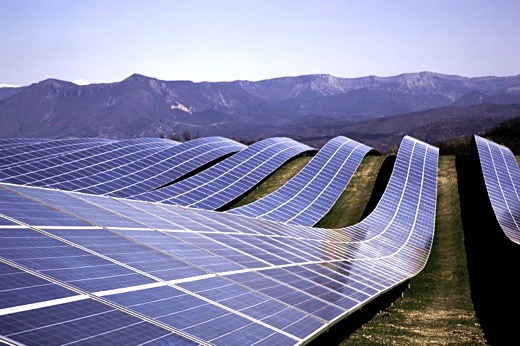
Image above: Last year, solar in Chile saw lowest global price for unsubsidized electricity by any technology. Source Bloomberg New Energy Finance. Credit BNEF New Energy Outlook 2017. From original article.

The staggering drop in the cost of clean energy has already upended the global power market over the past two decades — and that trend will only continue for the next two decades, according to new analysis from Bloomberg New Energy Finance (BNEF).

As a result, renewables will capture the lion’s share of the $10.2 trillion the world will invest in new power generation by 2040, BNEF projects in its annual New Energy Outlook 2017 report.

http://www.islandbreath.org/2017Year/06/170622chart1big.jpg
Image above: Charts of Investment by Technology 2017-2040. Source: Bllomberg New energy Finance. Credit: BNEF New Energy Outlook 2017 From original article. Click to enlarge.


Despite years of plummeting prices for renewables, BNEF projects that over the next two decades, the cost of solar power will still drop another two-thirds, onshore wind costs will be cut nearly in half, and offshore wind costs will drop a stunning 71 percent.

Here’s how this will profoundly transform power markets in the years ahead:
  • By 2023, solar and onshore wind will be competitive with new U.S. gas plants.
  • By 2028, solar will beat existing gas generation.
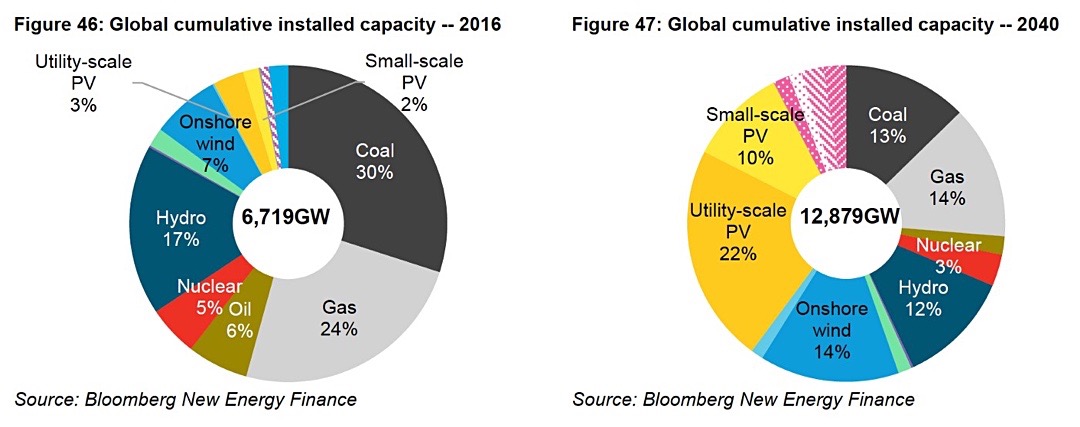
  • Solar and wind will make up nearly a half of installed capacity and over a third of global power generation by 2040. That’s a four-fold jump in wind capacity and a 14-fold jump in solar from today.
http://www.islandbreath.org/2017Year/06/170622chart2big.jpg
Image above: Charts of global cumulative installed capacity 2016 and 2040. Source: Bloomberg New energy Finance. Credit: BNEF New Energy Outlook 2017 From original article.


Deep penetration of renewables will be assisted by continued price drops in lithium-ion batteries and explosive growth in electric cars: “This will help renewable energy reach 74 percent penetration in Germany, 38 percent in the U.S., 55 percent in China, and 49 percent in India by 2040.”

BNEF concludes that despite President Donald Trump’s vocal support for the coal industry, “economic realities over the next two decades” work against it, and U.S. coal power generation is “forecast to see a 51 percent reduction in generation by 2040.”

Here’s another key conclusion: “Gas is a transition fuel, but not in the way most people think.” Other than in the Americas, where cheap gas is plentiful, gas plants won’t act as a replacement for “baseload coal,” but will “increasingly act as one of the flexible technologies needed to help meet peaks and provide system stability in an age of rising renewable generation,” BNEF predicts.

With total renewable investment over the next two decades projected to be $7.2 trillion versus $1.5 trillion for fossil fuel power, it’s clear where the biggest high wage job growth will come from.

.

We Are Still In!

SUBHEAD: Two reasons why this American climate alliance "We Are Still In" could save the world.

By Tegan Tallulah on 19 June 2017 for The Climate Lemon  -
(http://theclimatelemon.com/we-are-still-in-climate-coalition/)


Image above: Supporters of Paris Climate Accord gather to demonstrate on the Andy Warhol Bridge over the Allegheny River in down town Pittsburgh after Trump rejected world climate agreement. Pittsburgh continues its plan to power itself with 100% renewable energy by 2035. From original article.

There are many reasons why Donald Trump is dangerous. His egotism, his authoritarianism, his disregard for facts, his bigotry towards women, Muslims, Mexicans, disabled people… There’s quite a few contenders.

But arguably his most dangerous quality is his views on climate change. Because this is an area where he can damage the whole world, and that damage can reverberate for centuries.

Scary, huh? All through Trump’s campaign he promised to pull the USA out of the Paris Climate Deal, and sure enough, after a period of intense um-ing and ah-ing, he confirmed he would do so. Queue an impressive display of horror and condemnation from leaders around the world.

I was all prepared to be severely depressed about this, but then something amazing happened.
American business leaders, city mayors, state governors and university principals, stood up and said ‘no, we’re not going to put up with this shit’. (I’m not sure that’s a direct quote, I’m paraphrasing).

This unprecedented alliance – known as the ‘We Are Still In coalition’ has formed around support for the Paris Agreement and recognition that climate action is their obligation to the world, and is good for America anyway.

This is incredibly powerful, for two main reasons: the science and the symbolism. By that I mean the physical direct impact on the carbon emissions of America and the world, and the psychological, cultural and political impact that such a move has on the rest of the world, and the indirect climate effect of that.

But before we dive into these two main points, let’s just recap on why the USA’s response to climate change is so crucial for the world, and what this new American climate alliance actually is.

Quick note on why USA is so crucial to climate action

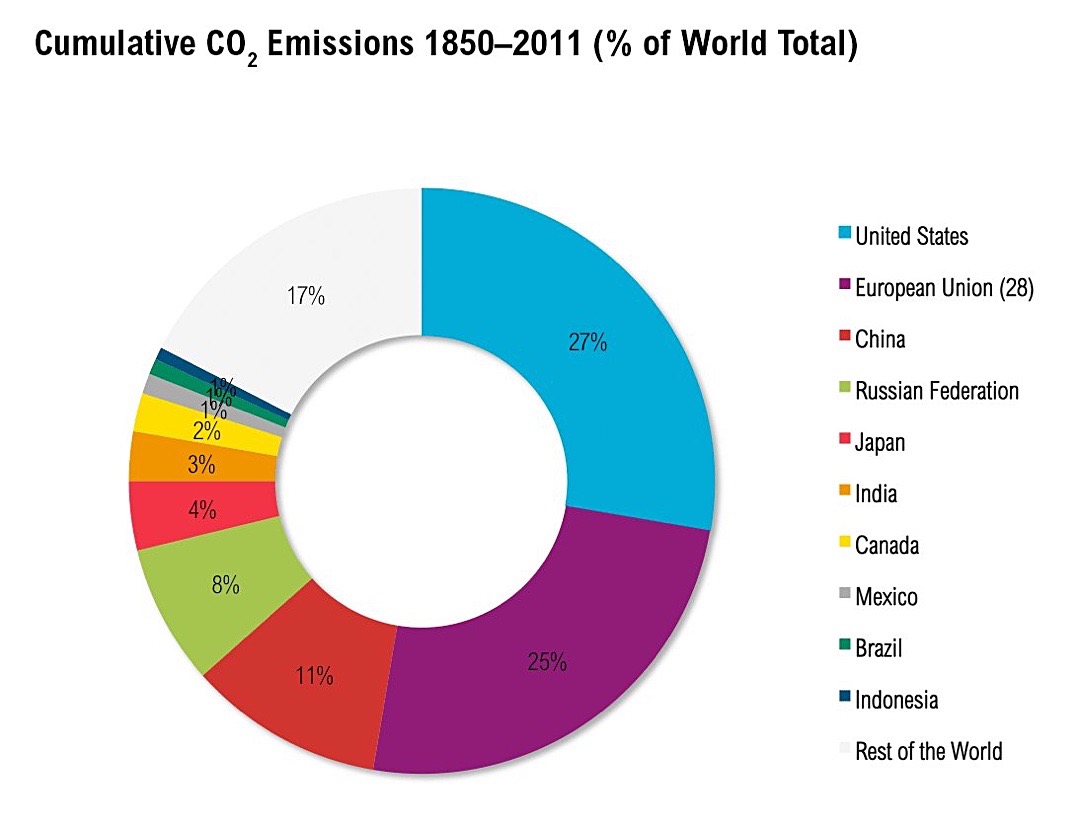
The USA has by far the biggest historical carbon emissions and one of the highest emissions per person in the world. This means they are one of the countries most responsible for causing this climate crisis. Quite frankly, it’s amoral to walk away from your responsibilities. If you make a mess, you should at least help clean it up.

Even if the USA wasn’t a heavy polluter, there would be a strong argument that they should be a key player in sorting out the mess anyway, just because they have the power to do so.

They are the richest country in the world and are routinely regarded as the most powerful, due to immense wealth and military might and ‘cultural power’ – a more fuzzy concept that includes everything from having the most UN diplomats to Hollywood movies dominating the global media market.

http://www.islandbreath.org/2017Year/06/170622piebig.jpg
Image above: Pie chart of percentage of cumulative CO2 emissions between 1850 and 2011 by country. From World Resource Institute (http://www.wri.org/blog/2014/11/6-graphs-explain-world%E2%80%99s-top-10-emitters). Click to enlarge.

http://www.islandbreath.org/2017Year/06/170622barbig.jpg
Image above: Bar chart of per person carbons emissions in metric tons of CO2 emissions in 2014 per person by country. From original article. This chart was adjusted from the 2011 data from the World Resource Institute (http://www.wri.org/blog/2014/11/6-graphs-explain-world%E2%80%99s-top-10-emitters). It separates countries in the European Union. Note, the United States past Canada in CO2 emissions per person. The world average is about what Britain's emissions are (less than a third of USA's. Click to enlarge. 

So what is the "We Are Still In" coalition?

The We Are Still In coalition is a loose voluntary group of city mayors, state governors, CEOs, investors and university principals who have signed a pledge, on behalf of their communities and organisations, and an open letter to the UN, stating that they are still committed to the Paris Agreement.

They have promised to use their respective powers to lead climate action in their communities and businesses, aiming to meet or exceed the USA’s commitments under the Paris Agreement. (Which by the way is a 26-28% cut in emissions compared to the 2005 level by 2025, and even under Obama they were likely to miss that target).

So who’s actually signed up? The pledge has 1219 signatories so far, and growing. This includes:
  • 9 states: California, Connecticut, Hawaii, New York, North Carolina, Oregon, Rhode Island, Virginia and Washington
  • 125 cities. Including Washington DC, New York City, Los Angeles, Chicago, Dallas, Pittsburgh…
  • 902 businesses and investors. Including Amazon, Apple, Google, Gap, Mars, Nike…
  • 183 universities and colleges.
You can check out the full list of signatories and their open letter here.

The cities and states represent 120 million Americans and a GDP of $6.2 trillion. The businesses together have combined revenue of $1.4 trillion.

This means 38% of the American population and at least 35% of their GDP is covered by this new alliance. If just the 9 states were a country, that country would be the fifth richest and sixth highest polluter in the world. So it’s a pretty big deal.

The philanthropist, business investor and former Mayor of New York Michael Bloomberg has been instrumental in coordinating this alliance, and he has even pledged to donate $15million from Bloomberg Philanthropies to the UN, to replace funding from Washington they’ll now miss out on thanks to Trump.

Although he’s certainly been a leader, it has also been a collaborative effort between 21 nonprofit groups, including C40 Cities, CDP (who I am starting a new job with next month!), WWF and others, who really pushed this forward.

The coalition wants to participate in the Paris Agreement, but there is currently no formal way for them to do so on America’s behalf, as it is an agreement between sovereign nations. However the Accord does call for ‘non-state actors’ to be involved. How this would work in practice is still being worked out.

The two big reasons why this is so incredible

Okay. Now into the real tofu and potatoes of this post. "Science" and "Symbolism"

The science

As this Alliance covers 38% of the American people and at least 35% of their GDP, they have significant power to influence the carbon emissions of the country. Due to the USA’s federal structure, states and cities have fairly extensive powers. The large companies have huge power through their supply chains.

However, even under Obama, the USA was not on track to meet its climate targets. With Trump’s hostile regressive stance and deregulation of pollution, it’s going to be even tougher to meet them.
But that doesn’t mean they can’t.

I’m fairly optimistic about their chances, as it looks like the hostility of the federal government is actually acting as an effective motivator to people who would have just sat back and done little otherwise. There really is a huge groundswell of support for the Paris Agreement emerging from the bottom up, and it’s not clear how far that momentum will go.

It’s difficult to estimate what percentage of the USA’s carbon emissions are represented in this coalition, because many of the members are overlapping – so you can’t just add up all their emissions. But the nine states alone represent 17% of USA emissions – and that’s without all the major cities and businesses outside of those states.

The symbolism

Direct cuts in carbon emissions are not even necessarily the most influential thing about the We Are Still In coalition. The symbolism is incredibly powerful. Here are cities, states and businesses directly defying Trump by saying: ‘You made the wrong decision. You do not speak for us. We are still in the Paris Agreement’.

The fact that Washington and New York were two key signatories will be a particular slap in the face for Trump. The small city of Pittsburgh is also notable because in his speech he declared ‘I was elected to represent Pittsburgh, not Paris’.

The mayor of Pittsburgh resented his city being used as an excuse like this, especially considering they already had a climate action plan to go 100% renewable powered. He publicly disagreed with the decision to leave the Paris Agreement, and joined the We Are Still In coalition instead.

The President also argued that climate action is bad for business and he would prioritise business. And what response did he get?

Tesla CEO Elon Musk and Disney CEO Bob Iger promptly quit his presidential advice council in protest. The ‘climate vs business’ position has become more discredited than ever, as over 900 businesses have joined the coalition.

Many of the most outspoken members are American-based tech giants, like Google, Apple and Amazon. They argue that in the short term, there are great business opportunities to be had from clean energy and greener products – and in the long term all business depends on a stable climate.

When Trump said he was going to exit the Paris Agreement, a real worry was that other countries would lose motivation and think ‘if the richest most powerful country, that has some of the highest emissions, is going to walk away, then there’s no point me doing anything.

Screw it, I’m out’. For some, that was an even bigger problem than the USA’s actual emissions. Because it posed the threat of unravelling the delicate international consensus that had been pieced together –finally, painfully- on this global issue.

Luckily, other national leaders were keen to reconfirm their support and to condemn Trump’s decision. (Even Kim Jong-un, who called the move “the height of egosim”, with zero self-awareness).
What this coalition does, is it assures the international community that America is still at the table. Even if the central government pulls out, America will still be informally committed to the Paris Agreement, through this broad and growing coalition.

Conclusion – Thank you America!

It’s imperative for the whole world’s future that America does not walk away from tackling climate change. Despite Trump’s damaging and regressive decision, it now looks like this will not be the case. Where the government steps down, leaders from local government, business and civil society will step up.

This has given me hope for the future. Thank you to everyone involved – thank you to the signatories, the organisers, and to all the everyday Americans who support it.
.

Security... or Surveillance?

SUBHEAD: Ron Paul interviews Edward Snowden on government threats to essential freedoms.

By James Holbrooks on 20 June 2017 for The AntiMedia -
(http://theantimedia.org/ron-paul-interviewing-edward-snowden/S)


Image above: Still frame of Ron Paul and Edward Snowden from video of interview below.
Saying that you don’t care about privacy because you have nothing to hide is no different than saying you don’t care about freedom of speech because you have nothing to say.”
That comment was made by famed whistleblower Edward Snowden during a recent interview on the Ron Paul Liberty Report. In his conversation with Dr. Paul and Daniel McAdams, published Tuesday, an articulate Snowden discusses the true meaning of freedom, the nature of the deep state, and even his upbringing as a child of a government family.

“I’d like to know a little bit, what do you do all day long?” a genuinely curious Dr. Paul asks as his opening question. After talking about the insanity that erupted — both in the political spectrum and his personal life — following the revelations he made back in 2013, Snowden says he’s now become a hot commodity for groups championing causes.
“They want me to sort of front for these issues of privacy and civil liberties and protection of people’s rights,” Snowden replies. “And I want to do what I can, but I’m not a politician. I’m an engineer.”
The whistleblower goes on to talk about how he’s now, at long last, finally able to devote time to more practical applications. For him, this means focusing on the area that holds the key to finding a balance between rights and laws in the digital age — technology.
“How technically is this even happening?” Snowden poses, digging straight to the heart of the issue of mass surveillance. “How is it that so many governments are spying on so many people? Because even if we pass the best legal reforms in the world in the United States, that doesn’t do anything against China, or Russia, or Germany, or France or Brazil or any other country in the world.”
Continuing, Snowden says that future generations’ rights and protections will be dependent on the current generation’s ability to adapt to a constantly shifting environment:
“We need to find new means, new mechanisms, for enforcing these rights in the new times. And I think that’s going to be primarily through science and technology.”
When Dr. Paul asks the former NSA contractor about his political affiliation, Snowden responds that he doesn’t associate himself with any faction and that as individuals, we’re more than tribes and labels. Proceeding, Snowden points to how technology has given humanity a means to have a global conversation on issues:
“I think the Internet produces a lot of people who look at these issues differently, in a less tribal way, because you hear more viewpoints. You hear from many more people. And the more people in a conversation, I think the more informed it often is.”
When co-host Daniel McAdams asks Snowden to comment on the idea of security vs. surveillance, the whistleblower again cuts straight to the core of the debate and speaks on the perception of freedom itself.

“What is liberty?” asks Snowden, and then points out that ten questions on the street would result in ten different answers. After stating his view that liberty is the “freedom of self” and the “freedom from permission,” Snowden goes on to say that true liberty is rooted in personal privacy:
“Privacy isn’t about something to hide, privacy is about something to protect. It’s about the ability to be you, to have a thought for yourself, to have a thing for yourself, to have some difference, to have some idea that’s new and untested and untried that you can sort of sharpen amongst those that you trust, and then introduce into the world, into that contest of ideas.”
Next, Dr. Paul asks his guest to comment on the topic of the deep state, which Snowden proceeds to describe as a “mass of government that survives beyond administration” that is “not responding to the politics of the people.” Snowden says this organism lives “across parties” and “across administrations.”

Continuing, Snowden equates the running of state policy to a game, one that favors those who get “better and better” at understanding the evolving rules:
“And eventually, the people who are the greatest experts at understanding and using these rules, the best bureaucrats, are not sitting in the White House, they’re not sitting in the Congress. Because those guys come and go as the years pass, and they win elections, and they lose elections, and it’s the people that sit there for 30 years or more, in these agencies, with their hand on the lever the whole time. And that’s what the deep state is.”
Snowden further states that party affiliation matters little with regard to this behind-the-scenes force and that any political faction in power will eventually “get to the point of saying yes when enough pressure is brought to bear.”

When Daniel McAdams next asks him about whether or not he thinks an agency such as the NSA should even exist, Snowden remarks on the irony of asking him that question — given that he’s a “product of the system” with familial ties to the United States government going back decades.

But the whistleblower presses forward following a question from Dr. Paul on whether or not he thinks any gains have been made from his 2013 revelations, stating that solutions come not from individuals alone, but from many of them who “lay down a single brick upon which others can build.”

Continuing in this vein, Snowden says progress in battling government violations of personal liberty is made in inches and should be accomplished organically:
“Step by step, working together, sharing our views, connecting our values, we can create spaces, more bricks, that when laid together create a defense of rights that can be relied upon, in even historic moments when law cannot be.”
In his final question to Snowden, Dr. Paul asks whether the former government contractor’s decision to sound the alarm was arrived at suddenly or through a gradual process. In response, Snowden links his own decision to the average human being, noting that everyone has a point at which nothing more can be tolerated:
“We all have a level, right, of this kind of cognitive dissonance that we can accept. A level of injustice, of inhumanity, of incivility that we can accept in the daily world, that we can sort of internalize and suppress. And then we have one step more.”

Video above: "Security or Surveillance? The Edward Snowden Interview" From (https://youtu.be/9XLLo0025Jc).

.

Illinois can no longer function

SUBHEAD: It enters third year without a budget, resulting in the state's imminent downgrade to junk status.

By Tyler Durden on 20 June 2017 for Zero Hedge -
(http://www.zerohedge.com/news/2017-06-20/illinois-comptroller-state-can-no-longer-function-we-have-reached-new-phase-crisis)


Image above: The seal of the State of Illinois with motto "State Sovereignty -National Union". From (https://commons.wikimedia.org/wiki/File:Seal_of_Illinois.svg).

With just 10 days to go until Illinois enters its third year without a budget, resulting in the state's imminent downgrade to junk status and potentially culminating in a default for the state whose unpaid bills now surpass $15 billion, Democratic Illinois Comptroller Susana Mendoza issued a warning to Illinois Governor Rauner and other elected officials on Tuesday, saying in a letter that her office has "very serious concerns" it may no longer be able to guarantee "timely and predictable payments" for some core services.

In the letter posted on her website, Mendoza who over the weekend warned that Illinois is "in massive crisis mode" and that "this is not a false alarm" said the state is "effectively hemorrhaging money" due to various court orders and laws that have left government spending roughly $600 million more a month than it's taking in.

Mendoza said her office will continue to make debt payments as required, but indicated that services most likely to be affected include long-term care, hospice and supportive living centers for seniors.

She added that managed care organizations that serve Medicaid recipients are owed more than $2.8 billion in overdue bills as of June 15th.

"The state can no longer function without a responsible and complete budget without severely impacting our core obligations and decimating services to the state's most in-need citizens," Mendoza wrote. "We must put our fiscal house in order. It is already too late. Action is needed now."

Unveiling the most dire language yet, in her letter Mendoza said "we are now reaching a new phase of crisis" perhaps in an attempt to prompt the Democrats and Republicans to sit down and come up with a compromise:
As Illinois’ Chief Fiscal and Accountability Officer, my Office is responsible for managing the state’s financial accounts as well as providing the public and the state’s elected leadership with objective and timely data concerning the state’s difficult fiscal condition. As you are quite aware, I have been very vocal regarding these issues and the budgetary impasse since assuming office six months ago; however we are now reaching a new phase of crisis.
She then addresses "the full extent of [Illinois'[ dire fiscal straits and the potential disruptions that we face in addressing even our most critical core responsibilities":
Accordingly, I must communicate to you at this time the full extent of our dire fiscal straits and the potential disruptions that we face in addressing even our most critical core responsibilities going forward into the new fiscal year.
My Office has very serious concerns that, in the coming weeks, the State of Illinois will no longer be able to guarantee timely and predictable payments in a number of areas that we have to date managed (albeit with extreme difficulty) despite an unpaid bill backlog in excess of $15 billion and growing rapidly.

The cause for alarm in America's most bananish state is well-known: living far beyond one's means, resulting in soaring deficits and the critical need for constant debt funding.
My cause for alarm is rooted in the increasing deficit spending combined with new and ongoing cash management demands stemming from decisions from state and federal courts, the latest being the class action lawsuit filed by advocates representing the Medicaid service population served by the state’s Managed Care Organizations (MCOs).

As of June 15th, the MCOs, and their provider networks, are owed a total of more than $2.8 billion in overdue bills at the Comptroller’s Office.
There is no question that these obligations should be paid in a more timely manner and that the payment delays caused by the state’s financial condition negatively impact the state’s healthcare infrastructure.

We are currently in court directed discussions to reach a workable and responsive payment schedule going forward, but any acceleration of the timing of those payments under the current circumstances will almost certainly affect the scheduling of other payments, regardless of other competing court orders and Illinois statutory mandates.

There was one silver lining: a default is not imminent, at least not in Mendoza's view, as the comptroller explained that "debt service payments will not be delayed or diminished going forward and I will use every statutory avenue or available resource to meet that commitment."
It is a necessary pledge in order to attempt to avoid further damage to our already stressed credit ratings and to make possible the additional debt financing that we all know will be required to achieve some measure of stability going forward.
And when "every available resource" runs out, that's when things get really bad.


Meanwhile, as the state's budget director warns of fire and brimstone, in a last ditch attempt to reach an agreement with the legislature, Illinois' Republican Gov. Bruce Rauner will deliver a brief address Tuesday night calling for unity as lawmakers prepare to return to Springfield for a special session, a move Democrats quickly dismissed as a political stunt.

The speech, which is closed to the press but expected to air live on 6 p.m. television newscasts, comes just days after Rauner launched a TV advertising blitz attacking Democratic House Speaker Michael Madigan, whom the governor has spent years vilifying as the source of the state's deep financial woes according to the Chicago Tribune. Democrats have long argued that Rauner's frequent political attacks do little to bring about common ground. The governor says political gamesmanship is part of being in public service but should not impact what happens at the Capitol.

Rauner will give his remarks at the Old State Capitol, where Abraham Lincoln gave his "House Divided" speech and Barack Obama kicked off his first White House run in 2007.

The speech will fall short.

Democratic governor candidate J.B. Pritzker called Rauner's address a "sham," saying Rauner "either doesn't have the slightest clue what unity is or just doesn't care." House Democrats called it laughable, saying if Rauner wanted to negotiate he would do it behind closed doors not in front of television cameras. "I find it tragically comedic that a governor who has done more to divide this state than probably any other governor in history is going to give a unity address," said Rep. Christian Mitchell, D-Chicago.

It's not just the Democrats: Republican lawmakers said they would vote for that tax plan, but only if the hike were limited to four years starting in July, and were tied to a four-year property tax freeze. The Senate Democrats' plan makes the tax hikes permanent and applies them retroactively to the beginning of 2017.

While Rauner is expected to talk about the need for unity and compromise, House GOP leader Jim Durkin said last week that Republicans expect "substantial compliance" from Democrats, warning that he would reject "reform light or anything that is significantly diluted."

Finally, in a harbringer of what's to come for the entire state, Bloomberg reports that Chicago’s junk-rated school system just went "no bid", and is paying bond-market penalties similar to those seen during the financial crisis.

The Chicago school district, slammed by the fallout from the Illinois budget gridlock, has been stuck paying punitive interest rates on $167.5 million of adjustable-rate bonds after PNC Capital Markets failed in March to resell the securities once previous owners sold them.

Remember the failure of Auction-Rate Securities just before all hell broke loose in 2008? Well, it's kinda like that.

The rate on the bonds, which are supposed to stay extremely low because investors can resell them to banks periodically, jumped to a maximum 9% on March 1 from 4.64% the week before and has stayed there ever since, according to data compiled by Bloomberg.
The spiraling interest bills are reminiscent of the chaos that erupted in the wake of the Lehman Brothers Holdings Inc.’s bankruptcy in 2008, when state and local governments were stung by soaring costs after investors sold the variable-rate securities en masse just as banks were scrambling to raise cash. In Chicago’s case, though, it reflects how skittish investors have become about holding the debt of the cash-strapped school system.
In another preview of what's coming once Illinois is junked, the school district agreed this week to pay a rate of 6.39% for a short-term $275 million loan from JPMorgan Chase & Co. to help make a pension payment and cover the cost of staying open through the end of the school year.

As we reported last week, the schools didn’t receive $215 million more in state aid to make the retirement-fund contribution after a measure was vetoed by Governor Bruce Rauner.

Illinois has failed to pass a budget for more than two years as the Republican governor and Democrat-led legislature battle over how to close the state’s chronic budget deficits.

"Chicago Public Schools has been unable to crate a fiscally responsible budget and it relies on outside sources that, as we see, sometimes comes through and sometimes don’t,” said Matt Dalton, chief executive officer of Rye Brook, New York-based Belle Haven Investments, which manages $6 billion of municipal bonds, including about $3 million of insured Chicago school debt.

“That’s unsettling investors."

Unfortunately, that's just the beginning, and once the state itself is junked, investors will be even more unsettled.

But the biggest insult and injury is to the near-insolvent state is that Illinois is facing a full-blown crisis just one day after chronic defaulter Argentina managed to pull off a 100 year bond offering, which was 3.5x oversubscribed.
.

Glyphosate harms gut enzyme

SUBHEAD: There are new claims against Monsanto in consumer lawsuit over Roundup herbicide.

By Carey Gillam on 20 June 2017 for Huffington Post -
(http://www.huffingtonpost.com/entry/new-claims-against-monsanto-in-consumer-lawsuit-over_us_59496379e4b0f500e5526088)


Image above: Store display of RoundUp for consumer use on home yards. From original article.

Another day, another lawsuit against global seed and chemical giant Monsanto Corporation. In a complaint filed Tuesday in federal court in Wisconsin, six consumers alleged that the company’s top-selling Roundup herbicide has been falsely promoted as uniquely safe when it actually can have profound harmful impacts on human gut bacteria critical to good health.

The lawsuit, which also names Roundup distributor Scotts Miracle-Gro Co. as a defendant, specifically alleges that consumers are being deceived by inaccurate and misleading statements made by Monsanto regarding glyphosate, the active weed-killing ingredient in Roundup.

Plaintiffs include residents of Wisconsin, Illinois, California, New York, New Jersey and Florida.

Glyphosate, which Monsanto introduced as an herbicide in 1974 and is widely used in growing food crops, has been promoted for years as a chemical that kills plants by targeting an enzyme that is not found in people or pets.

The lawsuit claims that assertion is false, however, and argues that research shows glyphosate can target an enzyme found in gut bacteria in people and animals, disrupting the immune system, digestion, and “even brain function.”

“Defendants repeat these false and misleading representations throughout their marketing, including in video advertisements produced for their websites and YouTube Channel,” states the lawsuit, which is filed in U.S. District Court for the Western District of Wisconsin.

Monsanto did not respond to a request for comment and neither did Scotts.

Monsanto is currently defending itself against nationwide claims that Roundup has caused hundreds of people to suffer from a type of blood cancer called non-Hodgkin lymphoma (NHL).

More than 1,100 plaintiffs have lawsuits pending in state and federal courts with many of the lawsuits combined in multidistrict litigation in federal court in San Francisco.

Those lawsuits were triggered by a 2015 decision by the World Health Organization’s International Agency for Research on Cancer (IARC) to classify glyphosate as a probable human carcinogen.

IARC said research showed an association between NHL and glyphosate, with limited evidence from epidemiology data collected on humans and stronger evidence seen in laboratory animals exposed to glyphosate.

The lawsuit filed in Wisconsin is markedly different from the Roundup cancer claims, though some of the same attorneys are involved in both lines of litigation.

Plaintiffs do not claim physical injury; rather they claim violations of trade and business practices laws, and allege Monsanto and Scotts were “unjustly enriched” as plaintiffs purchased and paid for more Roundup products than they would have in absence of the alleged false promotions.
.