Showing posts with label Financialization. Show all posts

Fligfht Path

SUBHEAD: The “wealth” acquired  by “one-percenters” was loaded onto a defective Boeing 737.

By James Kunstler on 17 April 2020 for Clusterfuck Nation -
(https://kunstler.com/clusterfuck-nation/flight-path/)


Image above: In 2013, a two-month-old Boeing 737-800, operated by LionAir, undershot the runway at Bali Airport, crashing into the water. Half the 108 passengers were injured. Luckily there were no fatalities. From (https://airwaysmag.com/industry/lion-air-boeing-737max8-crashes/).

This age of battling narratives tends to conceal the broken consensus behind it. What’s gone is a broad social agreement that there are certain fundamental realities, and then codes of conduct that follow from them. When anything goes, don’t expect people to do the right thing, or even know what it is.

The Covid-19 debacle presents just such a set of quandaries and puzzles. For many people stewing in quarantine, the virus is just another evil phantom lurking in the permanent twilight zone of television, and even there, among the familiar jabbering figments, there’s little agreement about it. The statistical projections mutate weekly.

 It’s no worse than any annual flu… It’s a savage illness that attacks every organ in the body, leaves survivors maimed, and you can even catch it again… The lockdowns are imperative… the lockdowns amount to economic suicide… There’s no sorting it all out, and the uncertainty itself is intolerable.

The only certainty is that most of the people in lockdown are going broke fast. By any ordinary rules, they are wiped out. They can’t even pretend anymore to keep juggling all those monthly payments for rent or mortgages, food, the cars, the medical insurance, the electricity, the cable, and on and on.

The $1200 mad money checks promised by Uncle Sam are little consolation for that, and the small business “loans” ­– if you can even jump through the infuriating hoops to get them – just pile on an additional layer of obligation in a lifetime of debt serfdom.

You don’t have to leap too many steps ahead mentally to imagine utter personal ruin on that glide path. And so what if millions of others are feeling squashed by the same phantom forces of disease and finance?

One firm reality is this: the global debt system that supported the turbo-charged global economy was disintegrating badly in the early fall of 2019, threatening every financial asset and the markets that affected to manage them ­­– and all the operations of modern daily life that they represented.

Nowhere on earth was the debt load more out-of-control than in China, where there were no constraints whatsoever on the banks’ accounting fraud, since they answered solely to the ruling party, which had but one overarching policy: to keep ruling.

And the biggest economic fiction of all was that China could maintain its supernatural growth rates in a world that had actually reached the limits of growth. Mr. Trump’s trade wars sent tremors through the system. A whole lot of bad loans were about to be flushed down the drain.

Banks everywhere else felt the vibrations, too, you may be sure. The Wuhan virus was, at least, a very convenient distraction from all that. And then, the darn thing got loose on countless airplane flights around the world.

The Covid-19 corona virus didn’t initiate the financial disorders of the moment in the US and Europe, but it ensured that there would not be another appearance of any “recovery” a la the central bank interventions of 2008-09.

What it portends is a fast-track journey to a whole new disposition of things: first, for a while, a harsher, hungrier, angrier society of broken promises and dashed expectations; and then adaptation when a consensus emerges that the set of facts at hand amount to a new reality. In the meantime, we’re living in the meantime, which is not a comfortable place.

Money is not an economy. Money is a medium of exchange within an economy where people grow things, make things, move things, and serve each other in countless ways. We’re not going to replace all those growings, makings, movings, and services by just giving people money.

Money may produce more money by the magic of compound interest, but money is not necessarily wealth, it just represents our ideas about wealth, and interest stops compounding anyway when the trend is clearly for reduced growings, makings, movings, and servicings. That’s exactly how and why capital vanishes.

The hocus-pocus of Modern Monetary Theory can only pretend to work around that reality.

The world never reached such a pitch of activity up to the blow-ups of 2008, and it went through the motions for a decade after that. Now that it’s stopped, all that’s left is the law of gravity, and it doesn’t get more basic.

The “wealth” acquired in the decade since by the so-called “one-percent” was loaded onto a defective aircraft, like a Boeing 737-MAX, and an awful lot of it will fall to earth now on broken wings. Their agents and praetorians on Wall Street are working feverishly to stave off that crash-landing, like a band of magicians casting spells on the ground while that big hunk of juddering metal augers earthward.

Wait for it as spring brings new life across the land and things unseen before steal onto the scene.

.

Dreams Die Hard

SUBHEAD: The world changes and sometimes profoundly enough to provoke flux and disorder.

By James Kunstler on 8 February 2019 for Kunstler.com-
(http://kunstler.com/clusterfuck-nation/dreams-die-hard/)


Image above: Still-frame of Alexandria Ortise-Cortez on MSNBC show MTP-Daily. From (https://www.msnbc.com/mtp-daily/watch/aoc-can-you-be-a-democratic-socialist-and-a-capitalist-it-s-possible-1439125059571).

Somewhere between the fevered Zzzz’s of American Dreaming and the blinding shock of being “woke,” there is a recognition that an awful lot about contemporary life is not working and can’t go on.

At the bottom of this discontent is the mistaken notion that the unwind of modernity can be arrested or mitigated by “smart” and “green” this-and-that.

The disappointment over it will be epic when we discover that the laws of physics override the bright ideas of politicians.

America has been blowing green smoke up its own ass for years, promoting oxymorons such as “green skyscrapers” and “clean energy,” but the truth is we’re not going to run WalMart, Suburbia, DisneyWorld, and the U.S. Interstate highway system on any combination of wind, solar, geothermal, recycled Fry-Max, and dark matter.

We’re just running too much stuff at too great a scale for too many people. We’ve blown through the capital already and replaced it with IOUs that will never be honored, and we’re caught in an entropy trap of diminishing returns from all the work-arounds we’re desperately trying.

For all that, there are actually some sound proposals in the mostly delusional matrix of the Green New Deal promoted by foxy front-person "AOC", Alexandria Ocasio-Cortez .
  • Revoke corporate personhood by amending our Constitution to make clear that corporations are not persons and money is not speech.
    Right on, I say, though they have not quite articulated the argument which is that corporations, unlike persons, have no vested allegiance to the public interest, but rather a legal obligation solely to shareholders and their boards-of-directors.
  •  
  • Replace partisan oversight of elections with non-partisan election commissions.     
    A no-brainer
  •  
  • Replace big money control of election campaigns with full public financing and free and equal access to the airwaves.  
    Quite cheap and worth every penny. 

  • Break up the oversized banks that are “too big to fail.”
    And while you’re at it, resume enforcement of the anti-trust laws. 

  • Restore the Glass-Steagall separation of depository commercial banks from speculative investment banks.
    Duh….
Of course, a lot of the proposals above may be obviated when the money system we’ve been using, and its subsidiaries in markets, blows up, taking much of the world’s notional wealth with it, along with our hopes and dreams for replacing the fossil fuel economy with “Green technology.”

The Green New Deal may be an exercise in throwing spaghetti against the wall to see what sticks, so let’s just assume that a lot of the “social justice” pander-jive in it will slide down the wall onto the floor and make its way to the dumpster.

Stuff like: “the right to full employment” (there is no such right), Free college and medicine (doesn’t pencil out with our capital gone, though the current odious rackets must go), “ending the war on immigrants” (how about ending the Democratic Party’s war on enforcing immigration laws?) (IB Publisher's 

There are two kinds of deadly narcissism at work in American culture these days: techno-narcissism — the belief that magical rescue remedies can save the status quo of comforts and conveniences — and organizational narcissism — the belief that any number of committees can lead a march of humanity into a future of rainbows and unicorns.

Both of these ideas are artifacts of a fossil fuel turbo-charged economy that is coming to an end.

Societies and economies are fundamentally emergent, non-linear, and self-organizing as they respond to the mandates of reality — which are not necessarily consistent with human wishes.

Circumstances in the world change and sometimes, when the changes are profound enough, they provoke episodes of flux and disorder.

A better index for our journey into the unknown frontier beyond modernity will not be what is “green” and “smart” but perhaps what is “sane” and “insane.”

.

The Scenarios of the Collapse

SUBHEAD: It would be wise to start making contingency plans. Something ‘biblical’ is approaching.

By Tuomas Malinen on 11 January 2019 for GNS Economics  -
(https://gnseconomics.com/en_US/2019/01/11/the-scenarios-of-the-collapse/)


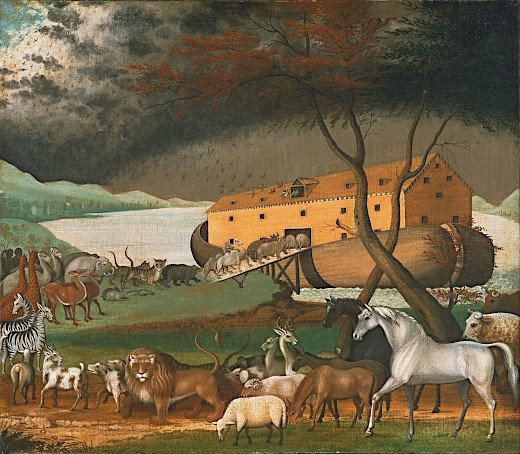
Image above: Painting of  "Noah's Ark" (1846) by American painter Edward Hicks. From (https://en.wikipedia.org/wiki/Noah%27s_Ark).

2019 has started more calmly after a very volatile year-end in the markets. Focus has been on the trade deal between China and the US and the words of the central bankers, most notably those of Jay Powell. However, this is all just a distraction, a side-show.

The market volatility was only the first sign of an approaching global economic crisis, as we warned in December 2017.

As the recent PMI figures across the globe show, a global downturn has started and the world is utterly unprepared for it. The global imbalances that have been growing for years cannot lead to anything else than a global crisis . However, there are different paths the crisis could take.

Here, we present three scenarios that the global economy is likely to follow, when the global downturn morphs into something much more sinister. We’ll start with the most likely scenario: Global Depression.

Scenario I: Global Depression

In a depression, everything that has been driven the economic expansion goes into reverse. Asset markets experience severe contraction (in excess of 50 percent), credit becomes restricted, corporations and households de-lever fiercely, and global trade flows stall (for more details see Q-review 2/2018). Gross Domestic Production (GDP) falls dramatically, between 10 to 25 percent.

Unemployment skyrockets. The standard means of stimulus by central banks (CBs) and governments are exhausted without any notable improvement in the economic environment.

The implosion of the current asset bubble will start a relentless unwinding of leverage and risk in the global financial system. Because major CBs are still “all-in” with rates pinned at or near historic lows, and balance sheets bloated to extreme levels, their ability to respond will be highly restricted.

Governments are also highly-indebted, and when interest rates rise, some sovereigns are likely to default, aggravating the global banking crisis, which will probably be in motion already. Combined with the zombified global business sector and a hard landing in China, these factors will lead the world economy into a depression.

However, a possibility of something even more ominous is lurking in the background.

Scenario II: Systemic Meltdown

Systemic crisis would mean that the global financial melts down due to an existential deficit of trust between counterparties within the system. Before 2008, a systemic meltdown was mostly a theoretical construct.

However, in mid-October in 2008, global leaders were faced with the possibility that banks would not open on Monday. The inter-bank markets had frozen, because no one knew the amount of the losses banks carried on their books.

The global financial system was grinding to a halt. Politicians and central bankers saved the day by guaranteeing bank deposits and by providing capital and extraordinary guarantees to keep the important financial institutions standing and credit flowing.

Now the problem is that many of these measures are already in play and when the next crisis hits, the solvency of governments and CBs will also be in question.

This creates a perilous situation because, for example, the shares of the Global Systemically Important Banks have been falling since the beginning of last year, which was also the time when the balance sheet normalization (QT) program of the Fed kicked into full gear.

This is no coincidence and it implies that troubles are, once again, brewing in the banking sector.

Because a crash in the asset values would affect the collateral of banks and because global depression would lead to a massive increase in loan losses, the already-impaired banking sector could, again, face collapse.

However, this time around, there is very little authorities can do to stem the panic. These factors make the systemic meltdown an ominously-likely scenario.

Systemic meltdown would mean that all banking actions, distribution of money, loans, swaps, banking services, etc., through the banking sector would stop. Credit cards would cease to function, ATMs would not give out money and loans could not be originated or rolled-over.

Following the likely collapse of global trade, the world economy would also collapse. This would imply that the global GDP would experience a harrowing fall of 20 to 40 percent. Modern societies would cease to exist in their current form.

Scenario III: The Fairy Tale

Could this all be averted somehow? We’ve been pondering this for two years now, and our resounding answer is no. The leverage in the system usually results in a crash at some point, and asset bubbles very rarely deflate in a controlled manner.

However, CBs can probably still postpone the inevitable, if they could re-start Quantitative Easing (QE) programs or find some other way to push artificial central bank liquidity into the financial markets.

To soften the eventual blow, and as an extremely desperate measure, central banks could, at least in theory, engage in a “QE-squared”. In it, major central banks would buy a hefty chunk of global risk assets, estimated to total $400 trillion.

This would mean that the balance sheet of major Central Banks would need to expand at least five-fold from the current level of approximately $20 trillion.

To cover the crippling losses to their collective balance sheets that these purchases would be likely to inflict, they would need to use their money-printing ability to paper them over.

CBs earn seigniorage-revenue from all the money they create. This is the difference between the nominal value and the production costs of the money.

Because production costs of digital entries are very close to zero, the seigniorage revenue CBs receive from each entry is close to 1-to-1. Still, this would mean that they would need to create new money in the range of tens of trillions of US dollars.

By comparison, in 2017, the global nominal GDP of the world was approximately $75 trillion.

To distribute such incomprehensible sums of new money, CBs would need to give it directly to consumers and governments.

Even in normal circumstances, the production side of the economy would be unlikely to be able to respond to such a massive increase in (artificially created) demand, and this time there would have been wide-spread corporate bankruptcies driven by global depression.

A hyper-inflation would be likely to follow.

There’s also the alternative that CBs would make a complete U-turn and continue to backstop market losses.

This would be the “way of Japan”, where the BoJ already owns over 40% of the sovereign bond universe. It would eventually mean the effective nationalization of capital markets which would continue to function in name only.

We have no historical experience with what the expropriation of modern capital markets would cause.

However, it would be unlikely to be anything good as capital markets have been around for several centuries, and they are extremely important in allocating financial capital efficiently. If CBs take a permanent active role in the capital markets, it would lead to financial market socialism.

 It would be likely to bring similar horrors as regular socialism in the form of lost incentives (breaking down of the risk-reward relationship) and inflated asset values.

It is unlikely that global central bankers would be willing, or that they would be allowed, to do so.

The Endgame Nears


The global balance sheet of CBs turned in August 2018. This marks the start of global QT and thus the end of the most reckless monetary policy experiment in history.

When this is combined with the slow-down in China, the engine of the world economy since 2008,  we have finally entered the endgame of at the current business cycle.

The desperate measures of central bankers and China enacted after the financial crisis have pushed the global debt and financial alchemy to never-seen heights.

The global financial system has become rigged with leverage, moral hazard and regulatory failures to a point where a “purge” has become all-but-impossible to avoid. This is the end.

Still, every company, household and government should start to make contingency plans. Something ‘biblical’ is approaching.

.

Farewell to Bargain Shopping

SUBHEAD: Perhaps Generations X, Y & Z will recognize an opportunity to go into business.

By James Kunstler on 7 January 2019 for Kunstler.com -
(http://kunstler.com/clusterfuck-nation/a-farewell-to-bargain-shopping/)


Image above: Photo image of K-Mart closing announcement by James Kunstler from original article.

[IB Publisher's note. Mr. Kunstler nailed it today! His humor is that of the grave, but it still amuses as it stings. Our little island of Kauai The Macy's is barely hanging on at the Kukui Grove Mall but our only mall has lost its Sears and K-Mart as well as Border's Books, Sports Authority, and a host of other national chains.The Walmart has hung on in Lihue but is quickly morphing intoi a competitor to Costco with an ever larger percentage of grocery floor space - Besides economy of size Costco seems to be aiming for the connoisseurs, restaurateurs and foodies - while Walmart is trolling for everyone else, including elderly, handicapped, and bottom feeders.We do much of our shopping through Azazon and are just waiting for CEO Jeff Bezos to buy the US Postal Service to stay in business.  Fortunately we still have a Home Depot to keep our homes intact, but that will likely disappear when new home building grinds to a halt. All those stores are a 30 minute (if your lucky) drive from here in Hanapepe. Thank god we still hava a Napa Auto Supply and Ace Hardware with walking distance. Hunker down folks. We have visited Jim Kunster's town outside of Albany, NY. and found it much like our former home in Panama, NY where you coulkd noit buy a can of soup or quart of milk without half an hour in a car.]

France has its Yellow Vests. Here in USA, we have a few poor shlubs hoisting the “Going Out of Business” signs on the highway in front of the K-Mart.

The store in my little flyover town in upstate New York announced that it would shutter in March, and the sign-hoisting shlubs appeared out on Route 29 the first Saturday in January, an apt kick-off to a nervous new year.

K-Mart’s parent company, Sears, is moving into liquidation, meaning anything that’s not nailed down must be converted into cash to pay off its creditors.

The store’s closing is viewed as both an injury and an insult to the town.

There just isn’t anywhere else to buy a long list of ordinary goods, from dish-towels to tennis balls without a 17-mile journey west, which means an hour behind the wheel coming-and-going, plus whatever time you spend picking stuff up inside.

And, of course, many people in town feel that this is just another way of Wall Street saying “…you deplorable, pathetic, tapped-out, drug-addled, tattoo-bedizened yokels are not worthy of a K-Mart….”

The K-Mart occupied the better part of a small strip mall at the edge of town, which also boasts a Dollar Store, which appears to sell stuff that fell off a truck.

There’s another, newer strip mall beyond it with a supermarket, a drug store, and a Tractor Supply outlet that probably stole a lot of K-Mart’s business after opening a few years ago.

There’s much speculation about what’ll go into Kmart’s soon-to-be vacant space, about 80,000 square feet of crappy tilt-up construction not far from the end of its design life, with a flat roof that has groaned under heavy snow loads for four decades. Nobody I talked to has a clue.

Probably not Neiman Marcus, for starters. I’m thinking: maybe an evangelical roller rink. It’s too big for a wig shop, or a motorcycle thug-wear boutique, the usual bottom-feeders in the declension of commercial collapse.

More likely, nothing will replace it. The national chain retail model has fallen apart, along with new car sales. Something is up in this foundering land, despite all the heraldic trumpet blasts on cable news about the “booming economy.”

What’s up is the international implosion of the bad debt, and the fading illusion that it doesn’t matter. It has any number of ways to express itself, from store closings, to dissolving pensions, to stock market instability, to divorce, homelessness, and war.

It’s what you get from a hyper-financialized economy that doesn’t really produce wealth but only steals it from somewhere else. It’s not the fault of “capitalism,” which, in theory just stands for the management of a society’s savings. America doesn’t save, it borrows.

Zero interest rates made savings a mug’s game, and zero interest rates were necessary to extend the borrowing far beyond the credible boundaries of repayment. Debt isn’t capital, it just pretends to be for a period of time. Wall Street made its trillions off the time-value of that pretense and now time is up.

Even in the hardship economy we’re sailing into, people will need to buy and sell things and it is very hard to see how that fundamental process of exchange might be reorganized going forward.

Back in the 1990s I attended many a town meeting (in many towns) where chain stores applied for permits to set-up operations. It was often contentious. There was always a contingent of locals — organized by the chains themselves — waving placards that said “We Want Bargain Shopping.”

And there were the short-sighted town officials drooling over the real estate tax “ratables” that chain stores represented. Their adversaries feared that their locally-owned Main Street businesses would be killed, and that was exactly what happened, in very short order.

You could see it coming from a thousand miles away. Now the Big Boxes are going down. Boo Hoo….

What will emerge out of the current disorder? Perhaps Generations X-Y-and-Z will recognize an opportunity to go into business — as an alternative to purchasing a degree in gender studies for $200,000 (at 6 percent interest).

There will be lots of opportunities, even in a world with generally less shopping.

 But it may require a deeper collapse to sweep away the impediments, both practical and mental, before that awareness turns to action.


.

Predictions for 2019

SUBHEAD: "Ding Ding! - Margin Call USA". Reality is about to bite us in the ass.

By James Kunstler on 31 December 2018 for Kunstler.com -
(http://kunstler.com/clusterfuck-nation/forecast-2019-ding-ding-margin-call-usa/)


Image above: The Greenleaf subdivision near Dawsonville Georgia was abandoned several years ago after it was found to be at the center of a mortgage fraud scheme. The developers knew the project was doomed from the start, as there were no public sewer lines anywhere in the area they could hook up to, and the lots were too small for septic tanks.From (https://imgur.com/gallery/G6SIf).

[IB Publisher's note: Two books published in 2005 transformed my understanding of the real world. The books were Jared Diamond's "Collapse" and James Kunstler's "The Long Emergency".Both identified the mortality and suicidal tendencies of human civilization. Together they provoked a reevaluation of my understanding of how the world works and our future in it. I am indebted to their clear thinking. Over time I came to personally know Kunstler. My wife Linda and I visited him twice in upstate New York. I even worked briefly with his agent on a movie proposal for his novel "World Made By Hand" (2008) that describes the unwinding and aftermath of a collapse of America as we know it. Over subsequent years we have kept in touch. I realized our thinking was wandering apart over our differences of opinion about the TV series "Treme" that premiered in 2010. "Treme" follows the lives of people in the Ninth Ward of New Orleans in the aftermath of hurricane Katrina. Many of the primary characters were black and/or female. Kunstler could not "get" the show at all. He could not getr through half the premier episode because it seemed to him incoherent and foreign - a zombie apocalypse. Since then I have come to realize Kunstler holds a resentment that many white male Baby-Boomers about increasing emergence of women and black people into positions of American privileges. Did they earn it? Did George Bush? Anyway, with that caution in mind I continue to read Kunstler with a bit of caution. I think he is still spot-on in his understanding of money and energy - the grease on the gears of Western Civilization. This post is an excerpt from his predictions for 2019, hopefully less the white male screed. Happy New Year!]   

Markets and Money
The jig is really up. The big bad bear market is already underway, even if it rallies in January. The debt bubble engineered by the Federal Reserve is blowing up and thundering through the system.

The epic market instability of December 2018 on the heels of persistent Fed rate hikes points to major credit problems and especially an inability to roll over old debt into new loans at higher interest rates — in particular loans to zombie enterprises that need to borrow to keep paying interest on previous loans (a lot of that among the shale oil companies).

The US government can’t take higher interest rates either. It’s already paying about as much in annual interest on US debt as we pay for our war machine. There are only two ways out, both of them nasty.

Either suck up debt defaults, which will induce an impoverishing disappearance of money; or provoke high inflation, by injecting more Central Bank QE “money” into the system, which can destroy the value of money.

Inflation is typically the choice of governments because it reduces the face value of debts while it allows government to pretend that it is taking action.

In the end, you may have plenty of worthless money, which is no different from having not enough money that retains value. The latter was the main feature of the Great Depression.

So, inflation is the usual choice, but it also typically leads to incendiary resentment among the citizenry when they realize they’ve been played and it takes a wheelbarrow full of cash to buy a loaf of bread and a jar of peanut butter.

I suppose that Fed chief Jerome Powell knows all too well he’s popped the Mother-of-All-Bubbles. He can blame it on Mr. Trump. Everybody else will, of course.

Sometime in the second quarter of 2019, the Fed will resume the money-for-nothing gambit of “quantitative easing” in the hope of arresting the damage, but this time the dollar will lose value uncontrollably and catastrophically. Many people will be ruined, especially retirees at the mercy of insolvent pension funds.

Before 2019 is out, the US could find itself in a situation worse than the Great Depression. Supply lines are much longer now than they were then.

If suppliers can’t get paid because trust has collapsed in the short-term corporate paper system, they won’t deliver supplies, which means you may not eat, or fill your gas tank, or heat your house, or get whatever else you need.

Also, the USA in 1931 had not yet transformed itself into the fiasco-waiting-to-happen called suburban sprawl. How is Dallas going to work for people who spend a substantial chunk of their income on mandatory motoring (if there’s little or no income)?

Stock market activity may appear to stabilize in January, but it will go south again later on in the first quarter and the Bear will growl louder for the rest of the year.

Civil Disorder
Be prepared for it in 2019. There are going to be a lot of pissed-off people around the country. They are liable to attack Federal property and their fellow citizens (and their property).

The hungrier they are, the worse it will be. They will not understand the forces that are destroying the money system.

There are a gazillion small arms out there and the government will not be able to control them or confiscate them. Any attempt to do that will only inflame the situation.

A major principle of The Long Emergency is that government becomes increasingly impotent and ineffectual as it rolls out. We’re already seeing that in Washington, and it is not at all just because Mr. Trump has inspired such an impasse between the branches. The states, too, will be hard-pressed to do anything useful.

Many of them, like Illinois, New Jersey, Connecticut, and California, are already technically insolvent. The federal government may have to pretend to rescue them financially, which will only make the national predicament worse.

Oil
The shale oil “miracle” was an impressive stunt. For a while, it goosed US production way above the former all-time production peak of 1970, and it achieved that with astounding speed — about a decade. But this is oil that is very expensive and complex to produce. It was made possible by massive borrowing at artificial low interest rates, which are now rising.

Something like three-quarters of the shale operators never made a red cent in net profit, and many of these companies will find it hard or impossible to roll over their existing debt, especially with oil under $50-a-barrel.

But the price is a deceptive metric. If it zoomed up to $100-a-barrel tomorrow, the effect would only be to crush economic activity, because industry requires cheaper oil to pencil out its operations and citizens can barely afford to drive when gasoline hits $4-a-gallon at the pump.

At the lower $45-a-barrel, the price crushes the oil producers. Take your pick. There’s no “Goldilocks” price.

The other problems with shale oil have to do with the nature of the shale plays. The Permian Basin in Texas is very large, but the best plays are developed in the so-called “sweet spots” and there’s a limited amount of them.

They are the places that the producers developed first, and when they are played out, the next round of plays will be in spots not-so-sweet (or productive) — possibly not worth drilling. The character of the shale oil wells is also way different from the old conventional classic oil wells. The old wells cost about $400,000 (in current dollars). It involved just sinking a pipe into the permeable source rock.

The oil came out under its own pressure at the rate of thousands of barrels a day.  Eventually, you put a simple pump-jack on the well (the “nodding donkey”) and it produced for decades, like running a cash register. Shale oil wells cost between $6- 12 million.

They require technically demanding horizontal drilling and fracking, with additional costs in highly technical labor, water for fracking, sand to hold open the fracks, chemicals to aid the process, and a gazillion truck trips to deliver all the water and sand (and take the oil away).

Shale wells produce maybe a few hundred barrels a day for one year, after which they typically deplete by over 60 percent.

After four years, they’re done. The oil is also different. Shale oil is typically ultra-light. It contains little-to-none of the heavier diesel, kerosene, jet fuel, and heating oil distillates, making it less valuable.

Trouble in the credit markets could shut down shale production for a period of time and create dire problems for the American economy. That could happen in 2019 as poorer-performing companies fail to get new financing.

As mighty as it seems to be, the industry is fraught with fragility.

Meanwhile, discovery of new, producible oil has fallen to the lowest level since the 1940s, after three recent previous record low years. Current low oil prices at around $45-a-barrel may give Americans a false sense of security.

Low prices are mostly indicative of the collapse of the demand for oil at the global margins and among the large US demographic that cannot afford it anymore — that is, the impoverished former middle class.

As the damage becomes more obvious, we could hear calls to nationalize the oil industry. The attempt to do that would collide with the aforementioned trend for government to become more strapped  for revenue, more impotent, and more incompetent.

Geopolitical
The Golden Golem has gone an extra mile to antagonize Russia the past two years. Is it to demonstrate how not Putin’s puppet he is? If so, it’s pathetic.

For instance, heaping ever more sanctions on Russia, tossing Russian diplomatic staff out of the country because of the laughable Novichok poisoning of the Skripal father-and-daughter in Britain. Nobody believed that set up — who recovers from the world’s supposedly most potent, high-tech military toxin?

The larger Russia hysteria, ginned up by the US “Intel Community” to cover the embarrassment of Hillary Clinton’s election loss, has destroyed the brains of thousands of Washington insiders and infected whole sectors of the educated coastal elites who really ought to know better.

Meddling in elections? Is that something the US has never entertained?

Recall that 1996 Time Magazine cover with the headline that bragged, “Yanks to the Rescue: the Secret Story of How American Advisors Helped Yeltsin Win.”

And now we’re wetting our pants over a baker’s dozen Russian Internet trolls on Facebook?

Yes, this is what the brightest people in the room have been doing for two years. The net result is a new cold war, pushing Russia into the arms of China, giving both of those countries an incentive to construct a new framework for global relations that excludes the toxic US as much as possible.

That new framework, by the way, will not be the same as the late, unwinding Globalism Release 2.0 (Release 1.0 was 1870 – 1914) that allowed America to exchange IOUs for flatscreen TVs lo these many years. Let’s call that Tom Friedman Globalism, after the pundit who said it would last forever.

The world will become a wider place again as the Great Powers are increasingly bound to their own regions for trade relations in a world growing short of energy and capital resources. The exception to that is in weaponry, now that Russia has demonstrated its ability to launch hypersonic rockets that can reach the US in little more than a few Noo Yawk minutes.

Do we have anything like that?

I suppose we wish we did. The media is not even talking about it, the implications are so dreadful.

Has Mr. Trump actually accomplished anything with his deal-seeking in China while beating it on the snout with his tariff stick?

Well, he got a lot of US companies loading up on inventory of goods they feared will carry costly duties a year hence, so they’re all stocked up just in time for a vicious bear market and the recession / depression that it entails. A lot of that stuff may end up being distributed by the bankruptcy judges.

How does our antagonism against China work with the campaign to “normalize” the behavior of North Korea. I doubt it helps. In 2019, North Korea will be the whoopie cushion that China places under America’s seat at the negotiating table.

Mr. Trump defied the conventional State Department wisdom by meeting face-to-face with Kim. It got the two Koreas actually speaking with each other for the first time in 60 years, with some concrete steps toward ending the de facto state-of-war.

Will Li’l Kim play the role China assigns to him? I think so. They can squash him like bug. And, of course, everything that the US congress and Mr. Mueller do to injure and weaken Mr. Trump will make further progress in Korea unlikely.

How about the second greatest economy in the world? That would be the European Union.

The EU’s financial system is way more dysfunctional than even ours, with no mechanism or provision for regulating each country’s spending vis-à-vis the debt generation of the Union as a whole.

There’s no way it can continue and no prospect for debugging the set-up. What’s more, decades-long shenanigans of the European Central Bank have created imbalances that will never be corrected.

Even the attempt to normalize operations — as the ECB ceases its debt monetization routines starting in the first quarter of 2019 — is guaranteed to crack up the EU economy, which is a horror show of zombie companies and zombie banks. They will suffer particularly in the recession / depression to come.

The next domino to fall, theoretically Italy, will take the EU down, whatever happens with the dithering over Brexit. Without the ECB vacuuming up unwanted EU paper, nothing really pencils out over there. In 2019, expect a substantial fall in the value of the Euro, and possibly its demise as a currency.

In fact, expect wholesale disintegration of many structural arrangements all over Europe beginning in 2019, along with more political violence that exceeds the simple street actions of the Yellow Vests in France.

NATO has been staging war games on Russia’s border for two years, apparently with no awareness that the NATO members are deeply dependent on Russian oil and natural gas to remain advanced nations with comforts and conveniences, like heating their homes. Perhaps that recognition will hit in 2019. But there will be plenty of noise for that signal to cut through.

Climate Change
Something’s going on ‘out there’ though the picture is deeply non-linear and is being confused for the moment by an extraordinary low level of cyclical sunspot activity. Not being a scientist, I have only two salient points worth considering about the issue:

The first is, we’re not going to do anything about it — because nothing can be done about it. Whatever’s happening, we’re going to have to roll with it. I’m also not persuaded that many of the proposed mitigations — carbon taxes, seeding the upper atmosphere with reflective particles — will accomplish anything.

The second thought is this: the civilized world has experienced many many instances of climate change over the past several thousand years. Civilizations rise and fall with these changes, but the human project as a more general matter continues, with periods of history that appear to be restful time-outs.

The Roman Optimum (warming period) segued into the Dark Age Cooling, and then the Medieval Warming (viniculture in England!), and eventually the Little Ice Age comes along with Isaac Newton and skaters on the Dutch canals.

 The difference this time is that our civilization is so deeply complex that successful adaptation to new conditions is a low percentage outcome, at least in the form of salvaging many of our current arrangements.

In other climate disruptions, people adapted, sometimes with very severe changes in customs, practices, political arrangements, and life-styles.

It will be especially stark this time, and the broad pop culture of Collapse suggests that we intuit this — everything from Game of Thrones to The Road, to my own World Made By Hand novels.

It begins with the wobbling of the most abstract and fragile of our systemic arrangements, finance, which is mostly based on ephemeral trust (that the other fellow will pay you).

From there, the trouble proceeds to politics and culture.

[IB Publisher's postscript: And that is the most optimistic view possible. I personally think we are closer to extinction than that. As a reminder see this 2011 "Scientific American" article One Time Through the Bottleneck - "Almost 200,000 years ago humans faced extinction. Only a few hundred were saved along the coast of Cape Horn"].  Happy New Year!


.

Three Deprivation Narratives

SUBHEAD: I’d like to think that it possible for everyone to have safe and comfortable shelter.

By Chris Smaje on 7 October 2018 for Small Farm Future -
(https://smallfarmfuture.org.uk/2018/10/three-deprivation-narratives/)


Image above: Poster from 1974 showing peasant life in rural China titled "Reporting to Chairman Mao". From (https://chineseposters.net/posters/e13-451.php).

I’ve been reading Lynn T. White’s book Rural Roots of Reform Before China’s Conservative Change (Routledge, 2018). I couldn’t honestly recommend it as a light bedtime read, but it’s absolutely fascinating nonetheless.

Here I just want to reflect on the case of a rural migrant mentioned by White thus:
“A twenty-five-year-old legal migrant from Henan to Suzhou explained in 1994 why he was so much more productive on the delta: “We used to spend three months doing farm work, one month celebrating the Spring Festival, and eight months in idle time every year.”
Now he was a restaurant waiter, working fourteen hours each day, seven days a week – but receiving 400 yuan (about US$50 a month, which was four times his previous Henan wage).
When asked whether he thought he was working too hard, he replied with great eloquence….“No, it is better than sitting idly by watching people in cities getting rich. The conditions here are not bad at all.
Color TV, electric heating, free meals – these are great. What I like most here is that I can take a shower every day. I was not able to take a bath during the entire winter at home. It would be too cold to do so in the river.” (p.354)
FIRST  DEPRIVATION
This example poses some potentially awkward questions for those like me who advocate for a small farm future – for more Henan and less Suzhou, so to speak. Could I look this man in the eye and tell him that he should have stayed on the farm? My answer to that, emphatically, is no.

But I think the implications of what he said are worth pondering. The first reason he gave for leaving the farm draws from a relative deprivation narrative – why molder away in rural poverty while city people make so much more money?
 
The last reason he gave draws from an absolute deprivation narrative – back home, he couldn’t even take a shower during the winter!

This individual story fits easily into the dominant narrative of our times – people naturally seek prosperity, and when the opportunity arises will therefore move from countryside to city, and also from poorer countries to richer ones in search of it.

Good luck to them – so long as the national and international economies are structured the way they are, I have zero sympathy for the anti-immigration rhetoric of right-wing populism, and little sympathy for left-populist peasant romanticism either.

But if you aggregate this one man’s journey across the global billions, urban and rural, who share his impoverished starting point, I can’t see this strategy of wealth-through-urbanization-and-economic-growth working.

For one thing, while the global economy is certainly capable of lifting millions of people out of poverty in some places – China foremost among them – I don’t think it’s structurally or physically capable of doing it adequately everywhere.

If, like me, you number among the top few hundred million in global wealth then that may not concern you much. Possibly it doesn’t concern a man like the Henan waiter either.

And much as I’d like to think that such persistent inequalities would prompt the poor into political action to achieve a fairer distribution of the world’s resources, the fact is this only happens in historically unusual circumstances, as occurred in early 20th century China.

If economist Minqi Li, whose book China and the 21st Century Crisis (Pluto, 2016) I’m currently ploughing my way through (it’s another bedtime no-no, I’m afraid), is to be believed, these circumstances are also likely to occur in the mid-21st century, and will probably result in the end of the global capitalist order.

SECOND DEPRIVATION
Let me throw in another China book while I’m at it – David Bandurski’s Dragons in Diamond Village: Tales of Resistance in Urbanizing China (Melville House, 2016) – a much better candidate for bedtime reading, which shows vividly why somebody like this waiter may get richer in the city but will always be watching other people get richer still.

Having corresponded recently with David (more on that anon), he pronounces himself pessimistic about the opportunities for resistance in Xi’s China. Time will tell.

Quite apart from the limited economic capacity of the global political economy to lift adequate numbers of people out of poverty, the other side of it is the limited environmental and energetic capacities to do so.

If you aggregate the single migrant journey from Henan to Suzhou I’ve described here among all those similarly lacking in the food, shelter, comfort and entertainment that many of us take for granted, the consequences will quite simply be environmentally catastrophic and untenable long-term unless you buy into ecomodernist fantasies that it’s all manageable through nuclear power, GM crops and the like.

THIRD DEPRIVATION
So here we come to a third deprivation narrative – contemporary people pursuing eminently justifiable and personally rational goals deprive others, most especially future generations, of the opportunity to do likewise.

The only way I see out of this morass is to detoxify the first and third of these deprivation narratives while focusing relentlessly on the second.

I’d like to think that it should be possible for everyone in the world to have safe and comfortable shelter (including access to tolerably warm bathing water) and an adequate diet (I’m not so sure about the color TV…or the free meals: isn’t there a capitalist story doing the rounds that the latter are a myth?)

But to achieve that sustainably so that future generations don’t go without I think we’re going to have to let go of the relative deprivation story, the “people in cities getting rich”, by sharing the wealth around much more fairly.

Well, it’s a plan – and it’s been tried before, notably in China by one Mao Zedong. The aforementioned Minqi Li seems to be among the cohort that’s reevaluating Maoism positively, for example analyzing Mao’s Cultural Revolution as an attempt to “save the revolution” through “the dictatorship of the proletariat” (p.18).

Personally, I struggle to justify the enormous destructiveness, misery and cruelty of it in those terms, when it seemed to be at least as much about saving the power of Mao Zedong through the dictatorship of Mao Zedong.

I find Lynn White’s analysis more interesting – in his view, the disasters of Mao’s Great Leap Forward followed soon after by the power vacuum created by the Cultural Revolution fostered considerable local economic autonomy in China from the 1960s, and it was this bottom-up economic dynamism rather than the top-down reforms of the post-Mao government that laid the foundation for the country’s transformation into today’s huge industrial-capitalist power.

I do find Li’s prognosis for how that transformation is likely to end in tears quite convincing, however.

So no, I’m not too keen on Maoist solutions to economic inequality. My preference is for agrarian populist solutions to it – which essentially means getting more people into farming and paying them better for it.

Low economic returns to agriculture have often been a historical fact, but they’re not intrinsically an economic one. Still, the questions remain – is such a populist solution likely to occur, and how could it happen?

My answers to that are ‘no’ and ‘with great difficulty’, but it’s the only solution that strikes me as likely to be successful long-term, so the long march back to Henan-with-hot-showers is the one I want to devote my thinking to.

White and Li’s books have helped me to see that a little more clearly, though still through a glass darkly. I’ll try to elucidate it more in future posts.

.

Winners will lose - Losers will win

SUBHEAD: The consolation, perhaps, is that there will be plenty for all those who survive the collapse.

By James Kunstler on 20 August 2018 for Kunstler.com -
(http://kunstler.com/clusterfuck-nation/the-winners-will-lose-and-the-losers-will-win/)


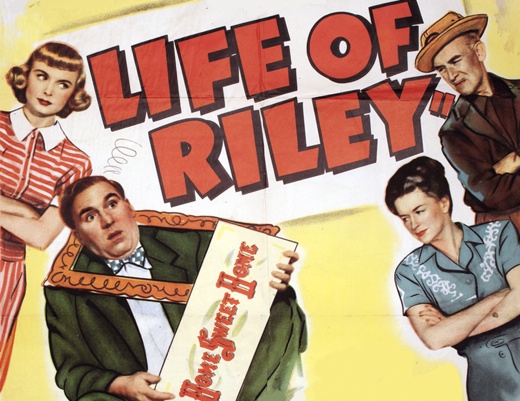
Image above: Detail of poster for the 1949 movie "The Life of Riley" based on the popular radio show and later hit 1950's TV show. From (https://www.imdb.com/title/tt0041590/).

Who doesn’t want to think that they are a good human being? That they are a person of good intentions, clear conscience, fair-minded, generous, loving, and merciful? On the other hand, who wants to be a loser?

The current political predicament in the USA has America’s winners turned losers and the consequent pain of that flip-flop has propelled the new designated losers into a fury of moral indignation.

The deplorable Trump insurgents were supposed to be put in their place on November 8, 2016 — stuffed back into their reeking WalMarts — but instead, their champion with his gold-plated hair-do presides over the nation in the house where Lincoln, The Roosevelts, and Hillary lived. “Winning…!” as the new president likes to tweet.

What a revoltin’ development, as Chester A. Riley used to say on “The Life of Riley” TV show back in 1955, when America was great (at least that’s the theory). Riley was an original deplorable before the concept even emerged from the murk of early pop culture.

He worked in an aircraft factory somewhere in southern California, which only a few decades prior was the mecca of an earlier generations of losers: the Oakies and other Dust Bowl refugees who went west to pick fruit or get into the movies.

Chester A. Riley supported a family on that job as a wing-riveter. All the male characters in the series had been through the Second World War, but were so far removed from the horror that the audience never heard about it.

That was the point: to forget all that gore and get down with the new crazes for backyard barbeque, seeing the USA in your Chevrolet, enjoying that healthful pack of Lucky Strikes in the valley of the Jolly Green Giant… double your pleasure, double your fun… and away go troubles down the drain….

As Tom Wolfe pointed out eons ago, the most overlooked feature of post-war American life was the way that the old US peasantry found themselves living higher on the hog than Louis the XVI and his court at Versailles.

Hot and cold running water, all the deliciously engineered Betty Crocker cake you could eat, painless dentistry, and Yankees away games on Channel 11, with Pabst Blue Ribbon by the case! By 1960 or so, along came color TV and air-conditioning, and in places like Atlanta, St. Louis, and Little Rock, you barely had to go outside anymore, thank God! No more heat stroke, hookworm, or chiggers.

It was a helluva lot better than earlier peasant classes had it, for sure, but let’s face it: it was kind of a low-grade nirvana. And a couple of generations beyond “The Life of Riley” the whole thing has fallen apart.

There are few hands-on jobs that allow a man to support a family. And what would we even mean by that? Stick the women back in kitchen and the laundry room?

What a waste of human capital (even for socialists who oppose capital). The odd thing is that there is increasingly little for this class of people to do besides stand near the door of the WalMart, and if the vaunted tech entrepreneurs of this land have their way with robotics, you can be sure there would be less than nothing for them to do… except crawl off and die quietly, without leaving an odoriferous mess.

What political commentator has failed to notice that the supposed savior of this peasant class is himself a sort of shabby version of Louis XVI, with his gilded toilet seats, brand-name pomp, and complex hair?

A happy peasantry needs a good king, and that is the role Mr. Trump seems to have cast himself in. I assume that he wants very earnestly to be considered a good person, though all his efforts to demonstrate that have been startlingly clumsy and mostly ineffective.

The one thing he has truly accomplished is driving his opponents in the overclass out of their gourds with loathing and resentment. (The term, overclass was minted, I believe by the excellent essayist Michael Lind.)

It’s a wonderfully inclusive term in that it describes basically everyone who is not in the underclass — that now-dreadful realm of tattooed diabetics moiling in the war memorial auditoriums and minor league ball parks for their hero and leader to descend like Deus ex Machina in the presidential helicopter to remind them how much they’re winning.

Meanwhile, the class of former winners-turned-losers — the Silicon Valley executives, the Hollywood movers and shakers, the Brooklyn Hipsters, the Ivy League faculties, the Deep State guideline writers, the K-Street consultants, the yoga ladies of Fairfield County, Connecticut, the acolytes of Oprah Winfrey and Elizabeth Warren — resort to righteous litigation in their crusade to restore the proper order of rule in this land. When they come to power, the shining city will be at hand….

I kind of doubt it. The truth is, all current winners and losers are living in the shadow of a financial system that doesn’t really work anymore, because it doesn’t represent the reality of wealth that is no longer there.

The consolation, perhaps, is that there will be plenty for all those who survive the collapse of that system to do when the time comes.

But it will be in a disposition of things and of power that we can’t possibly recognize from where we stand these days.

.

That collapse you ordered...?

SUBHEAD: And when it happens here, it will spread through the financial systems of the world.

By James Kunstler on 30 April 2018 for Kunstler.com -
(http://kunstler.com/clusterfuck-nation/9192/)


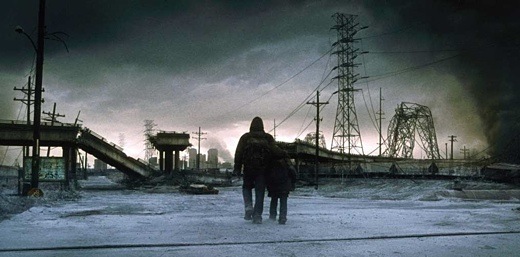
Image above: Scene from the movie "The Road" based on the novel by Cormac McCarthy. From (http://www.enclavedecine.com/2010/02/la-carretera-road-2009-de-john-hillcoat.html).

I had a fellow on my latest podcast, released Sunday, who insists that the world population will crash 90-plus percent from the current 7.6 billion to 600 million by the end of this century.

Jack Alpert heads an outfit called the Stanford Knowledge Integration Lab (SKIL) which he started at Stanford University in 1978 and now runs as a private research foundation. Alpert is primarily an engineer.

At 600 million, the living standard in the USA would be on a level with the post-Roman peasantry of Fifth century Europe, but without the charm, since many of the planet’s linked systems — soils, oceans, climate, mineral resources — will be in much greater disarray than was the case 1,500 years ago.

Anyway, that state-of-life may be a way-station to something more dire. Alpert’s optimal case would be a world human population of 50 million, deployed in three “city-states,” in the Pacific Northwest, the Uruguay / Paraguay border region, and China, that could support something close to today’s living standards for a tiny population, along with science and advanced technology, run on hydropower.

The rest of world, he says, would just go back to nature, or what’s left of it. Alpert’s project aims to engineer a path to that optimal outcome.

I hadn’t encountered quite such an extreme view of the future before, except for some fictional exercises like Cormac McCarthy’s The Road. (Alpert, too, sees cannibalism as one likely byproduct of the journey ahead.)

Obviously, my own venture into the fictionalized future of the World Made by Hand books depicted a much kinder and gentler re-set to life at the circa-1800 level of living, at least in the USA.

Apparently, I’m a sentimental softie.

Both of us are at odds with the more generic techno-optimists who are waiting patiently for miracle rescue remedies like cold fusion while enjoying re-runs of The Big Bang Theory. (Alpert doesn’t completely rule out as-yet-undeveloped energy sources, though he acknowledges that they’re a low-percentage prospect.)

We do agree with basic premise that the energy supply is mainly what supports the way we live now, and that it shows every evidence of entering a deep and destabilizing decline that will halt the activities necessary to keep our networks of dynamic systems running.

A question of interest to many readers is how soon or how rapid the unraveling of these systems might be. When civilizations crumble, it tends to fast-track.

The Roman empire seems to be an exception, but in many ways it was far more resilient than ours, being a sort of advanced Flintstones economy, with even its giant-scale activities (e.g. building the Coliseum) being accomplished by human-powered work.

In any case, the outfit really fell apart steadily after the reign of emperor Marcus Aurelius (180 AD).

The Romans had their own version of a financialized economy: they simply devalued their coins by mixing in less and less silver at the mint, so they could pretend to pay for the same luxuries they had grown accustomed to as resources stretched thin.

Our financialized economy — like everything else we do — operates at levels of complexity so baffling that even its supposed managers at the central banks are flying blind through fogs of debt, deception, and moral hazard.

When that vessel of pretense slams into a mountain top, the effects are likely to be quick and lethal to the economies on the ground below.

In our time, the most recent crash of a major socioeconomic system was the fall of the Soviet Union in 1990-91. Of course, it happened against the backdrop of a global system that was still revving pretty well outside the USSR, and that softened the blow.

Ultimately, the Russians still had plenty of oil to sell, which allowed them to re-set well above the Fifth Century peasant level of existence. At least for now.
'
The Soviet Union collapsed because it was a thoroughly dishonest system that ran on pretense and coercion. Apparently, the US Intel Community completely missed the signs that political collapse was underway. They seem to be pretty clueless about the fate of the USA these days, too.

If you consider the preoccupations of two very recent Intel chiefs — John Brennan of CIA and James Clapper, DNI — who now inveigh full-time on CNN as avatars of the Deep State against the wicked Golden Golem of Greatness.

Personally, I expect our collapse to be as sudden and unexpected as the USSR’s, but probably bloodier because there’s simply more stuff just lying around to fight over.

Of course, I expect the collapse to express itself first in banking, finance, and markets — being so deeply faith-based and so subject to simple failures of faith.

But it will become political and social soon enough, maybe all-at once.

And when it happens in the USA, it will spread through the financial systems the whole world round.

.

The Darkest Hours

SUBHEAD: But like all addicts, we have to hit bottom before anything like clarity returns to our daily doings.

By James Kunstler on 18 December 2017 for Kunstler.com -
(http://kunstler.com/clusterfuck-nation/the-darkest-hours/)


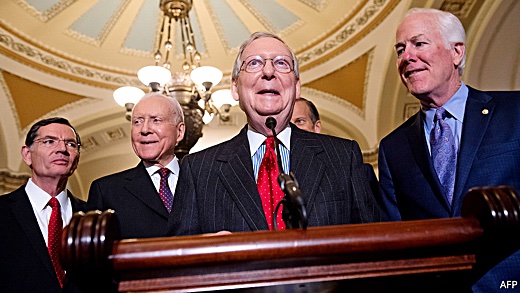
Image above: The Republican senate leadership gloat after passing self-serving tax reductions for the wealthy. From (https://www.economist.com/news/united-states/21732096-todays-bill-does-not-much-resemble-1986-tax-overhaul-how-republican-tax-bill).

The Tax “Reform” bill working its way painfully out the digestive system of congress like a sigmoid fistula, ought be re-named the US Asset-stripping Assistance Act of 2017, because that’s what is about to splatter the faces of the waiting public, most of whom won’t have a personal lobbyist / tax lawyer by their sides holding a protective tarpulin during the climactic colonic burst of legislation.

Sssshhhh….

The media has not grokked this, but the economy is actually collapsing, and the nova-like expansion of the stock markets is exactly the sort of action you might expect in a system getting ready to blow.

Meanwhile, the more visible rise of the laughable scam known as crypto-currency, is like the plume of smoke coming out of Vesuvius around 79 AD — an amusing curiosity to the citizens of Pompeii below, going about their normal activities, eating pizza, buying slaves, making love — before hellfire rained down on them.

Whatever the corporate tax rate might be, it won’t be enough to rescue the Ponzi scheme that governing has become, with its implacable costs of empire.

So the real aim here is to keep up appearances at all costs just a little while longer while the table scraps of a four-hundred-year-long New World banquet get tossed to the hogs of Wall Street and their accomplices. The catch is that even hogs busy fattening up don’t have a clue about their imminent slaughter.

The centerpiece of the swindle, as usual, is control fraud on the grand scale. Control fraud is the mis-use of authority in applying Three-Card-Monte principles to financial accounting practice, so that a credulous, trustful public will be too bamboozled to see the money drain from their bank accounts and the ground shift under their feet until the moment of freefall.

Control fraud is at work in the corporate C-suites, of course, because that is its natural habitat — remember that silver-haired CEO swine from Wells Fargo who got off scot-free with a life-time supply of acorns after scamming his account-holders — but their errand boys and girls in congress have been superbly groomed, pampered, fed, and trained to break trail and cover for them.

The country has gotten used to thinking that the game of pretend is exactly the same as what is actually going on in the world. The now-seminal phrase coined by Karl Rove, “we make our own reality,” is as comforting these days to Republicans from Idaho as it is to hairy, “intersectional” professors of post-structural gender studies in the bluest ivory towers of the Ivy League.

Nobody in this Republic really wants to get his-hers-zhe’s-they’s reality on.

Ah, but reality wants to do its thing regardless of our wishes, hopes, and pretenses, and you can kind of see how these moves taken in the dark waning hours of 2017 will play out in the quickening weeks of 2018. Long about March or April, something’s got to give.

Other players around the world are surely eager to assist shoving this mad bull of a polity towards the critical state it deserves to enter, though we are doing quite enough on our own to put ourselves at ground zero of financial and political implosion.

The addiction metaphor does apply to America. We are simply addicted to our own bullshit. But like all floundering addicts, we have to hit bottom before anything like clarity returns to our daily doings.

When that does happen, it will be as far from intoxicating as you can imagine. The smoldering wreckage of The World’s Highest Standing of Living will be visible in a 360-degree panorama. A lot of familiar faces will be among the suddenly missing. But we’re already prepped for this by the sexual purges of the season.

One day, the reassuring figure of ole Garrison Keillor is there to remind you of the exquisite taste of Midwestern sweet corn on an August night; and the next morning, you’re up to your eyeballs in the colonic explosion of unintended consequences engineered by the least reassuring cast of characters ever assembled under one capitol dome.

.

Volatility on Steroids

SUBHEAD: Regeneration, in this context, is about getting better, stronger, more resilient over time.

By Dr Nelson Lebo III on 17 OCtober 2017 in Automatic Earth -
(https://www.theautomaticearth.com/2017/10/volatility-on-steroids/)


Image above: Still frame of life in Las Vegas in 1982 fro the film  "Koyaanisqatsi". A film about our modern life out of balance. From (http://www.londoncitynights.com/2012/12/philip-glass-at-75-koyaanisqatsi-at.html).

Volatility is the new normal – that’s the message I gave a local Rotary Club when I spoke to members four or five years ago. I had been told beforehand the group was “worldly” and specifically instructed in the invitation to challenge them with my presentation.

As a weekly columnist in the city’s paper – the Wanganui Chronicle – I was widely known for my positions on wealth inequality, climate change, and debt, as well as a wide range of practical approaches to address these issues.

Around that time it was clear that a post-GFC new normal was functioning worldwide and many writers were using the term.

By then The Spirit Level (Pickett & Wilkinson, 2009) had been widely read and widely praised for its documentation of the relationship between wealth and income inequality and social problems.

Additionally, peer reviewed research based on decades worth of data had shown there was a quantitatively measurable increase in extreme weather events: more big storms and more big droughts.

I thought my audience would be well on board.

Judging from the response that day, however, the brief I had been given was misguided and most club members were neither expecting nor wanting a presentation that challenged the dominant paradigm of infinite growth without consequences no matter how factual.

As a mid-week midday meeting with New Zealand ‘fush ‘n chups’ on the menu the message that the-world-as-you-know-it-has-changed-forever was a bit heavy for people on their lunch break.

The response that day was, of course, perfectly ‘normal’. Almost no adult human seeks out new and different worldviews. On the contrary, we are far more inclined to cling to outdated ones, à la “Make America Great Again” than to acknowledge changing realities.

Social media allows us to reverberate in echo chambers of our own beliefs where we know we’re right because the echo told us so. Social science researchers have told us this for decades. The Internet just makes it worse and more obvious.

I’ve been writing about Trump, doubling-down and the post-truth world for two years now, and if anything I am more certain of the point I’ve been trying to make: most people are irrational. Seems there’s now a Nobel Laureate who has been arguing the same for decades.

Behavioral economist Richard Thaler was recently awarded a Nobel for his study of the psychology of economics, which seeks to understand how we are irrational and the impact on traditional economic theories that have failed time and again (think 2008 Global Financial Crisis) because they don’t sufficiently incorporate human factors. (Remember Greenspan’s admission?)

In no way do I intend to single out the Wanganui Rotarians, but rather use this example as illustrative for what my community, nation, and the entire world face: volatility made worse by inertia. In other words, the longer we choose to ignore inconvenient truths the greater will be their negative impacts.
This situation usually manifests in the form of tipping points .

 Malcolm Gladwell defined a tipping point in his debut book of the same name as “the moment of critical mass, the threshold, the boiling point.” Everything looks fine with the economy and the climate…until it’s not. And by ‘not fine’ we are talking really NOT FINE à la Greece, Puerto Rico, Houston, etc.

Tipping points is volatility on steroids. Brace yourselves.

Well-informed leaders from President Obama to Pope Francis agree the greatest threats facing humanity are climate change and wealth inequality. I’ve written extensively about both for many years yet neither appears to get much traction locally or globally.

Our ‘leaders’ ignore these issues at all of our peril because the result of each is increasing volatility in many forms: social, economic, financial, political, and an increasing incidence of extreme weather events.

Volatility is not good for social order, and where I live is a perfect example of the canary in the coalmine: a coastal, river city with high levels of inequality. It’s a tipping point waiting to happen.

Some readers may remember the 1982 film by Godfrey Reggio called Koyaanisqatsi, named using a Hopi term meaning “chaotic life” or “life out of balance.”

The film is unnerving, as is much of what comes via news media these days: hurricanes, mass shootings, hurricanes, opioid epidemics, hurricanes, people sleeping in cars, hurricanes, rising suicide rates, hurricanes, and children dying from cold damp homes.

And then there’s Myanmar: When Buddhists become the aggressors, you know the world is well and truly out of balance.

Okay, so the world is out of balance. What can be done about it?

Our solution to imbalance, as any regular reader of our blog knows, is called “Eco-Thrifty.” This approach to design and to life is about living better on less. Seems we have good company along these lines in the form of Costa Rica, the small Central American nation that regularly tops the Happy Planet Index published by the New Economics Foundation.

Despite per capita income one quarter that of New Zealand (ranked 38th of 140) and one fifth that of the US (108th of 140) Costa Rica matches many Scandinavian countries in terms of equality, wellbeing, life expectancy and ecological impact.

As Jason Hickel of the Guardian recently put it, “Costa Rica proves that rich countries could theoretically ease their consumption by half or more while maintaining or even increasing their human development indicators.”

“The opposite of growth isn’t austerity, or depression, or voluntary poverty. It is sharing what we already have, so we won’t need to plunder the earth for more.”

Sharing is at the heart of the permaculture ethics, where it is joined by caring for the environment and caring for people. Although we practice permaculture on our farm and in our community, we’re not dogmatic about it. What drives the eco-thrifty bus is resilience accompanied by regeneration.

Resilience, in this context, is the ability to withstand a pulse. It does not happen by accident. It can be designed, built and managed. Resilience only matters 0.0001% of the time, but when it matters it really matters.

Resilient homes stand up to earthquakes and hurricanes. Resilient farms stand up to major rain events and extended droughts. Resilient communities withstand economic downturns and ‘natural disasters’.

Regeneration, in this context, is about getting better, stronger, more resilient over time.

Regenerative farms grow food while building soil fertility, reducing erosion, storing carbon, managing storm water, and increasing biological diversity.

Regenerative communities reduce crime, domestic violence, drug abuse, and suicide rates while keeping wealth and resources circulating locally. They improve quality of life while shrinking energy use, pollution and wealth inequality.

From these perspectives Costa Rica is a good, albeit imperfect, case study. It is, however, about the best example we can find and has the data to show long-term consistently high quality of life.


Image above: "Pura Vida" is Spanish for "Pure Life". One alternative to the Ponzi scheme our debt based "economy" enshrines. From (https://www.goabroad.com/articles/study-abroad/10-reasons-to-study-abroad-in-costa-rica).


Pura Vida trumps Koyaanisqatsi.

.

Into the Cold and Dark

SUBHEAD: American life which emerges from this maelstrom will not look like what we’re living in today.

By James Kunstler on 20 October 2017 for Kunstler.com -
(http://kunstler.com/clusterfuck-nation/into-the-cold-and-dark/)


Image above: Illustration of obese crazy American with machinegun. By Pokket Mowse at https://pokketmowse.deviantart.com/gallery/. Found at (http://www.greanvillepost.com/2017/10/05/why-america-acts-so-goddamn-crazy/).

It amuses me that the nation is so caught up in the sexual mischief of a single Hollywood producer when the nation as a whole is getting fucked sideways and upside down by its own political caretakers.

Behind all the smoke, mirrors, Trump bluster, Schumer fog, and media mystification about the vaudeville act known as The Budget and The Tax Cut, both political parties are fighting for their lives and the Deep State knows that it is being thrown overboard to drown in red ink.

There’s really no way out of the financial conundrum that dogs the republic and something’s got to give.

Many of us have been waiting for these tensions to express themselves by blowing up the artificially levitated stock markets.

For about a year, absolutely nothing has thwarted their supernatural ascent, including the threat of World War Three, leading some observers to believe that they have been rigged to perfection.

Well, the algo-bots might be pretty fine-tuned, and the central bank inputs of fresh “liquidity” pretty much assured, but for all that, these markets are still human artifacts and Murphy’s Law still lurks out there in the gloaming with its cohorts, the diminishing returns of technology (a.k.a. “Blowback”), and the demon of unintended consequences.

Many, including yours truly, have expected the distortions and perversions on the money side of life to express themselves in money itself: the dollar.

So far, it has only wobbled down about ten percent. This is due perhaps to the calibrated disinformation known as “forward guidance” issued by this country’s central bank, the Federal Reserve, which has been threatening — pretty idly so far — to raise interest rates and shrink down its vault of hoarded securities — a lot of it janky paper left over from the misadventures of 2007-2009.

I guess the lesson is that when you have a pervasively false and corrupt financial system, it is always subject to a little additional accounting fraud — until it’s not. And the next thing you know, you’re sitting in the rubble of what used to be your civilization.

The ever more immiserated schnooks who make up the former middle-class know that their lives are crumbling, and may feel that they’re subject to the utterly overwhelming forces of a cruel destiny generated by a leviathan state that hates and despises them.

And of course that is exactly why they turned to the Golden Golem of Greatness for salvation.

Alas, Mr. Trump has not constructed a coherent strategy for defeating the colossus of fakery that drives the nation ever-deeper toward the cold and dark.

He has a talent for distraction and disruption, though, and so far that gave cover to a whole lot of other people in power who have been able to stand around with their hands in their pockets doing nothing about the sinking state of the nation.

Now, the vaudeville act is coming to a spectacular conclusion as the trappings of Halloween go back in the closet and the pulsating, LED-studded Santas go up on the rooftops.

Every ceremony of American life seems drained of meaning now, including the machinations of government over the budget and taxes.

The revolution to come out of this frozen swamp of irresponsibility will be the messiest and most incoherent in world history. Nobody will have any idea what is going on outside the geo-storm of failure.

About the only thing one can say for sure is that the American life which emerges from this maelstrom will not look a whole lot like what we’re living in today.

I remain serenely convinced that when it finally passes, the air will be fresh again and the sun will shine, and a lot more people will know what is real and what is not.

.

Reject Neofeudalism for Feudalism

SUBHEAD: Neofeudalism is not a re-run of feudalism. It's a "new and improved", state-corporate version of indentured servitude.

By Charles Hugh Smith on 20 September 2017 for Of Two Minds -
(http://charleshughsmith.blogspot.com/2017/09/loving-our-debt-serfdom-our-neofeudal.html)


Image above: Detail of a tapestry depicting feudal era agricultural work in "The Twelve Months of the Year" by Master of the Geneva Boccacci circa 1470AD. . From (https://commons.wikimedia.org/wiki/File:Crescenzi_calendar.jpg).

"Democracy" (i.e. political influence) and ownership of productive assets are the exclusive domains of the New Aristocracy.

I have often used the words neoliberal, neocolonial and neofeudal to describe our socio-economic-political status quo. Here are my shorthand descriptions of each term:
  1. Neoliberal: the commoditization / financialization of every asset, input (such as labor) and output of the economy; the privatization of the public commons, and the maximizing of private profits while costs and losses are socialized, i.e. transferred to the taxpayers.
  2. Neocolonial: the exploitation of the domestic populace using the same debt-servitude model used to subjugate, control and extract profits from overseas populations.
  3. Neofeudal: the indenturing of the workforce via debt and financial repression to a new Aristocracy; the disempowerment of the workforce into powerless debt-serfs.
Neofeudalism is a subtle control structure that is invisible to those who buy into the Mainstream Media portrayal of our society and economy. This portrayal includes an apparent contradiction: America is a meritocracy--the best and brightest rise to the top, if they have pluck and work hard-- and America is all about identity politics: whomever doesn't make it is a victim of bias.

Both narratives neatly ignore the neofeudal structure which disempowers the workforce in the public sphere and limits the opportunities to build capital outside the control of the state-corporate duopoly.

The book The Inheritance of Rome: Illuminating the Dark Ages 400-1000 shed some light on the transition to a feudal society and economy. While the author is a fine writer, the subject matter doesn't lend itself to light reading.

The transition from the Roman legacy of centralized governance (empire, monarchy, theocracy, etc.) to feudalism (governance by local lords / aristocracy) was complex and uneven, and the author takes pains to describe the process and many variations that arose in a highly fragmented post-Roman Europe.

(Note that the Eastern Roman Empire, a.k.a. Byzantine Empire, endured until 1453 AD. I've written often on both the western and eastern Roman empires:
The "Secret Sauce" of the Byzantine Empire: Stable Currency, Social Mobility
(September 1, 2016)

Don't Diss the Dark Ages
(October 26, 2016)

In the Footsteps of Rome: Is Renewal Possible?
(July 24, 2017) 
Neofeudalism is not a re-run of feudalism. It's a new and improved, state-corporate version of indentured servitude. The process of devolving from central political power to feudalism required the erosion of peasants' rights to own productive assets, which in an agrarian economy meant ownership of land.

Ownership of land was replaced with various obligations to the local feudal lord or monastery--free labor for time periods ranging from a few days to months; a share of one's grain harvest, and so on.
The other key dynamic of feudalism was the removal of the peasantry from the public sphere.

In the pre-feudal era (for example, the reign of Charlemagne), peasants could still attend public councils and make their voices heard, and there was a rough system of justice in which peasants could petition authorities for redress.

Of course peasants usually lost to the aristocracy and monasteries, but at least the avenue of redress was at least partially open. This presence in the public sphere was slammed shut in feudalism.

From the capitalist perspective, feudalism restricted serfs' access to cash markets where they could sell their labor or harvests.

The key feature of capitalism isn't just markets-- it's unrestricted ownership of productive assets--land, tools, workshops, and the social capital of skills, networks, trading associations, guilds, etc.

Our system is Neofeudal because the non-elites have no real voice in the public sphere, and ownership of productive capital is indirectly suppressed by the state-corporate duopoly.

Various studies have found that politicians ignore the bottom 99.5% who don't contribute to their campaigns or crony-capitalist wealth (five quick speeches for $200,000 each is $1 million. Rinse and repeat.)

The vast majority of incumbents are re-elected, as they leverage their power to vacuum up enormous sums of campaign contributions that then buy the compliance of a cowed public.

As for ownership of assets-- small business startups have been crushed by soaring costs, heavy regulations and the dominance of cartels and quasi-monopolies enforced by the state.

The so-called middle class owns little to no productive capital; what it "owns" is a house, which is ultimately a form of consumption.

I say "owns" for two reasons: one, most households have a mortgage, so their ownership is still contingent on making monthly payments to a lender, and two, the government collects property taxes on the home regardless of the owner's income or ability to pay.

Compare this to taxes levied on business income: if the business has no net income, it owes no taxes. Not so with property taxes--they are the modern equivalent of "rent" paid to the feudal lord.

Note that the aristocracy owns productive assets while the serfs own housing and debt. This is not a flaw in the system, it's a feature of the system.

Democracy (i.e. political influence) and ownership of productive assets are the exclusive domains of the New Aristocracy. This is Neofeudalism in a nutshell.
"Under a scientific dictator education will really work -- with the result that most men and women will grow up to love their servitude and will never dream of revolution." 
"The nature of psychological compulsion is such that those who act under constraint remain under the impression that they are acting on their own initiative. The victim of mind-manipulation does not know that he is a victim. To him, the walls of his prison are invisible, and he believes himself to be free. That he is not free is apparent only to other people. His servitude is strictly objective."
- Aldous Huxley
Video interview of Aldous Huxley source of quotes (read the entire thread)
.

America Can’t Afford to Rebuild

SUBHEAD: The grand credit/debt experiment is on its last legs, even with ultra low rates.

By Raul Ilargi Meijer on 9 September 2017 for the Automatic Earth -
(https://www.theautomaticearth.com/2017/09/america-cant-afford-to-rebuild/)


Image above: Mobile homes damaged in Naples, Florida, by hurricane Irma on 9/12/17. From (http://hamodia.com/2017/09/11/floridians-return-storm-shattered-homes-irma-hits-georgia/).

A number of people have argued over the past few days that Hurricane Harvey will NOT boost the US housing market. As if any such argument would or should be required. Hurricane Irma will not provide any such boost either.

News about the ‘resurrection’ of New Orleans post-Katrina has pretty much dried up, but we know scores of people there never returned, in most cases because they couldn’t afford to.

And Katrina took place 12 years ago, well before the financial crisis. How do you think this will play out today? Houston is a rich city, but that doesn’t mean it’s full of rich people only. Most homeowners in the city and its surroundings have no flood insurance; they can’t afford it. But they still lost everything. So how will they rebuild?

Sure, the US has a National Flood Insurance Program, but who’s covered by it? Besides, the Program was already $24 billion in debt by 2014 largely due to hurricanes Katrina and Sandy.

With total costs of Harvey estimated at $200 billion or more, and Irma threating to cause far more damage than that, where’s the money going to come from?

It took an actual fight just to push the first few billion dollars in emergency aid for Houston through Congress, with four Texan representatives voting against of all people. Who then will vote for half a trillion or so in aid? And even if they do, where would it come from?

Trump’s plans for an infrastructure fund were never going to be an easy sell in Washington, and every single penny he might have gotten for it would now have to go towards repairing existing roads and bridges, not updating them -necessary as that may be-, let alone new construction.

Towns, cities, states, they’re all maxed out as things are, with hugely underfunded pension obligations and crumbling infrastructure of their own. They’re going to come calling on the feds, but Washington is hitting its debt ceiling.

All the numbers are stacked against any serious efforts at rebuilding whatever Harvey and Irma have blown to pieces or drowned.

As for individual Americans, two-thirds of them don’t have enough money to pay for a $500 emergency, let alone to rebuild a home. Most will have a very hard time lending from banks as well, because
  1. They’re already neck-deep in debt, and
  2. Because the banks will get whacked too by Harvey and Irma. For one thing, people won’t pay the mortgage on a home they can’t afford to repair. Companies will go under. You get the picture.
There are thousands of graphs that tell the story of how American debt, government, financial and non-financial, household, has gutted the country. Let’s stick with some recent ones provided by Lance Roberts. Here’s how Americans have maintained the illusion of their standard of living. Lance’s comment:
This is why during the 80’s and 90’s, as the ease of credit permeated its way through the system, the standard of living seemingly rose in America even while economic growth rate slowed along with incomes. Therefore, as the gap between the “desired” living standard and disposable income expanded it led to a decrease in the personal savings rates and increase in leverage. It is a simple function of math. But the following chart shows why this has likely come to the inevitable conclusion, and why tax cuts and reforms are unlikely to spur higher rates of economic growth.
There’s no meat left on that bone. There isn’t even a bone left. There’s only a debt-ridden mirage of a bone. If you’re looking to define the country in bumper-sticker terms, that’s it.

A debt-ridden mirage. Which can only wait until it’s relieved of its suffering. Irma may well do that.

A second graph shows the relentless and pitiless consequences of building your society, your lives, your nation, on debt.
It may not look all that dramatic, but look again. Those are long-term trendlines, and they can’t just simply be reversed. And as debt grows, the economy deteriorates. It’s a double trendline, it’s as self-reinforcing as the way a hurricane forms.

Back to Harvey and Irma. Even with so many people uninsured, the insurance industry will still take a major hit on what actually is insured. The re-insurance field, Munich RE, Swiss RE et al, is also in deep trouble. Expect premiums to go through the ceiling. As your roof blows off.

We can go on listing all the reasons why, but fact is America is in no position to rebuild. Which is a direct consequence of the fact that the entire nation has been built on credit for decades now.

Which in turn makes it extremely vulnerable and fragile.

Please do understand that mechanism. Every single inch of the country is in debt. America has been able to build on debt, but it can’t rebuild on it too, precisely because of that.

There is no resilience and no redundancy left, there is no way to shift sufficient funds from one place to the other (the funds don’t exist). And the grand credit experiment is on its last legs, even with ultra low rates.

Washington either can’t or won’t -depending on what affiliation representatives have- add another trillion+ dollars to its tally, state capitals are already reeling from their debt levels, and individuals, since they have much less access to creative accounting than politicians, can just forget about it all.

Not that all of this is necessarily bad: why would people be encouraged to build or buy homes in flood- and hurricane prone areas in the first place? Why is that government policy? Why is it accepted?

Yes, developers and banks love it, because it makes them a quick buck, and then some, and the Fed loves it because it keeps adding to the money supply, but it has turned America into a de facto debt colony.

If you want to know what will happen to Houston and whatever part of Florida gets hit worst, think New Orleans/Katrina, but squared or cubed -thanks to the 2007/8 banking crisis.


.