Showing posts with label Snowden. Show all posts

Security... or Surveillance?

SUBHEAD: Ron Paul interviews Edward Snowden on government threats to essential freedoms.

By James Holbrooks on 20 June 2017 for The AntiMedia -
(http://theantimedia.org/ron-paul-interviewing-edward-snowden/S)
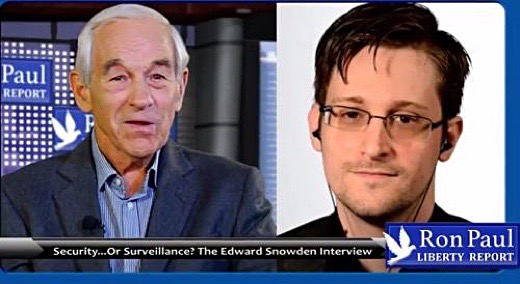

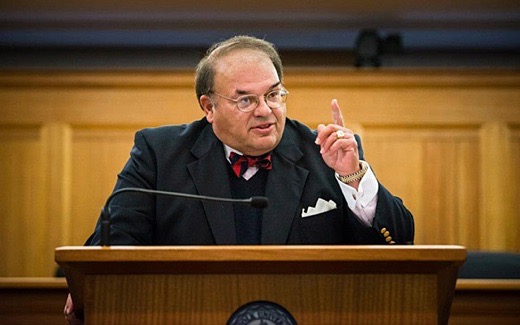
Image above: Still frame of Ron Paul and Edward Snowden from video of interview below.
Saying that you don’t care about privacy because you have nothing to hide is no different than saying you don’t care about freedom of speech because you have nothing to say.”
That comment was made by famed whistleblower Edward Snowden during a recent interview on the Ron Paul Liberty Report. In his conversation with Dr. Paul and Daniel McAdams, published Tuesday, an articulate Snowden discusses the true meaning of freedom, the nature of the deep state, and even his upbringing as a child of a government family.

“I’d like to know a little bit, what do you do all day long?” a genuinely curious Dr. Paul asks as his opening question. After talking about the insanity that erupted — both in the political spectrum and his personal life — following the revelations he made back in 2013, Snowden says he’s now become a hot commodity for groups championing causes.
“They want me to sort of front for these issues of privacy and civil liberties and protection of people’s rights,” Snowden replies. “And I want to do what I can, but I’m not a politician. I’m an engineer.”
The whistleblower goes on to talk about how he’s now, at long last, finally able to devote time to more practical applications. For him, this means focusing on the area that holds the key to finding a balance between rights and laws in the digital age — technology.
“How technically is this even happening?” Snowden poses, digging straight to the heart of the issue of mass surveillance. “How is it that so many governments are spying on so many people? Because even if we pass the best legal reforms in the world in the United States, that doesn’t do anything against China, or Russia, or Germany, or France or Brazil or any other country in the world.”
Continuing, Snowden says that future generations’ rights and protections will be dependent on the current generation’s ability to adapt to a constantly shifting environment:
“We need to find new means, new mechanisms, for enforcing these rights in the new times. And I think that’s going to be primarily through science and technology.”
When Dr. Paul asks the former NSA contractor about his political affiliation, Snowden responds that he doesn’t associate himself with any faction and that as individuals, we’re more than tribes and labels. Proceeding, Snowden points to how technology has given humanity a means to have a global conversation on issues:
“I think the Internet produces a lot of people who look at these issues differently, in a less tribal way, because you hear more viewpoints. You hear from many more people. And the more people in a conversation, I think the more informed it often is.”
When co-host Daniel McAdams asks Snowden to comment on the idea of security vs. surveillance, the whistleblower again cuts straight to the core of the debate and speaks on the perception of freedom itself.

“What is liberty?” asks Snowden, and then points out that ten questions on the street would result in ten different answers. After stating his view that liberty is the “freedom of self” and the “freedom from permission,” Snowden goes on to say that true liberty is rooted in personal privacy:
“Privacy isn’t about something to hide, privacy is about something to protect. It’s about the ability to be you, to have a thought for yourself, to have a thing for yourself, to have some difference, to have some idea that’s new and untested and untried that you can sort of sharpen amongst those that you trust, and then introduce into the world, into that contest of ideas.”
Next, Dr. Paul asks his guest to comment on the topic of the deep state, which Snowden proceeds to describe as a “mass of government that survives beyond administration” that is “not responding to the politics of the people.” Snowden says this organism lives “across parties” and “across administrations.”

Continuing, Snowden equates the running of state policy to a game, one that favors those who get “better and better” at understanding the evolving rules:
“And eventually, the people who are the greatest experts at understanding and using these rules, the best bureaucrats, are not sitting in the White House, they’re not sitting in the Congress. Because those guys come and go as the years pass, and they win elections, and they lose elections, and it’s the people that sit there for 30 years or more, in these agencies, with their hand on the lever the whole time. And that’s what the deep state is.”
Snowden further states that party affiliation matters little with regard to this behind-the-scenes force and that any political faction in power will eventually “get to the point of saying yes when enough pressure is brought to bear.”

When Daniel McAdams next asks him about whether or not he thinks an agency such as the NSA should even exist, Snowden remarks on the irony of asking him that question — given that he’s a “product of the system” with familial ties to the United States government going back decades.

But the whistleblower presses forward following a question from Dr. Paul on whether or not he thinks any gains have been made from his 2013 revelations, stating that solutions come not from individuals alone, but from many of them who “lay down a single brick upon which others can build.”

Continuing in this vein, Snowden says progress in battling government violations of personal liberty is made in inches and should be accomplished organically:
“Step by step, working together, sharing our views, connecting our values, we can create spaces, more bricks, that when laid together create a defense of rights that can be relied upon, in even historic moments when law cannot be.”
In his final question to Snowden, Dr. Paul asks whether the former government contractor’s decision to sound the alarm was arrived at suddenly or through a gradual process. In response, Snowden links his own decision to the average human being, noting that everyone has a point at which nothing more can be tolerated:
“We all have a level, right, of this kind of cognitive dissonance that we can accept. A level of injustice, of inhumanity, of incivility that we can accept in the daily world, that we can sort of internalize and suppress. And then we have one step more.”

Video above: "Security or Surveillance? The Edward Snowden Interview" From (https://youtu.be/9XLLo0025Jc).

.
TruthDigger of the Week

SUBHEAD: Julian Assange, WikiLeaks publisher of the Clinton Campaign emails.

By Alexander Reed Kelly on 22 OCtober 2016 for Truth Digger -
(http://www.truthdig.com/report/page2/truthdigger_of_the_week_julian_assange_20161022)


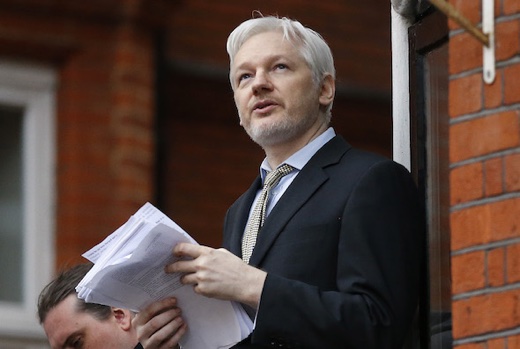
Image above: WikiLeaks founder Julian Assange reads from a U.N. report as he speaks from London’s Ecuadorean Embassy in February. Photo by Frank Augstein. From original article.

Every week the Truthdig editorial staff selects a Truthdigger of the Week, a group or person worthy of recognition for speaking truth to power, breaking the story or blowing the whistle. It is not a lifetime achievement award. Rather, we’re looking for newsmakers whose actions in a given week are worth celebrating.

Should we condemn Julian Assange for his recent interventions in U.S. politics?

The Australian hacker-turned-journalist became an international hero for free speech and government transparency in 2010 when he published through WikiLeaks, an organization he co-founded, a quartet of award-winning disclosures revealing the U.S. military behaving far worse in its wars in Afghanistan and Iraq than it had admitted and U.S. State Department officials speaking frankly about their allies and intentions around the globe.

Under threat of exposure, the Obama administration, led by Hillary Clinton’s State Department, leapt into action, opening a criminal investigation into Assange and pursuing him through its international allies to the Ecuadorean Embassy in London in 2012, where he remains to this day, functionally imprisoned under asylum.

This week, while he was still coordinating his work with others, the Ecuadorean government suspended his internet access.

Now, after publishing searchable databases of thousands of emails over the summer hacked or leaked from the servers of Democratic presidential candidate Hillary Clinton, the Democratic National Committee and Clinton campaign chairman John Podesta (messages that include transcripts of Clinton’s paid speeches to Goldman Sachs and give further substance to allegations of duplicity, disdain for activists and compromising self-interest that have followed her and her circle for more than a decade), Assange is under fresh attack from familiar adversaries representing the establishment and taking hard criticism from erstwhile allies.

Citing rationales that U.S. intelligence agencies have not made available to the public, Clinton and her aides assert—and their media allies uncritically report—that Assange is working with the Russian government to help Donald Trump win the presidency by strategically timing the release of the emails—the authenticity of which the Clinton camp has not denied—to cause maximum damage to her presidential campaign.

Relative newcomers to the critique of Assange are NSA whistleblower Edward Snowden, journalist, author and activist Naomi Klein and Harvard Law professor and civil liberties advocate Lawrence Lessig.

They take issue with the failure of Assange and his colleagues to strip the leaked documents of information that is not essential to the business of informed democracy and which unnecessarily spotlights the personal lives of the people involved.

In a conversation with The Intercept co-founder Glenn Greenwald (who maintains that public interest requires that powerful people, especially officials, forfeit a measure of their privacy), Klein eloquently expressed her concern “about the subjectivity of who gets defined as sufficiently powerful to lose their privacy,” adding that she is “absolutely sure there are plenty of people in the world who believe that you and I are sufficiently powerful to lose our privacy.”

“I’m not comfortable with anybody wielding that much power,” Klein said. “I’m not comfortable when it’s states, but I’m also not comfortable when it’s individuals or institutions.”

As a high-profile role model to journalists and activists for his role in bringing Snowden’s NSA leaks to the public, Greenwald has a special responsibility to protect the ethics that underpin his efforts in public service.

And that means criticizing Assange (whom Greenwald, a trained lawyer, ably defended in the press during WikiLeaks’ initial burst of activity in 2010) when Assange fails to meet his own ethical standards, or those he once claimed and practiced.

In 2010, Greenwald explained, “WikiLeaks, contrary to the way they were being depicted by the U.S. intelligence community and their friends, was not some reckless rogue agent running around sociopathically dumping information on the internet without concern about who might be endangered.

And in fact, if you look at how the biggest WikiLeaks releases were handled early on—the Iraq and Afghanistan war logs, as well as the State Department cables—not only did they redact huge numbers of documents on the grounds that doing so was necessary to protect the welfare of innocent people, they actually requested that the State Department meet with them to help them figure out what kind of information should be withheld on the grounds that it could endanger innocent people.”

But, “[s]omewhere along the way, WikiLeaks and Julian decided, and they’ve said this explicitly, that they changed their mind on that question—they no longer believe in redactions or withholding documents of any kind.”

Similarly, after WikiLeaks released a batch of DNC emails in July, Edward Snowden tweeted:
Democratizing information has never been more vital, and @Wikileaks has helped. But their hostility to even modest curation is a mistake.
Following Assange’s writings in 2010, when he stated that he seeks to tip the balance of power away from powerful institutions and actors by depriving them of the ability to operate behind closed doors without fear of being exposed and terminally and legally reckoned with by the public, Assange, in his work this summer, clearly targeted Clinton, whom he regards as an enemy of the public for championing U.S. hegemony and a personal antagonist for pursuing his prosecution.

“There is clearly a vendetta element going on,” Klein told Greenwald, “which is understandable, because Hillary Clinton is massively responsible for his lack of freedom.” But Klein “is very disturbed by [Assange’s] seeming willingness to burn it down” and “by the ego of seeing this election through one’s personal lens when the stakes are so incredibly high.”

Here’s a question few are asking: Would Assange, who set out to perform the honorable service of exposing government corruption, behave as he does today if he, a single individual with limited resources, had not been relentlessly pursued into the corner of a single room for 5½ years by people atop the most powerful state in civilized history?

And can he, under burden of stress and loss of staff, associations and resources, be expected to fulfill the ethical obligations he once honored and still perform the service of making essential, willfully concealed information public?

History is full of people who undertook to do good and were reshaped for the worse by the opposition they confronted. I’ve heard more than a few of Clinton’s progressive supporters casually justify her record of capitulation in the face of corporate and Republican forces in this way.

Do honesty and decency not require that we regard people, including Clinton and Assange, complexly?

The difference between the two, of course, is that Clinton wields tremendous wealth and state power, whereas at terrific cost to himself, Assange succeeds in performing the essential service of revealing what leaders do in secret in our name.

Because of Assange, we know that Clinton said politicians like her “need both a public and private position” when handling controversial matters, a comment that is as close to an admission of lying as we have heard from an official in recent years, and which should cast into doubt everything she has said or will say to voters.

Clinton’s supporters seem to expect that she’ll wield this trickiness in their interests. We hope they’re right. In the meantime, Julian Assange is our Truthdigger of the Week.

.

Iceland's Pirate Party

SUBHEAD: Radical democrats in favor of legalizing drugs and offering asylum to Edward Snowden running for office.

By Jon Henley on 12 August 2016 for the Guardian -
(https://www.theguardian.com/world/2016/aug/12/polls-suggests-icelands-pirate-party-form-next-government)


Image above: Gathering in June of 2015 in support of Pirate Party. From (https://talesfromtheloublog.wordpress.com/category/iceland/).

One of Europe’s most radical political parties is expected to gain its first taste of power after Iceland’s ruling coalition and opposition agreed to hold early elections caused by the Panama Papers scandal in October.

The Pirate party, whose platform includes direct democracy, greater government transparency, a new national constitution and asylum for US whistleblower Edward Snowden, will field candidates in every constituency and has been at or near the top of every opinion poll for over a year.

As befits a movement dedicated to reinventing democracy through new technology, it also aims to boost the youth vote by persuading the company developing Pokémon Go in Iceland to turn polling stations into Pokéstops.

“It’s gradually dawning on us, what’s happening,” Birgitta Jónsdóttir, leader of the Pirates’ parliamentary group, told the Guardian. “It’s strange and very exciting. But we are well prepared now. This is about change driven not by fear but by courage and hope. We are popular, not populist.”

The election, likely to be held on 29 October, follows the resignation of Iceland’s former prime minister Sigmundur Davið Gunnlaugsson, who became the first major victim of the Panama Papers in April after the leaked legal documents revealed he had millions of pounds of family money offshore.

In the face of some of the largest protests the small North Atlantic island nation had ever seen, the ruling Progressive and Independence parties replaced Gunnlaugsson with the agriculture and fisheries minister, Sigurður Ingi Jóhannsson, and promised elections before the end of the year.

Founded four years ago by a group of activists and hackers as part of an international anti-copyright movement, Iceland’s Pirates captured 5% of the vote in 2013 elections, winning three seats in the country’s 63-member parliament, the Althingi.

“Then, they were clearly a protest vote against the establishment,” said Eva Heida Önnudóttir, a political scientist at the University of Iceland who compares the party’s appeal to Icelandic voters to that of Spain’s Podemos, or Syriza in Greece.

“Three years later, they’ve distinguished themselves more clearly; it’s not just about protest. Even if they don’t have clear policies in many areas, people are genuinely drawn to their principles of transforming democracy and improving transparency.”

Propelled by public outrage at what is widely perceived as endemic cronyism in Icelandic politics and the seeming impunity of the country’s wealthy few, support for the party – which hangs a skull-and-crossbones flag in its parliamentary office – has rocketed.

A poll of polls for the online news outlet Kjarninn in late June had the Pirates comfortably the country’s largest party on 28.3%, four points clear of their closest rival, the conservative Independence party.

That lead has since narrowed slightly but most analysts are confident the Pirates will return between 18 and 20 MPs to the Althingi in October, putting them in a strong position to form Iceland’s next government.


Image above: Birgitta Jonsdottir, a co-founder of Iceland's Pirate Party. From (http://www.independent.co.uk/news/world/europe/iceland-pirate-party-takes-big-lead-in-polls-ahead-of-election-next-year-a6834366.html).

Jónsdóttir said the party was willing to form a government with any coalition partner who subscribes to its agenda of “fundamental system change” – something the Independence party has already ruled out.

“I look at us and I think, we are equipped to do this,” she said. “Actually, the fact we haven’t done it before and that we won’t have any old-school people telling us how, means we’ll do it more carefully. We will be doing things very differently.”

Built on the belief that new technologies can help promote civic engagement and government transparency and accountability, the party believes in an “unlimited right” for citizens to be involved in the political decisions that affect them, with ordinary voters able to propose new legislation and decide on it in national referendums.

It also wants no limit on individuals’ rights to express their views and share information, unless doing so violates others’ rights, and proposes to decriminalise drugs, raise taxes on the rich, and pursue internet freedoms and copyright reform.

Önnudóttir said she could “very easily see” the party winning 20-25% of the vote. “After that, their success will depend on what they can really deliver, how much they make of their first term,” she said. “With numbers like those, you risk becoming a part of the establishment.”

This article was amended on Satuday 13 August 2016 to remove a reference to “Gunnlaugsson’s Independence party”. As pointed out in comments below, Gunnlaugsson is the chairman of the Progressive party.

.

Federal Court's NSA smackdown

SUBHEAD: Snowden vindicated as federal judge orders shutdown of NSA illegal domestic spying.

By Claire Bernish 10 November 2015 for AntiMedia -
(http://theantimedia.org/snowden-vindicated-as-judge-shuts-down-nsa-bulk-spying-in-epic-smackdown/)


Image above: D.C. Federal District Court Judge Richard Leon.  From (http://www.newyorker.com/news/john-cassidy/in-praise-of-independent-judges-from-learned-hand-to-richard-j-leon).

On Monday, a federal judge ordered a halt to the NSA’s bulk metadata collection program in a reiteration and confirmation of a previous ruling that found the practice “unconstitutional” — and even “Orwellian.”
“This court simply cannot, and will not, allow the government to trump the Constitution merely because it suits the exigencies of the moment,” stated Washington, D.C. District Court Judge Richard Leon in his mordant 43-page ruling.
Edward Snowden immediately hailed the decision, pointing out significant passages from the court to his millions of Twitter followers. Of particular importance — and, indeed, at the heart of both known and potentially unknown domestic spy programs — remains the impossible reckoning between Fourth Amendment protections and the government’s claims of a national security imperative.
“Moved by whatever momentary evil has aroused their fears, officials — perhaps even supported by a majority of citizens — may be tempted to conduct searches that sacrifice the liberty of each citizen to assuage the perceived evil. But the Fourth Amendment rests on the principle that a true balance between the individual and society depends on the recognition of ‘the right to be let [sic] alone — the most comprehensive of rights and the right most valued by civilized men,’” the ruling stated, with emphasis added by Snowden.
In another tweet, the whistleblower summarized the ruling: “Judge rejects government claim that so long as you aren’t targeted individually, dragnet searches of your life are OK.” xxx

Though Leon’s judgment arrives mere weeks before metadata collection would naturally end under the USA Patriot Act’s Section 215 upon implementation of the newly passed USA Freedom Act, he emphasized potential implications of any undue delay in bringing such spying to a close, stating:
“In my December 2013 Opinion, I stayed my order pending appeal in light of the national security interests at stake and the novelty of the constitutional issues raised. I did so with the optimistic hope that the appeals process would move expeditiously. However, because it has been almost two years since I first found that the NSA’s Bulk Telephony Metadata Program likely violates the Constitution and because of the loss of constitutional freedoms for even one day is a significant harm […] I will not do that today.”
In other words, the judge harshly repudiated the government’s already poorly disguised emphasis on national security to justify bulk collection as wholly secondary to the individual’s right to privacy under the Constitution. Leon’s 2013 ruling was struck down in August this year, when an appeals court found the plaintiff in Klayman v. Obama had not established the legal standing necessary to dispute the constitutionality of the NSA program. Once amended appropriately, the judge was able to make a ruling on the original case and issue an injunction to halt bulk collection.

In this ruling, Leon sharply admonished the appeals court for its reversal, saying:
“Because the loss of constitutional freedoms is an ‘irreparable injury’ of the highest order, and relief to the two named plaintiffs would not undermine national security interests, I found that a preliminary injunction was not merely warranted — it was required. [emphasis by the judge]
Seemingly irritated at the insult of the government maintaining its position on the necessity of bulk collection while ignoring the preceding twenty-two months to find less invasive means to achieve the same goal, Leon searingly stated:
“To say the least, it is difficult to give meaningful weight to a risk of harm created, in significant part, by the Government’s own recalcitrance.”
Pointing out the painfully obvious, Leon derided fictitious claims the government needs bulk data collection at all, considering the program thwarted exactly zero terror attacks throughout its entire duration. In rebuttal to claims the contentious NSA program remains reasonably effective, the judge flatly stated:

“This is a conclusion I simply cannot reach given the continuing lack of evidence that the Program has ever actually been successful as a means of conducting time-sensitive investigations in cases involving imminent threats of terrorism.”

Pulling no punches, Leon concludes with a scathing challenge to the naïveté and blind acceptance Congress mistakenly presumed the public and court would give the contentiously invasive program:
“To be sure, the very purpose of the Fourth Amendment would be undermined were this court to defer to Congress’s determination that individual liberty should be sacrificed to better combat today’s evil.”
Employing linguistic subtlety which, at times, borders on a verbal smackdown, Judge Richard Leon brilliantly sent the NSA, Congress, and rest of the government a message that couldn’t be denied this second time around:  
Nobody buys your bullshit.

.

Top Dems condemn Snowden

SUBHEAD: Via satellite at Bard College Snowden disputed Clinton’s claim that he bypassed whistleblower protections.

By Tom McCartney on 16 October 2015 for the Guardian -
(http://www.theguardian.com/us-news/2015/oct/16/edward-snowden-hillary-clinton-false-claim-whistleblower-protection)


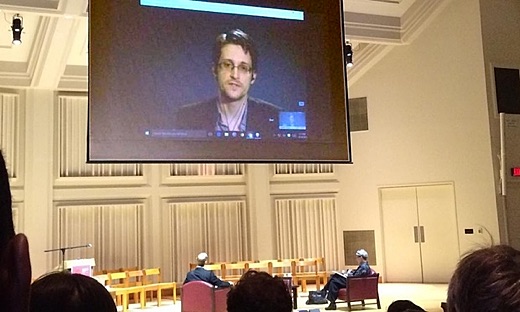
Image above: Edward Snowden speaks, via video-conference, at Bard College in New York on Friday. Photo by Beka Geodde. From original article.

Edward Snowden has accused Hillary Clinton of “a lack of political courage” for her assertion during the Democratic presidential debate this week that the whistleblower had bypassed options for disclosing illegal government spying programs that would have protected him and not violated the law.

Speaking via satellite at a privacy conference at New York’s Bard College on Friday, Snowden said:
“Hillary Clinton’s claims are false here.”
“This is important, right?” Snowden told an audience at the Hannah Arendt Center at Bard College. “Truth should matter in politics, and courage should matter in politics, because we need change. Everyone knows we need change. And we have been aggrieved and in many ways misled by political leaders in the past.”

Before Snowden spoke, Clinton repeated the claim on Friday, at a campaign appearance in New Hampshire. After a voter said Snowden was “close to a patriot,” BuzzFeed reported, Clinton disagreed and said he could have received whistleblower protections but instead chose to break the law.

“He broke the laws of the United States,” Clinton said at the debate on Tuesday. “He could have been a whistleblower. He could have gotten all of the protections of being a whistleblower. He could have raised all the issues that he has raised.

And I think there would have been a positive response to that.”

Multiple passes at fact-checking Clinton’s claim this week have concluded that “the protections of being a whistleblower” do not exist in the real world and did not apply to Snowden.

A 1989 whistleblower law, for example, does not apply to intelligence community employees. A separate law for would-be intelligence whistleblowers has been deemed a trap because it has led not to protections but to prosecutions.

“There is, I think, in many ways a lack of political courage in the established class that we expect to champion [our rights],” Snowden said at Bard, to enthusiastic applause.
The second US Circuit Court of Appeals in Manhattan ruled in May that the dragnet phone metadata collection program exposed by Snowden was indeed illegal.

In a wide-ranging question-and-answer session that lasted the better part of two hours, Snowden also rejected the premise of a question at the debate as to whether he was a hero or traitor. He discussed his Twitter habits, criticized Facebook for taking the side of the government over the side of users, and he praised the unidentified whistleblower who provided documents relating to drone warfare published on Thursday in an exposé by The Intercept.

“Thanks to some extraordinary whistleblower who provided this information to the Intercept, we now know that these drone attacks that claimed the lives of innocents, 90% of the time, nine out of 10 of those killed are not the intended targets,” Snowden said.

He dismissed the hero-or-traitor question, which CNN host Anderson Cooper posed at the presidential debate.

“I reject both [labels],” Snowden said. “Because even though people say being a hero would be a good thing, it’s other-izing, it’s distancing, it’s, ‘This person did something I could never do in that situation’ – that’s absolutely not true.”

Asked about being a privacy advocate who has nonetheless become active on Twitter, Snowden said he uses Tor and other “privacy-enhancing technologies” to protect his personal information when he uses social media.

He did not appear to be a Facebook user. “They’re really unwilling to make a commitment to the user,” Snowden said of the site. “They really need to decide who they work for – the government, or the people who use their services.”

Asked whether he was willing to face charges for leaking classified material, Snowden said that the law under which he has been charged, the Espionage Act of 1917, would not allow him to make the case that he had acted in the public good.

Snowden said he had been in contact with the government – apparently not recently – about how some kind of plea deal would work.

“They said ‘Well, we won’t torture you’,” Snowden said. “‘But we haven’t got beyond that.’”


Sanders & Clinton condemn Snowden
SUBHEAD: Both Democratic presidential candidates say Snowden should face criminal prosecution for revealing NSA secrets.

By Sam Thielman on 13 October 2015 for the Guardian -
(http://www.theguardian.com/us-news/2015/oct/13/clinton-sanders-snowden-nsa-democratic-debate)

Hillary Clinton and Bernie Sanders sparred over Edward Snowden during Tuesday’s Democratic presidential debate with both calling for him to face trial, but with the Vermont senator saying he thought the NSA whistleblower had “played a very important role in educating the American people”.


Clinton was unmoved by public approbation for Snowden, who exposed the depths of US and UK surveillance to media including the Guardian in 2013.

“He broke the laws of the United States,” she said. “He could have been a whistleblower, he could have gotten all the protections of a whistleblower. He chose not to do that. He stole very important information that has fallen into the wrong hands so I think he should not be brought home without facing the music.”

Snowden has said he did not believe he was granted adequate protection from reprisal under whistleblower laws. Laws protecting whistleblowers in intelligence agencies are written differently from laws protecting others who oppose their employers – including in the government – on grounds of conscience, and are generally considered comparatively weak.

Sanders – Clinton’s main challenger for the Democratic nomination – was more lenient. “I think Snowden played a very important role in educating the American public,” the Vermont senator said. He, too, said that Snowden had broken the law and suggested that he ought to be tried. “I think there should be a penalty to that,” he said. “But I think that education should be taken into consideration before the sentencing.”

Jim Webb, the Virginia senator and former secretary of the navy, said the decision should be left to the courts, and Martin O’Malley, the former Maryland governor, agreed with Clinton. Lincoln Chafee, the former Rhode Island governor, was the only candidate to say he would bring Snowden back to the US as a hero; that answer drew a positive response online.

Clinton’s claim that the information Snowden made public “has fallen into the wrong hands” could be reference to a disputed Times of London story that the leak exposed undercover agents. It could also refer to Snowden’s own admission that inadequate redaction of classified images he supplied to the New York Times was “a fuck-up”.

Ewen MacAskill, the Pulitzer prize-winning Guardian journalist who worked on the Snowden story, has pointed out that no evidence has ever been put forward suggesting that the Snowden documents were hacked or that Snowden himself handed the material to any person or agency other than reputable news outlets.


When moderator Anderson Cooper asked Clinton whether she regretted voting for the Patriot Act, she gave a flat: “No.”

“I don’t,” she said. “I think that it was necessary to make sure that we were able after 9/11 to put in place the security that we needed.” Clinton did allow that the act’s notorious section 215, which allowed for essentially unlimited data collection, had been interpreted overbroadly.

The provisions of the Patriot Act, a law broadening the powers of American intelligence and law enforcement agencies passed just weeks after 9/11, have widely been criticized as too broad and being without accountability.

Among them are the expansion of the secret Fisa court system and a framework for the standards for the collection of personal information from citizens who are not suspected or accused of any crime.

Sanders – who voted against the act multiple times, including against its original incarnation in the House of Representatives – said unequivocally that he would end bulk data collection by the NSA.
Clinton demurred. “It’s not easy to balance privacy and security but we have to keep them both in mind,” she said.
.

Newspapers seek Snowden clemency

SUBHEAD: New York Times and Guardian editorial boards recommend clemency for Edward Smowden.

By Staff on 2 January 2014 for Huffington Post -
(http://www.huffingtonpost.com/2014/01/02/edward-snowden-clemency_n_4529563.html#slide=3074349)


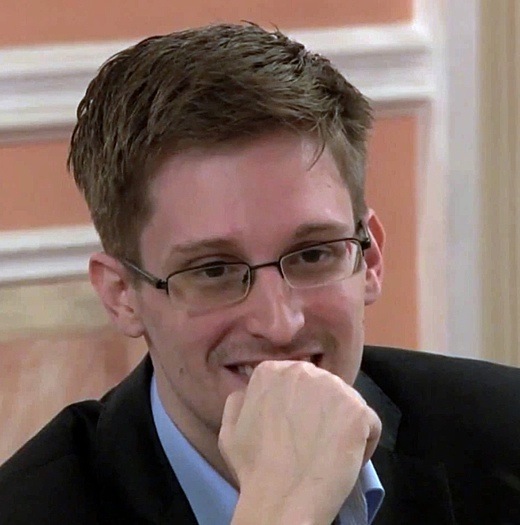
Image above: Edward Snowden smiles during a presentation ceremony for the Sam Adams Award in Moscow. From slideshow in original article.

The editorial boards of The New York Times and The Guardian published editorials on Wednesday, urging the Obama administration to treat Edward Snowden as a whistleblower and offer him some form of clemency.

Seven months ago, the former National Security Administration contractor stole as many as 1.7 million highly classified documents about the U.S. government's surveillance program and released the information to the press. The files revealed how the NSA forced American technology companies to reveal customer information, often without individual warrants, and how data from global phone and Internet networks was secretly intercepted.

While the release of these documents forced Snowden to flee the U.S. and move to Russia, it also alerted the American public -- and many U.S. allies -- of the government's intrusive, unethical and possibly unlawful spying efforts.

Beyond sparking public debate, Snowden's actions have prompted the American Civil Liberties Union to sue the NSA. The suit aims to force the U.S. government to disclose details of its electronic surveillance program and describe what protections it provides to Americans whose communications are swept up during the search for terrorist suspects, Reuters reported.

Eight major technology companies -- including Google, Facebook and Twitter -- have also joined forces to call for tighter controls on government surveillance.

To date, two federal judges have accused the NSA of violating the Constitution, and a panel appointed by President Barack Obama has blasted the agency's spying efforts and called for an overhaul of the program.

On Wednesday night, the editorial board of The New York Times published an editorial that not only described Snowden as a whistleblower but also called on the government to give him clemency.
Considering the enormous value of the information he has revealed, and the abuses he has exposed, Mr. Snowden deserves better than a life of permanent exile, fear and flight. He may have committed a crime to do so, but he has done his country a great service. It is time for the United States to offer Mr. Snowden a plea bargain or some form of clemency that would allow him to return home, face at least substantially reduced punishment in light of his role as a whistle-blower, and have the hope of a life advocating for greater privacy and far stronger oversight of the runaway intelligence community.
The Times noted that none of Snowden's revelations have done profound damage to the intelligence operations of the U.S., nor have his disclosures hurt national security. However, his efforts have exposed the federal government's lack of respect for privacy and constitutional protections.
When someone reveals that government officials have routinely and deliberately broken the law, that person should not face life in prison at the hands of the same government.
The Guardian, which has been at the forefront of the Snowden story from the very beginning, is also calling for clemency.
Snowden gave classified information to journalists, even though he knew the likely consequences. That was an act of courage.
In November, the White House rejected a clemency plea from Snowden, and told him to return to the U.S. to face trial.

.

It's about Power, not Safety

SUBHEAD: The NSA program is not about preventing terrorism. It is about economic spying and social control.

By Edward Snowden on 17 December 2013 in Counter Culture -
(http://www.countercurrents.org/snowden171213.htm)


Image above: From video released by WikiLeaks on Oct. 11, 2013. In Moscow Edward Snowden was awarded the Sam Adams Award. From (http://www.usatoday.com/story/news/world/2013/12/17/snowden-brazil-asylum/4049235/).

[Counter Culture note: An open letter to the people of Brazil. This letter was published today in the Brazilian newspaper A Folha in Portuguese and this original text was provided via the Facebook page of Glenn Greenwald's husband David Miranda.]

Six months ago, I stepped out from the shadows of the United States Government's National Security Agency to stand in front of a journalist's camera. I shared with the world evidence proving some governments are building a world-wide surveillance system to secretly track how we live, who we talk to, and what we say.

I went in front of that camera with open eyes, knowing that the decision would cost me family and my home, and would risk my life. I was motivated by a belief that the citizens of the world deserve to understand the system in which they live.

My greatest fear was that no one would listen to my warning. Never have I been so glad to have been so wrong. The reaction in certain countries has been particularly inspiring to me, and Brazil is certainly one of those.

At the NSA, I witnessed with growing alarm the surveillance of whole populations without any suspicion of wrongdoing, and it threatens to become the greatest human rights challenge of our time.

The NSA and other spying agencies tell us that for our own "safety"—for Dilma's "safety," for Petrobras' "safety"—they have revoked our right to privacy and broken into our lives. And they did it without asking the public in any country, even their own.

Today, if you carry a cell phone in Sao Paolo, the NSA can and does keep track of your location: they do this 5 billion times a day to people around the world. When someone in Florianopolis visits a website, the NSA keeps a record of when it happened and what you did there.

If a mother in Porto Alegre calls her son to wish him luck on his university exam, NSA can keep that call log for five years or more. They even keep track of who is having an affair or looking at pornography, in case they need to damage their target's reputation.

American Senators tell us that Brazil should not worry, because this is not "surveillance," it's "data collection." They say it is done to keep you safe. They’re wrong. There is a huge difference between legal programs, legitimate spying, legitimate law enforcement — where individuals are targeted based on a reasonable, individualized suspicion — and these programs of dragnet mass surveillance that put entire populations under an all-seeing eye and save copies forever.

These programs were never about terrorism: they're about economic spying, social control, and diplomatic manipulation. They're about power.

Many Brazilian senators agree, and have asked for my assistance with their investigations of suspected crimes against Brazilian citizens. I have expressed my willingness to assist wherever appropriate and lawful, but unfortunately the United States government has worked very hard to limit my ability to do so -- going so far as to force down the Presidential Plane of Evo Morales to prevent me from traveling to Latin America!

Until a country grants permanent political asylum, the US government will continue to interfere with my ability to speak.

Six months ago, I revealed that the NSA wanted to listen to the whole world. Now, the whole world is listening back, and speaking out, too. And the NSA doesn't like what it's hearing. The culture of indiscriminate worldwide surveillance, exposed to public debates and real investigations on every continent, is collapsing.

Only three weeks ago, Brazil led the United Nations Human Rights Committee to recognize for the first time in history that privacy does not stop where the digital network starts, and that the mass surveillance of innocents is a violation of human rights.

The tide has turned, and we can finally see a future where we can enjoy security without sacrificing our privacy. Our rights cannot be limited by a secret organization, and American officials should never decide the freedoms of Brazilian citizens. Even the defenders of mass surveillance, those who may not be persuaded that our surveillance technologies have dangerously outpaced democratic controls, now agree that in democracies, surveillance of the public must be debated by the public.

My act of conscience began with a statement:
"I don't want to live in a world where everything that I say, everything I do, everyone I talk to, every expression of creativity or love or friendship is recorded. That's not something I'm willing to support, it's not something I'm willing to build, and it's not something I'm willing to live under."
Days later, I was told my government had made me stateless and wanted to imprison me. The price for my speech was my passport, but I would pay it again: I will not be the one to ignore criminality for the sake of political comfort. I would rather be without a state than without a voice.

If Brazil hears only one thing from me, let it be this: when all of us band together against injustices and in defense of privacy and basic human rights, we can defend ourselves from even the most powerful systems.

• Edward Joseph Snowden is a US former technical contractor for the National Security Agency (NSA) and Central Intelligence Agency (CIA) employee who leaked details of top-secret US and British government mass surveillance programs to the press.


.

David Miranda detained as terrorist

SUBHEAD: Glenn Greenwald's partner was detained by authorities at London's Heathrow airport for nearly nine hours.

By Jack Mirkinson on 18 August 2013 for Huffingyon Post -
(http://www.huffingtonpost.com/2013/08/18/glenn-greenwald-partner-detained-david-miranda-airport_n_3776825.html)


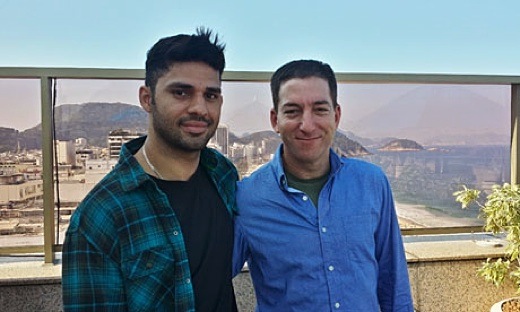
Image above: David Miranda (L) and Glenn Greenwald, in Brazil.  From original article.

[IB Publisher's note: Glenn Greenwald is the Guardian newspaper reporter that broke the Snowden NSA spying information to the world. And by the way FUCK Obama, the NSA and their UK stooges.]

Glenn Greenwald's partner was detained by authorities at London's Heathrow airport for nearly nine hours, the Guardian reported on Sunday.

David Miranda, who lives with Greenwald in Brazil, was held under Britain's Terrorism Act. The paper said he was held for the maximum amount of time allowed under the law:
According to official figures, most examinations under schedule 7 – over 97% – last under an hour, and only one in 2,000 people detained are kept for more than six hours. Miranda was then released without charge, but officials confiscated electronics equipment including his mobile phone, laptop, camera, memory sticks, DVDs and games consoles.
Miranda was coming from Berlin, where, the Guardian said, he had stayed with Laura Poitras, the filmmaker and journalist who, along with Greenwald, has been at the center of the storm surrounding NSA leaker Edward Snowden. Ironically, Poitras, whose work usually involves sensitive national security issues, re-located to Berlin from America because she had grown tired of being constantly detained and questioned at airports.

In a separate post, Greenwald said that Miranda had been questioned in detail about the work that he and Poitras were doing.

Britain is, of course, an extremely close ally of the United States, and the Guardian has published several major stories about the reach of its own intelligence service, GCHQ.

As one of the journalists most responsible for the revelations about the NSA's survaillance practices—and as someone in continuing contact with Snowden—Greenwald has become a target himself.

Republican congressman Peter King, for instance, called for his prosecution. Former NSA chief Michael Hayden said he was a "co-conspirator" with Snowden. NBC's David Gregory memorably asked him why he thought he shouldn't be charged with a crime.

In his blog post, Greenwald said that the detention would not deter him from continuing his reporting:
This is obviously a rather profound escalation of their attacks on the news-gathering process and journalism. It's bad enough to prosecute and imprison sources. It's worse still to imprison journalists who report the truth. But to start detaining the family members and loved ones of journalists is simply despotic. Even the Mafia had ethical rules against targeting the family members of people they feel threatened by. But the UK puppets and their owners in the US national security state obviously are unconstrained by even those minimal scruples. 
If the UK and US governments believe that tactics like this are going to deter or intimidate us in any way from continuing to report aggressively on what these documents reveal, they are beyond deluded. If anything, it will have only the opposite effect: to embolden us even further. Beyond that, every time the US and UK governments show their true character to the world - when they prevent the Bolivian President's plane from flying safely home, when they threaten journalists with prosecution, when they engage in behavior like what they did today - all they do is helpfully underscore why it's so dangerous to allow them to exercise vast, unchecked spying power in the dark.
Journalist Choire Sicha summed up the general attitude of many on Twitter:

Choire Sicha @Choire
This is FUCKED UP. RT @janinegibson: Thankfully David is ok and on his way home but a very concerning incident. http://www.theguardian.com/world/2013/aug/18/glenn-greenwald-guardian-partner-detained-heathrow 

.

NSA pressures ISP Lavabit

SUBHEAD: ISP provider Lavabit would rather close down than go along with spying on its customers.

By Akexander Reed Kelly on 10 August 2013 for TruthDig -
(http://www.truthdig.com/report/item/truthdigger_of_the_week_lavabits_ladar_levison_20130810/)


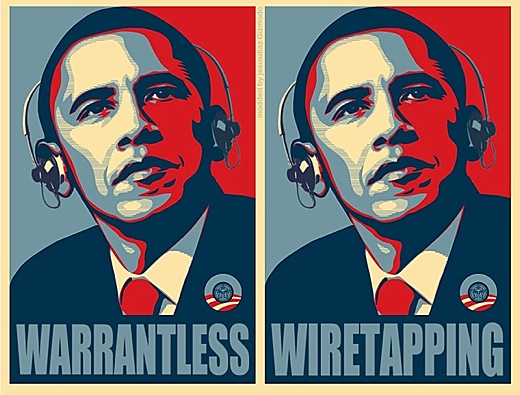
Image above:"Warrantless Wiretap" Obama satire poster.  From (http://gizmodo.com/5138271/obama-supports-warrantless-wiretapping-just-like-bush).

Americans love an underdog. So they should be cheering Ladar Levison, a 32-year-old digital security specialist who closed the email service he operated for 10 years rather than help the U.S. government spy on his customers.

Until Thursday afternoon, Levison was the owner and operator of Lavabit, a secure email service developed by a group of programmers in Texas in 2004 that used encryption technology to prevent the content of its users’ emails from being read by anyone who didn’t possess the numerical “keys” required to “unlock” them. Levison’s decision appears to be unprecedented. Kurt Opsahl, a lawyer with the Electronic Frontier Foundation, was quoted by The Guardian as saying: “I am unaware of any situation in which a service provider chose to shut down rather than comply with a court order they felt violated the constitution.”

No amount of encryption can completely protect online activity from determined snoopers, but Lavabit’s methods appear to have been among the most sound and reliable available to people desiring to communicate privately online. In an article about certain consequences of Lavabit’s shutdown, New Statesman technology reporter Alex Hern asserted that “based on everything we know about the intelligence services, even they can’t break that sort of encryption. If they don’t have the key, they don’t have the data.”

As if the availability of that kind of power wasn’t enough to attract official attention, the service became a focus of the U.S. government when it came out that NSA whistle-blower Edward Snowden was likely using it to talk with people across the globe out of earshot of the authorities. Snowden apparently used the non-secretive email address edsnowden@lavabit.com to invite journalists and human rights activists to a news conference in the international zone of Moscow’s Sheremetyevo airport, where he was sequestered for more than a month.

Advertisement <a href='http://www.truthdig.com/banners/www/delivery/ck.php?n=abee66dc&amp;cb=2043902560' target='_blank'><img src='http://www.truthdig.com/banners/www/delivery/avw.php?zoneid=8&amp;cb=2043902560&amp;n=abee66dc' border='0' alt='' /></a> If Snowden did indeed use Lavabit, he would not have been alone. According to the independent news site mathaba, Lavabit had 40,000 people logging in every day and sending 1.4 million messages per week. The Guardian says the service claimed 350,000 customers. Reports that Snowden used the site appeared to cause the number of people signing up to triple in recent weeks.

Levison’s parting message to his customers and the broader public, published to Lavabit’s page immediately after the shutdown, reads like an anxious hero’s cry against the advances of an overwhelming villain.

“My Fellow Users,” he begins, striking a fittingly non-hierarchical tone. “I have been forced to make a difficult decision: to become complicit in crimes against the American people or walk away from nearly ten years of hard work by shutting down Lavabit. After significant soul searching, I have decided to suspend operations. I wish that I could legally share with you the events that led to my decision. I cannot. I feel you deserve to know what’s going on—the first amendment is supposed to guarantee me the freedom to speak out in situations like this. Unfortunately, Congress has passed laws that say otherwise. As things currently stand, I cannot share my experiences over the last six weeks, even though I have twice made the appropriate requests.”

“What’s going to happen now?” he continues. “We’ve already started preparing the paperwork needed to continue to fight for the Constitution in the Fourth Circuit Court of Appeals. A favorable decision would allow me to resurrect Lavabit as an American company.”

“This experience has taught me one very important lesson,” Levison concludes. He has a warning for everyone using conventional tools and services to communicate online: “Without congressional action or a strong judicial precedent, I would _strongly_ recommend against anyone trusting their private data to a company with physical ties to the United States.” The warning echoes a grimmer comment attributed to him on mathaba: “I’m taking a break from email,” Levison reportedly said. “If you knew what I know about email, you might not use it either.”

Lavabit is not the only casualty of the government’s aggressive pursuit of encryption services. Hours after Lavabit announced its shutdown, another company that offered email encryption, Silent Circle, said it was pre-emptively shutting down its service.

Levison is not a privacy absolutist. When it’s made available to everyone, encryption technology can be used by criminals too. “He has cooperated in the past with government investigations,” mathaba reports. “He says he’s received ‘two dozen’ requests over the last ten years, and in cases where he had information, he would turn over what he had.”

Levison says he does not intend to support criminality. “I’m not trying to protect people from law enforcement,” he said. “If information is unencrypted and law enforcement has a court order, I hand it over.” But the secretive way the government goes about collecting information, which Americans know much about after months of revelations concerning the White House and the National Security Agency’s massive dragnet spying program, does disturb him. “The methods being used to conduct those investigations should not be secret,” he said.

Levison is currently raising money for a legal battle in the 4th U.S. Circuit Court of Appeals. As of Saturday morning, a defense fund being raised by private donors was reaching $90,000. He says he will revive Lavabit only if he can secure legal protections for services like his. “It needs to be clear that the government can’t do what they’re trying to do,” he said. “Otherwise the same request is going to come right back at us. Other big names aren’t able to shut down in protest. I’m one person without a bunch of employees to support. If we win, we win for everyone.”

When the Obama administration is using all of its vast, publicly funded resources to wage a war on Americans’ privacy and the freedom of thought that privacy enables, those words are exciting. Levison is a David facing a modern Goliath. His victory is not assured, but his determination to stand up for some of the United States’ founding principles, at a time when such a move is becoming increasingly dangerous, is inspiring. For sticking his neck out for all of us, we honor Ladar Levison as our Truthdigger of the Week.

.

Manning verdict & Snowden's future

SUBHEAD:  Edward Snowden's father, Lonnie, said: "I have absolutely no faith in the attorney general of the United States."

By Eyder Peralta on 30 January 2013 for NPR News -
(http://www.npr.org/blogs/thetwo-way/2013/07/30/207042272/what-the-manning-verdict-says-about-edward-snowdens-future)


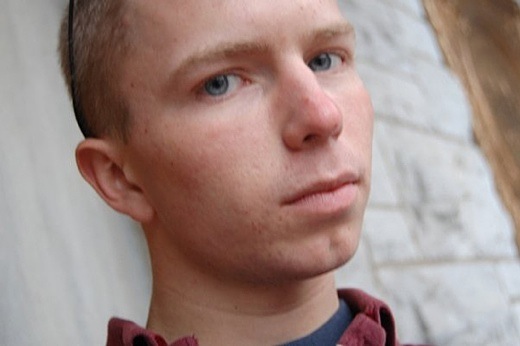
Image above: Photo courtesy of Bradley Manning Support Network. From (http://www.bu.edu/today/2012/the-making-of-a-cyber-libertarian/).

In the wake of of aiding the enemy, the natural question is, what does this say about Edward Snowden's future?

is, of course, the Army private responsible for the biggest leak of classified information in U.S. history. is responsible for revealing some of the most secretive and sensitive intelligence programs inside the National Security Agency.

The U.S. government charged Manning with aiding the enemy. , that was an unprecedented charge that had the potential of casting a long shadow over future leak cases.

Mary-Rose Papandrea, a professor of law at Boston College, is in the middle of writing an academic paper that explores the difference between leakers and traitors.

Papandrea said an aiding-the-enemy charge essentially amounts to treason; the fact that Col. Denise Lind, the military judge presiding over the Manning case, found him not guilty of the charge bodes well for Snowden and whoever may come next.

"It is good news for people who have the intent to inform the public that they will be protected," Papandrea said. "What I think the court did — without having seen any explicit rationale here — is to make a distinction between true aiding the enemy — intent to aid the enemy, knowledge that information will be read by the enemy and an intent to have that information read by the enemy — versus individuals who disclose information without authorization but with the intent to disclose them to the public at large."

During the trial, the U.S. government argued that when Manning released information to WikiLeaks — instead of traditional news outlets — it was because he wanted the data to be available in an indiscriminate manner. As an intelligence analyst, the government argued, he should have known that the information was going to end up in the hands of al-Qaida.

Many civil libertarians worried about the kind of precedent the case would set for investigative journalism in the United States. In essence, they said, this meant anyone could be charged with aiding the enemy for handing information to a website or news outlet because al-Qaida was free to visit that website.

What's more, aiding the enemy is one of only three crimes in the Uniform Code of Military Justice that theoretically applies to everyone.

Eugene Fidell, a lecturer at Yale Law School and an expert on military law, said the Manning verdict will likely revive talk about whether you can aide the enemy by releasing information to a news organization. One thing that seems clear, he says, is that Snowden will not be tried on that most-serious charge.

"On paper, the statute applies to any person. But in fact the Supreme Court would not tolerate a court martial of a civilian for aiding the enemy," Fidell said. "I don't think Mr. Snowden has to worry about being court martialed."

Papandrea agrees, but she says that while Manning beat the most serious charge against him, he could still face decades in prison for his other crimes, including espionage and theft.

"It's not like Bradley Manning is getting off scot-free. All it means is that he was not found guilty of what essentially amounts to treason," Papandrea says. "So as far as the message for Snowden, he still would face potential Espionage Act charges and other lesser charges."

In fact, the U.S. government has already charged the former NSA contractor with .

Papandrea argues, however, there are stark differences between Manning and Snowden.

"I don't think the espionage charges [against Manning] were that controversial," she said. "I think some people thought that Bradley Manning may have been engaged in whistle-blowing.

But I think the Snowden disclosures raise much bigger questions about the role of leakers in our society. You have Congress right now considering and coming close to passing legislation that would stop the program that Snowden revealed.

Clearly, his disclosures have had a big impact on the public debate. They are meaningful; they are important."

Manning, on the other hand, disclosed some 700,000 classified documents that "did not have significant impact on public discourse."

That was the argument, Snowden's father Lonnie and his attorney, Bruce Fein, made on CNN this afternoon. Snowden, Fein said, should be treated as a whistle-blower not a spy.

"He has sparked a conversation that Mr. Obama said was urgent," said Fein.

In Manning's case, judge Lind found the 25-year-old was not a traitor, but in six different instances, she rejected the defense's argument that Manning was a whistle-blower intent on sparking a debate about war and diplomacy.

If Lind sticks to maximum sentences, Manning could be in prison for decades.

Lonnie Snowden, who had called for his son to come back to the United States and face justice, had a different message for his son today: Stay safe, in Russia, he told him on CNN.

He added: "I have absolutely no faith in the attorney general of the United States."


Holden indicates US Government attitude

SUBHEAD: A.G. Holden says U.S. will not seek death penalty or torture Snowden if he returns. What a pathetic thing for him to have to say.

Mariano Castillo on 27 July 2013 for CNN News -
(http://www.cnn.com/2013/07/26/us/nsa-snowden/index.html)


Image above: Eric Snowden as a teen in an online post. Photo courtesy elitedaily.com — “The Voice of Generation Y”From (http://dhogle.wordpress.com/tag/edward-snowden/).
The U.S. Justice Department will not seek the death penalty for U.S. intelligence leaker Edward Snowden, Attorney General Eric Holder wrote to Russian authorities in a letter dated July 23.

In the letter, Holder says Snowden's arguments for temporary asylum in Russia are without merit.

Snowden is seeking asylum because he claims he will be tortured and face the death penalty if returned to the United States.

But the death penalty is not an option given the current charges against Snowden, and even if additional charges are filed, the United States would still not seek capital punishment, Holder wrote.

Once back in the United States, Snowden would not be tortured and would face a civilian trial with a lawyer appointed to him, the attorney general wrote.

"We believe that these assurances eliminate these asserted grounds for Mr. Snowden's claim that he should be treated as a refugee or granted asylum," Holder wrote.

He also said it is untrue that Snowden cannot travel because his U.S. passport was revoked. Snowden is still a U.S. citizen and is eligible for a limited-validity passport that would authorize a direct return to the United States.

"The United States is willing to immediately issue such a passport to Mr. Snowden," Holder wrote.

Father asks Obama to rein in Holder
In a letter released Friday, Snowden's father called on President Barack Obama to order Holder to dismiss the criminal complaint filed against his son.

Lon Snowden defended his son's actions, comparing them to acts of civil disobedience.

"We are also appalled at your administration's scorn for due process, the rule of law, fairness and the presumption of innocence as regards Edward," the letter said.

Earlier in the day, Lon Snowden said on NBC's "Today" that Snowden did the right thing by leaking U.S. intelligence and helping Americans see the truth.

"I think my son, when he takes his final breath, whether it's today or 100 years from now, (will) be comfortable with what he did," he said. "He did what he knew was right. He shared the truth with the American people. What we choose to do with it is up to us as a people."

Lon Snowden expressed his disappointment with the recent House vote that continued funding for the spy program that Edward Snowden exposed.

There is a need for a strong intelligence community, Lon Snowden said, but many who voted for continued funding for the program are really looking out for the special interests that will benefit.

"It's all about the money," he said.

The father said he has not been in direct contact with his son, but there has been indirect contact through intermediaries.

The intermediaries do not include WikiLeaks, Lon Snowden said, but he added that he is thankful to that group for aiding his son.

"I'm thankful for anybody at this point that is providing him with assistance to keep him safe and secure," he said.

U.S., Russian officials continue talks

Meanwhile, the Kremlin said that the Russian security agency FSB is talking to American officials.

"The situation around Snowden is not being discussed at the top level. There's a discussion between heads of FSB and FBI," the Kremlin press office said.

A spokesman for Vladimir Putin said the Russian president "expressed a firm intention to not allow" further damage to U.S. interests, including a pledge by Snowden not to release any more intelligence. "And I have no doubt this is how it will be, no matter how the situation develops," the spokesman said, according to the Russian news agency RIA Novosti.

The many mysteries of Snowden's transit zone

Snowden isn't yet allowed to step outside the Moscow airport where he's been confined for weeks. He is waiting for permission to stay elsewhere in Russia while his request for temporary asylum is considered.

He has been searching for a place to settle after the United States charged him with espionage.

The former National Security Agency contractor, who admitted last month to revealing sweeping U.S. electronic surveillance programs to the news media, left Hong Kong for Moscow on June 23.

Snowden may remain stuck in the transit area for weeks and maybe months, the head of Russia's migration service, Vladimir Volokh, told the Russian news agency Interfax. The maximum length of time Snowden can spend at the airport is six months, he said.
.

Prometheus Among the Cannibals

SUBHEAD: Letter to Edward Snowden from Rebecca Solnit.

By Rebecca Solnit on 18 July 2013 for Tom Dispatch -
(http://www.tomdispatch.com/post/175726/)


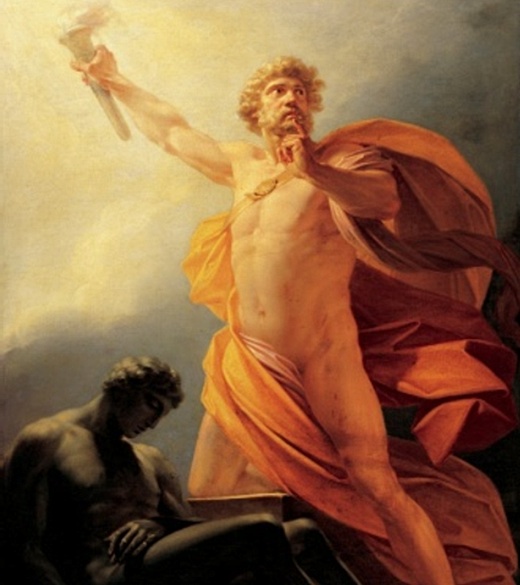
Image above: Detail of painting by Heinrich Friedrich of Prometheus Stealing the Fire of the Gods, 1817. From (http://www.flickr.com/photos/iesluisvelez2006-2007/8893194517/).

Dear Edward Snowden,

Billions of us, from prime ministers to hackers, are watching a live espionage movie in which you are the protagonist and perhaps the sacrifice. Your way forward is clear to no one, least of all, I’m sure, you.

I fear for you; I think of you with a heavy heart. I imagine hiding you like Anne Frank. I imagine Hollywood movie magic in which a young lookalike would swap places with you and let you flee to safety -- if there is any safety in this world of extreme rendition and extrajudicial execution by the government that you and I were born under and that you, until recently, served. I fear you may pay, if not with your death, with your life -- with a life that can have no conventional outcome anytime soon, if ever. “Truth is coming, and it cannot be stopped,” you told us, and they are trying to stop you instead.

I am moved by your choice of our future over yours, the world over yourself. You know what few do nowadays: that the self is not the same as self-interest. You are someone who is smart enough, idealistic enough, bold enough to know that living with yourself in a system of utter corruption would destroy that self as an ideal, as something worth being. Doing what you’ve done, on the other hand, would give you a self you could live with, even if it gave you nowhere to live or no life. Which is to say, you have become a hero.

Pity the country that requires a hero, Bertolt Brecht once remarked, but pity the heroes too. They are the other homeless, the people who don’t fit in. They are the ones who see the hardest work and do it, and pay the price we charge those who do what we can’t or won’t. If the old stories were about heroes who saved us from others, modern heroes -- Nelson Mandela, Cesar Chavez, Rachel Carson, Ella Baker, Martin Luther King, Aung San Suu Kyi -- endeavored to save us from ourselves, from our own governments and systems of power.

The rest of us so often sacrifice that self and those ideals to fit in, to be part of a cannibal system, a system that eats souls and defiles truths and serves only power. Or we negotiate quietly to maintain an uneasy distance from it and then go about our own business. Though in my world quite a few of us strike our small blows against empire, you, young man, you were situated where you could run a dagger through the dragon’s eye, and that dragon is writhing in agony now; in that agony it has lost its magic: an arrangement whereby it remains invisible while making the rest of us ever more naked to its glaring eye.

Private Eyes and Public Rights
Privacy is a kind of power as well as a right, one that public librarians fought to protect against the Bush administration and the PATRIOT Act and that online companies violate in every way that’s profitable and expedient. Our lack of privacy, their monstrous privacy -- even their invasion of our privacy must, by law, remain classified -- is what you made visible. The agony of a monster with nowhere to stand -- you are accused of spying on the spies, of invading the privacy of their invasion of privacy -- is a truly curious thing. And it is changing the world. Europe and South America are in an uproar, and attempts to contain you and your damage are putting out fire with gasoline.

You yourself said it so well on July 12th:

“A little over one month ago, I had family, a home in paradise, and I lived in great comfort. I also had the capability without any warrant to search for, seize, and read your communications. Anyone's communications at any time. That is the power to change people's fates. It is also a serious violation of the law. The 4th and 5th Amendments to the Constitution of my country, Article 12 of the Universal Declaration of Human Rights, and numerous statutes and treaties forbid such systems of massive, pervasive surveillance. While the U.S. Constitution marks these programs as illegal, my government argues that secret court rulings, which the world is not permitted to see, somehow legitimize an illegal affair. These rulings simply corrupt the most basic notion of justice -- that it must be seen to be done.”

They say you, like Bradley Manning, gave secrets to their enemies. It’s clear who those enemies are: you, me, us. It was clear on September 12, 2001, that the Bush administration feared the American people more than al-Qaeda. Not much has changed on that front since, and this almost infinitely broad information harvest criminalizes all of us. This metadata -- the patterns and connections of communications rather than their content -- is particularly useful, as my friend Chris Carlsson pointed out, at mapping the clusters of communications behind popular movements, uprisings, political organizing: in other words, those moments when civil society rises to shape history, to make a better future in the open world of the streets and squares.

The goal of gathering all this metadata, Chris speculates, "is to be able to identify where the ‘hubs’ are, who the people are who sit at key points in networks, helping pass news and messages along, but especially, who the people are who spread ideas and information from one network of people to the next, who help connect small networks into larger ones, and thus facilitate the unpredictable and rapid spread of dissent when it appears.”

Metadata can map the circulatory system of civil society, toward what ends you can certainly imagine. When governments fear their people you can be sure they are not serving their people. This has always been the minefield of patriotism: loyalty to our government often means hostility to our country and vice-versa. Edward Snowden, loyalist to country, you have made this clear as day.

Those who demonize you show, as David Bromwich pointed out in a fine essay in the London Review of Books, their submission to the power you exposed. Who stood where, he writes,

“was an infallible marker of the anti-authoritarian instinct against the authoritarian. What was distressing and impossible to predict was the evidence of the way the last few years have worn deep channels of authoritarian acceptance in the mind of the liberal establishment. Every public figure who is psychologically identified with the ways of power in America has condemned Snowden as a traitor, or deplored his actions as merely those of a criminal, someone about whom the judgment ‘he must be prosecuted’ obviates any further judgment and any need for thought.”

You said, "I know the media likes to personalize political debates, and I know the government will demonize me." Who you are is fascinating, but what you’ve exposed is what matters. It is upending the world. It is damaging Washington’s relations with many Latin American and some European countries, with Russia and China as well as with its own people -- those, at least, who bother to read or listen to the news and care about what they find there. “Edward Snowden Single-Handedly Forces Tech Companies To Come Forward With Government Data Request Stats,” said a headline in Forbes. Your act is rearranging our world. How much no one yet knows.

What You Love
What’s striking about your words on video, Edward Snowden, the ones I hear as your young, pale, thoughtful face speaks with clarity and incisiveness in response to Glenn Greenwald’s questions, is that you’re not talking much about what you hate, though it’s clear that you hate the secret network you were part of. You hate it because it poisons what you love. You told us, "I understand that I will be made to suffer for my actions... [but] I will be satisfied if the federation of secret law, unequal pardon, and irresistible executive powers that rule the world that I love are revealed even for an instant." You love our world, our country -- not its government, clearly, but its old ideals and living idealists, its possibilities, its dreamers, and its dreams (not the stale, stuffed American dream of individual affluence, but the other dreams of a better world for all of us, a world of principle).

You told us where we now live and that you refuse to live there anymore:

"I don't want to live in a world where everything that I say, everything I do, everyone I talk to, every expression of creativity or love or friendship is recorded. And that's not something I'm willing to support, it's not something I'm willing to build, and it's not something I'm willing to live under. America is a fundamentally good country. We have good people with good values who want to do the right thing. But the structures of power that exist are working to their own ends to extend their capability at the expense of the freedom of all publics."

Which is to say you acted from love, from all the things the new surveillance state imperils: privacy, democracy, accountability, decency, honor. The rest of us, what would we do for love?

What is terrifying to the politicians at the top is that you may be our truest patriot at the moment. Which makes all of them, with their marble buildings and illustrious titles, their security details and all the pomp, the flags, the saluting soldiers, so many traitors. The government is the enemy of the people; the state is the enemy of the country. I love that country, too. I fear that state and this new information age as they spread and twine like a poison vine around everything and everyone. You held up a mirror and fools hate the mirror for it; they shoot the messenger, but the message has been delivered.

“This country is worth dying for,” you said in explanation of your great risks. You were trained as a soldier, but a soldier’s courage with a thinker’s independence of mind is a dangerous thing; a hero is a dangerous thing. That’s why the U.S. military has made the Guardian, the British newspaper that has done the key reporting on your leaks, off limits to our soldiers overseas. Whoever made that cynical censorship decision understands that those soldiers may be defending a set of interests at odds with this country and its Constitution, and they need to be kept in the dark about that. The dark from which you emerged.

When the United States forced the airplane of Evo Morales, Bolivia’s democratically elected head of state, to land in Austria, after compliant France, Spain, Portugal, and Italy denied him the right to travel through their airspace, all South America took it as an insult and a violation of Bolivia’s sovereignty and international law. The allied president of Argentina, Cristina Fernandez de Kirchner, tracked the incident in a series of tweets that demonstrated an openness, a principledness, and a strong friendship between Morales, Ecuadoran president Rafael Correa, and her. It was a little window onto a really foreign continent: one in which countries are sometimes headed by genuinely popular leaders who are genuinely transparent and governed by rule of law. It’s a reminder that things in our own blighted, corrupted, corporate-dominated country could be different.

Building a Bridge to the Nineteenth Century
How did we get here? In 1996, President Bill Clinton and Vice President Al Gore pushed the dreadful slogan “building a bridge to the twenty-first century.” It was a celebration of Silicon Valley-style technological innovation and corporate globalization, among other things. At the time, I put “building a bridge to the nineteenth century” on my letterhead. It turned out that we were doing both at once: erecting a massive electronic infrastructure that outpaces our ability to democratically manage it and shifting our economy backward to recreate the chasms of class divide that marked the nineteenth century. The two goals intertwined like serpents making love.

The new technologies made a surveillance state that much more powerful and far-reaching; the new technologies replaced many jobs with few; the new technologies created new billionaires without principles; the new technologies made us all into commodities to be sold to advertisers; the new technologies turned our every move into something that could be tracked; the new technologies kept us distracted and busy. Meanwhile, almost everyone got poorer.

What the neoliberals amassing mountains of wealth for the already super-wealthy forgot, what the tax-cutters and child-starvers never learned in school, is that desperate people do not necessary simply lie down and obey. Often enough, they rebel. There is no one as dangerous as he or she who has nothing to lose. The twentieth century’s welfare states, their pumped-up, plumped-up middle classes, their relative egalitarianism and graduated tax plans pacified the once-insurrectionary classes by meeting, at least in part, their needs and demands. The comfortable don’t revolt much. Out of sheer greed, however, the wealthiest and most powerful decided to make so many of the rest of us at least increasingly uncomfortable and often far worse.

Edward Snowden, you rebelled because you were outraged; so many others are rebelling because their lives are impossible now. These days when we revolt, the new technologies become our friends as well as our enemies. If you imagine those technologies as the fire Prometheus stole from the gods, then it works both ways, for us and for them, to create and to destroy.

Those new technologies are key to the latest rounds of global organizing, from the World Trade Organization actions of 1999, put together by email and epochal in their impact, to the Arab Spring, which used email, cell phones, Facebook, Twitter, and other means, to Occupy Wall Street. The technologies are double-edged: populist networks for creating global resistance are vulnerable to surveillance; classified reams of data are breachable by information saved to thumb drives or burned onto CDs by whistleblowers and hackers. They can spy in private; we can organize in public, and maybe the two actions are true opposites.

Meanwhile there is massive upheaval in Egypt and in Brazil, and in recent years there have been popular rebellions in many parts of the Arab world, Turkey, Iceland, Greece, Spain, Britain, Chile, and the U.S. itself with Occupy. The globe is on fire with popular outrage, with fury over economic injustice and, among other things, climate change spurred by the profits a few are piling up to the detriment of the rest of us, generations to come, other species, and the planet itself. It seems that, surveillance or not, people are not about to go quietly into the nineteenth century or accept the devil’s bargains of the twenty-first either.

Prometheus and Being Burned
I think of a man even younger than you, Edward Snowden, who unlike you acted without knowing what he did: 26-year-old Mohammed Bouazizi, whose December 2010 self-immolation to protest his humiliation and hopelessness triggered what became the still-blooming, still-burning Arab Spring. Sometimes one person changes the world. This should make most of us hopeful and some of them fearful, because what I am also saying is that we now live in a world of us and them, a binary world. It’s not the old world of capitalism versus communism, but of the big versus the little, of oligarchy versus democracy, of hierarchies versus swarms, of corporations versus public interest and civil society.

It seems nearly worldwide now, which is why revolts all over the planet have so much in common these days, why Occupy activists last month held up signs in New York’s Liberty Plaza in solidarity with the uprising in Taksim Square in Turkey; why Arab Spring activists phoned in pizza orders to the uprising in Wisconsin in early 2011; why Occupy spread around the world, and Greek insurrectionaries learned from the successes of Argentina in the face of austerity and economic collapse. We know our fate is common and that we live it out together and change it together, only together.

There were rumblings that you had defected, or would defect, to China or Russia, but you had already defected when we became aware of your existence: you had defected from them to us, using the power you had gained deep within the bowels of their infernal machines to empower us. What will we do with what you’ve taught us? That’s up to us, but for anyone who thinks what you did was not threatening to those in power, just look at how furious, how upset, how naked our emperors now are.

And you, Prometheus, you stole their fire, and you know it. You said, "Being called a traitor by Dick Cheney is the highest honor you can give an American, and the more panicked talk we hear from people like him, [Senator Dianne] Feinstein, and [Congressman Peter] King, the better off we all are. If they had taught a class on how to be the kind of citizen Dick Cheney worries about, I would have finished high school."

Someday you may be regarded as a Mandela of sorts for the information age, or perhaps a John Brown, someone who refused to fit in, to bow down, to make a system work that shouldn’t work, that should explode. And perhaps we’re watching it explode.

The match is sacrificed to start the fire. So maybe, Edward Snowden, you’re a sacrifice. In the process, you’ve lit a bonfire out of their secrecy and spying, a call to action.

I fear for you, but your gift gives us hope and your courage, an example. Our loyalty should be to our ideals, because they are a threat to the secret system you’ve exposed, because we have to choose between the two. Right now you embody that threat, just as you embody those ideals. For which I am grateful, for which everyone who is not embedded in that system should be grateful.

Love,

Rebecca

• Rebecca Solnit, like Edward Snowden, has a GED, not a high-school diploma. She lives in Silicon Valley’s shadow, in a city where billionaires race $10 million yachts and austerity is closing the community college.  Her newest book is The Faraway Nearby.
.