Showing posts with label Refugees. Show all posts

Trump expects the Earth will boil

SUBHEAD: His administration expects the planet is going to experience temperature rise of 7ºF and doesn't care.

By Bill McKibbon on 2 October 2018 for the Guardian -
(https://www.theguardian.com/commentisfree/2018/oct/02/trump-administration-planet-boil-refugee-camps)
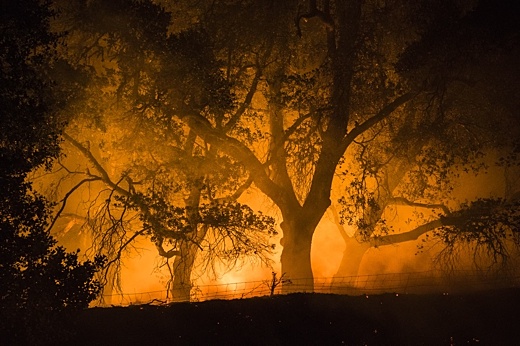

Image above: Trees silhouetted by flames in recent out of control wild fire in California seen in Washington Post article dated 9/28/18 titled "Trump administration sees a 7-degree rise in global temperatures by 2100". From (https://www.washingtonpost.com/national/health-science/trump-administration-sees-a-7-degree-rise-in-global-temperatures-by-2100/2018/09/27/b9c6fada-bb45-11e8-bdc0-90f81cc58c5d_story.html).

In the cloud of toxic dust thrown up by the Kavanaugh hearings last week, two new Trump initiatives slipped by with less notice than they deserve. Both are ugly, stupid – and they are linked, though in ways not immediately apparent.

In the first, the administration provided the rationale for scrapping President Obama’s automobile mileage standards: because Trump’s crew now officially expects the planet to warm by 4C . In the environmental impact statement they say it wouldn’t make much difference to the destruction of the planet if we all keep driving SUVs.

The news in that statement is that administration officials serenely contemplate that 4C rise (twice the last-ditch target set at the Paris climate talks). Were the world to actually warm that much, it would be a literal hell, unable to maintain civilizations as we have known them.

But that’s now our policy, and it apparently rules out any of the actions that might, in fact, limit that warming. You might as well argue that because you’re going to die eventually, there’s no reason not to smoke a carton of cigarettes a day.

Meanwhile, reporters also discovered that the administration has set up what can only be described as a concentration camp near the Mexican border for detained migrant children, spiriting them under cover of darkness from the foster homes and small shelters across the nation where they had been staying.

Not an extermination camp – these aren’t Nazis – but a camp that literally concentrates this “problem” in one place: a tent city in the middle of the desert. Schooling is not available there, as it was in the shelters they came from; instead the kids are given “workbooks that they have no obligation to complete. Access to legal services is limited.”

That camp is linked to climate change because, first, it’s in a desert. If you searched high and low across the North American continent, you could barely find a place hotter and drier than Tornillo, Texas, where in June the average high is 96F and where, as one climate data source succinctly puts it, “there is virtually no rainfall during the year”.

But the link goes much deeper. Most of those migrants are from Central America and Mexico, and they might as easily be described as refugees fleeing gang violence (much of it rooted originally in the US) and a changing climate. Guatemala, El Salvador and Honduras first saw an outbreak of coffee rust linked to higher nighttime temperatures; the El Niño that began in 2015 led to years of unprecedented drought.

Deep new droughts this summer wiped out more harvests: “total or partial loss of crops means that subsistence farmers and their families will not have enough food to eat or sell in coming months,” the UN’s Food and Agriculture Organization warned.

The author Todd Miller, writing in the Nation, described meeting men trying to jump a train in Guatemala headed north toward the border. “When I asked why they were heading for the United States, one responded simply, “No hubo lluvia.” (“There was no rain.”)

This will, of course, get steadily worse in the years ahead – every climate forecast shows deserts spreading and water evaporating across the region. And of course more migration will follow, in every corner of the world.

The World Bank predicts we may see 140 million climate migrants before long, and given the chaos that even a million people fleeing the (partially drought-fueled) crisis in Syria created, we better come to grips.

Some of that migration will be internal – perhaps six million people will abandon their coastal property in Florida alone, according to recent reports. And much of it will be international, as people flee because their lives depend on it.

And telling people to stay home is not a moral option, either. Because the climate chaos setting off waves of refugees is born above all from the unconstrained migration of carbon dioxide molecules from America over the last century.

No wall can prevent the exhaust from our armada of oversized cars from raising the temperature in Mexico; if Guatemala could ship its changed climate back north it doubtless would, but it can’t.

We have to realize that global warming stems from the fact that we are a world without atmospheric borders, where the people who have done the least to cause the problem feel its horrors first and hardest.

That’s why, over the last half-decade, the environmental and migrant-rights movement have grown ever closer.

The Trump years are a fantasy land where we pretend we can go on living precisely as in the past, unwilling even to substitute electric SUVs for our gas guzzlers, and able to somehow insist that the rest of the world stay locked in place as well.

It’s impractical, it’s unfair, and when it ends up with camps for kids in the desert it’s downright evil.


.
US anti-terrorism strategy backfires

SUBHEAD: UN report reveals nations with the most refugees were targets of American anti-terrorist interventions.

By Whitney Webb on 22 June 2017 for Mint Press News -
(http://www.mintpressnews.com/un-top-nations-refugees-targets-us-intervention/229136/)


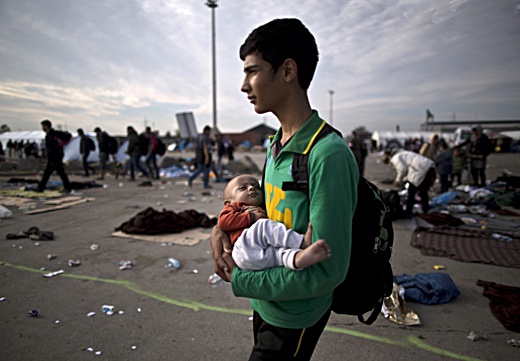
Image above: Afghan refugee Rasoul Nazari, 15, holds his 10-month-old nephew Imran after crossing the border between Hungary and Austria in Nickelsdorf, Austria. Photo by Muhammed Muheisen. From original article.

A United Nations report has shed light on the world’s burgeoning crisis of displaced peoples, finding that a record 65.6 million were forced to vacate their homes in 2016 alone. More than half of them were minors.

The Office of the UN High Commissioner for Refugees (UNHCR), which drafted the report, put the figure into perspective, stating that increasing conflict and persecution worldwide have led to “one person being displaced every three seconds – less than the time it takes to read this sentence.”

UN High Commissioner Filippo Grandi called the figure “unacceptable” and called for “solidarity and a common purpose in preventing and resolving the crisis.”

However, what the UN report failed to mention was the role of U.S. foreign intervention, indirect or direct, in fomenting the conflicts responsible for producing most of the world’s refugees.

According to the report, three of the nations producing the highest number of refugees are Syria (12 million refugees created in 2016), Afghanistan (4.7 million) and Iraq (4.2 million).


Video above: The UNHCR’s New Global Trends Report on Refugees. From original article and (https://youtu.be/hBFgI4D8eEM).

The conflicts in Iraq and Afghanistan are known to be the direct result of U.S. military invasions in the early 2000s, as well as the U.S.’ ongoing occupation of those nations.

Decades after invading both countries, the U.S.’ destabilizing military presence in Iraq and Afghanistan has continued to increase in recent years, with the Trump administration most recently announcing plans to send thousands of soldiers to Afghanistan in the coming months. It is worth noting that each U.S. soldier in Afghanistan costs U.S. taxpayers $2.1 million.

While the U.S. has yet to directly invade Syria, the U.S. role in the conflict is clear and Syria’s destabilization and the overthrow of its current regime have long been planned by the U.S. government.

The U.S. and its allies, particularly Israel and Saudi Arabia, have consistently funded “rebel” groups that have not only perpetuated the Syrian conflict for six long years, but have also committed atrocity after atrocity targeting civilians in Syrian cities, towns, and communities – a major factor in convincing Syrians to leave their homes.

The report ranks Colombia as the world’s second-largest producer of refugees, with 7.7 million Colombians displaced in 2016. Like Syria, the U.S. has not directly invaded Colombia, but is known to have extensively funded paramilitary groups, also known as “death squads,” in the country since the 1980s, when then-U.S. President Ronald Reagan declared a “war on drugs” in Colombia. 

U.S. efforts have long helped fuel the civil war between the Revolutionary Armed Forces of Colombia (FARC) and pro-government, U.S.-funded paramilitary groups. This conflict has lasted for more than half a century.

In 2000, then-President Bill Clinton’s administration funded the disastrous “Plan Colombia” with $4 billion in U.S. taxpayer funds, ostensibly to fight drug trafficking and insurgents. Almost all of this money was used to fund the Colombian military and its weapon purchases. 

“Plan Colombia” ultimately intensified armed violence, military deployments, human rights abuses by the Colombian military, and – of course – the internal displacement of Colombians. 

The legacy of U.S. policy in Colombia and its continuing support of the nation’s right-wing, neo-liberal regime have ensured that the chaos continues into the present.

In addition to the above, U.S foreign policy is also to blame for the conflict in South Sudan, where the UN report found was home to the fastest-growing displacement of people in the world. 

In 2011, the U.S. pushed South Sudan to secede from Sudan, as South Sudan holds the vast majority of Sudan’s oil reserves — the largest oil reserves in all of Africa. 

The U.S.’ push for the creation of an independent South Sudan dislodged Chinese claims to Sudanese oil, as the Chinese had previously signed oil contracts with the (now Northern) Sudanese government.

But when nation-building efforts went awry and civil war broke out just two years later, some analysts suggested that the conflict only started when South Sudan’s president began to cozy up to China. According to the UN report, approximately 3.3 million people in South Sudan have fled their homes since the war began.

Grandi has called on the world’s nations to help prevent and resolve the global refugee crisis. But he would also do well to point out the common cause uniting many of the world’s worst conflicts – the U.S. military-industrial complex’s insatiable lust for conquest, power and profit.

.

Xenophobia and religious prejudice

SUBHEAD: It should be obvious by now. The world is descending into xenophobia and religious prejudice.

By Juan Wilson on 19 November 2015 for Island Breath -
(http://islandbreath.blogspot.com/2015/11/xenophobia-and-religious-prejudice.html)


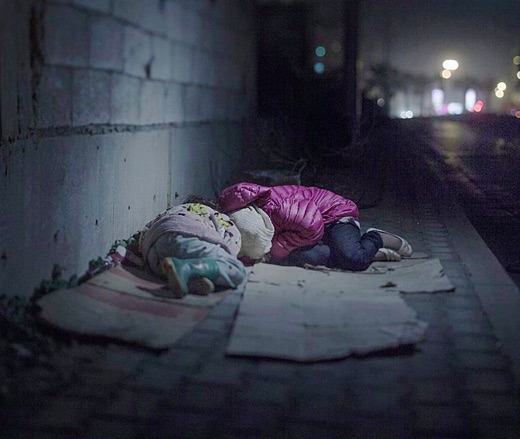
Image above: Photograph by Rav Vadgama of Ralia, 7, and Rahaf, 13, who live on the streets of Beirut. They are from Damascus, Syria, where a grenade killed their mother and brother. Along with their father they have been sleeping rough for a year. They huddle close together on their cardboard boxes. Rahaf says she is scared of “bad boys,” at which Ralia starts crying. From (http://kawaehawaii.blogspot.com/).

Got an email from Gary Hooser today. Yes he's running again for our Kauai County Council. And yes we will support him. Besides some personal notes and observations he ended his email with this.


... Like most, my work and life is focused primarily on the community in which I live.  However, events of the past few days have made us all keenly aware of the greater world around us that seems to be spinning out of control.

The discussion that has erupted around the question of accepting refugees into our State and Country has brought out the worse.

I have no answers or solutions but know that collectively we all need to take a deep breath, close our eyes, pause for a moment and think deeply about who we are and the core values that support our humanity.

Please read if you have a moment my friend Luke Evslin’s well written and deeply personal blog piece on this topic http://kawaehawaii.blogspot.com/2015/11/thoughts-on-syria.html

A woman who was seemingly distraught at the thought of bringing Syrian refugees to Hawaii posted in response a furious rant opposed to allowing refugees to enter Hawaii.  Her point was similar to many others that have been expressed recently “We don’t have the resources to take care of our own problems and have no business trying to help others until we help our own.”.

My response to her was:
“In this time of fear and angst on many levels and on many issues, both global and local - pushback against the concept of bringing more people into our home is understandable. But if a homeless child from any country or any religion or a family through no fault of their own was fleeing violence and seeking safety were to knock on my door, I would be hard pressed not to find them some small corner of my humble hale where they could lay their heads safely, at least for a little while. Luke Evslin speaks for me on this one.” ...

I commend Gary for speaking out and recommend reading Luke Evslin's blog article. We are putting a permanent link to his site on ours. Here's just the start of his observations that end with some compelling photos of Syrian children who are refugees.


Thoughts on Syria
I was robbed on Friday. They took four computers, jewelry, and possibly our two favorite ducks. I have never felt such shame and anger towards my fellow humans. This feeling is new to me. But not because some young punk broke into our house and violated our privacy. Crystal meth is creating a lost generation on Kaua'i who are driven to unconscionable acts. I can understand that.

It's our collective response to the worst humanitarian crisis since World War II that makes me want to vomit. It's the venom that is coming out on Social Media that's making me lose faith in humanity. From my friends-- people I know to be smart, good people.

That, I can not understand.

In case you missed it, Governor Ige said that Hawai'i would welcome Syrian refugees with aloha. And Social Media exploded in vehemence. This xenophobic outburst caused Governor Ige to partially retract his statement yesterday by saying "I suppose in hindsight I should probably be more thoughtful about my statements."

Yes-- Governor Ige, you should have known better. While we don't talk about it, we all know that under the thin veneer of the aloha spirit, Hawai'i harbors an intense distrust towards outsiders. But no-- Governor Ige, you shouldn't have to apologize for Hawai'i's lack of humanity. This is one of those rare times where it's important to say "fuck public opinion, I'm doing what's right."

My wife was born in a Cambodian refugee camp. My grandparents and great-grant parents were refugees. Most of my grandfather's family were shot or gassed because they could not get political asylum quick enough. Jews were painted as communists, and communists were thought to be dangerous. Nearly 70% of Americans were opposed to accepting Jewish refugees on the eve of World War II. ...


It should be obvious by now. The world is descending into xenophobia and religious prejudice.   Corporations and the military-security structures are taking over the commons and our public resources.

The Republicans are falling over each other trying to prove who's the least tolerant and most afraid of anyone who isn't a white Christian man. 

R. James Woolsey Jr. is an ex Director of the CIA. He is an idiot and a warmonger. The proof? He has been an adviser to John McCain.

Woosley claims the deal to slow Iran's nuclear program is "Worse than Useless" and that Edward Snowden should be executed by hanging because of the recent fatal attacks by terrorists in Paris by revealing the nature of the National Security Administration's universal unconstitutional illegal snooping on Americans (http://thehill.com/blogs/blog-briefing-room/260817-ex-cia-director-snowden-should-be-hanged-for-paris).

Where do we go from here? Probably more war.

See also:
Ea O Ka Aina: Federal Court's NSA Smackdown 11/10/15

.

TPP Slave Problem

SUBHEAD: Obama's Trans-Pacific Partnership is tangled in the intricate web of Malaysia's human trafficking problem.

By Laura Barron-Lopez on 30 May 2015 for Huffington Post -
(http://www.huffingtonpost.com/2015/05/30/malaysia-slavery-trade_n_7472682.html)


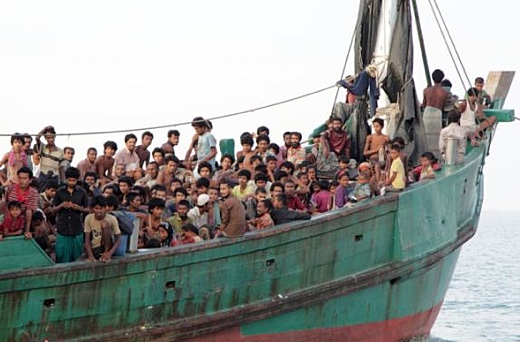
Image above: Migrants sit on their boat as they wait to be rescued by Acehnese fishermen on the sea off East Aceh, Indonesia, Wednesday, May 20, 2015. From original article.

President Barack Obama's push for legislation that would enable the U.S. to strike a major trade deal with 11 other countries has gotten tangled in a debate over Malaysia's record on slave labor, throwing up a last-minute legislative obstacle.

Inconveniently for backers of the trade deal, a full-blown humanitarian crisis is erupting in Malaysia, Thailand, Indonesia and Myanmar, directly connected to the region's reliance on human trafficking in industries as varied as electronics manufacturing, fishing and prostitution.

Last year, Malaysia and Thailand joined North Korea and Saudi Arabia on the State Department’s list of countries that are the worst offenders in forced labor and human trafficking -- formally known as a tier 3 designation. One year later, little has changed, though the importance of the tier 3 designation has surged as a result of the trade debate. the U.S. Senate last week passed legislation declaring that no country that engages in slave labor, such as Malaysia, can be a part of the trade deal.

As Malaysia angles for membership in a historic international trade deal of epic scope, it is facing increased scrutiny for its human rights record, yet doing little to change the facts on the ground.

In April, U.S. Ambassador Joseph Yun criticized Malaysia’s lack of progress on human trafficking. “The most obvious area is prosecution. Is there enough prosecution [of offenders] considering the incidence of trafficking?” Yun said, suggesting that such prosecutions were inexcusably rare.

This month, more than 139 grave sites were discovered, along with 28 suspected human trafficking camps in the far north of Malaysia, near the Thai border. Multiple bodies were found in each site, leading Malaysian authorities to estimate the number of dead to be well above 100.
With Malaysia finding itself engulfed in a migrant crisis, the United Nations has called on it to help rescue tens of thousands of Rohingya Muslims stranded at sea and in jungle concentration camps. Malaysia has not only refused, but has rebuffed even seriously participating in discussions. Meanwhile, a top Malaysian minister has said that despite the U.S. Senate's legislation, his government is sure it will be allowed into the Trans-Pacific Partnership trade deal, which may explain Malaysia's lack of interest in addressing the human trafficking crisis.
According to Malay Mail Online:

US news website Huffington Post reported Friday that while the White House is on the verge of securing the fast-track approval it needs to push ahead with the long-delayed free-trade deal, a US senator has succeeded in inserting a provision that would bar his country from entering agreements with countries officially viewed as engaging in slavery, which includes Malaysia.
“Regarding our Tier 3 position on human trafficking, this could be resolved if a Tier 3 country is seen to be taking concrete steps to implement recommendations in the Trafficking in Persons report,” Malaysia Minister Datuk Seri Mustapa Mohamed told the paper, referring to the State Department’s trafficking report. The White House has pushed for a modification of the Senate bill that mirrors the policy described by Mohamed, meaning revised language in a future House bill could allow Malaysia, or a tier 3 nation, into trade deals if they craft a plan to address human trafficking.
But the task of watering down the slavery language is made more challenging by the exploding humanitarian catastrophe, which couldn't come at a worse time for trade deal negotiators, who have argued that the Trans-Pacific Partnership, in the words of Obama, will be "the most progressive trade deal in history."

While that's a low bar, the active participation of a country that so blatantly participates in the slave trade calls that claim into question. American workers argue that they will face downward wage pressure from competition from Southeast Asian countries, and the fact that some of those workers will not be paid at all, but rather will be forced to work for free, only feeds those suspicions.

How did Malaysia get to this point? For the past four years, it has been on the State Department’s tier 2 watch list, and over the last seven has been ranked a tier 3 human trafficking nation three times.

The lack of consequences is just one explanation for Malaysia's apathetic response to the crisis. Perhaps more to the point, trafficking is an integral part of the nation's political economy, fed by surrounding countries.

The majority of the persecuted Rohingya are fleeing from Myanmar to neighboring nations of Thailand, Malaysia, and Indonesia. Further exacerbating the issue, Thailand cracked down on land-based migrant routes earlier this year, forcing smugglers to traffic people by sea, pushing even more to Malaysia.

Additionally, foreign workers typically migrate willingly to Malaysia from other Asian nations, according to the State Department annual report on human trafficking. Those countries include Indonesia, Bangladesh, Nepal and Thailand. A number of the migrants, the State Department report says, “subsequently encounter forced labor or debt bondage at the hands of their employers, employment agents, or informal labor recruiters.”

On top of that, the Malaysian government began a policy in 2013 that “places the burden of paying immigration and employment authorization fees on foreign workers,” rather than employers, making workers more susceptible to debt bondage. To make matters worse, employers in agriculture, construction, textile factories, and other domestic work throughout Malaysia routinely confiscate foreign workers' passports and other immigration documents, making it impossible for them to leave the country, and very difficult to find other work if they want to stay. Most workers aren't allowed to travel within Malaysia without immigration documents.

Immigration officials also contribute to the problem. “Press reports continued to accuse some immigration officials of facilitating smuggling, including the transportation of trafficking victims,” the State Department’s report says.

Such press reports include detailed investigations by Reuters revealing that the Thai navy is one key link in the chain of smugglers exploiting Rohingya Muslims. After interviewing smugglers and dozens of survivors who migrated via boat, Reuters found Thai naval personnel had worked with smugglers to profit from asylum seekers. (The Thai navy subsequently filed defamation charges against two journalists; the journalists won a Pulitzer Prize.)

Still, the State Department notes the Malaysian government “did not report any investigations, prosecutions, or convictions of government employees complicit in human trafficking,” despite multiple reports alleging such involvement.
.

First Climate Change Refugees

SUBHEAD: After cyclone Pam Kiribati Island residents want climate refugee status in New Zealand.

By Emma O'Brian on 30 March 2015 for Bloomberg News -
(http://www.bloomberg.com/news/articles/2015-03-30/an-islander-s-bid-to-be-the-world-s-first-climate-refugee)


Image above: Kiribate couple seeking refuge status in New Zealand after devastating cyclone hit tier island of Kiribate. From original article.

As Tropical Cyclone Pam ripped through the South Pacific earlier this month, Ioane Teitiota was 2,600 miles away in New Zealand checking Facebook for updates from friends and relatives back in Kiribati, a string of coral atolls about halfway between Australia and Hawaii.

The devastation wrought by the category five storm underscores the uncertain future faced by many in small Pacific Island nations as extreme weather events and climate change intensify. It’s a fate already being tested by Teitiota, who has launched an improbable bid to become the world’s first climate change refugee.

“I worry about our future, for our kids,” said Teitiota, sitting barefoot on a threadbare couch in his Auckland home as his three children run in and out, clutching pieces of white bread smeared with Nutella. People in Kiribati “are worried for their lives.”

Teitiota (pronounced Tess-yota) is legally contesting efforts by New Zealand Prime Minister John Key’s government to deport him in a case that may have far-reaching consequences for citizens of low-lying countries threatened by rising seas.

After a run of missed visa deadlines, the tomato farmer, 38, was arrested during a routine traffic stop in 2011.

Teitiota and his wife, Angua Erika, sought out attorney Michael Kidd. The Auckland lawyer, who’s also a pastor, says Teitiota and his family have been indirectly persecuted by industrialized nations, as their failure to check greenhouse-gas emissions propels the process of climate change.

‘Fundamentally Misconceived’

The claim has been rejected by New Zealand’s migration tribunal, High Court and Court of Appeal, which called it “fundamentally misconceived” because Teitiota was seeking refuge in a developed country, the alleged source of his oppression. Undeterred, Kidd is arguing for the case to be heard by the nation’s Supreme Court.
“I’m a sucker for helping people and he didn’t have any other options,” said Kidd, 63. “There’s substantial burying of heads in the sand going on.”

Over the past 20 years, New Zealand and Australia have rebuffed at least 17 applications from Pacific Islanders seeking refugee status because of climate change, according to Jane McAdam, an expert in refugee law at the University of New South Wales in Sydney.

She says the route is largely futile for victims of global warming because the threat doesn’t fit within the confines of the 1951 Refugee Convention, created to define the legal rights of citizens fleeing their homelands in the aftermath of World War II.

Pacific Exodus

There is little political will among governments to create new categories of people requiring protection, McAdam said. In 2011, the United Nations’ refugee agency tried and failed to get a mandate to start looking at a global framework for dealing with displacement wrought by climate change and natural disasters.

It’s also hard to pin down individual events as being “caused by” the phenomenon, McAdam said, meaning initiatives like the Convention for Persons Displaced by Climate Change, a treaty proposed by a group of Australian lawyers, will find it difficult to gain traction.

John Campbell, a geographer at New Zealand’s University of Waikato, estimates as many as 1.7 million people could be uprooted by climate change in the Pacific region by 2050. The International Organization for Migration puts the figure globally at around 200 million.

Islander Haven

New Zealand acknowledges Pacific countries’ concerns that climate change may impact their environments, but it is not grounds under international law for granting refugee status, said Immigration Minister Michael Woodhouse. The government “does not have climate-related immigration policies” and is focused on addressing the issue through its aid program in the Pacific, he said.

New Zealand is already home to one of the world’s biggest Pacific Islander communities, accounting for 7 percent of the country’s total population of 4.5 million. In Auckland, where supermarkets sell island staples like taro and breadfruit, one in five citizens will be of Pacific descent by 2043, according to city council projections. Australia is the region’s biggest aid donor and trading partner.

These ties, as well as the fact both countries have contributed to global warming, mean they have a “special responsibility” toward the peoples of the Pacific, said Russel Norman, co-leader of New Zealand’s Green Party. “This is our neighborhood,” he said. “We need to talk to Pacific Island nations about the solutions they want.”

Annual Quota

New Zealand has a green-card style system that grants residency via a ballot to citizens of four Pacific Island nations. The annual quota for Kiribati was boosted to 75 from 50 one year into the program, which was started in 2002, and the average number of applications was 90 in the four most recent rounds, data from the immigration department show. Both Australia and New Zealand offer seasonal work programs for Pacific Islanders.

The number of places offered in the residency scheme could be increased as the effects of climate change displace more people in the islands, said Su’a William Sio, a spokesman on Pacific affairs for New Zealand’s main opposition Labour Party.

Sio, who moved from Samoa to New Zealand as a child, represents a voting district in south Auckland that is more than 50 percent Pacific Islander. He says climate-change displacement is often raised by his constituents.

“This is real, this is happening now,” he said.

Rare Exception

While no climate change refugee bid has succeeded, the issue figured prominently in a case last year when a family from the tiny island nation of Tuvalu successfully appealed their deportation from New Zealand on humanitarian grounds.

Even though the fact most of their relatives lived in New Zealand formed the basis of the decision, the impact of climate change on the family’s ability to have a “safe and fulfilling life” in Tuvalu was cited prominently, particularly as it related to the couple’s two young children.

It was potentially the first such case to so directly raise the issue of climate change in the Pacific and succeed, said Vernon Rive, an environmental lawyer at AUT University in Auckland who’s researching legal and policy responses to climate displacement for a book.

Almost 45 percent of Tuvalu’s 10,800 people -- who are spread across 26 square kilometers (10 square miles) of atolls and reef no more than 15 feet above sea level -- were displaced by Cyclone Pam, Prime Minister Enele Sopoaga told Radio New Zealand International. In 1997, three cyclones washed away almost 7 percent of the country’s land mass, according to UN estimates.

Rising Seas 

 “Everyone’s trying to facilitate the process of moving across,” said Afa’ese Manoa, founder of New Zealand’s Pacific Island Climate Change Action Forum. Manoa left Tuvalu in 1989 and now lives in Auckland, where he’s an advocate for the community. “The majority of Tuvaluans have this concept that Tuvalu will eventually go under water,” he said.

Sea levels in the western Pacific are rising at about four times the global average, according to the UN Environment Programme, tainting ground water, poisoning arable land and swallowing up once livable islets.

Tropical cyclones are occurring in the region at an intensity never seen before as the oceans warm, said Rachel Kyte, the World Bank’s special envoy for climate change. More frequent, destructive storms are a “game changer” for low-lying atoll nations and they need help bolstering their natural defenses now, not in the next decade, she said.

Pam’s Wrath 

 In Vanuatu, the former British-French colony that bore the brunt of Pam’s wrath, about 80 percent of homes were destroyed or damaged in the capital Port Vila and some outer islands were rendered almost unlivable, according to Chris Philip, a spokesman for the country’s disaster management office.
Creeping tides in the Pacific are already causing people to leave smaller, remote islands for more densely populated areas, boosting competition for jobs and exerting pressure on public infrastructure. Kiribati’s President, Anote Tong, who’s spoken about the region’s plight at the UN, predicts his country -- home to around 105,000 people -- will start to disappear by about 2030. The government has already bought 6,000 acres of land in Fiji, 1,400 miles south of Kiribati.

As a child, Teitiota lived on an outer island. He planted coconut trees with his father, their fronds used to clad traditional island houses. The sea was their lifeline, the main source of food. Yet as he grew up, it became something more sinister, a bearer of slow and unpredictable destruction.

UN Option

Before they made the two-plane journey to New Zealand in 2007, Teitiota and Erika were living in Kiribati’s capital, Tarawa, with more than 15 of her relatives in a house the size of their current living room. The settlement, where only 34 percent of adults had cash employment in 2010, is a series of islets less than 10 feet above sea level joined by causeways.
The main one was badly damaged during Cyclone Pam, Erika said. One of South Tarawa’s two hospitals was evacuated last month after waves smashed through its sea wall.

Teitiota and Erika can’t follow the Tuvaluan family and apply for residency on humanitarian grounds because they missed the relevant deadline. Kidd, their lawyer, says he’ll take their case to the UN’s human rights committee if the Supreme Court refuses to hear it.

If he’s not successful, the couple’s New Zealand-born children will be deported along with them back to Kiribati, a place they’ve never been to and only know through their parents’ stories.

“Before, most of the people hated me” because they saw the case as a slight against Kiribati, said Teitiota, gazing out at an aging palm tree that hugs the deck in his Auckland backyard. “But now, they encourage me because some of the places up there are broken -- the causeway, the hospital, the king tide goes over the roads. It’s now worse than before.”

.