Showing posts with label City. Show all posts

Christmas Story

SUBHEAD: It’s a Wonderful Life presents an American scene poised to arc toward tragedy.

By James Kunstler on 25 December 2017 for Kunstler.com -
(http://kunstler.com/clusterfuck-nation/christmas-story/)
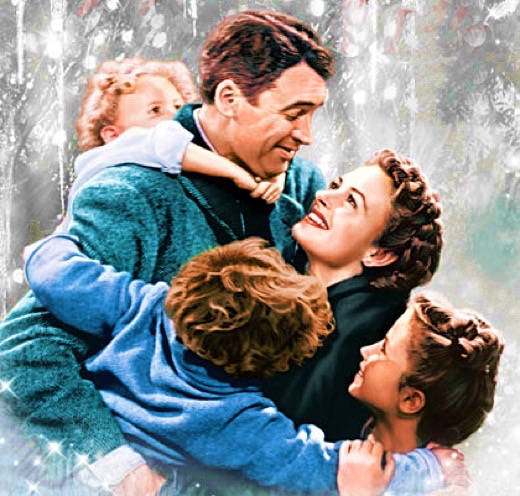

Image above: Colorized poster art for "It's a Wonderful Life" for digital download from Apple for $10.99. From (https://itunes.apple.com/nz/movie/its-a-wonderful-life/id297250466).

(IB Editor's note: "cis" is the Latin prefix for "same side of" versus the the prefix "trans" meaning the "other side of")

These are the long, dark hours when cis-hetero white patriarchs sit by the hearth chewing over their regrets for the fading year and expectations for the year waiting to be born.

I confess, I like Christmas a lot, Hebrew that I am, perhaps the musical and sensual trappings more than the virgin birth business.

Something in my mixed Teutonic blood stirs to the paganism of blazing Yule logs, fragrant fir trees, rousing carols, and snow on snow on snow.

I hope we can keep these hearty ceremonies… that they are not banished to the same puritanical limbo where the Prairie Home Companion archives were sent to rot.

One surviving old chestnut of the season is the 1946 movie, It’s a Wonderful Life, a movie so thick with gooey holiday sentiment, it’s like bathing in egg nog.

It’s larded with messages of good-will-to-all-mankind, of course, but some of the less obvious themes — almost certainly unintended — tell the more interesting story about where America has come from in recent history and where it went.

One thing for sure: every year that goes by, the America of It’s a Wonderful Life seems utterly unlike the sordid circus we live in now.

The movie takes place in a town, called Bedford Falls, like many in my corner of the country, upstate New York, or at least the way they used to be: alive, bustling with activity, with several layers of working, middle, and commercial classes employed at real productive work making things, and a thin candy shell of “the rich,” portrayed as unambiguously greedy and wicked — but overwhelmed in numbers by all the other good-hearted townspeople.

The movie depicts an American social structure that no longer exists. It’s both democratic and firmly hierarchical — owing probably to the lingering influence of army life in the recently concluded Second World War.

Jimmy Stewart plays George Bailey, the head of an old-style family-owned Savings and Loan bank, a very modest institution dedicate to lending money for new homes. His competitor in town is the wicked old rich banker Henry Potter (Lionel Barrymore), a swindler and thief, who wants to put George out of business.

Bedford Falls is a man’s world. The women in the movie are portrayed as taking care of the “home front” and supporting the male “troops” in the toils of small town commerce — another social holdover from the war years. This depiction of life would surely give a case of the vapors to any post-structuralist college professors who dare to watch the movie.

Now here’s one catch in the story: the main business of George Bailey’s bank is lending money to build the first post-war suburban housing development outside of town, a project called Bailey Park.

One of the pivotal scenes concerns the Martini family, immigrants, moving into their new suburban home with great sentimental fanfare.

So, what we’re witnessing in that incident is the beginning of the destructive force that will soon blight small town life (and big city life, too) all over the country. Moviegoers in 1946 probably had little intuition of the consequences.

Another catch in the story involves the plot twist in which George Bailey misplaces a large sum of money ($8,000, actually purloined by the wicked villain, Mr. Potter).

With his bank facing ruin, George contemplates suicide. He’s saved by his guardian angel, who goes on to show George what Bedford Falls would be like if he had never been born. It would be called Pottersville.

Its Main Street would be bustling with gin mills, the sidewalks full of suspiciously available young ladies, the whole scene a sordid nest of vice and wickedness.

The catch is that Pottersville would have been a much better outcome for American small towns like Bedford Falls than what actually happened.

Today, the lovely landscape of upstate New York today is dotted with small towns and even small cities that have absolutely nothing going on in them anymore, and stand in such awful desolation that you’d think a long war was fought here. Much of that is due to the activities of good-hearted suburban developers like George Bailey.

The Americans of 1946 must have had no idea where all this was headed, nor of the coming de-industrialization of the country that had won World War Two, or the massive social changes in the divisions of labor, or the annihilation of several layers of the working and middle classes, or the much greater wickedness of the generations of bankers who followed Henry Potter.

It’s a Wonderful Life presents an American scene poised to arc toward tragedy. It’s an excellent lesson in the ironies of history and especially the dangers of getting what you wished for.

Readers may agree: we’ve never seen our country in such a state of ugly division moral confusion, and intellectual disarray. A coherent consensus eludes us. Grievance, resentment, and bitterness boil and sputter everywhere.

My Christmas wish is that we might put behind us some of the more idiotic and pointless debates of the past year and get on with tasks that really matter… that will allow us to remain civilized through the hardships to come.

That’s how I roll this dark morning, here at the glowing hearth, while the Christmas day ahead, at least, offers some comforting stillness as the snow on snow on snow piles high. And so… to the presents waiting ominously under the twinkling tree.

.

We Are Still In!

SUBHEAD: Two reasons why this American climate alliance "We Are Still In" could save the world.

By Tegan Tallulah on 19 June 2017 for The Climate Lemon  -
(http://theclimatelemon.com/we-are-still-in-climate-coalition/)


Image above: Supporters of Paris Climate Accord gather to demonstrate on the Andy Warhol Bridge over the Allegheny River in down town Pittsburgh after Trump rejected world climate agreement. Pittsburgh continues its plan to power itself with 100% renewable energy by 2035. From original article.

There are many reasons why Donald Trump is dangerous. His egotism, his authoritarianism, his disregard for facts, his bigotry towards women, Muslims, Mexicans, disabled people… There’s quite a few contenders.

But arguably his most dangerous quality is his views on climate change. Because this is an area where he can damage the whole world, and that damage can reverberate for centuries.

Scary, huh? All through Trump’s campaign he promised to pull the USA out of the Paris Climate Deal, and sure enough, after a period of intense um-ing and ah-ing, he confirmed he would do so. Queue an impressive display of horror and condemnation from leaders around the world.

I was all prepared to be severely depressed about this, but then something amazing happened.
American business leaders, city mayors, state governors and university principals, stood up and said ‘no, we’re not going to put up with this shit’. (I’m not sure that’s a direct quote, I’m paraphrasing).

This unprecedented alliance – known as the ‘We Are Still In coalition’ has formed around support for the Paris Agreement and recognition that climate action is their obligation to the world, and is good for America anyway.

This is incredibly powerful, for two main reasons: the science and the symbolism. By that I mean the physical direct impact on the carbon emissions of America and the world, and the psychological, cultural and political impact that such a move has on the rest of the world, and the indirect climate effect of that.

But before we dive into these two main points, let’s just recap on why the USA’s response to climate change is so crucial for the world, and what this new American climate alliance actually is.

Quick note on why USA is so crucial to climate action

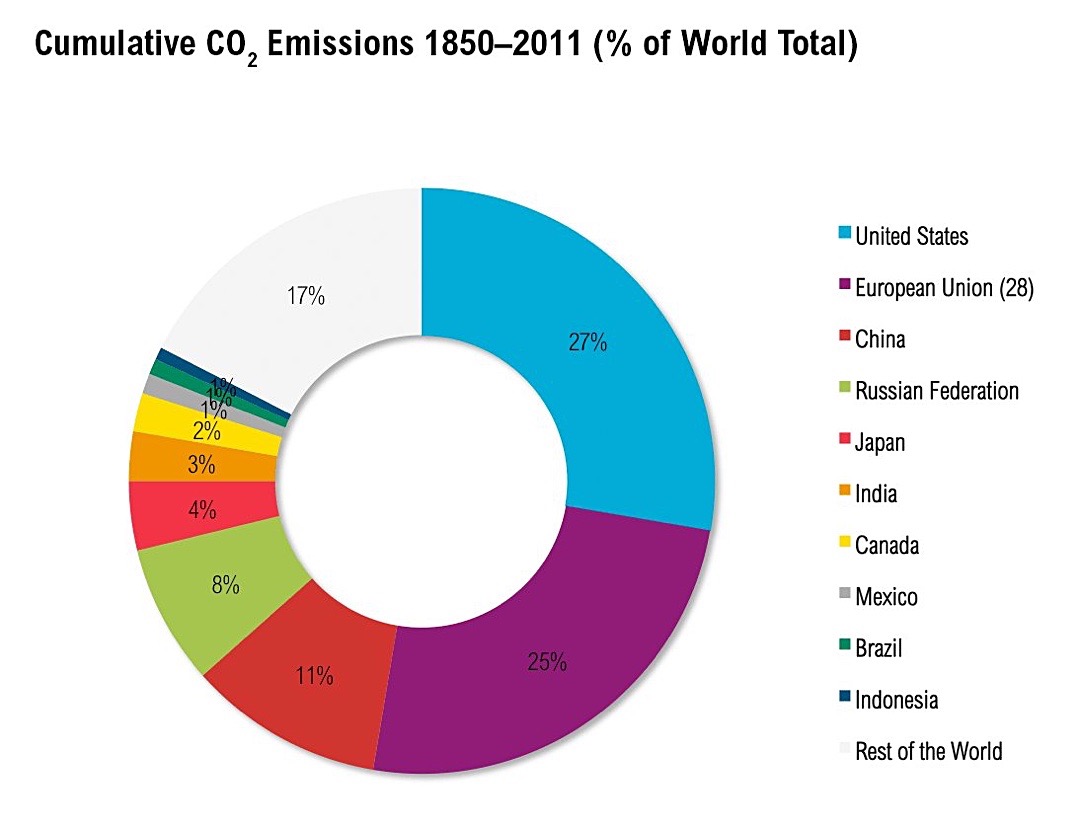
The USA has by far the biggest historical carbon emissions and one of the highest emissions per person in the world. This means they are one of the countries most responsible for causing this climate crisis. Quite frankly, it’s amoral to walk away from your responsibilities. If you make a mess, you should at least help clean it up.

Even if the USA wasn’t a heavy polluter, there would be a strong argument that they should be a key player in sorting out the mess anyway, just because they have the power to do so.

They are the richest country in the world and are routinely regarded as the most powerful, due to immense wealth and military might and ‘cultural power’ – a more fuzzy concept that includes everything from having the most UN diplomats to Hollywood movies dominating the global media market.

http://www.islandbreath.org/2017Year/06/170622piebig.jpg
Image above: Pie chart of percentage of cumulative CO2 emissions between 1850 and 2011 by country. From World Resource Institute (http://www.wri.org/blog/2014/11/6-graphs-explain-world%E2%80%99s-top-10-emitters). Click to enlarge.

http://www.islandbreath.org/2017Year/06/170622barbig.jpg
Image above: Bar chart of per person carbons emissions in metric tons of CO2 emissions in 2014 per person by country. From original article. This chart was adjusted from the 2011 data from the World Resource Institute (http://www.wri.org/blog/2014/11/6-graphs-explain-world%E2%80%99s-top-10-emitters). It separates countries in the European Union. Note, the United States past Canada in CO2 emissions per person. The world average is about what Britain's emissions are (less than a third of USA's. Click to enlarge

So what is the "We Are Still In" coalition?

The We Are Still In coalition is a loose voluntary group of city mayors, state governors, CEOs, investors and university principals who have signed a pledge, on behalf of their communities and organisations, and an open letter to the UN, stating that they are still committed to the Paris Agreement.

They have promised to use their respective powers to lead climate action in their communities and businesses, aiming to meet or exceed the USA’s commitments under the Paris Agreement. (Which by the way is a 26-28% cut in emissions compared to the 2005 level by 2025, and even under Obama they were likely to miss that target).

So who’s actually signed up? The pledge has 1219 signatories so far, and growing. This includes:
  • 9 states: California, Connecticut, Hawaii, New York, North Carolina, Oregon, Rhode Island, Virginia and Washington
  • 125 cities. Including Washington DC, New York City, Los Angeles, Chicago, Dallas, Pittsburgh…
  • 902 businesses and investors. Including Amazon, Apple, Google, Gap, Mars, Nike…
  • 183 universities and colleges.
You can check out the full list of signatories and their open letter here.

The cities and states represent 120 million Americans and a GDP of $6.2 trillion. The businesses together have combined revenue of $1.4 trillion.

This means 38% of the American population and at least 35% of their GDP is covered by this new alliance. If just the 9 states were a country, that country would be the fifth richest and sixth highest polluter in the world. So it’s a pretty big deal.

The philanthropist, business investor and former Mayor of New York Michael Bloomberg has been instrumental in coordinating this alliance, and he has even pledged to donate $15million from Bloomberg Philanthropies to the UN, to replace funding from Washington they’ll now miss out on thanks to Trump.

Although he’s certainly been a leader, it has also been a collaborative effort between 21 nonprofit groups, including C40 Cities, CDP (who I am starting a new job with next month!), WWF and others, who really pushed this forward.

The coalition wants to participate in the Paris Agreement, but there is currently no formal way for them to do so on America’s behalf, as it is an agreement between sovereign nations. However the Accord does call for ‘non-state actors’ to be involved. How this would work in practice is still being worked out.

The two big reasons why this is so incredible

Okay. Now into the real tofu and potatoes of this post. "Science" and "Symbolism"

The science

As this Alliance covers 38% of the American people and at least 35% of their GDP, they have significant power to influence the carbon emissions of the country. Due to the USA’s federal structure, states and cities have fairly extensive powers. The large companies have huge power through their supply chains.

However, even under Obama, the USA was not on track to meet its climate targets. With Trump’s hostile regressive stance and deregulation of pollution, it’s going to be even tougher to meet them.
But that doesn’t mean they can’t.

I’m fairly optimistic about their chances, as it looks like the hostility of the federal government is actually acting as an effective motivator to people who would have just sat back and done little otherwise. There really is a huge groundswell of support for the Paris Agreement emerging from the bottom up, and it’s not clear how far that momentum will go.

It’s difficult to estimate what percentage of the USA’s carbon emissions are represented in this coalition, because many of the members are overlapping – so you can’t just add up all their emissions. But the nine states alone represent 17% of USA emissions – and that’s without all the major cities and businesses outside of those states.

The symbolism

Direct cuts in carbon emissions are not even necessarily the most influential thing about the We Are Still In coalition. The symbolism is incredibly powerful. Here are cities, states and businesses directly defying Trump by saying: ‘You made the wrong decision. You do not speak for us. We are still in the Paris Agreement’.

The fact that Washington and New York were two key signatories will be a particular slap in the face for Trump. The small city of Pittsburgh is also notable because in his speech he declared ‘I was elected to represent Pittsburgh, not Paris’.

The mayor of Pittsburgh resented his city being used as an excuse like this, especially considering they already had a climate action plan to go 100% renewable powered. He publicly disagreed with the decision to leave the Paris Agreement, and joined the We Are Still In coalition instead.

The President also argued that climate action is bad for business and he would prioritise business. And what response did he get?

Tesla CEO Elon Musk and Disney CEO Bob Iger promptly quit his presidential advice council in protest. The ‘climate vs business’ position has become more discredited than ever, as over 900 businesses have joined the coalition.

Many of the most outspoken members are American-based tech giants, like Google, Apple and Amazon. They argue that in the short term, there are great business opportunities to be had from clean energy and greener products – and in the long term all business depends on a stable climate.

When Trump said he was going to exit the Paris Agreement, a real worry was that other countries would lose motivation and think ‘if the richest most powerful country, that has some of the highest emissions, is going to walk away, then there’s no point me doing anything.

Screw it, I’m out’. For some, that was an even bigger problem than the USA’s actual emissions. Because it posed the threat of unravelling the delicate international consensus that had been pieced together –finally, painfully- on this global issue.

Luckily, other national leaders were keen to reconfirm their support and to condemn Trump’s decision. (Even Kim Jong-un, who called the move “the height of egosim”, with zero self-awareness).
What this coalition does, is it assures the international community that America is still at the table. Even if the central government pulls out, America will still be informally committed to the Paris Agreement, through this broad and growing coalition.

Conclusion – Thank you America!

It’s imperative for the whole world’s future that America does not walk away from tackling climate change. Despite Trump’s damaging and regressive decision, it now looks like this will not be the case. Where the government steps down, leaders from local government, business and civil society will step up.

This has given me hope for the future. Thank you to everyone involved – thank you to the signatories, the organisers, and to all the everyday Americans who support it.
.

Pulse of Oahu Neighborhoods

SUBHEAD: Elections are underway for Oahu's volunteer advisory neighborhood boards.

By Natanya Friedheim on 28 April 2017 for Civil Beat -
(Ihttp://www.civilbeat.org/2017/04/why-oahus-neighborhood-boards-are-the-pulse-of-the-community/?mc_cid=2f9693aed7&mc_eid=28610da3ab)


Image above: Representatives of the the Waianae Neighborhood Board during public meeting. From original article.

[IP Publisher's note: Oahu has neighborhood boards that are publicly elected and have significant power, even though they are not a legislative or regulatory body. Their scale and and location are not dissimilar to the traditional ahupuaa of Hawaiian culture. After the disaster of Kauai's recent clueless update of the Kauai General Plan effort by the Planning Department, maybe we should consider neighborhood boards for more local input . Kauai has no village, town, or city level government bodies for local governance. Unfortunately, our county government has shown itself to be a place that has produced incompetent planning for the rest of the island.  It offers opportunities for grifting speculative developers while providing secure jobs with benefits for those centered in Lihue overseeing our "growth". We need the communities of our island to have structured positions in governing. We recommend looking to Oahu's Neighborhood Boards as a possible means.]

Every month, Michael Eli stands up to address military officials at the Waianae Coast Neighborhood Board meeting.

When will the United States end its illegal occupation of the Hawaiian Islands? he asks.

“No comment,” Army Maj. Richard Bell always responds.

Downtown-Chinatown Neighborhood Board members have probably never heard that question, but they’re used to disputes about noise, alcohol consumption and street closures from block parties sponsored by Chinatown’s young entrepreneurial class.

For the record, Oahu’s 33 active neighborhood boards (two are proposed and not yet formed) can’t grant liquor licenses, or evict the American military. They are strictly advisory, but that doesn’t mean they can’t have impact.

They can pass resolutions supporting or opposing government action, but they don’t create policy or choose where public funds are spent. Topics discussed at board meetings include trees that need trimming, potholes that need repair and sometimes bigger issues like proposed high rise developments.

And if you think neighborhood board meetings are just platforms for people to gripe, it could be that you’ve never been to one.

“Some people feel that they just go there, bitch and complain, and nothing ever happens,” said Amanda Ybanez, a member of the Kalihi-Palama Neighborhood Board. “But if it’s done correctly and you have the right people on the board that are voted in, not only are the politicians being held accountable and doing things, but the board members make sure that there is follow-up.”

Public outcry followed a proposed charter amendment last year that would have done away with the boards. A separate amendment that calls for periodic reviews of all city boards and commissions was approved.

While the measure to end the board system never made it to the ballot, it prompted a discussion over how effective the boards are as platforms for democracy. Sometimes the meetings are sparsely attended, and 18 of the boards have at least one vacancy.

The Neighborhood Commission Office, which oversees the neighborhood boards, is ramping up its public outreach efforts this year in hopes of drawing more people to the meetings and to vote in the upcoming board elections.

The elections, which occur every two years, take place online beginning Friday and continuing until May 19.

You’re really in touch with the pulse of the community going to the neighborhood boards,” said Shawn Hamamoto, executive secretary of the Neighborhood Commission Office.


Image above: Flora Obayashi, chair of the Kahaluu Neighborhood Board urges members of the Waimanalo Neighborhood Board to pass a resolution opposing aspects of a master plan for the Koolau Poko moku area. From original article.

‘You Don’t Need To Be An Expert’
Honolulu voters created the neighborhood board system in 1973 to give residents a stronger voice in issues and policies that affect them.

“The best training for a neighborhood board member is simply living in their neighborhood,” said Tyler Dos Santos-Tam, a member of the Neighborhood Commission. “You don’t need to be an expert in all the policy issues.”

The meetings provide a forum for residents to present their concerns to elected officials — if those officials show up. Some politicians send office representatives who may take an initial shot at answering questions, then return the following month with fuller responses.

Some board members say the information they get at meetings is inadequate, and that officials need to be more transparent.

In recent years, “the city has not been responsive,” said Stanford Yuen, who has served on the Downtown-Chinatown Neighborhood Board for 18 years. “They’ll give a halfway answer that’ll raise more questions … a lot of times they’ll just leave it open and walk away.”

Some officials respond to questions with highly technical language. Wilson Koike of the Waianae Coast Neighborhood Board said that’s a tactic.

“They have substitute, flowery answers which have no yes or no, and that’s the game they play,” Koike said. “We want a simple English answer, not technical, legalese answer.”

Mayor Kirk Caldwell’s office referred questions about neighborhood boards to Hamamoto, who said it may take a while for the city to thoroughly respond to inquiries and technical terms are sometimes appropriate.

“I don’t think it’s a case where the mayor’s representatives are trying to deceive,” Hamamoto said.
The boards also provide a forum for business owners, developers, nonprofits and other community organizations.

Dos Santos-Tam would like to see more small businesses get involved with the boards. While some owners might not live in the area where their business is located, he said, they may spend as much of their waking lives in the neighborhoods as residents do.

The boards are places where government agencies, businesses and residents can intersect.
“Government agencies rely heavily on what neighborhood boards say,” Hamamoto said.

The Honolulu Liquor Commission, for example, must notify the local neighborhood board before granting a liquor license.

If residents want a park to close at night, the Department of Parks and Recreation must get the OK from that area’s neighborhood board prior to implementation.

Last month, the Manoa Neighborhood Board meeting drew a crowd because Robert Kroning, the director of the Department of Design and Construction, attended to talk about road conditions in the valley.

While boards can’t create policy, they can wield influence through resolutions.

Over the last few months, Amy Perruso attended one board meeting after another to represent the Hawaii State Teachers Association. At each meeting, she urged board members to pass resolutions supporting Senate Bill 386, which died at the Legislature last week but would have generated more money for schools through a constitutional amendment to raise some property taxes.

Democracy if ‘Real People’ Show Up
Kakaako - Ala Moana Neighborhood Board Chairman Ryan Tam has two categories for the people who attend his board’s meetings: “real people” and “fake people.”

“Real people” are local residents who choose to participate. “Fake people” include contractors, consultants, city and state officials and their representatives, and the occasional reporters who attend because they have to.

Tam has sat through meetings where as few as two “real people” showed up. When the turnout of local residents is low, the meetings become just a conversation between board members, he said.
It can be difficult for people to commit to a meeting that might last two-plus hours on a weeknight.

Location also plays a role in turnout.

Waianae board meetings are held at the district park, a building complex that’s accessible by bus and buzzes with activity after work hours. The April board meeting drew more than 30 people.

Down a windy road with no street lights, the Waimanalo Neighborhood Board meeting at the National Guard Training Auditorium on the grounds of Bellows Air Force Station isn’t easily accessible for those without a car. Less than 10 people showed up for last month’s meeting.

Some boards struggle to retain members and attract young people. Forty percent of board members serving two-year terms in the 2014-2015 period were 64 or older. Only 6 percent were 18 to 30 years old, according to Neighborhood Commission data.

Boards have a minimum of nine members and a maximum of 19. The number is determined by a district’s population and geography.

As the current terms come to a close, some have as few as six members while others have all 19. As the first board ever created, Mililani/Waipiu/Melemanu board has an exception that allows it to have 23 members.

Hamamoto links low participation on neighborhood boards with Hawaii’s record low voter turnout. He and his staff of 13 people have made it their mission to reach out to the nearly 1 million people who live on Oahu.

They’ve visited more than 1,000 establishments islandwide to inform people about the boards, including doctors offices, golf courses, service clubs and cultural festivals.

“We’re boots on the ground,” Hamamoto said.

Elections begin Friday. They are conducted online and are open to all registered voters on Oahu. Mail-in ballots are also available, but require voters to call the ballot request hotline at 768-3763, with more directions at the city’s website.

Political Launching Pad
Sen. Karl Rhoads spent 10 years on the Downtown-Chinatown Neighborhood Board before becoming a state representative. He’s now a state senator.

“It was neat to see him work his way up through the ranks,” said Hamamoto, a former member of the Downtown Neighborhood Board.

Dos Santos-Tam has similar sentiments about Rep. Takashi Ohno and Rep. Kaniela Ing, now a Maui leggislator, both of whom served alongside him on the Liliha Neighborhood Board.

Rhoads, Sen. Laura Theilen, Rep. Tom Brower, and City Councilman Brandon Elefante are among the elected officials who started their political careers on a neighborhood board.

Mayor Caldwell served on both the Kaimuki and Manoa neighborhood boards.

Marcus Paaluhi, now the chair of the Waianae Coast Neighborhood Board, ran for the state House last year but lost to Rep. Cedric Gates, who also once served as the chair of the board.

“It’s a good way to get your feet wet,” Paaluhi said.


Record Votes for Neighborhood Boards

By Rui Kaneya on 14 May 2015 for Civil Beat
(http://www.civilbeat.org/2015/05/record-number-of-votes-cast-for-neighborhood-board-election/)


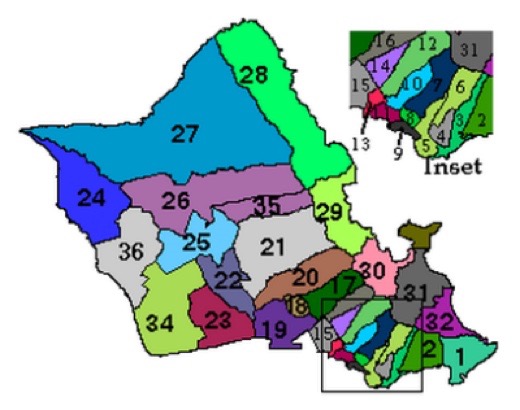
Image above: Map of Oahu Neighborhood Boards. From original article.

A record number of Oahu residents have cast their vote for the 2015 Neighborhood Board election, according to the Honolulu Neighborhood Commission Office.

With a day still left before the ballot closes, nearly 18,500 people have already voted in the all-online election, surpassing the previous record set during the last election in 2013 by nearly 20 percent.

This year, 598 candidates are vying for 437 seats in the biennial, all-online election, which received an innovation award from Harvard University’s John F. Kennedy School of Government for cutting costs by switching to a digital format.

Any Oahu residents who were registered to vote in the 2014 elections or newly signed up with the Neighborhood Commission can still cast their votes until 11:59 p.m. on Friday.

Oahu’s Neighborhood Boards serve as advisory councils that help decide what happens in their community in terms of development, business and neighborhood laws at all levels of government.

.

The compost pile that changed NYC

SUBHEAD: We can’t forget that we can also make big change ourselves by starting small and local.

By Colin Beavan on 8 April 2017 for Yes Magazine -
(http://www.yesmagazine.org/people-power/It%20Started%20With%20One%20Brave%20Compost%20Pile%2C%20An%20Entire%20City%20Was%20Inspired%20to%20Change-20170415)


Image above: Compost piles like Kate Zadir’s popped up in other communities all around New York City. Photo by Cribb Visuals. From original article.

One thing that has bothered me a lot since the election is the idea in the air that we cannot change things while the current administration is in office. There is a pernicious idea that the government is so strong that nothing can be fixed or changed without first fixing or changing it.

Of course, we must work to change the government, but we must also not lose sight of the fact that we can change things in many ways—at the community, city, and state levels—and that each of us remains capable of making the world a better place, even as the presidential administration works against us.

To remind ourselves of this fact, I wanted to retell a story from my book How To Be Alive: A Guide To The Kind Of Happiness That Helps The World. It is the story of my friend Kate Zidar who, in the early 2000s, was one of many New York City residents who refused to wait for a change of government in order to get what they wanted for their communities—in this instance, a composting program to manage food waste.

Instead of waiting for a change in government policy, Kate started her own community compost pile in a corner of a city park. Compost piles like hers popped up in other communities all around the city. In 2013, seeing the benefits of these compost piles, Mayor Michael Bloomberg’s government finally announced that it would move toward a citywide curbside compost program.

Here is what Kate says about her story:
Back in the early 2000s, I was volunteering in a community garden in Williamsburg, in Brooklyn’s McCarren Park, and my focus became soil toxicity. There was a lot of dioxin and lead in the soil because of fallout over the years from a nearby incinerator. I wanted to replace the top layer of soil so we could grow food safely. 

Also, trucks carrying food waste and other trash in the solid waste management system screwed up the air quality in the area. So it made sense to both create good topsoil and divert food scraps from the waste stream by starting a community compost pile. 

In McCarren Park, there was a part of a dog run that was not used, so I “annexed” it. I wrote a letter to the parks commissioner including a map showing the location of my new compost pile—I also sent a flower bulb, hoping that would get his attention—and asked for permission. He never wrote back, but I kept a copy of my letter and I told anyone who tried to interfere that the parks commissioner knew about the compost pile. 

In addition, I used really heavy 55 gallon plastic drums to house the compost system. They could not be moved easily. My idea was to make it so the work involved in shutting the compost system down would be greater than whatever problem park workers seemed to feel it caused. 

At first it was just me hauling my kitchen scraps to the barrels. But passing foot traffic soon attracted random people dropping off their food scraps, too. Before long, a woman named Jo Micek started to help. She was a community organizer, and she knew how to raise funds. Pretty quickly, the compost pile was being run by a “dirty dozen.” (Get it?) 

Not long after that, there were more than 100 families dropping off their food scraps every week, and the compost project turned into a collective, not just run by me. Meanwhile, the compost went back into the community garden, home gardeners took it home, and eventually even the park workers began to use it around the park. 

Why didn’t we begin by going to the city government and asking them to start a compost pile for us?
Everyone who works in community gardens knows that the gardens start essentially by squatting on an abandoned, unused piece of land. You don’t start by working with the government—but by working with your community for improvements everyone wants. When you try to work with the city agencies, they stonewall the idea because they have a whole range of missions and obligations to consider. But you have only one: your garden or compost pile. 

I didn’t want to use my energy dealing with the bureaucracy. I wanted to compost. Plus, I knew the project would actually represent a community improvement. I didn’t want to ask for permission. I could always later ask for forgiveness. Ultimately, there was no way the parks department could stop it because it became so popular with the local community. 

This is one way to bring about broader city or social change. You don’t ask the government to do it. Instead, you gather with other citizens and you demonstrate to the government that it is needed, is wanted, and works. That is why New York is adopting curbside composting now. Because so many communities like ours demonstrated that composting is needed, is wanted, and works. 

Meanwhile, the personal benefits to me were the people I met and the friends I made. Also, I figured it out on my own. I didn’t know what I was doing, and I started it and saw it through. I developed my own system of doing something. Once you do that in one area of your life, then you can do it in all areas. It made me less uncomfortable with not knowing how to start.
Here is the moral of this story for me: We can, through our own lifestyles and our participation in communities and local and state governments, still initiate positive change. We don’t have to settle only for resisting negative change.


.

Ecovillage Rescuing Los Angeles

SUBHEAD: They transformed it into a traffic-calmed and car-restricted promenade with fruit trees.

By Albert Bates on 26 March 2017 for The Great Change -
(http://peaksurfer.blogspot.com/2017/03/rescuing-los-angeles.html)


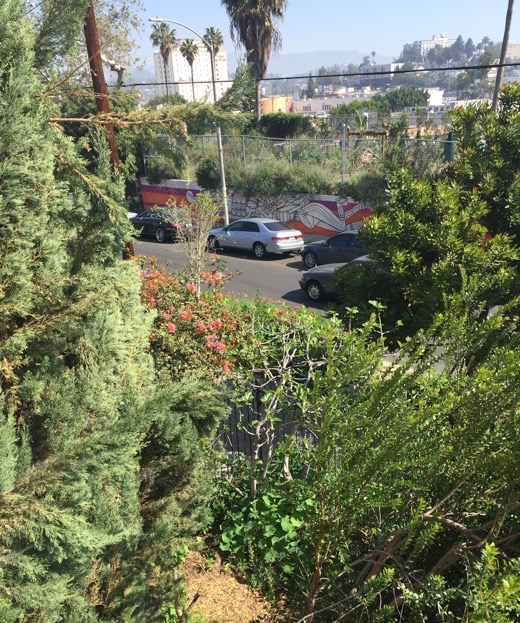
Image above: View from site of the Ecovillage in Los Angeles. From original article.

In the concrete desert that is downtown Los Angeles we were blessed to find a green oasis at the corner of Vermont and 1st Avenues known as Los Angeles Eco-Village (LAEV).

How we can use our hard wiring to communicate to the herd that it is time to veer off from a race towards the cliff’s edge which most don’t yet see?

LAEV has taken a two-block area of random residents and small storefront businesses, alleys and churches and transformed it into a traffic-calmed and car-restricted promenade with fruit trees, mosaic tables and cob benches built around larger canopy trees, verge gardens, interior courtyards and attractive outdoor classrooms.

It has created attractive residences affordable to lower income people, stores and kiosks selling products and services made or provided by neighbors.

It has converted large apartment complexes to low income, ethnically diverse cooperative housing, and is transforming four-plex garages to 3 or 4 story mixed use development with retail, offices, and super affordable “tiny” housing, with small ecological footprint and no parking.

It created California's first bicycle kitchen (starting literally from the kitchen in an apartment house) — a way of cooperatively building, sharing and maintaining bicycles and the skill-set that goes with that.

A recent purchase of an abandoned building and vacant lot on the corner of Vermont Avenue will allow them to create People Street Plaza with two parklets and an enclosed bike corral, a solar arbor for small electric neighborhood plug-in vehicles and pedal hybrids, plus metered parking and expanded city repair functions at two intersections.

Next year the ecovillage plans to eliminate sidewalks and parking lanes on north side of White House Place and install an urban organic working farm/food forest.

In the future they would like to acquire 5 four-plexed apartment houses on White House Place to ensure permanent affordability for 80 to 120% of poverty-level income if existing/future qualifying residents will commit to going car-free within a specified time, and providing convenient car share options.

They would power these new homes by installing neighborhood solar PV over the school parking lot. Beyond 2030, when the parking lot is no longer needed, they would create an urban farm.

More ambitious, and requiring more city approvals, are plans to acquire and retire the auto repair shops, raze them and reopen the concreted-over hot springs, Bimini Baths, that were overtaken by sprawl and pavement almost a century earlier.

They'd like to open a center for therapeutic and recreation and to offer affordable housing for healers (so they can charge lower rates for lower income residents).

They'd like to bring back the trolley service to the tracks that used to carry bath patrons to and from other parts of the city. For the immediate future, a vegan café and outdoor garden is planned to replace the auto repair shops. 

Much of this will be accomplished by local residents, using a Cooperative Resources & Services Project (CRSP) Ecological Revolving Loan Fund (ELF) which has the potential to generate about $2.5 million every three to six month period.

Imagine, for a moment, all cities transformed from the bottom up in this fashion. LAEV does not plan to produce all its own food, water, power and other needs from within its two-block area, but it could. Instead, it encourages doing some of that while also participating in cooperatives that join together the products and services of other parts of the city.

Once upon a time the founder of permaculture, Bill Mollison, was asked how cities could become sustainable. He responded that it was only by providing for all their needs within their boundaries.

Los Angeles, even now, at 5000 persons per square mile, could do this. But then, like LAEV, it would need to take another step and begin the process of producing food, fiber and energy while progressively withdrawing carbon from the atmosphere.

Ecovillages similar to LAEV — The Farm, Earthaven, Findhorn, ZEGG and Seiben Linden — have already demonstrated their ability to net sequester more than their own carbon in order to reverse climate change, even while implementing the UN’s 17 Sustainable Development Goals, using a combination of for-profit and non-profit social enterprises and a holistic, deliberative approach.

Over the past few years they have risen still another step and are embarked, with Global Ecovillage Network, Gaia University and Gaia Education, upon a process of building curricula and the cadre of trained instructors that will carry the work to a global scale.

This core idea, brought by ecovillages at the cutting edge of an historic shift, is part of the British Commonwealth's new Regenerative Development to Reverse Climate Change strategy announced at COP-22. It is also allied with the Chinese Two Mountain Policy we described here last December.

Ecovillages are like a shadow world government. They are not top-down electoral, C3I or Deep State puppeteers; they are grass roots, spontaneous, semi-autonomous networked infiltrators. Their weapons are not Death Stars or enslaving financial schemes but viral memes spread by new media, art and gardening.

They run on the energy and creativity of youth. They are a bullet train on a return track back out of the Anthropocene.

What is needed now, today, is exactly that sort of low cost, rapidly deployed, hugely scalable approach to reversing human misery, ecological destruction and climate change that will find apolitical social acceptance, quickly, without the requirement of carbon taxes or offset markets that only serve to line the pockets of the obscenely obtuse.

Indeed, to scale quickly, it should use tested, off-the-shelf technology, be antifragile, employ lots of young entrepreneurs, and provide a sensible return benefit for those in the older generations who hazard their limited time and resources to assist.

The adoption process for carbon-sequestering economies could benefit from the ideas Malcolm Gladwell expressed in The Tipping Point: How Small Things Make a Difference (2000).

Gladwell argued that the ability of viruses (whether diseases or ideas) to spread quickly, and universally, depends on their ability to be attractive and sympathetic. They need to be able to cross cultures, genders, age groups, and races.

Gladwell pointed to three elements that cause epidemics to spread, and said these same elements are fundamental to any large-scale social change. They are:
  1. The Law of the Few — some people spread disease (and ideas) better than others.
  2. The Stickiness Factor — the potency of viruses (or ideas and actions) to become universal. Ideas and actions to reverse climate change need to continue evolving and draw in people from around the world. The greater context of our climate dilemma suggests that if a favorable human tipping point is to occur, it needs to be able to cross cultures and to be sticky across all those differences.
  3. The Power of Context — the conditions under which the change is considered tend to either reinforce the change or thwart its spread. Commitment is not enough. The committed have to act, and share their commitment with others.
If a cultural tipping point is required, the tools most associated with cultural evolution should be employed. These include artistic movements (visual arts, performance, music, etc.), fashion (attraction to styles), and celebrity endorsements, among others.

Humans evolved as herd animals and we constantly signal to each other our affiliations, tastes and choices. Tapping into this natural process allows memes to propagate when stickiness and context cohere.

This leads us to an examination of the concept of style. What is it in the human genome that makes us such dedicated followers of fashion? Likely it is hard wired by an evolutionary choice our species made several million years back.

We hairless apes are more like army ants, gray wolves, dolphins, lions, mongooses and spotted hyenas than jaguars, frogs and horse flies. We are pack hunters.

Herd behavior has a defensive purpose, too. Witness zebras crossing a river full of crocodiles or a young buffalo calf being stalked by wolves. Some will be picked off, but most will survive.

We continuously signal to others in our herd that we are with them. We are part. We are in this tribe. We seek tribe approval, acceptance, respect. We may do this the way birds do, with colorful plumage, or the way horses do, with speed and agility. A necktie or a pants suit are forms of that signaling. A sports car is another.

How can we use our hard wiring to communicate to the herd that it is time to veer off from a race towards the cliff’s edge that most of our group most don’t yet see?

We need to make the change in direction fashionable.

For many if not most, the need to survive is ever present. To Westerners captured by the meme of money, their fragility can be measured by the number of digits left of the decimal point in their bank accounts, real estate valuations or securities portfolios, or by the (thin) thread of an enduring job with health benefits.

Standing at the edge of the Seneca Cliff, all of those indica are profoundly perilous routes forward.

Is it possible to break the fantasy of citizens of industrialized countries — that our jobs can continue to provide a magic elixir to meet our needs and debts? Difficult. Not impossible, just difficult.

Greed and familiarity cushion against sensibility. In other cultures, survival is bound by the timing and amount of rains needed for good crops, or the attractiveness of a female to acquire a supportive mate, or the fighting skills and tools for a warrior to dominate. But these also have a dark side.

Given how essential to survival rain, a mate, or fighting skills may be, they are also powerful drivers of aberrant behavior, like the magical belief that if we dance and pray that rain will come, or that anyone who can act the part of ruthless, selfish seducer can attract wealth, power or handsome mates.

That is all going to change, and quickly. Either that or we will all be extinct, and soon. If you want to get in on the change sooner, and avoid the hardship of late adoption, look into joining an ecovillage.

There is one trend afoot that few have seemed to notice. In the two-thirds world trade and commerce have always been dominated by nimble opportunists who see niches, swoop in and exploit them, and move on when the niche is no longer productive.

This independent spirit runs against the grain of wage slavery and so harsh sanctions like the withholding of health care and the destruction of public education have been used like cudgels to beat “employees” back into their roles as cogs in the machine.

So it was that Columbus destroyed the unsuited-as-slaves Taino and Arawak, or Francisco de Toledo instituted the mita system to compel Quechua and Yanacona encomienda to work the silver mines of Potosí.

Today, the tuned-in, spirited youth force of the world has undergone an evolutionary shift from encomiendista to free-agent. They want to be social impact entrepreneurs, not cubicle rats — blackmail-style benefits be damned. That instinctual shift provides the fuel to ignite the ecovillage revolution.

[Author's note: This post is part of an ongoing series we're calling The Power Zone Manifesto. We post to The Great Change on Sunday mornings and 24 to 48 hours earlier for the benefit of donors to our Patreon page.]

.

To save the Post-Industrial town

SUBHEAD: Donald Trump pushes people's buttons in the failed small towns of America, but he is merely cultural heroin.

By Gracie Olmstead on 6 July 2016 for The American Conservative-
(http://www.theamericanconservative.com/olmstead/how-to-save-the-post-industrial-town/)


Image above: View of abandoned Main Street in Bridgewater, Iowa on 7/1/16. Photo by Dustin77a. From original article.

How do we save America’s dying towns? This is a question of increasing importance in today’s society: though some U.S. cities (such as Detroit) have experienced upheaval over the past several years, it’s post-industrial and rural towns that seem to be suffering most. Binyamin Applebaum illuminates many of these struggles in a July 4 New York Times story about a former factory town that’s fallen into decay:

Thirty years have passed, almost to the day, since the last blasts of the steel furnaces that were the reason for this city’s existence. The steel mill is gone — used to film “RoboCop,” then demolished. Most of the people are gone, too, and those who remain are struggling to find a new purpose for this place.

Last week, Donald J. Trump, the presumptive Republican presidential nominee, came here to declare that as president, he would revive the fortunes of the American steel industry — and, by implication, Monessen.

“We are going to put American-produced steel back into the backbone of our country,” Mr. Trump told 200 invited guests at an aluminum recycling facility that occupies part of the old mill complex. “This alone will create massive numbers of jobs.”

In fact, about 71 percent of the steel used last year in the United States was made in the United States, according to the American Iron and Steel Institute. The mills in Monessen and other cities along the Monongahela River were not replaced by Chinese factories but by smaller, more efficient factories in other parts of the country.

Having lived through that transition, the people here surrendered hope of a Trump-like revival long ago.
But that hasn’t stopped other similar towns from rallying behind Trump, in hopes that the nostalgic dream he presents of revivified commerce may, in fact, come true. J.D. Vance notes for The Atlantic that many of these places have been trampled, broken, and disenchanted: “A common thread among Trump’s faithful, even among those whose individual circumstances remain unspoiled, is that they hail from broken communities.” He continues,
These are places where good jobs are impossible to come by. Where people have lost their faith and abandoned the churches of their parents and grandparents. Where the death rates of poor white people go up even as the death rates of all other groups go down.

Where too many young people spend their days stoned instead of working and learning. … There is no group of people hurtling more quickly to social decay. No group of people fears the future more, dies with such frequency from heroin, and exposes its children to such significant domestic chaos.
This is something Kevin D. Williamson has written about for National Review in the past. He’s noted the “welfare dependency, the drug and alcohol addiction, the family anarchy” pulling these communities apart. “The culture of the white underclass in America is horrifying,” he says. “It’s brutal. And its products are obvious.”

Is this just the way America is going to progress (or more accurately, fall apart) in the next decade—or is there some way to breathe a vision and telos back into crumbling buildings and deserted downtowns?

Trump’s popularity stems from nostalgia for the strong blue-collar community of yesteryear. But in his excellent new book The Fractured Republic,  Yuval Levin points out that putting one’s hopes in reviving the past is romantic at best—disastrous at worst.

“Whatever the argument being advanced about America’s challenges in our politics in recent years, it is a pretty good bet that it has been rooted in an understanding of [a] lost era of American greatness,” he writes. For Democrats, it’s the Great Society years in 1960s America. For Republicans, it’s the golden years of Ronald Reagan’s presidency.

But regardless, Levin argues, people “are focused less on how we can build economic, cultural, and social capital in the twenty-first century than on how we can recover the capital we have used up.”

And that presents some very considerable problems for towns like Monessen or Middletown.
Levin suggests that we need “a modernized ethic of subsidiarity,” which would bring “incremental revival” to America’s broken communities.

 In a Tocquevillian appeal to the importance of local, mediating institutions, he suggests that deconsolidation and federalism would add substance and telos to the hollowed-out towns filling our country.

“A decentralized approach to social and economic policy would not only recognize the limits of our knowledge but also speak to the particular problems we now confront,” he writes. “It embodies not just an epistemic humility but also a commitment to subsidiarity—to empowering institutions at different levels of our society to address those problems for which they are best suited.”

But what sorts of institutions could possibly breathe life back into these communities? Here are a few Levin lists: families, schools, churches, local civic groups, nonprofits, charities, fraternal groups, and unions. Local libraries and community colleges can also play significant roles, and many local businesses have an institutional impact on their communities.

Levin’s overarching point, one that can’t be emphasized enough, is that nostalgia for midcentury America’s admitted strengths will not save the towns now suffering from a collapse of economic and cultural capital. Rather, an honest and clear-eyed understanding of the post-industrial trends rocking our nation—along with a healthy appreciation of the diversity and localism sprouting in their wake—will help us move forward in a healthy way.

We must also note the toll “brain drain”—especially brain drain of the young—has had on these communities. Something must be done to draw them back, if we want rural towns to survive. In a recent story for The Atlantic, author Alana Semuels writes, “Kids and grandkids move to the cities, coming back on holidays, inheriting their parents’ homes and leaving them empty, wondering what will happen to the towns their parents say used to thrive.”

Part of the problem seems to be a generational disconnect, re: what makes a place livable and appealing. As Applebaum notes in his New York Times piece, “[Monessen’s] younger residents are frustrated that the older generation still dreams of factories. They want to replace some of the old mills with waterfront homes and restaurants. They would like to see the city and the river meet, instead of being almost entirely separated by the old industrial strip.”

The suggestions made above are not radical—they actually seem to echo the work of New Urbanists (chronicled and considered at length here at TAC on our New Urbs blog). This vision attunes itself to pre-World War II urban development, eschewing some of the excesses of midcentury America (the time that most baby boomers in these communities are pining away for).

It calls for greater walkability, mixed-use neighborhoods, and vibrant parks and city squares where people can congregate, as well as a renovation and preservation of (as opposed to demolishing and replacing) the old buildings and blocks that make up historic districts and downtowns.

These are just some of the puzzle pieces that fit into a larger New Urbanist blueprint for revitalizing America’s cities.

But in Monessen, these young people haven’t made much leeway, says Applebaum: “Mr. Mavrakis, the mayor, has little patience for these dreams. A blunt and forceful man who spent much of his life as a union organizer, he would like to demolish much of the remaining downtown and offer the land for new development.”

Emphasizing the historic and human-scale neighborhood may take some time to catch on. But trying to spread this vision will help knit together some of the fraying threads that are damaging U.S. towns and communities.

Good urban planning will not, by itself, redeem a dying factory town. But it may help stimulate and foster the other important strands of community growth necessary for a flourishing place.

There are other ways we can consider saving America’s towns. One I have been mulling over lately is the role wealthy individuals can play by boosting local commerce via their patronage (providing microloans, sponsoring vocational programs, providing grants and endowments, et cetera).

I also wonder what recent trends and changes in agriculture might do to boost commerce and congregation in small towns and cities.

One thing’s for certain: there’s no cure-all, no single way to transform and resurrect towns like Monessen. And the belief that a presidential candidate (be he orange-haired or socialist) can solve all our societal ills will only serve to exacerbate the problems we face. As Vance puts it,
The great tragedy is that many of the problems Trump identifies are real, and so many of the hurts he exploits demand serious thought and measured action—from governments, yes, but also from community leaders and individuals.

Yet so long as people rely on that quick high, so long as wolves point their fingers at everyone but themselves, the nation delays a necessary reckoning. There is no self-reflection in the midst of a false euphoria. Trump is cultural heroin. He makes some feel better for a bit. But he cannot fix what ails them, and one day they’ll realize it.


.

Time to let civilization go?

SUBHEAD: We need to live in the places we are as if they were the last places on Earth. Because they are.

By Juan Wilson on 7 December 2015 for Island Breath -
(http://islandbreath.blogspot.com/2015/12/time-to-let-civilization-go.html)


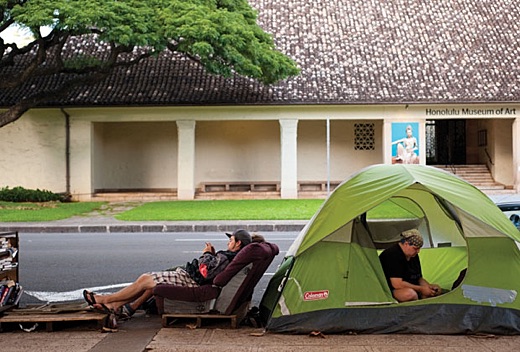
Image above: Front of the Honolulu Museum of Art as seen from Thomas Square Park. In the foreground are homelss people living in the park. From (http://www.honolulumagazine.com/Honolulu-Magazine/April-2013-1/Field-Notes-Occupy-Movement-in-Hawaii/).

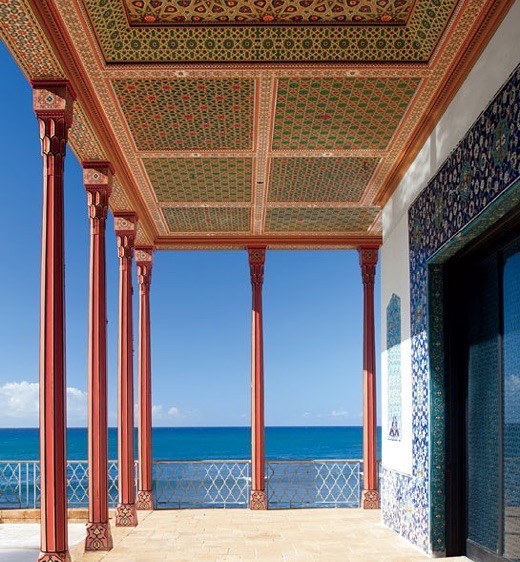
Over the weekend my wife Linda and I visited Honolulu to see her son, who lives there with his wife and their son. We visited three wonderful museums. The Bishop Museum, the Honolulu Museum of Art and Doris Duke Foundation's Museum of Islamic Art known as Shangri La. Each has a unique world class collection. All are impeccably presented.

The Bishop covers Hawaiian and Polynesian culture and history as well Earth sciences. The Honolulu Museum of Art's  collection has representation of world wide art covering over a thousand years as well as contemporary showings.

A special show on display now presents a large collection of the French sculpture of Auguste Rodin. Shangri La presents Duke's collection of Islamic architecture, art and craft that covers centuries and has origins from spanning from Spain across Africa, the Middle East and Asia.

I don't remember another time I enjoyed the experience of museums more.


Image above: The porch of guest house at Doris Duke's Shangri La modeled after a Persian palace in Iran. From (http://dionnerivera.com/odd-eccentric-pieces-and-places/).

Honolulu has recently grown to be the eleventh largest city in America. Most of it is quite new as cities go. It's economy is for the most part fueled by tourism, that is mostly brought to Hawaii by jet fuel. To me that doesn't seem a very solid foundation for the future.

In Honolulu most of the tourism seems to come from Asia, specifically from Japan and more recently China. Young well to do couples from Beijing, in search of a McDonalds, now stroll along the Waikiki Beach sidewalk past homeless aging Vietnam vets and bag ladies. It's an odd clash of civilizations.

We saw many homeless in Honolulu. The climate is easier on the homeless there than than Buffalo or Saint Paul.

Linda and I and her grandson arrived early at the Honolulu Museum of Art so he killed some time in the six acre park across the street called Thomas Square.

The park is a lovely site that has been largely abandoned to the homeless. People lay on the lawn in the shadows of trees in camouflage sleeping bags or next to shopping carts.

At its center is the remains of a large fountain that is about 100 feet in diameter that is surrounded by mature banyan trees. The six inch water main that fed the fountain is shut off. The fountain is empty with a film of pond scum and some litter.


Image above: The fountain in historic Thomas Square in Honolulu at a time when its fountain no longer operates. From (https://alantamayose.wordpress.com/2012/06/02/honolulu/).

Is this the peak of Western Civilization?

This morning, as I was online checking out material for this website while I was listening to Minnesota Public Radio. George Weiblen, a biologist from the University of Minnesota, was being interviewed.

Weiblen was back from a research trip to Papua, New Guinea. For years he has been studying  the forests there and the effects of climate change there. New Guinea has the third largest tropical jungle in the world behind the Amazon and Congo.

New Guinea is now going through what Minnesota went through in the 19th century - namely deforestation, or put another way "the arrival of civilization". His point was that it seems a requirement of a place being civilized is that first it is deforested.

I know this sounds pretty obvious, but somehow his presentation of this idea hit a nerve in me. My response is "if that's the case - we don't need so much civilization.

Weiblen added that if we (European settlers )in ) could push the indigenous inhabitants out of the forests of North America and then clear cut them, how could we tell people in Papau, New Guinea, not to do the same.

This moral dilemma is settled for me not by allowing New Guinea forests to be cut, but to require the farmland in Minnesota to be reforested - again, we don't need so much civilization.

The following interview with Peter Snyder, a climate scientist at the University of Minnesota. He discussed the increased occurrence of heat waves and more violent storms and the problems of  mitigating heat islands created by massive urban development like twin cities of Minneapolis-Saint Paul.

Some might think a place like Minnesota would be embracing global warming as a improvement to the icy cold that grips the region for much of the year. But the truth is that global warming is residue of our killing everything in our path. It's what civilized human beings.

So we do we don't need so much civilization.

We need to immediately begin the journey back to being indigenous people. That could take the form of living as shoreline fishermen, in pastoral villages, woodland gardens or as nomadic hunter gatherers. But it won't be as urban/suburban car-driving bean counters, baristas or personal assistants.

We need to live in the places we are as if they were the last places on Earth. Because they are.

This is the calm before a storm. It is now that you have a chance to plan and fit out, as you can, the resources you'll need.

The COP21 climate change conference going on in Paris is dwindling down to a fight by corporations for table scraps of resources that are left in the "Third World".
 
The most "civilized" countries in the world - including France,  Germany, England, America, Russia et cetera, seem hell bent on joining in on World War IV in Syria to control what fossil fuel is left in the Middle East.

So we do we need any so much civilization? 

.

The Fate of a City

SUBHEAD: The Frank Gehry condos and the Robert Stern hedge fund aeries recently built are already obsolete.

By James Kunstler on 13 January 2014 for Kunstler.com -
(http://kunstler.com/clusterfuck-nation/the-fate-of-a-city/)


Image above: Frank Gehry highrise luxury apartments at 8 Spruce Street in downtown Manhattan. From (http://luxuryrentalsmanhattan.com/blog-tags/micro-neighborhoods).

I was born and raised in New York City, on the east side of Manhattan (with a brief intermezzo in the long Island Suburbs (1954 – 1957) though I have lived upstate, two hundred miles north of the city, for decades since. I go back from time to time to see publishers and get some cosmopolitan thrills. One spring morning a couple of years back, toward the end of Mayor Bloomberg’s reign, I was walking across Central Park from my hotel on West 75th Street to the Metropolitan Museum of Art when I had an epiphany.

Which was that Central Park, and indeed much of the city, had never been in such good condition in my lifetime. The heart of New York had gone through a phenomenal restoration.

When I was a child in the 1960s, districts like Tribeca, Soho, and the Bowery were the realms of winos and cockroaches. The brutes who worked in the meatpacking district had never seen a supermodel. Brooklyn was as remote and benighted as Nicolae Ceausescu’s Romania.

The Central Park Zoo was like a set from Riot in Cellblock D, and the park itself was desecrated with the aging detritus of Robert Moses’s awful experiments in chain-link fencing as a decorative motif. Then, of course, came the grafitti-plagued 1970s summed up by the infamous newspaper headline [President] Ford to City: Drop Dead.

Now, the park was sparkling. The sheep’s meadow was lovingly re-sodded, many of Frederick Law Olmsted’s original structures, the dairy, the bow bridge, the Bethesda Fountain, were restored. Million dollar condos were selling on the Bowery.

Where trucks once unloaded flyblown cattle carcasses was now the hangout of movie and fashion celebrities. Brooklyn was a New Jerusalem of the lively arts. And my parents could never have afforded the 2BR/2bath apartment (with working fireplace) that I grew up in on East 68th Street.

The catch to all this was that the glorious rebirth of New York City was entirely due to the financialization of the economy. Untold billions had streamed into this special little corner of the USA since the 1980s, into the bank accounts of countless vampire squidlets engaged in the asset-stripping of the rest of the nation.

So, in case you were wondering, all the wealth of places like Detroit, Akron, Peoria, Waukegan, Chattanooga, Omaha, Hartford, and scores of other towns that had been gutted and retrofitted for suburban chain-store imperialism, or served up to the racketeers of “Eds and Meds,” or just left for dead — all that action had been converted, abracadabra, into the renovation of a few square miles near the Atlantic Ocean.

Nobody in the lamebrain New York based media really understands this dynamic, nor do they have a clue what will happen next, which is that the wealth-extraction process is now complete and that New York City has moved over the top of the arc of rebirth and is now headed down a steep, nauseating slope of breakdown and deterioration, starting with the reign of soon-to-be hapless Bill de Blasio.

Mayor Bloomberg was celebrated for, among other things, stimulating a new generation of skyscraper building. There is theory which states that an empire puts up its greatest monumental buildings just before it collapses. I think it is truthful. This is what you are now going to see in New York, especially as regards the empire of Wall Street finance, which is all set to blow up.

The many new skyscrapers recently constructed for the fabled “one percent”— the Frank Gehry condos and the Robert A.M. Stern hedge fund aeries — are already obsolete. The buyers don’t know it. In the new era of capital scarcity that we are entering, these giant buildings cannot be maintained (and, believe me, such structures require incessant, meticulous, and expensive upkeep).

Splitting up the ownership of mega-structures into condominiums under a homeowners’ association (HOA) is an experiment that has never been tried before and now we are going to watch it fail spectacularly. All those towering monuments to the beneficent genius of Michael Bloomberg will very quickly transform from assets to liabilities.

This is only one feature of a breakdown in mega-cities that will astonish those who think the trend of hypergrowth is bound to just continue indefinitely. It will probably be unfair to blame poor Mr. de Blasio (though he surely can make the process worse), even as it would be erroneous to credit Michael Bloomberg for what financialization of the economy accomplished in one small part of America.

.

Requeim for Detroit

SUBHEAD: What happened to Detroit will come to all the other great American metroplexes, but perhaps not in the same way.

By James Kunstler on 22 July 2013 for Kunstler.com -
(http://kunstler.com/clusterfuck-nation/requiem-for-detroit/)


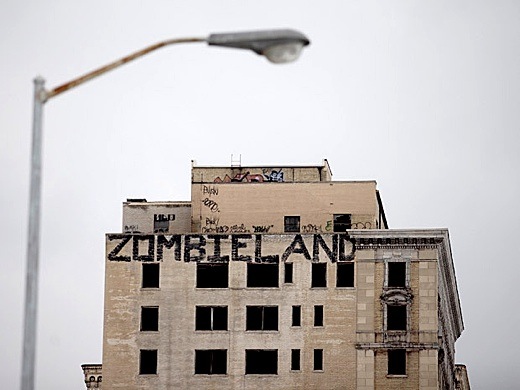
Image above: A high-rise near the intersection of Winder and Woodward Avenue in midtown Detroit labeled "ZombieLand". From (http://lubczasopismo.salon24.pl/liczby/post/513430,welcome-to-detroit-welcome-to-zombieland).

I was in Detroit in 1990 — not my first time — poking around to get a deeper feel for the place so I could write a chapter about it in The Geography of Nowhere. At mid-day, I was driving on one of the great avenues that radiates out of the old Beaux Arts fan of streets that emanates from the Grand Circus at the heart of downtown — Woodward or Cass or Gratiot, I forget. It was a six or eight laner, and everything along both sides was either some kind of social service installation or vacant. There was no traffic, by which I mean not merely a smooth flow of cars, but no other cars whatsoever. For at least a mile, my rent-a-car was the only vehicle on the street. 

Finally I saw another car up ahead, in my lane, coming straight at me. It continued bearing down on me, until the last 100 feet or so when it veered around me with an indignant blare of the horn. It was only about then that I noticed a sign indicating that I was on a one-way street. Downtown Detroit was so empty that I could drive a good mile the wrong way without knowing it.

Detroit’s decline and fall was long and gruesome. Back then, just outside the downtown of 1920s skyscrapers, there were whole neighborhoods of formerly magnificent old mansions in the most amazing states of dilapidation, with sagging porches, chimneys tilting at impossible angles, and whole exterior walls missing to reveal eerie dollhouse-like vignettes of rooms painted different colors, formerly lived in. These were built by the wealthy magnates of the Great Lakes frontier — the timber and copper kings, manufacturers of paint, coal stoves,  etc — before the car industry was even a gleam in  Henry Ford’s flinty eye. 

Over the 1990s they were all torched in the annual Halloween ritual called Devil’s Night. The next time I came back to Detroit, there were wildflower meadows where those ruined mansions had been. In a mere century, all that grandeur had arisen and been erased.

The grandest ruin of Detroit is the much-photographed main train station, with its attached office tower. The old neo-classical hulk had been neglected for so many decades that mature ailanthus trees were growing out of the parapets. I was back in downtown Detroit, around Cadillac Square, in the1990s shooting some “walk-and-talk” for a documentary at rush hour on a weekday evening and it was like the night of the living dead there. The old Hudson’s department store was dark and empty and the Statler Hotel had plywood sheets over every window. (It was demolished in 2005.) We were the only humans in the vicinity at 5:30 pm.


Image above: Interior photo of Michigan Central Station displaying layers of graffitti. From (http://printver.blogspot.com/2011/08/michigan-central-station.html).

It’s fitting that Detroit is the first great American city to officially bite the dust, because it produced the means of America’s suicidal destruction: the automobile. Of course you could argue that the motorcar was an inevitable product of the industrial era — and I would not bother to enlist a mob of post-doc philosophy professors to debate that — but the choices we made about what to do with the automobile is another matter. 

What we chose was to let our great cities go to hell and move outside them in a car-dependent utopia tricked out as a simulacrum of “country living.” The entire experiment of suburbia can, of course, be construed as historically inevitable, too, but is also destined to be abandoned — and sooner than most Americans realize.

Finally, what we’ll be left with is a tremendous continental-sized vista of waste and desolation, the end product of this technological thrill ride called Modernity. It’s hard to find redemption in this story, unless it’s a world made by hand, with all its implications for a return to human-ness.

What happened to Detroit will come to all the other great American metroplexes in time, but perhaps not in the same way. So-called urban experts like Ed Glaeser at Harvard (The Triumph of the City), and other exalted idiots just don’t get it. These cities attained a scale of operation that just can’t be sustained beyond the twilight of cheap fossil fuels. They will all contract massively — some of them, such as Phoenix and Las Vegas will disappear altogether. The lucky ones will reconstitute themselves at much smaller scale around their old harbors or riverfronts. The ones burdened with too many grandiose mega-structures (New York, Chicago) will choke to death on the liabilities they represent. 

The reason for this can be found in the basic equations around the cost and supply of energy resources and the consequent impairments of capital formation. In short, neither the affordable energy nor the money will be there to run things as we’re used to running them. The voodoo economists of the ivy League, the White House, the Federal Reserve, and The New York Times are utterly clueless about how this works.

Other idiots want to dedicate the ruins of Detroit, and places like it, to “urban farming.” This represents yet another layer of misunderstanding of how the world works. Detroit and most other cities occupy important geographical sites (in this case a river between two Great lakes). Some kind of urban human settlement will continue to occupy that site in the future.  It will just be smaller, less complex, and almost certainly less hideous than the disgraceful tangle of freeways, casinos, 7-Eleven shops, and rotting bungalows that remains on-the-ground there now. Farming is what happens outside the urban settlement (though gardening is another matter). There’s plenty of room in the rest of Michigan for farming.

By the way, the vast donut of prosperous suburbs around the ruins of Detroit are not long for this world either. Their wealth will prove to be just as transitory as the wealth embodied by those bygone inner mansion neighborhoods of the pre-1900 Detroit, and the detritus will be harder to clean up there because it is spread so far and wide. That particular lesson remains to be learned all over the rest of the USA, but with crude oil at $108-a-barrel this morning, a smack upside America’s thick-boned head is probably not far from landing.

How the legal aspects of Detroit’s bankruptcy get worked out will just be a sideshow outside the main tent of greater industrial era collapse and the practical demographic alterations of everyday life we can look forward to.

See also:
Ea O Ka Aina: Detroit - An American Autopsy 7/15/13

Ea O Ka Aina: City Lover's Guide to Detroit 12/2/112
Ea O Ka Aina: Detroit Comeback 4/6/11
Ea O Ka Aina: Things Fall Apart Slowly 8/4/10

Ea O Ka Aina: Barren Detroit Blocks 12/15/08

.

A Small American City

SUBHEAD: Review of a podcast series by Duncan Crary about Troy, New York.

Reviewed by Frank Kaminski on 1 March 2013 for Mud City Press -
(http://mudcitypress.com/smallcity.html)


Image above: Duncan Crary in chilly Troy, New York. From original article.

For many people, a city means the excitement and the cultural allure–as well as the crowding, pollution and other problems–of an enormous metroplex. Yet that notion of a city is being challenged as more and more people come to appreciate small-city living. The former steel town of Troy, New York offers a case in point. Despite being small, it lays just as much claim to offering true "city" life as does any major world center, from New York City to London to Mumbai. It's simply a different brand of city life.

Troy is where Duncan Crary lives. The author and online radio personality moved there 12 years ago, drawn by the area's history, small community feel and prospects for thriving in the years ahead. He has recently launched a new podcast series titled A Small American City, with which he hopes to bring "the voices, stories, history and urban fabric of Troy, New York to a global audience." It is an attempt to reacquaint people with the idea of a small city and the untold benefits that come of being part of one. So far the effort seems to be succeeding: Crary reports hearing from fans as far away as Sweden, New Zealand, Tokyo and the United Arab Emirates.

The show is a journal of daily life in Troy told through interviews with public figures, music from local artists, entertaining storytelling monologues and spoken-word essays. Crary invites us to eavesdrop and absorb the energy and aura of this special place, asking only that we pocket our cell phones first. He cautions that, like any newcomer to a community, we may find that it takes us a while to get oriented. But he assures us that if we keep coming back, we'll eventually come to know the people, the ways and the unique appeal of Troy.

Six episodes have aired so far. For the first two, Crary interviews two fellow writers in upstate New York, James Howard Kunstler and Jack Casey. Though Kunstler lives in Saratoga Springs and not Troy, his appearance in the pilot is nonetheless fitting. He and Crary did a weekly talk show podcast called The KunstlerCast from early 2008 to late last year, focusing on much the same subject matter as the new series. The KunstlerCast led to a book of the same title released by New Society Publishers in 2011, and also propelled Crary to fame among those who follow sustainability issues.

In the book's concluding chapter, Crary makes his case for Troy being "a small American city of exactly the type urban polemicist James Howard Kunstler sees prospering in the new energy future." This chapter became the direct inspiration for A Small American City.

Crary and Kunstler believe that as energy supplies become ever scarcer and more expensive, Troy will be well poised to thrive while other cities struggle. They contend that with its walkable scale, passenger rail system, proximity to good farmland and a major inland waterway to facilitate transport, the city will be able to embrace the demands of a contracting-energy economy. In the process, it will see a revival of its traditional economic, social and cultural fabric.

What is an ideal population size for a city? Crary and Kunstler address this question during the pilot of A Small American City, referencing the work of renowned urban planner Jaime Correa, who has researched the matter a great deal. Correa has concluded that, aside from Rome and Athens in their heydays, no traditional city has sustained more than 50,000 people. Crary and Kunstler make much of Correa's finding, interpreting it as a sign that Troy's population, at 49,000, is within the ideal range.
Radio has a rather special character as a performance medium: it is intimate, immediate, wonderfully expressive and quaintly old-fashioned.

As such, it's a perfect fit for a show extolling the bygone virtues of small-city life. Crary wholly understands these potentialities of radio and uses them well. In one of my favorite segments, he transports us to the mythical realm of ancient Greece to tell the story of Achilles and his fateful decision to accompany Odysseus into battle during the Trojan War.

Against the rousing bass and percussion chords of a traditional Greek song by Stamatis Makris, Crary intones, "Achilles–one man, hard as any Roman phalanx ever to stand after him. Achilles, demigod, prized child of goddess. Half mortal, half immortal." Crary wrote this poignant tribute to the bravest of the Greek warriors at Troy as a "hero's toast" from his own modern-day Troy.

It seems that there's a local joke about Troy standing for Tell Right On You, a fact we learn from Crary during a bit of devilish ribbing he gives Jack Casey. In an episode titled "The Night Jack Quit Drinkin'," he asks Casey about his last, heroic bender some 26 years ago. The story is a well-known piece of town lore, but Crary wants to hear it from the source, and Casey obliges.

Casey recounts how, as a young bohemian novelist in the late `80s, he stood up to a hoodlum who started menacing him and his two female companions one night. "You've got two girls and I don't have any," said the hood; to which Casey replied, "Well, who's the asshole?" His wit was rewarded with a fierce blow to the face that shattered his glasses and bloodied his nose, but his gallantry went down in history.

Another prominent, colorful figure in Troy comes in the form of Peter Albrecht, an accomplished builder who has worked on some of the city's most noted places. Gregarious by nature, he's one of the first people you'll meet while passing through the city. He also has a contemplative side and loves to read and discuss the work of ancient Greek philosophers, earning him the moniker "barroom Socrates."

Crary devotes an episode to talking philosophy with Albrecht, and they cover freedom, determinism, spirituality, science, religion, dream interpretation and many other topics. Albrecht even provides a philosophical basis for much of the conventional wisdom that guides peak oil thinkers–most notably the premise that change will come not from big government initiatives, but from the gradually changing perceptions of individual people around the world.

This show's music is eclectic, varied and almost entirely original. Drawing on genres as wide-ranging as folk, electronica and alternative rock, about the only thing the songs all have in common is their celebration of Troy and its small-community milieu. My favorites are a trio of traditional Irish-American songs by the multi-talented Casey, which he wrote for a stage adaptation of his novel The Trial of Bat Shea. These tunes took me straight from my writing desk to a turn-of-the-20th-century Irish pub.

The two most recent episodes of A Small American City have focused on a well-known local family named the Kennedys. In another writerly romp, Crary talks with William "Bill" Kennedy, an author who won the Pulitzer Prize for his Depression-era novel Ironweed (Viking Press, 1983), which was later adapted into a movie starring Jack Nicholson and Meryl Streep. Ironweed, along with much of Kennedy's other fiction, is set in Albany, New York, "another small American city," says Crary, who happens to be from there. "Not that small," counters Kennedy jokingly, at which point the two embark on an animated debate about their mutual stomping ground.

And that brings me to my parting note, an amusing quip that Crary made a while back on behalf of his chosen hometown. During a public contest between Albany and Troy this past June, he called himself a "Troy supremacist," as a bit of mock rabble-rousing.* Well, I have to say that after getting to know the place a bit through A Small American City, I'm totally down with Crary's Troy supremacy.

See also:
A Small American City: Home Page
The Kunstler Cast: All podcasts

.