skip to main | skip to sidebar

Ea O Ka Aina

  • How To
  • Nutrition
  • Current
  • Big Pic
  • Energy
  • Solutions
Showing posts with label Surveillance. Show all posts

Security... or Surveillance?

SUBHEAD: Ron Paul interviews Edward Snowden on government threats to essential freedoms.

By James Holbrooks on 20 June 2017 for The AntiMedia -
(http://theantimedia.org/ron-paul-interviewing-edward-snowden/S)
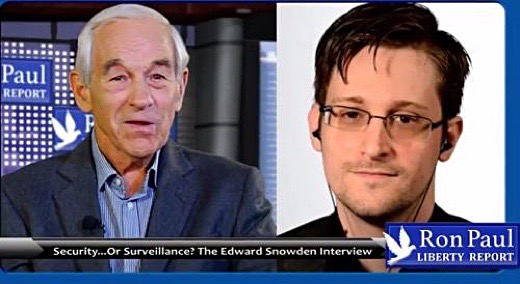

Image above: Still frame of Ron Paul and Edward Snowden from video of interview below.
Saying that you don’t care about privacy because you have nothing to hide is no different than saying you don’t care about freedom of speech because you have nothing to say.”
That comment was made by famed whistleblower Edward Snowden during a recent interview on the Ron Paul Liberty Report. In his conversation with Dr. Paul and Daniel McAdams, published Tuesday, an articulate Snowden discusses the true meaning of freedom, the nature of the deep state, and even his upbringing as a child of a government family.

“I’d like to know a little bit, what do you do all day long?” a genuinely curious Dr. Paul asks as his opening question. After talking about the insanity that erupted — both in the political spectrum and his personal life — following the revelations he made back in 2013, Snowden says he’s now become a hot commodity for groups championing causes.
“They want me to sort of front for these issues of privacy and civil liberties and protection of people’s rights,” Snowden replies. “And I want to do what I can, but I’m not a politician. I’m an engineer.”
The whistleblower goes on to talk about how he’s now, at long last, finally able to devote time to more practical applications. For him, this means focusing on the area that holds the key to finding a balance between rights and laws in the digital age — technology.
“How technically is this even happening?” Snowden poses, digging straight to the heart of the issue of mass surveillance. “How is it that so many governments are spying on so many people? Because even if we pass the best legal reforms in the world in the United States, that doesn’t do anything against China, or Russia, or Germany, or France or Brazil or any other country in the world.”
Continuing, Snowden says that future generations’ rights and protections will be dependent on the current generation’s ability to adapt to a constantly shifting environment:
“We need to find new means, new mechanisms, for enforcing these rights in the new times. And I think that’s going to be primarily through science and technology.”
When Dr. Paul asks the former NSA contractor about his political affiliation, Snowden responds that he doesn’t associate himself with any faction and that as individuals, we’re more than tribes and labels. Proceeding, Snowden points to how technology has given humanity a means to have a global conversation on issues:
“I think the Internet produces a lot of people who look at these issues differently, in a less tribal way, because you hear more viewpoints. You hear from many more people. And the more people in a conversation, I think the more informed it often is.”
When co-host Daniel McAdams asks Snowden to comment on the idea of security vs. surveillance, the whistleblower again cuts straight to the core of the debate and speaks on the perception of freedom itself.

“What is liberty?” asks Snowden, and then points out that ten questions on the street would result in ten different answers. After stating his view that liberty is the “freedom of self” and the “freedom from permission,” Snowden goes on to say that true liberty is rooted in personal privacy:
“Privacy isn’t about something to hide, privacy is about something to protect. It’s about the ability to be you, to have a thought for yourself, to have a thing for yourself, to have some difference, to have some idea that’s new and untested and untried that you can sort of sharpen amongst those that you trust, and then introduce into the world, into that contest of ideas.”
Next, Dr. Paul asks his guest to comment on the topic of the deep state, which Snowden proceeds to describe as a “mass of government that survives beyond administration” that is “not responding to the politics of the people.” Snowden says this organism lives “across parties” and “across administrations.”

Continuing, Snowden equates the running of state policy to a game, one that favors those who get “better and better” at understanding the evolving rules:
“And eventually, the people who are the greatest experts at understanding and using these rules, the best bureaucrats, are not sitting in the White House, they’re not sitting in the Congress. Because those guys come and go as the years pass, and they win elections, and they lose elections, and it’s the people that sit there for 30 years or more, in these agencies, with their hand on the lever the whole time. And that’s what the deep state is.”
Snowden further states that party affiliation matters little with regard to this behind-the-scenes force and that any political faction in power will eventually “get to the point of saying yes when enough pressure is brought to bear.”

When Daniel McAdams next asks him about whether or not he thinks an agency such as the NSA should even exist, Snowden remarks on the irony of asking him that question — given that he’s a “product of the system” with familial ties to the United States government going back decades.

But the whistleblower presses forward following a question from Dr. Paul on whether or not he thinks any gains have been made from his 2013 revelations, stating that solutions come not from individuals alone, but from many of them who “lay down a single brick upon which others can build.”

Continuing in this vein, Snowden says progress in battling government violations of personal liberty is made in inches and should be accomplished organically:
“Step by step, working together, sharing our views, connecting our values, we can create spaces, more bricks, that when laid together create a defense of rights that can be relied upon, in even historic moments when law cannot be.”
In his final question to Snowden, Dr. Paul asks whether the former government contractor’s decision to sound the alarm was arrived at suddenly or through a gradual process. In response, Snowden links his own decision to the average human being, noting that everyone has a point at which nothing more can be tolerated:
“We all have a level, right, of this kind of cognitive dissonance that we can accept. A level of injustice, of inhumanity, of incivility that we can accept in the daily world, that we can sort of internalize and suppress. And then we have one step more.”

Video above: "Security or Surveillance? The Edward Snowden Interview" From (https://youtu.be/9XLLo0025Jc).

.

INDEX: America , Fascism , Freedom , Russia , Secrecy , Security , Snowden , Surveillance
POSTED: 9:18 AM POSTER: Juan Wilson
Email This BlogThis! Share to X Share to Facebook
0 comment

The curse of the iPad

SUBHEAD: The rise of sleeplessness in young people and a praise of boredom as an indicating a need for change.

By Rob Hopkins on 7 May 2017 for Transition Network -
(https://transitionnetwork.org/news-and-blog/curse-ipad-stalks-land-praise-boredom/)


Image above: Family unit at family food franchise all on social media sights on various portable hypnosis machines. From (http://socialmediapersonalrelationships.blogspot.com/2014/03/how-social-media-changed-family-dynamic.html).

Last night I watched the latest episode of Panorama, ‘Sleepless Britain’.  It explored the problems of sleeplessness faced by many families, with visits to hospital caused by poor sleep having tripled in the last 10 years.  A generation of young people not getting as much sleep as they should be is having knock-on impacts in terms of obesity, family breakup, health and education.

It has been shown that poor sleep can reduce academic performance by up to two school years, and many young people are now increasingly reliant on prescription medicines to enable them to get a good night’s sleep.

One of the key reasons the programme identified behind this is the explosion in the use of electronic devices, mostly iPads and smartphones, just before sleep.  The blue light from such devices suppresses our body’s ability to create melatonin, the hormone which helps us get to sleep.

The programme followed several families as they tried to introduce an ‘electronic curfew’ of no screens in the hour before bed, and a more regular bedtime routine, with mixed success.

One of the things the programme didn’t touch on, and which struck me while watching it, was how our culture has developed a deep terror of the idea of ever being bored.  It’s as though every waking minute has to be filled with some kind of stimulation, the “intensification of nervous stimulation” which Matthew B Crawford in The World Beyond Your Head argues is increasingly underpinning our world.

For many young people, the idea of an hour before bed where you have no screens, read a book, draw, meditate, take a long bath or just look out of the window, feels like a ridiculous waste of their time.

And yet boredom really matters.  Many parents seem terrified of their kids ever being bored.  That somehow, bored kids represent a parental failure.  A paper in the journal Behavioural Sciences by Shane Bench and Heather Lench (I wonder if they chose to collaborate on it because their surnames rhymed so beautifully) called ‘On the Function of Boredom’, concludes that:
“Boredom provides a valuable adaptive function by signaling it is time to pursue a new goal”
 I’m not suggesting that our kids should always be bored witless, rather that late night screens are a symptom of our devaluing time in which we are not nervously stimulated in one way or another. If our kids say they are bored, rather than handing them the iPad, perhaps we’d be better to just suggest they sit with that feeling for a while, and see what arises instead.

It’s as though we are always suppressing that moment, rather than sitting with it and seeing what awaits us on the other side.

Some, at least, of the time currently dedicated to swiping up, swiping down, and sending text messages which could just as easily form the basis of an actual conversation the following day, could be spent daydreaming. Like boredom, daydreaming is something that gets bad press these days.

Michael Gove I’m sure hates daydreaming with a passion (I think it was the only thing at school that I excelled in), and his influence over education has resulted in less and less time for it.  Break times are being cut back in schools around the world as more time is demanded for teaching academic subjects.  As Jonah Lehrer writes in an article called The Virtues of Daydreaming:
“It turns out that whenever we are slightly bored—when reality isn’t quite enough for us—we begin exploring our own associations, contemplating counterfactuals and fictive scenarios that only exist within the head”


While Freud dismissed daydreaming as “infantile”, more recent research has come to think of it as an “essential cognitive tool”.  He references research by Benjamin Baird and Jonathan Schooler (who we’ll be publishing an interview with soon here) who argue that “creative solutions may be facilitated specifically by simple external tasks that maximize mind-wandering”.

Have you ever found yourself wondering who wrote a particular song, or scored a particular goal, and then 2 hours later the answer just ‘popped into your head’?  Our brains have an amazing ability to work on problems without our being consciously aware of them.  As Lehrer puts it:
“Question(s) need to marinate in the mind, “incubating” in those subterranean parts of the brain we can barely control”


So what are the kinds of simple tasks that facilitate this kind of thinking?  Lehrer describes them as being tasks which “consume just enough attention to keep us occupied, while leaving plenty of mental resources left over for errant daydreams”.

So, not television, iPads, texting or homework, but rather the kinds of things which, sadly, have been largely purged from most family homes.  Washing up, preparing food, kneading bread, knitting, gardening, sewing. Playing games together.  Time without noise, entertainment, stimulation.

Activities which keep enough of our brains free for daydreaming.

And sleep, of course, which is the time when our brain makes sense of, and files away the day’s varied inputs, rather like librarians working night shifts to get all the books back on the shelves in the right places ready for the next day.

It’s not for nothing that Kierkegaard called sleep “the height of genius”.  As Catherine Hill, a consultant pediatrician at Southampton children’s hospital, puts it in the Panorama program:
“If you could manufacture a pill that could improve your cognitive function, that improved your emotional regulation, that stopped you reaching for the biscuit tin in the afternoon, you’d be a millionaire. That is what sleep can help you with. It’s free, and available to us all”


And it’s not just kids for whom all this matters.  Many adults are sleep deprived too.  Perhaps I have just come up with the campaign idea with the least likelihood of mass engagement, but it deserves its place alongside the other great issues of our time.

“What do we want?” “The right to be bored!  To have time to look out of the window! To chew over the day’s events while doing the dishes!”  “When do we want it?” “Now!”  I’d be there, on that particular demo.

The beauty, of course, is that it needs no permission, just a personal decision that this stuff matters.

The beauty of it though is that steps towards being a family that spends more time together with less distractions, that listens to each other rather than to YouTube videos, that cooks together, sharing skills, recipes and stories, that puts away the iPads and reaches for the boardgames, is going to be happier and healthier anyway.

As Lehrer puts it, daydreaming allows us to “to invent additional possibilities”.  And goodness knows we need those, whatever age we are …


.
INDEX: Behavior , Children , Emotion , Family , Health , Mind , Social Media , Surveillance
POSTED: 9:05 AM POSTER: Juan Wilson
Email This BlogThis! Share to X Share to Facebook
0 comment

In praise of cash

SUBHEAD: Cash might be grungy, unfashionable and corruptible, but it is still a great public good.

By Brett Scott on 1 March 2017 for Aeon.co -
(https://aeon.co/essays/if-plastic-replaces-cash-much-that-is-good-will-be-lost)


Image above: Bundles of Somaliland's own currency are laid out by a money-changer on a street in Hargeisa, capital of the unrecognized breakaway republic of Somaliland in northwestern Somalia. From (https://www.northcountrypublicradio.org/news/npr/160117706/somaliland-a-pocket-of-stability-in-a-chaotic-region).

I recently found myself facing a vending machine in a quiet corridor at the Delft University of Technology in the Netherlands.

I was due to speak at a conference called ‘Reinvent Money’ but, suffering from jetlag and exhaustion, I was on a search for Coca-Cola.

The vending machine had a small digital interface built by a Dutch company called Payter. Printed on it was a sentence: 
‘Contactless payment only.’
I touched down my bank card, but rather than dispensing Coke, it beeped a message: ‘Card invalid.’ Not all cards are created equal, even if you can get one – and not everyone can.

In the economist’s imagining of an idealised free market, rational individuals enter into monetary-exchange contracts with each other for their mutual benefit.

One party – called the ‘buyer’ – passes money tokens to another party – called the ‘seller’ – who in turn gives real goods or services.

So here I am, the tired individual rationally seeking sugar. The market is before me, fizzy drinks stacked on a shelf, presided over by a vending machine acting on behalf of the cola seller.

It’s an obedient mechanical apparatus that is supposed to abide by a simple market contract: 
If you give money to my owner, I will give you a Coke.
So why won’t this goddamn machine enter into this contract with me? This is market failure.

To understand this failure, we must first understand that we live with two modes of money. ‘Cash’ is the name given to our system of physical tokens that are manually passed on to complete transactions. This first mode of money is public.

We might call it ‘state money’. Indeed, we experience cash like a public utility that is ‘just there’.

Like other public utilities, it might feel grungy and unsexy – with inefficiencies and avenues for corruption – but it is in principle open-access. It can be passed directly by the richest of society to the poorest of society, or vice versa.

Alongside this, we have a separate system of digital fiat money, in which our money tokens take the form of ‘data objects’ recorded on a database by an authority – a bank – granted power to ‘keep score’ of them for us.

We refer to this as our bank account and, rather than physically transporting this money, we ‘move’ it by sending messages to our banks – for example, via mobile phones or the internet – asking them to edit the data.

Money ‘moves’ to your landlord if your two respective banks can agree to edit your accounts, reducing your score and increasing your landlord’s score.

This second mode of money is essentially private, running off an infrastructure collectively controlled by profit-seeking commercial banks and a host of private payment intermediaries – like Visa and Mastercard – that work with them.

The data inscriptions in your bank account are not state money. Rather, your bank account records private promises issued to you by your bank, promising you access to state money should you wish. Having ‘£500’ in your Barclays account actually means ‘Barclays PLC promises you access to £500’.

The ATM network is the main way by which you convert these private bank promises – ‘deposits’ – into the state cash that has been promised to you. The digital payments system, on the other hand, is a way to transfer – or reassign – those bank promises between ourselves.

This dual system allows us the option to use private digital bank money when buying pizza at a restaurant, but we can always resort to public state money drawn out of an ATM if the proprietor’s debit card system crashes.

This choice seems fair.

At different times, we might find either form more or less useful. As you read this, though, architects of a ‘cashless society’ are working to remove the option of resorting to state cash. They wish to completely privatise the movement of money tokens, pushing banks and private-payments intermediaries between all interactions of buyers and sellers.

The cashless society – which more accurately should be called the bank-payments society – is often presented as an inevitability, an outcome of ‘natural progress’. This claim is either naïve or disingenuous. Any future cashless bank-payments society will be the outcome of a deliberate war on cash waged by an alliance of three elite groups with deep interests in seeing it emerge.

The first is the banking industry, which controls the core digital fiat money system that our public system of cash currently competes with. It irritates banks that people do indeed act upon their right to convert their bank deposits into state money.

It forces them to keep the ATM network running. The cashless society, in their eyes, is a utopia where money cannot leave – or even exist – outside the banking system, but can only be transferred from bank to bank.

The second is the private payments industry – the likes of Mastercard – that profits from running the infrastructure that services that bank system, streamlining the process via which we transfer digital money between bank accounts. They have self-serving reasons to push for the removal of the cash option.

Cash transactions are peer-to-peer, requiring no intermediary, and are thus transactions that Visa cannot skim a cut off.

The third – perhaps ironically – is the state, and quasi-state entities such as central banks. They are united with the financial industry in forcing everyone to buy into this privatised bank-payments society for reasons of monitoring and control.

The bank-money system forms a panopticon that enables – in theory – all transactions to be recorded, watched and analyzed, good or bad.

Furthermore, cash’s ‘offline’ nature means it cannot be remotely altered or frozen. This hampers central banks in implementing ‘innovative’ monetary policies, such as setting negative interest rates that slowly edit away bank deposits in order to coerce people into spending.

Governments don’t really mention that monetary policy agenda. It isn’t catchy enough. Rather, the key weapons used by the alliance are more classic shock-and-awe scare tactics. Cash is used by criminals! People buy drugs with cash! It’s the black economy! It supports tax evasion!

The ability to present control as protection relies on constant calls to imagine an external enemy, the terrorist or Mafiosi. These cries of moral panic are set in contrast to the glossy smiling adverts about digital payment.

The emerging cashless society looms like a futuristic sunrise, cleansing us of these dangerous filthy notes with rays of hygienic, convenient, digital salvation.

Signs say ‘Card only’. Who is Card? Card is a glamorous socialite, welcomed into stores. Card is superior.

Supporting this core alliance are auxiliary corps of establishment academics, economists and futurists, living life in leafy suburbs, flying business class to speak at technology conferences, attended to by a wall of sycophantic media pundits and innovation journalists preaching the gospel of cashlessness.

The Curse of Cash (2016) by Kenneth Rogoff, economics professor at Harvard, was long-listed for the Financial Times and McKinsey Business Book of the Year award, undoubtedly accompanied by invitations to financial industry-sponsored conference parties in five-star hotel lobbies.

The psychological assault is working. The Netherlands – where I face my vending machine – has become one key front in the war on cash. Here cash is becoming viewed like an illegal alien on the run, increasingly excluded from the formal economy, drawing dirty looks from shop assistants. Signs say ‘Card only’.

Who is Card? Card is a glamorous socialite, welcomed into stores. Card is superior. Look at the bank adverts showcasing their accessories for Card. Nobody is building accessories for Cash.

The frontlines, though, are now creeping to poorer countries. India’s recent so-called ‘demonetization’ was a brutal overnight retraction of rupee notes by the prime minister Narendra Modi to bring discipline to the ‘black economy’. It was an exercise that necessitated choking the poorest Indians, who depend on cash and who often lack access to bank accounts.

Originally cast in popular terms as an attempt to stem corruption, the message was later ironically altered to cast cashlessness as a way to create economic progress for India’s poor.

This message is given humanitarian credentials by the UN-based Better Than Cash Alliance, which promotes ‘the shift from cash to digital payments to reduce poverty and drive inclusive growth’, and which counts Visa, Mastercard and Citi Foundation as key partners.

The Modi action was also preceded by the initiation of the Cashless Catalyst program, ‘an alliance between the Government of India and USAID, to expand digital payments in India’, backed by a panoply of digital payments companies. These official alliances of states, corporations and public academics are impressive.

In India, well-heeled urban elites who applauded Modi’s actions from the sidelines can safely point to Rogoff’s Financial Times-nominated book of the year to justify it.

Rogoff, though, has appeared spooked, writing articles stating that he was advocating removing cash only from advanced economies with advanced banking systems. Oh damn.

Highly influential and politically powerful Harvard economist releases a global anti-cash book and is concerned when poorer nations take him seriously?

The attempt to present the cashless bank-payments society as a benefit to marginalized people is tenuous at best. If you’re a vulnerable denizen of the informal economy, an off-the-grid hustler, or a low-income precarious worker, banks and payments intermediaries have little interest in prioritizing you.

The bank-payments society will not process the activity that takes place in the peripheral cracks that form the basis of your livelihood.

Indeed, it is intended to shut down those spaces. That might be characterised as ‘progress’, but equally we might say you’re being firewalled out of the economy in an act of economic cleansing.

Under the guise of destroying the ‘shadow economy’, the underclass, the unwatched, the eccentric and the untamed will be coercively corralled into the hands of the state-corporate mainstream.

I have no special love of cash. I don’t really care for nostalgic reveries on the beautiful aesthetics of the banknote, or its texture and cultural importance within a market system, though I understand this is important to many.

I also don’t really care about the pedantic history of cash, whether it was the Tang or Song dynasty in China who first issued notes. What I care about is the unaccountable callousness of this vending machine, the one that has just blocked me from engaging in free trade.

Old vending machines didn’t do this. They had a little slot for coins, one that allowed even a ragged beggar to convert his tiny income into sustenance. Look closely at the machine. It’s actually two machines. The Payter device fused into its body does not work for the cola seller. It works for payments corporations.

You see, the cola seller has one bank account, but there are many people with many accounts at different banks approaching the vending machine. Those banks need to identify which of their account holders wishes to transfer how much money to which account at which other bank.

The device is there to deliver my card information into the transmission lines of the card payments networks, where it will be – in theory – routed to facilitate the transfer of money tokens from my account into the seller’s account, for a small fee.

This is no longer a deal between me and the seller. I am now dealing with a complex of unknown third parties, profit-seeking money-passers who stand between us to act as facilitators of the money flow, but also as potential gatekeepers.

If a gatekeeper doesn’t want to do business with me, I can’t do business with the seller. They have the ability to jam, monitor or place conditions upon that glorious core ritual of capitalism – the transfer of money for the transfer of goods.

This innocuous device exudes mechanical indifference, reporting only to invisible bosses far away, running invisible algorithms in invisible black boxes that don’t like me.

If we are going to refer to bank payments as ‘cashless’, we should then refer to cash payments as ‘bankless’. Because that’s what cash is, and right now it is the only thing standing between us and a completely privatised money system.

As in the case of previous privatisations, we’ll hear suited TV pundits arguing that if the digital payments companies don’t work for people they will be outcompeted by better private systems.

Yeah right.

When did you last see a credible competitor to the likes of Mastercard and Visa? They preside over huge network systems, subject to intense network effects. It’s in no shopkeeper’s interest to use a competitor to Visa when it’s so utterly dominant already.

The most we can hope for, then, is a benign oligopoly of payments corporations, heavily exposed to the geopolitical aspirations of the states they reside within.

The Chinese state encouraged the creation of China UnionPay precisely because they don’t want US payment megacorps installing themselves as gatekeepers into transactions made by Chinese citizens.

The new bank-payments society doesn’t actually solve the old problems – crime just goes digital, your account gets hacked rather than your wallet stolen

When mounting a defence, there are always two options. You either block an incoming attack, or you launch a strategic counterstrike, sometimes summed up as ‘offence is the best defence’.

In the former strategy, you focus on pointing out that the arguments against cash are either exaggerated, inaccurate or incomplete.

Exaggeration and inaccuracy are both present in anti-cash tirades, but incompleteness is crucial. For example, let’s say we agree that criminals prefer cash. Does that translate into ‘We should ban cash’?

Banning everything that criminals favored would almost certainly lead to a constrained, suffocating existence for everyone.

Congratulations, we ended crime, but only at the expense of ending privacy and free creative space too.

The end of crime comes accompanied by an overbearing surveillance state, always standing next to you, reaching into your most private moments, treating you like a small child that cannot be trusted. Enjoy your life.

The second mode of defence-as-offence involves attacking the proposed alternative.

We point out that the new bank-payments society, firstly, does not actually solve the old problems – crime just goes digital, and your account gets hacked rather than your wallet stolen – and, even worse, causes a whole range of new problems that were not explicitly mentioned in Mastercard’s marketing material. Let me reveal the fine-print written in invisible ink: Did we mention that in removing the ability to transact with cash we can now see everything you do and can also censor you?

Cheer up, if you have nothing to hide, you have nothing to fear!

Oh yes, I can use scare tactics too. I can point out that removing cash takes us one step closer to potentially realizing the most powerful and automated state-corporate financial control complex the world has ever seen.

Very few people either seem to understand this, or care. Like a slow-boiled frog, we don’t seem to notice the process of locking ourselves into daily dependence on an alienating, unaccountable infrastructure that makes us increasingly subservient to bureaucratic processes we cannot see.

Maybe I need to turn up the shock-and-awe. Maybe I can drum up an argument about how, in a cashless society, terrorists could target the electrical grid to bring entire regional economies to a halt.

No. My main defence of cash will be simple and intuitive. As unsexy and analogue as cash is,
  • it is resilient. 
  • It is easy to use. 
  • It requires little fancy infrastructure. 
  • It is not subject to arbitrary algorithmic glitches from incompetent programmers.
And, yes, it leaves no data trail that will be used to project the aspirations and neuroses of faceless technocrats and business analysts into my daily existence.

It comes with criminals, but hey, it’s good old friendly normal capitalism rather than predictive Minority Report surveillance-capitalism.

And ask yourself this: do you really want to live in the latter society without the ability to buy drugs? Believe me, you’ll need something to dull the existential pain.

.
INDEX: Banksters , Cash , Debt , Fed , Interest , Money , Surveillance
POSTED: 9:00 AM POSTER: Juan Wilson
Email This BlogThis! Share to X Share to Facebook
0 comment

Labour Party supports Corbyn

SUBHEAD: Despite sabotage and dirty tricks, he wins party leadership race in unprecedented landslide.

By Cory Doctorow on 24 September 2016 for Boing Boing -
(http://boingboing.net/2016/09/24/despite-sabotage-and-dirty-tri.html)


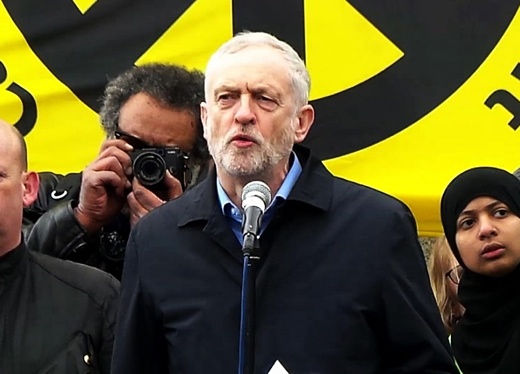
Image above: Jeremy Corbyn accepting party vote victory. From original article.

It's been just over a year since Jeremy Corbyn won the UK Labour Party leadership race with the biggest margin in history -- an avowed socialist who would reverse the party's years of special gifts to the UK's legendarily corrupt finance sector, fight mass surveillance, pull out of secretive trade deals -- a frugal man who walked his talk.

Almost immediately, his own party began sabotaging him, from the top on down, culminating in the mass-disenfranchisement of Corbyn supporters through an after-hours, non-agenda vote, which the party grandees doubled down on by spending the money those disenfranchised members had paid to appeal their decision to higher and higher courts.

In parallel, the UK press unilaterally declared Labour's most-popular-ever leader to be "unelectable" and did everything they could to sideline, belittle and dismiss him and his supporters, even as the UK Tories were leading the country to disaster through their Brexit vote.

So it is nothing short of a miracle that Corbyn has won the leadership race, and that, moreover, he has increased his lead, beyond last year's landslide, with a higher voter turnout than ever.

Corbyn's pledged to unite Labour (something that will require cooperation from the bankster-friendly, warmongering, surveillance-addicted party establishment) and promised not to retaliate against the party execs and elected leaders who tried to sabotage his leadership.
Mr Corbyn was first elected Labour leader in September 2015, when he beat three other candidates and got 59.5% of the vote.

Turnout was higher this time around, with 77.6% of the 654,006 eligible party members, trade union members and registered supporters - 506,438 in total - confirmed as taking part.

Mr Corbyn won comfortably in each of the three categories - winning the support of 59% of party members, 70% of registered supporters and 60% of affiliated supporters.

Party members - Jeremy Corbyn (168,216); Owen Smith (116,960)
Registered supporters - Corbyn (84,918); Smith (36,599)
Affiliated supporters - Corbyn (60,075); Smith (39,670)

Despite winning the leadership in a vote of the wider membership and registered supporters last year Mr Corbyn, who spent three decades as part of a marginalised leftwing group of Labour MPs in Parliament, has never had the support of more than about 20% of Labour's MPs.

.
INDEX: Banksters , Corruption , Election , England , Finance , Liberalism , Politics , Surveillance
POSTED: 8:09 AM POSTER: Juan Wilson
Email This BlogThis! Share to X Share to Facebook
0 comment

Is Apple Flying Or Dying?

SUBHEAD: A closer look at iPhone 7 indicates the evolutionary development of our wireless future.

By Ewan Spence on 18 September 2016 for Forbes-
(http://www.forbes.com/sites/ewanspence/2016/09/18/iphone-7-big-question-apple-doomed/)


Image above: iPhone7 promotional photo in fragile Jet Black finish. From original article.

What do the new iPhone 7 and iPhone 7 Plus smartphones tell us about Apple’s future? Let’s start this discussion with a simple premise that I think we can all agree on. Apple is not in stasis, it will change.

 Companies are always in transition, they hope to end up in a better place but in many cases the path of good intentions may eventually lead to a painful end.

The iPhone 7 handsets are pivotal phones for Apple. Tim Cook and his team are taking a number of gambles with the hardware, the software, the distribution, and its corporate attitude.

They believe that these changes will help Apple retain its leadership role in the technology space for the second decade of its smartphone (the original iPhone announcement was January 9 2007, so the birthday party is imminent).

The fact that I don’t think the iPhone 7 or 7 Plus change a huge amount for the end-user is a point I may return to in a later article, but my thoughts on why can be found in my ‘First Impressions’ review of the iPhone 7 here on Forbes.

In any case, let’s see what road signs are inside the iPhone 7 family and where they point to.

Everyone will have an opinion on the removal of the headphone jack, and while I wouldn’t want to go as far as saying that the decision was powered by “courage” it does illustrate that Apple is capable divining a future and has the willingness to proactively push towards it.

The move to lightning audio and wireless bluetooth is a ‘typically Apple’ attitude. There’s no point waiting for the combined might of the music industry  and various consumer electronics companies to throw away its comfort blanket, even if bluetooth headphones are starting to be in the majority of sales in some markets. Apple has forced the issue.

Assuming the removal of the jack is a success (and a genteel press corps will help smooth the rough edges of the transition), the opportunities in terms of handset design, reliability, lowered build costs and the potential for improved margins on peripheral sales are all positive benefits for Apple. It’s hard to see the basic shape of a smartphone changing now, so design is going to be focused on the edges.

Losing as many ports as possible will help evolve the smartphone. Switching the home key to a virtual button is more radical, but less likely to annoy the purists.

Again it lowers the count of physical parts on the device which will reduce the bill of materials to Apple, it reduces the number of warranty repairs required, and it will act as another point of difference against the raft of Android smartphones.

Perhaps more importantly, and staying in tune with the approach in audio, it reduces the number of extrusions in the basic chassis and offers far more ‘futuristic’ design choices for next year’s handed. Shorn of the need to prove the lack of a headphone jack or a physical home key, the tenth-anniversary iPhone 8 can bring forward a revolutionary look.

The release of the iPhone 7 and iPhone 7 Plus will also generate a vital data point for Apple’s sales team. Last year’s launch of the iPhone Upgrade Program allowed consumers to buy an iPhone direct from Apple in return for two years of monthly payments.

After one year they have the option of extending the payments by one year and trade up to the latest iPhone model. How many people take up this option will help plan the release of ‘the big one’ next year.

Apple has laid out the broad brush strokes of how it sees the future – a world with minimal use of wires, with fewer moving parts on the iPhone, and consumers that treat their smartphone as a monthly lease with ongoing payments rather than a huge investment every twenty-four months.

But Cupertino needs to watch out, because the new iPhone handsets also exhibit traits that could easily derail the company.


iPhone7 Jet Black finish scratches
SUBHEAD: Apple admits its iPhone 7 Jet Black finish is easy to mar.

By Ashley Carmin on 9 September 2016 for The Verge - 
(http://www.theverge.com/circuitbreaker/2016/9/7/12836762/iphone-7-announced-black-scratch)


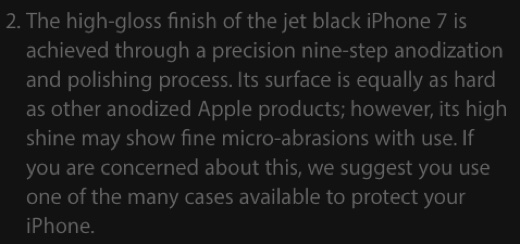
Image above: The low contrast Apple webpage that admits easy scratching of new Jet Black finished iPhone7.

Can you read that? Let me sum up: the jet black version of the iPhone 7, the one we the people wanted, scratches.

So if you don’t like a scratched iPhone, you’re going to need to invest in a case. People probably won’t be able to see your jet black iPhone 7 through that case. Do you love your phone’s color enough to let it be scratched?

Apple doesn’t have the same footnote for its simply "black" color. It comes in a matte finish and might be more on the gray side, but I think it’s the color we have to go with to avoid scratches.

.
INDEX: Cell Phones , Communication , Computers , Electronics , Progress , Surveillance , Techno-Optimists , Technology
POSTED: 8:44 AM POSTER: Juan Wilson
Email This BlogThis! Share to X Share to Facebook
0 comment

The End Game begins?

SUBHEAD: Either you position yourself before the skies darken or you are left groping in the dark.

By Cognitive Dissonance on 30 May 2016 for Two Ice Floes -
(http://twoicefloes.com/where-will-you-be-when-the-end-game-begins/)


Image above: Chess strategies of the End Game. From (http://www.thylacine3.com/419536821).

Sometime after oh-dark-thirty it will begin, the previously cocked trigger suddenly released to wreck havoc throughout the world’s financial system. Like an intricate and interwoven design made entirely of standing dominoes, all it takes is a slight disturbance to knock one off its base and start the cascade of toppled consequences running down the line.

With the benefit of hindsight it will be seen that the trigger itself was not the killer. Instead, sometime later, a specific projectile will be (most likely falsely) identified as the blunt instrument which tore economic flesh asunder and quickly bled the system of ‘liquidity’ faster than a slash to the femoral artery. Too late to make a difference, tourniquets will be applied to stem the red tide.

Sadly, all it will accomplish is to extend economic life long enough to enable a final frenzy of looting before the bloody end.

And the totalitarian end game will have only just begun.

End Game
Where will you physically be when the end game begins? If you are not there when it begins, you will most likely never get there.

A socioeconomic system, if healthy and vibrant, can usually withstand extremely rough handling and even intentionally directed assault. A severed lifeline, while certainly a devastating shock to the organism, can and will be survived simply because adequate resources and flexibility remain within the structure which can be quickly marshaled while emergency repairs are made.

But a compromised entity already deathly ill, continuously pumped with toxic drugs and stimulants, stressed beyond compare by various Rube Goldberg financial devices, constantly monitored and regulated to assure compliance to artificial standards no natural system would ever adhere to, is always one disturbance away from disaster.

Thus the stage is set for the dark thirty triggering event.   

While several likely scenarios can be put forward regarding the sequence of events that might follow the triggering (as well as the trigger itself) the precise chain of events is ultimately of little importance since a million and one fingers are resting on the trigger and several trillion dominoes await their inevitable fall.

The socioeconomic weapon will be fired, of this there is little doubt. The more penetrating, and ultimately personal, question is of what intensity and duration are the intended consequences.

I sincerely fear a long term mass casualty event of such strength and scope as to be inconceivable, therefore impossible, for the average cloistered mind to comprehend. Even those of us presently reading this article believe we have a heightened, some might say enlightened, perspective and understanding of the coming trials and tribulations.

We do not. And quite frankly, we cannot.

I say this with great conviction by way of my interaction with, and study of, living examples...those who lived through and carried the lifelong scars of the Great Depression of the 1930’s.

While just about any American over the age of 60 has talked to, or heard stories of, older family members who survived that decade plus of sustained hardship and deprivation, as a financial planner and broker I worked directly with many who suffered the most in the area of greatest damage, their personal financial affairs.

The best way to describe this class of people, an entire generation in fact, is that of walking wounded who are deeply scared by post traumatic stress disorder (PTSD).

More than ‘just’ suffering from the effects of a horribly maiming bomb blast, these survivors carried the burden of having been completely demoralized and abandoned by every institution they ever came to believe in.

Seventy plus years after the fact, the remaining few still hold little trust in anything they cannot hold in their hands or create with their own sweat and blood.

Talk about a lost generation.
Thankfully for the powers-that-be who presently guide us into dark territory, that generation, along with its vivid memories and stark warnings, is rapidly dying off. There is nothing more annoying than attempting to run the train off the tracks while those in the back seats are rabble rousing with dire warnings of impending doom, death and destruction. Into the valley of death rode the 6 billion.

As they say in poker, this nearly extinguished generation is a ‘tell’, a sign, a marker unmistakably warning in no uncertain terms where we are headed is not where we want to be.

This alone should be sufficient for any critical thinker to settle his or her affairs and remove themselves from the clearly marked ground zero, your local (sub) urban center where any semblance of independence and self sufficiency is a pipe dream of the self deluded mind.

It is well past time to move to where we have a chance of regaining some (even limited) control over our food, water and (safer) space.

Time is running out
Time is not on your side. When exactly do you posittion yourself for the next phase of Empire's collapse?

This is not to say we should bunker in, both physically and mentally. In fact I speak of just the opposite. As I have expressed time and time again, while bunkering might tide us over nicely for a short duration event of a few months or even a year, at some point we must come up for air and interact with the local population.

If at that point we have not integrated ourselves into the community, an extremely unlikely event if we were actually bunkering, it will be exponentially more difficult to do so after the fact. At best, if we are seen as a threat they will shun us and leave us to our own devices.

At worst we will be treated as a dangerous nuisance animal that must be eliminated or neutralized for the community’s greater good.

If the community, already dealing with great stress and turmoil, finds ‘us’ of less value than our ‘stuff’, they will take our stuff and leave our rotting carcass behind. We will be outsiders and must prove our worth to the others.

In a devolving socioeconomic situation a cohesive community must work together as equals while providing similar and equal value to the whole in order to survive. Those alien to the area will be quickly cast off if they do not measure up.

But there is more, so much more, to the unfolding totalitarian equation. One must be willingly deaf, dumb and blind not to hear the propaganda on the boob tube, understand the game theory being played out and see the bleak writing on the wall.

Any oppressive and controlling regime, whether it is defined as the elite, the one percent, shadow government, deep state, corpocracy, fascism or whatever label we use to mindlessly identify, compartmentalize and thereby cognitively diminish, will use any and all means at its disposal to defend itself when it perceives itself under attack.

And the term ‘attack’ is loosely defined to encompass any perceived danger real, imaginary or falsely concocted.

To view the increasingly hostile police state which America is rapidly becoming as anything other than an oppressive and controlling entity readying itself for war upon its population is to expose the reader’s appalling denial of the glaringly obvious. This is nothing short of an emotional and intellectual defect that is severely debilitating and potentially terminal.

The danger is clear and present and growing on a daily basis. If this cannot be seen for what it is, the observer remains hopelessly mired in the bargaining phase of their denial.

Then again never underestimate the time, energy and effort seemingly intelligent and worldly people will invest in constructing an alternative reality they wish to believe in. As a corollary, never underestimate the time, energy and effort an oppressive and controlling regime will invest in promoting an alternative reality the population wishes to believe in.

A self deluded populace is more easily controlled and directed than one whose sticks and stones, when used in anger, may break the elite’s bones. If the population wants to believe in fairy tales, give them fairy tales they can love, honor, cherish and defend. If they don’t, convince them they should believe by any means possible.

The genius of those who are constructing the underlying superstructure of the police state is their cunning ability to do so under the unflinching glare of the midday sun. Problem, reaction, solution is their trade craft, the government bureaucracy their blunt instrument, a corrupted legislature the enabler and creator of the unconstitutional and immoral laws, a co-opted and controlled press their sympathetic choir and the judiciary the final fraudulent arbiter of the chains that bind.

Make no mistake about it, every ‘government’ at war with its people makes certain its actions are ‘just and lawful’, particularly when they are patently not.

When viewed from the point of view of the disinterested and detached, the inevitable is obvious. The only purpose for power is to use the power…or have it used against its own creator. Therein lays its absolute ability to corrupt absolutely.

Clearly the rapidly increasing capacity of the powers-that-be to surveil, subvert, suppress, subdue, subsume and slaughter is self evident to all but those who are desperate not to see. Or, in what is more likely the case, are either paid not to see or wish to continue to be paid if blindness is feigned and cooperation assured. 

See No Evil
The Empire demands compliance. Why would you possibly think your 'End Game' options will still exist when the End Game begins?

This is why, at least at this moment, we would not be able to strike directly at the heart of the diseased beast, for it will be our fathers, family and friends who will defend ‘it’ from us. The Empire is exquisitely designed and constructed to be empowered when physical force is used against it.

Both the physical structure of its ramparts and the perverted psychology of its defenders are strengthened and emboldened when physical force is applied. Active resistance, when directed towards the Empire, is our own worst enemy.

The only way physical force has any chance of working against the Empire is when applied in overwhelming numbers against all vulnerable borders on a continuous basis. Since this requires great sacrifice by the population at large, Jane and Joe will only turn to these devices as a last resort, when all hope is lost and abject desperation sets in.

Even then, the controlling elite are expert at employing propaganda and psychological operations to turn Jane against Joe, thereby minimizing the effectiveness of the opposing force. One must be competently conditioned to kill on command in great numbers with ruthless efficiency to be considered an effective fighting force.

Quite frankly an angry mob is the exact opposite, making it very easy to turn each upon the other since the only driving force of the mob is blind emotional outburst easily subverted and misdirected.

Below are some sobering thoughts to ponder regarding human psychology and armed resistance to the Empire.  

Organized revolution requires both the will and a way. And by ‘way’ I mean money. Any money procured by, or offered to, a resistance always comes with strings attached. Often the money comes directly from the controlling elite itself via back channels designed to subvert, misdirect or implode the resistance.

Or it might come from an enemy of the Empire, thereby making you a proxy and not an independent force. Someone’s bitch, plain and simple.

Essentially, when outnumbered and outgunned guerrilla tactics are usually employed. Basically you are fighting fire with even more devastating fire. If you have any moral qualms with using the methods of Empire against the Empire, this fight isn’t for you. To convince yourself otherwise will only destroy you from within.

If you aren’t ready to declare war on your community, don’t even consider this path. Ninety percent of the population is hopelessly compromised, whether spiritually, morally, medically or pharmaceutically, psychologically, financially or ideologically. To believe otherwise is to engage in self deception. The vast majority will never oppose the Empire in any consistent or meaningful way.

Even worse, in the words of Morpheus, “You have to understand. Most of these people are not ready to be unplugged. And many of them are so inured, so helplessly dependent on the system that they will fight to protect it.”

This is so much more than a quote from some silly Hollywood movie. This is a universal psychological truth used to the significant advantage of the Empire. While the puppeteers are a relative few, they leverage the minds of millions far more effectively than if the bodies were simply cannon fodder.

Any serious degradation or collapse of the system will not weaken, but rather strengthen, the Empire, if only because it is accelerating the endgame towards the present day. Those compromised by the system will beg the corrupt system to save them from the collapsing system, a fool’s errand vigorously pursued by unprepared and panicked fools along with the ever present groveling sycophants.

Desperate men do desperate things. Our mistake is assuming that when the downward spiral accelerates the core elite will be among the desperate. Those pursuing a plan of divide and conquer while reaping the spoils will not panic when it’s playing out as expected. Socioeconomic chaos is their friend, not yours or mine.

While the endgame may be accelerating, it will not conclude quickly. These long period cycles of madness require many years, even decades, to complete its rotation only to begin the cycle once again.

Since the insanity of a decaying and corrupt Empire is constantly renewed and invigorated by new blood from below, its lifespan is far longer than yours and mine. The name of the game is survival, not gloriously wasted death or indefinite incarceration.

The greatest danger to us and our loved ones is not (just) the violent thrashing of the expiring Empire, but our refusal to deal frankly and honestly with our own personal shortcomings and denial. Our unwillingness to soberly assess ourselves and our surroundings circumvent any proactive response by us to a worsening situation.

To think one can shelter in place within the confines of the corral is shear lunacy. To believe one can effectively time their escape to greener pastures just ahead of the initial imposition of the financial lockdown is not dealing with reality, other than one produced by the self deceived.

The reason most of us remain frozen in place like jack-lighted deer is our reluctance to recognize the severity of our situation and the capacity for further degradation. Quite frankly, this reduces us to little more than rationalization and justification to explain our near total inaction, other than possibly stockpiling.

Ultimately our ‘plan’ is to cheer on a systemic collapse in the hope those in power will be deposed and a new regime arises from the ashes to rebuild the Empire from the tattered remains of its glorious capitalist past.

At best this is wishful thinking, at worst suicidal. There is madness afoot, a debilitating energy that permeates all that lives, not just the ‘bad’ guys and gals. In the vast majority it expresses as obsessive compulsive behavior, in some it manifests in the form of a sociopath or psychopath, with others various combinations of the seven deadly sins (greed and pride/ego especially) rise to the surface, in still others fear and cowardice prevails.

Great personal and collective courage is required to overcome the disaffected ‘self’. And during times of mass delusion and hysteria, courage is in chronic short supply.

Courage
Do we wait for the water to boil or make our move now? Our biggest enemy is not our surroundings, but our 'self'.

I am fully aware all that is necessary for the triumph of evil is that good men do nothing. I do not propose nothing be done. But the choices are not limited to either charging directly into withering rifle fire or remaining huddled behind phantom cover in the hope we survive. There are many equally viable alternatives, including (at least partial) withdrawal to begin the process of starving the beast.

Make no mistake about the following. The power of the Empire has not yet waned to the point where it will be toppled by its own arrogance, hubris or blind greed. It has miles to go, and lives to destroy, before it sleeps. Any weakness displayed by the Empire will be compensated for by even greater transgressions against the population.

The lie we tell ourselves is we are not participating in strengthening the Empire by simply going about our daily business while drafting, and possibly even implementing, contingency plans A, B and C.

The Empire cares little about the plans of individual mice and men. So in this respect the illusion of safety within the anonymous pack emboldens inaction. But to believe we are not contributing to the Empire because of our status as an individual snowflake flatly denies our involvement in the avalanche.

Empire does not require willing participation, just involvement plain and simple. The more our contribution is reduced, the less dependent we become, the less contributory we are.

The ugly, and self evident, truth is the vast majority of us wish to partake of the spoils of Empire while denying Empire and the means by which it acquires the spoils. We know any significant change to our living arrangement involves dislocation, deprivation and uncertainty.

We pontificate about high moral aspirations while decrying the despicable greed and self interest of the elite and powerful. Yet our perceived ‘enlightened’ self interest dictates our own (in) action even if it ultimately undermines us as well as our family and friends.

Who are we kidding if not our ‘self’?

As stated previously, Mrs. Cog and I do not have the answers, let alone a firm understanding of all the questions. What we believe we know is extremely personal in nature, but can be universally applied.

Either we declare powerless victimhood by doing little to nothing while awaiting the ‘sign’ to engage Plan B, or we execute a living breathing plan of action here and now by changing nearly everything about our lives and begin the process of reclaiming our personal sovereignty one step at a time.

To change the world I must first change myself. To approach this in any other manner is to adopt the techniques and mindset we decry as dishonest, disingenuous and corrupt. I have come to realize the approaching trials are about so much more than just survival.

This is about personal growth and spiritual transformation, of reaching for and achieving a higher plain of existence greater than the lowest common denominator, the heart of the fraud the Empire promotes and which “We the People” are addicted to and dependent upon.

And this, I suspect, is what truly holds so many people back.

For to break from the herd and look squarely in the mirror requires a fearless self examination and assessment, precisely what we are conditioned to avoid at all costs in our mindless pursuit of self absorbed consumerism.

The promoted myth is simple enough; when we exit the education indoctrination system the only remaining items left to pursue are specific skills required to further our ‘career’, which in turn provides the money to pay the debts that support the self destructive consumer lifestyle.

Turning our back on this meme and consciously choosing a life of more focused labor and dedication to self sufficiency and independence is not aligned with the bargain we struck with the system back when we entered grade school all those years ago. I made a deal with the devil in return for a life of leisure when I hit age 65.

To question this fundamental ‘truth’ requires us to question everything, something very few of us are willing to do.

Are you?
Either you position yourself before the skies darken or you are left groping in the dark.

.
INDEX: Collapse , Corporatism , Deep State , Elites , Empire , Fascism , Self Reliance , Self-Sufficiency , Strategy , Surveillance , Totalitarianism
POSTED: 9:01 AM POSTER: Juan Wilson
Email This BlogThis! Share to X Share to Facebook
2 comment

Fake NSA Reform

SUBHEAD: Little to celebrate as USA Freedom Act passes House with looming Patriot Act Reauthorization.

By John Queally on 14 May 2015 for Common Dreams -
(http://www.commondreams.org/news/2015/05/14/fake-reform-little-celebrate-usa-freedom-act-passes-house)


Image above: The House of Representatives passed the USA Freedom Act on Wednesday with a 338-88 vote, but experts say that powers of mass surveillance will continue, and even expand, if the bill passes and becomes law. (Image: EFF/flickr/cc).From original article.

With Patriot Act re-authorization looming, end of domestic phone collection program not enough to assuage civil liberty and privacy advocates.

Though the overwhelming and bipartisan passage of the USA Freedom Act in the House of Representatives on Wednesday portends the end of the NSA's mass collection of Americans' private telephone records, civil liberties groups found little else to celebrate as the ultimate passage of the bill, which now heads to the Senate, would re-authorize a number of worrisome programs by extending the life of the controversial Patriot Act.

Following a federal court ruling last week that deemed a provision of the Patriot Act, known as Section 215, as not a sound legal basis for the bulk phone data collection program, H.R. 2048, which passed the House by a vote of 338-88, would put a definitive end to the practice that was first revealed to the American public by documents leaked by whistleblower Edward Snowden in 2013.

However, despite strong objections from critics, the bill reauthorized Section 215 for other uses and would expanded other surveillance mechanisms and powers for government agencies.

See the full roll call of the vote here.

Though some progressive groups found it possible to support the bill for its strong stance against the domestic phone records program, tougher critics said that though they welcome the end of that specific program, the USA Freedom Act's re-authorization of broader Patriot Act powers could not be ignored.

Advocacy groups like the Electronic Frontier Foundation and the ACLU had offered some initial support to earlier versions of the bill, but both groups ultimately withdrew their backing of the law once it reached its final form. Others were never convinced and said true reform would come only from allowing the Patriot Act, and all its varied authorities, to sunset as scheduled on June 1.

“Congress has an opportunity to reform mass surveillance by letting the Patriot Act expire, and that’s what they should do," said Tiffiniy Cheng, co-founder of Fight for the Future, which has spearheaded a coalition opposed to mass surveillance, the re-authorization of the Patriot Act, and specifically Section 215.

Wednesday's vote to reauthorize the Patriot Act, said Cheng, would actually "expand the scope of surveillance" by the NSA and others. The USA Freedom Act, she said, "is the opposite of reform. It makes absolutely no sense."

Elaborating on the implications of the bill, she continued:
There is literally no reason for the NSA to be surveilling everyone and their mom in order to go after their targets. Why they aren’t satisfied with the US Constitutional limits on search and seizure and getting a warrant to do so is very suspicious. That’s just rogue and illegal behavior and part of selling a culture of fear. We’re demanding to see them build a case to surveil my mom and millions of Internet users around the world before they get one more peek at our private lives.“

Congress is trying to sell the USA Freedom Act to the American people as reform, but what the bill actually does is extend and expand the government’s power to monitor our communications under the PATRIOT Act. Far from reform, the bill will allow the government to invade even more of our private moments than ever by updating their surveillance powers for the devices and communications platforms we use most often these days.”

This is a fake privacy bill. Corrupt members of Congress and their funders in the defense industry are attempting to package up their surveillance-powers wishlist and misleadingly brand it as ‘USA Freedom.’ This is disappointing and offensive, and we will continue to work to kill this bill and any other attempt to legitimize unconstitutional surveillance systems.”
Within the halls of Congress, however, the climb toward meaningful reform in a Republican-controlled session has been a slog, with civil liberties groups hedging their critiques as well as their enthusiasm. As Russell Berman writes at The Atlantic:
The ACLU, for example, is taking no formal position on the bill even though it sent lawmakers a list of areas in which it didn’t go far enough. [A complex bipartisan] dynamic was on display this week when GOP House leaders rejected a bid by a group of younger libertarian members to offer amendments that would have further restricted the NSA. "This is a very delicate issue,” Speaker John Boehner explained to reporters. “I know members would like to offer some amendments, but this is not a place for people to bring out the wrecking ball.”

Broad majorities of House Democrats and Republicans decided on Wednesday that the Freedom Act was good enough as is, increasing pressure on the Senate to accept their compromise. Yet just how significant would the new law be? Lawmakers in Congress have a tendency to hail just about any bill that gets a bipartisan vote as a landmark achievement. Staunch privacy advocates dismiss it for paying lip service to reform while leaving intrusive surveillance programs untouched. The truth on this one lies somewhere in the middle, said Benjamin Wittes, a senior fellow at the Brookings Institution and the author of its Lawfare blog.
“This is a significant reform and rollback of a FISA program,” he told me. But it pales in the context of the extensive collections of NSA surveillance tools and the many, often unrelated provisions of the Patriot Act. Section 215 is, after all, just one section, and the reforms in this bill beyond ending bulk data collection are modest. “This is one, small program,” Wittes said. “It is not the big enchilada, or even one of the big enchiladas of the NSA programs.”
With the bill now heading to the Senate, critics of the House version are still holding out hope that improvements can be made in the upper chamber. As  Mark Jaycox, legislative analyst for EFF, wrote in the immediate wake of Wednesday's vote:
We believe the House missed an opportunity to strengthen the bill in light of the recent Second Circuit decision. We’re urging the Senate to take steps to strengthen the bill. The bill is now sent over to the Senate, where all eyes will be watching. The Senate is expected to take up the USA Freedom Act anytime in the next two weeks, and is likely to vote on it by May 22. The Senate is uniquely positioned to improve the civil liberties protections in the USA Freedom Act by adding additional transparency and oversight provisions, adding stronger limitations on the collection of data on innocent people, and throwing out some of the recently-added provisions to the bill that were included at the behest of the intelligence community.
He added, "2015 can and should be the year for powerful surveillance reform, and we’re urging the Senate to rise to this opportunity."


.
INDEX: America , Authoritarianism , Freedom , Legislation , NSA , Patriotism , Surveillance
POSTED: 8:48 AM POSTER: Juan Wilson
Email This BlogThis! Share to X Share to Facebook
0 comment

Secret law is not law

SUBHEAD: The secrecy of the legal justifications for NSA surveillance violates international human rights law.

By Cindy Cohn on 15 September 2014 for Electronic Frontier Foundation -
(https://www.eff.org/deeplinks/2014/09/secret-law-not-law)


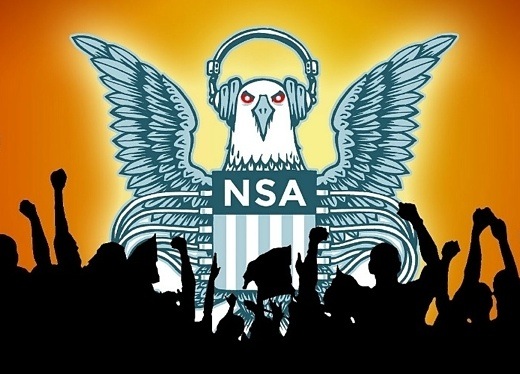
Image above: An appropriate great seal for the NSA's spying operation. From (http://www.dantynan.com/2013/06/11/love-trees-hate-meat-you-too-may-be-a-terrorist/).


One of the many ways that the NSA’s mass surveillance violates the human rights of both Americans and others around the world is that it teeters on a huge pile of secret law.

Let’s be clear. Under international human rights law, secret “law” doesn’t even qualify as “law” at all.

The Human Rights Committee confirms that law is only law if people know it exists and can act based on that knowledge. Article 19 of the ICCPR, protecting the freedoms of opinion and expression, requires that “to be characterized as a “law,” [a law] must be formulated with sufficient precision to enable an individual to regulate his or her conduct accordingly and it must be made accessible to the public. . . . “1 This same conclusion applies to Article 17, the right to privacy. The European Court of Human Rights similarly notes in the context of surveillance:
[T]he law must be sufficiently clear in its terms to give citizens an adequate indication as to the circumstances in which and the conditions on which public authorities are empowered to resort to this secret and potentially dangerous interference with the right to respect for private life and correspondence.2
This includes not just the law itself, but the judicial and executive interpretations of written laws because both of those are necessary to ensure that people have clear notice of what will trigger surveillance. 

This is a basic and old legal requirement: it can be found in all of the founding human rights documents. It allows people the fundamental fairness of understanding when they can expect privacy from the government and when they cannot. 

It avoids the Kafkaesque situations in which people, like Joseph K in The Trial and the thousands of people on the secret No Fly Lists, cannot figure out what they did that resulted in government scrutiny, much less clear their names. 

And it ensures that government officials have actual limits to their discretion and that when those limits are crossed, redress is possible.

Just how far has the US strayed from this basic principle in its mass surveillance practices? Very far. The existence of the mass surveillance was kept officially secret from the world for over a decade, from when it started in earnest in 2001 until June of 2013 after the Snowden revelations. The surveillance at first had no judicial authorization whatsoever. 

Various pieces of it were brought under judicial authority --  email records in 2004, U.S. domestic telephone records in 2006 and backbone and other content collection in 2007 -- but these court decisions also happened entirely in secret, so the public still didn't know. Even today, large amounts of both the caselaw and the Executive Branch’s internal legal guidance have been kept from the public. 

To the extent we know anything about what the government is doing, this has been based on the piecemeal (and often highly fragmented) release of information as the result of dogged FOIA work and the legal cases brought by EFF plus our friends at the ACLU and EPIC.3
 
The breadth of the secret law is astonishing. For instance, only after the Snowden revelations did the government first admit its legal theories -- that its mass spying relied on outrageous secret interpretations of section 215 of the PATRIOT ACT and section 702 of the FISA Amendments Act -- neither of which even mentions mass surveillance much less authorizes it. We also now know about the NSA’s domestic telephone records collection and a past program that collected cell location information but we still don’t know the NSA’s full use of section 215. 

In fact, on September 2 the government sidestepped questions from the Second Circuit about whether its legal arguments in support of its telephone records collection could also support the mass collection of all credit card or bank records of Americans (hint: it could).

Nor are these secret, often extremely weak interpretations of otherwise public laws the only problem. Sometimes there’s no “law” at all. The NSA’s foreign collection processes, which are much more extensive than their domestic collections, are only ostensibly justified by an Executive Order, currently Executive Order12333. While E.O. 12333 is public, it’s not law at all and it certainly does not mention mass surveillance of millions of innocent people around the world. 

None of the government’s legal interpretations of it are public either. We've now seen evidence that this non-law with secret interpretations is the basis for the NSA's mass surveillance of communications not just in one place, but at nearly every step of their journey: from remote access to computers, to man-in-the-middle attacks on messages in transit, to attacking direct service providers like Google, to tapping into the undersea cables. Yet the legal basis for these unprecedented intrusions into privacy remains opaque.
To bring the U.S. in line with international law, it must stop the process of developing secret law and ensure that all Americans, and indeed all people who may be subject to its surveillance have clear notice of when surveillance might occur. Terrorists and other criminals already well understand that they can be subject to surveillance during an investigation, so the people who are hurt are the innocent.

Some operational details can and should remain secret, of course, but the law must be sufficiently clear to allow innocent people to understand when and how they may be subject to surveillance and, as they wish, take steps to regain their privacy. Only then will the U.S. fulfill its obligations under international law.
  • 1. See UN Human Rights Committee, General Comment no. 34 on freedoms of opinion and expression (Article 19 ICCPR), available at: http://www2.ohchr.org/english/bodies/hrc/docs/gc34.pdf. The European Court of Human Rights applied the principles developed under Article 10 ECHR (right to freedom of expression) in Sunday Times in the case of Silver and others v. the United Kingdom, nos. 5947/72; 6205/73; 7052/75; 7061/75; 7107/75; 7113/75; 7136/75, 25 March 1983, paras. 85-86, which concerned the right to privacy of prisoners under Article 8 ECHR.
  • 2. Malone v. the United Kingdom, no. 8691/79, 2 August 1984, para. 67.
  • 3. All too often the Intelligence Community shamefully elides the fact that its public releases were due to pressure from our work and even then only releases what it decides to release, likely skewing what the public learns.
.
INDEX: America , Constitution , International , Justice , Law , NSA , Surveillance , Totalitarianism
POSTED: 8:22 AM POSTER: Juan Wilson
Email This BlogThis! Share to X Share to Facebook
0 comment

NSA pressures ISP Lavabit

SUBHEAD: ISP provider Lavabit would rather close down than go along with spying on its customers.

By Akexander Reed Kelly on 10 August 2013 for TruthDig -
(http://www.truthdig.com/report/item/truthdigger_of_the_week_lavabits_ladar_levison_20130810/)


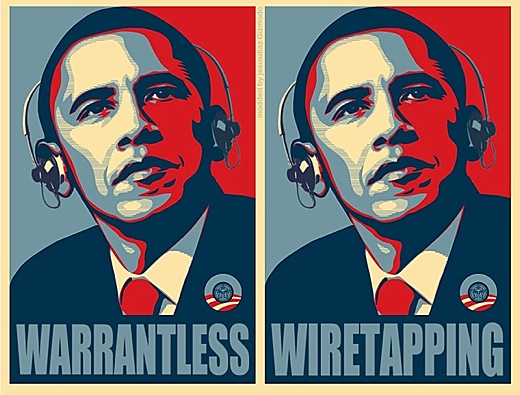
Image above:"Warrantless Wiretap" Obama satire poster.  From (http://gizmodo.com/5138271/obama-supports-warrantless-wiretapping-just-like-bush).

Americans love an underdog. So they should be cheering Ladar Levison, a 32-year-old digital security specialist who closed the email service he operated for 10 years rather than help the U.S. government spy on his customers.

Until Thursday afternoon, Levison was the owner and operator of Lavabit, a secure email service developed by a group of programmers in Texas in 2004 that used encryption technology to prevent the content of its users’ emails from being read by anyone who didn’t possess the numerical “keys” required to “unlock” them. Levison’s decision appears to be unprecedented. Kurt Opsahl, a lawyer with the Electronic Frontier Foundation, was quoted by The Guardian as saying: “I am unaware of any situation in which a service provider chose to shut down rather than comply with a court order they felt violated the constitution.”

No amount of encryption can completely protect online activity from determined snoopers, but Lavabit’s methods appear to have been among the most sound and reliable available to people desiring to communicate privately online. In an article about certain consequences of Lavabit’s shutdown, New Statesman technology reporter Alex Hern asserted that “based on everything we know about the intelligence services, even they can’t break that sort of encryption. If they don’t have the key, they don’t have the data.”

As if the availability of that kind of power wasn’t enough to attract official attention, the service became a focus of the U.S. government when it came out that NSA whistle-blower Edward Snowden was likely using it to talk with people across the globe out of earshot of the authorities. Snowden apparently used the non-secretive email address edsnowden@lavabit.com to invite journalists and human rights activists to a news conference in the international zone of Moscow’s Sheremetyevo airport, where he was sequestered for more than a month.

Advertisement <a href='http://www.truthdig.com/banners/www/delivery/ck.php?n=abee66dc&amp;cb=2043902560' target='_blank'><img src='http://www.truthdig.com/banners/www/delivery/avw.php?zoneid=8&amp;cb=2043902560&amp;n=abee66dc' border='0' alt='' /></a> If Snowden did indeed use Lavabit, he would not have been alone. According to the independent news site mathaba, Lavabit had 40,000 people logging in every day and sending 1.4 million messages per week. The Guardian says the service claimed 350,000 customers. Reports that Snowden used the site appeared to cause the number of people signing up to triple in recent weeks.

Levison’s parting message to his customers and the broader public, published to Lavabit’s page immediately after the shutdown, reads like an anxious hero’s cry against the advances of an overwhelming villain.

“My Fellow Users,” he begins, striking a fittingly non-hierarchical tone. “I have been forced to make a difficult decision: to become complicit in crimes against the American people or walk away from nearly ten years of hard work by shutting down Lavabit. After significant soul searching, I have decided to suspend operations. I wish that I could legally share with you the events that led to my decision. I cannot. I feel you deserve to know what’s going on—the first amendment is supposed to guarantee me the freedom to speak out in situations like this. Unfortunately, Congress has passed laws that say otherwise. As things currently stand, I cannot share my experiences over the last six weeks, even though I have twice made the appropriate requests.”

“What’s going to happen now?” he continues. “We’ve already started preparing the paperwork needed to continue to fight for the Constitution in the Fourth Circuit Court of Appeals. A favorable decision would allow me to resurrect Lavabit as an American company.”

“This experience has taught me one very important lesson,” Levison concludes. He has a warning for everyone using conventional tools and services to communicate online: “Without congressional action or a strong judicial precedent, I would _strongly_ recommend against anyone trusting their private data to a company with physical ties to the United States.” The warning echoes a grimmer comment attributed to him on mathaba: “I’m taking a break from email,” Levison reportedly said. “If you knew what I know about email, you might not use it either.”

Lavabit is not the only casualty of the government’s aggressive pursuit of encryption services. Hours after Lavabit announced its shutdown, another company that offered email encryption, Silent Circle, said it was pre-emptively shutting down its service.

Levison is not a privacy absolutist. When it’s made available to everyone, encryption technology can be used by criminals too. “He has cooperated in the past with government investigations,” mathaba reports. “He says he’s received ‘two dozen’ requests over the last ten years, and in cases where he had information, he would turn over what he had.”

Levison says he does not intend to support criminality. “I’m not trying to protect people from law enforcement,” he said. “If information is unencrypted and law enforcement has a court order, I hand it over.” But the secretive way the government goes about collecting information, which Americans know much about after months of revelations concerning the White House and the National Security Agency’s massive dragnet spying program, does disturb him. “The methods being used to conduct those investigations should not be secret,” he said.

Levison is currently raising money for a legal battle in the 4th U.S. Circuit Court of Appeals. As of Saturday morning, a defense fund being raised by private donors was reaching $90,000. He says he will revive Lavabit only if he can secure legal protections for services like his. “It needs to be clear that the government can’t do what they’re trying to do,” he said. “Otherwise the same request is going to come right back at us. Other big names aren’t able to shut down in protest. I’m one person without a bunch of employees to support. If we win, we win for everyone.”

When the Obama administration is using all of its vast, publicly funded resources to wage a war on Americans’ privacy and the freedom of thought that privacy enables, those words are exciting. Levison is a David facing a modern Goliath. His victory is not assured, but his determination to stand up for some of the United States’ founding principles, at a time when such a move is becoming increasingly dangerous, is inspiring. For sticking his neck out for all of us, we honor Ladar Levison as our Truthdigger of the Week.

.
INDEX: America , Civil Rights , Constitution , Snowden , Surveillance
POSTED: 9:31 AM POSTER: Juan Wilson
Email This BlogThis! Share to X Share to Facebook
0 comment

Black Hat heckles NSA head

SUBHEAD: NSA director heckled at Black Hat conference as he asks for security community's understanding.

By Andy Greenberg on 31 July 2013 fo Forbes -
(http://www.forbes.com/sites/andygreenberg/2013/07/31/nsa-director-heckled-at-conference-as-he-asks-for-security-communitys-understanding/)


Image above: From ().

When NSA Director Keith Alexander appeared at the Las Vegas security conference Black Hat Wednesday morning, he hoped to mend the NSA’s reputation in the eyes of thousands of the conference’s hackers and security professionals. It didn’t go exactly as planned.

Alexander was about a half hour into his talk when a 30-year-old security consultant named Jon McCoy shouted “Freedom!”

“Exactly,” responded Alexander. “We stand for freedom.”

“Bullshit!” McCoy shouted.

“Not bad,” Alexander said, as applause broke out in the crowd. “But I think what you’re saying is that in these cases, what’s the distinction, where’s the discussion and what tools do we have to stop this.”

“No, I’m saying I don’t trust you!” shouted McCoy.

“You lied to Congress. Why would people believe you’re not lying to us right now?” another voice in the crowd added.

“I haven’t lied to Congress,” Alexander responded, visibly tensing. “I do think it’s important for us to have this discussion. Because in my opinion, what you believe is what’s written in the press without looking at the facts. This is the greatest technical center of gravity in the world. I ask that you all look at those facts.”

Alexander’s talk had begun with a plea for the hacker and security researcher community to reconsider the NSA’s role in the wake of a still-unfolding scandal revealed by the classified leaks of former Booz Allen contractor Edward Snowden. “Their reputation has been tarnished,” he said, speaking of his NSA staff. “But you can help us articulate the facts properly. I will answer every question to the fullest extent possible, and I promise you the truth: What I know, what we’re doing, and what I cannot tell you because we don’t want to jeopardize the future of our defense.”

Alexander’s talk focused on the oversight placed on the NSA by Congress and the Foreign Intelligence Surveillance Court, which must approve the NSA’s surveillance in any case where it might target Americans. The FISC, which hears the NSA’s arguments without any opposing counsel, has been accused of offering negligible oversight of the Agency’s work. The FISC stated in April that it had received 1,789 applications for electronic surveillance, of which 1,748 others were approved without changes and only one was withdrawn.

“I’ve heard the court is a rubber stamp. I’m on the other end of that table, against that table of judges that don’t take any—I’m trying to think of a word here—from even a four-star general. They want to make sure what we’re doing comports with the constitution and the law,” Alexander said. “I can tell you from the wire brushings I’ve received, they are not a rubber stamp.”

Alexander also cited a Congressional inquiry into the NSA that found no evidence that it had engaged in any illegal use of its spying powers. But the NSA has come under continued Congressional scrutiny, including in a hearing Wednesday morning in which the Senate Judiciary committee grilled members of the intelligence community, including NSA deputy director John Inglis, over the mass collection of Americans’ cell phone records. Also Wednesday morning, the Guardian published new documents leaked by Edward Snowden revealing yet another NSA program known as XKeyScore, a tool that allows the broad search of millions of individuals’ emails and browsing history.

In his Black Hat talk, the four-star general presented a timeline of terrorist attacks around the world, from the 1993 World Trade Center bombing to the Boston Marathon attack. He told the story of Najibullah Zazi, a terrorist accused of plotting an attack on the New York subway whose plot was foiled by the NSA’s surveillance, particularly the PRISM program that allows the NSA access to user data from Google, Microsoft, Apple, Skype, Facebook and other tech firms.

Alexander also noted the 6,000 NSA cryptologists who have deployed to Afghanistan and Iraq, 20 of whom were killed in the line of duty according to Alexander. “Think about people willing to go forward to Iraq and Afghanistan, to make sure our soldiers, airmen and marines get the intelligence they need,” he said. “I believe these are the most noble people we have in this country.”

“We get all these allegations of what [NSA staff] could be doing,” Alexander added. “But when people check what the NSA is doing, they’ve found zero times that’s happened. And that’s no bullshit. Those are the facts.” The crowd responded to that line with loud applause, as Alexander asked the press not to quote his swearing, noting his 15 grandchildren.

“The whole reason I came here was to ask you to help you to help us make it better,” said the general. “And if you disagree with what we’re doing, you should help us twice as much.”

“Read the constitution!” shouted McCoy in one last heckle.

“I have. So should you,” responded Alexander to another round of applause.

After the talk, I found McCoy in the crowd and asked him about his not-so-friendly debate with the general. “His speech was pretty canned,” said McCoy. “It’s anything you can see on Fox News any day. We’re in danger, we have to get rid of your freedom to keep you safe.”

“Everyone’s thinking this, but no one’s saying it public, so everyone thinks they’re alone,” he said. “Ninety-eight percent of society has issues with this…But no one speaks up.”
.
INDEX: Big Brother , Dishonesty , Surveillance , Totalitarianism
POSTED: 11:43 AM POSTER: Juan Wilson
Email This BlogThis! Share to X Share to Facebook
0 comment
Older Posts Home
Subscribe to: Posts ( Atom )

FROM KAUAI HAWAII

  STAFF - EMAIL
Juan Wilson: Editor
Linda Pascatore: Editor

PARENT SITE
www.IslandBreath.org

NEWER ARTICLES

  2009 and on

OLDER ARTICLES

  1993 - 2008
 

TITLES IN ORDER

  • ▼  2023 (2)
    • ▼  August (1)
      • Another Half a Year passes
    • ►  February (1)
  • ►  2022 (3)
    • ►  July (3)
  • ►  2021 (6)
    • ►  November (1)
    • ►  August (1)
    • ►  February (1)
    • ►  January (3)
  • ►  2020 (35)
    • ►  December (2)
    • ►  November (1)
    • ►  June (1)
    • ►  May (4)
    • ►  April (7)
    • ►  March (7)
    • ►  February (5)
    • ►  January (8)
  • ►  2019 (33)
    • ►  December (5)
    • ►  November (2)
    • ►  October (1)
    • ►  September (1)
    • ►  August (2)
    • ►  July (6)
    • ►  June (1)
    • ►  May (1)
    • ►  March (4)
    • ►  February (1)
    • ►  January (9)
  • ►  2018 (151)
    • ►  December (9)
    • ►  November (6)
    • ►  October (23)
    • ►  September (12)
    • ►  August (9)
    • ►  July (15)
    • ►  June (14)
    • ►  May (8)
    • ►  April (22)
    • ►  March (14)
    • ►  February (7)
    • ►  January (12)
  • ►  2017 (520)
    • ►  December (22)
    • ►  November (18)
    • ►  October (7)
    • ►  September (16)
    • ►  August (50)
    • ►  July (63)
    • ►  June (58)
    • ►  May (54)
    • ►  April (56)
    • ►  March (60)
    • ►  February (56)
    • ►  January (60)
  • ►  2016 (554)
    • ►  December (52)
    • ►  November (60)
    • ►  October (76)
    • ►  September (62)
    • ►  August (53)
    • ►  July (52)
    • ►  June (35)
    • ►  May (41)
    • ►  April (34)
    • ►  March (36)
    • ►  February (30)
    • ►  January (23)
  • ►  2015 (547)
    • ►  December (32)
    • ►  November (62)
    • ►  October (53)
    • ►  September (46)
    • ►  August (55)
    • ►  July (41)
    • ►  June (55)
    • ►  May (41)
    • ►  April (43)
    • ►  March (37)
    • ►  February (37)
    • ►  January (45)
  • ►  2014 (461)
    • ►  December (32)
    • ►  November (40)
    • ►  October (42)
    • ►  September (29)
    • ►  August (26)
    • ►  July (24)
    • ►  June (25)
    • ►  May (29)
    • ►  April (39)
    • ►  March (46)
    • ►  February (57)
    • ►  January (72)
  • ►  2013 (829)
    • ►  December (60)
    • ►  November (74)
    • ►  October (81)
    • ►  September (77)
    • ►  August (76)
    • ►  July (71)
    • ►  June (64)
    • ►  May (53)
    • ►  April (62)
    • ►  March (75)
    • ►  February (60)
    • ►  January (76)
  • ►  2012 (839)
    • ►  December (69)
    • ►  November (62)
    • ►  October (80)
    • ►  September (67)
    • ►  August (64)
    • ►  July (68)
    • ►  June (58)
    • ►  May (79)
    • ►  April (75)
    • ►  March (68)
    • ►  February (80)
    • ►  January (69)
  • ►  2011 (1002)
    • ►  December (72)
    • ►  November (67)
    • ►  October (84)
    • ►  September (71)
    • ►  August (78)
    • ►  July (91)
    • ►  June (72)
    • ►  May (86)
    • ►  April (103)
    • ►  March (111)
    • ►  February (82)
    • ►  January (85)
  • ►  2010 (1116)
    • ►  December (99)
    • ►  November (91)
    • ►  October (78)
    • ►  September (71)
    • ►  August (86)
    • ►  July (93)
    • ►  June (101)
    • ►  May (97)
    • ►  April (104)
    • ►  March (98)
    • ►  February (88)
    • ►  January (110)
  • ►  2009 (929)
    • ►  December (91)
    • ►  November (94)
    • ►  October (108)
    • ►  September (94)
    • ►  August (83)
    • ►  July (60)
    • ►  June (66)
    • ►  May (64)
    • ►  April (72)
    • ►  March (78)
    • ►  February (61)
    • ►  January (58)
  • ►  2008 (63)
    • ►  December (63)

ADD ARTICLE

We invite articles submitted by our readers. You can add an article (subject to editorial approval) by emailing the Juan Wilson with what you want to post.

We will include your name as the author, or, if you are forwarding another's words, we will add you as the source.

PARTIAL INDEX

  • Collapse ( 768 )
  • Climate Change ( 675 )
  • Kauai ( 646 )
  • Health ( 619 )
  • Hawaii ( 608 )
  • Environment ( 586 )
  • Global Warming ( 509 )
  • GMOs ( 487 )
  • Future ( 413 )
  • Alternative Energy ( 382 )
  • Food Security ( 376 )
  • Military ( 376 )
  • Peak Oil ( 376 )
  • Corporatism ( 375 )
  • Economics ( 373 )
  • Self Delusion ( 345 )
  • CO2 ( 323 )
  • Banksters ( 315 )
  • Sustainability ( 310 )
  • Energy ( 306 )
  • Agriculture ( 292 )
  • Justice ( 284 )
  • Food ( 283 )
  • De-Industrialize ( 260 )
  • Nuclear Power ( 253 )
  • Self Reliance ( 246 )
  • Culture ( 245 )
  • Nature ( 233 )
  • Monsanto ( 232 )
  • Adaptation ( 228 )
  • Spirituality ( 225 )
  • Technology ( 211 )
  • Community ( 190 )
  • Planning ( 189 )
  • Humor ( 179 )
  • Science ( 179 )
  • Fukushima ( 174 )
  • Radiation ( 167 )
  • Self-Sufficiency ( 164 )
  • Behavior ( 163 )
  • Sovereignty ( 159 )
  • Ocean ( 152 )
  • Development ( 149 )
  • Ecosystem ( 141 )
  • Regionalism ( 136 )
  • Extinction ( 134 )
  • County ( 133 )
  • Solar Power ( 132 )
  • Civilization ( 122 )
  • Gardening ( 115 )
  • Permaculture ( 104 )
  • Globalization ( 91 )
  • Hawaiiana ( 90 )
  • Strategic Islands ( 82 )

WEEK'S VISITS