SUBHEAD: Zuckerberg at his keyboard after a few drinks creating a website to compare people’s appearance.
By John Lanchester on 17 August 2017 for London Review of Books -
(
https://www.lrb.co.uk/v39/n16/john-lanchester/you-are-the-product)
(
http://www.zerohedge.com/news/2017-09-02/facebook-exposed-you-are-product
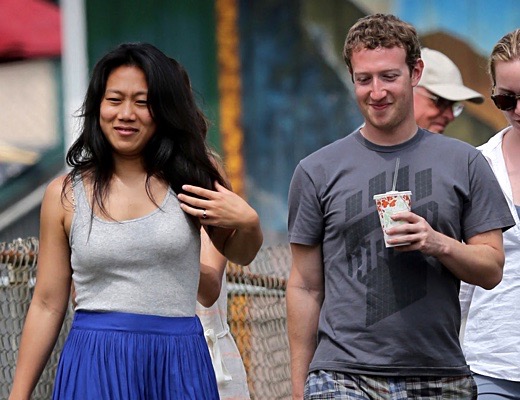 Image above: Mark Zuckerberg and wife kicking back in Hanalei on Kauai after purchasing a large oceanfront property. From (https://hawaiibusinessonline.com/mark-zuckerberg-responds-to-news-about-kauai-land-deal/).
At the end of June, Mark Zuckerberg announced that Facebook had hit a new level: two billion monthly active users. That number, the company’s preferred ‘metric’ when measuring its own size, means two billion different people used Facebook in the preceding month. It is hard to grasp just how extraordinary that is.
Bear in mind that thefacebook – its original name – was launched exclusively for Harvard students in 2004.
No human enterprise, no new technology or utility or service, has ever been adopted so widely so quickly. The speed of uptake far exceeds that of the internet itself, let alone ancient technologies such as television or cinema or radio.
Also amazing: as Facebook has grown, its users’ reliance on it has also grown. The increase in numbers is not, as one might expect, accompanied by a lower level of engagement. More does not mean worse – or worse, at least, from Facebook’s point of view. On the contrary.
In the far distant days of October 2012, when Facebook hit one billion users, 55 per cent of them were using it every day. At two billion, 66 per cent are.
Its user base is growing at 18 per cent a year – which you’d have thought impossible for a business already so enormous. Facebook’s biggest rival for logged-in users is YouTube, owned by its deadly rival Alphabet (the company formerly known as Google), in second place with 1.5 billion monthly users.
Three of the next four biggest apps, or services, or whatever one wants to call them, are WhatsApp, Messenger and Instagram, with 1.2 billion, 1.2 billion, and 700 million users respectively (the Chinese app WeChat is the other one, with 889 million).
Those three entities have something in common: they are all owned by Facebook. No wonder the company is the fifth most valuable in the world, with a market capitalisation of $445 billion.
Zuckerberg’s news about Facebook’s size came with an announcement which may or may not prove to be significant. He said that the company was changing its ‘mission statement’, its version of the canting pieties beloved of corporate America. Facebook’s mission used to be ‘making the world more open and connected’.
A non-Facebooker reading that is likely to ask: why? Connection is presented as an end in itself, an inherently and automatically good thing. Is it, though?
Flaubert was sceptical about trains because he thought (in Julian Barnes’s paraphrase) that ‘the railway would merely permit more people to move about, meet and be stupid.’
You don’t have to be as misanthropic as Flaubert to wonder if something similar isn’t true about connecting people on Facebook. For instance, Facebook is generally agreed to have played a big, perhaps even a crucial, role in the election of Donald Trump.
The benefit to humanity is not clear. This thought, or something like it, seems to have occurred to Zuckerberg, because the new mission statement spells out a reason for all this connectedness.
It says that the new mission is to ‘give people the power to build community and bring the world closer together’.
Hmm. Alphabet’s mission statement, ‘to organise the world’s information and make it universally accessible and useful’, came accompanied by the maxim ‘Don’t be evil,’ which has been the source of a lot of ridicule: Steve Jobs called it ‘bullshit’. Which it is, but it isn’t only bullshit. Plenty of companies, indeed entire industries, base their business model on being evil.
The insurance business, for instance, depends on the fact that insurers charge customers more than their insurance is worth; that’s fair enough, since if they didn’t do that they wouldn’t be viable as businesses.
What isn’t fair is the panoply of cynical techniques that many insurers use to avoid, as far as possible, paying out when the insured-against event happens.
Just ask anyone who has had a property suffer a major mishap. It’s worth saying ‘Don’t be evil,’ because lots of businesses are. This is especially an issue in the world of the internet. Internet companies are working in a field that is poorly understood (if understood at all) by customers and regulators.
The stuff they’re doing, if they’re any good at all, is by definition new. In that overlapping area of novelty and ignorance and unregulation, it’s well worth reminding employees not to be evil, because if the company succeeds and grows, plenty of chances to be evil are going to come along.
Google and Facebook have both been walking this line from the beginning. Their styles of doing so are different.
An internet entrepreneur I know has had dealings with both companies. ‘YouTube knows they have lots of dirty things going on and are keen to try and do some good to alleviate it,’ he told me. I asked what he meant by ‘dirty’. ‘Terrorist and extremist content, stolen content, copyright violations.
That kind of thing. But Google in my experience knows that there are ambiguities, moral doubts, around some of what they do, and at least they try to think about it.
Facebook just doesn’t care. When you’re in a room with them you can tell. They’re’ – he took a moment to find the right word – ‘scuzzy’.
That might sound harsh. There have, however, been ethical problems and ambiguities about Facebook since the moment of its creation, a fact we know because its creator was live-blogging at the time. The scene is as it was recounted in Aaron Sorkin’s movie about the birth of Facebook, The Social Network.
While in his first year at Harvard, Zuckerberg suffered a romantic rebuff. Who wouldn’t respond to this by creating a website where undergraduates’ pictures are placed side by side so that users of the site can vote for the one they find more attractive? (The film makes it look as if it was only female undergraduates: in real life it was both.) The site was called Facemash. In the great man’s own words, at the time:
I’m a little intoxicated, I’m not gonna lie. So what if it’s not even 10 p.m. and it’s a Tuesday night? What? The Kirkland dormitory facebook is open on my desktop and some of these people have pretty horrendous facebook pics. I almost want to put some of these faces next to pictures of some farm animals and have people vote on which is the more attractive … Let the hacking begin.
As Tim Wu explains in his energetic and original new book The Attention Merchants, a ‘facebook’ in the sense Zuckerberg uses it here ‘traditionally referred to a physical booklet produced at American universities to promote socialisation in the way that “Hi, My Name Is” stickers do at events; the pages consisted of rows upon rows of head shots with the corresponding name’.
Harvard was already working on an electronic version of its various dormitory facebooks. The leading social network, Friendster, already had three million users.
The idea of putting these two things together was not entirely novel, but as Zuckerberg said at the time, ‘I think it’s kind of silly that it would take the University a couple of years to get around to it. I can do it better than they can, and I can do it in a week.’
Wu argues that capturing and reselling attention has been the basic model for a large number of modern businesses, from posters in late 19th-century Paris, through the invention of mass-market newspapers that made their money not through circulation but through ad sales, to the modern industries of advertising and ad-funded TV.
Facebook is in a long line of such enterprises, though it might be the purest ever example of a company whose business is the capture and sale of attention. Very little new thinking was involved in its creation. As Wu observes, Facebook is ‘a business with an exceedingly low ratio of invention to success’.
What Zuckerberg had instead of originality was the ability to get things done and to see the big issues clearly. The crucial thing with internet start-ups is the ability to execute plans and to adapt to changing circumstances.
It’s Zuck’s skill at doing that – at hiring talented engineers, and at navigating the big-picture trends in his industry – that has taken his company to where it is today. Those two huge sister companies under Facebook’s giant wing, Instagram and WhatsApp, were bought for $1 billion and $19 billion respectively, at a point when they had no revenue.
No banker or analyst or sage could have told Zuckerberg what those acquisitions were worth; nobody knew better than he did. He could see where things were going and help make them go there. That talent turned out to be worth several hundred billion dollars.
Jesse Eisenberg’s brilliant portrait of Zuckerberg in The Social Network is misleading, as Antonio García Martínez, a former Facebook manager, argues in Chaos Monkeys, his entertainingly caustic book about his time at the company.
The movie Zuckerberg is a highly credible character, a computer genius located somewhere on the autistic spectrum with minimal to non-existent social skills. But that’s not what the man is really like.
In real life, Zuckerberg was studying for a degree with a double concentration in computer science and – this is the part people tend to forget – psychology. People on the spectrum have a limited sense of how other people’s minds work; autists, it has been said, lack a ‘theory of mind’. Zuckerberg, not so much.
He is very well aware of how people’s minds work and in particular of the social dynamics of popularity and status. The initial launch of Facebook was limited to people with a Harvard email address; the intention was to make access to the site seem exclusive and aspirational. (And also to control site traffic so that the servers never went down. Psychology and computer science, hand in hand.)
Then it was extended to other elite campuses in the US. When it launched in the UK, it was limited to Oxbridge and the LSE.
The idea was that people wanted to look at what other people like them were doing, to see their social networks, to compare, to boast and show off, to give full rein to every moment of longing and envy, to keep their noses pressed against the sweet-shop window of others’ lives.
This focus attracted the attention of Facebook’s first external investor, the now notorious Silicon Valley billionaire Peter Thiel. Again, The Social Network gets it right: Thiel’s $500,000 investment in 2004 was crucial to the success of the company. But there was a particular reason Facebook caught Thiel’s eye, rooted in a byway of intellectual history.
In the course of his studies at Stanford – he majored in philosophy – Thiel became interested in the ideas of the US-based French philosopher René Girard, as advocated in his most influential book, Things Hidden since the Foundation of the World. Girard’s big idea was something he called ‘mimetic desire’. Human beings are born with a need for food and shelter.
Once these fundamental necessities of life have been acquired, we look around us at what other people are doing, and wanting, and we copy them. In Thiel’s summary, the idea is ‘that imitation is at the root of all behaviour’.
Girard was a Christian, and his view of human nature is that it is fallen. We don’t know what we want or who we are; we don’t really have values and beliefs of our own; what we have instead is an instinct to copy and compare.
We are homo mimeticus. ‘Man is the creature who does not know what to desire, and who turns to others in order to make up his mind. We desire what others desire because we imitate their desires.’
Look around, ye petty, and compare. The reason Thiel latched onto Facebook with such alacrity was that he saw in it for the first time a business that was Girardian to its core: built on people’s deep need to copy.
‘Facebook first spread by word of mouth, and it’s about word of mouth, so it’s doubly mimetic,’ Thiel said. ‘Social media proved to be more important than it looked, because it’s about our natures.’
We are keen to be seen as we want to be seen, and Facebook is the most popular tool humanity has ever had with which to do that.
The view of human nature implied by these ideas is pretty dark. If all people want to do is go and look at other people so that they can compare themselves to them and copy what they want – if that is the final, deepest truth about humanity and its motivations – then Facebook doesn’t really have to take too much trouble over humanity’s welfare, since all the bad things that happen to us are things we are doing to ourselves.
For all the corporate uplift of its mission statement, Facebook is a company whose essential premise is misanthropic. It is perhaps for that reason that Facebook, more than any other company of its size, has a thread of malignity running through its story. The high-profile, tabloid version of this has come in the form of incidents such as the live-streaming of rapes, suicides, murders and cop-killings.
But this is one of the areas where Facebook seems to me relatively blameless. People live-stream these terrible things over the site because it has the biggest audience; if Snapchat or Periscope were bigger, they’d be doing it there instead.
In many other areas, however, the site is far from blameless. The highest-profile recent criticisms of the company stem from its role in Trump’s election.
There are two components to this, one of them implicit in the nature of the site, which has an inherent tendency to fragment and atomize its users into like-minded groups. The mission to ‘connect’ turns out to mean, in practice, connect with people who agree with you.
We can’t prove just how dangerous these ‘filter bubbles’ are to our societies, but it seems clear that they are having a severe impact on our increasingly fragmented polity. Our conception of ‘we’ is becoming narrower.
This fragmentation created the conditions for the second strand of Facebook’s culpability in the Anglo-American political disasters of the last year. The portmanteau terms for these developments are ‘fake news’ and ‘post-truth’, and they were made possible by the retreat from a general agora of public debate into separate ideological bunkers.
In the open air, fake news can be debated and exposed; on Facebook, if you aren’t a member of the community being served the lies, you’re quite likely never to know that they are in circulation. It’s crucial to this that Facebook has no financial interest in telling the truth.
No company better exemplifies the internet-age dictum that if the product is free, you are the product. Facebook’s customers aren’t the people who are on the site: its customers are the advertisers who use its network and who relish its ability to direct ads to receptive audiences.
Why would Facebook care if the news streaming over the site is fake? Its interest is in the targeting, not in the content.
This is probably one reason for the change in the company’s mission statement. If your only interest is in connecting people, why would you care about falsehoods?
They might even be better than the truth, since they are quicker to identify the like-minded. The newfound ambition to ‘build communities’ makes it seem as if the company is taking more of an interest in the consequence of the connections it fosters.
Fake news is not, as Facebook has acknowledged, the only way it was used to influence the outcome of the 2016 presidential election. On 6 January 2017 the director of national intelligence published a report saying that the Russians had waged an internet disinformation campaign to damage Hillary Clinton and help Trump.
‘Moscow’s influence campaign followed a Russian messaging strategy that blends covert intelligence operations – such as cyber-activity – with overt efforts by Russian government agencies, state-funded media, third-party intermediaries, and paid social media users or “trolls”,’ the report said.
At the end of April, Facebook got around to admitting this (by then) fairly obvious truth, in an interesting paper published by its internal security division. ‘Fake news’, they argue, is an unhelpful, catch-all term because misinformation is in fact spread in a variety of ways:
Information (or Influence) Operations – Actions taken by governments or organised non-state actors to distort domestic or foreign political sentiment.
False News – News articles that purport to be factual, but which contain intentional misstatements of fact with the intention to arouse passions, attract viewership, or deceive.
False Amplifiers – Co-ordinated activity by inauthentic accounts with the intent of manipulating political discussion (e.g. by discouraging specific parties from participating in discussion, or amplifying sensationalistic voices over others).
Disinformation – Inaccurate or manipulated information/content that is spread intentionally. This can include false news, or it can involve more subtle methods, such as false flag operations, feeding inaccurate quotes or stories to innocent intermediaries, or knowingly amplifying biased or misleading information.
The company is promising to treat this problem or set of problems as seriously as it treats such other problems as malware, account hacking and spam. We’ll see.
One man’s fake news is another’s truth-telling, and Facebook works hard at avoiding responsibility for the content on its site – except for sexual content, about which it is super-stringent.
Nary a nipple on show. It’s a bizarre set of priorities, which only makes sense in an American context, where any whiff of explicit sexuality would immediately give the site a reputation for unwholesomeness. Photos of breastfeeding women are banned and rapidly get taken down. Lies and propaganda are fine.
The key to understanding this is to think about what advertisers want: they don’t want to appear next to pictures of breasts because it might damage their brands, but they don’t mind appearing alongside lies because the lies might be helping them find the consumers they’re trying to target.
In Move Fast and Break Things, his polemic against the ‘digital-age robber barons’, Jonathan Taplin points to an analysis on Buzzfeed: ‘In the final three months of the US presidential campaign, the top-performing fake election news stories on Facebook generated more engagement than the top stories from major news outlets such as the New York Times, Washington Post, Huffington Post, NBC News and others.’ This doesn’t sound like a problem Facebook will be in any hurry to fix.
The fact is that fraudulent content, and stolen content, are rife on Facebook, and the company doesn’t really mind, because it isn’t in its interest to mind. Much of the video content on the site is stolen from the people who created it.
An illuminating YouTube video from Kurzgesagt, a German outfit that makes high-quality short explanatory films, notes that in 2015, 725 of Facebook’s top one thousand most viewed videos were stolen.
This is another area where Facebook’s interests contradict society’s. We may collectively have an interest in sustaining creative and imaginative work in many different forms and on many platforms. Facebook doesn’t. It has two priorities, as Martínez explains in Chaos Monkeys: growth and monetization.
It simply doesn’t care where the content comes from. It is only now starting to care about the perception that much of the content is fraudulent, because if that perception were to become general, it might affect the amount of trust and therefore the amount of time people give to the site.
Zuckerberg himself has spoken up on this issue, in a Facebook post addressing the question of ‘Facebook and the election’.
After a certain amount of boilerplate bullshit (‘Our goal is to give every person a voice. We believe deeply in people’), he gets to the nub of it.
‘Of all the content on Facebook, more than 99 per cent of what people see is authentic. Only a very small amount is fake news and hoaxes.’
More than one Facebook user pointed out that in their own news feed, Zuckerberg’s post about authenticity ran next to fake news. In one case, the fake story pretended to be from the TV sports channel ESPN.
When it was clicked on, it took users to an ad selling a diet supplement. As the writer Doc Searls pointed out, it’s a double fraud, ‘outright lies from a forged source’, which is quite something to have right slap next to the head of Facebook boasting about the absence of fraud.
Evan Williams, co-founder of Twitter and founder of the long-read specialist Medium, found the same post by Zuckerberg next to a different fake ESPN story and another piece of fake news purporting to be from CNN, announcing that Congress had disqualified Trump from office.
When clicked-through, that turned out to be from a company offering a 12-week program to strengthen toes. (That’s right: strengthen toes.) Still, we now know that Zuck believes in people. That’s the main thing.
A neutral observer might wonder if Facebook’s attitude to content creators is sustainable. Facebook needs content, obviously, because that’s what the site consists of: content that other people have created. It’s just that it isn’t too keen on anyone apart from Facebook making any money from that content.
Over time, that attitude is profoundly destructive to the creative and media industries. Access to an audience – that unprecedented two billion people – is a wonderful thing, but Facebook isn’t in any hurry to help you make money from it. If the content providers all eventually go broke, well, that might not be too much of a problem.
There are, for now, lots of willing providers: anyone on Facebook is in a sense working for Facebook, adding value to the company. In 2014, the New York Times did the arithmetic and found that humanity was spending 39,757 collective years on the site, every single day. Jonathan Taplin points out that this is ‘almost fifteen million years of free labor per year’. That was back when it had a mere 1.23 billion users.
Taplin has worked in academia and in the film industry. The reason he feels so strongly about these questions is that he started out in the music business, as manager of The Band, and was on hand to watch the business being destroyed by the internet.
What had been a $20 billion industry in 1999 was a $7 billion industry 15 years later. He saw musicians who had made a good living become destitute.
That didn’t happen because people had stopped listening to their music – more people than ever were listening to it – but because music had become something people expected to be free.
YouTube is the biggest source of music in the world, playing billions of tracks annually, but in 2015 musicians earned less from it and from its ad-supported rivals than they earned from sales of vinyl. Not CDs and recordings in general: vinyl.
Something similar has happened in the world of journalism. Facebook is in essence an advertising company which is indifferent to the content on its site except insofar as it helps to target and sell advertisements.
A version of Gresham’s law is at work, in which fake news, which gets more clicks and is free to produce, drives out real news, which often tells people things they don’t want to hear, and is expensive to produce.
In addition, Facebook uses an extensive set of tricks to increase its traffic and the revenue it makes from targeting ads, at the expense of the news-making institutions whose content it hosts. Its news feed directs traffic at you based not on your interests, but on how to make the maximum amount of advertising revenue from you.
In September 2016, Alan Rusbridger, the former editor of the Guardian, told a Financial Times conference that Facebook had ‘sucked up $27 million’ of the newspaper’s projected ad revenue that year. ‘They are taking all the money because they have algorithms we don’t understand, which are a filter between what we do and how people receive it.’
This goes to the heart of the question of what Facebook is and what it does. For all the talk about connecting people, building community, and believing in people, Facebook is an advertising company.
Martínez gives the clearest account both of how it ended up like that, and how Facebook advertising works. In the early years of Facebook, Zuckerberg was much more interested in the growth side of the company than in the monetization. That changed when Facebook went in search of its big payday at the initial public offering, the shining day when shares in a business first go on sale to the general public.
This is a huge turning-point for any start-up: in the case of many tech industry workers, the hope and expectation associated with ‘going public’ is what attracted them to their firm in the first place, and/or what has kept them glued to their workstations. It’s the point where the notional money of an early-days business turns into the real cash of a public company.
Martínez was there at the very moment when Zuck got everyone together to tell them they were going public, the moment when all Facebook employees knew that they were about to become rich:
I had chosen a seat behind a detached pair, who on further inspection turned out to be Chris Cox, head of FB product, and Naomi Gleit, a Harvard grad who joined as employee number 29, and was now reputed to be the current longest-serving employee other than Mark.
Naomi, between chats with Cox, was clicking away on her laptop, paying little attention to the Zuckian harangue. I peered over her shoulder at her screen. She was scrolling down an email with a number of links, and progressively clicking each one into existence as another tab on her browser. Clickathon finished, she began lingering on each with an appraiser’s eye. They were real estate listings, each for a different San Francisco property.
Martínez took note of one of the properties and looked it up later. Price: $2.4 million. He is fascinating, and fascinatingly bitter, on the subject of class and status differences in Silicon Valley, in particular the never publicly discussed issue of the huge gulf between early employees in a company, who have often been made unfathomably rich, and the wage slaves who join the firm later in its story. ‘The protocol is not to talk about it at all publicly.’
But, as Bonnie Brown, a masseuse at Google in the early days, wrote in her memoir, ‘a sharp contrast developed between Googlers working side by side. While one was looking at local movie times on their monitor, the other was booking a flight to Belize for the weekend. How was the conversation on Monday morning going to sound now?’
When the time came for the IPO, Facebook needed to turn from a company with amazing growth to one that was making amazing money. It was already making some, thanks to its sheer size – as Martínez observes, ‘a billion times any number is still a big fucking number’ – but not enough to guarantee a truly spectacular valuation on launch.
It was at this stage that the question of how to monetize Facebook got Zuckerberg’s full attention. It’s interesting, and to his credit, that he hadn’t put too much focus on it before – perhaps because he isn’t particularly interested in money per se. But he does like to win.
The solution was to take the huge amount of information Facebook has about its ‘community’ and use it to let advertisers target ads with a specificity never known before, in any medium. Martínez:
‘It can be demographic in nature (e.g. 30-to-40-year-old females), geographic (people within five miles of Sarasota, Florida), or even based on Facebook profile data (do you have children; i.e. are you in the mommy segment?).’ Taplin makes the same point:
If I want to reach women between the ages of 25 and 30 in zip code 37206 who like country music and drink bourbon, Facebook can do that. Moreover, Facebook can often get friends of these women to post a ‘sponsored story’ on a targeted consumer’s news feed, so it doesn’t feel like an ad. As Zuckerberg said when he introduced Facebook Ads, ‘Nothing influences people more than a recommendation from a trusted friend. A trusted referral is the Holy Grail of advertising.’
That was the first part of the monetization process for Facebook, when it turned its gigantic scale into a machine for making money.
The company offered advertisers an unprecedentedly precise tool for targeting their ads at particular consumers. (Particular segments of voters too can be targeted with complete precision. One instance from 2016 was an anti-Clinton ad repeating a notorious speech she made in 1996 on the subject of ‘super-predators’.
The ad was sent to African-American voters in areas where the Republicans were trying, successfully as it turned out, to suppress the Democrat vote. Nobody else saw the ads.)
The second big shift around monetization came in 2012 when internet traffic began to switch away from desktop computers towards mobile devices. If you do most of your online reading on a desktop, you are in a minority.
The switch was a potential disaster for all businesses which relied on internet advertising, because people don’t much like mobile ads, and were far less likely to click on them than on desktop ads. In other words, although general internet traffic was increasing rapidly, because the growth was coming from mobile, the traffic was becoming proportionately less valuable.
If the trend were to continue, every internet business that depended on people clicking links – i.e. pretty much all of them, but especially the giants like Google and Facebook – would be worth much less money.
Facebook solved the problem by means of a technique called ‘onboarding’. As Martínez explains it, the best way to think about this is to consider our various kinds of name and address.
For example, if Bed, Bath and Beyond wants to get my attention with one of its wonderful 20 per cent off coupons, it calls out:
Antonio García Martínez
1 Clarence Place #13
San Francisco, CA 94107
If it wants to reach me on my mobile device, my name there is:
38400000-8cfo-11bd-b23e-10b96e40000d
That’s my quasi-immutable device ID, broadcast hundreds of times a day on mobile ad exchanges.
On my laptop, my name is this: 07J6yJPMB9juTowar.AWXGQnGPA1MCmThgb9wN4vLoUpg.BUUtWg.rg.FTN.0.AWUxZtUf
This is the content of the Facebook re-targeting cookie, which is used to target ads-are-you based on your mobile browsing.
Though it may not be obvious, each of these keys is associated with a wealth of our personal behaviour data: every website we’ve been to, many things we’ve bought in physical stores, and every app we’ve used and what we did there …
The biggest thing going on in marketing right now, what is generating tens of billions of dollars in investment and endless scheming inside the bowels of Facebook, Google, Amazon and Apple, is how to tie these different sets of names together, and who controls the links. That’s it.
Facebook already had a huge amount of information about people and their social networks and their professed likes and dislikes.
After waking up to the importance of monetisation, they added to their own data a huge new store of data about offline, real-world behaviour, acquired through partnerships with big companies such as Experian, which have been monitoring consumer purchases for decades via their relationships with direct marketing firms, credit card companies, and retailers.
There doesn’t seem to be a one-word description of these firms: ‘consumer credit agencies’ or something similar about sums it up.
Their reach is much broader than that makes it sound, though Experian says its data is based on more than 850 million records and claims to have information on 49.7 million UK adults living in 25.2 million households in 1.73 million postcodes.
These firms know all there is to know about your name and address, your income and level of education, your relationship status, plus everywhere you’ve ever paid for anything with a card. Facebook could now put your identity together with the unique device identifier on your phone.
That was crucial to Facebook’s new profitability. On mobiles, people tend to prefer the internet to apps, which corral the information they gather and don’t share it with other companies. A game app on your phone is unlikely to know anything about you except the level you’ve got to on that particular game.
But because everyone in the world is on Facebook, the company knows everyone’s phone identifier. It was now able to set up an ad server delivering far better targeted mobile ads than anyone else could manage, and it did so in a more elegant and well-integrated form than anyone else had managed.
So Facebook knows your phone ID and can add it to your Facebook ID. It puts that together with the rest of your online activity: not just every site you’ve ever visited, but every click you’ve ever made – the Facebook button tracks every Facebook user, whether they click on it or not. Since the Facebook button is pretty much ubiquitous on the net, this means that Facebook sees you, everywhere.
Now, thanks to its partnerships with the old-school credit firms, Facebook knew who everybody was, where they lived, and everything they’d ever bought with plastic in a real-world offline shop. All this information is used for a purpose which is, in the final analysis, profoundly bathetic. It is to sell you things via online ads.
The ads work on two models. In one of them, advertisers ask Facebook to target consumers from a particular demographic – our thirty-something bourbon-drinking country music fan, or our African American in Philadelphia who was lukewarm about Hillary.
But Facebook also delivers ads via a process of online auctions, which happen in real time whenever you click on a website.
Because every website you’ve ever visited (more or less) has planted a cookie on your web browser, when you go to a new site, there is a real-time auction, in millionths of a second, to decide what your eyeballs are worth and what ads should be served to them, based on what your interests, and income level and whatnot, are known to be.
This is the reason ads have that disconcerting tendency to follow you around, so that you look at a new telly or a pair of shoes or a holiday destination, and they’re still turning up on every site you visit weeks later. This was how, by chucking talent and resources at the problem, Facebook was able to turn mobile from a potential revenue disaster to a great hot steamy geyser of profit.
What this means is that even more than it is in the advertising business, Facebook is in the surveillance business. Facebook, in fact, is the biggest surveillance-based enterprise in the history of mankind.
It knows far, far more about you than the most intrusive government has ever known about its citizens. It’s amazing that people haven’t really understood this about the company. I’ve spent time thinking about Facebook, and the thing I keep coming back to is that its users don’t realise what it is the company does.
What Facebook does is watch you, and then use what it knows about you and your behaviour to sell ads. I’m not sure there has ever been a more complete disconnect between what a company says it does – ‘connect’, ‘build communities’ – and the commercial reality.
Note that the company’s knowledge about its users isn’t used merely to target ads but to shape the flow of news to them.
Since there is so much content posted on the site, the algorithms used to filter and direct that content are the thing that determines what you see: people think their news feed is largely to do with their friends and interests, and it sort of is, with the crucial proviso that it is their friends and interests as mediated by the commercial interests of Facebook. Your eyes are directed towards the place where they are most valuable for Facebook.
I’m left wondering what will happen when and if this $450 billion penny drops. Wu’s history of attention merchants shows that there is a suggestive pattern here: that a boom is more often than not followed by a backlash, that a period of explosive growth triggers a public and sometimes legislative reaction.
Wu’s first example is the draconian anti-poster laws introduced in early 20th-century Paris (and still in force – one reason the city is by contemporary standards undisfigured by ads).
As Wu says, ‘when the commodity in question is access to people’s minds, the perpetual quest for growth ensures that forms of backlash, both major and minor, are all but inevitable.’ Wu calls a minor form of this phenomenon the ‘disenchantment effect’.
Facebook seems vulnerable to these disenchantment effects. One place they are likely to begin is in the core area of its business model – ad-selling. The advertising it sells is ‘programmatic’, i.e. determined by computer algorithms that match the customer to the advertiser and deliver ads accordingly, via targeting and/or online auctions.
The problem with this from the customer’s point of view – remember, the customer here is the advertiser, not the Facebook user – is that a lot of the clicks on these ads are fake. There is a mismatch of interests here. Facebook wants clicks, because that’s how it gets paid: when ads are clicked on.
ut what if the clicks aren’t real but are instead automated clicks from fake accounts run by computer bots?
This is a well-known problem, which particularly affects Google, because it’s easy to set up a site, allow it to host programmatic ads, then set up a bot to click on those ads, and collect the money that comes rolling in. On Facebook the fraudulent clicks are more likely to be from competitors trying to drive each others’ costs up.
The industry publication Ad Week estimates the annual cost of click fraud at $7 billion, about a sixth of the entire market. One single fraud site, Methbot, whose existence was exposed at the end of last year, uses a network of hacked computers to generate between three and five million dollars’ worth of fraudulent clicks every day. Estimates of fraudulent traffic’s market share are variable, with some guesses coming in at around 50 per cent; some website owners say their own data indicates a fraudulent-click rate of 90 per cent.
This is by no means entirely Facebook’s problem, but it isn’t hard to imagine how it could lead to a big revolt against ‘ad tech’, as this technology is generally known, on the part of the companies who are paying for it. I’ve heard academics in the field say that there is a form of corporate groupthink in the world of the big buyers of advertising, who are currently responsible for directing large parts of their budgets towards Facebook. That mindset could change.
Also, many of Facebook’s metrics are tilted to catch the light at the angle which makes them look shiniest.
A video is counted as ‘viewed’ on Facebook if it runs for three seconds, even if the user is scrolling past it in her news feed and even if the sound is off. Many Facebook videos with hundreds of thousands of ‘views’, if counted by the techniques that are used to count television audiences, would have no viewers at all.
A customers’ revolt could overlap with a backlash from regulators and governments. Google and Facebook have what amounts to a monopoly on digital advertising. That monopoly power is becoming more and more important as advertising spend migrates online. Between them, they have already destroyed large sections of the newspaper industry.
Facebook has done a huge amount to lower the quality of public debate and to ensure that it is easier than ever before to tell what Hitler approvingly called ‘big lies’ and broadcast them to a big audience. The company has no business need to care about that, but it is the kind of issue that could attract the attention of regulators.
That isn’t the only external threat to the Google/Facebook duopoly. The US attitude to anti-trust law was shaped by Robert Bork, the judge whom Reagan nominated for the Supreme Court but the Senate failed to confirm. Bork’s most influential legal stance came in the area of competition law.
He promulgated the doctrine that the only form of anti-competitive action which matters concerns the prices paid by consumers.
His idea was that if the price is falling that means the market is working, and no questions of monopoly need be addressed. This philosophy still shapes regulatory attitudes in the US and it’s the reason Amazon, for instance, has been left alone by regulators despite the manifestly monopolistic position it holds in the world of online retail, books especially.
The big internet enterprises seem invulnerable on these narrow grounds. Or they do until you consider the question of individualised pricing. The huge data trail we all leave behind as we move around the internet is increasingly used to target us with prices which aren’t like the tags attached to goods in a shop.
On the contrary, they are dynamic, moving with our perceived ability to pay. Four researchers based in Spain studied the phenomenon by creating automated personas to behave as if, in one case, ‘budget conscious’ and in another ‘affluent’, and then checking to see if their different behaviour led to different prices. It did: a search for headphones returned a set of results which were on average four times more expensive for the affluent persona.
An airline-ticket discount site charged higher fares to the affluent consumer. In general, the location of the searcher caused prices to vary by as much as 166 per cent. So in short, yes, personalised prices are a thing, and the ability to create them depends on tracking us across the internet.
That seems to me a prima facie violation of the American post-Bork monopoly laws, focused as they are entirely on price. It’s sort of funny, and also sort of grotesque, that an unprecedentedly huge apparatus of consumer surveillance is fine, apparently, but an unprecedentedly huge apparatus of consumer surveillance which results in some people paying higher prices may well be illegal.
Perhaps the biggest potential threat to Facebook is that its users might go off it. Two billion monthly active users is a lot of people, and the ‘network effects’ – the scale of the connectivity – are, obviously, extraordinary.
But there are other internet companies which connect people on the same scale – Snapchat has 166 million daily users, Twitter 328 million monthly users – and as we’ve seen in the disappearance of Myspace, the onetime leader in social media, when people change their minds about a service, they can go off it hard and fast.
For that reason, were it to be generally understood that Facebook’s business model is based on surveillance, the company would be in danger. The one time Facebook did poll its users about the surveillance model was in 2011, when it proposed a change to its terms and conditions – the change that underpins the current template for its use of data.
The result of the poll was clear: 90 per cent of the vote was against the changes. Facebook went ahead and made them anyway, on the grounds that so few people had voted.
No surprise there, neither in the users’ distaste for surveillance nor in the company’s indifference to that distaste. But this is something which could change.
The other thing that could happen at the level of individual users is that people stop using Facebook because it makes them unhappy. This isn’t the same issue as the scandal in 2014 when it turned out that social scientists at the company had deliberately manipulated some people’s news feeds to see what effect, if any, it had on their emotions.
The resulting paper, published in the Proceedings of the National Academy of Sciences, was a study of ‘social contagion’, or the transfer of emotion among groups of people, as a result of a change in the nature of the stories seen by 689,003 users of Facebook.
‘When positive expressions were reduced, people produced fewer positive posts and more negative posts; when negative expressions were reduced, the opposite pattern occurred. These results indicate that emotions expressed by others on Facebook influence our own emotions, constituting experimental evidence for massive-scale contagion via social networks.’
The scientists seem not to have considered how this information would be received, and the story played quite big for a while.
Perhaps the fact that people already knew this story accidentally deflected attention from what should have been a bigger scandal, exposed earlier this year in a paper from the American Journal of Epidemiology.
The paper was titled ‘Association of Facebook Use with Compromised Well-Being: A Longitudinal Study’. The researchers found quite simply that the more people use Facebook, the more unhappy they are.
A one percent increase in ‘likes’ and clicks and status updates was correlated with a 5 to 8 per cent decrease in mental health. In addition, they found that the positive effect of real-world interactions, which enhance well-being, was accurately paralleled by the ‘negative associations of Facebook use’.
In effect people were swapping real relationships which made them feel good for time on Facebook which made them feel bad.
That’s my gloss rather than that of the scientists, who take the trouble to make it clear that this is a correlation rather than a definite causal relationship, but they did go so far – unusually far – as to say that the data ‘suggests a possible trade-off between offline and online relationships’.
This isn’t the first time something like this effect has been found. To sum up: there is a lot of research showing that Facebook makes people feel like shit. So maybe, one day, people will stop using it.?
What, though, if none of the above happens? What if advertisers don’t rebel, governments don’t act, users don’t quit, and the good ship Zuckerberg and all who sail in her continues blithely on? We should look again at that figure of two billion monthly active users.
The total number of people who have any access to the internet – as broadly defined as possible, to include the slowest dial-up speeds and creakiest developing-world mobile service, as well as people who have access but don’t use it – is three and a half billion. Of those, about 750 million are in China and Iran, which block Facebook.
Russians, about a hundred million of whom are on the net, tend not to use Facebook because they prefer their native copycat site VKontakte. So put the potential audience for the site at 2.6 billion.
In developed countries where Facebook has been present for years, use of the site peaks at about 75 per cent of the population (that’s in the US). That would imply a total potential audience for Facebook of 1.95 billion.
At two billion monthly active users, Facebook has already gone past that number, and is running out of connected humans. Martínez compares Zuckerberg to Alexander the Great, weeping because he has no more worlds to conquer. Perhaps this is one reason for the early signals Zuck has sent about running for president – the fifty-state pretending-to-give-a-shit tour, the thoughtful-listening pose he’s photographed in while sharing milkshakes in (Presidential Ambitions klaxon!) an Iowa diner.
Whatever comes next will take us back to those two pillars of the company, growth and monetization. Growth can only come from connecting new areas of the planet.
An early experiment came in the form of Free Basics, a program offering internet connectivity to remote villages in India, with the proviso that the range of sites on offer should be controlled by Facebook. ‘Who could possibly be against this?’
Zuckerberg wrote in the Times of India. The answer: lots and lots of angry Indians. The government ruled that Facebook shouldn’t be able to ‘shape users’ internet experience’ by restricting access to the broader internet.
A Facebook board member tweeted that ‘anti-colonialism has been economically catastrophic for the Indian people for decades. Why stop now?’ As Taplin points out, that remark ‘unwittingly revealed a previously unspoken truth: Facebook and Google are the new colonial powers.’
So the growth side of the equation is not without its challenges, technological as well as political. Google (which has a similar running-out-of-humans problem) is working on ‘Project Loon’, ‘a network of balloons travelling on the edge of space, designed to extend internet connectivity to people in rural and remote areas worldwide’.
Facebook is working on a project involving a solar-powered drone called the Aquila, which has the wingspan of a commercial airliner, weighs less than a car, and when cruising uses less energy than a microwave oven.
The idea is that it will circle remote, currently unconnected areas of the planet, for flights that last as long as three months at a time. It connects users via laser and was developed in Bridgwater, Somerset. (Amazon’s drone program is based in the UK too, near Cambridge.
Our legal regime is pro-drone.) Even the most hardened Facebook sceptic has to be a little bit impressed by the ambition and energy. But the fact remains that the next two billion users are going to be hard to find.
That’s growth, which will mainly happen in the developing world. Here in the rich world, the focus is more on monetization, and it’s in this area that I have to admit something which is probably already apparent. I am scared of Facebook.
The company’s ambition, its ruthlessness, and its lack of a moral compass scare me. It goes back to that moment of its creation, Zuckerberg at his keyboard after a few drinks creating a website to compare people’s appearance, not for any real reason other than that he was able to do it.
That’s the crucial thing about Facebook, the main thing which isn’t understood about its motivation: it does things because it can.
Zuckerberg knows how to do something, and other people don’t, so he does it. Motivation of that type doesn’t work in the Hollywood version of life, so Aaron Sorkin had to give Zuck a motive to do with social aspiration and rejection.
But that’s wrong, completely wrong. He isn’t motivated by that kind of garden-variety psychology.
He does this because he can, and justifications about ‘connection’ and ‘community’ are ex post facto rationalizations. The drive is simpler and more basic. That’s why the impulse to growth has been so fundamental to the company, which is in many respects more like a virus than it is like a business. Grow and multiply and monetize. Why? There is no why. Because.
Automation and artificial intelligence are going to have a big impact in all kinds of worlds. These technologies are new and real and they are coming soon. Facebook is deeply interested in these trends.
We don’t know where this is going, we don’t know what the social costs and consequences will be, we don’t know what will be the next area of life to be hollowed out, the next business model to be destroyed, the next company to go the way of Polaroid or the next business to go the way of journalism or the next set of tools and techniques to become available to the people who used Facebook to manipulate the elections of 2016.
We just don’t know what’s next, but we know it’s likely to be consequential, and that a big part will be played by the world’s biggest social network. On the evidence of Facebook’s actions so far, it’s impossible to face this prospect without unease.
.