Showing posts with label Tourism. Show all posts

Kauai Northshore update

SUBHEAD: There is pressure on all local news sources to say nothing negative about impact on tourism.

By Neal Chantara on 1 May 2018 in Island Breath-
(http://islandbreath.blogspot.com/2018/05/kauai-norhshore-update.html)
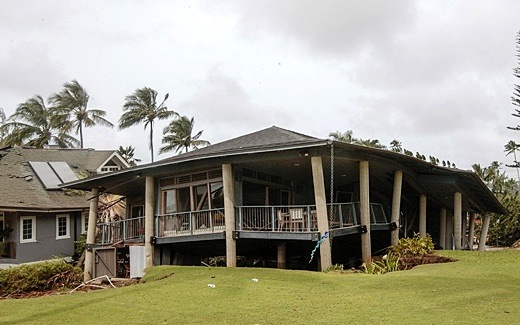

Image above: An upscale north shore raised residential structure "totaled" after being knocked off its foundation from flood waters eroding the earth around the column footings. Note half the yard looks like a putting green and half is a washed out gully. Photo by Jamm Aquino. From (http://www.staradvertiser.com/2018/04/16/photo-galleries/photos-aftermath-kauai-flooding/).

We are high and dry, but many did get wet. Mold and the high levels of contaminate in the flood waters (the water is actually "black water" from sewage, gas and oil from vehicles, etc) are making homes unlivable.

 Some people aren't aware of the danger and are simply throwing out furniture and planning to move back in.

I've been a designer and builder of healthy homes. I know better and have been researching what to do for wood that has been contaminated by these types of flood waters.

But what is so heartening is, the outpouring of support on this island. Differences have been put aside. So many volunteers. The federal and state agencies won't deal in any food other than non-perishables.

The locals with boats coordinated with locals with farms or money to buy apples, etc and a supply line of fresh food is going out to the island past Hanalei.

I spoke at length with a friend living way out there yesterday. People are picking up their trash at the road edge. Each house was delivered 5 gallons of gas. There's a free thrift store for clothes.

I was told the Hanalei Court House has more boots available than a big box store. The Hanalei Colony Resort, beyond the landslides, has been offering free breakfasts and dinners.

My friend said people are saying they are eating better now than before the flood.

Now one lane is open to emergency vehicles only. She said people out there can sign up the night before and a shuttle that leaves at 6am goes out. It will return at 6pm.

We continue to do our 2 mile walks at a couple beaches around here. They still stink. The beaches of the north shore are too contaminated to be in. However a friend said he heard the mayor on the local radio say he had a letter from the Dept of Health giving the OK to swim again!

The tourist bureau is under so much pressure. Business has really fallen off. Our daughter is a fashion designer supplying clothing to Chanterelle Couture, with four island stores and a couple on Oahu

One of Chanterelle's store owners told her that the entire week was 60% less business than normal.
Her two stores are on the other side of the island from the storm damage.

 A friend of ours, who is managing forty-two vacation rentals, had a call from a mainland person who had a booking in a place unaffected by the flood for next October - they wanted to cancel.

There is pressure on every news source in all of Hawaii not to say anything negative as so many mainland people do not differentiate between islands or part of islands and Hawaii.

They seem to think of Hawaii as one small state rather than small islands widely separated.

Many organizations have organized to help. I went by one Hanalei church with a sign out front "Free Water, Clothing, Food". There is a group of volunteers fixing homes for free.

So that's a quick update of the island news, but the real place to focus is on the Aloha.

See also:
Ea O Ka Aina: Storm damage on Kauai 4/24/18

.
Storm damage on Kauai

SUBHEAD: Rain storms have done more damage this spring to our north shore than in more than a generation.

By Juan Wilson on 24 April 2018 for Island Breath -
(http://islandbreath.blogspot.com/2018/04/rain-damage-on-kauai.html)

http://www.islandbreath.org/2018Year/04/180424kauailarge.jpg
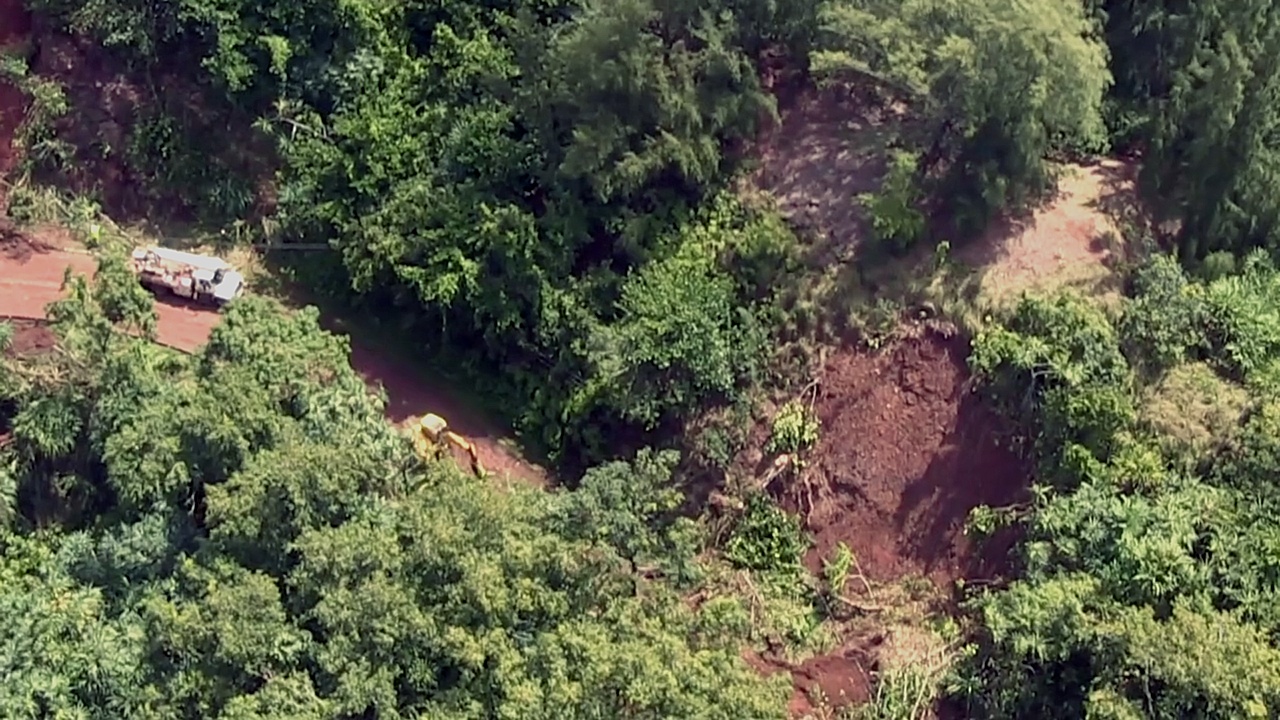
Image above: Only public road along the north shore of Kauai in Waikoko is obliterated by landslide west of Hanalei Bay.  Click to enlarge. Still image from video below.

Living in Kauai on the south side of Kauai we have missed he destruction of storms that destroyed much of the communities and infrastructure on our north shore. The impact has been tremendous for residence there; homes destroyed and roads wiped away.

As much suffering as this has caused and the long term difficulties that will linger, there is a thin silver lining in the darkened clouds.
 
The army of tourists in rented cars making the obligatory daily pilgrimage to Kee Beach crowding the roads, overflowing the parking lots and trampling the land has been temporarily halted.

When the roads are repaired and northshore tourism resumes we hope it is under new circumstances that would restrict tourist cars from anywhere west of Hanalei Bay. There was a feeble attempt to due this in the recent pass, but the will to disappoint tourists simply collapsed.

Here on the south shore we have noticed traffic through Hanapepe has increased significantly since last spring. Some of this is due to more rush hour traffic, presumably from the GMO companies and the PMRF (Pacific Missile Range Facility). We have a regular weekday 3pm eastbound rush hour never seen before.

Moreover, our local county beach, Salt Pond Beach Park, has been overrun by tourists since for over six months. This is certainly been in part because of the destruction of subtropical vacation destinations in the Caribbean.

In the last hurricane season there were 5 category-five storms that destroyed beaches, resorts, roads and much of amenities that attracted visitors. Puerto Rico is still suffering from island-wide blacked-outs. And here comes another hurricane season.

There seems to have been a bit of a campaign to make Salt Pond a heavier used visitor destination as well. Salt Pond is now rated online as a top beach for tourists. This take may take some pressure of totally overrun Poipu Beach Park and other crowded locations, but it is has unanticipated effects.

Salt Pond has historically been a "local" beach used as an outdoor living/rec room for many local families from the westside. Birthdays, weddings, graduation parties, spear-fishing surf-casting, BBQs and minding the kids and just kicking back with a beer after work has been the usage.

There is also and tradition of people temporarily living in tents (mixed with tourist camping) that helps transition (some people I've known) through a job loss, breakup or other temporary difficulty.

Anyway, I continue to hope jet plane enabled mass tourism to Hawaii ceases for two primary reasons. Is is destroying Kauai and it is destroying the atmosphere.

I have not flown to the mainland in several years and have no plans to start again.


Video above: Hawaii Department of Land & Natural Resources damage assessment of storm damage on several videos of the North Shore of Kauai. For more videos visit Vimeo site (https://vimeo.com/265509802).

.

Hawaiians removed from Wailua site

SUBHEAD: Sacred Kauai location to be re-developed as tourist resort despite Hawaiian claims.

By -
(http://www.civilbeat.org/2018/02/authorities-oust-protesters-from-coco-palms-resort-land)


Image above: Three officers block access to the encampment at the former Coco Palms resort property last Thursday. From original article.

[IB Publisher's note:  "Authorities shut down a protest camp on the grounds of the famed Coco Palms Resort."That is the first sentence of this article and precisely represents the false premise of the American position on it's illegal takeover of the Hawaiian Islands in order to first achieve navel domination the Pacific Ocean and second, to make money anyway possible with the resources of the land. Some points to ponder - Number 1: tthe they state of Hawaii thinks it has authority over practices of Native Hawaiians on their sacred sites. Number 2: This site was been used for crass commercial tourism (built in part on the celebrity of Elvis Presley's movie "Blue Hawaii" until a hurricane Iniki destroyed the resort in 1992. The wreckage of the resort still stands at a choke point for traffic on Kauai. The con artists attempting to sell this project are pandering to unfounded nostalgia and greed.  Number 3: Thew site is low lying and will be a likely place to inundation as the oceans rise due to global warming. The best use of this land would be for native cultural practices (like growing taro) and to act as a natural wetland that might absorb future flooding and ocean rise... a state park comes to mind. Certainly, the last thing Kauai needs is more tourism jamming up the Eastside.]

Authorities shut down a protest camp on the grounds of the famed Coco Palms resort Thursday morning, ordering campers off the property and blocking entry by those who had lived at the site for weeks, months and in some cases almost a year.

Almost a month after a judge ordered the eviction in the case of two encampment leaders, 25 deputy state sheriffs arrived to clear the property. About a dozen Native Hawaiians claiming ancestral ties to the land had continued to live on the property, farming taro, keeping watch over ancient burials and hosting Hawaiian language classes.

Mahealani Hanie-Grace, 23, who had been living at the camp, was arrested Thursday on suspicion of trespass and booked at the Kauai Police Department, according to the Hawaii Department of Public Safety.

“We were under the assumption that the ejectment was pending,” said Ke’ala Lopez, 22, an anthropology student at Columbia University who has been sleeping at the camp since New Year’s Day. “So when you are under that assumption and dozens of police officers come in and block the road and take over your hale, it’s devastating.”

Lopez told Civil Beat she wasn’t sure what her next step would be.

“I truly believe this place is protected,” she said. “Coco Palms got destroyed by a hurricane and for 20 years that one hurricane kept it from functioning. Now there are developers wanting to start again and the kanaka have been called in to protect it.”

As a trio of law enforcement agents blocked access to the encampment, Noa Mau-Espirito, one of two defendants in a land ownership dispute with Coco Palms Hui, displayed a map of the former Coco Palms resort property and informed the authorities of his plans to relocate the protest camp outside the bounds of the land parcel that is subject to the court order.

“I’m just letting you guys know these two plots are considered unencumbered state lands so that’s where I’m going,” Espirito said.


Image above: Noa Mau-Espirito, a defendant in the land ownership dispute, displays a map of the resort property Thursday. He informed authorities that he plans to relocate the protest camp elsewhere on the property and outside the bounds of the land effected by a recent court order. From original article.

The dispute over the Wailua property’s ownership has lasted almost a year, stalling a planned redevelopment of the hotel where Elvis Presley’s “Blue Hawaii” was filmed in 1961.

Long before the resort popularized torch-lighting ceremonies as a mainstay of Hawaii hospitality, the property was the 19th century home of Kauai’s last queen, Deborah Kapule Kaumuali’i.

Chad Waters and Tyler Greene of the Honolulu-based redevelopment firm Coco Palms Hui say they are committed to reopening the site as the Coco Palms Resort by Hyatt with an estimated $135 million project that will pay tribute to the property’s storied heritage.

The resort has been closed since it was heavily damaged in 1992 by Hurricane Iniki.

“Coco Palms Hui LLC is grateful that this particular saga in the rebuild of the Coco Palms Resort is now history,” Waters said Thursday. “We look forward to the next steps with final designs, engineering, permitting and then starting construction.”

Kauai Mayor Bernard Carvalho issued this statement Thursday:
I empathize with our Hawaiian community in this very emotional dispute. As Mayor, I understand the cultural and spiritual significance of this property. But above all emotions, I understand that we must all follow and respect the law. The court’s recent decision is very clear, and I continue to encourage all involved to move forward in a peaceful and respectful manner.
See also:
Ea O Ka Aina: Wailua Nui Update 2/2/18
Ea O Ka Aina: Okay given to destroy Paradise 6/10/17
Ea O Ka Aina: Coco Palms Good to Go 3/11/15
Ea O Ka Aina: Annals of pure bullshit - Coco Palms 6/22/14  
Ea O Ka Aina: Coco Palms Travesty 8/10/13
Ea O Ka Aina: Wailua Beach "Elephant Path" 12/22/12
Ea O Ka Aina: Wailua Bike Path Consideration  12/12/12
Ea O Ka Aina: Prehistory Wailua Ahupuaa 1/20/11
Ea O Ka Aina: Kauai Future 2020 - Part 1 1/18/10
Ea O Ka Aina: Hawaiian Ceremony for Wailua 11/11/09
Ea O Ka Aina: Preserve Wailua Beach 9/13/09
Island Breath: Annals of False Advertizing - Kauai Lagoons 3/18/08
Island Breath: Coco Palms Developers Break Promises 1/14/07
Island Breath: Coco Palms & Traffic Problem 3/1/06
Island Breath: Coco Palms Review 1/8/06
Island Breath: Kauai Coconut Coast Overdeveloped 11/12/05
Island Breath: Coco Palms Development 12/28/04

.

Save Hawaii's beaches or property?

SUBHEAD: Climate change and ocean rise is forcing difficult choices on Hawaii now.

By Nathan Eagle on 28 July 2017 for Civic Beat -
(http://www.civilbeat.org/2017/07/save-beaches-or-property-climate-change-will-force-tough-choices/)


Image above: A Waikiki lifeguard station surrounded by ocean water is barely operational today. From original article promo.

A coastal hazard expert briefs Hawaii officials and others about the need to adapt to rising sea levels and warmer temperatures.

With the impacts of climate change bearing down on Hawaii, government officials and community members need to make some important decisions about the islands’ iconic coastlines, said Dolan Eversole, a coastal hazards expert with the University of Hawaii’s Sea Grant program.

“That’s the policy question that we’re faced with now — what’s more important, protecting the property or protecting the beach?” he said. “It’s not a simple answer.”

Eversole was addressing a roomful of state and county officials, nonprofit leaders and others Thursday at the annual State of Hawaii Drowning Prevention and Ocean Safety Conference at the Hawaii Convention Center in Honolulu.

Even under conservative projections, he said Hawaii will have to adapt to a suite of issues that are exacerbated by increasing temperatures and rising sea levels, including coastal erosion, hurricanes, tsunamis, high surf, high winds and flooding.

“Climate change is not necessarily an independent problem,” Eversole said. “It’s going to overlie the problems that we have and in many cases make them worse.”

The “king tides” that caused flooding in Waikiki and other parts of the state this summer were in many ways a glimpse into the future, he said.

It’s not all doom and gloom though, at least compared to other coastal states like Florida and Louisana that are also being forced to adapt to climate change.

Hawaii has the advantage of topography, Eversole said. Elevations increase quickly in the mountainous islands, so adapting for some can mean moving to the other side of Kamehameha Highway, which wraps around Oahu’s northern coast.


Image above: Coastal highway on north shore of Oahu threatened by high ocean waves. From original article.

“It’s going to be inconvenient but we won’t have to go too far,” he said, underscoring how that’s not even an option in some other places.

Eversole is also heartened by Hawaii having a climate adaptation plan underway. The first part of that plan, due in December, will show how sea-level rise will likely affect hotels, homes and other properties in the coming decades.

Honolulu Emergency Services Director Jim Howe, who was the city’s longtime ocean safety chief, said the city has much of the necessary information and has started to respond.

He said the newly created Office of Climate Change, Resilience and Sustainability has held its first major gathering of stakeholders to gain input. A full report from that meeting with roughly 350 individuals from businesses, nonprofits, government and environmental groups is coming, he said, but the preliminary results illustrate the need to focus on the coastal areas and infrastructure.

“We’re going to have to make some priority decisions,” Howe said. “Where are we going to best spend our money? What is going to be the best approach for us as a community? That’s a dialogue that we need to have.”

He said Hawaii has to brace for weather impacts, from increased flooding to more frequent hurricanes.

“All of us in the community need to be prepared,” Howe said. “The more we can be proactive, the better off we’re going to be in the end.”

There’s a lot at stake. Hawaii’s economy largely depends on millions of tourists coming to visit its famed beaches.

Hospitality Advisors, a consulting firm, estimated Waikiki Beach alone contributes more than $2 billion in visitor spending annually.

Waikiki Beach is already in need of millions of dollars of overdue work and there’s still no master plan for the beach, Eversole said.


Image above: The beach at the Royal Hawaiian Hotel is under ocean waves that break against the hotel's porch railing. From original article promo.

And the adjacent Kuhio Beach is a “public safety emergency,” he said, noting how sections of the groin are collapsing in front of a mound where hula dancers perform.

“It’s a mess right now,” he said. “It’s the worst I’ve ever seen it.”

Studies are underway, including the state’s $800,000 Waikiki Beach Technical Feasibility Study, and public-private partnerships have formed to address the most serious problems.

The Waikiki Beach Special Improvement District Association is splitting a $1.5 million project with the state to fix the Royal Hawaiian groin, which Eversole said “literally holds together Waikiki Beach.”

Commercial properties pay a special tax that funds the association’s projects, which are all focused on beach management.

Construction may not begin for two years, though, due to permit requirements, Eversole said.

“Hawaii is probably one of the most vulnerable areas to coastal hazards in the world,” he said.

This is not the first time Eversole has waved flags trying to alert the public and policymakers to the problems Hawaii faces due to climate change.

He was lead author of a 2014 UH Sea Grant report, funded by the Hawaii Tourism Authority, that details the current and future effects of climate change in the islands.

Eversole said what concerns scientists the most are the extremes, not the averages, in terms of swings in temperatures and the rates of change.

The rate of warming air temperature in Hawaii has quadrupled in the last 40 years to more than 0.3 degrees Fahrenheit per decade. This causes stress for plants and animals, heat-related illnesses in humans and expanded ranges for pathogens and invasive species, he said.

“It could get exponential at some point in the future unless we do something about it,” he said.

When it comes to sea-level rise, the global average is 4 millimeters a year, but it’s not uniform. Low-lying atolls in the western Pacific are seeing 10-millimeter increases annually while Hawaii is averaging 1.5 millimeters a year.

Eversole said that Hawaii should not bank on its below-average increase because projections show it will greatly accelerate.

“Inarguably in the scientific community, climate change is real. There is no question,” he said. “The only question that surrounds climate change is what do we do about it. We’re in a catch-up mode.”
.

We need "our" Kauai General Plan

SUBHEAD: Take back the General Plan from the hands of the developers, large land owners and tourism industry.

By Sandy Herndon on 23 July 2017 in Island Breath -
(http://islandbreath.blogspot.com/2017/07/the-kauai-general-plan-is-ours.html)


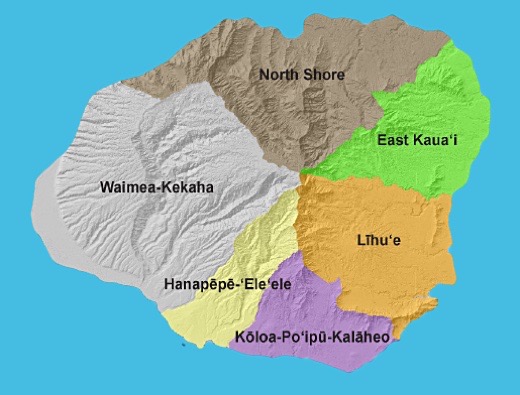
Image above: An indication of how bad the General Plan Update is was illustrated by this plan of Kauai. Note the "Districts" in the plan relate to no cultural, historical, bioregional, political, or governing identities, but appears to be the myopic view of the island from the County Planning Department Office in Lihue. See the New Yorker Magazine map of America below. From (http://plankauai.com/wp-content/uploads/2015/04/island_graphic2.png).

WHAT:
Organizing meeting to address the County of Kauai’s General Plan Update

WHEN:
August 2, 2017 at 6:30pm - 9pm

WHERE:
Kapaa Public Library
Kuhio Highway, Kapaa

WHO:
Community Coalition of Kauai
(www.communitycoalitionkauai.org)

WHY: 
There is a lack of community wide input for this proposed plan which is going to the Kauai County Council for approval.

Take Back the General Plan From the Hands of the Developers, Large Land Owners and Tourism Industry and Make it Your Own

THIS IS YOUR GENERAL PLAN. IS THIS THE FUTURE YOU WANT?

The County Planning Department and Planning Commission have proposed a new General Plan that ignores the hundreds of pages of concerns and input of community members and organizations. The new General Plan proposes town designations, re-zonings, up-zonings and entirely new zoning categories for the benefit of large landowners and developers.

§ We do not need a General Plan that was written by and for developers and the tourism industry.

§ We do need a General Plan that will create balanced/sustainable growth, diversified job opportunities, and protects Kauai’s environment, rural character and quality of life.


PLEASE JOIN US IN THIS COORDINATED COMMUNITY-WIDE EFFORT TO SPEAK WITH ONE VOICE ABOUT THE NEED TO HAVE A GENERAL PLAN THAT FIRST AND FOREMOST MEETS THE NEEDS OF THE RESIDENTS OF KAUAI.

We are looking for your input, your participation and your interest in joining a growing group of concerned community members who want to take back the General Plan. We are coordinating our concerns and efforts in preparation for the delivery of the General Plan to the County Council for their approval.


Image above: Illustration of the  myopic view of America and beyond from Manhattan in this Saul Steinburg cover of the New Yorker Magazine in the fall of 2004. From (http://karakulia.livejournal.com/30444.html).

See also:
Ea O Ka Aina: Fact or Fantasy - The Kauai General Plan 8/8/17
Ea O Ka Aina: Commission accepts General Plan 6/15/17
Ea O Ka Aina: Okay given to destroy Paradise 6/10/17
Ea O Ka Aina: Testimony against General Plan
Ea O Ka Aina: Kauai General Plan open house 12/8/16
Ea O Ka Aina: Reject the Kauai General Plan update 11/30/16
Ea O Ka Aina: Kauai County "Keep it Rural" 11/17/16
Ea O Ka Aina: Kauai General Plan Update 9/4/16
Ea O Ka Aina: Kauai General Plan Update 9/3/16
Ea O Ka Aina: Will developers write Kapaa’s future? 5/6/16 
Ea O Ka Aina: Kauai Plan Disappoints 12/9/15
Ea O Ka Aina: Hokua Place comment deadline 5/28/15
Ea O Ka Aina: Coco Palms good to go 3/11/15
Ea O Ka Aina: Lihue Loss of Vision 9/5/14
Ea O Ka Aina: Tax Donkey Purgatory - Lima Ola 7/18/14
Ea O Ka Aina: Annals of pure bullshit - Coco Palms 6/22/14 
Ea O Ka Aina: Coco Palms Travesty 8/10/13  
Ea O Ka Aina: Review 2000-2020 Kauai General Plan 4/2/09
Island Breath: Kauai Sustainable Land Use Plan 11/1/07
Island Breath: LEGS Sustainability Conference 10/13/07
Existing Kauai County General Plan 2000-2020 1999 
.

Giant A380 jets coming to Honolulu

SUBHEAD: It will cost the state of Hawaii $30 million for airport to accommodate these giant planes.

By Blaze Lovell on 29 June 2017 for Civil Beat -
(http://www.civilbeat.org/2017/06/these-giant-honu-planes-will-cost-hawaii-30m-to-accommodate/)


Image above: Five hundred seat European built Airbus 380 dwarfs a Boeing 747.  From (http://imgprix.com/wallpaper/airbus-a380/1920x1080).

[IB Publisher's note: We think the state would do better to prepare its harbors for future ship travel between islands and to mainland sites.]

All Nippon Airways wants to fly the world’s largest aircraft to Honolulu, and the state of Hawaii is on board.

The Hawaii Department of Transportation plans to spend up to $30 million to outfit two gates at the Daniel K. Inouye International Airport to serve the world’s largest commercial jumbo jet.

Officials believe accommodating All Nippon Airways’ huge plane may be worth the expense, however, due to potential increases in airport revenue and tourism.

The double-decker Airbus A380 has an average capacity of about 500 passengers, while the Japanese airline’s current planes flying to Honolulu carry up to 216 passengers. The Hawaii Tourism Authority estimates that Japanese tourists spend an average of $242.60 a day while they’re in the islands.

To accommodate the A380, the transportation department will expand a seating area in the international terminal, create a food court and build additional jet bridges at two gates to give passengers access to and from the plane’s second level.

Outside the terminal, the aircraft parking area will be reconfigured to accommodate the A380’s 80-meter wingspan. Baggage areas will also be expanded to accommodate the bigger load of passengers.

The improvements, which should begin in 2018 and finish in 2019, are part of a larger project to update the airport, said transportation department spokesman Tim Sakahara.


Image above: All Nippon Airways painted the A380 to look like Hawaiian sea turtle (honu). From Civil Beat article.

All Nippon Airways’ “Flying Honu,” one of the airlines’ three A380s, will start flying to Honolulu in 2019. The plane’s fuselage will be wrapped with an image of Hawaii’s most famous reptile, the sea turtle. The plane is powered by four Rolls Royce engines and has a maximum takeoff weight of 1.2 million pounds.

The transportation department has put out a bid for the gate project and has not received any responses yet. Sakahara said that the final cost may fluctuate depending on contract negotiations.

Honolulu will be the ninth U.S. airport to have facilities capable of docking the A380. The others include Atlanta, Dallas-Fort Worth, Houston, Los Angeles, Miami, San Francisco, Seattle and John F. Kennedy in New York City.

Bringing The Honu To Hawaii
Gov. David Ige met with All Nippon Airways officials to discuss flying the A380 to Hawaii during his trip to Japan in late 2015.

Cindy McMillan, a spokeswoman for the governor’s office, said that ANA executives promised to commit more planes to Hawaii if the state could make the improvements to service the ANA’s aircraft. Shortly after Ige’s visit, ANA placed an order for three A380s, the first requisitions Airbus received for the giant planes since 2013.

Sakahara said the governor then asked the transportation department to start studying what it would take to upgrade the airport to accommodate the plane.

“This is a strategically important move for Hawaii,” McMillan said. She said that in the future, other carriers may use the gates to fly in double-deckers, giving residents more travel options.


No other air carrier has expressed interest in flying the A380 to Honolulu so far, Sakahara said. Of the 20-plus airlines with service to Honolulu, only Korean Air and Qantas, which serves Australia, currently have the planes in their fleets.

Boeing recently acknowledged at the Paris Air Show that it sees no future in passenger travel for its version of the A380, the 747. It intends to make new 747s only for cargo transportation.

Though sales for smaller, twin-engine craft have trumped the A380 in recent years, Michael Boyd, president of the Colorado-based Boyd Group, which provides aviation consultation, said the gate upgrades will be worth the cost.

“Honolulu is the perfect market for the A380,” Boyd said. “It’s almost an imperative. Honolulu is facing a lot of competition around the world for the Japanese dollar.”

ANA currently flies 14 to 16 flights per week between Japan and Honolulu on Boeing 767s, which carry up to 216 passengers. The airline plans to replace its 767s with the new 787, which holds 240 people, on Honolulu routes even before it starts flying A380s to Oahu.

On average, the Honolulu flights are 90 percent full, airline executives said earlier this year, the Japan Times reported.

ANA has not said whether the A380s will replace smaller planes for all of its Honolulu flights once the airport renovations are completed. Either way, the A380 should increase the net amount of tourism dollars spent in Hawaii, said Eric Takahata, managing director for Hawaii Tourism Japan.

He said the total number of passengers arriving on ANA’s A380s aren’t as significant as the greater amount of money those passengers will spend. Airlines are reducing their economy classes to add more first class, business and premium economy passengers.

“If we can tax the infrastructure less but maintain or increase spending, that’s what we are aiming toward,” Takahata said.

ANA representatives could not be reached for comment.

Paying For The Upgrades
The state’s capital improvements budget allows the transportation department to spend up to $30 million just on improving the two gates.

Sakahara said the final cost of the project will depend on the construction contracts.

The Legislature approved a total of $446.6 million in capital improvements at the airport over the next two years.

The department will pay for the improvements to accommodate the A380s through bonds financed with airport revenue.

Wesley Machida, director for the Hawaii State Department of Finance, said that most of the airport’s $353 million in revenue from 2016 came from concessions, landing fees and rentals.

The airport brought in $145.5 million from vendors like car rental companies and restaurants. Airlines paid $66 million in usage fees (companies with heavier planes like the A380 would need to pay more, because the charges are based on weight).

Also, $115.4 million came from rentals of aeronautical facilities such as hangars. Non-aeronautical rentals such as storage for goods brought in $15.8 million.

Before the transportation department makes decisions on airport improvement projects, Sakahara said it communicates with airport tenants, as well as the Airlines Committee of Hawaii, which includes representatives of 20 airlines that operate in the state.

In regards to the A380 gate project, the department “wouldn’t have made these improvements unless an airline needs these improvements.”

It’s not yet clear how much additional revenue the airport will receive from A380 flights.

However, what the plane carries may be more of an economic advantage for Hawaii than the plane itself.

Each year, about 1.5 million tourists fly from Japan to Hawaii, and that amount is expected to increase to 1.6 million by the time ANA’s Flying Honu starts touching down in 2019. But because ANA hasn’t indicated how many A380 routes will fly to Honolulu, there are no specific estimates yet of the plane’s impact on tourism.

Tourists from Japan produce about $400 million in revenue for Hawaii’s tourism industry each year.

.

Commission accepts General Plan

SUBHEAD: Despite its unpopularity the Kauai County Planning Commission votes for the General Plan Update.

By Jenna Carpenter on 14 June 2017 for The Garden Island News -
(http://thegardenisland.com/news/local/planning-commission-approves-general-plan-update/article_202f3168-684e-5dab-b9e9-b4f3f3607a66.html)


Image above: Architect Ron Agor and representatives of the team promoting Kapaa's Hokua Place standing outside the Planning Commission Meeting during a break. The Hokua Place project was reinserted into the Kauai General Plan Update.  Photo by Juan Wilson.

[IB Publisher's note: Over the last 20 years the popular 2000 General Plan (Keep it rural!) was largely ignored by the Kauai Planning Department. Now, another travesty is born. This Kauai General Plan Update does not have the support of the general public. It should be an embarrassment even to the hacks in the Planning Department. Our planning officials should be ashamed of simply bowing to the American solution to social, infrastructure and urban problems - just build more suburban sprawl. Their plan is a sellout to our future in order to line the pockets of speculators, developers, contractors and banksters. It will also grease the palms of some career public employees and politicos. The cost will be environmental degradation, overpopulation and reduction of the resilience, self-reliance and sustainability of Kauai. The upside the public can choose to ignore this General Plan just as our current planners ignored the last.]  

On Tuesday, commissioners voted 4 to 2 to approve the seventh version of the General Plan Update, which restores Hokua Place, a proposed affordable housing development along Kapaa Bypass Road.

The Planning Commission’s work on the General Plan update is complete.

On Tuesday, commissioners voted 4 to 2 to approve the seventh version of the General Plan Update, which restores Hokua Place, a proposed affordable housing development along Kapaa Bypass Road.

In its previous version, the development had been deleted.

Kanoe Ahuna and Donna Apisa voted against the General Plan. About 20 people attended the meeting.

“I’m not comfortable making a decision. All I’ve known in the last six months are the same testimonies I don’t think we’ve addressed,” Ahuna said. “I don’t understand how we’ve heard the same testimonies and haven’t responded to that. How are we taking the community’s interest?”

Ahuna made a motion to defer the General Plan Update and have a workshop.

“So we can re-visit the critical areas,” she said.

Her motion was denied 5 to 1.

“I don’t see the point of a workshop. We are a decision-making body, and if there’s something that specifically needs to be addressed, we can bring it up and talk about it,” said Commissioner Sean Mahoney. “We’ve gone through all kinds of testimony and gone through all kinds of meetings. I think everyone’s been listened to.”

The General Plan, which contains everything from protecting Kauai’s beauty and the watersheds to addressing Kapaa traffic and designing healthy and complete neighborhoods, was last updated in 2000.

A 357-page updated discussion draft was released November 4th, after 18 months of public outreach.

But the $1.2 million project started in 2013, when the Planning Department began researching how to move forward with the update.

The Planning Commission has been tackling the update since the beginning of the year. It will now go the County Council for approval. If passed, it will go to Mayor Bernard Caravalho Jr.

During public testimony, Anne Walton, who lives in Kapaa, said the General Plan Update is built on an unstable foundation, including outdated data, inconsistencies and no rationale to support the reasons to keep Hokua Place in the General Plan.

“Let’s get back to where this General Plan started,” she said.

Carl Imparato, who lives in Hanalei, is concerned about how the General Plan addresses growth.

“We are drowning in an ever-expanding sea of tourists, and that excessive tourism growth is overwhelming our roads, parking capacity, parks and beaches, neighborhoods and lives,” he said.

He said nothing substantive was changed in the newest update.

“The current draft almost guarantees that county government will be the primary obstacle to genuine progress, rather than an ally in addressing the difficult issues that lie ahead,” he said.

Additionally, in the newest version, a paragraph that addresses a high tourist count was deleted, Imparato said.

He said the General Plan needs to go back to the drawing board, and when it does, he has two requests: The county needs to work with Kauai communities, and the General Plan needs to acknowledge and address Kauai’s tourism growth.

“Kauai’s health is poor. It’s like a patient in very serious condition. It needs surgery and rehabilitation, and all the General Plan is offering is a facelift.”

Commissioners made some amendments to the General Plan Update.

They added a definition to “provisional” as it relates to Provisional Agricultural, adopted agreements lined out in the Paris agreement and deleted a sentence that reflects a possibility of the Department of Land and Natural Resources beginning to charge people to go to state parks.The Planning Commission’s work on the General Plan update is complete.

See also:
Ea O Ka Aina: Testimony against General Plan 6/14/17
Ea O Ka Aina: Okay given to destroy Paradise 6/12/17
Ea O Ka Aina: Kauai Nui Kuapapa 5/14/1
Ea O Ka Aina: Find and Limit Ourselves 2/17/17
Ea O Ka Aina: Kauai General Plan open house 12/8/16
Ea O Ka Aina: Reject the Kauai General Plan update 11/30/16
Ea O Ka Aina: Kauai County "Keep Kauai Rural!" 11/11/16
Ea O Ka Aina: General Plan Update  9/4/16
Ea O Ka Aina: Will developers write Kapaa's future? 5/7/16
Ea O Ka Aina: Planet Kaauai 2/26/16
Ea O Ka Aina: Kauai Plan disappoints 12/9/15
Ea O Ka Aina: Potash King's Palace 6/24/10
Island Breath: Kauai Districts as Townships 3/27/08
Island Breath: Sustainability & Growth 4/19/05
Island Breath: Kauai Parks Master Plan - Puolo Point 10/7/04
Island Breath: Kauai Zoning 5/15/04
.

Park City, Utah, is damned!

SUBHEAD: Park City cannot have a thriving world class tourist economy AND a livable planet.

By Will Falk on 24 March 207 for San Diego Free Press -
(http://sandiegofreepress.org/2017/03/park-city-damned-case-study-civilization/)


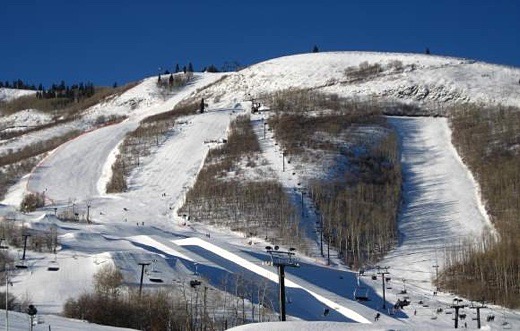
Image above: The ski slopes of Park City, Utah, is a favorite of tourists.  From original article.

[IB Publisher's note: Needless to say, this article pertains to here in Hawaii as it does to Utah. You cannot have a livable planet Earth and depend on jetting people from afar to enjoy your climate.] 

[Author's Note to My Readers: It has not been easy to write this essay and I am scared to see my name displayed publicly next to what follows. I am sure these ideas will win me few friends in Park City and the broader ski community. Nevertheless, what follows is the truth as it has been shown to me. My allegiance belongs, first and foremost, to life, to the land, to both the human and non-human victims of the insanity of the dominant system. I love to ski. I love to walk the aspen groves in the Wasatch Mountains above Park City. I love seeing moose cross Park Avenue almost weekly. In short, I love living here. But my desire to live here should not trump the land’s ability to survive.]

At the south end of Brown’s Canyon, about 6 miles northeast of Park City, Utah, there’s always an engine running. Usually, there are more than I can count.

If it’s not commuting car engines coughing to life in cold, winter air, it’s snowblowers blasting snow from driveways. If it’s not cars or snowblowers, its excavators flattening the next hill over, clawing out one bucketful of earth at a time. If it’s none of these, it’s diesel generators compressing air for nail guns popping boards together.

Standing on my small deck, sipping my morning coffee, I try to focus on the winds’ words. The winds speak a harsh tongue, full of curses. They are busy rattling aluminum drains on the roof’s edge, dragging loose gravel across a construction road, and navigating concrete right angles forming condominium building walls.

To the east, a red-tailed hawk is pinned against the wind above a snow-muddied expanse littered with cinder blocks, discarded hand tools, and a brown skid-steer ran off its rubber track. The sight of the crippled skid-steer brings half a wry smile to my face: a small if only momentary delay in the destruction.

Just a few months ago, this expanse was a ridge line washed in the bright turquoise light of morning sunshine seeping through sagebrush. There were a few healthy stands of pinyon pine and juniper trees. You’d see their branches jostle, first. Then, mule deer or elk would step into sunlight, grazing with blind confidence in the immortality of their basin home.

The hawk seeks the valley on the far side of the destruction where she might spot a mouse or vole. I often seek that valley, too. I love visiting late at night when rabbits with white winter coats wait for clouds to cross the moon so they may risk sprints across open spaces to the safety of shadows under gnarled rabbitbrush roots.

The sigh of a dump truck’s exhaust and the squeal of its brakes brings me back to the present. The engines resume each morning. This is daily life in Park City, a town expanding at a dizzying pace.
Eight new condo buildings have been built in my neighborhood in the last eighteen months. 

Just a few weeks ago, a large commercial and housing project proposal – part of the Promontory Development – was publicly unveiled. The proposal would destroy 666 acres with 190,000 square feet of commercial space, 350 hotel rooms, and 1,020 residential units. The proposal also includes plans to build yet another dam for yet another reservoir.

Over in Old Town, a group called the “Treasure Partnership” intends to force the Park City Planning Commission to vote on a project that would cut 1 million square feet out of the foothills above Park City to allow another 2000 people to stay in town. 

The project would involve parking space larger than a Super Wal-Mart, towers as much as 10 stories high, and the travel of 300 heavy trucks in and out of downtown Park City each day.

Park City is a damned town. Voices on the wind blowing in from the canyons whisper that this has always been true. Hollows groan with miners crushed in shafts long since collapsed, aspens still quake with memories of dynamite, and streams spit with tastes of mining waste. 

Mountains say nothing. They simply rise to the sky displaying their wounds. With shoulders flayed by roads and ski runs, their scars are reopened whenever forests threaten encroachment on skiers’ paths. First, these mountains had their guts ripped out by silver miners. Then, they had their skin peeled off by resorts. And, now they’re baking with climate change. 

What is happening to Park City is what is happening to the planet and what is happening is civilization. Derrick Jensen’s definition for civilization is best because it is defensible both linguistically and historically while accounting for physical reality. 

Jensen explains in his work, Endgame, the root word in “civilization” is “civil.” “Civil” derives from “civis” which comes from the Latin “civitatis” meaning “city-state.” 

From there, Jensen defines civilization as a “culture – that is a complex of stories, institutions, and artifacts – that both leads to and emerges from the growth of cities, with cities being defined – so as to distinguish them from camps, villages, and so on – as people living more or less permanently in one place in densities high enough to require the routine importation of food and other necessities of life.”

When people live in populations that exceed the carrying capacity of their land base, they strip their land of the necessities of life and must look to other lands for what they need. 

Many scholars date the beginning of civilization with the birth of agriculture close to 12,000 years ago. Despite agriculture’s favorable connotations in most circles, Lierre Keith describes what agriculture actually is: 
“In very brute terms, you take a piece of land, you clear every living thing off it, and then you plant it to human use. Instead of sharing that land with the other million creatures who need to live there, you’re only growing humans on it. It’s biotic cleansing.”
With its roots in agriculture, civilization has been destroying the planet from its beginning. Over thousands of years, civilized humans – with their native lands destroyed – sought out new lands to exploit. Park City was born from this process. 

The first European settlers to come to Park City en masse braved the harsh mountain environment for the silver that was discovered here.

When silver prices dropped, the mountains sighed with relief as mining significantly slowed. Park City’s human community would have deserted the area if the few remaining miners hadn’t come up with the idea to open the Treasure Mountain ski resort in 1963. 

 Park City miners traded one boom-or-bust industry for another.

Park City has no future. Either the snow or the industrial system allowing Park City’s human population to live here will fail. 

Park City’s human community relies on snow for its survival. First, snow is water. Park City sits on the eastern edge of the Great Basin with a permanent human population of about 8,000.  

The operation of the tourism industry means there are more than 8,000 humans in Park City at any given time – especially during the peak winter season.

These humans require water and the Great Basin is a desert. Snowpack is the area’s water source and serves as a natural reservoir collecting snow in winter and slowly releasing it to streams, soil, and plants as temperatures warm in spring and summer. 

Snow doesn’t just provide life-giving water, it gives tourists a reason to visit – and to spend money. 

While there are more humans in the area than the land can support the necessities of life must be imported. Importing these necessities costs money and the resort industry provides this money.

The snow that falls every winter on Park City is critically endangered by climate change. The Environmental Protection Agency (EPA) notes that Utah has warmed by two degrees (F) over the last century causing snowpack in Utah to be steadily decreasing since the 1950s. 

A 2009 report commissioned by Park City Municipal Corporation and The Park City Foundation predicts another two degrees average temperature rise in Park City by 2030, four degrees by 2050, and almost seven degrees by 2075. 

Porter Fox, author of Deep: The Story of Skiing and The Future of  Snow cites studies that show this seven degrees (F) warming will leave Park City with no snow by 2100.

 Physically speaking, climate change is caused by global greenhouse gas emissions. Greenhouse gasses trap the sun’s heat on the Earth’s surface causing the planet to warm. These greenhouse gasses include carbon dioxide, methane, nitrous oxide, chlorofluorocarbons, and water vapor.

 Greenhouse gas emissions are integral to the basic functioning of civilized life. Carbon dioxide is released through deforestation, biomass burning, conversion of land to agriculture, and the burning of fossil fuels. 

Methane is produced by waste decomposition, agriculture (especially rice production), and by the digestive systems of domestic livestock.

 Nitrous oxide is produced through soil cultivation practices including the use of both organic and commercial fertilizers, nitric acid production, fossil fuel combustion, and biomass burning. 

Chlorofluorocarbons are inorganic, synthetic compounds entirely produced by industrial activities. Chlorofluorocarbons not only act as greenhouse gasses, they weaken the Earth’s ozone layer.
The EPA regularly publishes reports on total U.S. greenhouse gas emissions by economic sector. 

Their latest report, based on emissions in 2014, attributes 30% of American greenhouse gas emissions to electricity generation, 26% to transportation which includes burning fossil fuel for trucks, ships, planes, trains, and personal automobiles, 21% to industry burning fossil fuel for energy and from chemical reactions involved in manufacturing, 12% to commercial and residential processes like burning fossil fuels for heat and the handling of waste, and, finally, 9% from agriculture including soil maintenance, fertilizer use, and livestock production. The EPA does not account for the other 2%.

If we look at the EPA’s numbers critically, we see that the vast majority of greenhouse gas emissions result from the same economic sectors supporting humans in Park City – electricity generation, transportation, manufacturing, and agriculture. 

If these sectors keep operating, the snow will fail. If the snow fails, Park City fails. For the snow to survive, these sectors must fail. If these sectors fail, Park City is left without the necessities of life. There’s no way out. 

Let’s take a closer look: Humans could not survive snowy and cold Park City winters at 7,000 feet above sea level without shelter and warmth.These shelters require wood. Harvesting wood requires deforestation and deforestation emits greenhouse gasses. The wood must be brought here. 
Transporting this wood requires ships, planes, and trucks. Ships, planes, and trucks burn fossil fuels. They also are manufactured. The manufacturing process requires a whole different list of building materials with their own associated extraction and transportation emissions.

Park City’s shelters must be heated, too. Most of these shelters are heated by electricity. 

In the United States, electricity generation emits the most greenhouse gasses. And again, the electricity must be transported. 

Electrical transportation requires the operation and maintenance of a power grid which, like we saw with ships, planes, and trucks, requires manufacturing processes with their own building materials, extraction, and transportation emissions.

The land surrounding Park City does not offer enough food to support 8,000 human residents plus thousands of visitors. Food, like building materials and energy, must be imported. Park City relies on the same greenhouse gas emitting transportation infrastructure that brings building materials to bring food. This food is produced through agriculture and industrial livestock. 

Agriculture requires deforestation and other land clearances that emit carbon dioxide and methane. It also requires soil cultivation and fertilization which emit nitrous oxide. And, the cows and sheep raised in industrial livestock operations emit significant amounts of methane.
 
Meanwhile, the general consensus amongst climate scientists is that developed nations must reduce greenhouse gas emissions 80% below 1990 levels by 2050 to avoid runaway climate change.  

Based on the EPA’s numbers, even if every small-business and home in America reduced its emissions to zero (12% of total US emissions) and each American drove cars that emitted no greenhouse gas (much less than 26% of total US emissions), the United States wouldn’t even come close to the 80% goal.

It’s at this point that most commentators invoke so-called alternative energies as the solution to climate change. These people insist that we can maintain our lifestyles if we just switch to solar or build enough wind farms. 

In Park City, these people tell us that we can have a thriving tourist economy with visitors transported from all over the world AND a livable planet. 

We can do this, they claim if we just switch city buses to electric and install solar panels on city buildings. Unfortunately, these “green technologies” are neither green nor solutions.
I’ll start with the most popular: Solar power.

While it is true that the sun offers near-infinite energy, the problem is harnessing that energy. Harnessing this energy requires solar cells and solar cell production emits greenhouse gasses that are worse than carbon dioxide. 

Alternative energy scholar Ozzie Zehner explains that the solar cell manufacturing process is one of the largest emitters of hexafluoroethane, nitrogen trifluoride, and sulfur hexafluoride. 

Zehner writes,
“As a greenhouse gas hexafluoroethane is twelve thousand times more potent than carbon dioxide … nitrogen trifluoride is seventeen thousand times more virulent than carbon dioxide, and sulfur hexafluoride, the most treacherous greenhouse gas…is twenty-five thousand times more threatening (than carbon dioxide).”  
The Silicon Valley Toxics Coalition points out that as the solar industry expands, “The most widely used solar photovoltaic panels have the potential to create a huge new wave of electronic waste at the end of their useful lives, which is estimated to be 20 to 25 years.” 

And, many new solar photovoltaic technologies “use extremely toxic materials or materials with unknown health and environmental risks…”

Right now, the solar power industry is tiny. Zehner notes it supplies less than a hundredth of 1 percent of America’s electricity. As this industry grows, solar cell production will emit more of the most dangerous greenhouse gasses and create more toxic waste. 

Zehner says it best: “Considering the extreme risks and limitations of today’s solar technologies, the notion that they could create any sort of challenge to the fossil-fuel establishment starts to appear not merely optimistic, but delusional.”

Wind power is another alternative energy darling. Like the energy offered by the sun, wind is a renewable, abundant energy. Turbines used to harvest wind energy, however, require the entire fossil fuel infrastructure to manufacture them. 

When considering the ability of wind turbines to replace greenhouse gas emissions, we must account for mining, manufacturing, transporting, constructing, land-clearances, maintaining, decommissioning, and waste supporting wind turbines. 

To harvest wind turbines must be placed where wind blows. The best places for wind turbines are often in remote and fragile natural communities. To build wind farms, land must be cleared. This involves deforestation. To transport energy harnessed by turbines from wind farms requires roads, power lines, and transformers. The greenhouse gasses emitted by deforestation, alone, may cancel benefits wind farms provide. 

Zehner makes a very interesting case against wind power – and all alternative energies for that matter – while examining the popularly recited possibility that the US could attain 20% wind energy by 2030. 

He says this achievement might not remove a single fossil-fuel plant from the grid and explains, “There is a common misconception that building additional alternative-energy capacity will displace fossil-fuel use; however…producing more energy simply increases supply, lowers cost, and stimulates additional energy consumption.” 

To support his claim, Zehner cites analysts who argue that wind turbines in Europe “have not reduced the region’s carbon footprint by a single gram.” 

The classic example is Spain “which prided itself on being a solar and wind power leader over the last two decades only to see its greenhouse gas emission rise 40% over the same period.”

So, alternative energies aren’t really alternative energies, they’re additional energies.

I could go on with the other alternative energies, but they share the same problems. 

Namely, manufacturing, transportation, installation, maintenance, and decommissioning of the means for harvesting a renewable energy emit green house gases and involve their own deadly pollutions.
At day’s end, even if these so-called “green” technologies were employed, they would only add to this culture’s capacity to consume.

Local scientist, Dr. Tim Garrett, Professor of Atmospheric Sciences at the University of Utah studies the amount of energy required to sustain civilization.  

Garrett concludes that civilization must collapse if the planet is to have any chance of survival. Garrett states the obvious. Civilizations always collapse. They must because they are based on hyper-exploitation of the land.  

Park City is a microcosm for the problems facing the planet. It is a product of civilization. Like civilization, Park City has no future.

With a human population exceeding the land’s carrying capacity, Park City is wholly dependent on the industrial system to bring the necessities of life. To access this system, Park City relies on a constant flow of money brought by tourists who come for the snow. 

Sadly, the very process that brings the tourists and their money – the industrial system – is the process emitting greenhouse gases that are warming the world, destroying the snow, and destroying the planet. There are no alternatives within this system. It must be dismantled.

Back on my deck with my coffee, I watch the lifts carrying people up Park City Mountain Resort. I contemplate what I should do today. Should I sit down to write what I know is true? Or, should I head up those lifts to ski? 

The decision isn’t too different than the decision facing the whole community.
Park City has a choice. 

We can face the truth that our town has no future and work to remove humans, humanely as possible, from the area. 

Or, we can try to keep this insane party going for a little longer as we put on our ski goggles to blur reality, shed our jackets with the warming climate, and take one last suicidal run on disappearing snow.

• Will Falk moved to the West Coast from Milwaukee, WI where he was a public defender. His first passion is poetry and his work is an effort to record the way the land is speaking. He feels the largest and most pressing issue confronting us today is the destruction of natural communities. He received a Society of Professional Journalists, San Diego Chapter, 2016 Journalism award. He is currently living in Utah.

.

Hawaiian spinner dolphin restriction

SUBHEAD: NOAA considering a 150 foot buffer zone restricting swimming near dolphins.

By Aja Hannah on 4 January 2017 for Earth Island Journal -
(http://www.earthisland.org/journal/index.php/elist/eListRead/noaa_ban_swimming_spinner_dolphins_hawaii/)


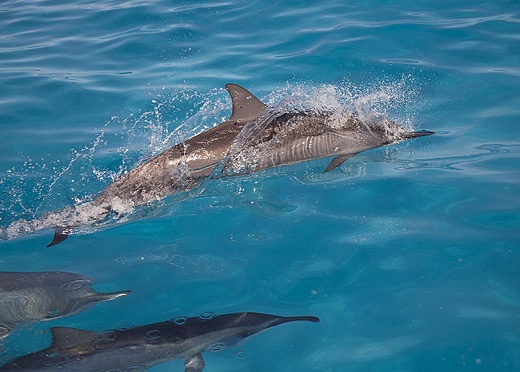
Image above: Spinner dolphins in Hawaii's Papahanaumokuakea Marine National Monument. From original article.

The proposed banned zone is intended to protect marine mammals from over-eager tourists.

[IB Publisher's note: Even 150' may be too close for approaching swimmers. Here on Kauai it is certainly it is too close for tourist filled zodiacs and catamarans that spot a pod of spinners during daylight hours and rouse them for sleep to dance for the tourists. They sail from Hanapepe along the south shore and to the westside and along the Napali Coast.]

Imagine you're sleeping and a friend comes over unannounced. You might hang out for a few hours or you might walk them out. Either way, they eventually leave and you return to bed. You're just getting into that good sleep when another person knocks on the door. Then another and another. All night this continues. Then it happens again the next night. And the night after that.

This is the current problem plaguing the Hawaiian spinner dolphin, one of the smallest dolphin species, well-known for their airborne twisting jumps.

The mainly nocturnal mammals spend their daylight hours resting near the shores of the Hawaiian Islands in shallow waters, but a growing number of tourists, tour companies, and increasing human interaction are impacting the health of the dolphin pods as well as individual dolphins.

In August, National Oceanic and Atmospheric Administration (NOAA) Fisheries proposed a rule that would ban everyone from swimming with Hawaiian spinner dolphins. Under the rule, no one would be allowed get within 50 yards of spinner dolphins by any means. This includes by boat, kayak, paddleboard, swimming, and other type of transportation.

The proposed ban has proven controversial, even among those who agree that spinner dolphins need protections. Hawaii’s economy, of course, is sustained by tourism, and local operators are concerned the ban may negatively impact their business.

At four to seven feet long, Hawaiian spinner dolphins (Stenella longirostris) spend the night hours off Hawaiian shores in search of fish, shrimp, and squid. In the darkness, these mammals track their prey to depths of nearly 1,000 feet, communicate through echolocation, and work cooperatively to herd prey for the catch.

As sunrise arrives, the dolphins return to the shallow coasts to socialize, sleep, and nurse their young until late in the afternoon. Dolphins remain in motion when they sleep: For four to five hours every afternoon, the dolphins will swim slowly back and forth, coming up for air when necessary, while half of their brain sleeps, a unique adaptation for dolphins and whales that are required to control their own breathing at all times.

When a vessel or person approaches a pod, dolphins are interrupted from their sleep — they wake up completely to assess the threat. When this happens repeatedly — as it often does — the dolphins become exhausted, and have less energy for other activities, including responding to threats, hunting, or caring for their young.

According to studies cited in the NOAA Fisheries’ proposal, short term changes in spinner dolphin behavior due to human interference have already been documented in Hawai’i, including a decreased number of individuals sighted in typical resting places. While this is not definitive of a decreased population, it at least means the dolphins have moved from traditional resting grounds.

“Several studies have suggested that spinner dolphins exhibit behaviors outside of their normal resting behaviors in response to human interactions in Hawaii. Disturbed individuals incur an energetic cost,” said Ann Garrett, the assistant regional administrator of NOAA Fisheries. Interactions that cause such behavioral changes qualify as “harassment” of marine mammals under the MMPA.

Spinner dolphin pods can be found off the coasts of Kauai/Niihau, Hawaii (The Big Island), and Oahu and do not interbreed throughout Hawaii’s archipelago. Disturbance of one individual can also disturb the whole pod into relocating and interrupts nursing mothers.

“Long-term studies on dolphins in different parts of the world have documented negative impacts from intense viewing pressure, including population decline, habitat abandonment, and decreased reproductive success,” Garrett added. “The enhanced protections were proposed in response to both identifiable short-term changes in behavior and as a preventative measure,”she said, referring to the proposed 50-yard buffer zone.

Although not listed under the Endangered Species Act, the dolphins are already protected under the MMPA, which makes it illegal to harass, feed, hunt, capture, collect or kill any marine mammal or collect or possess any part of a marine mammal. Harassment includes any pursuit, torment, or annoyance that could injure or disturb marine mammals, including activities that disturb behavioral patterns.

The MMPA is currently implemented in Hawai’i by NOAA Fisheries Office of Law Enforcement, the US Coast Guard, and Hawaii’s Division of Conservation and Resources Enforcement. Maximum penalties for violation of the law include a civil fine of $27,500 or — for criminal penalties — one year in prison and/or a $100,000 fine. Enforcement of the law, however, has been spotty, and most people visiting Hawai’i are unaware of the restrictions.

NOAA Fisheries and partners have also established a certification program, Dolphin SMART, which businesses can join to show their support for the species. Dolphin SMART promotes dolphin conservation by minimizing harassment, and includes a 50-yard distance requirement. Operators wishing to become certified must attend training and participate in responsible advertising, among other criteria.

The proposed 50-yard NOAA rule would enhance and clarify these existing protections for spinner dolphins. Exceptions to the rule would include: people who inadvertently come within 50 yards of a dolphin, as long as they make efforts to move away; vessels that are approached by dolphins, as long as the vessel remains on its course; vessels that cannot safely keep a 50-yard distance when going to or from a port or harbor; and emergency situations when imminent or serious threat must be avoided.

Other alternative rules under consideration include a 100-yard restriction and closure of important daytime habitats to swimmers at certain times of day, including four bays on the Big Island and one on Maui. These measures are unlikely to be adopted at this time, but could be adopted in the future if the 50-yard limit does not provide enough protection.

Hearings for the proposal have drawn more than 300 people from four islands and NOAA Fisheries is still compiling the written comments it received.

Dolphin Discoveries has been in business for 25 years on the Big Island, running swim tours and writing local guidelines on sustainable dolphin swims.

Co-owner of Dolphin Discoveries Kevin Merrill said, “Usually when we get in the water, we just float and the dolphins swim by. We know the dolphins are nocturnal and need to rest. Responsible operators cease at about 11:00 a.m.”

Merrill explained that legal issues and missteps created an excess of boating permits and an oversaturated tour market in Kona, a touristy area on west side of the Big Island. “Because of the way [the local government] issued permits, you have people trying to scratch out a living doing whatever they can. You’ve got all these knuckleheads that don’t understand what they’re doing with the dolphins, but they invested in a boat and have a permit.”

While conducting his tours, Merrill has encountered people driving through the pods at high speeds so that the dolphins will swim and jump at the bow. He’s seen overhand swimming and splashing tourists, which is seen as aggressive behavior by the dolphins.

Tour boats sometimes drive into the middle of pods and have clients drop into the water almost on top of the dolphins. And, of course, some operators continue to conduct swims past the ideal 11:00 a.m. limit, preventing dolphins from sleeping. Voluntary guidelines have been established locally, but there is no law to enforce the guidelines or to penalize the offenders.

Merrill believes the dolphins need protection, but there are better alternatives that would protect both dolphins and local businesses. Instead of banning the entire practice of swimming with dolphins in Hawaii, Merrill would rather see complete closures of critical habitats and time limits on swimming with dolphins made mandatory and enforced by NOAA.

These restrictions would also be easier to patrol than a 50-yard limit, he said, especially considering that the dolphins, tides, and people are constantly in motion. The new rule could put local, responsible operations out of business. “We think there should be local solutions to local problems,” he said.

Merrill also pointed out that captive facilities would be exempt from this the 50-yard ban. As a result, the only way for people to have a close encounter with a dolphin would be in a small tank. There’s the possibility that this would increase demand for captive dolphins.

However, Garrett said the 50-yard rule would level the playing field among businesses.

The pressure for close interactions with spinner dolphins would wane since no operators could legally provide them, she said, and tour operators would develop other alternatives, including wildlife tours that help customers spot the dolphins and other animals from a distance.

Mark Palmer, associate director of the International Marine Mammal Project, a project of Earth Island Institute, is a proponent of the ban. “While there is room for experimentation, in the end the needs of the dolphins are most important.

We may well need to go for swimming closures in areas necessary for dolphin respite,” he said. “I also think the issue is bigger than just the official whale watching tour companies — individual tourists are a problem.”

Because of that, he thinks that close supervision and enforcement by NOAA Fisheries will be required if the rule is passed, and that tourists will still need to be educated on why the dolphins should not be approached.

NOAA expects to make a decision on the proposed rule in late 2017.

.

Sweeping up the Homeless

SUBHEAD: Weekly cleanups provide temporary respite from homeless and their belongings.

By Dominique Times on 12 July 2016 for the Honolulu Star Advertiser -
(http://www.staradvertiser.com/hawaii-news/weekly-cleanups-provide-temporary-respite-from-homeless-and-their-belongings/)


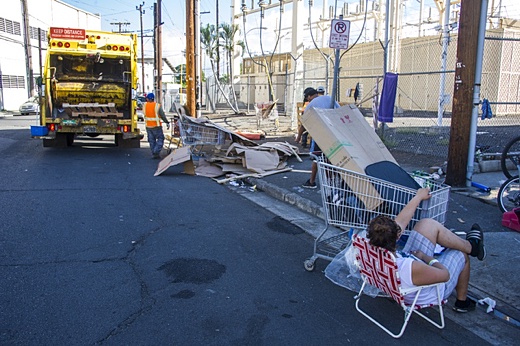
Image above: Bryanna Tunai, right, watched a city crew remove cardboard and pallets from Kuwili Street in Iwilei on Monday. From original article.

The smell of urine emanated from the sidewalks of Iwilei on Monday as the city’s homeless enforcement team returned to once again break down makeshift shelters built out of cardboard, tarps and wooden pallets — one of hundreds of sweeps that have taken place since the cleanup crew was created more than three years ago.

Monday through Friday the so-called SPO/SNO Enforcement Team discards — and stores — tons of personal belongings from Oahu’s homeless encampments at a cost to the city of about $15,000 a week.

The team got its inelegant name from the two city ordinances it enforces: the stored property ordinance and the sidewalk nuisance ordinance. One enables the removal of private property on city land, and the other keeps sidewalks clear.

But, as the residents and businesses of Iwilei have learned, the Monday sweeps only clear the area for the inevitable return of the area’s homeless.

Karen Manuluata, 25, and her boyfriend, Rick Tataishi, 34, spent the night on state-owned Nimitz Highway, just around the corner from where the SPO/SNO Enforcement Team was clearing city-owned Sumner Street.

“In two months we’ve been swept five times,” Manuluata said. “I’m not used to this. It’s hard. We have nowhere to go.”

The SPO/SNO Enforcement Team represents what Mayor Kirk Caldwell calls “compassionate enforcement” to encourage homeless people such as Manuluata to give up life on the street and instead move into a shelter or the city’s nascent Hale Mauliola community on Sand Island.

The team has been operating since January 2013 as part of Caldwell’s plan to deal with Oahu’s intractable homeless problem and respond to complaints from businesses and neighbors.

In communities such as Iwilei, where complaints connected to the homeless have increased in the last few months as more of them move in, the team’s Monday sweeps have become an unwelcome but expected part of life for the area’s homeless.

On monday about a dozen people who spent the night on the sidewalks of Kuwili Street were already packed and on the move to another neighborhood when the team rolled in with dump trucks and police escorts around 8 a.m. to find only two remaining encampments on either end of the street.

While others were still walking out of Kuwili Street, Bryanna Tunai, 21, sat in a beach chair outside her structure eating a cookie as the enforcement team’s dump truck noisily crushed pallets, plywood and the remains of someone else’s encampment.
“We have rights,” Tunai said.

Tunai is a veteran of the street who, like untold others, has grown both accustomed to — and weary of — the incessant sweeps that some say merely push homeless populations into neighboring communities.

“I’ve been out here since I was 16,” Tunai said. “The sweeps don’t faze me. We go back and forth between here and Aala Park.”

The work is not pleasant for the seven-person crew, which was joined by a separate, three-person “roving park patrol” in March 2015 to do the same work in city parks.

The crews sometimes work 17-hour shifts in order to clear city streets and enforce park bans that begin at 10 p.m., said Ross Sasamura, director and chief engineer of the city’s Department of Facility Maintenance.

In addition to harassment from the homeless people they remove, the crews are always on the lookout for hypodermic needles and “toilet buckets” filled with human urine and feces.

“When they leave, they leave their trash for us to pick up,” Sasamura said. “As a result of the sweeps, they’ve added mobility to their list of skills. Some of them scale down on the items they keep with them, and others find wheeled objects to help them transfer.”

Sasamura’s crew spent six months in the fall methodically breaking down the entrenched Kakaako homeless encampment. As it grew into a major safety and public health problem, the encampment crystallized Oahu’s need to deal with what has become the country’s highest per-capita rate of homelessness.

In the aftermath of the Kakaako sweeps, the city in January settled a lawsuit filed by the American Civil Liberties Union of Hawaii that alleged it failed to provide notice of the sweeps and destroyed belongings rather than store them to be reclaimed.

Sasamura said he was barred from discussing the terms of the settlement.

But he said the enforcement team now gives homeless people a 30-minute heads-up before sweeps commence. Those whose possessions are taken get a claim ticket for their items, which must be stored for at least 30 days in an undisclosed location in Halawa.

The city also announces the next day’s sweeps on its website by 3 p.m. each day, Sasamura said.
In a statement, Vanessa Chong, executive director of the ACLU of Hawaii, said, “City practices and policies during sweeps have been changed as a result of the lawsuit,” and the ACLU “continues to monitor city activities in the removal of private belongings on city property.”

Philip Richardson, president of Current Affairs, an event-planning business on Pine Street, said the ongoing sweeps are not a permanent solution, but they’re necessary to keep the neighborhood safe.

“They need to focus on picking up the carts, otherwise the homeless just rebuild again,” Richardson said. “But there is a marked difference between when they conduct the sweeps and when they do not in terms of violence, drugs and overall safety. If it were to discontinue, I would be extremely concerned.”

See also:
Ea O Ka Aina: Homeless Urban Survival 10/19/15
Ea O Ka Aina: Honolulu's Homeless "Solution" 10/15/15
Ea O Ka Aina: Hawaii's rising homelessness 10/13/14
Ea O Ka Aina: Criminalaization of Homelessness 4/10/12
.

Kapiolani Hotel is the RIMPAC lodge

SUBHEAD: The Queen Kapiolani will be extending our military "Per Diem PLUS" for all RIMPAC guests.

By Staff on 2 July 2016 for Queen Kapiolani Hotel -
(http://www.queenkapiolani.com/rimpac-2016.htm)


Image above: Exterior of the  Queen Kapiolani Hotel in a promo piece. From (http://www.greathawaiivacations.com/oahu/waikiki/id_queen_kapiolani_hotel.html#ad-image-0).

[IB Publisher's note: It's ugly to see a tourist hotels pimping for the military services. I guess the Kapiolani is more desperate than  it seems or simply doesn't care what damage the US  does to the Pacific Ocean and Hawaii.]

Queen Kapiolani Hotel & Kokua Hospitality welcomes RIMPAC 2016!   Since 1971 with the first RIMPAC the Queen Kapiolani has proudly welcomed our sailors and GI's from the US and Abroad. 
This year is no exception.  The Queen Kapiolani will be extending our military "Per Diem PLUS" for all RIMPAC guests. Book your reservation here...

The Per Diem PLUS includes the following:
  • PROMO CODE:  RIMPAC16
  • $177.00 Per Diem rate with appropriate ID
  • WAIVED - One Night Deposit at time of reservations
  • WAIVED - Daily Resort Fee ($15/day)
  • 50% Discount on Daily Valet Parking Fee 
  • FREE WIFI
  • FREE In-Room Coffee
  • FREE In-Room Safe
On Site:
  • 300 Steps to Waikiki Beach
  • 3 Miles to exit 25-A on the H1 Freeway
  • 24-Hour coin operated laundromat
  • 7 Minute walk to the center of Waikiki
  • On Main Bus Line 
  • On Site "Bike Rentals"
  • Sundry store open daily
  • Bar & Restaurant on 3rd Floor Pool Deck with a back drop of Diamond Head
We look forward to welcoming you with the true spirit of aloha & Thank you for all that you do 24/7/365!  See our website for additional information at: www.queenkapiola

RIMPAC on Social Media:

RIMPAC on Facebook RIMPAC on Twitter
RIMPAC on Instagram
RIMPAC on YouTube

.