Showing posts with label Politics. Show all posts

Ugly Gerry font of voting districts

SUBHEAD: A computer font made out of the shapes of gerrymandered voting districts.

By Rusty Blazenhoff on 2 August 20129 for Boing Boing -
(https://boingboing.net/2019/08/02/gerry-is-an-ugly-font-made-fro.html)


Image above: A message to Republicans on gerrymandering by someone using the UglyGerry type font. Of course Democrats have played their pert in this as well. From (https://pbs.twimg.com/card_img/1157070040816128006/gEPX-685?format=jpg&name=600x314).

Ooh, this is awesome. Activists have made a free font called Gerry that is made from the shapes of gerrymandered congressional districts. They encourage you to use it to write your representative.

The font’s creators, Ben Doessel and James Lee, made it to raise awareness and provide a method for disenfranchised voters to protest partisan gerrymandering. The duo, in a press release provided to the media, stated:
"After seeing how janky our Illinois 4th district had become, we became interested in this issue. We noticed our district’s vague, but shaky U-shape, then after seeing other letters on the map, the idea hit us, let’s create a typeface so our districts can become digital graffiti that voters and politicians can’t ignore."
For those unfamiliar with gerrymandering, it’s the process by which US voting districts use increasingly nonsensical borders to disenfranchise voters and limit who they can vote for by party lines instead of geography.

Congressional districts have a reputation for being downright ridiculous.
"North Carolina's 12th district resembled a severely broken snake until it was revamped in 2017. Pretty much all of Maryland's districts defy comparison to anything but abstract art. And then there are a few dozen districts that look like letters in the alphabet — so much so that an anonymous gerrymandering fighter turned them into a font.

A few of the letters in the Ugly Gerry typeface are a combination of side-by-side districts, while New York's 8th District is turned on its head to be both the "M" and "W" in the alphabet. But most of the districts don't even require much squinting to resemble letters, which are all downloadable in one file on UglyGerry.com."
From (https://theweek.com/speedreads/856423/someone-made-font-gerrymandered-congressional-districts)
http://www.islandbreath.org/2019Year/08/190803gerrybig.jpg
Image above: The alphabet made of gerrymandered US voting districts. From (https://www.uglygerry.com/) (https://twitter.com/UglyGerry). Click to enlarge.


.https://www.uglygerry.com/

Kauai 2018 Voting Recommendations

SUBHEAD: Island Breath's endorsements for Kauai Primary Election on 11 August 2018.

By Linda Pascatore on 26 July 2018 for Island Breath -
(http://islandbreath.blogspot.com/2016/07/our-primary-voting-recommendations.html)


http://www.islandbreath.org/2018Year/07/180727councilbig.jpg
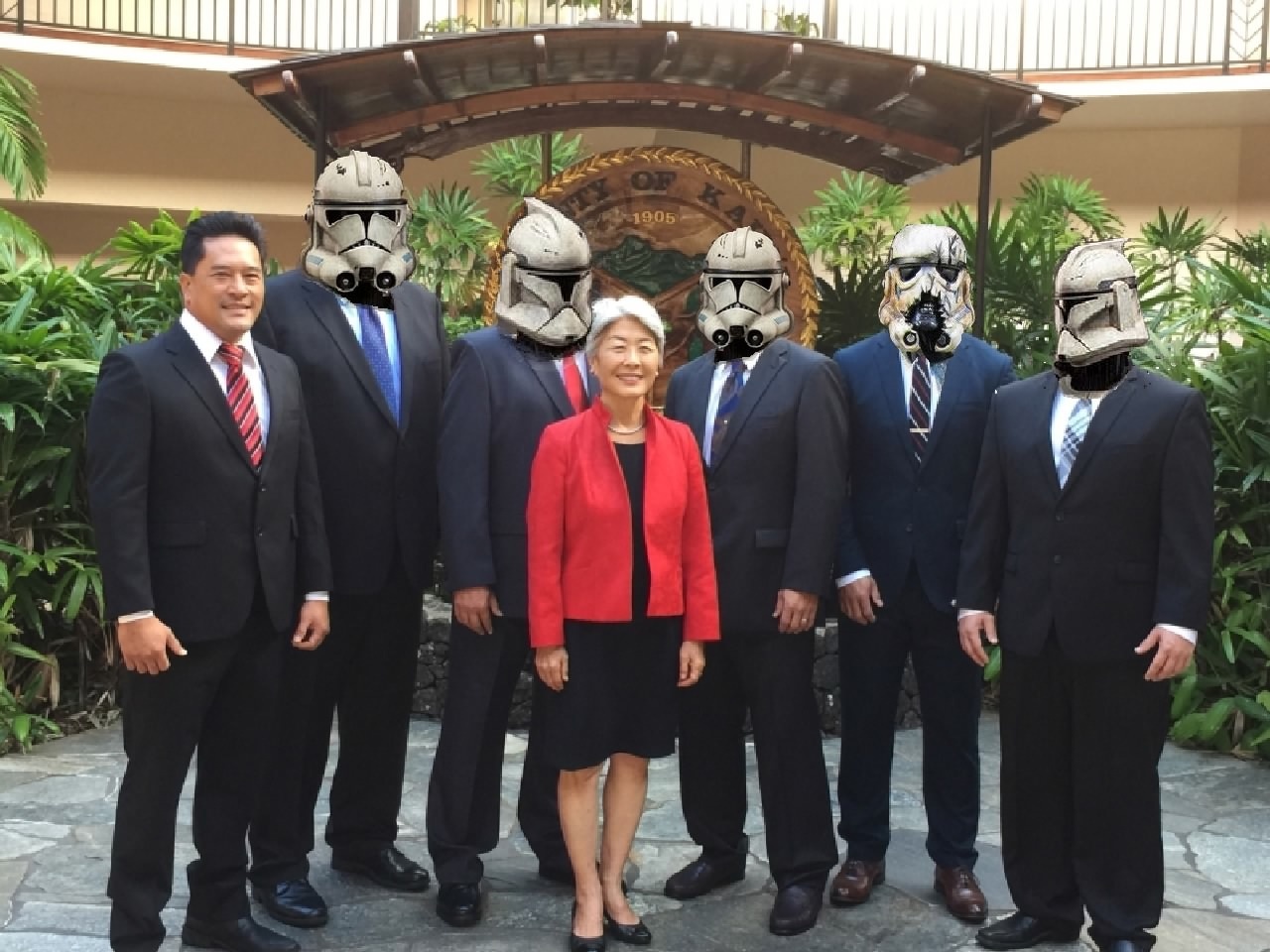
Image above: Kauai County Council members 2016-2018. L to R: Mason Chock, Arthur Brun, Mel Rapozo, Joann Yukimura, Ross Kagawa, Derek Kawakami and Arryl Kaneshiro. Mashup image by Juan Wilson. Click image to enlarge.

Register to Vote, Find your Polling Place, or View your Ballot here: https://elections.hawaii.gov/

Primary Voting Schedule
  • Early Walk In Voting for Primary: July 30 to Aug 9 at Historic County Building basement.
  • Last day to request Mail in Ballot: August 4
  • Primary Elections: August 11 - Polls open 7am to 6pm
Island Breath picks are based on general progressive, liberal positions, with an emphasis on sustainability, the environment, peace, equality, and Hawaiian Sovereignty.  We followed some of the  recommendations from the Sierra Club and Pono Hawaii Initiative.

Our recommended candidates are in italics with larger print.

We found information on candidates records and positions on the League of Women Voters (http://www.vote411.org/ballot), Votesmart (https://votesmart.org/), and also in articles profiling individual candidates in Civil Beat and The Garden Island.

On the primary ballot there are two sections: on one you choose a party and vote only for those candidates; the other section is non-partisan--everyone votes for the County Contests and the Office of Hawaiian Affairs.  We are choosing from the Democratic candidates on the party affiliated section.

Democratic Party


US Senator:

* Hirono, Mazie


US Representative, District II (Kauai)
* Gabbard, Tulsi


Governor:
* Ige, David Y.


Lieutenant Governor:
* Iwamoto, Kim Coco


District 14: 
Nadine Nakamura is running unopposed for the Democratic nomination.  We do not endorse her.


District 15: 
Elaine Daladig is running against incumbent James Tokioka for the Democratic nomination.  We do not endorse either candidate.


District 16:
* Morikawa, Daynette (Dee)


Non-Partisan

Everyone, no matter which party affiliation, can vote for Kauai Mayor and County Council and OHA (Office of Hawaiian affairs) trustees.


Office of Hawaiian Affairs (OHA): Oahu Resident Trustee

* Kia'aina, Esther


Office of Hawaiian Affairs (OHA): At-Large Trustee:
(vote for three)

* Aila, William J., Jr.

* Paikai, Landen D.K.K.

* Paris, Makana


Mayor:
* Yukimura, JoAnn A.


Kauai County Council: 
Special Note: Island Breath is recommending voting for no more than the three candidates noted below, even though you are allowed to vote for seven.  If you vote for seven, but really support just three candidates, your #4, 5, 6 and 7 votes could enable those other candidates to win over your top candidates.  Consider voting for fewer--a practice called "plunking".

* Chock, Mason

* Cowden, Felicia

* Roversi, Adam P.


See also:
Recommended by Gary Hooser; Executive Director of the Pono Hawaii Initiative
(https://ponohawaiiinitiative.org/endorsements)


.
.

The Good Life First

SUBHEAD: The good life or the ballot? Both you say? I say the good life first, the ballot second.

By Patrick Noble on 23 January 2018 for FEASTA -
(http://www.feasta.org/2018/01/23/the-good-life-or-the-ballot-both-you-say-i-say-the-good-life-first-the-ballot-second/)


Image above: Integrate your flock into a healthy growing system that is self-supporting. From (http://www.hobbyfarms.com/permaculture-chicken-keeping/).

We have reached a pivotal moment. I think we can be certain that governments and other powers, such as corporations and their promotional arms, such as the BBC, are set on destruction. The powers have made no appropriate attempts to act on climate change, or on the current ecological catastrophe.

It is plain that those in power think climate change is not real – rather it is a bee in the bonnet of just enough of the electorate to make it politically worth the posture of a response.

Since the first world climate summit in 1990 carbon dioxide emissions have risen steadily, so that by 2017 they were 60% higher than when nations first pledged to act.

Argument within governing systems is without hope of being heard, or even vaguely understood.

But there is hope. It is (as it has always been) in living the good life. Though such a course may fail, until it does so, it remains a source of happiness. It is now the only productive course we have to mitigate the worst of climate change.

By all means speak to the powers – you never know – and this writer is frequently wrong – but without rapid and then hopefully fashionable personal change, there’s not a realistic hope in hell…

If political engagement means that we become distracted from the problems of our own lives, then that engagement will be more destructive than productive. To consider that social change comes more from hierarchical instruction than personal consideration denies laws of physics.

Crowds, electorates, gangs, or societies are made up of the physics of people – one by one.

A crowd is five people, thirty people, a thousand people with those specific weights, energies and substances.

But the crowd; the electorate; the corporation; the government are also imagined – they are ideas in our singular heads.

The politically-engaged proposition (political influence is more powerful than the good life) suggests that to live well, we lobby an abstract authority to permit us to live how we choose and then, because consensus denies our request, we can continue to live how we do not choose.

Oh democracy, we say with a sigh – it’s bad, but not as bad as the alternatives. We propose that we are not moral beings – that we are a part of the moral consent of the crowd.

We misname that permission as liberality – we’d do better to accept it as permissiveness.

And so, climate change “authorities” jet to so many climate conferences, that they may be among the most climate-destructive groups on Earth.

Likewise, I may vote green, while taking holiday flights. I say that I lobby for the greater good, and propose that my small footprint is insignificant relative to the power of a green cross in the ballot.

Meanwhile political consensus (the amoral permission) is an idea. It does not exist. People exist.

One by one, we have physics, ecological connections, unique dreams and also, of course – common dependencies. We are responsible for all of those things. Our own causes generate unique effects, which only we can understand.

No greater good will remedy them. The greater good cannot see them. We walk in personally-imprinted landscapes.

People cause climate change. Governments cannot do so. Governments are communally accepted ideas (accepted by coercion, violence, inheritance, fearful prudence, or the ballot). Ideas have not the physics to cause anything.

Living the good life in that landscape is the greatest contribution to the greater good, since the greater good is the physical, moral and spiritual addition of our unique experience and contributory action to all the other unique experiences, which together make the whole.

Culture is what I do. Of course, I converse with others about my effects. It is cellular. I am both complete and incomplete. I am myself and my society and in the end my species.

My species has evolved within groups – as a social species. Ours is a eusocial evolution. Even so, every experience which enters the commons of folk memory, or tradition has first entered the senses of an individual.

No-one can experience birth, death, wind, sunshine and rain, but on their own. Yet my and all our yearnings are also to properly belong in family, friendship, neighbourhood, religion, tradition, memory…

Before it is too late, we must pay attention to our unique and lonely senses – to what we love and to what feeds us in taste, scent, sight, sound… We must be attentive. Those things will be modified by our inattention; by our distracted attention to more powerful notions of economic governance.

Climate is warming by my actions. The casino does not register it. If we listen we’ll hear the change. Already, at the dawn chorus, some small birds have ceased to sing.

We inherited a living culture. Our lives are the culture. We, not governments, bequeath that culture to our children and beyond.

The household remains as the model for the economy as a whole. The economy is a collective of households. It is true that the casino of rent, currency manipulation, usury, trade in shares and bonds and so on is not related to the household. But the casino is not an economy. It is a casino. Modern economists – even most green economists live strategically inside that casino to manipulate it for the better. They are misguided. The following are also disconnected from the casino – pillaged soils, pillaged ecologies, pillaged resources – that is: capital is not connected to the casino. But pillaged soil, ecology and resource and also diminishing infrastructure capital are very directly and sensually connected to the household – and to me. They are my responsibility. Their cause is my diminished responsibility.

Listen! – The household is ingenious and fierce and is rooted in family and folk tradition. It is limited to the restraints of wage, local resources and neighbourly opinion and is a dynamo for the pursuit of what we may call the most appropriate distribution of happiness. Isn’t that what we want for an economy?
Yet, modern European and American households have abandoned those restraints for what they see as the larger and progressive world of the governing casino. Even so, modern households are responsible for cascading ecologies and climate change.

They provide the physics to the casino’s abstraction. The abstraction can fix nothing and it causes nothing – doughnut economics, or true cost accounting fix nothing.

Only by fixing the household – the physical acts of the sensual, sensitive household, can we can fix ecology and economy. Only through the household do we have a landscape which is worth the governing.

But here’s the thing – who does not want to come home? We are prodigal sons and daughters unravelling threads to our various and anxious ways home.

Don’t forget that restraints give shape and meaning – borders can be drawn to be beautiful and true. We are placed within them. They trace the possible forms of home.

Rationally (abstractly) climate change is already beyond technological recall and settled cultures are set on almost certain unsettlement. The most populated cities and communities (and most ancient) are coastal communities, which must soon migrate to higher land.

Nearly all central government offices will be beneath the tide. Yet those government offices are (almost universally) making no attempt to guide their dependent populations to act on climate change.

The miracle could be the household.

Most of us agree that we are part of a collective madness and so we attempt to manipulate and reason within the madness – by petition, at the ballot and by consumer-choices. I disagree. Why don’t we school ourselves to be sane?

The governing psychosis oversees a changing physical landscape of people and resources.

The physics is where we should be. Physics reacts to our tools and teaches us how to belong. People change the physics. Corporations? – they are a part of the governing psychosis and they are also abstract.

Has anyone seen a corporation? – they don’t exist beyond an idea and our consent to it. Let’s remove consent. It’s late – but there may still be time to bail out and descend to solid ground.


The casino (which we pretend is an economy) will collapse – unless beforehand, ecology, or climate change wreck the culture as a whole. Money flow and the power of what we do – that is energy flow, are directly related. Perhaps 95% of that energy is from fossil fuels. Even so, current debt-created and quantitively-eased money-flow has exceeded even that vast fossilised under-pinning.

In a sense fossil fuels had suspended time and negated laws of nature – we dreamed that history had ended. It had not. Instead, history accumulated invisibly in cultural effects, which were sequestered beyond our collective imagination.

 Most in positions of power and their academic and journalistic sycophants, or critics remain inside that collective. That collective imagination will not be changed. We can reason within its borders, but reason from the real world of sunshine and rain will be treated as nonsense. Inside the casino, it does not rain.

Meanwhile, nothing can replace the power of fossil fuels. They came and money-flow vastly expanded. Now they must go – and money-flow must dramatically shrink. It will be confined to limits of natural physics again.

Collapse is inevitable.

When the casino collapses, companies fold, unemployment soars, tax revenues crash and infrastructures of social security, health-care, building and road maintenance and so on, crumble. The casino will bring down the real economy.

Once again, households can be lifeboats in the wreckage.

After the crash, what will change? Looking around at fields, crops, houses, roads, bridges, harbours… – nothing – nothing at all. The ideas will have changed – corporate structures, currency values, the complacency or anger of the crowd, the excitement or despair of the stock market…

All that is physical will remain, while all that was polemical, coercive, psychotic, or despotic will be in chaos.

The same food will be on the shelves, but we may have no wage to buy it. The same crop will grow in my field, but my tractor may be short of fuel to harvest it. The ecological means to the needs of an economy will remain unchanged. The sun will shine and the rain will fall. Trade’s people will have retained their skills.

Though money-flow will have lost its fossil power, still, all that is essential will remain – food, shelter, good conversation, people gathering to sing at the piano… Yet, they are a tiny percentage of what we used to buy, just yesterday, as we pillaged the Earth. We can be happy – rich in good things – without asking for more.

If I’ve lost my wage – still, all that is best of what a wage could buy will remain. My friends, family, neighbours, colleagues… will remain. All will be unchanged, but for the money, the governance and the high-pitched shrieking of share-holders and currency manipulators.

That is why, rather than pushing for a more benign casino, which registers natural capital, eco-system services and so on, we should divest from the casino and step by step build a real economy of people and resources, which can emerge alive from beneath the coming rubble. I don’t mean baked bean tins and bunkers.

I mean that we shop with businesses which are not financed by the amoral stock market, but simply by me, the purchaser.

A community of trade’s people, proper shops, village/corner shops and stores, street markets and farmers’ markets, pubs, libraries, theatres and concert halls, meeting houses, churches, temples, mosques, synagogues, council buildings… can be revived in the transition town manner- perhaps with a protective local currency and perhaps via locally issued (non-tradeable) shares, or bonds.

If I don’t find what I need by my local pound, then that lack is revealed and it may be to someone’s advantage to learn the missing trade (perhaps myself). Step by step we can divest from the garments of the casino (are we sure it had any clothes?) and put on what we can find in our terrain.


Am I fixated on aviation? – Yes – because it is both the least necessary and the most destructive of all our activities. Everyone, everywhere and forever could stop flying with very little effect on their lives.

We’ve no need to wait, while we lobby for carbon taxes, air traffic duty, or against runway expansion. Family connections? – jet-propelled connections will impoverish the lives of those we’d connect with. Love? Filial bonds? It’s an easy equation to understand. Trans-oceanic family duties contain a very near betrayal of still deeper bonds. Air freight? – It’s frivolous and unnecessary.

Those conferences (business, political, scientific)? – Nothing results without all parties carefully writing and reading the documents – why not begin and end with documents? Air-born climate authorities are not speakers, or performers, but writers, readers, data gatherers and statisticians.

Politicians, scientists and business people would do better to turn away from the posturing mirror – they’d achieve more and have more time to do so. Travellers? – Why travel without travel? Why not discover the cultures and terrains in between?

Many, or perhaps most of our destructive activities can only be changed in concert with others, but aviation is marvellously different – we can remove it on an instant.

Electric aviation is a fantasy. We’ll have trouble generating enough for more pressing needs, such as domestic heating.

With regards to government – had we proper governance, then all aviation (apart from the pleasurable hang glider) would long ago have been made illegal. For all their earnest lobbying, those who’d propose this, or that reduction in aviation, will still be ridiculed as lunatic fringe.

Aviation came with oil and must go with oil. The super market, the family car, suburbia and so on are the same, but more problematic in ascending degrees.

Many can abandon the super market on an instant, but others may have no alternatives nearby (until they are created). A family car, tied-in to work and pleasure is as destructive as occasional aviation.

However, ditching the family car is a more difficult proposition – it is tied to existing infrastructures – such as suburbia, lack of public transport and inconvenient work places. We can only change those things in concert with others and so conversation of some sort (not necessarily party political) becomes essential.

Earth has not the capacity to power the electric family car. Wind, hydro and solar generated electricity is the answer to many needs, but within absolute limits.

The car is redundant and must be made so by personal change, assisted by communal change.

Suburbia? – Well clearly, that’s an epic adventure – re-centring into new (or revived) towns and villages, accompanied by mass migration to coast and countryside and then re-cultivation of new hinterlands into farms and market gardens.

With regards to climate change, another powerful, easy and instant effect is to switch our general electricity supplier to a green supplier – making sure the source is wind, hydro, or solar – some use biomass, which is utterly destructive. We can also decide on an instant to farm and garden organically.

If we are fortunate to have land, we can plant trees on an instant – and we can let our existing hedges grow up – to flower, berry, nut and photosynthesise! For these important things, we need no advice from authority and need lobby no-one politically.

Other good personal activities such as re-using, re-cycling, refusing plastic packaging and so on have a tiny beneficial climatic impact relative to the large impact of refusing to fly, ditching the family car and switching to a green electricity supplier (or contributing to a community energy project).

Nevertheless, they do have very important ecological consequences and they are an essential part of the good life.

How do we find a way of life which is not powered by fossil fuels and which sits happily inside its ecology? For me, it is firstly, a society organised so that both work and pleasure are walking, or cycling distance from anyone’s door.

That is a society, which has removed the need for personal transport. It is also a more egalitarian society. The wealthy, by the sheer weight of their energy-bloated behaviours and purchases, cause the bulk of climate change, resource depletion, ecological destruction and social depravation.

A common ethics, followed by common law may control what is anti-social wealth.

So political engagement is a part – but I maintain the secondary part of firstly discovering what is the good life and then living it. That will be a process of trial and error – new truths are discovered by new errors.

How do we know where to begin? Why not start with the question – what is happiness? Only my reader can know the answer.

.

Trump and Russian Bombshell

SUBHEAD: Bannon claims Don Jr. took Russians to his father after their meeting with Kushner and Manafort.

By Hayley Miller on 3 JAnuary 2018 for Huffington Post -
(https://www.huffingtonpost.com/entry/steve-bannon-trump-tower_us_5a4cde0be4b0b0e5a7a9fe93)


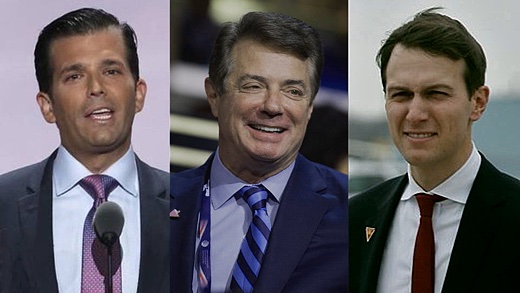
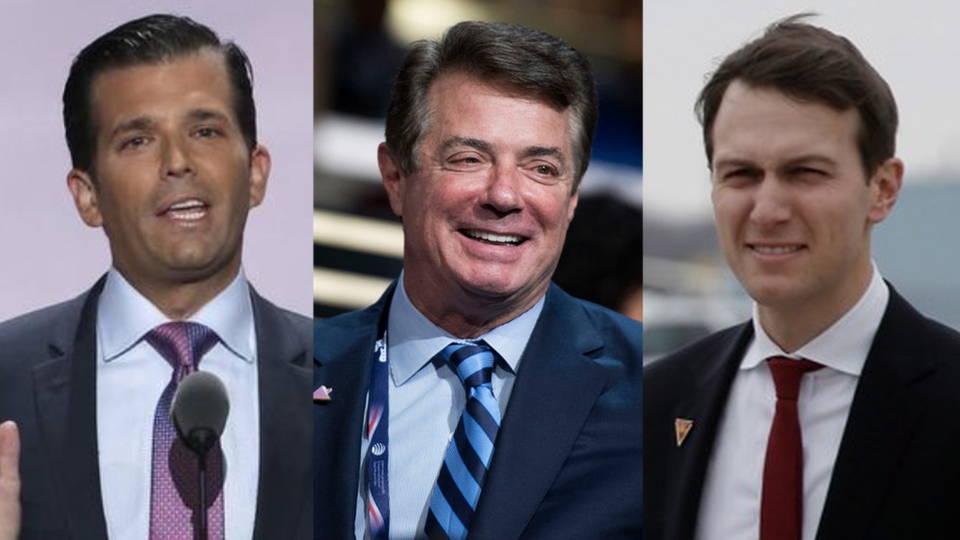
Image above: Trump Jr., Paul Manafort, Jared Kushner, conmen all. From (https://www.democracynow.org/images/headlines/12/37612/quarter_hd/H04_TrumpJr_Manafort_Kushner.jpg).

[IB Publisher's note: On one hand its obvious that Steve Bannon as a bone to pick with Donald Trump. But what he indicates about the real crime isn't talking to Russians but enabling and participating in systemic criminal money laundering is what the Mueller investigation is onto.]

The former White House strategist called the infamous Trump Tower meeting “treasonous,” according to a new book.

Steve Bannon suggested President Donald Trump was aware of Donald Trump Jr.’s meeting with Russian operatives at Trump Tower in June 2016 ― because he met with them that day, too, according to an explosive new book by acclaimed journalist Michael Wolff.

The former White House strategist was quoted by Wolff as saying there was “zero” chance Trump Jr. didn’t walk the Russian meeting attendees “up to his father’s office on the 26th floor.”

Wolff met with Bannon during the nine months he was granted far-reaching access to the West Wing and senior administration officials to write a tell-all book about the White House, Fire and Fury, set for release on Jan. 9.

The revelations appeared to contradict Trump’s repeated claims that he was unaware his eldest son, as well as his son-in-law Jared Kushner, had met with the Russians.

Bannon also dubbed the infamous Trump Tower meeting as “treasonous” and “bad shit,” according to Wolff. The far-right icon mocked Trump Jr. and Kushner for taking the meeting in hopes of acquiring dirt on Hillary Clinton, Trump’s political opponent in the 2016 presidential race, as first revealed by The New York Times in July.

“The three senior guys in the campaign thought it was a good idea to meet with a foreign government inside Trump Tower in the conference room on the 25th floor — with no lawyers,” Bannon told Wolff, according to The Guardian, which obtained a copy of the book.

“Even if you thought that this was not treasonous, or unpatriotic, or bad shit, and I happen to think it’s all of that, you should have called the FBI immediately,” he added.

Bannon predicted special counsel Robert Mueller’s investigation into possible collusion between Trump’s 2016 campaign and the Russian government will focus on money laundering.

“This is all about money laundering,” Bannon told Wolff. “Mueller chose [senior prosecutor Andrew] Weissmann first and he is a money-laundering guy. Their path to fucking Trump goes right through Paul Manafort, Don Jr and Jared Kushner … It’s as plain as a hair on your face.”

Bannon suggested Kushner’s business dealings with German financial juggernaut Deutsche Bank, which has loaned hundreds of millions of dollars to the Kushner family real estate business, would be problematic for the administration.

“The Kushner shit is greasy,” Bannon said. “They’re going to go right through that. They’re going to roll those two guys up and say play me or trade me.”

Four Trump associates have been indicted in connection to the probe, including former national security adviser Michael Flynn and former Trump campaign chairman Paul Manafort, who also attended the Trump Tower meeting. Manafort was indicted by a grand jury in October on charges of conspiracy and money laundering.

“They’re going to crack Don Junior like an egg on national TV,” he said, adding that the White House should reconsider its apparent lack of concern over the Mueller investigation. “They’re sitting on a beach trying to stop a Category Five.”
.

What Could Go Wrong?

SUBHEAD: James Kunstler's predictions for the year 2018 don't paint a pretty picture for America.

By James Kunstler on 1 January 2018 for Kunstler.com -
(http://kunstler.com/clusterfuck-nation/forecast-2018-go-wrong/)


Image above: Detail of cover of the Saturday Evening Post at the end of 1917 with a New Year's baby ready for World War One. From (http://www.saturdayeveningpost.com/2014/12/31/art-entertainment/art-and-artists/new-years-babies.html).

Markets
If you take your cues from Consensus Trance Central — the cable news networks, The New York Times, WashPost, and HuffPo — Trump is all that ails this foundering empire. Well, Trump and Russia, since the Golden Golem of Greatness is in league with Vladimir Putin to loot the world, or something like that.

Since I believe that the financial system is at the heart of today’s meta-question (What Could Go Wrong?), it would be perhaps more to the point to ask: what has held this matrix of rackets together so long?

After all, rackets are characterized by pervasive lying and fraud, meaning their operations don’t add up. Things that don’t comport with reality are generally prone to failure so sooner or later they have to implode.

Financial markets have been surging supernaturally on “liquidity” since 2009 — and by “liquidity” I mean “money” (digital credit from thin air) supplied by the Federal Reserve, in rotation with the other sovereign central banks, BOE, ECB, BOJ, PBOC, from whence it pings ‘round the world, wherever the lure of the main chance sparkles.

Trillions wafted into the stock and bond markets, levitating them as a sort of stage-managed misdirection from the sickening spectacle of wobbling real stuff economies.

In 2017, The Dow Jones Industrial Average recorded an astounding 5,000 point year-on-year upzoom, with 12 months of gains and no loser months, and a string of 71 record highs.

America’s central bank, the Federal Reserve, acted as if pumping up the stock markets was the only thing that mattered.

The result was a Potemkin economy, a glittering Wall Street false-front with a landscape of “flyover” squalor and desolation behind.

The Fed now works at cross-purposes with itself by raising the Fed Funds rate a quarter-point every few months, and supposedly “shrinking” (ha!) their balance sheet — dumping bonds onto the market plus “retiring” termed out bonds, which allows the Fed to disappear the principal paid by the borrowers, namely the US Treasury, or the quasi-governmental werewolf called Freddie Mac (The Federal Home Loan Mortgage Corporation), which bundles all kinds of janky mortgages into giant bonds the Fed buys in order to artificially pump up the real estate market.

Did your eyes glaze over yet? That’s the great thing about finance: it’s bewildering, so that when shit goes wrong, nobody notices until its way too late.

What could go wrong with that program?

Well, if you dump billions of bonds on the market, you will change the supply-and-demand equation in the direction of too much supply, and interest rates will have to rise when there isn’t enough bid from the demand side — especially if the US Treasury is creating ever more new bonds to make up for ever-greater deficit spending at the same time the Fed dumps bonds into the market.

And if, for instance, the interest rate on the benchmark 10-year US Treasury bond goes up past 3.00 percent, well that may be all she wrote for the US government’s ability to service its monstrous debt.

And it may be tits up for the real estate sector, too, because mortgage rates will rise, and fewer people will buy houses.

The Fed’s latest actions boil down to a lame attempt to have some maneuvering room to once again lower interest rates and refill their balance sheet via a QE-4 orgy when the economy heads south in a way that even the US Bureau of Labor Statistics can’t obfuscate.

The ECB and the BOJ have already made noises about curtailing their vacuuming up of securities, so the liquidity rotation may end altogether. The new Tax Cuts and Jobs Act has at its centerpiece the lowering of corporate income tax from 35 to 21 percent.

The hidden agenda may be to hope this can act as a substitute for the dwindling central bank liquidity injections.

The tax cuts and other new gimmicks would increase the federal debt by at least $1 trillion over a ten year period (and, by unofficial estimates, probably much more) paving the road to national bankruptcy with good intentions.

But, of course, quite a few wise men in this culture have declared that deficits don’t matter. My own view is that they don’t matter until they do, and then you’re pretty screwed.

In the background of all this is an array of perilous real world events playing out that include especially potential conflict around North Korea and the Middle East. China’s banking system is a fun-house of scams and dodges that don’t add up anymore than ours do.

The whole wicked pottage of EU / Brexit issues simmers away, along with the EU’s fatal flaw of lacking any fiscal discipline among member nations, so government spending has no relation to sovereign borrowing. NATO’s aggressive military posturing on Russia’s borders is pointless, stupid, dishonest, and provocative.

Nobody knows what kind of gambit Crown Prince Mohammed bin Salman of Saudi Arabia will try next. Iran demands to be recognized as the regional hegemon.

And our dear exceptional nation, with its restless Deep State black box “assets,” is capable of all sorts of mischief at home and abroad.

Any of these things could shove American markets into criticality, as if they don’t have enough built-in fragility already.

Manipulation of the markets by the Fed and its water-carrying Too Big To Fail partners have deprived the markets of their chief function: price discovery, the ability to discern what things are really worth. Markets are therefore functionally useless and their uselessness is a giant hazard.

No society that depends on money can work for long if nobody knows the true value of things, including the value of money itself. The price of attempting to live in a culture of pervasive dishonesty is that a re-set is inevitable.

When it happens, it will be hugely destabilizing.

I expect the DJIA to move down sharply before the third quarter, rebound a little, and eventually bottom at 14,000 or lower by this time next year. I’ll call the S & P to settle in under 1,000.

The NASDAQ may be the weakest, since its FAANG members — Facebook , Amazon, Apple, Netflix, Google (aka Alphabet)— are among the most mis-valued stocks, and the most based on vaporous products and services.

Call NASDAQ to land at 2,700. Calling for a US dollar index (DXY) of 79 by December. Calling for gold $2,500 and silver $60 twelve months from now. There it is, like so much meat on the table.

Bitcoin and other cryptos have a superficial appeal as a wealth safe haven supposedly out-of-reach of avaricious governments — if you don’t consider everything else that’s wrong with it.

Yesterday, Dec 31, Australia’s biggest banks froze the accounts of Bitcoin investors. I think the safe haven idea will prove fallacious.

Governments are already finding ways to interfere, using taxation schemes and shutting down exchanges.

Bitcoin’s other claims on “moneyness” look bogus as well. It’s too unstable to be a medium of exchange, and too difficult to even access when need to sell, and you certainly can’t price anything in it as it shoots up and crashes every day.

Bitcoin went way up because people — or maybe just algorithms — saw it going way up, so they hitched a ride.

The rush to the exits will be brutal. Its final resting place will be zero, but perhaps not without a trip or two to nosebleed levels in 2018, especially as other markets wobble in the first half of the year. Bitcoin $50-K wouldn’t surprise me. But I’m not among the buyers. Enjoy the show.

2018 is the year that fragilities in the shale oil industry challenge the narrative of the “miracle.” The industry hasn’t made a net red-cent since it ramped up ten years ago. It’s been running on debt, a lot of it junk financing (high-yield, high-risk, covenant-lite).

The producers have been fracking and pumping all-out for several years to maximize their cash flow to service their loans.

But these shale wells deplete by 80 percent on average after the first three years, and have to be replaced by expensive new wells, which require ever more debt financing.

The truth is that shale oil and other “unconventional” oils just don’t pencil out economically. Their success in recent years was part-and-parcel with the central bank credit flood.

As that credit flow gets choked down in 2018, oil companies will go out of business at an impressive rate. If the price of oil goes up to $80-a-barrel, as a result, it will be very damaging to what remains of the US economy of real stuff.

US Politics
Donald Trump survived in office a whole year. Imagine that! After the 2016 election, I figured that the top military brass would give him the bum’s rush inside of three months, in short a coup d’état. Their action actually has been much more subtle: they just ring-fenced him with generals.

Since he seems to regard them as his generals (“my generals”), then he’s apparently okay with that, like a boy in the nursery with his toy soldiers.

And apart from the fact that the constitution calls for civilian control of the military and not vice-versa, I’m okay with that… for now. He’s got chaperones, at least.

This is admittedly not the ideal disposition of American political power.

I did not vote for the Golden Golem, and I don’t esteem his abilities, but the incessant and rather hysterical attacks on his legitimacy, especially by members of Consensus Trance Central, display a mendacity out of George Orwell’s direst dreams.

I never believed in the ludicrous Russian collusion fantasy, and find it difficult to believe that the editors of The New York Times do.

So far, Special Counsel Robert Mueller has indicted two high-profile grifters (Manafort and Gates) on financial shenanigans involving business dealings in Russia dating from years before the 2016 election, plus one National Security Advisor (Michael Flynn) for speaking with the Russian Ambassador (who, exactly, are foreign ambassadors supposed to speak to if not government officials?

And otherwise what are they here for?), and one entry-level foreign policy wonk (George Papadopoulos) who never even met Trump.

I believe the grave and solemn Mueller is on a fishing expedition. Aficionados of DOJ tactics know that prosecutors can always fetch up the proverbial ham sandwich to indict, if there’s nothing else at hand.

Then there is the very troubling behavior of FBI employees (Peter Strzok, Lisa Page, Deputy FBI Director Andrew McCabe), plus some members of Obama’s inner circle (Susan Rice, Samantha powers) in the twilight months of his term.

And remember, Robert Mueller has been the erstwhile James Comey’s mentor and true-blue friend going way back. It just looks flat-out like a bunch of Deep State lifers are out to get the Golden Golem. The so-called “optics” are terrible.

Since crashing stock markets are liable to turn Trump into a mad bull, at the same time that Mueller will have to put up or shut up, I predict that long about the vernal equinox Mueller will come up with some Mickey Mouse charges against Trump, or his people, and be promptly fired by the president.

General Flynn and the baby foreign policy wonk will be pardoned, and perhaps others.

Probably not Manafort and his chum (though their prosecution might fail.) Democrats will go apeshit and batshit both, with talk of impeachment and constitutional crisis, but I don’t think any of that will stick.

Congress may have more to worry about with tanking markets and other symptoms of an incipient economic train wreck. The effort to dump Trump would aggravate the tanking markets.

It is also plausible after the disclosures of recent months that the Russian meddling investigation could blow back on Hillary, the Clinton Foundation, Clinton allies, and possibly even some of Obama’s people (maybe even the former president himself).

The evidence for Obama-era FBI involvement in the Christopher Steele file is already out there.

There is yet to be a satisfactory elucidation of the Loretta Lynch / Bill Clinton Phoenix tarmac meet-up, nor to the circumstances around HRC’s lost emails and private server, nor the Anthony Weiner laptop, nor to the Uranium One matter.

The casual observer sees much more circumstantial criminality in these matters so far than any Trump collusion-with-Russia hypothesis provides.

I venture to predict that ex-DNC Chair Debbie Wasserman-Schultz resigns her House seat in disgrace as the case of her Pakistani grifter IT aide, Imran Awan, moves into the courts.

Trump firing Mueller will drive his Dem-Prog adversaries to new heights of hysteria but their wrath may be so ineffectual that they will fall back on their stock-in-trade, ginning up more sexual panic.

This calls into question the pathetic state of the Democratic Party leadership. It’s so sclerotic these days that it makes the Whigs of 1856 look dynamic.

 They have no program for the compound emergencies the nation faces. The party machinery is in the hands of bought-and-paid-for errand boys, gender crybabies, and race hustlers.

Their allies at The New York Times and CNN look ever more ridiculous peddling daily paranoid fantasies and styling themselves as advocates for “the Resistance.”

Their cadres in the Ivy League outposts have turned into the most shamelessly illiberal gang of intellectual despots since Mao’s Red Guard roamed the earth.

I’m not persuaded that the Dems will necessarily stomp Trump’s Republicans in the 2018 congressional and state races, as seems to be widely assumed for the moment. I’ll predict, rather, that in 2018 we get the first stirrings of a new party forming to battle both tired old clubs.

Trump now “owns” the fate of the stock market and the economy it wags, having bragged on it all year. He and the Republicans will be blamed if it falls out of bed.

But my gut feeling is that the voters are even more sick of the Democrats and their victim-mongering. Their coffers are empty, despite jumping through every hoop that Wall Street held out for them. (Did all the money disappear into the maw of the Clinton Foundation?)

Finally, on a personal note, I blame them for driving a stake through Garrison’s Keillor’s heart with their reckless sexual witch-hunting, and I don’t forgive them for that, no matter how many tits he may have tried to touch backstage.


Elsewhere on This Planet
Economic savant and international man-of-mystery James Rickards says that Trump and his generals are going to whap North Korea upside its big chunky head soon after the winter Olympics are concluded in South Korea on February 25.

But as Trump averred in the election campaign, he is not inclined to state in advance exactly what we might do in a military situation. Maybe the rumor is true that we have interesting new weapons capable of turning Little Rocket Man into a Post Toastie without harming the mass of innocent North Koreans.

I’d have to give 50 percent odds that whatever we do in Korea turns out to be an epic illustration of Murphy’s Law, since our track record in foreign military adventures since VJ day in 1945 is pretty scant in the “win” column. The Balkan War, maybe… Bush One’s Gulf War sort of… Grenada (for Godsake)… what else…?

Kim Jung-un may not be able yet to deliver an atomic blast to Rodeo Drive, but he can likely lob one into Tokyo on a five minute flight path. Look at the map. The Japanese must be nervous about it.

They were once a world-class military power, in case you don’t remember the banzai era. Prime Minister Shinzo Abe wants to revise Japan’s pacifist constitution — engineered by US advisors during the post-war occupation — to allow for a robust military.

I wouldn’t be surprised if something lethal jumps out of a lacquered black bento box in the direction of Pyongyang around the same time the US goes for that whap upside NK’s head.

And there’s Seoul, of course, less than 20 miles from the DMZ and within range of a supposedly huge array of North Korean heavy artillery.

The theory is we have a slim window of opportunity to deal with this rascal before he equips himself to do some major mischief in the world.

I don’t believe this is just a bunch of shuck-and-jive cooked up by the arms merchants and their friends. It’s real and existential and very messy. Something is going to happen there.

China has a pretty firm mutual defense treaty with North Korea, and perhaps reason to want to keep the regime up-and-running as a buffer zone. But do they really want to jump feet first into World War Three defending Kim?

I guess we’ll find out. In the meantime, China’s president Xi Jinping has got enough on his plate trying to safely land the high-flying, but wobbling, debt-saturated Chinese economy.

Odds are that it’s going to be a rough landing. In which case, maybe war is the answer, as a way of distracting the Chinese public’s attention. But what sort of war? Cyber-sabotage? EMP blackouts? Good old-fashioned mutual nuclear destruction? Grinding old-school land campaigns?

Naval battles?

It’s a dangerous game and Xi does not look like a risk junkie — more like prudent ole Uncle Xi. So I’ll predict that whatever blows on the Korean Peninsula, China will try to stay out of it, even if it makes faces and jumps up and down a bit.

Russia can only benefit from steering clear of war, though its recent offer to act as an intermediary between Kim and Trump was a smart move. (Maybe they remember how Teddy Roosevelt negotiated a peace settlement in the Russo-Japanese War of 1907.) They have little to lose and prestige to gain.

Despite what you hear about the unholy thuggery of Vladimir Putin, it seems to me that what he wants most of all for his country is to attain the condition of a politically and economically normal nation — after the 75-year-long misadventure with communism.

I suspect Putin and others in Russia would have liked the country to become more fully Europeanized in tone and style than it has been allowed to be, with NATO playing war games on Russia’s border, and US monkeyshines in Ukraine, and sanctions against it for really no good reason.

So, Russia has been shoved back into its cubbyhole as a nation not quite of Europe, with sinister Byzantine overtones and ancient exotic Mongol influences.

This quasi-isolation has some benefits for Russia, for one, the imperative to develop businesses and industries for import-replacement, that is, for becoming more self-sufficient. Russia has a lot to work worth, with the world’s highest oil production, lots of ores and minerals, untold hydropower, and endless timber.

It can make its own stuff, and Russian citizens are free to try starting businesses. The country may even benefit from climate change with expanded croplands. Russia is already approaching food self-sufficiency after the long catastrophe of soviet farm collectivization.

Meanwhile, Europe desperately needs Russia’s oil and natural gas, so they must know that using NATO troops and armor to make threats is a hollow gesture. Notice that Russia is stockpiling gold reserves, where the USA is just selling the stuff off. (China is stockpiling, too. Like mad.)

When other currencies implode, there is reason to believe the world will be introduced to a gold-backed Ruble and Yuan, “money” backed by money.

They’ll be able to buy stuff they need. Will we? Will a gold-backed currency shove aside the US dollar as world reserve currency? The precursor to that will be China’s effort to establish oil trade in its Yuan.

Europe has stumbled along economically for several years on Mario Draghi’s promise to “do whatever it takes” to keep the EU’s member nations from falling into the black hole of debt deflation, namely, buying every bond that the sovereign governments and corporations issue.

That kept the game going, but the structural imbalances in EU banking are now so extreme that it is hard to see a way out besides an EU crackup.

The Merkel-led immigration-and-refugee policy looked like a bad bet from the get-go and is liable to get worse when the whatever-it-takes liquidity dries up and the EU member countries fall into recession (or depression) and there’s no more money to pay for all those refugee settlement centers and the social services that have been provided.

There won’t be enough gainful employment for Germans, Belgians, Frenchmen, and Swedes, let alone for immigrants and refugees.

I’ll predict that starting in 2018 we’ll see efforts to ramp up deportations of these newcomers. Racist?

That will be the knee-jerk hue-and-cry. But the epithet is losing its punch as the effects of Merkel’s open door policy are felt on-the-ground in the obvious hostility, xenophobia, and aggression, displayed by Islamic settlers.

The defeat of ISIS on the Middle East battlefields in 2017 suggests that they will be ramping up terror operations to Europe. European nationalism movements will grow in 2018 and gain intellectual respectability as the defense of European culture is taken seriously.

Middle European states such as Hungary and Poland have not given in on the EU’s demand to accept immigrants and refugees from Islamic lands. Their example will be followed. Politicians in the rest of Europe will consider the “Just Say No” option.

The United Kingdom enters 2018 especially vulnerable to economic travail. The estimated cost of Brexit at tens of billions of pounds sterling, and the potential loss of business, especially banking, is one mighty headwind.

The other, less talked about, is the dwindling of the UK’s oil and gas reserves. The equation is simple: fewer energy inputs equals lower economic activity.

The only way around that is the popular central bank strategy of recent years: money-printing and accounting fraud. You can’t base an economy on that, and the truth will become painfully self-evident this new year in Great Britain.

Suddenly this last week of 2017, anti-regime demonstrations are busting out all over Iran. They are said to be protests over poor economic performance and the regime’s squandering of resources sponsoring mischief in other lands (Yemen, Syria, Lebanon, etc).

Folks are getting killed in the streets. The Revolutionary Guard — the zealots who took our diplomatic personnel hostage in 1979 — have promised to squash the protest. Many Iranians must be good and goddam sick of mullahs and ayatollahs running the joint.

Otherwise, it’s beginning to look like Crown Prince Mohammed bin Salman (MBS) of Saudi Arabia (KSA) would like to rumble with Iran to beat back their influence outside their borders in the region.

Iran has had plenty of opportunity to play with its military hardware in recent decades: in the Iran-Iraq War, arming Hezbollah to battle Israel, in support of Bashar al-Assad’s government in Syria, and lately in Yemen’s civil war.

KSA, on the other hand, has been buying jet planes and bombs from the US for decades, with nary a chance to put them to use. MBS seems eager to test-drive this schwag.

A real dust-up between the principals would put a lot of the world’s oil supply at risk if oil tanker shipping in the Persian Gulf were interrupted. China and Japan would bear the brunt, but the whole world would feel it.

Kicking the clerics out of government in Iran might tone down the unnecessary religious hostilities between Sunni and Shiites that has played such a big part in the creation of failed states throughout the Middle East and North Africa (MENA). Iran has plenty of economic problems inside its own borders.

The disarray in other areas of the vast MENA region will continue in 2018, whether regime change in Iran happens or not. Iraq, Libya, Somalia, Sudan are permanently failed states, with Egypt ever on the verge. Syria will stabilize as a much smaller economy, propped up by payments from Russia for hosting naval and air bases there.

This part of the world has suffered ruinous population overshoot in the industrial age, especially the states that produced oil. The desert ecology can’t support all these people as the industry falters and shrinks. Even as the situation worsens, the swollen populations will generate more children. When they can no longer decant themselves into Europe, the real misery starts.

You may have forgotten there is a place called South America. Its many nations have been in a pleasant political coma for a decade or so, except Venezuela, which is in cardiac arrest, organ failure, and brain death. There will be a bloody revolution there this year, and Venezuela’s oil industry will be crippled, adding to the world’s oil supply problems.

The Closing of the American Mind
2017 was a spectacular year for intellectual collapse among the political Left, but especially for its subsidiaries on campus.

The trauma of Donald Trump’s election victory put this faction into a fugue state in which no opportunity for coercion and persecution of imagined enemies could be missed.

The victim-oppressor politics spawned by the critical-theory-for-lunch-bunch has produced an ideology in which “inclusion” means segregated dorms, racially separate graduation ceremonies, and (at Harvard) closing down age-old men’s and women’s voluntary social associations. And “diversity” means as long as you express the exactly same ideas we do.

The presidents, deans, and faculty of colleges around the country have turned into the most obdurate enemies of free thought since the Spanish Inquisition, a gang of cowards and villains who disgrace the meaning and purpose of higher Ed.

Highlights of the year in Social Justice Warrior Land include the violence around Charles Murray’s lecture at Middlebury, the Antifa riots at UC Berkeley, the “Day of Absence” ritual at Evergreen U in Washington State where white people were banished from campus, and the Lindsey Shepherd star chamber tribunal at Laurier University in Toronto (I know, that’s outside the USA). I


n all of these cases, college presidents, deans, and faculty acted contemptibly, supporting coercion, persecution, antipathy to due process of law, the willful betrayal of common decency, and a folio of shockingly stupid ideas — such as the proposition from the chair of the Purdue University Engineering Department (one Donna Riley) that academic rigor is a symptom of “white male heterosexual privilege.”

As it happens, higher education is approaching its own state of implosion, since college has become, most of all, a money-grubbing racket tuned to the flow of exorbitant student loans for exorbitant college costs.

Higher Ed’s fate is tied to the financial sector, especially the bond market, since college loans are lately being bundled into janky bonds just like the NINJA mortgages of 2007 were.

The entire US college industry has been in a hypertrophic blow-off for decades, and the gross expansion of facilities, programs, and costs has developedan inverse relationship to the value of a college education. I predict that a shocking number of small four-year colleges will go out of business this year. Students who had not completed their degree requirements will just be shit out of luck.

Concluding Thoughts
2018 will be a tumultuous year of shake-outs and loss. The watchword for the year should be “lean.” Individuals will be shoved into leaner modes of living. Companies will suffer despite the new lower tax. Financial rewards will be lean. Nations will have to seriously start planning to get by on less, to downscale, and jettison programs that don’t jibe with the mandates of reality.

2018 is the year that the world comes un-stuck from the past ten years of pretending that it’s possible to get something for nothing. For 2018, it’s full speed ahead into the long emergency.

.

Brown woman divorces Democrats

SUBHEAD: I’m a brown woman who’s breaking up with the Democratic Party.

By Saira Rao on 16 December 2017 for Huffington Post -
(https://www.huffingtonpost.com/entry/brown-women-democratic-party_us_5a31a32de4b07ff75b001456)


Image above: What appears to be a selfie of Saira Rao during her college days with Hillary Clinton. From original article.

Dear Democratic Party:

You were the love of my life. I fell in love early and hard. I have been the kind of party loyalist ― the kind of sappy, soapbox-y, clichéd devotee ― that makes Fox News moonwalk with glee.

The first vote I ever cast, at 18, was for Bill Clinton. The last vote I cast was for his wife, Hillary. My adoration for Hillary bordered on mania.

In college, I named my ficus plant after her. Twenty years later, I canvassed, held fundraisers, dragged my 8-year-old daughter door to door, proudly wore HRC’s face on T-shirts and housed campaign volunteers in my home.

I loved you so much that I cried each time I voted. Thinking about the women who died fighting for my right to vote did it every time. I cried when I voted for Bill. For Barack Obama. I wept when I voted for Hillary. You’ve been that kind of mad love to me.

And now I want to break up.

I realize now that the love has been one-sided, unrequited. You’ve never recognized me, as a brown woman. You’ve taken my love, my money, my tokenism, with nary anything in return. You married the white woman and hooked up with me on the side.

Black Lives Matter is a second ― or third ― thought. Where is your outrage over the national epidemic of police brutality against black people?

You continue to call angry white men who commit mass murder “lone wolves.” But if someone who looks like me screams “Allah” and fires a gun, it’s “terrorism.” And you wonder why angry white men are gunning down innocent brown men at bars, in their yards, on the street.

For all your talk about Dreamers, there’s been little action. You don’t seem to give a crap about kids of color who will be kicked out of this country, the only country they know.

What if all those Dreamers were white? I suspect there’d be a very different outcome.

You spend a lot of time and energy wooing white voters, while giving short shrift to voters of colors and assuming we’ll always show up for you.

To be fair, there’s no reason for you to assume otherwise. We always show up for you. Take, for example, the special election in Alabama on Tuesday. Had black people not shown up, an accused child molester would be our newest senator.

What will Doug Jones do for the black folks who put him in the Senate? If history is any indication, very little.

This past year, I held and attended numerous fundraisers for your candidates. I donated money every time I was asked. I marched: for women, for children, for reproductive rights, for science. I traveled across the country for the March for Women in Washington, D.C.

It was there that I got the first hint that you weren’t that into me. The giveaway? The sea of white women in pink hats with brown and black women dotting the waves like debris. I let it slide but I kept my eyes and ears open.

My fellow brown and black sisters started to notice, too — and the chatter began, in whispered hushes at first, then loud and clear. You are a party of white feminists. Of white feminism, the kind of feminism that focuses on the struggles of white women.

It was the first time I’d heard the term, most likely because self-awareness is hard and I was a brown woman trapped in a white feminist’s world.

But then I woke up. I saw you with clear eyes for the first time.

For every Kamala Harris and Pramila Jayapal sticking their brown and black necks out for me, there are dozens of white female Democrats who want me to shut my trap.

Your advocacy for reproductive rights zeros in on wealthy white women. Women of color and other marginalized women get sidelined.

The gender pay gap is worse for black and Latina women than it is for white women. Women of color make up 64 percent of women in U.S. jails. Why isn’t the Democratic Party talking about this and trying to fix it?

My own “liberal” white congresswoman in Colorado has given me a hint as to why.

At the congresswoman’s town hall in February, Neeti Pawar, the brown female founder of the South Asian Bar Association of Colorado, was one of the only people of color in a room of nearly a thousand. She asked about immigration and DACA protections.

The congresswoman scoffed. When Pawar pressed on, she was told to remain silent or she’d be asked to leave. During a follow-up, staffers told Pawar that civil rights weren’t the representative’s “issue.” Brown and black people don’t have the luxury of sidelining civil rights. It’s life and death for us.

And it didn’t stop there.

I was organizing a fundraiser for a U.S. senator earlier this month, and had planned to use the opportunity to highlight women of color by having black women introduce him.

The congresswoman’s staff caught wind of the event and asked if she could introduce the senator. I explained my position but invited her to come as a guest. No response. When pressed on her stance on racial inclusion, her staff didn’t respond to me directly but tattled on me to the white women co-hosting the event.

I know there are some good ones among you. But for every Kamala Harris, Maxine Waters and Pramila Jayapal sticking their brown and black necks out for me, there are dozens of white female Democrats who want me to shut my trap, and say please and thank you. 
I should be grateful for scraps while white women enjoy a proper marriage with you.

I’m done with all that. And if you don’t want to lose more women like me, there are a few basic things you can do.

Pay attention to the reproductive health of women of color and other marginalized women. Do something, anything, to protect Dreamers. Or, if you’re really feeling bold, move forward on some form of reparations for black people.

Finally, mentor young people of color to run for office. Campaign for brown and black folks. Raise money for them. Show up for them. I’d come running back to you with open arms if you did even a few of these things.

In the meantime, I’ll be on the sidelines waiting, watching, hoping, praying. You broke my heart.

.

Warren on the Warpath

SUBHEAD: Centrist Democrats riled as Warren says days of 'Lukewarm' policies are over.

By Jake Johnson on 18 August 2017 for Common Dreams -
(https://www.commondreams.org/news/2017/08/18/centrist-democrats-riled-warren-says-days-lukewarm-policies-are-over#)


Image above: From ().

She says;  "The Democratic Party isn't going back to the days of welfare reform and the crime bill."

In a wide-ranging and fiery keynote speech last weekend at the 12th annual Netroots Nation conference in Atlanta, Georgia, Sen. Elizabeth Warren (D-Mass.) relentlessly derided moderate Democratic pundits calling for the party to move "back to the center" and declared that Democrats must unequivocally "fight for progressive solutions to our nation's challenges."

As The Hill's Amie Parnes reported on Friday, Warren's assertion during the weekend gathering that progressives are "the heart and soul of today's Democratic Party"—and not merely a "wing"—raised the ire of so-called "moderate" Democrats, who have insisted that progressive policies won't sell in swing states.

But recent survey results have consistently shown that policies like single-payer healthcare, progressive taxation, a higher minimum wage, and tuition-free public college are extremely popular among the broader electorate. Sen. Bernie Sanders (I-Vt.)—the most prominent advocate of an ambitious, far-reaching progressive agenda—has consistently polled as the most popular politician in the country.

For Warren, these are all indicators that those pining for a rightward shift "back to the center" are deeply mistaken.

Specifically, Warren took aim at a recent New York Times op-ed by Democratic commentators Mark Penn and Andrew Stein, who argued that Democrats must moderate their positions in order to take back Congress and, ultimately, the presidency.

Warren ridiculed this argument as a call for a return to Bill Clinton-era policies that "lock[ed] up non-violent drug offenders and ripp[ed] more holes in our economic safety net."

"The Democratic Party isn't going back to the days of welfare reform and the crime bill," Warren said. "We're not going back to the days of being lukewarm on choice.

We're not going back to the days when universal healthcare was something Democrats talked about on the campaign trail but were too chicken to fight for after they got elected."

"And," Warren concluded, "we're not going back to the days when a Democrat who wanted to run for a seat in Washington first had to grovel on Wall Street."

For months media outlets have speculated that Warren is gearing up for a 2020 presidential run, but she has denied the rumors.

Warren's remarks came as a large coalition of progressive groups is mobilizing during the congressional recess to pressure Democrats to formally endorse the "People's Platform," a slate of ambitious legislation that includes Rep. John Conyers' (D-Mich.) Medicare for All bill.


Video above: Watch Warren's full speech at Netroots Nation. From (https://youtu.be/Rc2D9pn8mjc).

.

To find alternatives to Capitalism

SUBHEAD: Why co-ops, regional currencies, and hackerspaces are pointing the way toward a new economic vision.

By David Bollard on 9 August 2017 for the Nation -
(https://www.thenation.com/article/to-find-alternatives-to-capitalism-think-small/)


Image above: Detroit man plays a sax at the Eastern Market built in 1891 where local food and products are sold. From (https://roadtrippers.com/us/detroit-mi/food-drink/eastern-market-detroit).

In the aftermath of Donald Trump’s shocking election victory, a shattered Democratic Party and dazed progressives agree on at least one thing: Democrats must replace Republicans in Congress as quickly as possible.

As usual, however, the quest to recapture power is focused on tactical concerns and political optics, and not on the need for the deeper conversation that the 2016 election should have provoked us to have.

How can we overcome the structural pathologies of our rigged economy and toxic political culture, and galvanize new movements capable of building functional alternatives?

Since at least the 1980s, Democrats have accepted, with varying degrees of enthusiasm, the free-market “progress” narrative—the idea that constant economic growth with minimal government involvement is the only reliable way to advance freedom and improve well-being.

Dependent on contributions from Wall Street, Silicon Valley, Hollywood, and Big Pharma, the Democratic Party remains incapable of recognizing our current political economy as fundamentally extractive and predatory.

The party’s commitment to serious change is halfhearted, at best. While the mainstream resistance to Trump is angry, spirited, and widespread, its implicit agenda, at least on economic matters, is more to restore a bygone liberal normalcy than to forge a new vision for the future.

The impressive grassroots resistance to Trump may prove to be an ambiguous gift. While inspiring fierce mobilizations, the politicization of ordinary people, and unity among an otherwise fractious left, it has thus far failed to produce a much-needed paradigm shift in progressive thought.

This search for a new paradigm is crucial as the world grapples with some profound existential questions: Is continued economic growth compatible with efforts to address the urgent dangers of climate change?

If not, what does this mean for restructuring capitalism and reorienting our lives? How can we reap the benefits of digital technologies and artificial intelligence without exacerbating unemployment, inequality, and social marginalization?

And how shall we deal with the threats posed by global capital and right-wing nationalism to liberal democracy itself?

In the face of such daunting questions, most progressive political conversations still revolve around the detritus churned up by the latest news cycle.

Even the most outraged opponents of the Trump administration seem to presume that the existing structures of government, law, and policy are up to the job of delivering much-needed answers. But they aren’t, they haven’t, and they won’t.

These projects reject the standard ideals of economic development, emphasizing instead community and the mutualization of benefits.

Instead of trying to reassemble the broken pieces of the old order, progressives would be better off developing a new vision more suited to our times. There are already a number of projects that dare to imagine what a fairer, eco-friendly, post-growth economy might look like.

But these valuable inquiries often remain confined within progressive and intellectual circles.

Perhaps more to the point, they are too often treated as thought experiments for someone else to implement. “Action causes more trouble than thought,” the artist Jenny Holzer has noted. What is needed now are bold projects that attempt to demonstrate, rather than merely conceptualize, effective solutions.

The challenges before us are not modest.

But it’s now clear that the answers won’t come from Washington. Policy leadership and support at the federal level could certainly help, but bureaucracies are risk-averse, the Democratic Party has little to offer, and the president, needless to say, is clueless. It falls to the rest of us, then, to figure out a way to move forward.

The energy for serious, durable change will originate, as always, on the periphery, far from the guarded sanctums of official power and respectable opinion.

Resources may be scarce at the local level, but the potential for innovation is enormous: Here one finds fewer big institutional reputations at stake, a greater openness to risk-taking, and an abundance of grassroots imagination and enthusiasm.

Beyond the Beltway’s gaze, the seeds of a new social economy are being germinated in neighborhoods and farmers’ fields, in community initiatives and on digital platforms.

A variety of experimental projects, innovative organizations, and social movements are developing new types of local provisioning and self-governance systems.

Aspiring to much more than another wave of incremental reform, most of these actors deliberately bypass conventional politics and policy. In piecemeal fashion, they unabashedly seek to develop the DNA for new types of postcapitalist social and economic institutions.

The “commons sector,” as I call this bricolage of projects and movements, is a world of DIY experimentation and open-source ethics that holds itself together not through coercion or profiteering but through social collaboration, resourceful creativity, and sweat equity, often with the help of digital platforms.

Its fruits can be seen in cooperatives, locally rooted food systems, alternative currencies, community land trusts, and much else.

While these insurgent projects are fragmentary and do not constitute a movement in the traditional sense, they tend to share basic values and goals: production for household needs, not market profit; decision-making that is bottom-up, consensual, and decentralized; and stewardship of shared wealth for the long term.

They reject the standard ideals of economic development and a return on shareholder investment, emphasizing instead community self-determination and the mutualization of benefits.

Not surprisingly, the Washington cognoscenti have evinced scant interest in these emerging forms of social economy and their political potential.

As the 2016 campaigns showed, mainstream politicians can barely discuss climate change intelligently, let alone imagine a post-fossil-fuel economy (as the climate-justice and transition-towns movements do) or apply deep ecological principles and wisdom traditions to politics (as Native Americans have done at Standing Rock).

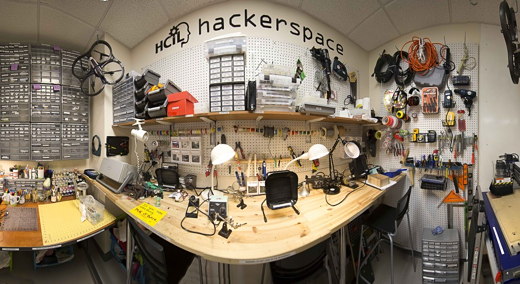
They are similarly oblivious to the hacktivists developing community-driven alternatives to Uber and Airbnb, and to the work of the social-and-solidarity-economy (SSE) movement to build multi-stakeholder cooperatives for social services.

But that’s precisely why those seeking profound change should be paying attention to these experiments. The commons sector goes beyond the orthodox approach to social change and justice, which tends to privilege individual rights and the redistribution of wealth via the tax system and government programs.

Instead, the animating ideals of the commons are collective emancipation and the “pre-distribution” of benefits by giving people direct ownership and control over discrete chunks of land, water, infrastructure, housing, public space, and online services.

With greater equity stakes and opportunities for self-governance, people are remarkably eager to contribute to their communities, whether local or digital. They welcome an escape from consumerism, exploitative markets, and remote bureaucracies.

These sorts of local and regional experiments not only advance effective structural solutions at a time when national politics is dysfunctional; they also provide meaningful ways for ordinary people to become agents of change themselves.

Almost 50 years ago, Fannie Lou Hamer came up with a shrewd strategy for dealing with community disempowerment—in her case, the vestiges of the plantation system and exploitative white-owned businesses.

The civil-rights leader purchased hundreds of acres of Mississippi Delta farmland so that poor blacks could grow their own food. “When you’ve got 400 quarts of greens and gumbo soup for the winter, nobody can push you around or tell you what to say or do,” Hamer noted.

This is roughly the same strategy that must be pursued today. Relocalizing and decommodifying production and services represents a compelling strategy for the small cities, towns, and rural areas that have been ruthlessly hollowed out by big-box stores, online retailers, automation, big agriculture, and outsourcing.

In fact, that’s just what the local-food movement has done over the past few decades.

Faced with a long list of agribusiness horrors—pesticides, processed foods, monoculture farming, seed monopolies, a loss of biodiversity, and more—countless champions of localism retrenched to create a semi-autonomous parallel economy on their own terms: community-oriented, fair-minded, humane, and ecologically respectful.


Image above: The shares of produce from Smolak Farms of North Andover, Massachusetts is an example of successful Community Supported Agriculture (CSA) that began as a farm stand over 30 years ago. From (https://roadtrippers.com/us/detroit-mi/food-drink/eastern-market-detroit).

Today, there are more than 1,650 community-supported agriculture (CSA) projects and more than 8,000 local farmers’ markets across the country. Organic farming is a robust market sector, and agroecology and permaculture are pointing the way to eco-friendly approaches.

In California, the Food Commons Fresno project is one of the most ambitious regional efforts to reimagine the food system from farm to plate.

Even though Fresno is located in the heart of prime agriculture lands, the region has been ecologically abused for decades and is a food desert for half a million low-income residents and farm workers.

To develop systemic solutions, the Food Commons has established a network of community-owned trusts that bring together landowners, farmers, food processors, distributors, retailers, and workers to support a shared mission: high-quality, safe, locally grown food that everyone can afford.

Instead of siphoning away profits to investors, the Food Commons mutualizes financial surpluses on a system-wide scale, reducing market pressures to deplete the soil, exploit farm workers, degrade food quality, and raise prices.

This approach, writes the social thinker John Thackara, “marks a radical shift from a narrow focus on the production of food on its own, towards a whole-system approach in which the interests of farm communities and local people, the land, watersheds and biodiversity are all considered together.”

Another impressive innovation in regional self-determination is the BerkShares currency, launched in 2006 by the Schumacher Center for a New Economics (where I work) in the largely rural Berkshires of western Massachusetts. The goal is to strengthen the local economy and community life by reengineering the flow of money.

Anyone can exchange $100 in US currency for $105 worth of BerkShares at any of four banks with a total of 16 branches throughout Berkshire County, and then spend them at 400 participating businesses.

Consumers get a 5 percent bump in purchasing power from this buy-local strategy while boosting the regional economy and strengthening the region’s identity.

The BerkShares story is part of a global trend in which dozens of localities worldwide are deploying their own currencies to reclaim some measure of control from hedge funds and banks.


New-economy renegades are not shy about engaging with the policy world, but many regard it as a rigged game that won’t yield the transformations needed. In the meantime, they ask, why not grow our own greens and make our own gumbo soup?

As in Fannie Lou Hamer’s day, the focus should be on securing tangible results and greater leverage for change.
 
Relocalization strategies can also help reinvigorate democratic self-governance. Just as the rise of public-interest organizations in the 1970s propelled far-reaching changes, today our economic future is taking shape in new organizational forms.

Innovative cooperative structures, pool-and-share projects, self-managed digital platforms, and collaborative global networks are changing the topography for pursuing social change. 

One of the most notable new forms may be the platform cooperative, a socially constructive alternative to Silicon Valley start-ups, which famously like to “move fast and break things.”

Gig-economy companies rely on heaps of capital, proprietary algorithms, and political muscle to control new markets that leapfrog over government standards for public safety, fair labor, and consumer protection.

Platform co-ops are attempting to write a different story: Instead of using networking technologies to extract money from communities for the benefit of investors and speculators, platform co-ops work with communities, workers, and consumers to share the gains.

 These dynamics play out at Stocksy United, a global co-op of photographers that sells royalty-free stock photos and video, and on service-swapping platforms like TimeBanks, which uses a currency of hours contributed to helping people meet needs and build circles of mutual support.

Another vanguard player is Enspiral, a New Zealand–  based cooperative that developed the popular Loomio platform for online deliberation and decision-making. (For more on platform co-ops, see The Internet of Ownership)

When community commitment and digital platforms come together, they often give rise to “cosmo-local” production, as Michel Bauwens of the P2P Foundation calls it.

This is a new model of manufacturing that allows “light” nonproprietary knowledge and design to be collaboratively produced on a global scale, while enabling “heavy” physical things to be produced locally at minimal cost. This fledgling model could greatly reduce carbon emissions and transport costs while building local economic capacity.


Image above: The University of Maryland Human-Computer Interaction Lab hackerspace. From (http://terp.umd.edu/step-inside-a-hackerspace/#.WZNDvYVDSQk).

The rudiments of cosmo-local production are evident at fab labs (short for “fabrication laboratories”) and so-called hackerspaces—participatory communities of socially minded artists, designers, engineers, entrepreneurs, and techies who use computer-assisted tools to produce vanguard industrial designs.

This production approach has been dubbed “SLOC”—small and local, but open and connected—a framework that scrambles the standard understanding of the economy as controlled by nation-states and corporations.

SLOC integrates the local and transnational into a remarkably creative provisioning sector—commons-based peer production—that is already developing farm equipment (Farm Hack, Open Source Ecology), furniture (Open Desk), houses (WikiHouse), animated videos (Blender Institute), and cars (Wikispeed).

To conventional policy minds, altering the micro-dynamics of organizations may seem irrelevant to the task of making broadscale social change. But transforming organizational systems and cultures on a small scale may be one of the most effective ways to bring about macro-change.

Just as the microprocessor and the telecommunications network changed the inner dynamics of business, eventually transforming the global economy itself, the rise of self-organized governance and networked collaboration is opening up strategic opportunities on a larger scale.

Attempting to move beyond neoliberal capitalism may sound naive. But over the past two decades, some remarkable progress has already been made.

Besides a range of relocalization strategies, a new sector of commons-based peer production has revolutionized software development, scientific research, academic publishing, education, and other fields by making their outputs legally and technically shareable.

In the halls of government, however, policy-makers and even progressives show little interest in the profound political and economic implications of free and open-source software, Creative Commons licenses, citizen science, data commons, open educational resources, and open design and hardware.

Most of these and other movements are seen as too small, local, unorthodox, or little-known to be consequential. They don’t swing elections. Their participants tend to eschew politics and policy, and often don’t regard their work as part of a unified movement.


They see themselves as part of a pulsating pluriverse of autonomous projects, each working diligently in its own separate sphere.

Counterintuitively, this pluriverse may fuel a true progressive revival. “The next big thing will be a lot of small things,” the designer Thomas Lommée predicted recently, neatly capturing the structural logic of postcapitalist movements and the generativity of the Internet.

Acting on this insight calls for a new mind-set. Greater attention should be paid to places and players on distributed networks. The swarms of self-selected individuals and projects should be recognized as serious actors that can meet real needs in new ways.

We also need to acknowledge the limits of markets and centralized bureaucracies, which are so often hell-bent on asserting total control, engineering dependencies, and eliminating the space for social deliberation and genuine human agency.

By enabling self-organized groups to bypass large institutions and formal systems of authority, and to set their own terms for establishing social trust and legitimacy, we enter the headwaters of a new kind of politics, one that is more accountable, decentralized, and human-scale.

The substantive, local, and practical move to the fore, challenging the highly consolidated power structures and ideological posturing that have turned our national politics into a charade.

But, skeptics ask, can these countless small, irregular initiatives scale up? The question carries the false premise that some form of centralized management or hierarchical control is needed.

As a creature of open networks and sharing, the new social economy will not be directed by a political headquarters or a federal program. That kind of control would kill it.

The participatory local economy will expand only by engaging a diverse base of American pragmatists. That just might be possible, since it offers something for everyone.

As my colleague Silke Helfrich puts it: “Conservatives like the tendency of commons to promote responsibility and community; liberals are pleased with the focus on equality and basic social entitlement; libertarians like the emphasis on individual initiative; and leftists like the idea of limiting the scope of the market.”

To be sure, a constructive rapprochement with state power will have to be negotiated at some point, and in the meantime supportive laws and infrastructures would certainly help.

But the success of the commons sector will hinge on the independent vitality of its projects, the integrity of its bottom-up participation, and the results it produces.

Emulation and federation—these are the means by which a new participatory sector will expand. The point is to create the conditions for grassroots initiatives to self-organize and grow.

It helps to recall that the New Deal didn’t spring fully grown from the brain of Franklin D. Roosevelt, but emerged over time as the policy’s many precursors nurtured brave experiments for years. We need to plant a field of new seeds today if we are going to have anything to harvest in the years to come.

In defense of the neoliberal revolution in the 1980s, British Prime Minister Margaret Thatcher famously thundered a phrase that is often shortened to its acronym, TINA: “There is no alternative!”

The result has been nearly 40 years of privatization, deregulation, austerity, and corporate governance, now reaching their farcical, destructive extremes.

For those seeking to overcome this awful legacy, along with the oxymoron of “democratic capitalism,” it is time for a rejoinder: “There are plenty of alternatives!” The only question is whether the Democratic Party and mainstream progressives have any use for them.


.