Showing posts with label Natural Gas. Show all posts

Ocean Warming on Steroids

SUBHEAD: Humans adding a half dozen Hiroshima A-bombs of heat per second to oceans.

By Eong Higgins on 14 January 2020 for Common Dreams -
(https://www.commondreams.org/news/2020/01/14/adding-five-six-hiroshima-bombs-heat-each-second-study-shows-oceans-warming-record)


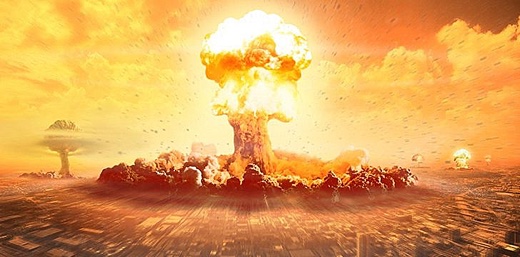
Image above: Illustration for article "Three Times The World Almost Entered A Nuclear War". From (https://www.thefactsite.com/nuclear-war/).

A new study published Monday shows that the Earth's oceans reached the highest temperatures and warmed the fastest since records began, highlighting the urgent need for global action to address the climate crisis before it's too late.

The study (pdf), "Record-Setting Ocean Warmth Continued in 2019," which was published in Advances in Atmospheric Studies, found the oceans have warmed by around 0.075 degrees C above the average of 1981-2010.

That level of warming, the paper found, is equal to:
 228,000,000,000,000,000,000,000 (228 Sextillion) Joules of heat. 

Study lead author Lijing Cheng, associate professor with the International Center for Climate and Environmental Sciences at the Institute of Atmospheric Physics of the Chinese Academy of Sciences analogized the level of heating to something more manageable for the human mind.

"The amount of heat we have put in the world's oceans in the past 25 years equals to 3.6 billion Hiroshima atom-bomb explosions," said Cheng. 

"This measured ocean warming is irrefutable and is further proof of global warming. There are no reasonable alternatives aside from the human emissions of heat trapping gases to explain this heating."

The warming is speeding up, the scientists found.

"We are now at five to six Hiroshima bombs of heat each second," study co-author John Abraham, a professor of mechanical engineering at the University of St. Thomas, told CNN.

Abraham said in a statement Monday announcing the study's publication that the public needs to be aware "how fast things are changing."

"The key to answering this question is in the oceans—that's where the vast majority of heat ends up," said Abraham. "If you want to understand global warming, you have to measure ocean warming."

The ocean warms slowly, said Cheng, but due to its vast size has dire consequences.

"The price we pay is the reduction of ocean-dissolved oxygen, the harmed marine lives, strengthening storms and reduced fisheries and ocean-related economies," Cheng said. "However, the more we reduce greenhouse gasses, the less the ocean will warm."
.

BlackRock reveals its Eco-Strategy

SUBHEAD: Investment company plans to fight Climate Change with its new strategy.

By Eoin Higgins on 14 January 2020 for Common Dreams  -
(https://www.commondreams.org/news/2020/01/14/massive-victory-blackrock-ceo-promises-center-climate-change-investment-strategy)


Image above: From ().

In a letter to investors Tuesday, Larry Fink, CEO of money management firm BlackRock, announced the company would prioritize the climate crisis in deciding on investments and strategies going forward—a major victory for the environmental movement.

The new direction for BlackRock, the largest investment firm in the world which manages assets of around $6.96 trillion, is the result of a hard-fought effort by a group of dedicated activists, tweeted 350 Action co-founder Bill McKibben.

"This is a massive victory for a small band of fighters," said McKibben.

"It gives us enormous confidence as we take on the giant banks," he added. "When we start to fight we start to win."
As Common Dreams reported last week, a new campaign called "Stop the Money Pipeline" is aimed at stopping financial support for the fossil fuel industry and has BlackRock as one of its primary targets.

Fink says in his letter to investors that he believes "we are on the edge of a fundamental reshaping of finance."

"The evidence on climate risk is compelling investors to reassess core assumptions about modern finance," Fink wrote.

According to the New York Times:
The firm, he wrote, would also introduce new funds that shun fossil fuel-oriented stocks, move more aggressively to vote against management teams that are not making progress on sustainability, and press companies to disclose plans "for operating under a scenario where the Paris Agreement’s goal of limiting global warming to less than two degrees is fully realized."
Diana Best, senior strategist for the Sunrise Project, said in a statement that Fink's letter was a welcome first step.

"BlackRock beginning its shift of capital out of fossil fuels, including today's divestment of coal in its actively managed funds, is a fantastic start and instantly raises the bar for competitors such as Vanguard and State Street Global Advisors," said Best. "We will be looking for additional leadership from the company in, as Larry Fink put it, 'fundamentally reshaping finance to deal with climate change,' including additional shifts of capital out of fossil fuels."

Sunrise Project is a key player in the BlackRock's Big Problem campaign.

Climate advocates celebrated the letter as a victory for years of activism and protest, but warned that the firm would have to be held accountable for its behavior going forward.

"BlackRock's coal divestment decision is yet another significant blow to the already dying market, yet major banks like Barclays continue to prop up coal-heavy companies," said ShareAction campaign manager Jeanne Martin. "If BlackRock is serious about its commitment to phase out thermal coal, it should use its voting rights to get major coal financiers to do the same."

In a statement, the Sierra Club's campaign representative Ben Cushing said BlackRock's decision was a watershed moment while warning the letter needs to be backed up by immediate and concrete action to divest from dirty investments.

"As the biggest financial institution in the world, BlackRock's announcement today is a major step in the right direction and a testament to the power of public pressure calling for climate action," said Cushing. "But BlackRock will continue to be the world's largest investor in coal, oil, and gas."

"It is time to turn off the money pipeline to dirty fossil fuels for good," Cushing added..

Predictions for 2019

SUBHEAD: "Ding Ding! - Margin Call USA". Reality is about to bite us in the ass.

By James Kunstler on 31 December 2018 for Kunstler.com -
(http://kunstler.com/clusterfuck-nation/forecast-2019-ding-ding-margin-call-usa/)


Image above: The Greenleaf subdivision near Dawsonville Georgia was abandoned several years ago after it was found to be at the center of a mortgage fraud scheme. The developers knew the project was doomed from the start, as there were no public sewer lines anywhere in the area they could hook up to, and the lots were too small for septic tanks.From (https://imgur.com/gallery/G6SIf).

[IB Publisher's note: Two books published in 2005 transformed my understanding of the real world. The books were Jared Diamond's "Collapse" and James Kunstler's "The Long Emergency".Both identified the mortality and suicidal tendencies of human civilization. Together they provoked a reevaluation of my understanding of how the world works and our future in it. I am indebted to their clear thinking. Over time I came to personally know Kunstler. My wife Linda and I visited him twice in upstate New York. I even worked briefly with his agent on a movie proposal for his novel "World Made By Hand" (2008) that describes the unwinding and aftermath of a collapse of America as we know it. Over subsequent years we have kept in touch. I realized our thinking was wandering apart over our differences of opinion about the TV series "Treme" that premiered in 2010. "Treme" follows the lives of people in the Ninth Ward of New Orleans in the aftermath of hurricane Katrina. Many of the primary characters were black and/or female. Kunstler could not "get" the show at all. He could not getr through half the premier episode because it seemed to him incoherent and foreign - a zombie apocalypse. Since then I have come to realize Kunstler holds a resentment that many white male Baby-Boomers about increasing emergence of women and black people into positions of American privileges. Did they earn it? Did George Bush? Anyway, with that caution in mind I continue to read Kunstler with a bit of caution. I think he is still spot-on in his understanding of money and energy - the grease on the gears of Western Civilization. This post is an excerpt from his predictions for 2019, hopefully less the white male screed. Happy New Year!]   

Markets and Money
The jig is really up. The big bad bear market is already underway, even if it rallies in January. The debt bubble engineered by the Federal Reserve is blowing up and thundering through the system.

The epic market instability of December 2018 on the heels of persistent Fed rate hikes points to major credit problems and especially an inability to roll over old debt into new loans at higher interest rates — in particular loans to zombie enterprises that need to borrow to keep paying interest on previous loans (a lot of that among the shale oil companies).

The US government can’t take higher interest rates either. It’s already paying about as much in annual interest on US debt as we pay for our war machine. There are only two ways out, both of them nasty.

Either suck up debt defaults, which will induce an impoverishing disappearance of money; or provoke high inflation, by injecting more Central Bank QE “money” into the system, which can destroy the value of money.

Inflation is typically the choice of governments because it reduces the face value of debts while it allows government to pretend that it is taking action.

In the end, you may have plenty of worthless money, which is no different from having not enough money that retains value. The latter was the main feature of the Great Depression.

So, inflation is the usual choice, but it also typically leads to incendiary resentment among the citizenry when they realize they’ve been played and it takes a wheelbarrow full of cash to buy a loaf of bread and a jar of peanut butter.

I suppose that Fed chief Jerome Powell knows all too well he’s popped the Mother-of-All-Bubbles. He can blame it on Mr. Trump. Everybody else will, of course.

Sometime in the second quarter of 2019, the Fed will resume the money-for-nothing gambit of “quantitative easing” in the hope of arresting the damage, but this time the dollar will lose value uncontrollably and catastrophically. Many people will be ruined, especially retirees at the mercy of insolvent pension funds.

Before 2019 is out, the US could find itself in a situation worse than the Great Depression. Supply lines are much longer now than they were then.

If suppliers can’t get paid because trust has collapsed in the short-term corporate paper system, they won’t deliver supplies, which means you may not eat, or fill your gas tank, or heat your house, or get whatever else you need.

Also, the USA in 1931 had not yet transformed itself into the fiasco-waiting-to-happen called suburban sprawl. How is Dallas going to work for people who spend a substantial chunk of their income on mandatory motoring (if there’s little or no income)?

Stock market activity may appear to stabilize in January, but it will go south again later on in the first quarter and the Bear will growl louder for the rest of the year.

Civil Disorder
Be prepared for it in 2019. There are going to be a lot of pissed-off people around the country. They are liable to attack Federal property and their fellow citizens (and their property).

The hungrier they are, the worse it will be. They will not understand the forces that are destroying the money system.

There are a gazillion small arms out there and the government will not be able to control them or confiscate them. Any attempt to do that will only inflame the situation.

A major principle of The Long Emergency is that government becomes increasingly impotent and ineffectual as it rolls out. We’re already seeing that in Washington, and it is not at all just because Mr. Trump has inspired such an impasse between the branches. The states, too, will be hard-pressed to do anything useful.

Many of them, like Illinois, New Jersey, Connecticut, and California, are already technically insolvent. The federal government may have to pretend to rescue them financially, which will only make the national predicament worse.

Oil
The shale oil “miracle” was an impressive stunt. For a while, it goosed US production way above the former all-time production peak of 1970, and it achieved that with astounding speed — about a decade. But this is oil that is very expensive and complex to produce. It was made possible by massive borrowing at artificial low interest rates, which are now rising.

Something like three-quarters of the shale operators never made a red cent in net profit, and many of these companies will find it hard or impossible to roll over their existing debt, especially with oil under $50-a-barrel.

But the price is a deceptive metric. If it zoomed up to $100-a-barrel tomorrow, the effect would only be to crush economic activity, because industry requires cheaper oil to pencil out its operations and citizens can barely afford to drive when gasoline hits $4-a-gallon at the pump.

At the lower $45-a-barrel, the price crushes the oil producers. Take your pick. There’s no “Goldilocks” price.

The other problems with shale oil have to do with the nature of the shale plays. The Permian Basin in Texas is very large, but the best plays are developed in the so-called “sweet spots” and there’s a limited amount of them.

They are the places that the producers developed first, and when they are played out, the next round of plays will be in spots not-so-sweet (or productive) — possibly not worth drilling. The character of the shale oil wells is also way different from the old conventional classic oil wells. The old wells cost about $400,000 (in current dollars). It involved just sinking a pipe into the permeable source rock.

The oil came out under its own pressure at the rate of thousands of barrels a day.  Eventually, you put a simple pump-jack on the well (the “nodding donkey”) and it produced for decades, like running a cash register. Shale oil wells cost between $6- 12 million.

They require technically demanding horizontal drilling and fracking, with additional costs in highly technical labor, water for fracking, sand to hold open the fracks, chemicals to aid the process, and a gazillion truck trips to deliver all the water and sand (and take the oil away).

Shale wells produce maybe a few hundred barrels a day for one year, after which they typically deplete by over 60 percent.

After four years, they’re done. The oil is also different. Shale oil is typically ultra-light. It contains little-to-none of the heavier diesel, kerosene, jet fuel, and heating oil distillates, making it less valuable.

Trouble in the credit markets could shut down shale production for a period of time and create dire problems for the American economy. That could happen in 2019 as poorer-performing companies fail to get new financing.

As mighty as it seems to be, the industry is fraught with fragility.

Meanwhile, discovery of new, producible oil has fallen to the lowest level since the 1940s, after three recent previous record low years. Current low oil prices at around $45-a-barrel may give Americans a false sense of security.

Low prices are mostly indicative of the collapse of the demand for oil at the global margins and among the large US demographic that cannot afford it anymore — that is, the impoverished former middle class.

As the damage becomes more obvious, we could hear calls to nationalize the oil industry. The attempt to do that would collide with the aforementioned trend for government to become more strapped  for revenue, more impotent, and more incompetent.

Geopolitical
The Golden Golem has gone an extra mile to antagonize Russia the past two years. Is it to demonstrate how not Putin’s puppet he is? If so, it’s pathetic.

For instance, heaping ever more sanctions on Russia, tossing Russian diplomatic staff out of the country because of the laughable Novichok poisoning of the Skripal father-and-daughter in Britain. Nobody believed that set up — who recovers from the world’s supposedly most potent, high-tech military toxin?

The larger Russia hysteria, ginned up by the US “Intel Community” to cover the embarrassment of Hillary Clinton’s election loss, has destroyed the brains of thousands of Washington insiders and infected whole sectors of the educated coastal elites who really ought to know better.

Meddling in elections? Is that something the US has never entertained?

Recall that 1996 Time Magazine cover with the headline that bragged, “Yanks to the Rescue: the Secret Story of How American Advisors Helped Yeltsin Win.”

And now we’re wetting our pants over a baker’s dozen Russian Internet trolls on Facebook?

Yes, this is what the brightest people in the room have been doing for two years. The net result is a new cold war, pushing Russia into the arms of China, giving both of those countries an incentive to construct a new framework for global relations that excludes the toxic US as much as possible.

That new framework, by the way, will not be the same as the late, unwinding Globalism Release 2.0 (Release 1.0 was 1870 – 1914) that allowed America to exchange IOUs for flatscreen TVs lo these many years. Let’s call that Tom Friedman Globalism, after the pundit who said it would last forever.

The world will become a wider place again as the Great Powers are increasingly bound to their own regions for trade relations in a world growing short of energy and capital resources. The exception to that is in weaponry, now that Russia has demonstrated its ability to launch hypersonic rockets that can reach the US in little more than a few Noo Yawk minutes.

Do we have anything like that?

I suppose we wish we did. The media is not even talking about it, the implications are so dreadful.

Has Mr. Trump actually accomplished anything with his deal-seeking in China while beating it on the snout with his tariff stick?

Well, he got a lot of US companies loading up on inventory of goods they feared will carry costly duties a year hence, so they’re all stocked up just in time for a vicious bear market and the recession / depression that it entails. A lot of that stuff may end up being distributed by the bankruptcy judges.

How does our antagonism against China work with the campaign to “normalize” the behavior of North Korea. I doubt it helps. In 2019, North Korea will be the whoopie cushion that China places under America’s seat at the negotiating table.

Mr. Trump defied the conventional State Department wisdom by meeting face-to-face with Kim. It got the two Koreas actually speaking with each other for the first time in 60 years, with some concrete steps toward ending the de facto state-of-war.

Will Li’l Kim play the role China assigns to him? I think so. They can squash him like bug. And, of course, everything that the US congress and Mr. Mueller do to injure and weaken Mr. Trump will make further progress in Korea unlikely.

How about the second greatest economy in the world? That would be the European Union.

The EU’s financial system is way more dysfunctional than even ours, with no mechanism or provision for regulating each country’s spending vis-à-vis the debt generation of the Union as a whole.

There’s no way it can continue and no prospect for debugging the set-up. What’s more, decades-long shenanigans of the European Central Bank have created imbalances that will never be corrected.

Even the attempt to normalize operations — as the ECB ceases its debt monetization routines starting in the first quarter of 2019 — is guaranteed to crack up the EU economy, which is a horror show of zombie companies and zombie banks. They will suffer particularly in the recession / depression to come.

The next domino to fall, theoretically Italy, will take the EU down, whatever happens with the dithering over Brexit. Without the ECB vacuuming up unwanted EU paper, nothing really pencils out over there. In 2019, expect a substantial fall in the value of the Euro, and possibly its demise as a currency.

In fact, expect wholesale disintegration of many structural arrangements all over Europe beginning in 2019, along with more political violence that exceeds the simple street actions of the Yellow Vests in France.

NATO has been staging war games on Russia’s border for two years, apparently with no awareness that the NATO members are deeply dependent on Russian oil and natural gas to remain advanced nations with comforts and conveniences, like heating their homes. Perhaps that recognition will hit in 2019. But there will be plenty of noise for that signal to cut through.

Climate Change
Something’s going on ‘out there’ though the picture is deeply non-linear and is being confused for the moment by an extraordinary low level of cyclical sunspot activity. Not being a scientist, I have only two salient points worth considering about the issue:

The first is, we’re not going to do anything about it — because nothing can be done about it. Whatever’s happening, we’re going to have to roll with it. I’m also not persuaded that many of the proposed mitigations — carbon taxes, seeding the upper atmosphere with reflective particles — will accomplish anything.

The second thought is this: the civilized world has experienced many many instances of climate change over the past several thousand years. Civilizations rise and fall with these changes, but the human project as a more general matter continues, with periods of history that appear to be restful time-outs.

The Roman Optimum (warming period) segued into the Dark Age Cooling, and then the Medieval Warming (viniculture in England!), and eventually the Little Ice Age comes along with Isaac Newton and skaters on the Dutch canals.

 The difference this time is that our civilization is so deeply complex that successful adaptation to new conditions is a low percentage outcome, at least in the form of salvaging many of our current arrangements.

In other climate disruptions, people adapted, sometimes with very severe changes in customs, practices, political arrangements, and life-styles.

It will be especially stark this time, and the broad pop culture of Collapse suggests that we intuit this — everything from Game of Thrones to The Road, to my own World Made By Hand novels.

It begins with the wobbling of the most abstract and fragile of our systemic arrangements, finance, which is mostly based on ephemeral trust (that the other fellow will pay you).

From there, the trouble proceeds to politics and culture.

[IB Publisher's postscript: And that is the most optimistic view possible. I personally think we are closer to extinction than that. As a reminder see this 2011 "Scientific American" article One Time Through the Bottleneck - "Almost 200,000 years ago humans faced extinction. Only a few hundred were saved along the coast of Cape Horn"].  Happy New Year!


.
State of Failure

SUBHEAD: How is it in Bashar al-Assad’s interests to provoke a fresh international uproar against him and his regime?

By James Kunstler on 9 April 2018 for Kunstler.com  -
(http://kunstler.com/clusterfuck-nation/state-of-failure/)


Image above: War Criminal Votes. Bachar al-Assad and his wife Asma at a polling place during a recent vote in Damascus, Syria. From (http://www.newindianexpress.com/world/2018/mar/19/syrias-assad-congratulates-vladimir-putin-on-natural-victory-1789486.html).
BEIRUT, Lebanon — Days after President Trump said he wanted to pull the United States out of Syria, Syrian forces hit a suburb of Damascus with bombs that rescue workers said unleashed toxic gas.
Fool me once, shame on you; fool me twice, shame on me, the old saying goes. So, tread carefully through the minefields of propaganda laid for the credulous in such low organs as The New York Times.

There are excellent reasons to suppose that the American Deep State wishes strenuously to keep meddling all around the Middle East.

The record so far shows that the blunt instruments of US strategic policy produce a consistent result: failed states.

Syria was well on its way to that sorry condition — prompted by an inflow of Jihadi maniacs fleeing our previous nation un-building experiment in Iraq — when the Russians stepped in with an arrantly contrary idea: to support the Syrian government.

Of course, the Russians had ulterior motives: a naval base on the Mediterranean, expanded influence in the region, and a Gazprom concession to develop and manage large natural gas fields near the Syrian city of Homs, for export to Europe.

The latter would have competed with America’s client state, Qatar, a leading gas exporter to Europe.

But the US objected to supporting the government of Bashar al-Assad, as it had previously with Saddam Hussein and Muammar Gaddafi, as well as Russia’s presence there in the first place.

So, the US cultivated anti-government forces in the Syrian civil war, a hodgepodge of Islamic psychopaths variously known as ISIS (Islamic State of Iraq and the Levant), Daesh, al-Qaeda, al-Nusra, Ansar al-Din, Jaysh al-Sunna, Nour al-Din al-Zenki, and what-have-you.

As it happened, US policy in Syria after 2013 became an exercise in waffling. It was clear that our support for the forces of Jihad against Assad was turning major Syrian cities into rubble-fields, with masses of civilians caught in the middle and ground up like so much dog food.

President Barack Obama famously drew a line-in-the-sand on the use of chemical weapons. It was well-known that the Syrian army had stockpiles of chemical poisons.

But the US also knew that our Jihadi consorts had plenty of their own. Incidents of chemical atrocities were carried out by… somebody… it was never altogether clear or proven… and Mr. Obama’s line-in-the-sand disappeared under dust-storms of equivocation.

Finally, a joint mission of the United Nations Human Rights Commission (UNHRC) and the Organization for the Prohibition of Chemical Weapons (OPCW) was called in to supervise the destruction of the Syrian government’s chemical weapons, and certified it as accomplished in late 2014.

Yet, poison gas incidents continued — most notoriously in 2017 when President Donald Trump responded to one with a sortie of cruise missiles against a vacant Syrian government airfield.


Image above:  War Criminal Votes. Donald Trump, with his wife Melania, votes for himself at polling place during 2016 Presidential Election. From (https://qz.com/831181/election-2016-how-do-you-write-donald-trump-in-chinese/).

And now another incident in the Damascus suburb of Douma has provoked Mr. Trump to tweetstormed threats of retaliatory violence, just days after he proposed a swift withdrawal from that vexing corner of the world.

Surely by now the American public has developed some immunity to claims of nefarious doings in foreign lands (“weapons of mass destruction,” and all).

The operative sentence in that New York Times report is “…Syrian forces hit a suburb of Damascus with bombs that rescue workers said unleashed toxic gas.”

Yeah, well, how clear is it that the toxic gas was contained in the bombs, or rather that the bombs dropped by the Syrian military blew up a chemical weapon depot controlled by anti-government Jihadis?

Does that hodgepodge of maniacs show any respect for the UN, or the Geneva Convention, or any other agency of international law?

As in many previous such incidents, we don’t know who was responsible — though there is plenty of reason to believe that parties within the US establishment are against Mr. Trump’s idea of getting the hell out of that place, and might cook up a convenient reason to prevent it.

Lastly, how is it in Bashar al-Assad’s interests to provoke a fresh international uproar against him and his regime? I’d say it is not the least in his interest, since he is on the verge of putting an end to the awful conflict. He may not be a model of rectitude by Western standards, but he’s not a mental defective.

And he has very able Russian support advising him in what has been so far a long and difficult effort to prevent his state from failing — or being failed for him.

[IB Publisher's note: We have been at war in the Middle East since 2001 and at war in Syria since 2013. As Americans we are now in a state of perpetual war in that region that accelerates ecosystem collapse and permanent climate change and mass exodus. Next stop Iran!]

See also:
Ea O Ka Aina: Syriasly! 4/2/18
Ea O Ka Aina: US shoots down Syrian jet 6/19/17
Ea O Ka Aina: Australia suspends Syria overflights 6/ 20/17
Ea O Ka Aina: Syria poison gas story unravels 4/18/17
Ea O Ka Aina: Source of Sarin gas attack faked? 4/14/17
Ea O Ka Aina: US has used DU in Syria 2/19/17
Ea O Ka Aina: Ms Gabbard goes to Syria 1/29/17
Ea O Ka Aina: Trump amps up war in Syria 1/29/17
Ea O Ka Aina: US shoots down Syrian drone 1/20/17
Ea O Ka Aina: Need for New Syria Policy 12/19/16
Ea O Ka Aina: To prevent still worse in Syria 10/4/16
Ea O Ka Aina: WWIII has begun in Syria 9/23/16
Ea O Ka Aina: Skidding towards Syrian War 6/19/16
Ea O Ka Aina: Hillary and the Syrian Bloodbath 2/15/16
Ea O Ka Aina: Road to World War III 2/14/16
Ea O Ka Aina: Don't Bomb Syria 11/28/15
Ea O Ka Aina: Ten reasons not to overthrow Syria 11/23/15
Ea O Ka Aina: Tulsi Gabbard on Syria 11/1/15
Ea O Ka Aina: Michele won't go to Syria 9/10/13
Ea O Ka Aina: Pentagon's Syrian Blackout 6/6/13
Ea O Ka Aina: Syria a preview of 2030 6/2/13
.

Renewable Revolution

SUBHEAD: Renewables to capture 3/4 of the $10 trillion world spends on new generation through 2040.

By Joe Romm on 15 June 2017 for Think Progress -
(https://thinkprogress.org/renewables-projected-to-crush-fossil-fuels-f6670e3792df)


Image above: Last year, solar in Chile saw lowest global price for unsubsidized electricity by any technology. Source Bloomberg New Energy Finance. Credit BNEF New Energy Outlook 2017. From original article.

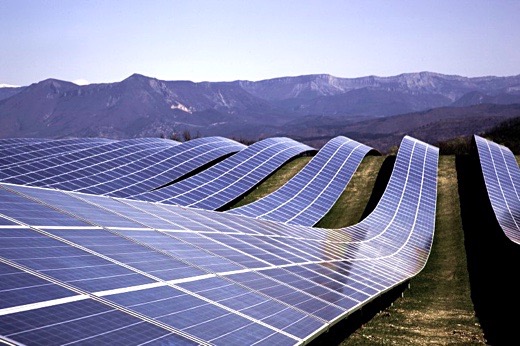
The staggering drop in the cost of clean energy has already upended the global power market over the past two decades — and that trend will only continue for the next two decades, according to new analysis from Bloomberg New Energy Finance (BNEF).

As a result, renewables will capture the lion’s share of the $10.2 trillion the world will invest in new power generation by 2040, BNEF projects in its annual New Energy Outlook 2017 report.

http://www.islandbreath.org/2017Year/06/170622chart1big.jpg
Image above: Charts of Investment by Technology 2017-2040. Source: Bllomberg New energy Finance. Credit: BNEF New Energy Outlook 2017 From original article. Click to enlarge.


Despite years of plummeting prices for renewables, BNEF projects that over the next two decades, the cost of solar power will still drop another two-thirds, onshore wind costs will be cut nearly in half, and offshore wind costs will drop a stunning 71 percent.

Here’s how this will profoundly transform power markets in the years ahead:
  • By 2023, solar and onshore wind will be competitive with new U.S. gas plants.
  • By 2028, solar will beat existing gas generation.
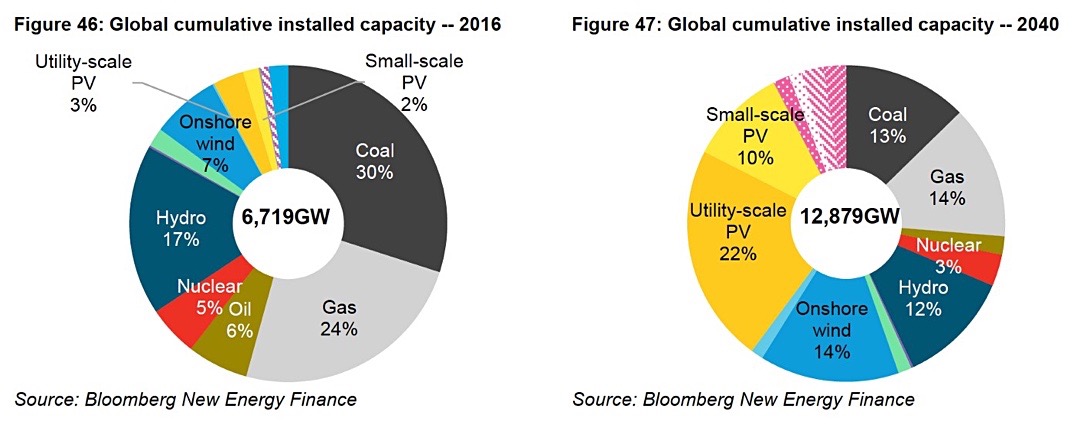
  • Solar and wind will make up nearly a half of installed capacity and over a third of global power generation by 2040. That’s a four-fold jump in wind capacity and a 14-fold jump in solar from today.
http://www.islandbreath.org/2017Year/06/170622chart2big.jpg
Image above: Charts of global cumulative installed capacity 2016 and 2040. Source: Bloomberg New energy Finance. Credit: BNEF New Energy Outlook 2017 From original article.


Deep penetration of renewables will be assisted by continued price drops in lithium-ion batteries and explosive growth in electric cars: “This will help renewable energy reach 74 percent penetration in Germany, 38 percent in the U.S., 55 percent in China, and 49 percent in India by 2040.”

BNEF concludes that despite President Donald Trump’s vocal support for the coal industry, “economic realities over the next two decades” work against it, and U.S. coal power generation is “forecast to see a 51 percent reduction in generation by 2040.”

Here’s another key conclusion: “Gas is a transition fuel, but not in the way most people think.” Other than in the Americas, where cheap gas is plentiful, gas plants won’t act as a replacement for “baseload coal,” but will “increasingly act as one of the flexible technologies needed to help meet peaks and provide system stability in an age of rising renewable generation,” BNEF predicts.

With total renewable investment over the next two decades projected to be $7.2 trillion versus $1.5 trillion for fossil fuel power, it’s clear where the biggest high wage job growth will come from.

.

Dumb and Dumber

SUBHEAD: Coal-loving Wyoming legislators are pushing a bill to outlaw wind and solar.

By Katie Herzog on 14 January 2017 for Grist -
(http://grist.org/briefly/coal-loving-wyoming-legislators-are-pushing-a-bill-to-outlaw-wind-and-solar/)


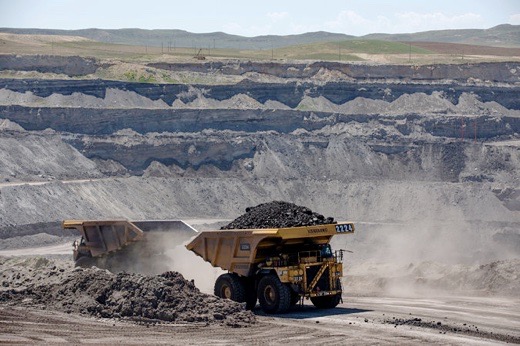
Image above: The Eagle Butte coal mine outside Gillette, Wyoming is operated by Alpha Coal West Inc. and is one of about a dozen mines in the Gillette area. From (https://www.nytimes.com/2016/06/20/us/as-wind-power-lifts-wyomings-fortunes-coal-miners-are-left-in-the-dust.html).

On the first day of the state’s legislative session, nine Republican lawmakers filed legislation that would bar utilities from using electricity produced by large-scale renewable energy projects.

The bill, whose sponsors are primarily from the state’s top coal-producing counties, would require utilities to use only approved energy sources like coal, natural gas, nuclear power, hydroelectric, and oil.

While individual homeowners and small businesses could still use rooftop solar or backyard wind, utilities would face steep fines if they served up clean energy.

Wyoming is the nation’s largest producer of coal, and gets nearly 90 percent of its electricity from coal, but it also has huge, largely untapped wind potential.

Currently, one of the nation’s largest wind farms is under construction there, but most of the energy will be sold outside Wyoming. Under this bill, such out-of-state sales could continue, yet the measure would nonetheless have a dampening effect on the state’s nascent renewable energy industry.

Experts are skeptical that the bill will pass, even in dark-red Wyoming, InsideClimate News reports. One of the sponsors, Rep. Scott Clem, is a flat-out climate change denier whose website showcases a video arguing that burning fossil fuels has improved the environment.


.

Gas pipeline meets aging nuke plant

SUBHEAD: Algonquin pipeline expansion is to be adjacent to crumbling Indian Point nuclear power plant.

By Karenna Gore on 26 October 2016 for the Daily News -
(http://www.nydailynews.com/opinion/karenna-gore-pipeline-people-planet-article-1.2844870)


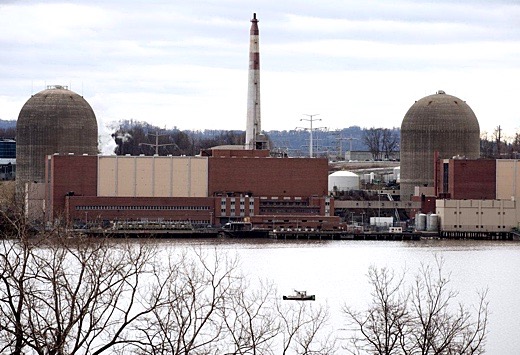
Image above: Indian Point Nuclear Power Plant on the Hudson River is where the Algonquin high pressure fracked gas pipeline is planned to cross the river.  Photo by Don Emmert. From original article.

Americans face a big decision on Nov. 8. But another high-stakes battle over our future is taking place closer to home.

Twenty-five miles north of the city, a private company is trying to force a high-pressure fracked-gas pipeline beside the Indian Point nuclear power plant and under the Hudson River. This fossil-fuel project would harm our climate and present the immediate threat of an accident that could contaminate our air, soil and water.

The Algonquin Incremental Market Expansion — or AIM project — consists of 37 miles of new pipeline and six compressor stations designed to push gas fracked from the shale fields of Pennsylvania through New York, New England and on to Canada for possible export.

 It was conceived by Spectra, a Texas-based corporation recently absorbed by Enbridge, a Canadian multinational (and owner of $1.5 billion stake in the Dakota Access Pipeline).

Spectra was granted eminent domain power by the Federal Energy Regulatory Commission, an agency notorious for rubber-stamping projects for the industry. Despite community outcry and trouble getting the pipe under the river, Spectra still plans to turn on the gas next Tuesday.

This is terribly risky. Indian Point sits near two earthquake fault lines and stores 40 years of highly radioactive spent fuel rods. If the AIM pipeline ruptures — and the number of accidents on U.S. gas transmission pipelines (143 in 2015) indicates that is a real possibility — the ensuing radioactive release could impact up to a 50-mile radius, where 20 million people live.

Faulty Indian Point pipe forces nuclear reactor shutdown — again
 
According to nuclear engineer Paul Blanch, the approval process for AIM was inherently flawed and did not take into account the nature of high-pressure fracked-gas pipelines. He and other experts warn that an accident at the intersection of AIM and Indian Point would be far worse than the Fukushima disaster in Japan in 2011, which resulted in the evacuation of tens of thousands of people.

Elected officials have taken notice, but not enough to make a difference. In February, Gov. Cuomo called for a halt to construction while the state conducted an independent risk assessment. In August, New York Sens. Chuck Schumer and Kirsten Gillibrand asked for a halt and an independent review of health, safety and environmental impacts.

Massachusetts Sens. Ed Markey and Elizabeth Warren have written the Federal Energy Regulatory Commission (FERC) about clear conflicts of interest in its approval process, and the City of Boston is among those suing the project.

But FERC is designed to respond to the industry rather than the public trust.

Anti-Indian Point activists warn of safety hazards at plant
 
If the placement of this pipeline is puzzling, so is the timing. A study released last month by Oil Change International found that if we do not accelerate the transition to renewable energy sources, we will face catastrophic climate change.

At the very least, this means flooding of coastal cities like New York, extreme weather and more refugees and strife as people flee places that have become uninhabitable.

Although commonly called natural gas, the fuel that would flow in this pipeline is more properly called methane. When burned, it has half the carbon emissions of coal.

But that is still too much carbon at a time when the atmosphere has just passed the threshold of 400 parts per million. Scientists have determined that when methane leaks or is released from gas operations, which is common, it is 84 times more heat-trapping over a 20-year period than carbon dioxide.

The threats to our health, safety and planet don’t end there. New York City water sources are located 12.4 miles from Indian Point. As the Standing Rock Sioux say, “Water is life.” Why would we endanger a common source of this most basic human need?

Indian nuke plant shutdown after 'missing' bolts discovered
 
We should not accept this high threshold of danger at the vulnerable Indian Point power station. We should not let a foreign company profit from tearing up the Hudson riverbed and putting New Yorkers at risk.

We should build a bridge to tomorrow’s economy, not to yesterday’s. President Obama must intervene with his administration’s energy regulatory commission and halt construction of this dangerous fossil fuel pipeline now.

See also:
Ea O Ka Aina: NoDAPL reclaim new frontline 10/24/16
Ea O Ka Aina: Amy Goodman "riot" charge dropped 10/17/16
Ea O Ka Aina: Amy Goodwin to face "Riot Charge" 10/16/16
Ea O Ka Aina: Shutdown of all tar sand pipelines 10/11/16
Ea O Ka Aina: Why Standing Rock is test for Oabama 10/8/16
Ea O Ka Aina: Why we are Singing for Water 10/8/16
Ea O Ka Aina: Labor's Dakota Access Pipeline Crisis 10/3/16
Ea O Ka Aina: Standing Firm for Standing Rock 10/3/16
Ea O Ka Aina: Contact bankers behind DAPL 9/29/16
Ea O Ka Aina: NoDAPL demo at Enbridge Inc 9/29/16
Ea O Ka Aina: Militarized Police raid NoDAPL 9/28/16
Ea O Ka Aina: Stop funding of Dakota Access Pipeline 9/27/16
Ea O Ka Aina: UN experts to US, "Stop DAPL Now!" 9/27/16
Ea O Ka Aina: No DAPL solidarity grows 9/21/16
Ea O Ka Aina: This is how we should be living 9/16/16
Ea O Ka Aina: 'Natural Capital' replacing 'Nature' 9/14/16
Ea O Ka Aina: The Big Difference at Standing Rock 9/13/16
Ea O Ka Aina: Jill Stein joins Standing Rock Sioux 9/10/16
Ea O Ka Aina: Pipeline temporarily halted 9/6/16
Ea O Ka Aina: Native Americans attacked with dogs 9/5/16
Ea O Ka Aina: Mni Wiconi! Water is Life! 9/3/16
Ea O Ka Aina: Sioux can stop the Pipeline 8/28/16
Ea O Ka Aina: Officials cut water to Sioux 8/23/16  

.

Fossil Fuels for foreseeable Future

SUBHEAD: Chevron CEO sees fossil fuel use as indispensable for our future - not Earth's.

By Chevron CEO John S. Watson on 30 August 2016 for LinkedIn -
(https://www.linkedin.com/pulse/why-i-think-oil-natural-gas-indispensable-foreseeable-john-s-watson)


Image above: Chevron CEO John S. Watson (l) talks to LinkedIn Editor Dan Roth (r). From original article.

[IB Publisher's Note: This is another good reason to not join LinkedIn. It's like FaceBook without your family or posse. Just a bunch of buzzards looking to make a few more bucks. What a surprise - Chevron's Chief Executive Officer is for fossil fuel usage to keep the industrial world growing for the foreseeable future. Not a word is mentioned about CO2, Global Warming, Ocean Rising or Climate Change. His case: "Fossil fuels have enabled the greatest advancements in living standards over the last 150 years." But at what cost - a livable planet Earth?]

I recently met with LinkedIn Executive Editor Dan Roth to talk about the current state of the oil and natural gas industry, which he noted has seen almost 70 bankruptcies this year, lower profits and a large number of layoffs. Dan wondered how Chevron could continue to attract employees – particularly millennials.

It’s a fair question – for those outside the oil and natural gas industry. Those of us in the industry know the products we develop are indispensable to the economies of the world. And so, even as we work our way through this low-price environment, we’re confident in the future.

During my 36 years with Chevron, oil prices have dropped 50 percent or more five times. In the most recent fall, oil went from a high of just over $115 a barrel to under $50 a barrel in just six months. When prices fall, industry pulls back on investment and scales back the workforce in line with activities.

Ours is a long-term business, so we know that eventually supply and demand will come back into balance and prices will stabilize. The global economy depends on it.

The energy we produce enables light, heat, mobility, mechanized agriculture, modern communications, the health system that keeps us well, and the many electronic devices that keep us connected and entertained. It’s also the feedstock for everything from crayons to contact lenses, not to mention the basis of our roads and runways.

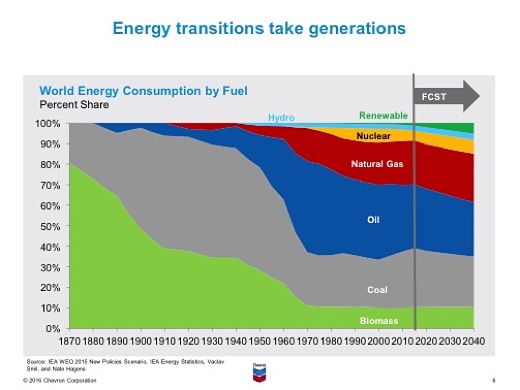
More than 50 percent of the world's energy currently comes from oil and natural gas – and another nearly 30 percent from coal. Fossil fuels have enabled the greatest advancements in living standards over the last 150 years.

They’re abundant; reliable; energy-dense; can be stored; provide multiple, high-value consumer products beyond power and fuel; and have a global infrastructure of refineries, pipelines, ships, and distribution systems that’s been more than a century in the making.


Image above: Chevron chart of industrial energy sources from 1870 to forecast of 2040. Note that fossil fuels make up 20% of energy in 1870 and over 80% in 2040. The planet Eaarth will be a cinder at that rate. From original article.

And yet, despite the depth and breadth of today’s energy market, there are still 1.2 billion people in the world without electricity and more than 2.7 billion people who still burn solid fuels, such as wood, crop residue and dung, to cook their food. Enabling affordable and reliable energy for these people, even as we maintain our modern lifestyles, is critical to global economic growth and stability.
Fossil fuels have enabled the greatest advancements in living standards over the last 150 years.
This will require more energy in the years ahead than we can possibly produce by renewable sources given today’s technology. Most forecasts call for global energy demand to rise by around one third or more by 2040 as populations grow, incomes rise and people all over the world strive for the standard of life we enjoy today. It’s clear that to meet those needs we’ll need all forms of energy – renewables, oil, natural gas, coal and nuclear.

Although the use of renewables will grow, under the International Energy Agency’s New Policies Scenario (with calculations based on current and projected emissions policies) we see oil and natural gas are forecast to account for 50 percent of global energy demand by 2040.

 Even in its 450 Scenario (which accounts for a greater reduction in emissions), oil and natural gas will still account for 44 percent, with coal providing an additional 16 percent.

Despite rapid growth in installed capacity, the share of total primary energy demand supplied by wind and solar generation is expected to still be about 3 percent in 2040.

While that’s a big jump from the less than 1 percent of the energy supplied by these renewables today, those forecasts make clear that, without a game-changing energy technology breakthrough, renewables will be insufficient to independently provide enough affordable and reliable energy to meet the needs of the developed world while also raising the living standards of developing countries.

Bill Gates notes that energy is critical to lifting people out of poverty. “If I could have just one wish to help the poorest people, it would be to find a cheap, clean source of energy to power our world,’’ he said in his 2016 annual letter.

“You might be wondering, `Aren’t people just trying to stay healthy and find enough to eat? Isn’t that important too?’ Yes, of course it is…But energy makes all those things easier. It means you can run hospitals, light up schools, and use tractors to grow more food.”

Gates predicts the world will uncover a clean-energy breakthrough within the next 15 years. Chevron supports continued research into early-stage technologies to find that breakthrough.

And while this search is underway, the world will continue to need energy from the mix of sources that we have today. That doesn’t mean we won’t see efficiency and environmental improvements along the way.

Industry, in partnership with governments and universities, has a good track record of advancing technology to make energy more efficient while addressing environmental priorities.

Since I was a kid, automotive tailpipe emissions have been reduced 98 percent, and electric vehicles have moved from an innovative idea into an integral – although still small – part of our nation’s roadways.

At the same time, the oil and natural gas industry has continued to find more resources and ways to recover more of them efficiently, economically and safely. In the past decade alone, we’ve used innovation and technology to transform the U.S. energy story from one of scarcity to one of abundance.

This can’t be done without always maintaining the right people in the right jobs at the right time. Even in today’s business environment, we’ve continued to hire, develop and train our employees. Demographics indicate a large retirement wave in the next 5-10 years, and we have to ensure we have the necessary talent in place to continue to advance our industry.

The energy sector has been, and will continue to be, transformed over a long sweep of time. But this transformation must be compatible with meeting our economic and environmental priorities, and that means oil and natural gas will remain critical.

These fuels remain for the foreseeable future the foundation of the energy economy, keeping the world’s lights on, its factories running, and the transportation system moving. People want to work for us because our products make life better.

.

Ukraine Hubris Circus

SUBHEAD: You don’t win a war with a Haircut In Search Of A Brain, not even a PR war. Those days are gone.

By Raul Illargi Meijer on 5 March 2014 for the Automatic Earth -
(http://www.theautomaticearth.com/debt-rattle-mar-4-2014-the-hubris-circus/)


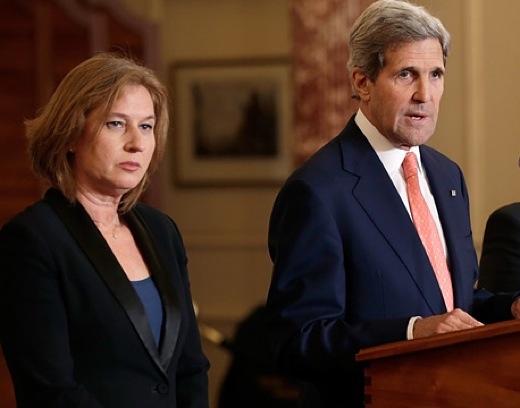
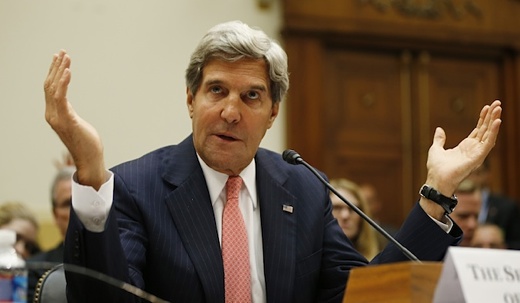
Image above: Assistant Secretary of State Victoria Nulandm (L) Secretary of State John Kerry (the “Haircut In Search Of A Brain”). From (http://www.theguardian.com/world/video/2013/jul/30/israeli-palestinian-peace-deal-nine-months-video).

Arguably, the US lost its first PR war over Vietnam. When its young and hopeful started dying on live TV, it was over. Never again, swore spin doctors on all sides of Capitol Hill. Over the past 40-odd years, PR and spin techniques have been substantially refined, and the media – both written and TV -, hard as it may have seemed at the time, have moved much closer to the government’s PR interests. So much so that one can figuratively speaking expect to be burned at the stake for suggesting Edward Snowden is anything like today’s Woodward and Bernstein.

As I was watching John Kerry land in Kiev today, and walk with his insane security detail to places where protesters were shot, only very recently, the lost PR war of 4 decades ago came to mind. God knows they’re still trying with all their might, just watch CNN, and read the Washington Post, but it looks very much like a lost cause.

The Washington Post runs a long piece entitled Behind the West’s Miscalculations in Ukraine; the basic tenet is that the US left it to Europe to deal with Ukraine and Yanukovych, and the EU screwed up, so now John Kerry has to step in and they will never leave this kind of important project up the Europeans again.

And granted, the EU probably didn’t do a great job either, but A) who would believe Washington would leave a project of the geopolitical magnitude of Ukraine up to others, and B) the article doesn’t name Assistant Secretary of State Victoria Nuland even once. While it’s very clear from recordings that she was pivotal in bringing “Yats” to power – she about hand-picked him – and keeping “Klitsch” out.

If you’re the Washington Post, and you run a long story on the “West’s Miscalculations in Ukraine”, but you neglect to mention the number one – public – US operative, then what does that say about Woodward and Bernstein’s legacy? For Peep’s sake, Nuland is walking in Kiev with Kerry on live TV as we speak, but you just ignore her in your article?

The “Haircut In Search Of A Brain” Kerry (as Jim Kunstler adequately christened the Secretary of State) came traveling with the promise of a $1 billion loan to the self-appointed new Kiev government. He better make sure the documents are iron clad, in case “Yats” is outta there in a few weeks time and the next government refuses to pay up.

That $1 billion number was what Yanukovych turned his back on in negotiations with Europe last fall, presumably when the absolutely full of themselves EU crew started attaching ever more IMF and World Bank conditions to it, and Putin had offered him $15 billion.

Apparently, that took everyone by surprise, including the US as represented by Nuland and ambassador Pyatt. And now Kerry comes a-carrying the same $1 billion again, undoubtedly with more strings attached than a spinning wheel. The entire western circus is just drowning in its own hubris.

NATO holds a special meeting today. So do the EU foreign ministers. And they’re all of them on the phone with the White House all the time. They’re extremely busy looking at bans and sanctions. And what do we have so far? The US has halted military cooperation with Russia.

Yeah, that’ll hurt … A secret document in Britain that the Guardian got hold of calls for any sanctions to leave rich Russians’ investments in London real estate alone. That’s got to have made Putin chuckle.

Economic sanctions? I bet you you can’t find anyone who can assure you those would hurt Russia more than it does the west. So count them out. Like what, we’re not going to buy your oil and gas anymore, Vlad?

I see estimates of high (60 days) EU gas reserves after a very mild winter across the continent, but so what? Are Germany et al going to risk first banning Russian gas, and then start buying again, in the hope that Putin will have learned his lesson?

For all they know, he’ll just double the price. Apart from all that, don’t forget that contracts have been signed, and you can’t just break those. Moscow sells $180 billion worth of mostly oil and gas to Europe, and Europe sells Moscow $120 billion in machines and various other items.

And whatever you may think of Putin, he’s consistent in his message: Russia reserves the right to protect the Russians and ethnic Russians who live in Ukraine.

And despite all sorts of denials in western media that these people are under threat, why should they, or we for that matter, feel sure about that? We’ve seen the anti-Russian sentiments. And If you don’t know what that looks like, try 12 Videos Showing Why Ukraine Fears And Stands Up To Radical Nationalists.

Putin also said today that Yanukovych in his view has no political future, something he indicated last week when he refused to meet with the ousted president. However, Putin maintains that Yanukovych is the only legitimate president of Ukraine, even if he fled to save his life. Which was in serious danger, little reason to doubt that.

Russia simply doesn’t recognize the “Yats”-led self named new government in Kiev. And that probably means “Yats” won’t be in power long. Kerry and his EU counterparts better prepare for that, and support a next PM, certainly before the May elections, if those take place.

No matter what you think, if you pay attention, it seems undeniable that Putin is winning the PR war on this one. No matter that Angela Merkel and Madeleine Munster Albright (who dug her up?) say he’s delusional and lives in another world, or Obama states he’s on the wrong side of history.

Riddle me this: if you want to have a constructive discussion with someone, to what extent does it help to say such things? And what is the person you’re saying it about supposed to make of it? Anyone notice that Putin doesn’t stoop to such levels? It seems that only the losers do.

The best assessment I saw today came from Russian/American journalist Vladimir Pozner on CNN, who said that whatever Putin does, he is always demonized by western media.

Pozner also remarked that there’s no such thing as one Ukraine, there are many different peoples gathered together under one flag. They of course have the same right to self-determination that all peoples are guaranteed under UN law.

And if the millions of Russians living in Ukraine feel threatened, and ask Putin for protection, should he deny that request? What would the US do if it had that kind of number of Americans under threat, and requesting aid, somewhere in the world, let alone on its own borders, like Mexico or Canada? I think we know the answer to that one.

Washington and Brussels would love to get a hold of the pipelines under Ukraine soil. And that they haven’t yet is certainly not for lack of trying. But they’re choking on their own hubris circus, and besides they should understand that Russia will never allow them control over those pipelines, because they keep the Russian economy alive.

It looks like a very real possibility that Ukraine will not survive in its present shape and form for much longer. And even though it would first of all be silly to blame that on Russia, even if Ukraine would split according to the wishes of its separate population segments, the pro west western part of the country should never get it into its head to as much as touch the pipelines.

Because that would carry with it a serious risk of warfare. It’s time for the western world to wake up from its hubris induced dreams of what once was. You don’t win a war with a Haircut In Search Of A Brain, not even a PR war. Those days are gone.

.

For Ukraine - Follow the Energy

SUBHEAD: Scrape away the media sensationalism and geopolitical posturing and it boils down to a simple dynamic... energy.

By Charles Hugh Smith on 3 March 2014 for Of Two Minds -
(http://charleshughsmith.blogspot.co.uk/2014/03/ukraine-follow-energy.html)


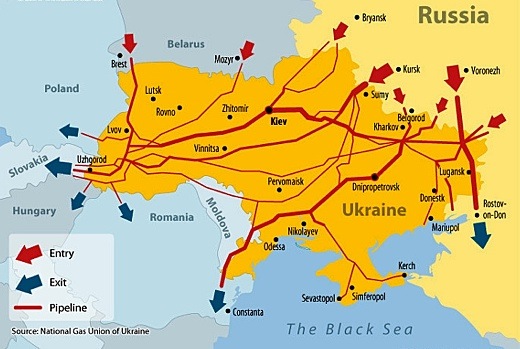
Image above: Map of Russian gas pipelines crossing the Ukraine and delivering to Europe. From (http://en.ria.ru/infographics/20090609/155206402.html).

Though many seem to believe that internal politics and geopolitical posturing in Ukraine are definitive dynamics, I tend to think the one that really counts is energy: not only who has it and who needs it, but where the consumers can get it from.

Let's cut to the chase and declare a partition along long-standing linguistic and loyalty lines a done deal. Let's also dispense with any notions that either side can impose a military solution in the other's territory.

Media reports on the weakness of Ukrainian military forces abound (for example, Ukraine Finds Its Forces Are Ill Equipped to Take Crimea Back From Russia), but Russia's ability to project power and hold territory isn't so hot, either.

A knowledgeable correspondent submitted these observations:

RE: Russian Army. Effective draft evasion is running 80%. Morale is low, training is very poor and poorly funded. The Russian army has also gone through 22 years of near continuous contraction.  
And this standing army has heavy commitments in the Caucasus and Far East Siberia. 
Moreover, at least half of these Russian ground troops are short term 12 month conscripts. I don't think these kids will produce many usable and motivated troops. The low morale recently seen in the Ukrainian Berkut and other police will be multiplied by at least 10x.  
Russian speaking Ukrainian bands are rumored to already be crossing the borders into Russia territory. They're to be ready to sabotage bridges and infrastructure and generally retaliate. Fluent Russian speakers with many years experience of living in Russia. 
Who can say for sure if this has already happened or is just being threatened? We can say this is a very real danger. These people look just like "Russians."  
And we can also say this threat will seriously complicate Russian rear area security and logistics. And speaking of logistics, the distances in south Ossetia and Abkhazia were very short and the populations were entirely friendly. Neither condition prevails in the Ukraine outside the Crimea.  
Supplying moving armored units over hundreds of miles of occupied country is very difficult logistically. The logistics for air assault helicopter units are just as bad. These helo units look mobile but they're a lot like a yoyo being twirled around your head on the string. They only go fast within a fixed radius anchored by logistics that are about as heavy to move as an armored division's supply columns. 
That is years in the 101st Airborne Division talking. The fuel consumption rates are immense. Stuff starts breaking down fast.Conclusion: a de facto partition is already baked in because neither side can force a re-unification. Various jockeying and posturing will undoubtedly continue for some time, but the basic end-game is already visible: de facto partition.

Let's move on to correspondent A.C.'s observations about energy.

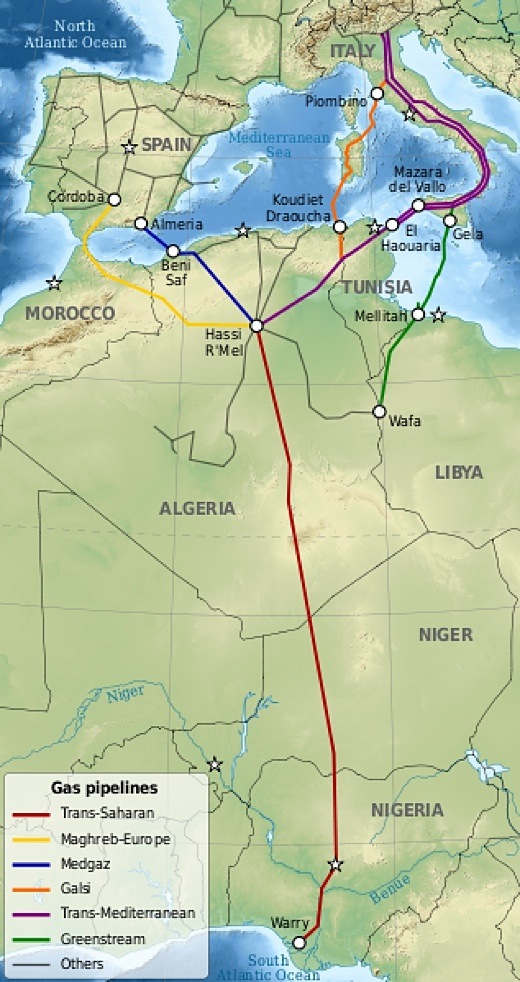
This map rounds out the European energy Rosetta Stone. When they hear that Italian fighter jets are over Tripoli, or that the French Foreign Legion has returned to the deep Sahara Desert, they can can better understand the reasons and real objectives of such operations.  

Image above: Map of gas pipelines across Mediterranean Sea and Sahara Desert. From (http://en.wikipedia.org/wiki/File:Gas_pipelines_across_Mediterranee_and_Sahara_map-en.svg).

Many have noted that the Russia economy is critically dependent on oil and gas exports to the EU. It should be noted that the converse is less true every day about EU dependence on Russian oil and gas. 
The Wall Street Journal even had a line about an EU proposal to push natural gas EAST to the Ukraine. It's hard to understand that passage or where the natural gas could come from unless one understands the North Africa to southern Europe gas pipelines.  
The factors bringing the conflict in Ukraine to a head are:  
  1. The natural gas discoveries in eastern Poland and western Ukraine played the largest role.
  2. The reduced importance of the gas pipeline running through the Ukraine to Europe as compared to 2009. Since that time the Nordstream lines have been finished and Gazprom acquired commercial control of the Belarus pipeline. The South Stream lines are well along in development.
  3. Fast developing liquid natural gas (LNG) seaport terminal infrastructure.
Events in Libya, Mali and Algeria are not hermetically isolated from this. They are part of a comprehensive energy policy problem being dealt with by the same leaderships. It increasingly looks like a series of peripheral Energy Wars that are being fought out for control of Europe.  
LNG exports are going to become a weapon in the struggle for geopolitical influence and control.  
This highlights another problem for Russia/Gazprom. Its present natural gas advantage in Europe now rests mainly on its pipeline infrastructure. This advantage is fading due to the current and proposed pipeline projects running through Turkey to Europe, plus LPG terminal & ship developments, plus the five trans-Mediterranean pipelines from Libya, Algeria and Morocco to southern Europe, plus local shale gas plays...  
The Ukraine is not the only country becoming less systemically important to Europe for natural gas supply. So is Russia. Current events will only accelerate everyone's efforts to diversify away from such an unstable and apparently dangerous supplier.  
I think the long-term fallout from the Ukrainian Crisis will be similar to China's attempt to exploit its temporary low price monopoly position in rare earth metals a few years ago. The result is rare earth metals are becoming less rare by the day as alternate mines outside China are opened and reopened.
Thank you, A.C. Scrape away the media sensationalism and geopolitical posturing and it boils down to a simple dynamic: follow the energy.
.

Let's you and him fight

SUBHEAD: Resource and capital scarcities drive down standards of living and lower the trust horizon in a time of failed states.

By James Kunstler on 3 March 2014 for Kunstler.com -
(http://kunstler.com/clusterfuck-nation/lets-you-and-him-fight/)


Image above: John Kerry's Lie: 'The President Is Not Asking You to Go to War'. From (http://www.theatlantic.com/politics/archive/2013/09/john-kerrys-lie-the-president-is-not-asking-you-to-go-to-war/279362/).

So, now we are threatening to start World War Three because Russia is trying to control the chaos in a failed state on its border — a state that our own government spooks provoked into failure? 

The last time I checked, there was a list of countries that the USA had sent troops, armed ships, and aircraft into recently, and for reasons similar to Russia’s in Crimea: the former Yugoslavia, Somalia, Afghanistan, Iraq, Libya, none of them even anywhere close to American soil. I don’t remember Russia threatening confrontations with the USA over these adventures.

The phones at the White House and the congressional offices ought to be ringing off the hook with angry US citizens objecting to the posturing of our elected officials. There ought to be crowds with bobbing placards in Farragut Square reminding the occupant of 1400 Pennsylvania Avenue how ridiculous this makes us look.

The saber-rattlers at The New York Times were sounding like the promoters of a World Wrestling Federation stunt Monday morning when they said in a Page One story:

“The Russian occupation of Crimea has challenged Mr. Obama as has no other international crisis, and at its heart, the advice seemed to pose the same question: Is Mr. Obama tough enough to take on the former K.G.B. colonel in the Kremlin?”

Are they out of their chicken-hawk minds over there? It sounds like a ploy out of the old Eric Berne playbook: Let’s You and Him Fight. What the USA and its European factotums ought to do is mind their own business and stop issuing idle threats. 

They set the scene for the Ukrainian melt-down by trying to tilt the government their way, financing a pro-Euroland revolt, only to see their sponsored proxy dissidents give way to a claque of armed neo-Nazis, whose first official act was to outlaw the use of the Russian language in a country with millions of long-established Russian-speakers. 

This is apart, of course, from the fact Ukraine had been until very recently a province of Russia’s former Soviet empire.

Secretary of State John Kerry — a haircut in search of a brain — is winging to Kiev tomorrow to pretend that the USA has a direct interest in what happens there. Since US behavior is so patently hypocritical, it raises the pretty basic question: what are our motives? 

I don’t think they amount to anything more than international grandstanding — based on the delusion that we have the power and the right to control everything on the planet, which is based, in turn, on our current mood of extreme insecurity as our own ongoing spate of bad choices sets the table for a banquet of consequences.

America can’t even manage its own affairs. We ignore our own gathering energy crisis, telling ourselves the fairy tale that shale oil will allow us to keep driving to WalMart forever. 

We paper over all of our financial degeneracy and wink at financial criminals. Our infrastructure is falling apart. We’re constructing an edifice of surveillance and social control that would make the late Dr. Joseph Goebbels turn green in his grave with envy while we squander our dwindling political capital on stupid gender confusion battles.

The Russians, on the other hand, have every right to protect their interests along their own border, to protect the persons and property of Russian-speaking Ukrainians who, not long ago, were citizens of a greater Russia, to discourage neo-Nazi activity in their back-yard, and most of all to try to stabilize a region that has little history and experience with independence. 

They also have to contend with the bankruptcy of Ukraine, which may be the principal cause of its current crack-up. Ukraine is deep in hock to Russia, but also to a network of Western banks, and it remains to be seen whether the failure of these linked obligations will lead to contagion throughout the global financial system. It only takes one additional falling snowflake to push a snow-field into criticality.

Welcome to the era of failed states. We’ve already seen plenty of action around the world and we’re going to see more as resource and capital scarcities drive down standards of living and lower the trust horizon. 

The world is not going in the direction that Tom Friedman and the globalists thought. Anything organized at the giant scale is now in trouble, nation-states in particular.  The USA is not immune to this trend, whatever we imagine about ourselves for now.

.

Savagery for All

SUBHEAD: THe Nazis wanted to erase the Slavic population altogether for the great fertile “breadbasket” of Ukraine.

By James Kunstler on 24 February 2014 for Kunstler.com -
(http://kunstler.com/clusterfuck-nation/4671/)


Image above: Provincial Ukrainian woman harvesting grain by hand. Enjoy this interesting set of photographs taken in different regions of Ukraine in the mid-20th century. From (http://ukrainetrek.com/blog/history/provincial-ukrainians-in-the-50s-of-the-20th-century/).

 A glance through the annals of history tells us that the Golden Age of Ukraine occurred just as western Europe was emerging from its long, dark, post-Roman coma around the 10th and 11th centuries, A.D. After that, it was a kind of polo field for sundry sweeping hordes of mounted hell-bringers: Tatars, Turks, Cossacks, Bulgars, Napoleon’s grand army. 

In modern times, its population was divided between allegiance to Russia or to the Germanic states of the west. The Russian soviet regime treated it very badly. As many Ukrainians starved to death under Stalin’s “terror famine” of 1932-1933 as Jews and others were killed later in Hitler’s death camps. Stalin went on to try and totally erase Ukraine’s ethnic identity.

The Nazis wanted to go even further: to erase the Slavic population altogether so that the great fertile “breadbasket” of Ukraine could provide lebensraum for German colonizers. Stalin foolishly signed a non-aggression pact with Hitler in 1939 — had he not read Mein Kampf? 

Less than two years later, Germany turned around and invaded Russia, using Ukraine as doormat and mud-room for a horrific struggle that left Kiev, the capital city of Ukraine, a virtual ashtray, and 28,000 villages destroyed.


Image above: Young woman in 1950's displaying traditional braided hair of provincial Ukraine.Political dissident Yulia Tymoshenko, who recently freed from Ukrainian prison, wears this style. From (http://ukrainetrek.com/blog/history/provincial-ukrainians-in-the-50s-of-the-20th-century/).

Culture, as we know, is resilient. But given that history, one wonders what the current disposition of all these historical tides portends. The few thousand Americans not completely distracted by tweeting the content of their breakfasts or shooting naked selfies or texting behind the wheel — yea, even the gallant minority not mentally colonized by the slave-masters of Silicon Valley — must wonder what the heck happened in the streets of Kiev last week. 

Or, as Sir Mick Jagger famously said at the deadly Altamont Speedway festival, “Who’s fighting, and what for?”

By the way, don’t count the editors of The New York Times among the aforementioned gallant minority of digital idiocy resisters. Today’s front page contained this rich nugget:

KIEV, Ukraine — Ukraine’s acting interior minister issued a warrant on Monday for the arrest of former President Viktor F. Yanukovych, accusing him of mass killing of civilian protesters in demonstrations last week…. Arsen Avakov, the acting official, made the announcement on his official Facebook page Monday.

Perhaps there’s a trend in this: all government information around the world will henceforth be transmitted by Facebook and Mark Zuckerberg will come to lead a New World Order of universal friendship. Remind me to send a friend request to Arsen Avakov and de-friend Victor F. Yanukovych.

I suppose the geopolitical bottom-line in all this is that the Ukrainians must feel more comfortable tilting toward a de-Nazified Germany than submitting to the attentions of a de-sovietized Russia.

>Both would-be patrons are dangling money before a rather cash-strapped Ukraine, which is faced by bond interest payouts that it can’t possibly come up with, not to mention some scratch to just keep the streetcars running. (Forgive me for pointing out that Ukraine at least has streetcars, unlike the USA, which just has cars on streets.)


Image above: Ukrainian girl in the mid 20th century with traditional regional dress holds bouquet of flowers. From (http://ukrainetrek.com/blog/history/provincial-ukrainians-in-the-50s-of-the-20th-century/).


Given the International Monetary Fund’s record as the West’s official loan shark, would a Ukraine government be wise to turn there for a handout? Meanwhile, is everybody pretending that the Ukraine is not crisscrossed by a great web of natural gas pipelines? And is it not obvious that the gas flows in one direction: from Russia to Europe.

So, how exactly would it benefit western Europe if Ukraine got more cuddly with them? Russia could still shut down the gas valve at the source? If the Europeans had any common sense, you’d think they would just butt out of this struggle and quit dangling money and offers of friendship to a nation whose greatest potential is to be a perpetual battleground in yet another unnecessary dreadful conflict.

Let’s hope the American government is just grandstanding in the background because we have less business in this feud than in the doings of Middle Earth. National Security Advisor Susan Rice was flogging ultimatums around on “Meet the Press” yesterday — some blather about right of the Ukrainian people “to fulfill their aspirations and be democratic and be part of Europe, which they choose to be.”

If anything, the uprising in Kiev last week should remind us that Europe’s history is long and deep in bloodshed and that one particular Ukrainian politician who employs snipers to shoot through the hearts of his adversaries is not the only person or party across that broad region capable of reawakening the hell-bringers.

There are quite a few other countries over there that could disintegrate politically in the months ahead, nations faced with insurmountable financial and economic troubles. The USA has enough problems of its own. Maybe it should just tweet a message to itself.

.

Promised Land

SUBHEAD: The natural gas industry hates the movie 'Promised Land' so much that it is boosting its popularity.

By Kurt Cobb on 6 January 2013 for Resource Insights -
(http://resourceinsights.blogspot.com/2013/01/why-natural-gas-industry-hates-movie.html)


Image above: Matt Damon promising riches in "Promised Land". From (http://resourceinsights.blogspot.com/2013/01/why-natural-gas-industry-hates-movie.html).

Matt Damon's new fictional movie about natural gas development in a rural township was being lambasted by the natural gas industry even before it premiered. And yet, the film shows no tanker trucks laden with toxic fracking fluid. It depicts no roughnecks descending on a small town unprepared for the influx of new workers. It features no ghastly wastewater ponds and not even one drilling pad or derrick. In fact, drilling has yet to begin in the fictional township of McKinley.

As a result there are no wheezing people made sick from fumes associated with the drilling. There are no flaming water taps--first seen by many in the documentary Gasland, a film which displays devastation which it attributes to hydraulic fracturing and other processes associated with natural gas drilling in America's deep shale deposits. In Promised Land there is not even one dead farm animal unless you count the ones pictured on a yard sign distributed by an environmental activist who opposes the drilling.

So why is the natural gas industry having such a hissy fit over the film? I think the answer lies in its premise: That the people of this small community ought to have a public discussion about whether they want the drilling--one informed by all the facts, not just the ones the natural gas drillers want them to hear--and that the community should then take a vote. God knows that in corporate America, democratic governance should never, ever take precedence over corporate imperatives. Could things be any more infuriating than that?

Well, yes they can. We are treated to acts of perfidy on the part of Steve Butler (played by Damon) who believes that everyone has a price, one that his company is only too willing to pay. Butler is a landman for a large drilling company though he is never referred to using this industry term. His job is to lease the mineral rights from landowners in the township quickly and cheaply. But a well-informed high school teacher (played by Hal Holbrook) challenges Butler at a meeting of townsfolk that was designed to close the deal. After that things get complicated. Butler and his partner, Sue Thomason (played by Frances McDormand), must abandon the playbook that has worked so well for them in the past and improvise.

As resistance grows, Butler and Thomason hurry to close as many deals as they can. Increasingly, people turn them down. Here is where Butler's frustration leaks out as he loses his cool in front of people he ought to be trying to gently persuade. Whether such flashes of temper accurately portray the behavior of landmen, I have my doubts. But these fits are illustrative of the arrogant attitude of the industry in general. How dare anyone question what the industry is doing to make America energy independent! How dare people who have so little money and so little prospect of getting any turn down the chance to become wealthy! How dare these little people from rural nowhere resist a big, powerful company that is only trying to help them, their communities, and the country at the same time!

Butler is likeable, even sweet when we first meet him. But later he seems to pout on behalf of the entire natural gas industry when he runs into inconvenient questions about his story and his motives. It's possible that people in the industry who watch the film will mistake his arrogance for righteous indignation, a pose which industry leaders have spent time perfecting so as to portray themselves as victims.

In his initial townhall-style meeting with community members, Butler challenges the townspeople saying that if they are against natural gas, then they are for more oil and coal consumption, both dirtier alternatives. He adds that the only other option is to reduce our energy use, and, of course, nobody wants to consider that. This is the one positively revolutionary thought slipped into the film. For it would be utterly revolutionary to proceed on the premise that we could remake our society into one that ultimately does not depend on fossil fuels for energy. The first crucial step would be to reduce our energy consumption dramatically. And, we actually know how to do this, both by adjusting our behavior and through existing technology. Optimists love to tout technology when talking about increasing the energy supply. They seem to forget that that same technological prowess can and should be focused on reducing our energy consumption. But then no oil and gas company can make a profit on that.

Will you be entertained by Promised Land? I was and I think an open-minded moviegoer will have much to enjoy in this film. The acting is excellent, the characters are well-developed, and the plot has enough twists to keep the audience interested. The script is a little heavy-handed in places. But keep in mind that this film is as much about an issue as it is about the characters. If the characters never talked about or defined the issue as carefully as they do, then Promised Land might still be a good film. But it would not be an issue-oriented film which is part of its appeal.

The reaction from the natural gas industry has been as predictable as it has been puzzling. By launching an all-out smear campaign, they are only helping to make Promised Land a must-see movie for 2013. Everyone will want to know what all the fuss is about, even those who have no strong feelings one way or another about fracking and natural gas. Those who do see the movie will certainly have more questions about the motives and veracity of the industry than before.

But the natural gas industry continues to be extraordinarily foolish in its handling of the media and completely idiotic in its reaction to environmental and health concerns. Instead of ignoring critics in the media, the industry has vilified them, thereby making them even more visible to the public. Instead of vowing to address environmental and health concerns with some kind of credible industry-wide standards, the industry has dismissed those concerns as imaginary, making the public all the more distrustful.

With that kind of track record, the producers of Promised Land should be thanking the natural gas industry for all the free publicity and for elevating what might otherwise have been an obscure, low-budget film into a contender for socially conscious movie-of-the-year--one that will now be labeled mandatory viewing for all right-minded people.


• Kurt Cobb is an author, speaker, and columnist focusing on energy and the environment. He is a regular contributor to the Energy Voices section of The Christian Science Monitor and author of the peak-oil-themed novel Prelude. In addition, he writes columns for the Paris-based science news site Scitizen, and his work has been featured on Energy Bulletin, The Oil Drum, OilPrice.com, Econ Matters, Peak Oil Review, 321energy, Common Dreams, Le Monde Diplomatique and many other sites. He maintains a blog called Resource Insights and can be contacted at kurtcobb2001@yahoo.com.

.