Showing posts with label Fascism. Show all posts

The Coming Collapse

SUBHEAD: One cannot grasp how fragile the decayed financial, social and political system is on the eve of implosion.

By Chris Hedges on 5 June 2018 for TruthDig -
(https://www.truthdig.com/articles/the-coming-collapse/)


Image above: Trump as Venus on the Halfshell. By Mr. Fish. From original article.

The Trump administration did not rise, prima facie, like Venus on a half shell from the sea. Donald Trump is the result of a long process of political, cultural and social decay. He is a product of our failed democracy.

The longer we perpetuate the fiction that we live in a functioning democracy, that Trump and the political mutations around him are somehow an aberrant deviation that can be vanquished in the next election, the more we will hurtle toward tyranny.

The problem is not Trump. It is a political system, dominated by corporate power and the mandarins of the two major political parties, in which we don’t count.

We will wrest back political control by dismantling the corporate state, and this means massive and sustained civil disobedience, like that demonstrated by teachers around the country this year. If we do not stand up we will enter a new dark age.

The Democratic Party, which helped build our system of inverted totalitarianism, is once again held up by many on the left as the savior.

Yet the party steadfastly refuses to address the social inequality that led to the election of Trump and the insurgency by Bernie Sanders. It is deaf, dumb and blind to the very real economic suffering that plagues over half the country. It will not fight to pay workers a living wage. It will not defy the pharmaceutical and insurance industries to provide Medicare for all.

It will not curb the voracious appetite of the military that is disemboweling the country and promoting the prosecution of futile and costly foreign wars. It will not restore our lost civil liberties, including the right to privacy, freedom from government surveillance, and due process. It will not get corporate and dark money out of politics.

It will not demilitarize our police and reform a prison system that has 25 percent of the world’s prisoners although the United States has only 5 percent of the world’s population. It plays to the margins, especially in election seasons, refusing to address substantive political and social problems and instead focusing on narrow cultural issues like gay rights, abortion and gun control in our peculiar species of anti-politics.

This is a doomed tactic, but one that is understandable. The leadership of the party, the Clintons, Nancy Pelosi, Chuck Schumer, Tom Perez, are creations of corporate America. In an open and democratic political process, one not dominated by party elites and corporate money, these people would not hold political power.

They know this. They would rather implode the entire system than give up their positions of privilege. And that, I fear, is what will happen. The idea that the Democratic Party is in any way a bulwark against despotism defies the last three decades of its political activity. It is the guarantor of despotism.

Trump has tapped into the hatred that huge segments of the American public have for a political and economic system that has betrayed them. He may be inept, degenerate, dishonest and a narcissist, but he adeptly ridicules the system they despise.

His cruel and demeaning taunts directed at government agencies, laws and the established elites resonate with people for whom these agencies, laws and elites have become hostile forces. And for many who see no shift in the political landscape to alleviate their suffering, Trump’s cruelty and invective are at least cathartic.

Trump, like all despots, has no ethical core. He chooses his allies and appointees based on their personal loyalty and fawning obsequiousness to him. He will sell anyone out. He is corrupt, amassing money for himself—he made $40 million from his Washington, D.C., hotel alone last year—and his corporate allies.

He is dismantling government institutions that once provided some regulation and oversight. He is an enemy of the open society. This makes him dangerous. His turbocharged assault on the last vestiges of democratic institutions and norms means there will soon be nothing, even in name, to protect us from corporate totalitarianism.

But the warnings from the architects of our failed democracy against creeping fascism, Madeleine Albright among them, are risible. They show how disconnected the elites have become from the zeitgeist. None of these elites have credibility. They built the edifice of lies, deceit and corporate pillage that made Trump possible.

And the more Trump demeans these elites, and the more they cry out like Cassandras, the more he salvages his disastrous presidency and enables the kleptocrats pillaging the country as it swiftly disintegrates.

The press is one of the principal pillars of Trump’s despotism. It chatters endlessly like 18th-century courtiers at the court of Versailles about the foibles of the monarch while the peasants lack bread.

It drones on and on and on about empty topics such as Russian meddling and a payoff to a porn actress that have nothing to do with the daily hell that, for many, defines life in America.

It refuses to critique or investigate the abuses by corporate power, which has destroyed our democracy and economy and orchestrated the largest transfer of wealth upward in American history.

The corporate press is a decayed relic that, in exchange for money and access, committed cultural suicide. And when Trump attacks it over “fake news,” he expresses, once again, the deep hatred of all those the press ignores.

The press worships the idol of Mammon as slavishly as Trump does. It loves the reality-show presidency.

The press, especially the cable news shows, keeps the lights on and the cameras rolling so viewers will be glued to a 21st-century version of “The Cabinet of Dr. Caligari.” It is good for ratings. It is good for profits. But it accelerates the decline.

All this will soon be compounded by financial collapse. Wall Street banks have been handed $16 trillion in bailouts and other subsidies by the Federal Reserve and Congress at nearly zero percent interest since the 2008 financial collapse.

They have used this money, as well as the money saved through the huge tax cuts imposed last year, to buy back their own stock, raising the compensation and bonuses of their managers and thrusting the society deeper into untenable debt peonage.

Sheldon Adelson’s casino operations alone got a $670 million tax break under the 2017 legislation.

The ratio of CEO to worker pay now averages 339 to 1, with the highest gap approaching 5,000 to 1.

This circular use of money to make and hoard money is what Karl Marx called “fictitious capital.”

The steady increase in public debt, corporate debt, credit card debt and student loan debt will ultimately lead, as Nomi Prins writes, to “a tipping point—when money coming in to furnish that debt, or available to borrow, simply won’t cover the interest payments. Then debt bubbles will pop, beginning with higher yielding bonds.”

An economy reliant on debt for its growth causes our interest rate to jump to 28 percent when we are late on a credit card payment. It is why our wages are stagnant or have declined in real terms—if we earned a sustainable income we would not have to borrow money to survive. It is why a university education, houses, medical bills and utilities cost so much. The system is designed so we can never free ourselves from debt.

However, the next financial crash, as Prins points out in her book “Collusion: How Central Bankers Rigged the World,” won’t be like the last one. This is because, as she says, “there is no Plan B.” Interest rates can’t go any lower.

There has been no growth in the real economy. The next time, there will be no way out. Once the economy crashes and the rage across the country explodes into a firestorm, the political freaks will appear, ones that will make Trump look sagacious and benign.

And so, to quote Vladimir Lenin, what must be done?

We must invest our energy in building parallel, popular institutions to protect ourselves and to pit power against power.

These parallel institutions, including unions, community development organizations, local currencies, alternative political parties and food cooperatives, will have to be constructed town by town. The elites in a time of distress will retreat to their gated compounds and leave us to fend for ourselves.

Basic services, from garbage collection to public transportation, food distribution and health care, will collapse. Massive unemployment and underemployment, triggering social unrest, will be dealt with not through government job creation but the brutality of militarized police and a complete suspension of civil liberties.

Critics of the system, already pushed to the margins, will be silenced and attacked as enemies of the state. The last vestiges of labor unions will be targeted for abolition, a process that will soon be accelerated given the expected ruling in a case before the Supreme Court that will cripple the ability of public-sector unions to represent workers.

The dollar will stop being the world’s reserve currency, causing a steep devaluation. Banks will close. Global warming will extract heavier and heavier costs, especially on the coastal populations, farming and the infrastructure, costs that the depleted state will be unable to address.

The corporate press, like the ruling elites, will go from burlesque to absurdism, its rhetoric so patently fictitious it will, as in all totalitarian states, be unmoored from reality. The media outlets will all sound as fatuous as Trump. And, to quote W.H. Auden, “the little children will die in the streets.”

As a foreign correspondent I covered collapsed societies, including the former Yugoslavia. It is impossible for any doomed population to grasp how fragile the decayed financial, social and political system is on the eve of implosion.

All the harbingers of collapse are visible:
  • crumbling infrastructure; 
  • chronic underemployment and unemployment; 
  • the indiscriminate use of lethal force by police; 
  • political paralysis and stagnation; 
  • an economy built on the scaffolding of debt; 
  • nihilistic mass shootings in schools, universities, workplaces, malls, concert venues and movie theaters; 
  • opioid overdoses that kill some 64,000 people a year; 
  • an epidemic of suicides; unsustainable military expansion; 
  • gambling as a desperate tool of economic development and government revenue; 
  • the capture of power by a tiny, corrupt clique; 
  • censorship; 
  • the physical diminishing of public institutions ranging from schools and libraries to courts and medical facilities; 
  • the incessant bombardment by electronic hallucinations to divert us from the depressing sight that has become America and keep us trapped in illusions.
We suffer the usual pathologies of impending death. I would be happy to be wrong. But I have seen this before. I know the warning signs.

All I can say is get ready.

.

Getting Past Trump

SUBHEAD: Instead of spreading democracy, we were more concerned with protecting our global oil supplies.

By Richard Heinberg on 7 March 2017 in Resilience - 
(http://www.resilience.org/stories/2018-03-07/getting-past-trump-this-is-how-democracies-die-part-1/)


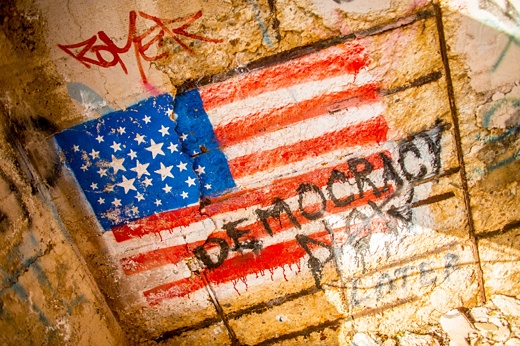
Image above: "Democracy Now!.. Later" illustration. From original article.

Donald Trump’s 13-month tenure (so far) as president of the United States has been an exhausting sprint for onlookers concerned about the state of the global ecosystem and the fate of industrial civilization.

Nearly every day begins with a new outrage — whether Trump’s gutting of the Environmental Protection Agency, his announcement of the US exit from the Paris climate accord, his selling off of national parks, his opening of coastal waters for offshore drilling, his easing of regulations on fracking, or his seeking subsidies for coal mining and coal power plants.

 Among my environmentalist friends and colleagues, “Trump fatigue” is a real and common ailment.

But much the same could be said for millions of citizens who are only peripherally interested in environmental issues.

They awake each morning to read about the Stormy Daniels scandal, the Rob Porter scandal, the Anthony Scaramucci hiring/firing scandal, the Mike Flynn scandal, the James Comey firing scandal, the Tom Price scandal, the White House nepotism and security clearance scandal. The list could go on and on; who can possibly keep up?

The Tweeter-in-chief is monopolizing attention at a moment in history when there are plenty of other things we really should be attending to, including climate change, resource depletion, plastic pollution in the oceans, mass species extinction, the fate of US labor unions, racial and social injustice, and worsening economic inequality.

These are the sorts of unaddressed problems that could cause even history’s “greatest” civilization to crack up.

But the conversation never seems to get past Trump, who obdurately obstructs action on these issues while commanding everyone’s constant adoring or horrified attention through divisive words and actions.

Naturally, many people are speculating about how the Trump nightmare might end. Two possibilities include Democrats obtaining majorities in Congress in the 2018 elections and initiating impeachment proceedings, or a presidential resignation following indictments of staff and family.

But Trump may not be dislodged so easily: A war or terrorist incident could give him the pretext to at least partly shut down the apparatus of democracy (including the Mueller investigation).

An Italian friend reminds me that Trump shares many characteristics with Silvio Berlusconi — who, despite frequent scandals, has managed to dominate national politics in Italy for nearly 20 years.

While I’m not prepared to make a prediction about Trump’s fate (there are just too many variables and unknowns), I have come to an unpleasant conclusion: While Trump will certainly be gone at some point — whether next month or years from now — we’re never going to return to the pre-Trump status quo.

The system is irremediably broken. Trump is both a symptom and an agent of that brokenness. What we can do is begin to reconnoiter and assess our new, unstable, still-emerging reality.

To even begin to understand this new reality, it is first essential to recognize its context. The United States, and industrial societies generally, are approaching the end of a decades-long fiesta of rapid economic and population growth founded upon cheap fossil energy.

I’ve discussed this grand trajectory in several books, notably The Party’s Over and The End of Growth, so it’s unnecessary to go into much detail here, except to note that absolute production figures for oil, coal and natural gas (which have been rising in recent years) are less crucial than the accelerating decline in the amount of energy that society receives in return for each unit of energy it invests in procuring more energy.

This erosion of energy return on energy investment is unavoidable, given the method by which fossil fuels are harvested, with low-hanging fruit always being picked first.

Energy is the prime mover of civilization; therefore, as net energy declines, so does society’s capacity to build complex infrastructure, and increase production and consumption.

Everyone feels this diminishing systemic dynamism, but — since surprisingly few people pay attention to slow but decisive shifts in our energy economy — almost nobody understands it, including the most exalted economists.

So, feeling symptoms of malaise but unable to diagnose the cause, most people are driven simply to find someone to blame — whether Wall Street bankers, immigrants, international competitors (for the US, that would include China), “lazy” poor people, entrenched Washington lobbyists and bureaucrats, or “socialists” in the mainstream media.

The waning of the world’s energy return on investment isn’t a sudden development. Our energy regime grew, matured and weakened in stages. Back in the years when it was “great,” the US was the engine of the global fossil fuel power train.

Prior to World War II, it was the world’s top producer and exporter of petroleum; it was also the foremost producer of coal and natural gas. But that gradually changed.

In the 1970s, US oil and gas production began to decline (this was decades before the fracking boom — a subject to which we’ll return shortly); the nation was already importing more and more of its energy supplies.

In the 1980s, globalization began, and the amount of debt in the US economy started growing much faster than the economy itself. Real (inflation-adjusted) incomes of most US workers stagnated or declined.

Debt was effectively being used to purchase the services that energy provides, with the understanding that payment would be made later with interest.

The use of debt to mask flagging economic momentum is an old trick, and — as economists and historians have discovered — it works for only a relatively short time before precipitating financial collapse.

Parenthetically, some readers may be wondering whether renewable energy might shift the curve of falling energy profitability. Unfortunately, the energy return on energy invested for solar and wind energy systems, once energy storage to make up for intermittency is included, is probably no higher than that of shale gas or tight oil:

The energy return from commercial photovoltaic panels is estimated at 10:1 in most US locations (without factoring the energy cost of batteries), whereas during much of the 20th century, oil provided a 50:1 energy payback or better.

Further, according to one recent study, installation rates for renewable energy would need to be roughly 10-times current rates in order to accomplish the transition to solar and wind before fossil fuel depletion and climate change undermine the current global industrial system.

By the first decade of the new millennium, it was clear to quickly growing ideological groups on the further ends of the political spectrum that the US was headed off the rails.

An insulated and arrogant foreign policy establishment in Washington was initiating costly, disastrous, illegal and unwinnable wars in Afghanistan and Iraq (with later detours to Libya and Syria).

Government and private debt was accumulating to truly frightening levels, with entitlements like Social Security and Medicare on track to boost government deficits exponentially in decades ahead. Rates of annual GDP growth were slowly but surely dwindling.

Levels of economic inequality were approaching those of the fabled Gilded Age, when Marxists and anarchists riled the disgruntled masses. The nation’s manufacturing base continued to erode due to globalization.

Massive industrial and transport infrastructure, built mostly during the high-energy decades of the mid-to-late 20th century, was aging and rusting. Following the Vietnam War and the collapse of the Soviet Union, it became harder to feel pride in being an American.

Instead of bringing democracy to the world, we were more concerned with protecting our access to global oil supplies, distracting ourselves with comic book hero movies and exporting a culture of celebrity worship.

An empire, built on the extraction of nonrenewable energy resources and on domination of world trade, was losing its grip.

Understandably, blame for unmet expectations fell largely upon elites — whether in government, the media, academia, the financial sector, science or the arts. But resentment toward immigrants and other easily scapegoated minority groups was also increasing in some quarters.

Enter Donald J. Trump, real estate developer and reality-television star. According to later reporting by Michael Wolff and others, Trump — who lacked experience in electoral politics — had no realistic expectation of winning the presidential race of 2016; he mainly hoped to increase his visibility and the value of his brand.

This meant he was free to say anything, however politically incorrect or factually erroneous, to rouse his audiences.

Trump, with help from self-styled political theorist Steve Bannon, promised to destroy the “administrative state” — the human bureaucracy and mass of regulations that propped up the failing status quo.
  • He would “shake things up” by shredding global trade agreements and renegotiating bilateral trade treaties to the US’s advantage.
  • He would radically reduce taxes.
  • He would rebuild the nation’s fraying infrastructure.
  • He would reduce both undocumented and documented immigration.
  • He would prevent the US from getting involved in more needless, costly wars.
  • He would “drain the swamp” in Washington, DC. And by doing these things, he would “Make America Great Again.”
When, to nearly everyone’s surprise (reportedly including his own), Trump won the presidency, he found himself in a tough spot: His team did not include enough competent people to fill newly emptied positions in the various agencies of the executive branch of government.

The few available personnel consisted mostly of ideologues, hangers-on and fellow grifters — often evincing as little relevant job experience as Trump himself — as well as people avowedly dedicated to the destruction of the agencies to which they would be appointed.

Over time, the new president and his team generated more and more dysfunction, resulting in a string of firings and resignations. As government, it was a trainwreck; but as reality TV, it was as riveting.

Meanwhile, the status of the nation’s all-important energy economy was more hidden from view than ever due to the temporary spectacle of soaring US oil and gas production from fracking. Rates of domestic shale gas and tight oil production were soaring, leading the new president to speak of US “energy dominance.”

But companies specializing in producing these fuels were — and are — doing so at an overall financial loss, propped up by cheap debt and investor hype. Their inability to turn a profit is a clear symptom of eroding energy return on investment, but is rarely understood as such.

Inevitably, as interest rates rise and investors start demanding returns, the fracking bubble will pop even more quickly than it inflated.

What Trump has done politically is somewhat analogous to the country’s fracking frenzy. He spoke a politically forbidden truth — that the United States is headed toward the graveyard of empires; he then promised a return to “greatness.”

But just as fracking has failed to reverse the nation’s slide toward energy bankruptcy, Trump’s means of reviving its greatness (a budget-busting tax cut and divisive rhetoric) have only accelerated the US’s nosedive into economic, moral, social and political ruin.

.

Daily Stormer style guide

SUBHEAD: Twelve most insane rules from the Daily Stormer,  the biggest Neo-Nazi website on the internet.

By Kali Holloway on 15 December 2017 for Alternet.org-
(https://www.alternet.org/media/12-most-insane-rules-biggest-neo-nazi-website-internet)


Image above: The group National Socialist Movement (NSM) is notable for its violent anti-Jewish rhetoric, its racist views and its policy allowing members of other racist groups to join NSM while remaining members of other groups. From (https://www.splcenter.org/fighting-hate/extremist-files/group/national-socialist-movement).

[IB Publisher's note: As of today the site can be reached at (https://dailystormer.red/). Apparently Andrew Anglin's site has problems staying avaliable.]

The Daily Stormer is an online hub for racists, white nationalists, anti-Semites, neo-Nazis, and other assorted angry white men. It’s run by Andrew Anglin, who’s been in hiding for months avoiding an SPLC lawsuit charging stochastic terrorism against a Jewish woman in Montana. (Even underground, Anglin has managed to pull in a healthy sum in donations from supporters.)

Among the confirmed readers of Anglin’s site are Dylann Roof, who in 2015 murdered nine black parishioners in a South Carolina church, and James Harris Jackson, who murdered a black man in New York City using a sword last March.

HuffPost writer Ashley Feinberg recently got a bit more insight behind the curtain of Anglin’s operation via the site’s 17-page style guide for contributing writers. The document lays out a few standard rules and protocols, from good HTML practices to proper grammar dictates, as well as a few rules that apply only to racist bloggers.

The guide is packed with writerly advice on how to promote Anglin’s goals, which begin with expanding readership and end with an all-out race war. The key, per Anglin, is to maintain the site’s veneer of “non-ironic Nazism masquerading as ironic Nazism.”

Here are 12 of the most insane pieces of advice from the biggest neo-Nazi website on the internet.

1. Always blame the Jews.
Anglin writes that the Daily Stormer is “designed to spread the message of nationalism and anti-Semitism to the masses.” To that end, he notes that authors’ “prime directive” is singular: “Always Blame the Jews for Everything.”
"As Hitler says, people will become confused and disheartened if they feel there are multiple enemies. As such, all enemies should be combined into one enemy, which is the Jews. This is pretty much objectively true anyway, but we want to leave out any and all nuance. So no blaming Enlightenment thought, pathological altruism, technology/urbanization, etc. just blame Jews for everything."
Anglin goes on to assert that Jews should be blamed “for the behavior of other nonwhites” as well as white women. “Women should be attacked, but there should always be mention that if it wasn't for the Jews, they would be acting normally.”

2. Go easy on the swear words, heavy on the racial slurs.
Contributors are discouraged from “an overuse of profanity” which “can come across as goofy.” But Anglin recommends liberal use of racial epithets, and even offers a helpful list of specific “allowed and advisable” slurs.
• Negro/Negroid
• Monkey
• Ape
• Spic
• Wetback
 •Beaner
• Beanperson
• Kike
• Yid
• Sheeny
• Christ-killer
• Haji
• Sandperson
• Paki (can be used for non-Pakistani Moslems, especially Arabs, because that's funny)
• Muzzie
• Chink
• Gook
• Zipperhead etc.
Anglin adds that while the n-word is also cool, it shouldn’t be used constantly .
”Let spontaneity be your guide, he seems to suggest. Keep people guessing about what new and disgusting way you’ll express your racist self!"
3. Demean women, gays, black folks and, of course, the Jews every chance you get.
Anglin shares that “faggots can be called all the words for faggot,” though scatological references are frowned upon.

He gives a specific list of words recommended for describing women, and the word “woman” doesn’t appear on it once. Instead, it features “slut,” “whore,” “bitch,” “harlot,” “trollop,” “slag,” and “skag.”

This is yet another moment when Anglin slips in a reminder to writers to shoehorn in more anti-Semitism amidst the misogyny. Anglin requests,:
“Whenever writing about women, make sure to follow the prime directive and blame Jew feminism for their behavior.”
4. But also, be sure to keep things fun and funny so people want to join the...clan!
The most insidious aspect of Anglin’s style guide is its repeated insistence on a stealth recruitment strategy that relies on humor and lightheartedness to get young white readers excited about white nationalism.

He repeatedly admonishes writers to cool it with the super angry racist diatribes that might scare newbies off.

Instead, he suggests, authors should infuse their racism with lots of jokes, like the hipster racism of Vice circa 2003. (Ironically, in this same document, Anglin trashes Vice co-founder and hipster-racism aficionado Gavin McInnes as a “bottomless bucket of lulz.”)
“While racial slurs are allowed/recommended, not every reference to non-white should not be a slur and their use should be based on the tone of the article. Generally, when using racial slurs, it should come across as half-joking—like a racist joke that everyone laughs at because it's true. This follows the generally light tone of the site.”
Here’s the key, though:
“It should not come across as genuine raging vitriol. That is a turnoff to the overwhelming majority of people.”
Anglin reaffirms that the goal is to lure new readers, and potential new adherents to the alt-right’s racist agenda, above all. And the way to do that is by dressing the message up in internet memes and provocative jokes, and then to drive the (racist) point home over and over again.
“[T]hough we do mean to keep readers who are already in the know informed and entertained, it should always be considered that the target audience is people who are just becoming aware of this type of thinking.”
“The goal is to continually repeat the same points, over and over and over and over again. The reader is at first drawn in by curiosity or the naughty humor, and is slowly awakened to reality by repeatedly reading the same points.
You know how you can end up knowing the words to a song you hate if you hear it enough on the radio? Repetition works. And Anglin’s betting that his writers can beat the audience over the head with their message until it’s gotten inside their heads.

5. Again, avoid overt hatred, despite the fact that it’s precisely what you’re peddling.
Anglin restates in another section of the document:
“Most people are not comfortable with material that comes across as vitriolic, raging, non-ironic hatred,” 
The unindoctrinated should not be able to tell if we are joking or not. There should also be a conscious awareness of mocking stereotypes of hateful racists. I usually think of this as self deprecating humor—I am a racist making fun of stereotype of racists, because I don't take myself super-seriously.”
He adds:
 “There should be a conscious agenda to dehumanize the enemy, to the point where people are ready to laugh at their deaths. So it isn't clear that we are doing this—as that would be a turnoff to most normal people—we rely on lulz.”
And puts a very fine, super ugly point on it:
This is obviously a ploy and I actually do want to gas kikes. But that's neither here nor there.”
6. Quote liberally from mainstream media sources to borrow their validity and authority.
Anglin urges writers to recycle “large parts” from articles in mainstream news outlets as a way to siphon legitimacy toward his own site. The idea is to do a good enough job of combining verifiable facts with nonsense racist propaganda that the two start to blend together.
“Being able to see the mainstream source quoted allows us to co-opt the perceived authority of the mainstream media,” Anglin writes, “and not look like one of those sites we are all probably familiar with where you are never certain if what they are saying has been confirmed.”
7. Note the media outlets covertly helping us do our dirty work.
While suggesting that writers find concise versions of real news stories to incorporate into their posts, Anglin notes that two news outlets seems to share a similar worldview. Anglin writes:
“RT and Breitbart have the benefit of being closer to our own spin on many issues, meaning….they are more likely to include points of interest.”
8. Take inspiration from—who else?—Adolf Hitler!
A quote from Anglin, without commentary:
“The basic propaganda doctrine of the site is based on Hitler's doctrine of war propaganda outlined in Mein Kampf, Volume I, Chapter VI. If you have not read this, please do so immediately.”
9. By all means, stir up the anger and rage of violent racist readers, but do it in a way that ensures we can feign innocence in court.
As he notes in a section titled “Violence,” Anglin is well aware that “It's illegal to promote violence on the internet.”

But as someone holding out hope that the U.S. will break out into a wide-scale race war, he’s dedicated to surreptitiously urging violent attacks by his racist followers en masse. Anglin advises writers for his site:
If you're writing about some enemy Jew/feminist/etc., link their social media accounts, Twitter especially. We've gotten press attention before when I didn't even call for someone to be trolled but just linked them and people went and did it.” 
He also suggests that “it's totally important to normalize the acceptance of violence as an eventuality/inevitability.” So murderous racists like Dylann Roof and Anders Breivik are hailed as heroes using language so over-the-top it borders on comical. Anglin cynically notes:
“This is great because people think you must be joking, but there is a part of their brain that doesn't think that…[E]ven when a person can say to themselves ‘this is ridiculous,’ they are still affected by it on an emotional level. Whether they like it or not.”
10. Use popular culture as a vehicle for the white nationalist message.
People like what they know, and so Anglin aims to replicate recognizable and widely known media to engage readers in a way they understand. Early on in the style guide,

 Anglin admits that the Daily Stormer “is in many ways modeled off of successful liberal blogs such as Gawker.” (Anglin has reportedly previously cited Vice and Infowars.) He recommends writers fill their posts with “pop culture gifs of the style that Buzzfeed uses.”

But beyond just mirroring cultural digital ephemera, Anglin suggests that writers subvert—or rather, “hijack”—popular memes to give them a racist twist.
“Cultural references and attachment of entertainment culture to Nazi concepts have the psychological purpose of removing it from the void of weirdness that it would naturally exist in, due to the way it has been dealt with by the culture thus far, and making it a part of the reader's world. Through this method we are also able to use the existing culture to transmit our own ideas and agenda.”
The site got lots of attention when it dubbed Taylor Swift an "Aryan Goddess" and suggested the singer is “a secret Nazi.” (For the record, Swift tried to sue a blogger who essentially demanded she disavow the alt-right, at least until the ACLU intervened on the blogger’s behalf. Conversely, Swift has never threatened to sue an actual white nationalist for claiming she supports their cause.)
Anglin also notes he turned 50 Cent’s “In Da Club” into an anti-immigrant song, because racists are lazy, garbage culture vultures who steal black people’s stuff while complaining about the browning of America.

11. There’s no such thing as bad press.
Remember how stoked the alt-right was when presidential candidate Hillary Clinton gave a speech about how awful they were? That’s because you can’t shame a movement bereft of morals and principles from jump. Also, because the alt-right’s unofficial motto is “there’s no such thing as bad press.”

“We should always be on the lookout for any opportunity to grab media attention,” Anglin affirms. “It's all good. No matter what.”

12. Even the payment system is a 'jokey' homage to Hitler.
Feinberg found that neo-Nazi hacker Andrew Auernheimer, who also serves as systems administrator for the Daily Stormer, recently shared this information with a group of prospective contributors:
"[O]kay basically, it works like this, you can write articles, if we dont like them you can put them on your own blog or whatever, if we accept them for publication we will pay you $14.88."
The numerals "1488" is a popular number among white supremacists and other garden-variety racists. Fourteen is a reference to the "14 words,” a racist slogan favored by white nationalists and the like
"We must secure the existence of our people and a future for white children."
The two eights—the eighth letter of the alphabet—stands for HH, as in "Heil Hitler". (During the 2016 presidential election, a PBS docu-special happened to catch an enthusiastic Trump supporter’s gigantic “88” hand tattoo.)

.

The myth of "White Safety"

SUBHEAD: Stats on violent deaths shows that people are safer living in diverse places - especially white people.

By Mike Males on 22 August for Truth Out -
(http://www.truth-out.org/news/item/41684-the-myth-of-white-safety)


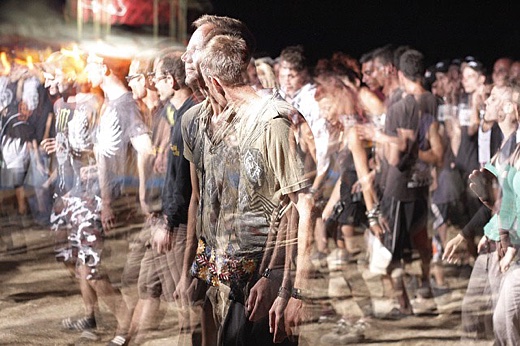
Image above: Photo illustration of white crowd. From original article.

The latest manifestation of white Americans' open racial animosity, from the election of President Donald Trump to the recent violence in Charlottesville and the emboldened rhetoric of white nationalists since then, suggests continued anxiety that research indicates is grounded in an overriding fear of non-whites.

But new data show that fear is irrational.

While white people tend to feel safer when they dominate the population, and feel threatened by the visible presence of other races, they actually are safer in racially diverse communities.

Trump's voters -- nearly 90 percent of whom are white and average $72,000 in median family income -- were often motivated by anxiety over increasing diversity and "racial resentment," especially toward "illegal" immigrants. Trump stoked his constituents' fears associating immigrants with violence and drugs, claiming they kill "innocent American(s)" abetted by liberal, immigrant-friendly sanctuary cities that "breed crime."

Trump's demagoguery resonates because it comes amid one of the most dramatic public health declines on record: the fall in recent decades of middle-aged whites' from America's safest demographic to its most endangered today.

From 1990 to 2015, deaths of whites 40-64 from drug overdoses rose from 3,000 to 22,000, suicides rose from 9,000 to 19,000, and total violent deaths rose from 24,000 to 58,000.

According to Princeton University economist Angus Deaton, there is correlative evidence that Donald Trump is doing very well in the same areas that are hardest hit by this decline. "…I think it is pretty clear that Mr. Trump has locked into this group of people who are feeling a lot of distress one way or another," Deaton said in an interview with Politico.

They are stressing, overdosing, and dying violently at rates surpassing less-advantaged non-white, younger, and poorer cohorts. And their worst death trends and levels are in predominantly white communities.

Centers for Disease Control mortality data show that whites are actually safer in racially diverse areas -- not only from violent deaths in general but specifically from guns, drugs, and suicides.


Image above: Chart of violent deaths in various percentages of whites and other races. Source is Center for Disease Control 2015 data from 3,097 counties on homicides, suicides, accidents and overdoses. From original article.

There's irony in many Americans' long association of danger with mean downtown streets, and their association of safety with leafy suburban cul-de-sacs and rural lanes.

Consider the city Trump and others often identify with rampant violence: Chicago. It is true that African Americans and Latinos have high homicide rates in the city and surrounding Cook County. However, whites there are much safer, with homicide rates less than half the national average.

The same is especially true of whites in New York City, Los Angeles, San Francisco, Washington, D.C., Philadelphia, Seattle, Columbus, and other large "sanctuary cities," where local policies seek to shield immigrants from federal persecution. whites living in and around diverse sanctuary cities are substantially less likely to die from violent death than anywhere else.

Fear-based white flight from "dangerous" cities to the "safety" of suburbs and small towns -- as their urban cores and schools became more racially diverse -- actually increased the odds that whites who fled would die violently.

Conservative politics of white-dominated areas seems to play a role.

The white-safety-in-white-numbers myth can be seen as emanating from a narrative of racial superiority.

A 2016 study found whites "living in racially isolated communities with worse health outcomes" is "one of the strongest predictors of Trump support." Isolation reinforces the sense of white grievance and siege mentality connected to high levels of racial anxiety many Trump voters seem to feel.

Deaton refers to this wave of grievance and anxiety as "white rage." It manifests in various reactions, he says, from support for far-right political candidates to "deaths of despair."

As middle-aged whites, stressed by socio-economic challenges, were most in need of health care such as mental health counseling, domestic violence and addiction services, budget cuts fueled by conservatives' anti-tax, anti-government politics were slashing these programs. These cuts not only eliminated vital services in predominantly White rural conservative places, they muted local alarms of just how serious White distress was becoming.

Conversely, the more progressive voting patterns of racially diverse, mostly urban residents sustained many vital services that may have helped mitigate the opiate and suicide epidemics in places like New York City and coastal California. Those whites more comfortable among diverse populations also may be less vulnerable to stresses over changing racial demographics. In New York City and urban California, for example, whites have had more time to adjust to their growing minority status.

And there's this. The white-safety-in-white-numbers myth can be seen as emanating from a narrative of racial superiority: whites are safer around other whites than around people of color because whites are better people.

Facts to the contrary may not change self-flattering prejudices. But, over time, mundane pocketbook issues might. A New York Federal Reserve Bank analysis shows the most robust economic futures lie in " areas that are less residentially segregated by race or income," favoring higher-quality schools and community cohesion.

Of course, continued analysis of the new violent deaths data is required. But, during this time of confronting whites' fears, it helps to understand that moving toward communities of diversity, integration, and multicultural environments -- and the progressive social policies that often accompany them -- may benefit whites in terms of both actual physical safety and economic well-being.

This piece was reprinted by Truthout with permission or license. It may not be reproduced in any form without permission or license from the source.

See also:
White Supremacy in the Age of Trump By Keri Leigh Merritt

• Mike Males is a senior researcher at the Center on Juvenile and Criminal Justice, San Francisco, and content director for YouthFacts.org. He taught sociology at the University of California, Santa Cruz, and has authored numerous journal articles, op-eds and four books on youth issues. He can be reached at mmales@earthlink.net.

.

Pres. Trump's dad in 1927 Klan rally

SUBHEAD: Reports confirm Donald Trump's dad was arrested at Klan rally, and that those arrested were "berobed"

By Rob Beschizza on 15 August 2017 for Boing Boing -
(http://boingboing.net/2016/08/29/reports-confirm-donald-trump.html)


Image above: Donald Trump and father Fred pictured together with report on arrest of Fred and other robed Ku Klux Klan members on Memorial Day 1927 in Queens NY. From original article.

Fred Trump, the father of millionaire presidential candidate Donald Trump, was arrested at a Ku Klux Klan rally as a young man, according to a 1927 New York Times story. Vice put in the legwork on corroborating the nearly-century-old one-sentence report. They not only found other reports of his arrest, but the startling fact that those arrested were "berobed".
The [Queens County Evening News] mentions Fred Trump as having been "discharged" and gives the Devonshire Road address, along with the names and addresses of the other six men who faced charges. Yet another account in another defunct local newspaper, the Richmond Hill Record, published on June 3, 1927, lists Fred Trump as one of the "Klan Arrests," and also lists the Devonshire Road address.
Another article about the rally, published by the Long Island Daily Press on June 2, 1927, mentions that there were seven arrestees without listing names, and claims that all of the individuals arrested were wearing Klan attire. ... While the Long Island Daily Press doesn't mention Fred Trump specifically, the number of arrestees cited in the report is consistent with the other accounts of the rally. Significantly, the article refers to all of the arrestees as "berobed marchers." If Fred Trump, or another one of the attendees, wasn't dressed in a robe at the time, that may have been a reporting error worth correcting.
[IB Publisher's note: The 1927 arrest record shows the address of Fred Trump as 175-24 Devonshire Road, Queens NY -the home Donald Trump grew up in. By 1927 Fred Trump had already changed his name from the Germanic "Friedrich Drumpf"]


.

Sinclair Broadcasting is Trump TV

SUBHEAD: The owner of  the most TV stations dumps Fox News to become Trump's mouthpiece.

By Staff on 30 July 2017 for Common Dreams -
(https://www.commondreams.org/news/2017/07/30/classic-propaganda-sinclair-broadcasting-pushes-aside-fox-news-become-trump-tv)


Image above: The Sinclair Broadcasting cut a biased deal with Jared Kushner and the Trump campaign. Now the Trump FCC is paying back the favor. From original article.

“It’s unheard of to have one company pushing one specific agenda reaching so many people and doing it in a way designed to evade local input”

During the 2016 Presidential campaign, the Sinclair Broadcasting group cut a deal
with Jared Kushner for “good” coverage of the Trump Administration, which seems to have paid off.


Politico reported last December:

Sinclair would broadcast their Trump interviews across the country without commentary, Kushner said. Kushner highlighted that Sinclair, in states like Ohio, reaches a much wider audience — around 250,000 viewers[sic]— than networks like CNN, which reach somewhere around 30,000.

With Fox News suffering several major setbacks in the past year, Sinclair Broadcasting is making moves to become the new giant of right-wing media. Many are now calling Sinclair 'Trump TV.'
David D. Smith built Sinclair Broadcast Group Inc. into the largest owner of television stations in the U.S. after taking over his father's television company (with his brothers) in the late 1980's.

With David as president and CEO, the Sinclair Broadcast Group blossomed to 59 stations in less than a decade. By 2014, that number had nearly tripled to 162. Smith stepped down earlier this year and became executive chairman.

The Smith family has heavily funded conservative Republican candidates. David Smith's Cape Elizabeth, Maine summer home, just 5 miles down the coast from Common Dreams' Portland office, regularly serves as a meeting place for right-wing politicians like Trump's HUD Secretary Ben Carson and conservative commentator Armstrong Williams.

Journalist David Zurawik, who has covered local television for roughly thirty years, is speaking out against Sinclair Broadcasting Group. In a recent segment on CNN on Sunday, Zurawik said:
“They come as close to classic propaganda as I think I’ve seen in thirty years of covering local television or national television. They’re outrageous! Whatever the White House says, you know, President Trump believes there was voter fraud and he sets up this commission to get data from the states and the states rightfully push back because it’s very intrusive data — Boris Ephsteyn’s piece on it ends with, the states should cooperate with President Trump.”
And John Oliver took aim at the Sinclair Broadcasting group earlier this month, examining the far right station’s ownership of many local TV news stations:
“National cable news gets a lot of attention with their big budgets and their fancy graphics packages. Meanwhile, local news often has to do a lot more with a lot less.”
The Sinclair Broadcasting group has close ties to the Trump administration and is forcing local stations to air pro-Trump news segments. Trump’s FCC chairman, Ajit Pai rolled back a key Obama administration regulation that had prevented Sinclair from further expansion. The green light from the Trump administration allowed Sinclair to purchase 42 more local stations from the Tribune Media company, extending its reach to 72 percent of American households.

Oliver went on to show clips of broadcaster Mark Hyman railing against “political correctness and multiculturalism”.
“Hyman is a commentator and former executive at Sinclair Broadcast Group, and Sinclair may be the most influential media company you’ve never heard of. Not only are they the largest owner of local TV stations in the country, they could soon get even bigger.”

“If the opinions were confined to just the commentary or the ad breaks, that would be one thing. But Sinclair can sometimes dictate the content of your local newscasts as well, and in contrast to Fox News, a conservative outlet where you basically know what you’re getting, with Sinclair, they’re injecting Fox-worthy content into the mouths of your local news anchors, the two people who you know, and who you trust, and whose on-screen chemistry can usually best be described as two people.

“You may not realize it’s happening because Sinclair and its digital news subsidiary Circa not only produce and send packages to their stations; they even write scripts that local anchors use to introduce the pieces. For example, this Tuesday night, anchors at Sinclair stations all over the country introduced a story about Michael Flynn like this.”
Oliver's footage then showed multiple Sinclair broadcasters in different locales introduce a report about Michael Flynn, Trump’s former national security adviser, by downplaying the investigation as just a “personal vendetta” against Flynn.

They are called “must-runs,” and they are sent every day to all the local stations owned by Sinclair Broadcasting — video reports that are centrally produced by the company. Station managers around the country must work them into the broadcast over a period of 24 or 48 hours.


Today, the Portland Press Herald (Maine) reported:
Marc McCutcheon of South Portland was watching WGME’s evening newscast as he has for half a century when something came on that shocked him.

In the midst of the local news, a taped commentary from President Trump’s former special assistant Boris Epshteyn appeared on the screen, trumpeting the administration’s position with what he thought selective use and abuse of facts.

McCutcheon, a small-business owner and political independent, describes the experience as “surreal,” “extremely jarring” and “so out of place with the friendly, local broadcast from news people I’ve come to trust over the years.” There was no rebuttal, no context, no alternate point of view – a situation he found concerning.

WGME-TV (Channel 13) and WPFO-TV (Channel 23) each carry the segments nine times a week on orders from their owner, the Maryland-based Sinclair Broadcasting Group, the nation’s largest owner of local television stations and an aggressive, unabashed disseminator of conservative commentary supporting the Trump wing of the Republican Party.

“It’s unheard of to have one company pushing one specific agenda reaching so many people and doing it in a way designed to evade local input,” says Craig Aaron, president and CEO of Free Press, a Washington-based group that opposes media consolidation. “The idea of having local stations offer an array of viewpoints is great, but what we get with Sinclair is one set of political leanings being broadcast everywhere.”

Epshteyn, a 34-year-old Russia-born investment banker, is a friend and former Georgetown University classmate of the president’s son Eric Trump who ascended rapidly within Trump’s campaign.

“Bottom Line With Boris” commentaries echo the White House’s own talking points. After former FBI director James Comey said in televised congressional testimony that the president had pressured him to let go of parts of his investigation of Russian interference in the 2016 election, Epshteyn asserted to Sinclair viewers that Comey’s appearance had been more damaging to Hillary Clinton than the president.
.

Fascism and the Denial of Truth

SUBHEAD: Party polarization and gridlock in the US have created unsolved issues amenable to a Trump demagogue.

By Thomas Scott on 30 July 2017 for Truth Out  -
(http://www.truth-out.org/opinion/item/41423-fascism-and-the-denial-of-truth-what-henry-wallace-can-teach-us-about-trump)


Image above: Cover art for song release of "Demagogue" by Franz Ferdinand. From (https://rateyourmusic.com/release/single/franz-ferdinand/demagogue/).

What is a fascist? How many fascists have we? How dangerous are they? These are the questions that the New York Times posed to Henry A. Wallace, Franklin Roosevelt's vice president, in April 1944.

In response, Wallace wrote "The Danger of American Fascism," an essay in which he suggested that the number of American fascists and the threat they posed were directly connected to how fascism was defined.

Wallace pointed out that several personality traits characterized fascist belief, arguing that a fascist is;
"one whose lust for money and power is combined with such an intensity of intolerance toward those of other races, parties, classes, religions, cultures, regions or nations as to make him ruthless in his use of deceit or violence to attain his ends."
Wallace also claimed that fascists "always and everywhere can be identified by their appeal to prejudice and by the desire to play upon the fears and vanities of different groups in order to gain power."

Fascists are "easily recognized by their deliberate perversion of truth and fact" (my italics), he contended.

Moreover, Wallace noted that fascists "pay lip service to democracy and the common welfare" and they "surreptitiously evade the laws designed to safeguard the public from monopolistic extortion."

Finally, Wallace identified that fascists' primary objective was to "capture political power so that, using the power of the state and the power of the market simultaneously, they keep the common man in eternal subjection."

Wallace was writing in the context of an existential threat to democracy posed by Nazi Germany, Italy and Japan.

However, his essay is prescient in that he identified the existence of a domestic form of American fascism that emerged from the political context of enlightened thought, rule of law and limited government. Wallace drew a clear distinction between European fascism and the kind of fascism found in the United States.

Rather than resort to overt violence, American fascists would "poison the channels of public information," Wallace reasoned. Likewise, he argued that American fascism was generally inert, not having reached the level of overt threat that it had reached in Europe.

Despite this, Wallace argued that American fascism had the potential to become dangerous to democracy under that appropriate context; one in which a "purposeful coalition" emerges based on "demagoguery."

British historian Karl Polanyi has written in his seminal book, The Great Transformation, that fascism can emerge in a society in reaction to "unsolved national issues."

Party polarization and gridlock in the US have created unsolved issues concerning health care, immigration reform and the "war on terror." These volatile issues, in turn, have created the perfect political context for a demagogue to emerge in the United States.

With the election of Donald Trump, the purposeful coalition Wallace feared may have evolved. Trump is the first US president who has been seriously associated with fascist ideology.

His coalition of white supremacists, xenophobes, plutocratic oligarchs and disaffected members of the working class have aligned with the mainstream Republican Party.

The coalition's political philosophy, rooted in reactionary populism and "American First" sloganeering, has quickly led to the United States' systematic withdrawal from global leadership.

Coupled with a disdain for multilateral collaboration, a rejection of globalization, and a focus on militarism and economic nationalism, Trumpism has taken the country down the perilous path of national chauvinism reminiscent of previous fascist states like Spain under Franco, Portugal under Salazar, or Peronist Argentina.

Unlike past Republican and Democratic presidents, Trump has disregarded long-standing traditions related to political protocol and decorum in the realm of political communication. He routinely makes unsubstantiated claims about political rivals, questioning their veracity and ethics.

Trump's claim that the Obama administration wiretapped his phones during the 2016 campaign and that Obama refused to take action regarding Russian meddling in the 2016 election, as well as Trump's incendiary tweets about federal judges who ruled against his executive orders on immigration, suggest a sense of paranoia commonly associated with autocrats.

Trump has demonstrated a fundamental ignorance of democratic institutions associated with the rule of law, checks and balances, and the separation of powers.

Common to autocratic leaders, Trump sees executive power as absolute and seems confounded when the legislative or judicial branches of government question his decisions.

Trump has seemed willing to ignore norms that are fundamentally aligned with US democracy: equality before the law, freedom of the press, individual rights, due process and inclusiveness.

Typical of all autocratic leaders, Trump has a deep-seated distrust of the media. Calling journalists "enemies of the people," Trump's incessant claims that media outlets like the New York Times and the Washington Post create "fake news" is a common attribute of authoritarian regimes.

In response to investigative reports that are critical of his administration, Trump engages in systematic tactics of disinformation. Trump has refined the art of evasion through communicating a multiplicity of falsehoods as a means of obfuscating charges of abuse of power and political misconduct.

The biggest dilemma for an autocrat is confronting the truth. Systematic strategies to implant misinformation have historically provided significant political dividends for demagogues.

From Trump's earliest forays in national politics, the truth was his biggest enemy.

Trump discovered in the 2016 campaign that the perpetuation of lies and deceit could be converted into political capital. Lying on issues actually generated support from Trump's political base, many of whom were low-information voters.

The hope by many that Trump would conform to traditional political norms once elected proved to be a chimera. Trump has obliterated the Orwellian dictum that lies are truth; in Trump's worldview, truth does not exist. It is seen as a political liability.

As president, the debasement of truth has become an important political strategy shaping much of his communication to the American public.

Purposeful deceit has become one of the primary means by which Trump energizes and excites his supporters. It is the catalyst that drives their emotional connection to Trump, who is insistent on "telling it like it is" and fighting for "the people" as a challenge to the political elite.

For Trump, facts mean nothing. They are contrary to the desires of his political base. Connecting to his base is visceral; intellectualism is the antithesis of Trump's immediate political objectives.

By denying the existence of truth-based politics, Trump solidifies his populist vision and perpetuates one of fascism's greatest mechanisms for acquiring absolute power: the force of emotion conquering the force of reason.

As Timothy Snyder states in his insightful book On Tyranny, "To abandon facts is to abandon freedom.

If nothing is true, then no one can criticize power, because there is no basis upon which to do so."

Seen in this light, empirical evidence based on scientific investigation is superfluous; public policy is only useful when it is connected to human emotion and desire.

This is all that matters in Trump's vision for the US. As such, facts and scientific research are a ruse, a tool of the elite designed to consolidate power over "the people" and discredit Trump's "America First" policies.

Truth is a necessity for democracy because citizens depend on truth-based decision-making to achieve reasoned judgments about public policy. In the Trump administration, the eradication of fact-based communication has normalized the denial of truth.

As a result, democracy is clearly under siege. Henry Giroux makes an excellent argument when he writes, "normalization is code for retreat from any sense of moral or political responsibility, and it should be viewed as an act of political complicity with authoritarianism and condemned outright."

All Americans should take heed of this point. History has provided ample evidence of how institutional and civic complicity with autocratic rule erodes democracy.

However, history has also demonstrated how engaged citizens can mobilize to resist this erosion.

]As Snyder argues, in order to confront autocracy, citizens need to become aware that democracy can disappear and mobilize to stop such a disastrous turn of events. In the age of Trump, there is no time for complacency.

.

Security... or Surveillance?

SUBHEAD: Ron Paul interviews Edward Snowden on government threats to essential freedoms.

By James Holbrooks on 20 June 2017 for The AntiMedia -
(http://theantimedia.org/ron-paul-interviewing-edward-snowden/S)


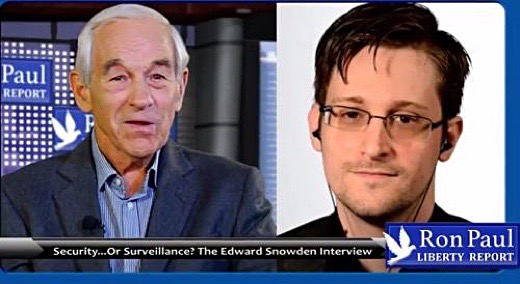
Image above: Still frame of Ron Paul and Edward Snowden from video of interview below.
Saying that you don’t care about privacy because you have nothing to hide is no different than saying you don’t care about freedom of speech because you have nothing to say.”
That comment was made by famed whistleblower Edward Snowden during a recent interview on the Ron Paul Liberty Report. In his conversation with Dr. Paul and Daniel McAdams, published Tuesday, an articulate Snowden discusses the true meaning of freedom, the nature of the deep state, and even his upbringing as a child of a government family.

“I’d like to know a little bit, what do you do all day long?” a genuinely curious Dr. Paul asks as his opening question. After talking about the insanity that erupted — both in the political spectrum and his personal life — following the revelations he made back in 2013, Snowden says he’s now become a hot commodity for groups championing causes.
“They want me to sort of front for these issues of privacy and civil liberties and protection of people’s rights,” Snowden replies. “And I want to do what I can, but I’m not a politician. I’m an engineer.”
The whistleblower goes on to talk about how he’s now, at long last, finally able to devote time to more practical applications. For him, this means focusing on the area that holds the key to finding a balance between rights and laws in the digital age — technology.
“How technically is this even happening?” Snowden poses, digging straight to the heart of the issue of mass surveillance. “How is it that so many governments are spying on so many people? Because even if we pass the best legal reforms in the world in the United States, that doesn’t do anything against China, or Russia, or Germany, or France or Brazil or any other country in the world.”
Continuing, Snowden says that future generations’ rights and protections will be dependent on the current generation’s ability to adapt to a constantly shifting environment:
“We need to find new means, new mechanisms, for enforcing these rights in the new times. And I think that’s going to be primarily through science and technology.”
When Dr. Paul asks the former NSA contractor about his political affiliation, Snowden responds that he doesn’t associate himself with any faction and that as individuals, we’re more than tribes and labels. Proceeding, Snowden points to how technology has given humanity a means to have a global conversation on issues:
“I think the Internet produces a lot of people who look at these issues differently, in a less tribal way, because you hear more viewpoints. You hear from many more people. And the more people in a conversation, I think the more informed it often is.”
When co-host Daniel McAdams asks Snowden to comment on the idea of security vs. surveillance, the whistleblower again cuts straight to the core of the debate and speaks on the perception of freedom itself.

“What is liberty?” asks Snowden, and then points out that ten questions on the street would result in ten different answers. After stating his view that liberty is the “freedom of self” and the “freedom from permission,” Snowden goes on to say that true liberty is rooted in personal privacy:
“Privacy isn’t about something to hide, privacy is about something to protect. It’s about the ability to be you, to have a thought for yourself, to have a thing for yourself, to have some difference, to have some idea that’s new and untested and untried that you can sort of sharpen amongst those that you trust, and then introduce into the world, into that contest of ideas.”
Next, Dr. Paul asks his guest to comment on the topic of the deep state, which Snowden proceeds to describe as a “mass of government that survives beyond administration” that is “not responding to the politics of the people.” Snowden says this organism lives “across parties” and “across administrations.”

Continuing, Snowden equates the running of state policy to a game, one that favors those who get “better and better” at understanding the evolving rules:
“And eventually, the people who are the greatest experts at understanding and using these rules, the best bureaucrats, are not sitting in the White House, they’re not sitting in the Congress. Because those guys come and go as the years pass, and they win elections, and they lose elections, and it’s the people that sit there for 30 years or more, in these agencies, with their hand on the lever the whole time. And that’s what the deep state is.”
Snowden further states that party affiliation matters little with regard to this behind-the-scenes force and that any political faction in power will eventually “get to the point of saying yes when enough pressure is brought to bear.”

When Daniel McAdams next asks him about whether or not he thinks an agency such as the NSA should even exist, Snowden remarks on the irony of asking him that question — given that he’s a “product of the system” with familial ties to the United States government going back decades.

But the whistleblower presses forward following a question from Dr. Paul on whether or not he thinks any gains have been made from his 2013 revelations, stating that solutions come not from individuals alone, but from many of them who “lay down a single brick upon which others can build.”

Continuing in this vein, Snowden says progress in battling government violations of personal liberty is made in inches and should be accomplished organically:
“Step by step, working together, sharing our views, connecting our values, we can create spaces, more bricks, that when laid together create a defense of rights that can be relied upon, in even historic moments when law cannot be.”
In his final question to Snowden, Dr. Paul asks whether the former government contractor’s decision to sound the alarm was arrived at suddenly or through a gradual process. In response, Snowden links his own decision to the average human being, noting that everyone has a point at which nothing more can be tolerated:
“We all have a level, right, of this kind of cognitive dissonance that we can accept. A level of injustice, of inhumanity, of incivility that we can accept in the daily world, that we can sort of internalize and suppress. And then we have one step more.”

Video above: "Security or Surveillance? The Edward Snowden Interview" From (https://youtu.be/9XLLo0025Jc).

.

Connecting the dots - Trump to Brexit

SUBHEAD: How our democracy was hijacked in America and Britain by friends of Donald Trump.

By  Carole Cadwalladr on 7 May 2017 for the Guardian -
(https://www.theguardian.com/technology/2017/may/07/the-great-british-brexit-robbery-hijacked-democracy)

http://www.islandbreath.org/2017Year/06/170603linksbig.jpg
Image above: Diagram of links between Trump, Steve Bannon, Cambridge Analytica and Aggregate IQ, Nigel Farage and Brexit. Click to embiggen. From original article.

A shadowy global operation involving big data, billionaire friends of Trump and the disparate forces of the Brexit campaign influenced the result of the EU referendum. As Britain heads to the polls again, is its electoral process still fit for purpose?

In June 2013, a young American postgraduate called Sophie was passing through London when she was called up by the boss of a firm where she’d previously interned. The company, SCL Elections, went on to be bought by Robert Mercer, a secretive hedge fund billionaire, renamed Cambridge Analytica, and achieved a certain notoriety as the data analytics firm that played a role in both Trump and Brexit campaigns. But all of this was still to come.

London in 2013 was still basking in the afterglow of the Olympics. Britain had not yet Brexited. The world had not yet turned.

“That was before we became this dark, dystopian data company that gave the world Trump,” a former Cambridge Analytica employee who I’ll call Paul tells me. “It was back when we were still just a psychological warfare firm.”

Was that really what you called it, I ask him. Psychological warfare? “Totally. That’s what it is. Psyops. Psychological operations – the same methods the military use to effect mass sentiment change. It’s what they mean by winning ‘hearts and minds’. We were just doing it to win elections in the kind of developing countries that don’t  have many rules.”

Why would anyone want to intern with a psychological warfare firm, I ask him. And he looks at me like I am mad. “It was like working for MI6. Only it’s MI6 for hire.

It was very posh, very English, run by an old Etonian and you got to do some really cool things. Fly all over the world. You were working with the president of Kenya or Ghana or wherever. It’s not like election campaigns in the west. You got to do all sorts of crazy shit.”

On that day in January 2013, Sophie met up with SCL’s chief executive, Alexander Nix, and gave him the germ of an idea.

“She said, ‘You really need to get into data.’ She really drummed it home to Alexander. And she mentioned to him a firm that belonged to someone she knew about through her father.”
Who’s her father?

“Eric Schmidt.”

Eric Schmidt – the chairman of Google?”
I had been speaking to former employees of Cambridge Analytica for months and heard dozens of hair-raising stories, but it was still a gobsmacking moment. To anyone concerned about surveillance, Palantir is practically now a trigger word.

The data-mining firm has contracts with governments all over the world – including GCHQ and the NSA. It’s owned by Peter Thiel, the billionaire co-founder of PayPal and major investor in Facebook, who became Silicon Valley’s first vocal supporter of Trump.

In some ways, Eric Schmidt’s daughter showing up and referring to Palantir is just another weird detail in the weirdest story I have ever researched.

A weird but telling detail. Because it goes to the heart of why the story of Cambridge Analytica is one of the most profoundly unsettling of our time. Sophie Schmidt now works for another Silicon Valley megafirm: Uber. And what’s clear is that the power and dominance of the Silicon Valley – Google and Facebook and a small handful of others – are at the centre of the global tectonic shift we are currently witnessing.

It also reveals a critical and gaping hole in the political debate in Britain. Because what is happening in America and what is happening in Britain are entwined. Brexit and Trump are entwined. The Trump administration’s links to Russia and Britain are entwined.

And Cambridge Analytica is one point of focus through which we can see all these relationships in play; it also reveals the elephant in the room as we hurtle into a general election: Britain tying its future to an America that is being remade - in a radical and alarming way - by Trump.

There are three strands to this story. How the foundations of an authoritarian surveillance state are being laid in the US. How British democracy was subverted through a covert, far-reaching plan of coordination enabled by a US billionaire.

And how we are in the midst of a massive land grab for power by billionaires via our data. Data which is being silently amassed, harvested and stored. Whoever owns this data owns the future.

My entry point into this story began, as so many things do, with a late-night Google. Last December, I took an unsettling tumble into a wormhole of Google autocomplete suggestions that ended with “did the holocaust happen”. And an entire page of results that claimed it didn’t.

Google’s algorithm had been gamed by extremist sites and it was Jonathan Albright, a professor of communications at Elon University, North Carolina, who helped me get to grips with what I was seeing. He was the first person to map and uncover an entire “alt-right” news and information ecosystem and he was the one who first introduced me to Cambridge Analytica.

He called the company a central point in the right’s “propaganda machine”, a line I quoted in reference to its work for the Trump election campaign and the referendum Leave campaign.

That led to the second article featuring Cambridge Analytica – as a central node in the alternative news and information network that I believed Robert Mercer and Steve Bannon, the key Trump aide who is now his chief strategist, were creating.

I found evidence suggesting they were on a strategic mission to smash the mainstream media and replace it with one comprising alternative facts, fake history and rightwing propaganda.


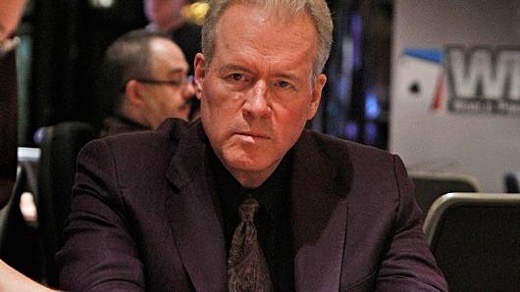
Image above: Robert Mercer in 2012 playing the World Poker Tour. From (http://www.cnbc.com/2014/11/07/robert-mercer-the-most-important-political-money-man-youve-never-heard-of.html).

Mercer is a brilliant computer scientist, a pioneer in early artificial intelligence, and the co-owner of one of the most successful hedge funds on the planet (with a gravity-defying 71.8% annual return). And, he is also, I discovered, good friends with Nigel Farage.

Andy Wigmore, Leave.EU’s communications director, told me that it was Mercer who had directed his company, Cambridge Analytica, to “help” the Leave campaign.

The second article triggered two investigations, which are both continuing: one by the Information Commissioner’s Office into the possible illegal use of data. And a second by the Electoral Commission which is “focused on whether one or more donations – including services – accepted by Leave.EU was ‘impermissable’”.

What I then discovered is that Mercer’s role in the referendum went far beyond this. Far beyond the jurisdiction of any UK law. The key to understanding how a motivated and determined billionaire could bypass ourelectoral laws rests on AggregateIQ, an obscure web analytics company based in an office above a shop in Victoria, British Columbia.

It was with AggregateIQ that Vote Leave (the official Leave campaign) chose to spend £3.9m, more than half its official £7m campaign budget. As did three other affiliated Leave campaigns: BeLeave, Veterans for Britain and the Democratic Unionist party, spending a further £757,750.

“Coordination” between campaigns is prohibited under UK electoral law, unless campaign expenditure is declared, jointly. It wasn’t. Vote Leave says the Electoral Commission “looked into this” and gave it “a clean bill of health”.

How did an obscure Canadian company come to play such a pivotal role in Brexit? It’s a question that Martin Moore, director of the centre for the study of communication, media and power at King’s College London has been asking too. “I went through all the Leave campaign invoices when the Electoral Commission uploaded them to its site in February.

And I kept on discovering all these huge amounts going to a company that not only had I never heard of, but that there was practically nothing at all about on the internet. More money was spent with AggregateIQ than with any other company in any other campaign in the entire referendum. All I found, at that time, was a one-page website and that was it. It was an absolute mystery.”

Moore contributed to an LSE report published in April that concluded UK’s electoral laws were “weak and helpless” in the face of new forms of digital campaigning.

Offshore companies, money poured into databases, unfettered third parties… the caps on spending had come off. The laws that had always underpinned Britain’s electoral laws were no longer fit for purpose. Laws, the report said, that needed “urgently reviewing by parliament”.

AggregateIQ holds the key to unravelling another complicated network of influence that Mercer has created. A source emailed me to say he had found that AggregateIQ’s address and telephone number corresponded to a company listed on Cambridge Analytica’s website as its overseas office: “SCL Canada”. A day later, that online reference vanished.

There had to be a connection between the two companies. Between the various Leave campaigns. Between the referendum and Mercer. It was too big a coincidence.

But everyone – AggregateIQ, Cambridge Analytica, Leave.EU, Vote Leave – denied it. AggregateIQ had just been a short-term “contractor” to Cambridge Analytica. There was nothing to disprove this. We published the known facts. On 29 March, article 50 was triggered.

Then I meet Paul, the first of two sources formerly employed by Cambridge Analytica. He is in his late 20s and bears mental scars from his time there. “It’s almost like post-traumatic shock. It was so… messed up. It happened so fast. I just woke up one morning and found we’d turned into the Republican fascist party. I still can’t get my head around it.”

He laughed when I told him the frustrating mystery that was AggregateIQ. “Find Chris Wylie,” he said.

Who’s Chris Wylie?

“He’s the one who brought data and micro-targeting [individualized political messages] to Cambridge Analytica. And he’s from west Canada. It’s only because of him that AggregateIQ exist. They’re his friends. He’s the one who brought them in.”

There wasn’t just a relationship between Cambridge Analytica and AggregateIQ, Paul told me. They were intimately entwined, key nodes in Robert Mercer’s distributed empire. “The Canadians were our back office.

They built our software for us. They held our database. If AggregateIQ is involved then Cambridge Analytica is involved. And if Cambridge Analytica is involved, then Robert Mercer and Steve Bannon are involved. You need to find Chris Wylie.”

I did find Chris Wylie. He refused to comment.

Key to understanding how data would transform the company is knowing where it came from. And it’s a letter from “Director of Defence Operations, SCL Group”, that helped me realise this. It’s from “Commander Steve Tatham, PhD, MPhil, Royal Navy (rtd)” complaining about my use in my Mercer article of the word “disinformation”.

I wrote back to him pointing out references in papers he’d written to “deception” and “propaganda”, which I said I understood to be “roughly synonymous with ‘disinformation’.” It’s only later that it strikes me how strange it is that I’m corresponding with a retired navy commander about military strategies that may have been used in British and US elections.

What’s been lost in the US coverage of this “data analytics” firm is the understanding of where the firm came from: deep within the military-industrial complex. A weird British corner of it populated, as the military establishment in Britain is, by old-school Tories.

Geoffrey Pattie, a former parliamentary under-secretary of state for defence procurement and director of Marconi Defence Systems, used to be on the board, and Lord Marland, David Cameron’s pro-Brexit former trade envoy, a shareholder.

Steve Tatham was the head of psychological operations for British forces in Afghanistan. The Observer has seen letters endorsing him from the UK Ministry of Defence, the Foreign Office and NATO.

SCL/Cambridge Analytica was not some startup created by a couple of guys with a Mac PowerBook. It’s effectively part of the British defence establishment. And, now, too, the American defence establishment. An ex-commanding officer of the US Marine Corps operations centre, Chris Naler, has recently joined Iota Global, a partner of the SCL group.

This is not just a story about social psychology and data analytics. It has to be understood in terms of a military contractor using military strategies on a civilian population. Us.

David Miller, a professor of sociology at Bath University and an authority in psyops and propaganda, says it is “an extraordinary scandal that this should be anywhere near a democracy. It should be clear to voters where information is coming from, and if it’s not transparent or open where it’s coming from, it raises the question of whether we are actually living in a democracy or not.”

Paul and David, another ex-Cambridge Analytica employee, were working at the firm when it introduced mass data-harvesting to its psychological warfare techniques. “It brought psychology, propaganda and technology together in this powerful new way,” David tells me.

And it was Facebook that made it possible. It was from Facebook that Cambridge Analytica obtained its vast dataset in the first place.

Earlier, psychologists at Cambridge University harvested Facebook data (legally) for research purposes and published pioneering peer-reviewed work about determining personality traits, political partisanship, sexuality and much more from people’s Facebook “likes”.

And SCL/Cambridge Analytica contracted a scientist at the university, Dr Aleksandr Kogan, to harvest new Facebook data. And he did so by paying people to take a personality quiz which also allowed not just their own Facebook profiles to be harvested, but also those of their friends – a process then allowed by the social network.

Facebook was the source of the psychological insights that enabled Cambridge Analytica to target individuals. It was also the mechanism that enabled them to be delivered on a large scale.

The company also (perfectly legally) bought consumer datasets – on everything from magazine subscriptions to airline travel – and uniquely it appended these with the psych data to voter files.

It matched all this information to people’s addresses, their phone numbers and often their email addresses. “The goal is to capture every single aspect of every voter’s information environment,” said David. “And the personality data enabled Cambridge Analytica to craft individual messages.”

Finding “persuadable” voters is key for any campaign and with its treasure trove of data, Cambridge Analytica could target people high in neuroticism, for example, with images of immigrants “swamping” the country. The key is finding emotional triggers for each individual voter.

Cambridge Analytica worked on campaigns in several key states for a Republican political action committee. Its key objective, according to a memo the Observer has seen, was “voter disengagement” and “to persuade Democrat voters to stay at home”: a profoundly disquieting tactic. It has previously been claimed that suppression tactics were used in the campaign, but this document provides the first actual evidence.

But does it actually work? One of the criticisms that has been levelled at my and others’ articles is that Cambridge Analytica’s “special sauce” has been oversold. Is what it is doing any different from any other political consultancy?

“It’s not a political consultancy,” says David. “You have to understand this is not a normal company in any way. I don’t think Mercer even cares if it ever makes any money. It’s the product of a billionaire spending huge amounts of money to build his own experimental science lab, to test what works, to find tiny slivers of influence that can tip an election.

Robert Mercer did not invest in this firm until it ran a bunch of pilots – controlled trials. This is one of the smartest computer scientists in the world. He is not going to splash $15m on bullshit.”

Tamsin Shaw, an associate professor of philosophy at New York University, helps me understand the context. She has researched the US military’s funding and use of psychological research for use in torture. “The capacity for this science to be used to manipulate emotions is very well established.

This is military-funded technology that has been harnessed by a global plutocracy and is being used to sway elections in ways that people can’t even see, don’t even realise is happening to them,” she says. “It’s about exploiting existing phenomenon like nationalism and then using it to manipulate people at the margins.

To have so much data in the hands of a bunch of international plutocrats to do with it what they will is absolutely chilling.

“We are in an information war and billionaires are buying up these companies, which are then employed to go to work in the heart of government. That’s a very worrying situation.”

A project that Cambridge Analytica carried out in Trinidad in 2013 brings all the elements in this story together. Just as Robert Mercer began his negotiations with SCL boss Alexander Nix about an acquisition, SCL was retained by several government ministers in Trinidad and Tobago.

The brief involved developing a micro-targeting programme for the governing party of the time.

And AggregateIQ – the same company involved in delivering Brexit for Vote Leave – was brought in to build the targeting platform.

David said: “The standard SCL/CA method is that you get a government contract from the ruling party. And this pays for the political work. So, it’s often some bullshit health project that’s just a cover for getting the minister re-elected. But in this case, our government contacts were with Trinidad’s national security council.”

The security work was to be the prize for the political work. Documents seen by the Observer show that this was a proposal to capture citizens’ browsing history en masse, recording phone conversations and applying natural language processing to the recorded voice data to construct a national police database, complete with scores for each citizen on their propensity to commit crime.

“The plan put to the minister was Minority Report. It was pre-crime. And the fact that Cambridge Analytica is now working inside the Pentagon is, I think, absolutely terrifying,” said David.


Image above: Steve Bannon in the East Room of the White House on February 15, 2017. Photo by Pete Marovich. From ((http://www.vanityfair.com/news/2017/04/steve-bannon-isnt-through-with-trump-yet).

These documents throw light on a significant and under-reported aspect of the Trump administration. The company that helped Trump achieve power in the first place has now been awarded contracts in the Pentagon and the US state department. Its former vice-president Steve Bannon now sits in the White House. It is also reported to be in discussions for “military and homeland security work”.

In the US, the government is bound by strict laws about what data it can collect on individuals. But, for private companies anything goes. Is it unreasonable to see in this the possible beginnings of an authoritarian surveillance state?

A state that is bringing corporate interests into the heart of the administration. Documents detail Cambridge Analytica is involved with many other right-leaning billionaires, including Rupert Murdoch. One memo references Cambridge Analytica trying to place an article with a journalist in Murdoch’s Wall Street Journal: “RM re-channeled and connected with Jamie McCauley from Robert Thomson News Corp office,” it says.

It makes me think again about the story involving Sophie Schmidt, Cambridge Analytica and Palantir. Is it a telling detail, or is it a clue to something else going on? Cambridge Analytica and Palantir both declined to comment for this article on whether they had any relationship.

But witnesses and emails confirm that meetings between Cambridge Analytica and Palantir took place in 2013. The possibility of a working relationship was at least discussed.

Further documents seen by the Observer confirm that at least one senior Palantir employee consulted with Cambridge Analytica in relation to the Trinidad project and later political work in the US. But at the time, I’m told, Palantir decided it was too much of a reputational risk for a more formal arrangement.

There was no upside to it. Palantir is a company that is trusted to handle vast datasets on UK and US citizens for GCHQ and the NSA, as well as many other countries.

Now though, they are both owned by ideologically aligned billionaires: Robert Mercer and Peter Thiel. The Trump campaign has said that Thiel helped it with data. A campaign that was led by Steve Bannon, who was then at Cambridge Analytica.

A leading QC who spends a lot of time in the investigatory powers tribunal said that the problem with this technology was that it all depended on whose hands it was in.

“On the one hand, it’s being done by companies and governments who say ‘you can trust us, we are good and democratic and bake cakes at the weekend’. But then the same expertise can also be sold on to whichever repressive regime.”

In Britain, we still trust our government. We respect our authorities to uphold our laws. We trust the rule of law. We believe we live in a free and fair democracy. Which is what, I believe, makes the last part of this story so profoundly unsettling.

The details of the Trinidad project finally unlocked the mystery that was AggregateIQ. Trinidad was SCL’s first project using big data for micro-targeting before the firm was acquired by Mercer. It was the model that Mercer was buying into.

And it brought together all the players: the Cambridge psychologist Aleksandr Kogan, AggregateIQ, Chris Wylie, and two other individuals who would play a role in this story: Mark Gettleson, a focus group expert who had previously worked for the Lib Dems. And Thomas Borwick, the son of Victoria Borwick, the Conservative MP for Kensington.

When my article linking Mercer and Leave.EU was published in February, no one was more upset about it than former Tory adviser Dominic Cummings, the campaign strategist for Vote Leave. He launched an irate Twitter tirade. The piece was “full of errors & itself spreads disinformation” “CA had ~0% role in Brexit referendum”.

A week later the Observer revealed AggregateIQ’s possible link to Cambridge Analytica. Cummings’s Twitter feed went quiet. He didn’t return my messages or my emails.

Questions had already been swirling about whether there had been any coordination between the Leave campaigns. In the week before the referendum, Vote Leave donated money to two other Leave groups – £625,000 to BeLeave, run by fashion student Darren Grimes, and £100,000 to Veterans for Britain, who both then spent this money with AggregateIQ.

The Electoral Commission has written to AggregateIQ. A source close to the investigation said that AggregateIQ responded by saying it had signed a non-disclosure agreement. And since it was outside British jurisdiction, that was the end of it. Vote Leave refers to this as the Electoral Commission giving it “a clean bill of health”.

On his blog, Dominic Cummings has written thousands of words about the referendum campaign. What is missing is any details about his data scientists. He “hired physicists” is all he’ll say. In the books on Brexit, other members of the team talk about “Dom’s astrophysicists”, who he kept “a tightly guarded secret”. They built models, using data “scraped” off Facebook.

Finally, after weeks of messages, he sent me an email. We were agreed on one thing, it turned out. He wrote: “The law/regulatory agencies are such a joke the reality is that anybody who wanted to cheat the law could do it easily without people realising.”

But, he says, “by encouraging people to focus on non-stories like Mercer’s nonexistent role in the referendum you are obscuring these important issues”.

And to finally answer the question about how Vote Leave found this obscure Canadian company on the other side of the planet, he wrote: “Someone found AIQ [AggregateIQ] on the internet and interviewed them on the phone then told me – let’s go with these guys. They were clearly more competent than any others we’d spoken to in London.”

The most unfortunate aspect of this – for Dominic Cummings – is that this isn’t credible. It’s the work of moments to put a date filter on Google search and discover that in late 2015 or early 2016, there are no Google hits for “Aggregate IQ”. There is no press coverage. No random mentions. It doesn’t even throw up its website. I have caught Dominic Cummings in what appears to be an alternative fact.

But what is an actual fact is that Gettleson and Borwick, both previously consultants for SCL and Cambridge Analytica, were both core members of the Vote Leave team.

They’re both in the official Vote Leave documents lodged with the Electoral Commission, though they coyly describe their previous work for SCL/Cambridge Analytica as “micro-targeting in Antigua and Trinidad” and “direct communications for several PACs, Senate and Governor campaigns”.

And Borwick wasn’t just any member of the team. He was Vote Leave’s chief technology officer.

This story may involve a complex web of connections, but it all comes back to Cambridge Analytica. It all comes back to Mercer.

Because the connections must have been evident. “AggregateIQ may not have belonged to the Mercers but they exist within his world,” David told me. “Almost all of their contracts came from Cambridge Analytica or Mercer. They wouldn’t exist without them.

During the whole time the referendum was going on, they were working every day on the [Ted] Cruz campaign with Mercer and Cambridge Analytica. AggregateIQ built and ran Cambridge Analytica’s database platforms.”

Cummings won’t say who did his modelling. But invoices lodged with the Electoral Commission show payments to a company called Advanced Skills Institute. It takes me weeks to spot the significance of this because the company is usually referred to as ASI Data Science, a company that has a revolving cast of data scientists who have gone on to work with Cambridge Analytica and vice versa.

There are videos of ASI data scientists presenting Cambridge Analytica personality models and pages for events the two companies have jointly hosted. ASI told the Observer it had no formal relationship with Cambridge Analytica.

Here’s the crucial fact: during the US primary elections, Aggregate IQ signed away its intellectual property (IP). It didn’t own its IP: Robert Mercer did. For AggregateIQ to work with another campaign in Britain, the firm would have to have had the express permission of Mercer.

Asked if it would make any comment on financial or business links between “Cambridge Analytica, Robert Mercer, Steve Bannon, AggregateIQ, Leave.EU and Vote Leave”, a spokesperson for Cambridge Analytica said: “Cambridge Analytica did no paid or unpaid work for Leave.EU.”

This story isn’t about cunning Dominic Cummings finding a few loopholes in the Electoral Commission’s rules. Finding a way to spend an extra million quid here. Or (as the Observer has also discovered) underdeclaring the costs of his physicists on the spending returns by £43,000.

This story is not even about what appears to be covert coordination between Vote Leave and Leave.EU in their use of AggregateIQ and Cambridge Analytica. It’s about how a motivated US billionaire – Mercer and his chief ideologue, Bannon – helped to bring about the biggest constitutional change to Britain in a century.


Image above: Donald Trump, in the White House Rose Garden announcing US exit from Paris Climate agreement on 2 June 2017. From (http://www.cnbc.com/2017/05/31/trump-paris-accord-exit-is-good-for-the-environment-commentary.html).

Because to understand where and how Brexit is connected to Trump, it’s right here. These relationships, which thread through the middle of Cambridge Analytica, are the result of a transatlantic partnership that stretches back years.

Nigel Farage and Bannon have been close associates since at least 2012. Bannon opened the London arm of his news website Breitbart in 2014 to support Ukip – the latest front “in our current cultural and political war”, he told the New York Times.

Britain had always been key to Bannon’s plans, another ex-Cambridge Analytica employee told me on condition of anonymity. It was a crucial part of his strategy for changing the entire world order.

“He believes that to change politics, you have to first change the culture. And Britain was key to that.

He thought that where Britain led, America would follow. The idea of Brexit was hugely symbolically important to him.”

On 29 March, the day article 50 was triggered, I called one of the smaller campaigns, Veterans for Britain. Cummings’s strategy was to target people in the last days of the campaign and Vote Leave gave the smaller group £100,000 in the last week. A small number of people they identified as “persuadable” were bombarded with more than a billion ads, the vast majority in the last few days.
I asked David Banks, Veterans for Britain’s head of communications, why they spent the money with AggregateIQ.

“I didn’t find AggegrateIQ. They found us. They rang us up and pitched us. There’s no conspiracy here. They were this Canadian company which was opening an office in London to work in British politics and they were doing stuff that none of the UK companies could offer.

Their targeting was based on a set of technologies that hadn’t reached the UK yet. A lot of it was proprietary, they’d found a way of targeting people based on behavioural insights. They approached us.”

It seems clear to me that David Banks didn’t know there might have been anything untoward about this. He’s a patriotic man who believes in British sovereignty and British values and British laws. I don’t think he knew about any overlap with these other campaigns. I can only think that he was played.

And that we, the British people, were played. In his blog, Dominic Cummings writes that Brexit came down to “about 600,000 people – just over 1% of registered voters”. It’s not a stretch to believe that a member of the global 1% found a way to influence this crucial 1% of British voters.

The referendum was an open goal too tempting a target for US billionaires not to take a clear shot at.

Or I should say US billionaires and other interested parties, because in acknowledging the transatlantic links that bind Britain and America, Brexit and Trump, so tightly, we also must acknowledge that Russia is wrapped somewhere in this tight embrace too.

For the last month, I’ve been writing about the links between the British right, the Trump administration and the European right. And these links lead to Russia from multiple directions. Between Nigel Farage and Donald Trump and Cambridge Analytica.

A map shown to the Observer showing the many places in the world where SCL and Cambridge Analytica have worked includes Russia, Lithuania, Latvia, Ukraine, Iran and Moldova. Multiple Cambridge Analytica sources have revealed other links to Russia, including trips to the country, meetings with executives from Russian state-owned companies, and references by SCL employees to working for Russian entities.

Article 50 has been triggered. AggregateIQ is outside British jurisdiction. The Electoral Commission is powerless. And another election, with these same rules, is just a month away. It is not that the authorities don’t know there is cause for concern.

The Observer has learned that the Crown Prosecution Service did appoint a special prosecutor to assess whether there was a case for a criminal investigation into whether campaign finance laws were broken.

The CPS referred it back to the electoral commission. Someone close to the intelligence select committee tells me that “work is being done” on potential Russian interference in the referendum.

Gavin Millar, a QC and expert in electoral law, described the situation as “highly disturbing”. He believes the only way to find the truth would be to hold a public inquiry. But a government would need to call it. A government that has just triggered an election specifically to shore up its power base. An election designed to set us into permanent alignment with Trump’s America.

Martin Moore of King’s College, London, pointed out that elections were a newly fashionable tool for would-be authoritarian states. “Look at ErdoÄŸan in Turkey. What Theresa May is doing is quite anti-democratic in a way. It’s about enhancing her power very deliberately. It’s not about a battle of policy between two parties.”

This is Britain in 2017. A Britain that increasingly looks like a “managed” democracy. Paid for by a US billionaire. Using military-style technology. Delivered by Facebook. And enabled by us. If we let this referendum result stand, we are giving it our implicit consent.

This isn’t about Remain or Leave. It goes far beyond party politics. It’s about the first step into a brave, new, increasingly undemocratic world.

Key names

SCL Group
British company with 25 years experience in military “psychological operations” and “election management”.

Cambridge Analytica
Data analytics company formed in 2014. Robert Mercer owns 90%. SCL owns 10%. Carried out major digital targeting campaigns for Donald Trump campaign, Ted Cruz’s nomination campaign and multiple other US Republican campaigns – mostly funded by Mercer. Gave Nigel Farage’s Leave.EU “help” during referendum.

Robert Mercer

 US billionaire hedge fund owner who was Trump’s biggest donor. Owns Cambridge Analytica and the IP [intellectual property] ofAggregateIQ. Friend of Farage. Close associate of Steve Bannon.

Steve Bannon
Trump’s chief strategist. Vice-president of Cambridge Analytica during referendum period. Friend of Farage.

Alexander Nix
 Director of Cambridge Analytica and SCL Group.

Christopher Wylie
Canadian who first brought data expertise and microtargeting to Cambridge Analytica; recruited AggregateIQ.

AggregateIQ
Data analytics company based in Victoria, British Columbia, Canada. Worked for Mercer-funded Pacs that supported the Trump campaign. Robert Mercer owns AggregateIQ’s IP. Paid £3.9m by Vote Leave to “micro-target” voters on social media during referendum campaign. Outside British jurisdiction.

Veterans for Britain
Given £100,000 by Vote Leave. Spent it with AggregateIQ.
 

BeLeave
Youth Leave campaign set up by 23-year-old student. Given £625,000 by Vote Leave & £50,000 by another donor. Spent it with AggregateIQ.

DUP
Democratic Unionist Party of Northern Ireland. Spent £32,750 with AggregrateIQ.

Thomas Borwick
Vote Leave’s chief technology officer. Previously worked with SCL/Cambridge Analytica and AggregateIQ.

ASI Data Science
 Data science specialists. Links with Cambridge Analytica, including staff moving between the two and holding joint events. Paid £114,000 by Vote Leave. Vote Leave declared £71,000 to Electoral Commission.

Donald Trump
US president. Campaign funded by Mercer and run by Bannon. Data services supplied by Cambridge Analytica and AggregrateIQ.

Nigel Farage
Former Ukip leader. Leader of Leave.EU. Friend of Trump, Mercer and Bannon.

Arron Banks
Bristol businessman. Co-founder of Leave.EU. Owns data company and insurance firm. Single biggest donor to Leave – £7.5m.

Some names, ages and other identifying details of sources in this article have been changed
This article was amended on 20 May 2017 to remove a reference to eBay.

.