Showing posts with label Collapse. Show all posts

Another Half a Year passes

SUBHEAD: Same old Wake-up time. If you can't smell the smoke yet... take another deep sniff.

By Juan Wilson -
(INSERT_LINK_BETWEEN_PARENTHESES)


Image above: From ()

We trust you have buckled down and are anticipating that time when the gas stations and supermarkets are empty. Trust me... that time has just over an upcoming horizon. 

If you are not collecting rainwater, don't have a water well,  are not growing much of your own veggies and don't have a chicken coop (for eggs & meat) then you could get into some serious trouble when the farmers who use "supply ships" to stock Hawaii and can sell their all their crops without paying for the long Trans-Pacific shipping.

Despite how many "climate change observers" are in denial, it is obvious to me that the whole system of climate stability the expected results, will fall by the wayside.

If you have not lately  taken a look at climate warming, and the crucial environmental conditions necessary to allow the human population to quadruple in the last half century;  then as Mr. T (born Laurence Tureaud, May 21, 1952) said:

         "I pity the fool!" 

Here in Hawaii we have not yet seen catastrophically high temperatures or failures of rainfall in the crucial food growing areas that re experiencing environmental collapse... but it is a real possibility. Here on Kauai we have had an unusual low lying  ring cumulus clouds 360 degrees around our horizon with otherwise sunny skies.

It rained less than normal last winter. And  there is no reason to think it will be otherwise this coming winter. As the Pacific Ocean warms the clouds over Hawaii they will rise to higher altitude... meaning the rain clouds will be a little higher in altitude and miss supplying the water to all 5 of the of the only rivers in the state of Hawaii.

Much of Hawaii has been blessed for a long line with gentle climes. That is about to change, whether we like it or not... even if we are avid gardeners and living off the "grid" with our own water well powered by photovoltaic solar panels... the clouds will cease and the water table will drop.

When the shit hits the fan you will want to be in the greenest, wettest, sunniest place you can find inhabited by friendly like minded people. 

I hope you are there now. It takes a while to get it right, and there is not a lot of time left for Costco Walmart and Home Depot.

I am going to try and get back on a regular schedule of posting. The biggest hang-ups are difficulties getting the illustrations the way I want them it is much harder than it used to be... I know... picky... but that's important to me...


Past the Limits to Growth

SUBHEAD: A half century since "The Limits of  Growth" was published we long for regeneration.    


By Jeffery D. Sachs on 26 May 2022 in the Seneca Effect  -
(https://thesenecaeffect.blogspot.com/2022/07/from-limits-to-growth-to-regeneration.html)


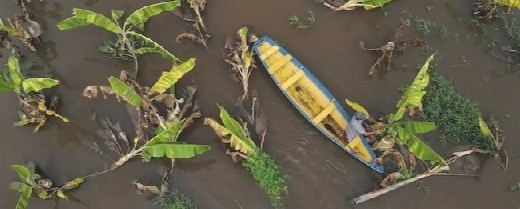
Image above: Aerial view of a banana boat in Brazil. From original article in Italian. (https://www.ilsole24ore.com/art/finalmente-abbiamo-capito-che-crescita-e-sviluppo-non-sono-stessa-cosa-AEJH2obB?refresh_ce=1) .

Fifty years ago, Italian business leaders in the Club of Rome gave a jolt to the world in their path-breaking report Limits to Growth.  That thought leadership continues today as Italian business leaders launch Regeneration 2030, a powerful call for more holistic, ethical, and sustainable business practices to help the world achieve the Sustainable Development Goals (SDGs) and the Paris Climate Agreement.  

The 50-year journey from Limits of Growth to Regeneration 2030 shows how far we have come in understanding the critical challenges facing humanity, but also how far we still have to go to meet those challenges.
 
The half-century since Limits to Growth also defines my own intellectual journey, since I began university studies at Harvard University exactly 50 years ago as well.  One of the first books that I was assigned in my introductory economics course was Limits to Growth.  The book made a deep and lasting impression on me.  Here for the first time was a mathematical simulation of the world economy and nature viewed holistically, and using new systems dynamics modeling then underway at the Massachusetts Institute of Technology (MIT). 
 
Limits to Growth warned that compound economic growth was on a path to overshoot the Earth’s finite resources, leading to a potential catastrophe in the 21st century.  My professor huffily dismissed the book and its dire warning.  The book, the professor told us, had three marks against it.  First, it was written by engineers rather than economists.  Second, it did understand the wonders of a self-correcting market system.  Third, it was written at MIT, not at Harvard!  Even at the time, I was not so sure about this easy dismissal of the book’s crucial warning.   
 
Fifty years later, and after countless international meetings, conferences, treaties, thousands of weighty research studies, and most importantly, after another half-century of our actual experience on the planet, we can say the following.  First, the growing world economy is indeed overshooting the Earth’s finite resources.  Scientists now speak of the global economy exceeding the Earth’s “planetary boundaries.”  Second, the violation of these planetary boundaries threatens the Earth’s physical systems and therefore humanity itself. 

Specifically, humanity is warming the climate; destroying the habitat of millions of other species; and polluting the air, freshwater systems, soils, and oceans. Third, the market economy by itself will not stop this destruction. 

Many of the most dangerous actions – such as emitting climate-changing greenhouse gases, destroying native forests, and adding chemical nutrients to the rivers and estuaries – do not come with market signals attached.  Earth is currently treated as a free dumping ground for many horrendously destructive practices. 

Twenty years after Limits to Growth, in 1992, the world’s governments assembled at the Rio de Janeiro Earth Summit to adopt several environmental treaties, including the UN Framework Convention on Climate Change (UNFCCC) and the Convention on Biological Diversity.  

Twenty years later, in 2012, the same governments re-assembled in Rio to discuss the fact that the environmental treaties were not working properly.  Earth, they acknowledged, was in growing danger.  At that 2012 summit they committed to establish Sustainable Development Goals (SDGs) to guide humanity to safety.  In 2015, all 193 UN member states adopted the SDGs and a few weeks later signed the Paris Climate Agreement to implement the 1992 climate treaty.
 
In short, we have gone a half-century from the first warnings to today.  We have adopted many treaties and many global goals, but in practice, have still not changed course.  The Earth continues to warm, indeed at an accelerating rate.  The Earth’s average temperature is now 1.2°C warmer than in the pre-industrial period (dated as 1880-1920), and is higher than at any time during the past 10,000 years of civilization.  

Warming has accelerated to more than 0.3°C per decade, meaning that in the next decade we will very possibly overshoot the 1.5°C warming limit that the world agreed to in Paris.    
 
A key insight for our future is that we now understand the difference between mere “economic growth” and real economic progress.  Economic growth focuses on raising traditional measures of national income, and is merely doing more of what we are already doing: more pollution, more greenhouse gas emissions, more destruction of the forests.  

True economic progress aims to raise the wellbeing of humanity, by ending poverty, achieving a fairer and more just economy, ensuring the quality education for all children, preventing new disease outbreaks, and increasing living standards through sustainable technologies and business practices.  True economic progress aims to transform our societies and technologies to raise human wellbeing.  

Regeneration 2030 is a powerful business initiative led by Italian business leaders committed to real transformation.  Regeneration aims to learn from nature itself, by creating a more circular economy that eliminates wastes and pollution by recycling, reusing, and regenerating natural resources.  Of course, an economy can’t be entirely circular – it needs energy from the outside (otherwise violating the laws of thermodynamics). 

But rather than the energy coming from digging up and burning fossil fuels, the energy of the future should come from the sun (including solar power, wind, hydroelectric, and sustainable bioenergy) and from other safe technologies.  Even safe man-made fusion energy may be within technical and economical reach in a few decades.   
 
On my part, I am trying as well to help regenerate economics, to become a new and more holistic academic discipline of sustainable development.  Just as business needs to be more holistic and aligned with the SDGs, economics as an intellectual discipline needs to recognize that the market economy must be embedded within an ethical framework, and that politics must aim for the common good.  Scientific disciplines must work together, joining forces across the natural sciences, policy sciences, human sciences, and the arts.  

Pope Francis has spurred the call for such a new and holistic economics by encouraging young people to adopt a new “Economy of Francesco,” inspired by the love of nature and humanity of St. Francis of Assisi. 
 
Sustainable Development, Regenerative Economy, and the Economy of Francesco are, at the core, a new way of harnessing our know-how, 21st century technologies, and ethics, to promote human wellbeing.  The first principle is the common good – and that means that we must start with peace and cooperation.  Ending the war in Ukraine at the negotiating table without further delay, and finding global common purpose between the West and East, is a good place for us to begin anew.

.

One more lap around the Sun

SUBHEAD: Whatever seemed normal, is about to vanish in the rear view mirror.

By Juan Wilson on 14 July 2022 for Island Breath -
(http://islandbreath.blogspot.com/2022/07/one-more-lap-around-sun.html

Image below: View of Hawaiian Islands from hear space looking northwest. From (https://www.nasa.gov/image-feature/the-hawaiian-island-chain).


There were times in the past when we would publish 2 or even 3 articles in a day for Island Breath. Back then we used ti have a subscription to a Kauai published and printed daily paper. In those days the ability to find a job, rent an apartment, and buy a car were vital services of a local daily news paper. 

That world has blown away like tumbleweed by the onslaught of features and function of the ubiquitous iPhone and it's copycat competitors. 

As a result one can hardly find a restaurant with a printed menu any more. You're invited by the "staff" to "scan it!"... Some people (like some baby-boomers, and and toddlers don't have an iPhone. "No Prob... we have a printed menu behind the bar... I'll see if I can find it. 

When we cannot keep up the near space telecommunication technology we have developed along with the wireless networks utilized by the iPhone and its copycats.

All might have gone well if we were not in total denial of the dire straights humanity has cornered itself into. Too many people, ruining, abandoning and throwing a way too much stuff for too long.

We have had half a century -since 1972- when the Club of Rome first published its predictions for our future based on resource losses, consumption increases, human population growth.

I'm going to try and get back in the saddle... meaning getting back to doing fresh, new articles... although I suspect they will not all avoid some cynicism.

I'll be back... soon I hope... Juan Wilson

Summer's Over

SUBHEAD: Another season has passed as we tip into the darkening side of the year.
 

By Juan Wilson on 11 November 2021 for IslandBreath -
(http://islandbreath.blogspot.com/2021/11/summers-over.html)


Image above: Fall colors at peak in mid Atlantic states two weeks ago. From (https://www.washingtonian.com/2021/09/30/heres-when-fall-foliage-will-peak-around-dc/).

For some people this last year has been a blessing, not a curse. I know there has been suffering... there always is in a pandemic. However, here on Kauai the impact of Corona Virus was largely mitigated by our County and State government closing down much of commercial tourism. On one hand, some people have lost jobs and are burdened by debt they cannot avoid. On the other hand things on Kauai went back to being more local and independent.

I have see more local people fishing and gathering along the shore. There has been less car traffic at the beach and less suntan lotion floating in the water. There have been mornings with just a couple of people swimming at our Salt Pond Beach Park. slowly, the wave of rental cars is resurging. 

But my sense is that the real hangover from the pandemic and the the collapse it has generated is just beginning... and that is okay... or at least sufferable.  But with over 8 billion of us there are too many people are groping for a mansion on a cul-de-sac.  The idea that humans can go on reproducing and consuming at the same rate for another generation does not look realistic. It's not a situation of the more people the merrier. What we need more of is more elephants, whales and eagles.

In the case of all the great apes (our closest cousins) there are a total of about 500,000 total. The Great Apes include all the gorillas, orangutans, chimpanzees and bonobos in the world. Humans are just one branch on that tree... That means there are more than 16,000 times as many humans than all the other great apes we share our traits with.

Not only that, but we take a much larger share,  individually, of the all the resources of the world - land, water, timber, etc.  

The solution... step back, take less, do less, travel less, eat less, buy less, spawn less. Walk more, talk more, make more, share more, grow more, love more. Buy used and refurbished. 

.


Getting Through Collapse

SUBHEAD: Things are unwinding, but there are preparations you should begin immediately.


By Juan Wilson 29 January 2021 for Island Breath -
(http://islandbreath.blogspot.com/2021/01/getting-through-collapse.html)


Image above: Plowing a field in a community garden near suburban homes. From (https://www.treehugger.com/how-to-start-a-small-farm-3016691).

There has been a sense of dread for some time...  by that I mean decades. Much of the 20th Century was embroiled in World Wars, the Great Depression, the Cold War and fear of nuclear extinction. Now we face a disease that appears more dangerous than the Spanish Influenza Pandemic of 1918.

As we wrote in "Winning the Trifecta last year - See (http://islandbreath.blogspot.com/2020/06/winning-trifecta.html) with the subhead "To win we will have to solve all our problems together... health, wealth and environment."

That has not changed, other than to intensify. The human condition is rapidly changing and not under our control or in our perceived interests. The trappings of civilization and culture are wearing thin under the yoke of lock-downs, indebtedness, fear of the future, and isolation.

There are not many realistic ways out of our dilemma that does not include a major human population reduction and a severe reduction in our consumption of Earth's resources and will require a monumental increase in recycling, repurposing and renewing those resources we have converted to "garbage". 

Here in Hawaii it is a realistic possibility that modern trans-Pacific container shipping will no longer be economically feasible. We will have to grow the majority of the food we consume in the islands. And more food will be necessary for feeding the eggeries, fisheries, dairy farms and other food and resource related agricultural operations that won't be distant factory operations but neighborhood businesses. 

In short, sustainable farming will become the major human operation in Hawaii. And that will be true in any place that has sustained human population. 

Yes, there will be some nomadic hunter gatherers... small bands of tribal people that move with the herds and the seasons. But the majority will exist in a condition more like the early18th century in rural America... but without great abundance of natural resources that was cut down, plowed up and mined.

I do not expect to see the complete transition myself. I'm a Baby Boomer in my late 70's. But I imagine it will be a life without personal automobiles, vast shopping plazas and on demand multi-media entertainment. 

My wife, Linda, and I are trying to grow as much food and herbal plants as we can and creating tradable "refined" products... like organic eggs and vegetables, macadamia nut butter, bottled hot sauce, jams, comfrey salves, etc.

These and other self employed efforts like:

    • Providing fresh water through rain-catchment, solar water-pump.

    • Providing multiple, overlapping systems for power hot water, and communication.

    • Growing and storing food from a place you have some managing control over. 

    • Having stock of materials, tools and know-how to maintain and repair what you have.

    • Ways to entertain yourself with neighborhood theater, music, card games, puzzles, or crafts.

Just remember there will be no TGI Fridays, Bed Bath & Beyond, Starbucks or GameStop to fill your cravings.

Bottom line... we are on our own in a land we are unfamiliar with. We are in a "New Normal" that is not going away, but is evolving into another world.  One that is not nearly as friendly as the Garden of Eden, but hopefully more comfortable than the Dark Ages, "1984" or "The Matrix"

Getting better at navigating that new landscape will be a major  determination of how happy you are.

That navigation will require the capability of fixing and maintaining some 20th century tech - like a small simply designed diesel engine or electric tools - but won't include repairing iPhone or maintaining full spectrum satellite communications systems.

So get yourself a good set of tools for the shop, garden, garage and sewing room... you're going to need them. Once you have the tools - start using them so when the time arrives you'll be useful.


 .

When Consensus is Fractured

SUBHEAD: In 2020 we found ourselves in a world where we could not agree on what is reality.


By Richard Heinberg on 18 December 2020 for Resilience.org -
(https://www.resilience.org/stories/2020-12-18/2020-the-year-consensus-reality-fractured/)
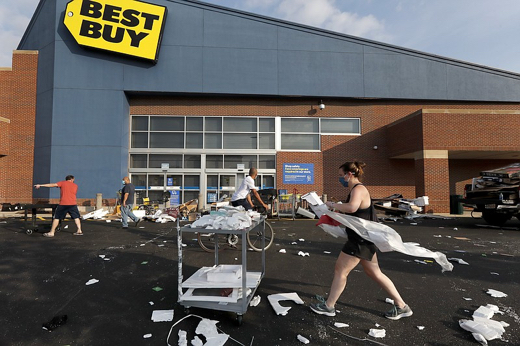

Image above: Volunteers help clean up the parking lot outside a Best Buy store, Monday, Aug. 10, 2020, after vandals struck overnight in the Lincoln Park neighborhood in Chicago. From (https://www.hotsr.com/news/2020/aug/11/hundreds-ransack-downtown-chicago-businesses/).

Virtually everyone agrees that 2020 was an abomination. An entire industry of opinion writers is busying itself with end-of-year hand wringing, scouring every online thesaurus for adjectives to express just how horrible the last twelve months have been. 

But what facet of the awfulness to focus on? For the appalled chronicler, the most obvious starting points are the coronavirus pandemic, which has left illness, death, shuttered businesses, and lost jobs trailing in its wake, and the chaotic US presidential election, in which the soundly defeated incumbent has attacked and seriously weakened the very foundations of democracy on his way out the door. 

These two baskets of grim news (pandemic and election) have been accompanied by a shift in the national (and, to some extent, global) zeitgeist—a shift that’s been obvious to anyone paying attention, but that’s nevertheless challenging to capture in words. 

Let’s call it the fracturing of consensus reality. While it won’t be the top story of the year according to most news roundups, it may end up being just as impactful as anything else that’s happened during our latest orbit of the sun. And that’s saying something. 

What’s Real? Let’s All Agree As social and linguistic creatures, we humans—operating in groups—create shared mental worlds. We perceive sensory data, then we verbalize and conceptualize those perceptions, and finally we check our verbalized and conceptualized accounts of reality with other people. 

Over time, a consensus emerges. This language-mediated reality-building process is hardly new; it’s been going on since we all lived by hunting and gathering. Then, everybody within their little groups shared the same stories and the same basic mental map of the world.

After we adopted agriculture, social classes and full-time division of labor ensued. With slavery, kings, and a dramatic reduction in the social power of women, consensus reality became more of a Venn diagram, with the king having the final word in defining the overlapping region on the diagram representing consensus. 

Later, the emergence of writing and Big God religions enabled reality to be codified for empires, and elements of the dominant consensus (e.g., Roman law and Christianity) could be spread among alien cultures. 

For most Europeans, even as dynasties came and went, reality remained essentially whatever the Bible, the church, and the king or emperor said it was. Consensus reality was never consistent or complete and never a correct map of what it purported to represent; it was always an approximation skewed by power relations. 

Some people’s realities were privileged, while other people’s were marginalized, excluded, or intentionally destroyed. And there were always blind spots—actual trends, vulnerabilities, and consequences that nobody noticed or talked about, such as the gradual depletion of natural resources—that only became “real” when they could no longer be ignored. The modern era (from roughly 1500 on) brought new sources of diversity to the consensus-building process. 

As Europeans conquered societies around the globe, “reality” began to reflect the sounds and flavors of these diverse cultures; the result was everything from jazz to fusion cuisine. Meanwhile, the power of commerce greatly increased, reducing the influence of church and aristocracy. 

Increased diversity and a shift toward commercial primacy were accompanied by new integrative trends in the process of collective reality-building. Principal among these was the emergence of science—a self-correcting method for discovering objective truth. 

Of course, science had its blind spots, too (for example, it was often subject to commercial influence—witness the long lags in recognizing the nasty side effects of tobacco and pesticides), but it was persuasive: assertions could be tested by controlled experiment. 

Over the decades, science built formidable structures of knowledge that most people lacked the expertise or temerity to question, but that could be verified by anyone with the necessary resources. Reality became “enlightened.” Another integrative trend consisted of the development of new communication tools—the printing press, and later radio, movies, and television. 

Increasingly, through these media, nearly everyone was exposed to common facts, ideas, and images. The wealthy banker and the destitute farmer uprooted by the dust bowl were marinated in the same Hollywood imagery, and the same civics homilies taught in compulsory public schools. 

Cracks in the Modern Consensus The emerging global consensus suffered a couple of serious ruptures during the modern era. In Europe, fascism brought more than a new set of political power relations; it created a mental universe so dominated by notions of racial and national superiority that it demanded the rewriting of textbooks. 

And in Russia, communism built a narrative in which the dictatorship of the proletariat—under constant attack by the forces of capitalism—must ultimately prevail, leading to a workers’ paradise. 

Both fascists and communists used new mass communication tools (radio, movies, and newspapers) to give their consensus realities force and credibility. Even science could be repurposed to support alternate realities. In the Soviet Union, the state decided to back an alternative to natural selection and science-based agriculture. 

The originator of this heterodox set of views, Trofim Lysenko, became Director of the Soviet Union’s Academy of Agricultural Sciences, where—with Stalin’s approving help—he rooted out the study of Mendelian genetics and taught instead the theory that characteristics acquired by parents can be directly transmitted to their offspring. 

Opponents of Lysenko were accused of “mysticism, obscurantism, and backwardness,” then banished to Siberian work camps. As a result, biological science in the Soviet bloc was set back decades. After the defeat of fascism in WWII and the fall of the Soviet bloc, the West’s consensus—shaped largely by the US—seemed to become reunified and stabilized. 

Political scientist Francis Fukuyama called it “the end of history.” But blind spots persisted and grew. Some of these profoundly shaped not just the dominant worldview itself, but the contours of daily life for multitudes. 

One telling example: the so-called science of economics codified for nearly everyone the false assumption that perpetual growth in industrial activity is possible, and denied all evidence to the contrary. 

Economics concealed other blind spots as well, as it continually ignored widespread signs that the “free market” does not in fact benefit everyone, and that people do not actually behave like idealized rational self-interest-maximizing robots. 

Some persistent and periodically worsening cracks in the consensus ripped along economic, ethnic, or political fault lines: especially during the Jim Crow era, African-Americans and European-Americans in southern US states inhabited sharply different realities, and stark inequities have persisted to the present. 

Other cracks, fed by suspicions that powerful people were manipulating the consensus to their own benefit, led to what came to be known as conspiracy theories—including doubts about the official accounts of the JFK assassination and 9/11, as well as misgivings about the safety and “real” purpose of water fluoridation and vaccination. Meanwhile, communications media were evolving still further. 

While radio and television had a largely unifying effect during the 20th century, the internet and social media are proving to be disintegrative to consensus in the 21st. Algorithms capture users’ interests and prejudices and feed them news and opinion articles that lead them to have ever-more-extreme views. 

“Do you think the government is suppressing information about space aliens? You don’t know the half of it! Read this!” 

The radicalizing propensity of social media was a factor in the sudden political ascendancy of Donald Trump, who acted as both symptom and driver of consensus breakdown. As a real estate developer and reality TV personality, he seemed an exceedingly inexperienced and unlikely candidate for the top political office in the country, and arguably the world. His intellect and ethics were widely suspect. 

But he had the ability to give utterance to the grievances of a sector of the populace that feels left behind—people of mostly European ancestry in low-density towns and rural areas across the nation (in recent decades, most of America’s wealth and cultural attention has flowed to high-density, multi-ethnic cities). 

Even if Trump could not change the material circumstances of small-town families, he could make them feel as though they had a voice. Ironically—and perhaps therefore somehow even more fittingly—it was the voice of a gaudily privileged New Yorker. 

But it was an angry voice, and it spoke in words of few syllables. He was the first Twitter President. The Trump team’s communication strategy, in the immortal words of former top adviser Steve Bannon, was to “flood the zone with shit.” Disruption of consensus reality wasn’t a regrettable side effect of their efforts; it was a central goal. 2020: The Dam Breaks In short, prior to the year now ending, consensus reality in the US was already starting to crumble. But 2020 delivered two sledgehammer blows: a pandemic and a polarizing presidential election. First, the pandemic. 

As many observers have pointed out, COVID-19 has greatly varying infection and death rates by nation, and countries with higher levels of social cohesion have generally tended to do better at combatting the disease. 

The United States has fared the worst of all countries in raw numbers, with over 17 million total cases so far and over 300,000 deaths (about a dozen smaller countries, including Belgium and San Marino, have suffered higher per capita rates of infection and mortality). Currently the US is seeing over 200,000 new cases each day and roughly 2,500 deaths. 

Unless the trend changes, total mortality for the country may eventually begin to rival that of the 1918-1919 influenza pandemic, in which about 675,000 died (though the per capita death rate will almost certainly not be as grim, given today’s far larger population). 

 Why has the US suffered such a horrific outcome? 

Much of the blame certainly must be borne by President Trump and his political appointees and allies in the federal government. They mounted almost no coordinated national pandemic response; instead, states were left to formulate their own policies and to compete with each other for medical supplies. 

Messaging from the executive branch was likewise unhelpful or downright counterproductive: in the early weeks, when the virus was largely just a distant menace and preparations could have made a huge difference, the President dismissed the need for concern (on January 22, he told a CNBC interviewer, “We have it totally under control. It’s one person coming in from China, and we have it under control. It’s going to be just fine.”). 

Then, when it became clear that sickness was spreading and people were dying, Trump invented the term “China virus,” evidently seeking to deflect blame while still failing to forge a national response plan. Later in the year, as economic and political concerns took the spotlight, 

Trump returned to almost completely ignoring the disease, even omitting attendance, for weeks at a time, at meetings of his coronavirus task force. With no clear messaging from the President, it was essential that the appropriate federal agencies step in. But here again the response faltered. 

The Centers for Disease Control at first advised the public against mask wearing, despite clear evidence that masks were effective at stopping the spread of the disease. Only later, once masks became more widely available, did the CDC change its recommendation. 

But this self-contradiction had undercut the agency’s credibility. Many people continued to believe that mask wearing is ineffective, while the President encouraged his followers to see mask mandates as government overreach. Conspiracy theories immediately filled the vacuum of leadership and consistent government messaging. 

Millions of people, stuck at home under lockdowns, were spending more time than ever on social media and Google, exploring ideas and opinions about the coronavirus. A pair of YouTube documentaries titled “Plandemic” became instant sensations.

 Many people adopted the view that there simply is no pandemic, and that the “fake news” media ginned up the story as a way to enable globalist liberal elites to exert more control over citizens and the economy. Now that vaccines are on the horizon, the conspiracy mill is cranking harder and faster than ever. While the anti-vax movement has been slowly simmering for decades, its current leaders’ books are suddenly among the top-sellers on Amazon.

Up to a third of Americans say they will likely refuse to take a vaccine when it is available. While many people hope that the advent of vaccines will halt the pandemic in its tracks, anti-vax fervor, along with the soaring rate of infections, may mean that the disease will continue to spread and kill far into the new year. If Americans were divided prior to the pandemic, their tribalism only intensified as the decision about whether to wear a mask became an instantly visible expression of group identity. 

But division was deepened also by the fact that 2020 was a presidential election year. Elections are always polarizing. That’s the point: each voter must choose one candidate or another; “all of the above” is not an option. 

But this election season pushed the polarization needle far into the danger zone. Democrats steeped themselves in books and articles detailing accusations that Donald Trump presents all the clinical symptoms of narcissistic personality disorder, and that he is an authoritarian, a rapist, a tax cheat, a business fraudster, a Russian puppet, and a traitor.

At the same time, followers of QAnon (who is supposedly a patriotic government insider) spread the notion that leading Democrats are Satan-worshiping pedophiles running a global child sex-trafficking ring, while Trump—a messiah sent by God—heads a heroic behind-the-scenes effort to preserve decency, freedom, and Christianity (QAnon believers now occupy seats in Congress and many state houses). The election outcome was unequivocal. 

Biden bested Trump by 7 million popular votes, with electoral votes stacked 306 to 232. Even Republican election officials in swing states said the balloting went off with scarcely a hitch. But Trump, evidently unwilling to be seen as a loser (or perhaps wishing to avoid prosecution for financial crimes once he leaves office), claimed that the election was rigged and that he had actually won. 

A flurry of almost 60 lawsuits followed, two making their way to the Supreme Court; all were dismissed. No convincing evidence of widespread irregularities was produced. Nevertheless, Trump’s followers adopted the narrative that millions of dead people had voted for Biden, and that suitcases full of illicit Biden ballots had been surreptitiously delivered to vote tabulators. According to one poll, only a quarter of Republicans think Biden was legitimately elected.

 A steady drumbeat of evidence-free assertions resounding through right-wing media channels and parroted by Republican elected officials (who fear retribution from Trump’s base) has created a formidable alternate reality in which Trump won fair and square, while Biden is being falsely elevated to the highest office.

 Consensus Dynamics Cognitive dissonance—the holding of contradictory thoughts or beliefs—makes people miserable. And when a person’s own interpretation of reality runs counter to the consensus reality, some degree of paranoia or depression often results. 

Alternatively, a person unmoored from the dominant consensus may become a dedicated paradigm warrior intent on converting others to their own views, sometimes even by violence. The loss of consensus is therefore also problematic for society as a whole. 

People who have left the consensus behind may disregard or flout norms (such as longstanding informal rules with regard to elections and Congressional procedures). Society then becomes less capable of solving problems; and so, if economic, social, or environmental crises materialize, societal collapse of one sort or another becomes a real possibility. 

As individuals find themselves not just disagreeing on politics or religion, but living in different and directly conflicting mental universes, they individually experience cognitive pain and anguish. Families are torn apart, friendships severed. 

But the collective risks of consensus breakdown go deeper, and include the possibility of widespread rage, pushing society toward civil violence, coup, or state failure. If, as is often the case, the fracturing of consensus results in (or is caused by) strong feelings of grievance among one group against another, a cycle of retribution may ensue. 

Recent brain research by James Kimmel, Jr. at the Yale University School of Medicine shows that the brain on grievance craves retribution in much the same way a brain addicted to heroin craves more heroin. 

 Is the fracturing of consensus reality a symptom of societal decline due to other factors (such as economic crisis or limits to vital resources), or is it an independent variable, capable of causing collapse by itself? 

In my view, the former is more likely the case: if a society is doing well economically, it is usually able to resolve occasional cognitive contradictions over time. A polarizing demagogue (like Joseph McCarthy or George Wallace) may appear, but the status quo eventually reasserts itself.

However, if a society is experiencing an economic, political, or social emergency, consensus breakdown may contribute to a self-reinforcing process of collapse. People’s views of reality don’t diverge arbitrarily and without cause. They do so because people’s self-interests (which may differ by income, status, region, religion, or ethnicity) are becoming further divided. The divergence of worldviews is thus a secondary problem.

But once consensus begins to shatter, people’s interests are likely to diverge even further as bifurcating worldviews create economic and social islands. People may even separate geographically, moving to be closer to people with whom they share values and views. 

Further, if an increasing majority people in a given community are espousing a new shared belief, others may feel compelled to alter their previous beliefs in order to belong. The fragmentation of consensus reality isn’t just a war of ideas. It is a more profound and disturbing process both psychologically and socially. People who have abandoned, or who have been abandoned by, the consensus may find dubious new beliefs to cling to; but they may also become keenly aware of cultural blind spots that others continue to ignore. 

They feel themselves flung into a new universe; the experience can be either terrifying or thrilling, or both. One of the effects of loss of consensus is the lowering of social trust. Trust is the basis of cooperation, and high levels of cooperation are required for modern complex societies to function. 

According to surveys by Pew Research Center, 71 percent of Americans think interpersonal trust has weakened in the past 20 years. There is a strong correlation between low trust and Trump voters—which could be an explanation for why the pre-election 2020 polls were inaccurate: people who are distrustful not only disproportionately voted for Trump but also refused to participate in polling surveys. Because the costs to society of loss of consensus are obvious and considerable, societies invest heavily in maintaining a shared worldview. 

But if there are severe and growing flaws in that consensus, keeping it whole may not be an option. 

When consensus fractures into two directly competing narratives, some people may seek to resolve cognitive dissonance by claiming that the two narratives are equally valid. But this is a difficult stance to maintain, as the narratives are usually mutually exclusive. Take the current case with regard to the US presidential election: the main competing reality claims are not on equal footing with regard to facts or outcomes. 

The “Trump really won” claim is simply fantasy; the “Biden really won” claim is backed by clear evidence that will result in the actual inauguration of a new President. But, in a way, facts are beside the point. Over a third of Americans are so alienated from the consensus that they prefer to believe obviously fabricated lies rather than to acknowledge demonstrable proof. 

The new Republican “reality” is tenable not because it is based on anything physically verifiable, but because it is emotionally satisfying for people who refuse to accept the dominant narrative. In the post-Trump era, traditional Republican ideology (low taxes, states’ rights, limited government spending) becomes entirely expendable. 

Any argument that “owns the Dems” is good, regardless how specious. 

Democracy itself becomes an impediment to the goal of wrecking the consensus. Defenders of the dominant worldview can’t understand why anyone would be so upset with it. Isn’t it based on science and established values and traditions? 

Doesn’t the alternative represent a devolution into pseudoscience, conspiracy theories, and deepening dissension? 

To a certain extent, the fervor of the disestablishmentarian faction is traceable to economic and social trends mentioned earlier (the flow of wealth and power to coastal urban centers and the slow demographic shift of the country toward multi-ethnicity). The upholders of the mainstream consensus accept those trends, which their elites use to their own advantage, but they fail to take account of those left behind, or to see the holes and blind spots in the consensus they defend. 

 Perhaps the deepest blind spot in the current US consensus is that it has no satisfying and unifying vision, no coherent ideology; its main guiding value is simply “more.” Its implicit message: we must keep on doing what we’re doing (producing more wealth by turning more of nature into waste) because to do otherwise would result in economic Armageddon. 

The best we can do is to somehow avert catastrophic climate change and reduce extreme wealth inequality with technical work-arounds, even as we continue to do the very things that cause those problems. 

 The central lie of the consensus is that the rising tide of economic growth will lift all boats . . . eventually. But eventually never seems to come. As the folly of expecting endless economic growth on a finite planet starts to reveal itself—via the need for ever more drastic measures to maintain the appearance of growth and to prevent widespread destitution—something has to give. People who feel unfairly treated as the impossible perpetual-growth machine decelerates begin fleeing the consensus, even if doing so leads them to curse imaginary scapegoats and believe obvious fictions. 

 Can the Old Consensus Be Repaired? Can a New One Be Built? Joe Biden is central casting’s answer to the call for a tried-and-true figurehead to restore the old consensus. Anyone who’s not swept up in anti-elite fervor probably finds it easy to sympathize with his exhortation to bring America back together, and his intention to be President of all the people, including those who voted against him.

However, Biden faces daunting if not insurmountable challenges. These arise not just from fervent, defeated, and angry Trumpists, who may attempt to run a “shadow” presidency, countering every action of the new administration. 

There are also hurdles inherent in the taming of the pandemic and the stabilization of the economy. Less widely acknowledged but perhaps most formidable of all is the challenge of finally coming to terms with the blind spots and lies embedded in the worldview that still runs the machinery of our economy and government. Consumerism—a way of organizing the economy that is fundamentally at odds with nature’s limits—is so deeply and implicitly woven into the warp and weft of modern America that only a cathartic collapse and renewal is likely to expunge it. 

The best Biden can likely do, even if he has the strategic brilliance to propose a Rural New Deal, is to be a competent placeholder. The perplexing fact is that we don’t know what kind of new consensus may emerge, or when. 

Indeed, it is entirely possible that, in the context of energy and economic decline, the human ideasphere will remain fragmented from now onward. However, I’d like to think that a new consensus is indeed possible, and that it will comprise the best of what we humans have learned so far. 

And, though what follows is entirely speculative, it seems appropriate to close this essay with an exploration of what that consensus might look like. Science would be an obvious candidate for inclusion, blind spots and all: its self-correcting mechanism tends to deliver improving approximations of truth with regard to physical reality. 

Of course, in a world with a smaller and slower economy and much less energy available, only comparatively small and simple experiments might be possible, but it’s the method that matters. 

 Science can’t tell us much about values and goals. For those, knowledge is less important than wisdom. And wisdom comes from intelligent self-control. As sages have always taught, it is in the taming of selfish urges that we find compassion and contentment. 

After the environmental and social mayhem that our two-century fossil-fueled consumerist mania will ultimately and undoubtedly unleash, I think we are likely to develop a strong and healthy collective skepticism regarding the aggregation of power for its own sake. 

A sustainability-oriented worldview would acknowledge the ongoing need for a low and stable population relative to environmental carrying capacity. And it would prize sufficiency, equity, resilience, and happiness above accumulation and ostentatious display. 

Our remarkable human capacities for language and tool making have gotten us into plenty of trouble over the millennia, never more so than now. A healthy consensus worldview would channel those outsized abilities away from geopolitical dominance and the production of wealth for the few, and toward the democratic (rather than just elite) production of beauty in all its possible forms—including poetry, literature, movement, music, art, drama, and architecture. And it would guide aesthetic appreciation toward the enhancement and emulation of nature.

Finally, a future consensus would take account of varying human needs, proclivities, modes of expression, histories, brain chemistry, and more, seeking reconciliation and community rather than exploitation and dominance. 

Such a consensus reality, such a culture, is far from where we are now. Between here and there sits a valley we must cross. If we travel together, we have a better chance of arriving safely on the other side. That requires healing the divisions among us, if and when we disagree. 

Have a peaceful holiday season.

.

The Great Unravelling

SUBHEAD: Part of a discussion series on adapting to the environmental crises we have created.

By Asher Miller on 28 October 2020 for the Post Carbon 
(https://www.postcarbon.org/is-the-great-unraveling-upon-us/)

Image above: Firefighters conduct a back-burn operation along Route CA-168 during the Creek fire as it approaches the Shaver Lake Marina on Sunday, Sept. 6, 2020. Photo by Kent Nishimura for The Los Angeles Times. From (https://www.latimes.com/california/story/2020-09-27/times-photos-california-fires).

Introducing “The Great Unraveling?”, a series of interviews with some of the world’s foremost experts on a broad range of environmental and societal challenges, culminating with a powerful discussion on what these converging and accelerating crises mean, and how we can respond.

What if we don’t look back on 2020 as the year from hell, a painful and surreal slip on the otherwise generally smooth path of progress? What if, instead, we look back in five or ten or twenty years to 2020 as the moment when everything started to really and truly unravel?

Of course, what I’ve presented is a false choice. The truth is that for billions of people (and other species!) the unraveling has been occurring for a long time, assuming they had anything that could be unravelled to begin with.

People who have been left behind or churned up by the relentless machine of exploitative capitalism. People and natural ecosystems already on the frontline of the climate crisis. Communities that have lost their social cohesion and ability to confront problems collectively.

2020 has exposed and supercharged the fragility, unsustainability, and injustice of so many of our global systems:
  • untenable economic and racial inequality;
  • brittle, globalized supply chains controlled by a relatively small number of corporations;
  • a global climate system that’s already fevered at 1.2ºC warming;
  • growing political instability, distrust, and the rise of authoritarian governments;
  • the collapse of biodiversity and the crossing of other planetary boundaries;
  • an economy dependent on growth, consumption, debt, energy, & population;
  • the failure of governmental institutions to respond to, let alone anticipate, crises;
  • the likely peak in the amount of energy available to power modern society.
These crises were already here or looming long before the coronavirus pandemic hit us broadside this year. In fact, my colleagues at Post Carbon Institute, the many writers who we have featured here at resilience.org, and allies across the globe have been sounding the alarm for decades that the Great Acceleration would inevitably lead to a Great Unraveling or even collapse. That forewarning may now be moot.

To begin considering how to navigate the “Great Unraveling,” we must first try to understand how various environmental and social systems may interact. So a few months ago, Post Carbon Institute and Anthropocene Actions asked some of the world’s foremost experts to share their views of where things stand with some of our most pressing environmental and societal challenges, particularly in the wake of the pandemic.

We then hosted a powerful discussion with an esteemed, diverse panel on what these converging and accelerating crises mean, and how we can respond.

Facing up to these interconnected crises requires unprecedented cooperation and coordination, if we have any hope of creating a sustainable, equitable, and resilient world. To this end, campaigners, politicians, companies, governments, and communities all across the world are pushing for and enacting change. 

But these efforts will have to remain robust, flexible, and resilient in the face of growing destabilization. And they must be grounded in an understanding of the systemic nature of the predicament we face.

The wrenching disruption of the pandemic presents barriers to change, as shown by those seeking to reinforce the pre-pandemic status quo. But this historic moment also presents opportunities to move toward a sustainable society that benefits all. The key to a better future is to learn how to manage the compounding crises of a more destabilized future – how to navigate the Great Unraveling. 

  .

Winning the Trifecta

SUBHEAD: To win we will have to solve all our problems together... health, wealth and environment.

By Juan Wilson on 24 June 2020 for Island Breath -
(https://islandbreath.blogspot.com/2020/06/winning-trifecta.html)


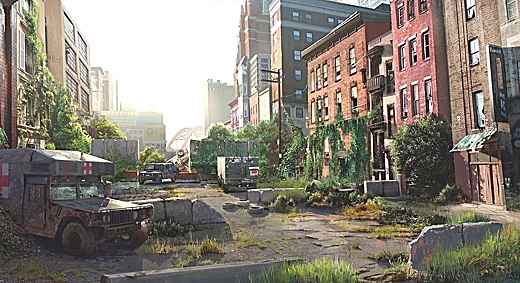
Image above: An urban street in America after a major collapse. From (https://www.masktactical.com/urban-survival-series-part-1/).

A trifecta is a certain kind of bet in a horse race. The better makes a great deal of money if he wins, but the chances are slim. The better must not only win on picking the first place finisher of the race, but also the second and third place winners.

We humans have to win against a trifecta of disasters that we have brought unto ourselves by greed, complacency and ignorance.

We have known for  more than three generations that the jig was up. We realized humans were destroying the Earth that is our only home. Its was 1970 (50 years ago) that President Richard Nixon, a conservative Republican, who signed into law the US Environmental Protection Agency.

There were high hopes that some remedy to our environmental plight might be found. It wasn't found and it wasn't in our short term interest to do so.  We avoided finding a way to save the Earth and the creatures that inhabit it because it wasn't as profitable or as comfortable as continuing on  burning up the planet for profit and comfort. 

Well, now we will have to win a trifecta to survive and flourish any longer. We face three implacable dangers that are intertwined.
  • Economic Collapse
  • Environmental Collapse
  • Worldwide Fatal Pandemic
The financial collapse is from over-borrowing against the future to continue economic growth as the means of creating wealth.

The environmental collapse is a result of supplying and utilizing the resources for the energy and resources for ever growing economic growth.

In my mind the worldwide fatal pandemic is a correction by Gaia (Mother Nature) for the financial and environmental collapse we have created. Mother Nature is shaking off her blood sucking tics.

There is little time or the will among us to change our ways... but for those that survive the 2020's it will because they have embraced small scale locally resourced food and fabrication. Those survivors will be using hand tools and sailboats rather than tractors and container ships to operate their steady state economy.

As we have been recommending for years... get a head start! As John Michael Greer wrote in 2012 "Collapse Now and Avoid the Rush!". That means getting educated to the situation and acting on it right now. 

If you are a newby to these thoughts you will have to work overtime to catch up. As James Howard Kunstler envisioned in his Would Made By Hand novels, most middle class suburbanites like car salesmen and insurance men will be lucky if they end up living on a productive plantation doing manual labor. 

Manual skills, whether making a barrel, playing a violin, or stitching up a wound, will have real and lasting value in the future. 

As things stand now, I have no clue how long we will have a "world wide web" to go to in the future. Right now we can count on it to inform us the answer to all the questions that we have. 

Once it is unreliable or down we will have only the hard copy left in the schools the libraries or your bookshelves for reference. You might try finding an Encyclopedia set that's been abandoned by your local library or at a local garage sale.


.

Re-opening won't fix our economy

SUBHEAD: Our national economy is too fragile, brittle, bankrupt, corrupt and hopelessly perverse.

By Charles Hugh Smith on 26 May 2020 for Of Two Minds -
(http://charleshughsmith.blogspot.com/2020/05/re-opening-economy-wont-fix-whats-broken.html)


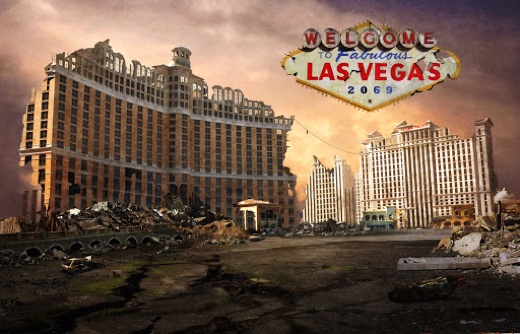
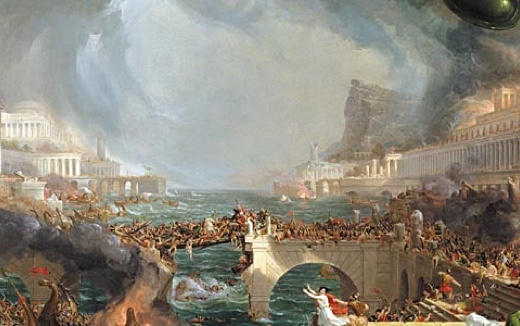
Image above: Illustration of the ruins of Las Vegas with the Bellagio Casino in the left foreground and Caesar's Palace to the right for the story "Underneath Us" by Alex TIllson. From (http://alextillson.com/writing/underneath-us/).

The stock market is in a frenzy of euphoria at the re-opening of the economy. Too bad the re-opening won't fix what's broken. As I've been noting recently, the real problem is the systemic fragility of the U.S. economy, which has lurched from one new extreme to the next to maintain a thin, brittle veneer of normalcy.

Fragile economies cannot survive any impact with reality that disrupts the distortions that are keeping the illusion of "growth" from shattering. 

For the past two decades, every collision with reality cracked the illusion, and the "fix" was to duct-tape the pieces together with new extremes of money-creation, debt, risk and speculative excess.

While the stock market has soared, the real world falls apart. If your region needs a new bridge built, count on about 20 years to get all the "stakeholders" to agree and get the thing actually built. 

Count on the cost quintupling from $500 million to $2.5 billion. Count on corners being cut as costs skyrocket, so those cheap steel bolts from China that are already rusting before the bridge is even finished? Oops. Replacing them will add millions to the already bloated budget.

Want to add a passenger stop on an existing railroad line? Count on 20 years to get it done.

The complexity thicket of every regulatory agency with the power to say "no" basically guarantees the project will never get approved, because every one of these bureaucracies justifies its existence by saying "no." Sorry, you need another study, another environmental review, and so on.

Need a new landfill? I hope you started the process 15 years ago, so you'll get approval in only five more years. Every agency with the power to say "no" will stretch out the approval, so they have guaranteed "work" for another decade or two.

Did your subway fares double? Was the excuse repairing a crumbling system? Did the work get done on budget and on time? You must be joking, right? All the fare increase did was cover the costs of skyrocketing salaries, pensions and administrative costs. Repairs to the tracks and cars-- that's extra. 

Let's float a $1 billion bond so nobody have to tighten their belts, and have riders pay for it indirectly, through higher taxes to pay the exorbitant costs of 20 years of interest on the bond.

Have you been thrown off your bicycle by the giant potholes in the city's "bike lanes"? The city reluctantly admits that these streets that haven't been maintained for decades--yes, decades. 

The city once paid for street maintenance out of its general budget, but alas, that's been eaten up by skyrocketing salaries, pensions and administrative costs, so now we need to float $100 million bond to fund filling potholes.

If all goes according to plan (ha-ha), we should be able to re-pave the streets that have been crumbling for 20 years in... the next 20 years.

These real-world examples are just four of thousands of manifestations of a broken system. Rather than make tough choices that drain power and wealth from vested interests, we simply borrow more money, in ever increasing amounts, to keep the entrenched interests and elites happy.

There are two "solutions" in the status quo: dump the debt on taxpayers or on powerless debt-serfs--for example, college students. (See chart below of the $1.6 trillion that's stripmining student debt-serfs.)

Who benefits from selling all the municipal bonds, bundled student loans, etc. to investors starving for a yield above 0.1%? Wall Street, of course.

The problem is that while debt has soared, productivity and earned income have stagnated. The statistical narrative has been ruthlessly gamed to hide the erosion of living standards, but even with the bogus "low inflation" of official statistics, wages for the bottom 95% have stagnated for decades.

Measures of productivity have also been gamed to mask the ugly reality that the vast majority of the U.S. economy is stagnating under the weight of interest payments on debt, mal-investments in speculative gambles, higher junk fees and taxes, crushing regulatory compliance, high costs imposed by monopolies and cartels and a well-cloaked decline in the quality of just about everything the bottom 95% uses or owns.

What little productivity gains have been made have been skimmed by the top 5%. Coupled with the Federal Reserve's single-minded goosing of the one signaling device it controls, the stock market, the top 0.1% in America own more wealth than the bottom 80%.

If productivity stagnates and winners take all, the wages of the bottom 95% cannot rise. Real wealth is only created by increases in the productivity of labor and capital; everything else is phantom wealth.

The only way stagnant incomes can support more debt is if interest rates decline. Presto, the Fed dropped interest rates to near-zero a decade ago. 

Of course you and I can't actually borrow millions for 0.1%; that privilege is reserved for financiers and other financial parasites and predators.

Debt-serfs were able to refinance their crushing mortgages to save a few bucks, and so they can afford to 1) take on more debt and 2) pay higher taxes to fund the ballooning public debt.

Every one of these extremes has increased the systemic fragility of the American economy. This fragility is reflected in the impoverishment of the bottom 95%, the thin line between solvency and bankruptcy, the decay of public trust in institutions run for the benefit of entrenched interests, and the quickening erosion of America's social contract.

Re-opening a fragile, brittle, bankrupt, hopelessly perverse and corrupt "normal" won't fix what's broken.
.

When Giants Fall

SUBHEAD: If you think Walmart will survive what’s killing other retail generally, you’re wrong.

By James Kunstler on 22 May 2020 for Kunstler.com -
(https://kunstler.com/clusterfuck-nation/when-giants-fall/)


Image above: "Wal*Mart" pun art by Mark Tichenor. From (https://www.redhen.ca/mal_wart.htm).

It was only a few decades ago that Walmart entered the pantheon of American icons, joining motherhood, apple pie, and baseball on the highest tier of the altar.

The people were entranced by this behemoth cornucopia of unbelievably cheap stuff packaged in gargantuan quantities. It was something like their participation trophy for the sheer luck of being born in this exceptional land, or having valiantly clawed their way in from wretched places near and far — where, increasingly, the mighty stream of magically cheap stuff was manufactured.

The evolving psychology of Walmart-ism had a strangely self-destructive aura about it. Like cargo cultists waiting on a jungle mountaintop, small town Americans prayed and importuned the gods of commerce to bring them a Walmart.

Historians of the future, pan-frying ‘possum cutlets over their campfires, will marvel at the potency of their ancestors’ prayers.

Every little burg in the USA eventually saw a Walmart UFO land in the cornfield or cow-pasture on the edge of town. Like the space invaders of sci-fi filmdom, Walmart quickly killed off everything else of economic worth around it, and eventually the towns themselves.

And that was where things stood as the long emergency commenced in the winter of early 2020, along with the Covid-19 corona virus riding shotgun on the hearse-wagon it rolled in on.

We’re in a liminal, transitional moment of history, like beach-goers gawking at the glassy-green curve of a great wave in the throes of breaking. Such mesmerizing beauty!

Alas, most people can’t surf. It looks easy on TV, but you’d be surprised at the conditioning it takes, and Americans are way, way out of condition. (All those tattoos don’t give you an ounce of extra mojo.)

And so, in this liminal moment, the people still trudge dutifully to the Walmarts with their dwindling reserves of cash money to get stuff, going through all the devotions that we took for granted before the wave welled up and threatened to break over us.

Which is happening. Despite all the fake-heroic blather from the Federal Reserve, from Nancy Pelosi, from Mr. Trump and Mr. Mnuchin — from everybody in charge, to be really fair — and in the immortal words of another recent president — this sucker is going down. Specifically, what’s going down is the aggregate of transactions we call “the economy.”

Meanwhile, the people in charge struggle to prop up the mere financial indexes that supposedly represent economic activity, but more and more just look like a shadow play on the wall of some special slum where the street-corner economists peddle their crack. 

Eventually, the people don’t even have money for the crack, and to make matters worse, whatever money actually remains on the street is worthless.

The wave is breaking now, and a lot of things will be smashed under it — are getting smashed as you read. As in any extinction event, it will be the smaller organisms that survive and eventually thrive and that’s how it will go in the next edition of America, whether we remain states united or find ourselves organized differently.

Accordingly, the giants must fall. When the communities of America rebuild, it will be the thousands of small activities that matter, because they will entail the rebuilding of social capital as well as exchanges that amount to business. 

Social capital is exactly what Walmart and things like it killed in every community from sea to shining sea. People stopped doing business with their neighbors. It took a cataclysm for them to finally notice.

If you think Walmart will survive the same cataclysm that’s killing chain-store retail generally, you’re going to be disappointed.

Everything about it is over and done, including the Happy Motoring adjunct that allowed the cargo-cultists to haul their booty those many miles home. (And, ironically, it wasn’t the oil issue that determined this, but the end of the financing system that allowed Americans to buy their cars on installment loans, when it ran out of credit-worthy borrowers.)

Amazon will be the last giant standing perhaps, but it will go down, too, eventually, on its ridiculous business model, which depends utterly on a doomed trucking system. It will be like the last dinosaur roaring at the dimming sun — while the little proto-mammals skitter to their hidey-holes beneath it.

One thing remains constant: human beings are very adept and resourceful at supplying each other’s needs, which is what business amounts to. Young people, freed from the fate of becoming serfs to corporate giants, can start right now at least imagining what they can do to be useful to others in exchange for a livelihood.

The earnest and energetic will find a way to do that at a scale that makes sense when a new order emerges from the wreckage. After a while, it won’t matter much what any government thinks about it, either. 

Like all the other giants, it will fall, too.
.

Dance Macabre

SUBHEAD: Hundreds of kinds of services no longer have customers who can afford their offerings.

By James Kunstler on 18 May 2020 for Kunstler.com
(https://kunstler.com/clusterfuck-nation/dance-macabre/)


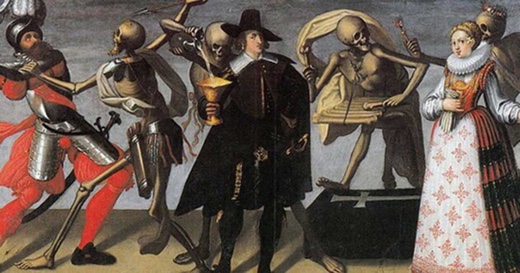
Image above: Painting from the 16th or 17th century illustrating the "Dance Macabre". From (https://www.ancient-origins.net/news-history-archaeology/dance-macabre-how-dead-danced-living-medieval-society-009063).

Western Civ’s most infamous encounter with pandemic disease, so far, was the big first wave of the Black Death that had a marathon run from 1346 to 1353. That bug was the real deal. It killed folks left and right, every age group, every social station, and it killed them ugly.

Few who caught it survived. Up to half the population of Europe perished, along with a lot of their social and economic ways.

The cause of the Black Death was subject to every possible explanation except the actual one, Yersina pestis, a bacterium associated with rats and their insect parasites, fleas and lice, who also enjoyed an association with humans living in the generally squalid conditions of the day — the ancient Roman habit of bathing long forgotten.

At the top of their list of causes was an angry God, and his wicked erstwhile subordinate, Satan.

The “experts” of that time tended to cluster in the church hierarchy, with its drear obsessions and compulsions. The squishy boundary between the supernatural and reality loosed all manner of derangement.

The Jews came in for much vilification, leading to massacres in Strasbourg, Mainz, and Cologne. On the whole, the episode represented a terrific humbling of humanity. The allegory of the Dance Macabre summed it up in mankind’s universal antic journey to the Palookaville of death.

On the plus side, as modern interpolators might say, the bubonic plague winnowed down Europe’s population to a scale more congenial with its resource base. After that big first wave of the disease, land was cheaper and human labor better rewarded.

Eventually, more food got around. Incidentally, the plague provoked nostalgia for the classical antiquity of Greece and Rome, especially among the scholars of Florence, launching the extravaganzas of the Renaissance, the Enlightenment, and eventually our own pageant of techno-supremacist Modernity.

Covid-19 seems rather a punk-ass illness compared to the Black Death. Its victims by far are people already on a fast track to the last roundup. We know exactly what causes it, if not so exactly its origin, and yet the response among our experts has been far more ambiguous than those long-ago bishops of Christendom to the Great Plague.

The various scientists, physicians, public health officers, and politicians seem, to the casual observer, about equally divided between those who consider the corona virus a grave threat and those who insist it’s hardly worse than any annual flu. What is one to believe? Or do?

Which brings us to the verge of the Great Opening-up. The current nostalgia for pre-Covid-19 business-as-usual is understandably intense.

Gone especially from daily life are all the ceremonies of human togetherness, from gatherings of friends to the casual shoulder-rubbings of urban life to the crowded venues of the lively arts to the great moiling orgies of pro sports.

The life of the perpetual jigsaw puzzle, YouTube, and Netflix has proved inadequate to human aspiration. Gone, too, are livelihoods, revenue streams, and rewarding roles in everyday existence. The itch to get out and do, get out and make, get out and be, is overwhelming.

Behind those plain yearnings, though, looms the specter of a system that appeared to be already foundering before Covid-19 entered the scene. There is, at least, considerable agreement that the disease catalyzed the disorders of finance and economy and accelerated the damage — just not among the people most responsible for engineering the fragilities that actually crashed things.

Jerome Powell, Pope of the Church of the Federal Reserve, went on the 60-Minutes show Sunday night to reassure the nation that things will eventually get back to normal. “I think you’ll see the economy recover steadily through the second half of this year.”

Yessir, if you say so. Were his fingers crossed? You couldn’t tell because the camera had him framed in a head-shot. Personally, I think the Fed Chairman was blowing smoke up the nation’s wazoo.

Spooky as it’s been, the Covid-19 virus has also been a great cover-story for the natural collapse of a severely unbalanced, ecologically unsound, and dishonestly represented set of arrangements that are now unspooling at horrifying speed.

The car industry is dying. The airline industry is laying out its fleet of big birds in desert graveyards. The college racketeering operation went off a cliff, along with medical profiteering. Agribusiness no longer has a business model.

Hundreds of kinds of services no longer have customers who can afford their offerings from acupuncture to zymurgy.

None of that will be fixed by injections of miracle money borrowed from ourselves in quantities that would turn every US citizen into a millionaire — if it wasn’t just pounded down the rat-holes of the stock and bond markets. The big question about the Great Opening-up is when the recognition of all that turns to raw emotion.

Covid-19 may still be with us then, but it will be the least of our problems.

The masks will come off. The dance will commence.
.

Not a Cause but a Trigger

SUBHEAD: This corona virus pandemic may cause civilization to collapse for good reasons.

By Ugo Bardi on 16 April 2020 for Cassandra's Legacy -
(https://cassandralegacy.blogspot.com/2020/04/collapse-coronavirus-is-not-cause-it-is.html)


Image above: Illustration by Steven Castelluccia of economic collapse caused by pandemic a peak consumption. From original article.

Do you remember the story of the straw that broke the camel’s back? It is an illustration of how overloaded systems are sensitive to small perturbations. Could the COVID-19 epidemic be the straw that breaks the back of the world’s economy?

Like an overloaded camel, the world’s economy is strained by at least two tremendous burdens: one is the increasing costs of production of mineral resources (don’t be fooled by the current low prices of oil: prices are one thing, costs are another). Then, there is pollution, including climate change, also weighing on the economy.

These two factors define the condition called “overshoot,” occurring when an economic system is consuming more resources than nature can replace. Sooner or later, an economy in overshoot has to come to terms with reality. It means that it can’t continue to grow: it must decline.

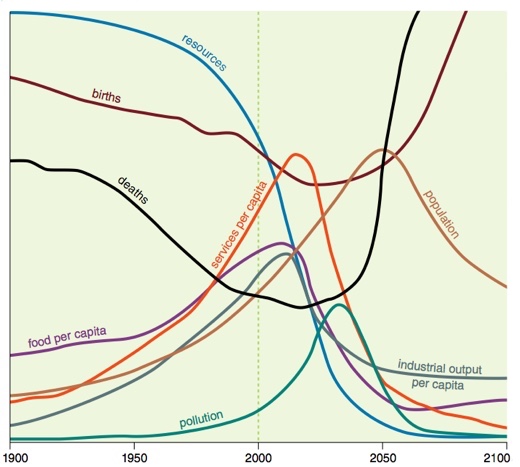
These considerations can be quantified. It was done for the first time in 1972 with the famous report The Limits to Growth sponsored by the Club of Rome. Widely disbelieved at the time, today we recognize that the model used for the study had correctly identified the trends of the world’s economy.

The results of the study showed that the double burden of resource depletion and pollution would bring economic growth first to a halt and then cause it to collapse, probably at some moment during the first decades of the 21st century.

Even with very optimistic assumptions on the availability of natural resources and of new technologies the calculations show that the collapse could at best be postponed, but not avoided.

Many later studies confirmed these results: collapse turns out to be a typical feature of systems in overshoot, a phenomenon called sometimes the “Seneca Cliff” from a sentence of the ancient Roman philosopher Lucius Annaeus Seneca.


Image above: Chart of the projections by the Club of Rome in March 1972 showing the projected " Limits to Growth". Note now in 2020 we have recently passed maximum food production and industrial output per person and are approaching maximum pollution as we slide down the steepest losses of resources. From (https://damnthematrix.wordpress.com/2012/04/11/so-much-for-debunking-the-club-of-rome/)

The coronavirus, in itself, is a minor perturbation, but the system is poised for collapse and the epidemics may trigger it. We already saw how the world’s economy is fragile: it nearly collapsed in 2008 under the relatively small perturbation of the crash of the subprime mortgage market.

At that time, it was possible to contain the damage but, today, the fragility of the system has not improved and the coronavirus may be a stronger perturbation.

The collapse of entire sectors of the economy, such as the tourism industry (more than 10% of the world’s gross product), is already ongoing and it may be impossible to stop it from spreading to other sectors.

So, what exactly is it going to happen to us? Since we started with mentioning a camel, we may also mention a famous statement by Shaykh Rāshid that we can summarize as, "My father rode a camel, I drive a Mercedes, my son will ride a camel." Might that sentence have been truly prophetic?

Indeed, the coming crisis might turn out to be so bad to push us back to the Middle Ages. But it is also true that all major epidemics in history have seen a robust rebound after the collapse.

Consider that, in the mid-14th century, the “black death” killed perhaps 40% of the population of Europe but, a century later, Europeans were discovering America and starting their attempt of conquering the world. It may be that the black death was instrumental in this rebound: the temporary reduction of the European population had freed the resources necessary for a new leap forward.

Could we see a similar rebound of our society in the future? Why not? After all, the coronavirus could be doing us a favor by forcing us to abandon the obsolete and polluting fossil fuels we use today. The current low market prices are the result of the contraction of the demand and are likely to be the straw that breaks the back of the oil industry. That will leave space for new and more efficient technologies.

Today, solar energy has become so cheap that it is possible to think of a society fully based on renewable energy. It won’t be easy, but recent studies show that it can be done.

That doesn’t mean that the near term collapse can be avoided. The transition to a new energy infrastructure will require enormous investments, impossible to find in a moment of economic contraction we expect for the near future.

But, in the long run, the transition is unavoidable and there is hope for a "Seneca rebound" toward a new society based on clean and renewable energy, no more plagued by the threats of depletion and climate change.

It will take time, but we can heal the poor camel’s back.

.

Weird Days

SUBHEAD: A list of some of the odd experiences of disasters in my lifetime.

By Juan Wilson on 15 April 2020 for Island Breath -
(https://islandbreath.blogspot.com/2020/04/weird-days.html)


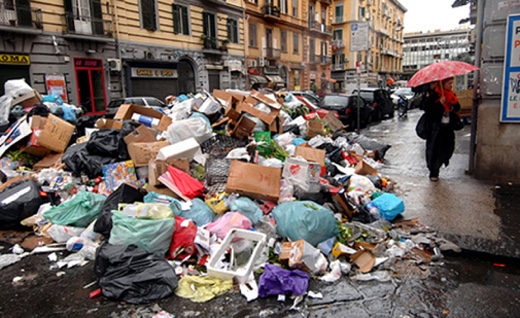
Image above: Photo of garbage piled into street in Manhattan, NY, during 1968 garbage strike. From (https://accesscities.org/nycrfei-pilot-for-public-realm-refuse-and-recyclingsolutionsrequest-for-expressionsof-interest-rfei/).

These are weird days and they seem to be leading to a major reset of life on Earth. The lists below are calamities I have lived through or witnessed through media in my lifetime.

Personally Experienced
Cuban Missile Crisis 1962 (We thought World War 3 was at hand)
(https://en.wikipedia.org/wiki/Cuban_Missile_Crisis)

North East Blackout 1965 (lived in Boston. People thought WW3 had begun)
(https://en.wikipedia.org/wiki/Northeast_blackout_of_1965)

NYC Garbage Strike 1968 (Lived in Lower East side. Garbage up past windows slid into streets)
(https://untappedcities.com/2015/02/11/today-in-nyc-history-the-great-garbage-strike-of-1968/)

OPEC Oil Embargo 1973 (A few people were shot to death for jumping long lines at gas stations)
(https://en.wikipedia.org/wiki/1973_oil_crisis)

Iran US Embassy Crisis 1979 (I lived in Iran 1975-76 and saw what preceded revolution)
(https://en.wikipedia.org/wiki/Iran_hostage_crisis)

Witnessed Through Mass Media
Exxon Valdis Oil Spill 1989 (Effects included the deaths as many as 250,000 seabirds)
(https://en.wikipedia.org/wiki/Exxon_Valdez_oil_spill)

Bangladesh Cyclone 1991 (over 135,000 people killed) 
(https://en.wikipedia.org/wiki/1991_Bangladesh_cyclone)

World Trade Center Attack 2001 (over 2,700 people killed)
(https://en.wikipedia.org/wiki/September_11_attacks)

Tohoku Earthquake & Tsunami 2011 (over 15,000 people killed)
(https://en.wikipedia.org/wiki/2011_Tōhoku_earthquake_and_tsunami)

When you look at the numbers of fatalities the World Trade Center collapse was not nearly as lethal as the other disasters listed above. But maybe it was so traumatic for Americans because it was a disaster created by humans intentionally and involved a symbol of American prowess. It was also witnessed live in the streets of New York and by millions on television.

Simultaneously Experiencing
Corona Virus Pandemic 2020 & Worldwide Economic Collapse 2020

These current disasters are interrelated and will transform the world in ways that will be in Nature's interest and ultimately our human interest. It's past time for a reset.


.

End of Neoliberal Era

SUBHEAD: However big we’re thinking about the effects of this pandemic, we can think bigger.

By Jeremy Lent on 3 April 2020 for Resilience -
(https://www.resilience.org/stories/2020-04-03/coronavirus-spells-the-end-of-the-neoliberal-era-whats-next/)


Image above: Detail of painting of the sack of Rome in 410 titled "Barbarians at the Gate" by Thomas Cole in his series of five paintings of Roman history entitled "The Course of Empire". From (https://medium.com/@robertos/the-fall-of-the-roman-empire-81eae500bdc0).

Think Bigger

Whatever you might be thinking about the long-term impacts of the coronavirus epidemic, you’re probably not thinking big enough.

Our lives have already been reshaped so dramatically in the past few weeks that it’s difficult to see beyond the next news cycle. We’re bracing for the recession we all know is here, wondering how long the lockdown will last, and praying that our loved ones will all make it through alive.

But, in the same way that Covid-19 is spreading at an exponential rate, we also need to think exponentially about its long-term impact on our culture and society. A year or two from now, the virus itself will likely have become a manageable part of our lives—effective treatments will have emerged; a vaccine will be available.

But the impact of coronavirus on our global civilization will only just be unfolding. The massive disruptions we’re already seeing in our lives are just the first heralds of a historic transformation in political and societal norms.

If Covid-19 were spreading across a stable and resilient world, its impact could be abrupt but contained. Leaders would consult together; economies disrupted temporarily; people would make do for a while with changed circumstances—and then, after the shock, look forward to getting back to normal.

That’s not, however, the world in which we live. Instead, this coronavirus is revealing the structural faults of a system that have been papered over for decades as they’ve been steadily worsening.

Gaping economic inequalities, rampant ecological destruction, and pervasive political corruption are all results of unbalanced systems relying on each other to remain precariously poised. Now, as one system destabilizes, expect others to tumble down in tandem in a cascade known by researchers as “synchronous failure.”

The first signs of this structural destabilization are just beginning to show. Our globalized economy relies on just-in-time inventory for hyper-efficient production.

As supply chains are disrupted through factory closures and border closings, shortages in household items, medications, and food will begin surfacing, leading to rounds of panic buying that will only exacerbate the situation.

The world economy is entering a downturn so steep it could exceed the severity of the Great Depression.

The international political system—already on the ropes with Trump’s “America First” xenophobia and the Brexit fiasco—is likely to unravel further, as the global influence of the United States tanks while Chinese power strengthens.

Meanwhile, the Global South, where Covid-19 is just beginning to make itself felt, may face disruption on a scale far greater than the more affluent Global North.

The Overton Window

During normal times, out of all the possible ways to organize society, there is only a limited range of ideas considered acceptable for mainstream political discussion—known as the Overton window. Covid-19 has blown the Overton window wide open.

In just a few weeks, we’ve seen political and economic ideas seriously discussed that had previously been dismissed as fanciful or utterly unacceptable: universal basic income, government intervention to house the homeless, and state surveillance on individual activity, to name just a few. But remember—this is just the beginning of a process that will expand exponentially in the ensuing months.

A crisis such as the coronavirus pandemic has a way of massively amplifying and accelerating changes that were already underway: shifts that might have taken decades can occur in weeks.

Like a crucible, it has the potential to melt down the structures that currently exist, and reshape them, perhaps unrecognizably. What might the new shape of society look like? What will be center stage in the Overton window by the time it begins narrowing again?
The Example of World War II

We’re entering uncharted territory, but to get a feeling for the scale of transformation we need to consider, it helps to look back to the last time the world underwent an equivalent spasm of change: the Second World War.

The pre-war world was dominated by European colonial powers struggling to maintain their empires. Liberal democracy was on the wane, while fascism and communism were ascendant, battling each other for supremacy.

The demise of the League of Nations seemed to have proven the impossibility of multinational global cooperation. Prior to Pearl Harbor, the United States maintained an isolationist policy, and in the early years of the war, many people believed it was just a matter of time before Hitler and the Axis powers invaded Britain and took complete control of Europe.

Within a few years, the world was barely recognizable. As the British Empire crumbled, geopolitics was dominated by the Cold War which divided the world into two political blocs under the constant threat of nuclear Armageddon.

A social democratic Europe formed an economic union that no-one could previously have imagined possible. Meanwhile, the US and its allies established a system of globalized trade, with institutions such as the IMF and the World Bank setting terms for how the “developing world” could participate.

The stage was set for the “Great Acceleration”: far and away the greatest and most rapid increase of human activity in history across a vast number of dimensions, including global population, trade, travel, production, and consumption.

If the changes we’re about to undergo are on a similar scale to these, how might a future historian summarize the “pre-coronavirus” world that is about to disappear?

The Neoliberal Era

There’s a good chance they will call this the Neoliberal Era. Until the 1970s, the post-war world was characterized in the West by an uneasy balance between government and private enterprise. However, following the “oil shock” and stagflation of that period—which at the time represented the world’s biggest post-war disruption—a new ideology of free-market neoliberalism took center stage in the Overton window (the phrase itself was named by a neoliberal proponent).

The value system of neoliberalism, which has since become entrenched in global mainstream discourse, holds that humans are individualistic, selfish, calculating materialists, and because of this, unrestrained free-market capitalism provides the best framework for every kind of human endeavor. Through their control of government, finance, business, and media, neoliberal adherents have succeeded in transforming the world into a globalized market-based system, loosening regulatory controls, weakening social safety nets, reducing taxes, and virtually demolishing the power of organized labor.

The triumph of neoliberalism has led to the greatest inequality in history, where (based on the most recent statistics) the world’s twenty-six richest people own as much wealth as half the entire world’s population. It has allowed the largest transnational corporations to establish a stranglehold over other forms of organization, with the result that, of the world’s hundred largest economies, sixty-nine are corporations.

The relentless pursuit of profit and economic growth above all else has propelled human civilization onto a terrifying trajectory. The uncontrolled climate crisis is the most obvious danger:

The world’s current policies have us on track for more than 3° increase by the end of this century, and climate scientists publish dire warnings that amplifying feedbacks could make things far worse than even these projections, and thus place at risk the very continuation of our civilization.

But even if the climate crisis were somehow brought under control, a continuation of untrammeled economic growth in future decades will bring us face-to-face with a slew of further existential threats. Currently, our civilization is running at 40% above its sustainable capacity. We’re rapidly depleting the earth’s forests, animals, insects, fish, freshwater, even the topsoil we require to grow our crops. We’ve already transgressed three of the nine planetary boundaries that define humanity’s safe operating space, and yet global GDP is expected to more than double by mid-century, with potentially irreversible and devastating consequences.

In 2017 over fifteen thousand scientists from 184 countries issued an ominous warning to humanity that time is running out: “Soon it will be too late,” they wrote, “to shift course away from our failing trajectory.”

They are echoed by the government-approved declaration of the UN-sponsored IPCC, that we need “rapid, far-reaching and unprecedented changes in all aspects of society” to avoid disaster.

In the clamor for economic growth, however, these warnings have so far gone unheeded. Will the impact of coronavirus change anything?

Fortress Earth

There’s a serious risk that, rather than shifting course from our failing trajectory, the post-Covid-19 world will be one where the same forces currently driving our race to the precipice further entrench their power and floor the accelerator directly toward global catastrophe.

China has relaxed its environmental laws to boost production as it tries to recover from its initial coronavirus outbreak, and the US (anachronistically named) Environmental Protection Agency took immediate advantage of the crisis to suspend enforcement of its laws, allowing companies to pollute as much as they want as long as they can show some relation to the pandemic.

On a greater scale, power-hungry leaders around the world are taking immediate advantage of the crisis to clamp down on individual liberties and move their countries swiftly toward authoritarianism.

Hungary’s strongman leader, Viktor Orban, officially killed off democracy in his country on Monday, passing a bill that allows him to rule by decree, with five-year prison sentences for those he determines are spreading “false” information.

Israel’s Prime Minister Netanyahu shut down his country’s courts in time to avoid his own trial for corruption. In the United States, the Department of Justice has already filed a request to allow the suspension of courtroom proceedings in emergencies, and there are many who fear that Trump will take advantage of the turmoil to install martial law and try to compromise November’s election.

Even in those countries that avoid an authoritarian takeover, the increase in high-tech surveillance taking place around the world is rapidly undermining previously sacrosanct privacy rights. Israel has passed an emergency decree to follow the lead of China, Taiwan, and South Korea in using smartphone location readings to trace contacts of individuals who tested positive for coronavirus.

European mobile operators are sharing user data (so far anonymized) with government agencies. As Yuval Harari has pointed out, in the post-Covid world, these short-term emergency measures may “become a fixture of life.”

If these, and other emerging trends, continue unchecked, we could head rapidly to a grim scenario of what might be called “Fortress Earth,” with entrenched power blocs eliminating many of the freedoms and rights that have formed the bedrock of the post-war world.

We could be seeing all-powerful states overseeing economies dominated even more thoroughly by the few corporate giants (think Amazon, Facebook) that can monetize the crisis for further shareholder gain.

The chasm between the haves and have-nots may become even more egregious, especially if treatments for the virus become available but are priced out of reach for some people.

Countries in the Global South, already facing the prospect of disaster from climate breakdown, may face collapse if coronavirus rampages through their populations while a global depression starves them of funds to maintain even minimal infrastructures.

Borders may become militarized zones, shutting off the free flow of passage. Mistrust and fear, which has already shown its ugly face in panicked evictions of doctors in India and record gun-buying in the US, could become endemic.

Society Transformed

But it doesn’t have to turn out that way. Back in the early days of World War II, things looked even darker, but underlying dynamics emerged that fundamentally altered the trajectory of history. Frequently, it was the very bleakness of the disasters that catalyzed positive forces to emerge in reaction and predominate.

The Japanese attack on Pearl Harbor—the day “which will live in infamy”—was the moment when the power balance of World War II shifted.

The collective anguish in response to the global war’s devastation led to the founding of the United Nations. The grotesque atrocity of Hitler’s holocaust led to the international recognition of the crime of genocide, and the UN’s Universal Declaration of Human Rights.

Could it be that the crucible of coronavirus will lead to a meltdown of neoliberal norms that ultimately reshapes the dominant structures of our global civilization? Could a mass collective reaction to the excesses of authoritarian overreach lead to a renaissance of humanitarian values? We’re already seeing signs of this.

While the Overton window is allowing surveillance and authoritarian practices to enter from one side, it’s also opening up to new political realities and possibilities on the other side. Let’s take a look at some of these.

A fairer society. The specter of massive layoffs and unemployment has already led to levels of state intervention to protect citizens and businesses that were previously unthinkable. Denmark plans to pay 75% of the salaries of employees in private companies hit by the effects of the epidemic, to keep them and their businesses solvent.

The UK has announced a similar plan to cover 80% of salaries. California is leasing hotels to shelter homeless people who would otherwise remain on the streets, and has authorized local governments to halt evictions for renters and homeowners. New York state is releasing low-risk prisoners from its jails. Spain is nationalizing its private hospitals.

The Green New Deal, which was already endorsed by the leading Democratic presidential candidates, is now being discussed as the mainstay of a program of economic recovery. The idea of universal basic income for every American, boldly raised by long-shot Democratic candidate Andrew Yang, has now become a talking point even for Republican politicians.

Ecological stabilization. Coronavirus has already been more effective in slowing down climate breakdown and ecological collapse than all the world’s policy initiatives combined. In February, Chinese CO2 emissions were down by over 25%.

One scientist calculated that twenty times as many Chinese lives have been saved by reduced air pollution than lost directly to coronavirus. Over the next year, we’re likely to see a reduction in greenhouse gas emissions greater than even the most optimistic modelers’ forecasts, as a result of the decline in economic activity.

As French philosopher Bruno Latour tweeted: “Next time, when ecologists are ridiculed because ‘the economy cannot be slowed down’, they should remember that it can grind to a halt in a matter of weeks worldwide when it is urgent enough.”

Of course, nobody would propose that economic activity should be disrupted in this catastrophic way in response to the climate crisis.

However, the emergency response initiated so rapidly by governments across the world has shown what is truly possible when people face what they recognize as a crisis. As a result of climate activism, 1,500 municipalities worldwide, representing over 10% of the global population, have officially declared a climate emergency.

The Covid-19 response can now be held out as an icon of what is really possible when people’s lives are at stake. In the case of the climate, the stakes are even greater—the future survival of our civilization. We now know the world can respond as needed, once political will is engaged and societies enter emergency mode

The rise of “glocalization.” One of the defining characteristics of the Neoliberal Era has been a corrosive globalization based on free market norms. Transnational corporations have dictated terms to countries in choosing where to locate their operations, leading nations to compete against each other to reduce worker protections in a “race to the bottom.”

The use of cheap fossil fuels has caused wasteful misuse of resources as products are flown around the world to meet consumer demand stoked by manipulative advertising.

This globalization of markets has been a major cause of the Neoliberal Era’s massive increase in consumption that threatens civilization’s future. Meanwhile, masses of people disaffected by rising inequity have been persuaded by right-wing populists to turn their frustration toward outgroups such as immigrants or ethnic minorities.

The effects of Covid-19 could lead to an inversion of these neoliberal norms. As supply lines break down, communities will look to local and regional producers for their daily needs. When a consumer appliance breaks, people will try to get it repaired rather than buy a new one. Workers, newly unemployed, may turn increasingly to local jobs in smaller companies that serve their community directly.

At the same time, people will increasingly get used to connecting with others through video meetings over the internet, where someone on the other side of the world feels as close as someone across town.

This could be a defining characteristic of the new era. Even while production goes local, we may see a dramatic increase in the globalization of new ideas and ways of thinking—a phenomenon known as “glocalization.”

Already, scientists are collaborating around the world in an unprecedented collective effort to find a vaccine; and a globally crowdsourced library is offering a “Coronavirus Tech Handbook” to collect and distribute the best ideas for responding to the pandemic.

Compassionate community. Rebecca Solnit’s 2009 book, A Paradise Built in Hell, documents how, contrary to popular belief, disasters frequently bring out the best in people, as they reach out and help those in need around them. In the wake of Covid-19, the whole world is reeling from a disaster that affects us all.

The compassionate response Solnit observed in disaster zones has now spread across the planet with a speed matching the virus itself. Mutual aid groups are forming in communities everywhere to help those in need.

The website Karunavirus (Karuna is a Sanskrit word for compassion) documents a myriad of everyday acts of heroism, such as the thirty thousand Canadians who have started “caremongering,” and the mom-and-pop restaurants in Detroit forced to close and now cooking meals for the homeless.

In the face of disaster, many people are rediscovering that they are far stronger as a community than as isolated individuals. The phrase “social distancing” is helpfully being recast as “physical distancing” since Covid-19 is bringing people closer together in solidarity than ever before.

Revolution in Values

This rediscovery of the value of community has the potential to be the most important factor of all in shaping the trajectory of the next era. New ideas and political possibilities are critically important, but ultimately an era is defined by its underlying values, on which everything else is built.

The Neoliberal Era was constructed on a myth of the selfish individual as the foundational for values. As Margaret Thatcher famously declared, “There’s no such thing as society. There are individual men and women and there are families.” This belief in the selfish individual has not just been destructive of community—it’s plain wrong.

In fact, from an evolutionary perspective, a defining characteristic of humanity is our set of prosocial impulses—fairness, altruism, and compassion—that cause us to identify with something larger than our own individual needs. The compassionate responses that have arisen in the wake of the pandemic are heartwarming but not surprising—they are the expected, natural human response to others in need.

Once the crucible of coronavirus begins to cool, and a new sociopolitical order emerges, the larger emergency of climate breakdown and ecological collapse will still be looming over us.

The Neoliberal Era has set civilization’s course directly toward a precipice. If we are truly to “shift course away from our failing trajectory,” the new era must be defined, at its deepest level, not merely by the political or economic choices being made, but by a revolution in values.

It must be an era where the core human values of fairness, mutual aid, and compassion are paramount—extending beyond the local neighborhood to state and national government, to the global community of humans, and ultimately to the community of all life.

If we can change the basis of our global civilization from one that is wealth-affirming to one that is life-affirming, then we have a chance to create a flourishing future for humanity and the living Earth.

To this extent, the Covid-19 disaster represents an opportunity for the human race—one in which each one of us has a meaningful part to play. We are all inside the crucible right now, and the choices we make over the weeks and months to come will, collectively, determine the shape and defining characteristics of the next era.

However big we’re thinking about the future effects of this pandemic, we can think bigger. As has been said in other settings, but never more to the point: “A crisis is a terrible thing to waste.”

.