Showing posts with label Debt. Show all posts

The Great Unravelling

SUBHEAD: Part of a discussion series on adapting to the environmental crises we have created.

By Asher Miller on 28 October 2020 for the Post Carbon 
(https://www.postcarbon.org/is-the-great-unraveling-upon-us/)

Image above: Firefighters conduct a back-burn operation along Route CA-168 during the Creek fire as it approaches the Shaver Lake Marina on Sunday, Sept. 6, 2020. Photo by Kent Nishimura for The Los Angeles Times. From (https://www.latimes.com/california/story/2020-09-27/times-photos-california-fires).

Introducing “The Great Unraveling?”, a series of interviews with some of the world’s foremost experts on a broad range of environmental and societal challenges, culminating with a powerful discussion on what these converging and accelerating crises mean, and how we can respond.

What if we don’t look back on 2020 as the year from hell, a painful and surreal slip on the otherwise generally smooth path of progress? What if, instead, we look back in five or ten or twenty years to 2020 as the moment when everything started to really and truly unravel?

Of course, what I’ve presented is a false choice. The truth is that for billions of people (and other species!) the unraveling has been occurring for a long time, assuming they had anything that could be unravelled to begin with.

People who have been left behind or churned up by the relentless machine of exploitative capitalism. People and natural ecosystems already on the frontline of the climate crisis. Communities that have lost their social cohesion and ability to confront problems collectively.

2020 has exposed and supercharged the fragility, unsustainability, and injustice of so many of our global systems:
  • untenable economic and racial inequality;
  • brittle, globalized supply chains controlled by a relatively small number of corporations;
  • a global climate system that’s already fevered at 1.2ÂșC warming;
  • growing political instability, distrust, and the rise of authoritarian governments;
  • the collapse of biodiversity and the crossing of other planetary boundaries;
  • an economy dependent on growth, consumption, debt, energy, & population;
  • the failure of governmental institutions to respond to, let alone anticipate, crises;
  • the likely peak in the amount of energy available to power modern society.
These crises were already here or looming long before the coronavirus pandemic hit us broadside this year. In fact, my colleagues at Post Carbon Institute, the many writers who we have featured here at resilience.org, and allies across the globe have been sounding the alarm for decades that the Great Acceleration would inevitably lead to a Great Unraveling or even collapse. That forewarning may now be moot.

To begin considering how to navigate the “Great Unraveling,” we must first try to understand how various environmental and social systems may interact. So a few months ago, Post Carbon Institute and Anthropocene Actions asked some of the world’s foremost experts to share their views of where things stand with some of our most pressing environmental and societal challenges, particularly in the wake of the pandemic.

We then hosted a powerful discussion with an esteemed, diverse panel on what these converging and accelerating crises mean, and how we can respond.

Facing up to these interconnected crises requires unprecedented cooperation and coordination, if we have any hope of creating a sustainable, equitable, and resilient world. To this end, campaigners, politicians, companies, governments, and communities all across the world are pushing for and enacting change. 

But these efforts will have to remain robust, flexible, and resilient in the face of growing destabilization. And they must be grounded in an understanding of the systemic nature of the predicament we face.

The wrenching disruption of the pandemic presents barriers to change, as shown by those seeking to reinforce the pre-pandemic status quo. But this historic moment also presents opportunities to move toward a sustainable society that benefits all. The key to a better future is to learn how to manage the compounding crises of a more destabilized future – how to navigate the Great Unraveling. 

  .

Dance Macabre

SUBHEAD: Hundreds of kinds of services no longer have customers who can afford their offerings.

By James Kunstler on 18 May 2020 for Kunstler.com
(https://kunstler.com/clusterfuck-nation/dance-macabre/)


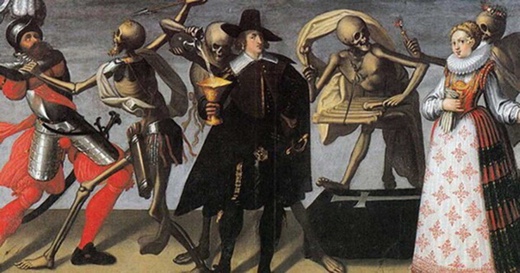
Image above: Painting from the 16th or 17th century illustrating the "Dance Macabre". From (https://www.ancient-origins.net/news-history-archaeology/dance-macabre-how-dead-danced-living-medieval-society-009063).

Western Civ’s most infamous encounter with pandemic disease, so far, was the big first wave of the Black Death that had a marathon run from 1346 to 1353. That bug was the real deal. It killed folks left and right, every age group, every social station, and it killed them ugly.

Few who caught it survived. Up to half the population of Europe perished, along with a lot of their social and economic ways.

The cause of the Black Death was subject to every possible explanation except the actual one, Yersina pestis, a bacterium associated with rats and their insect parasites, fleas and lice, who also enjoyed an association with humans living in the generally squalid conditions of the day — the ancient Roman habit of bathing long forgotten.

At the top of their list of causes was an angry God, and his wicked erstwhile subordinate, Satan.

The “experts” of that time tended to cluster in the church hierarchy, with its drear obsessions and compulsions. The squishy boundary between the supernatural and reality loosed all manner of derangement.

The Jews came in for much vilification, leading to massacres in Strasbourg, Mainz, and Cologne. On the whole, the episode represented a terrific humbling of humanity. The allegory of the Dance Macabre summed it up in mankind’s universal antic journey to the Palookaville of death.

On the plus side, as modern interpolators might say, the bubonic plague winnowed down Europe’s population to a scale more congenial with its resource base. After that big first wave of the disease, land was cheaper and human labor better rewarded.

Eventually, more food got around. Incidentally, the plague provoked nostalgia for the classical antiquity of Greece and Rome, especially among the scholars of Florence, launching the extravaganzas of the Renaissance, the Enlightenment, and eventually our own pageant of techno-supremacist Modernity.

Covid-19 seems rather a punk-ass illness compared to the Black Death. Its victims by far are people already on a fast track to the last roundup. We know exactly what causes it, if not so exactly its origin, and yet the response among our experts has been far more ambiguous than those long-ago bishops of Christendom to the Great Plague.

The various scientists, physicians, public health officers, and politicians seem, to the casual observer, about equally divided between those who consider the corona virus a grave threat and those who insist it’s hardly worse than any annual flu. What is one to believe? Or do?

Which brings us to the verge of the Great Opening-up. The current nostalgia for pre-Covid-19 business-as-usual is understandably intense.

Gone especially from daily life are all the ceremonies of human togetherness, from gatherings of friends to the casual shoulder-rubbings of urban life to the crowded venues of the lively arts to the great moiling orgies of pro sports.

The life of the perpetual jigsaw puzzle, YouTube, and Netflix has proved inadequate to human aspiration. Gone, too, are livelihoods, revenue streams, and rewarding roles in everyday existence. The itch to get out and do, get out and make, get out and be, is overwhelming.

Behind those plain yearnings, though, looms the specter of a system that appeared to be already foundering before Covid-19 entered the scene. There is, at least, considerable agreement that the disease catalyzed the disorders of finance and economy and accelerated the damage — just not among the people most responsible for engineering the fragilities that actually crashed things.

Jerome Powell, Pope of the Church of the Federal Reserve, went on the 60-Minutes show Sunday night to reassure the nation that things will eventually get back to normal. “I think you’ll see the economy recover steadily through the second half of this year.”

Yessir, if you say so. Were his fingers crossed? You couldn’t tell because the camera had him framed in a head-shot. Personally, I think the Fed Chairman was blowing smoke up the nation’s wazoo.

Spooky as it’s been, the Covid-19 virus has also been a great cover-story for the natural collapse of a severely unbalanced, ecologically unsound, and dishonestly represented set of arrangements that are now unspooling at horrifying speed.

The car industry is dying. The airline industry is laying out its fleet of big birds in desert graveyards. The college racketeering operation went off a cliff, along with medical profiteering. Agribusiness no longer has a business model.

Hundreds of kinds of services no longer have customers who can afford their offerings from acupuncture to zymurgy.

None of that will be fixed by injections of miracle money borrowed from ourselves in quantities that would turn every US citizen into a millionaire — if it wasn’t just pounded down the rat-holes of the stock and bond markets. The big question about the Great Opening-up is when the recognition of all that turns to raw emotion.

Covid-19 may still be with us then, but it will be the least of our problems.

The masks will come off. The dance will commence.
.

Fligfht Path

SUBHEAD: The “wealth” acquired  by “one-percenters” was loaded onto a defective Boeing 737.

By James Kunstler on 17 April 2020 for Clusterfuck Nation -
(https://kunstler.com/clusterfuck-nation/flight-path/)


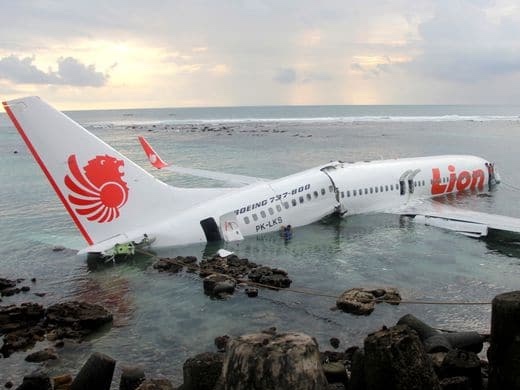
Image above: In 2013, a two-month-old Boeing 737-800, operated by LionAir, undershot the runway at Bali Airport, crashing into the water. Half the 108 passengers were injured. Luckily there were no fatalities. From (https://airwaysmag.com/industry/lion-air-boeing-737max8-crashes/).

This age of battling narratives tends to conceal the broken consensus behind it. What’s gone is a broad social agreement that there are certain fundamental realities, and then codes of conduct that follow from them. When anything goes, don’t expect people to do the right thing, or even know what it is.

The Covid-19 debacle presents just such a set of quandaries and puzzles. For many people stewing in quarantine, the virus is just another evil phantom lurking in the permanent twilight zone of television, and even there, among the familiar jabbering figments, there’s little agreement about it. The statistical projections mutate weekly.

 It’s no worse than any annual flu… It’s a savage illness that attacks every organ in the body, leaves survivors maimed, and you can even catch it again… The lockdowns are imperative… the lockdowns amount to economic suicide… There’s no sorting it all out, and the uncertainty itself is intolerable.

The only certainty is that most of the people in lockdown are going broke fast. By any ordinary rules, they are wiped out. They can’t even pretend anymore to keep juggling all those monthly payments for rent or mortgages, food, the cars, the medical insurance, the electricity, the cable, and on and on.

The $1200 mad money checks promised by Uncle Sam are little consolation for that, and the small business “loans” ­– if you can even jump through the infuriating hoops to get them – just pile on an additional layer of obligation in a lifetime of debt serfdom.

You don’t have to leap too many steps ahead mentally to imagine utter personal ruin on that glide path. And so what if millions of others are feeling squashed by the same phantom forces of disease and finance?

One firm reality is this: the global debt system that supported the turbo-charged global economy was disintegrating badly in the early fall of 2019, threatening every financial asset and the markets that affected to manage them ­­– and all the operations of modern daily life that they represented.

Nowhere on earth was the debt load more out-of-control than in China, where there were no constraints whatsoever on the banks’ accounting fraud, since they answered solely to the ruling party, which had but one overarching policy: to keep ruling.

And the biggest economic fiction of all was that China could maintain its supernatural growth rates in a world that had actually reached the limits of growth. Mr. Trump’s trade wars sent tremors through the system. A whole lot of bad loans were about to be flushed down the drain.

Banks everywhere else felt the vibrations, too, you may be sure. The Wuhan virus was, at least, a very convenient distraction from all that. And then, the darn thing got loose on countless airplane flights around the world.

The Covid-19 corona virus didn’t initiate the financial disorders of the moment in the US and Europe, but it ensured that there would not be another appearance of any “recovery” a la the central bank interventions of 2008-09.

What it portends is a fast-track journey to a whole new disposition of things: first, for a while, a harsher, hungrier, angrier society of broken promises and dashed expectations; and then adaptation when a consensus emerges that the set of facts at hand amount to a new reality. In the meantime, we’re living in the meantime, which is not a comfortable place.

Money is not an economy. Money is a medium of exchange within an economy where people grow things, make things, move things, and serve each other in countless ways. We’re not going to replace all those growings, makings, movings, and services by just giving people money.

Money may produce more money by the magic of compound interest, but money is not necessarily wealth, it just represents our ideas about wealth, and interest stops compounding anyway when the trend is clearly for reduced growings, makings, movings, and servicings. That’s exactly how and why capital vanishes.

The hocus-pocus of Modern Monetary Theory can only pretend to work around that reality.

The world never reached such a pitch of activity up to the blow-ups of 2008, and it went through the motions for a decade after that. Now that it’s stopped, all that’s left is the law of gravity, and it doesn’t get more basic.

The “wealth” acquired in the decade since by the so-called “one-percent” was loaded onto a defective aircraft, like a Boeing 737-MAX, and an awful lot of it will fall to earth now on broken wings. Their agents and praetorians on Wall Street are working feverishly to stave off that crash-landing, like a band of magicians casting spells on the ground while that big hunk of juddering metal augers earthward.

Wait for it as spring brings new life across the land and things unseen before steal onto the scene.

.

End of Neoliberal Era

SUBHEAD: However big we’re thinking about the effects of this pandemic, we can think bigger.

By Jeremy Lent on 3 April 2020 for Resilience -
(https://www.resilience.org/stories/2020-04-03/coronavirus-spells-the-end-of-the-neoliberal-era-whats-next/)
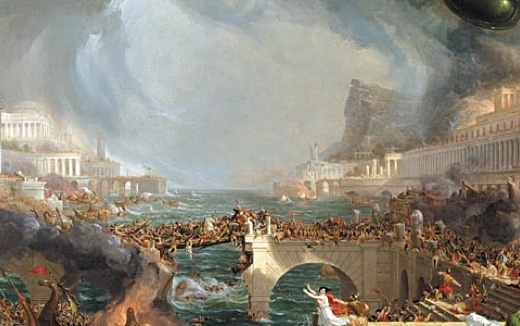

Image above: Detail of painting of the sack of Rome in 410 titled "Barbarians at the Gate" by Thomas Cole in his series of five paintings of Roman history entitled "The Course of Empire". From (https://medium.com/@robertos/the-fall-of-the-roman-empire-81eae500bdc0).

Think Bigger

Whatever you might be thinking about the long-term impacts of the coronavirus epidemic, you’re probably not thinking big enough.

Our lives have already been reshaped so dramatically in the past few weeks that it’s difficult to see beyond the next news cycle. We’re bracing for the recession we all know is here, wondering how long the lockdown will last, and praying that our loved ones will all make it through alive.

But, in the same way that Covid-19 is spreading at an exponential rate, we also need to think exponentially about its long-term impact on our culture and society. A year or two from now, the virus itself will likely have become a manageable part of our lives—effective treatments will have emerged; a vaccine will be available.

But the impact of coronavirus on our global civilization will only just be unfolding. The massive disruptions we’re already seeing in our lives are just the first heralds of a historic transformation in political and societal norms.

If Covid-19 were spreading across a stable and resilient world, its impact could be abrupt but contained. Leaders would consult together; economies disrupted temporarily; people would make do for a while with changed circumstances—and then, after the shock, look forward to getting back to normal.

That’s not, however, the world in which we live. Instead, this coronavirus is revealing the structural faults of a system that have been papered over for decades as they’ve been steadily worsening.

Gaping economic inequalities, rampant ecological destruction, and pervasive political corruption are all results of unbalanced systems relying on each other to remain precariously poised. Now, as one system destabilizes, expect others to tumble down in tandem in a cascade known by researchers as “synchronous failure.”

The first signs of this structural destabilization are just beginning to show. Our globalized economy relies on just-in-time inventory for hyper-efficient production.

As supply chains are disrupted through factory closures and border closings, shortages in household items, medications, and food will begin surfacing, leading to rounds of panic buying that will only exacerbate the situation.

The world economy is entering a downturn so steep it could exceed the severity of the Great Depression.

The international political system—already on the ropes with Trump’s “America First” xenophobia and the Brexit fiasco—is likely to unravel further, as the global influence of the United States tanks while Chinese power strengthens.

Meanwhile, the Global South, where Covid-19 is just beginning to make itself felt, may face disruption on a scale far greater than the more affluent Global North.

The Overton Window

During normal times, out of all the possible ways to organize society, there is only a limited range of ideas considered acceptable for mainstream political discussion—known as the Overton window. Covid-19 has blown the Overton window wide open.

In just a few weeks, we’ve seen political and economic ideas seriously discussed that had previously been dismissed as fanciful or utterly unacceptable: universal basic income, government intervention to house the homeless, and state surveillance on individual activity, to name just a few. But remember—this is just the beginning of a process that will expand exponentially in the ensuing months.

A crisis such as the coronavirus pandemic has a way of massively amplifying and accelerating changes that were already underway: shifts that might have taken decades can occur in weeks.

Like a crucible, it has the potential to melt down the structures that currently exist, and reshape them, perhaps unrecognizably. What might the new shape of society look like? What will be center stage in the Overton window by the time it begins narrowing again?
The Example of World War II

We’re entering uncharted territory, but to get a feeling for the scale of transformation we need to consider, it helps to look back to the last time the world underwent an equivalent spasm of change: the Second World War.

The pre-war world was dominated by European colonial powers struggling to maintain their empires. Liberal democracy was on the wane, while fascism and communism were ascendant, battling each other for supremacy.

The demise of the League of Nations seemed to have proven the impossibility of multinational global cooperation. Prior to Pearl Harbor, the United States maintained an isolationist policy, and in the early years of the war, many people believed it was just a matter of time before Hitler and the Axis powers invaded Britain and took complete control of Europe.

Within a few years, the world was barely recognizable. As the British Empire crumbled, geopolitics was dominated by the Cold War which divided the world into two political blocs under the constant threat of nuclear Armageddon.

A social democratic Europe formed an economic union that no-one could previously have imagined possible. Meanwhile, the US and its allies established a system of globalized trade, with institutions such as the IMF and the World Bank setting terms for how the “developing world” could participate.

The stage was set for the “Great Acceleration”: far and away the greatest and most rapid increase of human activity in history across a vast number of dimensions, including global population, trade, travel, production, and consumption.

If the changes we’re about to undergo are on a similar scale to these, how might a future historian summarize the “pre-coronavirus” world that is about to disappear?

The Neoliberal Era

There’s a good chance they will call this the Neoliberal Era. Until the 1970s, the post-war world was characterized in the West by an uneasy balance between government and private enterprise. However, following the “oil shock” and stagflation of that period—which at the time represented the world’s biggest post-war disruption—a new ideology of free-market neoliberalism took center stage in the Overton window (the phrase itself was named by a neoliberal proponent).

The value system of neoliberalism, which has since become entrenched in global mainstream discourse, holds that humans are individualistic, selfish, calculating materialists, and because of this, unrestrained free-market capitalism provides the best framework for every kind of human endeavor. Through their control of government, finance, business, and media, neoliberal adherents have succeeded in transforming the world into a globalized market-based system, loosening regulatory controls, weakening social safety nets, reducing taxes, and virtually demolishing the power of organized labor.

The triumph of neoliberalism has led to the greatest inequality in history, where (based on the most recent statistics) the world’s twenty-six richest people own as much wealth as half the entire world’s population. It has allowed the largest transnational corporations to establish a stranglehold over other forms of organization, with the result that, of the world’s hundred largest economies, sixty-nine are corporations.

The relentless pursuit of profit and economic growth above all else has propelled human civilization onto a terrifying trajectory. The uncontrolled climate crisis is the most obvious danger:

The world’s current policies have us on track for more than 3° increase by the end of this century, and climate scientists publish dire warnings that amplifying feedbacks could make things far worse than even these projections, and thus place at risk the very continuation of our civilization.

But even if the climate crisis were somehow brought under control, a continuation of untrammeled economic growth in future decades will bring us face-to-face with a slew of further existential threats. Currently, our civilization is running at 40% above its sustainable capacity. We’re rapidly depleting the earth’s forests, animals, insects, fish, freshwater, even the topsoil we require to grow our crops. We’ve already transgressed three of the nine planetary boundaries that define humanity’s safe operating space, and yet global GDP is expected to more than double by mid-century, with potentially irreversible and devastating consequences.

In 2017 over fifteen thousand scientists from 184 countries issued an ominous warning to humanity that time is running out: “Soon it will be too late,” they wrote, “to shift course away from our failing trajectory.”

They are echoed by the government-approved declaration of the UN-sponsored IPCC, that we need “rapid, far-reaching and unprecedented changes in all aspects of society” to avoid disaster.

In the clamor for economic growth, however, these warnings have so far gone unheeded. Will the impact of coronavirus change anything?

Fortress Earth

There’s a serious risk that, rather than shifting course from our failing trajectory, the post-Covid-19 world will be one where the same forces currently driving our race to the precipice further entrench their power and floor the accelerator directly toward global catastrophe.

China has relaxed its environmental laws to boost production as it tries to recover from its initial coronavirus outbreak, and the US (anachronistically named) Environmental Protection Agency took immediate advantage of the crisis to suspend enforcement of its laws, allowing companies to pollute as much as they want as long as they can show some relation to the pandemic.

On a greater scale, power-hungry leaders around the world are taking immediate advantage of the crisis to clamp down on individual liberties and move their countries swiftly toward authoritarianism.

Hungary’s strongman leader, Viktor Orban, officially killed off democracy in his country on Monday, passing a bill that allows him to rule by decree, with five-year prison sentences for those he determines are spreading “false” information.

Israel’s Prime Minister Netanyahu shut down his country’s courts in time to avoid his own trial for corruption. In the United States, the Department of Justice has already filed a request to allow the suspension of courtroom proceedings in emergencies, and there are many who fear that Trump will take advantage of the turmoil to install martial law and try to compromise November’s election.

Even in those countries that avoid an authoritarian takeover, the increase in high-tech surveillance taking place around the world is rapidly undermining previously sacrosanct privacy rights. Israel has passed an emergency decree to follow the lead of China, Taiwan, and South Korea in using smartphone location readings to trace contacts of individuals who tested positive for coronavirus.

European mobile operators are sharing user data (so far anonymized) with government agencies. As Yuval Harari has pointed out, in the post-Covid world, these short-term emergency measures may “become a fixture of life.”

If these, and other emerging trends, continue unchecked, we could head rapidly to a grim scenario of what might be called “Fortress Earth,” with entrenched power blocs eliminating many of the freedoms and rights that have formed the bedrock of the post-war world.

We could be seeing all-powerful states overseeing economies dominated even more thoroughly by the few corporate giants (think Amazon, Facebook) that can monetize the crisis for further shareholder gain.

The chasm between the haves and have-nots may become even more egregious, especially if treatments for the virus become available but are priced out of reach for some people.

Countries in the Global South, already facing the prospect of disaster from climate breakdown, may face collapse if coronavirus rampages through their populations while a global depression starves them of funds to maintain even minimal infrastructures.

Borders may become militarized zones, shutting off the free flow of passage. Mistrust and fear, which has already shown its ugly face in panicked evictions of doctors in India and record gun-buying in the US, could become endemic.

Society Transformed

But it doesn’t have to turn out that way. Back in the early days of World War II, things looked even darker, but underlying dynamics emerged that fundamentally altered the trajectory of history. Frequently, it was the very bleakness of the disasters that catalyzed positive forces to emerge in reaction and predominate.

The Japanese attack on Pearl Harbor—the day “which will live in infamy”—was the moment when the power balance of World War II shifted.

The collective anguish in response to the global war’s devastation led to the founding of the United Nations. The grotesque atrocity of Hitler’s holocaust led to the international recognition of the crime of genocide, and the UN’s Universal Declaration of Human Rights.

Could it be that the crucible of coronavirus will lead to a meltdown of neoliberal norms that ultimately reshapes the dominant structures of our global civilization? Could a mass collective reaction to the excesses of authoritarian overreach lead to a renaissance of humanitarian values? We’re already seeing signs of this.

While the Overton window is allowing surveillance and authoritarian practices to enter from one side, it’s also opening up to new political realities and possibilities on the other side. Let’s take a look at some of these.

A fairer society. The specter of massive layoffs and unemployment has already led to levels of state intervention to protect citizens and businesses that were previously unthinkable. Denmark plans to pay 75% of the salaries of employees in private companies hit by the effects of the epidemic, to keep them and their businesses solvent.

The UK has announced a similar plan to cover 80% of salaries. California is leasing hotels to shelter homeless people who would otherwise remain on the streets, and has authorized local governments to halt evictions for renters and homeowners. New York state is releasing low-risk prisoners from its jails. Spain is nationalizing its private hospitals.

The Green New Deal, which was already endorsed by the leading Democratic presidential candidates, is now being discussed as the mainstay of a program of economic recovery. The idea of universal basic income for every American, boldly raised by long-shot Democratic candidate Andrew Yang, has now become a talking point even for Republican politicians.

Ecological stabilization. Coronavirus has already been more effective in slowing down climate breakdown and ecological collapse than all the world’s policy initiatives combined. In February, Chinese CO2 emissions were down by over 25%.

One scientist calculated that twenty times as many Chinese lives have been saved by reduced air pollution than lost directly to coronavirus. Over the next year, we’re likely to see a reduction in greenhouse gas emissions greater than even the most optimistic modelers’ forecasts, as a result of the decline in economic activity.

As French philosopher Bruno Latour tweeted: “Next time, when ecologists are ridiculed because ‘the economy cannot be slowed down’, they should remember that it can grind to a halt in a matter of weeks worldwide when it is urgent enough.”

Of course, nobody would propose that economic activity should be disrupted in this catastrophic way in response to the climate crisis.

However, the emergency response initiated so rapidly by governments across the world has shown what is truly possible when people face what they recognize as a crisis. As a result of climate activism, 1,500 municipalities worldwide, representing over 10% of the global population, have officially declared a climate emergency.

The Covid-19 response can now be held out as an icon of what is really possible when people’s lives are at stake. In the case of the climate, the stakes are even greater—the future survival of our civilization. We now know the world can respond as needed, once political will is engaged and societies enter emergency mode

The rise of “glocalization.” One of the defining characteristics of the Neoliberal Era has been a corrosive globalization based on free market norms. Transnational corporations have dictated terms to countries in choosing where to locate their operations, leading nations to compete against each other to reduce worker protections in a “race to the bottom.”

The use of cheap fossil fuels has caused wasteful misuse of resources as products are flown around the world to meet consumer demand stoked by manipulative advertising.

This globalization of markets has been a major cause of the Neoliberal Era’s massive increase in consumption that threatens civilization’s future. Meanwhile, masses of people disaffected by rising inequity have been persuaded by right-wing populists to turn their frustration toward outgroups such as immigrants or ethnic minorities.

The effects of Covid-19 could lead to an inversion of these neoliberal norms. As supply lines break down, communities will look to local and regional producers for their daily needs. When a consumer appliance breaks, people will try to get it repaired rather than buy a new one. Workers, newly unemployed, may turn increasingly to local jobs in smaller companies that serve their community directly.

At the same time, people will increasingly get used to connecting with others through video meetings over the internet, where someone on the other side of the world feels as close as someone across town.

This could be a defining characteristic of the new era. Even while production goes local, we may see a dramatic increase in the globalization of new ideas and ways of thinking—a phenomenon known as “glocalization.”

Already, scientists are collaborating around the world in an unprecedented collective effort to find a vaccine; and a globally crowdsourced library is offering a “Coronavirus Tech Handbook” to collect and distribute the best ideas for responding to the pandemic.

Compassionate community. Rebecca Solnit’s 2009 book, A Paradise Built in Hell, documents how, contrary to popular belief, disasters frequently bring out the best in people, as they reach out and help those in need around them. In the wake of Covid-19, the whole world is reeling from a disaster that affects us all.

The compassionate response Solnit observed in disaster zones has now spread across the planet with a speed matching the virus itself. Mutual aid groups are forming in communities everywhere to help those in need.

The website Karunavirus (Karuna is a Sanskrit word for compassion) documents a myriad of everyday acts of heroism, such as the thirty thousand Canadians who have started “caremongering,” and the mom-and-pop restaurants in Detroit forced to close and now cooking meals for the homeless.

In the face of disaster, many people are rediscovering that they are far stronger as a community than as isolated individuals. The phrase “social distancing” is helpfully being recast as “physical distancing” since Covid-19 is bringing people closer together in solidarity than ever before.

Revolution in Values

This rediscovery of the value of community has the potential to be the most important factor of all in shaping the trajectory of the next era. New ideas and political possibilities are critically important, but ultimately an era is defined by its underlying values, on which everything else is built.

The Neoliberal Era was constructed on a myth of the selfish individual as the foundational for values. As Margaret Thatcher famously declared, “There’s no such thing as society. There are individual men and women and there are families.” This belief in the selfish individual has not just been destructive of community—it’s plain wrong.

In fact, from an evolutionary perspective, a defining characteristic of humanity is our set of prosocial impulses—fairness, altruism, and compassion—that cause us to identify with something larger than our own individual needs. The compassionate responses that have arisen in the wake of the pandemic are heartwarming but not surprising—they are the expected, natural human response to others in need.

Once the crucible of coronavirus begins to cool, and a new sociopolitical order emerges, the larger emergency of climate breakdown and ecological collapse will still be looming over us.

The Neoliberal Era has set civilization’s course directly toward a precipice. If we are truly to “shift course away from our failing trajectory,” the new era must be defined, at its deepest level, not merely by the political or economic choices being made, but by a revolution in values.

It must be an era where the core human values of fairness, mutual aid, and compassion are paramount—extending beyond the local neighborhood to state and national government, to the global community of humans, and ultimately to the community of all life.

If we can change the basis of our global civilization from one that is wealth-affirming to one that is life-affirming, then we have a chance to create a flourishing future for humanity and the living Earth.

To this extent, the Covid-19 disaster represents an opportunity for the human race—one in which each one of us has a meaningful part to play. We are all inside the crucible right now, and the choices we make over the weeks and months to come will, collectively, determine the shape and defining characteristics of the next era.

However big we’re thinking about the future effects of this pandemic, we can think bigger. As has been said in other settings, but never more to the point: “A crisis is a terrible thing to waste.”

.

Banks are about to drown

SUBHEAD: The entire world has completely ‘misunderestimated’ the Corona Virus.

By Simon Black for Soverignman on 18 March 2019 -
(https://www.sovereignman.com/trends/banks-are-going-to-drown-in-an-ocean-of-defaults-27537/)


Image above: Banking district in lower Manhattan in a simulated rise in water in New York Harbor. From (https://www.rollingstone.com/culture/culture-news/can-new-york-be-saved-in-the-era-of-global-warming-240454/).

On November 6, 2000, then US presidential candidate George W. Bush told a crowd of cheering supporters, “they misunderestimated me.”

Now, if English is not your native language, allow me to clear the air: ‘misunderestimate’ is not a word. But then again, George W. Bush was legendary for hilarious slip-ups like this.

There are entire books dedicated to his ‘Bushisms,’ the ridiculous made-up words and incomprehensible sayings that became routine for the 43rd US President.

‘Misunderestimate’ seems to be a conflation of the words ‘misunderstand’ and ‘underestimate’. And while that was utterly hysterical 20 years ago when Bush first said it, ‘misunderestimate’ may be the most appropriate word of today.The entire world has completely ‘misunderestimated’ the Corona Virus.

In terms of misunderstand– that’s obvious. There’s so much that we don’t know about the virus (officially known as SARS-CoV-2) and the disease that it causes (COVID-19).

For example, a group of researchers published a “peer-reviewed” research paper earlier this month stating that the virus had split into multiple strains.

(Peer-reviewed is a type of self-regulation among academics; it means the paper had been evaluated by other experts before it was published.)

But other specialists in the field strongly disagreed with the paper’s conclusions.

Swiss biologist Richard Neher described the research as, “wrong, misleading. . . downright dangerous inferences,” while Australian virologist Ian Mackay called it a “weak paper and poor science.”

Another peer-reviewed study released in the Journal of Medical Virology concluded that the virus originated from snakes. But plenty of experts disagreed with that assertion too.

The scientific community has learned so much about SARS-CoV-2 since it first surfaced a few months ago.

But there’s still so much that’s unknown– and that makes perfect sense given that this virus is brand new. They’re trying to figure it out as quickly as possible, but that’s naturally going to lead to some disagreements and conflicting conclusions.

But then the Internet takes over, and suddenly everyone’s an expert. People who have no background in medicine and biology Tweet with a level of certainty about the virus that’s just plain silly.

US television personality Jimmy Kimmel joked about this last week, saying, “I speak [about the virus] as if I’ve been a professor of immunology at Stanford for 35 years…”

There’s still so many things that the experts don’t understand, or don’t agree on. The answers are coming, but it’s still early days.

But in addition to misunderstanding, the world has also totally underestimated this virus… and continues to do so.

It started in China back in December, with the government trying to keep the outbreak quiet and taking steps to silence the first whistleblower.

As the virus began to spread, Western nations complacently shrugged it off and assumed it would remain in Asia.

Even the World Health Organization refused to call this a ‘pandemic’ until March 11… only a week ago.

Investors around the world ignored this for months, completely underestimating the massive, worldwide economic impact the virus would have.

Even now, after one of the worst stock market crashes in history, people are still woefully underestimating the effects.

And I’m not talking about the stock market (though there could easily be more losses ahead). I’m talking about something far more serious: banks.

Banks are about to drown in an ocean of defaults. I’ll talk about this a lot more in the coming days, but briefly:
  • There’s $250 TRILLION in global debt right now– mortgages, credit card debt, business loans, government debt, etc.
  • And banks own a large portion of that debt.
  • This virus crisis is going to trigger a wave of defaults from consumers, businesses, and even governments.
  • Think about it: tourism alone makes up 10% of global GDP. Revenue in that entire sector– hotels, airlines, cruise ships, etc. has collapsed, and many of those companies aren’t going to survive.
  • The crash in oil prices is going to wipe out countless oil companies.
  • Many large retail chains, which were already struggling in the age of e-commerce, will likely declare bankruptcy.
  • Countless businesses around the world have ‘temporarily’ closed due to public health policies, and many of them will go out of business entirely.
  • MOST of these businesses owe lots of money to the banks, whether it’s a small business working line, or the $34 billion in debt that American Airlines owes. So the defaults are going to be massive.
  • On top of that, millions of people are going to lose their jobs and be unable to make payments on their credit card debt, auto loans, and even mortgages.
  • Again, there’s $250 trillion in global debt right now. Total bank capital worldwide is less than $10 trillion.
  • So if the coming defaults trigger a mere 4% loss in total debt, it will exceed the entirety of global bank capital.
  • And this doesn’t even take into consideration the impact of the $1 QUADRILLION derivatives exposure.
Misunderestimate? Absolutely.

This looming wave of loan defaults over the next few months could spark a crisis in the global financial system that completely dwarfs what happened back in 2008.

I desperately want to be wrong.

And it’s possible that public health officials radically shift their positions in the coming weeks and tell all the young, healthy people in the world to go back to work, get infected, and start developing immunity.

They may be forced to do this to avoid destroying the global economy.

But at this point, every possible scenario is on the table. Nothing is out of the question… especially when the arithmetic is so obvious.

And continuing to misunderestimate the effects of this virus could be far more dangerous than the virus itself.

We’ll talk about this more in the coming days, along with some sensible suggestions to reduce risk.

The Final Act

SUBHEAD: In 2019 the US budget deficit was more than a trillion dollars - 16% more than 2018.

By Dmitry Orlov on 19 December 2019 for Club Orlov -
(https://cluborlov.blogspot.com/2019/12/the-final-act.html)

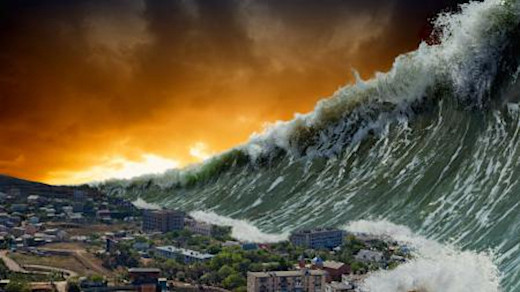
Image above A tidal wave of debt failure heading for home. From original article.

[IB Publisher's note: Hunker down for Merry Christmas... and as much as a Happy New Year as possible. Things may seem to be coming apart at the seams... but then again they always are - just as new things always come along and thrive. We are having our annual eggnog party tonight and we hope you find a glowing light in this darkest time of the year. In a couple of days the sky will be brighter, and isn't that is what Christmas time is all about. We know winter is coming, but there are signs it too will wane into spring.]

In processing the flow of information about the goings on in the US, it is impossible to get rid of a most unsettling sense of unreality—of a population trapped in a dark cave filled with little glowing screens, all displaying different images yet all broadcasting essentially the same message.

That message is that everything is fine, same as ever, and can go on and on. But whatever it is that’s going on can’t go on forever, and therefore it won’t. More specifically, a certain coal mine canary has recently died, and I want to tell you about it.

It’s easy to see why that particular message is stuck on replay even as the situation changes irrevocably. As of 2019, 90% of the media in the United States is controlled by four media conglomerates:\
  • Disney ABC
  • Viacom CBS
  • Comcast NBC-Universal
  •  AT&T Time-Warner
Together they have formed a corporate media monoculture designed to most effectively maximize shareholder value.

As I wrote in Reinventing Collapse in 2008, “...In a consumer society, anything that puts people off their shopping is dangerously disruptive, and all consumers sense this. Any expression of the truth about our lack of prospects for continued existence as a highly developed, prosperous industrial society is disruptive to the consumerist collective unconscious.

There is a herd instinct to reject it, and therefore it fails, not through any overt action, but by failing to turn a profit because it is unpopular.”

Two years earlier, in a slideshow optimistically titled “Closing the Collapse Gap” (between the USSR and the USA), I wrote: “...It seems that there is a fair chance that the US economy will collapse sometime within the foreseeable future. It also would seem that we won’t be particularly well-prepared for it.

As things stand, the US economy is poised to perform something like a disappearing act.” And now, 12 years later, I believe I am finally watching what amounts to preparations for that act’s final rehearsal; the ballet troupe is doing stretching exercises and the fat lady is singing arpegios to warm up…

Clearly, this final act is yet to be performed. The media replay loop continues to play, keeping the populace convinced that the future will resemble the past (except, perhaps, it will have more wind generators, solar panels and electric cars).

The populace continues to be persuaded to go out and shop for (or, more frequently now, order online) things it doesn’t need, to be paid for by money it doesn’t have.

Of course, there have been changes. The populace in the US has been doing progressively worse. Drug addiction and suicide rates have skyrocketed while rates of childbirth have plummeted. The purchase of a home is now out of reach for the vast majority of young couples.

Artificially rosy unemployment statistics hide the 100 million or so people who are considered “not in labor force” (because they lost their jobs some time ago and haven’t been able to find another one).

Uniquely among developed nations, life expectancy among white males—historically the most economically active and prosperous part of the population—has been dropping.

These are all negatives, but neither any one of them nor any combination of them adds up to anything that could cause the US economy to undergo a spontaneous existence failure.

Nevertheless, it is possible to build a convincing case that Rome is, to put it figuratively, burning. To continue with the metaphor, evidence that there is some fiddling going on is particularly compelling.

Overall, there is a steady backing away from addressing the substance of any problem and a concerted effort to maintain appearances at all cost.

Take the trade war with China, which has been going on since early 2018. Trump has recently declared a major victory in it, but upon examination signs victory are impossible to discern.

In 2017 the US ran a $750 billion trade deficit with China on $3.3 trillion of trade (22.7%). In 2018 it has jumped to $930 billion on $3.8 trillion of trade (24.4%).

China has found ways to parry each of Trump’s thrusts by imposing countertariffs. After two years of this sort of World War I-style trench warfare, in which the US has been slowly losing ground, it became clear that the US doesn’t have any means to put pressure on China.

And so Trump suddenly declares victory; not a full victory (that will have to wait until after Trump is reelected for his second term) but a victory nonetheless, because the Chinese have supposedly agreed to buy an extra $200 billion worth of US exports, $50 billion of them of agricultural exports from states that voted for Trump in 2016. But Trump is lying to his supporters.

Over the past two years the Chinese have imported roughly $24 billion of agricultural commodities from the US, and sources close to the trade talks have said that the Chinese have agreed to increase these imports by just $16 billion, putting the total $10 billion short of the $50 billion mark.

Even then, the US agricultural sector would have to rapidly scale up production by a factor of 1.6—and this is not at all likely.

The farmers will discover this only after they vote to reelect Trump, but that’s not Trump’s problem. Nor was it Trump’s problem when in 2017 the Chinese promised to buy $120 billion of US liquified natural gas exports and then the US wasn’t able to provide anywhere near that volume.

And now that Russia’s Power of Siberia pipeline is operational and ramping up volumes, while US fracking companies are going bankrupt left and right, the question has become largely moot.

The AG promise is just a replay of the LNG promise at a smaller scale. Appearances are all that matter, and appearances are what Trump delivers every time.

And if his voters want to believe—who’s to stop them? Even though it is clearly heading toward a defeat for the US as a whole, the trade war with China is definitely a huge positive for Trump: all he has to do to win personally is periodically deliver promises that others won’t keep—but that’s not his problem.

Another net benefit for Trump is the never-ending impeachment saga. It has kept him in the media limelight and has allowed him to pretend that he is prevailing heroically against great odds while making his opposition look ridiculous in the eyes of his supporters.

After the “Russian meddling” fable unraveled, an even more preposterous rationale for impeachment has taken its place.

An attempt to impeach Trump for refusing to cooperate with a congressional investigation is in the process of failing, since anyone with more intelligence than a bucket of California penis fish should know that it is up to the courts, not up to the legislature, to resolve disputes between the legislature and the executive.

All that remains now is an alleged abuse of power by Trump. Apparently, it is a no-no for a US president to ask a foreign leader to investigate a US presidential candidate for a variety of crimes such as corruption, bribery and money-laundering.

This may all seem quite ridiculous, but it serves a purpose: it allows Trump to clean up on free publicity and to continue fiddling (tweeting, in his case) as Rome burns.

But what has set fire under Rome is not the decrepitating state of US society, or the permanent and permanently worsening trade imbalance with China, or the never-ending impeachment farce. It is the incipient failure of the US dollar.

 For those who have been paying careful attention, the surreal nature of the proceedings, and the fact that results no longer matter—only appearances do—have become perfectly obvious, but they are a tiny minority.

What has allowed the politicians and the media to exploit the general public’s innate normalcy bias and to keep the media replay loop going without too many people catching on to what’s really happening was (note the past tense!)... the ability of the US government (with the assistance of the Federal Reserve, which is a government-linked but essentially private entity) to paper over the gaping chasm in the nation’s finances by issuing debt, in the form of US Treasury paper.

The US Treasury has been able to exploit its “exorbitant privilege” to issue internationally recognized and traded debt instruments denominated in its own currency—the US dollar—which has been the world’s main reserve currency for many decades.

The reserve currency status has conveyed a certain aura of security and reliability (paper money is, after all, pretty much just a confidence game) and has supported the world’s largest and most liquid financial market.

Anybody anywhere could put up US Treasury paper as collateral for a loan and get a low interest rate because that paper was considered as good as “real money” (whatever that means). And then that scheme suddenly broke.

It is difficult to say what caused the confidence game to fail. It could be just the inexorable and ever-accelerating increase in US government debt. It could be the blatant decoupling between the growth rate of the US economy and the rate of increase of its indebtedness.

It could also be the fact that much of the world is making a concerted effort to walk away from the US dollar as a reserve currency and as a means of exchange in international trade (Russia has sold off almost all of its US debt; China’s hoard is much larger but it is also gradually selling it off).

It is unclear what was the ultimate cause, but what is clear is that in August of 2019 something finally snapped, and USTs went from “good as real money” to “stuff nobody wants to hold.”

I first wrote about this in September when it became clear that real trouble was brewing in the market for US debt. Now, three months later, the situation has gone from bad to worse, and it would appear that the market for USTs definitevely broke.

I will try to sketch out what that means for the US economy and society later on (spoiler alert: nothing good) but for now I just want to lay out some of what has happened.

In the meantime please take your normalcy bias and put it some place safe (in case you need it later, although I have no idea what for).

Previously, when it was clear that an overburden of bad debt could trigger financial collapse at any moment, the Federal Reserve (which is in charge of printing money) engaged in something it euphemistically called “quantitative easing” (“QE”).

It printed lots of US dollars in exchange for various bits of USTs, along with other financial garbage, with the goal of later selling the USTs while hiding the garbage, thereby preserving the appearance that USTs are sovereign debt supported by the full faith and credit of the US government rather than just some waste paper clogging up its vaults.

But when it declared “quantitative easing” to be over and tried selling the USTs, all hell immediately broke loose and it was forced to go right back to buying them up, in a scheme that has been sarcastically referred to as “not QE.”

 Euphemisms aside, what is happening is properly called “debt monetization”: it’s when a government “borrows” money not by selling its debt in exchange for money that already exists but simply printing the money using paper and ink, or magic digits inside a very secure computer.

Let’s go over some of the relevant details.

“Not QE” actually started well before it was announced and proceeded in stealth mode. Over six weeks starting in September 2019, the Fed monetized an average of $20.5 billion per week.

This rate is compatible with the extent of its previous efforts at “quantitative easing” at their height. It was forced to do so because the REPO rate on USTs spiked to ten times the rate set by the Fed.
Note: REPO stands for “repurchase agreement”; it is where one party borrows short-term from another party, using USTs (and other supposedly very safe debt instruments) as collateral, much as a pawn shop will give you money for a watch and then allow you to buy it back.
The huge spike in interest rates signaled that USTs were no longer seen as particularly safe collateral and the Fed had to step in and start throwing freshly minted dollars at the problem. And it never stopped.

In fact, the problem grew larger; so large, that now, at the year’s end, the Fed has committed $500 billion of printing press output to making sure that nobody runs out of cash.

It is commonly thought that the Fed’s action has to do with short-term debt, and is therefore a short-term problem, but that’s simply not the case. Since early August (the start of stealth-mode “not QE”) the Fed has vacuumed up $179 billion with of USTs, of which USTs with terms longer than a year made up $108 billion, or 60%.

Compare these numbers to the total borrowing by the US government over the same period, which amounted to $659 billion, of which $368 billion was short-term debt and $291 billion long-term.

Thus, over this period the Fed has monetized 29.4% of new long-term debt and 24.4% of short-term debt. This should help put your mind at ease if you suspected that this isn’t a short-term problem but weren’t sure. It’s a long-term, structural problem.

Next, let’s consider whether the problem is being solved or is getting worse. Rest assured, it is getting worse. Looking at the numbers for October and November, the Fed monetized over half (50.7%) of new US government debt.

A straight-line projection is that if it took the Fed to go from 0% to 50% in four months, then it will go from 50% to 100% in another four—by April Fool’s 2020. But who’s to say that the increase will be linear rather than exponential?

Whichever it is, the trend is unmistakable: the market in US government debt—once the deepest and most liquid market in the world—is dead. The only thing propping up the value of USTs is the Fed’s printing press. And the only thing propping up the value of the output of the Fed’s printing press is… what is it, exactly?

Exactly!

Let’s add one more salient detail. Over the course of 2020, $4.665 trillion of USTs will mature and will need to be rolled over into new USTs. This is an all-time record, and this is on top of new debt that will have to be issued in order for the US government to be able to stay open.

Over the past year the US budget deficit has amounted to $1.022 trillion, which is a 15.8% increase over the previous year. If this trend continues, the new deficit will be around $1.183 trillion. In order to keep the wheels of finance from grinding to a halt, over 2020 the Fed will have to monetize, or print, close to $6 trillion.

It appears likely that at some point over the coming months Fed chairman Jerome Powell will have to announce “not not QE,” and then “not not not QE,” and then “Milk-milk-lemonade, ’round the corner fudge is made!” and run for the unigender restroom sobbing inconsolably.

And then Donald Trump will be forced to channel Boris Yeltsin, who, on August 14, 1998, summoned all the presidential gravitas he could muster and spoke the following sage words:

«Đ”Đ”ĐČĐ°Đ»ŃŒĐČацоо Ń€ŃƒĐ±Đ»Ń ĐœĐ” Đ±ŃƒĐŽĐ”Ń‚. Đ­Ń‚ĐŸ тĐČĐ”Ń€ĐŽĐŸ Đž чДтĐșĐŸ. ĐœĐŸĐ” утĐČĐ”Ń€Đ¶ĐŽĐ”ĐœĐžĐ” — ĐœĐ” ĐżŃ€ĐŸŃŃ‚ĐŸ ĐŒĐŸŃ Ń„Đ°ĐœŃ‚Đ°Đ·ĐžŃ, Đž ĐœĐ” ĐżĐŸŃ‚ĐŸĐŒŃƒ, Ń‡Ń‚ĐŸ я ĐœĐ” Ń…ĐŸŃ‚Đ”Đ» бы ĐŽĐ”ĐČĐ°Đ»ŃŒĐČацоо. ĐœĐŸĐ” утĐČĐ”Ń€Đ¶ĐŽĐ”ĐœĐžĐ” Đ±Đ°Đ·ĐžŃ€ŃƒĐ”Ń‚ŃŃ ĐœĐ° Ń‚ĐŸĐŒ, Ń‡Ń‚ĐŸ ĐČсД ĐżŃ€ĐŸŃŃ‡ĐžŃ‚Đ°ĐœĐŸ. Đ Đ°Đ±ĐŸŃ‚Đ° ĐżĐŸ ĐŸŃ‚ŃĐ»Đ”Đ¶ĐžĐČĐ°ĐœĐžŃŽ ĐżĐŸĐ»ĐŸĐ¶Đ”ĐœĐžŃ ĐżŃ€ĐŸĐČĐŸĐŽĐžŃ‚ŃŃ ĐșажЎыД сутĐșĐž. ĐŸĐŸĐ»ĐŸĐ¶Đ”ĐœĐžĐ” ĐżĐŸĐ»ĐœĐŸŃŃ‚ŃŒŃŽ ĐșĐŸĐœŃ‚Ń€ĐŸĐ»ĐžŃ€ŃƒĐ”Ń‚ŃŃ».
“There will be no ruble devaluation. This is my firm and clear position. My assertion is not just a product of my fantasy, and not because I don’t want devaluation to happen. My assertion is based on the fact that everything is taken into account. The work on reassessing the situation is being conducted daily. The situation is entirely under control.” (My translation.)
And then three days later the Russian government declared sovereign default. The ruble dropped by 2/3 against the US dollar and the Russian economy, which was at that time extremely import-dependent, crashed hard. In a similar scenario, the US economy will crash much harder.

Like Russia in 1998, the US is extremely import-dependent. But here the US government is not the only large borrower: most of US corporations are zombified corpses bloated with debt.

For many years they have been borrowing at artificially low interest rates in order to buy up their own shares and prop up their value in a ridiculous effort to maximize shareholder value in the face of stalling economic growth.

If they become unable to roll over their debt at artificially low interest rates (which will go away once the Fed definitively loses control of the situation) then they will automatically be forced to declare bankruptcy and liquidate.

If you want to maintain an optimistic outlook in spite of all of this, here is a book you might want to read.

.

The Scenarios of the Collapse

SUBHEAD: It would be wise to start making contingency plans. Something ‘biblical’ is approaching.

By Tuomas Malinen on 11 January 2019 for GNS Economics  -
(https://gnseconomics.com/en_US/2019/01/11/the-scenarios-of-the-collapse/)


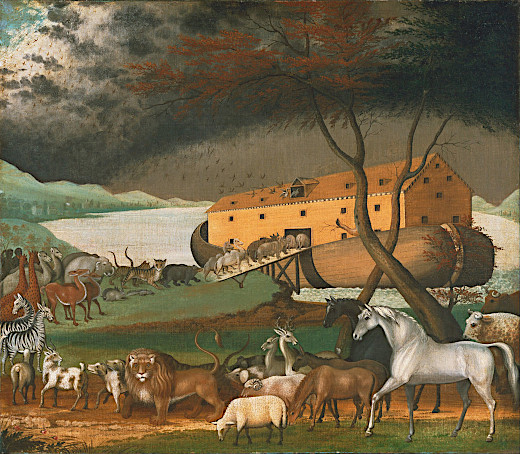
Image above: Painting of  "Noah's Ark" (1846) by American painter Edward Hicks. From (https://en.wikipedia.org/wiki/Noah%27s_Ark).

2019 has started more calmly after a very volatile year-end in the markets. Focus has been on the trade deal between China and the US and the words of the central bankers, most notably those of Jay Powell. However, this is all just a distraction, a side-show.

The market volatility was only the first sign of an approaching global economic crisis, as we warned in December 2017.

As the recent PMI figures across the globe show, a global downturn has started and the world is utterly unprepared for it. The global imbalances that have been growing for years cannot lead to anything else than a global crisis . However, there are different paths the crisis could take.

Here, we present three scenarios that the global economy is likely to follow, when the global downturn morphs into something much more sinister. We’ll start with the most likely scenario: Global Depression.

Scenario I: Global Depression

In a depression, everything that has been driven the economic expansion goes into reverse. Asset markets experience severe contraction (in excess of 50 percent), credit becomes restricted, corporations and households de-lever fiercely, and global trade flows stall (for more details see Q-review 2/2018). Gross Domestic Production (GDP) falls dramatically, between 10 to 25 percent.

Unemployment skyrockets. The standard means of stimulus by central banks (CBs) and governments are exhausted without any notable improvement in the economic environment.

The implosion of the current asset bubble will start a relentless unwinding of leverage and risk in the global financial system. Because major CBs are still “all-in” with rates pinned at or near historic lows, and balance sheets bloated to extreme levels, their ability to respond will be highly restricted.

Governments are also highly-indebted, and when interest rates rise, some sovereigns are likely to default, aggravating the global banking crisis, which will probably be in motion already. Combined with the zombified global business sector and a hard landing in China, these factors will lead the world economy into a depression.

However, a possibility of something even more ominous is lurking in the background.

Scenario II: Systemic Meltdown

Systemic crisis would mean that the global financial melts down due to an existential deficit of trust between counterparties within the system. Before 2008, a systemic meltdown was mostly a theoretical construct.

However, in mid-October in 2008, global leaders were faced with the possibility that banks would not open on Monday. The inter-bank markets had frozen, because no one knew the amount of the losses banks carried on their books.

The global financial system was grinding to a halt. Politicians and central bankers saved the day by guaranteeing bank deposits and by providing capital and extraordinary guarantees to keep the important financial institutions standing and credit flowing.

Now the problem is that many of these measures are already in play and when the next crisis hits, the solvency of governments and CBs will also be in question.

This creates a perilous situation because, for example, the shares of the Global Systemically Important Banks have been falling since the beginning of last year, which was also the time when the balance sheet normalization (QT) program of the Fed kicked into full gear.

This is no coincidence and it implies that troubles are, once again, brewing in the banking sector.

Because a crash in the asset values would affect the collateral of banks and because global depression would lead to a massive increase in loan losses, the already-impaired banking sector could, again, face collapse.

However, this time around, there is very little authorities can do to stem the panic. These factors make the systemic meltdown an ominously-likely scenario.

Systemic meltdown would mean that all banking actions, distribution of money, loans, swaps, banking services, etc., through the banking sector would stop. Credit cards would cease to function, ATMs would not give out money and loans could not be originated or rolled-over.

Following the likely collapse of global trade, the world economy would also collapse. This would imply that the global GDP would experience a harrowing fall of 20 to 40 percent. Modern societies would cease to exist in their current form.

Scenario III: The Fairy Tale

Could this all be averted somehow? We’ve been pondering this for two years now, and our resounding answer is no. The leverage in the system usually results in a crash at some point, and asset bubbles very rarely deflate in a controlled manner.

However, CBs can probably still postpone the inevitable, if they could re-start Quantitative Easing (QE) programs or find some other way to push artificial central bank liquidity into the financial markets.

To soften the eventual blow, and as an extremely desperate measure, central banks could, at least in theory, engage in a “QE-squared”. In it, major central banks would buy a hefty chunk of global risk assets, estimated to total $400 trillion.

This would mean that the balance sheet of major Central Banks would need to expand at least five-fold from the current level of approximately $20 trillion.

To cover the crippling losses to their collective balance sheets that these purchases would be likely to inflict, they would need to use their money-printing ability to paper them over.

CBs earn seigniorage-revenue from all the money they create. This is the difference between the nominal value and the production costs of the money.

Because production costs of digital entries are very close to zero, the seigniorage revenue CBs receive from each entry is close to 1-to-1. Still, this would mean that they would need to create new money in the range of tens of trillions of US dollars.

By comparison, in 2017, the global nominal GDP of the world was approximately $75 trillion.

To distribute such incomprehensible sums of new money, CBs would need to give it directly to consumers and governments.

Even in normal circumstances, the production side of the economy would be unlikely to be able to respond to such a massive increase in (artificially created) demand, and this time there would have been wide-spread corporate bankruptcies driven by global depression.

A hyper-inflation would be likely to follow.

There’s also the alternative that CBs would make a complete U-turn and continue to backstop market losses.

This would be the “way of Japan”, where the BoJ already owns over 40% of the sovereign bond universe. It would eventually mean the effective nationalization of capital markets which would continue to function in name only.

We have no historical experience with what the expropriation of modern capital markets would cause.

However, it would be unlikely to be anything good as capital markets have been around for several centuries, and they are extremely important in allocating financial capital efficiently. If CBs take a permanent active role in the capital markets, it would lead to financial market socialism.

 It would be likely to bring similar horrors as regular socialism in the form of lost incentives (breaking down of the risk-reward relationship) and inflated asset values.

It is unlikely that global central bankers would be willing, or that they would be allowed, to do so.

The Endgame Nears


The global balance sheet of CBs turned in August 2018. This marks the start of global QT and thus the end of the most reckless monetary policy experiment in history.

When this is combined with the slow-down in China, the engine of the world economy since 2008,  we have finally entered the endgame of at the current business cycle.

The desperate measures of central bankers and China enacted after the financial crisis have pushed the global debt and financial alchemy to never-seen heights.

The global financial system has become rigged with leverage, moral hazard and regulatory failures to a point where a “purge” has become all-but-impossible to avoid. This is the end.

Still, every company, household and government should start to make contingency plans. Something ‘biblical’ is approaching.

.

Predictions for 2019

SUBHEAD: "Ding Ding! - Margin Call USA". Reality is about to bite us in the ass.

By James Kunstler on 31 December 2018 for Kunstler.com -
(http://kunstler.com/clusterfuck-nation/forecast-2019-ding-ding-margin-call-usa/)


Image above: The Greenleaf subdivision near Dawsonville Georgia was abandoned several years ago after it was found to be at the center of a mortgage fraud scheme. The developers knew the project was doomed from the start, as there were no public sewer lines anywhere in the area they could hook up to, and the lots were too small for septic tanks.From (https://imgur.com/gallery/G6SIf).

[IB Publisher's note: Two books published in 2005 transformed my understanding of the real world. The books were Jared Diamond's "Collapse" and James Kunstler's "The Long Emergency".Both identified the mortality and suicidal tendencies of human civilization. Together they provoked a reevaluation of my understanding of how the world works and our future in it. I am indebted to their clear thinking. Over time I came to personally know Kunstler. My wife Linda and I visited him twice in upstate New York. I even worked briefly with his agent on a movie proposal for his novel "World Made By Hand" (2008) that describes the unwinding and aftermath of a collapse of America as we know it. Over subsequent years we have kept in touch. I realized our thinking was wandering apart over our differences of opinion about the TV series "Treme" that premiered in 2010. "Treme" follows the lives of people in the Ninth Ward of New Orleans in the aftermath of hurricane Katrina. Many of the primary characters were black and/or female. Kunstler could not "get" the show at all. He could not getr through half the premier episode because it seemed to him incoherent and foreign - a zombie apocalypse. Since then I have come to realize Kunstler holds a resentment that many white male Baby-Boomers about increasing emergence of women and black people into positions of American privileges. Did they earn it? Did George Bush? Anyway, with that caution in mind I continue to read Kunstler with a bit of caution. I think he is still spot-on in his understanding of money and energy - the grease on the gears of Western Civilization. This post is an excerpt from his predictions for 2019, hopefully less the white male screed. Happy New Year!]   

Markets and Money
The jig is really up. The big bad bear market is already underway, even if it rallies in January. The debt bubble engineered by the Federal Reserve is blowing up and thundering through the system.

The epic market instability of December 2018 on the heels of persistent Fed rate hikes points to major credit problems and especially an inability to roll over old debt into new loans at higher interest rates — in particular loans to zombie enterprises that need to borrow to keep paying interest on previous loans (a lot of that among the shale oil companies).

The US government can’t take higher interest rates either. It’s already paying about as much in annual interest on US debt as we pay for our war machine. There are only two ways out, both of them nasty.

Either suck up debt defaults, which will induce an impoverishing disappearance of money; or provoke high inflation, by injecting more Central Bank QE “money” into the system, which can destroy the value of money.

Inflation is typically the choice of governments because it reduces the face value of debts while it allows government to pretend that it is taking action.

In the end, you may have plenty of worthless money, which is no different from having not enough money that retains value. The latter was the main feature of the Great Depression.

So, inflation is the usual choice, but it also typically leads to incendiary resentment among the citizenry when they realize they’ve been played and it takes a wheelbarrow full of cash to buy a loaf of bread and a jar of peanut butter.

I suppose that Fed chief Jerome Powell knows all too well he’s popped the Mother-of-All-Bubbles. He can blame it on Mr. Trump. Everybody else will, of course.

Sometime in the second quarter of 2019, the Fed will resume the money-for-nothing gambit of “quantitative easing” in the hope of arresting the damage, but this time the dollar will lose value uncontrollably and catastrophically. Many people will be ruined, especially retirees at the mercy of insolvent pension funds.

Before 2019 is out, the US could find itself in a situation worse than the Great Depression. Supply lines are much longer now than they were then.

If suppliers can’t get paid because trust has collapsed in the short-term corporate paper system, they won’t deliver supplies, which means you may not eat, or fill your gas tank, or heat your house, or get whatever else you need.

Also, the USA in 1931 had not yet transformed itself into the fiasco-waiting-to-happen called suburban sprawl. How is Dallas going to work for people who spend a substantial chunk of their income on mandatory motoring (if there’s little or no income)?

Stock market activity may appear to stabilize in January, but it will go south again later on in the first quarter and the Bear will growl louder for the rest of the year.

Civil Disorder
Be prepared for it in 2019. There are going to be a lot of pissed-off people around the country. They are liable to attack Federal property and their fellow citizens (and their property).

The hungrier they are, the worse it will be. They will not understand the forces that are destroying the money system.

There are a gazillion small arms out there and the government will not be able to control them or confiscate them. Any attempt to do that will only inflame the situation.

A major principle of The Long Emergency is that government becomes increasingly impotent and ineffectual as it rolls out. We’re already seeing that in Washington, and it is not at all just because Mr. Trump has inspired such an impasse between the branches. The states, too, will be hard-pressed to do anything useful.

Many of them, like Illinois, New Jersey, Connecticut, and California, are already technically insolvent. The federal government may have to pretend to rescue them financially, which will only make the national predicament worse.

Oil
The shale oil “miracle” was an impressive stunt. For a while, it goosed US production way above the former all-time production peak of 1970, and it achieved that with astounding speed — about a decade. But this is oil that is very expensive and complex to produce. It was made possible by massive borrowing at artificial low interest rates, which are now rising.

Something like three-quarters of the shale operators never made a red cent in net profit, and many of these companies will find it hard or impossible to roll over their existing debt, especially with oil under $50-a-barrel.

But the price is a deceptive metric. If it zoomed up to $100-a-barrel tomorrow, the effect would only be to crush economic activity, because industry requires cheaper oil to pencil out its operations and citizens can barely afford to drive when gasoline hits $4-a-gallon at the pump.

At the lower $45-a-barrel, the price crushes the oil producers. Take your pick. There’s no “Goldilocks” price.

The other problems with shale oil have to do with the nature of the shale plays. The Permian Basin in Texas is very large, but the best plays are developed in the so-called “sweet spots” and there’s a limited amount of them.

They are the places that the producers developed first, and when they are played out, the next round of plays will be in spots not-so-sweet (or productive) — possibly not worth drilling. The character of the shale oil wells is also way different from the old conventional classic oil wells. The old wells cost about $400,000 (in current dollars). It involved just sinking a pipe into the permeable source rock.

The oil came out under its own pressure at the rate of thousands of barrels a day.  Eventually, you put a simple pump-jack on the well (the “nodding donkey”) and it produced for decades, like running a cash register. Shale oil wells cost between $6- 12 million.

They require technically demanding horizontal drilling and fracking, with additional costs in highly technical labor, water for fracking, sand to hold open the fracks, chemicals to aid the process, and a gazillion truck trips to deliver all the water and sand (and take the oil away).

Shale wells produce maybe a few hundred barrels a day for one year, after which they typically deplete by over 60 percent.

After four years, they’re done. The oil is also different. Shale oil is typically ultra-light. It contains little-to-none of the heavier diesel, kerosene, jet fuel, and heating oil distillates, making it less valuable.

Trouble in the credit markets could shut down shale production for a period of time and create dire problems for the American economy. That could happen in 2019 as poorer-performing companies fail to get new financing.

As mighty as it seems to be, the industry is fraught with fragility.

Meanwhile, discovery of new, producible oil has fallen to the lowest level since the 1940s, after three recent previous record low years. Current low oil prices at around $45-a-barrel may give Americans a false sense of security.

Low prices are mostly indicative of the collapse of the demand for oil at the global margins and among the large US demographic that cannot afford it anymore — that is, the impoverished former middle class.

As the damage becomes more obvious, we could hear calls to nationalize the oil industry. The attempt to do that would collide with the aforementioned trend for government to become more strapped  for revenue, more impotent, and more incompetent.

Geopolitical
The Golden Golem has gone an extra mile to antagonize Russia the past two years. Is it to demonstrate how not Putin’s puppet he is? If so, it’s pathetic.

For instance, heaping ever more sanctions on Russia, tossing Russian diplomatic staff out of the country because of the laughable Novichok poisoning of the Skripal father-and-daughter in Britain. Nobody believed that set up — who recovers from the world’s supposedly most potent, high-tech military toxin?

The larger Russia hysteria, ginned up by the US “Intel Community” to cover the embarrassment of Hillary Clinton’s election loss, has destroyed the brains of thousands of Washington insiders and infected whole sectors of the educated coastal elites who really ought to know better.

Meddling in elections? Is that something the US has never entertained?

Recall that 1996 Time Magazine cover with the headline that bragged, “Yanks to the Rescue: the Secret Story of How American Advisors Helped Yeltsin Win.”

And now we’re wetting our pants over a baker’s dozen Russian Internet trolls on Facebook?

Yes, this is what the brightest people in the room have been doing for two years. The net result is a new cold war, pushing Russia into the arms of China, giving both of those countries an incentive to construct a new framework for global relations that excludes the toxic US as much as possible.

That new framework, by the way, will not be the same as the late, unwinding Globalism Release 2.0 (Release 1.0 was 1870 – 1914) that allowed America to exchange IOUs for flatscreen TVs lo these many years. Let’s call that Tom Friedman Globalism, after the pundit who said it would last forever.

The world will become a wider place again as the Great Powers are increasingly bound to their own regions for trade relations in a world growing short of energy and capital resources. The exception to that is in weaponry, now that Russia has demonstrated its ability to launch hypersonic rockets that can reach the US in little more than a few Noo Yawk minutes.

Do we have anything like that?

I suppose we wish we did. The media is not even talking about it, the implications are so dreadful.

Has Mr. Trump actually accomplished anything with his deal-seeking in China while beating it on the snout with his tariff stick?

Well, he got a lot of US companies loading up on inventory of goods they feared will carry costly duties a year hence, so they’re all stocked up just in time for a vicious bear market and the recession / depression that it entails. A lot of that stuff may end up being distributed by the bankruptcy judges.

How does our antagonism against China work with the campaign to “normalize” the behavior of North Korea. I doubt it helps. In 2019, North Korea will be the whoopie cushion that China places under America’s seat at the negotiating table.

Mr. Trump defied the conventional State Department wisdom by meeting face-to-face with Kim. It got the two Koreas actually speaking with each other for the first time in 60 years, with some concrete steps toward ending the de facto state-of-war.

Will Li’l Kim play the role China assigns to him? I think so. They can squash him like bug. And, of course, everything that the US congress and Mr. Mueller do to injure and weaken Mr. Trump will make further progress in Korea unlikely.

How about the second greatest economy in the world? That would be the European Union.

The EU’s financial system is way more dysfunctional than even ours, with no mechanism or provision for regulating each country’s spending vis-Ă -vis the debt generation of the Union as a whole.

There’s no way it can continue and no prospect for debugging the set-up. What’s more, decades-long shenanigans of the European Central Bank have created imbalances that will never be corrected.

Even the attempt to normalize operations — as the ECB ceases its debt monetization routines starting in the first quarter of 2019 — is guaranteed to crack up the EU economy, which is a horror show of zombie companies and zombie banks. They will suffer particularly in the recession / depression to come.

The next domino to fall, theoretically Italy, will take the EU down, whatever happens with the dithering over Brexit. Without the ECB vacuuming up unwanted EU paper, nothing really pencils out over there. In 2019, expect a substantial fall in the value of the Euro, and possibly its demise as a currency.

In fact, expect wholesale disintegration of many structural arrangements all over Europe beginning in 2019, along with more political violence that exceeds the simple street actions of the Yellow Vests in France.

NATO has been staging war games on Russia’s border for two years, apparently with no awareness that the NATO members are deeply dependent on Russian oil and natural gas to remain advanced nations with comforts and conveniences, like heating their homes. Perhaps that recognition will hit in 2019. But there will be plenty of noise for that signal to cut through.

Climate Change
Something’s going on ‘out there’ though the picture is deeply non-linear and is being confused for the moment by an extraordinary low level of cyclical sunspot activity. Not being a scientist, I have only two salient points worth considering about the issue:

The first is, we’re not going to do anything about it — because nothing can be done about it. Whatever’s happening, we’re going to have to roll with it. I’m also not persuaded that many of the proposed mitigations — carbon taxes, seeding the upper atmosphere with reflective particles — will accomplish anything.

The second thought is this: the civilized world has experienced many many instances of climate change over the past several thousand years. Civilizations rise and fall with these changes, but the human project as a more general matter continues, with periods of history that appear to be restful time-outs.

The Roman Optimum (warming period) segued into the Dark Age Cooling, and then the Medieval Warming (viniculture in England!), and eventually the Little Ice Age comes along with Isaac Newton and skaters on the Dutch canals.

 The difference this time is that our civilization is so deeply complex that successful adaptation to new conditions is a low percentage outcome, at least in the form of salvaging many of our current arrangements.

In other climate disruptions, people adapted, sometimes with very severe changes in customs, practices, political arrangements, and life-styles.

It will be especially stark this time, and the broad pop culture of Collapse suggests that we intuit this — everything from Game of Thrones to The Road, to my own World Made By Hand novels.

It begins with the wobbling of the most abstract and fragile of our systemic arrangements, finance, which is mostly based on ephemeral trust (that the other fellow will pay you).

From there, the trouble proceeds to politics and culture.

[IB Publisher's postscript: And that is the most optimistic view possible. I personally think we are closer to extinction than that. As a reminder see this 2011 "Scientific American" article One Time Through the Bottleneck - "Almost 200,000 years ago humans faced extinction. Only a few hundred were saved along the coast of Cape Horn"].  Happy New Year!


.