Showing posts with label Solar Power. Show all posts

'Planet of the Humans" review

SUBHEAD: The calls into question the solutions proposed by so-called renewable technologies.

By Edwardo Sasso 0n 7 May 2020 for Resilience - 
(https://www.resilience.org/stories/2020-05-07/planet-of-the-humans-reviewing-the-film-and-its-reviews/)
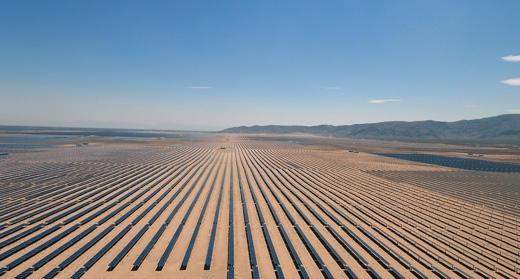

Image above: This immense photovoltaic power plant is operated by an Italian company in the desert near Villanueva, Mexico. From (https://www.nbcnews.com/mach/science/supersized-solar-farms-are-sprouting-around-world-maybe-space-too-ncna901666).

[IB Publisher's comment: In our experience in Hawaii solar-electricity generation does not necessarily require the use of large quantities of cement and steel. The panels themselves often have aluminum frames. In Hawaii we have a corrugated metal roof. Our solar panels have aluminum frames bolted to 2"x4" wood frames that are bolted to the metal roofing. Small scale individual residential and commercial solar systems don't need high voltage distribution towers or heavy duty foundations and framing. We worry about hurricane damage... but that's likely to take the whole roof off.]

If you haven’t seen the latest (and arguably the most contentious) documentary on renewable energy, be prepared for an aftertaste of mixed feelings.

Joining hands with the controversial Michael Moore, environmentalist and filmmaker Jeff Gibbs has sent an eerie message that is now somewhat dividing the climate movement—in many ways for the worse, but, in a few others, for the better.

So, at least, one could argue is the case of Planet of the Humans. After engaging briefly with some of the well-deserved criticisms the film has received thus far, there are nevertheless some important aspects brought to our attention by the movie.

Specifically, at one point in the documentary, Gibbs touches upon the religious and existential dimensions underlying our ecological hot waters—aspects that, for what it seems, many of his critics have left unaddressed. Hence the focus towards the end of this review will fall on the cosmic role of religion (or cosmology, if we will) in helping us engage with “the great scheme of things”, to use the phrase of one of the scholars interviewed in the documentary.

But first a sketch of the film and its criticism.

What is the Central Claim of Planet of the Humans?

Drawing implicitly on the legacy of renowned environmentalist Rachel Carson, in essence, Planet of the Humans calls into question the solutions proposed by so-called renewable technologies.

Such solutions, Gibbs argues, are to a degree or another an extension-in-disguise of the same problems created by our technological society. For one, solar panels and wind towers still burn fuels to be produced; for another, they rely on copious amounts of minerals and rare earth metals.

More worryingly, what Gibbs calls “the narrow solution of green technology” keeps feeding the pockets of a smaller few at the expense of the greater rest, leaving underlying societal problems unattended.

Overall, the documentary thus aims to show how the creation of these panels and towers, as well as the burning of biofuels and biomass, are also problematic, albeit in different ways if compared with the fossil fuels they aim to displace. Old wine in new wineskins, in short.

“Is it possible” thus asks Gibbs, “for machines made by industrial civilization to save us from industrial civilization?” (17:10)

Even if he argues for an unnerving “no”, some of the film’s reviewers are ready to claim the opposite.

(Well-Deserved) Hot-Blooded Reactions

To begin with, Gibbs’s critics are quick to signal how the film’s downplaying of renewables is outdated. The dismissal of solar panels (14:45, a scene whose panels arguably date from 2008), for instance, is done on the ground of their inefficiency.

However, as leading environmental activist Bill McKibben answers back, engineers have done their job since in vastly improving this technology, making solar the cheapest way of generating energy today.

According to McKibben, since a panel now lasts (up to) three decades—taking four years to compensate for the energy it took to build it—90 percent of the power it then produces is carbon-emissions-free.

Moreover, others point out how the overall impacts across the lifecycle (to mine materials, build, transport, install, and uninstall) both solar PVs and wind towers is between 3 and 28 times lower than using, say, liquified natural gas for electricity production (natural gas is one of the less polluting forms of fossil fuels).

The Guardian, too, implicitly takes sides with furious scientists calling to take down the movie—not least because fact-checks are revealing the film’s slim evidence to back up some claims.

Getting Rid of the Mud-water, but Keeping the Baby

Besides valid reasons like the above, what struck me as most troubling was the grim and rather accusatory tone of the documentary. It’s also (to a considerable extent) polarizing, at times dismissing perhaps too easily the honest intentions of some well-meaning folk. (Sad but true; especially in an age of ecological breakdown when we need to unite despite our differences.)

Still, could the film’s field-splitting call to choose sides, be the method to its madness? Could its polarizing stance somehow serve Gibb’s insistence to untangle the ecological cause from the story of unceasing economic growth—even of so-called ‘green’ economic growth—that continues to dictate the north of our industrialized societies?

Senior Fellow of the Post-Carbon Institute and author of Afterburn: Societies Beyond Fossil Fuels, Richard Heinberg, agrees with the filmmakers in admitting how the belief that with ‘green’ investments and political will we’ll ultimately be able to build a green future is “an illusion that deserves shattering.”

According to Heinberg,
“The only realistic way to make the transition in industrial countries like the US is to begin reducing overall energy usage substantially [solar-/wind-powered or otherwise], eventually running the economy on a quarter, a fifth, or maybe even a tenth of current energy.” 

Read: Renewables? To an extent, yes; but far beyond: lifestyle change, and cutbacks—something that some environmentalists shy away from championing, admittedly for the tactical communication purpose of not losing their audience.

And yet, as Heinberg notes, “it’s a mistake to let marketing consultants sort truth from fiction for us”—a chief reason why Planet of the Humans doesn’t have space for such bargaining.

Just Give Me (One More) Fact

On a similar vein, world-renowned Professor Emeritus of Community Planning at the University of British Columbia, William Rees, has recently shown the limitations of renewables and remains a pessimist facing what he labels as a “superficial support for the notion that green tech is our savior.”

To back his claim, Rees points out how building just one typical wind turbine requires 817 energy-intensive tonnes of steel, 2,270 tonnes of concrete, and 41 tonnes of non-recyclable plastic.

In turn, solar power also demands large quantities of cement, steel, and glass—let alone rare earth metals. Aside from their compromised mining and refining processes, world demand for such metals of so-called renewable energy would rise 300 percent to 1,000 percent by 2050 just to meet the Paris goals.

“Ironically,” Rees remarks, “the mining, transportation, refining and manufacturing of material inputs to the green energy solution would be powered mainly by fossil fuels.”

For all we’d like them to, towers and panels don’t simply drop from heaven. So, too, more or less argues the film.

Fact-checking and physical limitations aside, a deeper and more fundamental issue that Planet of the Humans unveils is that of the societal story that we continue to tell ourselves, in one shape or another—be it green, orange, right, left, or center.

And it’s the 300-year-old, now-taken-for-granted story of our increasingly urbanized, Techno-Industrial Age: namely, that we are the captains of our souls and the masters of our fates, and that we attain that fate through technology, production, and consumption.

In short, this societal narrative (including many ‘green’ versions of such narrative) has made us believe that we are above, front-and-center, while everything else is below, in the backstage.

Under this worldview, ‘nature’ is not a ‘Home’ but a ‘resource’; we are not earthly humans but technological ‘citizens’ (and now virtual ‘Internauts’); countries are not made of communities of earth-dwellers but of abstract ‘markets’ of X or Y number of ‘consumers’. And thus our very language betrays us.

Scholars call this ‘anthropocentrism’ blended with ‘economism’. Others label it ‘speciesism’ and ‘technopoly’, even as one corporation praised it by making us sing “You got the whole world in your hands, with Mastercard at your command.”

As materialist historian Yuval Noah Harari has shown in the sixteenth chapter of Sapiens, this story championed by today’s economic system has become so pervasive that it now has all the elements of religion—however secular its scope.

It tells us what to believe (economic growth will lead to the benefit of all), how to behave (rational and disciplined at the workplace, unrestrained and narcissistic at the shopping mall), and what to value (“Life is Now”, as Visa trumpeted rather conveniently, and dogmatically).

Hence to culture and religion we now turn—and to their characteristic interest in “the great scheme of things”.

Remixed Echoes of an Even-Older Story

In one of the most existential sections of the documentary (49:04), the director asks whether our inability to come to terms with our mortality misinforms most of our societal decisions. He also asks rhetorically whether his side (the environmental side) has an unspoken religion, even as the Right has Christianity and a belief in infinite fossil fuels.

I would nuance this second claim—at least pertaining to the so-called religion of (many) of the Right. And that because such a belief system is often in fact Deist. (Deism is a modern distortion of ancient Christianity, presenting us with a deity that’s detached from the world, which is then purportedly left for us to control as we discover and master its immutable laws.)

It is not my aim here to make a case for believing in a transcendental Agent, but simply to acknowledge how director Jeff Gibbs might be unknowingly inviting us to shed the same tears of the God testified to and experienced by the descendants of the ancient Hebrews.

In contrast to the absent deity of Deism, the sixth chapter of the Book of Genesis, for instance, speaks of the Most High becoming “regretful” considering the evil doings of humankind—something that “grieved God to his heart”.

According to the Book of Jeremiah, the Eternal One recoiled and was immersed in swirls of grief as people became strangers in their own land. In fact, in and through the cry of that young Hebrew prophet, God wept (Jer 14).

A Prophet in the Making?

haps, one of the film’s greatest contributions: its invitation to mourn, to leave us with discomfort towards superficial solutions, to invite us to feel and experience grief? However somberly and imperfectly, Gibbs may as well be helping us to traverse an unavoidable but ultimately necessary dark valley—one where we are reminded of how, before any blink of light, we must first confess and turn away from our pathological complicity with the decimation of our sacred Home. Genuine tears are the only cradle of authentic beginnings.

Even if commonly dismissed by large strands of the scientific and humanist communities in our scientific age, here lays one of the fundamental insights of what we call ‘religion’ or ‘spirituality’; namely, their ability to disclose the ultimate horizons that should inform and inspire our lives.

Such horizons have been barred by the smokescreens created by the Industrial Revolution, tempting us not to see anywhere beyond. (Who needs to pray for rain for crops when one is a click away from a Caesar’s salad or a Papa John’s pizza?)

For numerous reasons, for the past three centuries we’ve increasingly come to believe that there’s no ultimate purpose or ‘goal’ to life. Instead, all we’ve been left with is an unrestrained desire to impose our will upon others and upon the living world, as it’s now tragically evident. When ultimate purposes vanish out of sight, we strive to become gods.

Recovering Forgotten Horizon

Intentionally or not, the film’s sorrowful approach begins to dismantle this very ‘scheme of things’; one that has made us believe that we are alone, at the center, in control of an inert universe without ultimate meaning.

In contrast, the forgotten grand-view cracked open by ancient spiritual traditions summon us to acknowledge ourselves as guests in a world that precedes us and that is not our own. The spotlight falls elsewhere.

At least according to the Judeo-Christian tradition that now unspokenly undergirds pretty much all of today’s secularized Western cultures, we are mortal tenants and fragile earthlings; accountable, dependent, small. We are animated by sacred breath, even as we are made from the very dust to which we will return.

But, precisely as such, we are nevertheless invited into an extravagant feast hosted by the Ultimate Source of completeness, gladness, and joy—the very Source who also cries and grieves.

Is such plenitude the hidden treasure that we are most searching for today—left, right, or center? Far beyond any technical glitch that we can muster, isn’t such plenitude the very ‘something’ which we know in our bones to be ultimately missing?

Those, of course, are questions for another occasion. And they may seem trivial should we continue to dismiss the divine and the transcendental as sheer social constructions that our human ancestors invented back in yesteryear to soothe our consciousness.

But then we must ask, how far will the dogmas of Materialism continue to take us? As posed by one of the film’s social scientists: “If we’re to make progress (whatever that word means). . . we’re going to radically overhaul our basic conception of who and what we are and what it is that we value.”

Or to borrow the words from Albert Einstein:
“A human being is part of the whole, called by us ‘Universe’; a part limited in time and space. He experiences himself, his thoughts and feelings as something separated from the rest—a kind of optical delusion of his consciousness. . . . Our task must be to free ourselves from this prison by widening our circle of compassion to embrace all living creatures and the whole of nature in its beauty.”

Not unlike Einstein’s summons, Planet of the Humans is at least spot on about the need to turn away from our technocentric story and all its delusions that have claimed to give us full control. Then, and only then, will any light shine like the dawn. And perhaps then, and only then, will we humans realize ourselves as transient guests on a planet that is certainly not of our own making.

Our tears will not be in vain.
.
A Solar Powered Website

SUBHEAD: An examination into how hard, sustainable and affordable it is to power your own site.

By Kris De Decker on 1 February 2020 for Low Tech Magazine -
(https://www.lowtechmagazine.com/2020/01/how-sustainable-is-a-solar-powered-website.html)


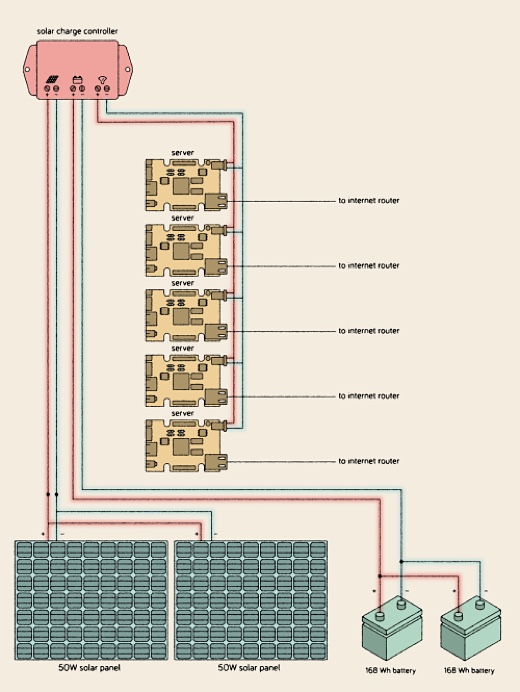
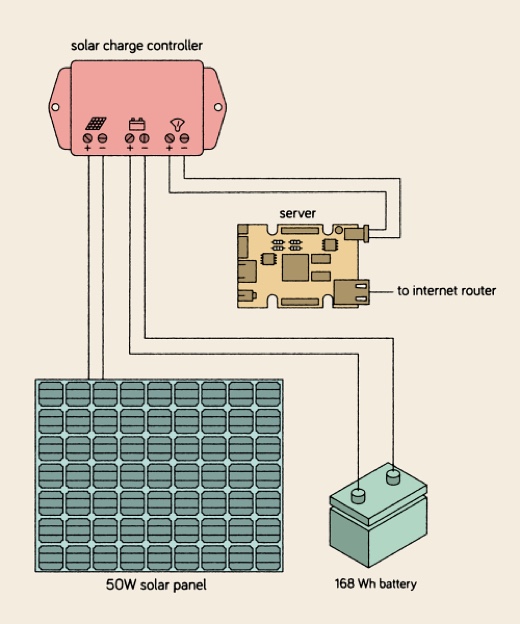
Image above: Diagram of home solar powered website. From original article. A simple representation of the system. A charge controller powered by a 50w solar panel charges a 168wh battery that runs a server to an internet router. The voltage conversion (between the 12V charge controller and the 5V server) and the battery meter (between the server and the battery) are missing.

(IB Editor's note: I just checked Amazon. A solar charge controller that meets the needs of this home base powered website server costs $10.97 with free Prime shipping. See (https://www.amazon.com/EEEKit-Controller-Intelligent-Multi-Function-Adjustable/dp/B07R8TRJ8C). I've had one for years attached to four 110ah dee cycle marine batteries keeping the LED lighting on in my shop. I think I paid over $30 for it then.)
.
Introduction
In September 2018, Low-tech Magazine launched a new website that aimed to radically reduce the energy use and carbon emissions associated with accessing its content. Internet energy use is growing quickly on account of both increasing bit rates (online content gets “heavier”) and increased time spent online (especially since the arrival of mobile computing and wireless internet).

The solar powered website bucks against these trends. To drop energy use far below that of the average website, we opted for a back-to-basics web design, using a static website instead of a database driven content management system. To reduce the energy use associated with the production of the solar panel and the battery, we chose a minimal set-up and accepted that the website goes off-line when the weather is bad.

We have been monitoring the solar powered server for 15 months now, and we have collected data on uptime, energy use, power use, system efficiency, and visitor traffic. We also calculated how much energy was required to make the solar panel, the battery, the charge controller and the server.

Uptime, Electricity Use & System Efficiency

The solar powered website goes off-line when the weather is bad – but how often does that happen? For a period of about one year (351 days, from 12 December 2018 to 28 November 2019), we achieved an uptime of 95.26%. This means that we were off-line due to bad weather for 399 hours.

If we ignore the last two months, our uptime was 98.2%, with a downtime of only 152 hours. Uptime plummeted to 80% during the last two months, when a software upgrade increased the energy use of the server. This knocked the website off-line for at least a few hours every night.

Let’s have a look at the electricity used by our web server (the “operational” energy use). We have measurements from the server and from the solar charge controller. Comparing both values reveals the inefficiencies in the system. Over a period of roughly one year (from 3 December 2018 to 24 November 2019), the electricity use of our server was 9.53 kilowatt-hours (kWh).

We measured significant losses in the solar PV system due to voltage conversions and charge/discharge losses in the battery. The solar charge controller showed a yearly electricity use of 18.10 kWh, meaning that system efficiency was roughly 50%.

During the period under study, the solar powered website received 865,000 unique visitors. Including all energy losses in the solar set-up, electricity use per unique visitor is then 0.021 watt-hour. One kilowatt-hour of solar generated electricity can thus serve almost 50,000 unique visitors, and one watt-hour of electricity can serve roughly 50 unique visitors. This is all renewable energy and as such there are no direct associated carbon emissions.

Embodied Energy Use & Uptime

The story often ends here when renewable energy is presented as a solution for the growing energy use of the internet. When researchers examine the energy use of data centers, which host the content that is accessible on the internet, they never take into account the energy that is required to build and maintain the infrastructure that powers those data centers.

There is no such omission with a self-hosted website powered by an off-the-grid solar PV installation. The solar panel, the battery, and the solar charge controller are equally essential parts of the installation as the server itself. Consequently, energy use for the mining of the resources and the manufacture of these components – the “embodied energy” – must also be taken into account.


Image above: Diagram of five servers powrf two 168wh batteries charged by two 50w solar panels a charge controller powered by two 50watt solar panels that charge two 168wh batteries.

Unfortunately, most of this energy comes from fossil fuels, either in the form of diesel (mining the raw materials and transporting the components) or in the form of electricity generated mainly by fossil fuel power plants (most manufacturing processes).

The embodied energy of our configuration is mainly determined by the size of the battery and the solar panel. At the same time, the size of battery and solar panel determine how often the website will be online (the “uptime”). Consequently, the sizing of battery and solar panel is a compromise between uptime and sustainability.

To find the optimal balance, we have run (and keep running) our system with different combinations of solar panels and batteries. Uptime and embodied energy are also determined by the local weather conditions, so the results we present here are only valid for our location (the balcony of the author’s home near Barcelona, Spain).

Uptime and Battery size

Battery storage capacity determines how long the website can run without a supply of solar power. A minimum of energy storage is required to get through the night, while additional storage can compensate for a certain period of low (or no) solar power production during the day. Batteries deteriorate with age, so it’s best to start with more capacity than is actually needed, otherwise the battery needs to be replaced rather quickly.

Greater than 90% Uptime
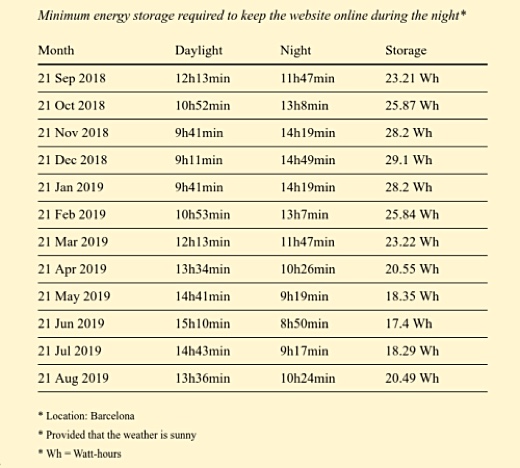
First, let’s calculate the minimum energy storage needed to keep the website online during the night, provided that the weather is good, the battery is new, and the solar panel is large enough to charge the battery completely. The average power use of our web server during the first year, including all energy losses in the solar installation, was 1.97 watts. During the shortest night of the year (8h50, June 21), we need 17.40 watt-hour of storage capacity, and during the longest night of the year (14h49, December 21), we need 29.19 Wh.


Table 1: Minimum energy required to keep website on line during the night. From original article.

Because lead-acid batteries should not be discharged below half of their capacity, the solar powered server requires a 60 Wh lead-acid battery to get through the shortest nights when solar conditions are optimal (2 x 29.19Wh). For most of the year we ran the system with a slightly larger energy storage (up to 86.4 Wh) and a 50W solar panel, and achieved the above mentioned uptime of 95-98%. [1]

100% Uptime
A larger battery would keep the website running even during longer periods of bad weather, again provided that the solar panel is large enough to charge the battery completely. To compensate for each day of very bad weather (no significant power production), we need 47.28 watt-hour (24h x 1.97 watts) of storage capacity.

From 1 December 2019 to 12 January 2020, we combined the 50 W solar panel with a 168 watt-hour battery, which has a practical storage capacity of 84 watt-hour. This is enough storage to keep the website running for two nights and a day. Even though we tested this configuration during the darkest period of the year, we had relatively nice weather and achieved an uptime of 100%.

However, to assure an uptime of 100% over a period of years would require more energy storage. To keep the website online during four days of low or no power production, we would need a 440 watt-hour lead-acid battery – the size of a car battery. We include this configuration to represent the conventional approach to off-grid solar power.

We also made calculations for batteries that aren’t large enough to get the website through the shortest night of the year: 48 Wh, 24 Wh, and 15.6 Wh (with practical storage capacities of 24 Wh, 12 Wh, and 7.8 Wh, respectively). The latter is the smallest lead-acid battery commercially available.

If the weather is good, the 48 Wh lead-acid battery will keep the server running during the night from March to September. The 24 Wh lead acid-battery can keep the website online for a maximum of 6 hours, meaning that the server will go off-line each night of the year, although at different hours depending on the season.

Finally, the 15.6 Wh battery keeps the website online for only four hours when there’s no solar power. Even if the weather is good, the server will stop working around 1 am in summer and around 9 pm in winter. The maximum uptime for the smallest battery would be around 50%, and in practice it will be lower due to clouds and rain.

A website that goes off-line in evening could be an interesting option for a local online publication with low anticipated traffic after midnight. However, since Low-tech Magazine’s readership is almost equally divided between Europe and the USA this is not an attractive option. If the website goes down every night, our American readers could only access it during the morning.

Uptime and Solar Panel Size
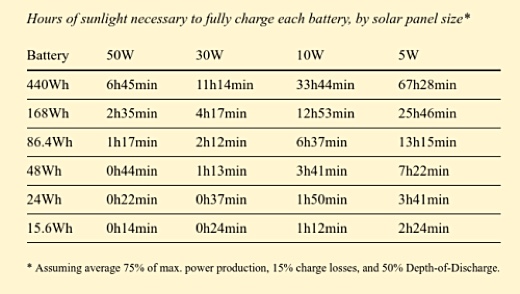
The uptime of the solar powered website is not only determined by the battery, but also by the solar panel, especially in relation to bad weather. The larger the solar panel, the quicker it will charge the battery and fewer hours of sun will be needed to get the website through the night. For example, with the 50 W solar panel, one to two hours of full sun are sufficient to completely charge any of the batteries (except for the car battery).


Table 2:  Hours of sunlight necessary to fully charge each battery; by solar panel size. From original article.

A 5 W solar panel – the smallest 12V solar panel commercially available – is the absolute minimum required to run a solar powered website. However, only under optimal conditions will it be able to power the server (2W) and charge the battery (3W), and it could only keep the website running through the night if the day is long enough. Because solar panels rarely generate their maximum power capacity, this would result in a website that is online only while the sun shines.

Even though the combination of a small solar panel and large battery can have the same embodied energy as the combination of a large solar panel and a small battery, the system each creates will have very different characteristics. In general, it’s best to opt for a larger solar panel and a smaller battery, because this combination increases the life expectancy of the battery – lead-acid batteries need to be fully charged from time to time or they lose storage capacity.

Embodied Energy for  Batteries and Solar Panels
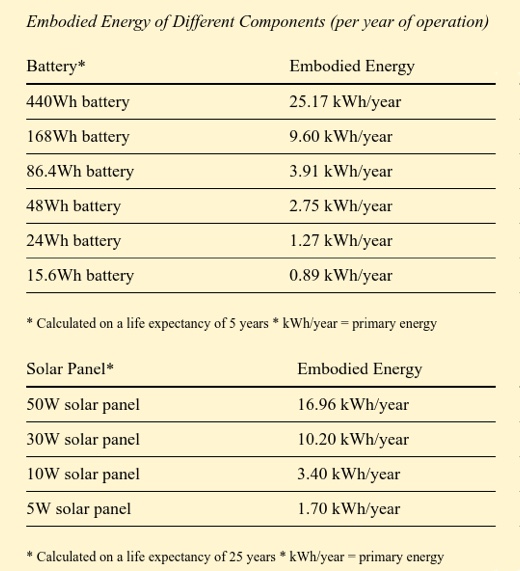
It takes 1.03 megajoule (MJ) to produce 1 watt-hour of lead-acid battery capacity [2], and 3,514 MJ of energy to produce one m2 of solar panel. [3] In the table below, we present the embodied energy for different sizes of batteries and solar panels and then calculate the embodied energy per year, based on a life expectancy of 5 years for batteries and 25 years for solar panels. The values are converted to kilowatt-hours per year and refer to primary energy, not electricity.

A solar powered website also needs a charge controller and of course a web server. The embodied energy for these components remains the same no matter the size of solar panel or battery. The embodied energy per year is based on a life expectancy of 10 years. [4][5]


Table 3:  Embodied Energy of Different Components (per ear of operation). From original article.

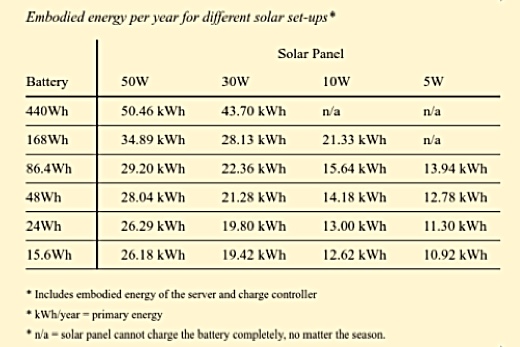
We now have all data to calculate the total embodied energy for each combination of solar panels and batteries. The results are presented in the table below.

The embodied energy varies by a factor of five depending on the configuration: from 10.92 kWh primary energy per year for the combination of the smallest solar panel (5W) with the smallest battery (15.6 Wh) to 50.46 kWh primary energy per year for the combination of the largest solar panel (50 W) with the largest battery (440Wh).

If we divide these results by the number of unique visitors per year (865,000), we obtain the embodied energy use per unique visitor to our website. For our original configuration with 95-98% uptime (50W solar panel, 86.4Wh battery), primary energy use per unique visitor is 0.03 Wh.

This result would be pretty similar for the other configurations with a lower uptime, because although the embodied energy is lower, so is the number of unique visitors.

How Sustainable is the Solar Powered Website?
Now that we have calculated the embodied energy of different configurations, we can calculate the carbon emissions. We can’t compare the environmental footprint of the solar powered website with that of the old website, because it is hosted elsewhere and we can’t measure its energy use.

What we can compare is the solar powered website with a similar self-hosted configuration that is run on grid power. This allows us to assess the (un)sustainability of running the website on solar power.

Life cycle analyses of solar panels are not very useful for working out the CO2-emissions of our components because they work on the assumption that all energy produced by the panels is used. This is not necessarily true in our case: the larger solar panels waste a lot of solar power in optimal weather conditions.

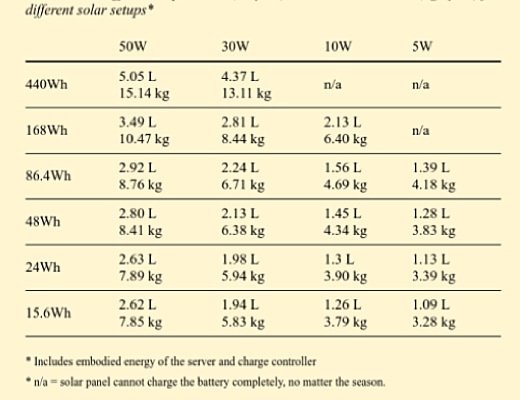
This means that fossil fuel use associated with running the solar powered Low-tech Magazine during the first year (50W panel, 86.4 Wh battery) corresponds to 3 litres of oil and 9 kg of carbon emissions – as much as an average European car driving a distance of 50 km. Below are the results for the other configurations:


Table 4:  Embodied Energy per year for different solar set-ups. From original article.

We therefore take another approach: we convert the embodied energy of our components to litres of oil (1 litre of oil is 10 kWh of primary energy) and calculate the result based on the CO2-emissions of oil (1 litre of oil produces 3 kg of greenhouse gasses, including mining and refining it). This takes into account that most solar panels and batteries are now produced in China – where the power grid is three times as carbon-intensive and 50% less energy efficient than in Europe. [6]

This means that fossil fuel use associated with running the solar powered Low-tech Magazine during the first year (50W panel, 86.4 Wh battery) corresponds to 3 litres of oil and 9 kg of carbon emissions – as much as an average European car driving a distance of 50 km. Below are the results for the other configurations:

Comparison with Carbon Intensity of Spanish Power GridNow let’s calculate the hypothetical CO2-emissions from running our self-hosted web server on grid power instead of solar power. CO2-emissions in this case depend on the Spanish power grid, which happens to be one of the least carbon intensive in Europe due to its high share of renewable and nuclear energy (respectively 36.8% and 22% in 2019).

Last year, the carbon intensity of the Spanish power grid decreased to 162 g of CO2 per kWh of electricity. For comparison, the average carbon intensity in Europe is around 300g per kWh of electricity, while the carbon intensity of the US and Chinese power grid are respectively above 400g and 900g of CO2 per kWh of electricity.

If we just look at the operational energy use of our server, which was 9.53 kWh of electricity during the first year, running it on the Spanish power grid would have produced 1.54 kg of CO2-emissions, compared to 3 - 9 kg in our tested configurations. This seems to indicate that our solar powered server is a bad idea, because even the smallest solar panel with the smallest battery generates more carbon emissions than grid power.

However, we’re comparing apples to oranges. We have calculated our emissions based on the embodied energy of our installation. When the carbon intensity of the Spanish power grid is measured, the embodied energy of the renewable power infrastructure is taken to be zero. If we calculated our carbon intensity in the same way, of course it would be zero, too.

Ignoring the embodied carbon emissions of the power infrastructure is reasonable when the grid is powered by fossil fuel power plants, because the carbon emissions to build that infrastructure are very small compared to the carbon emissions of the fuel that is burned. However, the reverse is true of renewable power sources, where operational carbon emissions are almost zero but carbon is emitted during the production of the power plants themselves.

To make a fair comparison with our solar powered server, the calculation of the carbon intensity of the Spanish power grid should take into account the emissions from the building and maintaining of the power plants, the transmission lines, and – should fossil fuel power plants eventually disappear – the energy storage. Of course, ultimately, the embodied energy of all these components would depend on the chosen uptime.

Possible Improvements
There are many ways in which the sustainability of our solar powered website could be improved while maintaining our present uptime. Producing solar panels and batteries using electricity from the Spanish grid would have the largest impact in terms of carbon emissions, because the carbon footprint of our configuration would be roughly 5 times lower than it is now.

What we can do ourselves is lower the operational energy use of the server and improve the system efficiency of the solar PV installation. Both would allow us to run the server with a smaller battery and solar panel, thereby reducing embodied energy. We could also switch to another type of energy storage or even another type of energy source.

Server
We already made some changes that have resulted in a lower operational energy use of the server. For example, we discovered that more than half of total data traffic on our server (6.63 of 11.16 TB) was caused by a single broken RSS implementation that pulled our feed every couple of minutes.

Fixing this as well as some other changes lowered the power use of the server (excluding energy losses) from 1.14 watts to about 0.95 watts. The gain may seem small, but a difference in power use of 0.19 watts adds up to 4.56 watt-hour over the course of 24 hours, which means that the website can stay online for more than 2.5 hours longer.

System Efficiency
System efficiency was only 50% during the first year. Energy losses were experienced during charging and discharging of the battery (22%), as well as in the voltage conversion from 12V (solar PV system) to 5V (USB connection), where the losses add up to 28%. The initial voltage converter we built was pretty suboptimum (our solar charge controller doesn't have a built-in USB-connection), so we could build a better one, or switch to a 5V solar PV set-up.

Energy Storage
To increase the efficiency of the energy storage, we could replace the lead-acid batteries with more expensive lithium-ion batteries, which have lower charge/discharge losses (small-scale compressed air energy storage system

(CAES). Although low pressure CAES systems have similar efficiency to lead-acid batteries, they have much lower embodied energy due to their long life expectancy (decades instead of years).

Energy Source
Another way to lower the embodied energy is to switch renewable energy source. Solar PV power has high embodied energy compared to alternatives such as wind, water, or human power. These power sources could be harvested with little more than a generator and a voltage regulator – as the rest of the power plant could be built out of wood. Furthermore, a water-powered website wouldn’t require high-tech energy storage. If you’re in a cold climate, you could even operate a website on the heat of a wood stove, using a thermo-electric generator.

Solar Tracker
People who have a good supply of wind or water power could build a system with lower embodied energy than ours. However, unless the author starts powering his website by hand or foot, we’re pretty much stuck with solar power. The biggest improvement we could make is to add a solar tracker that makes the panel follow the sun, which could increase electricity generation by as much as 30%, and allow us to obtain a better uptime with a smaller panel.

Let’s Scale Things Up !
A final way to improve the sustainability of our system would be to scale it up: run more websites on a server, and run more (and larger) servers on a solar PV system. This set-up would have much lower embodied energy than an oversized system for each website alone.


Table 5: Different solar setups includes embobied energy of the server and charge controller. From original article.

Solar Webhosting Company
If we were to fill the author’s balcony with solar panels and start a solar powered webhosting company, the embodied energy per unique visitor would decrease significantly. We would need only one server for multiple websites, and only one solar charge controller for multiple solar panels.

Voltage conversion would be more energy efficient, and both solar and battery power could be shared by all websites, which brings economies of scale.

Of course, this is the very concept of the data center, and although we have no ambition to start such a business, others could take this idea forward: towards a data center that is run just as efficiently as any other data center today, but which is powered by renewables and goes off-line when the weather is bad.

Add More Websites
We found that the capacity of our server is large enough to host more websites, so we already took a small step towards economies of scale by moving the Spanish and French versions of Low-tech Magazine to the solar powered server (as well as some other translations).

Although this move will increase our operational energy use and potentially also our embodied energy use, we also eliminate other websites that are or were hosted elsewhere. We also have to keep in mind that the number of unique visitors to Low-tech Magazine may grow in the future, so we need to become more energy efficient just to maintain our environmental footprint.

Combine Server and Lighting
Another way to achieve economies of scale would give a whole new twist to the idea. The solar powered server is part of the author’s household, which is also partly powered by off-grid solar energy. We could test different sizes of batteries and solar panels – simply swapping components between solar installations.

When we were running the server on the 50 W panel, the author was running the lights in the living room on a 10W panel – and was often left sitting in the dark. When we were running the server on the 10 W panel, it was the other way around: there was more light in the household, at the expense of a lower server uptime.

Let’s say we run both the lights and the server on one solar PV system. It would lower the embodied energy if both systems are considered, because only one solar charge controller would be needed.

Furthermore, it could result in a much smaller battery and solar panel (compared to two separate systems), because if the weather gets bad, the author could decide not to use the lights and keep the server online – or the other way around. This flexibility is not available now, because the server is the only load and its power use cannot be easily manipulated.

Energy Use in the Network
As far as we know, ours is the first life cycle analysis of a website that runs entirely on renewable energy and includes the embodied energy of its power and energy storage infrastructure. However, this is not, of course, the total energy use associated with this website.

There’s also the operational and embodied energy of the network infrastructure (which includes our router, the internet backbone, and the mobile phone network), and the operational and embodied energy of the devices that our visitors use to access our website: smartphones, tablets, laptops, desktops. Some of these have low operational energy use, but they all have very limited lifespans and thus high embodied energy.

Energy use in the network is directly related to the bit rate of the data traffic that runs through it, so our lightweight website is just as efficient in the communication network as it is on our server. However, we have very little influence over which devices people use to access our website, and the direct advantage of our design is much smaller here than in the network.

For example, our website has the potential to increase the life expectancy of computers, because it’s light enough to be accessed with very old machines. Unfortunately, our website alone will not make people use their computers for longer.

That said, both the network infrastructure and the end-use devices could be re-imagined along the lines of the solar powered website – downscaled and powered by renewable energy sources with limited energy storage.

Parts of the network infrastructure could go off-line if the local weather is bad, and your e-mail may be temporarily stored in a rainstorm 3.000 km away. This type of network infrastructure actually exists in some countries, and those networks partly inspired this solar powered website. The end-use devices could have low energy use and long life expectancy.

Because the total energy use of the internet is usually measured to be roughly equally distributed over servers, network, and end-use devices (all including the manufacturing of the devices), we can make a rough estimate of the total energy use of this website throughout a re-imagined internet.

For our original set-up with 95.2% uptime, this would be 87.6 kWh of primary energy, which corresponds to 9 litres of oil and 27 kg of CO2. The improvements we outlined earlier could bring these numbers further down, because in this calculation the whole internet is powered by oversized solar PV systems on balconies.

Authors: Kris De Decker, Roel Roscam Abbing, Marie Otsuka
llustrations by Diego Marmolejo.

Thanks to Kathy Vanhout, Adriana Parra and Gauthier Roussilhe.

Some of the Lights On

SUBHEAD: We should be redefining Energy Security as keeping at least "Some of the Lights On".

By Kris De Decker on 10 December 2018 for Low-Tech Magazine -
(https://www.lowtechmagazine.com/2018/12/keeping-some-of-the-lights-on-redefining-energy-security.html)


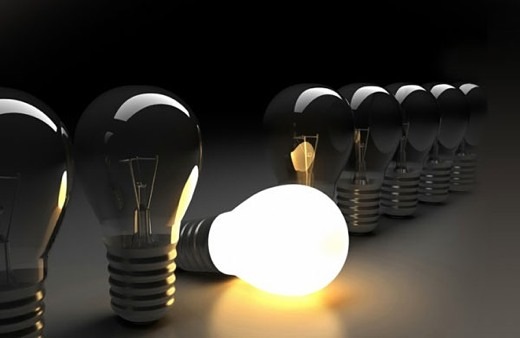
Image above: Keeping some of the lightbulbs on is better than all or nothing. From (http://www.womeninaction.co.za/be-different-to-make-a-difference/).

What is Energy Security?
What does it mean for a society to have “energy security”? Although there are more than forty different definitions of the concept, they all share the fundamental idea that energy supply should always meet energy demand. This also implies that energy supply needs to be constant – there can be no interruptions in the service. [1-4]

For example, the International Energy Agency (IEA) defines energy security as “the uninterrupted availability of energy sources at an affordable price”, the US Department of Energy and Climate Change (DECC) defines the concept as meaning that “the risks of interruption to energy supply are low”, and the EU defines it as a “stable and abundant supply of energy”. [5-7]

Historically, energy security was achieved by securing access to forests or peat bogs for thermal energy, and to human, animal, wind or water power sources for mechanical energy. With the arrival of the Industrial Revolution, energy security came to depend on the supply of fossil fuels.

As a theoretical concept, energy security is most closely related to the oil crises from the 1970s, when embargoes and price manipulations limited oil supply to Western nations.

As a result, most industrialised societies still stockpile oil reserves that are equivalent to several months of consumption.

Although oil remains as vital to industrial economies as it was in the 1970s, mainly for transportation and agriculture, it’s now recognised that energy security in modern societies also depends on other infrastructures, such as those supplying gas, electricity, and even data.

Furthermore, these infrastructures increasingly interconnect and depend on each other.

For example, gas is an important fuel for power production, while the power grid is now required to operate gas pipelines. Power grids are needed to run data networks, and data networks are now needed to run power grids.

This article investigates the concept of energy security by focusing on the power grid, which has become just as vital to industrial societies as oil. Moreover, electrification is seen as a way to decrease dependency on fossil fuels – think electric vehicles, heat pumps, and wind turbines.

The “security” or “reliability” of a power grid can be measured precisely by indicators of continuity such as the “Loss-of-Load Probability” (LOLP), and the “System Average Interruption Duration Index” (SAIDI). Using these indicators, one can only conclude that power grids in industrial societies are very secure.

For example, in Germany, power is available for 99.996% of the time, which corresponds to an interruption in service of less than half an hour per customer per year. [8]

Even the worst performing countries in Europe (Latvia, Poland, Lithuania) have supply shortages of only eight hours per customer per year, which corresponds to a reliability of 99.90%. [8]

The US power grid is in between these values, with supply interruptions of less than four hours per customer per year (99.96% reliability). [9]

How Secure is a Renewable Power Grid?

In the current operation of infrastructures, the paradigm is that consumers could and should have access to as much electricity, gas, oil, data or water as they want, anytime they want it, for as long as they want it.

The only requirement is that they pay the bill. Looking at the power sector, this vision of energy security is quite problematic, for several reasons.

First of all, most energy sources from which electricity is made are finite – and maintaining a steady supply of something that’s finite is of course impossible. In the long run, the strategy to maintain energy security is certainly doomed to fail. In the shorter term, it may disrupt the climate and provoke armed conflicts.

The International Energy Agency (IEA), which was set up following the first oil crisis in the early 1970s, encourages the use of renewable energy sources in order to diversify the energy supply and improve energy security in the long term.

A renewable power system is not dependent on foreign energy imports nor vulnerable to fuel price manipulations – which are the main worries in an energy infrastructure that is largely based on fossil fuels.

Of course, solar panels and wind turbines have limited lifetimes and need to be manufactured, which also requires resources that could come from abroad or which can become depleted. But, once they are installed, renewable power systems are “secure” in a way and for a period of time that fossil fuels (and atomic energy) are not.

Furthermore, solar and wind power provide more security concerning physical failure or sabotage, even more so when renewable power production is decentralised. Renewable power plants also have lower CO2-emissions, and the extreme weather events caused by climate change are a risk to energy security as well.

However, in spite of all these advantages, renewable energy sources pose fundamental challenges to the current understanding of energy security.

Most importantly, the renewable energy sources with the largest potential – sun and wind – are only intermittently available, depending on the weather and the seasons.

This means that solar and wind power don’t match the criterium that all definitions of energy security consider to be essential: the need for an uninterrupted, unlimited supply of power.

The reliability of a power grid with a high share of solar and wind power would be significantly below today’s standards for continuity of service. [10-14]

In such a renewable power grid, a 24/7 power supply can only be maintained at very high costs, because it requires an extensive infrastructure for energy storage, power transmission, and excess generation capacity.

This additional infrastructure risks making a renewable power grid unsustainable, because above a certain threshold, the fossil fuel energy used for building, installing and maintaining this infrastructure becomes higher than the fossil fuel energy saved by the solar panels and the wind turbines.

Intermittency is not the only disadvantage of renewable energy sources. Although many media and environmental organisations have painted a picture of solar and wind power as abundant sources of energy (“The sun delivers more energy to Earth in an hour than the world consumes in a year”), reality is more complex.

The “raw” supply of solar (and wind) energy is enormous indeed.

However, because of their very low power density, to convert this energy supply into a useful form solar panels and wind turbines require magnitudes of order more space and materials compared to thermal power plants – even if the mining and distribution of fuels is included. [15]

Therefore, a renewable power grid cannot guarantee that consumers have access to as much electricity as they want, even if the weather conditions are optimal.


How Secure is an Off-the-Grid Power System?
Today’s energy policies related to electricity try to reconcile three aims: an uninterrupted and limitless supply of power, affordability of electricity prices, and environmental sustainability.

A power grid that is mainly based on fossil fuels and atomic energy cannot achieve the aim of environmental sustainability, and it can only achieve the other goals as long as foreign suppliers do not cut off supplies or raise energy prices (or as long as national or international reserves are not depleted).

However, a renewable power grid cannot reconcile these three goals either. To achieve an unlimited 24/7 supply of power, the infrastructure needs to be oversized, which makes it expensive and unsustainable.

Without that infrastructure, a renewable power grid could be affordable and sustainable, but it could never offer an unlimited 24/7 supply of power.

Consequently, if we want a power infrastructure that is affordable and sustainable, we need to redefine the concept of energy security – and question the criterium of an unlimited and uninterrupted power supply.

If we look beyond the typical large-scale central infrastructures in industrial societies, it becomes clear that not all provisioning systems offer a limitless supply of resources.

Off-the-Grid microgeneration – the local production and storage of electricity using batteries and solar PV panels or wind turbines – is one example.

In principle, off-the-grid systems can be sized in such a way that they are “always on”. This can be done by following the “worst-month method”, which oversizes generation and storage capacity so that supply can meet demand even during the shortest and darkest days of the year.

However, just like in an imaginary large-scale renewable power grid, matching supply to demand at all times makes an off-the-grid system very costly and unsustainable, especially in high seasonality climates. [16-18]

Therefore, most off-the-grid systems are sized according to a method that aims for a compromise between reliability, economic cost and sustainability. The “loss-of-load probability sizing method” specifies a number of days per year that supply does not match demand. [19-21]

n other words, the system is sized, not only according to a projected energy demand, but also according to the available budget and/or the available space.

Sizing an off-the-grid power system in this way generates significant cost reductions, even if “reliability” is reduced just a little bit.

For example, a calculation for an off-the-grid house in Spain shows that decreasing the reliability from 99.75% to 99.00% produces a 60% cost reduction, with similar benefits for sustainability. Supply would be interrupted for 87.6 hours per year, compared to 22 hours in the higher reliability system. [16]

According to the current understanding of energy security, off-the-grid power systems that are sized in this way are a failure: energy supply doesn’t always meet energy demand.

However, off-gridders don’t seem to complain about a lack of energy security, on the contrary. There’s a simple reason for this: they adapt their energy demand to a limited and intermittent power supply.

In their 2015 book Off-the-Grid: Re-Assembling Domestic Life, Phillip Vannini and Jonathan Taggart document their travels across Canada to interview about 100 off-the-grid households. [22]

Among their most important observations is that voluntary off-gridders use less electricity overall and routinely adapt their energy demand to the weather and the seasons.

For example, washing machines, vacuum cleaners, power tools, toasters or videogame consoles are not used at all, or they are only used during periods of abundant energy, when batteries can accommodate no further charge.

If the sky is overcast, off-gridders act differently to draw less power and have some more left over for the day after.

Vannini and Taggart also observe that voluntary off-gridders seem to feel perfectly happy with levels of lighting or heating that are different from the standards that many in the western world have come to expect. Often, this shows itself in concentrating activities around more localised sources of heat and light. [22]

Similar observations can be made in places where people – involuntarily – depend on infrastructures that are not always on.

If centralised water, electricity and data networks are present in less industrialised countries, they are often characterised by regular and irregular interruptions in the supply. [23-25]

However, in spite of the very low reliability of these infrastructures – according to common indicators of continuity – life goes on.

Daily household routines are shaped around disruptions of supply systems, which are viewed as normal and a largely accepted part of life.

For example, if electricity, water or Internet are only available during certain times of the day, household tasks or other activities are planned accordingly. People also use less energy overall: the infrastructure simply doesn’t allow for a resource-intensive lifestyle. [23]
 
More Reliable, Less Secure?

The very high “reliability” of power grids in industrial societies is justified by calculating the “value of lost load” (VOLL), which compares the financial loss due to power shortages to the extra investment costs to avoid these shortages. [1][10] [26-29]

However, the value of lost load is highly dependent on how society is organised. The more it depends on electricity, the higher the financial losses due to power shortages will be.

Current definitions of energy security consider supply and demand to be unrelated, and focus almost entirely on securing energy supply.

However, alternative forms of power infrastructures like those described above show that people adapt and match their expectations to a power supply that is limited and not always on. In other words, energy security can be improved, not just by increasing reliability, but also by reducing dependency on energy.

Demand and supply are also interlinked, and mutually influence each other, in 24/7 power systems – but with the opposite effect. Just like “unreliable” off-the-grid power infrastructures foster lifestyles that are less dependent on electricity, “reliable” infrastructures foster lifestyles that are increasingly dependent on electricity.

In their 2018 book Infrastructures and Practices: the Dynamics of Demand in Networked Societies, Olivier Coutard and Elizabeth Shove argue that an unlimited and uninterrupted power supply has enabled people in industrial societies to adopt a multitude of power dependent technologies – such as washing machines, air conditioners, refrigerators, automatic doors, or 24/7 mobile internet access – which become “normal” and central to everyday life.

At the same time, alternative ways of doing things – such as washing clothes by hand, storing food without electricity, keeping cool without air-conditioning, or navigating and communicating without mobile phones – have withered away, or are withering away. [30]

As a result, energy security is in fact higher in off-the-grid power systems and “unreliable” central power infrastructures, while industrial societies are the weakest and most fragile in the face of supply interruptions.

What is generally assumed to be a proof of energy security – an unlimited and uninterrupted power supply – is actually making industrial societies ever more vulnerable to supply interruptions: people increasingly lack the skills and the technology to function without a continuous power supply.

Redefining Energy Security
To arrive to a more accurate definition of energy security requires the concept to be defined, not in terms of commodities like kilowatt-hours of electricity, but in terms of energy services, social practices, or basic needs. [1]

People don’t need electricity in itself. What they need, is to store food, wash clothes, open and close doors, communicate with each other, move from one place to another, see in the dark, and so on.

All these things can be achieved either with or without electricity, and in the first case, with more or less electricity.

Defined in this way, energy security is not just about securing the supply of electricity, but also about improving the resilience of the society, so that it becomes less dependent on a continuous supply of power.

This includes the resilience of people (do they have the skills to do things without electricity?), the resilience of devices and technological systems (can they handle an intermittent power supply?), and the resilience of institutions (is it legal to operate a power grid that is not always on?).

Depending on the resilience of the society, a disruption of the power supply may or may not lead to a disruption of energy services or social practices.

For example, although our food distribution system is dependent on a cold chain that requires a continuous power supply, there are many alternatives.

We could adapt refrigerators to an irregular power supply by insulating them much better, we could reintroduce cold cellars (which keep food fresh without electricity), or we could relearn older methods of food storage, like fermentation.

We could also improve people’s skills in terms of fresh cooking, switch to diets based on ingredients that don’t need cold storage, and encourage local daily shopping over weekly trips to large supermarkets.

If we look at energy security in a more holistic way, taking into account both supply and demand, it quickly becomes clear that energy security in industrial societies continues to deteriorate. We keep delegating more and more tasks to machines, computers and large-scale infrastructures, thus increasing our dependency on electricity.

Furthermore, the Internet is becoming just as essential as the power grid, and trends like cloud computing, the Internet of Things, and self-driving cars are all based on several interconnected layers of continuously operating infrastructures.


Because demand and supply influence each other, we come to a counter-intuitive conclusion: to improve energy security, we need to make the power grid less reliable. This would encourage resilience and substitution, and thus make industrial societies less vulnerable to supply interruptions.

Coutard and Shove argue that “it would make sense to pay more attention to opportunities for innovation that are opened when large network systems are weakened and abandoned, or when they become less reliable”. They add that the experiences of voluntary off-gridders “provide some insights into the types of configuration at stake”. [30]

Arguing for a less reliable power supply is sure to be controversial. In fact, “Keeping the lights on” is a phrase that is often used to justify energy reforms such as building more atomic plants, or keeping them in operation past their planned lifetimes.

To achieve real energy security, “keeping the lights on” should be replaced by phrases like “keeping some of the lights on”, “which lights should we turn off next?”, or “what’s wrong with a bit more dark?”. [31]

Obviously, a less reliable energy supply would bring fundamental changes to routines and technologies, whether it is in households, factories, transport systems, or communications networks – but that’s exactly the point. Present ways of life in industrial societies are simply not sustainable.

Sources
[1] Winzer, Christian. "Conceptualizing energy security." Energy policy 46 (2012): 36-48. https://www.repository.cam.ac.uk/bitstream/handle/1810/242060/cwpe1151.pdf?sequence=1&isAllowed=y

[2] Sovacool, Benjamin K., and Ishani Mukherjee. "Conceptualizing and measuring energy security: A synthesized approach." Energy 36.8 (2011): 5343-5355. https://relooney.com/NS4053-Energy/00-Energy-Security_1.pdf

[3] Kruyt, Bert, et al. "Indicators for energy security." Energy policy37.6 (2009): 2166-2181. https://www.sciencedirect.com/science/article/pii/S0301421509000883

[4] Cherp, Aleh, and Jessica Jewell. "The concept of energy security: Beyond the four As." Energy Policy 75 (2014): 415-421. https://www.sciencedirect.com/science/article/pii/S0301421514004960

5] Energy security, International Energy Agency. https://www.iea.org/topics/energysecurity/

[6] Lucas, Javier Noel Valdés, Gonzalo Escribano Francés, and Enrique San Martín González. "Energy security and renewable energy deployment in the EU: Liaisons Dangereuses or Virtuous Circle?." Renewable and Sustainable Energy Reviews 62 (2016): 1032-1046. https://www.researchgate.net/profile/Javier_Valdes4/publication/303361228_Energy_security_and_renewable_energy_deployment_in_the_EU_Liaisons_Dangereuses_or_Virtuous_Circle/links/5a536f45458515e7b72eab26/Energy-security-and-renewable-energy-deployment-in-the-EU-Liaisons-Dangereuses-or-Virtuous-Circle.pdf

[7] Strambo, Claudia, Måns Nilsson, and André Månsson. "Coherent or inconsistent? Assessing energy security and climate policy interaction within the European Union." Energy Research & Social Science 8 (2015): 1-12. https://www.sciencedirect.com/science/article/pii/S221462961500047X

[8] CEER Benchmarking Report 6.1 on the Continuity of Electricity and Gas Supply. Data update 2015/2016. Ref: C18-EQS-86-03. 26-July-2018. Council of European Energy Regulators. https://www.ceer.eu/documents/104400/-/-/963153e6-2f42-78eb-22a4-06f1552dd34c

[9] Average frequency and duration of electric distribution outages vary by states. U.S. Energy Information Administration (EIA). April 5, 2018. https://www.eia.gov/todayinenergy/detail.php?id=35652


[10] Röpke, Luise. "The development of renewable energies and supply security: a trade-off analysis." Energy policy 61 (2013): 1011-1021. https://www.econstor.eu/bitstream/10419/73854/1/IfoWorkingPaper-151.pdf

[11] "Evolutions in energy conservation policies in the time of renewables", Nicola Lablanca, Isabella Maschio, Paolo Bertoldi, ECEEE 2015 Summer Study -- First Fuel Now. https://www.eceee.org/library/conference_proceedings/eceee_Summer_Studies/2015/9-dynamics-of-consumption/evolutions-in-energy-conservation-policies-in-the-time-of-renewables/

[12] “How not to run a modern society on solar and wind power alone”, Kris De Decker, Low-tech Magazine, September 2017.

[13] Nedic, Dusko, et al. Security assessment of future UK electricity scenarios. Tyndall Centre for Climate Change Research, 2005. http://citeseerx.ist.psu.edu/viewdoc/download?doi=10.1.1.461.4834&rep=rep1&type=pdf

[14] Zhou, P., R. Y. Jin, and L. W. Fan. "Reliability and economic evaluation of power system with renewables: A review." Renewable and Sustainable Energy Reviews 58 (2016): 537-547. https://www.sciencedirect.com/science/article/pii/S136403211501727X

[15] Smil, Vaclav. Power density: a key to understanding energy sources and uses. MIT Press, 2015. https://mitpress.mit.edu/books/power-density

[16] Landeira, Cristina Cabo, Ángeles López-Agüera, and Fernando Núñez Sánchez. "Loss of Load Probability method applicability limits as function of consumption types and climate conditions in stand-alone PV systems." (2018). https://www.researchgate.net/profile/Cristina_Cabo2/publication/324080184_Loss_of_Load_Probability_method_applicability_limits_as_function_of_consumption_types_and_climate_conditions_in_stand-alone_PV_systems/links/5abca9fa45851584fa6e1efd/Loss-of-Load-Probability-method-applicability-limits-as-function-of-consumption-types-and-climate-conditions-in-stand-alone-PV-systems.pdf

[17] Singh, S. Sanajaoba, and Eugene Fernandez. "Method for evaluating battery size based on loss of load probability concept for a remote PV system." Power India International Conference (PIICON), 2014 6th IEEE. IEEE, 2014. https://ieeexplore.ieee.org/abstract/document/7117729

[18] How sustainanle is stored sunlight? Kris De Decker, Low-tech Magazine.

[19] Chapman, R. N. "Sizing Handbook for Stand-Alone Photovoltaic." Storage Systems, Sandia Report, SAND87-1087, Albuquerque (1987). https://prod.sandia.gov/techlib-noauth/access-control.cgi/1987/871087.pdf

[20] Posadillo, R., and R. López Luque. "A sizing method for stand-alone PV installations with variable demand." Renewable Energy33.5 (2008): 1049-1055. https://www.sciencedirect.com/science/article/pii/S096014810700184X

[21] Khatib, Tamer, Ibrahim A. Ibrahim, and Azah Mohamed. "A review on sizing methodologies of photovoltaic array and storage battery in a standalone photovoltaic system." Energy Conversion and Management 120 (2016): 430-448. https://staff.najah.edu/media/published_research/2017/01/19/A_review_on_sizing_methodologies_of_photovoltaic_array_and_storage_battery_in_a_standalone_photovoltaic_system.pdf

[22] Vannini, Phillip, and Jonathan Taggart. Off the grid: re-assembling domestic life. Routledge, 2014. http://lifeoffgrid.ca/off-grid-living-the-book/

[23] "Materialising energy and water resources in everyday practices: insights for securing supply systems", Yolande Strengers, Cecily Maller, in "Global Environmental Change 22 (2012), pp. 754-763. http://researchbank.rmit.edu.au/view/rmit%3A17990/n2006038376.pdf

[24] Pillai, N. "Loss of Load Probability of a Power System." (2008). https://mpra.ub.uni-muenchen.de/6953/1/MPRA_paper_6953.pdf

[25] Al-Rubaye, Mohannad Jabbar Mnati, and Alex Van den Bossche. "Decades without a real grid: a living experience in Iraq." International Conference on Sustainable Energy and Environment Sensing (SEES 2018). 2018. https://biblio.ugent.be/publication/8566224

[26] Telson, Michael L. "The economics of alternative levels of reliability for electric power generation systems." The Bell Journal of Economics (1975): 679-694. https://www.jstor.org/stable/3003250

[27] Schröder, Thomas, and Wilhelm Kuckshinrichs. "Value of lost load: an efficient economic indicator for power supply security? A literature review." Frontiers in energy research 3 (2015): 55. https://www.frontiersin.org/articles/10.3389/fenrg.2015.00055/full

[28] Ratha, Anubhav, Emil Iggland, and Goran Andersson. "Value of Lost Load: How much is supply security worth?." Power and Energy Society General Meeting (PES), 2013 IEEE. IEEE, 2013. https://www.ethz.ch/content/dam/ethz/special-interest/itet/institute-eeh/power-systems-dam/documents/SAMA/2012/Ratha-SA-2012.pdf

[29] De Nooij, Michiel, Carl Koopmans, and Carlijn Bijvoet. "The value of supply security: The costs of power interruptions: Economic input for damage reduction and investment in networks." Energy Economics 29.2 (2007): 277-295.

[30] Coutard, Olivier, and Elizabeth Shove. "Infrastructures, practices and the dynamics of demand." Infrastructures in Practice. Routledge, 2018. 10-22. https://www.routledge.com/Infrastructures-in-Practice-The-Dynamics-of-Demand-in-Networked-Societies/Shove-Trentmann/p/book/9781138476165

[31] Demand Dictionary of Phrase and Fable, seventeenth edition. Jenny Rinkinen, Elizabeth Shove, Greg Marsden, The Demand Centre, 2018. http://www.demand.ac.uk/wp-content/uploads/2018/07/Demand-Dictionary.pdf


.

The Off-Grid Poster Child

SUBHEAD: After the disaster of hurricane Maria, Puerto Rico is ripe to be the place to find stand-alone off-grid living.

By Juan Wilson on 20 September 2018 for Island Breath -
(http://islandbreath.blogspot.com/2018/09/off-grid-poster-child.html)


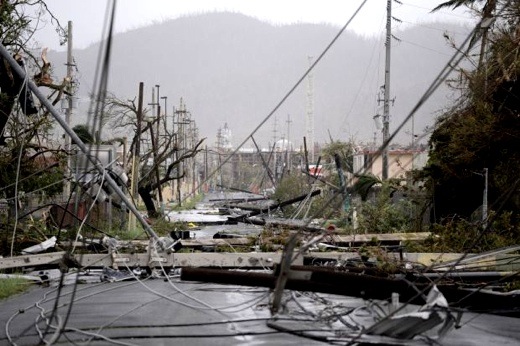
Image above: Electricity poles and lines lie toppled on the road after Hurricane Maria hit the eastern region of Puerto Rico. Photo: Carlos Giusti. From (https://www.wsj.com/articles/the-truth-about-hurricane-maria-1537129890).

Well before hurricane Maria devastated the island of Puerto Rico on 20 September 2017 the infrastructure of the power grid had deteriorated to the point of fragility not seen elsewhere in America.

That grid was the responsibility of The Puerto Rico Electric Power Authority (PREPA). PREPA is a government-owned corporation of Puerto Rico responsible for electricity generation, power distribution, and power transmission on the island. Hurricane Maria demonstrated that PREPA was a failure and that it would not have the vision or resources needed to serve Puerto Rico.

Without the resources to repair what had been a frail and failing system, Maria provided a death blow to PREPA. The Puerto Rican people tuned to gas operated electrical generators that had been purchased by people who could afford them for the frequent PREPA blackouts. After Maria things got nasty. Neighborhoods strung extension cords between homes in suburban neighborhoods. They got by with less.

There were some isolated small scaled solar photo-voltaic electric systems in place - and they became important. The Wall Street Journal reported (https://www.wired.com/story/puerto-rico-hurricane-maria-recovery/):
In the town rural town of Adjuntas, nestled in the mountains about an hour and a half southwest of San Juan, an NGO dedicated in part to solar power, called Casa Pueblo, became a pillar of the local recovery. 
When the town’s 18,000 residents were cut off from the rest of the island after Maria, the NGO’s solar-­powered radio helped authorities find out which roads were clear and which families were in danger, and attend to emergencies when the central government and federal authorities were not yet responding. 
Casa Pueblo subsequently gave out some 14,000 solar-powered lamps and also offered a solar-charged satellite phone at its offices for locals to use. At any given time, five to 10 people waited to make a call.

Arturo Massol, the associate director of Casa Pueblo and an ardent evangelist for decentralized, renewable energy, described what was happening on the island as “an energy insurrection.” Ordinary Puerto Ricans, he said, had woken up to the fact that when it came to electricity, they would have to look for alternatives.
This is part of a real solution. But that is not the direction that Puerto Rico is going. Instead the US government is planning on financing the privatization of PREPA through the creation of the “Puerto Rico Energy Transformation Administration (PRETA) that would provide guarantees (with US tax payer's money) for private energy corporations to rebuild the Puerto Rican grid. According to Debt Wire (https://www.debtwire.com/info/prepa-federalization-draft-bill-floating-congress)
Still in rough draft form, a bill tentatively titled the “Puerto Rico Energy Stabilization and Hurricane Resiliency Act of 2018” delineates specific steps to have the federal government—via the DOE—take over PREPA, impose a temporary administrator to supersede Puerto Rico’s Energy Commission ratemaking power, establish a corporation to issue restructuring bonds, and create special investment assurance accounts as part of the utility’s ongoing privatization process.
Here on Kauai the failure of privately owned Kauai Electric took a different but similar turn.

Those with long memories know what happened when the privately owned Kauai Electric called it quits. We paid off the "stake holders" a couple hundred million dollars of borrowed money to create a the debt ridden Kauai Island Utility Cooperative (KIUC). We now pay about the highest rates in the country.

Like Puerto Rico, Kauai is a stand alone grid on an isolated island. What energy it produces is all the energy it will have available. To its credit, KIUC has aggressively been adding solar voltaic power generation capacity. But it has not encouraged Solar PV stand alone systems.

Instead it encourages "co-generation"... the placement of PV systems on individual homes to supplement KIUC power generation. Co-gen certainly can reduce KIUC's high price for grid power, but it is, by my observation,  no real incentive to reduce power consumption.

Co-gen also means some resilience capability if the grid goes down because of a natural disaster, electro-magnetic pulse (EMP) or other disaster.

But KIUC suffers from the same vulnerability that Puerto Rico faced when Maria struck. All the power distribution is provided by poles and large hurricane can knock those poles down like a house of cards. That happened on Kauai with hurricane Iniki in 1992. But instead of burying the power distribution lines (as is done in most modern community planning) Kauai Electric simply re-erected the old creosote soaked wooden power poles.

Stand alone solar power systems have several advantages if they are not backed up by a electric grid or fossil fuel powered generator.
  • They absolutely limit the consumption of power to the amount of energy collected from the sun.
  • They require customer awareness of usage and some maintenance encouraging greater self reliance.
  • They reduce overall power consumption by high energy appliances like microwave ovens or air compressors.
  • They are resilient in that only the minority of systems that are hit directly by a disaster are damaged.
  • They wean us from living outside the limitations of energy not supplied by nature where you live.  
What we found was that having multiple independent stand alone PV systems is a real advantage. We stumbled into that situation by slowing adding systems over time. We started with a single panel and added increasingly bigger systems over almost a decade as we gained experience and knowledge.

All our systems use an array of one of two battery types. One type are high capacity 12volt 110amp-hour lead acid deep cycle batteries available on Kauai. The other type are 6v 405 amp-hour AGM (absorbant glass mat) batteries.

There are two AGM systems.

One is attached to our circuit breaker panel-box. This is where KIUC used to hook up. We had KIUC come and take off the meter and wiring to our house. This systems powers all the switches and outlets built into the house.

The second AGM system is attached to a power inverter providing energy for our new refrigerator and freezer. See (http://islandbreath.blogspot.com/2018/09/freezers-up-and-running.html).

The five other systems are smaller for specific tasks using smaller power inverters.
  • One provides counter lighting and strip outlets for our kitchen as well as our guest bathroom.
  • A second one provides lighting and a power strip to our master bedroom and its bathroom.
  • A third one provides lighting and a power strip  (for tool battery charging) in shop/utility room.
  • A fourth provides power for and office computer, wifi system and small appliance batteries.
  • A fifth provides power to a stand-alone shack that serves as a guest house. 
This overlapping redundancy has proved to be valuable. Any one system can go down and we can work around the problem by switching plugs in outlets and/or swapping around compatible batteries.

Redundancy is good. We had a neighbor who went with KIUC co-gen. After about a year the single co-gen system inverter failed and her solar panels were providing nothing to reduce her energy bill. The installer claimed it was out of warranty and not their problem. It took over year to get the system up and working agian.

Looking to the future my advice, as usual, is learn to and act to:
  • Grow your own food
  • Collect your own water
  • Produce your own energy
  • Make and repair what you can.
The alternative is sitting around a fire with pointy sticks.

Freezers up and running

SUBHEAD: Our two new freezers (one converted to fridge) are running off solar and working as expected.

By Juan Wilson on 1 September 2018 for Island Breath -
(http://islandbreath.blogspot.com/2018/09/freezers-up-and-running.html)


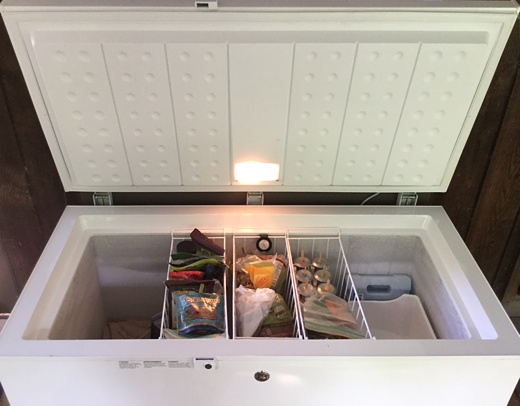
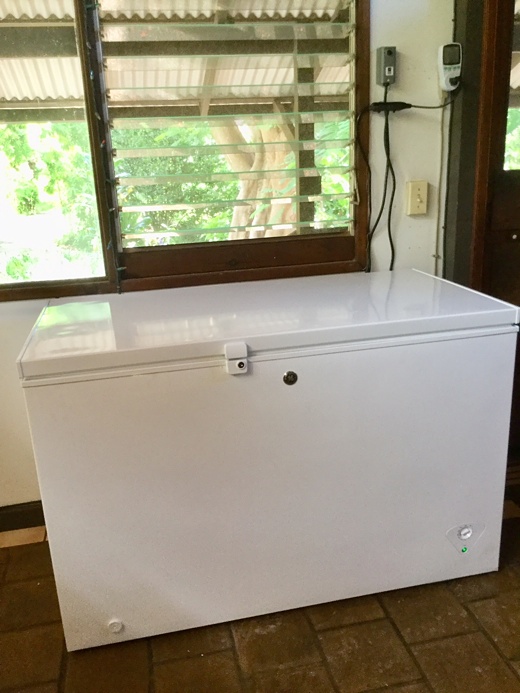
Image above: Top opening 10.6cuft General Electric chest freezer model number FCM11PHBWW with three movable bins and built in light costing about $449 on our lanai.

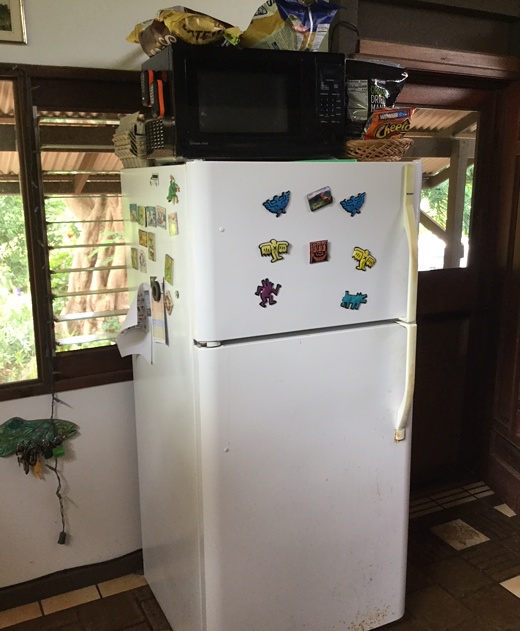
We are off the electric grid (KIUC) and run our homestead entirely on photovoltaic power spread across seven dedicated systems. One is dedicated to just our freezer and refrigerator. For quite some time we have suffered with inadequate energy to run our 16cuft refrigerator.

The small chest 4.5cuft freezer has been no trouble, but the refrigerator has been a real hassle - especially in the darker winter months.  Add to that our eight 405 amp-hour 6volt batteries dedicated to cooling food are going into their fifth year.

We realized that the chest design of the freezer was a great advantage over the front loading fridge. Every time the fridge door is opened all the cold air slides out. If you are making a complicated meal it's tough keeping that fridge cool.

We replaced a front loading 16cuft refrigerator and a 4.5cuft freezer with two 10.6cuft freezers. One of the freezer we put on our covered lanai just outside of our kitchen/dining room. It is more out of the weather than our previous freezer location that was in our carport (shop/laundry room).

The other freezer was placed where our upright front loading refrigerator used to be. Note we never got the use of the jalousie window with the old fridge there.


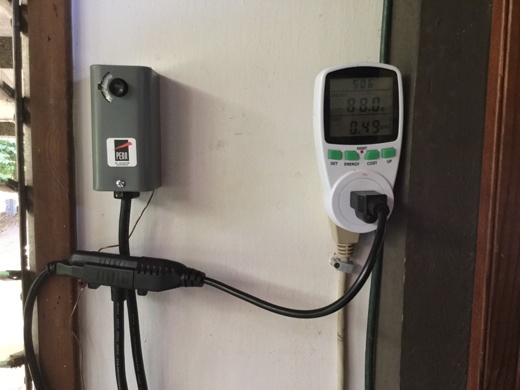
Image above: Top opening 10.6cuft General Electric chest freezer converted to a fridge with the use of a thermostat to shut it off when the temperature approaches 32ºF

Of course, there are advantages in organizing (or the lack there of) when using an upright refrigerator. Fortunately the freezer we found to use as a fridge had two features that helped a lot.

One - it comes with three plastic coated metal wire bins that slide on a ledge just under the top .
Two - it has a light on the underside of the top opening door that turns on when you lift the top.


Image above:Above the thermostat and monitor for the converted freezer to make it a refrigerator.

Left is the control for the thermostat that has a sensor on a long copper tube. It can be adjusted down to 20ºf. We are using it set to 32ºf. On the right is the source of electricity. The tan extension cord runs down and through the wall to the covered porch outside our front door. That is where our 110volt inverter sits just over the battery array under the porch.

Plugged into the cord is a power monitor that shows the refrigerator is pulling 88 watts while it is cooling. Plugged into the monitor is the thermostat and plugged into the thermostat is the fridge.

We bought the Johnson Controls Freezer Temperature Controller from Amazon.  This thermostat converts the freezer to a fridge.

So far so good. We are watching and adjusting how we load and use these units. 

See also:
Ea O Ka Aina: The Forthcoming freezers 8/25/18
Ea O Ka Aina: Convert Freezer to Fridge 7/21/18
Ea O Ka Aina: Guilt Free Cold Beer 3/7/10


.

The Forthcoming Freezers

SUBHEAD: Our ability to refrigerate and freeze food reliably off-grid requires converting to chest units only.

By Juan Wilson on 25 August 2018 for Island Breath -
(http://islandbreath.blogspot.com/2018/08/the-forthcoming-freezers.html)


Image above: Our current 16cuft fridge next the front door. The new 10.6 cuft freezer will turned be transformed into a refrigerator (set at 33 fahrenheit with a GE thermostatic switch. Note the microwave on top of the fridge is used only for storing open bags of chips and crackers. It's not plugged in because it will trip the PV inverter if turned on. Photo by Juan Wilson.

[IB Publisher's note: We are facing a problem with our 16 cubic foot refrigerator - it's not efficient enough to run on the the batteries charged by our solar PV system. We are looking to convert a 10 cubic foot freezer into a refrigeration unit and live with the inconvenience of organizing and searching the bin for its contents. We'll let you know how that goes.]

We have been off the power grid long enough to have learned a few things. Perhaps the toughest lesson was finding it really difficult to keep refrigeration going 24/7/365. A lot of things that require power can be episodic. That includes wi-fi internet access, electric lighting, and entertainment systems.

We have moved up from 8 120 amp-hour 12 volt deep cycle marine batteries to 8 405 amp-hour 6 volt AGM batteries. That's the same size array of batteries that run all out power outlets and switched lighting. After struggling through several seasons of darker than summer days we realized we could not run conventional refrigeration. That being an upright unit with a front door. The unit simply loses most of its cold air every time you open the door merely to see what's inside.

We had to go to a chest refrigerator. We also needed a bigger freezer to store all the food we process and store (like a year's worth of macadamia nuts, and packages of pre-cooked and seasoned cassava, taro and breadfruit.

We read about this solution in Kendra's post "Convert Freezer into Fridge" (http://islandbreath.blogspot.com/2018/07/convert-freezer-into-fridge.html), from New Life on a Homestead on 7/21/18.

Since July we have taken steps to rid ourselves of and upright refrigerator and expand our capacity to freeze for for long term storage.  The plan included purchasing two 10.6 cubic foot freezers. One would be converted to a refrigerator using the technique in the referenced article linked above.  The other would be a straight up freezer.

We purchased the freezers from Home Depot.  They are General Electric model FCM11PH Chest Freezer (garage ready) with an Energy Guide estimate of $26 estimated yearly energy cost. Of course that $26 is totally unrelated to the actual energy cost from Kauai's KIUC power company opr the fact that we will be running them off batteries charged from solar panels.

What the $26 does indicate is that this freezer is in a sweet spot being less energy costly than any of the smaller freezers we considered. Of course, we'll see what find out the actual consumption only when we are up and running.

We were notified yesterday that the two freezers had arrived on Kauai and would be delivered on August 31. So we are beginning now to execute changes we'll need to accommodate the switch over. Will have Home Depot remove the 4 cubic foot freezer in our garage the 16 cubic foot refrigerator.

One of the new freezers (the one we'll user as a fridge) will be placed in our kitchen/dining area where the old fridge was. It will be wider, lower and a bit less deep and requires some storage changes - like no storage on top of the fridge like now.

The other freezer will be on our lanai, just outside the the kitchen/dining area. That means no more trecking down and outside to get to the garage and our current freezer.

More on the installation and use of these units as we go.

On re-reading the specs again I realized that these new freezers have built in lighting. That is great, in that I won't have to install additional lighting on each unit that would be foot operated (or something).

More on this effort when the freezers arrive.


Image above: Our current 4 cu ft freezer is closer to the weather than the lanai location we intend for its replacement. Note rust at front right corner closest to the outside of our open "garage" (washroom, shop, storeroom, etc). Photo by Juan Wilson.