Showing posts with label Lawsuit. Show all posts

Bayer Battered

SUBHEAD: After buying Monsanto Bayer suffers major blow losing second RoundUp cancer trial.

By Tyler Durden on 20 March 2019 for Zero Hedge -
(https://www.zerohedge.com/news/2019-03-20/bayer-battered-after-suffering-major-blow-second-roundup-cancer-trial-loss)


Image above: Plaintiff DeWayne Johnson looks on at the start of the Monsanto trial in San Francisco, California on July, 09, 2018. From (https://www.sfgate.com/nation/article/Does-Roundup-cause-cancer-Patient-s-case-13061244.php).

Bayer AG shares are down over 12% in European trading - the biggest drop since 2003 - after a U.S. jury found the RoundUp weed killer was a substantial factor in a California man's cancer. This is the second case that has gone against manufacturer Monsanto, acquired by Bayer last year.

On Tuesday, a federal court jury in San Francisco ruled unanimously for plaintiff DeWayne Johnson,  in a lawsuit against Monsanto. Attorneys say the trial, which will determine in a second phase whether the company is liable and if so, for how much, could help determine the fate of hundreds of similar lawsuits.

The plaintiff's attorneys said he developed non-Hodgkin lymphoma after 26 years of regularly using Roundup to tackle weeds and poison oak, according to the Wall Street Journal. The active ingredient in Roundup and Ranger Pro is glyphosate, a herbicide.

Hardeman’s case is considered a “bellwether” trial for hundreds of other plaintiffs in the US with similar claims, which means the verdict could affect future litigation and other cancer patients and families. Monsanto, now owned by the German pharmaceutical company Bayer, is facing more than 9,000 similar lawsuits across the US.

The decision strikes another blow to the German pharmaceuticals group. In August, a jury ordered its Monsanto unit to pay $289 millionafter determining it failed to warn customers of the potential cancer risks of two of its weedkillers, Roundup and Ranger Pro. The verdict was cut to $78.5 million on appeal.

Analysts are broadly negative on the news, BUT appear to be buyers of any dip... and today's a big dip.
News is a “major blow,” according to Baader (buy, PT EU123), which says Bayer shares might move towards EU60 in the short-term. If stock falls toward 2018 lows, probability of Bayer becoming a target for activists or a takeover will increase.
Morgan Stanley (overweight, PT EU82) says there was “budding enthusiasm” among investors for either a potential “surprise” verdict in favor, or a hung jury, given multiple days elapsing during deliberations.
Overhang on Bayer shares “could be significant” as outcome was considered by some investors to be a potential bellwether for ~765 outstanding glyphosate cases, Goldman Sachs analyst Keyur Parekh (buy, PT EU78) writes.
Citi says “steady heads required” as >EU20b of litigation risk is already priced into the shares. Says legal checks instruct bank to be more focused on the upcoming Hall vs Monsanto trial being held in St Louis from April 1. St Louis result will better determine whether the estimate of a potential settlement liability of $1-6b needs to be refined.
Any extreme weakness is an opportunity to buy, according to Bernstein (outperform, PT EU86) as an ultimate liability well above the $5b is already “baked-in
Monsanto says studies have established that Roundup's active ingredient, glyphosate, is safe. It has appealed a separate U.S. court decision last year in favor of a man who used Roundup.
"We are disappointed with the jury's initial decision, but we continue to believe firmly that the science confirms that glyphosate-based herbicides do not cause cancer," Bayer said in a press release.
"Bayer stands behind these products and will vigorously defend them."


.

SCOTUS halts youth climate case

SUBHEAD: With Kavanaugh in place on Supreme Court likely to close lawsuit against fed not controlling greenhouse gases.

By Jessica Corbetton 20 October 2018 for Common Dreams -
(https://www.commondreams.org/news/2018/10/20/disgraceful-and-enraging-supreme-court-halts-youth-climate-case-after-last-ditch)


Image above: Demonstration in April 2017 in St. Paul MN by children wanting Federal Government take responsibility for not controlling greenhouse gases and imperiling life their lives. From original article.

In a move author and activist Naomi Klein denounced as "disgraceful and enraging," the U.S. Supreme Court has halted a lawsuit brought by 21 American children and young adults that aims to hold the federal government accountable for its ongoing failure to adequately curb greenhouse gas emissions to battle the global climate crisis.

The decision came in response to a last-ditch effort by the Trump administration to kill the "potentially landmark" case ahead of the trial slated to begin in the U.S. District Court for the District of Oregon on Oct. 29.

The case has been tied up in the legal system for three years. Just this week, District Court Judge Ann Aiken reaffirmed that the youth plaintiffs can credibly claim that the government has violated their due process rights.

The Supreme Court, however, stayed discovery and the trial in an order (pdf) issued Friday, demanding a response from the plaintiffs' legal counsel by Wednesday afternoon.

Michael Gerrard, director of Sabin Center for Climate Change Law at Columbia, called the move "highly unusual" and "reminiscent of their stay of the Clean Power Plan."

Farron Cousins, a radio host and executive editor of The Trial Lawyer magazine, tied the development to the upcoming midterms, tweeting:
There was one glimmer of hope this week when this case was allowed to proceed to trial, and in an instant, this guy took it away. Future generations are getting screwed, and I hope they remember who did this. Vote like your life depends on it! https://www.climateliabilitynews.org/2018/10/19/supreme-court-kids-climate-case-roberts/ 
While the high court's one-page order provoked public outrage, Julia Olson of Our Children's Trust, co-counsel for the youth plaintiffs, remained optimistic and said the team plans to file their reply on Monday.

"We are confident once Chief [John] Justice Roberts and the full court receive the youth plaintiffs' response to defendants' mischaracterization of their case, the trial will proceed," she said.
"As the Supreme Court has recognized in innumerable cases, review of constitutional questions is better done on a full record where the evidence is presented and weighed by the trier of fact. This case is about already recognized fundamental rights and children's rights of equal protection under the law."
As E&E News noted, "Roberts' action came hours after Jeffrey Wood, a top political appointee at the Department of Justice, said there is no such right. Speaking at a law conference in San Diego, Wood said the right to a safe climate that the plaintiffs demand 'simply does not exist,' adding that the government is still preparing for trial."

Several observers pointed out that the Supreme Court had previously allowed the case to proceed, back before the contentious new Justice Brett Kavanaugh replaced now-retired Anthony Kennedy. Environmental attorney Jeffrey Gracer remarked: "A newly configured Supreme Court seems poised to close the courthouse doors. But the tide of #ClimateAction cannot be stopped."

Jeffrey Gracer tweeted;
Justice Kennedy previously denied a stay in this climate change case brought by children who simply want their day in court. A newly configured Supreme Court seems poised to close the courthouse doors. But the tide of cannot be stopped.
See also:
Ea O Ka Aina: Case against Trump proceeding 10/18/18
.

Case against Trump proceeding

SUBHEAD: Blockbuster ruling on Children's Climate Change suit will proceed to trial October 29th.

By Julia Conley on 16 October 2018 for Common Dreams  -
(https://www.commondreams.org/news/2018/10/16/blockbuster-ruling-judge-says-youths-climate-case-against-trump-administration-can)


Image above: A young gird holds a poster of Planet Earth supporting children's lawsuit.  From original article.

Twenty-one children and young adults were looking forward on Tuesday to bringing their climate lawsuit against the federal government to trial in the coming weeks, following a U.S. District Court ruling arguing that the plaintiffs have made a convincing case that the Trump and Obama administrations have failed to curb carbon emissions even as they knew of the pollution's myriad harmful effects.

Judge Ann Aiken handed down the ruling late Monday in a court in Eugene, Oregon, affirming that the plaintiffs can credibly claim that their due process rights have been violated by the government and fossil fuel companies—an argument the young people are more than ready to make in court starting October 29, when the case is set to go to trial.

Following the decision, 21-year-old Tia Hatton said in a statement, "My fellow plaintiffs and I have our eyes set on one thing: our trial date...We—my lawyers, our experts, and my co-plaintiffs and I—are ready to make our case against the U.S. federal government and their deliberate energy policy that cause catastrophic climate change."

The lawsuit, Juliana vs. The United States, was first filed in 2015 under the Obama administration, with the 21 plaintiffs, then ranging in age from eight to 19, arguing with the help of Our Children's Trust that the government's actions that have worsened carbon emissions have "violated the youngest generation’s constitutional rights to life, liberty, and property, as well as failed to protect essential public trust resources."

The children pointed to increasingly frequent and destructive extreme weather events, rising sea levels, and droughts in their hometowns across the U.S. as evidence of their claim, and since then have called expert witnesses including climate scientist James Hansen and economist Joseph Stiglitz to bolster their case.

The young people "proffered uncontradicted evidence showing that the government has historically known about the dangers of greenhouse gases but has continued to take steps promoting a fossil fuel based energy system, thus increasing greenhouse gas emissions," said Aiken in her ruling.

Aiken dismissed President Donald Trump as a defendant in the lawsuit, but she did so "without prejudice"—meaning the youths can bring a case against him later on. Other Trump administration officials who head government agencies can still be named in the current case.

"The District Court continues to provide well-reasoned decisions that narrow and appropriately frame the heart of this case for trial," said Julia Olson, executive director of Our Children's Trust. "We are ready to bring all of the facts forward and prove these youths' case once and for all."

The federal government has for three years attempted to have the case dismissed by arguing that extreme weather events and pollution levels happen around the world, not only in the U.S., and that, as one Justice Department lawyer put it in 2016, "There simply is no constitutional right to a pollution-free environment." Aiken vehemently rejected the argument:
Where a complaint alleges knowing governmental action is affirmatively and substantially damaging the climate system in a way that will cause human deaths, shorten human lifespans, result in widespread damage to property, threaten human food sources, and dramatically alter the planet's ecosystem, it states a claim for a due process violation. To hold otherwise would be to say that the Constitution affords no protection against a government's knowing decision to poison the air its citizens breathe or the water its citizens drink.
"Judge Aiken's blockbuster decision lays out in extremely precise detail the factual and legal issues in our case which remain to be resolved at trial," Alex Loznak, a 21-year-old plaintiff, said.

"Having contributed extensive personal testimony and research to help develop our case's factual record over the past several years, I am confident that our arguments on the remaining disputed issues will ultimately prevail in court. We still need a full and fair trial to prove our case. October 29, here we come!"

Bayer Beware!

SUBHEAD: Lawyers claim to have "Explosive" documents concerning Monsanto and RoundUp.

By Tyler Durden on 11 September 2018 for Zero Hedge -
(https://www.zerohedge.com/news/2018-09-07/bayer-beware-lawyers-claim-have-explosive-monsanto-documents)


Image above: Common Ragweed is becoming resistant to glyphsate applications in Nebraska. Ragweed plants from a glyphosate-resistant (left) and susceptible population (right) three weeks after application of 44 ounces per acre of Roundup PowerMax (that is one ounce per thousand square feet). From (https://cropwatch.unl.edu/glyphosate-resistant-common-ragweed-confirmed-nebraska).

Lawyers involved in a California lawsuit against Monsanto claim to have "explosive" documents concerning the Bayer-owned agrochemical giant's activities in Europe, according to Euronews.
"What we have is the tip of the iceberg. And in fact we have documents now in our possession, several hundreds documents, that have not been declassified and some of those are explosive," said US lawyer Robert Kennedy Jr, adding - "And many of them are pertinent to what Monsanto did here in Europe. And that's just the beginning."
Monsanto - bought by Germany's Bayer AG in June for $66 billion, was ordered in August to pay a historic $289 million to a former school groundskeeper, Dewayne Johnson, who said Monsanto's Roundup weedkiller gave him terminal cancer. Monsanto says it will appeal the verdict.

Environmental lawyers have been in Brussels in order to address a European Parliament special committee on the issue.
"They are fighting a fight for more democracy and for transparency and to get a better insight in how big corporation such as Monsanto act and try to manipulate the facts," said Belgium MEP Bart Staes.
Last November EU approved the use of glyphosate - a key chemical in Roundup, following five years of heated debate over whether it causes cancer. While it was approved for just five years until 2022 vs. the usual 15 years, there are now rumors that they will withdraw Roundup's license this year altogether.

Labeled a carcinogen by the EPA in 1985, the agency reversed its stance on glyphosate in 1991. The World Health Organization's cancer research agency, however, classified the compound as "probably carcinogenic to humans" in 2015. California, meanwhile, has the chemical listed in its Proposition 65 registry of chemicals known to cause cancer. 

See also:
Ea O Ka Aina: A MAtch Made in Hell 6/30/18

.

Kauai hui sues DLNR over GMOs

SUBHEAD: To ensure that public lands are given the proper and environmental review before being leased out for commercial use. 

By Staff on 14 June 2017 for Hawaii Alliance for Progressive Action -
(http://www.hapahi.org/news/2017/6/14/kauai-groups-sue-state-to-enforce-environmental-review-law)


Image above: "No Tresspass" sign on gate to public land leased to private corporations for experimenting with pesticides combined with genetically modified organisms sited on "reclaimed" wetlands close to nearby the ocean reefs and westside Kauai populations centers. What could go wrong? From (http://www.huffingtonpost.com/maggie-sergio/gmo-pesticide-experiments_b_3513496.html).

A Kauai-based community group, Ke Kauhulu o Mana, have filed a lawsuit against the State Department of Land and Natural Resources (DLNR) and Syngenta.

The suit calls for enforcement of Hawaii Revised Statute (HRS) Chapter 343, which requires an environmental assessment (EA) or an Environmental Impact Statement (EIS) for any significant actions or development proposed on publicly-owned, coastal and conservation-zoned lands.

In this instance, the lands in question are located on Kauai’s west side in Mana adjacent to the coast, about three quarters of a mile from the homes and community of Kekaha, and close to the frequent surfing and recreation beach, Targets.

The hui, Ke Kauhulu O Mana, is represented by west side residents Loui Cabebe and Punohu Kekaualua III. The plaintiffs include the Surfrider Foundation, Kohola Leo and the Hawai'i Alliance for Progressive Action (H.A.P.A.).
“These lands are historically Hawaiian crown lands. According to the state Constitution, these lands are supposed to be held and protected as part of the public trust. The State of Hawai`i as the present caretaker of these lands needs to take that responsibility seriously. We are disappointed that to date, they have failed to do so. We feel compelled to take this legal action to ensure that the regulations designed to preserve and protect crown lands are respected, and that state agencies do their job and enforce those laws.”

- Loui Cabebe, long time west Kauai resident and representative of plaintiff group, Ke Kauhulu o Mana.
The plaintiffs are represented by public interest attorney, Lance Collins, who has a wide range of experience with a focus on good government, environmental protection and native Hawaiian law. Mr. Collins has brought a number of successful cases under HRS 343, most recently Kalepa v. Dept. of Transportation and Maalaea Community Assn v. Dept. of Housing & Human Concerns.

“This suit is being filed to ensure that sensitive, coastal, and publicly-owned lands zoned for conservation are given the proper and legally required environmental review prior to being leased out for private commercial use,” said Collins.

According to Collins, a thorough review evaluating direct, indirect and cumulative impacts which the law requires, has not been done.

The complaint further states that the proposed use of the lands may have significant negative impacts given the anticipated heavy application of Restricted Use Pesticides involved in the industrial farming of crops by Syngenta.

Syngenta has announced plans to sell its Hawai'i operations to the Wisconsin-based company, Hartung Brothers. However, media reports also indicate that Hartung Brothers will be contracted by Syngenta to perform the same activities currently conducted by Syngenta employees. Thus the environmental and health impacts will remain similar regardless of the named entity conducting day to day operations.

State must ensure that permittees abide by regulations and protect public lands

“These lands are historically Hawaiian crown lands. According to the state Constitution, these lands are supposed to be held and protected as part of the public trust,” says Loui Cabebe, a native Hawaian and long time West side resident and representative of the plaintiff group, Ke Kauhulu o Mana.

“The State of Hawaii as the present caretaker of these lands needs to take that responsibility seriously.

We are disappointed that to date, they have failed to do so. We feel compelled to take this legal action to ensure that the regulations designed to preserve and protect crown lands are respected, and that state agencies do their job and enforce those laws,” he added.

The complaint states that the DLNR must require and ensure the execution of a full Environmental Impact Statement (EIS) covering the lands currently being used by Syngenta.

Based on what is known of the company’s activities thus far, and because of the close proximity of the parcel in question to the ocean and its conservation designation, Syngenta’s use of the land will have significant impacts on the recreational use of the beach and near-shore waters, adjacent reef eco-systems, fishermen, surfers and endangered native species.

Area once considered for park expansion leased instead to Syngenta

In granting Syngenta its permit to utilize the lands the DLNR has stated the action is exempt from the requirements of HRS343 as no significant impacts are expected.  The complaint alleges this decision was made based on only a superficial review.  

That review is woefully inadequate in light of the area’s conservation zoning, its proximity to the coastline and the pesticide-intensive nature of the proposed use by Syngenta.

The complaint further points out that exemption to HRS343 was granted even though the Office of Hawaiian Affairs expressed concerns about possible burials in the area and even though Syngenta’s own federal permits indicate much of the work is done in areas that impact critical habitats of rare and endangered species.

The approximately 60 acre parcel comprises section 5(b) lands, which means they are held in public trust for the people of Hawai`i and are subject to native Hawaiian entitlements.  The area was previously identified by State agencies as ideal for future park expansion, but is now part of Syngenta’s approximately 3,000 acres of leased, publicly-owned crown lands on Kauai’s west side.

Pesticide-intensive industrial farming hazardous to health and the environment

The complaint argues that a full EIS is needed given the scale and nature of the planned industrial farming activities which are distinctly different from the operations of local farmers in several ways.

First and foremost, these large scale actions are occurring on state-owned conservation lands situated in a sensitive coastal environment.

Secondly they involve the heavy application of restricted use pesticides (RUP). Thirdly, night-time activity involving the use of bright lights is known to impact endangered species such as the ‘a’o (Newell’s Shearwater) and ua’u (Hawaiian Petrel). The Kauai Endangered Seabird Recovery Project has reported that between 1993 and 2013, populations of the ‘a’o declined by 94 percent while the ua’u declined by 78 percent.

The federal permits held by Syngenta to grow experimental crops state clearly that the activity is occurring in areas where critical habitats for endangered species exist.

The case will be heard in the environmental court on Kaua‘i, presided over by the Hon. Randal Valenciano.

.

Syngenta loses $218million lawsuit

SOURCE: Jeri DiPietro (ofstone@aol.com)
SUBHEAD: Corn producers claimed contaminated crops hurt sales to China in lawsuit over GMO seeds.

By Margaret Cronin Fisk on 23 June 2017 for Bloomberg -
(https://www.bloomberg.com/news/articles/2017-06-23/syngenta-ordered-by-jury-to-pay-218-million-to-kansas-farmers)


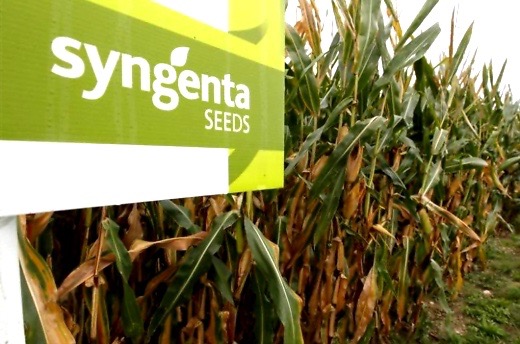
Image above: The logo of Swiss agrochemicals maker Syngenta is seen in front of a cornfield near the company's plant in Stein near Basel Switzerland illustrating another lawsuit in 2014. Photo byArnd Wiegmann. From (http://www.reuters.com/article/us-syngenta-seed-trans-coastal-idUSKBN0HB2OQ20140917).

[IB Publisher's note: This is likely a good thing for Kauai if it hurts Syngenta and ultimately reduces their impact of experimental pesticides on the environment and people here. This however, is in no way a rejection of GMO technology. It is merely punishment of Syngenta for letting  factory farms lose money they might have made in China selling them GMO corn grown in America and developed in Hawaii.]

Syngenta AG was ordered to pay $217.7 million to a group of Kansas farmers who claimed the company carelessly marketed its genetically modified corn seed, causing contamination of U.S. crops and a rejection of export sales to China by officials there.

A Kansas jury issued the verdict Friday in the first trial brought by U.S. farmers alleging Syngenta caused five years of depressed corn prices. Several other trials are pending as lawyers pursue suits on behalf of some 350,000 corn growers claiming as much as $13 billion in losses.

The win gives momentum to claims by farmers from more than 20 states who are suing the Swiss agrochemical giant. Syngenta faces its next class action in a Minnesota court in August, where farmers are seeking more than $600 million.

“This drastically changes the complexion of the upcoming litigation,” said Anthony Sabino, law professor at St. John’s University in New York. “A jury found the plaintiffs’ claims of depressed prices so convincing that, not only did the jury give them a win on the liability, they awarded the entire amount of damages asked for. That is not an everyday occurrence.”

A dozen Kansas farmers attended the 13-day trial. The only farmer in the courtroom Friday, when the jury returned its verdict after four hours of deliberation during two days, was Bret Kendrick, 52.

“I’m relieved that things turned out the way they did," Kendrick said. "I’m very happy, especially for Kansas farmers." Kendrick farms 6,000 acres in southwestern Kansas.

Jury Verdict

The Kansas City, Kansas, jury awarded only compensatory damages and no punitive damages. The farmers’ lawyers had asked for $217.7 million for lost sales plus punitive damages.

Syngenta said it would appeal the verdict. “We are disappointed with today’s verdict because it will only serve to deny American farmers access to future technologies even when they are fully approved in the U.S.,’’ the company said in an e-mail. “The case is without merit.’’

More than 7,000 Kansas farmers claimed Syngenta rushed its GMO seed to market before getting approval from China to export grain there. In 2013, China stopped shipments after calling the corn contaminated by the GMO seed. The farmers also claimed Syngenta misled them on when the Chinese would approve the seed.

In all, China barred an estimated 1.4 million metric tons of U.S. corn from entering the country, effectively cutting the U.S. out of the world’s fastest-growing market, the farmers contend. Corn futures tumbled as demand for American corn weakened, they claim.

And while Syngenta’s GMO seeds were approved by the Chinese a year later, corn from Ukraine and other countries continues to supplant U.S. crops, the farmers said.

The average U.S. cash corn price has fallen 20 percent since the 2013 Chinese ban on U.S. shipments, while futures on the Chicago Board of Trade fell 15 percent, according to data compiled by Bloomberg.

Price Trends

During the worst drought since the 1930s, cash prices peaked in August 2012 at $8.26 a bushel. On June 22, the price of a bushel of corn was $3.30, up from a seven-year low of $2.73 a bushel in September. The farmers blame the lower prices on the Chinese rejection. Syngenta said this wasn’t a factor.

The Swiss company was under pressure because Monsanto Co. had a seed that was equal to Syngenta’s that already had Chinese approval, Scott Powell, the farmers’ lawyer, told jurors Thursday.

“Syngenta rushed this product to market to serve its own commercial interests,’’ he said. “No consideration was given to the farmers.’’

Powell, citing a company document, said Syngenta’s then-CEO, Mike Mack, knew that China would object to his company’s seed, but that Mack wanted to “pressurize’’ China into accepting it.
“For Syngenta, there was no risk,’’ he said. “It was all on the backs of farmers.’’

Loss Analysis

Syngenta did nothing wrong and the farmers suffered no losses, Mike Brock, the company’s attorney, told jurors in closing arguments Thursday.

“Important approvals were in place before the seed went into the ground,’’ he said. Syngenta began marketing the seed in 2011 following U.S. approval the prior year.

The Chinese rejection didn’t cause corn prices to crater, he said. A 2010 corn drought in China forced it to buy foreign corn, and a 2012 drought in the U.S. led to a spike here, he said. A 2013 corn glut sent prices plummeting. Rain, particularly in the corn belt, shapes the corn market, he said.

China’s decision to block Syngenta’s seed wasn’t for safety reasons, but done as a “pretext’’ to lessen its dependence on U.S. corn, Brock said. “They wanted to slow down the export of corn to China.’’

China Watch

Syngenta wasn’t required to wait for Chinese approval and that country was using its biotech regulations to control trade, Brock said. The rejection of U.S. corn was part of that strategy, he said.

The trial in Kansas City, Kansas, comes as state-owned China National Chemical Corp. is completing its $43 billion acquisition of Basel, Switzerland-based Syngenta.

U.S. District Judge John Lungstrum, who is overseeing the Kansas City trial and most of the litigation, has certified eight statewide classes and had said Friday he’d schedule another trial for January or February. Farmers in 14 additional states are awaiting class certification by the Kansas judge.

Grain exporters Archer-Daniels-Midland Co. and Cargill Inc. have accused Syngenta in separate suits of carelessly allowing its seed to taint U.S. corn, causing the Chinese rejection. Those suits are pending in state court in Louisiana, with Cargill’s headed for trial next year.

The case is In Re: Syngenta AG MIR 162 Corn Litigation, 14-md-02591, U.S. District Court, District of Kansas (Kansas City).


.

Glyphosate harms gut enzyme

SUBHEAD: There are new claims against Monsanto in consumer lawsuit over Roundup herbicide.

By Carey Gillam on 20 June 2017 for Huffington Post -
(http://www.huffingtonpost.com/entry/new-claims-against-monsanto-in-consumer-lawsuit-over_us_59496379e4b0f500e5526088)


Image above: Store display of RoundUp for consumer use on home yards. From original article.

Another day, another lawsuit against global seed and chemical giant Monsanto Corporation. In a complaint filed Tuesday in federal court in Wisconsin, six consumers alleged that the company’s top-selling Roundup herbicide has been falsely promoted as uniquely safe when it actually can have profound harmful impacts on human gut bacteria critical to good health.

The lawsuit, which also names Roundup distributor Scotts Miracle-Gro Co. as a defendant, specifically alleges that consumers are being deceived by inaccurate and misleading statements made by Monsanto regarding glyphosate, the active weed-killing ingredient in Roundup.

Plaintiffs include residents of Wisconsin, Illinois, California, New York, New Jersey and Florida.

Glyphosate, which Monsanto introduced as an herbicide in 1974 and is widely used in growing food crops, has been promoted for years as a chemical that kills plants by targeting an enzyme that is not found in people or pets.

The lawsuit claims that assertion is false, however, and argues that research shows glyphosate can target an enzyme found in gut bacteria in people and animals, disrupting the immune system, digestion, and “even brain function.”

“Defendants repeat these false and misleading representations throughout their marketing, including in video advertisements produced for their websites and YouTube Channel,” states the lawsuit, which is filed in U.S. District Court for the Western District of Wisconsin.

Monsanto did not respond to a request for comment and neither did Scotts.

Monsanto is currently defending itself against nationwide claims that Roundup has caused hundreds of people to suffer from a type of blood cancer called non-Hodgkin lymphoma (NHL).

More than 1,100 plaintiffs have lawsuits pending in state and federal courts with many of the lawsuits combined in multidistrict litigation in federal court in San Francisco.

Those lawsuits were triggered by a 2015 decision by the World Health Organization’s International Agency for Research on Cancer (IARC) to classify glyphosate as a probable human carcinogen.

IARC said research showed an association between NHL and glyphosate, with limited evidence from epidemiology data collected on humans and stronger evidence seen in laboratory animals exposed to glyphosate.

The lawsuit filed in Wisconsin is markedly different from the Roundup cancer claims, though some of the same attorneys are involved in both lines of litigation.

Plaintiffs do not claim physical injury; rather they claim violations of trade and business practices laws, and allege Monsanto and Scotts were “unjustly enriched” as plaintiffs purchased and paid for more Roundup products than they would have in absence of the alleged false promotions.
.

Zuckerberg sues Hawaiians

SUBHEAD: Mark Zuckerberg sues to keep local landowners off right-of-way through his 700 acre Kauai estate.

By Maya Kosoff on 19 January  2017 for Vanity Fair -
(http://www.vanityfair.com/news/2017/01/mark-zuckerberg-sues-to-keep-native-hawaiians-off-his-kauai-estate)


Image above: Mark Zuckerberg and his wife on either side of young woman surfer on Kauai. From (http://usuncut.com/news/mark-zuckerberg-suing-force-native-hawaiians-off-ancestral-land-build-island-resort/).

The Facebook billionaire isn’t exactly endearing himself to his neighbors.
Mark Zuckerberg, the co-founder of the world’s largest social network, would just like some privacy.

In the past year alone, the 32-year-old billionaire spent $30 million to buy up the four homes surrounding his Palo Alto abode, only to demolish them, and later built a six-foot-tall wall around his 700-acre plot of land in Hawaii, to the chagrin of his Kilauean neighbors.

Now, Zuckerberg is seeking additional peace and quiet, this time by filing a series of lawsuits against several hundred people—some of whom are dead—who own or have claims to the land Zuckerberg purchased on the island of Kauai for more than $100 million in 2014.

Last year, onstage at Facebook’s annual F8 developer conference, Zuckerberg decried the isolationism sweeping the country, taking an unsubtle jab at a certain presidential candidate’s plan to wall off Mexico from the United States. “I hear fearful voices calling for building walls and distancing people they label as others,” he intoned. “Instead of building walls, we can build bridges.”

Those words apparently don’t apply to Zuckerberg, who reportedly wants to create a secluded sanctuary where he will have exclusive rights to every one of its 700 acres.

According to the Honolulu Star-Advertiser, which first reported the news on Wednesday, Zuckerberg has filed a set of lawsuits with Hawaii's state Circuit Court, seeking to identify the owners of land on his property, so that he may force a sale of those properties.

The Star-Advertiser reports that nearly 300 people could claim ancestral ownership of small pieces of land on Zuckerberg’s property, and Zuckerberg’s legal team has spent a year and a half trying to identify those individuals.
There are about a dozen small pieces of land contained within Zuckerberg’s enormous estate that are owned by other people, the Star-Advertiser reports. These native Hawaiian families currently have the right to “traverse the billionaire’s otherwise private domain.”

But because of Hawaii’s “quiet title” law, Zuckerberg may be able to appear before a judge, who will determine rightful land ownership. The land can ultimately be auctioned off if co-owners can’t agree to terms, in which case, Zuckerberg, who made almost $5 billion in the first two weeks of the year, could easily buy them out.

On Thursday, Zuckerberg posted a statement on Facebook in response to what he called “misleading” stories about the lawsuits. “To find all these partial owners so we can pay them their fair share, we filed what is called a ’quiet title’ action,” Zuckerberg said. “For most of these folks, they will now receive money for something they never even knew they had. No one will be forced off the land.

We are working with a professor of native Hawaiian studies and long time member of this community, who is participating in this quiet title process with us. It is important to us that we respect Hawaiian history and traditions.”
The lawsuits come at an odd time for Zuckerberg. The young Facebook C.E.O. has been meticulous about his own self-image, hiring a professional photographer and employing a team of about a dozen people to comb through and delete negative comments from his Facebook posts. He’s also remained largely apolitical, even as he has fueled speculation about his political ambitions.

He has pledged to donate the vast majority of his wealth to his own philanthropic organization, and recently hired a prominent White House alum to help run it. He has defended keeping Trump donor and surrogate  

Peter Thiel on Facebook’s board, and after the election said on Facebook that he was feeling “hopeful” about the future. The incoming president, he noted diplomatically, reminded him of “all the work ahead of us to create the world we want for our children.”
Even so, he can’t help but to be drawn into the muck himself. When Zuckerberg tried to depoliticize Facebook’s news feed last year, by replacing its human editorial team with an algorithm, Facebook only endured more criticism as hoax and fake political news stories filled up users’ feeds.

Zuckerberg’s recent plan to fight fake news—empowering users to flag misleading stories and enlisting third-party fact-checkers to provide additional context—only generated more controversy. Conservatives accused Facebook of censorship, with the Daily Caller, among other conservative outlets, dismissing Facebook’s fact-checkers as “liberal.”
Still, Zuckerberg is treading lightly, and working diligently to expand his coalition. On Tuesday night, Facebook threw an inauguration party in Washington, D.C. with the Daily Caller, which was sponsored by the oil giant BP.

Zuckerberg recently began a 50-state talking tour, making his first stop in Texas this week, where he met police officers, pressed hands, and helped build a community garden.

The resulting photos looked campaign-ready, if and when Zuckerberg is ready to exercise the new clause in his contract that will allow him retain control of Facebook if he takes a leave of absence to serve in a government position or office.

Suing to keep native Hawaiians off his 700-acre estate, however, suggests Zuckerberg still has a ways to go before he’s campaign-ready himself.

As Donald Trump knows, there’s a fine line between being a man of the people and appearing out of touch.
This story has been updated to include a statement from Mark Zuckerberg.
.

EPA files complaint against Syngenta

SUBHEAD: In January farm workers on Kauai were exposed to restricted use restricted use insecticides.

By Staff on 15 December 2016 for Environmental Protection Agency
(http://islandbreath.blogspot.com/2016/12/epa-files-complaint-against-syngenta.html)


Image above: Pearl Linton hand-pollinating corn plants at a Syngenta seed farm on Kauai in 2013. Photo by Craig Kojima. From (http://www.staradvertiser.com/2016/12/15/business/business-breaking/epa-alleges-syngenta-exposed-workers-to-pesticide/).

The U.S. Environmental Protection Agency has filed a complaint alleging that Syngenta Seeds, LLC violated numerous federal pesticide regulations meant to protect agricultural workers at its crop research farm in Kekaha, Kauai. EPA is seeking civil penalties of over $4.8 million for the violations.

On January 20, 2016, 19 workers entered a Syngenta field recently sprayed with a restricted use organophosphate insecticide. Ten of these workers were taken to a nearby hospital for medical treatment. Restricted use pesticides are not available to the general public because of their high toxicity, potential for harm and impact on the environment.

“Reducing pesticide exposure is a high priority, as it directly affects the health of farmworkers,” said Alexis Strauss, EPA’s Acting Regional Administrator for the Pacific Southwest.

“EPA is committed to enforcing the federal law that protects those who spend long hours in the fields. We appreciate working with the Hawaii Department of Agriculture to respond to this serious incident.”

The company named in the complaint does business as Syngenta Hawaii, LLC., a subsidiary of Syngenta AG, a global enterprise that produces chemicals and seeds.

The EPA complaint states that Syngenta misused the pesticide “Lorsban Advanced,” and it failed in its duties to adequately implement the Federal Insecticide, Fungicide, and Rodenticide Act’s Worker Protection Standard.

Specifically, EPA alleges that Syngenta failed to notify its workers to avoid fields recently treated with pesticides. The company then allowed or directed workers to enter the treated field before the required waiting period had passed, and without proper personal protective equipment.

After the workers’ exposure, Syngenta failed to provide adequate decontamination supplies onsite and failed to provide prompt transportation for emergency medical attention.

An inspector from the Hawaii Department of Agriculture was present at the Syngenta facility when the exposure incident occurred, prompting the State’s immediate investigation.

In March, HDOA referred the matter to EPA for follow-up investigation and enforcement. In April, EPA inspectors conducted a series of inspections, which led to the complaint.

The active ingredient in “Lorsban Advanced” is chlorpyrifos, which in small amounts may cause a runny nose, tears, sweating, or headache, nausea and dizziness. More serious exposures can cause vomiting, muscle twitching, tremors and weakness.

Sometimes people develop diarrhea or blurred vision. In severe cases, exposure can lead to unconsciousness, loss of bladder and bowel control, convulsions, difficulty in breathing, and paralysis. Symptoms can appear within minutes and may last days or weeks.

For EPA’s complaint please visit: (https://www.epa.gov/hi/matter-syngenta-seeds-llc-dba-syngenta-hawaii-llc)

For more information on pesticide Worker Protection Standard visit:
(https://www.epa.gov/pesticide-worker-safety/agricultural-worker-protection-standard-wps)


.

Kauai sues Hawaii over pesticides

SORCE: Phoebe Eng (phoebeeng@gmail.com)
SUBHEAD:  Lawsuit against ADC and DoH for violations of US Clean Water Act & State Constitution.

By Staff on 25 July 2016 for Earth Justice -
(http://earthjustice.org/news/press/2016/community-groups-sue-agribusiness-development-corporation-for-polluting-west-kaua-i-waters-and-department-of)


Image above: A polluted ditch on ADC managed land on the westside From original article.

Community groups sue Agribusiness Development Corporation (ADC) and Hawaii State Department of Health DOH for polluting West Kauai waters and allowing it to be done. They colluded in violations of US Clean Water Act & State Constitution.

Earthjustice, on behalf of community groups Na Kia‘i Kai, Surfrider Foundation, and Pesticide Action Network, sued Hawaii’s Agribusiness Development Corporation today for violating the Clean Water Act by polluting waters along Kauai’s West Side, and both ADC and the state Department of Health for abdicating their constitutional duties to conserve and protect these water resources.

ADC operates a 40-mile drainage ditch system that each day funnels millions of gallons of polluted drainage waters from the Mānā Plain into the ocean near Kekaha and Waimea.

The open ditches weave past thousands of acres of pesticide-intensive genetically engineered seed operations, a landfill, a wastewater treatment plant, and populated areas before emptying into popular recreational sites like Majors Bay, Kinikini Ditch, MacArthur Beach Park, and Kikiaola Harbor.

For decades, the drainage ditch system was subject to regulatory oversight, pollution monitoring, and public reporting under a federal Clean Water Act permit issued by the Department of Health.  But last August, ADC decided that it couldn’t be bothered to comply with the law and withdrew its permit renewal application.

In May, the community groups provided ADC notice of their intent to sue and an opportunity to comply with the law.  Rather than obtaining a permit or ceasing pollution, ADC continued fouling West Kaua‘i waters.

Instead of requiring a permit for the drainage ditch system like it had for decades, the Department of Health condoned ADC’s permit-free pollution.

“It’s bad enough that ADC thinks it’s above the law.  It’s even worse that the Hawaii Department of Health, the agency charged with enforcing the law, is giving ADC a pass, leaving communities and visitors at risk,” said Earthjustice attorney Kylie Wager.

“Native Hawaiians have been fishing in these waters for generations to feed our families,” said Na Kia‘i Kai member Gilroy Yorkman.  “Without regulation and monitoring, we have no way to know whether the water is safe for our food and our children.”

Many people fish, swim, surf, and boat near the pollution outfalls, where the water quality fails to meet state standards.

The Department of Health, the state Department of Agriculture, ADC, and community groups have found toxic pesticides and chemicals like atrazine, chlorpyrifos, glyphosate, metolachlor, arsenic, and selenium in the drainage ditch system along with other pollutants.

“Agriculture and health officials are ignoring potential pesticide contamination from genetically engineered seed operations, and allowing chemical-laden water to flow downstream.

By shirking their responsibilities under the law, ADC and the Department of Health are permitting public spaces — and fisheries that people rely on for food — to be contaminated with hazardous pesticides." said Paul Towers, Organizing Director for Pesticide Action Network.

“Surfrider Foundation is committed to providing clean and safe coastal waters for beachgoers to enjoy in Kauai and around the nation.  Protecting water quality is of the utmost importance for public health, and we will work tirelessly to defend it,” said Angela T. Howe, Esq., Legal Director for the Surfrider Foundation.

In its complaint the community groups alleged federal Clean Water Act violations against ADC, and violation of the public trust under the Hawaii Constitution against both ADC and the Department of Health.  ADC must respond to the community groups’ complaint within 21 days.

.

State court sides with teenagers

SUBHEAD: This is an historic climate victory for youngsters advocating for changes by government.

By Deidre Fulton on 17 May 2016 for Common Dreams -
(http://www.commondreams.org/news/2016/05/17/massachusetts-court-sides-teenagers-historic-climate-victory)


Image above: Two of the Massachusetts youth plaintiffs, Shamus Miller and Olivia Gieger, accompanied by their lawyers, Phelps Turner, Jennifer Rushlow, and Dylan Sanders, after a hearing in January. Photo by Our Children's Trust. From original article.

Siding with four teenage plaintiffs and the environmental groups that backed them, the Massachusetts Supreme Judicial Court on Tuesday ruled that the state has failed to fulfill its legal obligation to reduce greenhouse gas emissions.

The unanimous decision from the state's highest court reverses a lower court ruling and requires the state Department of Environmental Protection (DEP) issue regulations "that address multiple sources of categories of sources of greenhouse gas emissions, impose a limit on emissions that may be released, limit the aggregate emissions released from each group of regulated sources or categories of sources, set emission limits for each year, and set limits that decline on an annual basis."

By failing to do so, the court said, the DEP was falling short of complying with the 2008 Global Warming Solutions Act, which says that by 2050, greenhouse gas emissions be reduced by at least 80 percent below 1990 levels. It includes timelines for reductions in 2020, 2030, and 2040.

Massachusetts is not on track to meet its 2020 greenhouse gas reduction goal of 25 percent below 1990 levels—a fact the plaintiffs say is "directly related to DEP's failure to issue the required regulations."

"This is an historic victory for young generations advocating for changes to be made by government," said 17-year-old plaintiff Shamus Miller. "The global climate change crisis is a threat to the well being of humanity, and to my generation, that has been ignored for too long."

"This is a historic day," said lead attorney Jenny Rushlow, of the Conservation Law Foundation, which brought the case along with Mass Energy Consumers Alliance and with the support of Our Children's Trust, an Oregon-based organization orchestrating youth-driven legal campaign in the United States.

"Today our highest court declared clearly and unequivocally that our leaders can no longer sit on their hands while Massachusetts communities are put at risk from the effects of climate change."

Tuesday's win follows two other recent landmark victories in youth-led lawsuits against the federal government and the State of Washington.

"In agreeing with the youth plaintiffs in this case, the Massachusetts Supreme Judicial Court joins growing global judicial recognition of youth's rights to demand that their governments act in accordance with the urgency of the climate change crisis," said Julia Olson, executive director and chief legal counsel at Our Children’s Trust.

“Youth around the country and internationally are bringing their governments to court to secure their rights to a healthy atmosphere and stable climate," Olson said. "Today, the Massachusetts Supreme Judicial Court called Massachusetts to task and underscored the need to take significant action now, so youth are not unfairly consigned to a disproportionately bleak future should we fail to address the most important and time sensitive issue of our time."

Similar cases brought by youth to protect the atmosphere are pending in the federal district court in Oregon, and in the state courts of Pennsylvania, Colorado, Washington, and Oregon, as well as in several other countries.

Watch one of the Massachusetts youths, Eshe Sherley, explain why she was involved in the lawsuit:


Video above: Eshe Sherley from Our hildreen's Trust from original article and at (https://vimeo.com/52495384).


See also
Ea O Ka Aina: outh bring climate lawsuit ahead 4/9/16

.

Youth bring climate lawsuit ahead

SUBHEAD: 'Unprecedented' legal case by youth and James Hansen against government damage of environment moves forward.

By Nadia Prupis on 9 April 2016 for Common Dreams -
(http://www.commondreams.org/news/2016/04/09/unprecedented-youth-climate-case-against-government-moves-forward)


Image above: The plaintiffs celebrate after Friday's court ruling. Photo by Our Children's Trust. From original article.

A federal judge in Oregon on Friday ruled that the lawsuit brought against the U.S. government by a group of youths last August can go to trial—a huge victory for the case climate activists are calling "the most important lawsuit on the planet right now."

The lawsuit, filed by 21 plaintiffs ages 8-19, and climate scientist Dr. James Hansen, states that the federal government is violating their right to life, liberty, and property, as well as their right to public trust resources, by enabling continued fossil fuel extraction and use.

U.S. Magistrate Judge Thomas Coffin in Eugene, who called the case "unprecedented," rejected motions by federal lawyers and representatives of fossil fuel groups to dismiss the lawsuit. He stated in his decision (pdf) that the plaintiffs "give this debate justiciability by asserting harms that befall or will befall them personally and to a greater extent than older segments of society."

There is a need for a court to assess the "constitutional parameters of the actions or inactions taken by the government," Coffin said.

Philip Gregory, who represents the plaintiffs, said in a statement that the decision is "one of the most significant in our nation's history."

"The court upheld our claims that the federal government intensified the danger to our plaintiffs' lives, liberty, and property.... The next step is for the court to order our government to cease jeopardizing the climate system for present and future generations," Gregory said. "The court gave America's youth a fair opportunity to be heard."

Lawyers for the fossil fuel groups said the lawsuit posed a "direct, substantial threat" to their businesses, an argument Coffin rejected. The defendants have 14 days to file objections to the ruling.

One plaintiff, Kelsey Juliana, said the decision "marks a tipping point on the scales of justice.... This will be the trial of the century that will determine if we have a right to a livable future, or if corporate power will continue to deny our rights for the sake of their own wealth."
The decision was lauded by environmental activists.

"This is as important a court case as the planet has yet seen," said Bill McKibben, co-founder of climate group 350.org. "To watch the next generation stand up for every generation that will follow is as moving as it is significant."

See also:
Island Breath: Hansen sea level rise update 3/22/16
.

Lawsuit over FDA GMO salmon

SUBHEAD: Opponents are concerned about what will happen to wild salmon when the GMO fish reach to wild salmon.

By Chris D'Angelo on 31 March 2016 for Huffington Post -
(http://www.huffingtonpost.com/entry/fda-sued-over-genetically-engineered-salmon_us_56fd75f7e4b083f5c60730bc)


Image above: An AquAdvantage Salmon is pictured in this undated photo provided. Photo by AquaBounty Technologies. From original article.
  • Plaintiffs argue the federal agency overstepped its authority in approving the GMO fish.
  • AquaBounty Technologies' salmon are engineered to grow twice as fast as wild species.
  • Critics worry engineered salmon could prove disastrous for wild salmon populations.
Nearly a dozen fishing and environmental groups have filed suit against the Food and Drug Administration in an effort to block its recent approval of genetically modified salmon.

The plaintiffs, represented by the Center for Food Safety and Earthjustice, argue that by green-lighting the first-ever genetically altered animal slated for human consumption, the FDA violated the law and ignored potential risks to wild salmon populations, the environment and fishing communities.
“That’s one of the major risks here, is the escape of these fish into the wild,” George Kimbrell, senior attorney for Center for Food Safety, told The Huffington Post. “It could be a final blow to our already imperiled salmon stocks.”

Produced by Massachusetts-based company AquaBounty Technologies, the AquAdvantage Salmon is an Atlantic salmon engineered with genes from a Pacific Chinook salmon and a deep water ocean eelpout to grow twice as fast as its conventional counterpart.
 
The 64-page lawsuit, filed in U.S. District Court for the Northern District of California, challenges whether the FDA has authority to regulate genetically modified animals as “animal drugs” under the 1938 Federal Food, Drug and Cosmetic Act. It also argues the agency failed to protect the environment and consult wildlife agencies in its review process, as required by federal law, CFS said in a release.

“I think it’s important to note that FDA has gone ahead with this approval over the objections of over two million Americans in the comment period,” Kimbrell told HuffPost.

In its approval announcement in November, the FDA said it determined “food from AquAdvantage Salmon is as safe to eat and as nutritious as food from other non-GE Atlantic salmon and that there are no biologically relevant differences in the nutritional profile of AquAdvantage Salmon compared to that of other farm-raised Atlantic salmon.”


Image above: Fresh Atlantic salmon steaks and fillets at Eastern Market in Washington, D.C. in 2013. Photo by SailLoeb. From original article.

FDA spokeswoman Juli Putnamn told HuffPost in an email that as a matter of policy, the federal agency does not comment on pending litigation.
 
The lawsuit is the latest development in an ongoing and heated debate over genetically modified organisms, their safety and whether genetically engineered foods should be labeled. While proponents say the technology allows agricultural farmers to be more efficient, opponents argue they result in heavy pesticide use and transgenic contamination.

In the case of its GE salmon, AquaBounty says the fish grows to market size using 25 percent less feed than any Atlantic salmon on the market today.

But if the engineered fish were to be released into the wild — a risk AquaBounty says is eliminated by raising them on land and away from the ocean — critics worry they might outcompete endangered wild salmon for food and introduce new diseases.

“Once they escape, you can’t put these transgenic fish back in the bag,” Dune Lankard, a salmon fisherman and the Center for Biological Diversity’s Alaska representative, said in a release. “They’re manufactured to outgrow wild salmon, and if they cross-breed, it could have irreversible impacts on the natural world. This kind of dangerous tinkering could easily morph into a disaster for wild salmon that will be impossible to undo.”

Plaintiffs in the case include Pacific Coast Federation of Fishermen’s Associations, Institute for Fisheries Resources, Golden Gate Salmon Association, Friends of Merrymeeting Bay and others.

.

Rogue chemical companies

SUBHEAD: Illegal funding by GMO supporters who don't want labeling in the hot seat now.

By Mike Ludwig on 16 March 2016 for Truth Out -
(http://www.truth-out.org/news/item/35238-opponents-of-gmo-labeling-broke-washington-s-campaign-finance-law)

http://www.islandbreath.org/2016Year/03/160318prop92big.jpg
Image above: Detail of poster illustration the big ag, chemical, and food industry corporations against GMO food labeling and organizations supporting labling. Click for full poster. From (http://naturalsociety.com/8-reasons-monsanto-defeating-gmo-labeling-initiatives/).

Opponents of GMO Labeling Broke Washington's Campaign Finance Law 

A court in Washington has ruled that the Grocery Manufacturers Association (GMA) violated the state's finance disclosure law when it funneled millions of dollars in dark money from its major corporate members to the campaign that defeated a 2013 ballot initiative to label food containing genetically modified organisms, or GMOs.

The GMA could face up to a $33 million fine if a trial court determines that members of its staff knew they were breaking the law when they attempted to hide the identities of processed food companies opposed to the ballot initiative, which would have required special labels for grocery items containing GMO ingredients.

In a summary judgment released on Friday, a judge found that the GMA failed to disclose the corporate donors in paperwork required by state law, with the intent of shielding the donors' identities from public view and eliminating their campaign finance filing requirements.

The ruling points to internal GMA records revealing that the trade group set up a strategic "defense of brands" account to collect anonymous donations from several major food firms while "shielding individual members" from public "scrutiny." GMA staff also advised member companies on how to dodge questions from the media about the money.

Major donors to the account included PepsiCo, Nestlé, Coca-Cola, ConAgra, General Mills, Campbell Soup Company and several others. Together, the companies donated $14 million to the "defense of brands" account," according to Washington State Attorney General Bob Ferguson.

GMA gave $11 million from the account to the campaign opposing the GMO labeling initiative, but identified itself as the sole donor in state campaign finance filings.

The GMA could face a penalty equal to the $11 million in campaign cash that it attempted to conceal before voluntarily reporting the donations after Ferguson filed suit in 2013. If a trial court determines that GMA staff broke the law intentionally, then the penalty could be tripled.

"This landmark case has been a long fight for accountability," Ferguson said in a statement.

The court rejected the GMA's argument that Washington's campaign finance law is too vague and the state violated the group's First Amendment rights by singling it out for enforcement.

The court agreed with the GMA, however, that there is some evidence that its staff did not realize they were breaking the law, leaving the question of intent -- and the amount of a potential fine -- up to a trial court.

Opponents raised about $46 million dollars to defeat the GMO labeling initiative and broke the state record for money spent on a single ballot initiative.

Along with the GMA and its members, agrichemical companies such as Monsanto, DuPont and Bayer CropScience donated millions of dollars to block GMO labeling in Washington. Many of the same companies also spent millions to defeat a similar ballot initiative in California in 2012.

GMO labeling supporters raised $7.7 million with help from anti-GMO advocates and manufacturers of organic food and natural health products. Despite much heavier spending on the anti-labeling side, voters rejected the ballot initiative by a narrow margin of 51 to 49 percent.


Monsanto favors profits over health

SUBHEAD: Poretland Oregon sues Monsanto. City council passed resolution allowing city attorney to take legal action.


By Andrea Germanos on 17 March 2016 for Common Dreams -
(www.commondreams.org/news/2016/03/17/portland-ore-sue-monsanto-favoring-profits-over-ecological-and-human-health)


Image above: Walkers and bikers next to the Willamette River in Portland, Oregon.  Photo by Ian Sane. From original article.

Portland, Oregon's city council on Wednesay voted unanimously to authorize City Attorney Tracy Reeve to sue Monsanto for contaminating water bodies within the city with PCBs.

"Portland's elected officials are committed to holding Monsanto accountable for its apparent decision to favor profits over ecological and human health," Reeve said in a statement.  "Monsanto profited from selling PCBs for decades and needs to take responsibility for cleaning up after the mess it created," she said.

The resolution passed by the city body states that the company was the only manufacturer of PCBs (polychlorinated biphenyls) from 1935 until they were banned in 1979.

The contamination from PCBs—which cause a range of harmful effects on wildlife and humans and are categorized as probable human carcinogens—lingers, and it "has been found in sediments within the City of Portland in the Columbia Slough and the Willamette River," the resolution states.

"In our case there are PCBs widely distributed throughout Portland Harbor and that’s one of the main reasons it was listed as a superfund site back in December of 2000," Travis Williams, executive director of Willamette Riverkeeper, told local news KGW.

Portland joins six other West Coast cities—Seattle, Spokane, Berkeley, Oakland, San Diego and San Jose—to file such a suit. The seven cities will use the same two law firms for their separate suits.
.

Naval sonar damage settlement

SUBHEAD: Navy, bowing to two legal suits, agrees to limit Pacific trainings to protect marine life.

By Chris De Angelo on 15 September 2015 for Huffington Post -
(http://www.huffingtonpost.com/entry/navy-settlement-sonar-explosives-testing-in-california-hawaii_55f73373e4b0c2077efbba5e)


Image above: Two dolphin race ahead of the bow of the USNS Kaiser. From (http://news.discovery.com/earth/online-protests-against-navy-sonar-plans-120706.htm).

The U.S. Navy estimates it inadvertently kills 155 whales and dolphins off the coasts of Hawaii and Southern California in five years. Its training exercises also injure some 2,000 marine animals over the same period.

On Monday, thanks to a pair of lawsuits brought by environmental groups Earthjustice and the Natural Resources Defense Council, the Navy agreed to limit its use of sonar and other harmful training activities in critical habitats for whales, dolphins and other marine mammals.

The settlement, finalized by a federal judge in Honolulu, reconciles a decade-old debate about the Navy's sonar practices.

The agreement includes limits or bans on mid-frequency active sonar and explosives in specified areas. Earthjustice attorney David Henkin said that, at great distances, sonar can disrupt feeding and communication of marine mammals. At closer distances, it can lead to deafness or even death.

In Southern California, the Navy will no longer be able to use sonar in important habitats for beaked whales between Santa Catalina Island and San Nicolas Island, as well as in blue whale feeding areas near San Diego.

In Hawaii, the agreement prohibits sonar and explosives training on the eastern side of the Big Island and north of Molokai and Maui. The environmental groups say the restrictions will protect Hawaiian monk seals and small populations of toothed whales, including the endangered false killer whale.

The Natural Resources Defense Council called the settlement a "huge victory," but said it won’t end the advocacy group's fight to protect marine mammals from Navy sonar.

"We’ll now work to expand this success to the Navy’s other ranges ... and to make the protections we’ve achieved permanent for marine mammals off Southern California and Hawaii," spokesman Kimiko Martinez told HuffPost.

See also:
Ea O Ka Aina: RIMPAC 2014 - another whale death in Hanalei 7/27/14
Ea O Ka Aina: RIMPAC 2014 in Full March 7/16/14
Ea O Ka Aina: 21st Century Energy Wars 7/10/14
Ea O Ka Aina: RIMPAC War on the Ocean 7/3/14
Ea O Ka Aina: Voila - World War Three 7/1/14
Ea O Ka Aina: The Pacific Pivot 6/28/14
Ea O Ka Aina: RIMPAC IMPACT 6/8/14
Ea O Ka Aina: RIMPAC Then and Now 5/16/143
Ea O Ka Aina: Help save Mariana Islands 11/13/13
Ea O Ka Aina: End RimPac destruction of Pacific 11/1/13 
Ea O Ka Aina: Moana Nui Conference 11/1/13
Ea O Ka Aina: Navy to conquer Marianas again  9/3/13
Ea O Ka Aina: Pagan Island beauty threatened 10/26/13
Ea O Ka Aina: Navy license to kill 10/27/12
Ea O Ka Aina: Sleepwalking through destruction 7/16/12
Ea O Ka Aina: Despoiling Jeju island coast begins 3/7/12
Ea O Ka Aina: Jeju Islanders protests Navy Base 2/29/12 
Ea O Ka Aina: Military schmoozes Guam & Hawaii 3/17/11
Ea O Ka Aina: RimPac to expand activities 6/29/10
Ea O Ka Aina: RIMPAC War Games here in July 6/20/10
Ea O Ka Aina: Guam Land Grab 11/30/09
Ea O Ka Aina: Guam as a modern Bikini Atoll 12/25/09
Island Breath: RIMPAC 2008 - Navy fired up in Hawaii 7/2/08
Island Breath: RIMPAC 2008 uses destructive sonar 4/22/08
Island Breath: Navy Plans for the Pacific 9/3/07
Island Breath: Judge restricts sonar off California 08/07/07
Island Breath: RIMPAC 2006 sonar compromise 7/9/06
Island Breath: RIMPAC 2006 - Impact on Ocean 5/23/06
Island Breath: RIMPAC 2004 - Whale strandings on Kauai 9/2/04


.

Hawaii Dairy Farm faces lawsuit

SUBHEAD: Friends of Mahaulepu attorney says Clean Water Act violated by activities of HDF.

By Brittany Lyte on 3 June 2015 for the Garden Island -
(http://thegardenisland.com/news/local/hdf-faces-lawsuit/article_603afbae-150d-5463-a27a-ffb6bb7fd575.html)

http://www.islandbreath.org/2015Year/06/150603mahaulepubig.jpg
Image above: A pristine beach at Mahaulepu that is threatened by the Hawaii Dairy Farm operation. Photo by Juan Wilson. Click to embiggen

Oregon-based environmental attorney Charlie Tebbutt on Monday filed a lawsuit alleging violations of the federal Clean Water Act on the part of those behind a proposed dairy in Mahaulepu Valley.

The suit claims the backers of Hawaii Dairy Farms — a proposed $17.5 million, 576-acre operation — have and continue to violate federal water regulations by installing irrigation systems, wells and water troughs without a state stormwater construction permit.

Specifically, the suit alleges that these ongoing construction activities are “reasonably likely to cause discharges of pollutants,” including dirt, debris, sewage sludge, rock and sand, into Waiopili Stream and other nearby waterways.

“The fact that HDF is publicly saying one thing while violating the law by undertaking construction activities is a sign that this company is willing to do anything to try and get its way, and that is certainly not the way to proceed in Kauai,” Tebbutt said.

Tebbutt is representing the nonprofit group Friends of Mahaulepu in its fight to stop HDF, a company backed by eBay Founder Pierre Omidyar’s Ulupono Initiative. The suit also names Mahaulepu Farm among the illegal “dischargers.”

Amy Hennessey, HDF’s spokeswoman, has said the only activity taking place on the site is the growing and mowing of grass for pasture and the installation of water quality monitoring wells and fencing. All pasture cultivation activities, including the installation of an irrigation system, are authorized under the Natural Resources Conservation Service Conservation Plan and are not subject to National Pollutant Discharge Elimination System requirements because they are for agricultural purposes, she said.

“We believe this suit is without merit and a regrettable waste of the community’s resources,” Hennessey said in a prepared statement. “It is unfortunate that Friends of Mahaulepu group is using litigation instead of conversation to address its concerns about Hawaii Dairy Farms’ planned pasture-based dairy.”

HDF filed an application for a stormwater permit in September 2014, but did not complete the permit process after the company decided to first conduct a voluntarily Environmental Impact Statement prior to construction, Hennessey said.

The application lapsed due to inactivity, she said. HDF has filed a new application to restart the process.

“While Hawaii Dairy Farms does have its building permits from the County of Kauai, we are demonstrating good faith by not moving forward with construction until after the completion of the EIS,” Hennessey said. “As the first pasture-based dairy in the state, Hawaii Dairy Farms has encountered new, unique situations in the regulatory process. This uncharted path has led Hawaii Dairy Farms to work closely with the federal, state and county governments to ensure adherence to all regulatory standards.”

The lawsuit comes 60 days after FOM filed a notice of intent to sue the defendants for launching preliminary site construction projects without a stormwater National Pollutant Discharge Elimination System permit.

Bridget Hammerquist, president of FOM, said the group is committed to protecting the Mahaulepu area from pollutants.

“FOM is supportive of safe agriculture that does not risk the public’s health or threaten the environment, but this proposal not only threatens the Mahaulepu area, but is operating in disregard for the law already,” she said in a prepared statement. “The harm and further degradation of one of Kauai’s most revered locations must be stopped.”

The lawsuit states that HDF’s preliminary construction work, including grading and excavating, is a likely source of the pollution ending up in Waiopili Stream, which flows off Grove Farm land and enters the ocean near Makauwahi Cave Reserve and downhill from the proposed dairy site.

Recent testing has shown it is Kauai’s most polluted stream — of several that continuously fail to meet state water quality standards.

Bacteria tests conducted by Surfrider Foundation’s Kauai Chapter found that pollution levels in the stream are 275 times higher than the bacteria limits set by the government, according to data released by the ocean protection group. Test results from nearby waters where the stream meets the sea are nearly 17 times greater than state and federal limits, the data shows.

Surfrider and FOM mailed a petition last month to the Department of Health and its Environmental Health Administration calling for the stream to be listed as an impaired waterway under the Federal Water Pollution Control Act. They also requested public health warning signage.

“FOM has previously offered to sit down with HDF to discuss the foolishness of the proposal to put 2,000 head of cattle in the Mahaulepu Valley,” Tebbutt said.

FOM is not the only entity that has taken legal aim at HDF.

Kawailoa Development, LLP, owner of the nearby Grand Hyatt Kauai Resort and Spa and the Poipu Bay Golf Course, filed suit against HDF in 5th Circuit Court last July, claiming its business, recreational, environmental and aesthetic interests would be adversely affected should the dairy move into the neighborhood.

In light of public concern surrounding the project, HDF agreed in November to move forward with a voluntary Environmental Impact Statement — one demand of Kawailoa’s complaint.

Hennessey said HDF’s consultants are working on the draft EIS statement and plan to share the document for public comment this summer.