Showing posts with label Kauai. Show all posts

Revisiting an old friend

SUBHEAD: Coming back to this website is a bit like returning to Kauai after an absence.

By Juan Wilson on 13 August 2021 for Island Breath  -
(http://islandbreath.blogspot.com/2021/08/revisiting-old-friend.html)


Image above: French painting of "The Work of the Year", circa 1460-1475 From (https://www.pinterest.com/pin/107804984815741397).

It has been over half a year since our last post of an article for Island Breath. That is the longest hiatus since we began publishing the site. Much has changed in that time... In a way we are living on another planet. 

The planet wide ongoing pandemic is an obvious aspect of that change. But there is more than disease to worry about... we are in the midst of an overpopulation of the Earth by human beings that is a threat to all life on Earth as we know it. Our planet is in the midst of a transformation into something akin to Mars. 

Forget about human civilization being baled out by high-tech solutions or sensible long term planning. We have already scooched the pooch. The great greenhouse gas management of planet Earth by massive tropical jungles in Africa and South America have been consumed by human priorities. Fire storms are consuming northern forests, and the oceans have been strip mined for proteins.

There is no way to stop the freight train of transformation that we are riding. There is only "going with the flow". The way that works is that you you must be responsible for what is most immediately around you to be transformed into a thriving living self sustaining environment that provides food and shelter in trade for your sustained work.

You need to be situated to live off the resources you can walk to. And that will only work out if there is a collapse of the ginned up real estate development market for the rich who are escaping to their McMansions to live in Paradise and the push for "low cost housing"  for the serfs who mow their yards and fix their cars.

As the climate where you live becomes less friendly and reliable you will need as much green thriving trees and plants around you as you can get. Besides providing shade and holding moisture, plants will provide food and medicine and habitat for you and other nearby species. 

Well, it's good to be back, however I find myself quite rusty getting this blog post up and running.


Kauai Expanding Military Role

SUBHEAD: A testing site for weapons systems, missiles, and rockets in the middle of the Pacific.

By John Letman on 4 May 2019 for The Diplomat-
(https://thediplomat.com/2017/05/kauais-quietly-expanding-military-role/)


Image above: An Aegis rocket is fired from a US Navy ship in test of defense patrols. The navy wants a for aggressive role for the Aegis system. See article (https://www.defensenews.com/naval/2018/06/16/the-us-navy-is-fed-up-with-ballistic-missile-defense-patrols/).


[IB Publisher's note: A former US Navy Commander of the Pacific Missile Range Facility on KauaiBruce Hay  said, "We’re in an isolated location. But, we’re doing big things for very important people all across the globe." (see https://www.thegardenisland.com/2013/09/22/lifestyles/talk-story-with-capt-bruce-hay-commanding-officer-of-pmrf/). Unfortunately that means endangering all life on Earth for the sake of American dominance of the world. We living on Kauai are temporarily in the eye of an apocalyptic storm that will likely devastate our island. Can we not turn towards life instead of away from it?]


In the 76 years since Pearl Harbor catapulted Hawaii onto center stage of America’s Pacific war efforts, the islands’ importance to the Pentagon have only grown. Today, Hawaii hosts 142 sites (military bases and facilities) and, from its headquarters at Camp H.M. Smith on Oahu, U.S. Pacific Command (USPACOM) oversees America’s military operations across half the planet. It’s difficult to overstate Hawaii’s importance to the military and increasingly, that includes the island of Kauai.

Since 1940, Kauai has been used as a military landing field, quietly cultivated as a site capable of hosting a broad range of military operations from aviation and underwater testing to amphibious and ground assault training, testing cluster bombs and drones, missile launches, telemetry, radar, and low orbit rocket launches.Enjoying this article? Click here to subscribe for full access. Just $5 a month.

The Garden Island, as Kauai is known, is home to the Pacific Missile Range Facility (PMRF), which describes itself as “the world’s largest instrumented multi-environment range, capable of providing complex and realistic training scenarios.” A spokesman for the naval base said, “PMRF is unique in that it can simultaneously support surface, subsurface, air, and space training scenarios.”

Every two years, PMRF plays a role in Rim of the Pacific (RIMPAC), the world’s largest maritime exercise. In 2016, U.S. Marines and three allied nations conducted a simulated helicopter raid in support of “amphibious, offensive, defensive, and stability operations” at PMRF and the base supported SINKEX, an exercise in which decommissioned naval ships are used for practicing live-fire sinking.
Doing Big Things for Important People
As a missile testing and training facility, PMRF is said to be admired in Israeli defense circles. It’s also valued by NASA, the University of Hawaii, and defense contractors like Lockheed Martin, Raytheon, General Atomics, and Northrop Grumman.

PMRF was critical in testing the Aegis Ashore ballistic missile defense system as well as Terminal High Altitude Area Defense (THAAD), the mobile missile defense system deployed on Guam and now in South Korea. PMRF also served as the launching ground for the Advanced Hypersonic Weapon, a system designed to strike a 6,000 km range in 35 minutes with an accuracy of ten meters.

PMRF’s commanding officer declined to comment for this story but in 2013, PMRF’s former commanding officer told Kauai’s local newspaper, “We’re doing big things for very important people all across the globe.” Among those big things is providing a home to Sandia National Laboratories’ Kauai Test Facility (KTF) which was established in 1963 in support of the Atomic Energy Commission’s Operation Dominic series of 36 high-altitude nuclear weapons tests in the Pacific.

Since its founding, the 130-acre KTF has supported at least 443 launches and provided resources for assembling, testing, and launching test vehicles on Kauai and elsewhere. Sandia describes KTF as a national asset that offers a laundry list of services from weapons research and development, operational and missile defense testing, radar tracking, telemetry reception, and training and launch projects. Both Sandia and KTF declined to be interviewed for this story.

Combat Ready?
In 2016, PMRF made headlines when USPACOM’s Admiral Harry Harris said the military should consider transforming PMRF from a testing and training facility into a combat ready missile defense base. At that time, PMRF dismissed the idea of serving as an operational facility. When asked again in April, a PMRF spokesman responded: “[PMRF] has not changed and… continues to test technology and train the fleet. The Aegis Ashore Missile Defense Test Complex is a test asset and not an operational facility.”

But testifying before Congress on April 26, Harris said North Korea posed an immediate threat to Hawaii, again calling for a defensive radar system and missile interceptors in Hawaii. Kauai’s Congressional Representative Tulsi Gabbard (HI-02) has also been a vocal advocate for introducing a combat ready missile defense system in Hawaii but her fellow congresswoman, Rep. Colleen Hanabusa (HI-01), questioned the need, calling North Korean threats to Hawaii overstated.

‘Bird’ Watching on Kauai
The U.S. Marine Corps is also eyeing Kauai for testing and training CH-53 and H-1 helicopters and the MV-22 Osprey hybrid tilt-rotor aircraft. If approved, additional training would involve low altitude flights in the rugged mountains of west Kauai and the neighboring privately owned island of Niihau.

In an October 6, 2016 email, a Marine spokesman wrote, “No final decision has been made by the U.S. Marine Corps with respect to any new or additional aviation training to be conducted at Kauai or Niihau. The Marine Corps is completing an Environmental Assessment… before making a decision to carry out new or additional aviation training… ”

Despite this, at least four Osprey were filmed flying and landing at or near PMRF ten days earlier. Then, in January 2017, a Kauai resident recounted the surprise appearance of Osprey flying over a public beach some ten miles east of PMRF. He described the incident and uploaded a short clip here.

Previously a Marine spokesman said Kauai was selected, in part, based on past training conducted at these locations and the proximity to PMRF. However, a PMRF spokesman stated, “PMRF is not involved in testing of the MV-22 Osprey. In reference to MV-22 Osprey activities on Kauai, we recommend that you contact the U.S. Marine Corps…”

In September 2016, when the Marines published notification of the proposed increase in training, there was almost no awareness by local government officials. Six months later, in April, when asked about Osprey training, Hawaii State Rep. Daynette Morikawa, who represents west Kauai and Niihau, said she hadn’t heard any news and declined to comment.

Deadly crashes in Hawaii involving both the Osprey and CH-53E heavy-lift helicopters in 2015 and 2016, along with an Osprey crash in Okinawa last December, have raised concern among some, but many Kauai residents remain unaware of the aircraft’s presence. The Marine Corps plans to deploy an additional Osprey squadron (12 aircraft) to Hawaii in 2018.

Dolphins, Whales, and Long Range Strike Weapons
The waters northwest of Kauai include the Barking Sands Underwater Range Extension (BSURE), where the U.S. Air Force has announced a five-year plan (September 2017-August 2022) to test the Long Range Strike Weapons Systems Evaluation Program.

That plan calls for the use of multiple types of inert and live bombs and missiles delivered by bombers and fighter aircraft and requests authorization to take marine mammals incidental to conducting munitions testing.

In an email, a spokeswoman for the 53rd Wing Public Affairs Office cited the Marine Mammal Protection Act (MMPA)’s definition of take marine mammals as “to harass, hunt, capture, or kill, or attempt to harass, hunt, capture, or kill any marine mammal.” Incidental is defined as “unintentional, but not unexpected.”

The Air Force’s 86 Fighter Weapons Squadron’s request for a letter of authorization states that the proposed Long Range Strike Weapons and other munitions operations off Kauai could expose marine mammals to sound levels associated with Level A and B harassment.

Level A means “any act that injures or has the significant potential to injure a marine mammal.” Level B is described as “any act[s] that disturb… by causing disruption of natural behavioral patterns including, but not limited to, migration, surfacing, nursing, breeding, feeding, [etc.]…”

A total of nine species of whales, including humpback, melon-headed, and minke, and seven species of dolphins, including bottlenose, spinner, and striped, could be taken.

According to a NOAA spokeswoman, under the MMPA, NOAA Fisheries can “authorize impacts to marine mammals… provided [they] can ensure that the activity will have negligible impact on the affected species…” The Air Force has said, “No mortality is expected.”

Multiple requests for comment from the University of Hawaii Marine Mammal Research Program went unanswered.

A Shield or a Target?
Despite the breadth and frequency of military activities, most tourists on Kauai, and even many local residents, are scarcely aware of the military presence. Driving west toward PMRF along Kauai’s two-lane highway, a hand-painted wooden sign announces Hanapepe as “Kauai’s biggest little town.”

The sleepy community, better known as the fictitious setting for the Disney animated film Lilo & Stitch, is also home to a Hawaii Army National Guard (HIANG) Armory and the 299th Cavalry Regiment Combat Team Troop C.

It’s here, along the shoreline and by the mouth of the Hanapepe River that the 29th Infantry Brigade carries out monthly reconnaissance and infantry tactics training, preparing for the kind of battles they’ve faced in past deployments to Iraq and Afghanistan.

Here on Kauai, PMRF employs around 1,000 people (mostly Department of Defense and contract civilians) along with 90 active duty sailors. As one of Kauai’s top employers, the military is warmly regarded and touted as a way for the island’s youth to access high-tech and government employment.

It’s one reason why most residents (but not all) see nothing untoward when Kauai’s civilian airport is used for periodic touch and go exercises by the Hawaii Air National Guard’s F-22 Raptors or HIANG training in public, with camouflage-painted faces and firearms at the ready.

Kauai remains synonymous with beautiful beaches, dense tropical forests, and a laid-back island culture. But far from a sleepy Polynesian backwater removed from a troubled world, Kauai is an understated defense juggernaut with a growing role that leaves some wondering if all this weaponry serves more as a shield or a target.


.

The Off-Grid Poster Child

SUBHEAD: After the disaster of hurricane Maria, Puerto Rico is ripe to be the place to find stand-alone off-grid living.

By Juan Wilson on 20 September 2018 for Island Breath -
(http://islandbreath.blogspot.com/2018/09/off-grid-poster-child.html)


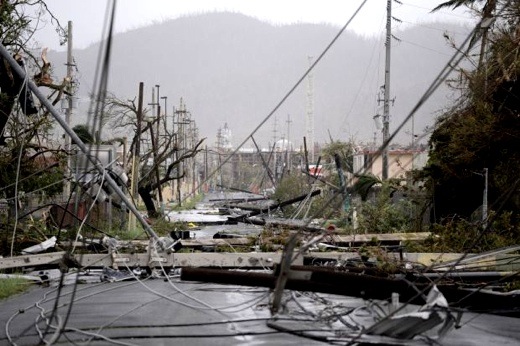
Image above: Electricity poles and lines lie toppled on the road after Hurricane Maria hit the eastern region of Puerto Rico. Photo: Carlos Giusti. From (https://www.wsj.com/articles/the-truth-about-hurricane-maria-1537129890).

Well before hurricane Maria devastated the island of Puerto Rico on 20 September 2017 the infrastructure of the power grid had deteriorated to the point of fragility not seen elsewhere in America.

That grid was the responsibility of The Puerto Rico Electric Power Authority (PREPA). PREPA is a government-owned corporation of Puerto Rico responsible for electricity generation, power distribution, and power transmission on the island. Hurricane Maria demonstrated that PREPA was a failure and that it would not have the vision or resources needed to serve Puerto Rico.

Without the resources to repair what had been a frail and failing system, Maria provided a death blow to PREPA. The Puerto Rican people tuned to gas operated electrical generators that had been purchased by people who could afford them for the frequent PREPA blackouts. After Maria things got nasty. Neighborhoods strung extension cords between homes in suburban neighborhoods. They got by with less.

There were some isolated small scaled solar photo-voltaic electric systems in place - and they became important. The Wall Street Journal reported (https://www.wired.com/story/puerto-rico-hurricane-maria-recovery/):
In the town rural town of Adjuntas, nestled in the mountains about an hour and a half southwest of San Juan, an NGO dedicated in part to solar power, called Casa Pueblo, became a pillar of the local recovery. 
When the town’s 18,000 residents were cut off from the rest of the island after Maria, the NGO’s solar-­powered radio helped authorities find out which roads were clear and which families were in danger, and attend to emergencies when the central government and federal authorities were not yet responding. 
Casa Pueblo subsequently gave out some 14,000 solar-powered lamps and also offered a solar-charged satellite phone at its offices for locals to use. At any given time, five to 10 people waited to make a call.

Arturo Massol, the associate director of Casa Pueblo and an ardent evangelist for decentralized, renewable energy, described what was happening on the island as “an energy insurrection.” Ordinary Puerto Ricans, he said, had woken up to the fact that when it came to electricity, they would have to look for alternatives.
This is part of a real solution. But that is not the direction that Puerto Rico is going. Instead the US government is planning on financing the privatization of PREPA through the creation of the “Puerto Rico Energy Transformation Administration (PRETA) that would provide guarantees (with US tax payer's money) for private energy corporations to rebuild the Puerto Rican grid. According to Debt Wire (https://www.debtwire.com/info/prepa-federalization-draft-bill-floating-congress)
Still in rough draft form, a bill tentatively titled the “Puerto Rico Energy Stabilization and Hurricane Resiliency Act of 2018” delineates specific steps to have the federal government—via the DOE—take over PREPA, impose a temporary administrator to supersede Puerto Rico’s Energy Commission ratemaking power, establish a corporation to issue restructuring bonds, and create special investment assurance accounts as part of the utility’s ongoing privatization process.
Here on Kauai the failure of privately owned Kauai Electric took a different but similar turn.

Those with long memories know what happened when the privately owned Kauai Electric called it quits. We paid off the "stake holders" a couple hundred million dollars of borrowed money to create a the debt ridden Kauai Island Utility Cooperative (KIUC). We now pay about the highest rates in the country.

Like Puerto Rico, Kauai is a stand alone grid on an isolated island. What energy it produces is all the energy it will have available. To its credit, KIUC has aggressively been adding solar voltaic power generation capacity. But it has not encouraged Solar PV stand alone systems.

Instead it encourages "co-generation"... the placement of PV systems on individual homes to supplement KIUC power generation. Co-gen certainly can reduce KIUC's high price for grid power, but it is, by my observation,  no real incentive to reduce power consumption.

Co-gen also means some resilience capability if the grid goes down because of a natural disaster, electro-magnetic pulse (EMP) or other disaster.

But KIUC suffers from the same vulnerability that Puerto Rico faced when Maria struck. All the power distribution is provided by poles and large hurricane can knock those poles down like a house of cards. That happened on Kauai with hurricane Iniki in 1992. But instead of burying the power distribution lines (as is done in most modern community planning) Kauai Electric simply re-erected the old creosote soaked wooden power poles.

Stand alone solar power systems have several advantages if they are not backed up by a electric grid or fossil fuel powered generator.
  • They absolutely limit the consumption of power to the amount of energy collected from the sun.
  • They require customer awareness of usage and some maintenance encouraging greater self reliance.
  • They reduce overall power consumption by high energy appliances like microwave ovens or air compressors.
  • They are resilient in that only the minority of systems that are hit directly by a disaster are damaged.
  • They wean us from living outside the limitations of energy not supplied by nature where you live.  
What we found was that having multiple independent stand alone PV systems is a real advantage. We stumbled into that situation by slowing adding systems over time. We started with a single panel and added increasingly bigger systems over almost a decade as we gained experience and knowledge.

All our systems use an array of one of two battery types. One type are high capacity 12volt 110amp-hour lead acid deep cycle batteries available on Kauai. The other type are 6v 405 amp-hour AGM (absorbant glass mat) batteries.

There are two AGM systems.

One is attached to our circuit breaker panel-box. This is where KIUC used to hook up. We had KIUC come and take off the meter and wiring to our house. This systems powers all the switches and outlets built into the house.

The second AGM system is attached to a power inverter providing energy for our new refrigerator and freezer. See (http://islandbreath.blogspot.com/2018/09/freezers-up-and-running.html).

The five other systems are smaller for specific tasks using smaller power inverters.
  • One provides counter lighting and strip outlets for our kitchen as well as our guest bathroom.
  • A second one provides lighting and a power strip to our master bedroom and its bathroom.
  • A third one provides lighting and a power strip  (for tool battery charging) in shop/utility room.
  • A fourth provides power for and office computer, wifi system and small appliance batteries.
  • A fifth provides power to a stand-alone shack that serves as a guest house. 
This overlapping redundancy has proved to be valuable. Any one system can go down and we can work around the problem by switching plugs in outlets and/or swapping around compatible batteries.

Redundancy is good. We had a neighbor who went with KIUC co-gen. After about a year the single co-gen system inverter failed and her solar panels were providing nothing to reduce her energy bill. The installer claimed it was out of warranty and not their problem. It took over year to get the system up and working agian.

Looking to the future my advice, as usual, is learn to and act to:
  • Grow your own food
  • Collect your own water
  • Produce your own energy
  • Make and repair what you can.
The alternative is sitting around a fire with pointy sticks.

Kauai 2018 Voting Recommendations

SUBHEAD: Island Breath's endorsements for Kauai Primary Election on 11 August 2018.

By Linda Pascatore on 26 July 2018 for Island Breath -
(http://islandbreath.blogspot.com/2016/07/our-primary-voting-recommendations.html)


http://www.islandbreath.org/2018Year/07/180727councilbig.jpg
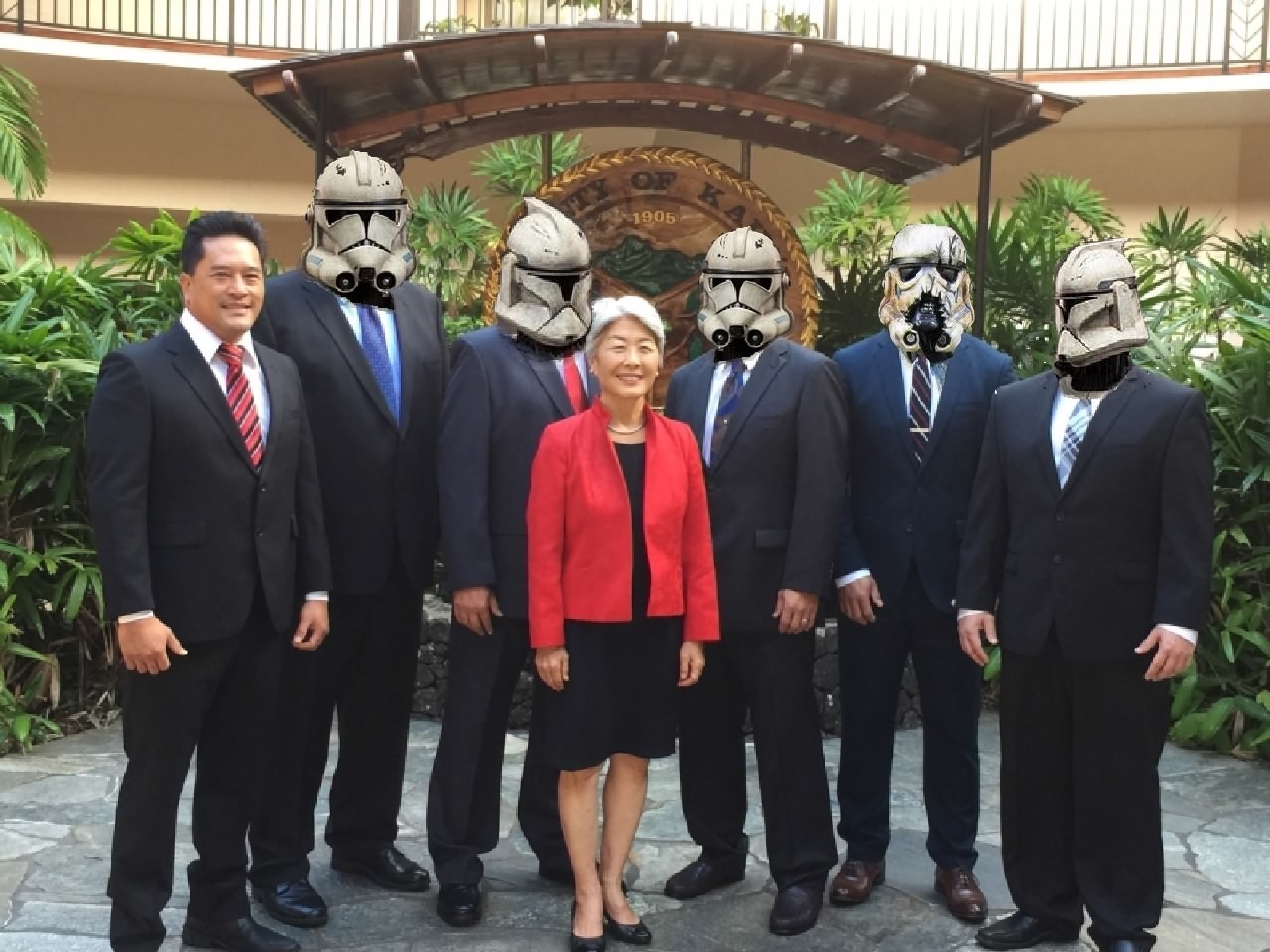
Image above: Kauai County Council members 2016-2018. L to R: Mason Chock, Arthur Brun, Mel Rapozo, Joann Yukimura, Ross Kagawa, Derek Kawakami and Arryl Kaneshiro. Mashup image by Juan Wilson. Click image to enlarge.

Register to Vote, Find your Polling Place, or View your Ballot here: https://elections.hawaii.gov/

Primary Voting Schedule
  • Early Walk In Voting for Primary: July 30 to Aug 9 at Historic County Building basement.
  • Last day to request Mail in Ballot: August 4
  • Primary Elections: August 11 - Polls open 7am to 6pm
Island Breath picks are based on general progressive, liberal positions, with an emphasis on sustainability, the environment, peace, equality, and Hawaiian Sovereignty.  We followed some of the  recommendations from the Sierra Club and Pono Hawaii Initiative.

Our recommended candidates are in italics with larger print.

We found information on candidates records and positions on the League of Women Voters (http://www.vote411.org/ballot), Votesmart (https://votesmart.org/), and also in articles profiling individual candidates in Civil Beat and The Garden Island.

On the primary ballot there are two sections: on one you choose a party and vote only for those candidates; the other section is non-partisan--everyone votes for the County Contests and the Office of Hawaiian Affairs.  We are choosing from the Democratic candidates on the party affiliated section.

Democratic Party


US Senator:

* Hirono, Mazie


US Representative, District II (Kauai)
* Gabbard, Tulsi


Governor:
* Ige, David Y.


Lieutenant Governor:
* Iwamoto, Kim Coco


District 14: 
Nadine Nakamura is running unopposed for the Democratic nomination.  We do not endorse her.


District 15: 
Elaine Daladig is running against incumbent James Tokioka for the Democratic nomination.  We do not endorse either candidate.


District 16:
* Morikawa, Daynette (Dee)


Non-Partisan

Everyone, no matter which party affiliation, can vote for Kauai Mayor and County Council and OHA (Office of Hawaiian affairs) trustees.


Office of Hawaiian Affairs (OHA): Oahu Resident Trustee

* Kia'aina, Esther


Office of Hawaiian Affairs (OHA): At-Large Trustee:
(vote for three)

* Aila, William J., Jr.

* Paikai, Landen D.K.K.

* Paris, Makana


Mayor:
* Yukimura, JoAnn A.


Kauai County Council: 
Special Note: Island Breath is recommending voting for no more than the three candidates noted below, even though you are allowed to vote for seven.  If you vote for seven, but really support just three candidates, your #4, 5, 6 and 7 votes could enable those other candidates to win over your top candidates.  Consider voting for fewer--a practice called "plunking".

* Chock, Mason

* Cowden, Felicia

* Roversi, Adam P.


See also:
Recommended by Gary Hooser; Executive Director of the Pono Hawaii Initiative
(https://ponohawaiiinitiative.org/endorsements)


.
.

Fuck RIMPAC 2018!

SUBHEAD: These exercises are a colossal waste of resources and energy that only demonstrate America's suicidal death spiral. 

By Juan Wilson on 29 June 2018 for Island Breath -
(http://islandbreath.blogspot.com/2018/06/fuck-rimpac-2018.html)


Image above: Naval participants on RIMPAC 2018 on parade for a photo op. From (https://news.usni.org/2018/06/26/rim-of-the-pacific-2018-participation).

For those that don't know RIMPAC is the U.S. Navy term for the "Rim of the Pacific. Evert two years the Navy puts together a nautical dog and pony show that they call RIMPAC "xxxx", where the "xxxx" is the even numbered year in which it takes place.

"Friendly" navy allies from nations proximate to the Pacific Ocean are invited to join the festivities on land, sea and in the air experimenting with new weapons systems, setting off explosives and coordinating he destruction of the planet Earth.

The US Navy likes to show its magnanimity by inviting "potential enemy" nations like China and Russia to join in as observers presumably to scare the crap out of them with the broad show of force. This also gives the nation the option of punishing an "enemy" observer nations with a dis-invitation if they do something we don't like.

This year China was dis-invited (https://www.militarytimes.com/news/your-military/2018/05/23/china-was-just-uninvited-from-rimpac-heres-why/) because it had the gall to continue to build up its presence in the South China Sea. Heaven forfend!

Well here we are again. This year is "RIMPAC 2018"... and it is going on now. Why "Fuck RIMPAC 2018!"? Because it is a costly public relations stunt that pollutes the ocean and kills uncounted numbers of sea creatures. Something we don't need any more of.

Through World War II to date the United States has dominated the Pacific Ocean through diabolic destruction with nuclear weapons and unfettered domination of island peoples. It is a disgusting display.

These RIMPAC war game are headquartered in Hawaii, with Pearl Harbor (on Oahu) and the Pacific Missile Range Facility (on Kauai) playing a major role.

If you don't think these "games" come at a cost to us living on Kauai you are dead wrong. Just go back to our post whale on pod stranding of a whale in Hanalei Bay in 2004 due to RIMPAC activities at the bottom of the list or articles below for a taste of the US Navy's games.

See also:
Ea O Ka Aina: Civil Beat views US military in Pacific 8/20/17
Ea O Ka Aina: "No!" to American Militarism 4/11/17
Ea O Ka Aina: DLNR responsibility on RIMPAC 7/6/16
Ea O Ka Aina: Participation in RIMPAC 2016 6/1/16
Ea O Ka Aina: Judgement against RIMPAC 2016 5/29/16
Ea O Ka Aina: Prepare for RIMPAC War in Hawaii 5/22/16
Ea O Ka Aina: Navy to "take" millions of mammals 5/1
Ea O Ka Aina: Judgement against RIMPAC 2016 4/3/16 
Ea O Ka Aina: Navy's "illegal" War Game 11/17/15
Ea O Ka Aina: US court RIMPAC Impact decision 4/3/15
Ea O Ka Aina: RIMPAC 2014 Impact Postmortem 10/22/14
Ea O Ka Aina: RIMPAC 2014 - another whale death 7/26/14
Ea O Ka Aina: RIMPAC 2014 in Full March 7/16/14
Ea O Ka Aina: 21st Century Energy Wars 7/10/14
Ea O Ka Aina: RIMPAC War on the Ocean 7/3/14
Ea O Ka Aina: Voila - World War Three 7/1/14
Ea O Ka Aina: The Pacific Pivot 6/28/14
Ea O Ka Aina: RIMPAC IMPACT 6/8/14
Ea O Ka Aina: RIMPAC Then and Now 5/16/14
Ea O Ka Aina: Earthday TPP Fukushima RIMPAC 4/22/14
Ea O Ka Aina: The Asian Pivot - An ugly dance 12/5/13
Ea O Ka Aina: Help save Mariana Islands 11/13/13
Ea O Ka Aina: End RimPac destruction of Pacific 11/1/13 
Ea O Ka Aina: Moana Nui Confereence 11/1/13
Ea O Ka Aina: Navy to conquer Marianas again  9/3/13
Ea O Ka Aina: Pagan Island beauty threatened 10/26/13
Ea O Ka Aina: Navy license to kill 10/27/12 
Ea O Ka Aina: Sleepwalking through destruction 7/16/12
Ea O Ka Aina: Okinawa breathes easier 4/27/12
Ea O Ka Aina: Navy Next-War-Itis 4/13/12
Ea O Ka Aina: America bullies Koreans 4/13/12
Ea O Ka Aina: Despoiling Jeju island coast begins 3/7/12
Ea O Ka Aina: Jeju Islanders protests Navy Base 2/29/12
Ea O Ka Aina: Hawaii - Start of American Empire 2/26/12
Ea O Ka Aina: Korean Island of Peace 2/26/12   
Ea O Ka Aina: Military schmoozes Guam & Hawaii 3/17/11
Ea O Ka Aina: In Search of Real Security - One 8/31/10
Ea O Ka Aina: Peace for the Blue Continent 8/10/10
Ea O Ka Aina: Shift in Pacific Power Balance 8/5/10
Ea O Ka Aina: RIMPAC to expand activities 8/3/10
Ea O Ka Aina: RIMPAC War Games here in July 6/20/10
Ea O Ka Aina: Pacific Resistance to U.S. Military 5/24/10
Ea O Ka Aina: Guam Land Grab 11/30/09
Ea O Ka Aina: Guam as a modern Bikini Atoll 12/25/09
Ea O Ka Aina: GUAM - Another Strategic Island 11/8/09
Ea O Ka Aina: Diego Garcia - Another stolen island 11/6/09
Ea O Ka Aina: DARPA & Super-Cavitation on Kauai 3/24/09
Island Breath: RIMPAC 2008 - Navy fired up in Hawaii 7/2/08
Island Breath: RIMPAC 2008 uses destructive sonar 4/22/08
Island Breath: Navy Plans for the Pacific 9/3/07
Island Breath: Judge restricts sonar off California 08/07/07
Island Breath: RIMPAC 2006 sonar compromise 7/9/06
Island Breath: RIMPAC 2006 - Impact on Ocean 5/23/06
Island Breath: RIMPAC 2004 - Whale strandings on Kauai 9/2/04
.

Kauai Puna Moku Update

SUBHEAD: Modification to Niumalu and Huleia ahupuaa boundary to provide better access to shoreline.

By Juan Wilson on 19 May 2018 for Island Breath -
(http://islandbreath.blogspot.com/2018/05/kauai-puna-moku-update.html)

http://www.islandbreath.org/hawaiinei/M7Kauai/M7KauaiRasterFile.png
Image above: Detail of change to Kauai moku of Puna Huleia ahupuaa boundary with Niumalu. Click for full map. From (http://www.islandbreath.org/hawaiinei/M7Kauai/M7KauaiRasterFile.png).

After a consultation with Jonathan Jay we have made a modification to the boundary between  Niumalu and Huleia ahupuaa in the moku of Puna on the island of Kauai.  We think a clearer and improved boundary line has been delineated.

In previous versions of the Puna plan the Huleia ahupuaa failed to reach the true coastline of Kauai, and thus was landlocked with only Huleia Stream passing out to the ocean between Niumalu and Kipu.

We have also recently added an additional layer of information to Kauai that includes many of the locations and names of significant mountain peaks. This is important to understanding moku and ahupuaa boundaries, especially from a ground's eye perspective.

We have not yet scheduled work on the mountain peaks of other islands. It would likely require weeks of work.

Hawaiinei Land Areas
Available updated downloads for Kauai:
GoogleEarth file .KMZ (15 MB) uploaded 5/19/18
24"x36"Plotfile .PDF (44 MB) uploaded 5/19/18
Hi RezRaster File .PNG (15 MB) uploaded 5/19/18
ArcView GIS files SHP .ZIP (319 KB) uploaded 5/19/18
AutoCAD files DXF .ZIP (2.7 MB)  uploaded  5/19/18  


 .

Climate Change "R" Us

SUBHEAD: Climate Change ignores all borders as rain bombs fall on Kauai and the Middle East alike.

By Robert Scribbler on 2 May 2018 for RobertScribbler.com-
(https://robertscribbler.com/2018/05/02/climate-change-ignores-all-borders-as-rain-bombs-fall-on-kauai-and-the-middle-east-alike/)


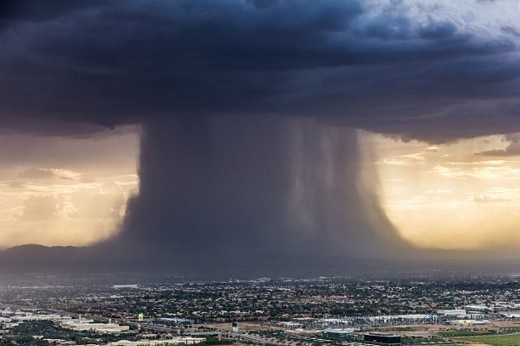
Image above: Photo of an extreme heavy rainfall event over Phoenix, AZ during 2016. Photo by (Bruce Haffner. From original artilce.

The weaponization of weather language has long been a topic of some controversy in the meteorological press. Peace-loving people the world over rightly try to communicate in a manner that discourages violent conflict. And the term ‘rain bomb’ has taken quite a lot of flak from those with thus-stated good intentions.

However, whether or not the language itself bristles with perceived warlike phrases, the weather itself is steadily being weaponized against everyone and everything living on the face of planet Earth by the greenhouse gasses fossil fuel related industries and technologies continue pumping into the air.

Rainfall Records Shattered in the World’s Wettest Place
For the Kauai event, the Washington Post reports that 49.69 inches of rain accumulated at the Waipa rain gauge on Kauai in just one 24-hour period.

Though Kauai is the rainiest place on Earth — receiving some 400 inches per year — this single day rainfall was far in excess of even that soggy norm. In total, it amounted to about one and a half months of precipitation for the world’s wettest location falling in just one day.

The previous all-time record for single day rainfall in the U.S. occurred in 1979 in Alvin, Texas during Tropical Storm Claudette. This storm dumped 43 inches over a 24-hour period. The recent Kauai event shattered this record. And it involved no tropical cyclone — just historically high moisture levels over the Pacific colliding with unstable air masses streaming down from the north.

In this case, warming ocean surfaces are generating higher levels of evaporation which in turn are feeding extreme thunderstorms all across the Pacific and over adjacent land masses.
“The flooding on Kauai is consistent with an extreme rainfall that comes with a warmer atmosphere. Just recognize that we’re moving into a new climate, and our communities are scaled and built for a climate that no longer exists.
The present record Kauai event has been classified as a 1 in 100 year instance in the context of past climatology. But given present conditions and ever-increasing Earth surface temperatures, this new record may fall within a decade or less as the atmosphere continues to load more moisture and as evaporation and extreme precipitation events steadily increase. 


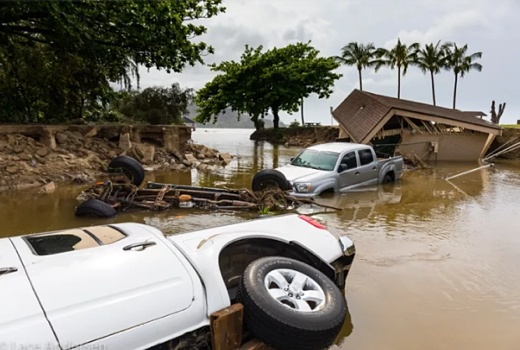
Image above: Pickup trucks washed into the wreckage at the mouth of the Hanalei River on the north shore of Kauai. Photo by Lace Andersonin Hawaii News Now.

Middle East Hammered by Extremes of Drought and Storm
Half a world away, the Middle East is seeing its own series of weather and climate shocks. The nations of Egypt, Jordan, Yemen, Lebanon, Syria, and Saudi Arabia have been experiencing widespread and long term drought.

[IB Publisher's note: A Pakistani City Hit 122.4 Degrees In April, Probably Setting A World Record. See (https://www.huffingtonpost.com/entry/pakistan-april-heat-temp-world-record_us_5aec96e5e4b041fd2d267113)]

This drought has, as with the recent Central U.S. event, in large part been driven by rising temperatures. Evaporation plays its role here too as lands dry out more swiftly when temperatures rise.

However, with climate change, you can never discount the hard swing back to heavy rain despite prolonged drying as weather chaos ensues. Such was the situation during the recent week as an intense weather disturbance crossed the Mediterranean and entered the Middle East on April 26th and 27th.

The colder air mass tapped high levels of moisture bleeding off the, again, much warmer than normal sea surfaces in the Med. It then dumped this moisture in the form of extreme precipitation over the Middle East.

In Israel, the resulting flash floods swept away ten teenagers as street flooding that was described as ‘epic’ ran through the country’s cities. Waters over-topped sidewalks and rushed into homes and businesses as the heavens unleashed.

One to two inch per hour rainfall rates were reported. Meanwhile, in Syria, heavy hail pelted down.

Jordan and Egypt were also inundated — with many streets described as impassable due to flood waters. The leading edge of cooler air kicked up a massive haboob — which spread its immense cloud of dust over Saudi Arabia and Kuwait. Over recent days, the stormy pattern continued. Heavy rains overtook parts of Yemen — forcing a dam to burst and washing away dozens of homes and farms. 

Two More in a Lengthening Tally
These two events are just the most recent affairs in a much larger and far more widespread pattern of ramping extreme global weather events. Events that will continue to proliferate so long as the world continues to warm. This is the state of affairs that continued fossil fuel burning has brought about.

The rain bombs are hanging, enlarging, above us. They are waiting to fall. And the politically-charged denials of their chief manufacturers — oil, gas, and coal — only make the situation worse for us all.

See also:
Ea O Ka AIna: Kauai Northshore Update 5/1/18
.

Kauai Northshore update

SUBHEAD: There is pressure on all local news sources to say nothing negative about impact on tourism.

By Neal Chantara on 1 May 2018 in Island Breath-
(http://islandbreath.blogspot.com/2018/05/kauai-norhshore-update.html)


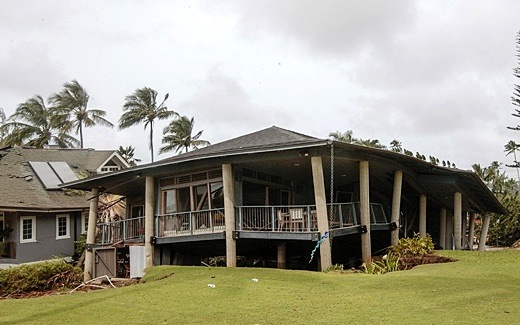
Image above: An upscale north shore raised residential structure "totaled" after being knocked off its foundation from flood waters eroding the earth around the column footings. Note half the yard looks like a putting green and half is a washed out gully. Photo by Jamm Aquino. From (http://www.staradvertiser.com/2018/04/16/photo-galleries/photos-aftermath-kauai-flooding/).

We are high and dry, but many did get wet. Mold and the high levels of contaminate in the flood waters (the water is actually "black water" from sewage, gas and oil from vehicles, etc) are making homes unlivable.

 Some people aren't aware of the danger and are simply throwing out furniture and planning to move back in.

I've been a designer and builder of healthy homes. I know better and have been researching what to do for wood that has been contaminated by these types of flood waters.

But what is so heartening is, the outpouring of support on this island. Differences have been put aside. So many volunteers. The federal and state agencies won't deal in any food other than non-perishables.

The locals with boats coordinated with locals with farms or money to buy apples, etc and a supply line of fresh food is going out to the island past Hanalei.

I spoke at length with a friend living way out there yesterday. People are picking up their trash at the road edge. Each house was delivered 5 gallons of gas. There's a free thrift store for clothes.

I was told the Hanalei Court House has more boots available than a big box store. The Hanalei Colony Resort, beyond the landslides, has been offering free breakfasts and dinners.

My friend said people are saying they are eating better now than before the flood.

Now one lane is open to emergency vehicles only. She said people out there can sign up the night before and a shuttle that leaves at 6am goes out. It will return at 6pm.

We continue to do our 2 mile walks at a couple beaches around here. They still stink. The beaches of the north shore are too contaminated to be in. However a friend said he heard the mayor on the local radio say he had a letter from the Dept of Health giving the OK to swim again!

The tourist bureau is under so much pressure. Business has really fallen off. Our daughter is a fashion designer supplying clothing to Chanterelle Couture, with four island stores and a couple on Oahu

One of Chanterelle's store owners told her that the entire week was 60% less business than normal.
Her two stores are on the other side of the island from the storm damage.

 A friend of ours, who is managing forty-two vacation rentals, had a call from a mainland person who had a booking in a place unaffected by the flood for next October - they wanted to cancel.

There is pressure on every news source in all of Hawaii not to say anything negative as so many mainland people do not differentiate between islands or part of islands and Hawaii.

They seem to think of Hawaii as one small state rather than small islands widely separated.

Many organizations have organized to help. I went by one Hanalei church with a sign out front "Free Water, Clothing, Food". There is a group of volunteers fixing homes for free.

So that's a quick update of the island news, but the real place to focus is on the Aloha.

See also:
Ea O Ka Aina: Storm damage on Kauai 4/24/18

.

Storm damage on Kauai

SUBHEAD: Rain storms have done more damage this spring to our north shore than in more than a generation.

By Juan Wilson on 24 April 2018 for Island Breath -
(http://islandbreath.blogspot.com/2018/04/rain-damage-on-kauai.html)

http://www.islandbreath.org/2018Year/04/180424kauailarge.jpg
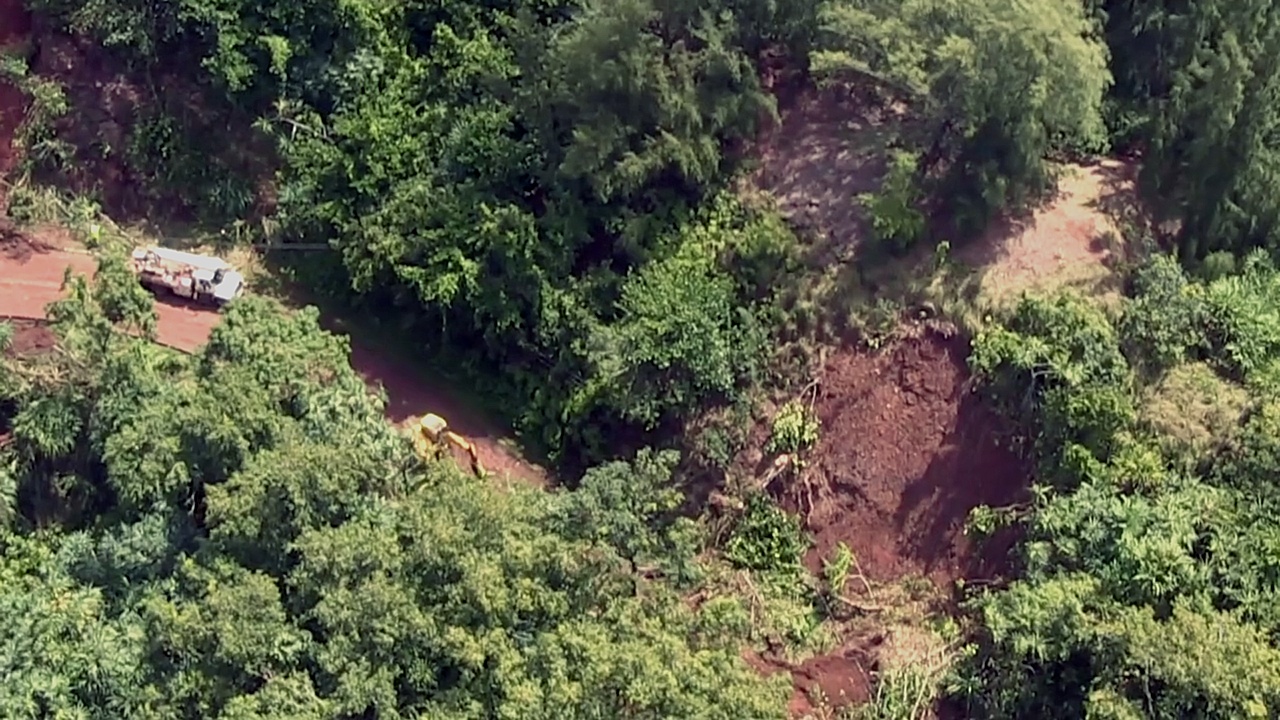
Image above: Only public road along the north shore of Kauai in Waikoko is obliterated by landslide west of Hanalei Bay.  Click to enlarge. Still image from video below.

Living in Kauai on the south side of Kauai we have missed he destruction of storms that destroyed much of the communities and infrastructure on our north shore. The impact has been tremendous for residence there; homes destroyed and roads wiped away.

As much suffering as this has caused and the long term difficulties that will linger, there is a thin silver lining in the darkened clouds.
 
The army of tourists in rented cars making the obligatory daily pilgrimage to Kee Beach crowding the roads, overflowing the parking lots and trampling the land has been temporarily halted.

When the roads are repaired and northshore tourism resumes we hope it is under new circumstances that would restrict tourist cars from anywhere west of Hanalei Bay. There was a feeble attempt to due this in the recent pass, but the will to disappoint tourists simply collapsed.

Here on the south shore we have noticed traffic through Hanapepe has increased significantly since last spring. Some of this is due to more rush hour traffic, presumably from the GMO companies and the PMRF (Pacific Missile Range Facility). We have a regular weekday 3pm eastbound rush hour never seen before.

Moreover, our local county beach, Salt Pond Beach Park, has been overrun by tourists since for over six months. This is certainly been in part because of the destruction of subtropical vacation destinations in the Caribbean.

In the last hurricane season there were 5 category-five storms that destroyed beaches, resorts, roads and much of amenities that attracted visitors. Puerto Rico is still suffering from island-wide blacked-outs. And here comes another hurricane season.

There seems to have been a bit of a campaign to make Salt Pond a heavier used visitor destination as well. Salt Pond is now rated online as a top beach for tourists. This take may take some pressure of totally overrun Poipu Beach Park and other crowded locations, but it is has unanticipated effects.

Salt Pond has historically been a "local" beach used as an outdoor living/rec room for many local families from the westside. Birthdays, weddings, graduation parties, spear-fishing surf-casting, BBQs and minding the kids and just kicking back with a beer after work has been the usage.

There is also and tradition of people temporarily living in tents (mixed with tourist camping) that helps transition (some people I've known) through a job loss, breakup or other temporary difficulty.

Anyway, I continue to hope jet plane enabled mass tourism to Hawaii ceases for two primary reasons. Is is destroying Kauai and it is destroying the atmosphere.

I have not flown to the mainland in several years and have no plans to start again.


Video above: Hawaii Department of Land & Natural Resources damage assessment of storm damage on several videos of the North Shore of Kauai. For more videos visit Vimeo site (https://vimeo.com/265509802).

.

CRISPR and Genedrive danger

SOURCE: Jerry DiPietro (ofstone@aol.com)
SUBHEAD: Letting genedrives loose outside labs is too risky, says scientist who promoted idea.

By Paul Koberstein on 22 Devember 2017 for Earth Island Journal -
(http://www.earthisland.org/journal/index.php/elist/eListRead/letting_gene_drives_loose_outside_labs_is_too_risky_says_scientist_who_prom/)


Image above: Illusration of mosquito and genexrive. From (http://www.earthisland.org/journal/index.php/eij/article/editing_evolution/).

[IB Publisher's note: As more people are avoiding GMO produced food you can bet that "players" in the GMO/Pesticide development in Hawaii are salivating to get out of that business and into open field testing of gene drive technology. And if GMO companies' indifference to the health and welfare of the people living on these islands is an indicator we are all endangered. See accompanying article "Editing Evolution" by Paul Koberstein further explaining genedrive technology.]

A large cache of emails released this month show that the Bill and Melinda Gates Foundation is stepping up its efforts to promote the deployment of a controversial new genetic engineering tool known as “gene drive” to help eradicate malaria in Africa.

Malaria killed an estimated 438,000 worldwide in 2015. Sub-Saharan Africa continues to carry a disproportionately high share of the global malaria burden. 

However, some of the scientists who had initially proposed using the technology for public health and conservation purposes are having serious second thoughts about deploying it outside of labs.

In a effort to combat the disease, researchers funded by the Bill and Melinda Gates Foundation are planning a field trial of gene drive equipped Anopheles gambiae mosquitoes – the main malaria vector in Africa – in Burkina Faso.

Gene drives can help circumvent traditional rules of genetic inheritance and force a desired, specifically selected, genetic trait through a population.

Given the almost magical possibilities it offers to enhance beneficial traits or remove undesired characteristics in living things – think eradicating pests without using toxins, or saving an endangered species by making them immune to certain diseases – the technology has captured the imagination of many in the fields of conservation and public health.

The Bill and Melinda Gates Foundation, which considers gene drives “necessary” to end malaria, has invested some $70 million on Target Malaria, a research organization based at Imperial College in London that is working on preventing deaths from malaria, which numbered 438,000 worldwide in 2015.

Target Malaria is planning to release genetically modified Anopheles gambiae mosquitoes – the main malaria vector in Africa – in Burkina Faso.

These modified mosquitoes would be equipped with gene drives that would disrupt the reproductive systems of successive generations and eventually cause them to go extinct. The project would be the first field trial of gene drive technology.

The release of 1,200 emails by the Genetic Biocontrol of Invasive Rodents (GBiRD) program at North Carolina State University, provide fresh insights into the work of groups like the Gates Foundation and GBiRD that are promoting the use of gene drive biotechnology.

(GBiRD is a partnership of seven university, government and non-government organizations advancing gene drive research.)

The emails – which were released in response to freedom of information requests submitted by Edward Hammond, a biosafety activist from Austin, Texas –also show that the environmental advocacy group Island Conservation is developing plans to use gene drives as a mechanism for exterminating invasive species on the islands of Hawaii, New Zealand, and Australia.

Hammond made the emails public just two weeks after one of the key proponents of the gene drive technology, Kevin Esvelt, published a report saying the technology was too risky to be used in field trials to control invasive species.

Esvelt, a professor at MIT who first identified the potential for gene drives to alter wild populations of organisms in 2013, is now warning, once unleashed, gene drives will prove difficult if not impossible to control.

Esvelt said that projects that are planning to conduct gene drive experiments to control invasive species in the wild should first invent safer forms of the technology.

In theory, the release of these genetically altered mosquitoes or invasive pests like rats, would cause all the members of a targeted population of mosquitoes or rats to go sterile, eventually exterminating that and only that population.

But new research by Esvelt and his colleagues at MIT and Harvard University suggests that gene drive deployments are more than likely to go haywire, with potentially disastrous consequences for non-targeted animal populations and ecosystems. (*Check update/clarification on this below.)

In a paper published in the non-peer reviewed scientific journal BioRxiv, Esvelt and his colleagues wrote that, once unleashed, gene drives will prove difficult if not impossible to control.

The paper, “Current CRISPR gene drive systems are likely to be highly invasive in wild populations,” is currently in pre-publication review. CRISPR refers to Clustered Regularly Interspaced Short Palindromic Repeats, a new technology that allows scientists to alter genes by editing strands of DNA.

CRISPR’s invention in 2012 by scientists at the University of California-Berkeley and MIT led to the development of gene drives two years later in Esvelt’s research laboratory.

In the BioRxiv paper, the scientists said that mathematical models based on existing empirical data show that in their current form, gene drives cannot be deployed without harmful side effects. Their modeling showed that gene drives can be very aggressive and even a handful of gene drive modified organisms could carry the new gene, not only through much of the targeted population of a certain species, but also on to non-intended populations.

For example, under their models, a gene drive released in Hawai’i to kill a specific kind of mosquito on the island of Kauai would eventually start targeting a different kind of mosquito on the island.

“Releasing a small number of organisms often causes invasion of the local population, followed by invasion of additional populations connected by very low gene flow rates,” they wrote. “Highly effective drive systems are predicted to be even more invasive.”

On the same day his BioRxiv paper was released, Esvelt expressed regret for ever proposing gene drives be used in real word experiments.

In an interview with the New York Times, Esvelt called his championing the notion “an embarrassing mistake” given the predicted invasiveness of current CRISPER-based drive systems.

But he and his colleagues still thinks researchers should continue exploring ways in which gene drives could help save species that are in peril.

The new report confirms concerns that many within the scientific and environmental community have had about the unknown ecological and public health risks posed by a technology whose basic purpose is to spread genetic mutations.

Nevertheless, the GBiRD emails show that that the Gates Foundation is ploughing ahead with its research on gene drives as a mechanism for eradicating the mosquito that causes malaria (which, it should be noted again, is not an effort to control an invasive species, but rather an effort to eradicate a disease-carrying insect).

In 2016, it made a $1.6 million payment to Emerging Ag, a PR firm it retained for the purpose of influencing a United Nations expert group that has been addressing gene drive issues. The group, the Ad Hoc Technical Expert Group on Synthetic Biology (AHTEG), was convened by the UN’s Convention on Biological Diversity.

Hammond, who posted the emails to his website, is a former member of AHTEG.

In one of the emails, the Gates Foundation said it hired EmergingAg to “increase awareness, understanding, and acceptance of possible gene drive applications for public good purposes.”

One of EmergingAg’s initiatives has been to recruit scientists who will advocate for gene drives. For example, in an Aug. 1, 2017 email thread, Isabelle Coche, a vice president of EmergingAg, is trying to recruit Fred Gould, codirector of the Genetic Engineering and Society Center at North Carolina State, for advocacy work.

The email asks Gould to "support advocacy and engagement activities on gene drive.” Gould, however, demurs, saying, “it would be problematic for me to be involved,” adding that such advocacy would “compromise” his role on a gene drive ethics committee.

Coche’s role at EmergingAg, according to another email, is “to fight back against gene drive moratorium proponents before the next CBD meeting in 2018.”

This was in reference to calls from several anti-gene drive groups for an international moratorium on gene drive research in petitions last year before the United Nations Convention on Biological Diversity (CBD). The CBD rejected those petitions, which are likely to be repeated at next year’s CBD meeting.

On its website, Emerging Ag calls itself “a boutique international consulting firm providing communications and public affairs services.”

Its president and founder is Robynne Anderson, a former international communications director of CropLife, the global lobby group for the biotechnology, seed, and pesticide industries based in Brussels, Belgium.

On her personal website, Anderson praises gene drives without actually mentioning the biotechnology by name.

“The Target Malaria team is researching approaches that can reduce the numbers of mosquitoes that spread malaria,” she writes. 
“By reducing the population of the malaria mosquito, (a very specific beast called Anopheles), they are able to combat transmission of the disease. Their strategy relies on reducing the number of female malaria mosquitoes.”
She said this approach “is expected to be complementary to other mosquito control methods, easy and inexpensive to implement, because the mosquitoes themselves do the work of stopping malaria. The control method would be a long-term, sustainable, and cost-effective solution to prevent malaria.”

Austin Burt, professor of evolutionary genetics at Imperial College London and principle investigator for the Target Malaria consortium, said in an email that “a blanket assertion that ‘gene drive field trials pose unacceptable risks for ecosystems’ is not consistent with how I understand [Esvelt’s] position – risks must always be assessed on a case-by-case basis, as they will depend on the exact features of the construct and the species / population into which it is to be released.

Rather, I believe he is calling for inclusive, informed discussion of the risks, which I certainly agree with.”

Burt said Esvelt’s paper “just shows that a particular type of gene drive construct may be expected to spread from one population to another when there is naturally-occurring gene flow, which indeed is correct.”

As for the Target Malaria initiative, he said that although “we are one of the leading groups working on developing this sort of technology, we are still many years (>5) from having something that we might propose to release in the field, and indeed we are still working on the path to get to that point.” Safety, he said, “is paramount, for humans and the environment.

Malaria imposes an appalling burden across too much of sub-Saharan Africa, and we want to be in a position to offer something that people and governments will want to use to help reduce this burden.”

He emphasized that when Target Malaria develops a gene drive it “will go through extensive safety testing before we would consider releases.”

Island Conservation, meanwhile, sees gene drives as a tool that can rid islands of invasive pests without the use of chemical pesticides.

The group says that 180,000 islands around the world are infested with alien rodents, but only 400 rodent eradication programs to date have been successful, and each relied on rodenticides to remove the non-native populations.

Heath Packard, a spokesman for the group, told Earth Island Journal that the group “is investigating the feasibility and suitability of a potential gene drive mouse construct that could safely and effectively remove invasive species from islands. The question is not only could we, but should we and under what conditions.

Local communities and their governments will need to decide on a case by case basis.”

But he said that Island Conservation “would never contemplate even asking a community to consider a highly-contained field trial unless work in the genetic laboratories demonstrated that the mouse construct could not, itself pose unmitigated harm to well-established parts of our ecosystem.”

“This work must be done, cautiously, thoroughly, and stepwise,” he said. “That’s exactly what our partnership is doing.”

*UPDATE, December 22: To be clear, this risk is not of gene drives spreading to other species. The risk is that they could spread to other populations, or rather, sub-species of the same species — for example to any of the other 205 mosquito species in the Anopheles subgenus — and as a result impact local ecosystems where they might serve key roles, such as, as a food source for other critters. This report isn't implying that gene drives can jump the species barrier spread to other species.

.

Update on Wailua Diversion

SUBHEAD: Meeting Thursday 12/14 from 11:00am-1:00pm at the Kapaa Neighborhood Center.

By Bridget Hammerquist on 12 December 2017 in Island Breath -
(http://islandbreath.blogspot.com/2017/12/update-on-wailua-diversions.html)


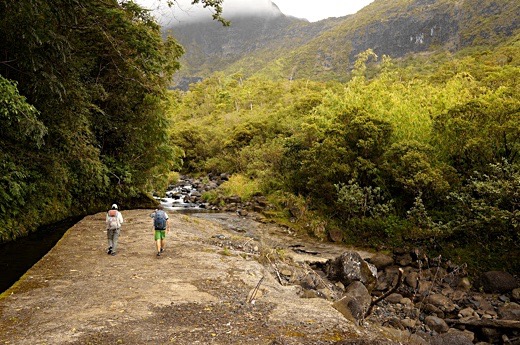
Image above: Two hikers at the Blue Hole walk across the concrete diversion (at left) of the North Fork of the Wailua Rivere diversion lets only overflow water into the natural channel of the river (at right). From (https://yosemitenews.info/forum/read.php?1,64439,64449).

[IB Publisher's note: The day with article was first published KIUC announced they were changing policy on the North Fork diversion of the Wailua River. See content of email we received.]


KIUC Board's Action on to Wailua River Diversions
Līhu'e, Kaua'i, HI - 12/12/17 - The Kauaʻi Island Utility Cooperative Board today authorized KIUC President and Chief Executive Officer David Bissell to make changes to the ditch system to return water to the North Fork of the Wailuā River at the Blue Hole and Waikoko diversions.
This action will ensure that water is flowing immediately downstream of the diversions.
The board also authorized the commencement of engineering design for permanent diversion modifications to ensure continuous stream flow for aquatic habitat. Construction will take place upon approval from the appropriate regulatory agencies.
Additionally, approval was granted to install additional gauging stations to increase data collection and understanding of the hydrology of the system.
"The hydros have been producing energy on Kauaʻi for more than 100 years and represent an important piece of KIUC's renewable portfolio and will help us reach the State's mandate of 100 percent renewables by 2045," said KIUC Board Chair Allan Smith.
On December 8, the State Board of Land and Natural Resources met and approved the holdover of a revocable permit for water use at the Blue Hole Diversion, which contribute 1.5 megawatts of energy to the island's renewable portfolio.


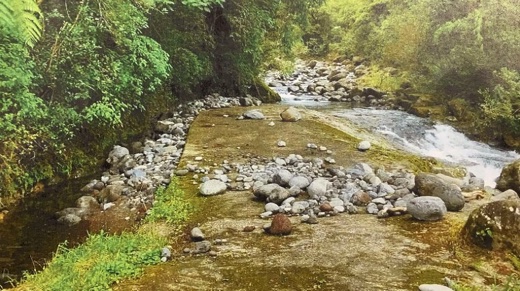
Image above: Boulders are scattered across the diversion at the head of the North Fork of the Wailua River due to heavy winter rains. Note the diversion channel is all but blocked (at left) and the natural flow of the water is in the original river bed (at right). From (https://www.bizjournals.com/pacific/news/2017/12/11/kiuc-receives-approval-for-holdover-of-hydro.html).


IB Publisher's note: On Friday 7 December 2017 the Hawaii State Board of Land & Natural Resources (BLNR) met on Kauai to consider the  renewal of a revocable water-diversion permit for Kauai Island Utility Cooperative’s (KIUC) hydroelectric plants that utilize water from Mt. Waialeale.

The water diversions have been criticized as illegal.  The Kiai Wai O Waialeale coalition, along with community groups Friends of Mahaulepu, HAPA and the Sierra Club, said KIUC and Grove Farm are illegally using 30 million gallons or more of water per day for the hydroelectric plants, and on days when there’s no rain, the streams are dry.

The BLNR approved the KIUC request.

Their will be a debriefing of the BLNR meeting Thursday 12/14 from 11:00am-1:00pm at the Kapaa Neighborhood Center.

WHAT:
Debriefing on BLNR decision in favor of KIUC and Gloves Farms to continue diverting Wailua River forks.

WHEN:
Thursday December 14th from 11:00am to 1:00pm

WHERE:
Kapaa Neighborhood Center
4491 Kou Street Kapaa, HI 96746

Summary of BLNR Meeting
Friday was an exciting day and I have to say that we did shine a bright light on a big issue that has received little public coverage. For those who may not have seen the news coverage of the Board meeting, here are a couple links to TV and newspaper coverage.

http://www.thegardenisland.com/2017/12/09/hawaii-news/kiuc-wins-water-fight/

http://www.hawaiinewsnow.com/story/37029649/land-board-approves-permit-to-continue-diverting-waialeale-waters-for-hydropower

For those who want to listen to the meeting Friday, here is a link to download the audio recording of Friday's BLNR meeting:

https://files.acrobat.com/a/preview/15e8a4fc-0d4b-4223-8c90-a96c83b92c04

My big take away/summary is:
  1. The Board was arbitrary when it denied the request for a contested case hearing.
  2. The denial gives us the right to go directly to the State Environmental Court.
Based on the facts and illuminating power points presented, Kiai Wai O Waialeale may be well positioned now to file a State Court lawsuit against KIUC on the merits of BLNR's renewal of the Waikoko and Blue Hole/North Fork Wailua diversion permits while simultaneously suing Grove Farm for its 4 100% base flow stream diversions (Iliiliula, Iole, Waiaka and Waiahi) in violation of the following water use law.

The testimony offered by KIUC established that Grove Farm is also taking 100% of the base flow from four streams fed by Mt Waialeale which waters are mixed into the waters from Waikoko and Blue Hole, diversions on State land.

Grove Farm has no permits to divert those streams and should have permits because the water is no longer used to grow sugar and pursuant to Hawaii State Supreme Court decisions, when the purpose for the diversion ends, the diversions have to be taken down and stream flow restored as mandated by Hawaii's Constitution.

Most importantly, DLNR staff and KIUC admitted the water use at issue is consumptive, because the waters diverted are never returned to their stream of origin. If you read the statute below, it doesn't appear that BLNR has any authority to approve, permit or lease State waters when the use is consumptive.

§171-58 Minerals and water rights.
(a) Except as provided in this section the right to any mineral or surface or ground water shall not be included in any lease, agreement, or sale, this right being reserved to the State; provided that the board may make provisions in the lease, agreement, or sale, for the payment of just compensation to the surface owner for improvements taken as a condition precedent to the exercise by the State of any reserved rights to enter, sever, and remove minerals or to capture, divert, or impound water.(c)(3)

After a certain land or water use has been authorized by the board subsequent to public hearings and conservation district use application and environmental impact statement approvals, water used in nonpolluting ways, for non-consumptive purposes because it is returned to the same stream or other body of water from which it was drawn, and essentially not affecting the volume and quality of water or biota in the stream or other body of water, may also be leased by the board with the prior approval of the governor and the prior authorization of the legislature by concurrent resolution.

When you read the statute, Grove Farm's diversions are illegal. Grove Farm is directing water through KIUC's hydro plants and in return, KIUC releases that water back to Grove Farm and also adds the water from its State land diversions.

Not only did we have 3 solid votes against RP renewal, with each no vote the voting board member spoke directly to KIUC's CEO, David Bissel, and told KIUC to:
  1. Complete their environmental studies (171.58 call for an EIS... did not understand why attorney's like Chris Yuen were speaking in terms of an EA when the statutory requirement is clear that any authorized use of State water can be permitted only "subsequent to" the acceptance of an EIS),
  2. Restore uninterpreted stream flow as soon as possible and
  3.  Meet with DHHL staff asap to achieve water distribution for its beneficiaries. One of the yes votes, from Chris Yuen, also made it sound like he wouldn't support them if they were not substantially along in the process by this time next year.

The other aspect that I didn't understand was why Suzanne Case did not recuse herself once it was clear that water from four Grove Farm stream diversions (IliIliula, Iole, Waiaka and Waiahi) mixes with the KIUC diversions and all runs through KIUC's power plant before being delivered to Grove Farm's infrastructure: the upper Lihue ditch (which is piped), the lower Lihue ditch and the Wailua South Fork that is 100% diverted by Grove Farm into the Hanamauulu ditch. 

Those four diversions were not part of the RP but the water from them is being used by the permittee and in return the permittee supports distribution back to Grove Farm. If you read 171.58, I can't find anything that exempts Grove Farm from a permit for their use of waters of the State. It is not right that Grove Farm directs this water to their surface water treatment plant before selling it to the County.

They claim they're charging for the delivery of water which is certainly splitting hairs because their charge is a fixed annual fee for 3 mgd.BLNR's arbitrary and capricious denial of the request for a contested case hearing, is a huge gift because we may now advance an Environmental State Court claim, having had our administrative remedy curtailed and having been deprived of due process. So rather than having the cost of an administrative hearing, I think we get to go right to State Court.

Note: Bridget Hammerquist is President of Friends of Maha’ulepu
P.O. Box: 1654
Koloa, HI 96756
friendsofmahaulepu.org
(808)742-1037

See also:
Ea O Ka Aina: Waialeale Water Lease 7/18/17
Ea O Ka Aina: Kauai's Hydro Battle 7/31/11
Ea O Ka Aina: Notice of Objection 6/3/11
Ea O Ka Aina: Special KIUC/FERC Meeting 5/28/11
Island Breath: Kauai Water Diversion - as a way of life 4/9/04

.