Showing posts with label Credit. Show all posts

When the Deal Goes Down

SUBHEAD: Stresses and tensions are a’buildin’ and the time for being a nation of feckless idiots is drawing to a close.

By James Kunstler on 30 June 2017 for Kunstler.com -
(http://kunstler.com/clusterfuck-nation/when-the-deal-goes-down/)


Image above: Oil painting "Feeding the Baby" by Mark Bryan, 2017 subtitled "Baby Trump loves Bannon’s Total...itarian Bullshit. He wants you to have some too." From (https://www.artofmarkbryan.com/feeding-the-baby-trump-bannon-art/).

Who needs Russia when the Tweety-Bird-in-Chief is hacking his own presidency into a global joke? Or at least it might be a joke if the USA weren’t such a menace to international order, and to itself, by the way. Interestingly, the 25th amendment allows for the removal of a president from office on account of incompetence or disability, but not for being an embarrassment to the nation.

They may come after him anyway with the 25th, especially as the financial system unravels later this year, because this time, unlike 2008-9, central bank interventions will not avail to rescue the faltering money system from nine years of previous central bank interventions.

All it takes is for the “liquidity” flows to seize up and before you know it, there’s no food in the supermarkets because everything in our just-in-time economy is exquisitely calibrated to the sure expectation of getting paid, and when that goes, it all goes.

Then the question arises: well, can’t you just re-start the liquidity flows? Not when the process requires another abracadabra magic act of summoning X-trillions of dollars out of absolutely nothing when the previous X-trillions created out of absolutely nothing are rushing at warp speed into the black hole of deleveraging because it has been discovered that the “loans” they were based on can never be paid back, not in this universe or any number of universes like it. In a word, they’re worthless.

Deleveraging is the polite term economists give to your net worth rapidly evaporating. Liquidity is the polite term for cash money and things denominated in them that can readily be converted into cash money. The problem with the kind of liquidity-creation solution to deleveraging is that it rapidly leads to money itself becoming worthless.

The preview of coming attractions is currently playing out in Illinois — soon to be joined by Connecticut, California, Kentucky, and many other bankrupt states. Illinois is dead broke. It can’t pay the contractors who fix things like roads and storm drains, and supply food to its prisons.

It’s over $200-billion deep in pension obligations that will never be honored. Its Medicaid system is a shambles. It doesn’t even have the cash-on-hand to pay lottery winners (what happened to all the cash paid into the lottery by the suckers who didn’t win, which is supposed to pay off the winners?). The state legislature hasn’t passed a budget in three years.

The governor and the mayor of Chicago and everybody else nominally in charge have no idea what they’re going to do about it. Think the federal government is going to just step in and save the day there?

They’d have to bail out every other foundering state and that’s just not going to happen, especially with that same federal government about to run out of cash money itself, with no resolution of the debt ceiling controversy that might allow it to even pretend to borrow more money by issuing treasury bonds that are instantly bought by the Federal Reserve — which, of course, is not an official government agency but a private banking consortium contracted to manage the nation’s money.

Do you begin to see the outlines of the clusterfuck rising like a bad moon over the harvest season of 2017? The American people, by and large, have no more idea how false and fragile the financial arrangements of the nation are than the average eight-year-old has about why the re-po squad is towing away Daddy’s Ford-F150.

We’re just doing what we always do: gittin’ our summer on. Breaking out the potato salad and the Bud Lites — at least those who have enough mojo left in their MasterCards to charge the party supplies.

An awful lot of Americans must be maxed out, though, people who actually used to work at things and get paid for it.

Each one of them is a walking Illinois now, facing each dawning day with a bigger load of problems, more things they can’t pay for, and moving closer to the dreadful day when everything is gone, every chattel, every knickknack, the very roof over their head, and most particularly the belief that they live in a fair and decent society.

So, I wonder what we’re going to do with a Tweety-Bird-in-Chief in the White House when this deal goes down. Stresses and tensions are out there a’buildin’ and the time for being a nation of feckless idiots is drawing to a close. The sad thing is: it wasn’t even fun while it lasted.


Trump to Unleash Trade War

SUBHEAD: Trump - true to his campaign promises - is set to launch a global trade wars after all,

By Tyler Durden on 30 June 2017 for Zero Hedge -
(http://www.zerohedge.com/news/2017-06-30/trump-overrules-cabinet-prepares-unleash-global-trade-war)

While one of Trump's recurring campaign promises was that he would "punish" China and other key US trade counterparties if elected, for taking advantage of free-trade by imposing steep tariffs and duties on foreign imports to "level the playing field", the President's stance changed drastically after the election, U-turning following his amicable meeting with China's president Xi Jinping in March, but mostly as a result of pressure by his ex-Goldman advisors to keep existing trade arrangements in place and not "rock the boat."

Now, all that may be about to fall apart.

According to Axios, behind the constant media scandals, "one of the most consequential and contentious internal debates of his presidency unfolded during a tense meeting Monday in the Roosevelt Room of the White House" where with "more than 20 top officials present, including Trump and Vice President Pence, the president and a small band of America First advisers made it clear they're hell-bent on imposing tariffs — potentially in the 20% range — on steel, and likely other imports."

In other words, Trump - true to his campaign promises - is set to launch a global trade wars after all, one where then main country impacted would be China, however the collateral damage would extend to Canada, Mexico, Japan, Germany and the UK.


There will be another financial crisis?

SUBHEAD: We are already seeing the early warning signs with delinquency rates rising and commercial lending on the decline.

By Robert Lance on 29 June 2017 for Real Investment Advise -
(https://realinvestmentadvice.com/yes-ms-yellen-there-will-be-another-financial-crisis/)

[IB Publsiher's note: To see the several charts relating to this article, please click on link above for original article.]

Janet Yellen, Federal Reserve Chair, recently stated;
“Will I say there will never, ever be another financial crisis? No, probably that would be going too far. But I do think we’re much safer and I hope that it will not be in our lifetimes and I don’t believe it will.”
That is a pretty bold statement to make considering that every one of her predecessors failed to predict the negative consequences of their actions.

Will there will be another “Financial Crisis” in our lifetimes?

Yes, it is virtually guaranteed.
The previous “crisis” wasn’t about just “an asset gone bad,” but rather the systemic shock caused by a “freeze” in the credit markets when Lehman Brothers filed for bankruptcy. Counterparties evaporated, banks froze lending and the credit market ceased to function.

Credit, not the stock market, is the “lifeblood” of the economy.

Of course, it is all good now because the Federal Reserve says so with Ms. Yellen placing a great amount of faith in the Federal Reserve’s own carefully constructing, and recently released results, of “bank stress tests.” Interestingly, EVERY bank passed with flying colors.

In other words, the Millennial generation has now passed the baton of “Everybody Gets A Trophy” to the banking sector.
“Test results released by the Federal Reserve show that the 34 institutions under scrutiny have enough capital to make it through the two scenarios regulators posed — one akin to the financial crisis and another entailing a shallower downturn.
Under the scenarios, the banks tested ‘would experience substantial losses.’ However, in total, the institutions ‘could continue lending to businesses and households, thanks to the capital built up by the sector following the financial crisis.’
In the most severe scenario, bank losses are projected to be $493 billion. In the less severe, the losses were put at $322 billion.”
This passage of the “test” by every bank, of course, is based on several faulty assumptions including:
  • FASB Rule 157 is still repealed allowing banks to mythically mark bad assets to “face value” which makes balance sheets stronger than they appear. So, how do you know what “toxic assets” still exist?
  • There is roughly $2 Trillion of excess reserves supporting banks which will evaporate IF the Fed actually commences with shrinking their bloated balance sheet. 
  • The worst case scenario only accounted for a “doubling” of the unemployment rate, or 8.6% from current levels, despite the fact we have an exceptionally low labor force participation rate and a surge to more than 10% is quite likely in the next recession. 
  • With more leverage in the system than at any point any previous history, and banks inextricably linked to the financial markets, just how sensitive are the tests to another “worst case scenario?”
What was NOT included in the test was another “Financial Crisis” scenario which SHOULD be the baseline of the stress tests to begin with. Unemployment rates of 15% or more, asset price declines of 50% and default rates of 20% or greater on outstanding debt should be the baseline by which you stress test financial systems against another systemic shock.

The Federal Reserve is once again engaging in very faulty thinking by believing the system will operate normally during a more severe economic scenario.

It isn’t just the losses projected on the banking sector in terms of defaulting loans that are the problem, but also the collapse in the asset markets when defaults ramp sharply as recessionary pressures build.

Most assuredly, lenders will immediately shut off access to capital leading to another “freeze” in the credit system. (Not to mention the sharp losses in market capitalization due to share price declines.)

Here is why Janet Yellen is wrong in believing another “Financial Crisis” can’t occur.

Catalyst 1: Delinquency & Defaults

We are already seeing the early warning signs with delinquency rates rising and commercial lending on the decline in both consumer and commercial and industrial loans.

Of course, as I noted above, once delinquency and default rates begin to rise, the first thing banks tend to do is to stop lending. Naturally, as banks shut off capital to businesses, private investment begins to slow which reduces employment and leads to slower economic growth.

Of course, this also includes the credit problems of the collapse in Commercial Real Estate which is grossly leveraged at a time when prices have begun to stagnate with an oversupply of inventory sitting on the ground.

Catalyst 2: Leverage & Robots

It isn’t just bank loans which will catalyze the coming financial crisis. It is also, be the massive surge in debt and leverage over the last eight years including student loans, credit cards, corporate debt and margin loans. As I discussed recently in the “Illusion Of Liquidity:”
“The illusion of liquidity has a dangerous side effect. The process of the previous two debt-deleveraging cycles led to rather sharp market reversions as margin calls, and the subsequent unwinding of margin debt fueled a liquidation cycle in financial assets. The resultant loss of the ‘wealth effect’ weighed on consumption pushing the economy into recession which then impacted corporate and household debt leading to defaults, write-offs, and bankruptcies.”
“With the push lower in interest rates, the assumed ‘riskiness’ of piling on leverage was removed. However, while the cost of sustaining higher debt levels is lower, the consequences of excess leverage in the system remains the same.”
You will notice in the chart above, that even relatively small deleveraging processes had significant negative impacts on the economy and the financial markets. With total system leverage spiking to levels never before witnessed in history, it is quite likely the next event that leads to a reversion in debt will be just as damaging to the financial and economic systems.

Of course, when you combine leverage into investor crowding into “passive indexing,” the risk of a “disorderly unwinding of portfolios” due to the lack of market liquidity becomes an issue. As Mark Carney, head of the BOE, recently opined:
“Market adjustments to date have occurred without significant stress. However, the risk of a sharp and disorderly reversal remains given the compressed credit and liquidity risk premia. As a result, market participants need to be mindful of the risks of diminished market liquidity, asset price discontinuities and contagion across asset markets.’”
At some point, that reversion process will take hold. It is then investor “psychology” will collide with “margin debt” and ETF liquidity. As I noted in my podcast with Peak Prosperity:
“It will be the equivalent of striking a match, lighting a stick of dynamite and throwing it into a tanker full of gasoline.”
When the “robot trading algorithms” begin to reverse, it will NOT BE a slow and methodical process but rather a stampede with little regard to price, valuation or fundamental measures as the exit will become very narrow.

Importantly, as prices decline it will trigger margin calls which will induce more indiscriminate selling. The forced redemption cycle will cause catastrophic spreads between the current bid and ask pricing for ETF’s.

As investors are forced to dump positions to meet margin calls, the lack of buyers will form a vacuum causing rapid price declines which leave investors helpless on the sidelines watching years of capital appreciation vanish in moments.

Catalyst 3: Pensions

Lastly, and a point clearly missed by Ms. Yellen in her quest to dismiss financial crisis risks, is the $3 Trillion “Pension Crisis” that is just one sharp downturn away from imploding. The cresting of the “baby boom” generation now puts these massively underfunded pensions at risk of a “run on assets” during the next downturn which could send the entire system into chaos.

Of course, this problem can be directly traced to the malfeasance of pension fund managers, and pension boards, which used excessively high return rates to lower costs of contributions.
“Pension computations are performed by actuaries using assumptions regarding current and future demographics, life expectancy, investment returns, levels of contributions or taxation, and payouts to beneficiaries, among other variables. The biggest problem, following two major bear markets and sub-par annualized returns since the turn of the century, is the expected investment return rate.
Using faulty assumptions is the lynch-pin to the inability to meet future obligations. By over-estimating returns, it has artificially inflated future pension values and reduced the required contribution amounts by individuals and governments paying into the pension system.
It is the same problem for the average American who plans on getting 6-8% return a year on their 401k plan, so why save money. Which explains why 8-out-of-10 American’s are woefully underfunded for retirement.”
The chart below demonstrates the problem pensions face today. The chart shows a $1000 investment into the S&P 500 TOTAL return from 1995 to present. There is a substantial difference between a dollar-weighted outcome in markets versus just looking at a market-capitalization weighted index return. I have then projected for using variable rates of market returns with cycling bull and bear markets, out to 2060 along with projections of 8%, 7%, 6%, 5% and 4% average rates of return from 1995 out to 2060.

See the problem here. The average rate of return growth is far above what markets are expected to return over a long period of time. But this has not deterred pension funds from clinging on to exceptionally high return rates. According to a recent report from the Hoover Institution:
Despite the introduction of new accounting standards, the vast majority of state and local governments continue to understate their pension costs and liabilities by relying on investment return assumptions of 7-8 percent per year. This report applies market valuation to pension liabilities for 649 state and local pension funds. Considering only already-earned benefits and treating those liabilities as the guaranteed government debt that they are, I find that as of FY 2015 accrued unfunded liabilities of U.S. state and local pension systems are at least $3.846 trillion, or 2.8 times more than the value reflected in government disclosures. Furthermore, while total government employer contributions to pension systems were $111 billion in 2015, or 4.9 percent of state and local government own revenue, the true annual cost of keeping pension liabilities from rising would be approximately $289 billion or 12.7 percent of revenue. Applying the principles of financial economics reveals that states have large hidden unfunded liabilities and continue to run substantial hidden deficits by means of their pension systems.”
If the numbers above are right, the unfunded obligations of approximately $4-$5 trillion, depending on the estimates, would have to be set aside today such that the principal and interest would cover the program’s shortfall between tax revenues and payouts over the next 75 years.

That ain’t gonna happen.

As Axel Merk recently penned:
“So while the banks may not need a bailout, I’m not so sure about pension funds or individual investors. Yet, ‘needing a bailout’ and actually getting one are different stories.”
Axel is right. When the next major bear market comes growling, the “financial crisis” won’t be secluded to just sub-prime auto loans, student loans, and commercial real estate. The real crisis comes when there is a “run on pensions” when the “fear” prevails that benefits will be lost entirely.

As George Will recently wrote:
“The problems of state and local pensions are cumulatively huge. The problems of Social Security and Medicare are each huge, but in 2016 neither candidate addressed them, and today’s White House chief of staff vows that the administration will not ‘meddle’ with either program. Demography, however, is destiny for entitlements, so arithmetic will do the meddling.”
Ms. Yellen is wrong about the next financial crisis. The only question is the timing and magnitude of its occurrence?


.
The Amazon Problem

SUBHEAD: There is only one force that can stop Amazon from running all American retail commerce.

By Matt Stoller on 17 June 2017 for Huffington Post -
(http://www.huffingtonpost.com/entry/americas-amazon-problem_us_59443b5be4b06bb7d2731cba)


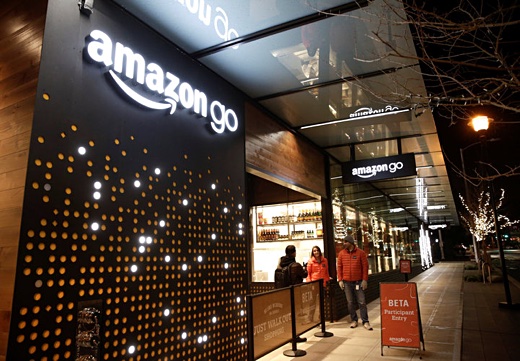
Image above: Exterior of AmazonGO store at the BETA participant entrance. From original article.

To understand the depth and breadth of Jeff Bezos’ ambitions for the company he built, type www.relentless.com into your browser. The domain Bezos registered in 1994 will redirect to Amazon, the company aptly, and ambitiously, nicknamed The Everything Store.n>

He tells his shareholders that the company will act like an aggressive startup — that at Amazon, it is always Day One.

Like Google and Facebook, Amazon uses technology and data to sidestep traditional restrictions on monopoly power.

Our lives are increasingly organized by the platforms these companies run, platforms which now mediate the way we communicate and engage in commerce with each other.

We are living in a world organized by tech monopolists, a change in power relationships that no one voted for but has been imposed upon us nonetheless.

Now, Bezos is attempting to add more power to his empire with the surprise announcement that the company will pay $13.7 billion for Whole Foods Market
. Amazon will now have a store footprint in neighborhoods across America.

Our communities and the way we engage in commerce will change. Imagine walking into a Whole Foods store and seeing different prices depending on whether you are a member of Amazon Prime — or seeing different prices depending on any other way that you interact with Amazon.

This isn’t implausible. It is what the company does when it opens up stores. For instance, Amazon is creating a chain of physical book stores to take the place of the book stores the company destroyed.

In these stores, there are no price tags at all: You scan the items with your phone and have a price delivered to you, personalized by Amazon.

Why wouldn’t Amazon extend this to Whole Foods? “Our goal with Amazon Prime, make no mistake,” says Amazon CEO Jeff Bezos, “is to make sure that if you are not a Prime member, you are being irresponsible.”


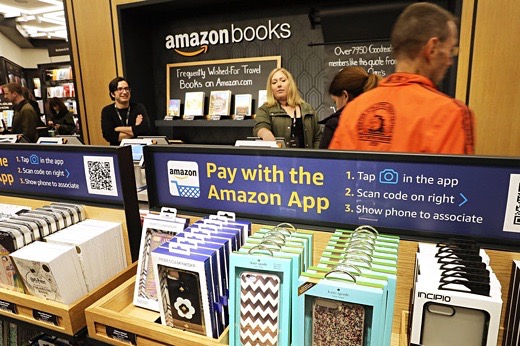
Image above: People shop in the newly opened Amazon Books on May 25 in New York City. Amazon Books, like the Amazon Go store, does not accept cash and instead lets Prime members use the Amazon app on their smartphone to pay for purchases. Non-members can use a credit or debit card. From original article.

This statement and the amount of power in Bezos’ hands should frighten all Americans. Bezos meant that Amazon will soon be so good for consumers that it would just be folly not to be a member.

But what he unwittingly implied is that as a citizen, you will have no choice but to interact with his institution to buy and sell key goods that everyone needs — on his terms.


Jeff Bezos, in other words, has a vision. To be everywhere, to be the platform for everything for every consumer. So when Bezos calls you irresponsible for not tithing to Amazon, America has a big political problem.

Amazon’s takeover of Whole Foods means that it can target and eliminate regional competitors one by one as it did with its online competitors. When Diapers.com emerged as a competitor to Amazon, Amazon simply sold diapers below cost until the company capitulated and sold itself to Bezos.

Why wouldn’t it? Even though predatory pricing is illegal, the government hasn’t enforced those laws for decades.

Whole Foods tends to source from local farms as part of a commitment to localism; these farms will now be negotiating with a much bigger entity that is committed to a ruthless model of efficiency.

There are so many ways that Amazon can use its power that it’s simply impossible to figure out what it will do. Amazon probably doesn’t even know yet; it will discover and test them, relentlessly.

Maybe you will get first in line, or last in line, for the most popular toy during the Christmas period, or maybe the restaurant you own will get access to the freshest yet limited batch strawberries you need based on whether you are giving better deals to Prime members.

Or here’s a more creative possibility. Amazon is excluding Amazon Prime video from Apple TV so that Prime members will buy its streaming device instead of Apple’s.

As the smartphone market commodifies and transforms, Bezos could simply use his combined physical and online footprint to keep you from even seeing prices at his stores unless you are using Amazon-approved electronic devices.

If Amazon were just one of many stores that would be one thing. But Amazon is quickly becoming the dominant way to buy and sell.

And this, make no mistake, is what is happening. Upon the announcement of the acquisition, Target’s stock price dropped by 10 percent and Walmart’s by 5 percent. Amazon’s rose by more than the price it is paying for Whole Foods.

Wall Street sees the writing on the wall. There is only one force that can stop Amazon from organizing and regulating basically all American retail commerce — our democratic institutions and our political system. We the people.

Bezos knows Amazon is a political enterprise at this point. The day before he announced his company’s attempt to buy this supermarket chain, he released a request on Twitter to have people offer ideas for where he can direct charity money. That is the kind of public relations undertaken by political leaders.

And Amazon put out an ad for a Ph.D. economist-cum-lobbyist “to educate regulators and policy makers about the fundamentally procompetitive focus of Amazon’s businesses.”

And he has put political fixers, like Ivanka Trump’s lawyer and ex-Clinton administration officer Jamie Gorelick, on his board of directors. He also bought The Washington Post.

The public should speak out in opposition to this merger. More than that, the government should take this opportunity to reject the entire pro-finance pro-concentration philosophy that has taken hold in this country since the Reagan era. 


It is no accident that Whole Foods founder John Mackey was forced to surrender his life’s work because financiers looking for a quick buck bought up a large bloc of shares in his company and pressured him to sell the company to Amazon.

The day before the announcement of the sale, he called these hedge funds “Ringwraiths,” after the evil characters in “Lord of the Rings.” Bezos might be the most powerful empire-builder in the land, but he had help.

This merger should frighten all of us. But it should also embolden anyone who believes that America should not be in thrall to monopolists like Bezos. For them, today, as Jeff Bezos might put it, is Day One.

See also:
Ea O Ka Aina: World Logistic Center Warehouse 6/6/17
Ea O Ka Aina: The coming tech backlash 1/5/17
Ea O Ka Aina: AT&T and Amazon Cloud outages 3/11/17
Ea O Ka Aina: Robots taking over Amazon 1/4/17
Ea O Ka Aina: Discovery  1/5/16
.
.

End Of American Consumerism

SUBHEAD: A re-posting of an Island Breath article about consumerism from a decade ago.

By Juan Wilson on 15 July 2007 for Island Breath -
(http://www.islandbreath.org/2007Year/20-HookahiKauai/0720-08Consumerism.html)


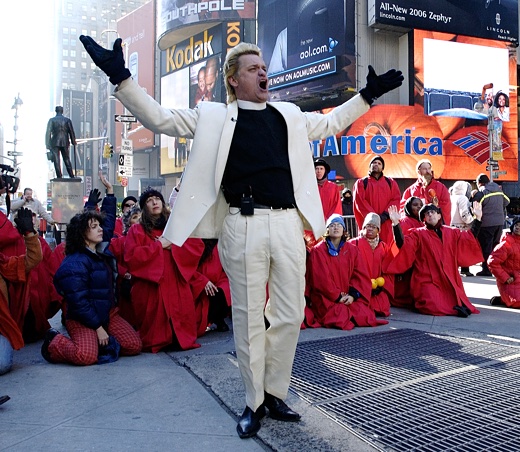
Image above: The Reverend Billy of the Church of Stop Shopping preaches in Times Square, NYC. From original article.

Bad Day at Kukui Grove

Americans are happy when buying stuff. We have come to love brand-names as if they were family members. We imbue the release of the next hip gadget as a spiritual revelation. Some techno-gurus have even dubbed Apple's new iPhone "The God Machine".

But often it is what gives us the greatest pleasure that is the source of our greatest frustration and suffering. Ask any junkie or ice-head. This truism not only applies for drug addicts, but to those addicted to consumption as well.

I'm speaking about that person who is bored and mildly depressed. You are looking forward to jumping in the new Honda Element and driving through winding tropical scenery to Kukui Grove.

The plan is to charge a $400 Champion Juicer at Macy's so you can "live off the land". Then your life will have meaning, and all will be right with the world. Afterwards, you can top off your shopping conquest with a mocha-latte-grande at Starbucks.

Unfortunately, in the real world, due to a raging wildfire on the way to Kukui Grove, the Honda got stuck in a three hour highway meltdown south of the Wailua Golf Course. You almost ran out of gas idling in traffic and the car's AC couldn't overcome the smoke, and now the Element doesn't smell so new.

When you finally get to Macy's and swipe your Capital One card they tell you the juicer purchase has been declined. You realize you're tapped out because you used the credit card for last month's car payment.

You head off to Starbucks for a latte to wash down a couple of aspirins and a Valium while you figure out how to tank up the car and get home before rush hour. Is this really fun?

American Consumerism
"Consumerism" is a word invented in America after the Second World War that coincides with the birth of Baby Boomers and the explosion of suburbia. Today, Americans have become characterized, more than anything else, as consumers.

Consumerism is defined as;
  1. The concept that the ever-expanding consumption of goods is advantageous to the economy.
  2. The term is used to equate personal happiness with purchasing material possessions.
  3. The movement for the protection of the consumer against useless, inferior, or dangerous products as well as unfair advertising and pricing.
There are some who are trying to save Americans from their shopping addiction before it is too late. One is Bill Talen, who as the Reverend Billy of the Church of Stop Shopping, warns of the coming Shopocalypse. He is funny and dead serious at the same time.

The Reverend Billy travels in a biodiesel fueled bus with the Stop Shopping Gospel Choir to preach from the parking lots of WalMart and Starbucks. While the Choir sings the Reverend does interventions and exorcisms.

He asks us "What would Jesus buy?" and exhorts consumers to stop shopping. Reverend Billy recommends that if you have to buy anything you should avoid the corporate franchises and chains stores and buy from locally owned businesses.

The Perfect Economic Storm
Consumerism may be the basis of our economy and the source of our "happiness", but as the central organizing principle of our culture has just about run its course. I believe consumerism, as we know it, is going away (kicking a screaming) and we will simply have to learn to sustain and entertain ourselves without it.

There is a perfect storm coming that will move us away from being consumers. The elements of the storm include...
  1. The demand for oil is exceeding supply - Sticking it out in Iraq won't fix the Peak Oil Crisis.
    The Result: Much more expensive oil.
  2. The failure of the US housing market - Hope you weren't counting on selling at the top of the market.
    The Result: Shutting off the consumer credit engine.
  3. The loss of economic leadership to China - We didn't want to make all that plastic junk anyway. Besides, it wrecks the environment.
    The Result: The US stock market crashes and the dollar can't buy anything.
The Empire Has No Clothes
It is my opinion that the there is a great struggle going on that threatens the way we live. But Bush-Cheney never really examined the underlying source. They just labeled it "The War on Terror" and started an endless shooting war with the Moslem world.

Underlying much of the resentment and hatred we see aimed at us is a rejection of Western culture and economics. It is not so much a war of religious fanaticism against our freedom and wealth as it is a clash of between socioeconomic models. It is really a battle between the First World and the Third World.

On the one hand is The First World (Western Civilization, Judeo-Christian-Agnostic Culture, a Global Economy, Corporate Rule): Its secular forces uses technology, cheap energy and cheap labor to transform us all into consumers without regard to history, local customs or spiritual development.
To what end? - Economic Growth at any cost.

On the other hand is there is the Third World (Underdeveloped Nations, Islamic Culture, Fierce Nationalism and Armed Tribalism): Its parochial forces attempt to use rigid codes to maintain cultural and religious values that preserve the traditional, stable and modest ways of living by strict adherence to arbitrary rules.

To what end? - Preservation through Obedience.

Both sound like hell to me. I'm hoping that "victory" leaves us somewhere in between. I'm looking for a modest sustainable lifestyle with intellectual and spiritual freedom - In the aina and with ohana.

On the surface the clash between the First and Third World is lopsided in favor of the West, but that is only on the surface. As we have found out in Iraq, high-tech maneuver warfare can be ground down by persistent door-to-door low-tech resistance.

As energy becomes more expensive (and it could be $75 a barrel for oil by the time you read this) the worldwide economic playing field will begin to level. We will all be living in the Third World - but with internet access.

Variation of the Golden Rule
Many in America consider themselves Christians. A central tenet is The Golden Rule: "Do unto others as you would have them do onto you."

An important corollary of that rule is "Act in a way that if everybody acted your way, the world would be a better place."

This would include an accounting of the share of the world's resources you consume. And that does not allow for trading pollution rights with natives from New Guinea.

If the Post-Peak-Oil economy does anything good, it will reduce our reliance on consumerism as our measure of our success. A wasteful use of resources will force us to face increasingly greater consequences.

We all will be forced to transform ourselves from consumers to artisans; from corporate employees to local entrepreneurs, from celebrity-wanna-bees to good neighbors. Consumerism will become a self healing wound - if it doesn't kill us first.

In the long run Americans will see that letting go of what Dick Cheney called "our nonnegotiable lifestyle" is the best thing that could happen to us. A new kind of economy and culture is self-organizing here on Kauai.

As it unfolds we will all become more native to this place - if not kanaka maoli maybe kama`aina. It will mean you won't have to make so much money or be stuck in your car all the time. It will mean you won't have to be hypnotized by your glowing TV and cellphone screen to get through the night. Kauai might even begin to feel like Kauai again.

See also:
Island Breath: Paradise Denied 9/1/10
Reverend Billy preaches against consumerism a Hanapepe's Storybook Theatre on Kauai.
.

India bans large denominations

SUBHEAD: India ditches 500 and 1000 rupee notes. For the first time the rich beg the poor to help them.

By Amrit Dhillon on 18 November 2016 for Sidney Morning Herald -
(http://www.inkl.com/news/for-the-first-time-in-india-the-rich-beg-the-poor-to-help-them)


Image above: Indian woman shows discontinued Indian currency notes and a photocopied ID card as she queues outside Reserve Bank of India. Photo by AP. From original article.

Driver Rahul Sharma, 25, remembers the exact day when his employer turned from a wolf into a lamb. It was November 9 when his employer called him  beta  - Hindi for "dear" - for the first time. The maid was asked to give him a cup of tea, for the first time.

"I was shocked at his sudden niceness. It went on for two days," said Sharma. For the past three years, his New Delhi-based employer has been abusive, bad-tempered, and imperious, often demanding that he turn up for work at 6am after finishing work at midnight.

"He didn't even bother to remember my name. When he wanted to summon me, he'd call out 'driver!'," Sharma said.

"On the third day, the penny dropped. He asked me to deposit 250,000 rupees ($4900) in my bank account on his behalf so that he could get rid of his black money."

Maids, drivers, nannies, and cooks in India are experiencing unusual politeness from their employers. Beyond the work they do every day, they suddenly have another use – to launder the undeclared cash which the rich have been hoarding in steel wardrobes, under the mattress and in under-bed storage.

This sudden outbreak of niceness is the outcome of India's current crackdown on "black money" - income in the form of cash that has not been declared to the tax authorities.

On November 8, the day before Sharma's employer became a lamb, Indian Prime Minister Narendra Modi scrapped 500 and 1000-rupee notes to root out corruption and force more Indians into the tax net.

In one fell swoop, the tens of millions of rupees that the rich kept at home in these denominations became worthless. If they deposit the money in the bank tax officials will pounce, imposing staggering penalties and taxes.

However until December 30, each Indian is allowed to deposit a smallish sum of 250,000 rupees in such defunct notes in their bank accounts without questions being asked. That is why the rich need the service of the poor.


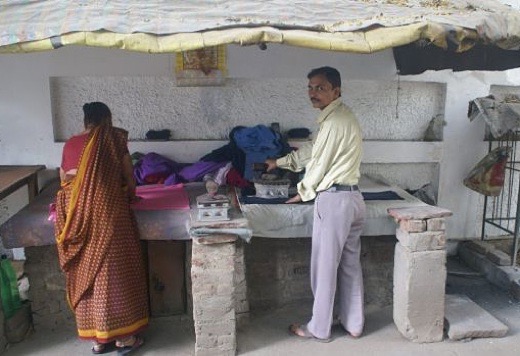
Image above: A presswallah who irons the clothes in the Indian capital says he was asked by three clients to deposit 200,000 rupees in his account in return for a payment of 10,000. From original article.

Sharma and others like him have been implored by suddenly humble employers to deposit the amount in their accounts by the deadline - to be returned to their employers later.

"I refused him. I don't want to get into trouble later if someone asks me how I got this money when I'm only a driver," Sharma said.


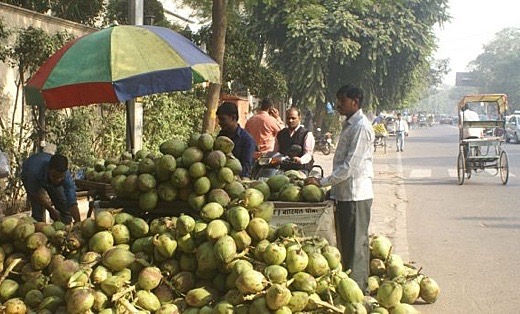
Image above: Coconut water seller Mohan Kishore says the cash crisis has made it hard for him to pay his suppliers but he feels the hardship is worth it for the "punishment" of the rich. Photo by Amrit Dhillon. From original article.

Domestic staff and factory employees are going around with big grins, delighting in the panic and anxiety etched on the faces of the fat cats who never showed them any consideration, not to mention the delicious irony of being beseeched by their now squirming masters.

Modi's message in a recent speech - "see how I make the powerful suffer with you" - has resonated powerfully. "For once the rich are as troubled as we poor Indians are every day," said Akash Atwal, a driver with a New Delhi car rental firm.


Image above: Coconut water seller Mohan Kishore says the cash crisis has made it hard for him to pay his suppliers but he feels the hardship is worth it for the "punishment" of the rich. Photo by Amrit Dhillon. From original article.

In return for depositing the scrapped notes, domestic staff and others are being offered 10 to 25 per cent as commission. Some have accepted, happy to pocket an unexpected windfall; others, fearing trouble, have refused; and others have refused out of the principle that, if some big fish have been caught, leave them wriggling at the end of the line.

In their desperation to get rid of their ill-gotten money, rich Indians are dumping sacks of notes into the River Jamuna in New Delhi.

Some have made a bonfire of their cash at some deserted place before running away to avoid identification. Police have stopped cars filled with suitcases stuffed with 1000-rupee notes, their drivers rushing to distant relatives they haven't seen for years to ask them to deposit their cash.

"Some families who buy fruit from me regularly wanted to get rid of 100,000 ($1900) worth of notes by paying me in advance for the fruit they will buy over the next year" said Bittu Bharati, who runs a fruit stall with his uncle in Lajpat Nagar.

Others who are usually paid in cash – florists, beauticians, personal trainers and "presswallahs' who iron clothes in neighborhoods – have also been told they can have their services paid for two years in advance, just so that affluent families can dispose of their expired cash. Then it's up to them to exchange the money at the bank.


Image above: Indians stand in a queue to deposit and exchange discontinued currency notes outside a bank in Allahabad, India. Photo by AP. From original article.

Some Indians are being too clever by half. A divorced man who had defied the courts by refusing alimony to his wife was seized with a new respect for the law and offered to pay her the arrears - in the banned currency notes. The judge threw him in jail until he paid in the new notes.

Domestic staff have been chuckling while exchanging stories of what's been happening in the homes of their employers: sudden palpitations, wailing wives, altercations over how to get rid of the banned notes, profuse sweating and pure despair.

Chemists have reported a spike in the sale of sleeping tablets. Mumbai hospitals have reported a surge in panic attacks. But some doctors are feeling queasy themselves – it's estimated that about 40 per cent of doctors are paid in cash.

"I'm an ordinary man and I'm suffering hardship too. I was in a long queue on Saturday. But it's worth it. The rich need to be punished for being greedy. I am savouring the moment," said a smiling Mohan Kishore, who sells fresh coconut water on a South Delhi street.


.

9/11 The Day America Ended

SUBHEAD: We built the Freedom Tower at the WTC site and denied ourselves the very freedom it symbolizes. 

By Juan Wilson on 11 September 2016 for Island Breath -
(http://islandbreath.blogspot.com/2016/09/911-day-america-ended.html)


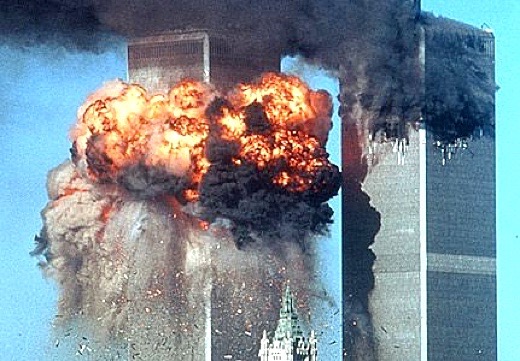
Image above: WTC2, the south tower of the World Trade center, begins its collapse to the ground after being hit with commercial jet. From (https://www.pinterest.com/pin/334321972311799824/).

Conspiracy theories abound. And they are like fractal geometries. The deeper you look the more complicated they may seem.
Fractal noun
a curve or geometric figure, each part of which has the same statistical character as the whole. Fractals are useful in modeling structures (such as eroded coastlines or snowflakes) in which similar patterns recur at progressively smaller scales, and in describing partly random or chaotic phenomena such as crystal growth, fluid turbulence, and galaxy formation.
As a result I personally have found going down the rabbit hole of conspiracies useless. This began for me with the Kennedy Assassination. What I think is important is to question the 'authorized version" of evtents and to get a gist of who has benefited from the results of the disaster the conspiracy may have produced.

In the case of the 9/11 attacks on the World Trade Center and Pentagon it is clear that it was executed for the Bush regime by the Saudi Arabians.

The Bush Team (Cheney-Rumsfeld-Rice) wanted and got their excuse for an endless war for American domination in the Middle East as well as the fascist takeover the the operation of the United States. Cheney, in particular, had business interests that could take advantage of our military response to 9/11.

Freedom as individuals in America has never been more threatened by our intelligence and security services as it is today. 

Bursting Bubbles
Often not linked to the 9/11 disaster was the crash of the DotCom Bubble. The over enthusiastic investment in the burgeoning commercial possibilities of the internet at the turn of the millennium featuring startups like GeoCities.com and Pets.com went sour. It seemed the American economy had been euphoric for a business model with yet no substance.

In less than a decade the DotCom Bubble was followed by the speculative Real Estate Bubble bursting in 2008-2009. The following The Great Recession still roils through our economy. We have not recovered from that and have been floating with only our nostrils above the water on a billowing bubble of debt ($20trillion or so). It's been provided by the Central Banks by way of Quantitative Easing, Zero Interest Rate Percent loans (ZIRP) to banks and now Negative Interest Rate Percent (NIRP) bank savings accounts.

But that Debt Bubble is about to burst now. With our current economic model growth and employment cannot be restored without destroying the planet. We will now face the consequences of that with either Hillary (and the NSA) or Donald (and the KGB) at the helm.

The strategy the banksters see going forward is to get rid of the cash economy. It provides too much cover for individual freedom of trade. It denies the banks a slice of every transaction. It can't be easily confiscated or devalued. It means not every step of your life will cannot be monitored.

One Little Grid Failure

It seems pretty clear that the Power Grid and Information Networks are as vital to our continuity as a working civilization as agriculture, highways, factories and ports that are the foundation of our infrastructure.

The power and information systems have become ever more crucial to our continuity as a nation. So much so that people cannot survive without them. 

Problem is they are so delicate that minor glitches can take them down and make our live inconvenient... and major interruptions can cause widespread havoc and chaos.

The "cashless" economy the Techno-Optimists dream of seems cool. Just tapping your iPhone for a Starbuck's coffee, or whizzing through a tollbooth with your EasyPass sticker seems convenient.

The downside of such dependencies exists too. Recently I went for lunch to a Kauai Island Brewery and Grill on the south side. They have great beer and like many restaurants today use networked iPads for orders and billing. Bills are paid at the front desk on an iPad using an attached SquareUp credit card reader.

The brew pub only a few hundred yards from the main KIUC main Port Allen power plant so a power grid failure wasn't likely. However, that doesn't protect them from irregularities of the internet.

As we were coming through the  door the staff, including head waiter, were focused around the card reading iPad at the entrance. It wasn't reading cards. The place was packed and many tables were set to rollover customers.  

The staff was realizing that many might be leaving without a way to pay their bills. They were only letting in new customers who said they could pay cash. We had cash. This lasted only about five minutes but as he seated us the sweat still gleamed on the head waiters forehead.

An electronic cashless economy will not persist for very long, even if it could be deployed. It's too delicate. More likely we will over time descend from a cash economy to a trade/barter/gifting economy.

This is totally lost on most Americans today.

We are is such deep self denial that we built the "Freedom Tower" at the site of the old World Trade Center as we denied ourselves the very freedoms it supposedly symbolizes.

Decentalize Now!

There is no way off this high and fragile branch we cling to, but we must climb down from this perch or to fall to our deaths. Getting down successfully means being reliant on yourself and local resources for all necessities. But in your heart you already knew that.
.

The War on Cash

SUBHEAD: A war on independence, privacy, and informal unaccounted personal behavior - all for a small fee.

By Brett Scott on 19 August 2016 for the Long and Short -
(http://thelongandshort.org/society/war-on-cash)


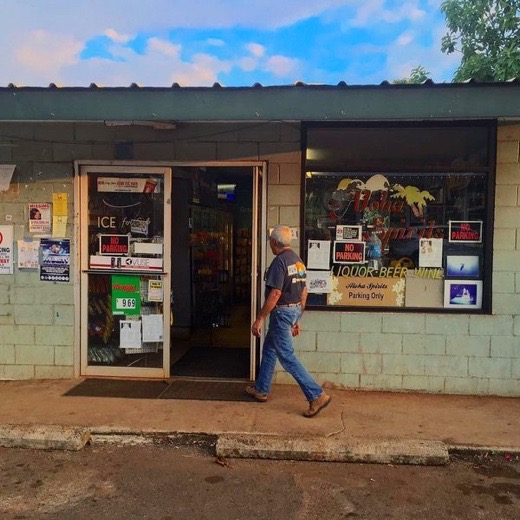
Image above: Aloha Spirits in Hanapepe, Kauai, Hawaii. Cash Only! From (https://pbs.twimg.com/media/Ch83WepWEAAAMoM.jpg).

[IB Publisher's note: There is a business in my town that's open 365 days a year from morning until latenight. It's called Aloha Spirits. It's a tiny store, but it provides a wide variety of things people really want - things they have habits for - including beer, liqueur, wine, sodas, cigarettes, vapes, tobacco, condoms, aspirin, decongestants, energy drinks, chips, candy, ice cream, gum and a variety of items that satisfy all the flavor cravings (sweet, salty, sour, bitter and umami). Aloha also has some fresh local produce and fruit like eggplants and pineapples. Aloha Spirits only accepts cash and so my secret desires are between us alone.]

Several months ago I stayed in an offbeat Amsterdam hotel that brewed its own beer but refused to accept cash for it. Instead, they forced me to use the Visa payment card network to get my UK bank to transfer €4 to their Dutch bank via the elaborate international correspondent banking system.
I was there with civil liberties campaigner Ben Hayes.

We were irritated by the anti-cash policy, something the hotel staff took for annoyance at the international payments charges we'd face. That wasn't it though. Our concern was an intuitive one about a potential future world in which we'd have to report our every economic move to a bank, and the effect this could have on marginalised people.

'Cashless society' is a euphemism for the "ask-your-banks-for-permission-to-pay society".

Rather than an exchange occurring directly between the hotel and me, it takes the form of a "have your people talk to my people" affair. Various intermediaries message one another to arrange an exchange between our respective banks. That may be a convenient option, but in a cashless society it would no longer be an option at all. You'd have no choice but to conform to the intermediaries' automated bureaucracy, giving them a lot of power, and a lot of data about the microtexture of your economic life.

Our concerns are unfashionable. Without any explicit declaration, the War on Cash has begun. Proponents of digital payment systems are riding upon technology-friendly times to proclaim the imminent Death of Cash. Sweden leads in the drive to reach this state, but the UK is edging that way too. London buses stopped accepting cash in 2014, but do accept MasterCard and Visa contactless payment cards.

Every cash transaction you make is one that a payments intermediary like Visa takes no fee from, so it has an interest in making cash appear redundant, deviant and criminal. That's why, in 2016, Visa Europe launched its "Cashfree and Proud" campaign, to inform cardholders that "they can make a Visa contactless payment with confidence and feel liberated from the need to carry cash."

The company's press release declared the campaign "the latest step of Visa UK’s long term strategy to make cash 'peculiar' by 2020."

There you have it. An orchestrated strategy to make us feel weird about cash. Propaganda is a key weapon of war, and all sides present themselves as liberators. Visa comes across like a paternalistic commander when assuring us that we – like a baby taking first steps – will feel a sense of achievement at liberating ourselves from the burden of cash dependence. Visa's technology offers freedom without dependence or dangers.

Visa is joined by other propagandists. In 2014 Penny for London arrived, an apparently altruistic group set up by the Mayor's Fund for London and Barclaycard, using charity as a hook to switch people to contactless cards on the London Underground. PayPal plastered cities with billboards claiming that "new money doesn't need a wallet", along with a video proclaiming: "New money isn't paper, it's progress".

Astroturfing campaigns like No Cash Day are backed by American Express, highlighting such anti-cash themes as the environmental impact of banknotes. Other tactics include pointing out that criminals use cash, that it fuels the shadow economy, that it's unsafe, and that it facilitates tax evasion.

These arguments have notable shortcomings. Criminals use many things that we keep – like cars – and fighting crime doesn't take priority over maintaining other social goods like civil liberties. The 'shadow economy' is a derogatory term used by elites to describe the economic activities of people they neither understand nor care about.

As for safety, having your wallet cash stolen pales in comparison to having your savings obliterated in a digital account hack. And if you care about tax justice, start with the mass corporate tax avoidance facilitated by the formal banking sector.

The peculiar feature about this war, however, is that only one side is fighting. Very few media champions defend cash. It is like a taken-for-granted public utility, whereas digital payments platforms are run by private companies with an incentive to flood the media with their key messages. When they fight this war, their target is our cultural belief in cash, and the belief that its provision should be a public right.

The UK government does not plan to maintain that right, and is siding with the payments industry. Their position is summed up by economist Kenneth Rogoff in his new book The Curse of Cash.

He argues that, apart from facilitating crime and tax evasion, cash hampers central banks from setting negative interest rates. In the absence of cash, everyone must keep their money in the form of digital bank deposits. During recessions central banks could then use the banking system to deliberately corrode people's deposits via negative charges, 'inspiring' them to spend rather than hoard.

The emergent consensus among economic and political elites is that this is the direction to go in, but to manufacture consent for this requires a drip-drip erosion of public resistance. Hearts and minds must be shown that the change represents inevitable and desirable progress.

Anyone defending cash in this context will be labelled as an anti-progress, reactionary, and nostalgic Luddite. That's why we must not defend cash. Rather, we should focus on pointing out that the Death of Cash means the Rise of Something Else. We are fighting a broader battle to maintain alternatives to the growing digital panopticon that is emerging all around us.

To understand this conflict, we must step back. A monetary transaction involves specific goods or services being exchanged for tokens giving access to general goods and services from others. The pub landlord hands me beer at night if I transfer tokens that allow him to get cigarettes from a shopkeeper in the morning.

There are two ways to implement this though.

The first is to give the tokens a physical form. In this scenario, 'getting rich' means accumulating those physical things and 'making a payment' means handing them over to someone else. They are bearer instruments, which means nobody keeps a record of who owns them. Rather, whoever holds them owns them. This is your wallet with notes in it. This is cash.

Alternatively, you can use a ledger. Someone sets up a database with spaces allotted to different people. This is then used to keep a record of who has tokens. These tokens have no physical form, but are written into existence. They are 'data objects', and they are 'moved around' by editing the record.

The keeper of the ledger thus maintains an account of what money is attributable to you, 'keeping score' of it for you. In this system, 'getting rich' means accumulating a high score on your account.

'Making a payment' involves identifying yourself to the keeper of the ledger via a communications system, and requesting that they edit your account, and the account of whoever you are paying.
Does this sounds familiar? It is your bank account.

Old banks used actual books to maintain these account ledgers, but modern banks use digital databases housed in huge datacentres. You then interact with them via your internet banking portal, your phone app, or by going into a branch. This is not a minor part of the monetary system. Over 90 per cent of the UK's money supply exists nowhere but on bank databases.

It is upon this underlying infrastructure that payment card companies like Visa build their operations. They deal with situations in which someone with one bank account finds themselves in a shop owned by someone else with another bank account. Rather than the pub landlord giving me his bank details for a manual transfer, my card sends messages through Visa's network to automatically arrange the editing of our respective accounts.

Many fintech – financial technology – startups specialise in finding ways to augment, gamify or streamline elements of this underlying infrastructure. Thus, I might use a mobile phone fingerprint reader to authorise changes to the bank databases. Much fintech 'disruption' merely involves putting slicker clothes on the same old emperor.

The use of high-speed communications systems to rearrange binary code information about who has what money might be new, but ledger money is as old as any bearer form.

The Rai stones of the island of Yap were huge and largely unmovable stones that, while seeming like physical tokens, were a form of ledger money. Rather than being physically moved – like cash would – a record of who owned the stones was kept in people's heads, stored in their communal memory.

If the owners wished to 'transfer' a stone to another, they 'edited the ledger' of who possessed the tokens by merely informing the community. Why physically roll the stone if you can just get everyone to remember that it has 'moved' to somebody else? The main reason that we struggle to recognise this as a form of cashlessness is that the ledger is invisible and informal.

Cashless society, though, is presented as futuristic progress rather than past history, a fashionable motif of futurists, entrepreneurs and innovation gurus. Nevertheless, while there are real trends in behaviour and tastes to be spotted in society, there are also trends in behaviour and taste among trend-spotters.

They are paid to fixate upon change and so have an incentive to hype minor shifts into 'end of history' deaths, births and revolutions.

Innovation communities are always at risk of losing touch within an echo chamber of buzzwords, amplifying one another's speculations into concrete future certainties. These prediction factories always produce the same two unprovable sentences: "In the future we will… " and "In the future we will no longer… ". Thus, in the future we will all use digital payments. In the future we will no longer use cash.

This is the utopia presented by the growing digital payments industry, which wishes to turn the perpetual mirage of cashless society into a self-fulfilling prophecy. Indeed, a key trick to promoting your interests is to speak of them as obvious inevitabilities that are already under way. It makes others feel silly for not recognising the apparently obvious change.

To create a trend you should also present it as something that other people demand. A sentence like "All over the world, people are switching to digital payments" is not there to describe what other people want. It's there to tell you what you should want by making you feel out of sync with them. Here's fintech investor Rich Ricci invoking the spectre of millennials, with their strange moral power to define the future. They are repulsed by the revolting physicality of cash, and feel all warm towards fintech gadgets.

But these are not, on the whole, real people. They are a weapon in the arsenal of marketing departments used to make older people feel prehistoric. We're not pushing this. We're just responding to what the new generation demands.

And so we get Visa's Cashfree and Proud campaign. If people really were ashamed of cash, they wouldn't need ads to tell them. Visa must engineer that shame to teach you that what you want is the same as what they want. And if you don't want it, just remember that cashless society is inevitable. Don't get left behind.

But this system will leave many behind. It is hardwired to include only those with access to a bank account; and bank accounts are hosted by profit-seeking corporations that operate at scale. They have no time for your individual idiosyncrasies. They cannot make profit off anyone who cannot easily be categorized and modeled on a spreadsheet.

So, good luck to you if you find yourself with only sporadic appearances in the official books of state, if you are a rural migrant without a recorded birthdate, identifiable parents, or an ID number. Sorry if you lack markers of stability, if you are a rogue traveller without permanent address, phone number or email.

Apologies if you have no symbols of status, if you're an informal economy hustler with no assets and low, inconsistent income. Condolences if you have no official stamps of approval from gatekeeper bodies, like university certificates or records of employment at a formal company. Goodbye if you have a poor record of engagements with recognised institutions, like a criminal record or a record of missed payments.

This is no small problem. The World Bank estimates that there are two billion adults without bank accounts, and even those who do have them still often rely upon the informal flexibility of cash for everyday transactions. These are people bearing indelible markers of being incompatible with formal institutional space. They are often too unprofitable for banks to justify the expense of setting them up with accounts. This is the shadow economy, invisible to our systems.

The shadow economy is not just 'poor' people. It’s potentially anybody who hasn't internalised the correct state-corporate narrative of normality, and anyone seeking a lifestyle outside of the mainstream.

The future presented by self-styled innovation gurus has no scope for flexible, unpredictable or invisible people. They represent analogue backwardness. The future is a world of endless consumer choice built upon an inescapable digital uniformity of automated rules, a matrix outside which you can neither exist nor think.

Back in Amsterdam I hang out with Ancilla van de Leest of the Netherlands Pirate Party. She only visits establishments that accept cash, true to her political belief in individual privacy from prying eyes.
It would be wrong to assume, however, that Ancilla's primary concern involves surveillance by a Big Brother-style bogeyman. It's true that your spending patterns reveal much about how you actually live, and the privacy implications of having these recorded in searchable database format are only starting to be uncovered.

We know that targeted individual surveillance of payments occurs by the likes of the FBI and NSA, but routinised mass surveillance could become a norm. Imagine automatic flagging systems triggered by anyone engaging in a combination of transactions deemed subversive. Tax authorities are bound to be building systems to flag discrepancies between your spending patterns and your declared profits.

It's also true that at London fintech gatherings the excited visions of cashless society now occasionally come with a disclaimer that we should think about the power granted to those who control the system.

Not only can payments intermediaries see every time you buy access to a porn site, but they have the ability to censor your transactions, like Visa, PayPal and MasterCard attempting to choke WikiLeaks by refusing to process people's donations.

We could imagine some harsh sci-fi scenario in which a theocratic regime issues decrees to payments processors to block anyone buying books deemed sexually deviant. Such decrees could be automatically enforced via code, with subroutines remotely triggering smart locks to place the offending miscreant under house arrest while automatically deducting a fine from their account.

Such automated dystopias should ideally be avoided, so a dose of paranoia about digital payments systems is a healthy impulse, even if it might be unwarranted.

But that isn't really the point. What's more important to Ancilla and me is the looming sense of an external watcher that 'assists', 'guides' or 'helps' you in your life, tracking and logging your moves in order to influence you.

The watcher is not a single entity. It's a collective array being incrementally built in stages by startups and companies around the world as we speak.

We feel it seeping deeper into our lives, a mesh of connected devices, cookies and sensors. Whether we visualise it as the benevolent eyes of a parent, or the menacing eyes of a tyrant doesn't matter. The point is that the eyes have the potential to monitor you, all the time.

The proclaimed Death of Cash is thus an episode in the broader drama that is the Death of Privacy, the death of breathing room, and the death of informal, non-measured, unaccounted-for behaviour. Every action you take must forever be attached to your digital persona, dragging with it a data trail extending back to the day you were born. We face creating an entire generation of people who do not know what it feels like to not be monitored.

For many economists, the War on Cash will be resolved by their favourite mystical demigod, the market. This guiding force prevails when utility-maximising producers and consumers go around making rational choices with perfect information about their options, and with total freedom to choose whether or not to exercise those options. If digital payment transaction costs are lower, then cash will rightly die.

The pristine realm of market theory is unfit to assess the dynamics of this situation. Our sense of what constitutes a legitimate choice does not form in a vacuum. We are born into social power structures that tell us what normality is, and that shame us for not choosing 'correctly'. You might be a rebel who challenges prevailing cultural norms, but those norms are conditioned by those with the greatest financial and media clout.

At this moment the blaring of propaganda extolling the short-term conveniences of digital payment is dulling our critical impulses to rearrange our cultural DNA. Who is thinking about the longer-term implications of building our lives around these systems, and thereby locking ourselves into dependence upon them?

Unlike a battle fought using violence, hegemony is the assertion of power by getting people to believe in it, to see it as inevitable, unassailable and normal. Visa's four-year plan is one such exercise, and once we've internalised it, we'll choose to build their power.

We'll feel strangely comforted by the MasterCard billboard endorsed by the Mayor of London. We'll find ourselves downloading ApplePay like a dazed child accepting a gift.

So, let's prepare for the War on Cash. Remember, this is not about romanticising the £10 notes with the Queen on them. This is about maintaining alternatives to the stifling hygiene of the digital panopticon being constructed to serve the needs of profit-maximising, cost-minimising, customer-monitoring, control-seeking, behaviour-predicting commercial bureaucrats.

And fear not, the Germans are onside, along with the criminals, the homeless, the street-side buskers and an army of people whose lives will never get a five-star rating on a mainstream reputation scoring system.

We will forge alliances with purveyors of non-bank alternative currency systems; and yes, we will maintain the option to use our payment cards. Because what we fight for is precisely that. The option.
.

Debt Rattle - The End of Credit

SUBHEAD: We are running headfirst into the wall.

 By Raul Ilargi Meijer on 30 December 2008 at the Automatic Earth -
(http://theautomaticearth.blogspot.com/2008/12/debt-rattle-december-30-2008-end-of.htm


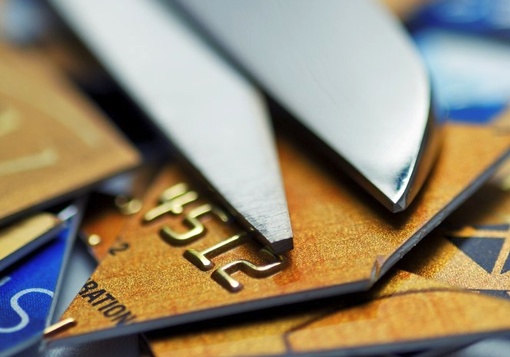
Image above: It's time to get serious about credit. By Bill Frymire

2009 will be the year credit disappears. That, more than any other single factor, is what will determine our economic futures. It will get very ugly, because our economies, even our entire societies, run on credit. There is no replacement.

Governments and central banks are trying to pump your money into the existing banking system, ostensibly with the idea that a credit flow can be (re-) started that way. The idea is so ridiculous that we have to wonder about the intentions behind the policies. To restart credit, they would have to go through any channels BUT the banking system. 


The reason is simple: the banks are bankrupt, with losses on their books that are many times larger than any sum that has been, will be or even could be handed out to them from the public coffer. For the man in the street, things won't get better if existing banks are bailed out or nationalized. They will get worse - much worse.

A government that buys a bank outright, also buys the -s o far mostly unrecognized - losses. A government that merely pumps money into a bank will see that money evaporate on the hot plate of yet-to-be-revealed losses. 


The loss of credit that will be the prime characteristic of the financial world in 2009 marks a watershed moment in our societies, which will have to scramble to find a new model for survival, for getting things from A to B, and to simply feed their citizens. 

The credit system that we have lived in for the past decades is gone and will not come back in our lifetimes. The losses, when they are revealed, and they will have to be, no matter how much the ruling classes resist this, are simply too big.

What is at risk in the derivatives trade alone is more than all the money on the planet. Societies and their governments can do some things to mitigate the damage, to minimize the suffering. 


But none are doing them to date. First, private and small business deposits in banks must be guaranteed. Then, the banks must be folded, along with their losses, which mainly consist of bets gone bad. In order to make this work, governments must set an example of frugality that needs to be adapted by all citizens. 

The Keynesian overspending that rules the day is a recipe for making the disaster much bigger than it already is. And following Keynes without demanding that the books are opened and losses revealed, is nothing short of criminal behavior.

Then, what needs most attention is what people need most: basic necessities. Water treatment and sewage systems are the most important barrier between a society and widespread disease. They will become, in relative terms, much more expensive for everyone. Forced rationing may have to be applied. 


Every level of government needs to look long and hard at where the food for its people comes from. If it is possible to feed everyone of your citizens, action needs to be taken to make sure that self-sufficiency is established.

A national government will be mostly useless in these things, you need smaller entities to be efficient. Increasingly empowering lower levels of government has another advantage: it’s much easier for everyone to track where their money is going. You see, I can write all this, and much more, and know that every word I write is true. But I don't think any of it will be done while there is still time.

What I see around me, what governments are doing, is that one-trick pony kind of thing: trying to resurrect the dead with money that doesn't belong to them. Before we can begin a reorganization of our societies, the present political and financial ruling classes will have to fall. And that will only happen after an amount of suffering so overpowering it makes me shudder. 


Few of those with power, political, economic, will give that up voluntarily, And few of us will volunteer to do with less. Until we run headfirst into the wall, we will deny the existence of the wall. But first, 2009.

No more loans, not for cars and homes, not for business lines and letters of credit, and increasingly not for governments, who'll be attempting to sell their bonds in an ever more overcrowded marketplace. International bond markets will be but a faint shadow of their former selves. And so will trade, in all its aspects. 


Of course it’s hard to predict exactly what will emerge from the end of credit. What is easy to see is that it will indeed end.

.