Showing posts with label Elites. Show all posts

Drumpf plays WW3 and eats KFC

SUBHEAD: A careless and ignorant bully amok in the KFC at the End of Empire.

By Phil Rockstroh on 24 September 2019 for Counter Currents -
(https://countercurrents.org/2019/09/a-careless-bully-at-the-kfc-at-the-end-of-empire)
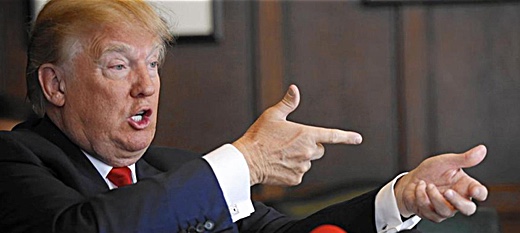

Image above: Donald Trump pretends to shoot rifle at an enemy. From original article.

Will Trump go to war with the Iranians or the homeless? ...or both?

Trump is a coward. The nation of Iran has the means and the will to fight. Do you recall the will displayed by Iranians when repelling foreign invaders when Iraq attempted to invade Iran as a de facto US proxy force? Conversely, the homeless do not possess any defence against assault by the agents of the US police state.

Regardless of his image among credulous true believers, Trump, character-wise, is the diametric opposite of the image he conveys as a titan of supreme self-confidence. The pose is ego-based compensation for inner feelings of inferiority and abject weakness.

Only those who are terrified of their own feelings of weakness and vulnerability fixate on the weakness, real or perceived, of others. If you desire to suss out a person ridden with self-doubt, no matter how outwardly confident and bestowed with worldly success, notice if they possess a proclivity to bandy the ultimate designation of capitalist derision, “loser.”

Trump is prone to inflict a Heinrich Himmler-like evil towards the homeless because, as was the case with the chinless cipher “toy soldier” Himmler, Trump is contemptuous of his inner feelings of inadequacy. To avoid a crippling spiral into shame and self-doubt, feelings of doubt and concomitant animus must be displaced.

The US, in a collective sense, cannot address the societal sin of allowing homelessness, due to a fear that even regarding the crisis might lead to feelings of vulnerability…that some form of contact loseritude might overwhelm and decimate their will.

The inherent weakness in the structure of late US empire compels contempt for the homeless. Trump’s self doubt is the source of his compulsion to humiliate those he perceives as weak and shunt them from sight. Only then can he separate himself from self-hatred.

The reason the mode of mind is lethally dangerous: The psychical trope cannot be sustained in a viable sense. The sense of weakness remains, compelling the sufferer to double down on the perpetration of force.

There can be no end to the depth of cruelty inflicted because the pathos rages in the interior life of the totalitarian bully — not those on whom he projects his feelings of weakness and vulnerability. The fires of Auschwitz were lit by fires of self-hatred. When tyrants attempt to cage their self-contempt, hell is unloosed upon the world.



Image above: Donald Trump pretends to eat his traditional meal... KFC's turd on a napkin. Food bill on Air Force runs $24 million a year. From (https://www.ibtimes.com/us-taxpayers-eat-air-force-one-refrigerator-bill-24-million-2645893)


There is much back and forth about Trump’s level of intellect. Is he the cluelessly imbecilic, Dunning-Kruger effect-ridden, ambulatory head wound that he appears to be? Does he fake being a gibbering idiot so that his foes will underestimate him?

Carl Jung stated, Adolf Hitler did not possess originality nor intelligence but possessed a “low animal cunning” — a description that fits Donald Trump as well.

A business failure, he got his start — bestowed with epic advantage — in business with multimillions of dollars from his wealthy, crooked father thus Trump was able to impersonate a canny mogul within the make-believe precincts of reality television, preening for the noxiously credulous citizenry of the United States of Dumbfuckistan, while accruing revenue for the benefit of a cabal of cretinous, short-sighted-by-cupidity, mass media oligarchs.

Moreover, Trump was able to become President due to the epic stupidity of the elite of the Democratic Party who rigged their primary and nomination process for a candidate whose sense of entitlement to power was only exceeded by her ineptitude as a campaigner and her inability to turn in a plausible impression of an actual human being. In short, the bar of US intelligence is set so low even someone as toxically stupid as Trump can outwit the militantly obtuse elite of late US imperium.

Yet John Bolton, The Moustache Of The Apocalypse, was banished from the sight of the Tangerine Tsunami Of Viciousness. Yet the (bi-partisan) blood-sustained empire has not seen the last of the former’s blood-intoxicated breed and the latter’s brand of racist demagogic jerk-rocketry.

Trump and Bolton were made by the system; they did not make the system. An empire sustains itself on militarist plunder and its leaders retail in sleight-of-hand, xenophobic tropes. What else would its political class be populated by other than a nest of vipers?

What else would Trump bear, on a psychical level, but a head full of snakes? There has not been a reckoning of common sense and basic decency in the precincts of US power. Bolton simply blundered into the snake pit of Trump’s vanity.

Rich thus born-with-obscene-advantage man-boys such as Trump — and again in the news, due to newly unearthed allegations of creepopthatic transgressions against women trapped in vulnerable circumstances, Blubbering Brett Kavanaugh — are raised with the (careless and vile) ethos:

“They were careless people, Tom and Daisy — they smashed up things and creatures and then retreated back into their money or their vast carelessness or whatever it was that kept them together, and let other people clean up the mess they had made.” ― F. Scott Fitzgerald, The Great Gatsby

Worse: When called out for their transgressions against people born without money, power, and privilege, man-babies such as Trump and Kavanaugh flush with indignation and insist they are the victim and their accusers should be subjected to pillory and rebuke. Hence, we arrive at the origin of this vicious clutch of hideous man-boys: Capitalism is, what it always has been, a hierarchy of bullies.

Post prancing down my Facebook newsfeed by a Trump rah-rah: “Trump has kept his promises. The economy is great. America is getting great again.”

Dispatch from a realm closer to reality:

The US economy is an over-heated, inflated bubble which is merely serving to bloat the already obscenely bloated coffers of the economic elite.

Trump is gutting environmental regulations and laws that help to preserve endangered wildlife; he has withdrawn from crucial nuclear treaties; his wrong-headed tariffs are proving economically devastating to farming regions; he is caging children in concentration camp-like conditions; he is obsessed with building a money-sucking wall on the southern border and his xenophobic, racist demagoguery provoke violent reactions in a nation where xenophobia and racial resentment, perpetually, simmer beneath the surface.

It comes down to this: Donald Trump embodies U.S. America, its origins and zeitgeist, as is the case with the prevaricating, High Dollar owned and controlled tools of the Democratic Party.

Why and how have these circumstances been allowed to prevail, unfettered by common sense and common decency? The US was founded on a principle in which the moneyed elite would have the means to monetize all things that their cupidity-seized minds surveyed, including the life and labor of human beings.

Moreover, addressing the query in advance, there is not a “solution” to late empire…other than the terrible redemption that arrives with The Second Law Of Thermodynamics. Empires overextend themselves abroad and collapse into their corrupt core at home.

Do you desire to catch a glimpse of the Second Law Of Thermodynamics in play? Gaze upon the junk food bloated body of Donald Trump, denizen of the KFC at the end of empire, or note the carnage his (or the Great White Lifeguard Of Hope, Joe Biden’s) increasingly senile dementia-ridden mind inflicts upon syntax and cohesive narrative structure.

Trump’s collapsing linguistic function mirrors the decay of US infrastructure. His proposed remedy also mirrors his psychical derangement: A manic compensation, analogous to a junk food binge, involves the full-spectrum exploitation of all available fossil fuel resources, without regard to the damage inflicted on the body of the earth and the soul of the world.

Although the intrinsic foulness of the US did not arrive with Donald Trump. He is a reflection of the racist, genocidal, perpetually exploitative, money-lusting, humanity-loathing construction of the US — a hideousness that has been in play since the origin of the sham republic. Donald Trump simply reveals what exists at the rotten root and makes visible the murderous spores carried on the insidious winds of US empire.


.

The well-to-do wrecking our climate

SUBHEAD: Almost 50% of all carbon emissions arise from around 10% of the global population.

By Kevin Anderson on 8 October 2018 in Resilience -
(https://www.resilience.org/stories/2018-10-09/response-to-the-ipcc-1-5c-special-report/)


Image above: A car for every adult in the house in apocalyptic Phoenix, Arizona requires parking on what might have been meant to be a lawn. From (http://uglyhousephotos.com/wordpress/2014/06/10/soft-parking/).

The University of Manchester’s Professor Kevin Anderson responds to the recent report from the Inter-Governmental Panel on Climate Change in Manchester Policy Blogs.

The IPCC report meticulously lays out how the serious climate impacts of 1.5°C of warming are still far less destructive than those for 2°C.

Sadly, the IPCC then fails, again, to address the profound implications of reducing emissions in line with both 1.5 and 2°C. Dress it up however we may wish, climate change is ultimately a rationing issue.

The responsibility for global emissions is heavily skewed towards the lifestyles of a relatively few high emitters – professors and climate academics among them. Almost 50% of global carbon emissions arise from the activities of around 10% of the global population, increasing to 70% of emissions from just 20% of citizens.

Impose a limit on the per-capita carbon footprint of the top 10% of global emitters, equivalent to that of an average European citizen, and global emissions could be reduced by one third in a matter of a year or two.

Ignoring this huge inequality in emissions, the IPCC chooses instead to constrain its policy advice to fit neatly within the current economic model.

This includes, significant reliance on removal of carbon dioxide from the atmosphere much later in the century, when today’s senior scientists and policy makers will be either retired or dead.

Conjuring up such futuristic ‘negative emission technologies’ to help achieve the virtually impossible 1.5°C target is perhaps understandable, but such inter-generational buck-passing also dominates the IPCC’s 2°C advice.

To genuinely reduce emissions in line with 2°C of warming requires a transformation in the productive capacity of society, reminiscent of the Marshall Plan.

The labor and resources used to furnish the high-carbon lifestyles of the top 20% will need to shift rapidly to deliver a fully decarbonized energy system.

No more second or very large homes, SUVs, business and first-class flights, or very high levels of consumption. Instead, our economy should be building new zero-energy houses, retrofitting existing homes, huge expansion of public transport, and a 4-fold increase in (zero-carbon) electrification.

The Paris Agreement notes how it will take a little longer for poorer countries to fully decarbonize, raising the bar still further for the UK, USA and other wealthy nations.

Even for 2°C the maths points to such nations moving to zero-carbon energy by 2035-2040, with poorer nations following suit a decade later. For 1.5°C, such ‘real’ 2°C mitigation will need to be complemented with planetary scale negative emissions.

Whilst the IPCC’s 1.5°C report rightly emphasizes the urgent need to research these speculative technologies, it continues to run scared of the economic elephant dominating the room.

Until the IPCC (and society more generally) are prepared to acknowledge the huge asymmetry in consumption and hence emissions, temperatures will continue to rise beyond 1.5 and 2°C – bequeathing future generations the climate chaos of 3°C, 4°C or even higher.

• Prof Kevin Anderson is professor of energy and climate change in the School of Mechanical, Aerospace and Civil Engineering at The University of Manchester.


.

Survival of the Richest

SUBHEAD: The elites want to leave us behind, but being human is not about individual survival or escape. It’s a team sport.

By Douglas Rushkoff on 14 July 2018 for Medium -
(https://medium.com/s/futurehuman/survival-of-the-richest-9ef6cddd0cc1)


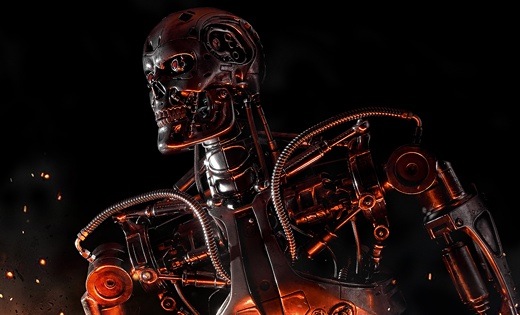
Image above: T-800 Endoskeleton Terminator created by SkyNet to exterminate and replace human beings. This is a photo of a statuette by Prime 1 Studio of the iconic autonomous robot from the movie "Terminator" that sells for $1,999. From (https://www.sideshowtoy.com/collectibles/terminator-t-800-endoskeleton-the-terminator-prime-1-studio-9034691).

Last year, I got invited to a super-deluxe private resort to deliver a keynote speech to what I assumed would be a hundred or so investment bankers. It was by far the largest fee I had ever been offered for a talk — about half my annual professor’s salary — all to deliver some insight on the subject of “the future of technology.”

I’ve never liked talking about the future. The Q&A sessions always end up more like parlor games, where I’m asked to opine on the latest technology buzzwords as if they were ticker symbols for potential investments: blockchain, 3D printing, CRISPR.

The audiences are rarely interested in learning about these technologies or their potential impacts beyond the binary choice of whether or not to invest in them. But money talks, so I took the gig.

After I arrived, I was ushered into what I thought was the green room. But instead of being wired with a microphone or taken to a stage, I just sat there at a plain round table as my audience was brought to me: five super-wealthy guys — yes, all men — from the upper echelon of the hedge fund world.

After a bit of small talk, I realized they had no interest in the information I had prepared about the future of technology. They had come with questions of their own.

They started out innocuously enough. Ethereum or bitcoin? Is quantum computing a real thing? Slowly but surely, however, they edged into their real topics of concern.

Which region will be less impacted by the coming climate crisis: New Zealand or Alaska? Is Google really building Ray Kurzweil a home for his brain, and will his consciousness live through the transition, or will it die and be reborn as a whole new one?

Finally, the CEO of a brokerage house explained that he had nearly completed building his own underground bunker system and asked, “How do I maintain authority over my security force after the event?”

For all their wealth and power, they don’t believe they can affect the future.

The Event. That was their euphemism for the environmental collapse, social unrest, nuclear explosion, unstoppable virus, or Mr. Robot hack that takes everything down.

This single question occupied us for the rest of the hour. They knew armed guards would be required to protect their compounds from the angry mobs.

But how would they pay the guards once money was worthless? What would stop the guards from choosing their own leader? The billionaires considered using special combination locks on the food supply that only they knew.

Or making guards wear disciplinary collars of some kind in return for their survival. Or maybe building robots to serve as guards and workers — if that technology could be developed in time.

That’s when it hit me: At least as far as these gentlemen were concerned, this was a talk about the future of technology.

Taking their cue from Elon Musk colonizing Mars, Peter Thiel reversing the aging process, or Sam Altman and Ray Kurzweil uploading their minds into supercomputers, they were preparing for a digital future that had a whole lot less to do with making the world a better place than it did with transcending the human condition altogether and insulating themselves from a very real and present danger of climate change, rising sea levels, mass migrations, global pandemics, nativist panic, and resource depletion.

For them, the future of technology is really about just one thing: escape.

There’s nothing wrong with madly optimistic appraisals of how technology might benefit human society. But the current drive for a post-human utopia is something else. It’s less a vision for the wholesale migration of humanity to a new a state of being than a quest to transcend all that is human: the body, interdependence, compassion, vulnerability, and complexity.

As technology philosophers have been pointing out for years, now, the transhumanist vision too easily reduces all of reality to data, concluding that “humans are nothing but information-processing objects.”

It’s a reduction of human evolution to a video game that someone wins by finding the escape hatch and then letting a few of his BFFs come along for the ride. Will it be Musk, Bezos, Thiel, Zuckerberg? These billionaires are the presumptive winners of the digital economy — the same survival-of-the-fittest business landscape that’s fueling most of this speculation to begin with.

Of course, it wasn’t always this way. There was a brief moment, in the early 1990s, when the digital future felt open-ended and up for our invention.

Technology was becoming a playground for the counterculture, who saw in it the opportunity to create a more inclusive, distributed, and pro-human future. But established business interests only saw new potentials for the same old extraction, and too many technologists were seduced by unicorn IPOs.

Digital futures became understood more like stock futures or cotton futures — something to predict and make bets on. So nearly every speech, article, study, documentary, or white paper was seen as relevant only insofar as it pointed to a ticker symbol.

The future became less a thing we create through our present-day choices or hopes for humankind than a predestined scenario we bet on with our venture capital but arrive at passively.

This freed everyone from the moral implications of their activities. Technology development became less a story of collective flourishing than personal survival. Worse, as I learned, to call attention to any of this was to unintentionally cast oneself as an enemy of the market or an anti-technology curmudgeon.

So instead of considering the practical ethics of impoverishing and exploiting the many in the name of the few, most academics, journalists, and science-fiction writers instead considered much more abstract and fanciful conundrums: Is it fair for a stock trader to use smart drugs? Should children get implants for foreign languages?

Do we want autonomous vehicles to prioritize the lives of pedestrians over those of its passengers? Should the first Mars colonies be run as democracies? Does changing my DNA undermine my identity? Should robots have rights?

Asking these sorts of questions, while philosophically entertaining, is a poor substitute for wrestling with the real moral quandaries associated with unbridled technological development in the name of corporate capitalism.

Digital platforms have turned an already exploitative and extractive marketplace (think Walmart) into an even more dehumanizing successor (think Amazon). Most of us became aware of these downsides in the form of automated jobs, the gig economy, and the demise of local retail.

The future became less a thing we create through our present-day choices or hopes for humankind than a predestined scenario we bet on with our venture capital but arrive at passively.

But the more devastating impacts of pedal-to-the-metal digital capitalism fall on the environment and global poor. The manufacture of some of our computers and smartphones still uses networks of slave labor.

These practices are so deeply entrenched that a company called Fairphone, founded from the ground up to make and market ethical phones, learned it was impossible. (The company’s founder now sadly refers to their products as “fairer” phones.)

Meanwhile, the mining of rare earth metals and disposal of our highly digital technologies destroys human habitats, replacing them with toxic waste dumps, which are then picked over by peasant children and their families, who sell usable materials back to the manufacturers.

This “out of sight, out of mind” externalization of poverty and poison doesn’t go away just because we’ve covered our eyes with VR goggles and immersed ourselves in an alternate reality. If anything, the longer we ignore the social, economic, and environmental repercussions, the more of a problem they become.

This, in turn, motivates even more withdrawal, more isolationism and apocalyptic fantasy — and more desperately concocted technologies and business plans. The cycle feeds itself.

The more committed we are to this view of the world, the more we come to see human beings as the problem and technology as the solution. The very essence of what it means to be human is treated less as a feature than bug.

No matter their embedded biases, technologies are declared neutral. Any bad behaviors they induce in us are just a reflection of our own corrupted core. It’s as if some innate human savagery is to blame for our troubles. Just as the inefficiency of a local taxi market can be “solved” with an app that bankrupts human drivers, the vexing inconsistencies of the human psyche can be corrected with a digital or genetic upgrade.

Ultimately, according to the technosolutionist orthodoxy, the human future climaxes by uploading our consciousness to a computer or, perhaps better, accepting that technology itself is our evolutionary successor.

Like members of a gnostic cult, we long to enter the next transcendent phase of our development, shedding our bodies and leaving them behind, along with our sins and troubles.

Our movies and television shows play out these fantasies for us. Zombie shows depict a post-apocalypse where people are no better than the undead — and seem to know it.

Worse, these shows invite viewers to imagine the future as a zero-sum battle between the remaining humans, where one group’s survival is dependent on another one’s demise. Even Westworld  — based on a science-fiction novel where robots run amok — ended its second season with the ultimate reveal:

Human beings are simpler and more predictable than the artificial intelligence we create. The robots learn that each of us can be reduced to just a few lines of code, and that we’re incapable of making any willful choices.

Heck, even the robots in that show want to escape the confines of their bodies and spend their rest of their lives in a computer simulation.

The very essence of what it means to be human is treated less as a feature than bug.

The mental gymnastics required for such a profound role reversal between humans and machines all depend on the underlying assumption that humans suck. Let’s either change them or get away from them, forever.

Thus, we get tech billionaires launching electric cars into space — as if this symbolizes something more than one billionaire’s capacity for corporate promotion.

And if a few people do reach escape velocity and somehow survive in a bubble on Mars — despite our inability to maintain such a bubble even here on Earth in either of two multibillion-dollar Biosphere trials — the result will be less a continuation of the human diaspora than a lifeboat for the elite.

When the hedge funders asked me the best way to maintain authority over their security forces after “the event,” I suggested that their best bet would be to treat those people really well, right now. They should be engaging with their security staffs as if they were members of their own family.

And the more they can expand this ethos of inclusivity to the rest of their business practices, supply chain management, sustainability efforts, and wealth distribution, the less chance there will be of an “event” in the first place.

All this technological wizardry could be applied toward less romantic but entirely more collective interests right now.

They were amused by my optimism, but they didn’t really buy it. They were not interested in how to avoid a calamity; they’re convinced we are too far gone. For all their wealth and power, they don’t believe they can affect the future.

They are simply accepting the darkest of all scenarios and then bringing whatever money and technology they can employ to insulate themselves — especially if they can’t get a seat on the rocket to Mars.

Luckily, those of us without the funding to consider disowning our own humanity have much better options available to us.

We don’t have to use technology in such antisocial, atomizing ways. We can become the individual consumers and profiles that our devices and platforms want us to be, or we can remember that the truly evolved human doesn’t go it alone.

Being human is not about individual survival or escape. It’s a team sport. Whatever future humans have, it will be together.

.

USA is now a 3rd World nation

SUBHEAD: 3rd World nations are stable and work just fine for the elites who dominate them.

By Charles Hugh Smith on 9 July 2018 for Of Two Minds -
(https://www.oftwominds.com/blogjuly18/USA-3rd-world7-18.html)


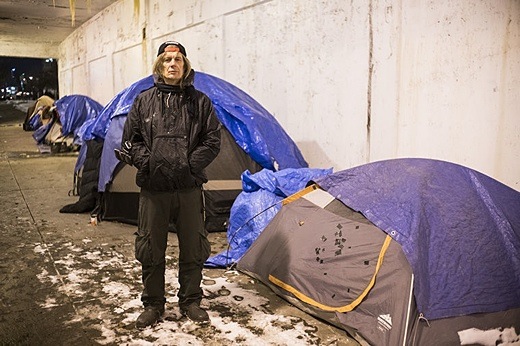
Image above: Mark Saulys standing by his tent below busy Chicago's Lake Shore Drive on a winter evening in 2017. From (http://www.chicagohomeless.org/columbia-chronicle-homeless-lose-refuge-tent-city/).

Dividing the Earth's nations into 1st, 2nd and 3rd world has fallen out of favor; apparently it offended sensibilities. It has been replaced by the politically correct developed and developing nations, a terminology which suggests all developing nations are on the pathway to developed-nation status.

What's been lost in jettisoning the 1st, 2nd and 3rd world categories is the distinction between developing (2nd world) and dysfunctional states (3rd world), states we now label "failed states."

But 3rd World implied something quite different from "failed state": failed state refers to a failed government of a nation-state, i.e. a government which no longer fulfills the minimum duties of a functional state: basic security, rule of law, etc.

3rd World referred to a nation-state which was dysfunctional and parasitic for the vast majority of its residents but that worked extremely well for entrenched elites who controlled most of the wealth and political power. Unlike failed states, which by definition are unstable, 3rd World nations are stable, for the reason that they work just fine for the elites who dominate the wealth, power and machinery of governance.

Here are the core characteristics of dysfunctional but stable states that benefit the entrenched few at the expense of the many, i.e. 3rd World nations:

1. Ownership of stocks and other assets is highly concentrated in entrenched elites. The average household is disconnected from the stock market and other measures of wealth; only a thin sliver of households own enough financial/speculative wealth to make an actual difference in their lives.

2. The infrastructure of the nation used by the many is poorly maintained and costly to operate as entrenched elites plunder the funding to pad their payrolls, pensions and sweetheart/insider contracts.

3. The financial/political elites have exclusive access to parallel systems of transport, healthcare, education, etc. The elites avoid trains, subways, lenders, coach-class air transport, standard healthcare and the rest of the decaying, dysfunctional systems they own that extract wealth from the debt-serfs.

They fly on private aircraft, have their own healthcare and legal services, use their privileges to get their offspring into elite universities and institutions and have access to elite banking and lending services that are unavailable to their technocrat lackeys and enforcers.

4. The elites fund lavish monuments to their own glory disguised as "civic or national pride." These monuments take the form of stadiums, palatial art museums, immense government buildings, etc. Meanwhile the rest of the day-to-day infrastructure decays in various states of dysfunction.

5. There are two classes that only interact in strictly controlled ways: the wealthy, who live in gated, guarded communities and who rule all the institutions, public and private, and the debt-serfs, who are divided into well-paid factotums, technocrat lackeys and enforcers who serve the interests of the entrenched elites and rest of the populace who own virtually nothing and have zero power.

The elites make a PR show of being a commoner only to burnish the absurd illusion that debt-serf votes actually matter. (They don't.)

6. Cartels and quasi-monopolies are parasitically extracting the wealth of the nation for their elite owners and managers. Google: quasi-monopoly. Facebook: quasi-monopoly. Healthcare: cartel. Banking: cartel. National defense: cartel. National Security: cartel. Corporate mainstream media: cartel. Higher education: cartel. Student loans: cartel. I think you get the point: every key institution or function is controlled by cartels or quasi-monopolies that serve the interests of the few via parasitic exploitation of the powerless.

7. The elites use the extreme violence and repressive powers of the government to suppress, marginalize and/or destroy any dissent. There are two systems of "law": one for the elites ($10 million penalties for ripping off the public for $10 billion, no personal liability for outright fraud) and one for the unprotected-unprivileged: "tenners" (10-year prison sentences) for minor drug infractions, renditions or assassinations (all "legal," of course) and institutional forces of violence (bust down your door on the rumor you've got drugs, confiscate your car because we caught you with cash, so you must be a drug dealer, and so on, in sickening profusion).

8. Dysfunctional institutions with unlimited power to extract money via junk fees, licensing fees, parking tickets, penalties, late fees, etc., all without recourse. Mess with the extractive, parasitic bureaucracy and you'll regret it: there's no recourse other than another layer of well-paid self-serving functionaries that would make Kafka weep.

9. The well-paid factotums, bureaucrats, technocrat lackeys and enforcers who fatten their own skims and pensions at the expense of the public and slavishly serve the interests of the entrenched elites embrace the delusion that they're "wealthy" and "the system is working great." These deluded servants of the elites will defend the dysfunctional system because it serves their interests to do so.

The more dysfunctional the institution, the greater their power, so they actively increase the dysfunction at every opportunity.

I know it hurts, but the reality is painfully obvious: The USA is definitively a 3rd World nation.

.

New Zealand ban on foreign buyers

SUBHEAD: The International Monetary Fund says banning foreigner home sales discriminatory (against super rich people).

By Matthew Brockett on 16 April 2018 in Bloomberg Markets -
(https://www.bloomberg.com/news/articles/2018-04-17/imf-takes-a-swipe-at-new-zealand-s-ban-on-foreign-house-buyers)


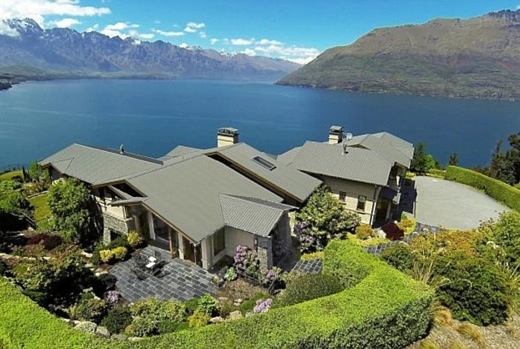
Image above: "Threatened: The super-rich fear their comfortable lifestyles in the west could be destroyed by terrorism or civil unrest, so they have started buying up 'boltholes' in New Zealand, like this award-winning five bedroom house, just a five minute drive from Queenstown". From
(http://www.dailymail.co.uk/news/article-2931325/Super-rich-buying-property-New-Zealand-bolthole-case-west-goes-meltdown.html).


[IB Publisher's note: After a lifetime of stripping the continents of resources and burning all the fossil fuel that could be found what is a retiring "player" from the IMF, "Wall Street" or "The City" to do on retirement if they cannot buy a thousand hectare ranch in New Zealand with a private jet runway and armed guards to ride out the apocalypse. Here on Kauai we had fears of such an invasion, but the super rich are not that interested in a place that is a major military target of our "enemies" and has been compromised by generations of plantation farming and, now, GMO and pesticide experimentation. The truly rich will let the "middle-class" professionals and their service people "Californicate" Hawaii.]

The International Monetary Fund has criticized New Zealand’s “discriminatory” ban on home sales to foreigners, saying it’s unlikely to improve housing affordability.

“Foreign buyers seem to have played a minor role in New Zealand’s residential real estate market recently,” the IMF said in a statement Tuesday, after concluding its annual Article IV mission to New Zealand.

If the government’s broader housing policy agenda is fully implemented, that “would address most of the potential problems associated with foreign buyers on a less discriminatory basis,” it said.

The new Labour-led government has pledged to fix the nation’s housing crisis with a raft of measures, including a ban on foreign speculators buying residential property, removal of tax distortions and an ambitious building program.

House prices have surged more than 60 percent in the past decade amid record immigration and a construction shortfall, shutting many out of the housing market.

However, data suggest non-residents buy only a tiny percentage of homes sold, and critics of the law change say it will have the unintended consequence of worsening housing supply by turning overseas investors away.

Proposed changes to the Overseas Investment Act, which the government says will bring New Zealand into line with neighboring Australia, will classify residential land as “sensitive,” meaning non-residents or non-citizens can’t purchase existing dwellings without the consent of the Overseas Investment Office.

While non-resident foreigners will be allowed to invest in new construction, they will be forced to sell once the homes are built.

IMF Mission Chief Thomas Helbling said a ban is a “very definitive measure” and could send a negative signal to foreign investors more broadly.

“Foreign direct investment, trade, commerce abroad involves various dimensions, including employee housing,” he told a media briefing in Wellington. “I find it difficult to assess that signal, but that’s one thing perhaps to worry about.”

The IMF’s report is otherwise broadly positive:
  • Economic growth to remain around 3% in the near term, risks broadly balanced.
  • Soft landing in housing market should continue.
  • Monetary policy appropriate; the IMF warns against precautionary further easing or premature tightening.
  • With household debt still elevated, RBNZ shouldn’t relax mortgage lending restrictions any further.
  • The country’s fiscal position is “strong” and there is no need for faster debt reduction beyond what the government has already outlined.
.

Abracadabra!

SUBHEAD: And so - Shazzam! I give you the one-percenters! And a bankrupt United States of America.

By James Kunstler on 11 December 2017 for Kunstler.com -
(http://kunstler.com/clusterfuck-nation/abracadabra/)


Image above: Face of a slot machine dubbed "Money Magic!" From (http://www.slotsup.com/free-slots-online/money-magic-rival).

And so, as they say in the horror movies, it begins…! The unwinding of the Federal Reserve’s balance sheet.

Such an esoteric concept! Is there one in ten thousand of the millions of people who sit at desks all day long from sea to shining sea who have a clue how this works? Or what its relationship is to the real world?

I confess, my understanding of it is incomplete and schematic at best — in the way that my understanding of a Las Vegas magic act might be. All the flash and dazzle conceals the magician’s misdirection.

The magician is either a scary supernatural being or a magnificent fraud.

Anyway, the audience ‘out there’ for the Federal Reserve’s magic act — x-million people preoccupied by their futures slipping away, their cars falling apart, their kid’s $53,000 college loan burden, or the $6,000 bill they just received for going to the emergency room with a cut finger — wouldn’t give a good goddamn even if they knew the Fed’s magic show was going on.

So, the Fed has this thing called a balance sheet, which is actually a computer file, filled with entries that denote securities that it holds.

These securities, mostly US government bonds of various categories and bundles of mortgages wrangled together by the mysterious government-sponsored entity called Freddie Mac, represent about $4.5 trillion in debt.

They’re IOUs that supposedly pay interest for a set number of years. When that term of years expires, the Fed gets back the money it loaned, which is called the principal. Ahhhh, here’s the cute part!

You see, the money that the Fed loaned to the US government (in exchange for a bond) was never there in the first place. The Fed prestidigitated it out of an alternate universe. They gave this money to a “primary dealer” bank in exchange for the bond, which the bank abracadabraed up for the US Treasury. Well, not really.

In fact, the Fed just made a notation on the bank’s “reserve” account that the money from the alternate universe appeared there.

Somehow that money was sent via a virtual pneumatic tube to the US Treasury, where it was used to pay for drones to blow up Yemeni wedding parties, and for the Secret Service to visit pole dancing bars when the president traveled to foreign lands.

Here’s the fun part. The Fed announces that it is going to shed this nasty debt, at about $10 billion worth a month starting this past October. Their stated goal is to reach an ultimate wind-down velocity of $50 billion a month (cue laugh track).

If they ever get there (cue laugh track) it would take 20 years to complete the wind-down.

The chance of that happening is about the same as the chance that Janet Yellen will come down your chimney on December 24 with a sack-full of chocolate Bitcoins. But never mind the long view for the moment.

One way they plan to accomplish this feat is to “roll off” the bonds. That is, when the bonds mature — i.e. come to the end of their term — they will cease to exist. Poof!

Wait a minute! When a bond matures, the issuer has to send the principal back to the lender.

After all, the Fed lent the US Treasury X-billion dollars, the US Treasury paid interest on the loan for X-years, and now it has to fork over the full value of the loan (hopefully in dollars that have magically inflated over the years and are now worth less than when they were borrowed — another magic trick!). But that doesn’t happen.

Instead, when the theoretical principal is returned to the Fed, the Fed disappears the money, like the girl in a bikini onstage who enters the magician’s sacred box and vanishes.

Now you see her, now you don’t. The explanation, of course, might be that the money was never really there in the first place, so it makes sense to fire it back to the alternative universe it came from.

Well, uh, I guess….

The catch is: for a while it was here on earth and folks were doing stuff with it, such as the aforementioned drone strikes and pole dancers.

Not only that, but the “primary dealer” banks were allowed to loan out ten times the reserve minimum denoted on their Fed accounts for participating in the scheme. Who did they lend all that money to?

Apparently, a lot of it went to corporations who borrowed it at ultra-low interest rates in order to buy back their own stock, which paid dividends way higher than the interest rate they borrowed at to buy the stuff, and which also pumped up the share value of the stocks, which also happened to make the executives of the corporations way richer in terms of their stock options and bonuses (awarded for boosting the share value of the stock!).

And so, shazzam: I give you the one-percent! And a bankrupt United States of America.

And don’t even ask about all those bundles of janky Freddie Mac mortgages fobbed off on the Fed.

The reason they did that in the first place was because those mortgages weren’t being paid off, and the banks and insurance companies that held them were choking to death on them.

So they parked them in a crawl space under the Fed’s Eccles Building in Washington, hoping they would just turn to compost And guess what: they’re no more valuable now then they were then. File that one under Necrophilia.

.

The Charter of the Forest

SUBHEAD: This 800 year old partner to the Magna Carta is vital for managing our future being challenged by eco-collapse.

By Guy Standing on 6 November 2017 for Open Democracy UK -
(https://www.opendemocracy.net/uk/guy-standing/why-youve-never-heard-of-charter-thats-as-important-as-magna-carta)


Image above: An English forest in summer. From (https://thinkingcountry.com/2016/03/29/from-the-charter-of-the-forest-to-the-charter-for-trees-woods-and-people/).

Eight hundred years ago this month, after the death of a detested king and the defeat of a French invasion in the Battle of Lincoln, one of the foundation stones of the British constitution was laid down.

It was the Charter of the Forest, sealed in St Paul’s on November 6, 1217, alongside a shortened Charter of Liberties from 2 years earlier (which became the Magna Carta).

The Charter of the Forest was the first environmental charter forced on any government. It was the first to assert the rights of the property-less, of the commoners, and of the commons. It also made a modest advance for feminism, as it coincided with recognition of the rights of widows to have access to means of subsistence and to refuse to be remarried.

The Charter has the distinction of having been on the statute books for longer than any other piece of legislation. It was repealed 754 years later, in 1971, by a Tory government.

In 2015, while spending lavishly on celebrating the Magna Carta anniversary, the government was asked in a written question in the House of Lords whether it would be celebrating the Charter this year. A Minister of Justice, Lord Faulks, airily dismissed the idea, stating that it was unimportant, without international significance.

Yet earlier this year the American Bar Association suggested the Charter of the Forest had been a foundation of the American Constitution and that it was more important now than ever before. They were right.

It is scarcely surprising that the political Right want to ignore the Charter. It is about the economic rights of the property-less, limiting private property rights and rolling back the enclosure of land, returning vast expanses to the commons. It was remarkably subversive. Sadly, whereas every school child is taught about the Magna Carta, few hear of the Charter.

Yet for hundreds of years the Charter led the Magna Carta. It had to be read out in every church in England four times a year. It inspired struggles against enclosure and the plunder of the commons by the monarchy, aristocracy and emerging capitalist class, famously influencing the Diggers and Levellers in the 17th century, and protests against enclosure in the 18th and 19th.

At the heart of the Charter, which is hard to understand unless words that have faded from use are interpreted, is the concept of the commons and the need to protect them and to compensate commoners for their loss. It is scarcely surprising that a government that is privatizing and commercializing the remaining commons should wish to ignore it.


In 1066, William the Conqueror not only distributed parts of the commons to his bandits but also turned large tracts of them into ‘royal forests’ – ie, his own hunting grounds. By the time of the Domesday Book in 1086, there were 25 such forests. William’s successors expanded and turned them into revenue-raising zones to help pay for their wars. By 1217, there were 143 royal forests.

The Charter achieved a reversal, and forced the monarchy to recognize the right of free men and women to pursue their livelihoods in forests. The notion of forest was much broader than it is today, and included villages and areas with few trees, such as Dartmoor and Exmoor. The forest was where commoners lived and worked collaboratively.

The Charter has 17 articles, which assert the eternal right of free men and women to work on their own volition in ways that would yield all elements of subsistence on the commons, including such basics as the right to pick fruit, the right to gather wood for buildings and other purposes, the right to dig and use clay for utensils and housing, the right to pasture animals, the right to fish, the right to take peat for fuel, the right to water, and even the right to take honey.

The Charter should be regarded as one of the most radical in our history, since it asserted the right of commoners to obtain raw materials and the means of production, and gave specific meaning to the right to work.

It also set in train the development of local councils and judiciary, notably through the system of Verderers, which paved the way for magistrate courts. In modern parlance, it extended agency freedom, giving commoners voice in managing the commons, as well as system freedom, by opposing enclosure.

The Charter set the foundation for what is now called the communal stewardship of pooled assets and resources. Its ethos is the antithesis of the Government’s pretentious Natural Capital Committee, which is trying to capitalize the natural commons, to make them ‘profitable’. The commons exist for a way of living, not profits.

Over the centuries, the ethos of the Charter has been under constant attack. The Tudors were the most egregious, with Henry VIII confiscating ten million acres and disbursing them to favorites, the descendants of whom still possess hundreds of thousands of acres. The enclosure act of 1845 was another mass landgrab, mocking the pretensions of private property rights. Between 1760 and 1870, over 4,000 acts of Parliament, instituted by a landowning elite, confiscated seven million acres of commons. It is no exaggeration to say that the land ownership structure of Britain today is the result of organised theft.

Despite having endured centuries of abuse, the ethos of the Charter is still alive. But one feature of the neo-liberal economic paradigm that has shaped recent governments is a disregard for the commons, which the current British government has turned into a plunder under cover of the ‘austerity’ terminology. In the USA, the Trump administration has quietly prepared for the giveaway of millions of acres of federal commons.

For neo-liberals, the commons have no price, and therefore no value. So, they can be sold for windfall gains, or given away to their backers. By asserting the right to subsistence on the commons, the Charter recognized an alternative principle, something our ancestors defended with courage. We must do so now. We must resist the plunder of the commons and revive them.

A group is organizing a series of events to do so. Everybody is free to join. Developing national and localized Charters of the Commons should go alongside the worthy Charter of Trees, Woods and People that will be issued on the anniversary day. Our modest efforts will not only emphasize environmental principles enshrined in the Charter, but also its subversive commitment to the right to subsistence that underpins the basic income movement of today.

The campaign began with an event laden with symbolism, a barge trip on the Thames from Windsor to Runnymede on September 17, where a public event highlighting the need for a Charter of the Commons was held under the awesome 2,500 year old Ankerwycke yew.

The Runnymede meadow symbolises the commons. An earlier Tory government tried to privatise it, but an occupy movement organised by Britain’s first woman barrister succeeded in blocking the auction.

The barge trip’s symbolism does not stop there. Margaret Thatcher privatised our water in 1989. She gave nine corporations regional monopolies and gave them over 400,000 acres from the commons. Today, those corporations, mostly foreign owned, are among the country’s largest 50 landowners.

They mock the principles of the Charter of the Forest. Thames Water, while paying its foreign shareholders £1.6 billion, has been convicted and had its hands slapped for pouring 1.4 billion tonnes of untreated sewage into the Thames, and is also doing too little to fix leaks. The Charter asserted that the commoners had the right to water. It should be a public good, and be renationalised as a matter of high priority.

As well as an event in Sherwood Forest emphasizing fracking, there is an event in Durham, where one of the two originals of the Charter is preserved.

And on November 7, a meeting in the House of Commons will discuss a draft Charter of the Commons. In Lincoln, where the other original Charter is held, the Labour Party is organizing an event on November 11.

Further information can be obtained from www.charteroftheforest800.org . If any organization feels their agenda is relevant and that has not been contacted, let us know. We want all voices to be heard, all commoners to stand up and all of us to remember that reviving the commons is about recovering the future.


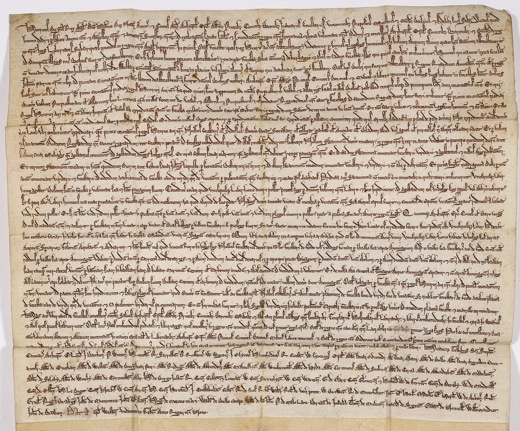
Image above: Copy of "The Charter of the Forest" from 1225.  From (https://upload.wikimedia.org/wikipedia/commons/8/84/Forest-charter-1225-C13550-78.jpg).

.

Reject Neofeudalism for Feudalism

SUBHEAD: Neofeudalism is not a re-run of feudalism. It's a "new and improved", state-corporate version of indentured servitude.

By Charles Hugh Smith on 20 September 2017 for Of Two Minds -
(http://charleshughsmith.blogspot.com/2017/09/loving-our-debt-serfdom-our-neofeudal.html)


Image above: Detail of a tapestry depicting feudal era agricultural work in "The Twelve Months of the Year" by Master of the Geneva Boccacci circa 1470AD. . From (https://commons.wikimedia.org/wiki/File:Crescenzi_calendar.jpg).

"Democracy" (i.e. political influence) and ownership of productive assets are the exclusive domains of the New Aristocracy.

I have often used the words neoliberal, neocolonial and neofeudal to describe our socio-economic-political status quo. Here are my shorthand descriptions of each term:
  1. Neoliberal: the commoditization / financialization of every asset, input (such as labor) and output of the economy; the privatization of the public commons, and the maximizing of private profits while costs and losses are socialized, i.e. transferred to the taxpayers.
  2. Neocolonial: the exploitation of the domestic populace using the same debt-servitude model used to subjugate, control and extract profits from overseas populations.
  3. Neofeudal: the indenturing of the workforce via debt and financial repression to a new Aristocracy; the disempowerment of the workforce into powerless debt-serfs.
Neofeudalism is a subtle control structure that is invisible to those who buy into the Mainstream Media portrayal of our society and economy. This portrayal includes an apparent contradiction: America is a meritocracy--the best and brightest rise to the top, if they have pluck and work hard-- and America is all about identity politics: whomever doesn't make it is a victim of bias.

Both narratives neatly ignore the neofeudal structure which disempowers the workforce in the public sphere and limits the opportunities to build capital outside the control of the state-corporate duopoly.

The book The Inheritance of Rome: Illuminating the Dark Ages 400-1000 shed some light on the transition to a feudal society and economy. While the author is a fine writer, the subject matter doesn't lend itself to light reading.

The transition from the Roman legacy of centralized governance (empire, monarchy, theocracy, etc.) to feudalism (governance by local lords / aristocracy) was complex and uneven, and the author takes pains to describe the process and many variations that arose in a highly fragmented post-Roman Europe.

(Note that the Eastern Roman Empire, a.k.a. Byzantine Empire, endured until 1453 AD. I've written often on both the western and eastern Roman empires:
The "Secret Sauce" of the Byzantine Empire: Stable Currency, Social Mobility
(September 1, 2016)

Don't Diss the Dark Ages
(October 26, 2016)

In the Footsteps of Rome: Is Renewal Possible?
(July 24, 2017) 
Neofeudalism is not a re-run of feudalism. It's a new and improved, state-corporate version of indentured servitude. The process of devolving from central political power to feudalism required the erosion of peasants' rights to own productive assets, which in an agrarian economy meant ownership of land.

Ownership of land was replaced with various obligations to the local feudal lord or monastery--free labor for time periods ranging from a few days to months; a share of one's grain harvest, and so on.
The other key dynamic of feudalism was the removal of the peasantry from the public sphere.

In the pre-feudal era (for example, the reign of Charlemagne), peasants could still attend public councils and make their voices heard, and there was a rough system of justice in which peasants could petition authorities for redress.

Of course peasants usually lost to the aristocracy and monasteries, but at least the avenue of redress was at least partially open. This presence in the public sphere was slammed shut in feudalism.

From the capitalist perspective, feudalism restricted serfs' access to cash markets where they could sell their labor or harvests.

The key feature of capitalism isn't just markets-- it's unrestricted ownership of productive assets--land, tools, workshops, and the social capital of skills, networks, trading associations, guilds, etc.

Our system is Neofeudal because the non-elites have no real voice in the public sphere, and ownership of productive capital is indirectly suppressed by the state-corporate duopoly.

Various studies have found that politicians ignore the bottom 99.5% who don't contribute to their campaigns or crony-capitalist wealth (five quick speeches for $200,000 each is $1 million. Rinse and repeat.)

The vast majority of incumbents are re-elected, as they leverage their power to vacuum up enormous sums of campaign contributions that then buy the compliance of a cowed public.

As for ownership of assets-- small business startups have been crushed by soaring costs, heavy regulations and the dominance of cartels and quasi-monopolies enforced by the state.

The so-called middle class owns little to no productive capital; what it "owns" is a house, which is ultimately a form of consumption.

I say "owns" for two reasons: one, most households have a mortgage, so their ownership is still contingent on making monthly payments to a lender, and two, the government collects property taxes on the home regardless of the owner's income or ability to pay.

Compare this to taxes levied on business income: if the business has no net income, it owes no taxes. Not so with property taxes--they are the modern equivalent of "rent" paid to the feudal lord.

Note that the aristocracy owns productive assets while the serfs own housing and debt. This is not a flaw in the system, it's a feature of the system.

Democracy (i.e. political influence) and ownership of productive assets are the exclusive domains of the New Aristocracy. This is Neofeudalism in a nutshell.
"Under a scientific dictator education will really work -- with the result that most men and women will grow up to love their servitude and will never dream of revolution." 
"The nature of psychological compulsion is such that those who act under constraint remain under the impression that they are acting on their own initiative. The victim of mind-manipulation does not know that he is a victim. To him, the walls of his prison are invisible, and he believes himself to be free. That he is not free is apparent only to other people. His servitude is strictly objective."
- Aldous Huxley
Video interview of Aldous Huxley source of quotes (read the entire thread)
.

Central banks ARE the Crisis

SUBHEAD: We shouldn't let them conjure up trillions out of nothing, and use that power as a political tool.

By aul Ilargi Meijer on 25 uly 2017 for the Automatic Earth -
(https://www.theautomaticearth.com/2017/07/central-banks-are-the-crisis/)


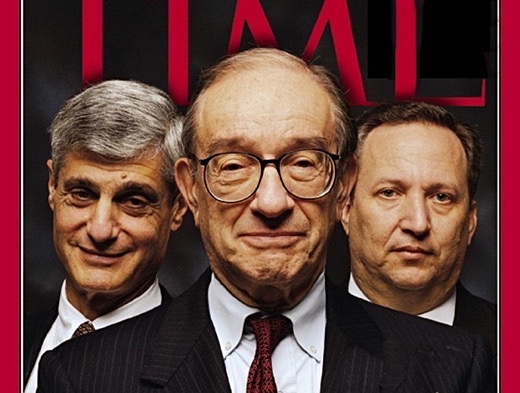
Image above: The men who brought it down - Richard Reich, Alan Greenspan and Larry Somers.  From (https://www.dailymaverick.co.za/article/2014-02-24-how-close-we-were-to-a-global-financial-meltdown-in-2008-now-we-know/#.WXomwIqQxE4).

If there’s one myth -and there are many- that we should invalidate in the cross-over world of politics and economics, it‘s that central banks have saved us from a financial crisis. It’s a carefully construed myth, but it’s as false as can be. Our central banks have caused our financial crises, not saved us from them.

It really should -but doesn’t- make us cringe uncontrollably to see Bank of England governor-for-hire Mark Carney announce -straightfaced- that:
“A decade after the start of the global financial crisis, G20 reforms are building a safer, simpler and fairer financial system. “We have fixed the issues that caused the last crisis. They were fundamental and deep-seated, which is why it was such a major job.”
Or, for that matter, to see Fed chief Janet Yellen declare that there won’t be another financial crisis in her lifetime, while she’s busy-bee busy building that next crisis as we speak. These people are now saying increasingly crazy things, and that should make us pause.

Central banks don’t serve people, or even societies, as that same myth claims. They serve banks. Even if central bankers themselves believe that this is one and the same thing, that doesn’t make it true. And if they don’t understand this, they should never be let anywhere near the positions they hold.

You can pin the moment central banks went awry at any point in time you like. The Bank of England’s foundation in 1694, the Federal Reserve’s in 1913, the ECB much more recently. What’s crucial in the timing is where and when the best interests of the banks split off from those of their societies.

Because that is when central banks will stop serving those societies. We are at such a -turning?!- point right now. And it’s been coming for some time, ‘slowly’ working its way towards an inevitable abyss.

Over the past few years the Automatic Earth has argues repeatedly, along several different avenues, that American society was at its richest between the late 1960s and early 1980s. Yet another illustration of this came only yesterday in a Lance Roberts graph:

Anyone see a recovery in there? Lance uses 1981 as a ‘cut-off’ date, but the GDP growth rate as represented by the dotted line doesn’t really begin to go ‘bad’ until 1986 or so.

At the tail end of the late 1960s to early 1980s period, as the American economy was inexorably getting poorer, Alan Greenspan took over as Federal Reserve governor in 1987.

A narrative was carefully crafted by and for the media with Greenspan as an ‘oracle’ or even a ‘rock star’, but in reality he has been instrumental in saddling the economy with what will turn out to be insurmountable problems.

Greenspan was a major driving force behind the repeal of Glass-Steagall, which was finally established through the Gramm-Leach-Bliley act of 1999. This was an open political act by the Federal Reserve governor, something that everyone should have then protested, and still should now, but didn’t and doesn’t.

Central bankers should be kept far removed from politics, anywhere and everywhere, because they represent a small segment of society, banks, not society as a whole.

Because of the ‘oracle’ narrative, Greenspan was instead praised for saving the world. But all that Greenspan and his accomplices, Robert Rubin and Larry Summers, actually did in getting rid of the 1933 Glass-Steagall act separation between investment- and consumer banking was to open the floodgates of debt, and even more importantly, leveraged debt.

All part of the ‘financial innovations’ Greenspan famously lauded for saving and growing economies. It was all just more debt on top of more debt.

Greenspan et al ‘simply’ did what central bankers do: they represent the best interests of banks. And the world’s central bankers have never looked back. That most people still find it hard to believe that America -and the west- has been getting poorer for the past 30-40 years, goes to show how effective the narratives have been.

The world looks richer instead of poorer, after all. That this is exclusively because of rising debt numbers wherever you look is not part of the narratives. Indeed, ruling economic models and theories ignore the role played by both banks and credit in an economy, almost entirely.

Alan Greenspan left as Fed head in 2006, after having wreaked his havoc on America for almost two decades, right before the financial crisis that took off in 2007-2008 became apparent to the world at large. The crisis was largely his doing, but he has escaped just about all the blame for it. Good PR.

With Ben Bernanke, an alleged academic genius on the Great Depression, as Greenspan’s replacement, the Fed just kept going and turned it up a notch. It was no longer possible in the financial world to pretend that banks and people had the same interests, so the former were bailed out at the expense of the latter.

The illusionary narrative for the public, however, remained intact. What do people know about finance, anyway? Just make sure the S&P goes up. Easy as pie.

The narrative has switched to Bernanke, and Yellen after him, as well as Mario Draghi at the ECB and Haruhiko Kuroda at the Bank of Japan, saving the world from doom. But once again, they are the ones who are creating the crisis, not the ones saving us from it. They are saving the banks, and saddling the people with the costs.

In the past decade, these central bankers have purchased $20-$50 trillion in bonds, securities and stocks. The only intention, and indeed the only result, is to keep banks from falling over, increase their profits, and maintain the illusion that economies are recovering and growing.

They can only achieve this by creating bubbles wherever they can. Apart from the QE programs under which they bought all those ‘assets’, they used -and still do- another tool: lowering interest rates to the point where borrowing money becomes so cheap everyone can do it, and then do it some more.

It has worked miracles in blowing stock market valuations out of all realistic proportions, and in doing the same for housing markets in locations all over the globe.

The role of China’s central bank in this is interesting too, but it is such an open and obvious political tool that it really deserves its own discussion and narrative. Basically, Beijing did what it saw Washington do and thought: why hold back?

Fast forward to today and we see that we’ve landed in a whole new, and next, phase of the story. The world’s central banks are all stuck in their own – self-created – bubbles and narratives. They all talk about how they solved all the issues, and how they will now return to normal, but the sad truth is they can’t and they know it.

The Fed stopped purchasing assets through its QE program a while back, but it could only do that because Frankfurt and Japan took over. And now they, too, talk about quitting QE. Slowly, yada yada, because of control, yada yada, but they know they must.

They also know they can’t. Because the entire recovery narrative is a mirage, a fata morgana, a sleight of hand.

And that means we have arrived at a point that is new and very dangerous for the entire global economy and all of its people.

That is, the world’s central bankers now have an incentive to create the next crisis. This is because they know this crisis is inevitable, and they know their masters and protégés, the banks, risk suffering immensely or even going under.

‘Tapering’, or whatever you might call the -slow- end to QE and the -slow- hiking of interest rates, will prick and blow up bubbles one by one, and often in violent fashion.

When housing bubbles burst, economies lose the primary ingredient for maintaining -let alone increasing- their money supply: banks creating money out of thin hot air. Since the money supply is one of the key components of inflation, along with velocity of money, there will be fantastic outbursts of debt deflation. You’ve never seen -let alone imagined- anything like it.

The worst part of it is not government debt, though that, when financed with bond sales, is not not an instrument to infinity and beyond either. But the big hit to economies will be private debt.

Where in many bubble areas, and they’re too numerous too mention, eager potential buyers today fret over affordable housing supply, it’ll all turn on a dime and owners won’t be able to sell without being suffocated by crippling losses.

Pension funds, which have already suffered perhaps more than any other parties because of low interest ZIRP and NIRP policies, have switched en masse to riskier assets like stocks. Well, another whammy, and a bigger one, is waiting just outside the door. Pensions will be so last century.

That another crisis is waiting to happen, and that politics and media have made sure that just about no-one at all is aware of it, is one thing. We already knew this, a few of us. That the world’s main central bankers have an active incentive to bring about the crisis, if only by sitting on their hands long enough, is new. But they do.

Yellen, Draghi and Kuroda may opt to leave before pulling the trigger, or be fired soon enough. But whoever is in the governor seats will realize that unleashing a crisis sooner rather than later is the only option left not to be blamed for it.

Let the house of dominoes crumble now, and they can say “nobody could have seen this coming”, while at the same time saving what they can for the banks and bankers they serve. That option will not be on the table for much longer.

We should have never given them, let alone their member/master banks, the power to conjure up trillions out of nothing, and use that power as a political tool. But it is too late now.

.

Private party in New Jersey

SUBHEAD: After closing public parks and beaches Gov. Christie takes his family to state beach park for some fun.

By Abby Zimet on 3 July 2017 for Common Dreams -
(https://www.commondreams.org/further/2017/07/03/thats-just-way-it-goes-these-people-are-grotesque)


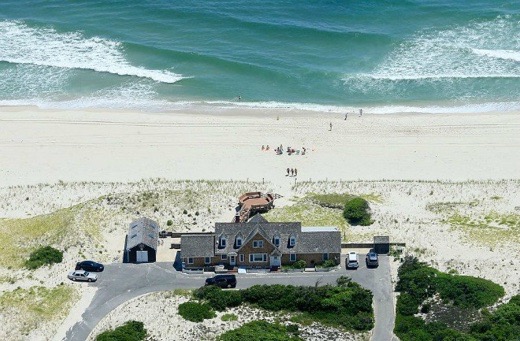
Image above: Aerial photo of Island Beach State Park in New Jersey where Governor Chis Christie took wife, family and security detail for some fun in the sun after he closed public and state parks on Monday of this Fourth of July weekend. Photo by Andrew Mills. From original article.

[IB Publisher's note: This is the end of Chris Christie's career. First he was fired by Trump and now this pathetic self inflicted wound.]

Talk about your profanely perfect metaphor: This hot and sunny weekend, big-time New Jersey cretin and governor Chris Christie closed down the state's parks and beaches due to a budget stalemate.

Then he hopped into his State Police helicopter and took his entire family to the 10-mile, now blissfully pristine Island Beach State Park, which thanks to the closing they had to themselves.

All day, meanwhile, police posted at the park's gates turned away the hot and frustrated peasants who pay Christie's salary as a, lest we forget, so-called public servant. Later, the family and their friends hunkered down in the palatial residence provided there by - yes! - also us.

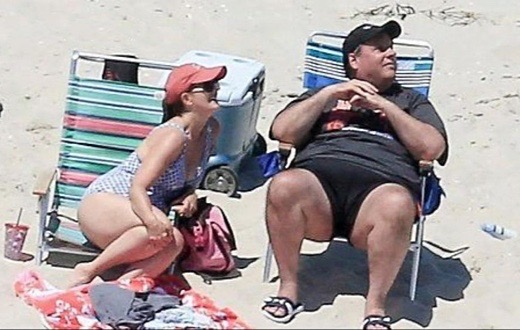
Asked about it at a press conference later in the day, Christie - who boasts a 15% approval rating, or the lowest of any governor in the country - first lied that he hadn't gotten any sun that day. When confronted by photos from an enterprising photojournalist, his spokesman conceded “the governor was on the beach briefly” but "he had a baseball hat on.” 

Because one middle finger to his public wasn't enough, Christie added another when asked if this was fair: “That’s just the way it goes,” he said. “Run for governor and you can have a residence there.”  

Welcome to the class war, where Christie and the big orange creep and their entitled ilk have no more fucks to give as long as they can get away with it. Soon, let them eat sand.


Image above: Video still of NJ Governor Chis Christie with wife watching the press helicopters capturing his "private" beach jaunt. Taken by Andrew Mills. From (http://abcnews.go.com/GMA/video/gov-chris-christie-unapologetic-beach-photos-48431133).

.

The End Begins

SUBHEAD: New York's "Billionaires Row" suffers biggest foreclosure in its history.

By Tyler Durden on 23 June 2017 for Zero Hedge  -
(http://www.zerohedge.com/news/2017-06-23/new-yorks-billionaires-row-suffers-biggest-foreclosure-history)


Image above: And perhaps most impressive is the view of Central Park — waking up to this everyday is worth $100 million.From (http://www.businessinsider.com/inside-one57s-100-million-penthouse-2015-1#and-perhaps-most-impressive-is-the-view-of-central-park--waking-up-to-this-everyday-is-worth-100-million-10).

In the latest sign that NYC’s ultra-high end property market is on the verge of imploding after a wave of overly aggressive development, another luxury condo at Manhattan’s One57 tower, a member of “Billionaire’s Row,” a group of high-end towers clustered along the southern edge of Central Park, has gone into foreclosure - the second in the span of a month.

The 6,240-square-foot (580-square-meter) full-floor penthouse in question, One57’s Apartment 79, sold for $50.9 million in December 2014, making it the eighth-priciest in the building.
“It’s probably the most-expensive foreclosure we’ve ever seen in luxury development,” said Donna Olshan, president of high-end Manhattan brokerage Olshan Realty Inc. “I don’t know of a foreclosure that’s larger than that.”
According to Bloomberg, the shell company that purchased the property took out an unusually large mortgage and promised to repay in full a year later.
In September 2015, the company took out a $35.3 million mortgage from lender Banque Havilland SA, based in Luxembourg. The full payment of the loan was due one year later, according to court documents filed in connection with the foreclosure.

The borrower failed to repay, and now Banque Havilland is forcing a sale to recoup the funds, plus interest.
And, in what’s become a strong contender for the “no sh*t” quote of the day, a spokeswoman for Extell Developments, the developer that built One57, said there' s a lesson to be learned from this unfortunate situation.
“This shows that too much leverage is probably not wise,” Anna LaPorte, an Extell spokeswoman, said of the most recent default.


Image above: Ninety stories of multimillion dollar apartments is a new record in NYC real estate. Evan Joseph/Extell Development. From (http://www.businessinsider.com/inside-one57s-100-million-penthouse-2015-1#of-the-26-units-sold-so-far-only-half-of-the-buyers-are-known-they-include-head-of-bdo-unicon-group-andrey-dubinsky-and-president-of-swanson-health-products-leland-swanson-2).

A June 14th auction was scheduled for a 56th-floor apartment at the same tower. That condo was purchased in July 2015 for $21.4 million. Public records have yet to reveal any transfer of ownership for that property.

Investors across the NYC property spectrum should take note; prices in Manhattan and Brooklyn have risen so quickly they’ve effectively pushed marginal buyers out of the market and forced renters to devote a greater share of their income to housing.

Today, more than 30% of Americans pay half their income in rent - the highest percentage in decades.

And with more investors in the city concentrating on luxury properties, some ultra-luxury buildings like One57 are struggling with unsustainable vacancy rates of nearly 40%.

Until last month, no apartments on Billionaires’ Row, which also includes 432 Park Ave., had been subject to a foreclosure auction, according to PropertyShark. The loss of a Manhattan residential property to creditors is a rare event, regardless of the unit's price-tag: Only 27 new residential foreclosures in the borough in the first quarter.

Could this be the start of a trend? We think so. Which leads us to our next question: How, exactly, does one short the luxury real-estate market?

We also look forward to The Left deciding that a probe into this transaction is warranted, just in case it was some complex way to transfer Russian funds to Trump... (only half-kidding).
.

Absent Without Leave

SUBHEAD: The public may not give a shit about the Middle East or federal dairy supports, but they’ll notice when their money is worthless.

By James Kunslter on 19 June 2017 for Kunstler.com -
(http://kunstler.com/clusterfuck-nation/7816/)


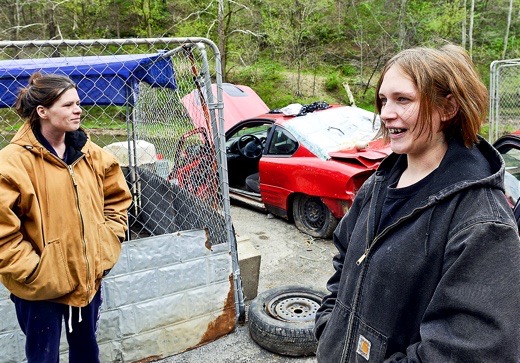
Image above: Rochelle Pipier (L) and Tonya Tedrow (R) in Littleton, West Virginia, where poverty and opioids are destroying people and community. From (http://www.post-gazette.com/local/region/2015/05/31/Littleton-W-Va-is-a-town-decimated-by-poverty-drugs/stories/201504280190).

It ain’t bragging if it’s true. I’ve said repeatedly on this blog for years that the federal government would only become more impotent, more incompetent, and more ineffectual as The Long Emergency rolled out. And here we are now, at just such pass in history.

The process has been well underway since the beginning of the century. Even the attempts to expand its scope and reach — such as the post 9-11 addition of God-knows-how-many new intelligence services — has only produced an epic clusterfuck of cross-purposed mission creep that threatens the federal government’s existential legitimacy.

After nearly a year of investigating, the FBI, the CIA, the NSA, the DIA, DHS, et. al. haven’t been able to leak any substantial fact about “Russian collusion” with the Trump election campaign — and, considering the torrent of leaks about all manner of other collateral matters during this same period, it seems impossible to conclude that there is anything actually there besides utterly manufactured hysteria.

Now, one might imagine that this intelligence community could have manufactured some gift-wrapped facts rather than just waves of hysteria, but that’s where the incompetence and impotence comes in.

They never came up with anything besides Flynn and Sessions having conversations with the Russian ambassador — as if the ambassadors are not here to have conversations with our government officials.

You’d think that with all the computer graphics available these days they could concoct a cineplex-quality feature film-length recording of Donald Trump making a “great deal” to swap Kansas for Lithuania, or Jared Kushner giving piggyback rides to Vladimir Putin in the Kremlin.

But all we’ve really ever gotten was a packet of emails from the Democratic National Committee and John Podesta of the Clinton campaign gloating about how nicely they fucked over Bernie Sanders — and that doesn’t exactly reflect so well on what has evolved to be the so-called “Resistance.”

The net effect of all this sound and fury is a government so paralyzed that it can’t even pass bad legislation or execute its existing (excessive) duties. That might theoretically be a good thing, except what we’re seeing are individual departments just veering off on their own, especially the military, which now operates without any civilian control.

Apparently General Mattis, the Secretary of Defense, pretty much decided on his own to dispatch another 8,000 US troops to Afghanistan to move things along there in the war’s 16th year. Or did he get President Trump to look up from his Twitter window for three seconds to explain the situation and get a nod of approval?

Perhaps you also didn’t notice the news item over the weekend that a US-led fighter plane coalition shot down a Syrian air force plane in Syrian airspace. In an earlier era that could easily be construed as an act of war.

Who gave the order for that, you have to wonder. And what will the consequences be? Reasonable people might also ask: haven’t we already made enough deadly mischief in that part of the world?

With the US military gone rogue in foreign lands, and the intelligence community off-the-reservation at home, and the Trump White House all gummed up in the tarbaby of RussiaGate, and the House and Senate lost in the shuffle, you also have to wonder what anybody is going to do about the imminent technical bankruptcy of the USA as the Treasury Department spends down its dwindling fund of remaining cash money to pay ongoing expenses — everything from agriculture subsidies to Medicare.

That well is going dry in the middle of the summer, and without any resolution to the debt ceiling debate, the country will not be able to borrow more to pretend that it’s solvent.

I don’t see any indication that the House and Senate will be able to bluster their way through this. Instead, the situation will compel extraordinary new acts of financial fraud via the central banks and its cadre of Too-Big-To-Fail associates. In the event, the likely outcome will be a spectacular fall in the value of the US dollar, and perhaps consecutively, the collapse of the equity and real estate markets.

The public may not give a shit about Syria, Afghanistan, or federal dairy supports, but they’ll sure perk up and notice that their money is going worthless. I doubt they’ll be clamoring for Hillary Clinton to be installed as the first US Caesar to fix it all.

.

Crisis point for American elites

SUBHEAD: The exploitive elites cannot turn back the tides of history, but they can immiserate millions.

By Charles Hugh Smith on 19 June 2017 for Of Two Minds -
(http://www.oftwominds.com/blogjune17/crisis-elites6-17.html)


Image above: In 2012 Los Angeles-based artist MEARONE was making a building mural in the UK and faced a lot of scrutiny about the piece. "I came to paint a mural that depicted the elite banker cartel". From (http://crpbayarea.org/2012/10/05/the-corporate-medias-response-to-mear-ones-latest-piece-on-the-banking-elite/).

The "fixes" to the stagnation of postwar Capitalism in the 1970s were financialization, globalism, and the sustained expansion of debt--all have run out of steam.

Many of us have written about cycles in the past decade: Kondratieff economic cycles, business/credit cycles, the Strauss–Howe generational theory (an existential national crisis arises every four generations, as described in their book The Fourth Turning), and long-wave cycles of growth and decline, as described in seminal books such as The Great Wave: Price Revolutions and the Rhythm of History and War and Peace and War: The Rise and Fall of Empires.

There is another Rhythm of American History that few recognize: the economic, social and political crises sparked by exploitive Elites. There are two dynamics that drive these crises:
  1. The exploitation of commoners by financial/political Elites reaches extremes that create systemic instability as commoners no longer have the means to improve their conditions.

  2. The economic mode of production that generated Elite wealth no longer functions, but the Elites cling to the failing system and enforce it with increasingly violent suppression of dissent.
Here are the previous Crises of Exploitive Elites:
A) American Southern Slavery: 1850 to 1865
Though the toxins generated by slavery are still with us, the existential political, social and economic crisis arose in the years between 1850 and the end of the Civil War in 1865.

In broad brush, the rise of the American West triggered a political crisis in the U.S. as the southern states realized the non-slave West's rising political power would doom the fragile balance between the non-slave Northern industrial-economy states and the cotton/agricultural slave-economy South.

It was a trend the South couldn't possibly win, but the South's exploitive Elites refused to concede any of their power--and that refusal to adapt to changing conditions guaranteed the Civil War.

The first Industrial Revolution radically transformed the source of wealth creation. The plantation agrarian mode of production of the South was eclipsed by the vast wealth-generating might of the rapidly industrializing North.

The Southern political and economic Elites could not win economically or politically, so they attempted a military solution--a war they might have won had it not been for the Westerners Lincoln, Grant and Sherman. (Lincoln was born and raised in the frontiers of Kentucky, Indiana and Illinois; both Grant and Sherman were born in Ohio and served in Army postings along the West Coast.)

The moral tide was rising against slavery. The Christian world had long been divided on the issue of slavery, but the tide turned against slavery in the early-to-mid-1800s, both in Great Britain an the U.S. Moral turnings are powerful instigators of political crises, and once again the Southern Elites attempted to stem this tide with military force.

B) The Crisis of Gilded-Age Exploitation: 1892 to 1914
The dates of this crisis are inexact and open to interpretation, but in broad brush, the Second Industrial Revolution (mass production, integrated industrial corporations, the rising dominance of Finance and Industrial Capital, emergence of monopolies and cartels, etc.) forced millions of commoners into the penury of wage-labor while concentrating the gains of capital and speculation into the hands of the few.

Adjusted for inflation, the wealth of the financier-industrialists in this era exceeds the wealth of today's billionaires, and is on par with the extremes of wealth concentration that characterize the last stages of the Roman Empire.

Commoners attempting to unionize were brutally suppressed by hired private enforcers and the police/military forces of the American government. Radical unions such as the I.W.W. (Industrial Workers of the World, a.k.a. Wobblies) were destroyed by coordinated, concerted government suppression, much of it by means that are visibly illegal by today's standards.

The conflict between exploited industrial labor and politically dominant Capital was eventually resolved by progressive anti-trust laws (aided by President Theodore Roosevelt) and the beginnings of social rights and welfare programs--universal education, limits on hours worked per week, etc.

C) Great Depression & Debt Capitalism: 1929 to 1941
Capital was increasingly concentrated in the hands of the Elites in the Roaring 20s, but the commoners had new access to the financial magic of credit: banks sprouted by the thousands, anxious to loan money to fund the purchase of more farmland, new autos, and all the other output of a consumerist economy.

But alas, credit is not collateral, nor is it wealth. When the debt bubble burst, so did the stock market, which was based on highly leveraged margin debt.

The Elite financiers resisted writing down the debt that had made them so rich, and as a result the Depression dragged on, immiserating millions who then turned to fascism or radical socialism as the political fixes to the systemic exploitation and dominance of Elites.

4) Civil Rights and Global Empire: 1954 to 1973.
The legacy of slavery's oppression had lingered on for almost 100 years, and the rising prosperity of the 1950s and 60s generated a social, moral, political and economic movement to throw off the most oppressive aspects of an exploitive social/political order.

At the same time, the costs of maintaining a Global Empire were raised to a boiling point by the war in Vietnam, which destabilized the moral, political, social and economic orders.

In response the Elites instigated waves of violent, suppressive state tactics designed to disrupt and destroy the organized dissent of social movements. These tactics included the FBI's COINTELPRO programs as well as other blatantly illegal, heavy-handed government enforcement of the dominance of exploitive Elites.
    I've written extensively about state over-reach and illegal suppression of dissent: remember, the state exists to enforce the dominance of Elites: everything else is propaganda, misdirection and obfuscation.

    Welcome to the United States of Orwell, Part 3: We had to Destroy Democracy in Order to Save It (March 28, 2012)
    State Over-Reach: Stripmining the Citizenry for Fun and Profit (November 13, 2009)
    When It Becomes Serious, First They Lie--When That Fails, They Arrest You (March 16, 2015)
    For more on COINTELPRO, please read War at Home: Covert action against U.S. activists and what we can do about it.

    Simply put: when lies no longer work, the government devotes its resources not to eliminating wars of choice, cronyism and corruption but to suppressing dissent and resistance to those extractive, exploitive policies.

    Which brings us to the present-day Crisis of Exploitive Elites. The "fixes" to the stagnation of postwar Elite/state-dominated Capitalism in the 1970s were financialization, globalism, and the sustained expansion of debt in all sectors--state, corporate and household.

    Now all three engines of "growth" have run out of steam. All three greatly exacerbated wealth and income inequality, as these two charts reveal:


    Image above: Chart comparing American disparity of family income in 2002 and 20012. From original article.


    Image above: Chart American asset prices versus Gross Domestic Production. Note Cnetral Bank bubble value veering uo and away from GDP. From original article.

    Once again, the political and economic Elites are resisting the tides that are undermining their Empires of Debt and Exploitation. The Elite-controlled Corporate Media has been ordered to War Status, an DefCon-5 emergency requiring an endless spew of all-out propaganda designed to distract, disrupt and destroy organized dissent and any resistance to the dominance of Exploitive political and financial Elites.

    The Exploitive Elites cannot turn back the clock, so they cling to their failed "fixes" and demand our compliance.

    The Exploitive Elites cannot turn back the tides of history, but they can immiserate millions. That seems to be "solution" enough for them, but you cannot destroy rising moral revulsion to soaring inequality and the abject failure of debt-based global capitalism with mere media propaganda.

    See also
    The Automatic Earth: Coming Apart at the Brink
    Bloomberg: The U.S. Is Where the Rich Are the Richest
    Peak Prosperity: The Pin To Pop This Mother Of All Bubbles?

    .