Showing posts with label Russia. Show all posts

The Final Act

SUBHEAD: In 2019 the US budget deficit was more than a trillion dollars - 16% more than 2018.

By Dmitry Orlov on 19 December 2019 for Club Orlov -
(https://cluborlov.blogspot.com/2019/12/the-final-act.html)
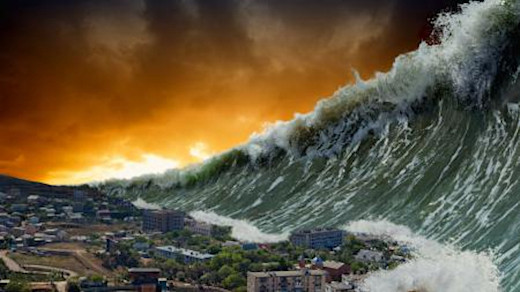
Image above A tidal wave of debt failure heading for home. From original article.

[IB Publisher's note: Hunker down for Merry Christmas... and as much as a Happy New Year as possible. Things may seem to be coming apart at the seams... but then again they always are - just as new things always come along and thrive. We are having our annual eggnog party tonight and we hope you find a glowing light in this darkest time of the year. In a couple of days the sky will be brighter, and isn't that is what Christmas time is all about. We know winter is coming, but there are signs it too will wane into spring.]

In processing the flow of information about the goings on in the US, it is impossible to get rid of a most unsettling sense of unreality—of a population trapped in a dark cave filled with little glowing screens, all displaying different images yet all broadcasting essentially the same message.

That message is that everything is fine, same as ever, and can go on and on. But whatever it is that’s going on can’t go on forever, and therefore it won’t. More specifically, a certain coal mine canary has recently died, and I want to tell you about it.

It’s easy to see why that particular message is stuck on replay even as the situation changes irrevocably. As of 2019, 90% of the media in the United States is controlled by four media conglomerates:\
  • Disney ABC
  • Viacom CBS
  • Comcast NBC-Universal
  •  AT&T Time-Warner
Together they have formed a corporate media monoculture designed to most effectively maximize shareholder value.

As I wrote in Reinventing Collapse in 2008, “...In a consumer society, anything that puts people off their shopping is dangerously disruptive, and all consumers sense this. Any expression of the truth about our lack of prospects for continued existence as a highly developed, prosperous industrial society is disruptive to the consumerist collective unconscious.

There is a herd instinct to reject it, and therefore it fails, not through any overt action, but by failing to turn a profit because it is unpopular.”

Two years earlier, in a slideshow optimistically titled “Closing the Collapse Gap” (between the USSR and the USA), I wrote: “...It seems that there is a fair chance that the US economy will collapse sometime within the foreseeable future. It also would seem that we won’t be particularly well-prepared for it.

As things stand, the US economy is poised to perform something like a disappearing act.” And now, 12 years later, I believe I am finally watching what amounts to preparations for that act’s final rehearsal; the ballet troupe is doing stretching exercises and the fat lady is singing arpegios to warm up…

Clearly, this final act is yet to be performed. The media replay loop continues to play, keeping the populace convinced that the future will resemble the past (except, perhaps, it will have more wind generators, solar panels and electric cars).

The populace continues to be persuaded to go out and shop for (or, more frequently now, order online) things it doesn’t need, to be paid for by money it doesn’t have.

Of course, there have been changes. The populace in the US has been doing progressively worse. Drug addiction and suicide rates have skyrocketed while rates of childbirth have plummeted. The purchase of a home is now out of reach for the vast majority of young couples.

Artificially rosy unemployment statistics hide the 100 million or so people who are considered “not in labor force” (because they lost their jobs some time ago and haven’t been able to find another one).

Uniquely among developed nations, life expectancy among white males—historically the most economically active and prosperous part of the population—has been dropping.

These are all negatives, but neither any one of them nor any combination of them adds up to anything that could cause the US economy to undergo a spontaneous existence failure.

Nevertheless, it is possible to build a convincing case that Rome is, to put it figuratively, burning. To continue with the metaphor, evidence that there is some fiddling going on is particularly compelling.

Overall, there is a steady backing away from addressing the substance of any problem and a concerted effort to maintain appearances at all cost.

Take the trade war with China, which has been going on since early 2018. Trump has recently declared a major victory in it, but upon examination signs victory are impossible to discern.

In 2017 the US ran a $750 billion trade deficit with China on $3.3 trillion of trade (22.7%). In 2018 it has jumped to $930 billion on $3.8 trillion of trade (24.4%).

China has found ways to parry each of Trump’s thrusts by imposing countertariffs. After two years of this sort of World War I-style trench warfare, in which the US has been slowly losing ground, it became clear that the US doesn’t have any means to put pressure on China.

And so Trump suddenly declares victory; not a full victory (that will have to wait until after Trump is reelected for his second term) but a victory nonetheless, because the Chinese have supposedly agreed to buy an extra $200 billion worth of US exports, $50 billion of them of agricultural exports from states that voted for Trump in 2016. But Trump is lying to his supporters.

Over the past two years the Chinese have imported roughly $24 billion of agricultural commodities from the US, and sources close to the trade talks have said that the Chinese have agreed to increase these imports by just $16 billion, putting the total $10 billion short of the $50 billion mark.

Even then, the US agricultural sector would have to rapidly scale up production by a factor of 1.6—and this is not at all likely.

The farmers will discover this only after they vote to reelect Trump, but that’s not Trump’s problem. Nor was it Trump’s problem when in 2017 the Chinese promised to buy $120 billion of US liquified natural gas exports and then the US wasn’t able to provide anywhere near that volume.

And now that Russia’s Power of Siberia pipeline is operational and ramping up volumes, while US fracking companies are going bankrupt left and right, the question has become largely moot.

The AG promise is just a replay of the LNG promise at a smaller scale. Appearances are all that matter, and appearances are what Trump delivers every time.

And if his voters want to believe—who’s to stop them? Even though it is clearly heading toward a defeat for the US as a whole, the trade war with China is definitely a huge positive for Trump: all he has to do to win personally is periodically deliver promises that others won’t keep—but that’s not his problem.

Another net benefit for Trump is the never-ending impeachment saga. It has kept him in the media limelight and has allowed him to pretend that he is prevailing heroically against great odds while making his opposition look ridiculous in the eyes of his supporters.

After the “Russian meddling” fable unraveled, an even more preposterous rationale for impeachment has taken its place.

An attempt to impeach Trump for refusing to cooperate with a congressional investigation is in the process of failing, since anyone with more intelligence than a bucket of California penis fish should know that it is up to the courts, not up to the legislature, to resolve disputes between the legislature and the executive.

All that remains now is an alleged abuse of power by Trump. Apparently, it is a no-no for a US president to ask a foreign leader to investigate a US presidential candidate for a variety of crimes such as corruption, bribery and money-laundering.

This may all seem quite ridiculous, but it serves a purpose: it allows Trump to clean up on free publicity and to continue fiddling (tweeting, in his case) as Rome burns.

But what has set fire under Rome is not the decrepitating state of US society, or the permanent and permanently worsening trade imbalance with China, or the never-ending impeachment farce. It is the incipient failure of the US dollar.

 For those who have been paying careful attention, the surreal nature of the proceedings, and the fact that results no longer matter—only appearances do—have become perfectly obvious, but they are a tiny minority.

What has allowed the politicians and the media to exploit the general public’s innate normalcy bias and to keep the media replay loop going without too many people catching on to what’s really happening was (note the past tense!)... the ability of the US government (with the assistance of the Federal Reserve, which is a government-linked but essentially private entity) to paper over the gaping chasm in the nation’s finances by issuing debt, in the form of US Treasury paper.

The US Treasury has been able to exploit its “exorbitant privilege” to issue internationally recognized and traded debt instruments denominated in its own currency—the US dollar—which has been the world’s main reserve currency for many decades.

The reserve currency status has conveyed a certain aura of security and reliability (paper money is, after all, pretty much just a confidence game) and has supported the world’s largest and most liquid financial market.

Anybody anywhere could put up US Treasury paper as collateral for a loan and get a low interest rate because that paper was considered as good as “real money” (whatever that means). And then that scheme suddenly broke.

It is difficult to say what caused the confidence game to fail. It could be just the inexorable and ever-accelerating increase in US government debt. It could be the blatant decoupling between the growth rate of the US economy and the rate of increase of its indebtedness.

It could also be the fact that much of the world is making a concerted effort to walk away from the US dollar as a reserve currency and as a means of exchange in international trade (Russia has sold off almost all of its US debt; China’s hoard is much larger but it is also gradually selling it off).

It is unclear what was the ultimate cause, but what is clear is that in August of 2019 something finally snapped, and USTs went from “good as real money” to “stuff nobody wants to hold.”

I first wrote about this in September when it became clear that real trouble was brewing in the market for US debt. Now, three months later, the situation has gone from bad to worse, and it would appear that the market for USTs definitevely broke.

I will try to sketch out what that means for the US economy and society later on (spoiler alert: nothing good) but for now I just want to lay out some of what has happened.

In the meantime please take your normalcy bias and put it some place safe (in case you need it later, although I have no idea what for).

Previously, when it was clear that an overburden of bad debt could trigger financial collapse at any moment, the Federal Reserve (which is in charge of printing money) engaged in something it euphemistically called “quantitative easing” (“QE”).

It printed lots of US dollars in exchange for various bits of USTs, along with other financial garbage, with the goal of later selling the USTs while hiding the garbage, thereby preserving the appearance that USTs are sovereign debt supported by the full faith and credit of the US government rather than just some waste paper clogging up its vaults.

But when it declared “quantitative easing” to be over and tried selling the USTs, all hell immediately broke loose and it was forced to go right back to buying them up, in a scheme that has been sarcastically referred to as “not QE.”

 Euphemisms aside, what is happening is properly called “debt monetization”: it’s when a government “borrows” money not by selling its debt in exchange for money that already exists but simply printing the money using paper and ink, or magic digits inside a very secure computer.

Let’s go over some of the relevant details.

“Not QE” actually started well before it was announced and proceeded in stealth mode. Over six weeks starting in September 2019, the Fed monetized an average of $20.5 billion per week.

This rate is compatible with the extent of its previous efforts at “quantitative easing” at their height. It was forced to do so because the REPO rate on USTs spiked to ten times the rate set by the Fed.
Note: REPO stands for “repurchase agreement”; it is where one party borrows short-term from another party, using USTs (and other supposedly very safe debt instruments) as collateral, much as a pawn shop will give you money for a watch and then allow you to buy it back.
The huge spike in interest rates signaled that USTs were no longer seen as particularly safe collateral and the Fed had to step in and start throwing freshly minted dollars at the problem. And it never stopped.

In fact, the problem grew larger; so large, that now, at the year’s end, the Fed has committed $500 billion of printing press output to making sure that nobody runs out of cash.

It is commonly thought that the Fed’s action has to do with short-term debt, and is therefore a short-term problem, but that’s simply not the case. Since early August (the start of stealth-mode “not QE”) the Fed has vacuumed up $179 billion with of USTs, of which USTs with terms longer than a year made up $108 billion, or 60%.

Compare these numbers to the total borrowing by the US government over the same period, which amounted to $659 billion, of which $368 billion was short-term debt and $291 billion long-term.

Thus, over this period the Fed has monetized 29.4% of new long-term debt and 24.4% of short-term debt. This should help put your mind at ease if you suspected that this isn’t a short-term problem but weren’t sure. It’s a long-term, structural problem.

Next, let’s consider whether the problem is being solved or is getting worse. Rest assured, it is getting worse. Looking at the numbers for October and November, the Fed monetized over half (50.7%) of new US government debt.

A straight-line projection is that if it took the Fed to go from 0% to 50% in four months, then it will go from 50% to 100% in another four—by April Fool’s 2020. But who’s to say that the increase will be linear rather than exponential?

Whichever it is, the trend is unmistakable: the market in US government debt—once the deepest and most liquid market in the world—is dead. The only thing propping up the value of USTs is the Fed’s printing press. And the only thing propping up the value of the output of the Fed’s printing press is… what is it, exactly?

Exactly!

Let’s add one more salient detail. Over the course of 2020, $4.665 trillion of USTs will mature and will need to be rolled over into new USTs. This is an all-time record, and this is on top of new debt that will have to be issued in order for the US government to be able to stay open.

Over the past year the US budget deficit has amounted to $1.022 trillion, which is a 15.8% increase over the previous year. If this trend continues, the new deficit will be around $1.183 trillion. In order to keep the wheels of finance from grinding to a halt, over 2020 the Fed will have to monetize, or print, close to $6 trillion.

It appears likely that at some point over the coming months Fed chairman Jerome Powell will have to announce “not not QE,” and then “not not not QE,” and then “Milk-milk-lemonade, ’round the corner fudge is made!” and run for the unigender restroom sobbing inconsolably.

And then Donald Trump will be forced to channel Boris Yeltsin, who, on August 14, 1998, summoned all the presidential gravitas he could muster and spoke the following sage words:

«Девальвации рубля не будет. Это твердо и четко. Мое утверждение — не просто моя фантазия, и не потому, что я не хотел бы девальвации. Мое утверждение базируется на том, что все просчитано. Работа по отслеживанию положения проводится каждые сутки. Положение полностью контролируется».
“There will be no ruble devaluation. This is my firm and clear position. My assertion is not just a product of my fantasy, and not because I don’t want devaluation to happen. My assertion is based on the fact that everything is taken into account. The work on reassessing the situation is being conducted daily. The situation is entirely under control.” (My translation.)
And then three days later the Russian government declared sovereign default. The ruble dropped by 2/3 against the US dollar and the Russian economy, which was at that time extremely import-dependent, crashed hard. In a similar scenario, the US economy will crash much harder.

Like Russia in 1998, the US is extremely import-dependent. But here the US government is not the only large borrower: most of US corporations are zombified corpses bloated with debt.

For many years they have been borrowing at artificially low interest rates in order to buy up their own shares and prop up their value in a ridiculous effort to maximize shareholder value in the face of stalling economic growth.

If they become unable to roll over their debt at artificially low interest rates (which will go away once the Fed definitively loses control of the situation) then they will automatically be forced to declare bankruptcy and liquidate.

If you want to maintain an optimistic outlook in spite of all of this, here is a book you might want to read.

.

Predictions for 2019

SUBHEAD: "Ding Ding! - Margin Call USA". Reality is about to bite us in the ass.

By James Kunstler on 31 December 2018 for Kunstler.com -
(http://kunstler.com/clusterfuck-nation/forecast-2019-ding-ding-margin-call-usa/)


Image above: The Greenleaf subdivision near Dawsonville Georgia was abandoned several years ago after it was found to be at the center of a mortgage fraud scheme. The developers knew the project was doomed from the start, as there were no public sewer lines anywhere in the area they could hook up to, and the lots were too small for septic tanks.From (https://imgur.com/gallery/G6SIf).

[IB Publisher's note: Two books published in 2005 transformed my understanding of the real world. The books were Jared Diamond's "Collapse" and James Kunstler's "The Long Emergency".Both identified the mortality and suicidal tendencies of human civilization. Together they provoked a reevaluation of my understanding of how the world works and our future in it. I am indebted to their clear thinking. Over time I came to personally know Kunstler. My wife Linda and I visited him twice in upstate New York. I even worked briefly with his agent on a movie proposal for his novel "World Made By Hand" (2008) that describes the unwinding and aftermath of a collapse of America as we know it. Over subsequent years we have kept in touch. I realized our thinking was wandering apart over our differences of opinion about the TV series "Treme" that premiered in 2010. "Treme" follows the lives of people in the Ninth Ward of New Orleans in the aftermath of hurricane Katrina. Many of the primary characters were black and/or female. Kunstler could not "get" the show at all. He could not getr through half the premier episode because it seemed to him incoherent and foreign - a zombie apocalypse. Since then I have come to realize Kunstler holds a resentment that many white male Baby-Boomers about increasing emergence of women and black people into positions of American privileges. Did they earn it? Did George Bush? Anyway, with that caution in mind I continue to read Kunstler with a bit of caution. I think he is still spot-on in his understanding of money and energy - the grease on the gears of Western Civilization. This post is an excerpt from his predictions for 2019, hopefully less the white male screed. Happy New Year!]   

Markets and Money
The jig is really up. The big bad bear market is already underway, even if it rallies in January. The debt bubble engineered by the Federal Reserve is blowing up and thundering through the system.

The epic market instability of December 2018 on the heels of persistent Fed rate hikes points to major credit problems and especially an inability to roll over old debt into new loans at higher interest rates — in particular loans to zombie enterprises that need to borrow to keep paying interest on previous loans (a lot of that among the shale oil companies).

The US government can’t take higher interest rates either. It’s already paying about as much in annual interest on US debt as we pay for our war machine. There are only two ways out, both of them nasty.

Either suck up debt defaults, which will induce an impoverishing disappearance of money; or provoke high inflation, by injecting more Central Bank QE “money” into the system, which can destroy the value of money.

Inflation is typically the choice of governments because it reduces the face value of debts while it allows government to pretend that it is taking action.

In the end, you may have plenty of worthless money, which is no different from having not enough money that retains value. The latter was the main feature of the Great Depression.

So, inflation is the usual choice, but it also typically leads to incendiary resentment among the citizenry when they realize they’ve been played and it takes a wheelbarrow full of cash to buy a loaf of bread and a jar of peanut butter.

I suppose that Fed chief Jerome Powell knows all too well he’s popped the Mother-of-All-Bubbles. He can blame it on Mr. Trump. Everybody else will, of course.

Sometime in the second quarter of 2019, the Fed will resume the money-for-nothing gambit of “quantitative easing” in the hope of arresting the damage, but this time the dollar will lose value uncontrollably and catastrophically. Many people will be ruined, especially retirees at the mercy of insolvent pension funds.

Before 2019 is out, the US could find itself in a situation worse than the Great Depression. Supply lines are much longer now than they were then.

If suppliers can’t get paid because trust has collapsed in the short-term corporate paper system, they won’t deliver supplies, which means you may not eat, or fill your gas tank, or heat your house, or get whatever else you need.

Also, the USA in 1931 had not yet transformed itself into the fiasco-waiting-to-happen called suburban sprawl. How is Dallas going to work for people who spend a substantial chunk of their income on mandatory motoring (if there’s little or no income)?

Stock market activity may appear to stabilize in January, but it will go south again later on in the first quarter and the Bear will growl louder for the rest of the year.

Civil Disorder
Be prepared for it in 2019. There are going to be a lot of pissed-off people around the country. They are liable to attack Federal property and their fellow citizens (and their property).

The hungrier they are, the worse it will be. They will not understand the forces that are destroying the money system.

There are a gazillion small arms out there and the government will not be able to control them or confiscate them. Any attempt to do that will only inflame the situation.

A major principle of The Long Emergency is that government becomes increasingly impotent and ineffectual as it rolls out. We’re already seeing that in Washington, and it is not at all just because Mr. Trump has inspired such an impasse between the branches. The states, too, will be hard-pressed to do anything useful.

Many of them, like Illinois, New Jersey, Connecticut, and California, are already technically insolvent. The federal government may have to pretend to rescue them financially, which will only make the national predicament worse.

Oil
The shale oil “miracle” was an impressive stunt. For a while, it goosed US production way above the former all-time production peak of 1970, and it achieved that with astounding speed — about a decade. But this is oil that is very expensive and complex to produce. It was made possible by massive borrowing at artificial low interest rates, which are now rising.

Something like three-quarters of the shale operators never made a red cent in net profit, and many of these companies will find it hard or impossible to roll over their existing debt, especially with oil under $50-a-barrel.

But the price is a deceptive metric. If it zoomed up to $100-a-barrel tomorrow, the effect would only be to crush economic activity, because industry requires cheaper oil to pencil out its operations and citizens can barely afford to drive when gasoline hits $4-a-gallon at the pump.

At the lower $45-a-barrel, the price crushes the oil producers. Take your pick. There’s no “Goldilocks” price.

The other problems with shale oil have to do with the nature of the shale plays. The Permian Basin in Texas is very large, but the best plays are developed in the so-called “sweet spots” and there’s a limited amount of them.

They are the places that the producers developed first, and when they are played out, the next round of plays will be in spots not-so-sweet (or productive) — possibly not worth drilling. The character of the shale oil wells is also way different from the old conventional classic oil wells. The old wells cost about $400,000 (in current dollars). It involved just sinking a pipe into the permeable source rock.

The oil came out under its own pressure at the rate of thousands of barrels a day.  Eventually, you put a simple pump-jack on the well (the “nodding donkey”) and it produced for decades, like running a cash register. Shale oil wells cost between $6- 12 million.

They require technically demanding horizontal drilling and fracking, with additional costs in highly technical labor, water for fracking, sand to hold open the fracks, chemicals to aid the process, and a gazillion truck trips to deliver all the water and sand (and take the oil away).

Shale wells produce maybe a few hundred barrels a day for one year, after which they typically deplete by over 60 percent.

After four years, they’re done. The oil is also different. Shale oil is typically ultra-light. It contains little-to-none of the heavier diesel, kerosene, jet fuel, and heating oil distillates, making it less valuable.

Trouble in the credit markets could shut down shale production for a period of time and create dire problems for the American economy. That could happen in 2019 as poorer-performing companies fail to get new financing.

As mighty as it seems to be, the industry is fraught with fragility.

Meanwhile, discovery of new, producible oil has fallen to the lowest level since the 1940s, after three recent previous record low years. Current low oil prices at around $45-a-barrel may give Americans a false sense of security.

Low prices are mostly indicative of the collapse of the demand for oil at the global margins and among the large US demographic that cannot afford it anymore — that is, the impoverished former middle class.

As the damage becomes more obvious, we could hear calls to nationalize the oil industry. The attempt to do that would collide with the aforementioned trend for government to become more strapped  for revenue, more impotent, and more incompetent.

Geopolitical
The Golden Golem has gone an extra mile to antagonize Russia the past two years. Is it to demonstrate how not Putin’s puppet he is? If so, it’s pathetic.

For instance, heaping ever more sanctions on Russia, tossing Russian diplomatic staff out of the country because of the laughable Novichok poisoning of the Skripal father-and-daughter in Britain. Nobody believed that set up — who recovers from the world’s supposedly most potent, high-tech military toxin?

The larger Russia hysteria, ginned up by the US “Intel Community” to cover the embarrassment of Hillary Clinton’s election loss, has destroyed the brains of thousands of Washington insiders and infected whole sectors of the educated coastal elites who really ought to know better.

Meddling in elections? Is that something the US has never entertained?

Recall that 1996 Time Magazine cover with the headline that bragged, “Yanks to the Rescue: the Secret Story of How American Advisors Helped Yeltsin Win.”

And now we’re wetting our pants over a baker’s dozen Russian Internet trolls on Facebook?

Yes, this is what the brightest people in the room have been doing for two years. The net result is a new cold war, pushing Russia into the arms of China, giving both of those countries an incentive to construct a new framework for global relations that excludes the toxic US as much as possible.

That new framework, by the way, will not be the same as the late, unwinding Globalism Release 2.0 (Release 1.0 was 1870 – 1914) that allowed America to exchange IOUs for flatscreen TVs lo these many years. Let’s call that Tom Friedman Globalism, after the pundit who said it would last forever.

The world will become a wider place again as the Great Powers are increasingly bound to their own regions for trade relations in a world growing short of energy and capital resources. The exception to that is in weaponry, now that Russia has demonstrated its ability to launch hypersonic rockets that can reach the US in little more than a few Noo Yawk minutes.

Do we have anything like that?

I suppose we wish we did. The media is not even talking about it, the implications are so dreadful.

Has Mr. Trump actually accomplished anything with his deal-seeking in China while beating it on the snout with his tariff stick?

Well, he got a lot of US companies loading up on inventory of goods they feared will carry costly duties a year hence, so they’re all stocked up just in time for a vicious bear market and the recession / depression that it entails. A lot of that stuff may end up being distributed by the bankruptcy judges.

How does our antagonism against China work with the campaign to “normalize” the behavior of North Korea. I doubt it helps. In 2019, North Korea will be the whoopie cushion that China places under America’s seat at the negotiating table.

Mr. Trump defied the conventional State Department wisdom by meeting face-to-face with Kim. It got the two Koreas actually speaking with each other for the first time in 60 years, with some concrete steps toward ending the de facto state-of-war.

Will Li’l Kim play the role China assigns to him? I think so. They can squash him like bug. And, of course, everything that the US congress and Mr. Mueller do to injure and weaken Mr. Trump will make further progress in Korea unlikely.

How about the second greatest economy in the world? That would be the European Union.

The EU’s financial system is way more dysfunctional than even ours, with no mechanism or provision for regulating each country’s spending vis-à-vis the debt generation of the Union as a whole.

There’s no way it can continue and no prospect for debugging the set-up. What’s more, decades-long shenanigans of the European Central Bank have created imbalances that will never be corrected.

Even the attempt to normalize operations — as the ECB ceases its debt monetization routines starting in the first quarter of 2019 — is guaranteed to crack up the EU economy, which is a horror show of zombie companies and zombie banks. They will suffer particularly in the recession / depression to come.

The next domino to fall, theoretically Italy, will take the EU down, whatever happens with the dithering over Brexit. Without the ECB vacuuming up unwanted EU paper, nothing really pencils out over there. In 2019, expect a substantial fall in the value of the Euro, and possibly its demise as a currency.

In fact, expect wholesale disintegration of many structural arrangements all over Europe beginning in 2019, along with more political violence that exceeds the simple street actions of the Yellow Vests in France.

NATO has been staging war games on Russia’s border for two years, apparently with no awareness that the NATO members are deeply dependent on Russian oil and natural gas to remain advanced nations with comforts and conveniences, like heating their homes. Perhaps that recognition will hit in 2019. But there will be plenty of noise for that signal to cut through.

Climate Change
Something’s going on ‘out there’ though the picture is deeply non-linear and is being confused for the moment by an extraordinary low level of cyclical sunspot activity. Not being a scientist, I have only two salient points worth considering about the issue:

The first is, we’re not going to do anything about it — because nothing can be done about it. Whatever’s happening, we’re going to have to roll with it. I’m also not persuaded that many of the proposed mitigations — carbon taxes, seeding the upper atmosphere with reflective particles — will accomplish anything.

The second thought is this: the civilized world has experienced many many instances of climate change over the past several thousand years. Civilizations rise and fall with these changes, but the human project as a more general matter continues, with periods of history that appear to be restful time-outs.

The Roman Optimum (warming period) segued into the Dark Age Cooling, and then the Medieval Warming (viniculture in England!), and eventually the Little Ice Age comes along with Isaac Newton and skaters on the Dutch canals.

 The difference this time is that our civilization is so deeply complex that successful adaptation to new conditions is a low percentage outcome, at least in the form of salvaging many of our current arrangements.

In other climate disruptions, people adapted, sometimes with very severe changes in customs, practices, political arrangements, and life-styles.

It will be especially stark this time, and the broad pop culture of Collapse suggests that we intuit this — everything from Game of Thrones to The Road, to my own World Made By Hand novels.

It begins with the wobbling of the most abstract and fragile of our systemic arrangements, finance, which is mostly based on ephemeral trust (that the other fellow will pay you).

From there, the trouble proceeds to politics and culture.

[IB Publisher's postscript: And that is the most optimistic view possible. I personally think we are closer to extinction than that. As a reminder see this 2011 "Scientific American" article One Time Through the Bottleneck - "Almost 200,000 years ago humans faced extinction. Only a few hundred were saved along the coast of Cape Horn"].  Happy New Year!


.

Energy collapse is upon us

SUBHEAD: This is your chance to engage with and become an agent of a new paradigm for humanity.

By Nafeez Ahmed on 28 December 2018 for Medium
(https://medium.com/insurge-intelligence/brexit-stage-one-in-europes-slow-burn-energy-collapse-1f520d7e2d89)


Image above: Van on fire in Paris after violent Yellow Vest protests. From original article.

Everyone’s talking about Brexit. Some about the French riots. But no one’s talking about why they are happening, and what they really mean. They might think they are, but they are usually missing the point.

On 6th May 2010, the Conservative Party took the reins of power for the first time since 1992, propped up with some help from the Liberal Democrats.

Hours before the election result, I warned in a blog post that whichever government was elected, it would be the first step in a dramatic shift toward the far-right that would likely sweep across the Western world within 10 years.

I wrote, describing the failure of all three political parties to understand why the heyday of economic growth was unlikely to return.
“The new government, beholden to conventional wisdom, will be unable or unwilling to get to grips with the root structural causes of the current convergence of crises facing this country, and the world...” 
“This suggests that in 5–10 years, the entire mainstream party-political system in this country, and many Western countries, will be completely discredited as crises continue to escalate while mainstream policy solutions serve largely to contribute to them, not ameliorate them.  
The collapse of the mainstream party-political system across the liberal democratic heartlands could pave the way for the increasing legitimization of far-right politics by the end of this decade…”
My prediction was astonishingly prescient. The global shift to the far-right began within exactly five years of my forecast, and has continued to accelerate before the decade is even out.

In 2014, far-right parties won 172 seats in the European Union elections — just under a quarter of all seats in the European Parliament.

In 2015, David Cameron was re-elected as Prime Minister with a parliamentary majority, a victory attributed in part to his promise to hold a referendum on Britain’s membership of the European Union.

Unbeknownst to many, the Tories had quietly established wide-ranging links with many of the same far-right parties that were now capturing seats in the EU.

The following year in June, the ‘Brexit’ referendum shocked the world with its result: a majority vote to leave the EU.

Six months later, billionaire real estate guru Donald Trump shocked the world again when he became president of the world’s most powerful country. Like the Conservatives in the UK, the Republicans too had forged trans-Atlantic connections with European parties and movements of the extreme-right.

Since then, far-right parties have made continued electoral gains across Europe in Italy, Sweden, Germany, France, Poland and Hungary.

We are on the cusp of a tidal wave, that looks poised to accelerate into a tsunami. Exactly as I had anticipated, far-right politics is no longer the province of the fringe, but is becoming increasingly normalised.

This not an accident. It is the result of a system that is failing — and the efforts of a network of far-right groups to exploit the fractures emerging from this system-failure to tear everything down, and erect a new order of their own fashioning.

My prediction of the resurgence of the far-right was based on analysing the probable consequences of a long-term ‘system-failure’ in which we are unable to return to the levels of economic growth we had become accustomed to in the heyday of the 1980s and 90s.

That system-failure, I explained, is rooted in the economics of the energy production that enables economic growth:
“…. a full and lasting recovery… is likely to be impossible in the constraints of the current system, because we’re running short on the physical basis of the last few decades of exponential (and fluctuating) ‘growth’ — and that is cheap, easily available hydrocarbon energies, primarily oil, gas and coal.

The turning point has arrived, and without that global cheap energy source in abundant supply, we cannot continue growing, no matter what we do. Something has to give. Our economies need to be fundamentally, structurally, transformed. 


We need to transition to a new, clean, renewable energy system on which to base our economies. 

We need to transform the way money is created, so that it’s not linked to the systematic generation of debt. We need to transform our banking system on the same grounds. 

Whitehall, and the three political parties, recognize only facets of the picture, but they don’t see it as a whole.”

Turning Point

The energy turning point is unequivocal. In the years preceding the historic Brexit referendum, and the marked resurgence of nationalist, populist and far-right movements across Europe, the entire continent has faced a quietly brewing energy crisis.

Europe is now a ‘post-peak oil’ continent. Currently, every single major oil producer in Western Europe is in decline. According to data from BP’s 2018 Statistical Review of Energy, Western European oil production peaked between 1996 and 2002. Since then, production had declined while net imports have gradually increased.

In a two-part study published in 2016 and 2017 in the Springer journal, BioPhysical Economics and Resource Quality, Michael Dittmar, Senior Scientist at the ETH Zurich Institute for Particle Physics and CERN, developed a new empirical model of oil production and consumption.

The study provides perhaps one of the most empirically-robust models of oil production and consumption to date, but its forecast was sobering.

Noting that oil exports from Russia and former Soviet Union countries are set to decline, Dittmar found that Western Europe will find it difficult to replace these lost exports. As a result,
“total consumption in Western Europe is predicted to be about 20 percent lower in 2020 than it was in 2015.”
The only region of the world where production will be stable for the next 15 to 20 years is the OPEC Middle East.

Everywhere else, concludes Dittmar, production will decline by around 3 to 5 percent a year after 2020. And in some regions, this decline has already started.

Not everyone agrees that a steep decline in Russia’s oil production is imminent. Last year, the Oxford Institute for Energy Studies argued that Russian production could probably continue to grow out to at least 2020. How long it would last thereafter was unclear.

On the other hand, the Russian government’s own energy experts are worried. In September 2018, Russia’s energy minister Alexander Novak warned that Russia’s oil production might peak within three years due to mounting production costs and taxes.

In the ensuing two decades, Russia could lose almost half its current capacity. This sobering assessment is still broadly consistent with the Oxford study.

The following month, Dr Kent Moor of the Energy Capital Research Group, who has advised 27 governments around the world including the US and Russia, argued that Russia is scraping the bottom of the barrel in its prize Western Siberia basin.

Moor cited internal Russian Ministry of Energy reports from 2016 warning of a “Western Siberia rapid decline curve amounting to a loss of some 8.5 percent in volume by 2022. Some of this is already underway.”

Although Russia is actively pursuing alternative strategies, wrote Moor, these are all “inordinately expensive”, and might produce only temporary results.

It’s not that the oil is running out. The oil is there in abundance — more than enough to fry the planet several times over.

The challenge is that we are relying less on cheap crude oil and more on expensive, dirtier and unconventional fossil fuels. Energetically, this stuff is more challenging to get out and less potent after extraction than crude.

The bottom line is that as Europe’s domestic oil supplies slowly dwindle, there is no meaningful strategy to wean ourselves off abject dependence on Russia; the post-carbon transition is consistently too little, too late; and the impact on Europe’s economies — if business-as-usual continues — will continue to unravel the politics of the union.

While very few are talking about Europe’s slow-burn energy crisis, the reality is that as Europe’s own fossil fuel resources are inexorably declining, and as producers continue to face oil price volatility amidst persistently higher costs of production, Europe’s economy will suffer.

In September, I reported exclusively on the findings of an expert report commissioned by the scientific group working on the forthcoming UN’s Sustainability Report.

The report underscored that cheap energy flows are the lifeblood of economic growth: and that as we shift into an era of declining resource quality, we are likely to continue seeing slow, weak if not declining economic growth.

This is happening at a global scale. EROI is already beginning to approach levels seen in the nineteenth century — demonstrating how constrained global economic growth might be due to declining net energy returns to society.

End of energy growth

Britain, which is due to leave the European Union on 29th March 2019, is a poster boy for this brewing energy-economic crisis.

In January 2017, the Centre for Climate Change Economics and Policy run by the University of Leeds and London School of Economics, produced a startling analysis of Britain’s declining net energy problem.

The study attempted to develop a methodology to examine national-level figures for Energy Return on Investment (EROI) — the amount of energy one uses to extract a particular quantity of energy.

The goal of the study was to pinpoint the EROI value as much as possible using Britain as a prime case-study. The concept of EROI fleshes out the recognition that a significant surplus of energy is required to fuel economic activity, separate to energy that is consumed precisely to extract energy in the first place.

The less energy we use to get new energy out, the more energy we have left to invest in the wider goods and services of economic activity. But if we keep using more energy just to get energy out, the amount of net energy we have left to fuel our economies decreases.

According to the study authors, Lina Brand-Correa, Paul Brockway, Claire Carter, Tim Foxon, Anne Owen and Peter Taylor:
“The higher the EROI of an energy supply technology, the more ‘valuable’ it is in terms of producing (economically) useful energy output. In other words, a higher EROI allows for more net energy to be available to the economy, which is valuable in the sense that all economic activity relies on energy use to a greater or lesser extent.”
The verdict on the UK predicament is stark. They find that “the UK as a whole has had a declining EROI in the first decade of the 21st century, going from 9.6 in 2000 to 6.2 in 2012.

These initial results show that more and more energy is having to be used in the extraction of energy itself rather than by the UK’s economy or society.”

Citing the work of French economists Florian Fizaine and Vincent Court, which estimates a minimal societal EROI of 11 for continuous economic growth, the paper concludes:
“… the UK is below that benchmark.”

In other words, early last year, a major scientific study found that for the last two decades and beyond, Britain’s economic growth is fundamentally constrained by domestic net energy decline. But this groundbreaking news did not make the ‘news’.

Break-up

At the close of 2010, in my book A User’s Guide to the Crisis of Civilization, I predicted that large trans-national state structures like the European Union are likely to face challenges to their territorial integrity as a side-effect of these processes.

The failure to address the systemic causes behind the 2008 financial crash, the incapacity to recognise it as a symptom of a system in decline, would lead to an increasingly authoritarian politics.

The integrity of large trans-national structures depends on the abundance of cheap energy flows to sustain them. If those flows come at greater cost and lower quality, then those structures will become increasingly strained and potentially even begin to break down.

Costs to keep the system going increase while returns are squeezed, meaning that the surplus to invest in core social goods to maintain such structures declines.

That is why despite the so-called ‘recovery’ — tepid as it is and based on accelerating debt levels (in biophysical terms borrowing from the Earth today with promise of paying it back tomorrow with what has already been over consumed today) — in real terms, peoples’ purchasing power continues to decline.

The failure to understand and engage with the root, systemic causes of the crisis also means that policymakers put themselves in a position where they can only address surface-symptoms.

All too often, that means short-term, reactionary responses.

And so in France, instead of addressing the question of how to galvanise a third industrial revolution to speed a post-carbon transition and infrastructure revival, Macron’s response to the climate crisis was to protect fossil fuel and nuclear producers while hiking up fuel taxes.

He didn’t want to tackle the horrendous supply chains of big French corporations. He didn’t want to penalise the powerful oil, gas and nuclear lobbies that he hopes might help him get re-elected, and did next to nothing to speed a viable post-carbon transition that might transform economic prosperity on more sustainable foundations.

And so by placing the burden almost exclusively on French workers and consumers, Macron triggered the spiral of rage and riots.

Protestors have set fire to banks, smashed and looted shops, and even targeted the Arc de Triomphe. They demand an end to corporate freeloading, along with nationalist demands such as ‘Frexit’ - France’s departure from the EU, and preventing migration.

It is telling that while some demands are compelling, there is no semblance of understanding the real planetary crisis beyond banal tropes about Big Banks. The French state has responded with its own violence, firing water cannons and tear gas on protestors, arresting over a thousand people, and threatening to bring in the French Army.

This is a microcosm of what can happen when states and peoples both fail to understand the deeper dynamics of a failing system: everyone responds to what is in front of them. Protestors blame Macron. The French state cracks down on violence. Politics becomes militarised, while scepticism of the liberal incumbency across the political spectrum finds vindication.

France’s riots therefore did not come out of the blue. They are part and parcel of a wider process of slow-burn EROI decline in which the returns to society from economic activity are being increasingly constrained by the higher energetic costs of that activity and productivity declines of the ageing centralised industrial-era infrastructure and technology.

It was only a matter of time before the average person began to feel the impact of that squeeze in their day to day lives. Macron’s tax hikes were not the cause, but the trigger. They lit the match, but the tinder box was already fuming.

Brexit

But we’ve been here before, in Syria and beyond.

Brexit was triggered in the context of global system dynamics which remain poorly understood. Over the decade preceding the 2008 financial crisis, Britain’s economic growth was being undermined not merely by a debt-bubble in the housing markets, but by an ailing fossil fuel dependent energy system.

That ailing system was indelibly linked to the European migrant crisis, which saw over a million refugees from the Middle East and North Africa seeking sanctuary across Europe, including the UK and France, that fuelled the surge in nationalist populism sweeping across the continent.

The migrant crisis, too, did not come out of the blue, but followed hot on the heels of the turbulence of the Arab Spring. The destabilisation of Syria, Egypt, Yemen and beyond was a long time coming — but it was triggered by a perfect storm of crises.

Domestic oil production declines which pulled the rug out from beneath oil-export dependent state revenues conspired with global oil price spikes thanks to the plateauing in world production of cheap conventional oil. A string of climate crises across the world’s major food basket regions led to crop failures and droughts which boosted food price spikes.

Global systemic crisis interacted with the breakdown in local national systems. As I’d reported in 2013, a natural drought cycle in Syria was massively worsened due to climate change, devastating agriculture and driving hundreds of thousands of Sunni farmers into Alawite-dominated coastal cities.

As Syrian oil revenues plummeted, its domestic conventional oil production having peaked in the mid-1990s, the government’s slashing of critical fuel and food subsidies just as prices were spiking globally was the last straw. People could not even afford bread, so they hit the streets.

Bashar al-Assad responded with escalating brutality, including shooting civilians in the streets. When protestors picked up arms in response, the cycle of violence kicked in.

Outside powers intervened to coopt their favoured sides, Russia and Iran backing Assad, the West backing various rebel groups — neither particularly interested in supporting Syrian civil society. The conflict escalated, devastating the country, and fuelling an unprecedented refugee crisis.

When NATO intervened in Libya, when the US and UK backed Saudi Arabia’s indiscriminate aerial bombardment of Yemen, it only destabilised the region further. The arc of collapse across the Middle East and North Africa resulted from a fatal combination: an earth system crisis, compounded by short-sighted and self-serving responses from human systems.

When families and children began turning up in their droves on European shores, the earth system crisis ‘out there’ came home.

The West could not shield itself from the long-range consequences of the unsustainability of the very postwar system it had nurtured since the Second World War: structural dependence on fossil fuels, a patchwork of alliances with regional despotic regimes, laying the groundwork for converging climate change, crude oil depletion and the resulting domino effect of food and economic crises.

The earth system crisis that erupted in Syria triggered a wave of human system destabilisation of which Brexit was merely the first eruption.

And so the Syria crisis is indeed a taste of things to come. Europe is already a post-peak oil continent, whose domestic fossil resources are in decline.

Most credible studies of Europe’s shale gas potential show that it is extremely weak and not similar to the American situation. If we are hell-bent on maintaining dependence on fossil fuels, we will be forced to import.

But as I showed in my scientific monograph for Springer Energy Briefs, Failing States, Collapsing Systems: BioPhysical Triggers of Political Violence (2017), if demand growth increases at current rates, it is unlikely that Central Asian and Russian suppliers will be capable of meeting that demand at costs we can cope with in coming decades.

Meanwhile, certain climate impacts are already locked in. Between 2030 and 2045, large parts of the Middle East and North Africa (MENA) are likely to become increasingly uninhabitable due to climate change. This is the same period in which oil production across the MENA region has been forecast to begin plateauing and declining.

As the energy costs of fossil fuel production and imports increases, and as the EU is likely hit again by the challenge of large-scale migration from the Middle East due to climate devastation, the challenges to the EU’s territorial integrity will not go away.

Brexit is merely a ripple on the surface of deeper currents. It is a symptom of the great civilisational phase-shift to life after fossil fuels.

In this sense, the Brexit fiasco is an example of how distant we are as a species from the conversations we need to be having.

Talking about being in or out of Europe and in what way is not unimportant, but it’s also a massive distraction from the deeper systemic crisis that is unfolding beneath the very issues driving our immediate concerns about Brexit.

Earth system disruption does not inevitably result in destabilisation of human systems. But if human systems refuse to engage and adapt to those disruptions, then they will be destabilised.

As long as Britain, Europe and their citizens continue to obsess myopically on the symptoms rather than the causes, we will be incapable of responding meaningfully to those causes.

Instead, we will fight with each other manically about the symptoms, while the ground beneath our feet continues to unravel.

The crisis of Brexit and the eruption of the riots in France are symptoms of a great unfolding civilizational transition, in which an old reductionist paradigm of materialist self-maximation is dying.

Citizens and policymakers, activists and business leaders, need to wake up to what is actually happening to have the conversations that can kick-start meaningful approaches to systemic transformation.

This is not a far-flung crisis that is going to happen years in the future. This is now. This is happening and it is affecting you, your children, and those you love the most. And it will affect their children, and their children.

This is your legacy. This is your choice. This is your chance to engage with and become an agent of a new paradigm, one that speaks for all humans, all species, and the Earth itself.

Maybe we don’t know exactly what the emerging paradigms will look like. But we know that it’s time to ask ourselves:Where do we stand? With the old, or with the new?

.

Trump ditching INF Treaty

SUBHEAD: Experts sound alarms after Trump confirms plans to ditch nuclear arms control treaty with Russia.

By Jessica Corbett on 20 October 2018 for Common Dreams -
(https://www.commondreams.org/news/2018/10/20/colossal-mistake-experts-sound-alarms-after-trump-confirms-plans-ditch-nuclear-arms)


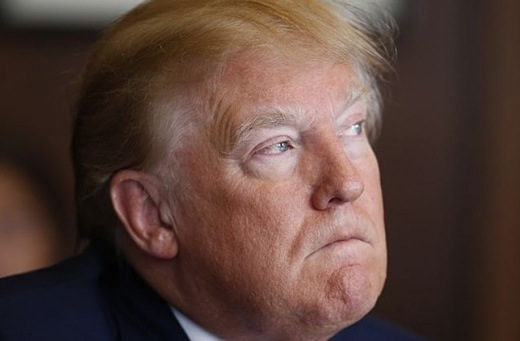
Image above: The US presidency wears down the occupant of the White House. Trump appears to have degenerated worse than most in less than two years in office. This photo of Trump was taken last Saturday. He looks unhealthy, worn out, disheveled and miserable. Who's doing his hair? From original article.

Trump says that he is abandoning the INF treaty, basically confirms a renewed arms race, and absolves himself from any responsibility to lead efforts to reduce nuclear tensions around the globe.

Concerns are mounting after President Donald Trump confirmed on Saturday that he will withdraw from a Cold War-era nuclear arms control treaty with Russia following reports that National Security Adviser John Bolton had been pushing the plan behind closed doors despite warnings from experts that ditching the agreement "would be reckless and stupid."

The Guardian had reported Friday that Bolton and an ally in the White House have been working to convince members of the administration to support the United States withdrawing from the 1987 Intermediate-range Nuclear Forces treaty (INF) on the grounds that Russia is violating it. Nuclear arms control experts and others rapidly responded with alarm.

Many agreed that Russia's alleged violation "merits a strong response" but noted a withdrawal could alienate European allies and raise the chances of armed conflict.

The president's comments on Saturday spurred more alarm, with Daryl Kimball of the Arms Control Association calling the looming withdrawal "an epic mistake."

Jeffrey Lewis, the director of the East Asia nonproliferation program at the Middlebury Institute of International Studies at Monterey agreed. "This is a colossal mistake," he told the Guardian. "I doubt very much that the U.S. will deploy much that would have been prohibited by the treaty. Russia, though, will go gangbusters."

"By declaring he will leave the INF Treaty, President Trump has shown himself to be a demolition man who has no ability to build real security," responded Beatrice Fihn, executive director of the International Campaign to Abolish Nuclear Weapons. "Instead, by blowing up nuclear treaties he is taking the U.S. down a trillion dollar road to a new nuclear arms race."

Journalist Glenn Greenwald tied the update to broader narratives about the Trump administration's relationship with Russia, and in particular President Vladimir Putin:
This is a major (and dangerous) provocation toward Russia by Trump that - like his lethal arms to Ukraine, the bombing of Assad's forces, & sanctions/expulsions - should cause anyone who peddled the "Putin-controls-Trump-with- kompromat" conspiracy tripe to apologize in shame.
 Trump revealed his withdrawal plans to reporters after campaign event in Nevada on Saturday. "Russia has violated the agreement. They've been violating it for many years. I don't know why President [Barack] Obama didn't negotiate or pull out," he said. "And we're not going to let them violate a nuclear agreement and go out and do weapons [while] we're not allowed to."

While claiming he would be receptive if both Russia and China concluded, "'Let's all of us get smart and let's none of us develop those weapons," under current circumstances, Trump appears hellbent on making more weapons.

"If Russia's doing it and if China's doing it and we're adhering to the agreement, that's unacceptable," he said. "So we have a tremendous amount of money to play with with our military."

"We are going to terminate the agreement and we are going to develop the weapons. If we get smart and if others get smart, and say 'Let's not develop these horrible nuclear weapons,' I would be extremely happy with that," he added. "But as long as somebody's violating that agreement then we're not going to be the only ones to adhere to it."

The signing of the INF treaty during the nuclear arms race of the Cold War, as CNN pointed out, had "marked a watershed agreement."

It required both Russia and the United States to eliminate ground-launched ballistic and cruise missiles with ranges between 300 and 3,400 miles.

The treaty "wasn't designed to solve all of our problems with the Soviet Union," but was "designed to provide a measure of some strategic stability on the continent of Europe," explained former State Department spokesman Rear Adm. John Kirby, now a CNN military and diplomatic analyst.
"I suspect our European allies right now are none too happy about hearing that President Trump intends to pull out of it."

Kingston Reif of the Arms Control Association outlined in a pair of tweets the impact a withdrawal could have on American foreign relations:
Our response to Russia’s INF Treaty violation shld be guided by the following:
  • Ensure Russia doesn't gain a military advantage
  • Keep allies on our side
  • Ensure Russia left holding bag if treaty collapses
  • Exhaust all diplomatic options
Withdrawal is not in keeping with these principles.
Withdrawal would make the problem far worse by:
  • Removing all constraints on Russia’s production and fielding of the illegal 9M729 missile
  • Dividing NATO
  • Allowing Russia to blame US for killing the treaty
  • Undermining US leverage to attempt to bring Russia back into compliance
And thanks to the president's warmonger of a national security adviser, the INF treaty isn't the only arms control agreement with Russia currently under threat of termination. As the Guardian reported:
Bolton and the top arms control adviser in the National Security Council (NSC), Tim Morrison, are also opposed to the extension of another major pillar of arms control, the 2010 New Start agreement with Russia, which limited the number of deployed strategic warheads on either side to 1,550. That agreement, signed by Barack Obama and Dmitri Medvedev, then president of Russia, is due to expire in 2021. 
"This is the most severe crisis in nuclear arms control since the 1980s," said Malcolm Chalmers, the deputy director general of the Royal United Services Institute. "If the INF treaty collapses, and with the New Start treaty on strategic arms due to expire in 2021, the world could be left without any limits on the nuclear arsenals of nuclear states for the first time since 1972."
Responding to the developments in a series of tweets, Alexandra Bell, a former senior arms control official at the State Department who is now at the Center for Arms Control and Non-Proliferation, said:
"Trump says that he is abandoning the INF treaty, basically confirms a renewed arms race, and absolves himself from any responsibility to lead efforts to reduce nuclear tensions around the globe."

"This administration has damaged, perhaps irreparably, an international order that has served U.S. interests for decades, turned a blind eye to catastrophic climate change, corroded our govt, [and] poisoned our national discourse," she added. "Now it will ask you to fund a nuclear arms race..

Armageddon Rides in the Balance

SUBHEAD: Never before have irrationality and immorality had such a firm hold on the US government.

By Paul Craig Roberts on 10 September 2018 for PaulCraigRoberts.org -
(https://www.paulcraigroberts.org/2018/09/10/armageddon-rides-in-the-balance/)


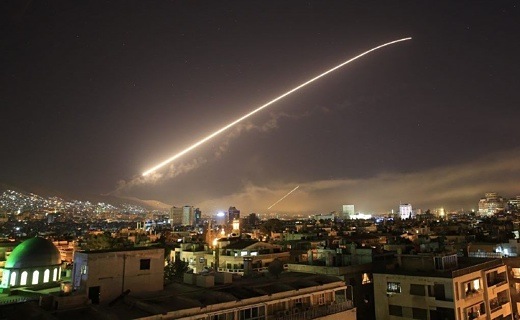
Image above: Many in this world inhabit Armageddon already. Damaged buildings are seen at the Yarmouk Palestinian camp in Damascus, Syria. April 28, 2018. Photo by Omar Sanadiki. From (https://www.thenational.ae/world/mena/syria-regime-and-rebels-agree-evacuation-deal-in-southern-damascus-1.725770).

IB Publisher's note: Yes Paul Craig Roberts is a nutcake. He is a Ronald Reagan Republican economist who sees clearly, but through a deeply colored filter. None the less, he does have an inkling of the dichotomy between the "Left" and the "Right". The "Left" with elements of the "Deep State" (intelligence complex, CIA, NSA, State Department, etc) and the "Right" with elements of the "Military-Industrial Complex" (Pentagon, Defense contractors, Mercenary operations, ICE, etc.). Both aspects of our government are hurtling towards a more repressive and garrulous America. As these aggressive and regressive forces gain influence, woe is us. America will conduct more war and experience more repression.] 

For some time I have pointed out the paradox of the American liberal/progressive/left being allied with the CIA, FBI, military/security complex and deep state. Now leftist Ann Garrison has noticed the paradox of this alliance. She concludes that the Left has lost its mind. https://www.globalresearch.ca/we-love-the-cia-or-how-the-left-lost-its-mind/5653450

Indeed, it has.

Out of its hatred of Trump the Left has united with the forces of evil and war that are leading to conflict with Russia. The Left’s hatred of Trump shows that the American Left has totally seperated from the interests of the working class, which elected Trump.

The American Left has abandoned the working class for the group victimizations and hatreds of Identity Politics. As Hillary put it, the working class comprises the “Trump deplorables.” The Democratic Party, like the Republicans, represents the ruling oligarchy.

I have explained that the leftwing lost its bearings when the Soviet Union collapsed and socialism gave way to neoliberal privatizations.

The moral fury of the leftwing movement had to go somewhere, and it found its home in Identity Politics in which the white heterosexual male takes the place of the capitalist, and his victim groups—blacks, women, homosexuals, illegal immigrants—take the place of the working class.

The consequences of the leftwing’s alliance with warmongers and liars is the leftwing’s loss of veracity. The Left has endorsed a CIA orchestration—“Russiagate”—for which there is no known evidence, but which the Left supports as proven truth.

The purpose of “Russiagate” is to prevent President Trump from normalizing relations with Russia. In these times when so many Americans are hard pressed, normal relations could adversely impact the budget and power of the military/security complex by reducing the “Russian threat.”

If there is no real Russian threat, only an orchestrated perceived one, the question arises: why does the military/security complex have a taxpayer-supported annual budget of $1,000 billion dollars?

The presstitutes have kept the truth from emerging that the “Russiagate” investigation has found no sign of a Trump/Putin plot to steal the 2016 presidential election from Hillary.

Indeed, it has been proven beyond all questioning that the Hillary emails were not hacked but were downloaded on a thumb drive. This proof collapses the entire premise of “Russiagate.”
Nevertheless, the hoax continues.

Muller’s indictments are for unrelated matters, such as income tax evasion in the distant past of Republican fund raisers and consultants. These charges have nothing whatsoever to do with Mueller’s mandate.

Indeed, as Andrew C. McCarthy, a former US attorney who led the 1995 terrorism prosecution against Sheik Omar Abdel Rahman for the 1993 World Trade Center bombing, has made clear, Deputy Attorney General Rod Rosenstein’s appointment of Mueller to head the “Russiagate” investigation is not in compliance with the regulations that govern the appointment of a special prosecutor.

The appointment of a special prosecutor requires evidence of a specific federal crime that is to be investigated. You only have a special prosecutor when there is factual basis for believing that a federal crime has been committed.

What is the federal crime? What is the factual basis? Mueller’s appointment does not say. Therefore, Mueller’s appointment is invalid. Rosenstein has violated the process.

In my opinion, this is grounds for Rosenstein to be removed from office. https://www.nationalreview.com/2018/09/trump-russia-probe-robert-mueller-investigation/

At one time, Congress—both parties—would have been all over the invalid Mueller appointment.

However, after 16 years of Cheney/Bush and Obama regime lawlessness, even Republicans accept that the Constitution’s restraints on executive branch power, along with the laws and regulations Congress has established specifying the exercise of these powers, have been rendered meaningless by the “war on terror,” a hoax designed to further Israel’s interests in the Middle East and the neoonservative doctrine of US hegemony, while making billions of dollars for the military/security complex.

Charlie Savage’s book, Takeover, and David Ray Griffin’s book, Bush and Cheney: How They Ruined America and the World, accurately document how 9/11 was used to destroy the Constitution’s balance of power within the government and to create unaccountable executive branch powers that over-ride the Constitution’s protection of civil liberty.

This demand for an unaccountable executive branch, pushed by VP—actually President in fact—Dick Cheney and his minions, such as Addington and John Yoo, was the agenda of the Republican Federalist Society.

An early book laying out the legally invalid and legally incompetent argument that the president had powers unchecked by Congress or the judiciary was Terry Eastland’s book, Energy in the Executive.

This collection of nonsense became Cheney’s bible as he proceeded in secret to remove constraints on executive branch power. The elevation of the executive branch above the law of the land is documented in Charlie Savage’s book. Read it and weep for your country destroyed by Dick Cheney.

On top of Cheney’s coup against accountable government, we have in America today another coup, organized by former CIA director John Brennan, former FBI director Comey, deputy attorney general Rod Rosenstein, the Democratic National Committee, the departed Republican senator John McCain, a coup fully supported by the entirety of the US presstitute media.

This coup is against the democratically elected President of the United States for the sole reason that he threatens the power and profit of the entrenched military/security complex, about which President Eisenhower warned us 57 years ago, by wanting to normalize relations with Russia, the world’s premier nuclear power.

The question is unavoidable: Why do the American people put up with this? Are they so insouciant that they have no realization that, if a president can be driven from office because he wants peace with Russia, the removed president’s successor will have to stand against Russia or also be driven from office. Trust and negotiation between the nuclear powers becomes impossible.

Why do Americans support conflict with a nuclear power that can completely destroy America?

During the entirety of the Cold War, in which I was a participant, the emphasis was on reducing tensions and creating trust. Today Washington’s interest is piling provocation after provocation on a country that can wipe us off the face of the earth.

The liberal/progressive/left, the Democratic National Committee, the CIA and the rest of the covert state, and the media whores all share this same commitment to the reckless and irresponsible provocation of a powerful nuclear power. As the US military itself acknowledges, Russia’s weapons are far beyond America’s defenses.

So what is going on? Is it the liberal/progressive/left’s desire that evil America be destroyed? Is this desired destruction of evil America the reason the Left has allied itself so tightly with the warmongers in Washington?

Is this the reason that the Left and the Democrats and a handful of Republicans want to impeach President Trump for attempting to make peace with Russia?

How can these crazed immoral people present themselves as some sort of moral arbiter when they are locked on a trajectory that will destroy Earth?

This destruction might be closer than anyone thinks. Here is the situation in Syria:

Russia and Syria, in cooperation with Iran and Turkey, have begun the assult on Iblid province, the last stronghold of Washington’s proxy army consisting of Al Qaeda, Al Nursra, and ISIS mercenaries hired by Washington.

According to reports, which might or might not be true considering the lack of veracity that is the defining characteristic of the Western media, the US and UK have troops among the mercenary forces, hoping apparently that this presence will deter the attack. As the attack has already begun, this is a false hope.

The Russians discovered Washington’s plot to explode a chemical weapon in Iblid province and exposed Washington’s plot to the UN. Washington had it set up that once its proxies created the appearance of a chemical weapon explosion, Washington would send Tomahawk missiles upon the Syrian forces, thus protecting its proxy army that it sent to overthrow Assad for Israel.

The Russian exposure of Washington’s conspiracy has denied Washington UN support. Moreover, Russia has sent a naval force armed with the new Russian hypersonic missiles to Syria and has announced that its aircraft in the area are also armed with these missiles.

As the US Navy and Air Force have no defense whatsoever against these missiles, if the US attacks the Syrian/Russian forces, it will be Putin’s decision whether any US ship or military aircraft in the area exists as anything but a smoldering ruin.

In other words, the entire power in the area lies in Russian hands. If Washington had any sense—and it doesn’t, Washington has hubris and arrogance in the place of sense—Washington would be nowhere close to Syria.

The question is this: Will the hotheads in Washington conclude that the Russian announcements and marshalling of forces is “just another Putin bluff.”

So far Putin has been loaded up with never-ending insults and provocation— blame for the crash of the Malaysian airliner, blame for poisoning a variety of people in England, blame for invading Ukraine, blame for interfering in US elections, blame for supporting the “dictator” Assad, a person democratically elected by a large vote who obviously has the support of the Syrian people as he liberates Syria from the forces Washington sent to put the country into the same chaos that exists in Iraq and Libya.

Have we reached the situation about which I have been worried, worries shared with my readers, in which Washington makes the miscalculation, based on the incorrect understanding of Russia’s resolve, to launch an attack on the Syrian/Russian forces that have begun the final liberation of Syria from Washington’s paid mercenaries?

Yesterday the Veteran Intelligence Professionals for Sanity sent a letter to President Trump advising him of the war danger that the Trump administration has created by its continued illegal interference in Syria’s internal affairs. https://www.globalresearch.ca/moscow-has-upped-the-ante-in-syria/5653571

The Russian government cannot accept Washington’s military intervention in behalf of Al Qaeda, Al Nursa, and ISIS without completely losing all credibility, not only in the world, but inside Russia itself.

A realistic alternative to military action would be for Washington to stand aside as Syria reconstitutes itself and use a propaganda war to blame Syria and Russia for civilian deaths and for destroying “democratic rebels” who rose against a “dictator.”

The fear could be expanded to the Baltics and Ukraine by reviving the propaganda that Putin intends to reconstruct the Soviet Empire.

Washington has long used an expertly manufactured fear of Russia to control Europe. Fear can keep Europe in line, whereas military action against Russia could scare Europe into taking refuge in a revival of its sovereignty.

Yesterday the Wall Street Journal reported: “President Bashar al-Assad of Syria has approved the use of chlorine gas in an offensive against the country’s last major rebel stronghold, U.S. officials said, raising the prospects for another retaliatory U.S. military strike as thousands try to escape what could be a decisive battle in the seven-year-old war.”

According to the Wall Street Journal, the US strikes could target Russian and Iranian forces as well as Syrian forces.

It is difficult to believe that Washington thinks attacks on Russian forces would go unanswered. Such a reckless and irresponsible act could initiate Armageddon.

The claim that Assad has approved the use of chlorine gas in the liberation of Iblid is propagandistic nonsense put out by Washington as an excuse for Washington’s effort to protect its proxy army in Syria with military strikes.

All Syrian chemical weapons were removed by Russia and turned over to the US during the Obama regime. Moreover, Russia would not permit Assad to use chemical weapons if he had them.

Life on earth is faced with a situation in which Washington is so determined to overthrow Assad and to leave Syria in the same chaos as Libya and Iraq that Washington is willing to risk war with Russia.

Never before have irrationality and immorality had such a firm hold on a government. The world should be scared to death of the recklessness and irresponsibility of the US government.

.

Displacement Syndrome Anatomy

SUBHEAD: USA facilities around the country working around the clock to penetrate foreign computer defenses.

By James Kunstler on 20 July 2018 for Kunstler.com -
(http://kunstler.com/clusterfuck-nation/anatomy-of-a-displacement-projection-syndrome/)


Image above: Small portion of the NSA Data Center in Bluffdale, Utah. This facility is reportedly capable of storing all electronic communications in the United States. From (http://www.datacenterknowledge.com/archives/2015/07/31/report-utah-cops-get-1m-a-year-to-park-at-nsa-data-center).
“For more than a decade, Russia has meddled in elections around the world, supported brutal dictators and invaded sovereign nations — all to the detriment of United States interests.”
The New York Times
The Resistance sure got a case of the vapors this week over Mr. Trump’s failure to throttle America’s arch-enemy, the murderous thug V. Putin of Russia, onstage in Helsinki, as any genuine Marvel Comix hero is expected to do when facing consummate evil.

Instead, the Golden Golem of Greatness voiced some doubts about the veracity of our “intelligence community” — as the shape-shifting Moloch of black ops likes to call itself, as if it were a kindly service organization in Mr. Rogers neighborhood, collecting dimes for victims of childhood cancer.

If I may be frank, the US Intel community looks like a much bigger threat to American life and values than anything Mr. Putin is doing, for instance his alleged “meddling” in US elections.

This word, meddling, absolutely pervades the captive Resistance news outlets these days. It has a thrilling vagueness about it, intimating all kinds of dark deeds without specifying anything, as consorting with Satan once did in our history.

The reason: the only specific acts associated with this meddling include the disclosure of incriminating emails among the Democratic National Committee leadership, and a tiny gang of Facebook trolls making sport of profoundly idiotic and dysfunctional American electoral politics.

The brief against Russia also contains vague accusations of “aggression.” It is hard to discern what is meant by that — though it apparently warms the heart of American war hawks and their paymasters in the warfare industries. They allege that Russia “stole” Crimea from Ukraine. Consider: Crimea had been a province of Russia since the 1700s.

Ukraine itself was a province of the USSR when Nikita Khrushchev put Crimea under Ukraine’s administrative control in 1956, a relationship which became obviously problematic after the breakup of the soviet mega-state in 1990 — and became even more of a problem when the US State Department and our CIA stage-managed a coup against the Russia-leaning Ukrainian president Viktor Yanukovych in 2014. Crimea is the site of Russia’s only warm water naval bases.

Do you suppose that even an experience American CIA analyst might understand that Russia would under no circumstances give up those assets?

Please, grow up.

Does anyone remember the explicit promise that US Government gave the transitional leader, Mikhail Gorbachev, that NATO would not expand into the countries of eastern Europe formerly under soviet control? NATO now includes the Czech Republic, Hungary and Poland, Bulgaria, Estonia, Latvia, Lithuania, Romania, Slovakia and Slovenia, Albania, Croatia, and Montenegro.

Is anyone aware that NATO has been staging war games on Russia’s border the past several years? Do you suppose this might be disturbing to the Russians, who lost at least 20 million dead when Germany crossed that border in 1941?

As to the thug-and-murderer charge against V. Putin, has any news org actually published a list of his alleged victims? It’s very likely, of course, that Mr. Putin has had some of his political enemies killed. I wouldn’t take the “con” side of that argument.

But I’d be interested in seeing an authoritative list, if the intel community has one (and why wouldn’t they?).

I imagine it doesn’t exceed two dozen individuals. How many innocent bystanders did President Obama kill during the drone attack spree of his second term, when our rockets blew up wedding parties and sandwich shops in faraway lands. In 2016, The Atlantic published this:
One campaign, Operation Haymaker, took place in northeastern Afghanistan. Between January 2012 and February 2013, The Intercept reported, “U.S. special operations airstrikes killed more than 200 people. Of those, only 35 were the intended targets. During one five-month period of the operation, according to the documents, nearly 90 percent of the people killed in airstrikes were not the intended targets.”

I suppose the excuse is that none of this was personal — as V. Putin’s alleged murders were. No, it wasn’t personal. It was worse than that.

It was a bunch of military video-game jocks sitting around an air-conditioned bunker eating hot pockets and slurping slurpees while snuffing out lives by remote control twelve-thousand miles away. I wouldn’t be surprised if they were high-fiving each other with every hit, too.

As for “hacking” of elections, do you suppose for minute that we do not have hundreds, or perhaps thousands, of computer techies at our many sprawling NSA facilities around the country working around the clock to penetrate foreign computer defenses absolutely everywhere, among friend and foe alike? And that we are not trying to influence the outcomes of their political struggles in our favor?

Go a step further: do you suppose those US “intel community” hackers are not also collecting information about American citizens, including yourself?

.

The Dog Wags Trump

SUBHEAD: The "missile attack" on Syria hardly diverted attention from the impeachment lava flow headed Trump's way.

By Juan Wilson on 14 April 2018 for Island Breath -
(http://islandbreath.blogspot.com/2018/04/the-dog-wags-trump.html)


Image above: US Tomahawk fly missiles over Damascus, Syria. Photo by Hassan Amma. From (http://www.srzd.com/geral/putin-acusa-eua-ataque-agrava-crise-humanitaria-na-siria/).

The Upside
Bombing hardly worked to divert attention from "Trump's bad press problem a year ago when US navel forces in the Mediterranean Sea sent 59 Tomahawk missiles to a pre-warned Shayrat Air Base in Syria on 7 April 2017. That "wagging of the dog" ended with Syrian combat flights resumed from the airbase the same day on the relatively undamaged runways.

Now we have another show of force against the Syrian government in reprisal for another supposed "weapons of mass destruction" incident with poison gas. This time 71 of 105 Tomahawk missiles were intercepted by high tech Russian installed missile defense systems.

This kill count was likely enhanced by US military information provided to the Russians to avoid tripping into WWIII.

The effort to drag our allies into this mess did more harm than good, in that England and France (both nuclear powers) came along for the show but Germany and Italy wanted no part i it. This effectively splits the NATO alliance in two.

The Downside
It appears the Michael Cohen, Donald Trump's "personal attorney" and "Fixer"- who did not practice law or have other clients to speak of - will likely be the fall guy for a myriad of felonies related Trump's "business activity" otherwise known as  "organized crime". As in the "Godfather", Cohen has been the Consigliere (counselor Tom Hagen) to the Don ( mob boss Michael Corleone).

Unfortunately for Trump, the warrant the FBI obtained to search the home, office, and hotel room occupied by Cohen will likely produce a treasure trove of records pointing to criminal activity of the Trump organization.

If you look at the leadership personnel of the FBI, Special Prosecutor's Office, and Court of the Southern District of New York, you will realize that it is the Republicans that are legally going after Trump in a way that will likely lead to impeachment in the Republican controlled US Congress and Senate.

Trump is Toast
I think the writing is on the wall. The conservative Deep State has been embarrassed by Trump's crudeness, ignorance, narcissism, selfishness and impropriety. The stench of corruption is everywhere and it's too ugly for them to watch. George Bush was an embarrassment as well, but at least he took orders from Dick Cheney, Donald Rumsfeld and Karl Rove. Trump has the misconception that he's "The Boss". Sorry chump! YOU'RE FIRED! 


.

Warmonger's Remorse

SUBHEAD: Defense head “Mad Dog” Mattis put the kibosh on the latest neocon temper tantrum.

By James Kunstler on 13 April 2018 for Kunstler.com -
(http://kunstler.com/clusterfuck-nation/warmongers-remorse/)


Image above: "Mad Gog" General Jim Mattis looks at Donald Trump with some trepidation as "Golden Gollum" speaks in a Nationa Security Council Meeting. From (https://www.washingtonpost.com/opinions/trump-likes-mattis-will-it-last/2017/12/21/341f7654-e694-11e7-ab50-621fe0588340_story.html).

I don’t know about you, but for a couple of days there I expected to wake up to the sight of mushroom clouds billowing across the horizon, all our exceptional hopes, wishes, troubles, and cares as a nation gone up in a vapor of smoking plastic.

I think it was the Defense Secretary, nickname “Mad Dog,” who put the kibosh on the latest neocon temper tantrum against Bashar “The Animal” al-Assad. General Mattis told the House Armed Services Committee that the US was, er, “still looking for evidence” of an alleged poison gas attack against civilians in Douma, Syria.

That phrase “still looking for evidence” sounds like an elliptical way of saying we have no idea what, if anything, might have actually happened over there, just possibly even nothing at all.

The Russians were busy looking for evidence on the ground in and around Douma, and they claimed to have found nothing — no traces of poison gas, no corpses, no gassing victims in the local hospital — and put out a call for international inspectors to come have a look.

No reply on that from our side. Which does raise the question: are we even interested in the truth?

Maybe not. Also apparently not in the strange case of the poisoned Skripals that preceded the incident (or not) at Douma, and which touched off an expulsion orgy of Russian Diplomats among the US and our allies. Sergei Skripal, a Russian/British double-agent who had been exchanged to Britain in a spy-swap, fell ill along with his daughter, Yulia, on a park bench after lunching in quaint old Salisbury, Wiltshire, UK.

The supposed weapon in that case, Novichok, an advanced neurotoxin that kills instantly, was found on the doorknob of the Skripal house, and yet the couple made it downtown, enjoyed a leisurely meal, and took a post-luncheon stroll.

Casual observers did note that Salisbury is only a ten-minute drive from the UK’s Defence Science and Technology Laboratory, where military poisons are stored and evaluated, and after two weeks of idle chatter, scientists there released a galling report that they could not determine the origin of whatever knocked out the Skripals.

In any case, it didn’t kill them. Yulia Skripal was released from the hospital this week and is, apparently, some sort of hostage of the British government.

You’d suppose that in a free country, Yulia might be interested in talking to the press, and certainly vice-versa, but she is incommunicado and was whisked away under guard to some mysterious hideaway. Sergei, we’re told, is coming out of it, too, in his hospital room, and seems to have nothing to say, either.

There was chatter in the US media that the Skripals might be sent here under some sort of US witness protection program. It looks like the US and Britain are running out of rugs to sweep stuff under.

Clownish as it was, the Skripal affair ramped up already poor relations between Russia and the West (mainly the US) to code red levels, as perhaps intended by the dream factory known as the Intelligence Community. At least that’s how it played in Deep State officialdom. The distracted public has stopped paying attention to it.

Note: neither The New York Times, the WashPo, nor CNN, have issued any righteous calls for answers in the malodorous Skripal matter. They’re all probably embarrassed that they latched on to the story and played it like “Pearl Harbor.”

But no one is accountable and the net result is a Russian diplomatic presence reduced to a skeleton crew in Washington, which can’t be a great thing for mutual understanding.

So, now, the Russians and Syrians have had plenty of time to scramble their airplanes and move personnel around the landscape to await another US smackdown, and the Russians have promised to shoot down our missiles with some spooky new technology, and it looks like our side is blinking.

Do we have any idea whether the Russians actually can shoot down our offensive missiles? Maybe we don’t want to know. We surely don’t want the world to know. It would be — how you say? — bad optics.

Of course, this latest uproar over the Douma poison gas incident coincided with the first day at work of National Security Advisor John Bolton, a reputed devotee of military monkey business.

But it’s possible that even Mr. Bolton is embarrassed by these crude shenanigans, which just preceded his return to influence on the political scene.

If he has any influence at all, perhaps he might use it to suggest that the President of the United States just shut the fuck up for a while.

.