Showing posts with label Alternative Energy. Show all posts

Making Biomass Sustainable

SUBHEAD: Coppiced woodlands, pollarded trees, and hedgerows provided sustainable energy. 

By Kris De Decker on 15 September 2020 for Low-Tech Magazine
(https://www.lowtechmagazine.com/2020/09/how-to-make-biomass-energy-sustainable-again.html)
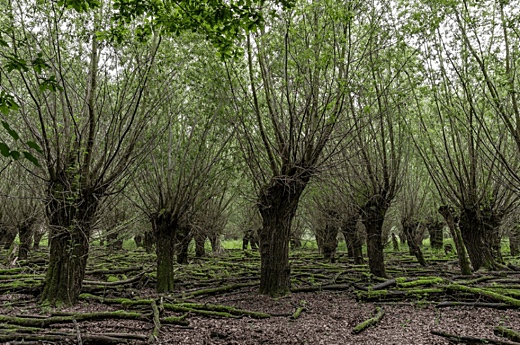

Image above:Pollarded trees in Germany are a technology worth keeping. Photo by Rene Schroder in original article.

IB Editor's note: The article has many more images of coppiced and pollarded wood farms in Europe that have operated for centuries.

From the Neolithic to the beginning of the twentieth century, coppiced woodlands, pollarded trees, and hedgerows provided people with a sustainable supply of energy, materials, and food.

How is Cutting Down Trees Sustainable?

Advocating for the use of biomass as a renewable source of energy – replacing fossil fuels – has become controversial among environmentalists. The comments on the previous article, which discussed thermoelectric stoves, illustrate this:

  • “As the recent film Planet of the Humans points out, biomass a.k.a. dead trees is not a renewable resource by any means, even though the EU classifies it as such.”
  • “How is cutting down trees sustainable?”
  • “Article fails to mention that a wood stove produces more CO2 than a coal power plant for every ton of wood/coal that is burned.”
  • “This is pure insanity. Burning trees to reduce our carbon footprint is oxymoronic.”
  • “The carbon footprint alone is just horrifying.”
  • “The biggest problem with burning anything is once it's burned, it's gone forever.”
  • “The only silly question I can add to to the silliness of this piece, is where is all the wood coming from?”

In contrast to what the comments suggest, the article does not advocate the expansion of biomass as an energy source. Instead, it argues that already burning biomass fires – used by roughly 40% of today’s global population – could also produce electricity as a by-product, if they are outfitted with thermoelectric modules. 

Nevertheless, several commenters maintained their criticism after they read the article more carefully. One of them wrote: “We should aim to eliminate the burning of biomass globally, not make it more attractive.”

Apparently, high-tech thinking has permeated the minds of (urban) environmentalists to such an extent that they view biomass as an inherently troublesome energy source – similar to fossil fuels. To be clear, critics are right to call out unsustainable practices in biomass production. 

However, these are the consequences of a relatively recent, “industrial” approach to forestry. When we look at historical forest management practices, it becomes clear that biomass is potentially one of the most sustainable energy sources on this planet.

Coppicing: Harvesting Wood Without Killing Trees

Nowadays, most wood is harvested by killing trees. Before the Industrial Revolution, a lot of wood was harvested from living trees, which were coppiced. The principle of coppicing is based on the natural ability of many broad-leaved species to regrow from damaged stems or roots – damage caused by fire, wind, snow, animals, pathogens, or (on slopes) falling rocks. 

Coppice management involves the cutting down of trees close to ground level, after which the base – called the “stool” – develops several new shoots, resulting in a multi-stemmed tree.

When we think of a forest or a tree plantation, we imagine it as a landscape stacked with tall trees. However, until the beginning of the twentieth century, at least half of the forests in Europe were coppiced, giving them a more bush-like appearance. [1

 The coppicing of trees can be dated back to the stone age, when people built pile dwellings and trackways crossing prehistoric fenlands using thousands of branches of equal size – a feat that can only be accomplished by coppicing. [2]

Ever since then, the technique formed the standard approach to wood production – not just in Europe but almost all over the world. Coppicing expanded greatly during the eighteenth and nineteenth centuries, when population growth and the rise of industrial activity (glass, iron, tile and lime manufacturing) put increasing pressure on wood reserves.

Short Rotation Cycles

Because the young shoots of a coppiced tree can exploit an already well-developed root system, a coppiced tree produces wood faster than a tall tree. Or, to be more precise: although its photosynthetic efficiency is the same, a tall tree provides more biomass below ground (in the roots) while a coppiced tree produces more biomass above ground (in the shoots) – which is clearly more practical for harvesting. [3

Partly because of this, coppicing was based on short rotation cycles, often of around two to four years, although both yearly rotations and rotations up to 12 years or longer also occurred.

Because of the short rotation cycles, a coppice forest was a very quick, regular and reliable supplier of firewood. Often, it was cut up into a number of equal compartments that corresponded to the number of years in the planned rotation. 

For example, if the shoots were harvested every three years, the forest was divided into three parts, and one of these was coppiced each year. Short rotation cycles also meant that it took only a few years before the carbon released by the burning of the wood was compensated by the carbon that was absorbed by new growth, making a coppice forest truly carbon neutral. In very short rotation cycles, new growth could even be ready for harvest by the time the old growth wood had dried enough to be burned.

In some tree species, the stump sprouting ability decreases with age. After several rotations, these trees were either harvested in their entirety and replaced by new trees, or converted into a coppice with a longer rotation. Other tree species resprout well from stumps of all ages, and can provide shoots for centuries, especially on rich soils with a good water supply. Surviving coppice stools can be more than 1,000 years old.

Biodiversity

A coppice can be called a “coppice forest” or a “coppice plantation”, but in reality it was neither a forest nor a plantation – perhaps something in between. Although managed by humans, coppice forests were not environmentally destructive, on the contrary. Harvesting wood from living trees instead of killing them is beneficial for the life forms that depend on them. 

Coppice forests can have a richer biodiversity than unmanaged forests, because they always contain areas with different stages of light and growth. None of this is true in industrial wood plantations, which support little or no plant and animal life, and which have longer rotation cycles (of at least twenty years).

Our forebears also cut down tall, standing trees with large-diameter stems – just not for firewood. Large trees were only “killed” when large timber was required, for example for the construction of ships, buildings, bridges, and windmills. [4

Coppice forests could contain tall trees (a “coppice-with-standards”), which were left to grow for decades while the surrounding trees were regularly pruned. However, even these standing trees could be partly coppiced, for example by harvesting their side branches while they were alive (shredding).

Multipurpose Trees

The archetypical wood plantation promoted by the industrial world involves regularly spaced rows of trees in even-aged, monocultural stands, providing a single output – timber for construction, pulpwood for paper production, or fuelwood for power plants. 

In contrast, trees in pre-industrial coppice forests had multiple purposes. They provided firewood, but also construction materials and animal fodder.

The targeted wood dimensions, determined by the use of the shoots, set the rotation period of the coppice. Because not every type of wood was suited for every type of use, coppiced forests often consisted of a variety of tree species at different ages. 

Several age classes of stems could even be rotated on the same coppice stool (“selection coppice”), and the rotations could evolve over time according to the needs and priorities of the economic activities.

Coppiced wood was used to build almost anything that was needed in a community. [5] For example, young willow shoots, which are very flexible, were braided into baskets and crates, while sweet chestnut prunings, which do not expand or shrink after drying, were used to make all kinds of barrels. Ash and goat willow, which yield straight and sturdy wood, provided the material for making the handles of brooms, axes, shovels, rakes and other tools.

Young hazel shoots were split along the entire length, braided between the wooden beams of buildings, and then sealed with loam and cow manure – the so-called wattle-and-daub construction. Hazel shoots also kept thatched roofs together. 

Alder and willow, which have almost limitless life expectancy under water, were used as foundation piles and river bank reinforcements. The construction wood that was taken out of a coppice forest did not diminish its energy supply: because the artefacts were often used locally, at the end of their lives they could still be burned as firewood.

Coppice forests also supplied food. On the one hand, they provided people with fruits, berries, truffles, nuts, mushrooms, herbs, honey, and game. On the other hand, they were an important source of winter fodder for farm animals. Before the Industrial Revolution, many sheep and goats were fed with so-called “leaf fodder” or “leaf hay” – leaves with or without twigs. [6]

Elm and ash were among the most nutritious species, but sheep also got birch, hazel, linden, bird cherry and even oak, while goats were also fed with alder. In mountainous regions, horses, cattle, pigs and silk worms could be given leaf hay too. Leaf fodder was grown in rotations of three to six years, when the branches provided the highest ratio of leaves to wood. When the leaves were eaten by the animals, the wood could still be burned.

Pollards & Hedgerows

Coppice stools are vulnerable to grazing animals, especially when the shoots are young. Therefore, coppice forests were usually protected against animals by building a ditch, fence or hedge around them. In contrast, pollarding allowed animals and trees to be mixed on the same land. Pollarded trees were pruned like coppices, but to a height of at least two metres to keep the young shoots out of reach of grazing animals.

Wooded meadows and wood pastures – mosaics of pasture and forest – combined the grazing of animals with the production of fodder, firewood and/or construction wood from pollarded trees. “Pannage” or “mast feeding” was the method of sending pigs into pollarded oak forests during autumn, where they could feed on fallen acorns. 

The system formed the mainstay of pork production in Europe for centuries. [7] The “meadow orchard” or “grazed orchard” combined fruit cultivation and grazing -- pollarded fruit trees offered shade to the animals, while the animals could not reach the fruit but fertilised the trees.

While agriculture and forestry are now strictly separated activities, in earlier times the farm was the forest and vice versa. It would make a lot of sense to bring them back together, because agriculture and livestock production – not wood production – are the main drivers of deforestation. 

If trees provide animal fodder, meat and dairy production should not lead to deforestation. If crops can be grown in fields with trees, agriculture should not lead to deforestation. Forest farms would also improve animal welfare, soil fertility and erosion control.

Line Plantings

Extensive plantations could consist of coppiced or pollarded trees, and were often managed as a commons. However, coppicing and pollarding were not techniques seen only in large-scale forest management. Small woodlands in between fields or next to a rural house and managed by an individual household would be coppiced or pollarded. 

A lot of wood was also grown as line plantings around farmyards, fields and meadows, near buildings, and along paths, roads and waterways. Here, lopped trees and shrubs could also appear in the form of hedgerows, thickly planted hedges. [8]

Although line plantings are usually associated with the use of hedgerows in England, they were common in large parts of Europe. In 1804, English historian Abbé Mann expressed his surprise when he wrote about his trip to Flanders (today part of Belgium):

 “All fields are enclosed with hedges, and thick set with trees, insomuch that the whole face of the country, seen from a little height, seems one continued wood”. 

Typical for the region was the large number of pollarded trees. [8]

Like coppice forests, line plantings were diverse and provided people with firewood, construction materials and leaf fodder. However, unlike coppice forests, they had extra functions because of their specific location. [9] One of these was plot separation: keeping farm animals in, and keeping wild animals or cattle grazing on common lands out. Various techniques existed to make hedgerows impenetrable, even for small animals such as rabbits. 

Around meadows, hedgerows or rows of very closely planted pollarded trees (“pollarded tree hedges”) could stop large animals such as cows. If willow wicker was braided between them, such a line planting could also keep small animals out. [8]

Trees and line plantings also offered protection against the weather. Line plantings protected fields, orchards and vegetable gardens against the wind, which could erode the soil and damage the crops. In warmer climates, trees could shield crops from the sun and fertilize the soil. Pollarded lime trees, which have very dense foliage, were often planted right next to wattle-and-daub buildings in order to protect them from wind, rain and sun. [10]

Dunghills were protected by one or more trees, preventing the valuable resource from evaporating due to sun or wind. In the yard of a watermill, the wooden water wheel was shielded by a tree to prevent the wood from shrinking or expanding in times of drought or inactivity. [8]

Location Matters

Along paths, roads and waterways, line plantings had many of the same location-specific functions as on farms. Cattle and pigs were hoarded over dedicated droveways lined with hedgerows, coppices and/or pollards. 

When the railroads appeared, line plantings prevented collisions with animals. They protected road travellers from the weather, and marked the route so that people and animals would not get off the road in a snowy landscape. They prevented soil erosion at riverbanks and hollow roads.

All functions of line plantings could be managed by dead wood fences, which can be moved more easily than hedgerows, take up less space, don’t compete for light and food with crops, and can be ready in a short time. [11

However, in times and places were wood was scarce a living hedge was often preferred (and sometimes obliged) because it was a continuous wood producer, while a dead wood fence was a continuous wood consumer. A dead wood fence may save space and time on the spot, but it implies that the wood for its construction and maintenance is grown and harvested elsewhere in the surroundings.

Local use of wood resources was maximised. For example, the tree that was planted next to the waterwheel, was not just any tree. It was red dogwood or elm, the wood that was best suited for constructing the interior gearwork of the mill. When a new part was needed for repairs, the wood could be harvested right next to the mill. 

Likewise, line plantings along dirt roads were used for the maintenance of those roads. The shoots were tied together in bundles and used as a foundation or to fill up holes. Because the trees were coppiced or pollarded and not cut down, no function was ever at the expense of another.

Nowadays, when people advocate for the planting of trees, targets are set in terms of forested area or the number of trees, and little attention is given to their location – which could even be on the other side of the world. However, as these examples show, planting trees closeby and in the right location can significantly optimise their potential.

Shaped by Limits

Coppicing has largely disappeared in industrial societies, although pollarded trees can still be found along streets and in parks. Their prunings, which once sustained entire communities, are now considered waste products. If it worked so well, why was coppicing abandoned as a source of energy, materials and food? The answer is short: fossil fuels. 

 Our forebears relied on coppice because they had no access to fossil fuels, and we don’t rely on coppice because we have.

Most obviously, fossil fuels have replaced wood as a source of energy and materials. Coal, gas and oil took the place of firewood for cooking, space heating, water heating and industrial processes based on thermal energy. Metal, concrete and brick – materials that had been around for many centuries – only became widespread alternatives to wood after they could be made with fossil fuels, which also brought us plastics. 

Artificial fertilizers – products of fossil fuels – boosted the supply and the global trade of animal fodder, making leaf fodder obsolete. The mechanisation of agriculture – driven by fossil fuels – led to farming on much larger plots along with the elimination of trees and line plantings on farms.

Less obvious, but at least as important, is that fossil fuels have transformed forestry itself. Nowadays, the harvesting, processing and transporting of wood is heavily supported by the use of fossil fuels, while in earlier times they were entirely based on human and animal power – which themselves get their fuel from biomass. It was the limitations of these power sources that created and shaped coppice management all over the world.

Wood was harvested and processed by hand, using simple tools such as knives, machetes, billhooks, axes and (later) saws. Because the labour requirements of harvesting trees by hand increase with stem diameter, it was cheaper and more convenient to harvest many small branches instead of cutting down a few large trees. 

Furthermore, there was no need to split coppiced wood after it was harvested. Shoots were cut to a length of around one metre, and tied together in “faggots”, which were an easy size to handle manually.

To transport firewood, our forebears relied on animal drawn carts over often very bad roads. This meant that, unless it could be transported over water, firewood had to be harvested within a radius of at most 15-30 km from the place where it was used. [12

 Beyond those distances, the animal power required for transporting the firewood was larger than its energy content, and it would have made more sense to grow firewood on the pasture that fed the draft animal. [13] T

here were some exceptions to this rule. Some industrial activities, like iron and potash production, could be moved to more distant forests – transporting iron or potash was more economical than transporting the firewood required for their production. However, in general, coppice forests (and of course also line plantings) were located in the immediate vicinity of the settlement where the wood was used.

In short, coppicing appeared in a context of limits. Because of its faster growth and versatile use of space, it maximised the local wood supply of a given area. Because of its use of small branches, it made manual harvesting and transporting as economical and convenient as possible.

Can Coppicing be Mechanised?

From the twentieth century onwards, harvesting was done by motor saw, and since the 1980s, wood is increasingly harvested by powerful vehicles that can fell entire trees and cut them on the spot in a matter of minutes. 

Fossil fuels have also brought better transportation infrastructures, which have unlocked wood reserves that were inaccessible in earlier times. Consequently, firewood can now be grown on one side of the planet and consumed at the other.

The use of fossil fuels adds carbon emissions to what used to be a completely carbon neutral activity, but much more important is that it has pushed wood production to a larger – unsustainable – scale. [14

Fossil fueled transportation has destroyed the connection between supply and demand that governed local forestry. If the wood supply is limited, a community has no other choice than to make sure that the wood harvest rate and the wood renewal rate are in balance. Otherwise, it risks running out of fuelwood, craft wood and animal fodder, and it would be abandoned.

Likewise, fully mechanised harvesting has pushed forestry to a scale that is incompatible with sustainable forest management. Our forebears did not cut down large trees for firewood, because it was not economical. 

Today, the forest industry does exactly that because mechanisation makes it the most profitable thing to do. Compared to industrial forestry, where one worker can harvest up to 60 m3 of wood per hour, coppicing is extremely labour-intensive. 

Consequently, it cannot compete in an economic system that fosters the replacement of human labour with machines powered by fossil fuels.

Some scientists and engineers have tried to solve this by demonstrating coppice harvesting machines. 

[15] However, mechanisation is a slippery slope. The machines are only practical and economical on somewhat larger tracts of woodland (>1 ha) which contain coppiced trees of the same species and the same age, with only one purpose (often fuelwood for power generation).

 As we have seen, this excludes many older forms of coppice management, such as the use of multipurpose trees and line plantings. Add fossil fueled transportation to the mix, and the result is a type of industrial coppice management that brings few improvements.

Sustainable forest management is essentially local and manual. This doesn’t mean that we need to copy the past to make biomass energy sustainable again.

 For example, the radius of the wood supply could be increased by low energy transport options, such as cargo bikes and aerial ropeways, which are much more efficient than horse or ox drawn carts over bad roads, and which could be operated without fossil fuels. 

Hand tools have also improved in terms of efficiency and ergonomics. We could even use motor saws that run on biofuels – a much more realistic application than their use in car engines. [16]

The Past Lives On

This article has compared industrial biomass production with historical forms of forest management in Europe, but in fact there was no need to look to the past for inspiration. The 40% of the global population consisting of people in poor societies that still burn wood for cooking and water and/or space heating, are no clients of industrial forestry. Instead, they obtain firewood in much of the same ways that we did in earlier times, although the tree species and the environmental conditions can be very different. [17]

A 2017 study calculated that the wood consumption by people in “developing” societies – good for 55% of the global wood harvest and 9-15% of total global energy consumption – only causes 2-8% of anthropogenic climate impacts. [18

 Why so little? Because around two-thirds of the wood that is harvested in developing societies is harvested sustainably, write the scientists. People collect mainly dead wood, they grow a lot of wood outside the forest, they coppice and pollard trees, and they prefer the use of multipurpose trees, which are too valuable to cut down. 

The motives are the same as those of our ancestors: people have no access to fossil fuels and are thus tied to a local wood supply, which needs to be harvested and transported manually.

These numbers confirm that it is not biomass energy that’s unsustainable. If the whole of humanity would live as the 40% that still burns biomass regularly, climate change would not be an issue. What is really unsustainable is a high energy lifestyle. 

We can obviously not sustain a high-tech industrial society on coppice forests and line plantings alone. But the same is true for any other energy source, including uranium and fossil fuels. 
'Planet of the Humans" review

SUBHEAD: The calls into question the solutions proposed by so-called renewable technologies.

By Edwardo Sasso 0n 7 May 2020 for Resilience - 
(https://www.resilience.org/stories/2020-05-07/planet-of-the-humans-reviewing-the-film-and-its-reviews/)


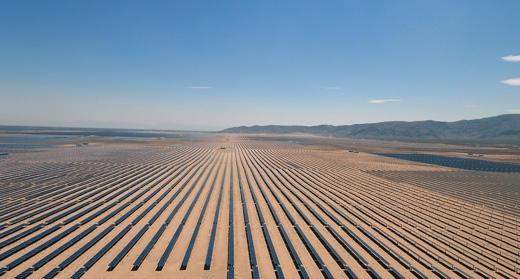
Image above: This immense photovoltaic power plant is operated by an Italian company in the desert near Villanueva, Mexico. From (https://www.nbcnews.com/mach/science/supersized-solar-farms-are-sprouting-around-world-maybe-space-too-ncna901666).

[IB Publisher's comment: In our experience in Hawaii solar-electricity generation does not necessarily require the use of large quantities of cement and steel. The panels themselves often have aluminum frames. In Hawaii we have a corrugated metal roof. Our solar panels have aluminum frames bolted to 2"x4" wood frames that are bolted to the metal roofing. Small scale individual residential and commercial solar systems don't need high voltage distribution towers or heavy duty foundations and framing. We worry about hurricane damage... but that's likely to take the whole roof off.]

If you haven’t seen the latest (and arguably the most contentious) documentary on renewable energy, be prepared for an aftertaste of mixed feelings.

Joining hands with the controversial Michael Moore, environmentalist and filmmaker Jeff Gibbs has sent an eerie message that is now somewhat dividing the climate movement—in many ways for the worse, but, in a few others, for the better.

So, at least, one could argue is the case of Planet of the Humans. After engaging briefly with some of the well-deserved criticisms the film has received thus far, there are nevertheless some important aspects brought to our attention by the movie.

Specifically, at one point in the documentary, Gibbs touches upon the religious and existential dimensions underlying our ecological hot waters—aspects that, for what it seems, many of his critics have left unaddressed. Hence the focus towards the end of this review will fall on the cosmic role of religion (or cosmology, if we will) in helping us engage with “the great scheme of things”, to use the phrase of one of the scholars interviewed in the documentary.

But first a sketch of the film and its criticism.

What is the Central Claim of Planet of the Humans?

Drawing implicitly on the legacy of renowned environmentalist Rachel Carson, in essence, Planet of the Humans calls into question the solutions proposed by so-called renewable technologies.

Such solutions, Gibbs argues, are to a degree or another an extension-in-disguise of the same problems created by our technological society. For one, solar panels and wind towers still burn fuels to be produced; for another, they rely on copious amounts of minerals and rare earth metals.

More worryingly, what Gibbs calls “the narrow solution of green technology” keeps feeding the pockets of a smaller few at the expense of the greater rest, leaving underlying societal problems unattended.

Overall, the documentary thus aims to show how the creation of these panels and towers, as well as the burning of biofuels and biomass, are also problematic, albeit in different ways if compared with the fossil fuels they aim to displace. Old wine in new wineskins, in short.

“Is it possible” thus asks Gibbs, “for machines made by industrial civilization to save us from industrial civilization?” (17:10)

Even if he argues for an unnerving “no”, some of the film’s reviewers are ready to claim the opposite.

(Well-Deserved) Hot-Blooded Reactions

To begin with, Gibbs’s critics are quick to signal how the film’s downplaying of renewables is outdated. The dismissal of solar panels (14:45, a scene whose panels arguably date from 2008), for instance, is done on the ground of their inefficiency.

However, as leading environmental activist Bill McKibben answers back, engineers have done their job since in vastly improving this technology, making solar the cheapest way of generating energy today.

According to McKibben, since a panel now lasts (up to) three decades—taking four years to compensate for the energy it took to build it—90 percent of the power it then produces is carbon-emissions-free.

Moreover, others point out how the overall impacts across the lifecycle (to mine materials, build, transport, install, and uninstall) both solar PVs and wind towers is between 3 and 28 times lower than using, say, liquified natural gas for electricity production (natural gas is one of the less polluting forms of fossil fuels).

The Guardian, too, implicitly takes sides with furious scientists calling to take down the movie—not least because fact-checks are revealing the film’s slim evidence to back up some claims.

Getting Rid of the Mud-water, but Keeping the Baby

Besides valid reasons like the above, what struck me as most troubling was the grim and rather accusatory tone of the documentary. It’s also (to a considerable extent) polarizing, at times dismissing perhaps too easily the honest intentions of some well-meaning folk. (Sad but true; especially in an age of ecological breakdown when we need to unite despite our differences.)

Still, could the film’s field-splitting call to choose sides, be the method to its madness? Could its polarizing stance somehow serve Gibb’s insistence to untangle the ecological cause from the story of unceasing economic growth—even of so-called ‘green’ economic growth—that continues to dictate the north of our industrialized societies?

Senior Fellow of the Post-Carbon Institute and author of Afterburn: Societies Beyond Fossil Fuels, Richard Heinberg, agrees with the filmmakers in admitting how the belief that with ‘green’ investments and political will we’ll ultimately be able to build a green future is “an illusion that deserves shattering.”

According to Heinberg,
“The only realistic way to make the transition in industrial countries like the US is to begin reducing overall energy usage substantially [solar-/wind-powered or otherwise], eventually running the economy on a quarter, a fifth, or maybe even a tenth of current energy.” 

Read: Renewables? To an extent, yes; but far beyond: lifestyle change, and cutbacks—something that some environmentalists shy away from championing, admittedly for the tactical communication purpose of not losing their audience.

And yet, as Heinberg notes, “it’s a mistake to let marketing consultants sort truth from fiction for us”—a chief reason why Planet of the Humans doesn’t have space for such bargaining.

Just Give Me (One More) Fact

On a similar vein, world-renowned Professor Emeritus of Community Planning at the University of British Columbia, William Rees, has recently shown the limitations of renewables and remains a pessimist facing what he labels as a “superficial support for the notion that green tech is our savior.”

To back his claim, Rees points out how building just one typical wind turbine requires 817 energy-intensive tonnes of steel, 2,270 tonnes of concrete, and 41 tonnes of non-recyclable plastic.

In turn, solar power also demands large quantities of cement, steel, and glass—let alone rare earth metals. Aside from their compromised mining and refining processes, world demand for such metals of so-called renewable energy would rise 300 percent to 1,000 percent by 2050 just to meet the Paris goals.

“Ironically,” Rees remarks, “the mining, transportation, refining and manufacturing of material inputs to the green energy solution would be powered mainly by fossil fuels.”

For all we’d like them to, towers and panels don’t simply drop from heaven. So, too, more or less argues the film.

Fact-checking and physical limitations aside, a deeper and more fundamental issue that Planet of the Humans unveils is that of the societal story that we continue to tell ourselves, in one shape or another—be it green, orange, right, left, or center.

And it’s the 300-year-old, now-taken-for-granted story of our increasingly urbanized, Techno-Industrial Age: namely, that we are the captains of our souls and the masters of our fates, and that we attain that fate through technology, production, and consumption.

In short, this societal narrative (including many ‘green’ versions of such narrative) has made us believe that we are above, front-and-center, while everything else is below, in the backstage.

Under this worldview, ‘nature’ is not a ‘Home’ but a ‘resource’; we are not earthly humans but technological ‘citizens’ (and now virtual ‘Internauts’); countries are not made of communities of earth-dwellers but of abstract ‘markets’ of X or Y number of ‘consumers’. And thus our very language betrays us.

Scholars call this ‘anthropocentrism’ blended with ‘economism’. Others label it ‘speciesism’ and ‘technopoly’, even as one corporation praised it by making us sing “You got the whole world in your hands, with Mastercard at your command.”

As materialist historian Yuval Noah Harari has shown in the sixteenth chapter of Sapiens, this story championed by today’s economic system has become so pervasive that it now has all the elements of religion—however secular its scope.

It tells us what to believe (economic growth will lead to the benefit of all), how to behave (rational and disciplined at the workplace, unrestrained and narcissistic at the shopping mall), and what to value (“Life is Now”, as Visa trumpeted rather conveniently, and dogmatically).

Hence to culture and religion we now turn—and to their characteristic interest in “the great scheme of things”.

Remixed Echoes of an Even-Older Story

In one of the most existential sections of the documentary (49:04), the director asks whether our inability to come to terms with our mortality misinforms most of our societal decisions. He also asks rhetorically whether his side (the environmental side) has an unspoken religion, even as the Right has Christianity and a belief in infinite fossil fuels.

I would nuance this second claim—at least pertaining to the so-called religion of (many) of the Right. And that because such a belief system is often in fact Deist. (Deism is a modern distortion of ancient Christianity, presenting us with a deity that’s detached from the world, which is then purportedly left for us to control as we discover and master its immutable laws.)

It is not my aim here to make a case for believing in a transcendental Agent, but simply to acknowledge how director Jeff Gibbs might be unknowingly inviting us to shed the same tears of the God testified to and experienced by the descendants of the ancient Hebrews.

In contrast to the absent deity of Deism, the sixth chapter of the Book of Genesis, for instance, speaks of the Most High becoming “regretful” considering the evil doings of humankind—something that “grieved God to his heart”.

According to the Book of Jeremiah, the Eternal One recoiled and was immersed in swirls of grief as people became strangers in their own land. In fact, in and through the cry of that young Hebrew prophet, God wept (Jer 14).

A Prophet in the Making?

haps, one of the film’s greatest contributions: its invitation to mourn, to leave us with discomfort towards superficial solutions, to invite us to feel and experience grief? However somberly and imperfectly, Gibbs may as well be helping us to traverse an unavoidable but ultimately necessary dark valley—one where we are reminded of how, before any blink of light, we must first confess and turn away from our pathological complicity with the decimation of our sacred Home. Genuine tears are the only cradle of authentic beginnings.

Even if commonly dismissed by large strands of the scientific and humanist communities in our scientific age, here lays one of the fundamental insights of what we call ‘religion’ or ‘spirituality’; namely, their ability to disclose the ultimate horizons that should inform and inspire our lives.

Such horizons have been barred by the smokescreens created by the Industrial Revolution, tempting us not to see anywhere beyond. (Who needs to pray for rain for crops when one is a click away from a Caesar’s salad or a Papa John’s pizza?)

For numerous reasons, for the past three centuries we’ve increasingly come to believe that there’s no ultimate purpose or ‘goal’ to life. Instead, all we’ve been left with is an unrestrained desire to impose our will upon others and upon the living world, as it’s now tragically evident. When ultimate purposes vanish out of sight, we strive to become gods.

Recovering Forgotten Horizon

Intentionally or not, the film’s sorrowful approach begins to dismantle this very ‘scheme of things’; one that has made us believe that we are alone, at the center, in control of an inert universe without ultimate meaning.

In contrast, the forgotten grand-view cracked open by ancient spiritual traditions summon us to acknowledge ourselves as guests in a world that precedes us and that is not our own. The spotlight falls elsewhere.

At least according to the Judeo-Christian tradition that now unspokenly undergirds pretty much all of today’s secularized Western cultures, we are mortal tenants and fragile earthlings; accountable, dependent, small. We are animated by sacred breath, even as we are made from the very dust to which we will return.

But, precisely as such, we are nevertheless invited into an extravagant feast hosted by the Ultimate Source of completeness, gladness, and joy—the very Source who also cries and grieves.

Is such plenitude the hidden treasure that we are most searching for today—left, right, or center? Far beyond any technical glitch that we can muster, isn’t such plenitude the very ‘something’ which we know in our bones to be ultimately missing?

Those, of course, are questions for another occasion. And they may seem trivial should we continue to dismiss the divine and the transcendental as sheer social constructions that our human ancestors invented back in yesteryear to soothe our consciousness.

But then we must ask, how far will the dogmas of Materialism continue to take us? As posed by one of the film’s social scientists: “If we’re to make progress (whatever that word means). . . we’re going to radically overhaul our basic conception of who and what we are and what it is that we value.”

Or to borrow the words from Albert Einstein:
“A human being is part of the whole, called by us ‘Universe’; a part limited in time and space. He experiences himself, his thoughts and feelings as something separated from the rest—a kind of optical delusion of his consciousness. . . . Our task must be to free ourselves from this prison by widening our circle of compassion to embrace all living creatures and the whole of nature in its beauty.”

Not unlike Einstein’s summons, Planet of the Humans is at least spot on about the need to turn away from our technocentric story and all its delusions that have claimed to give us full control. Then, and only then, will any light shine like the dawn. And perhaps then, and only then, will we humans realize ourselves as transient guests on a planet that is certainly not of our own making.

Our tears will not be in vain.
.

A Solar Powered Website

SUBHEAD: An examination into how hard, sustainable and affordable it is to power your own site.

By Kris De Decker on 1 February 2020 for Low Tech Magazine -
(https://www.lowtechmagazine.com/2020/01/how-sustainable-is-a-solar-powered-website.html)


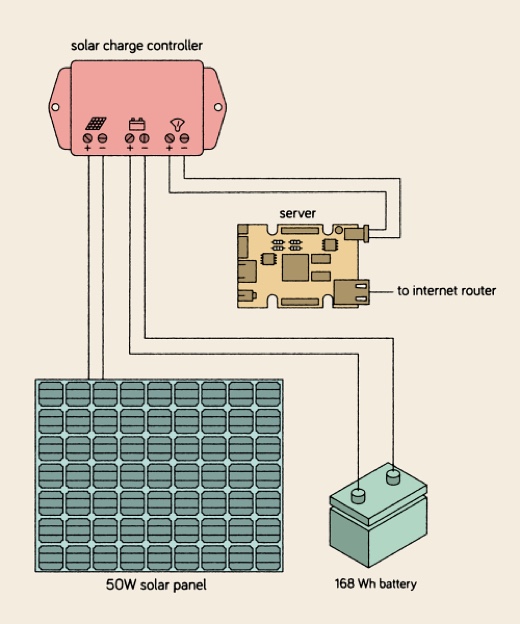
Image above: Diagram of home solar powered website. From original article. A simple representation of the system. A charge controller powered by a 50w solar panel charges a 168wh battery that runs a server to an internet router. The voltage conversion (between the 12V charge controller and the 5V server) and the battery meter (between the server and the battery) are missing.

(IB Editor's note: I just checked Amazon. A solar charge controller that meets the needs of this home base powered website server costs $10.97 with free Prime shipping. See (https://www.amazon.com/EEEKit-Controller-Intelligent-Multi-Function-Adjustable/dp/B07R8TRJ8C). I've had one for years attached to four 110ah dee cycle marine batteries keeping the LED lighting on in my shop. I think I paid over $30 for it then.)
.
Introduction
In September 2018, Low-tech Magazine launched a new website that aimed to radically reduce the energy use and carbon emissions associated with accessing its content. Internet energy use is growing quickly on account of both increasing bit rates (online content gets “heavier”) and increased time spent online (especially since the arrival of mobile computing and wireless internet).

The solar powered website bucks against these trends. To drop energy use far below that of the average website, we opted for a back-to-basics web design, using a static website instead of a database driven content management system. To reduce the energy use associated with the production of the solar panel and the battery, we chose a minimal set-up and accepted that the website goes off-line when the weather is bad.

We have been monitoring the solar powered server for 15 months now, and we have collected data on uptime, energy use, power use, system efficiency, and visitor traffic. We also calculated how much energy was required to make the solar panel, the battery, the charge controller and the server.

Uptime, Electricity Use & System Efficiency

The solar powered website goes off-line when the weather is bad – but how often does that happen? For a period of about one year (351 days, from 12 December 2018 to 28 November 2019), we achieved an uptime of 95.26%. This means that we were off-line due to bad weather for 399 hours.

If we ignore the last two months, our uptime was 98.2%, with a downtime of only 152 hours. Uptime plummeted to 80% during the last two months, when a software upgrade increased the energy use of the server. This knocked the website off-line for at least a few hours every night.

Let’s have a look at the electricity used by our web server (the “operational” energy use). We have measurements from the server and from the solar charge controller. Comparing both values reveals the inefficiencies in the system. Over a period of roughly one year (from 3 December 2018 to 24 November 2019), the electricity use of our server was 9.53 kilowatt-hours (kWh).

We measured significant losses in the solar PV system due to voltage conversions and charge/discharge losses in the battery. The solar charge controller showed a yearly electricity use of 18.10 kWh, meaning that system efficiency was roughly 50%.

During the period under study, the solar powered website received 865,000 unique visitors. Including all energy losses in the solar set-up, electricity use per unique visitor is then 0.021 watt-hour. One kilowatt-hour of solar generated electricity can thus serve almost 50,000 unique visitors, and one watt-hour of electricity can serve roughly 50 unique visitors. This is all renewable energy and as such there are no direct associated carbon emissions.

Embodied Energy Use & Uptime

The story often ends here when renewable energy is presented as a solution for the growing energy use of the internet. When researchers examine the energy use of data centers, which host the content that is accessible on the internet, they never take into account the energy that is required to build and maintain the infrastructure that powers those data centers.

There is no such omission with a self-hosted website powered by an off-the-grid solar PV installation. The solar panel, the battery, and the solar charge controller are equally essential parts of the installation as the server itself. Consequently, energy use for the mining of the resources and the manufacture of these components – the “embodied energy” – must also be taken into account.


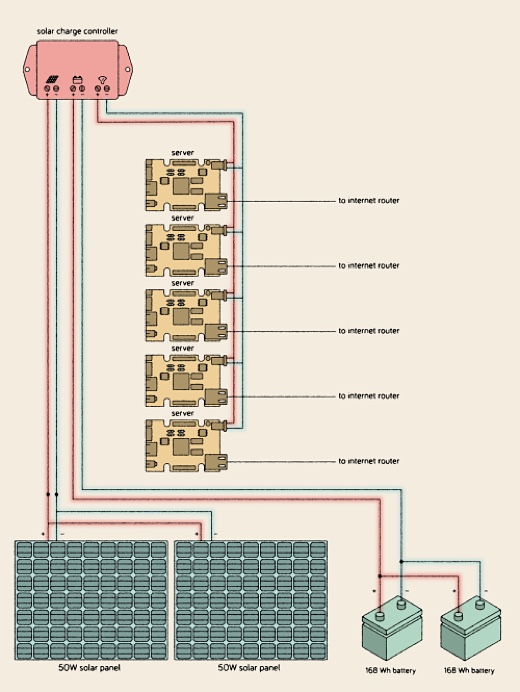
Image above: Diagram of five servers powrf two 168wh batteries charged by two 50w solar panels a charge controller powered by two 50watt solar panels that charge two 168wh batteries.

Unfortunately, most of this energy comes from fossil fuels, either in the form of diesel (mining the raw materials and transporting the components) or in the form of electricity generated mainly by fossil fuel power plants (most manufacturing processes).

The embodied energy of our configuration is mainly determined by the size of the battery and the solar panel. At the same time, the size of battery and solar panel determine how often the website will be online (the “uptime”). Consequently, the sizing of battery and solar panel is a compromise between uptime and sustainability.

To find the optimal balance, we have run (and keep running) our system with different combinations of solar panels and batteries. Uptime and embodied energy are also determined by the local weather conditions, so the results we present here are only valid for our location (the balcony of the author’s home near Barcelona, Spain).

Uptime and Battery size

Battery storage capacity determines how long the website can run without a supply of solar power. A minimum of energy storage is required to get through the night, while additional storage can compensate for a certain period of low (or no) solar power production during the day. Batteries deteriorate with age, so it’s best to start with more capacity than is actually needed, otherwise the battery needs to be replaced rather quickly.

Greater than 90% Uptime
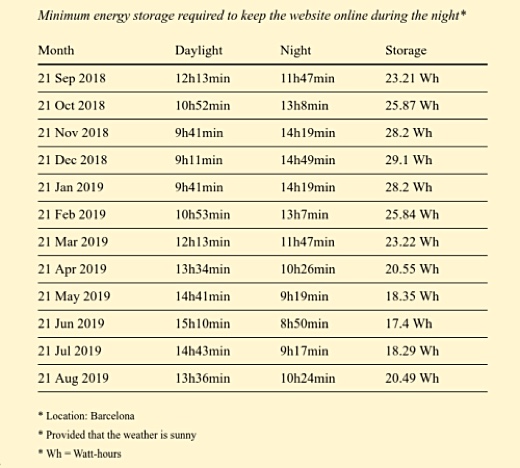
First, let’s calculate the minimum energy storage needed to keep the website online during the night, provided that the weather is good, the battery is new, and the solar panel is large enough to charge the battery completely. The average power use of our web server during the first year, including all energy losses in the solar installation, was 1.97 watts. During the shortest night of the year (8h50, June 21), we need 17.40 watt-hour of storage capacity, and during the longest night of the year (14h49, December 21), we need 29.19 Wh.


Table 1: Minimum energy required to keep website on line during the night. From original article.

Because lead-acid batteries should not be discharged below half of their capacity, the solar powered server requires a 60 Wh lead-acid battery to get through the shortest nights when solar conditions are optimal (2 x 29.19Wh). For most of the year we ran the system with a slightly larger energy storage (up to 86.4 Wh) and a 50W solar panel, and achieved the above mentioned uptime of 95-98%. [1]

100% Uptime
A larger battery would keep the website running even during longer periods of bad weather, again provided that the solar panel is large enough to charge the battery completely. To compensate for each day of very bad weather (no significant power production), we need 47.28 watt-hour (24h x 1.97 watts) of storage capacity.

From 1 December 2019 to 12 January 2020, we combined the 50 W solar panel with a 168 watt-hour battery, which has a practical storage capacity of 84 watt-hour. This is enough storage to keep the website running for two nights and a day. Even though we tested this configuration during the darkest period of the year, we had relatively nice weather and achieved an uptime of 100%.

However, to assure an uptime of 100% over a period of years would require more energy storage. To keep the website online during four days of low or no power production, we would need a 440 watt-hour lead-acid battery – the size of a car battery. We include this configuration to represent the conventional approach to off-grid solar power.

We also made calculations for batteries that aren’t large enough to get the website through the shortest night of the year: 48 Wh, 24 Wh, and 15.6 Wh (with practical storage capacities of 24 Wh, 12 Wh, and 7.8 Wh, respectively). The latter is the smallest lead-acid battery commercially available.

If the weather is good, the 48 Wh lead-acid battery will keep the server running during the night from March to September. The 24 Wh lead acid-battery can keep the website online for a maximum of 6 hours, meaning that the server will go off-line each night of the year, although at different hours depending on the season.

Finally, the 15.6 Wh battery keeps the website online for only four hours when there’s no solar power. Even if the weather is good, the server will stop working around 1 am in summer and around 9 pm in winter. The maximum uptime for the smallest battery would be around 50%, and in practice it will be lower due to clouds and rain.

A website that goes off-line in evening could be an interesting option for a local online publication with low anticipated traffic after midnight. However, since Low-tech Magazine’s readership is almost equally divided between Europe and the USA this is not an attractive option. If the website goes down every night, our American readers could only access it during the morning.

Uptime and Solar Panel Size
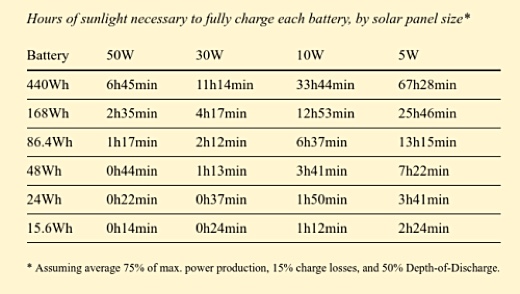
The uptime of the solar powered website is not only determined by the battery, but also by the solar panel, especially in relation to bad weather. The larger the solar panel, the quicker it will charge the battery and fewer hours of sun will be needed to get the website through the night. For example, with the 50 W solar panel, one to two hours of full sun are sufficient to completely charge any of the batteries (except for the car battery).


Table 2:  Hours of sunlight necessary to fully charge each battery; by solar panel size. From original article.

A 5 W solar panel – the smallest 12V solar panel commercially available – is the absolute minimum required to run a solar powered website. However, only under optimal conditions will it be able to power the server (2W) and charge the battery (3W), and it could only keep the website running through the night if the day is long enough. Because solar panels rarely generate their maximum power capacity, this would result in a website that is online only while the sun shines.

Even though the combination of a small solar panel and large battery can have the same embodied energy as the combination of a large solar panel and a small battery, the system each creates will have very different characteristics. In general, it’s best to opt for a larger solar panel and a smaller battery, because this combination increases the life expectancy of the battery – lead-acid batteries need to be fully charged from time to time or they lose storage capacity.

Embodied Energy for  Batteries and Solar Panels
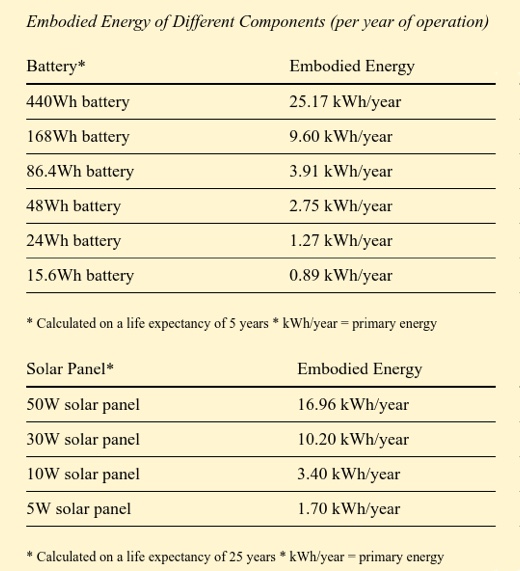
It takes 1.03 megajoule (MJ) to produce 1 watt-hour of lead-acid battery capacity [2], and 3,514 MJ of energy to produce one m2 of solar panel. [3] In the table below, we present the embodied energy for different sizes of batteries and solar panels and then calculate the embodied energy per year, based on a life expectancy of 5 years for batteries and 25 years for solar panels. The values are converted to kilowatt-hours per year and refer to primary energy, not electricity.

A solar powered website also needs a charge controller and of course a web server. The embodied energy for these components remains the same no matter the size of solar panel or battery. The embodied energy per year is based on a life expectancy of 10 years. [4][5]


Table 3:  Embodied Energy of Different Components (per ear of operation). From original article.

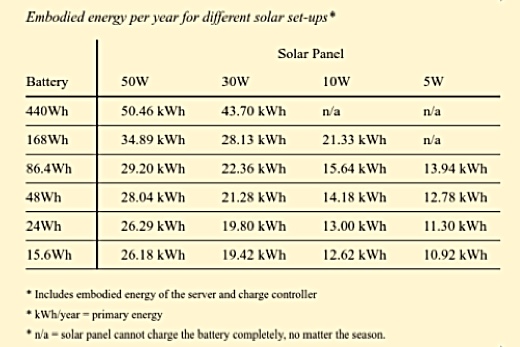
We now have all data to calculate the total embodied energy for each combination of solar panels and batteries. The results are presented in the table below.

The embodied energy varies by a factor of five depending on the configuration: from 10.92 kWh primary energy per year for the combination of the smallest solar panel (5W) with the smallest battery (15.6 Wh) to 50.46 kWh primary energy per year for the combination of the largest solar panel (50 W) with the largest battery (440Wh).

If we divide these results by the number of unique visitors per year (865,000), we obtain the embodied energy use per unique visitor to our website. For our original configuration with 95-98% uptime (50W solar panel, 86.4Wh battery), primary energy use per unique visitor is 0.03 Wh.

This result would be pretty similar for the other configurations with a lower uptime, because although the embodied energy is lower, so is the number of unique visitors.

How Sustainable is the Solar Powered Website?
Now that we have calculated the embodied energy of different configurations, we can calculate the carbon emissions. We can’t compare the environmental footprint of the solar powered website with that of the old website, because it is hosted elsewhere and we can’t measure its energy use.

What we can compare is the solar powered website with a similar self-hosted configuration that is run on grid power. This allows us to assess the (un)sustainability of running the website on solar power.

Life cycle analyses of solar panels are not very useful for working out the CO2-emissions of our components because they work on the assumption that all energy produced by the panels is used. This is not necessarily true in our case: the larger solar panels waste a lot of solar power in optimal weather conditions.

This means that fossil fuel use associated with running the solar powered Low-tech Magazine during the first year (50W panel, 86.4 Wh battery) corresponds to 3 litres of oil and 9 kg of carbon emissions – as much as an average European car driving a distance of 50 km. Below are the results for the other configurations:


Table 4:  Embodied Energy per year for different solar set-ups. From original article.

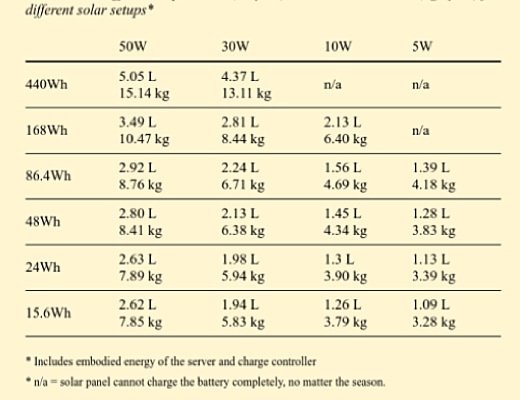
We therefore take another approach: we convert the embodied energy of our components to litres of oil (1 litre of oil is 10 kWh of primary energy) and calculate the result based on the CO2-emissions of oil (1 litre of oil produces 3 kg of greenhouse gasses, including mining and refining it). This takes into account that most solar panels and batteries are now produced in China – where the power grid is three times as carbon-intensive and 50% less energy efficient than in Europe. [6]

This means that fossil fuel use associated with running the solar powered Low-tech Magazine during the first year (50W panel, 86.4 Wh battery) corresponds to 3 litres of oil and 9 kg of carbon emissions – as much as an average European car driving a distance of 50 km. Below are the results for the other configurations:

Comparison with Carbon Intensity of Spanish Power GridNow let’s calculate the hypothetical CO2-emissions from running our self-hosted web server on grid power instead of solar power. CO2-emissions in this case depend on the Spanish power grid, which happens to be one of the least carbon intensive in Europe due to its high share of renewable and nuclear energy (respectively 36.8% and 22% in 2019).

Last year, the carbon intensity of the Spanish power grid decreased to 162 g of CO2 per kWh of electricity. For comparison, the average carbon intensity in Europe is around 300g per kWh of electricity, while the carbon intensity of the US and Chinese power grid are respectively above 400g and 900g of CO2 per kWh of electricity.

If we just look at the operational energy use of our server, which was 9.53 kWh of electricity during the first year, running it on the Spanish power grid would have produced 1.54 kg of CO2-emissions, compared to 3 - 9 kg in our tested configurations. This seems to indicate that our solar powered server is a bad idea, because even the smallest solar panel with the smallest battery generates more carbon emissions than grid power.

However, we’re comparing apples to oranges. We have calculated our emissions based on the embodied energy of our installation. When the carbon intensity of the Spanish power grid is measured, the embodied energy of the renewable power infrastructure is taken to be zero. If we calculated our carbon intensity in the same way, of course it would be zero, too.

Ignoring the embodied carbon emissions of the power infrastructure is reasonable when the grid is powered by fossil fuel power plants, because the carbon emissions to build that infrastructure are very small compared to the carbon emissions of the fuel that is burned. However, the reverse is true of renewable power sources, where operational carbon emissions are almost zero but carbon is emitted during the production of the power plants themselves.

To make a fair comparison with our solar powered server, the calculation of the carbon intensity of the Spanish power grid should take into account the emissions from the building and maintaining of the power plants, the transmission lines, and – should fossil fuel power plants eventually disappear – the energy storage. Of course, ultimately, the embodied energy of all these components would depend on the chosen uptime.

Possible Improvements
There are many ways in which the sustainability of our solar powered website could be improved while maintaining our present uptime. Producing solar panels and batteries using electricity from the Spanish grid would have the largest impact in terms of carbon emissions, because the carbon footprint of our configuration would be roughly 5 times lower than it is now.

What we can do ourselves is lower the operational energy use of the server and improve the system efficiency of the solar PV installation. Both would allow us to run the server with a smaller battery and solar panel, thereby reducing embodied energy. We could also switch to another type of energy storage or even another type of energy source.

Server
We already made some changes that have resulted in a lower operational energy use of the server. For example, we discovered that more than half of total data traffic on our server (6.63 of 11.16 TB) was caused by a single broken RSS implementation that pulled our feed every couple of minutes.

Fixing this as well as some other changes lowered the power use of the server (excluding energy losses) from 1.14 watts to about 0.95 watts. The gain may seem small, but a difference in power use of 0.19 watts adds up to 4.56 watt-hour over the course of 24 hours, which means that the website can stay online for more than 2.5 hours longer.

System Efficiency
System efficiency was only 50% during the first year. Energy losses were experienced during charging and discharging of the battery (22%), as well as in the voltage conversion from 12V (solar PV system) to 5V (USB connection), where the losses add up to 28%. The initial voltage converter we built was pretty suboptimum (our solar charge controller doesn't have a built-in USB-connection), so we could build a better one, or switch to a 5V solar PV set-up.

Energy Storage
To increase the efficiency of the energy storage, we could replace the lead-acid batteries with more expensive lithium-ion batteries, which have lower charge/discharge losses (small-scale compressed air energy storage system

(CAES). Although low pressure CAES systems have similar efficiency to lead-acid batteries, they have much lower embodied energy due to their long life expectancy (decades instead of years).

Energy Source
Another way to lower the embodied energy is to switch renewable energy source. Solar PV power has high embodied energy compared to alternatives such as wind, water, or human power. These power sources could be harvested with little more than a generator and a voltage regulator – as the rest of the power plant could be built out of wood. Furthermore, a water-powered website wouldn’t require high-tech energy storage. If you’re in a cold climate, you could even operate a website on the heat of a wood stove, using a thermo-electric generator.

Solar Tracker
People who have a good supply of wind or water power could build a system with lower embodied energy than ours. However, unless the author starts powering his website by hand or foot, we’re pretty much stuck with solar power. The biggest improvement we could make is to add a solar tracker that makes the panel follow the sun, which could increase electricity generation by as much as 30%, and allow us to obtain a better uptime with a smaller panel.

Let’s Scale Things Up !
A final way to improve the sustainability of our system would be to scale it up: run more websites on a server, and run more (and larger) servers on a solar PV system. This set-up would have much lower embodied energy than an oversized system for each website alone.


Table 5: Different solar setups includes embobied energy of the server and charge controller. From original article.

Solar Webhosting Company
If we were to fill the author’s balcony with solar panels and start a solar powered webhosting company, the embodied energy per unique visitor would decrease significantly. We would need only one server for multiple websites, and only one solar charge controller for multiple solar panels.

Voltage conversion would be more energy efficient, and both solar and battery power could be shared by all websites, which brings economies of scale.

Of course, this is the very concept of the data center, and although we have no ambition to start such a business, others could take this idea forward: towards a data center that is run just as efficiently as any other data center today, but which is powered by renewables and goes off-line when the weather is bad.

Add More Websites
We found that the capacity of our server is large enough to host more websites, so we already took a small step towards economies of scale by moving the Spanish and French versions of Low-tech Magazine to the solar powered server (as well as some other translations).

Although this move will increase our operational energy use and potentially also our embodied energy use, we also eliminate other websites that are or were hosted elsewhere. We also have to keep in mind that the number of unique visitors to Low-tech Magazine may grow in the future, so we need to become more energy efficient just to maintain our environmental footprint.

Combine Server and Lighting
Another way to achieve economies of scale would give a whole new twist to the idea. The solar powered server is part of the author’s household, which is also partly powered by off-grid solar energy. We could test different sizes of batteries and solar panels – simply swapping components between solar installations.

When we were running the server on the 50 W panel, the author was running the lights in the living room on a 10W panel – and was often left sitting in the dark. When we were running the server on the 10 W panel, it was the other way around: there was more light in the household, at the expense of a lower server uptime.

Let’s say we run both the lights and the server on one solar PV system. It would lower the embodied energy if both systems are considered, because only one solar charge controller would be needed.

Furthermore, it could result in a much smaller battery and solar panel (compared to two separate systems), because if the weather gets bad, the author could decide not to use the lights and keep the server online – or the other way around. This flexibility is not available now, because the server is the only load and its power use cannot be easily manipulated.

Energy Use in the Network
As far as we know, ours is the first life cycle analysis of a website that runs entirely on renewable energy and includes the embodied energy of its power and energy storage infrastructure. However, this is not, of course, the total energy use associated with this website.

There’s also the operational and embodied energy of the network infrastructure (which includes our router, the internet backbone, and the mobile phone network), and the operational and embodied energy of the devices that our visitors use to access our website: smartphones, tablets, laptops, desktops. Some of these have low operational energy use, but they all have very limited lifespans and thus high embodied energy.

Energy use in the network is directly related to the bit rate of the data traffic that runs through it, so our lightweight website is just as efficient in the communication network as it is on our server. However, we have very little influence over which devices people use to access our website, and the direct advantage of our design is much smaller here than in the network.

For example, our website has the potential to increase the life expectancy of computers, because it’s light enough to be accessed with very old machines. Unfortunately, our website alone will not make people use their computers for longer.

That said, both the network infrastructure and the end-use devices could be re-imagined along the lines of the solar powered website – downscaled and powered by renewable energy sources with limited energy storage.

Parts of the network infrastructure could go off-line if the local weather is bad, and your e-mail may be temporarily stored in a rainstorm 3.000 km away. This type of network infrastructure actually exists in some countries, and those networks partly inspired this solar powered website. The end-use devices could have low energy use and long life expectancy.

Because the total energy use of the internet is usually measured to be roughly equally distributed over servers, network, and end-use devices (all including the manufacturing of the devices), we can make a rough estimate of the total energy use of this website throughout a re-imagined internet.

For our original set-up with 95.2% uptime, this would be 87.6 kWh of primary energy, which corresponds to 9 litres of oil and 27 kg of CO2. The improvements we outlined earlier could bring these numbers further down, because in this calculation the whole internet is powered by oversized solar PV systems on balconies.

Authors: Kris De Decker, Roel Roscam Abbing, Marie Otsuka
llustrations by Diego Marmolejo.

Thanks to Kathy Vanhout, Adriana Parra and Gauthier Roussilhe.

Freezers up and running

SUBHEAD: Our two new freezers (one converted to fridge) are running off solar and working as expected.

By Juan Wilson on 1 September 2018 for Island Breath -
(http://islandbreath.blogspot.com/2018/09/freezers-up-and-running.html)


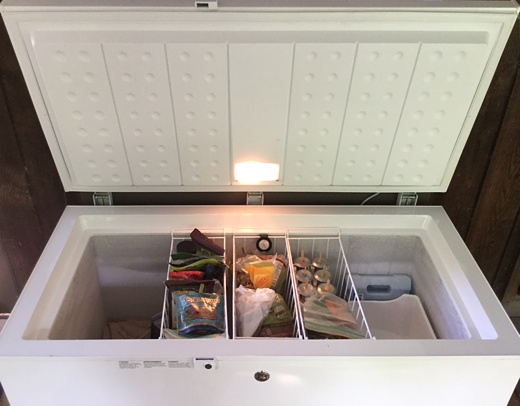
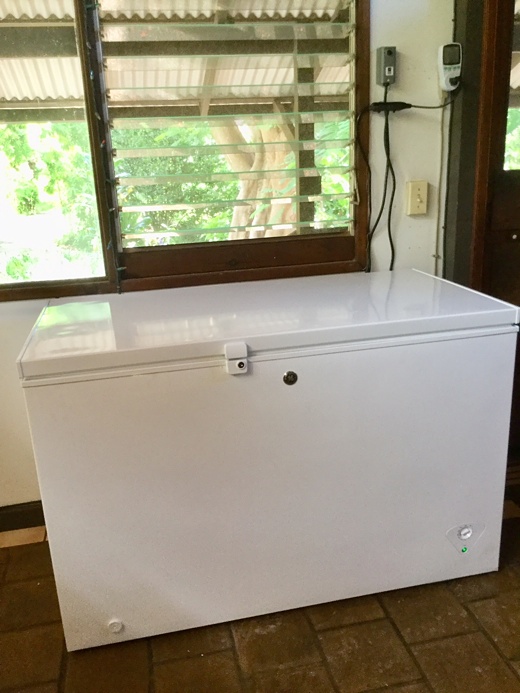
Image above: Top opening 10.6cuft General Electric chest freezer model number FCM11PHBWW with three movable bins and built in light costing about $449 on our lanai.

We are off the electric grid (KIUC) and run our homestead entirely on photovoltaic power spread across seven dedicated systems. One is dedicated to just our freezer and refrigerator. For quite some time we have suffered with inadequate energy to run our 16cuft refrigerator.

The small chest 4.5cuft freezer has been no trouble, but the refrigerator has been a real hassle - especially in the darker winter months.  Add to that our eight 405 amp-hour 6volt batteries dedicated to cooling food are going into their fifth year.

We realized that the chest design of the freezer was a great advantage over the front loading fridge. Every time the fridge door is opened all the cold air slides out. If you are making a complicated meal it's tough keeping that fridge cool.

We replaced a front loading 16cuft refrigerator and a 4.5cuft freezer with two 10.6cuft freezers. One of the freezer we put on our covered lanai just outside of our kitchen/dining room. It is more out of the weather than our previous freezer location that was in our carport (shop/laundry room).

The other freezer was placed where our upright front loading refrigerator used to be. Note we never got the use of the jalousie window with the old fridge there.


Image above: Top opening 10.6cuft General Electric chest freezer converted to a fridge with the use of a thermostat to shut it off when the temperature approaches 32ÂşF

Of course, there are advantages in organizing (or the lack there of) when using an upright refrigerator. Fortunately the freezer we found to use as a fridge had two features that helped a lot.

One - it comes with three plastic coated metal wire bins that slide on a ledge just under the top .
Two - it has a light on the underside of the top opening door that turns on when you lift the top.


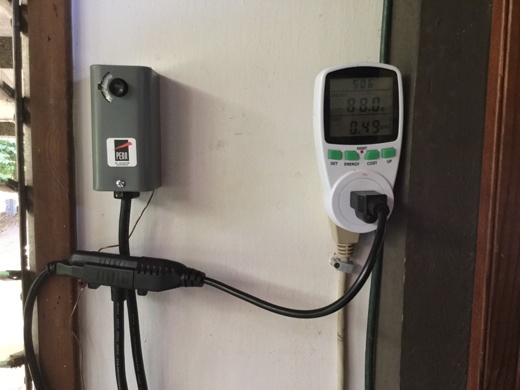
Image above:Above the thermostat and monitor for the converted freezer to make it a refrigerator.

Left is the control for the thermostat that has a sensor on a long copper tube. It can be adjusted down to 20Âşf. We are using it set to 32Âşf. On the right is the source of electricity. The tan extension cord runs down and through the wall to the covered porch outside our front door. That is where our 110volt inverter sits just over the battery array under the porch.

Plugged into the cord is a power monitor that shows the refrigerator is pulling 88 watts while it is cooling. Plugged into the monitor is the thermostat and plugged into the thermostat is the fridge.

We bought the Johnson Controls Freezer Temperature Controller from Amazon.  This thermostat converts the freezer to a fridge.

So far so good. We are watching and adjusting how we load and use these units. 

See also:
Ea O Ka Aina: The Forthcoming freezers 8/25/18
Ea O Ka Aina: Convert Freezer to Fridge 7/21/18
Ea O Ka Aina: Guilt Free Cold Beer 3/7/10


.

Get off the Grid now!

SUBHEAD: Advice for survivors - Find a place with soil and a source of water. 

By Juan Wilson on 19 August 2018 for Island Breath -
(http://islandbreath.blogspot.com/2018/08/get-of-grid-now.html)


Image above: Living off grid in Hawaii is likely our future. From (https://www.hawaiibusiness.com/off-the-grid-2/).

We got an email from Ed Wagner, on Oahu, this morning. It read:
Aloha Kakou,

Isn't it time for the Hawaii Public Utility Commission to shut down the only coal plant in the state of Hawaii (on Oahu) owned and operated by AES Corporation and move toward geothermal energy and a hydrogen economy ASAP?

Original Business Insider 1912 story about coal predicting future climate change. See (https://www.businessinsider.com/newspaper-in-1912-linked-coal-to-climate-change-2018-8).

The video is at bottom of above story in case you missed it from my last email. The video shows bubbles of methane gas leaking from Alaska lakes and a demonstration of its flammability.
Northern Alaskan lakes are leaking a greenhouse gas that's 84 times more potent than carbon dioxide.
Mahalo,
Ed Wagner
I agree with Ed on closing down the AES coal plant, but strongly object to moving further into producing "grid" energy with geothermal. See Fracking Hawaii by Henry Curtis (http://islandbreath.blogspot.com/2013/01/fracking-hawaii.html) from 1/30/2013.

It is quite possible that fracking at the Kilauea geothermal site may have triggered or exacerbated volcanic activity currently reeking havoc on the Big Island. See Kilauea Volcanic Update (http://islandbreath.blogspot.com/2018/06/kilauea-volcano-update.html) 6/5/18. It is certain that fracking on the mainland has caused earthquakes and other underground disturbances in places where those events are rare or unheard of.

My response to Ed was:
Aloha Ed,

I'd say geothermal is a fracking disaster. 

Yes coal is to be stopped, but so is diesel and biomass grid based "solutions". It's time to get off the grid and out of the cars.
That's where we are going anyway. Might as well have a headstart on our real future.

Juan Wilson
Hawaiians lived on these islands without a power grid or industrialization for over 500 years (see "When did Polynesians settle in Hawaii"). More than that, they thrived without metal or a even written language.

Our modern dependence on industrialization has been an environmental disaster. And more recently our dependence on "high tech" telecommunication, computerization, and electronic record keeping has made us vulnerable to a devastating collapse with even a short discontinuity of the grid.

The long term "solution" for Hawaii is getting off the grid and growing our own food. However, unfortunately, we have overpopulated the islands. Since 1950 the population has tripled from 500k to 1.5 million.

Oahu alone has almost a million people. The outer islands may only be able to absorb a fraction of that number to achieve a sustainable population distribution across the archipelago.

As our resource consuming civilization winds down we will have to make uncomfortable adjustments or suffer worse - catastrophic collapse.

As of now, with our heads buried in the 18 cubic foot fridge looking for a frozen snack while the AC chills the room and the flatscreen cable channel fills the room with false adventure we seem on track to go down with the grid once the fuel tanks are empty.

Advice for survivors: Find a place with soil and a source of water. Know your neighbors; Plant fruit trees; Grow food; Raise hens; Catch fish; Produce some energy; Gather tools; Make things; Trade things. Be happy!

See also:
Ea O Ka Aina: Kilauea Volcano Update 6/5/18
Ea O Ka Aina: Mistakes to avoid going off-grid 1/9/16
Ea O Ka Aina: Failing to live Off-Grid 1/3/16
Ea O Ka Aina: Living off-grid becoming illegal 11/7/15
Ea O Ka Aina: Off Grid living is illegal 1/26/15
Ea O Ka Aina: Kicking the KIUC habit 5/1/14
Ea O Ka Aina: Hawaii utilities fighting customers 1/6/14
Ea O Ka Aina: Off-grid handcrafted life 12/5/13
Ea O Ka Aina: KIUC afraid of residential PV 10/8/13
Ea O Ka Aina: Fracking Hawaii 1/31/13
Ea O Ka Aina: Island Breath is off the Grid 7/6/12
Ea O Ka Aina: Off-Grid Night Lighting 8/14/09
Ea O Ka Aina: Rural, not Suburban, Kauai 4/2/09
Island Breath: Solar Energy - A case study 5/12/04


.

Ditch the Batteries

SUBHEAD: Compressed air has longer life expectancy, technical simplicity, lower cost and lower maintenance.

By Kris De Decker on 9 June 2018 for Low Tech Magazine-
(http://www.lowtechmagazine.com/2018/05/ditch-the-batteries-off-the-grid-compressed-air-energy-storage.html)


Image above: Commercial large compressed air storage tanks. From original article.

Going off-grid? Think twice before you invest in a battery system. Compressed air energy storage is the sustainable and resilient alternative to batteries, with much longer life expectancy, lower life cycle costs, technical simplicity, and low maintenance.

Designing a compressed air energy storage system that combines high efficiency with small storage size is not self-explanatory, but a growing number of researchers show that it can be done.

Compressed Air Energy Storage (CAES) is usually regarded as a form of large-scale energy storage, comparable to a pumped hydropower plant. Such a CAES plant compresses air and stores it in an underground cavern, recovering the energy by expanding (or decompressing) the air through a turbine, which runs a generator.

Unfortunately, large-scale CAES plants are very energy inefficient. Compressing and decompressing air introduces energy losses, resulting in an electric-to-electric efficiency of only 40-52%, compared to 70-85% for pumped hydropower plants, and 70-90% for chemical batteries. The low efficiency is mainly since air heats up during compression.

This waste heat, which holds a large share of the energy input, is dumped into the atmosphere. A related problem is that air cools down when it is decompressed, lowering electricity production and possibly freezing the water vapour in the air.

To avoid this, large-scale CAES plants heat the air prior to expansion using natural gas fuel, which further deteriorates the system efficiency and makes renewable energy storage dependent on fossil fuels.

Why Small-scale CAES?

In the previous article, we outlined several ideas – inspired by historical systems – that could improve the efficiency of large-scale CAES plants.

In this article, we focus on the small but growing number of engineers and researchers who think that the future is not in large-scale compressed air energy storage, but rather in small-scale or micro systems, using man-made, aboveground storage vessels instead of underground reservoirs. Such systems could be off-the-grid or grid-connected, either operating by themselves or alongside a battery system.

The main reason to investigate decentralised compressed air energy storage is the simple fact that such a system could be installed anywhere, just like chemical batteries.

Large-scale CAES, on the other hand, is dependent on a suitable underground geology. Although there are more potential sites for large-scale CAES plants than for large-scale pumped hydropower plants, finding appropriate storage caverns is not as easy as was previously assumed. [1-2] [3]

Compared to chemical batteries, micro-CAES systems have some interesting advantages. Most importantly, a distributed network of compressed air energy storage systems would be much more sustainable and environmentally friendly. Over their lifetimes, chemical batteries store only two to ten times the energy needed to manufacture them. [4] Small-scale CAES systems do much better than that, mainly because of their much longer lifespan.
Compared to chemical batteries, a distributed network of compressed air energy storage systems would be much more sustainable and environmentally friendly
Furthermore, they do not require rare or toxic materials, and the hardware is easily recyclable. In addition, decentralised compressed air energy storage doesn’t need high-tech production lines and can be manufactured, installed and maintained by local business, unlike an energy storage system based on chemical batteries.

Finally, micro-CAES has no self-discharge, is tolerant of a wider range of environments, and promises to be cheaper than chemical batteries. [5]

Although the initial investment cost is estimated to be higher than that of a battery system (around $10,000 for a typical residential set-up), and although above-ground storage increases the costs in comparison to underground storage (the storage vessel is good for roughly half of the investment cost), a compressed air energy storage system offers an almost infinite number of charge and discharge cycles. Batteries, on the other hand, need to be replaced every few years, which makes them more expensive in the long run. [5,6]

Challenge: Limiting Storage Size
However, decentralised CAES also faces important challenges. The first is the system efficiency, which is a problem in large- and small-scale systems alike, and the second is the size of the storage vessel, which is especially problematic for small-scale CAES systems.

Both issues make small-scale CAES systems unpractical. Sufficient space for a large storage vessel is not always available, while a low storage efficiency requires a larger solar PV or wind power plant to make up for that loss, raising the costs and lowering the sustainability of the system.

To make matters worse, system efficiency and storage size are inversely related: improving one factor is often at the expense of the other.

Increasing the air pressure minimizes the storage size but decreases the system efficiency, while using a lower pressure makes the system more energy efficient but results in a larger storage size. Some examples help illustrate the problem.

A simulation for a stand-alone CAES aimed at unpowered rural areas, and which is connected to a solar PV system and used for lighting only, operates at a relatively low air pressure of 8 bar and obtains a round-trip efficiency of 60% -- comparable to the efficiency of lead-acid batteries. [7]

However, to store 360 Wh of potential electrical energy, the system requires a storage reservoir of 18 m3, the size of a small room measuring 3x3x2 meters. The authors note that “although the tank size appears very large, it still makes sense for applications in rural areas”.
System efficiency and storage size are inversely related: improving one factor is often at the expense of the other.
Such a system may indeed be beneficial in this context, especially because it has a much longer lifespan than chemical batteries. However, a similar configuration in an urban context with high energy use is obviously problematic.

In another study, it was calculated that it would take a 65 cubic meter air storage tank to store 3 kila-watt hours of energy. This corresponds to a 13 meter long pressure vessel with a diameter of 2.5 meters, shown below. [8]


Image above: Compressed air storage tank 6 feet high by 45 feet long could store 3 kWh of energy. From original article.

Furthermore, average household electricity use per day in industrialised countries is much higher still. For example, in the UK it’s slightly below 13 kWh per day, in the US and Canada it’s more than 30 kWh. In the latter case, ten such air pressure tanks would be required to store one day of electricity use.

Small-scale CAES systems with high pressures give the opposite results. For example, a configuration modeled for a typical household electrical use in Europe (6,400 kWh per year) operates at a pressure of 200 bar (almost 4 times higher than the pressure in large-scale CAES plants) and achieves a storage volume of only 0.55 m3, which is comparable to batteries. However, the electric-to-electric efficiency of this set-up is only 11-17%, depending on the size of the solar PV system. [9]

Two Strategies to Make Micro CAES work
These examples seem to suggest that compressed air energy storage makes no sense as a small-scale energy storage system, even with a reduction in energy demand. However, perhaps surprisingly to many, this is not the case.

Small-scale CAES systems cannot follow the same approach as large-scale CAES systems, which increase storage capacity and overall efficiency by using multi-stage compression with intercooling and multi-stage expansion with reheating.

This method involves additional components and increases the complexity and cost, which is impractical for small-scale systems.

The same goes for “adiabatic” processes (AA-CAES), which aim to use the heat of compression to reheat the expanding air, and which are the main research focus for large-scale CAES. For a micro-CAES system, it’s very important to simplify the structure as much as possible. [5,10]

This leaves us with two low-tech strategies that can be followed to achieve similar storage capacity and energy efficiency as lead-acid batteries. First, we can design low pressure systems which minimize the temperature differences during compression and expansion. Second, we can design high pressure systems in which the heat and cold from compression and expansion are used for household applications.
Small-scale, High Pressure

Small-scale compressed air energy storage systems with high air pressures turn the inefficiency of compression and expansion into an advantage.

While large-scale AA-CAES aims to recover the heat of compression with the aim of maximizing electricity production, these small-scale systems take advantage of the temperature differences to allow trigeneration of electrical, heating and cooling power.

The dissipated heat of compression is used for residential heating and hot water production, while the cold expanding air is used for space cooling and refrigeration. Chemical batteries can’t do this.
Small-scale, high pressure systems use the dissipated heat of compression for residential heating and hot water production, while the cold expanding air is used for space cooling and refrigeration.
In these systems, the electric-to-electric efficiency is very low. However, there are now several efficiencies to define, because the system also supplies heat and cold. [10,11]

Furthermore, this approach can make several electrical appliances unnecessary, such as the refrigerator, the air-conditioning, and the electric boiler for space and water heating. Since the use of these appliances is often responsible for roughly half of the electricity use in an average household, a small-scale CAES system with high pressure has lower electricity demand overall.

High pressure systems easily solve the issue of storage size. As we have seen, a higher air pressure can greatly reduce the size of a compressed air storage vessel, but only at the expense of increased waste heat.

In a small-scale system that takes advantage of temperature differences to provide heating and cooling, this is advantageous.

Therefore, high pressure systems are ideal for small-scale residential buildings, where storage space is limited and where there is a large demand for heat and cold as well as electricity.

The only disadvantages are that high pressure systems require stronger and more expensive storage tanks, and that extra space is required for heat exchangers.


Image above: Experimental set-up of a micro CAES system. From original article, Source [30].

Several research groups have designed, modeled and built small-scale combined heat-and-power CAES units which provide heating and cooling as well as electricity.

The high pressure system with a storage volume of only 0.55 m3 that we mentioned earlier, is an example of this type of system. [9]

As noted, its electrical efficiency is only 11-17%, but the system also produces sufficient heat to produce 270 litres of hot water per day. If this thermal source of energy is also taken into account, the “exergetic” efficiency of the whole system is close to 70%.

Similar "exergy" efficiencies can be found in other studies, with systems operating at pressures between 50 and 200 bar. [11-21]

Heat and cold from compression and expansion can be distributed to heating or cooling devices by means of water or air. The setup of an air cycle heating and cooling system is very similar to a CAES system, except for the storage vessel.

Air cycle heating and cooling has many advantages, including high reliability, ease of maintenance, and the use of a natural refrigerant, which is environmentally benign. [11]

Small-scale, Low Pressure

The second strategy to achieve higher efficiencies and lower storage volumes is exactly the opposite from the first.

Instead of compressing air to a high pressure and taking advantage of the heat and cold from compression and expansion, a second class of small-scale CAES systems is based on low pressures and “near-isothermal” compression and expansion.

Below air pressures of roughly 10 bar, the compression and expansion of air exhibit insignificant temperature changes (“near-isothermal”), and the efficiency of the energy storage system can be close to 100%. There is no waste heat and consequently there is no need to reheat the air upon expansion.

Isothermal compression requires the least amount of energy to compress a given amount of air to a given pressure. However, reaching an isothermal process is far from reality. To start with, it only works with small and/or slowly cycling compressors and expanders. Unfortunately, typical industrial compressors are not made for maximum efficiency but for maximum power and thus work under fast-cycling, non-isothermal conditions. The same goes for most industrial expanders. [22-24]
Below air pressures of 10 bar, compression and expansion of air exhibit insignificant temperature changes and the efficiency can be close to 100%.
The use of industrial compressors and expanders explains in large part why the low pressure CAES systems mentioned at the beginning of this article have such large storage vessels. Both systems are based on devices which are operated outside of their optimal or rated conditions. [25]

Because inefficiencies multiply during energy conversions, even relatively small differences in the efficiency of compressors and expanders can have large effects. For example, a variation in device efficiency from 60% to 80% results in a system efficiency from 36% to 64%, respectively.
New Types of Compressors and Expanders

Because the performance of a compressor and an expander significantly impact the overall efficiency of a small-scale CAES system, several researchers have built their own compressors and expanders, which are especially aimed at energy storage.

For example, one team designed, built and examined a single-stage, low power isothermal compressor that uses a liquid piston. [22]

It operates at a very low compression rate (between 10-60 rpm), which correspond to the output of solar PV panels, and limits temperature fluctuation during compression and expansion to 2 degrees Celsius.

The low-cost device has minimum moving parts and obtains efficiencies of 60-70% at 3 to 7 bar pressure. [22] This is a very high efficiency for such a simple device, considering that a sophisticated three-stage centrifugal compressor, used in large-scale CAES systems or in industrial settings, is roughly 70% efficient.

Furthermore, the researchers state that the efficiency is limited by the off-the-shelf motor that they use to power their compressor. Indeed, another research team achieved 83% efficiency. [26]


Image above: A cutaway view of a modern, quiet, oil free scroll format air compressor. From (http://www.fusheng.com/FSAP/F_ProductInfo?ProductId=Prod_1-11-0&n=GW%20Series%20Oil-free%20Scroll%20Air%20Compressor&r_reg=en-us&rndt=w1tupMXK).

Another novelty is the use of scroll compressors, which are the types of compressors that are now used in refrigerators, air-conditioning systems, and heat pumps. Both fluid piston and scroll compressors have a high area-to-volume ratio, which minimizes heat production, and can easily handle two-phase flow, which means that they can also be used as expanders.

They are also lighter and less noisy than typical reciprocating compressors. [24]
 

Varying Air Pressure
Although compressors and expanders are the most important determinants of system efficiency in small-scale CAES systems, they are not the only ones.

For example, in every compressed air energy storage system, additional efficiency loss is caused by the fact that during expansion the storage reservoir is depleted and therefore the pressure drops. Meanwhile, the input pressure for the expander is required to vary only in a minimal range to assure high efficiency.

This is usually solved in two ways, although neither is really satisfactory. First, air can be stored in a tank with surplus pressure, after which it is throttled down to the required expander input pressure. \

However, this method – which is used in large-scale CAES – requires additional energy use and thus introduces inefficiency.

Second, the expander can operate at variable conditions, but in this case efficiency will drop along with the pressure while the storage is emptied.
During expansion the storage reservoir is depleted and therefore the pressure drops.
With these problems in mind, a team of researchers combined a small-scale CAES with a small-scale pumped hydropower plant, resulting in a system that maintains a steady pressure during the complete discharge of the storage reservoir.

It consists of two compressed air tanks that are connected by a pipe attached to their lower portions: each of these have separate spaces for air (below) and water storage (above).

The configuration maintains a head of water by means of a pump, which consumes 15% of the generated power. However, in spite of this extra energy use, the researchers managed to increase both the efficiency and the energy density of the system. [11]

Off-the-Grid Power Storage

To give an idea of what a combination of the right components can achieve, let’s have a look at a last research project. [27] It concerns a system that is based on a highly efficient, custom-made compressor/expander, which is directly coupled to a DC motor/generator.

Apart from its efficient components, this CAES project also introduces an innovative system configuration. It doesn’t use one large air storage tank, but several smaller ones, which are interconnected and computer-controlled.

The setup consists of the compression/expansion unit coupled to three small (7L) cylinders, previously used as air extinguishers, and operates at low pressure (max 5 bar). The storage vessels are connected via PVC pipework and brass fittings.

To control the air-flow, three computer-controlled air valves are installed at the inlet of each cylinder. The system can be extended by adding more pressure vessels. [27]


Image above: A modular system of multiple compressor tanks has multiple advantages. From original article.

A modular configuration results in a higher system efficiency and energy density for mainly two reasons.

First, it helps more effective heat transfer to take place, because every air tank acts as an additional heat exchanger.
 
Second, it allows better control over the discharge rate of the storage reservoir.

The cylinders can be discharged either in unison to satisfy a demand for high power density (more power at the cost of a shorter discharge time), or they can be discharged sequentially to satisfy a demand for high energy density (longer discharge time at the cost of maximum power).
By discharging modular storage cylinders sequentially, the discharge time can be greatly increased, making the system comparable to lead-acid batteries in terms of energy density.
By discharging the cylinders sequentially, the discharge time can be greatly increased, making the system comparable to lead-acid batteries in terms of energy density. Based on their experimental set-up, the researchers calculated the efficiencies for different starting pressures and numbers of cylinders.

They found that 57 interconnected cylinders of 10 litre each, operating at 5 bar, could fulfill the job of four 24V batteries for 20 consecutive hours, all while having a surprisingly small footprint of just 0.6 m3.

Interestingly, the storage capacity is 410 Wh, which is comparable to the 360 Wh rural system noted earlier, which requires an 18 m3 storage vessel – that’s thirty times larger than the modular storage system.

The electric-to-electric efficiency for the 3-cylinder set-up reached a peak of 85% at 3 bar pressure, while the estimated efficiency for the 57-cylinder set-up is 75%.

These are values comparable to lithium-ion batteries, but adding more storage vessels or operating at higher pressures introduces larger losses due to compression, heat, friction and fittings. [27-29]

Nevertheless, when I e-mailed Abdul Alami, the main author of the study, thinking that the results sounded too good to be true, he told me that the figures were actually overly conservative: “We stuck to low pressures to achieve near-isothermal compression and to ensure safe operation.

Operating at pressures higher than 10 bar would create serious thermal losses, but a pressure of 7-8 bar may be beneficial in terms of energy and power density, though maybe not in terms of efficiency.”

Build it Yourself?


In conclusion, small-scale compressed air energy storage could be a promising alternative to batteries, but the research is still in its early stages – the first study on small-scale CAES was published in 2010 – and new ideas will continue to shed light on how best to develop the technology.

At the moment, there are no commercial products available, and setting up your own system can be quite intimidating if you are new to pneumatics.

Simply getting hold of the right components and fittings is a headache, as these come in a bewildering variety and are only sold to industries.

However, if you’re patient and not too unhandy, and if you are determined to use a more sustainable energy storage system, it is perfectly possible to build your own CAES system. As the examples in this article have shown, it’s just a bit harder to build a good one.

There's more ideas for small-scale CAES systems in the previous article: History and Future of the Compressed Air Economy.

References & Notes
[1] Luo, Xing, et al. "Overview of current development in electrical energy storage technologies and the application potential in power system operation." Applied Energy 137 (2015): 511-536. https://www.sciencedirect.com/science/article/pii/S0306261914010290

[2] Laijun, C. H. E. N., et al. "Review and prospect of compressed air energy storage system." Journal of Modern Power Systems and Clean Energy 4.4 (2016): 529-541. https://link.springer.com/article/10.1007/s40565-016-0240-5

[3] There is increasing competition for potential CAES geologic units, as many are also well suited to the storage of natural gas or sequestered carbon. Furthermore, cavern storage imposes harsh requirements on the geographical conditions. For example, the originally planned Iowa CAES project in the US was terminated due to its porous sandstone condition. [2]

[4] Barnhart, Charles J., and Sally M. Benson. "On the importance of reducing the energetic and material demands of electrical energy storage." Energy & Environmental Science 6.4 (2013): 1083-1092. https://gcep.stanford.edu/pdfs/EES_reducingdemandsonenergystorage.pdf

[5] Petrov, Miroslav P., Reza Arghandeh, and Robert Broadwater. "Concept and application of distributed compressed air energy storage systems integrated in utility networks." ASME 2013 Power Conference. American Society of Mechanical Engineers, 2013. http://eddism.com/wp-content/uploads/2014/10/Paper-EDD-Concept-and-Application-of-Distributed-Compressed-Air-Energy-Storage-Systems-Integrated-in-Utility-Networks-July-2013.pdf

[6] Tallini, Alessandro, Andrea Vallati, and Luca Cedola. "Applications of micro-CAES systems: energy and economic analysis." Energy Procedia 82 (2015): 797-804.

[7] Setiawan, A., et al. "Sizing compressed-air energy storage tanks for solar home systems." Computational Intelligence and Virtual Environments for Measurement Systems and Applications (CIVEMSA), 2015 IEEE International Conference on. IEEE, 2015. https://www.researchgate.net/profile/Ardyono_Priyadi/publication/274898992_Sizing_Compressed-Air_Energy_Storage_Tanks_for_Solar_Home_Systems/links/5670e2c408ae2b1f87acf927.pdf

[8] Herriman, Kayne. "Small compressed air energy storage systems." (2013). https://eprints.usq.edu.au/24651/1/Herriman_2013.pdf

[9] Manfrida, Giampaolo, and Riccardo Secchi. "Performance prediction of a small-size adiabatic compressed air energy storage system." International Journal of Thermodynamics 18.2 (2015): 111-119. http://dergipark.ulakbim.gov.tr/eoguijt/article/download/5000071710/5000113411

[10] Kim, Y. M., and Daniel Favrat. "Energy and exergy analysis of a micro-compressed air energy storage and air cycle heating and cooling system." Energy 35.1 (2010): 213-220.

[11] Kim, Young Min. "Novel concepts of compressed air energy storage and thermo-electric energy storage." (2012). https://infoscience.epfl.ch/record/181540/files/EPFL_TH5525.pdf

[12] Inder, Shane D., and Mehrdad Khamooshi. "Energy Efficiency Analysis of Discharge Modes of an Adiabatic Compressed Air Energy Storage System." World Academy of Science, Engineering and Technology, International Journal of Electrical, Computer, Energetic, Electronic and Communication Engineering 11.12 (2017): 1101-1109.

[13] Vollaro, Roberto De Lieto, et al. "Energy and thermodynamical study of a small innovative compressed air energy storage system (micro-CAES)." Energy Procedia 82 (2015): 645-651.

[14] Li, Yongliang, et al. "A trigeneration system based on compressed air and thermal energy storage." Applied Energy 99 (2012): 316-323. https://www.sciencedirect.com/science/article/pii/S0306261912003479

[15] Facci, Andrea L., et al. "Trigenerative micro compressed air energy storage: Concept and thermodynamic assessment." Applied energy 158 (2015): 243-254. https://www.sciencedirect.com/science/article/pii/S0306261915009526

[16] Mohammadi, Amin, et al. "Exergy analysis of a Combined Cooling, Heating and Power system integrated with wind turbine and compressed air energy storage system." Energy Conversion and Management 131 (2017): 69-78. https://www.sciencedirect.com/science/article/pii/S0306261915009526

[17] Yao, Erren, et al. "Thermo-economic optimization of a combined cooling, heating and power system based on small-scale compressed air energy storage." Energy Conversion and Management 118 (2016): 377-386. https://www.sciencedirect.com/science/article/pii/S0196890416302229

[18] Liu, Jin-Long, and Jian-Hua Wang. "Thermodynamic analysis of a novel tri-generation system based on compressed air energy storage and pneumatic motor." Energy 91 (2015): 420-429. https://www.sciencedirect.com/science/article/pii/S0360544215011317

[19] Lv, Song, et al. "Modelling and analysis of a novel compressed air energy storage system for trigeneration based on electrical energy peak load shifting." Energy Conversion and Management 135 (2017): 394-401. https://www.sciencedirect.com/science/article/pii/S0196890416311839

[20] Besharat, M. O. H. S. E. N., SANDRA C. Martins, and HELENA M. Ramos. "Evaluation of Energy Recovery in Compressed Air Energy Storage (CAES) Systems." 3rd IAHR Europe Congress. Book of Proceedings, Portugal. 2014. https://www.researchgate.net/profile/Mohsen_Besharat2/publication/270896130_Evaluation_of_Energy_Recovery_in_Compressed_Air_Energy_Storage_CAES_Systems/links/58a1fce0a6fdccf5e97109b2/Evaluation-of-Energy-Recovery-in-Compressed-Air-Energy-Storage-CAES-Systems.pdf

[21] Minutillo, M., A. Lubrano Lavadera, and E. Jannelli. "Assessment of design and operating parameters for a small compressed air energy storage system integrated with a stand-alone renewable power plant." Journal of Energy Storage 4 (2015): 135-144. https://www.sciencedirect.com/science/article/pii/S2352152X15300207

[22] Villela, Dominique, et al. "Compressed-air energy storage systems for stand-alone off-grid photovoltaic modules." Photovoltaic Specialists Conference (PVSC), 2010 35th IEEE. IEEE, 2010. https://pdfs.semanticscholar.org/9f1d/4273f8deb4a0a18c86eb4056e2fd378f8f3f.pdf

[23] Paloheimo, H., and M. Omidiora. "A feasibility study on Compressed Air Energy Storage system for portable electrical and electronic devices." Clean Electrical Power, 2009 International Conference on. IEEE, 2009. https://www.researchgate.net/profile/Michael_Omidiora/publication/224581292_A_Feasibility_Study_on_Compressed_Air_Energy_Storage_System_for_Portable_Electrical_and_Electronic_Devices/links/5640d5d308aebaaea1f6ad44.pdf 

[24] Prinsen, Thomas H. Design and analysis of a solar-powered compressed air energy storage system. Naval Postgraduate School Monterey United States, 2016. https://scholar.google.com/scholar?cluster=5783353621699682542&hl=nl&as_sdt=2005&sciodt=0,5

[25] The small-scale system aimed at urban environments, which has a storage reservoir of 18 metres long, is based on a compressor that “had been in service for 30 years on building sites to run various air tools and had little maintenance done”. [8] This is detrimental to system efficiency, because a compressor that is not maintained well easily wastes as much as 30% of its potential output through air leaks, increased friction, or dirty air filters. This small-scale system also used a highly inefficient expander. All together, this explains why it combines a very large storage volume with a very low electric-to-electric efficiency (less than 5%).

[26] Van de Ven, James D., and Perry Y. Li. "Liquid piston gas compression." Applied Energy 86.10 (2009): 2183-2191. https://experts.umn.edu/en/publications/liquid-piston-gas-compression

[27] Alami, Abdul Hai, et al. "Low pressure, modular compressed air energy storage (CAES) system for wind energy storage applications." Renewable Energy 106 (2017): 201-211.

[28] Alami, Abdul Hai. "Experimental assessment of compressed air energy storage (CAES) system and buoyancy work energy storage (BWES) as cellular wind energy storage options." Journal of Energy Storage 1 (2015): 38-43.

[29] Abdul Alami, e-mail conversation.

[30] Sun, Hao, Xing Luo, and Jihong Wang. "Feasibility study of a hybrid wind turbine system–Integration with compressed air energy storage." Applied Energy 137 (2015): 617 -628. https://www.sciencedirect.com/science/article/pii/S0306261914006680

See also:
Ea O Ka Aina: How much energy do we need? 1/8/18
Ea O Ka Aina: Run the Economy on the Weather 9/28/17
Ea O Ka Aina: How (not) to run on renewables 9/15/17
Ea O Ka Aina: Office Equipment Revolution 2/16/17
Ea O Ka Aina: The curse of the modern office 11/22/16
Ea O Ka Aina: The Return of DC Power 4/27/16
Ea O Ka Aina: Build a local low-tech internet 10/26/15
Ea O Ka Aina: Getting off the grid 5/17/16
Ea O Ka Aina: How Sustainable is Stored Sunlight? 5/14/15
Ea O Ka Aina: How sustainable is PV power? 4/26/15
Ea O Ka Aina: Efficency of well tended fires 7/1/14
Ea O Ka Aina: High Speed Train Disservice 12/16/13
Ea O Ka Aina: European Cargo Bike 9/19/12
Ea O Ka Aina: The Chinese Wheelbarrow 1/4/12
Ea O Ka Aina: In the World After Abundance 6/2/11
Ea O Ka Aina: Wood burning cars 5/27/10
Ea O Ka Aina: Reduce burning fossil fuel! 11/19/09
.