SUBHEAD: Ron Paul interviews Edward Snowden on government threats to essential freedoms.
By James Holbrooks on 20 June 2017 for The AntiMedia -
(http://theantimedia.org/ron-paul-interviewing-edward-snowden/S)
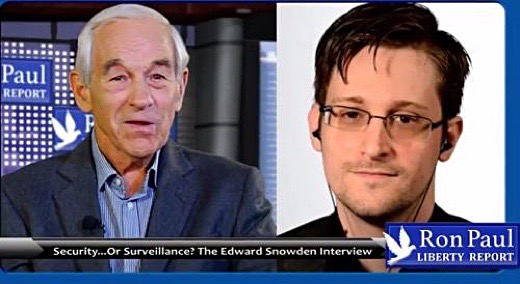
Image above: Still frame of Ron Paul and Edward Snowden from video of interview below.
“I’d like to know a little bit, what do you do all day long?” a genuinely curious Dr. Paul asks as his opening question. After talking about the insanity that erupted — both in the political spectrum and his personal life — following the revelations he made back in 2013, Snowden says he’s now become a hot commodity for groups championing causes.
“What is liberty?” asks Snowden, and then points out that ten questions on the street would result in ten different answers. After stating his view that liberty is the “freedom of self” and the “freedom from permission,” Snowden goes on to say that true liberty is rooted in personal privacy:
Continuing, Snowden equates the running of state policy to a game, one that favors those who get “better and better” at understanding the evolving rules:
When Daniel McAdams next asks him about whether or not he thinks an agency such as the NSA should even exist, Snowden remarks on the irony of asking him that question — given that he’s a “product of the system” with familial ties to the United States government going back decades.
But the whistleblower presses forward following a question from Dr. Paul on whether or not he thinks any gains have been made from his 2013 revelations, stating that solutions come not from individuals alone, but from many of them who “lay down a single brick upon which others can build.”
Continuing in this vein, Snowden says progress in battling government violations of personal liberty is made in inches and should be accomplished organically:
Video above: "Security or Surveillance? The Edward Snowden Interview" From (https://youtu.be/9XLLo0025Jc).
.
By James Holbrooks on 20 June 2017 for The AntiMedia -
(http://theantimedia.org/ron-paul-interviewing-edward-snowden/S)
Image above: Still frame of Ron Paul and Edward Snowden from video of interview below.
Saying that you don’t care about privacy because you have nothing to hide is no different than saying you don’t care about freedom of speech because you have nothing to say.”That comment was made by famed whistleblower Edward Snowden during a recent interview on the Ron Paul Liberty Report. In his conversation with Dr. Paul and Daniel McAdams, published Tuesday, an articulate Snowden discusses the true meaning of freedom, the nature of the deep state, and even his upbringing as a child of a government family.
“I’d like to know a little bit, what do you do all day long?” a genuinely curious Dr. Paul asks as his opening question. After talking about the insanity that erupted — both in the political spectrum and his personal life — following the revelations he made back in 2013, Snowden says he’s now become a hot commodity for groups championing causes.
“They want me to sort of front for these issues of privacy and civil liberties and protection of people’s rights,” Snowden replies. “And I want to do what I can, but I’m not a politician. I’m an engineer.”The whistleblower goes on to talk about how he’s now, at long last, finally able to devote time to more practical applications. For him, this means focusing on the area that holds the key to finding a balance between rights and laws in the digital age — technology.
“How technically is this even happening?” Snowden poses, digging straight to the heart of the issue of mass surveillance. “How is it that so many governments are spying on so many people? Because even if we pass the best legal reforms in the world in the United States, that doesn’t do anything against China, or Russia, or Germany, or France or Brazil or any other country in the world.”Continuing, Snowden says that future generations’ rights and protections will be dependent on the current generation’s ability to adapt to a constantly shifting environment:
“We need to find new means, new mechanisms, for enforcing these rights in the new times. And I think that’s going to be primarily through science and technology.”When Dr. Paul asks the former NSA contractor about his political affiliation, Snowden responds that he doesn’t associate himself with any faction and that as individuals, we’re more than tribes and labels. Proceeding, Snowden points to how technology has given humanity a means to have a global conversation on issues:
“I think the Internet produces a lot of people who look at these issues differently, in a less tribal way, because you hear more viewpoints. You hear from many more people. And the more people in a conversation, I think the more informed it often is.”When co-host Daniel McAdams asks Snowden to comment on the idea of security vs. surveillance, the whistleblower again cuts straight to the core of the debate and speaks on the perception of freedom itself.
“What is liberty?” asks Snowden, and then points out that ten questions on the street would result in ten different answers. After stating his view that liberty is the “freedom of self” and the “freedom from permission,” Snowden goes on to say that true liberty is rooted in personal privacy:
“Privacy isn’t about something to hide, privacy is about something to protect. It’s about the ability to be you, to have a thought for yourself, to have a thing for yourself, to have some difference, to have some idea that’s new and untested and untried that you can sort of sharpen amongst those that you trust, and then introduce into the world, into that contest of ideas.”Next, Dr. Paul asks his guest to comment on the topic of the deep state, which Snowden proceeds to describe as a “mass of government that survives beyond administration” that is “not responding to the politics of the people.” Snowden says this organism lives “across parties” and “across administrations.”
Continuing, Snowden equates the running of state policy to a game, one that favors those who get “better and better” at understanding the evolving rules:
“And eventually, the people who are the greatest experts at understanding and using these rules, the best bureaucrats, are not sitting in the White House, they’re not sitting in the Congress. Because those guys come and go as the years pass, and they win elections, and they lose elections, and it’s the people that sit there for 30 years or more, in these agencies, with their hand on the lever the whole time. And that’s what the deep state is.”Snowden further states that party affiliation matters little with regard to this behind-the-scenes force and that any political faction in power will eventually “get to the point of saying yes when enough pressure is brought to bear.”
When Daniel McAdams next asks him about whether or not he thinks an agency such as the NSA should even exist, Snowden remarks on the irony of asking him that question — given that he’s a “product of the system” with familial ties to the United States government going back decades.
But the whistleblower presses forward following a question from Dr. Paul on whether or not he thinks any gains have been made from his 2013 revelations, stating that solutions come not from individuals alone, but from many of them who “lay down a single brick upon which others can build.”
Continuing in this vein, Snowden says progress in battling government violations of personal liberty is made in inches and should be accomplished organically:
“Step by step, working together, sharing our views, connecting our values, we can create spaces, more bricks, that when laid together create a defense of rights that can be relied upon, in even historic moments when law cannot be.”In his final question to Snowden, Dr. Paul asks whether the former government contractor’s decision to sound the alarm was arrived at suddenly or through a gradual process. In response, Snowden links his own decision to the average human being, noting that everyone has a point at which nothing more can be tolerated:
“We all have a level, right, of this kind of cognitive dissonance that we can accept. A level of injustice, of inhumanity, of incivility that we can accept in the daily world, that we can sort of internalize and suppress. And then we have one step more.”
Video above: "Security or Surveillance? The Edward Snowden Interview" From (https://youtu.be/9XLLo0025Jc).
.