Showing posts with label Ecocide. Show all posts

One more lap around the Sun

SUBHEAD: Whatever seemed normal, is about to vanish in the rear view mirror.

By Juan Wilson on 14 July 2022 for Island Breath -
(http://islandbreath.blogspot.com/2022/07/one-more-lap-around-sun.html

Image below: View of Hawaiian Islands from hear space looking northwest. From (https://www.nasa.gov/image-feature/the-hawaiian-island-chain).


There were times in the past when we would publish 2 or even 3 articles in a day for Island Breath. Back then we used ti have a subscription to a Kauai published and printed daily paper. In those days the ability to find a job, rent an apartment, and buy a car were vital services of a local daily news paper. 

That world has blown away like tumbleweed by the onslaught of features and function of the ubiquitous iPhone and it's copycat competitors. 

As a result one can hardly find a restaurant with a printed menu any more. You're invited by the "staff" to "scan it!"... Some people (like some baby-boomers, and and toddlers don't have an iPhone. "No Prob... we have a printed menu behind the bar... I'll see if I can find it. 

When we cannot keep up the near space telecommunication technology we have developed along with the wireless networks utilized by the iPhone and its copycats.

All might have gone well if we were not in total denial of the dire straights humanity has cornered itself into. Too many people, ruining, abandoning and throwing a way too much stuff for too long.

We have had half a century -since 1972- when the Club of Rome first published its predictions for our future based on resource losses, consumption increases, human population growth.

I'm going to try and get back in the saddle... meaning getting back to doing fresh, new articles... although I suspect they will not all avoid some cynicism.

I'll be back... soon I hope... Juan Wilson

Gaia's Response to Us

SUBHEAD: The Earth is not dying, Gaia is just reacting to our mistakes.

By Erik Assadournian on 20 December 2020 for Gaianism.org -
(http://gaianism.org/gaia-is-responding-to-our-actions-will-we-act-differently-in-time/)


Image above: One of the earliest images of the whole Earth from 29,000 miles into space taken from NASA Appolo 17 spaceship on way to Moon. It was titled the Blue Marble and and is one of the most reproduced images in history. (https://en.wikipedia.org/wiki/The_Blue_Marble).

So often we hear the phrase ‘save the world’ or the ‘save our planet.’ We may even use it. But sometime back in my career someone wise corrected that, explaining that the planet is not dying but changing—and through that change many species, including our own, will probably die. But the Earth, in all likelihood, will not die.

But to say the Earth is changing, just as to say it is dying, is passive, like, saying ‘Oops, too bad, we were born on a sick old planet—just our bad luck.’

No, Gaia is responding. Responding to our actions. Whatever metaphors you want to use here, feel free: You want to make Gaia into a finely-balanced aquarium filled with exotic fish, and us a wild child dropping soap in the tank to ‘clean’ it

You want to make Gaia a partner suffering from domestic abuse who finally lashes out on us, her abuser, after years of mistreatment? You want to make Gaia a complex planetary system that holds heat from space with a thin coating of co2, a layer that has increased to a level not seen in 23 million years, higher than even three million years ago when global temperatures were 2 degrees C warmer and sea levels were 15-25 meters higher? While the last isn’t artful, it is accurate.

Gaia is responding. To the altered conditions we have unleashed—with our profligate burning of fossil fuels, our cutting down of forests and ravaging of oceans, and our sheer numbers (us and our pets and livestock).

Amazingly, I don’t see us correcting course any time soon.

This past year, in response to the coronavirus pandemic, we shut down large parts of our economy. And so far an additional 1.7 million people have died from COVID. Each and every death is a tragedy. But guess what? Atmospheric concentrations of co2 increased this past year, hitting yet another record (though at this point every year is a record as long as it keeps going up).

That’s pretty amazing. Air travel declined dramatically and is currently 46% lower than in 2019. Road travel in the US declined 11 percent compared with last year. Many businesses were shuttered and will never come back, particularly restaurants. 

But we kept eating, kept making things (after a brief pause) and perhaps even more things to fill consumer demand for novelties while stuck at home (from appliances to backyard patio sets),** plus, all the personal protective equipment (129 billion masks a month!), vaccines, and the equipment needed to deliver them (see, for example, the current boon in freezers and dry ice).

If anything, this year of pandemic, of urgent antiracism protests and prodemocracy demonstrations (not just in the US but countries like Belarus), and of endless Trumpian shenanigans and stoking of conflict and partisanship have crippled the climate movement.

Online protests don’t draw eyes—especially when there are half a dozen other crises to report on every day (including climate-driven ones like raging fires and a record hurricane season). And while groups like Fridays for the Future and the Extinction Rebellion have remained active, the smaller actions they’ve taken have gotten much less attention.

This past week, my wife, son, and I watched I am Greta. It was certainly a moving film, exploring how Greta Thunberg went from one individual striking, alone, in front of the Swedish parliament building for the climate, to sparking a global climate movement to becoming a symbol—both of youthful leadership and truth-telling as well as a vilified figure for those on the right, even receiving death threats.

And thus Greta has also become a symbol of this whole polarized nightmare. Climate change is a threat to our existence, but truly effective action (meaning economic degrowth and daunting levels of cultural change) is a threat to “our way of life” (i.e. the dominant consumer-capitalist paradigm). 

And thus, as viewers see in one scene, Thunburg argues passionately for action in front of the European Economic and Social Committee and Jean-Claude Juncker (president of the European Commission at the time) responds by saying that they’re working “to harmonize all flushes across all toilets in Europe,” which will help save water and energy. You could see the palpable contempt on Thunberg’s face.

Deep down I was hoping my son, 8.5, would say to me let’s start going to the Middletown Town Hall each Friday to strike. I’d be up for that. I want to do that. But I want him to lead that. I don’t want to ‘use’ him, like in an uncomfortably funny scene in the Dutch show Rita where parents make their daughter lead a school climate strike in order to get a book deal.

But the majority of kids, nej, the majority of all people do not want to spend their days protesting. They simply want to enjoy their lives.

But Gaia is responding. To our carbon-intensive life-enjoyment processes. And if we don’t try something different, perhaps partaking in “good trouble”, we’re gonna be in great trouble.

Carbon March to DC

Back in late 2008 (12 long years ago), I shared a proposal with some of the leaders of the climate movement at the time. It was a proposal to organize people from around the United States to walk to Washington,*** taking several months, building the energy and media attention as smaller groups merged into bigger ones and neared the capital, and then blockading major entryways into the city until the new president, Barack Obama, and the Congress felt compelled to respond. 

Note, this was before Occupy Wall Street and XR but absolutely not a new idea—I took it directly from Gandhi’s Salt March to Dandi mixed with Ukraine’s Orange Revolution and other non-violent actions (as you can read here).**** I got some generic positive comments, like Greta at the European Commission, but nothing more. 

And considering I had a cushy job at a sustainability think tank, and had just been invited to direct a new book (on consumerism and cultural change my passion), I didn’t push very hard. Especially as everyone else seemed so optimistic that, under the new president, we’d deal with climate change.

But we didn’t. And I should have pushed harder. And I should now. But even now, as the crisis is upon us (not a looming threat any longer), when I have a young son who will inherit this mess, I find myself hesitating at the idea of putting life on hold and risking life and liberty. 

Sure, in part it’s because I have a child, though old enough to walk with me now (and he’d probably get a kick out of walking from Connecticut to DC, where we used to live). And partly it’s because I’m conflicted about whether it’s simply too late to stop the climate unraveling (see the postscript below). But if I’m honest, it’s also because I’m too comfortable.

Yet, without sustained and consistent pressure, Biden’s climate policy, especially with a divided Congress, will not be enough nor will the Green New Deal that activists are advocating for and mostly consists of unsustainable techno-fixes instead of returning to live within Earth’s limits. No country is currently doing enough, as yet more research shows. Do we just accept that and prepare for collapse as best we can or do we fight, risking our freedom, safety, and comfort for that?

Perhaps the Carbon March is not a good idea (though I admit I still really like it, post-pandemic) but we certainly need to expand, support, and deepen efforts of groups like XR and Fridays for the Future, particularly in the United States, where climate protests have taken a back seat to issues that feel more pressing (and frankly have never gotten enough attention or energy here). 

Of course, we need to address racism, COVID, inequality, growing far-right extremism, and gun violence, as well, but if we don’t find a way to fold climate change into the mix, or even fold all of these into an intersectionalist environmentalist framework—then we’re toast, and, as the world burns, all the social gains fought for over the past two centuries will go up in flames with it.

Postscript: To Fight or Adapt? Or Both?

Taking on one other dimension of this, there is a new divide growing between those still trying to ‘save the world’ (aka stop runaway climate change and the mass die off of life including people), and those who simply think it’s too late, and that the best we can do is prepare for the inevitable transition ahead. This latter community, perhaps best represented by The Deep Adaptation Forum, may be right. But that doesn’t mean we can throw in the towel. 

Every part per million of co2 in the atmosphere is going to make things worse (in a non-linear kind of way). Yes, we need those working on preparing for the transition (in both direct ways, like the Transition Town Movement, and deeper ways, including, I’d argue cultivating an ecocentric spirituality that can help us get through the horrors ahead with our humanity intact), because a post-growth future—one wracked by a never-ending series of disasters—is coming soon to a theater near all of us. But we also need those slowing down this march to collapse (especially as after a point, adaptation is impossible).

This is the ideal, though: the actions we take in one realm would also help in the other. For example, a months-long march to Washington to press for climate solutions would also build social capital, engage communities around the country, teach participants to live simply (and get used to living with less), and rediscover basic skills like cooking (for their cadre of marchers). 

This might subtly do a lot to get us ready for the degrowth/collapsed reality ahead. And cultivating an ecospirituality that strongly encourages its adherents to be engaged politically and socially (especially in ways that help normalize degrowth) would also support both realms. 

Ultimately, with the scope of change needed, it does not much matter if you devote yourself to deep adaptation or to slowing the collapse—both are essential and both are part of our bigger collective struggle. The only thing we cannot afford is no corrective action at all.

Notes:

*Then again, as James Lovelock has noted, Gaia is older than Gi once was. There is a point when the strain of switching states could end all life on Earth and thus Gaia. And of course, like all beings, it is inevitable that Gaia will one day die, the sun’s growing heat and finite life guarantee that. But I have faith that Lynn Margulis is right in that the bacteria deep in the Earth will spread out and create new variations to fill in the empty niches of the new hot world humanity unleashes, starting another cycle of life.

**And factoring in hoarding, we may have even consumed more household goods and food (though it is feasible that this increase might have been offset by food waste avoided from eating at restaurants).

***Due to the nature of this journey, many of the participants would be students and elders (retirees) supported by the communities with food and shelter and attention as they passed through.

****I was inspired to write this after listening to Wendell Berry speak, telling his audience of environmental journalists that the time for “symbolic” civil disobedience was over (in 2008). By that he meant short-term actions that were designed for media attention but did not really disrupt anything in any sustained way that would force a serious response.

 
.

Winning the Trifecta

SUBHEAD: To win we will have to solve all our problems together... health, wealth and environment.

By Juan Wilson on 24 June 2020 for Island Breath -
(https://islandbreath.blogspot.com/2020/06/winning-trifecta.html)


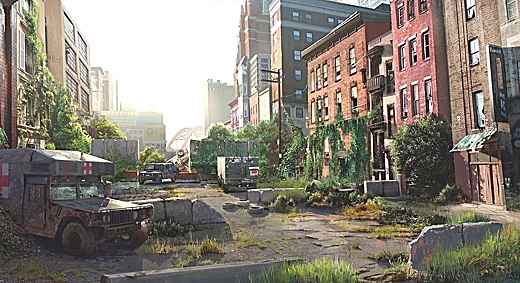
Image above: An urban street in America after a major collapse. From (https://www.masktactical.com/urban-survival-series-part-1/).

A trifecta is a certain kind of bet in a horse race. The better makes a great deal of money if he wins, but the chances are slim. The better must not only win on picking the first place finisher of the race, but also the second and third place winners.

We humans have to win against a trifecta of disasters that we have brought unto ourselves by greed, complacency and ignorance.

We have known for  more than three generations that the jig was up. We realized humans were destroying the Earth that is our only home. Its was 1970 (50 years ago) that President Richard Nixon, a conservative Republican, who signed into law the US Environmental Protection Agency.

There were high hopes that some remedy to our environmental plight might be found. It wasn't found and it wasn't in our short term interest to do so.  We avoided finding a way to save the Earth and the creatures that inhabit it because it wasn't as profitable or as comfortable as continuing on  burning up the planet for profit and comfort. 

Well, now we will have to win a trifecta to survive and flourish any longer. We face three implacable dangers that are intertwined.
  • Economic Collapse
  • Environmental Collapse
  • Worldwide Fatal Pandemic
The financial collapse is from over-borrowing against the future to continue economic growth as the means of creating wealth.

The environmental collapse is a result of supplying and utilizing the resources for the energy and resources for ever growing economic growth.

In my mind the worldwide fatal pandemic is a correction by Gaia (Mother Nature) for the financial and environmental collapse we have created. Mother Nature is shaking off her blood sucking tics.

There is little time or the will among us to change our ways... but for those that survive the 2020's it will because they have embraced small scale locally resourced food and fabrication. Those survivors will be using hand tools and sailboats rather than tractors and container ships to operate their steady state economy.

As we have been recommending for years... get a head start! As John Michael Greer wrote in 2012 "Collapse Now and Avoid the Rush!". That means getting educated to the situation and acting on it right now. 

If you are a newby to these thoughts you will have to work overtime to catch up. As James Howard Kunstler envisioned in his Would Made By Hand novels, most middle class suburbanites like car salesmen and insurance men will be lucky if they end up living on a productive plantation doing manual labor. 

Manual skills, whether making a barrel, playing a violin, or stitching up a wound, will have real and lasting value in the future. 

As things stand now, I have no clue how long we will have a "world wide web" to go to in the future. Right now we can count on it to inform us the answer to all the questions that we have. 

Once it is unreliable or down we will have only the hard copy left in the schools the libraries or your bookshelves for reference. You might try finding an Encyclopedia set that's been abandoned by your local library or at a local garage sale.


.

Weird Days

SUBHEAD: A list of some of the odd experiences of disasters in my lifetime.

By Juan Wilson on 15 April 2020 for Island Breath -
(https://islandbreath.blogspot.com/2020/04/weird-days.html)


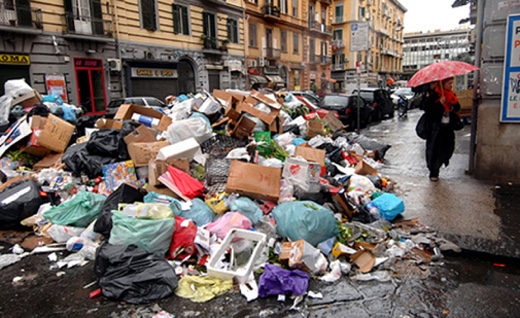
Image above: Photo of garbage piled into street in Manhattan, NY, during 1968 garbage strike. From (https://accesscities.org/nycrfei-pilot-for-public-realm-refuse-and-recyclingsolutionsrequest-for-expressionsof-interest-rfei/).

These are weird days and they seem to be leading to a major reset of life on Earth. The lists below are calamities I have lived through or witnessed through media in my lifetime.

Personally Experienced
Cuban Missile Crisis 1962 (We thought World War 3 was at hand)
(https://en.wikipedia.org/wiki/Cuban_Missile_Crisis)

North East Blackout 1965 (lived in Boston. People thought WW3 had begun)
(https://en.wikipedia.org/wiki/Northeast_blackout_of_1965)

NYC Garbage Strike 1968 (Lived in Lower East side. Garbage up past windows slid into streets)
(https://untappedcities.com/2015/02/11/today-in-nyc-history-the-great-garbage-strike-of-1968/)

OPEC Oil Embargo 1973 (A few people were shot to death for jumping long lines at gas stations)
(https://en.wikipedia.org/wiki/1973_oil_crisis)

Iran US Embassy Crisis 1979 (I lived in Iran 1975-76 and saw what preceded revolution)
(https://en.wikipedia.org/wiki/Iran_hostage_crisis)

Witnessed Through Mass Media
Exxon Valdis Oil Spill 1989 (Effects included the deaths as many as 250,000 seabirds)
(https://en.wikipedia.org/wiki/Exxon_Valdez_oil_spill)

Bangladesh Cyclone 1991 (over 135,000 people killed) 
(https://en.wikipedia.org/wiki/1991_Bangladesh_cyclone)

World Trade Center Attack 2001 (over 2,700 people killed)
(https://en.wikipedia.org/wiki/September_11_attacks)

Tohoku Earthquake & Tsunami 2011 (over 15,000 people killed)
(https://en.wikipedia.org/wiki/2011_Tōhoku_earthquake_and_tsunami)

When you look at the numbers of fatalities the World Trade Center collapse was not nearly as lethal as the other disasters listed above. But maybe it was so traumatic for Americans because it was a disaster created by humans intentionally and involved a symbol of American prowess. It was also witnessed live in the streets of New York and by millions on television.

Simultaneously Experiencing
Corona Virus Pandemic 2020 & Worldwide Economic Collapse 2020

These current disasters are interrelated and will transform the world in ways that will be in Nature's interest and ultimately our human interest. It's past time for a reset.


.

Sweet and fitting to die for country

SUBHEAD: “Dulce et Decorum est” - Xenophobia, racism, patriotism and collapse are leading us towards WWIII.

By Alexander Aston on 25 July 2019 in The Automatic Earth -
(https://www.theautomaticearth.com/2019/07/dulce-et-decorum-est/)


Image above: Results in Lebanon of America's long fought Middle East Warn continue. In the future this could be Miami. From (https://moderndiplomacy.eu/2018/03/23/the-coming-long-planned-middle-east-war/).
“Dulce et Decorum est” is a poem written by Wilfred Owen during World War I, and published posthumously in 1920. The Latin title is taken from Ode 3.2 of the Roman poet Horace and means “it is sweet and fitting …”. It is followed there by “pro patria mori”, which means “to die for one’s country”.

“The muffled tongue of Big Ben tolled nine by the clock as the cortege left the palace, but on history’s clock it was sunset, and the sun of the old world was setting in a dying blaze of splendour never to be seen again.”
– Barbara W. Tuchman, The Guns of August
If you have not read Barbara Tuchman’s The Guns of August you should do so, it is one of the great, accessible works of history. Tuchman details with great clarity the diplomatic failures, miscalculations and political logics that ensnared the imperial powers of Europe into the cataclysm of the Great War.

It was the book that Kennedy drew upon when navigating the Cuban missile crisis. Just over a century since the guns fell silent in Europe, and nearly fifty years since nuclear holocaust was averted, the world is teetering on what might very well be the largest regional, potentially global, conflict since the second world war.

The United States is a warfare economy, its primary export is violence and it is through violence that it creates the demand for its products.

The markets of the Empire are the failed states, grinding civil conflicts, escalating regional tensions and human immiseration created by gun-boat diplomacy. In true entrepreneurial spirit, the United States has repeatedly overestimated its abilities to control the course of events and underestimated the complexities of a market predicated on violence.

However, since the beginning of the twenty-first century the American Imperium has proven itself as incompetent as it is vicious. After nearly two decades of intensifying conflicts, a fundamentally broken global economy and a dysfunctional political system, Washington has turned feral, lashing out against decline.

The points of instability in the global system are various and growing, and the only geo-political logics that the Imperium appears to be operating under are threats, coercion, and violence. It is at this moment, with the most erratic president in the country’s history, surrounded by some of the most extreme neo-conservative voices, that the United States has been belligerently stumbling across the globe.

In the past few months we have witnessed a surrealistic reimagining of the Latin American coup, the medieval melodrama of Canadian vassals taking a royal hostage from the Middle Kingdom and British buccaneers’ privateering off the coast of Gibraltar. The Imperial system is in a paroxysm of incoherent but sustained aggression.

It has long been clear that if another Great War were to emerge, it would likely begin in the Middle East. Just over a century later, we have found ourselves amidst another July crisis of escalating military and diplomatic confrontations. European modernity immolated itself in the Balkans though miscalculation, overconfidence and the prisoners dilemma of national prestige.

The conditions of the contemporary Middle East are no less volatile than those of Europe when the Austro-Hungarian Empire decided to attack Serbia. If anything, conditions are far more complex in a region entangled with allegiances and enmities that transgress and supersede the national borders imposed in the wake of the first world war.

The United States’ withdrawal from the JCPOA and the stated aim of reducing Iranian oil exports to zero has enforced a zero-sum logic between the American Imperium and Persia. With each move and counter move the two countries are further entangled into the dynamics of a conflict.

Much like the run up to July 28th 1914, tanker seizures, drone shoot downs, sanctions, military deployments and general bellicosity reinforce the rational of the opposing sides and make it harder to back down without losing face and appearing weak.

Due to the asymmetry of the two powers the Iranians have the fewest options for de-escalation while the American establishment perceives the least incentive. This dynamic is further exacerbated by major regional powers agitating for a conflict they believe they will benefit from.

Indeed, the slide to war might be inexorable at this point, the momentum of historical causality may have already exceeded the abilities of those in power to control.

Czar Nicholas and Kaiser Wilhelm were cousins that desperately wanted to avoid war and were nonetheless impotent to avert disaster. There is nowhere near such intimacy, communication and motivation in our current context.

If war with Iran erupts, the Pax Americana will come to an end and humanity will fully enter a new historical epoch. The most unlikely scenario is an easy victory for the United States, yet even this outcome will only exacerbate the decline of the Empire. The other great powers would expedite their exit from the dollar system and drastically increase investment into the means to counter American hegemony.

Likewise, victory would further reinforce Washington’s hubris, generating more serious challenges to the Imperial order and making the US prone to take on even bigger fights. Ironically, easy military success would almost assure the outbreak of a third world war in the long-term.


War with Iran would likely ignite violence in Israel-Palestine, Lebanon and Iraq, re-energise and expand the ongoing wars in Syria and Yemen as well as generate sectarian violence and domestic insurgencies across the Middle East.

Under such conditions regional actors would likely utilise a dramatically intensifying conflict as cover for their own agendas, for example with a renewed Turkish assault on the Syrian Kurds. The conditions for rapid escalation are extremely high in which non-linear dynamics could easily take hold and quickly outstrip any attempts to maintain control of the situation.

Pyrrhic victory for either side is the most likely outcome, making the parallels to the Great War all the more salient. Global conflagration is a possibility, but with “luck” the fighting could be contained to the region. Nonetheless, amplified refugee crises, supply chain disruptions and immense geopolitical realignments will cascade out of such an event.

Undoubtedly, there would be concerted efforts to abandon the dollar system as quickly as possible. Furthermore, rapid increases in the price of oil would all but grind the global economy to a halt within a matter of months, tipping citizenries already saturated with private debt into financial crises.

Furthermore, the entanglement of the military-industrial complex, the petrodollar reserve currency system and the omni-bubble generated by quantitative easing has left the Empire systemically fragile.

Particularly, the bubble in non-conventional fuels precipitated by QE, depressed oil prices with scaled down exploration, R&D and maintenance makes the possibility of a self-reinforcing collapse in the American energy and financial systems extremely plausible. It is a Gordian knot which war with Persia would leave in fetters.

The most likely long-term outcome of a war with Iran would be the economic isolation and political fragmentation of the United States. What is assured is that whatever world results it will not look anything like the world since 1945.

The first world war collapsed the European world system, dynasties that had persisted for centuries were left in ruins and the surviving great powers crippled by the overwhelming expenditures of blood and treasure. We are on the precipice of another such moment. The American world system is fundamentally dependent upon the relationship between warfare, energy dominance and debt.

Conflict is required to maintain control of the energy markets which prop up a financialised economy. A dynamic that puts the nation deeper in hock while amplifying resistance to financial vassalage.

Losing energy dominance undermines the country’s reserve currency status and weakens the Empires ability to generate the debt necessary to sustain the warfare economy.

Likewise, the system of national and international debt peonage parasitizes global populations to work against their own best interests. This fuels resentment and resistance which further drives the warfare economy. It is, in the inimitably American expression, a “self-licking ice cream cone.”

On August 3rd 1914, one week into the war, the British Foreign Secretary Edward Grey famously remarked that “the lamps are going out across Europe and we shall not see them relit in our lifetime.”

At the beginning of the twenty-first century, we face similar, terrifying prospects. Indeed, we could witness the collapse of democratic societies for a very long time to come. If we have any hope of averting calamity we need to generate loud opposition to imperialist warfare.

This does not mean some hackneyed anti-war movement based on past glories and the parochialism of domestic politics, but earnest effort to find common cause in resisting the insanity of those that seek profit in our collective suffering.

This means working with people that we have very deep disagreements with by respecting our mutual opposition to the masters of war. It also means serious commitment to strategies such as tax and debt strikes as expressions of non-consent as well as other peaceful means of direct action.

Indeed, it is from a place of agreement that we can potentially rebuild civil discourse and renew our trust in the ability of democratic institutions to mediate our quarrels. Perhaps it is too late to change course, but how sweet and fitting it is to face madness with dignity.

“What is the cause of historical events? Power. What is power? …power is a word the meaning of which we do not understand. ”
“Kings are the slaves of history.”
– Tolstoy, War and Peace
.

Capitalism and ecological collapse

SUBHEAD: Our consumer economy will be the "Final Solution" for organic life on Earth.

By Ed Simon on 9 October 2018 for History News Netrwork -
(https://historynewsnetwork.org/article/170192)


Image above: Chiseled upside down into the stone embankment of the Elbe River four centuries ago, at a time of historic drought, are the words "If you see me, weep!" From (https://twitter.com/lfulg/status/1022831523920310279).

Four centuries ago, somebody starving in the drought afflicted Elbe region in what is today the Czech Republic, anonymously chiseled onto the stone of the receding river bank a warning.

Here, along the river where one day American and Soviet troops would meet on their duel approach to Berlin, a graffito made by unknown hand marks 1616 as the oldest year recorded on one particular “Hunger Stone”, and on that surface there is a memento mori which reads

“Wenn du mich sicht, dann weine.” 

This summer, among the hottest recorded, and the Elbe once again receded to the point where observers could read that ominous missive:

“If you see me, weep.”

Something to tattoo on the brain with the Monday release of the United Nations Intergovernmental Report on Climate Change.

Authored by 91 scientists, representing 40 countries and based on over 6,000 peer-reviewed scientific studies, the conclusions of the commission are horrifying.

According to Coral Davenport at the New York Times the climatologists discovered that if “greenhouse gas emissions continue at the current rate, the atmosphere will warm up by as much as 2.7 degrees Fahrenheit” by 2040, radically earlier than had been thought, meaning that most readers of this article will bear witness to “inundating coastlines and intensifying droughts and poverty.”

A child born today will have just turned the drinking age in a world where close to all of the coral reefs will be extinct and where massive storms like Hurricane Florence or Hurricane Maria, which has nearly destroyed a Puerto Rico abandoned by the government of the United States, will be common.

Where the social, cultural, and economic affects of climate change will be recorded not on revealed hunger stones, but in pandemics, wars, famines, and genocides exacerbated by the effects of higher temperatures.

Brandon Miller and Jay Croft at CNN write that we’ll see in starker detail the horrific results of industrial man-made global warming earlier than in two decades, with the report concluding that humanity has “only till 2030 to stem catastrophic climate change.”

Alterations to human behavior which might hasten the worst effects of climate change are technically possible, though the study’s authors doubt such change is politically feasible, as it would require direct action on the part of the industrial economies of the world, something with “no documented historic precedent.”

Myles Allen of Oxford University explained that “we need to reverse emissions trends and turn the world economy on a dime” if we’re to stave off an ecological apocalypse which we now understand isn’t centuries in the future, but rather mere decades, if not years.

We already see the effects in the increasing ferocity of storms, the droughts that mark not just the developing world, but increasingly North America and Europe, and in the wildfires, which have burnt their way across the west.

As the world’s temperature rises we see an equivalent political slow burn, nations increasingly moving toward the delusional reactionary nationalisms as a means of punishing refugee populations often affected either directly by climate change or by the civil strife made possible by it.

For as Mark Fishcetti describes the Syrian civil war in Scientific American, Human-induced drying in many societies can push tensions over a threshold that provokes violent conflict” – a reality that if the Trump administration pretends to deny, has long been acknowledged by the Pentagon.

Climate change has resulted in civilization catastrophe before.

Historian John Kelly notes in The Great Mortality, his book on the Black Death of fourteenth-century Europe, that pestilence was furthered by “climactic and ecological instability,” the bubonic plague encouraged by weakened immune systems brought on by drought and famine.

Polymathic anthropologist Jared Diamond has considered how climate change brought collapse in cultures as varied as the Anasazi and Maya or the medieval Norse settlements of Greenland, writing that the “collapse of industrial civilization… could assume various forms, such as the worldwide spread of diseases or else of wars, triggered ultimately by scarcity of environmental resources.”

Arguably the civilizations of ancient Mesopotamia and the Indus River Valley were felled by climate change, and one wonders if the peasants of Sumer were as despondent as that German speaker on the Elbe who asked future generations to weep, or if they were rather as myopic as we are, saying of such changes that “This too shall pass” while what expires is civilization itself?

Humans are unable to imagine the actual passing of their way of life. A sense that history changes has been novel for most cultures, even apocalyptic minded ones, as medieval paintings which depict Christ as a Flemish peasant or ancient Judeans as Florentine nobleman can attest.

The idea that the past was radically different from the present and that tomorrow will be distant from today is an innovation of Renaissance humanism and then modernity.

Rather, it’s always been easier to imagine that your world will literally pass into oblivion than that the values your civilization holds dear might disappear (or need to disappear).

During those lean times on the Indus River, on the Euphrates, or the Elbe, women and men may have dreamt of the end of days, but they couldn’t have quite dreamt of us. The myths that structured their world precluded it.

Lest we be too arrogant, ours is not so different a perspective, for as the literary theorist Frederic Jameson famously noted, it is “easier to imagine the end of the world than to imagine the end of capitalism.”

Similar for the hungry penitent in the temple to all the gods of Sumer, or to the starving medieval pilgrim who could envision the return of Christ, but not that he might look different from those who populated his world.

Limited perspective is the wage of any totalizing ideology, and all eras are structured by such paradigms.

As a priest in Moloch’s temple or a monk in a medieval monastery had their religions, so have we ours, but the cracked gods of our world differ in one important respect – only capitalism’s Mammon has the capability of bringing about the apocalypse.

Only capitalism was able to inaugurate a new geological epoch in the Anthropocene; unique is our dominant ideology’s status in being able to obliterate all of humanity.

IPCC Co-Chair Debra Roberts said that the report is a “line in the sand and what it says to our species is that this is the moment and we must act now,” but what should disturb us most is the authors’ accurate alarm at the lack of political will to avert catastrophe.

In the United States the coal, oil, and gas industries’ obfuscate, high percentages of Americans believe the lie that climate change is a hoax (while record heat affects the Midwest this October), and the Trump administration trashes the Paris Accords.

Noam Chomsky has said that the Republican “party is dedicated to racing as rapidly as possible to destruction of organized human life."

There is no historical precedent for such a stand, with modern fascism directly correlated to the increasing chaos of climate change itself.

Roy Scranton in We’re Doomed. Now What? writes that as the “gap between the future we’re entering and the future we once imagined grows ever wider, nihilism takes root in the shadow of our fear…. [Y]ou can see it in the pull to nationalism, sectarianism, war, and racial hatred. We see it in the election of Donald Trump.”

What must be reckoned with is how this situation was directly engendered by industrial capitalism, and in particular by the partisans of its most extreme ideological manifestations of libertarianism and neoliberalism who have provided cover for policies that have enflamed the crisis.

Past centuries were circumscribed by their worldviews, be it medieval Catholicism, or classical Roman Augustan paganism, or the varied gods of Sumer in ancient Mesopotamia.

Even the most visionary of individual perspectives must be limited by a culture’s dominant way of thinking, but while our adherence to the market is as all-encompassing as a Babylonian’s loyalty to Marduk, it is only our dark religion which actually threatens Armageddon.

Unfettered, unregulated, capricious, vampiric capitalism has brought us to the brink, and the mass inability to comprehend this fact evidences how ingrained said ideology is.

Our blinders are such that human tragedy that is attributable directly to our economic system is often naturalized as simply being “The way that things are,” thus precluding even the possibility of different ways of arranging our world.

Death due to differing ideologies is always interpreted as conscious and preventable, but capitalist tragedy is simply understood as how life operates.

Consideration of those who have died because of capitalism (and those who will, which may yet include us all) doesn’t require a cover-up.

So inured are we to seeing capitalism as its own imposed ideology that we fail to understand its death toll. Franco-Bulgarian philosopher Tzvetan Todorovwrote that “remembrance of our own woes prevents us from seeing the suffering of others,” and while true, the converse is also accurate.

While admitting that capitalism provided for unprecedented class mobility and technological innovation, an honest consideration of its death toll in any hypothetical Black Book of Capitalism would have to include not just the obvious fatalities of those who died in industrial accidents or whose lives were shortened by their labor, but indeed the victims of colonialism, the trans-Atlantic slave trade, and of fascismo corporativo, which is simply capitalism driven to its horrifying end.

Invisibility of such atrocities through normalization is a species of what the philosopher Louis Althusser termed “interpellation,” that is to say that we’re all molded subjects of the ideology that governs our world so that we mostly hold uncritical assumptions about capitalism’s normativity.

Writer William T. Vollmann addresses future generations in his new tome on climate change Carbon Ideologies, explaining that “We all lived for money, and that is what we died for.” As 2040 approaches our ignorance is a form of collective suicide.

The Editorial Board of theWashington Post writes that future “Historians will look in absolute astonishment” that not only did our governments and corporate elite fail to halt climate change, but that our policy makers “actually pushed in the wrong direction.”

That’s assuming that there will even be any historians left after the climate change horseman of pestilence, famine, war, and death gallop across the scorched and burning world, their riders named “Deregulation,” “Bottom Line,” “Market,” and “Profit.”

An August environmental impact statement prepared by the National Highway Traffic Safety Administration concedes that far from being a “Chinese hoax” as Trump has alleged, the average temperature will rise seven degrees by century’s end.

Quite a wide gulf between what the Trump administration knows to be true and what his deluded believers will swallow.

Juliet Eilperin, Brady Dennis, and Chris Mooney at the Washington Post write that the Trump “administration did not offer this dire forecast … as part of an effort to combat climate change,” for their “analysis assumes the planet’s fate is already sealed.”

Why prevent collapse when Trump concludes that there is still so much money to be made in not averting disaster?

This is the nightmare logic of scarcity capitalism, the macabre calculus which is content to let millions of people starve in the third world and that will ultimately exterminate refugees who dare to escape a parched landscape, all so that the economic status quo can be maintained before the process kills us all.

The puritanism of corporate eco-individualism which configures environmental protection as simply a matter of driving a Prius or taking short showers is moral contrition or personal branding rather than policy, a quasi-theological sacrifice before the altar of the dying Earth.

What’s actually required is a massive, international, eco-socialist mobilization of governments and industries that are responsible for this calamity. Because right now capitalism’s final solution is nothing less than complete ecological collapse.

In his 1888 autobiographical Ecce Homo, the German philosopher Friedrich Nietzsche eerily predicted that the 20th century would witness “wars as have never happened on earth.”

With chaos brought about by the scarcity resulting from climate change, we may reevaluate how prescient Nietzsche was about the last century, realizing that he was perhaps actually off by a hundred years.

.

The Wreckage We Leave

SUBHEAD: Nature was hobbled and tripped, chewed up and carted away … gone in the blink of a geologic instant.

By Brian Miller on 1 April 2018 for Winged Elm Farm -
(http://www.wingedelmfarm.com/blog/2018/04/01/the-wreckage-we-leave-a-memorial-for-that-which-is-no-more/)


Image above: A Catepillar D10 bulldozer on a patch of bare Earth.  From (http://www.resilience.org/stories/2018-04-02/the-wreckage-we-leave-a-memorial-for-that-which-is-no-more/).

A memorial to that which is no more. 

The hawk floats in over the valley with eyes sharply focused for any movement. It’s a ritual performed more out of habit than hoped-for consequence, above this once-teeming feeding ground that is no longer. How does the raptor fathom a clear-cut and soil-stripped landscape?

The accipiter’s ancestors have hunted this very ridge and creek for tens of millions of years, but it is now forced to move on by an interloper on a bulldozer. With wings thus clipped, it spirals out of sight and into the past.

Who gave us the right?


Where there were turtles, snakes, foxes, opossums, raccoons; nests with birds of every manner, from titmice to owls; groundhogs, deer, skunks, even kids who waded and swam in the water — they are gone now.

Where there was topsoil, rich with earthworms and nutrients, and assorted species of insect and mammalian life — they are gone. Where there was any life in the creek winding through this valley that depended on a healthy ecosystem above its banks, it is gone.

Trees? Gone. Loam, clay, and rock? Gone.

A ridge called by any familiar name? It too is now gone.

Who gave them the right?

Ownership. A quaint term for destruction. That such a right should be asserted by a creature whose lifespan is a mere four-score years, over a wedge of land and ridge formed three-hundred million years in the past — a claim of judge, jury, and executioner for this province nestled between the Cumberland Plateau and the Appalachian Mountains — is pure hubris.

Able to survive and prosper through four million, sixty-two thousand, five hundred lifespans of one single human, this valley, this self-sustaining microcosm, was unable to outlast the machine. It was hobbled and tripped, chewed up and carted away … gone in the blink of a geologic instant.

This right, this wreckage, we leave behind.


[IB Publisher's note: An "accipiter" is a genus of hawk with family members like the "goshawk" and "sparrowhawk"]
  

.

Science of a Vanishing Planet

SUBHEAD: Because science is supposed to be smart, and there’s nothing smart about destroying your own world.


By Raul Ilargi Meijer on 27 March 2018 for The Automatic Earth -
(https://www.theautomaticearth.com/2018/03/the-science-of-a-vanishing-planet/)


Image above: Vanishing point in the woodland. From (https://www.lightandmatter.org/2011/learn-photography/composition/photo-composition-vanishing-point/).

There are numerous ways to define the Precautionary Principle. It’s something we can all intuitively understand, but which many parties seek ways to confuse since it has the potential to stand in the way of profits. Still, in the end it should all be about proof, not profits.

That is exactly what the Principle addresses. Because if you first need to deliver scientific proof that some action or product can be harmful to mankind and/or the natural world, you run the risk of inflicting irreversible damage before that proof can be delivered.

In one of many definitions, the 1998 Wingspread Statement on the Precautionary Principle says: “When an activity raises threats of harm to human health or the environment, precautionary measures should be taken even if some cause and effect relationships are not fully established scientifically.”

Needless to say, that doesn’t easily fly in our age of science and money. Cigarette makers, car manufacturers and oil companies, just to name a few among a huge number of industries, are all literally making a killing while the Precautionary Principle is being ignored.

Even as it is being cited in many international treaties. Lip service “R” us. Are these industries to blame when they sell us our products, or are we for buying them? That’s where governments must come in to educate us about risks. Which they obviously do not.

Nassim Nicholas Taleb -of Black Swan and Antifragile fame- has made the case, in his usual strong fashion, for applying the Precautionary Principle when it comes to GMOs.

His argument is that allowing genetically modified organisms in our eco- and foodsystems carries unknown risks that we have no way of overseeing, and that these risks may cause irreversible damage to the very systems mankind relies on for survival.

Taleb is not popular among GMO producers. Who all insist there is no evidence that their products cause harm. But that is not the point. The Precautionary Principle, if it is to be applied, must turn the burden of proof on its head.

The absence of evidence is not evidence of absence.

Monsanto et al must prove that their products do no harm. They can not. Which is why they have, and need, huge lobbying, PR and legal departments.

But I didn’t want to talk about GMOs today, and not about Precautionary Principle alone. I wanted to talk about this: Paragraph 2 of article 191 of the European Union’s Lisbon Treaty (2009) states that:
“Union policy on the environment shall aim at a high level of protection taking into account the diversity of situations in the various regions of the Union. It shall be based on the precautionary principle and on the principles that preventive action should be taken, that environmental damage should as a priority be rectified at source and that the polluter should pay.”
In other words, the EU has committed itself to the Precautionary Principle. Well, on paper, that is. However, then we get to a whole series of reports on wildlife in Europe, and they indicate all sorts of things, but not that Brussels cares even one bit about adhering to the Precautionary Principle, either for its people or its living environment. One voice below calls it a “state of denial”, but I would use some other choice words. Let’s start with the Guardian this morning, because they have an interesting perspective:
Most Britons remain blithely unaware that since the Beatles broke up, we have wiped out half our wildlife…
…since the fall of the Berlin Wall in 1989, the number of flying insects on nature reserves in Germany had dropped by at least 76% – more than three-quarters…
Things like ‘since you were born’, ‘since man landed on the moon’, ‘since the wall came down’ or ‘since 9/11’ may be a bit clearer than 100 years, or 25 years. Moreover, I read somewhere that since Columbus landed in 1492, America has lost on third of all its biodiversity, but that doesn’t yet explain the rate of acceleration that is taking place.

In October last year, the Guardian had this:

The abundance of flying insects has plunged by three-quarters over the past 25 years , according to a new study that has shocked scientists.
Insects are an integral part of life on Earth as both pollinators and prey for other wildlife and it was known that some species such as butterflies were declining. But the newly revealed scale of the losses to all insects has prompted warnings that the world is “on course for ecological Armageddon”, with profound impacts on human society.
The new data was gathered in nature reserves across Germany but has implications for all landscapes dominated by agriculture, the researchers said.
The cause of the huge decline is as yet unclear, although the destruction of wild areas and widespread use of pesticides are the most likely factors and climate change may play a role. The scientists were able to rule out weather and changes to landscape in the reserves as causes, but data on pesticide levels has not been collected.
“The fact that the number of flying insects is decreasing at such a high rate in such a large area is an alarming discovery,” said Hans de Kroon, at Radboud University in the Netherlands and who led the new research. “Insects make up about two-thirds of all life on Earth [but] there has been some kind of horrific decline,” said Prof Dave Goulson of Sussex University, UK, and part of the team behind the new study.
“We appear to be making vast tracts of land inhospitable to most forms of life , and are currently on course for ecological Armageddon. If we lose the insects then everything is going to collapse.” 
[..] When the total weight of the insects in each sample was measured a startling decline was revealed. The annual average fell by 76% over the 27 year period, but the fall was even higher – 82% – in summer, when insect numbers reach their peak.
Previous reports of insect declines have been limited to particular insects, such European grassland butterflies, which have fallen by 50% in recent decades. But the new research captured all flying insects, including wasps and flies which are rarely studied, making it a much stronger indicator of decline.
Then last week from AFP:

Bird populations across the French countryside have fallen by a third over the last decade and a half, researchers have said. Dozens of species have seen their numbers decline, in some cases by two-thirds, the scientists said in a pair of studies – one national in scope and the other covering a large agricultural region in central France.
“The situation is catastrophic,” said Benoit Fontaine, a conservation biologist at France’s National Museum of Natural History and co-author of one of the studies. “Our countryside is in the process of becoming a veritable desert,” he said in a communique released by the National Centre for Scientific Research (CNRS), which also contributed to the findings.
The common white throat, the ortolan bunting, the Eurasian skylark and other once-ubiquitous species have all fallen off by at least a third, according a detailed, annual census initiated at the start of the century. A migratory song bird, the meadow pipit, has declined by nearly 70%.
museum described the pace and extent of the wipe-out as “a level approaching an ecological catastrophe”. The primary culprit, researchers speculate, is the intensive use of pesticides on vast tracts of monoculture crops, especially wheat and corn. The problem is not that birds are being poisoned, but that the insects on which they depend for food have disappeared. 
“There are hardly any insects left, that’s the number one problem,” said Vincent Bretagnolle, a CNRS ecologist at the Centre for Biological Studies in Chize. Recent research, he noted, has uncovered similar trends across Europe, estimating that flying insects have declined by 80%, and bird populations has dropped by more than 400m in 30 years.
Despite a government plan to cut pesticide use in half by 2020, sales in France have climbed steadily, reaching more than 75,000 tonnes of active ingredient in 2014, according to EU figures. “What is really alarming, is that all the birds in an agricultural setting are declining at the same speed, even ’generalist’ birds,” which also thrive in other settings such as wooded areas, said Bretagnolle.
Not that it’s just Europe, mind you. Still ‘ove’ this one from Gretchen Vogel in ScienceMag, about a year ago, on a phenomenon most of you stateside will have noticed too:

Entomologists call it the windshield phenomenon. “If you talk to people, they have a gut feeling. They remember how insects used to smash on your windscreen,” says Wolfgang WÀgele, director of the Leibniz Institute for Animal Biodiversity in Bonn, Germany. Today, drivers spend less time scraping and scrubbing. “I’m a very data-driven person,” says Scott Black, executive director of the Xerces Society for Invertebrate Conservation in Portland, Oregon. “But it is a visceral reaction when you realize you don’t see that mess anymore.”
Some people argue that cars today are more aerodynamic and therefore less deadly to insects. But Black says his pride and joy as a teenager in Nebraska was his 1969 Ford Mustang Mach 1—with some pretty sleek lines. “I used to have to wash my car all the time. It was always covered with insects.” Lately, Martin Sorg, an entomologist here, has seen the opposite: “I drive a Land Rover, with the aerodynamics of a refrigerator, and these days it stays clean.”
Though observations about splattered bugs aren’t scientific, few reliable data exist on the fate of important insect species. Scientists have tracked alarming declines in domesticated honey bees, monarch butterflies, and lightning bugs. But few have paid attention to the moths, hover flies, beetles, and countless other insects that buzz and flitter through the warm months. “We have a pretty good track record of ignoring most noncharismatic species,” which most insects are, says Joe Nocera, an ecologist at the University of New Brunswick in Canada.
After all those numbers, and before they get worse -which they will, it’s already baked in the cake-, you would expect the EU to remember the Precautionary Principle all its member nations signed on to for the Lisbon Treaty. You would expect wrong. Instead Brussels vows to continue with the exact same policies that have led to its mind-boggling biodiversity losses.

Europe’s crisis of collapsing bird and insect numbers will worsen further over the next decade because the EU is in a “state of denial” over destructive farming practices, environmental groups are warning. European agriculture ministers are pushing for a new common agriculture policy (CAP) from 2021 to 2028 which maintains generous subsidies for big farmers and ineffectual or even “fake” environmental or “greening” measures, they say.
In a week when two new studies revealed drastic declines in French farmland birds – a pattern repeated across Europe – the EU presidency claimed that the CAP continued to provide safe food while defending farmers and “protecting the environment”
“The whole system is in a state of denial,” said Ariel Brunner, head of policy at Birdlife Europe. “Most agriculture ministers across Europe are just pushing for business as usual. The message is, keep the subsidies flowing.” Farm subsidies devour 38% of the EU budget and 80% of the subsidies go to just 20% of farmers , via “basic payments” which hand European landowners £39bn each year. 
Because these payments are simply related to land area, big farmers receive more, can invest in more efficient food production – removing hedgerows to enlarge fields for instance – and put smaller, less intensive farmers out of business. France lost a quarter of its farm labourers in the first decade of the 21st century, while its average farm size continues to rise.
A smaller portion – £14.22bn annually – of EU farm subsidies support “greening” measures but basic payment rules work against wildlife-friendly farming: in Britain, farmers can’t receive basic payments for land featuring ponds, wide hedges, salt marsh or regenerating woodland. Signals from within the EU suggest that the next decade’s CAP [..] will continue to pay farmers a no-strings subsidy, while cash for “greening”, or wildlife-friendly farming, may even be cut.
Birdlife Europe said the “greening” was mostly “fake environmental spending” and wildlife-friendly measures had been “shredded” by “loophole upon loophole” introduced by member states.
[..] This week studies revealed that the abundance of farmland birds in France had fallen by a third in 15 years – with population falls intensifying in the last two years. It’s a pattern repeated across Europe: farmland bird abundance in 28 European countries has fallen by 55% over three decades, according to the European Bird Census Council. Conservationists say it’s indicative of a wider crisis – particularly the decimation of insect life linked to neonicotinoid pesticides.
About 20% of farmers work 80% of the land in Europe. That is used as an argument to single them out to pay them billions in subsidies. But it simply means these 20% use the most detrimental farming methods, most pesticides, most chemicals. The subsidies policy guarantees further deterioration of an already disastrous situation. The polluter doesn’t pay, as the Lisbon Treaty demands, but the polluter gets paid.

And even that is apparently still not enough for the fast growing bureaucracy. In a move perhaps more characteristic of the EU than anything else, it approved something last week that a million people had vehemently protested: the Bayer-Monsanto merger. The European parliament may have thrown out all Monsanto lobbyists recently, and voted to ban Roundup, but the die has been cast.

A million citizens can protest in writing, many millions in France and Germany and elsewhere may do the same on the street, none of it matters. The people who brought you WWII nerve gases and Agent Orange can now come together to take over your food supply.

German conglomerate Bayer won EU antitrust approval on Wednesday for its $62.5bn (£44.5bn) buy of US peer Monsanto, the latest in a trio of mega mergers that will reshape the agrochemicals industry. The tie-up is set to create a company with control of more than a quarter of the world’s seed and pesticides market.
Driven by shifting weather patterns, competition in grain exports and a faltering global farm economy, Dow and Dupont, and ChemChina and Syngenta had earlier led a wave of consolidation in the sector. Both deals secured EU approval only after the companies offered substantial asset sales to boost rivals.
Environmental and farming groups have opposed all three deals, worried about their power and their advantage in digital farming data, which can tell farmers how and when to till, sow, spray, fertilise and pick crops based on algorithms. The European Commission said Bayer addressed its concerns with its offer to sell a swathe of assets to boost rival BASF [..]
“Our decision ensures that there will be effective competition and innovation in seeds, pesticides and digital agriculture markets also after this merger,” European Competition Commissioner Margrethe Vestager said in a statement. “In particular, we have made sure that the number of global players actively competing in these markets stays the same.”
[..] Vestager said the Commission, which received more than a million petitions concerning the deal, had been thorough by examining more than 2,000 different product markets and 2.7 million internal documents to produce a 1,285-page ruling. [..] Online campaigns group Avaaz criticised the EU approval.
“This is a marriage made in hell. The Commission ignored a million people who called on them to block this deal, and caved in to lobbying to create a mega-corporation which will dominate our food supply,” Avaaz legal director Nick Flynn said.
Dow-Dupont, ChemChina and Bayer Monsanto have a lot more political influence than a million Europeans, or ten million Americans. They have even convinced numerous, if not most, people that without their products the world would starve. That their chemicals are needed to feed a growing human population. Farming based on algorythms.

They are not ‘seed companies’. They are ‘seeds-that-need-our-chemicals-to-grow’ companies. And they are out to conquer the entire world. A 100-times worse version of Facebook. And our governments subsidize the use of their products. As we not-so-slowly see our living world be massacred by those products.

We don’t know how bad GMOs will turn out to be. Which is in itself a very good reason to ban them. Since once they spread, they can’t be stopped anymore. Then the chemical boys will own all of our food. But we do know how bad the pesticides and other chemicals they produce are. And we’re not even banning those. We just eat all that sh*t and shut up.

It’s a failure to understand what science is: that you must proof harm first before banning stuff. The only real science is the one that has adopted the Precautionary Principle.

Because science is supposed to be smart, and there’s nothing smart about destroying your own world.

Because science should never be used to hurt people or nature. Science can only be good if it benefits us. Not our wallets, but our heads and hearts and forests, and our children. Do no harm.

Yeah, I know, who am I fooling, right?
.

Lesson from Costa Rica

SUBHEAD: Want to avert the apocalypse? This is the country in the Western Hemisphere to look for solutions.

By Jason Hickel on 7 October 2017 for the Guardian -
(https://www.theguardian.com/working-in-development/2017/oct/07/how-to-avert-the-apocalypse-take-lessons-from-costa-rica?CMP=Share_iOSApp_Other)


Image above: Shoreline of Costa Rica. Photo by Alamay. From original article.

Earlier this summer, a paper published in the journal Nature captured headlines with a rather bleak forecast. Our chances of keeping global warming below the 2C danger threshold are very, very small: only about 5%.

The reason, according to the paper’s authors, is that the cuts we’re making to greenhouse gas emissions are being cancelled out by economic growth.

In the coming decades, we’ll be able to reduce the carbon intensity of the global economy by about 1.9% per year, if we make heavy investments in clean energy and efficient technology. That’s a lot. But as long as the economy keeps growing by more than that, total emissions are still going to rise.

Right now we’re ratcheting up global GDP by 3% per year, which means we’re headed for trouble.

If we want to have any hope of averting catastrophe, we’re going to have to do something about our addiction to growth. This is tricky, because GDP growth is the main policy objective of virtually every government on the planet.

It lies at the heart of everything we’ve been told to believe about how the economy should work: that GDP growth is good, that it’s essential to progress, and that if we want to improve human wellbeing and eradicate poverty around the world, we need more of it. It’s a powerful narrative. But is it true?

Maybe not. Take Costa Rica. A beautiful Central American country known for its lush rainforests and stunning beaches, Costa Rica proves that achieving high levels of human wellbeing has very little to do with GDP and almost everything to do with something very different.

Every few years the New Economics Foundation publishes the Happy Planet Index – a measure of progress that looks at life expectancy, wellbeing and equality rather than the narrow metric of GDP, and plots these measures against ecological impact.

Costa Rica tops the list of countries every time. With a life expectancy of 79.1 years and levels of wellbeing in the top 7% of the world, Costa Rica matches many Scandinavian nations in these areas and neatly outperforms the United States. And it manages all of this with a GDP per capita of only $10,000 (£7,640), less than one fifth that of the US.

In this sense, Costa Rica is the most efficient economy on earth: it produces high standards of living with low GDP and minimal pressure on the environment.

How do they do it? Professors Martínez-Franzoni and Sánchez-Ancochea argue that it’s all down to Costa Rica’s commitment to universalism: the principle that everyone – regardless of income – should have equal access to generous, high-quality social services as a basic right.

A series of progressive governments started rolling out healthcare, education and social security in the 1940s and expanded these to the whole population from the 50s onward, after abolishing the military and freeing up more resources for social spending.

Costa Rica wasn’t alone in this effort, of course. Progressive governments elsewhere in Latin America made similar moves, but in nearly every case the US violently intervened to stop them for fear that “communist” ideas might scupper American interests in the region.

Costa Rica escaped this fate by outwardly claiming to be anti-communist and – horribly – allowing US-backed forces to use the country as a base in the contra war against Nicaragua.

The upshot is that Costa Rica is one of only a few countries in the global south that enjoys robust universalism. It’s not perfect, however.

Relatively high levels of income inequality make the economy less efficient than it otherwise might be. But the country’s achievements are still impressive. On the back of universal social policy, Costa Rica surpassed the US in life expectancy in the late 80s, when its GDP per capita was a mere tenth of America’s.

Today, Costa Rica is a thorn in the side of orthodox economics. The conventional wisdom holds that high GDP is essential for longevity: “wealthier is healthier”, as former World Bank chief economist Larry Summers put it in a famous paper.

But Costa Rica shows that we can achieve human progress without much GDP at all, and therefore without triggering ecological collapse. In fact, the part of Costa Rica where people live the longest, happiest lives – the Nicoya Peninsula – is also the poorest, in terms of GDP per capita.

Researchers have concluded that Nicoyans do so well not in spite of their “poverty”, but because of it – because their communities, environment and relationships haven’t been ploughed over by industrial expansion.

All of this turns the usual growth narrative on its head. Henry Wallich, a former member of the US Federal Reserve Board, once pointed out that “growth is a substitute for redistribution”. And it’s true: most politicians would rather try to rev up the GDP and hope it trickles down than raise taxes on the rich and redistribute income into social goods.

But a new generation of thinkers is ready to flip Wallich’s quip around: if growth is a substitute for redistribution, then redistribution can be a substitute for growth.


Costa Rica provides a hopeful model for any country that wants to chart its way out of poverty. But it also holds an important lesson for rich countries. Scientists tell us that if we want to avert dangerous climate change, high-consuming nations – like Britain and the US – are going to have to scale down their bloated economies to get back in sync with the planet’s ecology, and fast.

A widely-cited paper by scientists at the University of Manchester estimates it’s going to require downscaling of 4-6% per year.

This is what ecologists call “de-growth”. This calls for redistributing existing resources and investing in social goods in order to render growth unnecessary.

Decommoditizing and universalizing healthcare, education and even housing would be a step in the right direction. Another would be a universal basic income – perhaps funded by taxes on carbon, land, resource extraction and financial transactions.

The opposite of growth isn’t austerity, or depression, or voluntary poverty. It is sharing what we already have, so we won’t need to plunder the earth for more.

Costa Rica proves that rich countries could theoretically ease their consumption by half or more while maintaining or even increasing their human development indicators. Of course, getting there would require that we devise a new economic system that doesn’t require endless growth just to stay afloat. That’s a challenge, to be sure, but it’s possible.

After all, once we have excellent healthcare, education, and affordable housing, what will endlessly more income growth gain us?

Maybe bigger TVs, flashier cars, and expensive holidays. But not more happiness, or stronger communities, or more time with our families and friends. Not more peace or more stability, fresher air or cleaner rivers.

Past a certain point, GDP gains us nothing when it comes to what really matters. In an age of climate change, where the pursuit of ever more GDP is actively dangerous, we need a different approach.

.

The oil industry's soft underbelly

SUBHEAD: The upcoming Seneca Collapse will be demand side, and not supply side driven.

By Ugo Bardi on 19 November 2017 for Cassandra's Legacy -
(http://cassandralegacy.blogspot.com/2017/11/the-soft-belly-of-oil-industry-upcoming.html)


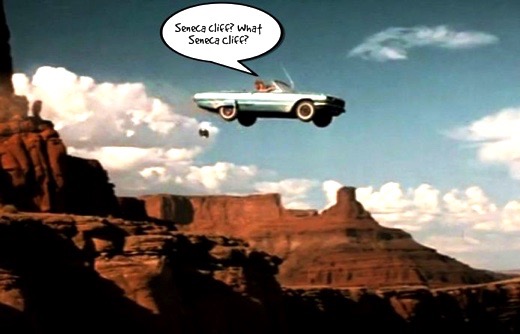
Image above: "Seneca Cliff? What Seneca Cliff?" scene from 1991 movie "Thelma and Louise" From (http://thesenecatrap.blogspot.com/2017/05/seneca-cliff-what-seneca-cliff.html).

Dear colleagues, we are having an interesting discussion on how to stop climate change and I think I could add some thoughts of mine on the basis of my recent work that I published in the form of the book titled "The Seneca Effect".

The problem we have been discussing is how to limit emissions and we saw that it needs to be done fast and even drastically if we want to avoid the worse effects of climate change. Obviously, it is not easy. (image from Skeptical Science)

Most of what has been said today was based on a "top-down" approach, which I may also describe as supply-limiting. That is, we are speaking of a carbon tax, of emission limits, and the like; measures that governments should take in order to limit the production of fossil fuels. I don't have to tell you that it is an effort that has been ongoing for several years and yet emissions keep growing. It doesn't seem to work

So, can we take the opposite approach? That is, look at the demand side in a "bottom-up" approach?

To discuss this point, let me introduce the concept of the "Seneca Effect" or the "Seneca Cliff." Here is the shape of the Seneca curve.

You know that I use the term of "Seneca Effect" taking inspiration from something that the Roman philosopher Seneca said long ago; "growth is sluggish but ruin is rapid". And you see how the curve looks like the projections for emission reductions we have been seeing here.

So, the question is, what causes the collapse we see in the Seneca Curve in complex systems?

Well, we can use system dynamics to model the collapse and we know it is not a "top-down" effect, nobody from outside forces the system to collapse. It is a very general phenomenon caused by the interactions of the various elements that compose the system which cooperate to bring it down. And that's a trick that can be exploited: as I say in my book, "The Seneca Effect", collapse is not a bug, it is a feature.

Let me see to explain it using the oil industry as an example: see the figure drawn on the board.

Now, you see the segmented line I drew, it keeps going up. It is what the oil companies expect for the future. Their projections, by Exxon for instance, say this: given sufficient investments, we can keep growing the oil production for a number of years, maybe a decade or more.

That's what they have been doing; despite various dire warnings, the oil industry has been able to keep production growing. It is true that conventional oil ("crude") peaked at some moment between 2005 and 2010, but it didn't really decline. Then, the production of "all liquids" kept growing by exploiting other sources such as shale oil.

Of course, the problem is that if the industry continues to make an all-out effort to increase, or at least maintain, production, all we were saying about the need of reducing emissions goes out of the smokestack. Forget about keeping warming below 2 degrees. It would be a disaster.

But look at the Seneca curve in the graph. It would generate more or less the kind of rapidly declining production curve we need for our future survival

The oil industry doesn't predict anything like that, but it is vulnerable, very vulnerable. The industry has a "soft belly:" the collapse of the demand. That is, we don't need governments to enact draconian regulations: if the market for a product disappears, then the industry producing it will disappear. Can it happen? Yes, it can.

The key point of the oil industry's vulnerability is in the need of large investments to keep the whole thing moving. Facing increasing production costs, they have been able to survive by growing and exploiting economies of scale. This has been possible because investors thought they were investing in a growing industry.

But things have been changing and the market of the oil industry is at risk. Consider that typically a good 50% of the oil industry production is gasoline. To this, you may add about 20% of diesel fuel and the result is that some 70% of the output of the industry is for internal combustion engines used for transportation.

So far, this has been a growing market, but the electric transportation revolution is coming, and not just that. There is a whole systemic change under the concept of "Transportation as a Service" (TAAS). The combination of the diffusion of electric vehicles and the optimization of the system may rapidly reduce the demand for gasoline and diesel fuel.

We don't need a large reduction in the demand for transportation fuels to generate a spiral of decline for the oil industry.

Less demand means less production, less production means the loss of economies of scale, and the loss of the economies of scale means higher costs that translate into higher prices which also depress the demand. And so it goes until it reaches the bottom.

As Lucius Annaeus Seneca said, long ago, "ruin is rapid". And the ruin of the oil industry is not a bad thing for the earth's ecosystem and for us all.

See also:
The Seneca Effect book published
(http://thesenecatrap.blogspot.com/2017/08/the-seneca-effect-published.html/)

Ea O Ka Aina: Can airlines be saved? 11/1/17
Ea O Ka Aina: American way of life is negotiable 5/31/17
Ea O Ka Aina: Ecovillage Rescuing Los Angeles 3/27/17

.

Climate Change not our biggest issue

SUBHEAD: Technology won’t save us. Systemic change driven by moral awakening is our only hope.

By Richard Heinberg on 14 August 2017 for EcoWatch -
(https://www.ecowatch.com/climate-change-heinberg-2471869927.html)


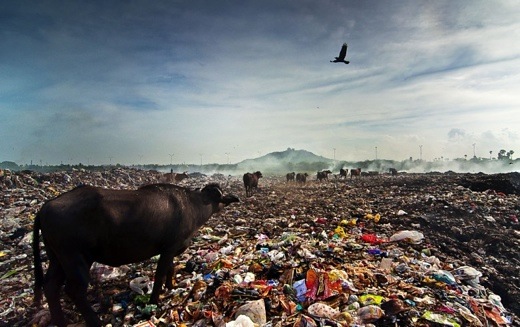
Image above: A herd of cows cross a landfill landscape in India. Photo by Saravanan Dhandapani. From (https://ecobnb.com/blog/2014/10/earth-overshoot-day/).

Our core ecological problem is not climate change. It is overshoot, of which global warming is a symptom.

Overshoot is a systemic issue.

Over the past century-and-a-half, enormous amounts of cheap energy from fossil fuels enabled the rapid growth of resource extraction, manufacturing and consumption; and these in turn led to population increase, pollution and loss of natural habitat and hence biodiversity.

The human system expanded dramatically, overshooting Earth's long-term carrying capacity for humans while upsetting the ecological systems we depend on for our survival.

Until we understand and address this systemic imbalance, symptomatic treatment (doing what we can to reverse pollution dilemmas like climate change, trying to save threatened species and hoping to feed a burgeoning population with genetically modified crops) will constitute an endlessly frustrating round of stopgap measures that are ultimately destined to fail.

The ecology movement in the 1970s benefitted from a strong infusion of systems thinking, which was in vogue at the time (ecology—the study of the relationships between organisms and their environments—is an inherently systemic discipline, as opposed to studies like chemistry that focus on reducing complex phenomena to their components).

As a result, many of the best environmental writers of the era framed the modern human predicament in terms that revealed the deep linkages between environmental symptoms and the way human society operates.

Limits to Growth (1972), an outgrowth of the systems research of Jay Forrester, investigated the interactions between population growth, industrial production, food production, resource depletion and pollution.

Overshoot (1982), by William Catton, named our systemic problem and described its origins and development in a style any literate person could appreciate. Many more excellent books from the era could be cited.

However, in recent decades, as climate change has come to dominate environmental concerns, there has been a significant shift in the discussion.

Today, most environmental reporting is focused laser-like on climate change, and systemic links between it and other worsening ecological dilemmas (such as overpopulation, species extinctions, water and air pollution, and loss of topsoil and fresh water) are seldom highlighted. It's not that climate change isn't a big deal.

As a symptom, it's a real doozy.

There's never been anything quite like it, and climate scientists and climate-response advocacy groups are right to ring the loudest of alarm bells. But our failure to see climate change in context may be our undoing.

Why have environmental writers and advocacy organizations succumbed to tunnel vision? Perhaps it's simply that they assume systems thinking is beyond the capacity of policy makers.

It's true: If climate scientists were to approach world leaders with the message, "We have to change everything, including our entire economic system—and fast," they might be shown the door rather rudely. A more acceptable message is, "We have identified a serious pollution problem, for which there are technical solutions."

Perhaps many of the scientists who did recognize the systemic nature of our ecological crisis concluded that if we can successfully address this one make-or-break environmental crisis, we'll be able to buy time to deal with others waiting in the wings (overpopulation, species extinctions, resource depletion and on and on).

If climate change can be framed as an isolated problem for which there is a technological solution, the minds of economists and policy makers can continue to graze in familiar pastures.

Technology—in this case, solar, wind and nuclear power generators, as well as batteries, electric cars, heat pumps and, if all else fails, solar radiation management via atmospheric aerosols—centers our thinking on subjects like financial investment and industrial production.

Discussion participants don't have to develop the ability to think systemically, nor do they need to understand the Earth system and how human systems fit into it.

All they need trouble themselves with is the prospect of shifting some investments, setting tasks for engineers and managing the resulting industrial-economic transformation so as to ensure that new jobs in green industries compensate for jobs lost in coal mines.

The strategy of buying time with a techno-fix presumes either that we will be able to institute systemic change at some unspecified point in the future even though we can't do it just now (a weak argument on its face), or that climate change and all of our other symptomatic crises will in fact be amenable to technological fixes.

The latter thought-path is again a comfortable one for managers and investors.

After all, everybody loves technology. It already does nearly everything for us. During the last century it solved a host of problems: it cured diseases, expanded food production, sped up transportation and provided us with information and entertainment in quantities and varieties no one could previously have imagined.

Why shouldn't it be able to solve climate change and all the rest of our problems?


Video above: "Hello Humanity, it's me, Technology. We need to talk. ". From (https://youtu.be/1TerTgDEgUE).

Of course, ignoring the systemic nature of our dilemma just means that as soon as we get one symptom corralled, another is likely to break loose.

But, crucially, is climate change, taken as an isolated problem, fully treatable with technology? Color me doubtful.

 I say this having spent many months poring over the relevant data with David Fridley of the energy analysis program at Lawrence Berkeley National Laboratory.

Our resulting book, Our Renewable Future, concluded that nuclear power is too expensive and risky; meanwhile, solar and wind power both suffer from intermittency, which (once these sources begin to provide a large percentage of total electrical power) will require a combination of three strategies on a grand scale: energy storage, redundant production capacity and demand adaptation.

At the same time, we in industrial nations will have to adapt most of our current energy usage (which occurs in industrial processes, building heating and transportation) to electricity.

Altogether, the energy transition promises to be an enormous undertaking, unprecedented in its requirements for investment and substitution.

When David and I stepped back to assess the enormity of the task, we could see no way to maintain current quantities of global energy production during the transition, much less to increase energy supplies so as to power ongoing economic growth.

The biggest transitional hurdle is scale: the world uses an enormous amount of energy currently; only if that quantity can be reduced significantly, especially in industrial nations, could we imagine a credible pathway toward a post-carbon future.

Downsizing the world's energy supplies would, effectively, also downsize industrial processes of resource extraction, manufacturing, transportation, and waste management.

That's a systemic intervention, of exactly the kind called for by the ecologists of the 1970s who coined the mantra, "Reduce, reuse and recycle."

It gets to the heart of the overshoot dilemma—as does population stabilization and reduction, another necessary strategy. But it's also a notion to which technocrats, industrialists, and investors are virulently allergic.

The ecological argument is, at its core, a moral one—as I explain in more detail in a just-released manifesto replete with sidebars and graphics ("There's No App for That: Technology and Morality in the Age of Climate Change, Overpopulation, and Biodiversity Loss").

Any systems thinker who understands overshoot and prescribes powerdown as a treatment is effectively engaging in an intervention with an addictive behavior.

Society is addicted to growth, and that's having terrible consequences for the planet and, increasingly, for us as well. We have to change our collective and individual behavior and give up something we depend on—power over our environment.


Image above: In 1961 we were consuming 74% of the Earth's sustainable resources. By 1985 we passed 100% of a sustainable rate. In 2012 we passed 150% of sustainable levels. Check out your footprint here (https://www.footprintcalculator.org/#!/). From (https://ecobnb.com/blog/2014/10/earth-overshoot-day/).

We must restrain ourselves, like an alcoholic foreswearing booze. That requires honesty and soul-searching.

In its early years the environmental movement made that moral argument, and it worked up to a point. Concern over rapid population growth led to family planning efforts around the world. Concern over biodiversity declines led to habitat protection.

Concern over air and water pollution led to a slew of regulations. These efforts weren't sufficient, but they showed that framing our systemic problem in moral terms could get at least some traction.

Why didn't the environmental movement fully succeed? Some theorists now calling themselves "bright greens" or "eco-modernists" have abandoned the moral fight altogether.

Their justification for doing so is that people want a vision of the future that's cheery and that doesn't require sacrifice. Now, they say, only a technological fix offers any hope.

The essential point of this essay (and my manifesto) is simply that, even if the moral argument fails, a techno-fix won't work either.

A gargantuan investment in technology (whether next-generation nuclear power or solar radiation geo-engineering) is being billed as our last hope. But in reality it's no hope at all.

The reason for the failure thus far of the environmental movement wasn't that it appealed to humanity's moral sentiments—that was in fact the movement's great strength.

The effort fell short because it wasn't able to alter industrial society's central organizing principle, which is also its fatal flaw: its dogged pursuit of growth at all cost.

Now we're at the point where we must finally either succeed in overcoming growthism or face the failure not just of the environmental movement, but of civilization itself.

The good news is that systemic change is fractal in nature: it implies, indeed it requires, action at every level of society.

We can start with our own individual choices and behavior; we can work within our communities.

We needn't wait for a cathartic global or national sea change. And even if our efforts cannot "save" consumerist industrial civilization, they could still succeed in planting the seeds of a regenerative human culture worthy of survival.

There's more good news: Once we humans choose to restrain our numbers and our rates of consumption, technology can assist our efforts. Machines can help us monitor our progress, and there are relatively simple technologies that can help deliver needed services with less energy usage and environmental damage.

Some ways of deploying technology could even help us clean up the atmosphere and restore ecosystems.

But machines can't make the key choices that will set us on a sustainable path. Systemic change driven by moral awakening: it's not just our last hope; it's the only real hope we've ever had.


.