Showing posts with label Afghanistan. Show all posts

American Wars of Error

SUBHEAD: The end of our empire is near and it won't be pretty.

By Tom Englehart on 9 January 2020 for TruthDig -
(https://www.truthdig.com/articles/the-end-of-american-empire-wont-be-pretty/)
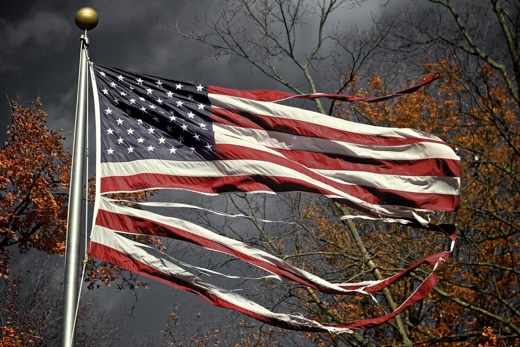

Image above: A tattered American flag flies in shreds. From original article.

Yes, our infrastructure stinks, our schools are failing, this country’s a nightmare of inequality, and there’s a self-promoting madman in the White House, so isn’t it time to take pride in the rare institutional victories America has had in this century?

Arguably, none has been more striking than the triumphal success of the American war system.

Oh, you’re going to bring that up immediately? Okay, you’re right. It’s true enough that the U.S. military can’t win a war anymore. In this century, it’s never come out on top anywhere, not once, not definitively.

And yes, just to get a step ahead of you, everywhere it’s set foot across the Greater Middle East and Africa, it seems to have killed startling numbers of people and uprooted so many more, sending lots of them into exile and so unsettling other parts of the world as well. In the process, it’s also had remarkable success spreading failed states and terror groups far and wide.

Al-Qaeda, whose 19 suicidal hijackers so devastatingly struck this country on September 11, 2001, was just a modest outfit then (even if its leader dreamt of drawing the U.S. into conflicts across the Islamic world that would promote his group big time). Nineteen years later, its branches have spread from Yemen to West Africa, while the original al-Qaeda still exists.

And don’t forget its horrific progeny, the Islamic State, or ISIS (originally al-Qaeda in Iraq). Though the U.S. military has declared it defeated in its “caliphate” (it isn’t, not truly), its branches have multiplied from the Philippines deep into Africa.

And the Afghan War, that original American invasion of this century, remains hell on Earth more than 18 years later. In December, the Washington Post broke a story about interviews on that conflict conducted by the Special Inspector General for Afghanistan Reconstruction with 400 key insiders, military and civilian, revealing that it was a war of (well-grasped) error.

As that paper’s reporter, Craig Whitlock, put it: “Senior U.S. officials failed to tell the truth about the war in Afghanistan throughout the 18-year campaign, making rosy pronouncements they knew to be false and hiding unmistakable evidence the war had become unwinnable.”

Many of those generals and other officials who had claimed, year after year, that there was “progress” in Afghanistan, that the U.S. had turned yet another “corner,” admitted to the Inspector General’s interviewers that they had been lying to the rest of us. In truth, so long after the invasion of 2001, this wasn’t exactly news (not if you had been paying attention anyway).

And it couldn’t have been more historically familiar. After all, U.S. military commanders and other key officials had, in a similar fashion, regularly hailed “progress” in the Vietnam War years, too.

As U.S. war commander General William Westmoreland put it in an address to the National Press Club in 1967, “We have reached an important point where the end begins to come into view,” a sentiment later boiled down by American officialdom to seeing “the light at the end of the tunnel.”

In fact, half a century later, these, too, have proved to be tunnel years for the U.S. military in its global war on terror, which might more accurately be called a global war of error.

Take Iraq, the country that, in the spring of 2003, President George W. Bush and crew so triumphantly invaded, claiming a connection between its autocratic ruler, Saddam Hussein, and al-Qaeda, while citing the dangers of the weapons of mass destruction he supposedly possessed.

Both claims were, of course, fantasies propagated by officials dreaming of using that invasion to establish a Pax Americana in the oil-rich Middle East forever and a day. (“Mission accomplished!”)

So many years later, Americans are still dying there; American air and drone strikes are still ongoing; and American troops are still being sent in, as Iraqis continue to die in significant numbers in a country turned into a stew of displacement, poverty, protest, and chaos.

Meanwhile, ISIS (formed in an American prison camp in Iraq) threatens to resurge amid the never-ending mess that invasion created — and war with Iran seems to be the order of the day.

And just to continue down a list that’s little short of endless, don’t forget Somalia. The U.S. military has been fighting there, on and off, with strikingly negative consequences since the infamous Blackhawk Down disaster of 1993.

Last year, American air strikes rose again to record levels there, while — no surprise — the terror outfit Washington has been fighting in that country since 2006, al-Shabaab, an al-Qaeda offshoot, seems only to be gaining strength.

Hey, even the Russians got a (grim) win in Syria; the U.S., nowhere. Not in Libya, a failed state filled with warring militias and bad guys of every sort in the wake of a U.S.-led overthrow of the local autocrat.

Not in Niger, where four American soldiers died at the hands of an ISIS terror group that still thrives; not in Yemen, yet another failed state where a Washington-backed Saudi war follows perfectly in the U.S. military’s footsteps in the region. So, yes, you’re right to challenge me with all of that.

How to Run a War of Error

Nonetheless, I stand by my initial statement. In these years, the American war system has proven to be a remarkable institutional success story. Think of it this way: in the military of the twenty-first century, failure is the new success. In order to grasp this, you have to stop looking at Afghanistan, Iraq, Libya, Somalia, and the rest of those embattled lands and start looking instead at Washington, D.C. While you’re at it, you need to stop thinking that the gauge of success in war is victory. That’s so mid-twentieth century of you! In fact, almost the opposite may be true when it comes to the American way of war today.

After more than 18 years of what, once upon a time, would have been considered failure, tell me this:

Is the Pentagon receiving more money or less? In fact, it’s now being fed record amounts of tax dollars (as is the whole national security state).

Admittedly, Congress can’t find money for the building or rebuilding of American infrastructure — China now has up to 30,000 kilometers of high-speed rail and the U.S. not one — and is riven by party animosities on issue after issue, but funding the Pentagon? No problem. When it comes to that, there’s hardly a question, hardly a dispute at all. Agreement is nearly unanimous.

Failure, in other words, is the new success and that applies as well to the “industrial” part of the military-industrial complex. That reality was caught in a Washington Post headline the day after a CIA drone assassinated General Qassem Suleimani: “Defense stocks spike after airstrike against Iranian commander.” Indeed, the good times clearly lay ahead. In the age of Trump, when the last secretary of defense was a former Boeing executive and the present one a former lobbyist for arms-maker Raytheon, it’s been weapons galore all the way to the bank.

Who cares if those weapons really work as advertised or if the wars in which they’re used are winnable, as long as they’re bought at staggering prices (and other countries buy them as well)?

If you don’t believe me, just check out Lockheed Martin’s F-35 jet fighter, the most expensive weapons system ever (that doesn’t really work). Hey, in 2019, that company got a $2.43 billion contract just for spare parts for the plane!

And this version of a success story applies not just to funding and weaponry but to the military’s leadership as well. Keep in mind that, after almost two decades without a victory in sight, if you check any poll, you’ll find that the U.S. military remains the most admired institution around (or the one Americans have most “confidence” in). And under the circumstances, tell me that isn’t an accomplishment of the first order.

For just about every key figure in the U.S. military, you can now safely say that failure continues to be the order of the day.

Consider it the twenty-first-century version of a military insurance policy: keep on keeping on without ever thinking outside the box and you’ll be pushed up the chain of command to ever more impressive positions (and, sooner or later, through Washington’s infamous “revolving door” onto the corporate boards of weapons makers and other defense firms). You’ll be hailed as a great and thoughtful commander, a genuine historian of war, and a strategist beyond compare. You’ll be admired by one and all.

Americans of another age would have found this strange indeed, but not today. Take, for instance, former Secretary of Defense and Marine General James “Mad Dog” Mattis who led troops into Afghanistan in 2001 and again in the invasion of Iraq in 2003.

In 2004, as commander of the 1st Marine Division, he was asked about a report that his troops had taken out a wedding party in western Iraq, including the wedding singer and his musicians, killing 43 people, 14 of them children. He responded: “How many people go to the middle of the desert… to hold a wedding 80 miles from the nearest civilization?”

And then, of course, he only rose further, ending up as the head of U.S. Central Command, or CENTCOM, which oversees America’s wars in the Greater Middle East (and you know how that went), until he retired in 2013 and joined the corporate board of General Dynamics, the nation’s fifth largest defense contractor.

Then, in 2016, a certain Donald J. Trump took a liking to the very idea of a general nicknamed “mad dog” and appointed him to run the Department of Defense (which should probably be renamed the Department of Offense).

There, with full honors, the former four-star general oversaw the very same wars until, in December 2018, deeply admired by Washington journalists among others, he resigned in protest over a presidential decision to withdraw American troops from Syria (and rejoined the board of General Dynamics).

In terms of the system he was in, that may have been his only genuine “error,” his only true “defeat.”

Fortunately for the Pentagon, another commander who had risen through the same dead-end wars, four-star Army General Mark Milley, having been appointed head of the Joint Chiefs of Staff, knew just what to whisper in the president’s ear — the magic word “oil,” or rather some version of protect (i.e. take) Syrian oil fields — to get him to send American troops back into that country to continue the local version of our never-ending wars.

By now, Milley’s rise to glory will seem familiar to you. In announcing his appointment as Army chief of staff in 2015, for instance, Secretary of Defense Ashton Carter called him “a warrior and a statesman.” He added, “He not only has plenty of operational and joint experience in Afghanistan, in Iraq, and on the Joint Staff, but he also has the intellect and vision to lead change throughout the Army.” Exactly!

Milley had, in fact, fought in both the Afghan and Iraq wars, serving three tours of duty in Afghanistan alone. In other words, the more you don’t win — the more you are, in a sense, in error — the more likely you are to advance.

Or as retired General Gordon Sullivan, president of the Association of the United States Army and a former chief of staff himself, put it then, Milley’s command experience in war and peace gave him “firsthand knowledge of what the Army can do and of the impact of resource constraints on its capabilities.”

In other words, he was a man ready to command who knew just how to handle this country’s losing wars and keep them (so to speak) on track. Once upon a time, such a crew of commanders would have been considered a military of losers, but no longer. They are now the eternal winners in America’s war of error.

In September 2013, Milley, then an Army three-star general, typically offered this ludicrously rosy assessment of Afghanistan’s American-trained and American-supplied security forces: “This army and this police force have been very, very effective in combat against the insurgents every single day.”

As Tony Karon wrote recently, “Either Milley was dissembling or he was deluded and therefore grotesquely incompetent.” One thing we know, though: when it comes to public military assessments of the Afghan War (and the global war on terror more generally), he was typical. For such commanders, it was invariably “progress” all the way.

Just in case you don’t quite see the pattern yet, after the Washington Post‘s Afghanistan Papers came out last December, offering clear evidence that, whatever they said in public, America’s commanders saw little in the way of “progress” in the Afghan War, Milley promptly stepped up to the plate. He labeled that report’s conclusions “mischaracterizations.”

He insisted instead that the endlessly optimistic public comments of generals like him had been “honest assessments… never intended to deceive either the Congress or the American people.”

Oh, and here’s a final footnote (as reported in the New York Times last year) on how Milley (and top commanders like him) operated — and not just in Afghanistan either:
“As Army chief of staff, General Milley has come under criticism from some in the Special Operations community for his involvement in the investigation into the 2017 ambush in Niger that left four American soldiers dead. He persuaded Patrick M. Shanahan, who was acting defense secretary, to curtail a broader review, and also protected the career of an officer who some blamed for the ambush. General Milley’s backers said he prevented the officer from leading another combat unit.”
Whatever you do, in other words, don’t give up the ghost (of error). Think of this as the formula for “success” in that most admired of institutions, the U.S. military. 

After all, Milley and Mattis are just typical of the commanders who rose (and are still rising) to ever more prestigious positions on the basis of losing (or at least not winning) an endless series of conflicts. Those failed wars were their tickets to success. Go figure.

Where Defeat Culture Leads

In other words, the men who fought the twenty-first-century equivalents of Vietnam — though against right-wing Islamists, not left-wing nationalists and communists — the men who never for a second figured out how to win “hearts and minds” any better than General William Westmorland had half a century earlier, are now triumphantly running the show in Washington. 

Add in the corporate types who endlessly arm them for battle and lobby for more of the same while raking in the dough and you have a system that no one involved would want to change. It’s a formula for success that works like a dream (even if someday that dream is sure to end up looking like a nightmare).

Once upon a time, in the early 1990s, I wrote a book called The End of Victory Culture. In it, I traced how a deeply embedded American culture of triumph evaporated in the Vietnam War years, “its graveyard for all to see,” as “the answers of 1945 dissolved so quickly into the questions of 1965.” 

Speaking of the impact of that war on American culture, I added: “There was no narrative form that could long have contained the story of a slow-motion defeat inflicted by a nonwhite people in a frontier war in which the statistics of American victory seemed everywhere evident.”

Little did I know then how deeply a version of what might be called “defeat culture” would embed itself in American life. After all, Donald Trump couldn’t have been elected to “make America great again” without it. From the evidence of these years, nowhere was that culture more deeply absorbed (however unconsciously) than in the military itself, which has, in our time, managed to turn it into a version of the ultimate success story.

Afghanistan has, of course, long been known as “the graveyard of empires.” The Soviet Union fought Islamic militants (backed by the Saudis and the United States) for nine years there before, in 1989, the Red Army limped home in defeat to watch a drained empire implode two years later. 

 That left the U.S. as the “sole superpower” on Planet Earth and its military as the uncontested greatest one of all.

And it took that military just a decade to head for that same graveyard. In this century, Americans have lost trillions of dollars in the never-ending wars Washington has conducted across the Greater Middle East and parts of Africa, wars that represent an eternal reign (rain?) of error. I’ve long suspected that the Soviet Union wasn’t the only superpower with problems in 1991. 

Though it was anything but obvious at the time, I’ve since written
“It will undoubtedly be clear enough… that the U.S., seemingly at the height of any power’s power in 1991 when the Soviet Union disappeared, began heading for the exits soon thereafter, still enwreathed in self-congratulation and triumphalism.”
The question is: When will the far more powerful of the two superpowers of the Cold War era finally leave that graveyard of empires (now spread across a significant swath of the planet)? 

Still commanded by the losers of those very wars, will it, like the Red Army, limp home one day to watch its country implode? Will it leave a world of war, of the dead, of countless refugees and rubblized cities, and finally return to see its own society disintegrate in some fashion?

Who knows? But keep your eyes peeled in 2020 and beyond. Someday, the U.S. military’s war of error will come to an end and one thing seems certain: it won’t be pretty.
.

The Real 9/11 Conspiracy

SUBHEAD: The US pretending it was not Saudi Arabia that flew two commercial jets into the World Trade Center towers.

By Sonali Kolatkar on 23 May 2016 for TruthDig -
(https://www.alternet.org/real-911-conspiracy)


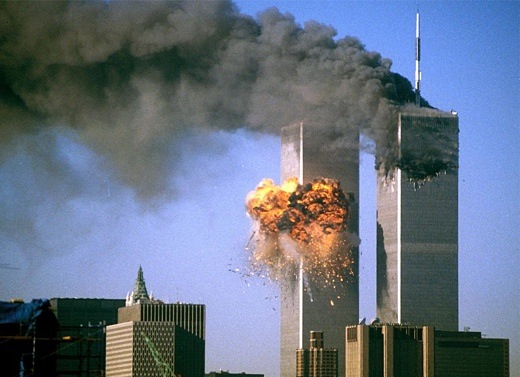
Image above: North tower burning (right) as South tower is struck by commercial jet. From (https://www.alternet.org/real-911-conspiracy).

I remember watching the towers fall.

My sister called early in the morning to tell me to turn on the television. My husband and I, who had been working closely with Afghan women organizing against the Taliban, stared at the screen, aghast as the buildings crumbled.

Like everyone else the world over, we realized it was a moment that was going to change history. We also realized that ordinary people, including our friends in Afghanistan, were going to pay the price for something they likely had nothing to do with.

And sure enough, on Oct. 7, 2001, despite the fact that 15 of the 19 hijackers were Saudi nationals, the U.S. went to war with Afghanistan. That war, the longest in U.S. history, remains a bloody weight on our collective conscience.

But as soon as the towers fell and Congress rushed to hand over blanket authority to President Bush to wantonly bomb, whispers of “an inside job” began circulating on the internet.

Those whispers snowballed as the war expanded from Afghanistan to Iraq. Many anti-war activists, eager to undermine the flawed rationale for the Iraq War, insisted ever more shrilly that Bush and company were likely behind the attacks or knew ahead of time that the attacks were coming and failed to act purposefully.

Complex and convoluted arguments about the temperatures at which the towers’ beams melted were vociferously trotted out on public radio and in Internet chat rooms. Jesse Ventura jumped into the fray. Films like “Loose Change” and “Zeitgeist” offered seductive theories for Americans to latch onto as they became angry about our rush to war.

As a journalist, I often came under fire from the so-called “9/11 truthers” for being a “gatekeeper” and refusing to take the conspiracy theories seriously. I was much more interested in the devastation being wrought by the U.S. in the name of the 9/11 attacks.

And one irrefutable fact kept arising over and over in my mind: 15 of the 19 hijackers were Saudi nationals. It was a simple fact that everyone agreed on. It had nothing to do with secrets, lies or thermodynamics. It was out in the open.

Here is a plausible conspiracy: The Saudi government, known for aiding and abetting fundamentalist terrorist groups in order to legitimize its own extremist ideology, may well have been involved with some of the 9/11 terrorists, whether or not they knew the hijackers’ intentions.

Once those links were revealed, the U.S. government, which has a history of cozy relations with the Saudis for various reasons (oil, regional influence, weapons sales, etc.), may have wanted to overlook those embarrassing connections and instead divert the American public to countries it had an interest in, namely Iraq (with Afghanistan as a stepping stone).

But in 2004, the 9/11 Commission, a 10-person government panel created to investigate the attacks, absolved the Saudi Arabian government of any involvement. (It also faulted intelligence agencies for lack of coordination.) This was thought to be the end of the story. We were supposed to accept as mere coincidence the fact that the majority of the hijackers were Saudi citizens.
 
Now it turns out that the far more plausible 9/11 conspiracy could be true. After years of rumors that a classified section of a 2002 congressional report held the key to a Saudi role, The Guardian newspaper recently interviewed a member of the 9/11 Commission who confirmed these suspicions.

John Lehman, a Republican and former U.S. Navy secretary under President Reagan, asserted, “There was an awful lot of participation by Saudi individuals in supporting the hijackers, and some of those people worked in the Saudi government.” According to The Guardian, Lehman was aware of “five Saudi government officials who were strongly suspected of involvement in the terrorists’ support network.”

Lehman, along with several members of Congress, wants the Obama administration to declassify the so-called “28 pages” that were kept secret. While Obama decides whether or not to release the documents, the GOP-dominated Senate has just passed a bill that would allow families of 9/11 victims to sue the Saudi government. The Saudis are predictably outraged, and Obama will likely veto the bill to assuage the U.S. ally.

Why is any of this important, particularly given the GOP’s penchant for finding any excuse, however insignificant, to oppose Obama?

It is important because the entire premise of current U.S. foreign policy in the Middle East is based on an assumption that no government actors were involved in the 9/11 attacks.

 Rather, we were told, it was a series of shadowy and reprehensible groups, including “al-Qaida, the Taliban and their associated forces,” in Obama’s own words, that have been targeted for blame and elimination. Just who those “associated forces” are is unknown. In reality, the “enemy” is about as classified as Saudi Arabia’s role in 9/11.

The wars in Afghanistan and Iraq that began well over a decade ago unleashed chaos and violence. They generated the gulag in Guantanamo, Cuba. They were expanded via drone strikes in Pakistan, Libya, Yemen and Somalia.

They have killed untold numbers of innocents and inspired hatred toward the U.S. The U.S. has undermined the Arab Spring movements for democracy in countries like Egypt and even bolstered Saudi Arabia’s brutal quashing of democracy in Bahrain.

It has partnered with the Saudis on a bloody war in Yemen and continued its long-standing tradition of selling the wealthy Gulf monarchy more weapons than it knows what to do with.

The real 9/11 conspiracy is that, despite recent claims that “U.S.-Saudi relations are strained,” close ties between the two countries are worth far more than uncovering what really happened on Sept. 11, 2001.

The real conspiracy has been out in the open all along. We are told that we need to trust that our government is handling the terrorists who hate us and tried to kill us, even if many contend that the wars have made us less safe. But it turns out our government is simply and amiably working along with the nation most implicated in the 9/11 attacks.

None of this is to imply that the U.S. should have bombed Saudi Arabia instead of Afghanistan in 2001. Our post-9/11 military incursions all point to the singular fact that the “War on Terror” has been a “War of Terror.”

On the lengthy list of reasons our modern era of warfare is immoral, misguided, murderous, violent and in every sense wrong, the revelations of Saudi links to the 9/11 attacks ought to be the final straw.

See also:
Ea O Ka Aina: 9/11 The Day America Ended 9/11/16
Ea O Ka Aina: What We've Lost Since 911 6/16/14
Ea O Ka Aina: New Meaning for Day After 911 9/12/13
Ea O Ka Aina: 911 Aftermath - Our Self Defeat
9/10/11
Ea O Ka Aina: The Price of 911 9/7/11
Ea O Ka Aina: Giuliani 911 NY PD FD Fraud
8/31/11
Ea O Ka Aina: Israel as a Failed State
1/4/09
Island Breath: 7th Anniversary of September 11th
9/8/08
Island Breath: The War on Terror Begins 9/11/2001 9/9/06
Island Breath: Bush-Taliban Deal Disaster
4/9/04

.

Trumped up war with Syria

SUBHEAD: In order to to save his presidency the Donald will have to connive a "Fatal "Distraction".

By  Juan Wilson on 11 April 2018 for Island Breath -
(http://islandbreath.blogspot.com/2018/04/trumped-up-war-with-syria.html)


Image above:Trump, Pence, Bolten meet with US military leaders on Syrian crisis.From (https://www.politico.eu/article/syria-crisis-collides-with-donald-trump-chaos-russia-vladimir-putin/).

Anybody here remember how the United States was conned into a full out effort to join into the Vietnam War?

Under President Kennedy our "contribution" to keeping South Vietnam from joining the north in what might be a Communist union had been through "advisors" - a few tens-of-thousands - who provided expertise, communications, weapons and aerial and naval backup.

Even so the corrupt South Vietnamese government was unable to beat back the revolution.

In 1965 US President Lyndon Johnson's CIA came up with a plan fort us to join into the ware effort openly.

Our Navy, in August of 1964 arranged for the US Maddox to be in the Gulf of Tonkin off the North Vietnam port of Hai Phong and was met by North Vietnam naval patrol boats.

The ensuing engagements in international waters of North Vietnam were our excuse to enter into the longest (and most useless) American war.

Until we got into the endless Middle East War that has destroyed several nation states that include Afghanistran, Iraq, Libya, Yemen and now Syria.

Donald Trump's crimes of corruption are about to destroy his presidency. There are a limited number of unlikely scenarios that might save it... economic collapse or more war.

We now have a convenient "war crime" in Syria to act on.

It's not exactly clear if Syria's President Bashar al-Assad decided on a chemical ware attack on innocent civilians as part of a desire for suicide, or one of his bombs hit a military target where chemical weapons were stored or the event was caused by another party in order to instigate a war that America would see as its destiny.

In any case it is convenient for Trump to deflect interest in the investigation that is about to show his bottomless corruption with organized criminal oligarchs working out of the remnants of the former Soviet Union. So war it is!

See articles below for a hint where Justice Department is going. Why the Cohen warrant search reaction while Trump sits with military brass on subject of Syria War.


Trump knows he's the real target
(https://www.alternet.org/news-amp-politics/trump-knows-hes-real-target-fbi-raid-michael-cohen)

SUBHEAD: "It’s an attack on our country, in a true sense. It’s an attack on what we all stand for."

President Trump made a statement on Monday that many people in American never thought they'd hear from him. He said, "It’s an attack on our country, in a true sense. It’s an attack on what we all stand for."

Unfortunately, the president wasn't talking about the interference in our democratic election process in 2016.

He was referring to the FBI warrants served on his attorney Michael Cohen's office and two residences that morning, in which agents seized documents reportedly pertaining to suspected wire fraud, bank fraud and campaign finance violations. Trump believes that such an investigation is an attack on America because he believes it is an attack on him.

To paraphrase a quip from the great Molly Ivins, it sounded better in the original French: L'état, c'est moi.

Trump was very worked up, so worked up that he spent the first 15 minutes or so of a televised photo-op with his national security team and the Joint Chiefs railing against Special Counsel Robert Mueller, the Department of Justice, Attorney General Jeff Sessions, Hillary Clinton and Deputy Attorney General Rod Rosenstein, among others.

It wasn't the first time we've seen this president deliver a petulant and angry denunciation of the Russia probe. But to do it as he sat around a table with the military brass, for a meeting called to decide how to respond to a chemical warfare attack, was stunningly narcissistic even for him.

The cameras didn't show much of his team, but one can imagine how they felt being led by such a man.

It's not hard to imagine how most people in the country felt either. No one will ever describe Donald Trump as a leader who shows grace under pressure.

These warrants were issued by the U.S. attorney for the Southern District of New York (a Trump appointee, by the way), based on a referral from the special counsel's office. Nobody is quite sure exactly why it happened that way.

Some have speculated that this is about the Stormy Daniels case, and therefore far afield from Mueller's mandate, while others have suggested that Mueller passed this to a federal prosecutor to avoid the accusation that he crossed Trump's (nonexistent) red line.

At this point, all we can say for sure is that all warrants targeting an attorney go through an extraordinary process all the way up the line in the Department of Justice and are subject to extreme scrutiny by the magistrates who must approve them.

These are all lawyers, and by training and instinct they are protective of attorney-client privilege. The U.S. Attorneys’ Manual identifies six additional safeguards to ensure that the Department of Justice doesn't violate it in cases where an attorney is the subject of an investigation.

This particular lawyer is also the president's personal attorney, so it's fair to assume investigators were careful to demonstrate probable cause that Cohen had committed a crime in the course of representing his client and that he would be likely to destroy the evidence if they simply subpoenaed his records.

That may be the most extraordinary aspect of this entire event, although if you look at the way Cohen has talked and behaved over the years, it's not hard to see why someone might assume he could do that.

Nonetheless, any prosecutor would have to be aware of the political implications, and think long and hard about whether or not he or she had the goods to pursue such a case.
Report Advertisement

Nobody should have been all that surprised by this, least of all Michael Cohen himself. He's at the center of the Stormy Daniels case, and the president unhelpfully exacerbated his problems last Friday on Air Force One when he referred questions about the alleged $130,000 payment to "my attorney Michael Cohen."

There is some speculation that he and Cohen believed they'd be protected by attorney-client privilege; if so, they were wrong.

But while that probably didn't help, it's almost certainly the reason Cohen's office and homes were raided on Monday. There's plenty of reporting to indicate that Cohen has been in the crosshairs for quite some time.

The Washington Post reported back in March that Mueller's office was interrogating witnesses about Cohen's negotiations during the presidential campaign to build a Moscow Trump Tower.

Reportedly, investigators were also exploring the odd story about the Russia-friendly "peace proposal" for Ukraine that Cohen received about a week after Trump was inaugurated.

Last week McClatchy reported that Mueller's team had shown up unannounced at the home of an unnamed Trump Organization business associate, "armed with subpoenas compelling electronic records and sworn testimony."

This person had reportedly worked with the company on overseas deals for years, and investigators were specifically interested in interactions with Cohen.

According to The New York Times on Monday, Mueller is also interested in a $150,000 payment paid to the Trump Foundation by a Ukrainian oligarch for a brief speech Trump gave during the presidential campaign. (You will recall that Trump has a way of pocketing money collected for his foundation.)

That deal was allegedly solicited by Michael Cohen. This apparently doesn't pertain to the warrants issued on Monday but rather the subpoenas issued to the Trump Organization last month.

Whether various federal officials are tracking Cohen's activities overseas, like the Moscow tower or the Ukraine speech, or the hush money paid to Stormy Daniels, it looks as though all roads lead to President Trump's personal lawyer.

Considering that it's well understood whom Michael Cohen is working for every minute of every day, that means the road dead-ends at 1600 Pennsylvania Avenue.


Trump reacts to Cohen raid
By Michael D. Shear on 9 April 2018 for the New York Times

(https://www.nytimes.com/2018/04/09/us/politics/trump-cohen-mueller-full-transcript.html)

President Trump spoke to reporters on Monday at the beginning of a meeting with military leaders and national security officials. He reacted to the news that the F.B.I. raided the office of his personal lawyer, Michael D. Cohen, and discussed his frustrations with his attorney general, Jeff Sessions, and the special counsel’s investigation being led by Robert S. Mueller III. Mr. Trump also touched on the potential for military action in Syria in the wake of a suspected chemical weapons attack by the Syrian government that killed dozens of people over the weekend.

The following is a transcript of those remarks, as prepared by The New York Times, with analysis from The Times’s Michael D. Shear, a White House correspondent.

PRESIDENT TRUMP: So, I just heard that they broke in to the office of one of my personal attorneys, a good man, and it’s a disgraceful situation. It’s a total witch hunt. I’ve been saying it for a long time. I’ve wanted to keep it down. We’ve given, I believe, over a million pages worth of documents to the special counsel.
Analysis
If there was one sign that Mr. Trump was furious about the raids of Mr. Cohen’s office and hotel, it was this phrase: They “broke in to the office.” Arms crossed, the president was clearly angry about how his friend and loyal attorney was treated — and did little to hide it.
TRUMP: They continue to just go forward and here we are talking about Syria, we’re talking about a lot of serious things with the greatest fighting force ever, and I have this witch hunt constantly going on for over 12 months now, and actually much more than that. You could say it was right after I won the nomination it started.

And it’s a disgrace, it’s frankly a real disgrace. It’s an attack on our country in a true sense. It’s an attack on what we all stand for.

So when I saw this and when I heard it — I heard it like you did — I said that is really now in a whole new level of unfairness. So this has been going on, I saw one of the reporters who is not necessarily a fan of mine, not necessarily very good to me, he said in effect that this is ridiculous, this is now getting ridiculous. They found no collusion whatsoever with Russia, the reason they found it is there was no collusion at all. No collusion.
Analysis
In a presidency not known for consistency, Mr. Trump has never wavered from his insistence that “they found no collusion.” In fact, what congressional investigators have always said is they had not yet determined whether the president or his aides had colluded with the Russians. Mr. Mueller has not said publicly one way or the other.

TRUMP: This is the most biased group of people, these people have the biggest conflicts of interest I’ve ever seen. Democrats, all — or just about all — either Democrats, or a couple of Republicans that worked for President Obama — they’re not looking at the other side.

They’re not looking at the Hillary Clinton, horrible things that she did and all of the crimes that were committed. They’re not looking at all of the things that happened that everybody is very angry about, I can tell you, from the Republican side, and I think even the independent side.
Analysis
Mr. Trump immediately focused on Mr. Mueller and his team, but in fact, Monday’s raids were authorized by a United States attorney who was appointed by Mr. Sessions and is a former law partner of Rudolph W. Giuliani, a Trump supporter. They were not authorized by Mr. Mueller.

TRUMP: They only keep looking at us. So they find no collusion, and then they go from there and they say, “Well, let’s keep going,” and they raid an office of a personal attorney early in the morning and I think it’s a disgrace.

So we’ll be talking about it more, but this is the most conflicted group of people I’ve ever seen. The attorney general made a terrible mistake when he did this, and when he recused himself, or he should have certainly let us know if he was going to recuse himself and we would have used a — put a different attorney general in. So he made what I consider to be a very terrible mistake for the country, but you’ll figure that out.
Analysis
Mr. Trump’s statement that “we’ll be talking about it more” — a reference to bias among the special counsel’s team — is an ominous one, suggesting that he might do something about it. What that would be is unclear, though adversaries and allies alike have at times worried that he might fire Mr. Mueller.
TRUMP: All I can say is after looking for a long period of time, not even before the special counsel because it really started just about from the time I won the nomination, and you look at what took place and what happened and it’s a disgrace. It’s a disgrace. I’ve been president now for what seems like a lengthy period of time. We’ve done a fantastic job. We’ve beaten ISIS. We have just about 100 percent of the caliphate or the land. Our economy is incredible.

The stock market dropped a lot today as soon as they heard the noise of, you know, this nonsense that’s going on. It dropped a lot. It was up — way up — and then it dropped quite a bit at the end, a lot. But that we have to go through that, we’ve had that hanging over us now from the very, very beginning and yet the other side, they don’t even bother looking. And the other side is where there are crimes, and those crimes are obvious:

Lies under oath, all over the place, emails that are knocked out, that are acid-washed and deleted, nobody’s ever seen — 33,000 emails are deleted after getting a subpoena for Congress, and nobody bothers looking at that.
Analysis
After repeatedly hailing stock market increases during his first year in office, Mr. Trump has all but ignored the market’s steep declines in the wake of his protectionist trade policies. So it was ironic that the president would blame what he called “this nonsense” for a drop in the stock market. The Dow Jones industrial average actually ended the day up slightly after at one point rising nearly 400 points.
TRUMP: And many, many other things, so I just think it’s a disgrace that a thing like this can happen.

With all of that being said, we are here to discuss Syria tonight. We’re the greatest fighting force anywhere in the world. These gentlemen and ladies are incredible people. Incredible talent, and we’re making a decision as to what we do with respect to the horrible attack that was made near Damascus, and it will be met, and it will be met forcefully. And when, I will not say because I don’t like talking about timing, but we are developing the greatest force that we’ve ever had.

We had $700 billion just approved, which was the reason I went along with that budget, because we had to fix our military. General Mattis would tell you that above anybody, we had to fix our military and right now we’re in a big process of doing that, $700 million and then $716 billion next year. So we’re going to make a decision tonight or very shortly thereafter and you’ll be hearing the decision.

But we can’t let atrocities like we all witnessed, and you can see that and it’s horrible. We can’t let that happen. In our world, we can’t let that happen. Especially when we’re able to, because of the power of the United States, because of the power of our country, we’re able to stop it.

I want to thank Ambassador John Bolton for joining us. I think he’s going to be a fantastic representative of our team. He’s highly respected by everybody in this room and, John, I want to thank you very much, this is going to be a lot of work.

Interesting day, he picked today as his first day. So, generals, I think he picked the right day. But certainly you’re going to find it very exciting but you are going to do a fantastic job and I appreciate you joining us.
Analysis
The president shifted briefly to Syria, taking note of John R. Bolton’s first day as national security adviser. He hinted that the United States would respond militarily to the chemical attacks in that country, saying that “we can’t let atrocities like we all witnessed” happen. He did not indicate whether Mr. Bolton — a noted national security hawk — had argued for a strike.
JOHN R. BOLTON: Thank you. It’s an honor to be here.

TRUMP: Thank you all very much.

REPORTER: Any concerns about what the F.B.I. might find, Mr. President?

TRUMP: No.

REPORTER: Do you have any concerns?

TRUMP: No, I’m not.

REPORTER: Did you have an affair with Stormy Daniels?

TRUMP: Why don’t I just fire Mueller?

REPORTER: Yeah, just fire the guy.

TRUMP: Well, I think it’s a disgrace, what’s going on. We’ll see what happens. But I think it’s really a sad situation when you look at what happened. And many people have said you should fire him. Again, they found nothing and in finding nothing, that’s a big statement.
Analysis
Among Mr. Trump’s verbal tics is the phrase “we’ll see what happens.” He says it all the time. So when he was asked why he doesn’t just fire Mr. Mueller, it popped out. It is not clear whether that means he is really considering doing that, or if the response was just another instance of this habit.

TRUMP: If you know the person who’s in charge of the investigation, you know all about that deputy Rosenstein, Rod Rosenstein, he wrote the letter very critical of Comey. One of the things I said, I fired Comey, well, I turned out to do the right thing because you look at all of the things that he’s done and the lies and you look at what’s gone on at the F.B.I. with the insurance policy and all of the things that happened, turned out I did the right thing. But he signed, as you know, he also signed the FISA warrant.

So Rod Rosenstein, who’s in charge of this, signed a FISA warrant, and he also, he also signed a letter that was essentially saying to fire James Comey, and he was right about that. He was absolutely right. So we’ll see what happens. I think it’s disgraceful and so does a lot of other people. This is a pure and simple witch hunt. Thank you very much. Thank you. Thank you. Thank you. Thank you all very much. Thank you.
Analysis
The president appointed Rod J. Rosenstein to be the deputy attorney general. But at Monday’s meeting, he criticized him for signing a FISA warrant, an apparent reference to the fact that Mr. Rosenstein had authorized agents to seek a warrant to wiretap Trump associates in the Russia probe. Mr. Trump and Republican allies have said the warrants were sought under false pretenses.
[Cross talk]

REPORTER: Can we get more clarity on who was responsible … [Inaudible]

TRUMP: We are getting clarity on that. Who is responsible for the weapons attack. We are getting very good clarity, actually. We have some pretty good answers. REPORTER: What are your options?

[Cross talk]

TRUMP: We have a lot of options militarily and we’ll be letting you know pretty soon.

AIDE: Thank you, everyone. Thank you all.

TRUMP: Probably after the fact.

AIDE: Thank you.


.

State of Failure

SUBHEAD: How is it in Bashar al-Assad’s interests to provoke a fresh international uproar against him and his regime?

By James Kunstler on 9 April 2018 for Kunstler.com  -
(http://kunstler.com/clusterfuck-nation/state-of-failure/)


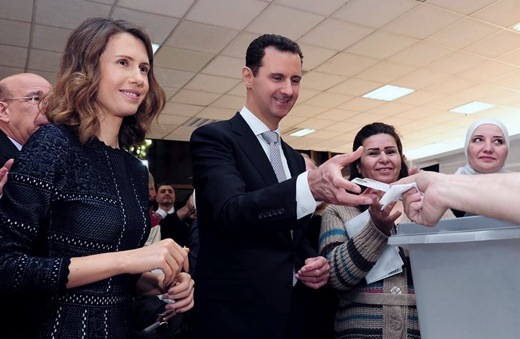
Image above: War Criminal Votes. Bachar al-Assad and his wife Asma at a polling place during a recent vote in Damascus, Syria. From (http://www.newindianexpress.com/world/2018/mar/19/syrias-assad-congratulates-vladimir-putin-on-natural-victory-1789486.html).
BEIRUT, Lebanon — Days after President Trump said he wanted to pull the United States out of Syria, Syrian forces hit a suburb of Damascus with bombs that rescue workers said unleashed toxic gas.
Fool me once, shame on you; fool me twice, shame on me, the old saying goes. So, tread carefully through the minefields of propaganda laid for the credulous in such low organs as The New York Times.

There are excellent reasons to suppose that the American Deep State wishes strenuously to keep meddling all around the Middle East.

The record so far shows that the blunt instruments of US strategic policy produce a consistent result: failed states.

Syria was well on its way to that sorry condition — prompted by an inflow of Jihadi maniacs fleeing our previous nation un-building experiment in Iraq — when the Russians stepped in with an arrantly contrary idea: to support the Syrian government.

Of course, the Russians had ulterior motives: a naval base on the Mediterranean, expanded influence in the region, and a Gazprom concession to develop and manage large natural gas fields near the Syrian city of Homs, for export to Europe.

The latter would have competed with America’s client state, Qatar, a leading gas exporter to Europe.

But the US objected to supporting the government of Bashar al-Assad, as it had previously with Saddam Hussein and Muammar Gaddafi, as well as Russia’s presence there in the first place.

So, the US cultivated anti-government forces in the Syrian civil war, a hodgepodge of Islamic psychopaths variously known as ISIS (Islamic State of Iraq and the Levant), Daesh, al-Qaeda, al-Nusra, Ansar al-Din, Jaysh al-Sunna, Nour al-Din al-Zenki, and what-have-you.

As it happened, US policy in Syria after 2013 became an exercise in waffling. It was clear that our support for the forces of Jihad against Assad was turning major Syrian cities into rubble-fields, with masses of civilians caught in the middle and ground up like so much dog food.

President Barack Obama famously drew a line-in-the-sand on the use of chemical weapons. It was well-known that the Syrian army had stockpiles of chemical poisons.

But the US also knew that our Jihadi consorts had plenty of their own. Incidents of chemical atrocities were carried out by… somebody… it was never altogether clear or proven… and Mr. Obama’s line-in-the-sand disappeared under dust-storms of equivocation.

Finally, a joint mission of the United Nations Human Rights Commission (UNHRC) and the Organization for the Prohibition of Chemical Weapons (OPCW) was called in to supervise the destruction of the Syrian government’s chemical weapons, and certified it as accomplished in late 2014.

Yet, poison gas incidents continued — most notoriously in 2017 when President Donald Trump responded to one with a sortie of cruise missiles against a vacant Syrian government airfield.


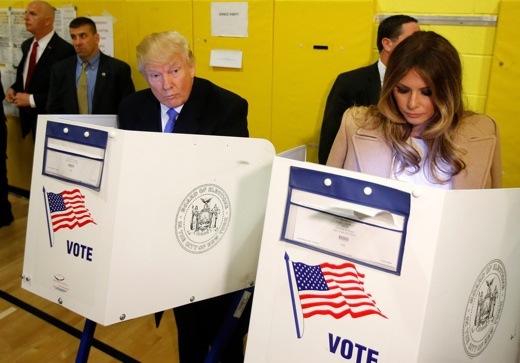
Image above:  War Criminal Votes. Donald Trump, with his wife Melania, votes for himself at polling place during 2016 Presidential Election. From (https://qz.com/831181/election-2016-how-do-you-write-donald-trump-in-chinese/).

And now another incident in the Damascus suburb of Douma has provoked Mr. Trump to tweetstormed threats of retaliatory violence, just days after he proposed a swift withdrawal from that vexing corner of the world.

Surely by now the American public has developed some immunity to claims of nefarious doings in foreign lands (“weapons of mass destruction,” and all).

The operative sentence in that New York Times report is “…Syrian forces hit a suburb of Damascus with bombs that rescue workers said unleashed toxic gas.”

Yeah, well, how clear is it that the toxic gas was contained in the bombs, or rather that the bombs dropped by the Syrian military blew up a chemical weapon depot controlled by anti-government Jihadis?

Does that hodgepodge of maniacs show any respect for the UN, or the Geneva Convention, or any other agency of international law?

As in many previous such incidents, we don’t know who was responsible — though there is plenty of reason to believe that parties within the US establishment are against Mr. Trump’s idea of getting the hell out of that place, and might cook up a convenient reason to prevent it.

Lastly, how is it in Bashar al-Assad’s interests to provoke a fresh international uproar against him and his regime? I’d say it is not the least in his interest, since he is on the verge of putting an end to the awful conflict. He may not be a model of rectitude by Western standards, but he’s not a mental defective.

And he has very able Russian support advising him in what has been so far a long and difficult effort to prevent his state from failing — or being failed for him.

[IB Publisher's note: We have been at war in the Middle East since 2001 and at war in Syria since 2013. As Americans we are now in a state of perpetual war in that region that accelerates ecosystem collapse and permanent climate change and mass exodus. Next stop Iran!]

See also:
Ea O Ka Aina: Syriasly! 4/2/18
Ea O Ka Aina: US shoots down Syrian jet 6/19/17
Ea O Ka Aina: Australia suspends Syria overflights 6/ 20/17
Ea O Ka Aina: Syria poison gas story unravels 4/18/17
Ea O Ka Aina: Source of Sarin gas attack faked? 4/14/17
Ea O Ka Aina: US has used DU in Syria 2/19/17
Ea O Ka Aina: Ms Gabbard goes to Syria 1/29/17
Ea O Ka Aina: Trump amps up war in Syria 1/29/17
Ea O Ka Aina: US shoots down Syrian drone 1/20/17
Ea O Ka Aina: Need for New Syria Policy 12/19/16
Ea O Ka Aina: To prevent still worse in Syria 10/4/16
Ea O Ka Aina: WWIII has begun in Syria 9/23/16
Ea O Ka Aina: Skidding towards Syrian War 6/19/16
Ea O Ka Aina: Hillary and the Syrian Bloodbath 2/15/16
Ea O Ka Aina: Road to World War III 2/14/16
Ea O Ka Aina: Don't Bomb Syria 11/28/15
Ea O Ka Aina: Ten reasons not to overthrow Syria 11/23/15
Ea O Ka Aina: Tulsi Gabbard on Syria 11/1/15
Ea O Ka Aina: Michele won't go to Syria 9/10/13
Ea O Ka Aina: Pentagon's Syrian Blackout 6/6/13
Ea O Ka Aina: Syria a preview of 2030 6/2/13
.

Syriasly!

SUBHEAD: Nature’s way of correcting those imbalances is very ugly, and easily mistaken for mere politics.

By James Kunstler on 2 April 2018 for Kunstler.com -
(http://kunstler.com/clusterfuck-nation/syriasly-2/)


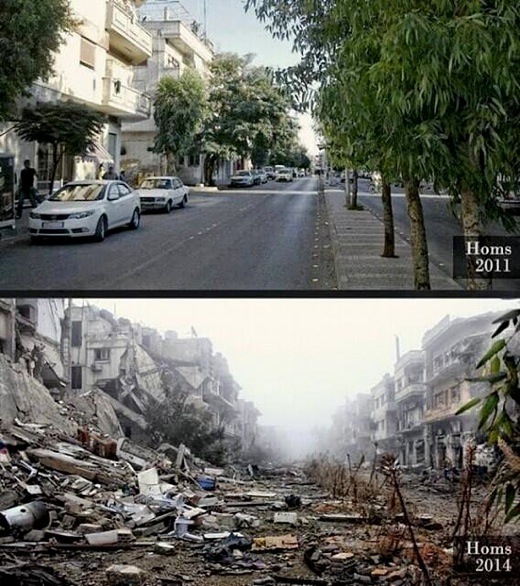
Image above: Before and After photos of a street in Homs, Syria, after attempt to end terrorism there. From (https://www.pinterest.com/pin/314266880219519388).
[IB Publisher's comment: "In order to save the village, we had to destroy it." Quote attributed to unidentified US Army Major concerning Ben Tre, South Vietnam reported by AP correspondent Peter Arnett, "Major Describes Move"in the New York Times (February 8, 1968), p. 14.]
“Peace with Honor” was President Nixon’s anodyne phrase for futzing around as long as possible in Vietnam to conceal the reality that the US military was getting its ass kicked by what we had initially thought was a 98-pound weakling of a Third World country.

That was a half-century ago and I remember it now at age 106 thanks to my diet of kale and pepperoni sticks.

Not ironically, the long struggle finally ended a few years after Nixon quit the scene, with the last straggling American evacuees waiting desperately for helicopter airlifts off the US embassy roof. And now, of course, Vietnam is a tourism hot-spot.

And so just the other day, the latest POTUS declared (in his usual way) that “we’ll be coming out of Syria, like, very soon. Let the other people take care of it now.” The utterance sent the neocon partisans in government into a paroxysm.

Cries of “Say What?” echoed up and down the Great Mall. Which “other people” was Mr. Trump referring to? The United Auto Workers? Gandalf the Grey? The cast of Glee?

I doubt that the average Harvard faculty member can state with any conviction what the fuck is going on in Syria.

Vietnam was like a simple game of Animal Lotto compared to the mystifying puzzle of Syria. And then, of course, once you get handle on who the players are, it’s another matter altogether to descry what US interests there might be.

One angle of the story is whether it is in America’s interest for Syria to become another failed state in a region of several other failed states.

Whatever else you might say about US policy in that part of the world, the general result in places like Iraq, Libya, and Yemen has been anarchy and irresolvable factional conflict.

In today’s world of nation-states, a central government is required to avoid that fate, and the embattled one in Syria happens to be the regime of Bashar al-Assad.

The US has long militated for the overthrow of Assad, but I would also challenge you (and the Harvard faculty) to name any credible party or person who we have hypothetically proposed to replace him with.

You might argue that the Great Age of Nation States is winding down, that the world does not need them anymore, that they are the cause of too much strife and anguish.

But then you would have to account for all the strife and anguish that occupied the world when it was composed of petty kingdoms, principalities, fiefdoms, and tribes.

And, of course, following that logic you’d also have to inquire into the legitimacy of the US government — which, by the way, California is well into testing these days.

One might also propose that the battlefield of Syria, with its array of militant religious maniac armies, is just a proxy action for the tag-teams of the USA/Israel versus Russia/Iran. If so, the US has not been very clear or honest about it.

Anyway, it has hardly been demonstrated that Russia is all that comfortable with Iran extending its influence to the Mediterranean Sea.

I would take Russia’s presence in Syria as an attempt to block, or at least moderate, Iran’s influence there — which is one of the arguments for a US/Russia partnership in cleaning up the mess there.

That possible outcome has been hugely compromised by the "RussiaRussiaRussia!" hysteria engineered by the neocon warhawks of the US permanent bureaucracy (a.k.a. the Deep State).

The latest ploy by these players is the overcooked story of Vladimir Putin personally moving to poison the Russian/British double agent Skripal (and daughter) in Salisbury, UK.

Given the extremely lethal nature of the supposed poison, Novichok, and the method supposedly used (smearing it on the Skripal doorknob), it’s hard to believe that the Skripals were able to walk to the park bench where they collapsed, nor that other persons ranging from the police to the medical examiners didn’t come into contact with the substance and fall ill.

But this is the sort of cockamamie melodrama that it has come down to on our side of the gameboard.

The other part of the story worth considering is this: Syria, like other new-ish nations of the Middle East, was able to hugely increase its population in the post-WW2 era due to oil wealth (now all but gone in Syria), and other perks of modernity like cheap grains for feeding all the newcomers.

Dwindling oil revenue and severe drought (arguably induced by climate change) that caused crop failures commenced in 2006.

So Syria became a workshop study in population overshoot and resource scarcity — problems that are sure to spread around other regions of the world in the years ahead. Nature’s way of correcting those imbalances is very ugly, and easily mistaken for mere politics.

.

US in Afghanistan blocking peace

SUBHEAD: Comments from Taliban chief come as Pentagon weighs sending an additional 4,000 troops to Afghanistan.

By Andrea Germano on 23 June 2017 for Common Dreams -
(https://www.commondreams.org/news/2017/06/23/us-occupation-afghanistan-main-obstacle-peace-taliban#)


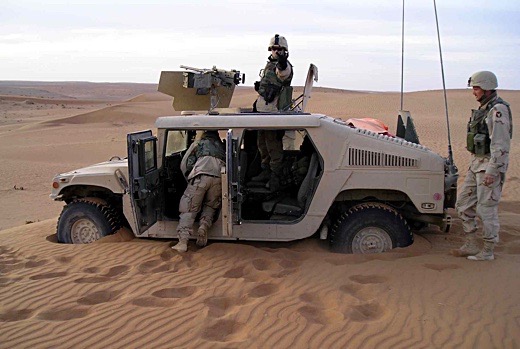
Image above: US Army Hummer stuck in the sand in southern Afghanistan. From (https://lareviewofbooks.org/article/never-ending-book-war/).

The U.S. occupation of Afghanistan is "the main obstacle" to peace, the Taliban's leader said Friday.

In his comments to mark the end of the Muslim holy month of Ramadan, Mullah Haibatullah Akhundzada also denounced the plan to increase number of U.S. troops in the country, and accused the U.S. and its allies of "destabilizing the whole region."

The Pentagon is reportedly weighing sending an additional 4,000 troops to Afghanistan. Akhundzada appeared to reference that development, saying, "The more they insist on maintaining the presence of their forces here or want a surge of their forces, the more regional sensitivity against them will intensify."

"Americans should understand that continuation of war in Afghanistan, upsurge of bombardment ... will never usher in success for them. The Afghans are not a people to kowtow to someone," he said.

Echoing previous comments made by the Taliban, he said, "The occupation is the main obstacle in the way of peace." He added that "constructive and good relations with you and the world" would follow a withdrawal of forces.

U.S. based activists have also criticized the proposal to send more troops as "escalating this endless war."

See also:
Ea O Ka Aina: US anti-terrorism strategy backfires 6/22/17
Ea O Ka Aina: United States of Permanent War 2/26/17
Ea O Ka Aina: Stop War for Christmas 12/24/11
Ea O Ka Aina: Real Soldiers Just Say No 9/3/09.

US anti-terrorism strategy backfires

SUBHEAD: UN report reveals nations with the most refugees were targets of American anti-terrorist interventions.

By Whitney Webb on 22 June 2017 for Mint Press News -
(http://www.mintpressnews.com/un-top-nations-refugees-targets-us-intervention/229136/)


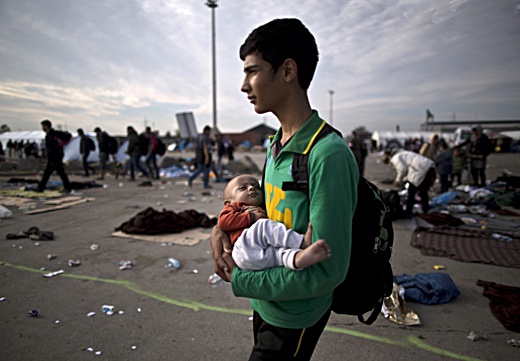
Image above: Afghan refugee Rasoul Nazari, 15, holds his 10-month-old nephew Imran after crossing the border between Hungary and Austria in Nickelsdorf, Austria. Photo by Muhammed Muheisen. From original article.

A United Nations report has shed light on the world’s burgeoning crisis of displaced peoples, finding that a record 65.6 million were forced to vacate their homes in 2016 alone. More than half of them were minors.

The Office of the UN High Commissioner for Refugees (UNHCR), which drafted the report, put the figure into perspective, stating that increasing conflict and persecution worldwide have led to “one person being displaced every three seconds – less than the time it takes to read this sentence.”

UN High Commissioner Filippo Grandi called the figure “unacceptable” and called for “solidarity and a common purpose in preventing and resolving the crisis.”

However, what the UN report failed to mention was the role of U.S. foreign intervention, indirect or direct, in fomenting the conflicts responsible for producing most of the world’s refugees.

According to the report, three of the nations producing the highest number of refugees are Syria (12 million refugees created in 2016), Afghanistan (4.7 million) and Iraq (4.2 million).


Video above: The UNHCR’s New Global Trends Report on Refugees. From original article and (https://youtu.be/hBFgI4D8eEM).

The conflicts in Iraq and Afghanistan are known to be the direct result of U.S. military invasions in the early 2000s, as well as the U.S.’ ongoing occupation of those nations.

Decades after invading both countries, the U.S.’ destabilizing military presence in Iraq and Afghanistan has continued to increase in recent years, with the Trump administration most recently announcing plans to send thousands of soldiers to Afghanistan in the coming months. It is worth noting that each U.S. soldier in Afghanistan costs U.S. taxpayers $2.1 million.

While the U.S. has yet to directly invade Syria, the U.S. role in the conflict is clear and Syria’s destabilization and the overthrow of its current regime have long been planned by the U.S. government.

The U.S. and its allies, particularly Israel and Saudi Arabia, have consistently funded “rebel” groups that have not only perpetuated the Syrian conflict for six long years, but have also committed atrocity after atrocity targeting civilians in Syrian cities, towns, and communities – a major factor in convincing Syrians to leave their homes.

The report ranks Colombia as the world’s second-largest producer of refugees, with 7.7 million Colombians displaced in 2016. Like Syria, the U.S. has not directly invaded Colombia, but is known to have extensively funded paramilitary groups, also known as “death squads,” in the country since the 1980s, when then-U.S. President Ronald Reagan declared a “war on drugs” in Colombia. 

U.S. efforts have long helped fuel the civil war between the Revolutionary Armed Forces of Colombia (FARC) and pro-government, U.S.-funded paramilitary groups. This conflict has lasted for more than half a century.

In 2000, then-President Bill Clinton’s administration funded the disastrous “Plan Colombia” with $4 billion in U.S. taxpayer funds, ostensibly to fight drug trafficking and insurgents. Almost all of this money was used to fund the Colombian military and its weapon purchases. 

“Plan Colombia” ultimately intensified armed violence, military deployments, human rights abuses by the Colombian military, and – of course – the internal displacement of Colombians. 

The legacy of U.S. policy in Colombia and its continuing support of the nation’s right-wing, neo-liberal regime have ensured that the chaos continues into the present.

In addition to the above, U.S foreign policy is also to blame for the conflict in South Sudan, where the UN report found was home to the fastest-growing displacement of people in the world. 

In 2011, the U.S. pushed South Sudan to secede from Sudan, as South Sudan holds the vast majority of Sudan’s oil reserves — the largest oil reserves in all of Africa. 

The U.S.’ push for the creation of an independent South Sudan dislodged Chinese claims to Sudanese oil, as the Chinese had previously signed oil contracts with the (now Northern) Sudanese government.

But when nation-building efforts went awry and civil war broke out just two years later, some analysts suggested that the conflict only started when South Sudan’s president began to cozy up to China. According to the UN report, approximately 3.3 million people in South Sudan have fled their homes since the war began.

Grandi has called on the world’s nations to help prevent and resolve the global refugee crisis. But he would also do well to point out the common cause uniting many of the world’s worst conflicts – the U.S. military-industrial complex’s insatiable lust for conquest, power and profit.

.

Trump lets Mattis set troop levels

SUBHEAD: Delegating too much authority to the military does not shield Trump from responsibility for setbacks.

By Phil Stewart & Idrees Ali on 14 June 2017 for Reuters  -
(https://www.reuters.com/article/us-usa-afghanistan-troops-idUSKBN19431H)


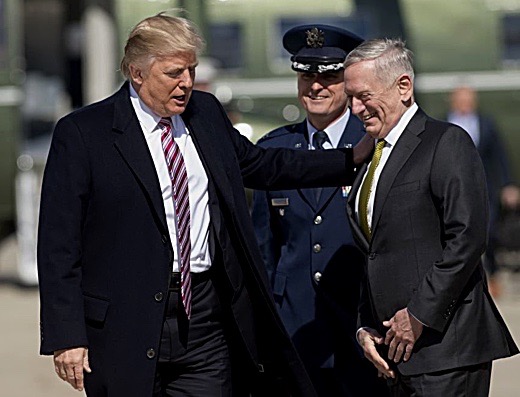
Image above: Trump on tarmac, in front of President's Marine helicopter, with hand on shoulder of Defense Secretary Jim Mattis. From (http://ijr.com/2017/06/899016-trump-grants-mattis-authority-set-troop-levels-afghanistan-report/).

U.S. President Donald Trump has given Defense Secretary Jim Mattis the authority to set troop levels in Afghanistan, a U.S. official told Reuters on Tuesday, opening the door for future troop increases requested by the U.S. commander.

The official, who spoke on condition of anonymity, said no immediate decision had been made about the troop levels, which are now set at about 8,400. The Pentagon declined to comment.

The decision is similar to one announced in April that applied to U.S. troop levels in Iraq and Syria, and came as Mattis warned Congress the U.S.-backed Afghan forces were not beating the Taliban despite more than 15 years of war.

"We are not winning in Afghanistan right now," Mattis said in testimony to the Senate Armed Services Committee earlier on Tuesday. "And we will correct this as soon as possible."

Mattis said the Taliban were "surging" at the moment, something he said he intended to address.
A former U.S. official said such a decision might allow the White House to argue that it was not micromanaging as much as the administration of former President Barack Obama was sometimes accused of doing.

Critics say delegating too much authority to the military does not shield Trump from political responsibility during battlefield setbacks and could reduce the chances for diplomats to warn of potential blowback from military decisions.

It has been four months since Army General John Nicholson, who leads U.S. and international forces in Afghanistan, said he needed "a few thousand" additional forces, some potentially drawn from U.S. allies.

Current and former U.S. officials say discussions revolve around adding 3,000 to 5,000 troops. Those forces are expected to be largely comprised of trainers to support Afghan forces, as well as air crews.
Deliberations include giving more authority to forces on the ground and taking more aggressive action against Taliban fighters.

Some U.S. officials have questioned the benefit of sending more troops to Afghanistan because any politically palatable number would not be enough to turn the tide, much less create stability and security. To date, more than 2,300 Americans have been killed and more than 17,000 wounded since the war began in 2001.

Any increase of several thousand troops would leave American forces in Afghanistan well below their 2011 peak of more than 100,000 troops.

A truck bomb explosion in Kabul last month killed more than 150 people, making it the deadliest attack in the Afghan capital since the Taliban were ousted in 2001 by a NATO-led coalition after ruling the country for five years.

On Saturday, three U.S. soldiers were killed when an Afghan soldier opened fire on them in eastern Afghanistan.

The broader regional U.S. strategy for Afghanistan remains unclear. Mattis promised on Tuesday to brief lawmakers on a new war strategy by mid-July that is widely expected to call for thousands more U.S. troops.

Senator John McCain, the chairman of the Armed Forces Committee, pressed Mattis on the deteriorating situation during the Tuesday hearing, saying the United States had an urgent need for "a change in strategy, and an increase in resources if we are to turn the situation around."
"We recognize the need for urgency," Mattis said.


The Afghan government was assessed by the U.S. military to control or influence just 59.7 percent of Afghanistan's 407 districts as of Feb. 20, a nearly 11 percentage-point decrease from the same time in 2016, according to data released by the U.S. Special Inspector General for Afghanistan Reconstruction.


.

US shoots down Syrian jet

SUBHEAD: Russia halts cooperation with US in Syria, will "Intercept Any Aircraft" in Russian areas of operation.

By Tyler Durden on 19 June 2017 for Zero Hedge -
(http://www.zerohedge.com/news/2017-06-19/russia-halts-cooperation-us-syria-will-intercept-any-aircraft-russian-areas-operatio)


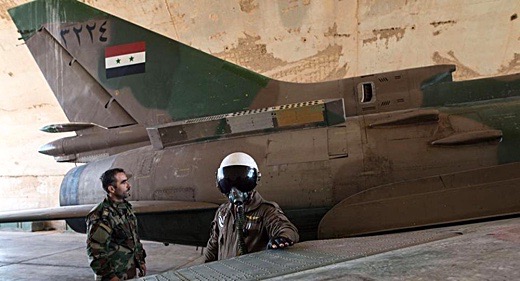
Image above: The kind of plane US shot down was a Russian built SU-22 aircraft. They are worn out and their pilots are old, but they’re all still flying. This is a close-up of the fin and rear fuselage of the SyAAF’s Su-22M-4K serial number 3224, as seen during a pre-fight inspection. From (http://warisboring.com/the-su-22-is-syrias-war-weary-warhorse/).

Shortly after Russia's deputy foreign minister slammed the US downing of a Syrian Su-22 jet as an "act of aggression" and "support for terrorists", Russia announced that starting June 19th it was halting all interactions with the US under the framework on the "memorandum of incident prevention in Syrian skies", the Russian Defense Ministry said on Monday, thereby assuring the probability of even more deadly escalations between Russia and the US-led coalition.

In retaliation, the ministry warned that Russian missile defense will intercept any aircraft in the area of operations of the Russian Aerospace Forces in Syria,

"In areas where Russian aviation is conducting combat missions in the Syrian skies, any flying ojects, including jets and unmanned aerial vehicles of the international coalition discovered west of the Euphrates River will be followed by Russian air and ground defenses as air targets," the Russian Defense Ministry announced, quoted by Sputnik.

Contrary to the earlier statement by the US according to which, it "contacted its Russian counterparts by telephone via an established "de-confliction line" to de-escalate the situation and stop the firing", Russia claims the US-led coalition command didn't use the deconfliction channel with Russia to avoid an incident during an operation in Raqqa:
"Russian Aerospace Forces' jets were conducting operations in Syrian airspace that time. However, the command of the coalition forces didn't use the existing channel between the air command of the Qatari airbase al Udeid and the [Russian] Hmeymim airbase to avoid incidents over Syria."
The Russian ministry also demands a thorough investigation by the US command with the provision of its results and measures taken.
"We consider such actions of the US command as an intentional violation of its obligations in the framework of the memo on avoiding incidents and the safety of aviation flights during operations in Syria signed on October 20, 2015."
A bilateral memorandum of understanding was signed between the United States and Russia signed in October 2015 to ensure the safety of flights during combat missions over Syria.

On June 18, the Syrian army said that the US-led coalition had brought down its aircraft in southern Raqqa countryside when it was fulfilling its mission against Daesh.

Later, the coalition confirmed the attack saying that it shot down the Syrian government forces' Su-22 aircraft as it had allegedly been bombing in an area where US-backed rebel forces, the Syrian Democratic Forces (SDF), were stationed, south of Tabqa in the Raqqa province. The US-led coalition called its attack on the Syrian army's jet "collective self-defense," adding that it contacted the Russian military to de-escalate the situation after the incident.

.