Showing posts with label Banksters. Show all posts

Banks are about to drown

SUBHEAD: The entire world has completely ‘misunderestimated’ the Corona Virus.

By Simon Black for Soverignman on 18 March 2019 -
(https://www.sovereignman.com/trends/banks-are-going-to-drown-in-an-ocean-of-defaults-27537/)


Image above: Banking district in lower Manhattan in a simulated rise in water in New York Harbor. From (https://www.rollingstone.com/culture/culture-news/can-new-york-be-saved-in-the-era-of-global-warming-240454/).

On November 6, 2000, then US presidential candidate George W. Bush told a crowd of cheering supporters, “they misunderestimated me.”

Now, if English is not your native language, allow me to clear the air: ‘misunderestimate’ is not a word. But then again, George W. Bush was legendary for hilarious slip-ups like this.

There are entire books dedicated to his ‘Bushisms,’ the ridiculous made-up words and incomprehensible sayings that became routine for the 43rd US President.

‘Misunderestimate’ seems to be a conflation of the words ‘misunderstand’ and ‘underestimate’. And while that was utterly hysterical 20 years ago when Bush first said it, ‘misunderestimate’ may be the most appropriate word of today.The entire world has completely ‘misunderestimated’ the Corona Virus.

In terms of misunderstand– that’s obvious. There’s so much that we don’t know about the virus (officially known as SARS-CoV-2) and the disease that it causes (COVID-19).

For example, a group of researchers published a “peer-reviewed” research paper earlier this month stating that the virus had split into multiple strains.

(Peer-reviewed is a type of self-regulation among academics; it means the paper had been evaluated by other experts before it was published.)

But other specialists in the field strongly disagreed with the paper’s conclusions.

Swiss biologist Richard Neher described the research as, “wrong, misleading. . . downright dangerous inferences,” while Australian virologist Ian Mackay called it a “weak paper and poor science.”

Another peer-reviewed study released in the Journal of Medical Virology concluded that the virus originated from snakes. But plenty of experts disagreed with that assertion too.

The scientific community has learned so much about SARS-CoV-2 since it first surfaced a few months ago.

But there’s still so much that’s unknown– and that makes perfect sense given that this virus is brand new. They’re trying to figure it out as quickly as possible, but that’s naturally going to lead to some disagreements and conflicting conclusions.

But then the Internet takes over, and suddenly everyone’s an expert. People who have no background in medicine and biology Tweet with a level of certainty about the virus that’s just plain silly.

US television personality Jimmy Kimmel joked about this last week, saying, “I speak [about the virus] as if I’ve been a professor of immunology at Stanford for 35 years…”

There’s still so many things that the experts don’t understand, or don’t agree on. The answers are coming, but it’s still early days.

But in addition to misunderstanding, the world has also totally underestimated this virus… and continues to do so.

It started in China back in December, with the government trying to keep the outbreak quiet and taking steps to silence the first whistleblower.

As the virus began to spread, Western nations complacently shrugged it off and assumed it would remain in Asia.

Even the World Health Organization refused to call this a ‘pandemic’ until March 11… only a week ago.

Investors around the world ignored this for months, completely underestimating the massive, worldwide economic impact the virus would have.

Even now, after one of the worst stock market crashes in history, people are still woefully underestimating the effects.

And I’m not talking about the stock market (though there could easily be more losses ahead). I’m talking about something far more serious: banks.

Banks are about to drown in an ocean of defaults. I’ll talk about this a lot more in the coming days, but briefly:
  • There’s $250 TRILLION in global debt right now– mortgages, credit card debt, business loans, government debt, etc.
  • And banks own a large portion of that debt.
  • This virus crisis is going to trigger a wave of defaults from consumers, businesses, and even governments.
  • Think about it: tourism alone makes up 10% of global GDP. Revenue in that entire sector– hotels, airlines, cruise ships, etc. has collapsed, and many of those companies aren’t going to survive.
  • The crash in oil prices is going to wipe out countless oil companies.
  • Many large retail chains, which were already struggling in the age of e-commerce, will likely declare bankruptcy.
  • Countless businesses around the world have ‘temporarily’ closed due to public health policies, and many of them will go out of business entirely.
  • MOST of these businesses owe lots of money to the banks, whether it’s a small business working line, or the $34 billion in debt that American Airlines owes. So the defaults are going to be massive.
  • On top of that, millions of people are going to lose their jobs and be unable to make payments on their credit card debt, auto loans, and even mortgages.
  • Again, there’s $250 trillion in global debt right now. Total bank capital worldwide is less than $10 trillion.
  • So if the coming defaults trigger a mere 4% loss in total debt, it will exceed the entirety of global bank capital.
  • And this doesn’t even take into consideration the impact of the $1 QUADRILLION derivatives exposure.
Misunderestimate? Absolutely.

This looming wave of loan defaults over the next few months could spark a crisis in the global financial system that completely dwarfs what happened back in 2008.

I desperately want to be wrong.

And it’s possible that public health officials radically shift their positions in the coming weeks and tell all the young, healthy people in the world to go back to work, get infected, and start developing immunity.

They may be forced to do this to avoid destroying the global economy.

But at this point, every possible scenario is on the table. Nothing is out of the question… especially when the arithmetic is so obvious.

And continuing to misunderestimate the effects of this virus could be far more dangerous than the virus itself.

We’ll talk about this more in the coming days, along with some sensible suggestions to reduce risk.

Dreams Die Hard

SUBHEAD: The world changes and sometimes profoundly enough to provoke flux and disorder.

By James Kunstler on 8 February 2019 for Kunstler.com-
(http://kunstler.com/clusterfuck-nation/dreams-die-hard/)


Image above: Still-frame of Alexandria Ortise-Cortez on MSNBC show MTP-Daily. From (https://www.msnbc.com/mtp-daily/watch/aoc-can-you-be-a-democratic-socialist-and-a-capitalist-it-s-possible-1439125059571).

Somewhere between the fevered Zzzz’s of American Dreaming and the blinding shock of being “woke,” there is a recognition that an awful lot about contemporary life is not working and can’t go on.

At the bottom of this discontent is the mistaken notion that the unwind of modernity can be arrested or mitigated by “smart” and “green” this-and-that.

The disappointment over it will be epic when we discover that the laws of physics override the bright ideas of politicians.

America has been blowing green smoke up its own ass for years, promoting oxymorons such as “green skyscrapers” and “clean energy,” but the truth is we’re not going to run WalMart, Suburbia, DisneyWorld, and the U.S. Interstate highway system on any combination of wind, solar, geothermal, recycled Fry-Max, and dark matter.

We’re just running too much stuff at too great a scale for too many people. We’ve blown through the capital already and replaced it with IOUs that will never be honored, and we’re caught in an entropy trap of diminishing returns from all the work-arounds we’re desperately trying.

For all that, there are actually some sound proposals in the mostly delusional matrix of the Green New Deal promoted by foxy front-person "AOC", Alexandria Ocasio-Cortez .
  • Revoke corporate personhood by amending our Constitution to make clear that corporations are not persons and money is not speech.
    Right on, I say, though they have not quite articulated the argument which is that corporations, unlike persons, have no vested allegiance to the public interest, but rather a legal obligation solely to shareholders and their boards-of-directors.
  •  
  • Replace partisan oversight of elections with non-partisan election commissions.     
    A no-brainer
  •  
  • Replace big money control of election campaigns with full public financing and free and equal access to the airwaves.  
    Quite cheap and worth every penny. 

  • Break up the oversized banks that are “too big to fail.”
    And while you’re at it, resume enforcement of the anti-trust laws. 

  • Restore the Glass-Steagall separation of depository commercial banks from speculative investment banks.
    Duh….
Of course, a lot of the proposals above may be obviated when the money system we’ve been using, and its subsidiaries in markets, blows up, taking much of the world’s notional wealth with it, along with our hopes and dreams for replacing the fossil fuel economy with “Green technology.”

The Green New Deal may be an exercise in throwing spaghetti against the wall to see what sticks, so let’s just assume that a lot of the “social justice” pander-jive in it will slide down the wall onto the floor and make its way to the dumpster.

Stuff like: “the right to full employment” (there is no such right), Free college and medicine (doesn’t pencil out with our capital gone, though the current odious rackets must go), “ending the war on immigrants” (how about ending the Democratic Party’s war on enforcing immigration laws?) (IB Publisher's 

There are two kinds of deadly narcissism at work in American culture these days: techno-narcissism — the belief that magical rescue remedies can save the status quo of comforts and conveniences — and organizational narcissism — the belief that any number of committees can lead a march of humanity into a future of rainbows and unicorns.

Both of these ideas are artifacts of a fossil fuel turbo-charged economy that is coming to an end.

Societies and economies are fundamentally emergent, non-linear, and self-organizing as they respond to the mandates of reality — which are not necessarily consistent with human wishes.

Circumstances in the world change and sometimes, when the changes are profound enough, they provoke episodes of flux and disorder.

A better index for our journey into the unknown frontier beyond modernity will not be what is “green” and “smart” but perhaps what is “sane” and “insane.”

.

The Scenarios of the Collapse

SUBHEAD: It would be wise to start making contingency plans. Something ‘biblical’ is approaching.

By Tuomas Malinen on 11 January 2019 for GNS Economics  -
(https://gnseconomics.com/en_US/2019/01/11/the-scenarios-of-the-collapse/)


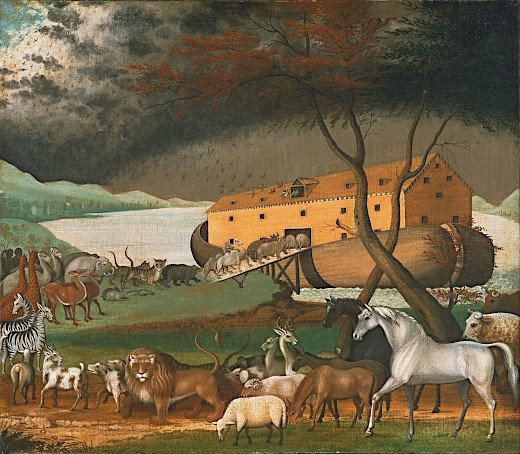
Image above: Painting of  "Noah's Ark" (1846) by American painter Edward Hicks. From (https://en.wikipedia.org/wiki/Noah%27s_Ark).

2019 has started more calmly after a very volatile year-end in the markets. Focus has been on the trade deal between China and the US and the words of the central bankers, most notably those of Jay Powell. However, this is all just a distraction, a side-show.

The market volatility was only the first sign of an approaching global economic crisis, as we warned in December 2017.

As the recent PMI figures across the globe show, a global downturn has started and the world is utterly unprepared for it. The global imbalances that have been growing for years cannot lead to anything else than a global crisis . However, there are different paths the crisis could take.

Here, we present three scenarios that the global economy is likely to follow, when the global downturn morphs into something much more sinister. We’ll start with the most likely scenario: Global Depression.

Scenario I: Global Depression

In a depression, everything that has been driven the economic expansion goes into reverse. Asset markets experience severe contraction (in excess of 50 percent), credit becomes restricted, corporations and households de-lever fiercely, and global trade flows stall (for more details see Q-review 2/2018). Gross Domestic Production (GDP) falls dramatically, between 10 to 25 percent.

Unemployment skyrockets. The standard means of stimulus by central banks (CBs) and governments are exhausted without any notable improvement in the economic environment.

The implosion of the current asset bubble will start a relentless unwinding of leverage and risk in the global financial system. Because major CBs are still “all-in” with rates pinned at or near historic lows, and balance sheets bloated to extreme levels, their ability to respond will be highly restricted.

Governments are also highly-indebted, and when interest rates rise, some sovereigns are likely to default, aggravating the global banking crisis, which will probably be in motion already. Combined with the zombified global business sector and a hard landing in China, these factors will lead the world economy into a depression.

However, a possibility of something even more ominous is lurking in the background.

Scenario II: Systemic Meltdown

Systemic crisis would mean that the global financial melts down due to an existential deficit of trust between counterparties within the system. Before 2008, a systemic meltdown was mostly a theoretical construct.

However, in mid-October in 2008, global leaders were faced with the possibility that banks would not open on Monday. The inter-bank markets had frozen, because no one knew the amount of the losses banks carried on their books.

The global financial system was grinding to a halt. Politicians and central bankers saved the day by guaranteeing bank deposits and by providing capital and extraordinary guarantees to keep the important financial institutions standing and credit flowing.

Now the problem is that many of these measures are already in play and when the next crisis hits, the solvency of governments and CBs will also be in question.

This creates a perilous situation because, for example, the shares of the Global Systemically Important Banks have been falling since the beginning of last year, which was also the time when the balance sheet normalization (QT) program of the Fed kicked into full gear.

This is no coincidence and it implies that troubles are, once again, brewing in the banking sector.

Because a crash in the asset values would affect the collateral of banks and because global depression would lead to a massive increase in loan losses, the already-impaired banking sector could, again, face collapse.

However, this time around, there is very little authorities can do to stem the panic. These factors make the systemic meltdown an ominously-likely scenario.

Systemic meltdown would mean that all banking actions, distribution of money, loans, swaps, banking services, etc., through the banking sector would stop. Credit cards would cease to function, ATMs would not give out money and loans could not be originated or rolled-over.

Following the likely collapse of global trade, the world economy would also collapse. This would imply that the global GDP would experience a harrowing fall of 20 to 40 percent. Modern societies would cease to exist in their current form.

Scenario III: The Fairy Tale

Could this all be averted somehow? We’ve been pondering this for two years now, and our resounding answer is no. The leverage in the system usually results in a crash at some point, and asset bubbles very rarely deflate in a controlled manner.

However, CBs can probably still postpone the inevitable, if they could re-start Quantitative Easing (QE) programs or find some other way to push artificial central bank liquidity into the financial markets.

To soften the eventual blow, and as an extremely desperate measure, central banks could, at least in theory, engage in a “QE-squared”. In it, major central banks would buy a hefty chunk of global risk assets, estimated to total $400 trillion.

This would mean that the balance sheet of major Central Banks would need to expand at least five-fold from the current level of approximately $20 trillion.

To cover the crippling losses to their collective balance sheets that these purchases would be likely to inflict, they would need to use their money-printing ability to paper them over.

CBs earn seigniorage-revenue from all the money they create. This is the difference between the nominal value and the production costs of the money.

Because production costs of digital entries are very close to zero, the seigniorage revenue CBs receive from each entry is close to 1-to-1. Still, this would mean that they would need to create new money in the range of tens of trillions of US dollars.

By comparison, in 2017, the global nominal GDP of the world was approximately $75 trillion.

To distribute such incomprehensible sums of new money, CBs would need to give it directly to consumers and governments.

Even in normal circumstances, the production side of the economy would be unlikely to be able to respond to such a massive increase in (artificially created) demand, and this time there would have been wide-spread corporate bankruptcies driven by global depression.

A hyper-inflation would be likely to follow.

There’s also the alternative that CBs would make a complete U-turn and continue to backstop market losses.

This would be the “way of Japan”, where the BoJ already owns over 40% of the sovereign bond universe. It would eventually mean the effective nationalization of capital markets which would continue to function in name only.

We have no historical experience with what the expropriation of modern capital markets would cause.

However, it would be unlikely to be anything good as capital markets have been around for several centuries, and they are extremely important in allocating financial capital efficiently. If CBs take a permanent active role in the capital markets, it would lead to financial market socialism.

 It would be likely to bring similar horrors as regular socialism in the form of lost incentives (breaking down of the risk-reward relationship) and inflated asset values.

It is unlikely that global central bankers would be willing, or that they would be allowed, to do so.

The Endgame Nears


The global balance sheet of CBs turned in August 2018. This marks the start of global QT and thus the end of the most reckless monetary policy experiment in history.

When this is combined with the slow-down in China, the engine of the world economy since 2008,  we have finally entered the endgame of at the current business cycle.

The desperate measures of central bankers and China enacted after the financial crisis have pushed the global debt and financial alchemy to never-seen heights.

The global financial system has become rigged with leverage, moral hazard and regulatory failures to a point where a “purge” has become all-but-impossible to avoid. This is the end.

Still, every company, household and government should start to make contingency plans. Something ‘biblical’ is approaching.

.

USA is now a 3rd World nation

SUBHEAD: 3rd World nations are stable and work just fine for the elites who dominate them.

By Charles Hugh Smith on 9 July 2018 for Of Two Minds -
(https://www.oftwominds.com/blogjuly18/USA-3rd-world7-18.html)


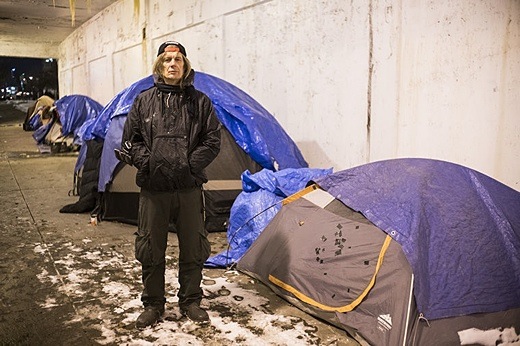
Image above: Mark Saulys standing by his tent below busy Chicago's Lake Shore Drive on a winter evening in 2017. From (http://www.chicagohomeless.org/columbia-chronicle-homeless-lose-refuge-tent-city/).

Dividing the Earth's nations into 1st, 2nd and 3rd world has fallen out of favor; apparently it offended sensibilities. It has been replaced by the politically correct developed and developing nations, a terminology which suggests all developing nations are on the pathway to developed-nation status.

What's been lost in jettisoning the 1st, 2nd and 3rd world categories is the distinction between developing (2nd world) and dysfunctional states (3rd world), states we now label "failed states."

But 3rd World implied something quite different from "failed state": failed state refers to a failed government of a nation-state, i.e. a government which no longer fulfills the minimum duties of a functional state: basic security, rule of law, etc.

3rd World referred to a nation-state which was dysfunctional and parasitic for the vast majority of its residents but that worked extremely well for entrenched elites who controlled most of the wealth and political power. Unlike failed states, which by definition are unstable, 3rd World nations are stable, for the reason that they work just fine for the elites who dominate the wealth, power and machinery of governance.

Here are the core characteristics of dysfunctional but stable states that benefit the entrenched few at the expense of the many, i.e. 3rd World nations:

1. Ownership of stocks and other assets is highly concentrated in entrenched elites. The average household is disconnected from the stock market and other measures of wealth; only a thin sliver of households own enough financial/speculative wealth to make an actual difference in their lives.

2. The infrastructure of the nation used by the many is poorly maintained and costly to operate as entrenched elites plunder the funding to pad their payrolls, pensions and sweetheart/insider contracts.

3. The financial/political elites have exclusive access to parallel systems of transport, healthcare, education, etc. The elites avoid trains, subways, lenders, coach-class air transport, standard healthcare and the rest of the decaying, dysfunctional systems they own that extract wealth from the debt-serfs.

They fly on private aircraft, have their own healthcare and legal services, use their privileges to get their offspring into elite universities and institutions and have access to elite banking and lending services that are unavailable to their technocrat lackeys and enforcers.

4. The elites fund lavish monuments to their own glory disguised as "civic or national pride." These monuments take the form of stadiums, palatial art museums, immense government buildings, etc. Meanwhile the rest of the day-to-day infrastructure decays in various states of dysfunction.

5. There are two classes that only interact in strictly controlled ways: the wealthy, who live in gated, guarded communities and who rule all the institutions, public and private, and the debt-serfs, who are divided into well-paid factotums, technocrat lackeys and enforcers who serve the interests of the entrenched elites and rest of the populace who own virtually nothing and have zero power.

The elites make a PR show of being a commoner only to burnish the absurd illusion that debt-serf votes actually matter. (They don't.)

6. Cartels and quasi-monopolies are parasitically extracting the wealth of the nation for their elite owners and managers. Google: quasi-monopoly. Facebook: quasi-monopoly. Healthcare: cartel. Banking: cartel. National defense: cartel. National Security: cartel. Corporate mainstream media: cartel. Higher education: cartel. Student loans: cartel. I think you get the point: every key institution or function is controlled by cartels or quasi-monopolies that serve the interests of the few via parasitic exploitation of the powerless.

7. The elites use the extreme violence and repressive powers of the government to suppress, marginalize and/or destroy any dissent. There are two systems of "law": one for the elites ($10 million penalties for ripping off the public for $10 billion, no personal liability for outright fraud) and one for the unprotected-unprivileged: "tenners" (10-year prison sentences) for minor drug infractions, renditions or assassinations (all "legal," of course) and institutional forces of violence (bust down your door on the rumor you've got drugs, confiscate your car because we caught you with cash, so you must be a drug dealer, and so on, in sickening profusion).

8. Dysfunctional institutions with unlimited power to extract money via junk fees, licensing fees, parking tickets, penalties, late fees, etc., all without recourse. Mess with the extractive, parasitic bureaucracy and you'll regret it: there's no recourse other than another layer of well-paid self-serving functionaries that would make Kafka weep.

9. The well-paid factotums, bureaucrats, technocrat lackeys and enforcers who fatten their own skims and pensions at the expense of the public and slavishly serve the interests of the entrenched elites embrace the delusion that they're "wealthy" and "the system is working great." These deluded servants of the elites will defend the dysfunctional system because it serves their interests to do so.

The more dysfunctional the institution, the greater their power, so they actively increase the dysfunction at every opportunity.

I know it hurts, but the reality is painfully obvious: The USA is definitively a 3rd World nation.

.

When Collapse goes Kinetic

SUBHEAD: The mortally wounded the American middle class made Donald Trump president.

By James Kunstler on 9 July 2018 for Kunstler.com -
(http://kunstler.com/clusterfuck-nation/collapse-goes-kinetic/)


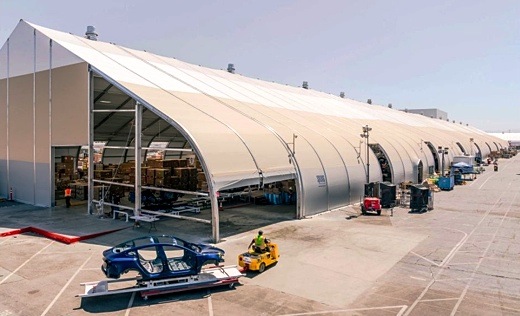
Image above: Elon Musk had to resort to building Tesla Model 3 cars by hand in a tent in Freemont, CA, when it was clear he could not build 5,000 cars in a week in an automated modern robotic plant. From (https://oppositelock.kinja.com/tesla-executives-approved-an-idea-from-the-company-s-e-1827266263).

I suppose many who think about the prospect of economic collapse imagine something like a Death Star implosion that simply obliterates the normal doings of daily life overnight, leaving everybody in a short, nasty, brutish, Hobbesian free-for-all that dumps the survivors in a replay of the Stone Age — without the consolation of golden ages yet to come that we had the first time around.

The collapse of our techno-industrial set-up has actually been going on for some time, insidiously and corrosively, without shattering the scaffolds of seeming normality, just stealthily undermining them.

I’d date the onset of it to about 2005 when the world unknowingly crossed an invisible border into the terra incognito of peak oil, by which, of course, I mean oil that societies could no longer afford to pull out of the ground. It’s one thing to have an abundance of really cheap energy, like oil was in 1955.

But when the supply starts to get sketchy, and what’s left can only be obtained at an economic loss, the system goes quietly insane.

In the event, popular beliefs and behavior have turned really strange. We do things that are patently self-destructive, rationalize them with doctrines and policies that don’t add up, and then garnish them with wishful fantasies that offer hypothetical happy endings to plot lines that do not really tend in a rosy direction.

The techno-narcissistic nonsense reverberating through the echo-chambers of business, media, and government aims to furnish that nostrum called “hope” to a nation that simply won’t admit darker outcomes to the terrible limits facing humanity.

Thus, we have the Tesla saga of electric motoring to save the day for our vaunted way of life (i.e. the landscape as demolition derby), the absurd proposals to colonize distant, arid, frigid, and airless Mars as a cure for ruining this watery blue planet ideally suited for our life-form, and the inane “singularity” narratives that propose to replace grubby material human life with a crypto-gnostic data cloud of never-ending cosmic orgasm.

The psychological desperation is obvious. Apparently, there are moments in history when flying up your own butt-hole is the most comforting available option.

I expect the collapse to pick up more momentum as we turn the corner around summer. The system that we have most willfully abused and perverted is finance.

This monster that so many observers call “capitalism” is just a set of methods for managing surplus wealth — the catch being that nothing nearly this complex has ever been seen before in history and is a pure product of the 200-year-long industrial orgy driven by fossil fuels.

That is, the world never before accumulated so much surplus wealth in such a short span of time.

We commonly refer to this dynamic as “growth.” When that growth, as expressed in modern GDP terms, slowed dramatically after 2005, we launched an array of clever mechanisms to keep faking it for a while. Racking up immense debt was our way of faking it.

If you can’t cover your costs in the present, just borrow from the future. Unfortunately, that works only as as long as there’s some reasonable expectation that debt can be paid back. We’re so far beyond that now, it’s not funny.

And that realization alone will destroy the bond markets and anything related to and dependent on their operations to function.

This is a broad outline to the coming end of the Trump miracle economy. It was the after effects of the previous debt blowup — the phony-baloney mortgage bond market in 2008 — that mortally wounded the American middle class and put Donald Trump in the White House.

His base is correct to feel swindled. That is exactly what happened to them, and the beat goes on now with securitized sub-prime auto loans.

Throw in the horrific burdens of unpayable and non-dischargable college loans that will ruin millions of lives and pricey health insurance with $5000 deductibles and you have a recipe for a complete loss of faith in the system.

The next debt blowup will be the end of Mr. Trump’s improbable credibility. It may also be the beginning of serious difficulty in being able to get many of the goods of daily life, because the producers of things will be very unsure of getting paid on delivery of just about anything.

A freeze up of short-term lending would quickly lead to empty WalMart shelves and “no gas” signs at the filling stations. That’s when collapse finally goes kinetic, and becomes something more than just bad feelings inane ideas.
.

The Coming Collapse

SUBHEAD: One cannot grasp how fragile the decayed financial, social and political system is on the eve of implosion.

By Chris Hedges on 5 June 2018 for TruthDig -
(https://www.truthdig.com/articles/the-coming-collapse/)


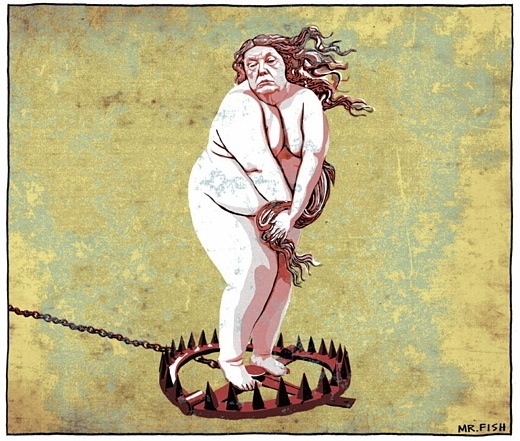
Image above: Trump as Venus on the Halfshell. By Mr. Fish. From original article.

The Trump administration did not rise, prima facie, like Venus on a half shell from the sea. Donald Trump is the result of a long process of political, cultural and social decay. He is a product of our failed democracy.

The longer we perpetuate the fiction that we live in a functioning democracy, that Trump and the political mutations around him are somehow an aberrant deviation that can be vanquished in the next election, the more we will hurtle toward tyranny.

The problem is not Trump. It is a political system, dominated by corporate power and the mandarins of the two major political parties, in which we don’t count.

We will wrest back political control by dismantling the corporate state, and this means massive and sustained civil disobedience, like that demonstrated by teachers around the country this year. If we do not stand up we will enter a new dark age.

The Democratic Party, which helped build our system of inverted totalitarianism, is once again held up by many on the left as the savior.

Yet the party steadfastly refuses to address the social inequality that led to the election of Trump and the insurgency by Bernie Sanders. It is deaf, dumb and blind to the very real economic suffering that plagues over half the country. It will not fight to pay workers a living wage. It will not defy the pharmaceutical and insurance industries to provide Medicare for all.

It will not curb the voracious appetite of the military that is disemboweling the country and promoting the prosecution of futile and costly foreign wars. It will not restore our lost civil liberties, including the right to privacy, freedom from government surveillance, and due process. It will not get corporate and dark money out of politics.

It will not demilitarize our police and reform a prison system that has 25 percent of the world’s prisoners although the United States has only 5 percent of the world’s population. It plays to the margins, especially in election seasons, refusing to address substantive political and social problems and instead focusing on narrow cultural issues like gay rights, abortion and gun control in our peculiar species of anti-politics.

This is a doomed tactic, but one that is understandable. The leadership of the party, the Clintons, Nancy Pelosi, Chuck Schumer, Tom Perez, are creations of corporate America. In an open and democratic political process, one not dominated by party elites and corporate money, these people would not hold political power.

They know this. They would rather implode the entire system than give up their positions of privilege. And that, I fear, is what will happen. The idea that the Democratic Party is in any way a bulwark against despotism defies the last three decades of its political activity. It is the guarantor of despotism.

Trump has tapped into the hatred that huge segments of the American public have for a political and economic system that has betrayed them. He may be inept, degenerate, dishonest and a narcissist, but he adeptly ridicules the system they despise.

His cruel and demeaning taunts directed at government agencies, laws and the established elites resonate with people for whom these agencies, laws and elites have become hostile forces. And for many who see no shift in the political landscape to alleviate their suffering, Trump’s cruelty and invective are at least cathartic.

Trump, like all despots, has no ethical core. He chooses his allies and appointees based on their personal loyalty and fawning obsequiousness to him. He will sell anyone out. He is corrupt, amassing money for himself—he made $40 million from his Washington, D.C., hotel alone last year—and his corporate allies.

He is dismantling government institutions that once provided some regulation and oversight. He is an enemy of the open society. This makes him dangerous. His turbocharged assault on the last vestiges of democratic institutions and norms means there will soon be nothing, even in name, to protect us from corporate totalitarianism.

But the warnings from the architects of our failed democracy against creeping fascism, Madeleine Albright among them, are risible. They show how disconnected the elites have become from the zeitgeist. None of these elites have credibility. They built the edifice of lies, deceit and corporate pillage that made Trump possible.

And the more Trump demeans these elites, and the more they cry out like Cassandras, the more he salvages his disastrous presidency and enables the kleptocrats pillaging the country as it swiftly disintegrates.

The press is one of the principal pillars of Trump’s despotism. It chatters endlessly like 18th-century courtiers at the court of Versailles about the foibles of the monarch while the peasants lack bread.

It drones on and on and on about empty topics such as Russian meddling and a payoff to a porn actress that have nothing to do with the daily hell that, for many, defines life in America.

It refuses to critique or investigate the abuses by corporate power, which has destroyed our democracy and economy and orchestrated the largest transfer of wealth upward in American history.

The corporate press is a decayed relic that, in exchange for money and access, committed cultural suicide. And when Trump attacks it over “fake news,” he expresses, once again, the deep hatred of all those the press ignores.

The press worships the idol of Mammon as slavishly as Trump does. It loves the reality-show presidency.

The press, especially the cable news shows, keeps the lights on and the cameras rolling so viewers will be glued to a 21st-century version of “The Cabinet of Dr. Caligari.” It is good for ratings. It is good for profits. But it accelerates the decline.

All this will soon be compounded by financial collapse. Wall Street banks have been handed $16 trillion in bailouts and other subsidies by the Federal Reserve and Congress at nearly zero percent interest since the 2008 financial collapse.

They have used this money, as well as the money saved through the huge tax cuts imposed last year, to buy back their own stock, raising the compensation and bonuses of their managers and thrusting the society deeper into untenable debt peonage.

Sheldon Adelson’s casino operations alone got a $670 million tax break under the 2017 legislation.

The ratio of CEO to worker pay now averages 339 to 1, with the highest gap approaching 5,000 to 1.

This circular use of money to make and hoard money is what Karl Marx called “fictitious capital.”

The steady increase in public debt, corporate debt, credit card debt and student loan debt will ultimately lead, as Nomi Prins writes, to “a tipping point—when money coming in to furnish that debt, or available to borrow, simply won’t cover the interest payments. Then debt bubbles will pop, beginning with higher yielding bonds.”

An economy reliant on debt for its growth causes our interest rate to jump to 28 percent when we are late on a credit card payment. It is why our wages are stagnant or have declined in real terms—if we earned a sustainable income we would not have to borrow money to survive. It is why a university education, houses, medical bills and utilities cost so much. The system is designed so we can never free ourselves from debt.

However, the next financial crash, as Prins points out in her book “Collusion: How Central Bankers Rigged the World,” won’t be like the last one. This is because, as she says, “there is no Plan B.” Interest rates can’t go any lower.

There has been no growth in the real economy. The next time, there will be no way out. Once the economy crashes and the rage across the country explodes into a firestorm, the political freaks will appear, ones that will make Trump look sagacious and benign.

And so, to quote Vladimir Lenin, what must be done?

We must invest our energy in building parallel, popular institutions to protect ourselves and to pit power against power.

These parallel institutions, including unions, community development organizations, local currencies, alternative political parties and food cooperatives, will have to be constructed town by town. The elites in a time of distress will retreat to their gated compounds and leave us to fend for ourselves.

Basic services, from garbage collection to public transportation, food distribution and health care, will collapse. Massive unemployment and underemployment, triggering social unrest, will be dealt with not through government job creation but the brutality of militarized police and a complete suspension of civil liberties.

Critics of the system, already pushed to the margins, will be silenced and attacked as enemies of the state. The last vestiges of labor unions will be targeted for abolition, a process that will soon be accelerated given the expected ruling in a case before the Supreme Court that will cripple the ability of public-sector unions to represent workers.

The dollar will stop being the world’s reserve currency, causing a steep devaluation. Banks will close. Global warming will extract heavier and heavier costs, especially on the coastal populations, farming and the infrastructure, costs that the depleted state will be unable to address.

The corporate press, like the ruling elites, will go from burlesque to absurdism, its rhetoric so patently fictitious it will, as in all totalitarian states, be unmoored from reality. The media outlets will all sound as fatuous as Trump. And, to quote W.H. Auden, “the little children will die in the streets.”

As a foreign correspondent I covered collapsed societies, including the former Yugoslavia. It is impossible for any doomed population to grasp how fragile the decayed financial, social and political system is on the eve of implosion.

All the harbingers of collapse are visible:
  • crumbling infrastructure; 
  • chronic underemployment and unemployment; 
  • the indiscriminate use of lethal force by police; 
  • political paralysis and stagnation; 
  • an economy built on the scaffolding of debt; 
  • nihilistic mass shootings in schools, universities, workplaces, malls, concert venues and movie theaters; 
  • opioid overdoses that kill some 64,000 people a year; 
  • an epidemic of suicides; unsustainable military expansion; 
  • gambling as a desperate tool of economic development and government revenue; 
  • the capture of power by a tiny, corrupt clique; 
  • censorship; 
  • the physical diminishing of public institutions ranging from schools and libraries to courts and medical facilities; 
  • the incessant bombardment by electronic hallucinations to divert us from the depressing sight that has become America and keep us trapped in illusions.
We suffer the usual pathologies of impending death. I would be happy to be wrong. But I have seen this before. I know the warning signs.

All I can say is get ready.

.

New Zealand ban on foreign buyers

SUBHEAD: The International Monetary Fund says banning foreigner home sales discriminatory (against super rich people).

By Matthew Brockett on 16 April 2018 in Bloomberg Markets -
(https://www.bloomberg.com/news/articles/2018-04-17/imf-takes-a-swipe-at-new-zealand-s-ban-on-foreign-house-buyers)


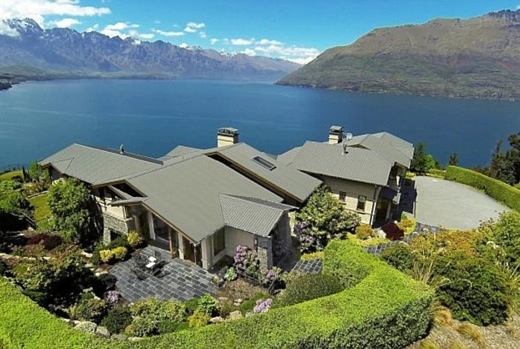
Image above: "Threatened: The super-rich fear their comfortable lifestyles in the west could be destroyed by terrorism or civil unrest, so they have started buying up 'boltholes' in New Zealand, like this award-winning five bedroom house, just a five minute drive from Queenstown". From
(http://www.dailymail.co.uk/news/article-2931325/Super-rich-buying-property-New-Zealand-bolthole-case-west-goes-meltdown.html).


[IB Publisher's note: After a lifetime of stripping the continents of resources and burning all the fossil fuel that could be found what is a retiring "player" from the IMF, "Wall Street" or "The City" to do on retirement if they cannot buy a thousand hectare ranch in New Zealand with a private jet runway and armed guards to ride out the apocalypse. Here on Kauai we had fears of such an invasion, but the super rich are not that interested in a place that is a major military target of our "enemies" and has been compromised by generations of plantation farming and, now, GMO and pesticide experimentation. The truly rich will let the "middle-class" professionals and their service people "Californicate" Hawaii.]

The International Monetary Fund has criticized New Zealand’s “discriminatory” ban on home sales to foreigners, saying it’s unlikely to improve housing affordability.

“Foreign buyers seem to have played a minor role in New Zealand’s residential real estate market recently,” the IMF said in a statement Tuesday, after concluding its annual Article IV mission to New Zealand.

If the government’s broader housing policy agenda is fully implemented, that “would address most of the potential problems associated with foreign buyers on a less discriminatory basis,” it said.

The new Labour-led government has pledged to fix the nation’s housing crisis with a raft of measures, including a ban on foreign speculators buying residential property, removal of tax distortions and an ambitious building program.

House prices have surged more than 60 percent in the past decade amid record immigration and a construction shortfall, shutting many out of the housing market.

However, data suggest non-residents buy only a tiny percentage of homes sold, and critics of the law change say it will have the unintended consequence of worsening housing supply by turning overseas investors away.

Proposed changes to the Overseas Investment Act, which the government says will bring New Zealand into line with neighboring Australia, will classify residential land as “sensitive,” meaning non-residents or non-citizens can’t purchase existing dwellings without the consent of the Overseas Investment Office.

While non-resident foreigners will be allowed to invest in new construction, they will be forced to sell once the homes are built.

IMF Mission Chief Thomas Helbling said a ban is a “very definitive measure” and could send a negative signal to foreign investors more broadly.

“Foreign direct investment, trade, commerce abroad involves various dimensions, including employee housing,” he told a media briefing in Wellington. “I find it difficult to assess that signal, but that’s one thing perhaps to worry about.”

The IMF’s report is otherwise broadly positive:
  • Economic growth to remain around 3% in the near term, risks broadly balanced.
  • Soft landing in housing market should continue.
  • Monetary policy appropriate; the IMF warns against precautionary further easing or premature tightening.
  • With household debt still elevated, RBNZ shouldn’t relax mortgage lending restrictions any further.
  • The country’s fiscal position is “strong” and there is no need for faster debt reduction beyond what the government has already outlined.
.

Stop and Assess

SUBHEAD: Let’s pause to make an assessment of where we stand as Winter finally coils into Spring.

By James Kunstler on 23 April 2018 for Kunstler.com -
(http://kunstler.com/clusterfuck-nation/stop-and-assess/)


Image above: A man waits at dawn, after sleeping in his car, to see a free ‘mobile doctor’ in Olean, New York. Photo by Spencer Platt. From (https://www.theguardian.com/inequality/2017/jun/20/is-the-american-dream-really-dead).

America has become Alzheimer Nation. Nothing is remembered for more than a few minutes. The news media, which used to function as a sort of collective brain, is a memory hole that events are shoved down and extinguished in.

An attack in Syria, you ask? What was that about? Facebook stole your…what? Four lives snuffed out in a… a what? Something about waffles? Trump said… what?

Let’s pause today and make an assessment of where things stand in this country as Winter finally coils into Spring.

As you might expect, a nation overrun with lawyers has litigated itself into a cul-de-sac of charges, arrests, suits, countersuits, and allegations that will rack up billable hours until the Rockies tumble.

The best outcome may be that half the lawyers in this land will put the other half in jail, and then, finally, there will be space for the rest of us to re-connect with reality.

What does that reality consist of?

Troublingly, an economy that can’t go on as we would like it to: a machine that spews out ever more stuff for ever more people. We really have reached limits for an industrial economy based on cheap, potent energy supplies. The energy, oil especially, isn’t cheap anymore.

The fantasy that we can easily replace it with wind turbines, solar panels, and as-yet-unseen science projects is going to leave a lot of people not just disappointed but bereft, floundering, and probably dead, unless we make some pretty severe readjustments in daily life.

We’ve been papering this problem over by borrowing so much money from the future to cover costs today that eventually it will lose its meaning as money — that is, faith that it is worth anything. That’s what happens when money is just a representation of debt that can’t be paid back.

This habit of heedless borrowing has enabled the country to pretend that it is functioning effectively. Lately, this game of pretend has sent the financial corps into a rapture of jubilation.

The market speed bumps of February are behind us and the road ahead looks like the highway to Vegas at dawn on a summer’s day.

Tesla is the perfect metaphor for where the US economy is at: a company stuffed with debt plus government subsidies, unable to deliver the wished-for miracle product — affordable electric cars — whirling around the drain into bankruptcy.

Tesla has been feeding one of the chief fantasies of the day: that we can banish climate problems caused by excessive CO2, while giving a new lease on life to the (actually) futureless suburban living arrangement that we foolishly invested so much of our earlier capital building. In other words, pounding sand down a rat hole.

Because none of that is going to happen.

The true message of income inequality is that the nation as a whole is becoming incrementally impoverished and eventually even the massive “wealth” of the one-percenters will prove to be fictitious, as the things it is represented in — stocks, bonds, currencies, Manhattan apartments — hemorrhage their supposed value.

The very wealthy will be a lot less wealthy while everybody else is in a life-and-death struggle to remain fed, housed, and warm. And, of course, that only increases the chance that some violent social revolution will take away even that remaining residue of wealth, and destroy the people who held it.

What lies ahead is contraction. Of everything. Activity, population. The industrial economy is not going to be replaced by a super high tech utopia, because that wished-for utopia needs an industrial economy underneath to support it. This is true, by the way, for all the other “advanced” nations.

China has a few more years of dependable oil supply left and then they will discover that they can no longer manufacture solar panels or perhaps not even run the magnificent electronic surveillance system they are so artfully building. Their political system will prove to be at least as fragile as our own.

The time may even come when the young people, of the USA especially, have to put aside their boundary-smashing frolics of the day and adjust the precooked expectations they’ve been handed to the actual contraction at hand, and what it means for making a life under severely different conditions. It means, better learn how to do something really practical and not necessarily high tech.

Better figure out a part of the country that will be safe to live in. Better plan on hunkering down there when the people stuck in the less favorable places make a real mess of things.

.

What Could Go Wrong?

SUBHEAD: James Kunstler's predictions for the year 2018 don't paint a pretty picture for America.

By James Kunstler on 1 January 2018 for Kunstler.com -
(http://kunstler.com/clusterfuck-nation/forecast-2018-go-wrong/)
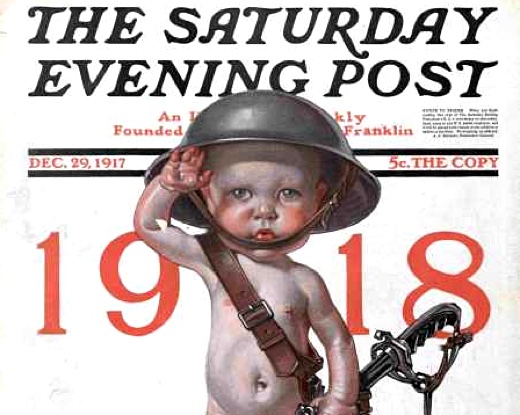

Image above: Detail of cover of the Saturday Evening Post at the end of 1917 with a New Year's baby ready for World War One. From (http://www.saturdayeveningpost.com/2014/12/31/art-entertainment/art-and-artists/new-years-babies.html).

Markets
If you take your cues from Consensus Trance Central — the cable news networks, The New York Times, WashPost, and HuffPo — Trump is all that ails this foundering empire. Well, Trump and Russia, since the Golden Golem of Greatness is in league with Vladimir Putin to loot the world, or something like that.

Since I believe that the financial system is at the heart of today’s meta-question (What Could Go Wrong?), it would be perhaps more to the point to ask: what has held this matrix of rackets together so long?

After all, rackets are characterized by pervasive lying and fraud, meaning their operations don’t add up. Things that don’t comport with reality are generally prone to failure so sooner or later they have to implode.

Financial markets have been surging supernaturally on “liquidity” since 2009 — and by “liquidity” I mean “money” (digital credit from thin air) supplied by the Federal Reserve, in rotation with the other sovereign central banks, BOE, ECB, BOJ, PBOC, from whence it pings ‘round the world, wherever the lure of the main chance sparkles.

Trillions wafted into the stock and bond markets, levitating them as a sort of stage-managed misdirection from the sickening spectacle of wobbling real stuff economies.

In 2017, The Dow Jones Industrial Average recorded an astounding 5,000 point year-on-year upzoom, with 12 months of gains and no loser months, and a string of 71 record highs.

America’s central bank, the Federal Reserve, acted as if pumping up the stock markets was the only thing that mattered.

The result was a Potemkin economy, a glittering Wall Street false-front with a landscape of “flyover” squalor and desolation behind.

The Fed now works at cross-purposes with itself by raising the Fed Funds rate a quarter-point every few months, and supposedly “shrinking” (ha!) their balance sheet — dumping bonds onto the market plus “retiring” termed out bonds, which allows the Fed to disappear the principal paid by the borrowers, namely the US Treasury, or the quasi-governmental werewolf called Freddie Mac (The Federal Home Loan Mortgage Corporation), which bundles all kinds of janky mortgages into giant bonds the Fed buys in order to artificially pump up the real estate market.

Did your eyes glaze over yet? That’s the great thing about finance: it’s bewildering, so that when shit goes wrong, nobody notices until its way too late.

What could go wrong with that program?

Well, if you dump billions of bonds on the market, you will change the supply-and-demand equation in the direction of too much supply, and interest rates will have to rise when there isn’t enough bid from the demand side — especially if the US Treasury is creating ever more new bonds to make up for ever-greater deficit spending at the same time the Fed dumps bonds into the market.

And if, for instance, the interest rate on the benchmark 10-year US Treasury bond goes up past 3.00 percent, well that may be all she wrote for the US government’s ability to service its monstrous debt.

And it may be tits up for the real estate sector, too, because mortgage rates will rise, and fewer people will buy houses.

The Fed’s latest actions boil down to a lame attempt to have some maneuvering room to once again lower interest rates and refill their balance sheet via a QE-4 orgy when the economy heads south in a way that even the US Bureau of Labor Statistics can’t obfuscate.

The ECB and the BOJ have already made noises about curtailing their vacuuming up of securities, so the liquidity rotation may end altogether. The new Tax Cuts and Jobs Act has at its centerpiece the lowering of corporate income tax from 35 to 21 percent.

The hidden agenda may be to hope this can act as a substitute for the dwindling central bank liquidity injections.

The tax cuts and other new gimmicks would increase the federal debt by at least $1 trillion over a ten year period (and, by unofficial estimates, probably much more) paving the road to national bankruptcy with good intentions.

But, of course, quite a few wise men in this culture have declared that deficits don’t matter. My own view is that they don’t matter until they do, and then you’re pretty screwed.

In the background of all this is an array of perilous real world events playing out that include especially potential conflict around North Korea and the Middle East. China’s banking system is a fun-house of scams and dodges that don’t add up anymore than ours do.

The whole wicked pottage of EU / Brexit issues simmers away, along with the EU’s fatal flaw of lacking any fiscal discipline among member nations, so government spending has no relation to sovereign borrowing. NATO’s aggressive military posturing on Russia’s borders is pointless, stupid, dishonest, and provocative.

Nobody knows what kind of gambit Crown Prince Mohammed bin Salman of Saudi Arabia will try next. Iran demands to be recognized as the regional hegemon.

And our dear exceptional nation, with its restless Deep State black box “assets,” is capable of all sorts of mischief at home and abroad.

Any of these things could shove American markets into criticality, as if they don’t have enough built-in fragility already.

Manipulation of the markets by the Fed and its water-carrying Too Big To Fail partners have deprived the markets of their chief function: price discovery, the ability to discern what things are really worth. Markets are therefore functionally useless and their uselessness is a giant hazard.

No society that depends on money can work for long if nobody knows the true value of things, including the value of money itself. The price of attempting to live in a culture of pervasive dishonesty is that a re-set is inevitable.

When it happens, it will be hugely destabilizing.

I expect the DJIA to move down sharply before the third quarter, rebound a little, and eventually bottom at 14,000 or lower by this time next year. I’ll call the S & P to settle in under 1,000.

The NASDAQ may be the weakest, since its FAANG members — Facebook , Amazon, Apple, Netflix, Google (aka Alphabet)— are among the most mis-valued stocks, and the most based on vaporous products and services.

Call NASDAQ to land at 2,700. Calling for a US dollar index (DXY) of 79 by December. Calling for gold $2,500 and silver $60 twelve months from now. There it is, like so much meat on the table.

Bitcoin and other cryptos have a superficial appeal as a wealth safe haven supposedly out-of-reach of avaricious governments — if you don’t consider everything else that’s wrong with it.

Yesterday, Dec 31, Australia’s biggest banks froze the accounts of Bitcoin investors. I think the safe haven idea will prove fallacious.

Governments are already finding ways to interfere, using taxation schemes and shutting down exchanges.

Bitcoin’s other claims on “moneyness” look bogus as well. It’s too unstable to be a medium of exchange, and too difficult to even access when need to sell, and you certainly can’t price anything in it as it shoots up and crashes every day.

Bitcoin went way up because people — or maybe just algorithms — saw it going way up, so they hitched a ride.

The rush to the exits will be brutal. Its final resting place will be zero, but perhaps not without a trip or two to nosebleed levels in 2018, especially as other markets wobble in the first half of the year. Bitcoin $50-K wouldn’t surprise me. But I’m not among the buyers. Enjoy the show.

2018 is the year that fragilities in the shale oil industry challenge the narrative of the “miracle.” The industry hasn’t made a net red-cent since it ramped up ten years ago. It’s been running on debt, a lot of it junk financing (high-yield, high-risk, covenant-lite).

The producers have been fracking and pumping all-out for several years to maximize their cash flow to service their loans.

But these shale wells deplete by 80 percent on average after the first three years, and have to be replaced by expensive new wells, which require ever more debt financing.

The truth is that shale oil and other “unconventional” oils just don’t pencil out economically. Their success in recent years was part-and-parcel with the central bank credit flood.

As that credit flow gets choked down in 2018, oil companies will go out of business at an impressive rate. If the price of oil goes up to $80-a-barrel, as a result, it will be very damaging to what remains of the US economy of real stuff.

US Politics
Donald Trump survived in office a whole year. Imagine that! After the 2016 election, I figured that the top military brass would give him the bum’s rush inside of three months, in short a coup d’état. Their action actually has been much more subtle: they just ring-fenced him with generals.

Since he seems to regard them as his generals (“my generals”), then he’s apparently okay with that, like a boy in the nursery with his toy soldiers.

And apart from the fact that the constitution calls for civilian control of the military and not vice-versa, I’m okay with that… for now. He’s got chaperones, at least.

This is admittedly not the ideal disposition of American political power.

I did not vote for the Golden Golem, and I don’t esteem his abilities, but the incessant and rather hysterical attacks on his legitimacy, especially by members of Consensus Trance Central, display a mendacity out of George Orwell’s direst dreams.

I never believed in the ludicrous Russian collusion fantasy, and find it difficult to believe that the editors of The New York Times do.

So far, Special Counsel Robert Mueller has indicted two high-profile grifters (Manafort and Gates) on financial shenanigans involving business dealings in Russia dating from years before the 2016 election, plus one National Security Advisor (Michael Flynn) for speaking with the Russian Ambassador (who, exactly, are foreign ambassadors supposed to speak to if not government officials?

And otherwise what are they here for?), and one entry-level foreign policy wonk (George Papadopoulos) who never even met Trump.

I believe the grave and solemn Mueller is on a fishing expedition. Aficionados of DOJ tactics know that prosecutors can always fetch up the proverbial ham sandwich to indict, if there’s nothing else at hand.

Then there is the very troubling behavior of FBI employees (Peter Strzok, Lisa Page, Deputy FBI Director Andrew McCabe), plus some members of Obama’s inner circle (Susan Rice, Samantha powers) in the twilight months of his term.

And remember, Robert Mueller has been the erstwhile James Comey’s mentor and true-blue friend going way back. It just looks flat-out like a bunch of Deep State lifers are out to get the Golden Golem. The so-called “optics” are terrible.

Since crashing stock markets are liable to turn Trump into a mad bull, at the same time that Mueller will have to put up or shut up, I predict that long about the vernal equinox Mueller will come up with some Mickey Mouse charges against Trump, or his people, and be promptly fired by the president.

General Flynn and the baby foreign policy wonk will be pardoned, and perhaps others.

Probably not Manafort and his chum (though their prosecution might fail.) Democrats will go apeshit and batshit both, with talk of impeachment and constitutional crisis, but I don’t think any of that will stick.

Congress may have more to worry about with tanking markets and other symptoms of an incipient economic train wreck. The effort to dump Trump would aggravate the tanking markets.

It is also plausible after the disclosures of recent months that the Russian meddling investigation could blow back on Hillary, the Clinton Foundation, Clinton allies, and possibly even some of Obama’s people (maybe even the former president himself).

The evidence for Obama-era FBI involvement in the Christopher Steele file is already out there.

There is yet to be a satisfactory elucidation of the Loretta Lynch / Bill Clinton Phoenix tarmac meet-up, nor to the circumstances around HRC’s lost emails and private server, nor the Anthony Weiner laptop, nor to the Uranium One matter.

The casual observer sees much more circumstantial criminality in these matters so far than any Trump collusion-with-Russia hypothesis provides.

I venture to predict that ex-DNC Chair Debbie Wasserman-Schultz resigns her House seat in disgrace as the case of her Pakistani grifter IT aide, Imran Awan, moves into the courts.

Trump firing Mueller will drive his Dem-Prog adversaries to new heights of hysteria but their wrath may be so ineffectual that they will fall back on their stock-in-trade, ginning up more sexual panic.

This calls into question the pathetic state of the Democratic Party leadership. It’s so sclerotic these days that it makes the Whigs of 1856 look dynamic.

 They have no program for the compound emergencies the nation faces. The party machinery is in the hands of bought-and-paid-for errand boys, gender crybabies, and race hustlers.

Their allies at The New York Times and CNN look ever more ridiculous peddling daily paranoid fantasies and styling themselves as advocates for “the Resistance.”

Their cadres in the Ivy League outposts have turned into the most shamelessly illiberal gang of intellectual despots since Mao’s Red Guard roamed the earth.

I’m not persuaded that the Dems will necessarily stomp Trump’s Republicans in the 2018 congressional and state races, as seems to be widely assumed for the moment. I’ll predict, rather, that in 2018 we get the first stirrings of a new party forming to battle both tired old clubs.

Trump now “owns” the fate of the stock market and the economy it wags, having bragged on it all year. He and the Republicans will be blamed if it falls out of bed.

But my gut feeling is that the voters are even more sick of the Democrats and their victim-mongering. Their coffers are empty, despite jumping through every hoop that Wall Street held out for them. (Did all the money disappear into the maw of the Clinton Foundation?)

Finally, on a personal note, I blame them for driving a stake through Garrison’s Keillor’s heart with their reckless sexual witch-hunting, and I don’t forgive them for that, no matter how many tits he may have tried to touch backstage.


Elsewhere on This Planet
Economic savant and international man-of-mystery James Rickards says that Trump and his generals are going to whap North Korea upside its big chunky head soon after the winter Olympics are concluded in South Korea on February 25.

But as Trump averred in the election campaign, he is not inclined to state in advance exactly what we might do in a military situation. Maybe the rumor is true that we have interesting new weapons capable of turning Little Rocket Man into a Post Toastie without harming the mass of innocent North Koreans.

I’d have to give 50 percent odds that whatever we do in Korea turns out to be an epic illustration of Murphy’s Law, since our track record in foreign military adventures since VJ day in 1945 is pretty scant in the “win” column. The Balkan War, maybe… Bush One’s Gulf War sort of… Grenada (for Godsake)… what else…?

Kim Jung-un may not be able yet to deliver an atomic blast to Rodeo Drive, but he can likely lob one into Tokyo on a five minute flight path. Look at the map. The Japanese must be nervous about it.

They were once a world-class military power, in case you don’t remember the banzai era. Prime Minister Shinzo Abe wants to revise Japan’s pacifist constitution — engineered by US advisors during the post-war occupation — to allow for a robust military.

I wouldn’t be surprised if something lethal jumps out of a lacquered black bento box in the direction of Pyongyang around the same time the US goes for that whap upside NK’s head.

And there’s Seoul, of course, less than 20 miles from the DMZ and within range of a supposedly huge array of North Korean heavy artillery.

The theory is we have a slim window of opportunity to deal with this rascal before he equips himself to do some major mischief in the world.

I don’t believe this is just a bunch of shuck-and-jive cooked up by the arms merchants and their friends. It’s real and existential and very messy. Something is going to happen there.

China has a pretty firm mutual defense treaty with North Korea, and perhaps reason to want to keep the regime up-and-running as a buffer zone. But do they really want to jump feet first into World War Three defending Kim?

I guess we’ll find out. In the meantime, China’s president Xi Jinping has got enough on his plate trying to safely land the high-flying, but wobbling, debt-saturated Chinese economy.

Odds are that it’s going to be a rough landing. In which case, maybe war is the answer, as a way of distracting the Chinese public’s attention. But what sort of war? Cyber-sabotage? EMP blackouts? Good old-fashioned mutual nuclear destruction? Grinding old-school land campaigns?

Naval battles?

It’s a dangerous game and Xi does not look like a risk junkie — more like prudent ole Uncle Xi. So I’ll predict that whatever blows on the Korean Peninsula, China will try to stay out of it, even if it makes faces and jumps up and down a bit.

Russia can only benefit from steering clear of war, though its recent offer to act as an intermediary between Kim and Trump was a smart move. (Maybe they remember how Teddy Roosevelt negotiated a peace settlement in the Russo-Japanese War of 1907.) They have little to lose and prestige to gain.

Despite what you hear about the unholy thuggery of Vladimir Putin, it seems to me that what he wants most of all for his country is to attain the condition of a politically and economically normal nation — after the 75-year-long misadventure with communism.

I suspect Putin and others in Russia would have liked the country to become more fully Europeanized in tone and style than it has been allowed to be, with NATO playing war games on Russia’s border, and US monkeyshines in Ukraine, and sanctions against it for really no good reason.

So, Russia has been shoved back into its cubbyhole as a nation not quite of Europe, with sinister Byzantine overtones and ancient exotic Mongol influences.

This quasi-isolation has some benefits for Russia, for one, the imperative to develop businesses and industries for import-replacement, that is, for becoming more self-sufficient. Russia has a lot to work worth, with the world’s highest oil production, lots of ores and minerals, untold hydropower, and endless timber.

It can make its own stuff, and Russian citizens are free to try starting businesses. The country may even benefit from climate change with expanded croplands. Russia is already approaching food self-sufficiency after the long catastrophe of soviet farm collectivization.

Meanwhile, Europe desperately needs Russia’s oil and natural gas, so they must know that using NATO troops and armor to make threats is a hollow gesture. Notice that Russia is stockpiling gold reserves, where the USA is just selling the stuff off. (China is stockpiling, too. Like mad.)

When other currencies implode, there is reason to believe the world will be introduced to a gold-backed Ruble and Yuan, “money” backed by money.

They’ll be able to buy stuff they need. Will we? Will a gold-backed currency shove aside the US dollar as world reserve currency? The precursor to that will be China’s effort to establish oil trade in its Yuan.

Europe has stumbled along economically for several years on Mario Draghi’s promise to “do whatever it takes” to keep the EU’s member nations from falling into the black hole of debt deflation, namely, buying every bond that the sovereign governments and corporations issue.

That kept the game going, but the structural imbalances in EU banking are now so extreme that it is hard to see a way out besides an EU crackup.

The Merkel-led immigration-and-refugee policy looked like a bad bet from the get-go and is liable to get worse when the whatever-it-takes liquidity dries up and the EU member countries fall into recession (or depression) and there’s no more money to pay for all those refugee settlement centers and the social services that have been provided.

There won’t be enough gainful employment for Germans, Belgians, Frenchmen, and Swedes, let alone for immigrants and refugees.

I’ll predict that starting in 2018 we’ll see efforts to ramp up deportations of these newcomers. Racist?

That will be the knee-jerk hue-and-cry. But the epithet is losing its punch as the effects of Merkel’s open door policy are felt on-the-ground in the obvious hostility, xenophobia, and aggression, displayed by Islamic settlers.

The defeat of ISIS on the Middle East battlefields in 2017 suggests that they will be ramping up terror operations to Europe. European nationalism movements will grow in 2018 and gain intellectual respectability as the defense of European culture is taken seriously.

Middle European states such as Hungary and Poland have not given in on the EU’s demand to accept immigrants and refugees from Islamic lands. Their example will be followed. Politicians in the rest of Europe will consider the “Just Say No” option.

The United Kingdom enters 2018 especially vulnerable to economic travail. The estimated cost of Brexit at tens of billions of pounds sterling, and the potential loss of business, especially banking, is one mighty headwind.

The other, less talked about, is the dwindling of the UK’s oil and gas reserves. The equation is simple: fewer energy inputs equals lower economic activity.

The only way around that is the popular central bank strategy of recent years: money-printing and accounting fraud. You can’t base an economy on that, and the truth will become painfully self-evident this new year in Great Britain.

Suddenly this last week of 2017, anti-regime demonstrations are busting out all over Iran. They are said to be protests over poor economic performance and the regime’s squandering of resources sponsoring mischief in other lands (Yemen, Syria, Lebanon, etc).

Folks are getting killed in the streets. The Revolutionary Guard — the zealots who took our diplomatic personnel hostage in 1979 — have promised to squash the protest. Many Iranians must be good and goddam sick of mullahs and ayatollahs running the joint.

Otherwise, it’s beginning to look like Crown Prince Mohammed bin Salman (MBS) of Saudi Arabia (KSA) would like to rumble with Iran to beat back their influence outside their borders in the region.

Iran has had plenty of opportunity to play with its military hardware in recent decades: in the Iran-Iraq War, arming Hezbollah to battle Israel, in support of Bashar al-Assad’s government in Syria, and lately in Yemen’s civil war.

KSA, on the other hand, has been buying jet planes and bombs from the US for decades, with nary a chance to put them to use. MBS seems eager to test-drive this schwag.

A real dust-up between the principals would put a lot of the world’s oil supply at risk if oil tanker shipping in the Persian Gulf were interrupted. China and Japan would bear the brunt, but the whole world would feel it.

Kicking the clerics out of government in Iran might tone down the unnecessary religious hostilities between Sunni and Shiites that has played such a big part in the creation of failed states throughout the Middle East and North Africa (MENA). Iran has plenty of economic problems inside its own borders.

The disarray in other areas of the vast MENA region will continue in 2018, whether regime change in Iran happens or not. Iraq, Libya, Somalia, Sudan are permanently failed states, with Egypt ever on the verge. Syria will stabilize as a much smaller economy, propped up by payments from Russia for hosting naval and air bases there.

This part of the world has suffered ruinous population overshoot in the industrial age, especially the states that produced oil. The desert ecology can’t support all these people as the industry falters and shrinks. Even as the situation worsens, the swollen populations will generate more children. When they can no longer decant themselves into Europe, the real misery starts.

You may have forgotten there is a place called South America. Its many nations have been in a pleasant political coma for a decade or so, except Venezuela, which is in cardiac arrest, organ failure, and brain death. There will be a bloody revolution there this year, and Venezuela’s oil industry will be crippled, adding to the world’s oil supply problems.

The Closing of the American Mind
2017 was a spectacular year for intellectual collapse among the political Left, but especially for its subsidiaries on campus.

The trauma of Donald Trump’s election victory put this faction into a fugue state in which no opportunity for coercion and persecution of imagined enemies could be missed.

The victim-oppressor politics spawned by the critical-theory-for-lunch-bunch has produced an ideology in which “inclusion” means segregated dorms, racially separate graduation ceremonies, and (at Harvard) closing down age-old men’s and women’s voluntary social associations. And “diversity” means as long as you express the exactly same ideas we do.

The presidents, deans, and faculty of colleges around the country have turned into the most obdurate enemies of free thought since the Spanish Inquisition, a gang of cowards and villains who disgrace the meaning and purpose of higher Ed.

Highlights of the year in Social Justice Warrior Land include the violence around Charles Murray’s lecture at Middlebury, the Antifa riots at UC Berkeley, the “Day of Absence” ritual at Evergreen U in Washington State where white people were banished from campus, and the Lindsey Shepherd star chamber tribunal at Laurier University in Toronto (I know, that’s outside the USA). I


n all of these cases, college presidents, deans, and faculty acted contemptibly, supporting coercion, persecution, antipathy to due process of law, the willful betrayal of common decency, and a folio of shockingly stupid ideas — such as the proposition from the chair of the Purdue University Engineering Department (one Donna Riley) that academic rigor is a symptom of “white male heterosexual privilege.”

As it happens, higher education is approaching its own state of implosion, since college has become, most of all, a money-grubbing racket tuned to the flow of exorbitant student loans for exorbitant college costs.

Higher Ed’s fate is tied to the financial sector, especially the bond market, since college loans are lately being bundled into janky bonds just like the NINJA mortgages of 2007 were.

The entire US college industry has been in a hypertrophic blow-off for decades, and the gross expansion of facilities, programs, and costs has developedan inverse relationship to the value of a college education. I predict that a shocking number of small four-year colleges will go out of business this year. Students who had not completed their degree requirements will just be shit out of luck.

Concluding Thoughts
2018 will be a tumultuous year of shake-outs and loss. The watchword for the year should be “lean.” Individuals will be shoved into leaner modes of living. Companies will suffer despite the new lower tax. Financial rewards will be lean. Nations will have to seriously start planning to get by on less, to downscale, and jettison programs that don’t jibe with the mandates of reality.

2018 is the year that the world comes un-stuck from the past ten years of pretending that it’s possible to get something for nothing. For 2018, it’s full speed ahead into the long emergency.

.

Debt as a weapon on poor

SUBHEAD: Is Washington operating under a  monetary theory were debt does not matter to the rich?

By Kurt Cobb on 24 December 2017 for Resource Insights -
(resourceinsights.blogspot.com/2017/12/is-washington-tacitly-operating-under.html)


Image above: Photo of German paper money during uncontrolled economic inflation that lead to the ris Fascism and World War II. From (https://www.istockphoto.com/fi/photo/german-inflation-money-from-1920s-gm170927779-17410276).

In 2002 when soon-to-be-dismissed U.S. Treasury Secretary Paul O'Neill warned then Vice President Dick Cheney that the Bush administration's tax cuts would drive up deficits and threaten the health of the economy, Cheney famously answered:
"You know, Paul, Reagan proved deficits don’t matter."
In the wake of the recently approved federal tax cut,voices concerned about the damage that deficits will do are rising again.

What's curious is that since Cheney's rebuke of O'Neill, growing federal government deficits seem not of have mattered. In fact, the largest deficits ever boosted the economy after the 2008-09 recession, exceeding $1 trillion annually for four years.

All of this suggests that the federal government has for a long time been operating under an unspoken monetary theory, namely, that government spending does not need to be backed by revenues and that the debt issued to fill the gap between spending and revenues will have little effect now or in the future.

But isn't there some level of federal debt which would cripple the federal government and the U.S. economy? A common metric for measuring this debt is the ratio of federal debt to annual gross domestic product (GDP).

When one looks at a graph of this, the growth in debt seems perilous, rising from a low of around 30% of GDP in the early 1980s to more than 100% of GDP today.

Seemingly more perilous is the rapid growth in Japanese government debt. That debt has soared from a low of around 40 percent of GDP in 1990 to almost 200 percent of GDP now. Yet, the oft-prophesied demise of Japanese government finance has not occurred.

What the United States and Japan share in this regard is that each issues its own sovereign currency. That means both could theoretically retire their entire government debt in one day by issuing sufficient currency to buy up all the outstanding bonds. A smarter way would be to do this very gradually without announcing it.

In the alternative, the legislature could pass a law requiring government bondholders to sell their bonds back to government at a pre-determined price—something bondholders would certainly dislike since the price is likely to favor the government.

What this tells us is that any government that issues its own currency will never run out of money to pay back bondholders.

That's, in part, why there is no panic among Japanese and American owners of government debt. What the above further tells us is a bit more shocking: Such governments don't even need to issue debt to finance their operations.

And, so long as a government doesn't issue more currency than the economy can produce goods and services for, it won't create price inflation (defined as too much money chasing too few goods).*

The only reason for governments which control their own currency to levy taxes then is to create demand for that currency. If someone has to pay taxes in the government-issued currency, he or she will want to receive at least some payment in that currency.

As it turns out, so will everyone else. As a result it becomes simply more convenient if everyone adopts the country's sovereign currency as their unit of account and medium of exchange.

All of what I've just described fits neatly into what is called Modern Monetary Theory (MMT), the premises of which are so deceptively simple that it is hard for people to believe them.

But Japan and the United States seem already to be operating under that theory save for one act—the act of issuing copious amounts of government debt, something that is entirely unnecessary under MMT.

The idea that governments which issue their own sovereign currency must rely on private credit—mostly from wealthy citizens—to finance themselves is an illusion. But it's an illusion that the monied class hopes no one will see through.

For if the public does see through it, government debt—which is used like a weapon to promote cuts in social spending—would cease to frighten anyone (and may be gradually eliminated). That means spending policy would become much more flexible than previously imagined.

So, it turns out that Dick Cheney was right—but not for reasons which he and the new rentier class would ever be willing to admit, namely, that the government doesn't need loans from rich people or loans of any kind.

Bondholders therefore can't really hold the government hostage. Realizing this and acting on it would seriously diminish the influence of the rich in the halls of power and make a realignment of spending priorities possible.

.

The Darkest Hours

SUBHEAD: But like all addicts, we have to hit bottom before anything like clarity returns to our daily doings.

By James Kunstler on 18 December 2017 for Kunstler.com -
(http://kunstler.com/clusterfuck-nation/the-darkest-hours/)


Image above: The Republican senate leadership gloat after passing self-serving tax reductions for the wealthy. From (https://www.economist.com/news/united-states/21732096-todays-bill-does-not-much-resemble-1986-tax-overhaul-how-republican-tax-bill).

The Tax “Reform” bill working its way painfully out the digestive system of congress like a sigmoid fistula, ought be re-named the US Asset-stripping Assistance Act of 2017, because that’s what is about to splatter the faces of the waiting public, most of whom won’t have a personal lobbyist / tax lawyer by their sides holding a protective tarpulin during the climactic colonic burst of legislation.

Sssshhhh….

The media has not grokked this, but the economy is actually collapsing, and the nova-like expansion of the stock markets is exactly the sort of action you might expect in a system getting ready to blow.

Meanwhile, the more visible rise of the laughable scam known as crypto-currency, is like the plume of smoke coming out of Vesuvius around 79 AD — an amusing curiosity to the citizens of Pompeii below, going about their normal activities, eating pizza, buying slaves, making love — before hellfire rained down on them.

Whatever the corporate tax rate might be, it won’t be enough to rescue the Ponzi scheme that governing has become, with its implacable costs of empire.

So the real aim here is to keep up appearances at all costs just a little while longer while the table scraps of a four-hundred-year-long New World banquet get tossed to the hogs of Wall Street and their accomplices. The catch is that even hogs busy fattening up don’t have a clue about their imminent slaughter.

The centerpiece of the swindle, as usual, is control fraud on the grand scale. Control fraud is the mis-use of authority in applying Three-Card-Monte principles to financial accounting practice, so that a credulous, trustful public will be too bamboozled to see the money drain from their bank accounts and the ground shift under their feet until the moment of freefall.

Control fraud is at work in the corporate C-suites, of course, because that is its natural habitat — remember that silver-haired CEO swine from Wells Fargo who got off scot-free with a life-time supply of acorns after scamming his account-holders — but their errand boys and girls in congress have been superbly groomed, pampered, fed, and trained to break trail and cover for them.

The country has gotten used to thinking that the game of pretend is exactly the same as what is actually going on in the world. The now-seminal phrase coined by Karl Rove, “we make our own reality,” is as comforting these days to Republicans from Idaho as it is to hairy, “intersectional” professors of post-structural gender studies in the bluest ivory towers of the Ivy League.

Nobody in this Republic really wants to get his-hers-zhe’s-they’s reality on.

Ah, but reality wants to do its thing regardless of our wishes, hopes, and pretenses, and you can kind of see how these moves taken in the dark waning hours of 2017 will play out in the quickening weeks of 2018. Long about March or April, something’s got to give.

Other players around the world are surely eager to assist shoving this mad bull of a polity towards the critical state it deserves to enter, though we are doing quite enough on our own to put ourselves at ground zero of financial and political implosion.

The addiction metaphor does apply to America. We are simply addicted to our own bullshit. But like all floundering addicts, we have to hit bottom before anything like clarity returns to our daily doings.

When that does happen, it will be as far from intoxicating as you can imagine. The smoldering wreckage of The World’s Highest Standing of Living will be visible in a 360-degree panorama. A lot of familiar faces will be among the suddenly missing. But we’re already prepped for this by the sexual purges of the season.

One day, the reassuring figure of ole Garrison Keillor is there to remind you of the exquisite taste of Midwestern sweet corn on an August night; and the next morning, you’re up to your eyeballs in the colonic explosion of unintended consequences engineered by the least reassuring cast of characters ever assembled under one capitol dome.

.