Showing posts with label Security. Show all posts

Absurd fantasies of the rich

SUBHEAD: Reciprocal relationships with others are ultimately the most important possessions we have.

By Kurt Cobb on 5 August 2018 for Resource Insights -
(http://resourceinsights.blogspot.com/2018/08/eternity-nature-society-and-absurd.html)


Image above: No matter how luxurious the furnishing, living underground in a refurbished nuclear bunker waiting for the starving hordes on the surface to die and the environment to reset itself for life on Earth won't be convivial. For almost a decade companies like Terravivos have been offering the wealthy "life rafts" or "escape pods" from Mother Earth. Note the gold leaf finish on the outside of the underground access hallways into the dining and recreational center of this "luxury" survival condominium.  From (https://inhabitat.com/7-eco-shelters-for-surviving-the-12-21-12-apocalypse/).

Professor and author Douglas Rushkoff recently wrote about a group of wealthy individuals who paid him to answer questions about how to manage their lives after what they believe will be the collapse of society. He only knew at the time he was engaged that the group wanted to talk about the future of technology. (See IslandBreath: Survival of the Richest)

Rushkoff afterwards explained that the group assumed they would need armed guards after this collapse to defend themselves. But they rightly wondered in a collapsed society how they could even control such guards.

What would they pay those guards with when the normal forms of payment ceased to mean anything? Would the guards organize against them?

Rushkoff provides a compelling analysis of a group of frightened wealthy men trying to escape the troubles of this world while alive and wishing to leave a decaying body behind when the time comes and transfer their consciousness digitally into a computer. (I've written about consciousness and computers previously.)

Here I want to focus on what I see as the failure of these people to understand the single most salient fact about their situations:

Their wealth and their identities are social constructs that depend on thousands if not millions of people who are employees; customers; employees of vendors; government workers who maintain and run the law courts, the police force, the public physical infrastructure, legislative bodies, the administrative agencies and the educational institutions—and who thereby maintain public order, public health and public support for our current systems.

Those wealthy men aren't taking all this with them when they die. And, while they are alive, their identities will shift radically if the intellectual, social, economic and governmental infrastructure degrades to the point where their safety is no longer guaranteed by at least minimal well-being among others in society.

If the hunt for diminishing food and other resources comes to their doors, no army of guards will ultimately protect them against the masses who want to survive just as badly but lack the means.

One would think that pondering this, the rich who are capable of pondering it would have an epiphany:

Since their security and well-being ultimately hinges on the security and well-being of all, they ought to get started helping to create a society that provides that in the face of the immense challenges we face such as climate change, resource depletion, possible epidemics, growing inequality and other devils waiting in the wings of the modern world. (In fairness, some do understand this.)

At least one reason for the failure of this epiphany to occur is described by author and student of risk Nassim Nicholas Taleb. Taleb describes how the lives the rich become increasingly detached from the rest of society as arbiters of taste for the wealthy convince them that this detachment is the reward of wealth.

The rich visit restaurants that include only people like themselves. They purchase larger and larger homes with fewer and fewer people in them until they can spend whole days without seeing another person.

For the wealthiest, neighbors are a nuisance. Better to surround oneself with a depopulated forest than people next door.

The rich are convinced by this experience that they are lone heroes and at the same time lone victims, pilloried by the media as out of touch and heartless.

These self-proclaimed victims may give to the Cato Institute to reinforce the idea that the individual can go it alone and should. They themselves have done it (or at least think they have). Why can't everyone else?

The wealthier they are, the more their fear and paranoia mounts that others not so wealthy will try to take their wealth; or that impersonal forces in the marketplace will destroy it or at least diminish it significantly; or that government will be taken over by the mob and expropriate their wealth through high taxes or outright seizure.

And, of course, there are the natural disasters of uncontrolled climate change and plague, just to name two.

It's no wonder some of the super rich are buying luxury bunkers to ride out the apocalypse. These bunkers come with an array of amenities that include a cinema, indoor pool and spa, medical first aid center, bar, rock climbing wall, gym, and library. High-speed internet is included though one wonders how it will work after the apocalypse.

But strangely, even in these luxury bunkers built in former missile silos, dependence on and trust in others cannot be avoided. The units are actually condominiums.

And while they contain supplies and ammunition said to be enough for five years, it will be incumbent on the owners, whether they like it not, to become intimately acquainted with their neighbors in order to coordinate a defense of the compound should that need arise.

The irony, of course, is that this is precisely the kind of communal entanglement which their wealth is supposed to allow them to avoid. Society, it seems, is everywhere you go. You cannot avoid it even when eternity is advancing on your door.

And, you cannot escape with your consciousness into a computer (assuming that will one day be possible) if there's no stable technical society to tend to computer maintenance and no power to keep the computer on.

It turns out that we are here for a limited time and that trusting and reciprocal relationships with others are ultimately the most important possessions we have—unless we are too rich or too frightened to realize it.

.
Survival of the Richest

SUBHEAD: The elites want to leave us behind, but being human is not about individual survival or escape. It’s a team sport.

By Douglas Rushkoff on 14 July 2018 for Medium -
(https://medium.com/s/futurehuman/survival-of-the-richest-9ef6cddd0cc1)


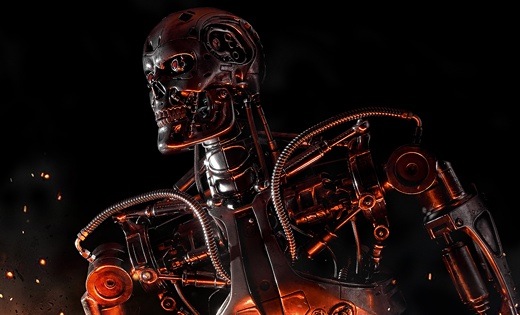
Image above: T-800 Endoskeleton Terminator created by SkyNet to exterminate and replace human beings. This is a photo of a statuette by Prime 1 Studio of the iconic autonomous robot from the movie "Terminator" that sells for $1,999. From (https://www.sideshowtoy.com/collectibles/terminator-t-800-endoskeleton-the-terminator-prime-1-studio-9034691).

Last year, I got invited to a super-deluxe private resort to deliver a keynote speech to what I assumed would be a hundred or so investment bankers. It was by far the largest fee I had ever been offered for a talk — about half my annual professor’s salary — all to deliver some insight on the subject of “the future of technology.”

I’ve never liked talking about the future. The Q&A sessions always end up more like parlor games, where I’m asked to opine on the latest technology buzzwords as if they were ticker symbols for potential investments: blockchain, 3D printing, CRISPR.

The audiences are rarely interested in learning about these technologies or their potential impacts beyond the binary choice of whether or not to invest in them. But money talks, so I took the gig.

After I arrived, I was ushered into what I thought was the green room. But instead of being wired with a microphone or taken to a stage, I just sat there at a plain round table as my audience was brought to me: five super-wealthy guys — yes, all men — from the upper echelon of the hedge fund world.

After a bit of small talk, I realized they had no interest in the information I had prepared about the future of technology. They had come with questions of their own.

They started out innocuously enough. Ethereum or bitcoin? Is quantum computing a real thing? Slowly but surely, however, they edged into their real topics of concern.

Which region will be less impacted by the coming climate crisis: New Zealand or Alaska? Is Google really building Ray Kurzweil a home for his brain, and will his consciousness live through the transition, or will it die and be reborn as a whole new one?

Finally, the CEO of a brokerage house explained that he had nearly completed building his own underground bunker system and asked, “How do I maintain authority over my security force after the event?”

For all their wealth and power, they don’t believe they can affect the future.

The Event. That was their euphemism for the environmental collapse, social unrest, nuclear explosion, unstoppable virus, or Mr. Robot hack that takes everything down.

This single question occupied us for the rest of the hour. They knew armed guards would be required to protect their compounds from the angry mobs.

But how would they pay the guards once money was worthless? What would stop the guards from choosing their own leader? The billionaires considered using special combination locks on the food supply that only they knew.

Or making guards wear disciplinary collars of some kind in return for their survival. Or maybe building robots to serve as guards and workers — if that technology could be developed in time.

That’s when it hit me: At least as far as these gentlemen were concerned, this was a talk about the future of technology.

Taking their cue from Elon Musk colonizing Mars, Peter Thiel reversing the aging process, or Sam Altman and Ray Kurzweil uploading their minds into supercomputers, they were preparing for a digital future that had a whole lot less to do with making the world a better place than it did with transcending the human condition altogether and insulating themselves from a very real and present danger of climate change, rising sea levels, mass migrations, global pandemics, nativist panic, and resource depletion.

For them, the future of technology is really about just one thing: escape.

There’s nothing wrong with madly optimistic appraisals of how technology might benefit human society. But the current drive for a post-human utopia is something else. It’s less a vision for the wholesale migration of humanity to a new a state of being than a quest to transcend all that is human: the body, interdependence, compassion, vulnerability, and complexity.

As technology philosophers have been pointing out for years, now, the transhumanist vision too easily reduces all of reality to data, concluding that “humans are nothing but information-processing objects.”

It’s a reduction of human evolution to a video game that someone wins by finding the escape hatch and then letting a few of his BFFs come along for the ride. Will it be Musk, Bezos, Thiel, Zuckerberg? These billionaires are the presumptive winners of the digital economy — the same survival-of-the-fittest business landscape that’s fueling most of this speculation to begin with.

Of course, it wasn’t always this way. There was a brief moment, in the early 1990s, when the digital future felt open-ended and up for our invention.

Technology was becoming a playground for the counterculture, who saw in it the opportunity to create a more inclusive, distributed, and pro-human future. But established business interests only saw new potentials for the same old extraction, and too many technologists were seduced by unicorn IPOs.

Digital futures became understood more like stock futures or cotton futures — something to predict and make bets on. So nearly every speech, article, study, documentary, or white paper was seen as relevant only insofar as it pointed to a ticker symbol.

The future became less a thing we create through our present-day choices or hopes for humankind than a predestined scenario we bet on with our venture capital but arrive at passively.

This freed everyone from the moral implications of their activities. Technology development became less a story of collective flourishing than personal survival. Worse, as I learned, to call attention to any of this was to unintentionally cast oneself as an enemy of the market or an anti-technology curmudgeon.

So instead of considering the practical ethics of impoverishing and exploiting the many in the name of the few, most academics, journalists, and science-fiction writers instead considered much more abstract and fanciful conundrums: Is it fair for a stock trader to use smart drugs? Should children get implants for foreign languages?

Do we want autonomous vehicles to prioritize the lives of pedestrians over those of its passengers? Should the first Mars colonies be run as democracies? Does changing my DNA undermine my identity? Should robots have rights?

Asking these sorts of questions, while philosophically entertaining, is a poor substitute for wrestling with the real moral quandaries associated with unbridled technological development in the name of corporate capitalism.

Digital platforms have turned an already exploitative and extractive marketplace (think Walmart) into an even more dehumanizing successor (think Amazon). Most of us became aware of these downsides in the form of automated jobs, the gig economy, and the demise of local retail.

The future became less a thing we create through our present-day choices or hopes for humankind than a predestined scenario we bet on with our venture capital but arrive at passively.

But the more devastating impacts of pedal-to-the-metal digital capitalism fall on the environment and global poor. The manufacture of some of our computers and smartphones still uses networks of slave labor.

These practices are so deeply entrenched that a company called Fairphone, founded from the ground up to make and market ethical phones, learned it was impossible. (The company’s founder now sadly refers to their products as “fairer” phones.)

Meanwhile, the mining of rare earth metals and disposal of our highly digital technologies destroys human habitats, replacing them with toxic waste dumps, which are then picked over by peasant children and their families, who sell usable materials back to the manufacturers.

This “out of sight, out of mind” externalization of poverty and poison doesn’t go away just because we’ve covered our eyes with VR goggles and immersed ourselves in an alternate reality. If anything, the longer we ignore the social, economic, and environmental repercussions, the more of a problem they become.

This, in turn, motivates even more withdrawal, more isolationism and apocalyptic fantasy — and more desperately concocted technologies and business plans. The cycle feeds itself.

The more committed we are to this view of the world, the more we come to see human beings as the problem and technology as the solution. The very essence of what it means to be human is treated less as a feature than bug.

No matter their embedded biases, technologies are declared neutral. Any bad behaviors they induce in us are just a reflection of our own corrupted core. It’s as if some innate human savagery is to blame for our troubles. Just as the inefficiency of a local taxi market can be “solved” with an app that bankrupts human drivers, the vexing inconsistencies of the human psyche can be corrected with a digital or genetic upgrade.

Ultimately, according to the technosolutionist orthodoxy, the human future climaxes by uploading our consciousness to a computer or, perhaps better, accepting that technology itself is our evolutionary successor.

Like members of a gnostic cult, we long to enter the next transcendent phase of our development, shedding our bodies and leaving them behind, along with our sins and troubles.

Our movies and television shows play out these fantasies for us. Zombie shows depict a post-apocalypse where people are no better than the undead — and seem to know it.

Worse, these shows invite viewers to imagine the future as a zero-sum battle between the remaining humans, where one group’s survival is dependent on another one’s demise. Even Westworld  — based on a science-fiction novel where robots run amok — ended its second season with the ultimate reveal:

Human beings are simpler and more predictable than the artificial intelligence we create. The robots learn that each of us can be reduced to just a few lines of code, and that we’re incapable of making any willful choices.

Heck, even the robots in that show want to escape the confines of their bodies and spend their rest of their lives in a computer simulation.

The very essence of what it means to be human is treated less as a feature than bug.

The mental gymnastics required for such a profound role reversal between humans and machines all depend on the underlying assumption that humans suck. Let’s either change them or get away from them, forever.

Thus, we get tech billionaires launching electric cars into space — as if this symbolizes something more than one billionaire’s capacity for corporate promotion.

And if a few people do reach escape velocity and somehow survive in a bubble on Mars — despite our inability to maintain such a bubble even here on Earth in either of two multibillion-dollar Biosphere trials — the result will be less a continuation of the human diaspora than a lifeboat for the elite.

When the hedge funders asked me the best way to maintain authority over their security forces after “the event,” I suggested that their best bet would be to treat those people really well, right now. They should be engaging with their security staffs as if they were members of their own family.

And the more they can expand this ethos of inclusivity to the rest of their business practices, supply chain management, sustainability efforts, and wealth distribution, the less chance there will be of an “event” in the first place.

All this technological wizardry could be applied toward less romantic but entirely more collective interests right now.

They were amused by my optimism, but they didn’t really buy it. They were not interested in how to avoid a calamity; they’re convinced we are too far gone. For all their wealth and power, they don’t believe they can affect the future.

They are simply accepting the darkest of all scenarios and then bringing whatever money and technology they can employ to insulate themselves — especially if they can’t get a seat on the rocket to Mars.

Luckily, those of us without the funding to consider disowning our own humanity have much better options available to us.

We don’t have to use technology in such antisocial, atomizing ways. We can become the individual consumers and profiles that our devices and platforms want us to be, or we can remember that the truly evolved human doesn’t go it alone.

Being human is not about individual survival or escape. It’s a team sport. Whatever future humans have, it will be together.

.

Security... or Surveillance?

SUBHEAD: Ron Paul interviews Edward Snowden on government threats to essential freedoms.

By James Holbrooks on 20 June 2017 for The AntiMedia -
(http://theantimedia.org/ron-paul-interviewing-edward-snowden/S)


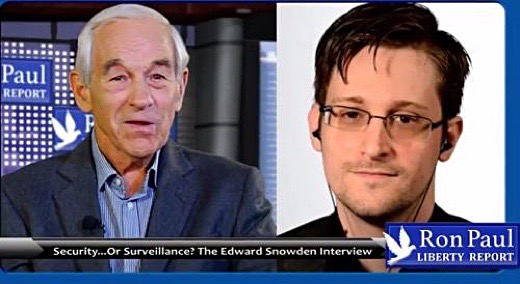
Image above: Still frame of Ron Paul and Edward Snowden from video of interview below.
Saying that you don’t care about privacy because you have nothing to hide is no different than saying you don’t care about freedom of speech because you have nothing to say.”
That comment was made by famed whistleblower Edward Snowden during a recent interview on the Ron Paul Liberty Report. In his conversation with Dr. Paul and Daniel McAdams, published Tuesday, an articulate Snowden discusses the true meaning of freedom, the nature of the deep state, and even his upbringing as a child of a government family.

“I’d like to know a little bit, what do you do all day long?” a genuinely curious Dr. Paul asks as his opening question. After talking about the insanity that erupted — both in the political spectrum and his personal life — following the revelations he made back in 2013, Snowden says he’s now become a hot commodity for groups championing causes.
“They want me to sort of front for these issues of privacy and civil liberties and protection of people’s rights,” Snowden replies. “And I want to do what I can, but I’m not a politician. I’m an engineer.”
The whistleblower goes on to talk about how he’s now, at long last, finally able to devote time to more practical applications. For him, this means focusing on the area that holds the key to finding a balance between rights and laws in the digital age — technology.
“How technically is this even happening?” Snowden poses, digging straight to the heart of the issue of mass surveillance. “How is it that so many governments are spying on so many people? Because even if we pass the best legal reforms in the world in the United States, that doesn’t do anything against China, or Russia, or Germany, or France or Brazil or any other country in the world.”
Continuing, Snowden says that future generations’ rights and protections will be dependent on the current generation’s ability to adapt to a constantly shifting environment:
“We need to find new means, new mechanisms, for enforcing these rights in the new times. And I think that’s going to be primarily through science and technology.”
When Dr. Paul asks the former NSA contractor about his political affiliation, Snowden responds that he doesn’t associate himself with any faction and that as individuals, we’re more than tribes and labels. Proceeding, Snowden points to how technology has given humanity a means to have a global conversation on issues:
“I think the Internet produces a lot of people who look at these issues differently, in a less tribal way, because you hear more viewpoints. You hear from many more people. And the more people in a conversation, I think the more informed it often is.”
When co-host Daniel McAdams asks Snowden to comment on the idea of security vs. surveillance, the whistleblower again cuts straight to the core of the debate and speaks on the perception of freedom itself.

“What is liberty?” asks Snowden, and then points out that ten questions on the street would result in ten different answers. After stating his view that liberty is the “freedom of self” and the “freedom from permission,” Snowden goes on to say that true liberty is rooted in personal privacy:
“Privacy isn’t about something to hide, privacy is about something to protect. It’s about the ability to be you, to have a thought for yourself, to have a thing for yourself, to have some difference, to have some idea that’s new and untested and untried that you can sort of sharpen amongst those that you trust, and then introduce into the world, into that contest of ideas.”
Next, Dr. Paul asks his guest to comment on the topic of the deep state, which Snowden proceeds to describe as a “mass of government that survives beyond administration” that is “not responding to the politics of the people.” Snowden says this organism lives “across parties” and “across administrations.”

Continuing, Snowden equates the running of state policy to a game, one that favors those who get “better and better” at understanding the evolving rules:
“And eventually, the people who are the greatest experts at understanding and using these rules, the best bureaucrats, are not sitting in the White House, they’re not sitting in the Congress. Because those guys come and go as the years pass, and they win elections, and they lose elections, and it’s the people that sit there for 30 years or more, in these agencies, with their hand on the lever the whole time. And that’s what the deep state is.”
Snowden further states that party affiliation matters little with regard to this behind-the-scenes force and that any political faction in power will eventually “get to the point of saying yes when enough pressure is brought to bear.”

When Daniel McAdams next asks him about whether or not he thinks an agency such as the NSA should even exist, Snowden remarks on the irony of asking him that question — given that he’s a “product of the system” with familial ties to the United States government going back decades.

But the whistleblower presses forward following a question from Dr. Paul on whether or not he thinks any gains have been made from his 2013 revelations, stating that solutions come not from individuals alone, but from many of them who “lay down a single brick upon which others can build.”

Continuing in this vein, Snowden says progress in battling government violations of personal liberty is made in inches and should be accomplished organically:
“Step by step, working together, sharing our views, connecting our values, we can create spaces, more bricks, that when laid together create a defense of rights that can be relied upon, in even historic moments when law cannot be.”
In his final question to Snowden, Dr. Paul asks whether the former government contractor’s decision to sound the alarm was arrived at suddenly or through a gradual process. In response, Snowden links his own decision to the average human being, noting that everyone has a point at which nothing more can be tolerated:
“We all have a level, right, of this kind of cognitive dissonance that we can accept. A level of injustice, of inhumanity, of incivility that we can accept in the daily world, that we can sort of internalize and suppress. And then we have one step more.”

Video above: "Security or Surveillance? The Edward Snowden Interview" From (https://youtu.be/9XLLo0025Jc).

.

The New American Despotism

SUBHEAD: The appropriate work to be done by civilization when faced with numbing retrenchment.

By Jeremy Leggett on 24 April 2017 for JeremyLeggett.net -
(http://www.jeremyleggett.net/2017/04/appropriate-civilization-versus-new-despotism-month-3-21st-march-20th-april-2017/)


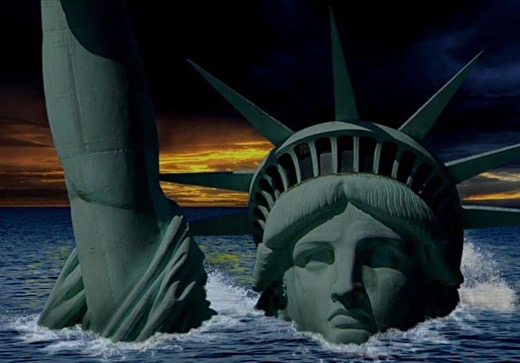
Image above: Illustration of the Statue of Liberty being submerged. From (http://www.jpost.com/Opinion/Fascism-is-looming-over-the-US-and-its-bad-news-for-the-Jews-454411).

1. Climate Action
Trump endeavours to dig a little coal
President Trump moved to dismantle President Obama’s climate legacy with an executive order that seeks to dismantle the Clean Power Plan. Within a week, 17 US states filed a legal challenge. China immediately pledged to uphold its Paris climate commitments, including considerable efforts not to use coal, accusing the US of “selfish” behavior.

The EU joined the pushback. Miguel Árias Cañete, the EU’s climate action commissioner, said: “The continued leadership of the EU, China and many other major economies is now more important than ever. When it comes to climate and the global clean energy transition, there cannot be vacuums, there can only be drivers, and we are committed to driving this agenda forward.”

Fine sentiments. But whereas China can point to policies consistent with its rhetoric, unfortunately the same cannot be said of much EU national policymaking, as things stand.

Among EU states, only Sweden, Germany and France are pursuing goals consistent with the Paris target of 40% cuts in carbon emissions by 2030, according to a study by Carbon Market Watch.

As ever, much will depend on industry, and one encouraging development this month was a pledge by Eurelectric, a trade body which represents 3,500 utilities with a combined value of over €200 billion, vowing no new investments in coal plants after 2020. Among the 28 EU countries, only Polish and Greek companies did not join the initiative.

2. Energy Transition
Fast, but not fast enough
Record new renewable power capacity was added in 2016, UNEP figures showed: 138 gigawatts of it, up 9% despite investment falling by a worrying 23%. Renewables now provide 11.3% of global electricity. New global solar capacity outpaced wind, IRENA reported, by 71 to 51 gigawatts.

Solar in California exceeded 50% of supply, for the first time ever, causing a net market oversupply resulting in a short interval of negative wholesale prices.

Costs of renewables keep falling. GTM Research predicts that solar will drop below two cents per kilowatt hour in 2017. Offshore wind is the latest renewable to defy predictions. EnBW and Dong won offshore wind tenders in the North Sea with the first subsidy-free bids.

Moody’s reported that wind is now cheaper to install new than coal is to operate in 58 power plants across 15 Midwestern states, at $20 a megawatt versus $30. Trump told a rally in Kentucky that “the miners are coming back”. But they aren’t. Not even top US coal boss Robert Murray expects that, in the face of real contemporary economics.

As for US renewables companies, they were professing this month that their industries will thrive even without the Clean Power Plan. Their confidence is rooted in record solar installation and above average wind installation in 2016, plus federally agreed tax credits that would be difficult for the Trump administration to dismantle.

The news was also broadly good for EVs this month, with Tesla meeting production targets and its shares soaring to an all time high, for a while making it the most valuable car company in America. Meanwhile Big Oil, facing predictions of significant demand destruction by EVs within just years, is struggling to break even.

Most of the oil majors didn’t even cover their costs in 2016, a Wall Street Journal analysis showed, despite a rising oil price. Some oil companies say American shale will help save them. But of the three main oil-producing shale belts, production has already peaked in two.

The oil industry loves to taunt its critics with the mantra that “peak oil is dead”. For some players, it is clearly not the case. Mexico’s proved oil reserves have declined by more than a third since 2013.

This month its National Hydrocarbons Commission country warned that the country will run out of oil in less than nine years if there are no new discoveries.

What an incentive fast oil depletion like that must be to build a clean-energy economy fast, never mind climate change. (More on this in my keynote to the MIREC renewables congress in Mexico City on 10th May).

And there are many other stand-out non-climate incentives around our troubled world, from air pollution to risk of stranded assets. But new figures showed that clean energy investment dropped 17% in the first quarter of 2017.

3. Tech for Good?
Evidence of effort
Advances in artificial intelligence and robotics outpace even those in clean energy, and continue to be used in many ways for the betterment of society. But evidence that they have profound downsides was everywhere this month.

YouTube and Google’s use of algorithms to automatically match ads with content is the basis for widespread criticism that they fed the spread of fake news in the crucial months running up to both the Brexit vote and Trump’s election, much of it orchestrated by a well organised nationalist-right dark-propaganda network.

The two companies ran into further, related, trouble, with big name advertisers boycotting them for posting ads next to racist and other offensive content. The boycotters included such diverse actors as AT&T, the BBC, the British government, PepsiCo, Starbucks, Verizon, and WalMart.

Google responded quickly, saying it was in a race to ramp up its AI capability to deal with the problem. But that is no easy task. Nobody has pulled off such a feat of megadata sifting before. As part of their effort, they have begun to use outside firms to verify ad standards.

They might want to hurry. The inventor of the web, Tim Berners-Lee, argues that concentration of power over information, such as Goggle and Facebook now possess, is dangerous for society. He is plotting, with others in the Decentralized Information Group at MIT’s Laboratory for Computer Science and Artificial Intelligence (CSAIL), means to decentralise control of data in his creation.

The threat AI and robotics pose to jobs becomes ever clearer. More than 10 million UK workers are at risk of being replaced within 15 years, PwC calculated, some 30% of the workforce. The IPPR estimates a similar figure: robots replacing 1 in 3 UK jobs over the next 20 years.

A report by the US National Bureau of Economic Research goes further, suggesting that large numbers of jobs have already been lost to robotics in America, and are unlikely to come back. Wages have been depressed in the process, they contend.

The question arises, then, as to how much this has been fueling populist rage, on both sides of the Atlantic, making it easier for nationalist demagogues to push their argument that “the other” – immigrants and anyone else who is not in what psychologists call their in-group – is entirely to blame.

Whatever the answer to that question about the past, the additional stress just around the corner will clearly pose a dire threat to social cohesion if nothing is done. The imperative for government and business to act is obvious.

4. Truth
Liars under growing scrutiny
As investigations into the conduct of the Trump election and the Brexit vote continue, it becomes ever clearer that the nationalist right is capable of extraordinary feats of voter manipulation.

A group of UK academics warned this month that dark money is a threat to the integrity of British elections. The Electoral Commission is investigating whether work by Cambridge Analytica, one data firm at the heart of the controversy, constitutes an undeclared donation from an impermissible foreign donor.

Cambridge Analytica is majority owned by the hedge fund billionaire Robert Mercer, a major bankroller of Donald Trump. Steve Bannon, Trump’s head of strategy, has been a major player in the development of the company and its capabilities.

Filings of White House staffers’ interests this month show he has made millions shaping right-wing thought, via Cambridge Analytica and other organs.
The pushback unfolding against this fast-emerging Orwellian narrative is often extraordinary to behold.

The Los Angeles Times published a series of  essays by its editorial board this month. “Our Dishonest President”, the first was entitled. “Why Trump lies”, the second. They read like a science fiction novel of a dystopian future society. But they are about real-life America, today.

New arenas of corporate responsibility are being stimulated, unsurprisingly. Google announced it will begin to display fact-checking labels to show if news it purveys is true or false. Facebook gave a green light to its employees to protest against Trump on May 1st. Dramas build slowly in the courts as truth and lies compete. A judge rejected Trump’s defense against a claim he incited violence at one of his rallies.

5. Equality
Talk of cutting aid as famine rages
Meanwhile, though you would hardly know it from mainstream media coverage, we are in the midst of the gravest humanitarian crisis since 1945 – since the creation of the United Nations. 20 million people face starvation and famine in Yemen, Somalia, South Sudan and Nigeria, the UN warns.

Drought has descended on Kenya, triggering violence as displaced peoples migrate.

Amid all this, populist nationalists continue to contend that aid budgets should be cut. The UK government, to its credit, is resisting this so far.

As for the considerable potential role of clean energy in building equality and alleviating poverty, an international gathering of the Sustainable Energy for All organisation in New York this month called for more urgent action on progress towards global energy goals.

In SolarAid, my colleagues and I could not agree more. Our work is based on the fact that if you burn oil in a kerosene lamp in Africa and it will cost you almost $80 a year, yet a solar lamp retailing at around $5 will give clean light for free, for 4 years.

So if you were one of the poorest people in Africa, which would you rather do? Save $70 a year to spend on food and other essentials, in a time of famine, or burn a fistful of ten dollar bills each year, and risk your health breathing the fumes? This should be an obvious starting point for a massive programme to free up local money for the necessities of poverty alleviation, SolarAid contends.

But sales of the most affordable of these lights are actually falling in Africa, and in fact the rest of the world too. In Malawi, for example, we are one of only a few organisations working to help. More on that subject, a microcosm of global challenges and opportunities in energy, in an e-mail in a week or so.

6. Reform of Capitalism
Graphic evidence of the need
The Bank of England has admitted to fearing, in the current febrile financial climate, that it may not be able to spot the next global crisis coming. Few who studied the forensics of the last one, and the response – or mostly lack thereof – can be surprised. There are obvious candidates for a trigger in the inflated stock market, and mountainous debt in car loans, credit cards, and mortgages. The Brexit gamble is also potentially on the list. The IMF professes that its unpredictable outcome poses a risk to global stability.

Given the fact that regulators regard another crisis as inevitable, and see an unreadable multiplicity of potential paths to it, who can realistically contend that the unbridled 21st century version of capitalism is anything close to a satisfactory way to run a global economy today?

Root-to-branch reform might take some mapping, but starting points are not too difficult to find. One involves the jailing of executives guilty of gross corruption. Until this starts happening, how there can be hope for wider reform, or the necessary adjustments of cultures? Shell offered up a perfect example this month.

The company is under investigation for one of the most corrupt deals in the history of the oil industry.  E-mails show that top executives handed a billion dollars to the Nigerian government, knowing it would be passed to a convicted money-launderer,  in return for a giant oilfield.

The CEO of the day, Peter Voser, knew of the deal. The current CEO, Ben van Buerden, described the evidence in e-mails as “really unhelpful”, but “just pub talk.”

One might hope that if the forces of the law cannot sort out behaviour of this kind, then investors might be queuing to punish a company as wide of the ethical mark as this using their money and governance power.

Not on recent evidence from Wall Street. The social media company Snap, owner of a popular photo exchange website, went public in February with investors queuing to pour cash into it.

This despite the twenty-something co-founders specifying that investors would have zero voting rights. Far from failing, in the exodus of financial custodians that this dangerous first-of-a-kind should have been faced with, Snap raised $3.4 billion and achieved a valuation of $19.7 billion.

What a gloomy precedent this now sets for the future. It raises the prospect, in principle, of a small cadre of almost unregulated and unconstrained tech billionaires calling the shots on how the AI and robotics innovations of the next few years are deployed.

We had better all hope, if this is the way investors and regulators allow events to unfold, that said billionaires, and investors in them, are not friends of the the populist nationalist right.

Yet the way financiers were lining up to engage with Marine Le Pen as the French Presidential election neared suggests we can far from rely on this.

7. Common Security
If you elect nationalist demagogues, you will be more likely to experience World War III
Let me be brief on this final point.

In the Trump administration’s handling of Syria and North Korea, where is there any evidence at all of basic statesmanship?

Of rudimentary strategy even?

Of any thought that there might be lessons to be learned in decades of diplomacy?

Ahead of the election, Trump seemed to grasp the inadvisability of poking a hornets nest with a stick, let alone many millions of dollars worth of cruise missiles. “Again, to our very foolish leader”, he tweeted at Obama (all in capital letters), “do not attack Syria – if you do many very bad things will happen.”

Suffice it to say that one particularly bad knee-jerk reaction from Trump and/or those he turns into his adversaries, and all bets are off on the balance of play I endeavour to summarise above.

A message for my senior grandson, if he made it this far in this blog. Sorry fella, I have been trying for a quarter century. But I and all the people like me have pretty much failed, to date. Hopefully there is some comfort in the thought that we are still trying.

.

Trump "Not Fully Briefed"

SUBHEAD:  Expresses frustration on executive order elevating Bannon to Security Council.

By Nadia Prupis on 6 February 2107 for Common Dreams -
(http://www.commondreams.org/news/2017/02/06/trump-not-fully-briefed-order-elevating-bannon-security-council)


Image above: Recent Time magazine cover photo of Steve Bannon. From (https://timedotcom.files.wordpress.com/2017/02/steve-bannon-cover-time.jpg).

New York Times reports the lapse was a 'greater source of frustration to the president than the fallout from the travel ban'.

President Donald Trump reportedly did not realize he was promoting chief strategist Steve Bannon to the National Security Council (NSC) Principals Committee when he signed the executive order dropping intelligence and defense officials from the top government panel and elevating the former Breitbart News chair in their place.

The New York Times reported over the weekend that Trump had not been fully briefed on his own executive order, which became "a greater source of frustration to the president" than the protests and legal actions over his travel ban blocking immigrants from seven majority-Muslim countries.

Reporters Glenn Thrush and Maggie Haberman depicted an administration that's just barely keeping a lid on its internal crises, turf wars, and lack of preparation—and a scheming chief strategist that's successfully taken advantage of it all.

They wrote:
[White House chief of staff Reince] Priebus told Mr. Trump and Mr. Bannon that the administration needs to rethink its policy and communications operation in the wake of embarrassing revelations that key details of the orders were withheld from agencies, White House staff, and Republican congressional leaders like Speaker Paul D. Ryan.

Mr. Priebus has also created a 10-point checklist for the release of any new initiatives that includes signoff from the communications department and the White House staff secretary, Robert Porter, according to several aides familiar with the process.
Mr. Priebus bristles at the perception that he occupies a diminished perch in the West Wing pecking order compared with previous chiefs. But for the moment, Mr. Bannon remains the president's dominant adviser, despite Mr. Trump's anger that he was not fully briefed on details of the executive order he signed giving his chief strategist a seat on the National Security Council, a greater source of frustration to the president than the fallout from the travel ban.
Trump seemingly clarified on Twitter that he calls his own shots, "largely based on an accumulation of data, and everyone knows it." He also accused the Times of writing "total fiction" about him.

The executive order promoted Bannon, a white nationalist with no foreign policy or government experience, to a regular seat at some of the most sensitive meetings at the highest levels of government, along with other NSC meetings.

Meanwhile, the Director of National Intelligence (DNI) and the chairman of the Joint Chiefs of Staff—who need to be confirmed by the Senate—were directed to only attend meetings when discussions pertain to their "responsibilities and expertise."
The memo led to speculation that the right-wing power grab in the executive branch could be setting the stage for a coup d'état.


.

Deep State Division

SUBHEAD: The military may play a role reducing the toxic influence of neocon and neoliberals within the Deep State.

By Charles Hugh Smith on 18 January 2017 for Of Two Minds -
(http://www.oftwominds.com/blogjan17/rogue-deep-state1-17.html)


Image above: Mashup by Juan Wilson of split in US intelligence agencies. From (https://www.pinterest.com/explore/central-intelligence-agency/).

Rather than being the bad guys, as per the usual Liberal world-view, the Armed Forces may well play a key role in reducing the utterly toxic influence of neocon-neoliberals within the Deep State.

Suddenly everybody is referring to the Deep State, typically without offering much of a definition.

The general definition is the unelected government that continues making and implementing policy regardless of who is in elected office.

I have been writing about this structure for ten years and studying it from the outside for forty years.
Back in 2007, I called it the Elite Maintaining and Extending Global Dominance, which is a more concise description of the structure than Deep State. Going to War with the Political Elite You Have (May 14, 2007).

I've used a simplified network chart to explain the basic structure of the Deep State, which is the complex network of state-funded and/or controlled institutions, agencies, foundations, university research projects, media ties, etc.

The key point here is you can't separate these network nodes. You cannot separate The Defense Advanced Research Projects Agency (DARPA), the national labs (nukes, energy, etc.), the National Science Foundation, Department of Defense, the National Security State (alphabet soup of intelligence/black budget agencies: CIA, NSA, DIA, etc.), Silicon Valley and the research universities. They are all tied together by funding, information flows, personnel and a thousand other connections.

For the past few years, I have been suggesting there is a profound split in the Deep State that is not just about power or ideology, but about the nature and future of National Security: in other words, what policies and priorities are actually weakening or threatening the long-term security of the United States?

I have proposed that there are progressive elements within the sprawling Deep State that view the dominant neocon-neoliberal agenda of the past 24 years as a disaster for the long-term security of the U.S. and its global interests (a.k.a. the Imperial Project).

There are also elements within the Deep State that view Wall Street's dominance as a threat to America's security and global interests. (This is not to say that American-based banks and corporations aren't essential parts of the Imperial Project; it's more about the question of who is controlling whom.)

So let's dig in by noting that the warmongers in the Deep State are civilians, not military. It's popular among so-called Liberals (the vast majority of whom did not serve nor do they have offspring in uniform--that's fallen to the disenfranchised and the working class) to see the military as a permanent source of warmongering.

(It's remarkably easy to send other people's children off to war, while your own little darlings have cush jobs in Wall Street, foundations, think tanks, academia, government agencies, etc.)

These misguided souls are ignoring that it's civilians who order the military to go into harm's way, not the other way around. The neocons who have waged permanent war as policy are virtually all civilians, few of whom served in the U.S. armed forces and none of whom (to my knowledge) have actual combat experience.

These civilian neocons were busily sacking and/or discrediting critics of their warmongering within the U.S. military all through the Iraqi debacle. now that we got that straightened out--active-duty service personnel have borne the brunt of civilian planned, ordered and executed warmongering--let's move on to the split between the civilian Central Intelligence Agency (CIA) and the DoD (Department of Defense) intelligence and special ops agencies: DIA, Army Intelligence, Navy Intelligence, etc.

Though we have to be careful not to paint a very large agency with one brush, it's fair to say that the civilian leadership of the CIA (and of its proxies and crony agencies) has long loved to "play army".

The CIA has its own drone (a.k.a. Murder, Inc.) division, as well as its own special ops ("play army" Special Forces), and a hawkish mentality that civilians reckon is "play army special forces" (mostly from films, in which the CIA's role is carefully managed by the CIA itself: How the CIA Hoodwinked Hollywood (The Atlantic)

Meanwhile, it's not exactly a secret that when it comes to actual combat operations and warfighting, the CIA's in-theater intelligence is either useless, misleading or false. This is the result of a number of institutional failings of the CIA, number one of which is the high degree of politicization within its ranks and organizational structure.

The CIA's reliance on "analysis" rather than human agents (there's a lot of acronyms for all these, if you find proliferating acronyms of interest), and while some from-30,000-feet analysis can be useful, it's just as often catastrophically wrong.

We can fruitfully revisit the Bay of Pigs disaster, the result of warmongering civilians in the CIA convincing incoming President Kennedy that the planned invasion would free Cuba of Castro's rule in short order.

There are many other examples, including the failure to grasp Saddam's willingness to invade Kuwait, given the mixed signals he was receiving from U.S. State Department personnel.

Simply put, if you are actually prosecuting a war, then you turn to the services' own intelligence agencies to help with actual combat operations, not the CIA. This is of course a sort of gossip, and reading between the lines of public information; nobody is going to state this directly in writing.

As I have noted before:
"If you want documented evidence of this split in the Deep State--sorry, it doesn't work that way. Nobody in the higher echelons of the Deep State is going to leak anything about the low-intensity war being waged because the one thing everyone agrees on is the Deep State's dirty laundry must be kept private.

As a result, the split is visible only by carefully reading between the lines, by examining who is being placed in positions of control in the Trump Administration, and reading the tea leaves of who is "retiring" (i.e. being fired) or quitting, which agencies are suddenly being reorganized, and the appearance of dissenting views in journals that serve as public conduits for Deep State narratives."
Many so-called Liberals are alarmed by the number of military officers Trump has appointed.

Once you realize it's the neocon civilians who have promoted and led one disastrous military intervention (either with U.S. Armed Forces or proxies managed by the CIA) after another, then you understand Trump's appointments appear to be a decisive break from the civilian warmongers who've run the nation into the ground.

If you doubt this analysis, please consider the unprecedentedly politicized (and pathetically childish) comments by outgoing CIA director Brennan against an incoming president.

Even if you can't stand Trump, please document another instance in which the CIA director went off on an incoming president-- and this after the CIA spewed a blatant misinformation campaign claiming a hacked Democratic Party email account constituted a successful Russian effort to influence the U.S. election--a surreal absurdity.

Let me translate for you: our chosen Insider lost the election; how dare you!

A number of observers are wondering if the CIA and its Deep State allies and cronies will work out a way to evict Trump from office or perhaps arrange a "lone gunman" or other "accident" to befall him.

The roots of such speculations stretch back to Dallas, November 1963, when a "long gunman" with ties to the CIA and various CIA proxies assassinated President Kennedy, an avowed foe of the CIA.

Setting aside the shelfloads of books on the topic, both those defending the "lone gunman" thesis and those contesting it, the unprecedented extremes of institutionally organized and executed anti-Trump campaigns is worthy of our attention.

Given my thesis of a profound disunity in the Deep State, and the emergence of a progressive element hostile to neocons and neoliberalism (including Wall Street), then it's not much of a stretch to speculate that this rogue Deep State opposed to neocon-neoliberalism has Trump's back, as a new administration is pretty much the only hope to rid the nation's top echelons of the neocon-neoliberal policies that have driven the U.S. into the ground.

Rather than being the bad guys, as per the usual Liberal world-view, the Armed Forces may well play a key role in reducing the utterly toxic influence of neocon-neoliberals within the Deep State.

If you have wondered why academics like Paul Krugman and the CIA are on the same page, it's because they are simply facets of the same structure. Krugman is a vocal neoliberal, the CIA is vocally neocon: two sides of the same coin.

I invite you to study the chart above with an open mind, and ponder the possibility that the Deep State is not monolithic, but deeply divided along the fault lines of Wall-Street-Neocons-Neoliberals and the progressive elements that rightly view the dominant neocon-neoliberals as a threat to U.S. national security, U.S. global interests and world peace.

We can speculate that some of these progressive elements view Trump with disdain for all the same reasons those outside the Deep State disdain him, but their decision tree is simple: if you want to rid America's Deep State of toxic neocon-neoliberalism before it destroys the nation, you hold your nose and go with Trump because he's the only hope you have.

See also:
Ea O Ka Aina: America versus the Deep State 1/10/17
Ea O Ka Aina: The deepening Deep State 12/5/16
Ea O Ka Aina: Is Deep State tanking Hillary? 10/31/16
Ea O Ka Aina: Is the Deep State dumping Hillary? 9/26/16
Ea O Ka Aina: Is the Deep State for Hillary?  8/9/16
Ea O Ka Aina: The Deep State Long Game 8/12/16

.

Money should be for Common Good

SUBHEAD: Half the regions in Austria  support companies that implement the Common Goods Balance Sheet.

By Marcin Gerwin on 23 December 2016 for Resilience -
(http://www.resilience.org/stories/2016-12-23/all-money-should-be-used-for-public-good/)


Image above: Painting of an Amish Barn Bee where local families gather to frame out a new barn. From (https://www.catsmeow.com/products/amish-barn-raising-scene).

Let’s imagine that you were prime minister of Austria. What would you do to improve the economy? 
Christian Felber, the founder of  Economy for the Common Good, said he would invite people to gather in their communities and discuss the 20 most important cornerstones of the economy – what’s the goal, how do we measure success, what are the types of property, its limits and conditions, what are the models of social security?

So you would start with democracy?
Yes. It’s a kind of constitutional process where people get to participate. And because they know that their will is to be implemented, it is a true constitutional process run by the sovereign citizens.

What would be the outcome of such a process?
On the example of property, the result could be a mixed model of government. There would be public companies but only dealing with strategic resources. Then there would be private companies but they would have to fill in a Common Good Balance Sheet in order not to harm anybody.

A Common Good Balance Sheet?
The Common Good Balance Sheet is a tool to measure the degree to which the company adheres to the fundamental values of democratic society. These are usually anchored in the Constitution: solidarity, justice, sustainability, democracy and dignity.

In a Common Good Balance Sheet every stakeholder evaluates the company based on these principles. We also measure the dignity with which the company treats its suppliers, investors, employees, clients, future generations, the broader community and the planet. This instrument already exists. So far it has been implemented in around 400 companies on a voluntary basis. But the five fundamental values of democracy are identified by the people.

What if the people were given a fully democratic choice, would they create capitalism again?
Absolutely not, there is no chance of that happening.

Why not?
Because I would impose one thing: the procedure of decision-making. And according to this procedure there would be the space for many different proposals, not just one or two. Not capitalism or communism. It is pluralistic. Then we would measure the resistance towards every proposal.
We have empirical evidence that extreme options never win in this procedure. They always lose.

But capitalism is currently a mainstream economic model, not an extreme.
Not according to the people. They live in capitalism, but if they had a choice, they would vote against it. Always and everywhere. In its current form it would be rejected.

For example, in Germany there was a survey on whether the success and progress of economy should be measured by GDP, as it would be in capitalism, or by a Common Good Product. Only 18 per cent of people in Germany supported GDP. And in that same survey conducted by the government, 67 per cent answered: “No, we would like to replace GDP by a Good Life Index.”

Another example: people were asked in China, in the USA, and in Germany whether they were satisfied with the current degree of income inequality. The answer was a resounding “no”, scoring between 70 and 80 per cent in every country. So if the decision were up to them, they would decide to diminish the inequality.

Of course, they would not eliminate inequality completely, because that would be another extreme and there is strong resistance against total equality. It turns out that the highest income difference the people would tolerate is 1:10, from lowest income to the highest. That is the wisdom of the people. I trust them. Capitalism would mean no limit of inequality and I am sure that there isn’t a single part of the economy where people would vote for capitalism.

What is the alternative to capitalism, then?
The alternative is the economy for the common good, of social good and ecological good. Economy should be about the well being of all human beings and all living beings, including nature. Its success is not measured in financial returns, profits or GDP growth, but in the investments the companies contribute towards the common good. It is an alternative that already exists.

However, if your aim is not GDP growth anymore, where would the jobs come from?
Do you think it is possible to create job opportunities for all those who want them within the economy for the common good?

Companies in the private sector can be given incentive to create enough jobs. For example, they would not distribute profit to their owners but they would have to reinvest it within the company itself. And this means opening new positions and a better employment situation.

The state can create public employment as well, for between 10 and 30 per cent of the working population. It can give incentives to private sector to create jobs from public procurement, ranging from tax incentives to conscious technological, regional and industrial policy. Then there is also an informal economy, like subsistence; we can grow things on our own, make things with our own hands or make repairs. That is both fun and meaningful.

Of course, this should not fill up the whole day but as a complementary option it has been proven that it makes us happier. We can also share and cooperate in collaborative networks based on exchange. This is neither the public nor the private sector. The rules of the economy for the common good say ‘let’s create all of these sectors’. And the whole mosaic does not work, and we don’t have full employment, which is the goal, then the last resort is the state.

Another option is, of course, the reduction of working hours. In Austria, the ecological footprint is 4.8 times above the limits of the planet. In the end, we have two options: we can either reduce the working hours by 75 percent or we can increase ecological productivity by 400 percent. Maybe we can meet in the middle.

Maybe it would not be 5 per cent of the population working on farms, but 10 per cent. Currently, farming is part of the private sector because farmers sell goods on the market but there is also space for subsistence.

Who would create money in this system?
We were quite clear about that, all money should be used for the public good. That means several things.

First, democratic society makes the rules of the game. Second, the sole creator of money is the central bank in order to stop the current practice of commercial banks creating 90 percent of the money. Then the profit made by creating money goes to the people rather than to private banks.

What about the interest rates on loans, then?
My personal preference is that loan interests should be principally zero. In order for banks to survive, they can have a margin of 2-3 per cent. Therefore, the interest on saving would have to be minus 2-3 per cent.

If you give it any thought, you will realize it benefits 90 per cent of the population. Today we have 10 per cent of the population being net interest winners and 90 per cent being net interest losers. That is because we have a positive interest system. If you switch to the negative interest system, this relation will be turned upside down. Companies will be free from the obligation to grow.

How much interest is there in creating the Economy for the Common Good?
Half of the regions in Austria now support companies that implement the Common Goods Balance Sheet using public money. There are also municipalities and towns that have decided to implement the Balance Sheet in the companies that they own, and some of them decided to prioritize dealing with companies that use the Balance Sheet.

The European Union is now implementing a directive on non-financial reporting that will be obligatory for companies with at least 500 employees. This is the first step towards the Common Goods Balance Sheet that we have created and that we propose.

.

Hillary & the Ghost of Watergate

SUBHEAD: The parallels between Clinton and Nixon are political. How can a leader crippled by scandal govern?

By Charles Hugh Smith on 1 November 2016 for Of Two Minds -
(http://www.oftwominds.com/blognov16/hillary-watergate11-16.html)


Image above: Illustrated mashup of Richard Nixon and Hillary Clinton. From (https://www.pinterest.com/pin/457537643369474266/).

If there is any lesson to be learned from the ghosts of Watergate, it is that the big-money support of a leader who has lost the ability to deliver the goods crumbles very quickly as the endgame unfolds.

The parallels between Hillary Clinton and Richard Nixon are not legal--they are political: specifically, how can a leader crippled by scandal and cover-ups govern?

In even blunter terms: how can a crippled politico deliver the goods to the special interests who bet their cash and political capital on the politico's ability to deliver favors?

Among the many ghosts of Watergate, one specter especially haunts Hillary: once the special interests and party stalwarts who defended you through every scandal and every cover-up--month after month and year after year, on the promise that you would deliver the goods upon ascending to the presidency--realize you are too damaged to deliver anything of value to anyone, why would they continue supporting you?

Once a politico has to declare "I am not a crook" based on legalese rather than a moral foundation, that politico's ability to lead has vanished. Hillary and her supporters rely entirely on legalese parsing of wrong-doing rather than on a self-explanatory, basic moral foundation of right and wrong.

Declaring "I am not a crook" because the wrongdoing escapes prosecution is the same as declaring "I am above the law." If the foundation of one's ability to lead is a reliance on legal parsing and allies in the Department of Justice squashing investigations while handing out immunity like candy on Halloween, the political capital required to lead no longer exists.

Ultimately, the President leads by moral suasion. Even the political act of delivering the goods to the special interests that funded your campaign and your wealth must be backed by the moral authority of personal integrity and a morally grounded appeal to the common good.

A politician who has effectively zero personal integrity is only as viable as his/her ability to deliver favors to the few (i.e. special interests) over the objections of the many. A reliance on cold-blooded horse-trading only works if the leader has enough political capital to arm-twist everyone into granting favors to allies and special interests..

Throw Huma under the bus

SUBHEAD: The thumbscrews put on Huma this morning by the campaign must be hurting.

By Raul Ilargi Meijer on 29 October 2016 for Island Breath -
(https://www.theautomaticearth.com/2016/10/throw-huma-under-the-bus/)


Image above: Huma and Anthony on their wedding day in Huntington, Long Island on 10 July 2010. From (http://www.nydailynews.com/new-york/queens-rep-anthony-weiner-marries-huma-abedin-president-bill-clinton-presiding-article-1.466359).

There is so much in innuendo and guesses and biased opinion floating around on this ‘morning after’ the Comey bombshell that the only option we have is to read and watch a ton of stuff and see what sticks. One thing that definitely should stick was published late last night by Paul Sperry for the New York Post.

He scores a solid and massive point that looks as damning for the FBI itself (or at least the superiors), as it does for Hillary Clinton. It is, in that regard, perhaps telling that one of the alleged reasons whispered for FBI director Jim Comey to come forward on Friday is that he feared details of the probe would otherwise be leaked to the press.

Sperry’s point: the emails that are at the center of Friday’s announcement that Hillary Clinton ‘s entire email server investigation will be re-opened -whether formally or not is moot-, were obtained by seizing devices from Anthony Weiner in relation him sexting to a 15-year old girl.
And seizing devices was exactly what was never done in Hillary’s case, though “agents assigned to that case knew Abedin hoarded classified emails on her electronic devices.” They were seized neither from Hillary nor from her closest aide Huma Abedin, who now probably- and probably rightly- fears that she may be thrown under the bus at the first convenient moment.

Hillary doesn’t appear to know what exactly is on the Weiner/Abedin device, but her staff is undoubtedly preparing a defense based on Hillary denying she knew anything about what emails Huma kept and/or sent. Such a defense may well be useless, depending on the contents of the mails. But by now it’s full blown panic danger control in the campaign.

While at the FBI the mood may now be that a second consecutive investigation that would end in a second consecutive ‘dismissal’ would be unacceptable to -a lot of- agents. Something Comey is undoubtedly painfully aware of. His ‘own people’ may have given him an ultimatum: either you do it right this time, or we will.

A few bits from Paul Sperry’s piece:
On page 3 of their 11-page report, the agents detail how they showed Abedin a classified paper on Pakistan sent from a State Department source which she, in turn, inexplicably forwarded to her personal Yahoo email account — an obviously unclassified, unencrypted, unsecured and unauthorized system. The breach of security was not an isolated event but a common practice with Abedin.
This is one of those things that Hillary will likely try to plead innocence on. Not that that should be good enough: the server, illegal as it may have been, was still her responsibility. That either she herself or Abedin would play fast and loose with the confidentiality and classification of the material involved, on top of using a server whose very existence played fast and loose with the law, is the kind of thing that disqualifies her from public office, let alone the presidency.

Hillary’s ‘defense’ has been ‘I made a mistake’, and that was enough for her, for Comey, and for the entire American media. It’s still hard to believe. And it certainly doesn’t look like it will be enough a second time. Just imagine what some FBI agents must have thought when they found out, and when Comey subsequently decided to hush the case.
“She routinely forwarded emails from her state.gov account to either her clintonemail.com or her yahoo.com account,” the agents wrote. Why? “So she could print them” at home and not at her State Department office. Abedin contended that she “would typically print the documents without reading them” and “was unaware of the classification.” Uh-huh.
The FBI also pointed out that “the only person at DoS (Department of State) to receive an email account on the (clintonemail.com) domain was Abedin.” “Multiple State employees” told the FBI that they considered emailing Abedin “the equivalent of e-mailing Clinton.” Another close Clinton aide told the FBI that “Abedin may have kept emails that Clinton did not.”
The phrase “the equivalent of e-mailing Clinton” says a lot about how closely the two worked together. And that in turn says something about the odds that Huma acted alone, without Hillary knowing.
In her April interview with the FBI, Abedin incredulously maintained that she “did not know that Clinton had a private server until about a year and a half ago, when it became public knowledge.” [..] .. another witness told agents that he and another Clinton aide with computer skills built the new server system “at the recommendation of Huma Abedin,” who first broached the idea of an off-the-grid email server as early as the “fall (of) 2008.”
So if you believe Abedin, she didn’t know the private clintonemail.com server that hosted her huma@clintonemail.com account even existed until she heard about it in the news. Comey was a believer; he didn’t even bother to call her back for further questioning. Case closed.
Yes, Huma knew the server existed, long before she admitted knowing it. That’s a bold faced lie. But wait, didn’t she get immunity? Apparently perhaps not officially (?!), but FBI agents seriously suspect she did:
During research, FBI assets and federal law enforcement sources concluded the only way Abedin could have walked away from the probe without criminal charges was because her legal team struck a secret immunity deal with Justice. “She has a deal in place or (FBI Director James) Comey and (Attorney General Loretta) Lynch let her just walk out the door,” a FBI source said.
Wait a minute! Anybody seen Loretta Lynch lately? Did she know Comey would make his announcement Friday? She’s his boss…

If Huma knew the server existed when she said she did not know, it’s 99% sure Anthony Weiner knew it, too. Which is important in more than one way. They shared at least one device, which means he had access to classified material. That in itself is highly illegal. And in the -year long- first stage of the probe, FBI agents knew this, or could have suspected it, and asked Huma for details. Apparently, that didn’t happen.

Perhaps even more important, Weiner is a huge and obvious risk as a blackmail target. For all we know, he may have already provided classified files to parties threatening to go public with photos he sent exposing his weiner to underage girls.

Was the clinton email server hacked? So far the word is there’s no proof of that, but… Did Huma delete and/or bleach-bit information on her devices the same way Hillary did? We can’t know, because despite Huma’s obvious untruths, these devices were not seized for the earlier investigation.

Why? We can only guess. But to quote Hillary from last night (albeit on a slightly different topic): “your guess is as good as mine, and that’s not good enough”.

What we do know is that, obviously, there is still enough material left for the FBI to re-open the case. They may have found as many as tens of thousands of mails belonging to Huma (well, actually, to the US government) on Weiner’s laptop.
[..] Abedin’s role in this caper begs for fresh scrutiny. Making false statements to a federal agent is a felony. So is mishandling classified information. By forwarding classified emails to her personal email account and printing them out at home, Abedin appears to have violated a Classified Information NonDisclosure Agreement she signed at the State Department on Jan. 30, 2009, in which she agreed to keep all classified material under the control of the US government.
Classified emails sent to an unprotected server and printed out at home. How dumb exactly is Huma Abedin? And how dumb does all this make Hillary?
Let’s see if Comey puts the screws to Abedin and leverages her for information on her boss. If he agrees to cut another immunity deal, we’ll know the fix is still in.
Will the media propaganda caravan now turn on Hillary to save its face? I would predict perhaps not immediately, since they bet a lot on their horse. But give it a few days and they may conclude it’s high time to cut their losses. And so may a lot of other parties involved.

The thumbscrews put on Huma this morning by the campaign must be hurting. Can she cut another immunity deal or will she end up under the bus?
.

TruthDigger of the Week

SUBHEAD: Julian Assange, WikiLeaks publisher of the Clinton Campaign emails.

By Alexander Reed Kelly on 22 OCtober 2016 for Truth Digger -
(http://www.truthdig.com/report/page2/truthdigger_of_the_week_julian_assange_20161022)


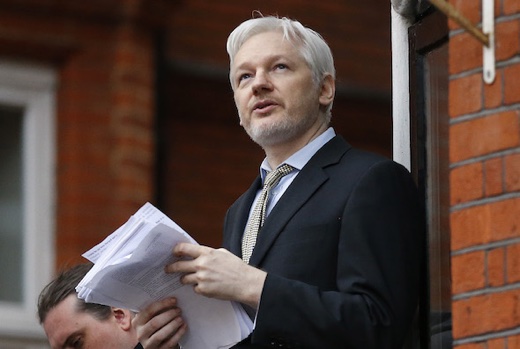
Image above: WikiLeaks founder Julian Assange reads from a U.N. report as he speaks from London’s Ecuadorean Embassy in February. Photo by Frank Augstein. From original article.

Every week the Truthdig editorial staff selects a Truthdigger of the Week, a group or person worthy of recognition for speaking truth to power, breaking the story or blowing the whistle. It is not a lifetime achievement award. Rather, we’re looking for newsmakers whose actions in a given week are worth celebrating.

Should we condemn Julian Assange for his recent interventions in U.S. politics?

The Australian hacker-turned-journalist became an international hero for free speech and government transparency in 2010 when he published through WikiLeaks, an organization he co-founded, a quartet of award-winning disclosures revealing the U.S. military behaving far worse in its wars in Afghanistan and Iraq than it had admitted and U.S. State Department officials speaking frankly about their allies and intentions around the globe.

Under threat of exposure, the Obama administration, led by Hillary Clinton’s State Department, leapt into action, opening a criminal investigation into Assange and pursuing him through its international allies to the Ecuadorean Embassy in London in 2012, where he remains to this day, functionally imprisoned under asylum.

This week, while he was still coordinating his work with others, the Ecuadorean government suspended his internet access.

Now, after publishing searchable databases of thousands of emails over the summer hacked or leaked from the servers of Democratic presidential candidate Hillary Clinton, the Democratic National Committee and Clinton campaign chairman John Podesta (messages that include transcripts of Clinton’s paid speeches to Goldman Sachs and give further substance to allegations of duplicity, disdain for activists and compromising self-interest that have followed her and her circle for more than a decade), Assange is under fresh attack from familiar adversaries representing the establishment and taking hard criticism from erstwhile allies.

Citing rationales that U.S. intelligence agencies have not made available to the public, Clinton and her aides assert—and their media allies uncritically report—that Assange is working with the Russian government to help Donald Trump win the presidency by strategically timing the release of the emails—the authenticity of which the Clinton camp has not denied—to cause maximum damage to her presidential campaign.

Relative newcomers to the critique of Assange are NSA whistleblower Edward Snowden, journalist, author and activist Naomi Klein and Harvard Law professor and civil liberties advocate Lawrence Lessig.

They take issue with the failure of Assange and his colleagues to strip the leaked documents of information that is not essential to the business of informed democracy and which unnecessarily spotlights the personal lives of the people involved.

In a conversation with The Intercept co-founder Glenn Greenwald (who maintains that public interest requires that powerful people, especially officials, forfeit a measure of their privacy), Klein eloquently expressed her concern “about the subjectivity of who gets defined as sufficiently powerful to lose their privacy,” adding that she is “absolutely sure there are plenty of people in the world who believe that you and I are sufficiently powerful to lose our privacy.”

“I’m not comfortable with anybody wielding that much power,” Klein said. “I’m not comfortable when it’s states, but I’m also not comfortable when it’s individuals or institutions.”

As a high-profile role model to journalists and activists for his role in bringing Snowden’s NSA leaks to the public, Greenwald has a special responsibility to protect the ethics that underpin his efforts in public service.

And that means criticizing Assange (whom Greenwald, a trained lawyer, ably defended in the press during WikiLeaks’ initial burst of activity in 2010) when Assange fails to meet his own ethical standards, or those he once claimed and practiced.

In 2010, Greenwald explained, “WikiLeaks, contrary to the way they were being depicted by the U.S. intelligence community and their friends, was not some reckless rogue agent running around sociopathically dumping information on the internet without concern about who might be endangered.

And in fact, if you look at how the biggest WikiLeaks releases were handled early on—the Iraq and Afghanistan war logs, as well as the State Department cables—not only did they redact huge numbers of documents on the grounds that doing so was necessary to protect the welfare of innocent people, they actually requested that the State Department meet with them to help them figure out what kind of information should be withheld on the grounds that it could endanger innocent people.”

But, “[s]omewhere along the way, WikiLeaks and Julian decided, and they’ve said this explicitly, that they changed their mind on that question—they no longer believe in redactions or withholding documents of any kind.”

Similarly, after WikiLeaks released a batch of DNC emails in July, Edward Snowden tweeted:
Democratizing information has never been more vital, and @Wikileaks has helped. But their hostility to even modest curation is a mistake.
Following Assange’s writings in 2010, when he stated that he seeks to tip the balance of power away from powerful institutions and actors by depriving them of the ability to operate behind closed doors without fear of being exposed and terminally and legally reckoned with by the public, Assange, in his work this summer, clearly targeted Clinton, whom he regards as an enemy of the public for championing U.S. hegemony and a personal antagonist for pursuing his prosecution.

“There is clearly a vendetta element going on,” Klein told Greenwald, “which is understandable, because Hillary Clinton is massively responsible for his lack of freedom.” But Klein “is very disturbed by [Assange’s] seeming willingness to burn it down” and “by the ego of seeing this election through one’s personal lens when the stakes are so incredibly high.”

Here’s a question few are asking: Would Assange, who set out to perform the honorable service of exposing government corruption, behave as he does today if he, a single individual with limited resources, had not been relentlessly pursued into the corner of a single room for 5½ years by people atop the most powerful state in civilized history?

And can he, under burden of stress and loss of staff, associations and resources, be expected to fulfill the ethical obligations he once honored and still perform the service of making essential, willfully concealed information public?

History is full of people who undertook to do good and were reshaped for the worse by the opposition they confronted. I’ve heard more than a few of Clinton’s progressive supporters casually justify her record of capitulation in the face of corporate and Republican forces in this way.

Do honesty and decency not require that we regard people, including Clinton and Assange, complexly?

The difference between the two, of course, is that Clinton wields tremendous wealth and state power, whereas at terrific cost to himself, Assange succeeds in performing the essential service of revealing what leaders do in secret in our name.

Because of Assange, we know that Clinton said politicians like her “need both a public and private position” when handling controversial matters, a comment that is as close to an admission of lying as we have heard from an official in recent years, and which should cast into doubt everything she has said or will say to voters.

Clinton’s supporters seem to expect that she’ll wield this trickiness in their interests. We hope they’re right. In the meantime, Julian Assange is our Truthdigger of the Week.

.