Showing posts with label Coal. Show all posts

A Way Down

SUBHEAD: There's a solution to global warming, energy crisis, loss of biosphere and over-population.

By Juan Wilson on 19 April 2020 for IslandBreath.org -
(https://islandbreath.blogspot.com/2020/04/a-way-down.html)


Image above: Up a tree? Your options are waiting to get rescued or climbing down. And I don't hear any sirens approaching. From (https://ui.uncc.edu/story/eastern-cottonwood-native-nc-tree).

My father became a practicing physician around 1950. For a while he had his office in our home in Levittown and did daily house calls and hospital visits. He delivered many babies and watched many people die. My sister, mother and I would hear details of these events at the dinner table.

I remember him using a phrase about dying that was "common knowledge" back then... "Pneumonia was the Old Peoples' Friend". That because if left untreated pneumonia causes  the patient to lapse into a state of reduced consciousness, slipping peacefully away in their sleep, thus giving a peaceful end to a period of often considerable suffering. Some would say an easy way out.

Well, the COVID-19 pandemic is having a two pronged impact on human civilization... basically ending it. It is causing a collapse of the energy, and resource consumption that is driving the destruction of the planet in the support of about seven billion too many people inhabiting the Earth today.

It's a place we have to climb down from... either voluntarily, by plan, or otherwise.

For much of my life my fear has been that the means would be a world-wide nuclear war involving untold thousands of atomic weapons being detonated in an exchange between America, Russia, China etc. Fortunately, that has not happened.

Nuclear armagedon would be much worse than the impact of COVID-19 to people and, more importantly, to all life on Earth.

Even without nuclear war we are on a track to destroy life on Earth. Our insane destruction of the biosphere in search of energy, resources and new places to "develop" have brought us in site of the end of the road for our species.... and many others.

A thinning of the heard is at hand. The reduction in human rapacity provided by the linkage of pandemic and economic collapse has cleared pollution from the skies over China. We could respond to our current predicament by abandoning "Economic Growth" as the "American Way of Life".

We could go back to small farms in local communities as it was before World War One. That was about the time we lost our connection to the land. Remember that 1919 song by Harry Fay, "How are You Going to Keep Them Down on the Farm?"
How you going to keep them down on the farm
After they've seen Paree?
How you going to keep them away from Broadway,
Jazzing around, painting the town?
How you going to keep them away from harm?
That's a mystery.
They'd wish they'd never seen a rake or plow,
So who the heck can parlez-vous a cow,
How you gonna keep them down on the farm,
After they've seen Paree?
Serious urbanization resulted from the coal and oil fueled economies that have flourished in the past century and a half. Since World War Two the mass production in automobiles fueled by cheap oil encouraged the surroundings of cities to be expanded with endless suburbs. Consumption became a stampede.

And here we are.  Sheltering in place and beginning to realize a new normal.

The only way out alive is to a more localized way of life.

It's time to climb down fro our dangerous perch to a changed landscape... to  grow food, make music!


.

BlackRock reveals its Eco-Strategy

SUBHEAD: Investment company plans to fight Climate Change with its new strategy.

By Eoin Higgins on 14 January 2020 for Common Dreams  -
(https://www.commondreams.org/news/2020/01/14/massive-victory-blackrock-ceo-promises-center-climate-change-investment-strategy)


Image above: From ().

In a letter to investors Tuesday, Larry Fink, CEO of money management firm BlackRock, announced the company would prioritize the climate crisis in deciding on investments and strategies going forward—a major victory for the environmental movement.

The new direction for BlackRock, the largest investment firm in the world which manages assets of around $6.96 trillion, is the result of a hard-fought effort by a group of dedicated activists, tweeted 350 Action co-founder Bill McKibben.

"This is a massive victory for a small band of fighters," said McKibben.

"It gives us enormous confidence as we take on the giant banks," he added. "When we start to fight we start to win."
As Common Dreams reported last week, a new campaign called "Stop the Money Pipeline" is aimed at stopping financial support for the fossil fuel industry and has BlackRock as one of its primary targets.

Fink says in his letter to investors that he believes "we are on the edge of a fundamental reshaping of finance."

"The evidence on climate risk is compelling investors to reassess core assumptions about modern finance," Fink wrote.

According to the New York Times:
The firm, he wrote, would also introduce new funds that shun fossil fuel-oriented stocks, move more aggressively to vote against management teams that are not making progress on sustainability, and press companies to disclose plans "for operating under a scenario where the Paris Agreement’s goal of limiting global warming to less than two degrees is fully realized."
Diana Best, senior strategist for the Sunrise Project, said in a statement that Fink's letter was a welcome first step.

"BlackRock beginning its shift of capital out of fossil fuels, including today's divestment of coal in its actively managed funds, is a fantastic start and instantly raises the bar for competitors such as Vanguard and State Street Global Advisors," said Best. "We will be looking for additional leadership from the company in, as Larry Fink put it, 'fundamentally reshaping finance to deal with climate change,' including additional shifts of capital out of fossil fuels."

Sunrise Project is a key player in the BlackRock's Big Problem campaign.

Climate advocates celebrated the letter as a victory for years of activism and protest, but warned that the firm would have to be held accountable for its behavior going forward.

"BlackRock's coal divestment decision is yet another significant blow to the already dying market, yet major banks like Barclays continue to prop up coal-heavy companies," said ShareAction campaign manager Jeanne Martin. "If BlackRock is serious about its commitment to phase out thermal coal, it should use its voting rights to get major coal financiers to do the same."

In a statement, the Sierra Club's campaign representative Ben Cushing said BlackRock's decision was a watershed moment while warning the letter needs to be backed up by immediate and concrete action to divest from dirty investments.

"As the biggest financial institution in the world, BlackRock's announcement today is a major step in the right direction and a testament to the power of public pressure calling for climate action," said Cushing. "But BlackRock will continue to be the world's largest investor in coal, oil, and gas."

"It is time to turn off the money pipeline to dirty fossil fuels for good," Cushing added..

Get off the Grid now!

SUBHEAD: Advice for survivors - Find a place with soil and a source of water. 

By Juan Wilson on 19 August 2018 for Island Breath -
(http://islandbreath.blogspot.com/2018/08/get-of-grid-now.html)


Image above: Living off grid in Hawaii is likely our future. From (https://www.hawaiibusiness.com/off-the-grid-2/).

We got an email from Ed Wagner, on Oahu, this morning. It read:
Aloha Kakou,

Isn't it time for the Hawaii Public Utility Commission to shut down the only coal plant in the state of Hawaii (on Oahu) owned and operated by AES Corporation and move toward geothermal energy and a hydrogen economy ASAP?

Original Business Insider 1912 story about coal predicting future climate change. See (https://www.businessinsider.com/newspaper-in-1912-linked-coal-to-climate-change-2018-8).

The video is at bottom of above story in case you missed it from my last email. The video shows bubbles of methane gas leaking from Alaska lakes and a demonstration of its flammability.
Northern Alaskan lakes are leaking a greenhouse gas that's 84 times more potent than carbon dioxide.
Mahalo,
Ed Wagner
I agree with Ed on closing down the AES coal plant, but strongly object to moving further into producing "grid" energy with geothermal. See Fracking Hawaii by Henry Curtis (http://islandbreath.blogspot.com/2013/01/fracking-hawaii.html) from 1/30/2013.

It is quite possible that fracking at the Kilauea geothermal site may have triggered or exacerbated volcanic activity currently reeking havoc on the Big Island. See Kilauea Volcanic Update (http://islandbreath.blogspot.com/2018/06/kilauea-volcano-update.html) 6/5/18. It is certain that fracking on the mainland has caused earthquakes and other underground disturbances in places where those events are rare or unheard of.

My response to Ed was:
Aloha Ed,

I'd say geothermal is a fracking disaster. 

Yes coal is to be stopped, but so is diesel and biomass grid based "solutions". It's time to get off the grid and out of the cars.
That's where we are going anyway. Might as well have a headstart on our real future.

Juan Wilson
Hawaiians lived on these islands without a power grid or industrialization for over 500 years (see "When did Polynesians settle in Hawaii"). More than that, they thrived without metal or a even written language.

Our modern dependence on industrialization has been an environmental disaster. And more recently our dependence on "high tech" telecommunication, computerization, and electronic record keeping has made us vulnerable to a devastating collapse with even a short discontinuity of the grid.

The long term "solution" for Hawaii is getting off the grid and growing our own food. However, unfortunately, we have overpopulated the islands. Since 1950 the population has tripled from 500k to 1.5 million.

Oahu alone has almost a million people. The outer islands may only be able to absorb a fraction of that number to achieve a sustainable population distribution across the archipelago.

As our resource consuming civilization winds down we will have to make uncomfortable adjustments or suffer worse - catastrophic collapse.

As of now, with our heads buried in the 18 cubic foot fridge looking for a frozen snack while the AC chills the room and the flatscreen cable channel fills the room with false adventure we seem on track to go down with the grid once the fuel tanks are empty.

Advice for survivors: Find a place with soil and a source of water. Know your neighbors; Plant fruit trees; Grow food; Raise hens; Catch fish; Produce some energy; Gather tools; Make things; Trade things. Be happy!

See also:
Ea O Ka Aina: Kilauea Volcano Update 6/5/18
Ea O Ka Aina: Mistakes to avoid going off-grid 1/9/16
Ea O Ka Aina: Failing to live Off-Grid 1/3/16
Ea O Ka Aina: Living off-grid becoming illegal 11/7/15
Ea O Ka Aina: Off Grid living is illegal 1/26/15
Ea O Ka Aina: Kicking the KIUC habit 5/1/14
Ea O Ka Aina: Hawaii utilities fighting customers 1/6/14
Ea O Ka Aina: Off-grid handcrafted life 12/5/13
Ea O Ka Aina: KIUC afraid of residential PV 10/8/13
Ea O Ka Aina: Fracking Hawaii 1/31/13
Ea O Ka Aina: Island Breath is off the Grid 7/6/12
Ea O Ka Aina: Off-Grid Night Lighting 8/14/09
Ea O Ka Aina: Rural, not Suburban, Kauai 4/2/09
Island Breath: Solar Energy - A case study 5/12/04


.

Electric cars don't reduce CO2

SUBHEAD: An inconvenient fact is they mostly use oil, gas and coal to get recharged and also have exotic batteries to be replaced.

By Tyler Durden on 18 August 2017 for Zero Hedge -
(http://www.zerohedge.com/news/2017-08-18/inconvenient-fact-morgan-stanley-says-electric-cars-create-more-co2-they-save)


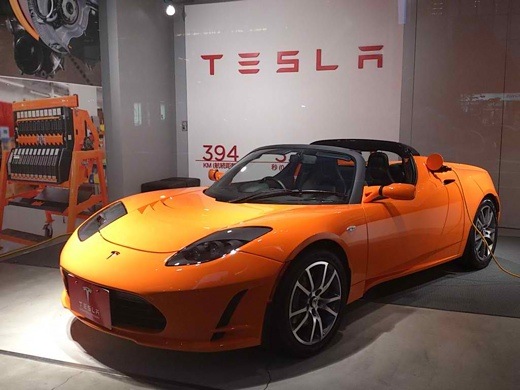
Image above: A Tesla two-seat sports roadster is displayed while it charges at an auto show. From (http://unitedcarsnow.com/2017-tesla-roadster/2017-tesla-roadster-interior/).

For all the funds out there looking to fill their portfolio with "environmentally conscious" companies working diligently to avert an inevitable global warming catastrophe that will result in the extinction of the human race, we guess in lieu of their actual fiduciary duties to simply make money for their investors, Morgan Stanley has compiled a list of how you can get the most 'environmental healing' per dollar invested.

As MarketWatch points out, it's not terribly surprising that of the 39 publicly-traded stocks analyzed, the solar and wind generation companies landed at the very top of Morgan Stanley's environmentally friendly the list.

Morgan Stanley identified 39 stocks that generate at least half their revenue “from the provision of solutions to climate change,” something it said was a central component of investing to make a difference, as opposed to just a making a buck.

“In our view, impact investing needs to begin with companies whose products and services have a notable positive environmental or social impact,” wrote Jessica Alsford, an equity strategist at the investment bank.

Not surprisingly, alternative-energy companies ranked the highest in terms of their positive impact, and the “top five climate-change impact stocks” were all manufacturers of solar and wind energy: Canadian Solar, China High Speed Transmission, GCL-Poly, Daqo New Energy, and Jinko Solar.
What is surprising, however, is that publicly traded electric car manufacturers, darlings of the environmentally-conscious Left, were actually found to generate more CO2 than they save.

As a stark reminder to our left-leaning political elites who created these companies with massive taxpayer funded subsidies, Morgan Stanley points out that while Teslas don't burn gasoline they do have to be charged using electricity generated by coal and other fossil fuels.

This is where Tesla, along with China’s Guoxuan High-Tech fall short.

“Whilst the electric vehicles and lithium batteries manufactured by these two companies do indeed help to reduce direct CO2 emissions from vehicles, electricity is needed to power them,” Morgan Stanley wrote.
“And with their primary markets still largely weighted towards fossil-fuel power (72% in the U.S. and 75% in China) the CO2 emissions from this electricity generation are still material.”
In other words, “the carbon emissions generated by the electricity required for electric vehicles are greater than those saved by cutting out direct vehicle emissions.”

Morgan Stanley calculated that an investment of $1 million in Canadian Solar results in nearly 15,300 metric tons of carbon dioxide being saved every year. For Tesla, such an investment adds nearly one-third of a metric ton of CO2.

.

Buffalo rising from the ashes

SUBHEAD: One of its suburban neighborhoods ends its dependence on coal for energy.

By Eliziabeth McGowen on 11 July 2017 for Grist -
(http://grist.org/justice/a-working-class-buffalo-suburb-retired-a-coal-plant-the-right-way/)


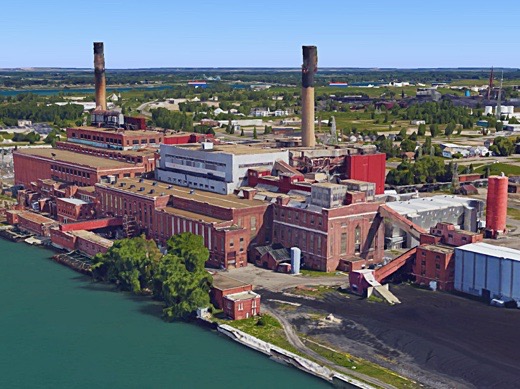
Image above: The retired coal burning Huntley Generating Station on the banks of the Niagara River. From original article.

Sixteen months ago, the coal-fired Huntley Generating Station, which sits on the banks of the Niagara River, stopped producing power for first time since World War I.

Erie County lost its largest air and water polluter. But the town of Tonawanda, a working class Buffalo suburb 13 miles downstream of America’s most storied waterfalls, also lost its biggest taxpayer.

The impact of Huntley’s decade-long slowdown — and finally shutdown — hit this upstate New York community like a punch to the gut.

In just five years, between 2008 and 2012, Huntley’s pre-tax earnings tumbled by $113 million as it operated far below capacity, translating into a combined revenue hit of at least $6.2 million to the town, county, and local school district. That precipitous decline came when state education funds were also shrinking. Belt-tightening wasn’t enough; 140 teachers lost their jobs. Three elementary schools and one middle school closed their doors.

Rebecca Newberry, a 35-year-old former bartender and LGBT-rights activist, saw her home town facing the same fate that has befallen so many other Rust Belt communities that fell on hard times following an industrial exodus. She was determined not to let it happen to the place where she grew up. And she was fortunate enough to find a diverse group of allies who were willing to fight for their survival.

By combining the resources of her nonprofit, the Clean Air Coalition of Western New York, with area labor unions and other community groups, Newberry helped to hatch a plan for Tonawanda’s next chapter — and provide an inclusive, equitable template for other blue-collar towns facing the loss of dirty energy jobs and other polluting industries. (The jargony term for this in advocacy circles is “just transitions.”)

The group that Newberry helped form would come to be known as the Huntley Alliance. The partnership convinced New York lawmakers to provide Tonawanda with a temporary cash infusion to sustain the town as it reinvents its tax base — the first time a state has offered a financial cushion to a community that was financially reliant on a coal-fired power plant.

“It was a trauma when Huntley finally announced it was closing,” Newberry says, “so we had to come at this from a place of healing. Our goal was to stop the bleeding to the industrial and public sectors.

“Always, our key question is: How are we going to take care of our people?”

Team of rivals

Tonawanda, a Native American word meaning swift waters, was founded by white settlers in 1836. East of the railroad tracks that run north from Buffalo to Niagara Falls, the 20-square mile town has nearly 73,000 residents and is known for its top-flight paramedic service.

But west of the tracks, it’s anything but quaint. Huntley and 50-plus industrial facilities coexist within a three-mile radius, mingled with older homes and trailer parks. Big grinding trucks assault the ears, and the air carries a distinct petroleum-rubber-chemical-exhaust stink.

The energy giant NRG purchased Huntley in 1999. Although the oldest current coal-fired unit dates back to 1942, the facility’s steam-generating history stretches back to World War I. NRG retired half of the plant’s 760-megawatt capacity in 2006 and 2007, with a corresponding drop in tax revenue.

In the fall of 2013, Peter Stuhlmiller, president of the Kenmore-Tonawanda Teachers Association, reached out to Richard Lipsitz, president of the local AFL-CIO chapter, to figure out how to save the community’s schools. They were soon joined by Newberry’s coalition, the Sierra Club, and trade unions representing steelworkers and Huntley employees.

“This country has a very poor record of rescuing communities built up around coal and heavy industries,” Lipsitz says. “Our goal was to stabilize the economy and provide income for a town that needed it desperately.”

Although their goal was the same, the various factions in the early Huntley Alliance had different priorities. The united front fell apart when a local Sierra Club member organized a protest calling for Huntley’s closure — with some demonstrators wearing union shirts. Labor leaders felt the rally threatened the livelihoods of the 70-plus remaining NRG employees. Finger-pointing ensued, and the plant’s union walked away from the nascent alliance.

Then the whole effort collapsed.

Newberry’s Clean Air Coalition didn’t join the Big Green’s call for Huntley’s closure — although it harangued other major polluters along the industrial waterfront during its decade of existence. The group’s leaders saw no need: The coal plant’s obsolescence seemed imminent with cheap natural gas flooding U.S. markets.

To motivate the Huntley Alliance to regroup, Newberry circulated preliminary results of a study her 200-member nonprofit commissioned. “Given that the plant is located in a region with substantial excess capacity for at least the next decade, the Huntley units appear ripe for retirement,” the Institute for Energy Economics and Financial Analysis concluded in a 24-page report released in January 2014.

That sobering prediction did the trick, ending the alliance’s six-month hiatus. Newberry — who ascended to the top job at the Clean Air Coalition in 2015, four years after being hired — insisted that workers couldn’t be left behind. It became the group’s guiding principle and managed to hold together unlikely allies. Teachers rubbed shoulders with steelworkers and teamsters. Male-dominated trade unions listened to women’s ideas. Labor and Big Green found common ground.

“Going through this helps me to visualize that we can do better as a society,” Newberry says. “We don’t always have to be fighting with one another.”

At least 1,500 members of the steelworkers union live in the Tonawanda area, many drawing paychecks at employers such as Tonawanda Coke, 3M, DuPont, and Sumitomo Rubber. They backed the alliance’s focus on job retention and creation, because they feared property taxes would spike after Huntley’s shutdown — to make up for lost revenues from the plant. That could spook existing employers and repel potential newcomers.

“We want to make sure there are good, clean, high-road, family-sustaining jobs that improve the quality of life,” says Dave Wasiura, the union’s organizing coordinator for the area.

Retired teacher Diana Strablow, a member of both the Sierra Club and Newberry’s group, was initially frustrated that the dangers of climate change sparked by coal-fired power plants weren’t the alliance’s number one priority. But Newberry helped her understand how a stumble by Huntley could mean a fall for her entire community.

“I was the angry environmentalist,” Strablow says. “I’ve learned we need to take care of both our workers and our environment.”

Don’t ask. Tell.

Once reunited, the Huntley Alliance needed clear goals — specifically ones that met the needs of the town’s residents. Through a series of listening sessions, door-to-door surveys, and voter-registration drives, the partnership channeled the hopes and anxieties of hundreds of residents. The wish list that emerged included keeping schools intact, creating good-paying jobs, expanding the tax base, and improving public health and the environment.

Those desires would be compiled with proposals and needs of businesses and other stakeholders into Tonawanda Tomorrow, a succinct blueprint for the town’s trajectory. A final version was released in June.

It was a tall order, so the alliance set about lobbying New York state legislators for “gap funds” to keep the town afloat during its transformation. After all, Newberry reasoned, Huntley had supplied electricity far beyond Tonawanda’s borders. Rather than asking lawmakers to find money for them, Newberry and her colleagues combed through the state’s budget themselves and compiled a list of potential funding pots to draw from.

By August 2015, when NRG announced Huntley’s impending retirement, a Democrat-majority State Assembly and a Republican-controlled Senate had already voted to back the alliance’s brainchild. When the 102-acre power plant went offline seven months later, the framework was in place for $30 million.

Cynthia Winland, a planning specialist at Chicago’s Delta Institute, praised New York legislators for being brave enough to act on Tonawanda’s financial request. Her sustainable solutions nonprofit helped assemble the town’s blueprint.

“If a state as geographically, politically, and economically complicated as New York is capable of this,” Winland says, “then other states can look for parallels.”

This spring, legislators expanded the Huntley-inspired measure — in part due to Governor Andrew Cuomo’s announcement last year that New York would strive to be coal-free by 2020. The gap fund’s budget ballooned from $30 million to $45 million, its availability was extended from five to seven years. (It now covers communities with plants powered by any fuel source.)

The initial funding makes Tonawanda’s post-Huntley metamorphosis viable, Newberry says, adding that the two-year extension “gives us the extra breathing room we will need.”

The fund so far has shored-up the school system — which is no longer hemorrhaging teachers — stopped electricity bills from skyrocketing, and kept the budget for the prized paramedic unit intact.

David Schlissel, a coauthor of the 2014 report questioning the Huntley Generating Station’s viability, emphasized that the alliance’s proactive approach and the New York legislature’s response offer a vital lesson for the rest of the country.

“Instead of spending millions on propping up coal plants,” Schlissel says, “we need to spend money to help communities make an economic transition.”

The Huntley Alliance took its cues from other communities forced to evolve beyond heavy industry. Members traveled as close as Appalachia and as far as Germany, where they were amazed to witness how the German government funded worker retraining programs and recycled old production plants, as renewables supplanted fossil fuels.

“That gave us hope that a cleaner environment can be achieved in Tonawanda without leaving broken workers behind,” Newberry says.

Back home, the alliance’s efforts also benefitted from a $160,000 grant from an Obama administration initiative to help communities distressed by the demise of coal. President Trump proposed defunding the program in his 2018 budget.

Not another Bethlehem Steel

Even with all the planning, the Huntley station’s idle smokestacks cause jitters among Tonawandans who have watched the 1,000-acre Bethlehem Steel plant idle in Lackawanna, 20 miles to the south, for three and a half decades. References to the hulking carcass send shivers down the spine of Tonawanda Town Supervisor Joseph Emminger.

“We are not going to have another Bethlehem Steel here,” he declares.

County and town planners view the reinvention of the Huntley site as a vital part of transforming 2,300-plus brownfield acres into greener ventures. Recent cleanups have allowed existing companies, such as Sumitomo Rubber, to expand and invited in newer industries, such as solar technology and warehousing operations.

“It’s a 20-year-long, step-by-step process,” says Erie County Director of Business Assistance Ken Swanekamp. “We’re doing it one project at a time.”


.

Coal and nuclear are uneconomic

SUBHEAD: High levels of wind penetration can be integrated into the grid without harming reliability.

By Joe Romm on 17 July 2017 for Think Progress -
(https://thinkprogress.org/draft-doe-study-bombshell-9221a62afefd)


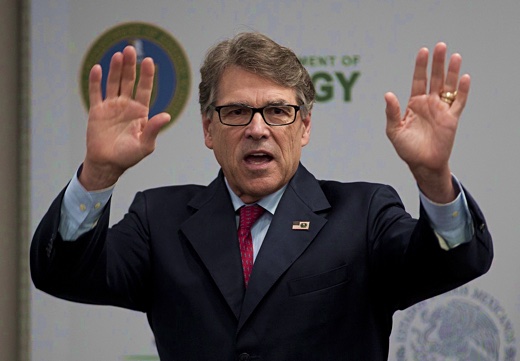
Image above: Energy Secretary Rick Perry holds his hands up as if at gunpoint. Photo by Eduardo Verdugo. From original article.

On Saturday, we reported that a leaked draft of Energy Secretary Rick Perry’s grid study obtained by Bloomberg debunks his attack on renewable energy.

ThinkProgress has now obtained a copy of that draft, and it has many more surprises — or, rather, findings that are fairly well known to energy experts but may come as an unpleasant surprise to Perry and the White House. For instance, a large fraction of America’s aging fleet of coal and nuclear plants are simply not economic to operate anymore.

The July draft, which ThinkProgress received from multiple sources, is here, so the public will be able to compare the final “politically-approved” version with the draft prepared by Department of Energy (DOE) staff. It is widely feared Perry’s team of Trump appointees will simply erase the the study’s inconvenient truths before it final report is released to the public.

The release of the study has been delayed several weeks — and the findings in the draft might explain why. The study was specifically requested to back up Perry’s claims that EPA regulations, along with renewable power sources like solar and wind power, were undermining the U.S. electric grid’s reliability by forcing the premature closure of “baseload” (24–7) power sources like coal and nuclear.

But the leaked July draft concludes the grid is as reliable than ever.

As for baseload plant retirements, factors like environmental regulations and renewable energy subsidies “played minor roles compared to the long-standing drop in electricity demand relative to previous expectation and years of low electric prices driven by high natural gas availability.”

The draft report finds that since 2002, “most baseload power plant retirements have been the victims of overcapacity and relatively high operating cost but often reflect the advanced age of the retiring plants.”

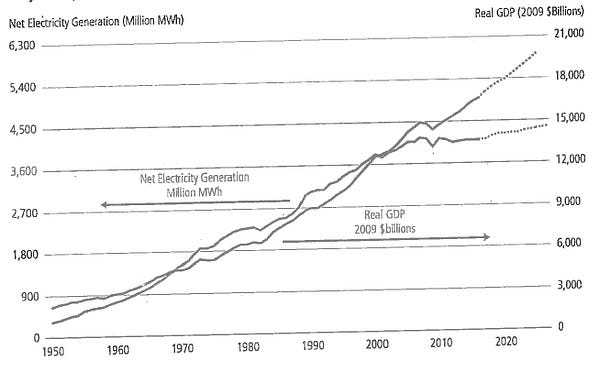
Overcapacity is a major cause of the turmoil in electricity markets. The report explains that because the grown in electricity demand has flattened since 2008, it is harder for “less competitive plants” to survive.

Between 1970 and 2005, “total US electricity generation grew steadily at a compound annual growth rate (CAGR) of 2.7 percent.” But since then, the rate has fallen to 0.05 percent — “even as the nation’s gross domestic product grew by 1.3 percent per year over the same period” (see chart), the draft report says.

 
CREDIT: July draft of DOE grid report

It’s increasingly clear that, for the foreseeable future, gas prices will stay low, demand growth will stay lower (thanks in large part to energy efficiency), and renewables will keep getting cheaper.

And it doesn’t make sense to keep an uneconomic plant running when you know it’s going to keep losing money.

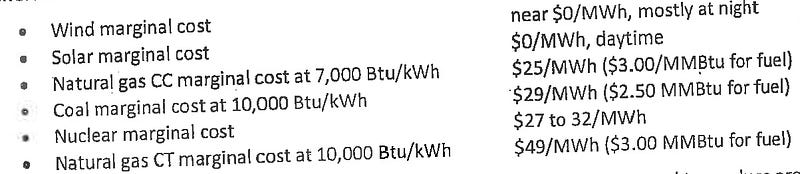
In the case of nuclear power, the study notes that vast majority of the plant closure announcements blame plant retirement on “unfavorable market conditions.” And the “most unfavorable condition is that the marginal cost of generation for many nuclear plants is higher than the cost of most other generators in the market.”

 
Marginal cost estimates for major U.S. generators. Combined cycle (CC) gas plants are very efficient whereas combustion turbine (CT) plants are inefficient, but cheaper to build. 
CREDIT: Draft DOE report

The bottom line is that “as long as natural gas prices stay down and there is an oversupply of energy in many hours of the day and year [because of zero-marginal-cost renewable power] the typical nuclear plant will lose money on every kWh produced, and not be able to make it up on volume.”

As an aside, if existing nuclear power plants are unprofitable, it should be pretty obvious that building a new nuclear power plant, which costs many billions of dollars — makes no economic sense at all.

Similarly, coal is also hurt by its high marginal cost: “[Coal] plants that have retired are old and inefficient units that were not recovering their operations and fuel costs, much less capital cost recovery.”

Uneconomic coal plants are run less often. The DOE draft reports that a detailed analysis found “about 70 percent of the [coal] plants that have retired between 2010 and 2016 had a capacity factor of less than 50 percent in the year prior to retirement.” That is, averaged over the whole year, they were running at half of their full power rating.

The DOE staff also explain that not only is the reliability of grid continuing to improve even as we add more and more renewables, but “High levels of wind penetration can be integrated into the grid without harming reliability.” And since renewables keep dropping in price, we can expect more and more penetration.

It’s really no surprise that DOE staff would conclude renewables are not threatening grid reliability. After all, many countries around the world, such as Germany, have integrated far higher percentages of solar and wind than we have, while maintaining high reliability.

The only surprise remaining is how many of these findings Trump’s political appointees will erase.
.

Renewable Energy Controversy

SUBHEAD: The debate is can wind, solar, and hydro fully power the U.S.? Both sides are wrong.

By Richard Heinberg on 11 July 2017 for Post Carbon Institute-
(http://www.postcarbon.org/controversy-explodes-over-renewable-energy/)


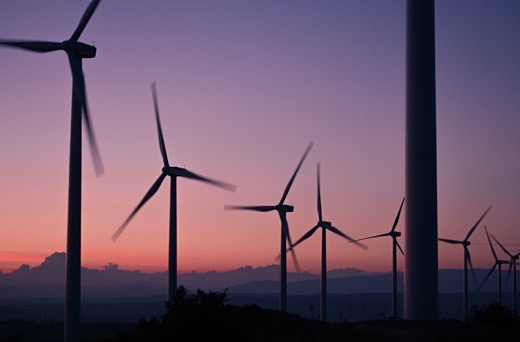
Image above: Wind generator array producing power at dusk. From original article.

[IB Publisher's note: The energy opportunities we have now will not last much longer. We need to be making good choices for our future. However, it's our opinion that Americans will use whatever is at hand for energy wherever they may be. We will use oil/gas until its gone. In some places still forested we will burn wood. In appropriate locations we will use water power. People will dig coal from the remains of dormant mines. Nuclear plants will degrade and leak but continue to operate. It will be quite a bit of last gasp pollution. The more renewable alternative energy we can get in place before we are no longer able to do so, the better off we'll be.]

The stakes in this controversy are high enough that the New York Times and other mainstream media have reported on it. One pro-renewables scientist friend of mine despairs not just because of bad press about solar and wind power, but also because the reputation of science itself is taking a beating.

If these renowned energy experts can’t agree on whether solar and wind power are capable of powering the future, then what are the implications for the credibility of climate science?

Jacobson and colleagues have published what can only be called a take-no-prisoners rebuttal to Clack et al. In it, they declare that, “The premise and all error claims by Clack et al. . . . about Jacobson et al. . . . are demonstrably false.” In a separate article, Jacobson has dismissed Clack and his co-authors as “nuclear and fossil fuel supporters,” though it’s clear that neither side in this debate is anti-renewables.

However, Clack et al. have issued their own line-by-line response to Jacobson’s line-by-line rebuttal, and it’s fairly devastating.

This is probably a good place to point out that David Fridley, staff scientist in the energy analysis program at Lawrence Berkeley National Laboratories, and I recently published a book, Our Renewable Future, exploring a hypothetical transition to a 100 percent wind-and-solar energy economy.

While we don’t say so in the book, we were compelled to write it partly because of our misgivings about Mark Jacobson’s widely publicized plans. We did not attack those plans directly, as Clack et al. have done, but sought instead to provide a more nuanced and realistic view of what a transition to all-renewable energy would involve.

Our exploration of the subject revealed that source intermittency is indeed a serious problem, and solving it becomes more expensive and technically challenging as solar-wind generation approaches 100 percent of all electricity produced.

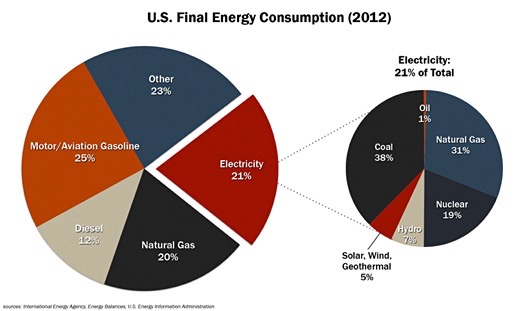
A further challenge is that solar and wind yield electricity, but 80 percent of final energy is currently used in other forms—mostly as liquid and gaseous fuels.

Therefore the energy transition will entail enormous changes in the ways we use energy, and some of those changes will be technically difficult and expensive.


Image above: Chart of energy consumption sources in 2012. Only a tiny percentage of one sector, electricity generation,  shows as much as 5% contribution of solar, wind and geothermal combined. Sources - International Energy Agency, US Energy Information Administration. From original article.

Our core realization was that scale is the biggest transition hurdle. This has implications that both Jacobson et al., and Clack et al. largely ignore. Jacobson’s plan, for example, envisions building 100,000 times more hydrogen production capacity than exists today.

And the plan’s assumed hydro expansion would require 100 times the flow of the Mississippi River. If, instead, the United States were to aim for an energy system, say, a tenth the size of its current one, then the transition would be far easier to fund and design.

When we start our transition planning by assuming that future Americans will use as much energy as we do now (or even more of it in the case of economic growth), then we have set up conditions that are nearly impossible to design for. And crucially, that conclusion still holds if we add nuclear power (which is expensive and risky) or fossil fuels (which are rapidly depleting) to the mix.

The only realistic energy future that David Fridley and I were able to envision is one in which people in currently industrialized countries use far less energy per capita, use it much more efficiently, and use it when it’s available rather than demanding 24/7/365 energy services.

That would mean not doing a lot of things we are currently doing (e.g., traveling in commercial aircraft), doing them on a much smaller scale (e.g., getting used to living in smaller spaces and buying fewer consumer products—and ones built to be endlessly repaired), or doing them very differently (e.g., constructing buildings and roads with local natural materials).

If powerdown—that is, focusing at least as much on the demand side of the energy equation as on the supply side—were combined with a deliberate and humanely guided policy of population decline, there would be abundant beneficial side effects. The climate change crisis would be far easier to tackle, as would ongoing loss of biodiversity and the depletion of resources such as fresh water, topsoil, and minerals.

Jacobson has not embraced a powerdown pathway, possibly because he assumes it would not appeal to film stars and politicians. Clack et al. do not discuss it either, mostly because their task at hand is simply to demolish Jacobson.

But powerdown, the pathway about which it is seemingly not permissible for serious people to speak, is what we should all be talking about. That’s because it is the most realistic way to get to a sustainable, happy future.

.

Renewable Revolution

SUBHEAD: Renewables to capture 3/4 of the $10 trillion world spends on new generation through 2040.

By Joe Romm on 15 June 2017 for Think Progress -
(https://thinkprogress.org/renewables-projected-to-crush-fossil-fuels-f6670e3792df)


Image above: Last year, solar in Chile saw lowest global price for unsubsidized electricity by any technology. Source Bloomberg New Energy Finance. Credit BNEF New Energy Outlook 2017. From original article.

The staggering drop in the cost of clean energy has already upended the global power market over the past two decades — and that trend will only continue for the next two decades, according to new analysis from Bloomberg New Energy Finance (BNEF).

As a result, renewables will capture the lion’s share of the $10.2 trillion the world will invest in new power generation by 2040, BNEF projects in its annual New Energy Outlook 2017 report.

http://www.islandbreath.org/2017Year/06/170622chart1big.jpg
Image above: Charts of Investment by Technology 2017-2040. Source: Bllomberg New energy Finance. Credit: BNEF New Energy Outlook 2017 From original article. Click to enlarge.


Despite years of plummeting prices for renewables, BNEF projects that over the next two decades, the cost of solar power will still drop another two-thirds, onshore wind costs will be cut nearly in half, and offshore wind costs will drop a stunning 71 percent.

Here’s how this will profoundly transform power markets in the years ahead:
  • By 2023, solar and onshore wind will be competitive with new U.S. gas plants.
  • By 2028, solar will beat existing gas generation.
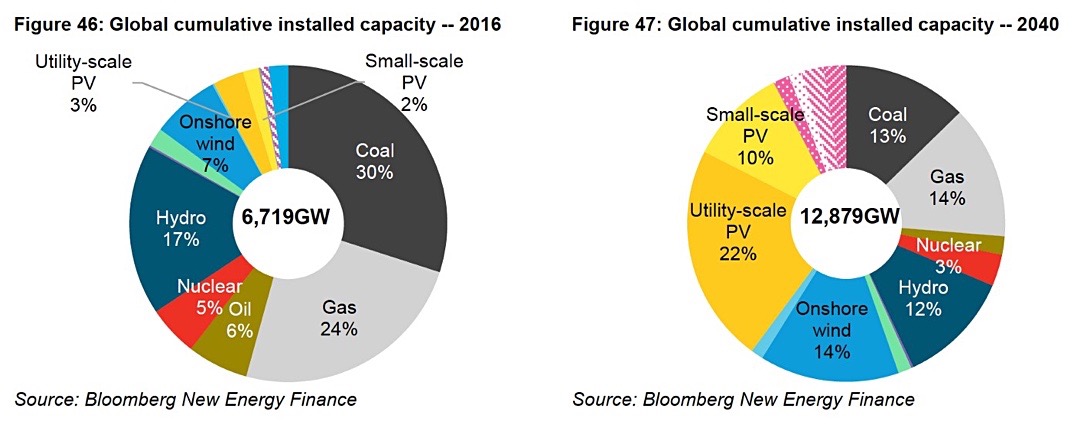
  • Solar and wind will make up nearly a half of installed capacity and over a third of global power generation by 2040. That’s a four-fold jump in wind capacity and a 14-fold jump in solar from today.
http://www.islandbreath.org/2017Year/06/170622chart2big.jpg
Image above: Charts of global cumulative installed capacity 2016 and 2040. Source: Bloomberg New energy Finance. Credit: BNEF New Energy Outlook 2017 From original article.


Deep penetration of renewables will be assisted by continued price drops in lithium-ion batteries and explosive growth in electric cars: “This will help renewable energy reach 74 percent penetration in Germany, 38 percent in the U.S., 55 percent in China, and 49 percent in India by 2040.”

BNEF concludes that despite President Donald Trump’s vocal support for the coal industry, “economic realities over the next two decades” work against it, and U.S. coal power generation is “forecast to see a 51 percent reduction in generation by 2040.”

Here’s another key conclusion: “Gas is a transition fuel, but not in the way most people think.” Other than in the Americas, where cheap gas is plentiful, gas plants won’t act as a replacement for “baseload coal,” but will “increasingly act as one of the flexible technologies needed to help meet peaks and provide system stability in an age of rising renewable generation,” BNEF predicts.

With total renewable investment over the next two decades projected to be $7.2 trillion versus $1.5 trillion for fossil fuel power, it’s clear where the biggest high wage job growth will come from.

.

Musktopia here we come!

SUBHEAD:  How delusional USA is these days that Elon Musk of Tesla and Space X is taken seriously. 

By James Kunstler on 3 April 2017 for Kunstler.com -
(http://kunstler.com/clusterfuck-nation/musktopia-here-we-come/)


Image above: Elon Musk sits for photo-op in one of his Tesla battery operated cars in a 2013 autoshow. From (http://oppositelock.kinja.com/tesla-posts-surprise-profit-1058185106).

It ought to be sign of just how delusional the nation is these days that Elon Musk of Tesla and Space X is taken seriously.

Musk continues to dangle his fantasy of travel to Mars before a country that can barely get its shit together on Planet Earth, and the Tesla car represents one of the main reasons for it — namely, that we’ll do anything to preserve, maintain, and defend our addiction to incessant and pointless motoring (and nothing to devise a saner living arrangement).

Even people with Ivy League educations believe that the electric car is a “solution” to our basic economic quandary, which is to keep all the accessories and furnishings of suburbia running at all costs in the face of problems with fossil fuels, especially climate change.

First, understand how the Tesla car and electric motoring are bound up in our culture of virtue signaling, the main motivational feature of political correctness. Virtue signaling is a status acquisition racket.

In this case, you get social brownie points for indicating that you’re on-board with “clean energy,” you’re “green,” “an environmentalist,” “Earth –friendly.” Ordinary schmoes can drive a Prius for their brownie points. But the Tesla driver gets all that and much more: the envy of the Prius drivers!

This is all horse shit, of course, because there’s nothing green or Earth-friendly about Tesla cars, or electric cars in general. Evidently, many Americans think these cars run on batteries.

No they don’t. Not really.

The battery is just a storage unit for electricity that comes from power plants that burn something, or from hydroelectric installations like Hoover Dam, with its problems of declining reservoir levels and aging re-bar concrete construction.

A lot of what gets burned for electric power is coal. Connect the dots. Also consider the embedded energy that it takes to just manufacture the cars. That had to come from somewhere, too.

The Silicon Valley executive who drives a Tesla gets to feel good about him/her/zheself without doing anything to change him/her/zhe’s way of life. All it requires is the $101,500 entry price for the cheapest model. For many Silicon Valley execs, this might be walking-around money. For the masses of Flyover Deplorables that’s just another impossible dream in a growing list of dissolving comforts and conveniences.

In fact, the mass motoring paradigm in the USA is already failing not on the basis of what kind of fuel the car runs on but on the financing end. Americans are used to buying cars on installment loans and, as the middle class implosion continues, there are fewer and fewer Americans who qualify to borrow.

The regular car industry (gasoline branch) has been trying to work around this reality for years by enabling sketchier loans for ever-sketchier customers — like, seven years for a used car. The borrower in such a deal is sure to be “underwater” with collateral (the car) that is close to worthless well before the loan can be extinguished.

We’re beginning to see the fruits of this racket just now, as these longer-termed loans start to age out. On top of that, a lot of these janky loans were bundled into tradable securities just like the janky mortgage loans that set off the banking fiasco of 2008. Wait for that to blow.

What much of America refuses to consider in the face of all this is that there’s another way to inhabit the landscape: walkable neighborhoods, towns, and cities with some kind of public transit.

Some Millennials gravitate to places designed along these lines because they grew up in the ‘burbs and they know full well the social nullity induced there. But the rest of America is still committed to the greatest misallocation of resources in the history of the world: suburban living.

And tragically, of course, we’re kind of stuck with all that “infrastructure” for daily life. It’s already built out! Part of Donald Trump’s appeal was his promise to keep its furnishings in working order.

All of this remains to be sorted out. The political disorder currently roiling America is there because the contradictions in our national life have become so starkly obvious, and the first thing to crack is the political consensus that allows business-as-usual to keep chugging along.

The political turmoil will only accelerate the accompanying economic turmoil that drives it in a self-reinforcing feedback loop.

That dynamic has a long way to go before any of these issues resolved satisfactorily.

.

Dumb and Dumber

SUBHEAD: Coal-loving Wyoming legislators are pushing a bill to outlaw wind and solar.

By Katie Herzog on 14 January 2017 for Grist -
(http://grist.org/briefly/coal-loving-wyoming-legislators-are-pushing-a-bill-to-outlaw-wind-and-solar/)


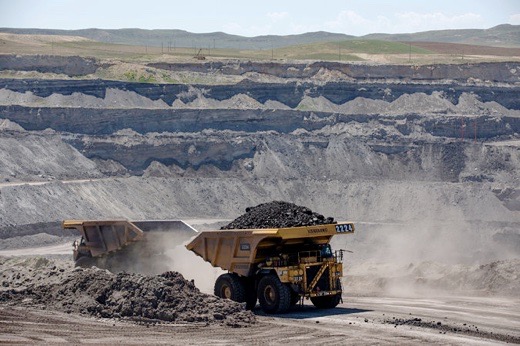
Image above: The Eagle Butte coal mine outside Gillette, Wyoming is operated by Alpha Coal West Inc. and is one of about a dozen mines in the Gillette area. From (https://www.nytimes.com/2016/06/20/us/as-wind-power-lifts-wyomings-fortunes-coal-miners-are-left-in-the-dust.html).

On the first day of the state’s legislative session, nine Republican lawmakers filed legislation that would bar utilities from using electricity produced by large-scale renewable energy projects.

The bill, whose sponsors are primarily from the state’s top coal-producing counties, would require utilities to use only approved energy sources like coal, natural gas, nuclear power, hydroelectric, and oil.

While individual homeowners and small businesses could still use rooftop solar or backyard wind, utilities would face steep fines if they served up clean energy.

Wyoming is the nation’s largest producer of coal, and gets nearly 90 percent of its electricity from coal, but it also has huge, largely untapped wind potential.

Currently, one of the nation’s largest wind farms is under construction there, but most of the energy will be sold outside Wyoming. Under this bill, such out-of-state sales could continue, yet the measure would nonetheless have a dampening effect on the state’s nascent renewable energy industry.

Experts are skeptical that the bill will pass, even in dark-red Wyoming, InsideClimate News reports. One of the sponsors, Rep. Scott Clem, is a flat-out climate change denier whose website showcases a video arguing that burning fossil fuels has improved the environment.


.

Trump in Post Ecological Age

SUBHEAD: Those who fret about Trump's climate and environmental policies have reason to be concerned.

By Kurt Cobb on 14 November 2016 for Resource Insights -
(http://resourceinsights.blogspot.com/2016/11/trump-americas-pilot-in-chief-in-post.html)


Image above: Presidential candidate Trump hearing coal miner's hat at rally. From (http://www.politico.com/story/2016/11/conservatives-vs-trumps-infrastructure-plan-231221).

Many Americans are frightened by the idea of Donald Trump as the country's new pilot-in-chief, fearing he'll crash the airliner of state (including climate and environmental policies) into a mountain or the ground.

 Clinton, they argued, for all her flaws, knows how to fly this thing called a country using the federal government and at least won't end up crashing it.

But my metaphor assumes that every American believes he or she is on the same plane. And, that understanding is what seems to have clouded the minds of so many when thinking about the U.S. presidential campaign this year.

For those living in America's small towns and rural areas and for those in the downwardly mobile working class, their plane has already crashed!

These groups are now dazed and wandering around in the wreckage trying to figure out how to live from day to day. It is no wonder that such voters were immune to cries that Trump would crash the country. The business-as-usual globalism that they believed Hillary Clinton represented seemed to them like it would only make things worse.

Both Donald Trump and Democratic primary contender Bernie Sanders told these disaffected groups that a big part of the reason their communities and livelihoods crashed was a set of trade agreements that essentially shipped their jobs overseas. That made sense to them, and for a time they had two competing champions. But only Donald Trump made it to the general election.

Having already seen their lives and livelihoods crash, those disaffected Americans who voted for Trump did so with more than a little glee in the hope that the specially outfitted luxury airliner America's elite flies would crash as well.

I think many of these voters were aware of the irony of voting for someone as their champion who really does fly around in his own private luxury airliner. But, they had simply had enough of establishment candidates and wanted to send a message. They certainly got everyone's attention when Trump won.

(As I've written before, Trump attracted most of the traditional Republican voters--business-oriented voters, social conservatives, and libertarians. What tipped the balance were the excess votes coming from those who might have voted for Sanders had he been the Democratic nominee.)

Whether Trump can or will actually fulfill promises made to those who supported him is unknown. The news out of Washington last week does not bode well for such an outcome as
  1.  Conservatives downplay new infrastructure spending that would help create the jobs Trump promised,
  2. Chamber of Commerce Republicans could balk at his levying a 45 percent tariff on Chinese goods that is supposed to protect American workers and 3) Trump considers John Bolton for secretary of state, a man who would certainly try to derail a warming of relations with Russia favored by Trump.
Trump may also face Republican attempts to impeach him to make way for establishment Republican Vice President Mike Pence to become president. Even conservative New York Times columnist David Brooks couldn't resist hinting at the possibility in a recent column.

Given the coverage of Trump to date, it doesn't seem far-fetched that a determined Republican Congress could build a case against him.

The shock of Trump's victory has been likened to the shock the world felt when British voters narrowly chose to leave the European Union, a move dubbed "Brexit." I detailed then the energy part of the Brexit equation suggesting that Great Britain's declining oil and gas production from the North Sea since 2004 had undermined the prosperity of the country--except for the financial class mostly located in and around London, a major world financial center.

I noted that stagnant wages were a common theme both in Britain and the United States and suggested a link with the high worldwide price of oil from 2010 through most of 2014.

I also noted in another piece that both major U.S. presidential candidates--while differing on environmental issues such as climate change--embraced speeding up economic growth.

My conclusion in this much older piece is that what U.S. political parties differ on ecologically speaking is not whether we should protect the long-term habitability of the biosphere for humans, but rather at what pace we should undermine that habitability for short-term gains, both political and economic.

This is what I mean when I say we have a pre-ecological politics in a post-ecological age.

The sciences tells us quite grimly what the prognosis is for the climate, the oceans, the rivers, the soil, the forests, and the myriad other species that share the planet with us, but we do not understand. Most of us cling to the what I call the modern myth, the premises of which I'll repeat here:
  1. Humans are in one category and nature is in another.
  2. Scale doesn't matter.
  3. History can be safely ignored since modern society has seen through the delusions of the past.
  4. Science is a unified, coherent field that explains the rational principles by which we can manage the physical world.
Those who fret about Trump's climate and environmental policies have reason to be concerned. But, in truth, our trajectory with Clinton would only be somewhat less injurious to the biosphere--though it might have upheld other values such as the importance of maintaining the natural beauty of some public lands. (We should also not overestimate what one person, even the president of the United States, can do good or bad regarding such matters.)

This is not to dismiss the Paris climate agreement from which Trump has pledged to withdraw the United States. The agreement was an important watershed moment in which the world was united at least in saying that climate change was real and an urgent priority. But what we need to do to address climate change goes far beyond what that agreement contains.

Our larger problem is that our political discourse remains pre-ecological. Changing that discourse won't happen just because another party takes the White House in four years.

• Kurt Cobb is an author, speaker, and columnist focusing on energy and the environment. He is a regular contributor to the Energy Voices section of The Christian Science Monitor and author of the peak-oil-themed novel Prelude.

.

For Old Order, and Earth, the jig is up

SUBHEAD: The existing Wall Street/Washington establishment has been repudiated and ended. 

By David Stockman on 9 November 2016 for Zero Hedge -
(http://www.zerohedge.com/news/2016-11-09/david-stockman-jig-america%E2%80%99s-voters-just-fired-their-ruling-elites)


Image above: Painting of scene of French Revolution at Musee Carnavalet titled 'Prise Du Louvre' by Jean Louis Bezard 1833. From (https://edu.hstry.co/timeline/the-french-revolution-b992).

[IB Publisher's note: Word is that Rudy Giuliani, Newt Gingrich, Chris Chrisie and Sarah Palin are up for Cabibet posts and the Keystone XL and Dakota Access Pipelines as well as 'Clean Coal' are getting the Green Light under the Trump Administration.]

America’s voters fired their ruling elites last night. After 30 years of arrogant misrule and wantonly planting the seeds of economic and financial ruin throughout Flyover America, the Wall Street/Washington establishment and its mainstream media tools have been repudiated like never before in modern history.

During the course of the past year, upwards of 70 million citizens—–59 million for Trump and 13 million for Bernie Sanders—-have voted for dramatic change. That is, for an end to pointless and failed wars and interventions abroad and a bubble-based economic policy at home.

The latter showered Wall Street and the bicoastal elites with vast financial windfalls—-even as it left 90% of Flyover America behind, where households struggled with stagnant wages, vanishing jobs, soaring health costs, shrinking living standards and diminishing hope for the future.

The voters also said in no uncertain terms that they are fed-up with a “rigged” system that has one set of rules for establishment insiders and another for everyone else. In essence, that’s what servergate, the Clinton Foundation pay-to-play scandals and the trove of Wikileaks DNC/Podesta hacks was all about.

Indeed, in his brawling style, the Donald in effect convinced a huge slice of the electorate that the Clintons amounted to America’s leading crime family. And while he may have exaggerated the extent of their personal crimes and misdemeanors, the latter functioned as a proxy for the beltway racketeering that has become the modus operandi of the Imperial City.
Stated differently, the people did connect the dots. There is a straight line from repeal of Glass-Steagall by the Rubin-Clinton democrats in the late 1990s through the resounding repudiations of the Clintons last night. This string includes:
  • The M&A roll-up of the giant Wall Street banks after 1998
  • The subprime mortgage scams, housing booms and subsequent crash during the next decade
  • The panicked multi-trillion bailouts of the Wall Street gambling houses in the fall of 2008 and the lunatic spree of central bank money pumping that followed
  • The soaring stock market fueled by the Fed’s free money that arose therefrom
  • The egregious global fund-raising and shakedowns of the Clinton Foundation 
  • Personal wealth accumulations by the Clinton’s personally, capped by Hillary’s notorious $250,000 off-the-record speeches to Goldman Sachs.
What happened was that during the eight Obama years, Washington essentially borrowed $10 trillion, or nearly as much as the first 43 presidents did over 220 years, while the Fed expanded its balance sheet by 5X more than had happened during its first 94 years of existence.

This feckless resort to monumental public borrowing and money printing did generate a faux prosperity in the Imperial City and a $25 trillion gain in financial wealth among the gambling and financial asset owing classes at the top of the economic ladder.

But the bicoastal elites in Washington, Wall Street and Silicon Valley and its environs, luxuriating in their good fortune, essentially assumed that all was fixed and all was forgotten from the dark days of the financial crisis.

Not at all. The rubes remembered. No one in America supported the Wall Street bailouts except a few ten-thousands Wall Street operators, hedge funds and other gamblers; and the politicians and Keynesian policy apparatchiks who saw it as a new route to power and spoils.

What happened last election night —especially in the rust belt precincts where 70,000 factories have already closed and 6 million breadwinner jobs have disappeared – was nothing less than the third vote on TARP.

Whereas the cowardly House GOP had capitulated to Wall Street and their spineless leaders on the second vote in late September 2008, the rank and file voters of Flyover America last night proclaimed  loudly that it had not been done with their leave. Not at all.

The resentments and anger on main street has not only been simmering for years; its inhabitants have also figured out that it was on their backs that Wall Street was rehabilitated and then inflated to hideous valuations that bear no relationship to the faltering economy of main street.

Indeed, after getting a bailout they hated, main street then got a rogue central bank run by clueless Keynesian academics who deliberately and callously savaged savers and retirees; and also tried purposefully to trash worker wages with even more inflation than what was already destroying their jobs and shrinking the purchasing power of their paychecks.

We are now more convinced than ever that 2% inflation targeting is the greatest governmental assault on the working classes known to modern history.

And the working classes of Flyover America—-whose jobs are most exposed to the China Price on goods and the India Price on services—-finally said they are not going to take it any longer.

That’s a start, but it’s way too late for orderly reform and incremental change. The essence of last night’s thunderbolt— Brexit 2.0 on steroids — is that the ruinous rule of the existing Wall Street/Washington  establishment has been repudiated and ended.

But there is nothing to replace it. Donald Trump has no coherent program at all—-just a talent for name-checking the symptoms and rubbing them raw.

So as I said on Fox Business last night at about 11:30 PM, when I called the election for Trump long before the networks could bring themselves to face the truth, the election is over and the nation’s long nightmare has just begun.

For months and years to come, the Imperial City will be ungovernable and the nation will be racked with fiscal, financial, political and even constitutional crisis. By kicking the can in a ruinous direction for decades, America implicitly opted eventually for the bleeding cure.

To wit, the giant stock market bubble will now crash. The stock-price obsessed C-suites of corporate America will now panic and begin pitching inventory and workers overboard. We will be in an official recession within 6 months. The Federal budget will plunge back into trillion dollar annual deficits very soon.

Accordingly, Washington will descend into permanent warfare over the debt ceiling and an exploding $20 trillion+ public debt. Any notion of a Trump economic revival program—-even if it could now be confected—will be stillborn in the financial and fiscal chaos ahead.

And most important of all, the almighty Fed will be stranded high and dry—-out of dry powder and under political attack like never before from angry politicians and citizens alike.

The jig is up.

.

Oahu in energy self delusion

SUBHEAD: But one underground nuclear reactor at Schofield Barracks could power the entire island.

By Juan Wilson on 23 October 2016 for Island Breath -
(http://islandbreath.blogspot.com/2016/10/oahu-in-energy-self-delusion.html)


Image above: Lego nuclear power plant workers photo illustration from 2008 article advocating mini-nuclear reactors be built over the next five years (by 2015). As if! From (https://cleantechnica.com/2008/11/09/mini-nuclear-power-plants-for-your-neighborhood-in-five-years/).

We follow Henry Curtis' blog Ililani Media. A recent article asked whether a nuclear power generation plant on Oahu would be a good idea. See (http://www.ililani.media/2016/10/would-nuclear-power-be-good-for-oahu.html). The article opens with.
A comment received for a recently blog post dealt with nuclear power.

“One small modular, nuclear reactor (same as reactors in Navy ships at Pearl Harbor) in an underground facility on Schofield Barracks could power the entire island without the need for inter-island cables.”

While the comment is easy for many to dismiss, it raises questions about the AES coal plant in Campbell Industrial Park that are worth exploring.

Legislative bills have been introduced at the State Legislature to get pass the Constitutional nuclear power hurdle, but they not have come close to passing.

Article XI, Section 8 of the Hawai`i State Constitution states, “No nuclear fission power plant would be constructed or radioactive material disposed of in the state without the prior approval by two-thirds vote in each house of the legislature.”
The article demonstrates many of the problems associated with such an endeavor but does not breach the subject of learning to live without the dependence we have on fossil fuels or exploring a life on Oahu using less energy.

I commented on the article with this:
Nuclear power is literally a dead end. Fukushima is the poster child for the end of that technology. Japan will continue the intensification of radioactive poisoning of the Pacific Ocean for millennia.

Hawaii is and will be further damaged as a result.

There is no sustainable way to keep Oahu in the power it is accustomed to. Discretionary use of fossil fuels use for consumers is closing out over the next few decades as more important industrial use will have  higher priority

There are no substitutes for fossil fuels. Even large scale wind farms are unlikely to be much of an alternative (see http://nawindpower.com/siemens-turbine-fails-at-sempras-auwahi-wind-complex and http://www.hawaiifreepress.com/ArticlesMain/tabid/56/ID/6350/Broken-promises-The-rusting-wind-turbines-of-Hawaii.aspx).

Solar power is the real alternative, but it will provide only a fraction of what we use today. Storage and distribution are big limitations - but life can go on.

Here on Kauai my wife and I cut of ties to KIUC (including them taking the meter and cutting their cable) and are heading into our second winter with nothing but solar and battery storage. Over several years installed over time seven small systems to take on specific (and partially overlapping) functions. Our largest system just barely takes care of our refrigerator and freezer.

We have only modest retirement incomes so it consequently took us almost 8 years for us to afford the system. About forty batteries and 40 panels are involved. Most of the batteries are deep cycle marine batteries from Walmart. We think we will be ale to replace them over time as long as they are available.

If we live long enough the panels will fail likely from either water corrosion or flying debris. As our power capability diminished over time we hope that we'll be accustomed to lower energy consumption end eventually live on rural Kauai like the Hawaiians did in the past.

Oahu is unsustainable. It's population will likely have to partially re-emigrate back to the Mainland and be distributed partially to Hawaii's outer islands. A rough estimate would be about doubling of population in Kauai, Maui and Hawaii counties.

It will be tight but with concentrated effort to provide food and water we may get through the upcoming bottleneck of economic failure and climate catastrophe with some kind future to look forward to. 

It is critical no to move quickly and embrace a lower level of power consumption. It won't be comfy and it won't be suburban but it can be livable.
Having visited Oahu recently for a few weeks I must conclude that people there, for the most part, are living in an shiny bubble of media reinforcement that denies reality. And that's how they like it. Nuff said.


.

Columbia River Coal Pipeline

SUBHEAD: The next Standing Rock is the Longview Millennium coal export rail line facility.

Bymark Trahant on 14 October 2016 for Yes Magazine -
(http://www.yesmagazine.org/planet/what-army-corps-suddenly-decides-coal-trains-wont-harm-salmon-filled-columbia-river-20161014)


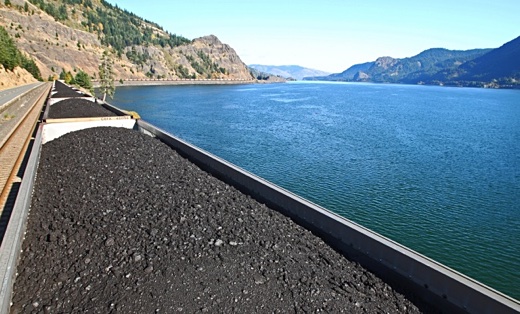
Image above: Uncovered train hopper cars filled with dusty coal running along the bank of the Columbia River reach to the horizon. Photo by Daniel Dancer. From original article.

Forget the presidential campaign (for a minute). It’s so much easier to be confused by the energy and climate debate within the Obama administration.

Buckle up. There is a danger of whiplash.

In May, the Army Corps of Engineers denied a permit for a coal shipping terminal north of Bellingham in Washington. The $700 million project would have interfered with the Lummi Nation’s treaty rights to fish for salmon.

“The Gateway Pacific Terminal would have a greater than de minimus impact on the Lummi Nation's (treaty) rights,” said Seattle District Commander Col. John Buck.

So no permit. Whew! The Army Corps gets it. Progress.

Then, in August, the same Army Corps winked and nodded and gave its OK to the Dakota Access pipeline, allowing it to proceed with a permit (but no easement) to begin drilling under the Missouri River. That action, of course, led to the Standing Rock movement, and now thousands of people are camped in southern North Dakota to stop the pipeline’s construction and protect the water from a potential oil spill.

The Standing Rock Sioux Tribe, like the Lummi, are a treaty tribe, and while the lands in this case are off the reservation, there is a federal requirement to consult with the tribe. And a moral one in this case because any leak would contaminate the tribe’s water source. (Notably, the route was moved away from Bismarck because of the threat to that city’s water.)

Nonetheless, the Army Corps let the pipeline proceed. Boo. The government doesn’t get it.

Then in September, sunshine. The Army Corps, joined by the departments of Interior and Justice, said it would re-evaluate the pipeline’s permit and review the tribal consultation process.

No permit. Yay! The government does get it.

Well, no. The Army Corps, the same agency, the same office that a few months ago championed treaty rights for the Lummi Nation, now says another major coal terminal 200 miles down the road in Washington is just fine.

A couple weeks ago, the Corps released a draft environmental impact statement for the Millennium Bulk Terminal port in Longview. The project would ship coal from Montana and Wyoming out of a port on the Columbia River.

The statement points out that “salmon are central to the spiritual and cultural identity of all Columbia River tribes. Tribal members gather and camp at multiple sites along the Columbia River beginning in May and many stay until fall to harvest salmon and steelhead from the Columbia River and its tributaries.” But unlike a few months ago, this time the Corps figures dirty coal trains won’t impact the salmon runs.

No, the report doesn’t say that. “Coal could enter water as either coal dust or as the result of a coal spill,” the draft EIS says. But it does give this dismissal: “The potential risk for exposure to toxic chemicals contained in coal would be low because they tend to be bound to the matrix structure and not easily leached.

Coal dust particles would likely be transported downriver by river flow and either carried out to sea or distributed over a sufficiently broad area that a measurable increase in concentrations of toxic chemicals in the Columbia River would be unlikely.”

Except salmon are also in the river flow in that same “sufficiently broad area.”

The Army Corps will accept public comments until late November. But let’s be clear: This terminal must not be built. You can add up all of the reasons that the Dakota Access pipeline is a bad idea, but they are multiplied when the fossil fuel is coal moving on trains. Coal dust is a pipeline accident that will happen daily.

As Eric DePlace of Sightline has pointed out, “Coal trains mean coal dust — period. So much coal dust escapes from the open-top rail cars used for transporting coal that it can create safety problems for rail traffic. … Given the coal export industry’s designs on the Northwest, it is important for residents to know more about the coal dust hazard.”

The Army Corps of Engineers suddenly decided that coal trains will not harm salmon in the Columbia River. Water protectors know coal dust is like a pipeline accident that happens daily.

The environmental impact statement has a curious approach to factoring climate change. It looks at the carbon impact of the terminal itself but fails to count emissions along the way or add that the coal will eventually be burned after shipping.

That alone ought to be a fatal flaw. Especially when just a few days ago President Obama so eloquently called the Paris Agreement the best shot we have to save the planet.

That’s impossible while we build pipelines, and that’s impossible while we plan a new shipment point for coal. This is the next Standing Rock. The Longview Millennium coal export facility must never be built.

[IB Publisher's note: Talk about trains leaving a mess in a river. In 1967 I took a pre-Amtrak train from Oakland, California to Chicago, Illinois. The train war called the California Zephyr and it was an express train. North of Sacremento we traveled through the isolated Feather River Valley. We ground to a stop on the tracks. Hours went by. Below us was a the river and near the river was a railroad bed designed with less steep grades for freight trains. Debris was floating down the river. As dusk arrived  we could see countless cartons, some broken open floated along. Eventually we inched along the track and neared the source of the debris. An entire multi-engined train with all its freight cars had rolled off the track and into the river. Not so hard to do when one is pulling a mile long train along a curved track at speed. Some box cars had broken open and spilled their contents into the river. There were also tank cars and fuel in the river.]

• Mark Trahant is an independent journalist and a journalism professor at the University of North Dakota. He's a member of the Shoshone-Bannock tribes and has written about American Indian and Alaska Native issues for more than three decades. His most recent project, TrahantReports, covers the 2016 election with a focus on Native issues and candidates. Follow him on Twitter @TrahantReports.
.

The Right and Climate Catastrophe

SUBHEAD: At this point, electing Green-minded leaders is the only realistic path to a habitable planet.

By Michael T. Klare on 15 September 2016 for Tom Dispatch -
(http://www.tomdispatch.com/post/176186/tomgram%3A_michael_klare%2C_the_rise_of_the_right_and_climate_catastrophe/)


Image above: US Presidential candidate Donald Trump "I'm not a big believer in Global Warming". From (http://www.businessinsider.com/bill-nye-great-response-donald-trump-statements-climate-change-2016-1).

In a year of record-setting heat on a blistered globe, with fast-warming oceans, fast-melting ice caps, and fast-rising sea levels, ratification of the December 2015 Paris climate summit agreement -- already endorsed by most nations -- should be a complete no-brainer.  That it isn't tells you a great deal about our world.

Global geopolitics and the possible rightward lurch of many countries (including a potential deal-breaking election in the United States that could put a climate denier in the White House) spell bad news for the fate of the Earth. It’s worth exploring how this might come to be.

The delegates to that 2015 climate summit were in general accord about the science of climate change and the need to cap global warming at 1.5 to 2.0 degrees Celsius (or 2.6 to 3.5 degrees Fahrenheit) before a planetary catastrophe ensues.  They disagreed, however, about much else.

Some key countries were in outright conflict with other states (Russia with Ukraine, for example) or deeply hostile to each other (as with India and Pakistan or the U.S. and Iran). In recognition of such tensions and schisms, the assembled countries crafted a final document that replaced legally binding commitments with the obligation of each signatory state to adopt its own unique plan, or “nationally determined contribution” (NDC), for curbing climate-altering greenhouse gas emissions.

As a result, the fate of the planet rests on the questionable willingness of each of those countries to abide by that obligation, however sour or bellicose its relations with other signatories may be.  As it happens, that part of the agreement has already been buffeted by geopolitical headwinds and is likely to face increasing turbulence in the years to come.

That geopolitics will play a decisive role in determining the success or failure of the Paris Agreement has become self-evident in the short time since its promulgation.

While some progress has been made toward its formal adoption -- the agreement will enter into force only after no fewer than 55 countries, accounting for at least 55% of global greenhouse gas emissions, have ratified it -- it has also encountered unexpected political hurdles, signaling trouble to come.

On the bright side, in a stunning diplomatic coup, President Obama persuaded Chinese President Xi Jinping to sign the accord with him during a recent meeting of the G-20 group of leading economies in Hangzhou.

Together, the two countries are responsible for a striking 40% of global emissions.  “Despite our differences on other issues,” Obama noted during the signing ceremony, “we hope our willingness to work together on this issue will inspire further ambition and further action around the world.”

Brazil, the planet's seventh largest emitter, just signed on as well, and a number of states, including Japan and New Zealand, have announced their intention to ratify the agreement soon.

Many others are expected to do so before the next major U.N. climate summit in Marrakesh, Morocco, this November.

On the dark side, however, Great Britain’s astonishing Brexit vote has complicated the task of ensuring the European Union’s approval of the agreement, as European solidarity on the climate issue -- a major factor in the success of the Paris negotiations -- can no longer be assured. “There is a risk that this could kick EU ratification of the Paris Agreement into the long grass,” suggests Jonathan Grant, director of sustainability at PricewaterhouseCoopers.

The Brexit campaign itself was spearheaded by politicians who were also major critics of climate science and strong opponents of efforts to promote a transition from carbon-based fuels to green sources of energy.

For example, the chair of the Vote Leave campaign, former Chancellor of the Exchequer Nigel Lawson, is also chairman of the Global Warming Policy Foundation, a think-tank devoted to sabotaging government efforts to speed the transition to green energy.

Many other top Leave campaigners, including former Conservative ministers John Redwood and Owen Paterson, were also vigorous climate deniers.

In explaining the strong link between these two camps, analysts at the Economist noted that both oppose British submission to international laws and norms: “Brexiteers dislike EU regulations and know that any effective action to tackle climate change will require some kind of global cooperation: carbon taxes or binding targets on emissions.

The latter would be the EU writ large and Britain would have even less say in any global agreement, involving some 200 nations, than in an EU regime involving 28.”

Keep in mind as well that Angela Merkel and François Hollande, the leaders of the other two anchors of the European Union, Germany and France, are both embattled by right-wing anti-immigrant parties likely to be similarly unfriendly to such an agreement.  And in what could be the deal-breaker of history, this same strain of thought, combining unbridled nationalism, climate denialism, fierce hostility to immigration, and unwavering support for domestic fossil fuel production, also animates Donald Trump’s campaign for the American presidency.

In his first major speech on energy, delivered in May, Trump -- who has called global warming a Chinese hoax -- pledged to “cancel the Paris climate agreement” and scrap the various measures announced by President Obama to ensure U.S. compliance with its provisions.

Echoing the views of his Brexit counterparts, he complained that “this agreement gives foreign bureaucrats control over how much energy we use on our land, in our country. No way.”

He also vowed to revive construction of the Keystone XL pipeline (which would bring carbon-heavy Canadian tar sands oil to refineries on the U.S. Gulf Coast), to reverse any climate-friendly Obama administration acts, and to promote the coal industry.  “Regulations that shut down hundreds of coal-fired power plants and block the construction of new ones -- how stupid is that?” he said, mockingly.

In Europe, ultra-nationalist parties on the right are riding a wave of Islamaphobia, anti-immigrant sentiment, and disgust with the European Union.

In France, for instance, former president Nicolas Sarkozy announced his intention to run for that post again, promising even more stringent controls on migrants and Muslims and a greater focus on French “identity.” Even further to the right, the rabidly anti-Muslim Marine Le Pen is also in the race at the head of her National Front Party.

Like-minded candidates have already made gains in national elections in Austria and most recently in a state election in Germany that stunned Merkel’s ruling party.

In each case, they surged by disavowing relatively timid efforts by the European Union to resettle refugees from Syria and other war-torn countries.

Although climate change is not a defining issue in these contests as it is in the U.S. and Britain, the growing opposition to anything associated with the EU and its regulatory system poses an obvious threat to future continent-wide efforts to cap greenhouse gas emissions.

Elsewhere in the world, similar strands of thinking are spreading, raising serious questions about the ability of governments to ratify the Paris Agreement or, more importantly, to implement its provisions.  Take India, for example.

Prime Minister Narendra Modi of the Hindu nationalist Bharatiya Janata Party (BJP) has indeed voiced support for the Paris accord and promised a vast expansion of solar power.  He has also made no secret of his determination to promote economic growth at any cost, including greatly increased reliance on coal-powered electricity. That spells trouble.

According to the Energy Information Administration of the U.S. Department of Energy, India is likely to double its coal consumption over the next 25 years, making it the world’s second largest coal consumer after China.

Combined with an increase in oil and natural gas consumption, such a surge in coal use could result in a tripling of India’s carbon dioxide emissions at a time when most countries (including the U.S. and China) are expected to experience a peak or decline in theirs.

Prime Minister Modi is well aware that his devotion to coal has generated resentment among environmentalists in India and elsewhere who seek to slow the growth of carbon emissions. He nonetheless insists that, as a major developing nation, India should enjoy a special right to achieve economic growth in any way it can, even if this means endangering the environment.

“The desire to improve one's lot has been the primary driving force behind human progress,” his government affirmed in its emissions-reduction pledge to the Paris climate summit. “Nations that are now striving to fulfill this ‘right to grow’ of their teeming millions cannot be made to feel guilty [about] their development agenda as they attempt to fulfill this legitimate aspiration.”

Russia is similarly likely to put domestic economic needs (and the desire to remain a great power, militarily and otherwise) ahead of its global climate obligations.

Although President Vladimir Putin attended the Paris summit and assured the gathered nations of Russian compliance with its outcome, he has also made it crystal clear that his country has no intention of giving up its reliance on oil and natural gas exports for a large share of its national income.

According to the Energy Information Administration, Russia’s government relies on such exports for a staggering 50% of its operating revenue, a share it dare not jeopardize at a time when its economy -- already buffeted by European Union and U.S. sanctions -- is in deep recession.

To ensure the continued flow of hydrocarbon income, in fact, Moscow has announced multibillion dollar plans to develop new oil and gas fields in Siberia and the Arctic, even if such efforts fly in the face of commitments to reduce future carbon emissions.

From Reform and Renewal to Rivalry
Such nationalistic exceptionalism could become something of the norm if Donald Trump wins in November, or other nations join those already eager to put the needs of a fossil fuel-based domestic growth agenda ahead of global climate commitments.

With that in mind, consider the assessment of future energy trends that the Norwegian energy giant Statoil recently produced.  In it is a chilling scenario focused on just this sort of dystopian future.

The second-biggest producer of natural gas in Europe after Russia’s Gazprom, Statoil annually issues Energy Perspectives, a report that explores possible future energy trends.

Previous editions included scenarios labeled “reform” (predicated on coordinated but gradual international efforts to shift from carbon fuels to green energy technology) and “renewal” (positing a more rapid transition).

The 2016 edition, however, added a grim new twist: “rivalry.” It depicts a realistically downbeat future in which international strife and geopolitical competition discourage significant cooperation in the climate field.

According to the document, the new section is “driven” by real-world developments -- by, that is, “a series of political crises, growing protectionism, and a general fragmentation of the state system, resulting in a multipolar world developing in different directions.  In this scenario, there is growing disagreement about the rules of the game and a decreasing ability to manage crises in the political, economic, and environmental arenas.”

In such a future, Statoil suggests, the major powers would prove to be far more concerned with satisfying their own economic and energy requirements than pursuing collaborative efforts aimed at slowing the pace of climate change.

For many of them, this would mean maximizing the cheapest and most accessible fuel options available -- often domestic supplies of fossil fuels.

Under such circumstances, the report suggests, the use of coal would rise, not fall, and its share of global energy consumption would actually increase from 29% to 32%.

In such a world, forget about those “nationally determined contributions” agreed to in Paris and think instead about a planet whose environment will grow ever less friendly to life as we know it.  In its rivalry scenario, writes Statoil, “the climate issue has low priority on the regulatory agenda.

While local pollution issues are attended to, large-scale international climate agreements are not the chosen way forward.

As a consequence, the current NDCs are only partly implemented. Climate finance ambitions are not met, and carbon pricing to stimulate cost-efficient reductions in countries and across national borders are limited.”

Coming from a major fossil fuel company, this vision of how events might play out on an increasingly tumultuous planet makes for peculiar reading: more akin to Eaarth -- Bill McKibben’s dystopian portrait of a climate-ravaged world -- than the usual industry-generated visions of future world health and prosperity.

And while “rivalry” is only one of several scenarios Statoil’s authors considered, they clearly found it unnervingly convincing.

Hence, in a briefing on the report, the company’s chief economist Eirik Wærness indicated that Great Britain’s looming exit from the EU was exactly the sort of event that would fit the proposed model and might multiply in the future.

Climate Change in a World of Geopolitical Exceptionalism
Indeed, the future pace of climate change will be determined as much by geopolitical factors as by technological developments in the energy sector.

While it is evident that immense progress is being made in bringing down the price of wind and solar power in particular -- far more so than all but a few analysts anticipated until recently -- the political will to turn such developments into meaningful global change and so bring carbon emissions to heel before the planet is unalterably transformed may, as the Statoil authors suggest, be dematerializing before our eyes.

If so, make no mistake about it: we will be condemning Earth’s future inhabitants, our own children and grandchildren, to unmitigated disaster.

As President Obama’s largely unheralded success in Hangzhou indicates, such a fate is not etched in stone. If he could persuade the fiercely nationalistic leader of a country worried about its economic future to join him in signing the climate agreement, more such successes are possible. His ability to achieve such outcomes is, however, diminishing by the week, and few other leaders of his stature and determination appear to be waiting in the wings.

To avoid an Eaarth (as both Bill McKibben and the Statoil authors imagine it) and preserve the welcoming planet in which humanity grew and thrived, climate activists will have to devote at least as much of their energy and attention to the international political arena as to the technology sector.

At this point, electing green-minded leaders, stopping climate deniers (or ignorers) from capturing high office, and opposing fossil-fueled ultra-nationalism is the only realistic path to a habitable planet.

• Michael T. Klare, a TomDispatch regular, is a professor of peace and world security studies at Hampshire College and the author, most recently, of The Race for What’s Left. A documentary movie version of his book Blood and Oil is available from the Media Education Foundation. Follow him on Twitter at @mklare1.

.