Showing posts with label Self-Sufficiency. Show all posts

Getting Through Collapse

SUBHEAD: Things are unwinding, but there are preparations you should begin immediately.


By Juan Wilson 29 January 2021 for Island Breath -
(http://islandbreath.blogspot.com/2021/01/getting-through-collapse.html)


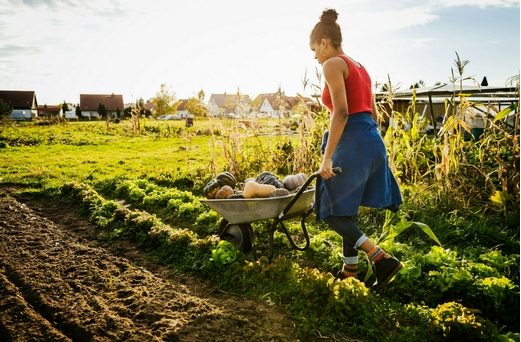
Image above: Plowing a field in a community garden near suburban homes. From (https://www.treehugger.com/how-to-start-a-small-farm-3016691).

There has been a sense of dread for some time...  by that I mean decades. Much of the 20th Century was embroiled in World Wars, the Great Depression, the Cold War and fear of nuclear extinction. Now we face a disease that appears more dangerous than the Spanish Influenza Pandemic of 1918.

As we wrote in "Winning the Trifecta last year - See (http://islandbreath.blogspot.com/2020/06/winning-trifecta.html) with the subhead "To win we will have to solve all our problems together... health, wealth and environment."

That has not changed, other than to intensify. The human condition is rapidly changing and not under our control or in our perceived interests. The trappings of civilization and culture are wearing thin under the yoke of lock-downs, indebtedness, fear of the future, and isolation.

There are not many realistic ways out of our dilemma that does not include a major human population reduction and a severe reduction in our consumption of Earth's resources and will require a monumental increase in recycling, repurposing and renewing those resources we have converted to "garbage". 

Here in Hawaii it is a realistic possibility that modern trans-Pacific container shipping will no longer be economically feasible. We will have to grow the majority of the food we consume in the islands. And more food will be necessary for feeding the eggeries, fisheries, dairy farms and other food and resource related agricultural operations that won't be distant factory operations but neighborhood businesses. 

In short, sustainable farming will become the major human operation in Hawaii. And that will be true in any place that has sustained human population. 

Yes, there will be some nomadic hunter gatherers... small bands of tribal people that move with the herds and the seasons. But the majority will exist in a condition more like the early18th century in rural America... but without great abundance of natural resources that was cut down, plowed up and mined.

I do not expect to see the complete transition myself. I'm a Baby Boomer in my late 70's. But I imagine it will be a life without personal automobiles, vast shopping plazas and on demand multi-media entertainment. 

My wife, Linda, and I are trying to grow as much food and herbal plants as we can and creating tradable "refined" products... like organic eggs and vegetables, macadamia nut butter, bottled hot sauce, jams, comfrey salves, etc.

These and other self employed efforts like:

    • Providing fresh water through rain-catchment, solar water-pump.

    • Providing multiple, overlapping systems for power hot water, and communication.

    • Growing and storing food from a place you have some managing control over. 

    • Having stock of materials, tools and know-how to maintain and repair what you have.

    • Ways to entertain yourself with neighborhood theater, music, card games, puzzles, or crafts.

Just remember there will be no TGI Fridays, Bed Bath & Beyond, Starbucks or GameStop to fill your cravings.

Bottom line... we are on our own in a land we are unfamiliar with. We are in a "New Normal" that is not going away, but is evolving into another world.  One that is not nearly as friendly as the Garden of Eden, but hopefully more comfortable than the Dark Ages, "1984" or "The Matrix"

Getting better at navigating that new landscape will be a major  determination of how happy you are.

That navigation will require the capability of fixing and maintaining some 20th century tech - like a small simply designed diesel engine or electric tools - but won't include repairing iPhone or maintaining full spectrum satellite communications systems.

So get yourself a good set of tools for the shop, garden, garage and sewing room... you're going to need them. Once you have the tools - start using them so when the time arrives you'll be useful.


 .

Going Down with Books

SUBHEAD: It is getting clearer as to how the complex and poisonous system we are riding will fail. 

By Juan Wilson on 4 March 2020 for Island Breath -
(https://islandbreath.blogspot.com/2020/03/going-down-with-books.html)


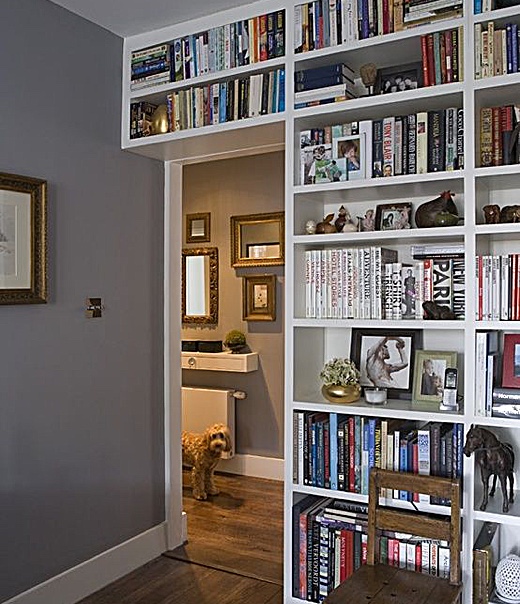
Image above: View from a full wall home library. It's a start. From (https://images.app.goo.gl/634TXyX3moM2Fcvt5).

Don't count on a last minute reprieve, a bailout, or escape from our current condition. The impending failure of the system we depend on is an on-going process has been accelerated now by a worldwide virus pandemic.

We have become blind to our total dependence on "The System" (or "The Grid") that we see no alternative reality.

As we have discovered the "System" requires massive inputs of resources ans energy and, as a result, huge outputs of waste and pollution.  It also requires that we have no scalable substitutions or alternatives to this dependency but turning to total collapse.

There is simply too many of us and too much our stuff and too little of everything else. Kicking and screaming we will be dragged to the consequences.

How blind are we? Is the best we can come up with for our next president is a contest between Trump and Biden?

These are two fossils who either have no clue of the existential challenge we face or are counting on fleeing with the billionaires to the Alps or some inaccessible tropical island.

Three elements of the perfect storm we are sailing into are:
  • Loss of individual, family, or group knowledge of fending for one's own. 
  • Uncontrolled debt inflation to finance industrialization and economic growth.
  • Ravaging of the Earth for settlements, agland, resources, and places to toss garbage.
For the few who get through the breakdown of the delicate networks of interdependent systems providing us shelter, food, water, and energy it will be best you acquire skills in self-maintained off-grid living.

That would include skills growing food and procuring potable water; experience with building and maintaining the home; knowledge of medical care; and an idea of the principals of general science.

At some point in the not so distant future your iPhone will be about useful as a drink coaster for acquiring and storing these, instructions, and techniques in independent living.

Yes, fifty years ago young people were seriously considering getting "Off the Grid" and taking actions to get back to "The Land" and be self-sustainable. The mantra was from our guru Timothy Leary was "Tune In, Turn On and Drop Out!"

They almost made it but traded bluejeans for polyester bell-bottoms and LSD for cocaine.

It's a good idea to keep acid free paper books on the principals of all of these subjects.

Half a century ago this kind of information was widely published and identified in "The Whole Earth Catalog" and can still be found in  "Back to the Land" books and other publications from the Hippy-Trippy1970's.

Fortunately, not all has been forgotten of the knowledge of the earlier Urban Hippie diaspora.
This survival knowledge can still be obtained from bookstores and online.

Having a printed book library of basic techniques is a crucial resource, just as much as a toolshed of wood working, metal working and garden implements.

Vital information can be found in publications like the US Army Survival Field Manuals and tomes with specifics on the knowledge  required for basic survival, and sustained living independently of the sprawl of suburbia, office parks,  malls, hospitals and supermarkets.

Many libraries offers free older hardcover books of fiction and non fiction as they are rotated off their shelves. Many libraries are still getting rid of entire sets of hardcover encyclopedias.

I recommend that you start building a library of crucial information and reference books... but also collect classic reading material for entertainment. Much is available and there won't be any Netflix, Hulu or Amazon Prime.

Author's note:
One little book (3"x 5" x 3/4")  I would suggest everyone own is "Pocket Ref" by Thomas J. Glover by Sequoia Press. My version is the Third Edition (ISBN 978-1-885071-33-0). It is an encyclopedia of information showing everything from illustrations of a wide variety of rope knots and bends to a listing of all the phone area code numbers by state in North America to the friction loss in pipes of various materials, to the square, cubes, square roots, and cube root of all numbers from 1 to 1,000 to five place accuracy... plus much, much more. You'll be amazed what's in this tiny gem. I got mine at my local Ace Hardware Store.

.

How do you degrow?

SUBHEAD: Facing large obstacles, huge consequences, humbling lessons and above all, mixed feelings.

By Constanza Hepp on 23 November 2018 for Degrowth.info -
(https://www.degrowth.info/en/2018/11/how-do-you-degrow/)


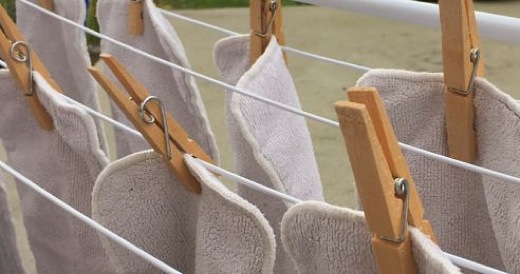
Image above: Handwashed cloth diapers hanging in the sun to dry. From original article.

We live nextdoor to my partner’s grandmother, Maria, who was born during the Second World War in Northern Italy. This means that she knows what hard times look like. Maria could not believe we would be using washable diapers for our baby boy.

With genuine surprise she asked me, “why?”, and then she was curious in which pot we were planning to boil the diapers. In her eyes, we could not possibly be choosing to use washable diapers – to her, an extinct garment reminiscent of poverty and manual labour – when there exists the comfort of the disposable.

Therefore, it must be that we cannot afford disposable diapers. Needless to say, for the first six months of our son’s life, every time Maria went to the supermarket, she bought us a packet of disposable diapers.

Everything about the lifestyle we are accustomed to, as rich westerners, has to change. If we let that sink in for a little bit that is when the real disruption comes in, giving way to a radical shift in perspective. So, where do we go from here?

As practitioners of the degrowth creed, the first challenge we face is precisely this, where do we start?
This is a very real question that needs to be answered when degrowthers decide to settle down. Since it’s possible to start anywhere, why not start with the closest and most immediate: ourselves. Our life.

Our lifestyle, our diet, our jobs. I want to bring forward how this radical decision – to choose the self as the first point of action towards a degrowth future – brings large obstacles, huge consequences, many humbling lessons and above all, so many mixed feelings.

How do we go about practicing degrowth?

So again, how do we go about practicing degrowth? Keeping in mind that the larger goal of degrowth is to socially organize through sufficiency, not to individually organize a lifestyle that soothes colonial guilt.

As I see it, there are two paths for practicing a degrowth lifestyle. One is to build an autonomous off-the-gird community that performs the visions for a degrowth society and the other is to coexist within existing ‘conventional’ communities, neighbourhoods and families.

I can only speak for the latter path, as it has been my experience for the last couple of years. Through coexisting with the status-quo, we are trying to change it from within. So far, the result is a living contradiction: we live in a small town, we manage a small homestead, and share with our community, but at the same time we are constantly breaking apart from them. The cultural obstacles are soul crushing.

Being surrounded by conspicuous consumption and judged by the same standards is overwhelming. It’s too easy to feel constrained when we are just trying to live in a way that is respectful of the natural world.

“I don’t understand this poverty vow you have taken for the sake of the environment”

Before my son was born, my mother said to me once, “I don’t understand this poverty vow you have taken for the sake of the environment”.

Only in that moment I realized what my choices look like to others. To me, it was both a sobering and a liberating choice, choosing to living with less in some aspects but really having so much more in other regards. However, to a set of very pragmatic eyes, voluntary simplicity looks a whole lot like poverty.

It’s hard to swallow just how much privilege is contained within that sentence, but it’s true. With her comment, my mother was echoing the common renunciations of Degrowth, which is something we (as a movement) absolutely must learn to deal with.

Part-time jobs mean more time for the unpaid reproductive labour in the home and the farm, but it also requires to make do with half the salary.

Second-hand clothes are an opportunity to be creative and original, but they also look like you cannot afford clothes and rely on hand-me-downs.

Fostering cooperation is a way of strengthening the bonds within a community, but it could also mean you are just needy and always seeking help. And so on.

Can we calmly coexist in communities when the waters are turbulent and bitter with contradiction? Not really, that’s my honest reply. There is no way around it, wherever both voluntary simplicity and frivolous materialism (and its resultant over-consumption) occur, a permanent contradiction exists that must be dealt with, never reconciled.

A couple of weeks ago, our neighbour’s daughter handed me a bag full of boy’s clothing and begged me not to be offended. Since the clothes were still good she thought maybe I could find use for them.

Twice she apologized for offending me in such a way. Offended! If anything, I am offended she thought I would be offended! I tried to show my gratitude and praise her gesture, but still she shied away.

In the performance of degrowth principles, the everyday things that add up to our existence become tense, there are constant contradictions and irreconcilabilities with the status-quo. And that’s a good thing. But a great deal of support is lacking, because there is definitely a kind of solitude in trying to be alright with a paradoxical existence.

There is a large degrowth community out there

The good news is, we are not alone! There is a large degrowth community out there; many odd-duck degrowthers living amidst capitalistic exploitation who can inspire and encourage each other. We are the revolutionaries that are living with less, the ones whose food choices imply a long explanation, and the ones choosing to wash diapers.

I’ve always accepted Maria’s weekly gift of disposable diapers. Although I’ve tried to explain several times, my point doesn’t really get across. She is doing us a favour and refusing her gift would damage our friendship. She is a generous woman who takes pride in her position of caretaker and the diapers are one of the many ways she helps us out.

I am thankful for that, but we don’t really understand each other. She has come to interpret that we are ‘artistic’, ‘eccentric’, and that we ‘experiment’ a lot. To her, we are not degrowthers, we are just poor.

This is an invitation: we want to read and share your stories.

How do you degrow? Share with us your experiences, your challenges, or even better – your successes. Write to us at blog@degrowth.de

Author:
Constanza Hepp studied Journalism in Santiago (Chile) and Human Ecology in Lund (Sweden). She is currently living in northern Italy, caring for her young family and establishing a CSA (Community Supported Agriculture) project. She is interested in creating a bridge between academic activism and social practices with potential towards systemic change.

.

Time's up! Cease and Desist!

SUBHEAD: Be carbon neutral and shelter in place. The storm is about to descend upon us.

By Juan Wilson on 6 November 2018 for Island Breath -
(https://islandbreath.blogspot.com/2018/11/times-up-cease-and-desist.html)


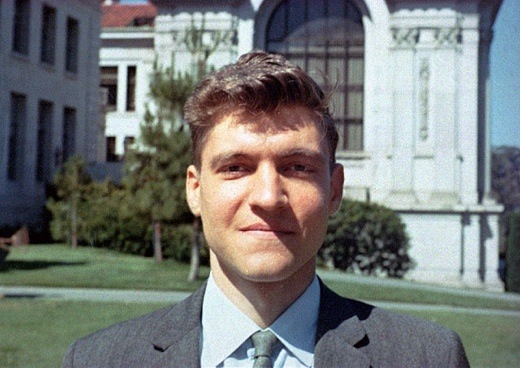
Image above:Ted Kaczynski as an assistant professor at the University of California, Berkley in 1967... the Summer of Love. From (https://en.wikipedia.org/wiki/Ted_Kaczynski).

If you don't know about Ted Kaczynski you should. He was a young professor at UC Berkley in the late 1960's. Ted was a brilliant mathematician and observer of the scene.

After realizing the likely destruction of life on Earth due to modern industrialization he abandoned an academic career in 1969 to pursue a primitive lifestyle.

He moved to a remote cabin without electricity or running water near Lincoln, Nebraska, where he lived as a recluse while learning survival skills in an attempt to become self-sufficient.

After witnessing the destruction of the wilderness surrounding his cabin he became deranged and engaged in a terror campaign.  He became the Unabomber. Between 1978 and 1995, he killed three people and injured 23 others mailing explosives packages to those he deemed agents of the industrial destruction of nature. 

He issued a social critique in the form of a manifesto that he submitted to the New York Times and Washington Post opposing industrialization and advancing a nature-centered form of anarchism.

It's past time to come to grips with what Ted Kaczynski realized (before the Club of Rome Report) a half century ago.

In my opinion he was right about the industrial destruction - but he was wrong about fixing things by mailing bombs. My advice...

"Cease and Desist!"
A cease and desist order is sent to individuals or businesses to stop purportedly illegal or undesirable activity ("cease") and not to restart it ("desist").

Yes, this means you (and me)!

This article is not meant to be a warning. It's an instruction. Immediately cease and desist all activities producing a net loss of thriving biosphere.

To the degree that is possible stop eating packaged food, stop using disposable products, stop going places you are not needed, stop depending on the power-grid and information networks for all your information and entertainment... including this blog.

"Be Carbon Neutral!"
Make no net release of carbon dioxide to the atmosphere, especially through offsetting emissions by planting trees.

If what you are doing is not Carbon Neutral or better you are actively contributing to the near term extinction of life on Earth as we know it.

What this means is you personally achieving within the next two years a change in your life that will increase the living biosphere to a degree that outpaces your consumption of energy and natural resources.

"Shelter in Place!"
Already it is getting too late for many. If your not in a place that can be made self-sustaining it is already too late. Act now! Are there friends or relatives in sustainable places with whom you could contribute to a livable future? If so get in touch now.

If you are in a sustainable place, but not off the grid and growing your own food already, there is little time left. Act now! Get the tools you need. Plant the garden - Store fresh water - Capture energy. It take time and effort, with trials and errors, to make a place provide for life support. Get going!

The implications of the changes coming are massive.
  • It would mean abandoning access to automobiles for the purpose daily commuting, errands,  shopping or recreation. 
  • It would mean having an occupation, getting services, and obtaining food within walking distance from your home.
  • It would mean changes in lifestyle that would include an end to regular air travel for business or pleasure. 
  • It would mean an end to universal access to the Power Grid (most people would need to cleanly produce their own power).
  • It would mean a return to small family farming for the vast majority of people (about 90% in America before World War One).  
  • It would mean making and repairing the things you need in your daily life (meals, clothing, furniture, shelter.
My most optimistic future vision is one in which the future supports and sustains oases of biodiverse environments where living things can flourish. Including some humans. Each oasis may be far from one another, but an experienced traveler might wend their way from one to another.

My advice is to treat this information like a hurricane emergency alert that you find yourself in the path of. Act now and avoid the rush.

See also:
Ea O Ka Aina: Biodiversity loss is our extinction 11/6/18
Ea O Ka Aina: Earth • Water • Fire • Air 11/2/18
Ea O Ka Aina: Living in a Shitstorm 10/17/18
Ea O Ka Aina: What's Omitted from the IPCC Report 10/9/18
Ea O Ka Aina: Final Call to Save the World 10/8/18
Ea O Ka Aina: The Well-To-Do Wrecking the Climate 10/8/18
Ea O Ka Aina: Scientists Outline Paths to Survival 10/4/18
Ea O Ka Aina: Being Green is being a Terrorist
 2/20/18
Ea O Ka Aina: 'Shrinking the Technosphere' review
12/30/17
Ea O Ka Aina: Find and Limit Ourselves 2/2/17
Ea O Ka Aina: Automation - whatta bitch! 1/4/17
Ea O Ka Aina: Planet Kaauai 2/26/16
Ea O Ka Aina: Oases on a future Eaarth
6/28/15
Ea O Ka Aina: Dark Ecology
 2/2/13
Ea O Ka Aina: The Luddite Rebellion 11/14/12


.

Puerto Rican local food revolution

SUBHEAD: Puerto Rican farmers to envisage agriculture not reliant chemical companies and fossil fuels.

By Alex Sammon on 2 October 2018 for FoodTank -
(https://foodtank.com/news/2018/10/a-local-food-revolution-in-puerto-rico/)


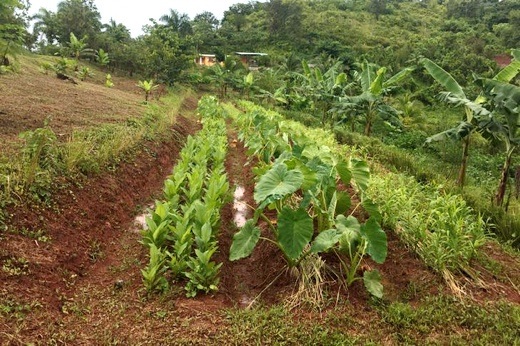
Image above: A hillside at Plenitud Teaching Center in Puerto Rico, that grows ginger, turmeric, taro, string beans, and bananas. Plenitud uses practices such as terraces, swales, berms and other permaculture methods to manage stormwater and reduce erosion. From (https://www.nationalgeographic.com.au/people/puerto-ricos-farms-were-wiped-out-heres-how-theyre-bouncing-back.aspx).

A year has passed since Hurricane Maria first made landfall in Puerto Rico, destroying homes, roads, and vehicles in its path—and taking thousands of lives.

The island languished for months as an insufficient emergency response campaign attempted to restore basic services like water and power.

After a recent independent study, the official death toll was raised from the initial 64 to 2,975 through analysis done by The New York Times, citing malnutrition and other food-based ailments as possible culprits for surging mortality in the storm’s aftermath, estimated that number could be over 4,000.

How could this happen?

By taking out the island’s infrastructure like highways, trucks, gas stations, and more, the storm also wiped out its agricultural supply lines. Puerto Rico imports about 85% of all its food, producing just 15% of what’s consumed on the island. [IB Publisher's note: Hawaii imports a higher percentage than that.]

In the wake of the storm, people stood in lines for hours and walked barely-stocked aisles looking for canned, non-perishable foods.

Many relied on emergency responders and Federal Emergency Management Administration (FEMA) meals, made of packaged and processed foods that require little to no preparation, like the beef jerky and crackers you’d expect to find in a vending machine.

In harder-to-service rural areas on the island, the threat of starvation loomed large.

“They say that during Maria, Puerto Rico only had enough food for one week,” says Carmen Yulín Cruz, the mayor of San Juan, who became an international figurehead after calling out President Trump for his inadequate response to the crisis.

“I hate to say anything positive about Maria. But what the hurricane did was force us to look at the realities of life here and how our dependency on the outside weakens our ability to ensure our people are taken care of. Maria made it evident that we need agricultural sovereignty.”

The story of Puerto Rico’s food production is also the story of the island’s own colonial history.

Large-scale plantations replaced native farming during Puerto Rico’s days as a Spanish colony, resulting in the consolidation of agricultural land and landholding, as well as the number of crops being grown on it.

When the United States took over the island in the wake of the Spanish-American War in 1898, economic restructuring meant that the remaining agricultural activity focused only on cash crops like sugarcane and coffee.

Then, in the 1940s, Congress launched Operation Bootstrap, a campaign to overhaul the Puerto Rican economy that focused on manufacturing and tourism—moving even further away from agriculture.

Subsequent tax breaks and economic initiatives to encourage investment in these sectors solidified these moves.

Deliberately, over the course of years, an import-driven food system was put in place in Puerto Rico, and all other farming fell by the wayside.

“Puerto Rico’s economy has always been categorized by being an import economy: we produce things we do not consume but then we have to import things we do consume, especially in agriculture,” notes Gladys González-Martínez, a professor of agricultural economics at the University of Puerto Rico.

Still, Puerto Rican local farming had been experiencing the beginning stages of a renaissance even before the storm hit, spurred by the economic crisis of 2006.

According to statistics provided by the governor’s office, farm income grew 25% from 2012 to 2014, while the number of acres under cultivation rose by 50% between 2012 and 2016, generating at least 7,000 jobs.

That progress was short-lived: 80% of the island’s crops were destroyed in the storm. But, despite those losses, the seeds of a local agricultural had taken root. Some took the storm as inspiration.

At farms like Cosechas Tierra Viva in Las Piedras, run by Eduardo Burgos and Franco Marcano, where they grow kale, arugula, green beans, and eggplant for local farmers’ markets, the storm kicked them into high gear.

Just a month after Maria’s landfall, they converted the farm to run exclusively on solar energy and shifted their irrigation system’s source to rainwater.

“Maria was the push we needed to execute the ideas we had to expand our production,” Burgos told NBC News in July.

They’re not alone.

Agroecology—defined by the Food and Agriculture Organization of the United Nations as both a movement and practice of socially, economically, and environmentally sustainable development—is an approach to farming that promotes diversity through crop rotation, polycultures, or livestock integration, and uses natural systems and local knowledge like planting flowers to attract insects that keep pest levels under control.

Using agroecology has allowed Puerto Rican farmers to envisage an agriculture system not reliant on external inputs from chemical companies and fossil fuels. And the idea is rapidly taking hold in farms, schools, and community groups across the island.

Already, organizations like the Puerto Rico Resilience Fund are supporting the movement by establishing sites like the student-run farm at the University of Puerto Rico’s Río Piedras campus, while networks like the Organización Boricuá de Agricultura Ecológica de Puerto Rico are helping small farms like the Pachamama Bosque Jardín find their feet.

These projects are crucial for the island’s food security, but also for its protection from storms that are likely to grow in intensity and frequency due to climate change.

Surveys after hurricanes in the late 1990s in countries like Nicaragua and Cuba have shown that diversified, small-scale farms suffer less damage than bigger farms practicing conventional agriculture.

Already, the movement is making a noticeable difference. The Puerto Rican Department of Agriculture is aiming to have food imports down to 65% to 75% by the end of the year, which could represent as much as a 20% decrease on pre-Maria levels and a 30% drop from the island’s post-Maria peak.

Ricardo Fernandez, CEO of Puerto Rico Farm Credit, sees signs of the transformation. People are flocking to farmers’ markets; university students are signing up for agricultural classes.

“There’s a resurgence now, because we have to re-invent ourselves,” he says in a recent interview with NPR. For an island facing serious questions about its own colonial legacy and territorial status, local food may well be the first step towards a more independent Puerto Rico.

See also:
Ea O Ka Aina: The Off-Grid poster child 9/20/18
Ea O Ka Aina: 13 Years of Permaculture 9/5/17
Ea O Ka Aina: Permaculture in Hawaii 4/26/17
Ea O Ka Aina: Permaculture Cool Lab 4/5/17
Ea O Ka Aina: Forging Permaculture Hand Tools 2/15/17
Ea O Ka Aina: Forest Farms 8/16/16
Ea O Ka Aina: Permaculture, Climate & Survival 10/23/15
Ea O Ka Aina: The Permaculture Fail 8/21/14
Ea O Ka Aina: Permaculture Development 3/18/14
Ea O Ka Aina: The trouble with Permaculture 1/23/14
Ea O Ka Aina: Permaculture - Let's get real! 7/17/13
Ea O Ka Aina: Paradise Lot 6/7/13
Ea O Ka Aina: Programmable Permaculture
3/1/13
Ea O Ka Aina: Permaculture - Use of Space 5/24/12
Ea O Ka Aina: Permaculture - Design Diversity 5/24/12
Ea O Ka Aina: Permaculture - Problems to Solutions 5/24/12
Ea O Ka Aina: Permaculture - Relative Location 5/14/12
Ea O Ka Aina: Seattle Permaculture 2/29/12
Ea O Ka Aina: Permaculture Taking Off in Hawaii 3/29/11
Ea O Ka Aina: UN is Getting Into Permaculture
2/12/11
Ea O Ka Aina: Permaculture as a Venture 1/25/11
Ea O Ka Aina: Bill Mollison on Permaculture 11/12/10
Ea O Ka Aina: Permaculture - Multiple Functions 3/29/10
Ea O Ka Aina: Introduction to Permaculture
3/24/10
Ea O Ka Aina: Permaculture - Growing Zones
3/22/10
Ea O Ka Aina: Permaculture Realists & Optimists 5/2/09
Ea O Ka Aina: Permaculture Design Course 2/16/09
IslandBreath: Cultural Change at the Limits to Growth 5/7/2008
IslandBreath: The Garden of Eden 4/22/07
IslandBreath: Kauai 2007-2029 12/15/06
IslandBreath: How Cuba survived Peak Oil 7/23/06

.

The Off-Grid Poster Child

SUBHEAD: After the disaster of hurricane Maria, Puerto Rico is ripe to be the place to find stand-alone off-grid living.

By Juan Wilson on 20 September 2018 for Island Breath -
(http://islandbreath.blogspot.com/2018/09/off-grid-poster-child.html)


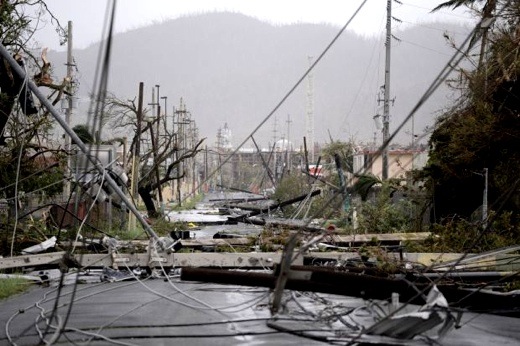
Image above: Electricity poles and lines lie toppled on the road after Hurricane Maria hit the eastern region of Puerto Rico. Photo: Carlos Giusti. From (https://www.wsj.com/articles/the-truth-about-hurricane-maria-1537129890).

Well before hurricane Maria devastated the island of Puerto Rico on 20 September 2017 the infrastructure of the power grid had deteriorated to the point of fragility not seen elsewhere in America.

That grid was the responsibility of The Puerto Rico Electric Power Authority (PREPA). PREPA is a government-owned corporation of Puerto Rico responsible for electricity generation, power distribution, and power transmission on the island. Hurricane Maria demonstrated that PREPA was a failure and that it would not have the vision or resources needed to serve Puerto Rico.

Without the resources to repair what had been a frail and failing system, Maria provided a death blow to PREPA. The Puerto Rican people tuned to gas operated electrical generators that had been purchased by people who could afford them for the frequent PREPA blackouts. After Maria things got nasty. Neighborhoods strung extension cords between homes in suburban neighborhoods. They got by with less.

There were some isolated small scaled solar photo-voltaic electric systems in place - and they became important. The Wall Street Journal reported (https://www.wired.com/story/puerto-rico-hurricane-maria-recovery/):
In the town rural town of Adjuntas, nestled in the mountains about an hour and a half southwest of San Juan, an NGO dedicated in part to solar power, called Casa Pueblo, became a pillar of the local recovery. 
When the town’s 18,000 residents were cut off from the rest of the island after Maria, the NGO’s solar-­powered radio helped authorities find out which roads were clear and which families were in danger, and attend to emergencies when the central government and federal authorities were not yet responding. 
Casa Pueblo subsequently gave out some 14,000 solar-powered lamps and also offered a solar-charged satellite phone at its offices for locals to use. At any given time, five to 10 people waited to make a call.

Arturo Massol, the associate director of Casa Pueblo and an ardent evangelist for decentralized, renewable energy, described what was happening on the island as “an energy insurrection.” Ordinary Puerto Ricans, he said, had woken up to the fact that when it came to electricity, they would have to look for alternatives.
This is part of a real solution. But that is not the direction that Puerto Rico is going. Instead the US government is planning on financing the privatization of PREPA through the creation of the “Puerto Rico Energy Transformation Administration (PRETA) that would provide guarantees (with US tax payer's money) for private energy corporations to rebuild the Puerto Rican grid. According to Debt Wire (https://www.debtwire.com/info/prepa-federalization-draft-bill-floating-congress)
Still in rough draft form, a bill tentatively titled the “Puerto Rico Energy Stabilization and Hurricane Resiliency Act of 2018” delineates specific steps to have the federal government—via the DOE—take over PREPA, impose a temporary administrator to supersede Puerto Rico’s Energy Commission ratemaking power, establish a corporation to issue restructuring bonds, and create special investment assurance accounts as part of the utility’s ongoing privatization process.
Here on Kauai the failure of privately owned Kauai Electric took a different but similar turn.

Those with long memories know what happened when the privately owned Kauai Electric called it quits. We paid off the "stake holders" a couple hundred million dollars of borrowed money to create a the debt ridden Kauai Island Utility Cooperative (KIUC). We now pay about the highest rates in the country.

Like Puerto Rico, Kauai is a stand alone grid on an isolated island. What energy it produces is all the energy it will have available. To its credit, KIUC has aggressively been adding solar voltaic power generation capacity. But it has not encouraged Solar PV stand alone systems.

Instead it encourages "co-generation"... the placement of PV systems on individual homes to supplement KIUC power generation. Co-gen certainly can reduce KIUC's high price for grid power, but it is, by my observation,  no real incentive to reduce power consumption.

Co-gen also means some resilience capability if the grid goes down because of a natural disaster, electro-magnetic pulse (EMP) or other disaster.

But KIUC suffers from the same vulnerability that Puerto Rico faced when Maria struck. All the power distribution is provided by poles and large hurricane can knock those poles down like a house of cards. That happened on Kauai with hurricane Iniki in 1992. But instead of burying the power distribution lines (as is done in most modern community planning) Kauai Electric simply re-erected the old creosote soaked wooden power poles.

Stand alone solar power systems have several advantages if they are not backed up by a electric grid or fossil fuel powered generator.
  • They absolutely limit the consumption of power to the amount of energy collected from the sun.
  • They require customer awareness of usage and some maintenance encouraging greater self reliance.
  • They reduce overall power consumption by high energy appliances like microwave ovens or air compressors.
  • They are resilient in that only the minority of systems that are hit directly by a disaster are damaged.
  • They wean us from living outside the limitations of energy not supplied by nature where you live.  
What we found was that having multiple independent stand alone PV systems is a real advantage. We stumbled into that situation by slowing adding systems over time. We started with a single panel and added increasingly bigger systems over almost a decade as we gained experience and knowledge.

All our systems use an array of one of two battery types. One type are high capacity 12volt 110amp-hour lead acid deep cycle batteries available on Kauai. The other type are 6v 405 amp-hour AGM (absorbant glass mat) batteries.

There are two AGM systems.

One is attached to our circuit breaker panel-box. This is where KIUC used to hook up. We had KIUC come and take off the meter and wiring to our house. This systems powers all the switches and outlets built into the house.

The second AGM system is attached to a power inverter providing energy for our new refrigerator and freezer. See (http://islandbreath.blogspot.com/2018/09/freezers-up-and-running.html).

The five other systems are smaller for specific tasks using smaller power inverters.
  • One provides counter lighting and strip outlets for our kitchen as well as our guest bathroom.
  • A second one provides lighting and a power strip to our master bedroom and its bathroom.
  • A third one provides lighting and a power strip  (for tool battery charging) in shop/utility room.
  • A fourth provides power for and office computer, wifi system and small appliance batteries.
  • A fifth provides power to a stand-alone shack that serves as a guest house. 
This overlapping redundancy has proved to be valuable. Any one system can go down and we can work around the problem by switching plugs in outlets and/or swapping around compatible batteries.

Redundancy is good. We had a neighbor who went with KIUC co-gen. After about a year the single co-gen system inverter failed and her solar panels were providing nothing to reduce her energy bill. The installer claimed it was out of warranty and not their problem. It took over year to get the system up and working agian.

Looking to the future my advice, as usual, is learn to and act to:
  • Grow your own food
  • Collect your own water
  • Produce your own energy
  • Make and repair what you can.
The alternative is sitting around a fire with pointy sticks.

Comfy?

SUBHEAD: After a hard day's work homesteading, snuggle down for sunset and the dusky onset evening stars and conversation. 

By Juan Wilson on 26 July 2018 for Island Breath  -
(http://islandbreath.blogspot.com/2018/07/comfy.html)

http://www.islandbreath.org/2018Year/07/180726yardpano.jpg
Image above: Detail of backyard panorama. On building hotwater panel, solar PV panels, rain catchme4nt gutter to 1,000 water tank. In yard foreground: pepper trees, two cassava, ginger. Midground: papaya, 12 cacao trees. Backgound: Macadamia nut and litchi tree, to right is corner of enclosed raised-bed garden.  Photo by Juan Wilson. Click to see panorama view. ().

Homesteading in retirement is hard work. In some ways harder than having a nine-to-five job forty hours a week. With the full time job eating out or buying prepared food was normal.

It's not as demanding as commercial farming, but there are dozens of tasks that keep piling onto the "to-do" list as well as many regular routines needed to be done frequently... even on a half acre lot.

Checking the fruiting plants daily is a daily activity. Avocado, mango and macadamia nut trees are seasonal.

It getting into macadamia nut season right now. We have three producing trees now. That's enough macadamia nuts in a season to get us through the year.

We make macadamia nut butter, and eat roasted nuts for snacks. We need to check under each tree a few times a day. In July it begins as a trickle of a few dozen in a day. Later we will be picking up a few hundred nuts in a day.  Lots of bending over.

In their own seasons are mango, avocado and always papaya. Other fruiting trees are oranges, tangerines, grapefruit, limes, lemons... and that's just the citrus. There are also a few oddballs like cacao, starfruit, litchi, noni, surinam cherry and Hawaiian chili peppers.

Plus, we cannot forget the staples like taro, cassava and breadfruit, plantain, banana, coconut.

This does not count the daily tending, weeding, watering and harvesting of our 16' by 32' raised-bed garden.

Nor does this work does includes the husking, peeling, chopping, drying, canning, and other processes needed daily to keep the plant production converting into usable fresh or storable food.

Are you having fun yet? Well don't forget the composting of plant waste, amending the soil,  trimming of trees, etc.

Homesteading is more than a full-time job. It's a life. And about the most secure and rewarding one.

We are inching our way back to the Garden of Eden. Don't be left behind.


.

The Last 4th of July

SUBHEAD: Well, the pressure is on and will only increase. Get off the Grid. Get out of the Matrix. Go for what's real and close by!

By Juan Wilson on 3 July 2018 for Island Breath -
(http://islandbreath.blogspot.com/2018/07/the-last-4th-of-july.html)


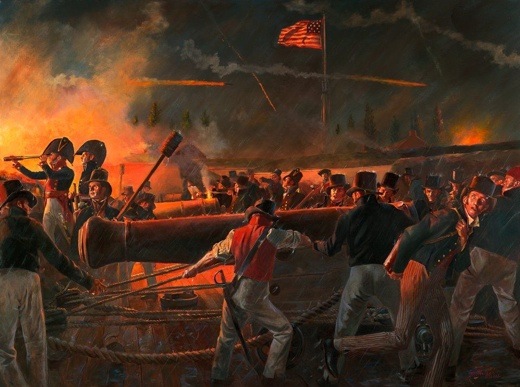
Image above: Painting of bombs bursting in air, that was commissioned by the graduating class of the US Army War College. Painting titled "Our Flag Was Still There" in the Defense of Ft. McHenry, Sept. 13-14, 1814, by Don Troiani. From (https://news.usni.org/2018/06/26/rim-of-the-pacific-2018-participation).

This may be not only the latest, but perhaps the last 4th of July "celebration" for American's used to it being a "Party like it's 1999". The holiday that embraces "Bombs Bursting in Air" has run out of our enthusiasm.

"Make America Great Again!"

When was "again"? Was it the time of the the American Revolution for independence from Britain. Back then the nonnative population of Americans was less than three-million people. That's less than 1% of today's human population of the United States (https://commons.wikimedia.org/wiki/File:Population_history_of_USA.png).

The support required our current American population is staggering and unsustainable. Worldwide if you include the just the domestic livestock of mega-fauna (large-animals) raised in pens for our food (chickens, pigs, cattle, etc) that's over 90% of mega-fauna alive).
Humans are selfish. As if they are all that matter.  
As your nostrils fill with acrid smell of charcoal grill fire-starter and firecracker black-powder smoke just remember you don't have to be sitting baking in the sun while pounding down beer and grilled flesh.

You could be sitting in the shade near your sunny raised-bed garden admiring the pole-beans with a glass in your hand filled with home grown lemonade sweetened with your own honey...

... that is if you started some years ago by building a raised bed, planting a lemon tree and husbanding a beehive.  
Humans live for today. As if there is no tomorrow.
Thousands of years ago we invented "agriculture". That was in the then hospitable Tigris-Euphrates Valley once known as the "Fertile Crescent". Sumerian and Mesopotamian culture was the founded there and morphed into Greco-Roman civilization and ultimately modern "Western" industrial society.
Now the 'Fertile-Crescent" is the 'Fossile-Crescent" stretching from Northern Africa through the Middle East. The last useful scraps of the  "crack-cocaine energy" we fuel ourselves with is there and we will lat waste to it and whoever lives there to "stay high".

If we keep "keep on pushin' on" the fine membrane of life will snap and everywhere will be as bleak as Afghanistan and Syria are today.

Where do we go from here? Certainly not upwards with more of the "same-old same-old". More likely if we make it through through the "eye of a needle" of collapse we will be as ragtag groups of hunter-gatherers.

By that I mean there may be a small bands of humans in some corners of the world still habitable that may survive... possibly the tip of South America, Africa and Australia. It has happened before. See (http://islandbreath.blogspot.com/2011/04/one-time-through-bottleneck.html)
Humans can adapt to change. But is seems only under great pressure. 
Well, the pressure is on and will only increase. Get off the Grid. Get out of the Matrix. Go for what's real and close by!

See also:
Ea O Ka Aina: American Dignity on Fourth of July 7/1/17
Ea O Ka Aina: The Next American Revolution 7/5/13
Ea O Ka Aina: The American Unraveling 7/29/11
Ea O Ka Aina: Birthday Card 7/4/11
Ea O Ka Aina: "Merciless Indian Savages" 7/3/11
Island Breath: American patriotism's failure 7/4/08
Island Breath: Thinking about July Fourth 7/4/07

.

Maui Breadfruit Company

SUBHEAD: With community help this local business was able to get off the ground and help others do the same.

By John Cadman on 27 June 2018 in Resilience - (https://www.resilience.org/stories/2018-06-27/maui-breadfruit-company-receives-slow-money/)


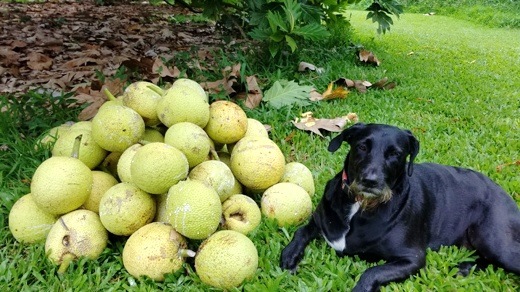
Image above: A pile of breadfruit (left) and John's business partner Maile (right). Note the volume of large tough fallen leaves typical of  breadfruit trees. From original article.

We all have them; you know, those things we call defining moments in our lives. I’ve had several, but the one that stands out most for me occurred in the Fall of 2012. I was asked to give a cooking demo at the local chapter of the Farmers Union on Maui.

I said, “Sure, what would you like me to focus on?”

The Farmers Union said, “How about breadfruit?”

I thought, “OK, I know a little bit about that—heck, I had even eaten and cooked with breadfruit a few times.” Just so it sounded like I knew what I was talking about, however, I figured I better do a little research and experimentation.

I can’t really explain it, but for some reason the light just came on for me. I quickly realized what an amazing food breadfruit is.

You see, it is one of the original canoe plants that the ancient Polynesian voyagers brought to Hawaii. It has been grown throughout the Polynesia as a staple food crop for many centuries. The tree itself has many uses, but the fruit is what is so amazing.

When immature it is firm, very much like a potato. As it ripens it becomes soft, sweet, and deliciously aromatic. The trees are amazingly easy to grow, extremely high yielding, and are very tolerant to many types of growing conditions.

Sadly, it has become a neglected food here in Hawaii, but I was determined to change this. I am convinced that breadfruit has more potential to address food security than does any other crop in Hawaii, where we import about 90% of what we eat.

Developing our local small-chain food supply is truly essential in overcoming this staggering figure.

So, with my newfound passion for this forgotten fruit, I began experimenting and making all kinds of delicious things using breadfruit in both its starchy and sweet stages. Fast-forward about a year, and I had come up with a dessert that was nothing short of amazing—or so I was told.


Image above: A slice of John's Pono Pie. Note Maui upcountry is one of the few places in Hawaii that can grow commercial strawberries. From original article.

Naturally, the next step was to quit my secure and high-paying job and go into selling breadfruit pies. That was four years ago, and now Pono pies are sold on all four of the major Hawaiian Islands, at health food stores, and in some excellent restaurants.

In Hawaiian, “Pono” means correct, beneficial, and done in the right way. I have tried to adhere to this principle in my business. One way is to source my ingredients locally. My breadfruit, sweet potatoes, bananas, honey, macadamia nuts, coconut, and coffee are all grown in Hawaii.

One of the greatest unintended consequences of bootstrapping my business is that I can help other aspiring food entrepreneurs by renting out kitchen time at my factory. This is a win-win situation for everyone involved.

Currently, there are no truly affordable options available to anyone who wants to develop a value-added product here on Maui.

Presently, five fledgling companies use my kitchen space. Although I have watched at least that many companies start up only to shut down when the harsh realities of small-company food production became all too real, at least they didn’t have to make significant investments in building or leasing an entire kitchen to find this out.

For my company, the additional income really helped in the early growth stages when cash flow is so crucial.

You see, I started the company with very little money. I believe that growing a company with as little debt as possible is the best way; but sometimes it is just not possible to expand without some financial assistance.

That’s where Slow Money Hawaii came in. Previously, I had my labels printed locally in small batches at a cost of $0.31 per label. My printer told me that if I could order in bulk it could get the cost down to $0.06 per label, but that would require ordering at least 100,000 labels.

Slow Money Hawaii connected me with some very supportive and enthusiastic community members who believe in breadfruit as much as I do.

The very generous loan terms provided by Slow Money enable me to make the monthly payments and still increase my profit. I really hope that someday I will be able to return the favor and help other aspiring food entrepreneurs as a Slow Money lender.

See also:
Ea O Ka Aina: Changing the culture and ourselves 7/30/16
Ea O Ka Aina: In Soil We Trust 2/27/11
Ea O Ka Aina: Slow Money 12/16/10
Ea O Ka Aina: SuperBus vs StraddleBus 12/4/10
Ea O Ka Aina: COP16 as Cancun disappears 12/1/10
Ea O Ka Aina: Bringing Money Down to Earth 11/22/09
Ea O KA Aina: Breadfruit Recipe Experiments 11/15/09
Ea O Ka Aina: Investing in our community 5/25/09
.

Tales of History are a Dead End Road

SUBHEAD: Solution? How most of villagers lived and thought in, let’s say, 1914 is a good start.

By Patrick Noble on 20 June 2018 for Feasta -
(http://www.feasta.org/2018/06/20/the-tales-of-history-are-a-dead-end-road/)


Image above: "Landscape" by Russian painter Ilya Mashkov in 1914. From original article and (https://www.wikiart.org/en/ilya-mashkov/landscape-1914).

[IB Publisher's note: FEASTA is the Foundation for the Economics of Sustainability.]

Culture is what people do. It decays when people stop culturing. Changing a culture means changing what we do.

Often, that will need a step by step transition as we negotiate obstacles. Even though we follow some backward meanders, the river may flow on.

But there are some transitionary illusions – convenient untruths, which are not obstacles to be overcome, but dead-end roads to be avoided.

In those cases, we must turn back and begin again.
Dead-end roads (or stagnant backwaters) can be paved (or punted) with the best intentions – often because we are focused on singularly-important things, such as energy-use, pesticides, human rights…

We applaud solar panels on the buildings of a retail park, or the rising quantity of organic and fairly-traded produce in the super market swamp. But retail parks and super markets were created by and are maintained by fossil fuel.

Greening such infrastructures gives them an illusory credence. It satisfies complacent images of social justices, green energy and regenerative farming. But what came with oil must go with oil. However green we strive to make them the retail park and super market remain vast and stagnant backwaters.

We lazily mined those millions of years of sequestered photosynthesis. Now we must live by singular seasons as they pass. The thing about natural limits, is that they have shape – taste, scent, sound, mass, energy, volume, chronology… We can give them meaning, and if we know them truly, they can gain beauty.

Buying organic produce (for instance) in a super market defers a large part of cultural creation to infrastructures, which we cannot see, or taste. Those green market signals are not signs to a better future but delusive advertisements to the virtues of a dead-end road.


Just as the flow of money directly relates to the flow of energy, so does the flow of cultural effects. As the flow of fossil energy diminishes, so we must return to human sized spending power with human-size imprints.

Returning to just human size brings culture round us like a shawl. We can wear it – a durable vestment died with both personal and community colours.

We can divest from identity levelling, but powerful provisions of oil. They are, in any case much too large to fit. Of course, much of what we do is not measured by GDP, needs no fossil fuel and has no monetary value.

Nevertheless, it may be vital to the functioning of any measurable economic activity. As we leave oil in the ground and as oil infrastructures evaporate those unpaid activities of parenthood, home-making, cooking, gardening, story-telling, singing, dancing… will remain untouched and can swell as the consumption of piped entertainment recedes.

The culture we created by fossil fuel is no longer possible. Most of our choices have become dead-end roads. A 2% increase in GDP is more or less, a 2% increase in green-house gas emissions.

GDP could be just as accurately named GDCC – Gross Domestic Climate Change.
If culture is what we do, what do we do next?

Some difficulties emerge, because we are social partners to existing infrastructures. There will be some backward meanders (infrastructures don’t exist until we find or make them) and many dead-end roads.

We exist as a social species. Our identities are parts of the whole. When cultures break, they break identity. To heal ourselves, we’d heal the culture. But cultures evolve from deeper commons and may resist time-bound manipulation.

Alienated, we seek artificial, or imagined fraternity. Fraternity? – Where is the sexless alternative?

I cannot find a word – so it is with wider culture – its evolution and revolutions. Revolutions are usually temporal and unsatisfactory. Yet we do need a powerful, all-embracing, sexless equivalent to fraternity.

If cultures place evenly-sexed roots in the soil which feeds them, then a more balanced and so durable ethics can evolve.

That is how new commons emerge. In removing our dependency on the strata of fossilised years we become intensely dependent on local resources and on each other.

Since we need an utter revolution in the ways we live and think today, those commons must evolve quickly… How most of us lived and thought in, let’s say, 1914 is a good start.

Breaking connections to dead-end roads may mean both breaking and healing hearts. Broken cultures break hearts, but then healing hearts heal cultures. And with regards to quickly evolved commons, inherited commons lie neglected and dormant – awaiting resuscitation – somewhere very like the some-when of 1914.

Nostalgia is an answer – what has been could be. Within the nostalgic vision, deeper and essential commons survive, which could not be manufactured by reason and thin air. And they are familiar. The once and future life comes ready-made with poets, musicians, painters, familiar voices…

Once the nostalgic vision is adopted, circumstance will force pragmatic change and new artistry may sing for what newly surrounds it. The nostalgic vision provides a landing ground for the first footstep (the last flight!) – and one which can be communally understood.

Time, and the contrary physics of 2018 will change it – but we can embark with genuine ancestry.

Where do we find a coherent model for a life without fossil fuels? For most of us in the developed world, it is not a case of greening how we live, but of abandoning it.

Many of our infrastructures cannot be greened. They must be evacuated. We shall be refugees and foragers making the best of what we find. Why not pick up what is deeply familiar?

Why not revive how our grand, or great grandparents lived – untouched by subliminal advertisers, or shadily-financed political punditry – sequestered from time, yet beside the same spring of deepest commons, which flow between all generations?

Are you ashamed to step backwards? Why? – The paths we’ve communally taken have been misdirected. It is natural to retrace those bad steps to the first solid ground and then begin again – first-footing into new times – not with last year’s embers, but with the last durable; the last possible embers to ignite a future without fossil fuels.

Look – here’s where we traded, once upon a time – from ports on every mile of coastline – the last cutters, schooners, brigs… – pinnacle of thousands of years of evolutionary marine architecture. Coal evoked new designs, which have been short-lived – scarcely-tried – just a hundred and a score years old, because they embarked to a backwater of no return.

If we retrace our steps to 1914, when the last schooner was built in Porthmadog, we shall know where to begin with sea trade. Those futuristic-looking aerofoils on today’s (ill-fated) oil designs are futile – a reluctance to change how we live – just like solar panels in a retail park, or organic produce in a super market.

To be sure, we have new knowledge of aerofoils and hull design from amateur racing dinghies and keel boats. But still, we begin in 1914 when there remained a fragmented, but still working sail-trade. Then we can adapt what we’ve found with the advantages of that new knowledge.

In 1914, living canal and river networks flowed to the sea. Coastal communities were also connected to each other by sea. That shore-hopping trade has vanished today.

What’s more boats of fifty to two hundred tons, had recently been built in small ports and on beaches all around Britain by the communities which financed, sailed and traded with them – without advice from corporation, government or bank. Yes, by 1914 we find sail’s twilight years.

That’s why I alight there, in a time still depicted by remembered anecdotes within modern families and communities, yet when the total domination of fossil fuel had not yet been completed.

It seems to me, that our schooner may be a paradigm for everything. Let’s keep 1914 as a destination, (conveniently forgetting the contemporary idiocies of the powers). The same acreage of arable land was easily farmed without either coal or oil.

We had the steam plough at some headlands and a few small towing tractors, but their influence was insignificant. Traction was largely man, horse, ox and wind powered (though for machinery – milling and so on – steam and oil engines were already replacing wind, water and horse power). Major cities were ringed with market gardens…

Let’s consider crop yield – in 1914 average UK wheat yield was 1.01 tons per acre and in 2017, 3.36 tons per acre (Defra). It is a mistake to think that massive increase is derived from a similar increase in artificial fertilisers, pesticides, fungicides, herbicides and growth regulators.

Since modern organic farmers often achieve 3 tons per acre (we have done so ourselves on an upland farm), we can see that the greatest contribution to yield has been selective, in-line, plant breeding – an advantage I propose to keep as I step forwards from 1914.

In any case, true yield is output, minus input – so that when we subtract the massive inputs of today, (their finite material, mass, manufacture, and distribution) we end with a yield which is probably much like that of 1914.

When was peak phosphate?

Of course, organic yield depends on a proper rotation – so reducing it, if we add that increased acreage. However, organic methods must maintain an optimum mass of soil fauna (biomass), while continuous cropping continually reduces it.

We must add the negative of lost soil fauna to those inputs – or we can say, lost soil fauna is equivalent to lost acreage.

So, as we retrace our arable steps to 1914, using modern seed varieties, we begin with the considerable advantage of a possible 3 tons per acre in rotated fields, which can continue growing that same yield from that same fertility. Small birds will continue their songs and Summer air will be loud with flies, bugs and bees.

Of course, those regenerative courses in arable rotation will provide other good things – if we like eggs, milk, butter, cream, meat… However, in the UK much of today’s and 1914’s permanent pasturelands will prove more beneficial, to both economy and ecology (and photosynthesis) as forest.

Today, in 2018 futile inputs are destroying the ecosystems on which all cultures depend. They are also shrinking soil biomass – that is the capacity to grow future crops. If we shrink soil biomass, we shrink all the connections of a web in which Man is one very small part. For instance, soil fauna and atmospheric CO.2 are intimately connected…

Starting from 1914 and stepping into the future, we’ll find an abundance of market gardens and orchards close to cities and towns.

Their labour requirement can be almost entirely human, with horse and cart to auction and street market – or in the case of London – barge along Thames, or Lea – along which the night soils are discretely returned.

The market garden model is a better one than the field-scale vegetables and seasonal slave-labour of today. Our eco-modernist is polemical with population. I also – egalitarian, involved, ingenious (oil has no ingenuity) people will re-populate the land!

The horse will need her share of acreage but (along with forestation) will happily replace a part of that surfeit of sheep and cattle.

My nostalgia is circumspect. By 1914, enclosure and dispossession were complete. The dispossessed had migrated to the factory gate, or to the New World, or had been starved and evaporated from the map of Earth.

Sheep had replaced people in marginal lands and uplands, the mass slaughter of innocent young men was about to begin and only wealthy men held right to the ballot.

Women over thirty would have to wait until 1918 to hold voting rights along with men over twenty-one who had paid less than £10 annual rent.

Six out of seven males, and all women, held no voting rights in UK (then called Great Britain) until 1918.

I bequeath no virtues to our journey’s beginning but suggest that from 1914 a road to the future is possible – cyclic infrastructures, though decayed, are in place for revival.

Coal-fired suburbia was already spreading along rail routes from major cities. Yet for all but the suburban office worker, both work and pleasure were within easy walking distance.

The trades congregated in town and village centres. Local produce appeared in season, mostly by horse and cart, in grocers, green grocers and butchers’ shops and in street markets and fairs.

The majority of those businesses were family run and many of them descended though generations of skill and cultural tradition. Those businesses and those cultural traditions and the network of connections between them, were the economy.

Neither government, nor corporation had much part in it – only to fill the tea caddy, collect taxes (for war) and deny the vote to most.

Church and chapel, meeting house, theatre, concert hall, pub and tea-room made other connections. Though on occasion, authority passed by on his high, dark horse, to the prudent doffing of caps, while land agent and factor swept in for the gathering of rent, they played no part in production. Their business was violence and consumption.

The rural poor had it harder, because they were more isolated and conspicuous to that violence. To keep a roof, one had to be deferential to the gentry.

My partner’s great uncle was spotted taking a pheasant. He hid in a muck heap and with family help, made the passage from Liverpool to America – to escape the “justice” of an Australian penal colony. That was a story of many.

There’s a problem with the telling of history… and so also with how we’d like to make history. Still today, books are written, documentaries made, and classrooms taught – how kings, politicians, treaties, wars, generals and strategic marriages steered the passages of time.

We talk of fake news, but what if all our history lessons are fake? What if to attain that B.A. we must propagate nonsense? What if our whole modern narrative is fake and if people everywhere come to see the deception?

What is true news? – events in the making of culture and with that news, the possibility of an exited renaissance. Culture is what people do in spite of the powers. Kings, lords, lairds, squires (for UK) and corporate executives do nothing but extract various forms of rent and non-distributive taxes.

Culture is what people do who make things, grow things, maintain things, share and gossip about things – that is people who both physically and spiritually are the culture.

Culture is a living, pulsing, evolving thing. Yet how food was grown; how houses, bridges, roads, canals, harbours, ships, cathedrals… were built – how scarcity and surplus were exchanged – is invisible to historians, but for footnotes.

History has been the accumulated praise recitations of court bards. The cattle raid of Troy was made an epic adventure, in which even the gods participated. The shining walls of Ilium are celebrated as a symbol for a great, though soon to be fallen power.

But they were not – they were made by the dexterity, ingenuity and complex social fabric of unrecorded generations of busy people.

Hector and Achilles, like Napoleon and Wellington, could scarcely tie their shoe laces, let alone contribute to a culture. Ah – you say, but we all have roles and one role – one small part of the whole – is that of leader.

Right, I concede (a little) – but where is the record of the larger part whose lives have been coerced and parasitized by our celebrated elites and then hidden from posterity’s view by their academic, journalistic, or bardic sycophants?

The thing is, those history books lead us on another dead-end road. Because of them, we lobby governments, petition corporations and strike imitative, pugilistic attitudes. NGOs propose that to make history, we must behave like the history books and engage with the powers.

But look at their shoe laces!

Why seek to change what has, and can have, no creative power in the hope that it will mysteriously gain creativity by our instruction? We neglect our own parts in the evolution of culture by asking the powerful, who have not the means, (or attention span) to create a culture for us.

The culture which created climate change was not created by leaders. It was created by ordinary people, who did not pay attention to how they were led.

Corporations and governments have not the skill to create climate change – to find and extract those sedimentary layers of fossilised lives – to devise pistons, cylinders, cranks and wheels – to understand compression and ignition – even to understand how money can be either put to work, or put to destruction…

The powers have no thought of farming techniques, or of building ships to trade scarcity with surplus. They watch, preen and extract. Of course, there is fluidity – ordinary creative people can become extractive and powerful people can become creative – but nevertheless the pattern remains.

If we make a community in the woods, it will evolve leadership. Perhaps leadership is an essential part of human cultures – part of an inherited pattern of social behaviour. We have benign and malign leadership, so when we lobby the powers, we lobby for the benignity.

But lobbying for social change is futile, since we, the lobbyists are the physics of the society that must change. Governance is abstract, people are real.

Climate change, trashed resources and cascading ecosystems are real and have been caused by real, ordinary people. Only ordinary people can pull back from that destruction.

Ordinary people can achieve what no government can achieve – the evaporation of the super market, the end of aviation and the death of the family car. Perhaps a pied piper (leader) can call us away, but unless we do walk away, nothing will happen.

I say we recede into familiar community histories to the first sight of solid ground and then set out again from that original wrong turning to a dead-end road – which is where we stand now. We stand in super markets, jet the globe and polish our cars. Only we can stop doing so.

We prevaricate to suggest that we must first ask the powers to ask (or compel) us to stop. We cut out personal guilt and paste it on the powers.

But we (principally we) are guilty. It is comic to propose that governments should impose a carbon tax before we can stop burning it ourselves.

It is tragic that we remain loyal to an entirely oil-powered super market to change it for the better by market signals, when our own town centre decays because of our absence. It is both tragic and comic to petition against that third runway, as we simultaneously book a business, or holiday flight.

We created the super market, the airline and the family car – we built, maintained and paid for them – and we populate them – thronging a dead-end road. What can a leader do? She can do nothing.

We must do everything, because we did everything. I own some shares in those four hundred and twelve parts per million of atmospheric carbon dioxide.

.
Get in the lifeboat now!

SUBHEAD: There is not much time left to find a way off this sinking ship. Find a seat soon.

By Juan Wilson on 19 June 2018 for Island Breath -
(http://islandbreath.blogspot.com/2018/06/get-in-lifeboat-now.html)


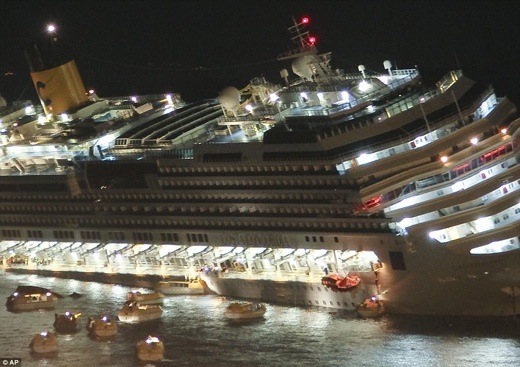
Image above: Abandoning the Costa Concordia that capsized and sank in 2012 off Isola del Giglio, Tuscany, Italy. From (https://paullaherty.com/2015/01/05/lessons-from-the-costa-concordia/).

I know it's comfy in the First Class State Room on A Deck but that won't be for long. As Americans we've grown accustomed to having "the best". However, now in the first part of the 21st century we are beginning to realize that we all are not "on board". An increasing number are in steerage... already below the waterline.

People around the world in places that have been trashed by over population, war,  bad agriculture, eco-collapse and fanaticism have been rushing to the exits - primarily to Western Europe, America, Australia, New Zealand and other parts of the world held together by some combination of modern technology, advanced military, historic plunder, natural resources  and/or isolation.

Those "safe havens" likely won't be able to handle the additional load. This is particularly true if those escaping intend to live in the style that "western civilization" has become accustomed:
Automobiles for everybody, highways to everywhere; universal electric grid, internet, and cell service; air conditioning, refrigeration, supermarkets, frozen food;  jet travel and fresh fruit on the table from another hemisphere, next day Amazon delivery service - total security... etc.
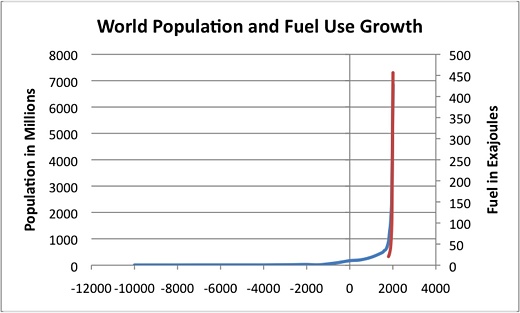
Those services cannot be provided for the eight billion people that inhabit the planet now. At this point of degradation of the ecosystem it is probably not possible for even a tenth of that number. That's about what the population of the world was when America became nation independent in 1776.

Basically, this human population explosion is a function of the consumption of fossil fuels. See the chart below:


Image above: World population from US Census Bureau inj blue, overlaid with fossil fuel use (red) by Vaclav Smil from Energy Transitions: History, Requirements, Prospects. From "Human Population Overshoot: What Went Wrong?"2/15/12 (https://ourfiniteworld.com/2012/02/15/human-population-overshoot-what-went-wrong/).

What is the solution?
Back away from your dependence on fossil fuel (and all that it supports) as soon as you can. Make your life livable (and hopefully enjoyable) off the grid as soon as you can. Get in a lifeboat now! By that I mean have at your immediate disposal a place where you can survive, and even thrive, without dependence on "The Mother Ship" (The System, The Grid, Civilization, the United States of America. etc.).

There is no time for any delay. My wife and I have been working towards this goal for over a decade and we are not quite there. If the container ships and tankers were to stop coming to Hawaii we would face drastic changes, but likely our homestead could support human habitation.

Are you in such a place now? If the lights go out can you be in such a place securely within a couple of days? I say that because that is about as long as most people have the resources at hand to survive.

For starters, you will need your own sources for water, food, energy and shelter.

See also:
Ea O Ka Aina: Settling into a Collapse Rant 11/15/17
Ea O Ka Aina: Oases on a future Eaarth 6/28/15
Ea O Ka Aina: Tales of a Dark Kauai 5/23/14
Ea O Ka Aina: The New Game 11/10/13
Ea O Ka Aina: Food, Water, Energy & Shelter 1/31/13
Ea O Ka Aina: The Titanic or Noah's Ark 3/4/12
Ea O Ka Aina: The Hero's Way 1/13/12
Ea O Ka Aina: Time to Stop Pretending 4/27/11
Ea O Ka Aina: All Aboard 12/9/09
Ea O Ka Aina: Here the Deal!  7/5/09
.

Discovering the Hutterites

SUBHEAD: Here’s what one of America’s most isolated communities can teach us about getting along.

By Amanda Duberman on 13 April 2018 fro Huffington Post -
(https://www.huffingtonpost.com/entry/hutterites-rural-religious-photos_us_5accee42e4b0152082fe4005)


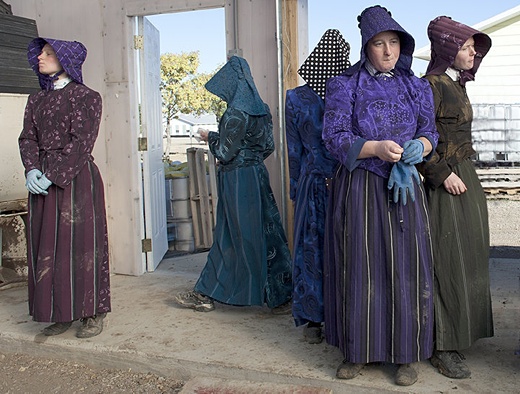
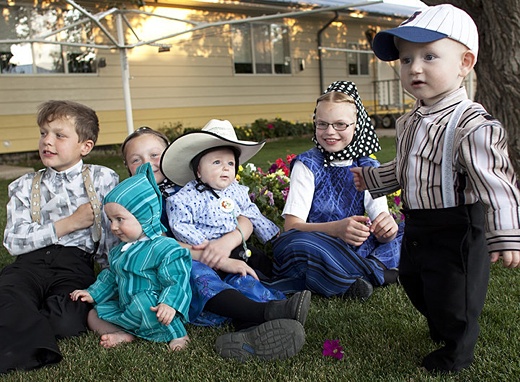
Image above: Hutterite women dress with bonnets often or polka dot scarves. From original article.

[IB Publisher's note: This article is in part a photo essay by someone dear to me that I've known since 1950. We went through school together at a Waldorf School in Garden City, Long Island from kindergarten through high school. I've been closer to Jill Brody longer than anyone other than my sister Diana. Jill has honed her skills over decades in a career being a Steiner teacher, becoming a Unitarian minister, working in medical imaging to in recent decades producing documentary photography. Jill has always brought deep understanding to what she does. For more of Jill's Hutterite photos see original Huffington Post article.]

After spending just one day with the Hutterites of Liberty County, Montana, Jill Brody recalls she was “hooked.”

The educator and photographer learned of the reclusive ethnoreligious group while researching a book on ranch life in central Montana. Locals told her that if she wanted to see what good farming looked like, she ought to visit the Hutterites.

That advice would change the way she thought about life and inspire a portfolio of photos titled “Hidden in Plain Sight,” which captures the world within these small, ultra-traditional religious communes.

The Hutterites were not Brody’s first exposure to people from isolated rural areas. At a young age, she had traveled from New York to North Carolina to attend summer camp.

“There were all these nice Jewish kids from New York, and most of the counselors were from the Deep South,” she said. Many of them had limited education, which Brody said she and her youthful peers mistook for a lack of intelligence.

With age and experience, Brody came to realize that she had misjudged them and the wisdom and ingenuity demanded by rural life. “They were pretty amazing people,” she said.

Decades later, she found herself living and working among some other pretty amazing people in one of America’s most isolated communities.


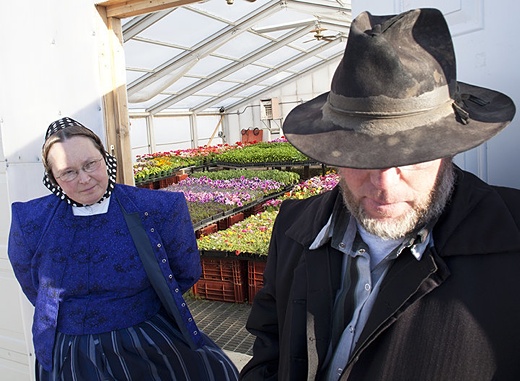
Image above: Hutterite husband and wife outside community greenhouse. From original article.

The Hutterites are Anabaptists ― Christians who believe people should be baptized not as infants but only when they are old enough to confess their sins and choose baptism for themselves. They fled persecution in Austria during the Protestant Reformation and eventually ended up living across parts of North America’s Great Plains. According to National Geographic, there were roughly 40,000 Hutterites living in 480 colonies in the U.S. and Canada as of 2012.

The group is named for a 16th century leader, Jakob Hutter, who preached the tenets of pacifism and communal living. Nearly all property in a Hutterite colony is owned by the colony ― a practice that differentiates them from other rural religious communities, such as the Amish and Mennonites.

Their guiding doctrine comes from a verse in the New Testament. Acts 2:44 reads: “All the believers live together and have everything in common.”

Unlike the Amish, the Hutterites utilize various forms of modern technology. They generally sustain their communities through industrial agriculture, selling frozen meat, chicken, eggs, milk and vegetables to large local grocery chains.

Some also offer services in commercial construction and mechanics. Brody said a Hutterite man could build you a Mercedes and because every Hutterite woman is given a sewing machine when she marries ― the only possession she will ever own ― “any of them could get a job as a seamstress in Hollywood.”

Initially, while researching her book on ranchers, Brody didn’t pay much attention to the local Hutterites. “They were just these anachronistic people who wore brightly colored clothing and spoke with a funny sort of Germanic type of accent,” she said. “They were friendly but distant.”

But she took up an offer from some other area residents to introduce her. She did know that the Hutterite communities were insular, highly patriarchal and guided by strict religious tenets. Brody, who is not religious, wasn’t expecting to enjoy herself.

She eventually spent four years photographing the group and learning about their lives.


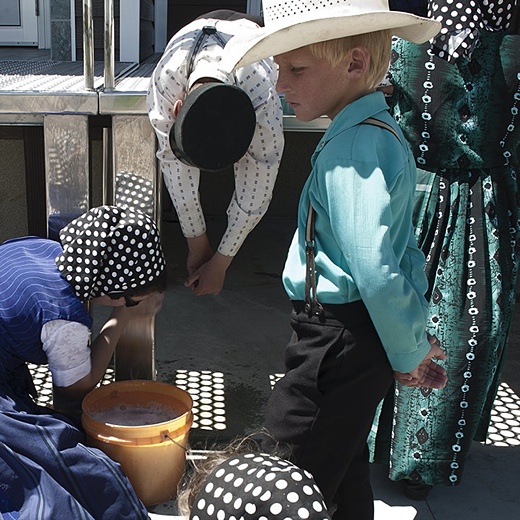
Image above: Hutterite boys and girls help cleaning farm equipment and doing chores. From original article.

“For whatever reason ― maybe it’s the way I am or the way they are ― there was space made for me to come and do something which they don’t normally like people doing, which is taking pictures of and being with them,” she said.

Brody photographed three separate Hutterite colonies in Liberty County. Her work honors the many technical skills that allow the communes, which she said consisted of about 150 people each, to function. But more profoundly, it captures the relationships that develop when a community is simply too small to allow itself to become divided.

“I thought I had a sense of who Hutterites were,” Brody said. “Then as you get to know them better, you realize they’ve got this thing ― this little jewel that they pass on to each other, that we don’t have anymore.”

Brody described this “jewel” as “the ability to be together,” which she observed while spending time with the women in the colonies. Whether they personally liked each other or not, she said their faith called on them to “live together and have all things in common.”

It’s a principle the Hutterites are committed to living by, no matter how difficult a situation or personality they encounter.

“There are just destructive people ― in almost any community, you’ll find at least one,” Brody said. “So how do you handle that? Do you ostracize them? In a tiny community, can you afford to do that? No. So you learn to adjust and adjust and make space for that person to function.”

The Hutterite women accommodate one another’s individual differences in order to protect the health of the entire community. When a person is destructive or obnoxious or insolent ― either in personality or in reaction to the community’s rules ― the group adjusts their expectations. This creates a space for the disruptive person to function within the community and, perhaps, create a path to contentment they may not have otherwise found.

“When people started asking me about what I was doing there and what I was looking at, I realized that’s what I was looking at,” Brody said. “I was looking for a piece of the puzzle in me or in us, in general, that is missing.”


Image above: Younger Hutterire children playing in the grass. From original article.

Tolerance is not the first thing one expects to find in a community that rejects almost everything outside itself. But when nothing from the outside world is allowed in, they have no choice but to cherish and protect each other.

“Part of what they came to understand was you don’t have to love everybody. You don’t even have to like them,” Brody said. “But you need to get along, and you need to help.”

“That’s a huge lesson this country has completely forgotten,” she added.

Below are Jill's thoughts on her time with the Hutterites and the lessons she believes they can teach us.


Image above: Members of a Hutterite colony eat a communal dinner segregated by gender. From original article.

“I had all these messages coming to me about rural America and its importance, from the time I was 8 years old up until the present. I was interested almost immediately in how small rural economies operate and how small communities operate. If you live in large urban communities, they don’t operate, except in a snowstorm. We are so easily split asunder. We see a horrifying, graphic example of it right now in Washington, and we don’t seem to have any sense about the importance of community in structuring our lives.”

They taught me so much about just being mindful that when there is a person right next to you who you don’t know, you might have a lot in common and you might have very little, but it’s possible to take a couple of minutes to just sort of slow down and not make the assumption that if they get something, you don’t get it. If they win, you lose. Everything that’s happening in this country now is so incredibly divisive. The Hutterites don’t vote; they don’t participate. But one of them said to me, ‘We really should now.’”

“They make everything they wear, except for underwear or shoes. If you look at the pictures, it looks like they’re all wearing different clothing. Until you look closely and you realize every apron is the same, every dirndl skirt is the same, every shirt is the same, every jacket is the same, every head covering is the same. So they express their personality in the pattern of the fabric, not in the design of the clothing. It’s a whole metaphor for them that they have these small things that differentiate themselves but they’re expected to conform on larger issues. If any Hutterite woman left there and offered themselves up as a seamstress, they could make a killing in Hollywood.”

“What surprised me most was how fearful they are of the outside world. They don’t need to be that fearful, but they are.”

“Some of the hardest work the men will do, but mostly the women do everything. They don’t slaughter the cattle, but the minute the cattle are slaughtered, they take over the butchering. They slaughter the ducks and the chickens themselves and the geese. So you might want to say to yourself, what is left? If all the women disappeared from the colony, it would take them probably five days to fall apart.”

“A lot of what they have in place relies on the women being certain types of people. The women will say to me, ’We’re going to vote on who is going to be the new head of the kitchen. I said, ‘Who’s going to vote?’ They said, ‘Oh, the men vote.’ I asked how the men know who to vote for. They said, ‘Well, we tell them who to vote for.’”

“One day one of the women asked me if I’d like to know what they were talking about. I said sure. These are women who range in age from maybe 20 to 80. They’ve lived together their whole lives, one way or another. They were talking about which scent they like better, Mr. Clean or Pinesol or something with lavender in it. I realized if you live in a dorm in college, you have that kind of relationship with somebody ― where the mundane becomes crucial and important. But in general, you don’t have that. When people started asking me about what I was doing there and what I was looking at, I realized that’s what I was looking at. I was looking for a piece of the puzzle in me or in us, in general, that is missing.”

“They’re pacifist, they’re communitarian. ... There are a gazillion people to take care of you and your kids. There are 7-year-old girls who are assigned to 5-month-old babies and they’re au pairs from the time they’re 6 or 7 years old. So you might drive in there and think of them, ‘Oh, I really couldn’t stand this, this is too much for me.’ And then you can’t let yourself leave at the end of the day because they’ve got this thing that you can’t quite describe and that you don’t have.”

“The women get up at 4 in the morning, they get their houses in order. They are constantly cleaning their houses. I don’t know what they’re cleaning. You could literally eat off the floor in any of those places.”

“One of the ministers said, ‘Well, you know in the old days we objected to the ideas of telephones and we survived that. Then we objected to the idea of mobile phones and we survived that. But I think the internet is different.’ And I said, ’You’re absolutely right. The internet is completely different.’ He said, ‘That really makes me worry. Bad things could happen.’ I said, ’But does that have to change your relationship to God?’”
 
       
.