Showing posts with label Petroleum. Show all posts

Civilization as Asteroid

SUBHEAD: We and our livestock are more than an order of magnitude greater than all animals on land.

By Darrin Qualman on 13 June 2018 in Resilience -
(https://www.darrinqualman.com/humans-livestock-extinctions/)


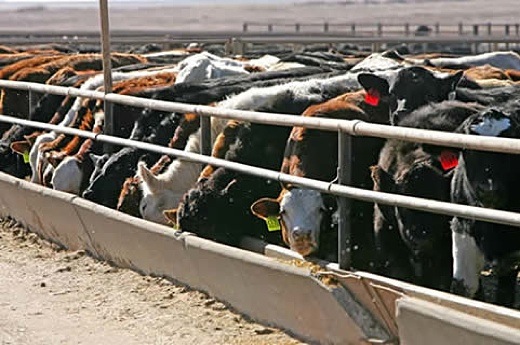
Image above: These 600-700 pound steers are being fed in a feedlot in Jetmore, Kansas, for “backgrounding” to gain weight to around 1,000 pounds. They’ll be sent to another feedlot for “finishing” before slaughter. From (https://aspenranchrealestate.com/Colorado_Cattle_Ranching).

Humans and our livestock now make up 97% of all animals on land.  Wild animals (mammals and birds) have been reduced to a mere remnant: just 3%.  This is based on mass.  Humans and our domesticated animals outweigh all terrestrial wild mammals and birds 32-to-1.

To clarify, if we add up the weights of all the people, cows, sheep, pigs, horses, dogs, chickens, turkeys, etc., that total is 32 times greater than the weight of all the wild terrestrial mammals and birds: all the elephants, mice, kangaroos, lions, raccoons, bats, bears, deer, wolves, moose, chickadees, herons, eagles, etc.

A specific example is illuminating: the biomass of chickens is more than double the total mass of all other birds combined.


Image above: At this KFC "broiler shed" there is only artificial light, no fresh air, and huge fans circulate the stale ammonia filled air. Chicken meat is perfect for our fast food culture. A producer can ‘grow’ a chicken within a few weeks with super large breasts, and minimize overhead through economies of scale. From (https://pos394.wordpress.com/2014/11/02/do-you-know-how-your-chicken-was-raised/).

Before the advent of agriculture and human civilizations, however, the opposite was the case: wild animals and birds dominated, and their numbers and mass were several times greater than their numbers and mass today.

Before the advent of agriculture, about 11,000 years ago, humans made up just a tiny fraction of animal biomass, and domesticated livestock did not exist.  The current situation—the domination of the Earth by humans and our food animals—is a relatively recent development.

The preceding observations are based on a May 2018 report by Yinon Bar-On, Rob Phillips, and Ron Milo published in the academic journal Proceedings of the National Academy of Sciences.  Bar-On and his coauthors use a variety of sources to construct a “census of the biomass of Earth”; they estimate the mass of all the plants, animals, insects, bacteria, and other living things on our planet.

The graph below is based on data from that report (supplemented with estimates based on work by Vaclav Smil).  The graph shows the mass of humans, our domesticated livestock, and “wild animals”: terrestrial mammals and birds.  The units are millions of tonnes of carbon.[1]  Three time periods are listed.


Image above: Graph of history of land based mammals and bird biomass over last 11,000 years. From www.darrinqualman.com.

The first, 50,000 years ago, is the time before the Quaternary Megafauna Extinction.  The Megafauna Extinction was a period when Homo sapiens radiated outward into Eurasia, Australia, and the Americas and contributed to the extinction of about half the planet’s large animal species (over 44 kgs).  (Climate change also played a role in that extinction.)

In the middle of the graph we see the period around 11,000 years ago—before humans began practicing agriculture.  At the right-hand side we see the situation today.  Note how the first two periods are dominated by wild animals.  The mass of humans in those periods is so small that the blue bar representing human biomass is not even visible in the graph.[2]

This graph highlights three points:
  1. Wild animal numbers and biomass have been catastrophically reduced, especially over the past 11,000 years
  2. Human numbers and livestock numbers have skyrocketed, to unnatural, abnormal levels
  3. The downward trendline for wild animals visible in this graph is gravely concerning; this graph suggests accelerating extinctions.
Indeed, we are today well into the fastest extinction event in the past 65 million years.  According to the 2005 Millennium Ecosystem Assessment “the rate of known extinctions of species in the past century is roughly 50–500 times greater than the extinction rate calculated from the fossil record….”

The extinction rate that humans are now causing has not been seen since the Cretaceous–Paleogene extinction event 65 million years ago—the asteroid-impact-triggered extinction that wiped out the dinosaurs.

Unless we reduce the scale and impacts of human societies and economies, and unless we more equitably share the Earth with wild species, we will enter fully a major global extinction event—only the sixth in 500 million years.  To the other species of the Earth, and to the fossil record, human impacts increasingly resemble an asteroid impact.

In addition to the rapid decline in the mass and number of wild animals it is also worth contemplating the converse: the huge increase in human and livestock biomass.  Above, I called this increase “unnatural,” and I did so advisedly.


The mass of humans and our food animals is now 7 times larger than the mass of animals on Earth 11,000 or 50,000 years ago—7 times larger than what is normal or natural.

For millions of years the Earth sustained a certain range of animal biomass; in recent millennia humans have multiplied that mass roughly sevenfold.

How?  Fossil fuels.  Via fertilizers, petro-chemical pesticides, and other inputs we are pushing hundreds of millions of tonnes of fossil fuels into our food system, and thereby pushing out billions of tonnes of additional food and livestock feed.

We are turning fossil fuel Calories from the ground into food Calories on our plates and in livestock feed-troughs.   For example, huge amounts of fossil-fuel energy go into growing the corn and soybeans that are the feedstocks for the tens-of-billions of livestock animals that populate the planet.

Dr. Anthony Barnosky has studied human-induced extinctions and the growing dominance of humans and their livestock.  In a 2008 journal article he writes that “as soon as we began to augment the global energy budget, megafauna biomass skyrocketed, such that we are orders of magnitude above the normal baseline today.”

According to Barnosky “the normal biomass baseline was exceeded only after the Industrial Revolution” and this indicates that “the current abnormally high level of megafauna biomass is sustained solely by fossil fuels.”

Only a limited number of animals can be fed from leaves and grass energized by current sunshine.  But by tapping a vast reservoir of fossil sunshine we’ve multiplied the number of animals that can be fed.  We and our livestock are petroleum products.

There is no simple list of solutions to mega-problems like accelerating extinctions, fossil-fuel over-dependence, and human and livestock overpopulation.  But certain common sense solutions seem to present themselves.

I’ll suggest just one: we need to eat less meat and fewer dairy products and we need to reduce the mass and number of livestock on Earth.  Who can look at the graph above and come to any other conclusion?

We need not eliminate meat or dairy products (grazing animals are integral parts of many ecosystems) but we certainly need to cut the number of livestock animals by half or more.

Most importantly, we must not try to proliferate the Big Mac model of meat consumption to 8 or 9 or 10 billion people.  The graph above suggests a stark choice: cut the number of livestock animals, or preside over the demise of most of the Earth’s wild species.
  1. Using carbon content allows us to compare the mass of plants, animals, bacteria, viruses, etc.  Very roughly, humans and other animals are about half to two-thirds water.  The remaining “dry mass” is about 50% carbon.  Thus, to convert from tonnes of carbon to dry mass, a good approximation is to multiply by two.
     
  2. There is significant uncertainty regarding animal biomass in the present, and much more so in the past.  Thus, the biomass values for wild animals in the graph must be considered as representing a range of possible values.  That said, the overall picture revealed in the graph is not subject to any uncertainty.  The overall conclusions are robust: the mass of humans and our livestock today is several times larger than wild animal biomass today or in the past; and wild animal biomass today is a fraction of its pre-agricultural value.
Graph sources:
– Yinon M. Bar-On, Rob Phillips, and Ron Milo, “The Biomass Distribution on Earth,” Proceedings of the National Academy of Sciences, May 17, 2018.
– Anthony Barnosky, “Megafauna Biomass Tradeoff as a Driver of Quaternary and Future Extinctions,” Proceedings of the National Academy of Sciences 105 (August 2008).
– Vaclav Smil, Harvesting the Biosphere: What We Have Taken from Nature (Cambridge, MA: MIT Press, 2013).


.

Heatwave melts Arizona

SUBHEAD: Much of the man-made landscape there is petroleum based plastic and now Climate Change is melting it.

By Tyler Durden on 26 June 2017 for Zero Hedge -
(http://www.zerohedge.com/news/2017-06-25/epic-pictures-arizonas-heatwave-everything-literally-melting)


Image above: Extreme Heat on 21 June 12017 means the temperature map of Arizona almost runs out of colors on it legend past 120º Fahrenheit. Looks a bit like the surface of Mars. From original article.

Ask any Arizonan whether their summers are more tolerable because "it's a dry heat" and you're likely to be asked to turn your oven to 150 degrees, stick your head inside for 20 minutes and report back as to whether or not the humidity within the oven ever crossed you mind. Probably not.


Image above: Yes, it is so hot that you may need oven mittens to drive around in the sun in Arizona. From original article.

Arizonans have learned to cope with the "dry heat," this summer has been particularly brutal for people living in the Southwest as temperatures have already soared to over 120 degrees in certain areas. What's worse, it's only June.


Image above: A petroleum based mailbox fails in the sun from the weight of mail made up of bills and credit card offers. Note condition of "grass" lawn about to become blowing sand. From original article.


Image above: In Tempe, Arizona a trash bin becomes trash itself due to high temperatures. Ironically, most of the trash appears to be packaging for refrigerated food that exacerbates the heat. From original article.

And while the heatwave may not be that fun for the people living through it, it does making for some amazing pictures of stuff melting.


Image above: Towards sunset the heat damage to the plastic yard fence can be surveyed in this suburban neighborhood. Looks like something out of a horror movie. From original article.

.

Petroleum and Nuclear Coverups

SUBHEAD: We cannot rely on our governments to tell us the truth about the dangers we face from continuing our current existence.

By Juan Wilson on 21 October 2015 for Island Breath -
(http://islandbreath.blogspot.com/2015/10/petroleum-and-nuclear-coverups.html)


Image above: A shot at night of Chicago from the John Hancock Building looking south. Photo by Jamie of Bytown. From (http://www.wired.com/2014/12/cities-climate-change-danger-warns-capitan-planet/).

Two articles came to my attention this morning. The subject of these pieces are cover-ups of ongoing disasters that may cause TEOTWAWKI, or the End Of The World As We Know it. Both are related to the ways in which we get the energy to meet the modern world's day to day needs.

PETROLEUM COVERUP
The first cover-up goes back to the 1970's and has continued for 40 years. It is that Exxon Corporation has been doing Climate Change science related to CO2 emissions all that time and has known that the rate of burning petroleum products would threaten our very existence. In the intervening years Exxon chose to become Climate Change denier and amass more profits than any other company during that period.

Below is a quote from of today's Democracy Now! video below:
For decades, Exxon has publicly questioned the science of global warming, contradicting internal findings by the company’s own scientists.

Recent exposés by InsideClimate News and the Los Angeles Times reveal that Exxon concealed for decades its own conclusions that fossil fuels cause global warming, alter the climate and melt the Arctic.

Exxon’s climate deception is now sparking calls for a federal probe similar to that which yielded a racketeering conviction of Big Tobacco for hiding the dangers of smoking.

We are joined by Rep. Ted Lieu (D-California), who is calling for a Justice Department investigation of Exxon, as well as 350.org co-founder Bill McKibben, who was just arrested for a one-man protest shutting down his local Exxon gas station. "It’s difficult to think of a company that could have set back humanity for decades, and perhaps permanently," Rep. Lieu says. "But that’s what happened here."

Video above: Interview on subject of Exxon cover-up with 350.org founder Bill MCKibbon and US Congressman Ted Lieu. From (http://www.democracynow.org/2015/10/21/prison_for_exxon_execs_calls_grow).

NUCLEAR COVERUP
The second cover-up has been on going for five years, ever since the multiple nuclear reactor meltdowns in Fukushima.  It has been the policy of the Japanese and American governments to pretend the disaster is behind us and no major threat. They, and the corporations that depend on the economy supported by nuclear power (including mass media), have denied, under reported and hidden the evidence of the ongoing and increasing threat to life on Earth posed by nuclear energy and Fukushima in particular. 

Below is are excerpts from ENEnews.com made by former US Congresswoman Cynthia McKinney on cover-up of dangers posed by Fukushima meltdowns. "The elephant in the room is Fukushima radiation"
In the aftermath of Japan’s Fukushima nuclear power meltdown… the international community has totally failed in keeping the public properly informed and protected from the fallout. Scientists and environmental officials continue to express concern, even now, at the unusual events and wonder about the causes. At the same time, the media present the facts, but fail to make any connection whatsoever to the ongoing state of affairs stemming from the tragic 2011 events at Fukushima...

Gerry McChesney of the Farallon National Wildlife Refuge says that the die-off has him all the more “baffled” because of the strip of cold water in his area full of food for these birds. In my mind’s eye, I can see McChesney scratching his head as I read that he considers poisoning, starvation, and El Nino as possible causes for the die-off. The article ends with the following comment by McChesney, “We might have to see some other problem in the ocean before we understand what’s causing the die-off.”

The media provide coverage of marine anomalies mentioning global warming, even El Nino and toxic algae, while the elephant in the room is Fukushima radiation. It is this silence that is deafening!… I do want to know why in the face of what appear to be Pacific Ocean die-offs, El Nino is mentioned and not the Fukushima-related elevated levels of radiation.

As long as there is a palpable lack of transparency in the mainstream media’s ordinary coverage of extraordinary environmental events, that includes what one senses as a reticence to discuss the obvious, I predict that there will be a proliferation of citizen journalists and citizen scientists seizing upon each piece of new data trying to make sense out of a government-approved narrative that just doesn’t make sense…


Video above: The Fukushima cover-up begins.  President Obama statement a few days after the disastrous meltdowns indicating that now harm should be expected in the Pacific islands, Hawaii, Alaska, or the continental United States. From (https://youtu.be/095dqQn_3H8).

One thing we at IslandBreath have concluded is that now we cannot rely on our governments to tell us the truth about the dangers we face from on going poisoning of the planet by Fukushima radiation or the on going use of fossil fuels to continue our current existence.

We must awake from the deep sleep of comfy coach potatoes, turn off the mass media and shutdown power generators and refineries that are killing the planet.


.

Muskular Magic

SUBHEAD: Tesla’s activities are meant to extend the fatal rackets of the suburban development pattern.

By James Kunstler on 11 May 2015 for Kunstler.com -
(http://kunstler.com/clusterfuck-nation/muskular-magic/)


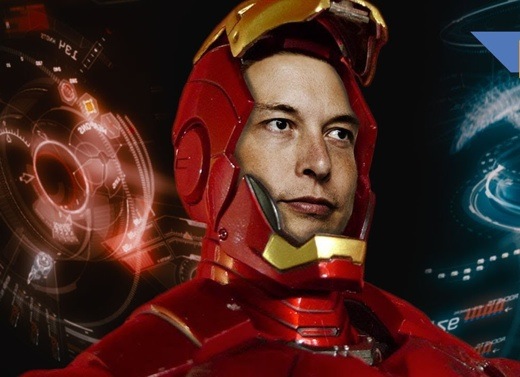
Image above: Is Elon Musk the new Steve Jobs or Ironman? From (http://i.ytimg.com/vi/4wDG-7HVaM8/maxresdefault.jpg).

Elon Musk, Silicon Valley’s poster-boy genius replacement for the late Steve Jobs, rolled out his PowerWall battery last week with Star Wars style fanfare, doing his bit to promote and support the delusional thinking that grips a nation unable to escape the toils of techno-grandiosity. The main delusion: that we can “solve” the problems of techno-industrial society with more and better technology.

The South African born-and-raised Musk is surely better known for founding Tesla Motors, maker of the snazzy all-electric car. The denizens of Silicon Valley are crazy about the Tesla. There is no greater status trinket in Northern California, where the fog of delusion cloaks the road to the future. 

They believe, as Musk himself often avers, that Tesla cars “don’t burn hydrocarbons.” That statement is absurd, of course, and Musk, who holds a degree in physics from Penn, must blush when he says that. After all, you have to plug it in and charge somewhere from the US electric grid.

Only 6 percent of US electric power comes from “clean” hydro generation. Another 20 percent is nuclear. The rest is coal (48 percent) and natural gas (21 percent) with the remaining sliver coming from “renewables” and oil. (The quote marks on “renewables” are there to remind you that they probably can’t be manufactured without the support of a fossil fuel economy). 

Anyway, my point is that the bulk of US electricity comes from burning hydrocarbons, and then there is the nuclear part which is glossed over because the techno-geniuses and politicians of America have no idea how they are going to de-commission our aging plants, and no idea how to safely dispose of the spent fuel rod inventory simply lying around in collection pools. This stuff is capable of poisoning the entire planet and we know it.

The PowerWall roll out highlighted the “affordability” of the sleek lithium battery at $3,500 per unit. The average cluck watching Musk’s TED-like performance on the web was supposed to think he could power his home with it. Musk left out a few things. Such as: you need the rooftop solar array to feed the battery. Figure another $25,000 to $40,000 for that, depending on whether they are made in 

China (poor quality) or Germany, or in the USA (and installation is both laborious and expensive). Also consider that you need a charge controller and inverter to manage the electric flow and convert direct current (DC) from the sun into usable alternating current (AC) for your house — another $3,500. So, the cost of hanging a solar electric system on your house with all its parts is more like fifty grand.

What happens when the solar panels, battery, etc., reach the end of their useful lives, say 25 years or so, when there is no more fossil fuel (or an industry capable of providing it economically). How will you fabricate the replacement parts? By then the techno-wizards will have supposedly “come up with” a magic energy rescue remedy. Stand by on that, and consider the possibility that you will be disappointed with how it works out.

What gets me about Tesla’s various products and activities is that, when all is said and done, they are meant to extend the fatal rackets of contemporary life, especially car dependency and the suburban development pattern. 

Car dependency can and probably will fail on the financial basis, not on the question of how you run the car. The main economic problem we face is the end of growth of the kind we’re used to, the kind that generates real capital and enables bank lending. It is already happening and has led to fewer loans for fewer qualified borrowers. 

It will also lead to the end of government’s ability to pay for fixing the elaborate hierarchy of paved highways, roads, and streets that the cars have to run on. 

Imagine the psychic pain of the Silicon Valley billionaire driving his $87,000 Tesla P85D down a freeway that the State of California hasn’t been able to repair in five years.

See also:
Ea O Ka Aina: KIUC on PV -Tesla on PowerWall 5/1/15


.

Synthetic Grass Warehouse

SUBHEAD: Your synthetic turf will be made in America and be environmentally friendly too. It's the "Green Thing To Do!"

By Juan Wilson on 1 May 2015 for Island Breath -
(http://islandbreath.blogspot.com/2015/05/synthetic-grass-warehouse.html)


Image above: Drought? What drought! An Everlast Turf installation after a light shower at dusk. A promo photo from Synthetic Grass Warehouse. From (http://everlastturf.com/media/photos/).

Today is May Day - the celebration at mid-spring of rebirth, youth, life and nature. This morning I read an email from a public relations firm working with an artificial turf supplier that was directed at Californians concerned with global warming, the environment, drought and having an unsightly lawn because Jerry Brown won't let you water your half acre of zoysia or fescue grass.

The solution is simple. Get rid of the high maintenance living grass and replace it with a new and sophisticated version of AstroTurf. You might remember that AstroTurf was engineered after it was found impossible to keep real grass alive under the roof of the "environmentally challenged" Houston Astrodome.

The newer synthetic turfs are not just monochrome kelly green from curb to patio. They show highlights of sun bleaching and a secondary under layer yellowing leaf shoots. Even your friends won't know your wearing a landscaping "Comb Over". Here's the public relations press release I received:


Following a recent call to action by California State Governor Jerry Brown, Anaheim-based Synthetic Grass Warehouse (SGW) announces a partnership with DRIVEN Public Relations to help with drought restoration efforts in California. As residents and businesses search for alternative ways to help reduce their water consumption, the two companies will work together to educate the community on the environmental benefits of synthetic grass.

Synthetic Grass Warehouse is the largest distributor of synthetic grass in North America and the exclusive distributor of Tiger Turf and Everlast Turf, the highest quality and most technologically advanced product on the market today. SGW’s turfs are low maintenance, require absolutely no watering and reduce air pollution making it an environmentally-friendly alternative to natural grass. SGW’s synthetic grass is ideal for homes, businesses, parks, sports fields, putting greens and pet runs. Customers vary from residential home owners to corporate businesses to government organizations.

“Getting the message across on how a simple solution can contribute to the conservation of millions of gallons of water is going to be an important task for us,” said Mike Caudill, President of DRIVEN Public Relations. “This is where our team takes the reins. Our expertise in strategic media relations and reaching the masses allows for an effective and promising fight against the drought. We believe in SGW and we’re confident that their products can help California. Our team is ecstatic to be able to use our expertise to help residents and businesses as best we can.”

DRIVEN Public Relations’ diverse industry specialties in automotive, alternative energy, technology, motorcycle, lifestyle, wine & spirits and consumer product industries, helps to create effective and specialized strategies that resonate with media, clients and consumers. DRIVEN’s dedication in crafting a highly extensive and integrated strategic plan tailored to each client is crucial in strengthening brand awareness and consumer demand.

“We’re really looking forward to teaming up with such an accomplished PR agency. Our goal is to work with DRIVEN Public Relations to spread the word about how we can help with the drought because we’re so passionate about helping our community in this time of need. We’re not just distributors of turf, we’re also a resource center for all things synthetic grass,” said SGW co-owner Victor Lanfranco. “Not many people know about us or the benefits of installing synthetic grass, so we’re lucky to have DRIVEN alongside us to help.”

Synthetic Grass Warehouse has already proven to be the leading innovator in synthetic grass throughout the country. The company was selected to provide an alternative to natural grass to adorn the Las Vegas Strip. The grass seen on the islands down Las Vegas Boulevard are now always green and lush and don’t require any maintenance or watering. It’s SGW’s goal to transform more natural grass areas like the Las Vegas Strip to conserve water and eliminate pollution caused by lawn mowers, trimmers, chemicals, and pesticides.

Over the past 11 years, Anaheim-based Synthetic Grass Warehouse (SGW) has become the nation’s largest distributor of synthetic grass products for landscapes, putting greens, playgrounds and pet applications. The company is the exclusive distributor of Everlast Turf and Tiger Turf, the highest quality and most technologically advanced synthetic grass on the market. With six distribution locations, SGW provides same-day shipping and serves as a resource center for all things synthetic grass.
For more information on Synthetic Grass Warehouse products, visit (www.syntheticgrasswarehouse.com)


Image above: Diamond Light Fescue artificial lawn by Tiger Express and distributed by Synthetic Grass Warehouse is designed for pets and children. From (http://www.syntheticgrasswarehouse.com/products/diamond-series/diamond-light-fescue-turf).

The newer artificial lawns are not simply green plastic outdoor shag carpeting; they are an artificial replacement for real living grass. With a residential installation there is always the problems with independent actions of children and pets. Without sophisticated engineering unauthorized digging, urinating and defecating on the lawn can be a problem. With the proper drainage, substrate, backing, and chemical treatment those problems can be minimized.

If you have pets Synthetic Grass Warehouse's "Tiger Express Pet Turf System"  is better than a real grass lawn. The website (http://www.tigerexpresslandscape.com/our-products/pet-turf-system/) says it all:


A pet installation is unique. There is no doubt Synthetic grass will beautify your home, but the most important aspect of this type of installation is the performance. Unlike many synthetic grass companies, Tiger understands that pet urine can and will create unwanted odors that will turn your new synthetic lawn into an unpleasant experience. This is why it is important to make sure the urine does not bond with the turf backing. The Tiger Pet System utilizes a five step process to drastically curtail odor issues by focusing on aeration, drainage, neutralization and of course beauty.

Each step of our system compliments the other to create the perfect combination for great looking and fresh smelling artificial grass. From our antibacterial Durafill, urine neutralizing ATD, UV stabilized Pet Turf, perforated Drain Core to our non-toxic Turf Fresh this system was designed to meet the needs of pet owners. Whether you have one small pet or a whole family of large animals the Turf Core Drain System is exactly what you need.

All of the products in our system have been tested and are safe not only for your pet, but also the environment and most importantly you.

DURAFILL is the latest technology in infill product for synthetic grass. The following are some of the many benefits of Durafill; Animal Urine and other external elements are not absorbed which eliminates building bacterial spores within the infill product. Durafill does not degradate over time and does not need repeated applications. Durafill does not become blistering hot in the heat which would otherwise cause more heat by transfer to the synthetic grass. Durafill is environmentally safe and does not contain silica dust, zinc or heavy metals.

ATD is an infill substitute that is intended for turf that’s used by pets. It’s the only infill with a negatively charged ion that prevents common pet smells caused by ammonia from becoming a gas. In other words, your turf will resist unpleasant odors your furry friend does his business. ATD is pet-friendly, child safe and can be used alone, mixed with other infills or added to existing turf applications to control odor. It’s a low-cost alternative to maintaining fresh synthetic grass.

With PET TURF you will no longer will you have to worry about your yard falling victim to unsightly brown spots or muddy holes with our Pet Turf. We designed Pet Turf for comfort and durability. With a coated with polyurethane backing, Pet Turf can withstand moderate to heavy foot traffic, rough play and consistent stress. Just because it’s designed for pets does not mean it won’t impress humans. Like all of our turf, Pet Turf looks and feels identical to natural grass and stays green all year long. It really offers the best of both worlds!

DRAINCORE ensures adequate drainage for your synthetic turf. It came to the forefront of turf technology in replacement of stone and metal pipes. Draincore is a perforated backing that provides an additional drain system to our already perforated turf. The water will flow through this backing at a significantly higher rate than a pipe or stone drain system and is significantly easier to install.

TURF FRESH does just that. It keeps your turf fresh! It’s the perfect solution for pet owners who want to avoid lingering smells caused by their furry friends. When applied directly to your artificial grass, Turf Fresh’s active enzymes break down odor-causing bacteria hiding in the turf. It’s an organic solution that’s safe for pets, children and the whole family. Keep your pet turf smelling pleasant with Turf Fresh!


So, Californians, you won't have to see your yard blow away in a cloud of dust. If you can afford to replace your lawn with an industrially manufactured replacement created from petrochemicals you won't have to worry about the drought. Your sythetic turf will be made in America and environmentally friendly too. It's the "Green Thing To Do!"


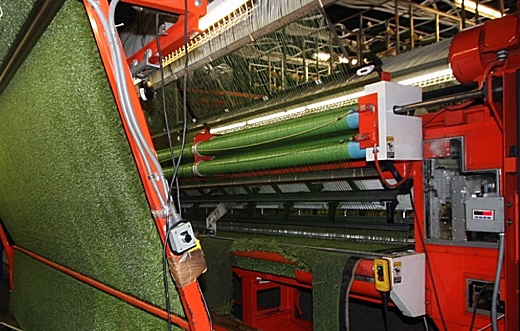
Image above: Everlast synthetic lawn automated manufacturing plant. From (http://www.syntheticgrasswarehouse.com/products/diamond-series/diamond-light-fescue-turf).


.

The Fire This Time

SUBHEAD: Adversity tends to bring out the best in us, and we’re now in the headwinds of a maelstrom.

By David Pollard on 10 December 2013 for How to Save the World -
(http://howtosavetheworld.ca/2013/12/11/the-fire-this-time/)


Image above: Scientists packed to work through Arctic Summer. From (http://www.livescience.com/37917-arctic-expedition-packing.html). 

A few days ago I watched the documentary Chasing Ice, as part of our local Transition initiative’s film series. What really struck me in the film was the narrator’s four word comment about 1/3 through the film when he was discussing what we can/should do about arctic melting and runaway climate change:
“There is no time.”

Just that. He meant that there is no time for us to continue to do what we have been doing — the politicking, stalling, denial, endless debate and research.

But what these four words mean to me, and I think at a visceral and perhaps subconscious level what they now mean to many people who are informed about what is happening in our world, is that there is no time for us to pull back from collapse, no time to avoid or even mitigate runaway climate change and the emergence, later this century, of a climate on Earth as different (7-8oC) from today’s (though in the opposite direction) as the climate during the most recent glacial maxima (colloquially, “Ice Ages”) 20 and 140 and 260 and 340 and 440 thousand years ago.

During these “Ice Ages” much of the planet’s land mass was covered in ice an average of 2 km thick, and the regions adjacent to the ice-covered areas suffered constant windstorms that transformed them into scrub and desert, and beyond that desert, what are now semi-tropical areas were covered in boreal forest. Equatorial areas then, in addition to being much cooler than today, see-sawed between prolonged periods of monsoon-like rains and periods of extended drought.

What will our planet be like with 7-8 degrees of warming in the next few decades? Weather will likely be more extreme (more flooding, desertification and fires, and, later, much higher sea levels) and much more turbulent, but instead of only the equatorial areas being habitable by significant human numbers, as happened during the “Ice Ages”, only the polar areas, with whatever vegetation will have emerged there in that short time, will likely be habitable in the coming “Fire Age”.

There is no time for us to avert this. But there is time to imagine potential future scenarios and how we might react to them, to increase our resilience to the large-scale changes to our way of living it will bring, and to prepare ourselves for them (intellectually, emotionally, and capacity-wise that is — for the coming Long Emergency, hoarding assets and building bunkers is not a viable strategy).

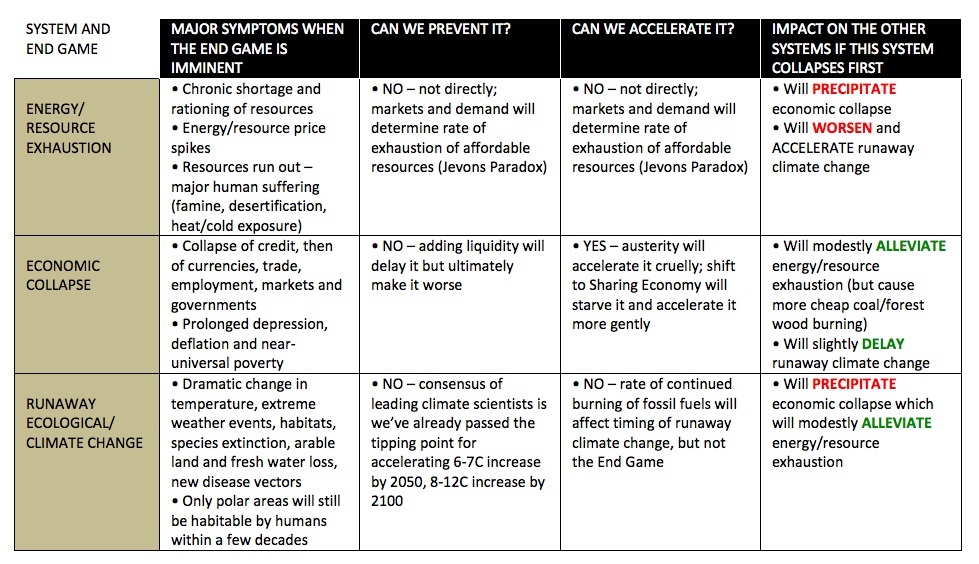
[IB Publisher's note: For David's table of "End Game" scenarios click on this link.]

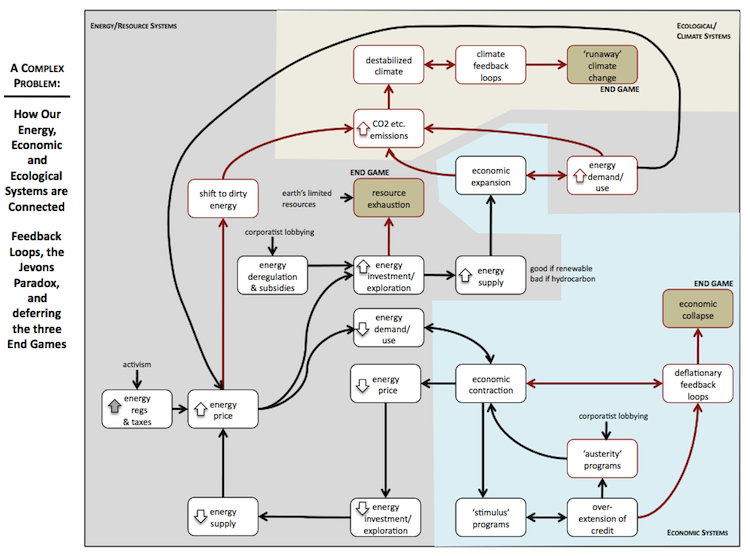
What complicates the future scenario for our planet is that we are also nearing End Games in our global economic and energy/resource systems, as I diagrammed in my post last month. Neither system is sustainable for more than a few more years, a few decades at most, and both systems affect the rate of atmospheric pollution and hence the extent and timing of runaway climate change.

I’m writing a series of articles that explains all this in more detail for the fledgling Sustainability Showcase magazine, but the chart above summarizes the interrelationship of our economic, resource/energy, and climate/ecological systems, and how ‘collapse’ (i.e. dramatic and uncontrolled unbalancing and change, with largely unpredictable consequences) of any of these systems would likely affect the other two. Here’s the prognosis in a nutshell:

 Best case (Eisenstein) scenario: Shift to Sharing Economy precipitates near-term, gradual collapse of the industrial growth economy, which will leave some of Earth’s energy and resources in the ground and delay and slightly lessen runaway climate change. [Or similarly, major early unexpected impacts of climate change (e.g. pandemic) precipitate near-term, gradual economic collapse, with the same results.]

Worst case (Ehrenfeld) scenario: Politicians ratchet up the economy to extend industrial growth a little longer, exhaust energy and other resources faster and more completely, then use nukes to try to mitigate energy exhaustion, all leading to faster and more severe runaway climate change and total economic collapse and energy/resource exhaustion.


All scenarios end with runaway climate change. This is kind of hard to comprehend, but once you realize how delicate the balance is that has kept our planet in a brief paradisiacal near-stasis climate for several millennia, and how often runaway climate change has happened in our planet’s past (for many reasons, mostly unknown), it’s not too hard to accept. We’ve just unwittingly accelerated the process this time.

There will be large scale species extinction — it’s already begun and it’s also not a new phenomenon on this planet. Life will go on. Some like it hot. There will be a steady exodus toward the poles by many species, with varying degrees of success. What will evolve in the planet’s new super-hot, super-stormy zones is anyone’s guess.

From that perspective, the timing of the collapse of this civilization’s unstable, global, oil-and-growth dependent industrial economy, and whether we plunder the last of the easily-accessible energy, soil, water, minerals, forests and other resources (a billion years’ worth of accumulated riches) before the climate destabilizes, may seem a bit moot. But it will be very important for our immediate descendants, and for many living today.

As the table above shows, we have little say in (or control over) how all this unfolds. But we have a little. The sooner we bring down our rapacious and wasteful economy, the less severe and longer delayed ecological collapse will be — and the more resources will be left for post-collapse life.

We can (and some say should) help precipitate that economic take-down, through direct action against its most grievous activities — tar sands, nukes, deepwater, shale, mountaintop removal, rainforest razing, ‘blood’ mining, factory farming, forced/slave labour etc. And we can precipitate it by walking away from that teetering economy and shifting our activities to that of the sharing economy — by using, gifting and conserving local, organic, low-energy, durable goods and services in community with each other, without the use of fiat currencies.

Beyond that, there’s not much we can do to prepare for The Fire This Time, except learn some useful new skills, learn how to build (and live in) community (anywhere), get and stay healthy, and cultivate what we might call a resilient, adaptable attitude. Some of the qualities I think might be part of such an ‘attitude’ — a way of being in the world — are (in no particular order) being:
  • generous
  • self-aware and self-knowledgeable
  • attentive (“present”)
  • curious and imaginative (they’re not the same thing)
  • able to let go (open, forgiving, patient, even ‘stoic’)
  • challenging (able to think critically)
  • self-expressive and articulate
  • appreciative and grateful
  • playful, joyful, and able to see beauty everywhere
  • able to relish simple pleasures
  • contemplative, gentle, and at peace
We can’t be these things if we’re not, of course, and the stresses of our modern lives make it hard to be them. But, joyful pessimist that I am, I believe most of these qualities are in most of our natures, if we can find space for them, and let them come out. Adversity tends to bring out the best in us, and we’re now in the headwinds of a maelstrom.

It’s hopeless, but we’ll be fine. One day, everything will be free.

.

Man - Conquerer of Nature - Dead

SUBHEAD: The medical examiner’s office confirmed this morning he was 408 and died of a petroleum overdose.

By John Michael Greer on 4 December 2013 for Archdruid Report -
(http://thearchdruidreport.blogspot.com/2013/12/man-conqueror-of-nature-dead-at-408.html)


Image above: Detail of painting "Greed" by Jose Brand. From (http://www.josebrand.com/projects/man-vs-nature/).

Man, the conqueror of Nature, died Monday night of a petroleum overdose, the medical examiner’s office confirmed this morning. The abstract representation of the human race was 408 years old.

The official announcement has done nothing to quell the rumors of suicide and substance abuse that have swirled around the death scene since the first announcement yesterday morning, adding new legal wrinkles to the struggle already under way over Man’s inheritance.

Man’s closest associates disagree about what happened. His longtime friend and confidant Technology thinks it was suicide. “Sure, Man liked to have a good time,” he said at a press conference Tuesday evening, “and he was a pretty heavy user, but it wasn’t like he was out of control or anything. No, I’m sure he did it on purpose.

Just a couple of weeks ago we were hanging out at his place, looking up at the moon and talking about the trips we made out there, and he turned to me and said, ‘You know, Tech, that was a good time—a really good time. I wonder if I’ll ever do anything like that again.’

He got into moods like that more and more often in the last few years. I tried to cheer him up, talking about going to Mars or what have you, and he’d go along with it but you could tell his heart wasn’t in it.”

Other witnesses told a different story. “It was terrifying,” said a housekeeper who requested that her name not be given. “He was using more and more of the stuff every day, shooting it up morning, noon and night, and when his connections couldn’t get him as much as he wanted, he’d go nuts. You’d hear him screaming at the top of his lungs and pounding his fists on the walls.

Everybody on the staff would hide whenever that happened, and it happened more and more often—the amount he was using was just unbelievable. Some of his friends tried to talk him into getting help, or even just cutting back a little on his petroleum habit, but he wouldn’t listen.”

The medical examiner’s office and the police are investigating Man’s death right now. Until their report comes out, the tragic end of humanity’s late self-image remains shrouded in mystery and speculation.

A Tumultuous Family Saga

“He was always a rebel,” said Clio, the muse of history, in an exclusive interview in her office on Parnassus this morning. “That was partly his early environment, of course. He was born in the household of Sir Francis Bacon, remember, and brought up by some of the best minds of seventeenth-century Europe; an abstract image of humanity raised by people like that wasn’t likely to sit back and leave things as they were, you know. Still, I think there were strong family influences too. His father was quite the original figure himself, back in the day.”

Though almost forgotten nowadays, Man’s father Everyman, the abstract representation of medieval humanity, was as mediagenic in his own time as his son became later on.

The star of a wildly popular morality play and the subject of countless biographies, Everyman was born in extreme poverty in a hovel in post-Roman Europe, worked his way up to become a wealthy and influential figure in the Middle Ages and Renaissance, then stepped aside from his financial and political affairs to devote his last years to religious concerns.

Savage quarrels between father and son kept the broadsheet and pamphlet press fed with juicy stories all through the seventeenth and eighteenth centuries, and eventually led to their final breach over Darwin’s theory of evolution in 1859.

By that time Man was already having problems with substance abuse. “He was just using coal at first,” Technology reminisced;
 “Well, let’s be fair, we both were. That was the hot new drug in those days. It was cheap, you could get it without too much hassle, and everybody on the cutting edge was using it. I remember one trip we took together—it was on one of the early railroads, at thirty miles an hour. We thought that was really fast. Were we innocent back then, or what?”
Clio agreed with that assessment;
“I don’t think Man had any idea what he was getting into, when he started abusing coal. It was an easy habit to fall into, very popular in avant-garde circles just then, and nobody yet knew much about the long term consequences of fossil fuel abuse. Then, of course, he started his campaign to conquer Nature, and he found out very quickly that he couldn’t keep up the pace he’d set for himself without artificial help. That was when the real tragedy began.”
The Conquest of Nature 
It’s an open question when Man first decided to conquer Nature. “The biographers all have their own opinions on that,” Clio explained, gesturing at a shelf loaded with books on Man’s dramatic and controversial career. “Some trace it back to the influence of his foster-father Francis Bacon, or the other mentors and teachers he had in his early days. Others say that the inspiration came from the crowd he ran with when he was coming of age in the eighteenth and nineteenth centuries.

He used to tell interviewers that it was a family thing, that everyone in his family all the way back to the Stone Age had been trying to conquer Nature and he was just the one who finally succeeded, but that won’t stand up to any kind of scrutiny. Examine the career of Everyman, for example, and you’ll find that he wasn’t interested in conquering Nature; he wanted to conquer himself.”

“The business about conquering Nature?” Technology said. “He got into that back when we were running around being young and crazy. I think he got the idea originally from his foster-father or one of the other old guys who taught him when he was a kid, but as far as I know it wasn’t a big deal to him until later.

Now I could be wrong, you know. I didn’t know him that well in those days; I was mostly just doing my thing then, digging mines, building water mills, stuff like that. We didn’t get really close until we both got involved in this complicated coal deal; we were both using, but I was dealing, too, and I could get it cheaper than anybody else—I was using steam, and none of the other dealers knew how to do that.

So we got to be friends and we had some really wild times together, and now and then when we were good and ripped, he’d get to talking about how Nature ought to belong to him and one of these days he was going to hire some soldiers and just take it.

“Me, I couldn’t have cared less, except that Man kept on bringing me these great technical problems, really sweet little puzzles, and I’ve always been a sucker for those. He figured out how I was getting the coal for him so cheap, you see, and guessed that I could take those same tricks and use them for his war against Nature. For me, it was just a game, for Nature, against Nature, I couldn’t care less. Just give me a problem and let me get to work on it, and I’m happy.

“But it wasn’t just a game for him. I think it was 1774 when he really put me to work on it. He’d hired some mercenaries by then, and was raising money and getting all kind of stuff ready for the war. He wanted steam engines so, like the man said, it was steam engine time—I got working on factories, railroads, steamships, all the rest.

He already had some of his people crossing the border into Nature to seize bits of territory before then, but the eighteenth century, that’s when the invasion started for real. I used to stand next to him at the big rallies he liked to hold in those days, with all the soldiers standing in long lines, and he’d go into these wild rants about the glorious future we were going to see once Nature was conquered. The soldiers loved it; they’d cheer and grab their scientific instruments and lab coats and go conquer another province of Nature.”

The Triumphant Years 

 It was in 1859, Technology recalled, that Man first started using petroleum. “He’d just had the big spat with his dad over this Darwin dude: the worst fight they ever had, and in fact Man never spoke to the old man again.

Man was still steaming about the fight for days afterwards, and then we heard that this guy named Edwin Drake over in Pennsylvania could get you something that was an even bigger rush than coal. Of course Man had to have some, and I said to myself, hey, I’ll give it a try—and that was all she wrote, baby. Oh, we kept using coal, and a fair bit of it, but there’s nothing like petroleum.

“What’s more, Man figured out that that’s what he needed to finish his conquest of Nature. His mercs had a good chunk of Nature by then, but not all of it, not even half, and Man was having trouble holding some of the territory he’d taken—there were guerrillas behind his lines, that sort of thing.

He’d pace around at headquarters, snapping at his staff, trying to figure out how to get the edge he needed to beat Nature once and for all. ‘I’ve gotta have it all, Tech,’ he’d say sometimes, when we were flopped on the couch in his private quarters with a couple of needles and a barrel of petroleum, getting really buzzed. ‘I’ve conquered distance, the land, the surface of the sea—it’s not enough. I want it all.’ And you know, he got pretty close.”

Petroleum was the key, Clio explained. “It wasn’t just that Man used petroleum, all his soldiers and his support staff were using it too, and over the short term it’s an incredibly powerful drug; it gives users a rush of energy that has to be seen to be believed. Whole provinces of Nature that resisted every attack in the first part of the war were overrun once Man started shipping petroleum to his forces. By the 1950s, as a result, the conquest of Nature was all but complete.

Nature still had a few divisions holed up in isolated corners where they couldn’t be gotten at by Man’s forces, and partisan units were all over the conquered zone, but those were minor irritations at that point. It was easy enough for Man and his followers to convince themselves that in a little while the last holdouts would be defeated and Nature would be conquered once and for all.

“That’s when reality intervened, though, because all those years of abusing coal, petroleum, and other substances started to catch up with Man. He was in bad shape, and didn’t know it—and then he started having problems feeding his addiction.”

On and Off the Wagon

“I forget exactly how it happened,” Technology recounted. “It was some kind of disagreement with his suppliers—he was getting a lot of his stuff from some Arab guys at that point, and he got into a fight with them over something, and they said, ‘Screw you, man, if you’re going to be like that we’re just not going to do business with you any more.’

So he tried to get the stuff from somebody else, and it turned out the guy from Pennsylvania was out of the business, and the connections he had in Texas and California couldn’t get enough. The Arab guys had a pretty fair corner on the market. So Man went into withdrawal, big time. We got him to the hospital, and the doctor took one look at him and said, ‘You gotta get into rehab, now.’ So me and some of his other friends talked him into it.”

“The records of his stays in rehab are heartbreaking,” Clio said, pulling down a tell-all biography from her shelf. “He’d start getting the drug out of his system, convince himself that he was fine, check himself out, and start using again almost immediately.

Then, after a little while, he’d have problems getting a fix, end up in withdrawal, and find his way back into rehab. Meanwhile the war against Nature was going badly as the other side learned how to fight back effectively. There were rumors of ceasefire negotiations, even a peace treaty between him and Nature.”

“I went to see him in rehab one day,” said Technology. “He looked awful. He looked old—like his old man Everyman. He was depressed, too, talking all the time about this malaise thing. The thing is, I think if he’d stuck with it then he could have gotten off the stuff and straightened his life out. I really think he could have done it, and I tried to help. I brought him some solar panels, earth-sheltered housing, neat stuff like that, to try to get him interested in something besides the war on Nature and his petroleum habit. That seemed to cheer him up, and I think all his friends had high hopes for a while.

“Then the next thing I heard, he was out of rehab. He just couldn’t hack it any longer. I went to his place, and there he was, laughing and slapping everybody’s back and full of big ideas and bigger plans, just like before. That’s what it looked like at first, but the magic was gone. He tried to do a comeback career, but he just couldn’t get it back together, and things went downhill from there.”

The Final Years 

The last years of Man’s career as representation of the human race were troubled. “The war against Nature wasn’t going well by then,” Clio explained. “Man’s forces were holding onto the most important provinces and cities, but insurgencies were springing up all over—drug-resistant microbes here, herbicide-tolerant weeds there.

Morale was faltering, and a growing fraction of Man’s forces in the struggle against Nature no longer believed in what they were doing. They were in it for the money, nothing more, and the money was running out. Between the costs of the war, the costs of Man’s lavish lifestyle, and the rising burden of his substance abuse problem, Man was in deep financial trouble; there’s reason to believe that he may have been engaged in outright fraud to pay his bills during the last few years of his life.”

Meanwhile, Man was becoming increasingly isolated.

“He’d turned his back on most of his friends,” said the anonymous housekeeper quoted earlier. “Art, Literature, Philosophy—he stopped talking to any of them, because they kept telling him to get off the stuff and straighten out his life. I remember the last time Science came to visit—she wanted to talk to Man about the state of the atmosphere, and Man literally threw her out of the house and slammed the door in her face."

She added; " I was working downstairs in the laundry, where you usually can’t hear much, but I could hear Man screaming, ‘I own the atmosphere! I own the planet! I own the solar system! I own the goddam stars! They’re mine, mine, mine—how dare you tell me what to do with my property?’ He went on like that for a while, then collapsed right there in the entry. A couple of us went up, carried him into his bedroom, and got him cleaned up and put to bed. We had to do that pretty often, the last year or so.”

His longtime friend Technology was apparently the last person to see Man alive. “I went over to his place Monday afternoon,” Technology recalled. “I went there pretty often, and we’d do some stuff and hang out, and I’d start rapping about all kinds of crazy stuff, omniscient supercomputers, immortal robot bodies, stuff like that.

I told him, ‘Look, Man, if you want to get into stuff like omniscience and immortality, go talk to Religion. That’s her bag, not mine.’ But he didn’t want to do that; he had some kind of falling out with her a while back, you know, and he wanted to hear it from me, so I talked it up. It got him to mellow out and unwind, and that’s what mattered to me.

“Monday, though, we get to talking, and it turns out that the petroleum he had was from this really dirty underground source in North Dakota. I said to him, ‘Man, what the frack were you thinking?’ He just looked at me and said, ‘I’ve gotta have the stuff, Tech. I’ve gotta have the stuff.’

Then he started blubbering, and I reached out to, like, pat his shoulder—and he just blew up at me. He started yelling about how it was my fault he was hooked on petroleum, my fault the war against Nature wasn’t going well, my fault this and that and blah blah blah. Then he got up and stormed out of the room and slammed the door behind him.

I should have gone after him, I know I should have, but instead I just shook my head and left. Maybe if I’d gone and tried to talk him down, he wouldn’t have done it.”

“Everything was quiet,” the housekeeper said. “Too quiet. Usually we’d hear Man walking around, or he’d put some music on or something, but Monday night, the place might as well have been empty. Around ten o’ clock, we were really starting to wonder if something was wrong, and two of us from the housekeeping staff decided that we really had to go check on Man and make sure he was all right.

We found him in the bathroom, lying on the floor. It was horrible—the room stank of crude oil, and there was the needle and all his other gear scattered around him on the floor. We tried to find a pulse, but he was already cold and stiff; I went and called for an ambulance anyway, and—well, you know the rest.”


The Troubled Aftermath
Man’s death leaves a great many questions unanswered. “By the time Everyman died,” Clio explained, “everyone knew who his heir would be. Man had already taken over his father’s role as humanity’s idealized self-image. That hasn’t happened this time, as you know.

Man didn’t leave a will, and his estate is a mess—it may be years before the lawyers and the accountants finish going through his affairs and figure out whether there’s going to be anything at all for potential heirs to claim.

In the wings there are at least half a dozen contenders for the role of abstract representation of the human race, and none of them is a clear favorite. It may be a long time before all the consequences are sorted out.”

Meanwhile, one of the most important voices in the debate has already registered an opinion.

Following her invariable habit, Gaia refused to grant any personal interviews, but a written statement to the media was delivered by a spokesrabbit on Tuesday evening.
“Please accept My sympathy for the tragic demise of Man, the would-be conqueror of Nature. I hope it will not be out of place, though, to suggest that whomever My human children select as their new self-image might consider being a little less self-centered—not to mention a little less self-destructive.”
.

Horizontal Well Presentation

SUBHEAD: This well may be difficult to maintain and spur development. Why not just add PV to existing wells?

By Juan Wilson on 19 September 2013 for Island Breath -
(http://islandbreath.blogspot.com/2013/09/horizontal-well-presentation.html)


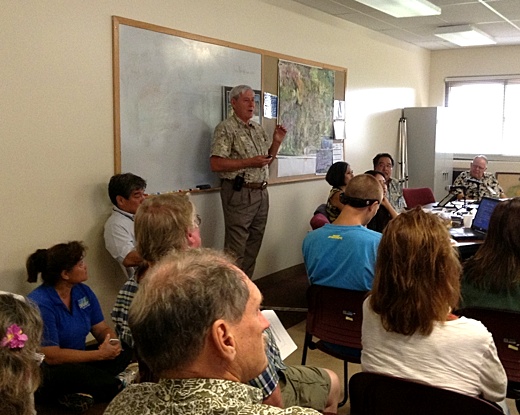
Image above: David Craddick (center), DOW manager, makes presentation on Kahili Ridge Horizontal Water Well. Note Jan TenBruggencate, board member of KIUC, in foreground. Photo by Juan Wilson.

[Author's note: This article is from a letter I emailed today to David Craddick, manager at the Department of Water, concerning the proposed Kahili Ridge Horizontal Well.]

Aloha Mr. Craddick,

I attended the DOW (Department of Water) Special Board meeting on September 17th. Thank you for your thoughtful presentation of the project.

IT'S ALL ABOUT SMALLER WATER BILLS
Why dig this horizontal well? It's new name tells some of the story "Kahili Well Energy Saving Project." This makes it sound as if it's all about saving energy.

Obviously a gravity fed water system requires less energy to deliver water than one requiring pumping water against gravity. The DOW points out that a large part of its present cost is based on the price to pump water.

Your equation then is that saving energy is saving money. And that saving money translates into smaller water bills for your customers. This you have determined is a win-win situation for Kauai.

I beg to differ. One possibility is that cheaper water might just lead to greater consumption. If water is cheap enough people will grow grass in the desert. Just look at Phoenix. Cheaper water is not really the issue.

Adequate reliable water is the real issue. You asked the question yourself at the meeting. "What will we do when the fuel barge stops coming?"

A question I asked your project engineer afterwards was why he thought that future energy costs for DOW would be going up int the future - and why that justified the horizontal well project. I was answered with silence. I went on to add that energy prices would likely be dropping, as large scale PV (Photo-Voltaic) sourced electricity will eclipse diesel for power generation.

My question to you is: Why doesn't the DOW spend the cost of the horizontal well on it's own solar PV arrays at each existing wellhead site? How far would $60 million in PV go towards lowering your pumping costs?

As you know, solar panels are at an all time low price and are conservatively estimated to be functional for more than 30 years.

Wouldn't PV well pumping greatly add to the affordability, reliability and sustainability of DOW systems?

DISASTER A POSSIBILITY
I was particularly impressed with your concern about relying in the future on a single source of water for our Puna Moku community. Your point concerning the horizontal well's vulnerability to acts of terrorism or sabotage is an important consideration.

It may be unlikely that an intentional destruction of the well would take place. However, if such an event would ever occur the results could be an ongoing disaster for Kauai.

You pointed out that we would need to keep our current vertical well technology intact and operational as a backup for any such a scenario.

I would add that an intentional sabotaging of the horizontal well is not as likely as one caused by a natural disaster or one caused by technical failure or human error.

A wellhead failure at the horizontal well (backed up with 1,200 psi on a 24" pipe) would be a logistical nightmare. Everyone remembers the failure of the blowout preventer (BOP) at the Macondo well in the Gulf of Mexico. The Gulf's fishing industry and ecosystem were profoundly damaged by the long delay before the well was recapped.

I'm not suggesting that poisonous crude oil would fill the Puna Moku if the Kahili Ridge wellhead failed, but to assume a significant failure of the well technology could never happen is an unsafe bet.

There is major difference that I see in the safety concerns between our current vertical well technology and the horizontal well proposed. The catastrophic failure of a single vertical well (among many) not only does not cause a total loss of water delivery, and does not lead to cascading and escalating engineering problems.

A single vertical well failure would merely render that well inoperable. That failure could be the result of a hand-grenade or a casing collapse. In either case, no massive loss of water resources would ensue and no major engineering feat would be required at that wellhead to make it safe again.

Unanticipated construction and engineering failures occur all the time. Who was the engineer who thought a good place for the backup generators at Fukushima was a basement near the seawall? Now the entire Pacific Ocean is threatened with a continuous flow of radioactive pollutants for generations to come.

Most major infrastructure programs are designed to last more than a generation. You have said the proposed Kahili Well is one of those. I would argue that 25, 50 or 100 years from now, our ability to deal with engineering emergencies will be degraded here on Kauai.

As you have probably come to realize, the availability of heavy transport, hydraulic equipment, helicopters, telecommunications, experienced engineers etc, may all be compromised or unavailable on Kauai 50 years from now.
 
Let me ask you how a few scenarios might play out at the Kahili Horizontal Well. I'm sure you have considered at least a few of them over the short term.

But how, in 50 years time, would the DOW deal with a catastrophic wellhead or BOP failure in the context of the following?
  1. Aging or damaged hardware
  2. Unavailability of equipment or expertise
  3. Site erosion and natural overgrowth
  4. Major landslide
  5. Earthquake
Techno-optimism is rampant in our society. We think we'll populate the stars, but the fact is NASA hasn't been back to the Moon in 40 years and couldn't go if they wanted too. America even abandoned the near space Shuttle program and cannot reach the International Space Station without hitching a ride. Who's kidding who about our technical prowess?

What would happen to Kauai's aquifer if in a generation or two the 24" diameter Kahili Ridge horizontal well head failed and could not be repaired? Is that a contingency the DOW has evaluated?

MORE WATER = MORE DEVELOPMENT
I grew up on Long Island in the 1950's-60s. I saw my county grow from place of potato, duck and horse farms, with scattered estates, to a place of sprawling contiguous suburbs dotted with shopping plazas and malls. I won't detail the horrors.

But I will say, growing there and in my profession I have heard every play in the book that this or that project was "for our own good". The project was touted to reduce traffic, increase business, add to convenience or just to help reduce the cost to the existing community. Bullshit! It was always for the moneymakers.

You spoke at the 9/17 meeting of abandoning your existing vertical wells in lieu the the new 24" horizontal well. Later you indicated that keeping the vertical wells operational would be needed as a backup to the Kahili well. It's hard to believe that either the DOW or Grove Farms would want such a valuable resource to go unused.

If Grove Farms bean-counters had their way, the land in Puna Moku would look much like Mililani, Oahu. The big corporate land owners on Kauai share one dream - maximizing profit - which means maximizing suburban sprawl density. It is short termed thinking, but that's what corporations do - for them five years is an eternity.

If their is more usable water capacity added to Kauai it means there will be more development and more population. As you probably know, "growing" our way to prosperity is no longer the solution to future human welfare.

CLIMATE CHANGE = LESS RAIN
Planning on a greater use of water for a larger population is more than misguided.

Climate scientists predict that rising temperatures will mean less rain for Kauai. Our grandchildren will fell the impact of Global Warming here on Kauai.

It's already happening. In the last 20 years we have seen a 20% drop off in rainfall on Waialeale, Kauai's aquifer is being replenished at a lower rate than in the past. For all intents and purposes, that diminishment may increase and continue indefinitely while our shorelines will be eroded by a rising ocean.

Encouraging "no growth" in population and "water conservation" seems a duty of DOW. Moreover, adopting the permaculture philosophy of slowing water movement across the landscape is vital.

If you abandon the horizontal well,  it won't be like you won't have anything to do. There are solar panels to erect, and when that's done there is reforestation of hillsides, the restoration fishponds, rice paddies and taro loi that could be added to your agenda.

There's plenty of good to do. 

.

Strange Bedfellows

SUBHEAD: AlohaFuels wants to turn Hawaiian water and air into jet fuel using alternative energy. It's high-tech suicide.

By Juan Wilson on 9 April 2013 for Island Breath -
(http://alohafuels.pbworks.com/w/page/44240912/FrontPage)


Image above: Image of alternative energy from AlohaFuels website. From (http://alohafuels.com/who-we-are/).

Yesterday we posted an invitation to sign a petition " A PV on enery roof" (http://islandbreath.blogspot.com/2013/04/a-pv-on-every-roof.html) )

The petition is addressed to Mina Morita, the Chairperson of the Hawaiian Public Utilities Commission. It have the PUC make Hawaii's power utility companies become proponents of distributed photovoltaic panels on residences with backup-battery storage.

That means finding a way for customers to have an affordable path to generating the power for their own homes on their own roofs. This would mean changing HECO and KIUC's position to have just limited number of PV co-generation from residences.

The current go-gen policy means that customers share their own generation of PV electricity with the power company at a low price (without the ability to store that energy for their own use). Then when its dark and the customer needs energy, they must buy energy back (generated by diesel fuel) from the utility at a high price.

We have supported the idea of independent distributed solar panel generation and storage of energy at individual residences for some time now. But, it is strange who we find behind the petition in question. It was the AlohaFuels Division of H2-Technologies.

After posting the invitation to join the petition I re-visited the sight of  the petition's author (AlohaFuel) and found the following mission statement.

Welcome to AlohaFuels, Division of H2-Technologies

Our mission:
Help Hawaii to become self-sustaining on energy, fuel and food.

Our Goals:
Secure clean, safe, renewable and affordable solar electric energy for everyone and;
  • i. Convert water to hydrogen (H2)

  • ii. H2 and CO2 to gasoline or aviation fuel (CH2)*

  • iii. H2 and N2 to ammonia (NH3)
In the fine print below Aloha fuels specified:
* Produce renewable gasoline in Hawaii, from CO2 and water captured from air, for 3 (2011) $/GGE** wholesale before taxes, or ~4 $/GGE** retail after taxes, independent on World crude oilprices, with a ~ 20 MGGE/y** plant, sized for economic viability on the Big Island, to replace part of the present con- sumption of 30 Mgal/y jet fuel and/or 120 Mgal/y of gasoline.

** Million Gallons of Gasoline Equivalent per year
What this means is AlohaFuels plans to capture CO2 and water captured from the air and using alternative energy to split the water into oxygen and hyrodgen and then combine it with the CO2 to produce JP4 jet fuel (octane = C8H18). Alternative energy sources would include geothermal on the Big Island.

The plan would have the scope of rendering Hawaiian water and air into 20 million gallons of jet fuel a year.

AlohaFuel thinks this is a win-win proposition for Hawaii. We'd become "self reliant" on fuel to get across the Pacific Ocean.

 Only one little problem with that plan - That jet fuel would be burned in the upper atmosphere. This plan would only accelerate global warming and the effects of climate change on Hawaii. Those effects include a dryer climate with less atmospheric water.

The AlohaFuel plan is high-tech suicide.


.