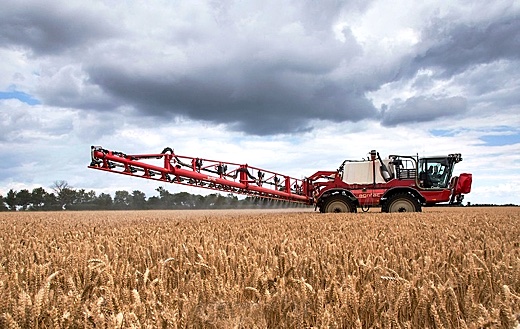
Glyphosate, the world's most common weed killer, has caused significant concerns over its potential risk to human health, animals, and the environment for several decades. Earlier this month, a US court awarded a groundskeeper $289 million who claimed Bayer AG unit Monsanto's glyphosate-based weed-killers, including Roundup, gave him terminal cancer.
Now, a new report from PNAS alleges that glyphosate may be indirectly killing honey bees around the world, a threat that could potentially also leave a major mark on the global economy.
“We need better guidelines for glyphosate use, especially regarding bee exposure, because right now the guidelines assume bees are not harmed by the herbicide. Our study shows that’s not true.” said Erick Motta, the graduate student who led the research, along with professor Nancy Moran.
UT News of The University of Texas at Austin says that glyphosate interferes with an important enzyme found in plants and microorganisms, but not in animals, it has long been assumed to be nontoxic to animals, including humans and bees.
However, the latest study reveals that by altering a bee’s gut microbiome — the ecosystem of bacteria living in the bee’s digestive tract, including those that protect it from harmful bacteria — glyphosate jeopardizes its ability to fight infection.
For this study, scientists exposed honeybees to glyphosate at normal levels found on farms. The researchers painted the bees' backs with colored dots so they could be tracked and later recaptured.
Three days later, they saw that the honeybees exposed to glyphosate suffered a significant loss of bacteria in their guts and were more susceptible to infection and death from harmful bacteria.
“Studies in humans, bees and other animals have shown that the gut microbiome is a stable community that resists infection by opportunistic invaders,” Moran said. “So if you disrupt the normal, stable community, you are more susceptible to this invasion of pathogens.”
In recent times, US beekeepers have reported a massive loss of bees or Colony Collapse Disorder (CCD). Millions of bees mysteriously disappeared, leaving farms with fewer pollinators for crops. Officials have been baffled, and the media has been quiet about the bee population collapse.
Explanations for the phenomenon have included exposure to pesticides or antibiotics, habitat loss, and bacterial infections. The latest study now adds herbicides to the list as a possible contributing factor.
“It’s not the only thing causing all these bee deaths, but it is definitely something people should worry about because glyphosate is used everywhere,” said Motta.
Among the nuts, almond growers have the largest need for bee pollination. Bee pollination is worth $15 billion to the US farming industry.
Any sharp change in global bee populations could affect the beef and dairy industries. Bees pollinate clover, hay, and other forage crops. As the bee population dwindles, it increases the cost of feedstock.
That forces inflation into beef and milk prices at the grocery store and ultimately hurts the American consumer. This could then lead to increased imports of produce from foreign countries where bee populations are healthy, further widening the trade deficit.
Couple this with the current trade war and this particular "black swan" - or rather "black bee" - problem, may be just the tipping point that finally forces the US economy to catch down to the rest of the world.
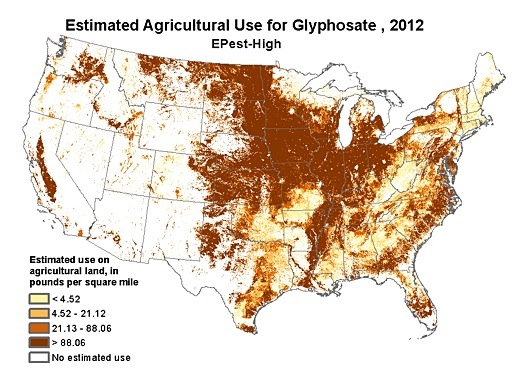
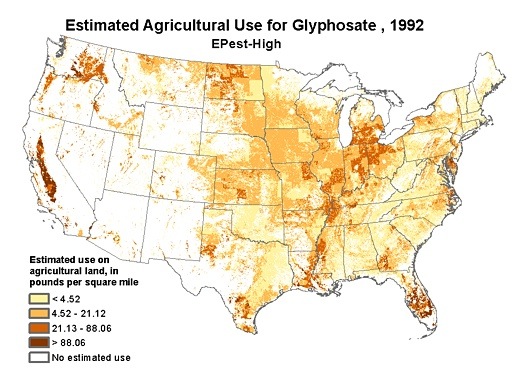
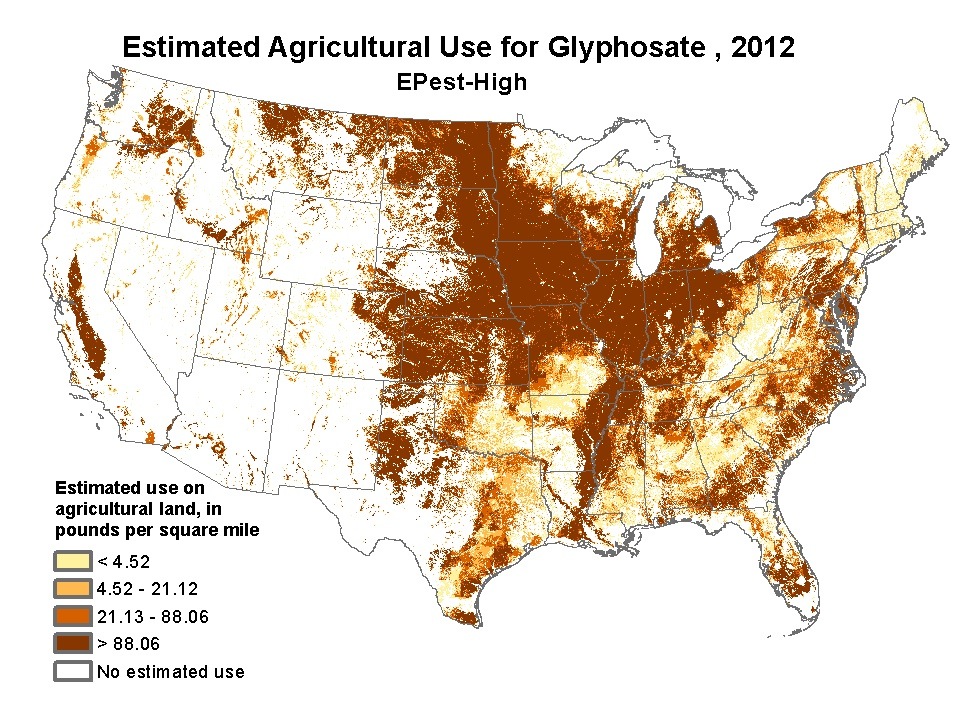
Image above: United State Geological Survey map of the continental states showing extent and intensity of the use of glyphsoates applied to cropland in 1992, twenty years earlier than map above. Note that at that time the Central Valley in California was the densest and most intense use of glyphosates on food crops. From (https://water.usgs.gov/nawqa/pnsp/usage/maps/show_map.php?year=1992&hilo=H&map=GLYPHOSATE).
Image above: Common Ragweed is becoming resistant to glyphsate applications in Nebraska. Ragweed plants from a glyphosate-resistant (left) and susceptible population (right) three weeks after application of 44 ounces per acre of Roundup PowerMax (that is one ounce per thousand square feet). From (https://cropwatch.unl.edu/glyphosate-resistant-common-ragweed-confirmed-nebraska).
Lawyers involved in a California lawsuit against Monsanto claim to have "explosive" documents concerning the Bayer-owned agrochemical giant's activities in Europe, according to Euronews.
"What we have is the tip of the iceberg. And in fact we have documents now in our possession, several hundreds documents, that have not been declassified and some of those are explosive," said US lawyer Robert Kennedy Jr, adding - "And many of them are pertinent to what Monsanto did here in Europe. And that's just the beginning."
Monsanto - bought by Germany's Bayer AG in June for $66 billion, was ordered in August to pay a historic $289 million to a former school groundskeeper, Dewayne Johnson, who said Monsanto's Roundup weedkiller gave him terminal cancer. Monsanto says it will appeal the verdict.
Environmental lawyers have been in Brussels in order to address a European Parliament special committee on the issue.
"They are fighting a fight for more democracy and for transparency and to get a better insight in how big corporation such as Monsanto act and try to manipulate the facts," said Belgium MEP Bart Staes.
Last November EU approved the use of glyphosate - a key chemical in Roundup, following five years of heated debate over whether it causes cancer. While it was approved for just five years until 2022 vs. the usual 15 years, there are now rumors that they will withdraw Roundup's license this year altogether.
Labeled a carcinogen by the EPA in 1985, the agency reversed its stance on glyphosate in 1991. The World Health Organization's cancer research agency, however, classified the compound as "probably carcinogenic to humans" in 2015. California, meanwhile, has the chemical listed in its Proposition 65 registry of chemicals known to cause cancer.
Image above: A child pouring Cheerios into a cereal bowl. From original article.
Popular oat cereals, oatmeal, granola and snack bars come with a hefty dose of the weed-killing poison in Roundup, according to independent laboratory tests commissioned by EWG.
Glyphosate, an herbicide linked to cancer by California state scientists and the World Health Organization, was found in all but two of 45 samples of products made with conventionally grown oats.
Almost three-fourths of those samples had glyphosate levels higher than what EWG scientists consider protective of children’s health with an adequate margin of safety. About one-third of 16 samples made with organically grown oats also had glyphosate, all at levels well below EWG’s health benchmark.
Glyphosate does not belong in cereal. Act and urge the EPA to restrict pre-harvest applications of glyphosate and tell companies to identify and use sources of glyphosate-free oats.
Report on samples tested indicates even organic oat products contained measurable amounts of glyphosate, but none were above the EWG's Health Benchmark of 160 parts per billion.
Samples Tested
Conventional
Organic
Samples Tested
45
16
Glyphosate Detected
43
5
Detects above EWG’s Health Benchmark
31
0
Glyphosate is the active ingredient in Roundup, the Monsanto weed killer that is the most heavily used pesticide in the U.S. Last week, a California jury ordered Monsanto to pay $289 million in damages to a man dying of cancer, which he says was caused by his repeated exposure to large quantities of Roundup and other glyphosate-based weed killers while working as a school groundskeeper.
EWG tested more than a dozen brands of oat-based foods to give Americans information about dietary exposures that government regulators are keeping secret. In April, internal emails obtained by the nonprofit US Right to Know revealed that the Food and Drug Administration has been testing food for glyphosate for two years and has found “a fair amount,” but the FDA has not released its findings.
Each year, more than 250 million pounds of glyphosate are sprayed on American crops, primarily on “Roundup-ready” corn and soybeans genetically engineered to withstand the herbicide. But when it comes to the food we eat, the highest glyphosate levels are not found in products made with GMO corn.
Increasingly, glyphosate is also sprayed just before harvest on wheat, barley, oats and beans that are not genetically engineered. Glyphosate kills the crop, drying it out so that it can be harvested sooner than if the plant were allowed to die naturally.
Roundup was produced for decades by Monsanto, which this year merged with the German pharmaceutical company Bayer AG. In the case decided last week, the jury found that Monsanto knew for decades of the product’s hazards and not only failed to warn customers, but schemed to publicly discredit the evidence.
The California case that ended Friday was the first of reportedy thousands of lawsuits against Monsanto. These suits have been brought by farm workers and others who allege that they developed cancer from years of exposure to Roundup.
In 2015, the International Agency for Research on Cancer, part of the World Health Organization, reviewed extensive U.S., Canadian and Swedish epidemiological studies on glyphosate’s human health effects, as well as research on laboratory animals. The IARC classified the chemical as probably carcinogenic to humans, and has steadfastly defended that decision despite ongoing attacks by Monsanto.
In 2017, California listed glyphosate in its Proposition 65 registry of chemicals known to cause cancer. The state’s Office of Environmental Health Hazard Assessment, or OEHHA, has proposed a so-called No Significant Risk Level for glyphosate of 1.1 milligrams per day for an average adult of about 154 pounds. That level of exposure is more than 60 times lower than the safety level set by the Environmental Protection Agency.
California’s level represents an increased lifetime risk of cancer of one in 100,000 for an average adult. But for many cancer-causing drinking water contaminants, OEHHA’s lifetime risk factor is set at one in 1 million.
Additionally, because children and developing fetuses have increased susceptibility to carcinogens, the federal Food Quality Protection Act supports including an additional 10-fold margin of safety. With this additional children’s health safety factor, EWG calculated that a one-in-a-million cancer risk would be posed by ingestion of 0.01 milligrams of glyphosate per day.
To reach this maximum dose, one would only have to eat a single 60-gram serving1 of food with a glyphosate level of 160 parts per billion, or ppb. The majority of samples of conventional oat products from EWG’s study exceeded 160ppb, meaning that a single serving of those products would exceed EWG’s health benchmark.
As part of a glyphosate risk assessment, the EPA estimated potential highest dietary exposure levels for children and adults. The EPA has calculated that 1-to-2-year-old children are likely to have the highest exposure, at a level twice greater than California’s No Significant Risk Level and 230 times EWG’s health benchmark.
Studies suggest that glyphosate-sprayed crops such as wheat and oats are a major contributor to glyphosate in the daily diet. In EWG lab tests, 31 of 45 samples made with conventionally grown oats had 160 ppb or more of glyphosate.
The highest levels, greater than 1,000 ppb, were detected in two samples of Quaker Old Fashioned Oats. Three samples of Cheerios had glyphosate levels ranging from 470 ppb to 530 ppb. Twelve of the food samples had levels of glyphosate lower than EWG’s health benchmark, ranging from 10 ppb to 120 ppb. Only two samples had no detectable glyphosate.
Glyphosate was also detected at concentrations of 10 ppb to 30 ppb in five of 16 samples made with organic oats. The five samples came from two brands of organic rolled oats: Bob’s Red Mill and Nature’s Path.
A third brand of organic rolled oats and all other organic oat products tested did not contain detectable concentrations of glyphosate.
How does glyphosate get into organic foods? It could come from glyphosate drifting from nearby fields of conventionally grown crops, or by cross-contamination during processing at a facility that also handles non-organic crops. Nature's Path explains:
While organic farming certifications prohibit the use of glyphosate, organic products do not always end up completely free of glyphosate residue. While this news may come as disappointing, it is not entirely surprising. Glyphosate use has skyrocketed in the past decade, and it maintains the ability to adhere to water and soil particles long enough to travel through the air or in a stream to nearby organic farms.
The problem of glyphosate contamination of organic foods underscores the need to restrict pre-harvest uses of glyphosate and the need for more data on glyphosate levels in products, an area where U.S. federal agencies are falling short.
Two years ago, under pressure from the Government Accountability Office, the FDA began testing for glyphosate in a limited number of foods. At the 2016 North American Chemical Residue Workshop, an FDA scientist presented data showing that glyphosate has been detected in several oat-based food products.
After a Freedom of Information Act request by US Right to Know, earlier this year the FDA released documents that said the agency has found “a fair amount” of glyphosate in several processed foods. The results have not been released, but could be made public later this year or in early 2019.
In 2016, the non-profit Food Democracy Now tested for glyphosate in single samples of a variety of popular foods. “Alarming levels” of glyphosate were found in a number of cereals and other products, including more than 1,000 ppb in Cheerios. More recently, the Center for Environmental Health tested single samples of 11 cereal brands and found glyphosate levels ranging from about 300 ppb to more than 2,000 ppb.
EPA has denied that glyphosate may increase the risk of cancer, and documents introduced in the recent California trial showed how the agency and Monsanto worked together to promote the claim that the chemical is safe.
EWG has been urging the EPA to review all evidence linking glyphosate to increased cancer risk and other adverse health effects in human and animal studies. The EPA should limit the use of glyphosate on food crops, including pre-harvest application.
Oat-based foods are a healthy source of fiber and nutrients for children and adults, and oat consumption is linked to health benefits such as lowered cholesterol and decreased cardiovascular risk.
Parents should not have to wonder whether feeding their children these heathy foods will also expose them to a pesticide that increases the risk of cancer.
Monsanto is the major supplier of products containing glyphosate, with ‘Roundup’ being the best-known product.
The product is widely used by farmers, gardeners and local authorities to control weeds. In 2015 the World Health Organisation’s (WHO) classified glyphosate as a probable carcinogen.
But in March, the EU's chemicals agency said glyphosate should not be classed as a carcinogen. And a survey has shown that a ban on glyphosate in the UK could force one in five wheat farms into 'serious financial difficulty'.
More than half of British farmers say they are concerned that a ban could cost them more than £10,000 every year.Speaking at Cereals 2017, NFU Vice President Guy Smith said:
“This year looks like being a watershed year for classical chemistry for arable farms with these three decisions on the horizon from Europe.
“A poor decision on endocrine disruptor definition could see an end to the availability of around 26 active ingredients; the European Commission is proposing a ban on the use of neonicotinoids on all outdoor crops; and a decision on the reauthorisation of glyphosate is due by the end of the year.
“The NFU will continue to make the case for evidence-based decisions to be made in all three of these areas, and we will continue to work with our members to help them make the case to politicians and other decision makers about the importance of these products and to demonstrate the damage that bad decisions will have on farming and our food supply.”
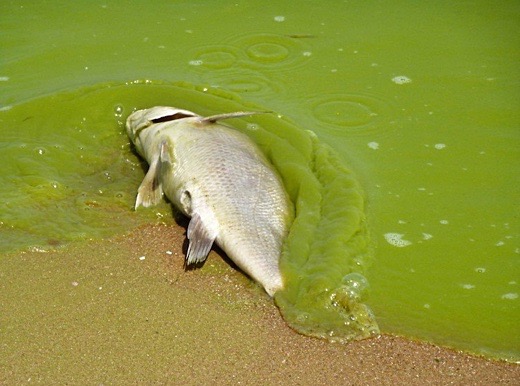
Image above: A dead fish surrounded by algae in Lake Erie during a record-setting algae bloom in 2011. Photo by Tom Archer. From original article.
Glyphosate, the controversial main ingredient in Monsanto's Roundup and other herbicides, is being connected to Lake Erie's troubling algae blooms, which has fouled drinking water and suffocated and killed marine life in recent years.
Phosphorus—attributed to farm runoff carried by the Maumee River—has long beenidentified as a leading culprit feeding the excessive blooms in the western Lake Erie basin. Now, according to a new study from chemistry professor Christopher Spiese, a significant correlation has been established between the increased use of glyphosate to the percentage of dissolved reactive phosphorus (DRP) in the runoff.
As No-Till Farmer observed from the study, DRP loads in Lake Erie increased in the mid-1990s at the same time that farmers began the widespread cultivation of crops genetically engineered to withstand multiple applications of Roundup.
"For every acre of Roundup Ready soybeans and corn that you plant, it works out to be about one-third of a pound of P [phosphorus] coming down the Maumee," Spiese told the agricultural publication.
Here's how the team came to the conclusion, as No-Till Farmer reported:
Through his own and others' research, Spiese found that depending on the types of metal in the soil, glyphosate does release P. For example, when glyphosate is applied to soil containing iron oxide-hydroxide, P is immediately released. But almost nothing is removed when it's an iron oxide material.
Finally, Spiese took soil samples all over the Maumee watershed, applied P to them and then sprayed glyphosate to see how much P was released vs. soil that wasn't sprayed with glyphosate after 24 hours. He saw desorption occurred all over the watershed, but certain areas were higher than others, specifically in the southeastern corner.
Based on the average two glyphosate applications growers make every year, Spiese estimates that overall, 20-25 percent of the DRP runoff is caused by glyphosate. But depending on the location within the watershed, that percentage could be much lower or much greater.
"Some of those sites, it's less than a percent. Other sites it's almost 100 percent," he says.
Previous studies have tied glyphosate to the phosphorous fueling Lake Erie's blue-green algae. In 2009, Ohio Sea Grant researchers, Drs. R. Michael McKay and George Bullerjahn of Bowling Green State University, found that glyphosate could only be detected in the lake at certain times of year—after crops are planted.
"Our research is finding that Roundup is getting into the watershed at peak farming application times, particularly in the spring," McKay said.
Approximately 1,000 metric tonnes (about 2.2 million pounds) of Roundup is applied in the Lake Erie watershed per year, and it is being detected in adjacent waterways particularly in the spring, the Ohio Environmental Protection Agency (EPA) noted from McKay and Bullerjahn's study.
The researchers also found that the blue-green algae (cyanobacteria) in the lake are capable of using phosophonates.
"It turns out that many cyanobacteria present in Lake Erie have the genes allowing the uptake of phosphonates, and these cyanobacteria can grow using glyphosate and other phosphonates as a sole source of phosphorus," Bullerjahn said.
Harmful Lake Erie blooms have increased at record levels over the last decade,according to the U.S. EPA and are expected to become more common due to warmer temperatures and heavy rainfall that feed algae growth.
The toxic algae rob oxygen from the waters creating dead zones where fish and other marine life are unable to survive. The algae is also a threat to humans—swallowing it can cause health problems such as rashes, vomiting, numbness and difficulty breathing.
In February this year, the U.S. and Canada announced a goal to reduce the amount of phosphorus entering affected areas of Lake Erie by a total of 40 percent by 2025.
Image above: Store display of RoundUp for consumer use on home yards. From original article.
Another day, another lawsuit against global seed and chemical giant Monsanto Corporation. In a complaint filed Tuesday in federal court in Wisconsin, six consumers alleged that the company’s top-selling Roundup herbicide has been falsely promoted as uniquely safe when it actually can have profound harmful impacts on human gut bacteria critical to good health.
The lawsuit, which also names Roundup distributor Scotts Miracle-Gro Co. as a defendant, specifically alleges that consumers are being deceived by inaccurate and misleading statements made by Monsanto regarding glyphosate, the active weed-killing ingredient in Roundup.
Plaintiffs include residents of Wisconsin, Illinois, California, New York, New Jersey and Florida.
Glyphosate, which Monsanto introduced as an herbicide in 1974 and is widely used in growing food crops, has been promoted for years as a chemical that kills plants by targeting an enzyme that is not found in people or pets.
The lawsuit claims that assertion is false, however, and argues that research shows glyphosate can target an enzyme found in gut bacteria in people and animals, disrupting the immune system, digestion, and “even brain function.”
“Defendants repeat these false and misleading representations throughout their marketing, including in video advertisements produced for their websites and YouTube Channel,” states the lawsuit, which is filed in U.S. District Court for the Western District of Wisconsin.
Monsanto did not respond to a request for comment and neither did Scotts.
Monsanto is currently defending itself against nationwide claims that Roundup has caused hundreds of people to suffer from a type of blood cancer called non-Hodgkin lymphoma (NHL).
More than 1,100 plaintiffs have lawsuits pending in state and federal courts with many of the lawsuits combined in multidistrict litigation in federal court in San Francisco.
Those lawsuits were triggered by a 2015 decision by the World Health Organization’s International Agency for Research on Cancer (IARC) to classify glyphosate as a probable human carcinogen.
IARC said research showed an association between NHL and glyphosate, with limited evidence from epidemiology data collected on humans and stronger evidence seen in laboratory animals exposed to glyphosate.
The lawsuit filed in Wisconsin is markedly different from the Roundup cancer claims, though some of the same attorneys are involved in both lines of litigation.
Plaintiffs do not claim physical injury; rather they claim violations of trade and business practices laws, and allege Monsanto and Scotts were “unjustly enriched” as plaintiffs purchased and paid for more Roundup products than they would have in absence of the alleged false promotions. .
Stunning new documents unsealed by a federal judge suggest that Monsanto worked directly with federal regulators to hide the health risks of and manipulate the science behind its best-selling herbicide, RoundUp.
The documents reveal that Monsanto pressured Environmental Protection Agency (EPA) officials to not publicly release information on the cancer risks of glyphosate, the main ingredient in RoundUp, ghostwrote research for the EPA and worked with a senior official at the agency to quash a federal review of the chemical.1
These documents suggest an unprecedented level of collusion between the EPA and Monsanto to cover up evidence that RoundUp is a likely carcinogen. The Office of Inspector General of the EPA, an independent office tasked with investigating fraud and abuse in the agency, must immediately launch an investigation to hold Monsanto and all EPA employees involved accountable.
In 2015, the World Health Organization (WHO) declared glyphosate a probable carcinogen, which spurred a class-action lawsuit brought by hundreds victims who developed cancer after being exposed to the chemical.
These newly uncovered documents reveal that months before the WHO’s determination, an EPA official tipped off Monsanto to the upcoming ruling in an effort to aid the agricultural giant’s public relations campaign.
The official promised the company that he would attempt to beat back an upcoming review of glyphosate by the Department of Health and Human Services, saying “If I can kill this, I should get a medal.” HHS subsequently never completed the review.2
Unsealed documents also suggest that a Monsanto executive gave his employees the go-ahead to ghostwrite favorable research on glyphosate and later attribute the studies to academics by merely placing their names on the research.3
Given Donald Trump’s appointment of Scott Pruitt to head the EPA, this is a crucial opportunity for the the Office of the Inspector General to prove that it will remain truly independent under a Trump administration determined to exert total control and suppress all dissent.
The inspector general of the Department of Health and Human Services has recently launched an investigation into the Trump administration, so there is precedent for the EPA inspector general to follow suit.4
Monsanto has a long and dark history covering up glyphosate’s dangers, but it’s simply unconscionable that the EPA would collude with Monsanto to conceal the serious threat the chemical poses to public health.
The defeat of Trumpcare shows that our activism works. Now it’s time for the the Office of the Inspector General to do its job and hold Monsanto and EPA employees accountable.
Tell the Office of Inspector General of the EPA: Investigate collusion between Monsanto and the EPA. Click here (https://act.credoaction.com/sign/monsanto_epa) to sign the petition.
Image above: A farmhand loads genetically modified corn seed into a planter on Bo Stone's farm in Rowland, North Carolina, April 20, 2016. Photo by Jeremy M. Lange. From original article.
Monsanto, one of the world's biggest pesticide and seed corporations and leading developer of genetically modified crop varieties, had a stock market value of US$66 billion in 2014. It has gained this position by a combination of deceit, threat, litigation, destruction of evidence, falsified data, bribery, takeovers and cultivation of regulatory bodies.
Its rise and torrid controversies cover a long period starting with polychlorinated biphenyls (PCBs, chemicals used as insulators for electrical transformers) in the 1940s and moving on to dioxin (a contaminant of Agent Orange used to defoliate Vietnam), glyphosate (the active ingredient in Roundup herbicide), recombinant bovine growth hormone (rBGH, a hormone injected into dairy cows to increase their milk production), and genetic modified organisms (GMOs).
Its key aim in dealing with health and environmental issues is to protect sales and profits and the company image. The latter has been a monumental failure, making Monsanto potentially the most hated corporation in the world.
To better sell its GMO technology, Monsanto began acquiring seed companies in 1996 and within 10 years became the largest seed supplier in the world. If the planned merger with German multinational Bayer takes place, the combined corporate giant will control a third of the world's seed market and a quarter of the pesticide market.
Influence
Gaining friends in high places and managing regulatory body policy has been crucial to Monsanto's power. There is a crossover between Monsanto and the US Environmental Protection Authority (EPA), the US Food and Drug Administration (FDA), the US Department of Agriculture, the European Food Safety Authority and some United Nations food regulatory arms.
This crossover works in four ways: retired legislators move to Monsanto; legislators become lobbyists for Monsanto; regulators move on to Monsanto; and Monsanto employees switch to regulatory organisations (and often back again).
Michael Taylor, a former Monsanto lawyer, moved to the FDA where he determined FDA policy on genetic modification, before becoming Monsanto vice president. Linda Fisher was assistant administrator for pesticides and toxic substances in the EPA for 10 years; she moved to Monsanto in 1995 to lobby politicians, then returned to the EPA in 2001 as deputy administrator.
In the George W Bush administration, Monsanto managed to get four of its associates to head departments: the attorney-general and the secretaries for health and human services (of which the EPA is part), agriculture, and defence. Monsanto lobbying expenses for 1998 to 2001 amounted to $21 million. From 2004 to 2014, it was $62.3 million. In 2002, Monsanto gave $1.2 million to the Republican Party and $320,000 to the Democrats.
As a result, the regulators have by and large facilitated Monsanto's interests. A former EPA manager, William Sanjour, said: "Unfortunately the EPA is more concerned with protecting the interests of companies than with defending the public interest."
Labelling
One example of this cosy relationship came with Monsanto's successful action over labelling of rBGH in milk products.
Because of public concern about rBGH, some milk companies wanted to label their product as "rBGH free". But Monsanto lobbied the EPA to disallow the practice because labelling would imply non-rBGH milk was safer or of higher quality -- which, Monsanto argued, was misleading.
Monsanto threatened to sue dairy companies that specified their milk came from non-treated cows. It forced the companies to add that the EPA had found no difference between treated and non-treated milk.
The FDA sacked a researcher for questioning Monsanto data on rBGH. The US federal government attitude was that biotechnology was so important that they could not allow a few questions about cow or human safety to get in the way.
Monsanto also got the FDA to raise the allowed residues of glyphosate on soybeans from six parts per million to 20 parts per million, and in the European Union from 0.1 parts per million to 20 parts per million. In 2013, this was raised in the US to 40 parts per million for soybean oil -- 400 times the amount known to kill gut bacteria.
The regulators determined that GM and non-GM food was "substantially equivalent", which meant that no safety tests were required. This was a political decision with no scientific basis. Most of the data used by the regulators to determine the safety of products is provided by Monsanto and independent studies are ignored.
In 1998, British researcher Arpad Pusztai announced that he had found adverse effects of GM potatoes on rats. Then-US president Bill Clinton called then-British prime minister Tony Blair, who in turn rang the director of Pusztai's Rowett Institute in Aberdeen to get Pusztai dismissed from the institute.
A Rowett director said: "Tony Blair's office had been pressured by the Americans, who thought our study would harm the biotech industry, and particularly Monsanto."
Monsanto associates on the UN Joint Expert Committee of Food Safety succeeded in getting the body to declare that rBGH was safe, despite the evidence.
Monsanto was also instrumental in getting Trade Related Intellectual Property Rights (TRIPS) inserted into World Trade Organisation rules. This meant that any patent gained in the US automatically applied anywhere in the world, netting hundreds of millions of dollars extra in royalties for Monsanto.
The wording in the EPA toxicity report on PCBs was also changed on Monsanto's request from "slightly tumorigenic" to "does not appear to be carcinogenic".
Monsanto spends millions of dollars fighting proposed GM labelling laws for food. A 2014 Oregon referendum on whether to impose GM labelling cost the company $6 million to fight. The referendum was narrowly lost after Monsanto successfully convinced enough people that labelling would lead to higher food costs.
Surveys show that more than 90% of US citizens want GM labelling. The GMO lobby is trying to get a law passed in Congress to prevent government agencies from ever introducing GMO labelling laws.
African governments are now being targeted to accept GM seeds -- South Africa is one of the few that does. Bill Gates' Alliance for a Green Revolution in Africa (AGRA) is one of the pushers.
Monsanto is part of AGRA management and Gates has $23 million worth of shares in Monsanto. The Clinton Global Initiative and US Aid for International Development also partner with Monsanto.
Market Access
Along with the glowing advertising that promises higher yields for lower costs, which Monsanto uses around the world to entice farmers to buy its products, less open tactics are also used to grow its market.
For instance, vets in the US were paid $300 for each of their clients that adopted rBGH.
In the case of South America, the penetration of GM soy has been extraordinarily successful. Argentina was an early approver of GM products, but neighbouring Brazil and Paraguay initially refused to allow it.
However, GM soy seeds were smuggled in from Argentina in unmarked bags in huge quantities. These seeds were used by large farmers illegally to such an extent that the governments of Brazil and Paraguay were forced to change the law to make it legal.
It is suspected, but not proven, that Monsanto was involved in this introduction -- it was certainly a huge beneficiary.
The extent to which Monsanto uses bribery is not known. One example that was revealed was the $700,000 paid to Indonesian officials between 1997 and 2002 to facilitate the introduction of GM cotton to that country. The US Department of Justice fined Monsanto $1.5 million for this bribery.
Data Falsification and Concealment
Regulators do very little testing of pesticides and GMO products, instead relying on the data provided by the companies requesting approval.
Monsanto has been caught falsifying studies on PCB; 2,4,5-T; and dioxin. It also concealed dioxin levels in Agent Orange (the defoliant used in the Vietnam War) to maintain that lucrative market. Adverse data were destroyed or withheld.
Monsanto's own adverse findings on rGBH were kept secret until leaked by an employee.
Independent studies on Roundup found that the full formulation was much more toxic than glyphosate, the active ingredient, itself. Monsanto's tests were only conducted on glyphosate, not Roundup.
Public laboratories are reluctant to conduct research on Roundup and other product toxicity because most biotechnology research is only funded by the biotechnology companies. Researchers know their careers will suffer if they do this type of research. Monsanto refuses to supply GM seeds for independent research.
Buyers of GM seeds must sign an agreement not to use the seeds or crop for research. In the few cases where permission is granted, Monsanto retains the right to block publication of the results.
Scientists who identify problems with Monsanto technologies are vilified. These have included the University of California, Berkeley researchers David Quist and Ignacio Chapela, who found GM contamination in indigenous corn in Mexico where GM corn is not authorised.
Chapela was dismissed from the university and their report in the journal Nature was repudiated by the editors. Much of Nature's advertising revenue comes from biotech companies. Monsanto also ridiculed studies that found GM corn was killing the monarch butterfly.
Threats and Litigation
Whistleblowers in the EPA have been harassed, marginalised, defamed and often sacked.
Vietnam veterans claiming compensation from Monsanto because of chemical poisoning by Agent Orange were fought bitterly by Monsanto to exhaust the litigants' reserves. The final settlement in 1984 amounted to $12,000 for each claimant, spread over 10 years. It came with a proviso that made them ineligible for pensions, state assistance and food stamps -- meaning most veterans got nothing.
Farmers using rGBH have to sign a confidentiality agreement to not talk about any problems they find with cow health. Some farmers have been sued for doing so.
Farmers buying GM seed have to sign a "technology use agreement" not to re-sow seed, and to use only Roundup herbicide, not any other brand, on Roundup Ready crops (crops engineered to be unaffected by Roundup). They also have to agree to the right of inspection by Monsanto, which uses the Pinkerton Detective Agency in the US and Robinsons in Canada to enforce this agreement.
Farmers found to have GM crops that they have not paid royalties for are sued -- even if the plants have regenerated naturally or are the result of cross pollination by neighbouring GM crops. A total of $23 million in patent infringement law suits had been collected by Monsanto by 2014.
In 2005, the average suing per farmer amounted to $412,000, but many farmers settle out of court to avoid court costs, even if they are innocent. They are not permitted to disclose the settlement figures.
Media organisations have been threatened with litigation and withdrawal of Monsanto advertising for reporting adverse findings relating to rGBH.
A report by Gilles-Eric Seralini in 2012 on his trials of Roundup Ready maize that showed liver and kidney damage was withdrawn from the Food and Chemical Toxicity journal after a year of pressure and the appointment of a former Monsanto scientist to the editorial board.
In an April 2015 article titled "Is Monsanto on the side of science?", New Internationalist listed several examples of scientists reporting findings adverse to Monsanto who have found themselves under attack. One of them, Italian Manuela Malatesta, said she was forced out of her university job as a researcher after publishing her studies on GM soy that found malfunctioning of testes, pancreas and liver in mice.
Malatesta said:
"Research on GMOs is now taboo. You can't find money for it…
"People don't want to find answers to troubling questions. It's the result of widespread fear of Monsanto and GMOs in general."
A trade group including Monsanto also backed a proposed federal law that would nullify the state of Vermont's law enforcing GMO labelling and any other mandatory labelling of GMOs in the United States.
Promise Versus Reality
In its advertising, Monsanto promises higher returns for farmers if they plant GM crops. Initially this does happen, but within a few years the costs multiply because pests become immune to toxins inserted into corn, soy and cotton, and weeds became resistant to Roundup used on Roundup Ready corn, soy, canola and cotton.
Damage to soil biology by the heightened use of Roundup cause outbreaks of root rotting diseases (Fusarium and Rhizoctonia) and restricted the Rhizobium bacteria that create nitrogen on soy roots, so that more fertiliser is needed.
Yields decrease. Soon GM crops become less profitable than non-GM; the difference in the US is made up by increased government subsidies to farmers. GM seeds cost three-to-four times more than non-GM. Even the US Department of Agriculture acknowledged in 2014 that yields are lower for GM crops, particularly soy.
Monsanto promises lower pesticide use. In the US, pesticide use (including herbicides) increased 7% between 1996 and 2001, while in Western Europe, using non-GM crops, pesticide use dramatically fell in that period with increased yields.
Monsanto insists that GM technology and Roundup are safe, yet the independent studies that have been done point to the opposite.
The widespread use of Roundup Ready GM crops since 1996 has corresponded with a dramatic rise in illnesses such as coeliac disease, gluten intolerance, Alzheimer's disease and diabetes. Cause is hard to prove, but the damage that Roundup does to intestinal microbiology has significantly decreased bodily and immune system function, according to Dr Don Huber, making it a likely factor in the disorders.
Glyphosate is also patented as an antibiotic, not just a herbicide. In the US, almost all processed foods contain GM soy and/or corn products (80%). People living in areas of intensively cultivated GM soy in Argentina are twice as likely to die of cancer. Levels of glyphosate in urine in the US are 10 times the levels of people in Europe.
The glowing promises of GM Bollgard cotton in India have had disastrous results. The crops did not perform well in the monsoon conditions of wet and dry, the fibre was shorter and brought a lower price, the seeds cost four times as much as non-GM, and pests proliferated. Non-GM seeds became unavailable as local suppliers only stocked Bollgard, with the support of state governments.
The resulting indebtedness has caused many farmer suicides -- 296,400 cotton farmers took their lives in 20 years (often by drinking Roundup).
Flooding the Market
Monsanto promised that GM and non-GM crops could co-exist. The reality is that GM genes spread far and wide through cross pollination by bees and wind. All canola seeds in Canada, including non-GM seeds, have GM genes, which has eliminated organic canola growing.
Indeed, this was the goal of Monsanto, as Don Westfall, a consultant to biotech companies, said in 2001: "The hope of the industry is that over time the market is so flooded that there's nothing you can do about it. You just sort of surrender."
GMO advocates say that the technology is essential to feed the world. Yet the world already produces enough food for the expected population of the world in 2050. Hunger is not a production issue but one of social justice.
Even the wealthiest countries with abundant food have significant percentages of food insecure people (10% in Australia).
Almost all GM crops so far developed have been for herbicide tolerance (85%, so the whole crop can be sprayed to kill the weeds) or contain the toxin of the bacteria Bacillus thuringiensis (Bt). Golden Rice, engineered to increase vitamin A levels, failed because the increase was marginal, and has been abandoned.
Other promised miracles including drought and salt tolerant wheat have not materialised, though might in the future. On the other hand, conventional plant breeding has been far more successful at achieving sustainability goals.
Some Victories
Monsanto has not had everything go its own way. On occasions its arrogance and deceit has backfired.
In the criminal trial in 2002 over the poisoning of residents in Anniston, Mississippi, by the Monsanto PCB factory, a US judge said Monsanto's conduct was "so outrageous in character and extreme in degree as to go beyond all possible bounds of decency, so as to be regarded as atrocious and utterly intolerable in civilized society".
Craven Laboratories, acting for Monsanto, was heavily fined for falsifying test data and its owner was sentenced to five years' jail.
Monsanto claimed in its promotional material that glyphosate was less toxic than table salt, was 100% biodegradable, and left no residue in soil. In 1996, this was challenged in court by the New York State attorney-general as false and misleading advertising. Monsanto lost.
In France's north-west, the Brittany Water and Rivers association also sued Monsanto for misleading advertising, as residues in rivers were found to be well above the legal threshold for glyphosate.
Although the case was successful, Monsanto's penalty was merely €15,000 after a seven-year court battle.
In 2005, to avoid the costly investigating and suing of farmers suspected of saving the seed of patented varieties, Monsanto acquired a company that had developed the Terminator gene.
The aim was to insert this gene into all patented varieties, GM and non-GM, so that the next generation would not germinate. A worldwide outcry led to the international community deciding to ban this technology.
However, some countries, including Australia and the US, want this ban overturned.
Monsanto's dream of Roundup Ready wheat was defeated in 2004 because farmers in North America fought it successfully. Farmers were concerned that they would lose markets, because Europe, Japan and some other countries said they would not import any wheat from North America because of inevitable contamination.
Canadian canola growers have lost much of their market already. Monsanto withdrew its application for approval.
Gaining Control
Monsanto's strategy in getting control of the world's food system has so far been successful, relying on government support, effective advertising, intimidation and litigation.
But public opposition is mounting. Huge numbers of people around the world took part in the March Against Monsanto in 2015. The organic industry in the US is booming because this is the only way consumers can choose non-GM foods. Farmers are starting to reject GM seeds. However, there is a long way to go before Monsanto falls.
It was public action that led to the ban on PCBs and the hormonal herbicide 2,4,5-T.
In Australia we must continue to support the South Australian and Tasmanian GMO moratoria and pressure other governments to withdraw approval for GM canola and cotton and continue to block GM soy and corn.
We must support ecological farming systems that do not need the inputs provided by Monsanto or any of the other pesticide, seed and GMO conglomerates.
This piece was reprinted by Truthout with permission or license. It may not be reproduced in any form without permission or license from the source.
• Alan Broughton is a member of the Socialist Alliance and involved with the Organic Agriculture Association. Along with Elena Garcia, he is a co-author of the recently released Sustainable Agriculture Versus Corporate Greed, Resistance Books, 2017.
If we had a dime for every kooky, left-wing theory we've heard alleging some vast corporate conspiracy to exploit the treasures of the Earth, destroy the environment and poison people with unknown carcinogens all while buying off politicians to cover their tracks, we would be rich. The problem, of course, is that sometimes the kooky conspiracy theories prove to be completely accurate.
Lets take the case of the $60 billion ag-chemicals powerhouse, Monsanto, and their controversial herbicide, Roundup as an example.
For those who aren't familiar, Roundup Ready is Monsanto’s blockbuster weedkiller, credited with transforming U.S. agriculture, with a majority of farm production now using genetically modified seeds resistant to the chemical.
For years the company has assured farmers that their weed killing product was absolutely safe to use. As proof, Monsanto touted the approval of the chemical by the Environmental Protection Agency (EPA).
That said, newly unsealed court documents released earlier today seemingly reveal a startling effort on the part of both Monsanto and the EPA to work in concert to kill and/or discredit independent, albeit inconvenient, cancer research conducted by the World Health Organization's International Agency for Research on Cancer (IARC)....more on this later.
But, before we get into the competing studies, here is a brief look at the 'extensive' work that Monsanto and the EPA did prior to originally declaring Roundup safe for use (hint: not much).
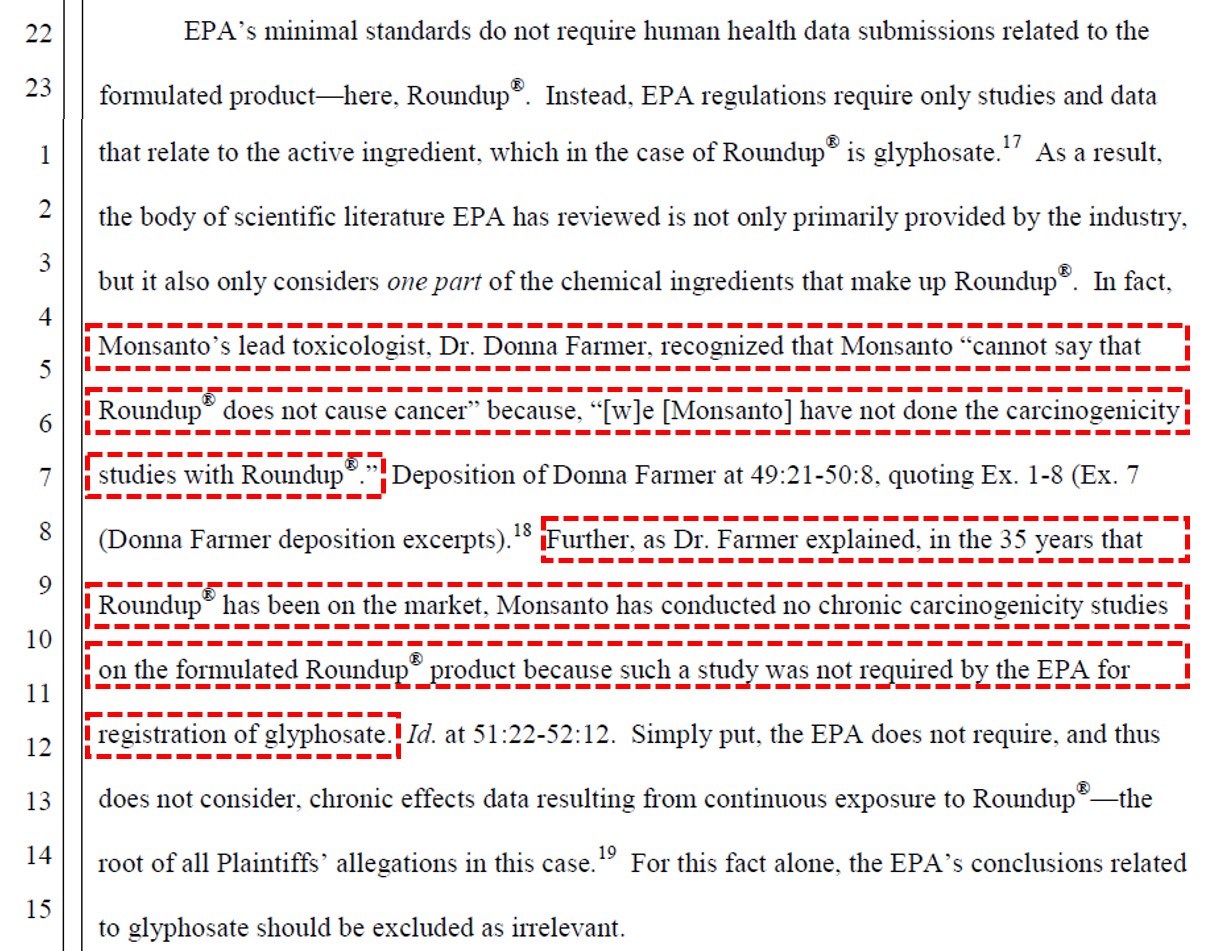
As the excerpt below reveals, the EPA effectively declared Roundup safe for use without even conducting tests on the actual formulation, but instead relying on industry research on just one of the product's active ingredients.
"EPA's minimal standards do not require human health data submissions related to the formulated product - here, Roundup. Instead, EPA regulations require only studies and data that relate to the active ingredient, which in the case of Roundup is glyphosate.
As a result, the body of scientific literature EPA has reviewed is not only primarily provided by the industry, but it also only considers one part of the chemical ingredients that make up Roundup."
Meanwhile, if that's not enough for you, Donna Farmer, Monsanto's lead toxicologist, even admitted in her deposition that she "cannot say that Roundup does not cause cancer" because "[w]e [Monsanto] have not done the carcinogenicity studies with Roundup."
Image above: Document #2 from original article. Click to enlarge.
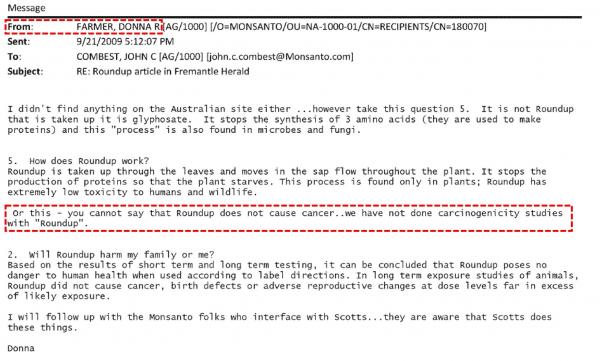
And just in case you're the super skeptical type, here is Farmer's actual email, from back in 2009, which seems pretty clear:
"you cannot say that Roundup does not cause cancer..we have not done carcinogenicity studies with "Roundup".
Image above: Document #2 from original article. Click to enlarge.
And while the revelations above are quite damning by themselves, this is where things get really interesting.
In early 2015, once it became clear that the World Health Organization's IARC was working on their own independent study of Roundup, Monsanto immediately launched their own efforts to preemptively discredit any results that might be deemed 'inconvenient'.
That said, Monsanto, the $60 billion behemoth, couldn't possibly afford the $250,000 bill that would come with conducting a legitimate scientific study led by accredited scientists. Instead, they decided to "ghost-write" key sections of their report themselves and plotted to then have the independent scientists just "sign their names so to speak."
"A less expensive/more palatable approach might be to involve experts only for the areas of contention, epidemiology and possibly MOA (depending on what comes out of the IARC meeting), and we ghost-write the Exposure Tox & Genetox sections...but we would be keeping the cost down by us doing the writing and they would just edit & sign their names so to speak."
Image above: Document #3 from original article. Click to enlarge.
Finally, when all else fails, you call in those "special favors" in Washington D.C. that you've paid handsomely for over the years.
And that's where Jess Rowland, the EPA's Deputy Division Director for the Office of Chemical Safety and Pollution Prevention and chair of the Agency's Cancer Assessment Review Committee, comes in to assure you that he's fully exploiting his role as the "chair of the CARC" to kill any potentially damaging research..."if I can kill this I should get a medal."
Image above: Document #4 from original article. Click to enlarge.
All of which begs the question of whether the D.C. swamp is just too large to be drained.
SOURCE: Russ Pascatore (russ.pascatore@titanx.com)
SUBHEAD: Protesters supported by donations are not a new idea. There are national holidays for some of them.
Image above: Reverend Billy getting arrested during an anti-Monsanto protest in Des Moines, Iowa in 2016. Photo by Sharon Donovan. From original article.
On January 11 in Des Moines, Iowa, Reverend Billy Talen and his co-defendant, Father Frank Cordaro, were found innocent of the charge of trespass, with possible $500 fine and 30 days in prison. In her decision, Judge Carol Coppola refused to accept the prosecution's motion to stop Talen and Cordaro from invoking the First Amendment in their defence.
"Your honour - he's a professional protester!" the Assistant District Attorney called out in horror. Wylie Stecklow, my long-suffering pro-bono lawyer standing next to me, cast a wry sidelong glance.
Why the demonisation of protest?
Protesters supported by volunteer donations are not a new idea. We create national holidays for some of the prominent ones. Sometimes, you just have to go out and ask for help! In the Church of Stop Shopping, we have 200 people who give $2 each month. We call these friends "Holy Rollers".
The motion in the link above was filed for the Iowa judge to consider before our recent trial. It proposed that my co-defendant and I not be allowed to defend our actions by invoking the First Amendment, on the grounds that we have protested many times in our past and are therefore free speech abusers. Professional protester!
Norman Siegel, for many years the head of the New York American Civil Liberties Union (ACLU), told us that in his experience this motion is without precedent. Retire a portion of the Constitution for a trial? Retroactively suspend a defendant's First Amendment rights? What other kind of defence strategy would a protester even consider?
Monsanto's attacks on citizens that are critical of its popular herbicide, RoundUp, and its glyphosate toxin are similar to fundamentalist religions like Scientologists, Zionists, or the National Rifle Association.
In contrast to their problems elsewhere in the world - where half a dozen countries have enacted prohibitions on its use and more are considering such action - in the United States, the company is successful in stifling its dissent, especially in Iowa, where newspapers accept large ad buys and the government works openly to accommodate the chemical giant.
A critical researcher can be defamed publicly and dogged for years in the press and scientific journals. The recent study from Kings College's genetic researchers linking glyphosates to liver and kidney disease is the latest smoking gun, but Monsanto's spin machine will surely swing into action in the coming days.
In our case, what we were all fearing was that the prosecution was protecting Monsanto. But the government's argument blew up, as it should have. The judge was not about to banish the Constitution from her court. She dismissed the charges in about two hours, which is very quick, in court time. We didn't even select a jury.
The criminalisation of expressive freedoms may be a hallmark of Donald Trump's hate era. Iowa is a Trump state, as well as a Monsanto state. And Iowa is very much a Monsanto state: It absorbs more of the herbicide, RoundUp, than any other state in the union, and Iowa's cancer rates are said to be high.
Iowa Governor Terry Branstad endorsed Trump, and now will be the new ambassador to China. Monsanto will like that. The World Food Prize party, where we were protesting - local wags call it "Monsanto's Oscars", has been subsidised by Iowa taxpayers up to $1m annually and features big cash awards to GMO advocates. Monsanto got Iowans to pay for their poison. The party's location says it all: They rent the entire Iowa State Capitol building.
This is certain: Our nation's pro-business bias habitually places the law enforcement community in opposition to the US Constitution's protection of free speech. When the national emotion is fear, then all free speech is suspicious, and, for the corporations, free speech is a baffling gift economy. Free speech is just that: it's free. You can't sell it, therefore it must be illegal.
When the official emotion is fear, then protesters symbolise the part of life that makes change. In evolution, adaptation is made possible by the arrival of mutation, of free radicals that come in the wind and the waves and upset the host organism. You must have resistance in a healthy democracy, but the resistance will change you.
The Iowa prosecutor, after thoroughly losing this case, made a final speech about "respecting our police". The implication was that the people in the room who defend the First Amendment are disrespectful to the state troopers.
Well, respect for the Constitution and respect for our police should never be in conflict. These police handcuffed us a football field away from the state capitol's front door. They need to look again at those five freedoms: Worship, Speech, Press, Peaceable Assembly and Redress of Grievances. The First Amendment, born in 1791, makes remarkably modern instruction.
We left the courtroom knowing that there is much to be done. We are given the responsibility for this double teaching. Free speech and organic farming have common ground. They are both nature. They are wild and alive. The words and the seeds give so much, if we let them grow freely.
Image above: Glyphosate being sprayed on winter wheat sevendays before harvest to wither the crop for easier harvesting. Photo by Gary Naylor. From (http://gnp.photoshelter.com/image/I0000kK3KyBLj_Vs).
[IB Publisher's note: This nearly hour-and-a-half interview is cutting edge information on the impact of the widespread use of glyphosate (RoundUp). Chris Martenson (with PHD in toxicology), interviews Dave Murphey (executive director of Food Democracy Now!). As we in Hawaii are vitally interested in the experimental development of complex genetic and pesticide interactions on human health and the environment we suggest struggling through this material.]
In November, a very concerning report — Glyphosate: Unsafe On Any Plate — was released by The Detox Project and Food Democracy Now!, raising the alarm of the high levels of glyphosate in the US food supply and the (deliberate?) low levels of awareness of its associated health risks.
Dave Murphy, executive director of Food Democracy Now!, joins us this week to explain the finding of this new report on the world’s most-used herbicide (more commonly known by its retail brand: Roundup).
As happened in past decades with the alcohol and tobacco industries, there’s compelling evidence that profits have taken a priority over consumer safety — and as public health concerns are being raised, Big Ag is circling its wagons and attacking the questioners rather than embracing open scrutiny.
Are we being poisoned in the pursuit of profit?
Look at the chemical and what actually it does. Monsanto has three patents for glyphosate and the first one is from 1964 from the Sulfur Chemical Company in Westport, Connecticut. It was originally used to clean pipes. It's like Drano: it basically strips minerals out of and heavy metals out of a pipe.
Scientists have found that it actually chelates those same minerals in soil and makes them unavailable into the plant. At some point in the 1960s a Monsanto chemist discovered that it would also kill weeds. Monsanto applied for a patent in '68 or '69, was awarded that patent in '74, and that is when Roundup first went on the market.
It was used you know in forests and to kill weeds on road sides and that kind of thing. It was used in forest management for a long time and in public parks.
Today, 300 million pounds of glyphosate-based herbicides are used here in the United States each year. In our report ,we have one graph showing how from 1992 (four years prior to Roundup Ready crops being introduced) to 2014 -- I mean -- the states of Minnesota becomes three quarters covered in all black. Iowa is fully blotted out. Illinois is fully blotted out. North Dakota is mostly blotted out and so is South Dakota, Nebraska and Kansas. And this is just showing you how widespread glyphosate use is.
The US geological survey did tests in 2007 and again in 2011, showing that 75% of the rain water and river and stream samples in the Midwest contained glyphosate, which is pretty alarming.
This chemical is being sprayed on our food and then is evaporating into the air and going downwind and being taken up into clouds. It can fall hundreds of miles away from where it is originally applied.
The reason we took our time with this report and why we made it so detailed is because the highest level of glyphosate found today is in Cheerios, which is often the first solid food that a mother will feed her child as they are transitioning from breast milk or formula.
Cheerios is an iconic brand, and all the mothers I talk to explain how their babies love to grab onto them. They are a perfect finger food because they have that hole in the center. And so it is a common food for a mother to automatically give her child. The only problem is a single serving of Cheerios to a one year old child would subject them to a harmful dose of glyphosate.
Chris Martenson: Welcome to this Peak Prosperity podcast. I am your host, Chris Martenson, and today is November 28th, 2016. This is an important podcast about an important subject. Today, we are going to be talking about the chemical herbicide glyphosate. We are going to cut right to the issue affecting your health and that of your children and loved ones.
Unfortunately, we are also probably going to undermine any remaining trust you may have in the hybrid system of corporate interest and government regulations that we all live under. According to a new report, glyphosate residues are found in, I will use this word carefully, alarmingly high levels, in a wide range of popular American foods.
Luckily, my PhD was in toxicology, so I find the materially relatively straight-forward to interpret and report on, and I don’t trot out that pedigree very often, but today I will.
This report is thorough. It is careful. It is comprehensive. And today we are going to be talking with one of its lead authors. This report was put together by a group called Food Democracy Now and it is calling for renewed Federal investigation into the likely harmful effects of glyphosate on human and environmental health, as well as for a ban on certain uses of glyphosate.
So who is Food Democracy Now? Well Food Democracy Now or FDN is a grassroots community dedicated to building a sustainable food system that protects our natural – excuse me, that protects our natural environment and sustains farmers and nourishes families.
Their first campaign successfully put officials endorsed by FDN members in the Obama administration, so they know how to get results. From the FDN website we read “Our food system is fundamentally broken.
A few companies dominate the market prioritizing profits over people and our planet. Government policies put the interest of corporate agribusiness over the livelihoods of farm families. Farm workers toil in unsafe conditions for minimal wages. School children lack access to healthy foods, as well as millions of Americans living in poverty.
From rising childhood and adult obesity to issues of food safety, air, water and pollution, workers rights and global warming, our current food system is leading our nation to an unsustainable future.” End quote. Now we here at Peak Prosperity share a lot in common with our assessments of the FDN.
Yes, our food system is broken. No, it does not have to remain that way. All of our interviews with Joel Salatin of Polyphase Farm and the Kaisers of Singing Frog Farms, among many others prove there is another way to farm that is actually in relationship to the earth, its rhythms and each other. To tell us about glyphosate and the startling new report they commissioned is Dave Murphy, the founder and executive director of Food Democracy Now.
Murphy has been called the most crucial and politically savvy actor in the ongoing efforts to help move American agriculture into the 21st Century, as a result of his Sustainable Dozen campaign, which resulted in four candidates being placed in high level positions at the USDA, and his efforts to reform food and agriculture under the Obama administration.
In 2006 Murphy moved back to Iowa to help stop a factory farm from being built near his sister’s farm. After seeing the loss of basic democratic rights of rural Iowans, Murphy decided to stay in Iowa to fight for Iowa’s farmers and rural residents and expose the flaws of industrial agriculture to help create a more sustainable future for all Americans.
Previously, he has worked as an environmental and food policy lobbyist and political strategist. His writing has appeared in The Nation, The Hill, Huffington Post and the New York Times. Welcome, Dave.
Dave Murphy: Thank you very much, Chris. It is a pleasure to be here.
Chris Martenson: It is really great to have you on, because I admire and support the work that you are doing, first to reform farming as a practice and as a lifestyle; and because we at Peak Prosperity, Dave, we have been poking around the edges of this glyphosate story for some time. I’ve got your report right in front of me.
People are going to hear me thumbing through it. And it is titled Glyphosate Unsafe on Any Plate. Hey clear nod to Ralph Nader’s book that shook up the auto industry, am I right?
Dave Murphy: No, absolutely. We think that, much like the automobile industry – the interesting thing, the parallels are very similar. The automobile industry in the 40s and 50s and 60s, they focused on mass producing cars and trying to produce them cheaply.
They didn’t put safety first, and when critics of safety records of automobiles first became public, they were vigorously attacked. The interesting things is European auto industry starting with Volvo and then Mercedes and Audi, they took safety, you know safe vehicles and safe cars seriously.
One of the things is the European auto industry is doing much better than Detroit at this point. I mean, Detroit fought regulations and they fought safety rules and regulations and people’s trust in the American automobile has declined. I think the same thing is happening here in the United States.
Basically, these food companies have relied on basically an outdated mode of producing cheap calories that really started under Nixon.
Producing cheap calories, that policy or that belief system has not really resulted in producing the safest, healthiest food. There is a lot of cheap calories out there, but if you walk down your average street in America, you will notice one thing – most people do not look healthy and, in fact, we have an obesity academic where over 60% of adults US and American adults are overweight or have or are obese, which is kind of alarming.
Chris Martenson: Indeed. The health epidemic that we are facing is pretty serious. There is clearly something that has gone wrong.
Epidemiologically, we have all the data that we need. I like how you are framing this, saying look, when industries come along, they of course want to do things as cheaply as they can, because we have a profit motive and they do that, and then eventually people start to get more sophisticated and they say hey, we would like cars that don’t kill us when we bump into a brick wall at 10 miles an hour. That would be fantastic. Can we do anything about that?
And the first response of any industry, of course, is to defend itself and defend not itself, but its profits. And so, I think that is a great way to frame this; that here is an industry. It is time for it to mature – let’s look at the data. And that is why I want to tell you,
Dave, how impressed I am at this report. I’ve got it in front of me, Dave. Twenty-nine pages cover to cover. It is packed with science. It has got the latest research. Knowns, the unknowns, lots of citations. It is hard hitting, but not sensationalist.
I think it is just a great example of how such a report should be done. So, first question – what led your group to put what is clearly a lot of time and effort into producing this report? Why glyphosate?
Dave Murphy: There’s two reasons. You know, one I am from a small town in Iowa. You said earlier in the introduction I moved back to fight a factory farm away from my sister’s farm. And what I really learned is that the rules of democracy are rigged against us.
Especially if you are a family farmer, you are someone living in rural America and you support clean water and clean air. You know these industries have figured out a way to kind of lobby and use their political donations or lobby in influence to always rig the rules against the citizens and clean water and clean air and clean food.
I will just say Roundup — one of the things is being from Iowa you are always aware of what the biggest industry in your state is, or at least you should be. And for Iowa that is agriculture. And I moved back initially to fight factory farms, but it was very clear there was a real problem with Monsanto bullying farmers in the Midwest, threatening them over, you know, what they claim would be patent violations and making up claims that were illegally saving seeds.
That is really how Monsanto first got on our radar. They are bullying farmers in the Midwest and then I started looking into it further. One of the interesting things is Iowa produces 97% GMO soybeans and 94% Roundup ready corn. So Roundup is the main chemical sprayed in our state. The more I learned about it and the more I kept reading about new studies coming out, the more concerns we had.
And then we helped lead these GMO labeling ballot initiatives. We kind of dug into the history of Monsanto. And I studied history in college, so I always like to look if I am analyzing a company, I always like to go back to their long-term history, not just the product that they are producing now.
One of the alarming things in Monsanto’s history they produce some of the most toxic chemicals on the planet, including Agent Orange, PCBs, dioxin and DDT.
And one of the things about them is that each – in each case of these chemicals that they produced, they were illegal, they were approved by the FDA or EPA and you know I mean the proper agencies the problem is just like the tobacco industry, Monsanto knew that these products were causing harm even to their own workers and they still hid the fact of harm.
Even from their – I will just say like if you read the transcripts from the trial of US veterans, you know — Vietnam veterans on Agent Orange, it would really give you pause when you learn that these are the people responsible for producing the seeds, and then the chemicals that go on your food.
So, we chose to do this report because, in the process of our investigation in looking into this, we found out that the USDA had never really even released pesticide residue results for glyphosate.
I find that really shocking that it is the mostly widely used weed killer or herbicide in America and also the world, and the US government won’t release basic pesticide residue data to the American public. Those are the things that, as a citizen and a resident of Iowa, I find it kind of shocking.
So we looked into these. We did a year and a half investigation behind the science and the regulatory, what I would say, collusion or manipulation by the industry.
We looked into it, and then we were able to find a lab that did this testing.
We had no idea what we are going to find, meaning we had an idea where it may be, but we had no idea what the levels actually were. I think that the reason we took our time with this report and the reason we made it so detailed is because the highest level was in Cheerios, which is the first, like, whole food that a mother will feed their child as they are transitioning from breast milk to formula.
Cheerios is kind of an iconic brand and all the mothers I talk to, the babies love to grab onto them. They are like perfect finger food, because they have that hole in the center. And so it is a perfect food for a mother to automatically give their child.
The only problem is a single serving with this level of glyphosate residue is twice as harmful to health, as new research is showing that like the levels we found in Cheerios with glyphosate it was 1,125.3 parts per billion.
One serving of Cheerios to a one year old child is twice as evident – current research and scientific evidence shows just that one serving that child would be exposed to a harmful dose of glyphosate.
Chris Martenson: So, let’s start at the beginning. I love starting at the beginning with this then. Glyphosate — so from your report I learned a couple of things. I learned that it was originally patented as a chemical. So glyphosate is a compound. It is a molecule. It was originally patented to clean pipes in 1964. Somebody invented a — Stauffer Chemical — and they are using it to remove unwanted mineral deposits from metal.
Pipes, that is what they started with. It does that because it is a chelating agent. That means it binds things. So, anybody that does any or heard about so-called chelating therapies, where you have to take toxic metals out from your body. You have been acutely poisoned or chronically — a chelating agent simply binds things.
Vital nutrients such as iron, manganese, boron, in the soil, they get bound up by glyphosate. It wasn’t until later; it was 1974, it was discovered — hey, this compound also metabolically poisons plants. So, take us through the beginning of where really glyphosate came from and, beyond that, how did this really come to be such a dominant position in the Iowa landscape?
Dave Murphy: Well, listen, that is a great question. The interesting thing is, you know, Montana likes to claim that and they have claimed this for 40 years — glyphosate is perfectly safe. It is safer than table salt.
We even have Monsanto propagandists. They have PhDs, but they still – they are so zealous in their defense of Monsanto’s product.
We had a guy, last year, say he would drink a pint of Roundup glyphosate on air and as soon as the interviewer offered him a glass he said oh no, no. I’m not stupid. So clearly, in you know, in theoretical world they claim it’s safe, but in reality when they are exposed to it, they say no.
And here are the things, so we you look at the chemical and what actually it does. Not just one, the patent they have for herbicidal or weed killing action, and the interesting thing is glyphosate has three patents and as you mentioned the first one was in 1964 Sulfur Chemical Company in Westport, Connecticut.
One of my best friends from college lives in Westport, Connecticut. I found it very interesting it was originally used to clean pipes. It’s like Drano. Like you said it basically strips minerals out of and heavy metals out of a pipe. The fact is, scientists have found with some studies that it actually chelates those same minerals in soil and makes them unavailable into the plant.
Apparently, it wasn’t the best you know, it wasn’t the best pipe cleaner or they couldn’t bring it to market at scale at that time. So, at some point in the 60s a Monsanto chemist discovers that this would kill weeds. I think they applied for a patent in ‘68 or ‘69, Monsanto did. They were awarded that patent in 1974, and that is when it first went on the market.
You know, it was used, you know, in forests and to kill weeds on you know, road sides and that kind of thing. It was used in forest management for a long time and in public parks. The other thing is, interestingly though, in the 1980s Monsanto was looking for a way to diversify their portfolio. They didn’t just want to be a chemical company and biotechnology was coming along.
And so, several of their scientists cleverly figured out that they could take a gene – they found some weeds that became resistant to Roundup on their property somewhere, and then there are scientists that analyze those plants, and they found a gene in there that made them resistant to Roundup and then they inserted it into corn. They made genetically engineered Roundup ready corn and soybeans.
And so, in 1996 glyphosate use really started to explode across the country and had been pretty minimally, I should say, minimally used compared to what it is now. In the last 20 years since 1996 Roundup ready crops they have GMO corn that is Roundup ready, soybeans, cotton, sugar beets and canola.
So, Monsanto always says, biotech industry always says, that they are here to feed the world, but these — we need biotechnology and genetic engineering to feed the world. In reality, when you look at the business model and you look at the system of what GMOs or genetically engineered crops have created, it is really a toxic chemical delivery device. They created food crops that allow them to survive being sprayed with Roundup.
Everything else in the field dies, but glyphosate and Roundup does not kill those plants that contain those genes.
The interesting thing is today 300 million pounds of glyphosate is used Roundup ready and glyphosate based herbicides are used here in the United States; and in the report we have, this one graph, this one chart on it is on page three, that kind of shows from 1992 prior to this is four years prior to Roundup ready crops being introduced to 2014.
I mean, it is just like the states of Minnesota is three quarters covered in all black. Iowa is fully blotted out. Illinois is fully blotted out. North Dakota is mostly blotted out, and so is South Dakota, Nebraska and Kansas. And this is just showing you how widespread glyphosate use is.
The interesting thing is, the US Geological survey did tests. I think they started in 2007, and they followed up in 2011, when they showed that rainwater and river and stream samples, 75% of them in the Midwest contained glyphosate, which is pretty alarming.
It is the chemical that is being sprayed on our food and then it is evaporating into the air and going down wind and you know, being taken up into clouds. It can fall hundreds of miles away from where it is originally applied.
Chris Martenson: Dave, you mentioned a third patent. I think we missed it. What was that third patent one?
Dave Murphy: Yea it – Monsanto’s patent on Roundup expired in 2000, so they went off patent and it is a generic chemical. Other chemical companies can create it. But it is still a third of their – it is still worth over $5 billion for them annually. Interestingly, in the early 2000s they applied for a patent at the patent office for an anti microbial.
Not only does glyphosate work as a metal chelator, a mineral chelator and a weed killer, it also has an anti microbial aspect to it. This is where scientists really need to look into that mode of action by which glyphosate operates.
Monsanto has always gotten away, and the regulatory agencies have always gotten away, with saying that glyphosate doesn’t harm humans or mammals because we don’t have what is called a schechemic pathway.
Plants have what is called a schechemic pathway, and that is where they produce three essential aromatic essential – I’m sorry, amino acids. And those amino acids produced in that plant, they help that plant grow through photosynthesis, though it also helps with its immune system.
The thing is, glyphosate shuts down that – the schechemic pathway. They are claiming that humans and mammals don’t have it, so there should be no impact on human health. The fact is, humans are interestingly enough, we are an animal.
We are a species, but we have trillions of bacteria on our body and in our stomach. The last five or 10 years scientists have really discovered the major importance of the autoimmune is with your stomach bacteria.
So, your gut microflora and in fact your gut microflora do have shechemic pathways. So, any level of residue on food has a possibility of going into your stomach and disrupting that essential microflora in your stomach.
Just like if you take an antibiotic, it will kill beneficial microorganisms.
The thing is, glyphosate does the same thing. It will kill beneficial micro organisms in your stomach and, interestingly, even USDA scientists have shown, Bob Kremer, used to work at the University of Missouri, famously showed research on his brother’s farm that glyphosate was killing beneficial micro organisms in the soil, and as a result harmful ones were coming to the surface.
Famously, in agriculture production, when glyphosate is sprayed the usarium fungus is the one that comes up. I would just say it may not sound interesting, it may sound scary, but that is – the rise of usarium fungus in farmer’s fields, it leads to crop diseases.
And two of the most prominent crop diseases in Iowa are sudden death syndromes of soybeans and also Gosses wilt in corn. Basically, it happens because there is a real massive imbalance in the soil bacteria and these harmful ones come to the surface.
So, Monsanto basically has a chemical that they are spraying on their food that they have only gotten approval for based on one criteria. And that is the herbicidal criteria. They think of doctors and toxicologists and they start looking at these multiple patents in these multiple mode of actions, they are really going to find in the long run glyphosate is probably even more harmful than DDT to human health and the environment.
Chris Martenson: This is really shocking and I guess it shouldn’t be, but the story here is that I think a lot of people assume that for a chemical that we are going to apply 300 million pounds of to ourselves, that would pretty thoroughly studied. That there would be a variety of studies conducted. In animal studies you would have acute and chronic studies, meaning we find out what the lethal dose is, but then we are interested more long-term.
What happens?
What happens when we are using this compound and you know what happens to things like cancer formation to embryo formation a long – term reproductive health effects, endocrine system functions. You would think all of that would be studied and, in particular, it wouldn’t just be the stripped out compound, it would be the actual formulation that is used; something that you point out very well in this report, which is that glyphosate is a specific molecule that is called the active ingredient in something like Roundup.
But Roundup consists of both glyphosate, plus what they call, insert air quotes, “inert” ingredients which are other things that have their own effects which we should probably study the thing that is being applied as the entire compound rather than just the soul part. How much of those studies have actually been done that we just described? Acute, chronic, long-term as well as multiple species studies?
Dave Murphy: Well, listen. You obviously have a full scope of understanding of the type of what we would think would be rigorous kind of studies that are conducted or reviewed by the FDA or the EPA and the US regulatory agencies.
The interesting thing is none of these agencies conduct their own studies to show if this is safe. They rely on the industry to provide them with studies.
Chris Martenson: So Monsanto conducts a study. So, who specifically in the industry has conducted any glyphosate studies that have been reviewed by the USDA and the FDA?
Dave Murphy: Every chemical that is being sought for approval the only science that the agencies will review is corporate sponsored science supplied by that corporation. So, in the case of glyphosate, it was that research, independent research, I shouldn’t say it is independent, because it is not. It is corporate sponsored.
That is supplied by Monsanto in the bio tech industry. And the other data, as you mentioned here, is the thing – glyphosate is the main chemical ingredient, but it only makes up 41% of the formula of the weed killer Roundup.
And glyphosate by itself does not kill weeds. It does not kill plants. It actually needs that 59% of the other formulation, which is not tested, so that you’re right. They never test the complete formulation for safety. They only test the single active ingredient.
The interesting thing is other scientists around the world and even the US have done independent studies and they always show glyphosate is more harmful than Monsanto admits. But even more importantly, Roundup, the entire Roundup formula, is basically 125 times more toxic than glyphosate alone.
The US government has kind of rigged the rules against us. The chemical industry helped lobby for that by only requiring the main chemical ingredient to be tested. The interesting things is yes, trade secrets. Monsanto submits trade research and the EPA reviews it.
The interesting thing is I read the old historical documents, which is the EPA and Monsanto going back and forth, and they did studies on rats, they did studies on mice, with dogs, all various animals to get this approved.
But the interesting thing was the EPA’s own scientists, when they reviewed some of these studies, were alarmed. In fact, in the 1980s there was a time for several years where glyphosate was considered a probable carcinogen, but Monsanto kept submitting additional studies and additional, what they call, historical data.
So eventually, the study that showed it was probably carcinogenic just became noise. They were successful in submitting an avalanche of data, new research from third party labs, that they claimed showed safety and there was no reason for concern.
Chris Martenson: Now this is – so, as a toxicologist, if I wanted to go and read these studies that have been – that were submitted to a public agency so that a compound could be regulated for a public good, where would I go to read these studies?
Dave Murphy: Well, these studies are not publicly available.
Chris Martenson: What?
Dave Murphy: You would have to do a freedom of information act request to get all the original submissions from the EPA. The EPA is the agency that governs approval for a new chemical, new weed killer, and they would submit this research. The interesting thing is, it is not publicly available. It is not listed on the EPA’s website.
You can’t find it on any public or federal government website. And even worse is when you FOIA it — I talk to other people who have tried to FOIA this. They send you back a lot of blacked out documents, meaning that they send you some information.
But then they black out all this background data, which you can’t in the real scientific community; how can a chemical claim that it is perfectly safe when they only did safety assessments for 41% of that product’s formula?
Even worse is when the scientific community can’t review that data independently of the federal government or independently of this company.
The scientific community really has no idea if this product is safe.
We just have to take the word of Monsanto scientists again, which from my review of history they are most like – they are probably one of the biggest corporate criminals on the planet, just when you review all of the chemicals that they released into the public domain and knowing and even after years of using them they find out they are harmful, they don’t try to get that product off the market.
They use tobacco tactics to delay any concern. Ultimately, they are usually defeated in a court situation.
So, the good news is there is about 10 lawsuits right now linking Monsanto’s Roundup to cancer. So there is basically 10 civil suits out there. I think really fundamentally all the data needs to be released by the EPA. It is basically criminal malfeasance on the part of our government and these corporations to continue this.
Chris Martenson: Absolutely. So, I want to get into some of the data here; and for anybody listening, trust me we are going to get to very actionable things. There is a way for you to personally carve your way through this and keep yourself safe. We will get to that in just a minute.
But let’s just talk very quickly. I got a little confused and I am a toxicologist, so I got a little confused going through the data. I was unfamiliar with where you talked about the acceptable daily limits have been. There is a term here, which is when we set a dose of something, we set it in terms of how much you weigh and how much of this thing you are allowed to have over some period of time.
So, we might express it in milligrams, the amount, per kilogram, per day. So, reading through this, I found that in the US the daily acceptable limit is 1.75mg of glyphosate per kg per day. Did I get that right?
Dave Murphy: Absolutely.
Chris Martenson: That’s an interesting number. 1.75mg per kg per day. That means if you are an 80kg person they are basically saying hey 140mg of glyphosate ending up in you incidentally as you wander about eating things or being rained upon, I’ve just learned, is fine. We are cool with that. Let’s start with that number first.
How does, first off, 1.75mg per kg per day, that is a pretty high amount to me, based on – that is, we are saying that is a fairly safe compound.
First, how does that compare to what the original number was that was set in the United States that the EPA, I assume, set based on the original data that they had gotten? Let’s start there. What was the original amount?
Dave Murphy: You nailed that perfectly. You mentioned it. The current acceptable daily intake level from the US EPA of glyphosate is 1.75 mg per kg of bodyweight per day. Originally, this was set by the EPA, again based on the research that Monsanto had submitted to them it was at .1 parts per billion. So they increased it quite a bit originally.
And the reason they applied for 1.75 mg per kg is because they knew that in – they were already doing research on genetically engineered crops Roundup ready crops. They raised the level as soon as they created a viable plant.
The interesting thing is Europe’s assessment of glyphosate’s toxicity or safety they came in, they reviewed the same data and it was the German consumer safety agency or BBL. They set the European Union limit at almost six times lower. It is .3 mg per kg and that is basically after reviewing all the same data. In the process of this investigation, I will just say I had to go through a lot of historical documents that were not interesting, but they did provide a lot of fascinating information.
And so I looked at the German government; this agency’s original review of glyphosate. It was 1998 when they reviewed this and they looked at the same data and they actually in their report, I think it was a couple hundred page report, they had a fascinating chart.
This chart is on page 16, if you want to take a quick look at it. It says multi generational rat studies on glyphosate with recommended ADI levels. So this is a chart and it lists eight different companies applying for the allowable daily intake. They want to set a level, so that way it becomes the industry standard.
So all of these other chemical companies are asking for ADI levels at, I mean .1 mg per kg .06 mg per kg .3mg per kg, .05 mg per kg and the US, you know, basically the chemical company in the United States responsible for this chemical, Monsanto, they asked for one that was at 1.75 mg per kg.
And this was so unique that the reviewers actually put this chart in there to show you the differences.
More importantly, they said this – this is what they said in their food safety report. They said a very high ADI of 1.75 mg per kg of body weight was proposed in the joint dossier of Monsanto and Caminoba (that is a Dutch chemical company) based on the no, or no observable effect level for maternal toxicity in a teratogenicity study in rabbits. Basically, there is this famous study, Tasker 1980, and basically the European reviewer said it is discussed here, since it is far outside the range of all the other suggested values.
So, they were shocked. They looked at the level requests by Monsanto and they just said this doesn’t make any sense, especially based on all of the studies that you have submitted. Rather than expose their citizens to a level of what may be considered harmful, they chose to pick a level that was five and a half times lower.
Again, this is all in retrospect, looking back at this, seeing how the American public has been exposed to very high levels. The interesting thing is as we are trying to get this report covered in the media and the press I had a reporter ask me, going “well, is this an illegal level?” I said “no, it is not illegal.”
More importantly, you should be concerned at how high it is actually set. You know what I mean? I tried to tell about the history and the background of it. It is like today’s’ reporters don’t have time to even do a surface dive into the facts.
And if they know if it is going to conflict with the chemical company like Monsanto, they are just going to be attacked for days, if not weeks or months. So, journalists are, many times, hesitant to cover this topic because it is so controversial.
Chris Martenson: Controversial. Let’s be clear that is something that we cover at Peak Prosperity a lot is that there is astroturfing and other tools that corporations bring to bare. Information is important. They don’t fight clean. They don’t just like put out an ad that refutes what you are saying.
They will bring in people leaving nasty comments on your site and they will make calls to your advertisers. They understand what they are doing. They understand how to play this game. But anybody who has studied, I love how you said this, the tobacco industry, this is how the corporate game is played. You do what you can.
But let me get back to this – when was it bumped from .1 parts per billion all the way up to this 1.75mg per kg? When did that happen in the US?
Dave Murphy: That would have happened in the late 80s. The original .1 parts per billion that was set in the early 80s. It was very evident.
I think Monsanto probably panicked when there was a two or three year period, or at least a year period year or two period where glyphosate was considered probably carcinogenic, because you know, that is probably not going to be allowed to be sprayed on your food if it had that classification.
And so, I will just say they, obviously, they applied for and they received approval in the late 1980s, which is in full knowledge of the fact that Roundup ready crops would be coming online in the next decade for this high acceptable daily intake.
And the interesting thing is the federal government, it is almost like every single time that Monsanto has applied for increased glyphosate residues on food they have been awarded that. The government has complied with them.
In 2013 the Obama administration, even the Obama administration, approved an increase in glyphosate residues on certain crops. It is not really based on safety assessments. It is based on the fact that more and more of this chemical is being used in our environment and especially in farming.
Chris Martenson: This is critical, because we didn’t talk about one of the key uses, which is just shocking when it is revealed, which is that glyphosate is used as a desiccant, a drying agent on certain grains, simply to help them dry a little faster at the end of a harvest cycle. I am sure you know much more about that than I do. Did I say that roughly right? It is just sort of sprayed on?
Dave Murphy: It is absolutely right. A desiccant, which no one knows what a desiccant is, unless maybe you are in science; you have taken science courses. Yes, it is used as a preharvest drying agent.
Monsanto is always trying to figure out more uses for the product, just like the corn and the – the corn industry is always trying to figure out more uses for the corn. So, they figured out you can spray this chemical, Roundup, on crops, and it would dry them out faster.
And so they do it on wheat, oats, barley and they do it on kind of dry, edible beans. I think in 2012 there was a case in Michigan where some of their dry, edible beans tested higher than the currently allowed level. Rather than change their spraying practices, they just went to Federal government and said can you increase this, and they did.
This is where we found – I am glad you mentioned this preharvest spraying. I will just say, we had, like I said, we had an idea where we would find it, but we were shocked when we found the three highest levels are all as a result of preharvest spraying. Cheerios.
2014 General Mills took GMOs out of Cheerios, based on pressure by groups like Food Democracy Now and GMO Inside and Friends of the Earth. They removed them, so you really shouldn’t be seeing any glyphosate residue in there, but the main, their main ingredient, in Cheerios is oats, which is one of the biggest crops that uses Roundup as a drying agent.
The second highest was Stacy’s pita chips. Fascinatingly enough, Stacy’s pita chips is actually non GMO certified. So, meaning it is certified. It is tested. It doesn’t contain GMOs, but that doesn’t mean it is chemical free in any way.
I think that has always been one of the criticisms of non GMO products. It does a great service educating people about GMOs in the food supply, but it doesn’t really take up that second area of concern; what kind of pesticides and chemicals are you being exposed to in your food.
And the third highest was Honey Nut Cheerios, which was almost half of what regular Cheerios was. That level.
Chris Martenson: Yea. I can hear people practically through the, through my headphones listening to this going “oh my God does food have to be this complex?” I have to rank the GMOs. It is just crazy what we are doing with our food system. I want to put forward here. Again, people, there are things we can do about this. I will get to that in a minute.
I just need to complete this exposure level. Here is the nutty part. The government has also set a 700 parts per billion limit in water for exposure for glyphosate. If you are over that, they consider the water unsafe. So 700 parts per billion, upper limit.
If I have done my math right, there is a chance I have messed this up. If I have done my math right, 700 parts per billion in water implies that to get to that 140mg for an 80kg human being 140mg of glyphosate exposure you would basically have to drink 200,000 liters of water per day at the upper limit to get that exposure.
So, for some reason exposure in water has been set wildly lower than exposure levels in foods. Is there an explanation for that?
Dave Murphy: I think it would be considered lower because they would probably not expect in an average area, they would not expect glyphosate to be in the water supply. When they set it they may have figured some agricultural run off. The problem is basically Monsanto lied about every property that this chemical has.
We know that they lied. I mean, I am not using that word lightly. They said that it was perfectly safe. It was harmless to animals. It was harmless to – it was biodegradable. They actually did advertisements in France where they claimed glyphosate would clean your soil.
That takes some hutzpa for a company to put a chemical out there that says for their marketing material that this actually, this cleaning the soil. The fact is, there is two court cases, one in the State of New York — the Attorney General in the State of New York took Monsanto to court and said these are false claims.
They are fraudulent – it is fraudulent advertising. You are going to have to stop making these claims that it is biodegradable. It does not wash away. It doesn’t just evaporate. And they have claimed multiple things in their submittal process that it binds tightly in the soil and that it doesn’t stay in the soil. I mean, they get away with so much regulatory malfeasance in the way I look at it, and so two court cases prove that they made fraudulent safety claims. One is in New York State; one is in France.
Interestingly enough, the US government always repeats the same talking points that Monsanto does. Glyphosate is perfectly safe. It is the most studied chemical in the history of chemicals. They keep making these claims. Nothing could be further from the truth.
One of the tobacco tactics the biotech industry and Monsanto has perfected is that any scientist that does a study that shows harm or even potential harm from Roundup or glyphosate or their products, they are basically crucified and they will try to run them out of their jobs. If they are in a public university, a lot of these scientists will be fired ultimately.
They tried to do that to a guy named Ignacio Apella. He is a scientist in Berkeley. He was at Berkeley, University of Berkeley. In the early 2000s he showed that there was contamination from transgenics or GMO pollen in Mexico from the corn, which is the birthplace of corn. Now he believed this was spreading because on the migratory process geese were, and ducks were picking up GMO corn that was leftover in fields and flying down to Mexico over winter in the south, and they would deposit this GMO corn they picked up and ate in the Midwest in Mexico and that is how it grew.
So Monsanto basically launched a smear campaign against him. He was denied tenure at University of Berkeley and incredibly enough he fought it. He is still at Berkeley today. This is like trial by fire.
You are a scientist and you are doing your duty, an obligation to science and as a citizen of your country, and you are showing there may be harm for this product; and rather than take that consideration you know, Monsanto just shoots the messenger. They have been pretty effective at it up until recently.
I think with the GMO labeling movement, you know, more and more people are starting to stand up. More evidence is coming forward that shows how corrupt they are.
Chris Martenson: Now what, while we are on this topic, tell us briefly about some of the push back that you have received to this report coming out.
Dave Murphy: Well, just my computer was hacked the night before it went out. We got the report out. It has been non stop online. And this is a pretty common thing. Within 24 hours of the report being published Monsanto had made a statement on their Facebook page claiming again, famously, claiming that Monsanto’s Roundup is perfectly safe. It has been approved by the EPA. They said that within 24 hours.
Then, the other thing is, they have this kind of army of attack trolls. I have a lot of biotech scientists that are on Twitter, on social media and they say engaging in a public conversation — well, listen these are scientists that act like angry little trolls. They act like teenage adolescents when they talk about science.
We put this out. One of the guy’s names is Kevin Volta. He was a professor at the University of Florida. Ironically, he is also the Department Chair. Within minutes of our report being public he starts attacking us on Twitter.
Another one is this scientist in Wyoming — Weeds, I can’t remember his name right now. They basically jump over this report and say “oh, you used the law – you used the wrong method. You absolutely didn’t use the – you used ELISA.” This is a testing method.
ELISA is a testing method and basically it – ELISA is one of the methods that can show. It can show that glyphosate is there, but it sometimes gives false positives.
So, it is really not the best way to do this type of study, this type of research. So we had a – we used an FDA registered lab in San Francisco, in Anresco Laboratories.
They have been doing this since 1943. they are used as a spot and hold laboratory for imports from Asia. They do testing for the Federal government on pesticide residues.
So, we did the gold standard mass spectrometry and just say instantly the biotech industry was attacking us on claiming we used the wrong method. Once they found out we used this kind of gold standard, which is the one, it is a testing method that regulatory agencies accept as the gold standard, then they switched to saying there is no way you could have done this properly.
You didn’t detail how they broke down the compounds and you didn’t at the end of your report, you didn’t list how you did this. They are trying to debunk it based on the laboratory testing and the fascinating thing is this went on for over a week. And eventually, and this is a lot of back and forth on Twitter, social media and chat rooms. T
his guy Kevin Volta, the New York Times, did a major piece on him last year showing that despite dozens of claims that he had nothing to do with Monsanto, he was basically working behind the scenes communicating with their lobbying department almost non stop for two or three years. And he always said I am not paid from Monsanto. They don’t pay for me.
They wrote him a $25,000 check for travel funds. He’s got a $25,000 slush fund from Monsanto, so he can go around propagandizing about how good GMOs and how safe they are. The fascinating thing is, he doesn’t even do GMO research. He does research on fruits and vegetables.
So why would a scientist that doesn’t even have, you know, a background in doing research on GMOs, be so angry and so attacking of this new report? I find it pretty shocking.
And the interesting thing was ultimately he contacted our lab. He asked for the methods that we use.
The lab explained to him how it was done and on Thanksgiving day I woke up to probably the best tweet of my life. Basically this guy admitting that the lab did the right safety tests. Did the right residue tests.
Chris Martenson: This was the first part that I turned to was your method for food testing and seeing, sorry for the geek fest here, people, but it’s liquid chromatography.
Random mass spectrometry, it is really the gold standard. They actually, you put the test methods in here, so what the extraction process was, I read through it. I’m used to science papers, like, oh yea, this is a reasonable test.
The limit of sensitivity is well below the limits that are being recorded. It is not like you were dancing around the limit of detection. You were finding things that were vastly in excess of limits of detection. I am intrigued it was hard to even find a lab that would be willing to come up with results that they knew might be published in this way.
Dave Murphy: It was. I understand there are over 300 labs that were contacted in this process. It was a very detailed process. But it is an interesting journey to kind of go through this, where do you test this method? Yes, we do. Could we test this process or this product? Well, yes we can test for it. It will take some time. It is a unique molecule. It is pretty small. It is hard to test.
I am just saying there is always these excuses for why the FDA and USDA hasn’t done residue testing. It does take a little bit longer for some labs to calibrate and determine the right testing methods so, but they can all do it.
I am just saying in 2016, maybe in 1992 and 2000 it was different. Well today, science is progress and detection levels and method have progressed rapidly. It was difficult to find a lab and several of them, at least a dozen, said “well, we will test for you, but we do not want this information to be made public.”
So, we obviously don’t want to – we want to honor that lab’s standards or what they are comfortable with, so we couldn’t use certain labs that we knew could test. We did get lucky in finding Anresco Laboratories, because they did the right test methods. They have an absolutely spotless reputation in terms of testing and they did it right. It took them months to get these testing methods and protocols down. We feel absolutely comfortable with this report.
Chris Martenson: So that was fantastic. That was essential to me and it was good on you to go forward and make sure that you had the science right because now you can build off of that and you list a bunch of peer reviewed science on glyphosate and it is not like you found one study that says “oh, maybe there is a few things here.”
This is an extensive list. I am going to read through a couple of them, because this is linking glyphosate to everything from cancer to epidemiological studies supporting that direct in vivo studies; there is endocrine destruction; maybe liver and kidney damage at doses that are fairly low compared to the limits.
Antibiotic resistance, the list goes on and on.
So here is a one peer reviewed study from 2014 — the Journal of Environmental and Analytical Toxicology said that glyphosate was significantly higher in human conventional food compared with predominantly organically fed humans. Remember people, I just said we are going to get to the solution – the word just popped up, organic.
Also, the glyphosate residues in urine were grouped according to the human health status — here is the gold sentence in this for people interested – chronically ill humans had significantly higher glyphosate residues in urine than healthy humans. Chronically ill. So this is a fairly large epidemiological study it is looking at when you look across broad groups of people. You can make a linkage there.
So, cause and effect we don’t know, but really, if the summary here is that glyphosate is now being linked to disturbance of lower gut bacterias, we talked about, autoimmune diseases, birth defects, reproductive problems, infertility, antibiotic resistance, you name it. T
here is just so much data here. I hardly know what to — my mouth is moving but words are not really forming. To me as a scientist, once you have this body of data in here, there would be some way that this would be feeding back into our regulatory process, but it seems not to be at this point, yet. Is that fair?
Dave Murphy: That is a very fair statement. You covered that perfectly well. Listen, neuroscientists, you understand exactly what this means, and the thing is Monsanto knows what this report means, but a lot of people will read it and kind of get confused. There is a lot of science in there. I’m just saying listen last year the World Health Organization, an international agency for the research on cancer, declared glyphosate a probable carcinogen.
So 2015, a group of 17 international scientists, got together and reviewed all the latest research and said that it is probably a carcinogen. So, this absolutely agrees with the same assessment from the 1980s.
The interesting thing is, listen, I have done a review of this chemical. I studied it for a decade, but I did a deep dive investigation for a year and a half, and I will just say after this investigation my biggest concerns are yes,
I do think it probably causes cancer, but it does in terms of what are your exposure levels, how is a person exposed to glyphosate so that they would get cancer. I am glad that you brought up this 2014 study in Europe.
And it was done by Monica Kroger in Europe. What they did is they analyzed dairy cows in Germany and in Denmark. In Germany they didn’t have GMO feed; a Roundup ready feed in Denmark they did.
So the levels of a glyphosate residue were very high in these animals and in humans that had high levels of glyphosate in them. Even worse is, they showed that the animals that were the sickest and the humans that were the sickest had the highest levels of glyphosate. The real thing is my bigger concern when I look at this systematically I try to take a systems approach to looking at something, looking at a problem, analyzing it, figuring out a solution.
The autoimmune impacts from the antimicrobial antibacterial aspect of glyphosate are much – because of the food level residues that we have discovered, are more likely to cause significant harm to a wider population base. The same is true with endocrine disrupting. The exposures to like if this is chronic, low dose exposure to a chemical.
And so, when this scientist in Europe said that the animals and humans have the highest glyphosate levels, were the sickest, it makes a lot of sense when you understand the mode of action that you know plants of Roundup.
In a farmer’s field plants do not die outright. It is not caustic. It does not automatically kill them. It kills the way that they create photosynthesis. It shuts down the immune system. So plants die by eventually being exposed to pathogens in the soil.
That is how Roundup works. So if it works like that in the soil in a farmer’s field how does that impact human health? I think it is pretty concerning.
And the interesting thing is Monsanto. This is another claim that Monsanto has always made about glyphosate and Roundup, that it is rapidly excreted in urine and feces. So you know, I always, it is like Ronald Reagan says trust but verify. I have very skeptical radar when it comes to claims made by this chemical company and while I was doing some of this research
I came across two different places where they said 99% of glyphosate is excreted. That is 99%. That is not 100%. Where is that extra 1% going? Then I saw one is from an EPA document and one is from that German review; and it says that glyphosate 1% of glyphosate is absorbed into bones in bone tissue. That is frightening.
If you understand that it is a chelating chemical. That means it can bind with your bone and stay in there. So one of the cancers linked to glyphosate that the World Health Organization came out with last year is non Hodgkin’s lymphoma. It is basically a blood cancer. It starts in bone and bone tissue.
I am saying having a chelating chemical absorb into bone and bone tissue that is a real area for exposure and significant health risk that really hasn’t been considered by the US regulatory agency or even the scientific community because many people for years have believed Monsanto’s talking point. We put it in there because we think it is a new avenue by which significant harm to human health could be happening.
Chris Martenson: Now here is my standard as a toxicologist when we studied this – you are always looking for a dose response curve and there is a level beneath which usually something you say is safe, right? In that dose response curve, if you are trying to set a daily acceptable limit on something or an exposure that you are going to call non harmful, you wouldn’t want any of your – you wouldn’t want to find anything harmful in your animal studies.
Listen, animal studies aren’t perfect. Rats metabolize things differently from humans. We have to allow a little for that. Here is again from your report talking about an invivo study, that means in a living rat in a living animal, but in this case a rat.
An invivo study of Roundup, not glyphosate, but Roundup which has that other 59% of who knows what in there. Invivo study administered to rats in drinking water diluted to 50 nanograms per liter glyphosate equivalents.
Now that is half the level permitted in drinking water in the US, but 14,000 times lower than that permitted currently in the drinking water in the USA resulted in severe organ damage and a trend of increased instance of mammary tumors in female animals over a two year period of exposure. Age.
So, that to me is the sort of finding that if I was trying to put something forward say in a drug study or in a modern toxicological study, that would be a pretty difficult thing to get around. That finding right there. That is 50 nanograms per liter. 14,000 times lower than currently permitted.
You find a finding like that — well, we would want to follow that up; we would want to do additional studies; we would want to do multi species studies; we would want to follow that. That is pretty shocking to me.
Dave Murphy: Well, listen yea. I think the more that I study this the more concerned I became. I was shocked that they had kind of gotten away with rigging the roles against the American public. I was pretty stunned. And I really think that the scientific community has to stand up to chemical companies.
They have to stand up to corporate America, where they produce flawed studies that expose humans to excessive risks. I would just say it wouldn’t be an excessive risk if glyphosate was only used on 1 to 5% of our food products.
But it is – it is everywhere. 75 to 80% of the processed foods in the US contain GMO ingredients and more importantly Roundup is even being sprayed on crops that aren’t Roundup ready, as a drying agent. So, the level of exposures to the human population in the United States alone is massive.
And what these glyphosate residue testing shows is that the US Federal Government is out to lunch and they are taking the word of one of the most corrupt chemical companies on the planet and they are exposing all of us and our children’s health. Basically, this is – we are playing Russian roulette with our food here.
I say that because American mothers go to the grocery store and they buy Cheerios because they trust that that company has made it and has made it within the rules and regulatory safety levels set by the US government. The problem is now we are finding that glyphosate is – the independent peer reviewed studies showing harm from glyphosate the last eight years alone has exploded. It used to be just a few of them.
Now it is dozens of them. I know from my work with internet scientists in the United States and internationally, there are at least three to six more studies coming out in the very near future that will show harm from glyphosate at these low, ultra low levels that we are all chronically exposed to in our food supply. The good news is, though, you can avoid glyphosate. The way to do that is to eat organic food. You know?
And I think it looks like we may need to create a glyphosate free label for the American population just for them if you know as new evidence becomes apparent I think it is going to be the American public is really kind of recoil against what they are doing to our food system.
Chris Martenson: Oh, absolutely. That is the key thing that anybody can do and we have discussed this for other reasons in the context of neonicotinoid pesticides said hey what is the solution? Organic. Eat organic.
Now, I know that eating organic is more expensive, but this just shows again that whether your concern is for the environment and not wholesale slaughtering of the biocide of neonics that are just taking out everything in the insect food chain, not just the things we are calling pests, but as well for your own personal health.
You don’t want an obviously suspect toxin being used as a drying agent on your grains. Organic is the answer to that. And that is the simplest answer people can do.
Beyond that, somebody says “okay, let me just, for my own sake, go organic here.” I think it would be a great decision. What I love is you have a call to action. It is not just an oh my God, look at this crazy stupid stuff happening. You have four points here in your call to action.
The first being renewed or a federal investigation into the likely harmful effects of glyphosate on human health. So on that first step how would we go about getting that federal investigation? Is the EPA, what is the process? Do they ever reopen lines of inquiry into chemicals or what actually is being asked for there?
Dave Murphy: Yea, well they do actually. The interesting thing is right now the – the FDA and there is a renewal process for glyphosate. When I say that the chemical comes up for review every 15 years. This is the same — is true in the US as also in Europe, so the interesting thing is glyphosate was supposed to be re-authorized in 2015. The fascinating thing is it wasn’t.
The Obama administration kind of kicked the can down the road. And so you know, obviously, they probably didn’t want to release this, their approval of it or the re-approval during the election and in fact, there was supposed to be a hearing.
But with the EPA scientists basically on a review of its carcinogenicity and crazy enough five days before this is supposed to take place a week before the election, the Obama administration canceled it.
You know, they just said “no, we are not going to do this.” We released the report. Two days after the report they came back out and they said “oh no, we are going to do this. We are going to do this on December 14th.”
So basically they have a panel of experts they have reviewing this process and for carcinogenicity. The interesting things is the World Health Organization last year declares it a probable carcinogen. This year the EPA leaked, accidentally leaked, their final review of it and they said absolutely zero connection to cancer. This is why this is a pretty controversial topic right now.
The EPA is currently reviewing the safety assessments for it. We are calling basically on the Inspector General to look at this whole, you know, this whole process and we are asking them basically to do a thorough review in considering – I mean here is the thing. The EPA scientists, they reviewed some of the latest studies, but they didn’t include the findings in their consideration.
So yes, they looked at the study. They marked it in the docket, but they never considered that data this new scientific data that shows harm. They refuse to use that new data in their review, which is kind of a bit of a crazy thing for a regulatory agency to do, to have scientific studies that have been independent and peer reviewed showing harm. You are going to know yes, that study is out there.
We are just not going to use any of that study’s data in our final review.
Chris Martenson: I don’t understand. You are using words and theoretically that sentence should make sense to me, but I don’t get it. Just – I don’t – it is like we are doing this study of the data and the only thing we are not including in that is the data.
Dave Murphy: Yea.
Chris Martenson: Okay. Alright. How would a person weigh in on that process and, you know what is the – what is this process?
Dave Murphy: Well, for direction, we have a petition. We are calling on the EPA Inspector General to ask for a review of all the latest findings. We are doing it – the Inspector General’s office in every agency is kind of like the military police. They police the agency. So they are independent.
They can’t get – they can’t be corrupted. I mean, I am just theoretically – they are independent, so they would do a review and they would hopefully do a balanced review of all the latest data and you know, figure out how if there is real reasons for concern. And listen, we have done, this is one of three reports. There’s two more coming. So this is just the beginning of this process and I think when we are done I don’t think they will be wanting to buy Monsanto.
I think that there will be – I think there is new evidence coming up showing likely harm from glyphosate. That probably bogged them down in court for a decade in reality. I think they should call off the merger and then buy them off the component parts at a later date. I think that is very likely to happen if the US government will actually do its job and stand up for the health and well being of the American public. I’m holding my breath, because
I have only spent the last ten years of my life trying to get this – these kind of changes in regulatory agencies and public policy and legislation. I know how difficult it is, but I do think that this is a reasonable request — is to ask for a Federal investigation by the EPA inspector general, analyze all the data and more importantly, it is not just that. We want all the data that Monsanto submitted. We want it publicly. We want to see it publicly.
Chris Martenson: You mentioned two of the calls to action. The third then would be a permanent ban on the use of glyphosate as a pre harvest drying agent for crops such as dry beans, sunflowers, wheat, oats and barley. That seems perfectly reasonable.
Hey, how about we don’t spray this stuff directly on the stuff right before you eat it? That doesn’t seem like too – what kind of economic harm would that cause to farmers if they didn’t have access to that?
Dave Murphy: Well, here, it is a new method. It is not – okay you would – if they use it to dry out the crops. It dries out the crops immediately. So, they wouldn’t have to go in storage. They need to have the moisture content down to a certain level to make sure there is no diseases that, fungus or crop diseases show up in the drying process.
You have storage bins and then you have the drying time that it would cost them. All of these farmers have bins anyway. They probably haven’t been using them, because they have been spraying Roundup. It’s a shortcut.
But it’s a shortcut that puts all of our health at risk. So, there is no reason to do it. And so the question really is, we are, the United States is in a system of push and shove; regulation. We need regulations. Regulations are terrible. Regulations cost businesses so much money.
The question is, listen, a regulation is like the rules of the road for that industry. I would just say regulations can be burdensome, but most times they’re not. You have to understand, regulations are the thing that keeps your tires on your car not falling off while you are driving down the road. We have a very clear situation here where the regulations have been written to benefit the chemical industry, and that puts us at risk and that puts our health at risk.
Here is the thing – talking about the cost. I don’t think that there is – I think the cost to the farmer in the industry is minimal, especially when you consider it on a scale of justice, the harm and the likely harm that it is causing for massive exposure to this chemical in our environment.
I think, like, having them not spray glyphosate or Roundup Ready — Roundup on crops for preharvest, that is a – that will be a massive benefit to the American public’s health.
I just think we need to start looking at things differently, and I know you do this, but I am just saying in this conversation I think it is important to remember that the health and well being of the citizens of America is a thousand times more important than any potential harm economically to a chemical company.
Chris Martenson: Totally agree and number four in your call to action is calling for the immediate release of all the restricted, allegedly trade secret data from all the previous industry studies and glyphosate hey let’s see the data and then we can all decide.
I totally agree. It is not a trade — here’s what — it is just like the secrecy laws in government. Often they are used because of something embarrassing that you wouldn’t want to see the light of day has come out, not because it is a legitimate secret that has a protected interest behind it that is legitimate in any way.
So I would agree, let’s get the data out. I don’t think that safety data should be held secret as a general principle. Of course, that is a much broader change than anything around glyphosate itself.
But I feel that the winds of change are here. I am watching people being legitimately shocked at where we are. I got to tell you the ecological data is so shocking.
That bounces off of most people. I mean, what do you do when you open up the newspaper and read that 40% of the birds are missing, right?
Or an equivalent number of insects. What does that mean when the whole bottom of the food pyramid is just seemingly in rapture and gone somewhere else? And whether it is due to glyphosate or these other chemicals we are using, there is clear warning signs saying look, let’s not just dump stuff willy nilly, but more importantly are we going to use science to guide our decisions. If we are going to be a faith based, technologically based, science driven culture, then let’s do that or not.
Here is the thing it is not. I’m sure some people are going to start putting a partisan lens on this. I am not, because whether this was under Obama or Bush prior or Trump, now I am going to guarantee you this transcends left/right.
This is about dollars versus people. This is about corporations and profit motives versus our right to live in an open, transparent and relatively safe environment to the best of our ability. So, that is why I really I like this report. I am glad to hear there is more coming. This is an extraordinary effort here.
Very well researched. Lots of science. Lots of data. I hope we didn’t get too geeky for most people on this, but there are things that I think are actionable here. Your calls to action are great and for anybody, listen, just buy organic. That is just — start there. Like listen, I don’t know what is going on in the world, so let me just buy organic. That is a great place to start. And that is a fairly easy step that anybody can take.
But beyond that, Dave, tell us how people can first follow your work more closely; and also, how can they get involved in this? How can somebody listening help you help us?
Dave Murphy: Listen, Chris that is a great question. I appreciate it. You can go to the website FoodDemocracyNow.org. We have a call to action on our homepage, basically asking for this investigation at the EPA and an independent investigation also asking for a release of this data. We are also going to be launching a petition to all of these food companies asking them to halt the practiced to make it.
Here is the thing – we find this to be shocking information and we put it together. I mean, I would just say this is probably one of the driest, most sober things that I have written in the last decade, because we did not want to start a panic.
We do not want to demonize food companies like General Mills and others. We really want them to just halt the practice and you know, I think the biotech industry and some of Monsanto’s’ trolls have accused us of fear mongering.
Listen, this is just a reasonable risk assessment of this thing. I would just say one of the things is people — I think it is very important that people take action in their daily lives where they can, and so we send out petitions or call to actions. Make sure I sign every petition that comes in my inbox because one, I know how much hard work it takes to create that petition, and I know how important these issues are.
If you are on a list of an environmental group – I would love for you to join fooddemocracynow.org if you are interested, but any environmental group that you get a petition asking for a change in regulations or a change in policies, please sign that because that is the backbone of reform.
Now, I like to say that is kind of drive by activism. That is the first step. The next step, you know, getting engaged on Facebook and Twitter social media. Communicate your ideas and your concerns to the regulatory agencies, to the companies involved.
Try to – I mean, the thing with social media one person can make a difference at light speed. Companies are responsive to this kind of thing and they do move pretty quickly with the right amount of pressure. And the other aspect is listen, we are talking about buying organic food and you know, I go down and I look in my fridge and I look in my pantry and 90% of everything I have in my house is organic.
Three reasons – one, I believe it is the best food out there.
Food is not a commodity and it is not just empty calories. Food is the basis for your health and eating healthy food will give you a better opportunity to be healthy.
More importantly, if you think that organic food is too expensive; well, you should just look up the price tag for chemotherapy or heart disease. I am just saying eating organic food is about a long term investment in your health, the health of your family and the health of the environment.
More importantly, I think it helps, can help buying organic food. I think we need to really build a new food economy that emphasizes health and well being of the consumer, the family farmer and the environment. I just think we need to take back our food supply with every bite that we eat. For me, those are the three reasons why I buy organic food. And how you can, you know, help make this change happen at warp speed.
Chris Martenson: Absolutely. Well, thank you for that and thank you for all your work on this, Dave. We have been talking with Dave Murphy. He is one of the authors of Glyphosate Unsafe On Any Plate. It is a fantastic study. Well done.
Again, not sensationalist, packed with science, packed with data. Enough there to really change my view. I knew glyphosate was sort of at the edges. I am worried about it in terms of the impact on the gut biome.
The more I learn about those trillions and trillions of cohabitants in my body and the impact on our health by having a deregulated or unbalanced gut biome it is just piling up. It is extraordinary.
Glyphosate directly inhibits a key pathway of not all but some of the more beneficial inhabitants of my gut and your gut. On that basis alone caution would be warranted, studies definitely are needed and until we have that harder data hey, let’s avoid it.
So, thank you so much for all your hard work in this. I am wishing you all the best in this. I am preparing myself for a little troll influx. It is going to happen. That is the world we live in, but this is how we have to raise awareness and give people the context they need to make the changes to help us all. So, thank you so much for your time today. Thank you everybody for listening this far into what is very much a much longer than usual podcast, but I felt it was worth it and please visit Dave at Food Democracy Now.
Dave, thank you so much.
Dave Murphy: Listen, thank you very much, Chris. I really appreciate being on Peak Prosperity and I am definitely looking forward to reading your book. So thank you so much.
We invite articles submitted by our readers. You can add an article (subject to editorial approval) by emailing the Juan Wilson with what you want to post.
We will include your name as the author, or, if you are forwarding another's words, we will add you as the source.