Showing posts with label GMOs. Show all posts

Bayer Beware!

SUBHEAD: Lawyers claim to have "Explosive" documents concerning Monsanto and RoundUp.

By Tyler Durden on 11 September 2018 for Zero Hedge -
(https://www.zerohedge.com/news/2018-09-07/bayer-beware-lawyers-claim-have-explosive-monsanto-documents)


Image above: Common Ragweed is becoming resistant to glyphsate applications in Nebraska. Ragweed plants from a glyphosate-resistant (left) and susceptible population (right) three weeks after application of 44 ounces per acre of Roundup PowerMax (that is one ounce per thousand square feet). From (https://cropwatch.unl.edu/glyphosate-resistant-common-ragweed-confirmed-nebraska).

Lawyers involved in a California lawsuit against Monsanto claim to have "explosive" documents concerning the Bayer-owned agrochemical giant's activities in Europe, according to Euronews.
"What we have is the tip of the iceberg. And in fact we have documents now in our possession, several hundreds documents, that have not been declassified and some of those are explosive," said US lawyer Robert Kennedy Jr, adding - "And many of them are pertinent to what Monsanto did here in Europe. And that's just the beginning."
Monsanto - bought by Germany's Bayer AG in June for $66 billion, was ordered in August to pay a historic $289 million to a former school groundskeeper, Dewayne Johnson, who said Monsanto's Roundup weedkiller gave him terminal cancer. Monsanto says it will appeal the verdict.

Environmental lawyers have been in Brussels in order to address a European Parliament special committee on the issue.
"They are fighting a fight for more democracy and for transparency and to get a better insight in how big corporation such as Monsanto act and try to manipulate the facts," said Belgium MEP Bart Staes.
Last November EU approved the use of glyphosate - a key chemical in Roundup, following five years of heated debate over whether it causes cancer. While it was approved for just five years until 2022 vs. the usual 15 years, there are now rumors that they will withdraw Roundup's license this year altogether.

Labeled a carcinogen by the EPA in 1985, the agency reversed its stance on glyphosate in 1991. The World Health Organization's cancer research agency, however, classified the compound as "probably carcinogenic to humans" in 2015. California, meanwhile, has the chemical listed in its Proposition 65 registry of chemicals known to cause cancer. 

See also:
Ea O Ka Aina: A MAtch Made in Hell 6/30/18

.

A match made in Hell

SUBHEAD: Monsanto partnership with Bayer increases threat to all life on Earth.

By Robert Bridge on 30 June 2018 for Strategic Culture Foundation- (https://www.strategic-culture.org/news/2018/06/30/match-made-hell-bayer-monsanto-partnership-signals-death-knell-for-humanity.html)


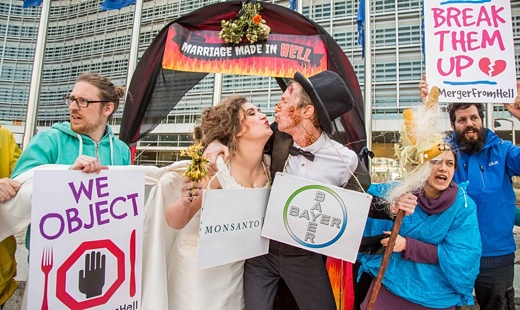
Image above: Demonstrators protesting merger of GMO companies Monsanto and Bayer. From original article.

On what plane of reality is it possible that two of the world’s most morally bankrupt corporations, Bayer and Monsanto, can be permitted to join forces in what promises to be the next stage in the takeover of the world’s agricultural and medicinal supplies?

Warning, plot spoiler: There is no Mr. Hyde side in this horror story of epic proportions; it’s all Dr. Jekyll.

Like a script from a David Lynch creeper, Bayer AG of poison gas fame has finalized its $66 billion (£50bn) purchase of Monsanto, the agrochemical corporation that should be pleading the Fifth in the dock on Guantanamo Bay instead of enjoying what amounts to corporate asylum and immunity from crimes against humanity.

Such are the special privileges that come from being an above-the-law transnational corporation.

Unsurprisingly, the first thing Bayer did after taking on Monsanto, saddled as it is with the extra baggage of ethic improprieties, was to initiate a rebrand campaign.

Like a Hollywood villain falling into a crucible of molten steel only to turn up later in some altered state, Monsanto has been subsumed under the Orwellian-sounding ‘Bayer Crop Science’ division, whose motto is: "Science for a better life."

Yet Bayer itself provides little protective cover for Monsanto considering its own patchy history of corporate malfeasance. Far beyond its widely known business of peddling pain relief for headaches, the German-based company played a significant role in the introduction of poison gas on the battlefields of World War I.

Despite a Hague Convention ban on the use of chemical weapons since 1907, Bayer CEO Carl Duisberg, who sat on a special commission set up by the German Ministry of War, knew a business opportunity when he saw one.

Duisberg witnessed early tests of poison gas and had nothing but glowing reports on the horrific new weapon: “The enemy won’t even know when an area has been sprayed with it and will remain quietly in place until the consequences occur.”

Bayer, which built a department specifically for the research and development of gas agents, went on to develop increasingly lethal chemical weapons, such as phosgene and mustard gas. “This phosgene is the meanest weapon I know,”

Duisberg remarked with a stunning disregard for life, as if he were speaking about the latest bug spray. “I strongly recommend that we not let the opportunity of this war pass without also testing gas grenades.”

Duisberg got his demonic wish. The opportunity to use the battlefield as a testing ground and soldiers as guinea pigs came in the spring of 1915 as Bayer supplied some 700 tons of chemical weapons to the war front.

On April 22, 1915, it has been estimated that around 170 tons of chlorine gas were used for the first time on a battlefield in Ypres, Belgium against French troops. Up to 1,000 soldiers perished in the attack, and many more thousands injured.

In total, an estimated 60,000 people died as a result of the chemical warfare started by Germany in the First World War and supplied by the Leverkusen-based company.

According to Axel Koehler-Schnura from the Coalition against BAYER Dangers: “The name BAYER particularly stands for the development and production of poison gas.

Nevertheless the company has not come to terms with its involvement in the atrocities of the First World War. BAYER has not even distanced itself from Carl Duisberg’s crimes.”

The criminal-like behavior has continued right up until modern times. Mike Papantonio, a US attorney and television presenter discussed one of the more heinous acts committed by this chemical company on Thomas Hartmann’s program, The Big Picture: “They produced a clotting agent for hemophiliacs, in the 1980s, called Factor VIII.

This blood-clotting agent was tainted with HIV, and then, after the government told them they couldn’t sell it here, they shipped it all over the world, infecting people all over the world. That’s just part of the Bayer story.”

Papantonio, citing Bayer’s 2014 annual report, said the company is facing 32 different liability lawsuits around the world. For the 2018 Bayer liability report, click here.

Before flushing your Bayer products down the toilet, you may want to put aside an aspirin or two because the story gets worse.

One of the direct consequences of the ‘Baysanto’ monster will be a major hike in prices for farmers, already suffering a direct hit to their livelihood from unsustainable prices.

“Farmers have already experienced a 300% price increase in recent years, on everything from seeds to fertilizer, all of which are controlled by Monsanto,” Papantonio told Hartmann. “And every forecaster is predicting that these prices are going to climb even higher because of this merger.”

Yet it’s hard to imagine the situation getting any worse for the American farmer, who is now facing the highest suicide rate of any profession in the country. The suicide rate for Americans engaged in the field of farming, fishing and forestry is 84.5 per 100,000 people - more than five times that of the broader population.

This tragic trend echoes that of India, where about a decade ago millions of Indian farmers began switching from farming with traditional farming techniques to using Monsanto’s genetically modified seeds instead.

In the past, following a millennia-old tradition, farmers saved seeds from one harvest and replanted them the following year. Those days of wisely following the rhythms and patterns of the natural world are almost over.

Today, Monsanto GMO seeds are bred to contain 'terminator technology', with the resulting crops ‘programmed’ not to produce seeds of their own. In other words, the seed company is literally playing God with nature and our lives.

Thus, Indian farmers are forced to buy a new batch of seeds – together with Monsanto pesticide Round Up - each year and at a very prohibitive cost. Hundreds of thousands of Indian farmers

But should the world have expected anything different from the very same company that was involved in the production of Agent Orange for military use during the Vietnam War (1961-1971)?

More than 4.8 million Vietnamese suffered adverse effects from the defoliant, which was sprayed over vast tracts of agricultural land during the war, destroying the fertility of the land and Vietnam’s food supply.

About 400,000 Vietnamese died as a result of the US military’s use of Agent Orange, while millions more suffered from hunger, crippling disabilities and birth defects.

This is the company that we have allowed, together with Bayer, to control about one-quarter of the world’s food supply. This begs the question: Who is more nuts? Bayer and Monsanto, or We the People?

It’s important to mention that the Bayer – Monsanto convergence is not occurring in a corporate vacuum. It is all part of a race on the part of the global agrochemical companies to stake off the world’s food supplies.

ChemChina has bought out Switzerland’s Syngenta for $43 billion, for example, while Dow and DuPont have forged their own $130 billion empire.

However, none of those companies carry the same bloodstained reputations as Bayer and Monsanto, a match made in hell that threatens all life on earth.

.

CRISPR and Genedrive danger

SOURCE: Jerry DiPietro (ofstone@aol.com)
SUBHEAD: Letting genedrives loose outside labs is too risky, says scientist who promoted idea.

By Paul Koberstein on 22 Devember 2017 for Earth Island Journal -
(http://www.earthisland.org/journal/index.php/elist/eListRead/letting_gene_drives_loose_outside_labs_is_too_risky_says_scientist_who_prom/)


Image above: Illusration of mosquito and genexrive. From (http://www.earthisland.org/journal/index.php/eij/article/editing_evolution/).

[IB Publisher's note: As more people are avoiding GMO produced food you can bet that "players" in the GMO/Pesticide development in Hawaii are salivating to get out of that business and into open field testing of gene drive technology. And if GMO companies' indifference to the health and welfare of the people living on these islands is an indicator we are all endangered. See accompanying article "Editing Evolution" by Paul Koberstein further explaining genedrive technology.]

A large cache of emails released this month show that the Bill and Melinda Gates Foundation is stepping up its efforts to promote the deployment of a controversial new genetic engineering tool known as “gene drive” to help eradicate malaria in Africa.

Malaria killed an estimated 438,000 worldwide in 2015. Sub-Saharan Africa continues to carry a disproportionately high share of the global malaria burden. 

However, some of the scientists who had initially proposed using the technology for public health and conservation purposes are having serious second thoughts about deploying it outside of labs.

In a effort to combat the disease, researchers funded by the Bill and Melinda Gates Foundation are planning a field trial of gene drive equipped Anopheles gambiae mosquitoes – the main malaria vector in Africa – in Burkina Faso.

Gene drives can help circumvent traditional rules of genetic inheritance and force a desired, specifically selected, genetic trait through a population.

Given the almost magical possibilities it offers to enhance beneficial traits or remove undesired characteristics in living things – think eradicating pests without using toxins, or saving an endangered species by making them immune to certain diseases – the technology has captured the imagination of many in the fields of conservation and public health.

The Bill and Melinda Gates Foundation, which considers gene drives “necessary” to end malaria, has invested some $70 million on Target Malaria, a research organization based at Imperial College in London that is working on preventing deaths from malaria, which numbered 438,000 worldwide in 2015.

Target Malaria is planning to release genetically modified Anopheles gambiae mosquitoes – the main malaria vector in Africa – in Burkina Faso.

These modified mosquitoes would be equipped with gene drives that would disrupt the reproductive systems of successive generations and eventually cause them to go extinct. The project would be the first field trial of gene drive technology.

The release of 1,200 emails by the Genetic Biocontrol of Invasive Rodents (GBiRD) program at North Carolina State University, provide fresh insights into the work of groups like the Gates Foundation and GBiRD that are promoting the use of gene drive biotechnology.

(GBiRD is a partnership of seven university, government and non-government organizations advancing gene drive research.)

The emails – which were released in response to freedom of information requests submitted by Edward Hammond, a biosafety activist from Austin, Texas –also show that the environmental advocacy group Island Conservation is developing plans to use gene drives as a mechanism for exterminating invasive species on the islands of Hawaii, New Zealand, and Australia.

Hammond made the emails public just two weeks after one of the key proponents of the gene drive technology, Kevin Esvelt, published a report saying the technology was too risky to be used in field trials to control invasive species.

Esvelt, a professor at MIT who first identified the potential for gene drives to alter wild populations of organisms in 2013, is now warning, once unleashed, gene drives will prove difficult if not impossible to control.

Esvelt said that projects that are planning to conduct gene drive experiments to control invasive species in the wild should first invent safer forms of the technology.

In theory, the release of these genetically altered mosquitoes or invasive pests like rats, would cause all the members of a targeted population of mosquitoes or rats to go sterile, eventually exterminating that and only that population.

But new research by Esvelt and his colleagues at MIT and Harvard University suggests that gene drive deployments are more than likely to go haywire, with potentially disastrous consequences for non-targeted animal populations and ecosystems. (*Check update/clarification on this below.)

In a paper published in the non-peer reviewed scientific journal BioRxiv, Esvelt and his colleagues wrote that, once unleashed, gene drives will prove difficult if not impossible to control.

The paper, “Current CRISPR gene drive systems are likely to be highly invasive in wild populations,” is currently in pre-publication review. CRISPR refers to Clustered Regularly Interspaced Short Palindromic Repeats, a new technology that allows scientists to alter genes by editing strands of DNA.

CRISPR’s invention in 2012 by scientists at the University of California-Berkeley and MIT led to the development of gene drives two years later in Esvelt’s research laboratory.

In the BioRxiv paper, the scientists said that mathematical models based on existing empirical data show that in their current form, gene drives cannot be deployed without harmful side effects. Their modeling showed that gene drives can be very aggressive and even a handful of gene drive modified organisms could carry the new gene, not only through much of the targeted population of a certain species, but also on to non-intended populations.

For example, under their models, a gene drive released in Hawai’i to kill a specific kind of mosquito on the island of Kauai would eventually start targeting a different kind of mosquito on the island.

“Releasing a small number of organisms often causes invasion of the local population, followed by invasion of additional populations connected by very low gene flow rates,” they wrote. “Highly effective drive systems are predicted to be even more invasive.”

On the same day his BioRxiv paper was released, Esvelt expressed regret for ever proposing gene drives be used in real word experiments.

In an interview with the New York Times, Esvelt called his championing the notion “an embarrassing mistake” given the predicted invasiveness of current CRISPER-based drive systems.

But he and his colleagues still thinks researchers should continue exploring ways in which gene drives could help save species that are in peril.

The new report confirms concerns that many within the scientific and environmental community have had about the unknown ecological and public health risks posed by a technology whose basic purpose is to spread genetic mutations.

Nevertheless, the GBiRD emails show that that the Gates Foundation is ploughing ahead with its research on gene drives as a mechanism for eradicating the mosquito that causes malaria (which, it should be noted again, is not an effort to control an invasive species, but rather an effort to eradicate a disease-carrying insect).

In 2016, it made a $1.6 million payment to Emerging Ag, a PR firm it retained for the purpose of influencing a United Nations expert group that has been addressing gene drive issues. The group, the Ad Hoc Technical Expert Group on Synthetic Biology (AHTEG), was convened by the UN’s Convention on Biological Diversity.

Hammond, who posted the emails to his website, is a former member of AHTEG.

In one of the emails, the Gates Foundation said it hired EmergingAg to “increase awareness, understanding, and acceptance of possible gene drive applications for public good purposes.”

One of EmergingAg’s initiatives has been to recruit scientists who will advocate for gene drives. For example, in an Aug. 1, 2017 email thread, Isabelle Coche, a vice president of EmergingAg, is trying to recruit Fred Gould, codirector of the Genetic Engineering and Society Center at North Carolina State, for advocacy work.

The email asks Gould to "support advocacy and engagement activities on gene drive.” Gould, however, demurs, saying, “it would be problematic for me to be involved,” adding that such advocacy would “compromise” his role on a gene drive ethics committee.

Coche’s role at EmergingAg, according to another email, is “to fight back against gene drive moratorium proponents before the next CBD meeting in 2018.”

This was in reference to calls from several anti-gene drive groups for an international moratorium on gene drive research in petitions last year before the United Nations Convention on Biological Diversity (CBD). The CBD rejected those petitions, which are likely to be repeated at next year’s CBD meeting.

On its website, Emerging Ag calls itself “a boutique international consulting firm providing communications and public affairs services.”

Its president and founder is Robynne Anderson, a former international communications director of CropLife, the global lobby group for the biotechnology, seed, and pesticide industries based in Brussels, Belgium.

On her personal website, Anderson praises gene drives without actually mentioning the biotechnology by name.

“The Target Malaria team is researching approaches that can reduce the numbers of mosquitoes that spread malaria,” she writes. 
“By reducing the population of the malaria mosquito, (a very specific beast called Anopheles), they are able to combat transmission of the disease. Their strategy relies on reducing the number of female malaria mosquitoes.”
She said this approach “is expected to be complementary to other mosquito control methods, easy and inexpensive to implement, because the mosquitoes themselves do the work of stopping malaria. The control method would be a long-term, sustainable, and cost-effective solution to prevent malaria.”

Austin Burt, professor of evolutionary genetics at Imperial College London and principle investigator for the Target Malaria consortium, said in an email that “a blanket assertion that ‘gene drive field trials pose unacceptable risks for ecosystems’ is not consistent with how I understand [Esvelt’s] position – risks must always be assessed on a case-by-case basis, as they will depend on the exact features of the construct and the species / population into which it is to be released.

Rather, I believe he is calling for inclusive, informed discussion of the risks, which I certainly agree with.”

Burt said Esvelt’s paper “just shows that a particular type of gene drive construct may be expected to spread from one population to another when there is naturally-occurring gene flow, which indeed is correct.”

As for the Target Malaria initiative, he said that although “we are one of the leading groups working on developing this sort of technology, we are still many years (>5) from having something that we might propose to release in the field, and indeed we are still working on the path to get to that point.” Safety, he said, “is paramount, for humans and the environment.

Malaria imposes an appalling burden across too much of sub-Saharan Africa, and we want to be in a position to offer something that people and governments will want to use to help reduce this burden.”

He emphasized that when Target Malaria develops a gene drive it “will go through extensive safety testing before we would consider releases.”

Island Conservation, meanwhile, sees gene drives as a tool that can rid islands of invasive pests without the use of chemical pesticides.

The group says that 180,000 islands around the world are infested with alien rodents, but only 400 rodent eradication programs to date have been successful, and each relied on rodenticides to remove the non-native populations.

Heath Packard, a spokesman for the group, told Earth Island Journal that the group “is investigating the feasibility and suitability of a potential gene drive mouse construct that could safely and effectively remove invasive species from islands. The question is not only could we, but should we and under what conditions.

Local communities and their governments will need to decide on a case by case basis.”

But he said that Island Conservation “would never contemplate even asking a community to consider a highly-contained field trial unless work in the genetic laboratories demonstrated that the mouse construct could not, itself pose unmitigated harm to well-established parts of our ecosystem.”

“This work must be done, cautiously, thoroughly, and stepwise,” he said. “That’s exactly what our partnership is doing.”

*UPDATE, December 22: To be clear, this risk is not of gene drives spreading to other species. The risk is that they could spread to other populations, or rather, sub-species of the same species — for example to any of the other 205 mosquito species in the Anopheles subgenus — and as a result impact local ecosystems where they might serve key roles, such as, as a food source for other critters. This report isn't implying that gene drives can jump the species barrier spread to other species.

.

The Infinite Suburbs are a joke

SUBHEAD: We must return to a landscape composed with the resource realities of the future.

By James Kunstler on  27 October 2017 for The American Conservative -
(http://www.theamericanconservative.com/urbs/the-infinite-suburb-is-an-academic-joke/)


Image above: The Jetsons in their flying car. Note Elroy holds leash through the "glass dome" of the family vehicle that is attached the dog Astro's doggy dome. From original article.

The elite graduate schools of urban planning have yet another new vision of the future. Lately, they see a new-and-improved suburbia—based on self-driving electric cars, “drone deliveries at your doorstep,” and “teardrop-shaped one-way roads” (otherwise known as cul-de-sacs)—as the coming sure thing.

It sounds suspiciously like yesterday’s tomorrow, the George Jetson utopia that has been the stock-in-trade of half-baked futurism for decades.

It may be obvious that for some time now we have lived in a reality-optional culture, and it’s vividly on display in the cavalcade of techno-narcissism that passes for thinking these days in academia.

Exhibit A is an essay that appeared last month in The New York Times Magazine titled “The Suburb of the Future is Almost Here,” by Alan M. Berger of the MIT urban design faculty and author of the book Infinite Suburbia—on the face of it a perfectly inane notion.

The subtitle of his Times Magazine piece argued that “Millennials want a different kind of suburban development that is smart, efficient, and sustainable.”

Note the trio of clichés at the end, borrowed from the lexicon of the advertising industry.

“Smart” is a meaningless anodyne that replaces the worn out tropes “deluxe,” “super,” “limited edition,” and so on. It’s simply meant to tweak the reader’s status consciousness. Who wants to be dumb?

“Efficient” and “sustainable” are actually at odds. The combo ought to ring an alarm bell for anyone tasked with designing human habitats. Do you know what “efficient” gets you in terms of ecology?

Monocultures, such as GMO corn grown on sterile soil mediums jacked with petroleum-based fertilizers, herbicides, and fast-depleting fossil aquifer water.

It’s a method that is very efficient for producing corn flakes and Cheez Doodles, but has poor prospects for continuing further into this century—as does conventional suburban sprawl, as we’ve known it.

Efficiency in ecological terms beats a path straight to entropy and death.

Real successful ecologies, on the other hand, are the opposite of efficient.

They are deeply redundant. They are rich in diverse species and functions, many of which overlap and duplicate, so that a problem with one failed part or one function doesn’t defeat the whole system. This redundancy is what makes them resilient and sustainable.

Swamps, prairies, and hardwood forests are rich and sustainable ecologies.

Monocultures, such as agri-biz style corn crops and “big box” retail monopolies are not sustainable and they’re certainly not even ecologies, just temporary artifacts of finance and engineering. What would America do if Walmart went out of business?

And don’t underestimate the possibility as geopolitical tension and conflict undermine global supply lines.

Suburbia of the American type is composed of monocultures: residential, commercial, industrial, connected by the circulatory system of cars. Suburbia is not a sustainable human ecology.

Among other weaknesses, it is fatally prone to Liebig’s “law of the minimum,” which states that the overall health of a system depends on the amount of the scarcest of the essential resources that is available to it. This ought to be self-evident to an urbanist, who must ipso facto be a kind of ecologist.

Yet techno-narcissists such as MIT’s Berger take it as axiomatic that innovation of-and-by itself can overcome all natural limits on a planet with finite resources. They assume the new-and-improved suburbs will continue to run on cars, only now they will be driverless and electric, and everything in their paradigm follows from that.

I don’t think so. Like it or not, the human race has not yet found a replacement for fossil fuels, especially oil, which has been the foundation of techno-industrial economies for a hundred years, and it is getting a little late in the game to imagine an orderly segue to some as-yet-undiscovered energy regime.

By the way, electricity is not an energy source. It is just a carrier of energy generated in power plants. We have produced large quantities of it at the grand scale using fossil fuels, hydropower, and nuclear fission (which is dependent on fossil fuels to operate).

And, by the way, all of our nuclear power plants are nearing the end of their design life, with no plans or prospects for them to be replaced by new ones.

We have maxed out on potential hydroelectric sites and the existing big ones are silting up, which will take them out of service inside of this century.

Electricity can also be produced by solar cells and wind turbines, but at nowhere near the scale necessary, on their own, for running contemporary American life.

The conceit that we can power suburbia, the interstate highway system, truck-based distribution networks, commercial aviation, the U.S. military, and Walt Disney World on anything besides fossil fuels is going to leave a lot of people very disappointed.

The truth is that we have been running all this stuff on an extravagant ramp-up of debt for at least a decade to compensate for the troubles that exist in the oil industry, oil being the primary and indispensable resource for our way of life.

These troubles are often lumped under the rubric peak oil, but the core of the trouble must be seen a little differently: namely, a steep decline in the Energy Return on Investment (EROI) across the oil industry. The phrase might seem abstruse on the face of it.

It means simply that it is becoming uneconomical to extract oil from the ground, even with the so-called miracle of “fracking” shale oil deposits. It doesn’t pay for itself, and the EROI is still headed further down.

In the 1930s, the oil industry could get 100 barrels of oil for every barrel of oil in energy they put into production. Drilling on the Texas prairie was like slipping a straw in a milkshake and the oil gushed out of the ground under its own pressure. Today, those old wells are far into depletion and we’re left with unconventional oil.

Horizontal drilling and fracking into shale is enormously more expensive to carry out, and offshore deepwater drilling that requires a $100 million floating oil platform is nothing like slipping a straw into a milkshake.

They have to go down a mile or more beneath the surface and then another mile into the undersea rock. It’s very expensive and dangerous. (Remember the BP Deepwater Horizon blowout of 2010?)

The aggregate ratio of oil-out-for-energy-in these days is 17 to 1, and for shale oil it’s more like 5 to 1. You cannot run industrial civilizations at those EROI ratios. Thirty to one is probably the minimum.

And you can’t run renewable alternative energy systems without an underlying support platform of fossil fuels. The implacable reality of this dynamic has yet to sink in at the graduate-school fantasy factories.

The world’s major oil companies are cannibalizing themselves to stay in business, with balance sheets cratering, and next-to-zero new oil fields being discovered. The shale oil producers haven’t made a net dime since the project got ramped up around 2005.

Their activities have been financed on junk lending made possible by arbitrages on the near-zero Fed fund rate, itself an historical abnormality.

The shale-oil drillers are producing all out to service their loans, and have thus driven down oil prices, negating their profit. Low oil prices are not the sign of a healthy industry but of a failing industrial economy, the latter currently expressing itself in a sinking middle class and the election of Donald Trump.

All the techno-grandiose wishful thinking in the world does not alter this reality. The intelligent conclusion from all this ought to be obvious: Restructuring the American living arrangement to something other than “infinite” suburban sprawl based on limitless car dependency.

As it happens, the New Urbanist movement recognized this dynamic beginning in the early 1990s and proposed a return to traditional walkable neighborhoods, towns, and cities as the remedy. It has been a fairly successful reform effort, with hundreds of municipal land-use codes rewritten to avert the inevitable suburban sprawl mandates of the old codes.

The movement also produced hundreds of new town projects all over the country to demonstrate that good urbanism was possible in new construction, as well as downtown makeovers in places earlier left for dead like Providence, Rhode Island, and Newburgh, New York.

When the elite graduate schools finally noticed the New Urbanism movement, it provoked extreme jealousy and hostility because they hadn’t thought of it themselves—it was a product of the property-development industry.

Harvard’s Graduate School of Design, in particular, had been lost for decades in raptures of Buck Rogers modernism, concerned solely with “cutting edge” aesthetics—that is, architectural fashion statements aimed at status seeking.

They affected to be offended by the retrograde front porches and picket fences of the New Urbanists, but they were unable to develop any coherent alternative vision of a plausible future urbanism—because there really wasn’t one.

Instead, around 2002 Harvard came up with a loopy program they called “Landscape Urbanism,” which was a half-baked revision of Ian McHarg’s old Design with Nature idea from the 1970s.

Design with Nature had spawned hundreds of PUDs (Planned Unit Developments) of single-family houses nestled in bosky, natural settings and sheathed in environmental-looking cedar, and scores of university housing “complexes” bermed into the terrain (with plenty of free parking).

Mostly, McHarg’s methodology was concerned with managing water runoff. It did not result in holistic towns, neighborhoods, or cities.

The projects of so-called Landscape Urbanism were not about buildings, and especially the relationship between buildings, other buildings, and the street. They viewed suburbia as a nirvana that simply required better storm-water drainage and the magic elixir of “edginess” to improve its long-term prospects.

Apparently MIT, down the street from Harvard, got jealous. They had snootily ignored the New Urbanism movement too, and done next to nothing on their own to rethink the next phase of the urban condition, besides the usual stale fantasies derived from the Radiant City playbook of Le Corbusier, the Swiss modernist who tried to destroy Paris in the 1920s with a skyscrapers-in-a-park scheme (which ended up being appropriated for the notorious American housing projects for the poor of the 1950s).

That’s where MIT’s Berger came in, having previously been at Harvard during the birth pangs of Landscape Urbanism. He brought over to MIT the P-Rex Lab (The Project for Reclamation Excellence) which put a “cutting edge” super high-tech veneer on what was still just environmental mitigation on previously used landscapes—pushing polluted soil around with front-end loaders.

Berger’s P-Rex lab showed absolutely no interest in the particulars of traditional urban design: street-and-block grids, street and building typologies, code-writing for standards and norms in construction, et cetera.

They showed no interest in the human habitat per se. Berger and his gang were simply promoting a fantasy they called the “global suburbia.”

Their fascination with the suburbs rested on three pillars: 
1) the fact that suburbia was already there;

2) the presumption that mass car use would continue to enable that settlement pattern; and

3 ) a religious faith in technological deliverance from the resource and capital limits that boded darkly for the continuation of suburban sprawl.
I will tell you without ceremony what the future actually holds for the inhabited terrain of North America.

The big cities will have to contract severely and the process will be fraught and disorderly.

The action will move to the small cities and small towns, especially the places that have a meaningful relationship with farming, food production, and the continent’s inland waterways. The suburbs have three destinies, none of them mutually exclusive: slums, salvage, and ruins.

The future has mandates of its own. If we want to remain civilized, we will be compelled to return to a landscape composed of relationships between town and country, at a scale that comports with the resource realities of the future.

These days the failure of American imagination, especially at the university level, is epic.

.

Monsanto's army of online bullies

SUBHEAD: Trolls for the GMO company are bullies aboard a sinking ship. Show them links to the truth. 

By Jeffery Smith 12 July 2017 for Light on Conspiracy  -
(https://www.lightonconspiracies.com/monsantos-army-of-online-bullies/)


Image above: Graphic for ignoring GMO bullies and supporting World Health Organization International Agency for Research on Cancer. From (https://www.pinterest.com/pin/316026098837545704).

There are hundreds, possibly thousands of them—paid to bully, shame, and endlessly argue with anyone posting a comment deriding GMOs or pesticides. And when a high-profile person stands up to Monsanto’s technology, watch out. The trolls swarm in and gang up.

Take Marion Nestle, for example. When a GMO propaganda film called Food Evolution purposely quoted her out of context, she demanded that her 10-second clip be removed. Nestle’s blog was then ambushed with 870 comments by Monsanto’s minions, forcing her to block all comments from her site, Food Politics.

The presence of a troll army was revealed during the on-going lawsuit against Monsanto over the cancer-causing properties of their herbicide Roundup. The lawyers wrote:

“Monsanto even started the aptly-named “Let Nothing Go” program to leave nothing, not even Facebook comments, unanswered; through a series of third parties, it employs individuals who appear to have no connection to the industry, who in turn post positive comments on news articles and Facebook posts, defending Monsanto, its chemicals, and GMOs.”

Scientists Attacked

The legal brief also points out that, “Monsanto quietly funnels money to ‘think tanks’ such as the ‘Genetic Literacy Project’ and the ‘American Council on Science and Health,’ organizations intended to shame scientists . . .”

As a frequent target of these groups, I know well their unethical bullying tactics. And so too do the scientists who discover evidence that GMOs are harmful.

World renowned biologist Arpad Pusztai, for example, was pummeled by the biotech machinery when he accidentally discovered that GMOs caused massive damage to rats in just 10 days. In the late 1990s. he led a team that was designing test protocols to be used by European authorities to evaluate GMO safety.

His research, however, revealed that the generic process of creating a GMO caused dangerous and unpredictable side-effects that might already be eroding the health of consumers. Because his shocking discovery could have destroyed the entire GMO industry, they came after Pusztai with far more than just a shaming campaign.

Within days, his employer of 35 years terminated his contract. Pusztai’s 20-member team was dismantled. He was silenced with threats of a lawsuit. And the biotech industry and pro-GMO UK government unleashed a campaign to destroy his reputation.

Although Pusztai was the first scientist to undergo this type of industry battering, many others have since been targeted. One told me that these types of attacks have deterred hundreds of other scientists from doing research on GMOs.

The online bullies have a similar intimidating effect. Their well-chosen words are sharp and condescending, designed to scare away others from making comments—lest they become the next target.

The folks at the International Fitness Profesionals Association learned this the hard way. After posting what they considered to be a balanced article on GMOs, a troll got wind of it, posted a negative comment on the Pro-GMO FB site “We Love GMOs and Vaccines,” and asked his comrades to also make comments. The trolls swarmed.

They not only challenged the GMO article, they attacked the integrity and reputation of the organization. And of course, the trolls avoided commenting on details about GMOs, since they would quickly lose that argument with anyone familiar with the science. Facts are not their strong point. They prey on emotions.

Standing up to the Bully
Bullying and shaming can traumatize. In schools, online, at work, they have damaged and destroyed lives. It works. That’s why the biotech industry uses them.

Before discussing what to do, the first step is how to feel. The answer: INVINCIBLE!

After reporting for years about Monsanto’s strong-arm tactics, I finally became their target about eight years ago. Rather than feeling hurt or depressed, I felt uplifted. I viewed their baseless attacks as a badge of honor. I was now such a threat to their business dealings around the world, they invested a significant amount of money trying to distort my work and discredit me.

I considered whether I should spend time countering their spin to set the record straight, but soon realized that it was a black hole that would suck up my life. After all, why would I want to write posts to correct the views of the handful of people who wander onto their site, when I could reach millions of others with real information.

And so I smile, shake my head, and don’t even bother to read their posts about me. We’re winning the battle against GMOs and soon these bounty hunters will be hired by the next toxic industry.

That’s right, I said we are TOTALLY WINNING. Mainstream food companies in the US are falling over themselves to remove genetically engineered ingredients in order to boast a Non-GMO label.

With 57% of surveyed Americans saying that they are concerned about the health impacts of GMOs, we are now the majority. We have the average American on the right side of this issue.

And that’s why Monsanto has unleashed its online army. It’s a last-ditch attempt to turn the tide.

So, if you get a troll on your case or see one doing their dark dance on someone else’s post, feel GREAT! Let it remind you that our collective work sharing the truth about GMO dangers has been so successful, we are seeing the dying embers of a desperate and failing industry.

And have absolutely no anxiety or concern about any details of their accusations. They will portray themselves as mainstream, pretending to have logic and science on their side. They will appear absolutely sure of themselves. And their colleagues will give them support.

It’s their game. It’s just a game. It means nothing. And by the way, we have become the mainstream in this argument (finally).

So What Do We Do? Strike Back!
Arguing with a professional GMO huckster is hopeless. Forget about it. (Or as my NY colleagues say: fugedabowdit.)

If you are in charge of the website or account, just delete their comments. Don’t waste the time or damage the emotions of your readers. Replace their mindless ramble with a statement like:

We just found a Monsanto troll! That’s right. Monsanto hired and trained an online army to attack anyone who dares to reveal the dangers of GMOs and pesticides like Roundup. Their campaign is called “Let Nothing Go.”

So we deleted a post that had all the markings of a troll: It was emotionally bullying or shaming. It used talking points made popular by Monsanto’s PR companies, including myths like GMOs feed the world, increase yield, reduce pesticide use, or are proven safe.

And it was clearly uninformed. So it was either posted by a paid troll, or worse yet, some poor person who actually believes and emulates them. Read more about the GMO trolls and GMO dangers in general.

If you can’t delete the offending post, here’s a similar type of statement you can post in response:

Looks like we’ve found a Monsanto troll! If you haven’t heard, Monsanto hired and trained an online army to attack anyone who dares to reveal the problems with GMOs and pesticides like Roundup. Their campaign is called “Let Nothing Go.” You can decide for yourself if this is one of Monsanto’s minions.

The tone of the trolls are typically emotionally bullying or shaming. They claim the high ground, pretending that science is on their side. They often roll out one of the many talking point myths made popular by Monsanto’s PR companies, pretending that GMOs feed the world, increase yield, reduce pesticide use, and are proven safe, etc.

And they are clearly uninformed. So either this is a troll, or worse yet, some poor person who actually believes and emulates them. Read more about the GMO trolls and GMO dangers in general.

If they engage you in an online argument (and if they’re a troll, they or their friends will) you can ignore the baseless claims and just use the opportunity to post links to one of the many informative articles that shreds Monsanto’s myths.

Find lots of stuff to post at ResponsibleTechnology.org or on our Facebook page.

Please subscribe to our newsletter and like our page so we can get you more ammunition—and stories of success.

This is a time to celebrate our victories, but we can’t let up. Let’s nail the coffin shut on this dangerous and irresponsible use of genetic engineering and protect future generations. With life itself at stake, we can withstand the buzzing of a few online gnats.

Safe eating and posting.

See also:
Ea O Ka Aina: Monsanto colluded with EPA 4/14/17
Ea O Ka Aina: Glyphosate harms gut enzyme 6/21/17
Ea O Ka Aina: Monsanto and EPA collusion 3/29/17
Ea O Ka Aina: Corporate monster Monsanto 3/20/17
Ea O Ka Aina: Monsanto and First Amendment 1/24/17
Ea O Ka Aina: EPA obedient to Monsanto 12/17/16
Ea O Ka Aina: Whole Foods and Monsanto partners 7/1/16
Ea O Ka Aina: Molokai says "A'ole GMO" 9/8/13
Ea O Ka Aina: Monsanto lobbying Congress 5/18/13
Ea O Ka Aina: Roundup and human health 4/25/13
Ea O Ka Aina: Supreme Court Monsanto seed case 2/19/13
Ea O Ka Aina: Hungary denies GMOs & IMF 9/8/12
Ea O Ka Aina: GMO Corn HFCS & Cancer 8/4/10 .

Kauai hui sues DLNR over GMOs

SUBHEAD: To ensure that public lands are given the proper and environmental review before being leased out for commercial use. 

By Staff on 14 June 2017 for Hawaii Alliance for Progressive Action -
(http://www.hapahi.org/news/2017/6/14/kauai-groups-sue-state-to-enforce-environmental-review-law)


Image above: "No Tresspass" sign on gate to public land leased to private corporations for experimenting with pesticides combined with genetically modified organisms sited on "reclaimed" wetlands close to nearby the ocean reefs and westside Kauai populations centers. What could go wrong? From (http://www.huffingtonpost.com/maggie-sergio/gmo-pesticide-experiments_b_3513496.html).

A Kauai-based community group, Ke Kauhulu o Mana, have filed a lawsuit against the State Department of Land and Natural Resources (DLNR) and Syngenta.

The suit calls for enforcement of Hawaii Revised Statute (HRS) Chapter 343, which requires an environmental assessment (EA) or an Environmental Impact Statement (EIS) for any significant actions or development proposed on publicly-owned, coastal and conservation-zoned lands.

In this instance, the lands in question are located on Kauai’s west side in Mana adjacent to the coast, about three quarters of a mile from the homes and community of Kekaha, and close to the frequent surfing and recreation beach, Targets.

The hui, Ke Kauhulu O Mana, is represented by west side residents Loui Cabebe and Punohu Kekaualua III. The plaintiffs include the Surfrider Foundation, Kohola Leo and the Hawai'i Alliance for Progressive Action (H.A.P.A.).
“These lands are historically Hawaiian crown lands. According to the state Constitution, these lands are supposed to be held and protected as part of the public trust. The State of Hawai`i as the present caretaker of these lands needs to take that responsibility seriously. We are disappointed that to date, they have failed to do so. We feel compelled to take this legal action to ensure that the regulations designed to preserve and protect crown lands are respected, and that state agencies do their job and enforce those laws.”

- Loui Cabebe, long time west Kauai resident and representative of plaintiff group, Ke Kauhulu o Mana.
The plaintiffs are represented by public interest attorney, Lance Collins, who has a wide range of experience with a focus on good government, environmental protection and native Hawaiian law. Mr. Collins has brought a number of successful cases under HRS 343, most recently Kalepa v. Dept. of Transportation and Maalaea Community Assn v. Dept. of Housing & Human Concerns.

“This suit is being filed to ensure that sensitive, coastal, and publicly-owned lands zoned for conservation are given the proper and legally required environmental review prior to being leased out for private commercial use,” said Collins.

According to Collins, a thorough review evaluating direct, indirect and cumulative impacts which the law requires, has not been done.

The complaint further states that the proposed use of the lands may have significant negative impacts given the anticipated heavy application of Restricted Use Pesticides involved in the industrial farming of crops by Syngenta.

Syngenta has announced plans to sell its Hawai'i operations to the Wisconsin-based company, Hartung Brothers. However, media reports also indicate that Hartung Brothers will be contracted by Syngenta to perform the same activities currently conducted by Syngenta employees. Thus the environmental and health impacts will remain similar regardless of the named entity conducting day to day operations.

State must ensure that permittees abide by regulations and protect public lands

“These lands are historically Hawaiian crown lands. According to the state Constitution, these lands are supposed to be held and protected as part of the public trust,” says Loui Cabebe, a native Hawaian and long time West side resident and representative of the plaintiff group, Ke Kauhulu o Mana.

“The State of Hawaii as the present caretaker of these lands needs to take that responsibility seriously.

We are disappointed that to date, they have failed to do so. We feel compelled to take this legal action to ensure that the regulations designed to preserve and protect crown lands are respected, and that state agencies do their job and enforce those laws,” he added.

The complaint states that the DLNR must require and ensure the execution of a full Environmental Impact Statement (EIS) covering the lands currently being used by Syngenta.

Based on what is known of the company’s activities thus far, and because of the close proximity of the parcel in question to the ocean and its conservation designation, Syngenta’s use of the land will have significant impacts on the recreational use of the beach and near-shore waters, adjacent reef eco-systems, fishermen, surfers and endangered native species.

Area once considered for park expansion leased instead to Syngenta

In granting Syngenta its permit to utilize the lands the DLNR has stated the action is exempt from the requirements of HRS343 as no significant impacts are expected.  The complaint alleges this decision was made based on only a superficial review.  

That review is woefully inadequate in light of the area’s conservation zoning, its proximity to the coastline and the pesticide-intensive nature of the proposed use by Syngenta.

The complaint further points out that exemption to HRS343 was granted even though the Office of Hawaiian Affairs expressed concerns about possible burials in the area and even though Syngenta’s own federal permits indicate much of the work is done in areas that impact critical habitats of rare and endangered species.

The approximately 60 acre parcel comprises section 5(b) lands, which means they are held in public trust for the people of Hawai`i and are subject to native Hawaiian entitlements.  The area was previously identified by State agencies as ideal for future park expansion, but is now part of Syngenta’s approximately 3,000 acres of leased, publicly-owned crown lands on Kauai’s west side.

Pesticide-intensive industrial farming hazardous to health and the environment

The complaint argues that a full EIS is needed given the scale and nature of the planned industrial farming activities which are distinctly different from the operations of local farmers in several ways.

First and foremost, these large scale actions are occurring on state-owned conservation lands situated in a sensitive coastal environment.

Secondly they involve the heavy application of restricted use pesticides (RUP). Thirdly, night-time activity involving the use of bright lights is known to impact endangered species such as the ‘a’o (Newell’s Shearwater) and ua’u (Hawaiian Petrel). The Kauai Endangered Seabird Recovery Project has reported that between 1993 and 2013, populations of the ‘a’o declined by 94 percent while the ua’u declined by 78 percent.

The federal permits held by Syngenta to grow experimental crops state clearly that the activity is occurring in areas where critical habitats for endangered species exist.

The case will be heard in the environmental court on Kaua‘i, presided over by the Hon. Randal Valenciano.

.

Syngenta loses $218million lawsuit

SOURCE: Jeri DiPietro (ofstone@aol.com)
SUBHEAD: Corn producers claimed contaminated crops hurt sales to China in lawsuit over GMO seeds.

By Margaret Cronin Fisk on 23 June 2017 for Bloomberg -
(https://www.bloomberg.com/news/articles/2017-06-23/syngenta-ordered-by-jury-to-pay-218-million-to-kansas-farmers)


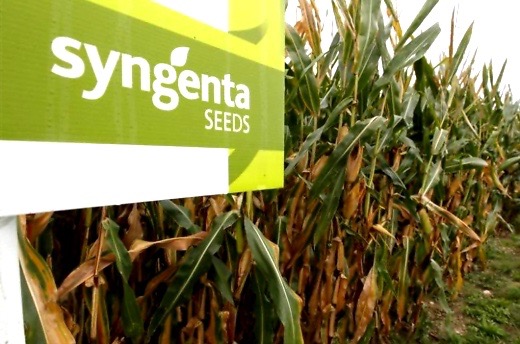
Image above: The logo of Swiss agrochemicals maker Syngenta is seen in front of a cornfield near the company's plant in Stein near Basel Switzerland illustrating another lawsuit in 2014. Photo byArnd Wiegmann. From (http://www.reuters.com/article/us-syngenta-seed-trans-coastal-idUSKBN0HB2OQ20140917).

[IB Publisher's note: This is likely a good thing for Kauai if it hurts Syngenta and ultimately reduces their impact of experimental pesticides on the environment and people here. This however, is in no way a rejection of GMO technology. It is merely punishment of Syngenta for letting  factory farms lose money they might have made in China selling them GMO corn grown in America and developed in Hawaii.]

Syngenta AG was ordered to pay $217.7 million to a group of Kansas farmers who claimed the company carelessly marketed its genetically modified corn seed, causing contamination of U.S. crops and a rejection of export sales to China by officials there.

A Kansas jury issued the verdict Friday in the first trial brought by U.S. farmers alleging Syngenta caused five years of depressed corn prices. Several other trials are pending as lawyers pursue suits on behalf of some 350,000 corn growers claiming as much as $13 billion in losses.

The win gives momentum to claims by farmers from more than 20 states who are suing the Swiss agrochemical giant. Syngenta faces its next class action in a Minnesota court in August, where farmers are seeking more than $600 million.

“This drastically changes the complexion of the upcoming litigation,” said Anthony Sabino, law professor at St. John’s University in New York. “A jury found the plaintiffs’ claims of depressed prices so convincing that, not only did the jury give them a win on the liability, they awarded the entire amount of damages asked for. That is not an everyday occurrence.”

A dozen Kansas farmers attended the 13-day trial. The only farmer in the courtroom Friday, when the jury returned its verdict after four hours of deliberation during two days, was Bret Kendrick, 52.

“I’m relieved that things turned out the way they did," Kendrick said. "I’m very happy, especially for Kansas farmers." Kendrick farms 6,000 acres in southwestern Kansas.

Jury Verdict

The Kansas City, Kansas, jury awarded only compensatory damages and no punitive damages. The farmers’ lawyers had asked for $217.7 million for lost sales plus punitive damages.

Syngenta said it would appeal the verdict. “We are disappointed with today’s verdict because it will only serve to deny American farmers access to future technologies even when they are fully approved in the U.S.,’’ the company said in an e-mail. “The case is without merit.’’

More than 7,000 Kansas farmers claimed Syngenta rushed its GMO seed to market before getting approval from China to export grain there. In 2013, China stopped shipments after calling the corn contaminated by the GMO seed. The farmers also claimed Syngenta misled them on when the Chinese would approve the seed.

In all, China barred an estimated 1.4 million metric tons of U.S. corn from entering the country, effectively cutting the U.S. out of the world’s fastest-growing market, the farmers contend. Corn futures tumbled as demand for American corn weakened, they claim.

And while Syngenta’s GMO seeds were approved by the Chinese a year later, corn from Ukraine and other countries continues to supplant U.S. crops, the farmers said.

The average U.S. cash corn price has fallen 20 percent since the 2013 Chinese ban on U.S. shipments, while futures on the Chicago Board of Trade fell 15 percent, according to data compiled by Bloomberg.

Price Trends

During the worst drought since the 1930s, cash prices peaked in August 2012 at $8.26 a bushel. On June 22, the price of a bushel of corn was $3.30, up from a seven-year low of $2.73 a bushel in September. The farmers blame the lower prices on the Chinese rejection. Syngenta said this wasn’t a factor.

The Swiss company was under pressure because Monsanto Co. had a seed that was equal to Syngenta’s that already had Chinese approval, Scott Powell, the farmers’ lawyer, told jurors Thursday.

“Syngenta rushed this product to market to serve its own commercial interests,’’ he said. “No consideration was given to the farmers.’’

Powell, citing a company document, said Syngenta’s then-CEO, Mike Mack, knew that China would object to his company’s seed, but that Mack wanted to “pressurize’’ China into accepting it.
“For Syngenta, there was no risk,’’ he said. “It was all on the backs of farmers.’’

Loss Analysis

Syngenta did nothing wrong and the farmers suffered no losses, Mike Brock, the company’s attorney, told jurors in closing arguments Thursday.

“Important approvals were in place before the seed went into the ground,’’ he said. Syngenta began marketing the seed in 2011 following U.S. approval the prior year.

The Chinese rejection didn’t cause corn prices to crater, he said. A 2010 corn drought in China forced it to buy foreign corn, and a 2012 drought in the U.S. led to a spike here, he said. A 2013 corn glut sent prices plummeting. Rain, particularly in the corn belt, shapes the corn market, he said.

China’s decision to block Syngenta’s seed wasn’t for safety reasons, but done as a “pretext’’ to lessen its dependence on U.S. corn, Brock said. “They wanted to slow down the export of corn to China.’’

China Watch

Syngenta wasn’t required to wait for Chinese approval and that country was using its biotech regulations to control trade, Brock said. The rejection of U.S. corn was part of that strategy, he said.

The trial in Kansas City, Kansas, comes as state-owned China National Chemical Corp. is completing its $43 billion acquisition of Basel, Switzerland-based Syngenta.

U.S. District Judge John Lungstrum, who is overseeing the Kansas City trial and most of the litigation, has certified eight statewide classes and had said Friday he’d schedule another trial for January or February. Farmers in 14 additional states are awaiting class certification by the Kansas judge.

Grain exporters Archer-Daniels-Midland Co. and Cargill Inc. have accused Syngenta in separate suits of carelessly allowing its seed to taint U.S. corn, causing the Chinese rejection. Those suits are pending in state court in Louisiana, with Cargill’s headed for trial next year.

The case is In Re: Syngenta AG MIR 162 Corn Litigation, 14-md-02591, U.S. District Court, District of Kansas (Kansas City).


.

GMOs - China - Syngenta

SUBHEAD: China pushes public to accept GMO food products as Syngenta takeover nears.

By Shuping Niu on 21 May 2017 for Bloomberg -
(https://www.bloomberg.com/news/articles/2017-05-22/china-pushes-public-to-accept-gmo-as-syngenta-takeover-nears)


Image above: A bowl of genetically-modified "Golden Rice." Photograph by Imaginechina. From original article.

China will carry out a nationwide poll next month to test the public’s acceptance of genetically-modified food, a technology the government says would boost yields and sustainable agriculture in a country that’s seen consumption soar.

Beijing’s prestigious Tsinghua University and two other Chinese colleges will carry out the survey, said Jin Jianbin, a professor at Tsinghua’s School of Journalism and Communication. The poll, sponsored by the government, will be carried out in tandem with a campaign on social media to broadcast basic knowledge on GMO technology, which is widely misunderstood in the country, Jin said.

China is the world’s fourth-largest grower of GMO cotton and the top importer of soybeans, most of which are genetically modified and used for cooking oil and animal feed for pigs and chickens. But public concern over food safety issues and skepticism about the effects of consuming GMO foods have made the government reluctant to introduce the technology for staple crops.

A 2012 trial of so-called Golden Rice -- a yellow GMO variant of the grain that produces beta-carotene -- caused a public storm after reports that the rice was fed to children without the parents being aware that it was genetically modified.

“Many Chinese turn pale when you mention the GMO word,” said Jin in his small office. Some still believe GMO food can cause cancer and impair childbirth, due to misleading reports in newspapers and social media, he said. A recent decision by a local legislative body against growing GMO crops has added to public confusion, Jin said.

‘Half-Cooked Rice’

The national survey aims to discover what the public’s concerns are so that the government can resolve the confusion, Jin said. “If the government pushes ahead before the public is ready to accept the technology, it would be embarrassing -- like offering a pot of half-cooked rice to eat.”

Jin said he expected the poll result to show that the general public’s perception of GMO is still negative, but “as more people get to know the technology, more would be willing to accept it.”

The lack of an authoritative scientific institution to answer questions, the widespread illegal cultivation of GMO crops, and public mistrust of government authorities after a series of food scandals have all contributed to skepticism about GMO, Jin said.

Producers of GMO crops claim they offer improved yields, enhanced nutritional value and resistance to drought, frost and insects. Critics have raised concerns over safety and potential adverse ecological effects.

Last year, the U.S., the world’s largest producer of GMO crops, mandated that food makers label products with modified ingredients. EU lawmakers this month objected to imports of herbicide-resistant strains of corn and cotton.

Syngenta AG, which produces genetically modified seeds for corn, is gearing up for rapid expansion in the country after shareholders accepted a $43 billion offer for the Swiss agribusiness by China National Chemical Corp. The Chinese state-owned company is expected to complete the deal this month.

The American Chamber of Commerce in China had complained that U.S. strains of GMO suffered from slower and less predictable approval for import into China. Chinese and U.S. officials have agreed to evaluate pending U.S. biotechnology product applications by the end of the month, including corn and cotton.

China itself has spent billions on research of its own GMO technology over the past decade, but has not allowed commercial production of grains, with scientists citing public resistance as part of the reason for the delay. China has said that it will allow commercial production of modified corn and soybeans by 2020.

Government officials have said that the country would introduce the use of the technology first on feed grains after cotton. China’s corn consumption is estimated to grow nearly 20 percent in the coming decade on demand for protein-rich meat and dairy products.


Syngenta sells Hawaii Sites

SUBHEAD: IB Publisher's note - this is because of the extent of military operations throughout the state of Hawaii and on Kauai the large Syngenta presense at and around the PMRF where research and development and testing of new weapon systems takes place.

By  Jessica Else on 12 May 2017 for The Garden Island - 
(http://thegardenisland.com/business/local/syngenta-sells-hawaii-sites/article_330d8eae-ebd4-55a0-8acb-cb1246eedcbb.html)

An Iowa company is taking over the Hawaii Syngenta sites, including the location on Kauai’s Westside, but day-to-day activities will stay the same, according to company representatives.

The purchase agreement between Hartung Brothers, Inc. and Syngenta was announced Thursday. The deal should close by the end of June for an undisclosed amount.

“There are no planned reductions (in staff) resulting from this,” said Paul Minehart, Syngenta spokesman.

Syngenta’s Kauai location employs about 100 people.

Hartung Brothers, Inc., is a seed company founded in Madison,Wisc., in 1975, that has been providing seed corn production, processing and distribution services to Syngenta since the 1980s.

“We are extremely pleased to have this agreement with Hartung Brothers for our Hawaii sites,” said Ed Attema, Syngenta head of Global Seed Operations, Production & Supply in a press release. “The goal has been to have our employee talent base and facilities maintained and to contract work with the new owner, and that will be achieved.”

All employees will be offered employment by Hartung when the acquisition closes, according to the release.

Part of the agreement includes Syngenta contracting current Hawaii-based seed production activities from Hartung. According to the release, the purchase “ensures ongoing crop innovation will continue to be part of Hawaii agriculture, which plays an important role in food production for the U.S. and around the world.”

Bennette Misalucha, executive director of Hawaii Crop Improvement Association, welcomed the new agribusiness to the Hawaii agriculture community.

“Hartung Brothers, Inc.’s purchase of Syngenta’s Hawaii operations will ensure the preservation of jobs and continuation of seed production activities on Oahu and Kauai,” Misalucha said.

Activists who have been asking the state to regulate pesticide use by the agribusiness companies on the Westside are keeping an eye on the sale, hoping to see a change in practices.

“It would be refreshing if a company came in, grew something non-toxic and profitable, (so) that we could have jobs that are safe from continual pesticide exposure,” said Jeri Di Pietro, of Hawaii SEED.
Di Pietro said she hopes Hartung Brothers will use practices that remedies the soil.

“Even the worst soil can be made healthy again, we need to see what this new company has in mind,” she said.

In August, Syngenta Seeds announced a potential $43 billion sale of the company to China National Chemical Corporation (ChemChina) and the deal between the state-owned ChemChina and the Swiss-owned Syngenta is nearing completion.

In a Wednesday announcement, the two companies said the takeover has won support from about 80 percent of Syngenta’s shareholders.

The transaction required 67 percent of shareholders to accept the acquisition. According to a timeline provided by the companies, the first half of the settlement will be paid on May 18 and the second half will be paid on June 7.

ChemChina is headquartered in Beijing and owns production, research and development, and marketing systems in 150 countries and regions.

Since the August announcement of the pending sale, Hawaii locations have been exempt from the deal by the U.S. Committee on Foreign Investment.

Even so, Syngenta officials have been planning to sell its operations on Oahu and Kauai since the announcement of the possible ChemChina buyout in August.

The purpose was to pursue a different operating model by contracting Hawaii-based seed production activities with the new owner, according to a news release, while maintaining a commitment to developing agricultural innovation in Hawaii.

This isn’t the first time Syngenta has entertained the idea of selling or merging the company. In August 2015, Monsanto abandoned a $47 billion proposed takeover of the company.

Though Hartung is taking over the reins at Syngenta’s Hawaii locations, the family owned agribusiness plans to keep the focus on providing customers with quality seeds and services, as well as maintaining a strong workforce.

“Our company is very much a family business rooted in the work ethic instilled in us by our parents Lorna and Galen Hartung,” said Dan Hartung, president, Hartung Brothers, Inc. “We are excited about the opportunities this acquisition will bring our current customers.”

He continued: “It will also allow us to expand our customer base with new capabilities. We are very impressed with the current Hawaii management team and employees. Their dedication, knowledge and pride shows in all they do.”

Syngenta works about 4,000 acres on Oahu and Kauai for inbred and hybrid seed production sites and was established in Hawaii in the late 1960s.

See also:
Ea O Ka Aina: ChemChina takeover of Syngenta 5/5/17
Ea O Ka Aina: China's suicidal food strategy 9/30/16
Ea O Ka Aina: China to take over Syngenta? 2/2/16
Ea O Ka Aina: GMO Corn Wars 8/28/15
Ea O Ka Aina: Oxfam at Odds over GMO's 4/14/10
Island Breath: TGI#24 - Down with King Corn 2/28/08
Island Breath: GMO Free China 12/22/05


.

ChemChina takeover of Syngenta

SUBHEAD: For $43billion the Chinese chemical corporation gains control of Swiss Syngenta.

By Michael Shields on 5 May 2017 for Rueters -
(http://uk.reuters.com/article/us-syngenta-ag-m-a-chemchina-idUKKBN1810CU)


Image above: Syngenta corporate logo wall sign. From original article.

ChemChina [CNCC.UL] has won more than enough support from Syngenta shareholders to clinch its $43 billion takeover of the Swiss pesticides and seeds group, the two companies said on Friday.

The deal, announced in February 2016, was prompted by China's desire to use Syngenta's portfolio of top-tier chemicals and patent-protected seeds to improve domestic agricultural output. It is China's biggest foreign takeover to date.

It is one of several deals that are remaking the international market for agricultural chemicals, seeds and fertilisers.

The other deals in the sector are a $130 billion proposed merger of Dow Chemical and DuPont, and Bayer's plan to merge with Monsanto.

The trend toward market consolidation has triggered fears among farmers that the pipeline for new herbicides and pesticides might slow. Regulators have required some divestments as a condition for approving the Syngenta deal.

Based on preliminary numbers, around 80.7 percent of Syngenta shares have been tendered, above the minimum threshold of 67 percent support, the partners said in a joint statement.

The agreed offer is for $465 per share. Syngenta shares closed on Thursday at 459 Swiss francs ($464.5), and rose 0.4 percent in early trade on Friday to 461.20 francs.

The transaction is set to close on May 18 after the start of an additional acceptance period for shareholders and payment of a special 5-franc dividend to holders of Swiss-listed shares on May 16. Holders of U.S.-listed depositor receipts will get the special dividend in July.

Syngenta shares will be delisted from the Swiss bourse and its depository receipts from the New York Stock Exchange.

Chief Executive Erik Fyrwald played down the transition from publicly listed group to becoming part of a Chinese state enterprise, stressing that Syngenta would remain a Swiss-based global company while under Chinese ownership.

"It is very important to understand that this is a financial transaction," he told broadcaster CNBC in an interview.

He saw two major changes: giving Syngenta a long-term shareholder to accompany it during the 12 years it typically takes to discover and launch new products, and helping to overhaul Chinese agriculture, which he called very much behind the global standard.

He said he expected the acceptance rate to easily surpass 90 percent, with a squeeze-out of remaining shareholders to follow if needed in June.

Funding for the acquisition was clear and irrevocable, while refinancing the company after the transaction closed was still being discussed.

"I am very confident we are going to have a strong balance sheet as agreed," he said, with an investment-grade rating that would let it pursue market share growth, investments, capital spending and acquisitions.

Syngenta sells its products in more than 90 countries under such brand names as Acuron, Axial, Beacon and Callisto. It sells seeds such as cereals, corn, rice, soybeans and vegetables.

.

Executive Order pushes pesticides

SUBHEAD: We can’t allow the protections we depend on for clean water, clean air, and safe food to be gutted.

By Staff on 26 April 2017 for Center for Food Safety -
(http://salsa3.salsalabs.com/o/1881/t/0/blastContent.jsp?email_blast_KEY=1370269)


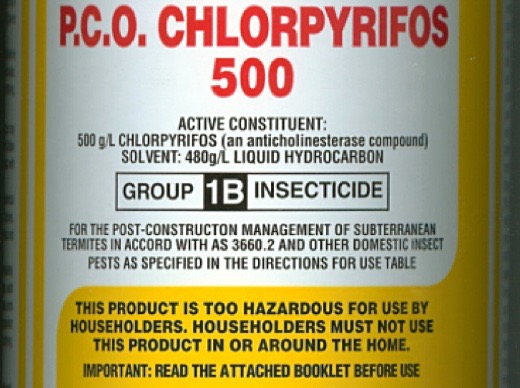
Image above: Photo detail of can of Dow Chemical's chlorpyrifos pesticide distributed by David Gray Co. with warning: "This product is too hazardous for use by householders. Householders must not use this product in or around the home." From (http://www.fertilisersdirect.com.au/pco-chlorpyrifos-1l.html).
 
The hits to our food, farms, and environment just keep coming.
Just hours ago, President Trump signed a new Executive Order, this time specifically on agriculture, directing the Secretary of Agriculture to undertake a 180-day review to “identify and eliminate" what Trump says are "unnecessary regulations”.1

The Presidential Order also creates a new task force to recommend eliminating food and agriculture legislation, policies, and regulations that might hinder the profit-making of “agribusiness.”

What kind of regulations are they looking at? Well, the details are slim, but what is there doesn’t look good. We know that regulations regarding the oversight, production, and export of genetically engineered crops are high on the list.2

The Executive Order also seems to push for faster and/or easier approvals for pesticides and biotech crops, pushing biotech crops abroad to ease export market access, easing the privatization of scarce public water resources for corporate gain, and opening public lands up to mining, farming, ranching and other activities that don’t belong on our public lands.3

We know that Agribusiness has Trump’s ear. He picked Sonny Perdue, one of Big Ag’s own, for his USDA Secretary.

And this week, the Associated Press dropped a bombshell:
Dow Chemical gave $1,000,000 to Trump’s inauguration fund, and the chemical giant is now urging the Environmental Protection Agency (EPA) to set aside its findings on chlorpyrifos and three other pesticides that federal scientists from several agencies found were harmful to endangered species and human health.4
Trump’s EPA also just green-lighted Dow’s new “Enlist Duo” genetically engineered crops, resistant to 2,4-D, part of the Vietnam Era Agent Orange pesticide.

In January, then President-elect Trump sat down chemical giant Bayer’s CEO Werner Baumann and Monsanto’s CEO Hugh Grant at Trump Tower and had a “productive meeting” on “the future of the agriculture industry” and the pending merger between the two companies.

Combined, President Trump, EPA Administrator Pruitt, and newly confirmed USDA Secretary Perdue have received millions of dollars from Big Ag and chemical companies.

We can’t allow the protections we depend on for clean water, clean air, and safe food to be gutted by the new administration and the corporations which have purchased great influence over the President and his policies.

Trump needs to hear from you – add your name  to petition

1. http://www.nydailynews.com/newswires/news/national/latest-trump-aims-ease-farming-regulations-article-1.3099884
2. https://www.politicopro.com/tech/whiteboard/2017/04/perdue-to-chair-trumps-task-force-on-rural-america-086691
3. https://www.whitehouse.gov/the-press-office/2017/04/25/presidential-executive-order-promoting-agriculture-and-rural-prosperity
4. http://bigstory.ap.org/article/a29073ecef9b4841b2e6cca07202bb67/ap-exclusive-pesticide-maker-tries-scrap-risk-study

.

From Standing Rock to Maui

SUBHEAD: We are like the Dakota Sioux fighting to protect the Missouri River because Water is Life.

By Jonathan Greenberg on 25 March 2017 for Maui Independent -
(http://mauiindependent.org/native-wisdom-water-protector-alika-atay-on-the-power-of-we-the-people/)


Image above: From ().

In November, organic farmer Alika Atay, the grassroots leader of Hawaii’s ʻĀina Protector’s United effort was elected to the Maui County Council in a stunning upset (described in detail here).
Atay was the lead plaintiff in the SHAKA Movement’s federal lawsuit over the invalidation of Maui’s successful GMO Moratorium initiative in 2014.

This Maui Independent In Their Own Words features the barrel-chested, deep-voiced leader known to many Native Hawai’ians as “Uncle Alika.” His words are from interviews conducted during the past year by journalist Jonathan Greenberg.

Protect Our Water

I stand to protect our drinking water. We are very similar to our brothers and sisters in the Dakotas fighting to protect the Missouri River because Ola Ka Wai: Water is life.

Aina Protectors United is like-minded people who have been raised under the values of Aloha Aina (love of the land). Everything we do has a connection to the earth and our resources. Given our responsibility under Aloha Aina, we must stand up and protect.

I am speaking for the land, for the water, for the children. We all have a responsibility to stand up for future generations. The importance of native water rights and the ʻĀina Protectors movement is to allow those of us who are of the ʻĀina to understand that this is our indigenous right that we are born with.

We need to stand up and say enough of the oppression.

For me and the people, we are all kanakas. If they poison us, if they allow this to continue, they are creating cultural ethno genocide. They are slowly killing us, the kanaka–Hawaiians and my children and my future descendants. If we die or if we get sick and this place gets polluted, where else do we go? We don’t have anywhere else to go in the world to call our homeland.

This is our homeland. And as Kanaka Maoli, as indigenous people of this land, we cannot allow corporations such as Monsanto to be more important than the health and welfare of our people.

We are into into grassroots democracy. Grassroots democracy comes from the ground up, from the indigenous, spiritual, and cultural level. It says we will live the way we want to live.

My involvement with this movement began 40 years ago, when agrochemical companies sprayed DDT onto their plants, like the pineapple plantations. After soaking the plants, the DDT soaked the soil, and after soaking the soil, it went down and hit our water aquifer. It tainted our drinking water well until we could no longer drink fresh water from the well. Forty years later that well is still tainted. We cannot drink that water. It is still tainted.

Monsanto fields are only 40 feet above sea level. We ran into a Monsanto field and saw their spray board. It said they sprayed a 100-acre field four times a day, and the next day, five times a day, the very next day four times. With different chemicals.

You drench the fields, and then you get a big rain. The earth becomes a wet sponge and gets saturated, and all that chemical poison gets pushed down. The question is not if it’s going to hit our water table. The question is if they keep this up unchecked, when will it hit our water table to also make it unsafe for us to be drinking fresh water?

I believe this is about water and the pesticides that affect water. I am concerned with the drenching of our land with pesticides and the effect this has on our water. We live on an island and must protect our sacred water.

We have to look at the damage heavy chemical pesticides are doing to the soil and the aquifer. Not only what affects us now but more so the long-term future concerns. What kind of water will our future generations have to drink?

Look at what our experience has been for the last two years against the biotech pesticide companies. During the [GMO Moratorium Initiative] contest, there was big, big involvement of organized corporate money, spending close to $8 million.

Yet the people voted yes, and the people defeated them. The big lesson was the power of the people; what was victorious was organized people.

If You Are Not at the Table, You Are On the Menu

If you are not at the table, you are on the menu.
Whatever community you are, whatever country you are, you’ve got to open your eyes and be at the table.

We have that power. We the people can organize ourselves to stand up against them and say, “This is wrong.” Yes we call out Aloha ʻĀina; love the land. But it is not as simple as that. You cannot interpret it just by the words. You have to understand the values that are in there. How do you practice Aloha ʻĀina values? By protecting our natural resources, protecting our water.

Right now, with this [November Council election] victory, we are setting the cornerstone of the house that we want to live in. It is up to the rest of the village to be involved in the construction of the house.

I am looking forward to setting policy, regulations, and enforcement that will protect our natural resources. We need our entire village to be involved to solve these problems.

We live on an island, and our job is to protect this aquifer, our sacred water. There is a wave of momentum for change to protect our Maui way of living. Everyone sees the handwriting on the wall and is concerned with protecting the environment, which also protects our tourist economy.

Our Responsibility to Become Great Ancestors

Our ancestors, my ancestors, they lived here for 1,500 years. They lived here organically, naturally.

They didn’t live with chemical poisons. Then my ancestors handed it over to me: green pristine, clean, and sacred.

And in a very short period, westernization came in and almost killed us. Almost. Unless we come in and say, “Nuff already. This ain’t happening.”

We want to become great ancestors.

I don’t want to pass on and have my descendants say, “My tutu—he didn’t do a good job by giving us this place all polluted.”

We have a responsibility to our future. That’s why we do this.


Video above: "Water Protector Alika Atay on People Power" From original article. (https://youtu.be/Gu5dZ1_agNY). 

See also:
Ea O Ka Aina: Lessons from Standing Rock 3/14/17
Ea O Ka Aina: Standing Rock will not go away 2/24/17
Ea O Ka Aina: DAPL fight not over yet 2/19/17
Ea O Ka Aina: Tribes divest DAPL bankers 2/13/17
Ea O Ka Aina: Army Corps okays DAPL easement 2/8/17
Ea O Ka Aina: Trump orders go on DAPL EIS 2/3/17
Ea O Ka Aina: Trump orders shale oil pipelines 1/24/17
Ea O Ka Aina: Missile launcher at Standing Rock 1/19/17
Ea O Ka Aina: Lockdown at Trans-Pecos Pipeline 1/10/17
Ea O Ka Aina: Standing Rock has changed us 12/9/16
Ea O Ka Aina: As Standing Rock celebrates... 12/5/16
Ea O Ka Aina: Army Corps denies DAPL easement 12/4/16
Ea O Ka Aina: My Whole Heart is With You 12/2/16
Ea O Ka Aina: The Loving Containment of Courage 12/1/16
Ea O Ka Aina: The Beginning is Near 12/1/16
Ea O Ka Aina: Obama hints at DAPL rerouting 11/3/16
Ea O Ka Aina: New military attack on NODAPL 11/3/16
Ea O Ka Aina: How to Support NoDAPL 11/3/16
Ea O Ka Aina: Standing Rock has changed us 12/9/16
Ea O Ka Aina: As Standing Rock celebrates... 12/5/16
Ea O Ka Aina: Army Corps denies easement 12/4/16
Ea O Ka Aina: My Whole Heart is With You 12/2/16
Ea O Ka Aina: The Loving Containment of Courage 12/1/16
Ea O Ka Aina: The Beginning is Near 12/1/16
Ea O Ka Aina: Feds to shutdown NoDAPL Camp 11/25/16
Ea O Ka Aina: NoDAPL people are going to die 11/23/16
Ea O Ka Aina: Hundreds of vets to join NoDAPL 11/22/16
Ea O Ka Aina: Obama must support Standing Rock 11/21/16
Ea O Ka Aina: Trump's pro oil stance vs NoDaPL 11/15/16
Ea O Ka Aina: Kauai NoDAPL Demonstration 11/12/16
Ea O Ka Aina: Obama to Betray Standing Rock 11/12/16
Ea O Ka Aina: Trump impact on Standing Rock 11/12/16
Ea O Ka Aina: Ann Wright on Standing Rock 11/8/16
Ea O Ka Aina: Turning Point at Standing Rock 11/6/16
Ea O Ka Aina: Jackson Browne vs DAPL owner 11/5/16
Democracy Now: Boycott of DAPL Owner's Music Festival
Ea O Ka Aina: World responds to NoDAPL protests 11/5/16
Ea O Ka Aina: NoDAPL victory that was missed 11/5/16
Ea O Ka Aina: DAPL hid discovery of Sioux artifacts 11/5/16
Ea O Ka Aina: Dakota Access Pipeline will leak 11/5/16
Ea O Ka Aina: Route of the Dakota Access Pipeline 11/4/16
Ea O Ka Aina: Sanders calls for stopping DAPL 11/4/16
Ea O Ka Aina: Obama hints at DAPL rerouting 11/3/16
Ea O Ka Aina: New military attack on NODAPL 11/3/16
Ea O Ka Aina: How to Support NoDAPL 11/3/16
Unicorn Riot: Tweets from NoDAPL 11/2/16
Ea O Ka Aina: Standing Rock & the Ballot Box 10/31/16
Ea O Ka Aina: NoDAPL reclaim new frontline 10/24/16
Ea O Ka Aina: How far will North Dakota go? 10/23/16
Ea O Ka Aina: Amy Goodman "riot" charge dropped 10/17/16
Ea O Ka Aina: Amy Goodwin to face "Riot Charge" 10/16/16
Ea O Ka Aina: Shutdown of all tar sand pipelines 10/11/16
Ea O Ka Aina: Why Standing Rock is test for Oabama 10/8/16
Ea O Ka Aina: Why we are Singing for Water 10/8/16
Ea O Ka Aina: Labor's Dakota Access Pipeline Crisis 10/3/16
Ea O Ka Aina: Standing Firm for Standing Rock 10/3/16
Ea O Ka Aina: Contact bankers behind DAPL 9/29/16
Ea O Ka Aina: NoDAPL demo at Enbridge Inc 9/29/16
Ea O Ka Aina: Militarized Police raid NoDAPL 9/28/16
Ea O Ka Aina: Stop funding of Dakota Access Pipeline 9/27/16
Ea O Ka Aina: UN experts to US, "Stop DAPL Now!" 9/27/16
Ea O Ka Aina: No DAPL solidarity grows 9/21/16
Ea O Ka Aina: This is how we should be living 9/16/16
Ea O Ka Aina: 'Natural Capital' replacing 'Nature' 9/14/16
Ea O Ka Aina: The Big Difference at Standing Rock 9/13/16
Ea O Ka Aina: Jill Stein joins Standing Rock Sioux 9/10/16
Ea O Ka Aina: Pipeline temporarily halted 9/6/16
Ea O Ka Aina: Native Americans attacked with dogs 9/5/16
Ea O Ka Aina: Mni Wiconi! Water is Life! 9/3/16
Ea O Ka Aina: Sioux can stop the Pipeline 8/28/16
Ea O Ka Aina: Officials cut water to Sioux 8/23/16 

.