Showing posts with label Crash. Show all posts

Fligfht Path

SUBHEAD: The “wealth” acquired  by “one-percenters” was loaded onto a defective Boeing 737.

By James Kunstler on 17 April 2020 for Clusterfuck Nation -
(https://kunstler.com/clusterfuck-nation/flight-path/)


Image above: In 2013, a two-month-old Boeing 737-800, operated by LionAir, undershot the runway at Bali Airport, crashing into the water. Half the 108 passengers were injured. Luckily there were no fatalities. From (https://airwaysmag.com/industry/lion-air-boeing-737max8-crashes/).

This age of battling narratives tends to conceal the broken consensus behind it. What’s gone is a broad social agreement that there are certain fundamental realities, and then codes of conduct that follow from them. When anything goes, don’t expect people to do the right thing, or even know what it is.

The Covid-19 debacle presents just such a set of quandaries and puzzles. For many people stewing in quarantine, the virus is just another evil phantom lurking in the permanent twilight zone of television, and even there, among the familiar jabbering figments, there’s little agreement about it. The statistical projections mutate weekly.

 It’s no worse than any annual flu… It’s a savage illness that attacks every organ in the body, leaves survivors maimed, and you can even catch it again… The lockdowns are imperative… the lockdowns amount to economic suicide… There’s no sorting it all out, and the uncertainty itself is intolerable.

The only certainty is that most of the people in lockdown are going broke fast. By any ordinary rules, they are wiped out. They can’t even pretend anymore to keep juggling all those monthly payments for rent or mortgages, food, the cars, the medical insurance, the electricity, the cable, and on and on.

The $1200 mad money checks promised by Uncle Sam are little consolation for that, and the small business “loans” ­– if you can even jump through the infuriating hoops to get them – just pile on an additional layer of obligation in a lifetime of debt serfdom.

You don’t have to leap too many steps ahead mentally to imagine utter personal ruin on that glide path. And so what if millions of others are feeling squashed by the same phantom forces of disease and finance?

One firm reality is this: the global debt system that supported the turbo-charged global economy was disintegrating badly in the early fall of 2019, threatening every financial asset and the markets that affected to manage them ­­– and all the operations of modern daily life that they represented.

Nowhere on earth was the debt load more out-of-control than in China, where there were no constraints whatsoever on the banks’ accounting fraud, since they answered solely to the ruling party, which had but one overarching policy: to keep ruling.

And the biggest economic fiction of all was that China could maintain its supernatural growth rates in a world that had actually reached the limits of growth. Mr. Trump’s trade wars sent tremors through the system. A whole lot of bad loans were about to be flushed down the drain.

Banks everywhere else felt the vibrations, too, you may be sure. The Wuhan virus was, at least, a very convenient distraction from all that. And then, the darn thing got loose on countless airplane flights around the world.

The Covid-19 corona virus didn’t initiate the financial disorders of the moment in the US and Europe, but it ensured that there would not be another appearance of any “recovery” a la the central bank interventions of 2008-09.

What it portends is a fast-track journey to a whole new disposition of things: first, for a while, a harsher, hungrier, angrier society of broken promises and dashed expectations; and then adaptation when a consensus emerges that the set of facts at hand amount to a new reality. In the meantime, we’re living in the meantime, which is not a comfortable place.

Money is not an economy. Money is a medium of exchange within an economy where people grow things, make things, move things, and serve each other in countless ways. We’re not going to replace all those growings, makings, movings, and services by just giving people money.

Money may produce more money by the magic of compound interest, but money is not necessarily wealth, it just represents our ideas about wealth, and interest stops compounding anyway when the trend is clearly for reduced growings, makings, movings, and servicings. That’s exactly how and why capital vanishes.

The hocus-pocus of Modern Monetary Theory can only pretend to work around that reality.

The world never reached such a pitch of activity up to the blow-ups of 2008, and it went through the motions for a decade after that. Now that it’s stopped, all that’s left is the law of gravity, and it doesn’t get more basic.

The “wealth” acquired in the decade since by the so-called “one-percent” was loaded onto a defective aircraft, like a Boeing 737-MAX, and an awful lot of it will fall to earth now on broken wings. Their agents and praetorians on Wall Street are working feverishly to stave off that crash-landing, like a band of magicians casting spells on the ground while that big hunk of juddering metal augers earthward.

Wait for it as spring brings new life across the land and things unseen before steal onto the scene.

.

Lamentation

SUBHEAD: The sudden end of a whole regional economy that was a tragic blunder from the get-go?

By James Kunstler on 14 September 2018 for Kunstler.com -
(http://kunstler.com/clusterfuck-nation/lamentation/)


Image above: Bedroom sheetrock drywalls in the home of Rashida Ferdinand in the New Orleans's Lower Ninth Ward blooming with health threatening mold following heavy rain and flooding in the wake of hurricane Katrina in 2005. From (https://www.thisoldhouse.com/ideas/keep-mold-taking-hold).

An awful lot of sheetrock is going to be permanently ruined over the next few days down along the coast of Dixieland. Following the spectacle of hurricane reportage on TV reveals very little while the event is in progress.

The cheapo building materials of the stereotypical strip malls flap around in the gale and the valiant cable news storm-chasers lean into the horizontal deluge in the empty parking lots, but their reportage doesn’t tell much of the real story, which only emerges when the roaring blob of weather moves on and the sun finally comes out.

More than a decade of punishing storms along the US coastline must be wrecking the insurance industry as much as the stuff on the landscape.

They’ve been pummeled from another direction for ten years by the supernaturally low interest rates that make it so hard to refurbish their coffers after whole regions like the Houston metro area and the entire island of Puerto Rico get blasted and they have to pay out billions in claims.

This time around, all those vinyl and chip-board McHouses along the Atlantic beaches will not be replaced. But farther inland, far from the roaring surf, along all the overflowing estuaries that drain the coastal plain, the damage will be widespread and epic.

It may create a whole new social class of de-housed, displaced Sunbelters who will never again have a decent place of their own to live in. Since many are retirees, the event may even lead to a stealth die-off of people who are just too far along to start over.

The lamentation for the northern part of “flyover” America is an old story now. Nobody is surprised anymore by the desolation of de-industrialized places like Youngstown, Ohio, or Gary, Indiana, where American wealth was once minted the hard way by men toiling around blast furnaces.

But the southeast states enjoyed a strange interlude of artificial dynamism since the 1950s, which is about three generations, and there is little cultural memory for what the region was like before: an agricultural backwater with few cities of consequence and widespread Third Worldish poverty, barefoot children with hookworm, and scrawny field laborers in ragged straw hats leaning on their hoes in the stifling heat.

The demographic shifts of recent decades turned a lot of it into an endless theme park of All-You-Can-Eat buffets, drive-in beer emporia, hamburger palaces, gated retirement subdivisions, evangelical churches built like giant muffler shops, vast wastelands of free parking, and all the other trappings of the greatest misallocation of resources in the history of the world.

Like many of history’s prankish proceedings, it seemed like a good idea at the time.

As survivors slosh around in the plastic debris in the weeks ahead, and the news media spins out its heartwarming vignettes of rescue and heroism, will there be any awareness of what has actually happened: the very sudden end of a whole regional economy that was a tragic blunder from the get-go?

It is probably hard to imagine Dixieland struggling into whatever its next economy might be. In some places, it’s not even possible to return to a prior economy based on agriculture. A lot of the landscape was farmed so ruinously for two hundred years that the soil has turned into a kind of natural cement, called hardpan or caliche.

The climate prospects for the region are not favorable either, not to mention the certain cessation of universal air-conditioning and “happy motoring” that made the unwise mega-developments of recent decades possible.

The one salutary effect of Hurricane Florence may be that news of the after-effects will supersede the incoherent manufactured political blather welling up around the coming midterm elections — especially if the financial damage is powerful enough to disturb the debt-fueled occult economic “boom” attributed to the magic powers of our deal-wielding POTUS.

.

Amazon is the New Tech Crash

SUBHEAD: There is only a handful of big tech winners - Amazon, Apple, Microsoft, Google Facebook & Netflix.

By David Stockman on 1 August 2017 for the Daily Reckoning -
(https://dailyreckoning.com/amazon-new-tech-crash/)


Image above: Sign on an unidentified Amazon building. From original article.

It won’t be long now. During the last 31 months the stock market mania has rapidly narrowed to just a handful of shooting stars.

At the forefront has been Amazon.com, Inc., which saw its stock price double from $285 per share in January 2015 to $575 by October of that year. It then doubled again to about $1,000 in the 21 months since.

By contrast, much of the stock market has remained in flat-earth land.

For instance, those sections of the stock market that are tethered to the floundering real world economy have posted flat-lining earnings, or even sharp declines, as in the case of oil and gas.

Needless to say, the drastic market narrowing of the last 30 months has been accompanied by soaring price/earnings (PE) multiples among the handful of big winners. In the case of the so-called FAANGs + M (Facebook, Apple, Amazon, Netflix, Google and Microsoft), the group’s weighted average PE multiple has increased by some 50%.

The degree to which the casino’s speculative mania has been concentrated in the FAANGs + M can also be seen by contrasting them with the other 494 stocks in the S&P 500.

The market cap of the index as a whole rose from $17.7 trillion in January 2015 to some $21.2 trillion at present, meaning that the FAANGs + M account for about 40% of the entire gain.

Stated differently, the market cap of the other 494 stocks rose from $16.0 trillion to $18.1 trillion during that 30-month period.

That is, 13% versus the 82% gain of the six super-momentum stocks.

Moreover, if this concentrated $1.4 trillion gain in a handful of stocks sounds familiar that’s because this rodeo has been held before.

The Four Horseman of Tech (Microsoft, Dell, Cisco and Intel) at the turn of the century saw their market cap soar from $850 billion to $1.65 trillion or by 94% during the manic months before the dotcom peak.

At the March 2000 peak, Microsoft’s PE multiple was 60X, Intel’s was 50X and Cisco’s hit 200X.

Those nosebleed valuations were really not much different than Facebook today at 40X, Amazon at 190X and Netflix at 217X.

The truth is, even great companies do not escape drastic over-valuation during the blow-off stage of bubble peaks.

Accordingly, two years later the Four Horseman as a group had shed $1.25 trillion or 75% of their valuation.

More importantly, this spectacular collapse was not due to a meltdown of their sales and profits. Like the FAANGs +M today, the Four Horseman were quasi-mature, big cap companies that never really stopped growing.

Now I’m targeting the very highest-flyer of the present bubble cycle, Amazon.

Just as the NASDAQ 100 doubled between October 1998 and October 1999, and then doubled again by March 2000, AMZN is in the midst of a similar speculative blow-off.

Not to be forgotten, however, is that one year after the March 2000 peak the NASDAQ 100 was down by 70%, and it ultimately bottomed 82% lower in September 2002. I expect no less of a spectacular collapse in the case of this cycle’s equivalent shooting star.

In fact, even as its stock price has tripled during the last 30 months, AMZN has experienced two sharp drawdowns of 28% and 12%, respectively. Both times it plunged to its 200-day moving average in a matter of a few weeks.

A similar drawdown to its 200-day moving average today would result in a double-digit sell-off.

But when — not if — the broad market plunges into a long overdue correction the ultimate drop will exceed that by many orders of magnitude.

Amazon’s stock has now erupted to $1,000per share, meaning that its market cap is lodged in the financial thermosphere (highest earth atmosphere layer). Its implied PE multiple of 190X can only be described as blatantly absurd.

After all, Amazon is 24 years-old, not a start-up. It hasn’t invented anything explosively new like the iPhone or personal computer.

Instead, 91% of its sales involve sourcing, moving, storing and delivering goods. That’s a sector of the economy that has grown by just 2.2% annually in nominal dollars for the last decade, and for which there is no macroeconomic basis for an acceleration.

Trade Secrets From Investing Legends

Don't be drawn into the suckers rally: Listen to the guys who have beaten the market! Chris Mayer lays out eight unusual rules for becoming a better investor.

In the report he reveals the five greatest investment books you have never heard of -- you get them immediately. Sign up for the Daily Reckoning today and receive your FREE report.

Yes, AMZN is taking share by leaps and bounds. But that’s inherently a one-time gain that can’t be capitalized in perpetuity at 190X.

And it’s a source of “growth” that is generating its own pushback as the stronger elements of the brick and mortar world belatedly pile on the e-commerce bandwagon.

Wal-Mart’s e-commerce sales, for example, have exploded after its purchase of Jet.com last year — with sales rising by 63% in the most recent quarter.

Moreover, Wal-Mart has finally figured out the free shipments game and has upped its e-commerce offering from 10 million to 50 million items just in the past year. Wal-Mart is also tapping for e-commerce fulfillment duty in its vast logistics system — including its 147 distribution centers, a fleet of 6,200 trucks and a global sourcing system which is second to none.

In this context, even AMZN’s year-over-year sales growth of 22.6% in Q1 2017 doesn’t remotely validate the company’s bubblicious valuation — especially not when AMZN’s already razor thin profit margins are weakening, not expanding.

Based on these basic realities, Jeff Bezos will never make up with volume what he is losing in margin on each and every shipment.

The Amazon business model is fatally flawed. It’s only a matter of the precise catalyst that will trigger the realization in the casino that this is another case of the proverbial naked emperor.

Needless to say, I do not think AMZN is a freakish outlier. It’s actually the lens through which the entire stock market should be viewed because the whole enchilada is now in the grips of a pure mania. Stated differently, the stock market is no longer a discounting mechanism nor even a weighing machine. It’s become a pure gambling hall.

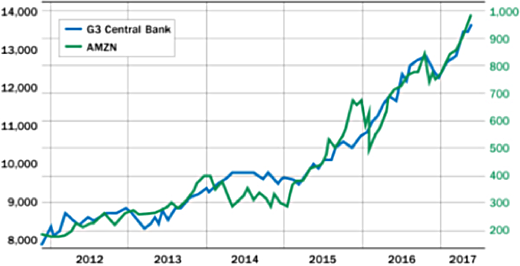
So Bezos’ e-commerce business strategy is that of a madman — one made mad by the fantastically false price signals emanating from a casino that has become utterly unhinged owing to 30 years of Bubble Finance policies at the Fed and its fellow central banks around the planet. Indeed, the chart below leaves nothing to the imagination.

Since 2012, Amazon stock price has bounded upward in nearly exact lock-step with the massive balance sheet expansion of the world’s three major central banks.


Image above: Comparison of stock values of G3 Central Banks and Amazon Corp. From original article.

At the end of the day, the egregiously overvalued Amazon is the prime bubble stock of the current cycle. What the Fed has actually unleashed is not the healthy process of creative destruction that Amazon’s fanboys imagine.

Instead, it embodies a rogue business model and reckless sales growth machine that is just one more example of destructive financial engineering, and still another proof that monetary central planning fuels economic decay, not prosperity. Amazon’s stock is also the ultimate case of an utterly unsustainable bubble.

When the selling starts and the vast horde of momentum traders who have inflated it relentlessly in recent months make a bee line for the exits, the March 2000 dotcom crash will seem like a walk in the park. .

Central banks ARE the Crisis

SUBHEAD: We shouldn't let them conjure up trillions out of nothing, and use that power as a political tool.

By aul Ilargi Meijer on 25 uly 2017 for the Automatic Earth -
(https://www.theautomaticearth.com/2017/07/central-banks-are-the-crisis/)


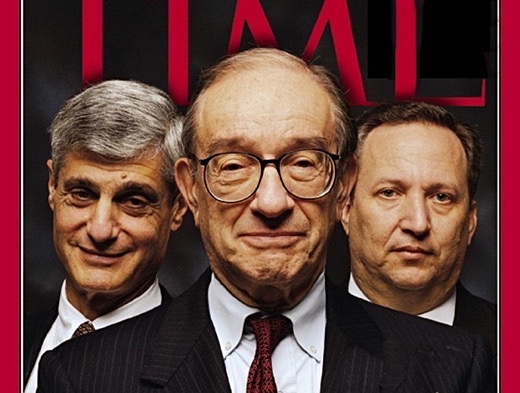
Image above: The men who brought it down - Richard Reich, Alan Greenspan and Larry Somers.  From (https://www.dailymaverick.co.za/article/2014-02-24-how-close-we-were-to-a-global-financial-meltdown-in-2008-now-we-know/#.WXomwIqQxE4).

If there’s one myth -and there are many- that we should invalidate in the cross-over world of politics and economics, it‘s that central banks have saved us from a financial crisis. It’s a carefully construed myth, but it’s as false as can be. Our central banks have caused our financial crises, not saved us from them.

It really should -but doesn’t- make us cringe uncontrollably to see Bank of England governor-for-hire Mark Carney announce -straightfaced- that:
“A decade after the start of the global financial crisis, G20 reforms are building a safer, simpler and fairer financial system. “We have fixed the issues that caused the last crisis. They were fundamental and deep-seated, which is why it was such a major job.”
Or, for that matter, to see Fed chief Janet Yellen declare that there won’t be another financial crisis in her lifetime, while she’s busy-bee busy building that next crisis as we speak. These people are now saying increasingly crazy things, and that should make us pause.

Central banks don’t serve people, or even societies, as that same myth claims. They serve banks. Even if central bankers themselves believe that this is one and the same thing, that doesn’t make it true. And if they don’t understand this, they should never be let anywhere near the positions they hold.

You can pin the moment central banks went awry at any point in time you like. The Bank of England’s foundation in 1694, the Federal Reserve’s in 1913, the ECB much more recently. What’s crucial in the timing is where and when the best interests of the banks split off from those of their societies.

Because that is when central banks will stop serving those societies. We are at such a -turning?!- point right now. And it’s been coming for some time, ‘slowly’ working its way towards an inevitable abyss.

Over the past few years the Automatic Earth has argues repeatedly, along several different avenues, that American society was at its richest between the late 1960s and early 1980s. Yet another illustration of this came only yesterday in a Lance Roberts graph:

Anyone see a recovery in there? Lance uses 1981 as a ‘cut-off’ date, but the GDP growth rate as represented by the dotted line doesn’t really begin to go ‘bad’ until 1986 or so.

At the tail end of the late 1960s to early 1980s period, as the American economy was inexorably getting poorer, Alan Greenspan took over as Federal Reserve governor in 1987.

A narrative was carefully crafted by and for the media with Greenspan as an ‘oracle’ or even a ‘rock star’, but in reality he has been instrumental in saddling the economy with what will turn out to be insurmountable problems.

Greenspan was a major driving force behind the repeal of Glass-Steagall, which was finally established through the Gramm-Leach-Bliley act of 1999. This was an open political act by the Federal Reserve governor, something that everyone should have then protested, and still should now, but didn’t and doesn’t.

Central bankers should be kept far removed from politics, anywhere and everywhere, because they represent a small segment of society, banks, not society as a whole.

Because of the ‘oracle’ narrative, Greenspan was instead praised for saving the world. But all that Greenspan and his accomplices, Robert Rubin and Larry Summers, actually did in getting rid of the 1933 Glass-Steagall act separation between investment- and consumer banking was to open the floodgates of debt, and even more importantly, leveraged debt.

All part of the ‘financial innovations’ Greenspan famously lauded for saving and growing economies. It was all just more debt on top of more debt.

Greenspan et al ‘simply’ did what central bankers do: they represent the best interests of banks. And the world’s central bankers have never looked back. That most people still find it hard to believe that America -and the west- has been getting poorer for the past 30-40 years, goes to show how effective the narratives have been.

The world looks richer instead of poorer, after all. That this is exclusively because of rising debt numbers wherever you look is not part of the narratives. Indeed, ruling economic models and theories ignore the role played by both banks and credit in an economy, almost entirely.

Alan Greenspan left as Fed head in 2006, after having wreaked his havoc on America for almost two decades, right before the financial crisis that took off in 2007-2008 became apparent to the world at large. The crisis was largely his doing, but he has escaped just about all the blame for it. Good PR.

With Ben Bernanke, an alleged academic genius on the Great Depression, as Greenspan’s replacement, the Fed just kept going and turned it up a notch. It was no longer possible in the financial world to pretend that banks and people had the same interests, so the former were bailed out at the expense of the latter.

The illusionary narrative for the public, however, remained intact. What do people know about finance, anyway? Just make sure the S&P goes up. Easy as pie.

The narrative has switched to Bernanke, and Yellen after him, as well as Mario Draghi at the ECB and Haruhiko Kuroda at the Bank of Japan, saving the world from doom. But once again, they are the ones who are creating the crisis, not the ones saving us from it. They are saving the banks, and saddling the people with the costs.

In the past decade, these central bankers have purchased $20-$50 trillion in bonds, securities and stocks. The only intention, and indeed the only result, is to keep banks from falling over, increase their profits, and maintain the illusion that economies are recovering and growing.

They can only achieve this by creating bubbles wherever they can. Apart from the QE programs under which they bought all those ‘assets’, they used -and still do- another tool: lowering interest rates to the point where borrowing money becomes so cheap everyone can do it, and then do it some more.

It has worked miracles in blowing stock market valuations out of all realistic proportions, and in doing the same for housing markets in locations all over the globe.

The role of China’s central bank in this is interesting too, but it is such an open and obvious political tool that it really deserves its own discussion and narrative. Basically, Beijing did what it saw Washington do and thought: why hold back?

Fast forward to today and we see that we’ve landed in a whole new, and next, phase of the story. The world’s central banks are all stuck in their own – self-created – bubbles and narratives. They all talk about how they solved all the issues, and how they will now return to normal, but the sad truth is they can’t and they know it.

The Fed stopped purchasing assets through its QE program a while back, but it could only do that because Frankfurt and Japan took over. And now they, too, talk about quitting QE. Slowly, yada yada, because of control, yada yada, but they know they must.

They also know they can’t. Because the entire recovery narrative is a mirage, a fata morgana, a sleight of hand.

And that means we have arrived at a point that is new and very dangerous for the entire global economy and all of its people.

That is, the world’s central bankers now have an incentive to create the next crisis. This is because they know this crisis is inevitable, and they know their masters and protégés, the banks, risk suffering immensely or even going under.

‘Tapering’, or whatever you might call the -slow- end to QE and the -slow- hiking of interest rates, will prick and blow up bubbles one by one, and often in violent fashion.

When housing bubbles burst, economies lose the primary ingredient for maintaining -let alone increasing- their money supply: banks creating money out of thin hot air. Since the money supply is one of the key components of inflation, along with velocity of money, there will be fantastic outbursts of debt deflation. You’ve never seen -let alone imagined- anything like it.

The worst part of it is not government debt, though that, when financed with bond sales, is not not an instrument to infinity and beyond either. But the big hit to economies will be private debt.

Where in many bubble areas, and they’re too numerous too mention, eager potential buyers today fret over affordable housing supply, it’ll all turn on a dime and owners won’t be able to sell without being suffocated by crippling losses.

Pension funds, which have already suffered perhaps more than any other parties because of low interest ZIRP and NIRP policies, have switched en masse to riskier assets like stocks. Well, another whammy, and a bigger one, is waiting just outside the door. Pensions will be so last century.

That another crisis is waiting to happen, and that politics and media have made sure that just about no-one at all is aware of it, is one thing. We already knew this, a few of us. That the world’s main central bankers have an active incentive to bring about the crisis, if only by sitting on their hands long enough, is new. But they do.

Yellen, Draghi and Kuroda may opt to leave before pulling the trigger, or be fired soon enough. But whoever is in the governor seats will realize that unleashing a crisis sooner rather than later is the only option left not to be blamed for it.

Let the house of dominoes crumble now, and they can say “nobody could have seen this coming”, while at the same time saving what they can for the banks and bankers they serve. That option will not be on the table for much longer.

We should have never given them, let alone their member/master banks, the power to conjure up trillions out of nothing, and use that power as a political tool. But it is too late now.

.

When the Deal Goes Down

SUBHEAD: Stresses and tensions are a’buildin’ and the time for being a nation of feckless idiots is drawing to a close.

By James Kunstler on 30 June 2017 for Kunstler.com -
(http://kunstler.com/clusterfuck-nation/when-the-deal-goes-down/)


Image above: Oil painting "Feeding the Baby" by Mark Bryan, 2017 subtitled "Baby Trump loves Bannon’s Total...itarian Bullshit. He wants you to have some too." From (https://www.artofmarkbryan.com/feeding-the-baby-trump-bannon-art/).

Who needs Russia when the Tweety-Bird-in-Chief is hacking his own presidency into a global joke? Or at least it might be a joke if the USA weren’t such a menace to international order, and to itself, by the way. Interestingly, the 25th amendment allows for the removal of a president from office on account of incompetence or disability, but not for being an embarrassment to the nation.

They may come after him anyway with the 25th, especially as the financial system unravels later this year, because this time, unlike 2008-9, central bank interventions will not avail to rescue the faltering money system from nine years of previous central bank interventions.

All it takes is for the “liquidity” flows to seize up and before you know it, there’s no food in the supermarkets because everything in our just-in-time economy is exquisitely calibrated to the sure expectation of getting paid, and when that goes, it all goes.

Then the question arises: well, can’t you just re-start the liquidity flows? Not when the process requires another abracadabra magic act of summoning X-trillions of dollars out of absolutely nothing when the previous X-trillions created out of absolutely nothing are rushing at warp speed into the black hole of deleveraging because it has been discovered that the “loans” they were based on can never be paid back, not in this universe or any number of universes like it. In a word, they’re worthless.

Deleveraging is the polite term economists give to your net worth rapidly evaporating. Liquidity is the polite term for cash money and things denominated in them that can readily be converted into cash money. The problem with the kind of liquidity-creation solution to deleveraging is that it rapidly leads to money itself becoming worthless.

The preview of coming attractions is currently playing out in Illinois — soon to be joined by Connecticut, California, Kentucky, and many other bankrupt states. Illinois is dead broke. It can’t pay the contractors who fix things like roads and storm drains, and supply food to its prisons.

It’s over $200-billion deep in pension obligations that will never be honored. Its Medicaid system is a shambles. It doesn’t even have the cash-on-hand to pay lottery winners (what happened to all the cash paid into the lottery by the suckers who didn’t win, which is supposed to pay off the winners?). The state legislature hasn’t passed a budget in three years.

The governor and the mayor of Chicago and everybody else nominally in charge have no idea what they’re going to do about it. Think the federal government is going to just step in and save the day there?

They’d have to bail out every other foundering state and that’s just not going to happen, especially with that same federal government about to run out of cash money itself, with no resolution of the debt ceiling controversy that might allow it to even pretend to borrow more money by issuing treasury bonds that are instantly bought by the Federal Reserve — which, of course, is not an official government agency but a private banking consortium contracted to manage the nation’s money.

Do you begin to see the outlines of the clusterfuck rising like a bad moon over the harvest season of 2017? The American people, by and large, have no more idea how false and fragile the financial arrangements of the nation are than the average eight-year-old has about why the re-po squad is towing away Daddy’s Ford-F150.

We’re just doing what we always do: gittin’ our summer on. Breaking out the potato salad and the Bud Lites — at least those who have enough mojo left in their MasterCards to charge the party supplies.

An awful lot of Americans must be maxed out, though, people who actually used to work at things and get paid for it.

Each one of them is a walking Illinois now, facing each dawning day with a bigger load of problems, more things they can’t pay for, and moving closer to the dreadful day when everything is gone, every chattel, every knickknack, the very roof over their head, and most particularly the belief that they live in a fair and decent society.

So, I wonder what we’re going to do with a Tweety-Bird-in-Chief in the White House when this deal goes down. Stresses and tensions are out there a’buildin’ and the time for being a nation of feckless idiots is drawing to a close. The sad thing is: it wasn’t even fun while it lasted.


Trump to Unleash Trade War

SUBHEAD: Trump - true to his campaign promises - is set to launch a global trade wars after all,

By Tyler Durden on 30 June 2017 for Zero Hedge -
(http://www.zerohedge.com/news/2017-06-30/trump-overrules-cabinet-prepares-unleash-global-trade-war)

While one of Trump's recurring campaign promises was that he would "punish" China and other key US trade counterparties if elected, for taking advantage of free-trade by imposing steep tariffs and duties on foreign imports to "level the playing field", the President's stance changed drastically after the election, U-turning following his amicable meeting with China's president Xi Jinping in March, but mostly as a result of pressure by his ex-Goldman advisors to keep existing trade arrangements in place and not "rock the boat."

Now, all that may be about to fall apart.

According to Axios, behind the constant media scandals, "one of the most consequential and contentious internal debates of his presidency unfolded during a tense meeting Monday in the Roosevelt Room of the White House" where with "more than 20 top officials present, including Trump and Vice President Pence, the president and a small band of America First advisers made it clear they're hell-bent on imposing tariffs — potentially in the 20% range — on steel, and likely other imports."

In other words, Trump - true to his campaign promises - is set to launch a global trade wars after all, one where then main country impacted would be China, however the collateral damage would extend to Canada, Mexico, Japan, Germany and the UK.


There will be another financial crisis?

SUBHEAD: We are already seeing the early warning signs with delinquency rates rising and commercial lending on the decline.

By Robert Lance on 29 June 2017 for Real Investment Advise -
(https://realinvestmentadvice.com/yes-ms-yellen-there-will-be-another-financial-crisis/)

[IB Publsiher's note: To see the several charts relating to this article, please click on link above for original article.]

Janet Yellen, Federal Reserve Chair, recently stated;
“Will I say there will never, ever be another financial crisis? No, probably that would be going too far. But I do think we’re much safer and I hope that it will not be in our lifetimes and I don’t believe it will.”
That is a pretty bold statement to make considering that every one of her predecessors failed to predict the negative consequences of their actions.

Will there will be another “Financial Crisis” in our lifetimes?

Yes, it is virtually guaranteed.
The previous “crisis” wasn’t about just “an asset gone bad,” but rather the systemic shock caused by a “freeze” in the credit markets when Lehman Brothers filed for bankruptcy. Counterparties evaporated, banks froze lending and the credit market ceased to function.

Credit, not the stock market, is the “lifeblood” of the economy.

Of course, it is all good now because the Federal Reserve says so with Ms. Yellen placing a great amount of faith in the Federal Reserve’s own carefully constructing, and recently released results, of “bank stress tests.” Interestingly, EVERY bank passed with flying colors.

In other words, the Millennial generation has now passed the baton of “Everybody Gets A Trophy” to the banking sector.
“Test results released by the Federal Reserve show that the 34 institutions under scrutiny have enough capital to make it through the two scenarios regulators posed — one akin to the financial crisis and another entailing a shallower downturn.
Under the scenarios, the banks tested ‘would experience substantial losses.’ However, in total, the institutions ‘could continue lending to businesses and households, thanks to the capital built up by the sector following the financial crisis.’
In the most severe scenario, bank losses are projected to be $493 billion. In the less severe, the losses were put at $322 billion.”
This passage of the “test” by every bank, of course, is based on several faulty assumptions including:
  • FASB Rule 157 is still repealed allowing banks to mythically mark bad assets to “face value” which makes balance sheets stronger than they appear. So, how do you know what “toxic assets” still exist?
  • There is roughly $2 Trillion of excess reserves supporting banks which will evaporate IF the Fed actually commences with shrinking their bloated balance sheet. 
  • The worst case scenario only accounted for a “doubling” of the unemployment rate, or 8.6% from current levels, despite the fact we have an exceptionally low labor force participation rate and a surge to more than 10% is quite likely in the next recession. 
  • With more leverage in the system than at any point any previous history, and banks inextricably linked to the financial markets, just how sensitive are the tests to another “worst case scenario?”
What was NOT included in the test was another “Financial Crisis” scenario which SHOULD be the baseline of the stress tests to begin with. Unemployment rates of 15% or more, asset price declines of 50% and default rates of 20% or greater on outstanding debt should be the baseline by which you stress test financial systems against another systemic shock.

The Federal Reserve is once again engaging in very faulty thinking by believing the system will operate normally during a more severe economic scenario.

It isn’t just the losses projected on the banking sector in terms of defaulting loans that are the problem, but also the collapse in the asset markets when defaults ramp sharply as recessionary pressures build.

Most assuredly, lenders will immediately shut off access to capital leading to another “freeze” in the credit system. (Not to mention the sharp losses in market capitalization due to share price declines.)

Here is why Janet Yellen is wrong in believing another “Financial Crisis” can’t occur.

Catalyst 1: Delinquency & Defaults

We are already seeing the early warning signs with delinquency rates rising and commercial lending on the decline in both consumer and commercial and industrial loans.

Of course, as I noted above, once delinquency and default rates begin to rise, the first thing banks tend to do is to stop lending. Naturally, as banks shut off capital to businesses, private investment begins to slow which reduces employment and leads to slower economic growth.

Of course, this also includes the credit problems of the collapse in Commercial Real Estate which is grossly leveraged at a time when prices have begun to stagnate with an oversupply of inventory sitting on the ground.

Catalyst 2: Leverage & Robots

It isn’t just bank loans which will catalyze the coming financial crisis. It is also, be the massive surge in debt and leverage over the last eight years including student loans, credit cards, corporate debt and margin loans. As I discussed recently in the “Illusion Of Liquidity:”
“The illusion of liquidity has a dangerous side effect. The process of the previous two debt-deleveraging cycles led to rather sharp market reversions as margin calls, and the subsequent unwinding of margin debt fueled a liquidation cycle in financial assets. The resultant loss of the ‘wealth effect’ weighed on consumption pushing the economy into recession which then impacted corporate and household debt leading to defaults, write-offs, and bankruptcies.”
“With the push lower in interest rates, the assumed ‘riskiness’ of piling on leverage was removed. However, while the cost of sustaining higher debt levels is lower, the consequences of excess leverage in the system remains the same.”
You will notice in the chart above, that even relatively small deleveraging processes had significant negative impacts on the economy and the financial markets. With total system leverage spiking to levels never before witnessed in history, it is quite likely the next event that leads to a reversion in debt will be just as damaging to the financial and economic systems.

Of course, when you combine leverage into investor crowding into “passive indexing,” the risk of a “disorderly unwinding of portfolios” due to the lack of market liquidity becomes an issue. As Mark Carney, head of the BOE, recently opined:
“Market adjustments to date have occurred without significant stress. However, the risk of a sharp and disorderly reversal remains given the compressed credit and liquidity risk premia. As a result, market participants need to be mindful of the risks of diminished market liquidity, asset price discontinuities and contagion across asset markets.’”
At some point, that reversion process will take hold. It is then investor “psychology” will collide with “margin debt” and ETF liquidity. As I noted in my podcast with Peak Prosperity:
“It will be the equivalent of striking a match, lighting a stick of dynamite and throwing it into a tanker full of gasoline.”
When the “robot trading algorithms” begin to reverse, it will NOT BE a slow and methodical process but rather a stampede with little regard to price, valuation or fundamental measures as the exit will become very narrow.

Importantly, as prices decline it will trigger margin calls which will induce more indiscriminate selling. The forced redemption cycle will cause catastrophic spreads between the current bid and ask pricing for ETF’s.

As investors are forced to dump positions to meet margin calls, the lack of buyers will form a vacuum causing rapid price declines which leave investors helpless on the sidelines watching years of capital appreciation vanish in moments.

Catalyst 3: Pensions

Lastly, and a point clearly missed by Ms. Yellen in her quest to dismiss financial crisis risks, is the $3 Trillion “Pension Crisis” that is just one sharp downturn away from imploding. The cresting of the “baby boom” generation now puts these massively underfunded pensions at risk of a “run on assets” during the next downturn which could send the entire system into chaos.

Of course, this problem can be directly traced to the malfeasance of pension fund managers, and pension boards, which used excessively high return rates to lower costs of contributions.
“Pension computations are performed by actuaries using assumptions regarding current and future demographics, life expectancy, investment returns, levels of contributions or taxation, and payouts to beneficiaries, among other variables. The biggest problem, following two major bear markets and sub-par annualized returns since the turn of the century, is the expected investment return rate.
Using faulty assumptions is the lynch-pin to the inability to meet future obligations. By over-estimating returns, it has artificially inflated future pension values and reduced the required contribution amounts by individuals and governments paying into the pension system.
It is the same problem for the average American who plans on getting 6-8% return a year on their 401k plan, so why save money. Which explains why 8-out-of-10 American’s are woefully underfunded for retirement.”
The chart below demonstrates the problem pensions face today. The chart shows a $1000 investment into the S&P 500 TOTAL return from 1995 to present. There is a substantial difference between a dollar-weighted outcome in markets versus just looking at a market-capitalization weighted index return. I have then projected for using variable rates of market returns with cycling bull and bear markets, out to 2060 along with projections of 8%, 7%, 6%, 5% and 4% average rates of return from 1995 out to 2060.

See the problem here. The average rate of return growth is far above what markets are expected to return over a long period of time. But this has not deterred pension funds from clinging on to exceptionally high return rates. According to a recent report from the Hoover Institution:
Despite the introduction of new accounting standards, the vast majority of state and local governments continue to understate their pension costs and liabilities by relying on investment return assumptions of 7-8 percent per year. This report applies market valuation to pension liabilities for 649 state and local pension funds. Considering only already-earned benefits and treating those liabilities as the guaranteed government debt that they are, I find that as of FY 2015 accrued unfunded liabilities of U.S. state and local pension systems are at least $3.846 trillion, or 2.8 times more than the value reflected in government disclosures. Furthermore, while total government employer contributions to pension systems were $111 billion in 2015, or 4.9 percent of state and local government own revenue, the true annual cost of keeping pension liabilities from rising would be approximately $289 billion or 12.7 percent of revenue. Applying the principles of financial economics reveals that states have large hidden unfunded liabilities and continue to run substantial hidden deficits by means of their pension systems.”
If the numbers above are right, the unfunded obligations of approximately $4-$5 trillion, depending on the estimates, would have to be set aside today such that the principal and interest would cover the program’s shortfall between tax revenues and payouts over the next 75 years.

That ain’t gonna happen.

As Axel Merk recently penned:
“So while the banks may not need a bailout, I’m not so sure about pension funds or individual investors. Yet, ‘needing a bailout’ and actually getting one are different stories.”
Axel is right. When the next major bear market comes growling, the “financial crisis” won’t be secluded to just sub-prime auto loans, student loans, and commercial real estate. The real crisis comes when there is a “run on pensions” when the “fear” prevails that benefits will be lost entirely.

As George Will recently wrote:
“The problems of state and local pensions are cumulatively huge. The problems of Social Security and Medicare are each huge, but in 2016 neither candidate addressed them, and today’s White House chief of staff vows that the administration will not ‘meddle’ with either program. Demography, however, is destiny for entitlements, so arithmetic will do the meddling.”
Ms. Yellen is wrong about the next financial crisis. The only question is the timing and magnitude of its occurrence?


.

Blood Sports

SUBHEAD: Trump is a more troubling personality than Nixon, infantile, narcissistic, at times verging on psychotic.

By James Kunstler on 12 May 2017 for Kunstler.com -
(http://kunstler.com/clusterfuck-nation/7571/)


Image above: Donald Trump "wax figure" at Ripley's Odditorium in Orlando, Florida. From what we can tell the wax figures hands have been slightly enlarged and the finger fattened up like Polish sausage.From (http://www.huffingtonpost.com/entry/rosie-odonnell-in-new-twitter-attack-we-have-three-weeks-to-stop-trump_us_586b2c56e4b0d9a5945c3b9c?slideshow=true#gallery/5826518ee4b0c4b63b0cc448/1).

What you’re seeing in the political miasma of “RussiaGate” is an exercise in nostalgia. Apart from the symbolic feat of getting a “black” president freely elected in 2008 (remember, Mr. Obama is also half-white), the Democratic Party hasn’t enjoyed a political triumph in half a century to match the Watergate extravaganza of 1972-74, which ended in the departure of Mr. Nixon, the designated Prince of Darkness of those dear dead days. Watergate had had a more satisfying finale than The Brides of Dracula.

So, in its current sad state, devoid of useful political ideas, mired in the mostly manufactured conflicts of race and gender, psychologically crippled by the election loss of a miserable candidate to the Golden Golem of Greatness, the Democratic Party is returning full steam to a gambit that worked so well years ago: beating the devil by congressional inquiry.

In President Trump (uccchhh, the concept!), they’ve got a target much juicier even than Old Nixie. It wasn’t for nothing that they called him “Tricky Dick.” He came back from political near-death twice in his career.

The first time, running as Dwight Eisenhower’s veep, he was accused of accepting the gift of a vicuna coat for his wife, Pat, and other secret cash emoluments. He overcame that with one of the first epic performances of the TV age, the “Checkers Speech” — Checkers being the family’s cocker spaniel, who Nixon invoked as a proxy for his own guileless innocence. It worked bigly.

The second near-death was his defeat in the California governor’s race of 1962, following his 1960 squeaker presidential election loss to John F. Kennedy. “You won’t have Nixon to kick around anymore…” he told the press.

But he rose from the grave in 1968 — after fortifying his bank account in a Wall Street law practice — when the Vietnam War was tearing the country apart (and wrecking the Democratic Party of Lyndon Johnson and Hubert Humphrey).

It is not unrecognized that in his first term Nixon functioned as a very capable executive, presiding over social and environmental legislation that would be considered progressive today — though he remained mired in the tarbaby of Vietnam.

But then, in the reelection campaign of ’72, he got a little too cute — or, at least, his campaign show-runners did, hiring a klatch of bumbling ex-CIA errand boys to burgle the DNC offices, who were then caught red-handed at the scene, which was the basement of the Watergate apartment complex… and the rest is history.

What a fabulous inquisition Watergate was! What a colorful cast characters: the wily old “country lawyer” Senator Sam Ervin, the dashing chief staff inquisitor Professor Sam Dash, the fallen Republican knights, Elliot Richardson and Archibald Cox, the lonely and heroic bean-spiller, John Dean! And many more.

The Watergate hearings on TV were more thrilling than Downtown Abby. Once Old Nixie went down the path of stonewalling and evasion — covering up an escapade he might not have even known about at the time — he was dead meat.

I remember that sweaty August day that he threw in the towel. (I was a young newspaper reporter when newspapers still mattered.) It was pretty much a national orgasm. “NIXON RESIGNS!” the headlines screamed. A moment later he was on the gangway into the helicopter for the last time.

Enter, stage right, the genial Gerald Ford….

Forgive me for getting caught up in the very nostalgia I castigate. And now here we are in the mere early months of Trumptopia about to hit the replay button on a televised inquisition.

In my humble opinion, Donald Trump is a far more troubling personality than Tricky Dick ever was, infantile, narcissistic, at times verging on psychotic, but the RussiaGate story looks pretty flimsy.

At this point, after about ten months of NSA-FBI investigation, nothing conclusive has turned up about Trump’s people “colluding” with Russia to gain unfair advantage in the election against You-Know-Who. Former NSA chief James Clapper has publicly stated twice in no uncertain terms that there’s no evidence to support the allegations (so far).

And there remains the specter of the actual content of the “collusion” — conveniently ignored by the so-called “Resistance” and its water-carriers at The New York Times — the hacked emails that evince all kinds of actual misbehavior by Secretary of State HRC and the DNC.

The General Mike Flynn episode seems especially squishy, since it is the routine duty of incoming foreign affairs officials to check in with the ambassador corps in Washington. Why do you think nations send ambassadors to other countries?

The upshot of all this will be a political circus for the rest of the year and the abandonment of any real business in government, at a moment in history when some very weighty black swans circle above the clouds waiting to crash land.

Enjoy the histrionics if you dare, and pay no attention to collapsing economy as it all plays out.

.

Surfing the stock market bubble

SUBHEAD: If you want to make lots of money more than you want to grow your own food.

By Harry Dent on 4 May 2017 for Market Oracle -
(http://www.marketoracle.co.uk/Article58942.html)


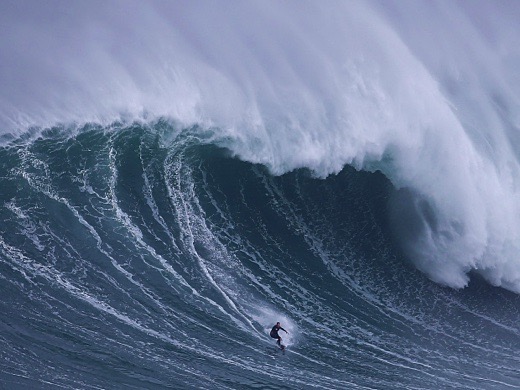
Image above: German surfer Sebastian Steudtner drops down the face of a gargantuan wave at Praia do Norte, in Nazare, Portugal, on Nov. 1, 2015. The beach at the tiny fishing village has become a famous big wave surf spot ever since Hawaiian surfer Garrett McNamara set a world record there in 2011. Photo by Rafael Marchante. From (http://www.cbc.ca/news/world/photos/monster-waves-attract-daring-surfers-to-portugal-1.3301909).

I took up surfing in my early 30s.

It didn’t last long. But I learned a tremendous amount from the experience (least of which is that I suck at surfing).

Well, it’s time to think like a surfer... Your sole focus is to catch the wave.

The best surfers can see the waves building, just like we can in the markets, but they only care about where the biggest, best waves will crash. That’s where you get the ride.

And if you catch the biggest wave in the right place, you get the ride of a lifetime.

Look at this fourth and largest wave building in the stock market. It’s the wave of a lifetime for investors, and it’s rolling onto our shores right about now…

Remember, all the action comes when the wave crashes, not as it’s building.

As the swell grows around you, you can go with the flow and harness the energy of the wave with little effort. That’s when you become one with the universe, sitting there on your board, surrounded by dark water, rolling up and down as the power builds beneath you. That’s why surfers get addicted.

Then, at the perfect moment, all the wave’s pent up energy releases in a roaring spray of water and power.

That’s where we want YOU to be when the greatest market wave of your lifetime comes crashing to shore!

That’s when the greatest profits come.

That’s when the greatest innovations spring up.

The smartest people (I include surfers in this group) and the greatest innovators understand this. They don’t look at a good economy as the best opportunity for success. Seeds of radical innovation only grow in the most challenging conditions.

That’s why the best traders are most often short sellers rather than long buyers… just ask Paul Tudor Jones or George Soros.

That’s why people who are prepared for the crash make out like bandits in the aftermath.

While writing my latest best seller, The Sale of a Lifetime, I created a bubble model for stocks. It follows the Masters and Johnson male orgasm study of the late 1950s.

Bubbles build exponentially and then burst twice as fast, deflating back to their point of origin (or close).

Exactly like the ocean waves that surfers spend their lives hunting for. And precisely what smart investors spend their lives waiting for!

Central Banks have extended this wave beyond all expectations, but it’s now showing signs of peaking. It looks like it’s getting ready for that big crashing later this year.

You can either paddle out past where this massive 40-foot wave (at least you’ll be safe)…

Or you can ride it all the way down and create extreme wealth.

This is one of those defining moments.

The choice is entirely yours.

But know that our best investment services are designed to not only to profit from the upside (as the swell builds), but to also rake it in during the downside, when it comes crashing down like Holy Hell!


.

The Bag Holder and the Bag

SUBHEAD: The Fed may be eager to send Trump on the road to perdition with shit sandwiches and a hair shirt.

By James Kunstler on 10 March 2017 for Kunstler.com -
(http://kunstler.com/clusterfuck-nation/bag-holder-bag/)


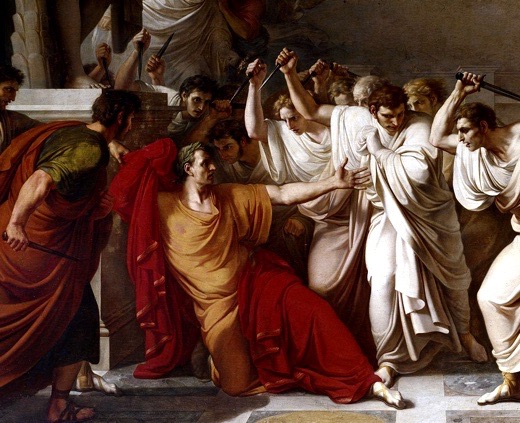
Image above: Detail of he 1798 painting "The Assassination of Julius Caesar" by Vincenzo Camuccini". Beware the Ides of March" is a quote from Shakespeare's 1601 play "Julius Caesar" spoken by the soothsayer's to Caesar, warning of his death.  From (http://www.vox.com/2015/3/15/8214921/ides-of-march-caesar-assassination).

Can you see those swans coming in for a landing on Pond USA? They’re not exactly black swans, because you knew they were out there circling, but they’re dark enough against the twilight’s last gleaming to give you the heebie jeebies.

Troubles and portents of more trouble are stacking up as we approach the Ides of March zone of financial turmoil.

You must surely surmise that a debt ceiling impact, a Federal Reserve interest rate hike, and the election of a Dutch anti-EU leader all scheduled for that one day are a good start on the greater unravel to follow.

Glowering in the spotlight at center stage will be President Donald Trump, designated bag-holder of the Deep State and its myrmidons. And what’s in that bag he’s holding?

Just a couple of shit sandwiches and a hair shirt for his journey down the lonely road to exile. But getting rid of Trump would only leave the Deep State with a bigger problem: itself. That is, an economy and a society that can’t be governed by any means.

I think many professional observers-of-the-scene are missing something in this unspooling story: the Deep State is actually becoming more impotent and ineffectual, not omnipotent. Case in point:

RussiaGate — come on, let’s finally call it that — the popular idea that Russia hacked the 2016 presidential election. It’s popular because it’s such a convenient excuse for the failure of a corrupt, exhausted, and brain-dead Democratic establishment.

But all the exertions of the Deep State to put over this story since last summer were negated this week by two events.

First, there was former NSA Director James Clapper’s appearance on NBC’s Sunday Meet the Press show with Chuck Todd featuring the following interchange:
CHUCK TODD:
Does intelligence exist that can definitively answer the following question, whether there were improper contacts between the Trump campaign and Russian officials?
JAMES CLAPPER:
We did not include any evidence in our report, and I say, “our,” that’s N.S.A., F.B.I. and C.I.A., with my office, the Director of National Intelligence, that had anything, that had any reflection of collusion between members of the Trump campaign and the Russians. There was no evidence of that included in our report.
CHUCK TODD:
I understand that. But does it exist?
JAMES CLAPPER:
Not to my knowledge.
And so what to make of the RussiaGate histrionics served up by CNN, The New York Times, the WashPo, NPR, and sundry tools as Senator Chuck Schumer (D–NY)? What I make of it is a growing civil war in the government itself, and perhaps something arguably like sedition.

Second matter: this week’s release of Wikileaks’ Vault-7 trove of purloined government documents.

These seem to suggest that US Intel agencies have acquired the ability to spoof any activity on any sort of computer or program that makes it impossible to track the identity of any hacker and, what’s more, gives US Intel a tool to make any party appear culpable for any given case of hacking — meaning that if so called computer hacking “footprints” had been discovered linking Russia to the Hillary-DNC-Podesta emails, those footprints could have been engineered by US Intel itself… meaning further that any so-called “evidence” of Russian election hacking could not be proven one way or the other.

Now, this might be too fine a point for the RussiaGate partisans, but I don’t see how it fails to moot the issue. The partisans are still finding other ways to propagandize. On Thursday evening, NPR ran a story about Russia breaking a missile agreement with this wrap-up from correspondent David Welna:
WELNA: Still unclear is how President Trump, an admirer of Russian President Vladimir Putin, might respond to Moscow’s defiance. David Welna, NPR News, Washington.
That lapse of newsmanship is the kind of thing that makes me (a still-registered Democrat) want to support the defunding of NPR.

All this hugger-mugger may be further mooted by the financial disorders of Spring 2017. Don’t underestimate the Federal Reserve’s eagerness in sending Trump on the road to political perdition with his shit sandwiches and hair shirt.

The Fed’s board of governors knows full well that their interest rate hike could sink even the carefully fabricated Potemkin appearance of a healthy economy.

It would also create more dire debt-servicing problems for the US Treasury when and if the debt ceiling problem ever gets resolved. They’re holding a hand grenade in the old USA bunker and they’re getting ready to pull the pin. Just watch.

See also:
Ea O Ka Aina: Making the internet safe for anarchy 5/1/12


.

Trump's debt crisis nears

SUBHEAD: Reagan's budget director says American economic debt meltdown will begin this month. 

By Tyler Durden on 1 March 2017 for Zero Hedge  -
(http://www.zerohedge.com/news/2017-03-01/stockman-trump-will-create-debt-crisis-never)


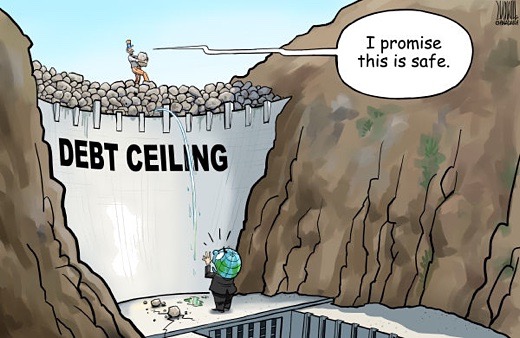
Image above: Cartoon of America again raising its budgetary debt  ceiling. From (http://www.voalearningenglish.net/economic-report-us-debt-ceiling-means/).

Having warned that "everything will grind to a halt on March 5th" due to the under-appreciated debt-ceiling debacle that looms over Washington, and exclaiming that "what is going on today is complete insanity," former Reagan Budget Director David Stockman is rapidly losing faith that anything can be done...
"I've thrown in the towel because he’s not paying attention and he’s not learning anything and he’s making ridiculous statements."
Reflecting on Trump's address to Congress, and what we know of The White House agenda, Stockman told Fox Business' Neil Cavuto:
"We don’t need a $54 billion increase in defense when the budget already is ten times bigger than that of Russia. We don’t need $6 trillion of defense spending over the next decade because China is going nowhere except trying to keep their Ponzi scheme together."
Stockman rejected Trump's dynamic scoring hope...
"Trump is so deep in fiscal la-la-land, he won't even find the wrong envelope... he is saying crazy things."
And wasn’t sold on Speaker Ryan’s Obamacare plan.
“If you look at the Ryan draft that came out over the weekend, it’s basically Obamacare-like. It’s not really repealing anything,” he said.


“It’s basically reneging and turning the Medicaid expansion into a block grant, turning the exchanges into tax credits [and] it’s still going to cost trillions of dollars.”
Last week, Trump’s Treasury Secretary Steven Mnuchin, told FOX Business the administration is “focused on an aggressive timeline” to produce a tax reform plan by August Opens a New Window, but in Stockman’s opinion, tax reform won’t happen this year.
“I think what people are missing is this date, March 15th 2017.  That’s the day that this debt ceiling holiday that Obama and Boehner put together right before the last election in October of 2015.  That holiday expires.  The debt ceiling will freeze in at $20 trillion.  It will then be law.  It will be a hard stop. 

The Treasury will have roughly $200 billion in cash.  We are burning cash at a $75 billion a month rate.  By summer, they will be out of cash.  Then we will be in the mother of all debt ceiling crises.  Everything will grind to a halt.  I think we will have a government shutdown. 

There will not be Obama Care repeal and replace.  There will be no tax cut.  There will be no infrastructure stimulus.  There will be just one giant fiscal bloodbath over a debt ceiling that has to be increased and no one wants to vote for.”
Stockman also predicts very positive price moves for gold and silver as a result of the coming budget calamity.

.

End of century global debt cycle

SUBHEAD: Central banks global debt has been rising for generations. A crash is overdue.

By Michael Synider on 27 February 2017 for EconomicCollapseBlog
(http://theeconomiccollapseblog.com/archives/march-2017-the-end-of-a-100-year-global-debt-super-cycle-is-way-overdue)


Image above: European Central Bank sign behind a wall of flames. From (http://learningenglish.voanews.com/a/eu-central-bank-moves-to-help-ecomony/3229756.html).

For more than 100 years global debt levels have been rising, and now we are potentially facing the greatest debt crisis in all of human history.  Never before have we seen such a level of debt saturation all over the planet, and pretty much everyone understands that this is going to end very, very badly at some point.

The only real question is when it will happen.  Many believe that the current global debt super cycle began when the Federal Reserve was established in 1913.

Central banks are designed to create debt, and since 1913 the U.S. national debt has gotten more than 6800 times larger.  But of course it is not just the United States that is in this sort of predicament.  At this point more than 99 percent of the population of the entire planet lives in a nation that has a debt-creating central bank, and as a result the whole world is drowning in debt.

When people tell me that things are going to “get better” in 2017 and beyond, I find it difficult not to roll my eyes.  The truth is that the only way we can even continue to maintain our current ridiculously high debt-fueled standard of living is to grow debt at a much faster pace than the economy is growing.

We may be able to do that for a brief period of time, but giant financial bubbles like this always end and we will not be any exception.

Barack Obama and his team understood what was happening, and they were able to keep us out of a horrifying economic depression by stealing more than nine trillion dollars from future generations of Americans and pumping that money into the U.S. economy. 

As a result, the federal government is now 20 trillion dollars in debt, and that means that the eventual crash is going to be far, far worse than it would have been if we would have lived within our means all this time.

Corporations and households have been going into absolutely enormous amounts of debt as well.  Corporate debt has approximately doubled since the last financial crisis, and U.S. consumers are now more than 12 trillion dollars in debt.

When you add all forms of debt together, America’s debt to GDP ratio is now about 352 percent.  I think that the following illustration does a pretty good job of showing how absolutely insane that is…
If your brother earns $100,000 in annual income and borrowed $10,000 on his credit card, he could consume $110,000 worth of stuff.  In this example, his debt to his personal GDP is just 10%.  But what if he could get more credit year after year and reached a point where his total debt reached $352,000 but his income remained the same.  His personal debt-to-GDP ratio would now be 352%.

If he could borrow at super low interest rates, maybe he could sustain the monthly loan payments. Maybe?  But how much more could he possibly borrow?  What lender would lend him more?  And what if those low rates began to rise?  How much debt can his $100,000 income cover?  Essentially, he has reached the end of his own debt cycle.
The United States is certainly not alone in this regard.  When you look all over the industrialized world, you see similar triple digit debt to GDP figures

When this current debt super cycle ultimately ends, it is going to create economic pain on a scale that will be unlike anything that we have ever seen before.  The following comes from King World News…
That is the inevitable consequence of 100 years of credit expansion from virtually nothing to $250 trillion, plus global unfunded liabilities of roughly $500 trillion, plus derivatives of $1.5 quadrillion. This is a staggering total of $2.25 quadrillion. Therefore, the question is not what could go wrong since it is guaranteed that all these liabilities will implode at some point.

And when they do, it will bring misery to the world of a magnitude that no one could ever imagine. It is of course very difficult to forecast the end of a major cycle. As this is unlikely to be a mere 100-year cycle but possibly a 2000-year cycle. It is also impossible to forecast how long the decline will take.

Will it be gradual like the Dark Ages, which took 500 years after the fall of the Roman Empire? Or will the fall be much faster this time due to the implosion of the biggest credit bubble in world history? The latter is more likely, especially since the bubble will become a lot bigger before it implodes.
And there are certainly lots of signs that a global slowdown is already beginning.  For example, global trade growth has fallen below 2 percent for only the third time since the year 2000.  On each of the other occasions, we witnessed a horrible recession take place.

For more signs that economic conditions are deteriorating, please see my previous article entitled “Recession 2017? Things Are Happening That Usually Never Happen Unless A New Recession Is Beginning“.

Of course much of the globe is already in the midst of a horrible economic crisis.  Brazil is in the middle of their worst recession ever, and people are literally starving in Venezuela.  A new round of debt problems has erupted in Europe, with Greece, Portugal and Italy being the latest flashpoints.

Just like in 2007, many are mocking the idea that the a major economic downturn is coming to the United States.  They believe that the ridiculously high stock market valuations of today can stick around indefinitely, and they are putting their faith in politicians.

But it won’t be too long before a new economic crisis begins in America and the kind of civil unrest that I portray in “The Beginning Of The End” erupts all across the country.

I just don’t understand why more people cannot see this.  Government debt, corporate debt and consumer debt have all been growing much, much faster than the overall economy.  Can someone please explain to me how that could possibly be sustainable in the long-term?

Someone that I considered to be a mentor but that has since passed away once said that things would seem like they would be getting better for a little while before the next crash comes.

And it turned out that he was precisely correct.  We are in a season of time when economic conditions have appeared to be getting a little bit better in the United States, and this has blinded so many people to the truth of what is about to happen to us.

.

Too little Growth to grow

SUBHEAD: “Real GDP growth fell and leveled off in the mid-1970s, then started falling again in the mid-2000s”.

By Raul Ilargi Meijer on 18 February 2017 for the Automatic Earth -
(https://www.theautomaticearth.com/2017/02/not-nearly-enough-growth-to-keep-growing/)


Image above: Mashup of canoe paddling team dragging a water skier. No matter how hard they paddle it is too little energy to get the job done, or not enough ERoEI. Mashup by Juan Wilson.

It’s amusing to see how views start to converge, at the same time that it’s tiresome to see how long that takes. It’s a good thing that more and more people ‘discover’ how and why austerity, especially in Europe, is such a losing and damaging strategy. It’s just a shame that this happens only after the horses have left the barn and the cows have come home, been fed, bathed, put on lipstick and gone back out to pasture again. Along the same lines, it’s beneficial that the recognition that for a long time economic growth has not been what ‘we’ think it should be, is spreading.

But we lost so much time that we could have used to adapt to the consequences. The stronger parties in all this, the governments, companies, richer individuals, may be wrong, but they have no reason to correct their wrongs: the system appears to work fine for them. They actually make good money because all corrections, all policies and all efforts to hide the negative effects of the gross ‘mistakes’, honest or not, made in economic and political circles are geared towards making them ‘whole’.

The faith in the absurd notion of trickle down ‘economics’ allows them to siphon off future resources from the lower rungs of society, towards themselves in the present. It will take a while for the lower rungs to figure this out.

The St. Louis Fed laid it out so clearly this week that I wrote to Nicole saying ‘We’ve been vindicated by the Fed itself.’ That is, the Automatic Earth has said for many years that the peak of our wealth was sometime in the 1970’s or even late 1960’s.

Intriguing questions: was America at its richest right before or right after Nixon took the country off the gold standard in 1971? And whichever of the two one would argue for, why did he do it smack in the middle of peak wealth? Did he cause the downfall or was it already happening?

As per the St. Louis Fed report: “Real GDP growth fell and leveled off in the mid-1970s, then started falling again in the mid-2000s”.

What happened during that 30-year period was that we started printing and borrowing with abandon, making both those activities much easier while we did, until the debt load overwhelmed even our widest fantasies ten years ago. And we’ve never recovered from that, if that was not obvious yet. Nor will we.

As the first graph below shows, there was still growth post-Gold Standard but the rate of growth fell and then “leveled off”, only to fall more after, to a point where Real GDP per Capita is presently 0.5% or so -little more than a margin error-. How one would want to combine that with talk of an economic recovery is hard to see. In fact, such talk should be under serious scrutiny by now.

Still, the numbers remain positive, you say. Yes, that’s true. But there’s a caveat, roughly similar to the one regarding energy and the return on it. Where we used to pump oil and get 100 times the energy in return that we needed to pump it, that ratio (EROEI) is now down to 10:1 or less.

Alternative energy sources do little better, if at all. Whereas to run a complex society, let alone one like ours that must become more complex as we go along – or die-, we would need somewhere along the lines of a 20:1 to even 30:1 EROEI rate.

Another place where a similar caveat can be found is the amount of dollars it takes to produce a dollar of real growth. That amount has been increasing, and fast, to the point where it takes over $10 to create $1 or growth in the US and Europe, and China too moves towards such numbers.

Both our energy systems and our financial systems are examples of what happens when what we should perhaps call the rate of ‘productivity’ (rather than growth) falls below a critical mass: it becomes impossible to maintain, even keep alive, a society as complex as ours, which requires an increase in complexity to survive.

In other words: a Real GDP per Capita growth rate of 0.5% is not enough to stand still, just like oil EROEI of 5:1 is not; there is growth, but not -nearly- enough to keep growing.

One does not get the impression that the St. Louis Fed economists who wrote the report are aware of this -though the title is suggestive enough-, they seem to lean towards the eternal desire for a recovery, but they did write it nonetheless. Do note the sharp drop that coincides with the 1973 oil crisis. We never ‘recovered’.

The U.S. economy expanded by 1.6% in 2016, as measured by real GDP. Real GDP has averaged 2.1% growth per year since the end of the last recession, which is significantly smaller than the average over the postwar period (about 3% per year). These lower growth rates could in part be explained by a slowdown in productivity growth and a decline in factor utilization. However, demographic factors and attitudes toward the labor market may also have played significant roles.
Long-run growth rates were high until the mid-1970s. Then, they quickly declined and leveled off at around 3% per year for the following three decades. In the second half of the 2000s, around the last recession, growth contracted again sharply and has been declining ever since. The 10-year average growth rate as of the fourth quarter of 2016 was only 1.3% per year. Total output grows because the economy is more productive and capital is accumulated, but also because the population increases over time.
The same dynamics (or lack thereof) are reflected in a recent piece by Chris Hamilton, in which he argues that global growth -as expressed by growth in energy consumption- has largely been non-existent for years, other than in China. Moreover, China has added a stunning amount of debt to achieve that growth, and since its population growth is about to stagnate -and then turn negative-, this was pretty much all she wrote.

Since 2000, China has been the nearly singular force for growth in global energy consumption and economic activity. However, this article will make it plain and simple why China is exiting the spotlight and unfortunately, for global economic growth, there is no one else to take center stage.
China’s core population is essentially peaking this year and beginning a decades long decline (not unlike the world. The chart below shows total Chinese core population peaking, energy consumption stalling, and debt skyrocketing.
• China of 1985-2000 grew on population and demographic trends.
• China of 2000-2015 grew despite decelerating population growth but on accelerating debt growth…this growth in China kept global growth alive.
• China of 2015-2030 will not grow, will not drive the global economy and absent

Chinese growth…the world economy is set to begin an indefinite period of secular contraction. China ceased accumulating US Treasury debt as of July of 2011 and continues to sell while busy accumulating gold since 2011.

Unfortunately, neither quasi-democracies nor quasi-communist states have any politically acceptable solutions to this problem of structural decelerating growth and eventual outright contraction…but that won’t keep them from meddling to stall the inevitable global restructuring.
I can only hope that these data will convince more people that all the times I’ve said that growth is over, it was true. And perhaps even make them think about what follows from there: that when growth is gone, so is all centralization, including globalization, other than by force. This will change the world a lot, and unfortunately not always in peaceful ways.

What seems to have started (but was in the air long before) with Brexit and Trump, is merely a first indication of what’s to come.

People will not accept that important decisions that affect them directly are taken by anonymous ‘actors’ somewhere far away, unless this promises and delivers them very concrete and tangible benefits. In fact, many have lost all faith in the whole idea, and that’s why we have Trump and Brexit in the first place.

This turn inward -protectionism if you will-, in the UK, US and many other places, is an inevitable development that follows from declining growth and soaring debt. Entire societies will have to be re-built from the ground up, and people will want to do that themselves, not have it dictated by strangers.

At the same time, of course, those who profit most from centralization want that to continue. They can’t, but they will try, and hard.

Equally important, people who wish to try and save existing ‘central institutions’ for less selfish and more peaceful reasons should think twice, because they will fail too. It’s centralization itself that is failing, and the demise of the structures that represent it is but a consequence of that.

We will see local structures being built, and only after that possibly -and hopefully- connect to each other. This is a big change, and therefore a big challenge.

.

What's going on is insane!

SUBHEAD: David Stockman says we're facing a fiscal bloodbath and a Trump historic train wreck.

By Tyler Durden on 14 February 2017 for Zero Hedge -
(http://www.zerohedge.com/news/2017-02-13/stockman-whats-going-today-complete-insanity)


Image above: Donald Trump's hair out of control reflecting what's going on in his mind. From (http://thegreatamericandisconnect.blogspot.com/2016/06/the-donald-trump-campaign-for-president.html).

In his recent TV appearance, last week David Stockman suggested that President Trump would be better suited to spend some time actually addressing economic issues instead of the administration's travel ban for immigrants from Middle Eastern countries, which Stockman called "a giant misfire."

Employing the 1992 Clinton Campaign motto of "it's the economy, stupid," Stockman noted "Trump was elected because flyover America is hurting economically.

The voters of Racine, Wisconsin and Johnstown, Pennsylvania are imperiled not because of some refugees, they're imperiled because their jobs have all been disappearing for decades." He added, correctly, that "the problem is far more the Federal Reserve, Janet Yellen, the bubbles they're creating on Wall Street."

Stockman went on to suggest that the Trump Administration is showing decreased interest in "draining the swamp", having surrounded himself with, as he himself has now realized, the "Goldman Guys."

Then, in a follow up interview with CNBC, Stockman once again discussed the impact of Trump, this time on markets, and warned that while stocks are booming under Trump, with the S&P now up 12%  since the election (with banks up 25% and Goldman 35% higher), traders are living in a "fantasy land" that can't last —and Trump's policies will derail the market for years to come.

Stockman reiterated his concern that Trump has lost his focus on the economy, and has become distracted by other issues which should be a particular point of worry for investors.

Most of Trump's actions "[have] nothing to do with the economic agenda" he's proposed, Stockman told CNBC. 

That, along with a debt ceiling debate that will take place on March 15 in Congress, and a market rally that has gone on for a while, has the bearish Stockman worrying about a big downturn, which however not only refuses not to come, but the S&P hasn't had a 1% drop in 85 days.

 "What's going on today is complete insanity," said Stockman. "The market is apparently pricing in a huge Trump stimulus. But if you just look at the real world out there, the only thing that's going to happen is a fiscal bloodbath and a White House train wreck like never before in U.S. history."

He added that "there's going to be no tax action this year," said Stockman, echoing repeated concerns by Goldman who have said, mostly recently this morning, that Trump's plans for the economy are facing mounting political risks.

Last week, the president vowed that tax reform could happen this year, and promised to unveil a "phenomenal" tax plan within the next few weeks, which however has drawn skepticism from Washington insiders.

"If there's any next year it will be deficit neutral, which means it's not going to add the $15 to earnings like these people expect," Stockman said. In fact, as reported earlier, with the Border Adjustment Tax becoming a virtual impossibility, the extent of corporate tax cuts will likely be far less than what the market is pricing in currently.

"My argument is there is not going to be any economic rebound, there is not going to be any profit surge," Stockman added. "Therefore the market will be repricing dramatically downward once it's clear that that's the case."

For now, the market blissfully refuses to listen. In a prior appearance on CNBC in November, Stockman argued that a recession was coming in 2017 thanks to Trump.

For now it is Stockman's word of caution against that of Gartman, who earlier today predicted that because "Illogic reigns" the market “melt Up” has begun in earnest and it will stop when it stops and not a moment before."

Needless to say, everyone would like to know when that "moment" is.

.