Showing posts with label Pollution. Show all posts

Not a Cause but a Trigger

SUBHEAD: This corona virus pandemic may cause civilization to collapse for good reasons.

By Ugo Bardi on 16 April 2020 for Cassandra's Legacy -
(https://cassandralegacy.blogspot.com/2020/04/collapse-coronavirus-is-not-cause-it-is.html)


Image above: Illustration by Steven Castelluccia of economic collapse caused by pandemic a peak consumption. From original article.

Do you remember the story of the straw that broke the camel’s back? It is an illustration of how overloaded systems are sensitive to small perturbations. Could the COVID-19 epidemic be the straw that breaks the back of the world’s economy?

Like an overloaded camel, the world’s economy is strained by at least two tremendous burdens: one is the increasing costs of production of mineral resources (don’t be fooled by the current low prices of oil: prices are one thing, costs are another). Then, there is pollution, including climate change, also weighing on the economy.

These two factors define the condition called “overshoot,” occurring when an economic system is consuming more resources than nature can replace. Sooner or later, an economy in overshoot has to come to terms with reality. It means that it can’t continue to grow: it must decline.

These considerations can be quantified. It was done for the first time in 1972 with the famous report The Limits to Growth sponsored by the Club of Rome. Widely disbelieved at the time, today we recognize that the model used for the study had correctly identified the trends of the world’s economy.

The results of the study showed that the double burden of resource depletion and pollution would bring economic growth first to a halt and then cause it to collapse, probably at some moment during the first decades of the 21st century.

Even with very optimistic assumptions on the availability of natural resources and of new technologies the calculations show that the collapse could at best be postponed, but not avoided.

Many later studies confirmed these results: collapse turns out to be a typical feature of systems in overshoot, a phenomenon called sometimes the “Seneca Cliff” from a sentence of the ancient Roman philosopher Lucius Annaeus Seneca.
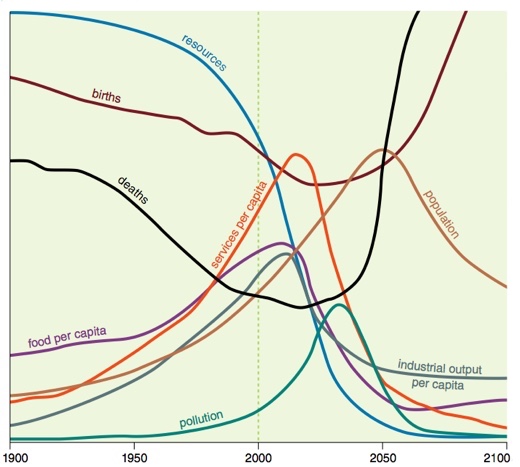


Image above: Chart of the projections by the Club of Rome in March 1972 showing the projected " Limits to Growth". Note now in 2020 we have recently passed maximum food production and industrial output per person and are approaching maximum pollution as we slide down the steepest losses of resources. From (https://damnthematrix.wordpress.com/2012/04/11/so-much-for-debunking-the-club-of-rome/)

The coronavirus, in itself, is a minor perturbation, but the system is poised for collapse and the epidemics may trigger it. We already saw how the world’s economy is fragile: it nearly collapsed in 2008 under the relatively small perturbation of the crash of the subprime mortgage market.

At that time, it was possible to contain the damage but, today, the fragility of the system has not improved and the coronavirus may be a stronger perturbation.

The collapse of entire sectors of the economy, such as the tourism industry (more than 10% of the world’s gross product), is already ongoing and it may be impossible to stop it from spreading to other sectors.

So, what exactly is it going to happen to us? Since we started with mentioning a camel, we may also mention a famous statement by Shaykh Rāshid that we can summarize as, "My father rode a camel, I drive a Mercedes, my son will ride a camel." Might that sentence have been truly prophetic?

Indeed, the coming crisis might turn out to be so bad to push us back to the Middle Ages. But it is also true that all major epidemics in history have seen a robust rebound after the collapse.

Consider that, in the mid-14th century, the “black death” killed perhaps 40% of the population of Europe but, a century later, Europeans were discovering America and starting their attempt of conquering the world. It may be that the black death was instrumental in this rebound: the temporary reduction of the European population had freed the resources necessary for a new leap forward.

Could we see a similar rebound of our society in the future? Why not? After all, the coronavirus could be doing us a favor by forcing us to abandon the obsolete and polluting fossil fuels we use today. The current low market prices are the result of the contraction of the demand and are likely to be the straw that breaks the back of the oil industry. That will leave space for new and more efficient technologies.

Today, solar energy has become so cheap that it is possible to think of a society fully based on renewable energy. It won’t be easy, but recent studies show that it can be done.

That doesn’t mean that the near term collapse can be avoided. The transition to a new energy infrastructure will require enormous investments, impossible to find in a moment of economic contraction we expect for the near future.

But, in the long run, the transition is unavoidable and there is hope for a "Seneca rebound" toward a new society based on clean and renewable energy, no more plagued by the threats of depletion and climate change.

It will take time, but we can heal the poor camel’s back.

.
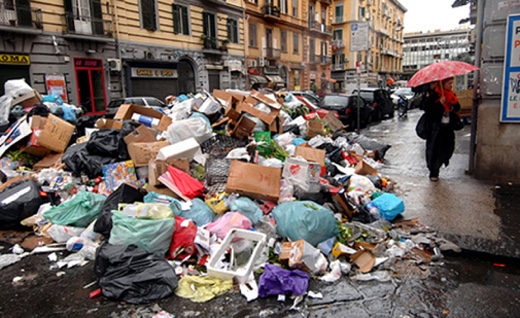
Weird Days

SUBHEAD: A list of some of the odd experiences of disasters in my lifetime.

By Juan Wilson on 15 April 2020 for Island Breath -
(https://islandbreath.blogspot.com/2020/04/weird-days.html)


Image above: Photo of garbage piled into street in Manhattan, NY, during 1968 garbage strike. From (https://accesscities.org/nycrfei-pilot-for-public-realm-refuse-and-recyclingsolutionsrequest-for-expressionsof-interest-rfei/).

These are weird days and they seem to be leading to a major reset of life on Earth. The lists below are calamities I have lived through or witnessed through media in my lifetime.

Personally Experienced
Cuban Missile Crisis 1962 (We thought World War 3 was at hand)
(https://en.wikipedia.org/wiki/Cuban_Missile_Crisis)

North East Blackout 1965 (lived in Boston. People thought WW3 had begun)
(https://en.wikipedia.org/wiki/Northeast_blackout_of_1965)

NYC Garbage Strike 1968 (Lived in Lower East side. Garbage up past windows slid into streets)
(https://untappedcities.com/2015/02/11/today-in-nyc-history-the-great-garbage-strike-of-1968/)

OPEC Oil Embargo 1973 (A few people were shot to death for jumping long lines at gas stations)
(https://en.wikipedia.org/wiki/1973_oil_crisis)

Iran US Embassy Crisis 1979 (I lived in Iran 1975-76 and saw what preceded revolution)
(https://en.wikipedia.org/wiki/Iran_hostage_crisis)

Witnessed Through Mass Media
Exxon Valdis Oil Spill 1989 (Effects included the deaths as many as 250,000 seabirds)
(https://en.wikipedia.org/wiki/Exxon_Valdez_oil_spill)

Bangladesh Cyclone 1991 (over 135,000 people killed) 
(https://en.wikipedia.org/wiki/1991_Bangladesh_cyclone)

World Trade Center Attack 2001 (over 2,700 people killed)
(https://en.wikipedia.org/wiki/September_11_attacks)

Tohoku Earthquake & Tsunami 2011 (over 15,000 people killed)
(https://en.wikipedia.org/wiki/2011_Tōhoku_earthquake_and_tsunami)

When you look at the numbers of fatalities the World Trade Center collapse was not nearly as lethal as the other disasters listed above. But maybe it was so traumatic for Americans because it was a disaster created by humans intentionally and involved a symbol of American prowess. It was also witnessed live in the streets of New York and by millions on television.

Simultaneously Experiencing
Corona Virus Pandemic 2020 & Worldwide Economic Collapse 2020

These current disasters are interrelated and will transform the world in ways that will be in Nature's interest and ultimately our human interest. It's past time for a reset.


.

War on the World

SUBHEAD: Industrialized militaries are a bigger part of the climate emergency than you know.

By Mutaza Hussain for The Intercept on 15 September 2019 -
(https://theintercept.com/2019/09/15/climate-change-us-military-war/)


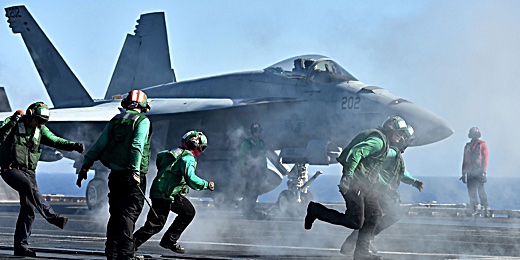
Image above: USN sailors get ready around an F/A-18E Super Hornet on the carrier USS Dwight D. Eisenhower in the Mediterranean Sea on July 6, 2016. Photo by Alberto Pizzoli. From original article).

Over a century before we reached the brink of ecological catastrophe, Rabindranath Tagore had a glimpse of where we might be headed. Tagore, an Indian author and cultural reformer who lived during the period of British colonialism, was among the last of a generation able to examine the industrialized world from the outside.

 He issued one of the earliest and most eloquent warnings about the precarity of a world sustained, like ours today, on the twin pillars of industrial consumption and industrial warfare.

On a sea voyage to Japan in 1916, Tagore witnessed an unfathomable event that seems almost mundane to us today: an oil spill. To him, it was a jarring image of an earth destroyed by humanity’s unbridled pursuit of power, now supercharged by the tools of modern science.

“Before this political civilization came to its power and opened its hungry jaws wide enough to gulp down great continents of the earth,” Tagore wrote in “On Nationalism,” his 1917 book of essays, “we had wars, pillages, changes of monarchy and consequent miseries.

But never such a sight of fearful and hopeless voracity, such wholesale feeding of nation upon nation, such huge machines for turning great portions of the earth into mincemeat, never such terrible jealousies with all their ugly teeth and claws ready for tearing open each other’s vitals.”

The climate emergency we are tipping into today — the tearing open of our mutual vitals — is a product of our collective failure to adhere to limits. An economic system that demanded endless growth and endless consumption was always too much to ask from a planet whose resources are finite.

Yet, as Tagore recognized, the same avarice and contempt that led us to war against the earth would also lead to catastrophic, endless wars among peoples. At the time of his writing, World War I was underway. T

agore saw that conflict as the first of the modern wars that showed us the great power we had gained to destroy the natural world along with our fellow humans. The massive military industries created during that conflict pointed to an even more inhuman future that might be in store.

“The gigantic organizations for hurting others and warding off their blows, for making money by dragging others back, will not help us,” Tagore wrote. “On the contrary, by their crushing weight, their enormous cost, and their deadening effect upon the living humanity, they will seriously impede our freedom.”

Until his death in 1940, Tagore wrote about the dangers of militarism, race hatred, and a brutal type of industrial development that had begun to disfigure the natural world. The industrialization of warfare has now given us powers to destroy other human beings and the earth itself on a scale surpassing even Tagore’s warnings.

Even those whose lives have been dedicated to the project of American militarism have begun to recognize the destruction being wrought. In the era of climate crisis, the relationship between environmental destruction and the destruction of human life that Tagore decried in his writings has become perhaps the central issue of our time.

It may not come as a surprise that the largest industrial military in the history of the world is also the single biggest polluter on the planet. A recent study from Brown University’s Costs of War project surfaced this startling fact: The U.S. Department of Defense has a larger annual carbon footprint than most countries on earth.

With a sprawling network of bases and logistics networks, the U.S. military is the single biggest emitter of carbon dioxide in the world aside from whole nation-states themselves. “Indeed, the DOD is the world’s largest institutional user of petroleum and correspondingly, the single largest producer of greenhouse gases in the world,” the report notes.

If the Pentagon were a country, it would be the world’s 55th biggest emitter of carbon dioxide.

And its main purpose — warfare — is easily its most carbon-intensive activity. Since the present era of American conflicts began with the invasion of Afghanistan in 2001, the U.S. military is estimated to have emitted a staggering 1.2 billion tons of carbon into the atmosphere. For comparison, the entire annual carbon emissions of the United Kingdom is roughly 360 million tons.

That massive additional burden on the planet might be justifiable were it all being done in the name of vital national security interests, but the biggest components of the U.S. military’s carbon dioxide footprint have been in wars and occupations that were almost entirely unnecessary. To put it crudely: The U.S. poisoned the planet for vanity projects.

Take, for example, the occupation of Afghanistan, where after 18 years the United States may be close to cutting a peace deal with the Taliban. While the initial war was widely accepted as a necessary response to the September 11 attacks, the nearly two decades of fighting since then seem to have served no political purpose.

From an American perspective, a better peace deal could have been reached in 2001, when the Taliban had nearly disbanded in the face of an international military offensive. Instead of sensibly concluding a deal then and declaring Afghanistan a victory, the United States decided to embark on an endless war and occupation. The costs have been tremendous: The Taliban was revived from near-death, at least 110,000 people have been killed, and the environmental toll has been massive.

In addition to emitting millions of tons of carbon dioxide during the war, the U.S. military footprint contributed more directly to the immediate destruction of the Afghan environment.

Deforestation has accelerated amid the chaos of the war and, through trash burning and other means, the U.S. armed forces released toxic pollutants into the air that are blamed for sickening Afghan civilians and causing chronic illnesses among U.S. veterans.

The environmental havoc wreaked by the war in Iraq has been even worse. Not only did the war lead to a spike in carbon dioxide emissions through U.S. military activity, it resulted in the widespread poisoning of the Iraqi environment through the use of toxic munitions and the same so-called burn pits on military bases that were used in Afghanistan.

The environment has become so toxic in some places that it has led to elevated rates of cancer, as well as crippling birth defects — terrible individual punishments inflicted on innocent future generations.

A British doctor who co-authored two studies on the environmental impact of U.S. military operations in Fallujah said that the city’s population suffers “the highest rate of genetic damage in any population ever studied.”

Much of this impact can be blamed on the use of depleted uranium munitions by U.S. forces. Despite vowing to cease their use, a study by the independent monitoring group Airwars and Foreign Policy Magazine found that the military continued to use the toxic munitions during its most recent bombing campaign in Syria.

The fact that fossil fuel emissions have been the major driver of climate change adds another grim irony to these wars. For decades, the heavy U.S. military footprint in the Middle East has been justified by the need to preserve access to the region’s oil reserves. The industrial extraction of those same reserves has been one of the major drivers of global carbon dioxide emissions.

In other words, we have been killing, dying, and polluting to ensure our access to the same toxic resource most responsible for our climate disruption. It took this perfect symmetry between industrial warfare and industrial exploitation of the earth to bring about the unspeakable emergency we now face.

The phenomena of endless war and climate change have benefitted from another shared indulgence: public indifference. To be clear, it’s not that people don’t care. Before the Iraq War began, millions went into the streets in a last-ditch effort to prevent the invasion. There has been a vibrant environmental movement in the United States for decades.

Over time, however, the raging wars abroad and stories about distant ecological catastrophes have become background noise. Even today, as genuine disaster stares us in the face, neither subject is the primary focus of our media or political discourse.

Part of this seems to be based on who has suffered so far. Just as the terrible burdens of war have fallen mostly on foreign countries — as well as a small, volunteer military from the United States — the first stages of the climate crisis have mainly impacted distant places with brown-skinned populations like Brazil, Bangladesh, the Maldives, and the Bahamas.

As long as the crisis stays away from the mainland United States, even people who might be saddened by such news seem unwilling to treat it as an emergency.

Sooner or later, the emergency will come to our shores. This March, the level of atmospheric carbon dioxide reached a milestone 415 parts per million. To give a sense of what that means, the last time the atmosphere had that much carbon was 800,000 years ago. At that time, the South Pole was a temperate zone with forests growing and average global temperature was 3 to 4 degrees Celsius warmer than today.

Sea levels were 60 feet higher than present levels. Without a drastic push for net-negative emissions — stopping carbon dioxide emissions and reducing the amount of carbon already in the atmosphere — we are on the way to creating a planet like that. Instead, net global emissions are rising.

Ironically, given its own role in helping create this emergency, the Pentagon happens to be one of the few redoubts from the climate denialism now gripping the American government. “The only department in Washington that is clearly and completely seized with the idea that climate change is real is the Department of Defense,” Col. Lawrence Wilkerson, former chief of staff to Gen. Colin Powell, has said.

The U.S. military is preparing for a grim future of climate-caused political instability, food shortages, resource wars, and massive refugee flows. Recognizing the strategic threat posed by its own dependence on fossil fuel, it has even taken steps to diversify its energy sources.

Yet even these limited efforts have met pushback from the Trump administration. The Navy recently killed a task force created to study the effects of climate change, undermining a bare-minimum effort to forecast the impact of rising seas and melting ice caps.

In the words of the former rear admiral who led the Navy’s climate change efforts until 2015, “The task force ended, in my opinion, without full incorporation of climate change considerations.”

We intend to think of the 20th century as mainly one of material progress. It’s worth remembering that it was also an era that gave us bloodshed on a historically unprecedented scale. The power of modern science was finally wedded to the primordial dark side of human nature. The result was the most savagely violent period in human history.

The death tolls can scarcely be comprehended today, but World War II alone — with its industrial demonology of tanks, bomber planes, poison gas, and atomic weapons — killed over 70 million people. The war inflicted types of environmental harm never seen before.

The nuclear blasts at Hiroshima and Nagasaki gave us our first realistic glimpses of how civilization itself could end. We eventually staggered out of that catastrophe. We may now be walking into a far greater one.

The melting of the Arctic is not just creating an ecological emergency, but, in the eyes of American, Russian, and Chinese military commanders, it is also creating a potential new battleground. Faced with a planet that is clearly at the limits of the abuse it can take, the groundwork is still being laid for more exploitation and violence.

Rabindranath Tagore died at the outset of World War II, before it reached its terrible nuclear crescendo. Many decades earlier, he had already foreseen where unlimited greed, military expansion, and environmental contempt might lead the planet — unless we found a way to steer ourselves off the course.

More than a century later, his words sound nearly prophetic. There are finally stirrings of a real movement against the endless war and environmental nihilism that have brought us to this precipice. Tagore left no ambiguity about where we would find ourselves if we fail.

“If this persists indefinitely and armaments go on exaggerating themselves to unimaginable absurdities, and machines and storehouses envelop this fair earth with their dirt and smoke and ugliness,” Tagore warned, “then it will end in a conflagration of suicide.”


.

Living in a Shitstorm

SUBHEAD: Get over despair. The big problems won't be fixed. A planetary adjustment is at hand.

By Chris Jordan on 17 October 2018 for Huffington Post -
(https://www.huffingtonpost.com/entry/despair-environment-politics_us_5bc5d910e4b0a8f17ee5d240)


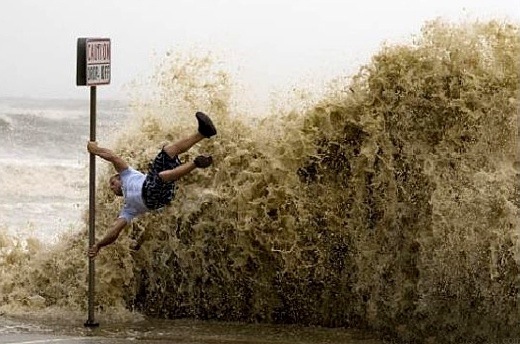
Image above: Man hanging onto "Caution" sign as braking storm wave breaks. From internet.

[IB Publisher's note: My advise to the author of this piece... Get over the despair. The big problems won't be fixed. A planetary adjustment is at hand. There is much work to be done by the survivors. Some places will be much safer than others. If you are not in one, find such a spot. Abandon your dependence on "The System" to a degree you never imagined (ditch the car,  the grid, discount retailing and the  information cloud as soon as possible. Hunker down with people you trust and can work or trade with. Entertain each other until the new dawn. P.S. This is the 7,000th post to this blog. Where does the time go?] 

Like all of you, I pay close daily attention to the increasingly grotesque environmental and political shitshow we are witnessing unfold before our astonished eyes. The question is how to respond.

I have never at the same time felt such a strong desire to make a positive difference and less empowered to do so.

In my own psyche, something has shifted on a foundational level.

Most conversations now, even among my wisest and most engaged friends, lead down familiar rabbit holes that end in shrugged shoulders, dumb jokes that mask disempowerment and worn out memes about “solutions” that are infinitesimal in proportion to the scale of the problems.

Ask young people what two words most characterize our future and the response is as instant as it is ubiquitous: “We’re fucked.”

The most relevant internet comment people seem to be able to muster is “vote,” which raises a whole separate conversation, but the crux for me is, “Of course ― and what else?” Politics is an increasing disaster that can be seen as both a cause and a symptom.

I try to step back to a meta-perspective in the hope of achieving a clearer-headed view, but the wide-angle picture becomes even more chaotic. The panopticon turns out to be a Halloween hall of mirrors.

And in this space I find myself steeped in the familiar feeling of dread that I had before going to Midway Island to photograph dead albatrosses whose stomachs are filled with plastic.

To take the next step forward, I know I must face something dark that lies inside of myself, but I can’t quite make out what it is ― something so taken for granted that I don’t see it, like the water we swim in, right in front of our nose but invisible.

Yet its presence is just strong enough to swing the needle of my internal compass in its direction.

The abyss I went to encounter on Midway was grief, which at the time I knew little about and thought was the scariest feeling there is to bear.

Now the form of a new monster emerges through the mist, a hundred times more frightening than grief, a lurking layer in the psyche that possesses the horrible power to drain individual and collective life force. It carries such strong cultural taboos that even naming it risks a kind of social suicide.

But I can no longer deny its residency in my consciousness, like a new roommate who showed up uninvited and now sleeps in my bed next to me and walks with me everywhere I go. I wonder if it accompanies you too. It is that state of mind we call despair.

On uttering the awful term, I realize I know barely anything about it. In my 14 years of individual and group therapy, I don’t recall any of the therapists or clients ever mentioning it, and I have rarely if ever read anything about it or heard discussion of it.

One thing I can observe about it right away is, in the same way I was grief averse, I am exponentially more despair averse. Admitting despair feels like surrendering the game for lost. An abhorrent kind of giving up seems to lie at its core.

At least grief expresses itself in the cathartic flow of tears, with the possibility of moving through to the other side.

Despair presents as an existential energy sink, like bleeding from an artery, a black hole that if approached pulls inescapably toward implosion and emotional collapse.

Acknowledging despair may amplify it, but denying it may feed it even more. The unconscious defense mechanism is avoidance:

Keep up a hopeful facade, say something positive, focus on trivia, talk about solutions, point to some small evidence of improvement somewhere, quote a self-help one-liner, any old cliche will do.

I wonder what it would mean to allow for some measure of despair as a natural response to the ever more fucked-up realities of our world.

Can despair be held and contained as a natural human experience alongside fear, anger, rage, grief, joy, beauty and love?

Or does it somehow diminish or cancel out everything else?

Perhaps there is something empowering and transformative that comes from standing in despair’s crucible.

Given we may create the very depression we fear by holding despair at bay, I want to know what happens if we take the risk of looking all the way into that darkness.

Let us consider the possibility that there may be value in exploring the territory of despair together, embracing it not as an exercise in negativity or capitulation but as a liberating doorway we can step through toward the healing of our relationship with each other and the world.

.

Kavanaugh to Earth - "Drop Dead!"

SUBHEAD: Supreme Court lets stand an anti-EPA decision written by then Judge Kavanaugh.

By Jay Michaelson on 10 October 2018 for The Daily Beast -
(https://www.thedailybeast.com/kavanaugh-and-supreme-court-to-planet-drop-dead)


Image above: Illustration of grumpy, bitter Burt O'Kavanaugh smelling coal burning smokestacks. From original article.

In the same week that the world’s scientists declared global climate disruption has reached a “point of no return”, the Supreme Court, Brett Kavanaugh, and the Trump administration all agreed to do nothing about it.

On Monday, the United Nations’ Intergovernmental Panel on Climate Change (IPCC) released a special report describing the effects of climate change that are already being felt today, and the disastrous effects that could come as soon as 2040 absent dramatic action.

Then on Tuesday, the Supreme Court, at the request of the Trump administration, dismissed an appeal of a D.C. Circuit decision that prevented the EPA from regulating a powerful greenhouse gas.

The author of that decision: Judge Kavanaugh.

For anyone waiting for the impact now-Justice Kavanaugh will have on the Supreme Court, you need wait no longer.

While Kavanaugh was not involved in the decision to dismiss this case, it is his opinion is now the law of the land — and is it a disaster for the environment.

David Doniger, who had argued the case for the Natural Resources Defense Council, said in a statement that “Coming only a day after the world’s leading climate scientists called for urgent action to curb dangerous carbon pollution, the court’s decision lets irresponsible companies continue harming our planet.”

The regulation in question dates back to the good old days when the EPA accepted the global consensus of climate scientists that manmade gas emissions are causing the earth’s atmosphere to trap more heat – a phenomenon that, among other things, enabled life on earth to develop 2.5 billion years ago, but which is now causing the Earth’s climate to warm at a breakneck pace unlike anything in the history of the planet.

Among the gases doing the most damage are hydrofluorocarbons.

While HFCs are helpful in preventing ozone loss (they replaced chlorofluorocarbons, which cause it), they are nasty greenhouse gases – nicknamed “super-pollutants” because each molecule causes around 14,000 times as much warming as a CO2 molecule. And they are ubiquitous, found in millions of household products from air conditioners to hairspray.

So, in 2015, the EPA effectively banned companies from using HFC in their products when alternatives were available. A consortium of industries sued – although since the leading HFC alternative is manufactured by Honeywell, Inc., it sided with environmentalists.

In August, 2017, the D.C. Circuit court struck down the regulation, in a 2-1 opinion written by Kavanaugh. The court held that while the relevant provision of the Clean Air Act gave the EPA authority to ban ozone-depleting chemicals, it could not ban the replacements for those chemicals, such as HFCs.

That suited the Trump-era EPA just fine; they were planning to roll back the HFC regulations, part of Obama’s Climate Action Plan, anyway.

And so while Honeywell and environmental groups appealed the decision to the Supreme Court, the EPA filed a memo arguing that since they weren’t going to regulate HFCs anyway, there would be no point in the Court taking the case.

The Court agreed today – which makes sense, really. There would be little point going through the effort of a Supreme Court briefing, argument, and decision process if, at the end of the day, the regulation is doomed anyway. So they dismissed the case.

The larger contexts, of course, are Kavanaugh and climate change.

Kavanaugh’s opinion in Mexichem Fluor vs. EPA is the perfect example of his view that agencies may not act without specific statutory authority.

That sounds like a neutral principle, but in practice, it would spell the end for a huge swath of environmental, health, safety, labor, financial, commercial, and other regulations.

Congress has neither the time nor the expertise to specify every consequence of every law it passes.

That’s why it delegates that level of decision-making to agencies, who have teams of experts (until the Trump administration, anyway) to work out the details.

In the case of HFCs, the EPA noted that it had the authority to replace ozone-depleting chemicals with “safe substitutes.” HFCs, it said, are unsafe, because they are climate change super-pollutants. But Judge Kavanaugh called this a “novel reading” of the statute and struck down the regulations.


.

Race to mine the Pacific Ocean

SUBHEAD: Rare valuable minerals to be strip-mined from ocean floor by drones will endanger environment.

By Jon Letman on 29 August 2018 for National Geographic -
(https://www.nationalgeographic.com/environment/2018/08/news-race-to-mine-deep-sea-drones-seafloor-environmental-impact/)


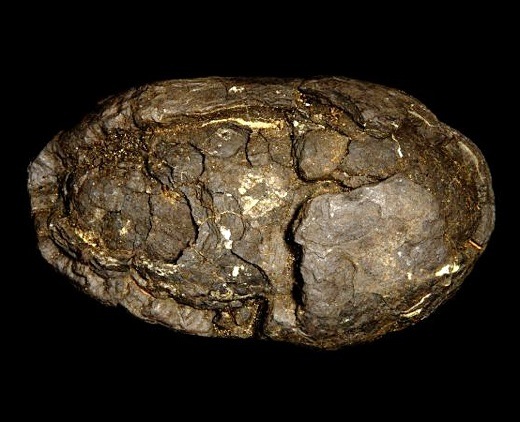
Image above: Polymetallic nodules like this one, made of layers of iron and manganese, sit on the deep seabed. Deep-sea mining companies are hunting for these nodules to use in the technology industry. From original article.

Closer than the moon, yet less well-mapped than Mars, the Earth’s seafloor is home to otherworldly creatures befitting a science fiction movie. Their remote habitat has caught the attention of humans, who are lining up to begin mining the bottom of the deep blue sea.

As technology and infrastructure drive the demand for minerals, and terrestrial resources grow harder to mine, the materials in the deep ocean are starting to look increasingly attractive to countries and companies.

“Deep-sea mining could end up having the largest footprint of any single human activity on the planet in terms of area of impact,” says University of Hawaii oceanographer Craig Smith.

It’s already underway: pioneer excavations in Papua New Guinea and Japan have taken advantage of advances in remotely operated vehicles, robotics, and communications technology to pioneer excavations. And companies like Lockheed Martin subsidiary UK Seabed Resources are eager to embark on a new deep-sea bonanza.

Over one million square miles of abyssal plain 12,000 to 18,000 feet deep is peppered with polymetallic nodules—vast fields of lumpy, black, potato-shaped mineral deposits.

Nodules range in size from a pea to a soccer ball and are rich in manganese, iron, copper, nickel, cobalt, and rare-earth elements, though they can take millions of years to grow a few millimeters.

The idea of mining these nodules, in part, led to the U.N. Convention on the Law of the Sea (UNCLOS) in 1982. It also resulted in the establishment of the International Seabed Authority (ISA) which oversees exploration claims in international waters.

Over half of those claims, some nearly 29,000 square miles in size, are in the Clarion-Clipperton Zone (CCZ), a region 75 percent as large as the continental United States that stretches some 3,000 miles across the equatorial eastern Pacific between Hawaii and Mexico. In total, the ISA recognizes 29 claims, although mining has yet to begin. Currently all activity in the CCZ is in the experimental or exploratory phase.

A reservoir for biodiversity


Craig Smith of the University of Hawaii recently led an expedition to study life on the seafloor in the western CCZ. “These are ecosystems that are counter-intuitive to us,” says Smith, describing an environment rich in biodiversity.

Smith explains that as many as half the animals living on top of nodules are related to the mineralogy. Mine those nodules, and you remove habitat for species before they’re even described.

Those creatures offer potential resources for pharmaceuticals and can provide new insights to how life begins. Smith calls them “the raw material for evolution.” But they evolved in waters as deep as 18,000 feet that are largely free of ocean currents or the light, vibration, and noise that would result from mining.

What’s more, mining will produce sediment plumes that may inhibit life on the seafloor and other habitats at varying depths.

“It’s recognized that this mining will inevitably impact very large areas of the seafloor,” Smith says, noting that modifying it could also have long-term impacts on how the ocean regulates the climate.

Carbon sequestration and the modulation of ocean acidity occur in the CCZ and elsewhere. Blanketing large areas of seafloor with sediment may affect the ocean’s ability to buffer against climate change.

“You can’t say that’s environmentally benign,” says Smith. “Society may decide it’s an acceptable impact given the tradeoffs, but it’s not benign.”

Smith argues that the time to establish protected areas and integrate them into deep-sea mining claim management is now. The seafloor, he notes, represents the largest ecosystems on the planet, adding, 
“It may be that Deep Sea Mining [DSM] can be done in a way that doesn’t cause species extinctions or major loss of ecosystem services, although we still don’t know enough to be able to say that.”
Others worry about the effects on humans. A UN resolution passed in the 1970s put deep-sea minerals in international waters outside the jurisdiction of any single country, limiting the power of countries—particularly island nations—that may see the most potent effects of pollution and marine debris.

“While the harmful effects of DSM on the marine environment are increasingly documented, far less attention is being paid to the potential effects of DSM on the human environment, specifically on the people living along the coast of Pacific Island nation-states,” says Julian Aguon, an environmental lawyer in Guam.

The unknown deep

Cindy Van Dover, a deep-sea biologist and professor at Duke University Marine Laboratory, and Daniel Dunn of Duke’s Marine Geospatial Ecology Lab are part of an international team that has developed guidelines to help the ISA establish a conservation strategy for deep-sea mining along the Atlantic Ridge and elsewhere.

Adopting a precautionary approach, they hope to see 30 to 50 percent of potential mining areas set aside as “no mine” zones to protect deep-sea biodiversity, while still allowing some mining.

“Our big concern is that we know so little about what’s happening in the deep sea and about the species down there,” says Dunn.

Without understanding the connectivity between species, both he and Van Dover warn of the risk of seriously damaging biodiversity.

“I’m not sure if we have an idea of how the industry is going to compensate for damage to the environment,” says Van Dover. “Because clearly it’s going to damage the environment.”
.

Fuck RIMPAC 2018!

SUBHEAD: These exercises are a colossal waste of resources and energy that only demonstrate America's suicidal death spiral. 

By Juan Wilson on 29 June 2018 for Island Breath -
(http://islandbreath.blogspot.com/2018/06/fuck-rimpac-2018.html)


Image above: Naval participants on RIMPAC 2018 on parade for a photo op. From (https://news.usni.org/2018/06/26/rim-of-the-pacific-2018-participation).

For those that don't know RIMPAC is the U.S. Navy term for the "Rim of the Pacific. Evert two years the Navy puts together a nautical dog and pony show that they call RIMPAC "xxxx", where the "xxxx" is the even numbered year in which it takes place.

"Friendly" navy allies from nations proximate to the Pacific Ocean are invited to join the festivities on land, sea and in the air experimenting with new weapons systems, setting off explosives and coordinating he destruction of the planet Earth.

The US Navy likes to show its magnanimity by inviting "potential enemy" nations like China and Russia to join in as observers presumably to scare the crap out of them with the broad show of force. This also gives the nation the option of punishing an "enemy" observer nations with a dis-invitation if they do something we don't like.

This year China was dis-invited (https://www.militarytimes.com/news/your-military/2018/05/23/china-was-just-uninvited-from-rimpac-heres-why/) because it had the gall to continue to build up its presence in the South China Sea. Heaven forfend!

Well here we are again. This year is "RIMPAC 2018"... and it is going on now. Why "Fuck RIMPAC 2018!"? Because it is a costly public relations stunt that pollutes the ocean and kills uncounted numbers of sea creatures. Something we don't need any more of.

Through World War II to date the United States has dominated the Pacific Ocean through diabolic destruction with nuclear weapons and unfettered domination of island peoples. It is a disgusting display.

These RIMPAC war game are headquartered in Hawaii, with Pearl Harbor (on Oahu) and the Pacific Missile Range Facility (on Kauai) playing a major role.

If you don't think these "games" come at a cost to us living on Kauai you are dead wrong. Just go back to our post whale on pod stranding of a whale in Hanalei Bay in 2004 due to RIMPAC activities at the bottom of the list or articles below for a taste of the US Navy's games.

See also:
Ea O Ka Aina: Civil Beat views US military in Pacific 8/20/17
Ea O Ka Aina: "No!" to American Militarism 4/11/17
Ea O Ka Aina: DLNR responsibility on RIMPAC 7/6/16
Ea O Ka Aina: Participation in RIMPAC 2016 6/1/16
Ea O Ka Aina: Judgement against RIMPAC 2016 5/29/16
Ea O Ka Aina: Prepare for RIMPAC War in Hawaii 5/22/16
Ea O Ka Aina: Navy to "take" millions of mammals 5/1
Ea O Ka Aina: Judgement against RIMPAC 2016 4/3/16 
Ea O Ka Aina: Navy's "illegal" War Game 11/17/15
Ea O Ka Aina: US court RIMPAC Impact decision 4/3/15
Ea O Ka Aina: RIMPAC 2014 Impact Postmortem 10/22/14
Ea O Ka Aina: RIMPAC 2014 - another whale death 7/26/14
Ea O Ka Aina: RIMPAC 2014 in Full March 7/16/14
Ea O Ka Aina: 21st Century Energy Wars 7/10/14
Ea O Ka Aina: RIMPAC War on the Ocean 7/3/14
Ea O Ka Aina: Voila - World War Three 7/1/14
Ea O Ka Aina: The Pacific Pivot 6/28/14
Ea O Ka Aina: RIMPAC IMPACT 6/8/14
Ea O Ka Aina: RIMPAC Then and Now 5/16/14
Ea O Ka Aina: Earthday TPP Fukushima RIMPAC 4/22/14
Ea O Ka Aina: The Asian Pivot - An ugly dance 12/5/13
Ea O Ka Aina: Help save Mariana Islands 11/13/13
Ea O Ka Aina: End RimPac destruction of Pacific 11/1/13 
Ea O Ka Aina: Moana Nui Confereence 11/1/13
Ea O Ka Aina: Navy to conquer Marianas again  9/3/13
Ea O Ka Aina: Pagan Island beauty threatened 10/26/13
Ea O Ka Aina: Navy license to kill 10/27/12 
Ea O Ka Aina: Sleepwalking through destruction 7/16/12
Ea O Ka Aina: Okinawa breathes easier 4/27/12
Ea O Ka Aina: Navy Next-War-Itis 4/13/12
Ea O Ka Aina: America bullies Koreans 4/13/12
Ea O Ka Aina: Despoiling Jeju island coast begins 3/7/12
Ea O Ka Aina: Jeju Islanders protests Navy Base 2/29/12
Ea O Ka Aina: Hawaii - Start of American Empire 2/26/12
Ea O Ka Aina: Korean Island of Peace 2/26/12   
Ea O Ka Aina: Military schmoozes Guam & Hawaii 3/17/11
Ea O Ka Aina: In Search of Real Security - One 8/31/10
Ea O Ka Aina: Peace for the Blue Continent 8/10/10
Ea O Ka Aina: Shift in Pacific Power Balance 8/5/10
Ea O Ka Aina: RIMPAC to expand activities 8/3/10
Ea O Ka Aina: RIMPAC War Games here in July 6/20/10
Ea O Ka Aina: Pacific Resistance to U.S. Military 5/24/10
Ea O Ka Aina: Guam Land Grab 11/30/09
Ea O Ka Aina: Guam as a modern Bikini Atoll 12/25/09
Ea O Ka Aina: GUAM - Another Strategic Island 11/8/09
Ea O Ka Aina: Diego Garcia - Another stolen island 11/6/09
Ea O Ka Aina: DARPA & Super-Cavitation on Kauai 3/24/09
Island Breath: RIMPAC 2008 - Navy fired up in Hawaii 7/2/08
Island Breath: RIMPAC 2008 uses destructive sonar 4/22/08
Island Breath: Navy Plans for the Pacific 9/3/07
Island Breath: Judge restricts sonar off California 08/07/07
Island Breath: RIMPAC 2006 sonar compromise 7/9/06
Island Breath: RIMPAC 2006 - Impact on Ocean 5/23/06
Island Breath: RIMPAC 2004 - Whale strandings on Kauai 9/2/04
.

"Green" Houston isn't for everybody

SUBHEAD: The Texas capital plan for sustainability does not include some minority neighborhoods.

By Raj Mankad on 15 August 2017 for Grist -
(https://grist.org/article/the-newer-greener-houston-isnt-for-everybody/)


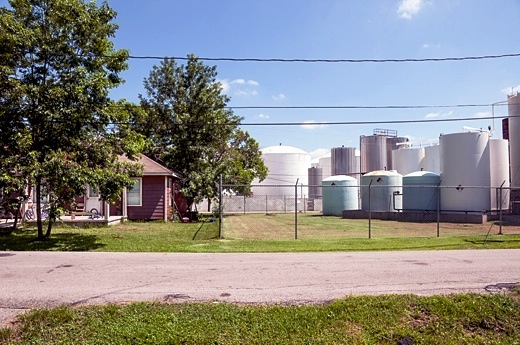
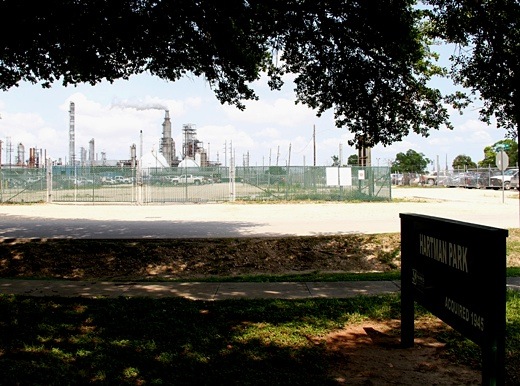
Image above: In some cases, little more than a fence separates Manchester homes from neighboring fossil fuel industry. Photo by Paul Hester. From original article.

Juan Parras gives one hell of a tour of Houston’s east side. He’s charming and funny. Wearing a beret, he strikes an old-world look, like he might lead you to a cafe on a plaza. He doesn’t charge a fee for his services. After all, you’re on a “toxic tour,” and Parras is on a mission.

Parras grew up in 1950s West Texas. He remembers segregated schools, the restaurants that wouldn’t serve him, the unpaved roads, and the people who lived closest to the local refinery. Those experiences led him to a career as a social justice advocate.

The resident of Houston’s heavily industrial east side has worked in a city housing department, for a union, for a law clinic, and on a campaign that stopped a PVC factory from being built in Louisiana’s “Cancer Alley.”

For the last decade, he has served as executive director of Texas Environmental Justice Advocacy Services (better known as t.e.j.a.s.). Part of his work is leading tours past the heaping piles of scrap metal along Houston’s Buffalo Bayou and by Cesar Chavez High School, which opened in 2000 within a quarter-mile of three large petrochemical plants.

Parras can go all day, up and down the Houston Ship Channel to Denver Harbor and neighborhoods like Galena Park, Baytown, and Pasadena. Surely you’ve read about the Keystone XL pipeline and other controversial proposed projects that would carry oil from the Canadian tar sands to Gulf Coast refineries? Parras can show you where many of them would end.

The toxic tour sometimes concludes in the neighborhood of Manchester, a six-square-mile grid of streets where the petrochemical industry towers directly over small homes. Where, according to EPA databases, Valero Refining can produce up to 160,000 barrels a day of gasoline and other fuels.

 Where the Ship Channel Bridge, one of the busiest stretches of Interstate 610, carries tens of thousands of vehicles per day (along with their emissions) directly over homes. And where about 4,000 people live — more than 95 percent of whom are people of color, and 90 percent low income.

The cancer risk for residents of Manchester and the neighboring community of Harrisburg is 22 percent higher than for the overall Houston urban area, according to a recent report from the Union of Concerned Scientists and t.e.j.a.s. 

While the city works to overcome its image as a dirty oil town, these neighborhoods remain solidly dominated by the petrochemical industry. And despite the work of Parras and his team, the environmental and health issues that Manchester’s residents face are not gaining enough political traction to garner real change.

“Environmental justice issues become all too easy to grasp when you take people into neighborhoods,” Parras said when the Sierra Club awarded him its 2015 Robert Bullard Environmental Justice Award. So Parras gives the toxic tour over and over again, hoping that, eventually, people will listen.

In 2016, Houston was lauded for its “green transformation.” The D.C.-based nonprofit Cultural Landscape Foundation brought visitors from around the country to study new investments in the city’s parks, as well as an 150-mile network of trails alongs its bayous.

Long the whipping boy of the urban-planning world, the fourth-largest U.S. city will soon have half a dozen signature parks designed by internationally known firms.

Yet Houston’s attempts to appear greener have thrown longstanding inequities into sharper contrast. Two-bedroom apartments in a downtown highrise overlooking Discovery Green park rent for more than $4,000. Seven miles east, chemical storage tanks dot the landscape around Hartman Park in Manchester, where nearly 40 percent of residents live in poverty.

Beyond financial disparities, the region’s signature industry inflicts a staggeringly disproportionate burden on east-side residents.

According to the Union of Concerned Scientists’ report, the airborne concentration of 1,3-butadiene, which causes cancer and a host of neurological issues, is more than 150 times greater in Manchester and Harrisburg than in West Oaks and Eldridge, relatively affluent neighborhoods on Houston’s west side.

Adrian Shelley, director of Texas’s outpost of the watchdog group Public Citizen, describes Manchester and the neighborhoods that abut it as sacrificial lambs, where the situation is “unjust, offensive, cruel, racist, ridiculous, tragic, and costing lives.”

Juan Flores has lived in Galena Park, right across Buffalo Bayou from Manchester, since the age of four. One of his earliest memories, as a kindergartner, was “seeing all this white stuff on the cars” and thinking it was snow — a rare occurrence in Houston. He played in it until his mom yelled out, “Hijo, no! We don’t know what it is!”

When he would play with friends over in Manchester, he remembers smells that “were so unbearable you had to go inside.”

“Most of the people who live in the area, like my dad, work in the industry,” Flores says. “We are aware of the dangers. We can smell the chemicals.”

He recalls “his first explosion,” which happened in the nearby Pasadena neighborhood in 1989, when Flores was in sixth grade. He remembers seeing “a big mushroom cloud.”

The so-called Phillips disaster — which was actually multiple explosions at the Houston Chemical Complex owned by the energy company Phillips 66 — broke the windows of his school. Twenty-three Phillips 66 employees were killed and 314 people were injured.

Flores was a member of the Galena Park city council from 2014 to 2016. He helped get an ordinance passed that limits the time trucks can idle on city streets, a substantial source of air pollution along the Ship Channel. The neighboring Jacinto City community adopted the policy, too.

According to Flores, truck drivers were at first upset with the new regulation. But he helped them understand the impact of running engines on the neighboring communities. “I told them, ‘Guys, it is your own kids,’” he says.

Local advocates say the only remedy for really helping the people trapped in Manchester and its toxic surrounding areas would involve a public buyout of their homes for the full cost of rebuilding their houses. (Market prices for Manchester-area homes are depressed by their hazardous neighbors). But even if residents were suddenly able to move to more pristine surroundings, Shelly says, doing so would disperse an entire community.


Image above: In some cases, little more than a fence separates Manchester homes from neighboring fossil fuel industry. Photo by Paul Hester. From original article.

Meanwhile, it’s tough to argue that Houston — despite its new park-building boom — isn’t prioritizing industry over the health of its vulnerable communities.

In May, Houston agreed to sell Valero several Manchester streets near its refinery for $1.4 million. The energy company will expand its footprint, adding auxiliary buildings and more parking for the facility.

In recent years, according to Parras, Valero has bought out some residents in a piecemeal approach. (Valero did not respond to requests to comment for this story.)

But he still didn’t see the deal coming.
“I found out about the sale of the streets through the newspaper,” says Parras, who was taken aback after reading a Houston Chronicle article. “We are ignored.”

Policy that would help Houston control its pollution problem is tough to enact in a town dominated by the petrochemical industry. In 2005, a Chronicle investigation on industry-reported emissions spurred then-Houston Mayor Bill White to approach companies about voluntarily reducing air pollution — 1,3-butadiene, in particular.

In Manchester, Valero took the step of placing a sophisticated air monitor at its facility’s fenceline. Citywide, the impact of White’s entreaties on emissions appears to have been inconsequential, and the effort likely cost him in his subsequent campaign for governor.

City-led initiatives are consistently challenged in courts by the Business Coalition for Clean Air, an industry-lobbying group that represents ExxonMobil and others. Last year, it convinced the Texas Supreme Court to strike down Houston’s Clean Air Ordinance, which was adopted during White’s administration.

The court ruled that the city does not have authority to enforce clean air regulations. During the last legislative session and the current special session, state politicians have put forward a range of bills using that and other pro-industry precedents to undermine the city’s ability to police environmental issues.

Lawmakers have attacked tree-preservation ordinances, fracking bans, and policies to reduce single-use plastic bags.

A 2016 report by the Sierra Club, Public Citizen, and Texans for Public Justice found that the three state oil and gas regulators raised $11 million in recent years, 60 percent of which came from the industries they’re charged with monitoring.

A 2017 report by the Environmental Integrity Project found that Texas penalizes only 3 percent of the illegal pollution releases reported by companies.

“In a different political environment, self-reported violations or reports of air-emission events would result in fines of $25,000 per day,” Shelley says. “But it is not done, even though the authority is there under the law.”

T.e.j.a.s. argues that the state should require chemical facilities to use safer substances, update their technologies, continuously monitor and report emissions, and avoid the construction of new facilities near homes and schools.

But Bakeyah Nelson, the executive director of Air Alliance Houston, says that putting such changes into effect “is tied to civic engagement and voting.” A real shift will happen, she explains, only when “elected officials reflect what the population looks like and vote in a way that is consistent with what people want, which is protection from environmental toxins.”

Last year, former Harris County Sheriff Adrian Garcia, a Mexican-American running on a platform that included environmental justice issues, challenged incumbent Gene Green, who has represented Texas’ 29th district, which includes Manchester, since 1993. Despite the district having a population that is 76 percent Hispanic origin, local and national Latino leaders backed Green, praising his consistent stand on immigration issues.

Green retained his seat with a message that voters were more concerned about the jobs that industry brings than curtailing its unchecked growth.

According to the Air Alliance’s Nelson, that economy-versus-environment framing is a false dichotomy. She says that greater regulation at a national level has coincided with continued economic growth and helped spur technological innovation.

Countering industry’s hold on the region would involve raising awareness among locals that they don’t have to choose between their health and their livelihoods, Nelson says. But the very fact that people choose to live in places like Manchester, which has been heavily industrialized since the 1970s, points to fundamental problems with access to safe, healthy, affordable housing, she adds.

“People need living wages so they don’t have to purchase homes that put their health at risk,” Nelson explains. “It is about environmental, health, and economic justice. All of those things are tied together.”

In some cases, little more than a fence separates Manchester homes from neighboring industry.
 Paul Hester Houston-based and other Texas nonprofits — like Air Alliance Houston and Environment Texas — have recently banded together to try to bring the air quality around so-called fenceline communities (meaning they border the fences surrounding industrial facilities) into the public consciousness.

“Through storytelling and good science, we are informing people that we need better air for a healthier and prosperous Houston,” says Matthew Tresaugue, who manages the newly formed Houston Air Quality Media Initiative.

The strategy includes amplifying the voices of residents, like Bianca Ibarra, a recent graduate of Galena Park High School, whose video PSA won a competition held by the media initiative and sponsored by the Environmental Defense Fund.

The collaborative effort is funded by the Houston Endowment, a charitable organization that gives out $80 million in grants yearly to local nonprofits. (Though the Endowment has fewer direct ties to oil and gas wealth than other local foundations, it’s previous president, Larry Faulkner, sat on the board of ExxonMobil while at the organization.)

Tresaugue stresses the need to move people to take action and put pressure on policymakers by connecting people in areas far from the Ship Channel to the challenges faced by residents of communities like Manchester, Harrisburg, Galena Park, Baytown, and Pasadena.


Image above: Photo of Juan Parras who has led Texas Environmental Justice Advocacy Services for the past decade. From original article.

That’s something Juan Parras has been doing for years now. And while the new initiative gets its feet under it, he’ll continue his tours, giving them to anyone from students to fellow activists to public officials. That way, people can see and smell and reckon with what Manchester’s residents live with every day.

“This is considered the capital of the industry for gas and oil,” Parras says. “We learn that on a daily basis.”

.

The worst product ever marketed

SUBHEAD: Eventually we learn what's the good way to do things. Too bad that it is almost always too late.

By Ugo Bardi on 30 July 2017 for Cassandra's Legacy -

(http://cassandralegacy.blogspot.com/2017/07/what-is-worst-product-ever-marketed.html)


Image above: Detail of Bic advertisement celebrating the 40th anniversary of the introduction of the Bic lighter.  From original article.

Greens often exaggerate in inviting people to save energy and be happier by staying in the dark and eating insects. However, it is also true that sometimes wastefulness goes a few notches higher and becomes truly a scandal. It is the case of the ordinary disposable lighter.

Bic alone produces almost a billion lighters per year and has produced some 20 billions of them in the past 30 years. The whole world production is probably of a few billion per year. A good example of a successful product, but is it a good product?

The disposable lighter is surely practical but also, if you think about it, a very bad deal. It contains some 5 cc of butane, that you pay, typically, more than $1. That means around $200 per liter, or $800/gallon.

You wouldn't be happy to pay that kind of money when you refill the tank of your car. And, being powered by a fossil fuel, butane, every time you light up one you add some CO2 to the atmosphere, some of which will stay there for tens of thousands of years.

Then, the disposable lighter doesn't contain just non-renewable fuel but plastics manufactured from fossil fuels and also polluting. Then, it contains metals such as cerium, lanthanum, neodymium, praeseodymium and more.

These metals are classified as "rare earths;" they are not so rare as the name seems to imply, but they are not so common, either. And the lighter is thrown away after use and it will never be recycled. The rare earths it contains will be lost forever.

Is all that enough to qualify disposable lighters as "the worst product ever marketed"? Well, everything can be questioned, but if you line up the characteristics of a bad product as;
  1. uses rare and non-renewable resources, 
  2. is not recycled and not supposed to be recyclable, 
  3. is manufactured on a large scale, 
  4. it has non-polluting and less expensive alternatives, there are few examples other than lighters for which you can tick all the four boxes.
I can hardly think of anything so wasteful to set something on fire, no matter whether you are a professional arsonist or simply an ordinary smoker.

After all, what was so wrong with using the old matches? Matches contain only recyclable materials: wood, paper, phosphorous, sulfur. I can't see anything that can be done with a lighter that cannot be done with a match, except that a lighter can burn steadily for a longer time.

But if your purpose is to light up a cigarette or a kitchen burner, it makes no difference. And, by all means, there is no way that a lighter would cost less than a match, at least if manufactured on a comparable scale.

So, disposable lighters are all an example of how a combination of financial factors and government regulations can push a bad product to dominate the market. It is, after all, what has happened with fossil fuels, still gathering large government subsidies, despite the damage they are doing to all of us.

In the case of lighter vs. matches, the playing field has been made unfavorable to matches from the beginning, because they have been traditionally taxed by governments (also lighters, in some cases, but not always).

Add to that the rapid expansion of the cigarette market during the past decades, with some six billion cigarettes sold worldwide every year, and growing, some large companies saw their chance.

They engaged in the large scale manufacturing of lighters and they crushed the match manufacturers, mainly small companies that couldn't match (indeed!) the financial power of large corporations.

The advertising power, too, played a big role, with the appeal of colored and fashionable items that could also be collected. And it was world domination for the disposable lighter.

Could we reverse this demonic trend? Maybe there are signs of an inversion of the tendency and, not long ago, I saw again courtesy matchboxes appearing in an Italian Hotel.

Maybe it was because finally (in 2015) the Italian government decided to abolish the tax on matches, a good idea that, unfortunately, arrived at least 50 years too late (the French Government did that in 1999).

Whatever the case, it is high time that someone realizes that some ideas, such as disposable lighters, are evil to the bone. And that the mythical "free market" cannot turn evil into good.

But maybe you think that the old matches are passé? In this case, we have technologies for getting rid of the obsolete propane lighters without having to get back to the somewhat primitive matches. For instance, we have spark lighters that use only electricity.

They are a solid state alternative to propane lighters in the same way as photovoltaic energy is a solid state alternative to fossil energy. In the picture, you see one of these super hi-tech lighters in the hands of my daughter, Donata.


Image above: Donata Bardi holds solid state spark lighter.  From original article.

So, eventually, we learn what's the good way to do things. Too bad that it is almost always too late.

.

Buffalo rising from the ashes

SUBHEAD: One of its suburban neighborhoods ends its dependence on coal for energy.

By Eliziabeth McGowen on 11 July 2017 for Grist -
(http://grist.org/justice/a-working-class-buffalo-suburb-retired-a-coal-plant-the-right-way/)


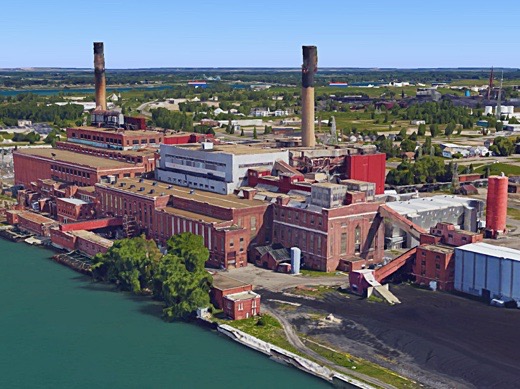
Image above: The retired coal burning Huntley Generating Station on the banks of the Niagara River. From original article.

Sixteen months ago, the coal-fired Huntley Generating Station, which sits on the banks of the Niagara River, stopped producing power for first time since World War I.

Erie County lost its largest air and water polluter. But the town of Tonawanda, a working class Buffalo suburb 13 miles downstream of America’s most storied waterfalls, also lost its biggest taxpayer.

The impact of Huntley’s decade-long slowdown — and finally shutdown — hit this upstate New York community like a punch to the gut.

In just five years, between 2008 and 2012, Huntley’s pre-tax earnings tumbled by $113 million as it operated far below capacity, translating into a combined revenue hit of at least $6.2 million to the town, county, and local school district. That precipitous decline came when state education funds were also shrinking. Belt-tightening wasn’t enough; 140 teachers lost their jobs. Three elementary schools and one middle school closed their doors.

Rebecca Newberry, a 35-year-old former bartender and LGBT-rights activist, saw her home town facing the same fate that has befallen so many other Rust Belt communities that fell on hard times following an industrial exodus. She was determined not to let it happen to the place where she grew up. And she was fortunate enough to find a diverse group of allies who were willing to fight for their survival.

By combining the resources of her nonprofit, the Clean Air Coalition of Western New York, with area labor unions and other community groups, Newberry helped to hatch a plan for Tonawanda’s next chapter — and provide an inclusive, equitable template for other blue-collar towns facing the loss of dirty energy jobs and other polluting industries. (The jargony term for this in advocacy circles is “just transitions.”)

The group that Newberry helped form would come to be known as the Huntley Alliance. The partnership convinced New York lawmakers to provide Tonawanda with a temporary cash infusion to sustain the town as it reinvents its tax base — the first time a state has offered a financial cushion to a community that was financially reliant on a coal-fired power plant.

“It was a trauma when Huntley finally announced it was closing,” Newberry says, “so we had to come at this from a place of healing. Our goal was to stop the bleeding to the industrial and public sectors.

“Always, our key question is: How are we going to take care of our people?”

Team of rivals

Tonawanda, a Native American word meaning swift waters, was founded by white settlers in 1836. East of the railroad tracks that run north from Buffalo to Niagara Falls, the 20-square mile town has nearly 73,000 residents and is known for its top-flight paramedic service.

But west of the tracks, it’s anything but quaint. Huntley and 50-plus industrial facilities coexist within a three-mile radius, mingled with older homes and trailer parks. Big grinding trucks assault the ears, and the air carries a distinct petroleum-rubber-chemical-exhaust stink.

The energy giant NRG purchased Huntley in 1999. Although the oldest current coal-fired unit dates back to 1942, the facility’s steam-generating history stretches back to World War I. NRG retired half of the plant’s 760-megawatt capacity in 2006 and 2007, with a corresponding drop in tax revenue.

In the fall of 2013, Peter Stuhlmiller, president of the Kenmore-Tonawanda Teachers Association, reached out to Richard Lipsitz, president of the local AFL-CIO chapter, to figure out how to save the community’s schools. They were soon joined by Newberry’s coalition, the Sierra Club, and trade unions representing steelworkers and Huntley employees.

“This country has a very poor record of rescuing communities built up around coal and heavy industries,” Lipsitz says. “Our goal was to stabilize the economy and provide income for a town that needed it desperately.”

Although their goal was the same, the various factions in the early Huntley Alliance had different priorities. The united front fell apart when a local Sierra Club member organized a protest calling for Huntley’s closure — with some demonstrators wearing union shirts. Labor leaders felt the rally threatened the livelihoods of the 70-plus remaining NRG employees. Finger-pointing ensued, and the plant’s union walked away from the nascent alliance.

Then the whole effort collapsed.

Newberry’s Clean Air Coalition didn’t join the Big Green’s call for Huntley’s closure — although it harangued other major polluters along the industrial waterfront during its decade of existence. The group’s leaders saw no need: The coal plant’s obsolescence seemed imminent with cheap natural gas flooding U.S. markets.

To motivate the Huntley Alliance to regroup, Newberry circulated preliminary results of a study her 200-member nonprofit commissioned. “Given that the plant is located in a region with substantial excess capacity for at least the next decade, the Huntley units appear ripe for retirement,” the Institute for Energy Economics and Financial Analysis concluded in a 24-page report released in January 2014.

That sobering prediction did the trick, ending the alliance’s six-month hiatus. Newberry — who ascended to the top job at the Clean Air Coalition in 2015, four years after being hired — insisted that workers couldn’t be left behind. It became the group’s guiding principle and managed to hold together unlikely allies. Teachers rubbed shoulders with steelworkers and teamsters. Male-dominated trade unions listened to women’s ideas. Labor and Big Green found common ground.

“Going through this helps me to visualize that we can do better as a society,” Newberry says. “We don’t always have to be fighting with one another.”

At least 1,500 members of the steelworkers union live in the Tonawanda area, many drawing paychecks at employers such as Tonawanda Coke, 3M, DuPont, and Sumitomo Rubber. They backed the alliance’s focus on job retention and creation, because they feared property taxes would spike after Huntley’s shutdown — to make up for lost revenues from the plant. That could spook existing employers and repel potential newcomers.

“We want to make sure there are good, clean, high-road, family-sustaining jobs that improve the quality of life,” says Dave Wasiura, the union’s organizing coordinator for the area.

Retired teacher Diana Strablow, a member of both the Sierra Club and Newberry’s group, was initially frustrated that the dangers of climate change sparked by coal-fired power plants weren’t the alliance’s number one priority. But Newberry helped her understand how a stumble by Huntley could mean a fall for her entire community.

“I was the angry environmentalist,” Strablow says. “I’ve learned we need to take care of both our workers and our environment.”

Don’t ask. Tell.

Once reunited, the Huntley Alliance needed clear goals — specifically ones that met the needs of the town’s residents. Through a series of listening sessions, door-to-door surveys, and voter-registration drives, the partnership channeled the hopes and anxieties of hundreds of residents. The wish list that emerged included keeping schools intact, creating good-paying jobs, expanding the tax base, and improving public health and the environment.

Those desires would be compiled with proposals and needs of businesses and other stakeholders into Tonawanda Tomorrow, a succinct blueprint for the town’s trajectory. A final version was released in June.

It was a tall order, so the alliance set about lobbying New York state legislators for “gap funds” to keep the town afloat during its transformation. After all, Newberry reasoned, Huntley had supplied electricity far beyond Tonawanda’s borders. Rather than asking lawmakers to find money for them, Newberry and her colleagues combed through the state’s budget themselves and compiled a list of potential funding pots to draw from.

By August 2015, when NRG announced Huntley’s impending retirement, a Democrat-majority State Assembly and a Republican-controlled Senate had already voted to back the alliance’s brainchild. When the 102-acre power plant went offline seven months later, the framework was in place for $30 million.

Cynthia Winland, a planning specialist at Chicago’s Delta Institute, praised New York legislators for being brave enough to act on Tonawanda’s financial request. Her sustainable solutions nonprofit helped assemble the town’s blueprint.

“If a state as geographically, politically, and economically complicated as New York is capable of this,” Winland says, “then other states can look for parallels.”

This spring, legislators expanded the Huntley-inspired measure — in part due to Governor Andrew Cuomo’s announcement last year that New York would strive to be coal-free by 2020. The gap fund’s budget ballooned from $30 million to $45 million, its availability was extended from five to seven years. (It now covers communities with plants powered by any fuel source.)

The initial funding makes Tonawanda’s post-Huntley metamorphosis viable, Newberry says, adding that the two-year extension “gives us the extra breathing room we will need.”

The fund so far has shored-up the school system — which is no longer hemorrhaging teachers — stopped electricity bills from skyrocketing, and kept the budget for the prized paramedic unit intact.

David Schlissel, a coauthor of the 2014 report questioning the Huntley Generating Station’s viability, emphasized that the alliance’s proactive approach and the New York legislature’s response offer a vital lesson for the rest of the country.

“Instead of spending millions on propping up coal plants,” Schlissel says, “we need to spend money to help communities make an economic transition.”

The Huntley Alliance took its cues from other communities forced to evolve beyond heavy industry. Members traveled as close as Appalachia and as far as Germany, where they were amazed to witness how the German government funded worker retraining programs and recycled old production plants, as renewables supplanted fossil fuels.

“That gave us hope that a cleaner environment can be achieved in Tonawanda without leaving broken workers behind,” Newberry says.

Back home, the alliance’s efforts also benefitted from a $160,000 grant from an Obama administration initiative to help communities distressed by the demise of coal. President Trump proposed defunding the program in his 2018 budget.

Not another Bethlehem Steel

Even with all the planning, the Huntley station’s idle smokestacks cause jitters among Tonawandans who have watched the 1,000-acre Bethlehem Steel plant idle in Lackawanna, 20 miles to the south, for three and a half decades. References to the hulking carcass send shivers down the spine of Tonawanda Town Supervisor Joseph Emminger.

“We are not going to have another Bethlehem Steel here,” he declares.

County and town planners view the reinvention of the Huntley site as a vital part of transforming 2,300-plus brownfield acres into greener ventures. Recent cleanups have allowed existing companies, such as Sumitomo Rubber, to expand and invited in newer industries, such as solar technology and warehousing operations.

“It’s a 20-year-long, step-by-step process,” says Erie County Director of Business Assistance Ken Swanekamp. “We’re doing it one project at a time.”


.

Sixth Mass Extinction Underway

SOURCE: Katherine Muzik PHD (kmuzik@gmail.com)
SUBHEAD: A ‘biological annihilation’ of billions of animals have been lost in recent decades.

By Damian Carrington on 10 July 2017 for the Guardian -
(https://www.theguardian.com/environment/2017/jul/10/earths-sixth-mass-extinction-event-already-underway-scientists-warn)


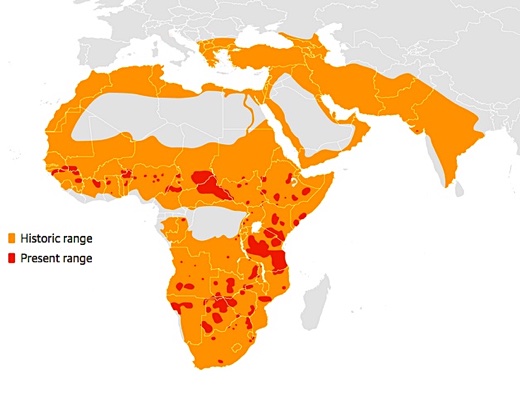
Image above: A male and female Alions in almost desert-like sub-Saharan Africa. From (http://www.nationalgeographic.com/prototype/topics/prototype-african-lion-responsive/).

A “biological annihilation” of wildlife in recent decades means a sixth mass extinction in Earth’s history is under way and is more severe than previously feared, according to research.

Scientists analyzed both common and rare species and found billions of regional or local populations have been lost. They blame human overpopulation and overconsumption for the crisis and warn that it threatens the survival of human civilisation, with just a short window of time in which to act.

The study, published in the peer-reviewed journal Proceedings of the National Academy of Sciences, eschews the normally sober tone of scientific papers and calls the massive loss of wildlife a “biological annihilation” that represents a “frightening assault on the foundations of human civilisation”.

Prof Gerardo Ceballos, at the Universidad Nacional Autónoma de México, who led the work, said: “The situation has become so bad it would not be ethical not to use strong language.”

Previous studies have shown species are becoming extinct at a significantly faster rate than for millions of years before, but even so extinctions remain relatively rare giving the impression of a gradual loss of biodiversity. The new work instead takes a broader view, assessing many common species which are losing populations all over the world as their ranges shrink, but remain present elsewhere.

The scientists found that a third of the thousands of species losing populations are not currently considered endangered and that up to 50% of all individual animals have been lost in recent decades.

Detailed data is available for land mammals, and almost half of these have lost 80% of their range in the last century. The scientists found billions of populations of mammals, birds, reptiles and amphibians have been lost all over the planet, leading them to say a sixth mass extinction has already progressed further than was thought.

Nearly half of the 177 mammal species surveyed lost more than 80% of their distribution between 1900 and 2015. In the Americas about 20% of those species have lost more than 80% of their range. In Europe about 40%have, But in Africa and Australia about 60% is lost and in Asia almost 80% of species have lost more than 80% of their range.

The scientists conclude: “The resulting biological annihilation obviously will have serious ecological, economic and social consequences. Humanity will eventually pay a very high price for the decimation of the only assemblage of life that we know of in the universe.”

They say, while action to halt the decline remains possible, the prospects do not look good: “All signs point to ever more powerful assaults on biodiversity in the next two decades, painting a dismal picture of the future of life, including human life.”

Wildlife is dying out due to habitat destruction, overhunting, toxic pollution, invasion by alien species and climate change. But the ultimate cause of all of these factors is “human overpopulation and continued population growth, and overconsumption, especially by the rich”, say the scientists, who include Prof Paul Ehrlich, at Stanford University in the US, whose 1968 book The Population Bomb is a seminal, if controversial, work.

“The serious warning in our paper needs to be heeded because civilisation depends utterly on the plants, animals, and microorganisms of Earth that supply it with essential ecosystem services ranging from crop pollination and protection to supplying food from the sea and maintaining a livable climate,” Ehrlich told the Guardian. Other ecosystem services include clean air and water.

“The time to act is very short,” he said. “It will, sadly, take a long time to humanely begin the population shrinkage required if civilisation is to long survive, but much could be done on the consumption front and with ‘band aids’ – wildlife reserves, diversity protection laws – in the meantime.” Ceballos said an international institution was needed to fund global wildlife conservation.

The research analysed data on 27,500 species of land vertebrates from the IUCN and found the ranges of a third have shrunk in recent decades. Many of these are common species and Ceballos gave an example from close to home: “We used to have swallows nesting every year in my home near Mexico city – but for the last 10 years there are none.”

The researchers also point to the “emblematic” case of the lion: “The lion was historically distributed over most of Africa, southern Europe, and the Middle East, all the way to northwestern India. [Now] the vast majority of lion populations are gone.”


Image above: Graphic map of the range of lions. Historically lions lived across Africa, southern Europe, the Middle East, all the way up to Northwestern India. Today their habitat has been reduced to a few tiny pockets of the original area.

Prof Stuart Pimm, at Duke University in the US and not involved in the new work, said the overall conclusion is correct, but he disagrees that a sixth mass extinction is already under way: “It is something that hasn’t happened yet – we are on the edge of it.”


Pimm also said there were important caveats that result from the broad-brush approach used. “Should we be concerned about the loss of species across large areas – absolutely – but this is a fairly crude way of showing that,” he said. “There are parts of the world where there are massive losses, but equally there are parts of the world where there is remarkable progress. It is pretty harsh on countries like South Africa which is doing a good job of protecting lions.”

Robin Freeman, at the Zoological Society of London, UK, said: “While looking at things on aggregate is interesting, the real interesting nitty gritty comes in the details. What are the drivers that cause the declines in particular areas?”

Freeman was part of the team that produced a 2014 analysis of 3000 species that indicated that 50% of individual animals have been lost since 1970, which tallies with the new work but was based on different IUCN data. He agreed strong language is needed: “We need people to be aware of the catastrophic declines we are seeing. I do think there is a place for that within the [new] paper, although it’s a fine line to draw.”

Citing human overpopulation as the root cause of environmental problems has long been controversial, and Ehrlich’s 1968 statement that hundreds of millions of people would die of starvation in the 1970s did not come to pass, partly due to new high-yielding crops that Ehrlich himself had noted as possible.
Ehrlich has acknowledged “flaws” in The Population Bomb but said it had been successful in its central aim – alerting people to global environmental issues and the the role of human population in them. His message remains blunt today: “Show me a scientist who claims there is no population problem and I’ll show you an idiot.”

Earth’s five previous mass extinctions

End-Ordovician, 443 million years ago
A severe ice age led to sea level falling by 100m, wiping out 60-70% of all species which were prominently ocean dwellers at the time. Then soon after the ice melted leaving the oceans starved of oxygen.

Late Devonian, c 360 million years ago
A messy prolonged climate change event, again hitting life in shallow seas very hard, killing 70% of species including almost all corals.

Permian-Triassic, c 250 million years ago
The big one – more than 95% of species perished, including trilobites and giant insects – strongly linked to massive volcanic eruptions in Siberia that caused a savage episode of global warming.

Triassic-Jurassic, c 200 million years ago
Three-quarters of species were lost, again most likely due to another huge outburst of volcanism. It left the Earth clear for dinosaurs to flourish.

Cretaceous-Tertiary, 65 million years ago
An giant asteroid impact on Mexico, just after large volcanic eruptions in what is now India, saw the end of the dinosaurs and ammonites. Mammals, and eventually humans, took advantage.

.