Showing posts with label Peace. Show all posts

Displacement Syndrome Anatomy

SUBHEAD: USA facilities around the country working around the clock to penetrate foreign computer defenses.

By James Kunstler on 20 July 2018 for Kunstler.com -
(http://kunstler.com/clusterfuck-nation/anatomy-of-a-displacement-projection-syndrome/)
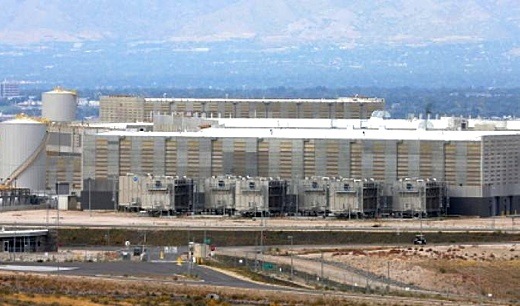

Image above: Small portion of the NSA Data Center in Bluffdale, Utah. This facility is reportedly capable of storing all electronic communications in the United States. From (http://www.datacenterknowledge.com/archives/2015/07/31/report-utah-cops-get-1m-a-year-to-park-at-nsa-data-center).
“For more than a decade, Russia has meddled in elections around the world, supported brutal dictators and invaded sovereign nations — all to the detriment of United States interests.”
The New York Times
The Resistance sure got a case of the vapors this week over Mr. Trump’s failure to throttle America’s arch-enemy, the murderous thug V. Putin of Russia, onstage in Helsinki, as any genuine Marvel Comix hero is expected to do when facing consummate evil.

Instead, the Golden Golem of Greatness voiced some doubts about the veracity of our “intelligence community” — as the shape-shifting Moloch of black ops likes to call itself, as if it were a kindly service organization in Mr. Rogers neighborhood, collecting dimes for victims of childhood cancer.

If I may be frank, the US Intel community looks like a much bigger threat to American life and values than anything Mr. Putin is doing, for instance his alleged “meddling” in US elections.

This word, meddling, absolutely pervades the captive Resistance news outlets these days. It has a thrilling vagueness about it, intimating all kinds of dark deeds without specifying anything, as consorting with Satan once did in our history.

The reason: the only specific acts associated with this meddling include the disclosure of incriminating emails among the Democratic National Committee leadership, and a tiny gang of Facebook trolls making sport of profoundly idiotic and dysfunctional American electoral politics.

The brief against Russia also contains vague accusations of “aggression.” It is hard to discern what is meant by that — though it apparently warms the heart of American war hawks and their paymasters in the warfare industries. They allege that Russia “stole” Crimea from Ukraine. Consider: Crimea had been a province of Russia since the 1700s.

Ukraine itself was a province of the USSR when Nikita Khrushchev put Crimea under Ukraine’s administrative control in 1956, a relationship which became obviously problematic after the breakup of the soviet mega-state in 1990 — and became even more of a problem when the US State Department and our CIA stage-managed a coup against the Russia-leaning Ukrainian president Viktor Yanukovych in 2014. Crimea is the site of Russia’s only warm water naval bases.

Do you suppose that even an experience American CIA analyst might understand that Russia would under no circumstances give up those assets?

Please, grow up.

Does anyone remember the explicit promise that US Government gave the transitional leader, Mikhail Gorbachev, that NATO would not expand into the countries of eastern Europe formerly under soviet control? NATO now includes the Czech Republic, Hungary and Poland, Bulgaria, Estonia, Latvia, Lithuania, Romania, Slovakia and Slovenia, Albania, Croatia, and Montenegro.

Is anyone aware that NATO has been staging war games on Russia’s border the past several years? Do you suppose this might be disturbing to the Russians, who lost at least 20 million dead when Germany crossed that border in 1941?

As to the thug-and-murderer charge against V. Putin, has any news org actually published a list of his alleged victims? It’s very likely, of course, that Mr. Putin has had some of his political enemies killed. I wouldn’t take the “con” side of that argument.

But I’d be interested in seeing an authoritative list, if the intel community has one (and why wouldn’t they?).

I imagine it doesn’t exceed two dozen individuals. How many innocent bystanders did President Obama kill during the drone attack spree of his second term, when our rockets blew up wedding parties and sandwich shops in faraway lands. In 2016, The Atlantic published this:
One campaign, Operation Haymaker, took place in northeastern Afghanistan. Between January 2012 and February 2013, The Intercept reported, “U.S. special operations airstrikes killed more than 200 people. Of those, only 35 were the intended targets. During one five-month period of the operation, according to the documents, nearly 90 percent of the people killed in airstrikes were not the intended targets.”

I suppose the excuse is that none of this was personal — as V. Putin’s alleged murders were. No, it wasn’t personal. It was worse than that.

It was a bunch of military video-game jocks sitting around an air-conditioned bunker eating hot pockets and slurping slurpees while snuffing out lives by remote control twelve-thousand miles away. I wouldn’t be surprised if they were high-fiving each other with every hit, too.

As for “hacking” of elections, do you suppose for minute that we do not have hundreds, or perhaps thousands, of computer techies at our many sprawling NSA facilities around the country working around the clock to penetrate foreign computer defenses absolutely everywhere, among friend and foe alike? And that we are not trying to influence the outcomes of their political struggles in our favor?

Go a step further: do you suppose those US “intel community” hackers are not also collecting information about American citizens, including yourself?

.

Hawaii & US Regime Changes

SUBHEAD: Stephen Kinzer will tell the story of how the United States became an overseas empire.

By Michael Goodwin on 18 May 2018 in Island Breath -
(http://islandbreath.blogspot.com/2018/05/hawaii-us-regime-changes.html)


Image above: Photo of Stephen Kinzer at Brown University. From promotional material.

Stephen Kinzer will tell the story of how the United States became an overseas empire.  His book, Overthrow: America’s Century of Regime Change from Hawaii to Iraq, shows how the annexation of Hawaii was the beginning of an era of foreign intervention.

Mr. Kinzer is a current Senior Fellow at the Watson Center for International and Public Affairs at Brown University, as well as the World Affairs columnist for the Boston Globe.

He is a former Foreign Correspondent for the New York Times, and has written several books about U.S. foreign policy.

All programs are subject to change. If you require an auxiliary aid or accommodation due to a disability, please contact the library at least 7 days before the program date.  For a list of upcoming library events, visit www.librarieshawaii.org/events.

WHO:
Mr. Kinzer is a current Senior Fellow at the Watson Center for International and Public Affairs at Brown University.

WHAT:
Lecture on the history of American development into an overseas empire.

WHEN:
May 23, 2018 from 5:30 pm to 7:00 pm

WHERE:
Waimea Library
9750 Kaumualii Highwya
Waimea, HI 96796 p

PHONE:
808-338-6848


.

US military makes Hawaii a target

SUBHEAD: Things Hawaii must do in response to recent false ballistic missile alert that terrified many.

By Gary Hooser on 29 January 2018 in Gary Hooser's Blog -
(https://garyhooser.wordpress.com/2018/01/19/4-things-hawaii-must-do-in-response-to-recent-ballistic-missile-scare/)


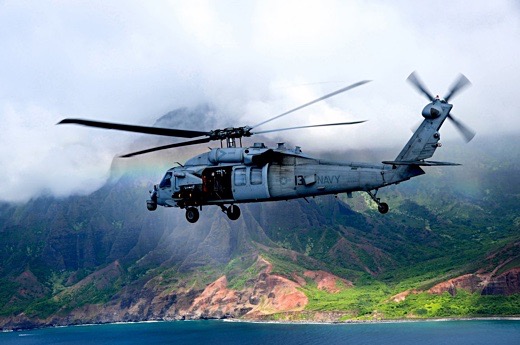
Image above: An MH-60S Sea Hawk helicopter, flies past the north shore of Kauai on July 14, 2014 during RIMPAC 2014. Photo by Joseph Pfaff. From (http://www.businessinsider.com/military-has-best-views-from-offices-2017-5).

Providing leadership and support for a strong and conscientious movement toward global peace and the dismantling of all nuclear weaponry, must be Hawaii’s response to the events of this past Saturday morning.

To be clear, I believe in having a strong national defense. I know there are bad people in the world who want to hurt us, and we need to protect ourselves from those threats.

But hosting a vast nuclear arsenal is not the answer. And neither is it necessary for the United States to be the largest exporter of guns, tanks, bombs and military weapons in the world, supplying our enemies as well as our friends.

My father was a career Navy man and I grew up on military bases. Members of my family currently serve in the military, and I am proud and thankful for their service. But our national conversation needs to shift from investing in guns, bullets and missiles toward investing in diplomacy, human rights and the alleviation of poverty.

The ballistic missile attack that did not happen, should be our call to action. Knowing we are personally vulnerable to the narcissistic and delusional games played by our obviously unstable so-called world leaders, is more than sufficient justification to at least try to take away their ballistic nuclear missiles.

Hawaii can lead the world conversation by starting here at home with an honest and open discussion about the large military presence in our islands and its impact on the environment, on our economy, and on our core value systems.

As the military presence in Hawaii grows, so does our attraction as a target. When the testing and tracking of missiles transitions into the establishment of a launching site for missiles, our risk factor jumps exponentially.

This is our 6,000 lb gorilla in the room, and this is a conversation that must occur.

As Ikaika Hussey tweeted on the day the missiles were not launched,
“The world should remember that we’re not a target because of our unique history or cultures, but because of the way that the US has turned our islands into the command center for the Pacific fleet. Militarism is reducing, not enhancing, our security.”
Hawaii must seize this moment.

The launching of the ballistic missile that never happened, can, bizarrely enough, be the catalyst needed to propel our state forward as a leader in the effort to bring sanity and peace to the world.

Both local and global conversations must occur, and Hawaii can play a unique and important role in hosting and convening those discussions. If we are serious about pulling our planet back from the edge we only recently had a taste of, we must embrace an active and leadership role toward peace.


Image above: A good reason Hawaii is in the crosshairs is Pearl Harbor, the center of American domination of the Pacific Ocean with nuclear weapons systems. Note two nuclear attack subs in foreground. From (http://indonesia-komando.blogspot.com/2015/10/natuna-diproyeksikan-jadi-pearl-harbour.html).

Hawaii’s leaders at all levels must immediately and loudly proclaim their resolute support for a diplomatic resolution to the situation in North Korea.
  • Our voices in Hawaii must unite with a message to all who hold the levers of global power to “stand down,” cease their military bluster and posturing, and come to the table of diplomacy and reason.
Hawaii as a “Geneva of the Pacific” is not a new idea and it is time now to breathe fresh life into it.

The University of Hawaii, Spark M. Matsunaga Institute for Peace and Conflict Resolution http://www.peaceinstitute.hawaii.edu was established in 1986.

This body has the potential to convene and host both local and global conversations to promote peace and the ultimate dismantling of nuclear weapons through-out the world.

This really is the only answer to the madness that engulfed us this past Saturday morning.
  • We can demand the firing, transfer, or forced retirement of all responsible for the debacle that occurred that day, and we should, for the mismanagement is inexcusable. 
     
  • We can redesign the early warning systems and policies, and we should, as they were clearly inadequate.
  • We can blast President Trump for his irresponsible actions and comments that have exacerbated and unnecessarily inflamed the tension between North Korea and the United States, and yes we absolutely should as his conduct is also inexcusable.
But at the end of the day, we must work toward ending the constant escalation of conflict in the world, and certainly we must strive to rid the planet of nuclear weapons.

While it might sound pollyanna-ish to some, think about it for a moment. What else are we going to do? There are not enough storm drains in Hawaii to hold all of us.

See also:
Ea O Ka Aina: strafing run at Salt Pond Beach 12/9/17


.

Korea in Conflict

SUBHEAD: "From Colonization to Militarization" a free lecture December 7th at 6-8pm at KCC.

By Kip Goodwin for Island Breath on 29 November 2017 - 
(http://islandbreath.blogspot.com/2017/11/korea-in-conflict.html)


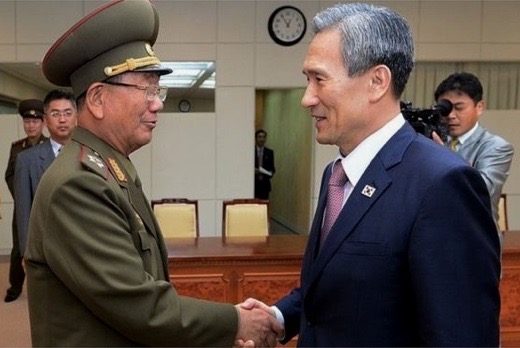
Image above: Representatives of North and South Korea meeting in Demilitarized Zone in 2015 peace talks. From (http://www.bbc.com/news/world-asia-34039187).

WHAT:
 "From Colonization to Militarization: Korea in Context: Past and Present".  A free lecture with powerpoint presented by KCC History Professor Mark Ombrello and Kauai journalist Jon Letman.   Followed by snacks, refreshments, and a lively discussion.

WHERE:
Kauai Community College
One-Stop Center (the first building on the right when you drive into the Puhi campus
3-1901 Kaumualii Highway
Lihue, Hawaii 96766
808-245-8225

WHEN:
 Thursday, 7 December 2017, 6pm - 8pm

SPONSOR:
Kauai Alliance for Peace and Justice, and KCC History and Philosophy Club
For more information, email ombrello@kauai.edu or call 808-245-8328

Dr. Ombrello will provide a brief overview of modern (20th century) history of colonialism in Korea from the overthrow of the kingdom by Japan in 1910 to World War ll.

Mr. Letman will speak on current affairs with focus on the highly militarized state of the two Koreas. At a time of heightened tension with the threat of war on the Korean Peninsula, speakers will also examine Kauai's role in the militarization of South Korea and northeast Asia.

.

Truth about Military Recruiting

SUBHEAD: Military recruiters don't tell the whole truth. Help us complete the picture.

By Kip Goodwin on 3 October 2017 for Hawaii Peace and Justice -
(http://islandbreath.blogspot.com/2017/10/truth-about-military-recruiting.html)


Image above: Volunteers providing information about the truth regarding US military recruitment in support of 808truth2youth and Hawaii Peace and Justice. From https://youtu.be/_8rbHwMXMT8.

The Pentagon spends $1.4 billion annually on public relations and recruiting, teaming with professional sports, Hollywood, and the video gaming and media industries. Their primary audience is 15 to 25 year olds, the demographic from which they recruit about one quarter million annually.

There are missing pieces in the recruitment narrative, and there is no organized effort on the part of the schools or anyone else to fill in gaps. We need your support to meet the need. If we reach our goal, more than 20,000 Hawaii youth will have the opportunity to learn:
Enlistment contract promises made to the enlistee can ALL be broken.
Service term is for eight years, and may be extended.
Job training is for military, not civilian jobs.
College benefits are NOT guaranteed.
Our young Hawaii citizens who are committing to military service have a right to know:

Departments of Defense and Veterans Affairs report in 2016 that 10 to 17% of combat veterans suffer PTSD and 10-23% have traumatic brain injury (TBI).  25% have some to extreme difficulty in social functioning, productivity and self care.

Centers for Disease Control and Prevention reports in 2015 male veterans 50% as likely, women vets almost twice as likely to be homeless, than the general population.

In 2014, 1 in 4 women and 1 in 100 men reported military sexual trauma. "For women, an experience of sexual trauma while in the military greatly increases risk of homelessness."

The Veterans Administration reports in 2016 thirty veterans per 100,000 population commit suicide, more than twice the number for the general population. On average, twenty veterans are committing suicide every day.

America's Health Rankings, based on interviews with 400,000 Americans in 2016, reported 62% higher rate of heart disease and 13% higher rate of cancer in veterans than in the general population.

Modern neuroscience teaches us that the parts of our brains that allow reason to overcome emotion don't fully mature until our early to mid twenties. The military plays on this with promises of adventure. Our mission is to fully disclose the reality of the military commitment, during active duty and afterward.

808truth2youth is currently engaged in social media outreach to our children growing into adulthood in low income communities (the most recruiter-vulnerable) on the four main islands. Every six days, our posts have gone out to hundreds of young people on Facebook. We have surpassed 10,000 "reaches". You can see these posts on our Facebook page, 808truth2youth.

We encourage them to consider alternatives, especially education leading to secure, good paying careers that promote peace. Our donation website, 808truth2youth.org, has a how-to guide to the best schools, and scholarships exclusively for students who show an interest in social justice, nuclear disarmament and conflict resolution.

Please help us empower our youth with the truth about the military and by extension about America's addiction to a war economy and the endless cycle of war that will end only when a critical mass of awareness is arrived at.


Image above: Retired Special Forces Master Sergeant Stan Goff explains what military life really entails. From (https://youtu.be/_8rbHwMXMT8).

Thank you! for what support you can give for our Hawaii youth's right to know.

You can donate to our mission through Hawaii Peace and Justice, our fiscal sponsor.

Click here to donate:
(https://www.gofundme.com/808truth2youth)

or
Send a check to:
Hawaii Peace and Justice
2426 O`ahu Avenue
Honolulu, Hawaii 96822-1967

-in memo line, write 8808truth2youth

.

South Korea's stubborn peace effort

SUBHEAD: Peace movement refusing to give up is taking the long view of its campaign. 

By Jon Letman on 4 August 2017 for Truth Out -
(http://www.truth-out.org/news/item/41486-taking-the-long-view-why-south-korea-s-peace-movement-refuses-to-give-up)


Image above: Jeong Young-hee is a Korean tangerine farmer in Gangjeong village on Jeju island. Like many residents, she strongly opposes the newly built South Korean naval base just two miles from her farm. Photo by Jon Letman. From original article.

In August, 1945, as Japan smoldered in the ruins of war, the question of what would become of the Korean peninsula after 35 years of Japanese occupation and a Soviet army advancing southward spurred the hasty selection of an artificial division along the 38th parallel drawn by two American officials as a border between US and Soviet "zones of occupation."

That line, never intended to be permanent, hardened like stubborn mud before the newly liberated Korea ever had the chance to form an independent, unified and democratic nation. Today 38°N still marks a potentially catastrophic flashpoint between North and South Korea.

The DMZ -- demilitarized zone -- despite its name, is one of the most militarized places on the planet. This hyper-militarization, in fact, extends south across the peninsula and today, 64 years after an armistice halted (but never formally ended) the Korean war, South Korea remains peppered with scores of US military installations -- at least 80 by the Pentagon's own count.

US bases, and the 28,500 US troops and joint military exercises they support, are not only opposed by North Korea; many South Koreans see them as a problematic construct that perpetuates the likelihood of war.

Despite frequent media coverage of North Korea's highly choreographed military parades, increasing missile launches, and Kim Jong-un's threats to turn Seoul into a "sea of fire," far less attention is paid to South Korea's tireless, well-organized peace movement opposed to militarism on both sides of the DMZ.

South Korean civil groups and NGOs like People's Solidarity for Participatory Democracy and the Korean Confederation of Trade Unions are skilled at forming coalitions with peace activists and religious groups opposed to a military buildup, which they see as increasing tensions with the North and militarization across Northeast Asia.

Your Old Farm Is Our New Base


Image above: Candle light protests have been held outside the Seongju County office nightly since the deployment of the THAAD antimissile defense system was announced in July 2016. Photo by John Letman. From original article.

With the bulk of US bases concentrated in and around Seoul and within range of North Korean artillery, the US is in the middle of a major realignment of its forces as it consolidates bases, moving tens of thousands of troops, their families and civilian contractors to US Army Garrison Humphreys in the city of Pyeongtaek, 40 miles south of Seoul.

In 2002, when the US announced its plan to triple Humphreys in size, Pyeongtaek residents living around the base organized fierce protests that raged for five years.

Thousands of police were deployed, citizens were arrested and villages were demolished. In the end, however, the base's walls were pushed outward, and Camp Humphreys grew from just over 1,000 acres to more than 3,400 acres, making it the US's largest overseas military base in the world.

Now in the final years of construction, US Army Garrison Humphreys is equipped to serve as the new headquarters for the Eighth US Army and US Forces Korea command center.


Image above: A representative of the Korean Confederation of Trade Unions holds an anti-THAAD banner at a demonstration in Soseong-ri, Seongju County, South Korea. Photo by John Letman. From original article.

The Humphreys expansion is slated for completion by 2020 and will eventually be home to up to 46,000 military and civilian personnel living and working behind razor wire-topped walls and gates.

The $10.7 billion expansion, the US's largest-ever peacetime military construction project, is being paid for overwhelmingly (around 90 percent) by the South Korean government. In 2016, Gen. Vincent Brooks (now head of US Forces Korea) publicly stated that it's cheaper to station US troops in South Korea than in the United States.

The Humphreys expansion does have supporters in the community, and many businesses have come to depend on the US military's presence.

Pyeongtaek's city government, unable to refuse the influx of thousands of US forces, has done its best to promote Humphreys' expansion as an opportunity to court non-military business and infrastructure investment and push for internationalization through increased cultural exchanges with military personnel and their families.

Still, many residents view the base as an unwelcome intrusion on Korean sovereignty and a source of crime, pollution and noise from military aircraft like F-16s, A-10 Thunderbolts, Chinook and Apache helicopters.


Image above: Demonstrators march toward the former golf course in Seongju County where the controversial THAAD antimissile defense system is being deployed by the US. Photo by John Letman. From original article.

Since 2002, Kang Song-won of the Pyeongtaek Peace Center has been working closely with residents from communities affected by Humphreys, particularly those who were forcibly relocated from the villages of Daechu-ri and Dodu-ri. Kang works with volunteers to monitor military incidents and accidents around the base.

Beyond the noise and inherent danger, he told Truthout the most harmful impact of Humphreys' expansion has been the deep divisions sown in the community between base supporters and opponents.

Giving up, however, is not an option. "Even though we lost the fight against the US military, I think it is still necessary to keep fighting ... against the problems of the US military base," Kang said.

Island of Peace, Tides of War


Image above: US Army Garrison Humphreys is a helicopter base in what will soon be the the United States' largest overseas military base. Just beyond the fence are small farming villages. Photo by John Letman. From original article.

An hour's flight south of Seoul is sub-tropical Jeju island. Home to nine UNESCO Global Geoparks and a World Heritage site, the volcanic island is renowned for its natural beauty and biodiversity both on land and sea. Jeju has also been heavily developed for tourism. On the south coast, in Gangjeong village, is the site of a new Korean naval base.

Muddying its primary purpose, the base is sometimes called the Jeju Multipurpose Port Complex and is touted as having a (future) dual civilian-military function, but for now it's strictly a Korean naval base and headquarters for the South Korean Navy's Mobile Task Force Flotilla-7, which includes Aegis warfare destroyers, KDX III helicopter destroyers and a submarine force command.

Like the expansion of Camp Humphreys, the 2007 announcement of the Jeju naval base sparked widespread outcry from residents opposed to the militarization of what was dubbed "Island of Peace" in recognition of Jeju's horrific April 3 massacre (1947-54).

In that massacre, as many as 30,000 island residents were killed by Korean forces over a seven-year period beginning in 1947 during the US military administration that occupied the southern part of the Korean peninsula immediately after the August 1945 defeat of Japan.

As in Pyeongtaek, Jeju base protesters clashed with the police for years. Base opponents, including the former mayor, were arrested and heavily fined but in the end, the base was built.


Image above: Many of the residents protesting against the deployment of the THAAD antimissile defense system are elderly farmers who don't want their remote mountain village to be militarized. Photo by John Letman. From original article.

Tangerine farmers Jeong Young-hee and her husband Kang Sung-won have been growing Jeju's famous citrus varieties for 30 years in greenhouses less than two miles from the base. Young-hee and Sung-won are concerned about the environmental impact of the base, especially the effects on the sea -- including soft corals, sea urchins, abalone and other marine life -- and the destruction of what was a sacred lava rock coastal field called Gureombi.

Construction on the base is not yet complete. Young-hee and Sung-won worry that as it grows, if a future exclusion zone (a zone that would restrict new construction) is declared, it would surround their farm, almost certainly driving down land values.

Peeling one of her sweet hallabong oranges, Young-hee explains how the base has caused a rift between friends and family members. The base has also divided many citrus farmers and Jeju's famous Haenyeo free divers. "Our relationship was destroyed," says Young-hee, who joined her male counterparts in shaving her head as a gesture of protest against the base.


Image above: Retired Catholic priest Father Mun Jeong-hyeon holds a daily mass along along a roadside site that doubles as a protest against the Jeju naval base in Gangjeong village, Jeju island. Photo by John Letman. From original article.

In the early days of the struggle, when base opponents pointed fingers at the US accusing it of pressuring South Korea (also known as the Republic of Korea), South Korean officials denied that the base would permanently host US warships.

This year, in March and June, US warships made their first visits to the Jeju base with short, inconspicuous port calls similar to what was recommended in a 2013 US Army War College strategy research project. Last January, US Pacific Command's Adm. Harry Harris suggested the possibility of deploying the US's newest, most lethal stealth destroyer, the USS Zumwalt to Jeju waters.

The Jeju navy base became operational in February 2016. Resistance continues daily, with activists gathering each morning in front of the entry gate to perform one hundred bows as a nonviolent, meditative protest.

Nearby, in a roadside tent chapel, retired Catholic priest Father Mun Jeong-hyeon leads a daily mass, before joining protesters who gather with flags and banners playing raucous music outside the base.

The mood of the protesters is defiant and the message is serious: they want a shift away from militarization of the Korean peninsula and northeast Asia.

This week (July 30-August 5), for the eighth year since 2008, apeace march is underway, in which activists are walking from the Jeju naval base around the island to raise awareness of the continuing struggle and to call for peace.

In Defense of Who?


Image above: Guards look out from behind a razor wire fence surrounded the new South Korean naval base on Jeju island, South Korea. Photo by John Letman. From original article.

South Korea's latest struggle against militarization began in July 2016 in rural, traditionally conservative Seongju County 135 miles south of Seoul.

Residents of Seongju and neighboring Gimcheon were caught off guard when the central government, under deposed President Park Geun-hye, offered Seongju to the US as a location for the US antimissile defense Terminal High Altitude Area Defense (THAAD) system.

For more than a year since that announcement, daily protests have been taking place in Seongju and elsewhere around the country. In June, an anti-THAAD protest of several thousand people briefly and peacefully surrounded the US embassy in Seoul.

THAAD manufacturer Lockheed Martin says the system is intended to defend "US troops, allied forces, population centers and critical infrastructure against short and medium range ballistic missiles."

Seongju residents and Koreans across the country, however, recite a litany of reasons they are opposed to THAAD, from environmental and health concerns to the lack of a democratic process to ever-increasing deployment of foreign weapons, as well as economic repercussions and tension with its neighbors China and Russia.


Image above: Korean Army personnel stand guard at the Demilitarized Zone/Joint Security Area outside the Military Armistice Commission buildings along the tense border. Photo by John Letman. From original article.

Two weeks before South Korea's snap election on May 9 this year, the US, citing North Korean threats, hurriedly began the deployment of THAAD in what had been a golf course outside a small village called Soseong-ri.

When South Korea's newly elected President Moon Jae-in learned that his own Ministry of Defense had failed to notify him of the presence of an additional four THAAD launchers, Moon called for a temporary suspension of THAAD to conduct an environmental assessment.

That suspension, however, is being reevaluated now as South Korea considers deploying additional launchers in response to a North Korean intercontinental ballistic missile test last week.

Like other aspects of the military alliance between the US and South Korea, THAAD is supported by some South Koreans and reviled by others. And like the communities in Gangjeong village on Jeju and Pyeongtaek near Seoul, the people of Seongju and Gimcheon are divided.

Speaking at a candlelight vigil outside the Seongju County government office on May 30, three local women were eager to share their thoughts with Americans.

On this 310th day of consecutive protests, the women told Truthout they wanted their lives back the way they were before THAAD.

They said their community was being torn apart -- even relations between parents and children were being strained by strong disagreements over THAAD.

Some of their neighbors have given up opposition to THAAD, either accepting it as unavoidable or simply focusing on other matters.

These women, however, refuse to give up and say they feel a responsibility to attend nightly demonstrations against THAAD. They also admit feeling a growing resentment toward what they see as an unequal alliance.

"We are starting to have anti-American sentiments even though we don't hate Americans," a woman who identified herself as Mrs. Kim said.

"To be honest, I want the US military to go home," said a second woman, who also goes by the name Mrs. Kim, adding the English phrase, "Yankee, go home."

The Truth Is Very Powerful


Image above: Demonstrators perform 100 bows for peace six days a week as a protest against the South Korean Jeju naval base in Gangjeong village, Jeju island. Photo by John Letman. From original article.

Even as new bases are built, old bases expanded and more weapons imported, what fuels South Korean peace movements in the face of overwhelming power?

In Seoul, Jungmin Choi who works with Durebang (My Sister's Place), an NGO that provides counseling to foreign women working in bars and clubs near US bases, says those women are living witnesses to the impact of military bases.

Choi calls the impacts of the bases "indescribably huge" and both tangible and intangible, but insists, "we believe this fight cannot be defeated … we will fight in a creative way with a long-term view."

On the other side of the country, Jeju base opponent Choi Sung-hee says that even though the Jeju base is operational and US warships have started visiting, the protests must continue.

Not only does the military know it is being watched, but protests build solidarity with other anti-base movements across South Korea and internationally, in places like Okinawa, Guam, the Philippines and Hawaii, particularly among women.


Image above: A protester is blocked by a security guard as he sits in silent protest outside the entry to the South Korean naval base on Jeju island. Photo by John Letman. From original article.

"That's the role of people ... we should constantly demand: we do not need arms, we do not need THAAD, we do not need more military bases," Choi says. "If the people's movement is strong, I think it can also influence the decisions of the South Korean president."

Nearby, in the St. Francis Peace Center, Father Mun carves messages of peace into wooden boards after each morning's protest. Nearly 80 years old, Father Mun has been a peace activist for decades in Pyeongtaek, on Jeju and elsewhere acting, in his words, as "a witness for truth."

When asked why he continues to resist in the face of overwhelming power, Father Mun declared, "The truth cannot be thrown away. The truth will stand up some day. The truth is very powerful. So, I believe the truth is going to win all enemies."

.

Authority for Use of Military Force

SUBHEAD: Congress must reclaim war-making authority from President Trump by repealing the AUMF.

By Marjorie Cohn on 6 July 2017 for Truth Out -
(http://www.truth-out.org/news/item/41186-congress-must-reclaim-war-making-authority)


Image above: A US Air Force MQ-1B Predator unmanned aerial vehicle, carrying a Hellfire air-to-surface missile lands at a secret air base in the Persian Gulf region on January 7, 2016. Photo by John Moore.From original article.

The House Appropriations Committee unexpectedly passed an amendment to the Department of Defense Appropriations bill last week that would repeal the Authorization for Use of Military Force (AUMF) passed by Congress in 2001 after the 9/11 terrorist attacks.

If this effort to revoke the AUMF proves successful, the repeal would effectively limit Donald Trump's ability to use military force against North Korea, Iran and elsewhere.

In the 2001 AUMF, Congress authorized the president to use military force against groups and countries that had supported the 9/11 attacks. Congress rejected the George W. Bush administration's request for open-ended military authority "to deter and preempt any future acts of terrorism or aggression against the United States." ISIS (also known as Daesh) did not exist in 2001.

Although Congress limited the scope of the AUMF, it has nevertheless been used as a blank check for military force more than 37 times in 14 different countries, according to the Congressional Research Service.

Bush relied on the 2001 AUMF to invade Afghanistan and start the longest war in US history. Barack Obama used the AUMF to lead a NATO force into Libya and forcibly change its regime; ISIS then moved in to fill the vacuum.

Obama also invoked the AUMF to carry out targeted killings with drones and manned bombers, killing myriad civilians. Trump relies on the AUMF for his drone strikes in Syria, Iraq, Yemen, Somalia, Libya and Afghanistan, which have killed thousands of civilians.

Rep. Barbara Lee (D-California) introduced the new amendment, tweeting, "GOP & Dems agree: a floor debate & vote on endless war is long overdue." Lee was the only Congress member to vote against the AUMF in 2001. She said, "I knew then it would provide a blank check to wage war anywhere, anytime, for any length by any president."

Lee clarified that her amendment would repeal "the overly broad 2001 AUMF, after a period of eight months after the enactment of this act, giving the administration and Congress sufficient time to decide what measures should replace it."

It remains to be seen whether Lee's amendment will be defeated in the House of Representatives, as it is opposed by the House Foreign Affairs Committee, which said it "should have been ruled out of order" because the Appropriations Committee lacked jurisdiction over the matter.

The AUMF Should Be Repealed to Constrain Trump's War-Making
Lee's amendment raises the issue of how much war-making authority Congress should delegate to the president.

The 2001 AUMF should be repealed. But Congress should not give Trump a newer, more tailored, one. Trump cannot be trusted with war-making authority.

Tensions with North Korea continue to escalate. In response to Pyongyang's ballistic missile test, the Trump administration participated with South Korea in a massive live-fire ballistic missile exercise as a warning to Kim Jong-un. Trump warned he is considering "some pretty severe things."

Trump's recent saber-rattling against North Korea led Laura Rosenberger, a former State Department official who worked on North Korea issues, to warn that Trump is "playing with fire here -- nuclear fire."

Trump has indicated his willingness to use nuclear weapons. As he said on MSNBC in 2016, "Somebody hits us within ISIS, you wouldn't fight back with a nuke?"

Secretary of Defense James Mattis cautioned against war with North Korea. In May, he stated on CBS's "Face the Nation" that a conflict in North Korea "would be probably the worst kind of fighting in most people's lifetimes." It would be "tragic on an unbelievable scale," he said at a Pentagon press conference.

Nikki Haley, US ambassador to the United Nations, warned the Security Council, "One of our capabilities lies with our considerable military forces. We will use them if we must, but we prefer not to have to go in that direction." But, she said, North Korea is "quickly closing off the possibility of a diplomatic solution."

The UN Charter requires the pursuit of peaceful alternatives to the use of military force. Christine Hong, associate professor at the University of California, Santa Cruz, wrote in the Progressive, "Unsurprisingly, few media outlets have reported on North Korea's overtures to the United States, even as these, if pursued, might result in meaningful de-escalation on both sides. To be clear: peaceful alternatives are at hand.

Far from being an intractable foe, North Korea has repeatedly asked the United States to sign a peace treaty that would bring the unresolved Korean War to a long-overdue end."

But Trump, not known for his patience, is unlikely to pursue a diplomatic solution for long.
Moreover, his uses of military force thus far have been conducted unlawfully.

Trump's Unlawful Military Attacks
Trump's drone strikes cannot be justified by the 2001 AUMF or any other act of Congress. They thus violated the War Powers Resolution.

Passed in the wake of the Vietnam War, the War Powers Resolution requires the president to report to Congress within 60 days of initiating the use of military force. The Resolution allows the president to introduce US Armed Forces into hostilities or imminent hostilities in only three situations:
First, after Congress has declared war, which has not happened since World War II. Second, in "a national emergency created by attack upon the United States, its territories or possessions, or its armed forces," which has not occurred. And third, when there is "specific statutory authorization," such as an AUMF.

The UN Charter requires that countries settle their disputes peacefully. The Charter forbids a country from using military force against another country, except in self-defense or with the approval of the Security Council.

Trump launched 59 Tomahawk cruise missiles against Syria in retaliation for an unproven claim that the Syrian government was responsible for a deadly chemical attack in Khan Sheikhoun.

"There's no doubt that international law, the UN Charter, prohibits the use of military force for retaliation or for reprisal, punishment," said Mary Ellen O'Connell, professor of international law at the University of Notre Dame. "You can only use military force in self-defense, and he did not."

Trump's Tomahawk missiles in Syria did not comply with the UN Charter or the War Powers Resolution.

The Trump administration utilized a self-defense rationale for shooting down a Syrian fighter jet and two Iranian-made drones. But neither Syria nor Iran had attacked the United States. And the Security Council did not sanction the US strikes. Those shoot-downs also violated the UN Charter.

The Stakes of the Effort to Repeal the AUMF
Trump's military interventions and the frightening prospect that he may attack North Korea raise the question of whether the 2001 AUMF should be repealed.

In 2015, Obama proposed repealing the 2001 AUMF and replacing it with a new one. Obama's proposal contained no geographical limitation and would have allowed the use of military force against ISIS and "associated forces," which is overly broad. And although it would have prohibited "enduring offensive operations," it contained a loophole that would have permitted the limited use of ground troops by labeling operations "defensive."

Obama essentially asked Congress to bless endless war against anyone he wanted, wherever he wanted. Congress declined Obama's invitation.

Article I of the Constitution gives Congress the power to declare war. Congress should retain that authority as the framers intended, not hand it over to an unpredictable and volatile president. The fate of the world is at stake.

.

US in Afghanistan blocking peace

SUBHEAD: Comments from Taliban chief come as Pentagon weighs sending an additional 4,000 troops to Afghanistan.

By Andrea Germano on 23 June 2017 for Common Dreams -
(https://www.commondreams.org/news/2017/06/23/us-occupation-afghanistan-main-obstacle-peace-taliban#)


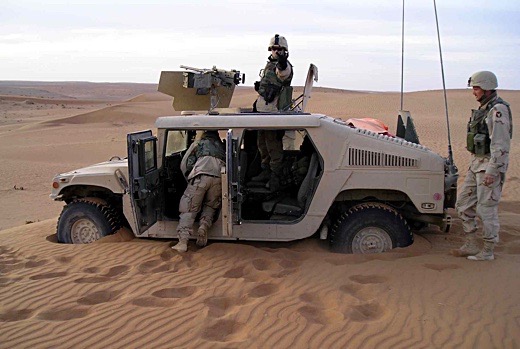
Image above: US Army Hummer stuck in the sand in southern Afghanistan. From (https://lareviewofbooks.org/article/never-ending-book-war/).

The U.S. occupation of Afghanistan is "the main obstacle" to peace, the Taliban's leader said Friday.

In his comments to mark the end of the Muslim holy month of Ramadan, Mullah Haibatullah Akhundzada also denounced the plan to increase number of U.S. troops in the country, and accused the U.S. and its allies of "destabilizing the whole region."

The Pentagon is reportedly weighing sending an additional 4,000 troops to Afghanistan. Akhundzada appeared to reference that development, saying, "The more they insist on maintaining the presence of their forces here or want a surge of their forces, the more regional sensitivity against them will intensify."

"Americans should understand that continuation of war in Afghanistan, upsurge of bombardment ... will never usher in success for them. The Afghans are not a people to kowtow to someone," he said.

Echoing previous comments made by the Taliban, he said, "The occupation is the main obstacle in the way of peace." He added that "constructive and good relations with you and the world" would follow a withdrawal of forces.

U.S. based activists have also criticized the proposal to send more troops as "escalating this endless war."

See also:
Ea O Ka Aina: US anti-terrorism strategy backfires 6/22/17
Ea O Ka Aina: United States of Permanent War 2/26/17
Ea O Ka Aina: Stop War for Christmas 12/24/11
Ea O Ka Aina: Real Soldiers Just Say No 9/3/09.

A Matter of God's Mercy

SUBHEAD: Now that we’ve made Earth uninhabitable we won’t have to remember how it got that way.

By James Kunstler on 21 April 2017 for Kunstler.com -
(http://kunstler.com/clusterfuck-nation/a-matter-of-mercy/)


Image above: "Back to the Future's" Biff Tannen in an Adidas warmup suit and looking confused.   From (http://backtothefuture.wikia.com/wiki/Biff_Tannen). Dontal Trump is Biff Tannen - a greedy bully. See also (http://khitschicago.cbslocal.com/2015/10/21/proof-back-to-the-futures-biff-tannen-is-running-for-president/).

Paging Doctor Oz!

A patient calling itself The United States wandered into the emergency room disoriented, wearing a filthy warm-up suit, claiming it was “the greatest” this and that… but was unable to complete the nine-page admission protocol or present valid insurance ID. Patient is growing increasingly violent, threatening staff and other patients….

Nations do develop something like Alzheimers. Perhaps you haven’t noticed that for some time now nothing sticks in the national brain-pan — if that’s what we can call the news media and its analogs on the Web waves.

For months, an obsession about “Russian interference in the election” raged through the left lobe of the national consciousness. Then, about a week ago, it vanished utterly. Grandpa suffered similar delusions about the Russians meddling with “our precious bodily fluids.”

Paging Doctor Strangelove!

Not so far back as last summer, a candidate named Trump un-ironically called for “an end to endless war in the Middle East.”

The oft-applied policy of “regime change,” he said, was not working out in the various US-engineered failed states such as Libya, Iraq, Somalia, Yemen, Ukraine.

About two weeks ago, I seem to recall, the State Department even declared explicitly that we had no brief for regime change in the case of one Bashar al-Assad over in Syria.

Then there was something in the wifi waves about a poison gas attack. The evidence as to exactly who perpetrated it looked, how-you-say, not altogether convincing.

This evidence amounted to the US Intel services, in their aggregate omniscience, asserting that, “yes, it was so that this weasel Assad bombed his people with Sarin.”

Wolf Blitzer and Rachel Maddow ran so hard with the story that they vanished over the horizon.

The patient had a dream after that: a dream of cruise missiles reigning down hellfire judgment upon a Syrian air base. Quite a few of them went astray and blew up some prickly pears in the desert and a pod of migrating sea turtles out in the Mediterranean. (Thank you Microsoft Windows.)

Then the Secretary of State, Mr. Tillerson declared that “Assad must go.” The patient now was completely confused about who was coming or going. Then the patient forgot about the dream and we’ve heard no more about this fairytale land of Syria since then. Oh well….

It seemed like only yesterday that head honcho over North Korea — a character straight out of the James Bond fantasies with the weirdest haircut in recorded history — was threatening to blow up the United States.

A US aircraft carrier fleet was soon steaming around his half of the Korean peninsula. A rocket lifted off somewhere… and promptly blew up. Well, at least something blew up. I forgot what, exactly….

And now I see on the morning wire that ISIS has gone and pulled off another terror incident in Paris — one cop dead, one injured in a street  shooting.

Weren’t there other incidents before this one, possibly even worse ones? I forget. Anyway, in this case, it was easy to figure out the man’s identity (one Karim Cheurfi) because the fucker had spent 15 years in prison after being convicted of three attempted murders, two against police officers, and was released on parole in 2015.

There was some additional chatter in the wire story about the incident having an effect on an upcoming French election. But I forget who’s running. And when the darn thing is over, I’ll probably forget who won, and why.

That’s how we roll in the national Alzheimers ward. Shit happens and then is promptly forgotten. Sometimes the shit that happens is forgotten so completely that it’s like living in universe where nothing happens.

The auditors who once reported to work in your brain have left their stations — with no duties left after the smart-phone came on the scene. They are among the millions “no longer looking for work” in those BLS reports.

Maybe this is a manifestation of what used to be called “God’s mercy.”

Now that we’ve almost succeeded in making the planet uninhabitable, we don’t have to remember how it got that way, or what will happen to us in the meantime, while we’re still here.

.

Ms Gabbard goes to Syria

SUBHEAD: After "secret trip", Gabbard derided as ‘Stooge,’ and praised as ‘Courageous’.

By Kristin Downey on 27 January 2017 for Civel Beat -
(http://www.civilbeat.org/2017/01/after-secret-trip-gabbard-derided-as-stooge-praised-as-courageous/)


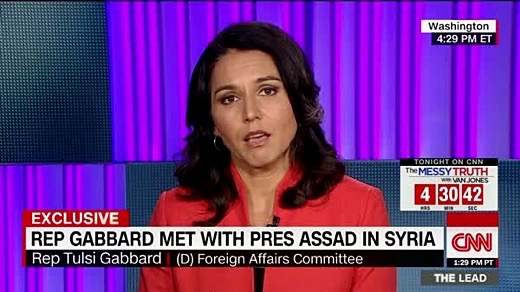
Image above: Tulsi Gabbard explaining her journey this week to meet President Assad in Syria. From still frame from CNN video stream.

No stranger to the national stage, the Hawaii congresswoman is getting international attention after meeting with Syrian President Assad.

Hawaii Congresswoman Tulsi Gabbard’s secret fact-finding trip to Syria and Lebanon — and especially her meeting with a brutal dictator, Syrian President Bashar Assad — continues to garner attention here and abroad.

Gabbard, who serves on the House Foreign Affairs and Armed Services committees, has declined to share many details about the week-long visit to the war-torn nations, which has only added to the mystery and heightened the suspicions of people questioning her motives.

On Friday, her office said again that Gabbard would not discuss the trip.

In statements, Gabbard has characterized the trip as a peace-making effort aimed at trying to better understand the on-the-ground realities in the region, where horrific violence has caused millions of refugees to flee to Europe and the United States.

She said she was surprised by an invitation to meet with Assad, and acted on the opportunity, sharing no further details.

Anger And Praise Critics say that a meeting with a member of Congress enhanced Assad’s credibility and that it was naïve, or even treacherous, for her to go there.

Gabbard’s trip “raised alarms,” wrote The Guardian, a British news site. “Tulsi Gabbard’s Fascist Escorts to Syria,” was the headline on a piece by The Daily Beast. The Daily Kos called her a “stooge” for the Syrian president, who has killed thousands of dissidents, allegedly including by poison gas.

The secret trip angered some of her congressional colleagues, according to The Hill, a political news site.

Gabbard, a combat veteran who served in Iraq, has also been praised in some circles for making the trip. A group of Syrians posting on a website called Progressive Democrats of America called the visit “courageous.” A story about the trip on AntiWar.Blog attracted applause from people who oppose U.S. military intervention and high levels of military spending.

Gabbard, a Hindu of Samoan descent, has also been lauded by white supremacists David Duke, the former leader of the Ku Klux Klan, and Richard B. Spencer. In a tweet, Spencer said Gabbard is “brave and the kind of person we need in the diplomatic corps.”

Syria, once a bastion of multiculturalism and religious tolerance, the home of picturesque and historic antiquities, has become a bloodbath since a civil war erupted in 2011 amid the uprisings known as the Arab Spring.

Assad’s regime is backed by Russia. His opponents, who are backed by Saudi Arabia and other Persian Gulf countries, include many Islamic militant groups. Some of the rebels who are viewed as more moderate have received American support.

Syrian government forces are also battling the Islamic State on Syrian soil.

Former President Barack Obama was a vocal opponent of Assad, and contemplated sending U.S. troops to Syria to help topple his regime. President Donald Trump has endorsed a more hands-off approach to military intervention in the Middle East.

His position on Syria is a work in progress, but there have been some suggestions in leaked documents that he plans to step up U.S. involvement there.

Gabbard has long opposed U.S. military intervention in Syria, saying that overthrowing Assad would allow Islamic militants to gain control of the country.

Center Of Attention — Again
This isn’t the first time the representative of Hawaii’s 2nd Congressional District has been a lightning rod.

She has been at odds with the Democratic Party establishment since she endorsed Sen. Bernie Sanders for president instead of former Secretary of State Hillary Clinton. Gabbard resigned her position as vice-chair of the Democratic National Party to underscore her disapproval of what she said the party had done to undermine Sanders’ candidacy.

Gabbard went to Syria during the transition week, as Obama was departing office and Trump was being inaugurated. She said she could not reveal details of her travel plans for security reasons.

She did not inform Democratic Party officials she was going, and did not tell the Republican leaders of the Foreign Service or Armed Service committees. She said she did tell the Defense Department she was planning to make the trip, and got approval from the House Ethics Committee.

She said she did not inform Trump.

“The Trump administration was not aware or involved in the trip in any way, and the congresswoman has not been in touch with them since returning regarding this trip or anything else,” her office said in a statement.

Gabbard’s relationship with Trump has also raised eyebrows in Democratic circles. Shortly after he won the election, Gabbard visited him at his New York home in Trump Tower. She said she went to talk about her concerns about military intervention in Syria; some observers speculated she might be looking for a job in his administration.

Assad’s military alliance with Russia added to the controversy over Gabbard’s trip. Russia is widely believed to have intervened in the U.S. presidential election by hacking the email of the Democratic National Committee, exposing messages that put Clinton and her supporters in a bad light and undermined her candidacy.

Gabbard has said that the trip was sponsored by an organization called the Arab American Community Center for Economic and Social Services, part of an organization known as ACCESS, which says on its website that it is a philanthropic group that assists Arab-Americans.

She said was accompanied by former Congressman Dennis Kucinich, a progressive pacifist who ran for president in 2008.

Gabbard’s husband, Abraham Williams, also traved with her. He posted video of the trip on Gabbard’s facebook page, which has drawn 102,000 views, 2,640 shares and dozens of comments.

Most of them are complimentary, with some urging her to run for president in 2020.

.

Dominica in Transition

SUBHEAD:Report from the island State of Dominica in the Caribbean.  Could "Transition" assist the island?

By Naresh Giangrande on 6 January 2017 for Resilience -
(http://www.resilience.org/stories/2017-01-06/dominica-in-transition/)


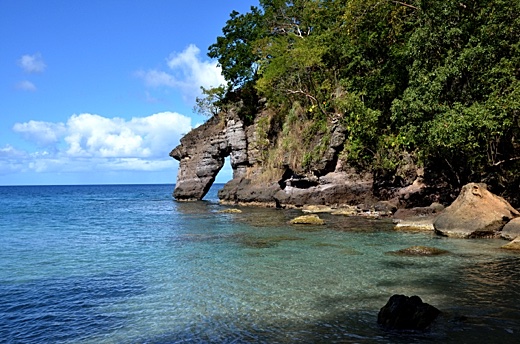
Image above: Secret Beach at Portsmouth on Dominica. Photo byEric Tuvel. From (https://erictuvel.wordpress.com/2012/01/12/island-life/).

[IB Publisher's note: This Caribbean island nation halfway between Puerto Rico and Trinidad is not that dissimilar to Kauai. It is, however, closer to its full independence and its indigenous population more in charge. Dominica does not have an armed forces - and likes it that way. Lessons might be learned through their experience.]

The island state of Dominica (absolutely NOT the Dominican Republic!) is unique, constantly confounding my expectations. It is a tropical Caribbean island, but not a typical Caribbean island.

It is hot and wet, mountainous, with small rocky beaches, few tourists, and a fiercely independent spirit in a part of the world dominated by their powerful neighbor to the North.

I was invited by WEF, the Waitukubuli Ecological Foundation, to visit and help them explore Transition as a possible way for this island.

The last refuge of the indigenous inhabitants of the Caribbean, the Kalinago people, Wai’ Tukubuli in their language, is at another moment of choice in it’s history. At a time when the socialism has come and gone, and the current neoliberal, globalized trade system is rapidly falling away, what place for small island states such as Dominica?

When there is a wish amongst most people to move forward and not backwards to a poverty and simple existence that is within living memory. Never completely colonized, to understand the people and this island you need to look back, which might also provide insights into ways forward.

The interior of the island is mountainous, very steep and rugged, and covered with dense rainforest. This enabled a state within a state to sit side by side with first the French then English colonizers. Read this account of the fighting Maroons of Dominica to understand how comprehensive the resistance to colonization was.

Tribes of Maroons and Kalinagos lived for centuries, free men and women apart from, and in occasional violent, bloody conflict with, the colonial slave regimes on the coastal plains.


Image above: Kalinago dancers don traditional wear for displays at the Baruna Aute in the Kalinago Territory. From (http://embracedominica.com/dominicas-people/).

The interior of the island was unsuitable for agriculture, or at least the plantation agriculture of the colonists, and able to resist the superior firepower of the European garrisons. Modern day Dominicans have the blood of these fiercely independent people running in their veins.

Dominica has much going from it from a resilience point of view, and is very different from most Caribbean islands. The sand, sea, and hot dry climate formula which facilitates mass tourism on most islands in the Caribbean does not work in Dominica.

The climate is wetter, the beaches rocky. The shoreline is common land. There have been attempts by hotels chains to build large hotels, but with the proviso that their section of beach become private. Dominicans have so far resisted the temptation to privatize this commons.

Few large estates remain. One of the heirs to the Rockefeller fortune donated his estate to help form the Morne Trois Pitons National Park in the center of the island. Land ownership remains widespread and egalitarian. I have been told most Dominicans have land and many grow their food. Most Transitioners would be very jealous of the 3 or 4 hectares with ample water and sun that ordinary folks have here.


Image above: For Dominicans the perfect definition of ‘peace’ is the absence of an armed force, and they seem to be doing just fine without the intervention of one. From (http://traveltriangle.com/blog/places-without-armed-forces/).

The land is not suitable for large scale agribiz, and hence not bought up by the large tropical fruit and commodity multinationals. There has been a succession of mono cropped, cash crops; citrus, ‘bay’, sugar cane, coffee, and bananas mostly grown by small land owners. All have come and gone. Many of the brightest young educated Dominicans leave the island to work in the USA and UK.

As the curtain goes down on the globalized world we have known for so many decades where does that leave Dominica? The set of cultural assumptions which I call the ‘myth of progress’ operates here as everywhere else.

But as in the ‘developed world’ that set of assumptions about our future; more, better, richer, more high tech are disappearing before our eyes as the ecological limits of growth on a finite planet begin to bite. Transition presents another way altogether of a marriage of the old and the new, making life more local, small scale, and convivial.

Would Transition work here? What would it take? There is a very small middle class. Could or would the ordinary Dominican warm to Transition? There is healthy scepticism of anything European, hardly surprising given the history.

There are a network of credit unions which could supply community funding. Can the small scale land ownership model be extended to renewable energy or community owned light industry? Could Local Entrepreneur Forums work here?

These are some of the questions I have been raising and the Dominicans I have meet are grappling with. There are no easy answers. The Transition model would be useful to the extent that it is very good at engaging people in conversations that matter, visioning, working well in groups, and developing a good networking strategy.

Would Transition look very different, to most places in the world, in Dominica? Probably yes. We have a workshop this Monday to explore these questions further. As always, I only ask the questions.Dominicans must answer.

.

See film "Answering the Call"

SUBHEAD: Kauai Alliance for Peace and Social Justice hosts activist and filmmaker John Witeck.

By Sandy Herndon on 21 December 2016 for Island Breath -
(http://islandbreath.blogspot.com/2016/12/see-answering-call.html)


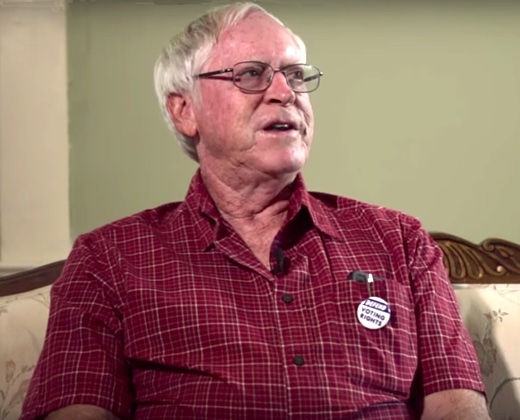
Image above: A young John Witeck and friend at the University of Hawaii in the 1960's. Still frame from trailer below.

WHAT:
Watch "Answering the Call" , a film about his experiences with Civil Rights suppression in Selma AL in  and a Q & A about his current work in Hawaii.  The evenings events will open with civil rights era social justice songs by Blu Dux and Friends. The events are free.

WHEN: 
January 15th  2017 From  3:00 pm to 6:00 pm

WHERE:
Lihue Neighborhood Center, 3353 Eono Street
Lihue, Kauai, Hawaii 96766

WHY:
As relevant today as it was in the '60's, suppression of people's voting and other civil rights continues to be a source of dishonor to our "Democratic Society". This film and the Q & A afterward, offers an opportunity to better understand our role in taking back our power.

SPONSOR: 
Kauai Alliance for Peace and Social Justice hosts activist film maker John Witeck.

CONTACT:
If you need further information
Sandy Herndon
phone: 808-320-3878
email: 2da1wahine@gmail.com


Image above: Current John Witeck in an interview from the movie "Answering the Call". Still frame from trailer below.

BACKGROUND:
John Witeck was called to Selma, in 1963 by Dr. Martin Luther King to promote voter registration of suppressed African Americans. He will speak at Lihue Neighborhood Center on Sunday Jan. 15 at 3PM. The documentary film "Answering the Call" portraying Mr. Witeck's sometimes chilling experiences in Selma will be shown.

Mr. Witeck was inspired to become involved in the greater movement for social change. In 1967 he enrolled in the East-West Center graduate program on O`ahu, and heeding Dr. King's words became a draft resister and anti-war activist. He joined in local causes, among them the Hawaiians' struggle against evictions in Kalama Valley and elsewhere.

He is a founder of University of Hawaii Students for a Democratic Society (SDS), the Labor Community Alliance and Hawaii Peoples Fund. Mr. Witeck served as Business Agent for United Public Workers for 25 years, and he is a retiree of HEA Bargaining Unit Thirteen.Today he instructs at Honolulu Community College and is vice president of Hoa` O Makaha (Makaha Farm).


Video above: Trailer for "Answering the Call". From (https://youtu.be/GSyD8tlIz28).

.

Standing Rock has changed us

SUBHEAD: As we work toward a post-fossil fuel society, we can look to these lessons from the Sioux.

By Sarah van Gelder on 7 December 2016 for Yes Magazine  -
(http://www.yesmagazine.org/people-power/how-standing-rock-has-changed-us-20161207/)


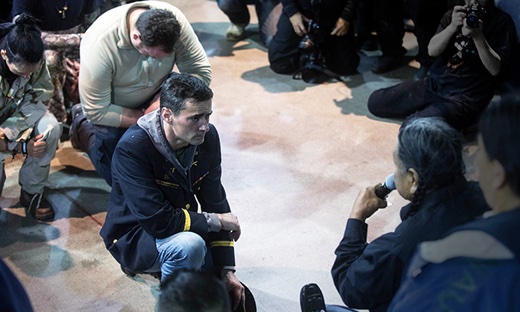
Image above: In a ceremony on Monday, veterans asked for forgiveness on behalf of the nation for theft of land and genocide of Native Americans. The veterans were led by Wes Clark Jr., who addressed Chief Leonard Crow Dog, a Lakota spiritual leader. Photo by Adam Johannson.
From original article.


At the Oceti Sakowin camp there were celebrations into the night when the U.S. Army Corps of Engineers’ decision was announced. Fireworks lit up the sky, which is normally dominated by police searchlights, and there were songs, prayers, and dance. And tears.

The decision to halt work on the Dakota Access pipeline may be the victory that the Standing Rock Sioux tribe and thousands of water protectors were looking for.

On the heels of the announcement, Energy Transfer Partners issued a statement insisting that they will go ahead with the project. What that means is not yet clear, but whatever happens the events at Standing Rock have been transformative, and these victories are not ones that Energy Transfer Partners or even President-elect Trump can take away.

Here are just a few things that have shifted in our world because of the extraordinary Native-led uprising at Standing Rock.

Decolonizing
It was a scene I didn’t think I’d ever witness. Veterans at Standing Rock, led by Wesley Clark Jr., spoke of the many ways the U.S. military had brutalized Native people, through killings, through taking their lands and even their children. And then they knelt down and apologized in front of the elders.

These nonviolent warriors, sworn to uphold the Constitution, came to North Dakota to protect the water protectors, but they did something even more important by acknowledging historic harms and showing remorse.

Clergy too came with humility and apologies. At a gathering in early November, one Christian denomination after the next burned the Doctrine of Discovery, a centuries-old religious doctrine that made its way into law and condones taking the lands of non-Christians.

If it is possible to heal from the long U.S. history of genocide, these moves by clergy and veterans were powerful steps in that direction.

The work of decolonizing is much bigger though, and it is Native-led. Within the camps, Lakota culture is at the foundation of everything, from the early morning prayers at the sacred fire to the food line, where elders are served first. Newcomers are reminded to respect these ways. Native people have led this movement from the beginning, and they are reclaiming their power.

This time, non-Natives in large numbers stood with them and learned from them ways to live that are inclusive and collective.

And as people return home from the camp, the effects will ripple out into communities across North America for years to come.


Respect for Mother Earth and our own bodies

Walk to the edge of the Cannonball River at Standing Rock, or to the banks of the Missouri River, which provides water to the Standing Rock Sioux tribe and Cheyenne River tribes, and to millions of others farther downstream. And then consider what it would mean if DAPL ruptured, spewing toxins into this precious shared water.

The core idea that “water is life” is self-evident, as our bodies are nearly two-thirds water. Yet the implications are radical. What would it mean to actually protect water and, therefore, to also protect our health?

Even more radical is the idea that we would sacrifice the comforts of fossil fuel-based consumerism for the quality of that water, giving a gift of well-being to our children and future generations.

Water is important everywhere, but the Sioux people, by protecting the water of their place on Earth, have shown what moral authority looks like. Their commitment attracted support from around the world, and showed people everywhere what it means to protect your home.

Finding our power
The American people want to switch to renewable energy—not invest more in fossil fuel infrastructure. Many are closing accounts with big banks and moving their funds into credit unions and community banks, thus helping to rebuild the economy to support communities and life.

And at Standing Rock, people found many ways to exert power. In the face of pepper spray, rubber bullets, dogs, concussion grenades, and water cannons, the water protectors remained nonviolent. They were arrested by the hundreds, strip-searched, and placed in fenced enclosures resembling dog kennels. But their responses were prayerful and sometimes even loving.

This display of courage moved the hearts of millions. As law enforcement escalated the violence, water protectors increased their presence.
And because of independent reporting and social media, the story got out in real time even when other media weren’t paying attention.

Amy Goodman’s Democracy Now coverage of dogs attacking water protectors was the first reporting to alert the world to the brutality of pipeline security. The beautiful short films featuring the people at the camp, the posters and art, the water protectors’ drones, the tweets and live feeds from Standing Rock—all have kept the story alive for months.
People power in all these forms works.

Thousands came to the remote plains of North Dakota. Hundreds of thousands took action through donations and demonstrations. The sense of power and hope that goes with this decentralized movement, and the accumulating know-how, will make the next action easier to pull off, and the next one after that.


What’s next?
The work, prayers, hardship, and collaborations are not over. There may be new rounds at Standing Rock, and more water protectors may be injured and traumatized there or at other locations. There may even be loss of life. And there are other pipelines that need to be confronted by water protectors. Just last week, Canadian Prime Minister Justin Trudeau gave the green light to the Kinder Morgan pipeline, and the presidency of Donald Trump could threaten everything we hold dear.

Nonetheless, this is a time to celebrate. The water protectors won a huge victory with the Corps of Engineers decision—a victory that benefits not only the Sioux tribes, not only those along the Missouri River, but everyone.

We all drink water and need a stable climate. As we navigate what may be the most dangerous time in human history, the lessons from Standing Rock can guide us.

As we create a post-fossil fuel society, we can take the lessons of respect and nonviolence, of valuing life over money, of learning from the indigenous peoples as cornerstones. A revolution in values and culture is rippling out across the country and the world, and it started at Standing Rock.

• Sarah van Gelder wrote this article for YES! Magazine. Sarah is cofounder and editor at large of YES! Magazine. Her new book, “The Revolution Where You Live: Stories from a 12,000-Mile Journey Through a New America” is available now from YES! Read more about her road trip and book here and follow her on Twitter @sarahvangelder.

See also:
Ea O Ka Aina: As Standing Rock celebrates... 12/5/16
Ea O Ka Aina: Army Corps denies easement 12/4/16
Ea O Ka Aina: My Whole Heart is With You 12/2/16
Ea O Ka Aina: The Loving Containment of Courage 12/1/16
Ea O Ka Aina: The Beginning is Near 12/1/16
Ea O Ka Aina: Feds to shutdown NoDAPL Camp 11/25/16
Ea O Ka Aina: NoDAPL people are going to die 11/23/16
Ea O Ka Aina: Hundreds of vets to join NoDAPL 11/22/16
Ea O Ka Aina: Obama must support Standing Rock 11/21/16
Ea O Ka Aina: Trump's pro oil stance vs NoDaPL 11/15/16
Ea O Ka Aina: Kauai NoDAPL Demonstration 11/12/16
Ea O Ka Aina: Obama to Betray Standing Rock 11/12/16
Ea O Ka Aina: Trump impact on Standing Rock 11/12/16
Ea O Ka Aina: Ann Wright on Standing Rock 11/8/16
Ea O Ka Aina: Turning Point at Standing Rock 11/6/16
Ea O Ka Aina: Jackson Browne vs DAPL owner 11/5/16
Democracy Now: Boycott of DAPL Owner's Music Festival
Ea O Ka Aina: World responds to NoDAPL protests 11/5/16
Ea O Ka Aina: NoDAPL victory that was missed 11/5/16
Ea O Ka Aina: DAPL hid discovery of Sioux artifacts 11/5/16
Ea O Ka Aina: Dakota Access Pipeline will leak 11/5/16
Ea O Ka Aina: Route of the Dakota Access Pipeline 11/4/16
Ea O Ka Aina: Sanders calls for stopping DAPL 11/4/16
Ea O Ka Aina: Obama hints at DAPL rerouting 11/3/16
Ea O Ka Aina: New military attack on NODAPL 11/3/16
Ea O Ka Aina: How to Support NoDAPL 11/3/16
Unicorn Riot: Tweets from NoDAPL 11/2/16
Ea O Ka Aina: Standing Rock & the Ballot Box 10/31/16
Ea O Ka Aina: NoDAPL reclaim new frontline 10/24/16
Ea O Ka Aina: How far will North Dakota go? 10/23/16
Ea O Ka Aina: Amy Goodman "riot" charge dropped 10/17/16
Ea O Ka Aina: Amy Goodwin to face "Riot Charge" 10/16/16
Ea O Ka Aina: Shutdown of all tar sand pipelines 10/11/16
Ea O Ka Aina: Why Standing Rock is test for Oabama 10/8/16
Ea O Ka Aina: Why we are Singing for Water 10/8/16
Ea O Ka Aina: Labor's Dakota Access Pipeline Crisis 10/3/16
Ea O Ka Aina: Standing Firm for Standing Rock 10/3/16
Ea O Ka Aina: Contact bankers behind DAPL 9/29/16
Ea O Ka Aina: NoDAPL demo at Enbridge Inc 9/29/16
Ea O Ka Aina: Militarized Police raid NoDAPL 9/28/16
Ea O Ka Aina: Stop funding of Dakota Access Pipeline 9/27/16
Ea O Ka Aina: UN experts to US, "Stop DAPL Now!" 9/27/16
Ea O Ka Aina: No DAPL solidarity grows 9/21/16
Ea O Ka Aina: This is how we should be living 9/16/16
Ea O Ka Aina: 'Natural Capital' replacing 'Nature' 9/14/16
Ea O Ka Aina: The Big Difference at Standing Rock 9/13/16
Ea O Ka Aina: Jill Stein joins Standing Rock Sioux 9/10/16
Ea O Ka Aina: Pipeline temporarily halted 9/6/16
Ea O Ka Aina: Native Americans attacked with dogs 9/5/16
Ea O Ka Aina: Mni Wiconi! Water is Life! 9/3/16
Ea O Ka Aina: Sioux can stop the Pipeline 8/28/16
Ea O Ka Aina: Officials cut water to Sioux 8/23/16

.