Showing posts with label Entertainment. Show all posts

Trump's lazy lack of interest

SUBHEAD: Trump, America's Boy King, should know golf and television won't make America great again.

By Lee Moran on 4 August 2017 for Huffington Post -
(http://www.huffingtonpost.com/entry/newsweek-cover-donald-trump_us_598418d1e4b041356ebef616)


Image above: Cover of Newsweek illustrates Trump's Lazyboy lifestyle labeled "Donald Trump is bored and tired. Imagine how bad he'd feel if he did any work." From (http://www.newsweek.com/2017/08/11/donald-trump-hillary-clinton-gop-white-house-potus-bannon-643996.html).

“I would have added past due bills on floor...”

President Donald Trump won’t want to hang this uncomplimentary magazine cover at any of his golf clubs.

Newsweek depicted the president as a junk food-eating television addict on the front of its next issue, dated Aug. 11.

Under the headline “LAZY BOY,” the edited photo shows Trump slumped in a recliner with a remote control in one hand and a Diet Coke in the other.

An open bag of Cheetos is perched on his lap while an empty McDonald’s hamburger carton is discarded on the floor.

“Donald Trump is bored and tired,” the sub-headline reads. “Imagine how bad he’d feel if he did any work.”

Newsweek shared the cover on its home page late Thursday, two days after it published the cover story itself, which examined “America’s boy king” and his apparent lack of enthusiasm for the job.

The image went viral, sparking a myriad of responses.


Image above: Could Trump be afraid? From (http://www.newsweek.com/2017/08/11/donald-trump-hillary-clinton-gop-white-house-potus-bannon-643996.html).


.

Fox to cut ties with Bill O'Reilly

SUBHEAD: Mr. O’Reilly hasn’t been on the air since April 11, when he announced plans for a vacation.

By Xeni Jardin on 18 April 2017 for Boing Boing -
(http://boingboing.net/2017/04/18/more-like-bill-o-bye-ly.html)


Image above: Fox News host Bill O'Reilly's Superbowl interview with President Donald Trump in February 2017. From (http://www.infostormer.com/bill-oreillys-super-bowl-interview-with-president-trump/).

The Rupert Murdoch and ‎News Corp-owned Wall Street Journal reports Fox News “is preparing to cut ties with its biggest star, Bill O’Reilly,” and a final decision on his “fate could come as early as the next several days.”

The 'O’Reilly Factor' host has been accused of sexual abuse and harassment for over 15 years by a number of women.

Most recently, an April 1, 2017 article in the New York Times [screenshot] revealed an apparent conspiracy to hide $13 million in previously undisclosed settlement payments he and Fox News made to five women who worked on or appeared on his program.

A steady escalation of internal and public pressure on Fox News to fire Mr. O’Reilly followed that news report.

From today's Wall Street Journal story on O'Reilly's likely imminent ouster from Fox News:
Mr. O’Reilly hasn’t been on the air since April 11, when he ended his show by announcing plans for a vacation. While Mr. O’Reilly had planned to take this week off, the early start to his vacation wasn’t part of the original plan, people familiar with the matter said. The plan was for him to return to his show next Monday.

On Tuesday, an attorney for Mr. O’Reilly said the host has “been subjected to a brutal campaign of character assassination that is unprecedented in post-McCarthyist America” and added that it has “evidence that the smear campaign is being orchestrated by far-left organizations bent on destroying O’Reilly and Fox News for political and financial reasons.”

The negative publicity for 21st Century Fox follows the exit last year of Fox News Chairman and chief executive Roger Ailes that put a spotlight on the treatment of women at the network. Mr. Ailes resigned in July after he was accused of sexual harassment by multiple women, prompting an internal investigation within the company. Mr. Ailes has denied all of the accusations.


Video above: "Inside Edition" host Bill O'Reilly goes nuts with staff over teleprompter issue. From (http://www.infostormer.com/bill-oreillys-super-bowl-interview-with-president-trump/).
.

Premiere of Seed: The Untold Story

SUBHEAD: Saturday, March 18 at KCC, a documentary film about our seed legacy.

By Jeri DiPietro on 10 March 2017 in Island Breath
(http://islandbreath.blogspot.com/2017/03/premiere-of-seed-untold-story.html)


Image above: Still frame from movie "Seed" showing seed sprouting from the soil.

WHAT:
Documentary Film,  "Seed: The Untold Story"
Question and answer session to follow the film.

WHEN:
Saturday, 18 March 2017 at 7:00pm

WHERE:
at the Kauai Community College Performing Arts Center.

CONTACT:
Sponsored by Hawaii Seed and GMO Free Kauai.
Call Jeri DiPietro, (808) 651-1332 or email ofstone@aol.com
or call MiKey at (808) 651-9603.

COST:
Tickets available at seedthemovie.com/kauai - Brown Paper Tickets Online. Also available at the KCC Box Offoce the night of the performance - cash only.
Keiki under five = Free
Students = $5.
Seniors = $9.
Adults = $10.
Few things on Earth are as miraculous and vital as seeds, worshiped and treasured since the dawn of humankind. Award winning documentary, SEED: The Untold Story, follows passionate seed keepers protecting our 12,000 year-old food legacy. In the last century, 94% of our seed varieties have disappeared.

As biotech chemical companies control the majority of our seeds, farmers, scientists, lawyers, and indigenous seed keepers fight a David and Goliath battle to defend the future of our food.

In a harrowing and heartening story, these reluctant heroes rekindle a lost connection to our most treasured resource and revive a culture connected to seeds.

SEED features Vandana Shiva, Dr. Jane Goodall, Andrew Kimbrell, Winona Laduke and Raj Patel.

Also the film features Kauai's SEED features Kauai's Dustin Barca, Howard Hurst, Malia Chun, Wendell Kabutan, and Gary Hooser, in addition to Vandana Shiva, Dr. Jane Goodall, Winona Laduke, Claire Hope Cummings, Andrew Kimbrell, and Jeffrey Smith.

This film has already won 8 awards at 7 film festivals.  It completes the Trilogy of Taggart Siegel and Jonathan Betz from Collective Eye Media, creators of Queen of the Sun: What Are The Bees Telling Us? and The Real Dirt of Farmer John.

For more information, go to: http://www.seedthemovie.com/

TRAILER:

Video above: Trailer for "Seed - The Untold Story. From (http://www.seedthemovie.com/trailer).


.

See film "Island Earth"

SUBHEAD: An underground movement of young people moving back to the land and growing their own food.

By Jerry DiPietro on 18 January 2017 for GMO Free Kauai -
(http://islandbreath.blogspot.com/2017/01/see-film-island-earth_18.html)


Image above: Detail of promotional poster for film "Island Earth". From Jeri DiPietro.

the Kauai premiere of a film "Island Earth" by Cyrus Sutton, an Emmy Award winning film maker and Professional Surfer. The film features many of our local and national friends in the movement!

The film is about all of you, and will help bring our story to the rest of the world!

WHAT:
Documentary movie "Island Earth" about agriculture, GMOs, pesticides and Hawaii.

WHEN:
Friday, Feburary 10th, 2107. Doors open at 6:00pm. Movie starts at 7:00pm.

WHERE:
Kauai Community College Performing Arts Center
Kaumaulii Highway
Puhi, Kauai

SPONSORS:
Hawaii SEED, GMO Free Kauai and The MOM Hui

CONTACTS:
Tabling space available for our coalition partners (with reservations in advance of the event.
Call MiKey at (808 )651-9603 or Jeri at (808) 651-1332. 

We hope to fill up the Performing Arts Center so please come meet filmaker Cyrus Sutton, and please share and help spread the word! See you on Friday, February 10th.


Video above: Trailer for "Island Earth" From (https://youtu.be/8YHfoehag5I). Provided by (https://www.kickstarter.com/projects/cyrussutton/island-earth-documentary)

This documentary is about an underground movement of young people moving back to the land and growing their own food in response to corporate corruption in our food supply.


Video above: Background film about Cyrus Sutton and "Island Earth". From (https://youtu.be/q1YCMkcVDDg).

Cyrus Sutton is many things. A surfer. A storyteller. A filmmaker. An activist. It's his dynamic, healthy skepticism of the status quo and profound dedication to change that make him a visionary in the canon of contemporary surf personalities.

Currently, he's producing a new film called Island Earth that explores the world's food supply. You can bet that it will inspire you to take your food – and the way you choose to spend your cash in supporting business – just a little more seriously. And that's a good thing. 
.

Kissenger is a Kiss messenger

SUBHEAD: The Kissenger allows your iPhone to simulate kissing your long-distance lover.

By Rob Beschizza on 30 December 2016 in Boing Boing -
(http://boingboing.net/2016/12/30/kissenger-simulates-kissin.html)


Image above: The hardware that allows an cell phone to replace a lover.   From original article.

Touted as Earth's "first mobile kiss messenger," Kissenger is a rubbery-looking dock that humans put their phones in. It has a tactile surface they depress with their meat. The movements are then transmitted in realtime over the internet, so that a replica of them may be experienced by another human.

Plug in to your phone and give your loved ones a kiss over the Internet. Kissenger can sense your kiss and transmit realistic kissing sensations to your partner in real time. You can also feel the force on your lips when your partner kisses you back. Share an intimate moment with your friends and families while chatting with them on your phone.

The device comprises six sensors, corresponding actuators, and a meat-colored silicone sheath. There's an app that goes with it so the humans can interact on a audiovisual-discursive level at the same time. It's at the prototype stage with nothing to buy, yet, but obviously we should keep an eye on this. It should suffice to say that our previous recommendations with respect to establishing contact with this species have not changed.


Image above: Obviously, for two lovers lips to meet requires one's partner to also have a Kissenger. From original article

High precision force sensors are embedded under the silicon lip to measure the dynamic forces at different parts of your lips during a kiss. The device sends this data to your phone, which transmits it to your partner over the Internet in real time. Miniature linear actuators are used to reproduce these forces on your partner's lips, creating a realistic kissing sensation. Kissenger provides a two-way interaction just like in a real kiss. You can also feel your partner's kiss on your lips when they kiss you back.


.

See film "Answering the Call"

SUBHEAD: Kauai Alliance for Peace and Social Justice hosts activist and filmmaker John Witeck.

By Sandy Herndon on 21 December 2016 for Island Breath -
(http://islandbreath.blogspot.com/2016/12/see-answering-call.html)


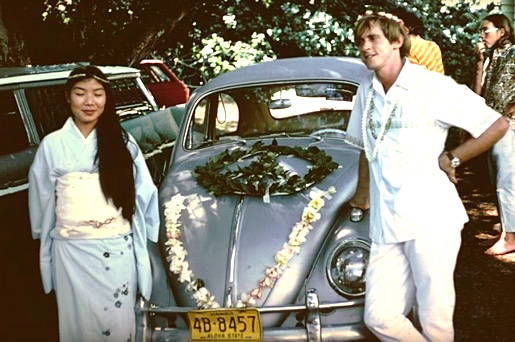
Image above: A young John Witeck and friend at the University of Hawaii in the 1960's. Still frame from trailer below.

WHAT:
Watch "Answering the Call" , a film about his experiences with Civil Rights suppression in Selma AL in  and a Q & A about his current work in Hawaii.  The evenings events will open with civil rights era social justice songs by Blu Dux and Friends. The events are free.

WHEN: 
January 15th  2017 From  3:00 pm to 6:00 pm

WHERE:
Lihue Neighborhood Center, 3353 Eono Street
Lihue, Kauai, Hawaii 96766

WHY:
As relevant today as it was in the '60's, suppression of people's voting and other civil rights continues to be a source of dishonor to our "Democratic Society". This film and the Q & A afterward, offers an opportunity to better understand our role in taking back our power.

SPONSOR: 
Kauai Alliance for Peace and Social Justice hosts activist film maker John Witeck.

CONTACT:
If you need further information
Sandy Herndon
phone: 808-320-3878
email: 2da1wahine@gmail.com


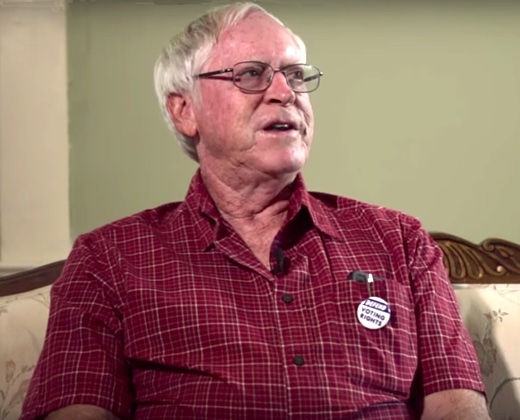
Image above: Current John Witeck in an interview from the movie "Answering the Call". Still frame from trailer below.

BACKGROUND:
John Witeck was called to Selma, in 1963 by Dr. Martin Luther King to promote voter registration of suppressed African Americans. He will speak at Lihue Neighborhood Center on Sunday Jan. 15 at 3PM. The documentary film "Answering the Call" portraying Mr. Witeck's sometimes chilling experiences in Selma will be shown.

Mr. Witeck was inspired to become involved in the greater movement for social change. In 1967 he enrolled in the East-West Center graduate program on O`ahu, and heeding Dr. King's words became a draft resister and anti-war activist. He joined in local causes, among them the Hawaiians' struggle against evictions in Kalama Valley and elsewhere.

He is a founder of University of Hawaii Students for a Democratic Society (SDS), the Labor Community Alliance and Hawaii Peoples Fund. Mr. Witeck served as Business Agent for United Public Workers for 25 years, and he is a retiree of HEA Bargaining Unit Thirteen.Today he instructs at Honolulu Community College and is vice president of Hoa` O Makaha (Makaha Farm).


Video above: Trailer for "Answering the Call". From (https://youtu.be/GSyD8tlIz28).

.

Magic with Magnets and Marbles

SUBHEAD: Watch these videos and enjoy the dance of kinetic energy, gravity and geometry.

By Rob Beschizza on 20 December 2016 for Boing Boing -
(http://boingboing.net/2016/12/20/magnets-and-marbles.html)


Image above: Still frame from video below "Magnets and Marbles!".

This isn't your usual kinetic pachinko balls-in-a-gravity-maze toy, but a mindbending demonstration of magnets. It starts getting really crazy at about 2m in but one should enjoy the subtle pleasures too.

Here's creator Kaplamino:
In this project, I use those little magnets that can be used to make cubes and others geometric figures, I think the name is "Neocube". It's really impressive how many tricks you can do with that, at the beginning I didn't think that I could make a whole project based on those magnets, but finally, it was pretty easy and I think there is still lots of cool tricks to discover!


Video above: "Magnets and Marbles!" by Kaplamino. From (https://youtu.be/QQ9gs-5lRKc).


Video above: "Marbles Tricks" by Kaplamino. From (https://youtu.be/QdkVhVwYJu0).

.

Moana - the Bigger Picture

SUBHEAD: Disney’s latest motion picture is a parable about climate change and indigenous rights.

By Ed Rampell on 2 December 2016 for Earth Island -
(http://www.earthisland.org/journal/index.php/elist/eListRead/disneys_moana_is_parable_about_climate_change/)


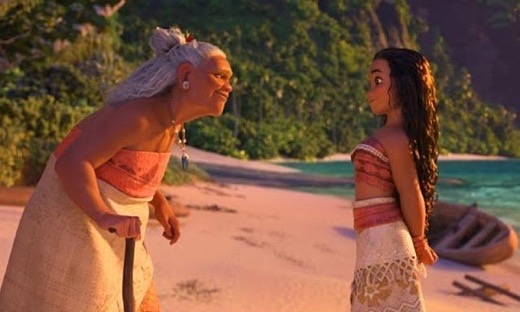
Image above: Gramma Tala speaking to her granddaughter Moana on the beach of their island of Motunui at sunset. From (http://www.twoohsix.com/2016/11/moana-movie-review.html).

Disney’s South Pacific-set animated feature Moana — co-directed by Ron Clements and John Musker, co-creators of The Little Mermaid and Aladdin, with voice characterization by Dwayne “The Rock” Johnson and music co-written by Hamilton’s Lin-Manuel Miranda — was number one at US box offices during the Thanksgiving holiday weekend.

After its world premiere at LA’s AFI Fest on November 14, The Hollywood Reporter noted, “Moana scored… with $81.1 million from 3,875 theaters,” while ABC News reported it “notched the third-largest three-day Thanksgiving opening of all time.”

The optically opulent movie is about Moana (voiced by Hawaiian teenager Auli’i Cravalho), daughter of Motunui island’s Polynesian Chief Tui (New Zealand Maori actor Temuera Morrison, who starred in 1994’s Once Were Warriors).

After the Pacific Islander learns about her voyaging heritage from Gramma Tala (Maori actress Rachel House of 2016’s Hunt for the Wilderpeople), Moana decides to embark on an Oceanic odyssey to save her endangered isle from environmental devastation.

During her voyage she enlists the aid of the legendary demigod Maui (voiced by Johnson, who is part-Samoan), who reluctantly helps the young, feisty Moana as they cross the Pacific in a sailing canoe to fight the demonic force on a far away isle that is threatening Motunui (which can be translated as “big island”).

This is the basic plot of Disney’s sumptuously animated musical adventure, but what most reviewers have missed is that disguised in the medium of a feature-length colorful cartoon, Moana’s filmmakers have created a motion picture parable about climate change.

And emerging while Native tribes take a stand at Standing Rock against fossil fuel development and oppression of indigenous peoples, Moana is also a movie metaphor about indigenous rights. (If Dakota Access Pipeline protesters are “water protectors,” however, in Moana the Pacific protects the title character — whose name can be translated as “ocean.”)

The entire raison d’etre for Moana’s mission is that an environmental disaster has befallen Motunui. The crops are failing, the coconuts have turned black, and the lagoon’s fish have been fished out.

To restore ecological balance Moana must sail to the distant island of Te Fiti and return the “heart of Te Fiti,” a sculpted, jade-like precious gem-like stone that glows green (symbolizing Mother Nature) in order to defeat Te Kā, a fierce fiery creature threatening her home.

Te Kā’s heat and flames represent global warming; Moana and Maui repeatedly proclaim they’re not only rescuing Motunui, but “saving the world.” 

Disney’s creative team has rendered, within the animation format, an allegorical version of Pacific Islanders’ struggle against climate change, as depicted in documentaries such as Josh Fox’s How to Let Go and Love All the Things Climate Can’t Change.

In that 2016 nonfiction film the Pacific Climate Warriors — including islanders from Polynesia, Micronesia, and Melanesia — form a blockade with a fleet of outrigger canoes to stop coal ships from leaving the port at Newcastle, Australia. Compelled by the fear that global warming-caused sea level rise will inundate the isles, their slogan is: “We are not drowning, We are fighting!”

Moana also expresses the revival of traditional Polynesian seafaring methods that was launched in the 1970s by the Hawaiian voyaging canoe Hokule’a. This movement proved that ancient Polynesians purposefully and scientifically sailed to and settled islands across the vast stretches of the Pacific by using the stars, ocean currents, winds, etc., to chart their courses.

This systematic wayfinding technique gave the lie to the racist canard that Pacific Islanders were not intelligent enough to have crossed the ocean by design and had only discovered their far-flung islands randomly and by chance.

The 1970s’ resurgence of traditional Oceanic voyaging contributed to a Pacific Renaissance of culture that inspired ethnic pride among colonized peoples at Hawaii, Tahiti and beyond, and Moana taps into this proud legacy.

Fox’s documentary also goes on location at Vanuatu and at Savaii, the big island of Samoa, the first major film to shoot there in 90 years, since Robert Flaherty made the classic silent film Moana of the South Seas.

Starting with 1922’s Arctic Circle-set Nanook of the North about Inuits’ way of life, Flaherty pioneered a form of ethno-filmmaking of  documentary-like films shot at remote locations. Moana of the South Seas, released in 1926, was his poetic follow-up to Nanook.

Disney’s 2016 animated feature probably derived its name from Flaherty’s exquisite black and white masterpiece, although in it, Moana is actually a teenaged male.

And instead of saving his island — let alone the planet — the Savaii villager’s goal is to undergo the painful traditional knee-to-navel tattooing of the “Fa’a Samoa” — the Samoan Way. Ninety years later, a cinematic highlight of Disney’s Moana are scenes in which Maui’s tattoos come to life on his body.

Some Polynesians have criticized the depiction of the ancient demigod of their pre-Christian religion, Maui, as obese. While it is true that Maui is portrayed as overweight in the film, Moana’s body type is a huge improvement over that of Disney’s other indigenous princess in 1995’s Pocahontas, where the young teenager was over-sexualized, illustrated as a voluptuous beauty, and given voice by Alaska-born Irene Bedard, an Inupiat Eskimo and French Canadian/Cree actress voted one of People magazine’s “50 Most Beautiful People.”

The cartoon Pocahontas was reportedly modeled on Bedard, who was about twice her character’s age at the time.
Despite the continued prevalence of South Seas celluloid stereotypes portraying Polynesian women as promiscuous, Moana — voiced by Cravalho when she was only 15 — is not sexualized in the film, and is depicted appropriately for a female character who is in early adolescence.

South Seas Cinema is a popular film genre dating back to 1898, and most of these movies set and shot in Oceania depict white characters as the protagonists, such as Errol Flynn, Clark Gable, Marlon Brando, and Mel Gibson portraying Fletcher Christian in various versions of the Bounty mutiny saga.

On the other hand, all of Moana’s human characters are aboriginal islanders co-existing in harmony with nature (at least until the ecosystem is menaced). Motunui’s inhabitants live in pre-contact Polynesia before European explorers arrived, followed by colonizers, missionaries, and merchants.

And like 2002’s Maori movie Whale Rider starring Keisha Castle-Hughes, with its spunky grrrrrrl power protagonist who confronts Maui and monsters alike, Moana also has an empowering feminist message.

The film’s relative authenticity and cultural sensitivity reflects the fact that the filmmakers traveled to the South Pacific and hired a team of Native cultural consultants to advise on the production. One advisor listed in Moana’s closing credits is Dr. Vilsoni Hereniko, a University of Hawaii professor, playwright, and moviemaker born on the Polynesian islet of Rotuma in Fiji.

Samoan-born songwriter Opetaia Foa’i — whose father is from Tokelau and mother from Tuvalu — co-created Moana’s music with Disney musical veteran Mark Mancina. All of the key cast members giving voice to the animated human characters are Polynesian, though the dramatis personae themselves are not identified as coming from any particular island group.

And according to the L.A. Times, the PG-rated, one hour and fifty-three minute Moana “will be the first Disney movie ever translated and re-recorded in Tahitian.”

Like Aesop’s Fables, Moana’s film fable has “a moral to the story.” With its rare depiction of an intact, untouched Polynesian culture, Moana shows how the issues of native lifestyles and climate change are inextricably bound up with one another; how indigenous peoples are among those most impacted by global warming.

Moana and Maui’s quest is to restore ecological balance to preserve traditional culture. Framed in the medium of computer-generated animation with some hand-drawn artwork, Moana presents an environmental, indigenous vision via mass entertainment for children of all ages.

• Ed Rampell is a L.A.-based reviewer/film historian Ed living in Oceania for 23 years who co-authored three film histories on South Seas Cinema, including The Hawaii Movie and Television Book.

.

Review & link for "Before the Flood"

SUBHEAD: This powerful and timely film is beautiful but a braver and more demanding sacrifice is needed.

By Rob Hokins on 2 November 2016 for Transition Culture -
(https://transitionnetwork.org/blogs/rob-hopkins/2016-11/leonardo-dicaprio-s-flood-review)


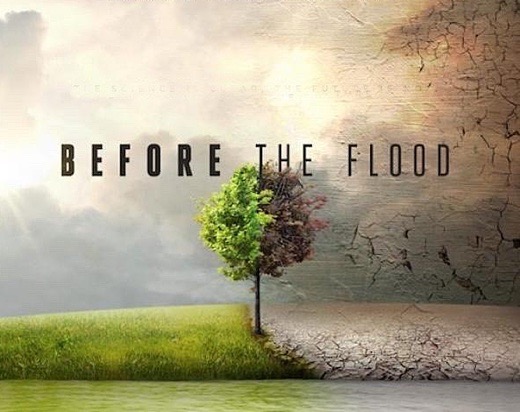
Image above: Movie poster promoting the film "Before the Flood". From (http://inhabitat.com/watch-leonardo-dicaprios-riveting-new-documentary-before-the-flood-for-free-this-week/before-the-flood/).

The release of Leonardo DiCaprio’s new film ‘Before the Flood’, near the end of a US election in which climate change has gone all but unmentioned, is to be celebrated.

As is the fact that it has been made available free online, and within the first 2 days of its release, has already been viewed 3.5 million times, as well as trending on Twitter.

Ah, the power of celebrity.  It powerfully reminds the world of the urgency around climate change, which can only be a good thing.  You can watch the whole thing for free at the bottom of this article below, then proceed into my reflections on it.

It’s not a film you get to the end of without a real jolt around the urgency of climate change.

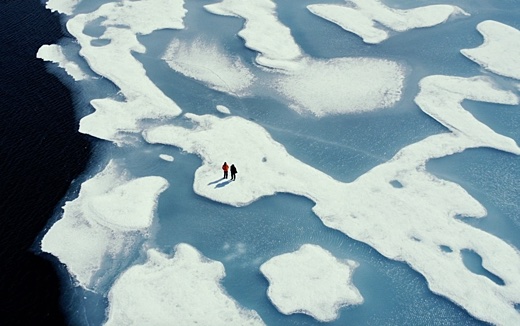
Very few people other than those who have completely severed the link between their brain and their heart can watch footage taken flying over the Alberta tar sands (“it looks like Mordor”, he tells the executive of the company wreaking this devastation.  “What’s Mordor?” comes the reply), over the Indonesian forests deliberately set alight by palm oil companies, or over collapsing ice sheets without being deeply troubled.

“Everything I have seen on my journey has absolutely terrified me”, he says.


Image above: Movie poster promoting the film "Before the Flood". From (http://inhabitat.com/watch-leonardo-dicaprios-riveting-new-documentary-before-the-flood-for-free-this-week/before-the-flood/).

In terms of the gravity of the challenge, the film doesn’t pull its punches. “The window”, Johan Rockstrom of the Stockholm Resilience Centre tells him (i.e. the window of action for avoiding disastrous climate change), “is barely open”.

He visits world leaders and key people in governments and business.

We see some degree of how this impacts on him personally, for example when the shooting for scenes for ‘The Revenant’ that require snow have to be moved 9,000 miles south, from the Canadian snow belt to southern Argentina because there’s no snow left in that region of Canada.  All of which leads me into the two fundamental issues I have with this film.

One: Before the Flood ... of tears?

Climate change is clearly something Leonardo di Caprio cares about deeply, and has for many years.  One of the key moments in the film, for me, is his interview with Sunita Narain of the Centre for Science and Environment in New Delhi.

She challenges him, saying that 30% of Indians still have no access to electricity, and for the US to tell India to cut its emissions without cutting its own, without recalibrating its own lifestyle and its expectations, is not going to work.

When she presses him on this point, he says “it (the US voluntarily changing its lifestyle) is probably not going to happen”.

There is, in this moment, a tension that runs, unaddressed, throughout ‘Before the Flood’.  DiCaprio lives in a world of contradiction.  His influence is such that he can make a film containing interviews with the Pope, President Obama and so on.


Image above: DiCaprio on his 450' yacht in Cannes, France. From (http://www.dailymail.co.uk/tvshowbiz/article-3091601/Leonardo-DiCaprio-cuts-lonesome-figure-mills-aboard-450ft-superyacht-Cannes.html).

He is a very wealthy man, owning an island off Belize, numerous homes around the world.  He supports lots of great projects.  He is part of the 1%.  He has the 11th largest yacht in the world, which cost over $200 million, which has its own wine cellar and a helicopter pad.

He attracted a lot of criticism when, earlier this year, he flew from Cannes to New York by private jet, to collect an environmental award.  It has been argued by some that his lifestyle diminishes his ‘moral authority’ to speak out on issues like climate change.

I don’t want to knock him.  In many ways it’s a great film, and I think he is a great ambassador for all of this.  He’s a cool guy, and his opinion is respected, especially by young people who find themselves bewildered in cyberspace by the “is climate change real or not?” nonsense babble.

It’s impossible to keep everyone happy: if you’re rich and a celebrity and you speak out, people will accuse you of being privileged and out of touch, if you aren’t, far fewer people will listen.  It’s brilliant that he has made this.

But I would like to have seen more of his inner conflicts.  It would have transformed this film’s narrative, impact and credibility.  He knows the reality of climate change, yet he lives a 1% lifestyle.

When he was on that plane to New York, to pick up his environmental award, how did he justify it to himself?  What did those internal conversations look like?

Yes, he drives electric cars, and has solar panels on his house, but nothing in this film, including his reaction during that interview in Delhi, mentions ‘sacrifice’.

And ultimately, if we are to get through this, wealthier nations, and wealthier people, need to make sacrifices. We know from Oxfam that the world’s wealthiest 10% generate half of global carbon emissions. There is huge leadership to be shown here.

Absent are his reflections on how that future world could be, on how a more equitable, just, sustainable world could be so much better than today.  In that world, what do the lifestyles of the rich and famous look like?

What kind of inner journey do they need to go on?  What do they need to let go of, and what does that grief, that refocusing look like?  How does their relationship with privilege and power need to change?

What does it look like for a celebrity to really become embedded, rooted, in a place, rather than houses around the world, connected by private jets and huge yachts?  That’s what I wanted to see. I wanted to see how this stuff affected his heart, made him rethink and reimagine his own life and lifestyle, his self-image.

DiCaprio could do that.  He could be the first celebrity to really model that.  I wondered if the title ‘Before the Flood’ might in fact refer to the moment before the flood of tears that often come before any real period of self-examination.

 The reality is that there is really no place for super yachts in a world that manages to stay below 2 degrees.

Nor for fracking, third runways, huge new infrastructure projects.  Nor, indeed, for the 1% with their current ways of living.  The film would have us believe that we can have our cake and eat it.  We can’t.  But there is still a delicious, albeit different, menu on offer.

I’d have loved him to have read Chuck Collins’ book ‘Born on Third Base’ before making this film.  DiCaprio’s reluctance to share his own honest, painful, rich journey with us is such a pity.

He is, perhaps, uniquely placed to do that.  It would have had such an impact, and his example would have touched the 1% as well as the rest of us.

In his book, Collins writes: “Wealthy friends and neighbors.  It is time to come home … to come out of your gated communities and gated hearts”.   It’s a journey I would love to have seen DiCaprio make.

Two. Social technologies 
‘Before the Flood’ presents a case where climate change is to be solved by politics and technology.  It’s all about international agreements, new tax regimes, renewable energy, eating less meat and battery storage.  “There’s no reason we can’t solve this problem in time” he says at one point.

Elon Musk would have us believe that technology can do it all, and his vision and commitment are certainly remarkable.  We are left with a sense that this is a challenge that can only be solved by the rich and the powerful.
 
Yet all over the world, people are already doing a huge amount.  Much of the best action is coming from city Mayors, from local governments, and from communities.  And this stuff is growing, and spreading fast.  I loved Jonathan Latham ‘s piece ‘Why the Food Movement is Unstoppable’ which gives a great taste of this.

What are the new social technologies, the social infrastructures, that this shift requires?  They are being pioneered, around the world, through a huge diversity of initiatives and communities.

They are recognizing that climate change is a crisis that is about disconnection, from each other, from nature, from the places where we live, and they are reweaving those connections.  The role of the Obamas, the 1%, should be to support those and to learn from them.


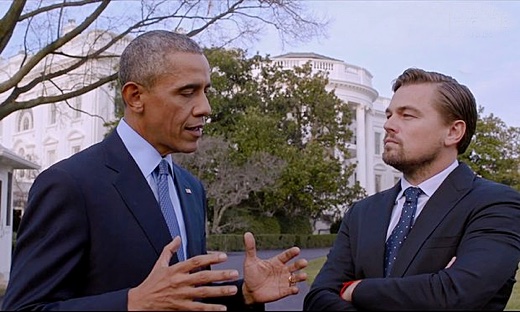
Image above: DiCaprio meets with President Obama on White House Lawn. From (https://www.theguardian.com/film/2016/oct/01/leonardo-dicaprio-climate-change-film-before-the-flood-barack-obama).

Yes, the leadership from the powerful people interviewed here is important.  But President Obama cuts an unconvincing figure, sombrely acknowledging that the Paris Agreement is “nowhere near enough” but offering little else, and the Pope’s amazing historic Encyclical on the climate has largely fallen on deaf ears.

But other than mobilizing through demonstrations, people could reach the end of this film with the impression that nothing is happening on the ground.  The reality couldn't be more different.

This is a powerful, timely, and beautifully made film, and it will have a big impact.  But it could have been so much more, gone so much deeper, taken so many more risks, been braver. Climate change demands us to take risks, to reimagine sacrifice as opportunity.

But if we avoid the sacrifice bit, we skirt around the heart of the issue, and around our own hearts too. 


Video above: "Before the Flood", full movie by  Leonardo DiCaprio and National Geographic. From (https://youtu.be/90CkXVF-Q8M).

.

DeGrasse Tyson cozy with Pentagon

SUBHEAD:Tyson in partnership “between the public and private sectors“ to promote “innovation” in US military.

By Adam Johnson on 27 July 2016 for AlterNet - 
(http://www.alternet.org/culture/neil-degrasse-tyson-cozy-pentagon)


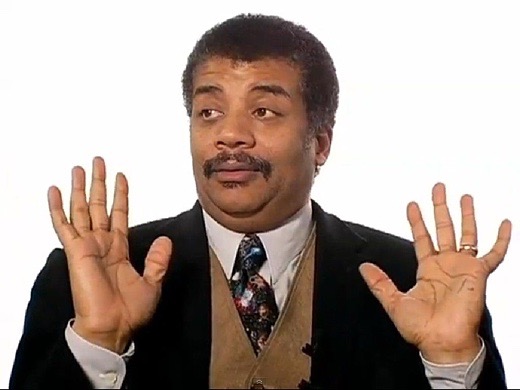
Image above: Photo of Neil DeGrasse Tyson and yeah…he does this a lot. From (https://zeinshver.wordpress.com/2014/04/07/i-met-neil-degrasse-tyson/).

It was announced Wednesday that Neil deGrasse Tyson, beloved ambassador of science and head of the Hayden Planetarium in New York, will be joining the Pentagon’s “Innovation Board” along with Amazon CEO and multibillionaire Jeff Bezos. The two join a 15-person board that includes Aspen Institute chief executive Walter Isaacson, former Google CEO Eric Schmidt and other “private sector leaders.”

The board’s purpose is somewhat vague, described by Defense Secretary Carter as a partnership “between the public and private sectors“ to promote “innovation” at the Defense Department.

The addition of deGrass Tyson is notable due to his status as a public science educator and his vocal criticisms of war. In a 2014 interview with Parade magazine titled "Neil deGrasse Tyson: Why You Will Never Find Scientists Leading Armies Into Battle," deGrasse Tyson mused on the inherent antiwar nature of scientists:

"...when you have a cosmic perspective, when you know how large the universe is and how small we are within it—what Earth looks like from space, how tiny it is in a cosmic void—it’s impossible for you to say, ‘I so don’t like how you think that I’m going to kill you for it.’ You will never find scientists leading armies into battle. You just won’t. Especially not astrophysicists—we see the biggest picture there is."
While deGrasse Tyson certainly is not leading anyone to war, he’s consulting with those who are.

The United States military has active engagements in 80 to 90 countries a day and, in 2015, dropped a total of 23,144 bombs on seven countries. All with the assistance of thousands of scientists.

There’s an added layer of irony that the heir to the legacy of Carl Sagan, whose popular educational television series "Cosmos" deGrasse Tyson rebooted in 2014, is further warming up to the same military system Sagan was arrested for protesting against in 1986 and had frequent public battles with it throughout his career.

AlterNet’s attempts to get comment from deGrasse Tyson were not immediately returned. It is unclear if the position is paid.

The host of "Cosmos" has been criticized before for his blind spot on the militarization of science. In dueling open letters in 2014, science writer John Horgan and UC Santa Barbara professor Patrick McCray asked deGrasse Tyson to clarify his apparent indifference.

He did so in a brief followup exchange with Horgan that climaxed with this bit of circular handwaving:
No scientist working for the government has a job outside of tax-based sources of support—paid by citizens in the service of national policy implemented by a Congress and a President. I can scream at lawmakers without limit, but their duty is to serve their constituents. And so it’s the electorate that I, as a scientist and educator, will always target for my messages.
Seems deGrasse Tyson is now bypassing the electorate and targeting a private consortium of billionaires, ex-spooks and military brass.

The militarization of science is a serious issue and deGrasse Tyson’s position on it deserves far more clarity, doubly so now that he's gone from indifferent to the problem to actively partaking in it.

.

Deep Winter Ruminations

SUBHEAD: On pretending that what’s happening to the Earth isn’t actually happening.

By Adrian Ayres Fisher on 26 February 2016 for Resilience -
(http://www.resilience.org/stories/2016-02-26/on-pretending-that-what-s-happening-isn-t-actually-happening)


Image above: Water color painting of "Unbelievable Winter Color" by Albert H. Krehbiel
on the Des Plaines River, 1928. In original article from (http://www.krehbielart.com/).


In December I found myself sliding into a state of extreme unwillingness to take on new projects, to continue work on those in hand, to write, or do much of anything else, really, at work or at home.

I found myself prodded awake in the night by worries about global warming, the tides of war and migration, the ramifications of random, dismal environmental facts come upon during the course of a day’s work, or of social justice problems encountered in the news and on the streets of Chicago; about any of which I can do very little to help. There were too many meetings with environmental groups, and no time for walks.

I could not look at a tree without wondering how its species would fare in coming, climate disrupted years. I had reached a state of incipient burnout. 

Thus, for a few weeks--a month and more, actually--after the solstice, I went into a state of semi-retreat. I did this by allowing myself to hope that COP21 would help bend the climate curve, and by pretending that our ongoing environmental catastrophe, of which climate change, is, after all, only a pernicious, deadly symptom, isn’t happening.

I also attempted to pay less attention to the ever increasing spate of bad news, from war, to race relations, to migration, to the grim presidential race—and on and on and on, much of which is at least partly related to said catastrophe, with some industrial civilizational collapse, resource depletion and overpopulation thrown in.

I cooked and baked; had family over for meals; helped my mother with projects; visited with my children; went to a party; accompanied my husband to concerts that featured unamplified voices and acoustical instruments; saw friends; wandered through art exhibits; cleaned out a closet; finished one crochet project and started another; and read books whose vocabularies did not include the words “ecology,” “habitat”, or “ecosystem.”

I went so far as to go to a movie, watch a TV show, spend time on Facebook and make an effort to listen to people talk about football without wishing I were somewhere else.

Most of these things I’d do anyway, but the difference was that I determinedly wasn’t thinking about ecological collapse and the need for ecological restoration all the while earnestly pretending I was too busy to take a walk through the cold, leafless woodland savannah along the gelid Des Plaines river near my home.

In short, I made an effort—attitudinally, at least—to live what I imagine to be “normal” life: at least as an educated, white, fairly-comfortably-situated American might, and as many people I know seem actually to live.

So many are so deeply immersed in their private lives and, whether by press of circumstance or by willful turning away and emotional dissociation, manage to express concern but are too busy to do much about larger issues at hand, not to mention attempting to recognize and ameliorate their own complicity in same.

We Americans are very busy.

It couldn’t be a full retreat: my day job requires ongoing understanding of, engagement with, and action regarding environmental and sustainability issues ranging from climate change to ecology, from transportation to recycling, with some energy thrown in.

 My day-to-day lifestyle continues in semi-collapsed mode, as in John Michael Greer’s half ironic, half serious slogan “collapse now and avoid the rush.” Various family responsibilities (and finances) preclude my hying myself off to some Benedictine monastery, Zen-flavored spa in beautiful scenery, or rural artist’s retreat.

But I told myself the story that I could, for awhile, at least, stop paying attention to the matters that concern my relationship with those whom the Potawatomi language calls “the standing people” and all their friends and relations.

For a while, at any rate, I could turn away from concern with Gaia. I told myself that this would somehow make me feel better. I stayed indoors. Kept my walking confined to neighborhood sidewalks. It should have been very easy.

Everything about American life is geared towards this kind of pretense.

It’s so easy, when online, to choose to spend hours down the rabbit hole of surfing, shopping, reading feature articles about fashion, health, exercise, or what have you, not to mention politics.

It’s so easy to get obsessed with handbags or shoes or celebrities, watch sports on TV, movies on Netflix, so easy to get in the car and drive somewhere instead of taking public transit, walking or biking, easier still that it’s winter.

It’s so easy to buy packaged food, to imagine that organizing and decorating your house will transform your life—and give you more room to buy more things!

It's so easy to go out to eat, so easy to “be concerned” about the environment, but keep your own house warm enough to wear a short-sleeve t-shirt when it’s 10 degrees (F) outside, or fly, without thinking about it, somewhere for business or pleasure.

It’s so easy to separate one’s professional life—no matter how “do goody,” from one’s personal life of comfort and consumption. It’s so easy to live a life separate from the natural world and thus from its concerns.

Yeah, global warming is terrible, have you joined Amazon Prime?

(It is also incredibly easy to be judgmental about all of the above, as though one were not, oneself, present and participating in American culture, one way or another.)

To not do those easy things, to avoid falling into those easy habits takes a certain kind of discipline. In here somewhere also is a question of balance. How is one to balance family, work and calling?

How does one stay dedicated to one’s calling and still keep friendly relationships with family, friends and colleagues who mostly don’t think about trees, rivers or birds? Who mostly think, in fact, that paying attention, spending time outside at the expense of more practical matters is somehow self indulgent or evading responsibilities?

How does one do what one can do without burning out?

How does one carry out a spiritually and practically earthcentered way of life while living in an American and global culture—in which we all are embedded, willy-nilly, no matter how disengaged—dedicated to ignoring the true environmental costs of the ways in which it keeps itself going?

How much of one’s own “private” life does one sacrifice? How much do one person’s actions count, anyway? What constitutes private life?

How on earth does one keep up good relations with Gaia and the standing people?

I understand I can ask these questions because, as an employed member of the shrinking middle class in the US, on a global scale I am incredibly privileged. I can choose how high to turn up the heat, have enough nutritious food to eat and can go to sleep at night without worrying that my neighborhood will be lit up by gunfire and/or cratered by bombs.

There is enough water and it is more-or-less safe to drink. I can decide to pretend everything is ok and maintain the illusion pretty steadily. But for me, this pretense of living the good life doesn’t work.

Most available electronic entertainments and on-offer material appeasements to our craving—for what, exactly?— get tedious and do nothing to calm the underlying nature-and-environment-related, deep structural anxieties that I believe infect our culture like a disease, disturbing even the most willfully dense, even the richest and most powerful among us.

Besides the distractions of entertainment, there are other ways of displacing, rather than attending to this often unacknowledged anxiety; there are, for example, the high abstractions of ideology, and, regrettably often, the run-of-the-mill blaming of those of another religion, color, political party, nationality, or what have you for whatever social problems there are.

This is not to say that politics don't matter, that discrimination and poverty don’t need to be ameliorated, because obviously they do: societal injustice and inequality are terribly real; destructive things happen, terribly, in the name of one social worldview or another.

Rather it is to say that ideological thought often confuses an abstract model for the messy reality of complex systems, in its believers, at any rate, and often results in an effort to make the messy reality match the beautiful abstraction to often brutal results.

Ideologies thus become a distraction from, and symptom of, our separation from the natural world and, crucially, because of that separation, from the truly existential environmental problems that do already or soon will afflict us all.

Even more crucially, they can separate us from the possibility of developing regenerative ways of life.

From this perspective, one could even say that the most extreme and violent ideologies, religious or not, are fueled by the most extreme refusal to see what the real, actual problems are, much less grapple with them in constructive ways that would benefit people, other species, and the biosphere as a whole. There is no lack of examples, but no point in naming them.

I haven't yet worked out an answer to my own dilemmas and possibly never will. I have started to read natural history again and a few days ago spent time outdoors.

Alone, loafing about, as Thoreau or Whitman might put it, though never out of earshot of traffic noise. In the morning light early groups of sandhill cranes made their way north in that raggedy, glittering way they have.

Later, two red tailed hawks circled over woods and fields in ever widening, ascending spirals. A chickadee called. I ate lunch sitting on a log in a sunny space. I walked along a muddy path, collecting dark goo on my boots, appreciating the soft, non-concrete feel of it. Sunlight shone on the smooth ripples and white-capped riffles of a noisy creek littered with boulders left by the last glacier.

The bare trees were every imaginable, glowing shade of brown. Flat, shelflike fungi gleamed on fallen, crumbling logs. Two cardinals sat on a branch overhanging the water, watching me approach for a while before deciding to change trees. Unseen woodpeckers announced the news that a human was in the vicinity.

Before returning home, I picked up a couple of spherical seed clusters from beneath a sycamore tree and a few clean, white and black mussel shells from a miniature sand spit. The shells will stay in my jacket pocket for awhile, as reminders.

Some time this spring I expect I’ll be watching a clutch of baby sycamores unfurl their new leaves in a nursery flat. I’m looking forward to it.

.

Christmas Present

SUBHEAD: It’s not just Janet Yellen and the Federal Reserve; everything around us is backed into a corner.

By James Kunstler on 21 December 2015 for Kunstler.com -
(http://kunstler.com/clusterfuck-nation/christmas-present/)


Image above: A mashupof Janet Yellen on a "Star: The Force Awakens" poster wars.

Theory du jour: the new Star Wars movie is sucking in whatever meager disposable lucre remains among the economically-flayed mid-to-lower orders of America. In fact, I propose a new index showing an inverse relationship between Star Wars box office receipts and soundness of the financial commonweal.

In other words, Star Wars is all that remains of the US economy outside of the obscure workings of Wall Street — and that heretofore magical realm is not looking too rosy either in this season of the Great Rate Hike after puking up 623 points of the DJIA last Thursday and Friday.

Here I confess: for thirty years I have hated those stupid space movies, as much for their badly-written scripts (all mumbo-jumbo exposition of nonsensical story-lines between explosions) as for the degenerate techno-narcissism they promote in a society literally dying from the diminishing returns and unintended consequences of technology.

It adds up to an ominous Yuletide. Turns out that the vehicle the Federal Reserve’s Open Market Committee was driving in its game of “chicken” with oncoming reality was a hearse. The occupants are ghosts, but don’t know it. A lot of commentators around the web think that the Fed “pulled the trigger” on interest rates to save its credibility.

Uh, wrong.

They had already lost their credibility.

What remains is for these ghosts to helplessly watch over the awesome workout, which has obviously been underway for quite a while in the crash of commodity prices (and whole national economies — e.g. Brazil, Canada, Australia), the janky regions of the bond markets, the related death of the shale oil industry, and the imploding hedge fund scene.

As it were, all credit these days looks shopworn and threadbare, as if the capital markets had by stealth turned into a swap meet of previously-owned optimism. Who believes in anything these days besides the allure of fraud?

Capital is supposedly plentiful these days — look how much has rushed into the dollar from the nervous former go-go nations with their wobbling ziggurats of bad loans and surfeit of production capacity — but what actually constitutes that capital? Answer: the dwindling faith anyone will pay you back next Tuesday for a hamburger today.

We now enter the “discovery” phase of financial collapse, where things labeled “capital” and “credit” turn out to be mere holograms. Fed Chair Janet Yellen herself had a sort of hologramatic look last Wednesday when she stepped onto her Delphic platform to reveal the long-heralded interest rate news.

Perhaps Mrs. Yellen is a figment conjured by George Lucas’s Industrial Light & Magic shop (now owned by Disney). What could be more fitting in a smoke-and-mirrors culture? Anyway, the rude discovery that capital is not what it has appeared to be is now underway, with the power to derail political systems and societies.

Is there anyone who thinks the Presidential election campaign is not completely deranged? Well, it is the analog for America’s deranged financial polity. The graceless Mr. Trump necessarily reflects the just grievances of the great public wad, but has anyone noticed that he is incapable of stringing together two coherent thoughts?

I suppose one thought at a time — or maybe a percentage of one thought — is enough to satisfy the sputtering masses, faced as they are by the arrant theft of both their patrimony and their future. But it adds up to something like flying blind through a shitstorm with your pilot in the throes of cerebral infarction. I don’t want to be on that plane.

Then there’s the giant flying reptile known simply as Hillary. She will blow up the sad and noisome remains of the Democratic party and then she will preside over the blow-up of the USA as an advanced techno-industrial society.

That final outcome may be inevitable one way or another, but the journey there need not be so harsh. America needs a vision of something other than itself as a permanent demolition derby, which, by the way, will not be “solved” by pushing everyone into a Tesla instead of a Ford F-150.

It’s not just the Federal Reserve; everything around us is backed into a corner. Come January, when the dazzle of Star Wars fades away, you will hear instead through the long dark nights a howl of raging animals. Merry Christmas to all.

.

New movie rating announced

SUBHEAD: MPAA adds category "O" for "Original" to warn audiences of films not based on existing works. 

By Staff on 20 October 2015 for The Onion -
(http://www.theonion.com/article/mpaa-adds-new-rating-warn-audiences-films-not-base-51651)


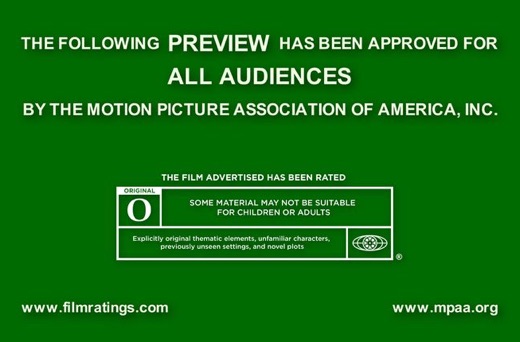
Image above: Screen presentation of the new "Original" category rating is not meant as censorship. From original article.

In an effort to provide moviegoers with the information they need to determine which films are appropriate for them to see, the Motion Picture Association of America (MPAA) announced Tuesday the addition of a new rating to alert audiences of movies that are not based on existing works.

According to MPAA officials, the new “O,” or “Original,” designation will inform viewers that a particular film contains characters with whom they are unfamiliar, previously unseen settings, and novel plots.

The rating will also reportedly serve as a warning of the potentially disorienting effects associated with having to remember characters’ names for as many as two hours and the discomfort that can occur when one is forced to keep track of narrative arcs for an entire film.

“We recognize how distressing it can be when viewers go into a film and suddenly find themselves confronted with jarring scenes containing a protagonist they’ve never encountered before, which is precisely why we created this rating,” said Joan Graves, head of the MPAA’s ratings board, who said the new category was added in part due to the thousands of complaints the organization has received from moviegoers who were upset they weren’t given advance notice that they’d have to make sense of the scenarios unfolding onscreen.

“It’s important that today’s movie fans are aware upon entering the theater that none of what they will see has been adapted from a well-known comic book, television series, novel, video game, historical event, previous movie, or theme park ride.”

“Ultimately, it will be up to the consumer’s discretion as to whether a film is suitable for themselves and their family, but the O rating will explicitly caution people that they will have to pay attention during the movie and follow the storyline on their own,” Graves added.

Though sources said films requiring the new rating are comparatively rare, a spate of high-profile movies over the past several years that do not stem from any previously existing source material—including The Kids Are All Right, Her, WALL-E, Birdman, and Nebraska, among others—have left many viewers angered and perplexed.

Citing test audiences they have observed, MPAA officials said that many moviegoers spent the entirety of such films in a state of distress, waiting for the moment when the Incredible Hulk, Katniss Everdeen, Wolverine, or another recognizable character from an established franchise would appear onscreen and clarify the meaning and direction of the film.

“I never would have gone to see Sicario if I knew it was going to be so unbearable,” said filmgoer Mark Kemmer of Cleveland, referring to the recently released crime thriller set against the violent backdrop of the contemporary Mexican drug trade that, under the MPAA’s guidelines, would receive the new rating. “It was pretty much unwatchable.

It seemed like in nearly every scene I had to figure out who the people were and where the story was going. And the whole movie was like that!”
“What a waste of money,” he added.

Others reported being viscerally repulsed by movies they attended that were not based on media that originated several decades or generations earlier, saying they had become so upset by what they had seen that they had trouble even sitting through the films.


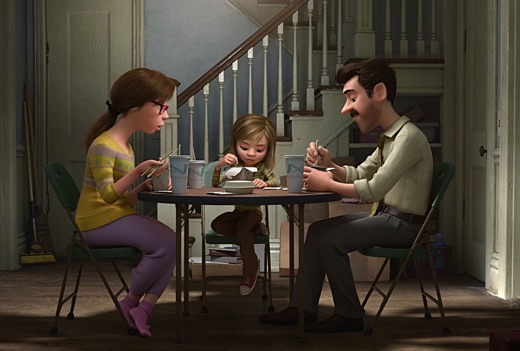
Image above: Still from Pixar animation "Inside Out". From (http://www.theverge.com/2015/6/17/8790177/inside-out-movie-interview-pixar-pete-docter-jonas-rivera).

“How does this trash even get made?” said Katherine Hubbard, a mother of three from Rockford, IL, who, after buying tickets for the Pixar film Inside Out, was incensed that her children had been exposed to original storytelling. “Within the first minute, some little girl character my kids have never seen or heard of walks onscreen, and then we immediately have to learn her whole backstory and how she navigates the world?

 I marched us all right out of that theater after about 10 minutes.”

While audiences have reportedly been receptive to the new rating, directors and distributors have already decried it as severely damaging in regard to box-office revenues and the number of venues that will carry their films. However, the MPAA was adamant that the new classification should not be interpreted as censorship.

“The O rating isn’t meant to be a punishment or a moral judgment of any kind,” Graves said. “It’s simply a value-neutral designation intended to protect consumers, ensuring that they are fully informed about a movie and are able to make their own decisions about how much artistic and narrative originality they are comfortable seeing.”

“If filmmakers want to avoid the rating and appeal to a wider audience, all they have to do is throw in a superhero or a hobbit or some other licensed property,” Graves added.


.

Homeland TV series gets banksied

SUBHEAD: Why and how the artists on show "Homeland" got political with Middle East set graffiti.

By Shirin Jaafari on 15 October 2015 for Public Radio International -
(http://www.pri.org/stories/2015-10-15/here-s-why-artists-wrote-homeland-watermelon-set-tv-series)


Image above:Graffiti in Arabic from the set of "Homeland." It reads: "Homeland is not a series". From original article.

Artists Heba Amin, Caram Kapp and Stone have always had misgivings about how the TV series "Homeland" portrays the Middle East and Middle Easterners. Artists Heba Amin, Caram Kapp and Stone have always had misgivings about how the TV series "Homeland" portrays the Middle East and Middle Easterners.

He adds that the series represents Middle Easterners as "either terrorists or refugees."

So when they were asked to create artwork for the set of one of its episodes, they knew exactly what to do.

An episode, which aired last Sunday, takes place inside a refugee camp in Lebanon. To make it look authentic, the producers of "Homeland" hired the artists to spray Arabic graffiti on the walls.

Kapp and the team asked their friends and family for advice.

“[They] sent us a lot of proverbs and Arabic sayings,” he says.

But after he considered all the suggestions, the team came up with an idea: they’d add those proverbs but they’d also add their own commentary. There was this: “Homeland is watermelon.”

"Heba and I both come from Egypt and in Egypt when we say something is 'batikh,' which is Arabic for watermelon, we mean that something is nonsense, that it's fake," explains Kapp.


Image above: Wall with spray painted graffiti reading “Homeland is Watermelon”. From original article.

“Homeland is racist” was one message. Another was “Homeland is a joke, and it didn’t make us laugh.” There was also “#blacklivesmatter.”

Over the two days that they spent on the set, the artists were asked twice about what they were writing. At the time, Kapp says they were spraying the Arabic proverbs and so that's what they said the were doing.


Image above: Spray painted graffiti reading "Homeland is Racist". From original article

But overall, he adds, the producers were so busy with the production that no one checked the meaning of the words on the walls.

And to the artists disbelief, the graffiti ended up on the episode that aired last Sunday.

"I was very surprised that the messages were in the show ... we were operating on the assumption that they had actually either painted it over on the set or CGI'd it out," Kapp says referring to the computer-generated imagery effect used in films and TV programs.

Kapp adds that he doesn't plan on doing any more graffiti for Hollywood.

But he's glad that they managed to get their message out.

"We did know that it's once in a lifetime opportunity in more than one way. If we hadn't done what we did, we would regret it on a moral basis," he says.

Read Heba Amin's statement about the project here.

.

Deadhead Security Alert

SUBHEAD: What they're telling security personnel at the Grateful Dead Farewell Show this weekend.

By Philip Smith on 2 July 2015 for Alternet -
(http://www.alternet.org/drugs/security-alert-deadheads-taking-strange-drug-farewell-shows)

http://www.islandbreath.org/2015Year/07/150704dead1big.jpg
Image above: The Grateful Dead face a sea of Deadheads at one of the Fare Thee Well Concerts. Click to embiggen. Photo by Jay Blakesberg - Invision for the Greatful Dead.
"DO NOT MAKE CONTACT WITH THESE GUESTS" warns a flyer published by the organization Rock Medicine that has traveled with Dead shows for over 40 years.
The Grateful Dead (minus Jerry Garcia, of course) are playing their farewell shows in Chicago this weekend. Tens of thousands of Deadheads are expected to fill Soldier Field over the three-night run.

The iconic jam band's shows have long been legendary not only for the music, but also for the rampant use of psychedelics by attendees, some of whom never actually make into the show itself. These shows will likely be no exception.

Not to worry this time around, though. Security has this covered. According to the music website Live For Live Music, security personnel working the shows have been given a flyer alerting them that they may well run across people taking LSD, or "acid" in hipster lingo.

"LSD is a mind-altering chemical, also known as an hallucinogen," the flyer helpfully explains. "LSD produces a change in the user's sense of reality, thought patterns, and perceptions. You cannot predict the type of experience a guest under the influence of LSD will have."

Users "may 'see' images, 'hear' sounds, and 'feel' sensations that do not actually exist," the flyer elaborates. "These effects can be pleasurable, frightening, disorienting, and/or disturbing."

People "high" on acid may harmlessly trance out, dance, spin, and wave their hands around, but they may also have a "bad trip" and be "combative," have "poor judgement," or even "act on their enhanced sexuality" by getting naked or something.

"DO NOT MAKE CONTACT WITH THESE GUESTS!" the flyer warns security personnel about people having an "upsetting experience." Leave it instead to medical personnel, the flyer says. And don't touch them! (Gloves are available in the uniform room.)

"LSD CAN BE ABSORBED THROUGH SKIN TO SKIN CONTACT. DO NOT TOUCH ANY GUESTS SUSPECTED OF BEING UNDER THE INFLUENCE OF LSD.

And, oddly enough, the flyer instructs security not to refer to people as "tripping," but as having "IPR (Intense Psychedelic Response).

It's easy to poke a little fun at the flyer with its hokey wording and 1967 Readers' Digest feel, but it's actually a well-intentioned effort at harm reduction. And it is aimed at security guards, who may not be the most aware of drugs popular with the Deadhead set.

 The flyer is produced by Rock Medicine, which has been staffing medical tents at concerts for more than 40 years and says it is "setting the standard in non-judgmental event medicine." Those are the folks security guards are supposed to call when confronted by IPRing fans unhinged by the music.

"Take care of the individual right now. Return him or her to their friends or family and do away with the necessity of either hospitalizing the individual or getting involved with the law,Rock Medicine founder and former director Dr. George R. "Skip" Gay says prominently on the website.

Appropriately enough, Rock Medicine got its start when legendary San Francisco rock promoter Bill Graham asked the Haight-Asbury Free Clinic to staff its outdoor Grateful Dead and Led Zeppelin concerts in 1972. Dr. Gay formalized it as Rock Medicine the following year.

And now they're there at the last Dead shows ever. What a long, strange trip it's been.

http://www.islandbreath.org/2015Year/07/150704dead2big.jpg
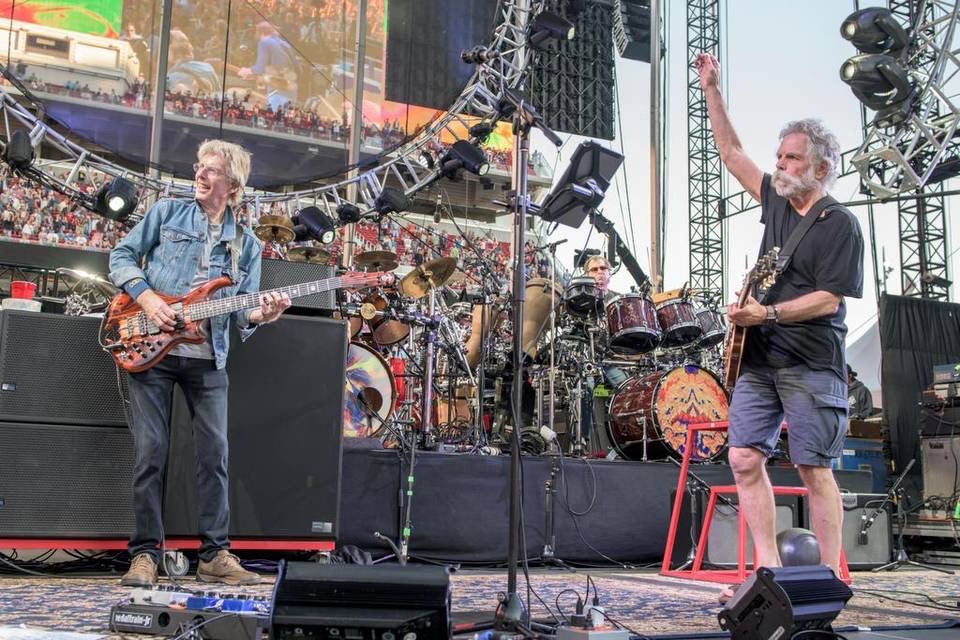
Image above: Phil Lesh, Mickey Hart and Bob Weir rock on at the Grateful Dead’s Fare Thee Well show. Click to embiggen. Photo by Jay Blakesberg - Invision for the Greatful Dead.

http://www.islandbreath.org/2015Year/07/150704dead3big.jpg
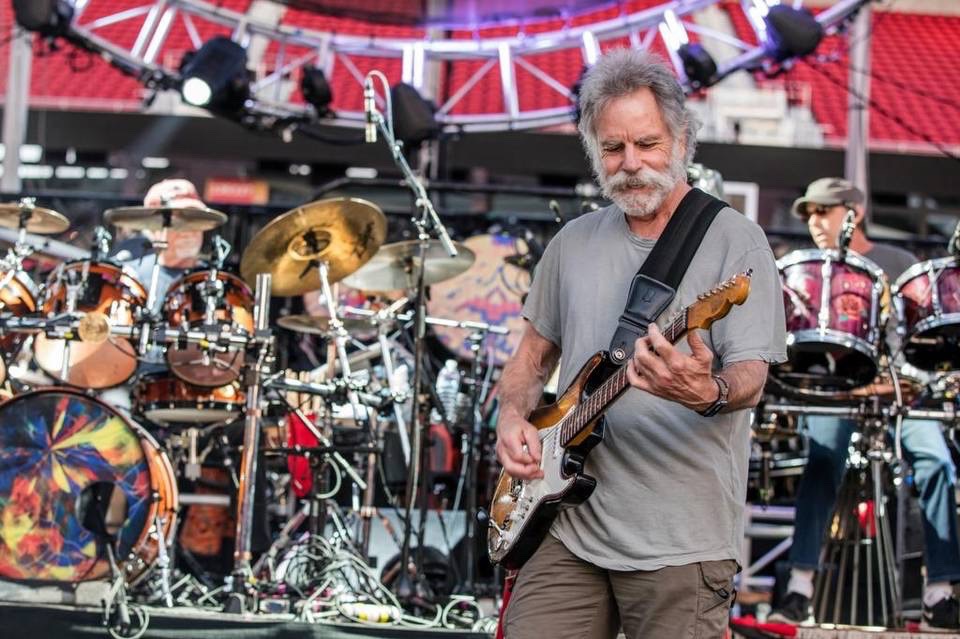
Image above: Bob Weir of the Grateful Dead on the Fare Thee Well tour. Click to embiggen. Photo by Jay Blakesberg - Invision for the Greatful Dead.

http://www.islandbreath.org/2015Year/07/150704dead4big.jpg
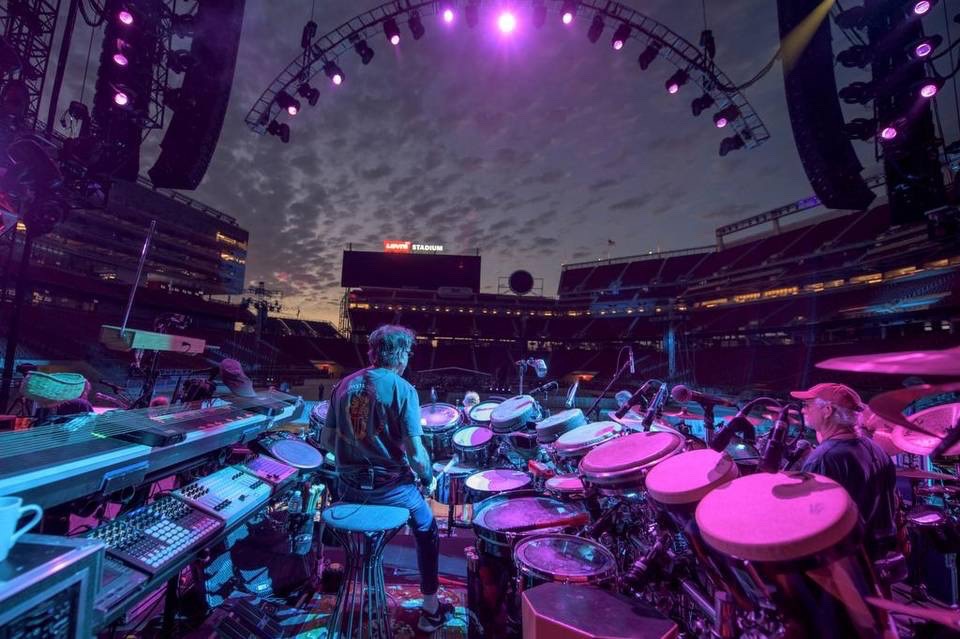
Image above: Mickey Hart, Grateful Dead drummer, on stage after sunset. Click to embiggen. Photo by Jay Blakesberg - Invision for the Greatful Dead.

• Phillip Smith is editor of the AlterNet Drug Reporter and author of the Drug War Chronicle.


.

Time for The Last Guardian

SUBHEAD: Can a video game character become a real friend? Should you care?

By Laura Hudson on 21 June 2015 for Boing Boing -
(http://boingboing.net/2015/06/22/e3-2015-best-games.html)

http://www.islandbreath.org/2015Year/06/150623tricobig.jpg
Image above: A young boy meets who is to become his companion - Trico - a dog, cat, chicken beast the size of a dragon. Click to embiggen. From (http://www.gamesradar.com/last-guardian-believe-games/).

The annual video game onslaught of E3 is finally over, and as expected, it served up plenty of big-budget sequels, like Halo 5, Fallout 4, Dishonored 2, Uncharted 4, and of course, the Final Fantasy VII remake that made everyone lose their collective minds.

But a lot of other cool things happened at E3, like yarn, robot dinosaurs, and a giant, awesome dog, not to mention a comparatively remarkable number of titles with female protagonists. Join me now on a whirlwind tour of all the exciting new games that weren't popular franchise names followed by numbers!

The moment I saw the beginning of The Last Guardian trailer I said aloud, "oh man, please let this entire game be about this giant dog." Great news: it is. People have been waiting for The Last Guardian since 2007, largely because it's the newest title from Fumito Ueda, the guy who made super beloved puzzle-ish action games like Ico and Shadow of Colossus.

You play as a young boy who befriends a giant dog-cat-bird and has to help guide him across a lot of precarious platforms, and if the trailer is any indication it will simultaneously trigger both your "oh god, don't kill the dog!" and "oh god, don't kill the kid!" anxieties near constantly.

Where: PlayStation 4

When: 2016


Video above: Recent trailer for The Last Guardian. From (https://youtu.be/zXLZvsSmBIs).


.

Yesterday's Tomorrowland

SUBHEAD: Memorial Day is a dreary moment to have to face this onrushing calamity of rocket-propelled medievalism rampant.

By James Kunstler on 25 May 2015 for Kunstler.com -
(http://kunstler.com/clusterfuck-nation/yesterdays-tomorrowland/)


Image above: Poster illustration for Disney's utopian Tomorrowland. From (http://www.tomorrowland-movie.com/).

America takes pause on a big holiday weekend requiring little in the way of real devotions beyond the barbeque deck with two profoundly stupid movie entertainments that epitomize our estrangement from the troubles of the present day.

First there’s Mad Max: Fury Road, which depicts the collapse of civilization as a monster car rally. They managed to get it exactly wrong. The present is the monster car show. Houston. Los Angeles. New Jersey, Beijing, Mumbai, etc.

In the future, there will be no cars, gasoline-powered, electric, driverless, or otherwise. Mad Max: Fury Road is actually a perverse exercise in nostalgia, as if we’re going to miss being a nation of savages in the driver’s seat, acting out an endless and pointless competition for our little place on the highway.

The other holiday blockbuster is Disney’s Tomorrowland, another exercise in nostalgia for the present, where the idealized human life is a matrix of phone apps, robots, and holograms. Of course, anybody who had been to Disneyland back in the day remembers the old Tomorrowland installation, which eventually had to be dismantled because its vision of the future had become such a joke — starting with the idea that the human project’s most pressing task was space travel.

Now, at this late date, the monster Disney corporation — a truly evil empire — sees that more money can be winkled out of the sore-beset public by persuading them that techno-utopia is at hand, if only we click our heels hard enough.

Another theme running through both films is the idea that girls can be what boys used to be, that it’s “their turn” to be masters-of-the-universe, that men are past their sell-by date and only exist to defile and humiliate females. That this message is really only a mendacious effort to rake in more money by enlarging the teen “audience share” for the reigning wishful fantasy du jour is surely lost on the culture commentators, who are so busy these days celebrating the triumph and wonder of transgender life.

The reviewers are weighing these two movies on the popular pessimism / optimism scale. These are the only choices for the masses: whether to be a “doomer” or a “wisher.”

Both positions are cartoon world-views that don’t provide much guidance for continuing the project of civilization, in case anyone is actually interested in that. It’s either rampaging id or the illusion of supernatural control, take your pick. I find both stances revolting.


Image above: Promotional still image from the apocalyptic Mad Max: Fury Road movie. From (http://www.chud.com/community/t/146538/mad-max-fury-road-pre-release-discussion/750).

[IB Publisher's note: The votes are in. America has chosen its future. Over the crucial Memorial Day weekend box office Disney's "Tomorrowland" tanked while "Mad Max: Fury Road" soared. So watch out you techno-optimists America wants a more S&M exciting future.]

Anyway, it’s interesting that the real Fury Road of the rightnow runs from Syria into Iraq starring ISIS. There is a growing sentiment in the news media (including the web, of course) of a sickening déjà vu with these developments.

The old familiar talk of air strikes and ground troops infects the wifi transmissions. Maybe we should think about sending Charlize Theron over there with a few vestigial male sidekicks to load her assault rifle. How else to git’er done? Nobody knows.

Memorial Day is a dreary moment to have to face this onrushing calamity of rocket-propelled medievalism rampant — all those poor American soldiers blown up and mangled the past twelve years.  It’s also interesting that the news media is totally out-of-touch with the biggest prize on the great gameboard: Saudi Arabia. You think ISIS overrunning Iraq is bad news?

Wait until the ordnance starts flying around Riyadh. Notice, too, that there’s no news coming out of Yemen on the base of the Arabian peninsula, a failed state with a population nearly equal to its neighbor. If we have any idea what’s going on there — and surely the Pentagon and NSA do — then it’s not for popular consumption.

This is ironic because if the trouble happens to spread into Saudi Arabia — and I don’t see how it will not — then we’ll find out in a New York minute how America’s future is not about monster trucks, cars, dirt bikes, holograms, phone apps, and all the other ridiculous preoccupations of the moment.

.

Busy getting ready

SUBHEAD: In a way we are all Noah. We toil to get ready for a change that will allow as much to thrive as possible.

By Juan Wilson on 28 March 2014 for Island Breath -
(http://islandbreath.blogspot.com/2014/03/busy-getting-ready.html)  
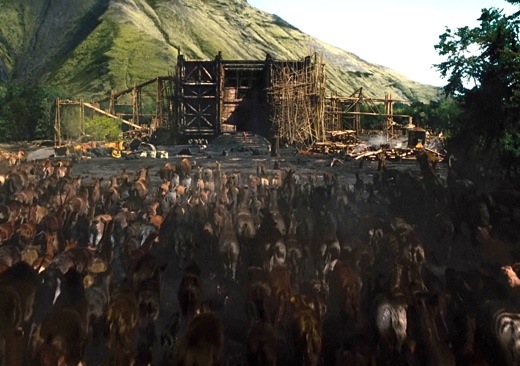

Image above: Scene from "Noah" of animals approaching the Arc two-by-two. From (http://www.dailybillboardblog.com/2014/03/noah-movie-billboards.html).

Today the movie "Noah" opens nationwide.

Sorry for the the recent absence from this site. I've been very busy with other work recently and have been concentrating on that. In the last few weeks I've been trying to complete a phase of a plan for the eventual development of a sustainable permaculture community on what was once sugar cane fields.

It is a complicated problem because of the site conditions as well as the history and resource restrictions of those who might eventually live there. As with many complicated problems it requires simultaneous solutions to conflicting elements.

As for the Island Breath website and the attempt to daily deliver pertinent material that is useful to you - (especially those of you on Kauai or in Hawaii) -  it can get in the way of getting what I shoud get done on a little half acre in Hanapepe Valley.

As of this writing there are about 1,700 website posts on Island Breath between 2004 and 2008 with many posts containing multiple articles on a subject. Since we initiated the blog based format in 2009 there have been another 4,958 articles posted.

I was thinking of retiring the daily blog responsibility after 5,000 articles. If I did so that would be in about a month.   There are many garden chores, maintenance tasks, repairs and new projects done done... in fact the list seems to just grow longer.

Moreover, I have said just about everything I'm likely to say - in a number of cases more than once. What the message boils down to is that:
  • big changes and disruptions are coming
  • they will make the usual way of doing business impossible
  • the larger and most complicated systems will fail
  • we will be more isolated in our current locations and communities
  • we will be responsible for our own food, energy, health and entertainment
  • you will be responsible for enhancing and saving as much of the local living environment as you can
For the rich and powerful the parable of the day is the Titanic. For the rest of us it is Noah and the Arc.

Get to work! Go permaculture!


Noah v. Kitschy Jesus
SUBHEAD: Today the movie "Noah" opens nationwide.  Looks like one to watch.


By Jay Michaelson on 27 March 2014 for Religious Dispatches -
(http://www.religiondispatches.org/archive/culture/7729/noah_v__kitschy_jesus__a_tale_of_two_movies/)
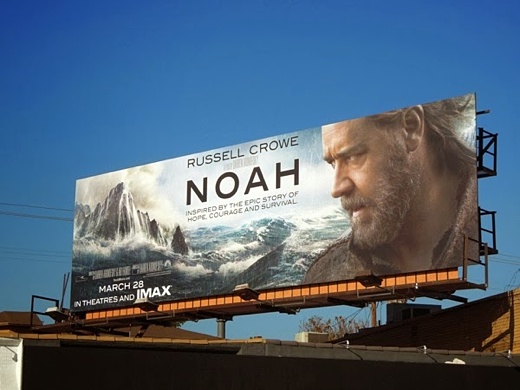

Image above: Billboard for movie "Noah" in rain starved Los Angles, California. From (http://www.dailybillboardblog.com/2014/03/noah-movie-billboards.html).

I was around nineteen years old when I understood that kitsch was stupid.  Maybe it’s the other way around: it was then that I understood that the clichés, conventions, and other intellectually clunky tropes with which I had largely grown up had a name—kitsch—and that smart people had gotten beyond them. The adolescent alienation that I shared with, I’ll wager, many readers of this magazine was a temporary phase. It did, in fact, get better, precisely when one saw through and transcended what had once felt like absolutes.

Many of these clichés were aesthetic: football quarterbacks and lettermen, pickup trucks and teased hair. Others were ethical: the ‘common sense’ notions we took apart in philosophy class, the simplistic myths of religion. Others, for lack of a better word, were questions of style. Sentiment, saccharine, Hallmark Cards, kitties with big eyes, immaculate suburban lawns, patriotism, douchey fashion accessories, believing in the bromides of politicians—I can’t quite pinpoint what all of these had in common, except that they were cheap, over-simplified, and kitschy.

And thanks to Walter Benjamin, Clement Greenberg, the Frankfurt School, and a legion of writers and musicians allergic to the cliché, I came to reject kitsch and its quasi-fascistic associations. Feel this way, think this way, act this way—no!

It took another several years before I really understood that some people, perhaps most people, never went through this quintessentially sophomoric phase. Oddly, they seemed not to have read Clement Greenberg. They liked Norman Rockwell unironically. They still looked at “abstract” art and said “my pet could do that.” They listened to Richard Marx.

This was especially true in America, where clichés ruled the political airwaves, as well as the radio dial, back when such a thing mattered. And it was especially true of religious people.
Son of God, the latest cultural product aimed at the supposedly burgeoning Christian consumer public, embodies this mode of kitsch religiosity. Of course Jesus is hot, white, and soulful.  Of course he is just absolutely perfect. That’s what a religious person should aspire to be: nice, clean, square, entirely in major key.

More than the Biblical literalism of the film—a term which is hardly deserved, given the contradictions between the Gospels and the inevitable selection of which stories to tell—what is striking about Son of God and its marketing campaign is how straightforward it actually is. The film is the opposite of irony and afraid of nuance.

Of course, we’ve already had nuance and complexity in the Jesus story—the Scorsese/Kazantakis Last Temptation of Christ—and we saw how well that went.

One could object that Jesus, being Divine, is a special case. But how different is the milquetoast Jesus from the milquetoast teens meant to ask WWJD?, or commit to virginity at the Purity Ball? This isn’t the Emergent Church; this is unreconstructed pabulum.

Darren Aronofsky’s Noah is, in contrast, an exercise is complexity. Its title character is being marketed as your standard Russell Crowe action hero—Gladiator, the Prequel. In fact, he is tortured, obsessive, wounded, and deeply flawed. He ends up being the villain of his own story, eager for humanity to be wiped out.

Press coverage of the “Christian reaction” to Noah has focused on its often outlandish elaboration on the Biblical tale. As I’ve described elsewhere, many of its additions—the fallen angels called the Watchers, for example—have precedent in Christian and Jewish legend.  Many others are just made up.

But these embellishments of the Biblical story seem secondary to a different conception of what a Biblical story should be in the first place. Is the point of myth to provide a relatable character, full of human flaws, to whom we might relate and from whom we might learn? Or is myth about paragons of virtue, well beyond ordinary folks like us, to whom we might aspire?

Alan Dershowitz and others have argued that this is a Jewish/Christian difference. The flawed heroes of Genesis versus the Christian martyrs and saints. But Jews are every bit as capable of whitewashing and idealization as Christians are. Plenty of rabbinic exegetes have idealized every complicated character from the Bible. Jacob’s not a conniving thief with masculinity issues; he’s pure and saintly. Moses doesn’t have an anger management problem; he’s pure and saintly. In fact, every hero is pure and saintly because that’s what heroes are.

No, this kind of hero—corny, shallow, stupid, unrelatable, and flattening of the beautiful and horrible complexity of the human experience—is not specific to any religious tradition. It is specific, rather, to a particular unsophistication of taste and simplicity of intellect, both attributes that are affirmatively praised by many religious fundamentalists. Simple faith, simple values, common sense, old time religion.

In this reading, Noah has to be a good, simple guy because he’s a hero (in Christian readings of the Bible anyway—Jews were always more ambivalent about him) and therefore he can’t be seen getting in knock-down, drag-out fights with his sons. Good people don’t do that. And of course, Jesus can’t be tempted by sins of the flesh—even though the Bible itself suggests that he might’ve been.
I don’t think it’s because Aronofsky’s Noah has a mixture of admirable and flawed elements that he raises fundamentalist suspicions. It’s because he has a mixture of any kind at all.  Progressive religion values complexity and nuance; traditional religion values simplicity. Noah’s character flaws, which make him interesting to progressives, hit sour notes for traditionalists— indeed, like blue notes corrupting the C-major harmony, or complex flavors messing up the meal.

And the fact that Aronofsky gives serious consideration to Noah’s nemesis, the (invented) Tubal-Cain, pushes it over the line. Villains are supposed to be bad—not interesting.

Question everything, undermine everything, nothing is as simple as it seems, put scarequotes around clichés—these are some of the values I was taught at my corrupting, secularist, humanist university. Yet they have always seemed consonant with my religious consciousness, which itself is hybridized, postmodern, and self-reflexive in the extreme—as well as informed by mystical and ethical traditions which resist oversimplification.

Son of God and Noah don’t just represent two different ways to read Scripture, two different ways to make films, and two different marketing demographics. They also represent two sharply different ways to believe, to be in the world: one inspired by the pure and the simple, another suspicious, if not contemptuous, of them. These different modes of relation to complexity include politics, art, taste, style, culture, morality, and ethics within them. And while I feel certain that the tendency toward simplicity slides toward cruelty, I wonder if the basis for that certainty is, itself, ethical—or something else.


Noah's Arc of Triumph

SUBHEAD: An enthusiastic review of the movie Noah.

By Kathleen Parker on 28 March 2014 for the Washington Post -
(http://www.washingtonpost.com/opinions/kathleen-parker-noahs-arc-of-triumph/2014/03/14/3678b092-abaa-11e3-98f6-8e3c562f9996_Story.html)


Video above: Official trailer for the movie Noah. From (http://youtu.be/6qmj5mhDwJQ).

There’s nothing quite so helpful as a fatwa and threats of a Christian boycott to create buzz in advance of a new movie.

“Noah,” scheduled for its U.S. release on March 28, has become such a target. The United Arab Emirates, Qatar and Bahrain have banned the movie because it depicts a prophet, which, as Danish cartoonists will attest, isn’t the peachiest of ideas in certain circles.

Even here in the land of religious tolerance, the National Religious Broadcasters threatened to boycott the film unless Paramount, the film’s distributor and co-financier with New Regency, issued a disclaimer that the movie isn’t a literal interpretation of the Genesis story. It is good to have fundamentalist literalists explain exactly what the Bible’s authors intended, especially since a literal interpretation would keep moviegoers away or put them to sleep.

To wit: In the literal tale, no one speaks until after (spoiler alert) a dove sent to find land returns with an olive twig in its beak, indicating the flood is over and the world is saved. In the movie version, people talk, which is awfully helpful in following the narrative.

Alas, under pressure, Paramount altered its advertising to say the movie was “inspired” by the Bible story and is not the Bible story.

Note the frequent use of the word “movie” in the preceding paragraphs. This is because “Noah” is a movie. It is not a sermon or a call to prayer. It cost $130 million to make and is intended to entertain, inspire and — bear with me, I know this is crazy — make money. It does not presume to encourage religious conversion, disrespect a prophet or evangelize a snake, though it does glorify virtue in the highest.

I recently viewed the film and can confidently report the following: If you liked “Braveheart,” “Gladiator,” “Star Wars,” “The Lord of the Rings,” “Indiana Jones” or “Titanic,” you will like “Noah.” If you liked two or more of the above, you will love “Noah.” Your enjoyment increases exponentially with each movie checked above, though I should warn that “Titanic” made the cut for only one reason, the major difference between it and “Noah” being obvious. “Noah” also includes the essential love story or two, without which no story floats.

“Noah,” in other words, is a big movie. There’s plenty of action and enough gore and guts to leave young children at home. It’s a morality play/spiritual journey without being preachy, except occasionally by the protagonist. Noah the man can be a tad over the top at times, but this is an obvious plus when you’re being instructed by the Creator to build an ark and fill it with snakes, among other creatures.

And, let’s face it, Noah is Russell Crowe, from whom one wouldn’t mind hearing: “Would you like to see my ark?” We’ve come a long way, baby, from Charlton Heston as Moses in Cecil B. DeMille's “The Ten Commandments.” Add to the cast Anthony Hopkins playing Methuselah, Yoda-esque in his ancient wisdom; Jennifer Connelly, who plays Noah’s wife; and Emma Watson as his adopted daughter. There are also Noah’s three heart-stopping sons, whom we witness evolving from innocence to self-knowledge as they question their father’s authority (sound familiar?) and try to resist Oedipal urges that surge to the surface with the terrifying brutality of a serpent’s strike.

Poor Noah, alienated from a world consumed by evil, aspires to goodness and justice even as he questions his qualifications to the task. Moviegoers are treated to a short course in original sin, magically presented with zoom lenses, a pulsating apple and, shall we say, reptilian dispatch. (“Anaconda” probably deserves an honorable mention on the list.)

This is all to say, the film is art, neither executed nor to be taken literally. And who are these experts who know precisely what the Bible’s authors intended? Among other criticisms are the implications that evolution and creation might be mutually inclusive and that man and beast are equal in the eyes of the Creator. Noah and his family are vegetarian and demonstrate respect for the Earth’s fragile balance.

Pure heresy. Next thing you know, we’ll all be driving Teslas and eating basil burgers.

To each his own interpretation, but at least one conclusion seems self-evident: The Bible’s authors were far more literary than we. They clearly had a keen appreciation for parable and metaphor as well as a profound understanding that truth is better revealed than instructed.

If the literalists prevail, we just might need another flood.
.