Showing posts with label Innovation. Show all posts

The Golden Rule of Technology

SUBHEAD: It's that "Technological Progress" is innovation doesn't solve problems, it creates them.

By Ugo Bardi in 21 December 2017 for Cassandra's Legacy -
(http://cassandralegacy.blogspot.co.uk/2017/12/the-golden-rule-of-technological.html)
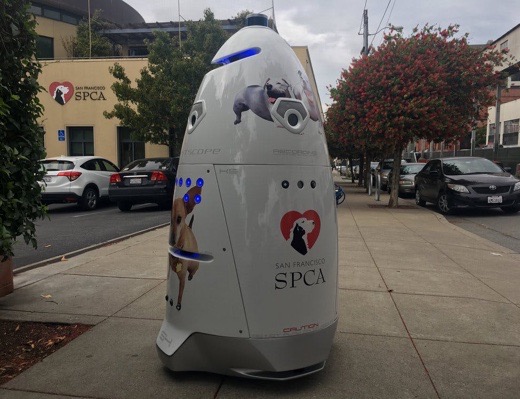

Image above: a KnightsScope security robot patrols around San Francisco Society for the Prevention for Cruelty to Animals to deter homeless people. We guess they are not as valuable as stray dogs. From (https://realfarmacy.com/homeless-robot/).
As the homeless problem continues to surge in San Francisco, an animal advocacy and pet adoption clinic has taken the novel, if dystopian, approach of hiring an autonomous security robot unit to clear out vagrants.

The SPCA (the Society for the Prevention of Cruelty to Animals) deployed a K5 robot manufactured by Knightscope, a Silicon Valley-based robotics company, to help discourage homeless people from erecting tents on the sidewalks and streets near the clinic. Though it has reduced the number of encampments, the robot has drawn overwhelmingly negative reactions from city residents.

Resembling a Whovian Dalek, the K5 security robot moves at around three miles per hour and is equipped with four cameras and an array of lasers, thermal sensors, and GPS. It can be rented for $6 an hour as opposed to the $16/hr a security guard costs.
See that thing up there? It is an autonomous security robot, something that's becoming fashionable nowadays.

Obviously, for every problem, there has to be a technological solution. So, what could go wrong with the idea that the problem of homeless people can be solved by means of security robots? After all, they are not weaponized.... I mean, not yet.

There is something badly wrong with the way we approach what we call "problems" and our naive faith in technology becomes more and more pathetic. And now we are deploying security robots all over the world. Surely a "solution" but it is not so clear what the problem is.

The story of this silly robot made me think of a post that I published a few months ago where I stated what I called "the golden rule of technological innovation: "innovation doesn't solve problems, it creates them". And the more I think about that, the more I think it is true.

Decades of work in research and development taught me this:

Innovation does not solve problems, it creates them. 

Which I could call "the Golden Rule of Technological Innovation." There are so many cases of this law at work that it is hard for me to decide where I should start from. Just think of nuclear energy; do you understand what I mean?

So, I am always amazed at the naive faith of some people who think that more technology will solve the problems created by technology. It just doesn't work like that.

That doesn't mean that technological research is useless; not at all. R&D can normally generate small but useful improvements to existing processes, which is what it is meant to do. But when you deal with breakthroughs, well, it is another kettle of dynamite sticks; so to say.

Most claimed breakthroughs turn out to be scams (cold fusion is a good example) but not all of them. And that leads to the second rule of technological innovation:

Successful innovations are always highly disruptive

You probably know the story of the Polish cavalry charging against the German tanks during WWII. It never happened, but the phrase "fighting tanks with horses" is a good metaphor for what technological breakthroughs can do.

Some innovations impose themselves, literally, by marching over the dead bodies of their opponents.

Even without such extremes, when an innovation becomes a marker of social success, it can diffuse extremely fast. Do you remember the role of status symbol that cell phones played in the 1990s?

Cars are an especially good example of how social factors can affect and amplify the effects of innovation.

I discussed in a previous post on Cassandra's Legacy how cars became the prime marker of social status in the West with the 1950s, becoming the bloated and inefficient objects we know today. They had a remarkable effect on society, creating the gigantic suburbs of today's cities where life without a personal car is nearly impossible.

But the great wheel of technological innovation keeps turning and it is soon going to make individual cars as obsolete as it would be wearing coats made of home-tanned bear skins.

It is, again, the combination of technological innovation and socioeconomic factors creating a disruptive effect. For one thing, private car ownership is rapidly becoming too expensive for the poor.

At the same time, the combination of global positioning systems (GPS), smartphones, and autonomous driving technologies makes it possible a kind of "transportation on demand" or "transportation as a service" (TAAS) that was unthinkable just a decade ago.

Electric cars are especially suitable (although not critically necessary) for this kind of transportation.

In this scheme, all you need to do to get a transportation service is to push a button on your smartphone and the vehicle you requested will silently glide in front of you to take you wherever you want. (*)

The combination of these factors is likely to generate an unstoppable and disruptive social phenomenon. Owning a car will be increasing seen as passé, whereas using the latest TAAS gadgetry will be seen as cool.

People will scramble to get rid of their obsolete, clumsy, and unfashionable cars and TAAS will also play the role of social filter: with the ongoing trends of increasing social inequality, the poor will be able to use it only occasionally or not at all.

The rich, instead, will use it to show that they can and that they have access to credit. Some TAAS services will be exclusive, just as some hotels and resorts are. Some rich people may still own cars as a hobby, but that wouldn't change the trend.

Of course, all that is a vision of the future and the future is always difficult to predict.

But something that we can say about the future is that when changes occur, they occur fast. In this case, the end result of the development of individual TAAS will be the rapid collapse of the automotive industry as we know it: a much smaller number of vehicles will be needed and they won't need to be of the kind that the present autuomotive industry can produce. This phenomenon has been correctly described by "RethinkX," even though still within a paradigm of growth.

In practice, the transition is likely to be even more rapid and brutal than what the RethinkX team propose. For the automotive industry, there applies the metaphor of "fighting tanks with horses."

The demise of the automotive industry is an example of what I called the "Seneca Effect." When some technology or way of life becomes obsolete and unsustainable, it tends to collapse very fast.

Look at the data for the world production of motor vehicles, below (image from Wikipedia). We are getting close to producing a hundred million of them per year.

If the trend continues, during the next ten years we'll have produced a further billion of them. Can you really imagine that it would be possible? There is a Seneca Cliff waiting for the automotive industry.

See also:
Ea O Ka Aina: Robot guard "commits suicide 7/18/17
Ea O Ka Aina: Robot runs over young boy 7/13/16
.

Why I have no plans for a computer

SUBHEAD: Thirty years ago he realized his first duty was to reduce his own consumption?

By Wendell Berry 21 September 1987 in BTconnect -
(http://home.btconnect.com/tipiglen/berrynot.html)


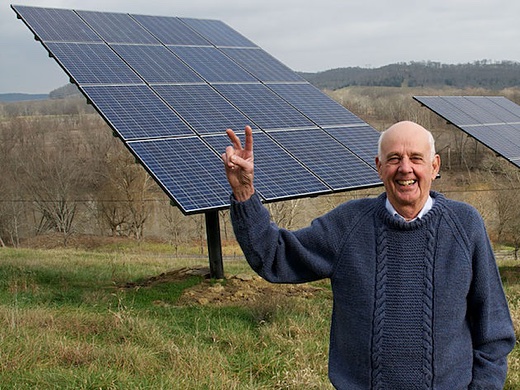
Image above: Wendel Berry, three decades after writing this article stands in front of his solar panels in Henry County, Kentucky.  From (http://huckleberryhans.wixsite.com/resonantliving/single-post/2017/03/06/Lenten-Day-6-Giving-up-Despair---Operation-Beauty).

[IB Publisher's note: This article was originally published in print by The New England Review and Bread Loaf Quarterly in the Fall of 1987 (https://www.jstor.org/stable/40241890?seq=1#page_scan_tab_contents)] 

Like almost everybody else, I am hooked to the energy corporations, which I do not admire. I hope to become less hooked to them. In my work, I try to be as little hooked to them as possible. As a farmer, I do almost all of my work with horses. As a writer, I work with a pencil or a pen and a piece of paper.

My wife types my work on a Royal standard typewriter bought new in 1956 and as good now as it was then. As she types, she sees things that are wrong and marks them with small checks in the margins. She is my best critic because she is the one most familiar with my habitual errors and weaknesses. She also understands, sometimes better than I do, what ought to be said.

We have, I think, a literary cottage industry that works well and pleasantly. I do not see anything wrong with it.

A number of people, by now, have told me that I could greatly improve things by buying a computer. My answer is that I am not going to do it. I have several reasons, and they are good ones.

The first is the one I mentioned at the beginning. I would hate to think that my work as a writer could not be done without a direct dependence on strip-mined coal. How could I write conscientiously against the rape of nature if I were, in the act of writing, Implicated in the rape ? For the same reason, it matters to me that my writing is done in the daytime, without electric light.

I do not admire the computer manufacturers a great deal more than I admire the energy industries. I have seen their advertisements. attempting to seduce struggling or failing farmers into the belief that they can solve their problems by buying yet another piece of expensive equipment. I am familiar with their propaganda campaigns that have put computers into public schools in need of books.

That computers are expected to become as common as TV sets in "the future" does not impress me or matter to me. I do not own a TV set. I do not see that computers are bringing us one step nearer to anything that does matter to me: peace, economic justice, ecological health, political honesty, family and community stability, good work.

What would a computer cost me? More money, for one thing, than I can afford, and more than I wish to pay to people whom I do not admire. But the cost would not be just monetary. It is well understood that technological innovation always requires the discarding of the "old model"—the "old model" in this case being not just our old Royal standard. but my wife, my critic, closest reader, my fellow worker.

Thus (and I think this is typical of present-day technological innovation). what would be superseded would be not only something, but somebody. In order to be technologically up-to-date as a writer, I would have to sacrifice an association that I am dependent upon and that I treasure.

My final and perhaps mv best reason for not owning a computer is that I do not wish to fool myself. I disbelieve, and therefore strongly resent, the assertion that I or anybody else could write better or more easily with a computer than with a pencil.

I do not see why I should not be as scientific about this as the next fellow: when somebody has used a computer to write work that is demonstrably better than Dante's, and when this better is demonstrably attributable to the use of a computer, then I will speak of computer with a more respectful tone of voice, though I still will not buy one.

To make myself as plain as I can, I should give my standards for technological innovation in my own work. They are as follows:
  1. The new tool should be cheaper than the one it replaces.
  2. It should be at least as small in scale as the one it replaces.
  3. It should do work that is clearly and demonstrably better than the one it replaces.
  4. It should use less energy than the one it replaces.
  5. If possible, it should use some form of solar energy, such as that of the body.
  6. It should be repairable by a person of ordinary intelligence, provided that he or she has the necessary tools.
  7. It should be purchasable and repairable as near to home as possible.
  8. It should come from a small, privately owned shop or store that will take it back for maintenance and repair.
  9. It should not replace or disrupt anything good that already exists, and this includes family and community relationships.
After the foregoing essay, first published in the New England Review and Bread Loaf Quarterly, was reprinted in Harper's, the Harper's editors published the following letters in response and permitted me a reply. W.B.


LETTERS
Wendell Berry provides writers enslaved by the computer with a handy alternative: Wife—a low-tech energy-saving device. Drop a pile of handwritten notes on Wife and you get back a finished manuscript, edited while it was typed. What computer can do that? Wife meets all of Berry's uncompromising standards for technological innovation: she's cheap, repairable near home, and good for the family structure.

Best of all, Wife is politically correct because she breaks a writer's "direct dependence on strip-mined coal."

History teaches us that Wife can also be used to beat rugs and wash clothes by hand, thus eliminating the need for the vacuum cleaner and washing machine, two more nasty machines that threaten the act of writing.
Gordon Inkeles Miranda, Calif.


I have no quarrel with Berry because he prefers to write with pencil and paper; that is his choice. But he implies that I and others are somehow impure because we choose to write on a computer. I do not admire the energy corporations, either. Their shortcoming is not that they produce electricity but how they go about it. They are poorly managed because they are blind to long-term consequences. To solve this problem, wouldn't it make more sense to correct the precise error they are making rather than simply ignore their product ? I would be happy to join Berry in a protest against strip mining, but I intend to keep plugging this computer into the wall with a clear conscience.
James Rhoads Battle Creek, Mich.


I enjoyed reading Berry's declaration of intent never to buy a personal computer in the same way that I enjoy reading about the belief systems of unfamiliar tribal cultures. I tried to imagine a tool that would meet Berry's criteria for superiority To his old manual typewriter. The clear winner is the quill pen. It is cheaper, smaller, more energy-efficient, human-powered, easily repaired, and non-disruptive of existing relationships.

Berry also requires that this tool must be "clearly and demonstrably better" than the one it replaces. But surely we all recognize by now that "better" is in the mind of the beholder. To the quill pen aficionado, the benefits obtained from elegant calligraphy might well outweigh all others.

I have no particular desire to see Berry use a word processor; or he doesn't like computers, that's fine with me. However, I do object to his portrayal of this reluctance as a moral virtue. Many of us have found that computers can be an invaluable tool in the fight to protect our environment.

In addition to helping me write, my personal computer gives me access to up-to-the-minute reports on the workings of the EPA and the nuclear industry. I participate in electronic bulletin boards on which environmental activists discuss strategy and warn each other about urgent legislative issues.

Perhaps Berry feels that the Sierra Club should eschew modern printing technology which is highly wasteful of energy, in favor of having its members handcopy the club's magazines and other mailings each month ? 
Nathaniel S. Borenstein Pittsburgh, Pa.


The value of a computer to a writer is that it is a tool not for generating ideas but for typing and editing words. It is cheaper than a secretary (or a wife!) and arguably more fuel-efficient. And it enables spouses who are not inclined to provide free labor more time to concentrate on their own work.

We should support alternatives both to coal-generated electricity and to IBM-style technocracy. But I am reluctant to entertain alternatives that presuppose the traditional subservience of one class to another. Let the PCs come and the wives and servants go seek more meaningful work.
Toby Koosman Knoxville, Tenn.


Berry asks how he could write conscientiously against the rape of nature if in the act of writing on a computer he was implicated in the rape. I find it ironic that a writer who sees the underlying connectness of things would allow his diatribe against computers to be published in a magazine that carries ads for the National Rural Electric Cooperative Association, Marlboro, Phillips Petroleum, McDonnell Douglas, and yes, even Smith-Corona. If Berry rests comfortably at night, he must be using sleeping pills.

Bradley C. Johnson Grand Forks, N.D.


WENDELL BERRY REPLIES:
The foregoing letters surprised me with the intensity of the feelings they expressed. According to the writers' testimony, there is nothing wrong with their computers; they are utterly satisfied with them and all that they stand for. My correspondents are certain that I am wrong and that I am, moreover, on the losing side, a side already relegated to the dustbin of history. And yet they grow huffy and condescending over my tiny dissent. What are they so anxious about?

I can only conclude that I have scratched the skin of a technological fundamentalism that, like other fundamentalisms, wishes to monopolize a whole society and, therefore, cannot tolerate the smallest difference of opinion. At the slightest hint of a threat to their complacency, they repeat, like a chorus of toads, the notes sounded by their leaders in industry. The past was gloomy, drudgery-ridden, servile, meaningless, and slow.

The present, thanks only to purchasable products, is meaningful, bright, lively, centralized, and fast. The future, thanks only to more purchasable products, is going to be even better. Thus consumers become salesmen, and the world is made safer for corporations.

I am also surprised by the meanness with which two of these writers refer to my wife. In order to imply that I am a tyrant, they suggest by both direct statement and innuendo that she is subservient, characterless, and stupid—a mere "device" easily forced to provide meaningless "free labor."

I understand that it is impossible to make an adequate public defense of one's private life, and so l will only point out that there are a number of kinder possibilities that my critics have disdained to imagine: that my wife may do this work because she wants to and likes to; that she may find some use and some meaning in it; that she may not work for nothing.

 These gentlemen obviously think themselves feminists of the most correct and principled sort, and yet they do not hesitate to stereotype and insult, on the basis of one fact, a woman they do not know. They are audacious and irresponsible gossips .

In his letter, Bradley C. Johnson rushes past the possibility of sense in what I said in my essay by implying that I am or ought to be a fanatic. That I am a person of this century and am implicated in many practices that I regret is fully acknowledged at the beginning of my essay. I did not say that I proposed to end forthwith all my involvement in harmful technology, for I do not know how to do that.

I said merely that I want to limit such involvement, and to a certain extent I do know how to do that. If some technology does damage to the world—as two of the above letters seem to agree that it does—then why is it not reasonable, and indeed moral, to try to limit one's use of that technology? Of course, I think that I am right to do this.

I would not think so, obviously, if I agreed with Nathaniel S. Borenstein that " 'better' is in the mind of the beholder." But if he truly believes this, I do not see why he bothers with his personal computer's "up-to-the-minute reports on the workings of the EPA and the nuclear industry" or why he wishes to be warned about "urgent legislative issues."

According to his system, the "better" in a bureaucratic, industrial, or legislative mind is as good as the "better" in his. His mind apparently is being subverted by an objective standard of some sort, and he had better look out.

Borenstein does not say what he does after his computer has drummed him awake. I assume from his letter that he must send donations to conservation organizations and letters to officials. Like James Rhoads, at any rate, he has a clear conscience. But this is what is wrong with the conservation movement. It has a clear conscience.

The guilty are always other people, and the wrong is always somewhere else. That is why Borenstein finds his "electronic bulletin board" so handy. To the conservation movement, it is only production that causes environmental degradation; the consumption that supports the production is rarely acknowledged to be at fault. The ideal of the run-of-the-mill conservationist is to impose restraints upon production without limiting consumption or burdening the consciences of consumers.

But virtually all of our consumption now is extravagant, and virtually all of it consumes the world. It is not beside the point that most electrical power comes from strip-mined coal . The history of the exploitation of the Appalachian coal fields is long, and it is available to readers.

I do not see how anyone can read it and plug in any appliance with a clear conscience. If Rhoads can do so, that does not mean that his conscience is clear; it means that his conscience is not working.

To the extent that we consume, in our present circumstances, we are guilty. To the extent that we guilty consumers are conservationists, we are absurd. But what can we do ? Must we go on writing letters to politicians and donating to conservation organizations until the majority of our fellow citizens agree with us? Or can we do something directly to solve our share of the problem?

I am a conservationist. I believe wholeheartedly in putting pressure on the politicians and in maintaining the conservation organizations. But I wrote my little essay partly in distrust of centralisation. I don't think that the government and the conservation organizations alone will ever make us a conserving society.

Why do I need a centralized computer system to alert me to environmental crises? That I live every hour of every day in an environmental crisis I know from all my senses. Why then is not my first duty to reduce, so far as I can, my own consumption?

Finally, it seems to me that none of my correspondents recognizes the innovativeness of my essay. If the use of a computer is a new idea, then a newer idea is not to use one.

.

DeGrasse Tyson cozy with Pentagon

SUBHEAD:Tyson in partnership “between the public and private sectors“ to promote “innovation” in US military.

By Adam Johnson on 27 July 2016 for AlterNet - 
(http://www.alternet.org/culture/neil-degrasse-tyson-cozy-pentagon)


Image above: Photo of Neil DeGrasse Tyson and yeah…he does this a lot. From (https://zeinshver.wordpress.com/2014/04/07/i-met-neil-degrasse-tyson/).

It was announced Wednesday that Neil deGrasse Tyson, beloved ambassador of science and head of the Hayden Planetarium in New York, will be joining the Pentagon’s “Innovation Board” along with Amazon CEO and multibillionaire Jeff Bezos. The two join a 15-person board that includes Aspen Institute chief executive Walter Isaacson, former Google CEO Eric Schmidt and other “private sector leaders.”

The board’s purpose is somewhat vague, described by Defense Secretary Carter as a partnership “between the public and private sectors“ to promote “innovation” at the Defense Department.

The addition of deGrass Tyson is notable due to his status as a public science educator and his vocal criticisms of war. In a 2014 interview with Parade magazine titled "Neil deGrasse Tyson: Why You Will Never Find Scientists Leading Armies Into Battle," deGrasse Tyson mused on the inherent antiwar nature of scientists:

"...when you have a cosmic perspective, when you know how large the universe is and how small we are within it—what Earth looks like from space, how tiny it is in a cosmic void—it’s impossible for you to say, ‘I so don’t like how you think that I’m going to kill you for it.’ You will never find scientists leading armies into battle. You just won’t. Especially not astrophysicists—we see the biggest picture there is."
While deGrasse Tyson certainly is not leading anyone to war, he’s consulting with those who are.

The United States military has active engagements in 80 to 90 countries a day and, in 2015, dropped a total of 23,144 bombs on seven countries. All with the assistance of thousands of scientists.

There’s an added layer of irony that the heir to the legacy of Carl Sagan, whose popular educational television series "Cosmos" deGrasse Tyson rebooted in 2014, is further warming up to the same military system Sagan was arrested for protesting against in 1986 and had frequent public battles with it throughout his career.

AlterNet’s attempts to get comment from deGrasse Tyson were not immediately returned. It is unclear if the position is paid.

The host of "Cosmos" has been criticized before for his blind spot on the militarization of science. In dueling open letters in 2014, science writer John Horgan and UC Santa Barbara professor Patrick McCray asked deGrasse Tyson to clarify his apparent indifference.

He did so in a brief followup exchange with Horgan that climaxed with this bit of circular handwaving:
No scientist working for the government has a job outside of tax-based sources of support—paid by citizens in the service of national policy implemented by a Congress and a President. I can scream at lawmakers without limit, but their duty is to serve their constituents. And so it’s the electorate that I, as a scientist and educator, will always target for my messages.
Seems deGrasse Tyson is now bypassing the electorate and targeting a private consortium of billionaires, ex-spooks and military brass.

The militarization of science is a serious issue and deGrasse Tyson’s position on it deserves far more clarity, doubly so now that he's gone from indifferent to the problem to actively partaking in it.

.

Pedal Power Farming

SUBHEAD: Two articles on the development of pedal power farm tractors by Farm Hack.
 
Second Prototype

By Staff on 15 November 2014 for No Tech Magazine -
(http://www.notechmagazine.com/2014/11/pedal-powered-farming.html)


Image above: Field test of second prototype of peddle powered farm tractor. From original article.

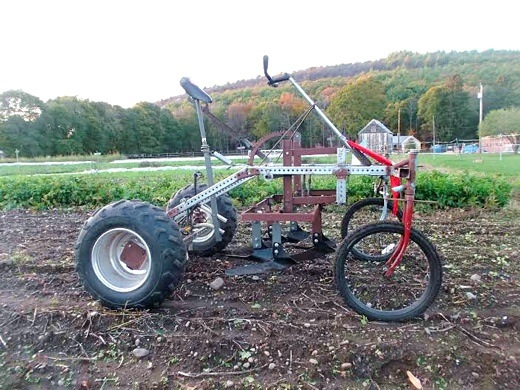
The Culticycle is a pedal powered tractor that can cultivate, seed, spray, or pull gear for most low horsepower tasks. We talked about the first prototype almost two years ago. A new version has now been released, built around a modular tractor frame. Tim Cooke explains us how it’s built and how it works: 
“The math behind the idea is nothing more than observing that a lot of the work a tractor does – shallow cultivation, seeding, flame weeding – requires very little of its available horsepower; and since these jobs are best done between 3 and 5 mph, a bike can be geared down low enough that a human can produce the necessary horsepower.

Take the cranks, seat, and handlebars from a bike and center them in a 4-wheel, lightweight, modular tractor frame: the obvious frame material is telestrut. For the front end use 20″ bike wheels and forks. You need about a foot of clearance but you want a low center of gravity and as much traction as possible: get 25 x 8 ATV tires for the rear, ideally with aluminum rims.”

“Assume you’ll pedal at 60 rpm and use a gear ratio of about 2.2 on the cranks to 3 on the differential. Now you have 25/12 x Ï€ for one revolution of the tire, x 22/30 gear ratio, x 60 rpm, x 60 minutes, divided by 5280 feet per mile = 3.3 mph. Pedal at 70 rpm and you’re at 3.8 mph. Meanwhile you’re not hunched and twisted and causing joint damage, you’re getting aerobic exercise.

And if your farm is bigger with tighter time constraints, have 2 or 3 of these machines set up specifically for those 2 or 3 row spacings that you use the most, and put the interns or volunteers on them. For instance one with a basket weeder, one with sweeps, one with finger weeders. Or fatten the front tires and throw a 12 foot aluminum ladder across the chassis and hang those big plastic harvest bins from each end, out over the beds, for lettuce harvesting: you could put 100 pounds on each end of the ladder.”


Video above: Field test of  second prototype of peddle powered farm tractor. From (https://youtu.be/Oy3LqlTq4e4).


First Prototype

By Staff on 31 March 2015 for Greenhorns -
(https://thegreenhorns.wordpress.com/2015/03/31/pedal-power-farm-hack-report-from-the-feild/)


Video above: Field test of first prototype of peddle powered farm tractor. From (https://youtu.be/C4u87VhYFV0).

“The Culticycle is a pedal powered tractor that can cultivate, seed, spray, or pull gear for most low horsepower tasks. Small tractors do many jobs very well and very fast, but also consume fuel, compact soil, cost a lot, and cause physical damage to the operator -– mainly spine and joint problems. Many of their jobs could be done, slower but better, by human pedal power.
This prototype consists of:
  • the front ends of 2 bikes welded together at 42” on center;
  • a lawn tractor differential mounted in a unistrut rectangle for a rear end , with 3/4″ round axles and 20” ATV tires;
  • a bike frame welded above the rear end with motorcycle sprocket and chain driving the differential (a springloaded idler tensions the chain);
  • a belly mount lift to hold cultivators, seeders, etc.;
  • a bike handlebar, separate from the bike frame and joined to the front end, steering the front wheels.
The materials are rebar, unistrut, landscape rake tines, and parts from bikes, an ATV, and a lawn tractor. It attempts to show that human pedal power can do some jobs of small tractors, albeit in twice the time, and that the design can be simple enough that no extra weight is needed for traction. The effort required is similar to climbing a 10 degree slope on a seventies Schwinn 3 speed. This prototype was built for testing: a more easily buildable version is in the works.”


Some Background

By Stall on 3 March 2015 for Green Horns -
(https://thegreenhorns.wordpress.com/2015/03/31/pedal-power-farm-hack-report-from-the-feild/)

An ace team of farmers, fabricators, engineers, and pedal-powered truckers gathered at Metro Pedal Power in Somerville, MA for a weekend build event. What project would bring such an intriguing group of individuals together? Only the culticycle, a pedal-powered cultivating tractor designed by Tim Cooke, that uses human brawn and bicycle brains to replace fossil fuel powered tractors for lightweight field cultivation. Culticycle video here!

First, a quick introduction of our weekend hosts. Metro Pedal Power is a pedal-powered hauling business in the Boston area, replacing box trucks with custom-built freight trikes to haul last-mile inter-city freight such as compost, recycling and CSA shares. They hope to reduce urban congestion and traffic, improve human wellbeing, and encourage others to see the appropriateness of pedal power in the urban environment.

Wenzday and Eric from MPP generously hosted the build event at their fully outfitted shop in Somerville, without which the event would have been wholly impossible and a lot less comfortable. Many thanks to them and the rest of their team for hosting, convening and offering their fabrication skills.

The goal of the pedal power hack was several fold. We wanted to showcase an already built culticycle for those who had never laid eyes on it before, and bring minds together to brainstorm improvements as Tim moves forward in his development of the tool.

Several attendees also were in the process of building their own culticycle, or had already done so, so we additionally hoped to build some replacement components and share knowledge of the build process that we could take home with us.

Additionally, we wanted to document the tool more thoroughly, specifically in CAD design format to be shared freely on the Farm Hack Tools platform. We also wanted to use this opportunity to shoot video and take photos to capture the Farm Hack collaborative design and build process as it was happening.

With those goals in mind, we set forth Saturday morning by working together to assemble a pre-built culticycle, so that everyone would have a chance to look over the design and get a sense of how the pieces fit together. We then split into several teams.

Team 1 started from scratch with steel stock, cutting and grinding the structural pieces of the chassis – using Tim’s documentation to guide their effort but also improving upon the design as they went.

Team 2 worked on “Culti 2,” a culticycle which was about halfway completed but still needed steering linkages and the parallel lift which raises and lowers the tools.

Team 3 began to rebuild the “belly mount,” or toolbar, which is attached underneath the culticycle and which the weed killing tools are clamped to. This new and improved belly mount will be delivered to Hawthorne Valley Farm and installed on their culticycle, replacing the older, less robust model which was a part of the earlier culticycle design iteration.

For a day and a half, the shop buzzed with activity as folks dropped in to observe the process or get their hands dirty cutting, grinding, and welding. Lu Yoder brought along his pedal powered grain grinder, grinding wheat and making bread on Saturday and grinding corn for his brother Chris’s CSA Sunday.

By midday Sunday, we had made significant progress on both the second and third culticycles, finished a pile of DIY, cheaply made star hoes, nearly completed the belly mount, and made many small modifications and improvements to the Culticycle.

Farm Hack supports an approach to tool design and innovation that is built on principles of resilience. Instead of the top-down approach to tool development put forward by corporate agribusiness, the event this weekend prioritized local manufacturing, easily repairable and modifiable tool design, and collaborative and iterative research and development. For the better part of the last decade, Tim Cook has spent countless hours in his basement shop designing, tinkering, and building this machine from scratch.

This is a familiar model: an isolated innovator who is the focused, driving force behind a revolutionary tool design. The community of support which showed up this weekend to pitch in, cut, weld, prototype, and offer their design feedback and support are a vital part of this process of resilient design.

As we concluded the weekend-long build sprint, the conversation turned to next steps for the Culticycle and for Farm Hack, both community-driven efforts to re–imagine the landscape of our collective farming future. Keep an eye out for upcoming opportunities to be involved with both, including another eastern Massachusetts culticycle build in the next weeks, a Farm Hack event at the Draft Animal Power Field Days in Cummington, MA this September, and a late Fall event at Lu Yoder’s place.

And if you’re inspired by this Massachusetts flurry of activity, keep in mind that Farm Hack is made up of the collective efforts and contributions of all of us. If you would like to organize an event in your community but you’re not quite sure how to do it, check out the helpful event organizing tool on the site.

.

Outsourcing Innovation

SUBHEAD: Offshore outsourcing of manufacturing has crippled America's innovation engine.

By Curtis Ellis on 19 October 2013 for Huffington Post -
(http://www.huffingtonpost.com/curtis-ellis/offshore-outsourcing-has-_b_4128766.html)


Image above: Innovative high-tech smart iPhone stand - the iPlunge. From (http://www.amazon.com/Fred-IPL-iPLUNGE-Phone-Stand/dp/B0046PKR8U/ref=sr_1_1).

A generation of efficiency experts have been telling us the U.S. doesn't need to manufacture things. We will lead the world at innovating -- coming up with new products and technologies, they say.
But a troubling report by the Massachusetts Institute of Technology finds that the loss of manufacturing is crippling our ability to innovate.

The always incisive Manufacturing & Technology News has the story.
The United States no longer has the industrial "ecosystem" necessary to bring new ideas to market. Finance, equipment, suppliers and manufacturers are not available in the United States to make prototypes and scale up commercial production of innovative ideas and products. This holds true for high-tech start-ups, the best small- and medium-sized manufacturing companies, and U.S.-based multinational corporations.
"Serious basic weaknesses in the industry ecosystem are prevalent," according to MIT's Production in the Innovation Economy (PIE) study in a book published on Sept. 20 titled Making in America: From Innovation to Market. "In some companies we interviewed, these weaknesses took the form of managers' worrying about having to bring parts of production back in-house because they feared for the survival of their suppliers. The cost of substituting for missing suppliers would divert resources from the development of new lines of business."
How about all those iWhatevers -- Designed in California, Made in China? Doesn't that prove America can be the innovation leader even if we don't make anything?
No, says Martin Schmidt, MIT professor, Associate Provost and director of the Task Force on Production in the Innovation Economy:
a lot of attention gets paid to consumer electronics -- and Apple being the greatest icon of that -- where you have firms that can innovate in new products but don't manufacture any of the products under their own roof -- and in many instances manufacture those products in other parts of the world. But while that is true, it is an anomaly -- a function of the standardization of the manufacturing processes for the core technologies that feed into consumer electronics. We don't see that standardization in other areas. ... We just haven't seen that model work in other industries.
The varied skills, know-how and facilities associated with manufacturing is nothing less than an industrial ecosystem needed to nurture new invention. The offshore outsourcing of America's manufacturing base has had the same impact on this ecosystem as a million chain saws have had on the Amazon rain forest.

Another problem: Many enterprising innovators are being bankrolled by foreign capital. These investors stipulate when production ramps up it happen where the capital came from - outside the U.S.

So the next time someone tells you "We don't need to make things here - America is best at coming up with the next great new technology" you can tell them they don't know what they're talking about.
We won't have full employment until we start making the products we consume. And we won't remain a technological leader, either.

.

The Pallet

SUBHEAD: The single most important object, and the most ubiquitous,  in the Global Economy.

By Tome Vanderbilt on 14 August 2013 for Slate Magazine -
(http://www.slate.com/articles/business/transport/2012/08/pallets_the_single_most_important_object_in_the_global_economy_.single.html)


Image above: Illustration of the use of the the pallet and forklift in the Pacific in World War Two in Palletizer Magazine in 1954. From (http://packagingrevolution.net/navy-1954/).

Earlier this spring, the Washington Conservation Corps faced a sudden influx of beach debris on the state’s southwestern shore. Time and tide were beginning to deposit the aftereffects of Japan’s March 11, 2011, tsunami. One of the myriad objects retrieved was a plastic pallet, scuffed and swimming-pool green, bearing the words: “19-4 (salt) (return required), and, below that, “Japan salt service.”

A year earlier, Dubai’s police made the region’s largest narcotics bust when they intercepted a container, carried on a Liberian registered-ship, that had originated from Pakistan and transited through what Ethan Zuckerman has called the “ley lines of globalization,” that constellation of dusty, never-touristed entrepôts like Oman’s Salalah Port or Nigeria’s Tin Can Island Port. Acting on an informant’s tip, police searched the container’s cargo—heavy bags of iron filings—to no avail. Only after removing every bag did police decide to check the pallets on which the bags had rested. Inside each was a hollowed-out section holding 500 to 700 grams of heroin.

Two random stories plucked from the annals of shipping. What unites these disparate tales of things lost (and hidden) on the seas is that they each draw attention to something that usually goes unnoticed: The pallet, that humble construction of wood joists and planks (or, less typically, plastic or metal ones) upon which most every object in the world, at some time or another, is carried. “Pallets move the world,” says Mark White, an emeritus professor at Virginia Tech and director of the William H. Sardo Jr. Pallet & Container Research Laboratory and the Center for Packaging and Unit Load Design. And, as the above stories illustrate, the world moves pallets, often in mysterious ways.

Pallets, of course, are merely one cog in the global machine for moving things. But while shipping containers, for instance, have had their due, in Marc Levinson’s surprisingly illustrative book The Box (“the container made shipping cheap, and by doing so changed the shape of the world economy”), pallets rest outside of our imagination, regarded as scrap wood sitting outside grocery stores or holding massive jars of olives at Costco. As one German article, translated via Google, put it: “How exciting can such a pile of boards be?”

And yet pallets are arguably as integral to globalization as containers. For an invisible object, they are everywhere: There are said to be billions circulating through global supply chain (2 billion in the United States alone). Some 80 percent of all U.S. commerce is carried on pallets. So widespread is their use that they account for, according to one estimate, more than 46 percent of total U.S. hardwood lumber production.

Companies like Ikea have literally designed products around pallets: Its “Bang” mug, notes Colin White in his book Strategic Management, has had three redesigns, each done not for aesthetics but to ensure that more mugs would fit on a pallet (not to mention in a customer’s cupboard). After the changes, it was possible to fit 2,204 mugs on a pallet, rather than the original 864, which created a 60 percent reduction in shipping costs.

There is a whole science of “pallet cube optimization,” a kind of Tetris for packaging; and an associated engineering, filled with analyses of “pallet overhang” (stacking cartons so they hang over the edge of the pallet, resulting in losses of carton strength) and efforts to reduce “pallet gaps” (too much spacing between deckboards). The “pallet loading problem,”—or the question of how to fit the most boxes onto a single pallet—is a common operations research thought exercise.

Pallet history is both humble and dramatic. As Pallet Enterprise (“For 30 years the leading pallet and sawmill magazine”) recounts, pallets grew out of simple wooden “skids”, which had been used to help transport goods from shore to ship and were, essentially, pallets without a bottom set of boards, hand-loaded by longshoremen and then, typically, hoisted by winch into a ship’s cargo hold.

Both skids and pallets allowed shippers to “unitize” goods, with clear efficiency benefits: “According to an article in a 1931 railway trade magazine, three days were required to unload a boxcar containing 13,000 cases of unpalletized canned goods. When the same amount of goods was loaded into the boxcar on pallets or skids, the identical task took only four hours.”

As USDA Forest Service researchers Gilbert P. Dempsey and David G. Martens noted in a conference paper, two factors led to the real rise of the pallet. The first was the 1937 invention of gas-powered forklift trucks, which “allowed goods to be moved, stacked, and stored with extraordinary speed and versatility.”

The second factor in the rise of the pallet was World War II. Logistics—the “Big ‘L’,” as one history puts it—is the secret story behind any successful military campaign, and pallets played a large role in the extraordinary supply efforts in the world’s first truly global war. As one historian, quoted by Rick Le Blanc in Pallet Enterprise, notes, “the use of the forklift trucks and pallets was the most significant and revolutionary storage development of the war.” Tens of millions of pallets were employed—particularly in the Pacific campaigns, with their elongated supply lines. Looking to improve turnaround times for materials handling, a Navy Supply Corps officer named Norman Cahners—who would go on to found the publishing giant of the same name—invented the “four-way pallet.” This relatively minor refinement, which featured notches cut in the side so that forklifts could pick up pallets from any direction, doubled material-handling productivity per man. If there’s a Silver Star for optimization, it belongs to Cahners.

As a sort of peace dividend, at war’s end the U.S. military left the Australian government with not only many forklifts and cranes, but about 60,000 pallets. To handle these resources, the Australian government created the Commonwealth Handling Equipment Pool, and the company eventually spawned a modern pallet powerhouse, CHEP USA, which now controls about 90 percent of the “pooled” pallet market in the United States.

 Pooled pallets are rented from one company that takes care of delivering and retrieving them; the alternative is a “one-way” pallet, essentially a disposable item that is scrapped, recycled or reused when its initial journey is done. You can identify pooled pallet brands by their color: If you see a blue pallet at a store like Home Depot, that’s a CHEP pallet; a red pallet comes from competitor PECO.

There’s a big debate in the pallet world about whether using pooled or one-way pallets is preferable, just one of the many distinctions within the industry explained to me by Bob Trebilcock, the executive editor of Modern Materials Handling (which, as it happens, grew out of Norman Cahners’ World War II newsletter The Palletizer). Trebilcock grew up in the industry—his father owned a pallet company in northeastern Ohio. “Most kids’ dads take them to Disney World,” he says, “Mine took me to the Borg Warner Auto Parts plant in North Tonawanda, New York.”

Pooled vs. one-way, block vs. stringer, wood vs. plastic (there’s a lot of claims, but little peer-reviewed research, on which has a greater environmental footprint)—one can quickly find themselves on the wrong side of an argument at a materials handling convention.

To illustrate the implications of pallets, Trebilcock describes a recent conversation with Costco, which last year shook up the pallet world by shifting to “block” pallets, which have long been common in Europe and other regions. Block pallets are essentially an improvement on the four-way pallet that debuted during WWII; the pallet deckboards rest on sturdy blocks, rather than long crossboards (or “stringers”), which make them even easier for forklifts and pallet jacks to pick up from any angle.

With “stringer” pallets, Costco warehouse workers couldn’t fit pallet jack forks into pallets if they were facing the wrong side; instead, he says, they’d have to “pinwheel” the pallet around before picking it up. A small maneuver, but, he adds, “Costco unloads a million trucks a year.” Do the math, and the company was sitting on an institutional-size jar of corporate inefficiency.

So why don’t all companies use block pallets? Indeed, no major retailer has yet followed Costco’s lead. As with everything in the pallet world, says Virginia Tech’s White, it boils down to economics. Block pallets cost more to build than stringer pallets. More expensive pallets lend themselves to rental programs.

Rental programs need to have systems in place to track and retrieve pallets, and they need industries that use standardized pallets. While rental block pallets are common in Europe, White says the geography of the United States has discouraged their use. “When the supply chain between raw materials and man is very long and protracted, and the volumes are smaller, it doesn’t make sense for rental companies to get into that business.”

Given the increasing interconnectedness of the global economy, White says there is a surprising, and disheartening, lack of standardization among pallets. In the United States, pallets commonly measure 48 inches by 40 inches (the size of the Grocery Manufacturer Association’s pallet, which makes up 30 percent of new U.S. wood pallets each year). Europe tends to use a standard of 1000 millimeters by 1200 millimeters standard. Japan’s most common pallet is 1100 by 1100.

All told, the ISO (the International Organization for Standardization) recognizes six pallet standards. Packaging itself, meanwhile, is set to a 400 millimeter by 600 millimeter footprint—ideal for metric pallets. But shipping containers, notes White, are still set to a U.S. customary standard: 20 feet by 40 feet. The math doesn’t add up.

Because of this, he says, most containers today bearing consumer goods and industrial products are “floor loaded,” i.e, loaded by hand, only to be hand unloaded and then “palletized” as they enter the U.S. supply chain. “With a 40-foot container, it could take two lumpers four to eight hours to unload it, whereas on pallets, we could unload it in 30 minutes.”

Of course, nothing in supply chains is so simple: To be effectively used in containers, pallets would have to become thinner — “you want to max the cube,” White says, i.e., fill the container’s volume with as much product as possible, and current pallets would take up valuable space. But creating thinner pallets, he says, would require changes down the line in the way companies store products. Warehouse rack storage, he says, would have to be retrofit to accommodate the newer designs.

Such changes are not impossible. In fact, it’s already been done by Ikea, a company famous for its fixation on logistics. Last year, Ikea abandoned wooden pallets in a favor of a low-profile system called “Optiledge.” The system consists of one-pound “load carriers,” little ledges with feet that are placed under stacks of boxes and then held in place with giant bands. (There’s a cool demo of the system here.)

The benefit, says the company, is that the system—which is one-way and 100 percent recyclable—can adapt to the dimensions of the load being carried, rather than vice versa. It’s also lighter and takes up less space. “One truckload of OptiLedges,” the company notes, “would be the equivalent of 23 truckloads of traditional pallets.” But overhauling the pallet required a massive overhaul of Ikea’s stores: In Europe alone more than 500,000 new metal shelves had to be installed.

Ikea’s is perhaps the most thoroughgoing reinvention of a product that has, with some minor refinements in design and engineering, stayed quite similar to its World War II origins. But there are other changes afoot that may reduce our dependence on pallets, says Trebilcock. Businesses like grocery stores, which might once have taken delivery of an entire pallet’s worth of, say, Cambpell’s Soup, have moved to smaller and more frequent delivery schedules.

“They’ve gotten rid of their back rooms,” he says, and instead of receiving pallet loads they’re hand-unloading pallets of boxes of “mixed product SKUs” versus “single SKU pallets,” part of a larger trend toward leaner, more rapid distribution, itself driven by a proliferation of choice.

Then there’s what might be called the Amazon effect. “The biggest thing impacting distribution right now is the Internet,” he says. “You and I are ordering so much stuff online. We’re just getting a small box with stuff. Those things don’t go onto pallets, they go into the back of a UPS truck.” Indeed, one has to wonder if we might eventually take all the labor saved from containerization and palletization and simply put it onto the back of the UPS driver. But Trebilcock has no actual evidence that pallet use is down.

The pallet is one of those things that, once you start to look for it, you see everywhere: Clustered in stacks near freight depots and distribution centers (where they are targets for theft), holding pyramids of Coke in an “endcap display” at your local big-box retailer, providing gritty atmosphere in movies, forming the dramatic stage-setting for wartime boondoggles (news accounts of the Iraqi scandal seemed obsessed with the fact the money was delivered on pallets, as if to underscore the sheer mass of the currency), being broken up for a beach bonfire somewhere, even repurposed into innovative modern architecture.


Image above: IB Editor's stack of four used pallets from Ace Hardware to support pots of herbs. Wire is to keep the toads from climbing into the pots and stifling the plants. The red petal are from an overhanging poinciana tree that goes off in August. Photo by Juan Wilson.

Trebilcock likens the industry to the slogan once used by the company BASF: “At BASF, we don't make a lot of the products you buy. We make a lot of the products you buy better." At parties he’ll tell people who ask what he does: “Without a pallet, most of what you and I eat or wear or sit on or whatnot would not have gotten to us as easily or inexpensively as it got to us.”

Just don’t get him started on the “raggle stick,” another quietly ubiquitous feature of the supply chain. Raggle sticks are the scalloped pieces of wood or plastic you’ve no doubt seen (or better yet, not seen) used to help efficiently stack pipes or rods on the back of trucks. They are basically pallets for round objects. It turns out his father also had a raggle stick company. “You don’t want to know how many raggle sticks they sold.”


.

Rubik X-Cube

SUBHEAD: Take a classic puzzle, an idea, CAD, 3D Printing and the  results are Wow!

By Dane Chrsitianson on 10 December 2012 for YouTube  -
(http://youtu.be/d_z0hyUvI8c)


Image above: Detail of still frame of X-Cube from video below.

Dane Chrsitianson created this using CAD and 3D printing. It's a twisty puzzle with fully functional additional layers on four of the faces of a 3x3x3 puzzle.


The 3-D printer craze just ain't slowing up. Like it wasn't enough for these technological marvels to spit out houses, drugs, firearms, body parts, and all manner of plastic items you can simply print out and pitch straight into landfill, this guy's made a puzzle that's so much fun, it's in danger of attracting unwanted attention from the Rubik's legal team.

Regular folks seem just as interested in the "X-Cube," with this video pulling 200,000 views in one day on YouTube.


Video above: Demonstration of X-Cube. From (http://youtu.be/d_z0hyUvI8c)

This project was completed through the Idea Shop at the Illinois Institute of Technology.

.

Changing Education Paradigns

SUBHEAD: The waste in natural resources are more than matched by the waste of our human resources. Education has failed. By Staff on 27 December 2010 for the Guardian - (http://www.guardian.co.uk/science/punctuated-equilibrium/2010/dec/27/1) Why don't we get the best out of people? Sir Ken Robinson argues that it's because we've been educated to become good workers, rather than creative thinkers. Students with restless minds and bodies -- far from being cultivated for their energy and curiosity -- are ignored or even stigmatized, with terrible consequences. "We are educating people out of their creativity," Robinson says.

This presentation did not impress me in the least. Basically, Sir Ken Robinson whinges about the educational system without presenting even one creative, usable solution to the problems that he reports -- problems that every one of us is acutely aware of. Anyone can criticise the system but few can (or will, apparently) fix it.

What solutions do you think would address the problems that Robinson describes? I have many thoughts on this matter, having taught at several public universities on opposite coasts of the United States, but my arm is trapped in a plaster cast right now, so typing is not exactly something I can do for very long at the moment. However, that said, one pedagogy I've found effective is learning from our mistakes, and those made by others. (I link to that video as a way to jump-start the discussion).

This animation was adapted from a talk given at the RSA by Sir Ken Robinson, world-renowned education and creativity expert and recipient of the RSA's Benjamin Franklin award. See Ken Robinson's website at (http://sirkenrobinson.com/skr/watch). Video above: "Changing Education Paradigns". From (http://www.youtube.com/watch?feature=player_embedded&v=zDZFcDGpL4U#at=130). Video above: "Do Schools Kill Creativity". From (http://www.youtube.com/watch?v=iG9CE55wbtY). [Editor's note: Thanks for the comment and the suggestion, John. However there is an error in your link. I think the above video is what you were aiming at.] .

The Ascent of Man?

SUBHEAD:Modern consumer society and its high energy lifestyles is happening when the outlook for real innovation is very bleak indeed.

By Thomas Robinson on 3 February 2011 for nature Bats Last - (http://guymcpherson.com/2011/02/the-ascent/)

Image above: Detail of cover of "The Ascent of Man" DVD by Jacob Bronowski. From (http://consciousvideodirectory.webs.com/apps/videos/channels/show/2587582-the-ascent-of-man).

In the classical 1973 BBC production The Ascent of Man, Bronowski lists a number of amazing accomplishments that grew from primitive tools millions of years ago to wonders such as the theory of relativity and understanding DNA as a basis for life. One cannot but be impressed with how little the series has aged in terms of technology, paradigms and scientific understanding.

However, the apparent agelessness of the documentary poses a very fundamental challenge to the wide spread assumption that the rate of technological change and scientific understanding is accelerating exponentially. In fact, accelerating technology and scientific innovation constitutes a pillar for the school of thought, which rejects peak oil and its consequences. An impending energy crunch and resultant devolution of modern lifestyles will be avoided — it is argued — through amazing scientific discoveries and technological implementations, which will allow indefinite exponential growth even in a closed and limited system.

While Jevons’ Paradox suggests that technological conservation of energy will be eroded by greater usage, there is an even more fundamental problem, namely that: 1) technological progress is less useful than usually thought, because of marginal returns and 2) technological advancement and innovation has slowed alarmingly over the last decades. This is why The Ascent of Man seems so timeless: mankind has not ascended much in the recent past. We are in fact witnessing a severe collapse of creativity and innovation in spite of the newest apps on your phone.

One formulation of technological optimism is found in Moore’s Law, which has accurately stated that computing power will double approximately every two years. Futurists believe that Moore’s Law will lead to what is known as a technological singularity –- a situation in which computations occur virtually instantaneously. This could perhaps be attained using quantum computers based on super-positioning and entanglement. However, here one must remember the law of diminishing returns. How much benefit can be drawn from this ever increasing computing speed?

We have long since passed the point at which greater computational speeds have greater significance in everyday life. For instance, when I search “house” in Google, I get 1,520,000,000 hits in 0,05 seconds. The question being, whether am I significantly better off now than two years ago when I only got 760,000,000 hits in the same time, or when it took me all of 0.1 seconds. These differences are effectively beyond the threshold of human senses: the time differences have become negligible and I would never in a whole lifetime be able to browse all the results and make a meaningful choice between them.

So, in this particular case, Moore’s Law has not improved my life significantly. In fact, some would argue that the proliferation of possibilities and options as regards hits in a computer search and technologies have made me much worse off, creating paralysis in the face of all this information and choice. The psychologist Barry Schwartz has eloquently argued that this reduces the quality of life.

Although computing speeds double every other year, the computer is itself an old invention, as readers of Neil Stephenson’s Cryptonomicon will know. The first mechanical computers go back to the 1600s and savants such as Blaise Pascal and Gottfried von Leibnitz. Indeed, the cryptology and mathematics involved are older yet, since the binary number system used for computers originates with the ancient Indian mathematician Pingala. The 1800s saw the rise of punch-card computers and the first modern electrical computers were designed by Alan Turing in 1936 and built during the Second World War. This is old stuff. The first commercial word processor was WordStar from 1978, which was –- coincidentally — made famous by Arthur C. Clarke who praised its qualities from a Sri Lankan beach.

The Internet is from the 1960s, the cellphone is from 1973, the first satellite was put into orbit in 1957, the details of which were put forth by Clarke in a Wireless World article in 1945, but Konstantin Tsiolkovsky had already calculated the necessary orbital speeds in 1903. The first heart transplant was in 1967 and the first kidney transplant in 1953. The list of technology goes on and on: television, radio, nuclear reactors, cars, refrigeration, rail, internal combustion, reinforced concrete, aeroplanes, industrialized agriculture, robots, windmills, solar panels, in vitro fertilization, and so on. These were all invented in the 19th and 20th centuries. In fact, one would be hard pressed to suggest a single innovation from the last 30 years that has changed, improved or eased everyday life for ordinary people in a radical way, such as those mentioned here.

At best, one could speak of combining existing technologies, such as internet on the cellphone or improving efficiency, as in Moore’s law and deadly and destructive economies of scale. In fact the Time magazine list of best inventions for 2009 has astounding wonders such as the universal unicycle, the edible race car, and the sky king, a radical breakthrough in paper plane folding.

Even seemingly useful inventions on the Time 2010 list, such as a seed bank or Seed Cathedral is a rip off from the 20th century. The 1972 Sci-fi movie Silent Running has a seed bank, but reality also has them, such as the 1926 Vavilov Research Institute of Plant Industry, the 1936 Wellcome Trust, the 1984 Nordic Gene Bank at Svalbard. Why delude ourselves into thinking that this is innovation in any other manner than presentation and aesthetics? Similarly flying cars (sic), jet packs (sic) and plastic fur (sic) from the 2010 list are not true innovations either, but high-energy gimmicks.

The slowing in innovation is not merely a hypothesis, intuition, or vague impression. Jonathan Huebner has made a case for the concept of peak innovation using quantitative measures. His paper examines the number of technological innovations in relation to population size since the 1450s and reaches the flabbergasting result that innovation peaked in 1873 and that within a few years, the rate of contemporary innovation will drop to levels not seen since the Middle Ages. There may be inaccuracies in using patents as proxies for innovation, but the results are so marked that they at least suggest an overall trend. In the abstract, Huebner is therefore able to draw an astounding statistical conclusion: “We are at an estimated 85% of the economic limit of technology, and it is projected that we will reach 90% in 2018 and 95% in 2038.”

Not unlike with oil, it would seem that the low-hanging fruits of research have been taken. The remaining breakthroughs in science will take longer to attain and involve more extensive funding and regard ever more esoteric subjects. This can be seen, for example, in the age of Nobel Prize winners. They have been getting older and older over the last many decades, suggesting that scientific results take longer to reach. For instance, the winners of the 2010 Nobel Prize in economics were 62, 70, and 71 years old, while conventional wisdom would have it that 50 years of age was an upper limit.

It seems that a technological solution to the challenges facing modern consumer society and its high energy lifestyles is happening in a circumstance where outlooks for innovation are very bleak indeed. We are facing the prospects of fewer breakthroughs, which require longer time for development, need more funding and will be less useful when completed.

Over and against this, universities across the globe are facing severe cut-backs all the while bibliometric management principles have drawn efforts away from basic research and directed them into knowledge dissemination in conservative peer-reviewed journals. In fact, one issue here could be the inherent conservatism of the peer-review process, which consistently rejects groundbreaking research. Vested interest in given theories and schools of thought counters the process of “conjectures and refutations” that science lives by and slows innovation even further by reducing everything to what Kuhn calls ‘normal science’ rather than challenging paradigms.

So, how do we account for the discrepancy between popular conceptions about the rate of innovation and reality? Firstly, there is a general confluence of true innovation and gimmickry. Go-faster stripes on a cellphone hardly constitute a radical new breakthrough. In fact, modern life has developed into an age of illusion, valuing spectacle and fantasy more than reality.

Ever more efforts are spent on creating virtual innovation: new fantasies, new computer games, new special effects in movies, “reality” shows, political spin. These create the illusion of movement, while the technology supporting the real, physical basis for life has not changed, merely been ignored. Mankind is stuck in a highly entertaining hamster wheel and is running out of energy.

Being conditioned by computers, movies, malls, ads, and TV, many accept the seemingly magical appearance of food, clothes, water, heating, and electricity without any real knowledge about the more fundamental reality — the enormous and hidden infrastructure — which sustains people. Many have simply learnt to suspend their disbelief, that very questioning ability, which drove Bronowski’s primitive apes to pick up tools millions of years ago and resulted in the theory of relativity more than a hundred years hence. This suspending of disbelief numbs the faculties, which we employ when seeking deeper understanding of the natural world, which sustains us.

This conditioning is so extensive and powerful that many are even able to suspend disbelief in arguments that defy logic, such those that claim that exponential growth can continue indefinitely in a closed system.

• Thomas Derek Robinson was born in 1975 in the depths of the Cold War, in what was then a frontline state with the Warsaw-pact: Denmark — but grew up in Thatcherite, North-East England. Dual-nationalities and multicultural living made Thomas a bilingual and gave him a need for certainties, which lay beyond tradition and convention, wherefore he has a degree in philosophy. Thomas currently translates Danish (not the pastry) research into English. He and his family have a farm with horses on the Danish island of Funen (Fyn). Horse muck and living outside the city have also made it possible for him to develop a prodigious interest in gardening with the aim of soon being self-sufficient.

Student Achieves Bird Flight

SUBHEAD: The ornithopter (bird-like flight) was first sketched by Da Vinci way back in 1485, but was not successfully flown until now.

By Jerry Stone on 22 September 2010 for TreeHugger - (http://www.treehugger.com/files/2010/09/student-makes-history-with-first-ever-human-powered-flight.php)

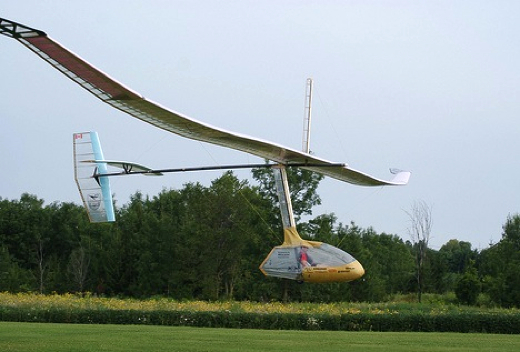
Image above: Liftoff of SnowBird. Photo via Todd Reichert

A Canadian university student has done what Leonardo da Vinci had only dreamt of: piloted a human-powered "wing-flapping" plane! Called an ornithopter, and the inspiration for modern day helicopters, the machine was first sketched by Da Vinci way back in 1485 and never actually built.

Todd Reichert, an engineering student at the University of Toronto, made history by sustaining flight in his ornithopter--named Snowbird--for 19.3 seconds and covering 475.72 feet. Snowbird is made from carbon fiber, balsa wood and foam. The 92.59 pound vehicle maintained an average speed of 15.91 miles per hour.

Video above: Human powered flight by University of Toronto engineering student. From (http://vimeo.com/15168317) See also (http://www.youtube.com/user/OrnithopterProject#p/a/f/0/0E77j1imdhQ)

Todd and his plane made the accomplishment on August 2nd at the Great Lakes Gliding Club in Tottenham, Ontario. The crew kept the achievement quiet for nearly two months to get the data finalized. Todd and some 30 other students had been working on the plane for 4 years.

group.jpg

Image above: Members of team. Photo via Todd Reichert

The team went through 65 practice flights and sadly, the aircraft will probably never be flown again.

Todd endured a year long exercise program in which he lost 18 lbs. to prep for the flight. With a wingspan of 104 feet--which is comparable to that of a Boeing 737--he had to pedal with his legs all while pulling on the wings to flap at the same time. And he had to do it fast enough to fly!

First Human Powered Flight Wingspan Photo

Image above: Bird like wing of SnowBird. Photo via Todd Reichert

"Our original goal was to complete this sort of original aeronautical dream to fly like a bird," said 28-year-old Reichert yesterday. "The idea was to fly under your own power by flapping your wings."

The flight, witnessed by the Federation Aeronautique Internationale (FAI), is the first officially confirmed flight in an ornithopter.

"Thousands of people have tried to do this for hundreds of years," said Reichert. "To be honest, I don't think it's really set in yet that I'm the one who has been successful. I was pushing with everything I had. When I finally let go and landed, I was hit with a breadth of excitement. It was pretty wild."

I bet it was, Todd!

.

Permanently Unemployed Economy

SUBHEAD: The consumer is mutating and evolving. This new fast-growing consumer underclass is an area where new product development opportunities abound. Image above: Dignity Village residents in Portland, ORegon, employ both scrap material and new products in their households. From (http://myhomelessstory.net/homeless_camp_images.htm) By Dmitry Orlov on 12 February 2010 in Club Orlov - (http://cluborlov.blogspot.com/2010/02/products-and-services-for-permanently.html) Developing and marketing products for a shrinking market poses an interesting set of challenges. Even if a company does an outstanding job and is able to steadily grow its market share, these gains are negated if the market itself continually shrinks by an ever larger amount. For instance, a company might have an outstanding electric vehicle design, but it is destined to by the wayside during a time when the number of consumers that qualify for a car loan is trending downward, the used car market is glutted by repossessions, and federal, state and municipal governments are unable to upgrade their car fleets because their budgets are far in the red.
Consumer product development caters to individuals who live in houses or condos, have jobs to which they commute by car, and generate a steady stream of disposable income. This is the group to which the business press often refers collectively as "the consumer". One often reads that the consumer is retrenching, that the consumer's credit is tapped out, that the consumer's disposable income is shrinking and so on. The consumer market is not growing. What is there left to do except design and manufacture fewer and fewer products? The answer is as simple as it is surprising. The consumer is not melting away; the consumer is mutating and evolving. In the United States alone, half a million people a month (in round numbers) is being shed from the workforce. Although this is often portrayed as a temporary condition, job creation is not expected to pick up pace any time soon, and few people are willing to forecast when it will again exceed population growth. Even a rose-tinted economic scenario has to admit that there is a high probability of new energy price spikes triggering new recessionary periods, which would drive unemployment higher. Therefore, more often than not, a job loss will set a person on a new career path - one that comes with a new set of challenges and options. Most significantly, these formerly employed people often no longer have sufficient income to afford the two items that dominate most household budgets - the house and the car, and all of the expenses that are associated with them. Medical expenses form a third category, and are highly variable, depending on a person's age and medical condition. These costs range from zero (for the healthy uninsured) to arbitrarily large (medical expenses being the largest single cause of personal bankruptcy). Does permanent job loss mean that someone is no longer a consumer? In some cases the answer is yes: some people continue to spend as if they still had a job, and the inevitable result is eventual destitution. Once they run out of unemployment benefits, savings and credit, their purchasing ability decreases to the barest minimum provided by food stamps. I don't mean to sound harsh, but this makes them rather uninteresting from a new product marketing perspective. Image above: Boomer generation facing a new challenge with 21st century technology. From (http://myhomelessstory.net/homeless_camp_images.htm) But other people may be quick to shed their biggest categories of expense, walking away from their mortgage and their car loan, allowing their medical insurance to lapse, and developing a new lifestyle that is well within their new budgetary constraints. They may couch-surf, take advantage of house-sitting opportunities or rent a spot at a campground by the season. For the cold part of the year, they may head south and, again, camp out. They may look for seasonal employment, do odd jobs for cash, or use their skills to repair or make and sell items for cash. With their largest expenses gone, their disposable income may actually be higher. However, their needs and requirements are quite different, and since most product offerings target the settled, fully employed consumer, they are in some ways under-served. This is an area where new product development opportunities abound, and companies that gain a share of this growing market segment and build brand loyalty among this fast-growing consumer underclass will lock in a decade or more of profits and rapid growth. As a marketing strategy, it is not just recession-proof but actually recession-enhanced. In saying that the unemployed consumers are currently under-served, I do not mean to belittle the huge positive effect on their lifestyles that resulted from the recent major advances in mobile computing and communications. Laptops with wireless Internet access have made it possible for a homeless person to run an Internet business or a software company, manage an investment portfolio, or contribute to an international scientific collaboration. Any of these things can now be done from an Internet cafe or a public library, or, in fine weather, even a bench in a city park or a tent at a campground. Cell phones make it possible to give radio interviews and participate in teleconferences from just about anywhere that is within sight of a cell phone tower. Hand-held GPS units allow people to find their way around and to retrieve items stashed in the woods using their coordinates. But even here there is plenty of room for specific improvements: the umbilical cord of the laptop power supply and the cell phone charger hampers mobility. It would not be difficult to add small solar panels to the backs of cell phones and the lids of laptops, making it possible to recharge them simply by leaving them in the sun for an hour or two. Many people would be willing to trade off certain features, such a high-powered microprocessor or a brilliant display, against reduced power consumption and a reduced need to use the power cord. In addition to such incremental improvements, certain completely new types of devices can be designed to serve some of the unique needs of the permanently unemployed. For example, it is not uncommon for them to be living in places that lack public utilities such as running water, making it impossible to use flush toilets. A commonsense adaptation is to put together a composting toilet, using a 5-gallon drum and a toilet seat, and a length of dryer hose for the exhaust duct. A key component of this solution is the exhaust fan, which can be quite tiny and low-powered, but has to run continuously. A small computer fan connected to a lantern battery is adequate and lasts for many months, but an even better solution is a battery-backed exhaust fan powered by a solar panel that is designed to be installed in a partially opened window. Another example: a portable device that can detect the many environmental hazards that are likely to be present in such a less-than-ideal living environment: a combined smoke/carbon dioxide/carbon monoxide detector that can also detect toxic fumes from burning synthetic materials would be perfect. A device for testing the safety of drinking water would also be very useful. In addition to such new products, the permanently unemployed would also benefit from certain services designed to fit their unique needs. For example, a campground at which campsites are paired up with garden plots, allowing people to spend the summer months growing their own food, would suit people who have plenty of time, little money, and nowhere to live. In the cities, low-priced dormitories styled after Japanese capsule hotels, and shower and locker facilities would make their lives much easier while also helping to improve sanitation and public health and to preserve public order. We live in a time of steadily rising unemployment, and, consequently, much emphasis is being placed on stimulating job creation. To this end, the federal government has already spent a lot of economic stimulus money on a variety of infrastructure projects. An obvious question to ask is whether any of these projects have directly benefited the unemployed, beyond creating a few temporary jobs. It is a no-brainer that the jobs to create first are the ones in industries with the highest growth potential, where job creation can quickly become self-sustaining. As a matter of public policy, it would make perfect sense to provide seed money for what is bound to become a new high-growth industry segment: serving the needs of the permanently unemployed. .