Showing posts with label Sexuality. Show all posts

Moana - the Bigger Picture

SUBHEAD: Disney’s latest motion picture is a parable about climate change and indigenous rights.

By Ed Rampell on 2 December 2016 for Earth Island -
(http://www.earthisland.org/journal/index.php/elist/eListRead/disneys_moana_is_parable_about_climate_change/)
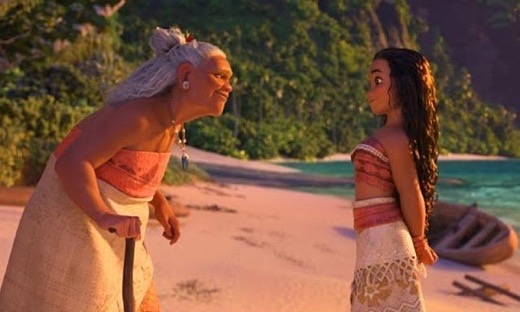

Image above: Gramma Tala speaking to her granddaughter Moana on the beach of their island of Motunui at sunset. From (http://www.twoohsix.com/2016/11/moana-movie-review.html).

Disney’s South Pacific-set animated feature Moana — co-directed by Ron Clements and John Musker, co-creators of The Little Mermaid and Aladdin, with voice characterization by Dwayne “The Rock” Johnson and music co-written by Hamilton’s Lin-Manuel Miranda — was number one at US box offices during the Thanksgiving holiday weekend.

After its world premiere at LA’s AFI Fest on November 14, The Hollywood Reporter noted, “Moana scored… with $81.1 million from 3,875 theaters,” while ABC News reported it “notched the third-largest three-day Thanksgiving opening of all time.”

The optically opulent movie is about Moana (voiced by Hawaiian teenager Auli’i Cravalho), daughter of Motunui island’s Polynesian Chief Tui (New Zealand Maori actor Temuera Morrison, who starred in 1994’s Once Were Warriors).

After the Pacific Islander learns about her voyaging heritage from Gramma Tala (Maori actress Rachel House of 2016’s Hunt for the Wilderpeople), Moana decides to embark on an Oceanic odyssey to save her endangered isle from environmental devastation.

During her voyage she enlists the aid of the legendary demigod Maui (voiced by Johnson, who is part-Samoan), who reluctantly helps the young, feisty Moana as they cross the Pacific in a sailing canoe to fight the demonic force on a far away isle that is threatening Motunui (which can be translated as “big island”).

This is the basic plot of Disney’s sumptuously animated musical adventure, but what most reviewers have missed is that disguised in the medium of a feature-length colorful cartoon, Moana’s filmmakers have created a motion picture parable about climate change.

And emerging while Native tribes take a stand at Standing Rock against fossil fuel development and oppression of indigenous peoples, Moana is also a movie metaphor about indigenous rights. (If Dakota Access Pipeline protesters are “water protectors,” however, in Moana the Pacific protects the title character — whose name can be translated as “ocean.”)

The entire raison d’etre for Moana’s mission is that an environmental disaster has befallen Motunui. The crops are failing, the coconuts have turned black, and the lagoon’s fish have been fished out.

To restore ecological balance Moana must sail to the distant island of Te Fiti and return the “heart of Te Fiti,” a sculpted, jade-like precious gem-like stone that glows green (symbolizing Mother Nature) in order to defeat Te Kā, a fierce fiery creature threatening her home.

Te Kā’s heat and flames represent global warming; Moana and Maui repeatedly proclaim they’re not only rescuing Motunui, but “saving the world.” 

Disney’s creative team has rendered, within the animation format, an allegorical version of Pacific Islanders’ struggle against climate change, as depicted in documentaries such as Josh Fox’s How to Let Go and Love All the Things Climate Can’t Change.

In that 2016 nonfiction film the Pacific Climate Warriors — including islanders from Polynesia, Micronesia, and Melanesia — form a blockade with a fleet of outrigger canoes to stop coal ships from leaving the port at Newcastle, Australia. Compelled by the fear that global warming-caused sea level rise will inundate the isles, their slogan is: “We are not drowning, We are fighting!”

Moana also expresses the revival of traditional Polynesian seafaring methods that was launched in the 1970s by the Hawaiian voyaging canoe Hokule’a. This movement proved that ancient Polynesians purposefully and scientifically sailed to and settled islands across the vast stretches of the Pacific by using the stars, ocean currents, winds, etc., to chart their courses.

This systematic wayfinding technique gave the lie to the racist canard that Pacific Islanders were not intelligent enough to have crossed the ocean by design and had only discovered their far-flung islands randomly and by chance.

The 1970s’ resurgence of traditional Oceanic voyaging contributed to a Pacific Renaissance of culture that inspired ethnic pride among colonized peoples at Hawaii, Tahiti and beyond, and Moana taps into this proud legacy.

Fox’s documentary also goes on location at Vanuatu and at Savaii, the big island of Samoa, the first major film to shoot there in 90 years, since Robert Flaherty made the classic silent film Moana of the South Seas.

Starting with 1922’s Arctic Circle-set Nanook of the North about Inuits’ way of life, Flaherty pioneered a form of ethno-filmmaking of  documentary-like films shot at remote locations. Moana of the South Seas, released in 1926, was his poetic follow-up to Nanook.

Disney’s 2016 animated feature probably derived its name from Flaherty’s exquisite black and white masterpiece, although in it, Moana is actually a teenaged male.

And instead of saving his island — let alone the planet — the Savaii villager’s goal is to undergo the painful traditional knee-to-navel tattooing of the “Fa’a Samoa” — the Samoan Way. Ninety years later, a cinematic highlight of Disney’s Moana are scenes in which Maui’s tattoos come to life on his body.

Some Polynesians have criticized the depiction of the ancient demigod of their pre-Christian religion, Maui, as obese. While it is true that Maui is portrayed as overweight in the film, Moana’s body type is a huge improvement over that of Disney’s other indigenous princess in 1995’s Pocahontas, where the young teenager was over-sexualized, illustrated as a voluptuous beauty, and given voice by Alaska-born Irene Bedard, an Inupiat Eskimo and French Canadian/Cree actress voted one of People magazine’s “50 Most Beautiful People.”

The cartoon Pocahontas was reportedly modeled on Bedard, who was about twice her character’s age at the time.
Despite the continued prevalence of South Seas celluloid stereotypes portraying Polynesian women as promiscuous, Moana — voiced by Cravalho when she was only 15 — is not sexualized in the film, and is depicted appropriately for a female character who is in early adolescence.

South Seas Cinema is a popular film genre dating back to 1898, and most of these movies set and shot in Oceania depict white characters as the protagonists, such as Errol Flynn, Clark Gable, Marlon Brando, and Mel Gibson portraying Fletcher Christian in various versions of the Bounty mutiny saga.

On the other hand, all of Moana’s human characters are aboriginal islanders co-existing in harmony with nature (at least until the ecosystem is menaced). Motunui’s inhabitants live in pre-contact Polynesia before European explorers arrived, followed by colonizers, missionaries, and merchants.

And like 2002’s Maori movie Whale Rider starring Keisha Castle-Hughes, with its spunky grrrrrrl power protagonist who confronts Maui and monsters alike, Moana also has an empowering feminist message.

The film’s relative authenticity and cultural sensitivity reflects the fact that the filmmakers traveled to the South Pacific and hired a team of Native cultural consultants to advise on the production. One advisor listed in Moana’s closing credits is Dr. Vilsoni Hereniko, a University of Hawaii professor, playwright, and moviemaker born on the Polynesian islet of Rotuma in Fiji.

Samoan-born songwriter Opetaia Foa’i — whose father is from Tokelau and mother from Tuvalu — co-created Moana’s music with Disney musical veteran Mark Mancina. All of the key cast members giving voice to the animated human characters are Polynesian, though the dramatis personae themselves are not identified as coming from any particular island group.

And according to the L.A. Times, the PG-rated, one hour and fifty-three minute Moana “will be the first Disney movie ever translated and re-recorded in Tahitian.”

Like Aesop’s Fables, Moana’s film fable has “a moral to the story.” With its rare depiction of an intact, untouched Polynesian culture, Moana shows how the issues of native lifestyles and climate change are inextricably bound up with one another; how indigenous peoples are among those most impacted by global warming.

Moana and Maui’s quest is to restore ecological balance to preserve traditional culture. Framed in the medium of computer-generated animation with some hand-drawn artwork, Moana presents an environmental, indigenous vision via mass entertainment for children of all ages.

• Ed Rampell is a L.A.-based reviewer/film historian Ed living in Oceania for 23 years who co-authored three film histories on South Seas Cinema, including The Hawaii Movie and Television Book.

.

Sexy Fungus

SUBHEAD: Women who sniff this Hawaiian mushroom that grows in lava have spontaneous orgasms.

By Mark Frauenfelder on 13 October 2015 for Boing Boing -
(http://boingboing.net/2015/10/13/this-tropical-mushroom-gives-w.html)


Image above: Dictyophora mushroom that can produce sexual arousal in human women. From original articla.

A study from the International Journal of Medicinal Mushrooms reports that Dictyophora, a mushroom that grows on lava flows, induces spontaneous orgasms in about 1/3 of the woman who sniff it. From Wikipedia:
According to a 2001 publication in the International Journal of Medicinal Mushrooms, the smell of the fresh fungus can trigger spontaneous orgasms in human females. In the trial involving 16 women, 6 had orgasms while smelling the fruit body, and the other ten, who received smaller doses, experienced physiological changes such as increased heart rate.

All of the 20 men tested considered the smell disgusting. According to the authors, the results suggest that the hormone-like compounds present in the volatile portion of the gleba may have some similarity to human neurotransmitters released in females during sexual activity. The study used the species found in Hawaii, not the edible variety cultivated in China.

.

Roots of Wonder Woman

SUBHEAD: She emerged from the feminist movements of women’s suffrage, birth control, and the fight for equality.

By Christopher Zumski Finke on 10 December 2014 for Yes -
(http://www.yesmagazine.org/happiness/everything-you-need-to-know-about-the-radical-roots-of-wonder-woman)


Image above: An image of Wonder Woman in her 1940's style. From (http://www.soundonsight.org/the-entire-1940s-wonder-woman-comics-available-for-the-first-time-ever/).

All these things are true about Wonder Woman: She is a national treasure that the Smithsonian Institution named among its 101 Objects that Made America; she is a '70s feminist icon; she is the product of a polyamorous household that participated in a sex cult.

Harvard historian Jill Lepore claims in her new book, The Secret History of Wonder Woman, that Wonder Woman is the “missing link in a chain of events that begins with the women’s suffrage campaigns of the 1910s and ends with the troubled place of feminism fully a century later.”

The hero and her alter ego, Diana Prince, were the products of the tumultuous women’s rights movements of the early 20th century. Here are 10 essential elements to understanding the history and legacy of Wonder Woman and the family from which she sprung.

Wonder Woman first appeared in Sensation Comics #1 in December 1941.

Since that issue arrived 73 years ago, Wonder Woman has been in constant publication, making her the third longest running superhero in history, behind Superman (introduced June 1938) and Batman (introduced May 1939).

Wonder Woman’s creator had a secret identity.

Superheroes always have secret identities. So too did the man behind Wonder Woman. His name upon publication was Charles Moulton, but that was a pseudonym. It was after two years of popularity and success that the author revealed his identity: then-famous psychologist William Moulton Marston, who also invented the lie detector test.

William Moulton Marston was, as Jill Lepore tells it, an “awesomely cocky” psychologist and huckster from Massachusetts. He was also committed to the feminist causes he grew up around.

By 1941, Marston’s image of the iconic feminist of the future was already a throwback to his youth. He saw the celebrated British suffragist Emmeline Pankhurst speak in Harvard Square (she was banned from speaking at Harvard University) in 1911, and from then on imagined the future of civilization as one destined for female rule.

Actually, the whole Marston family had a secret identity.

The Marston family was an unconventional home, full of radical politics and feminism. Marston lived with multiple women, including his wife, Sadie Elizabeth Holloway, a highly educated psychologist, and another lifelong partner, a writer named Olive Byrne, who was the niece of birth control activist Margaret Sanger. He had four children, two by each of the women, and they all grew up oblivious to the polyamorous nature of their parents’ relationships.

Marston, Holloway, and Byrne all contributed to Wonder Woman’s creation, a character that Marston explicitly designed to show the necessity of equality and advancement of women’s rights.

Wonder Woman was an Amazon molded from clay, but she was birthed out of feminism.

Princess Diana of Themyscira, or Diana Prince (Wonder Woman’s alter ego), comes from the land of the Amazons. In Greek mythology, the Amazons are an immortal race of beauties that live apart from men. In the origin story of Wonder Woman, Diana is daughter of the queen of the Amazons. She’s from Paradise Island (Paradise is the land where no men live), where Queen Hyppolita carves her daughter out of clay. She has no father.

She comes out of the feminist movements of women’s suffrage, birth control, and the fight for equality. When Marston was working with DC Comics editor Sheldon Mayer on the origins of Wonder Woman, Marston left no room for interpretation about what he wanted from his heroine.

“About the story’s feminism,” historian Lepore writes, “he was unmovable. ‘Let that theme alone,’ Marston said, ‘or drop the project.’”

Wonder Woman fought for the people—all the people.

The injustices that moved Wonder Woman to action did not just take place in the world of fantasy heroes and villains, nor was she only about women’s rights. She also fought for the rights of children, workers, and farmers.

In a 1942 issue of Sensation Comics, Wonder Woman targets the International Milk Company, which she has learned has been overcharging for milk, leading to the undernourishment of children. According to Lepore, the story came right out of a Hearst newspaper headline about “milk crooks” creating a “milk trust” to raise the price of milk, profiteering on the backs of American babies.

For the Wonder Woman story, Marston attributed the source of this crime to Nazi Germany. But the action Wonder Woman takes is the same as the real-life solution: She leads a march of women and men in “a gigantic demonstration against the milk racket.”

There’s a whole lot of bondage in Wonder Woman.

In the years that Marston was writing Wonder Woman, bondage was everywhere. “In episode after episode,” Lepore writes, “Wonder Woman is chained, bound, gagged, lassoed, tied, fettered, and manacled.” Even Wonder Woman herself expressed exhaustion at the over-use of being bound: “Great girdle of Aphrodite! Am I tired of being tied up!” she says.

There’s little doubt that the sexual proclivities of the Marston family were in part responsible for this interest. A woman named Marjorie Wilkes Huntley was part of the Marston household—an “aunt” for the children, who shared the family home (and bedroom) when she was in town. Huntley was fond of bondage.

The theme was so persistent that an Army sergeant who was fond of the erotic images wrote to Marston asking where he could purchase some of the bondage implements used in the book. After that, DC Comics told Marston to cut back on the BDSM.

But that bondage was not all about sex.

The bondage themes in Wonder Woman are more complex than just a polyamorous fetish, though. Women in bondage was an iconic image of the suffrage and feminist movements, as women attempted to loosen the chains that bound them in society. Cartoonist and artist Lou Rogers drew many women in bonds, and Margaret Sanger appeared before a crowd bound at the mouth to protest the censorship of women in America.

Later, Margaret Sanger’s Birth Control Review would use a similar motif. One cover image had a woman chained to the weight of unwanted babies.

Readers—boys and girls—loved Wonder Woman.

Despite the political and secretive history of Wonder Woman’s creation, she was a wildly popular character. After Wonder Woman’s early success, DC Comics considered adding her to the roster of the Justice Society, which included Batman and Superman and many other male superheroes. Charlie Gaines, who ran DC Comics, decided to conduct a reader poll, asking, “Should Wonder Woman be allowed, even though a woman, to become a member of the justice society?”

Readers returned 1,801 surveys. Among boys, 1,265 said yes, 197 said no; among girls, 333 said yes, and only 6 said no.

But Justice Society was not written by feminist Marston. After Wonder Woman was brought into the Justice Society, she spent her first episodes working as the secretary.

The feminist spirit of Wonder Woman waned for decades.

After the death of William Moulton Marston in 1947, DC Comics took the feminism out of Wonder Woman and created instead a timid and uninspiring female character. “Wonder Woman lived on,” Lepore writes, “but she was barely recognizable.”

The first cover not drawn by the original artist, Harry G. Peter, “featured Steve Trevor [Wonder Woman’s heretofore hapless love interest] carrying a smiling, daffy, helpless Wonder Woman over a stream. Instead of her badass, kinky red boots, she wears dainty yellow ballerina slippers,” Lepore observes. Without her radical edge, Wonder Woman’s popularity waned until the rise of second wave feminism in the '60s and '70s, when Wonder Woman was trumpeted as an icon of women’s empowerment.

Wonder Woman became president.

In a 1943 story, Wonder Woman is actually elected President of the United States. Marston was adamant that a women would one day rule the United States, and that the world would be better when civilization’s power structures were in the hands of women instead of men.

Wonder Woman’s popularity soared as the feminist movement picked up in the late 1960s. Wonder Woman appeared on the first issue of Ms. Magazine, in 1972, with the headline “Wonder Woman for President.” At that time, Gloria Steinem said of Wonder Woman, “Looking back now at these Wonder Woman stories from the '40s, I am amazed by the strength of their feminist message.”

The impact of Wonder Woman continues.

Wonder Woman is in for a great couple of years. Ms. Magazine just celebrated its 40th anniversary, and Wonder Woman is back on its cover. Jill Lepore’s book has been getting wonderful coverage (see her on The Colbert Report below discussing the kinks of the Marston Family), and Noah Berlatsky’s Wonder Woman: Feminism and Bondage in the Marston/Peter Comics will be published in January.

She’s also gearing up for her first-ever theatrical film appearance: Wonder Woman will appear in Zack Snyder’s 2016 film Batman vs. Superman: Dawn of Justice. In 2017, she will be the star of her own film, to be directed by Michelle McClaren (Breaking Bad, The Walking Dead). Wonder Woman will be played by the Israeli actress Gal Gadot.

Let us hope that Gadot in the role conjures the spirit of the original creation of Marston, Holloway, and Byrne: a radical, independent, fierce woman and leader for all women and men to admire.


Video above: From (http://youtu.be/KnAhu-yU8Os).


.

Reinventing Square Wheels

SUBHEAD: The monastic life is one of the few consistent success stories in the history of communal living.

By John Michael Greer on 23 October 2013 for the Archdruid Report -
(http://thearchdruidreport.blogspot.com/2013/10/reinventing-square-wheels.html)


Image above: Scene from  a Shaker village in Harvard, Massachusetts (not in Cambridge MA, near Brook Farm, that had a long lived success. From (http://en.wikipedia.org/wiki/Harvard_Shaker_Village_Historic_District).

The issues raised in last week’s post here on The Archdruid Report cut far closer to the heart of our predicament than many of my readers may realize. It’s not just that the production of every kind of good or service in an industrial economy depends on the expectation that somebody or other can make a profit out of the deal, though of course that’s of huge importance.

Every other mechanism we’ve got for circulating wealth depends directly or indirectly on the same expectation: taxes, fees, rent, interest on loans, and much else assumes that every business ought to produce enough profit that its banker, landlord, local and state governments, and so on can all be supported off a share of the proceeds without bankrupting the business.

Nowadays, that’s not necessarily a safe assumption. If you walk down the main streets in the old red brick Appalachian mill town where I live, for example, you’ll see any number of empty storefronts in excellent locations.

Most of them haven’t had a tenant in forty years. Now and then a new business opens in one of these spots, or makes the attempt, but it’s very rare for one of these to be around a year after its opening. Cumberland, Maryland is a classic Rust Belt town, and the factories that were once its main employers all shut down in the early 1970s, pushing it through the same deindustrial transition that most of the rest of the United States is facing right now.

Businesses here have to survive on a very thin profit margin. The difficulty is that bankers, landlords, local and state officials, and so on still want their accustomed cut, which is substantially more than that margin will usually cover. This isn’t mere greed—they all have their own bills to pay, and an equal or larger number of people and institutions clamoring for a share of their own take.

The result, though, is that storefronts stay empty despite an abundance of unmet economic needs and an equal abundance of people who would be happy to work if they had the chance, because the businesses that could meet those needs and employ those people can’t make enough of a profit to keep their doors open. The inability of most economic activities to turn a profit in an age of contraction is already an issue at many levels, and one with which contemporary economic thought is almost completely unprepared to deal.

The one reliable way of dealing with that inability, of course, is to move productive activities into spheres that don’t depend on the profit motive. The household economy is one obvious place, and so is that expansion of the household economy—pretty much universal in dark ages—in which each family cultivates grains, legumes, and other bulk food crops for its own use on village farmland. Gift economies hardwired into the social hierarchy are also standard in such ages.

There’s a good reason why the English word “lord” comes from an Anglo-Saxon term meaning “giver of loaves,” and it’s the same reason why generosity is always one of the most praised virtues in feudal and protofeudal societies: from Saxon England to Vedic India to the First Nations of the Pacific Northwest coast, giving lavish gifts to all and sundry is the most important economic activity of the aristocrat.

Still, as discussed last week, religion is among other things a critically important source of motivation for unprofitable but necessary activities, and it tends to become paramount in ages of decline. There are certain complexities here, though, and the best way to grasp them is an indirect one. As so often in these essays, that route leads along unexpected byways—in this case, past two communes in rural Massachusetts, of all places, during the first half of the nineteenth century.

The first of them will be familiar only to who know the history of the Transcendentalist movement, America’s first homegrown counterculture. Its name was Brook Farm; it was founded with high hopes and much fanfare in 1841 by a bunch of Boston hippies—for all practical purposes, that’s what the Transcendentalists were—and it imploded in a series of crises in 1846 and 1847, having followed a trajectory that will be painfully familiar to anybody who watched the aftermath of the Sixties.

As usual, the central conflict pitted middle-class expectations of adequate leisure, comfort, and personal independence against the hard economic realities of subsistence farming, and both sides lost; unable to support its members’ lifestyles solely from the results of their labor, the community ran through its savings and as much money as it could borrow, and when the money ran out, it went under.

One of the commune’s founding members, Nathaniel Hawthorne, set his novel The Blithedale Romance at a lightly fictionalized Brook Farm.

Back when American public schools still had students read literature, you could count on getting assigned to read Hawthorne’s The Scarlet Letter or The House of the Seven Gables, but not The Blithedale Romance. Partly, I suspect, that was because its edgy portrayal of the psychology of the true believer, via the character of Hollingsworth the social reformer, cuts far too close to the bone; partly, though, it’s because America has long suffered from a frantic terror of all the most creative dimensions of its own past.

Brook Farm, in point of fact, was one of several hundred known communes in the United States in the 19th century, which built on a tradition going back to the late 17th; the first American commune I know of, Johannes Kelpius’ “Woman in the Wilderness” community of Rosicrucian ascetics, was founded in the trackless forests of Pennsylvania in1694.

There are dozens of good books on these communities from 19th and early 20th century historians—Charles Nordhoff’s 1875 survey The Communistic Societies of the United States is a classic—and a flurry of research on them in academic circles more recently, but you’ll rarely hear about any of that in any public venue these days.

There’s a post to be written about the spectacular falsification of the American past that unfolds from our efforts to flee from our own history, but that’s a subject for another week.

The point relevant now is that, during the years when Brook Farm was stumbling through its short and troubled life, there were several other communes in the neighborhood, and one that deserves special mention here was only thirty-five miles away by road. Long before Brook Farm’s rise and long after its fall, it was a prosperous egalitarian community with around 200 members, growing all its own food and meeting all its financial needs with room to spare.

The Harvard Village, as it was called, was everything Brook Farm’s founders claimed they wanted their commune to be, and it was also everything Brook Farm’s founders rejected most heatedly in practice: that is, it was a Shaker community.

Those of my readers from outside the United States may never have heard of the United Society of Believers in Christ’s Second Appearing, better known then and now as the Shakers. To most Americans, for that matter, those words might at most stir some vague memory of spare but elegant handicrafts and a few notes of the classic Shaker hymn “Simple Gifts.”

I have yet to see a discussion of the United Society find its way into the ongoing conversation about lifeboat ecovillages. That’s a pity, because the Shaker experience has important and highly relevant lessons to teach in that context.

The United Society had its start in Manchester, England, where Ann Lee—“Mother Ann” to Shakers ever after—led a tiny group that spun off from the Quakers over the course of the 1760s.

In 1774, Mother Ann and eight followers came to what was about to become the United States, and found no shortage of interest in their new gospel. From 1787 on, the United Society was run by its American converts, and these latter proceeded to accomplish one of the most remarkable feats of convergent evolution in human history: starting wholly from first principles, and with apparently no knowledge of the historical parallels, they reinvented almost every detail of classic monasticism.

Like monks and nuns everywhere, Shakers were celibate—one of Mother Ann’s revelations was that sexuality is the most potent source of human sinfulness—and lived communally, owning no personal property. Men and women lived in separate dormitories in a Shaker village and led essentially separate lives; Shaker meetinghouses, where Sunday services were held, had two doors, one for Brothers and one for Sisters, and the two sexes sat on opposite sides.

Despite the rule of celibacy, there were always children in Shaker villages, some of them orphans, some left by destitute or deadbeat parents, some brought into the United Society when their parents joined; they had their own dormitories, one for girls and one for boys. The children could choose to leave or stay when they reached adulthood. To stay was to give up sexuality, family, property, and a great deal of autonomy, but it was a choice many made.

There were consolations, to be sure, and not all of them were wholly spiritual. The opportunities open to women among the Shakers were much more substantial than what was available in what Shakers called “the World.” Both sexes had equal roles in each village, each regional bishopric, and the entire Society—the Central Ministry, the body of four senior Shakers who ran the organization, always consisted of two Elders and two Eldresses.

Ordinary members could expect a life of of hard work, but that was common enough in 19th century America, and the lifelong support of a close-knit community provided by the Shaker system was something most people in that rough-and-tumble era did not have.

The Shakers thus had to be on the watch for freeloaders—“bread-and-butter Shakers” was the usual term—who wanted to join the Society for the sake of free meals and medical care, but had no interest in the religion or, for that matter, in putting in an honest day’s work.

Still, the United Society found so many sincere converts that new Shaker communities were being founded into the 1830s, and membership declines didn’t become an issue until well after the Civil War.

Nor is the United Society quite gone even today; there are still a few members left at the last remaining Shaker village at Sabbathday Lake, Maine, supporting themselves by the utterly traditional Shaker trade of drying and selling herbs.

Compare a Shaker community with a Christian or Buddhist monastery and the parallels are impossible to miss. The classic Christian monastic virtues of poverty, chastity, and obedience are all present and accounted for; so is the commitment to labor as a form of religious service.

For that matter, the clean, simple, spare esthetic that the Shakers made famous in their furnishings and architecture has a great deal in common with the elegant simplicity that Zen Buddhism introduced to Japanese art and design, or the close equivalents in Christian monastic traditions.

The parallels aren’t accidental: set out to live on a monastic plan, and the kind of simplicity prized by Shakers, Cistercians, Zen monks, and so many of their fellow monastics, has a great many practical advantages.

Whether it takes the form of a Shaker village, a Catholic abbey, a Zen Buddhist monastery, or what have you, the monastic life is one of the few consistent success stories in the history of communal living. That’s exactly the problem, of course, because the vast majority of people who imagine themselves living in a communal setting these days aren’t willing to push their enthusiasm to the point of giving up sex, family personal property, and personal autonomy.

The result, predictably enough, has been a steady stream of projects, proposals, and actual communities launched by people who want to have their cake and eat it too: that is, to live in a self-supporting communal setting while still retaining comfortable middle-class values of ownership, autonomy, and unhindered sexual activity.

Brook Farm was one of those attempts, and it lasted longer than most. Throughout American history, the average lifespan of a commune has been around two years. There are counterexamples, to be sure, but it’s remarkable how often those have ended up adopting at least some of the traditional monastic values, such as community ownership of property.

There’s a wholly pragmatic reason for those failures. The kind of lifestyle most people consider normal in industrial societies is only possible if you’re helping to burn through half a billion years of stored sunlight via a modern industrial economy. You can’t support such a lifestyle with hand labor on a rural commune. Even the much less resource-intensive lifestyles of the Brook Farm era were too costly to be met by working the land, which is why Brook Farm went broke in five years.

Most of the communes of the Sixties crashed and burned sooner than that: unless there was a sugar daddy available to cover the bills, the amount and kind of work the residents were willing to do usually failed to meet the costs of the lifestyles they wanted to lead, and collapse followed promptly.
The exceptions have almost all been religious communities. In the Sixties, that usually meant that they clustered around a spiritual leader who was charismatic or convincing enough to get away with telling his followers what to do.

Some religious communities launched by the Sixties counterculture thus are still around; others got past the economic problems that wrecked most of their secular counterparts, only to crash headlong into one of the other standard traps that face communal projects.

You can see all these same patterns traced out in the communes launched by earlier American countercultures, from the Transcendentalists on—and by and large, the only ones that survive their founding generation are those that conform more or less precisely to the model of classic monasticism sketched out above.

I spoke of convergent evolution earlier, and the borrowing from biology is a deliberate one. Darwin’s theory, at its core, is simply a recognition that some things work better than others, and those organisms who stumble across something that works better—in physical structure, in behavior, or what have you—are more likely to survive whatever challenges they and their less gifted counterparts face together.

Why one thing works better than another may or may not be obvious, even after close study, but when one set of adaptations consistently results in survival, while a different set just as consistently results in collapse, it seems quite reasonable to draw the obvious lesson from that experience.

That inference seems reasonable to me, at least. I’m quite aware that most other people in the modern industrial world don’t seem to see things that way. I can point out that X has failed every single time it’s been tried, without a single exception, and people will insist that this doesn’t matter unless I can detail the reasons why it has to fail; then, when I do so, they try to argue with the reasons. In the opening lines of his essay The Eighteenth Brumaire of Louis Napoleon, Karl Marx commented acidly:
“Hegel says somewhere that all great world-historic facts and personages appear, so to speak, twice. He forgot to add: the first time as tragedy, the second time as farce.” 
One of the most potent forces driving those repetitions, by turns tragic and farcical, is the endlessly repeated insistence that this time, the lessons of history don’t matter.

Thus it’s an interesting question why celibacy should be so important a factor in the long-term survival of monastic systems.

  • Perhaps celibacy works because it prevents sexual jealousies from spinning out of control, as they so often do in the hothouse environment of communal living.
  • Perhaps celibacy works because pair bonds between lovers are a potent source of the private loyalties that, left to run free, so often distract members of communal groups from their loyalty to the project as a whole.
  • Perhaps celibacy works because it’s only when your followers are willing to give up sex for the cause that you can be sure they’re committed enough.
  • Perhaps celibacy works because all that creative energy has to go somewhere—the Shakers, like so many other monastic traditions, birthed an astonishing range of artistic and creative endeavors, from a musical corpus of more than 11,000 original hymns, through graphic arts, architecture, and a style of furniture and other crafts that’s widely considered one of the great traditions of American folk culture.
  • Perhaps it’s some other reason entirely. The point that needs to be kept in mind, though, is that in a monastic setting, celibacy works, and most of the other ways of managing human sexuality in that setting pretty reliably don’t. 
It’s possible to be utterly correct about the fact that X is the case while being just as utterly clueless about the reasons why X is the case. The fact that medieval philosophers believed that rocks fall because they’re passionately in love with the earth, and desire to be united with their beloved, thus did not prevent those same philosophers from recognizing that rocks do indeed fall when you pick them up and let go.

The value and the limitations of history as a guide to the present and the future come out of the hard fact that history tells us what happens, but not why it happens. More than three centuries of communal experiments in North America, and more than three thousand years of similar experiments elsewhere, have a lot to teach about what works and what doesn’t work when people decide to pursue a communal lifestyle.

Those who are willing to learn from those experiences have a much better chance of coming up with something that works than those who insist that the past doesn’t matter and thus repeat its most common mistakes all over again.

Reinventing the wheel has its uses, but if your efforts at reinvention consistently turn out square wheels, it may be helpful to look at other examples of the wheelwright’s craft and see if you can figure out what they got right and you got wrong.

Ironically, that’s an insight the Shakers could have used. I mentioned above that they managed to reinvent almost every detail of classic monasticism, but one of the few details they missed turned out to be their Achilles’ heel.

Quite a few religious movements have started out wholly monastic; those that survived for more than a few generations figured out that they also needed some mode of participation for people who admired their ideals and believed in their teachings but weren’t ready to take the plunge into a celibate lifestyle.

The Jain and Buddhist religions, to name only two examples, started out as wholly monastic traditions, but figured out early on that they needed to make room for laypersons as well—and discovered that the more room they made for lay involvement, the more often it happened that people got sufficiently used to the idea of monastic life to say “You know, I could live with that.” It’s by way of that process that successful monastic systems keep themselves supplied with novices.

If the Shakers had such a community of supportive lay believers as a waystation between the World and the formal Shaker life, it’s quite possible that they would be a major American denomination today.

If the lack of that bridge is what finally brings the United Society’s story to an end, as seems likely just now, they won’t be the first victims of that particular trap, and doubtless won’t be the last, either. That’s why it’s important to pay attention to the lessons of history, especially when there’s reason to suspect a mismatch between your expectations and the facts on the ground.

The decline and fall of contemporary industrial civilization bids fair to bring a bumper crop of that sort of mismatch into play—and in such times insisting that despite all the experience of the past, wheels ought to have square corners, is not exactly a useful habit.


.

Sex and Aging

SUBHEAD: Intimacy is the most natural, normal thing in the whole world. It keeps you young; it's something to look forward to.

By Bryan Gruley on 23 July 2013 for Bloomberg News -
(http://www.bloomberg.com/news/2013-07-23/sex-in-geriatrics-sets-hebrew-home-apart-in-elderly-care.html)


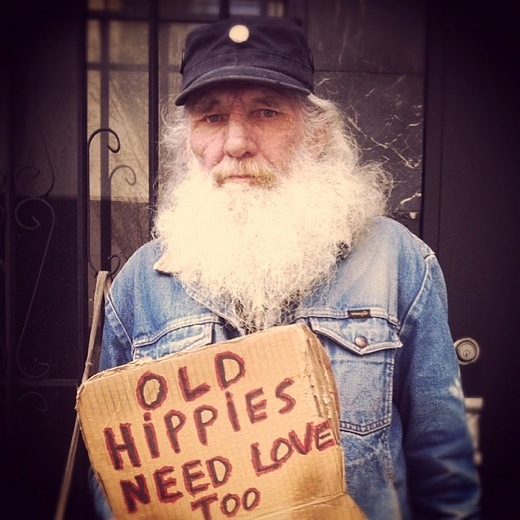
Image above: A homeless man in Seattle holds sign "Old Hippies Need Love Too". From (http://www.flickr.com/photos/lucky11studios/7116670991/).

The nurse was frantic. She’d just seen two elderly people having sex in a room at the Hebrew Home at Riverdale, New York. She asked Daniel A. Reingold, then the home’s executive vice president, what she should do.

“Tiptoe out and close the door so you don’t disturb them,” he told her.

Today, Reingold likes to recount the 19-year-old tale to show why the Hebrew Home broke with industry practice and encouraged sex and intimacy among its elderly residents, including those with Alzheimer’s and other forms of dementia.

In 1995, the home adopted a four-page policy -- considered the first of its kind -- stating that residents “have the right to seek out and engage in sexual expression,” including “words, gestures, movements or activities which appear motivated by the desire for sexual gratification.”

Beverly Herzog, an 85-year-old widow who recently moved to the Hebrew Home, said, “Intimacy is the most natural, normal thing in the whole world. It keeps you young, it gives you something to look forward to. It’s not easy to get into a cold bed.”

Said Reingold, now president and chief executive officer of the home: “We honor what remains in a person, not what’s gone.”

No one keeps track of how many of the nation’s 16,000 elderly care facilities have policies like the Hebrew Home’s. Greg Crist, a spokesman for the American Health Care Association, an industry trade group, said, “I’m not aware of anything that’s consistent.”

No Specific Policy
Instead of specific sexual-expression policies, some of the nation’s larger operators of nursing homes -- including Genesis HealthCare Corp. of Kennett Square, Pennsylvania, and Golden Living of Plano, Texas -- said they address the issue on a person-by-person basis, with training about sexual situations built into broader programs.

“This is an industry that is changing daily,” said Charlotte Patterson, a registered nurse who is vice president and associate general counsel of health care at Golden Living, which operates more than 300 nursing homes in 21 states. “We don’t have hard and fast rules because that could lock you into something you don’t want to be locked into. It’s important that we constantly keep that discussion going with our residents, our facilities and our staff.”

The $120.6 billion nursing home industry is expected to grow by an annual average of 3.6 percent to about $144 billion by 2018, according to industry research firm IBISWorld. The growth might be stronger if not for reductions in Medicare and Medicaid reimbursements and increased use of in-home services.

Sexually Freer
Hebrew Home’s sexual-expression policy is unusual, partly because many facilities lack the time, resources or inclination to confront the subject.

“There are still a lot of nursing homes that have their heads in the sand,” Reingold said.

That could change with the aging of the Baby Boom generation. By 2030, people 65 and over are expected to number more than 72 million, up from 40 million today, according to the U.S. Census Bureau. Baby Boomers, who started moving into that group in 2011, are sexually freer, living longer and using drugs such as Viagra.

Barring medical breakthroughs, the Alzheimer’s Association expects the number of those 65 and over with Alzheimer’s to grow to 7.1 million by 2025. Elderly-care residents with dementia can raise difficult legal, ethical and moral issues for caregivers who must determine whether those residents have the mental capacity to consent to sex.

Desire for Intimacy
In “To Be or to Exist,” a 2009 article in the Indiana Law Review, Evelyn Tenenbaum, a professor at Albany Law School in Albany, New York, wrote that, although desire for intimacy persists in people with dementia, “nursing homes cannot freely allow sexual relationships” between them. Homes “must intervene to ensure that unsafe and abusive relationships do not occur,” she wrote.

The Hebrew Home was founded in 1917. Today, the 870-bed facility sits on a 32-acre sprawl of brick pavilions atop a grassy slope along the Hudson River. The resident population counts 23 centenarians and has a median age of 86.

With an annual budget of almost $105 million, a staff of more than 1,000 and donors including famed lawyer David Boies and former American International Group chief Maurice Greenberg, the nursing home has greater resources than many in its field. (Bloomberg L.P., the parent company of Bloomberg News, also has donated to the Hebrew Home over the years.)

Questionnaire on Sex
Reingold, 58, started working at the home in 1990, when his father was CEO. He soon became aware that residents regularly had sex. In 1994, staffers filled out a questionnaire about their attitudes toward it. Some wanted the sex stopped altogether, some thought it was funny, some considered it disgusting.

“It reflected their personal backgrounds,” Reingold said.

A group of 11 staffers spent eight months writing a policy designed to reduce personal, religious, ethnic or other bias workers might bring to their interpretation of a sexual encounter.

“Generally,” the policy said, “it is the function and responsibility of staff to uphold and facilitate resident sexual expression.”

Intimacy Room
The policy gave residents rights to books, magazines, films and other materials with explicit sexual content, as well as to private space. Lack of privacy has often been cited in nursing home surveys as a primary obstacle to intimate relationships. Reingold recalled joking with a woman that maybe the Hebrew Home should offer an “intimacy room” for rental by the hour.

“She said, ‘Mr. Reingold, at our age, we’ll need it for more than an hour,’” he said.

The policy also was intended to comply with federal law giving residents essentially the same rights they’d enjoy outside the facility. Sex is as much a civil right as the right to vote, Reingold said.

The policy sets rules for guarding against non-consensual sex and public displays such as masturbation that could offend other residents. It also requires that the Hebrew Home maintain regular staff orientation and training programs in resident sexuality.

Staff members are taught to monitor people known to be in intimate relationships -- whether they involve simple handholding or intercourse -- for signs that either party is uncomfortable.

For instance, disruptions in eating, sleeping or bathroom patterns could prompt a nurse to ask a resident whether she or he is unhappy in a relationship. Where a relationship seems unwanted, the home can take steps to help end it, from counseling an overly aggressive resident to moving one to a different floor.

Family Involvement
The Hebrew Home has more than 250 beds assigned to residents with dementia. The home’s original policy acknowledged the sexual rights of those people while requiring, when one was known to be in an intimate relationship, that family be consulted. Staffers would counsel the family on the benefits of the relationship. If the family insisted on ending it, the home would comply.

In April, the Hebrew Home adjusted the policy to say that family members’ wishes wouldn’t necessarily be honored in all cases. Essentially, the home presumes that demented residents have the capacity to consent, absent evidence to the contrary, and works with families to accept the residents’ desires.

Even where a resident married to someone outside the facility has sex with another resident, the home could support the relationship if it’s healthy and consensual.

“This isn’t meant to be a hospital, it’s meant to be a home,” said Robin Dessel, 56, the Hebrew Home’s sexual rights educator. “A resident’s voice is foremost; it trumps everything.”

Once Consensual
Nevertheless, law professor Tenenbaum said, “Since dementia is a progressive disease, the staff must be vigilant to ensure that a once-consensual relationship does not become abusive. It may be difficult to determine when a consensual relationship between demented nursing home residents becomes non-consensual.”

Tenenbaum said more nursing homes should emulate the Hebrew Home. She wrote in the Indiana Law Review that elderly care facilities could provide “do not disturb” signs; set policies to discourage the spread of sexually transmitted diseases; make condoms, vaginal lubricants and Viagra readily available; and provide beauty salons and other cosmetic services to help residents feel physically and sexually attractive.

Herzog, the octogenarian Hebrew Home resident, looked pretty in red lipstick and gold bangles on a recent visit. She said she’d love to have someone special in her life.

“You want to have someone to pat you, someone to hold hands with,” she said. “Age should not be a barrier to anything.”

.

Vigil Against Violence

SUBHEAD: YWCA event, Wednesday, October 17th at St Michael & All Angels Church in Lihue.

By Amy Kurtz on 6 October 2012 in Island Breath
(http://islandbreath.blogspot.com/2012/10/vigil-against-violence.html)


Image above: Rosalie Baker holds a candle during a candlelight vigil held at the YWCA in support of the victims of domestic violence in Yakima, Washington. From (http://www.yakima-herald.com/galleries/3352/photos/1).

Please Join the YWCA of Kaua’i as we honor victims and survivors of domestic violence, sex assault and 
teen dating violence at our annual Candlelight Vigil.  This year's theme is: “Love that Hurts, 
Love that Heals”

WHEN: 
Wednesday, October 17, 2012 beginning at 6:00pm

WHERE:
St. Michael and All Angels Church
4364 Hardy Street
Lihue, Kauai, Hawaii 96766


WHAT: 
Please Join the YWCA of Kaua’i as we honor victims and survivors of domestic violence, sex assault and 
teen dating violence at our annual Candlelight Vigil.  This year's theme is: “Love that Hurts, 
Love that Heals”, with an emphasis on nurturing self-love.  Please join us to support awareness of the effects of and the efforts to end violence against women and their children. Program suitable for ages 14 and up. Childcare will be provided from 5:45 - 7:00 p.m. 

SCHEDULE:
5 - 6:00pm Music and refreshments
6 - 7:00pm Program / Candle lighting


CONTACT:
Sponsored by the YWCA.  For more info call Diane at (808) 245-8404 or


.

LGBT Labor Leadership Workshop

SUBHEAD: A LGBT Labor Leadership Workshop is taking place on August 27th at 9am to noon.  

By Ray Catania on 7 August 2011 for Pride at Work Hawaii - 
(http://islandbreath.blogspot.com/2011/08/lgbt-labor-leadership-workshop.html


Image above: From (
http://thehawaiiindependent.com/story/civil-unions-a-view-from-the-pew).  

WHAT:
LGBT Labor Leadership Workshop

 WHEN:
Saturday 27th August 2011 from 9am to 12 noon.  

WHERE:
ILWU Hall 4154 Hardy Street, in Lihue, Kauai

A LGBT Labor Leadership Workshop is taking place on August 27th at 9am to noon. The workshop is sponsored by Pride at Work Hawaii. Pride at Work Hawaii invites Lesbian, Gay, Bisexual and Transgender individuals as well as straight allies to learn how to organize for your rights on the job and in your union. The workshop will be at the ILWU Hall 4154 Hardy Street, in Lihue, Kauai.

The 3 hour workshop costs $15 but scholarships are available. For more information or applications please call Steve at (808) 543-6054 or email prideatworkhawaii@hawaiiantel.net. This workshop is being supported by a grant from the McElrath Fund for Economic and Social Justice.

 Locally you can also call Ray Catania at 634-2737 or email (may11nineteen71@gmail.com). .

Sex as Antiparasitic

SUBHEAD: Sex was invented to stay one evolutionary step ahead of dangerous parasites.  

By Jon Hamilton on 7 July 2011 for NPR -
  (http://www.npr.org/2011/07/07/137681962/have-sex-to-stay-one-evolutionary-step-ahead?sc=17&f=1001)


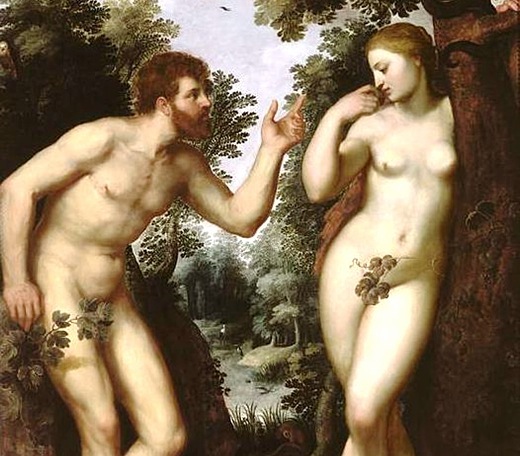
Image above: "Adam & Eve" by Peter Paul Rubens in 1597. From (http://www.bonzasheila.com/art/archives/nov08/24.html).

Scientists have finally demonstrated that sex is useful. A team from Indiana University found that worms that have sex were better able than asexual worms to stay one evolutionary step ahead of dangerous parasites. The finding, published in the journal Science, provides the first direct evidence that sexual reproduction improves a species' ability to survive in a fast-changing environment.

And it suggests that parasites, including bacteria and viruses, are one reason species developed sexual reproduction in the first place. The results explain "one of the long-standing mysteries in evolutionary biology, one that we've been banging our heads against for 30 years," says Michael Brockhurst from the University of Liverpool in the U.K.

Brockhurst says previous studies found plenty of circumstantial evidence that sexual reproduction provided an evolutionary edge. But he says this is the first experiment showing the process at work in a lab animal. Scientists say sex has been a mystery because it doesn't make much sense, from a biological perspective.

For one thing, this approach to reproduction requires males, which consume resources even though they may not contribute much beyond their DNA, says Levi Morran of Indiana University, the new study's lead author. Imagine you're a mom who wants a lot of grandchildren, he says. "If you were able to produce daughters that didn't need a male to reproduce, you could actually produce more grandchildren than another mother who wasted her time and resources producing males that can't directly bear offspring," Morran says.  

The Red Queen Hypothesis
So why, then, are there so many species that have sex? One common explanation dates back to the 1970s, when biologists came up with something called the Red Queen hypothesis, after the Red Queen in Lewis Carroll's Through the Looking-Glass. At one point, Alice and the Queen run as fast as they can but never get anywhere. Biologists think something similar is going on with species: They're evolving as fast as they can just to stay even with their competitors and enemies.

And that's where sex comes in, Morran says. It lets a species evolve faster to rapidly adapt to a new environment, or a new threat. Sex does this because it lets a species mix and match from two different sets of genes, one from each parent. Without sex, reproduction is a lot like cloning, where each generation is essentially a copy of the previous one. Most scientists accept the Red Queen hypothesis.

But Morran and his team wanted to demonstrate it in the lab. And he also wanted to show why it's so important to adapt quickly. So he did an experiment with worms, which can reproduce sexually or asexually. The research team exposed the worms to a bacterial parasite that can do bad things to them. "As gross as it sounds, it actually digests the host from the inside out," Morran says. "So it's a pretty nasty pathogen."

 This parasite is constantly evolving in ways that help it infect its worm host, Moran says. "And then you have the host evolving on the other side of the equation trying to evade the parasite," he says. As part of the experiment, the team used genetic engineering to create a group of worms that could only reproduce through self-fertilization. When we allowed a parasite to co-evolve with them, they rapidly went extinct," Morran says.

Then the team tried the same thing with another group of worms that could only reproduce by having sex. "Even though their bacterial parasites became more infective," Morran says, "those sexual populations were able to adapt and become better at evading their parasites." Finally, the scientists looked at worms in their natural state, which can choose to reproduce sexually or asexually. They found was that the worms responded to an evolving parasite by adding lots of males to their population and having a lot more sex.

.

NY okays LGBT Marriage

SUBHEAD: New York State legislature votes to legalize same-sex marriage.  

By AP Staff on 24 June 2011 in NPR.org - 
  (http://www.npr.org/2011/06/24/137409547/n-y-legislature-votes-to-legalize-same-sex-marriage?sc=17&f=1001)

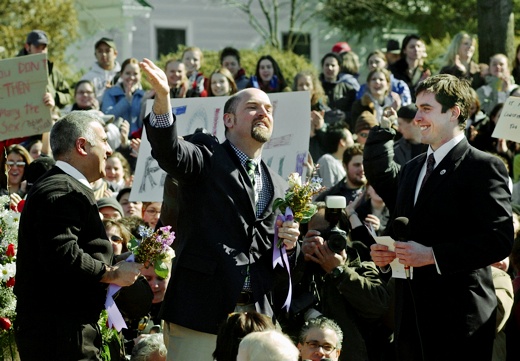
Image above: On February 27, 2004, New Paltz Mayor Jason West married 25 same-sex couples before a cheering crowd in front of the New Paltz Village Hall. From (http://clubs.calvin.edu/chimes/article.php?id=6819).

 New York lawmakers narrowly voted to legalize same-sex marriage Friday, handing activists a breakthrough victory in the state where the gay rights movement was born. New York will become the sixth state where gay couples can wed and the biggest by far. "We are leaders and we join other proud states that recognize our families and the battle will now go on in other states," said Sen. Thomas Duane, a Democrat.

Gay rights advocates are hoping the vote will galvanize the movement around the country and help it regain momentum after an almost identical bill was defeated here in 2009 and similar measures failed in 2010 in New Jersey and this year in Maryland and Rhode Island. Though New York is a relative latecomer in allowing gay marriage, it is considered an important prize for advocates, given the state's size and New York City's international stature and its role as the birthplace of the gay rights movement, which is considered to have started with the Stonewall riots in Greenwich Village in 1969.

The New York bill cleared the Republican-controlled state Senate on a 33-29 vote. The Democrat-led Assembly, which passed a different version last week, is expected to pass the new version with stronger religious exemptions and Democratic Gov. Andrew Cuomo, who campaigned on the issue last year, has promised to sign it. Same-sex couples can begin marrying 30 days after that. The passage of New York's legislation was made possible by two Republican senators who had been undecided. Sen. Stephen Saland voted against a similar bill in 2009, helping kill the measure and dealing a blow to the national gay rights movement. "While I understand that my vote will disappoint many, I also know my vote is a vote of conscience," Saland said in a statement to The Associated Press before the vote. "I am doing the right thing in voting to support marriage equality."

Gay couples in gallery wept during Saland's speech. Sen. Mark Grisanti, a GOP freshman from Buffalo, also said he would vote for the bill. Grisanti said he could not deny anyone what he called basic rights. The effects of the law could be felt well beyond New York: Unlike Massachusetts, which pioneered gay marriage in 2004, New York has no residency requirement for obtaining a marriage license, meaning the state could become a magnet for gay couples across the country who want to have a wedding in Central Park, the Hamptons, the romantic Hudson Valley or that honeymoon hot spot of yore, Niagara Falls.

 New York, the nation's third most populous state, will join Connecticut, Iowa, Massachusetts, New Hampshire, Vermont and Washington, D.C., in allowing same-sex couples to wed. For five months in 2008, gay marriage was legal in California, the biggest state in population, and 18,000 same-sex couples rushed to tie the knot there before voters overturned the state Supreme Court ruling that allowed the practice.

The constitutionality of California's ban is now before a federal appeals court. While court challenges in New York are all but certain, the state — unlike California — makes it difficult for the voters to repeal laws at the ballot box. Changing the law would require a constitutional convention, a long, drawn-out process. The sticking point over the past few days: Republican demands for stronger legal protections for religious groups that fear they will be hit with discrimination lawsuits if they refuse to allow their facilities to be used for gay weddings. The climactic vote came after more than a week of stop-and-start negotiations, rumors, closed-door meetings and frustration on the part of advocates.

Online discussions took on a nasty turn with insults and vulgarities peppering the screens of opponents and supporters alike and security was beefed up in the capitol to give senators easier passage to and from their conference room. The night before, President Barack Obama encouraged lawmakers to support gay rights during a fundraiser with New York City's gay community. The vote also is sure to charge up annual gay pride events this weekend, culminating with parades Sunday in New York City, San Francisco and other cities.

Despite New York City's liberal Democratic politics and large and vocal gay community, previous efforts to legalize same-sex marriage failed over the past several years, in part because the rest of the state is more conservative than the city. The bill's success this time reflected the powerful support of Cuomo and perhaps a change in public attitudes.

Opinion polls for the first time are showing majority support for same-sex marriage, and Congress recently repealed the "don't ask, don't tell" policy that barred gays from serving openly in the military. In the week leading up to the vote in New York, some Republicans who opposed the bill in 2009 came forward to say they were supporting it for reasons of conscience and a duty to ensure civil rights. Pressure to vote for gay marriage also came from celebrities, athletes and New York City Mayor Michael Bloomberg, the Republican-turned-independent who has long used his own fortune to help bankroll GOP campaigns and who personally lobbied some undecided lawmakers.

Lady Gaga has been urging her 11 million Twitter followers to call New York senators in support of the bill. While the support of the Assembly was never in doubt, it took days of furious deal-making to secure two Republican votes needed for passage in the closely divided Senate. Representatives of the Roman Catholic Church, Orthodox rabbis and other conservative religious leaders fought the measure, and their GOP allies pressed hard for stronger legal protections for religious organizations.

Each side of the debate was funded by more than $1 million from national and state advocates who waged media blitzes and promised campaign cash for lawmakers who sided with them. But GOP senators said it was Cuomo's passionate appeals in the governor's mansion on Monday night and in closed-door, individual meetings that were perhaps most persuasive. The bill makes New York only the third state, after Vermont and New Hampshire, to legalize marriage through a legislative act and without being forced to do so by a court. [Copyright 2011 The Associated Press]

 .

What do they do with their legs?

SUBHEAD: She considered herself an enlightened, sex-is-no-big-deal kind of parent. But that was before an innocent question about tadpoles.  

By Julia Sweeney on 23 April 2011 for The Guardian -  
(http://www.guardian.co.uk/lifeandstyle/2011/apr/23/sex-education-julia-sweeney)


Image above: Still frame from "Partly Cloudy", 2009 amination short by Pixar about where babies come from. From (http://wallpaper.imcphoto.net/stork-wallpaper.html).
 
One evening, on a school night, when my daughter Mulan was nine, we were eating dinner together at our favourite Thai restaurant. It was autumn, over two years ago, and writing about it now I see that Mulan and I interacted much like two roommates. We ate out a lot. We had a handful of favourite places. When you're a single mother who primarily takes her daughter to dinner at restaurants (my meagre defence: I was spending four days a week driving her to gymnastics after school – 45 minutes each way – so, who had time to cook?), it's easy to think of yourselves as a couple. You eat, you talk, and sometimes you just stare at each other in a stupor of familiarity.

At the restaurant, we know the owner and chef, who this night recommended the frogs' legs in hot peppers. We politely declined. Mulan told me her class had begun studying frogs. In fact, she revealed she had a report to do, and began to explain the basic parameters: "So, Mum. First, the frogs lay eggs, in a pond, and then the eggs turn into tadpoles and the tadpoles turn into more frogs."

I squinted my eyes. Biology – and science in general – was not my academic strong suit. Only recently had I discovered my own deep, neglected interest in science, and had been scrambling to catch up with the 21st century. Whenever Mulan told me of anything she was learning about science, I'm sure I wore an expression of astonished bewilderment and surprise. My 12 years of Catholic schooling did not dwell long on biology (God didn't want us thinking about that) and avoided the subject of reproduction almost entirely.

Eventually I mumbled a response: "Uh… yeah. I think so. I think, though, that it's probably just the females that lay the eggs, and then the males fertilise them – although I don't know for sure – and there are probably all kinds of species of frogs with different ways of doing things. But yeah, in general, I'm willing to bet, the females are the ones with the eggs. Or something like that."
"Huh?" Mulan said, listening carefully. "But, what does 'fertilise' mean?"

I said, "Oh, the males have this substance inside them, and it's like a co-ingredient, called sperm. They sprinkle, or squirt it on the eggs. That's how they get fertilised. It takes both the female's eggs and the male's sperm, and together they make the new tadpoles." I was really proud of myself for the word "co-ingredient". That was good.

"Soooooo, only the females have the eggs." Mulan said, her eyes wandering to the ceiling, taking this all in.

"Yes," I said.

"Humans, too?" she asked.

Let me freeze this scene for a moment and say that I considered myself an enlightened, open-minded, sex-is–no-big-deal parent, yet I hadn't truly prepared myself for this conversation. I had read a few parenting books and they all seemed to advise the same thing, which was, when your child starts to ask you about sex, or really anything that is complicated and multifaceted, just answer the exact question they ask. Nothing more. Don't elaborate. Don't over-share.

In that sense, I suppose I was prepared for this crucial rite-of-passage. I wasn't going to stop and take her hand, get all watery-eyed and explain about the beautiful way we create more children in the world. That wasn't what she was asking. She just wanted to know if human women had the eggs. The answer was clear and unambiguous.

"Yes," I said. I deliberately forced a pause. I tried to think of some other subject to move on to. I took a big bite of the mango salad we'd just been served.

Mulan asked, "Where do women keep their eggs?"

"Well," I said, "we women have evolved to have our own pond, right inside our own bodies. We lay our eggs in this pond, which is so convenient when you think about it compared with frogs, because we don't have to worry about any competing eggs. It's a pond of our own."

A pond of one's own. I imagined Virginia Woolf contentedly sitting in a pond of her own. And then drowning.

"Where is it?" Mulan asked, her eyes bigger than ever.

"It's in our lower abdomen, inside us, below our belly button, above our vagina." I had managed to be specific and totally vague all at once. Perfect.

"But… how do the eggs get fertilised?"

"By the man," I said, thinking why did I use the phrase "the man"? Aside from its conformist big-business connotations, I had possibly implied that there was only one man, some special Man who was used only for this purpose. Creepy and weird. And, of course, incorrect.

Thankfully, at this moment the rest of the food was delivered. I scooped up some green beans with chilli and hoped the subject would change. I realised my eyes were darting around, which reminded me of my own mother. I hated how awkward and embarrassed and offputting my mother became about the subject of sex. Now my own body was displaying the same indications of unease. I took a deep breath and smiled in a deliberately relaxed way at Mulan.

"But how does the sperm get in to fertilise the eggs?" she asked.

I said, "Oh, yes. That. Well, the sperm comes out of the man's penis and it goes into the woman's vagina. This happens when the two do what's called, 'have sex'. And that's where the egg – there's usually only one in the woman's pond at a time – gets fertilised." Only after the fact did I realise that I had said the words penis and vagina and sex in a strained, sotto voce tone. This was also something my own mother would have done. Self-hate swelled in my breast.

Mulan had put down her fork. Her face was twisted in disgust. "That's where humans make a baby, where you go to the bathroom? Mum!!" Her voice was rising.

"Yes," I said, looking around conspiratorially. "I know," I sighed. "It is weird. That part can take some getting used to."

"Gross." Mulan mumbled.

"Yeah, I know. As they say, it's like having a waste treatment plant right next to an amusement park. Terrible town planning."
 
"What?" Mulan said.

"The thing is," I went on, "that's how we evolved. That's where it all happens. And even though going to the bathroom and having sex are both in the general same area, they are actually totally separate." I wanted to add, "Except for some people, where psychologically it gets all mushed together, which is creepy in my opinion but certainly not morally wrong, and is actually understandable given the proximity." But that seemed to be getting ahead of the conversation, so I tried to change the direction slightly.

"Like your nose and your mouth," I ventured. "They're both close to each other on your face, but you wouldn't stick a bean sprout up your nose." Mulan gave me a pathetic lower-teeth-revealing smile and grunted a charity chuckle. Then she got back to the topic at hand.

"But Mum," Mulan asked with tractor-beam focus, "how can this ever happen? I mean, men and women, they can never be naked together."

"Well," I explained, "when people are older – much, much older than a kid – when they are older and they both decide they want to, in very certain circumstances, like if they're in love with each other, well, then, they can be naked together."

"But how do they know when?" Mulan asked. "Does the man say, 'Is now the time to take off my pants?'"

We held each other's gaze for a moment.

"Yes," I said. "That's exactly what they say."

To my great relief Mulan seemed content with that knowledge and began to eat with gusto. We moved on to other topics of conversation.

As we drove home Mulan seemed unusually quiet. I glanced at her from time to time in my rear-view mirror. She was sitting in the back seat, staring out of the window. The pavements were filled with people.

Suddenly Mulan laughed.

"What?" I asked.

"Oh Mum, you're going to laugh so hard."

"Why?"

"Because, Mum, you can't believe what I thought you said back at the restaurant. It's so funny. I thought you said that the man puts his penis in a woman's vagina – inside of it – and that's how people make a baby. Isn't that hysterical?"

A pause.

"That is what I said," I said.

"Oh," Mulan said. Her face had turned from gaiety to seriousness. There was a long quiet time. She stared out of the window, taking all this in.

Mulan asked, "What if two people just walked up to each other on the street and started doing it?" Our eyes met in the mirror. Her eyebrows were furrowed and she broke our gaze and looked at some people standing on the street.

At this point, I decided the best way to approach these questions was to pretend I was some dispassionate anthropologist discussing the mating habits of an animal other than our own. "The human species is very private when it comes to sex. Humans are unusual in this way. They have sex in private."

Mulan asked, "What if you went to a party and there were a bunch of men and women and they all just started doing it? Would that ever happen?"

"No," I lied. "That would never happen. Because humans are so private."

My back stiffened. I realised it stiffened like my grandmother's, my mother's mother. I was reaching back, farther back than my own mother's discomfort and into the graves of the next generation of discomfort. The dead live.

"Mum," Mulan said gravely, "have you ever done this?"
"Yes," I said, flatly.

"But Mum, you can't have children."

"That's true," I said.

"Well, you never have to do that again," Mulan sighed. She sounded relieved.

After a moment I said, "Well, if you really love someone and you're an adult, then you want to do it, even if you can't have a baby."

Silence. Mulan stared out of the window deep in thought. "But Mum, how can people do that? I mean, how do their legs go? You know, not everyone can do the splits."

Ah, the perspective of the proud gymnast. Mulan became somewhat fixated on the role of legs in sex. She could not picture how it was physically possible, even if someone could do the splits. Finally, I said, "Mulan, people figure the legs out. They just do."

"Oh," Mulan said, taking this in. She quieted down and we got home. When we got out of the car, our cat Val was sitting in the front garden soaking up the last bits of sunlight. Val rolled on to her back.
"What about cats? How do they do it?"

"It's basically the same idea," I said.

"But how do their legs go?" Mulan wondered.

"They, well, I think the male stands behind the female and… and… they just do, Mulan," I said, exasperated, and disappointed that "They just do" was the best I could do.

Once inside the house, our dog Arden, delirious with glee at our return, jumped up and licked my hand. "What about dogs?" Mulan asked, having never considered the possibility before.
"Same thing," I said. "It's basically the same thing for all mammals."

"But what about their legs?" she asked again.

"Look," I said, now desperately tired of this subject, "I've lost my ability to describe it. Maybe we can look on Wikipedia or something and it will show us."

So, we went to my office and got online. I Googled "cats mating". And, of course, on YouTube there were thousands of videos. We watched a couple of them. Mulan was riveted. She moved her face closer and closer to the monitor.

"Now what about dogs?" she asked. We watched a few dog videos. She put her hand on my arm.
Here, dear reader, we come to another moment out of time. Such as when you're in an accident and time slows to a crawl. I could hear my own breathing as if I were suddenly wearing a space suit from 2001: A Space Odyssey. Mulan's hand seemed to be reaching out to my arm in slow motion: frame-by-frame. I believe I remember it this way because it wasn't until then, until this small intimate gesture, this gesture of familiarity and of safety, that I realised where I'd led us.

"Mum, do you think there would be any videos of humans mating on the internet?"

I am a monster. An incompetent monster of a mother.

I smiled and said, firmly, "No. There would never be anything like that. Because humans are so private." And then, "Hey, how about some ice-cream?"

Which, of course, was teaching her that when questions about sex got awkward, food was truly the answer.

Later that night, Mulan asked, "What about Roger and Don – how do they do it?"

"I… I don't know," I said.

All right, I was thrown. I thought I would have more time between frogs and same-sex intercourse than just an hour or two. I was out of my depth.

Mulan went to the bathroom and took a little longer than usual to come out. Later she said, casually, "I think I know how Roger and Don do it."

"Oh yeah?" I said.

"Yeah, Mum, there's another hole down there, where you also go to the bathroom. Maybe… you know, maybe they use that."

That's my girl, my Mulan, age nine, inventing anal sex. Smart, inquisitive, problem-solving, Spock-like in objectivity and with a total lack of squeamishness. Bless her heart.

"Maybe," I answered, and shrugged my shoulders to indicate: see how casual and easygoing I am?
"But Mum," she said, "what about two girls? What about Eileen and Karen, how do they do it?"
"I... I…" I answered meekly, beaten.

"Why don't you call Karen and ask her?" Mulan asked me.

"Nah," I said, pretending to read the newspaper.

Mulan put her face a few inches from mine. She looked disgusted with me. "Mum, aren't you even curious?"

.

Lesbian Laysan Albatross

SUBHEAD: A third of albatross pairs in Hawaii are lesbians and have been coupled for up to 19 years.

By Rosemary Black on 4 May 2010 in NY Daily News
(http://www.nydailynews.com/lifestyle/pets/2010/05/04

 
Image above: Pair of adult Laysan albatross in the Hawaiian chain. From (http://trostomaten.blogspot.com/2007/07/to-midway-and-back-email-interview-with.html). 

Birds of a feather aren't opposed to same-sex relationships.