Showing posts with label Magic. Show all posts

Magical Thinking of Ecomodernism

SUBHEAD: Do high-consuming nations, like the USA need to keep growing their GDP forever?

By Jason Hickel on 4 April 2018 for JasonHickel.org -
(https://www.jasonhickel.org/blog/2018/4/4/the-magical-thinking-of-ecomodernism)
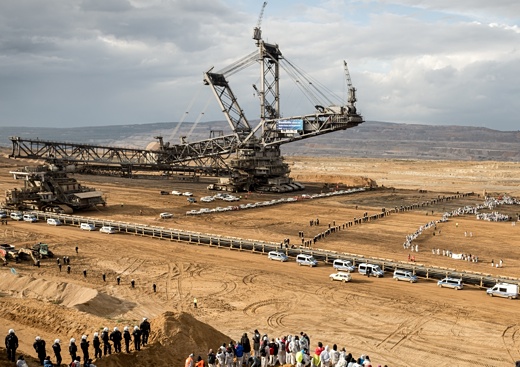

Image above: On November 5, 2017, at the beginning of COP 23, the activist organization Attac and the alliance Ende Gelände demonstrated against lignite-fired power generation in the Rhenish lignite mining district not far from Bonn. From (http://www.resilience.org/stories/2018-04-05/the-magical-thinking-of-ecomodernism/).

I recently wrote an article for Fast Company explaining why “green growth” is not a thing. I looked at three high-profile studies showing that even aggressive taxes and rapid improvements in technological efficiency will not be enough to cut global resource use as long as we keep growing the world economy.

 Right now we are consuming about 85 billion tons of material stuff per year, exceeding the sustainable threshold by 70%. According to the UN, our resource use will rise to at least 132 billion tons per year by 2050, and possibly as high as 180 billion tons.

It is on this basis that scientists have concluded that absolute decoupling of GDP from aggregate resource use is not possible. But the ecomodernists at the Breakthrough Institute aren’t convinced.

Linus Blomqvist wrote a blog post responding to my article, arguing that focusing on aggregate material flows is “misleading”, and that in reality absolute decoupling “is still a very real possibility.”

The stakes are high. After all, decoupling is the central objective of ecomodernism. No decoupling, no ecomodernism.

Blomqvist seems to agree that absolute decoupling of GDP from aggregate material use is not possible; or at least he doesn’t dispute the point.

But we needn’t worry about this fact, he says; it doesn’t matter if we keep using more and more resources each year, because aggregate material use is not a meaningful proxy for environmental impact.

 Industrial and construction materials, for instance, “account for a pretty small portion of environmental impacts like greenhouse gas emissions or land use,” and while biomass use keeps growing, land use has peaked (at least for now).

But this is cherrypicking indicators. Industrial and construction materials may contribute relatively little to greenhouse gas emissions and land use, but anyone who has ever seen (or lived next to) an open pit mine will know that they are ecological disaster zones in all sorts of other ways.

 Plus, Blomqvist’s claim about emissions and land just isn’t true (and he provides no evidence for it): cement production alone contributes 10% of anthropogenic CO2, and the transport, production and use of industrial materials is clearly linked to fossil fuel consumption.

As for biomass: let’s not pretend that land use is all that matters here. Our current method for extracting higher yields from land involves aggressive use of chemical fertilizers and pesticides, which have already pushed us well over the planetary boundaries for biogeochemical flows.

 And those same chemicals are causing insect populations – including pollinators – to collapse, and bird populations along with them.

 Indeed, the inputs involved in industrial agriculture are a major driver of biodiversity loss, regardless of whether or not more land is being used. They are also a major driver of soil depletion, which in turn drives greenhouse gas emissions from farmland.

This is the thing about ecology, you see: everything is connected. The biomass bone is connected to the biogeochemical bone is connected to the insect bone.

And that’s why aggregate material flows are in fact an important indicator of what’s happening to our planet. Sure, some material use has more dramatic impact than others.

 But no material use is impact-free. You can’t keep increasing aggregate material extraction and consumption indefinitely without increasing environmental impact right along with it. To believe that doubling or tripling our existing aggregate resource draw isn’t going to cause problems is magical thinking.

Blomqvist’s next move is similar to the first. He says that while absolute decoupling of aggregate resource use may not be possible (and sadly even relative decoupling of emissions has come to a halt), there are some happy isolated cases where it does seem to be happening.

Water extraction has peaked in the US, for example. And several pollutants (like sulfur dioxide and nitrous oxide) have peaked or declined globally. Blomqvist says this counts as “significant progress”.

If this is the best the ecomodernists have to offer, I despair. First of all, you can’t look at nations (and particularly rich nations like the US) in isolation, because they have outsourced much of their environmental impact abroad.

If you count all the water extraction involved in producing and shipping the imports that the US consumes, American water use is going up, not down. As for sulfur dioxide and nitrous oxide – yes, there have been gains, and we should celebrate them. But pollutants like these constitute one of the few examples where the much-misunderstood Environmental Kuznets Curve actually works.

Ecologists have pointed out for years that the EKC doesn’t hold for most other impacts. So as a defense for endless growth, I’m afraid Blomqvist’s example just won’t do.

I agree with Blomqvist that we should strive to accelerate resource efficiency. Of course we should! We need all the efficiency gains we can get. But unfortunately it’s not going to be enough, in and of itself – and we need to face up to this fact.

Tellingly, Blomqvist doesn’t engage with my claim about the rebound effect, nor about the physical limits to efficiency gains (the paper I cite by Ward et al concludes that “permanent decoupling is impossible for essential, non-substitutable resources because the efficiency gains are ultimately governed by physical limits”). We can’t just ignore these realities.

If absolute decoupling isn’t a thing, then ultimately we’re going to have to scale down global economic activity. Blomqvist doesn’t actually explain why he dislikes this conclusion so much. All he says is that degrowth “seems far-fetched”.

 I have no idea what he means by this. But could it really be more far-fetched than achieving what is physically impossible? Perhaps Blomqvist – or anyone at the Breakthrough Institute – could explain why they think that rich, high-consuming nations (like the US, for instance) need to keep growing their GDP (forever?), when we know that additional growth is not generating any better social outcomes.

Given how powerful the scale effect of growth is when it comes to driving ecological breakdown, it just doesn’t make sense to take it off the table.

.

Walking on Lava

SUBHEAD: Promotion of collected writing from the Dark Mountain project by one of its editor's.

By Charlotte Du Cann on 11 September 2017 for Open Democracy -
(https://www.opendemocracy.net/transformation/charlotte-du-cann/under-volcano)


Image above: Writer and artist Robert Leaver in his performance ‘Crawling Home’ in New York. Photo by Larrey Fessenden. From original article.

On a mountain in Wales in the teeming rain, we sit in a yurt packed with people, the five of us, on hay bales, dressed in black suits and bowler hats. One of us has a pack of cards up his sleeve, another an African folktale, another a guitar and a song by Nick Drake from the 1970s.

I have oak leaves in my hatband to signify an instruction circa 600 BC from the Sibyl who once guarded the door to the Underworld in the ‘Campi Flegrei’ outside Naples.

A link to the pre-patriarchal ‘uncivilised’ world, she guides a lineage of poets to the territory under the volcano where all deep transformations take place: Virgil, Dante, T.S. Eliot, Mary Shelley, Sylvia Plath. Denied immortal youth by the autocratic Apollo, her desiccated body kept in a jar, only her voice is still left for us to follow.

One of us, Dougie, stands up and invites the audience to take part in a demonstration of two figures from the ancient world: one is Chronos, the inexorable march of linear time; the other is a young man with a lock of hair over his forehead, who intervenes and interrupts him. His name is Kairos, and sometimes ‘Possibility.’

We’re giving a performance called ‘Testaments of Deep Time’ to introduce the work of The Dark Mountain Project—itself an intervention into the linear narrative about ecological and social calamity. As the rational world attempts to control the consequences of its dominant storyline, cracks have begun to appear.

Through those cracks, archaic, indigenous knowledge, hidden for safekeeping against Roman and other empires, slips through, and fleeting glimpses of another future reveals itself.

This encounter, we know, is what changes everything.

Dark Mountain was launched in 2009 to challenge the contemporary lack of response by culture makers to ecological overshoot in the aftermath of the 2008 financial crisis. Its manifesto was called simply Uncivilisation.

Many people picked up this gauntlet, recognising it, not as a challenge to a duel but as an invitation to explore a territory yet unmapped.

This invitation has led to collaborations with writers, musicians and artists; 12 books and five festivals; a year-long theatre workshop in Sweden; teaching encounters in the mountains of Spain and the moors of the West Country; and performances built around the celebrations of the solar year by the River Thames and the ancestral wilderness of Scotland—and now in Wales.

What distinguishes Dark Mountain from grassroots Earth-defending organisations and progressive movements is that it is a creative response to prevailing crises—and lacks an evangelical agenda to fix them.

The project’s manifesto can act as a frame, but there is no drive to act in the space that frame creates—no pressure to shut down power stations or convince your neighbour to stop flying, or your community to reduce its carbon emissions.

Instead, it provides a space that has room and time in it, where the 24/7 broadcast of progress can be switched off and other voices apart from the mainstream can be heard; it gives an opportunity to look at things differently, and for other slower realisations to occur—for interactions, connections and deep thought as a reader, listener or contributor.

‘Are you against environmental activism?’ I was asked recently by a television researcher. ‘No,’ I said ‘We’re not against anything. It’s a conversation not an argument. We’re a creative network.’
‘If this manifesto has travelled further than we imagined, one explanation is that it has helped people to get their bearings in a world where the thin, shiny surface of prosperity has cracked. Trying to make sense of our own experience it seems that we put words to a feeling that others shared... a feeling that there is no way through the mess we find ourselves that doesn’t involve facing the darkness, and being honest about the scale of the unravelling that is under way, and the uncertainty as to where it will end. A feeling that it is time to look down.’  Dougald Hine from the Introduction to the 2014 edition of Uncivilisation.
This rallying point, the agreement to ‘look down’ and acknowledge that we sit on a crater’s edge rather than a firm foundation, not only creates a different literature but also nurtures a very different feeling towards that literature and those who write it.

If there is one shared response to the contacts made by people towards the project it is the sense of relief and comradeship in a world where a possible eruption of the status quo is manifestly denied.

However there is no mantra or belief system to take refuge in here. Dark Mountain is a collective work-in-progress, initiated by ‘recovering journalists’ disillusioned by the green movement and its timid approaches toward change.

It doesn’t offer a road map for a sustainable future but can offer you a place by the fire, an opportunity to dig beneath the distracting surface of industrial late capitalism; to produce work that asks the question, ‘how can we reclaim the voice and body of ourselves that has been suppressed by civilisation for millennia. The deadline is never far away.

The fact is we all know that “the boat is leaking and the captain lied” as Leonard Cohen once sang; we know the statistics about climate change and acidified oceans and decapitated mountains. The news that the numbers of kittiwakes on St Kilda have plummeted or that the ancient trees of Sheffield have been felled pains us. We don’t numb out that pain, nor do we indulge it in the see-saw of hope and despair.

We know the Earth is not an abstract concept of environment or ‘nature’ and requires a very different relationship, one that wrests the material of life out of the hands of the ‘quants’ and economists and gives it due respect.

The question we face is always: what do you do when you know, when you allow yourself to see and feel what is shut out by the broadcast of progress? You can’t keep writing conventional love stories and detective novels, hoping that Hollywood will get in touch.

What kind of literature and art does this awareness produce? A diverse body of work that does not fit neatly into a monocultural, corporate bookshelf or gallery wall.

Inspired by the inhumanist poetry of Robinson Jeffers, its voices do not come out of a narcissistic and alienated highbrow culture, discussed by the chattering classes of Boston or London, but from a library of stones, from the desert and forest hermitage, from conversations around convivial fires.

This space is existentialist, ringed as it is by urgent questions about what kind of human being can be so numb or so dumb in the face of catastrophe; its tone is elegiac rather than triumphant.

In many ways it returns the artist and writer to their original function, as people who push the edge and keep the door of possibility open. People who embody and stand by their words, for whom those fiery brimstone fields are home.

It’s in this spirit that we’ve created a new work called Walking on Lava, taken from our first ten hardback journals as a showcase introduction. Following their shape it is made of work of contrasting voices and genres—poetry, flash fiction, essays, artworks, photography and interviews—and structured around the manifesto’s ‘Eight Principles of Uncivilisation.’

Here are Robert Leaver crawling along Broadway in New York on his hands and knees; Christos Galanis shooting a thrift store copy of the Iliad in the New Mexico desert; and Emily Laurens sweeping the brown sands of the Welsh peninsula in honour of the disappeared passenger pigeon and the millions of species now becoming extinct—testimony, encounter, protest art and praise song of a different kind.
‘I imagine the people I have seen on Broadway, and maybe the world over, feeling a weight on their backs, in their hearts and souls. Maybe this weight is the burden on modern life, the burden on being conscious in a world gone mad. Crawling seemed to be a way to maybe show compassion or solidarity, to make a metaphor of this collective burden we all share. Instead of crawling I could have curled up in a foetal position in perfectly chosen locations. But this crawl was never about surrendering. I went down and kept moving, kept pressing on as so many humans are doing every day. The idea has always been to keep on, to get through this journey, to make it home safe and sound.’ Robert Leaver – Crawling Home.
What happens when you get bitten by a squirrel, or when you return to your homeland now crawling with bulldozers and fracking trucks?

When the story you were told by your teachers and parents is broken, when the Earth makes contact with you, you may stumble upon art with a different kind of attention: a feral stew of roots and road killed pheasant in the highlands of Scotland, a dreaming woman carrying a horse in her womb in Cornwall, a meditation on graphite in the winter-wet Cumbrian hills.

Kairos, the daemon of opportunity, had a shaved head, meaning that you had to grasp the moment that faced you, for once the light-footed one had disappeared the chance to see in all-at-once-time had also gone also.

There are only so many opportunities to sense the volcano that rumbles beneath us. Rarely do we find the way to the cave where the Sibyl sits, or pay heed to those who struggle to return from the darkness of the Stygian lake.

We live, as Marshall McLuhan once noted, in a third world war of narratives, of competing controlled ways of perceiving the world, all of them hostile to people and planet. In the quiet, in the depths, in the wild places, in the struggle of our hearts, writers and artists—those who have always kept a true link to the wider, wilder world—are forging another story.

We hope that Walking on Lava will show how some of that new collective tale is unfolding.

Walking on Lava – Selected Work for Uncivilised Times is edited by Charlotte Du Cann, Dougald Hine, Nick Hunt and Paul Kingsnorth and published by Chelsea Green.

.

America's Disneyland Economy

SUBHEAD: Unfortunately, the economic suffering that we are seeing right now is just the beginning.

By Muchale Snyder on 16 July 2017 for Economic Collapse Blog -
(http://theeconomiccollapseblog.com/archives/our-disneyland-economy)


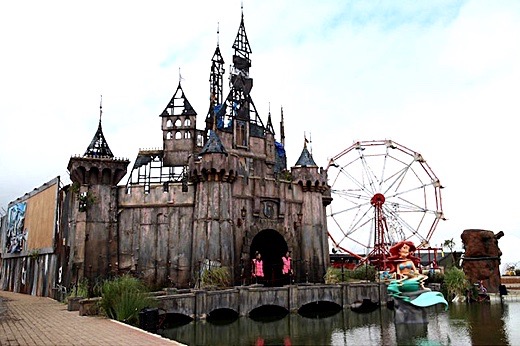
Image above: Entry to Dismaland bemusement park by Banksky "The Unhappiest Place on Earth!". From (http://cavemancircus.com/2015/08/21/banksys-just-made-a-theme-park-and-its-the-unhappiest-place-on-earth/).

Disneyland is known as a place “where dreams come true” and where every story always has a happy ending. But there is going to be no happy ending for the U.S. economy.

Wishful thinking has resulted in one of the greatest stock market rallies in history in recent months, but like all childhood fantasies, it won’t last. The real economy continues to deteriorate, and we can see this even right outside of the gates of Disneyland.

Every night growing numbers of homeless people sleep on the pavement just steps away from “the happiest place on Earth”. It can be fun to “play make believe” for a while, but eventually reality always catches up with us.

Without a doubt, the stock market has been on a tremendous run. Since Donald Trump’s stunning election victory in November, the market has been setting record high after record high, and it is now up a total of 17 percent…
The Dow Jones Industrial Average recorded its 23rd all time high of 2017 yesterday closing at 21,532. There have been a total of 120 days where the markets have closed since President Trump’s inauguration on January 20th. The ‘DOW’ has closed at all time highs 23 of those days for nearly 20% or one-fifth of the days the market has been open. The market is up 9% since the inauguration.

Since the election on November 8th the DOW has closed at record highs an amazing 40 times! Nearly one-fourth or 24% of the 168 days the markets have closed have been record highs since the November 8th election. The market is up 17% since the election!If this surge was supported by hard economic data, that would be something to greatly celebrate, but that has not been the case at all.
Instead, stock prices have become completely disconnected from economic reality, and now we are facing one of the greatest stock bubbles of all time. As Graham Summers has pointed out, stocks are now trading at price to sales ratios that we haven’t seen since the very height of the dotcom bubble…
Earnings, cash flow, and book value are all financial data points that can be massaged via a variety of gimmicks. As a result of this, valuing stocks based on Price to Earnings, Price to Cash Flow, and Price to Book Value can often lead to inaccurate valuations.

Sales on the other hand are all but impossible to gimmick. Either money came in the door, or it didn’t And, if a company is caught faking its sales numbers, someone is going to jail.

So the fact that stocks are now trading at a P/S ratio that matches the Tech Bubble (the single largest stock bubble in history) tells us that we’re truly trading at astronomical levels: levels associated with staggering levels of excess.
There is no possible way that this is sustainable, and just like before the 2008 crisis a whole host of experts are warning that disaster is imminent. One of them is John Mauldin…
Looking with fresh eyes at the economic numbers and central bankers’ statements convinced me that we will soon be in deep trouble. I now feel that it’s highly likely we will face a major financial crisis, if not later this year, then by the end of 2018 at the latest. Just a few months ago, I thought we could avoid a crisis and muddle through. Now I think we’re past that point. The key decision-makers have (1) done nothing, (2) done the wrong thing, or (3) done the right thing too late.

Having realized this, I’m adjusting my research efforts. I believe a major crisis is coming. The questions now are, how severe will it be, and how will we get through it?And even though the stock market has been surging deeper and deeper into bubble territory in recent months, the middle class has continued to shrink and poverty has continued to grow all over the country.
In fact, because so many homeless people have been sleeping at bus shelters across from Disneyland lately authorities decided to completely remove the benches that they had been sleeping on…
The vanishing benches were Anaheim’s response to complaints about the homeless population around Disneyland. Public work crews removed 20 benches from bus shelters after callers alerted City Hall to reports of vagrants drinking, defecating or smoking pot in the neighborhood near the amusement park’s entrance, officials said.

The situation is part of a larger struggle by Orange County to deal with a rising homeless population. A survey last year placed the number of those without shelter at 15,300 people, compared with 12,700 two years earlier.
But simply removing benches will not make the problem go away.

Homelessness has been growing so rapidly in Los Angeles that the the L.A. City Council actually asked Governor Jerry Brown to formally declare a state of emergency.

And in New York City, street homelessness is up 39 percent over the past year.

This is where the real economy is heading, but a rising stock market makes for much happier headlines.

Many major cities around the nation are passing laws to essentially make it illegal to be homeless. Forcing homeless people to go somewhere else may mask the problem for a while, but it certainly doesn’t do anything to solve it.

 In my new book entitled “Living A Life That Really Matters”, I talk about how real love is not just about loving those that are just like us. Rather, real love is about caring for people no matter what they look like and no matter what they are going through.

Unfortunately, the economic suffering that we are seeing right now is just the beginning.

Just like in 2008, the major financial crisis that is coming is going to greatly accelerate our economic problems. And just like last time, millions of people are going to lose their jobs, and millions of people are going to lose their homes.

Homelessness is already worse in many parts of the nation that it was during the depths of the last recession, and what we are going to see during the next economic downturn is going to be absolutely unprecedented.

So don’t look down on those that need a helping hand, because in the not too distant future you may find yourself needing some help.

.

Wonderland of Magical Economics

SUBHEAD: The Earth's economy glorifies waste, exploitation, debt, expediency and magical thinking.

By Charles Hugh Smith on 17 July 2017 for Of Two Minds -
(http://www.oftwominds.com/blogjuly17/earth-economy7-17.html)


Image above: Painting of a Magritte-like figure swirling the sky with a wand and producing illuminated light bulbs. From (http://adelaidereview.com.au/opinion/magical-thinking-modern-world/).

Humanity appears to default to magical thinking when faced with untenable situations that demand systemic change.

How would extraterrestrial anthropologists characterize Earth's dominant socio-economic system? It's not difficult to imagine their dismaying report:

"Earth's economy glorifies waste. Its economists rejoice when a product is disposed as waste and replaced with a new product. This waste is perversely labeled 'growth.'

Aimless wandering that consumes fossil fuels is likewise rejoiced as 'growth.'

The stripping of the planet's oceans for a few favored species of edible fish is also considered 'growth' as the process of destroying the ocean ecosystem generates sales of the desired seafood.

Even more perversely, the resulting shortages are also causes of rejoicing by the planet's elites, as their ability to purchase the now-scarce resources boosts their social status and grandiose sense of self-worth.

This glorification of waste is the same dynamic that destroyed the civilization on Zork.

Earth's economy also glorifies exploitation, as this maximizes profits, which appears to be the planetary equivalent of a secular religion that everyone believes as a Natural Law.

Thus slavery and monopoly are highly valued as the most reliable sources of profits. If ethical concerns limit the actual ownership of humans, Earth's economy incentivizes feudal arrangements that share characteristics of servitude and bondage.

In the current era, the favored mechanisms are over-indebtedness (debt-serfdom) and taxation by the state, which extracts approximately 40% of all labor via threat of imprisonment.

Earth's elites exhibit a pathological preference for micro-managing the commoners via criminalizing much of everyday life and imposing extremely harsh punishments for any dissent or resistance to elite domination.

This is the same dynamic that doomed planetary civilizations in the Blug system.

Earth's economy is currently dependent on depleting fossil fuels and borrowing from the future to fund consumption in the present, i.e. debt.

Rather than face the reality that this is not sustainable and pursue other arrangements, Earth's elites have chosen expediency, responding to the inevitable crises caused by depletion and dependence on debt with expedient but ultimately destructive policies that paper over the crises but at the cost of generating greater crises in the next iteration.

Humanity appears to default to magical thinking when faced with untenable situations that demand systemic change. This is eerily parallel to the now-lost civilization of Frum.

It seems Earth's dominant species has selected the most destructive policies and mindsets to glorify and worship. Earth's current civilization is doomed, with near-zero prospects for the necessary transition to a more sustainable, less exploitive arrangement.

Earth's decline is a tragi-comedy, much like the one on Ononon that entertained our home planet audiences for a time."

In case you missed it, here's a snapshot of total debt as a percentage of median household income: from 79% to 584% between 1980 and 2016.


Image above: Chart of Total debt as a percentage of median household income. From original article.

If this strikes you as "healthy growth" because "debt doesn't matter"-- welcome to the Wonderland of Magical Thinking.
.

Magic with Magnets and Marbles

SUBHEAD: Watch these videos and enjoy the dance of kinetic energy, gravity and geometry.

By Rob Beschizza on 20 December 2016 for Boing Boing -
(http://boingboing.net/2016/12/20/magnets-and-marbles.html)


Image above: Still frame from video below "Magnets and Marbles!".

This isn't your usual kinetic pachinko balls-in-a-gravity-maze toy, but a mindbending demonstration of magnets. It starts getting really crazy at about 2m in but one should enjoy the subtle pleasures too.

Here's creator Kaplamino:
In this project, I use those little magnets that can be used to make cubes and others geometric figures, I think the name is "Neocube". It's really impressive how many tricks you can do with that, at the beginning I didn't think that I could make a whole project based on those magnets, but finally, it was pretty easy and I think there is still lots of cool tricks to discover!


Video above: "Magnets and Marbles!" by Kaplamino. From (https://youtu.be/QQ9gs-5lRKc).


Video above: "Marbles Tricks" by Kaplamino. From (https://youtu.be/QdkVhVwYJu0).

.

Go see movie "Epic"

SUBHEAD: The movie evokes empathy, a sense of magic, as well as the fragility of nature.

By Juan Wilson on 27 May 2013 for Island Breath -
(http://islandbreath.blogspot.com/2013/05/go-see-epic.html)


Image above: From ().

Last night, my wife Linda and I went to the movies to see the animated feature film Epic at the Kukui Grove Cinema. It is 1hr 42min‎‎ - Rated PG‎‎ - and categorized as Animation/Family/Action/Adventure.

Linda and I see a lot of family oriented animation movies. As a category these films seem more satisfying than the cool, slick, violent films geared for young adults. We don't see all the family-fun-nonsense movies. 

Upcoming animation flicks we rejected in the 20 or so minutes of previews that were shown before "Epic" included "Monster U", "Cloudy with a Chance of Meatballs 2" and "Planes". All three of these are franchises coming back with a followup movie. Everything in these films look like plastic action toys you'll find in blister packages at Walmart.

The other movies playing at the Kukui Grove Cinema included "Startrek - Into Darkness", "Fast & Furious 6", and "Ironman 3".  Between them, these three film franchises make up 21 feature films. To me, film franchises like "Fast & Furious" represent the worst America has to offer regarding violence, industrialization, amoral activity and spiritual poverty.

"Epic" tells the story of an ongoing battle deep in the forest in the balance of life and death. The health of the forest is threatened by extinction. A teenage girl finds herself magically transported into world of forest spirits trying save their world... and ours.

The movie evokes a sense of magic, humor, empathy, and the beauty and fragility of nature. Take a child if you can... but go see "Epic". You'll have fun!


Video above: Official trailer for "Epic". above: From (http://youtu.be/-xu3JLXfuwQ).


Epic will be playing this week on Kauai at:
Kukui Grove Cinema
(http://kukuigrovecinema.com/)

4368 Kukui Grove, Lihue, HI - (808) 245-5055
2D and 3D showings.  Call or visit website for schedule.


.

Floral Telecommunication

SUBHEAD:  Bees can see visible and ultraviolet light,  and now we know they can also detect electric fields.

By Adam Cole on 22 February 2013 for NPR News -
(http://www.npr.org/2013/02/22/172611866/honey-its-electric-bees-sense-charge-on-flowers)


Image above: Painting of Red Clover Meadow Fairy in Flower Fairies Of The Countryside by Cicely Mary Barker, 1889. From (http://www.etsy.com/listing/82749851/red-clover-meadow-fairy-flower-fairies).

Flowers are nature's ad men. They'll do anything to attract the attention of the pollinators that help them reproduce. That means spending precious energy on bright pigments, enticing fragrances and dazzling patterns.

Now, scientists have found another element that contributes to flowers' brand: their distinct electric field.

Flowers tailor their displays toward the sensory capabilities of their pollinators. Bees can see visible and ultraviolet light, they have precise olfactory receptors, and now we know they can also detect electric fields.

Anne Leonard, who studies bees at the University of Nevada, says our understanding of pollinator-flower communication has been expanding for decades.

"Flowers do a lot of things you might not expect," Leonard says. "We observe they have these distinct bright, beautiful colors, patterns, scents."

But we don't often stop to consider that this incredible display is all an attempt to attract bees and other pollinators. These displays don't just consist of things humans notice. There are also patterns in the ultraviolet spectrum, petal temperatures and textures and shapes.

"We've found that by producing these combinations of sensory stimuli, the plant basically makes its flowers easier for the bee to learn and remember," Leonard says.

That means the bee can forage more efficiently, and flowers are more likely to be pollinated.

"This is a magnificent interaction where you have an animal and a plant, and they both want this to go as well as possible," says Gregory Sutton of the University of Bristol in the U.K. "The flowers are trying to make themselves look as different as possible. This is to establish the flower's brand."

Sutton and a team of researchers led by Daniel Robert have just uncovered a whole new layer to flower brands.

"We found that flowers can use electric fields," Sutton says.

That's right — electric fields. It turns out flowers have a slight negative charge relative to the air around them. Bumblebees have a charge, too.

"When bees are flying through the air, just the friction of the air and the friction of the body parts on one another causes the bee to become positively charged," Sutton says.

It's like shuffling across a carpet in wool socks. When a positively charged bee lands on a flower, the negatively charged pollen grains naturally stick to it. The Bristol team wondered if bees were aware of this electrostatic interaction.

So, they designed an experiment — one described in this week's Science magazine. The researchers built a small arena full of fake flowers. Each flower was simple — a stalk with a small steel dish at the top. Half of the "flowers" held delicious sugar water. The other half held quinine, a substance that bees find bitter and disgusting.

When bumblebees explored this false flower patch, they moved around randomly. They chose to land on sweet flowers just about as often as bitter flowers.

But when the sweet flowers carried a small charge, the bees learned pretty quickly to choose the charged flowers. And when the electric charge was removed? They went back to their random foraging.

The bees had recognized the electric field, and had learned to use it to find sweet flowers. But that's not all.

"In the seconds just before the bee lands, there is electrical activity in the plant," Sutton says.

The plant's electric field is changed by the proximity of that positively charged bee. And once the bee leaves, the field stays changed for 100 seconds or so. That's long enough for the altered field to serve as a warning for the next bee that buzzes by. She won't stop to investigate a flower that's already been visited..

We Were Warned

SUBHEAD: It looks like the apocalypse has been rescheduled for the first quarter of 2013.

By Juan Wilson on 21 December 2012 for Island Breath -
(http://islandbreath.blogspot.com/2012/12/we-were-warned.html)


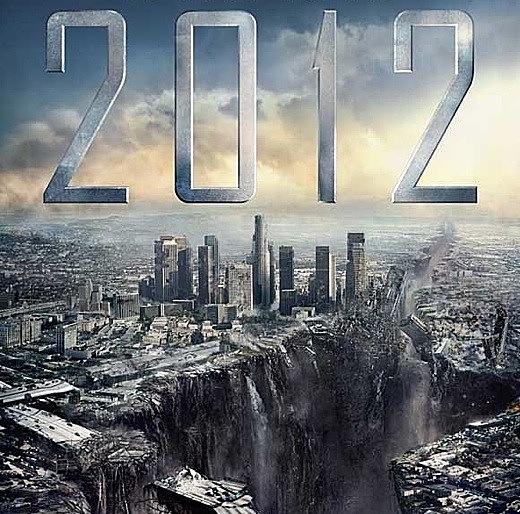
Image above: Los Angeles is destroyed in this poster for movie "2012". That was the flick with the subhead "We were warned." From (http://blogs.babble.com/babble-voices/take-10-jaime-morrison-curtis-jacinda-cannon-boneau/2012/09/26/its-the-top-ten-movies-about-the-end-of-the-world-and-i-feel-fine/#2012).

Okay! Okay! Move along people. Nothing to see here. No end of the world... at least a quick supernatural ending anyway. Just the slow agonizing kind brought on by too much of a bad thing - like too much industrialization, too much burning of fossil fuels and too many people. But that's boooorrrring.

That's so Yesterday
We recently posted and article by Ugo Bardi detailing the drop in online interest in both "Peak Oil" and "Climate Change" (http://islandbreath.blogspot.com/2012/12/losing-interest-in-disaster.html). The articel postulates that when people face immediate difficulties, they tend to emphasize short term solutions and have no time to worry about the ultimate reasons of what's befalling them.

I would add that when people are despondent with their current surroundings they display a fascination with celebrity, sensationalism, and fantasy - all resulting in only short term escapism. Whatever stimulates them wears off quickly.

Moreover, when one is truly cornered by a terrible event it can simply be a matter of self denial. Reaching for magic and miracles to replace reality.

The Lazy Brained
There is a lazy-brained way of seeming brainy. I noticed this first with fairly intelligent people who were not highly educated. The seemed to have a need to seem interesting and informed about some new compelling subject that was exciting.

It could involve:
  • a  conspiracy theory, a scientific oddity or supernatural manifestation. 
  • the end of the world, an alternate reality, or a religious awakening.
  • a cure for cancer, a free infinite source of energy, denial of a historic fact.
  • the Masons, extraterrestrials, or the CIA.
It could also be any combination of these things, as long nobody has heard of it before. The point is, that it should get reactions like; "Wow! "Amazing!" "That's heavy!"

Now it seems that everybody is trying to get into the amazement game. Here on Kauai we certainly have our fair share of new-agers and space-cadets. In this tropical paradise, in the twilight hours of empire, can we afford to drift away from reality to dreamland? Maybe when we are done weeding the garden.

This Just In
It looks like the apocalypse has been rescheduled for the first quarter of 2013. The inside word is we will be having a planetary coastal event as the Pacific tectonic plate cracks this spring. See you up in Kokee.

.

National Hocus Pocus

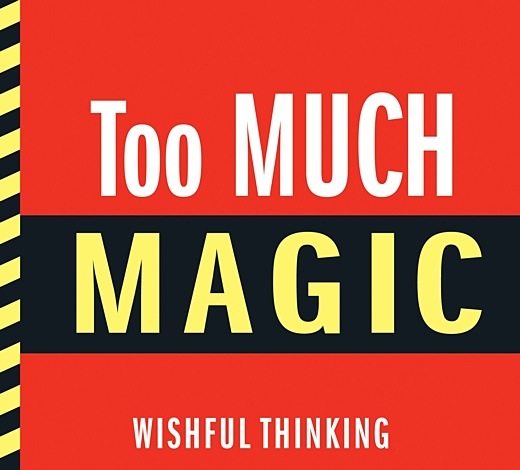
SUBHEAD: A review of James Kunstler's new book "Too Much Magic: Wishful Thinking, Technology & the Fate of the Nation". By Lindsay Curren on 17 July 2012 for Transition Voice- (http://transitionvoice.com/2012/07/hocus-pocus-as-national-strategy-review-too-much-magic/) Image above: detail from the sleeve jacket of Kunstler's book "Too Much Magic". From original article.

In the Waldorf method of education, founded by scientist and mystic Rudolf Steiner, each year the child experiences a different central focus in class. This central focus informs everything from storytelling to math to language acquisition to handwork skills like knitting, sewing, or wood working.

For example, in the first grade the central focus is fairy tales and in second grade it is myths, legends, and saints. In theory, fairy tales and other legends inspire the young child, still filled with wonder about the world, in her own heroic quest to overcome evil and discover her own innate strengths while internalizing a moral code, desiring to do the right thing and recognizing when something is wrong.

This is the right age for fairy tales. The six-, seven- and eight-year old child is just beginning to grasp abstract concepts such as math equations and representative letters. But soon enough the child will be done with magic stones and dark forests, with spinning straw into gold and believing in St. George slaying a literal dragon.

Yet somewhere in the recesses of his mind those fairy tales will linger, leaving a feeling that anything is possible. It will simply be checked by later developmental needs, particularly those grounded in what is possible under natural law. Over the arc of the years, new central focuses will dominate. His imagination will thus unite with and inform his morality, his reason and his intellect, resulting in the mature man.

Arrested development

Too Much Magic: Wishful Thinking, Technology, and the Fate of the Nation by James Howard Kunstler, Atlantic Monthly Press (June, 2012), 336pp, hardcover, $16.50

Well, of all the long lead-ins that I’ve ever written, I can’t help but see the failure of contemporary man (or more precisely, Americans) to achieve any of that wise, progressive, human development as a central critical premise in James Howard Kunstler’s latest book, Too Much Magic: Wishful Thinking, Technology, and the Fate of the Nation (Kindle edition here).

These days, it’s as if Americans are permanently and pervasively stuck at age seven, more focused on the imaginative powers of Harry Potter’s wand and Buffy the Vampire Slayer (or the latest iGadget) than running their own adult lives.

Kunstler would probably not appreciate the Christian-mystic and astrological end of Steiner’s writings. But Steiner’s methodical case for the anthroposophical development of man — uniting inner life and outer development over time — might meet Kunstler’s reverent standards of truth, beauty, and goodness.

And in my view, these are Kunstler’s core concerns, informing every aspect of his recent analysis; most of all that, lacking a proper maturation, and mired in a protracted version of what Elizabeth Kolbert calls “adultolescence,” contemporary man is in thrall to a debilitative brand of magical thinking that prevents our ability to craft responses to manifold problems in the social, political, cultural, and economic realms.

All that magical thinking is quite literally, killing us.

Kunstler’s book is a hard-nosed and unforgiving look at the times with particular regard to the key resource driving economy — cheap fossil fuels — and its decline, along with the relationship of energy to economy, and more precisely, to credit and the inability to pay back what’s already been drawn on as well as the gumming up of future credit. He attributes this to a cultural habit of wanting and expecting “something for nothing.”

As in the present volume’s prequel, The Long Emergency, Kunstler’s narrative rides on sweeping historic analyses with a particular focus on the century and a half of fossil fuel development and the ensuing living arrangements, most notably suburbia, that define the era, including its politics, policy, and consumerism. Kunstler’s writing is remarkably lucid, readable, incisive, accurate, and telling, making it the absolute non-fiction page turner of 2012.

Moreover, you don’t need to be a freaking rocket scientist to get it.

Kunstler writes with wit and ease, covering vast terrains of history, society, culture, science, technology, politics, art, architecture, civilization, economics and more while never actually giving away that that’s what he’s doing. At least in the sense that his writing is never bogged down or overly-technical.

All the while he builds up the unassailable truth that we’re screwed because we’re too busy being distracted by pop culture and investing in wildly unrealistic technotopian schemes for collective living (Gingrich’s colony on the moon, anyone?) that we can’t see ourselves driving ourselves to distraction while driving ourselves over a cliff in the process.

We can’t see it, he argues, because we’re still in first grade. Because we prefer first grade. We want fairy tales. We prefer magic wands to cogent observation, discernment and prudent decision making. We don’t want to grow up.

What we have in our “debate” over global warming, for example, and our ignorance of the realities of energy and in our unsustainable living arrangements is the result of preferring arrested development over the advice of, say, the Bible’s 1 Corinithians: “When I was a child, I talked like a child, I thought like a child, I reasoned like a child. When I became a man, I put childish ways behind me.”

Such ancient advice should appeal to the conservatives who are ever at the ready to co-opt Christianity to their ends. It should also appeal to truly devout Christians. Instead it seems to appeal to no one.

We are, Kunster argues, a relentlessly immature society, though we haven’t always been.

No stone left unturned

Part of his lament is our collective fall from a time when we possessed great moral authority as a nation, after the defeat of Hitler and the hard-won victories of World War II. Where did that substantive America(n) go, he wonders, an America(n) that can’t been found anymore through all the reality TV, bling, vinyl homes, flagrant wastefulness and crimes as serious as Abu Ghraib and the recent Wall Street perfidy.

For Kunstler this means looking afresh at our dysfunctional political system and, eschewing the romanticism that sees America as unassailable, finding fault where censure is due: today’s plutocratic parties lack the intellectual heft, visionary approach, groundedness in reality, and the gentlemanliness of compromise to lead the nation in its most dire hour.

The present is a remarkable period of stupidity, even within the spectrum of what passes for extremes in our history. The challenges to the project of civilization have never been greater than in this moment of ecological overshoot, and the public conversation about what is happening to us and what we might do about it has never been so inadequate. Our aging two-party system gives off an odor of necrosis. Roughly dividing what we conceive to be the right and the left, both sides evince fabulous sweeps of cluelessness and dishonesty.

Contents unindexed

Readers of Kunstler will know that he is impatient with idiocy and doesn’t suffer fools gladly or otherwise. Though his intellect is razor sharp, his research impeccable, his historic analysis comprehensive, it may be his disdain that I find most appealing because he just makes so much sense in cutting through the insanity — which is one helluva anomaly these days.

A somewhat cranky Renaissance man (at least at first glance), Kunstler seems unafraid of any subject, and Too Much Magic offers the contrarian view on an encyclopedic range of topics relevant to today, to wit –

The decline of cheap oil, the bubble-quality of hydrofracking for natural gas, and the limits of shale oil, tar sands, and uranium. He gives you your Wall Street shysters and derivatives banking on a platter skewered and fileted, along with the Fed, the two US political parties, architecture, urban development, food, farming, conservation, renewable energy as doable and as limited; you’ll get culture, pop culture, tattoos, Beaux Arts, fashion, TV, discourse, women, men, races, cultures, families, small towns, big towns, peak oil, global warming, small hydro, good friends, references to other key figures in the peak oil analysis, an unforgiving take down of the failure to enforce the rule of law on investment banking heists, and many other things that I can’t remember because the one fault of the book is its lack of an…index for God’s sake!

Kunstler, what were you thinking?

At the same time I’m not sure there’s another peak oil writer who evidences so much heart, so much love for humanity, for our wondrous creations. His understanding of that juncture where cheap energy and easy cash outstripped our ability to intellectually and emotionally integrate so many new toys and lifestyle shifts leaves him pining for a cultural clearinghouse that would cut the dross so we could see, for example, the many beautifully constructed urban spaces that predate what he calls the clownishness of suburban sprawl. It’s the kind of development (or retrofitting) that he sees as a more sustainable project for civilization.

But his is not just nostalgia for easier to understand times. There may be some of that, but it isn’t his central point. His central point is that today’s arrangements don’t work, leaving us fat, sick, alienated, in debt and unable to sustain our arrangements going forward. Moreover, that we can’t seem to knit together how it got that way.

The growing prosperity of the New South also expressed itself in burgeoning suburbia. The great highways were built rapidly — rationalized, in fact, as a national defense mobility network — and before long the predictable manifestations of car-centered real estate development followed. Wherever a set of on-and-off ramps was built, the housing subdivisions followed, and then the strip malls and the out-parcel tilt-up commercial boxes sprang up. By the 1960s many a southern boy who’d grown up barefoot on a farm in the Great Depression had turned into a wealthy car dealer, owner of a real-estate agency, production builder of tract houses, a paver and excavator, air-conditioning contractor, lumber dealer, strip mall magnate, or the lucky holder of multiple fast food franchises, all activities spun off by suburban sprawl. The economic transformation was very abrupt while cultural behaviors and beliefs lagged behind.

So too, it seems, did an understanding that if all this was running on cheap energy, and cheap energy was running out, at some point in the near future all this would be unmanageable, unaffordable, and due to the former two, undesirable.

And so, he advises, it’s time to rethink and rebuild our living arrangements at a much more human scale, offering some caution but plenty of hope about how we can do that.

If you’re following the peak oil story, this book is essential to your personal library and for you to recommend to your local library right now. I mean step…away…from…the…computer…and go through the process to recommend this to your local library…immediately.

It’s also the best easy read yet (without sacrificing a shred of hefty intellectual substance) for you to give away (or recommend) to everyone you know who is primed to grasp the undeniable energy and economy story we’re facing today (and which no Hadron collider can ever zoom away). Get ten, and parcel them out for every holiday on your calendar.

It is a MUST READ!

Think of it as the definitive book for anyone who’s done with fairy tales and is ready to meet the world where it really is. It’s a book for grown ups, for those who are ready for the maturation of the human race but who like to consider such a prospect while also hearing the phrase “baby pants.” They’ll be the ones who understand that it’s time we graduated to cleaning up our own mess.

[IB Editor's note: We too will soon be publishing a review of "Too Much Magic". You can purchase the book at (http://www.indiebound.org/book/9780802120304)] See also: Ea O Ka Aina: Our review of "Too Much Magic" 7/19/12 .

Too Much Wrong Magic

SUBHEAD: We have come to a place where fossil fuels and technology have replaced real magic.  

By John Michael Greer on 4 July 2012 for the Archdruid Report - (http://thearchdruidreport.blogspot.com/2012/07/wrong-kind-of-magic.html)


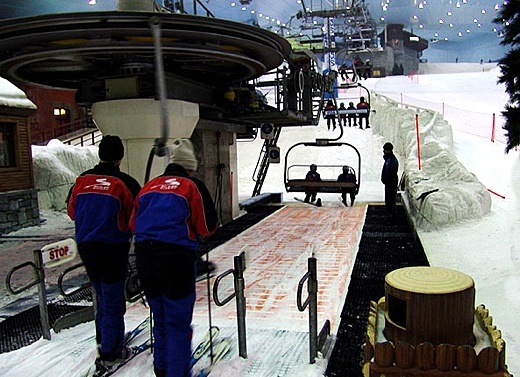
 Image above: Chairlift at indoor ski slope in Dubai. From (http://www.skidubai.com/ski-dubai/photos/).
 
Carl Jung and his physicist friend Wolfgang Pauli suggested in a too rarely read 1952 book that synchronicity—an "acausal connecting principle," to use Jung’s carefully phrased description—brought events that occur at the same time into a relationship of unexpected meaning. Whether or not they were right in general, there are times when synchronicities arrive with all the subtlety of a cold wet mackerel across the face, and last Friday was one of those.

That afternoon, after a busy couple of weeks centered on the hundredth anniversary of the Druid order I head, I finally had the spare time to put my feet up and do some reading, and the book at the top of the stack was James Howard Kunstler’s latest, Too Much Magic: Wishful Thinking, Technology, and the Fate of the Nation.

Anyone who’s read Kunstler’s previous work will no doubt already be guessing that Too Much Magic is lively, curmudgeonly, and highly readable, as indeed it is. It’s best described as a seven-year update to his bestseller The Long Emergency, and its message is stark: the storm is upon us.

Then, not long after I finished the book, the storm really was upon us.
Meterorologists can tell you exactly what it was that sent a wall of powerful thunderstorms a couple of hundred miles wide sweeping eastwards across the Rust Belt from Wisconsin straight to the Atlantic coast, leaving chaos in its wake. Here in Cumberland, we noticed the haze thickening in the west toward late afternoon, taking on that drowned murky look that everybody locally recognizes as a warning of bad weather on the way.

By nightfall, lightning was going off like flashbulbs at a 1950s press conference, and about a quarter to nine, hurricane winds and sheets of rain struck as suddenly as though somebody had flipped a switch. The winds and the rain pounded us for an hour or so, and then gradually faded out; the lightning kept flashing for another hour or so after that.
Like the smartest of the three little pigs, Sara and I had provided ourselves with a brick house, one that was built well before the post-Second World War vogue for cheapjack building methods that Kunstler has rightfully excoriated in several of his other books.

We got by without any real damage—granted, the big mulberry tree out back dropped a half ton or so of limb onto our driveway, but since we don’t own a car, all it did was scare the bejesus out of the local woodchucks. We lost power, but since we don’t use a lot of electricity anyway, that wasn’t a huge problem; we had a late dinner by candlelight, and then broke out the hand-cranked LED lamps and spent the rest of the evening by their light. By morning we had power again, but if we hadn’t, it would not have been a great inconvenience.

Yes, I’m including the lack of air conditioning in that. Cumberland gets hot and humid in the summer, but Sara and I don’t use air conditioning; that was a deliberate decision of ours, when we moved here three years ago. Human beings evolved in an equatorial zone, without air conditioners, and billions of us get by in very hot climates without them today; given the opportunity to adapt, the human body can handle hot and humid conditions easily. Of course the opportunity to adapt is precisely the issue here.

I have immense sympathy for the people who found themselves suddenly evicted from air-conditioned comfort into the subtropical heat of a mid-Atlantic summer; if I hadn’t spent three years getting used to an unfamiliar climate, researching and relearning the skills that people here once used to get through summers in relative comfort, and making use of features built into a house that dates from long before air conditioning and was designed to be livable without it, I’d be miserable too.

It’s arguably high time that more people began acclimatizing themselves to a world in which they can’t simply turn on the air conditioning any time it gets hot and muggy. In a broader sense, that’s the core message of Kunstler’s book. Since the end of the Second World War, most Americans—and, to be sure, a fair number of people in other countries—got used to being able to call upon practically unlimited amounts of cheap energy to do, well, just about anything they happened to want, so long as somebody else could make money off it.

Strawberries in winter? No problem; we’ll just fly them in from the other side of the planet. Rocks from the Moon? Easily done, since all it takes is nearly unimaginable amounts of energy. Cold dry air indoors in August? Sure thing; we can just throw some gigawatts at it. In the phrase Kunstler uses, we’ve all gotten far too used to getting things done by magic.

Regular readers of this blog will be expecting me to quibble about his use of that last word, and indeed I will. Let’s save that for a bit, though, because what Kunstler is saying here deserves attention. The sort of magic he’s talking about is the kind you find in fairy tales and The Thousand and One Nights, not to mention an endless stream of shoddy fantasy novels and Hollywood extravaganzas churned out more recently, and the factor that defines it is that the people who use it never have to worry themselves about how it works.

Consider the old story of Jack and the Beanstalk. All Jack has to do is plant the magic beans; he doesn’t have to figure out how they’re going to produce all that plant tissue overnight, so he can climb into the sky the next morning. For that matter, he doesn’t have to figure out how the giant’s castle stays up there in the sky, violating the laws of medieval and modern physics alike. He doesn’t have to do much or understand anything; it all just happens. That’s the sort of thing you get when the elegant symbolic narratives of an earlier age get dumbed down, stripped of their interpretive context, and relegated to the nursery.

To be fair, many of them had been there all along, for good reason. Most societies that haven’t gotten around to writing, and a good many that have, teach their children by telling them colorful stories, and then teach their adolescents a good deal more by explaining to them what the stories they learned and loved as children actually mean.


Since the end of the Renaissance and the abandonment of the lively sense of the symbolic that permeated medieval and Renaissance culture, only the first half of the equation remained in the Western world; the stories themselves were retained for a few more centuries out of a vague sense of nostalgia, until they were finally pushed aside in our era by shoddy mass-marketed consumables whose only meaning or lesson is that somebody wanted to make a fast buck.

I’ve come to think, though, that the rise of modern technology over the three centuries since the dawn of the industrial revolution was guided, in no small part, by the lingering echoes of these old stories. No law of nature or of human nature required us to use the gargantuan treasure of nearly free energy we took from the Earth’s carbon stash in precisely the ways that we did, after all.


Some of the things we did with all that energy packed enough of an economic or military advantage that it was a safe bet that they’d be tried, no matter what stories were rattling around the crawlspaces of the western world’s collective psyche, but that’s hardly true of all. Visit a large department store sometime, go up and down the aisles, and ask yourself: how many of the things for sale there imitate some detail in a fairy tale?
The magic garments and ointments and jewels that turn serving girls into beautiful princesses, the magic boxes that bring summer in winter and winter in summer, the magic boats that sail under the waves and the magic birds that carry people through the skies, even the beanstalks of smoke and flame that took a modest number of space-suited Jacks (and a very few Jills) up through the clouds to look, unsuccessfully, for a giant’s palace—we’ve got them, or more precisely, we think we’ve got them. In point of fact, what we’ve got are simulacra of these things, the nearest approach to them that you can get by throwing terawatts of energy and the raw materials of an entire planet at them, which in most cases is not actually that close.

In a brilliant passage in Where the Wasteland Ends, a book that has lost none of its relevance or power forty years after its publication, Theodore Roszak compared the dream of flying to the tawdry, tedious experience of air travel. He was writing at a time when airlines still boasted about the quality of their in-flight meals and the leg room their passengers could enjoy on the flight, and when airports were not yet quite so reminiscent of medium-security prisons, complete with armed guards herding inmates toward the confinement that awaits them. Nowadays?

 A ride in a New York subway is more inspiring, not to mention more comfortable. The same is true, by and large, of the other simulacra of fairy-tale magic that surround us these days: we may be able to get strawberries in winter, like the little girl in the Brothers Grimm story, but they’ve been picked green, artificially ripened with ethylene, and squirted with imitation strawberry fragrance, and they taste like mildly sugared sawdust.

 
That is to say, the fake magic that clutters up our lives today doesn’t satisfy the needs it claims to fulfill. We all know this. We’ve all had our faces rubbed in it as long as we’ve been alive, starting with those childhood Christmas presents that looked so enticing in the store and turned out to be so bleakly vapid once the artificial glow of emotionally manipulative marketing wore off them, and extending straight through the upcoming election, which will inevitably be packed with rhetorical bluster about hope, change, and other vacant buzzwords destined to be discarded in favor of four more years of business as usual the moment the polls close.


We all know this, and yet so many of us keep chasing after the latest shiny simulacrum, like greyhounds on a racing track in hot pursuit of a mechanical rabbit they’ll never catch and couldn’t eat if they did.

That futile pursuit of fake magic is a central theme of Kunstler’s book. It’s on display most memorably, perhaps, in his encounters with Google employees who insist that the Long Emergency can’t happen because, like, we’ve got technology, or with the TED conference attendees who flocked to hear the latest rehash of that weary 1950s fantasy, the flying automobile. (I’m asked now and then whether I’ve been invited to give a talk at one of the TED conferences.


I haven’t, and I don’t expect ever to get such an invitation; any audience that can be entranced by jabber about flying cars will pretty much by definition not be interested in anything I have to say.) rom vertical farming aficionados whose skyscraper-centric vision ignores the rising spiral of factors that are turning skyscrapers into an obsolete architectural form, to green energy wonks who can’t imagine why a society in freefall might not be able to scrape together the resources required for their favorite gargantuan construction program, right up to Ray Kurzweil, the computer geek’s Harold Camping with high-tech Rapture prophecy to match, Kunstler spends much of the book exploring the ways in which wishful thinking founded on a debased, fairy-tale image of magic has come to replace reasoned thought in contemporary American culture, to our immense peril.

Last Friday’s storm, again, was a useful lesson in the nature of that peril. Behind the magic boxes that keep the heat of summer away stands a huge and hypercomplex system of power plants, transmission lines, transformers, and the whole suite of services and social structures that go into keeping the system running.


None of it can be dispensed with, and none of it comes cheap, but it’s only when something pops up on the far end of the probability curve and knocks the system silly that most people are forced to notice that the whole thing doesn’t work by fairy tale magic—and even then a great many of them spend their time complaining because the relevant authorities can’t make the magic pop back into being overnight, like Jack’s beanstalk from those magic beans.


The slow shredding of the infrastructure that makes the magic possible rarely enters into the collective conversation of our time, and the logical consequence of that process—the statistically inevitable point at which, for each of us in turn, the magic goes away once and for all—goes not merely unmentioned but unimagined.

Still, that’s where we’re headed. We haven’t yet reached the point at which people in outlying areas whose homes lose electrical power in a storm are quietly informed that they will have to pay the full cost themselves if they want power back, or told that they’ve been put on a list and it may take weeks or months or years before their turn comes up. Still, given the increasingly long delays in restoring power after increasingly frequent weather-related disasters—well, the Bob Dylan line is inescapable: you don’t need a weatherman to know which way the wind blows.


The same wind from a different quarter is blowing through the lives of all those jobless Americans who are losing their unemployment benefits and dropping off the far end of the nation’s joblessness statistics; nonpersons in very nearly an Orwellian sense, they’ve been tossed out of our imaginary happy land of fake magic into a harsher world. That world is waiting for the rest of us, too, and we’ll each arrive there sooner or later.

Getting ready for that harsh transition, it seems to me, is one of the crucial tasks facing any thoughtful person in our time. It’s not going to be easy, quick or cheap, and a great many of those people who are busy finding reasons why they should cling to their fake magic just that little bit longer are, I’m afraid, going to find it very awkward to discover that the time they spent doing that would have been better spent acclimatizing themselves to the post-fairy tale world.

One of the more useful tools for that task, as I’ve suggested more than once in these essays, is magic—the old art and science of causing change in consciousness in accordance with will, the stuff that I wrote about in my recent book The Blood of the Earth, the stuff that the fake magic of wand-waving movie stars is meant to imitate. It’s not the only important tool that will be needed, to be sure, but it has something significant in common with every one of the other things that belong on that list: they all require hard work. You can’t just plant some magic beans in the garden and expect someone or something else to make things happen.


 You can’t wait for the authorities to take care of it, because they won’t; you can’t wait for some inventor somewhere to solve the problem for you, because it’s not a problem that can be solved, and the inventors are too busy daydreaming about flying cars to get around to it anyway; you can’t wait for the Rapture or the Singularity or the space brothers or something to make it all go away, because it’s only modern culture’s monumental sense of entitlement that makes people think that some supernatural agency is going to come at a run to bail them out of the consequences of their own actions.

That is to say, if you’re waiting for any of these things, you’re relying on the wrong kind of magic.
Now there are plenty of things that individuals can do right now to make it easier for themselves, their families, and their communities to make the shift to what I’ve called the post-fairy tale world.

I wish Kunstler had put a little more of his book into talking about those options; it’s important to try to shake people out of the delusion that everything’s going to be just fine if we just have faith in progress or what have you, but it seems to me that it’s at least as important to give those who do wake up some alternative to the paralyzing despair that comes so easily to those who have been taught all their lives that the only alternative to business as usual is misery and mass death.

Even so, Too Much Magic is a useful glance across the topography of the postpeak world in which we now live.


.

Bringing it down to Earth

SUBHEAD: There is manipulation of our desperate craving to have the lifestyle we think we are owed.  

By John Michael Greer on 23 November 2011 for the Archdruid Report - (http://thearchdruidreport.blogspot.com/2011/11/bringing-it-down-to-earth.html)

   
Image above: Banquet brand turkey TV dinner ad. Just because they say so doesn't mean you really want it. The copy reads "Ye Indians are hungry tonight! Be a friendly Pilgrim and serve your little tribe a real turkey dinner." From (http://www.flickr.com/photos/shaman683/4129827681/lightbox/).

We’ve covered a lot of ground in the last two months or so, and at this point I want to summarize the territory thus explored and link it back into the core of this blog’s project—the search for a realistic understanding of the troubled future ahead of us, and a meaningful way to respond to it.

One crucial part of that response, I’ve suggested, relates to that tangled realm where consciousness meets the unconscious drives that shape so much of our experience of the world: a realm that contemporary thought addresses, however incompletely, through the science of psychology, and that the older lore of magic approaches in a much more comprehensive and potent way.

That latter lore is only one part of the toolkit we’re going to need to deal with the storms to come, but it’s an important part, and it’s well suited to deal with issues most of today’s proposals for the future leave unanswered.

Much more often than not, peak oil, anthropogenic climate change, and most of the other symptoms of our civilization’s head-on collision with planetary limits to growth are treated as technical problems that can be addressed with technical solutions.

Bookshelves around the world have accordingly been piled to the breaking point with proposed technical solutions.

Some of them are basically handwaving, others are attempts to shill for one or another industry or political movement, but a fair number are serious proposals that could do at least some good if they were put into effect.

The difficulty, as I’ve discussed in previous posts, is that none of these plans are being put into effect, and there’s no good reason to think that any of them will be.

Quite the contrary: by and large, modern industrial civilization is moving the other way, following the same trajectory of overshoot that has terminated the history of so many other civilizations.

What’s more, we’re not being dragged down that road, or forced along it by the pressure of circumstances; by and large, we’re going that way with whoops of enthusiasm.

When the United States abandoned its last real attempt to head in the other direction, in the early 1980s, the collective sigh of relief must have been audible on the Moon, and anyone who didn’t join in the stampede along the road to overshoot—and I can speak here from three decades of personal experience—came in for a spectrum of nasty responses, ranging from spluttering abuse to scornful pity, from pretty much anyone else who noticed.

That is to say, it’s not the technical dimension of the predicament of industrial society that matters most just now. It’s the inner dimension, the murky realm of nonrational factors that keep our civilization from doing anything that doesn’t make the situation worse, that must be faced if anything constructive is going to happen at all.

n a civilization that’s spent the last three and a half centuries trying to pretend that this inner dimension doesn’t matter, it was a foregone conclusion that most people’s inner lives would end up an unholy mess.

 It doesn’t help matters at all that plenty of political, economic, cultural, and religious interest groups, some of them with prodigious resources at their beck, have put a very large fraction of those resources into schemes to manipulate people’s minds using any number of nonrational hot buttons, in order to maximize their own wealth and power.

An effective response to this predicament, as I’ve proposed here, involves several unfamiliar steps.

The first of them is to get out from under the collective thinking of our society and the manufactured popular pseudoculture that holds that collective thinking pinned firmly in place in the minds of most people, so you can make your own decisions about what goes into your mind, instead of letting huge corporations ante up millions of dollars to choose for you. (It still amazes me how many people never wonder why what appears on TV is called "programming.")

This is a challenging task, made even more so by the blank incomprehension and active hostility of those who are still down there in the belly of the beast, but the payoff is worth it.

The problem with thinking thoughts that you’re told to think by others, after all, is that the people who tell you what to think are doing it for their own advantage, not for yours; think your own thoughts, and doors open before you that the thoughts you’ve been told to think are meant to keep tightly shut. The second step is to learn how to get along with the nonrational side of your own inner life.

There are any number of ways to do that; various schools of psychology, philosophy, religion and magic all have their own toolkits for this kind of work, and what appeals to one person is certain to repel somebody else.

I’ve discussed a handful of useful mental tools, drawn mostly from one tradition in which I’ve had some training, and they may be enough for those readers who don’t feel any attraction to the more intensive work on offer from the schools just mentioned.

Those who do feel such an attraction can find more detailed guidance in whatever tradition they choose to study and, more importantly, to practice. These two steps provide the neglected mental dimension that’s so often missing in attempts to deal with the future bearing down on us.

Without them, with weary inevitability, proposals for change end up gathering dust on the overloaded bookshelves already mentioned, if they don’t simply mutate into yet another excuse for business as usual. Einstein’s famous dictum—"We can’t solve problems using the same kind of thinking we used when we created them"—is true, but it’s only part of the whole picture.

You can change your thinking all you like, but if you don’t deal with the nonrational factors that drove your previous thinking, your brand new thoughts are going to head in the same old directions.

Only if you distance yourself from the thaumaturgy that predetermines so much human thinking, and then come to grips with the mental automatisms and unthinking reactions within yourself, that you can pick the locks on what Blake called "the mind-forg’d manacles" and choose your own path.

Once all this is done, though, there’s a third step, which consists of bringing the work you’ve done down from the realm of mental phenomena into the realm of everyday life.

That’s an essential element of magical practice, by the way; it’s a core teaching of the old occult philosophies that your magical work, however deep it may reach into the innermost realms of consciousness, has to be brought all the way down to earth, and anchored right here in the world of matter by an appropriate action on what occultists like to call the material plane.

Put more simply, in magic as in anything else, it’s necessary to walk your talk, or the talk dries up into excuses and goes rolling away like tumbleweeds in the wind.

One question that needs careful consideration, though, is how to walk the talk we’ve been discussing over these last few months—or, to put the thing in more explicitly magical terms, how to choose an appropriate anchor for the movement of consciousness I’ve tried to set in motion in the last two months of blog posts. The careful consideration is essential here for several reasons, but the most important of them is that contemporary culture is well stocked with bad advice on this subject.

Thus it’s a very common notion, when the issue of walking your talk comes up, to think that it’s enough to engage in activism—in other words, to walk your talk by insisting that the government, or the big corporations, or other people in general, get out and walk theirs.

 Activism has its place, to be sure, and potentially an important one, but activism only matters if the people who are doing it have already followed Gandhi’s advice and become the change that they wish to see in the world.

When that first necessary step doesn’t happen, activism fails. Those of my readers who have watched the self-destruction of the climate change movement have already seen how far activism gets when the activists show no signs of accepting the limits that they hope to impose on others.

Beyond that, there’s another problem with activism in this context, which is that it amounts to demanding that somebody else do something.

There are times when this is an entirely appropriate thing to do—when, for example, it’s precisely the actions or inactions of a government or a corporation that need to be addressed.

Not all the difficulties that beset a modern society come from such causes, though, and when a problem is actually being caused by habits of thought and action that are shared by everyone—even when some people engage in them more, or more profitably, than others—trying to make a handful of the worst offenders take the blame for everybody is not an effective strategy.

 Nor is it any more helpful to insist that a few people, however rich and powerful they may be, are to blame for changes that have their origin in factors entirely outside of human control.

The Occupy Wall Street protests that are still struggling gamely on as I write this, despite a rising tide of police repression, have fallen into both these latter traps.

Though the culture of larceny that defines Wall Street these days amply deserves criticism—not to mention the legal charges of racketeering and fraud that the Obama administration has steadfastly refused to file, even in the cases that most stridently call for it—the misbehavior of bankers and stockbrokers doesn’t actually have that much to do with the decline of the American economy that has deprived a great many of the OWS protesters of the chance to earn a living.

Central to that decline is, first, the unraveling of the American global hegemony that, until recently, funnelled some 25% of the world’s energy resources and 33% of its raw materials and industrial product to the 5% of humanity that lives in the United States; and second, the ongoing depletion of those same energy resources and raw materials, which is ending the abundance that made the American lifestyle of the 20th century possible in the first place.

No amount of protesting is going to refill the once vast and now mostly depleted reserves of cheap oil and other resources that gave America its age of extravagance, nor is protest going to do anything to stop the decline of America as a world power or the rise of competing powers.

Blaming the results of both these processes on the manifold abuses of Wall Street is not going to help the situation noticeably—though seeing bankers and stockbrokers doing perp walks through the streets of Manhattan might do a little to restore public faith in the rule of law, which has taken quite a beating in recent years.

Most Americans, ignoring these realities, still insist they are entitled to a standard of living that neither their country’s faltering position in the world, nor the hard facts of physics and geology, will enable them to have for much longer, or get back if they’ve already lost it.

Until that sense of entitlement gives way to a more realistic set of expectations, nothing is going to solve the problem Americans think they have—that of finding a way to hang onto hopelessly unsustainable lifestyles—and nothing is going to be done to deal with the predicament Americans actually face—that of dealing with the end of abundance in a way that doesn’t finish shredding the already frayed fabric of our society.

Any attempt to walk the talk that we’ve been discussing here, in other words, has to begin with the individual, and has to start with the acceptance of a very significantly lowered standard of living.

To return to an acronym I’ve proposed here already, any response to the future that doesn’t involve using LESS—Less Energy, Stuff, and Stimulation—simply isn’t a serious response to the downside of the industrial age. The toolkit of the Seventies organic gardening and appropriate tech movements, which I’ve discussed here at some length, is among many other things a very effective way of responding to the need to use LESS in a humane and creative manner.

By growing a garden and raising chickens in your backyard instead of buying packaged and processed vegetables and eggs that are shipped halfway across the continent, conserving energy relentlessly and getting as much as you can from local renewable sources, and sharply downscaling the pursuit of material excess in favor of a life that’s rich in experiences, relationships, and meaning, it’s possible to get by very comfortably on a small fraction of the energy, stuff, and stimulation that most Americans think they need.

This isn’t simply a good thing on abstract grounds, though it is that.

On the individual scale, such steps provide a margin of safety in hard times that the ordinary American lifestyle simply doesn’t have; on the community scale, those who embrace such steps are positioned to act as role models and mentors for those who decide to make the same changes later on, when the advantages of doing so are likely to be much more evident; on the wider scale, even a very modest movement in this direction, amidst the widening failure of the political and economic mainstream to do anything worth noticing in the face of the widening crisis of our time, might just possibly fill the role of a seed crystal around which a much larger movement could take shape.

Seen from another perspective, though, these practical steps also have a magical dimension: they serve to bring the changes in consciousness we’ve been discussing for the last two months all the way down into the world of everyday life.

To complete the task of breaking away from the murky thinking and the tangled nonrational drives that dominate contemporary life in today’s America, it’s necessary to break away from the lifestyles and everyday choices that are produced by that thinking and those drives.

Mind you, the same equation works the other way around: to make the break away from lifestyles that demand energy and resource flows we can’t count on getting for much longer—and making that break is perhaps the most essential task of the decade or so immediately before us—it’s going to be necessary to turn away from the thinking patterns and the unmentioned and usually unnoticed passions that make those lifestyles seem to make sense.

The recognition that these two transformations, the outer and the inner, work in parallel and have to be carried out together is the missing piece that the sustainability movements of the Seventies never quite caught.

Significant steps were taken toward that discovery; books such as Gregory Bateson’s Mind and Nature and E.F. Schumacher’s A Guide For The Perplexed lay out much of the groundwork from which an analysis of the sort I’ve been suggesting in these essays could have been built.

Some of the less intellectually vacuous movements in the alternative spirituality scene of the time were moving in the same direction from the other side of the equation.

Still, it never quite came together; the engineers were too dismissive of the occultists, the occultists were too suspicious of the engineers, and when the Reagan administration came into power and hit the entire movement at its most vulnerable point—the flows of government and foundation grant money on which nearly all of it, appropriate tech engineers and New Age theorists alike, had become fatally dependent—the chance at that recognition went by the boards. That could happen again.

I’ve suggested more than once that the troubles looming ahead of us in the near term may well open a window of opportunity for the same kinds of effort toward sustainability that we had, and then lost, in the wake of the energy crises of the Seventies.

If something of the sort does happen, once the immediate crisis is out of the way, there will inevitably be a backlash, and that backlash will likely wield the same tools of thaumaturgy that were turned on the appropriate tech movement in the early 1980s with devastating effect.

Good intentions and idealism, it bears remembering, are not an adequate safeguard against systematic manipulation of the mass mind, especially when that manipulation moves in parallel with the desperate craving of a great many Americans to have the lifestyles they think they deserve and ought to get. Meeting a challenge on that scale is a tall order.

Still, any movement faced with a backlash of that kind can accept its short term losses, renew its commitments to its values and vision, keep on going straight through the initial waves of negative publicity, and carve out a niche from which it can’t be dislodged, and pursue a long-range strategy, knowing that the tide will eventually turn its way.

With a few worthy exceptions, that didn’t happen in the twilight years of the early Eighties, but many other movements of many kinds have done it, and a noticeable number of them have passed through that stage and gone on to accomplish their goals.

Whether green wizardry or the broader peak oil movement reaches that last milestone is up to the future; for the time being, though, while it’s vital that we be ready to respond if a window of opportunity does open for us, it’s even more vital that when the backlash comes, as the

Who put it, we won’t get fooled again.
.