Showing posts with label Protest. Show all posts

Hawaiians fight Mauna Kea telescope

SUBHEAD: Native Hawaiians say "If not now, when will we stand to protect our sacred lands?" 

By Amy Goodman on 22 July 2019 for Democracy Now!-
(https://www.democracynow.org/2019/7/22/mauna_kea_thirty_meter_telescope_resistance#transcript)
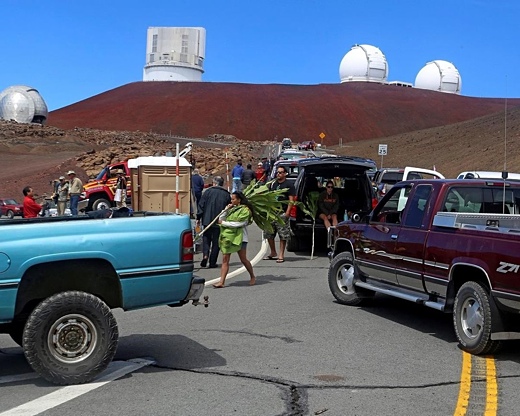

Image above: From the Honolulu newspaper The Star labeled "Hawaiian activists prepare convoys ton convoys to proposed telescope site. From (https://images.thestar.com/nOL4rf4iZSFiR1QqCmEx-tahjR8=/1086x869/smart/filters:cb(1563118201053)/https://www.thestar.com/content/dam/thestar/news/world/us/2019/07/14/hawaiian-activists-prepare-for-mauna-kea-telescope-convoys/HIHIO301-413_2018_164051.jpg).

A historic indigenous resistance is unfolding on the Big Island of Hawaii, where thousands have descended on Mauna Kea, a sacred Native site, to defend it from the construction of a $1.4 billion telescope.

Scientists say the Thirty Meter Telescope will help them peer into the deepest corners of space, but indigenous resisters say the construction was approved without their consent and will desecrate their sacred lands.

Last week, police arrested 33 people — most of them Hawaiian elders — as they blocked a road to prevent work crews from reaching the site of the telescope being planned atop Mauna Kea.

And on Sunday, demonstrators reported that more than 2,000 people had gathered at the access road to stop construction. We speak with Pua Case, an indigenous organizer and activist defending Hawaii’s Mauna Kea.

TRANSCRIPT

AMY GOODMAN: The Filipino-Hawaiian musician Kalani Pe’a, who’s been at the protests that we’ll be talking about now. This is Democracy Now!

I’m Amy Goodman, as we go to Hawaii’s Big Island, where growing protests are heading into a second week against the construction of a massive telescope on top of Mauna Kea, a dormant volcano, sacred Native site, that’s become a flashpoint of indigenous resistance.

On Sunday, demonstrators reported more than 2,000 people had gathered at an access road to stop construction on Hawaii’s highest peak from starting.

Last week, police arrested 33 people, most of them Hawaiian elders, as they blocked a road to prevent work crews from reaching the site of the Thirty Meter Telescope being planned atop Mauna Kea.
HAWAIIAN ELDER: We have a right to worship god in the environment of our belief. Respect it!
AMY GOODMAN: Just hours after the arrests, Hawaii’s Democratic Governor David Ige signed an emergency order granting police more power to clear the way for construction equipment.
GOV. DAVID IGE: This afternoon, I signed an emergency proclamation for the situation on Mauna Kea. Since Monday, protesters have illegally occupied roads and highways. … We do believe that this emergency proclamation gives law enforcement the additional tools that they need to continue to work to keep the people safe.
AMY GOODMAN: Activists say construction of the telescope was approved without consulting the local Native community. The protests build on decades of indigenous resistance in Hawaii. This week, the Hawaii County Council plans to vote on a resolution, quote, “strongly urging” Governor Ige and Mayor Harry Kim to honor a request for a 60-day moratorium on the construction.

For more, we go to Hawaii’s Big Island, where we’re joined by Pua Case, an indigenous organizer, one of the leading activists defending Hawaii’s Mauna Kea.

Welcome to Democracy Now! It’s great to have you with us, Pua. If you can describe for us where you are and just tell us what is happening? Who is building, or attempting to build, this telescope? And why are the indigenous people of Hawaii so concerned?

PUA CASE: Aloha Mai Kako. ‘O Pua Case ko’u inoa. ‘O Mauna a Wakea ko’u mauna.Aloha, everyone. My name is Pua Case. Mauna Kea is my mountain. I’m reporting from a hunter’s check-in station, at a place called Pu’u Huluhulu, which is right across the street of the access road leading up to Mauna Kea.

Mauna Kea is a sacred mountain for us here in Hawaii. Mauna Kea is genealogically linked to the Native people of these lands. Mauna Kea is known as our kupuna, our ancestor, our teacher, our protector, our corrector and our guide.

And so, for the last 10 years, we have held off the project of the building of an 18-story telescope on the top of our mountain, near the summit, on a pristine area called the northern plateau, over our water aquifer and the source of water for much of this island.
Those who are partnering in this project are Canada, China, India, Japan and the United States in the area of California, with the largest single donor being the Gordon and Betty Moore Foundation in Palo Alto.

So, why we are standing for this mountain is quite simple, Amy. And thank you for having me on the show. If I could put it very simply, I would say, if we don’t stand for the most sacred, what will we stand for? And if not now, when will we stand?

So, we are making a stand as not just Native people and not just the local community, but really a worldwide community, because there are so many similarities. There are Native people everywhere around the world standing for their mountaintops, for their waters, for their land bases, their oceans and their life ways. We are no different than them.

But because Mauna Kea is the highest mountain in the world from seafloor, and, spiritually speaking, there are reasons that Mauna Kea is connected to many different mountains around the world, and the integrity and the essence of water in our spirituality, is why we must not allow 18 stories to be built on the northern plateau of our mountain.

It is the one too many and the one too big. And we have said no for the last 10 years and have been successful so far in stopping the project.

AMY GOODMAN: Now, the foundation gave money to Caltech, is that right, Pua?

PUA CASE: Yes, it is.

AMY GOODMAN: And who was consulted? Why do they have rights to this mountain?
PUA CASE: The university —

AMY GOODMAN: There are other telescopes there, is that right?

PUA CASE: Yes, there are other telescopes on the summit of the mountain. The University of Hawaii has the lease on the summit of the mountain until 2033. So, from the late 1960s, there have been smaller telescopes built on the mountain. And, you know, Amy, you have to understand, and I’m explaining to the world community right now, it would take a whole semester course to try to explain why 13 telescopes are now sitting at the top of the mountain.

What I can say is that for many of our people, my grandparents’ generation and my parents’, as well, you know, there comes — in that time period, you don’t even know if you have the ability to stop something like that. We were in a time period where people would say, “Oh, they’re just going to build it anyway.”

And a lot of times, we were not even aware that building was occurring on the summit. And so, for a lot of different reasons, 13 telescopes sit on the summit of Mauna Kea.

The 18-story Thirty Meter Telescope cannot possibly fit on the mountain. The desecration, the construction and the destruction of the northern plateau is just something that cannot be allowed on our sacred mountain. As I said before, it’s the one too many and the one too big.

So, what I will say is, the University of Hawaii initiated the permit on behalf — the permit application on behalf of the countries, because most of the countries are already up on the mountain in those 13 other telescopes. Only China and India are not on the mountain at this time.

AMY GOODMAN: We heard that the National Guard might be called in. You have the Hawaii governor, David Ige, issuing an emergency order granting police more power to clear the way for construction equipment. He says that the protesters are dangerous. Can you talk about what you expect to happen today? First, I want to go to an activist speaking last week during a news conference.

PUA CASE: Sure.
KAHO’OKAHI KANUHA: And I reaffirm to each and every maka’i, each and every police officer, each and every individual who’s going to come and attempt to get us out of the way, we will stand, and we will stand in Kapu Aloha. We are committed. We are absolutely committed to peace, peaceful protest, nonviolent action. We are not wavering from that. And so, to the maka’i, I ask you folks to make that same commitment, because you guys are not my enemy. None of you are my enemy. Our enemy is this illegal occupying state, that continues to deny the rights of Kanaka, who continue to treat us as a nonexistent, dead people. Eka Lahui, are we dead?
PROTESTERS: A’ole
KAHO’OKAHI KANUHA: Are we dead?
PROTESTERS: A’ole!
KAHO’OKAHI KANUHA: We’re alive.
AMY GOODMAN: That, an activist at a news conference last week. So, talk about the governor’s charges and also where the Honolulu mayor stands.

PUA CASE: That young activist is one of our organizers. That’s Kaho’okahi Kanuha. And his words exemplify the stance that we were taking on the day that the law enforcement came in to the access road area.

And what I want to preference — preface this with is, who would ever think — and that’s what I spoke to the maka’i, or the law enforcement, about as they stood there, some of them in full riot gear with their batons, many of them either our relatives or Native Hawaiians, who are put in a very difficult position to have to stand there and possibly arrest us, and, certainly, the possibility of harm.

So, what I said to them that day was, who would ever think — who would ever think that in Hawaii, I, as a middle school teacher and just the daughter of ranchers that come from this area — and many of us, you know, we are just — we are mothers and fathers. We are aunties and uncles. We are elders, and we are youth.

And being so passionate about what is left of our culture, our sacred places and our life ways — that we would find ourselves standing in the middle of the street facing armed officers with only our Kapu Aloha, or the manner in which we stand, our code of conduct, integrity, standing in the way that our ancestors would expect and command of us, in nonviolence, no resistance, facing our relatives. And so that that in itself is very difficult.

So, Governor Ige, our governor, did issue a state of emergency at the end of that day, after 33 of our elders were arrested because they had made a stand, and they are still sitting in those chairs ’til today, make a stand to block that access road, because that is the only way that the machinery will be able to go up the mountain. So, what I want to —

AMY GOODMAN: Pua, I wanted to —

PUA CASE: — have — yes?

AMY GOODMAN: I wanted to read from the Honolulu Star-Advertiser, the local paper.
PUA CASE: Sure.

AMY GOODMAN: It says, “The Gordon and Betty Moore Foundation in 2007 committed $200 million to the California Institute of Technology and the University of California toward TMT’s construction. Gordon Moore is a leader in the semiconductor industry and co-founder of Intel Corp., creator of the world’s first microprocessor.”

You have what happened yesterday at Standing Rock, the Standing Rock Sioux tribal members gathering at the epicenter of the Dakota Access pipeline to show solidarity with you, with Native Hawaiians, who are opposing the construction of this huge telescope at Mauna Kea. Can you compare what’s happening right now to what took place in Standing Rock? Do you see similarities?

PUA CASE: You know, I certainly can, because I was at Standing Rock twice. And so were a large number of our people here. When Standing Rock occurred, we already had a relationship with the leadership of both Sacred Stone Camp and Standing Rock. And, in fact, the first day, when we took that stance, when the elders sat there and chose to block the road, the first caller that we had that morning to bless our day was LaDonna Brave Bull Allard.

So, we have a very close relationship to our relatives, because we are both standing for what is sacred: water. We are standing for the water from our mountain, and they, of course, are standing for their water.

The similarities are astounding, some of them being you have a small space with a large amount of people that cannot help themselves but be there, because for those of us who are either struggling, who have lost so much, when we see the opportunity to assist and support relatives who are going through the same thing, we will do everything in our power to either be there or assist in some way from afar.

So, many, many of our relatives from Standing Rock have pledged to be here, if we put the call out. So, the camaraderie, the alliances, the networking and the relationships that you create when you stand on each other’s front lines is something that is binding. We make a commitment to each other.

Right now we have not put out that call, because we went from 30 people, when we started last Friday — we are up to about 3,000 people. So, at this point, we have not put a call out to anyone anywhere other than Hawaii. However, we are finding each day that relatives from all around the world are finding their way here, even though that call out has not been made.

AMY GOODMAN: And do you expect the National Guard to come out today?

PUA CASE: The National Guard is here, yes. When Governor Ige did issue the state of emergency that allowed for the deployment of the National Guard, we know that they have been flying in. We know that they are housed very close to where we are, because the Pohakuloa military base is just miles down the road.

I can’t tell you what will happen today, to be quite honest. It changes every second of the day. I’m not sure we are aware of what is going to happen. We just remain on alert. We remain vigilant, 24 hours.
We are actually located in a parking lot, which has become a sanctioned sanctuary and safe place for us, and along the sides of a road in lava fields.

So, that’s where we differ from Standing Rock. We don’t have the kind of infrastructure here to create a large camp, except to be right in the elements, in the lava, and in the parking lot across from the access road.

We know that the National Guard is here. We know that a large amount of law enforcement is here, as well. And again, I have to emphasize that we are people, just people. We are not trained. We are not armed. We come from all walks of life. We are Native people. We are local residents. We are visitors. But we have made a commitment.So, what I would like to share, just as an example of how it is here —

AMY GOODMAN: We just have 30 seconds, Pua.

PUA CASE: Oh, I’m sorry. So, what I would like to say, in ending, if we have 30 seconds left, is I want to thank the worldwide community for standing with us. And so, what we are asking is that you go to Actions for Mauna Kea Facebook page.

You can find all the information about us. Thank you to everyone around the world, and to you, Amy, for allowing us to voice what is happening here in Hawaii. We are proud people. We are standing for what we have left. And —

AMY GOODMAN: Pua —

PUA CASE: Mahalo.

AMY GOODMAN: Pua, I want to say thank you for joining us. I’d like to ask you to stay to the top of the hour to do Part 2 of this interview, where you can explain further why you are taking this stand. I want to thank you, Pua Case, indigenous organizer defending Hawaii’s Mauna Kea.

She is there at the access road with so many others, who are trying to prevent the Thirty Meter Telescope, or TMT, from being built at the summit of Mauna Kea, the largest mountain in the world, a volcano. Thank you so much for being with us from Hawaii.

See also:
Mauna Kea telescope protest - Ea O Ka Aina 2 April 2014
Ige listens to Hawaii - Ea O Ka Aina 8 April 2015
Education and the Mountain - Ea O Ka Aina 15 April 2015
Eight arrested on Mauna Kea - Ea O Ka Aina 10 September 2015
No permit for TMT on Mauna Kea - Ea O Ka Aina 3 December 2015

.
Google employees discuss protest

SUBHEAD: Some employees disturbed about the potential applications of a project for the military.

By Rebecca Klein on 1 June 2018 for Huffington Post -
(https://www.huffingtonpost.com/entry/google-maven-protests_us_5b119678e4b0d5e89e1fa730)


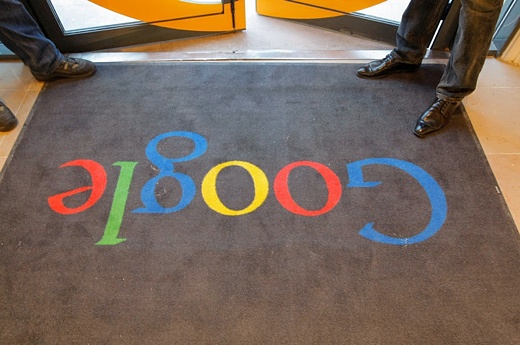
Image above: Door mat at Google entrance door. Photo by Jaques Brinin. From original article.

A small group of Google employees, in response to a company contract with a Pentagon-backed program called Maven, have discussed the idea of staging a protest at a conference in July. Employees fear that the project, which provides artificial intelligence tools to the military, could be used in fatal drone strikes.

The protest, as discussed in preliminary exchanges over Google’s internal communications platform, would take place at a Google Cloud conference in San Francisco, according to messages obtained by HuffPost and an interview with an employee.

More than a dozen Google employees have resigned over the project, according to Gizmodo, and thousands of employees have signed a letter protesting it.

Now Google employees are debating showing resistance in a more active way, through a potential demonstration.

Discussions regarding the possibility of a protest took place this week on an internal thread devoted to criticism of Maven. The thread, called “maven conscientious objectors,” includes hundreds of employees, but only a small percentage of those were active in the discussion.

The debate about staging a physical demonstration took place on Wednesday and Thursday and was started by a departing engineer. The employee called the project “the greatest ethical crises in technology of our generation” and suggested that “Maven protesters” go to the conference with the aim of “making some noise.”

The employee’s last day was Friday, but by late morning, someone from human resources had asked them to leave immediately due to their “recent statements” related to the conference. “As such, we’re going to move up your exit by a few hours and we’ve ended access, effective immediately,” the HR person wrote.

In response to the initial thread, another employee called the engineer an “agent provocateur.” Someone else said such an action would “be enough reason to fire us lot with popular support.”

The debate became heated and personal, with some employees questioning whether their colleague who originally suggested the idea of a physical protest should even belong in the “conscientious objectors” group.

But there were a few employees who supported the idea, calling the discussion “legitimate topics for this mailing list.” Another said that while they were not based in San Francisco and were thus unable to join the action, they personally thought the protest was “a good idea since it increases Google’s PR cost of getting involved in military projects.”

Representatives for Google did not respond to HuffPost’s request for comment. The Intercept reported Friday afternoon that Google will not renew its contract to work on Project Maven, though the company plans to work on the project through June 2019 and has not ruled out taking on similar work in the future.

This isn’t the first round of discord from Google employees. In an April petition to Google CEO Sundar Pichai protesting the Pentagon contract and signed by thousands, petitioners referenced “Don’t be evil,” Google’s famous former unofficial motto, as an argument for canceling the contract.

“This contract puts Google’s reputation at risk and stands in direct opposition to our core values. Building this technology to assist the US Government in military surveillance ― and potentially lethal outcomes ― is not acceptable,” the signers of the petition wrote.

Hundreds of academics subsequently wrote a letter to Google co-founder Larry Page, as well as Pichai and other company leaders, supporting the petitioning employees.

The academics expressed concern that Project Maven will help the military become “just a short step away from authorizing autonomous drones to kill automatically, without human supervision or meaningful human control.”

The letter also cited recent Cambridge Analytica scandals as demonstrating “growing public concern over allowing the tech industries to wield so much power.”

At a recent companywide meeting, Sergey Brin, one of Google’s co-founders, reportedly responded to a question about the project and addressed some of the controversies, according to The New York Times. Brin explained that he thought it was better for the world’s militaries to be partnered with an international company like Google, rather than nationalistic defense contractors.

The employee who started the discussion about protesting Google’s involvement with Maven implied on the thread that they gave notice due to a violation of their own ethical standards.

“The time to protest is now or never,” the employee wrote.

Are you a Google employee who wants to talk about your experience with Maven? Email rebecca.klein@huffpost.com.

.

Climate Change is legal defense

SUBHEAD: Minnesota Appeals Court rules climate activists can use a "necessity defense" in trial.

By Natashia Geiling on 23 April 2018 for Think Progress -
(https://thinkprogress.org/minnesota-climate-activists-necessity-defense-appeal-65d5399619cb/)


Image above: In front of the White House, on 22 August 2011, US Park Police officers arrest group of about 40 demonstrators protesting a tar sands pipeline. Photo by Chip Somadevilla. From original article.

Does climate change pose such an imminent threat to the planet that it’s okay to break the law in order to stop it?

Four climate activists currently awaiting trial in Minnesota for shutting off a tar sands pipeline think so — and on Monday, the Minnesota Court of Appeals agreed that they should be allowed to make that argument before a jury when their case goes to trial.

“This is a big win for anyone who cares about climate change,” Kelsey Skaggs, a co-founder of Climate Defense Project and a member of the defendants’ legal team, said in a press statement. 
“The climate necessity defense is an important tool for pushing back against efforts by the federal government and industry to silence opposition to the reckless development of fossil fuels.”
The climate activists who shut down the pipeline in Minnesota are part of a small group of protesters known as the Valve Turners, who each shut off a different pipeline across four states in a concerted protest on October 11, 2016.

The protesters involved were arrested and charged with criminal charges ranging from trespass to criminal mischief, and each has tried to use a climate necessity defense in court to argue that their actions were necessary to head off a more immediate threat (in this case, climate change).

In every state but Minnesota, judges have not allowed juries to acquit the Valve Turner defendants on the basis of necessity. That has lead to a mix of outcomes, from a conviction with jail time in North Dakota for one protester to a conviction with community service in Washington.

Last October, however, a Minnesota judge ruled that the activists could present a necessity defense — something that Michael Gerrard, director of the Sabin Center for Climate Change Law at Columbia University, described to Inside Climate News as “extremely unusual.”

The state of Minnesota quickly appealed that decision, arguing that allowing defendants to present evidence about climate change would have a “critical impact” on the case and severely undermine the prosecution’s odds at achieving a conviction.

The Minnesota appellate court, however, disagreed, ruling on Monday that the defendants could mount a necessity defense.

The Minnesota court’s decision, however, was not unanimous, with Judge Francis Connolly writing in his dissent that “this case is about whether respondents have committed the crimes of damage to property and trespass. It is not about global warming.”

Despite Connolly’s dissent, the Minnesota court’s ruling means that the climate activists will be allowed to call experts to testify about climate science and the consequences that inaction could pose for the world — facts that the activists argue will help strengthen their argument that shutting down the pipeline was necessary to avert the worst impacts of global warming.

As climate action remains stalled at the federal level, climate activists are increasingly turning to protest and civil disobedience to disrupt fossil fuel infrastructure projects around the country.

With those acts of civil disobedience on the rise, more defendants are turning to the climate necessity defense — and some are even seeing the technique yield successful results.

Earlier this year, for instance, a judge in Massachusetts found 13 pipeline protesters that were charged with trespass for disrupting pipeline construction in Boston not responsible on the basis of necessity — in other words, the judge ruled that the illegal actions taken by the protesters had been legally necessary due to climate change.

But the West Roxbury, Boston defendants only presented their necessity defense to a judge; the Minnesota trial will be the first time that climate activists are able to present a climate necessity defense to a jury. Arguing a case in front a jury often helps attract more attention, and can help move public opinion, more than simply arguing a case before a judge.

At the same time as climate activists are attempting to use necessity defenses to justify acts of civil disobedience, Republican lawmakers — supported by the fossil fuel industry — are seeking to impose harsher penalties for environmental protest in several states.

In Louisiana, Pennsylvania, and Minnesota — all states with controversial pipeline projects currently under consideration — lawmakers have recently introduced bills that would allow prosecutors to charge individuals for “conspiracy” if they are involved in the planning of a protest that includes a civil disobedience component like trespass, even if they ultimately don’t participate in the protest itself.

.

Louisiana snubs TigerSwan

SUBHEAD: The state won’t give the security firm that tracked DAPL opponents a license to operate.

By Nikhil Swaminathan on 20 July 2017 for Grist Magazine -
(http://grist.org/briefly/louisiana-wont-give-the-security-firm-that-tracked-dapl-opponents-a-license/)


Image above: TigerSwan mercenaries at Standing Rock were hired by the Dakota Access Pipeline to fight the indigenous Sioux and others protesting the construction of the pipeline. From (http://bsnorrell.blogspot.com/2017/05/intercept-exposes-tigerswan-mercenaries.html).

The state Board of Private Security Examiners rebuffed the North Carolina company known as TigerSwan, citing a legal complaint filed by a similar North Dakota agency charging that the outfit operated in that state without legal permission.

Fabian Blache III, the board’s executive director, said that Louisiana law governing the private security industry is designed to protect the state’s people. He said TigerSwan — which was denied a license in North Dakota twice — had not shown it could follow regulations.

Internal company documents obtained and reported on separately by Grist and The Intercept last month revealed the extent of TigerSwan’s surveillance operations during last year’s protests against the Dakota Access Pipeline.

Earlier this month, the Associated Press reported that Energy Transfer Partners said it no longer had a security presence on the ground in North Dakota, and TigerSwan said it had ended work with the Dallas-based pipeline developer at the end of June.

But apparently the firm was still seeking to work for Energy Transfer Partners in Louisiana, where the company is currently planning to build a 162-mile pipeline known as Bayou Bridge, which would shuttle refined crude oil to hubs in Texas.

That project, like Dakota Access, faces court challenges.
Regional advocacy groups pleaded with the Louisiana board to deny TigerSwan’s license, citing the type of intrusive surveillance reportedly employed by the company in North Dakota.

“TigerSwan follows people as if we were criminals,” said Anne Rolfes, founding director of the Louisiana Bucket Brigade. “We can disagree about the pipeline without resorting to such behavior.”

See also:
Ea O Ka Aina: No DAPL battle not over 6/15/17
Ea O Ka Aina: Defense contractors fought NoDAPL 5/27/17
Ea O Ka Aina: Tribes divest DAPL Bankers 2/13/17
Ea O Ka Aina: Veterans defending NoDAPL 2/11/17
Ea O Ka Aina: Army Corps okays DAPL Easement  2/8/17
Ea O Ka Aina: Trump orders go on DAPL EIS 2/3/17
Ea O Ka Aina: Water Protectors pipeline resistance 2/1/17 
Ea O Ka Aina: Force a full EIS on DAPL 1/27/17
Ea O Ka Aina: Missile launcher at Standing Rock 1/19/17
Ea O Ka Aina: Lockdown at Trans-Pecos Pipeline 1/10/17
Ea O Ka Aina: Standing Rock has changed us 12/9/16
Ea O Ka Aina: As Standing Rock celebrates... 12/5/16
Ea O Ka Aina: Army Corps denies easement 12/4/16
Ea O Ka Aina: My Whole Heart is With You 12/2/16
Ea O Ka Aina: The Loving Containment of Courage 12/1/16
Ea O Ka Aina: The Beginning is Near 12/1/16
Ea O Ka Aina: Feds to shutdown NoDAPL Camp 11/25/16
Ea O Ka Aina: NoDAPL people are going to die 11/23/16
Ea O Ka Aina: Hundreds of vets to join NoDAPL 11/22/16
Ea O Ka Aina: Obama must support Standing Rock 11/21/16
Ea O Ka Aina: Trump's pro oil stance vs NoDaPL 11/15/16
Ea O Ka Aina: Kauai NoDAPL Demonstration 11/12/16
Ea O Ka Aina: Obama to Betray Standing Rock 11/12/16
Ea O Ka Aina: Trump impact on Standing Rock 11/12/16
Ea O Ka Aina: Ann Wright on Standing Rock 11/8/16
Ea O Ka Aina: Turning Point at Standing Rock 11/6/16
Ea O Ka Aina: Jackson Browne vs DAPL owner 11/5/16
Democracy Now: Boycott of DAPL Owner's Music Festival
Ea O Ka Aina: World responds to NoDAPL protests 11/5/16
Ea O Ka Aina: NoDAPL victory that was missed 11/5/16
Ea O Ka Aina: DAPL hid discovery of Sioux artifacts 11/5/16
Ea O Ka Aina: Dakota Access Pipeline will leak 11/5/16
Ea O Ka Aina: Route of the Dakota Access Pipeline 11/4/16
Ea O Ka Aina: Sanders calls for stopping DAPL 11/4/16
Ea O Ka Aina: Obama hints at DAPL rerouting 11/3/16
Ea O Ka Aina: New military attack on NODAPL 11/3/16
Ea O Ka Aina: How to Support NoDAPL 11/3/16
Unicorn Riot: Tweets from NoDAPL 11/2/16
Ea O Ka Aina: Standing Rock & the Ballot Box 10/31/16
Ea O Ka Aina: NoDAPL reclaim new frontline 10/24/16
Ea O Ka Aina: How far will North Dakota go? 10/23/16
Ea O Ka Aina: Amy Goodman "riot" charge dropped 10/17/16
Ea O Ka Aina: Amy Goodwin to face "Riot Charge" 10/16/16
Ea O Ka Aina: Shutdown of all tar sand pipelines 10/11/16
Ea O Ka Aina: Why Standing Rock is test for Oabama 10/8/16
Ea O Ka Aina: Why we are Singing for Water 10/8/16
Ea O Ka Aina: Labor's Dakota Access Pipeline Crisis 10/3/16
Ea O Ka Aina: Standing Firm for Standing Rock 10/3/16
Ea O Ka Aina: Contact bankers behind DAPL 9/29/16
Ea O Ka Aina: NoDAPL demo at Enbridge Inc 9/29/16
Ea O Ka Aina: Militarized Police raid NoDAPL 9/28/16
Ea O Ka Aina: Stop funding of Dakota Access Pipeline 9/27/16
Ea O Ka Aina: UN experts to US, "Stop DAPL Now!" 9/27/16
Ea O Ka Aina: No DAPL solidarity grows 9/21/16
Ea O Ka Aina: This is how we should be living 9/16/16
Ea O Ka Aina: 'Natural Capital' replacing 'Nature' 9/14/16
Ea O Ka Aina: The Big Difference at Standing Rock 9/13/16
Ea O Ka Aina: Jill Stein joins Standing Rock Sioux 9/10/16
Ea O Ka Aina: Pipeline temporarily halted 9/6/16
Ea O Ka Aina: Native Americans attacked with dogs 9/5/16
Ea O Ka Aina: Mni Wiconi! Water is Life! 9/3/16
Ea O Ka Aina: Sioux can stop the Pipeline 8/28/16
Ea O Ka Aina: Officials cut water to Sioux 8/23/16

.

Solar Panels to block XL route

SUBHEAD: Opponents of the Keystone XL Pipeline plan to install of solar panels on its route first.

By Ron Johnson on 11 July 2017 for Earth Island Journal -
(http://www.earthisland.org/journal/index.php/elist/eListRead/solar_panel_installations_keystone_xl_route/)


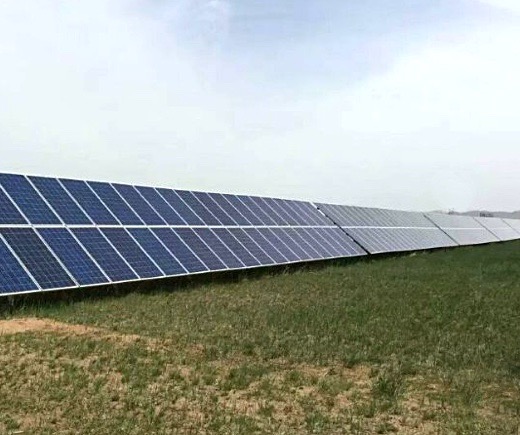
Image above: A linear array of solar photo-voltaic panels cross the landscape. From (https://www.linkedin.com/pulse/gsl-energy-finished-2mw-grid-tied-ground-solar-pv-systems-gsl-energy).

Environmental groups hope to block pipeline’s path, promote renewable energy as Nebraska ponders pipeline approval.

When President Donald Trump signed off on a presidential permit okaying the Keystone XL crude oil pipeline in March, it was a real blow to an environmental movement that had tasted victory over the dirty tar sands clunker back in 2015 when President Obama withdrew the permit for the project.

With Trump and Canadian Prime Minister Justin Trudeau united in their support of the pipeline, it seemed little could stand in the way of some 830,000 barrels of dirty tar sands fuel barreling down a 36-inch crude oil pipe from Hardisty, Alberta through Montana, South Dakota, and Nebraska to export terminals in the Gulf of Mexico.

The pipeline seemed destined to pass over, under, and through environmentally sensitive areas such as Nebraska’s Sandhills, and putt at risk the Ogallala Aquifer, one of the world’s largest underground freshwater sources.

But not so fast. Anti-pipeline activists are holding strong. And last week, they announced Solar  XL, the latest move in a battle waged against the pipeline. Launched July 7 by a coalition of groups including Bold Nebraska, 350.org, Indigenous Environment Network, and Oil Change International, the campaign features a series of solar panel arrays installed directly on the KXL pipeline route as it passes through Nebraska.

“We are putting solutions in the path of the problem,” said Sara Shor, a campaigner for 350.org.  “TransCanada will have to literally dig up these solar arrays in order to build a polluting pipeline of the past that will pollute land and water, increase carbon emissions, and make climate change worse. The first project will be completed by the time the hearing in Lincoln starts in August.”

Each installation will cost $15,500 for a nine-panel frame, net-metering connection to the Nebraska power grid, and labor. The groups aim to raise $50,000 via crowdfunding at the Action Network to help finance the installation in locations where landowners have refused to sell to TransCanada.

The energy produced by the arrays will be used by Nebraska farmers and ranchers leading the fight against KXL in Nebraska, both symbolically and literally putting a renewable energy future directly in the path of some of the dirtiest fuel on the planet.

“I am vehemently opposed to the Keystone XL pipeline mainly because of the properties of the contents of the tar sands oil it will carry — this is not your Mother’s crude oil, it is the Devil’s, and it can kill,” said Nebraska landowner Jim Carlson.

“We must be focused on clean, renewable energy and America can get along just fine without this foul concoction they call bitumen that TransCanada wants to pipe across our precious soil and water.”

The current pipeline route would also pass through Indigenous treaty lands, and the campaign includes solar panel installation at the Rosebud Sioux Tribe Spirit Camp in South Dakota, a prayer camp set up to oppose KXL back in 2014.

“On the Rosebud reservation in South Dakota, renewable energy projects are already serving Indigenous peoples, and more are being planned,” said Wayne Frederick, member of the Rosebud Sioux Tribe.

“From Nebraska to Alberta, Indigenous peoples, farmers, and communities along Keystone XL’s route know that our best resistance is through putting the answers in the path of the problem.”

Advocates are honing in on Nebraska as it is the last state reviewing the pipeline — all the other states through which KXL would pass have already approved the project. The publically elected Public Service Commission (PSC) is tasked with approving (or not approving) the route. 

The PSC has been holding a series of hearings over the past months to gather information from the public, and is reviewing the thousands of comments registered in opposition to the project. The crucial final hearings are set to get underway August 3.

For grassroots activists such as Bold Nebraska, PSC is the last line of defense, and they are doing whatever they can to get the message out that Keystone XL has no place in the Cornhusker state. 

The group is made up largely of local farmers and ranchers fighting against the use of eminent domain to get the pipeline onto Nebraska land, as threatened by TransCanada, the Canadian energy company behind the project.

“Building America means relying on energy that protects our property rights and ensures we have clean drinking water. Foreign tar sands in the Keystone XL pipeline, that would flow to the export market, is not in our public or our state’s interest,”

Bold Alliance president Jane Kleeb said in a statement. “When faced with challenges, Nebraskans find solutions together to show our communities’ values and the bond to the land that TransCanada cannot break or buy.”

Since President Trump approved KXL, it seems there has been no shortage of news demonstrating why it isn’t needed, from the withering away of customer interest in using the new pipeline to new statistics showing more people working in the solar industry than oil, gas and coal combined, which begs the question of who stands to benefit from more fossil fuel infrastructure. 

"The fight is absolutley not over," Shor said. "And no matter what happens in Nebraska, Trump's complete disregard for communities in approving this project has only activated thousands more people to fight the fossil fuel projects that are in their backyards," Shor said. 

"Every fossil fuel company should be shaking in their boots because of the inevitable transition away from fossil fuels to renewable energy projects."

See also:
Ea O Ka Aina: Keystone XL an Act of War 11/17/14
Ea O Ka Aina: Facebook "likes" Keystone XL 5/2/13
Ea O Ka Aina: DAPL battle not over 6/16/17
Ea O Ka Aina: Defense contractors fought NoDAPL 5/27/17
Ea O Ka Aina: Tribes divest DAPL Bankers 2/13/17
Ea O Ka Aina: Veterans defending NoDAPL 2/11/17
Ea O Ka Aina: Army Corps okays DAPL Easement  2/8/17
Ea O Ka Aina: Trump orders go on DAPL EIS 2/3/17
Ea O Ka Aina: Water Protectors pipeline resistance 2/1/17 
Ea O Ka Aina: Force a full EIS on DAPL 1/27/17
Ea O Ka Aina: Trump orders shale oil pipelines 1/24/17
Ea O Ka Aina: Missile launcher at Standing Rock 1/19/17
Ea O Ka Aina: Lockdown at Trans-Pecos Pipeline 1/10/17
Ea O Ka Aina: Standing Rock has changed us 12/9/16
Ea O Ka Aina: As Standing Rock celebrates... 12/5/16
Ea O Ka Aina: Army Corps denies easement 12/4/16
Ea O Ka Aina: My Whole Heart is With You 12/2/16
Ea O Ka Aina: The Loving Containment of Courage 12/1/16
Ea O Ka Aina: The Beginning is Near 12/1/16
Ea O Ka Aina: Feds to shutdown NoDAPL Camp 11/25/16
Ea O Ka Aina: NoDAPL people are going to die 11/23/16
Ea O Ka Aina: Hundreds of vets to join NoDAPL 11/22/16
Ea O Ka Aina: Obama must support Standing Rock 11/21/16
Ea O Ka Aina: Trump's pro oil stance vs NoDaPL 11/15/16
Ea O Ka Aina: Kauai NoDAPL Demonstration 11/12/16
Ea O Ka Aina: Obama to Betray Standing Rock 11/12/16
Ea O Ka Aina: Trump impact on Standing Rock 11/12/16
Ea O Ka Aina: Ann Wright on Standing Rock 11/8/16
Ea O Ka Aina: Turning Point at Standing Rock 11/6/16
Ea O Ka Aina: Jackson Browne vs DAPL owner 11/5/16
Democracy Now: Boycott of DAPL Owner's Music Festival
Ea O Ka Aina: World responds to NoDAPL protests 11/5/16
Ea O Ka Aina: NoDAPL victory that was missed 11/5/16
Ea O Ka Aina: DAPL hid discovery of Sioux artifacts 11/5/16
Ea O Ka Aina: Dakota Access Pipeline will leak 11/5/16
Ea O Ka Aina: Route of the Dakota Access Pipeline 11/4/16
Ea O Ka Aina: Sanders calls for stopping DAPL 11/4/16
Ea O Ka Aina: Obama hints at DAPL rerouting 11/3/16
Ea O Ka Aina: New military attack on NODAPL 11/3/16
Ea O Ka Aina: How to Support NoDAPL 11/3/16
Unicorn Riot: Tweets from NoDAPL 11/2/16
Ea O Ka Aina: Standing Rock & the Ballot Box 10/31/16
Ea O Ka Aina: NoDAPL reclaim new frontline 10/24/16
Ea O Ka Aina: How far will North Dakota go? 10/23/16
Ea O Ka Aina: Amy Goodman "riot" charge dropped 10/17/16
Ea O Ka Aina: Amy Goodwin to face "Riot Charge" 10/16/16
Ea O Ka Aina: Shutdown of all tar sand pipelines 10/11/16
Ea O Ka Aina: Why Standing Rock is test for Oabama 10/8/16
Ea O Ka Aina: Why we are Singing for Water 10/8/16
Ea O Ka Aina: Labor's Dakota Access Pipeline Crisis 10/3/16
Ea O Ka Aina: Standing Firm for Standing Rock 10/3/16
Ea O Ka Aina: Contact bankers behind DAPL 9/29/16
Ea O Ka Aina: NoDAPL demo at Enbridge Inc 9/29/16
Ea O Ka Aina: Militarized Police raid NoDAPL 9/28/16
Ea O Ka Aina: Stop funding of Dakota Access Pipeline 9/27/16
Ea O Ka Aina: UN experts to US, "Stop DAPL Now!" 9/27/16
Ea O Ka Aina: No DAPL solidarity grows 9/21/16
Ea O Ka Aina: This is how we should be living 9/16/16
Ea O Ka Aina: 'Natural Capital' replacing 'Nature' 9/14/16
Ea O Ka Aina: The Big Difference at Standing Rock 9/13/16
Ea O Ka Aina: Jill Stein joins Standing Rock Sioux 9/10/16
Ea O Ka Aina: Pipeline temporarily halted 9/6/16
Ea O Ka Aina: Native Americans attacked with dogs 9/5/16
Ea O Ka Aina: Mni Wiconi! Water is Life! 9/3/16
Ea O Ka Aina: Sioux can stop the Pipeline 8/28/16
Ea O Ka Aina: Officials cut water to Sioux 8/23/16

.

Combating Trump's Neo-Fascism

SUBHEAD: The great collective power of resistance has ignited. Hope and a sense of humanity are in the air.

By Henry Giroux on 7 February 2017 inTruth Out -
(http://www.truth-out.org/news/item/39378-combating-trump-s-neo-fascism-and-the-ghost-of-1984)


Image above: Illustration by Jared Rodriguez of Donald Trump with his tie slightly lengthened and his hair tinted closer to his orange mane. From original article.

"Ignorance is Strength."
-- George Orwell

In a strange but revealing way, popular culture and politics intersected soon after Trump first assumed the presidency of the United States.

On the side of popular culture, George Orwell's dystopian novel, "1984", surged as the number one best seller on Amazon both in the United States and Canada. This followed two significant political events.

First, Kellyanne Conway, Trump's advisor, echoing the linguistic inventions of Orwell's Ministry of Truth, coined the term "alternative facts" to justify why press secretary Sean Spicer lied in advancing disproved claims about the size of Trump's inauguration crowd.

Second, almost within hours of his presidency, Trump penned a series of executive orders that compelled Adam Gopnik, a writer for The New Yorker, to rethink the relevance of 1984.

He had to go back to Orwell's book, he writes, "Because the single most striking thing about [Trump's] matchlessly strange first week is how primitive, atavistic and uncomplicatedly brutal Trump's brand of authoritarianism is turning out to be."

In this amalgam of Trump's blatant contempt for the truth, his willingness to embrace a blend of taunts and threats in his inaugural address, and his eagerness to enact a surge of regressive executive orders, the ghost of fascism reasserts itself with a familiar blend of fear and revenge.

Unleashing promises he had made to his angry, die-hard ultranationalist and white supremacist supporters, Trump targeted a range of groups whom he believes have no place in American society.

These include Muslims, Syrian refugees and undocumented immigrants, whom he has targeted with a number of harsh discriminatory policies.

The underlying cruelty, ignorance and punishing, if not criminogenic, intent behind such policies was made all the clearer when Trump suggested that he intended to roll back a wide range of environmental protections.

He asserted his willingness to resume the practice of state-sponsored torture and deny funding to those cities willing to provide sanctuary to undocumented immigrants.

Trump reaffirmed his promise to lift the US ban on torture by appointing Gina Haspel as the new CIA deputy director. Haspel not only played a direct role in overseeing the torture of detainees at a black site in Thailand, she also participated in the destruction of videotapes documenting their brutal interrogations.

Trump's enthusiasm for committing war crimes was matched by his willingness to roll back many of the regulatory restrictions put in place by the Obama administration in order to prevent the financial industries from repeating the economic crisis of 2008.

In Trump's worldview, there exists no contradiction between the principles and ideals of a democracy, on the one hand, and implementing state-sponsored torture, running "black sites" and waging an assault on poor people, immigrants, health care and the environment.

And this is just the beginning. The ruling elites, banks and other major financial institutions now find their savior in Trump as they will receive more tax cuts and happily embrace the loosening of government regulations, while their greed spins out of control. Should we be surprised?

The memory of totalitarianism, with its demand for simplistic answers, intoxication with spectacles of vulgarity, and a desire for strong leaders, has faded in a society beset by a culture of immediacy, sensations and civic illiteracy.

Under such circumstances, it is difficult to underestimate the depth and tragedy of the collapse of civic culture and democratic public spheres, especially given the profound influences of a permanent war culture that trades in fear, and the ever-present seductions of consumerism, which breeds depoliticization and infantilism.

Another shocking and revelatory indication of the repressive fist of neo-fascism in the Trump regime took place when Trump's chief White House right-wing strategist, Steve Bannon, stated in an interview that "the media should be embarrassed and humiliated and keep its mouth shut and just listen for a while....

You're the opposition party. Not the Democratic Party....

The media is the opposition party. They don't understand the country." This is more than an off-the-cuff angry comment. It is a blatant refusal to see the essential role of a robust and critical media in a democracy.

Such comments suggest not only a war on the press, but the very real threat of suppressing dissent, if not democracy itself. Unsurprisingly, Bannon referred to himself in the interview as "Darth Vader."

A more appropriate comparison would have been to Joseph Goebbels, the Reich Minister of Propaganda in the Third Reich.

What is clear is that the dire times that haunt the current age no longer appear as merely an impending threat. They have materialized with the election of Donald Trump to the presidency.

Trump and his administration of extremists epitomize the dire dangers posed by those who longed to rule American society without resistance, dominate its major political parties, and secure uncontested control of its commanding political, cultural and economic institutions.

The consolidation of power and wealth in the hands of the financial elite along with the savagery and misery that signifies their politics is no longer the stuff of Hollywood films, such as Wall Street and American Psycho.

If George W. Bush's reign of fearmongering, greed and war on terror embodied the values of a kind of militarized Gordon Gekko, Trump represents the metamorphosis of Gekko into the ethically neutered Patrick Bateman.

Yet, Trump's ascent to the highest office in America is already being normalized by numerous pundits and politicians who are asking the American public to give Trump a chance or are suggesting that the power and demands of the presidency will place some restraints on his unrestrained impetuousness and often unpredictable behavior.

Those members of Congress who railed against both Obama's alleged imperial use of executive orders and later, during the Republican primaries, denounced Trump as unfit for office now exhibit a level of passivity and lack of moral courage that testifies to their complicity with the dark shadow of authoritarianism.

Wrongheaded Calls to "Give Trump a Chance"
As might be expected, a range of supine politicians, media pundits and mainstream journalists are already tying themselves in what Tom Engelhardt calls "apologetic knots" while they "desperately look for signs that Donald Trump will be a pragmatic, recognizable American president once he takes the mantle of power."

As comedian John Oliver pointed out on his show, "Last Week Tonight," Trump is not ordinary and his politics forebode the storm clouds of an American version of authoritarianism.

Oliver brought his point home by shouting repeatedly "This is not normal," and, of course, he is right! It is even more surprising that Lesley Stahl's "60 Minutes" interview with Trump portrayed him less as a demagogue than as a transformed politician who was "subdued and serious."

In addition, NBC's Andrea Mitchell reported approvingly upon the transition, as if proposed White House counselor Steve Bannon and proposed attorney general Jeff Sessions, two men with racism in their pasts, were ordinary appointments.

High-profile celebrity, Oprah Winfrey, stated without irony, in an interview with "Entertainment Tonight" that "I just saw President-elect Trump with President Obama in the White House, and it gave me hope."

This is quite a stretch given Trump's history of racist practices, his racist remarks about Blacks, Muslims and Mexican immigrants during the primary and the presidential campaigns, and his appointment of a number of cabinet members who embrace a white nationalist ideology.

The New York Times's opinion writer, Nicholas Kristof, sabotaged his self-proclaimed liberal belief system by noting, in what appears to be acute lapse of judgment, that Americans should "Grit [their] teeth and give Trump a chance." Bill Gates made clear his own and often hidden reactionary worldview when speaking on CNBC's "Squawk Box."

The Microsoft cofounder slipped into a fog of self-delusion by stating that Trump had the potential to emulate JFK by establishing an upbeat and desirable mode of "leadership through innovation."

Such actions by the mainstream media and such highly visible pundits not only point to a retreat from responsible reporting and discourse, and a flight from any vestige of social responsibility, they also further the collapse of serious journalism and thoughtful reasoning into the corrupt world of a corporate-controlled media empire and an infantilizing celebrity culture.

Normalizing the Trump regime does more than sabotage the truth, moral responsibility and justice; it also diminishes and sidelines the democratic institutions necessary for a future of well-being and economic and political justice.

New York Times columnist Charles Blow observes insightfully that under a Trump administration:
The nation is soon to be under the aegis of an unstable, unqualified, undignified demagogue [who surrounds] himself with a rogue's gallery of white supremacy sympathizers, anti-Muslim extremists, devout conspiracy theorists, anti-science doctrinaires and climate change deniers.... This is not normal [and] I happen to believe that history will judge kindly those who continued to shout, from the rooftops, through own weariness and against the corrosive drift of conformity.
Blow is right. Any talk of working with a president who has surrounded himself with militarists, racists, neo-fascists, anti-intellectuals and neoliberal fundamentalists should be resisted at all cost. It is well worth remembering that Trump chose Steve Bannon, a notorious anti-Semite and white supremacist to occupy the center of power in the White House.

As Reuters reported, "White supremacists and neo-Nazis have rarely, if ever, in recent history been so enthusiastic about a presidential appointment as Donald Trump's choice of Steve Bannon to be his chief White House strategist."

Trump has also surrounded himself with militarists and corporate ideologues who fantasize about destroying all vestiges of the welfare state and the institutions that produce the public values that support the social contract. Neal Gabler argues that the normalizing of Trump by the mainstream media is about more than the dereliction of journalistic duty. In his piece "And So It Begins: Normalizing the Election," he writes:
Far more serious is their normalization not of Trump but of his voters. The former is typical cowardice under threat of reactionary populism. The latter is an endorsement of reactionary populism that may have far-reaching consequences for whether the country can ever be reunited after having been torn asunder.
Normalization is code for a retreat from any sense of moral and political responsibility, and it should be viewed as an act of political complicity with authoritarianism and condemned outright. What is being propagated by Trump's apologists is not only a reactionary popularism and some fundamental tenets of an American-style authoritarianism, but also a shameless whitewashing of the racism and authoritarianism at the center of Trump's politics.

In addition, little has been said about how Trump and his coterie of semi-delusional, if not heartless, advisors embrace a version of Ayn Rand's view that selfishness, war against all competition and unchecked self-interest are the highest human ideals.

In addition, arguments in defense of such normalization appear to overlook with facile indifference how the rhetoric of authoritarianism has become normalized in many parts of the world, to grave effect, and that the Trump administration has clearly demonstrated an affinity with that sort of hateful rhetoric.

How else to explain the support that Trump has received from a number of ruthless dictators who head reactionary governments, such as the Philippines, Turkey and Egypt, among others? Such a danger is all the more ominous given the current collapse of civic literacy and the general public's increasing inability to deal with complex issues on one hand, and the attempt, on the other hand, by those who maintain power to ruthlessly promote a depoliticizing discourse of lies, simplicity and  manufactured distortions.

Ominous Echoes of a Totalitarian Past
The United States has entered a new historical conjuncture that echoes elements of a totalitarian past. Hannah Arendt, Sheldon Wolin and Robert Paxton, the great theorists of totalitarianism, believed that the fluctuating elements of fascism are still with us and that as long as they are, they will crystalize in different forms.

Far from being fixed in a frozen moment of historical terror, these theorists believed that totalitarianism not only "heralds as a possible model for the future" but that its "protean origins are still with us."

Arendt, in particular, was keenly aware that a culture of fear, the dismantling of civil and political rights, the ongoing militarization of society, the attack on labor, an obsession with national security, human rights abuses, the emergence of a police state, a deeply rooted racism and the attempts by demagogues to undermine education as a foundation for producing critical citizenry were all at work in American society.

Historical conjunctures produce different forms of authoritarianism, though they all share a hatred for democracy, dissent and human rights.

More recently, Robert Paxton in his seminal work, The Anatomy of Fascism, provides a working definition of fascism that points to both its anti-democratic moments and those elements that link it to both the past and the present.

Paxton's point is not to provide a precise definition of fascism but to understand the conditions that enabled fascism to work and make possible its development in the future. Accordingly, he argues that fascism is:
A form of political behavior marked by obsessive preoccupation with community decline, humiliation or victimhood and by compensatory cults of unity, energy and purity, in which a mass-based party of committed nationalist militants, working in uneasy but effective collaboration with traditional elites, abandons democratic liberties and pursues with redemptive violence and without ethical or legal restraints, goals of internal cleansing and external expansion.
It is too easy to believe in a simplistic binary logic that strictly categorizes a country as either authoritarian or democratic and leaves no room for entertaining the possibility of a mixture of both systems.

American politics today suggests a more updated if not different form of authoritarianism or what might be called the curse of totalitarianism. In Trump's America, there are strong echoes of the fascism that developed in Europe in the 1920s and 30s.

For instance, there are resemblances to a fascist script in Trump's scapegoating of the "other;"
  • his claim that the United States is in a period of decline;  
  • his call to "Make America Great Again;" 
  • his blatant appeal to ultra-nationalism;  
  • his portrayal of himself as a strongman who alone can save the country; 
  • his appeal to aggression and violence aimed at those who disagree with him; 
  • his appeal to xenophobia, national greatness and support for a politics of disposability; 
  • his courting of anti-Semites and white supremacists; 
  • his flirtation with the discourse of racial purity;
  • his support for a white Christian public sphere; 
  • his contempt for weakness and his enthusiasm for hyper-masculinity;
  • his use of a kind of verbal waterboarding to denigrate Muslims, Blacks, undocumented immigrants and women's reproductive rights; 
  • his contempt for dissent; his deep-rooted anti-intellectualism, or what Arendt called "thoughtlessness" (i.e., denial that climate change is produced by humans) coupled with 
  • his  elevation of instinct and emotion over reason;
Trump's totalitarian mindset was on full display both during his inaugural speech and in his actions during his first few days in office. In the first instance, he presented a dystopian view of American society laced with racist stereotyping, xenophobia and the discourse of ultra- nationalism.

Frank Rich called the language of the speech "violent and angry -- 'This American carnage stops right here' -- reeking of animosity, if not outright hatred [and that] the tone was one of retribution and revenge."

As soon as the speech ended, the normalizing process began with the expected tortured clichés from various Fox News commentators calling it "muscular," "unifying," "very forceful," "just masterful," and Charles Krauthammer stating that it was "completely nonpartisan."

The fog of self-delusion and denial was in full swing at CNN when the historian Douglas Brinkley called Trump's inaugural address not only "presidential" but "solid and well-written" and the "best speech" Trump has made "in his life."

Once in the Oval Office, Trump not only enacted measures to facilitate building a wall on the Mexican border and prevent people from seven Muslim-majority countries from entering the United States, he also cleared the way for resurrecting the construction of the Keystone XL and Dakota Access pipelines.

Trump's broader assault on environmental protections is indicative of his disregard for the rights of the Native Americans who protested the building of a pipeline that both crossed their sacred burial lands and posed a risk to contaminating the Missouri River, which is the primary water source for the Standing Rock Sioux.

In response to Trump's inaugural address and early policy measures, Roger Cohen, a columnist for The New York Times, wrote a forceful commentary suggesting that Trump's neo-fascist tendencies were on full display and that his presence in American politics contains echoes of former dictators and augurs badly for American democracy. He argued:
But the first days of the Trump presidency ... pushed me over the top. The president is playing with fire. To say, as he did, that the elected representatives of American democracy are worthless and that the people are everything is to lay the foundations of totalitarianism. It is to say that democratic institutions are irrelevant and all that counts is the great leader and the masses he arouses.

To speak of "American carnage" is to deploy the dangerous lexicon of blood, soil and nation. To boast of "a historic movement, the likes of which the world has never seen before" is to demonstrate consuming megalomania.

To declaim "America first" and again, "America first," is to recall the darkest clarion calls of nationalist dictators. To exalt protectionism is to risk a return to a world of barriers and confrontation. To utter falsehood after falsehood, directly or through a spokesman, is to foster the disorientation that makes crowds susceptible to the delusions of strongmen.
The grave period Americans are about to enter into under a Trump regime cannot be understood without an acknowledgement of the echoes of a totalitarian past.

With Trump's election, the crisis of politics is accompanied by a crisis of historical conscience, memory, ethics and agency exacerbated by an appeal to a notion of common sense in which facts are regarded with disdain, words reduced to slogans, and science confused with pseudo-science.

Under such circumstances, language is emptied of any meaning and constitutes a flight from ethics, justice and social responsibility. As language rapidly loses meaning, the American public is inundated with empty slogans such as "post-truth" and "fake news."

This culture is part of what Todd Gitlin calls "an interlocking ecology of falsification that has driven the country around the bend." Against the background of an infantilizing culture of immediacy, spectacle and sensationalism, Trump will govern as if he is running a reality TV show, endlessly performing for an increasingly depoliticized public.

But there are more dangers ahead than the toxic seduction of politics as theater and the transformation of the mainstream media as an adjunct of the entertainment industry or for that matter, a growing distrust of democracy itself.

The Complicity of the Media and Attacks on the Press
Under casino capital, the alleged celebration of the principle of a free press hides more than it promises.

Noam Chomsky, Bill Moyers and Robert McChesney, among others, have observed that the mainstream media now work in conjunction with the financial elite and the military-industrial-academic complex as an echo chamber while further indulging in the rituals of shock, celebrity culture and spectacularized violence in order to increase their ratings.

Earlier this year, CBS CEO Les Moonves stated that his network's inordinate and disastrous coverage of Trump "may not be good for America but it's damn good for CBS." Moonves openly gloated not only because the network was pumping up its ratings but was also getting rich by inordinately covering Trump's presidential campaign.

As he put it, [T]he money's rolling in ... [T]his is going to be a very good year for us.... It's a terrible thing to say, but bring it on, Donald. Go ahead. Keep going." Moonves made it clear that the power of mainstream media in general has little to do with either pursuing the truth or holding power accountable.

On the contrary, its real purpose was to normalize corruption, lies, misrepresentation, accumulate capital and allow the transformation of the press to become an adjunct of authoritarian ideologies, policies, interests and commodified values -- if that is what it takes to increase their profit margins.

Normalization is about more than dominant media outlets being complicit with corrupt power or willfully retreating from any sense of social responsibility; it is also about aiding and abetting power in order to increase the bottom line and accumulate other cowardly forms of power and recognition.

This is evident in the fact that some powerful elements of the mainstream press not only refused to take Trump seriously, they also concocted embarrassing rationales for not holding him to any viable sense of accountability.

For instance, Gerard Baker, the editor-in-chief of The Wall Street Journal, publicly announced that in the future he would not allow his reporters to use the word "lie" in their coverage.

NPR also issued a statement arguing that it would not use the word "lie" on the grounds that "the minute you start branding things with a word like 'lie,' you push people away from you."

In this truly Orwellian comment, NPR is suggesting that calling out lies on the part of governments and politicians should be avoided by the media on the grounds that people might be annoyed by having to face the contradiction between the truth and misinformation.

This is more than a retreat from journalism's goal of holding people, institutions and power to some measure of justice; it also legitimizes the kind of political and moral cowardice that undermines informed resistance, the first amendment and the truth.

While such actions may not rise to the level of book burning that was characteristic of various fascist and authoritarian regimes in the past, it does mark a distinctive retreat from historical memory and civic courage that serves to normalize such actions by making dissent appear, at best, unreasonable and at worst, an act of treason.

Such actions become apparent in efforts by the mainstream press to rage against the rise of "fake news," suggesting that by doing so, their integrity cannot be questioned.

Of course, the term "fake news" is slippery and can be deployed to political ends -- a maneuver which is on full display particularly when used by Trump and his merry band of liars to dismiss anyone or any organization that holds him accountable for his fabrications.

Hence, there were no surprises when Trump at his first president-elect press conference refused not only to take questions from a CNN reporter because his network had published material critical of Trump but also justified his refusal by labeling CNN as fake news -- reducing the term to a slogan used to silence the press.

Clearly, we will see more of this type of bullying repression and censorship, and traditional democratic public spheres, such as higher education, will also feel the brunt of such an attack.

Any analysis of the forces behind the normalization of the Trump administration and its assault on the truth, if not democracy itself, must include the powerful role of the conservative media in the United States.

Former conservative radio talk show host Charles Sykes recently published a remarkable op-ed arguing that over the last few decades, right-wing media played a major role in discrediting and delegitimizing the fact-based media. In doing so, it destroyed "much of the right's immunity to false information."

According to Sykes, conservatives, including himself, created a "new post-factual political culture" that has become so powerful that even when the Trump administration is caught lying, it does so with impunity because it believes that "the alternative-reality media will provide air cover" that allows it to pollute "political discourse" and discredit "independent sources of information."

Evidence of this major assault on truth can be measured in part by the magnitude of the lies the administration produces, which are truly Orwellian. For instance, Kellyanne Conway attempted recently to justify Trump's executive order banning people from seven majority-Muslim countries by referring to what she called the "Bowling Green Massacre", an alleged terrorist attack by Iraqi refugees that was to have taken place in 2011. According to Conway, Obama instituted a six-month ban on Iraqi resettlements.

The attack never happened, no Iraqis were involved and the Obama administration never instituted such a ban. It gets worse. White House Press Secretary Sean Spicer recently claimed that Iran had committed an act of war by attacking a US Naval vessel. That never happened. What did happen is that a Saudi ship off the coast of Yemen was attacked by Houthi rebels.

Normalization has many registers and one of the most important is the control by the financial elite over commanding cultural apparatuses that produce, legitimize and distribute highly selective media narratives that shore up the most reactionary ideologies and financial interests.

The mainstream press says little about how such actions serve as an apology for the egregiously reactionary nature of Trump's ideology and policies.

Moreover, they fail to note how distortions of the truth, the endless production of lies by governments, politicians and corporations, along with the media's flight from civic literacy, serve to bolster authoritarian societies willing to distort the truth while simultaneously suppressing dissent.

Under such circumstances, it should not be surprising that Trump's authoritarian and hateful discourse, threats of violence, loathing of dissent and racist attitudes toward Muslims, Blacks and Mexican immigrants are downplayed in the mainstream media.

These structured silences have become more and more apparent given the benign manner in which the supine press and its legion of enervated anti-public intellectuals and pundits treat Trump's endless nighttime Twitter outpourings and his incessant choreographed public fabrications.

For instance, The Wall Street Journal's refusal to address critically Trump's endless lies and insults is matched by the highbrow New Yorker's publishing of a piece on Trump that largely celebrates uncritically how he is viewed by conservative intellectuals, such as Hillsdale College president, Larry Arnn.

Arnn supports Trump because he shares his view that "the government has become dangerous." If Arnn were referring to the rise of the surveillance and permanent war state, it would be hard to disagree with him. Instead, he was referring to the government's enforcement of "runaway regulations."

What Arnn and Kelefa Sanneh, the author of the New Yorker article, ignore or conveniently forget is the fact that the real danger the government poses is the result of it being in the hands of demagogues, such as Trump, who are truly dangerous and threaten the planet, American society and the rest of the world.

When Kelefa Sanneh mentions Trump's connection to the "alt-right," he underplays the group's fascist ideology and refuses to use the term "white supremacist" in talking about such groups, reverting instead to the innocuous-sounding term, "white identity politics."

Trump's misogyny, racism, anti-intellectualism, Islamophobia and hatred of democracy are barely mentioned. Sanneh even goes so far as to suggest that since Trump has disavowed the "alt-right," his connection to neo-fascist groups is tenuous.

This is more than an apology dressed up in the discourse of ambiguity; such reporting is a shameful retreat from journalistic integrity -- an assault on the truth that constitutes an egregious act of normalization. This is only one example of what is surely to come in the future under Trump's rule.

The Hard Road Ahead        
Under Trump's regime of economic, religious, educational and political fundamentalism, compassion and respect for the other will almost certainly be viewed with contempt while society will increasingly become more militarized and financial capital will likely be deregulated in order to be free to engage in behaviors that put the American public and planet in danger.

A form of social and historical amnesia appears set to descend over American society.

A culture of civic illiteracy will likely be produced and legitimated along with a culture of fear that will enable a harsh law and order regime.

Policies will almost certainly be enacted in which public goods, such as schools, will be privatized, and a culture of greed and selfishness will be elevated to new heights of celebration. There will likely be a further retreat from civic literacy, civic courage and social responsibility, one matched by a growing abandonment by the state of any allegiance to the common good.

Fear and the threat of state violence are threatening to shape how problems are addressed, and a growing culture of dissent may soon be ruthlessly suppressed in all of the public spheres in which it has functioned in the past.

The free-market mentality that gained prominence under the presidency of Ronald Reagan will likely accelerate under the Trump administration and continue to drive politics, destroy many social protections, celebrate a hyper-competitiveness and deregulate economic activity.

Under Donald Trump's reign, almost all human activities, practices and institutions are at risk of becoming subject to market principles and militarized.

The only relations that matter will likely be defined in commercial terms, just as civil society will be organized for the production of violence.

It is most likely that the most dangerous powers of the state will be unleashed under Trump against protesters, Black people, Muslims and undocumented immigrants. They will also be unleashed against the environment and against public and higher education.

Surely, all the signs are in place given the coterie of billionaires, generals, warmongers, Islamophobes, neoliberal cheerleaders and anti-public demagogues Trump has appointed to high-ranking government positions.

Americans may be on the verge of witnessing how democracy ends and this is precisely why Trump's election as the president of the United States must not be normalized.

Trump's repressive and poisonous attitudes and authoritarian policies will not change his role as president. If his first two weeks in office are any indication, he plans to consolidate his power and will be more reckless than he was during the primaries and presidential campaigns.

 Trump's narcissism, indifference to the truth and intensive use of the spectacle will further increase his view of himself and his policies as unaccountable, especially as he institutes a mode of governance that suppresses the opposition and deals with his audience directly through the social media.

Fortunately, a number of diverse groups, including unions, immigrant rights groups, anti-fascist organizations, Black liberation groups, congregations and faith-based organizations, legal coalitions and reproductive rights groups, along with teachers, actors and artists are organizing to protest Trump's neo-fascist ideology and policies.

As George Yancy pointed out to me in a personal correspondence, such actions are unique in that they make the political more pedagogical by elevating protests, modes of resistance and criticism to the level of the cultural rather than allowing such criticism to reside in the voice and presence of isolated, prophetic intellectuals.

Moreover, a number of independent publications, along with various public intellectuals, such as Anthony DiMaggio, Robin Kelley and members of the Black Lives Matter Movement, are producing instructive articles on both the nature of resistance and what forms it might take.

The current onslaught of revenge and destruction produced by Trump's updated version of authoritarianism is glaringly visible and deeply brutal, and points to a bleak future in the most immediate sense.

We live at a time in which totalitarian forms are with us again. US society is no longer at the tipping point of authoritarianism; we are in the midst of what Hannah Arendt called "dark times." Individual and collective resistance is the only hope we have to move beyond this ominous moment in our history.

Fortunately, the arrogant presence of this neo-fascist regime is not going entirely unchecked.

The great collective power of resistance has ignited. Hope and a sense of humanity are in the air and the relevance of mass action has a renewed urgency. Demonstrations are taking place every day; some mayors are refusing to allow their cities to be placed under Nazi influence; and marginalized people and their co-strugglers are marching in record-breaking numbers to protect their rights.

This resistance will continue to grow until it becomes a movement whose power is on the side of justice not injustice, bridges not walls, dignity not disrespect, compassion not hate.

Let's hope this resistance will dispel Orwell's nightmarish vision of the future in our own time.

Note: This piece draws on some ideas that appeared first in "Normalizing Trump's Authoritarianism Is Not an Option," an article published by Tikkun Magazine on January 19, 2017.

• Henry A. Giroux currently holds the McMaster University Chair for Scholarship in the Public Interest in the English and Cultural Studies Department and dis the Paulo Freire Distinguished Scholar in Critical Pedagogy. His most recent books are America's Addiction to Terrorism (Monthly Review Press, 2016) and America at War with Itself (City Lights, 2017). He is also a contributing editor to a number of journals, including Tikkun, the Journal of Wild Culture and Ragazine. Giroux is also a member of Truthout's Board of Directors. His website is www.henryagiroux.com.
To read more articles by Henry A. Giroux and other authors in the Public Intellectual Project, click here.

.