Showing posts with label Bayer. Show all posts

Bayer Battered

SUBHEAD: After buying Monsanto Bayer suffers major blow losing second RoundUp cancer trial.

By Tyler Durden on 20 March 2019 for Zero Hedge -
(https://www.zerohedge.com/news/2019-03-20/bayer-battered-after-suffering-major-blow-second-roundup-cancer-trial-loss)


Image above: Plaintiff DeWayne Johnson looks on at the start of the Monsanto trial in San Francisco, California on July, 09, 2018. From (https://www.sfgate.com/nation/article/Does-Roundup-cause-cancer-Patient-s-case-13061244.php).

Bayer AG shares are down over 12% in European trading - the biggest drop since 2003 - after a U.S. jury found the RoundUp weed killer was a substantial factor in a California man's cancer. This is the second case that has gone against manufacturer Monsanto, acquired by Bayer last year.

On Tuesday, a federal court jury in San Francisco ruled unanimously for plaintiff DeWayne Johnson,  in a lawsuit against Monsanto. Attorneys say the trial, which will determine in a second phase whether the company is liable and if so, for how much, could help determine the fate of hundreds of similar lawsuits.

The plaintiff's attorneys said he developed non-Hodgkin lymphoma after 26 years of regularly using Roundup to tackle weeds and poison oak, according to the Wall Street Journal. The active ingredient in Roundup and Ranger Pro is glyphosate, a herbicide.

Hardeman’s case is considered a “bellwether” trial for hundreds of other plaintiffs in the US with similar claims, which means the verdict could affect future litigation and other cancer patients and families. Monsanto, now owned by the German pharmaceutical company Bayer, is facing more than 9,000 similar lawsuits across the US.

The decision strikes another blow to the German pharmaceuticals group. In August, a jury ordered its Monsanto unit to pay $289 millionafter determining it failed to warn customers of the potential cancer risks of two of its weedkillers, Roundup and Ranger Pro. The verdict was cut to $78.5 million on appeal.

Analysts are broadly negative on the news, BUT appear to be buyers of any dip... and today's a big dip.
News is a “major blow,” according to Baader (buy, PT EU123), which says Bayer shares might move towards EU60 in the short-term. If stock falls toward 2018 lows, probability of Bayer becoming a target for activists or a takeover will increase.
Morgan Stanley (overweight, PT EU82) says there was “budding enthusiasm” among investors for either a potential “surprise” verdict in favor, or a hung jury, given multiple days elapsing during deliberations.
Overhang on Bayer shares “could be significant” as outcome was considered by some investors to be a potential bellwether for ~765 outstanding glyphosate cases, Goldman Sachs analyst Keyur Parekh (buy, PT EU78) writes.
Citi says “steady heads required” as >EU20b of litigation risk is already priced into the shares. Says legal checks instruct bank to be more focused on the upcoming Hall vs Monsanto trial being held in St Louis from April 1. St Louis result will better determine whether the estimate of a potential settlement liability of $1-6b needs to be refined.
Any extreme weakness is an opportunity to buy, according to Bernstein (outperform, PT EU86) as an ultimate liability well above the $5b is already “baked-in
Monsanto says studies have established that Roundup's active ingredient, glyphosate, is safe. It has appealed a separate U.S. court decision last year in favor of a man who used Roundup.
"We are disappointed with the jury's initial decision, but we continue to believe firmly that the science confirms that glyphosate-based herbicides do not cause cancer," Bayer said in a press release.
"Bayer stands behind these products and will vigorously defend them."


.

Bayer Beware!

SUBHEAD: Lawyers claim to have "Explosive" documents concerning Monsanto and RoundUp.

By Tyler Durden on 11 September 2018 for Zero Hedge -
(https://www.zerohedge.com/news/2018-09-07/bayer-beware-lawyers-claim-have-explosive-monsanto-documents)


Image above: Common Ragweed is becoming resistant to glyphsate applications in Nebraska. Ragweed plants from a glyphosate-resistant (left) and susceptible population (right) three weeks after application of 44 ounces per acre of Roundup PowerMax (that is one ounce per thousand square feet). From (https://cropwatch.unl.edu/glyphosate-resistant-common-ragweed-confirmed-nebraska).

Lawyers involved in a California lawsuit against Monsanto claim to have "explosive" documents concerning the Bayer-owned agrochemical giant's activities in Europe, according to Euronews.
"What we have is the tip of the iceberg. And in fact we have documents now in our possession, several hundreds documents, that have not been declassified and some of those are explosive," said US lawyer Robert Kennedy Jr, adding - "And many of them are pertinent to what Monsanto did here in Europe. And that's just the beginning."
Monsanto - bought by Germany's Bayer AG in June for $66 billion, was ordered in August to pay a historic $289 million to a former school groundskeeper, Dewayne Johnson, who said Monsanto's Roundup weedkiller gave him terminal cancer. Monsanto says it will appeal the verdict.

Environmental lawyers have been in Brussels in order to address a European Parliament special committee on the issue.
"They are fighting a fight for more democracy and for transparency and to get a better insight in how big corporation such as Monsanto act and try to manipulate the facts," said Belgium MEP Bart Staes.
Last November EU approved the use of glyphosate - a key chemical in Roundup, following five years of heated debate over whether it causes cancer. While it was approved for just five years until 2022 vs. the usual 15 years, there are now rumors that they will withdraw Roundup's license this year altogether.

Labeled a carcinogen by the EPA in 1985, the agency reversed its stance on glyphosate in 1991. The World Health Organization's cancer research agency, however, classified the compound as "probably carcinogenic to humans" in 2015. California, meanwhile, has the chemical listed in its Proposition 65 registry of chemicals known to cause cancer. 

See also:
Ea O Ka Aina: A MAtch Made in Hell 6/30/18

.

Breakfast with a dose of Roundup?

SUBHEAD: Weed killer is found in most of the oat cereals and granola bars tested, including some organic.

By Alexis Tempkin - Toxicologist on 15 August 2918 for EWG.org -
(https://www.ewg.org/childrenshealth/glyphosateincereal/#.W3con4WeGPX)


Image above: A child pouring Cheerios into a cereal bowl. From original article.

Popular oat cereals, oatmeal, granola and snack bars come with a hefty dose of the weed-killing poison in Roundup, according to independent laboratory tests commissioned by EWG.

Glyphosate, an herbicide linked to cancer by California state scientists and the World Health Organization, was found in all but two of 45 samples of products made with conventionally grown oats.

Almost three-fourths of those samples had glyphosate levels higher than what EWG scientists consider protective of children’s health with an adequate margin of safety. About one-third of 16 samples made with organically grown oats also had glyphosate, all at levels well below EWG’s health benchmark.

 Glyphosate does not belong in cereal. Act and urge the EPA to restrict pre-harvest applications of glyphosate and tell companies to identify and use sources of glyphosate-free oats.
 Report on samples tested indicates even organic oat products contained measurable amounts of glyphosate, but none were above the EWG's Health Benchmark of 160 parts per billion.
Samples Tested Conventional   Organic
Samples Tested 45   16
Glyphosate Detected 43   5
Detects above EWG’s Health Benchmark       31   0
Glyphosate is the active ingredient in Roundup, the Monsanto weed killer that is the most heavily used pesticide in the U.S. Last week, a California jury ordered Monsanto to pay $289 million in damages to a man dying of cancer, which he says was caused by his repeated exposure to large quantities of Roundup and other glyphosate-based weed killers while working as a school groundskeeper.

EWG tested more than a dozen brands of oat-based foods to give Americans information about dietary exposures that government regulators are keeping secret. In April, internal emails obtained by the nonprofit US Right to Know revealed that the Food and Drug Administration has been testing food for glyphosate for two years and has found “a fair amount,” but the FDA has not released its findings.

Each year, more than 250 million pounds of glyphosate are sprayed on American crops, primarily on “Roundup-ready” corn and soybeans genetically engineered to withstand the herbicide. But when it comes to the food we eat, the highest glyphosate levels are not found in products made with GMO corn.

Increasingly, glyphosate is also sprayed just before harvest on wheat, barley, oats and beans that are not genetically engineered. Glyphosate kills the crop, drying it out so that it can be harvested sooner than if the plant were allowed to die naturally.

Roundup was produced for decades by Monsanto, which this year merged with the German pharmaceutical company Bayer AG. In the case decided last week, the jury found that Monsanto knew for decades of the product’s hazards and not only failed to warn customers, but schemed to publicly discredit the evidence.

The California case that ended Friday was the first of reportedy thousands of lawsuits against Monsanto. These suits have been brought by farm workers and others who allege that they developed cancer from years of exposure to Roundup.

In 2015, the International Agency for Research on Cancer, part of the World Health Organization, reviewed extensive U.S., Canadian and Swedish epidemiological studies on glyphosate’s human health effects, as well as research on laboratory animals. The IARC classified the chemical as probably carcinogenic to humans, and has steadfastly defended that decision despite ongoing attacks by Monsanto.

In 2017, California listed glyphosate in its Proposition 65 registry of chemicals known to cause cancer. The state’s Office of Environmental Health Hazard Assessment, or OEHHA, has proposed a so-called No Significant Risk Level for glyphosate of 1.1 milligrams per day for an average adult of about 154 pounds. That level of exposure is more than 60 times lower than the safety level set by the Environmental Protection Agency.

California’s level represents an increased lifetime risk of cancer of one in 100,000 for an average adult. But for many cancer-causing drinking water contaminants, OEHHA’s lifetime risk factor is set at one in 1 million.

Additionally, because children and developing fetuses have increased susceptibility to carcinogens, the federal Food Quality Protection Act supports including an additional 10-fold margin of safety. With this additional children’s health safety factor, EWG calculated that a one-in-a-million cancer risk would be posed by ingestion of 0.01 milligrams of glyphosate per day.

To reach this maximum dose, one would only have to eat a single 60-gram serving1 of food with a glyphosate level of 160 parts per billion, or ppb. The majority of samples of conventional oat products from EWG’s study exceeded 160ppb, meaning that a single serving of those products would exceed EWG’s health benchmark.

As part of a glyphosate risk assessment, the EPA estimated potential highest dietary exposure levels for children and adults. The EPA has calculated that 1-to-2-year-old children are likely to have the highest exposure, at a level twice greater than California’s No Significant Risk Level and 230 times EWG’s health benchmark.

Studies suggest that glyphosate-sprayed crops such as wheat and oats are a major contributor to glyphosate in the daily diet. In EWG lab tests, 31 of 45 samples made with conventionally grown oats had 160 ppb or more of glyphosate.

The highest levels, greater than 1,000 ppb, were detected in two samples of Quaker Old Fashioned Oats. Three samples of Cheerios had glyphosate levels ranging from 470 ppb to 530 ppb. Twelve of the food samples had levels of glyphosate lower than EWG’s health benchmark, ranging from 10 ppb to 120 ppb. Only two samples had no detectable glyphosate.

Glyphosate was also detected at concentrations of 10 ppb to 30 ppb in five of 16 samples made with organic oats. The five samples came from two brands of organic rolled oats: Bob’s Red Mill and Nature’s Path.

A third brand of organic rolled oats and all other organic oat products tested did not contain detectable concentrations of glyphosate.

How does glyphosate get into organic foods? It could come from glyphosate drifting from nearby fields of conventionally grown crops, or by cross-contamination during processing at a facility that also handles non-organic crops. Nature's Path explains:
While organic farming certifications prohibit the use of glyphosate, organic products do not always end up completely free of glyphosate residue. While this news may come as disappointing, it is not entirely surprising. Glyphosate use has skyrocketed in the past decade, and it maintains the ability to adhere to water and soil particles long enough to travel through the air or in a stream to nearby organic farms.
The problem of glyphosate contamination of organic foods underscores the need to restrict pre-harvest uses of glyphosate and the need for more data on glyphosate levels in products, an area where U.S. federal agencies are falling short.

Two years ago, under pressure from the Government Accountability Office, the FDA began testing for glyphosate in a limited number of foods. At the 2016 North American Chemical Residue Workshop, an FDA scientist presented data showing that glyphosate has been detected in several oat-based food products.

After a Freedom of Information Act request by US Right to Know, earlier this year the FDA released documents that said the agency has found “a fair amount” of glyphosate in several processed foods. The results have not been released, but could be made public later this year or in early 2019.

In 2016, the non-profit Food Democracy Now tested for glyphosate in single samples of a variety of popular foods. “Alarming levels” of glyphosate were found in a number of cereals and other products, including more than 1,000 ppb in Cheerios. More recently, the Center for Environmental Health tested single samples of 11 cereal brands and found glyphosate levels ranging from about 300 ppb to more than 2,000 ppb.

EPA has denied that glyphosate may increase the risk of cancer, and documents introduced in the recent California trial showed how the agency and Monsanto worked together to promote the claim that the chemical is safe.

EWG has been urging the EPA to review all evidence linking glyphosate to increased cancer risk and other adverse health effects in human and animal studies. The EPA should limit the use of glyphosate on food crops, including pre-harvest application.

Oat-based foods are a healthy source of fiber and nutrients for children and adults, and oat consumption is linked to health benefits such as lowered cholesterol and decreased cardiovascular risk.

Parents should not have to wonder whether feeding their children these heathy foods will also expose them to a pesticide that increases the risk of cancer.

.

A match made in Hell

SUBHEAD: Monsanto partnership with Bayer increases threat to all life on Earth.

By Robert Bridge on 30 June 2018 for Strategic Culture Foundation- (https://www.strategic-culture.org/news/2018/06/30/match-made-hell-bayer-monsanto-partnership-signals-death-knell-for-humanity.html)


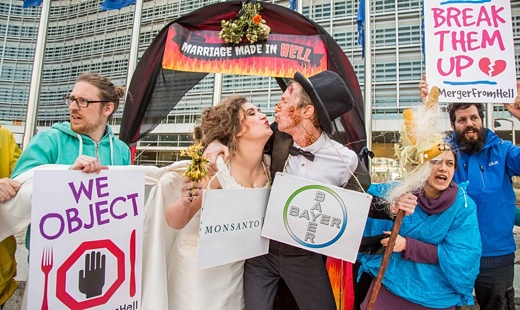
Image above: Demonstrators protesting merger of GMO companies Monsanto and Bayer. From original article.

On what plane of reality is it possible that two of the world’s most morally bankrupt corporations, Bayer and Monsanto, can be permitted to join forces in what promises to be the next stage in the takeover of the world’s agricultural and medicinal supplies?

Warning, plot spoiler: There is no Mr. Hyde side in this horror story of epic proportions; it’s all Dr. Jekyll.

Like a script from a David Lynch creeper, Bayer AG of poison gas fame has finalized its $66 billion (£50bn) purchase of Monsanto, the agrochemical corporation that should be pleading the Fifth in the dock on Guantanamo Bay instead of enjoying what amounts to corporate asylum and immunity from crimes against humanity.

Such are the special privileges that come from being an above-the-law transnational corporation.

Unsurprisingly, the first thing Bayer did after taking on Monsanto, saddled as it is with the extra baggage of ethic improprieties, was to initiate a rebrand campaign.

Like a Hollywood villain falling into a crucible of molten steel only to turn up later in some altered state, Monsanto has been subsumed under the Orwellian-sounding ‘Bayer Crop Science’ division, whose motto is: "Science for a better life."

Yet Bayer itself provides little protective cover for Monsanto considering its own patchy history of corporate malfeasance. Far beyond its widely known business of peddling pain relief for headaches, the German-based company played a significant role in the introduction of poison gas on the battlefields of World War I.

Despite a Hague Convention ban on the use of chemical weapons since 1907, Bayer CEO Carl Duisberg, who sat on a special commission set up by the German Ministry of War, knew a business opportunity when he saw one.

Duisberg witnessed early tests of poison gas and had nothing but glowing reports on the horrific new weapon: “The enemy won’t even know when an area has been sprayed with it and will remain quietly in place until the consequences occur.”

Bayer, which built a department specifically for the research and development of gas agents, went on to develop increasingly lethal chemical weapons, such as phosgene and mustard gas. “This phosgene is the meanest weapon I know,”

Duisberg remarked with a stunning disregard for life, as if he were speaking about the latest bug spray. “I strongly recommend that we not let the opportunity of this war pass without also testing gas grenades.”

Duisberg got his demonic wish. The opportunity to use the battlefield as a testing ground and soldiers as guinea pigs came in the spring of 1915 as Bayer supplied some 700 tons of chemical weapons to the war front.

On April 22, 1915, it has been estimated that around 170 tons of chlorine gas were used for the first time on a battlefield in Ypres, Belgium against French troops. Up to 1,000 soldiers perished in the attack, and many more thousands injured.

In total, an estimated 60,000 people died as a result of the chemical warfare started by Germany in the First World War and supplied by the Leverkusen-based company.

According to Axel Koehler-Schnura from the Coalition against BAYER Dangers: “The name BAYER particularly stands for the development and production of poison gas.

Nevertheless the company has not come to terms with its involvement in the atrocities of the First World War. BAYER has not even distanced itself from Carl Duisberg’s crimes.”

The criminal-like behavior has continued right up until modern times. Mike Papantonio, a US attorney and television presenter discussed one of the more heinous acts committed by this chemical company on Thomas Hartmann’s program, The Big Picture: “They produced a clotting agent for hemophiliacs, in the 1980s, called Factor VIII.

This blood-clotting agent was tainted with HIV, and then, after the government told them they couldn’t sell it here, they shipped it all over the world, infecting people all over the world. That’s just part of the Bayer story.”

Papantonio, citing Bayer’s 2014 annual report, said the company is facing 32 different liability lawsuits around the world. For the 2018 Bayer liability report, click here.

Before flushing your Bayer products down the toilet, you may want to put aside an aspirin or two because the story gets worse.

One of the direct consequences of the ‘Baysanto’ monster will be a major hike in prices for farmers, already suffering a direct hit to their livelihood from unsustainable prices.

“Farmers have already experienced a 300% price increase in recent years, on everything from seeds to fertilizer, all of which are controlled by Monsanto,” Papantonio told Hartmann. “And every forecaster is predicting that these prices are going to climb even higher because of this merger.”

Yet it’s hard to imagine the situation getting any worse for the American farmer, who is now facing the highest suicide rate of any profession in the country. The suicide rate for Americans engaged in the field of farming, fishing and forestry is 84.5 per 100,000 people - more than five times that of the broader population.

This tragic trend echoes that of India, where about a decade ago millions of Indian farmers began switching from farming with traditional farming techniques to using Monsanto’s genetically modified seeds instead.

In the past, following a millennia-old tradition, farmers saved seeds from one harvest and replanted them the following year. Those days of wisely following the rhythms and patterns of the natural world are almost over.

Today, Monsanto GMO seeds are bred to contain 'terminator technology', with the resulting crops ‘programmed’ not to produce seeds of their own. In other words, the seed company is literally playing God with nature and our lives.

Thus, Indian farmers are forced to buy a new batch of seeds – together with Monsanto pesticide Round Up - each year and at a very prohibitive cost. Hundreds of thousands of Indian farmers

But should the world have expected anything different from the very same company that was involved in the production of Agent Orange for military use during the Vietnam War (1961-1971)?

More than 4.8 million Vietnamese suffered adverse effects from the defoliant, which was sprayed over vast tracts of agricultural land during the war, destroying the fertility of the land and Vietnam’s food supply.

About 400,000 Vietnamese died as a result of the US military’s use of Agent Orange, while millions more suffered from hunger, crippling disabilities and birth defects.

This is the company that we have allowed, together with Bayer, to control about one-quarter of the world’s food supply. This begs the question: Who is more nuts? Bayer and Monsanto, or We the People?

It’s important to mention that the Bayer – Monsanto convergence is not occurring in a corporate vacuum. It is all part of a race on the part of the global agrochemical companies to stake off the world’s food supplies.

ChemChina has bought out Switzerland’s Syngenta for $43 billion, for example, while Dow and DuPont have forged their own $130 billion empire.

However, none of those companies carry the same bloodstained reputations as Bayer and Monsanto, a match made in hell that threatens all life on earth.

.

Executive Order pushes pesticides

SUBHEAD: We can’t allow the protections we depend on for clean water, clean air, and safe food to be gutted.

By Staff on 26 April 2017 for Center for Food Safety -
(http://salsa3.salsalabs.com/o/1881/t/0/blastContent.jsp?email_blast_KEY=1370269)


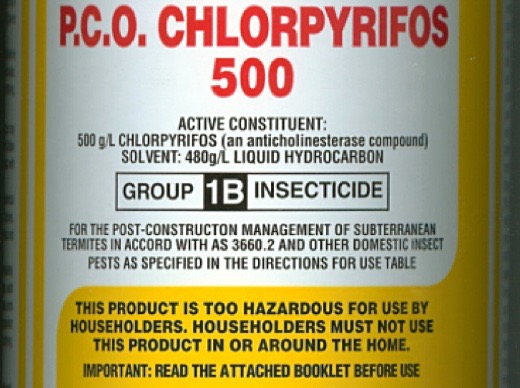
Image above: Photo detail of can of Dow Chemical's chlorpyrifos pesticide distributed by David Gray Co. with warning: "This product is too hazardous for use by householders. Householders must not use this product in or around the home." From (http://www.fertilisersdirect.com.au/pco-chlorpyrifos-1l.html).
 
The hits to our food, farms, and environment just keep coming.
Just hours ago, President Trump signed a new Executive Order, this time specifically on agriculture, directing the Secretary of Agriculture to undertake a 180-day review to “identify and eliminate" what Trump says are "unnecessary regulations”.1

The Presidential Order also creates a new task force to recommend eliminating food and agriculture legislation, policies, and regulations that might hinder the profit-making of “agribusiness.”

What kind of regulations are they looking at? Well, the details are slim, but what is there doesn’t look good. We know that regulations regarding the oversight, production, and export of genetically engineered crops are high on the list.2

The Executive Order also seems to push for faster and/or easier approvals for pesticides and biotech crops, pushing biotech crops abroad to ease export market access, easing the privatization of scarce public water resources for corporate gain, and opening public lands up to mining, farming, ranching and other activities that don’t belong on our public lands.3

We know that Agribusiness has Trump’s ear. He picked Sonny Perdue, one of Big Ag’s own, for his USDA Secretary.

And this week, the Associated Press dropped a bombshell:
Dow Chemical gave $1,000,000 to Trump’s inauguration fund, and the chemical giant is now urging the Environmental Protection Agency (EPA) to set aside its findings on chlorpyrifos and three other pesticides that federal scientists from several agencies found were harmful to endangered species and human health.4
Trump’s EPA also just green-lighted Dow’s new “Enlist Duo” genetically engineered crops, resistant to 2,4-D, part of the Vietnam Era Agent Orange pesticide.

In January, then President-elect Trump sat down chemical giant Bayer’s CEO Werner Baumann and Monsanto’s CEO Hugh Grant at Trump Tower and had a “productive meeting” on “the future of the agriculture industry” and the pending merger between the two companies.

Combined, President Trump, EPA Administrator Pruitt, and newly confirmed USDA Secretary Perdue have received millions of dollars from Big Ag and chemical companies.

We can’t allow the protections we depend on for clean water, clean air, and safe food to be gutted by the new administration and the corporations which have purchased great influence over the President and his policies.

Trump needs to hear from you – add your name  to petition

1. http://www.nydailynews.com/newswires/news/national/latest-trump-aims-ease-farming-regulations-article-1.3099884
2. https://www.politicopro.com/tech/whiteboard/2017/04/perdue-to-chair-trumps-task-force-on-rural-america-086691
3. https://www.whitehouse.gov/the-press-office/2017/04/25/presidential-executive-order-promoting-agriculture-and-rural-prosperity
4. http://bigstory.ap.org/article/a29073ecef9b4841b2e6cca07202bb67/ap-exclusive-pesticide-maker-tries-scrap-risk-study

.

See film "Island Earth"

SUBHEAD: An underground movement of young people moving back to the land and growing their own food.

By Jerry DiPietro on 18 January 2017 for GMO Free Kauai -
(http://islandbreath.blogspot.com/2017/01/see-film-island-earth_18.html)


Image above: Detail of promotional poster for film "Island Earth". From Jeri DiPietro.

the Kauai premiere of a film "Island Earth" by Cyrus Sutton, an Emmy Award winning film maker and Professional Surfer. The film features many of our local and national friends in the movement!

The film is about all of you, and will help bring our story to the rest of the world!

WHAT:
Documentary movie "Island Earth" about agriculture, GMOs, pesticides and Hawaii.

WHEN:
Friday, Feburary 10th, 2107. Doors open at 6:00pm. Movie starts at 7:00pm.

WHERE:
Kauai Community College Performing Arts Center
Kaumaulii Highway
Puhi, Kauai

SPONSORS:
Hawaii SEED, GMO Free Kauai and The MOM Hui

CONTACTS:
Tabling space available for our coalition partners (with reservations in advance of the event.
Call MiKey at (808 )651-9603 or Jeri at (808) 651-1332. 

We hope to fill up the Performing Arts Center so please come meet filmaker Cyrus Sutton, and please share and help spread the word! See you on Friday, February 10th.


Video above: Trailer for "Island Earth" From (https://youtu.be/8YHfoehag5I). Provided by (https://www.kickstarter.com/projects/cyrussutton/island-earth-documentary)

This documentary is about an underground movement of young people moving back to the land and growing their own food in response to corporate corruption in our food supply.


Video above: Background film about Cyrus Sutton and "Island Earth". From (https://youtu.be/q1YCMkcVDDg).

Cyrus Sutton is many things. A surfer. A storyteller. A filmmaker. An activist. It's his dynamic, healthy skepticism of the status quo and profound dedication to change that make him a visionary in the canon of contemporary surf personalities.

Currently, he's producing a new film called Island Earth that explores the world's food supply. You can bet that it will inspire you to take your food – and the way you choose to spend your cash in supporting business – just a little more seriously. And that's a good thing. 
.

Bayer & Syngenta poisoning bees

SUBHEAD: Bayer and Syngenta criticized for secrecy after unpublished research linked high doses of their products to damage to bee colonies.

By Damian Carrington on 22 September 2106 for the Guardian -
(https://www.theguardian.com/environment/2016/sep/22/pesticide-manufacturers-own-tests-reveal-serious-harm-to-honeybees)


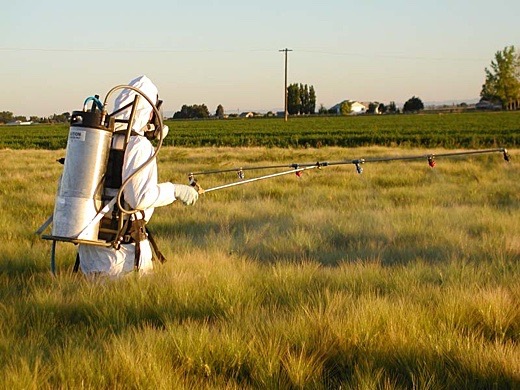
Image above: Man spraying barley with Syngenta's thiamethoxam. From (http://wrir4.ucdavis.edu/PHOTOS/CONDUCT/pages/Barley%20thiamethoxam%20ID.htm).

Unpublished field trials by pesticide manufacturers show their products cause serious harm to honeybees at high levels, leading to calls from senior scientists for the companies to end the secrecy which cloaks much of their research.

The research, conducted by Syngenta and Bayer on their neonicotinoid insecticides, were submitted to the US Environmental Protection Agency and obtained by Greenpeace after a freedom of information request.

Neonicotinoids are the world’s most widely used insecticides and there is clear scientific evidence that they harm bees at the levels found in fields, though only a little to date showing the pesticides harm the overall performance of colonies. Neonicotinoids were banned from use on flowering crops in the EU in 2013, despite UK opposition.

Bees and other insects are vital for pollinating three-quarters of the world’s food crops but have been in significant decline, due to the loss of flower-rich habitats, disease and the use of pesticides.

The newly revealed studies show Syngenta’s thiamethoxam and Bayer’s clothianidin seriously harmed colonies at high doses, but did not find significant effects below concentrations of 50 parts per billion (ppb) and 40ppb respectively. Such levels can sometimes be found in fields but concentrations are usually below 10ppb.

However, scientists said all such research should be made public. “Given all the debate about this subject, it is hard to see why the companies don’t make these kinds of studies available,” said Prof Dave Goulson, at the University of Sussex. “It does seem a little shady to do this kind of field study — the very studies the companies say are the most important ones — and then not tell people what they find.”

Prof Christian Krupke, at Purdue University in Indiana, said: “Bayer and Syngenta’s commitment to pollinator health should include publishing these data. This work presents a rich dataset that could greatly benefit the many publicly funded scientists examining the issue worldwide, including avoiding costly and unnecessary duplication of research.”

Ben Stewart, at Greenpeace, said: “If Bayer and Syngenta cared about the future of our pollinators, they would have made the findings public. Instead, they kept quiet about them for months and carried on downplaying nearly every study that questioned the safety of their products. It’s time for these companies to come clean about what they really know.”

Syngenta had told Greenpeace in August that “none of the studies Syngenta has undertaken or commissioned for use by regulatory agencies have shown damages to the health of bee colonies.” Goulson said: “That clearly contradicts their own study.”

Scientists also noted that the companies have been previously been critical of the research methods they themselves used in the new studies, in which bees live in fields but are fed sucrose dosed with neonicotinoids.

In April 2016, in response to an independent study, Syngenta said: “It is important to note that the colony studies were conducted by directly feeding colonies with spiked sucrose, which is not representative of normal field conditions.”

In 2014, commenting on another independent study, Bayer told the Guardian the bees “are essentially force-fed relatively high levels of the pesticide in sugar solutions, rather than allowing them to forage on plants treated with” pesticide.

“If someone had done this type of study and found harm at more realistic levels, the industry would have immediately dismissed it as a rubbish study because it was not what happens naturally to bees,” said Goulson. “So it is interesting that they are doing those kinds of studies themselves and then keeping them quiet.”

Utz Klages, a spokesman for Bayer, said: “The study [Bayer] conducted is an artificial feeding study that intentionally exaggerates the exposure potential because it is designed to calculate a ‘no-effect’ concentration for clothianidin.

lthough the colony was artificially provided with a spiked sugar solution, the bees were allowed to forage freely in the environment, so there is less stress — which can be a contributing variable — than if they were completely confined to cages. Based on these results, we believe the data support the establishment of a no-effect concentration of 20ppb for clothianidin.”

He said a public presentation would be made at the International Congress of Entomology next week in which the new results would be discussed.

A spokesman for Syngenta said: “A sucrose-based mechanism was used on the basis that it was required to expose bees artificially to thiamethoxam to determine what actual level of residue would exert a toxic effect.”

Given the lower concentration usually found in fields, he said: “The reported ‘no adverse effect level’ of 50ppb indicates that honey bee colonies are at low risk from exposure to thiamethoxam in pollen and nectar of seed treated crops. This research is already in the process of being published in a forthcoming journal and is clearly already publicly available through the FOI process in the US.”

Matt Shardlow, chief executive of conservation charity Buglife, said: “These studies may not show an impact on honeybee health [at low levels], but then the studies are not realistic. The bees were not exposed to the neonics that we know are in planting dust, water drunk by bees and wildflowers, wherever neonics are used as seed treatments. This secret evidence highlights the profound weakness of regulatory tests.”

Researchers also note that pollinators in real environments are continually exposed to cocktails of many pesticides, rather than single chemicals for relatively short periods as in regulatory tests.


.

GMO guys the dumbest in the room

SUBHEAD: The GMO industry has managed to hire the worst public relations strategists in human history.

By Kurt Cobb on 10 July 2016 for Resource Insights -
(http://resourceinsights.blogspot.com/2016/07/gmo-industry-dumbest-guys-in-room.html)


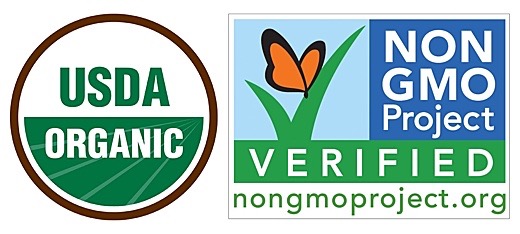
Image above: These are two labels that guarantee that the food in the package contains no GMO ingredients. From (http://organicconnectmag.com/project/a-tale-of-two-labels-organic-and-non-gmo/).

[IB Publisher's note: The Vermont labeling law was not strong enough. To merely indicate that the ingredients of a food package "contains genetically engineered ingredients" does not tell us nearly enough. For example; if the only GMO ingredient in the product is only a few percentage of the total product that is quite different from it being a major element like high-fructose-corn-syrup (HFCS) in soft drinks. The way food ingredients are labeled is in descending order of percentage. Frozen non GMO corn with added dash of HFCS as a sweetener and some salt  might be 95% GMO free. Where as if the corn was a GMO product the package would be 95% GMO. This should be reflected in the ingredients label listing. For example: as "INGREDIENTS: Corn, GMO HFCS, salt"  or "INGREDIENTS: GMO corn, GMO HFCS, salt". This is not being done because of the "burden" on those providing the printed packaging to various locations with differing requirements. All the more reason for a comprehensive, informative and easy to read labeling regimen coming from the federal government. Until then we will have to rely on "USDA Organic" or "Non GMO Product" labels on packaging.]


Image above: Possible senate (and Democrat) approved. Isn't this informative to the buyer? QR scanner code mark which would "inform" consumer, of among other things, if there was GMO content. From (http://www.resilience.org/stories/2016-07-10/gmo-industry-the-dumbest-guys-in-the-room).

I am now convinced the GMO industry has managed to hire the worst public relations strategists in human history. By supporting a deeply flawed GMO labeling bill in the U.S. Congress--some would say intentionally deeply flawed--the industry is about to open a Pandora's Box of PR nightmares for years to come.

First, a little background. GMO, of course, means genetically modified organism which more properly refers to genetically engineered crops and animals. GMO industry leader Monsanto and its competitors such as Bayer, Dupont, Dow Chemical and Sygenta have all been fighting a fierce battle in the United States against labeling foodstuffs derived from genetically engineered crops.

After defeating statewide labeling referendums in California, Oregon and Washington, they failed to stop the implementation of Vermont's GMO labeling law which went into effect July 1st.

In desperation the companies have been trying to get the U.S. Congress to pass a nationwide labeling law--one that is considerably less stringent and also riddled with loopholes--that would pre-empt Vermont's law. Just last week the Senate approved its version of the labeling law. If the House and Senate can work out their differences, we may see such a law signed by President Obama before too long.

The industry's main complaint has been that labeling GMOs would unfairly stigmatize them in the minds of consumers. Some 64 countries already require such labeling. What concerns the industry is that increased consumer awareness could create a movement that would lead to a ban on the cultivation of GMO crops, a ban already implemented by 19 countries in Europe.

Opponents of the GMO labeling law currently moving through the U.S. Congress believe it is so poorly drafted that almost no commonly consumed genetically modified foods will actually be covered.

In addition, food derived from newer gene-editing techniques as opposed to transgene processes--the ones that transfer genes from one species to another--may be excluded as well. The fact that agricultural trade groups are praising the labeling bill--after fighting labeling for years--tells you something about how effective they believe the law will be at informing consumers, namely, not very.

The Senate bill allows food manufacturers to use a symbol, a statement or a so-called QR code that shoppers would have to scan using a cellphone to obtain information on genetically engineered ingredients. Small companies could simply list a phone number or website address.

If you were selling GMO-derived foods, which would you use? Probably the options that provide the least information and which make it most difficult for consumers to access that information. This assumes that anything in your product actually turns out to be covered by the law which looks like it will exclude great swaths of foodstuffs containing genetically engineered ingredients.

Given what we know now, the final bill is likely to be vague and riddled with exceptions and confusing directives. The GMO-friendly U.S. Department of Agriculture will then be tasked with writing the actual labeling regulations.

We are thus assured of months and perhaps years of wrangling over the labeling rules, every step of which will be given wide and probably negative coverage by the anti-GMO activist community. The pending federal labeling law is more likely to assist opponents in sowing mistrust of major food companies than alleviate it.

When the rules go into effect, if they are every bit as lax as the law seems to promise, the activists will make a sport out of spotting and telling on companies that are cheating or that are cleverly thwarting the purposes of the law.

The anti-GMO groups will likely put out lists of the worst labeling violators and lists of their products containing GMOs. And, of course, there will be lists based on those enigmatic QR codes. Perhaps those codes will become the equivalent of the skull and crossbones feared by one GMO executive.

The whole shopping experience will be treated like an reverse Easter egg hunt. Can you spot the GMO foods? Can you identify the alleged cheaters on the grocery store shelves and punish them by refusing to buy their products?

Perhaps some enterprising activist, one not afraid of incarceration, will surreptitiously slap GMO cheater labels on various products on the store shelves that are not labeled properly. Any subsequent arrest will then lead to more coverage as some in the public cheer the civil disobedience while others simply shrug their shoulders.

Acquiescence to the Vermont law or acceptance of a federal law with Vermont's straightforward labeling rules would have saved the GMO industry from what will almost surely be a years-long PR debacle if the labeling law before Congress passes.

There will doubtless be many more creative ways than I've listed for GMO opponents to tweak the industry and keep the issue of honest labeling alive and before the public. If only the industry had accepted Vermont's labeling law as the de facto standard for the country, the industry would have in one stroke taken the issue away from its opponents!

But the industry's business and public relations strategists are the same ones who made a colossal marketing error--while believing they had achieved a regulatory coup--when they steamrolled the U.S. Food and Drug Administration (FDA) into ruling that GMOs are "substantially equivalent" to their non-GMO counterparts and therefore require no testing.

The FDA did this despite their own scientists' concerns that these novel life forms might have unanticipated effects on the environment and on humans who consume them. Some of those scientists thought extensive testing similar to what a new drug must go through was advisable to rule out such risks.

The reason this strategy has turned out to be a colossal marketing error is that as the attacks on GMOs have mounted during the intervening couple of decades, the industry finds itself unable to pivot and point to any advantages that GMO foods have for consumers over non-GMO foods. This is because the industry has been saying for more than 20 years that GMOs have no advantages for consumers.

After all, GMO foods are said to be "substantially equivalent." That means that the industry cannot give consumers any reasons to prefer GMO foods over their non-GMO counterparts. Any claims of superiority over conventional foods made now will ring hollow and bring down an avalanche of public derision from GMO opponents.

(The industry may cite supposed advantages for farmers and for the environment. But those advantages are sharply and publicly disputed by anti-GMO activists and have nothing to do with taste, nutrition or appearance which are what matters to consumers. While the GMO industry tells us that GMO crops with enhanced nutrition are coming, I can find only one that has been brought to market under a cloud of concerns. So far genetic engineering has focused on creating plants the produce insecticides internally--not a pleasant thought for those eating them--and which are immune to herbicides made by, you guessed it, the companies producing the GMO seeds.)


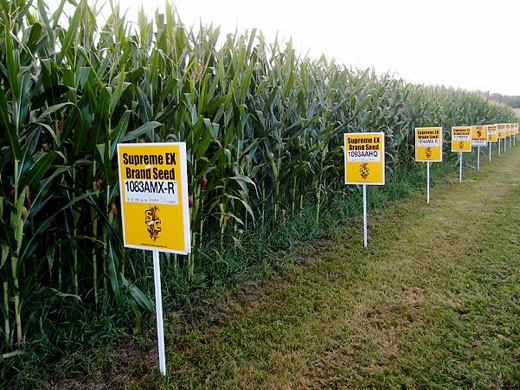
Image above: GMO experimental corn field with rows of "Supreme EX Brand Seed". From (http://www.resilience.org/stories/2016-07-10/gmo-industry-the-dumbest-guys-in-the-room).

These same industry strategists have directed a campaign of fear aimed at farmers to prevent supposed intellectual property theft through the use of saved GMO seeds. Even those into whose fields GMO seeds have been swept by wind have been sued. Since farmers growing in areas where other farmers grow genetically engineered crops may be subject to windblown "thefts," they have an incentive to grow GMO crops on their land and pay the royalties to avoid being sued for such "theft." Essentially, it's, "Buy from us or we'll sue you--and we're a lot richer than you are."

Aggressive tactics including smear campaigns have also been used against critics who question the safety and social utility of GMOs and associated farm chemicals. (Click here, here and here.) Mostly, those campaigns have backfired by creating extensive media coverage of the smear campaigns themselves.

These aggressive tactics have made the company most associated with the GMO industry, Monsanto, one of the most hated corporations in America.

All of this would make for an enviable record for anti-GMO activists, and yet it comes from business and public relations strategists in the industry itself. In most industries, a record like this would lead to a rash of sackings.

Instead, the bunglers have managed to bungle into yet another long-term public relations disaster of their own making. They seem not to have learned anything from their repeated failures.

All this should be pleasing to GMO opponents who must be thinking these continuing debacles couldn't be happening to nicer people.


P.S. I borrow my slightly altered headline for this piece from a book and film entitled "The Smartest Guys in the Room" about the collapse of Enron, the energy trading firm. The phrase refers to key traders in the company who believed they were, in fact, always the smartest guys in the room, the same ones who eventually brought the company down.

• Kurt Cobb is an author, speaker, and columnist focusing on energy and the environment. He is a regular contributor to the Energy Voices section of The Christian Science Monitor and author of the peak-oil-themed novel Prelude. In addition, he has written columns for the Paris-based science news site Scitizen, and his work has been featured on Energy Bulletin (now Resilience.org), The Oil Drum, OilPrice.com, Econ Matters, Peak Oil Review, 321energy, Common Dreams, Le Monde Diplomatique and many other sites. He maintains a blog called Resource Insights and can be contacted at kurtcobb2001@yahoo.com.

.

Chemical Company Troubles

SUBHEAD: Kauai demonstration against Monsanto and other chemical food corporations.

By Blake Drolson on 12 May 2016 for GMO Free Kauai  
(http://islandbreath.blogspot.com/2016/05/chemical-company-troubles.html)


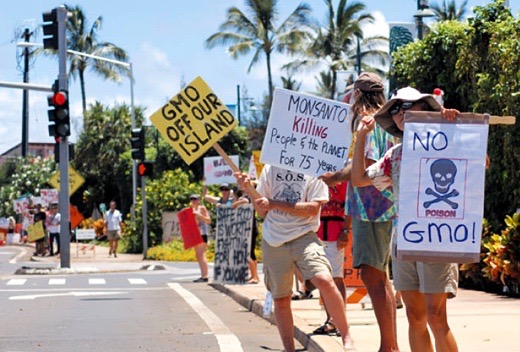
Image above: Demonstration in opposition to GMO and pesticide testing on Kauai during a rally 5/25/13 held outside the Kauai Village shopping center along Kuhio Highway in Kapaa. From (http://thegardenisland.com/news/local/rally-against-gmos-in-kapaa/article_f73dee50-c5c8-11e2-a00d-0019bb2963f4.html).

WHAT:
Kauai rallies in solidarity with the March Against Monsanto where millions of people around the World will demand an end to Monsanto's (and the rest of the chemical cartel's) corrupt and polluting actions.

WHEN:
21st of May 2016 from 10:00am to noon

WHERE:
On sidewalk at stop light
Safeway Supermarket
4-831 Kuhio Highway
Kapaa, Kauai, Hawaii


Lawsuit threat over Kauai pesticide use

SUBHEAD: Earthjustice threatens to sue Hawaii's Agribusiness Development Corporation over pesticides on Kauai.

By Courtney Teague on 3 May 2016 for Civil Beat -
(http://www.civilbeat.com/2016/05/environmental-law-group-threatens-suit-over-pesticides-on-kauai/)


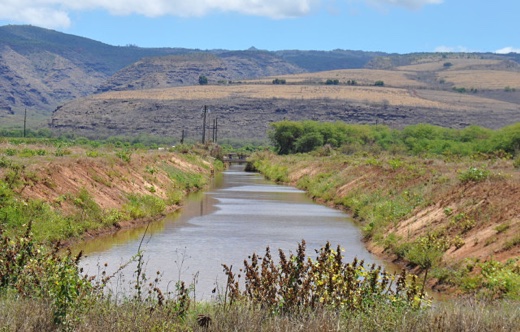
Image above: Water flows near DuPont Pioneer’s now-shuttered parent seed facility in Kekaha, Kauai on June 16, 2015. From original article.


Earthjustice
, a U.S. nonprofit environmental law firm, notified Hawaii’s Agribusiness Development Corporation on Tuesday that it will sue the agency for allegedly allowing pesticides and chemicals to contaminate a 40-mile-long drainage ditch system on the Mana Plain of Kauai’s west side.

The ADC, a division of the Department of Agriculture, leases thousands of acres there to seed companies. Earthjustice, in alliance with several community groups, said that the genetically-engineered crops grown on the lands on the west side of Kauai require intensive applications of chemicals and pesticides that run off into drainage ditches, flowing through communities and into the ocean near the Mana Plain.

For decades, the drainage system used for this land was monitored by the Department of Health under a Clean Water Act permit; but in August, ADC decided not to renew its permit, according to the statement. The Clean Water Act requires a permit from those who intend to discharge harmful chemicals into state waters and wetlands.

The Department of Agriculture declined comment Tuesday on the notice of intent to sue.

ADC meeting minutes show that in July 2015, officials decided that new Department of Health “water quality standards would be extremely difficult to meet, particularly at approval.”
So instead of applying to renew the existing permit, ADC opted to pursue an exemption and create a plan to take care of the soil and water in the Mana Plain. ADC also would have to identify what streams were associated with nearby hydroelectric power plants, according to the minutes.

The Kauai chapter of Surfrider Foundation, a conservation group, tested ditches on the west side of Kaui and confirmed they contain pesticides, according to a statement attributed to Angela Howe, the foundation’s legal director. Earthjustice also cited 2012 Census data that found the majority of nearby residents are people of color and Native Hawaiian.

The drain flows through towns and popular recreation sites, according to the release.

The Mana Plain was one of many locations surveyed in a $100,000 report ordered by the DOA and Kauai County Council in December 2014, following public outcry over potential health and environmental health hazards caused by seed companies’ pesticide use.

Although four pesticides (atrazine, chlorpyrifos, fipronil and glyphosate) were found in the Mana Plain, the report said that the amount found couldn’t have “significant negative impacts.” Water tested from a wetland on the plain detected pesticides, but those tests did not measure the types or concentrations.

Kylie Wager, Earthjustice associate attorney, said in a telephone interview that the issue was brought to the group’s attention after community members reached out to them. The notice of intent to sue is their first attempt at contact with the ADC. She said if ADC doesn’t address Earthjustice’s concerns about noncompliance with Clean Water Act requirements within 60 days, the group will take legal action.

Wager said it was “a shame” that the ADC decided not to renew its Clean Water Act permit, since these areas are used for swimming, fishing and boating. She referenced a 2013-2014 DOH pesticide testing survey that found Kekaha, an area near the Mana Plain, detected trace amounts of the restricted insecticide chlorpyrifos.

The report said Kauai and Oahu had higher levels of pesticides in water samples than the Big Island.

Tests at another location on west Kauai found two restricted pesticides at levels within the legal limit, but at levels that could still harm sea life. Many locations tested near lands leased to seed corporations found traces of pesticides.

“The Clean Water Act doesn’t require a showing of extreme health problems,” Wager said. “If pollutants are going into the water, the people have a right to know what those are.”


Chemical Company Takeover?

SUBHEAD: International cabal of chemical corporation continues control of world food supply.

By Andrea Germanos on 12 May 2016 for Common Dreams -
(http://www.commondreams.org/news/2016/05/12/monsanto-takeover-corporate-cabals-control-food-supply-continues)


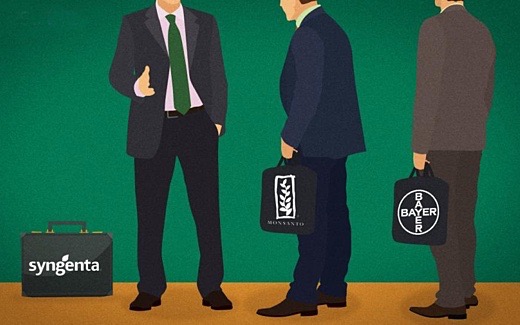
Image above: Syngenta - Monsanto - Bayer conglomeration talks go on. From (http://www.bidnessetc.com/46167-monsanto-company-to-go-after-bayer-if-talks-with-syngenta-fail/).

Mergers like Bayer's rumored takeover of Monsanto 'would make it even harder for farmers, consumers and communities to build a vibrant, sustainable food system'

German chemical giants Bayer AG and BASF SE are both considering takeovers of U.S. seed behemoth Monsanto, according to news reports on Thursday.

Of the potential Bayer takeover of Monsanto, valued at roughly $40 billion, Bloomberg noted that it "would create the world’s largest supplier of seeds and farm chemicals."
As USA Today reported, "A bid for Monsanto would be just the most recent in a wave of chemical and agribusiness consolidation."

Indeed, in February China National Chemical Corp. (ChemChina) announced it would acquire Swiss pesticide company Syngenta for $43 billion, while DuPont and Dow Chemical announced their merger last year.

According to advocacy group Food & Water Watch, such consolidation has far-reaching impacts, and is bad news for farmers and communities.

"A Bayer takeover of Monsanto would only be the latest in a string of high-profile seed and agrochemical mergers that are undermining the economic viability of family farms," said Wenonah Hauter, the organization's executive director. "Unchecked food and agribusiness monopolies pay farmers less, charge consumers more and reduce everyone's choices."

"The Department of Justice must block deals like the proposed ChemChina-Syngenta and Dow-DuPont mergers that already threaten to hyper-consolidate the biotech seed industry," she argued. "Doing so would also send a message that mega-mergers like the rumored Bayer-Monsanto deal will not be rubber stamped.

"The shocking consolidation in the biotech seed and agrochemical industry turns over the food system to a cabal of chemical companies that would make it even harder for farmers, consumers and communities to build a vibrant, sustainable food system," Hauter said.

The potential merger, Bloomberg reports, "would face a global antitrust review."  The paper also quotes Erik Gordon, a professor at University of Michigan’s Ross School of Business, who said that it may be slowed down by regulators who "are faced not with a decision about a single deal, but rather with a decision about the structural concentration of the whole industry.”

See also:
Ea O Ka Aina: Chinese to take over Syngenta? 2/2/16
Ea O Ka Aina: Monsanto and Syngenta stranglehold
10/7/15


.

Between pesticides and bee deaths

SUBHEAD: Federal scientists have reported harassment when their work conflicts with agribusiness interests.
 
By Raynard Loki on 5 May 2015 for Alternet -
(http://www.alternet.org/environment/usda-silencing-its-own-scientists-bee-killing-pesticide-research)


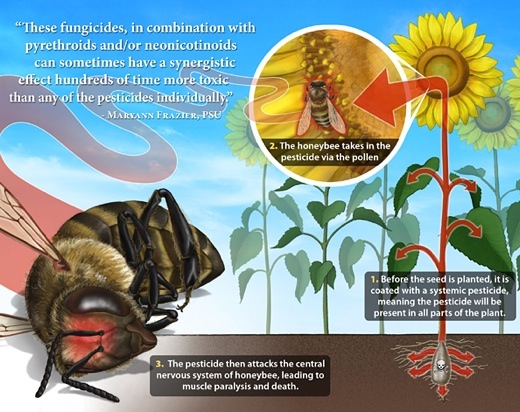
Image above: Illustration by Tony Links of neonicotinoid poisoning of bee. From (http://www.tonylinka.com/scientific/neonicotinoids.html).

Following reports that scientists at the United States Department of Agriculture are being harrassed and their research on bee-killing pesticides is being censored or suppressed, a broad coalition of farmers, environmentalists, fisheries and food-safety organizations urged an investigation in a May 5 letter sent to Phyllis K. Fong, USDA Inspector General.

"The possibility that the USDA is prioritizing the interests of the chemical industry over those of the American public is unacceptable," states the letter, which was signed by more than 25 citizens' groups concerned that a forthcoming report by the White House Task Force on Pollinator Health, which is co-chaired by the USDA, will be compromised.

The signatories include the American Bird Conservancy, Avaaz, Center for Biological Diversity, Center for Food Safety, Farmworkers Association of Florida, Food and Water Watch, Friends of the Earth, Green America, Organic Consumers Association and Sierra Club.

"It is imperative that the American people can trust that their government and its employees are serving their constituents and not the profits of private companies," they wrote. "All of the research that the USDA conducts must maintain scientific integrity and transparency to ensure it is guiding sound policy decisions."

The research in question centers on neonicotinoids, a nicotine-like class of insecticides that impair the neurological systems of insects and which studies have linked to die-offs of bees and monarch butterflies—two key pollinators—as well as birds.

Neonicotinoids have been strongly linked to honey-bee colony collapse disorder (CCD), a syndrome first observed in Germany that has been blamed for massive bee population declines across the globe. In 2013, certain neonicotinoids were banned by the European Union and a few non-EU nations.

The global food system relies on bees to pollinate at least 30 percent of the world's crops. Bees are responsible for pollinating a host of American crops, from apples and almonds to cantaloupes and cucumbers, impacting $15 billion a year in U.S. crops.

In March, Public Employees for Environmental Responsibility (PEER), an environmental activist group supporting local, state and federal researchers, filed a legal petition with the USDA seeking new rules meant to increase the job protection for government scientists and citing censorship and harassment. At least 10 USDA scientists have come under fire for research into farm chemical safety that conflicts with the interests of the agribusiness sector, according to PEER executive director Jeff Ruch.

"They have very little in the way of legal rights and have career paths that are extremely vulnerable," he said. He said the scientific work under scrutiny is the research into the effects of neonicotinoids and glyphosate, the key ingredient in Monsanto's popular Roundup herbicide, which the World Health Organization recently concluded likely causes cancer.

"Your words are changed, your papers are censored or edited or you are not allowed to submit them at all," a senior scientist at the USDA's Agricultural Research Service told Reuters.

“Censorship and harassment poison good science and good policy,” said Lori Ann Burd, environmental health director at the Center for Biological Diversity. "There’s no question that neonicotinoids are killing bees, and it’s long past time for our government to take action.

The European Union has already banned neonicotinoids. The reports that USDA is harassing and suppressing its scientists for doing their jobs instead of using their findings to protect our pollinators are extremely disturbing."

“How can the American public expect USDA to develop a federal strategy that will protect bees instead of pesticide industry profits if it is harassing and suppressing its own scientists for conducting research that runs counter to industry claims?" said Tiffany Finck-Haynes, food futures campaigner with Friends of the Earth.

In April 2014, the group released “Follow the Honey: 7 ways pesticide companies are spinning the bee crisis to protect profits,” a report documenting the deceptive tactics used by agrochemical companies to deflect blame from their chemicals to pollinator declines and stall governmental regulation on neonicotinoids.

The companies named in the report include U.S.-based Monsanto, Switzerland-based Syngenta and Germany-based Bayer, which patented the first commercial neonicotinoid, Imidacloprid, the world's most widely used insecticide.

"If USDA wants to employ a kill-the-messenger approach," said Finck-Haynes, "it will only delay critical action to address the bee crisis that threatens our nation’s food supply."

"It is imperative that the American people can trust that their government and its employees are serving their constituents and not the profits of private companies," they wrote. "All of the research that the USDA conducts must maintain scientific integrity and transparency to ensure it is guiding sound policy decisions."

The research in question centers on neonicotinoids, a nicotine-like class of insecticides that impair the neurological systems of insects and which studies have linked to die-offs of bees and monarch butterflies—two key pollinators—as well as birds. Neonicotinoids have been strongly linked to honey-bee colony collapse disorder (CCD), a syndrome first observed in Germany that has been blamed for massive bee population declines across the globe. In 2013, certain neonicotinoids were banned by the European Union and a few non-EU nations.

The global food system relies on bees to pollinate at least 30 percent of the world's crops. Bees are responsible for pollinating a host of American crops, from apples and almonds to cantaloupes and cucumbers, impacting $15 billion a year in U.S. crops.

In March, Public Employees for Environmental Responsibility (PEER), an environmental activist group supporting local, state and federal researchers, filed a legal petition with the USDA seeking new rules meant to increase the job protection for government scientists and citing censorship and harassment. At least 10 USDA scientists have come under fire for research into farm chemical safety that conflicts with the interests of the agribusiness sector, according to PEER executive director Jeff Ruch.

"They have very little in the way of legal rights and have career paths that are extremely vulnerable," he said. He said the scientific work under scrutiny is the research into the effects of neonicotinoids and glyphosate, the key ingredient in Monsanto's popular Roundup herbicide, which the World Health Organization recently concluded likely causes cancer.

"Your words are changed, your papers are censored or edited or you are not allowed to submit them at all," a senior scientist at the USDA's Agricultural Research Service told Reuters.

“Censorship and harassment poison good science and good policy,” said Lori Ann Burd, environmental health director at the Center for Biological Diversity. "There’s no question that neonicotinoids are killing bees, and it’s long past time for our government to take action. T

he European Union has already banned neonicotinoids. The reports that USDA is harassing and suppressing its scientists for doing their jobs instead of using their findings to protect our pollinators are extremely disturbing."

“How can the American public expect USDA to develop a federal strategy that will protect bees instead of pesticide industry profits if it is harassing and suppressing its own scientists for conducting research that runs counter to industry claims?" said Tiffany Finck-Haynes, food futures campaigner with Friends of the Earth.

In April 2014, the group released “Follow the Honey: 7 ways pesticide companies are spinning the bee crisis to protect profits,” a report documenting the deceptive tactics used by agrochemical companies to deflect blame from their chemicals to pollinator declines and stall governmental regulation on neonicotinoids.

The companies named in the report include U.S.-based Monsanto, Switzerland-based Syngenta and Germany-based Bayer, which patented the first commercial neonicotinoid, Imidacloprid, the world's most widely used insecticide.

"If USDA wants to employ a kill-the-messenger approach," said Finck-Haynes, "it will only delay critical action to address the bee crisis that threatens our nation’s food supply."

"It is imperative that the American people can trust that their government and its employees are serving their constituents and not the profits of private companies," they wrote. "All of the research that the USDA conducts must maintain scientific integrity and transparency to ensure it is guiding sound policy decisions."

The research in question centers on neonicotinoids, a nicotine-like class of insecticides that impair the neurological systems of insects and which studies have linked to die-offs of bees and monarch butterflies—two key pollinators—as well as birds.

Neonicotinoids have been strongly linked to honey-bee colony collapse disorder (CCD), a syndrome first observed in Germany that has been blamed for massive bee population declines across the globe. In 2013, certain neonicotinoids were banned by the European Union and a few non-EU nations.

The global food system relies on bees to pollinate at least 30 percent of the world's crops. Bees are responsible for pollinating a host of American crops, from apples and almonds to cantaloupes and cucumbers, impacting $15 billion a year in U.S. crops.

In March, Public Employees for Environmental Responsibility (PEER), an environmental activist group supporting local, state and federal researchers, filed a legal petition with the USDA seeking new rules meant to increase the job protection for government scientists and citing censorship and harassment.

At least 10 USDA scientists have come under fire for research into farm chemical safety that conflicts with the interests of the agribusiness sector, according to PEER executive director Jeff Ruch.

"They have very little in the way of legal rights and have career paths that are extremely vulnerable," he said. He said the scientific work under scrutiny is the research into the effects of neonicotinoids and glyphosate, the key ingredient in Monsanto's popular Roundup herbicide, which the World Health Organization recently concluded likely causes cancer.

"Your words are changed, your papers are censored or edited or you are not allowed to submit them at all," a senior scientist at the USDA's Agricultural Research Service told Reuters.

“Censorship and harassment poison good science and good policy,” said Lori Ann Burd, environmental health director at the Center for Biological Diversity. "There’s no question that neonicotinoids are killing bees, and it’s long past time for our government to take action. The European Union has already banned neonicotinoids.

The reports that USDA is harassing and suppressing its scientists for doing their jobs instead of using their findings to protect our pollinators are extremely disturbing."

“How can the American public expect USDA to develop a federal strategy that will protect bees instead of pesticide industry profits if it is harassing and suppressing its own scientists for conducting research that runs counter to industry claims?" said Tiffany Finck-Haynes, food futures campaigner with Friends of the Earth.

In April 2014, the group released “Follow the Honey: 7 ways pesticide companies are spinning the bee crisis to protect profits,” a report documenting the deceptive tactics used by agrochemical companies to deflect blame from their chemicals to pollinator declines and stall governmental regulation on neonicotinoids.

 The companies named in the report include U.S.-based Monsanto, Switzerland-based Syngenta and Germany-based Bayer, which patented the first commercial neonicotinoid, Imidacloprid, the world's most widely used insecticide.

"If USDA wants to employ a kill-the-messenger approach," said Finck-Haynes, "it will only delay critical action to address the bee crisis that threatens our nation’s food supply."

.

GMO Ukraine

SOURCE: Kip Goodwin (pigdog44@icloud.com)
SUBHEEAD: Monsanto’s role in Ukraine overthrow and takeover of Ukraine's farmland for GMOs?

By Christina SArich on 12 January 2015 for Common Ground -
(http://www.commondreams.org/views/2015/01/12/what-theyre-not-telling-you-about-monsantos-role-ukraine)


Image above: Genetically Modified Organisms (GMOs) grow near an abandoned cooling tower of the Chernobyl Nuclear Power Plant in Ukraine. From (http://www.outsideonline.com/outdoor-adventure/science/Chernobyl--My-Primeval--Teeming--Irradiated-Eden.html).

The World Bank and International Monetary Fund (IMF) is helping biotech run the latest war in Ukraine. Make no mistake that what is happening in the Ukraine now is deeply tied to the interests of Monsanto, Dow, Bayer, and other big players in the poison food game.

Monsanto has an office in Ukraine. While this does not shout ‘culpability’ from every corner, it is no different than the US military’s habit to place bases in places that they want to gain political control. The opening of this office coincided with land grabs with loans from the IMF and World Bank to one of the world’s most hated corporations – all in support of their biotech takeover.

Previously, there was a ban on private sector land ownership in the country – but it was lifted ‘just in time’ for Monsanto to have its way with the Ukraine.

In fact, a bit of political maneuvering by the IMF gave the Ukraine a $17 billion loan – but only if they would open up to biotech farming and the selling of Monsanto’s poison crops and chemicals – destroying a farmland that is one of the most pristine in all of Europe. Farm equipment dealer, Deere, along with seed producers Dupont and Monsanto, will have a heyday.

In the guise of ‘aid,’ a claim has been made on Ukraine’s vast agricultural riches. It is the world’s third largest exporter of corn and fifth largest exporter of wheat. Ukraine has deep, rich, black soil that can grow almost anything, and its ability to produce high volumes of GM grain is what made biotech come rushing to take it over.

As reported by The Ecologist, according to the Oakland Institute:
“Whereas Ukraine does not allow the use of genetically modified organisms (GMOs) in agriculture, Article 404 of the EU agreement, which relates to agriculture, includes a clause that has generally gone unnoticed: it indicates, among other things, that both parties will cooperate to extend the use of biotechnologies.

There is no doubt that this provision meets the expectations of the agribusiness industry. As observed by Michael Cox, research director at the investment bank Piper Jaffray, ‘Ukraine and, to a wider extent, Eastern Europe, are among the most promising growth markets for farm-equipment giant Deere, as well as seed producers Monsanto and DuPont’.”
The nation WAS Europe’s breadbasket – and now in an act of bio-warfare, it will become the wasteland that many US farmlands have become due to copious amounts of herbicide spraying, the depletion of soil, and the overall disruption of a perfect ecosystem.

The aim of US government entities is to support the takeover of Ukraine for biotech interests (among other strategies involving the prop-up of a failing cabalistic banking system that Russia has also refused with its new alignment with BRICS and its own payment system called SWIFT). This is similar to biotech’s desired takeover of Hawaiian islands and land in Africa.

The Ukraine war has many angles that haven’t been exposed to the general public – and you can bet that biotech has their hands in the proverbial corn pie.

.

Right to Land and Seed

SUBHEAD: A film about food sovereignty in times of climate change and global warming.

By Jürgen Kraus and Heiko Thiele on 15 December 2014 for Grain -
(http://www.grain.org/bulletin_board/entries/5109-right-to-land-and-seed)


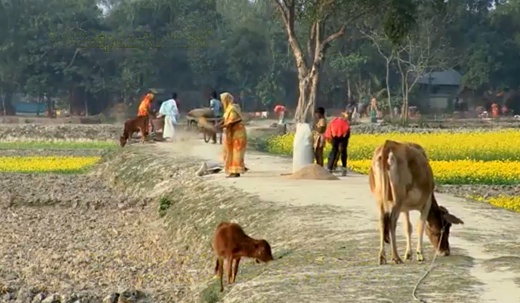
Image above: Still from movie "Right to Land and Seed" of traditional community farming in Bangladesh.

“Food sovereignty” is the main political demand of the landless and peasant movement in Bangladesh in times of climate change and intensifying land conflicts. The concept of food sovereignty is based on the right to grow their own food, with own seeds and in an ecologically sustainable way of farming.

The peasant movement fights for a revolutionary land reform and self-determined food production, in order to improve and guarantee the local and national food supply.

One strategy to strengthen the demand for food sovereignty is the occupation of land by groups of small farmers. According to the law, landless farmers have a right to land which often isn't enforced due to corruption and unequal power relations.

The capitalization of the agricultural sector is a threat for the local markets and self-sustained food production. Since the so called “green revolution” in the 1960s, there is a growing influence of international seed- and chemical-companies on the agricultural market in Bangladesh.

The dependency on fertilizers, pesticides and modified seeds along with the infrastructural adjustments made by the state of Bangladesh and the World Bank have significantly changed the living conditions of small farmers.

Higher production costs as well as lower productivity and fertility of the soil is the reason why many peasants end up in dept.

Around three fourths of those engaged in the farming sector are landless workers. Many would have the right to receive land through the “Kash land”-legislation. But corruption of local politicians and administration are immediate and structural obstacles that prevent landless workers from obtaining land-titles of state-owned or unused land.

Bangladesh is one of the most vulnerable countries to climate change in the world. The rise of sea level causes loss of agricultural land. Cyclones and salinization are a threat for the whole farming sector.

Nevertheless, the government sticks to the concept of „food security“, relying on transnational agro-companies for food supply on the one hand and on the other on export of agricultural products to markets in Asia and abroad.

This results in monocultures and ecological destruction. The vast areas of fish- and shrimp-farming in the southwestern part of the country is only one example.

The documentation team participated in the “South-Asian Caravan for climate justice, food sovereignty and gender” which went through Bangladesh from North to South.

Later on it conducted interviews and investigated issues such as the impact of climate change, the economic situation of peasants, the “green revolution”, the difference between “food sovereignty” and “food security”, the processes of land-grabbing and conflicts around land and the strategies, resistance and alternatives created by the landless movement in Bangladesh.

The documentary includes voices of peasants, landless workers, activists of various South Asian grassroot movements, NGOs, politicians and scientists of the field.


Video above: Trailer from movie "Right to Land and Seed" of traditional community farming in Bangladesh. From (http://youtu.be/UyV33cKbftU).

.