Showing posts with label Religion. Show all posts

The Winter Solstice Once Again

SUBHEAD: In Hawaii it does not mean the same thing as in upstate New York. But it still means much.

By Juan Wilson on 20 December 2019 for Island Breath -
(https://islandbreath.blogspot.com/2019/12/the-winter-solstice-once-again.html)


Image above: Image of a Winter Solstice on today's Navajo-Hopi Observer. From (https://www.nhonews.com/news/2017/dec/26/guest-column-welcoming-winter-solstice/).

Below are two articles from our website "The Gobbler" from the Winter of 1995 in western upstate New York. At this time of year you go to work in the morning in the dark and come home in the afternoon in the dark. Colder than in the inside of your refrigerator - and often colder than the inside of your freezer.

Tonight we are going to have
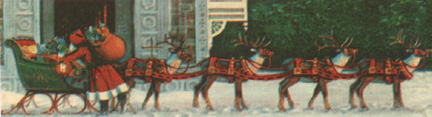
 
Christmas Traditions
by Linda Pascatore
©1995 The Gobbler: Winter Crystal
Nativity scenes, Santa Claus, reindeer, stars, wreaths and holly, stockings and presents are all associated with Christmas. Some traditions are directly related to the Christian holiday, while others had their origin earlier in various midwinter or solstice celebrations.  
Christmas, or Christ's mass, is the feast day celebrating the birth of Jesus two thousand years ago. Since the exact date of Christ's birth was not known, the earliest Christians didn't celebrate it. But in 350 AD, the Pope set a date--December 25th. 
It was probably observed at this time because of strong traditions of solstice celebrations. Winter solstice is the shortest day, and the longest night of the year. It falls around December 21st. The earth, in traveling around the sun, is tilted on its axis. At the Autumnal Equinox, around September 23rd, the North Pole begins tilting away from the sun. The days become shorter, the noon sun is lower in the sky, and we get less sunlight in the Northern Hemisphere. 
Solstice means a standing still, because the sun appears at the same low point for a few days around midwinter. From that time on, the days become longer, the light grows, and the coming of Spring has begun. People feared the cold dark winter. It was natural to celebrate the return of the sun and hope for the new year. There were many festivals around this time. 
In most cultures, this was the new year, when the Sun returned, a time of light and hope. Since Christ was the "light of the world", and the hope for salvation and new spiritual life, the tone of the solstice festivals was appropriate for his birthday. The "Sun" god was replaced by the "Son" of God.  
Long before Christ was born, the Persians celebrated the "Birthday of the Unconquered Sun" on December 25th. They lit fires in honor of Mithra, the god of light. This date marked the beginning of their New Year.  
The Jews had Hanukkah, the Feast of Lights, in December. The purpose was to commemorate an ancient victory, in which they drove off an invading army and then rededicated their temple. Legend has it that they had only enough lamp oil for the Eternal Lamp in the temple to burn for one day, but the light miraculously burned for eight days. The Menorah symbolizes this event. One more candle is lit each day of Hanukkah, along with the servant candle or shamash, until all eight are burning on the last day. 
Many of our Christmas traditions are found in the ancient Roman celebration of Saturnalia, honoring Saturn, the god of agriculture. The Romans wore masks, danced in the streets, had feasts, and gave gifts. They placed evergreen branches in their homes at this time, and crowned Saturn with wreaths of holly. Trees were decorated and lit with candles. A figure of Saturn was placed on top of the tree. No war or disputes of any kind were allowed during the Saturnalia Festival, making peace and goodwill part of this ancient Roman holiday. 
For Christians, the birth of Jesus is the center of the most meaningful traditions. Nativity scenes, with Jesus, Mary, Joseph and the attendant angels, shepherds, wise men and animals are found around the world. People usually render the figures in their own image, so features will vary from Middle Eastern to Hispanic, Nordic, Oriental or African. Saint Francis of Assisi introduced the living Nativity Scene. He set up a manger in a cave and had real animals and people play the parts. 
This tradition continues in many places today, with whole villages taking part in the Christmas pageants. In Mexico, people dress as Mary and Joseph, and visit one house each night for nine nights, reenacting the holy family's search for shelter. They are turned away the first eight nights, then on the last night, Christmas Eve, they are finally given shelter and the birth of Jesus is celebrated by all.  
The star on top of the Christmas tree represents the bright star of Bethlehem which led the three wise men to the infant Jesus. Astronomers have tried to find an explanation for this famous star. There were no bright novas, or new stars, in the years around the birth of Christ. 
No comet was visible then, either. However, it is possible that Christ was actually born in the spring of 6 B.C., when there was a close alignment of three stars in Pices; Mars, Jupiter, and Saturn 
This particular alignment had great significance in Jewish history. The same constellation had appeared together in Pices shortly before Moses was born. The wise men of the East, learned in astronomy, might have taken the appearance of these stars as a sign of some great event about to take place in Israel, and so begun their journey there. 
In the Bible, Jesus is called "the bright and morning star." Today, in many parts of Europe and the Middle East, Christmas festivities begin with the appearance of the first star on Christmas Eve. 
The three kings, or wise men, are the center of many Christmas traditions. They were probably magi, learned priests from ancient Persia. Some eastern orthodox sects celebrate Christmas on the feast of the Three Kings or the Epiphany, January 6th. The word Epiphany means manifestation, and according to church doctrine, on that day it was manifested to the wise men that the baby was sent by God. 
The days between Christmas and January 6th are called the twelve holy days, with the Epiphany being the Twelfth Night. The gifts of the Magi foretold the destiny of the Christ child; the would be a king, the frankincense that he would be a high priest, and the myrrh that he would be a healer and martyr. 
In Germany and Austria, boys go in groups of four on the Epiphany, one carrying a star and the other three dressed as kings. In Spain, children go out to the gates of the city with cake for the kings, figs for the servants, and hay for the camels; looking for the kings silhouetted on the horizon. In many countries children receive their gifts on January 6th, either from the Three Kings or from their youngest camel. 
Two other gift givers, the Italian La Befana and the Russian Baboushka, are tied up in the legend of the Wise Men. As the story is told, La Befana refused to accompany the Magi to Bethlehem, and Babouska misdirected the visitors. Since then, both women wander on the feast of the Kings, leaving gifts for all children as they search for the Christ child. 
Santa Claus is a beloved symbol of Christmas to children of many cultures, especially northern Europeans and Americans. He was not always the jolly old elf of today. His first ancestor was probably the god Odin, from Scandinavia thousands of years before Christ. 
Legend has it that at midwinter, or solstice, Odin would ride an eight-footed horse through the world, bringing rewards or punishments to men. Odin's son Thor wore red and fought the gods of ice and snow at midwinter, conquering the cold and allowing the return of the sun. 
Saint Nicholas is the Christian predecessor to Santa. He was a kind-hearted bishop in Asia Minor in the 4th century. Legend has it that a poor nobleman had three daughters and no dowry for them. When the time came for the first daughter to marry, a bag of gold appeared overnight in his home. 
The same thing happened with the second daughter. When it was time for the third daughter to marry, her father kept watch and caught Bishop Nicholas dropping a bag of gold down the chimney, where it landed in a stocking hung over the fire to dry.  
News of the bishop's good deeds got out. and soon the stories grew into legendary proportions. The anniversary of his death was December 6th, and soon the legend merged with Christmas. 
In Holland, St. Nicholas or Sinterklaas, would come on a horse. Children would leave their shoes filled with hay for his horse, and he would leave them nuts and candies. In Lapland, the saint drove a reindeer sleigh. 
The Swedes wait for a gnome, Jultomten, with the goats of the god Thor pulling the sleigh. In Germany and Holland the influence of Odin remained, and Saint Nick carried a switch to dole out punishment for bad children as well as rewards for good ones. 
Americans created a kinder, gentler Santa. In 1809 Washington Irving wrote of a chubby man with a big smile. The most popular image of Santa Claus was in Dr. Clement Moore's "The Night Before Christmas." This poem contains all the modern elements--the flying reindeer pulling the sleigh, entry through the chimney, stockings hanging by the fireplace, a large sack of toys, and a fat, jolly Saint Nick. 
Certain common themes run through all the Christmas traditions, from the solstice festivals, to the pagan gods, to the Christian commemoration of the birth of Jesus. They all celebrate the return of light and hope to the world. The sentiments of the season are peace and goodwill, love and the spirit of giving.
Source:
Image above: Holly, Reindeer, and Colored Lights; The Story of the Christmas Symbols; by Edna Barth, Seabury Press, New York, 1971. 


The Seasons of the Senecas


© 1995 The Gobbler: Winter Thaw


by Linda Pascatore


Method of tapping trees, Grand River Reserve 


The local Seneca Indians here in Western New York had traditional celebrations for each season. They lived in close harmony with nature and the flow of the seasons. They were dependent on the natural environment to provide them with the basic necessities of their lives; food, clothing and shelter.

Their spirituality was also centered in nature. They called the earth Mother, the sky Father, the moon Grandmother, the sun Grandfather, and animals, trees and plants their brothers and sisters. It was natural for them to celebrate the changing seasons.

The Senecas were part of the Iroquois Confederacy. The Iroquois divided the year into four seasons which coincide with ours. Their new year was probably originally in the Spring, but after contact with Europeans they began to celebrate it around the time of the Winter Solstice as we do today. The names of the seasons, obtained from Chief David Key (Seneca speaking Onondaga) are;


Winter: gu sa' a gi, "the cold has arrived"


Spring: diyugwagaho' di, "it is time to plant or sow"


Summer: gana na' gi, "it red has come"


(a reference to red strawberries?)


Fall: ganana' ge hagwadi, "the red colours have come"


The local Native Americans found the twelve moons of the year more meaningful than our rather arbitrary system of months, which attempts to fit lunar months into a solar calendar (see our Gobbler version of a Solar/Moon calendar). The Iroquois named months after weather conditions or foods produced at that particular time of year. The names that follow begin with the first moon after the New Year. They were provided by John Gibson, historic chief of the Brant Reservation (near Silver Creek);


disgu' na: "principal mid-winter moon"


gana du' ha: "leaves falling into the water from such trees as the oak and beech, to which they have clung during the winter" 


gana du gu' na: "great falling of leaves under the water now" 


he sata: "bushes, shrubs, and plants begin to grow again" 


u hiaigu' na: "berries begin to ripen"


sisge' ha: "plants growing"


sisgegu' na: "almost everything growing up and bearing something"


gade' a: "food beginning to form"


gade a gu' na: "season when everything is bearing food"


dijutu' weha: "beginning of cold weather"


djutuwegu' na: "again it is cold greatly"


disa: "the sun is returning" (reference to lengthening days after the Winter Solstice)


The Iroquois celebrated eight major festivals each year. They often coincided with the seasonal availability of foods that were staples for area tribes. The dates varied with local conditions across the Iroquois territory. They were;


New Year


Tapping the Maple Trees


Maple Sugar Festival


Planting the Corn


Strawberry Festival


Bean Festival


Green Corn Festival


Gathering the Corn. 


At this time of year in early spring in the northeast, the native Americans would have been tapping the maple trees, as is still done today. Maple syrup is a local resource and true native food. The Iroquois used bark funnels as taps and wooden troughs carved from a tree trunk to hold the sap (see illustration). It was boiled down to make syrup and used in cooking. At the end of the maple syrup season, the Maple Sugar Festival was held.

The Iroquois festivals usually included ceremony, singing, dancing, and feasting. At this particular celebration, the soups were flavored with the new maple syrup. Making maple sugar seems a natural excuse for a party at the end of a dreary winter.

A modern Maple Sugar Festival at the Methodist Church in Mayville. We listened to the children of the parish sing while stirring hot maple syrup in anticipation of the sweet sugar crystallizing. Maybe some traditions are so ingrained in time and place that they cross the lines of culture to become common, shared human experiences.

Editor's Note: There is little written on the details of these seasonal events. The Native Americans used oral traditions; myths, legends and stories. Through the years, many of these ceremonies were incorporated into the Long House religion, which is a mixture of traditional native beliefs and Christianity. 

Currently, the Long House ceremonies are not shared with non-native outsiders. If there are Senecas, Iroquois or other natives in the area who would like to write something for us or just tell us some stories, please E mail us. I did find some valuable resources at Barbara Berry's Book Shop, on Route 394 and Stedman Road, in Stedman, New York. 

Warren Berry has an entire series of books which are reprints of historical writings on many aspects of Iroquois life. The sources used for this article are Myths of the Iroquois by E.A. Smith and Iroquois Foods and Food Preparation by F.W. Waugh; published by Iroqrafts, Ltd.; Ontario, Canada.

http://islandbreath.org/TheGobbler/Articles%20Published/Seasonal%20SZ/07%20Crystal/sz_iroquois_winter.html

.
Discovering the Hutterites

SUBHEAD: Here’s what one of America’s most isolated communities can teach us about getting along.

By Amanda Duberman on 13 April 2018 fro Huffington Post -
(https://www.huffingtonpost.com/entry/hutterites-rural-religious-photos_us_5accee42e4b0152082fe4005)


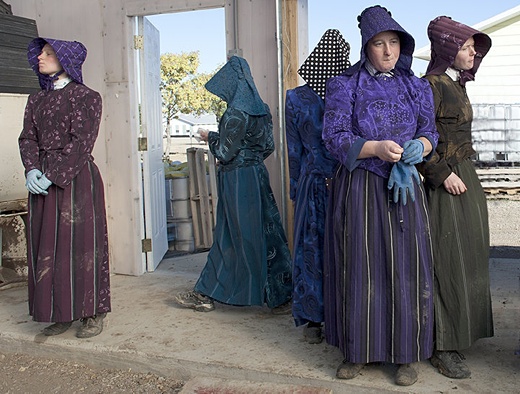
Image above: Hutterite women dress with bonnets often or polka dot scarves. From original article.

[IB Publisher's note: This article is in part a photo essay by someone dear to me that I've known since 1950. We went through school together at a Waldorf School in Garden City, Long Island from kindergarten through high school. I've been closer to Jill Brody longer than anyone other than my sister Diana. Jill has honed her skills over decades in a career being a Steiner teacher, becoming a Unitarian minister, working in medical imaging to in recent decades producing documentary photography. Jill has always brought deep understanding to what she does. For more of Jill's Hutterite photos see original Huffington Post article.]

After spending just one day with the Hutterites of Liberty County, Montana, Jill Brody recalls she was “hooked.”

The educator and photographer learned of the reclusive ethnoreligious group while researching a book on ranch life in central Montana. Locals told her that if she wanted to see what good farming looked like, she ought to visit the Hutterites.

That advice would change the way she thought about life and inspire a portfolio of photos titled “Hidden in Plain Sight,” which captures the world within these small, ultra-traditional religious communes.

The Hutterites were not Brody’s first exposure to people from isolated rural areas. At a young age, she had traveled from New York to North Carolina to attend summer camp.

“There were all these nice Jewish kids from New York, and most of the counselors were from the Deep South,” she said. Many of them had limited education, which Brody said she and her youthful peers mistook for a lack of intelligence.

With age and experience, Brody came to realize that she had misjudged them and the wisdom and ingenuity demanded by rural life. “They were pretty amazing people,” she said.

Decades later, she found herself living and working among some other pretty amazing people in one of America’s most isolated communities.


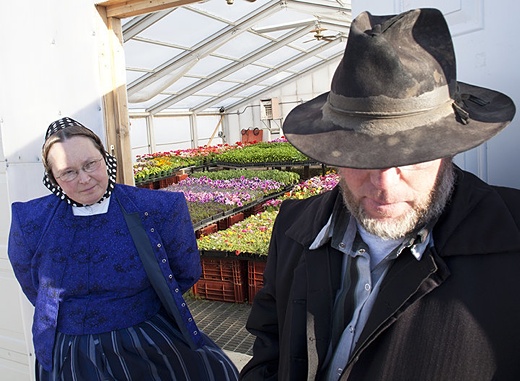
Image above: Hutterite husband and wife outside community greenhouse. From original article.

The Hutterites are Anabaptists ― Christians who believe people should be baptized not as infants but only when they are old enough to confess their sins and choose baptism for themselves. They fled persecution in Austria during the Protestant Reformation and eventually ended up living across parts of North America’s Great Plains. According to National Geographic, there were roughly 40,000 Hutterites living in 480 colonies in the U.S. and Canada as of 2012.

The group is named for a 16th century leader, Jakob Hutter, who preached the tenets of pacifism and communal living. Nearly all property in a Hutterite colony is owned by the colony ― a practice that differentiates them from other rural religious communities, such as the Amish and Mennonites.

Their guiding doctrine comes from a verse in the New Testament. Acts 2:44 reads: “All the believers live together and have everything in common.”

Unlike the Amish, the Hutterites utilize various forms of modern technology. They generally sustain their communities through industrial agriculture, selling frozen meat, chicken, eggs, milk and vegetables to large local grocery chains.

Some also offer services in commercial construction and mechanics. Brody said a Hutterite man could build you a Mercedes and because every Hutterite woman is given a sewing machine when she marries ― the only possession she will ever own ― “any of them could get a job as a seamstress in Hollywood.”

Initially, while researching her book on ranchers, Brody didn’t pay much attention to the local Hutterites. “They were just these anachronistic people who wore brightly colored clothing and spoke with a funny sort of Germanic type of accent,” she said. “They were friendly but distant.”

But she took up an offer from some other area residents to introduce her. She did know that the Hutterite communities were insular, highly patriarchal and guided by strict religious tenets. Brody, who is not religious, wasn’t expecting to enjoy herself.

She eventually spent four years photographing the group and learning about their lives.


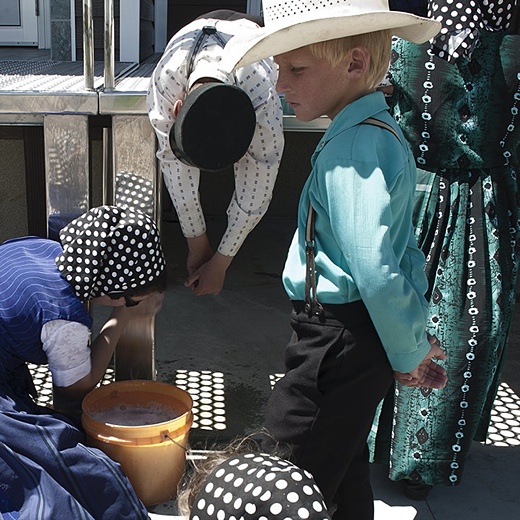
Image above: Hutterite boys and girls help cleaning farm equipment and doing chores. From original article.

“For whatever reason ― maybe it’s the way I am or the way they are ― there was space made for me to come and do something which they don’t normally like people doing, which is taking pictures of and being with them,” she said.

Brody photographed three separate Hutterite colonies in Liberty County. Her work honors the many technical skills that allow the communes, which she said consisted of about 150 people each, to function. But more profoundly, it captures the relationships that develop when a community is simply too small to allow itself to become divided.

“I thought I had a sense of who Hutterites were,” Brody said. “Then as you get to know them better, you realize they’ve got this thing ― this little jewel that they pass on to each other, that we don’t have anymore.”

Brody described this “jewel” as “the ability to be together,” which she observed while spending time with the women in the colonies. Whether they personally liked each other or not, she said their faith called on them to “live together and have all things in common.”

It’s a principle the Hutterites are committed to living by, no matter how difficult a situation or personality they encounter.

“There are just destructive people ― in almost any community, you’ll find at least one,” Brody said. “So how do you handle that? Do you ostracize them? In a tiny community, can you afford to do that? No. So you learn to adjust and adjust and make space for that person to function.”

The Hutterite women accommodate one another’s individual differences in order to protect the health of the entire community. When a person is destructive or obnoxious or insolent ― either in personality or in reaction to the community’s rules ― the group adjusts their expectations. This creates a space for the disruptive person to function within the community and, perhaps, create a path to contentment they may not have otherwise found.

“When people started asking me about what I was doing there and what I was looking at, I realized that’s what I was looking at,” Brody said. “I was looking for a piece of the puzzle in me or in us, in general, that is missing.”


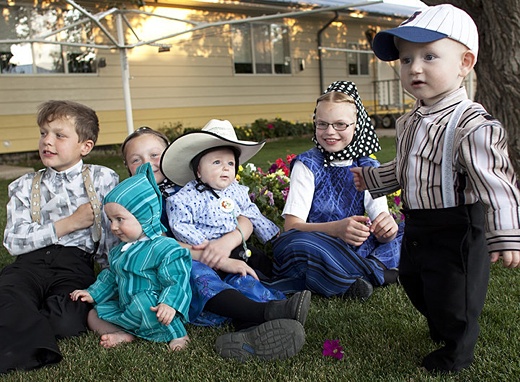
Image above: Younger Hutterire children playing in the grass. From original article.

Tolerance is not the first thing one expects to find in a community that rejects almost everything outside itself. But when nothing from the outside world is allowed in, they have no choice but to cherish and protect each other.

“Part of what they came to understand was you don’t have to love everybody. You don’t even have to like them,” Brody said. “But you need to get along, and you need to help.”

“That’s a huge lesson this country has completely forgotten,” she added.

Below are Jill's thoughts on her time with the Hutterites and the lessons she believes they can teach us.


Image above: Members of a Hutterite colony eat a communal dinner segregated by gender. From original article.

“I had all these messages coming to me about rural America and its importance, from the time I was 8 years old up until the present. I was interested almost immediately in how small rural economies operate and how small communities operate. If you live in large urban communities, they don’t operate, except in a snowstorm. We are so easily split asunder. We see a horrifying, graphic example of it right now in Washington, and we don’t seem to have any sense about the importance of community in structuring our lives.”

They taught me so much about just being mindful that when there is a person right next to you who you don’t know, you might have a lot in common and you might have very little, but it’s possible to take a couple of minutes to just sort of slow down and not make the assumption that if they get something, you don’t get it. If they win, you lose. Everything that’s happening in this country now is so incredibly divisive. The Hutterites don’t vote; they don’t participate. But one of them said to me, ‘We really should now.’”

“They make everything they wear, except for underwear or shoes. If you look at the pictures, it looks like they’re all wearing different clothing. Until you look closely and you realize every apron is the same, every dirndl skirt is the same, every shirt is the same, every jacket is the same, every head covering is the same. So they express their personality in the pattern of the fabric, not in the design of the clothing. It’s a whole metaphor for them that they have these small things that differentiate themselves but they’re expected to conform on larger issues. If any Hutterite woman left there and offered themselves up as a seamstress, they could make a killing in Hollywood.”

“What surprised me most was how fearful they are of the outside world. They don’t need to be that fearful, but they are.”

“Some of the hardest work the men will do, but mostly the women do everything. They don’t slaughter the cattle, but the minute the cattle are slaughtered, they take over the butchering. They slaughter the ducks and the chickens themselves and the geese. So you might want to say to yourself, what is left? If all the women disappeared from the colony, it would take them probably five days to fall apart.”

“A lot of what they have in place relies on the women being certain types of people. The women will say to me, ’We’re going to vote on who is going to be the new head of the kitchen. I said, ‘Who’s going to vote?’ They said, ‘Oh, the men vote.’ I asked how the men know who to vote for. They said, ‘Well, we tell them who to vote for.’”

“One day one of the women asked me if I’d like to know what they were talking about. I said sure. These are women who range in age from maybe 20 to 80. They’ve lived together their whole lives, one way or another. They were talking about which scent they like better, Mr. Clean or Pinesol or something with lavender in it. I realized if you live in a dorm in college, you have that kind of relationship with somebody ― where the mundane becomes crucial and important. But in general, you don’t have that. When people started asking me about what I was doing there and what I was looking at, I realized that’s what I was looking at. I was looking for a piece of the puzzle in me or in us, in general, that is missing.”

“They’re pacifist, they’re communitarian. ... There are a gazillion people to take care of you and your kids. There are 7-year-old girls who are assigned to 5-month-old babies and they’re au pairs from the time they’re 6 or 7 years old. So you might drive in there and think of them, ‘Oh, I really couldn’t stand this, this is too much for me.’ And then you can’t let yourself leave at the end of the day because they’ve got this thing that you can’t quite describe and that you don’t have.”

“The women get up at 4 in the morning, they get their houses in order. They are constantly cleaning their houses. I don’t know what they’re cleaning. You could literally eat off the floor in any of those places.”

“One of the ministers said, ‘Well, you know in the old days we objected to the ideas of telephones and we survived that. Then we objected to the idea of mobile phones and we survived that. But I think the internet is different.’ And I said, ’You’re absolutely right. The internet is completely different.’ He said, ‘That really makes me worry. Bad things could happen.’ I said, ’But does that have to change your relationship to God?’”
 
       
.

How America Lost Its Mind

SUBHEAD: Our post-truth moment is the sum of mind-sets that have always made America "exceptional".

By Kurt Andersen on 24 August 2017 for The Atlantic -
(https://www.theatlantic.com/magazine/archive/2017/09/how-america-lost-its-mind/534231/)


Image above: Illustration of American fantasies over the decades by R. Kikuo Johnson. From original article.

“You are entitled to your own opinion,
but you are not entitled to your own facts.”
— Daniel Patrick Moynihan

“We risk being the first people in history to have been
able to make their illusions so vivid, so persuasive,
so ‘realistic’ that they can live in them.”
— Daniel J. Boorstin,

When did America become untethered from reality? I first noticed our national lurch toward fantasy in 2004, after President George W. Bush’s political mastermind, Karl Rove, came up with the remarkable phrase reality-based community.

People in “the reality-based community,” he told a reporter, “believe that solutions emerge from your judicious study of discernible reality … That’s not the way the world really works anymore.

A year later, The Colbert Report went on the air. In the first few minutes of the first episode, Stephen Colbert, playing his right-wing-populist commentator character, performed a feature called “The Word.” His first selection: truthiness.

“Now, I’m sure some of the ‘word police,’ the ‘wordinistas’ over at Webster’s, are gonna say, ‘Hey, that’s not a word!’ Well, anybody who knows me knows that I’m no fan of dictionaries or reference books. They’re elitist.

Constantly telling us what is or isn’t true. Or what did or didn’t happen. Who’s Britannica to tell me the Panama Canal was finished in 1914?

If I wanna say it happened in 1941, that’s my right. I don’t trust books—they’re all fact, no heart … Face it, folks, we are a divided nation … divided between those who think with their head and those who know with their heart …


Because that’s where the truth comes from, ladies and gentlemen—the gut.”

Whoa, yes, I thought: exactly. America had changed since I was young, when truthiness and reality-based community wouldn’t have made any sense as jokes. For all the fun, and all the many salutary effects of the 1960s—the main decade of my childhood—I saw that those years had also been the big-bang moment for truthiness.

And if the ’60s amounted to a national nervous breakdown, we are probably mistaken to consider ourselves over it.

Each of us is on a spectrum somewhere between the poles of rational and irrational. We all have hunches we can’t prove and superstitions that make no sense. Some of my best friends are very religious, and others believe in dubious conspiracy theories.

What’s problematic is going overboard—letting the subjective entirely override the objective; thinking and acting as if opinions and feelings are just as true as facts.

The American experiment, the original embodiment of the great Enlightenment idea of intellectual freedom, whereby every individual is welcome to believe anything she wishes, has metastasized out of control.

From the start, our ultra-individualism was attached to epic dreams, sometimes epic fantasies—every American one of God’s chosen people building a custom-made utopia, all of us free to reinvent ourselves by imagination and will.

In America nowadays, those more exciting parts of the Enlightenment idea have swamped the sober, rational, empirical parts.

Little by little for centuries, then more and more and faster and faster during the past half century, we Americans have given ourselves over to all kinds of magical thinking, anything-goes relativism, and belief in fanciful explanation—small and large fantasies that console or thrill or terrify us.

And most of us haven’t realized how far-reaching our strange new normal has become.

Much more than the other billion or so people in the developed world, we Americans believe—really believe—in the supernatural and the miraculous, in Satan on Earth, in reports of recent trips to and from heaven, and in a story of life’s instantaneous creation several thousand years ago.

We believe that the government and its co-conspirators are hiding all sorts of monstrous and shocking truths from us, concerning assassinations, extraterrestrials, the genesis of , the 9/11 attacks, the dangers of vaccines, and so much more.

And this was all true before we became familiar with the terms post-factual and post-truth, before we elected a president with an astoundingly open mind about conspiracy theories, what’s true and what’s false, the nature of reality.

We have passed through the looking glass and down the rabbit hole. America has mutated into Fantasyland.

How widespread is this promiscuous devotion to the untrue? How many Americans now inhabit alternate realities? Any given survey of beliefs is only a sketch of what people in general really think.

But reams of survey research from the past 20 years reveal a rough, useful census of American credulity and delusion. By my reckoning, the solidly reality-based are a minority, maybe a third of us but almost certainly fewer than half.

Only a third of us, for instance, don’t believe that the tale of creation in Genesis is the word of God. Only a third strongly disbelieve in telepathy and ghosts. Two-thirds of Americans believe that “angels and demons are active in the world.”

More than half say they’re absolutely certain heaven exists, and just as many are sure of the existence of a personal God—not a vague force or universal spirit or higher power, but some guy. A third of us believe not only that global warming is no big deal but that it’s a hoax perpetrated by scientists, the government, and journalists.

A third believe that our earliest ancestors were humans just like us; that the government has, in league with the pharmaceutical industry, hidden evidence of natural cancer cures; that extraterrestrials have visited or are visiting Earth.

Almost a quarter believe that vaccines cause autism, and that Donald Trump won the popular vote in 2016.

A quarter believe that our previous president maybe or definitely was (or is?) the anti-Christ.

According to a survey by Public Policy Polling, 15 percent believe that the “media or the government adds secret mind-controlling technology to television broadcast signals,” and another 15 percent think that’s possible. A quarter of Americans believe in witches.

 Remarkably, the same fraction, or maybe less, believes that the Bible consists mainly of legends and fables—the same proportion that believes U.S. officials were complicit in the 9/11 attacks.

When I say that a third believe X and a quarter believe Y, it’s important to understand that those are different thirds and quarters of the population.

Of course, various fantasy constituencies overlap and feed one another—for instance, belief in extraterrestrial visitation and abduction can lead to belief in vast government cover-ups, which can lead to belief in still more wide-ranging plots and cabals, which can jibe with a belief in an impending Armageddon.

Why are we like this?

The short answer is because we’re Americans—because being American means we can believe anything we want; that our beliefs are equal or superior to anyone else’s, experts be damned.

Once people commit to that approach, the world turns inside out, and no cause-and-effect connection is fixed. The credible becomes incredible and the incredible credible.

The word mainstream has recently become a pejorative, shorthand for bias, lies, oppression by the elites. Yet the institutions and forces that once kept us from indulging the flagrantly untrue or absurd—media, academia, government, corporate America, professional associations, respectable opinion in the aggregate—have enabled and encouraged every species of fantasy over the past few decades.

 A senior physician at one of America’s most prestigious university hospitals promotes “miracle cures” on his daily TV show. Cable channels air documentaries treating mermaids, monsters, ghosts, and angels as real.

When a political-science professor attacks the idea “that there is some ‘public’ that shares a notion of reality, a concept of reason, and a set of criteria by which claims to reason and rationality are judged,” colleagues just nod and grant tenure.

The old fringes have been folded into the new center. The irrational has become respectable and often unstoppable.

Our whole social environment and each of its overlapping parts—cultural, religious, political, intellectual, psychological—have become conducive to spectacular fallacy and truthiness and make-believe. There are many slippery slopes, leading in various directions to other exciting nonsense.

During the past several decades, those naturally slippery slopes have been turned into a colossal and permanent complex of interconnected, crisscrossing bobsled tracks, which Donald Trump slid down right into the White House.

American moxie has always come in two types. We have our wilder, faster, looser side: We’re overexcited gamblers with a weakness for stories too good to be true.

But we also have the virtues embodied by the Puritans and their secular descendants: steadiness, hard work, frugality, sobriety, and common sense.

A propensity to dream impossible dreams is like other powerful tendencies—okay when kept in check. For most of our history, the impulses existed in a rough balance, a dynamic equilibrium between fantasy and reality, mania and moderation, credulity and skepticism.

The great unbalancing and descent into full Fantasyland was the product of two momentous changes. The first was a profound shift in thinking that swelled up in the ’60s; since then, Americans have had a new rule written into their mental operating systems: Do your own thing, find your own reality, it’s all relative.

The second change was the onset of the new era of information. Digital technology empowers real-seeming fictions of the ideological and religious and scientific kinds. Among the web’s 1 billion sites, believers in anything and everything can find thousands of fellow fantasists, with collages of facts and “facts” to support them.

Before the internet, crackpots were mostly isolated, and surely had a harder time remaining convinced of their alternate realities. Now their devoutly believed opinions are all over the airwaves and the web, just like actual news. Now all of the fantasies look real.

Today, each of us is freer than ever to custom-make reality, to believe whatever and pretend to be whoever we wish. Which makes all the lines between actual and fictional blur and disappear more easily.

Truth in general becomes flexible, personal, subjective. And we like this new ultra-freedom, insist on it, even as we fear and loathe the ways so many of our wrongheaded fellow Americans use it.

Treating real life as fantasy and vice versa, and taking preposterous ideas seriously, is not unique to Americans.

But we are the global crucible and epicenter. We invented the fantasy-industrial complex; almost nowhere outside poor or otherwise miserable countries are flamboyant supernatural beliefs so central to the identities of so many people.

This is American exceptionalism in the 21st century. The country has always been a one-of-a-kind place. But our singularity is different now.

We’re still rich and free, still more influential and powerful than any other nation, practically a synonym for developed country. But our drift toward credulity, toward doing our own thing, toward denying facts and having an altogether uncertain grip on reality, has overwhelmed our other exceptional national traits and turned us into a less developed country.

People see our shocking Trump moment—this post-truth, “alternative facts” moment—as some inexplicable and crazy new American phenomenon. But what’s happening is just the ultimate extrapolation and expression of mind-sets that have made America exceptional for its entire history.

America was created by true believers and passionate dreamers, and by hucksters and their suckers, which made America successful—but also by a people uniquely susceptible to fantasy, as epitomized by everything from Salem’s hunting witches to Joseph Smith’s creating Mormonism, from P. T. Barnum to speaking in tongues, from Hollywood to Scientology to conspiracy theories, from Walt Disney to Billy Graham to Ronald Reagan to Oprah Winfrey to Trump.

In other words: Mix epic individualism with extreme religion; mix show business with everything else; let all that ferment for a few centuries; then run it through the anything-goes ’60s and the internet age. The result is the America we inhabit today, with reality and fantasy weirdly and dangerously blurred and commingled.

The 1960s and the Beginning of the End of Reason


Image above: Illustration of American 1960's Counter Culture mixed with nutcakes of today. by R. Kikuo Johnson. From original article.

I don't regret or disapprove of many of the ways the ’60s permanently reordered American society and culture. It’s just that along with the familiar benefits, there have been unreckoned costs.

In 1962, people started referring to “hippies,” the Beatles had their first hit, Ken Kesey published One Flew Over the Cuckoo’s Nest, and the Harvard psychology lecturer Timothy Leary was handing out psilocybin and LSD to grad students.

And three hours south of San Francisco, on the heavenly stretch of coastal cliffs known as Big Sur, a pair of young Stanford psychology graduates founded a school and think tank they named after a small American Indian tribe that had lived on the grounds long before. “In 1968,” one of its founding figures recalled four decades later,
Esalen was the center of the cyclone of the youth rebellion. It was one of the central places, like Mecca for the Islamic culture. Esalen was a pilgrimage center for hundreds and thousands of youth interested in some sense of transcendence, breakthrough consciousness, LSD, the sexual revolution, encounter, being sensitive, finding your body, yoga—all of these things were at first filtered into the culture through Esalen. By 1966, ’67, and ’68, Esalen was making a world impact.
This is not overstatement. Essentially everything that became known as New Age was invented, developed, or popularized at the Esalen Institute. Esalen is a mother church of a new American religion for people who think they don’t like churches or religions but who still want to believe in the supernatural.

The institute wholly reinvented psychology, medicine, and philosophy, driven by a suspicion of science and reason and an embrace of magical thinking (also: massage, hot baths, sex, and sex in hot baths). It was a headquarters for a new religion of no religion, and for “science” containing next to no science.

The idea was to be radically tolerant of therapeutic approaches and understandings of reality, especially if they came from Asian traditions or from American Indian or other shamanistic traditions. Invisible energies, past lives, astral projection, whatever—the more exotic and wondrous and unfalsifiable, the better.

Not long before Esalen was founded, one of its co-founders, Dick Price, had suffered a mental breakdown and been involuntarily committed to a private psychiatric hospital for a year.

His new institute embraced the radical notion that psychosis and other mental illnesses were labels imposed by the straight world on eccentrics and visionaries, that they were primarily tools of coercion and control. This was the big idea behind One Flew Over the Cuckoo’s Nest, of course.

And within the psychiatric profession itself this idea had two influential proponents, who each published unorthodox manifestos at the beginning of the decade—R. D. Laing (The Divided Self) and Thomas Szasz (The Myth of Mental Illness).

“Madness,” Laing wrote when Esalen was new, “is potentially liberation and renewal.” Esalen’s founders were big Laing fans, and the institute became a hotbed for the idea that insanity was just an alternative way of perceiving reality.

These influential critiques helped make popular and respectable the idea that much of science is a sinister scheme concocted by a despotic conspiracy to oppress people.

Mental illness, both Szasz and Laing said, is “a theory not a fact.” This is now the universal bottom-line argument for anyone—from creationists to climate-change deniers to anti-vaccine hysterics—who prefers to disregard science in favor of his own beliefs.

You know how young people always think the universe revolves around them, as if they’re the only ones who really get it?

And how before their frontal lobes, the neural seat of reason and rationality, are fully wired, they can be especially prone to fantasy?

In the ’60s, the universe cooperated: It did seem to revolve around young people, affirming their adolescent self-regard, making their fantasies of importance feel real and their fantasies of instant transformation and revolution feel plausible.

Practically overnight, America turned its full attention to the young and everything they believed and imagined and wished.

If 1962 was when the decade really got going, 1969 was the year the new doctrines and their gravity were definitively cataloged by the grown-ups. Reason and rationality were over.

The countercultural effusions were freaking out the old guard, including religious people who couldn’t quite see that yet another Great Awakening was under way in America, heaving up a new religion of believers who “have no option but to follow the road until they reach the Holy City … that lies beyond the technocracy … the New Jerusalem.”

That line is from The Making of a Counter Culture: Reflections on the Technocratic Society and Its Youthful Opposition, published three weeks after Woodstock, in the summer of 1969. Its author was Theodore Roszak, age 35, a Bay Area professor who thereby coined the word counterculture.

Roszak spends 270 pages glorying in the younger generation’s “brave” rejection of expertise and “all that our culture values as ‘reason’ and ‘reality.’ ” (Note the scare quotes.)

So-called experts, after all, are “on the payroll of the state and/or corporate structure.” A chapter called “The Myth of Objective Consciousness” argues that science is really just a state religion.

To create “a new culture in which the non-intellective capacities … become the arbiters of the good [and] the true,” he writes, “nothing less is required than the subversion of the scientific world view, with its entrenched commitment to an egocentric and cerebral mode of consciousness.” He welcomes the “radical rejection of science and technological values.”


Earlier that summer, a University of Chicago sociologist (and Catholic priest) named Andrew Greeley had alerted readers of The New York Times Magazine that beyond the familiar signifiers of youthful rebellion (long hair, sex, drugs, music, protests), the truly shocking change on campuses was the rise of anti-rationalism and a return of the sacred—“mysticism and magic,” the occult, séances, cults based on the book of Revelation.

When he’d chalked a statistical table on a classroom blackboard, one of his students had reacted with horror: “Mr. Greeley, I think you’re an empiricist.”

As 1969 turned to 1970, a 41-year-old Yale Law School professor was finishing his book about the new youth counterculture. Charles Reich was a former Supreme Court clerk now tenured at one of ultra-rationalism’s American headquarters.

But hanging with the young people had led him to a midlife epiphany and apostasy. In 1966, he had started teaching an undergraduate seminar called “The Individual in America,” for which he assigned fiction by Kesey and Norman Mailer. He decided to spend the next summer, the Summer of Love, in Berkeley. On the road back to New Haven, he had his Pauline conversion to the kids’ values.

His class at Yale became hugely popular; at its peak, 600 students were enrolled. In 1970, The Greening of America became The New York Times’ best-selling book (as well as a much-read 70-page New Yorker excerpt), and remained on the list for most of a year.

At 16, I bought and read one of the 2 million copies sold. Rereading it today and recalling how much I loved it was a stark reminder of the follies of youth. Reich was shamelessly, uncritically swooning for kids like me.  

The Greening of America may have been the mainstream’s single greatest act of pandering to the vanity and self-righteousness of the new youth. Its underlying theoretical scheme was simple and perfectly pitched to flatter young readers:

There are three types of American “consciousness,” each of which “makes up an individual’s perception of reality … his ‘head,’ his way of life.”  

Consciousness I people were old-fashioned, self-reliant individualists rendered obsolete by the new “Corporate State”—essentially, your grandparents.  

Consciousness IIs were the fearful and conformist organization men and women whose rationalism was a tyrannizing trap laid by the Corporate State—your parents.

And then there was Consciousness III, which had “made its first appearance among the youth of America,” “spreading rapidly among wider and wider segments of youth, and by degrees to older people.”

If you opposed the Vietnam War and dressed down and smoked pot, you were almost certainly a III. Simply by being young and casual and undisciplined, you were ushering in a new utopia.

Reich praises the “gaiety and humor” of the new Consciousness III wardrobe, but his book is absolutely humorless—because it’s a response to “this moment of utmost sterility, darkest night and most extreme peril.”

Conspiracism was flourishing, and Reich bought in. Now that “the Corporate State has added depersonalization and repression” to its other injustices, “it has threatened to destroy all meaning and suck all joy from life.” Reich’s magical thinking mainly concerned how the revolution would turn out.

“The American Corporate State,” having produced this new generation of longhaired hyperindividualists who insist on trusting their gut and finding their own truth, “is now accomplishing what no revolutionaries could accomplish by themselves.

The machine has begun to destroy itself.” Once everyone wears Levi’s and gets high, the old ways “will simply be swept away in the flood.”

The inevitable/imminent happy-cataclysm part of the dream didn’t happen, of course. The machine did not destroy itself. But Reich was half-right. An epochal change in American thinking was under way and “not, as far as anybody knows, reversible …

There is no returning to an earlier consciousness.” His wishful error was believing that once the tidal surge of new sensibility brought down the flood walls, the waters would flow in only one direction, carving out a peaceful, cooperative, groovy new continental utopia, hearts and minds changed like his, all of America Berkeleyized and Vermontified.

Instead, Consciousness III was just one early iteration of the anything-goes, post-reason, post-factual America enabled by the tsunami.

Reich’s faith was the converse of the Enlightenment rationalists’ hopeful fallacy 200 years earlier.

Granted complete freedom of thought, Thomas Jefferson and company assumed, most people would follow the path of reason.

Wasn’t it pretty to think so.

I remember when fantastical beliefs went fully mainstream, in the 1970s.

My irreligious mother bought and read The Secret Life of Plants, a big best seller arguing that plants were sentient and would “be the bridesmaids at a marriage of physics and metaphysics.” The amazing truth about plants, the book claimed, had been suppressed by the FDA and agribusiness.

My mom didn’t believe in the conspiracy, but she did start talking to her ficuses as if they were pets.

In a review, The New York Times registered the book as another data point in how “the incredible is losing its pariah status.”

Indeed, mainstream publishers and media organizations were falling over themselves to promote and sell fantasies as nonfiction.

In 1975 came a sensational autobiography by the young spoon bender and mind reader Uri Geller as well as Life After Life, by Raymond Moody, a philosophy Ph.D. who presented the anecdotes of several dozen people who’d nearly died as evidence of an afterlife.

The book sold many millions of copies; before long the International Association for Near Death Studies formed and held its first conference, at Yale.

During the ’60s, large swaths of academia made a turn away from reason and rationalism as they’d been understood.

Many of the pioneers were thoughtful, their work fine antidotes to postwar complacency. The problem was the nature and extent of their influence at that particular time, when all premises and paradigms seemed up for grabs.

That is, they inspired half-baked and perverse followers in the academy, whose arguments filtered out into the world at large:

All approximations of truth, science as much as any fable or religion, are mere stories devised to serve people’s needs or interests. Reality itself is a purely social construction, a tableau of useful or wishful myths that members of a society or tribe have been persuaded to believe.

The borders between fiction and nonfiction are permeable, maybe nonexistent. The delusions of the insane, superstitions, and magical thinking?

Any of those may be as legitimate as the supposed truths contrived by Western reason and science. The takeaway: Believe whatever you want, because pretty much everything is equally true and false.

These ideas percolated across multiple academic fields. In 1965, the French philosopher Michel Foucault published Madness and Civilization in America, echoing Laing’s skepticism of the concept of mental illness; by the 1970s, he was arguing that rationality itself is a coercive “regime of truth”—oppression by other means. Foucault’s suspicion of reason became deeply and widely embedded in American academia.

During the ’60s, large swaths of academia made a turn away from reason and rationalism as they’d been understood. Many of the pioneers were thoughtful, their work fine antidotes to postwar complacency. The problem was the nature and extent of their influence at that particular time, when all premises and paradigms seemed up for grabs.

That is, they inspired half-baked and perverse followers in the academy, whose arguments filtered out into the world at large:

All approximations of truth, science as much as any fable or religion, are mere stories devised to serve people’s needs or interests.

Reality itself is a purely social construction, a tableau of useful or wishful myths that members of a society or tribe have been persuaded to believe.

The borders between fiction and nonfiction are permeable, maybe nonexistent. The delusions of the insane, superstitions, and magical thinking? Any of those may be as legitimate as the supposed truths contrived by Western reason and science. The takeaway: Believe whatever you want, because pretty much everything is equally true and false.

These ideas percolated across multiple academic fields. In 1965, the French philosopher Michel Foucault published Madness and Civilization in America, echoing Laing’s skepticism of the concept of mental illness; by the 1970s, he was arguing that rationality itself is a coercive “regime of truth”—oppression by other means. Foucault’s suspicion of reason became deeply and widely embedded in American academia.

When I first read that, at age 18, I loved the quotation marks. If reality is simply the result of rules written by the powers that be, then isn’t everyone able—no, isn’t everyone obliged—to construct their own reality? The book was timed perfectly to become a foundational text in academia and beyond.

A more extreme academic evangelist for the idea of all truths being equal was a UC Berkeley philosophy professor named Paul Feyerabend. His best-known book, published in 1975, was Against Method: Outline of an Anarchistic Theory of Knowledge.

“Rationalism,” it declared, “is a secularized form of the belief in the power of the word of God,” and science a “particular superstition.”

In a later edition of the book, published when creationists were passing laws to teach Genesis in public-school biology classes, Feyerabend came out in favor of the practice, comparing creationists to Galileo. Science, he insisted, is just another form of belief.

“Only one principle,” he wrote, “can be defended under all circumstances and in all stages of human development. It is the principle: anything goes.”

Over in anthropology, where the exotic magical beliefs of traditional cultures were a main subject, the new paradigm took over completely—don’t judge, don’t disbelieve, don’t point your professorial finger. This was understandable, given the times: colonialism ending, genocide of American Indians confessed, U.S. wars in the developing world.

Who were we to roll our eyes or deny what these people believed? In the ’60s, anthropology decided that oracles, diviners, incantations, and magical objects should be not just respected, but considered equivalent to reason and science.

If all understandings of reality are socially constructed, those of Kalabari tribesmen in Nigeria are no more arbitrary or faith-based than those of college professors.

In 1968, a UC Davis psychologist named Charles Tart conducted an experiment in which, he wrote, “a young woman who frequently had spontaneous out-of-body experiences”—didn’t “claim to have” them but “had” them—spent four nights sleeping in a lab, hooked up to an EEG machine.

Her assigned task was to send her mind or soul out of her body while she was asleep and read a five-digit number Tart had written on a piece of paper placed on a shelf above the bed. He reported that she succeeded.

Other scientists considered the experiments and the results bogus, but Tart proceeded to devote his academic career to proving that attempts at objectivity are a sham and magic is real. In an extraordinary paper published in 1972 in Science, he complained about the scientific establishment’s “almost total rejection of the knowledge gained” while high or tripping.

He didn’t just want science to take seriously “experiences of ecstasy, mystical union, other ‘dimensions,’ rapture, beauty, space-and-time transcendence.” He was explicitly dedicated to going there. A “perfectly scientific theory may be based on data that have no physical existence,” he insisted.

The rules of the scientific method had to be revised. To work as a psychologist in the new era, Tart argued, a researcher should be in the altered state of consciousness he’s studying, high or delusional “at the time of data collection” or during “data reduction and theorizing.”

Tart’s new mode of research, he admitted, posed problems of “consensual validation,” given that “only observers in the same [altered state] are able to communicate adequately with one another.”

Tart popularized the term consensus reality for what you or I would simply call reality, and around 1970 that became a permanent interdisciplinary term of art in academia. Later he abandoned the pretense of neutrality and started calling it the consensus trance—people committed to reason and rationality were the deluded dupes, not he and his tribe.

Even the social critic Paul Goodman, beloved by young leftists in the ’60s, was flabbergasted by his own students by 1969. “There was no knowledge,” he wrote, “only the sociology of knowledge. They had so well learned that … research is subsidized and conducted for the benefit of the ruling class that they did not believe there was such a thing as simple truth.”

Ever since, the American right has insistently decried the spread of relativism, the idea that nothing is any more correct or true than anything else.

Conservatives hated how relativism undercut various venerable and comfortable ruling ideas—certain notions of entitlement (according to race and gender) and aesthetic beauty and metaphysical and moral certainty. 
 
Yet once the intellectual mainstream thoroughly accepted that there are many equally valid realities and truths, once the idea of gates and gatekeeping was discredited not just on campuses but throughout the culture, all American barbarians could have their claims taken seriously.

Conservatives are correct that the anything-goes relativism of college campuses wasn’t sequestered there, but when it flowed out across America it helped enable extreme Christianities and lunacies on the right—gun-rights hysteria, black-helicopter conspiracism, climate-change denial, and more.

The term useful idiot was originally deployed to accuse liberals of serving the interests of true believers further on the left. In this instance, however, postmodern intellectuals—post-positivists, poststructuralists, social constructivists, post-empiricists, epistemic relativists, cognitive relativists, descriptive relativists—turned out to be useful idiots most consequentially for the American right.

“Reality has a well-known liberal bias,” Stephen Colbert once said, in character, mocking the beliefs-trump-facts impulse of today’s right. Neither side has noticed, but large factions of the elite left and the populist right have been on the same team.

 [IB Publisher's note: If you've read to here you are only part way through - about 40%. To read about Kurt Anderson's take the 70's and 80's and beyond go to (https://www.theatlantic.com/magazine/archive/2017/09/how-america-lost-its-mind/534231/) and search for:

"Conspiracy and Paranoia in the 1970s"

 Enjoy!


.

Fragile

SUBHEAD: To recover from ecological crisis, we must transform our who we are in relation to the Earth.

By Peter Reason on 31 May 2017 for Dark Mountain -
(http://dark-mountain.net/blog/fragile/)


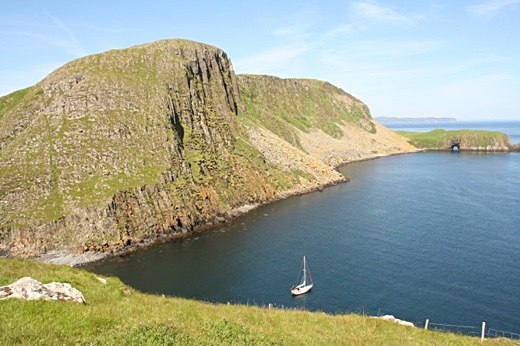
Image above: A small sailboat anchored in the lee of a small island east of Ireland. From original article.

[Dark Mountain Editor's note: ‘To recover from ecological crisis, we humans must transform our sense of who we are in relation to the Earth.’ In 2011 Peter Reason sailed his little yacht Coral from the south coast of England to the west coast of Ireland, a journey recorded in his book Spindrift: A Wilderness Journey at Sea. This week we bring you an excerpt from his latest book In Search of Grace: An Ecological Pilgrimage, which follows the further voyages of Coral to the far north of Scotland.]
 
I steered my little yacht Coral through the confused water of the tidal stream that poured out between Garbh Eilean and Eilean Mhuire. The calm pool opened in front of me, littered with specks of white as if some giant had cast handfuls of torn up paper across the surface.

Soon Coral was surrounded by puffins, with their startling white breasts, the distinctive markings around their eyes and brightly coloured beaks. The air was full of puffins too, so full they seemed more like a cloud of mosquitoes than a flock of birds.

I was in the final stages of my travels, which over two summers had taken me and Coral from the south coast of England, round the west coast of Ireland and through the Western Isles to the far north of Scotland, mainly single handed.

As I turned southward, I made for the small archipelago of the Shiant Islands, an isolated group, separated from Lewis by the Sound of Shiant, notorious for its strong tides, overfalls and underwater hazards.


I saw my travels as an ecological pilgrimage. There is a longstanding tradition in most human societies of making a journey, more or less arduous, away from the comforts of home in search of new insights and deeper understandings.

This practice may be as old as the human species: Mesolithic peoples in Europe certainly made long journeys to the sacred sites marked by stone circles; the Aboriginal people of Australia take extended walks along ‘songlines’, re-enacting the journeys of ‘creator-beings’ during the Dream Time.

The idea and practice of pilgrimage developed in a religious context. One thinks of the requirement of good Muslims to undertake the Hajj at least once in their lives; of the Christian pilgrimages of the Middle Ages and the continuing contemporary practices; of the vast numbers of Hindu devotees who travel to sacred sites on the River Ganges; and of Buddhists who walk the difficult path to circumnambulate Mount Kailash.

In its fullest sense, pilgrimage entails a long journey in search of qualities of moral or spiritual significance, a journey across both outer physical and inner spiritual landscapes. Pilgrims separate themselves from home and familiars, maybe joining a group of like-minded seekers and wearing special clothes or other marks to indicate their pilgrim status.

The pilgrimage journey offers a fluid and imaginative space between the everyday and the eternal, a liminal zone between body and soul, heaven and Earth, humanity and divinity. For it is not easy to move across the boundaries between these worlds when locked in the familiarity of the everyday.

Religious pilgrimages are taken to sacred sites in order to encounter a holy realm for worship and the affirmation of faith, in search of illumination and for healing.

As I conceive it, the ecological pilgrimage seeks a primal, heartfelt connection with the Earth itself and the community of life that has evolved on Earth.

It is also a celebration and an act of homage, honouring the Earth as the more-than-human world of which we are a part, existing for itself rather than for human use.

By taking the pilgrim away from the habits of civilization and by disrupting the patterns of everyday life, pilgrimage offers an opening to a different view of the Earth of which we are a part.


Before I left for Scotland, I read about the Shiant Islands and studied the sailing directions. I learned to pronounce the name properly, in one softened syllable: ‘Shant’.

The little archipelago is made up of three rugged islands: to the west Garbh Eilean and Eilean an Tighe are joined by a natural boulder isthmus; across an open pool to the northeast lies Eilean Mhuire.

Adam Nicolson, whose family have owned the islands for many years writes; 
‘The rest of the world thinks there is nothing much to them. Even on a map of the Hebrides the tip of your little finger would blot them out. But the Shiants… are not modest. They stand out high and undoubtable.’ 
Although keen to visit, I doubted whether it would be possible, for they are very exposed and offer little shelter. But it seemed I was lucky: the weather was quiet, with a smooth sea yet enough wind to sail.

Nevertheless, I approached them with caution, keeping an eye on the tidal streams and carefully noting landmarks.

Once I was safely in the pool and had got over the thrill of seeing so many puffins, I turned my attention to getting Coral settled.

The recommended anchorage is by the isthmus that connects Garbh Eilean and Eilean an Tighe.
This is protected from the prevailing westerly winds, but open to the light easterlies blowing that morning.

Since these volcanic islands rise abruptly from the seabed, the bottom shoals steeply and consists of boulders, so there is sediment of mud or sand into which the anchor can sink and get a good grip.

It took a little while before I was happy that the anchor was holding, with Coral tucked into the corner between the isthmus and the precipitous cliffs of Eilean an Tighe.

With Coral safely anchored, I could look around. I soon realised that there were nearly as many razorbills as puffins in the pool.

They are also auks, but rather bigger, distinguished by a black beak with a white line across it, joining a similar line across the face to the eye.

The razorbills seem on the whole less nervous than the puffins: I watched one swimming within a couple of yards of Coral, quite undisturbed as I moved about the deck.

When it decided to dive I was able to watch it turn tail up and, once underwater, open its wings to fly down beneath Coral’s keel, the bubbles of air around its feathers gleaming as they caught the sunlight.

Looking up again across the pool, I realized that there were tens of thousands of puffins and razorbills, for this is one of the major nesting places in the North Atlantic.

There were, of course, other birds: shags, black-backed gulls, kittiwakes, fulmars, guillemots, and the odd gannet.

For me the most impressive were the skuas, big, heavily built seabirds, brown, with two white stripes on their wing. Skuas are known as ‘kleptoparasites’ because of their habit of stealing food from other birds: I watched one attack a gull, hanging onto its wing as they tumbled together to the water to make it regurgitate its meal.

I am sure that given half a chance they would snatch a puffin chick, as would the big gulls. I imagined the links in the local food chain: marine plankton feeding sand-eels, sand-eels feeding baby birds and baby birds feeding skuas and gulls.

I spent the afternoon sitting in the cockpit watching the birds and enjoying the changing light. A few yachts visited, but none stayed for long; a couple of fishing boats chugged through the pool.

As the long northern evening drew in I began preparations for the night. The weather was calm enough for it to be safe to stay overnight at the islands, but I wanted to move to a more secure anchorage.

The dark cliffs and the stony isthmus looked too close, and if the anchor were to drag Coral would soon be ashore. Even if the light winds persisted through the night, it felt unseamanlike to sleep while she was anchored off a lee shore where there was poor holding.

So I hauled up the anchor and motored round the end of Eilean an Tighe to the western side of the isthmus. This anchorage is open to the swell of the Little Minch and disturbed by the tidal movement through the Sound of Shiant.

Despite this, with the light wind blowing Coral away from the islands, she felt safer. Two Danish yachts had already taken the best positions but I was able to find a spot where the anchor held closer inshore.

In the early evening the crews of the Danish yachts returned from their expeditions ashore, and soon there was a whiff of diesel and rattle of anchor chains as they left the anchorage and disappeared north round the end of Garbh Eilean.

With their departure I felt suddenly alone and vulnerable. I checked the forecast on my iPhone yet again, even though that meant waiting ages for the weak signal to load the page.

I looked again at the anchor chain – it was hanging almost vertical, I had plenty of scope out, so all was well there. I looked about me and consulted the chart to see how I would leave the anchorage in the dark if I needed to – there was sea room to the southwest.

There was no rational reason why I should not stay safely overnight, so I took myself in hand, sat down quietly, made myself breath properly and look out at the world around me rather than inwards to my anxieties. I might feel exposed, just a speck in a vast sky and expanse of sea, but I could relax and appreciate it.

The evening wore on, the light faded and I became enveloped in the quiet mystery of twilight. Coral pitched gently on the light swell. Little waves rolled continuously up to the stony shore and broke with a hollow crash on the boulders.

The mound of Garbh Eilean loomed above me, dark against the evening sky, the details of the basalt columns obscured. Nicolson’s little cottage on Eilean an Tighe stood out ghostly white, then, as the light faded away, merged with the hillside behind.

 Looking over Coral’s stern, past the line of rocks and islets that stretches toward the mainland, I searched the surface of the Sound for a glimpse of the flashing green light on the buoy that marks Damhag. All I could see was the grey sea and the distant hazy line of Lewis.

Through the evening the inexhaustible stream of puffins flew overhead; the skuas and black-backed gulls continued their patrols around the cliff tops. If I peered out to sea I could just make out the white flash of gannets on a late search for fish. I sat out late, enchanted by my surroundings while still feeling strangely vulnerable, reluctant to go to bed.


The word that keeps coming to my mind to describe this evening is ‘fragile’. It captures both the strength and the vulnerability of my situation, of the puffins and of the islands themselves. The Shiants are the nesting ground of one of the last flourishing populations for puffins: huge populations in Iceland and elsewhere have quite suddenly disappeared as climate change has brought warm waters that have disturbed the delicate ecological balance on which they depend.

The basalt columns that form the Shiant Islands appear strong and stable, but are weakly jointed; over time, wind and waves penetrate the joints, allowing large chunks to break away. And indeed of all of us, despite the veneer of civilization, are at root unprotected in a wild world and the wild universe.

Our attention has been drawn to the fragility of Planet Earth by the space program. Ever since the early Apollo missions, pictures of planet Earth from space have been widely available, starting with the most famous ‘Earth Rising’, taken as Apollo 8 emerged from behind the moon.


Image above: Earthrise on Christmas Eve 1968. This photo was taken in black and white from the Apollo Command Module orbiting the Moon. NASA has colorized it from available data. From (https://earthobservatory.nasa.gov/IOTD/view.php?id=82693).

This has been called ‘the most influential environmental photograph ever taken’. For, it is argued, now that humanity can see the Earth alone within the vast reaches of space, we will realise her beauty, fragility and significance and band together to protect and preserve her as our home.

Astronauts report that they spend much of their spare time on missions simply ‘Earthgazing’.

NASA engineer Nicole Stott tells us;
‘I think you start out with this idea of what its going to be like, and then when you do finally look at the Earth for the first time you’re overwhelmed by how much more beautiful it really is…’
Shuttle astronaut Jeff Hoffman goes further;
'Earth looks like a living, breathing organism, but it also at the same time looks extremely fragile’. 
And Ron Garon, who served on the International Space Station, remembers;
 ‘When we look down on the Earth from space we see this amazing, indescribably beautiful planet… It’s really striking and its sobering to see this paper thin layer and to realize that that little paper thin layer is all that protects every living thing on Earth from death’.
Edgar Mitchell, who was the Lunar Module pilot on Apollo 14 and the sixth person to walk on the moon, is one of many astronauts to reflect deeply on their experience. His view is that it is not just that you get see the beauty and fragility from space, but there is also a shift in consciousness which he describes a close to the ancient accounts of savikalpa samādhi.

There is as a direct experience of interconnection:
‘You see things as you see them with your eyes but you experience them emotionally and viscerally as ecstasy and a sense of total unity and oneness…
It’s rather clear to me as I studied this that is was not anything new, but was something that was very important to the way we humans were put together’.
I wonder if the experience of the astronauts was so very far from my own as I sat in the long northern twilight off the Shiant Islands: it was just this kind of direct interconnection that I was seeking on my ecological pilgrimage.

Of course, I am not among those who first saw Earth rising from behind the moon; I have not watched the shadow of night move across the face of the Earth; nor I have experienced the thin blue line of the biosphere clinging to the curve of the planet.

And yet, as Mitchell points out, the astronauts’ experience of oneness is nothing new. I think we may idealize their experience and in doing so see the capability of experiencing oneness as something special, something extraordinary, something for which we have to go outside the planet.

Maybe it is better to see it as a dimension of human consciousness that we modern humans have neglected and marginalised, rather than something only available from outer space.

Maybe a better way to celebrate the astronauts’ experience, the way that ‘Earth Rising’ might change human consciousnesses, the way it might kick-start a true environmental movement, is realise our own capacity for such experiences.

Zen masters teach us not to seek the extraordinary, not to look for special or ‘sacred’ places. To seek that seeking prevents us from seeing what is before our eyes – the specialness of the everyday, how everything rolls together in being and nonbeing, how we are every moment part of a living planet.

These are capabilities that we must bring back to ourselves, and not just to our pilgrimages into the wild, but into our homes, our gardens, our cities, the everyday world around us and our relationships with other humans.


As the darkness finally gathered off the Shiants and day finally rolled into night, my long watch was rewarded by the waxing crescent moon rising, a deep red, between the two dark humps of the islands. The overhead stream of puffins ceased, and I too was at last content to climb down the companionway and sleep.

[Dark Mountain Editor's note: In Search of Grace is the story of an ecological pilgrimage undertaken by the author from the south coast of England, round the west coast of Ireland to the far north of Scotland. It explores themes of pilgrimage, the overall pattern of separation from the everyday, venturing forth and returning home. It tells of meeting wildlife, visiting sacred places, confronting danger, expanding and deepening the experience of time, of silence, of fragility.
It will be published in October 2017 by Earth Books. You can read pre-publication reviews, more excerpts from the book and watch a video describing the journey here.]


.

Climate Change does not care

SUBHEAD: Our opinions are immaterial to Nature. How do we learn the value of reciprocity with Nature.

By Adrian Ayres Fisher on 24 March 2017 for Ecological Gardening -
(http://www.ecologicalgardening.net/2017/03/climate-change-doesnt-care-about.html)


Image above: Bison grazing in the Black Hills of South Dakota. From original article.

As the Delphic oracle laconically informed the Spartans, Erasmus paraphrased in Latin, and someone later rendered into English, “bidden or unbidden, God is present.”

Regardless of one’s ideas about what is signified by the word “God,” the statement could be broadly interpreted to mean that the universe in general and the earth in particular function the way they do as a result of structure and laws—“God,” if you like—that are always operational, regardless of what anyone thinks about the matter.

On Earth, these operations, governed by the laws of chemistry and physics (among others), include both the behavior of the atmosphere when its greenhouse gas proportions are altered and the subsequent cascading effects on the functioning of the biosphere: our home.

No longer do I think that anyone doesn’t “believe” in climate change, particularly the money-fueled “deniers” and “skeptics.” The disastrous effects already are too much with us.

Everything is more or less as usual, only more—or less—so, sometimes unbearably more or less. There are the generally intensified floods and droughts, new warmth, and new extremes of weather, sometimes unseasonable, often deadly.

To my mind, at the terrible center of the refusal to take serious action regarding global warming stand the orphaned children of Aleppo. They are victims of a war caused in part, some say, by an unprecedented, climate-change-fueled drought.

Those children have the misfortune to live in an already climatically fragile, over-populated country and region that would benefit by people working together to help improve resilience, but that instead has become enmeshed in nihilistic, zero-sum conflict.

Even where there is not war, along the Atlantic seaboard, in the “global south,” and the American heartland—lives are becoming increasingly uneasy due to climate change’s effects.

This is true even in places where the changes continue to be denied, a stance satirized by a recent New Yorker cartoon caption: “Dad, your basement is flooded with over ten inches of left-wing hoax.”

The language we use to describe things is important. It is how we construct reality and make sense of the world.

What the deniers are doing, really, is not only denying reality, but also denying people’s ability to describe that reality and take appropriate action.

But all this has been written, tweeted, filmed, and spoken about before, on and on, while the atmosphere keeps on getting loaded up like a giant piñata full of unusual surprises to be released in the future when a few more childish hits break the structure.

The real question could be what to do about it. Actually, that’s not even a real question any longer, either.

Answers are to be had, ascending in levels of complexity from the very simple, such as that those of us who own cars could drive less and walk or bike more, to the most complex of technological, social and political structures and processes.

And this, too, has been endlessly discussed—and in some places, appropriate actions taken.

To me, there are other, related questions I would love to see at least beginning to be answered, that maybe are beginning to be answered:

How can we make important the idea of sacrifice as something desirable, in the old sense of making something sacred, of giving something up or away for the sake of continued health of the community?

How do we revalorize the idea that the community, from which we are not separate, though we are an individual species within it, is “Nature,” aka the biosphere, and every aspect and part thereof?

And finally, how do we re-learn the value of reciprocity in our relations with the natural world, our community?

These are big questions, big enough to be pondered for a lifetime and more, and I have no answers.

I’m trying to figure it out for myself, and mostly, writing helps me figure out what I think.

What would we give our lives to protect? 
A recurring theme of Tana French’s brilliant series of detective novels focused on the Murder Squad of the Irish city of Dublin is the question posed by Detective Frank Mackey’s father in "Faithful Place": “What would you die to protect?”

Different characters in the series reflect on, act upon, and through events and actions come to answer some version of that question for themselves.

Sometimes they die. Sometimes they figure out who perpetrated a crime. Sometimes simply parsing the question causes a realignment of fundamental relationships in their lives.

One could ask this question in slightly less dramatic terms. Many of us in the US mostly don’t encounter the kind of life and death situations giving murder mysteries their heightened drama.

So: what are you willing to at least risk your life to save; or, what are you willing to sacrifice, to give up or give away—make sacred to god—in order to protect something dear to you? This question, really, is about love.

What is it that you love so much, is worth so much to you that you would give your life in order to make sure it survives? Sometimes the answer is so self-evident it goes without saying. For me, images of my children and husband immediately come to mind, though further reflection offers other ideas as well.

Often, though, it’s easy to avoid even considering this question, especially in a wider sense, unless forced by circumstance.

To have thought about it—or not—and to take decisions and follow a course of action based on whatever one’s answer is—or not—brings one face to face with what is most important in one’s life.

And the answer is often discovered through action rather than cogitation. Sometimes it is the threat of losing something taken for granted that forces a person—or a community—into this kind of self-discovery.

Sometimes the self-discovery leads to new discoveries about the world and about relations with it.

Often the answer is not only about family, but also about our home, our land, about that which gives us sustenance, material and spiritual.

It is in this light that I think about the water protectors who gathered last fall to defend, non-violently, the Standing Rock Sioux’ sacred sites and the Missouri River, sacred in and of itself, as all rivers are sacred, because of their life-giving benefits to all living things within their watersheds.

I do not put that title "water protectors"  in quotes, as so many in the media did, marking it out as a new, not quite legitimized version of the term protesters.

To me the epithet is brilliantly accurate, emblematic of the action they were taking and sacrifices making.

They were not protesting against something, but were, in truth, protecting, in service to their personal values, and the larger set of values and beliefs that leads a person, a group, a tribe, a people, to honor the earth for what it is and what it does, to value and protect those things, perhaps intangible, that are of inestimable value, and on which their lives depend.

The water protectors were making a sacrifice, a chosen sacrifice. They were voluntarily giving up comforts, livelihoods, and certain kinds of social and legal standing while risking their lives to protect what they love, in service to a reciprocal relationship with the earth.

Sacrifice and reciprocity mean giving gifts 
The word “sacrifice” is sometimes suspect nomenclature denoting a troubled, complicated history. At root, the word means making an offering—making something sacred—to god(s).

That idea has had wildly differing interpretations and applications in different times and places, ranging from the Aztecs’ habits of daily human sacrifice to the sun, to Mother Teresa giving her whole life in service to the poor, to parents making sacrifices in their own lives so their children may succeed, to the current president’s claim of having made sacrifices as he avoided duty, obligation to family and society, and integrity in his wealth-fueled quest for greater riches and adulation.

In early days, making something sacred to god often did involve killing some living thing, human or animal.

The Aztecs and Mayans may seem like poster cultures for human sacrifice, but in fact, prior to modern times, wherever humans practiced nature-centered fertility religions, the custom was pretty usual.

This includes South and Meso-American cultures, the ancient Celts, Scandinavians and other pre-Christian European cultures, and others.

The understanding that human sacrifice was not necessary to appease various gods, assure luck in a dangerous venture, or restore the fertility of the earth prior to planting season must have marked a major turning point for many cultures. (Though of course most have invented other, equally spurious religious or ideological excuses for killing people).

This realization by, among others, the ancient Greeks, Old Testament Jews, Buddhists, and North American Indian tribes, is a great invention.

The idea and practice then had room to enlarge into something less literal and transactional; it could become symbolic, as in such different religious realms as the Christian custom of communion, representing Christ’s eternal sacrifice, and certain old North American Indian rites in which pretend “arrows” were “shot” at “victims” during adoption and renewal ceremonies.

It also became personal—regardless of belief, adherents have often made—and make—physical self-sacrifices of various kinds, including living lives of poverty and service, and putting their lives on the line to carry out non-violent resistance in the face of oppression.

And sacrifice and reciprocity do exist in a gift-giving context. On a basic, transactional level, something is given in order to get something back.

A more mature person, group or culture will think in terms of reciprocity, that subtler and more complex concept that has moved beyond the transactional to include altruism, mutual benefit, and love.

We give back because we understand what great gifts we have been given, or how others have sacrificed so we might thrive, and to make the family or community stronger and healthier.

Regardless of the particular elements in a given case, reciprocity involves true relationship that benefits all involved, and respects, rather than attempts to exploit, other parties.

Our friends have us over for dinner. If we wish to continue a strong relationship, we subsequently have them back to our house, or we buy them a meal at a restaurant, or we do something else that lets them know we appreciate them and want to continue the relationship in a way that strengthens the love and support we provide one another.

By contrast, if we buy dinner from a restaurant, we are under no obligation to do so again, nor is the restaurant under any obligation to us.

The distinction might seem painfully obvious, yet our culture has confused these two kinds of relationships, and in too many cases substitutes the transactional for the reciprocal.

“Ecosystem services,” a term that has come into vogue in recent years, along with the idea of putting a dollar value to those “services,” takes us along the transactional path. I understand the concept, and why monetary terms are used, as though to appeal to capitalists in language they can understand, in an effort to save ecosystems.

To me it’s a little like calling “parental services” those things loving parents do for their children—providing love, discipline, food, clothing, housing—and then putting a dollar value to them.

Who will pay? Why do not parents get a salary—from some large corporation—for their trouble?

How does this explain the essential nature of a parent-child relationship, especially the love part?

It is mysterious and complex, the parent-child bond, and when it goes right, is a relationship not transactional, but reciprocal, in a way that grows in reciprocity and mutual benefit over time, and further, benefits the community of which the parents and children—the family—are part.

Thus our relationship with nature, with the biosphere of which we are a part. It is not true that “Nature,” that entity over there, separate from us, provides services either because somehow subjected to us, and there for the exploitation, or because we could somehow pay Nature a salary.

We ought not to say to nature, “We’re going to plant five or a thousand native trees in this city or along this rural stream bank for you, Nature, so you’d better pay us back with cleaner air and stream water” (and meanwhile, the city or farmer might expect payment from some government entity for doing this). We are all familiar with this way of looking at things.

The trees of New York City, for example, are considered to provide 22 million dollars a year worth of carbon sequestration and air pollution filtering; but that is missing the point, as might be expected, given the transactional nature of our culture’s dominant ethos.

We are misunderstanding the actual relationship and in so doing, making a grave mistake.

The crucial point is that Nature, or the biosphere as a whole (the global, interconnected community of which our species is one in possibly eight or nine million), which is subject to the laws underpinning the functioning of the entire universe, though impersonal in its actions, offers us gifts, a livelihood, if we are smart enough to recognize this; and at the same time, lays on us the obligation to give back for the benefit of the whole.

 In a context of reciprocity, more questions abound: What can and should we humans offer of ourselves, or that is precious to us to ensure the continued health of the biosphere?

What actions can we take to maintain the reciprocal relationships so necessary to the proper functioning of ecosystems local, regional, continental and planetary?

How can we best use our talents, to benefit the whole enterprise, especially those, whether in kind or degree, that make us uniquely human?

Getting to choose is important 
Another important thing about sacrifice and reciprocity is the element of choice. These days, a prevailing ethic seems to be that if sacrifice is to be required, better that others should be made to sacrifice for the personal gain of those who are better off.

This attitude pinpoints the difference between willing and unwilling sacrifice and the importance of the context of reciprocity. Not for nothing are the environmentally damaged places where poor people, often of color, live called “sacrifice zones.”

Not by choice, these people lose freedom, health, livelihoods and communities, family bonds, and often their lives to the grinding demands of an economic system and society run by powerful entities and people that prize transactional, exploitive relationships above all else.

There is no reciprocity involved. Nothing is being made sacred.

These places ought to be called “scapegoat zones,” in the sense of the Ursula Le Guin parable, “The Ones Who Walk Away from Omelas.” And what happens when a civilization makes pretty much the whole planet a scapegoat zone?

In the question of the DAPL, the investors, the pipeline company and the mostly white citizens of Bismarck avoided making a potentially dangerous environmental tradeoff that would disadvantage their community by “sacrificing,” or scapegoating, the poorer people downriver and, with the collusion of the Federal Government, denying them the right to choose what tradeoffs and sacrifices they, themselves, were willing to make.

And none of these corporate and governmental entities were willing to give the Missouri River (including the watershed and all living denizens thereof) any “say” in the matter.

This, the water protectors turned on its head by rejecting imposed sacrifices and embracing others in alignment with their own values—and the river’s requirement that it be able to fulfill its life giving role in the landscape.

Any successful mitigation of climate change and environmental degradation on the necessary planetary scale will require a similar flip in societal values—and actions—from the merely transactional and exploitive to the reciprocal and regenerative. It will require millions, actually billions, of humans to change aspects of their lives, to become earth protectors, ecosystem protectors, and biosphere protectors.

This change will look very different in different parts of the world and will require very different kinds of sacrifices, from different groups of people, some of which actions might not be obvious or evident to the affluent westerner. It will also require certain kinds of social and environmental justice to take place that the wealthy and powerful will resist, are already resisting, mightily.

The reader will, I’m sure, immediately call to mind individuals, governments and corporations engaged in this last-ditch, retrograde resistance. Yet even they need clean air and water as a condition of life.

Besides choice, a further crucial component of sacrificial, reciprocal relationship is a social milieu in which group social values uphold the practices, and in which all members are in good standing of the group. What is defined as sacrifice will depend on attitudes, individual and societal. Long ago I gave up eating meat.

Vegetarianism, in the context of our industrialized agricultural system, is the quickest way for a relatively affluent American such as myself to lower her carbon footprint. I suppose it is a sacrifice in keeping with my social and cultural identity as an ecosystem protector. Other people have other reasons, beliefs and habits.

For some, meatless Mondays, or, for Catholics, not eating meat on Fridays, or for others, giving up meat for a certain holiday is a chosen sacrifice.

But this is a sacrifice relatively affluent people who can afford to buy meat get to decide to make. It is not a sacrifice malnourished people necessarily can choose, since it might be a condition imposed by poverty and politics, to deleterious results.

Successful vegetarianism, while better for the planet, and good for religious practice, depends nutritionally on having both enough to eat and access to plenty of other healthful foods, and these, in turn, require agency in society; for it is not true that there is not enough food to feed everyone, rather it is that poor people cannot afford to buy much food, healthy food least of all. Their economic—and social—standing bars access.

Sacrifice and reciprocity are not easy, either to talk about or to do, particularly in this America in which the idea of the public good is in such disrepute. Getting to choose means many won’t choose. For one thing, there is required an acknowledgement of privilege, and the need for imposing restraint on a comfortable way of life, a step many are not prepared to take.

For example, climate scientists are among the privileged members of society, and among the global top ten percent of carbon emitters, in part owing to their propensity to fly around the globe attending conferences.

Only recently have a few come out and publicly stated that they, themselves, perhaps ought to be part of the solution in a material way. It has been estimated that if the top ten percent of carbon emitters, including elite climate scientists, Davos attendees, members of the US House and Senate, billionaire cabinet members and all the others, including your average frequent fliers and, not least, the denizens of any middle to upper-middle class American enclave, were to reduce their personal carbon footprints to the European average, planetary carbon emissions would be reduced by as much as 30%.

What kinds of “sacrifices” would this entail?

Unfortunately, at the moment, it seems that having enough wealth means never having to exercise carbon restraint, or if one does, it means one’s house can be that much larger. Al Gore could have avoided a lot of trolling had he opted to build a smaller house.

Peter Thiel and certain other members of the global financial elite are in a position to benefit the public good enormously, yet they abdicate any idea of social and biosphere-related reciprocity by indulging apocalyptic fantasies with real-world bolt holes.

The people and the bison 
Recently, I went to see a film, “Little Wound’s Warriors,” by a colleague of mine. It is composed of a series of interviews with residents of Pine Ridge reservation in South Dakota, a curtailed remnant of the homeland of the Lakota people.

The main interviewees were the high school students at Little Wound School, which educates grades kindergarten through high school. An affecting portrait is built up, as they, and others from the community, describe life on “the rez” and their efforts to strengthen the community after a series of suicides by young people.

The miserable history of the US Government’s genocide and double-dealing, and Anglo culture’s attempt to obliterate native culture by actively suppressing language, religion, and ways of life, is not a matter for history books for the Lakota, who are living with both the direct experience and its pervasive after effects.

While honest in its portrayal of the devastation caused by poverty, drug and alcohol use, there was hope in social engagement and a renewed emphasis on traditional culture. Besides the renewal of ceremonies, beliefs and the study of Lakota language, the people have embarked on the project of bringing bison back to the reservation.

This last is significant. George Apple, a leader at Pine Ridge, was there with several others for a post-film panel discussion, during which the subject of the tribe’s relationship with the bison came up. He said the Lakota have always believed that the strength of the tribe is dependent on the strength of the bison.

The Lakota people are bonded with the buffalo in a relationship of deep reciprocity. As the fortunes of the bison herds go, so go the fortunes of the tribe.

Afterwards I asked George to explain more, and he told me this creation story: long ago, before time began, the people were living underground. Life was good, and they lived happy lives.

At some point they were tricked—how, he didn’t say—into emerging into the land we now call America. The people promptly began to suffer, because they didn’t know how to live here where life is so hard. Not knowing how to get along, they were starving, and had no homes or way of living.

The buffalo came to them and taught them, and in fact sacrificed themselves so the people could live.

The people learned ceremony, to help them stay healthy and keep in good agreement with the spirits—the forces—that govern the world, and they learned how to use every part of the bison—meat for food, hides for warmth and shelter, and bones from which to craft tools. No part was wasted. George then told me that so close is the physical and spiritual bond that Lakota people say that they and the buffalo share DNA.

Now, the herd is increasing. As part of tribal renewal, they have a buffalo hunt each year, during which one animal is killed and the young people are taught the old ways regarding the bison and its uses.

 A lesson I drew from that story is that with reciprocity comes responsibility. In the terms of the story, the buffalo sacrifice themselves, but the terms of that sacrifice entail the human responsibility to live on the land so that the bison might thrive, and this requires ceremony, as well as practical actions in the material world, such as careful stewardship —and sacrifice of our own greed, arrogance and lawless behavior vis a vis what we call the natural world.

Giving our lives, rebuilding relationships 
Sacrifice is another word for giving. We give so that all might benefit. We give to improve the public good. We give because we are given so much and want to continue a relationship of reciprocity. We talk about helping biodiversity increase, about creating habitat for wildlife, for bees and butterflies, for birds.

When we do that, aren’t we also creating habitat for humans? What do we most need to thrive?

Our and other living things’ habitat needs really are one and the same. Saving butterflies and bumblebees, mangroves and seagrass, mountain lions and prairie chickens—and bison—means saving ourselves.

Humans need what all other living things need, including space to live according to the ways of our species, appropriate food, clean water, clean air and a stable climate regime.

If we only focus on what we imagine to be strictly human needs without cultivating reciprocity, there is no productive way forward.

All other species suffer the consequences of over-success and overpopulation, and endure natural correction in one way or another, often tailored to the particular way the species inhabits its niche. Too many deer browsing a woodland understory in the absence of predators will encounter certain starvation, disease and death until some kind of equilibrium is achieved.

A virus too efficient at killing its host will itself will die out over time.

You could say climate change is our own special corrective, tailored to the particular traits that mark us as the species Homo sapiens.

Unfortunately, every other living thing—all our plant and animal relations—will be caught up in the dreadful consequences.

 “Nature,” as we personify the planetary biosphere, is not kind, nor merciful (nor malevolent); but nature will allow our species to live and thrive if we practice reciprocity, which, among species, we are uniquely able to consciously do.

In the long run, we do not get to bargain, nor to we get to choose the conditions for continued survival. We do get to choose to find ways to live in accordance with the laws nature sets.

Millions of people are already engaged in this work, in multiple realms, from the religious to the most steadfastly pragmatic.

At present, ecocentric ideas are reappearing in some religions, monotheistic or not, without also bringing back the idea that we must kill some people in order to ensure the earth’s continued health and fertility.

Old, nature-centered religions have been resurrected, morphed into gentler versions of their blood-soaked prior incarnations.

And quite a few Americans who do not subscribe to any religion, who may in fact not merely be secular but actively anti-religion because they adhere so strongly to the ideology and methods of scientific materialism, nevertheless have embraced a conservation ethic because that is where the weight of evidence moves the scale.

Though there has been progress—world emissions have been flat for three years now—help is mostly not coming from the powerful and rich, the politically connected.

There is no Deus ex Machina. It is up to all of us to do what can and must be done. There is hope, but the time is growing short.
.