Showing posts with label Communication. Show all posts

FCC trashes Net Neutrality

SUBHEAD:The FCC ignored 18 state attorneys general who asked that the vote be delayed.

By Ryan Grenoble on 14 December 2017 for Huffington Post -
(https://www.huffingtonpost.com/entry/net-neutrality-rules-repealed_us_5a31a282e4b01bdd7659c5c4?ncid=inblnkushpmg00000009)


Image above: Possible result of end of net neutrality are fees for packages of high speed access to popular websites where there are no charges today. From (https://www.reddit.com/r/LateStageCapitalism/comments/6mtjaw/the_internet_if_the_fcc_win/).

[IB Publisher's note: This decision by the Republican controlled FCC may affect your access to this website in the future. The voices of small independent blogs and websites may be eclipsed by large commercial access providers and those who can afford to pay big bucks for bandwidth. We hope this backfires politically on the tone deaf Trumpsters. People want the internet free and fair. Fuck the corporate stooges like Trump's FCC Chairman Ajit Pai.]

In a victory for internet service providers like AT&T, Comcast and Verizon, the Federal Communications Commission voted Thursday to repeal net neutrality rules.

FCC Commissioner Ajit Pai, who was appointed by President Donald Trump, forged ahead with the vote, despite widespread opposition and a request from 18 state attorneys general to delay it over concerns that the public comment process was corrupted by fraudulent messages. The repeal proposal passed 3-2 on party lines.

The hearing was temporarily delayed — and the room evacuated — by a bomb threat before Pai could cast the fifth and final vote. Commissioners were permitted to continue after police and dogs searched the empty chamber.

The repeal rolls back so-called “Title II” regulations that classified the internet as a public utility, and which, among other things, required internet service providers, or ISPs, to treat all of the data traveling on their networks equally.

Without the protections of Title II, those ISPs can now legally begin treating data from some websites differently than others.

So Comcast, for instance, could charge customers who use Netflix extra for using so much bandwidth; AT&T could, in theory, decide to block access to some websites entirely; or Verizon, which owns HuffPost’s parent company Oath, could hypothetically decide wireless customers won’t be charged data when they’re viewing HuffPost content.

(HuffPost’s union is represented by the Writers Guild of America, East, which supports net neutrality and opposed its repeal.)

Immediately after Thursday’s vote, New York Attorney General Eric Schneiderman pledged to sue to halt the FCC’s actions.

In Congress, Sen. Ed Markey (D-Mass.) joined with 15 other senators to contest the FCC decision via a Congressional Review Act (CRA) resolution.

“We will fight the FCC’s decisions in the courts, and we will fight it in the halls of Congress,” Markey said in a statement. “With this CRA, Congress can correct the Commission’s misguided and partisan decision and keep the internet in the hands of the people, not big corporations.”

Large tech companies like Netflix and Twitter also reiterated their support for the now-defunct rules.

In a conference call with reporters Wednesday ahead of the vote, telecom industry executives sought to calm the storm of public opinion.

Michael Powell, the head of the National Cable & Telecommunications Association and a former FCC chairman, argued that just because it’s now legal for ISPs to discriminate against internet traffic and create fast lanes doesn’t mean they will.

“We can’t live by a principle that just because there isn’t a rule banning something, it doesn’t mean necessarily that something is going to happen,” he said.

“There are a lot of things in our society we don’t expressly prohibit, but it doesn’t mean that they’re going to happen,” he added. “There’s no law that says I can’t paint my house hot pink, but I assure you I have no intention of doing it.”

He called arguments to the contrary — that ISPs are only repealing net neutrality rules so they can engage in the sort of behavior that would otherwise have been prohibited — “a very lazy and unfounded way of looking at the problem.”

While ISPs have previously pledged not to prioritize web traffic in this manner, under the new rules, customers can’t do much but take them at their word. And their word is no ironclad guarantee.

Last week, Comcast quietly altered a net neutrality pledge that had been on its website since 2014, removing a promise that it wouldn’t “prioritize internet traffic or create paid fast lanes” and replacing it with a much more cautious pledge to “not block, throttle, or discriminate against lawful content.” If Comcast decides on a whim to change its pledge again next week, it absolutely can.

In addition to repealing net neutrality, the new FCC rules also strip state and local governments of the power to enact their own laws regulating broadband service.

That provision alarmed a group of nearly five dozen mayors from across the political spectrum, who signed a public letter last week slamming the FCC’s actions as a “stark, inexplicable, and unwarranted attack on the constitutional principles that lie at the heart of our system of government.”

A collective of internet activist groups that have united under the banner of “Team Internet” responded to the repeal by calling on Congress to review and overturn the FCC’s action.

“The telecom industry spent millions lobbying and spreading misinformation to pit Internet users against each other and turn net neutrality into a partisan issue,” the group said in an emailed statement to HuffPost. “They have failed.”

“Net neutrality has more public support now than it ever has before. Internet users are educated, outraged, and strategic, and they know that Congress has the power to overturn the FCC vote,” the statement continued.

“Lawmakers cannot hide from their constituents on this issue. The Internet has given ordinary people more power than ever before. We’re going to fight tooth and nail to make sure no one takes that power away.”
.

Do you feel Capitalism dying?

SUBHEAD: We need to develop the fortitude and skills needed for the future that is coming at us.

By Joe Brewer on 24 July 2017 for Medium -
(https://medium.com/@joe_brewer/do-you-still-feel-capitalism-dying-c487b89c42ca)


Image above: A sign about "Capitalism" in Westminister Square with the Tower of London at British Parlement in the background. From (https://medium.com/@discomfiting/kill-capitalism-before-it-kills-us-fe23d10f6243).

Can you feel capitalism dying around you? There is a mental disease of late-stage capitalism causing deep worry and anxiety, prompting feelings of severe isolation and humiliation, combined with a profound sense of powerlessness for millions of people around the world.

The question I ask today is What are YOU going to do about it?

The feeling bubbles up when students graduate from college with mountains of debt and few prospects for meaningful work. It spreads across cities where housing prices are skyrocketing and a giant financial chasm exists between owners and renters of residential property. And it aches in the spiraling decay of exploited ecosystems as they unravel after decades (or centuries) of pillaging industries waging war on nature.

There is a reason only 5 men have the same aggregate wealth as half the human population. And that the Earth’s climate is ramping up for a phase transition that threatens our entire civilization. It is because a Global Architecture of Wealth Extraction has been carefully built up in the last five hundred years to produce exactly these outcomes.

And it is causing millions of people to feel a malaise of loneliness and quiet desperation that tickles at the edge of their tongues — yet they don’t quite know what to call it.

I’ve called it late-stage capitalism and this resonated with hundreds of thousands when I wrote about it last year. The depth and tenor of this resonance revealed that these feelings are truly widespread and the currents run deep within our veins.

So what are we going to do with these feelings? Some tens of millions of Americans decided to elect President Trump last year. They had fallen victim to a sophisticated information war that functions as a kind of political mind control.

Too few among them were able to discern what is really going on and now they are emotionally manipulated pawns in the end game for a small cohort of super-elites.

This is not an acceptable place to direct the feelings we have about the death of capitalism. It will only accelerate us on the path to planetary-scale collapse that we need to reckon with in our lifetimes.

Instead — if we can develop the fortitude and skills — we need to direct these feelings toward the much more productive path of learning how to design cultural change.

You see, it has been our inability to collectively set intentions that enabled elite groups to divide-and-conquer us in these times of mass confusion, hardship, and despair.

We need to recognize that the real state of power is culture and learn how to wield this power the way our ancestors once did.

Anthropologists who study hunter-gatherer societies have long known that they are all egalitarian.

Bullies and dictators were not able to rise up and boss people around because the group sanctioned against it.

They did this through a combination of shaming and ostracism, or in extreme cases they resorted to expulsion or execution. But they were able to keep the bullies in check becaus;
  1. everyone knew everyone else in these small bands of people and
  2. relationships of trust were robust enough to navigate conflicts and cooperate effectively against individuals who might be stronger or more skilled at hunting than any one person on their own.
We now have a vast digital infrastructure — the internet plus cell phones and satellite communication systems — that make it possible for the first time since the birth of civilizations to coordinate with transparency and trust at larger scales of society.

Yet we remain divided into political tribes, fighting amongst each other at the beckoning of those who set the terms of debate.

Are you a Democrat or Republican? Socialist or Capitalist?

A person of color or a beneficiary of white privilege? Categories of division such as these may have important realities embedded within them but none gets at the root issue that defines these times.

We are in a deep crisis that is carrying us all on the path toward extinction. We must learn to rise above our labels of separation and remember that everything is connected. Only then can we be seeds of transformation in a world where most of our stories are breaking down.

So I call upon you to name your feelings of angst and powerlessness.

Recognize that you are living through the death of a capitalist system that has brought our entire civilization to the brink of ruin.

Learn how to design for change in a world where only through a paradigm shift in values and behaviors will it be possible to navigate our way toward planetary resilience in the decades ahead.

We can get to the future we all want but only when we realize that it is our power to create cultural mythologies that has blinded us to our place within a world barreling toward humanity’s end.

This power must now be employed in service of life, compassion, humility, and care for the living world. These are dangerous times and our actions matter more than most of us are ready to realize.

Take hold of your feelings and direct them toward life, healing, and regeneration of our broken world.

We owe it to ourselves. We owe it to our children, born and unborn.

And we owe it to the many other species whose very existence are now in jeopardy because an arrogant myth of human superiority has driven us to soil the beds we must sleep in as members of the natural world ourselves.

Time is short and there is much work to be done.

Onward, fellow humans.

.

Review of "The One Device"

SUBHEAD: A new book on the birth and manufacture of Apple's now ten year old iPhone. 

By Les Grossman on 19 June 2017 for the New York Times -
(https://www.nytimes.com/2017/06/19/books/review/one-device-secret-history-iphone-brian-merchant.html)


Image above: Apple CEO Steve Jobs introducing the first iPhone at the Macworld Conference in January 2007. From original article.

[IB Publisher's note:  In regards to President Trump's "Muslim Ban" on Syrians entering America - it should be remembered that Steve Jobs was the son of Syrian immigrants.]

Before anybody outside Apple was aware of it, the project that would become the iPhone was referred to internally by the code name Purple. No one seems to remember exactly why; it may have been named after a toy purple kangaroo that belonged to one of the engineers.

Purple was so secret that even inside Apple hardly anybody knew about it. It was developed in a lab sealed tight behind badge readers and a metal door. Employees had to sign Non-Disclosure Agreements for their Non-Disclosure Agreements.

The lab became known as the Purple Dorm because people worked there round the clock, through weekends, holidays, vacations, honeymoons.

They ate there. They slept there. It smelled bad.

In fact, although it would eventually emerge as the gleaming quintessence of the collaboration between the Apple co-founder Steve Jobs and Apple’s design magus, Jony Ive, Purple could seem like a nightmare of overwork, insoluble technical tarballs and political infighting.
“You created a pressure cooker of a bunch of really smart people with an impossible deadline, an impossible mission, and then you hear that the future of the entire company is resting on it,”


Andy Grignon, one of the iPhone’s key engineers, has said. “It was just like this soup of misery.” The Purple Dorm will no doubt one day be the setting of a taut claustrophobic drama by some future Aaron Sorkin.

If it does, that drama may well be based on “The One Device: The Secret History of the iPhone,” a new book by Brian Merchant, an editor at Motherboard, the science and technology division of Vice.

Merchant does the important work of excavating and compiling large numbers of details and anecdotes about the development of the iPhone, many of them previously unrecorded. It’s important because along with being splash-, water- and dust-resistant, the iPhone is resistant to history.

The iPhone dwells among us, but it looks — it’s designed to look — as if it just moments ago entered our world from some higher, more ideal plane of existence. Just as its flat black face makes no compromise with the contours of the human skull, its gleaming, lickable surface offers no clues about where and when it was made, or by whom, or how.

You can’t even open it without a special proprietary screwdriver called a Pentalobe. This is an effect not just of the iPhone’s physical design but of the strange culture of reverence and secrecy that Apple has created around its products. The iPhone knows everything about us, but we know very little about it.

An example: multitouch, the technology that allows the iPhone’s touch-screen to track several fingertips at once — it’s why you can pinch to zoom. Where does it come from? Jobs always maintained that multitouch was invented at Apple. It wasn’t.

As Merchant demonstrates, it was actually invented several different times, including in the 1960s at England’s Royal Radar Establishment and in the 1970s at CERN. The specific multitouch technology that went into the iPhone was pioneered around the turn of the millennium by a man you’ve almost certainly never heard of named Wayne Westerman.

A brilliant engineering Ph.D. at the University of Delaware, Westerman worked on multitouch in part because he suffered from severe repetitive strain injury, which made conventional keyboard interfaces agony. Apple acquired Westerman’s company, FingerWorks, in 2005 — whereupon it and Westerman disappeared behind Apple’s Titanium Curtain.

The rest is, and isn’t, history. (Apple wouldn’t let Merchant interview Westerman, or any current Apple employee, for “The One Device.” Merchant did, with characteristic thoroughness, track down Westerman’s sister.)

The iPhone is designed for maximum efficiency and compactness. “The One Device” isn’t. The three chapters on the development of the iPhone are the heart of the book, but there’s some filler too.

It’s curiously unilluminating to read a metallurgical analysis of a pulverized iPhone, or to watch Merchant trudge around the globe on a kind of iCalvary in search of the raw materials Apple uses — through a Stygian Bolivian tin mine and a lithium mine in the Chilean desert and an e-waste dump in Nairobi where many iPhones end up.
This kind of hacker tourism can be done well — the gold standard is Neal Stephenson’s epic 1996 Wired article “Mother Earth Mother Board".

His one conspicuous success in this line is his visit to a Foxconn factory outside Shenzhen, China, where iPhones are manufactured.

Foxconn has a reputation for bad labor conditions, and visiting Westerners are generally closely chaperoned, but during a trip to the bathroom Merchant manages to ditch his minders and take a stroll through the vast, dystopian facility. “It is factories all the way down,” he writes, “a million consumer electronics being threaded together in identically drab monoliths.

You feel tiny among them, like a brief spit of organic matter between aircraft-carrier-size engines of industry.” It’s a palpable glimpse of the way the iPhone has, like a shiny glossy virus, physically reshaped the world to produce copies of itself.

Merchant also tells the origin stories of the technologies that converged into the iPhone: Gorilla Glass, motion sensors, lithium-ion batteries, ARM chips, wireless technology and so on.

He shows how many people’s work went into the creation of the iPhone, as a counterweight to “the myth of the lone inventor — the notion that after countless hours of toiling, one man can conjure up an invention that changes the course of history.”

The lone inventor starts showing his straw stuffing after a couple of paragraphs, but Merchant spends entire chapters chatting with people like Mitsuaki Oshima, the father of image stabilization.

Oshima undoubtedly has hidden depths, but as an interviewer Merchant is powerless to reveal them. (“Even with a shake of the camera, the image did not blur at all. It was too good to be true!” etc.)

Even worse is Merchant’s ghastly time-traveling habit. In order to talk about magnetometers we first have to sit still for a history lesson (“compasses can be traced back at least as far as the Han dynasty, around 206 B.C.”).

To get to assembly-line production, a concept with which most readers are already pretty familiar, we have to slog back to the Pleistocene Era (“Homo erectus, which emerged 1.7 million years ago, were the first species to widely adopt tools.…”).

And so on. The origin of this kind of writing can be traced back at least as far as the Undergraduate Era, to those leaden essays that begin, “Since the dawn of time, mankind has wondered.…”

But when he gets back to the actual iPhone’s creation, Merchant tells a far richer story than I — having covered Apple for years as a journalist — have seen before. If you’ve ever worked on a hopeless project that felt like it was going nowhere, you will draw spiritual strength from Merchant’s account of life in the Purple trenches.

It includes fascinating dead ends and might-have- beens (a prototype based on the original iPod’s click wheel, backlit in blue and orange); personal sacrifices (“The iPhone is the reason I’m divorced”).

There were obscure technical hurdles (the phone’s infrared proximity sensor, which turns the screen off when it’s near your head, wouldn’t recognize dark hair)

And there was the backstage tension at the launch (I was actually there, watching Jobs rehearse the famous iPhone keynote, but apparently missed everything); even a symbolic onstage assassination (when Jobs publicly demonstrated swiping to delete a contact, he used Apple vice president Tony Fadell’s name, foreshadowing Fadell’s imminent departure).

The iPhone masquerades as a thing not made by human hands. Merchant’s book makes visible that human labor, and in the process dispels some of the fog and reality distortion that surround the iPhone. “The One Device” isn’t definitive, but it’s a start.

What we need is the critical equivalent of a Pentalobe, a book that will crack open the meaning of the iPhone, to properly interrogate this digital symbiont, or parasite, that has introduced new kinds of both connection and disconnection into our lives.

If the iPhone was a revolution, who or what exactly was overthrown? One of the stories Merchant tells comes from Grignon, who was the first person to receive a call on the iPhone.

“Instead of being this awesome Alexander Graham Bell moment, it was just like, ‘Yeah,… go to voice mail,’” Grignon says. “I think it’s very apropos, given where we are now.”

THE ONE DEVICE
The Secret History of the iPhone
By Brian Merchant
Illustrated. 407 pp.
Little, Brown & Company. $28.

.

Why I have no plans for a computer

SUBHEAD: Thirty years ago he realized his first duty was to reduce his own consumption?

By Wendell Berry 21 September 1987 in BTconnect -
(http://home.btconnect.com/tipiglen/berrynot.html)


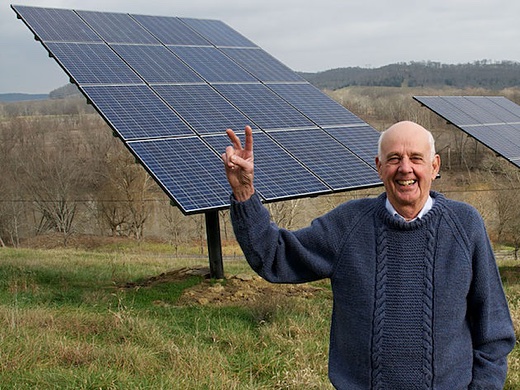
Image above: Wendel Berry, three decades after writing this article stands in front of his solar panels in Henry County, Kentucky.  From (http://huckleberryhans.wixsite.com/resonantliving/single-post/2017/03/06/Lenten-Day-6-Giving-up-Despair---Operation-Beauty).

[IB Publisher's note: This article was originally published in print by The New England Review and Bread Loaf Quarterly in the Fall of 1987 (https://www.jstor.org/stable/40241890?seq=1#page_scan_tab_contents)] 

Like almost everybody else, I am hooked to the energy corporations, which I do not admire. I hope to become less hooked to them. In my work, I try to be as little hooked to them as possible. As a farmer, I do almost all of my work with horses. As a writer, I work with a pencil or a pen and a piece of paper.

My wife types my work on a Royal standard typewriter bought new in 1956 and as good now as it was then. As she types, she sees things that are wrong and marks them with small checks in the margins. She is my best critic because she is the one most familiar with my habitual errors and weaknesses. She also understands, sometimes better than I do, what ought to be said.

We have, I think, a literary cottage industry that works well and pleasantly. I do not see anything wrong with it.

A number of people, by now, have told me that I could greatly improve things by buying a computer. My answer is that I am not going to do it. I have several reasons, and they are good ones.

The first is the one I mentioned at the beginning. I would hate to think that my work as a writer could not be done without a direct dependence on strip-mined coal. How could I write conscientiously against the rape of nature if I were, in the act of writing, Implicated in the rape ? For the same reason, it matters to me that my writing is done in the daytime, without electric light.

I do not admire the computer manufacturers a great deal more than I admire the energy industries. I have seen their advertisements. attempting to seduce struggling or failing farmers into the belief that they can solve their problems by buying yet another piece of expensive equipment. I am familiar with their propaganda campaigns that have put computers into public schools in need of books.

That computers are expected to become as common as TV sets in "the future" does not impress me or matter to me. I do not own a TV set. I do not see that computers are bringing us one step nearer to anything that does matter to me: peace, economic justice, ecological health, political honesty, family and community stability, good work.

What would a computer cost me? More money, for one thing, than I can afford, and more than I wish to pay to people whom I do not admire. But the cost would not be just monetary. It is well understood that technological innovation always requires the discarding of the "old model"—the "old model" in this case being not just our old Royal standard. but my wife, my critic, closest reader, my fellow worker.

Thus (and I think this is typical of present-day technological innovation). what would be superseded would be not only something, but somebody. In order to be technologically up-to-date as a writer, I would have to sacrifice an association that I am dependent upon and that I treasure.

My final and perhaps mv best reason for not owning a computer is that I do not wish to fool myself. I disbelieve, and therefore strongly resent, the assertion that I or anybody else could write better or more easily with a computer than with a pencil.

I do not see why I should not be as scientific about this as the next fellow: when somebody has used a computer to write work that is demonstrably better than Dante's, and when this better is demonstrably attributable to the use of a computer, then I will speak of computer with a more respectful tone of voice, though I still will not buy one.

To make myself as plain as I can, I should give my standards for technological innovation in my own work. They are as follows:
  1. The new tool should be cheaper than the one it replaces.
  2. It should be at least as small in scale as the one it replaces.
  3. It should do work that is clearly and demonstrably better than the one it replaces.
  4. It should use less energy than the one it replaces.
  5. If possible, it should use some form of solar energy, such as that of the body.
  6. It should be repairable by a person of ordinary intelligence, provided that he or she has the necessary tools.
  7. It should be purchasable and repairable as near to home as possible.
  8. It should come from a small, privately owned shop or store that will take it back for maintenance and repair.
  9. It should not replace or disrupt anything good that already exists, and this includes family and community relationships.
After the foregoing essay, first published in the New England Review and Bread Loaf Quarterly, was reprinted in Harper's, the Harper's editors published the following letters in response and permitted me a reply. W.B.


LETTERS
Wendell Berry provides writers enslaved by the computer with a handy alternative: Wife—a low-tech energy-saving device. Drop a pile of handwritten notes on Wife and you get back a finished manuscript, edited while it was typed. What computer can do that? Wife meets all of Berry's uncompromising standards for technological innovation: she's cheap, repairable near home, and good for the family structure.

Best of all, Wife is politically correct because she breaks a writer's "direct dependence on strip-mined coal."

History teaches us that Wife can also be used to beat rugs and wash clothes by hand, thus eliminating the need for the vacuum cleaner and washing machine, two more nasty machines that threaten the act of writing.
Gordon Inkeles Miranda, Calif.


I have no quarrel with Berry because he prefers to write with pencil and paper; that is his choice. But he implies that I and others are somehow impure because we choose to write on a computer. I do not admire the energy corporations, either. Their shortcoming is not that they produce electricity but how they go about it. They are poorly managed because they are blind to long-term consequences. To solve this problem, wouldn't it make more sense to correct the precise error they are making rather than simply ignore their product ? I would be happy to join Berry in a protest against strip mining, but I intend to keep plugging this computer into the wall with a clear conscience.
James Rhoads Battle Creek, Mich.


I enjoyed reading Berry's declaration of intent never to buy a personal computer in the same way that I enjoy reading about the belief systems of unfamiliar tribal cultures. I tried to imagine a tool that would meet Berry's criteria for superiority To his old manual typewriter. The clear winner is the quill pen. It is cheaper, smaller, more energy-efficient, human-powered, easily repaired, and non-disruptive of existing relationships.

Berry also requires that this tool must be "clearly and demonstrably better" than the one it replaces. But surely we all recognize by now that "better" is in the mind of the beholder. To the quill pen aficionado, the benefits obtained from elegant calligraphy might well outweigh all others.

I have no particular desire to see Berry use a word processor; or he doesn't like computers, that's fine with me. However, I do object to his portrayal of this reluctance as a moral virtue. Many of us have found that computers can be an invaluable tool in the fight to protect our environment.

In addition to helping me write, my personal computer gives me access to up-to-the-minute reports on the workings of the EPA and the nuclear industry. I participate in electronic bulletin boards on which environmental activists discuss strategy and warn each other about urgent legislative issues.

Perhaps Berry feels that the Sierra Club should eschew modern printing technology which is highly wasteful of energy, in favor of having its members handcopy the club's magazines and other mailings each month ? 
Nathaniel S. Borenstein Pittsburgh, Pa.


The value of a computer to a writer is that it is a tool not for generating ideas but for typing and editing words. It is cheaper than a secretary (or a wife!) and arguably more fuel-efficient. And it enables spouses who are not inclined to provide free labor more time to concentrate on their own work.

We should support alternatives both to coal-generated electricity and to IBM-style technocracy. But I am reluctant to entertain alternatives that presuppose the traditional subservience of one class to another. Let the PCs come and the wives and servants go seek more meaningful work.
Toby Koosman Knoxville, Tenn.


Berry asks how he could write conscientiously against the rape of nature if in the act of writing on a computer he was implicated in the rape. I find it ironic that a writer who sees the underlying connectness of things would allow his diatribe against computers to be published in a magazine that carries ads for the National Rural Electric Cooperative Association, Marlboro, Phillips Petroleum, McDonnell Douglas, and yes, even Smith-Corona. If Berry rests comfortably at night, he must be using sleeping pills.

Bradley C. Johnson Grand Forks, N.D.


WENDELL BERRY REPLIES:
The foregoing letters surprised me with the intensity of the feelings they expressed. According to the writers' testimony, there is nothing wrong with their computers; they are utterly satisfied with them and all that they stand for. My correspondents are certain that I am wrong and that I am, moreover, on the losing side, a side already relegated to the dustbin of history. And yet they grow huffy and condescending over my tiny dissent. What are they so anxious about?

I can only conclude that I have scratched the skin of a technological fundamentalism that, like other fundamentalisms, wishes to monopolize a whole society and, therefore, cannot tolerate the smallest difference of opinion. At the slightest hint of a threat to their complacency, they repeat, like a chorus of toads, the notes sounded by their leaders in industry. The past was gloomy, drudgery-ridden, servile, meaningless, and slow.

The present, thanks only to purchasable products, is meaningful, bright, lively, centralized, and fast. The future, thanks only to more purchasable products, is going to be even better. Thus consumers become salesmen, and the world is made safer for corporations.

I am also surprised by the meanness with which two of these writers refer to my wife. In order to imply that I am a tyrant, they suggest by both direct statement and innuendo that she is subservient, characterless, and stupid—a mere "device" easily forced to provide meaningless "free labor."

I understand that it is impossible to make an adequate public defense of one's private life, and so l will only point out that there are a number of kinder possibilities that my critics have disdained to imagine: that my wife may do this work because she wants to and likes to; that she may find some use and some meaning in it; that she may not work for nothing.

 These gentlemen obviously think themselves feminists of the most correct and principled sort, and yet they do not hesitate to stereotype and insult, on the basis of one fact, a woman they do not know. They are audacious and irresponsible gossips .

In his letter, Bradley C. Johnson rushes past the possibility of sense in what I said in my essay by implying that I am or ought to be a fanatic. That I am a person of this century and am implicated in many practices that I regret is fully acknowledged at the beginning of my essay. I did not say that I proposed to end forthwith all my involvement in harmful technology, for I do not know how to do that.

I said merely that I want to limit such involvement, and to a certain extent I do know how to do that. If some technology does damage to the world—as two of the above letters seem to agree that it does—then why is it not reasonable, and indeed moral, to try to limit one's use of that technology? Of course, I think that I am right to do this.

I would not think so, obviously, if I agreed with Nathaniel S. Borenstein that " 'better' is in the mind of the beholder." But if he truly believes this, I do not see why he bothers with his personal computer's "up-to-the-minute reports on the workings of the EPA and the nuclear industry" or why he wishes to be warned about "urgent legislative issues."

According to his system, the "better" in a bureaucratic, industrial, or legislative mind is as good as the "better" in his. His mind apparently is being subverted by an objective standard of some sort, and he had better look out.

Borenstein does not say what he does after his computer has drummed him awake. I assume from his letter that he must send donations to conservation organizations and letters to officials. Like James Rhoads, at any rate, he has a clear conscience. But this is what is wrong with the conservation movement. It has a clear conscience.

The guilty are always other people, and the wrong is always somewhere else. That is why Borenstein finds his "electronic bulletin board" so handy. To the conservation movement, it is only production that causes environmental degradation; the consumption that supports the production is rarely acknowledged to be at fault. The ideal of the run-of-the-mill conservationist is to impose restraints upon production without limiting consumption or burdening the consciences of consumers.

But virtually all of our consumption now is extravagant, and virtually all of it consumes the world. It is not beside the point that most electrical power comes from strip-mined coal . The history of the exploitation of the Appalachian coal fields is long, and it is available to readers.

I do not see how anyone can read it and plug in any appliance with a clear conscience. If Rhoads can do so, that does not mean that his conscience is clear; it means that his conscience is not working.

To the extent that we consume, in our present circumstances, we are guilty. To the extent that we guilty consumers are conservationists, we are absurd. But what can we do ? Must we go on writing letters to politicians and donating to conservation organizations until the majority of our fellow citizens agree with us? Or can we do something directly to solve our share of the problem?

I am a conservationist. I believe wholeheartedly in putting pressure on the politicians and in maintaining the conservation organizations. But I wrote my little essay partly in distrust of centralisation. I don't think that the government and the conservation organizations alone will ever make us a conserving society.

Why do I need a centralized computer system to alert me to environmental crises? That I live every hour of every day in an environmental crisis I know from all my senses. Why then is not my first duty to reduce, so far as I can, my own consumption?

Finally, it seems to me that none of my correspondents recognizes the innovativeness of my essay. If the use of a computer is a new idea, then a newer idea is not to use one.

.

Gorillas in our midst

SUBHEAD: Two videos that feature the nature of gorilla and human contact in the jungle.

By Juan Wilson on 24 April 2017 for Island Breath -
(http://islandbreath.blogspot.com/2017/04/gorillas-in-our-midst.html)


Image above: A family of apes spends some moments with a man. Still frame from 2011 video below.

Once and a while I just screw around on YouTube and find something that is for me compelling. By that I don't mean such categories as "Supertanker Disasters" of "World's Biggest Tsunamis"... although I have seen a share of those.

What I did find was friendly contact between wild gorillas and humans. It's not all poaching and hunting and eating them. It seems that a human can have a relationship with our cousins if we are willing to submit to their will.

Below are two examples:


Video above: December 2010 - Man reunites with gorilla he has not seen for five years. From (https://youtu.be/nEUlUfhQbNw).


Video above: July 2015 - a gorilla remembers a girl he had not seen for 12 years. From (https://youtu.be/Xarwk2d5Jm8).

.

Kissenger is a Kiss messenger

SUBHEAD: The Kissenger allows your iPhone to simulate kissing your long-distance lover.

By Rob Beschizza on 30 December 2016 in Boing Boing -
(http://boingboing.net/2016/12/30/kissenger-simulates-kissin.html)


Image above: The hardware that allows an cell phone to replace a lover.   From original article.

Touted as Earth's "first mobile kiss messenger," Kissenger is a rubbery-looking dock that humans put their phones in. It has a tactile surface they depress with their meat. The movements are then transmitted in realtime over the internet, so that a replica of them may be experienced by another human.

Plug in to your phone and give your loved ones a kiss over the Internet. Kissenger can sense your kiss and transmit realistic kissing sensations to your partner in real time. You can also feel the force on your lips when your partner kisses you back. Share an intimate moment with your friends and families while chatting with them on your phone.

The device comprises six sensors, corresponding actuators, and a meat-colored silicone sheath. There's an app that goes with it so the humans can interact on a audiovisual-discursive level at the same time. It's at the prototype stage with nothing to buy, yet, but obviously we should keep an eye on this. It should suffice to say that our previous recommendations with respect to establishing contact with this species have not changed.


Image above: Obviously, for two lovers lips to meet requires one's partner to also have a Kissenger. From original article

High precision force sensors are embedded under the silicon lip to measure the dynamic forces at different parts of your lips during a kiss. The device sends this data to your phone, which transmits it to your partner over the Internet in real time. Miniature linear actuators are used to reproduce these forces on your partner's lips, creating a realistic kissing sensation. Kissenger provides a two-way interaction just like in a real kiss. You can also feel your partner's kiss on your lips when they kiss you back.


.

KIUC & the Culture of Fear

SUBHEAD: A correspondence on Smart Meters between a KIUC member and its Executive Administrator.

By Ray Songtree on 31 October 2016 for Lipstick & War Crimes -
(https://lipstick-and-war-crimes.org/kiuc-kauai-island-utility-cooperatives-culture-fear/)


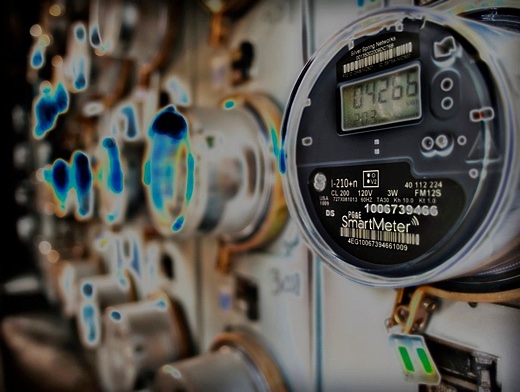
Image above: A typical smart meter installation at multi unit housing intensifies radiation in small area.  From (https://burbankaction.wordpress.com/petition/).

FROM KIUC EXECUTIVE ADMINISISTRATOR
On 10/31/2016 “Kathleen Chin” (kchin@kiuc.coop) wrote the email:
Aloha Ray,

While we are pleased to receive feedback from our members, I ask the email content you send to KIUCBOD@hawaii.rr.com and BoardChair@hawaii.rr.com be specific to our primary business as an electric utility. Please remove our email address from your bulk email blast list otherwise we will have to block your communications.

Respectfully, Pua

Kathleen “Pua” Chin | Executive Administrator | Kauai Island Utility Cooperative | 4463 Pahe`e Street, Suite 1, Lihue, HI 96766-2000

Confidentiality Notice: This e-mail message, including any attachments, is for the sole use of the intended recipient(s) and may contain confidential and privileged information. Any unauthorized review, copy, use, disclosure, or distribution is prohibited. If you are not the intended recipient, please contact the sender by reply e-mail and destroy all copies of the original message.
REPLY FROM RAY SONGTREE
On 10/31/2016 “Ray Songtree (rayupdates@hushmail.com) replied with the email:
Hi Pua,

Respectfully, who has requested this? I do not have KIUC on a blast list and find that categorization insulting. I send technology and corruption issues that board members might find interesting.

Some board members may not, and that would be expected in a diverse and free thinking group. The board is made of different individuals. Some of them may find this information vital as they will not get this info in mainstream news, which includes the Garden Island Star Advertiser. I am an author and researcher. If KIUC was curious about corruption, they would hire me as a consultant.

I often send these emails to Mayor and Council as they have gone along with KIUC lack of research and they need to be informed. The wikileaks story is critical to those who want honest government and honest utilities. This is why I included that, because many Kauai residents are hoping the county, state, federal and UN corruption will be busted. They know this will only happen through whistle blowers.

Perhaps there are people at KIUC who would not like to see this, and resent whistle blowers who throw a wrench in their opaque planning which decides for everyone else, with no ability to challenge their decisions, what the community’s future might look like.

In point, the special ballots are formatted by KIUC which is the entity being challenged. Conflict of interest? There is no check and balance at KIUC. One contestant directs wording of Ballot which predictably leads the thinking of the voters in favor of the one contestant.

Thus there are no real challenges possible to the ensconced thinking and structure of KIUC. Thus KIUC is a co-op only in name, for tax and legal reasons only, where the serfs have no voice.
I am familiar with who initiated smart grid, how it was promulgated, what it really is, and what is not, all which has been foisted on Kauai residents. Smart grid is not for anything green, it was to create the internet of all things, where everything is tracked through smart meters. Smart meters, like cell phones, were never safe and will never be safe.

TEDx Talk: By Jeromy Johnson - Wireless Wake-Up Call at Zellerbach Hall on the UC Berkeley campus. He gave a wonderful TED talk about how WiFi and EMF are affecting our health at (www.emfanalysis.com/tedx-wireless-wake-up-call/). [See video below]


Specifically, I send emails about EMF, Smart Meter, and technocracy issues. I am the person, as you might remember, who led the failed attempt to educate the board about FCC corruption and Smart Meters. The issue will never go away until KIUC is willing to do the research and break with Federal government. FCC is directly linked to KIUC.

If someone asked you to send me this letter, please forward this to them so we can discuss what kinds of FCC / government corruption, and undiscussed technology are NOT of interest to a quasi public utility.

Also please let me know who speaks to censor the communication with 9 other people?

I’m sorry your job description includes attempts to censor whistle blowing and I wonder how it is, that you sent this email without reservations?

Perhaps you would feel comfortable to discuss your honest and personal feelings about KIUC on radio, as I’m sure your job would not be jeopardized.

We could do a skype talk and I could post it to youtube for you. You have nothing to fear from KIUC.

Ray Songtree
378-4152

Image above: Jeromy Johnson TEDx talk of radiation from smart meters and cellphones. From (https://youtu.be/F0NEaPTu9oI).
.

Is Apple Flying Or Dying?

SUBHEAD: A closer look at iPhone 7 indicates the evolutionary development of our wireless future.

By Ewan Spence on 18 September 2016 for Forbes-
(http://www.forbes.com/sites/ewanspence/2016/09/18/iphone-7-big-question-apple-doomed/)


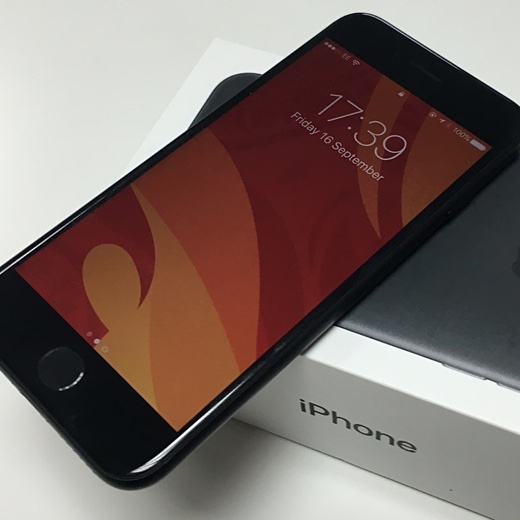
Image above: iPhone7 promotional photo in fragile Jet Black finish. From original article.

What do the new iPhone 7 and iPhone 7 Plus smartphones tell us about Apple’s future? Let’s start this discussion with a simple premise that I think we can all agree on. Apple is not in stasis, it will change.

 Companies are always in transition, they hope to end up in a better place but in many cases the path of good intentions may eventually lead to a painful end.

The iPhone 7 handsets are pivotal phones for Apple. Tim Cook and his team are taking a number of gambles with the hardware, the software, the distribution, and its corporate attitude.

They believe that these changes will help Apple retain its leadership role in the technology space for the second decade of its smartphone (the original iPhone announcement was January 9 2007, so the birthday party is imminent).

The fact that I don’t think the iPhone 7 or 7 Plus change a huge amount for the end-user is a point I may return to in a later article, but my thoughts on why can be found in my ‘First Impressions’ review of the iPhone 7 here on Forbes.

In any case, let’s see what road signs are inside the iPhone 7 family and where they point to.

Everyone will have an opinion on the removal of the headphone jack, and while I wouldn’t want to go as far as saying that the decision was powered by “courage” it does illustrate that Apple is capable divining a future and has the willingness to proactively push towards it.

The move to lightning audio and wireless bluetooth is a ‘typically Apple’ attitude. There’s no point waiting for the combined might of the music industry  and various consumer electronics companies to throw away its comfort blanket, even if bluetooth headphones are starting to be in the majority of sales in some markets. Apple has forced the issue.

Assuming the removal of the jack is a success (and a genteel press corps will help smooth the rough edges of the transition), the opportunities in terms of handset design, reliability, lowered build costs and the potential for improved margins on peripheral sales are all positive benefits for Apple. It’s hard to see the basic shape of a smartphone changing now, so design is going to be focused on the edges.

Losing as many ports as possible will help evolve the smartphone. Switching the home key to a virtual button is more radical, but less likely to annoy the purists.

Again it lowers the count of physical parts on the device which will reduce the bill of materials to Apple, it reduces the number of warranty repairs required, and it will act as another point of difference against the raft of Android smartphones.

Perhaps more importantly, and staying in tune with the approach in audio, it reduces the number of extrusions in the basic chassis and offers far more ‘futuristic’ design choices for next year’s handed. Shorn of the need to prove the lack of a headphone jack or a physical home key, the tenth-anniversary iPhone 8 can bring forward a revolutionary look.

The release of the iPhone 7 and iPhone 7 Plus will also generate a vital data point for Apple’s sales team. Last year’s launch of the iPhone Upgrade Program allowed consumers to buy an iPhone direct from Apple in return for two years of monthly payments.

After one year they have the option of extending the payments by one year and trade up to the latest iPhone model. How many people take up this option will help plan the release of ‘the big one’ next year.

Apple has laid out the broad brush strokes of how it sees the future – a world with minimal use of wires, with fewer moving parts on the iPhone, and consumers that treat their smartphone as a monthly lease with ongoing payments rather than a huge investment every twenty-four months.

But Cupertino needs to watch out, because the new iPhone handsets also exhibit traits that could easily derail the company.


iPhone7 Jet Black finish scratches
SUBHEAD: Apple admits its iPhone 7 Jet Black finish is easy to mar.

By Ashley Carmin on 9 September 2016 for The Verge - 
(http://www.theverge.com/circuitbreaker/2016/9/7/12836762/iphone-7-announced-black-scratch)


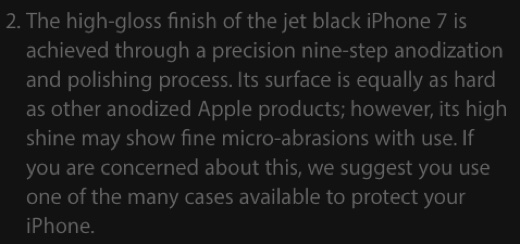
Image above: The low contrast Apple webpage that admits easy scratching of new Jet Black finished iPhone7.

Can you read that? Let me sum up: the jet black version of the iPhone 7, the one we the people wanted, scratches.

So if you don’t like a scratched iPhone, you’re going to need to invest in a case. People probably won’t be able to see your jet black iPhone 7 through that case. Do you love your phone’s color enough to let it be scratched?

Apple doesn’t have the same footnote for its simply "black" color. It comes in a matte finish and might be more on the gray side, but I think it’s the color we have to go with to avoid scratches.

.

Build a local low-tech internet

SUBHEAD: Research groups have developed and implemented much cheaper alternative network technologies.

By Kris De Decker on 26 October 2015 for Low Tech Magazine -
(http://www.lowtechmagazine.com/2015/10/how-to-build-a-low-tech-internet.html)
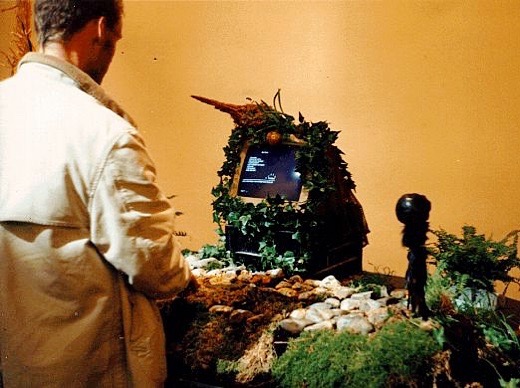

Image above: An artistic interpretation of Stone Age computing. From (https://oertijd.home.xs4all.nl/st-age/photo.htm).

Wireless internet access is on the rise in both modern consumer societies and in the developing world.

In rich countries, however, the focus is on always-on connectivity and ever higher access speeds. In poor countries, on the other hand, connectivity is achieved through much more low-tech, often asynchronous networks.

While the high-tech approach pushes the costs and energy use of the internet higher and higher, the low-tech alternatives result in much cheaper and very energy efficient networks that combine well with renewable power production and are resistant to disruptions.

If we want the internet to keep working in circumstances where access to energy is more limited, we can learn important lessons from alternative network technologies. Best of all, there's no need to wait for governments or companies to facilitate: we can build our own resilient communication infrastructure if we cooperate with one another. This is demonstrated by several community networks in Europe, of which the largest has more than 35,000 users already.

More than half of the global population does not have access to the "worldwide" web. Up to now, the internet is mainly an urban phenomenon, especially in "developing" countries.

Telecommunication companies are usually reluctant to extend their network outside cities due to a combination of high infrastructure costs, low population density, limited ability to pay for services, and an unreliable or non-existent electricity infrastructure. Even in remote regions of "developed" countries, internet connectivity isn't always available.

Internet companies such as Facebook and Google regularly make headlines with plans for connecting these remote regions to the internet. Facebook tries to achieve this with drones, while Google counts on high-altitude balloons. There are major technological challenges, but the main objection to these plans is their commercial character.

Obviously, Google and Facebook want to connect more people to the internet because that would increase their revenues. Facebook especially receives lots of criticism because their network promotes their own site in particular, and blocks most other internet applications. [1]

Meanwhile, several research groups and network enthusiasts have developed and implemented much cheaper alternative network technologies to solve these issues. Although these low-tech networks have proven their worth, they have received much less attention.

Contrary to the projects of internet companies, they are set up by small organisations or by the users themselves. This guarantees an open network that benefits the users instead of a handful of corporations. At the same time, these low-tech networks are very energy efficient.

WiFi-based Long Distance Networks
Most low-tech networks are based on WiFi, the same technology that allows mobile access to the internet in most western households. As we have seen in the previous article, sharing these devices could provide free mobile access across densely populated cities. But the technology can be equally useful in sparsely populated areas.

Although the WiFi-standard was developed for short-distance data communication (with a typical range of about 30 metres), its reach can be extended through modifications of the Media Access Control (MAC) layer in the networking protocol, and through the use of range extender amplifiers and directional antennas. [2]
Although the WiFi-standard was developed for short-distance data communication, its reach can be extended to cover distances of more than 100 kilometres.
The longest unamplified WiFi link is a 384 km wireless point-to-point connection between Pico El Águila and Platillón in Venezuela, established a few years ago. [3,4]

However, WiFi-based long distance networks usually consist of a combination of shorter point-to-point links, each between a few kilometres and one hundred kilometers long at most. These are combined to create larger, multihop networks. Point-to-points links, which form the backbone of a long range WiFi network, are combined with omnidirectional antennas that distribute the signal to individual households (or public institutions) of a community.
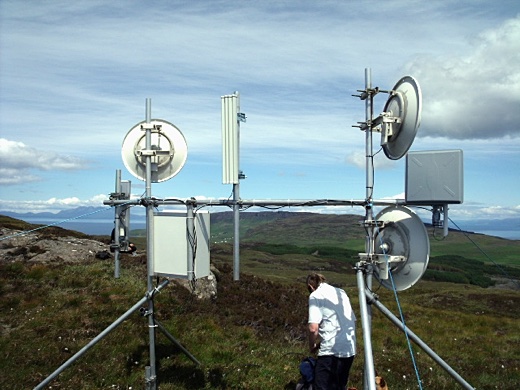


Image above: A relay with three point-to-point links and three sectoral antennae. By Tegola. From original article.

Long-distance WiFi links require line of sight to make a connection -- in this sense, the technology resembles the 18th century optical telegraph. [5] If there's no line of sight between two points, a third relay is required that can see both points, and the signal is sent to the intermediate relay first. Depending on the terrain and particular obstacles, more hubs may be necessary. [6]

Point-to-point links typically consist of two directional antennas, one focused on the next node and the other on the previous node in the network. Nodes can have multiple antennas with one antenna per fixed point-to-point link to each neighbour. [7] This allows mesh routing protocols that can dynamically select which links to choose for routing among the available ones. [8]
Long-distance WiFi links require line of sight to make a connection -- in this sense, the technology resembles the 18th century optical telegraph.
Distribution nodes usually consist of a sectoral antenna (a small version of the things you see on mobile phone masts) or a conventional WiFi-router, together with a number of receivers in the community. [6] For short distance WiFi-communication, there is no requirement for line of sight between the transmitter and the receiver. [9]

To provide users with access to the worldwide internet, a long range WiFi network should be connected to the main backbone of the internet using at least one "backhaul" or "gateway node". This can be a dial-up or broadband connection (DSL, fibre or satellite). If such a link is not established, users would still be able to communicate with each other and view websites set up on local servers, but they would not be able to access the internet. [10]

Advantages of Long Range WiFi
Long range WiFi offers high bandwidth (up to 54 Mbps) combined with very low capital costs. Because the WiFi standard enjoys widespread acceptance and has huge production volumes, off-the-shelf antennas and wireless cards can be bought for very little money. [11]

Alternatively, components can be put together from discarded materials such as old routers, satellite dish antennas and laptops. Protocols like WiLDNet run on a 266 Mhz processor with only 128 MB memory, so an old computer will do the trick. [7]

The WiFi-nodes are lightweight and don't need expensive towers -- further decreasing capital costs, and minimizing the impact of the structures to be built. [7] More recently, single units that combine antenna, wireless card and processor have become available. These are very convenient for installation. To build a relay, one simply connects such units together with ethernet cables that carry both signal and power. [6]

The units can be mounted in towers or slim masts, given that they offer little windload. [3] Examples of suppliers of long range WiFi components are Ubiquity, Alvarion and MikroTik, and simpleWiFi.
Long Range WiFi makes use of unlicensed spectrum and offers high bandwidth, low capital costs, easy installation, and low power requirements.
Long range WiFi also has low operational costs due to low power requirements. A typical mast installation consisting of two long distance links and one or two wireless cards for local distribution consumes around 30 watts. [6,12]

In several low-tech networks, nodes are entirely powered by solar panels and batteries. Another important advantage of long range WiFi is that it makes use of unlicensed spectrum (2.4 and 5 GHz), and thus avoids negotiations with telecom operators and government. This adds to the cost advantage and allows basically anyone to start a WiFi-based long distance network. [9]

Long Range WiFi Networks in Poor Countries
The first long range WiFi networks were set up ten to fifteen years ago. In poor countries, two main types have been built. The first is aimed at providing internet access to people in remote villages.

An example is the Akshaya network in India, which covers the entire Kerala State and is one of the largest wireless networks in the world. The infrastructure is built around approximately 2,500 "computer access centers", which are open to the local population -- direct ownership of computers is minimal in the region. [13]

Another example, also in India, are the AirJaldi networks which provide internet access to approximately 20,000 users in six states, all in remote regions and on difficult terrain. Most nodes in this network are solar-powered and the distance between them can range up to 50 km or more. [14]

In some African countries, local WiFi-networks distribute internet access from a satellite gateway. [15,16]


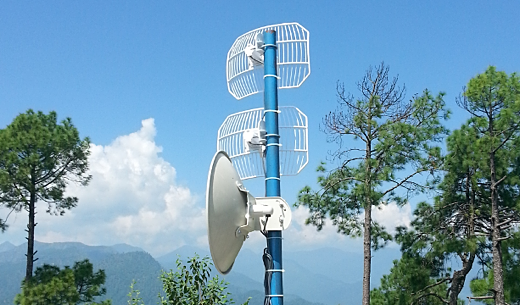
Image above: A node in the AirJaldi network, a company connecting rural India. From original article.

second type of long distance WiFi network in poor countries is aimed at providing telemedicine to remote communities. In remote regions, health care is often provided through health posts scarcely equipped and attended by health technicians who are barely trained. [17]

Long-range WiFi networks can connect urban hospitals with these outlying health posts, allowing doctors to remotely support health technicians using high-resolution file transfers and real-time communication tools based on voice and video.

An example is the link between Cabo Pantoja and Iquitos in the Loreto province in Peru, which was established in 2007. The 450 km network consists of 17 towers which are 16 to 50 km apart. The line connects 15 medical outposts in remote villages with the main hospital in Iquitos and is aimed at remote diagnosis of patients. [17,18]

All equipment is powered by solar panels. [18,19] Other succesful examples of long range WiFi telemedicine networks have been built in India, Malawi and Ghana. [20,21]

WiFi-Based Community Networks in Europe
The low-tech networks in poor countries are set up by NGO's, governments, universities or businesses. In contrast, most of the WiFi-based long distance networks in remote regions of rich countries are so-called "community networks": the users themselves build, own, power and maintain the infrastructure.

Similar to the shared wireless approach in cities, reciprocal resource sharing forms the basis of these networks: participants can set up their own node and connect to the network (for free), as long as their node also allows traffic of other members. Each node acts as a WiFi routing device that provides IP forwarding services and a data link to all users and nodes connected to it. [8,22]
In a community network, the users themselves build, own, power and maintain the infrastructure.
Consequently, with each new user, the network becomes larger. There is no a-priori overall planning. A community network grows bottom-up, driven by the needs of its users, as nodes and links are added or upgraded following demand patterns. The only consideration is to connect a node from a new participant to an existing one.

As a node is powered on, it discovers it neighbours, attributes itself a unique IP address, and then establishes the most appropriate routes to the rest of the network, taking into account the quality of the links. Community networks are open to participation to everyone, sometimes according to an open peering agreement. [8,9,19,22]


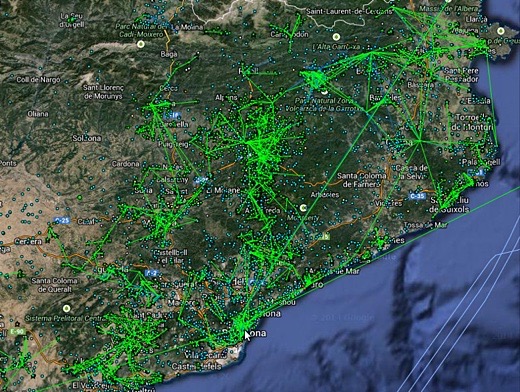
Image above: Wireless links in Barcelona Spanish by GuifiNet. From original article.

Despite the lack of reliable statistics, community networks seem to be rather succesful, and there are several large ones in Europe, such as Guifi.net (Spain), Athens Wireless Metropolitan Network (Greece), FunkFeuer (Austria), and Freifunk (Germany). [8,22,23,24]

The Spanish network  is the largest WiFi-based long distance network in the world with more than 50,000 kilometres of links, although a small part is based on optic fibre links. Most of it is located in the Catalan Pyrenees, one of the least populated areas in Spain. The network was initiated in 2004 and now has close to 30,000 nodes, up from 17,000 in 2012. [8,22]

Guifi.net provides internet access to individuals, companies, administrations and universities. In principle, the network is installed, powered and maintained by its users, although volunteer teams and even commercial installers are present to help. Some nodes and backbone upgrades have been succesfully crowdfunded by indirect beneficiaries of the network. [8,22]

Performance of Low-tech Networks
So how about the performance of low-tech networks? What can you do with them? The available bandwidth per user can vary enormously, depending on the bandwidth of the gateway node(s) and the number of users, among other factors. The long-distance WiFi networks aimed at telemedicine in poor countries have few users and a good backhaul, resulting in high bandwidth (+ 40 Mbps).

This gives them a similar performance to fibre connections in the developed world. A study of (a small part of) the Guifi.net community network, which has dozens of gateway nodes and thousands of users, showed an average throughput of 2 Mbps, which is comparable to a relatively slow DSL connection. Actual throughput per user varies from 700 kbps to 8 Mbps. [25]
The available bandwidth per user can vary enormously, depending on the bandwidth of the gateway node(s) and the number of users, among other factors
However, the low-tech networks that distribute internet access to a large user base in developing countries can have much more limited bandwidth per user. For example, a university campus in Kerala (India) uses a 750 kbps internet connection that is shared across 3,000 faculty members and students operating from 400 machines, where during peak hours nearly every machine is being used.

Therefore, the worst-case average bandwidth available per machine is approximately 1.9 kbps, which is slow even in comparison to a dial-up connection (56 kbps). And this can be considered a really good connectivity compared to typical rural settings in poor countries. [26] To make matters worse, such networks often have to deal with an intermittent power supply.

Under these circumstances, even the most common internet applications have poor performance, or don't work at all. The communication model of the internet is based on a set of network assumptions, called the TCP/IP protocol suite. These include the existence of a bi-directional end-to-end path between the source (for example a website's server) and the destination (the user's computer), short round-trip delays, and low error rates.

Many low-tech networks in poor countries do not comform to these assumptions. They are characterized by intermittent connectivity or "network partitioning" -- the absence of an end-to-end path between source and destination -- long and variable delays, and high error rates. [21,27,28]

Delay-Tolerant Networks
Nevertheless, even in such conditions, the internet could work perfectly fine. The technical issues can be solved by moving away from the always-on model of traditional networks, and instead design networks based upon asynchronous communication and intermittent connectivity.

These so-called "delay-tolerant networks" (DTNs) have their own specialized protocols overlayed on top of the lower protocols and do not utilize TCP. They overcome the problems of intermittent connectivity and long delays by using store-and-forward message switching.

Information is forwarded from a storage place on one node to a storage place on another node, along a path that eventually reaches its destination. In contrast to traditional internet routers, which only store incoming packets for a few milliseconds on memory chips, the nodes of a delay-tolerant network have persistent storage (such as hard disks) that can hold information indefinitely. [27,28]
Delay-tolerant networks combine well with renewable energy: solar panels or wind turbines could power network nodes only when the sun shines or the wind blows, eliminating the need for energy storage.
Delay-tolerant networks don't require an end-to-end path between source and destination. Data is simply transferred from node to node. If the next node is unavailable because of long delays or a power outage, the data is stored on the hard disk until the node becomes available again. While it might take a long time for data to travel from source to destination, a delay-tolerant network ensures that it will eventually arrive.

Delay-tolerant networks further decrease capital costs and energy use, leading to the most efficient use of scarce resources. They keep working with an intermittent energy supply and they combine well with renewable energy sources: solar panels or wind turbines could power network nodes only when the sun shines or the wind blows, eliminating the need for energy storage.

Data Mules
Delay-tolerant networking can take surprising forms, especially when they take advantage of some non-traditional means of communication, such as "data mules". [11,29] In such networks, conventional transportation technologies -- buses, cars, motorcycles, trains, boats, airplanes -- are used to ferry messages from one location to another in a store-and-forward manner.

Examples are DakNet and KioskNet, which use buses as data mules. [30-34] In many developing regions, rural bus routes regularly visit villages and towns that have no network connectivity. By equipping each vehicle with a computer, a storage device and a mobile WiFi-node on the one hand, and by installing a stationary WiFi-node in each village on the other hand, the local transport infrastructure can substitute for a wireless internet link. [11]


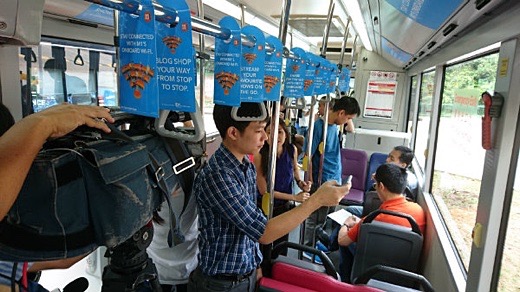
Image above: Singapore provides seamless service on board island bus service. From (https://www.thinksmallcell.com/System/m1-singapore-provides-seamless-service-on-board-island-bus-service.html).

Outgoing data (such as sent emails or requests for webpages) is stored on local computers in the village until the bus comes withing range. At this point, the fixed WiFi-node of the local computer automatically transmits the data to the mobile WiFi-node of the bus. Later, when the bus arrives at a hub that is connected to the internet, the outgoing data is transmitted from the mobile WiFi-node to the gateway node, and then to the internet.

Data sent to the village takes the opposite route. The bus -- or data -- driver doesn't require any special skills and is completely oblivious to the data transfers taking place. He or she does not need to do anything other than come in range of the nodes. [30,31]
In a data mules network, the local transport infrastructure substitutes for a wireless internet link.
The use of data mules offers some extra advantages over more "sophisticated" delay-tolerant networks. A "drive-by" WiFi network allows for small, low-cost and low-power radio devices to be used, which don't require line of sight and consequently no towers -- further lowering capital costs and energy use compared to other low-tech networks. [30,31,32]

The use of short-distance WiFi-links also results in a higher bandwidth compared to long-distance WiFi-links, which makes data mules better suited to transfer larger files. On average, 20 MB of data can be moved in each direction when a bus passes a fixed WiFi-node. [30,32] On the other hand, latency (the time interval between sending and receiving data) is usually higher than on long-range WiFi-links. A single bus passing by a village once a day gives a latency of 24 hours.

Delay-Tolerant Software
Obviously, a delay-tolerant network (DTN) -- whatever its form -- also requires new software: applications that function without a connected end-to-end networking path. [11]

Such custom applications are also useful for synchronous, low bandwidth networks. Email is relatively easy to adapt to intermittent connectivity, because it's an asynchronous communication method by itself.

A DTN-enabled email client stores outgoing messages until a connection is available. Although emails may take longer to reach their destination, the user experience doesn't really change.


Image above: Vision of a computer technology merged with organic nature.  From (https://oertijd.home.xs4all.nl/st-age/photo.htm).

Browsing and searching the web requires more adaptations. For example, most search engines optimize for speed, assuming that a user can quickly look through the returned links and immediately run a second modified search if the first result is inadequate. However, in intermittent networks, multiple rounds of interactive search would be impractical. [26,35]

Asynchronous search engines optimize for bandwith rather than response time. [26,30,31,35,36]

For example, RuralCafe desynchronizes the search process by performing many search tasks in an offline manner, refining the search request based on a database of similar searches. The actual retrieval of information using the network is only done when absolutely necessary.
Many internet applications could be adapted to intermittent networks, such as webbrowsing, email, electronic form filling, interaction with e-commerce sites, blogsoftware, large file downloads, or social media.
Some DTN-enabled browsers download not only the explicitly requested webpages but also the pages that are linked to by the requested pages. [30] Others are optimized to return low-bandwidth results, which are achieved by filtering, analysis, and compression on the server site.

A similar effect can be achieved through the use of a service like Loband, which strips webpages of images, video, advertisements, social media buttons, and so on, merely presenting the textual content. [26]

Browsing and searching on intermittent networks can also be improved by local caching (storing already downloaded pages) and prefetching (downloading pages that might be retrieved in the future).

Many other internet applications could also be adapted to intermittent networks, such as electronic form filling, interaction with e-commerce sites, blogsoftware, large file downloads, social media, and so on. [11,30] All these applications would remain possible, though at lower speeds.

Sneakernets
Obviously, real-time applications such as internet telephony, media streaming, chatting or videoconferencing are impossible to adapt to intermittent networks, which provide only asynchronous communication. These applications are also difficult to run on synchronous networks that have limited bandwidth.

Because these are the applications that are in large part responsible for the growing energy use of the internet, one could argue that their incompatibility with low-tech networks is actually a good thing (see the previous article).

Furthermore, many of these applications could be organized in different ways. While real-time voice or video conversations won't work, it's perfectly possible to send and receive voice or video messages. And while streaming media can't happen, downloading music albums and video remains possible.

Moreover, these files could be "transmitted" by the most low-tech internet technology available: a sneakernet. In a sneakernet, digital data is "wirelessly" transmitted using a storage medium such as a hard disk, a USB-key, a flash card, or a CD or DVD. Before the arrival of the internet, all computer files were exchanged via a sneakernet, using tape or floppy disks as a storage medium.

Just like a data mules network, a sneakernet involves a vehicle, a messenger on foot, or an animal (such as a carrier pigeon).

However, in a sneakernet there is no automatic data transfer between the mobile node (for instance, a vehicle) and the stationary nodes (sender and recipient). Instead, the data first have to be transferred from the sender's computer to a portable storage medium.

Then, upon arrival, the data have to be transferred from the portable storage medium to the receiver's computer. [30] A sneakernet thus requires manual intervention and this makes it less convenient for many internet applications.

There are exceptions, though. For example, a movie doesn't have to be transferred to the hard disk of your computer in order to watch it. You play it straight from a portable hard disk or slide a disc into the DVD-player.

Moreover, a sneakernet also offers an important advantage: of all low-tech networks, it has the most bandwidth available. This makes it perfectly suited for the distribution of large files such as movies or computer games. In fact, when very large files are involved, a sneakernet even beats the fastest fibre internet connection. At lower internet speeds, sneakernets can be advantageous for much smaller files.

Technological progress will not lower the advantage of a sneakernet. Digital storage media evolve at least as fast as internet connections and they both improve communication in an equal way.

Resilient Networks
While most low-tech networks are aimed at regions where the alternative is often no internet connection at all, their usefulness for well-connected areas cannot be overlooked. The internet as we know it in the industrialized world is a product of an abundant energy supply, a robust electricity infrastructure, and sustained economic growth. This "high-tech" internet might offer some fancy advantages over the low-tech networks, but it cannot survive if these conditions change. This makes it extremely vulnerable.
The internet as we know it in the industrialized world is a product of an abundant energy supply, a robust electricity infrastructure, and sustained economic growth. It cannot survive if these conditions change.
Depending on their level of resilience, low-tech networks can remain in operation when the supply of fossil fuels is interrupted, when the electricity infrastructure deteriorates, when the economy grinds to a halt, or if other calamities should hit. Such a low-tech internet would allow us to surf the web, send and receive e-mails, shop online, share content, and so on.

Meanwhile, data mules and sneakernets could serve to handle the distribution of large files such as videos. Stuffing a cargo vessel or a train full of digital storage media would beat any digital network in terms of speed, cost and energy efficiency. And if such a transport infrastructure would no longer be available, we could still rely on messengers on foot, cargo bikes and sailing vessels.

Such a hybrid system of online and offline applications would remain a very powerful communication network -- unlike anything we had even in the late twentieth century. Even if we envision a doom scenario in which the wider internet infrastructure would disintegrate, isolated low-tech networks would still be very useful local and regional communication technologies.

Furthermore, they could obtain content from other remote networks through the exchange of portable storage media. The internet, it appears, can be as low-tech or high-tech as we can afford it to be.

Sources & Notes:
DIY: Wireless networking in the developing world (Third Edition) is a free book about designing, implementing and maintaining low-cost wireless networks. Available in English, French, and Spanish.

[1] Connecting the unwired world with balloons, satellites, lasers & drones, Slashdot, 2015

[2] A QoS-aware dynamic bandwidth allocation scheme for multi-hop WiFi-based long distance networks, Iftekhar Hussain et al., 2015

[3] Long-distance, Low-Cost Wireless Data Transmission (PDF), Ermanno Pietrosemoli, 2011

[4] This link could only be established thanks to the height of the endpoints (4,200 and 1,500 km) and the flatness of the middle ground. The curvature of the Earth makes longer point-to-point WiFi-links difficult to achieve because line of sight between two points is required.

[5] Radio waves occupy a volume around the optical line, which must be unemcumbered from obstacles. This volume is known as the Fresnel ellipsoid and its size grows with the distance between the two end points and with the wavelength of the signal, which is in turn inversely proportional to the frequency. Thus, it is required to leave extra "elbow room" for the Fresnel zone. [9]

[6] A Brief History of the Tegola Project, Tegola Project, retrieved October 2015

[7] WiLDNet: Design and Implementation of High Performance WiFi based Long Distance Networks (PDF), Rabin Patra et al., 2007

[8] Topology Patterns of a Community Network: Guifi.net (PDF), Davide Vega et al., 2012

[9] Global Access to the Internet for All, internet draft, Internet Engineering Task Force (IETF), 2015

[10] This is what happened to Afghanistan's JLINK network when funding for the network's satellite link ran dry in 2012.

[11] The case for technology in developing regions (PDF), Eric Brewer et al., 2005

[12] Beyond Pilots: Keeping Rural Wireless Networks Alive (PDF), Sonesh Surana et al., 2008

[13] http://www.akshaya.kerala.gov.in/

[14] http://main.airjaldi.com/

[15] VillageCell: Cost Effective Cellular Connectivity in Rural Areas (PDF), Abhinav Anand et al., 2012

[16] Deployment and Extensio of a Converged WiMAX/WiFi Network for Dwesa Community Area South Africa (PDF), N. Ndlovu et al., 2009

[17] "A telemedicine network optimized for long distances in the Amazonian jungle of Peru" (PDF), Carlos Rey-Moreno, ExtremeCom '11, September 2011

[18] "Telemedicine networks of EHAS Foundation in Latin America", Ignacio Prieto-Egido et al., in "Frontiers in Public Health", October 15, 2014.

[19] "The design of a wireless solar-powered router for rural environments isolated from health facilities" (PDF), Francisco Javier Simo Reigadas et al., in "IEEE Wireless Communications", June 2008.

[20] On a long wireless link for rural telemedicine in Malawi (PDF), M. Zennaro et al., 2008
[21] A Survey of Delay- and Disruption-Tolerant Networking Applications, Artemios G. Voyiatzis, 2012

[22] Supporting Cloud Deployment in the Guifi Community Network (PDF), Roger Baig et al., 2013

[23] A Case for Research with and on Community Networks (PDF), Bart Braem et.al, 2013

[24] There are smaller networks in Scotland (Tegola), Slovenia (wlan slovenija), Belgium (Wireless Antwerpen), and the Netherlands (Wireless Leiden), among others. Australia has Melbourne Wireless. In Latin America, numerous examples exists, such as Bogota Mesh (Colombia) and Monte Video Libre (Uruguay). Some of these networks are interconnected. This is the case for the Belgian and Dutch community networks, and for the Slovenian and Austrian networks. [8,22,23]

[25] Proxy performance analysis in a community wireless network, Pablo Pitarch Miguel, 2013

[26] RuralCafe: Web Search in the Rural Developing World (PDF), Jay Chen et al., 2009

[27] A Delay-Tolerant Network Architecture for Challenged Networks (PDF), Kevin Fall, 2003

[28] Delay- and Disruption-Tolerant Networks (DTNs) -- A Tutorial (version 2.0) (PDF), Forrest Warthman, 2012

[29] Healthcare Supported by Data Mule Networks in Remote Communities of the Amazon Region, Mauro Margalho Coutinho et al., 2014

[30] First Mile Solutions' Daknet Takes Rural Communities Online (PDF), Carol Chyau and Jean-Francois Raymond, 2005

[31] DakNet: A Road to Universal Broadband Connectivity (PDF), Amir Alexander Hasson et al., 2003

[32] DakNet: Architecture and Connectivity in Developing Nations (PDF), Madhuri Bhole, 2015

[33] Delay Tolerant Networks and Their Applications, Longxiang Gao et al., 2015

[34] Low-cost communication for rural internet kiosks using mechanical backhaul, A. Seth et al., 2006

[35] Searching the World Wide Web in Low-Connectivity Communities (PDF), William Thies et al., 2002

[36] Slow Search: Information Retrieval without Time Constraints (PDF), Jaime Teevan, 2013

[37] Potential for Collaborative Caching and Prefetching in Largely-Disconnected Villages (PDF), Sibren Isaacman et al., 2008


.