Showing posts with label Psychology. Show all posts

Microdosing with LSD

SUBHEAD: It's a growing phenomena in Silicon Valley. But does it actually work?

By Dominique Mosbergen on 3 September 2018 for Huffington Post -
(https://www.huffingtonpost.com/entry/microdosing-lsd-placebo-study_us_5b8d1e48e4b0511db3daaaff)

http://www.islandbreath.org/2018Year/09/180905hofmannbig.jpg
Image above: Painting titled "St. Albert" by the artist Alex Gray. Dr. Albert Hofmann is the Swiss chemist who discovered LSD, thus catalyzing a consciousness revolution. Surrounding Hofmann in the painting are luminaries who have written about the powerful positive influence of psychedelics. The painting was completed as part of Dr. Albert Hofmann's 100th birthday celebration held in Basel, Switzerland on January 11th, 2006. From (https://shop.cosm.org/collections/artwork) Click to enlarge.

[IB Publisher's note: About friggin' time! It's been 75 years since LSD was discovered. The drug has had a government sponsored propaganda reputation almost as incorrect as that for marijuana. It has taken half a century of my life to get the issue of the usefulness of cannabis/hemp settled. Remember NORML?] 

A powerful distortion and alteration of perception, mood and cognitive function: The effects of taking larger amounts of psychedelic drugs like LSD and magic mushrooms are fairly well documented and understood.

But when it comes to the growing trend of microdosing or taking very small quantities of these drugs on a regular basis, the science is hazy.

Anecdotally, people who microdose with psychedelics have claimed the drugs deliver a range of benefits such as heightened focus, productivity and creativity, as well as psychological and emotional well-being.

The effects are apparently so positive that microdosing has been described as the “life hack du jour” in Silicon Valley, where the practice first gained widespread popularity.

Yet, despite the burgeoning interest in the technique, research into microdosing and its effects remain scarce ― though scientific interest does appear to be growing.

“If you look around in the scientific literature, you realize there are virtually no studies on [this topic],” neuroscience researcher Balazs Szigeti told Wired magazine in a recent interview.

On Monday, Szigeti and a team of colleagues are working to change this fact with the launch of one of the first ever placebo-controlled trials of microdosing.

The study, which is supported by Imperial College London and the Beckley Foundation, a U.K.-based think tank that funds psychedelic research, aims to find out whether microdosing of LSD actually delivers the positive benefits that users claim — or whether it’s merely a placebo effect.

“As a scientist working in the field, it just feels not very satisfying that something explosively used by a lot of people is basically so non-evidence-based,” David Erritzoe, the study’s principal investigator, told Wired.

For cost and feasibility reasons, the study will not be conducted in a lab but will instead involve adult subjects who have been recruited online and who already microdose with LSD or intend to.

The researchers will not provide the drugs but will facilitate a “self-blinding” procedure that will involve sending the participants eight envelopes with QR codes on them.

The subjects will have to fill these envelopes themselves with either empty pills (the placebo) or capsules with LSD microdoses in them.

The participants will then have to mix the eight envelopes up and pick only four of them, each corresponding to one week in the four-week trial.

Once the trial begins, the subjects will take one pill every morning from that week’s envelope ― though they won’t know whether they’re consuming LSD or a dummy pill.

According to the study’s website, participants will be required throughout the study to “complete a set of online questionnaires and to play a selection of online cognitive games.

The questionnaires focus on examining the psychological state of participants, while the online games have been designed to measure cognitive performance.”

As Wired noted, the study has some clear advantages but also inherent problems. “An advantage of the at-home study is that it can accommodate a large number of potential participants, which means more data,” the magazine said.

“A disadvantage, however, is that researchers will have to rely on people following their instructions correctly, reporting back accurately and not breaking the self-blinding mechanism.”

Still, the researchers say they are hopeful that this innovative trial will offer more insight into microdosing’s effects.

“One can’t and doesn’t want to encourage people to microdose, but it is interesting to try to gather data in a slightly more scientific way from people who are doing it,” Amanda Feilding, director of the Beckley Foundation, told The Guardian of the new research.

See also:
Ea O Ka Aina: Be Your Own Medicine 1/31/16
Ea O Ka Aina: Deadhead Security Alert
4/7/15
Ea O Ka Aina: 10 Things about Steve Jobs 8/24/11
Ea O Ka Aina: Psychedelics are "Born Illegal"
1/10/10
Ea O Ka Aina: Fear and Loathing in America 1/20/06
.

Is the President mentally fit?

SUBHEAD: Psychiatrists at Yale warn that there is something seriously wrong with Donald Trump.

By Staff on 21 April 2017 for Anti-Media -
(http://theantimedia.org/psychiatrists-yale-warned-trump/)


Image above: Mashup illustration of Donald Trump in straght-jacket in padded room. From original article.
“I’ve worked with murderers and rapists. I can recognize dangerousness from a mile away. You don’t have to be an expert on dangerousness or spend fifty years studying it like I have in order to know how dangerous this man is.”
Those words came from the mouth of James Gilligan, psychiatrist and professor at New York University. The man he is speaking of is the president of the United States.

Gilligan’s comments were one of many from a group of psychiatrists who gathered at Yale’s School of Medicine on Thursday. The message presented was that Donald Trump is mentally unfit to be in the White House.

Dr. John Gartner, practicing psychiatrist and founding member of Duty to Warn, a group of several dozen mental health professionals who feel it’s their obligation to inform the public about the president’s mental state, says the warning signs have been there from the beginning.

Dr. Gartner said.
“Worse than just being a liar or a narcissist, in addition he is paranoid, delusional and grandiose thinking, and he proved that to the country the first day he was president.”
Earlier in the year, claiming Trump is “psychologically incapable of competently discharging the duties of President,” Dr. Gartner started a petition calling for Trump to be removed from office. So far, that petition has received nearly 43,000 signatures.

Dr. Bandy Lee, who chaired the conference and is an assistant clinical professor in Yale’s department of psychology, thinks Trump’s mental state is an issue people are beginning to become concerned about:
As some prominent psychiatrists have noted, [Trump’s mental health] is the elephant in the room. I think the public is really starting to catch on and widely talk about this now.


.

Time and Age

SUBHEAD: Reasons why time seems to go by more quickly as we get older.

By Christian Yates on 12 August 2016  in AlterNet  -
(http://www.alternet.org/personal-health/why-time-seems-go-more-quickly-we-get-older)


Image above: Detail of illustration of Father Time. From (http://mysticinvestigations.com/supernatural/father-time-watch/).

When we were children, the summer holidays seemed to last forever, and the wait between Christmases felt like an eternity. So why is that when we get older, the time just seems to zip by, with weeks, months and entire seasons disappearing from a blurred calendar at dizzying speed?

This apparently accelerated time travel is not a result of filling our adult lives with grown-up responsibilities and worries. Research does in fact seem to show that perceived time moves more quickly for older peoplemaking our lives feel busy and rushed.

There are several theories which attempt to explain why our perception of time speeds up as we get older. One idea is a gradual alteration of our internal biological clocks. The slowing of our metabolism as we get older matches the slowing of our heartbeat and our breathing. Children’s biological pacemakers beat more quickly, meaning that they experience more biological markers (heartbeats, breaths) in a fixed period of time, making it feel like more time has passed.

Another theory suggests that the passage of time we perceive is related to the amount of new perceptual information we absorb. With lots of new stimuli our brains take longer to process the information so that the period of time feels longer.

This would help to explain the “slow motion perception” often reported in the moments before an accident. The unfamiliar circumstances mean there is so much new information to take in.

In fact, it may be that when faced with new situations our brains record more richly detailed memories, so that it is our recollection of the event that appears slower rather than the event itself. This has been shown to be the case experimentally for subjects experiencing free fall.

But how does this explain the continuing shortening of perceived time as we age? The theory goes that the older we get, the more familiar we become with our surroundings. We don’t notice the detailed environments of our homes and workplaces.

For children, however, the world is an often unfamiliar place filled with new experiences to engage with. This means children must dedicate significantly more brain power re-configuring their mental ideas of the outside world. The theory suggests that this appears to make time run more slowly for children than for adults stuck in a routine.


So the more familiar we become with the day-to-day experiences of life, the faster time seems to run, and generally, this familiarity increases with age.

The biochemical mechanism behind this theory has been suggested to be the release of the neurotransmitter dopamine upon the perception of novel stimuli helping us to learn to measure time. Beyond the age of 20 and continuing into old age, dopamine levels drop making time appear to run faster.

But neither of these theories seem to tie in precisely with the almost mathematical and continual rate of acceleration of time.

The apparent reduction of the length of a fixed period as we age suggests a “logarithmic scale” to time. Logarithmic scales are used instead of traditional linear scales when measuring earthquakes or sound. Because the quantities we measure can vary to such huge degrees, we need a wider ranging measurement scale to really make sense of what is happening. The same is true of time.

On the logarithmic Richter Scale (for earthquakes) an increase from a magnitude ten to 11 doesn’t correspond to an increase in ground movement of 10% as it would do in a linear scale. Each increment on the Richter scale corresponds to a ten-fold increase in movement.

Toddler time
But why should our perception of time also follow a logarithmic scaling? The idea is that we perceive a period of time as the proportion of time we have already lived through. To a two-year-old, a year is half of their life, which is why it seems such an extraordinary long period of time to wait between birthdays when you are young.

To a ten-year-old, a year is only 10% of their life, (making for a slightly more tolerable wait), and to a 20-year-old it is only 5%. On the logarithmic scale, for a 20-year-old to experience the same proportional increase in age that a two-year-old experiences between birthdays, they would have to wait until they turned 30. Given this view point it’s not surprising that time appears to accelerate as we grow older.

We commonly think of our lives in terms of decades – our 20s, our 30s and so on – which suggests an equal weight to each period. However, on the logarithmic scale, we perceive different periods of time as the same length. The following differences in age would be perceived the same under this theory: five to ten, ten to 20, 20 to 40 and 40 to 80.

I don’t wish to end on a depressing note, but the five-year period you experienced between the ages of five and ten could feel just as long as the period between the ages of 40 and 80.

So get busy. Time flies, whether you’re having fun or not. And it’s flying faster and faster every day.

• Christian Yates is a Lecturer in Mathematical Biology, University of Bath.

.

On Surplus - Part One?

SUBHEAD: My wife and are still adjusting our lives so that we might live within the means we can expect.

By Erik Linberg on 5 June 2016 for Transition Milwaukee -
(http://transitionmilwaukee.org/profiles/blogs/on-surplus-part-i)
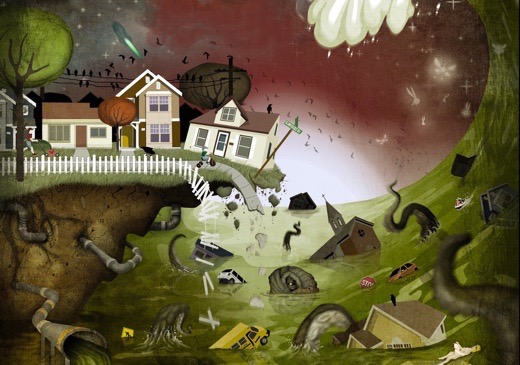

Image above: Detail of cover art for the Rhythm Pimps "End of Suburbia" album. From (https://therhythmpimps.bandcamp.com/album/end-of-suburbia).

This is Part 1 of a 2 or 3 part series on the concept of surplus. Surplus is one of the most central features of modern industrial and democratic societies. In fact it is so central and its permanence so taken for granted that it is scarcely noticed and even less understood. The following installations are my attempt to discuss several of its facets, for the slow disappearance of surpluses is, I think, the cause of great bewilderment.

Overshoot
A few weeks ago I came home from work one day feeling utterly defeated, oppressed by a life-weight that was buckling my knees.  Money was short, jobs seemed ready to go off the rails, and there was no way I could stay on top of all the moving parts.

The driver’s side door of my truck would no longer open due to some sort of malfunction and a day of scooting over a passenger seat full of job folders, miscellaneous tools, and the other refuse of a contractor/carpenter life was making a previously broken wrist ache.

I looked around at our house and yard and saw the wreckage of a half-completed life.  I’m a third done with a home restoration project that starts when some money comes in and stops when it doesn’t, but going on year three I leave things set up and un-tidied as if to tell myself (and my restive neighbors) that the work is in permanent progress.  The sink was full of dishes, the garbage overflowing, and the living room an explosion of Legos, Lincoln Logs, sticker-books and crumpled artwork.

Dust-bunnies, dirty socks and cheerios huddled along the walls.  Only a fire or a flood. . . (I thought to myself) could solve this problem.  All of this was the results of two overworked parents who, already running large deficits on our own time, also can’t afford the hired help that would be necessary to keep everything put together in the wake of our twin four year olds and their boundless entropy.  This is not what I expected.  This is now how I grew up.

This scene is of course also our own doing and is indicative of quirks and weaknesses that my wife and I share.  But there are aspects in it that also represents a unique moment in American (and probably European) culture today.

For it is not just about a messy house and overwhelmed parents, but a greater sense of a botched life, of having not lived up to our potential, of grinding ourselves into nubs of our former selves without the prospect of relief; we fight our way through the tangled underbrush without hope of finding a clearing or a vista.

This moment is marked by a place where shrinking paychecks cross paths with our expanding hopes and aspirations, leaving so many of us frustrated, angry, looking for answers.  Though  usually misnamed, this moment and its trajectory seems to be all that we talk about, at least during a political season, though without any real understanding.

Because I have been a student of this moment for almost a decade (let’s keep things general for now and call it the changing wealth of nations) I know not to compare my life with the life of my parents, for the wealth of their nation was far different than is ours.   This difference will be my eventual topic, but I think the lived experience of it is a crucial groundwork.

I know not to make this comparison, then but there are moments of defeat or frustration, when everything seems such a hopeless and uncleanable mess, and I look around and feel like a failure as old images from my childhood--of clean and sparkling success--sneak out from their hiding place.

These images represent not only what I lived as a child, they were additionally pounded into the crevices of my being by years simply of living in America, the land of high expectations, where we walk to the uniform drumbeat of forced want and desire.

You can turn away from all this unfortunate cultural training.  You can know that success is not the same thing as having, and that simplicity can be beautiful, and imagine a beautiful and simple life for yourself.

You can read and write and march and protest in order to dislodge these images, bury them in community gardens dug until your fingers bleed;  but some are so deeply embossed on our emotional backdrops, ready always to remake their mark—ready, in my case, for the moment when the façade of my life appears to crumbling.

For when I came home that afternoon I suddenly recalled in the most vivid crystalline light an image of my childhood home, always tidy and well-kept, my parents relaxing in the shade, tending  the flower garden and reading quietly after supper.  It was an ordered life, lived well and well within its means.

But virtue of this order, it seemed a modest life; and compared to many portrayed on TV and movies as the most idealized kind of American wealth, it was a modest life--comfortable, yes, but without a hint of ostentation.  Their life, in any case, was the opposite of our frantic overshoot.

“Everything I wanted”
My parents did live extraordinary lives of the kind that could only happen in America and during a short and extraordinary time.  From relatively humble, evangelical origins they marched together away from that past to the top of academic ultra-success--my father writing the books, giving the papers, and directing the institutes, my mother hosting the parties and providing a welcoming place for graduate students and new faculty.  They did this without Ivy League credentials or any insider-edge.

In fact they struggled in the early years of academic life to discard their old inherited evangelical bumpkinisms, like confusing sherry for white wine, a crime against humanity in 1960s Ann Arbor.  They were sensitive, honest, and forthright--and faultlessly dependable.  They worked hard and with spectacular diligence.

And, as my father always emphasized, they were lucky.  Especially when two years into his Michigan appointment, a position opened up in the History of Science department at the University of Wisconsin, where he was to spend the rest of his days.

By the time he was my age, he had published a shelf full of books, many translated into dozens of languages; he lectured widely around the world, and was positioning himself for his end-of-career glory, in which he was bestowed with all the honors available in his field.  He was soon to publish the standard textbook on “the origins of Western science.”

He was awarded a Vilas Professorship from the University of Wisconsin and had countless life-time achievement awards from various scholarly societies in the decade before his death.  He was smart, of course, and very hard working.  He was disciplined, organized, a revered teacher and trusted colleague.

He never missed a deadline and his constant productivity was rewarded with a lifetime of summer grants and other funding that allowed us to spend a year in Princeton when I was four, and a year in Oxford when I was a pre-teen, along with countless other stays in various global academic hot spots.[i]

Because of the accompanying material comfort and stability, theirs was not just the picture-perfect academic life.  It was an upper-middle class life as well, even though we, like most people in America, felt ourselves to be closer to the middle than we actually were.  It was, to be honest about it, a comfortable life of bourgeois consumption, despite the high-culture and socially critical hue to it—entirely ecologically unsustainable despite its ordinary and modest lack of anything considered excessive.

True, we were more frugal than most of our family friends and neighbors, adopting new middle class conveniences like central air-conditioning, color TV, snow blowers, and automatic garage door openers after everyone else we knew had.  And true, as I noted, our consumption often had an edifying angle to it—Europe rather than Disney World, camping rather than amusement parks.

But the sort of “headwinds” that many experienced during the 1970s energy crisis and economic slow-down had no apparent effect on our lives.  The two week summer vacations never ceased, we bought new (if very modest) cars whenever they were needed.  We upgraded from a modest ranch to a larger cape cod style house in 1973, and we took a 5 week European vacation in 1974.

Despite the years of “stagflation,” the research grants (in the humanities no less!) and summer funding never missed a beat during the seventies, nor, for that matter over the course of at least five presidential administrations.  We were nothing if not economically secure.

If life in America might be called super-abundant, it was also ultra-secure.  That we might have a routine crisis (a car breakdown, the need for a new furnace or washing machine, even a kitchen no longer suited to our position in life) and not have the savings to address it immediately was unthinkable.

Life could be well-ordered and tidy in so many inner and external ways because, like a balanced ecosystem (though that it was not) the flows and supplies, the inputs and outputs all seemed to work according to a well-proportioned logic.

I would write a history of the structural tectonics of the 1980s in a much different way than I would describe lived-experience during the Reagan years.  Although my parents believed Reagan was a scourge on the Republic, they also enjoyed rising possibilities at the same time, though without ever understanding the connection.  The vacations became more frequent and more luxurious, the artwork real, the personal indulgences less reserved.

But still they saved staggering amounts of money—at least from my perspective--had long-term care insurance, a place reserved at a very nice retirement village, and were still able to put two children through private college and then graduate school, help with our home purchases, and still maintain large reserves.  My children, sadly (or not), will have none of these privileges.

Like every life, theirs had its turmoil and tragedies and our family had the normal mix of pathologies and dysfunction, resentments and disappointments.   But, at least in my mind, these never characterized the sum of their life.  As my father once commented to my mother, he had managed to get everything he had wanted in life.  This is an extraordinary feat.

The wants were not extravagant, but they were in many ways highly ambitious.  It was a beautiful life that combined hard work and discipline with leisure and enjoyment, intensive days of research and writing, and relaxing strolls by the Madison lakes.

Their access to money is alien to my experience, but even more befuddling is how much spare time they had—time to pursue hobbies, art, culture, and an active social life.  How did my dad write the books, paint the house himself, never miss one of my soccer games, read every night, exercise, entertain, work for hours in his woodshop?  Where did all that time come from?  And where has it gone?

What I Have
I learned a lot from my parents and consider my childhood to have been good training for my current life.  They modeled good parenting, and I always felt loved.  I was granted remarkable intellectual privileges, for we talked and debated and thought for hours on end as a family.  But beyond this, none of what I have been describing is available to me and my family.

To be clear, compared to most of the world, I still enjoy unwarranted privileges, but not with as much ease and regularity as many of my parent’s generations.

Although I have worked hard, especially over the past decade, to curtail my wants and redefine success, there are days in which I feel like a complete failure.  I have not, to put it bluntly, gotten very much of what I wanted, or at least I sometimes feel like that, and I probably should have more trepidation than I do about my family’s material insecurity.

When I set out in 1990 in pursuit of my own Ph.D. in English and Comparative Literature, I believed that I had every reason to expect that my future might bear some resemblance to my past.  We could of course quibble with the details but it is safe to say that my father and I have roughly the same general range of natural talent and I benefited from a life-long academic acculturation that he did not have.

He was more disciplined than I am, but I am probably a bit more creative.  He was more focused on the end-product, while I am probably more attracted to the ideas themselves. He was moderate where I tend to be radical.  But the same sort of life in the academy was not ruled out by some major break in in aptitude, intensity, or motivation.

As some of my readers are aware, I am a carpenter rather than a professor.  I had some successes in the academic world, including a number or articles in refereed journals and a page full of conference presentations.

But no job.

The life of a carpenter and small business owner, into which I fell backwards, has some marvelous features and it initially provided an interesting sort of relief from the very different competition and status-based world of an academic aspirant.  It allowed me to pursue urban farming, and perhaps a more radical and free-ranging sort of social activism and intellectual work.

I like working with my hands and my body, and have an interesting niche in the local restoration market.  The life of a carpenter has allowed me to feel strong, resilient, and capable.

If I can’t fix it, I know someone who can.  This is a gift in a world where most of us grow increasingly dependent on high-priced experts.  There is much to be grateful here, especially as the University of Wisconsin inches towards systemic collapse.

But this career path was only partially chosen.  There was a time in which I very much wanted an academic job and worked furiously to secure one.  I am at heart more interested in ideas, language, and concepts than anything else, and for the first time in fifteen years yearn for a life that would allow complete dedication to ideas.

In graduate school I wrote a very long and intense dissertation on the history of the idea of the unconscious.  Into it was packed all sorts of social and political philosophy, literature, and a focused study on cultural narratives.  I lived and breathed this stuff, and after a few years of practical respite in carpentry, still do.   I had some job interviews after finishing the dissertation—good jobs that I would have been thrilled to accept.

But, for a number of reasons, none of the jobs panned out and I was soon swept away, for a time, by the excitement of building things that pushed the limits of my knowledge and experience almost every day.

The usual path for a graduate student in the humanities looking for a tenure-track job is to become a “lecturer,” which, at the University of Wisconsin, Milwaukee, is a step below the coveted “adjunct professor” position.  The mis-named “lecturer” is a transitional position that, for many, becomes permanent.  It even has a version of tenure, aptly named “indefinite status.”

That means they will probably keep you around as long as enrollments remain high, while those who are not given indefinite status by default have “definite status,” which means they are definitely not going to be kept around for very long.

Marx referred to the industrial equivalent of this as “mobile army of surplus labor,” and the lecturer (or whatever else it is called in other universities) is indeed the university proletariat, the caste my wife belongs to.

A lecturer in the English department teaches up to four classes (often, because of the low pay, supplemented by another class or two at a community college).

Lecturers do some of the most labor-intensive teaching in the university and often that which requires a level of teaching talent not required to deliver the weekly lecture that many high-ranking professors are permitted; in the English department they work with entry-level students in basic writing classes that involve thousands of pages of writing to be graded and commented-upon each semester.

Although it can be fulfilling (as it is for my wife who loves her students and is revered by them), this is work in the trenches in an institution that is supposed to only have high and broad vistas, and where only merit trumps equality but never at the expense of fairness and respect.

For reasons I will be discussing, the university in America today cannot afford its high principles, nor its lavish grants and light teaching loads.  The low cost of temporary and disposable labor is becoming the financial backbone of the university, just as outsourced labor is used to keep corporate profits aloft.

The wave of retirements (that made job prospects appear promising for my generation of graduate students) resulted less in new tenure-track hires, and more lower-paid and easily eliminated lecturers and adjuncts.  Professors bemoan this situation, but, I should add, are equally unprepared to share their privilege.  They too feel under fire from above.

I opted out of the lecturer track, falling back on my experience as a roofer (where speed, endurance, and focus are proportionally rewarded and at a much higher pay rate than the itinerant intellectual worker) while also finding promise in the growing remodeling industry of the late 90s.

About 8 years later, by which time I had built a small but solid company called Community Building and Restoration, we in the construction industry were beginning to realize that we had been banking on a system of borrowed home-equity money. and had been floating untethered within an exploding bubble economy.

Like most people in my position, I was almost wiped out when the housing bubble popped, found myself laden with unpayable debt, and came out the other side barely limping.  Things have never been the same since.

This isn’t to say that some business models aren’t performing well, as least for now.  But I have given up all former dreams of an upwardly mobile life of a small business man, where I might settle into leisure and comfort as I get older and hand off the harder physical labor work to underlings.  I don’t aspire to this anymore, because I don’t think it is an ethically responsible life, but I couldn’t have it if I wanted it.

There is neither a path from where I am to a parallel version of the life my parents made for themselves, nor for a university-based one secured by my wife, despite her rare talent as a teacher. In fact, there is scarcely much chance for basic economic security in our future.  I hope the university survives and that my body doesn’t break down too soon.  I worry about the next popping bubble, but probably not as much as I should.
 
My main purpose in sharing these personal reflections is, perhaps contrary to appearances, to explain the structural tectonics that have fractured the roads to success upon which many in my generation once set out.  My experience, I think, is not entirely unique.  The comparison between me and my parents is largely a generational one. 

On a whole, my generation does not live as securely as our parents did and our opportunities are shrinking.  This is born out in the statistics and in the life experiences of many of my peers.  There are of course exceptions.  Those who went into “financial services” live with excessive comfort, as do many physicians and lawyers and people in the “tech industry.”

But for most of the rest of us, whether we work in retail, the trades, manufacturing, as teachers, in most government jobs (the list could go on), the fact that wages have “stagnated” tell only part of the story of slow decline.

The life of a young university professor, one who did manage to find a foothold into the world in which my father thrived, also provides a good insight into a world I know well, while reinforcing my sense of generational differences.  The university is not funded the way it used to be, and, in addition to the truly beleaguered lecturers and adjuncts, tenured professors are also feeling a pinch.

They can live very comfortable lives, it is true, but the expansive opportunities enjoyed by my father’s cohort have largely dried up.  In the humanities, summer funding is rare, teaching loads are increasing, departments are shrinking, and even tenure is being questioned as the university is being “run more like a business.”

If I am honest with myself, these personal reflections are flavored with own bitter aftertaste.  I admit it—I do have a chip on my shoulder about the university and about the amount of unpaid research and writing I perform in my scarce free-time and for no compensation.  Living in a different generation, my father had more free time to do what he wished after he was done writing, lecturing, and leading seminars than I have to do any reading and writing in the first place.

There is some self-pity (since I’m already opening myself up for dissection, I might as well admit it all) in my moments of defeat, when I just don’t have the time I need to pursue what I value and what might get give me pleasure.  I do, as I have said, sometimes feel like a failure when life has run me down, and when I feel like a failure, I also feel a bit sorry for myself.  So there you have it.  This might all be read as an attempt to come to grips with my own pathetic little feelings.

But this may make it all the more significant, if for no reason other than the way  I have spent the last eight years on what I now think of as a spiritual journey—one bent on understanding not in  terms of personal entitlement and disappointment, but in structural and historical ones, the changing course of the wealth of nations and especially the American nation.  I don’t believe the world owes me a growing economy and increased consumption.

Just the opposite, in fact—for an economy the size of our current one has already overshot the planet’s biological capacity for production and regeneration.  I know this--and still the lived experience of decline and contraction is more than I can gracefully accept or emotionally process when my back is up against the wall.

My wife and are still only beginning to adjust the reality of our material lives so that we might live within the means we can expect.  We, too, are still in a position of overshoot.

So I’m getting personal, here, because I think the struggles I am able to articulate are ones that others will, though each in their own way, also be required to confront as well—if not now, then in the future.  Feelings, hopes, expectations, disappointments—this is where politics and the economy are lived.  And the changing wealth of our nation will give us a difficult journey.

Or maybe it is not so difficult, per se; perhaps we as a people are unprepared for minor challenges of a certain sort.  In either case,  my own unfinished journey to a new acceptance has taken lots of painful and persistent work and I still have a long way to go.

 And when I see the supporters of Bernie Sanders or Donald Trump acting as if their candidate could possibly remake the America that my parents and their generation enjoyed, I see denial and postponement of the inevitable real revolution—one of expectations.

When I see faculty at the University of Wisconsin view their current struggles almost exclusively in personal terms of a bad governor and an indifferent state legislature, I see people who have neither begun to understand nor integrate at the level of lived-experience the great structural and systemic changes in the wealth of nations that are afoot.

I know I risk coming off as smug, here, but that is not my intention, even though (to be honest again) I do feel smug at times.  But I am also afraid.  For if the most educated and most adept at structural and historical thinking among us are not able to translate their own lived-crises into a broader systemic one, then what hope is there for the angry, frustrated and increasingly violent supporters of someone like Trump and all that they represent and portend in a world of decreasing surplus?

For those readers who have made it this far, I would only ask this: listen to my coming systemic explanation for the sorts of frustrations, worries, and disappointments that so many Americans are experiencing today.

See if it makes more sense than the usual explanation, in which America is suffering a temporary setback at the hands of bad governance or a false ideology or those on the other side of the political divide.


[i] There is of course a valid feminist critique of the support role that my mother played without question.  But on the other hand she was also revered among their circle for her warmth, humor, and friendship, along with epic garden parties and superb gourmet cooking whipped out with no apparent effort.  This division of labor in what from the outside, as least, was a beautiful life was of course made possible by the simple fact that a simple university salary was more than enough to exceed any material ambitions they had dreamed of as they set out on their life-journey. 

.

Deadhead Security Alert

SUBHEAD: What they're telling security personnel at the Grateful Dead Farewell Show this weekend.

By Philip Smith on 2 July 2015 for Alternet -
(http://www.alternet.org/drugs/security-alert-deadheads-taking-strange-drug-farewell-shows)

http://www.islandbreath.org/2015Year/07/150704dead1big.jpg
Image above: The Grateful Dead face a sea of Deadheads at one of the Fare Thee Well Concerts. Click to embiggen. Photo by Jay Blakesberg - Invision for the Greatful Dead.
"DO NOT MAKE CONTACT WITH THESE GUESTS" warns a flyer published by the organization Rock Medicine that has traveled with Dead shows for over 40 years.
The Grateful Dead (minus Jerry Garcia, of course) are playing their farewell shows in Chicago this weekend. Tens of thousands of Deadheads are expected to fill Soldier Field over the three-night run.

The iconic jam band's shows have long been legendary not only for the music, but also for the rampant use of psychedelics by attendees, some of whom never actually make into the show itself. These shows will likely be no exception.

Not to worry this time around, though. Security has this covered. According to the music website Live For Live Music, security personnel working the shows have been given a flyer alerting them that they may well run across people taking LSD, or "acid" in hipster lingo.

"LSD is a mind-altering chemical, also known as an hallucinogen," the flyer helpfully explains. "LSD produces a change in the user's sense of reality, thought patterns, and perceptions. You cannot predict the type of experience a guest under the influence of LSD will have."

Users "may 'see' images, 'hear' sounds, and 'feel' sensations that do not actually exist," the flyer elaborates. "These effects can be pleasurable, frightening, disorienting, and/or disturbing."

People "high" on acid may harmlessly trance out, dance, spin, and wave their hands around, but they may also have a "bad trip" and be "combative," have "poor judgement," or even "act on their enhanced sexuality" by getting naked or something.

"DO NOT MAKE CONTACT WITH THESE GUESTS!" the flyer warns security personnel about people having an "upsetting experience." Leave it instead to medical personnel, the flyer says. And don't touch them! (Gloves are available in the uniform room.)

"LSD CAN BE ABSORBED THROUGH SKIN TO SKIN CONTACT. DO NOT TOUCH ANY GUESTS SUSPECTED OF BEING UNDER THE INFLUENCE OF LSD.

And, oddly enough, the flyer instructs security not to refer to people as "tripping," but as having "IPR (Intense Psychedelic Response).

It's easy to poke a little fun at the flyer with its hokey wording and 1967 Readers' Digest feel, but it's actually a well-intentioned effort at harm reduction. And it is aimed at security guards, who may not be the most aware of drugs popular with the Deadhead set.

 The flyer is produced by Rock Medicine, which has been staffing medical tents at concerts for more than 40 years and says it is "setting the standard in non-judgmental event medicine." Those are the folks security guards are supposed to call when confronted by IPRing fans unhinged by the music.

"Take care of the individual right now. Return him or her to their friends or family and do away with the necessity of either hospitalizing the individual or getting involved with the law,Rock Medicine founder and former director Dr. George R. "Skip" Gay says prominently on the website.

Appropriately enough, Rock Medicine got its start when legendary San Francisco rock promoter Bill Graham asked the Haight-Asbury Free Clinic to staff its outdoor Grateful Dead and Led Zeppelin concerts in 1972. Dr. Gay formalized it as Rock Medicine the following year.

And now they're there at the last Dead shows ever. What a long, strange trip it's been.

http://www.islandbreath.org/2015Year/07/150704dead2big.jpg
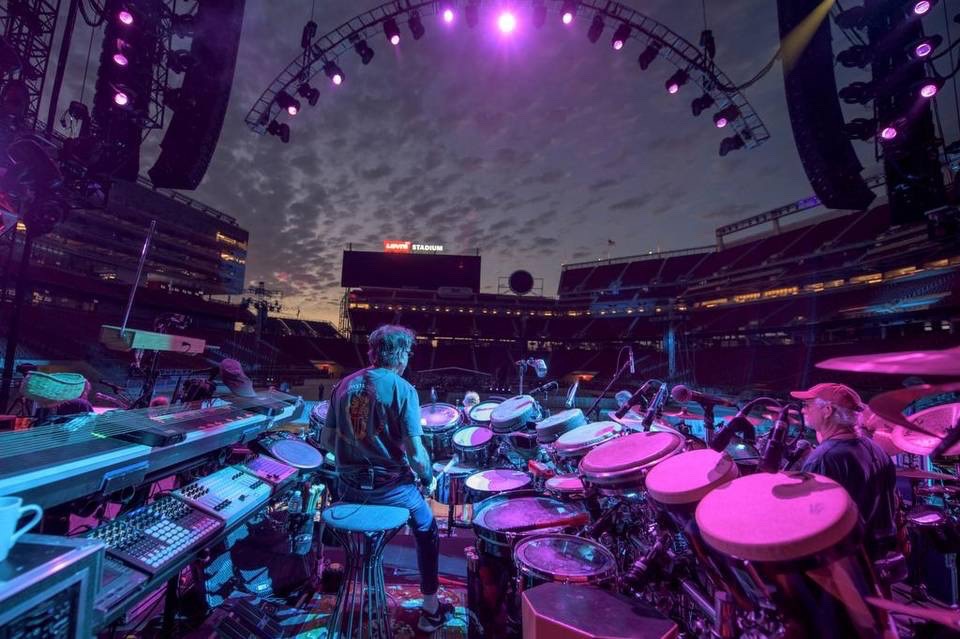
Image above: Phil Lesh, Mickey Hart and Bob Weir rock on at the Grateful Dead’s Fare Thee Well show. Click to embiggen. Photo by Jay Blakesberg - Invision for the Greatful Dead.

http://www.islandbreath.org/2015Year/07/150704dead3big.jpg
Image above: Bob Weir of the Grateful Dead on the Fare Thee Well tour. Click to embiggen. Photo by Jay Blakesberg - Invision for the Greatful Dead.

http://www.islandbreath.org/2015Year/07/150704dead4big.jpg
Image above: Mickey Hart, Grateful Dead drummer, on stage after sunset. Click to embiggen. Photo by Jay Blakesberg - Invision for the Greatful Dead.

• Phillip Smith is editor of the AlterNet Drug Reporter and author of the Drug War Chronicle.


.

Roots of Wonder Woman

SUBHEAD: She emerged from the feminist movements of women’s suffrage, birth control, and the fight for equality.

By Christopher Zumski Finke on 10 December 2014 for Yes -
(http://www.yesmagazine.org/happiness/everything-you-need-to-know-about-the-radical-roots-of-wonder-woman)


Image above: An image of Wonder Woman in her 1940's style. From (http://www.soundonsight.org/the-entire-1940s-wonder-woman-comics-available-for-the-first-time-ever/).

All these things are true about Wonder Woman: She is a national treasure that the Smithsonian Institution named among its 101 Objects that Made America; she is a '70s feminist icon; she is the product of a polyamorous household that participated in a sex cult.

Harvard historian Jill Lepore claims in her new book, The Secret History of Wonder Woman, that Wonder Woman is the “missing link in a chain of events that begins with the women’s suffrage campaigns of the 1910s and ends with the troubled place of feminism fully a century later.”

The hero and her alter ego, Diana Prince, were the products of the tumultuous women’s rights movements of the early 20th century. Here are 10 essential elements to understanding the history and legacy of Wonder Woman and the family from which she sprung.

Wonder Woman first appeared in Sensation Comics #1 in December 1941.

Since that issue arrived 73 years ago, Wonder Woman has been in constant publication, making her the third longest running superhero in history, behind Superman (introduced June 1938) and Batman (introduced May 1939).

Wonder Woman’s creator had a secret identity.

Superheroes always have secret identities. So too did the man behind Wonder Woman. His name upon publication was Charles Moulton, but that was a pseudonym. It was after two years of popularity and success that the author revealed his identity: then-famous psychologist William Moulton Marston, who also invented the lie detector test.

William Moulton Marston was, as Jill Lepore tells it, an “awesomely cocky” psychologist and huckster from Massachusetts. He was also committed to the feminist causes he grew up around.

By 1941, Marston’s image of the iconic feminist of the future was already a throwback to his youth. He saw the celebrated British suffragist Emmeline Pankhurst speak in Harvard Square (she was banned from speaking at Harvard University) in 1911, and from then on imagined the future of civilization as one destined for female rule.

Actually, the whole Marston family had a secret identity.

The Marston family was an unconventional home, full of radical politics and feminism. Marston lived with multiple women, including his wife, Sadie Elizabeth Holloway, a highly educated psychologist, and another lifelong partner, a writer named Olive Byrne, who was the niece of birth control activist Margaret Sanger. He had four children, two by each of the women, and they all grew up oblivious to the polyamorous nature of their parents’ relationships.

Marston, Holloway, and Byrne all contributed to Wonder Woman’s creation, a character that Marston explicitly designed to show the necessity of equality and advancement of women’s rights.

Wonder Woman was an Amazon molded from clay, but she was birthed out of feminism.

Princess Diana of Themyscira, or Diana Prince (Wonder Woman’s alter ego), comes from the land of the Amazons. In Greek mythology, the Amazons are an immortal race of beauties that live apart from men. In the origin story of Wonder Woman, Diana is daughter of the queen of the Amazons. She’s from Paradise Island (Paradise is the land where no men live), where Queen Hyppolita carves her daughter out of clay. She has no father.

She comes out of the feminist movements of women’s suffrage, birth control, and the fight for equality. When Marston was working with DC Comics editor Sheldon Mayer on the origins of Wonder Woman, Marston left no room for interpretation about what he wanted from his heroine.

“About the story’s feminism,” historian Lepore writes, “he was unmovable. ‘Let that theme alone,’ Marston said, ‘or drop the project.’”

Wonder Woman fought for the people—all the people.

The injustices that moved Wonder Woman to action did not just take place in the world of fantasy heroes and villains, nor was she only about women’s rights. She also fought for the rights of children, workers, and farmers.

In a 1942 issue of Sensation Comics, Wonder Woman targets the International Milk Company, which she has learned has been overcharging for milk, leading to the undernourishment of children. According to Lepore, the story came right out of a Hearst newspaper headline about “milk crooks” creating a “milk trust” to raise the price of milk, profiteering on the backs of American babies.

For the Wonder Woman story, Marston attributed the source of this crime to Nazi Germany. But the action Wonder Woman takes is the same as the real-life solution: She leads a march of women and men in “a gigantic demonstration against the milk racket.”

There’s a whole lot of bondage in Wonder Woman.

In the years that Marston was writing Wonder Woman, bondage was everywhere. “In episode after episode,” Lepore writes, “Wonder Woman is chained, bound, gagged, lassoed, tied, fettered, and manacled.” Even Wonder Woman herself expressed exhaustion at the over-use of being bound: “Great girdle of Aphrodite! Am I tired of being tied up!” she says.

There’s little doubt that the sexual proclivities of the Marston family were in part responsible for this interest. A woman named Marjorie Wilkes Huntley was part of the Marston household—an “aunt” for the children, who shared the family home (and bedroom) when she was in town. Huntley was fond of bondage.

The theme was so persistent that an Army sergeant who was fond of the erotic images wrote to Marston asking where he could purchase some of the bondage implements used in the book. After that, DC Comics told Marston to cut back on the BDSM.

But that bondage was not all about sex.

The bondage themes in Wonder Woman are more complex than just a polyamorous fetish, though. Women in bondage was an iconic image of the suffrage and feminist movements, as women attempted to loosen the chains that bound them in society. Cartoonist and artist Lou Rogers drew many women in bonds, and Margaret Sanger appeared before a crowd bound at the mouth to protest the censorship of women in America.

Later, Margaret Sanger’s Birth Control Review would use a similar motif. One cover image had a woman chained to the weight of unwanted babies.

Readers—boys and girls—loved Wonder Woman.

Despite the political and secretive history of Wonder Woman’s creation, she was a wildly popular character. After Wonder Woman’s early success, DC Comics considered adding her to the roster of the Justice Society, which included Batman and Superman and many other male superheroes. Charlie Gaines, who ran DC Comics, decided to conduct a reader poll, asking, “Should Wonder Woman be allowed, even though a woman, to become a member of the justice society?”

Readers returned 1,801 surveys. Among boys, 1,265 said yes, 197 said no; among girls, 333 said yes, and only 6 said no.

But Justice Society was not written by feminist Marston. After Wonder Woman was brought into the Justice Society, she spent her first episodes working as the secretary.

The feminist spirit of Wonder Woman waned for decades.

After the death of William Moulton Marston in 1947, DC Comics took the feminism out of Wonder Woman and created instead a timid and uninspiring female character. “Wonder Woman lived on,” Lepore writes, “but she was barely recognizable.”

The first cover not drawn by the original artist, Harry G. Peter, “featured Steve Trevor [Wonder Woman’s heretofore hapless love interest] carrying a smiling, daffy, helpless Wonder Woman over a stream. Instead of her badass, kinky red boots, she wears dainty yellow ballerina slippers,” Lepore observes. Without her radical edge, Wonder Woman’s popularity waned until the rise of second wave feminism in the '60s and '70s, when Wonder Woman was trumpeted as an icon of women’s empowerment.

Wonder Woman became president.

In a 1943 story, Wonder Woman is actually elected President of the United States. Marston was adamant that a women would one day rule the United States, and that the world would be better when civilization’s power structures were in the hands of women instead of men.

Wonder Woman’s popularity soared as the feminist movement picked up in the late 1960s. Wonder Woman appeared on the first issue of Ms. Magazine, in 1972, with the headline “Wonder Woman for President.” At that time, Gloria Steinem said of Wonder Woman, “Looking back now at these Wonder Woman stories from the '40s, I am amazed by the strength of their feminist message.”

The impact of Wonder Woman continues.

Wonder Woman is in for a great couple of years. Ms. Magazine just celebrated its 40th anniversary, and Wonder Woman is back on its cover. Jill Lepore’s book has been getting wonderful coverage (see her on The Colbert Report below discussing the kinks of the Marston Family), and Noah Berlatsky’s Wonder Woman: Feminism and Bondage in the Marston/Peter Comics will be published in January.

She’s also gearing up for her first-ever theatrical film appearance: Wonder Woman will appear in Zack Snyder’s 2016 film Batman vs. Superman: Dawn of Justice. In 2017, she will be the star of her own film, to be directed by Michelle McClaren (Breaking Bad, The Walking Dead). Wonder Woman will be played by the Israeli actress Gal Gadot.

Let us hope that Gadot in the role conjures the spirit of the original creation of Marston, Holloway, and Byrne: a radical, independent, fierce woman and leader for all women and men to admire.


Video above: From (http://youtu.be/KnAhu-yU8Os).


.

Psychology of Sustainability

SUBHEAD: At this time of grave and genuine crisis, we desperately need to evoke what we love.

By Mark Garavan on 26 November 2014 for FEASTA -
(http://www.feasta.org/2014/11/26/the-psychological-dimension-to-sustainability/)


Image above: Sarah van Erp (at front) with other volunteers at the Waverley Communal Garden, in New South Wales, Australia. From (http://uniken.unsw.edu.au/features/rise-urban-jungle).

As the 21st century unfolds it is increasingly clear that we are entering more deeply into times of travail. The symptoms, both personal and social, of systemic stress are all about.

At the political level we see the re-emergence of various fundamentalisms, nationalisms, far-right politics and the normalisation of the Orwellian permanent ‘war on terror’ and subsequent justification for constant state surveillance of citizens.

Authoritarian government in the East and post-democracy in the West now exist side by side. Politics is contracted to a regime of technocratric management of the global economy.

The capitalist economic system lurches into continual instability kept afloat only by measures such as quantitative easing and the imposed socialisation of elite debts.

At the social level inequality, insecurity, new forms of apartheid and social exclusion, slavery and trafficking, and vast enforced movements of people in search of economic security further accentuate the instability of the world.

Hovering above all of this disorder ecological crisis grows.

The term Climate Change may suggest that only the weather is in question but climate is everything – food, water, temperature, nature itself. Half of all vertebrate life-forms have become extinct in the last forty years.

What is all of this doing to us today? These interlocking problems are not just ‘out there’. We are also being affected at a deep personal level.

Not only are we now in the age of social and ecological unsustainability; we must also acknowledge that we are in the age of psychological unsustainability. We must acknowledge the pain and distress of this.

All of this social and natural dis-order is taking a toll on our human well-being. Our emotions are picking up this systemic collapse long before our rational minds can.

Symptoms of stress and distress are all about us – the exponential rise of labelled ‘mental illnesses’ (fuelled by pharmaceutical companies), of addiction, of despair. Many of us are anxious or depressed.

As Feasta has predicted and argued since its foundation, the system itself is disintegrating. That this is happening is a tragedy. There is no comfort in having anticipated what is now occurring. We are now living through this time. It is no surprise that as the system decays we suffer stress and anxiety at a personal level.

It is in this context that Feasta needs to address where it stands today and what it can do at this time. We have produced detailed analyses and proposals over many years. All of these remain serviceable and valuable.

But as a small organisation, desperately trying to argue for fundamental change at a systemic level, a high toll is exacted at the human level. Organisations often do not talk enough about this element. Burn-out, inter-personal frustrations, sheer exhaustion can dissipate even the most committed.

I know all of these features from personal experience in campaigns. I know what total exhaustion and inability to continue is like. There is so much to do, so much seems to rest on our shoulders, the issues are so urgent, we feel so much responsibility. It can easily become overwhelming.

Often, advocates for change necessarily end up in the role of the critic, of the one in opposition, of the one who points out what is wrong, of the nay-sayer, of the doom-mongerer. We seem to come from a place of negation. We can appear experts in what is wrong, in what we oppose, in what we hate.

At this time of grave and genuine crisis, we desperately need to evoke what we love. We need to restore to our public discourse the capacity to dream of a world of inclusion, economic sufficiency, democratic participation and of psychological wholeness and well-being where care and compassion ground our fragile existence.

The widespread alienation characteristic of our failing system may channel itself into anger, hatred and fear unless a project of hope and inspiration can be offered.

The word Feasta can be used ambivalently. Its origins as a title comes from the line Cad a dheanimid feasta gan adhmaid (what will we do in the future without wood). This suggests the future as a place of forboding and warning.

But Feasta can also be an assertion of hope – that despite all there is a future. It must be inhabited and constructed. That is up to us.

But we cannot do it all of course. At a minimum all we in Feasta can do is not collude with the contemporary illusions.

We can speak with utter honesty about ourselves as struggling human beings, about our collapsing system, about our fears, distresses and vulnerabilities and about our hopes of a world that might be good enough for a holistically sustainable human life. Sustainability must include the social, political, economic and ecological and also the psychological.

The new language and praxis of a sustainable politics must include care and well-being – focusing on the welfare of all of us. That needs to start now so we can begin to support ourselves through these times of woe.

Related posts:
  1. A Complexity Approach to Sustainability – Theory and Application: Review
  2. A guide for sustainability advocates
  3. Comment on The psychological roots of resource overconsumption by Floro
  4. The Anne Behan Community Sustainability Award
  5. New Financial Architecture for Sustainability
• Mark Garavan lectures in social care in the Galway-Mayo Institute of Technology. He is the author of Compassionate Activism: An Exploration of Integral Social Care. He is currently chairperson of Feasta's trustees.
.

Six words for love

SUBHEAD: The Greek language had several words describing different kinds of love. Knowing them can change you.

[IB Editor's note: HAPPY VALENTINE'S DAY! May you celebrate all these loves.]

By Roman Krxnaric on 27 December 2013 for Yes! -
(http://www.yesmagazine.org/happiness/the-ancient-greeks-6-words-for-love-and-why-knowing-them-can-change-your-life)


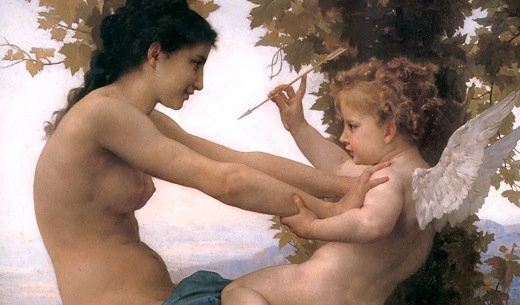
Image above: Detail of painting of  "Young Girl Defending Against Cupid" by Adolphe Bouguereau, 1880. From (http://www.swide.com/art-culture/history/2013-valentine%E2%80%99s-day-the-year-of-love-and-the-greek-god-eros/2013/2/13).

Looking for an antidote to modern culture's emphasis on romantic love? Perhaps we can learn from the diverse forms of emotional attachment prized by the ancient Greeks. 

Today's coffee culture has an incredibly sophisticated vocabulary. Do you want a cappuccino, an espresso, a skinny latte, or maybe an iced caramel macchiato?

The ancient Greeks were just as sophisticated in the way they talked about love, recognizing six different varieties. They would have been shocked by our crudeness in using a single word both to whisper "l love you" over a candlelit meal and to casually sign an email "lots of love."
So what were the six loves known to the Greeks?

And how can they inspire us to move beyond our current addiction to romantic love, which has 94 percent of young people hoping—but often failing—to find a unique soul mate who can satisfy all their emotional needs?

1. Eros, or sexual passion
The first kind of love was eros, named after the Greek god of fertility, and it represented the idea of sexual passion and desire. But the Greeks didn't always think of it as something positive, as we tend to do today. In fact, eros was viewed as a dangerous, fiery, and irrational form of love that could take hold of you and possess you—an attitude shared by many later spiritual thinkers, such as the Christian writer C.S. Lewis.

Eros involved a loss of control that frightened the Greeks. Which is odd, because losing control is precisely what many people now seek in a relationship. Don't we all hope to fall "madly" in love?

2. Philia, or deep friendship
The second variety of love was philia or friendship, which the Greeks valued far more than the base sexuality of eros. Philia concerned the deep comradely friendship that developed between brothers in arms who had fought side by side on the battlefield. It was about showing loyalty to your friends, sacrificing for them, as well as sharing your emotions with them. (Another kind of philia, sometimes called storge, embodied the love between parents and their children.)

We can all ask ourselves how much of this comradely philia we have in our lives. It's an important question in an age when we attempt to amass "friends" on Facebook or "followers" on Twitter—achievements that would have hardly impressed the Greeks.

3. Ludus, or playful love
This was the Greeks' idea of playful love, which referred to the affection between children or young lovers. We've all had a taste of it in the flirting and teasing in the early stages of a relationship. But we also live out our ludus when we sit around in a bar bantering and laughing with friends, or when we go out dancing.

Dancing with strangers may be the ultimate ludic activity, almost a playful substitute for sex itself. Social norms may frown on this kind of adult frivolity, but a little more ludus might be just what we need to spice up our love lives.

4. Agape, or love for everyone
The fourth love, and perhaps the most radical, was agape or selfless love. This was a love that you extended to all people, whether family members or distant strangers. Agape was later translated into Latin as caritas, which is the origin of our word "charity."

C.S. Lewis referred to it as "gift love," the highest form of Christian love. But it also appears in other religious traditions, such as the idea of mettā or "universal loving kindness" in Theravāda Buddhism.

There is growing evidence that agape is in a dangerous decline in many countries. Empathy levels in the U.S. have declined sharply over the past 40 years, with the steepest fall occurring in the past decade. We urgently need to revive our capacity to care about strangers.

5. Pragma, or longstanding love
Another Greek love was the mature love known as pragma. This was the deep understanding that developed between long-married couples.

Pragma was about making compromises to help the relationship work over time, and showing patience and tolerance.

The psychoanalyst Erich Fromm said that we expend too much energy on "falling in love" and need to learn more how to "stand in love." Pragma is precisely about standing in love—making an effort to give love rather than just receive it. With about a third of first marriages in the U.S. ending through divorce or separation in the first 10 years, the Greeks would surely think we should bring a serious dose of pragma into our relationships.

6. Philautia, or love of the self

The Greek's sixth variety of love was philautia or self-love. And the clever Greeks realized there were two types. One was an unhealthy variety associated with narcissism, where you became self-obsessed and focused on personal fame and fortune. A healthier version enhanced your wider capacity to love.

The idea was that if you like yourself and feel secure in yourself, you will have plenty of love to give others (as is reflected in the Buddhist-inspired concept of "self-compassion"). Or, as Aristotle put it, "All friendly feelings for others are an extension of a man's feelings for himself."

The ancient Greeks found diverse kinds of love in relationships with a wide range of people—friends, family, spouses, strangers, and even themselves. This contrasts with our typical focus on a single romantic relationship, where we hope to find all the different loves wrapped into a single person or soul mate. The message from the Greeks is to nurture the varieties of love and tap into its many sources. Don't just seek eros, but cultivate philia by spending more time with old friends, or develop ludus by dancing the night away.

Moreover, we should abandon our obsession with perfection. Don't expect your partner to offer you all the varieties of love, all of the time (with the danger that you may toss aside a partner who fails to live up to your desires). Recognize that a relationship may begin with plenty of eros and ludus, then evolve toward embodying more pragma or agape.

The diverse Greek system of loves can also provide consolation. By mapping out the extent to which all six loves are present in your life, you might discover you've got a lot more love than you had ever imagined—even if you feel an absence of a physical lover.

It's time we introduced the six varieties of Greek love into our everyday way of speaking and thinking. If the art of coffee deserves its own sophisticated vocabulary, then why not the art of love?

.

Reefer madness New York years

SUBHEAD: Time with Timothy Leary, Mexico, Magic Mushrooms, and Reefer Madness.

By Ethan Persoff and Scott Marshall on 21 November 2013 for Boing Boing -
(http://boingboing.net/2013/11/21/john-wilcock-participating-in.html)

[IB Publisher's note: This is a three part comic graphic illustrated story published by Boing Boing that looks back on the early 1960s and a New York writer's first introduction to psychedelic drugs.

THE STORY: Part 1


While on an assignment John Wilcock meets an enthusiastic Timothy Leary, wearing red socks, in Cuernavaca, Mexico.

http://www.islandbreath.org/2013Year/11/131121wilcock1big.jpg
Image above: Detail from Reefer madness Part 1.  Click for full page. From (http://boingboing.net/2013/11/07/john-wilcock-timothy-leary-m.html).

THE STORY: Part 2

Witnessing a dinner with  a spacey Timothy Leary and his fascination with avocados (green butter) and bananas (joyous miracle).

http://www.islandbreath.org/2013Year/11/131121wilcock2big.jpg
Image above: Detail from Reefer madness Part 2.  Click for full page. From (http://boingboing.net/2013/11/14/john-wilcock-witnessing-tim-l.html).

THE STORY: Part 3

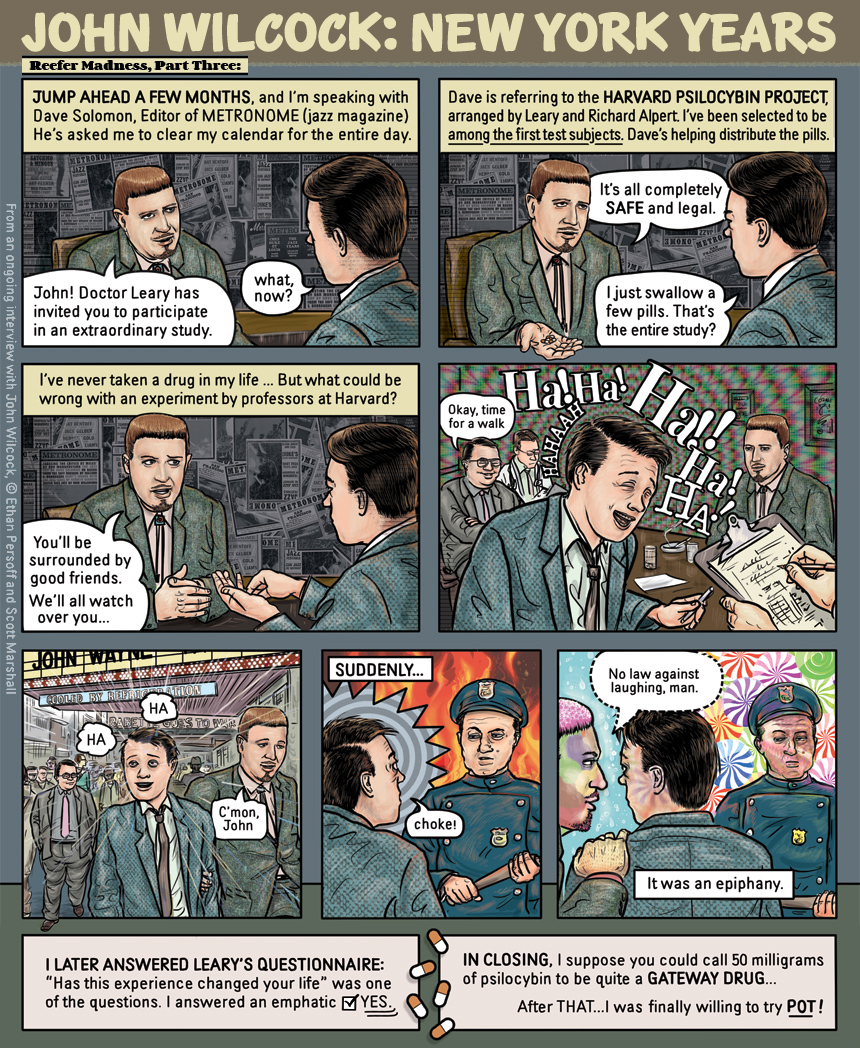
John Wilcock concludes with an invitation to participate in the  Harvard Psilocybin Project - the road to ruin that ultimately leads John to pot.

http://www.islandbreath.org/2013Year/11/131121wilcock3big.jpg
Image above: Detail from Reefer madness Part 3.  Click for full page. From (http://boingboing.net/2013/11/21/john-wilcock-participating-in.html).


Adventure with a Pink Pill
By John Wilcock on 6 September 1962 for The Village Voice -
(http://boingboing.net/2013/11/21/john-wilcock-participating-in.html)

[Boing Boing Editior's note: As an added treat to this final comic tale, here's John's original column on participating in the Harvard Psilocybin Project, from 1962.]

A questionnaire arrived last month from Tim Leary, a professor at Harvard who has been doing research on the effects of Mexico's "magic mushrooms" (teonanacati) on human consciousness. The mushrooms, foundation of some Indian religions, have been synthesized commercially into psilocybin, a small pink pill, and Tim Leary's Harvard group has been testing them on people and noting the effects.

I tried psilocybin about a year ago and reported on the enjoyable and highly euphoric effects. What Dr. Leary wanted to know now was whether there had been any permanent effects or changes in my life as a result. I was able to tell him (as, apparently, 62 percent of his subjects have told him) that my life had changed for the better.

It's always difficult to evaluate what effect a single action has had upon the course of one's life, and to what extent the normal maturing process is responsible, but it's true to say that in the past year I have become happier, more tolerant, less compulsive, and much more of a PARTICIPANT in virtually every phase of activity. I enjoy everything more these days, often with the sort of hearty abandon that wouldn't have been possible at one time in my life.

The simplest things -- reading the newspapers, listening to jazz on the radio, stopping for a hamburger, taking a bubble bath, kissing a girl -- fill me with tremendous anticipation and pleasure. I have become in love with the whole world, while at the same time retaining a healthy contempt for cruelty, greed, inhumanity, and the terrible things that people and countries do to each other.

It would be very unscientific, and potentially dangerous, to believe that these effects came solely from psilocybin, of course, but I do have a suspicion that that one afternoon's experience, coming at a particular time of my life, helped along what would possibly have been a natural course of events.

And I take my cue from a statement by Leary's group (the Center for Research in Personality):
"We have come to believe that psilocybin has the potential to facilitate for an individual the experience of major insights and problem solutions of an intellectual-emotional nature... It is also our conviction that these insights, enlightenment, or solutions provide a firm educational foundation for change in the social or intellectual behavior of the individual."

...In a meeting with representatives of the Food and Drug Administration, which has been kept informed of his research, Dr. Leary's group reported:
"We are convinced that these substances can contribute to human welfare in many ways -- in psychiatry and other forms of social rehabilitation, in creative industry, in education, in defense enterprises, in artistic and cultural pursuits."

And a compilation of reports from 98 of the 157 people who tried psilocybin reveals that 70 percent found the experience pleasant; 87 percent learned something new about themselves and the world; 62 percent report it changed their lives for the better; and 90 percent want to try it again. Leary's initial experiments are now concluded, and he has none of the drug available.


FOOTNOTE BY DR. LEARY:

The most important single factor that determines whether a person undergoes a heavenly or hellish experience is his expectancy. If, for example, he takes one of these drugs in a hospital setting, where his contract is to behave as a subject in a scientific experiment and where his every move is carefully watched and noted by attending doctors and psychiatrists, he will almost certainly manifest psychiatric symptoms.

On the other hand, if the drug is taken together with a group of close, loving friends in a warm, familiar environment and the expectancy is to have a joyful, intellectual experience, then the chances for this to happen are very good.

However, if the scene is rebellious or secretive -- fear of being caught by the police, guilt of pleasure, sense of doing something shady and illicit -- the chances are that all these things will become magnified out of all proportion.

COMIC CREDITS:
John Wilcock: Author and experimental psychedelic guinea pig will continue with additional chapters of this story in a few months. John still writes a terrific column of news and opinion, posted every week at www.johnwilcock.net.

Ethan Persoff (Twitter) is an archivist, sound artist and cartoonist. His other new comics project is RADIO WIRE.

Scott Marshall (Facebook) is an illustrator, sound artist, and art director, based in New York City. Previous projects include audio work for Woody Allen (Small Time Crooks), and the score for a full-length dance piece by choreographer Lar Lubovitch (Men's Stories).


See also:
Island Breath: Tales from The Tube 11/29/08
(Psychedelic surf comic by Rick Griffin in 1971 Surfer Magazine)


.

Romans invented Jesus Christ

SUBHEAD: This Messiah urged turn-the-other-cheek pacifism and encouraged Jews to 'give onto Caesar'.

By Ray Gilmore on 8 October 2013 for PRweb -
(http://uk.prweb.com/releases/2013/10/prweb11201273.htm)

[IB Publisher's note: This thesis in this article has been pretty well trashed by Richard Carrier's analysis. See (http://freethoughtblogs.com/carrier/archives/4664) or (http://islandbreath.blogspot.com/2013/10/atwills-cranked-up-jesus.html).]


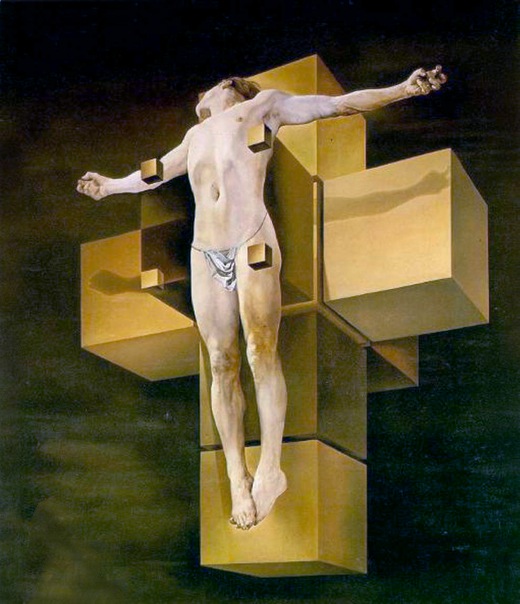
Image above: Detail of Salvadore Dali's 1954 painting of the crucifixion of Christ titled "Corpus Hypercubus". From (http://en.wikipedia.org/wiki/Crucifixion_%28Corpus_Hypercubus%29).

American Biblical scholar Joseph Atwill will be appearing before the British public for the first time in London on the 19th of October to present a controversial new discovery: ancient confessions recently uncovered now prove, according to Atwill, that the New Testament was written by first-century Roman aristocrats and that they fabricated the entire story of Jesus Christ. His presentation will be part of a one-day symposium entitled "Covert Messiah" at Conway Hall in Holborn (full details can be found at http://www.covertmessiah.com).

Although to many scholars his theory seems outlandish, and is sure to upset some believers, Atwill regards his evidence as conclusive and is confident its acceptance is only a matter of time. "I present my work with some ambivalence, as I do not want to directly cause Christians any harm," he acknowledges, "but this is important for our culture. Alert citizens need to know the truth about our past so we can understand how and why governments create false histories and false gods. They often do it to obtain a social order that is against the best interests of the common people."

Atwill asserts that Christianity did not really begin as a religion, but a sophisticated government project, a kind of propaganda exercise used to pacify the subjects of the Roman Empire. "Jewish sects in Palestine at the time, who were waiting for a prophesied warrior Messiah, were a constant source of violent insurrection during the first century," he explains.
"When the Romans had exhausted conventional means of quashing rebellion, they switched to psychological warfare. They surmised that the way to stop the spread of zealous Jewish missionary activity was to create a competing belief system. That's when the 'peaceful' Messiah story was invented. Instead of inspiring warfare, this Messiah urged turn-the-other-cheek pacifism and encouraged Jews to 'give onto Caesar' and pay their taxes to Rome."
Was Jesus based on a real person from history? "The short answer is no," Atwill insists, "in fact he may be the only fictional character in literature whose entire life story can be traced to other sources. Once those sources are all laid bare, there's simply nothing left."

Atwill's most intriguing discovery came to him while he was studying "Wars of the Jews" by Josephus [the only surviving first-person historical account of first-century Judea] alongside the New Testament. "I started to notice a sequence of parallels between the two texts," he recounts.

"Although it's been recognized by Christian scholars for centuries that the prophesies of Jesus appear to be fulfilled by what Josephus wrote about in the First Jewish-Roman war, I was seeing dozens more. 
What seems to have eluded many scholars is that the sequence of events and locations of Jesus ministry are more or less the same as the sequence of events and locations of the military campaign of [Emperor] Titus Flavius as described by Josephus.

This is clear evidence of a deliberately constructed pattern. The biography of Jesus is actually constructed, tip to stern, on prior stories, but especially on the biography of a Roman Caesar."
How could this go unnoticed in the most scrutinised books of all time? "Many of the parallels are conceptual or poetic, so they aren't all immediately obvious. After all, the authors did not want the average believer to see what they were doing, but they did want the alert reader to see it.

An educated Roman in the ruling class would probably have recognised the literary game being played." Atwill maintains he can demonstrate that "the Roman Caesars left us a kind of puzzle literature that was meant to be solved by future generations, and the solution to that puzzle is 'We invented Jesus Christ, and we're proud of it.'"

Is this the beginning of the end of Christianity? "Probably not," grants Atwill, "but what my work has done is give permission to many of those ready to leave the religion to make a clean break. We've got the evidence now to show exactly where the story of Jesus came from.

Although Christianity can be a comfort to some, it can also be very damaging and repressive, an insidious form of mind control that has led to blind acceptance of serfdom, poverty, and war throughout history. To this day, especially in the United States, it is used to create support for war in the Middle East."

Atwill encourages skeptics to challenge him at Conway Hall, where after the presentations there is likely to be a lively Q&A session. Joining Mr.Atwill will be fellow scholar Kenneth Humphreys, author of the book "Jesus Never Existed."

Further information can be found at http://www.covertmessiah.com.

About Joseph Atwill: Joseph Atwill is the author of the best-selling book "Caesar's Messiah" and its upcoming sequel "The Single Strand."

.

The Grand Finale

SUBHEAD: The window of opportunity to gracefully shift to the sustainable Post Ego Era is rapidly closing.

By Arius Hopman on 18 July 2013 for Island Breath -
(http://islandbreath.blogspot.com/2013/07/the-grand-finale.html)


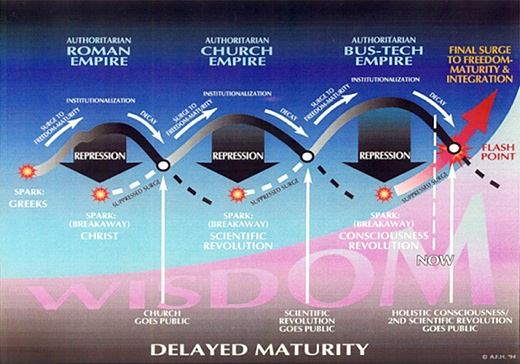
Image above: A graph of the history and near future of "wisdom". By Arius Hopman from (http://www.egoempire.com/).

Say goodbye to the rotten old Ego Era, And Welcome…

…To the Post Ego Era of human species maturity, sustainability and balance: “sobriety, equanimity, forbearance, temperance, ruthlessness and sweetness” (these are Toltec traits of the spiritual warrior, the one who does the Inner Work. They are also the traits of the Post-Ego mature adult).

A common denominator of all living species (except humans) is innocence. Nature depends on innocence to operate optimally, which the biosphere has done since the beginning of life, some three billion years ago. Because of innocence, all wild ecosystems are in dynamic balance, effortlessly self-adjusting as one or more species goes out of balance.

This is a system that requires no regulation. William McDunough (Cradle to Grave) says: “a system that requires regulation is not designed correctly”. Nature is a self-designed system that needs no regulation. Nature effortlessly recycles all biomass, it self-diversifies/experiments, self-cleans, self-expands to new unfilled niches, self-regulates all populations, self-controls genetic health, effortlessly self-heals after disasters and much more.

Consider the after-effects of Hurricane Iniki on Kauai: humans had over $2.4 billion in damage to their artificial environments that required years of work and expense to fix up (the environment always pays the price), while nature simply re-clothed itself with new leaves and thousands of seeds used the opportunity to sprout.

Nature is a miracle in effortless life-affirmation, and is the only system known that reverses entropy. That the universe, in which entropy is the law, could develop a system that reverses entropy must be considered a miracle. We have much to learn, since humans merely accelerate entropy.

Humans and their prided “consciousness” seem to defy almost every principle of nature. We arrogantly defy the natural order and presume to be able to "improve" on it. After 10,000 years of “progress”, look at the disaster we have created! The more “progress” we make, the faster we destroy nature. Note that technological advances can not be considered biological improvements. Ever since we left the hunter-gatherer lifestyle that nature adapted us for, we have been degenerating our gene pool and accelerating unsustainability.

In spite of all the evidence that we are accelerating down a dead-end road, we keep stepping on the gas. Half of the destruction of nature to date has occurred in the last 80 years. The first half started with the control of fire and accelerated 10,000 years ago with the beginning of the Agricultural Revolution, which has been called “humanities greatest mistake”.

Among dozens of degenerative changes, agriculture brought about possession of the land, exploitation and disrespect of nature, accumulation of possessions, male dominance (possession of women by men), dominance hierarchy and servitude, fixed enclosed residences, surpluses and population growth, indentured servants, standing armies and war, disease in dense populations, overuse of local “natural resources” (nature becomes a “resource” as well as a dumping ground) etc. We now see the logical extreme of that trajectory. Land, oceans and the atmosphere are now our sewer and our primary capital resource.

We pride ourselves for our wealth, but look closely and our wealth is extractive of the entire natural world. We have consumed/drawn down the natural capital of the planet to fill our empty emotional hole that can never be satisfied through material consumption. This is an evolutionary vicious cycle and a trap. The theme song for the Ego Era is: “can’t get nooo… satisfaction, but I try, and I try, and I try!” Our own emotional indulgence/addiction will eventually break the cycle when we reach the limits of a finite planet.

By definition, what is unsustainable will not last. We are now at that Flashpoint where we have to radically re-balance every aspect of our lives to re-establish sustainability. Since we seem to be incapable of doing so intentionally, it will be done by default: we have reached the limits. We are now at the bottleneck. Not everyone will want to become thrifty and agile enough to get through this very small door.

Our so-called “consciousness” is antithetical to the effortless, innocent order of nature. Look at the facts: whether it be a mono-crop in a fenced-in field where all intruding nature is killed with poisons, or our houses that displace nature and are built from living trees, our roads, cities, our consumer lifestyles that exploit “natural resources”, our concept-driven education that further alienates us from nature, on and on: are all contrary to natural order… and obviously unsustainable in the long run.

We will try to deny these facts until they nip us where it hurts. This is the end of the long run… What is unsustainable cannot last. Simple math, its now time to get it right.

To put it bluntly: our so-called “consciousness” is not what it is trumped-up to be. Nature is the final arbiter, and to nature, our “consciousness” has been a compounding disaster.

If we are honest, we must admit that our human intelligence (that we are so proud of) that presumably puts us on top of the evolutionary pile, does not, in the long run, favor survival: We have been around for only a few hundred millennia. But look at the real marathon survivors: blue-green algae: 2-3 billion years, sponges: one billion years, most fish families: ½ billion years+, insects: hundreds of millions of years etc.

By the time we get up to the more intelligent mammals, the species survival rate drops to only a few million years average. Clearly, as we look around at our unsustainable “civilization”, the success of the human species and it’s survivability are in question… unless we break through to the Post-Ego Era (see below).

Humans evolved “consciousness” on a planet of tens of millions of innocent species. One of the most basic signs of life for both plants and animals is the “stimulus-response” effect. From amoebas to dolphins a direct stimulus elicits a direct and spontaneous (innocent) response.

Humans are critically different; we go: stimulus> ego-mind> response (ie. not spontaneous, but mentally controlled). We have short-circuited direct response and put ego-mind as the judge of an appropriate response! Herein lies the glitch: We are living not in direct Here-Now experience, but rather in an interpreted/conceptual simulated reality that we call “conscious”.

The consequences are disastrous. We no longer eat the soul food of direct Now experience. Instead, we insist on eating the menu. The result is great suffering, anxiety, stress, urgency, discontent, frustration, denial, anger, despair, depression. We insist on choking down the MENU even as our collective symptoms are getting worse by the day. This trend is obviously unsustainable for us as well as for the biosphere that always takes the brunt of our insanity.

The Post-Ego Era
From the above synopsis, it should be clear that the Ego Era is seriously off track for survival. The good news is that it is only a juvenile evolutionary phase that Helena Norberg Hodges (Ancient Futures) calls “the boy culture”. The ego, that has been directing the show, is a “façade”, a pretense, make believe, the veil and the fallen state. Ego, that has been appropriately called “ego-mind” is the complex simulated-reality (concept) ego program that we identify ourselves with.

Simulated reality is the conceptual menu/blueprint we live by, that can never nourish our souls. We act “as if” we were fully mature, but harbor a deep inner yearning for authenticity, freedom, sovereignty. Our very recent evolution of simulated reality also introduced the ability for fantasy, exaggeration, lies and pretenses: we progressively became less authentic as cultural ego was passed on to successive generations. Our actions originate from this muddy soup of concepts. Result: this disastrous, ugly, exploitative culture we see around us now.

We have been displaced from our authentic True Selves by (on average) 500,000 corrections in our childhoods (Duke University study) and then throughout our lives we self-monitor and self-correct according to what others expect of us, and what we expect of ourselves. Thus we live narrow, controlled, contrived lives that cannot possibly be satisfying. “Can’t get nooo…”. In short, the ego is a very recent and contrived cultural artifact that displaces who we really are.

This did not always used to be so. For billions of years of evolution our ancestors evolved in innocence and in balance with nature: the Pre-Ego Era. Like the rest of nature, we were authentic in our actions and relationships. Essentially all of hominid evolution, from Australopithecus, to Erectus, Habilis, and Neanderthal took place in the Pre-Ego Era of innocence.

The early glimmerings of self-interpretation were not yet a dominant feature, as they became with homo sapiens, only some 70,000 years ago. The rapid development of the neo-cortex and resulting conceptualization was made possible by the new Homo sapiens ability of voluntary recall of memory/concept, including concept of self and the rise of ego: self-concept.

This shift is encapsulated in the term “sapiens”: knowing, concept, simulated reality.

The many compounding side-effects are documented in the website egoempire.com and touched on above. The overarching result of this shift was the displacement from our original pre-ego authentic and innocent Self, including our original, sustainable lifestyle and our original habitat: nature. The Ego Era began an artificial ego-contrived environment with its artificial, concept-driven lifestyle we call “culture” and “civilization”.

For centuries we have denied that the ego lifestyle is unsustainable. The good news is that we can now no longer deny that fact. Finally, this gives us the clear directive and motivation to seek the exit and re-discover our authenticity and a balanced lifestyle that works for the triple bottom line (Planet, People, Profit). The ego party (more of a purgatory, actually) is over. It is time to pay the piper and clean up the mess. This time, luckily, we have no choice and no excuses.

Our task is to launch the Post Ego Era. At first we may see no way to exit. Like the pupae in the strict confines of the chrysalis we seem to have little wiggle room and no place to turn. Becoming a butterfly seems like a complete impossibility. A re-birth is unimaginable. Letting go of the familiar (no matter how odious) seems catastrophic. But like the chrysalis, a crack in the cosmic egg begins to appear. …A little relief from the dysfunctional Ego Era. New possibilities are opening up.

As the Chinese proverb goes: “confusion is a high state, because in confusion all the options are open”. It is also a critical time. We have dawdled for so long that the window of opportunity to make a graceful shift to the sustainable Post Ego Era is rapidly closing. We can no longer depend on authority to make the choices for us. That is also good news, because circumstance is asking all of us to become self-responsible. Freedom is an individual choice.

Like love, respect and trust, it is earned, not given. The times are full of potential. Who will seize it? Let it be YOU.

See also:
www.EgoEmpire.com

• Born in 1940 in Kashmir, Arius Hopman is the son of a Dutch-English couple who motored from Amsterdam to India in a Ford Model A in 1935. His adventurous parents were following J. Krishnamurti, escaping the growing tension in Europe and seeking the Light from the East. In 1959, Hopman was an exchange student in the United States. He graduated cum laude in 1964 with degrees in geology, paleontology and evolution. Arius is He is a reknowned painter and photographer , He moved to Hawaii in 1985 from Taos, New Mexico, and lives in Hanapepe, Kauai, where he opened a gallery in June of 1997.

.