SUBHEAD: Privileged white-supremacist patriarchal Americanized men extract wealth from all else.
By Robert Jensen on 5 March 2016 in Resilience -
(
http://www.resilience.org/stories/2016-03-08/the-coddling-of-the-capitalist-white-supremacist-patriarchal-american-mind)
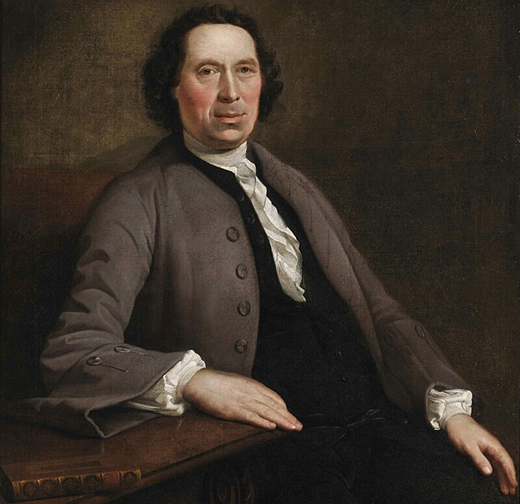 Image above: An 18th century "Portrait of a Gentleman" unsigned in the style of the Anglo American School. From (http://www.skinnerinc.com/auctions/2598B/lots/207).
[Author's note: This is an edited version of a talk given to
Common Ground for Texans in Austin, TX, March 5, 2016.]
To avoid being conned, politically and intellectually, it’s important to examine how a debate is framed and what ideology is advanced by that framing. What is the scope of the question? How was the direction of the inquiry decided? Who set the boundaries of the conversation?
Let’s ask those questions in regard to the contemporary conversation in the United States about allegedly dangerous trends on college campuses concerning “political correctness,” “microaggressions,” and “trigger warnings.”
A spirited public discussion of these issues was touched off most recently by an article in
The Atlantic magazine titled
“The Coddling of the American Mind.” I want to challenge the framing and ideology of that article, and of the dominant culture, by suggesting a better title would be “The Coddling of the Capitalist, White-Supremacist, Patriarchal American Mind.”
CAPITALIST
Educators are right to be concerned about non-rational or anti-intellectual factors that can shut down the conversation in a classroom; emotion and politics can impede open inquiry.
Let’s use that as a definition of political correctness — a narrowing of the scope of inquiry, especially to avoid certain controversial ideas out of a fear of offending someone, falling out of step with peers, or being disciplined by authorities.
There is one academic unit on most every campus where political correctness severely limits students and undermines the quality of intellectual work: The business school.
I have been teaching at the University of Texas at Austin for 24 years, and I ask students from the business school how often in their classes they are asked to challenge, or presented with a challenge of, capitalism.
The answer typically is “never.” Despite the many trenchant critiques of capitalism, the easily demonstrated failures of the system, and experiments with alternatives, it appears that the word “business” in “business school” actually means “business as it is narrowly defined in capitalism.” This limit, policed with an efficiency that Stalin would envy, is so routine that even in the sectors of a business school where one might assume challenges are welcome, such as courses on ethics or social responsibility, serious critiques are rarely presented.
Another troubling example of this ideological subordination to capitalism comes in most economics departments.
While there are challenges to capitalism allowed at some schools — those departments typically are described as “heterodox,” which implies that most economics departments are “orthodox,” a term most often used to describe adherence to religious doctrine — most economics curricula embrace neo-classical economics, which simply means the doctrines of contemporary capitalism.
Once again, the critiques, failures, and alternatives are ignored or sidelined.
Let’s pause to ponder the consequences of this narrow approach to the crucial question of how we produce, distribute, and consume goods and services.
One of the key problems facing the human species — I would say the central problem — is that a high-energy/high-technology world is undermining the capacity of the ecosphere to sustain large-scale human societies, and that a continued pursuit of “growth” on a finite planet will intensify the
multiple, cascading ecological crises that are unfolding around us. In other words, modern mass-consumption capitalism is ecocidal.
Some economists recognize this and have for several decades been advocating
“ecological economics,” an approach based on the notion that the laws of physics and chemistry (let’s call that “reality”) trump the theories of economists (let’s call that “the theories of economists”).
Ecological economics is reality-based.
One might think that all of economics, a field that likes to think of itself as a science, would embrace real scientific principles.
One might assume that ecological economics would be a synonym for “economics for rational economists.”
Instead, it is a small subfield that is routinely ignored within the discipline.
Why would this reality-denial strategy be dominant? Because of the coddling of the capitalist mind. Capitalists apparently are so emotionally fragile and intellectually limited, that any challenge to orthodoxy feels like aggression and threatens to trigger a breakdown.
Why do we coddle capitalists? Capitalists apparently have considerable influence, perhaps because the concentration of wealth in the system allows the wealthiest capitalists to have disproportionate influence in politics through campaign contributions and in education through philanthropy.
One of the renegades,
Richard Norgaard, marks the non-rational quality of orthodox economics with the phrase
“the Church of Economism,” describing the contemporary economy as “the world’s greatest faith-based organization” that “replaces belief in God’s control over human destiny with the belief that markets control our fate.”
Norgaard, a central figure in ecological economics, points out that some honest economists have acknowledged the religious nature of their discipline, including Frank Knight, one of the founders of the neo-liberal Chicago school of economics, who in a 1932 article wrote:
The point is that the “principles” by which a society or a group lives in tolerable harmony are essentially religious. The essential nature of a religious principle is that not merely is it immoral to oppose it, but to ask what it is, is morally identical with denial and attack.
There must be ultimates, and they must be religious, in economics as anywhere else, if one has anything to say touching conduct or social policy in a practical way. Man is a believing animal and to few, if any, is it given to criticize the foundations of belief “intelligently.
Certainly the large general [economics] courses should be prevented from raising any question about objectivity, but should assume the objectivity of the slogans they inculcate, as a sacred feature of the system.
Political correctness is real, and the most intellectually sanitized spaces on most campuses — the business school and economics department — encourage us to roll the dice of the future of the planet based on non-rational doctrines that are more theologically than empirically based. That is a cause for concern.
WHITE SUPREMACIST
From the class politics that define the modern university, let’s turn to race, where most of the debate has been focused the past year, and start with a
definition of microaggressions:
the everyday verbal, nonverbal, and environmental slights, snubs, or insults, whether intentional or unintentional, which communicate hostile, derogatory, or negative messages to target persons based solely upon their marginalized group membership. In many cases, these hidden messages may invalidate the group identity or experiential reality of target persons, demean them on a personal or group level, communicate they are lesser human beings, suggest they do not belong with the majority group, threaten and intimidate, or relegate them to inferior status and treatment.
I am not part of any identifiable marginalized groups, but I’ve spoken with many students at UT and other universities in my 24 years of teaching, and I’ve read a lot about these issues, and all this evidence leads me to conclude that microaggressions are real and often have a negative effect on students, though there is considerable individual variation in non-white students’ reactions. So, what training and/or policies should a university implement to deal with this problem?
Before we get to that question, let’s ask where microaggressions come from. In matters of race, they are a product of white supremacy, the ideological system that for 500 years has shaped the domination of the world by Europe and its offshoots, such as the United States.
White supremacy is obviously a part of our history, but there is considerable debate about how relevant that ideological system is to contemporary life.
This debate goes on at the University of Texas at Austin, where for several decades students, faculty, and community members have called for the removal of statues of Confederate officials, which have been met by spirited defenses of those public monuments.
The statue of Jefferson Davis, the president of the Confederacy, was finally
removed this past summer, but statues of Robert E. Lee (leader of the Confederate Army), Albert Sidney Johnston (a Confederate officer) and John Reagan (postmaster general for the Confederacy) still stand.
Public monuments to one of the most morally depraved political units in modern history remain on the UT campus to this day.
UT is, of course, in Texas, where many people celebrated the election to the presidency of sort-of native son George W. Bush, who once joked that his success proved that “C students: You too, can be president,” reflecting his less than stellar academic record, suggesting that his admission to Yale and Harvard universities for undergraduate and master’s degrees might have been based more on family connections than on merit.
Many of the same people who raise no objection to such legacy admissions will claim that UT is admitting black and brown students who are unqualified and that this policy is unfair and/or a threat to the integrity of higher education.
More nuanced defenses of this white-supremacist ideology (“it’s about heritage, not hate” in the case of the statues, or “we should live in a meritocracy” in the case of affirmative action) have in recent years given way to more overt racist rhetoric and images, no doubt sparked in large part by the election of a black president (who, because he is black, is deemed illegitimate by some) and an economic malaise (which is easier for some to blame on immigrants than on the people who capture a disproportionate share of the country’s wealth).
So, we have mainstream institutions that find it hard to remove symbols of white supremacy from prominent positions, let alone deal with the deeper ideological manifestations, let alone deal with the material realities of racialized disparities in wealth and power.
And we see a resurgence of conservative political forces that are comfortable with more overt expressions of white supremacy.
In that context, should we ask whether some non-white students are too sensitive about microaggressions? Sure, that’s a reasonable question, but it might help to think more about the context first.
Why does the contemporary United States, liberal and conservative, find it so hard to come to terms with white supremacy? A quick review of our history helps clarify that. We know that there would be no United States if not for the nearly complete extermination of indigenous people by Europeans, the first American holocaust, an extermination program justified by the ideology of white supremacy.
We know that the United States’ move into the industrial era was supported by cheap cotton, which provided the raw material for the textile mills of New England and a commodity for sale abroad to generate capital, and that the slave system that made that possible — another crime of holocaust proportions — was justified by the ideology of white supremacy.
American dominance of the world has intensified after WWII in part because of the use of military forces in the Third World, also producing holocaust levels of death and destruction, and such wars are easier to sell when the people being killed are not white (think about terms such as gook and raghead).
There would be no country called the United States, nor would it likely be the wealthiest country in the history of the world, without these racist and/or racialized crimes. It’s not hard to see why we don’t deal with the question honestly. How does a country come to terms with the reality that its prosperity is built on such extermination, exploitation, and empire?
So far, we have avoided that reckoning, and much of white America seems determined to continue that avoidance strategy.
Should we be coddling the white-supremacist mind?
PATRIARCHAL
The contemporary debate about campus politics also has intersected with concerns about gender, including the use of trigger warnings which alert students that a reading, video, or lecture may contain material that could cause emotional distress. The mental health of rape victims/survivors was one of the first concerns that gave rise to trigger warnings.
So, let’s talk about the reality of rape.
Rape is a vastly underreported crime; most women who are raped do not go to law enforcement agencies, and therefore crime statistics tell us little about the prevalence of rape.
But the feminist movement’s activism against men’s violence led to research based on women’s experiences rather than on crime reporting, and those studies have found varying rape rates.
On a global scale, 30% of women over the age of 15 have experienced
“intimate partner violence,” defined as physical, sexual, or emotional violence, based on data from 81 countries. The rate in North America is 21%. For many years, anti-rape activists in the United States quoted the statistic that
one in three girls is sexually abused and that 38% of the women reported sexual abuse before age 18.
A recent review of the data by well-respected researchers concluded that in the United States
, at least one of every six women has been raped at some time in her life, a figure that is now widely accepted.
Much of this sexual violence is directed at young people; in the National Violence against Women Survey, slightly more than half of the 14.8% of women who reported being raped said
it happened before age eighteen.
Those statistics address acts that meet the legal definition of rape, but women and girls face a much broader range of what we can call “sexual intrusions,” sexual acts that they do not request and do not want but experience regularly — sexually corrosive messages and calls, sexual taunting on the streets, sexual harassment in schools and workplaces, coercive sexual pressure in dating, sexual assault, and violence that is sexualized.
In public lectures on these issues, I list these categories and women’s heads nod, an affirmation of the routine nature of men’s intrusions into their daily lives.
To drive home the point, I sometimes tell audiences that I have just completed an extensive longitudinal study on the subject and found that the percentage of women in the United States who have experienced some form of sexual intrusion is exactly 100%.
Women understand the dark humor — no study is necessary to confirm something so routine.
If we describe rape as
“sexually invasive dehumanization” to capture the distinctive nature of the crime, then let’s ask this painful question: How much of everyday life do women experience as sexually invasive dehumanization on some level? Even more challenging, why does this situation continue even when the feminist movement has made progress on other fronts?
The answer requires us to confront patriarchy, the system of institutionalized male dominance, in which men continue to use sex and violence to control women, a strategy not only widespread in everyday life but celebrated in the routine sexual objectification and exploitation of women in mass media and the
sex industries of prostitution, pornography, and stripping.
How does a society come to terms with inequality woven so deeply into the fabric of everyday life? We can’t expect to advance a challenge to patriarchy by coddling the patriarchal mind.
CONCLUSION
I have spent his entire adult life working as either a journalist or a professor; I have both principled and practical reasons for caring about freedom of expression and academic freedom. I also have been on the receiving end of attempts to limit the scope of debate because of arguments I’ve made that have challenged the conventional wisdom of both conservatives and liberals.
My
antiwar writing after 9/11 led to a phone/letter campaign to get me fired, and more recently my
critiques of the ideology underlying the transgender movement have led to protests of public lectures I’ve given.
In my career, I have observed the routine way that serious challenges to concentrated wealth and power are marginalized in academic life. I also have witnessed exchanges in which accusations about class/race/gender oppression are hurled without supporting evidence and potentially productive exchanges are cut off by people who think that invoking jargon ends an argument.
A phrase such as
“check your privilege” can be an important reminder that people from dominant groups should think about how unearned status can limit our understanding of power dynamics, but it also can turn into a cliché that shuts down conversation.
So, my remarks today are not intended to ignore the difficult struggles on campuses over questions of intellectual openness and honesty.
- When does merely offensive speech becomes oppressive?
- When should one person’s freedom of expression, no matter how offensive, be defended and when does a pattern of abusive expression clearly undermine the ability of others to participate fully in a classroom discussion?
- How do we encourage challenges to widely accepted theories and doctrines?
- How do we model civil, respectful intellectual debate when those debates are not merely academic but have serious effects on participants in the debate?
- When should we offer students some kind of shield from the corrosive aspects of contemporary culture and when is it important for all of us to face the worst of the culture?
My remarks are intended to suggest that any discussion of how to approach these issues should first contend with the systems and structures of power that create the hierarchy, inequality, and violence at the heart of these struggles.
After nearly three decades in academic life, I am more aware than ever of how difficult it is to resolve these questions and how easy it is for all of us to feel overly confident about our own conclusions.
Still, I am confident that crafting intellectually defensible policies requires us to never stray too far from the reality of those systems and structures of power.
.


