Showing posts with label Recreation. Show all posts

Trump's lazy lack of interest

SUBHEAD: Trump, America's Boy King, should know golf and television won't make America great again.

By Lee Moran on 4 August 2017 for Huffington Post -
(http://www.huffingtonpost.com/entry/newsweek-cover-donald-trump_us_598418d1e4b041356ebef616)


Image above: Cover of Newsweek illustrates Trump's Lazyboy lifestyle labeled "Donald Trump is bored and tired. Imagine how bad he'd feel if he did any work." From (http://www.newsweek.com/2017/08/11/donald-trump-hillary-clinton-gop-white-house-potus-bannon-643996.html).

“I would have added past due bills on floor...”

President Donald Trump won’t want to hang this uncomplimentary magazine cover at any of his golf clubs.

Newsweek depicted the president as a junk food-eating television addict on the front of its next issue, dated Aug. 11.

Under the headline “LAZY BOY,” the edited photo shows Trump slumped in a recliner with a remote control in one hand and a Diet Coke in the other.

An open bag of Cheetos is perched on his lap while an empty McDonald’s hamburger carton is discarded on the floor.

“Donald Trump is bored and tired,” the sub-headline reads. “Imagine how bad he’d feel if he did any work.”

Newsweek shared the cover on its home page late Thursday, two days after it published the cover story itself, which examined “America’s boy king” and his apparent lack of enthusiasm for the job.

The image went viral, sparking a myriad of responses.


Image above: Could Trump be afraid? From (http://www.newsweek.com/2017/08/11/donald-trump-hillary-clinton-gop-white-house-potus-bannon-643996.html).


.

Determining Kauai's Ala Loa Trail

SUBHEAD: State lawmakers may identify the path of the ancient Ala Loa trail on Kauai as a public trail.

By Timothy Hurley 17 February 2017 for Star Advertiser -
(http://www.staradvertiser.com/2017/02/17/hawaii-news/bill-aims-to-settle-disputes-over-trail-on-kauai/)


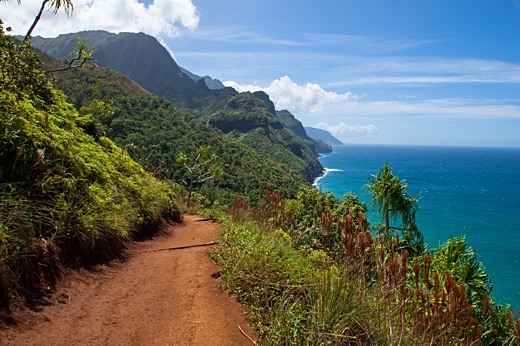
Image above: Photo looking west along the Kalaloa Trail on the north shore of Kauai. This section of the overall Ala Loa Trail system is still in everyday use. From (http://islandbreath.blogspot.com/2015/11/kauais-ala-loa-trail.html).

[IB Publisher's Note: To follow and comment on this legislation see (http://www.capitol.hawaii.gov/measure_indiv.aspx?billtype=HB&billnumber=120&year=2017)]

State lawmakers are weighing a bill that requires the state to identify the path of the ancient Ala Loa trail on Kauai and recognize it as a public trail.

The trail, which generally follows the coast around the island, apparently includes a section that crosses the property of Facebook CEO Mark Zuckerberg as well as other oceanfront property owners reluctant to open their land.

More than 100 people marched near Zuckerberg’s property Feb. 4 in what was billed as a peaceful demonstration to “Save the Ala Loa” and urge that it be opened to the public. Some were Native Hawaiians looking for coastal access for fishing and gathering purposes.

The bill, introduced by state Rep. Kaniela Ing, is expected to be approved on second reading today by the House Committee on Ocean, Marine Resources and Hawaiian Affairs and then move on to the House Committee on Water and Land.

The measure was approved Tuesday despite a request by state Department of Land and Natural Resources Chairwoman Suzanne Case that it be deferred.

In written testimony, Case said that while the department, through its Na Ala Hele trail and access program, has determined from registered maps that the trail is owned by the state, the problem is that the exact location still remains undetermined.

“To date the department has not been able to confirm the location of this historic trail — indeed evidence indicates it may have been located further mauka away from the coast near the main highway,” she said.

Nevertheless, officials remain committed to an ongoing dialogue with community members regarding specific trail locations, and the department is continuing to review “all available information” in an effort to determine the trail’s whereabouts, Case said.

But Jocelyn Doane, public policy director for the Office of Hawaiian Affairs, said more than enough information is available to pinpoint what she called a “critical cultural pathway.”

Doane said officials with OHA and the Native Hawaiian Legal Corp., along with community members in the Koolau district of North Kauai, have been working on the issue since 2011.

“Through this work and the great work of the community, OHA believes that the specific scope and location of the Ala Loa extending through the Koolau district has in fact been thoroughly documented,” Doane said.

The historic trail appears on maps from as early as 1833 through 1900 and is recognized in land commission award documents that date back to the Great Mahele, the land distribution of 1848.

What’s more, ancient coastal settlements in the Koolau district such as Moloaa, Papaa and Aliomanu were traditionally linked by the Ala Loa, she said, and accounts of the use of this historic trail have been documented in publications from 1829 to 1895.

Doane said she walked portions of the trail with community members only two weeks ago.

“There’s no question they know exactly where the Ala Loa is,” she said.

The state’s authority to claim ownership of ancient trails dates back to when Queen Lili‘uokalani and the legislature of the kingdom of Hawaii enacted the Highways Act of 1892, a law that still remains on the books.

Under the law, all roads, trails, bridges and other forms of public access that can be verified to have existed before 1892 continue to be owned in fee simple by the state.

The law applies even if the trail is not physically on the landscape, having, for example, been wiped out from ongoing land use activities or by natural events. But the burden of proof rests with the state, which must consider archaeological reports, historic maps, historic accounts, surveyor’s notes, deeds and other sources of information that might help determine state ownership.

In written testimony, Kauai County Councilman Mason Chock said identifying and recognizing the trail would be an important step in securing public-access, hunting and gathering rights for many Native Hawaiians.

It would also help end the escalating tension between Native Hawaiians, private landowners and residents in regard to its location, Chock said.

Some residents have complained about fences blocking access, security guards patrolling beaches and fishermen being threatened with arrest.

See also:
Ea O Ka Aina: Modest Disruption will unravel us 11/25/15
Ea O Ka Aina: No need for $7m from state 11/12/15
Ea O Ka Aina: Kauai's Ala Loa Trail 11/6/15
Ea O Ka Aina: The Toxic Truth 4/18/14
Ea O Ka Aina: The Ala Loa Trail 4/10/14
Ea O Ka Aina: Trails and Tribulations 2/26/13
Ea O Ka Aina: Sleeping with the Enemy 5/24/11
Ea O Ka Aina: Paradise Ranch Rationalization 2/16/11

.

MV-22 Osprey landing at Salt Pond

SUBHEAD: Multiple landings and takeoffs of controversial aircraft at Kauai public beach.

By Juan Wilson on 5 February 2017 for Island Breath -
(http://islandbreath.blogspot.com/2017/02/mv-22-oprey-landings-at-salt-pond.html)


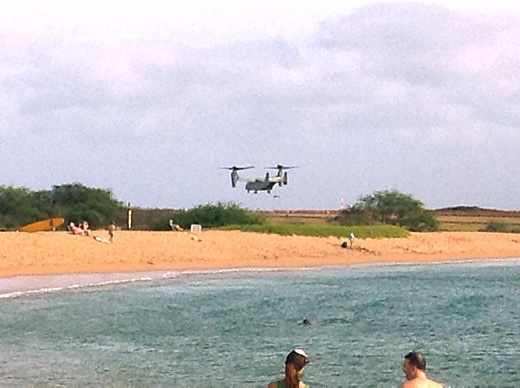
Image above: Photo for this article by Juan Wilson of Osprey aircraft landing over Salt Pond Beach Park.

Last Tuesday, January 31st, I was at the beach with my wife Linda and granddaughter Ruby. We were at the kiddy beach at the west end of Salt Pond Park in Hanapepe, Kauai, Hawaii. It was a pleasant sunny day and there were several locals and tourists on the beach and in the water.

At four-thirty in the afternoon a deep guttural growl could be heard coming from the east. In moments the sound amped up as a strange looking "plane" flew past going west offshore of the southern extremity of nearby Puolo Point. The profile was that of uniquely odd MV-22 Osprey helicopter/plane that was developed primarily for the US Marine Corps.

The Osprey has rotational wings that old two turbine propeller engines that allow it to fly much faster than a conventional helicopter yet rotate its engines and land vertically.

"The best of both world's?" Not exactly! I knew from previous reporting that the Marine Corps had been having performance issues with the Osprey.

It was found that the Osprey is quite sensititve to dust entering its turbine engines when landing in sandy and dusty conditions. It has experienced crashes. Hovering for even a short while over dusty terrain had to be severely limited.

I had hard that the military had plans to do training for the Ospreys on Kauaiand be stationed out of the Pacific Missile Range Facility (PMRF). I heard it involved difficult landings and takeoffs from narrow valleys on the Napali Coast. I assumed the passing Osprey was on its way west to land at the PMRF for that training.

But once shortly just past Kamakani near the old Gay & Robinson sugar mill the Osprey could be seen turning around. It approached Salt Pond Beach low and fast. As it past the sound of the rotors was quite load. The Osprey passed right over swimmers and people on the beach and slowed as it came to the runway near Puolo Point.

That's when the thing got really noisy. As it rotated its wings to vertical orientation it ceased traveling horizontal and the engines whined loudly. There must be some strange dynamic between the horizontal and vertical flight that causes chaotic and disturbing vibrations boomed across the water to where I stood a half a mile away. It sounded like a controlled crash.

The Osprey never shut down its engines after landing. In a moment it revved up the turbines and began a vertical take-off. Again chaotic and noisy at it made it transition to horizontal flight. Some people did not understand what was going on and seemed disturbed.

The Osprey took off going east and somewhere over Hanapepe Sound came around to west again and past again heading towards Kamakane. Once there it did a one-eighty and returned to land again. It seemed a little closer to where I stood in the kiddy pond.By this time I was shaking my fist at the Osprey.

Altogether there were three test landings over the public beach.

A a resident of Hanapepe, and a frequent user of Salt Pond Beach Park, I strongly request that the US military use its own 10,000 foot runways at the PMRF for this training activity and stay away from public recreational areas with this controversial aircraft.

The Japanese on Okinawa have had a long struggle with the US Marines and their Ospreys. This Janaury 9th there was a non-fatal crash of an Osprey in Okinawa that brought safety fears to the fore. See (http://www.japantimes.co.jp/news/2017/01/09/reference/nonfatal-osprey-crash-okinawa-brings-safety-fears-fore/#.WJe8rRAnr6g).

Closer to home their has been a crash on Oahu.

After relating this encounter with the Marines to a friend he identified a valley on the Napali Coast where if one hikes these days you will be met with camouflaged armed soldiers coming from hidden structures who will frog-walk you out of the valley.


Visdeo above: Osprey aircraft takes of after passing over Salt Pond Beach Park and landing on tarmac of runaway near Puolo Point near Hanapepe, Kauai, on 31 January 2017. Filmed by Juan Wilson.  From (https://youtu.be/j6eAKPpbun8).


Image above: Two days before this landing on Kauai an Osprey crashed in burned in Yemen during the ill-fated Al Qaeda raid by Seal Team Six. From (https://theaviationist.com/2017/01/29/u-s-mv-22-osprey-tilt-rotor-aircraft-crash-lands-in-yemen-during-special-ops-raid-on-al-qaeda/).

See also:
Ea O Ka Aina: Kauai and Niihau endangered 9/24/16
Ea O Ka Aina: Oceans 4 Peace Pacific Pivot Panel 6/18/16
Ea O Ka Aina: Judgement against RIMPAC 2016 5/29/16
Ea O Ka Aina: Okinawans wish US military gone 8/26/15
Ea O Ka Aina: RIMPAC 2014 in Full March 7/17/14
Ea O Ka Aina: Stop bombing Kaula Island! 10/8/12
Ea O Ka Aina: Marines backing off 8/24/12
Ea O Ka Aina: Unproved Osprey on Kauai 8/21/12


New movie rating announced

SUBHEAD: MPAA adds category "O" for "Original" to warn audiences of films not based on existing works. 

By Staff on 20 October 2015 for The Onion -
(http://www.theonion.com/article/mpaa-adds-new-rating-warn-audiences-films-not-base-51651)


Image above: Screen presentation of the new "Original" category rating is not meant as censorship. From original article.

In an effort to provide moviegoers with the information they need to determine which films are appropriate for them to see, the Motion Picture Association of America (MPAA) announced Tuesday the addition of a new rating to alert audiences of movies that are not based on existing works.

According to MPAA officials, the new “O,” or “Original,” designation will inform viewers that a particular film contains characters with whom they are unfamiliar, previously unseen settings, and novel plots.

The rating will also reportedly serve as a warning of the potentially disorienting effects associated with having to remember characters’ names for as many as two hours and the discomfort that can occur when one is forced to keep track of narrative arcs for an entire film.

“We recognize how distressing it can be when viewers go into a film and suddenly find themselves confronted with jarring scenes containing a protagonist they’ve never encountered before, which is precisely why we created this rating,” said Joan Graves, head of the MPAA’s ratings board, who said the new category was added in part due to the thousands of complaints the organization has received from moviegoers who were upset they weren’t given advance notice that they’d have to make sense of the scenarios unfolding onscreen.

“It’s important that today’s movie fans are aware upon entering the theater that none of what they will see has been adapted from a well-known comic book, television series, novel, video game, historical event, previous movie, or theme park ride.”

“Ultimately, it will be up to the consumer’s discretion as to whether a film is suitable for themselves and their family, but the O rating will explicitly caution people that they will have to pay attention during the movie and follow the storyline on their own,” Graves added.

Though sources said films requiring the new rating are comparatively rare, a spate of high-profile movies over the past several years that do not stem from any previously existing source material—including The Kids Are All Right, Her, WALL-E, Birdman, and Nebraska, among others—have left many viewers angered and perplexed.

Citing test audiences they have observed, MPAA officials said that many moviegoers spent the entirety of such films in a state of distress, waiting for the moment when the Incredible Hulk, Katniss Everdeen, Wolverine, or another recognizable character from an established franchise would appear onscreen and clarify the meaning and direction of the film.

“I never would have gone to see Sicario if I knew it was going to be so unbearable,” said filmgoer Mark Kemmer of Cleveland, referring to the recently released crime thriller set against the violent backdrop of the contemporary Mexican drug trade that, under the MPAA’s guidelines, would receive the new rating. “It was pretty much unwatchable.

It seemed like in nearly every scene I had to figure out who the people were and where the story was going. And the whole movie was like that!”
“What a waste of money,” he added.

Others reported being viscerally repulsed by movies they attended that were not based on media that originated several decades or generations earlier, saying they had become so upset by what they had seen that they had trouble even sitting through the films.


Image above: Still from Pixar animation "Inside Out". From (http://www.theverge.com/2015/6/17/8790177/inside-out-movie-interview-pixar-pete-docter-jonas-rivera).

“How does this trash even get made?” said Katherine Hubbard, a mother of three from Rockford, IL, who, after buying tickets for the Pixar film Inside Out, was incensed that her children had been exposed to original storytelling. “Within the first minute, some little girl character my kids have never seen or heard of walks onscreen, and then we immediately have to learn her whole backstory and how she navigates the world?

 I marched us all right out of that theater after about 10 minutes.”

While audiences have reportedly been receptive to the new rating, directors and distributors have already decried it as severely damaging in regard to box-office revenues and the number of venues that will carry their films. However, the MPAA was adamant that the new classification should not be interpreted as censorship.

“The O rating isn’t meant to be a punishment or a moral judgment of any kind,” Graves said. “It’s simply a value-neutral designation intended to protect consumers, ensuring that they are fully informed about a movie and are able to make their own decisions about how much artistic and narrative originality they are comfortable seeing.”

“If filmmakers want to avoid the rating and appeal to a wider audience, all they have to do is throw in a superhero or a hobbit or some other licensed property,” Graves added.


.

Yosemite Park Turns 150

SUBHEAD: Now some park regions will be once again be accessible only by foot, to protect delicate regions of the park.

By Sasha Khokha on 28 June 2014 for NPR News -
(http://www.npr.org/2014/06/28/326216331/as-yosemite-park-turns-150-charms-and-challenges-endure)


Image above: Yosemite is located in east central California. The park covers an area of 761,268 acres  and reaches across the western slopes of the Sierra Nevada mountain chain. From (http://wordlesstech.com/2012/03/10/boulders-yosemite-national-park/).


Yosemite National Park, in California's Sierra Nevada, is celebrating the 150th anniversary of the law that preserved it — and planted the seeds for the National Park system. At the same time, the park faces the challenge of protecting the natural wonders from their own popularity.

Since President Abraham Lincoln signed the 1864 law that protected this land, visitors have been enjoying the park's spectacular features, from Half Dome to the giant sequoia grove — and the moonbow at Yosemite Falls.

The moonbow is like a rainbow, but at night. Some photographers time their visits to the park so they can catch a glimpse of this rare phenomenon, which is only visible when the moonlight catches the mist at the waterfall.

Four million people visit the park each year. Photographer Mark Zborowski, who's here to capture the moonbow, is among them.

He explains that the naked eye just sees a thin silvery band, but a long exposure with a camera can capture the moonbow's color. The entire scene is "just a spectacular view," Zborowski says.

"You look up, and you can see the ridges up high, and the stars," he says. "It fills your eyes — gives you a lot to feed off of."

Photography has been key to Yosemite's allure. Historians think it may have helped convince Lincoln to preserve a place he'd never visited.

Today you can still see some of the sites that appealed to those early photographers. Ranger and park historian Dean Shenk points out one of Yosemite's most famous trees, The Grizzly Giant — which he says is close in size to the Leaning Tower of Pisa.

"The first photographer who came to the Mariposa Grove in 1859 took a picture of the Grizzly Giant from the angle that we're looking at today," Shenk says.

This grove of giant sequoias, together with Yosemite's iconic valley, became the first federally protected wilderness areas on June 30, 1864, when Lincoln signed the Yosemite Land Grant.
"In the midst of our country's civil war, with all the bloodshed, all the battle, all the anxiety," Shenk says, "many of us would like to think that he took a moment and perhaps shook his head, or smiled, in just perhaps a sigh of pleasure."

Shenk compares the idea of protecting these lands to the seed of a giant sequoia, which is as tiny as an oat flake. "That seed planted by Lincoln's signature has expanded to the National Park System throughout America," he says.

But even those who urged Congress and Lincoln to preserve Yosemite warned that tourism had to be managed carefully, Shenk says. That includes Frederick Law Olmsted, the landscape architect who helped design New York's Central Park and helped oversee the Yosemite land grant.

"Not only did he predict the millions of people in the future, but he also said ... 'We must be aware of the capricious damage that one visitor might make, and then multiply it by the millions,'" Shenk says.


Olmstead and Yosemite

SUBHEAD: The vision of America's first and greatest landscape architect for wilderness preservation.

By Dan Anderson in 1998 for Yosemte -
(http://www.yosemite.ca.us/library/olmsted) 


Image above: Waterfall in Yosemite National park. From (http://www.wondermondo.com/Attractions/Waterfalls.htm).

[IB Publisher's note: Frederick Law Olmstead came to prominence with his winning design for New York's Central Park in 1853. Olmstead went on to reinvent landscape architecture - transforming it from a special service for rich landowners to the enhancements and preservation of the public commons. He designed many of the 19th century major urban parks including Brooklyn, Boston and Buffalo, Detroit, Denver, Milwaukee and many more. He also did the campus master plan for Stanford University the University of California Berkeley. His greatestwork may have been the philosophy he developed in the formulation of Yosemite Park and later the establishment of the Nation park System with the design of Yellowston National Park. For more see (http://en.wikipedia.org/wiki/Frederick_Law_Olmsted)] 

Yosemite Preliminary Report
Written in 1865 by landscape architect Frederick Law Olmsted when he served briefly as one of the first Commissioners appointed to manage the grant of the Yosemite Valley and the Mariposa Big Tree Grove from Congress to the State of California as a park, this Report offers one of the first systematic expositions in the history of the Western world of the importance of contact with wilderness for human well-being, the effect of beautiful scenery on human perception, and the moral responsibility of democratic governments to preserve regions of extraordinary natural beauty for the benefit of the whole people.

The Report also includes characteristically thoughtful suggestions for managing the Park for human access with minimal harm to the natural environment.

Olmsted read the Report to his fellow Commissioners at a meeting in the Yosemite Valley on August 9, 1865; ultimately intended for presentation to the state legislature, it met with indifference or hostility from other members of the Commission, and was quietly suppressed.

Olmsted himself left California for good at the end of 1865; he had arrived there just a little more than two years before to assume responsibilities as Superintendent for the Mariposa Mining Estate. Only in the twentieth century has his Preliminary Report come to be widely recognized as one of the most profound and original philosophical statements to emerge from the American conservation movement.

.

Kauai loses Kipu Falls

SUBHEAD: Administration bumbling and risk management misdirection take another beautiful spot away from public.

 By Andy Parx on 25 August 2011 for Parx News Network - 
(http://parxnewsdaily.blogspot.com/2011/08/parkyakarkus.html)


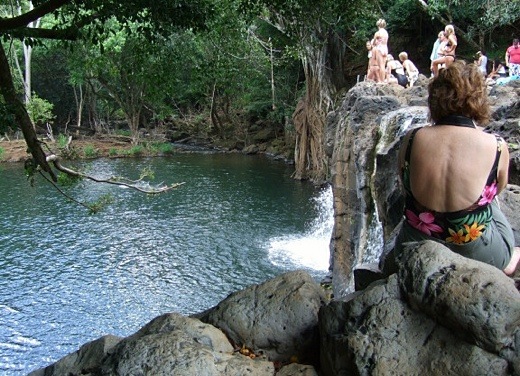
Image above: From View from top of Kipu Falls in Puhi with a crowd of visitors. From (http://angiemattwedding.com/beach.htm).

 It was only a matter of time and everyone knew it. So when the land gluttons Grove Farm announced they were putting up a gate and no trespassing signs at Kipu Falls after countless deaths over the decades- deaths of both locals and tourists, press reports notwithstanding- it wasn't unexpected. But what was, if not surprising at least gut-grabbing, was the fact that they had offered to turn the area over to the county for a park and the county turned them down due to "liability" according to at least half a dozen press reports.

What- or more to the point "who"- the words "the county" refers to isn't stated but one can only assume it was the administration of Mayor Bernard Carvalho who, without letting anyone know, gave up the chance to obtain an incredible asset for the people of Kaua`i. What's more it really isn't the administration's decision to make. The county charter makes it plain that the acquisition of property comes under the purview of the county council which apparently was not even asked since any communication would have had to have been placed on the council's agenda for any discussion to have taken place. Instead, as is typical of Carvalho's administration, the decision was made behind closed doors with no input from the public. "Liability" has been the cry of past administrations in rejecting donations of property.

The second access to Kaupea (Secret) beach was turned down by the Kusaka administration citing liability, although rumor has it that Carvalho has told people that he's working on getting it "donated" to the county. That's fifteen years of no access to the second beach there which often becomes inaccessible from the current county access during the winter. Liability can and should be able to be minimized and even eliminated, if we assume we actually have people with half a brain in the Parks and Recreation Department who can properly determine signage and other safety measures. Liability is related not to the inherent, natural dangers of an area but to the degree of negligence of the owner in the unique situation that is cited in a lawsuit.

The recent determination that the state was libel for the deaths of the tourist who fell off Wailua falls was not simply because the area is state property but because the signage was so poorly designed and placed that it apparently directed the woman off the cliff. What Carvalho is essentially saying is that there's no one in his administration competent enough to minimize the liability inherent in owning Kipu Falls.

 It's hard to say which is worse; the county turning down the potential gift of one of the most beautiful and popular spots on the island and one that attracts thousands of tourists every year or that they did it secretly without even asking the body that actually has the power to make that determination... much less asking the taxpayers and citizens who would have to bear any burden of any potential liability. It's not too late for this outrage to be overturned. If you're as pissed off as we are, contact your council at councilmembers@kauai.gov and tell them that you want them to at least look into if not accept Grove Farms offer to turn Kipu Falls over to the county.

.

Halfway There

SUBHEAD: Take the quiet and peace you can find and cherish it. Be sure to plan a way to find more where ever you are.  

By Juan Wilson on 1 July 2011 for Island Breath - 
(http://islandbreath.blogspot.com/2011/07/halfway-there.html)


Image above: The hand of Tara Nevins, of Donna the Buffalo, on the concertina at the Great Blue Heron Music Festival. Photo by Juan Wilson.


The year 2011 is half over and were on the back straightaway and heading for the third turn. We're on the mainland and when this morning is over my wife Linda and I will be heading over to the Great Blue Heron Music Festival (http://www.greatblueheron.com) in Sherman, New York.

It's mostly old time music, zydeco, folk, world and tunes that could (if needed) be played acoustically. It's on for three days and nestled in rolling hills and woodlands and surrounded by Amish farms.

Being at the Heron allows us to escape the predominant culture's expression of subliminal violence that is the Fourth of July weekend.

Every year that midyear celebration of patriotic militarism returns with the ritual charring of meat, waving of flags and setting off explosions. Whoopie!

The fact is there is not a whole lot to celebrate in much of America. Floods, fires, draught, and poverty seem to be spreading without control as the social fabric shreds and disintegrates.

 In the last few days the state New York declared fracking for natural gas a good thing while th entire state of Texas was declared a natural disaster area... And don't forget the state Minnesota was shut down at midnight last night.

 The second half of this year should be a corker. Greece is waiting in the wings to default as the Middle East continues to roil. Take the quiet and peace you can find and cherish it. Be sure to plan a way to find more where ever you are.

 .

Mickey teaches the Chinese

SUBHEAD: M-I-C-K-E-Y teaches Chinese children to speak English... and love Disney Corp.  

[IB Editor's note: Chinese and Americans demonstrating very different reactions to Disney Corporation.] 

By Jen Doll on 8 April 2011 for the Village Voice - 
(http://blogs.villagevoice.com/runninscared/2011/04/chinese_parents.php) 

 
Image above: Source original article.

 Exciting news for the children of China: Walt Disney Co. and its Chinese government friends have finally broken ground on Shanghai Disneyland, reports the Wall Street Journal. The "Disneyland" portion is just part of what will be a $4.4 billion resort with hotels, shops, restaurants, and everything a person could ever want, because after all, it's Disney! Everyone wants to go to Disneyland! Despite that, it took over a decade to get the Chinese government to agree to this.


As part of the deal, the majority of the resort is controlled by three state-owned businesses called the Shanghai Shendi Group. Disney holds 43%. The park's completion is expected to take five years.
Of course, Disney views China as a "great market," and China can't help but love Mickey Mouse.

Thus, "Shanghai Disney Resort will be both authentically Disney and distinctly Chinese," [Disney Chief Executive Robert] Iger said. Shanghai Disneyland will be the sixth park world-wide.

Chinese parents: When announcing your impending trip, remember that the element of surprise is not always on your side.


Video above: American children are told, en route, of surprise visit to Disney World. From (http://www.youtube.com/watch?feature=player_embedded&v=8MIBxhh_R_w)

Mickey teaches Chinese Kids English

By Staff on 12 May 2011 for Bloomberg News - 
(http://www.bloomberg.com/news/2011-05-11/m-i-c-k-e-y-mouse-teaches-chinese-to-speak-english-love-disney.html)

 
Image above: Disney English launches in Beijing Andrew Sugerman, General Manager and Senior Vice President for English Language Learning The Walt Disney Company (center). From (http://www.prnasia.com/pr/10/05/100411811-1.html).

Five-year-old Wei Ziyun chose “Robot” as his English name after the title character in the Walt Disney Co. (DIS) movie “Wall-E.” Now a Disney learning center in Shanghai is teaching him how to spell it.

“I want to come here every day,” he said after one of his twice-weekly lessons at a Disney English classroom in the Chinese city’s Pudong area. “It’s fun to learn English.”

“Robot” and his classmates are also learning to love Disney characters as the world’s biggest theme-park operator builds the $4.4 billion Shanghai Disney Resort, scheduled to open in five years.

Teaching English to children in the world’s most populous nation has proven so lucrative that Burbank, California-based Disney has tripled its number of language schools there in the past year, with plans for more.

“It’s a very efficient way of marketing their brand as well as the amusement park,” said Shang Yang, chairman of Shangyang Enterprise Management Consulting Co. “They’re starting years early, brainwashing Chinese children and cultivating them as potential clients in a very indirect, yet penetrative, fashion.”

Growth Forecast
China’s private-education market, including international schools, is projected to grow to 517 billion yuan ($79.6 billion) by 2012 from 356 billion yuan in 2009, according to a December report by Bank of America Corp.’s Merrill Lynch unit. The catalysts include increased domestic consumption, government subsidies for schooling and a cultural emphasis on education, the report said.

The market for children’s English-language learning may increase 29 percent annually over the next four years from the current 24 billion yuan, said Andrew Sugerman, senior vice president and general manager of Disney English.

The first Disney English center opened in Shanghai in September 2008 and the number has increased in the past year to 22 from seven. China is the only market where unit Disney Publishing Worldwide operates the language schools.

“Being surrounded by all sorts of Disney products and characters, it’s almost impossible for children and their parents not to love Disney,” said Wang Bing, an analyst with Phillip Securities Research in Shanghai.

“All good feelings toward the company will surely translate into visitations to its theme park.”

Focused on China
Sugerman declined to give financial details about Disney English except to say that it’s profitable. There also are learning centers in Beijing, Hangzhou, Nanjing, Ningbo, Tianjin and Suzhou.
The company eventually will look to expand the business outside China, Sugerman said, declining to provide details.

“All of our focus right now is geared on China,” he said.

Disney said Tuesday its profit in the quarter ended April 2 fell 1.2 percent to $942 million, or 49 cents a share, as a shrinking movie box-office, a park shortfall and the disaster caused by the March 11 earthquake in Japan overshadowed gains in television.

“I believe Disney English is profitable without taking into account licensing fees for these cartoon characters,” said Jason Ding, a Beijing-based partner and vice president at management consultant Roland Berger AG. “The business may have a huge potential if Disney licenses its content and teaching methods to others.”

‘Most Important Subject’
The market is fragmented, according to the Merrill Lynch report. New Oriental Education & Technology Group (EDU) Inc. is the largest private education company in the country with less than 1 percent market share as of 2009.

New Oriental, based in Beijing, made about $64 million from children’s English training in the year through Feb. 28, an increase of more than 35 percent from a year earlier, President Louis Hsieh said. The “POP Kids” program, launched in 2001, is expected to expand by at least 40 percent during the next couple of years, he said in an interview.

“As families get a higher income, they are going to spend a lot of money on early-childhood education,” said Hsieh, who also is the chief financial officer. “The most important subject for Chinese kids is English. It’s also seen as an absolutely necessary skill to get a good-paying job.”
Disney English worked with an academic advisory board to create its Disney Immersive Storytelling Approach, and the company produced more than 300 songs for the program, it said.

Education Standards
The curriculum follows standards set by the national and Shanghai education ministries, Sugerman said. A team of 10 Los Angeles-based Disney staff creates culturally relevant content.

“What Disney is doing now in China is growing a future consumer base,” said Mary Bergstrom, founder of Bergstrom Group, a Shanghai-based consumer consulting company. “They are giving them the opportunity not only to learn English, but also to create really deep, intimate memories with those characters.”

Disney charges between 3,000 yuan and 12,000 yuan for the programs, including “Hello World” for 2- to 4-year-olds; “Foundation” for 3- to 6-year-olds; and “Step Up” for primary-school ages.

Classes typically last 45 minutes and are taught by a native English-speaking “trainer” -- certified in teaching English as a foreign language to children -- and a Chinese- speaking assistant. When it’s time to start, kids march down a hallway decorated with characters from “Bolt” and “Ratatouille” to classrooms referencing “The Lion King” and “Mulan,” a Chinese warrior princess.

Sleeping Beauty
After the “Hello Song,” children interact with two projection screens, called the Magic Theatre, to study words and phrases. Their lessons include learning the colors of fish on Mickey Mouse’s boat and the articles of clothing Goofy needs when the weather gets cold.

They also manipulate a warrior who fends off a dragon’s fireballs to save Sleeping Beauty while also teaching the words “defeat,” “defend” and “celebrate.”

“Their use of English becomes a comfortable, natural reality as opposed to a forced, painful reality,” Sugerman said in a room filled with stuffed toys including gray cats, blue birds and watermelon slices with bite marks.

Children are tested every six weeks on their reading, writing, speaking and listening comprehension. They also can study at home with materials featuring Mickey Mouse, Winnie the Pooh and “Monsters, Inc.”
Meredith Ge, who works for the regulatory affairs department at Procter & Gamble Co. (PG), enrolled her 4-year-old daughter, Melody, at the center after trying others. Her daughter says the way Disney teaches English is “relaxing.”

“English language is a very useful tool,” said Ge, 33. “I want to lay a solid foundation before Melody goes to primary school.”


.

Fungicide found to be Frogicide

SUBHEAD: Syngenta, is the manufacturer of the fungicide chlorothalonil used to treat farm fields, lawns and golf courses.

By Craig Pittman on 8 April 2011 for Tampa Bay Times -
(http://www.tampabay.com/news/environment/wildlife/usf-study-concludes-that-common-fungicide-is-deadly-to-frogs/1162355)

 
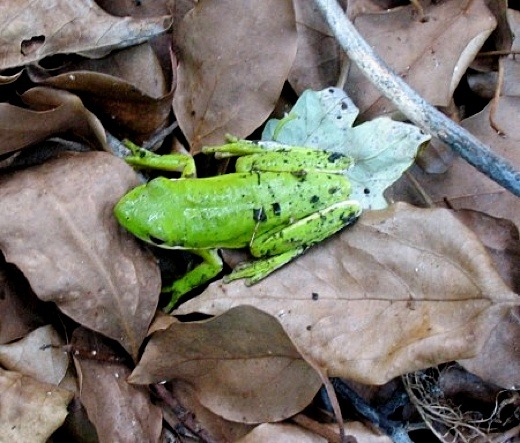
Image above: Green tree frog endangered by Syngenta's fungicide chlorothalonil. From original article.

Two years ago some University of South Florida researchers began studying the effects of the most widely used fungicide in the country to see if it might kill more than just fungus.

Turns out it's also a pretty effective frog-icide.

"We were completely surprised to see it basically killed everything," said Taegan McMahon, the lead researcher on the study, which was published this week in a scientific journal called Environmental Health Perspectives. Frogs on farms with treated fields, frogs in ponds on golf courses, frogs in the back yard — the fungicide could be lethal to any of them, the study suggests.

"We don't know what the effect on humans could be," she added. "And we use it heavily in Florida."

The fungicide, chlorothalonil, sold under such names as Bravo, Echo and Daconil, is used to treat farmers' fields, lawns and golf courses and is an ingredient in mold-suppressing paint.

It's part of the same chemical family, organochlorines, as the banned pesticide DDT. It is known to cause severe eye and skin irritation in humans if handled improperly.

Chlorothalonil kills mold and fungi by disrupting the respiratory functions of the cells, explained Jason Rohr, an assistant professor who co-authored the study and heads up USF's Rohr Ecology Lab. At this point the researchers don't know if that's how it kills frogs, too, he said. They just know it's lethal. Rohr stated:
"We've previously studied a variety of other pesticides, such as atrazine, as well as herbicides and insecticides.We haven't seen one with nearly the mortality that we've seen with chlorothalonil."


Frogs and other amphibians play an important role in the food chain, which is why scientists began sounding the alarms in the early 1990s when they discovered many were disappearing. An estimated one-third of the world's 6,300 amphibian species are threatened with extinction, with the blame being pointed at climate change, loss of habitat, chemical use by humans and a spreading fungus — just the sort of thing a fungicide would kill.

However, McMahon said, no one has studied the effects this popular fungicide might have on frogs. For their experiment, the researchers used hundreds of tadpoles from southern leopard frogs, Cuban tree frogs, green tree frogs and squirrel tree frogs, held in jars.

Chlorothalonil's label says not to spray it directly on waterways, so the researchers did not do that. Instead, they used a federally approved formula that calculates how much of a concentration would run off of a farmer's field and wash downstream into a nearby waterway.

It killed nearly 90 percent of the frogs, no matter what species, McMahon said. When they doubled the dose, it killed all of them. Even weaker concentrations harmed the frogs' immune and liver systems and may have altered their stress hormone levels.

Protecting the frogs, Rohr said, might require the government to restrict its use to much farther away from waterways or else ban it entirely, as happened with DDT.

A spokeswoman for Syngenta, the Swiss manufacturer of Bravo and Daconil, challenged the study's findings.

"This study used a model that significantly overstated the potential exposure of amphibians to the fungicide chlorothalonil," said Ann Bryan. "The amount of chlorothalonil was 100 times higher than ever would be found in the real world."

Syngenta reported $11.6 billion in global sales last year.

Studies in Pennsylvania have found far higher concentrations of chlorothalonil in bee pollen. So now there are studies about whether it could be causing a decline in the bee population, Rohr said.

Now that the frog study is done, Rohr said his research group is already studying the effects on other species, such as snails, insects and plankton. Given what has turned up so far, though, he said, "This might be a chemical of concern in the next few years."

The study was done in conjunction with the Archbold Biological Station in Venus and the University of Florida Gulf Coast Research and Education Center in Wimauma.

See also:
Island Breath: Syngenta Poisoning at Waimea Middle School 1/12/07
Island Breath: 2nd Poisoning at Waimea Middle School 2/23/07
.

The SkyCycle

SUBHEAD: Somehow this is not what we thought a green revolution might produce.

 By Juan Wilson on 24 April 2009 for Island Breath -
(http://islandbreath.blogspot.com/2009/04/skycycle.html)


Image above: View getting onto the SkyCycle tandem cart.


I was browsing the internet and stumbled on a Japanese website that detailed a ride called the SkyCycle at Washuzan Highland theme park in Okayama, Japan. I could not read the text but found the photo essay that accompanied it fascinating. It is a foot powered roller-coaster ride! I soon realized that there were a spate of other websites, in English, that had picked up the story. Some people think it is the scariest ride in the world. Below is an example and several images from the Japanese website

 Bike Roller Coaster in Japan  

By Lloyd Alter on 14 March 2007 in Treehugger.com 
http://www.treehugger.com/files/2007/03/treehuggerstyle.php
 
Here is the future of the green amusement park: The Skycycle at Washuzan Highland Park in Okayama, a pedal-powered roller coaster. They clearly have some dramatic topography to take advantage of here, and it looks truly frightening. Most North American amusement parks are on pretty flat terrain but they often build artificial mountains- Demand a green ride like this on the Magic Mountain.

The side-by-side tandem pedal-powered carts have seat belts, and a cute pink basket, however this ride looks really scary.


Image above: The beginning of the SkyCycle experience.


Image above: There is no turning back once you've started.


Image above: Not to worry. IT's only a cycle ride. Right! 


Image above: Oh my God! We're going to die!


See also:
Island Breath: Cheney and Nascar 6/3/07
http://drkssk2.fc2web.com/washuzan/skycycle/cycle.html

.