Showing posts with label Utopia. Show all posts

Yesterday's Tomorrowland

SUBHEAD: Memorial Day is a dreary moment to have to face this onrushing calamity of rocket-propelled medievalism rampant.

By James Kunstler on 25 May 2015 for Kunstler.com -
(http://kunstler.com/clusterfuck-nation/yesterdays-tomorrowland/)


Image above: Poster illustration for Disney's utopian Tomorrowland. From (http://www.tomorrowland-movie.com/).

America takes pause on a big holiday weekend requiring little in the way of real devotions beyond the barbeque deck with two profoundly stupid movie entertainments that epitomize our estrangement from the troubles of the present day.

First there’s Mad Max: Fury Road, which depicts the collapse of civilization as a monster car rally. They managed to get it exactly wrong. The present is the monster car show. Houston. Los Angeles. New Jersey, Beijing, Mumbai, etc.

In the future, there will be no cars, gasoline-powered, electric, driverless, or otherwise. Mad Max: Fury Road is actually a perverse exercise in nostalgia, as if we’re going to miss being a nation of savages in the driver’s seat, acting out an endless and pointless competition for our little place on the highway.

The other holiday blockbuster is Disney’s Tomorrowland, another exercise in nostalgia for the present, where the idealized human life is a matrix of phone apps, robots, and holograms. Of course, anybody who had been to Disneyland back in the day remembers the old Tomorrowland installation, which eventually had to be dismantled because its vision of the future had become such a joke — starting with the idea that the human project’s most pressing task was space travel.

Now, at this late date, the monster Disney corporation — a truly evil empire — sees that more money can be winkled out of the sore-beset public by persuading them that techno-utopia is at hand, if only we click our heels hard enough.

Another theme running through both films is the idea that girls can be what boys used to be, that it’s “their turn” to be masters-of-the-universe, that men are past their sell-by date and only exist to defile and humiliate females. That this message is really only a mendacious effort to rake in more money by enlarging the teen “audience share” for the reigning wishful fantasy du jour is surely lost on the culture commentators, who are so busy these days celebrating the triumph and wonder of transgender life.

The reviewers are weighing these two movies on the popular pessimism / optimism scale. These are the only choices for the masses: whether to be a “doomer” or a “wisher.”

Both positions are cartoon world-views that don’t provide much guidance for continuing the project of civilization, in case anyone is actually interested in that. It’s either rampaging id or the illusion of supernatural control, take your pick. I find both stances revolting.


Image above: Promotional still image from the apocalyptic Mad Max: Fury Road movie. From (http://www.chud.com/community/t/146538/mad-max-fury-road-pre-release-discussion/750).

[IB Publisher's note: The votes are in. America has chosen its future. Over the crucial Memorial Day weekend box office Disney's "Tomorrowland" tanked while "Mad Max: Fury Road" soared. So watch out you techno-optimists America wants a more S&M exciting future.]

Anyway, it’s interesting that the real Fury Road of the rightnow runs from Syria into Iraq starring ISIS. There is a growing sentiment in the news media (including the web, of course) of a sickening déjà vu with these developments.

The old familiar talk of air strikes and ground troops infects the wifi transmissions. Maybe we should think about sending Charlize Theron over there with a few vestigial male sidekicks to load her assault rifle. How else to git’er done? Nobody knows.

Memorial Day is a dreary moment to have to face this onrushing calamity of rocket-propelled medievalism rampant — all those poor American soldiers blown up and mangled the past twelve years.  It’s also interesting that the news media is totally out-of-touch with the biggest prize on the great gameboard: Saudi Arabia. You think ISIS overrunning Iraq is bad news?

Wait until the ordnance starts flying around Riyadh. Notice, too, that there’s no news coming out of Yemen on the base of the Arabian peninsula, a failed state with a population nearly equal to its neighbor. If we have any idea what’s going on there — and surely the Pentagon and NSA do — then it’s not for popular consumption.

This is ironic because if the trouble happens to spread into Saudi Arabia — and I don’t see how it will not — then we’ll find out in a New York minute how America’s future is not about monster trucks, cars, dirt bikes, holograms, phone apps, and all the other ridiculous preoccupations of the moment.

.
Charting Collapsniks


SUBHEAD: Some have become “terra-ists” bringing down the system by acts of economic disobedience.

By Albert Bates on 14 January 2014 for The Great Change -
(http://peaksurfer.blogspot.co.uk/2014/01/charting-collapseniks.html)


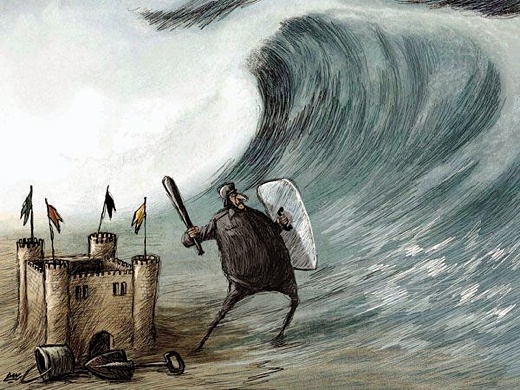
Image above: Illustration used for article "Collapse? Fast or Slow?". From (http://22billionenergyslaves.blogspot.com/2012/08/collapse-sudden-or-slow.html).

Rather than spurning financial system terrorists, Holmgren urges activists to become “terra-ists”; to directly bring down the system by thousands of acts of economic disobedience.
"A ferment in the environmental movement, brewing for many years, has now bubbled up into the blogosphere. We are dipping our ladle in here to take a little taste of it, even though we are quite certain it is not done fermenting.

Bill McKibben has been stirring the wort of whether social activism can save us for many years. In Eaarth: Making Life on a Tough New Planet, as in The End of Nature a quarter century earlier, he poignantly waffled, in elegant prose, between hope and despair. Since launching 350.org — “the first political action with a number for a name” — he has urged those of us with any remaining shred of hope for our children’s future, given what we now know about climate change, to step up and lay our lives on the line. Get arrested. Risk lengthy jail terms and even death to stop this atrocity. Do not go gentle into that good night.

Words to this effect we have heard much longer and louder from Derrick Jensen, another eloquent writer, the difference being that McKibben advocates for non-violence in the mold of Gandhi and King, while Jensen has no qualms about advocating violence. Naomi Klein, another stirring writer with an arrest record, calls for acts of resistance large and small.

McKibben is tepid about taking on capitalism’s growth imperative, as though it were not a major contributing factor, while neither Holmgren, Klein nor Jensen have any such reservations.

Thus we are tasting many different flavors of leadership, or literary guidance, in the shaping of the nascent climate resistance movement.

Scientists themselves have been growing politically more active and radicalized, as Klein described in her October New Statesman essay. If you go back enough years you’ll find scientists like Dennis Meadows, Howard Odum and James Lovelock, all of whom correctly foresaw the impending collision between consumer civilizations and natural systems. Lovelock made a series of climate-and-society predictions that went unheeded for 20 years but hold up well in retrospect.

Joining the chorus of climate Cassandras with more structured harmonies are the peak-oilers and financial collapsarians. These thoughtful writers straddle a continuum that is both time-sensitive (near-term, middle term, long-term) and outcome ambivalent — they are undecided as to whether the future they foresee will be a good thing, a bad thing, or even survivable.

Guy MacPherson has staked out the lonely position for near-term human extinction, which might be a good thing or a bad thing, depending on how you look at it. Richard Heinberg, Nicole Foss and Steve Keen all see financial constraints as the leading edge of whatever storm is forming, and are not making predictions about how or when, but are planting gardens and putting up canned goods nonetheless.

Michael Ruppert, James Howard Kunstler and Dmitry Orlov are also decoupling from whatever economic grids they may be attached to, but do not foresee a particularly happy outcome in all this. Social unraveling is not a pretty picture, as Orlov describes in his Five Stages of Collapse.

Still clinging to the possibility of some salvageable human prospect are cultural and technical optimists like Amory Lovins, David Orr and Rob Hopkins. We personally would also favor this idea of an ecotopian future, and have been working to bring it about it for half a century now, but our own position is that collapse is likely unstoppable now, given, as Nicole Foss puts it “the excess claims on underlying real wealth.”

What suddenly bubbled up from the blog vat at the start of 2014 was a white paper authored by David Holmgren, one of the founders of permaculture, reversing a position he had long espoused.

Instead of associating himself with peaceful change by calling for restraint on overconsumption and gradual adoption of the degrowth economic paradigm, extending it ever outward until it became the mainstream culture, Holmgren abruptly called for “Crash on Demand or a strategic decoupling by masses of youth (and elders) from the economic system that is the crashing the planet’s ecological stasis, by simply walking away.

“Rather than spurning financial system terrorists [a.k.a. banksters or the 1/10th-percent],” Holmgren urged activists to become “terra-ists”; to directly bring down the system by thousands of acts of economic disobedience. “The urgency for more radical action to build parallel systems and disconnect from the increasingly centralized destructive mainstream is a logical and ethical necessity whether or not it contributes to a financial collapse,” he wrote provocatively.

This immediately inspired a flurry of thoughtful responses, as might be expected. One of the most impassioned came from one whose positions Holmgren had just abandoned. Writing for Transition Culture January 13, Rob Hopkins responded, “to state that we need to deliberately, and explicitly, crash the global economy feels to me naive and dangerous, especially as nothing in between growth and collapse is explored at all.”

Hopkins main truck with Holmgren is his readiness to toss away all notions of mainstreaming permaculture and transition towns. “I may be naive,” he writes, “but I still think it is possible to mobilise that in a way that, as the Bristol Pound illustrates, gets the support and buy-in of the 'City/State' level, and begins to really put pressure and influence on 'National' thinking. I may be naive, but it's preferable to economic collapse in my book, and I think we can still do it.”

Concerned that a hard line position would expose social change agents to the full weight of state security as well as to the blame cascading from an angry populace, and that sewing the seeds of civil discord is always dangerous, Nicole Foss wrote on The Automatic Earth January 9 that financial collapse is already well underway and there is no need to expedite the process.

“While I understand why Holmgren would open a discussion on this front, given what is at stake, it is indeed dangerous to ‘grasp the third rail’ in this way. This approach has some aspects in common with Deep Green Resistance, which also advocates bringing down the existing system, although in their case in a more overtly destructive manner.”

“Decentralization initiatives already face opposition, but this could become significantly worse if perceived to be even more of a direct threat to the establishment,” Foss concluded.

Having these positions staked out was useful for the discussion of strategy that change agents need to be more engaged with. Klein and McKibben seem to think that if we just have enough “Battles for Seattle,” the economic system of global civilization will be radically restructured. Our own experience in joining dozens of massive marches and actions of civil disobedience but nonetheless failing to end the Vietnam War has perhaps jaundiced our views in this regard. Moreover, Holmgren and Foss make clear that that’s not going to happen.

Even the recently unveiled strategy of fossil fuel divestment, as promising as it is, and as grounded in investment reality of the stranded, overvalued assets unable to ever be burnt, stands little chance of being able to arrest climate tipping points that may have been triggered decades ago.

Foss is not especially concerned for the climate, apparently clinging to the position Holmgren had some years ago, that collapse of energy and economics will augur in a low-carbon future, although she does acknowledge the lurking unknowns from reversed global dimming.

“We need to get down to the business of doing the things on the ground that matter, and to look after our own local reality. We can expect considerable opposition from those who have long benefited from the status quo, but if enough people are involved, change can become unstoppable.

It won’t solve our problems in the sense of allowing us to continue any kind of business as usual scenario, and it won’t prevent us from having to address the consequences of overshoot, but a goal to move us through the coming bottleneck with a minimum amount of suffering is worth striving for.”

Our own view is that the likelihood that a runaway greenhouse effect is now underway is greater than it has ever been, and to call what is coming a bottleneck is a poor choice of words except perhaps in the sense of the genetic bottleneck experienced 70-80 thousand years ago in connection with a supervolcano that reduced our hereditary lines to fewer than 5000 individuals worldwide.

While we understand the concern she raises about unduly politicizing the issue, we’d say that cat has left its bag and keeping silent for fear of numbing the population makes no more sense for climate change than it does for Ponzi economics.

Indeed, the parallels between the overdraft on Earth’s atmosphere and the excess claims on fictional central bank assets are striking — neither is going to go away simply by ignoring them. In both cases, the cake already baked.

This prompts us to make a new grid to categorize the range of opinions amongst peakists, collapseniks, politicos and anarchists. It goes something like this, at first drawing, and we welcome corrections, especially from those named.

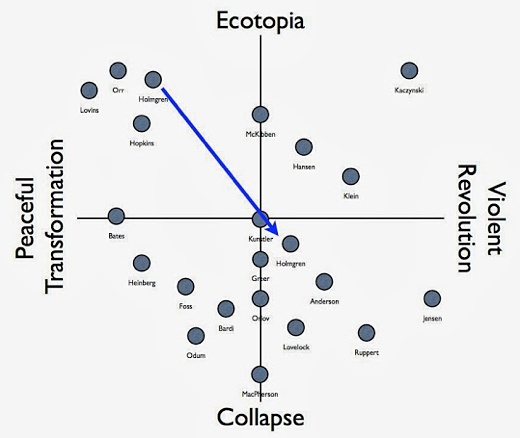
Holmgren’s change of position can be charted this way:

 
Image above: Chart demonstrating Holmgren's vector of change. From original article. This is revision #6 since the original post.

If we plot the respective positions of other change strategists, they look something like this:

 
Image above: Chart illustrating several "collapsniks" positions. From original article. This is revision #6 since the original post.

Our own position in this matrix outlined in two books since 2006,
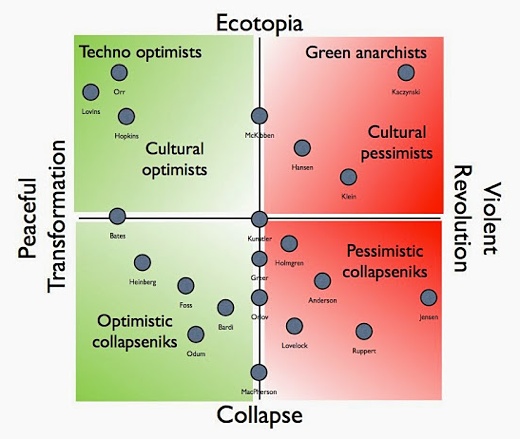
is off to the left and centered on the line, meaning that while we are adamant in our advocacy for peaceful transformation, we are doubtful as to whether ecotopia is possible without collapse. Those seem to us to be a coupled pair. Likewise, McKibben is in favor of a new green economy but stuck vacillating between more peaceful and less peaceful means of getting there, while MacPherson is deeply wedded to inevitable collapse without caring any more about social responses.

Not surprising, given what they know, scientists like Lovelock, Ken Anderson, and Howard Odum all fall below the line dividing Ecotopia from Collapse. Odum, we suspect, would have been in favor of peaceful transformation, while the others would like us to push harder and force the issue.

Naturally those most concerned with Holmgren’s shift would be those closest to his former position, including Rob Hopkins. Those closest to him now — Kunstler, Anderson, Hansen and Klein — would be the most likely to approve.

What is missing from Holmgren’s paper are the advances in terrestrial carbon sequestration — as opposed to Ponzi geoengineering — in no small measure reaching fruition by dint of permaculture design.

While permaculturists like Rob Hopkins, Declan Kennedy and Max Lindegger pursued innovations in social structures — transition towns, complimentary currencies and ecovillages — other permaculturists — Darren Doherty, Richard Perkins, Joel Salatin and Ethan Roland, to name just some — have pushed the envelope to see how much carbon can actually be returned to the soil. This revolution is the subject of Courtney White’s new book, Grass, Soil, Hope: A Journey Through Carbon Country, scheduled for release in June.

Would we have ever learned that a mere 2% increase in the carbon content of the planet’s soils could offset 100% of all greenhouse gas emissions going into the atmosphere if we had not been so frightened of climate change by Al Gore and other scaremongers? Speaking as one who wandered deep into Amazonian history to discover this new paradigm, we reply: probably not.

We’ve added some color coding and sector analysis with this third iteration:

 
Image above: Chart with color coding for pacifism vs violence. From original article. This is revision #6 since the original post.

Now lets step back and add a whole ‘nother layer to this. There is a really good cultural transformation going on, with ecovillagers, ecological restorationists, soil remineralizers and post-empire econometricists.

Simultaneously, there is a really negative übertrend of banksters and purchased or annointed politicians enriching themselves off oil, nuke and the wealth of nature, then turning all that surplus into the worst kinds of pollution – the kinds that take millennia to degrade and even then impair gene pools for untold generations.

These two conflicting transformations coexist against the backdrop of almost immeasurably immense climatic and biosystemic change that will severely affect, if not drive, our world in the future. We all exist in the context of ecosystems and yet these familiar norms are being utterly destroyed while we write this.

The tiny little good ecovillagers, permaculturists and transition towners do pales in comparison to the scale of damage of unrestrained growthaholism that seems almost a genetic imperative of our species — and we are the keystone species in ecosystem Earth.

Holmgren has this right, and it is undeniably frightening. We’re sure there may be more thoughtful readers who can add to this analysis and produce more insights than we have, but as we say, we’re just grateful to be having this kind of discussion.

• After co-teaching a permaculture course in Belize with Nicole Foss next month, we will be vetting this analysis with Dmitry Orlov, Dennis Meadows, John Michael Greer, Gail Tverberg, KMO and others at the Age of Limits conference in Pennsylvania in May. .

Optimism Bias is the Default

SUBHEAD: What we cannot admit is that what we now use to keep us alive will kill us tomorrow.

By Raul Ilargi Meijer on 18 November 2012 for the Automatic Earth - 
(http://theautomaticearth.com/Finance/optimism-bias.html)


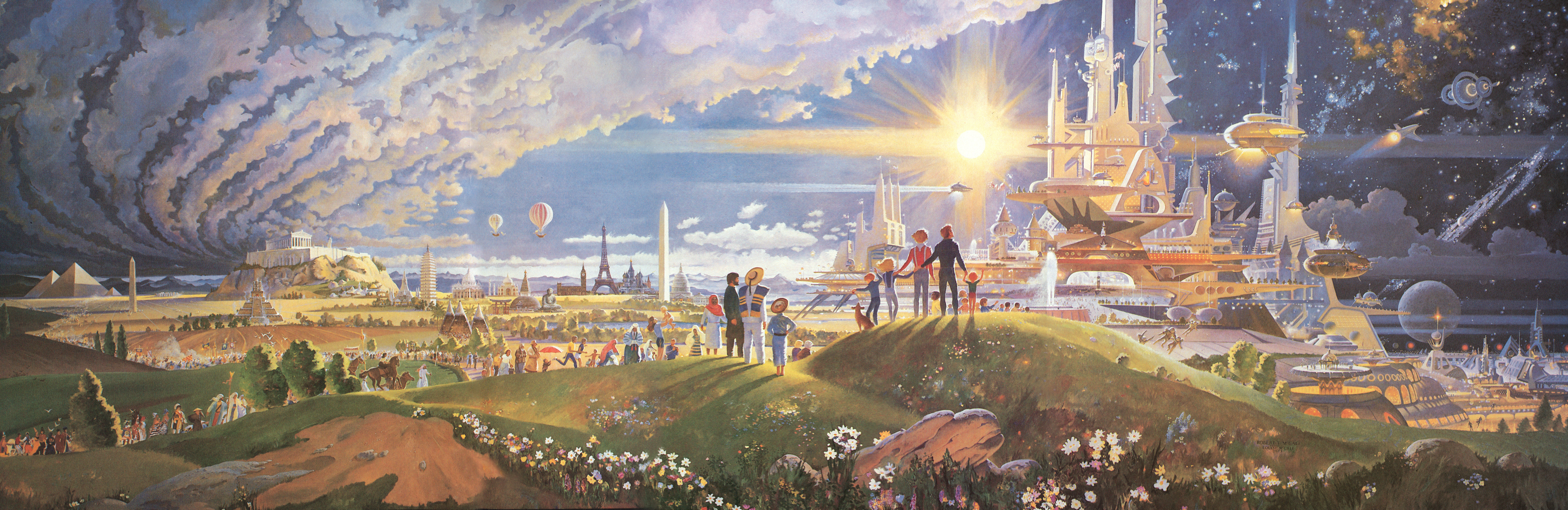
Image above: Detail of Disney Corporation imagineers creating mural of 'The Prologue & the Promise" by techno-optimist artist Robert T. Mccall in 2009. From (http://www.imagineeringdisney.com/blog/2009/12/16/horizons-mural-the-prologue-and-the-promise-high-res.html). Click to enlarge.
Definition of a lie: any not entirely accurate representation of the world as we perceive it; what's not spoken can be as crucial as what is.
So yeah, people lie. They, we, all do. Some of us understand the extent to which this is true better than others, but that's probably just because we haven't all spent equal time wondering when it was we first started doing it. Let alone why. Interesting questions. After the fact, it's blindingly obvious why we would want to lie: accomplished liars get to mate faster and more often. Which still is the purpose of life, even though it may not be terribly fashionable to phrase it that way these days.

But we couldn't have known that before we began lying, so that's not what got us started. Another interesting question is who we first lied to, ourselves or others. I personally lean to the former option lately, since we couldn't have known the advantages of lying to others beforehand. Whereas fooling ourselves could potentially have developed as a much more insidious, secretive, step by step feature.

Likely purely as a survival mechanism, after extremely traumatic experiences. To have such experiences, you need awareness, consciousness, either/or. Probably a sense of belonging to a group, a family, as well as a sense of what's right and what's not. If, in that state, you see your friends and family get killed off by a natural disaster or the cruelty of other humans, you need some sort of selective memory, some kind of denial mechanism, in order to survive both mentally and physically, and to find meaning in your life, a pre-requisite for who has awareness and is not a full-fledged psychopath.

The ability to lie to ourselves, and make ourselves think our lives are better than they really are, and that our own place in the world looks better than it does, has endowed us with a propensity for good tidings. We want the world around us to skew our picture of who and how we are in the same way that we ourselves do. Turns out, that's not a hard thing to find.

If only because the other kind of lying, that from one human being to another, the one that developed quite naturally modeled after our "internal" one, comes with one major caveat. Our ability to detect lies told by others is highly compromised by our ability to lie to ourselves, since the latter only works if it remains somewhere in our unconscious. We obviously don't consciously believe our own lies, and therefore neither the lies of others.

It all takes place outside of, beyond, our awareness. That's where the second hand car salesman operates, and any other charmer and grafter, the ad executive, the junkie and the politician. Sigmund Freud may not have been the first to realize this, but he was the first to frame it in rational terms. If you make commercials that tell people what a car or a perfume or a burger really is, they won't bite. If a junkie tells you what he really wants the money for, you don't give it to him.

And if a politician tells you what the real state of the economy (and hence your future) is, you're not going to vote for him. So (s)he tells you want you would like to hear. Without you even knowing it. There's a world full of things out there that you want without knowing it, and as many that you don't want.

Why we don't teach Freud throughout all our school systems, all the time, is a far deeper mystery than any of us alive today care to ponder. Unless we bow to the notion that we - unconsciously (?!)- don't want to know that either. We don't want to know why we don't want to know, because when the dominoes start falling that would shatter our carefully crafted and polished self-portraits.

All this to lead into what I really wanted to talk about. The optimism bias. Which plays havoc with everybody's understanding of the financial crisis like there's no tomorrow. Pun both intended and unconscious. And, in true character, nobody seems to notice much. Nobody wants to. Not unconsciously.

Extra, Extra, read all about it! the EU is falling apart so desperately now that Greece calls on the Arab world for loans, and Spain turns to South America. The crisis and the austerity it bred start to bite the European core. And will continue on their inevitable course towards swallowing it whole.

As you all would have seen long ago, if not for your optimism bias playing headgames. Most of you still won't, and possibly for quite some time to come, depending on how much longer it takes until the walls start to truly crumble. Because it's not until the truth stares them straight in the face that people will see it for what it is. And even then.

For the exact same reason, there was never a chance that Obama would lose the recent election. Because of the relatively acceptable economic numbers, multiplied by the optimism bias. Anyone who didn't see that coming in the run-up to the election should get themselves an education. Yeah, like, read Freud. That should go a long way towards figuring out who's saying what and why they say it. And towards explaining why you didn't know.

But, before this all becomes too winding a tale, let me explain that I got back to thinking of this topic of lies and self deceit and Freud because of a pretty simple graph I picked up from the website of a Dutch TV channel named RTL-Z. And i'd like to stress that this graph, and what it depicts, by no means constitute an exception in any way shape or form; the graph is merely an example of how economic and financial data are treated, and have been for years, by the media we frequent and trust. Thing is, we do that because they tell us what we want to hear and see and believe, because they provide that version of the story which we prefer to the real one, which doesn't fit our optimism bias.

Man, all those stories too about the US economy recovering, enough already. The US ain't going anywhere forward without Europe, and Europe is moving backwards if at all. Economic growth at unemployment rates of 25% in Greece and Spain and what is it, 14-15% stateside (?!), is not a viable thing. Our optimism plays games with us, and so do our politicians, to the extent that we come to think it's actually possible, though we know we should know better, to pay off our debts with more debt. Blinded by the light inside.

This graph tells the story (one of an endless number) of what, over the past four years, the EU predicted would be Greek GDP numbers, through five consecutive rounds of predictions, and what eventually actual numbers turned out to be. Pretty graphic(al). Being off by 6-7-8% was no exception, it was the rule. And this whole procedure is no exception either, it's all the rule. Which all politicians, pundits and forecasters get away with breeding because the stories they tell are the stories you want to hear. And then the stories inevitably turn south.

And they'll continue to do that for a long time, until we demand to know what happened to the debt. We don't really want to know that, though, do we? We have this unconscious itch that tells us exactly what happened to it. And we don't like that. We'd much rather believe anyone who tells us it'll be fine, that we can either borrow our way out of too much borrowing, or budget cut our way out of our budget deficits. Either way we fancy we'll have a little bit of pain, just a twitch, and then we can restart the party and make it bigger better than it's ever been.

I've said it many times before: we are the most tragic species. We not only destroy all of the world around us, we are aware of doing it but unable to stop ourselves. We have faith and hope that things will get better, that we can turn around at the last second what we've screwed up over years and decades. Which of course is nothing but an excuse to keep on screwing up. All courtesy of our optimism bias.

Here's the graph:


Image above: Chart from original article.

The thing about this graph and its consequences is that the policies for what happens at the final stages shown in the graph are defined by the predictions at the early stages. Once reality sinks in, it's too late, the damage has been done. The difference is then made up for by firing an additional million people here and there, cut pensions and benefits for a few million more, and keep talking about a recovery just around the corner. Beyond the horizon, more like it.

This is how all those who have a public voice you care to listen to treat their audiences. Because they are well aware that if they spread a message that fits in with the prevalent optimism bias, they will be more popular, sell better, get more votes, get elected into office. When Jack Nicholson said you don't want the truth because you can't handle the truth, he was talking to a much wider audience than we would like to acknowledge.

And so we get what we get. Still, you can't always get what you want. In the end, all that's left is what you need. And we know that, unconsciously. It's just that in the meantime we like to be sitting pretty. And not think about the fact that this very attitude of ours will hasten and worsen the end. We're creatures bent on instant gratification. Which is, come to think of it, precisely why we have our optimism bias in the first place.

Whatever it is that's going wrong, and there's more of that than we can summarize right here and now, the tragedies we create rival those of the ancient Greeks, which in and of itself shows that we never learned much. Voltaire in his 1759 Candide told us to replace "all is for the best in the best of all possible worlds" with "we must cultivate our garden". Never took that to heart either.

Like all those before us, we'll walk right into our tragic futures thinking everything will be alright. 'Cause that's who we are. Our tragedies will be as over the top bloody and deadly too as the Greeks' were.

Meanwhile, being the modern people we are, we can't help but wait for Godot, and we'll die waiting, because our optimism bias tells us he will come.

No, this is certainly no time for easy optimism, but tragically, that's all we got.
We're only static on the radio, picking up speed.
- Band of Horses


.