Showing posts with label Women. Show all posts

Iranian woman mathematician dies

SUBHEAD: Maryam Mirzakhani, first woman to win the Fields Medal - the "Nobel Prize for Mathematics"

By Staff on 15 July 2017 for the BBC News -
(http://www.bbc.com/news/science-environment-40617094)


Image above: Stanford faculty photograph of Maryam Mirzakhani. From (https://mathematics.stanford.edu/people/name/maryam-mirzakhani/).

[IB Publisher's note: My daughter Laura was born in Tehran, Iran in 1976, just about the time Maryam was born. I was working there on a one year contract for a planning firm. I found the Iranians to be wonderful people. When I finished the following article I felt stricken as if she were my daughter too. It is incomprehensible to me that we perceive the Iranians to be evil while we buddy up to the Saudis royals as our friends.]

Nearly three years after she became the first woman to win math's equivalent of a Nobel Prize, Maryam Mirzakhani has died of breast cancer at age 40. Her death was confirmed Saturday by Stanford University, where Mirzakhani had been a professor since 2008.

Mirzakhani is survived by her husband, Jan Vondrák, and a daughter, Anahita — who once referred to her mother's work as "painting" because of the doodles and drawings that marked her process of working on proofs and problems, according to an obituary released by Stanford.

"A light was turned off today .... far too soon. Breaks my heart," former NASA scientist Firouz Naderi said in a tweet.

He later added, "A genius? Yes. But also a daughter, a mother and a wife."

Naderi later posted a time-lapse video of Mirzakhani presiding over a lecture hall, filling chalkboards with a proof.

Early in her life, Mirzakhani had wanted to be a writer. But her passion and gift for mathematics eventually won out.

"It is fun — it's like solving a puzzle or connecting the dots in a detective case," Mirzakhani said when she won the prestigious Fields Medal in 2014. "I felt that this was something I could do, and I wanted to pursue this path."


Mirzakhani was born in Tehran, Iran, and she lived in that country before coming to the U.S. to attend graduate school at Harvard University. By then, she was already a star, having won gold medals in the International Mathematical Olympiad in the mid-1990s — after becoming the first girl ever named to Iran's team.

"There were more accolades," Danielle Karson reports for NPR's Newscast unit. "Mirzakhani was the first Iranian woman elected to the National Academy of Sciences last year, in recognition of her 'distinguished achievement in original research.' She was in good company: Albert Einstein, Thomas Edison and Alexander Graham Bell were past honorees."

Describing Mirzakhani's work, Stanford says:
"Mirzakhani specialized in theoretical mathematics that read like a foreign language by those outside of mathematics: moduli spaces, Teichmüller theory, hyperbolic geometry, Ergodic theory and symplectic geometry.

"In short, Mirzakhani was fascinated by the geometric and dynamic complexities of curved surfaces — spheres, doughnut shapes and even amoebas. Despite the highly theoretical nature of her work, it has implications in physics, quantum mechanics and other disciplines outside of math. She was ambitious, resolute and fearless in the face of problems others would not, or could not, tackle."
.

Climate change as genocide

SUBHEAD: Not since WWII have more human beings been at risk from disease and starvation than now.

By Michael Klare on 21 April 2017 for Resilience -
(http://www.resilience.org/stories/2017-04-21/climate-change-genocide/)


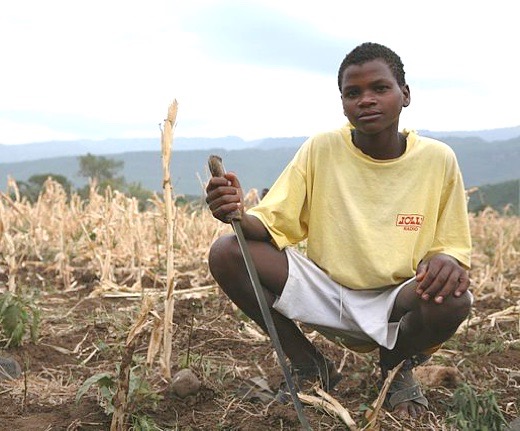
Image above: Photo of a young man in drought conditions in Ethiopia in 2008. From original article.

On March 10th, Stephen O’Brien, under secretary-general of the United Nations for humanitarian affairs, informed the Security Council that 20 million people in three African countries — Nigeria, Somalia, and South Sudan — as well as in Yemen were likely to die if not provided with emergency food and medical aid.

“We are at a critical point in history,” he declared. “Already at the beginning of the year we are facing the largest humanitarian crisis since the creation of the U.N.”  Without coordinated international action, he added, “people will simply starve to death [or] suffer and die from disease.”

Major famines have, of course, occurred before, but never in memory on such a scale in four places simultaneously. According to O’Brien, 7.3 million people are at risk in Yemen, 5.1 million in the Lake Chad area of northeastern Nigeria, 5 million in South Sudan, and 2.9 million in Somalia.

In each of these countries, some lethal combination of war, persistent drought, and political instability is causing drastic cuts in essential food and water supplies. Of those 20 million people at risk of death, an estimated 1.4 million are young children.

Despite the potential severity of the crisis, U.N. officials remain confident that many of those at risk can be saved if sufficient food and medical assistance is provided in time and the warring parties allow humanitarian aid workers to reach those in the greatest need.

“We have strategic, coordinated, and prioritized plans in every country,” O’Brien said. “With sufficient and timely financial support, humanitarians can still help to prevent the worst-case scenario.”

All in all, the cost of such an intervention is not great: an estimated $4.4 billion to implement that U.N. action plan and save most of those 20 million lives.

The international response? Essentially, a giant shrug of indifference.

To have time to deliver sufficient supplies, U.N. officials indicated that the money would need to be in pocket by the end of March. It’s now April and international donors have given only a paltry $423 million — less than a tenth of what’s needed.

While, for instance, President Donald Trump sought Congressional approval for a $54 billion increase in U.S. military spending (bringing total defense expenditures in the coming year to $603 billion) and launched $89 million worth of Tomahawk missiles against a single Syrian air base, the U.S. has offered precious little to allay the coming disaster in three countries in which it has taken military actions in recent years.

As if to add insult to injury, on February 15th Trump told Nigerian President Muhammadu Buhari that he was inclined to sell his country 12 Super-Tucano light-strike aircraft, potentially depleting Nigeria of $600 million it desperately needs for famine relief.

Moreover, just as those U.N. officials were pleading fruitlessly for increased humanitarian funding and an end to the fierce and complex set of conflicts in South Sudan and Yemen (so that they could facilitate the safe delivery of emergency food supplies to those countries), the Trump administration was announcing plans to reduce American contributions to the United Nations by 40%.

It was also preparing to send additional weaponry to Saudi Arabia, the country most responsible for devastating air strikes on Yemen’s food and water infrastructure. This goes beyond indifference.  This is complicity in mass extermination.

Like many people around the world, President Trump was horrified by images of young children suffocating from the nerve gas used by Syrian government forces in an April 4th raid on the rebel-held village of Khan Sheikhoun.

“That attack on children yesterday had a big impact on me — big impact,” he told reporters. “That was a horrible, horrible thing. And I’ve been watching it and seeing it, and it doesn’t get any worse than that.” In reaction to those images, he ordered a barrage of cruise missile strikes on a Syrian air base the following day.

But Trump does not seem to have seen — or has ignored — equally heart-rending images of young children dying from the spreading famines in Africa and Yemen.

Those children evidently don’t merit White House sympathy.
Who knows why not just Donald Trump but the world is proving so indifferent to the famines of 2017?

It could simply be donor fatigue or a media focused on the daily psychodrama that is now Washington, or growing fears about the unprecedented global refugee crisis and, of course, terrorism.  It’s a question worth a piece in itself, but I want to explore another one entirely.

Here’s the question I think we all should be asking: Is this what a world battered by climate change will be like — one in which tens of millions, even hundreds of millions of people perish from disease, starvation, and heat prostration while the rest of us, living in less exposed areas, essentially do nothing to prevent their annihilation?

Famine, Drought, and Climate Change
First, though, let’s consider whether the famines of 2017 are even a valid indicator of what a climate-changed planet might look like.

After all, severe famines accompanied by widespread starvation have occurred throughout human history. In addition, the brutal armed conflicts now underway in Nigeria, Somalia, South Sudan, and Yemen are at least in part responsible for the spreading famines.

In all four countries, there are forces — Boko Haram in Nigeria, al-Shabaab in Somalia, assorted militias and the government in South Sudan, and Saudi-backed forces in Yemen — interfering with the delivery of aid supplies.

Nevertheless, there can be no doubt that pervasive water scarcity and prolonged drought (expected consequences of global warming) are contributing significantly to the disastrous conditions in most of them.

The likelihood that droughts this severe would be occurring simultaneously in the absence of climate change is vanishingly small.

In fact, scientists generally agree that global warming will ensure diminished rainfall and ever more frequent droughts over much of Africa and the Middle East. This, in turn, will heighten conflicts of every sort and endanger basic survival in a myriad of ways.

In their most recent 2014 assessment of global trends, the scientists of the prestigious Intergovernmental Panel on Climate Change (IPCC) concluded that “agriculture in Africa will face significant challenges in adapting to climate changes projected to occur by mid-century, as negative effects of high temperatures become increasingly prominent.”

Even in 2014, as that report suggested, climate change was already contributing to water scarcity and persistent drought conditions in large parts of Africa and the Middle East. Scientific studies had, for instance, revealed an “overall expansion of desert and contraction of vegetated areas” on that continent.

With arable land in retreat and water supplies falling, crop yields were already in decline in many areas, while malnutrition rates were rising — precisely the conditions witnessed in more extreme forms in the famine-affected areas today.

It’s seldom possible to attribute any specific weather-induced event, including droughts or storms, to global warming with absolute certainty.

Such things happen with or without climate change.  Nonetheless, scientists are becoming even more confident that severe storms and droughts (especially when occurring in tandem or in several parts of the world at once) are best explained as climate-change related.

If, for instance, a type of storm that might normally occur only once every hundred years occurs twice in one decade and four times in the next, you can be reasonably confident that you’re in a new climate era.

It will undoubtedly take more time for scientists to determine to what extent the current famines in Africa and Yemen are mainly climate-change-induced and to what extent they are the product of political and military mayhem and disarray. But doesn’t this already offer us a sense of just what kind of world we are now entering?

History and social science research indicate that, as environmental conditions deteriorate, people will naturally compete over access to vital materials and the opportunists in any society — warlords, militia leaders, demagogues, government officials, and the like — will exploit such clashes for their personal advantage.

“The data suggests a definite link between food insecurity and conflict,” points out Ertharin Cousin, head of the U.N.’s World Food Program.  “Climate is an added stress factor.”

In this sense, the current famines in Nigeria, Somalia, South Sudan, and Yemen provide us with a perfect template for our future, one in which resource wars and climate mayhem team up as temperatures continue their steady rise.

The Selective Impact of Climate Change
In some popular accounts of the future depredations of climate change, there is a tendency to suggest that its effects will be felt more or less democratically around the globe — that we will all suffer to some degree, if not equally, from the bad things that happen as temperatures rise.

And it’s certainly true that everyone on this planet will feel the effects of global warming in some fashion, but don’t for a second imagine that the harshest effects will be distributed anything but deeply inequitably.  It won’t even be a complicated equation.

As with so much else, those at the bottom rungs of society — the poor, the marginalized, and those in countries already at or near the edge — will suffer so much more (and so much earlier) than those at the top and in the most developed, wealthiest countries.

As a start, the geophysical dynamics of climate change dictate that, when it comes to soaring temperatures and reduced rainfall, the most severe effects are likely to be felt first and worst in the tropical and subtropical regions of Africa, the Middle East, South Asia, and Latin America — home to hundreds of millions of people who depend on rain-fed agriculture to sustain themselves and their families.

Research conducted by scientists in New Zealand, Switzerland, and Great Britain found that the rise in the number of extremely hot days is already more intense in tropical latitudes and disproportionately affects poor farmers.

Living at subsistence levels, such farmers and their communities are especially vulnerable to drought and desertification.

In a future in which climate-change disasters are commonplace, they will undoubtedly be forced to choose ever more frequently between the unpalatable alternatives of starvation or flight.  In other words, if you thought the global refugee crisis was bad today, just wait a few decades.

Climate change is also intensifying the dangers faced by the poor and marginalized in another way.  As interior croplands turn to dust, ever more farmers are migrating to cities, especially coastal ones.

If you want a historical analogy, think of the great Dust Bowl migration of the “Okies” from the interior of the U.S. to the California coast in the 1930s. In today’s climate-change era, the only available housing such migrants are likely to find will be in vast and expanding shantytowns (or “informal settlements,” as they’re euphemistically called), often located in floodplains and low-lying coastal areas exposed to storm surges and sea-level rise.

As global warming advances, the victims of water scarcity and desertification will be afflicted anew.  Those storm surges will destroy the most exposed parts of the coastal mega-cities in which they will be clustered.

In other words, for the uprooted and desperate, there will be no escaping climate change.  As the latest IPCC report noted, “Poor people living in urban informal settlements, of which there are [already] about one billion worldwide, are particularly vulnerable to weather and climate effects.”

The scientific literature on climate change indicates that the lives of the poor, the marginalized, and the oppressed will be the first to be turned upside down by the effects of global warming. “The socially and economically disadvantaged and the marginalized are disproportionately affected by the impacts of climate change and extreme events,” the IPCC indicated in 2014.

“Vulnerability is often high among indigenous peoples, women, children, the elderly, and disabled people who experience multiple deprivations that inhibit them from managing daily risks and shocks.”

It should go without saying that these are also the people least responsible for the greenhouse gas emissions that cause global warming in the first place (something no less true of the countries most of them live in).

Inaction Equals Annihilation
In this context, consider the moral consequences of inaction on climate change. Once it seemed that the process of global warming would occur slowly enough to allow societies to adapt to higher temperatures without excessive disruption, and that the entire human family would somehow make this transition more or less simultaneously.

That now looks more and more like a fairy tale.

Climate change is occurring far too swiftly for all human societies to adapt to it successfully.  Only the richest are likely to succeed in even the most tenuous way.

Unless colossal efforts are undertaken now to halt the emission of greenhouse gases, those living in less affluent societies can expect to suffer from extremes of flooding, drought, starvation, disease, and death in potentially staggering numbers.

And you don’t need a Ph.D. in climatology to arrive at this conclusion either.

The overwhelming majority of the world’s scientists agree that any increase in average world temperatures that exceeds 2 degrees Celsius (3.6 degrees Fahrenheit) above the pre-industrial era — some opt for a rise of no more than 1.5 degrees Celsius — will alter the global climate system drastically.

In such a situation, a number of societies will simply disintegrate in the fashion of South Sudan today, producing staggering chaos and misery. So far, the world has heated up by at least one of those two degrees, and unless we stop burning fossil fuels in quantity soon, the 1.5 degree level will probably be reached in the not-too-distant future.

Worse yet, on our present trajectory, it seems highly unlikely that the warming process will stop at 2 or even 3 degrees Celsius, meaning that later in this century many of the worst-case climate-change scenarios — the inundation of coastal cities, the desertification of vast interior regions, and the collapse of rain-fed agriculture in many areas — will become everyday reality.

In other words, think of the developments in those three African lands and Yemen as previews of what far larger parts of our world could look like in another quarter-century or so: a world in which hundreds of millions of people are at risk of annihilation from disease or starvation, or are on the march or at sea, crossing borders, heading for the shantytowns of major cities, looking for refugee camps or other places where survival appears even minimally possible.

If the world’s response to the current famine catastrophe and the escalating fears of refugees in wealthy countries are any indication, people will die in vast numbers without hope of help.

In other words, failing to halt the advance of climate change — to the extent that halting it, at this point, remains within our power — means complicity with mass human annihilation. We know, or at this point should know, that such scenarios are already on the horizon.

We still retain the power, if not to stop them, then to radically ameliorate what they will look like, so our failure to do all we can means that we become complicit in what — not to mince words — is clearly going to be a process of climate genocide.

How can those of us in countries responsible for the majority of greenhouse gas emissions escape such a verdict?

And if such a conclusion is indeed inescapable, then each of us must do whatever we can to reduce our individual, community, and institutional contributions to global warming. Even if we are already doing a lot — as many of us are — more is needed.

Unfortunately, we Americans are living not only in a time of climate crisis, but in the era of President Trump, which means the federal government and its partners in the fossil fuel industry will be wielding their immense powers to obstruct all imaginable progress on limiting global warming.  

They will be the true perpetrators of climate genocide.

As a result, the rest of us bear a moral responsibility not just to do what we can at the local level to slow the pace of climate change, but also to engage in political struggle to counteract or neutralize the acts of Trump and company.

Only dramatic and concerted action on multiple fronts can prevent the human disasters now unfolding in Nigeria, Somalia, South Sudan, and Yemen from becoming the global norm.


.

Fox to cut ties with Bill O'Reilly

SUBHEAD: Mr. O’Reilly hasn’t been on the air since April 11, when he announced plans for a vacation.

By Xeni Jardin on 18 April 2017 for Boing Boing -
(http://boingboing.net/2017/04/18/more-like-bill-o-bye-ly.html)


Image above: Fox News host Bill O'Reilly's Superbowl interview with President Donald Trump in February 2017. From (http://www.infostormer.com/bill-oreillys-super-bowl-interview-with-president-trump/).

The Rupert Murdoch and ‎News Corp-owned Wall Street Journal reports Fox News “is preparing to cut ties with its biggest star, Bill O’Reilly,” and a final decision on his “fate could come as early as the next several days.”

The 'O’Reilly Factor' host has been accused of sexual abuse and harassment for over 15 years by a number of women.

Most recently, an April 1, 2017 article in the New York Times [screenshot] revealed an apparent conspiracy to hide $13 million in previously undisclosed settlement payments he and Fox News made to five women who worked on or appeared on his program.

A steady escalation of internal and public pressure on Fox News to fire Mr. O’Reilly followed that news report.

From today's Wall Street Journal story on O'Reilly's likely imminent ouster from Fox News:
Mr. O’Reilly hasn’t been on the air since April 11, when he ended his show by announcing plans for a vacation. While Mr. O’Reilly had planned to take this week off, the early start to his vacation wasn’t part of the original plan, people familiar with the matter said. The plan was for him to return to his show next Monday.

On Tuesday, an attorney for Mr. O’Reilly said the host has “been subjected to a brutal campaign of character assassination that is unprecedented in post-McCarthyist America” and added that it has “evidence that the smear campaign is being orchestrated by far-left organizations bent on destroying O’Reilly and Fox News for political and financial reasons.”

The negative publicity for 21st Century Fox follows the exit last year of Fox News Chairman and chief executive Roger Ailes that put a spotlight on the treatment of women at the network. Mr. Ailes resigned in July after he was accused of sexual harassment by multiple women, prompting an internal investigation within the company. Mr. Ailes has denied all of the accusations.


Video above: "Inside Edition" host Bill O'Reilly goes nuts with staff over teleprompter issue. From (http://www.infostormer.com/bill-oreillys-super-bowl-interview-with-president-trump/).
.

Women Who Farm

SUBHEAD: The actions of women rooted in agriculture, leadership and cultural change.

By Katie Massy on 1 March 2016 for Overgow the System -
(http://www.overgrowthesystem.com/women-who-farm/#wome-who-farm)


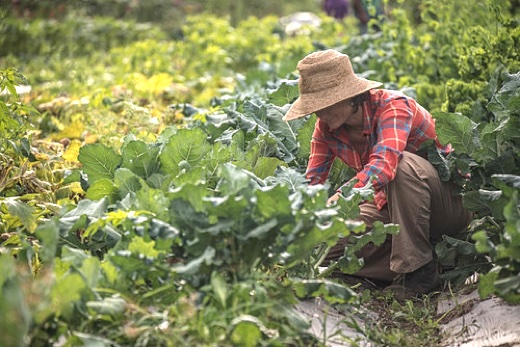
Image above: A woman farming. From  original article.

From backyards, abandoned urban spaces, rural properties, and farmland, women around the world, are leading a change that nourishes the soil, encourages biodiversity, safe-guards the seeds, and teaches the children.

This movement continues to gain power through the women who are changing the future of food. Their hardwork, re-skilling and activism is what the world has been waiting for.
Women Who Farm seeks to share these stories.

This project establishes itself as an online media project, and as a book that follows the stories of 15 women across Canada and the United States. The book is still in its infancy stage, while the online project is now underway.

Women Who Farm seeks to celebrate women, through it’s multiple platforms in order to create a new narrative of perserverance, skill and leadership. These stories can inspire both women and men, towards a more ecological and diverse food system which in turn will bring about a more socially just and biodiverse world.

As Vandana Shiva, an agricultural activist says, “We are either going to have a future where women lead the way to make peace with the earth, or we are not going to have a human future at all.”

Are you a woman dedicated to small-scale agriculture, homesteading, gardening, market farming, or raising animals in an ethical way?  Be apart of Women Who Farm! We seek to celebrate women who are leading the local food movement.

To be featured on the Women Who Farm Facebook page send in a photo of yourself on your farm, or in your garden, etc. and we will send you a question. Once we receive your reply, we will feature you on our social media channels. We will post your photo with your engaging quote and give credit to you and your farm.

Do you want to write for Women Who Farm?  We are seeking to publish articles through our online platform connected with Over Grow The System. We will also share your article on the Women Who Farm social media sites.

One last easy way to be apart of Women Who Farm: Tag yourself #womenwhofarm and connect up with us!

Please send all photo’s, submissions and any questions you may have to submissions@womenwhofarm.com

[Her]Story is an online feature of Women Who Farm that empowers and celebrates women around the world. We share the stories of women to inspire a new narrative of empowerment through gardening, homesteading, farming, beekeeping, and seed saving.

This online platform is for you. By sharing your story, you inspire others to create positive change on both the land and in communities throughout the world. By sharing the good work that you and countless women are indebted to, you inspire ripples of positive global change.

Tips & suggestions for your entry:
  • Please give full, in depth replies. Write like you would in an essay.
  • Find someone who can go over and edit your entry before you enter in below.
  • Feel free to advertise the work you are doing, such as your blog or book etc., but don’t let it over shadow the writing. You can advertise at the end of the article the work in which you want to promote.
  • We want to share your story with both the challenges and victories. We are inspired by the real stories of what it means to farm and grow food. It’s not all sunshine and kale, and we are totally inspired by that. Check out some of our Her[Story] features below.
  • After we receive your submission, we will contact you and ask for photographs.  
  • Please send in ten to fifteen high quality images. Images really help with the telling of your story.
  • You don’t have any high quality images? Reach out to your community to see if there is anyone who will take pictures of you and your work.  Some smart phones take good enough quality images that look beautiful. We request that all images are 2000pix wide
  • Please reply to the questions you feel most called to. You do not need to reply to all of them.

My name is Katie Massy. I have been farming since the age of 25. I found my life’s career when I planted the first seeds of early Spring. My first year farming was filled with struggle, but that year of not having a boss, being free on the land, eating amazing food, made me fall in love with being a farmer.

Heart and Soil Organics, run by my partner and I, began when I met a man travelling down from the Haida Gwaii, who urged me to start growing food. With limited access to locally grown food, and most food being shipped in, he was concerned about the Haida Gwaii and noted that Vancouver Island was in a similar situation. It was that day that my partner and I decided to start farming.
We now grow on an acre of land, maybe a little bit more.

Our intention is not to plow more soil, but to grow with better soil, quality seed, and rain harvested water. We spend a lot of time soil building. Each year we harvest enough rain water to irrigate our entire farm for the year.

With the support of our customers it is possible for us to grow food that nourishes both the land and its people. When people take home food we have grown, I feel such happiness in my heart. They have tasted what a real tomato tastes like.

I believe farming is such a perfect vocation for women. It takes real nuturing and attention to grow good food. We don’t need to know how to fix huge tractors, or combines. All we need are some hand tools, determination and a strong back.

I hope that you share your story with me. Together we can change the cultural ideal of what it means to be a woman and celebrate being a farmer. It is a great thing to be a woman who farms.


Video above: "Women Who Farm". Featuring Katie Massy. From original article. (https://vimeo.com/155460216).

.

Women Crossed the Line

SUBHEAD: For world peace these women crossed the DMZ Line from North Korea to South Korea.

By Jon Letman on 24 May 24 for Boing Boing  -
(http://www.islandbreath.org/2015Year/05/150524dmz.jpg)


Image above: A press conference for "Women Call for a Korean Peace Treaty". From original article.

In an historic move, a group of global feminist activists march into the demilitarized zone between North and South Korea to create a space for a new type of conversation about truly ending the Korean war.

At the time of this blog post in Seoul and Pyongyang it’s already Sunday, May 24th, International Women’s Day for Peace and Disarmament, when a group of more than 30 women are scheduled to cross the Demilitarized Zone (DMZ) at Kaesong from North Korea into South Korea. Their goal: to draw attention to Korea’s “forgotten” and unfinished war, and move toward a real peace that can reunite families and, perhaps, a divided nation.

The march includes both North and South Korean women marching on their respective sides, and was preceded by a peace symposium in Pyongyang (watch North Korean TV coverage here). It will be followed by a similar symposium in Seoul after they cross the DMZ (Saturday evening in the U.S.).

The Korean War (officially 1950-53) stands out for its bloody toll. Some 4 million people, mostly civilians, perished. Although a “temporary” cease-fire was signed, the last 62 years have been marked by a protracted cold war defined by ongoing threats by both sides of the DMZ, decades of profligate military spending, and what is effectively a permanent state of near-war and the fear of attack.

The idea to walk from North Korea into South Korea began with a dream that lead organizer Christine Ahn had several years ago. The concept grew after Ahn connected with feminist icon Gloria Steinem who took a public stand in 2011 against the militarization of South Korea’s Jeju island.


Activist and feminist Gloria Steinem (C) speaks at a news conference before the WomenCrossDMZ group leaves for North Korea's capital Pyongyang, at a hotel in Beijing, China, May 19, 2015.  REUTERS/Kim Kyung-Hoon
Image above: Activist and feminist Gloria Steinem (C) speaks at a news conference before the WomenCrossDMZ group leaves for North Korea's capital Pyongyang, at a hotel in Beijing, China, May 19, 2015. REUTERS/Kim Kyung-Hoon. In original article.

The movement evolved into WomenCrossDMZ as Nobel Peace Prize laureates Mairead Maguire of Northern Ireland and Leymah Gbowee of Liberia joined Ahn, Steinem and what has grown to more than 30 women from South Korea, Japan, the US, Britain, Australia--at least 15 countries, in all.

A Different Future
Gwyn Kirk, a founding member of Women for Genuine Security, and one of the DMZ marchers, says WomenCrossDMZ is intended to create a space for a new type of conversation about ending the Korean war once and for all. After more than 60 years of tit-for-tat provocations, costly and dangerous brinksmanship and outright nuclear threats, Kirk says it’s time to create a different future.

That this movement is organized entirely by women is natural, says Kirk, pointing to UN Security Resolution 1325 which reaffirms “the important role of women in the prevention and resolution of conflicts, peace negotiations, peace-building, peacekeeping, humanitarian response and in post-conflict reconstruction…”

As these women mount a brave effort to do what men have failed to achieve (bring peace to the Korean peninsula), they are also receiving criticism for their efforts. One Korea policy commentator went so far as to call the group “naïve, duplicitous, disingenuous, fatuous, and [stupid].”

CNN’s Brian Todd asked if Kim Jong-un was “in league with a women’s group to bring peace between North and South Korea” and played up suggestions Christine Ahn might be “sympathetic” to North Korea. The Monthly Review responded by breaking down why The Situation Room with Wolf Blitzer did a “hatchet job” on WomenCross DMZ rather than a serious examination of what they set out to achieve.


NGO activist Choi Ai-young (R) and other members of the WomenCrossDMZ group pose with Korea's traditional patchwork before the group leaves for North Korea's capital Pyongyang, at a hotel in Beijing, China, May 19, 2015. REUTERS/Kim Kyung-Hoon
Image above: NGO activist Choi Ai-young (R) and other members of the WomenCrossDMZ group pose with Korea's traditional patchwork before the group leaves for North Korea's capital Pyongyang, at a hotel in Beijing, China, May 19, 2015. In original article.
 
Making history
Independent investigative journalist Tim Shorrock had a different take. In an email from Seoul, he called the DMZ march “an important milestone because it runs against the grain of the militarist approach to Korea taken by the Obama administration and the hostility of the South Korean government.”

Shorrock, who has covered Korea and Japan for more than three decades, said the women’s march and symposia held in Pyongyang and later Seoul, sends a message to the North that peace and reconciliation are possible. He hopes the march will also spur the U.S. to “take measures to defuse the tense situation in Korea and adopt a more flexible approach to settling its differences with North Korea.”

Responding to charges that she and her colleagues are “sympathetic” to North Korea, Christine Ahn says it’s ironic that people who claim to be staunch supporters of human rights are the ones most vehemently opposed to efforts to pursue a real peace agreement.

“You’re not going to see any improvement in North Korean human rights if you continue to isolate them or not engage or have dialogue,” Ahn said by Skype. The universal theme that has united years of international NGO reports, she says, is that there needs to be a peace settlement to improve human rights in North Korea.

Crazy repression, crazy militarization
WomenCrossDMZ, Ahn says, seeks to “get to the root cause of the issue of divided families” and what she calls “crazy militarization” and “crazy repression” of democracy in both North and South Korea.

Ahn says former U.S. Ambassador to South Korea James Laney cut to the core of the Korean issue when he said, “...One item should be at the top of the agenda...that is the establishment of a peace treaty to replace the truce that has been in place since 1953...”

To fully appreciate why North Korea has evolved into a “paranoid, hyper-militaristic society,” Ahn says it’s important to carefully examine history before the 1950-53 Korean war and remember the tremendous losses suffered by the North. “We might have forgotten that history,” she says, “but [North Korea] hasn’t.”

Ahn describes WomenCrossDMZ as “peace women” who want to find a peaceful resolution to the Korean stalemate. To do that, she says, requires listening, understanding, dialogue and a degree of empathy which is absent today. Dehumanizing the other side won’t bring peace, Ahn says. “It’s a tough place to be, but I really believe there is no other alternative.”

Being armed to the teeth (hasn’t worked) 
Gwyn Kirk says that reducing military tensions is more likely to lead to better human rights conditions. “That’s what we’re advocating...more dialogue and more openness.” As long as there’s no dialogue or engagement, nothing will change.”

Kirk points to diplomatic progress between the United States and both Cuba and Iran, saying that “sanctions, being armed to the teeth [and] militarism hasn’t worked.” 
She adds, “So if that’s controversial, I guess [it’s] controversial but it just seems to me that this old cold war stuff is really history...We need to move forward and think differently.

Follow the organization on Twitter or Facebook. Link to announcement from “Women Cross DMZ” (PDF)
Photo, top: Members of the WomenCrossDMZ group attend a news conference before they leave for North Korea's capital Pyongyang, at a hotel in Beijing, China, May 19, 2015. REUTERS/KIM KYUNG-HOON

Jon Letman is an independent freelance journalist and photographer on the Hawaiian island of Kauai. His articles on conservation, the environment, politics and the Asia-Pacific region have been published in Al Jazeera English, Truthout, Inter Press Service, Christian Science Monitor, CNN Traveller, as well as publications in Finland, Iceland, Russia, Japan, Canada, the UK and across the US.  

.

Roots of Wonder Woman

SUBHEAD: She emerged from the feminist movements of women’s suffrage, birth control, and the fight for equality.

By Christopher Zumski Finke on 10 December 2014 for Yes -
(http://www.yesmagazine.org/happiness/everything-you-need-to-know-about-the-radical-roots-of-wonder-woman)


Image above: An image of Wonder Woman in her 1940's style. From (http://www.soundonsight.org/the-entire-1940s-wonder-woman-comics-available-for-the-first-time-ever/).

All these things are true about Wonder Woman: She is a national treasure that the Smithsonian Institution named among its 101 Objects that Made America; she is a '70s feminist icon; she is the product of a polyamorous household that participated in a sex cult.

Harvard historian Jill Lepore claims in her new book, The Secret History of Wonder Woman, that Wonder Woman is the “missing link in a chain of events that begins with the women’s suffrage campaigns of the 1910s and ends with the troubled place of feminism fully a century later.”

The hero and her alter ego, Diana Prince, were the products of the tumultuous women’s rights movements of the early 20th century. Here are 10 essential elements to understanding the history and legacy of Wonder Woman and the family from which she sprung.

Wonder Woman first appeared in Sensation Comics #1 in December 1941.

Since that issue arrived 73 years ago, Wonder Woman has been in constant publication, making her the third longest running superhero in history, behind Superman (introduced June 1938) and Batman (introduced May 1939).

Wonder Woman’s creator had a secret identity.

Superheroes always have secret identities. So too did the man behind Wonder Woman. His name upon publication was Charles Moulton, but that was a pseudonym. It was after two years of popularity and success that the author revealed his identity: then-famous psychologist William Moulton Marston, who also invented the lie detector test.

William Moulton Marston was, as Jill Lepore tells it, an “awesomely cocky” psychologist and huckster from Massachusetts. He was also committed to the feminist causes he grew up around.

By 1941, Marston’s image of the iconic feminist of the future was already a throwback to his youth. He saw the celebrated British suffragist Emmeline Pankhurst speak in Harvard Square (she was banned from speaking at Harvard University) in 1911, and from then on imagined the future of civilization as one destined for female rule.

Actually, the whole Marston family had a secret identity.

The Marston family was an unconventional home, full of radical politics and feminism. Marston lived with multiple women, including his wife, Sadie Elizabeth Holloway, a highly educated psychologist, and another lifelong partner, a writer named Olive Byrne, who was the niece of birth control activist Margaret Sanger. He had four children, two by each of the women, and they all grew up oblivious to the polyamorous nature of their parents’ relationships.

Marston, Holloway, and Byrne all contributed to Wonder Woman’s creation, a character that Marston explicitly designed to show the necessity of equality and advancement of women’s rights.

Wonder Woman was an Amazon molded from clay, but she was birthed out of feminism.

Princess Diana of Themyscira, or Diana Prince (Wonder Woman’s alter ego), comes from the land of the Amazons. In Greek mythology, the Amazons are an immortal race of beauties that live apart from men. In the origin story of Wonder Woman, Diana is daughter of the queen of the Amazons. She’s from Paradise Island (Paradise is the land where no men live), where Queen Hyppolita carves her daughter out of clay. She has no father.

She comes out of the feminist movements of women’s suffrage, birth control, and the fight for equality. When Marston was working with DC Comics editor Sheldon Mayer on the origins of Wonder Woman, Marston left no room for interpretation about what he wanted from his heroine.

“About the story’s feminism,” historian Lepore writes, “he was unmovable. ‘Let that theme alone,’ Marston said, ‘or drop the project.’”

Wonder Woman fought for the people—all the people.

The injustices that moved Wonder Woman to action did not just take place in the world of fantasy heroes and villains, nor was she only about women’s rights. She also fought for the rights of children, workers, and farmers.

In a 1942 issue of Sensation Comics, Wonder Woman targets the International Milk Company, which she has learned has been overcharging for milk, leading to the undernourishment of children. According to Lepore, the story came right out of a Hearst newspaper headline about “milk crooks” creating a “milk trust” to raise the price of milk, profiteering on the backs of American babies.

For the Wonder Woman story, Marston attributed the source of this crime to Nazi Germany. But the action Wonder Woman takes is the same as the real-life solution: She leads a march of women and men in “a gigantic demonstration against the milk racket.”

There’s a whole lot of bondage in Wonder Woman.

In the years that Marston was writing Wonder Woman, bondage was everywhere. “In episode after episode,” Lepore writes, “Wonder Woman is chained, bound, gagged, lassoed, tied, fettered, and manacled.” Even Wonder Woman herself expressed exhaustion at the over-use of being bound: “Great girdle of Aphrodite! Am I tired of being tied up!” she says.

There’s little doubt that the sexual proclivities of the Marston family were in part responsible for this interest. A woman named Marjorie Wilkes Huntley was part of the Marston household—an “aunt” for the children, who shared the family home (and bedroom) when she was in town. Huntley was fond of bondage.

The theme was so persistent that an Army sergeant who was fond of the erotic images wrote to Marston asking where he could purchase some of the bondage implements used in the book. After that, DC Comics told Marston to cut back on the BDSM.

But that bondage was not all about sex.

The bondage themes in Wonder Woman are more complex than just a polyamorous fetish, though. Women in bondage was an iconic image of the suffrage and feminist movements, as women attempted to loosen the chains that bound them in society. Cartoonist and artist Lou Rogers drew many women in bonds, and Margaret Sanger appeared before a crowd bound at the mouth to protest the censorship of women in America.

Later, Margaret Sanger’s Birth Control Review would use a similar motif. One cover image had a woman chained to the weight of unwanted babies.

Readers—boys and girls—loved Wonder Woman.

Despite the political and secretive history of Wonder Woman’s creation, she was a wildly popular character. After Wonder Woman’s early success, DC Comics considered adding her to the roster of the Justice Society, which included Batman and Superman and many other male superheroes. Charlie Gaines, who ran DC Comics, decided to conduct a reader poll, asking, “Should Wonder Woman be allowed, even though a woman, to become a member of the justice society?”

Readers returned 1,801 surveys. Among boys, 1,265 said yes, 197 said no; among girls, 333 said yes, and only 6 said no.

But Justice Society was not written by feminist Marston. After Wonder Woman was brought into the Justice Society, she spent her first episodes working as the secretary.

The feminist spirit of Wonder Woman waned for decades.

After the death of William Moulton Marston in 1947, DC Comics took the feminism out of Wonder Woman and created instead a timid and uninspiring female character. “Wonder Woman lived on,” Lepore writes, “but she was barely recognizable.”

The first cover not drawn by the original artist, Harry G. Peter, “featured Steve Trevor [Wonder Woman’s heretofore hapless love interest] carrying a smiling, daffy, helpless Wonder Woman over a stream. Instead of her badass, kinky red boots, she wears dainty yellow ballerina slippers,” Lepore observes. Without her radical edge, Wonder Woman’s popularity waned until the rise of second wave feminism in the '60s and '70s, when Wonder Woman was trumpeted as an icon of women’s empowerment.

Wonder Woman became president.

In a 1943 story, Wonder Woman is actually elected President of the United States. Marston was adamant that a women would one day rule the United States, and that the world would be better when civilization’s power structures were in the hands of women instead of men.

Wonder Woman’s popularity soared as the feminist movement picked up in the late 1960s. Wonder Woman appeared on the first issue of Ms. Magazine, in 1972, with the headline “Wonder Woman for President.” At that time, Gloria Steinem said of Wonder Woman, “Looking back now at these Wonder Woman stories from the '40s, I am amazed by the strength of their feminist message.”

The impact of Wonder Woman continues.

Wonder Woman is in for a great couple of years. Ms. Magazine just celebrated its 40th anniversary, and Wonder Woman is back on its cover. Jill Lepore’s book has been getting wonderful coverage (see her on The Colbert Report below discussing the kinks of the Marston Family), and Noah Berlatsky’s Wonder Woman: Feminism and Bondage in the Marston/Peter Comics will be published in January.

She’s also gearing up for her first-ever theatrical film appearance: Wonder Woman will appear in Zack Snyder’s 2016 film Batman vs. Superman: Dawn of Justice. In 2017, she will be the star of her own film, to be directed by Michelle McClaren (Breaking Bad, The Walking Dead). Wonder Woman will be played by the Israeli actress Gal Gadot.

Let us hope that Gadot in the role conjures the spirit of the original creation of Marston, Holloway, and Byrne: a radical, independent, fierce woman and leader for all women and men to admire.


Video above: From (http://youtu.be/KnAhu-yU8Os).


.

Feminism Pre and Post Collapse

SUBHEAD: A response to Dmitry Orlov on gender, collapse & communities we can all abide.

By Katherine Acosta on 18 September 2013 for the Smirking Chimp -
(http://www.smirkingchimp.com/thread/katherine-acosta/51695/on-gender-collapse-communities-we-can-all-abide-part-ii)
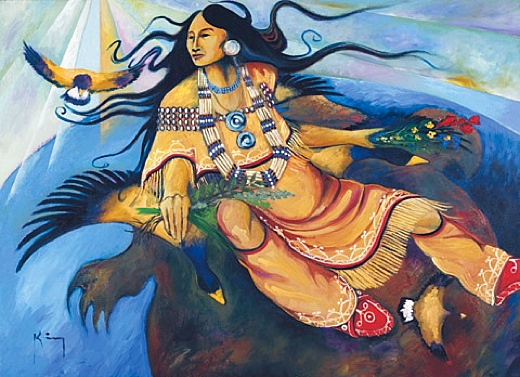

Image above: "Skywoman" by Haudenosaunee Oneida member Bruce King. From (http://www.esf.edu/nativepeoples/).

Writing, blogging, and “prepping” for collapse has become a cottage industry over the last ten years.

The proliferation of websites, books, articles, and conferences devoted to analysis and speculation about what will happen, learning to grow and preserve food and other survival skills, and storing up supplies, are based on the well-founded fears that inter-connected systems of finance and fossil-fueled industry are heading for implosion and that the environment will become unstable, less habitable and less able to sustain the billions straining the earth’s carrying capacity.

 At the heart of all this activity is the concern: How will we be able to protect and sustain our families and others we love in drastically altered conditions?

Dmitry Orlov, a prominent writer on collapse, now weighs in with a preliminary analysis of “communities that abide”. Orlov has written several books on collapse, including Reinventing Collapse, which compares the collapse of the former Soviet Union with the impending collapse of the United States, and The Five Stages of Collapse.

Turning now to writing about small, self-sufficient societies, he aims to identify some commonalities, or a set of “best practices,” that may be adapted for small-scale post-collapse communities. His goal, he wrote on his blog,
is to give individuals, families and small groups of people (of modest means) viable options for the future that they otherwise wouldn't know existed—options which they will be able to exercise separately from what remains of American society. And the nature of these options will be dictated in large measure by the nature of the conditions that will prevail in as little as a couple of decades.
In late May, he gave a talk on his work at the Age of Limits conference and in subsequent months elaborated on his ideas in a series of posts on his blog. The talk didn’t quite goes as planned, however, provoking what he later described on his blog as a “shit storm” where “feminist rhetoric flew fast and furious” in the Q & A following his presentation.

It seems that all his examples of “communities that abide” were patriarchal and some women in the audience questioned his work. In Part I of this two-part essay, I reviewed the incident and his post-conference response to it. In this second part of my essay, I examine the content of his work on “communities that abide” and provide an alternative model.

Over the course of six posts published on his blog in the weeks following the Age of Limits conference (links below), Orlov discusses three examples of “communities that abide;” the Dukhobor of Canada, the Roma (sometimes called Gypsies), and the Hutterites. (I could not find a transcript or video of his presentation at the conference.)

The essays are rambling and muddled, making it unclear exactly what the criteria were for selecting communities to include in his study and which of the “commonalities” he observed among these communities emerged from his analysis.

One explicit, though non-specific, criterion is endurance – communities that “have been around for awhile – a century at least.” Self-sufficiency – meaning that the society provides for all its members’ needs like housing, nutrition, education, and so on - also appears to be a criterion for inclusion in the study.

Less clear is whether two organizing principles Orlov identifies as important for success, “communist organization of production and communist organization of consumption,” were criteria for inclusion in his study or emerged from the data after he selected his study groups.

Most confusing of all, in Part II Orlov presents a list of characteristics that “winners in the game of survival” are likely to have based on their “commonalities.” How exactly a “commonality” is distinguished from an item on this list, and whether this list is a prediction of what Orlov expects to find, or has identified based on his study group, is unclear.

The list describes communities that are autonomous, separatist, based on a strong ideology which they refuse to question or debate, speak their own languages or dialects, are distrustful of outsiders, nomadic, pacifist, “anarchic in their patterns of self-governance – neither patriarchal nor matriarchal,” and have high birth rates and communist “patterns of production and consumption.”

Reading Orlov, it becomes clear that that his primary interests are collective ownership and management of resources and anarchic forms of social organization. So it’s worth stating here that, broadly speaking, anarchism is characterized by lack of a ruler or a ruling hierarchy, by direct democracy, and by mutual aid. This latter idea was developed by the 19th century Russian anarchist Peter Kropotkin, who argued that mutual aid, rather than competition, was the key to evolutionary advancement of a species.

The most striking example of mutual aid Orlov describes involves the Dukhobor of Canada. Orlov reports that this pacifist group fled “Russia for the US, then the US for Canada, to avoid conscription.” (He doesn’t say when this happened, but a quick fact check reveals that they arrived in Canada in 1899, and that their pacifism stemmed from their religious beliefs.)

Orlov quotes from Peter Kropotkin’s Mutual Aid to describe how, having arrived penniless and therefore unable to buy draft animals, “their women would hitch up to the plough 20 or 30 at a time, while the middle-aged men worked on the railroad, giving up their earnings to the commune… [A]fter seven or eight years all 6000 or 7000 Dukhobors achieved a level of well-being.”

Although families lived in individual cabins, their land and buildings were held in common. Orlov provides no information about their internal decision-making processes or self-government, but it is hard to imagine that women capable of pulling a plow – and making that level of economic contribution to the group - didn’t manage to have their voices heard.

Contemporary Dukhobor no longer live and work communally and their population is aging. Fact-checking independent of Orlov indicates that in 2001, 28% of Dukhobors were over 65, compared with 12% of the entire population of Canada.

The second group considered by Orlov in his series on “Communities That Abide” is the Roma. This group also engages in collective labor and property ownership. The Roma, he writes:
will contract to do work as work groups (called kumpania) but never as individuals, and all the earnings are given to the Rom baro who is the self-appointed leader with the responsibility for distributing these earnings according to merit and need. This system is extended to every other type of good that is taken in from the outside.
They must have some private property, however, because Orlov also states that “the Roma all unconditionally pledge a large part of their private property to the common cause, in order to support an extensive system of mutual self-help.” Orlov doesn’t give specific information about the kinds of property that are held in common or those that individuals or families are allowed to hold privately.

Nevertheless, the Roma seek to avoid accumulating wealth and thus the “temptation to re-privatize,” according to Orlov. One way is by “burn[ing] through fantastic sums of money by throwing lavish wedding feasts that last three days.”

The Roma are a diverse people with groups in many countries throughout the world, so it is difficult to make generalizations about them. Some adopt the religion of the countries in which they live, some are no longer nomadic, some Romani groups arrange marriages and others allow young people to choose their mates.

They are generally considered to be a patriarchal culture. Virginity prior to marriage is prized in girls and bride-kidnapping to avoid paying a bride price has been reported among Romani in several countries. Though they appear to practice a degree of collectivism and mutual aid, Orlov presents no information about their decision-making processes.

The third group, and the one Orlov defines as a “success,” are the Hutterites. This group is a branch of the Anabaptists who fled religious persecution in Europe and eventually settled in Canada and the United States. Again, Orlov provides no dates, but apparently they arrived in North America between 1874 and 1879. According to Orlov, the Hutterites practice the doctrine of “everything in common.”
They live in communal houses where each family has a separate room or apartment, but children over a certain age go and live in the Kinderhaus. They take their meals together in a separate communal kitchen and dining hall.
Orlov praises their high fertility, but in fact, their birth rates have been declining for at least half a century. In 1954 they averaged about 10 children per family; by 2010 this had dropped to fewer than five.

Orlov describes the Hutterites as “entirely anarchic” because, while some leaders are elected, “all lines of authority really proceed from the full meeting of the commune, which tends to rule by consensus.” At the same time, he admits that:
[T]heir notion of gender roles is strictly 16th century. The women have no voice (except in prevailing on their husbands) and no opportunity to compete with men. They take their meals at a separate table from the men (the children have a table of their own). It's tempting for some to call the Hutterites patriarchal, except that they have no archon (Greek for “ruler”) and exhibit no hierarchy. Instead, there is gender dimorphism, which exists in many species, human species included.
This is truly pretzel-bending logic. If the women have no say, and the men elect leaders and make other decisions among themselves, then is not one sex ruled over by the other? Here Orlov parts ways with the 19th century Russian anarchist Mikhail Bakunin who saw equal rights for women and men as central to the anarchist project. Emma Goldman, another 19th century Russian anarchist – and feminist - would certainly have derided Orlov’s claim that Hutterite governance is “anarchic.”

Orlov’s work thus far on “communities that abide” suffers from severe limitations. His selection of communities to study is unsystematic. Aside from endurance and self-sufficiency, he fails to distinguish which “commonalities” he discusses were criteria for inclusion in the study and which emerged as a result of his analysis.

He provides insufficient detail about the internal workings of these communities to enable identification of “best practices.” In particular, he fails to make his case that the examples he presents are “anarchic in… self governance – neither patriarchal nor matriarchal.”

He describes decision-making processes for only one of his three examples, and that one he admits excludes women. Clearly, Orlov needs to go back to the drawing board on this one.

Orlov insists that his aim in studying “communities that abide” is not to advocate any particular type of social organization. He’s merely a messenger, describing ones that;
are uniquely successful in terms of their longevity and outcomes… Please draw your own conclusions. You can run off and join them or damn them all to hell. But please leave me out of it.
But are Orlov’s examples the best that can be found among a dearth of “communities that abide” without large bureaucratic governments and systems, provide for all their members’ needs, and survive hard times? Is Orlov correct in his assertions that such communities “tend to be conservative” with regard to gender relations and that communities based on progressive principles usually do not “outlast the generation of their founders?”

The answer is an unqualified “no.” There are indeed matrilineal societies that have “abided” for centuries, fed, housed, nurtured, and protected their members through good times and bad – and that allowed all members, women and men, a say in decision-making for their communities. They are also, as Orlov wrote of his examples, found right here in North America.

Many of the largest Indian tribes in what is now the United States, including the Navaho, the Cherokee, and the Haudenosaunee (Iroquois), are matrilineal societies. (The Six Nations of the Haudenosaunee include the Mohawk, Oneida, Onondaga, Cayuga, Seneca, and Tuscarora nations.)

Recall that an audience member asked Orlov at his talk whether he could find examples of matrilineal societies and Orlov responded that matriarchal societies were rare; they were outliers. It is true that there is no strong evidence in the historical record of matriarchal societies – the inverse of patriarchy – where women rule over men.

But there are many examples of matrilineal societies. Strictly speaking, matrilineal means that lineage is traced through the mother rather than the father. However, many matrilineal societies are characterized by shared power arrangements among women and men. This is true of the Navajo, the Cherokee, and the Haudenosaunee.

Among the Haudenosaunee, women collectively owned and farmed the land. The men cleared new fields and were hunters and warriors. The men also served as chiefs but the clan mothers nominated the chiefs and could remove a bad one.

A contemporary Onondaga clan mother told researcher Sally Roesch Wagner that the “unbroken custom” for nominating chiefs to represent their clans in the Grand Council excludes men who have committed murder or theft, or who have sexually assaulted a woman.

Haudenosaunee means “people of the longhouses.” Extended family groups lived in these longhouses, with young couples joining one of their mothers’ households after marriage.(1) Children were cared for by the extended family group, with young boys trained by their uncles to hunt and fight.

Among the Seneca (the largest of the Six Nations), the women distributed the communally-owned land according to household size and each year elected a woman to organize the work. According to Jensen:
Sick and injured members of these mutual aid societies had a right to assistance in planting and harvesting; and after hoeing the owner of each parcel of land would provide a feast for all the women workers. (2)
Mary Jemisen, an 18th century Irish woman who was captured by the Seneca and lived with them for decades, reported that the work of Seneca women “was less onerous than that of White women… [T]hey had no drivers or overseers and worked in the fields as leisurely as they wished with their children beside them.”(3)

Seneca and other Haudenosaunee women were free to divorce husbands who were absent too long or failed to do their share of providing for the family. A former Adjutant General for Massachusetts, Henry Dearborn, noted in his journal (1904) that Seneca women enjoyed “perfect equality,” with their husbands. They influenced and advised their men and were well-treated in return. Dearborn wrote, “She lives with him from love for she can obtain her own means of support better than he can.”(4)

Traditional Haudenosaunee exhibit many of the “commonalities” Orlov argues are characteristic of “communities that abide.” They collectively owned and managed the resources of the group and collectively organized production.

They had systems of mutual aid such as the obligation to help the sick and injured to work their parcels of land. They are more genuinely anarchic in social organization than any of the groups Orlov describes because women as well as men participate in decision-making processes for the community.

Unlike the groups Orlov describes, the Haudenosaunee are not pacifist; they fiercely defended their land and customs. However, they value nonviolence within their communities – unlike some of the groups Orlov mentioned in his Age of Limits talk. (See Part I here.) Men who have sexually abused women are ineligible to serve as chiefs and violence against women generally is taboo.

Jesuit visitors in the 17th century reported that “Seneca women showed extraordinary affection for their children… and children had great respect for their parents.”(5)

The superior status of Haudenosaunee women relative to their American counterparts was a major source of inspiration for 19th century feminists”. Recall that in the 19th century, American women could not vote and married women were “legally dead,” meaning they could not sign contracts and had no right to own property or to their own earnings. It was legal for men to beat their wives and women who attempted to leave could be brought back by the police. Divorce was not an option.

Feminist historian Sally Roesch Wagner spent 20 years studying the work of early women’s rights activists, including Lucretia Mott, Matilda Joslyn Gage, and Elizabeth Cady Stanton.

All three had personal experience with the Haudenosaunee that influenced their activism. Mott, after spending a month in 1848 observing Seneca women participate in decision-making as the Seneca reorganized their governance, had her;
feminist vision fired by that experience… [She] traveled that July from the Seneca nation to nearby Seneca Falls, where she and [Elizabeth Cady] Stanton held the world’s first women’s rights convention.
Gage, who published a series of articles in 1875 about the Haudenosaunee in the New York Evening Post, including the observation that “division of power between the sexes in its Indian republic was nearly equal,” had an even more dramatic experience:
Shortly after Matilda Joslyn Gage was arrested in 1893 at her home in New York for the "crime" of trying to vote in a school board election, she was adopted into the Wolf clan of the Mohawk nation and given the name Karonienhawi (Sky Carrier). In the Mohawk nation, women alone had the authority to nominate the chief, after counseling with all the people of the clan.
Stanton, who studied the law with her father, was impressed with the power of Haudenosaunee women to terminate bad marriages.
"No matter how many children or whatever goods he might have in the house," Stanton informed the National Council of Women convention in 1891, the "luckless husband or lover who was too shiftless to do his share of the providing" in an Iroquois marriage "might at any time be ordered to pick up his blanket and budge; and after such an order it would not be healthful for him to attempt to disobey."
Stanton, who was born in 1815, refused to promise to obey her husband in her marriage vows, bore seven children, the youngest when she was 44 years old, and lived to the ripe old age of 86. "According to Wagner:
When called a “savage”… for practicing natural childbirth, Stanton rebutted her critics by mocking their use of the word, pointing out that Indian women "do not suffer" giving birth -- thus it was absurd to suppose "that only enlightened Christian women are cursed" by painful, difficult childbirth.
Some prominent Haudenosaunee men supported the cause of the American feminists and rebuked American men for their treatment of women. Wagner reports that:
[Ethnographer Alice] Fletcher… quoted an Indian man who reproached white men: "Your laws show how little your men care for their women. The wife is nothing of herself." He was not alone in chastising white men for their domination of women.

A Tuscarora chief, Elia Johnson, writing about the absence of rape among Iroquois men in his popular 1881 book,
Legends, Traditions and Laws, of the Iroquois, or Six Nations... commented wryly that European men had held the same respect for women "until they became civilized".

A Cayuga chief, Dr. Peter Wilson, addressing the New York Historical Society in 1866, encouraged white men to use the occasion of Southern reconstruction to establish universal suffrage, "even of the women, as in his nation."
There is a pernicious thread in the discourse on collapse that goes something like this: The gains American women made in the 20th century were “frills” made possible by industrial society. Once TSHTF (The Shit Hits the Fan), men and women will revert to their pre-industrial roles and statuses.

Women will be consumed with child-bearing and rearing and household tasks and will therefore have little time for anything else. The chaos and lawlessness that is expected to result from collapse means women will also need male protection from rape and violence.

The implication is that, in exchange for protection, women will naturally submit to some degree of male authority – or what a feminist wit once called, the “protection racket.” These are merely the facts, we are told, and women who object are just not being rational. Those who don’t get with the program may be left behind when times get tough. Per Orlov:
It will be a thorough regression to baseline, which will be hard on people who are used to the idea of endless progress… Many of them will no doubt insist on making a stand for their hard-won social victories, and this, in turn, will make them a poor choice as crew to take along on this journey.
But Orlov is not the first or only writer on collapse to express this point-of-view. James Kunstler has been propagating these ideas for years, both in his nonfiction books, such as The Long Emergency (2005), and in his novels. In the former he wrote that

Reestablished traditional divisions of labor may undo many of the putative victories of the feminist revolution. In the context of new circumstances, these altered relations will come to seem normal and inevitable (p304).

In 2010, at a conference in Colorado, Kunstler apparently came unglued when critiques of his portrayals of women in his novels were read. Several attendees reported his response to Sharon Astyk, one of his literary critics: 
“Fuck those motherfuckers!” When he was finally at the podium he began with, “I’m going to address the woman thing right up front. I’m appalled that educated, intelligent women of the boomer generation are so incapable of imagining a world where a completely different economic status has evaporated the gains of women. You need to get over it.”
 
In July of this year, he returned to this theme in an essay entitled “Reality Does Not Have An Ideology," where he again addressed criticism of his novels:
High and low, far and wide, women denounced my book in formal reviews and casual emails…. It seemed self-evident to me that a lot of this achievement [of feminism] was provisional, depending on larger macro historical trends. That idea alone was greeted… by the sharpest opprobrium, since it was assumed that the political victories of recent decades have become permanent installations of the human condition. I recognize that, as a principle of politics, privileges and rights attained are rarely given up without a fight. But I wondered at the failure of imagination I was witnessing, especially among educated women readers.
The real “failure of imagination” is among people like Orlov and Kunstler who cannot envision post-collapse gender relations different from those derived from Euro-American culture culminating in the 19th century. It also reveals ignorance of history and cultures different from one’s own. The subordination of women characteristic of pre-industrial America is neither natural nor inevitable as the Haudenosaunee example has shown.

Pre-industrial Haudenosaunee women enjoyed status on a par with the men of their culture. They (collectively) owned their means of subsistence and had a powerful role in the governance of their community. Strong cultural sanctions, rather than submission to male authority, protected them against rape and violence.

Certainly, gender roles among the Haudenosaunee were strictly defined. A little girl who wanted to be a warrior or a boy who wanted to farm was unlikely to get their wishes. But one gender was not assigned a lower status relative to the other.

Though gender roles may come to be seen as “natural” they are always to some degree socially constructed – that is, determined by the society itself. To 18th century Americans, it was “unnatural” for Haudenosaunee women to farm and their men to “‘play’ with bows and arrows.”(6)

After conquest, missionaries moved in on the Haudenosaunee, determined to force them into their “proper” gender roles. For women, that meant spinning and sewing; for men, farming like American men. One Quaker woman spent most of her life, half a century, at this task, but never made much headway.(7)

In October 2012, I wrote a warmly favorable piece in response to Orlov’s article “In Praise of Anarchy.” I was inspired by the idea that, although political and economic collapse will produce pain and disruption for many, it also presents an opportunity to build something better. I wrote:
The decline of industrial society and impending collapse of global capitalism is, and will continue to, produce social dislocation and misery, but this rupture with the past also creates the space to build something new; perhaps something more equitable? More freeing? More caring? After all, industrial society produced its own forms of misery: boredom, conformity, stifling of creativity, and alienation to name a few.
So Orlov’s reactionary turn with his patriarchal examples of “best practices” and his ferocious attack on the women who dared to question him is deeply troubling. It betrays the egalitarian ideals of anarchism, a philosophy he claimed to praise.

But Orlov’s views are just that; his opinions. He has not made his case and his vision is not inevitable, nor even probable, in my view. Those of us who can envision something better, most women and men, will work to build it. As for Orlov, and his latest work on “communities that abide,” I wonder, have we reached peak kollapsnik?

Links to Orlov’s articles on Communities that Abide:Communities that Abide--Preamble
(Preamble contains Orlov’s rant against his critics)
Communities that Abide--Part II
Communities that Abide –Part III
Communities that Abide- Part IV

What Comes First?
1)Jensen, Joan M. “Native American
Women and Agriculture: A Seneca
Case Study.” Pp 70-84 in
Unequal Sisters: A Multi-
Cultural Reader in US Women’s
History.
Second edition.
New York: Routledge, 1994.
2)Ibid, p72.
3)Ibid.
4)Ibid, p76.
5)Ibid, p71.
6)Ibid, p74.
7)Ibid, p80.

Katherine M Acosta is a freelance writer currently based in Madison, Wisconsin. She may be contacted at kacosta at undisciplinedphd dot com.

.

Harnessing the Future

SUBHEAD: The story of a young woman tilling the soil with horse and ox.

By Donna McClurkan on 12 Spetember 2013 for Second Wave Media -
(http://swmichigan.secondwavemedia.com/features/tillingtheearthwithoxenandhorses0912.aspx)


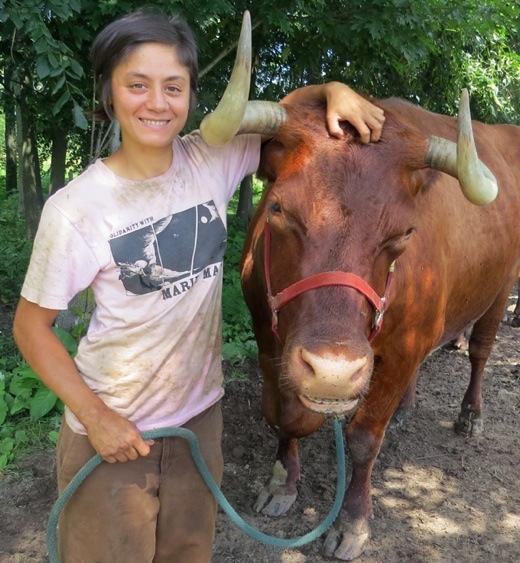
Image above: Gina Wertz plows her field with help of a friend and draft horses Prince and Bob. From original article. Photo by Donna McClurkan.

The word "teamster" carries meanings both modern and ancient. In current day usage, we associate the term with truck drivers moving freight, fuel, and food across the continent. Originally, a teamster was someone who drove a team of draft animals--typically horses, oxen and mules--to transport heavy loads by cart and for agricultural tillage. This practice dates back to 3000 B.C., originating in Mesopotamia (Iraq), Turkey and Egypt.

Gina Wertz is a horse and ox teamster. Her animal-powered market vegetables and herbs are grown at Under the Stone Garden on the grounds of Tillers International, a Kalamazoo County working farm and learning center dedicated to the preservation and training of inexpensive methods of food production in rural areas around the world.

Gina’s operation is part of Tillers’ farmer incubation program, and she's one of 456,000 "beginning farmers" defined by the United States Department of Agriculture (USDA) as having less than a decade of experience, many of whom are choosing to leave established careers to live a hands-on life. It can be a tough row to hoe, literally, given the staggering costs of land and capital for equipment, intense physical labor requirements, and a host of uncontrollable variables such as market volatility and climate variability.

What would compel a young woman to choose farming, and why "revert" to animal power?

Very early on a recent muggy morning, the temperature inching toward a triple digit heat index, her story unfolds over coffee in the Cook’s Mill Learning Center high on the grounds of Tillers’ 430 acre farm and pasture. Schooled in social work, Gina found her way to farming in 2008 after reading The Party’s Over, Richard Heinberg’s portent of epic proportions: modern industrial societies are completely dependent on finite fossil fuel-based resources, the inevitable and dwindling supply of which is having increasingly catastrophic, global economic and political consequences. She finished the book a week before the collapse of Fanny Mae, and resolved to become more self-reliant by growing her own food, starting with apprenticeships on sustainable farms in Maine and Indiana.

Ken Lamson of New Beat Farm in Maine was Gina’s first animal power mentor, and the experience was profound and transformative. "As I learned to understand horses," Gina says, "it was deeply satisfying to develop the focus, discipline and attentiveness required to manage the land with these animals."

As for risk, "yes, it can be dangerous for the teamster, the horses and anyone in the vicinity of the soil being plowed and cultivated. Horses evolved to flee if they feel threatened, even if they’re attached to heavy equipment."

She pauses a moment, then describes a traumatic, close call in which her two horse team suddenly broke into a full-on sprint and would not stop. They were attached to an eight-foot-wide double (2 row) gang disk. In those few terrifying moments, she imagined getting sucked under and dragged behind the heavy, steel equipment.  She dropped the lines and dove off. Ken jumped in front of the rearing, horses and grabbed their bridles to regain control. The next two months were spent getting comfortable around the horse team before draft animal training resumed. Today, Gina knows there is still much to learn but she’s confident and eager to demonstrate her skills.

En route to a remote pasture where the Belgian draft horses, Prince and Tom, are grazing, we survey the vast green landscape, a fine mist hovering in distant low lying areas. We are enveloped in a profusion of sweet, earthy balance. An open barn rafter window reveals hay stacked for winter. All manner of poultry--chickens, roosters, ducks, turkeys and guinea hens--coo and caw, hunt and peck adjacent to the intern’s lush, productive garden. Sheep and goats lounge in shade. A donkey is taking a dust bath. Interns and other workers start their chores; one pauses to check his smart phone. Scattered about are many animal-powered rustic implements. This rich and agriculturally diverse, peaceful place is steeped in contrasts: modern and ancient.

Gina leads Prince and Tom from pasture to watering station to grooming area where they are brushed, harnessed and hitched to an implement for working the soil. This ritual is repeated every time, Gina says, for consistency and to strengthen the bond between human and animal. Honoring animals as partners on the farm and fostering trust ensures their willingness to work under the safest possible conditions. With assistance from 15-year-old helper, Jehra Smith, Gina deftly directs Prince and Tom in the creation of a furrow at the far west end of the garden into which beets and carrots will soon be planted.


Image above: Gina Wertz poses with her grinning ox Herschel. Photo by Donna McClurkan.

I return in a few days to photograph Gina with the oxen. Five gentle giants parading in from pasture lumber past me toward a galvanized drinking trough. One stops to inspect my outstretched hand, snorts, and resumes his journey. It’s both terrifying and exhilarating to be in close proximity to these beasts weighing in at 2000 pounds and more.

Two oxen, Herschel and Walker, are led to the grooming station where they are brushed and placed in a neck yoke. Great, horned heads sway and nod away flies. I open gates and close them behind us along the way to the garden, where Herschel and Walker are hitched to a bright red culti-mulcher with rollers and teeth used to break up the soil.  Teamster Gina stays within view of the oxen, walking and commanding "Get up" (go), "Whoa" (stop), "Gee"(turn right), and "Haw" (turn left).  A new plot is tilled.

I leave Gina’s garden thinking how much easier it would be to mount a tractor, turn a key and just go … and knowing easy isn’t the objective.

A book by Richard Heinberg set Gina on a path to sustainable, low fossil-fuel intensive farming. May many millions like her find their way.

Meet Gina on Sunday, Sept. 15 during the 11th Annual Southwest Michigan Harvest Fest  at Tillers International, at the 100 Mile Market at the People’s Food Co-op, and at the Kalamazoo Farmers’ Market.

• Donna McClurkan’s many outlets for local food advocacy include crafting occasional articles about the ways in which farmers’ markets, small scale, sustainable farmers and gardeners are transforming the way we eat.  She lives in Kalamazoo.

.