Showing posts with label Escape. Show all posts

New Zealand to restrict foreigners

SUBHEAD: Plans to restrict wealthy foreign buyers from buying homes in New Zealand.

By Richard Paryington on 25 October 2017 for the Guardian -
(https://www.theguardian.com/world/2017/oct/25/new-zealand-to-ban-foreign-buyers-existing-homes-jacinda-ardern)


Image above: Lake Wanaka harbour on New Zealand’s South Island. Photograph by Alamy. From (https://www.theguardian.com/technology/2017/jan/29/silicon-valley-new-zealand-apocalypse-escape).

New Zealand is planning to ban foreign buyers from purchasing existing homes in an attempt to tackle a housing crisis by halting a trend among the world’s wealthy to snap up property in the country.

The restrictions announced by the prime minister-designate, Jacinda Ardern, are likely to be closely watched by other countries around the world also facing housing shortages and price rises driven by foreign investors. At 37, Ardern has become New Zealand’s youngest leader for 150 years.

New Zealand has become a destination for Chinese, Australian and Asian buyers and has gained a reputation as a bolthole for the world’s wealthy – who view it as a safe haven from a potential nuclear conflict, the rise of terrorism and civil unrest, or simply as a place to get away from it all.

The country has become a hotspot for wealthy Americans seeking an escape from political upheaval elsewhere, who view it as a stable nation with robust laws and far from potential conflict zones. Peter Thiel, the co-founder of PayPal and a Facebook board member and donor to Donald Trump’s campaign, is among those to have purchased property in New Zealand.

Global financiers have been increasingly snapping up properties in the country. Speaking at the annual gathering of the world’s elite in Davos, Robert Johnson, the president of the Institute for New Economic Thinking, said: “I know hedge-fund managers all over the world who are buying airstrips and farms in places like New Zealand because they think they need a getaway.”

Reports by Bloomberg and the New Yorker have suggested dozens of Silicon Valley futurists are secretly preparing for doomsday, acquiring boltholes in the country. Jack Ma, the man behind Alibaba, China’s answer to Amazon and its richest man, is also reported to have shown interest in buying a home there.

Land sales to foreign buyers are booming in New Zealand, with 465,863 hectares (1.16m acres) bought in 2016, an almost sixfold increase on the year before. That is the equivalent to 3.2% of farmland in a country of 4.7 million people.

Despite this apparent boom, official statistics show that of the 48,603 property transfers registered by the government in the three months to June, just 3% were buyers with an overseas tax residency.

The bulk of those buyers were Chinese, followed by Australians. Tax residents of the UK, US and Hong Kong were also among the biggest buyers of property.

Domestic buyers feel they are losing out. Only a quarter of adults in New Zealand own their own home, compared with half in 1991. Soaring house prices have put home ownership out of reach for many. Hundreds of families in Auckland were found last year to be living in cars, garages and even a shipping container.

According to research from property agents Knight Frank, New Zealand was the 10th fastest growing country in the world in terms of house prices. Prices increased by 10.4% in the year to the end of June, compared with 2.8% in the UK. In Wellington, the capital, they soared by more than 18% in the same period. A report by the Economist this year showed New Zealand had the most unaffordable house prices in the world, with prices in Auckland climbing 75% in the last four years, although the market has cooled in recent months.

The country’s proposed ban on foreign buyers, which would only apply to non-domiciles, comes amid rising support for protectionist policies in developed nations around the world. Trump rode to election victory by pledging more jobs and support for US citizens, while the Brexit vote has been interpreted as a call to prioritise British workers over European migrant labour.

The steps announced by Ardern form part of a coalition deal unveiled this week by her Labour party and the minority partners forming her government – the Green party and anti-immigration New Zealand First. It follows a campaign pledge by Labour to crack down on “property speculators”.

Speaking after the announcement of the ban on foreign buyers of existing homes, the leader of NZ First, Winston Peters, said: “There’s going to be a change and a clear signal sent internationally that New Zealand is no longer for sale in the way it has been. And we are happy with that.”

.

Christmas Present

SUBHEAD: It’s not just Janet Yellen and the Federal Reserve; everything around us is backed into a corner.

By James Kunstler on 21 December 2015 for Kunstler.com -
(http://kunstler.com/clusterfuck-nation/christmas-present/)


Image above: A mashupof Janet Yellen on a "Star: The Force Awakens" poster wars.

Theory du jour: the new Star Wars movie is sucking in whatever meager disposable lucre remains among the economically-flayed mid-to-lower orders of America. In fact, I propose a new index showing an inverse relationship between Star Wars box office receipts and soundness of the financial commonweal.

In other words, Star Wars is all that remains of the US economy outside of the obscure workings of Wall Street — and that heretofore magical realm is not looking too rosy either in this season of the Great Rate Hike after puking up 623 points of the DJIA last Thursday and Friday.

Here I confess: for thirty years I have hated those stupid space movies, as much for their badly-written scripts (all mumbo-jumbo exposition of nonsensical story-lines between explosions) as for the degenerate techno-narcissism they promote in a society literally dying from the diminishing returns and unintended consequences of technology.

It adds up to an ominous Yuletide. Turns out that the vehicle the Federal Reserve’s Open Market Committee was driving in its game of “chicken” with oncoming reality was a hearse. The occupants are ghosts, but don’t know it. A lot of commentators around the web think that the Fed “pulled the trigger” on interest rates to save its credibility.

Uh, wrong.

They had already lost their credibility.

What remains is for these ghosts to helplessly watch over the awesome workout, which has obviously been underway for quite a while in the crash of commodity prices (and whole national economies — e.g. Brazil, Canada, Australia), the janky regions of the bond markets, the related death of the shale oil industry, and the imploding hedge fund scene.

As it were, all credit these days looks shopworn and threadbare, as if the capital markets had by stealth turned into a swap meet of previously-owned optimism. Who believes in anything these days besides the allure of fraud?

Capital is supposedly plentiful these days — look how much has rushed into the dollar from the nervous former go-go nations with their wobbling ziggurats of bad loans and surfeit of production capacity — but what actually constitutes that capital? Answer: the dwindling faith anyone will pay you back next Tuesday for a hamburger today.

We now enter the “discovery” phase of financial collapse, where things labeled “capital” and “credit” turn out to be mere holograms. Fed Chair Janet Yellen herself had a sort of hologramatic look last Wednesday when she stepped onto her Delphic platform to reveal the long-heralded interest rate news.

Perhaps Mrs. Yellen is a figment conjured by George Lucas’s Industrial Light & Magic shop (now owned by Disney). What could be more fitting in a smoke-and-mirrors culture? Anyway, the rude discovery that capital is not what it has appeared to be is now underway, with the power to derail political systems and societies.

Is there anyone who thinks the Presidential election campaign is not completely deranged? Well, it is the analog for America’s deranged financial polity. The graceless Mr. Trump necessarily reflects the just grievances of the great public wad, but has anyone noticed that he is incapable of stringing together two coherent thoughts?

I suppose one thought at a time — or maybe a percentage of one thought — is enough to satisfy the sputtering masses, faced as they are by the arrant theft of both their patrimony and their future. But it adds up to something like flying blind through a shitstorm with your pilot in the throes of cerebral infarction. I don’t want to be on that plane.

Then there’s the giant flying reptile known simply as Hillary. She will blow up the sad and noisome remains of the Democratic party and then she will preside over the blow-up of the USA as an advanced techno-industrial society.

That final outcome may be inevitable one way or another, but the journey there need not be so harsh. America needs a vision of something other than itself as a permanent demolition derby, which, by the way, will not be “solved” by pushing everyone into a Tesla instead of a Ford F-150.

It’s not just the Federal Reserve; everything around us is backed into a corner. Come January, when the dazzle of Star Wars fades away, you will hear instead through the long dark nights a howl of raging animals. Merry Christmas to all.

.

Yesterday's Tomorrowland

SUBHEAD: Memorial Day is a dreary moment to have to face this onrushing calamity of rocket-propelled medievalism rampant.

By James Kunstler on 25 May 2015 for Kunstler.com -
(http://kunstler.com/clusterfuck-nation/yesterdays-tomorrowland/)


Image above: Poster illustration for Disney's utopian Tomorrowland. From (http://www.tomorrowland-movie.com/).

America takes pause on a big holiday weekend requiring little in the way of real devotions beyond the barbeque deck with two profoundly stupid movie entertainments that epitomize our estrangement from the troubles of the present day.

First there’s Mad Max: Fury Road, which depicts the collapse of civilization as a monster car rally. They managed to get it exactly wrong. The present is the monster car show. Houston. Los Angeles. New Jersey, Beijing, Mumbai, etc.

In the future, there will be no cars, gasoline-powered, electric, driverless, or otherwise. Mad Max: Fury Road is actually a perverse exercise in nostalgia, as if we’re going to miss being a nation of savages in the driver’s seat, acting out an endless and pointless competition for our little place on the highway.

The other holiday blockbuster is Disney’s Tomorrowland, another exercise in nostalgia for the present, where the idealized human life is a matrix of phone apps, robots, and holograms. Of course, anybody who had been to Disneyland back in the day remembers the old Tomorrowland installation, which eventually had to be dismantled because its vision of the future had become such a joke — starting with the idea that the human project’s most pressing task was space travel.

Now, at this late date, the monster Disney corporation — a truly evil empire — sees that more money can be winkled out of the sore-beset public by persuading them that techno-utopia is at hand, if only we click our heels hard enough.

Another theme running through both films is the idea that girls can be what boys used to be, that it’s “their turn” to be masters-of-the-universe, that men are past their sell-by date and only exist to defile and humiliate females. That this message is really only a mendacious effort to rake in more money by enlarging the teen “audience share” for the reigning wishful fantasy du jour is surely lost on the culture commentators, who are so busy these days celebrating the triumph and wonder of transgender life.

The reviewers are weighing these two movies on the popular pessimism / optimism scale. These are the only choices for the masses: whether to be a “doomer” or a “wisher.”

Both positions are cartoon world-views that don’t provide much guidance for continuing the project of civilization, in case anyone is actually interested in that. It’s either rampaging id or the illusion of supernatural control, take your pick. I find both stances revolting.


Image above: Promotional still image from the apocalyptic Mad Max: Fury Road movie. From (http://www.chud.com/community/t/146538/mad-max-fury-road-pre-release-discussion/750).

[IB Publisher's note: The votes are in. America has chosen its future. Over the crucial Memorial Day weekend box office Disney's "Tomorrowland" tanked while "Mad Max: Fury Road" soared. So watch out you techno-optimists America wants a more S&M exciting future.]

Anyway, it’s interesting that the real Fury Road of the rightnow runs from Syria into Iraq starring ISIS. There is a growing sentiment in the news media (including the web, of course) of a sickening déjà vu with these developments.

The old familiar talk of air strikes and ground troops infects the wifi transmissions. Maybe we should think about sending Charlize Theron over there with a few vestigial male sidekicks to load her assault rifle. How else to git’er done? Nobody knows.

Memorial Day is a dreary moment to have to face this onrushing calamity of rocket-propelled medievalism rampant — all those poor American soldiers blown up and mangled the past twelve years.  It’s also interesting that the news media is totally out-of-touch with the biggest prize on the great gameboard: Saudi Arabia. You think ISIS overrunning Iraq is bad news?

Wait until the ordnance starts flying around Riyadh. Notice, too, that there’s no news coming out of Yemen on the base of the Arabian peninsula, a failed state with a population nearly equal to its neighbor. If we have any idea what’s going on there — and surely the Pentagon and NSA do — then it’s not for popular consumption.

This is ironic because if the trouble happens to spread into Saudi Arabia — and I don’t see how it will not — then we’ll find out in a New York minute how America’s future is not about monster trucks, cars, dirt bikes, holograms, phone apps, and all the other ridiculous preoccupations of the moment.

.

A Suburban Holiday

SUBHEAD: Most US suburbanites are driving long hours in massive cars alone with talk radio for company.  

By Brian Kaller on 6 August 2012 for Restoring Mayberry - 
  (http://restoringmayberry.blogspot.ie/2012/08/suburban-disneyworld.html)  
Image above: Interior of Jamestown Mall in Florissant, MO, looking towards the Sears anchor store. From (http://www.beltstl.com/2009/10/tear-down-jamestown-mall/).

Sometimes you come home a stranger.

I visited my native Missouri last month with my eight-year-old daughter, and people asked where I was from; apparently I don’t sound native anymore. When I tell them we live in Ireland, everyone gets a dreamy look and tells me how much they’ve always wanted to see it.

Everyone, it seems, longs for our adopted country, Ireland, as a getaway, like some ancient and mystical land. I don’t have to scratch too deeply to see that many of those same people feel increasingly maddened by the USA right now, and are longing for something simpler and more authentic.

I understand, I tell them: some years ago we took the “Benedict Option” and moved from the US suburbs to the Irish countryside, where we grow our own food and learn about traditional ways of life. We work regular jobs and have a car and laptop, but we want to be prepared for a future where such things will not be guaranteed, I explain, and we’ve learned a lot from elderly people in the area.
Nonetheless, I say, there aren’t any real getaways, not from a place where bills need to be paid, exercise hurts and children have tantrums. Also, while Ireland is lovely, most places look wonderfully exotic in the distance; after several years here, we sometimes dream of American suburbs.

My daughter and I wore old clothes and carried an almost-empty suitcase on the plane, for our rare trips are the chance to go shopping where everything is cheap, convenient and often luxurious. We shopped at mall stores the size of the Temple of Solomon, decked in bright kindergarten colours, with doors you don’t even have to open yourself. People stand at the door like servants, greeting you cheerfully, and guide you down massive aisles wide as Irish traffic lanes. The walls rise on either side stacked with affordable products -- many of them, from Bibles to deodorants, advertised as “extreme” -- in ridiculously giant containers.

Drive-throughs. Three-dollar petroleum. Clean lavatories the size of Irish living rooms, free to use for everyone.

I remember all this, I thought. I could get used to this again.
 
As we drove around my daughter marvelled at the lakes and rivers of asphalt, whose far end you can’t see, as Jim Kunstler put it, because of the curvature of the Earth. Rural roads simply plough straight through hills and span valleys, and when I brought my daughter to the Ozark Mountains I could show her the same exposed geology I remembered from childhood.

Driving means something very different on Ireland’s narrow, winding roads, bound tightly by hedgerows on either side. To a newcomer it felt like driving through the bottom of a ditch, like Luke Skywalker through the climactic scenes of Star Wars, if the Death Star’s trenches had undulated and wound around like a rollercoaster over the landscape.

The lack of visibility, along with the bouncy ride most Irish roads offer, forces you to drive slowly – a handy habit in a country where petroleum is eight dollars a gallon. It also helps when you approach one of the many roads and bridges in our area that are a single lane, where one car simply has to wait for others to get out of the way.

The most obvious change, of course, was the weather. I grew up a thousand kilometres from the ocean in any direction, where a single year can see 40-degree (100F) summers and -20 (-5F) winters, as well as tornadoes, blizzards, droughts and floods, everything dramatic and mercurial.

Ireland, though, sits in an ocean less than a thousand miles from the Arctic Circle; this far north in North America, you can find polar bears. The Gulf Stream sweeps up from the Caribbean to warm this island, and all of Europe behind it, far more than its latitude warrants, and while it doesn’t feel like Jamaica when it sprays over the Conemara rocks, its slightly-less-frigid temperatures keep the country from freezing in winter. People here are so unprepared for snow that when an inch came down in Dublin one night, traffic crawled to a stop and my usual 90-minute bus ride took four hours.
While the air rarely becomes crisp, however, it also rarely gets warm, so a day in December can be cool and rainy, and so can a day in July.

That’s normal weather, so imagine a summer that is the rainiest since records began, ruining local farmers. That would be this summer. In the month of June the country received 228 millimetres of rain – three times the average – and received only 93 hours of sunlight.

Ninety-three hours of sunlight in a month. An average of three hours a day, at latitudes where summer brings eighteen-hour days. The average temperature for June – June, mind you – was 12C (53F). Yes, I was ready to go home.

I started a chicken coop four months ago, and have worked on it every available moment, even digging for several hours in the evening after working several hours in Dublin. It’s simply that I could only work in fits and starts between showers, so a two-day project has taken most of the year. The Girl and I returned from the USA to find the coop still unfinished, only now surrounded by waist-high weeds. “None of you cut the grass?” I asked my family on our return.

“We couldn’t,” they said. “It never stopped raining.”

If we had left a caricature of Ireland, though, we came to a caricature of Missouri, still seeing one of the hottest and driest summers on record: 43 degrees (109F). Everyone joked that were getting hot water from both taps, that the trees were whistling for the dogs, that the cows were giving condensed milk, and that local Protestants were going back to full-immersion baptisms. More serious than the heat, though, was the drought, the most serious to hit the continent’s interior in 56 years, ruining the lives of thousands of farmers and driving up global food prices.

“How hot was it?” my neighbours asked when I returned, grinning and expecting a funny story about the sweltering 30-degree (80F) temperatures that make Irish people lunge for the air conditioning. When I asked them to guess, they started there and worked their way upwards. By the time they got to 43, their smiles had disappeared.

No matter how uncomfortable the surroundings, though, I found that Midwesterners remained the friendliest of strangers. The Irish have a reputation for being friendly, but as a rule they are more neighbourly, greeting each other on the road or in the village and then minding their own business. To be friendly in the way of Missourians -- to chat with people standing in queue, complain about your day or talk about your church -- requires a level of public intimacy most Europeans find intrusive.
A co-worker of mine who had to make several business calls to the USA soon asked me, unsettled, why everyone kept telling him to “have a nice day.”


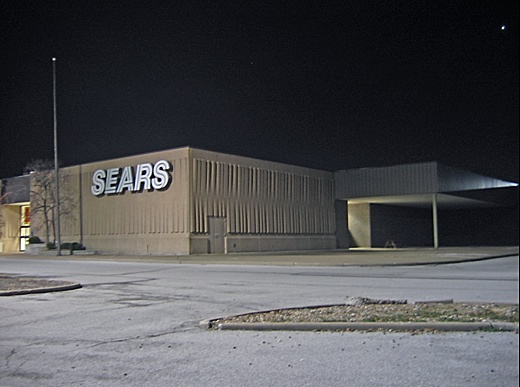
 Image above: On Christmas Eve 2008 the Sears at the Jamestown Mall in Florissant, MO closed for good. From (http://www.beltstl.com/2009/10/tear-down-jamestown-mall/)
 
People here are more business-like in business; tell a Lidl or Tesco employee to effusively greet each incoming shopper with an airplane-stewardess smile, as Wal-Mart employees must do, and most would say they don’t get paid enough for that.

By contrast, when I shopped at a grocery store, I soon learned all about the checkout lady’s grandchildren, the changes in the neighbourhood, and her fears for the future of America. There are things you can only tell a stranger, and in the USA, you see, most of us are.
I missed this, I thought.

I now think of Missouri the way many US residents think of Ireland, as a holiday destination, pleasurable and indulgent and surreal, except instead of a rollercoaster my daughter and I scream and hold on to the car as we drive around a highway cloverleaf, and instead of a castle I can take her to a Barnes and Noble the same size. But then, as much as we enjoy seeing friends and family again, I’m reminded why we’re raising our daughter somewhere else.

It’s not just the little annoyances that I rediscovered, like sales tax or ATM fees. It was realising anew that the constant driving and fast food, which feel like such a treat to us, constitute an ordinary day for many people. Futurists in the 1950s imagined a world of highways and drive-throughs would be an age of constant wonder, describing it in the same dreamy tones that people I meet described seeing Ireland. But there is no world that sustains the elated novelty of a vacation, and any attempt to do so results in an unhealthy landscape.

The broad roads and cheap gasoline are one reason my fellow Americans use twice as much energy as the average European, who themselves live far beyond what the planet could support. The massive stores can only exist because people desire to own many times more than they need. I enjoyed the ubiquitous fast food, but felt disappointed at the girth of many of the people I passed on the street; tourists from all over the world visit Ireland, but we can usually spot US residents hundreds of metres away by their shape.

Here in Ireland almost nothing is convenient, but they tend to be the important things; few restaurants have drive-throughs, but I can ride my bicycle just a few miles to the nearest bus stop, hop on the bus to Dublin, and be there in an hour and a half; in fact, most places in the entire country are no more than a few kilometres from a bus route. Back home, city neighbourhoods have less bus service than our isolated country roads, and the rural towns we saw in the Ozarks could be hundreds of kilometres from the nearest public transportation.

When seeing old acquaintances again, however, the greatest gulf stretched between our inner lives. Even when I lived in the USA I lived without a television for many years, and now that I live away, most pop-culture references fly past me. Kardashians. Angry Birds. Jersey Shore.

When the pop-culture references get political – this week, over Chick-Fil-A drive-through restaurants – the landscape becomes even more alien. I see old friends and loved ones taking sides I didn’t know existed, in a conflict I wasn’t aware of, over an issue I struggle to think of as political, each claiming their side is suffering from oppression.

In a country where people eat at restaurants, I think. That have drive-throughs. Made for cars. They own cars. 

The bizarre lifestyles and politics are not unconnected. Most US suburbanites are shoehorned into an ill-fitting life: driving long hours in massive cars alone with talk radio for company, with televisions, speakers, smart phones and advertisements everywhere. In short, they live surrounded by shouting of one kind or another, so ubiquitous that it becomes a poisonous kind of white noise.

During our recent visit to Missouri my eight-year-old happened to see a bit of cable news, and began laughing at the hosts’ exaggerated facial expressions, kindergarten tones and ridiculous volume, and she had fun imitating them the rest of the trip, thinking they were a comedy act.

Surrounded by such shouting, I see many of Americans allying themselves with one media figure or other, funnelling their discontent into this or that spectacularly fatuous issue, believing that they are persecuted or threatened. Living amid such wealth and convenience, more and more seem desperate, unlettered but possessed of the most flamboyant opinions, aggressively pious but uncharitable, pugnacious but fearful.
Coming from a country still in the grip of the Patriot Act and with a murder rate five times that of most European countries, I found it a relief to realise that life doesn’t have to be that way; when the local newspaper ran a screaming headline about a “TERROR ATTACK!,” it meant that someone had been mugged.

It was refreshing to watch political debates between five or seven major parties, and to realize that only in the USA, among world democracies, do citizens passively accept having only one choice more than North Koreans. It was refreshing to hear neighbours talk about their chosen candidate without much tension, without a sense that an election was an apocalyptic smack-down between the forces of good and evil.

Yet people, including my fellow Americans, are often more and better than their memes or bumper stickers. When my hometown of Florissant, Missouri, lacked electricity for two weeks a few summers ago, I was told that my old neighbors helped each other out, and I hear similar stories from most crises. My hope is that, as the emergency continues, the Disneyworld aspects of America will fade, and instead of gazing at a simpler life in the distance, more Americans will find they can create one at their feet. And they might discover that their online Chick-Fil-A flame-war enemies turn out to be good at carting jugs of fresh water from the creek.


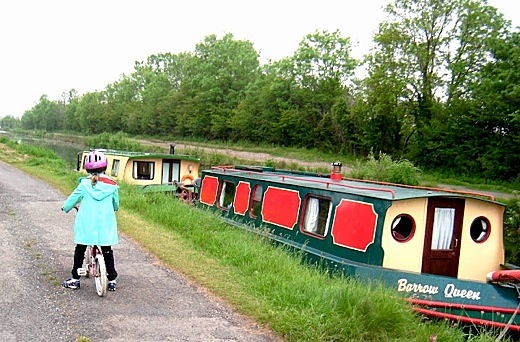
 Image above: My daughter on her bike a brief walk from our front gate in Ireland. Form original article.
 
In the meantime, I’m raising my daughter in the country, and while even there we get more mass media than I would like, I feel like I have a bit of room to pass an older set of values.

So at the end of our holiday, we go back to a cold and wet countryside where everything is expensive, cramped and slow-moving. This island began as a getaway for us at first too, but it became real soon enough, and perhaps someday, the USA, too, will feel real again.
• Florissant, Missouri, USA is the hometown of the author.
.