Showing posts with label Activism. Show all posts

Futility of "Big Green" activism

SUBHEAD: To minimize human suffering and protect ecosystems, working locally to build resilience is the best strategy.

By Richard Heinberg & Tim DeChristopher on 29 March 2018 for Resilience -
(http://www.resilience.org/stories/2018-03-29/getting-past-trump-part-3-the-futility-of-big-green-activism-a-conversation-with-tim-dechristopher/)


Image above: Still image from film Bidder 70 of Tim DeChristopher . In 2008 the environmental activist made bogus bids for 22,000 acres of federal land up for auction. Some people found his actions inspiring, but after the courts finished with him, he found himself in jail. The film Bidder 70 follows DeChristopher’s growth as an outspoken activist even as the criminal case against him intensified. From (http://radiowest.kuer.org/post/through-lens-bidder-70-0).

If environmentalists hope to have any real success in the age of Trump, they will have to change strategies and tactics in response to a transformed political and social context.

Back in the long-ago, hard-to-recall days before Trump became president, environmental (as well as peace and human rights) nonprofit organizations engaged in a routine, ritualized two-part dance of raising money from contributors, and then trying to convince policy makers to do something to save the world — or at least reduce the scale of harms being done.

What was actually accomplished was never enough to actually turn society in the direction of sustainability, but the effort was in some respects its own reward: Activists felt useful, and in some cases, fundraising produced enough to pay salaries. And there were occasional victories to celebrate.

Now the United States is led by an authoritarian who is steadily undermining our democratic norms and institutions, and a Congress that is either bought and paid for by moneyed interests, or is too scared to challenge them meaningfully.

It’s clear that no amount of cajoling, wheedling, imploring, threatening or explaining will convince Congress or the executive branch of the federal government to do anything whatsoever to address the panoply of do-or-die problems confronting us. Why even bother asking them?

Recall it was the failure of elites to address real underlying problems that contributed to the advent of Trump in the first place. Now, of course, at least from environmentalists’ perspective, Trump is making everything much, much worse: It’s probably fair to say that the Trump administration has never met an environmental regulation it didn’t want to kill.

What should environmentalists do under these changed circumstances? What strategies should environmental organizations pursue?

In order to get some helpful perspective, I recently corresponded with activist Tim DeChristopher, cofounder of Climate Disobedience Center. I respect DeChristopher for two important reasons: He has a good understanding of the range of overshoot issues humanity currently faces, and he has the courage of his convictions (he spent nearly two years in federal prison for a creative act of civil disobedience recounted in the documentary film Bidder 70).

What follows is a lightly edited transcript of my conversation with DeChristopher.

I first asked Tim what he thought about the actions of the big mainstream environmental organizations in the context of the new Trump administration.

Tim DeChristopher:
I really don’t think that most mainstream climate environmental organizations are operating with any kind of intentional strategy in which they think that what they are doing will lead to positive change.

When groups are mobilizing their members to “send a message” or “make their voices heard” to [US Secretary of the Interior Ryan] Zinke, [Environmental Protection Agency Administrator Scott] Pruitt or Trump, I doubt any staffers in those groups actually think that what they are doing has any potential of working.

I think they are hemmed-in by the norms of social movement organizing. Those norms demand relentless optimism and positivity, so there is very little room for open reflection on our mistakes, changing direction or acknowledging that certain goals are no longer possible. Those norms also define leadership around knowing what to do and giving people tangible and immediate things to do.

I think most organizations and leaders would feel extremely nervous about saying to their community, “I don’t know what needs to be done in this unprecedented situation.” There is a mainstream assumption that they would no longer be justified in their leadership position if they expressed that uncertainty. But I think one of our most critical needs for a future of climate chaos is to develop a model of uncertain leadership.

This is a kind of leadership that can hold space for sitting with uncertainty and empower a broader community of people to actively think and work in that space of vulnerability. Such leadership is embodied not in one’s ability to control a situation, but in one’s courage to engage with and relate to the situation.

Richard Heinberg: 
Historically, nonviolent protest and civil disobedience have developed as successful strategies for social change mostly within the context of liberal democracies. For example, there has been some discussion about whether [Mahatma] Gandhi’s efforts would have been as successful if Britain had not had a free press and other democratic institutions.

Without a free press, regimes can simply imprison and kill protesters with minimal public awareness of either the protest or its repression. How do you think protest might evolve if the US continues its trajectory toward authoritarianism?

Tim DeChristopher:
I think that Trump has certainly changed the dynamics of civil disobedience at the federal level. It’s worth noting that Erica Chenoweth’s research has shown that nonviolent civil resistance is often more effective under authoritarian regimes, but I think Trump represents a very rare kind of power.

Part of the efficacy of civil disobedience is often that it pulls back the facade of decency or democracy to reveal power that is actually rooted in violence.

The police violence at Standing Rock was an embarrassment to Obama because he had hinged his authority on lofty ideals, but in fact his real power was the state’s monopoly on violence. Even Bush Jr. ran on a platform of being a “compassionate conservative.” It was a lie, but he needed that lie.

Trump, however, never tried to project a facade of compassion or even decency. His power is based on ruthlessness and the breaking of taboos. If he is put into a position in which he has to violently repress nonviolent dissent, it may actually strengthen his power rather than undermine it.

In terms of media, I think our trajectory is not one of outright suppression of a free press to the point of avoiding public awareness, but rather a bifurcation of the press and social media to the point that no one has to accept anything they don’t want to believe.

This is a serious challenge not only for civil disobedience, but for all social change efforts regardless of strategy. It is further exacerbated by new video manipulation technologies. It is very hard to see how we avoid either nihilism or civil war.

Richard Heinberg:  
So, what to do?

Tim DeChristopher:
My current thinking is that our best bet to overcome these challenges is making protest far more diffuse and widespread. With the lack of a central narrative or even a consensus reality, big iconic protests with famous people will likely continue to become less effective.

But we all have a small circle of people whom we can influence in ways that are not dependent on media. Because our current culture has such justifiable skepticism of manipulation, one’s own willingness to sacrifice is more critical than ever for using our influence effectively, so I think civil disobedience will continue to play an important role for that.

So perhaps this is to say that protest needs to follow the path that needs to be followed for so many other changes we need to make: more localized, more diverse, more people involved, more experimentation. No goddamn mono-crop social movements!

Richard Heinberg:
How is your own organization, the Climate Disobedience Center, dealing with these issues and challenges? What concrete actions are your taking that different from the strategies of the ‘Big Green’ groups?

Tim DeChristopher: The Climate Disobedience Center began as a resource and support center for folks doing civil disobedience against the fossil fuel industry.  At the time, a certain brand of safe and limited civil disobedience was being increasingly embraced by the mainstream of the climate movement.

We felt that there was an opportunity to work with those folks who were engaging in direct action and help them manifest the full potential of vulnerable and transformative civil disobedience. We primarily ended up filling the particular void in the movement around supporting folks after the point of arrest as they engage with the court system.

Over time, we realized that rather than providing a plug-in service that could easily interface with a mainstream model, we were approaching this work with a fundamentally different paradigm that demanded a holistic structure.

So we refocused our efforts on building small praxis groups of holistic support, like a cross between an affinity group and a small group ministry. These are groups of folks who support one another to live with integrity in a time of climate crisis.

One piece of that is the moral responsibility to act to mitigate whatever harms can still be avoided, but we believe that work cannot be detached from the need to build resilient communities as well as grieve for that which is already being lost.

As these are largely unprecedented challenges, we are trying to create the practices of mutual support that allow for as much experimentation and creativity as possible.


DeChristohper emphasizes that simply getting rid of Trump as first priority will not solve the environmental crisis. If the system wasn’t sufficiently self-correcting before, and if the status quo is irreparably broken, then it’s clear that some other change in strategy is needed.

He also calls for more local and experimental activism and civil disobedience, warning that large-scale protests could simply become indiscernible components of the noise being generated by the implosion of the US political system.

My own tendency is to look at the big picture. In that regard, my gut and intellect both tell me that the Trump interval is best understood as a stage in societal collapse. Each stage of that process will no doubt follow its own internal logic.

As the stages progress, larger scales of societal organization (international institutions, then nation states) will tend to fail first. Therefore the usefulness of national and global strategies for resistance and repair will tend to gradually diminish.

If we want to minimize human suffering and protect ecosystems, then working locally to build community resilience is probably the best strategy available. The reasons are plentiful and the rationale only grows stronger as our context evolves.

.

Being Green is being a Terrorist

SUBHEAD: Environmentalists say they’re averting climate disaster. Conservatives say it’s terrorism.

By Alexander C. Kaufman on 20 February 2018 for Huffington Post -
(https://www.huffingtonpost.com/entry/pipeline-environmentalist-terrorism_us_5a85c2ede4b0058d55672250)


Image above: Illustration by Ji Sub Jeong of "pollution" in the form of Donald Trump going after environmental activists. From original article.

Michael Foster, 53, is a mild-mannered mental health counselor and father of two from Seattle, with short-cropped silver hair and soft features.

But in a North Dakota court last October, prosecutors painted Foster as a ruthless killer and agent of chaos.

The prosecution team compared him to the 9/11 hijackers who killed 2,996 people in the worst terror attack in history, and warned that he envisioned an anarchic future under Islamic religious law. Prosecutors even put him in a league with Ted Kaczynski, the so-called Unabomber whose 17-year bombing spree left three dead and injured 23.

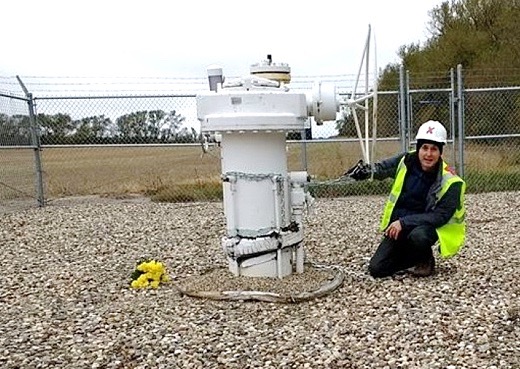
Foster hadn’t killed anyone. He didn’t even injure anyone when, on Oct. 11, 2016, he put on a white hard hat and neon-yellow safety vest, grabbed some bolt cutters, and clipped the chain locking a fenced section of the Keystone Pipeline in Walhalla, North Dakota. Once inside the fence, Foster cranked a giant wheel-like valve until it closed, temporarily stopping the flow of tar sands oil.

“In order to preserve life as we know it, and civilization, and give us a fair chance and our kids a fair chance, I’m taking action as a citizen,” Foster told another activist, Sam Jessup, who live-streamed the action. “I am duty-bound.”

Foster’s action was part of a protest in solidarity with the indigenous activists fighting to stop construction of the Dakota Access Pipeline, which runs through a sacred water source at the Standing Rock Sioux Reservation on the other side of the state.

Foster and Jessup did so in coordination with “valve turners” in four other states, timing their break-ins across the country to temporarily halt 15 percent of U.S. oil consumption.

Then came the legal crackdown.

In October, a judge convicted Foster and Jessup of felonies ― including criminal mischief and conspiracy to commit criminal mischief ― carrying maximum sentences of 11 to 26 years in prison. Earlier this month, the judge sentenced Foster to three years in prison; Jessup received two years of probation. (Other valve turners have faced up to 10 years in prison and $20,000 in fines.)

“They hit the trifecta: 9/11, the Unabomber, and that somehow our action was going to lead to Sharia law,” said Emily Johnston, 51, who is set to stand trial in May for turning a pipeline valve in Minnesota. “The theory being that if everyone just acted on what they believed in, it would be anarchy.”

That theory is now gaining some traction in Washington.

In October, 84 members of Congress, including four Democrats, sent Attorney General Jeff Sessions a letter urging him to find out whether the Department of Justice could prosecute pipeline saboteurs as terrorists.

The Justice Department has yet to announce a decision, but said in November that it was “committed to vigorously prosecuting those who damage this critical energy infrastructure in violation of federal law.” Doing so would be a break from the Obama administration’s decision to let states handle such cases, rather than treating them as federal crimes.
The purpose of this law isn’t to wrap everybody up and send them to federal prison. It’s to scare people, to create fear. - Will Potter, author of ‘Green Is The New Red’
But policymakers are sharpening their knives on the state level, too. Late last year, the conservative American Legislative Exchange Council drafted model legislation calling for severe punishments for anyone caught trespassing on or tampering with an oil, gas or chemical factory. The Critical Infrastructure Protection Act even includes a clause that any “conspirator” organization would be fined 10 times more than a trespasser, opening the door to crippling penalties for environmental groups.

Lawmakers in Ohio and Iowa are now considering bills based on the proposal. The Iowa bill is backed by Energy Transfer Partners, the company behind the Dakota Access Pipeline. In all, 31 states have considered 58 bills to crack down on protesters since November 2016, according to a database maintained by the International Center for Not-for-Profit Law. Eight have been enacted, and 28 are pending.

At a moment when the Trump administration is waging all-out war on environmentalism, macheting away regulations and gearing up for a massive pipeline construction spree, “eco-terrorism” is re-emerging as a boogeyman in a way it hasn’t since right after 9/11.

There are already laws in place to send environmentalists who tamper with fossil fuel infrastructure to jail, as Foster’s case demonstrates. But if conservative lawmakers get their way, new laws could undermine the environmental movement ― just as scientists say the humans are running out of time to make the changes needed to stave off the worst effects of climate change.


Image above: A screenshot frok video of Michael Foster turning the valve on the Keystone Pipeline. Shot by Sam Jessup. From original article.

Protesting After The Patriot Act

Targeting environmentalists as domestic security threats goes back nearly two decades. Radical environmental groups experienced their heydays in the 1990s, but became victims of their own success as concerns over pollution and animal cruelty went mainstream.

But even as the influence of these groups waned, a scorched-earth crackdown loomed. President George W. Bush signed the USA Patriot Act in October 2001, just over a month after the 9/11 attacks. The law expanded the government’s view of domestic terror suspects and granted law enforcement sweeping new powers to investigate organizations and individuals, including by seizing assets without any prior hearing or criminal charges.

“It’s about installing fear so they don’t go out and protest in the first place,” said Will Potter, author of the book Green Is The New Red, while comparing ALEC’s recent bill to the actions taken after 9/11. “The purpose of this law isn’t to wrap everybody up and send them to federal prison. It’s to scare people, to create fear.”

Potter would know. In 2002, when he was a reporter working on the Chicago Tribune’s metro desk, two FBI agents arrived at his home to question him about an animal rights protest he and his girlfriend had participated in months earlier.

Both had been arrested and charged with misdemeanor disorderly conduct after leaving flyers in a neighborhood where an insurance executive whose company covered animal laboratory testing lived.

He says FBI agents, armed with new powers under the Patriot Act, threatened to add him to a domestic terror list if he didn’t become an informant on the group with which he protested.

The officers threatened him, telling him they could “make your life very difficult for you,” having secured “more authority now to get things done and get down to business” after 9/11, Mother Jones reported in 2011.
Is this about just protecting some businesses? Or is this about this larger idea that the radical left is threatening America? - Cas Mudde, Dutch political scientist
In 2005, John Lewis, then the FBI official in charge of domestic terrorism, ranked “eco-terrorism and animal-rights movement” activists ahead of radical Islamic extremists as the nation’s top domestic terror threat.

The agency began investigating Eric McDavid, a self-declared green anarchist, that same year. In a now-infamous case, the FBI recruited a mole to get close to McDavid and coax him into plotting a C4 bomb attack. He was arrested in January 2006, and spent a decade in prison.

Congress also quietly passed the Animal Enterprise Terrorism Act in 2005, a sweeping law that classified many forms of animal rights protest as terrorism. It was used to prosecute Lauren Gazzola, the U.S. coordinator for a campaign against an animal product testing, on six felony charges that included conspiracy to violate an earlier law meant to protect businesses from protestors.

The crackdown was at odds with any realistic threat these environmentalists might have posed. Less than 10 percent of all radical environmental and animal rights actions from 2003 to 2010 even included criminal activity, according to a study published in 2014 in the journal Studies in Conflict & Terrorism. Of those acts, 66 percent were vandalism, less than 15 percent were house visits, and just over 12 percent involved freeing animals from cages. About 4 percent were arsons, and 1.4 percent involved explosives. There were no assassinations.

Protesting Post-Trump

Cas Mudde, a Dutch political scientist who co-authored the study on criminal activity amongst activists, points out that the attacks on environmentalists came at a time when many political protesters were speaking out against the Iraq War ― meaning environmentalists served as a sort of proxy for other left-leaning protest movements.

This is not unlike what we’re seeing now, Mudde said, noting that overlap between leftist activists and radical environmentalists makes it easy for conservatives to demonize both equally.

For example, Fox News hosts Tucker Carlson and Sean Hannity spent months inveighing against the so-called “antifa” and “alt left” movements, terms they use to refer to certain anti-fascist protester groups that rose up in response to increasingly vocal white nationalists in the U.S. Researchers who study extremists say “alt left” does not describe a real phenomenon.

This New World

The current capitalist system is broken. Get updates on our progress toward building a fairer world.

Mudde said it could be especially telling to see how Republicans frame the laws to criminalize fossil fuel protest.

“Is this about just protecting some businesses?” he said. “Or is this about this larger idea that the radical left is threatening America?”

The surprise election of President Donald Trump in 2016 dashed any hopes that the so-called green scare was a thing of the past. Trump, who dismisses climate change and installed an EPA administrator who shares his ideological antagonism toward science, reversed regulations and announced plans to withdraw from the Paris climate accord.

The conditions primed the rise of a more militant environmental movement ― and for an even more militant crackdown.

In a provocative essay published in September in Foreign Policy, think tank scholar Jamie Bartlett argued that “formal, peaceful political activism — that all-important route to redress — isn’t working” to address pollution and that “the signs of growing radicalism in green circles are already there, if you know where to look.” He noted that hard-line environmental organizations are seeing a membership surge, and that local anti-fracking groups are growing faster than ever before.

In April, the Department of Homeland Security warned of attacks by eco-terrorists who “believe violence is justified” to stop the planned Diamond Pipeline from Oklahoma to Tennessee. But the report admitted that no current intelligence suggested any attack had actually been planned.

The oil and gas industry is fueling fears of impending eco-terrorist attacks. In October, the American Petroleum Institute disclosed that it was “working with the Trump administration on this issue, including the DOJ, the Federal Bureau of Investigation and the Pipeline and Hazardous Materials Safety Administration,” according to the trade publication Natural Gas Intelligence.

API indicated that its lobbyists met with the FBI and other agencies to discuss “efforts related to pipeline security,” according to its final-quarter disclosure report from 2017.

The ALEC model bill is perhaps the clearest indication that “eco-terrorism” is back as a boogeyman on the right. When ALEC began shopping the bill around to state legislatures, it included a letter signed by a consortium of fossil fuel corporations and chemical manufacturers urging lawmakers to introduce bills based on the legislation to curtail the “growing and disturbing trend” of environmentalists attacking infrastructure.

The letter, which HuffPost obtained, listed five examples to back up the trend. One was the valve turners case. The others did not actually involve environmentalists. Instead, they were loosely bound by common threads of mental illness or workplace grievance:
  • In August 2011, Daniel Wells Herriman heard voices in his head, which convinced him to plant a crude bomb near a gas pipeline in Oklahoma. He turned himself in, pleaded insanity, and was sentenced the next year to more than five years in prison.

  • In June 2012 ― after spending months writing fawning prison letters to the Unabomber and posting enraged videos about having to pay taxes ― Anson Chi decided to live out his fantasies by blowing up a homemade explosive near a natural gas pipeline in Plano, Texas. He was sentenced to 20 years in prison.

  • Just after midnight on April 16, 2013, a sniper fired more than 100 rounds of .30-caliber rifle ammunition into the radiators of 17 electricity transformers in Metcalf, California. The attacker, believed to “an insider” who worked at the utility PG&E, was never found.

  • In October 2017, vandals believed to be recently furloughed employees ransacked a wastewater plant in Crow Agency, Montana, igniting a fire and firing off guns.

.

Activism in the Anthropocene

SUBHEAD: To withstand the coming waves, winds and wars, we need to be addressing our own incoherence.

By Sam Allen on 15 December 2017 for Transition Network -
(https://transitionnetwork.org/news-and-blog/activism-in-the-anthropocene/)


Image above: The Pacific Climate warriors prepare for their journey to the Vatican, carrying traditional mats that weave together stories from the low-lying islands of the Pacific. Photo by Fenton Lutunatabua. From original article.

This is the first in a series of blogs from Kevin Buckland, a Barcelona-based artivist, storyteller, facilitator and organizer who engages art as a tool for enabling change.

Look out the window, see the air between your eyes and the horizon.

This is the Anthropocene – a new geological age characterized by the critical impacts of human activities on the Earth’s systems. Every word you will ever speak will be articulated using this changed air.

The Anthropocene can be understood not as an issue but a context: it is the world we do and will, from now on, inhabit – the rest of our lives will be defined increasingly by an accelerating political and ecological destabilization of unimaginable scale.

Sit with that feeling, hold it – it is not going away, internalizing this knowledge will allow us as individuals and as movements to build structural resilience that prepares us for coming destabilization.
But if climate change is inevitable, global and profoundly altering human culture – then so too can our movements react on scale with the crisis.
The word “crisis” first appeared in English (from the greek origin krinein “decide”) to mean “the turning point of a disease”. Global warming is Gaias’s fever, a symptom of an unsustainable relationship to the physical world.

But as this fever rises, global movements are swarming like antibodies to the underlying causes of the disease. The global climate crisis presents a great challenge, but also a great opportunity. Climate change means that our human civilization has to change.

Yet, the direction this now inevitable cultural shift takes is still left to be decided. As the ecological security of our vital life systems degrade there is a grave danger for the neoliberal logic of scarcity to accumulate more power, and already the rise of the far-right is hailing a response to this crisis with enhanced borders, racism, centralization and militarism.

For movements to thrive and survive in the anthropocene, we need to look beyond the “activism-as-usual” that has shaped the past century, and gaze deeper into long-term cultural change that can withstand in the coming centuries of accelerating entropy.

If the left is to provide a more effective proposal to this collective crisis than the world that capitalism proposes, it requires the deep work of targeting not only the symptom of the illness, but also its causes.

This means addressing the long history of white-supremacy, racism, sexism, anthropocentrism, imperialism and colonialism that have shaped both our world and our atmosphere.

This is hard work, that many environmental movements have shied away from due to the urgency of the crisis, but this also reframes the vast majority of the world who have been victim of structural injustice as our allies.

But to create a movement wide enough for everyone, history demands the left provides not only an alternative politic to neoliberalism, but an alternative process.

If this process is a truly bottom-up democratic process, then each coming disaster provides the opportunity for it to spread, allowing movements for justice to flourish inside the oncoming chaos, rather than be derailed by it.

This series of articles and interviews digs into the space where resistance becomes resilience; where people are experimenting with alternative organizing cultures inside their place of struggle.

These articles will investigate how movements are working together, rather than just what we are working on; and examining the socio-cultural shift underway inside those on the edges who are nudging the mainstream into new directions.

Our movements’ desires to foment alternative futures – encouraging democratic, prefigurative and decentralized solutions – may actually have less to do with solar panels and community gardens than with nurturing scalable and democratic organizing cultures that can be shared with allies, volunteers and partners in ways that improve access to autonomy as we move together into an exponentially tumultuous future.

We will examine organizing that is intentional about its cultural legacy, and focus on process for participation rather than as a product of participation. It is, perhaps, these organizing cultures that are already incubating the next chapter of human history.

This series of articles will examine a diversity of spaces from across the global movement for climate justice.
  1. In our first article, we will look at how eco-feminist principles are reshaping cultures of mass direct action though Ende Gelande.
  2. Our second article will focus on the “Pacific Warriors”, indigenous activists from the low-lying islands of the Pacific and the people most vulnerable to sea level rise.
  3. Our third article will look at Cooperation Jackson, that combines black-led eco-social cooperativism with local municipal politics to provide an alternative future for the “deep south” of the United States.
  4. Finally, we will look to Imider, a small community on the edge of the Sahara who are transforming their indigenous political cultures as they protect their communities’ water from an expanding silver mine.
It is my intention that by looking at Emergent movement organizing structures on a diversity of scales and contexts, there is potential to look at how other groups are developing and enacting political processes that are coherent with their shared values and ambitions.

While the climate crisis cannot be avoided; disaster can be. The main question regarding the severity of the Anthropocene will be how human beings organize in this unpredictable and hostile terrain and what processes have the structural integrity to survive constant destabilization.

If our “movement of movements” is to withstand the coming waves, winds and wars, we need to be addressing our own incoherencies, lest they open fissures in our structures at every weak point.

Across the world, bottom up processes are gaining force as the global climate justice movement begins to inhabit its politics, tilting from being diverse protest movements towards being a truly revolutionary force that can rise faster than the oceans.

.

A Plan to Beat Climate Change

SUBHEAD: Even if Donald Trump won't help experts have a plan to avoid complete disaster if we act.

By Nick Visser on 30 June 2017 for Huffington Post -
(http://www.huffingtonpost.com/entry/climate-change-plan-2020_us_5955ef9ce4b0da2c73227dbe)

http://www.islandbreath.org/2017Year/06/170630chartbig.jpg
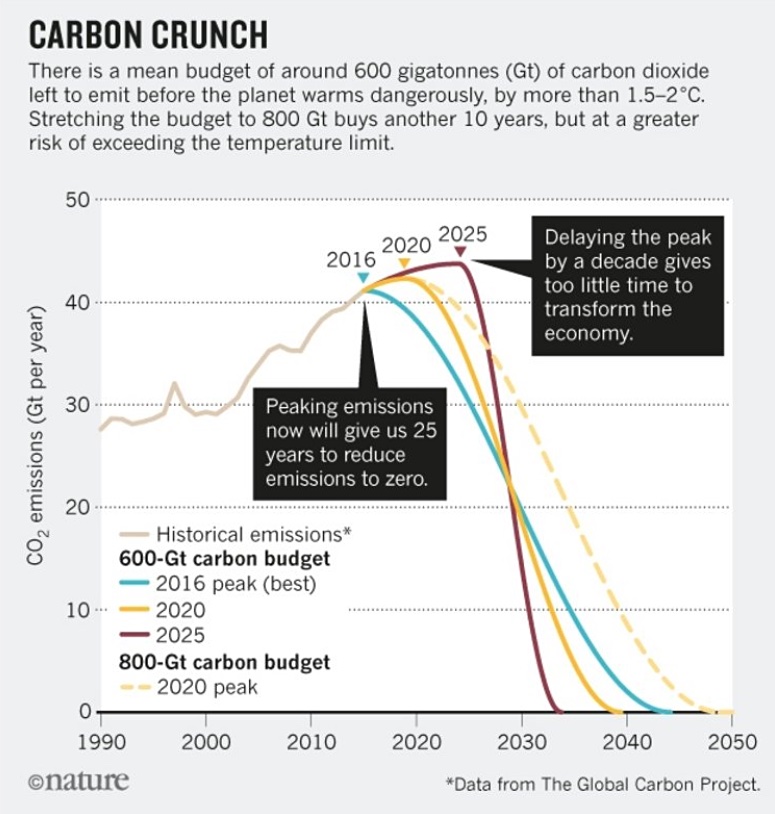
Image above: Chart of remaining "spendable" CO2 from the Global Carbon Project in original article and Nature. Click to enlarge.

The world has just a few years to scale back global carbon emissions to avoid the worst effects of climate change, a panel of leading experts and scientists warned this week. That goal may seem farfetched, but they say it is attainable.

The journal Nature published a statement Wednesday from a group of six climate experts urging the world to urgently reduce emissions in order to keep the planet from warming beyond safe limits that scientists established as part of the landmark Paris climate agreement. Dozens of prominent co-signers have also added their names to the statement.

The group, led by Christiana Figueres, the former executive secretary of the United Nations Framework Convention on Climate Change, has set a goal of 2020 to begin lowering emissions after a multiyear plateau. The experts said that despite growing antagonism from some parts of the world (like the U.S. under the Trump administration), the transition is still possible.

“When it comes to climate, timing is everything,” the authors write.

As several outlets note, the group points to basic math to rationalize the urgency of a target just three years away: The planet can probably only emit about 600 billion tons of carbon dioxide into the atmosphere before temperatures rise beyond 1.5 to 2 degrees Celsius.

Above that temperature, scientists say a slew of horrific effects would be seen around the planet, including heat waves, more intense weather events, rising seas and mass extinctions.

The authors estimate we only have about 15 years, maximum, before that allocation is exhausted, and it’d be near impossible to emit carbon for the next decade and a half and then immediately stop. Scientists warn the world is perilously close to missing targets if reductions aren’t locked in soon, and some say the Paris commitments aren’t even close to being strong enough.

“If the current rate of annual emissions stays at this level, we would have to drop them almost immediately to zero once we exhaust the budget,” the statement reads. “Such a ‘jump to distress’ is in no one’s interest.

A more gradual descent would allow the global economy time to adapt smoothly. The good news is that it is still possible to meet the Paris temperature goals if emissions begin to fall by 2020.”

Many of those negative climate impacts have already begun to take place ― even with the limited warming over the past century, the experts write:
After roughly 1°C of global warming driven by human activity, ice sheets in Greenland and Antarctica are already losing mass at an increasing rate. Summer sea ice is disappearing in the Arctic and coral reefs are dying from heat stress — entire ecosystems are starting to collapse. The social impacts of climate change from intensified heatwaves, droughts and sea-level rise are inexorable and affect the poorest and weakest first.
However, despite those fears, the group presents six goals they identify as “idealistic at best, unrealistic at worst” to achieve what they’re calling Mission 2020. The group has urged rapid investment in renewable energy to generate 30 percent of the world’s power by 2020, and said no new coal plants should be approved beyond that date. The experts called for 15 percent of all cars sold to be electric vehicles and for vast reforestation efforts to create a “carbon sink.” Other efforts would involve retooling investment in cities and business to favor environmental projects.

While those goals may seem unattainable, the authors note that optimism must be encouraged and efforts by the likes of President Donald Trump to withdraw America from the Paris Agreement will not stop a clean energy transition. Trump’s anti-climate agenda is likely to come to a fore during next week’s Group of 20 meeting, as a coalition led by German Chancellor Angela Merkel seeks to refocus attention on the issue, the nonprofit environmental news site Grist notes.

“Recent political events have thrown the future of our world into sharp focus. But as before Paris, we must remember that impossible is not a fact, it’s an attitude. It is crucial that success stories are shared. Demonstrating where countries and businesses have over-achieved on their targets will raise the bar for others. More-ambitious targets become easier to set,” the experts write in Journal.

“There will always be those who hide their heads in the sand and ignore the global risks of climate change. But there are many more of us committed to overcoming this inertia. Let us stay optimistic and act boldly together.”
.

Ninth Ward fights freeway

SUBHEAD: New Orleans plans traffic onto new interstate route through the black neighborhood.

By Michael Stein on 20 March 2017 for Truth Out -
(http://www.truth-out.org/news/item/39900-new-orleans-ninth-ward-fights-freeway-through-historic-black-neighborhood)


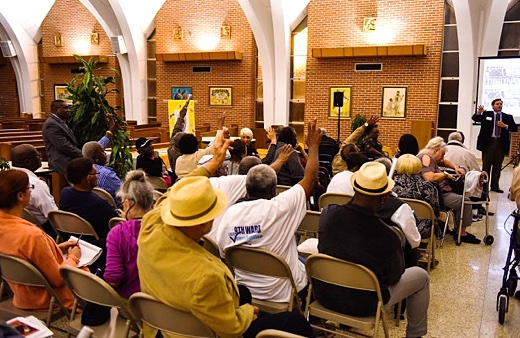
Image above: Public meeting attendees raise their hands to question Arcadis consultant representative Scott Hoffeld. Photo by Michael Stein. From original article.

[IB Publisher's note: You might not think this article touches your life if you live on Kauai, but the events in this story are echoed in our experience on Kauai. You've seen it before -  a consultant advocating a plan your community doesn't want and obfuscating answers from residents and promising all concerns will be handled later in the process. Bullshit! Right now the Kauai County trying to adopt an "update" of our General Plan that will not keep Kauai rural but suburbanize it with double the current population. It will hit the westside hard with a tripling of population and an increased dependence on GMO/Pesticide experiments and further militarization of PMRF to support that population. This will mean a greatly increased presence of Navy, Marine and Air Force activities and personnnel. It's just going to be shoved down our throats. Only pushing back will slow this process to a halt.]

"You say you come to inform, but there's no information. You're playing games with my home." Schoolteacher and Ninth Ward resident Derrick Anthony Renkins Jr. was standing at a rancorous public meeting, passionately opposing the proposed Florida Avenue Roadway, a project that would funnel truck traffic through the Ninth Ward from neighboring St. Bernard Parish.

There were about 200 Ninth Ward community members in the Saint Mary of the Angels church that night to see what the Department of Transportation had planned for their home.

This situation was unfortunately familiar for them. Ninth Ward residents continuously contend with infrastructure projects that disregard their well-being and ignore their input.

It's these polices that isolated the Lower Ninth Ward from the rest of the city, robbed it of public resources and caused it to suffer the worst devastation during Hurricane Katrina.

There was national recognition after Katrina that much of the storm's destruction was human-made, and the US has moved closer to acknowledging the devastating impact of racist infrastructure projects and city planning.

Former Secretary of Transportation Anthony Foxx admitted that "urban renewal" and highway building have harmed poor Black neighborhoods and recommended that future infrastructure projects benefit communities that "have been on the wrong side of transportation decisions."

Louisiana and the city of New Orleans have left this advice unheeded, and the Ninth Ward now faces another infrastructure project that would damage the community and uproot families.

At the front of the church stood Scott Hoffeld, a representative from the private consultancy firm Arcadis. Many in the crowd watched Hoffeld with frustration while he explained the proposal. When he was finished, he asked the crowd if they had any questions. Dozens of hands shot up.

Most Ninth Ward residents are already fed up with the existing truck traffic saturating their roads. Activists have been working to divert St. Bernard trucks away from the Ninth Ward, but they're now threatened by a plan that would permanently establish a truck route through their community.

"The fact is, freeways ruin neighborhoods," explains Beth Butler, the executive director of A Community Voice, a local nonprofit organization. "It's astonishing that in this day in time they would put a freeway through a Black neighborhood."

Residents complain that trucks pollute their communities, damage their roads and reduce their property values.

There is also concern about the source of these trucks, namely the Chalmette Refinery. This large petrochemical plant ships out an array of dangerous materials, and many worry about toxic spills and contamination. "They've already experienced environmental racism," says Butler. "It shouldn't keep happening."

Then there is the issue of eminent domain. A 2013 environmental assessment concluded that the project requires the acquisition of up to 105.4 acres of land, including 128 residences, nine water resources, six commercial structures and a church.

"Before we rebuilt [after Katrina], we had a big meeting, why didn't y'all tell us then that you were putting the roadway here?" asked Vernice Lyons, a homeowner in the Lower Ninth Ward. "Because we wouldn't have rebuilt it.

We built our houses from the ground up. We had nothing but lots there. But y'all waited till after we rebuilt and now y'all want to take us away again?"

"I'm sorry, that was before our contract," Hoffeld responded. "These projects are sometimes imperfect."

Hoffeld tried to assure the crowd that the roadway was intended to benefit the Ninth Ward, not damage it. But the original iteration of this roadway was a raised highway that didn't include a single onramp in the Ninth Ward, casting doubt among residents that this project was intended in any way for their benefit.

Hoffeld admitted that a central purpose of the new high-speed roadway would be to provide interstate access to trucks coming from St. Bernard. The audience rejected this justification on two grounds. The first was a general refusal to suffer damage in their community for another's gain.

The second demurral came from people who have lived in the neighborhood their entire lives and have a comprehensive understanding of the street grid. They insisted that this road isn't necessary because there is already a freeway that provides interstate access.

The existing freeway takes St. Bernard trucks downriver away from the city, instead of west into the Ninth Ward. Truckers familiar with the area attest to the convenience of this route, and say a new Florida Avenue roadway wouldn't do much to truncate their commutes.

When asked if he would utilize the new roadway once it was built, veteran trucker Lloyd Gaimer said it wouldn't be much quicker. "It's all about the same, I'll take either one."

Randy Guillot, vice chairman of American Trucking Associations and member of the Louisiana Trucking Association, insists that this roadway isn't consistent with New Orleans' contemporary infrastructure needs. "It would be much more appropriate to spend the money elsewhere," he says.

Ninth Ward residents agree, citing a long list of desired infrastructure developments in their community including levee improvements to protect them from future flooding.

Many activists on the front line of the opposition say the Louisiana Department of Transportation appears to be trying to deceive them as to its true motivation for pursuing the plan. "We're not getting the whole picture," says community activist Rev. Willie Calhoun Jr. "You're dealing with ignorance here. I'm not calling the people ignorant, but they lack the knowledge of what the overall game plan is."

At the meeting, the audience continued to push Hoffeld about the roadway's true purpose.
"From a legislative standpoint, there are components of this plan that must be constructed," he told the crowd.

He was referring to a 28-year-old piece of legislation that mandates the construction of a new bridge on Florida Avenue. It's called the Transportation Infrastructure Model for Economic Development (TIMED) program, created by the state legislature in 1989. It was the single largest transportation bill in state history, allocating $1.4 billion for 16 infrastructure projects.

TIMED projects have already cost an estimated $5.2 billion and two of the projects were never completed. One of these unfinished projects is the new Florida Avenue bridge.

Today, the Louisiana Department of Transportation and Ninth Ward residents agree on at least one thing: There is still a pressing need for a new Florida Avenue bridge. The Lower Ninth Ward is cut off from the rest of New Orleans by a canal, and the existing bridges that link the Lower Ninth Ward are often unavailable, regularly closed for construction or raised to allow boats to pass.

This keeps the Lower Ninth Ward isolated from the rest of the city, restricting access to hospitals, jobs and supermarkets.

Louisiana State Sen. Wesley T. Bishop, a native of the Lower Ninth Ward, attended the public meeting and told the crowd, "There is a need to have another way to get out of the Lower Ninth Ward, but the way it's being proposed to us is unacceptable. We're trying to find a way to keep the project."

The current proposal from the Louisiana Department of Transportation combines the Florida Avenue bridge and Florida Avenue Roadway projects.

Butler believes that the current composition of the proposal is meant to force the community to accept the unwanted roadway in order to get the much-needed bridge.

"This is an optional program, that has not been made clear to people," she says. "People were told things that made them think that you had to take the freeway with the bridge."

Calhoun reported that an Arcadis representative told him the bridge wouldn't be built without the roadway. Calhoun and Butler are working to inform people that the state is required by law to build a new bridge, whether or not the Florida Avenue extension project is approved.

This roadway has been proposed many times in the past. As Calhoun recalls, "My father talked about this in the '60s -- this is way more in-depth than you think."

The idea for a thoroughfare from New Orleans into St. Bernard can be traced back to the 1927 New Orleans Master Plan. But the city's needs are very different than they were in 1927, 1989 or even 10 years ago, and some question if this plan is a prudent use of government funds.

The original TIMED program allocated $30 million to build the new bridge. An assessment from 2013 estimated that the entire Florida Avenue extension project could cost over half a billion dollars.

Southern Louisiana is in great need of infrastructure development. Not only are its streets crumbling, but its coastline is also experiencing erosion at a rate of one football field every hour.

The state recently created a $50 billion plan to combat this subsidence, but there is still a $30 billion budget shortfall.

Louisiana is also dealing with one of the largest budget deficits in state history, and many are perplexed as to why the Louisiana Department of Transportation is focusing on an expensive plan that is not only opposed by the community, but offers limited commercial value.

So the question remains, who benefits from the roadway's construction? Calhoun said he doesn't know, but wouldn't be surprised if "this is just more of Bobby Jindal's people getting money," referencing the rampant corruption in Louisiana politics.

But he also suggested that perhaps this is just an infrastructure project that has floated around the state's bureaucracy for so long that it's attained a weight of its own, being pushed by nobody in particular, but advancing nonetheless. "I don't even think our elected officials have been told the real deal on this," he said. "They're trying to promote it just to promote it."

Ultimately, what many Ninth Ward residents say is most frustrating is that they feel ignored. Those attending the public meeting said they believe the state is withholding information and that even if they were fully informed, there isn't anything they can do to stop the project.

Many saw the meeting as only a façade of public outreach, meant to check a bureaucratic box rather than truly hear and integrate community concerns.

"For the Department of Transportation to allow you to come and stand in front of us and not prepare for your presentation lets me know that once again, my life does not matter," Renkins Jr. told Hoffeld at the end of the meeting. "The task at hand is for you to reach out to me, not for me to reach out to you."

The highway authority is scheduled to make a final decision on the future of the project in January 2018. Between now and then, there is only one public meeting and a final public hearing scheduled. It remains unclear whether community leaders have any recourse to stop a project that is so ubiquitously derided in the Ninth Ward.

"Do we have any say as a community?" asked one frustrated meeting attendee. "At the end of the day, ya'll gonna do what ya'll want to do. I don't know anywhere else in the city where they would allow this to happen."

"They don't understand New Orleans," says Butler. "These are communities that are working class. It's the only affordable housing in the city almost.

The history of these communities; they are families that have built this city. They are strong African American families, working class, who just did everything right and were never rewarded for it.

But at least they had their own community, their own churches. This plan is going to pulverize this Black neighborhood that they know nothing about."

.

See film "Answering the Call"

SUBHEAD: Kauai Alliance for Peace and Social Justice hosts activist and filmmaker John Witeck.

By Sandy Herndon on 21 December 2016 for Island Breath -
(http://islandbreath.blogspot.com/2016/12/see-answering-call.html)


Image above: A young John Witeck and friend at the University of Hawaii in the 1960's. Still frame from trailer below.

WHAT:
Watch "Answering the Call" , a film about his experiences with Civil Rights suppression in Selma AL in  and a Q & A about his current work in Hawaii.  The evenings events will open with civil rights era social justice songs by Blu Dux and Friends. The events are free.

WHEN: 
January 15th  2017 From  3:00 pm to 6:00 pm

WHERE:
Lihue Neighborhood Center, 3353 Eono Street
Lihue, Kauai, Hawaii 96766

WHY:
As relevant today as it was in the '60's, suppression of people's voting and other civil rights continues to be a source of dishonor to our "Democratic Society". This film and the Q & A afterward, offers an opportunity to better understand our role in taking back our power.

SPONSOR: 
Kauai Alliance for Peace and Social Justice hosts activist film maker John Witeck.

CONTACT:
If you need further information
Sandy Herndon
phone: 808-320-3878
email: 2da1wahine@gmail.com


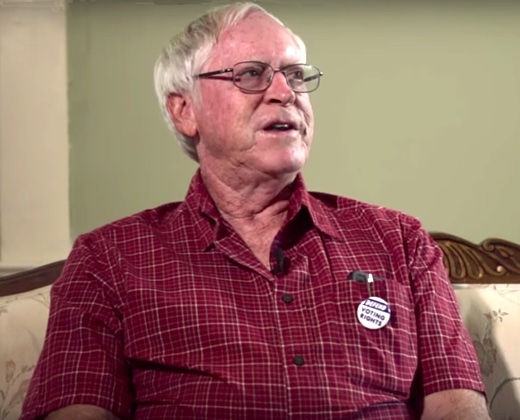
Image above: Current John Witeck in an interview from the movie "Answering the Call". Still frame from trailer below.

BACKGROUND:
John Witeck was called to Selma, in 1963 by Dr. Martin Luther King to promote voter registration of suppressed African Americans. He will speak at Lihue Neighborhood Center on Sunday Jan. 15 at 3PM. The documentary film "Answering the Call" portraying Mr. Witeck's sometimes chilling experiences in Selma will be shown.

Mr. Witeck was inspired to become involved in the greater movement for social change. In 1967 he enrolled in the East-West Center graduate program on O`ahu, and heeding Dr. King's words became a draft resister and anti-war activist. He joined in local causes, among them the Hawaiians' struggle against evictions in Kalama Valley and elsewhere.

He is a founder of University of Hawaii Students for a Democratic Society (SDS), the Labor Community Alliance and Hawaii Peoples Fund. Mr. Witeck served as Business Agent for United Public Workers for 25 years, and he is a retiree of HEA Bargaining Unit Thirteen.Today he instructs at Honolulu Community College and is vice president of Hoa` O Makaha (Makaha Farm).


Video above: Trailer for "Answering the Call". From (https://youtu.be/GSyD8tlIz28).

.

Sea Shepherd to obstruct Japanese

SUBHEAD: An attempt to stop Japan’s so-called “scientific research” program used to justify killing whales.

By Staff on 5 December 2016 for Sea Shepherd -
(http://www.seashepherdglobal.org/nemesis/)


Image above: Sea Shepherd ship Steve Irwin sets sail to meet Japanese whalers. From (http://www.maritime-executive.com/article/sea-shepherd-the-chase-is-on).

After final preparations in Australia, two Sea Shepherd vessels are now on their way to the Southern Ocean to intercept the Japanese whaling fleet in a bid stop their slaughter of Minke whales.

The marine conservation organization's flagship vessel the Steve Irwin departed Saturday from Seaworks, Williamstown in Melbourne, followed by its fast new patrol vessel the Ocean Warrior, which departed from Hobart, Tasmania on Sunday.

They're now on their way to the vast Southern Ocean in an effort to prevent the Japanese whaling fleet, which left Japan on November 18th, from killing its self-allocated quota of 333 Minke whales.

"With all of the hectic preparations behind us, it's good to finally be on our way to the Southern Ocean," said Captain Adam Meyerson from the bridge of the Ocean Warrior.

Fast enough to outrun any whaling ship and equipped with a powerful water cannon, Sea Shepherd predicts the Ocean Warrior will be a game-changer for their 11th whale defense campaign, Operation Nemesis.

About Operation Nemesis
Operation Nemesis is Sea Shepherd’s 11th Antarctic whale defense campaign. In Sea Shepherd’s past ten campaigns over 6,000 whales have been spared the grenade-tipped harpoons of the illegal Japanese whaling fleet.

Japan’s so-called “scientific research” program used to justify the killing of whales has been rejected by the International Court of Justice and the International Whaling Commission’s scientific committee. In 2015 the Australian Federal Court fined the Japanese whalers $AU1 million for hunting within an Australian whale sanctuary, however it remains unpaid.

This is the second time the illegal Japanese whaling fleet has returned to the scene of their crimes in the Southern Ocean since the 2014 International Court of Justice ruling. at a press conference in the port of Hobart Saturday morning Australian Senator Peter Whish-Wilson said:
"Sea Shepherd shouldn’t have to be taking on the whalers again this summer. Australia won the International Court of Justice case against Japan, but unfortunately the government put trade deals ahead of whales and removed all diplomatic pressure. The Japanese whaling fleet might be able to escape and outrun the international courts but it won’t escape Sea Shepherd."
Jeff Hansen, Managing Director of Sea Shepherd Australia said:
"It's time that Japan respected the International Court of Justice, the Australian Federal Court, and the global moratorium on commercial whaling and ended their so-called scientific lethal hunting of whales off the Antarctic coast." 
The Japanese typically hunt whales from December until March, so Sea Shepherd's vessels have been equipped to endure four months of harsh conditions at sea to protect the whales of the Southern Ocean.

"The crew has worked really hard to get the ship ready and everybody is super excited to be on our way," said Steve Irwin's Captain Wyanda Lublink.

The two Sea Shepherd vessels are carrying a total of 50 crew members from eight different countries: Australia, Germany, France, UK, Austria, Spain, Canada and the United States. "They are very much looking forward to getting down towards the Antarctic and being able to experience firsthand the stunning beauty of this part of the world. A place where illegal whaling vessels from the other side of the world do not belong."


Video above: Video describing Sea Shepherd activity on its 11th seasonal journey to protect whales from Japanese hunting vessels. From (https://youtu.be/vZm-k9r3kus).

About Sea Shepherd Global
Established in 1977, Sea Shepherd is an international non-profit, marine wildlife conservation organization. Our mission is to end the destruction of habitat and slaughter of wildlife in the world's oceans in order to conserve and protect ecosystems and species.

Sea Shepherd uses innovative direct-action tactics to investigate, document, and take action when necessary to expose and confront illegal activities on the high seas. By safeguarding the biodiversity of our delicately-balanced ocean ecosystems, Sea Shepherd works to ensure their survival for future generations.

For more information, visit:
www.seashepherdglobal.org

For photos and interview requests, contact:

Heather Stimmler, Sea Shepherd Global Media Director
E-mail: heather@seashepherdglobal.org
Tel: +339 7719 7742 (EUROPE, GMT+1)

For Australia and New Zealand media requests, contact:
Adam Burling, Media Coordinator Sea Shepherd Australia
E-mail: adam@seashepherdglobal.org
Tel : +61 409 472 922 (AUSTRALIA, GMT+11)

.

Shutdown of all tar sands pipelines

SUBHEAD: Ten activists are in jail for shutting down all tar sands pipelines entering the United States.

By Lauren McCauley on 11 October 2016 for Common Dreams -  
(http://www.commondreams.org/news/2016/10/11/my-act-love-climate-activists-shut-down-all-us-canada-tar-sands-pipelines)


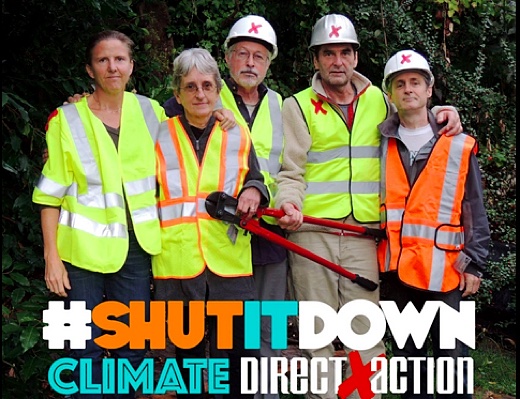
Image above: Some of the activists involved with shutting down the tar sands pipelines for #ShutItDown. From original article.

Five activists shut down all the tar sands pipelines crossing the Canada-U.S. border Tuesday morning, in a bold, coordinated show of climate resistance amid the ongoing fight against the Dakota Access

The activists employed manual safety valves to shut down Enbridge's line 4 and 67 in Leonard, Minnesota; TransCanada's Keystone pipeline in Walhalla, North Dakota; Spectra Energy's Express pipeline in Coal Banks Landing, Montana; and Kinder-Morgan's Trans-Mountain pipeline in Anacortes, Washington.

The activists, who planned the action to coincide with the International Days of Prayer and Action With Standing Rock, expressed feeling "duty bound to halt the extraction and combustion of fossil fuels...in the absence of any political leadership" to address the withering goal of keeping global temperature increase beneath the 2°C climate threshold.

"I have signed hundreds of petitions, testified at dozens of hearings, met with most of my political representatives at every level, to very little avail," said 64-year-old mother Annette Klapstein of Bainbridge Island, Washington, who was arrested just before publication.

"I have come to believe that our current economic and political system is a death sentence to life on earth, and that I must do everything in my power to replace these systems with cooperative, just, equitable and love-centered ways of living together. This is my act of love."

Fifty-nine-year-old Ken Ward of Corbette, Oregon, who was also arrested, said, "There is no plan of action, policy or strategy being advanced now by any political leader or environmental organization playing by the rules that does anything but acquiesce to ruin.

Our only hope is to step outside polite conversation and put our bodies in the way. We must shut it down, starting with the most immediate threats—oil sands fuels and coal."

The action comes two days after a U.S. federal court of appeals lifted an injunction on the Dakota Access project, to the dismay of the Indigenous water protectors and their supporters across the U.S. and Canada.

"Because of the climate change emergency, because governments and corporations have for decades increased fossil fuel extraction and carbon emissions when instead we must dramatically reduce carbon emissions; I am committed to the moral necessity of participating in nonviolent direct action to protect life," added activist Leonard Higgins, 64, from Eugene, Oregon.

The activists are all members of the group Climate Direct Action, which is providing live updates on the coordinated shut-downs on its website and Facebook page. Others shared statements in support, as well as images and videos of the actions on social media with the hashtag #shutitdown.

Tim DeChristopher's Climate Disobedience Action Fund is also supporting the action and has set up a legal fund for the activists' defense.


Image above: Michael Foster, 52, pictured here, said, "All of our climate victories are meaningless if we don’t stop extracting oil, coal and gas now." From original article.

See also:
Ea O Ka Aina: Time for Direct Action on CO2 10/12/16
Ea O Ka Aina: Why Standing Rock is test for Obama 10/8/12
Ea O Ka Aina: Why we are Singing for Water 10/8/16
Ea O Ka Aina: Labor's Dakota Access Pipeline Crisis 10/3/16
Ea O Ka Aina: Standing Firm for Standing Rock 10/3/16
Ea O Ka Aina: Contact bankers behind DAPL 9/29/16
Ea O Ka Aina: NoDAPL demo at Enbridge Inc 9/29/16
Ea O Ka Aina: Militarized Police raid NoDAPL 9/28/16
Ea O Ka Aina: Stop funding of Dakota Access Pipeline 9/27/16
Ea O Ka Aina: UN experts to US, "Stop DAPL Now!" 9/27/16
Ea O Ka Aina: No DAPL solidarity grows 9/21/16
Ea O Ka Aina: This is how we should be living 9/16/16
Ea O Ka Aina: 'Natural Capital' replacing 'Nature' 9/14/16
Ea O Ka Aina: The Big Difference at Standing Rock 9/13/16
Ea O Ka Aina: Jill Stein joins Standing Rock Sioux 9/10/16
Ea O Ka Aina: Pipeline temporarily halted 9/6/16
Ea O Ka Aina: Native Americans attacked with dogs 9/5/16
Ea O Ka Aina: Mni Wiconi! Water is Life! 9/3/16
Ea O Ka Aina: Sioux can stop the Pipeline 8/28/16
Ea O Ka Aina: Officials cut water to Sioux 8/23/16   

.

Getting grades on population

SUBHEAD: Many prominent environmental activists concerned with climate change have too many children.

By Albert Bates on 20 August 2016 for the Great Change -
(http://peaksurfer.blogspot.com/2016/08/making-grade-in-population.html)


Image above: Al Gore and wife Tipper, center and their surrounding spawn of five on the porch of their 20 room Tennessee mansion. From (https://thedarjeelingexpress.wordpress.com/2011/06/29/goracle-babies-for-me-but-not-for-thee/).

percent of all humans who have ever lived are alive today. Recent projections  of fertility momentum put global population between 9.6 and 12.3 billion by the end of the century. Of course that could no more be sustained than too many reindeer living on lichen on a small island.

A 2014 study in the Proceedings of the National Academy of Sciences (Bradshaw and Brook"Human population reduction is not a quick fix for environmental problems." DOI: 10.1073/pnas.1410465111)looked at a number of different scenarios to gauge how long it might take the human population to plateau and then decline. The Yale Environmental Review commented:
Many of the findings highlight the strength of this demographic momentum. For example, the study found that if every unplanned pregnancy were avoided worldwide due to reproductive education, family planning, and cultural shifts, population would peak at 8.39 billion in 2050 and then fall to 7.3 billion by 2100, a level slightly higher than today. 
The study also found that implementing contentious population control measures such as a worldwide one-child policy, results in a population that wouldn’t fall back to present-day size until the end of the century.

Another scenario looked at a hypothetical catastrophic mortality event equal to the number of deaths from the First World War, the Second World War, and the 1918 Spanish flu epidemic combined. This event barely altered the long-term population projection.

Population tends to be the third rail for many environmental activists. They are okay talking about a one child policy for China, or lamenting the fact that Africa will more than triple its population by mid-century, but the idea of limiting their own family size seems to hold little interest.

Perhaps some role models are needed. Among the presidential candidates, Jill Stein gets a C. She has two children. Donald Trump receives a failing grade. He has 5. Hillary Clinton, with only one child, receives a B. To get an A she would have needed either none or a half child, perhaps one adopted from a one child family or acquired by marriage.

Top Marks:
Leo DiCaprio (0); Rocky Mountain Institute’s Amory Lovins (0); Consumer Advocate Ralph Nader (0); Sea Shepherd Captain Paul Watson (1); 350.org’s Bill McKibben (1); Greenpeace Executive Director Annie Leonard (1); Greenpeace spokesman Kumi Naidoo (1); and “population bomb” theorists Paul and Anne Ehrlich (1).

The US’s largest and most influential grassroots environmental organization Sierra Club, has a population mission:
The Global Population and Environment Program believes that healthy people and a healthy environment go hand in hand. We work to protect the global environment, preserve natural resources for future generations, and ensure healthy, thriving families and communities by promoting global reproductive health, reproductive rights and sustainable development initiatives.
And yet the Sierra Club’s president and his wife “attribute their ongoing passion for environmental activism in part to concern that their children (plural) inherit a healthy world.”

Pope Francis has yet to issue an encyclical urging Catholics to use birth control. Naomi Klein thinks artificial insemination should be a universal right.

Activist saints who receive C’s on the population quiz:
Ralph Borsodi, George Monbiot, Wendell Berry, David Attenborough and Jane Goodall.

Activist saints who receive Top Marks:
Rachel Carson (0); Henry David Thoreau (0).

Failing grades:

Thomas Malthus (3), Helen Caldicott (3); Al Gore (4); David Brower (4), Jacques-Yves Cousteau (4); Garrett Hardin (4); Allan Yeomans (5); Aldo Leopold (5); and David Suzuki (5 children, 6 grandchildren).

.

Climate Change activists' failure

SUBHEAD: Climate change activists are going to have to demonstrate that they’re willing to take one for the team.

By John Michael Greer on 27 July 2016 for the Archdruid Report-
(http://thearchdruidreport.blogspot.com/2016/07/climate-change-activism-post-mortem.html)


Image above: Demonstrators at COP21 in Paris in December of 2015.From (http://bdnews24.com/environment/2015/12/05/at-halfway-chance-of-un-climate-deal-higher-but-ambition-lower-than-in-2009).

As I write these words, much of North America is sweltering under near-tropical heat and humidity. Parts of the Middle East have set all-time high temperatures for the Old World, coming within a few degrees of Death Valley’s global record.

The melting of the Greenland ice cap has tripled in recent years, and reports from the arctic coast of Siberia describe vast swathes of tundra bubbling with methane as the permafrost underneath them melts in 80°F weather.

Far to the south, seawater pours through the streets of Miami Beach whenever a high tide coincides with an onshore wind; the slowing of the Gulf Stream, as the ocean’s deep water circulation slows to a crawl, is causing seawater to pile up off the Atlantic coast of the US, amplifying the effect of sea level rise.

All these things are harbingers of a profoundly troubled future. All of them were predicted, some in extensive detail, in the print and online literature of climate change activism over the last few decades. Not that long ago, huge protest marches and well-funded advocacy organizations demanded changes that would prevent these things  from happening, and politicians mouthed slogans about stopping global warming in its tracks.

Somehow, though, the marchers went off to do something else with their spare time, the advocacy organizations ended up preaching to a dwindling choir, and the politicians started using other slogans to distract the electorate.

The last gasp of climate change activism, the COP-21 conference in Paris late last year, resulted in a toothless agreement that binds no nation anywhere on earth to cut back on the torrents of greenhouse gases they’re currently pumping into the atmosphere.

The only commitments any nation was willing to make amounted to slowing, at some undetermined point in the future, the rate at which the production of greenhouse gas pollutants is increasing.

In the real world, meanwhile, enough greenhouse gases have already been dumped into the atmosphere to send the world’s climate reeling; sharp cuts in greenhouse gas output, leading to zero net increase in atmospheric CO2 and methane by 2050 or so, would still not have been enough to stop extensive flooding of coastal cities worldwide and drastic unpredictable changes in the rain belts that support agriculture and keep all seven billion of us alive.

The outcome of COP-21 simply means that we’re speeding toward even more severe climatic disasters with the pedal pressed not quite all the way to the floor.

Thus it’s not inappropriate to ask what happened to all the apparent political momentum the climate change movement had ten or fifteen years ago, and why a movement so apparently well organized, well funded, and backed by so large a scientific consensus failed so completely.

In my experience, at least, if you raise this question among climate change activists, the answer you’ll get is that there was a well-funded campaign that deployed disinformation against them.

So? Every movement for social change in human history has been confronted by well-funded vested interests that deployed disinformation against them.

Consider the struggle for same-sex marriage, which triumphed during the same years that saw climate change activism go down to defeat.  The disinformation deployed against same-sex marriage was epic in its scale as well as its raw dishonesty—do you recall the claims that ministers would be forced to perform gay weddings, and that letting same-sex couples marry would cause society to fall apart?

I do—and yet the movement for same-sex marriage brushed that aside and achieved its goal.

Blaming the failure of climate change activism entirely on the opposition, in other words, is a copout.

It’s also a way to avoid learning the lessons of failure—and here as elsewhere, those who ignore their history are condemned to repeat it.

Other movements for social change faced comparable opposition and overcame it, while climate change activism failed to do so; that’s the difference that needs to be discussed, and it leads inexorably to a consideration of the mistakes that were made by the movement.

The most important mistakes, to my mind, are these:

First, the climate change movement was largely led and directed by scientists, and as discussed here two weeks ago, people with a scientific education suck at politics.

Over and over again, the leaders of the climate change movement waved around their credentials and told everyone else what to do, in the fond delusion that that’s an adequate way to bring about political change.

Not so; too many people outside the scientific community have watched scientific opinion whirl around like a weathercock on too many issues; too many products labeled safe and effective by qualified scientists have been put on the market, and then turned out to be ineffective and unsafe; too many people simply don’t trust the guys in the white lab coats any more—and some of them have valid reasons for that lack of trust.

Thus a movement that based its entire political strategy on the prestige of science was hamstrung from the start.
Second, the climate change movement made the same mistake that the Remain side made in the recent Brexit vote in the UK, and Hillary Clinton’s presidential campaign seems to be making on this side of the pond: it formulated its campaign in purely negative terms.

David Cameron failed because he couldn’t talk about anything except how dreadful it would be if Britain left the EU, and Clinton’s campaign is failing because her supporters can’t talk about anything but the awfulness of Donald Trump.

In exactly the same way, the climate change movement spent all its time harping about the global catastrophes that were going to happen if they didn’t get their way, and never really got around to talking about anything else—and so it failed, too.

I’m not sure why this sort of strategy has become such a broken record in contemporary political life, because it simply doesn’t work. People have heard it so many times, if all you can talk about is how awful this or that or the other thing is, they will roll their eyes and walk away.

To win their interest, their enthusiasm, and their votes, you have to offer them something to look forward to.

That doesn’t mean you have to promise rainbows and jellybeans; you can promise them blood, toil, tears, and sweat; you can warn them of a long struggle ahead and call them to shared sacrifice, and they’ll eat it up—but there has to be a light at the end of the tunnel, something that doesn’t just amount to the indefinite continuation of a miserably unsatisfactory status quo.

The climate change movement never noticed that, and so people quickly got tired of the big bass drum going “doom, doom, doom,” all the time, and wandered away.

It didn’t have to be like that; the climate change movement could have front-and-centered the vision of a grand new era of green industry, with millions of new working-class jobs blossoming as America leapt ahead of the oh-so-twentieth-century fossil-fueled economies of other nations, but it apparently never occurred to anyone to do that.

Instead, the climate change movement did a really fine impression of a crowd of officious busybodies trotting out round after round of doleful jeremiads about the awful future that would swallow us up if we didn’t do what they said, and that did about as much good as it usually does.

Third, the climate change movement inflicted a disastrous own goal on itself by insisting that nobody with scientific credentials ever claimed that an ice age was imminent, when anybody over fifty whose memory is intact knows that that’s simply not true. Any of my readers who are minded to debate this point should get and read the following books from the 1970s and 1980s:

The Weather Machine by Nigel Calder, After the Ice by E.C. Pielou, and Ice Ages by Windsor Chorlton and the editors of Time Life Books. These were very popular in their time, and they’re all available on the used book market for a few bucks each, as the links I’ve just given demonstrate.

Nigel Calder was a respected science writer; E.C. Pielou is still the doyenne of Canadian field ecologists, and the third book was part of Time Life Book’s Planet Earth series, each volume of which was supervised by scientific experts in the relevant fields. All three books discuss the coming of a new ice age as the most likely future state of Earth’s climate.

While you’re at it, you might also pick up a couple of really good science fiction novels, The Winter of the World by Poul Anderson and The Time of the Great Freeze by Robert Silverberg. Anderson and Silverberg were major SF authors in the 1960s and 1970s, at a time when success in the genre depended on close attention to scientific fact, and both authors drew on what were then considered credible forecasts of an approaching ice age to ground their stories about the future.

If you’re going to insist, along the lines of George Orwell’s 1984, that Oceania has never been allied with Eurasia, you’d better make sure that nobody’s in a position to check. If they can, and they discover that you’re lying, your chance to convince them to trust you about anything else has just gone out the window once and for all.

That’s how a great many people responded to the climate change movement’s attempt to rewrite history and erase the ice age scare of the 1970s and 1980s.

Every time I’ve brought up this issue among climate change activists, they’ve responded by insisting that I must be a climate change denialist. That’s the fourth factor that’s contributed mightily to the crumpling of the climate change movement: the rise within that movement of a culture of intolerance in which dissent is demonized and asking questions about tactics and strategy is equated with disloyalty. I’m thinking here especially, though not only, of an embarrassing screed by climate change activist Naomi Oreskes, which insisted with a straight face that asking questions about whether renewables can replace fossil fuels is “a new form of climate denialism”.

As it happens, there are serious practical questions about whether anything—renewable or otherwise—can replace fossil fuels and still allow the inmates of today’s industrial societies to maintain their current lifestyles, but Oreskes doesn’t want to hear it: for her, loyalty to the cause demands blindness to the facts.

As a way to alienate potential allies and drive away existing supporters, that attitude’s hard to beat.
Stunning political naïveté, a purely negative campaign, a disastrous own goal through a constantly repeated and easily detected falsehood, and an internal culture of intolerance and demonization: those four factors would have been a heavy burden for any movement for social change, and any two of them would most likely have caused the failure of climate change activism all by themselves.

There was, however, another factor at work, and to my mind it was the most important of all.

To understand that fifth factor, it’s useful to return to a distinction I made here two weeks ago between facts, values, and interests. Facts are simply statements of what happened, what’s happening, and what will happen given X set of conditions—the things, in other words, that science is supposed to be about.

Whether or not anthropogenic greenhouse gas emissions are causing the global climate to spin out of control, whether or not books published in the 1970s and 1980s by reputable scientists and science writers predicted a coming ice age, whether or not the project of replacing fossil fuels with renewable resources faces serious difficulties—these are questions of fact.

Facts by themselves simply state a case. Values determine what we should do about them.

Consider the factual statement “unrestricted greenhouse gas emissions are responsible for an ongoing increase in weather-related disasters.” If the rate of weather-related disasters doesn’t concern you, that fact doesn’t require any action from you; it’s when you factor in “weather-related disasters ought to be minimized where possible,” which is a value judgment, that you can go on to “therefore we should cut greenhouse gas emissions.”

Not all value judgments are as uncontroversial as the one just named, but we can let that pass for now, because it’s the third element that’s at issue in the present case.

Beyond facts and values are interests: who benefits and who loses from any given public policy. If, let’s say, we decide that greenhouse gas emissions should be cut, the next step takes us squarely into the realm of interests.

Whose pocketbook gets raided to pay for the cuts? Whose lifestyle choices are inconvenienced by them? Whose jobs are eliminated because of them? The climate change movement has by and large treated these as irrelevant details, but they’re nothing of the kind. Politics is always about interests.

If you want your facts to be accepted and your values taken seriously, you need to be able to respond to people’s interests—to offer an arrangement whereby everybody gets something they need out of the deal, and no one side has to carry all the costs.

That, in turn, is exactly what the climate change movement has never gotten around to doing.

I’d like to suggest a thought experiment here, to show just how the costs and benefits offered by the climate change movement stacked up. Let’s imagine, for a moment, that there’s an industry in today’s industrial nations that churns out colossal amounts of greenhouse gases every single day.

It doesn’t produce anything necessary for human life or well-being; it’s simply a convenience, and one that, not that many decades ago, most people in the industrial world did without and never thought they’d need.

If it were to be shut down, sure, a certain number of people would lose their jobs, but most of the steps that have been urged by climate change activists would have that effect; other than that, and a certain amount of inconvenience for its current users, the only result would be a sharp decrease in the amount of carbon dioxide and certain other greenhouse gases being dumped into the atmosphere.

That being the case, shouldn’t climate change activists get to work right now to shut down that industry, and shouldn’t they start off by boycotting it themselves?

The industry in question actually exists. It’s the commercial air travel industry.

You may have noticed, dear reader, that nobody in the climate change movement has been out there protesting commercial air travel, and precious few of them are even willing to cut back on their flying time, even though commercial air travel a massive contributor to the problems the movement claims to be fighting.

I know of two scientists researching climate change who have pointed out that there’s something just a little bit hypocritical about flying all over the world on jetliners to attend conferences discussing how we all have to decrease our carbon footprint! Their colleagues, needless to say, haven’t listened.

Neither has the rest of the climate change movement; like Al Gore, who might as well be their poster child, they keep on racking up their frequent flyer miles.

On the other hand, climate change activists are eager to shut down coal mining. What’s the most significant difference between coal mining and commercial air travel? Coal mining provides wages for the working poor; commercial air travel provides amenities for the affluent.

The difference isn’t accidental, either. Across the board, the climate change movement has pushed for changes that will penalize people in what I’ve called the wage class, the majority of Americans who depend on an hourly wage for their income.

The movement has gone out of its way to avoid pushing for changes that will penalize people in what I’ve called the salary class, the affluent minority of Americans who bring home a monthly salary. That isn’t a minor point.

There’s the hard fact that, on average, the more money you make, the bigger your carbon footprint is—but there’s also a political issue, and it goes to the heart of the failure of the climate change movement.

I’ve had any number of well-meaning climate change activists ask me, in tones of baffled despair, why they can’t get ordinary Americans to take climate change seriously. My answer is not one they want to hear, because I tell them that it’s because well-meaning climate change activists don’t take climate change seriously.

If you don’t care enough about the CO2 concentration in the atmosphere to accept some inconveniences to your own lifestyle, how much do you actually care about it? That’s the kind of logic that ordinary Americans use all the time to judge whether someone is serious about a cause or simply grandstanding, and by and large, climate change activism fails that sniff test.

Ordinary Americans, furthermore, are all too used to seeing grandiose rhetoric deployed by the affluent to load yet another round of burdens onto ordinary Americans. It’s not the affluent, after all, who have been inconvenienced by the last thirty years of environmental regulations, trade treaties, or what have you.

To wage class Americans, anthropogenic climate change is just more of the same, another excuse to take jobs away from the working poor while sedulously avoiding anything that would inconvenience the middle and upper middle classes.

The only way climate change activists could have evaded that response from wage class Americans would have been to demonstrate that they were willing to carry some of the costs themselves—and that was exactly what they weren’t willing to do.

The bitter irony in all this, of course, is that the climate change movement was right about two very important things all along: treating the atmosphere as a gaseous sewer in which to dump wastes from our smokestacks and tailpipes was a really dumb idea, and the blowback from that idiocy is going to cost us—all of us—in blood.

Right now all three of the earth’s major ice caps—the Greenland, West Antarctic, and East Antarctic ice sheets—have tipped over into instability; climate belts are lurching drunkenly north and south, putting agriculture at risk in far more places than a crowded, hungry planet can afford; drought-kindled wildfires in the American and Canadian west and in Siberia are burning out of control...

And unless something significant changes, it’s just going to keep on getting worse, year after year, decade after decade, until every coastal city on the planet is under water, the western half of North America is as dry as the Sahara, glaciers and snowfall are distant memories, and famine, war, and disease have left the human population of the planet a good deal smaller than it is today.

That didn’t have to happen. It might still be possible to avoid the worst of it, if enough people who are concerned about climate change stop pretending that their own lifestyles aren’t part of the problem, stop saying “personal change isn’t enough” and pretending that this means personal change isn’t necessary, stop trying to push all the costs of change onto people who’ve taken it in the teeth for decades already, and show the only kind of leadership that actually counts—yes, that’s leadership by example.

It would probably help, too, if they stopped leaning so hard on the broken prestige of science, found a positive vision of the future to talk about now and then, backed away from trying to rewrite the recent past, and dropped the habit of demonizing honest disagreement.

Still, to my mind, the crucial thing is that the affluent liberals who dominate the climate change movement are going to have to demonstrate that they’re willing to take one for the team.

Will they? I’d love to be proved wrong, but I doubt it—and in that case we’re in for a very rough road in the centuries ahead.

.