Showing posts with label Investments. Show all posts

BlackRock reveals its Eco-Strategy

SUBHEAD: Investment company plans to fight Climate Change with its new strategy.

By Eoin Higgins on 14 January 2020 for Common Dreams  -
(https://www.commondreams.org/news/2020/01/14/massive-victory-blackrock-ceo-promises-center-climate-change-investment-strategy)

Image above: From ().

In a letter to investors Tuesday, Larry Fink, CEO of money management firm BlackRock, announced the company would prioritize the climate crisis in deciding on investments and strategies going forward—a major victory for the environmental movement.

The new direction for BlackRock, the largest investment firm in the world which manages assets of around $6.96 trillion, is the result of a hard-fought effort by a group of dedicated activists, tweeted 350 Action co-founder Bill McKibben.

"This is a massive victory for a small band of fighters," said McKibben.

"It gives us enormous confidence as we take on the giant banks," he added. "When we start to fight we start to win."
As Common Dreams reported last week, a new campaign called "Stop the Money Pipeline" is aimed at stopping financial support for the fossil fuel industry and has BlackRock as one of its primary targets.

Fink says in his letter to investors that he believes "we are on the edge of a fundamental reshaping of finance."

"The evidence on climate risk is compelling investors to reassess core assumptions about modern finance," Fink wrote.

According to the New York Times:
The firm, he wrote, would also introduce new funds that shun fossil fuel-oriented stocks, move more aggressively to vote against management teams that are not making progress on sustainability, and press companies to disclose plans "for operating under a scenario where the Paris Agreement’s goal of limiting global warming to less than two degrees is fully realized."
Diana Best, senior strategist for the Sunrise Project, said in a statement that Fink's letter was a welcome first step.

"BlackRock beginning its shift of capital out of fossil fuels, including today's divestment of coal in its actively managed funds, is a fantastic start and instantly raises the bar for competitors such as Vanguard and State Street Global Advisors," said Best. "We will be looking for additional leadership from the company in, as Larry Fink put it, 'fundamentally reshaping finance to deal with climate change,' including additional shifts of capital out of fossil fuels."

Sunrise Project is a key player in the BlackRock's Big Problem campaign.

Climate advocates celebrated the letter as a victory for years of activism and protest, but warned that the firm would have to be held accountable for its behavior going forward.

"BlackRock's coal divestment decision is yet another significant blow to the already dying market, yet major banks like Barclays continue to prop up coal-heavy companies," said ShareAction campaign manager Jeanne Martin. "If BlackRock is serious about its commitment to phase out thermal coal, it should use its voting rights to get major coal financiers to do the same."

In a statement, the Sierra Club's campaign representative Ben Cushing said BlackRock's decision was a watershed moment while warning the letter needs to be backed up by immediate and concrete action to divest from dirty investments.

"As the biggest financial institution in the world, BlackRock's announcement today is a major step in the right direction and a testament to the power of public pressure calling for climate action," said Cushing. "But BlackRock will continue to be the world's largest investor in coal, oil, and gas."

"It is time to turn off the money pipeline to dirty fossil fuels for good," Cushing added..
Exit Sign? Bitcoins!

SUBHEAD: Techno-Narcissism — the idea is tech is now so magical that it over-rides the laws of physics.

By James Kunstler on 27 November 2017 for Kunstler.com -
(http://kunstler.com/clusterfuck-nation/exit-sign/)


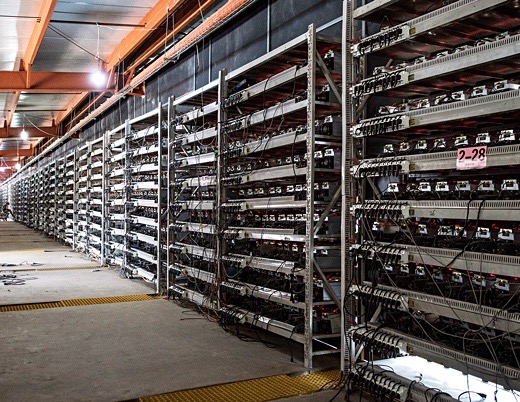
Image above: The largest Bitcoin mining operations are in China running on coal. From (https://spectrum.ieee.org/computing/networks/why-the-biggest-bitcoin-mines-are-in-china).

Shoeshine boys in airports ‘round the world must be whispering about Bitcoin as the crypto-currency coils upward to tickle the $10,000 line. Ethereum’s roaring up, too, along with most other cryptos, from Byteball Bytes to Tattoocoin (Limited Edition).

Whatever else you think about it, this action is sending a message, perhaps several.

One would be Get Rich Quick, of course. Eight months ago, you could have copped Bitcoin for a mere $1000, and around Labor Day it touched $5000, which seemed, well, figment-ish. In the last two weeks it went all out hockey-stick, doubling.

To a certain sort of mind this must seem irresistible. The result: a good old-fashioned mania. Digital tulip bulbs.

Another message probably goes something like duck-and cover. Some nervous nellies are seeking shelter in Bitcoin as they detect tremors in the more traditional markets creeping ever-higher to new records.

To some degree, Bitcoin may be doing the job that gold used to do, providing the aura of a “safe haven” from a possible global financial mega-storm.

The last time such an event came out nowhere (ha!) after the “permanent plateau” of 1929 collapsed, the government confiscated as much physical gold as it could get its paws on. So who wants to be there? (Echo answers….)

These days, the zeitgeist also points to new-and-improved government monkey business for shoving global populations into cashless monetary regimes where the authorities could monitor and control (and collect a vig on) all transactions — and there is the theory, at least, that Bitcoin’s block-chain computer math would be secure from any government’s clutches.

I’m not so sanguine about Bitcoin’s supposed impregnability, nor about many of its other appealing claims.

The Mt. Gox affair of 2014 must be forgotten now, but back then some sharpie hacked 850,000 Bitcoins (valued over $450,000,000) out of the exchange, which was processing almost two-thirds of all the Bitcoin trades in the world. Mt. Gox went out of business.

Bitcoin tanked and then traded sideways for three years until (coincidentally?) the Golden Golem of Greatness was elected Leader of the Free World. Hmmmm…..

Not many readers understand the first thing about block-chain math, your correspondent among them.

But I am aware that the supposed safety of Bitcoin lies in its feature of being an algorithm distributed among a network of computers world-wide, so that it kind of exists everywhere-and-nowhere at the same time, a highly-valued ghost in the techno-industrial meta-machine.

However, the electric energy required for “mining” each Bitcoin — that is, the computations required for updating the block-chain network — is enough to boil almost 2000 liters of water.

This is happening world-wide, and a lot of the Bitcoin “mining” is powered by coal-burning electric plants, making it the first Steampunk currency.

If Bitcoin were to keep rising to $1,000,000 per unit, as many investors hope and pray, there wouldn’t be enough electric power in the world to keep it going.

Pardon me if I seem skeptical about the whole scheme. Even without Bitcoin bringing extra demand onto the scene, America’s electrical grid is already an aging rig of rags and tatters.

There are a lot of ways that the service could be interrupted, perhaps for a long time in the case of an electric magnetic pulse (EMP). I’m not convinced that crypto-currencies are beyond the clutches of government, either.

Around the world, in their campaign to digitize all money, there must be a deep interest in either hijiking existing block-chains, or creating official government Bit-monies to seal the deal of total control over financial transactions they seek.

Anyway, there are already over 1300 private cryptos and, apparently, a theoretically endless ability to create ever new ones — though the electricity required does seem to be a limiting factor. Maybe governments will shut them down for being energy-hogs.

My personal take on the phenomenon is that it represents the high point of techno-narcissism — the idea that technology is now so magical that it over-rides the laws of physics.

That, for me, would be the loudest “sell” signal. I’d just hate to be in that rush to the exits. And who knows what kind of rush to other exits it could inspire.

See also:
Ea O Ka Aina: Bitcoins are a waste of energy 11/6/17
Ea O Ka Aina: In praise of cash 3/6/17
Ea O Ka Aina: The War on Cash has begun 2/17/16
.

Surfing the stock market bubble

SUBHEAD: If you want to make lots of money more than you want to grow your own food.

By Harry Dent on 4 May 2017 for Market Oracle -
(http://www.marketoracle.co.uk/Article58942.html)


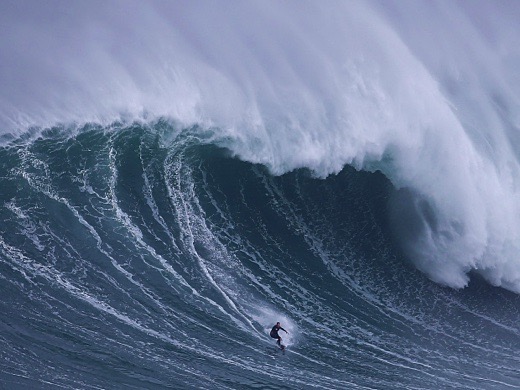
Image above: German surfer Sebastian Steudtner drops down the face of a gargantuan wave at Praia do Norte, in Nazare, Portugal, on Nov. 1, 2015. The beach at the tiny fishing village has become a famous big wave surf spot ever since Hawaiian surfer Garrett McNamara set a world record there in 2011. Photo by Rafael Marchante. From (http://www.cbc.ca/news/world/photos/monster-waves-attract-daring-surfers-to-portugal-1.3301909).

I took up surfing in my early 30s.

It didn’t last long. But I learned a tremendous amount from the experience (least of which is that I suck at surfing).

Well, it’s time to think like a surfer... Your sole focus is to catch the wave.

The best surfers can see the waves building, just like we can in the markets, but they only care about where the biggest, best waves will crash. That’s where you get the ride.

And if you catch the biggest wave in the right place, you get the ride of a lifetime.

Look at this fourth and largest wave building in the stock market. It’s the wave of a lifetime for investors, and it’s rolling onto our shores right about now…

Remember, all the action comes when the wave crashes, not as it’s building.

As the swell grows around you, you can go with the flow and harness the energy of the wave with little effort. That’s when you become one with the universe, sitting there on your board, surrounded by dark water, rolling up and down as the power builds beneath you. That’s why surfers get addicted.

Then, at the perfect moment, all the wave’s pent up energy releases in a roaring spray of water and power.

That’s where we want YOU to be when the greatest market wave of your lifetime comes crashing to shore!

That’s when the greatest profits come.

That’s when the greatest innovations spring up.

The smartest people (I include surfers in this group) and the greatest innovators understand this. They don’t look at a good economy as the best opportunity for success. Seeds of radical innovation only grow in the most challenging conditions.

That’s why the best traders are most often short sellers rather than long buyers… just ask Paul Tudor Jones or George Soros.

That’s why people who are prepared for the crash make out like bandits in the aftermath.

While writing my latest best seller, The Sale of a Lifetime, I created a bubble model for stocks. It follows the Masters and Johnson male orgasm study of the late 1950s.

Bubbles build exponentially and then burst twice as fast, deflating back to their point of origin (or close).

Exactly like the ocean waves that surfers spend their lives hunting for. And precisely what smart investors spend their lives waiting for!

Central Banks have extended this wave beyond all expectations, but it’s now showing signs of peaking. It looks like it’s getting ready for that big crashing later this year.

You can either paddle out past where this massive 40-foot wave (at least you’ll be safe)…

Or you can ride it all the way down and create extreme wealth.

This is one of those defining moments.

The choice is entirely yours.

But know that our best investment services are designed to not only to profit from the upside (as the swell builds), but to also rake it in during the downside, when it comes crashing down like Holy Hell!


.

Trump won't cut taxes

SUBHEAD: It demonstrates the monumental magnitude of the Debt Trap that has enveloped the Imperial City.

By David Stockman on 1 April 2017 for Bonner & Partners -
(http://bonnerandpartners.com/reagan-adviser-why-trump-wont-cut-taxes/)

http://www.islandbreath.org/2017Year/04/170402trumpmarebig.jpg
Image above: "The Nightmare" oil on canvas (30"x40") by Mark Bryan who says "The Kraken has been released from the depths, and the Trumpocalypse is at hand. Hang on tight, it’s gonna be a rough ride Back to when things were “great”." Click to enlarge. From (http://www.artofmarkbryan.com/the-nightmare/).

The mules of Wall Street were back at it again, buying the dips after the overnight whoosh downward in the futures market. Apparently, it will take an actual two-by-four between the eyes to break a habit that has been working for 96 months now since the March 2009 post-crisis bottom.

We think it is plain as day, however, that we are in a new ball game that the "stimulus-blinded” mules don’t see coming at all. To wit, they have been juiced for eight years running by the Keynesian apparatchiks at the Fed who needed permission from exactly no one to run the printing presses full tilt or to rescue the market with a new round of QE or an extension of ZIRP whenever the indices began to wobble.

But now, even the money printers have made it clear in no uncertain terms that they are done for this cycle, anyway, and that they will be belatedly but consistently raising interest rates for what ought to be a truly scary reason.

That is, the denizens of the Eccles Building have finally realized that they have not outlawed the business cycle after all and need to raise rates toward 2-3% so that they have headroom to "cut" the next time the economy slides into the ditch.

Instead, they are merely storing up monetary ammo for the next downturn.

But the Wall Street mules keep buying the dips anyway because they are under the preposterous delusion that one source of "stimulus" is just as good as the next.

And since the gamblers have now decreed that the "stimulus" baton be handed off to fiscal policy, it only remains for Congress and the White House to shape up and get the job done with all deliberate speed.
But they won’t.

Not in a million years.

The massive Trump tax cut and infrastructure stimulus is DOA because Uncle Sam is broke and the U.S. economy has slithered into moribund old age.

In that context, it’s not remotely the same as the 12  members of the FOMC sitting behind closed doors for two days jawing about the short-term economic weather; and then at the conclusion of their gabfest, ordering the New York Fed’s open market desk to flood the canyons of Wall Street with cash by buying another $80 billion of bonds with digital credits conjured from thin air.

Au contraire. Fiscal policy is inherently an exercise in herding cats and an especially impossible one when the cupboards are bare.

The essence of the matter at the present state of play is the legislative equivalent of "no ticky, no washy."

Without a 10-year budget resolution for FY [fiscal year] 2018 and associated reconciliation instructions, there is no possibility of passing a tax bill or even an infrastructure spending boondoggle.

But hammering out a budget resolution, passing it in each house, and reconciling the differences in conference would take months under the best of circumstances. But given the parlous state of Uncle Sam’s fiscal condition and the partisan acrimony that already suffuses Washington in the era of Trump, passage of a budget resolution by summer would be a miracle in itself.

Indeed, even the thought of surmounting this next daunting legislative obstacle course puts to rest this week’s particular Wall Street fantasy. Namely that after being burned by the Freedom Caucus on Obamacare Lite, the Trump White House will now "pivot" to the middle and form a coalition with the Democrats to make a deal on corporate tax cuts and infrastructure spending.

Yes, and if dogs could whistle, the world would be a chorus.

That is to say, there is no conceivable fiscal policy menu that could be agreed upon by Speaker Ryan, Nancy Pelosi, Chuck Schumer, and the Donald, and then be shoe-horned into a 10-year budget resolution.


In effect, the Fed is saying to Wall Street: "Price in" a recession because we are!

After all, our monetary central planners are not reluctantly allowing interest rates to lift off the zero bound because they have become converts to the cause of honest price discovery—-nor are they fixing to liberate money rates, debt yields, and the prices of stocks and other financial assets to clear on the free market.

Yet without a budget resolution and reconciliation instructions, there is not a fiscal stimulus "ticky" and no grand bipartisan compromise on building airports and slashing corporate tax rates.

So what lies directly ahead, therefore, is another bumbling attempt by the White House and Congressional Republicans to hammer out an FY 2018 budget resolution and what amounts to a 10-year fiscal plan. And it is there where the whole fantasy of the Trump Stimulus comes a cropper.

There are not remotely 218 GOP votes for what would be a $12 trillion-13 trillion add to the national debt with the Trump Stimulus program over the next decade—-even with all the "dynamic" scoring and revenue "reflows" that are imaginable.

To be sure, this is why the GOP Congressional leadership stoutly insists on a deficit-neutral tax cut. They are keenly aware of the debt monster they have been kicking down the road—-even if the headline-reading robo-traders of Wall Street are not.

What that means, in turn, of course, is that the rapidly fracturing Trump/Republican coalition must find the offsets on the spending side of the ledger.

In short, the whole enterprise amounts to budgetary madness and demonstrates the monumental magnitude of the Debt Trap that has enveloped the Imperial City.

And the “buy the dip” crowd will soon be getting that two-by-four between the eyes.

So now is not the time to buy.


.

Tribes divest DAPL bankers

SUBHEAD: Defunding spreads across Indian Country as tribes divest pipeline backers.

By Frances Madison on 2 February 2017 for YEs Magazine -
(http://www.yesmagazine.org/people-power/defund-dapl-spreads-across-indian-country-as-tribes-divest-20170202)


Image above: Detail from painting by A. Scott Eidson of Wells Fargo stage coach in battle with Native Americans as it passes through "Indian Country". From (http://www.boxartden.com/gallery/var/resizes/Boxart-Collection/Artists/A-Scott-Eidson/Wagons/Wells%20Fargo%20Stage%20Coach%20Rev-H501-960.jpg).

The Navajo Nation is making moves to join a growing number of tribes that have already respectfully, but conclusively, shown Wells Fargo the door.

Like the call and response in Lakota ceremonial prayer songs, tribes are answering the Standing Rock’s Sioux plea for all of Indian Country to move its money out of banks that have invested in the Dakota Access pipeline and help further destabilize the pipeline’s already shaky financing.

“Many people are, rightfully, afraid that executive support [President Trump’s]now means that the pipelines are full steam ahead,” said Melanie Yazzie, co-founder of The Red Nation, an activist coalition dedicated to the liberation of Native people from capitalism and colonialism.

She views divestment as obstruction—the good kind—something akin to water protectors locking down on construction equipment and as a continuation of the widespread resistance that has united under the cry of #NoDAPL.

“The investors and financiers will not move forward if the projects are deemed financially unfavorable,” Yazzie said. “We must continue to deny settlers their desired profits, profits they reap from colonizing our non-human relatives—the land and water.”

That is the hope of a growing cohort of tribal leaders, activists, researchers, and strategists who have come to see divestment, which is catching on all across Indian Country, as a winning tactic in a wider strategy of non-cooperation. It’s a cohort that at first glance appears to have some strange bedfellows: radical academics and Wall Street professionals.

Since last August, when the Standing Rock Sioux severed their own relationships with DAPL-invested banks, financial adviser Lynn Rapp has been fielding a steady stream of questions from her tribal clients. She is managing director of Seacrest Investment Financial Management in Buffalo Gap, South Dakota.

“Tribes want to divest themselves as external supporters,” explained Rapp, who is Oglala Sioux. “It speaks really highly to their level of long-term commitment to the cause.”

The cause is mni wiconi, Sioux for “water is life,” or as some are now translating it: “water is alive.” And as Rapp sees it, it’s also about securing Indian rights.

“American Indians have to be able to stand up for what they believe about the environment, the economics of their time, and the social impact of situations like this,” she said.

Even in very poor nations like the Navajo, where 47 percent of the population lives below the poverty line, there are grassroots efforts to help move the divestment needle. Duane “Chili” Yazzie, president of the Shiprock Chapter of the Navajo Nation, has referred to the #NoDAPL struggle as the “ultimate stand for Mother Earth.”

He’s advocating for Speaker Lorenzo Bates, President Russell Begay, and Vice President Jonathan Nez to divest from Wells Fargo and all other DAPL-invested banks, beginning with the more than $2 billion in the Nation’s Permanent Trust Fund. In mid-December, the Shiprock Chapter and the Northern Navajo Agency Council passed resolutions that point to the dishonor and indignity of using Navajo money to lay waste to Mother Earth.

“The DinĂ© people are the caretakers of the Earth in concert with people of good hearts around the world,” he explained. “I want to see my nation put some serious substance behind the verbal expressions of support for the Standing Rock Sioux.”

Or, as he put it more plainly: “Money talks.”

If this effort succeeds, the Navajo Nation will join a growing number of tribes that have already respectfully, but conclusively, shown Wells Fargo the door. The Nez Perce Tribe in Idaho and the Mille Lacs Band of Ojibwe in Minnesota have already severed fiscal ties, while the Alliance of Colonial Era Tribes, a consortium of tribes located along the East Coast, has indicated some of its members may soon do the same.

Of the U.S. banks, Wells Fargo is the second-largest financier of DAPL parent Energy Transfer, having committed $467 million to the family of companies, according to researcher Hugh MacMillan of Food & Water Watch. 

That includes $120 million directly to DAPL. So far, Wells Fargo has borne the brunt of divestments from Indian Country. (Citibank is the largest DAPL financier, having committed $521 million in credit to Energy Transfer, including $235 million directly to DAPL.)

In a written statement, Wells Fargo said it has been “serving Native American governments and communities for more than 50 years.” It provides financial services to more than 200 tribal and Native entities in 27 states, including many tribal community development projects. Over the past three years, the bank says, it has granted tribes $11 million, including $3 million for scholarships and educational programs though the American Indian Graduate Center.

Despite the longstanding relationships, what’s happened with DAPL changed everything for the tribes.

On the night of Nov. 20, when law-enforcement officers used tear gas and water cannons as part of their assault on unarmed water protectors, Janene Yazzie, a research associate in the Department of Soil, Water and Environmental Science at the University of Arizona, decided she could not remain silent. Armed with the Shiprock resolutions, she’s been actively lobbying the executive and legislative branches of Navajo Nation to divest.

“As a Navajo Woman,” she wrote in an email, “watching the videos on social media disturbed me to my core. They captured proof that the so-called ‘Indian Wars’ have never ended but are, rather, coming to a culmination.”

In Idaho, acting quickly after the Standing Rock Sioux’s call for divestment, the Nez Perce tribe withdrew millions from Wells Fargo on the grounds that the bank’s investment in DAPL was “inconsistent with the views and policies of the Nez Perce.” Mary Jane Miles, chair of the tribe’s executive committee, explained why they divested:
“I feel that tribal nations need to support each other in their efforts to remind the big companies of our stewardship responsibility. Our voice needs to be heard, and if there is any way that we can enhance our position we need to do so. The Nez Perce tribe supported their sister nation in other ways as well, such as tribal members voluntarily traveling to the site to camp in the bitter cold. The protest was well warranted in our worldview and was supported in all the ways we felt was necessary,” 
Miles wrote.
Rudolph Ryser, a member of the Cowlitz Tribe and board chair of the Center for World Indigenous Studies, a research and education organization, wants Indians everywhere to follow the lead of the Nez Perce.

“It is no longer tenable for the leaders of American Indian [tribes], Canadian Indian [tribes], and Indian leaders throughout the Americas to operate as if the leaders of hemispheric nations can or will act in responsible ways toward the indigenous people or the living earth.

Fourth World nations in the United States, Europe, Asia, and the Pacific are in a strong position to apply pressure on investors in the Dakota pipeline banks.”

Ryser hopes to see tribes act in unison for greater impact, banding together to “demand investment changes or withdraw funds.”

The nuts and bolts of divestment are easy to accomplish, Rapp explained.

“It’s very simple,” she said. “Establish an account with another financial institution that meets your political and social needs. The tribal council signs the transfer form, and it’s done. The new institution will request the funds be transferred, and that’s all there is to it.”

Lists of non-DAPL invested banks are being circulated, and Native-owned banks are being promoted as alternatives to the 17 U.S. banks invested in DAPL.

The Standing Rock Sioux continue to encourage and applaud divestment. On Jan. 16, Indigenous Environmental Network released a focused statement on recent efforts to influence DAPL banks to renegotiate or cancel their loans. It's likely to rev up the divestment engine. A billboard in Times Square broadcasts the rolling tally of self-reported dollars already divested (more than $55 million now); it's also reported on the Defund DAPL website.

Meanwhile, cities of varying sizes are pursuing divestment, including Seattle, where a final vote is scheduled Monday. It would make Seattle the first municipality to divest over Dakota Access, but it’s a trend that’s occurring in the context of a worldwide fossil-fuel divestment movement.

According to a recent Arabella Advisors report, “The Global Fossil Fuel Divestment and Clean Energy Investment Movement,” as of December 2016, institutions and individuals with assets over $5 trillion have committed to divest from fossil fuels.

Longtime White Earth Ojibwe activist Winona LaDuke of Honor the Earth wrote a letter to Canadian energy giant Enbridge, noting that the company hasn’t yet put in some $1.3 billion toward the pipeline.

“They're sitting on it,” she said. “This is the pipeline that doesn’t have all its needs for capital met.”
Native prophecies speak of a choice, LaDuke said, “between a well-worn, scorched path, and a new path, which is green. This scorched path is a path of violence, a path of billions of dollars of oil infrastructure we don’t need, and the new path is the path of peace.”

“And that’s what this moment is,” she continued after a pause. “We can ensure we have a future where they can’t harm us all.”

See also:
Ea O Ka Aina: Army Corps okays DAPL easement 2/8/17
Ea O Ka Aina: Trump orders shale oil pipelines 1/24/17
Ea O Ka Aina: Army Corps denies DAPL easement 12/4/16
Ea O Ka Aina: Obama hints at DAPL rerouting 11/3/16
Ea O Ka Aina: New military attack on NODAPL 11/3/16
Ea O Ka Aina: How to Support NoDAPL 11/3/16
Ea O Ka Aina: Standing Rock has changed us 12/9/16
Ea O Ka Aina: As Standing Rock celebrates... 12/5/16
Ea O Ka Aina: Army Corps denies easement 12/4/16
Ea O Ka Aina: My Whole Heart is With You 12/2/16
Ea O Ka Aina: The Loving Containment of Courage 12/1/16
Ea O Ka Aina: The Beginning is Near 12/1/16
Ea O Ka Aina: Feds to shutdown NoDAPL Camp 11/25/16
Ea O Ka Aina: NoDAPL people are going to die 11/23/16
Ea O Ka Aina: Hundreds of vets to join NoDAPL 11/22/16
Ea O Ka Aina: Obama must support Standing Rock 11/21/16
Ea O Ka Aina: Trump's pro oil stance vs NoDaPL 11/15/16
Ea O Ka Aina: Kauai NoDAPL Demonstration 11/12/16
Ea O Ka Aina: Obama to Betray Standing Rock 11/12/16
Ea O Ka Aina: Trump impact on Standing Rock 11/12/16
Ea O Ka Aina: Ann Wright on Standing Rock 11/8/16
Ea O Ka Aina: Turning Point at Standing Rock 11/6/16
Ea O Ka Aina: Jackson Browne vs DAPL owner 11/5/16
Democracy Now: Boycott of DAPL Owner's Music Festival
Ea O Ka Aina: World responds to NoDAPL protests 11/5/16
Ea O Ka Aina: NoDAPL victory that was missed 11/5/16
Ea O Ka Aina: DAPL hid discovery of Sioux artifacts 11/5/16
Ea O Ka Aina: Dakota Access Pipeline will leak 11/5/16
Ea O Ka Aina: Route of the Dakota Access Pipeline 11/4/16
Ea O Ka Aina: Sanders calls for stopping DAPL 11/4/16
Ea O Ka Aina: Obama hints at DAPL rerouting 11/3/16
Ea O Ka Aina: New military attack on NODAPL 11/3/16
Ea O Ka Aina: How to Support NoDAPL 11/3/16
Unicorn Riot Tweets NoDAPL 11/2/16
Ea O Ka Aina: Standing Rock & the Ballot Box 10/31/16
Ea O Ka Aina: NoDAPL reclaim new frontline 10/24/16
Ea O Ka Aina: How far will North Dakota go? 10/23/16
Ea O Ka Aina: Amy Goodman "riot" charge dropped 10/17/16
Ea O Ka Aina: Amy Goodwin to face "Riot Charge" 10/16/16
Ea O Ka Aina: Shutdown of all tar sand pipelines 10/11/16
Ea O Ka Aina: Why Standing Rock is test for Oabama 10/8/16
Ea O Ka Aina: Why we are Singing for Water 10/8/16
Ea O Ka Aina: Labor's Dakota Access Pipeline Crisis 10/3/16
Ea O Ka Aina: Standing Firm for Standing Rock 10/3/16
Ea O Ka Aina: Contact bankers behind DAPL 9/29/16
Ea O Ka Aina: NoDAPL demo at Enbridge Inc 9/29/16
Ea O Ka Aina: Militarized Police raid NoDAPL 9/28/16
Ea O Ka Aina: Stop funding of Dakota Access Pipeline 9/27/16
Ea O Ka Aina: UN experts to US, "Stop DAPL Now!" 9/27/16
Ea O Ka Aina: No DAPL solidarity grows 9/21/16
Ea O Ka Aina: This is how we should be living 9/16/16
Ea O Ka Aina: 'Natural Capital' replacing 'Nature' 9/14/16
Ea O Ka Aina: The Big Difference at Standing Rock 9/13/16
Ea O Ka Aina: Jill Stein joins Standing Rock Sioux 9/10/16
Ea O Ka Aina: Pipeline temporarily halted 9/6/16
Ea O Ka Aina: Native Americans attacked with dogs 9/5/16
Ea O Ka Aina: Mni Wiconi! Water is Life! 9/3/16
Ea O Ka Aina: Sioux can stop the Pipeline 8/28/16
Ea O Ka Aina: Officials cut water to Sioux 8/23/16 


.

Trump impact on Standing Rock

SUBHEAD: The Sioux tribe is facing a pro-oil president-elect with personal investments in the Dakota Access pipeline.

By Jenni Monet on 9 November 2016 for Yes Magazine -
(http://www.yesmagazine.org/planet/what-the-trump-victory-means-for-standing-rock-20161109)


Image above: Dakota Access Pipeline construction bulldozer with NoDAPL graffiti "Think of Your Kids". Photo by  Rob Wilson. From original article.

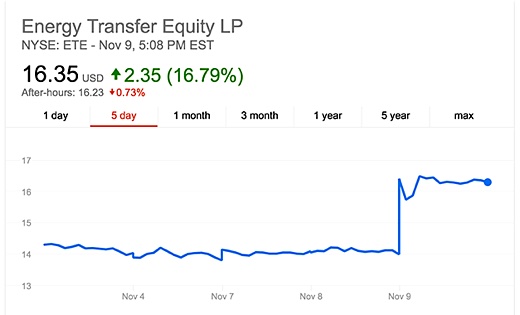
Less than 12 hours after Donald Trump walked onto a New York City stage as the newly elected president, the stock price for Energy Transfer Equity shot up 15 percent. Among that company’s holdings is Energy Transfer Partners, operator of the controversial Dakota Access pipeline. Protesters near the Standing Rock Sioux Reservation continue to fight completion of the $3.8 billion project.

But the jump in share price indicates an immediate pro-energy confidence in Trump.
And that confidence is not unfounded.

In Bismarck, North Dakota, Donald Trump gave a speech in May that would help secure his seat as America’s 45th president. The candidate was lagging 30 delegates to become the Republican nominee. His decision to address oil entrepreneurs in North Dakota was political strategy.

At a petroleum conference, Trump introduced his energy plan for the first time: more fossil fuels, fewer regulations, and a vow to undo many of President Obama’s climate initiatives. Trump would meet the required 1,237-delegate threshold to go on and win the presidency, a startling upset for an outsider who has disrupted the political establishment.


Image above: Five day New York Stock Exchange history of Energy Transfer Equity stock indicates 17% jump the day after election was called for Trump. From original article.

What a Trump victory may spell for the continued battle over the Dakota Access pipeline—and for indigenous rights, in general—is alarming.

For starters, President-elect Trump would stand to personally profit from the project. His campaign energy adviser, Harold Hamm, would also see gains. Hamm is the CEO of Continental Resources, which has plans to flow its supply of Bakken fracked crude through the pipeline. With Trump’s recent victory, Hamm is also on the short list of becoming U.S. energy secretary.

As Politico reports, Trump is also seriously considering 74-year-old Forrest Lucas, of oil products company Lucas Oil, as a top contender for interior secretary, along with “Drill, Baby, Drill” Sarah Palin.
This political changeover has come at a critical time in the struggle at Standing Rock.
All sides, for and against the pipeline, have vowed to stand their ground. The battle to stop the project and protect the Missouri River has recently intensified, growing into one of the largest indigenous rights movements in the world.

On Tuesday, pipeline operators Energy Transfer Partners announced plans to advance its project despite earlier calls from the Obama administration to halt construction. According to a statement released Wednesday, the U.S. Army Corps of Engineers had recently repeated this request in the midst of more violence between police and protesters erupting on lands belonging to the Corps. 
“We asked Dakota Access pipeline on Nov.  4 to honor the administration’s request for a voluntary shut down by stopping work for a 30-day period to allow for de-escalation,” said Colonel John Henderson, the Army Corps district commander. “Dakota Access did not agree to this request.” 
The U.S. government is reassessing permits and has said it’s looking at possible rerouting; the pipeline route currently needs to traverse easements on U.S. Army Corps of Engineers lands.
On Tuesday, Energy Transfer said it is “mobilizing horizontal drilling equipment” for tunneling under Lake Oahe, a basin on the Missouri River, near where thousands of protesters are camped out to protect the water.

That the energy company chose Election Day to announce its brazen defiance of federal appeals is worth mentioning—a day when the focus of most Americans would not be the pipeline, but on the race for the White House.

“Dakota Access remains confident that it will receive the easement for these two strips of land adjacent to Lake Oahe in a time frame that will not result in any significant delay in proceeding with drilling activities under Lake Oahe,” read a statement from the company.

Energy Transfer noted plans to start traversing the water within two weeks in an effort to meet its end of the year construction deadlines—a signal that it has no intention to negotiate, slow down, or reroute.

We are concerned over recent statements from DAPL,” said Col. Henderson.  In his remarks, he once again urged the pipeline company to stop construction and leave the area. “We again ask DAPL to voluntarily cease operations in this area as their absence will help reduce these tensions.”
But now that Trump has won the election and has said he would steer energy policy toward more oil production rather than less, plans to ignore the Obama administration and advance the pipeline so swiftly doesn’t seem so brazen at after all. Just prescient.

According to his Public Financial Disclosure Report, Trump disclosed between $500,000 and $1 million in investments in ETP. He also disclosed $50,000 to $100,000 in investments in Phillips 66, which would own one-quarter of the Dakota Access pipeline once complete.

Between now and January 20, 2017, when Trump is officially sworn into office, it will be up to the Obama administration—through its three agencies, the Department of Justice, the Department of the Interior, and the U.S. Army Corps of Engineers—to deny the permits to Energy Transfer and Dakota Access, if the pipeline is to be halted.

“In this time of uncertainty, President Obama still has the power to give our children hope,” said Standing Rock Sioux Tribal Chairman Dave Archambault II. In a statement today, the tribal leader described the results of last night’s election this way: “We as a country have so much work to do.”
The question now becomes: What happens after Jan. 20?

Among Trump’s campaign promises has been a vow to rescind President Obama’s key climate policies, including reviving construction of the disrupted Keystone XL pipeline. That pipeline would bring petroleum from Canada’s oil sands to Gulf Coast refineries. Obama eventually stepped in and stopped the Keystone, a move widely celebrated for his commitment in addressing these environmental issues.

But what separates Keystone from Dakota Access are boundaries.

Keystone is an international issue because it crosses into Canada, so the State Department has authority over the proposal, unlike the Dakota Access pipeline.

Dakota Access is entirely domestic, beginning in North Dakota and crossing South Dakota and Iowa until it reaches a plant nearly 1,200 miles away in south central Illinois. The federal government has final oversight because the pipeline crosses interstate waterways, like the Missouri River. But even then, only 3 percent of the Dakota Access pipeline crosses federal lands. It also narrowly avoids falling under tribal jurisdiction by a half-mile.

The one constant factor delaying the pipeline process is the Standing Rock Sioux tribe’s assertion of its sovereign right to protect the interests of its water.

But under a Trump presidency, even this right could be under attack.

In the final months of his campaign, Native American leaders canceled a planned meeting with Trump after the then-candidate repeatedly referred to Sen. Elizabeth Warren (D-MA) as “Pocahontas,” a jab about her contested claims of having Cherokee ancestry.

Trump has a history of insulting Native Americans, including tribal leaders he saw as competition for casino interests on the East Coast. “They don’t look like Indians to me,” Trump once said in a congressional hearing. Meanwhile, in 2000, Trump was fined $500,000 for financing ads that portrayed Apache tribal members as criminals in their quest to open a casino.

“This is like Andrew Jackson’s victory,” quipped Rudy Giuliani, speaking to MSNBC’s Chris Matthews. The former New York City mayor was jovially referencing how Trump had appeared to beat the establishment in the way Jackson did in 1827. “The people are rising up against a government they find to be dysfunctional,” he said.

But the reference to Jackson could not have been more directly aimed at Standing Rock—and all of Indian Country. Jackson’s presidential legacy was violently forcing Native peoples from their homelands.

Last week, construction reached the river. Plans call to bury the pipeline 92 feet below the river’s surface. The Missouri is the Standing Rock Sioux tribe’s prime water source; 18 million other people depend on it downstream.

See also:
Ea O Ka Aina: Trump impact on Standing Rock 11/12/16
Ea O Ka Aina: Ann Wright on Standing Rock 11/8/16
Ea O Ka Aina: Turning Point at Standing Rock 11/6/16
Ea O Ka Aina: Jackson Browne vs DAPL owner 11/5/16
Democracy Now: Boycott of DAPL Owner's Music Festival
Ea O Ka Aina: World responds to NoDAPL protests 11/5/16
Ea O Ka Aina: NoDAPL victory that was missed 11/5/16
Ea O Ka Aina: DAPL hid discovery of Sioux artifacts 11/5/16
Ea O Ka Aina: Dakota Access Pipeline will leak 11/5/16
Ea O Ka Aina: Route of the Dakota Access Pipeline 11/4/16
Ea O Ka Aina: Sanders calls for stopping DAPL 11/4/16
Ea O Ka Aina: Obama hints at DAPL rerouting 11/3/16
Ea O Ka Aina: New military attack on NODAPL 11/3/16
Ea O Ka Aina: How to Support NoDAPL 11/3/16
Unicorn Riot: Tweets from NoDAPL 11/2/16
Ea O Ka Aina: Standing Rock & the Ballot Box 10/31/16
Ea O Ka Aina: NoDAPL reclaim new frontline 10/24/16
Ea O Ka Aina: How far will North Dakota go? 10/23/16
Ea O Ka Aina: Amy Goodman "riot" charge dropped 10/17/16
Ea O Ka Aina: Amy Goodwin to face "Riot Charge" 10/16/16
Ea O Ka Aina: Shutdown of all tar sand pipelines 10/11/16
Ea O Ka Aina: Why Standing Rock is test for Oabama 10/8/16
Ea O Ka Aina: Why we are Singing for Water 10/8/16
Ea O Ka Aina: Labor's Dakota Access Pipeline Crisis 10/3/16
Ea O Ka Aina: Standing Firm for Standing Rock 10/3/16
Ea O Ka Aina: Contact bankers behind DAPL 9/29/16
Ea O Ka Aina: NoDAPL demo at Enbridge Inc 9/29/16
Ea O Ka Aina: Militarized Police raid NoDAPL 9/28/16
Ea O Ka Aina: Stop funding of Dakota Access Pipeline 9/27/16
Ea O Ka Aina: UN experts to US, "Stop DAPL Now!" 9/27/16
Ea O Ka Aina: No DAPL solidarity grows 9/21/16
Ea O Ka Aina: This is how we should be living 9/16/16
Ea O Ka Aina: 'Natural Capital' replacing 'Nature' 9/14/16
Ea O Ka Aina: The Big Difference at Standing Rock 9/13/16
Ea O Ka Aina: Jill Stein joins Standing Rock Sioux 9/10/16
Ea O Ka Aina: Pipeline temporarily halted 9/6/16
Ea O Ka Aina: Native Americans attacked with dogs 9/5/16
Ea O Ka Aina: Mni Wiconi! Water is Life! 9/3/16
Ea O Ka Aina: Sioux can stop the Pipeline 8/28/16
Ea O Ka Aina: Officials cut water to Sioux 8/23/16   

.

Climate, Energy, Economy - Pick two

SUBHEAD: Investments of time, energy, and money in resilience will become increasingly valuable.

By Nelson Lebo on 5 July 2016 for the Automatic Earth -
(https://www.theautomaticearth.com/2016/07/climate-energy-economy-pick-two/)


Image above: Painting of futuristic view of Eaarth from the North Pole after peak anthropomorphic climate change. From (http://www.worlddreambank.org/D/DUBIA.HTM).

Introduction by Raul Ilargi Meijer

We used to have this saying that if someone asks you to do a job good, fast and cheap, you’d say: pick two. You can have it good and cheap, but then it won’t be fast, etc. As our New Zealand correspondent Dr. Nelson Lebo III explains below, when it comes to our societies we face a similar issue with our climate, energy and the economy.

Not the exact same, but similar, just a bit more complicated. You can’t have your climate nice and ‘moderate’, your energy cheap and clean, and your economy humming along just fine all at the same time. You need to make choices. That’s easy to understand.

Where it gets harder is here: if you pick energy and economy as your focus, the climate suffers (for climate you can equally read ‘the planet’, or ‘the ecosystem’). Focus on climate and energy, and the economy plunges. So far so ‘good’.

But when you emphasize climate and economy, you get stuck. There is no way the two can be ‘saved’ with our present use of fossil fuels, and our highly complex economic systems cannot run on renewables (for one thing, the EROEI is not nearly good enough).

It therefore looks like focusing on climate and economy is a dead end. It’s either/or. Something will have to give, and moreover, many things already have. Better be ahead of the game if you don’t want to be surprised by these things. Be resilient.

But this is Nelson’s piece, not mine.


Article by Nelson Lebo


There appear to be increasing levels of anxiety among environmental activists around the world and in my own community in New Zealand. After all, temperature records are being set at a pace equal only to that of Stephen Curry and LeBron James in the NBA Finals. A recent Google news headline said it all: “May is the 8th consecutive month to break global temperature records.”

In other words, October of last year set a record for the highest recorded global monthly temperature, and then it was bettered by November, which was bettered by December, January, and on through May. The hot streak is like that of Lance Armstrong’s Tour De France dominance, but we all know how that turned out in the end.

Making history – like the Irish rugby side in South Africa recently – is usually a time to celebrate. Setting a world record would normally mean jubilation – not so when it comes to climate.

Responses to temperature records range from sorrow, despair, anger, and even fury.

Anyone with children or grandchildren (and even the childless) who believes in peer review and an overwhelming scientific consensus has every right to feel these emotions. So why do I feel only resignation?

We are so far down the track at this point that we are damned if we do and damned if we don’t. Remember the warnings 30 years ago that we needed 30 years to make the transition to a low carbon economy or else there would be dire consequences? Well, in case you weren’t paying attention, it didn’t happen.

While these warnings were being issued by scientists much of the world doubled down – Trump-like – on Ford Rangers, Toyota Tacomas, and other sport utility vehicles. The same appears to be happening now, with the added element that we are experiencing the dire consequences as scientists issue even more warnings and drivers buy even more ‘light trucks’. Forget Paris, the writing was on the wall at Copenhagen.

The bottom line is that most people will (and currently do) experience climate change as a quality of life issue, and quality of life is related to a certain extent to disposable income. Acting or not acting proactively or reactively on climate change is expensive and gets more expensive every day.

If the international community ever takes collective action on climate change it will make individuals poorer because the cost of energy will rise significantly. If the international community fails to act, individuals will be made poorer because of the devastating effects of extreme weather events – like last year’s historic floods where I live as well as in northern England, etc – shown to be on the increase over the last 40 years in hundreds of peer-reviewed papers with verifiable data.

And here is the worst part: most economies around the world rely on some combination of moderate climate and cheap fossil fuels. For example, our local economy is heavily dependent on agriculture and tourism, making it exceptionally vulnerable to both acting AND not acting on climate change.

Drought hurts rural economies and extreme winds and rainfall can cost millions in crop damage as well as repairs to fencing, tracks and roads. As a result, both farmers and ratepayers have fewer dollars in their pockets to spend on new shoes, a night out, or a family trip. This is alongside living in a degraded environment post-disaster. The net result is a negative impact on quality of life: damned if we don’t.

On the other hand, tourism relies on inexpensive jet fuel and petrol to get the sightseers and thrill seekers to and around the world with enough dollars left over to slosh around local economies.

Think about all of the service sector jobs that rely on tourism that in turn depend entirely on a continuous supply of cheap fuel. (This is not to mention peak oil and the lack of finance available to fund any long and expensive transition to an alternative energy world.) I’m told 70% of US jobs are in the service sector, most of which rely on inexpensive commuting and/or a highly mobile customer base.

Any significant approach to curbing carbon emissions in the short term will result in drastic increases to energy prices.

The higher the cost of a trip from A to Z the less likely it is to be made. As a result, business owners and ratepayers at Z will have fewer dollars in their pockets to spend on new shoes, a night out, or a family vacation of their own.

The net result is a negative impact on their quality of life: damned if we do.

I suppose it deserves repeating: most OECD economies and the quality of life they bring rely on both moderate climate and cheap fossil fuels, but these are mutually exclusive. Furthermore, regardless of emissions decisions made by the international community, we are already on track for decades of temperature records and extreme weather events that will cost billions if not trillions of dollars.

The response in many parts of the world has been to protest. That’s cool, but you can’t protest a drought – the drought does not care.

You can’t protest a flood – the flood does not care. And even if the protests are successful at influencing government policies – which I hope long-term they are – we are still on track for decades of climatic volatility and the massive price tags for clean up and repair.

Go ahead and protest, people, but you better get your house in order at the same time, and that means build resilience in every way, shape and form.

Resilience is the name of the game, and I was impressed with Kyrie Irving’s post NBA game seven remarks that the Cleveland Cavaliers demonstrated great resilience as a team.

As I wrote here at TAE over a year ago, Resilience Is The New Black. If you don’t get it you’re not paying attention.

This article received a wide range of responses from those with incomplete understandings of the situation as well as those in denial – both positions dangerous for their owners as well as friends and neighbours.

The double bind we find ourselves in by failing to address the issue three decades ago is a challenge to put it mildly. Smart communities recognize challenges and respond accordingly. The best response is to develop resilience in the following areas: ecological, equity, energy and economic.

The first two of these I call the “Pope Index” because Francis has identified climate change and wealth inequality as the greatest challenges facing humanity. Applying the Pope Index to decision making is easy – simply ask yourself if decisions made in your community aggravate climate change and wealth inequality or alleviate them.

For the next two – energy and economics – I take more of a Last Hours of Ancient Sunlight (credit, Thom Hartmann) perspective that I think is embraced by many practicing permaculturists.

Ancient sunlight (fossil fuels) is on its way out and if we do not use some to build resilient infrastructure on our properties and in our communities it will all be burned by NASCAR, which in my opinion would be a shame.

As time passes, everything that is not resilient to high energy prices and extreme weather events will become economically unviable and approach worthlessness.

On the other hand, investments of time, energy, and money in resilience will become more economically valuable as the years pass.

Additionally, the knowledge, skills and experience gained while developing resilience are the ultimate in ‘job security’ for an increasingly volatile future.

If you know it and can do it and can teach it you’ll be sweet. If not, get onto it before it’s too late.

See also:
Ea O Ka Aina: The Solution Space - Part 1 8/15/15
The cost of capital will be very high and solutions which need it will lie outside solution space.

Ea O Ka Aina: The Solution Space - Part 2 8/16/15
If solutions depend on cooperation at a large scale, they will not be part of solution space.

Ea O Ka Aina: The Solution Space - Part 3 8/17/15
Proposed solutions which depend on energy-intensivity will lie outside the solution space.

Ea O Ka Aina: The Solution Space - Part 4 8/18/15
The shift to lower consumption will be imposed on us. The choice will be only in how we face it.

Ea O Ka Aina: The Solution Space - Part 5 8/19/15
The solution space will be inexpensive, small-scale, simple, low-energy, and community-based.

Ea O Ka Aina: From Here on Down 8/4/15
Keep your head down, your nose clean and your hands busy! Get used to it and thrive!

Ea O Ka Aina: Oases on a future Eaarth 6/28/15
It may seem like slow motion, but the unraveling is happening as quick as it can go.

Ea O Ka Aina: Food, Water, Energy & Shelter 1/31/13
As things seem to be degrading or coming apart you will have to step in to provide for yourself.

Ea O Ka Aina: Embrace the Change 7/24/12
Considering the alternatives, there really isn't that much choice.
.

Union pension will need bailout

SUBHEAD: Teamsters' Central States Pension Fund is under funded and won't meet obligations required by government.

By Tyler Durden on 12 May 2016 for Zero Hedge -
(http://www.zerohedge.com/news/2016-05-12/here-come-lot-angry-teamsters-one-americas-largest-pension-funds-demands-taxpayer-ba)


Image above: Teamsters protesting failure of pension funding. From original article.

Over the past few months, we have covered the unfolding saga (here and here) of the Central States Pension Fund, which handles retirement benefits for current and former Teamster union truck drivers across various states including Texas, Michigan, Wisconsin, Missouri, New York, and Minnesota, and is one of the largest pension funds in the nation, all the way through Kenneth Feinberg's rejection of the proposal to cut benefits on behalf of the Treasury.

When the proposal was rejected, we said that the final resolution will be in the form of an inevitable taxpayer-funded bailout
If the Treasury won't allow any pension cuts, and the government created safety net won't be there to keep the benefits flowing, how will the cash continue to flow to members? With the precedent now set by the Treasury that no cuts will be allowed, the answer will likely come in the form of a massive bailout.
As it turns out, that is precisely what fund director Thomas Nyhan believes as well. Nyhan said the rejection means the CSPF likely won't be able to offer another proposed fix without getting funding from Congress, either directly or through the Pension Benefit Guaranty Corp.

However with the PBGC also on its way to insolvency, and unable to shoulder the additional burden in world of zero and negative rates, that leaves us with... drum roll please... the US taxpayers, aka Congress, footing the bill.
"There are only two solutions. Either the plan receives more money or has to have fewer benefits. I'm hopeful that come probably 2017, we can actually all get to work on something that can provide a solution. If there is no legislation at any time, we're going to end up going to insolvency." Nyhan said. 
The full-court press is now on, as now everyone involved is calling on congress to step in. Visitors to CSPF's website this morning were greeed with a banner directing to a rescue plan website.

Before you could enter the rescue site a pop-up message is shown, simply saying that since congress effectively shut down the proposal, they can now stand up and pass legislation to bail the fund out.
"Central States strongly urges these members to act now to pass legislation that protects the pension benefits of the over 400,000 participants of Central States Pension Fund"
With the Treasury denying the possibility of pension cuts, the ball is now in Congress' court to initiate a bailout.

When it does, because it will, the flood gates will be open for the rest of the insolvent funds to come knocking with their hands out, and we can formally welcome the arrival of helicopter money - whether Yellen wants it or not - in the United States.

What follows is Tom Nyhan testifying before congress back in 2013, laying it out in very plain terms that without funding, or significant benefit cuts, the game is over.

"Unless the fund substantially reduces its liabilities, or receives a large influx of assets, it's projected become insolvent within ten or fifteen years, and at this point our options are very limited."
Nobody listened, and now - in this bold new age of pension fund crushing zero and negative interest rates - it is game over.


Image above: Thomas Nyham testimony egards to the Central States Pension Fund before the House Subcommittee on Health, Employment, Labor, and Pensions. From (https://youtu.be/xWJAmJFcWC0).

.

Pension fund cuts coming?

SUBHEAD: Woe betide. A major union pension fund is threatened by low interest rate yields on investments.

By Tyler Durden on 20 April 2016 for Zero Hedge -
(http://www.zerohedge.com/news/2016-04-20/going-be-national-crisis-one-largest-us-pension-funds-set-cut-retiree-benefits)


Image above: Regardless of a sense of injustice and unfairness - if and when the pension stop coming, we will go through something like what the former Soviet Union went through in the late 1980's. A cataclysmic social convulsion and contraction that leads to a rebirth - of sorts. From original article.

A dark storm is brewing in the world of private pensions, and all hell could break loose when it finally hits.

As the Washington Post reports, the Central States Pension Fund, which handles retirement benefits for current and former Teamster union truck drivers across various states including Texas, Michigan, Wisconsin, Missouri, New York, and Minnesota, and is one of the largest pension funds in the nation, has filed an application to cut participant benefits, which would be effective July 1 2016, as it "projects" it will become officially insolvent by 2025.

In 2015, the fund returned -0.81%, underperforming the 0.37% return of its benchmark.

Over a quarter of a million people depend on their pension being handled by the CSPF; for most it is their only source of fixed income.

Pension funds applying to lower promised benefits is a new development, albeit not unexpected (we warned of this mounting issue numerous times in the past).

For many years there existed federal protections which shielded pensions from being cut, but that all changed in December 2014, when folded neatly into a $1.1 trillion government spending bill, was a proposal to allow multi employer pension plans to cut pension benefits so long as they are projected to run out of money in the next 10 to 20 years.

Between rising benefit payouts as participants become eligible, the global financial crisis, and the current interest rate environment, it was certainly just a matter of time before these steps were taken to allow pension plans to cut benefits to stave off insolvency.

The Central States Pension Fund is currently paying out $3.46 in pension benefits for every $1 it receives from employers, which has resulted in the fund paying out $2 billion more in benefits than it receives in employer contributions each year.

As a result, Thomas Nyhan, executive director of the Central States Pension Fund said that the fund could become insolvent by 2025 if nothing is done.

The fund currently pays out $2.8 billion a year in benefits according to Nyhan, and if the plan becomes insolvent it would overwhelm the Pension Benefit Guaranty Corporation (designed by the government to absorb insolvent plans and continue paying benefits), who at the end of fiscal 2015 only had $1.9 billion in total assets itself. Incidentally as we also pointed out last month, the PBGC projects that they will also be insolvent by 2025 - it appears there is something very foreboding about that particular year.

As the Washington Post writes:

Ava Miller, 64, and her husband, Ed Northrup, 68, could see their combined monthly pension income cut to about $3,000 from the nearly $7,000 they receive now, according to a letter they received from Central States in October.
If the cuts go through, Miller, who worked as a dispatcher in Flint, Mich., said they will need to dip into their savings to help cover their $1,300 mortgage payment, heating bills and trips to visit her 84-year old mother. Northrup, a retired car hauler, has started applying for truck driving jobs that could supplement their potentially smaller pension payments.

What makes the cuts more painful, Miller said, is that she took pay cuts so that the company could continue making contributions to the pension.

"I did everything I was supposed to," Miller said, adding that she and her husband made extra payments on their car loan to cut down on their monthly bills after they received letters in October informing them of the potential cuts.
All hope is not lost, however.

Democratic candidate Bernie Sanders has proposed a bill that would repeal the measure allowing cuts, and instead calls for the government to provide assistance to troubled pension funds.
In other words, another bailout.

Which brings us to the current juncture, where we remind everyone that the governments own safety net, the PBGC has itself become insolvent, and according to CNN, projects that more than 10% of the roughly 1,400 multiemployer plans, covering more than 1 million workers fits the current criteria to be able to apply for benefit cuts for participants.

"This is going to be a national crisis for hundreds of thousands, and eventually millions, of retirees and their families. It's going to open the floodgates for other cuts." said Karen Friedman, executive president of the Pension Rights Center.

We can't help but wonder that as more pension funds become insolvent, and more and more participants are forced to take reductions in benefits, whether helicopter money won't soon become a reality for the United States, even before it becomes one in Japan.

Especially if it is spun by some opportunistic politicians as the "only hope" for America's workers to preserve some of their retirement savings.

.

Stupor Bowl 2016

SUBHEAD: The economic game of watching the Bear's Recession Offense crush the Unicorn believing Bulls.

By Charles Hugh Smith on 31 January 2016 for Of Two Minds -
(http://charleshughsmith.blogspot.co.uk/2016/01/stupor-bowl-2016.html)


Image above: Illustration of Chicago Bears mascot in uniform. From (http://www.windycitygridiron.com/2009/7/13/945246/the-bears-den-7-13-09).

When I use the phrase Stupor Bowl, I refer not to the upcoming Super Bowl or the crazy mid-winter bicycle free-for-all in Minneapolis, but to the economic game of watching the Bear's Recession Offense crush the Unicorn-believing Bulls.

Let's follow the score here in the opening minutes of the Recession 2016 contest:
1. Sales have only one way to go: down. Touchdown Bears.

2. Profits have only one way to go: down. Touchdown Bears.

3. Stock buybacks have only one way to go: down. Touchdown Bears.

4. Global "growth" has only one way to go: down. Touchdown Bears.

5. Risk premiums have only one way to go: up. Touchdown Bears.

6. The efficacy of central bank "easing" only one way to go: down. Touchdown Bears. 
This is getting stupefyingly repetitive, and the game has barely started: the Bears have racked up 42 points while the Unicorn-believing Bulls are scoreless.

The Unicorn-believing Bulls are going to need not just one Immaculate Reception, but a half-dozen miracle scores just to stay in the game. But the Bears have barely dented their playbook. Another eight touchdowns are within reach.
7. Government deficits have only one way to go: up.

8. The growth rate of private-sector debt has only one way to go: down.

9. The number of nations with crashing currencies has only one way to go: up.

10. The number of nations defaulting on sovereign debt has only one way to go: up.

11. The number of IPOs that quickly fall below their initial price has only one way to go: up--way up.

12. The number of margin calls to be issued to overleveraged "investors" has only one way to go: up--way up.

13. The number of junk bonds that will default has only one way to go: up--way up.

14. The number of Greater Fools willing to pay outlandishly absurd prices for homes in hot markets is plummeting; as a result, the market value of real estate globally has only one way to go: down--way down. 
The Bears can fumble a few plays and still score another 42 points with ease.

The Unicorn-believing Bulls will need the financial equivalent of The Catch just to avoid being skunked.

But even that won't change the outcome--a recession that will leave all the Unicorn believers, Keynesian Cargo Cultists and the rest of the delusional mob of Bulls stupefied by their crushing defeat.

.

Beware the great 2016 financial crisis

SUBHEAD: Sell everything except high-quality bonds. This is about return of capital, not return on capital.

By Larry Elliot on 12 January 2016 for the Guardian -
(http://www.theguardian.com/business/2016/jan/12/beware-great-2016-financial-crisis-warns-city-pessimist)


Image above: Doomster investors in Manila celebrating drop in stocks. Photo by Dennis M. Sabangan. /From original article.

The City of London’s most vocal “bear” has warned that the world is heading for a financial crisis as severe as the crash of 2008-09 that could prompt the collapse of the eurozone.

Albert Edwards, strategist at the bank SociĂ©tĂ© GĂ©nĂ©rale, said the west was about to be hit by a wave of deflation from emerging market economies and that central banks were unaware of the disaster about to hit them. His comments came as analysts at Royal Bank of Scotland urged investors to “sell everything” ahead of an imminent stock market crash.

“Developments in the global economy will push the US back into recession,” Edwards told an investment conference in London. “The financial crisis will reawaken. It will be every bit as bad as in 2008-09 and it will turn very ugly indeed.”

Fears of a second serious financial crisis within a decade have been heightened by the turbulence in markets since the start of the year. Share prices have fallen rapidly and a slump in the cost of oil has left Brent crude trading at barely above $30 a barrel.

“Can it get any worse? Of course it can,” said Edwards, the most prominent of the stock market bears – the terms for analysts who think shares are overvalued and will fall in price. “Emerging market currencies are still in freefall. The US corporate sector is being crushed by the appreciation of the dollar.”

The Soc Gen strategist said the US economy was in far worse shape than the country’s central bank, the US Federal Reserve, realised. “We have seen massive credit expansion in the US. This is not for real economic activity; it is borrowing to finance share buybacks.”
Edwards attacked what he said was the “incredible conceit” of central bankers, who had failed to learn the lessons of the housing bubble that led to the financial crisis and slump of 2008-09.

“They didn’t understand the system then and they don’t understand how they are screwing up again. Deflation is upon us and the central banks can’t see it.”

Edwards said the dollar had risen by as much as the Japanese yen had in the 1990s, an upwards move that pushed Japan into deflation and caused solvency problems for the Asian country’s banks. He added that a sign of the crisis to come was the collapse in demand for credit in China.
“That happens when people lose confidence that policymakers know what they are doing. This is what is going to happen in Europe and the US.”

Europe has shown tentative signs of recovery in the past year, but Edwards said the efforts of the European Central Bank to push the euro lower and growth higher would come to nothing in the event of a fresh downturn. “If the global economy goes back into recession, it is curtains for the eurozone.”
Countries such as France, Spain and Italy would not accept the rising unemployment that would be associated with another recession, he said. “What a disaster the euro has been: it is a doomsday machine in favour of the German economy.”

The warning from Edwards came as stock markets had a respite from the wave of selling seen since the start of the year. The FTSE 100 index rose by 57 points to close at 5,929, while the Dow Jones Industrial Average was up by 10 points in early trading in New York.

The mood in equity markets was helped by intervention by the People’s Bank of China overnight to support the yuan, with the Chinese currency moving higher on foreign exchange markets.

Edwards joked that after years in which he has tended to be a lone voice, other institutions were also becoming a lot gloomier about global prospects.

He was referring to the RBS advice, which warned that investors face a “cataclysmic year” where stock markets could fall by up to 20% and oil could slump to $16 a barrel.

In a note to its clients the bank said: “Sell everything except high-quality bonds. This is about return of capital, not return on capital. In a crowded hall, exit doors are small.” It said the current situation was reminiscent of 2008, when the collapse of the Lehman Brothers investment bank led to the global financial crisis. This time China could be the crisis point, RBS said.

But the slide in the oil price continued, with Brent crude falling a further 3.5% to close in London at $30.45. Oil has not been below $30 a barrel since 2003.


.

COP21 light at the end of the tunnel?

SUBHEAD: It seems if lluminati have suddenly, after heel dragging had a come-to-Jesus moment.

By Alan Bates on 10 December 2015 for the Great Change -
(http://peaksurfer.blogspot.com/2015/12/down-to-business.html)


Image above: Group of 10 US Senators pledge to defend Prresident Obama's environmental agenda in Congress, citing ‘promise from the American people to the world’. Joining Al Gore (center) in Paris are Sens. Brian Chatz (D-Hawaii), Ed Markey (D-Mass.), Al Franken (D-Minn.), Tom Udall (D-N.M.), Ben Cardin (D-Md.), Jeanne Shaheen (D-N.H.), Sheldon Whitehouse (D-R.I.), Jeff Merkley (D-Ore.), Chris Coons (D-Del.), and Cory Brooker (D-N.J.). From (http://thehill.com/policy/energy-environment/262208-climate-draft-deal-reached-at-paris-conference).

We have to confess we tend to cast a jaundiced eye whenever we see proposals to save the planet through the power of business, free enterprise or so-called “fair trade.” Our first instinct is to make sure our wallet is intact.

A dogged protest has stalked nearly every COP since Kyoto, unfurling its banners with slogans like “System Change not Climate Change.” The protest has found an unlikely ally in Pope Francis, whose Laudato Si encyclical pointed the finger at capitalist greed and made it inseparable with the climate crisis. These are grand gestures and undeniable truths, but we have to wonder whether making a Paris agreement dependent on the dawning of the Age of Aquarius is a viable strategy.

That said, we sense a sea change in business as usual. When Henry David Thoreau said it was no good having a comfortable house if you did not have a habitable planet to put it on, he was not referring to posh villas overlooking Cannes or infinity pools on private islands in The Seychelles but for the upper one-tenth of the one-percent living in such places, he may as well have been. It took a while, but now they get it.

If you manage billions of dollars, pounds, rubles or euros of your own or other peoples' money, it has by now not escaped your attention that it is all at risk in a most profound way.

The IPCC’s (vastly overestimated) atmospheric budget of 1,000 GtCO2, even with highly optimistic assumptions on curtailing deforestation, air travel, shipping and cement emissions, requires global reductions in energy-CO2 of at least 10% each year, transitioning rapidly to zero emissions by 2050 and then going beyond zero. The severity of such cuts would likely exclude even clean coal and natural gas from most countries' energy mix after 2025, President Trump's Energy Policy Task Force notwithstanding.

Reality cannot be reconciled with repeated claims by world leaders and renewables advocates that in transitioning to a low-carbon energy future “global economic growth would not be strongly affected.” You know that is not true! You cannot grow an industrial economy on daily sunbeams the way you can from 500 million years of stored sunlight. Heck, you can even send people to the Moon on that kind of energy.

The economy is a heat engine. It needs to be completely reversed if anyone is going to survive. Degrowth may be unmentionable in Paris, but it is the only policy that gives us any chance to survive to the end of this century. Tyndall Centre's Kevin Anderson observes,

“... [T]here remains an almost global-scale cognitive dissonance with regards to acknowledging the quantitative implications of the analysis, including by many of those contributing to its development. We simply are not prepared to accept the revolutionary implications of our own findings, and even when we do we are reluctant to voice such thoughts openly.”
At a side event on Tuesday called “Growth, the Driver of Climate Change Action” presented by Brazil, Climate Policy Initiative and Brookings, Sir Nicholas Stern mentioned four ways to move towards the zero or negative emission rates that will be necessary: soil rehabilitation; reforestation; CO2 capturing from the air; and biomass with carbon capture.

He said that economic decline from resource overshoot and population pressure, notably migrants from South to North, would likely mean that governments would not be up to the task.

Sterns prognostication was affirmed at the Press Briefing on Wednesday by US Secretary of State John Kerry, who, after posturing for some 20 minutes, pulling out every platitude imaginable about the heroic work we are all undertaking and how this will be humanity's finest hour — “… our commitment to the global clean energy economy that every one of us knows we need if our future is to be secure…” —finally slipped in some statements worth picking our head out of our chest for.
“Ladies and gentlemen the situation demands, and this moment demands, that we do not leave Paris without an ambitious, inclusive and durable global climate agreement.
“Today we are formally announcing, the United States, that we are part of what we are calling the 'High Ambition Coalition.' … Addressing climate change will require a fundamental change in the way that we decide to power our planet and our aim can be nothing less than the steady transformation of the global economy. And that's not a pipe dream, some sort of pie-in-the-sky idea that's way out there and we're waiting for Godot to come along and give us the answer. That's not it. This is not a situation where we have to hope and pray that some smart person is going to come along and find a solution. No! We already have the solution!

“Remember, one of the things that we expect to happen here and makes Paris so important is not that we're going to leave here knowing everything we do is going to hit the 2-degree mark, but what we are doing is sending the marketplace an extraordinary signal, that those 186 countries [that submitted INDCs] are really committed.

And that helps the private sector move capital into that, knowing that there is a future that is committed to this sustainable path. That is why we need a strong, legally binding, transparent system.”
The High Ambition Coalition that Kerry blew the cover on has been gathering in secret for 6 months. It consists of 79 African, Caribbean and Pacific countries, the US and all of EU member states. Notably absent are Australia, South Africa, Brazil, China and India. Canada only just joined.
The group is focusing on at least four key issues. They want an agreement at Paris to be legally binding; to set a clear long-term goal on global warming that is in line with scientific advice; to introduce a mechanism for reviewing countries’ emissions commitments every five years; and to create a unified system for tracking countries’ progress on meeting their carbon goals. —  Karl Mathiesen and Fiona Harvey

On Tuesday the group demanded a binding agreement with five-yearly reviews to consider more ambitious targets for the world and individual countries. They wanted clear rules for all countries to report on their emission reductions promises and have them reviewed and revised.

That piqued oil rich Saudi Arabia, Venezuela and Malaysia – who complained of procedural irregularity and argued the talks should revert to line-by-line negotiations. India said flatly it did not intend to revisit its promised emissions reduction target until 2030.

Hewlett Foundation President Larry Kramer said that new technologies cannot drive change by themselves because of inadequate regulatory frameworks. Neither can climate finance philanthropy provide the needed scale of resources for the necessary investments. Kerry said the overdeveloped countries could not go it alone and even if they reduced all emissions to zero tomorrow, the Earth would continue to warm without comparable cuts coming from the Two-Thirds World. So where does that leave us?

As we looked out the windows at French robocops manhandling journalists who strayed too close to the Grand Palais, we had to say it would not come from street protesters. It had to come from the direction Kerry was pointing — the Illuminati!

Despite the grand claims by Bill McKibben and Naomi Klein that public protest had brought down the Keystone pipeline and transformed energy utilities, we seriously doubt that.

What stopped the pipeline is the same thing that stopped King Coal: the economic downturn in China driving the price of crude oil down; the halving in the price of renewables despite a half century of every possible barrier and disincentive being erected by the Department of Energy, the White House and most governments around the world; and, not inconsequentially, some gnome bean-counters in Switzerland actually running the numbers and closing the spigot on fracking and tar sands, as they must eventually on genetic modification, not because of health concerns, but because they are scientific and economic frauds.

The smart money wants to go green, fast. Jean-Dominique Senard, CEO of Michelin, said pointedly, “You should never oppose the future.”

Michael Bloomberg was equally succinct: “No CEO could survive if they said climate change is not a problem.” Leading companies are seeing an average 27% internal ROI on low-carbon investment.

If the Illuminati actually exists, they have suddenly, after a quarter century of heel dragging and backsliding, had a come-to-Jesus moment. They have realized the existential implications of climate change and are changing the marching orders they are sending to their minions.

An example of that is “We Mean Business,” a consortium of 353 companies, with $7.2 trillion in revenue and $19.6 trillion under management, 50 of whom have already committed to 100% renewable energy (RE100). WMB has an 8-fold demand for the Paris treaty that sounds like it could have been written by Climate Action Network:

The Portfolio Decarbonization Coalition (PDC) is a multi-stakeholder initiative that aims to cut greenhouse gas emissions by having institutional investors (ie: the owners of trillions of dollars of assets) redirect their capital to low-carbon investment opportunities. For 2015, PDC set a target of decarbonizing $100 billion in Assets Under Management. In November it announced it had smashed its target, hitting $230 billion.

The take-home point for Parties in Paris is that while they haggle over a few missing billions in government and private contributions to the Green Climate Fund they are loosing sight of the trillions that can be unlocked with the keys already in their hands.

The French Environment Minister SĂ©golène Royale announced a global call for tender to create cheaper and more efficient electric vehicles. The goal, he said, is to produce EVs which can be sold for less than €7,000, with a charging time of 30 minutes and a 500 km capacity. That carries a number of implications.

To bring down the cost, designers will have to use fewer, cheaper and renewable resources. Think molded bamboo frames and bamboo biochar fuel cells.

Anthony Hobley, CEO of Carbon Tracker said that a critical element in remaining within the limits of a habitable Earth is the need to pull back from projects in the “danger zone.” He pointed to billions of dollars tied up in projects that are simply not needed due to massive cost reductions in renewable energy technology and changing demands.

The US has the greatest financial exposure with $412 billion of unneeded projects, followed by Canada ($220bn), China ($179bn), Russia ($147bn) and Australia ($103bn).

Solar and wind are already getting to grid parity across the globe, and earlier this year, Warren Buffett set a price of three cents per kilowatt hour for his 100 MW solar farm.

ING, a Dutch investment company, announced this week in Paris they will stop financing new coal-fired power plants and mines worldwide and will turn away new clients whose business is more than 50 percent dependent on coal.

As the final days of COP21 draw to a close, the divides are familiar. Dropping the goal from 2° to 1.5°C above pre-industrial levels now seems within reach. Not the temperature — that is no longer within reach — but the Maginot Line and the effort to defend it.

Those resisting this goal, such as India, China and the Arab States, suggest that such a target would represent too heavy a burden on competitiveness, economic development and poverty alleviation. The US and Canada have switched sides and are backing 1.5 to stay alive.

On the issue of finance, underdeveloping economies – those that are transitioning from agriculturally secure, renewably based societies to overpopulated consumerist fossil-addicted client state Ponzi systems — require enormous capital to invest in new coal plants, super-highways and megacities they’ll need to pursue unobtainable economic growth and customer population expansion that exists only in their dreams.

Dozens of countries have aspirations like this and have sent delegates to Paris to push for their Bollywood fantasy of curry in every pot.

On the other hand, overdeveloped countries grappling with financial collapse from years of officially sanctioned systemic ripoffs and lagging resource extraction from the edges of their empires are struggling to meet Hillary Clinton's commitment to mobilize $100 billion per year in support of the bribes extorted by India, South Africa, Brazil and China at Copenhagen.

While other important differences exist, these issues are the biggest impediments to  success at Paris. They are slowing the pace of negotiations and undermining trust. Some countries seem intent on rejecting reasonable compromise because they fear being economically disadvantaged or thrown off their projected growth trajectory, as if that were even possible for anyone but unrepentant economists.

What could shift the argument might be private sector investment, within a enforceably defined regulatory regime, with accountability and transparency, to deploy low-carbon and net-sequestering technologies, including biomass-to biochar carbon capture and storage with agriculture and ecosystem service benefits.

 These represent an investment opportunity pegged by Stern and others at $4.7 trillion. For Ponzi economists it is a wet dream, and for red-eyed French diplomats trying to bring this puppy home, it is God-sent.

A few countries seem intent on making requests that cannot be met and are well beyond the bargaining range – what negotiators call pozo, the “zone of possible agreement.” Include India, Bolivia and Saudi Arabia here. Continuing to push for impossible positions risks everything for nothing.

We Mean Business writes:
“The climate action plans tabled by national governments in the run up to COP21 are already on course to change the temperature trajectory from an estimated 4.8°C by the end of the century to an estimated 2.7°C. Is that enough? Not at all. But a thriving clean economy and a platform for further ambition is contained within those INDCs. Moreover, for those looking for climate finance, remember, the deal itself is the financial package.

The combination of a long-term goal, an ambitious review mechanism, appropriate mechanisms for transparency and accountability, and seed capital for low-carbon development provided by the public purse creates the environment for trillions of dollars in investments and funds the innovation that will drive our common success.”
In his famous 1971 Rules for Radicals, Saul Alinsky said, “A good tactic is one your people enjoy. They’ll keep doing it without urging and come back to do more. They’re doing their thing, and will even suggest better ones.” In this case, anyone who wants utilities to get off coal or nuclear power should look up and see if there are solar cells or a windmill on their house and maybe a bicycle in the shed and complimentary currency in their pocket.

Alinsky warned, “The price of a successful attack is a constructive alternative. Never let the enemy score points because you’re caught without a solution to the problem…. Pick the target, freeze it, personalize it, and polarize it.” This is what is happening to the street protesters outside the corporate venue, who are having their lunch eaten by Big Business as it mashes the accelerator on the green technology revolution.

When engaging in a large-scale political conflict involving civil disobedience, Gandhi believed that satyagrahis (“truth warriors”) must undergo training to ensure discipline. He wrote that it is “only when people have proved their active loyalty by obeying the many laws of the State that they acquire the right of Civil Disobedience.”

Gandhi contrasted satyagraha (holding on to truth) with “duragraha” (holding on to force), by saying the latter was meant more to harass than enlighten opponents and change the status quo. He wrote: “There must be no impatience, no barbarity, no insolence, no undue pressure. If we want to cultivate a true spirit of democracy, we cannot afford to be intolerant. Intolerance betrays want of faith in one's cause.”

One of the biggest roadblocks to achieving the Paris treaty, after Senate Republicans in the US, is India. India demands $2.5 trillion in development pledges before it will implement its national commitments to carbon reductions put forward by its government ahead of the talks. Moreover, it is intolerant of any agreement that will force it to cut its high carbon development path before mid-century, bending the science to fit its politics.

Secretary Kerry said,
“We did not come to Paris to create a ceiling that contains all we ever hope to do. We came to Paris to build a floor, on which all of us together can continue to build. The progress that we've made, particularly with respect to INDCs, is unprecedented and encouraging, but it alone will not be enough.

The targets that we've announced, taken together, will make a major dent in global emissions. They will bend the curve. But they will not hold the temperature to 2°C, which is what scientists tell us is what needs to happen to prevent the worst impacts, or lower than that, even, if possible, the 1.5, whatever.

And that is why it is important that we keep an eye on our targets and insure that they are as ambitious as possible, that we understand whether we are making progress, that we set up a system to review our targets and ratchet them up at regular intervals if we need to, and given the rapid pace that I just mentioned, in which technology is evolving, in five years the individual capacity of one nation or another could increase dramatically.”
Both Wednesday and Thursday will have midnight sessions, it was announced this afternoon by COP President Laurent Fabius. Delegates hope Friday will be a day of rest while the legal and linguistic group reviews the text.

The next iteration of the text, expected for Thursday afternoon, will be what Fabius calls the “penultimate text.” We shall see. Some brackets are more stubborn than others.

Governments may not be able to curb India's counterambitions. But maybe the Illuminati will, especially if, like ING, it refuses to do business with anyone who leaves Paris and is still burning coal. That would be most in keeping with the spirit of the Mahatma
.