Showing posts with label Ponzi. Show all posts

Crypto Puzzle Craze

SUBHEAD: Will puzzle artwork be the next crypto-currency trend to go mainstream?

By Tyler Durden on 30 December 2018 for Zero Hedge -
(https://www.zerohedge.com/news/2018-12-29/will-these-puzzles-be-next-crypto-trend-go-mainstream)

http://www.islandbreath.org/2019Year/01/190126cryptoboysbig.jpg
Image above: "Amir Taaki and Cody Wilson" portraits embedded in a crpto-puzzle painting solved in 2014 with a prize of 3.5 BTC (BitCoins). Click to enlarge. From original article and (https://bitcointalk.org/index.php?topic=661781.0). Note this "painting" is derived from a photo of the two founders of "Dark Wallet" - a system for hiding the identities of BitCoin owners. See (https://www.wired.com/2014/04/dark-wallet/).

The cryptocurrency mania that drove the price of a bitcoin to $20,000 last year has come and gone, leaving a legion of deeply disappointed marginal buyers in its wake. But anybody who still believes in the long-term promise of crypto - and is looking to pick up some coins on the cheap - should try their luck at a crypto puzzle.

What's a crypto puzzle? Put simply, it's a burgeoning genre of artwork where viewers race against one another to solve a puzzle embedded in the picture.

Whoever wins is rewarded with a purse of cryptocurrency.

Though the phenomenon first emerged in 2014, when @coin_artist, the pseudonym of Marguerite deCourcelle, created Dark Wallet Puzzle, the first known cryptopuzzle, Business Week claimed in a recent feature about the trend that cryptopuzzles are still thriving - with buyers even paying hefty sums for pieces even after they have been solved.
Marguerite deCourcelle lives at the peculiar intersection of Bitcoin and art. Under the pseudonym @coin_artist, she’s credited with inventing the crypto-art puzzle, a genre of images hiding complicated ciphers that reward the first solver with a walletful of virtual currency. 
he most famous of these is an @coin_artist oil pastel from 2015 called Torched H34R7S, the final work in a series known as The Legend of Satoshi Nakamoto. Depicting a ­turtledove, chess pieces, and a ­phoenix surrounded by flames, the painting incorporates symbolic references to Bitcoin’s creator, as well as to Shakespeare and deCourcelle’s personal life.
An anonymous person solved the riddle in 2018, unlocking 5 Bitcoins, at the time worth about $50,000.
DeCourcelle started the Bitcoin-art-puzzle phenomenon in 2014 with Dark Wallet Puzzle, a painting of two leading crypto anarchists that hides a key. It led to a 3.4-Bitcoin reward. "I created it after realizing that without a third party litigating how money moves, that money could be ‘pulled out’ of anything," she says.
The result is a strange amalgam of the crypto and art-world universes, as crypto puzzles are beginning to "enter the mainstream through galleries, museums, international exhibitions, and even video games." In a way, winning crypto purses from solving these visual puzzles isn't that much different than the process of crypto mining - the only difference is that humans are solving the puzzles and not computers.


The Whitney Museum of American Art is planning to display its first crypto puzzle next spring. Until recently, most hidden-crypto-key artworks had been known only to nerdy collectors, their images circulated on websites such as Reddit and BitcoinTalk. Now they’re starting to enter the mainstream through galleries, museums, international exhibitions, and even video games. Many of the puzzles are also getting a bit easier to solve, giving more people a chance to crack the code and claim the coins. Some collectors are buying the art even after the puzzle has been solved and the ­digital currency extracted.
This spring artist Andy Bauch showcased “New Money,” a collection of mosaics, at the Castelli Art Space in Los Angeles. The patterns in the pieces, which were made of thousands of Lego blocks and included a 4-by-9-foot horizontal triptych, contained clues to troves of Bitcoin and other ­cryptocurrencies. "How seemingly arbitrary art prices are, and seeing crypto prices fluctuating wildly, I was curious,” Bauch says. "Will the ­cryptocurrency I put in this art appreciate? Will the art itself appreciate regardless of the cryptocurrency?"
Three of his works have sold - one of them for $14,000 - though the virtual coins hidden within one had already been taken before the show began. Per the unspoken rules of the ­crypto-art crowd, Bauch had posted photos of the works online, where anyone could view them and try to ­decipher their riddles.
The pieces are also getting some high-­profile attention from the art world. The Whitney Museum of American Art in New York plans to show a 16-millimeter film by Jennifer and Kevin McCoy that offers clues to a Bitcoin address.
The first solver will be named as one of the official donors of the piece, a distinction that can be resold or traded. At Bitcoin Art (r)evolution in Paris this fall, some 1,000 visitors in the course of a week viewed 40 works from @coin_artist and others, organizer Pascal Boyart says. He plans to embed crypto-art puzzles in his murals in the city’s streets.

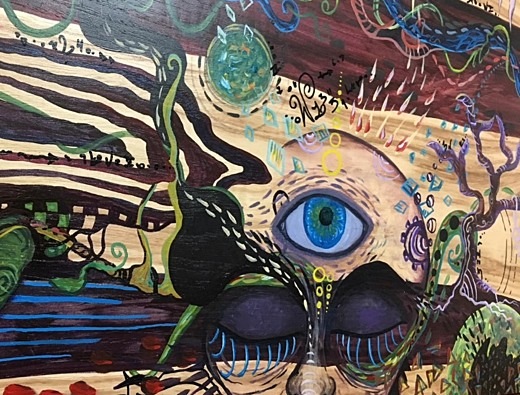
Image above: Detail of crypto artwork by Nanu Berk from an article about her thoughts on the new art industry. From (https://medium.com/blockchain-art-collective/crypto-art-is-no-easy-calling-heres-what-artist-nanu-berks-really-thinks-about-the-industry-7c5e84663614).

As the genre gains prominence in the mainstream art world, DeCourcelle is finding new ways to monetize the concept, including digital puzzles that resemble video games and selling pieces to collectors who are looking to own a piece of crypto history.
DeCourcelle, who has an art degree from Eastern Oregon University, made the final piece of The Legend of Satoshi Nakamoto series when she found herself suddenly single and parenting two small children, living in a rented room at a friend’s house with no steady means of support.
She spent four months working at night, during her boys’ naptimes, and between freelance projects to finish the painting, for which she’d already pledged 3.5 of her own Bitcoins in prize money.
She survived in the meantime by selling the original Dark Wallet Puzzle painting for 10 Bitcoins, or about $3,000 at the time.
"I just wanted a piece of that history," says buyer Brooke Royse-Mallers, a Bitcoin investor and avid crypto-puzzle-solver. "The history of Bitcoin’s evolution and my evolution with it, I guess. That painting helped me learn more about the technology without being a coder."
Though most crypto puzzles aren't worth much, DeCourcelle says she's been offered as much as $1 million for her work over the years. That should give remaining crypto entrepreneurs hope: If they're dissatisfied with the retail price, they can try packaging it with a visual puzzle to boost the price.

.

Abracadabra!

SUBHEAD: And so - Shazzam! I give you the one-percenters! And a bankrupt United States of America.

By James Kunstler on 11 December 2017 for Kunstler.com -
(http://kunstler.com/clusterfuck-nation/abracadabra/)


Image above: Face of a slot machine dubbed "Money Magic!" From (http://www.slotsup.com/free-slots-online/money-magic-rival).

And so, as they say in the horror movies, it begins…! The unwinding of the Federal Reserve’s balance sheet.

Such an esoteric concept! Is there one in ten thousand of the millions of people who sit at desks all day long from sea to shining sea who have a clue how this works? Or what its relationship is to the real world?

I confess, my understanding of it is incomplete and schematic at best — in the way that my understanding of a Las Vegas magic act might be. All the flash and dazzle conceals the magician’s misdirection.

The magician is either a scary supernatural being or a magnificent fraud.

Anyway, the audience ‘out there’ for the Federal Reserve’s magic act — x-million people preoccupied by their futures slipping away, their cars falling apart, their kid’s $53,000 college loan burden, or the $6,000 bill they just received for going to the emergency room with a cut finger — wouldn’t give a good goddamn even if they knew the Fed’s magic show was going on.

So, the Fed has this thing called a balance sheet, which is actually a computer file, filled with entries that denote securities that it holds.

These securities, mostly US government bonds of various categories and bundles of mortgages wrangled together by the mysterious government-sponsored entity called Freddie Mac, represent about $4.5 trillion in debt.

They’re IOUs that supposedly pay interest for a set number of years. When that term of years expires, the Fed gets back the money it loaned, which is called the principal. Ahhhh, here’s the cute part!

You see, the money that the Fed loaned to the US government (in exchange for a bond) was never there in the first place. The Fed prestidigitated it out of an alternate universe. They gave this money to a “primary dealer” bank in exchange for the bond, which the bank abracadabraed up for the US Treasury. Well, not really.

In fact, the Fed just made a notation on the bank’s “reserve” account that the money from the alternate universe appeared there.

Somehow that money was sent via a virtual pneumatic tube to the US Treasury, where it was used to pay for drones to blow up Yemeni wedding parties, and for the Secret Service to visit pole dancing bars when the president traveled to foreign lands.

Here’s the fun part. The Fed announces that it is going to shed this nasty debt, at about $10 billion worth a month starting this past October. Their stated goal is to reach an ultimate wind-down velocity of $50 billion a month (cue laugh track).

If they ever get there (cue laugh track) it would take 20 years to complete the wind-down.

The chance of that happening is about the same as the chance that Janet Yellen will come down your chimney on December 24 with a sack-full of chocolate Bitcoins. But never mind the long view for the moment.

One way they plan to accomplish this feat is to “roll off” the bonds. That is, when the bonds mature — i.e. come to the end of their term — they will cease to exist. Poof!

Wait a minute! When a bond matures, the issuer has to send the principal back to the lender.

After all, the Fed lent the US Treasury X-billion dollars, the US Treasury paid interest on the loan for X-years, and now it has to fork over the full value of the loan (hopefully in dollars that have magically inflated over the years and are now worth less than when they were borrowed — another magic trick!). But that doesn’t happen.

Instead, when the theoretical principal is returned to the Fed, the Fed disappears the money, like the girl in a bikini onstage who enters the magician’s sacred box and vanishes.

Now you see her, now you don’t. The explanation, of course, might be that the money was never really there in the first place, so it makes sense to fire it back to the alternative universe it came from.

Well, uh, I guess….

The catch is: for a while it was here on earth and folks were doing stuff with it, such as the aforementioned drone strikes and pole dancers.

Not only that, but the “primary dealer” banks were allowed to loan out ten times the reserve minimum denoted on their Fed accounts for participating in the scheme. Who did they lend all that money to?

Apparently, a lot of it went to corporations who borrowed it at ultra-low interest rates in order to buy back their own stock, which paid dividends way higher than the interest rate they borrowed at to buy the stuff, and which also pumped up the share value of the stocks, which also happened to make the executives of the corporations way richer in terms of their stock options and bonuses (awarded for boosting the share value of the stock!).

And so, shazzam: I give you the one-percent! And a bankrupt United States of America.

And don’t even ask about all those bundles of janky Freddie Mac mortgages fobbed off on the Fed.

The reason they did that in the first place was because those mortgages weren’t being paid off, and the banks and insurance companies that held them were choking to death on them.

So they parked them in a crawl space under the Fed’s Eccles Building in Washington, hoping they would just turn to compost And guess what: they’re no more valuable now then they were then. File that one under Necrophilia.

.

Volatility on Steroids

SUBHEAD: Regeneration, in this context, is about getting better, stronger, more resilient over time.

By Dr Nelson Lebo III on 17 OCtober 2017 in Automatic Earth -
(https://www.theautomaticearth.com/2017/10/volatility-on-steroids/)


Image above: Still frame of life in Las Vegas in 1982 fro the film  "Koyaanisqatsi". A film about our modern life out of balance. From (http://www.londoncitynights.com/2012/12/philip-glass-at-75-koyaanisqatsi-at.html).

Volatility is the new normal – that’s the message I gave a local Rotary Club when I spoke to members four or five years ago. I had been told beforehand the group was “worldly” and specifically instructed in the invitation to challenge them with my presentation.

As a weekly columnist in the city’s paper – the Wanganui Chronicle – I was widely known for my positions on wealth inequality, climate change, and debt, as well as a wide range of practical approaches to address these issues.

Around that time it was clear that a post-GFC new normal was functioning worldwide and many writers were using the term.

By then The Spirit Level (Pickett & Wilkinson, 2009) had been widely read and widely praised for its documentation of the relationship between wealth and income inequality and social problems.

Additionally, peer reviewed research based on decades worth of data had shown there was a quantitatively measurable increase in extreme weather events: more big storms and more big droughts.

I thought my audience would be well on board.

Judging from the response that day, however, the brief I had been given was misguided and most club members were neither expecting nor wanting a presentation that challenged the dominant paradigm of infinite growth without consequences no matter how factual.

As a mid-week midday meeting with New Zealand ‘fush ‘n chups’ on the menu the message that the-world-as-you-know-it-has-changed-forever was a bit heavy for people on their lunch break.

The response that day was, of course, perfectly ‘normal’. Almost no adult human seeks out new and different worldviews. On the contrary, we are far more inclined to cling to outdated ones, à la “Make America Great Again” than to acknowledge changing realities.

Social media allows us to reverberate in echo chambers of our own beliefs where we know we’re right because the echo told us so. Social science researchers have told us this for decades. The Internet just makes it worse and more obvious.

I’ve been writing about Trump, doubling-down and the post-truth world for two years now, and if anything I am more certain of the point I’ve been trying to make: most people are irrational. Seems there’s now a Nobel Laureate who has been arguing the same for decades.

Behavioral economist Richard Thaler was recently awarded a Nobel for his study of the psychology of economics, which seeks to understand how we are irrational and the impact on traditional economic theories that have failed time and again (think 2008 Global Financial Crisis) because they don’t sufficiently incorporate human factors. (Remember Greenspan’s admission?)

In no way do I intend to single out the Wanganui Rotarians, but rather use this example as illustrative for what my community, nation, and the entire world face: volatility made worse by inertia. In other words, the longer we choose to ignore inconvenient truths the greater will be their negative impacts.
This situation usually manifests in the form of tipping points .

 Malcolm Gladwell defined a tipping point in his debut book of the same name as “the moment of critical mass, the threshold, the boiling point.” Everything looks fine with the economy and the climate…until it’s not. And by ‘not fine’ we are talking really NOT FINE à la Greece, Puerto Rico, Houston, etc.

Tipping points is volatility on steroids. Brace yourselves.

Well-informed leaders from President Obama to Pope Francis agree the greatest threats facing humanity are climate change and wealth inequality. I’ve written extensively about both for many years yet neither appears to get much traction locally or globally.

Our ‘leaders’ ignore these issues at all of our peril because the result of each is increasing volatility in many forms: social, economic, financial, political, and an increasing incidence of extreme weather events.

Volatility is not good for social order, and where I live is a perfect example of the canary in the coalmine: a coastal, river city with high levels of inequality. It’s a tipping point waiting to happen.

Some readers may remember the 1982 film by Godfrey Reggio called Koyaanisqatsi, named using a Hopi term meaning “chaotic life” or “life out of balance.”

The film is unnerving, as is much of what comes via news media these days: hurricanes, mass shootings, hurricanes, opioid epidemics, hurricanes, people sleeping in cars, hurricanes, rising suicide rates, hurricanes, and children dying from cold damp homes.

And then there’s Myanmar: When Buddhists become the aggressors, you know the world is well and truly out of balance.

Okay, so the world is out of balance. What can be done about it?

Our solution to imbalance, as any regular reader of our blog knows, is called “Eco-Thrifty.” This approach to design and to life is about living better on less. Seems we have good company along these lines in the form of Costa Rica, the small Central American nation that regularly tops the Happy Planet Index published by the New Economics Foundation.

Despite per capita income one quarter that of New Zealand (ranked 38th of 140) and one fifth that of the US (108th of 140) Costa Rica matches many Scandinavian countries in terms of equality, wellbeing, life expectancy and ecological impact.

As Jason Hickel of the Guardian recently put it, “Costa Rica proves that rich countries could theoretically ease their consumption by half or more while maintaining or even increasing their human development indicators.”

“The opposite of growth isn’t austerity, or depression, or voluntary poverty. It is sharing what we already have, so we won’t need to plunder the earth for more.”

Sharing is at the heart of the permaculture ethics, where it is joined by caring for the environment and caring for people. Although we practice permaculture on our farm and in our community, we’re not dogmatic about it. What drives the eco-thrifty bus is resilience accompanied by regeneration.

Resilience, in this context, is the ability to withstand a pulse. It does not happen by accident. It can be designed, built and managed. Resilience only matters 0.0001% of the time, but when it matters it really matters.

Resilient homes stand up to earthquakes and hurricanes. Resilient farms stand up to major rain events and extended droughts. Resilient communities withstand economic downturns and ‘natural disasters’.

Regeneration, in this context, is about getting better, stronger, more resilient over time.

Regenerative farms grow food while building soil fertility, reducing erosion, storing carbon, managing storm water, and increasing biological diversity.

Regenerative communities reduce crime, domestic violence, drug abuse, and suicide rates while keeping wealth and resources circulating locally. They improve quality of life while shrinking energy use, pollution and wealth inequality.

From these perspectives Costa Rica is a good, albeit imperfect, case study. It is, however, about the best example we can find and has the data to show long-term consistently high quality of life.


Image above: "Pura Vida" is Spanish for "Pure Life". One alternative to the Ponzi scheme our debt based "economy" enshrines. From (https://www.goabroad.com/articles/study-abroad/10-reasons-to-study-abroad-in-costa-rica).


Pura Vida trumps Koyaanisqatsi.

.

Central banks ARE the Crisis

SUBHEAD: We shouldn't let them conjure up trillions out of nothing, and use that power as a political tool.

By aul Ilargi Meijer on 25 uly 2017 for the Automatic Earth -
(https://www.theautomaticearth.com/2017/07/central-banks-are-the-crisis/)


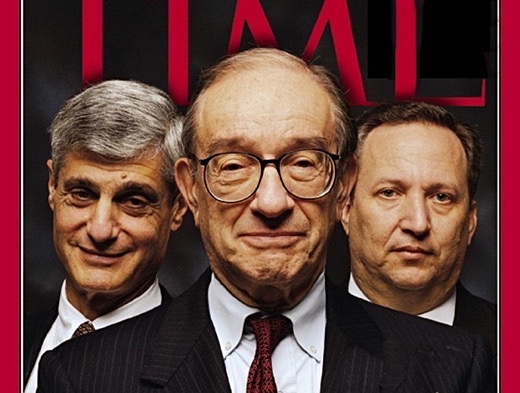
Image above: The men who brought it down - Richard Reich, Alan Greenspan and Larry Somers.  From (https://www.dailymaverick.co.za/article/2014-02-24-how-close-we-were-to-a-global-financial-meltdown-in-2008-now-we-know/#.WXomwIqQxE4).

If there’s one myth -and there are many- that we should invalidate in the cross-over world of politics and economics, it‘s that central banks have saved us from a financial crisis. It’s a carefully construed myth, but it’s as false as can be. Our central banks have caused our financial crises, not saved us from them.

It really should -but doesn’t- make us cringe uncontrollably to see Bank of England governor-for-hire Mark Carney announce -straightfaced- that:
“A decade after the start of the global financial crisis, G20 reforms are building a safer, simpler and fairer financial system. “We have fixed the issues that caused the last crisis. They were fundamental and deep-seated, which is why it was such a major job.”
Or, for that matter, to see Fed chief Janet Yellen declare that there won’t be another financial crisis in her lifetime, while she’s busy-bee busy building that next crisis as we speak. These people are now saying increasingly crazy things, and that should make us pause.

Central banks don’t serve people, or even societies, as that same myth claims. They serve banks. Even if central bankers themselves believe that this is one and the same thing, that doesn’t make it true. And if they don’t understand this, they should never be let anywhere near the positions they hold.

You can pin the moment central banks went awry at any point in time you like. The Bank of England’s foundation in 1694, the Federal Reserve’s in 1913, the ECB much more recently. What’s crucial in the timing is where and when the best interests of the banks split off from those of their societies.

Because that is when central banks will stop serving those societies. We are at such a -turning?!- point right now. And it’s been coming for some time, ‘slowly’ working its way towards an inevitable abyss.

Over the past few years the Automatic Earth has argues repeatedly, along several different avenues, that American society was at its richest between the late 1960s and early 1980s. Yet another illustration of this came only yesterday in a Lance Roberts graph:

Anyone see a recovery in there? Lance uses 1981 as a ‘cut-off’ date, but the GDP growth rate as represented by the dotted line doesn’t really begin to go ‘bad’ until 1986 or so.

At the tail end of the late 1960s to early 1980s period, as the American economy was inexorably getting poorer, Alan Greenspan took over as Federal Reserve governor in 1987.

A narrative was carefully crafted by and for the media with Greenspan as an ‘oracle’ or even a ‘rock star’, but in reality he has been instrumental in saddling the economy with what will turn out to be insurmountable problems.

Greenspan was a major driving force behind the repeal of Glass-Steagall, which was finally established through the Gramm-Leach-Bliley act of 1999. This was an open political act by the Federal Reserve governor, something that everyone should have then protested, and still should now, but didn’t and doesn’t.

Central bankers should be kept far removed from politics, anywhere and everywhere, because they represent a small segment of society, banks, not society as a whole.

Because of the ‘oracle’ narrative, Greenspan was instead praised for saving the world. But all that Greenspan and his accomplices, Robert Rubin and Larry Summers, actually did in getting rid of the 1933 Glass-Steagall act separation between investment- and consumer banking was to open the floodgates of debt, and even more importantly, leveraged debt.

All part of the ‘financial innovations’ Greenspan famously lauded for saving and growing economies. It was all just more debt on top of more debt.

Greenspan et al ‘simply’ did what central bankers do: they represent the best interests of banks. And the world’s central bankers have never looked back. That most people still find it hard to believe that America -and the west- has been getting poorer for the past 30-40 years, goes to show how effective the narratives have been.

The world looks richer instead of poorer, after all. That this is exclusively because of rising debt numbers wherever you look is not part of the narratives. Indeed, ruling economic models and theories ignore the role played by both banks and credit in an economy, almost entirely.

Alan Greenspan left as Fed head in 2006, after having wreaked his havoc on America for almost two decades, right before the financial crisis that took off in 2007-2008 became apparent to the world at large. The crisis was largely his doing, but he has escaped just about all the blame for it. Good PR.

With Ben Bernanke, an alleged academic genius on the Great Depression, as Greenspan’s replacement, the Fed just kept going and turned it up a notch. It was no longer possible in the financial world to pretend that banks and people had the same interests, so the former were bailed out at the expense of the latter.

The illusionary narrative for the public, however, remained intact. What do people know about finance, anyway? Just make sure the S&P goes up. Easy as pie.

The narrative has switched to Bernanke, and Yellen after him, as well as Mario Draghi at the ECB and Haruhiko Kuroda at the Bank of Japan, saving the world from doom. But once again, they are the ones who are creating the crisis, not the ones saving us from it. They are saving the banks, and saddling the people with the costs.

In the past decade, these central bankers have purchased $20-$50 trillion in bonds, securities and stocks. The only intention, and indeed the only result, is to keep banks from falling over, increase their profits, and maintain the illusion that economies are recovering and growing.

They can only achieve this by creating bubbles wherever they can. Apart from the QE programs under which they bought all those ‘assets’, they used -and still do- another tool: lowering interest rates to the point where borrowing money becomes so cheap everyone can do it, and then do it some more.

It has worked miracles in blowing stock market valuations out of all realistic proportions, and in doing the same for housing markets in locations all over the globe.

The role of China’s central bank in this is interesting too, but it is such an open and obvious political tool that it really deserves its own discussion and narrative. Basically, Beijing did what it saw Washington do and thought: why hold back?

Fast forward to today and we see that we’ve landed in a whole new, and next, phase of the story. The world’s central banks are all stuck in their own – self-created – bubbles and narratives. They all talk about how they solved all the issues, and how they will now return to normal, but the sad truth is they can’t and they know it.

The Fed stopped purchasing assets through its QE program a while back, but it could only do that because Frankfurt and Japan took over. And now they, too, talk about quitting QE. Slowly, yada yada, because of control, yada yada, but they know they must.

They also know they can’t. Because the entire recovery narrative is a mirage, a fata morgana, a sleight of hand.

And that means we have arrived at a point that is new and very dangerous for the entire global economy and all of its people.

That is, the world’s central bankers now have an incentive to create the next crisis. This is because they know this crisis is inevitable, and they know their masters and protégés, the banks, risk suffering immensely or even going under.

‘Tapering’, or whatever you might call the -slow- end to QE and the -slow- hiking of interest rates, will prick and blow up bubbles one by one, and often in violent fashion.

When housing bubbles burst, economies lose the primary ingredient for maintaining -let alone increasing- their money supply: banks creating money out of thin hot air. Since the money supply is one of the key components of inflation, along with velocity of money, there will be fantastic outbursts of debt deflation. You’ve never seen -let alone imagined- anything like it.

The worst part of it is not government debt, though that, when financed with bond sales, is not not an instrument to infinity and beyond either. But the big hit to economies will be private debt.

Where in many bubble areas, and they’re too numerous too mention, eager potential buyers today fret over affordable housing supply, it’ll all turn on a dime and owners won’t be able to sell without being suffocated by crippling losses.

Pension funds, which have already suffered perhaps more than any other parties because of low interest ZIRP and NIRP policies, have switched en masse to riskier assets like stocks. Well, another whammy, and a bigger one, is waiting just outside the door. Pensions will be so last century.

That another crisis is waiting to happen, and that politics and media have made sure that just about no-one at all is aware of it, is one thing. We already knew this, a few of us. That the world’s main central bankers have an active incentive to bring about the crisis, if only by sitting on their hands long enough, is new. But they do.

Yellen, Draghi and Kuroda may opt to leave before pulling the trigger, or be fired soon enough. But whoever is in the governor seats will realize that unleashing a crisis sooner rather than later is the only option left not to be blamed for it.

Let the house of dominoes crumble now, and they can say “nobody could have seen this coming”, while at the same time saving what they can for the banks and bankers they serve. That option will not be on the table for much longer.

We should have never given them, let alone their member/master banks, the power to conjure up trillions out of nothing, and use that power as a political tool. But it is too late now.

.

New Jersey government shuts down

SUBHEAD: Illinois and New Jersey state insolvencies are just the start... Kentucky is next and more are on the way.

By Tyler Durden on 1 July 2017 for Zero Hedge -
(http://www.zerohedge.com/news/2017-07-01/chris-christie-announces-new-jersey-government-shutdown-orders-state-emergency)


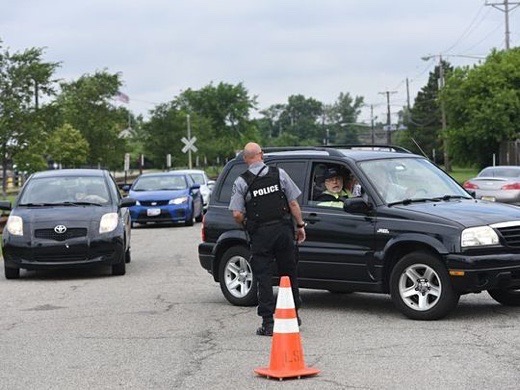
Image above: With the government shut down New Jersey closed all its public parks and beaches to the public this July 4th weekend. Here police (still operating) turn away people from Liberty State Park. From (http://www.app.com/story/news/politics/new-jersey/chris-christie/2017/07/02/gov-christie-get-h-off-beach/446242001/).

We've written quite a bit over the past couple of months about the pending financial crisis in Illinois which will inevitability result in the state's debt being downgraded to "junk" at some point in the near future (See article below).

Chris Christie announces New Jersey government shutdown and orders a state Of emergency.

Illinois, Maine, Connecticut: the end of the old fiscal year and the failure of numerous states to enter the new one with a budget, means that some of America's most populous states have seen their local governments grind to a halt overnight until some spending agreement is reached. Now we can also add New Jersey to this list.

On Saturday morning, New Jersey Gov. Chris Christie declared a state of emergency in the state, and announced a partial state government shutdown as New Jersey become the latest state to enter the new fiscal year without an approved budget after the Republican governor and the Democrat-led Legislature failed to reach an agreement by the deadline at midnight Friday, CBS New York reports.

In a news conference Saturday morning, Christie blamed Democratic State Assembly Speaker Vincent Prieto for causing the shutdown.

And, just like Illinois and Connecticut, Christie and the Democrat-led Legislature are returning to work in hopes of resolving the state's first government shutdown since 2006 and the first under Christie, before NJ is downgraded further by the rating agencies.

"If there's not a resolution to this today, everyone will be back tomorrow," Christie said, calling the shutdown "embarrassing and pointless." He also repeatedly referred to the government closure as "the speaker's shutdown." Christie later announced that he would address the full legislature later at the statehouse on Saturday.

Prieto remained steadfast in his opposition, reiterating that he won't consider the plan as part of the budget process but would consider it once a budget is signed. Referring to the shutdown as "Gov. Christie's Hostage Crisis Day One," Prieto said he has made compromises that led to the budget now before the Legislature.

"I am also ready to consider reasonable alternatives that protect ratepayers, but others must come to the table ready to be equally reasonable," Prieto said. "Gov. Christie and the legislators who won't vote 'yes' on the budget are responsible for this unacceptable shutdown. I compromised. I put up a budget bill for a vote. Others now must now do their part and fulfill their responsibilities."

Politics aside, the diplomaitc failure has immediate consequences for Jersey residents: Christie ordered nonessential services to close beginning Saturday. New Jerseyans were feeling the impact as the shutdown took effect, shuttering state parks and disrupting ferry service to Liberty and Ellis islands. Among those affected were a group of Cub Scouts forced to leave a state park campsite and people trying to obtain or renew documents from the state motor vehicle commission, among the agencies closed by the shutdown.

As funds run out elsewhere, it will only get worse. Police were turning away vehicles and bicyclists at Island Beach state park in Ocean County.

A sign posted at the park entrance featured a photo of Prieto and the phone number of his district office in Secaucus, along with the caption: "This facility is CLOSED because of this man."
When asked about the sign, Christie spokesman Jeremy Rosen said the governor wanted to make sure people knew why the site was shuttered.  "Speaker Prieto singlehandedly closed state government," Rosen said, adding that the governor wanted to make sure families "knew that the facilities were closed and who is responsible."
Not all things will be affected: remaining open under the shutdown will be New Jersey Transit, state prisons, the state police, state hospitals and treatment centers as well as casinos, race tracks and the lottery.

A major point of disagreement is the ongoing stalemate between Christie and lawmakers over whether to include legislation affecting the state's largest health insurer into the state budget.

Christie and Senate President Steve Sweeney agree on legislation to make over Horizon Blue Cross Blue Shield, including allowing the state insurance commissioner to determine a range for the company's surplus that if exceeded must be put to use benefiting the public and policyholders.

But Prieto opposes the plan, saying that the legislation could lead to rate hikes on the insurer's 3.8 million subscribers and that the legislation is separate from the budget. Prieto has said he will leave open a vote on the $34.7 billion budget that remains deadlocked 26-25, with 24 abstentions, until those 24 abstentions change their mind.

Democratic Assemblyman Vince Mazzeo, of Northfield, was among those abstaining. He reasoned that if the governor did not get the Horizon bill, then nearly $150 million in school funding -- $9.6 million of which would go to his district -- would be line-item vetoed out of the budget.

And indeed, Christie said Friday during a news conference that he would slash the Democratic spending priorities if he did not get the Horizon bill as part of a package deal on the budget.  "You want me to wave a magic wand to get a budget?" Christie said. "I can't get a budget to my desk.

Only the Senate and Assembly can get the budget to my desk."

But where things may get nasty quick, is that Christie said public workers should not expect any back pay. "Yeah, don't count on it." Christie said of furlough pay. "That was Jon 'I'll Fight For a Good Contract For You' Corzine. I ain't him."

Meanwhile, the fingerpointing has begun, including Democrats pointing at other Democrats.

"It seems like he's just being stubborn," Mazzeo said of Prieto. "With all due respect to the speaker, then there should be some type of negotiations." But Prieto said it's lawmakers - fellow Democrats - like Mazzeo who are to blame for the shutdown. He said he is willing to discuss the Horizon legislation but after the budget is resolved.

Christie has balked at the proposal because he says lawmakers plan to leave town to campaign for re-election and he will be a lame duck.

According to CBS, all 120 lawmakers face voters this year. Finally, putting the sheer chaos of it all in context, Christie who is term-limited and is expected to be out of office by January, has his family staying for the holiday weekend in a state-owned house at Island Beach State Park. The park is closed because of the shutdown


Jersey and Illinois are not alone
SUBHEAD: When the ponzi dominoes start to fall, Bloomberg has provided this helpful map to illustrate who will succumb first...
By Tyler Durden on 1 July 2017 for Zero Hedge -
(http://www.zerohedge.com/news/2017-07-01/americas-pension-bomb-illinois-just-start)


Image above: Diagramatic map of USA illustrating percentage of funding for state pension obligations. From original article by Bloomberg News.

Unfortunately, the state of Illinois doesn't have a monopoly on ignorant politicians...they're everywhere. And, since the end of World War II, those ignorant politicians have been promising American Baby Boomers more and more entitlements while never collecting nearly enough money to cover them all...it's all been a massive state-sponsored scam.

As we've noted frequently before, some of the largest of the many entitlement 'scams' in this country are America's public pension funds. Up until now, these public pension have been covered by stealing money set aside for future generations to cover current claims...it's a ponzi scheme of epic proportions...$5-$8 trillion to be exact.

Of course, the problem with ponzi schemes is that eventually you get to the point where the ponzi is so large that you can't possibly steal enough money from new entrants to cover redemptions from those trying to exit...and, with a tidal wave of baby boomers about to pass into their retirement years, we suspect that America's epic ponzi is on the verge of being exposed for the world to see.

And when the ponzi dominoes start to fall, Bloomberg has provided this helpful map to illustrate who will succumb first...

Of course, if you live in a state like South Dakota, you may take some solace from the fact that your public pension is fully funded...don't.

Once the dominoes start to fall, and they will, those "ignorant politicians" we mentioned above will think they're doing the right thing when they attempt to "socialize the issue" with federal bailouts and tax hikes. Unfortunately, this is one crisis that will be too large for even American taxpayers to bailout.

.

Sound of One Wing Flapping

SUBHEAD: Just when you thought it was safe you find that a calm surface is exactly what Black Swans like to land on.

By James Kunstler on 1 May 2017 for Kunstler.com -
(http://kunstler.com/clusterfuck-nation/sound-one-wing-flapping/)


Image above: One from a series of photos of a black swan landing on calm waters. From (http://wampy1.blogspot.com/2011/04/black-swan-landing.html).

And suddenly the storms of early Trumptopia subside, or seem to. The surface of things turns eerily placid as the sweets of May sweep away the toils of an elongated mud season. Somebody stuffed Kim Jong Un back in his bunker with a carton of Kools and the Vin Diesel video library.

France appears resigned to Hollandaise Lite in the refreshing form of boy wonder Macron. It’s been weeks since The New York Times complained about the Russians stealing Hillary’s turn as leader of the free world.

We’re given to understand that Congress managed overnight to cook up a spending bill that will avert a Government shut-down until September. Rest easy America… oh, and buy every dip.

A calm surface is exactly what Black Swans like to land on, though by definition we will not know they’re out there until our reveries are broken by the sound of wings flapping.

Some kind of dirty bird showed up on Canada’s thawing pond last week when that country’s biggest home loan lender suffered a 60 percent pukage of shareholder equity and had to be bailed out — not by the Canadian government directly, but by the Ontario Province’s Health Care Workers Pension Fund, a neat bit of hocus pocus that amounts to a one-year emergency loan at ten percent interest.

If that’s a way for insolvent public employee pension plans to find enough “yield” to meet their obligations, then maybe that could be the magic bullet for the USA’s foundering pension funds.

The next time Citibank, Goldman Sachs, JP Morgan, and friends get a case of the Vapors, let them be bailed out by the Detroit School Bus Drivers’ Pension Fund at ten percent interest. That ought to work. And let Calpers take care of Wells Fargo.

The situation across Western Civilization is as follows: virtually every major financial institution has become a check-kiting operation or a Ponzi scheme, and we’ve reached the point where they can only pretend to be rescued.

Bailout or not, the Toronto-based Home Capital Group is still stuck with shit-loads of non-performing sub-prime mortgage loans — its specialty — and Canada’s spectacular real estate bubble has hardly begun to pop. The collateral is starting to turn, like dead meat in the May sunshine, and the odium will waft across the border.

It doesn’t take much to blow things up, as the world discovered in several other historically recent episodes.

The 1998 banking contagion started with the collapse of Thailand’s currency, called the baht. I doubt you could count on one hand the number of people in Wall Street or the Federal Reserve (with its 300-plus PhD economists) who gave a flying fuck about the Thai baht.

Before you knew it, South Korea and Indonesia started whirling around the drain. And then Russia felt the suck.

And then the Nobel Prize winning economists at a Connecticut hedge fund called Long Term Capital Management found out the hard way that their “secret sauce” investment formula which “could not fail in the life of this universe or several like it,” fatally poisoned its balance sheet on a repast of Russian sovereign bonds after only about eighteen months.

And it took all the poobahs of American banking to paper over the firm’s death about five minutes before the global banking system would shut down via the greatest daisy chain of cross-collateralized financial booby-traps ever assembled.

And ten years later, there was the fiasco of 2008, starring Lehman Brothers and a demonic host of grifters trafficking in worthless bonded debt around the sub-prime mortgage racket tied into a toxic web of “derivative financial products” — i.e. bad bets between insolvent counter-parties masquerading as “insurance” against unsound investment. Trillions of bailout monies conjured out of thin air fixed that, oh yes it did!

So enjoy the festivities around the Maypole today, and the suddenly calm waters of global affairs, and keep your ears pricked for the sound of wings flapping.

See also:
Ea O Ka Aina: Land as insurance - The Black Swan 3/7/17

.

Forgo Wells Fargo

SUBHEAD: Wells Fargo board of directors face wrath for complicity in bank's corruption.

By Lauren McCauley on 25 April 2017 for Common Dreams -
(https://www.commondreams.org/news/2017/04/25/wells-fargo-directors-face-wrath-complicity-bank-corruption)


Image above: "Around the country, people are saying that we've had enough of Wells Fargo really doing everything it can to extract as much value out of our communities as possible, and we're fighting back," Saqib Bhatti, director of the ReFund America Project who also is working on the Forgo Wells campaign. From (ForgoWells.org).

The board of directors of Wells Fargo Bank was dealt low-confidence vote, and met with fierce protests in and outside of annual shareholder meeting.

Met by fierce protests both inside and out the annual shareholder meeting in Ponte Vedra Beach, Florida on Tuesday, members of the Wells Fargo board of directors refused to step down despite expressions of outrage and no confidence for their handling of a massive consumer banking scam.

The meeting marked the first for shareholders since the Consumer Financial Protection Bureau (CFPB) last September exposed the bank for opening millions of unauthorized accounts, which saddled many customers with fees and blemishes on their credit score, all in the name of meeting unrealistic sales quotas.

The massive scandal and fallout led to the resignation of former CEO John Stumpf and Tuesday's meeting was expected to be the moment that the directors would be held to account.

Sen. Elizabeth Warren (D-Mass.) issued a series of tweets during the three-hour long meeting, advising those voting to demand accountability:
Either @WellsFargo’s board failed to fully investigate the fraud for years or they knew about it and did nothing – either is unacceptable.
Shareholders should vote out every member of the @WellsFargo’s board who was around during this scam. This is about accountability.
Inside the meeting, multiple shareholders stood up to express anger at the directors.

The New York Post reports:
During the first minutes of the meeting, shareholder Bruce Marks of the Neighborhood Assistance Corporation of America spurred mayhem as he demanded that board members to stand up and tell investors what they knew and when they knew it about the scandal [...]

"Let them speak! Let them speak! Or are they just mouthpieces for the executives who allowed these predatory practices to occur?" Marks said.  [Chairman Stephen] Sanger tried to get Marks to sit down and wait until a specific Q&A session, telling him he was "out of order." [...]
"Wells Fargo has been out of order for years, and your response is, 'Well, we're sorry,'" Marks yelled. "Well, that's not good enough!"
Sister Nora Nash, director of corporate responsibility for the Sisters of St. Francis of Philadelphia, also denounced the board, saying they "failed to set the tone and the culture" that it should have, according to NBC News.

At one point, shareholders introduced a motion to break up the banking giant. Rachel Curley, democracy associate with the consumer advocacy group Public Citizen, said of the request:
"One of the key arguments for reducing the size of Wells Fargo... is that the bank is too big to manage. The massive cross-selling fraud attests to this problem."
Another proposal which recommended the bank drop its funding of the Dakota Access Pipeline (DAPL) was also tabled. "You can drink water. You can't drink oil," Robert Taken Alive, a member of the Standing Rock Sioux Tribal Council, said during the meeting. "We're looking for action. We're not looking for policy or paper."

Outside the meeting, campaigners held a day of action to draw attention to the "corrupt and unethical business practices" of the bank—from an overnight anti-pipeline protest at a New York City location to a flyover banner above the Florida meeting, which drew attention to Wells Fargo executive Jeff Grubb's support for an anti-LGBT extremist group. Others took to Twitter to express their outrage with the banking giant, using the hashtag #ForgoWells.

"Around the country, people are saying that we've had enough of Wells Fargo really doing everything it can to extract as much value out of our communities as possible, and we're fighting back," Saqib Bhatti, director of the ReFund America Project who also is working on the Forgo Wells campaign, told CounterSpin recently, explaining that the campaign "is really about getting cities, states, counties, school districts across the country to stop doing business with Wells Fargo."

In addition to the day of action, Forgo Wells is circulating a petition that, Bhatti explained, "calls on the bank to divest from Dakota Access Pipeline, to stop investing in private prisons and immigration detention centers, to stop funding the payday lending industry, to stop its tremendous lobbying that it's doing to try to influence our politics, to stop its predatory foreclosure practices, and a number of other demands that we raise."

Ultimately, "all but three of the directors received less than 81 percent of the shares cast, with risk committee chairman Enrique Hernandez Jr. receiving the lowest tally, 53 percent," reported Deon Roberts and Rick Rothacker with the Charlotte Observer's "Bank Watch," who described the vote as "a strong rebuke."

"It's extremely rare for corporate directors to be voted out or even to have a poor showing in annual shareholder votes," they noted. "Running unopposed, they typically receive voting percentages in the high 90s." Chairman Sanger only received 56 percent. The three directors who fared well were all hired in the wake of the scandal.

The embattled board seemed to hold on with the help of Warren Buffett, whose company Berkshire Hathaway owns about 10 percent of shares.

.

Our Intellectual Bankruptcy

SUBHEAD: When the system itself is the source of our problems, changing nothing guarantees collapse.

By Charle Hugh Smith on 19 April 2017 for of Two Minds  -
(http://www.oftwominds.com/blogapr17/idea-bankruptcy4-17.html)


Image above: Painting of an alchemist attempting to turn lead into gold. From (https://ecstatic-darkness.com/2016/12/13/solar-transformation/).

Clinging to magical-thinking fixes that change nothing on the fundamental level hastens collapse. For esxample the religious belief in "Keynesian Economics", "Universal Basic Income" and "Medicare/Medicade for All".

Here we stand on the precipice, and all we have in our kit is a collection of delusional magical thinking that we label "solutions." We are not just morally and financially bankrupt, we're intellectually bankrupt as well.
Here are three examples of magical thinking that pass for intellectually sound ideas:

1. Mainstream neo-classical/ Keynesian economics
As economist Manfred Max-Neef notes in this interview, neo-classical/ Keynesian economics is no longer a discipline or a science--it is a religion.

It demands a peculiar faith in nonsense: for example, the environment--Nature-- is merely a subset of the economy. When we've stripped the seas of wild fish (and totally destroyed the ecology of the oceans), no problem--we'll substitute farmed fish, which are in economic terms, entirely equal to wild fish.

In other words, the natural world cannot be valued in our current mock-science religion of economics.

Other absurdities abound. Stripping the seas of wild fish adds to GDP, so it's all good, right? Dismantling newly constructed buildings and building a replacement structure also adds to GDP, so it's an excellent source of "growth."

As Max-Neef points out, conventional economists have absolutely no understanding of poverty. If you need a sobering account of just how this abject willful ignorance works in the real world, I recommend reading The White Man's Burden: Why the West's Efforts to Aid the Rest Have Done So Much Ill and So Little Good.

Gail Tverberg (among others) has shown how the existing economic model no longer makes sense of the actual economy we inhabit: The Economy Is Like a Circus.

As for rising wealth/income inequality--there is a cure for that, but it's not in mainstream econ textbooks: The Only Thing, Historically, That's Curbed Inequality: Catastrophe Plagues, revolutions, massive wars, collapsed states—these are what reliably reduce economic disparities.(via Arshad A.)
2. Universal Basic Income
As noted in yesterday's essay, wages are no longer an adequate means of distributing the dwindling surplus of advanced economies. Wages as a share of GDP have been declining for decades, and only click up temporarily during massive speculative bubbles. Once these bubbles pop, which they inevitably do due to their instability and unsustainability, wage earners' share of GDP plummets to a new low.

The mainstream is enthusing about the "solution": Universal Basic Income (UBI). The solution to low pay and scarcity of middle-class paid work is to give everyone a basic income for doing nothing.

Delusional academics anticipate a flowering of creative talent akin to a new Renaissance as people are freed from work by robots and automation. But if we look at people already receiving the equivalent of "free money" UBI--disability-- studies find recipients are simply watching more TV and YouTube videos and pursuing opioids, not writing poetry and composing concertos.

They are not volunteering in their community or engaging their communities in any positive fashion. What actually happens with UBI is recipients become isolated and miserable because UBI strips their lives of meaning, purpose and the need to contribute to a community.

The real purpose of UBI is to chain every household to the state, and drain all social relations between the isolated "consumer" and the state.

As tragic as the delusion of UBI is to individuals, it is unworkable financially because profits will fall as automation becomes commoditized, and the surplus available to distribute to every household will diminish.

I explain this at some length in my books Why Our Status Quo Failed and Is Beyond Reform and A Radically Beneficial World: Automation, Technology & Creating Jobs for All.

Much of what is passed off as "corporate profits" is accounting fraud and the monetization of what was once free. For example, all that customer labor: now that we pump our own gasoline, check and pack our own purchases, do our own banking--who's skimming the output of our labor? Yup, the corporations.

Commoditization of software and tools + the Internet = loss of monopoly. This is a problem, for the core function of the state-cartel version of capitalism we inhabit is the state enforces a cartel-monopoly structure to guarantee steady surpluses it can tax for its own expansion.

As automation is commoditized, profits plummet as competition can no longer be controlled by cartels or even the state--just as Marx laid out.

Combine declining productivity and declining surplus (profits) (both for deeply structural reasons) and there cannot be enough money to fund UBI. Weirdly, proponents of UBI never even perform a back of the envelope calculation of cost and the source of all this free money (tax revenues and/or borrowing from future generations). Perhaps they intuit that such an exercise would reveal the bankruptcy of their magical thinking.

As we shall see below, the system can't even support the entitlements it has already promised to hundreds of millions of people, never mind an additional universal entitlement.

(Note to UBI enthusiasts: there are limits on what robots and automation can and will do: they will only perform work that is highly profitable. Since most human work is not profitable (or even paid), the idea that robots and automation will free everyone from work is delusional fantasy. I explain all this in greater detail in A Radically Beneficial World.)  
3. Medicare for all
I understand the desire for a single-payer healthcare system, and have published various proposals over the years for such a system.

The latest magical-thinking "solution" attracting widespread support (again, without any basis in actual numbers) is Medicare for all. The idea is: take a system (Medicare-Medicaid) that's already bankrupting the government and the nation and expand it from 70 million people to 320 million people.

Uh, right.

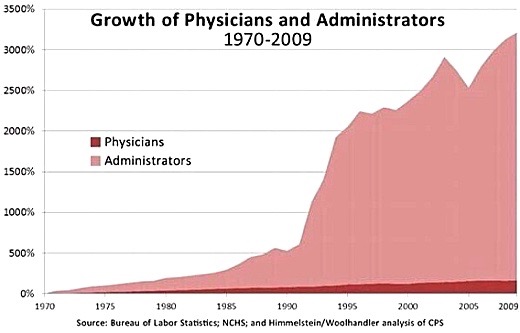
Shall we consult reality before embracing delusional "solutions"? Here's a chart of the rise of administrative costs in healthcare, public and private. Proponents of Medicare for All claim admin costs are lower in Medicare, but this conveniently overlooks the estimates that 40% of Medicare costs are paper-shuffling, needless or harmful tests, procedures, etc. and outright fraud.


Image above: Chart showing the growth in the number of physicians versus medical administrators. From the article.

We know a few things as fact
One is that the populations qualifying for Medicare and Medicaid (the elderly and low-income households) are expanding at a high and very predictable rate.

The other thing we know is that the Medicare-Medicaid costs are rising at a rate far above the growth rate of the economy that supports these programs (GDP), far above the growth rate of tax revenues and far above the growth rate of wages, which matters because payroll taxes fund Medicare.

It doesn't take much to extend these lines and conclude Medicare-Medicaid alone will bankrupt the federal government and the nation. The problem is these programs are bloated by fraud, defensive medicine, predatory pricing for medications, and every other costly ill of our healthcare system.

Like every other centrally funded/regulated sector, Medicare-Medicaid is optimized for maximizing private-sector profits and increasing regulatory costs. This is one manifestation of the diminishing returns on the entire centralized-control model.

We'd all like "solutions" that don't change anything, but when the system itself is the source of our problems, changing nothing guarantees collapse.

As noted in the article linked above, various inequalities and asymmetries get resolved by collapse. Clinging to magical-thinking fixes that change nothing on the fundamental level hastens collapse. In that sense, magical-thinking fixes are "solutions," but not the sort their proponents imagined.


.

End of century global debt cycle

SUBHEAD: Central banks global debt has been rising for generations. A crash is overdue.

By Michael Synider on 27 February 2017 for EconomicCollapseBlog
(http://theeconomiccollapseblog.com/archives/march-2017-the-end-of-a-100-year-global-debt-super-cycle-is-way-overdue)


Image above: European Central Bank sign behind a wall of flames. From (http://learningenglish.voanews.com/a/eu-central-bank-moves-to-help-ecomony/3229756.html).

For more than 100 years global debt levels have been rising, and now we are potentially facing the greatest debt crisis in all of human history.  Never before have we seen such a level of debt saturation all over the planet, and pretty much everyone understands that this is going to end very, very badly at some point.

The only real question is when it will happen.  Many believe that the current global debt super cycle began when the Federal Reserve was established in 1913.

Central banks are designed to create debt, and since 1913 the U.S. national debt has gotten more than 6800 times larger.  But of course it is not just the United States that is in this sort of predicament.  At this point more than 99 percent of the population of the entire planet lives in a nation that has a debt-creating central bank, and as a result the whole world is drowning in debt.

When people tell me that things are going to “get better” in 2017 and beyond, I find it difficult not to roll my eyes.  The truth is that the only way we can even continue to maintain our current ridiculously high debt-fueled standard of living is to grow debt at a much faster pace than the economy is growing.

We may be able to do that for a brief period of time, but giant financial bubbles like this always end and we will not be any exception.

Barack Obama and his team understood what was happening, and they were able to keep us out of a horrifying economic depression by stealing more than nine trillion dollars from future generations of Americans and pumping that money into the U.S. economy. 

As a result, the federal government is now 20 trillion dollars in debt, and that means that the eventual crash is going to be far, far worse than it would have been if we would have lived within our means all this time.

Corporations and households have been going into absolutely enormous amounts of debt as well.  Corporate debt has approximately doubled since the last financial crisis, and U.S. consumers are now more than 12 trillion dollars in debt.

When you add all forms of debt together, America’s debt to GDP ratio is now about 352 percent.  I think that the following illustration does a pretty good job of showing how absolutely insane that is
If your brother earns $100,000 in annual income and borrowed $10,000 on his credit card, he could consume $110,000 worth of stuff.  In this example, his debt to his personal GDP is just 10%.  But what if he could get more credit year after year and reached a point where his total debt reached $352,000 but his income remained the same.  His personal debt-to-GDP ratio would now be 352%.

If he could borrow at super low interest rates, maybe he could sustain the monthly loan payments. Maybe?  But how much more could he possibly borrow?  What lender would lend him more?  And what if those low rates began to rise?  How much debt can his $100,000 income cover?  Essentially, he has reached the end of his own debt cycle.
The United States is certainly not alone in this regard.  When you look all over the industrialized world, you see similar triple digit debt to GDP figures

When this current debt super cycle ultimately ends, it is going to create economic pain on a scale that will be unlike anything that we have ever seen before.  The following comes from King World News
That is the inevitable consequence of 100 years of credit expansion from virtually nothing to $250 trillion, plus global unfunded liabilities of roughly $500 trillion, plus derivatives of $1.5 quadrillion. This is a staggering total of $2.25 quadrillion. Therefore, the question is not what could go wrong since it is guaranteed that all these liabilities will implode at some point.

And when they do, it will bring misery to the world of a magnitude that no one could ever imagine. It is of course very difficult to forecast the end of a major cycle. As this is unlikely to be a mere 100-year cycle but possibly a 2000-year cycle. It is also impossible to forecast how long the decline will take.

Will it be gradual like the Dark Ages, which took 500 years after the fall of the Roman Empire? Or will the fall be much faster this time due to the implosion of the biggest credit bubble in world history? The latter is more likely, especially since the bubble will become a lot bigger before it implodes.
And there are certainly lots of signs that a global slowdown is already beginning.  For example, global trade growth has fallen below 2 percent for only the third time since the year 2000.  On each of the other occasions, we witnessed a horrible recession take place.

For more signs that economic conditions are deteriorating, please see my previous article entitled “Recession 2017? Things Are Happening That Usually Never Happen Unless A New Recession Is Beginning“.

Of course much of the globe is already in the midst of a horrible economic crisis.  Brazil is in the middle of their worst recession ever, and people are literally starving in Venezuela.  A new round of debt problems has erupted in Europe, with Greece, Portugal and Italy being the latest flashpoints.

Just like in 2007, many are mocking the idea that the a major economic downturn is coming to the United States.  They believe that the ridiculously high stock market valuations of today can stick around indefinitely, and they are putting their faith in politicians.

But it won’t be too long before a new economic crisis begins in America and the kind of civil unrest that I portray in “The Beginning Of The End” erupts all across the country.

I just don’t understand why more people cannot see this.  Government debt, corporate debt and consumer debt have all been growing much, much faster than the overall economy.  Can someone please explain to me how that could possibly be sustainable in the long-term?

Someone that I considered to be a mentor but that has since passed away once said that things would seem like they would be getting better for a little while before the next crash comes.

And it turned out that he was precisely correct.  We are in a season of time when economic conditions have appeared to be getting a little bit better in the United States, and this has blinded so many people to the truth of what is about to happen to us.

.

Unrest is the only Growth Industry

SUBHEAD: The entire politics-economics-media operation hasn't hidden its failed "Growth" model.

By Raul Ilargi Meijer on 1 February 2017 for the Automatic Earth -
(https://www.theautomaticearth.com/2017/02/unrest-is-the-only-growth-industry-left/)


Image above: Illustration for article on unsustainability. From (https://www.vision.org/visionmedia/social-issues-sustainable-society/50333.aspx).

Benoît Hamon won the run-off for the presidential nomination of the Socialist party in France last weekend. The party that still, lest we forget, runs the country; current president François Hollande is a Socialist, even if only in name, but he did win the previous election.

Hamon ran on a platform of shortening the workweek from 35 to 32 hours, legalizing cannabis and ‘easing’ the country into a universal basic income of €750/month per capita. He’s way left of Hollande, who has a hilariously low approval rating of 4%.

Hamon doesn’t appear to have much chance of winning the presidency in the two voting rounds taking place on April 23 and May 7, but we all know how reliable election predictions are these days, and in that regard France is as volatile as the next country.

With conservative runaway favorite François Fillon accused of having paid his wife $1 million for doing nothing and Marine Le Pen, already desperately short on funds, targeted by the EU over money, who knows what and who will decide the election?

Hamon may simply be the only one left standing on the day after the vote.

I bring up Hamon, about whom I know very little, not least because he was more or less a late minute addition to the field that was supposed to have been an easy win for his former boss Manuel Valls, I bring up Hamon because he confirms something I’ve been talking about for a while.

That is, the fact that ‘leftist France’ chooses to go even more left than expected, goes a way towards proving my ‘theory’ that voters in many if not most western countries will move away from their respective political centers, and towards extremes.

This is an inevitable consequence of traditional, less extreme, politicians and parties having all become clustered together in shapeless and colorless blobs in the center, both in the US and in most European countries, combined with the fact that all of their policies -especially economic ones- have spectacularly failed vast amounts of people (or voters, if you will).

The failure of their policies has been hidden from sight by interest rates squashed like bugs, ballooning central bank balance sheets, real estate bubbles, fabricated economic data, and fantasy stories in their media that seem(ed) to affirm the ‘recovery’ tales, but they all ‘forgot’ to -eventually- line up reality with the fantasies. They never made 99% of people actually more comfortable.

The entire politics-economics-media operation has failed because it was/is based on lies and fake news, meant to hide economic reality (i.e. negative growth), and this will have grave consequences.

People have started noticing this despite the official and media-promoted data. And they’re not going to “un-notice”. Not only don’t people -once they find out- like having been lied to for years, they dislike worsening living conditions even more.

And that’s all they get; the only people who get it better are the rich, because without that the machinery can’t continue pumping up the ‘official’ numbers.

And what do you get? People complain about Trump. And they focus on one of his -seemingly- crazy ideas: temporarily closing US borders to refugees from nations with large Muslim populations.

Which is a fine thing to resist, because yes, it’s a pretty silly idea, but why haven’t they paid similar attention to how they’ve been lied to for years on both the economy and on Syria, on how Obama became the Drone King and how many innocent people lost their lives because of that?!

To how favorite all-American gal Hillary screwed up Northern Africa when she declared "We Came We Saw He Died" and the death of Libya’s Gaddafi, who gave his country the highest living standards in the region, free education and free health care, but was murdered by Hillary’s US troops, co-created the chaos that led to so many people wanting to flee their homelands in the first place?

Why is that?

Why are there protests when people are halted at an American border crossing but not when American and British and French and Australian forces blow the very same people’s homes to smithereens?

Could that have something to do with where the protesters get their information?

With how much they know about what’s happening in the world before it reaches their doorsteps?

Yes, people are suffering, and it’s very unfair what’s happening to many caught in the Trump Ban, but does anyone really believe that that’s where it started, that this is the first time (or even a unique time) that protest is warranted, or more so? And if not, why is it happening?

Because people only notice stuff when it hits them in the face, I would presume, but who among the protesters would volunteer to agree they live their lives with blinders on?

Not many, I would venture. So why do we see what we do? Where were you when Obama ordered yet another child, a family, which hadn’t yet made it to a US airport but might as well have, to be collateral damage?

I get why you’re protesting the Trump ban, but I don’t get why that’s your prime focus. I am guessing that most of the protesters would not have voted Trump in the first place, and would have been much happier -to put it mildly- for Hillary to be president right now.

But if you would have paid attention in history class, you would know that it was Hillary who brought the refugees to your welcome mats to begin with.

Take it a step further, like to the January 21 women’s march, and you would realize that the vast majority of the refugees would have much preferred to stay where they grew up, where the women in their families, their sisters and aunts and daughters used to live.

Most of whom are gone now, they’re either dead or diaspora-ed to Jordan, Turkey, Alberta, Sweden, Greece. All on account of Obama and his crew. Who of course blamed it on Assad and Putin. “I killed 1000 children, but I had to because those guys are so dangerous….”

This generation of refugees, of the huddled masses that the Statue of Liberty is supposed to teach you about, didn’t come to America because it’s the promised land; they came because America turned their homeland into a giant pile of rubble surrounded by garbage heaps and minefields.

I don’t know if you’ve ever seen pictures of Aleppo before it was destroyed, but I dare you to tell me there is even one existing American city today that’s more beautiful than Aleppo was before Americans and their allies reduced it to dust.


Image above: This is Aleppo before America got involved in Syria. From original article.

There’s very little left of that beautiful city, with its highly educated people and their lovely happy children. And none of that has anything at all to do with Donald Trump!

I don’t want to give you pics of what Aleppo looks like now. I want you to remember how lovely it was before ‘we’ moved in, years go. Sure, what you hear and see in the west is that Assad and Putin are the bad guys in this story. But now that the US/EU supported ‘rebels’ are gone, dozens of schools are reopening, and medical centers, hospitals. Who are the bad guys now?

And yeah, Trump is an elephant, and elephants are always awkward and they’re messy and they tend to kick things over and when they make mistakes those tend to be huge, but how much valuable china does the US really have left anyway?

Isn’t it all perhaps just a sliver off target, the demos, the outrage and indignation? Is the idea that your army can destroy people’s living environments with impunity without you protesting in anything approaching a serious way, and that then you get to demand, through protest, that those same people are allowed entry into your country? That’s way too late to do the right thing.

I started out making the point that as our politico-economic systems are failing, voters will move away from the center that devised and promoted those systems, and that this will happen in many countries.

The US could have had Bernie Sanders as president, but the remaining powers in the center made that impossible. Likewise, many European countries will see a move towards either further left or further right.

Since the former is mostly dormant at best, while the latter has long been preparing for just such a moment, many nations will follow the American example and elect a right wing figurehead.

This will cause a lot of chaos, but that’s not necessarily a bad thing. People need to wake up and become active. The recent US demonstrations may be a first sign of that, even though they look largely out of focus.

More than anything else, people need a mirror, they need to acknowledge that because they’ve been in a state of mindless self-centered slumber for so long, they have work to do now.

And that work needs to consist of more than yelling at the top of your lungs that Trump and Le Pen and Wilders are such terribly bad people.

For one thing because that will only help them, for another because they were not the people who put you to sleep or were supporting mindless slaughter in faraway nations or were making up ‘official’ numbers as your economies were dumped into handbaskets on their way to hell.

So ask yourselves, why did you believe what Obama was saying, or Merkel, or Cameron, Sarkozy, Rutte, you name them, while you could have known they were just making it all up, if only you had paid attention?

Why? What happened?

Why did the term ‘fake news’ only recently become a hot potato, even though you’ve been bombarded with fake and false news for years? Is it because you were/are so eager to believe that your economy is recovering that any evidence to the contrary didn’t stand a chance?

If so, do realize that for many people that was not true; it’s why they voted for the people you now so despise. Is it perhaps also because you’re so eager to believe your ‘leaders’ do the right thing that you completely miss out on the fact that they’re not? And whose fault is that?

In yet another angle, people claim that the planet’s in great peril because Trump doesn’t ‘believe’ in climate change.

But it’s not Trump’s who’s the danger when it comes to climate change, you are, because you’re foolish enough to believe that things like last year’s infinitely bally-hood Paris Agreement (CON21) will actually ‘save’ something. That belief is more dangerous than a flat-out denial, because it lulls people into sleep, while denial keeps them awake.

It’s the idea that there’s still time to rescue the planet that’s dangerous, because it’s the perfect excuse to keep on doing what you were doing without having to feel too much guilt or remorse.

You’re not going to save a single species with your electric car or whatever next green fad there is, the only way to do that is through drastic changes to your society and your own behavior.

That’s not only true with respect to the climate, it’s just as valid with respect to the refugees on your doorstep. If you want to rescue them, and those who will come after them, the only thing that makes any difference is making sure the bombing stops, that the US and European war machines are silenced. If you don’t do that, none of these protests are of any use.

So sure, yeah, by all means, protest, but make sure you protest the real issues, not just a symptom.

That doesn’t mean you should shut the door in the face of these frail forms fainting at the door, that’s just insane, but it does mean that after welcoming your guests, you will also have to make sure what brought them there must stop.

If you stop killing and maiming these people, and help rebuild Aleppo and a thousand other places, they won’t need to come to your door anymore.

As for the political field, unrest will continue and grow because the end of economic growth means the end of centralization, and our entire world, politically, economically, what have you, is based on these two things. Today, unrest is the only growth industry left.

And it’s not going away anytime soon. It’s a new day, a new dawn, it’s just that unfortunately this is not going to be a pretty one.

Still, none of it is unexpected. The Automatic Earth has been saying for years, and with us quite a few others, that this was and is inevitable. Of course there are those who say that we cried wolf, but we’ll take that risk any day.

Saw a nice very short video of Mike Maloney saying in 2011 that Obama would have to double US debt between 2008 and 2016 just to keep the entire system from starting to collapse, running to stand still, Alice, Red Queen and all. And guess what?

There’s the recovery as it’s been sold to you. It’s all been borrowed, to the last penny. Will Donald Trump double US debt once again? Will the EU countries do the same? How about Japan and China?

And to think that federal debt isn’t even the worst threat, personal debt is, and so many of us carry so much of that, and try to pass off our mortgaged homes as assets, not debt. An increasingly desperate game on all fronts.

.

Trump's 1995 tax records leaked

SUBHEAD: A "Deep Throat" emerges leaking Trump's $900+ million 1995 income loss.

By Tyler Durden on 2 October 2016 for Zero Hedge -
(http://www.zerohedge.com/news/2016-10-02/trump-deep-throat-emerges-unknown-source-leaks-donalds-95-tax-filing-nyt)

http://www.islandbreath.org/2016Year/10/161002trump1.jpg
Image above: Page on of three pages of Donald Trump's 1995 New York State Income Tax Form IT-201 indicating an adjusted federal gross income of of -$915,729,293. Click to enlarge Page 1. Click to see  Page 2. Click to see Page 3. From original article.

For months democrats had complained that it was only damaging information associated with Hillary and the Democratic party that had been leaked during the election season, a string of hacks which was promptly assigned to Russia and Putin. That changed overnight.

In its leading Sunday story, the New York Times reports that "Trump Tax Records Obtained by The Times Reveal He Could Have Avoided Paying Taxes for Nearly Two Decades."

Specifically, it reports that according to a previously undisclosed 1995 tax filing, Trump reported a $916 million loss on his income tax returns that year which could have allowed him to legally avoid paying any federal income tax for up to 18 years.

As it explains, "the 1995 tax records, never before disclosed, reveal the extraordinary tax benefits that Mr. Trump, the Republican presidential nominee, derived from the financial wreckage he left behind in the early 1990s through mismanagement of three Atlantic City casinos, his ill-fated foray into the airline business and his ill-timed purchase of the Plaza Hotel in Manhattan."

To be sure, since Trump has never released his tax returns, it's still unclear if he paid federal income tax in subsequent years.  At Monday’s presidential debate when Hillary Clinton accused him of not paying federal income taxes, he replied, “That makes me smart.”

As the NYT further details, in the early 1990s, Trump's real estate projects and other businesses were quickly losing money, New Jersey casino regulator records and other documents have shown, which has been known for years as was the fact that Trump faced near-ruin in the mid-90s.  The Times said that Trump reported earning $7.4 million in interest income for the year but just over $6,000 in wages, salaries and tips.
“He has a vast benefit from his destruction” in the early 1990s, said one of the experts, Joel Rosenfeld, an assistant professor at New York University’s Schack Institute of Real Estate. Mr. Rosenfeld offered this description of what he would advise a client who came to him with a tax return like Mr. Trump’s: “Do you realize you can create $916 million in income without paying a nickel in taxes?”
Of course, the NYT discovery in itself is hardly as exciting as it makes it out to be: all the paper has found is that Trump established a substantial Net Operating Loss, or NOL, which courtesy of the US tax code, could be carried forward for years.
Reports by New Jersey’s casino regulators strongly suggested that Mr. Trump had claimed large net operating losses on his taxes in the early 1990s. Their reports, for example, revealed that Mr. Trump had carried forward net operating losses in both 1991 and 1993. What’s more, the reports said the losses he claimed were large enough to virtually cancel out any taxes he might owe on the millions of dollars of debt that was being forgiven by his creditors. (The I.R.S. considers forgiven debt to be taxable income.)
Indeed, as the NYT itself admits there was nothing illegal about using such a manoeuvre: the world's rich take advantage of NOL tax planning all the time, and in fact acquiring corporations for their NOL benefit has long been a strategy in corporate America designed to minimize Federal and State tax outflows.
The tax experts consulted by The Times said nothing in the 1995 documents suggested any wrongdoing by Mr. Trump, even if the extraordinary size of the loss he declared would have probably attracted extra scrutiny from I.R.S. examiners. “The I.R.S., when they see a negative $916 million, that has to pop out,” Mr. Rosenfeld said.
Considering that according to Trump he has been the subject of numerous tax audits by the IRS that appears to be indeed the case.

Furthermore, the NYT itself is perfectly happy to take advantage of the US tax to minimize the amount of money it pays to the government: in 2014 the company got a tax refund of $3.6 million despite having a $29.9 million pretax profit, an effective negative tax rate for 2014, which it explained was favorably affected by approximately $21.1 million for the reversal of reserves for uncertain tax positions due to the lapse of applicable statutes of limitations.

owever, the biggest news in the NYT report is not so much the glimpse into Trump's income statement over 20 years ago, but the fact that unexpectedly a Deep Throat appears to have emerged within Trump's organization, someone found directly inside the Trump Tower. This is how the NYT explains where it got the questionably obtained filings:
The documents consisted of three pages from what appeared to be Mr. Trump’s 1995 tax returns. The pages were mailed last month to Susanne Craig, a reporter at The Times who has written about Mr. Trump’s finances. The documents were the first page of a New York State resident income tax return, the first page of a New Jersey nonresident tax return and the first page of a Connecticut nonresident tax return.

Each page bore the names and Social Security numbers of Mr. Trump and Marla Maples, his wife at the time. Only the New Jersey form had what appeared to be their signatures.

The three documents arrived by mail at The Times with a postmark indicating they had been sent from New York City. The return address claimed the envelope had been sent from Trump Tower.
Missing, however, was Trump's comprehensive Federal tax return: "because the documents sent to The Times did not include any pages from Mr. Trump’s 1995 federal tax return, it is impossible to determine how much he may have donated to charity that year.

The state documents do show, though, that Mr. Trump declined the opportunity to contribute to the New Jersey Vietnam Veterans’ Memorial Fund, the New Jersey Wildlife Conservation Fund or the Children’s Trust Fund. He also declined to contribute $1 toward public financing of New Jersey’s elections for governor."

Understandably, the Trump campaign was troubled by the leak: as the NYT notes, a lawyer for Mr. Trump, Marc E. Kasowitz, emailed a letter to The Times arguing that publication of the records is illegal because Mr. Trump has not authorized the disclosure of any of his tax returns.

Mr. Kasowitz threatened “prompt initiation of appropriate legal action.” Incidentally, Kasowitz is also somewhat well known in the investing community for threatening to sue outspoken critics of problematic stock narratives, having threatened with lawsuits investors and journalists divulging negative information involving such Canadian firms as Fairfax, Valeant and Brookfield.

It remains to be seen if legal action against the NYT will indeed be taken. The Trump campaign promptly responded to what it alleges was "illegally obtained" information as follows:
"The only news here is that the more than 20-year-old alleged tax document was illegally obtained, a further demonstration that the New York Times, like establishment media in general, is an extension of the Clinton Campaign, the Democratic Party and their global special interests. What is happening now with the FBI and DOJ on Hillary Clinton's emails and illegal server, including her many lies and her lies to Congress are worse than what took place in the administration of Richard Nixon - and far more illegal.

"Mr. Trump is a highly-skilled businessman who has a fiduciary responsibility to his business, his family and his employees to pay no more tax than legally required. That being said, Mr. Trump has paid hundreds of millions of dollars in property taxes, sales and excise taxes, real estate taxes, city taxes, state taxes, employee taxes and federal taxes, along with very substantial charitable contributions. Mr. Trump knows the tax code far better than anyone who has ever run for President and he is the only one that knows how to fix it.

"The incredible skills Mr. Trump has shown in building his business are the skills we need to rebuild this country. Hillary Clinton is a corrupt public official who violated federal law, Donald Trump is an extraordinarily successful private businessman who followed the law and created tens of thousands of jobs for Americans."

However, while the story of Trump's use of NOLs may be overblown, the big news of the day is that a deeply-embedded, and well-connected mole appears to have emerged within Trump's organization, someone close enough to have access to Trump's tax filings, albeit at least for now, going back more than 20 years in time.

As such suddenly the odds that the "October Surprise" will be a leak not so much of additional Hillary hacked data, but of adverse infromation impacting the Trump campaign has surged. That said, we doubt if the media will blame the Kremlin for this particular leak, as it has done all along whenever Hillary's own dirty laundry was released into the open.
The three leaked state tax filing pages are shown below:


Trump may have avoided 18 years taxes

SUBHEAD: Trump may have 18 years of no federal taxes from 1995. Question is was it a "real" net operating loss.

By John Hempton on 2 October 2016 for Bronte Capital -
(http://brontecapital.blogspot.com/2016/10/some-comments-on-new-york-times-story.html)

Decades ago - before I was a fund manager - I was the resident expert on tax avoidance working for the Australian Treasury. That was where I started to hone the accounting skills sometimes shown on this blog.

I very rarely do anything in tax - but now I think it is time.

The New York Times has published a story (including extracts) about Donald Trump's tax returns over two decades ago. The money-quote is this:
Donald J. Trump declared a $916 million loss on his 1995 income tax returns, a tax deduction so substantial it could have allowed him to legally avoid paying any federal income taxes for up to 18 years...
According to the New York Times the losses came
... through mismanagement of three Atlantic City casinos, his ill-fated foray into the airline business and his ill-timed purchase of the Plaza Hotel in Manhattan.
There is an issue here.

Donald Trump did not repay all the debt associated with those investments.

Either
  • the loss is a real loss and the Donald was really was out of pocket by $916 million, in which case he has legitimate Net Operating Losses (NOLs)
  • or the loss was passed on to someone else by The Donald defaulting on debt - in which case Donald Trump should be assessed for income from debt forgiveness.
After all if the debt is forgiven it is not Donald Trump's loss. The loss is borne by the person who lent Donald money and did not get it back.

That - clearly stated by example - is why most income tax systems assess debt forgiveness as income.

Okay - I do not know whether Donald Trump had the wherewithal in 1995 to bear $916 million of losses personally. But I doubt it. (If he did his financial career is different from what is popularly accepted.)

So the alternative is the debt was forgiven in some way. But then the story the New York Times is running is wrong - because the $916 million of losses would not have survived the debt forgiveness and hence would have wiped out his NOLs and thus he would not be allowed to shelter his income for the next 18 years.

Unless that is there is an avoidance scheme the New York Times has not worked out. Those schemes go by the name of "debt parking".

Debt parking
Here is how debt parking works. Suppose the debtor (in this case The Donald) is going to get his debt cancelled for (say) 1c in the dollar. When he gets the debt wiped out the debtor (ie The Donald) will have to report assessable income equal to the debt wiped out (in this case 99 percent of $916 million).

The alternative though is for the debtor to set up a dummy party. The dummy party might be his wife or children or some company or trust set up by them or more likely some completely opaque offshore trust.

And that dummy party goes and buys the debt for say 1.1 cents in the dollar. Then they just sit there.

They don't force the debtor (ie The Donald) to repay. They don't make a profit or loss on the debt. And because the debtor never has his debt forgiven he never gets the assessment on debt forgiveness and he gets to keep his NOLs even though the losses did not come out of his pocket.

Every tax system worth its salt has some rules on "effective debt forgiveness" to prevent debt parking. And - from my experience which is now over twenty years old - none of them work entirely.

Now if Donald really has all those tax losses its pretty clear that the debt must be parked somewhere.

There is a vehicle out there (say an offshore trust or other undisclosed related party effectively controlled by Donald Trump) - which owns over $900 million in debt and is not bothering to collect it.

I do not have the time or energy to find that vehicle. But it is there. Now that this blog has gone public journalists are going to look for it.

There is a Pulitzer prize for whoever finds it. Just give me a nod at the acceptance ceremony.


.